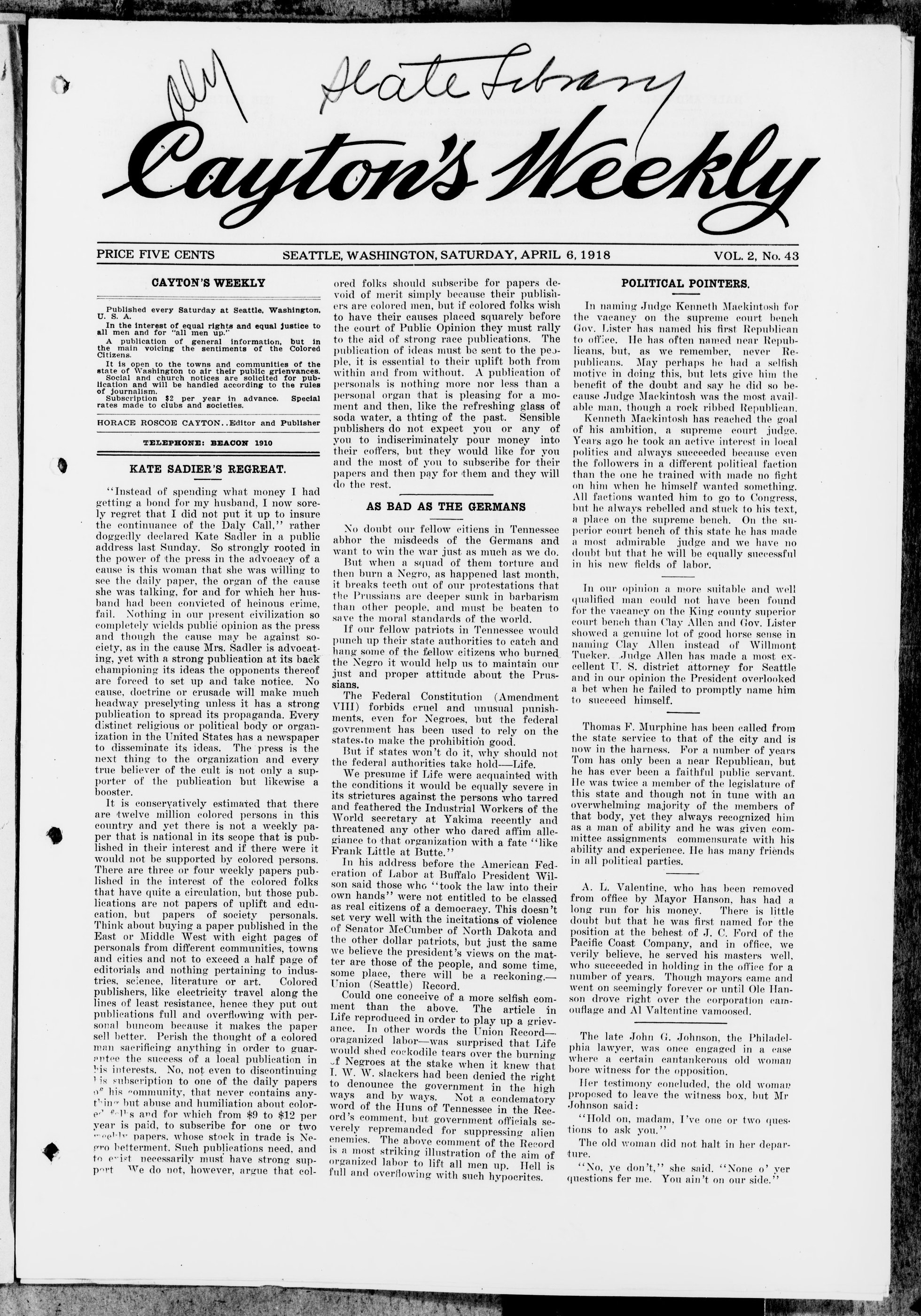
Cayton's Weekly
Saturday, April 6, 1918
Seattle, Washington
Page text (machine-generated)
State Library
Cayton's Weekly
PRICE FIVE CENTS
CAYTON'S WEEKLY
Published every Saturday at Seattle, Washington, U. S. A.
In the interest of equal rights and equal justice to all men and for "all men up."
A publication of general information, but in the main voicing the sentiments of the Colored Citizens.
It is open to the towns and communities of the state of Washington to air their public grievances. Social and church notices are solicited for publication and will be handled according to the rules of journalism.
Subscription $2 per year in advance. Special rates made to clubs and societies.
HORACE ROSCOE CAYTON..Editor and Publisher
TELEPHONE: BEACON 1910
KATE SADIER'S REGREAT.
"Instead of spending what money I had getting a bond for my husband, I now sorely regret that I did not put it up to insure the continuance of the Daly Call," rather doggedly declared Kate Sadler in a public address last Sunday. So strongly rooted in the power of the press in the advocacy of a cause is this woman that she was willing to see the daily paper, the organ of the cause she was talking, for and for which her husband had been convicted of heinous crime, fail. Nothing in our present civilization so completely wields public opinion as the press and though the cause may be against society, as in the cause Mrs. Sadler is advocating, yet with a strong publication at its back championing its ideas the opponents thereof are forced to set up and take notice. No cause, doctrine or crusade will make much headway preselyting unless it has a strong publication to spread its propaganda. Every distinct religious or political body or organization in the United States has a newspaper to disseminate its ideas. The press is the next thing to the organization and every true believer of the cult is not only a supporter of the publication but likewise a booster.
It is conservatively estimated that there are twelve million colored persons in this country and yet there is not a weekly paper that is national in its scope that is published in their interest and if there were it would not be supported by colored persons. There are three or four weekly papers published in the interest of the colored folks that have quite a circulation, but those publications are not papers of uplift and education, but papers of society personals. Think about buying a paper published in the East or Middle West with eight pages of personals from different communities, towns and cities and not to exceed a half page of editorials and nothing pertaining to industries, science, literature or art. Colored publishers, like electricity travel along the lines of least resistance, hence they put out publications full and overflowing with personal buncom because it makes the paper sell better. Perish the thought of a colored man sacrificing anything in order to guarantee the success of a local publication in his interests. No, not even to discontinuing his subscription to one of the daily papers of his community, that never contains anything but abuse and humiliation about colored folks and for which from $9 to $12 per year is paid, to subscribe for one or two weekly papers, whose stock in trade is Negro betterment. Such publications need, and to exist necessarily must have strong support. We do not, however, argue that col-
ored folks should subscribe for papers devoid of merit simply because their publishers are colored men, but if colored folks wish to have their causes placed squarely before the court of Public Opinion they must rally to the aid of strong race publications. The publication of ideas must be sent to the people, it is essential to their uplift both from within and from without. A publication of personals is nothing more nor less than a personal organ that is pleasing for a moment and then, like the refreshing glass of soda water, a thing of the past. Sensible publishers do not expect you or any of you to indiscriminately pour money into their coffers, but they would like for you and the most of you to subscribe for their papers and then pay for them and they will do the rest.
AS BAD AS THE GERMANS
No doubt our fellow citizens in Tennessee abhor the misdeeds of the Germans and want to win the war just as much as we do. But when a squad of them torture and then burn a Negro, as happened last month, it breaks teeth out of our protestations that the Prussians are deeper sunk in barbarism than other people, and must be beaten to save the moral standards of the world. If our fellow patriots in Tennessee would punch up their state authorities to catch and hang some of the fellow citizens who burned the Negro it would help us to maintain our just and proper attitude about the Prussians. The Federal Constitution (Amendment VIII) forbids cruel and unusual punishments, even for Negroes, but the federal govrenment has been used to rely on the states to make the prohibition good. But if states won't do it, why should not the federal authorities take hold—Life.
We presume if Life were acquainted with the conditions it would be equally severe in its strictures against the persons who tarred and feathered the Industrial Workers of the World secretary at Yakima recently and threatened any other who dared affim allegiance to that organization with a fate "like Frank Little at Butte."
In his address before the American Federation of Labor at Buffalo President Wilson said those who "took the law into their own hands" were not entitled to be classed as real citizens of a democracy. This doesn't set very well with the incitations of violence of Senator McCumber of North Dakota and the other dollar patriots, but just the same we believe the president's views on the matter are those of the people, and some time, some place, there will be a reckoning. Union (Seattle) Record.
Could one conceive of a more selfish comment than the above. The article in Life reproduced in order to play up a grievance. In other words the Union Record—oraganized labor—was surprised that Life would shed cockodile tears over the burning of Negroes at the stake when it knew that I. W. W. slackers had been denied the right to denounce the government in the high ways and by ways. Not a condematory word of the Huns of Tennessee in the Record's comment, but government officials severely repremanded for suppressing alien enemies. The above comment of the Record is a most striking illustration of the aim of organized labor to lift all men up. Hell is full and overflowing with such hypocrites.
VOL.2, No.43
POLITICAL POINTERS
In naming Judge Kenneth Mackintosh for the vacancy on the supreme court bench Gov. Lister has named his first Republican to office. He has often named near Republicans, but, as we remember, never Republicans. May perhaps he had a selfish motive in doing this, but lets give him the benefit of the doubt and say he did so because Judge Mackintosh was the most available man, though a rock ribbed Republican. Kenneth Mackintosh has reached the goal of his ambition, a supreme court judge. Years ago he took an active interest in local politics and always succeeded because even the followers in a different political faction than the one he trained with made no fight on him when he himself wanted something. All factions wanted him to go to Congress, but he always rebelled and stuck to his text, a place on the supreme bench. On the superior court bench of this state he has made a most admirable judge and we have no doubt but that he will be equally successful in his new fields of labor.
In our opinion a more suitable and well qualified man could not have been found for the vacancy on the King county superior court bench than Clay Allen and Gov. Lister showed a genuine lot of good horse sense in naming Clay Allen instead of Willmont Tucker. Judge Allen has made a most excellent U. S. district attorney for Seattle and in our opinion the President overlooked a bet when he failed to promptly name him to succeed himself.
Thomas F. Murphine has been called from the state service to that of the city and is now in the harness. For a number of years Tom has only been a near Republican, but he has ever been a faithful public servant. He was twice a member of the legislature of this state and though not in tune with an overwhelming majority of the members of that body, yet they always recognized him as a man of ability and he was given committee assignments commensurate with his ability and experience. He has many friends in all political parties.
A. L. Valentine, who has been removed from office by Mayor Hanson, has had a long run for his money. There is little doubt but that he was first named for the position at the behest of J. C. Ford of the Pacific Coast Company, and in office, we verily believe, he served his masters well, who succeeded in holding in the office for a number of years. Though mayors came and went on seemingly forever or until Ole Hanson drove right over the corporation camouflage and Al Valentine vamoosed.
The late John G. Johnson, the Philadelphia lawyer, was once engaged in a case where a certain cantankerous old woman bore witness for the opposition.
Her testimony concluded, the old woman proposed to leave the witness box, but Mr Johnson said:
"Hold on, madam, I've one or two questions to ask you."
The old woman did not halt in her departure.
"No, ye don't," she said. "None o' yer questions fer me. You ain't on our side."
```markdown
```
```markdown
```
HALF AND HALF.
As we have been doing all winter we are still getting up "foreday."
"I hear you have an auto Mrs. Red Peppers. Is it a machine or a Ford? Machine!
No, Jim Shepperson is not a philosopher, but he talks about as we imagine Diogenese did.
Save wheat! You bet we will, but for the love of Mike let down the price of your corn meal.
It was nice of Mayor Hanson to return the Pacific Coast Company its precious Valentine.
This spring as last Bill Kaiser marched up the hill to show how gracefully he could march down.
Tacoma has a silver tipped Fawcett, which was installed at great expense, that has sprung a leak.
Give us "democracy" in car load lots that we may be able to give democracy what Patty gave the drum.
Milwaukee is in the U. S. A. alright, but it endorsed Kaiser Bill at its election last Tuesday just the same.
Who said Wright is wrong might, after thinking it over, conclude Wright is right, especially when Wright is not wrong.
If a Legg can produce a store like unto the one at 1201 Jackson what in the duce and tomwalker would a whole body do along that line.
I am sending food to my hog; and next fall it will bring me forty bucks," said J. T. Gayton, and just think it will not have cost me but $38.
Eeach of the names of the two colored physicians of Seattle end with "well," but their patients are seldom as fortunate as the doctors names end.
Yes, I sell booze! What are you going to do about it? Tell the police. Is thasso? Well, I beat you to it and he already has his cut—Sam Johnsing.
If it be true that Germany lost a half a million men in its recent offensive the "march down the hill" is tended with many ghostly apparitions.
Seattle is more or less dry and gambling is on the toboggan and yet the town gives no signs of going into bankruptey. Could the brewers have been mistaken?
"Human liberty is no longer the plaything of monarch," says a writer. Quite right, brother, but human life is, judging from the daily reports from the war zone.
I will preach next Sunday on Mind and Matter, announced Rev Carter. The matter in your mind is de subject of Brer Carter's sermon next Sunday, solemnly related an aged memebr.
Jamison is looking for a suitable house and lot to buy, "and I will turn my machine in on it." Oh, yes, you plant to buy the lot and give the man your machine for the privilege." Oh gwan.
Of course the black folk are getting up faster in the South than in the North but they would not be if the Huns of the South were not rendering them valuable assistance with a hempen rope.
In trying to be a bigger man than Jim Shepperson Louis Toomer struck a blind snag and was forced to run up a distress signal. He is still waddling but the race is called off forever and one day after.
This is a sample text. The actual content may vary.
If the recent election in Wisconsin was a test of the popularity of the present National Democratic Administration in that neck of the woods then its popularity is badly shot to pieces.
Score one for the Woman's Political Alliance as Commissioner Ramsay has put Walter Washington temporarily on the courthouse force. He had been endorsed and recommended by the Alliance. Now lag for another ladies.
That Charity Begins at Home article in Cayton's Weekly three weeks ago made the Rev. J. N. Barbour smile so vociferously that a passerby was moved to inquire, "has Gabriel and his horn begun their final work?"
In a running argument with a member of the Mt. Zion Baptist Church the Rev. Maney stood almost speechless when the other fellow rather sarcasticly looked up and said: "All men are liars except you and I, and I have my doubts of you."
Not long since Theodore Roosevelt was introduced to a record breaking audience as "our next president," and while the people wildly cheered Teddy just smiled all over his face and he seemed to say, "Well, I have no objections."
If the Huns of Tennessee were sent to the war front and if they were as successful in taking human life at the front as they are in Tennessee then the Huns of Europe would soon be wriggling on a bon fire and the Tennessee Huns would be doing the can can.
Oh, I never eat a meal without my coffee, said the editor hereof, as he took a seat in a Tacoma restaurant and began looking over the bill of fare. He made his order and then noticed coffee was five cents extra and having but enough dough to pay for the meal we found we could eat without coffee.
How good a man Tom Murphine is for the job, to which he was recently appointed by Mayor Hanson know we not, but he would have to be an awfully bad man to camouflage the citizens of Seattle as has A. L. Valentine. If you d onothing more Ole you have made good. Here is our , shake.
As long as the Puget Sound Traction, Light and Power Company pays its men thirty four cents an hour just so long will it be hiring new men. Its a human impossibility for a man to feed his family when he only gets thirty four cents an hour for his labor.
Miss Dorcas McLeod of Charleston, S. C., has been stopping at the home of Mrs. A. R. Bonner for the past week. She is the matron for the Jenkin's Orphanage of Charleston and is in Seattle to deliver an orphan to the home of one of our citizens. She will speak next Sunday at 11 a. m. to the Mt. Zion Baptist Church and will doubtless tell of her work in her home city.
Like an irridescent dream does the news come to the Northwest that Charlie Parker of Spokane, now Lieutenant Parker of the U. S. A. is in an officer's training camp somewhere in Oklahoma receiving instructions in field fortifications from a French army officer, which, perhaps, is the finishing touch prior to sailing for France to take his place on the firing line. Charlie is a brainy boy and if he ever gets in action he will make his mark.
At a meeting held at the residence of Mrs. Bogardus to perfect a county organization for the betterment of babies, at which Mrs. Howard Brown, Mrs. Hattie Bowser, Mrs. A. R. Black and others were present the general outline for the work was set forth by Mrs. Bogardus. Mrs. Howard Brown and Mrs. Hattie Bowser were respectively named as president and secretary of a unit to be organized among the colored women of the city.
THE BLITHE SPIRIT.
Oh, Monday may be wheatless and Tuesday may be meatless, but I'll be happy still: if I can swat the foeman by skimping my abdomen, I'll do it with a will. The luscious ham and bacon by me will be forsaken, if that's the proper move; I'll cut out red meat dishes and feed on bony fishes, and chortle while I hoove. That gent is not a winner who kicks because his dinner is shy of pork or beef, who eats his wheatless ration and grumbles of privation, and airs a lot of grief. Some day perhaps we'll suffer; our diet may be tougher than we have ever known, before the war is ended we may think shavings splendid and gnaw old Towser's bone. We may all get together to eat a side of leather, before we end the war, our persons lank and hollow, we may be glad to swallow some boiled excelsior. Let's not pretend we're martyrs until we chew our garters and eat our Sunday shoes; let's eat the scheduled vittles and show no jots or tittles of grouches, dumps or blues. My health has been improving since I first started hooving, and eating simple fare; I have a better figure and I am full of vigor, my whiskers full of hair.
WALT MASON
NEGRO SOLDIERS IN THE WARS OF THE WORLD
By Irene McCov Gaines.
War of 1812—The Negro fought for the American government in increasing numbers in the war of 1812. With the same courage and valor which had distinguished his services in the Revolutionary War. By the year 1815 more than 300 Negroes had been recruited for the American army. On one occasion Adjutant General Livingston rode to the head of his troops and addressing the Negro soldiers among other things, said:
"I have found in you united to these qualities that noble enthusiasm which impels to great deeds."
In one of his hsitories, George W. Williams said of them:
"They were found to be brave and steady, performing with cheerfulness and celerity every order that was given them."
It is said that in the great battle of New Orleans it was thru the strategy and breastworks erected by the Negroes with bales of cotton, that American arms were triumphant and the final issue of the war decided in favor of American arms In the New Orleans Picayune some years later there appeared this glowing tribute to the Negro soldiers in the War of 1812:
"During the 36 years that have passed away since they assisted to repel the invaders from our shores, these faithful men have never before participated in the annual rejoicings for the victory which their valor contributed to gain. Their good deeds have been consecrated only in their memories, or lived but to claim a passing notice on the page of the historian. Yet, who, more than they deserve the thanks of the country and the gratitude of succeeding generations? Who endured more cheerfully the hardships of the camp, or faced with greater courage the perils of the fight?
Great Civil War—"The part enacted by the Negro soldier in the war of the Rebellion is the romance of North American history. It was midnight and noonday without a space between; from the Egyptian darkness of bondage to the lurid glare of civil war; from clanking chains to clashing arms; from passive submission to the cruel curse of slavery to the brilliant aggressiveness of a free soldier; from a chattel to a person; from the shame of degredation to the glory of military exaltation; and from deep obscurity to fame and martial immortality."
In 1860 the forces of freedom and slavery had come to the parting of the ways when Lincoln was elected president of the United States. Upon the hanging of John Brown and the secession of the states the supreme question that trembled upon every lip was, Shall the American Union survive and live? At first it was thought that the Rebellion could be suppressed with comparative ease and it was decided to conquer the Confeder-
acy with white troops, but the rebels captured Ft. Sumpter, and the defeat of the Union armies at Bull Run placed a different aspect upon the glory of the government toward the Negro as a soldier. It now became apparent that without his military services it was doubtful if the nation could live. The call for Negro volunteers was answered with nearly 200,000 strong. At Fort Pillow, Ft. Wagner, and Milligan's Bend his bravery and courage elecited the praise and plaudits of the world. In innumerable instances when the earth quaked, and sheet and fire flashed along the forts and the air was filled with demons of destruction and death, the enemy hissing, howling, screaming and leaping at their black victims—when the slaughter was dreadful, the shattered, quiveringng, bleeding columns only wheeled by companies to the rear, and formed and again gallantly dashed down thru the Valley of Death and charged for the guns. Owing to their fateful positions in each of these battles it was of no avail that these Negro soldiers fought like white veterans. The mill of death was grinding with great speed. Into these remorseless conflicts, bristling with bayonets and glinting with the red flash of cannon, the Negro troops were being hurled by the inexorable orders of Brigadier General William Dwight. Facing unsurmountable difficulties they were sternly told nothing would be considered accomplished unless they took the guns. Tho they knew someone had blundered.
Theirs is not to make reply,
Theirs not to reason why.
Theirs but to do and die. Not a man faltered when the torn and decimated lines were reformed and led over the same field to the same terrible fate. From the time of the enlistment of Negro soldiers until the close of the war the hope for the salvation of the Union grew stronger and brighter until thru the decision and courage and military prowess of the Negro soldiers victory was finally won.—Broadax.
AMERICA AND JAPAN.
(New Republic.)
America is utterly opposed to the occupation of Eastern Siberia by Japan. False witnesses may testify to a division of American opinion on the subject; they may swear themselves black all through that dissent from Japanese designs is only a Washington policy. The Japanese themselves must be shrewd enough to know that Washington is merely giving expression to a popular feeling that is very intense, very general. America is for free Russia and against autocratic Berlin, and would bitterly resent any act on the part of a friend and ally that seemed to give point to the German insinuation that free Russia has no sincerer support than that which Germany, in pursuance of her selfish interest, is willing to accord.
But Japan wants to go into Siberia. What if American opposition should give her mortal offense and tend to detach her from the allied cause? It is this fear that gives rise to whatever support the Siberian project has received in Amreica or among the liberals of England and France. To acknowledge it is quite out to keeping with allied affirmations of confidence in the integrity of Japanese intentions. Can Japan not be counted on to remain loyal unless she is permitted to pursue her own designs, whether these appear politic or impolitic, legitimate or illegitimate to her allies? For our part, we shall continue to believe that with Japan as with ourselves, the common cause is paramount. But beyond this we believe that Japanese statesmanship is intelligent, and will not out of a sense of national pique swear from its obligation to protect the permanent interests of the Japanese nation. And it is to the permanent interest of Japan to remain on terms of amity with the nations composing the anti-German alliance, and especially with the United States. This conclusion we base, not upon moral consideration alone, but upon the solid facts of geography and economics.
Let us first glance at the commercial relations between the two countries before they
were disturbed by conditions of war. In 1913 America was Japan's best customer, taking from her goods to the value of 184. 000,000 yen. China came next, absorbing goods worth 154,000,000 yen. France took 60,000,000 yen, Great Britain, 32,000,000; Italy, 29,000,000; British India, 29,000,000; Germany, only 13,000,000. Japan was also a good customer of ours, taking goods from us worth 122,000,000 yen, as compared with 173,000,000 from British India, 122,000,000 from Great Britain, 68,000,000 from Germany, 65,000,000 from China, 37,000,000 from the Dutch Indies, 24,000,000 from IndoChina, 6,000,000 from France, and 1,000,000 from Italy. In the mercantilistic terms that still pass current among statesmen, the United States and China are the chief factors making for a favorable balance in Japan's trade, although France and Italy range themselves on the same side of the balance. The trade of the Indian Ocean and the trade with Great Britain and Germany make for an unfavorable balance.
But national economic philosophy occupies itself with the qualities of imports and exports as well as with the quanaities. One country imports food stuffs, raw materials and other means of production; another imports luxuries and highly finished products. National economics adjudges the major advantage to the former. Laissez-faire economics do indeed deny that the advantage can be allocated in this way, and they may be right. But laissez-faire economics does not dominate the statecraft of either Japan or America. Both nations survey the qualities of imports and exports with great solicitude. Now, from this point of view, the advantage of trade again lies with Japan. What she exports to the United States is mainly silk, 125,000,000 yen out of 184,000,000. Tea is her next largest export, with 8,000,000 yen; miscellaneous manufactures make up most of the rest. All these goods are luxuries, the product of much labor, making only an insignificant drain upon the natural desources of Japan. What Japan imports from the United States is raw cotton, 64,000,000 yen out of a total of 122,000,000; wheat, 9,500,-000, and for the rest miscellaneous materials of production. In other words, what Japan sends to us enriches our consumption; what we send to Japan enriches her production. We send Japan raw cotton to be worked up into cheap stuffs wherewith to supply the China trade; Japan sends us raw silk to be worked up into products wherewith to display our own wealth to ourselves. Moreover, a considerable fraction of the Japanese silk exports credited to France and Italy are destined ultimately for American consumption. It may be predicted that after the war we shall be of still greater relative importance to the Japanese silk industry Europe will not consume much silk, for a while.
The trade of 1913 is interesting chiefly as it foreshadows coming developments. There is no question whatever that a brilliant commercial and industrial future is in store for Japan, if she plays her cards well. She has a great industrious population, easily adaptable to all the requirements of trade and industry. Behind her lies the vast Asiatic mainland, rich in labor power. It has been held back solely by want of enterprise and capital. Japan is rapidly developing the necessary qualities of enterprise. She is accumulating capital, but for the present the rate of accumulation is slow; Japan is poor. America, on the other hand, promises to be for some time the world's chief source of capital. If Japan can draw upon American capital to develop the natural resources of the Asiatic hinterland and to develop her own industry to a point where full advantage can be taken of such resources, her economic future is assured. More and more the products of the West, destined for consumption in China or India, or the islands of the sea, will go to Japan in the shape of raw materials, to be worked up by Japanase industry. More and more the products of the East will reach the world via Japan, after Japanese labor has improved them and increased them in value. A carrying trade of immense proportions will spring up about
the shores of Asia and over the Pacific, and Japan can make this trade chiefly her own. Japan can become in the twentieth century Pacific what England became in the nineteenth century Atlantic.
But all this is dependent upon Japan's managing to live in amity with the western world, especially America and England. The essential problem is one of drawing wealth to Eastern Asia by the instrumentality of Japanese commerce and industry. If Eastern Asia were to be made a closed economic system, it would remain poor and backward for generations. And so long as it is poor and backward there is a danger that the profits of developing it will lure the western nations to an imperialistic competition with Japan. If Japan is to achieve the role of greatness that geography has marked out for her, she will wisely make haste to develop her industrial and trading wealth. She will pursue policies that disarm suspicion and circumvent any movement in America toward prohibitive duties on imported luxuries or toward the creation of a heavily subsidized American merchant marine in the Pacific. When Japan is older, economically, she may be able to meet discrimination with discrimination. For the present, however, she cannot do this.
Still, would not territorial acquisitions in China and Siberia offer a fair compensation for any commercial losses a resentful western world might inflict upon Japan? Territorial acquisitions have permanent value to a nation only as they improve her strategic position or increase her commerce. Whether the possession of Eastern Siberia would improve Japan's strategic position is, at least, doubtful. A blow aimed at Japan from Vladivostok would be easier to ward off than a blow aimed at Japanese mainland possessions from the Russian hinterland. Eastern Siberia might indeed offer vacant lands for an overflow of Japanese population, but the Japanese are not a people who take naturally to the settlement of vacant lands under a subarctic sky. But suppose Japan actually succeeded in opening a channel for the outflow of population to the mainland, what would be the permanent gain? No modern state has ever thus won relief from overpopulation. Emigration amounts to nothing more than dipping intermittently from a flowing stream.
It is the experience of the west that no relief from general poverty is to be had through emigration, either to alien lands or to settlement colonies. The one possible method of raising the national standard of life consists in the development of commerce and industry. Following this method, England grew rich; so long as she followed this method, Germany, without a settlement colony in the world, gained more rapidly in wealth than any other European nation. By the same method Japan may raise herself to the western level of wealth in one generation, or at most in two. Will she repudiate this method to follow the ways of an imperialism that has brought the western world to the verge of ruin? If she does, she is likely to find America, which might have been her most useful friend, accepting the role of her most jealous antagonist, her most dangerous rival.
A rather raw servant girl was told to order the family vegetables at the grocer's. After booking what was asked for, the tradesman queried: "Will your mistress want any horseradish today? Some just in, nice and fresh."
Tossing her head, Mary Jane said:
"No, indeed; we want no such thing, I know. My master keeps a motor car."
Sherlock Holmes was taking a holiday.
"Ah, my dear Watson," he said, as he sat down to breakfast at his boarding house, "I see we have a new cook!"
"How do you make that out?" asked Dr. Watson.
"There are different thumbprints on the plates," replied the great detective.
Cayton's Weekly publishes legal notices at current rates. Main 24.
```markdown
```
```markdown
```
HERE'S WHERE THEY SMILE
A certain stock broker went to a horse dealer and tried to pick up a general utility nag. He explained that he wanted a nice, quiet good looking animal for himself, which would be driven by his wife in a dog cart and would not object to being hitched up to a lawn mower.
The dealer listened with rapt attention and finally asked in dulcet tones: "Would you like him to wait at the table at all, sir?"
"I wouldn't drink out of that cup if I were you." said the little boy at the pump. "That is Bessie's cup and she has just been drinking out of it."
"Oh," said the gay young man from the city, as he drained the cup, "I don't mind. I feel honored to drink out of Bessie's cup. Who is she, your sister?" "No, sir; my dog."
Master Walter, aged 4, had eaten the soft portions of his toast at breakfast on his plate.
"When I was a boy," remarked his father, who sat opposite him "I always ate the crusts of my toast."
"Did you like them?" inquired his offspring cheerfully.
"Yes," replied the parent.
"Then you may have these," said Master Walter, pushing his plate across the table.
"Now, here is a showcase," said the dealer, pointing to a peculiar looking specimen of his wares, "that is bound to become popular. It magnifies everything put in it to double its natural size."
"Can't use it in my business," replied the prospective customer. "What I want is a case that will seemingly reduce the actual size of its contents fully one-half."
"What is your line?" 'asked the dealer.
"My specialty is ladies' shoes."
"What!" cried the careful housewife. "You charge me a quarter a pound for these apples?" "Yes, ma'am," answered the polite grocer, "that is the very lowest price we can sell them for." "How is it that I can get them from Todd's for 15 cents, then?" "I cannot say, madam. Perhaps Mr. Todd has taken a fancy to you. He is a widower and you are beautiful. Unfortunately, I—Yes'm, two pounds? Certainly." Mrs. Frippery wasn't an expert cook, and even the mention of cooking roused all her fighting qualities.
"Did you make these bisceuits, dear?" asked her husband, of course meaning no harm.
"I did," said his wife, preparing for a skirmish.
"They're smaller than usual, aren't they?" said hubby.
"They are," said his wife. "That's so you will have less to find fault with!"
The fact that Sir Douglas Haig attained his fifty seven birthday on June 19 brings back to mind a story told of him a short while back.
It is, of course, well known that Sir Douglas is a soldier first, last and all the time, regarding all other professions as of quite negligible importance, a trait in his character which lends point to the anecdote.
He was, it appears, inspecting a cavalry troop, and was particularly struck with the neat way in which repairs had been made in some of the saddles.
"Very good work," he remarked to the troop major. "Who did it?"
"Two of my troopers, sir," was the reply.
"You're fortunate to have two such expert saddlers in your troop," said Haig.
"As a matter of fact, sir," was the reply, "they're not saddlers, in civil life being lawyers"
"Well," ejaculated Sir Douglas, "how men who can do work like that could have wasted their lives over law I can't imagine!"
FOR RENT—One or two furnished rooms for men. Good accommodations. Ballard 1975.
STATEMENT OF THE OWNERSHIU, MANAGEMENT, CIRCULATION, ETC., REKUIRED BY THE ACT OF CONGRESS OF AUGUST 24, 1912
Of Cayton's Weekly, published weekly at Seattle for April, 1918.
State of Washington, County of King.—ss.
Before me, a notary public in and for the State and county afonzaaid, personally appeared Horace Roscoe Cayton, who, having been duly sworn on cording to law, deposes and says that he is the editor of the Cayton's Weekly and that the following is, to the best of his knowledge and belief, a true statement of the ownership, management (and if a daily paper, the circulation), etc, of the aforesaid publication for the date shown in the above caption, required by the Act of August 24, 1912, embodied in section 443, Postal Laws and Regulations, printed on the reverse of this form, to-wit:
4. That the two paragraphs next above, giving the names of the owners, stockholders, and security holders, if any, contain not only the list of stockholders and security holders as they appear upon the books of the company but also, in cases where the stockholder or security holder appears upon the books of the company as trustee or in any other duiary relation, the name f the person or corporation for whom such trustee is acting, is given; also that the said two paragraphs contain statements embracing affiant's full knowledge and belief as to the circumstances and conditions under which stockholders and security holders who do not appear upon the books of the company as trustees, hold stock and securities in a capacity other than that of a bona fide owner; and this affiant has no reason to believe that any other person, association, or corporation has any interest direct or indirect in the said stock, bonds, or other securities than as so stated by him.
5. That the average number of copies of each issue of this publication sold or distributed, through the mails or otherwise, to paid subscribers during the six months preceding the date shown above is (This information is required from daily publications only.)
Sworn to and subscribed before me this 4th day of April, 1918.
IN THE SUPERIOR COURT OF THE STATE OF Washington for King County.
Parilee Leaf, Plaintiff, vs. Sam Leaf, Defendant.—No. .... Summons by Publication.
The State of Washington to the said Sam Leaf, Defendant:
You are hereby summoned to appear within sixty days after the date of the first publication of this summons. to-wit: within sixty days after the 6th day of April, 1918, and defend the above entitled action in the above entitled court, and answer the complaint of the plaintiff, and serve a copy of your answer upon the undersigned attorney for plaintiff at his office below stated; and in case of your failure so to do, judgment will be rendered against you according to the demand of the complaint, which has been filed with the clerk of said court.
The object of the above entitled action is to obtain a decree of divorce from the defendant by the plaintiff on the ground of desertion, and for the restoration of her former name, Parilee Townsend, and likewise the real estate, lot 18, block 2 of Highland View, an addition to the city of Seattle, King County, Washington.
Attorney for Plaintiff.
P. O. Address, 316 Pacific Block, Seattle, Wash.
April 6—May 18, 1918.
ALHAMBRA CASH GROCERY
H. Legg, Prop. W. H. Banks, Mgr.
We Carry a Full Line of Fancy and
Staple Groceries
WE KINDLY INVITE YOUR INSPECTION
Our New Store:
1201-3 Jackson St. Phone Beacon 505
TUTT'S BARBER SHOP "He wants to see you." High-class
Tonsorial Work. 300 Main Street, Seattle. Latest
race papers. All kinds of toilet supplies.
CAYTON'S
WEEKLY
BEACON
513 Pacific Blk. 1910
IN THE SUPERIOR COURT OF THE STATE OF Washington, for King County.—In Probate. In the matter of the estate of Frank O'Neil, alias Mitro Bossaroba, Deceased.—No. 22884. Notice to Creditors.
Notice is hereby given that the undersigned has been appointed and has qualified as administrator of the estate of Frank O'Neil, alias Mitro Bassaroba, Deceased; that all persons having claims against said deceased are hereby required to serve the same, duly vrified, on said administrator at the address below stated, and file the same with the Clerk of said Court, together with proof of such service within six months after the date of first publication of this notice, or the same will be barred.
Date of first publication March 30, 1918.
ANDREW R. BLACK,
Administrator of said Estate.
Address: 316 Pacific Block, Seattle, Wash.
ANDREW R. BLACK,
Attorney for Estate.
316 Pacific Block, Seattle, Wash.
March 30—May 11, 1918.
IN THE SUPERIOR COURT OF THE STATE OF
Washington for King County.
Saddie Nettleton, Plaintiff, vs. Eugene Nettleton,
Defendant.—No. ..... Summons by Publication.
The State of Washington to the said Eugene Nettle-
ton, Defendant:
You are hereby summoned to appear within sixty days after the date of the first publication of this summons, to-wit: within sixty days after the 30th day of March, 1918, and defend the above entitled action in the above entitled court, and answer the complaint of the plaintiff, and serve a copy of your answer upon the undersigned attorney for plaintiff at his office below stated; and in case of your failure so to do, judgment will be rendered against you according to the demand of the complaint, which has been filed with the clerk of said court.
The object of the above entitled action is to obtain a decree of divorce from the defendant by the plaintiff on the ground of desertion.
ANDREW R. BLACK.
Attorney for Plaintiff.
P. O. Address, 316 Pacific Block, Seattle, Wash.
March 30—May 11, 1918.
IN THE SUPERIOR COURT OF THE STATE OF Washington for King County.
Myrtle Carpenter, Plaintiff, vs. Paul Carpenter, Defendant.—No. ..... Summons by Publication.
The State of Washington to the said Paul Carpenter, Defendant:
You are hereby summoned to appear within sixty days after the date of the first publication of this summons. to-wit: within sixty days after the 30th day of March, 1918, and defend the above entitled action in the above entitled court, and answer the complaint of the plaintiff, and serve a copy of your answer upon the undersigned attorney for plaintiff at this office below stated; and in case of your failure so to do, judgment will be rendered against you according to the demand of the complaint, which has been filed with the clerk of said court.
The object of the above entitled action is to obtain a decree of divorce from the defendant by the plaintiff on the ground of desertion.
ANDREW R. BLACK.
Attorney for Plaintiff.
P. O. Address, 316 Pacific Block, Seattle, Wash.
March 30—May 11, 1918.
IN THE SUPERIOR COURT OF THE STATE OF Washington, in and for the County of King.
In the Matter of the Dissolution of Toyo Shokai, a corporation.—No. 128072. Notice of Dissolution of Corporation.
Notice is hereby given that Toyo Shokai, a Washington corporation, with headquarters at Seattle, has petitioned the King County Superior Court for authority to disincorporate and dissolve.
Notice is hereby given that said application will be heard in Department No. 1. of the King County Superior Court on the 28th day of May. 1918. Datd at Seattle, Wash., March 29th, 1918. PERCY F. THOMAS. County Clerk. By W. F. HOTT, Deputy.
A. R. BLACK,
316 Pacific Block.
March 30-May 25. 1918
DR. J. A. GHENT, SPECIALIST In Surgery and Gynecology has removed his office from the Marion Bldg. to 221 and 222 Seaboard Bldg., formerly Northern Bank Bldg., corner Westlake and Pine. Tel. Main 1185.
BURR WILLIAMS RUSSELL SMITH
President Secretary
DUMAS CLUB, INC.
209 Fifth Avenue South
CAFE IN CONNECTION
Phone Elliott 3763
SEATTLE WASHINGTON
THE DOUGLAS CLUB
Now Occupies spacious and elegantly
furnished and equipped
NEW QUARTERS
And will be pleased to meet old and
new friends
208 Washington St. Frank Smith, Prop.
Main 4930
---