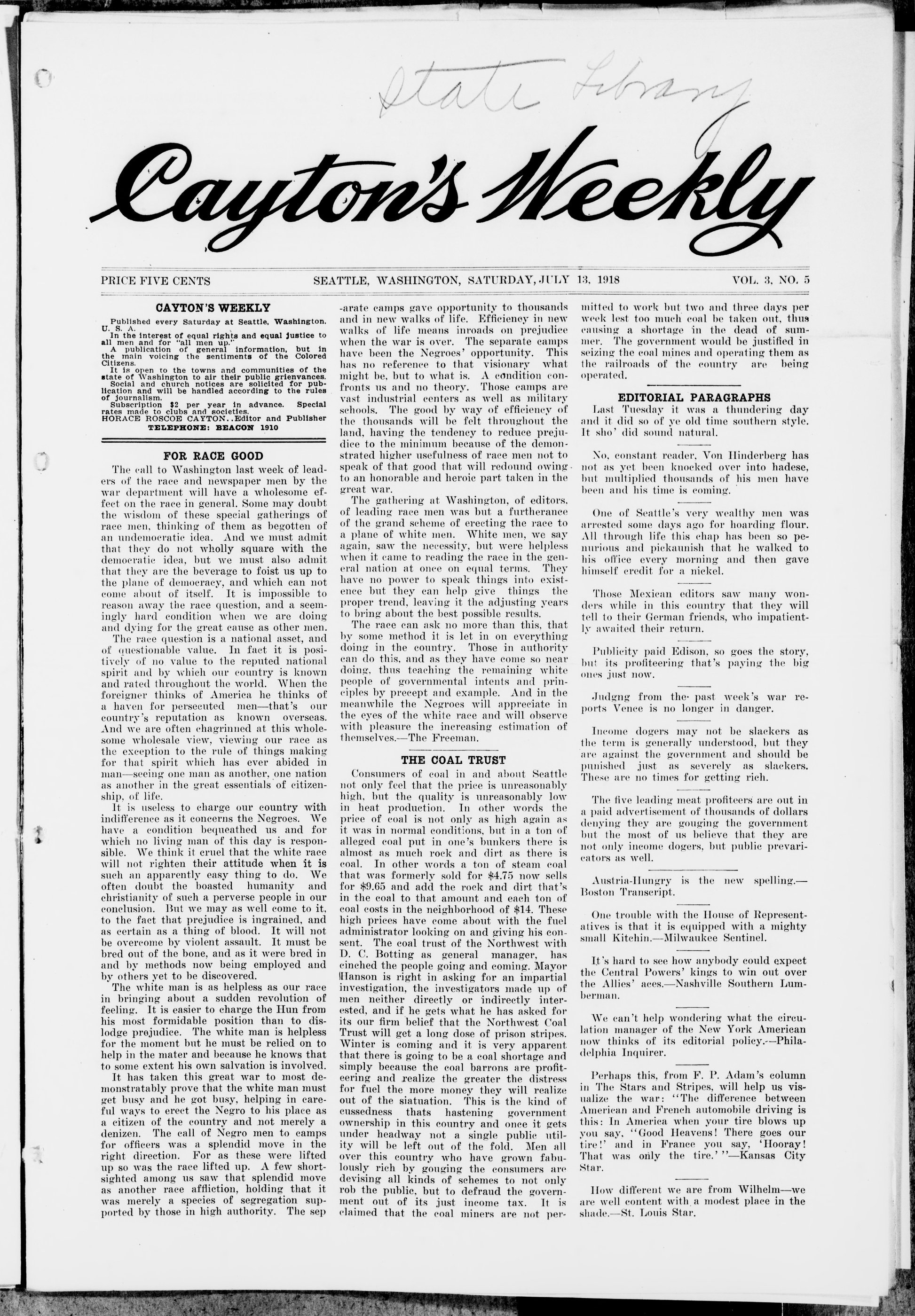
Cayton's Weekly
Saturday, July 13, 1918
Seattle, Washington
Page text (machine-generated)
---
PRICE FIVE CENTS
CAYTON'S WEEKLY
Published every Saturday at Seattle, Washington. U. S. A. In the interest of equal rights and equal justice to all men and for "all men up." A publication of general information, but in the main voicing the sentiments of the Colored Citizens.
It is open to the towns and communities of the state of Washington to air their public grievances. Social and church notices are solicited for publication and will be handled according to the rules of journalism.
Subscription $2 per year in advance. Special rates made to clubs and societies. HORACE ROSCOE CAYTON..Editor and Publisher
TELEPHONE: BEACON 1910
FOR RACE GOOD
The call to Washington last week of leaders of the race and newspaper men by the war department will have a wholesome effect on the race in general. Some may doubt the wisdom of these special gatherings of race men, thinking of them as begotten of an undemocratic idea. And we must admit that they do not wholly square with the democratic idea, but we must also admit that they are the beverage to foist us up to the plane of democracy, and which can not come about of itself. It is impossible to reason away the race question, and a seemingly hard condition when we are doing and dying for the great cause as other men.
The race question is a national asset, and of questionable value. In fact it is positively of no value to the reputed national spirit and by which our country is known and rated throughout the world. When the foreigner thinks of America he thinks of a haven for persecuted men—that's our country's reputation as known overseas. And we are often chagrinned at this wholesome wholesale view, viewing our race as the exception to the rule of things making for that spirit which has ever abided in man—seeing one man as another, one nation as another in the great essentials of citizenship, of life.
It is useless to charge our country with indifference as it concerns the Negroes. We have a condition bequeathed us and for which no living man of this day is responsible. We think it cruel that the white race will not righten their attitude when it is such an apparently easy thing to do. We often doubt the boasted humanity and christianity of such a perverse people in our conclusion. But we may as well come to it, to the fact that prejudice is ingrained, and as certain as a thing of blood. It will not be overcome by violent assault. It must be bred out of the bone, and as it were bred in and by methods now being employed and by others yet to be discovered.
```markdown
```
The white man is as helpless as our race in bringing about a sudden revolution of feeling. It is easier to charge the Hun from his most formidable position than to dislodge prejudice. The white man is helpless for the moment but he must be relied on to help in the mater and because he knows that to some extent his own salvation is involved. It has taken this great war to most demonstratably prove that the white man must get busy and he got busy, helping in careful ways to erect the Negro to his place as a citizen of the country and not merely a denizen. The call of Negro men to camps for officers was a splendid move in the right direction. For as these were lifted up so was the race lifted up. A few shortsighted among us saw that splendid move as another race affliction, holding that it was merely a species of segregation supported by those in high authority. The sep
-arate camps gave opportunity to thousands and in new walks of life. Efficiency in new walks of life means inroads on prejudice when the war is over. The separate camps have been the Negroes' opportunity. This has no reference to that visionary what might be, but to what is. A condition confronts us and no theory. Those camps are vast industrial centers as well as military schools. The good by way of efficiency of the thousands will be felt throughout the land, having the tendency to reduce prejudice to the minimum because of the demonstrated higher usefulness of race men not to speak of that good that will redound owing to an honorable and heroic part taken in the great war.
The gathering at Washington, of editors, of leading race men was but a furtherance of the grand scheme of erecting the race to a plane of white men. White men, we say again, saw the necessity, but were helpless when it came to reading the race in the general nation at once on equal terms. They have no power to speak things into existence but they can help give things the proper trend, leaving it the adjusting years to bring about the best possible results. The race can ask no more than this, that by some method it is let in on everything doing in the country. Those in authority can do this, and as they have come so near doing, thus teaching the remaining white people of governmental intents and principles by precept and example. And in the meanwhile the Negroes will appreciate in the eyes of the white race and will observe with pleasure the increasing estimation of themselves.—The Freeman.
THE COAL TRUST
Consumers of coal in and about Seattle not only feel that the price is unreasonably high, but the quality is unreasonably low in heat production. In other words the price of coal is not only as high again as it was in normal conditions, but in a ton of alleged coal put in one's bunkers there is almost as much rock and dirt as there is coal. In other words a ton of steam coal that was formerly sold for $4.75 now sells for $9.65 and add the rock and dirt that's in the coal to that amount and each ton of coal costs in the neighborhood of $14. These high prices have come about with the fuel administrator looking on and giving his consent. The coal trust of the Northwest with D. C. Botting as general manager, has cinched the people going and coming. Mayor Hanson is right in asking for an impartial investigation, the investigators made up of men neither directly or indirectly interested, and if he gets what he has asked for its our firm belief that the Northwest Coal Trust will get a long dose of prison stripes. Winter is coming and it is very apparent that there is going to be a coal shortage and simply because the coal barrons are profit-eering and realize the greater the distress for fuel the more money they will realize out of the siatuation. This is the kind of cussedness thats hastening government ownership in this country and once it gets under headway not a single public utility will be left out of the fold. Men all over this country who have grown fabulously rich by gouging the consumers are devising all kinds of schemes to not only rob the public, but to defraud the government out of its just income tax. It is claimed that the coal miners are not per-
VOL. 3. NO. 5
mitted to work but two and three days per week lest too much coal be taken out, thus causing a shortage in the dead of summer. The government would be justified in seizing the coal mines and operating them as the railroads of the country are being operated.
EDITORIAL PARAGRAPHS
Last Tuesday it was a thundering day and it did so of ye old time southern style. It sho' did sound natural.
No, constant reader, Von Hinderberg has not as yet been knocked over into hadese, but multiplied thousands of his men have been and his time is coming.
One of Seattle's very wealthy men was arrested some days ago for hoarding flour. All through life this chap has been so penurious and pickaunish that he walked to his office every morning and then gave himself credit for a nickel.
Those Mexican editors saw many wonders while in this country that they will tell to their German friends, who impatiently awaited their return.
Publicity paid Edison, so goes the story, but its profiteering that's paying the big ones just now.
Judgng from the past week's war reports Vence is no longer in danger.
Income dogers may not be slackers as the term is generally understood, but they are against the government and should be punished just as severely as slackers. These are no times for getting rich.
The five leading meat profiteers are out in a paid advertisement of thousands of dollars denying they are gouging the government but the most of us believe that they are not only income dogers, but public prevaricators as well.
Austria-Hungry is the new spelling.—Boston Transcript.
One trouble with the House of Representatives is that it is equipped with a mighty small Kitchin.—Milwaukee Sentinel.
It's hard to see how anybody could expect the Central Powers' kings to win out over the Allies' aces.—Nashville Southern Lumberman.
We can't help wondering what the circulation manager of the New York American now thinks of its editorial policy.—Philadelphia Inquirer.
Perhaps this, from F. P. Adam's column in The Stars and Stripes, will help us visualize the war: "The difference between American and French automobile driving is this: In America when your tire blows up you say, 'Good Heavens! There goes our tire!' and in France you say, 'Hooray! That was only the tire.'"—Kansas City Star.
How different we are from Wilhelm—we are well content with a modest place in the shade.—St. Louis Star.
---
N
TOWN TOPICS
Mrs. Thomas McPherson has gone to California and will be away for a month or more. Mr. McPherson has been employed for ten years in the street department of the city and is one of the heavy realty owners of the city among the colored citizens. The Masons of the state and jurisdiction held their annual conclave in Everett this week and many of Seattle's prominent personages visited the sessions. Grand Master Holmes was on the Sound ahead of time, looking over the field and incidentally to meet old friends on the Sound.
From Portland comes the report that many of Seattle's former sporting fraternity are now employed in the ship yards there. Don Wormley is a foreman and Blackie Williams and Noodle Smith are strong clerks in the establishment. It seems that the colored men are given a better show in the yards down there than they are in Seattle, which may mean others will leave for Portland.
Mr. and Mrs. Floyd Wright reached Seattle last Wednesday evening direct from Camp Grant. Mr. Wright left Seattle last year for Camp Lewis and was transferred from there to Camp Grant, where he has been in the military service of the U. S. Government. He was temporarily discharged from the army at the request of his wife. Mrs. Wright was formerly Miss Ruth Cayton. Mr. Wright wil seek employment in Seattle.
Some three weeks ago Cayton's Weekly copied from a Los Angeles paper the announcement to the effect that Gene Johnson had purchased a drug store in that city, which pleased well the readers hereof. Now the public will be gratified to know that his sister, Miss Edna Johnson, has gone thither to act as cashier for the establishment. Both brother and sister are well and favorably known in Seattle and Mr. Johnson's wife is a Seattle girl.
Rev. W. D. Carter left last Monday for Butte, Montana, where he dedicated a Baptist church. The A. M. E. church for some years had a congregation there and owned an edifice in which services were held, but for some reason it withdrew from that city and the Baptist on seeing an opportunity to get hold of the building raised the money and purchased the property and the same, as said above, has been dedicated by the Rev. W. D. Carter and others.
Each and every member of the Mt. Zion Baptist Church can not only congratulate the other fellow, but likewise him or herself for the final results of the financial report at the closing rally. Some weeks ago the church resolved itself into a committee of the whole and set out to raise $5000 which would be the purchase price of the Louis Levy property, on which a church edifice is to be erected and while the $5000 mark was not quite reached, yet they got in hailing distance, the sum of $4,500 being raised and the same placed in a bank to the credit of the church. The property cost $6000 and deducting the amount raised from that only $1,500 is unpaid. Now as soon as the congregation disposes of its present church site, which can be done at a splendid figure, the trustees will be able to erect the new church edifice and when dedicated it will be practically free from any encumbrance. The entire membership of the Mt. Zion Baptist is to be congratulated for the splendid work all have done.
Under the auspices of a committee of entertainment and arrangement created by the body politic of the Grace Presbyterian Church, the Rev. Barber, pastor of the church, was given a warm welcome by the members of the church, as well as many well wishers of the church last Monday evening. John F. Cragwell was master of ceremonies and after briefly stating the cause for the presence of so many of Seattle's foremost colored citizens, introduced
H. R. Cayton as the first speaker of the evening, who speaking for the citizens in general welcomed the new pastor to the city and bade him Godspeed in his pastorial duties. Abner Jones spoke for the Sunday school; Mrs. Eugene A. Johnson for the missionary society; Rev. D. A. Graham on behalf of the A. M. E. Church; Mr. Yancey on behalf of the Mt. Zion Baptist Church. Mr. and Mrs. Chatters rendered a vocal and an instrumental solo. Mrs. F. F. Keeble rendered a vocal solo, which was well received and Miss Loretta Sanders rendered a very appropriate instrumental solo. To all of the above welcoming addresses and musical renditions the Rev. Barber most feelingly responded. Said he, "I want to become identified with your city. I want to be a member of your clubs and organizations for the uplift. I want to be a help to humanity without regard to race, color or creed. While I am here specifically to build up Grace Presbyterian Church, yet it is not my intention to be narrow and bias in my work, but work for the general good of all. I want to know your city not only geographically but personally." After the program refreshments were served.
HOW GERMAN BAPTISTS ARGUE
Almost the first ray of light on the mystery of the German religious psychology in respect to the war comes at last from the German Baptists. The Watchman-Examiner (New York reports that several months ago the Baptist Union of Great Britain and Ireland addressed a letter to the Baptists of Sweden explaining their attitude to the war and giving a reasoned statement of the case from the point of view of the Allies. This was transmitted to the German Baptists, and their reply shows how schooled the subjects of the Kaiser have become in parceling and docketing the properties of their intellectual and religious life as well as the elements of their material possessions. The direct answer is not quoted by this American Baptist paper, but we get the gist of it, together with the effect it produces on their Anglo-Saxon brethren of the Baptist faith:
"This reply, which is signed by four of the best-known Baptist ministers and laymen in Germany, opens with a striking admission which goes far to explain the attitude of the churches in Germany to the war and to their own Government. 'In principle,' it says, 'we keep politics and religion apart. We have not considered it our duty as a church to be occupied with political affairs.' The whole letter is really a commentary on these words. The Baptists have clearly taken as true, and without investigation, anything and everything the German Government has told them. They re-
THE PROFIT SHARING ASSOCIATION Incorporated
H. C. Bell, Pres. A. R. Bonner, Vice-Pres.
S. E. Buxton, Sec. & Treas.
C. J. Johns, Director
Phone Main 3203
ANNOUNCEMENT
On Saturday, July 6, 1918, we will open our grocery store, at 1024 Jackson St., Seattle, Wash., with a full fresh line of staple groceries. We aim to sell for less, therefore we invite your inspection.
Our slogan is—THE PROFIT IS YOURS.
We wish to cater especially to our people, so give us a trial, and we will do the rest.
Respectfully yours for business,
THE PROFIT SHARING ASSOCIATION Incorporated
ject as a malicious libel on the Government and people alike the statement that the former has 'carried on a warlike policy in any way opposed to the will of the people.'
"The statement as to the causes of the war is in line with this absolute reliance upon the assertions of their Government. The fault was entirely England's. The sole danger to peace was her 'encircling policy' and her insistence on the 'two-Power naval standard.' It was only when Germany was faced by 'bitter necessity' that she 'drew the sword in defense of her existence.' The statement of the British Baptists that England had tried for years to avert the danger of war and to reduce armaments is characterized as an 'unconscious untruth.'
"The most astounding part of the German Baptists' reply is their justification of the violation of Belgian neutrality, on the double ground that respect for it would not have kept England out of the war, and that Belgian neutrality was a fiction. England, is their astonishing assertion, is really responsible for the 'much inconvenience' suffered by Belgium, for it was England that prevented Belgium from accepting Germany's generous offer of a guaranty of indemnity and independence if she allowed a free passage to the German army. It is, therefore, they conclude, the duty of England, not of Germany, to compensate Belgium for the losses entailed by her refusal. This phrase, 'much inconvenience,' is the only reference in the whole letter to the atrocities of which Belgium has been the victim.
"With regard to the intervention of America there is not a single word about the submarine war and the outrages which forced her to take part in the struggle. The reason assigned for her intervention is that she saw no other way of saving the vast sums she had lent to the Allies. From beginning to end of the document there is no hint that Germany has done a single thing of which she need be ashamed."
The British Baptist Union have sent a second manifesto in which the points of the German letter are taken up and the arguments refuted. Reliance to support their case is placed on the revelations of Prince effect will be doubtless depends on the Lichnowsky and Dr. Muhlon, but what the drama played on the West Front.—Literary Digest.
A HUNDRED PER CENT AMERICAN If you see yourself grow daily thinner. From your cook's idea of a Hoover dinner; If you had four lumps of anthracite And gave your neighbor two last night; If your pipes froze up and made a leak And you wade around in a private creek; And the plumber won't come for love or money
And still you pretend to think it's funny;
If your car gets stuck in a twelve-foot drift,
And no one comes to give you a lift,
And you ride in a street car a la sardine,
And reach your work at ten-fifteen,
You must think of the boys in distant camps
And then fill up on Savings Stamps;
If you've boarded money to take in a show
And you're all dressed up and no place to go;
If you can let the mercury drop to zero
And not swell up and think you're a hero;
If your church is closed to save some coal
And you stand a chance of losing your soul,
But grin some more and never let go,
And keep your religion at 19 below.
If your business profits swiftly diminish,
And still you're in this war to the finish,
And you grin and grin and work with a will
For the one big purpose of squelching "Bill";
If you can do all this, you're more than a man.
You're a hundred per cent American. From the Railway Conductor.
She Knew the Symptoms.—"Charley, dear," said young Mrs. Torkins in a tone that was kind but firm, "did you tell me you were up late last night with a sick friend?"
"Yes."
"What made your friend feel sick? Was he a heavy loser?"—Washington Item.
POLITICAL POINTERS
In political circles things have begun to stir and the office seekers are on the streets wearing their best smiles.
Rumor has it that Elmer Conner will again cross swords with "Mistah" Wadall and Cayton's Weekly hopes that Elmer will wipe the earth up with him.
Its enough to give one the royal jim jams to think of having to make a choice between Ilull and Hugo Kelly for county assessor and that seems to be the ticket.
In announcing his candidacy for county commissioner Lafé Hamilton relies on the record he made while in the office and since the grand jury failed on two different occasions to indict him for malfasance in office, his record must be all wool and a yard wide.
Commissioner Lou Smith has an eight-year record as county commissioner and a four-year record as sheriff, all in King county to refer to and he says, "If my record is not clear, then defeat me." Lou has many friends and thinks he can win in a walk.
To disinterested persons the entrance of Lafe Hamilton and Lou Smith into the commissioner fight of the South district means the nomination and election of Gus Nelson, who came so close to beating Lou two years ago.
It costs more money to run the affairs of King county than it does to run the affairs of Spokane, Pierce and Multnomah, (Ore.) counties," said a prominent business man one day this week, "and unless there is a world of retrenchment on the part of the officials of King county the citizens will wake up one of these bright mornings to find the county absolutely bankrupt."
The fight for sheriff still seems to be between Jack Stringer and Bob Hodge with the odds very much in the latter's favor. However, the fact must not be overlooked that Jack is in and has quite a few friends digging for him. Before the filing days close there may be many others besides Jack and Bob, and lets hope so.
Organized labor has already begun to tag those candidates for office that the rank and file of that organization are to support and other organizations sooner or later will follow in its wake.
It is said that in the Republican primaries Representative John F. Miller will have no opposition, but according to the signs of the times he will have to do some mighty hard scrapping to win at the November election.
Fred C. Brown thus far is the only announced candidate for prosecuting attorney though it is thought that there will be a bountiful crop of candidates before the filing will have ended.
No one that has ever held the office of justice of the peace has made a better, if as good, record as has John B. Wright and he plans to run again and he ought to be nominated by an overwhelming majority. This paper will give him a hearty support simply because he has endeavored to conduct the affairs of his office in the interest of the people.
Victor Zednick will be among those who will seek nomination for justice of the peace in the Seattle district. Once on a time Mr. Zednick planned to file for the state senate, but later on changed his mind. Cayton's Weekly truly hopes to see Mr. Zednick both nominated and elected.
And now the U. S. Government is threatening to take over the beat sugar industries to prevent the trust hogs, who now control them, from gouging the people in the very near future. We truly hope this will be
done and lets hope and pray that the sugar industry will not be the only industry the Government will take over. As said in another column, the coal industry should be seized at once if not sooner, for the coal trust hogs are robbing the people to a greater extent than any other set of trust hogs in the Northwest. If the Government should take over the sugar industry it would be another long step in the direction of government ownership of public utilities and it is right proper to do this.
Yesterday, the 12th, marked the first filing day for county officers and there was something of a rush. Filings will continue until August 10th and the primaries will be held September 10th.
W. L. Presto is thinking of filing for the legislature on the Democratic ticket, "and if I file two other colored men will file on the Republican ticket," said he one day this week. Colored men have the same right to file for office as white men and they will do themselves individually or collectively good to do so and they therefore should do so.
According to a report in the P.-I. Jack Thatcher may file for sheriff. May perhaps he would get somewhere in case he does do so, but Cayton's Weekly will endeavor to drop as many cobles in his pahtway as it can get together and at that its editor is no slouch.
If the United States Government can control the sugar industries and the hundred and one other industries it is threatening to do, then why can not the Government control the lynching industry of the country, asks one who is "jest biling" all over on account of the increase of lynching of colored men, women and children while thousands of colored men are fighting for the flag over-seas. There is no doubt that something can 'be did' if the president and his cabinet could be interested in the ugly situation, but this seems impossible and all because the president is from the South and does not dare to criticise the Huns of the South who delight in this form of brutality. Let the colored citizens of the North, since the president seems so very indifferent to the outlawry, seek to have the Republican congressional candidates and as many of the Democratic ones as possible pledge to support an iron-clad anti-lynching law in Congress and thus put it to the president for approval. This thing of burning men, women and children at the stake must be stopped or hell will pop right here at home.
Just now Austria instead of Turkey, seems to be the sick man of Europe and if the Italians continue to drive them back as they have for the paste ten days it strikes us that Austria will not be the sick man of Europe, but will be the dead man. The war over there continues in the Allies favor.
TOPICS IN BRIEF
Piave is Italian for "it rains;" for the Austrians it means the deluge.—Springfield Republican.
Say Reims to a German, during the next one hundred years, if you want to see him squirm.—Springfield Republican.
Considering that Foch has no reserves and there is no American army, the Allies are holding well. The Berliners must wonder how they do it.—Chicago Tribune.
More food riots in Austria! What's the matter with those people? Always thinking of their stomach when the fate of the German Emperor is at stake!—Pittsburg Gazette-Times.
If those U-boats have a base on this side they'd better stick close to it and not try to steal home.—Nashville Southern Lumberman.
Foch says the way to win is to attack. The Kaiser tries Foch's strategy and loses
half a million men. The real strategy seems to be in giving the advice to an enemy fool enough to act upon it.—Brooklyn Eagle.
Maybe Mr. McAdoo's health would be better if he had some sort of work to keep his mind occupied.—Nashville Southern Lumberman.
A small bit of German territory is now in the keeping of a small bit of the United States army. Both bits will grow.—Springfield Republican.
Under the new control our railroads are saving everything but time.—Boston Herald.
"There will be a revolution in Germany, but it will be after the war," says Ambassador Gerard. Everybody hopes it will be soon after, so the American boys can see it before they leave Berlin.—Kansas City Star.
ALHAMBRA CASH GROCERY
H. Legg, Prop.
We Carry a Full Line of Fancy and
Staple Groceries
WE KINDLY INVITE YOUR INSPECTION
Our New Store:
1201-3 Jackson St.
Phone Beacon 505
TUTT'S BARBER SHOP "He wants to see you." High-class
Tonsorial Work. 300 Main Street, Seattle. Latest
race papers. All kinds of toilet supplies.
IN THE SUPERIOR COURT OF THE STATE OF Washington for King County.
Georgia Watson, Plaintiff, vs. Milton Watson, Defendant—No. ..... Summons by Publication.
The State of Washington to the said Milton Watson, Defendant:
You are hereby summoned to appear within sixty days after the date of the first publication of this summons, to-wit: within sixty days after the 15th day of June, 1918, and defend the above entitled action in the above entitled court, and answer the complaint of the plaintiff, and serve a copy of your answer upon the undersigned attorney for plaintiff at his office below stated; and in case of your failure so to do, judgment will be rendered against you according to the demand of the complaint, which has been filed with the clerk of said court.
The object of the above entitled action is to obtain a decree of divorce from the defendant by the plaintiff on the ground of cruelty.
ANDREW R. BLACK.
Attorney for Plaintiff.
P. O. Address, 316 Pacific Block, Seattle, Wash.
June 15—August 3, 1918
IN THE SUPERIOR COURT OF THE STATE OF Washington for King County.
Dottie Blackadar, Plaintiff, vs. Carl H. Blackadar, Defendant.—No. Summons by Publication.
The State of Washington to the said Carl H. Blackadar. Defendant:
You are hereby summoned to appear within sixty days after the date of the first publication of this summons, to-wit: within sixty days after the 18th day of May, 1918, and defend the above entitled action in the above entitled court, and answer the complaint of the plaintiff, and serve a copy of your answer upon the undersigned attorney for plaintiff at his office below stated; and in case of your failure so to do, judgment will be rendered against you according to the demand of the complaint, which has been filed with the clerk of said court.
The object of the above entitled action is to obtain a decree of divorce from the defendant by the plaintiff on the ground of desertion.
ANDREW R. BLACK,
Attorney for Plaintiff.
P. O. Address, 316 Pacific Block, Seattle, Wash.
May 18—June 29, 1918.
IN THE SUPERIOR COURT OF THE STATE OF Washington for King County.
Mary A. Graff, Plaintiff, vs. Frank F. Graff, Defendant.—No. ..... Summons by Publication.
The State of Washington to the said Frank F. Graff, Defendant:
You are hereby summoned to appear within sixty days after the date of the first publication of this summons, to-wit: within sixty days after the 29th day of June, 1918, and defend the above entitled action in the above entitled court, and answer the complaint of the plaintiff, and serve a copy of your answer upon the undersigned attorney for plaintiff at his office below stated; and in case of your failure so to do, judgment will be rendered against you according to the demand of the complaint, which has been filed with the clerk of said court.
The object of the above entitled action is to obtain a decree of divorce from the defendant by the plaintiff on the ground of desertion.
ANDREW R. BLACK
Attorney for Plaintiff.
P. O. Address, 316 Pacific Block, Seattle, Wash.
June 29—August 17, 1918.
IN THE SUPERIOR COURT OF THE STATE OF Washington for King County.
Georgia Lee Cole, Plaintiff, vs. Nathan H. Cole, Defendant—No. ..... Summons by Publication.
The State of Washington to the said Nathan H. Cole, Defendant:
You are hereby summoned to appear within sixty days after the date of the first publication of this summons, to-wit: within sixty days after the 29th day of June, 1918, and defend the above entitled action in the above entitled court, and answer the complaint of the plaintiff, and serve a copy of your answer upon the undersigned attorney for plaintiff at his office below stated; and in case of your failure so to do, judgment will be rendered against you according to the demand of the complaint, which has been filed with the clerk of said court.
The object of the above entitled action is to obtain a decree of divorce from the defendant by the plaintiff on the ground of cruelty and non-support.
ANDREW R. BLACK.
Attorney for Plaintiff.
P. O. Address, 316 Pacific Block, Seattle, Wash.
June 29—August 17, 1918.
---
CLAYTON'S WEEKLY
wants you to Subscribe for it today
Order by Telephone
BEACON 1910
Published at Gateway Printing Co. Collins Bldg.
---
```markdown
```
STOLEN FROM THIEVES
They Are So Careless.—Hippopotamus meat is said to be as good as pork, but the chances are that a lot of hippopotamuses running about would muss up a back yard almost as much as chickens.—Marion (Ohio. Star.
Dad's Confession.—"Father," said the small boy, "what is constructive criticism?"
"Constructive criticism, my son, is your own line of talk which, if offered by some one else, would be called ordinary fault-finding."—Washington Star.
Cheerless Future.—We sometimes wonder if it ever occurs to Austria that all she has to hope for even in the event of glorious and complete ultimate victory is to be bossed around for the rest of her natural life by a beery megalomaniae.—Ohio State Journal.
What Ya Mean—Attics?
Poets in the olden
Times used to live
Up in attics, but
Nowadays the attics
Of many poets are
Unoccupied.
Doctor's Only Chance.—Wife: "Hello! Dr. Bunyan? Yes? Come right away. Mr. Littl chas another one oef his spells."
Doctor (half hour later): "Why didn't you send for me sooner? You should not have waited till your husband was unconscious."
Wife: "Well, as long as he had his senses he wouldn't let me send for you."—New York Evening World.
How Griggs Saved $10—"Any restitution Germany offers to the Allies will be offered, you may be sure, in the spirit of Griggs."
The speaker was Edward Hungerford, the advertising expert.
"Griggs and Miggs," he went on, "were kidnapped by bandits and shut up in a cave.
"They'll take every cent we've got on us," moaned Miggs. 'Every blessed cent.'
"They will, eh?' said Griggs, thoughtfully.
"They sure will."
"Griggs peeled a ten-spot from his roll.
"Here, Miggs,' he said, 'here is that ten dollars I've been owin' you for so long.'"
—Pittsburgh Chronicle-Telegraph.
Real Yankee Language.—A French soldier who came proudly up to an American in a certain headquarters town the other day asked:
"You spik French?"
"Nope." answered the American, "not yet."
The Frenchman smiled complacently.
"Aye spik Eengleesh," he said. The American grinned and the Frenchman looked about for some means to show his prowess in the foreign tongue. At that moment a French girl, very neat and trim in her peaked hat, long coat, and high laced boots, came along. The Frenchman jerked his head toward her, looked knowing at the American, and said trimphantly: "Chicken."
The American roared.
"Shake," he said, extending his hand. "You don't speak English; you speak American."—London Opinion.
So Was Hubby.—"My dear, the doctor says I'm in need of a little change."
"Then ask him to givve it to you. He's got the last of mine."—Baltimore American.
Words Could Not Hurt.—"James," said Mrs. Mellow to the man servant, "can you find out whether the tinned salmon was all eaten last night? I don't want to ask the new cook, because she may have eaten it, and then she would feel uncomfortable."
"Please, ma'am," replied James, "the new cook ate all the salmon, an' no mat-
ter what you was to say to her you couldn't make her more uncomfortable than she is now."—Baltimore American.
Remarkable Cure.—Doctor: "Did that cure for deafness really help your brother?"
Pat: "Sure enough; he hadn't heard a sound for years, and the day after he took that medicine he heard from a friend in America."—New York American.
Yes, Why, Russia?—After biting off a Slavonic ear in the first act, throwing her off the bridge in the second, kicking her in the eye in the third, Germany now exclaims as the curtain rises on the fourth, "Why do you not love me, Russia?"—Kansas City Times.
The Limit in Collars.—The Knut: "It's simply absurd! What's the use of showing we low-eut collars like these? Do you mean to say you keep nothing taller?"
Shop Girl: "I'm sorry, but our next size is cuffs."—Cassell's Saturday Journal.
Not a New Idea to Him.—"Now, Lieutenant Tompkins," said the general, "you have the battalion in quarter column, facing south—how would you get it into line, in the quickest possible way, facing northeast?" "Well, sir," said the lieutenant, after a moment's fruitless consideration, "do you know, that's what I've often wondered." Boston Transcript.
Time to Resign.—A retired army officer tells of an army examiner who had before him a very dull candidate. The man proving, apparently, unable to make response to the most simple questions, the examiner finally grew impatient and, quite sarcastically, put this question:
"Let it be supposed that you are a captain in command of infantry. In your rear is an impassable abyss. On both sides of you there rise perpendicular rocks of tremendous height. In front of you lies the enemy, outnumbering you ten to one. What, sir, in such an emergency, woul you do?"
"I think, sir." said the aspirant for military distinction, "I would resign."—Harper's Monthly.
CLAYTON'
wants you to Sub
Published at Gateway Print
Political Evolution.—"Do you believe in evolution?"
"Can't help believing," replied Senator Sorghum, "after seeing how many varieties of politicians a bull mose can develop." Washington Star.
William the Last has reigned thirty years at an average cost to humanity of $5,000,- 000,000 a year. It is no joke to call him Bill.—Brooklyn Eagle.
Lenine is reported as being on his way to Berlin, and the supposition is that there has been some hitch in the arrival of his checks.—Philadelphia North American.
A captured German officer says Germany has just got to have peace. Well, well, he needn't worry any more; we are going to see that she gets it.—Kansas City Times.
"The case against LaFollette," says his counsel, "is a case of 'much ado about nothing.'" Are you sure? Don't you mean "The Taming of the Shrew"?—Boston Herald.
Mrs. William Randolph Hearst is doubtless very praiseworthy in wanting to retain a position on the committee of national defense as an outlet for her patriotic activities, but it looks as if there ought to be a large field for them at home.—Philadelphia North American.
Successful Masseur
Facial Massage, Hair Shampooing and
Scalp Treatment
Open for Business
Parlors 2103 E. James Tel. East 5694
NEW WAY CAFE
Phone Main 5964 1034 Jackson
Regular Dinner from 4 to 8 P.M.
We give Special Attention to Theatre parties
J. C. Garner and E. T. Palmer, Props.
GOLDEN WEST
Phone 2647 1034 Jackson
Tailors and Cleaners
Clothes called for and delivered.
Hats retrimmed and blocked.
H. S. Frazier C. W. Curtest
S WEEKLY
cribe for it today
ing Co. Collins Bldg.
VIOLA N. BERRY