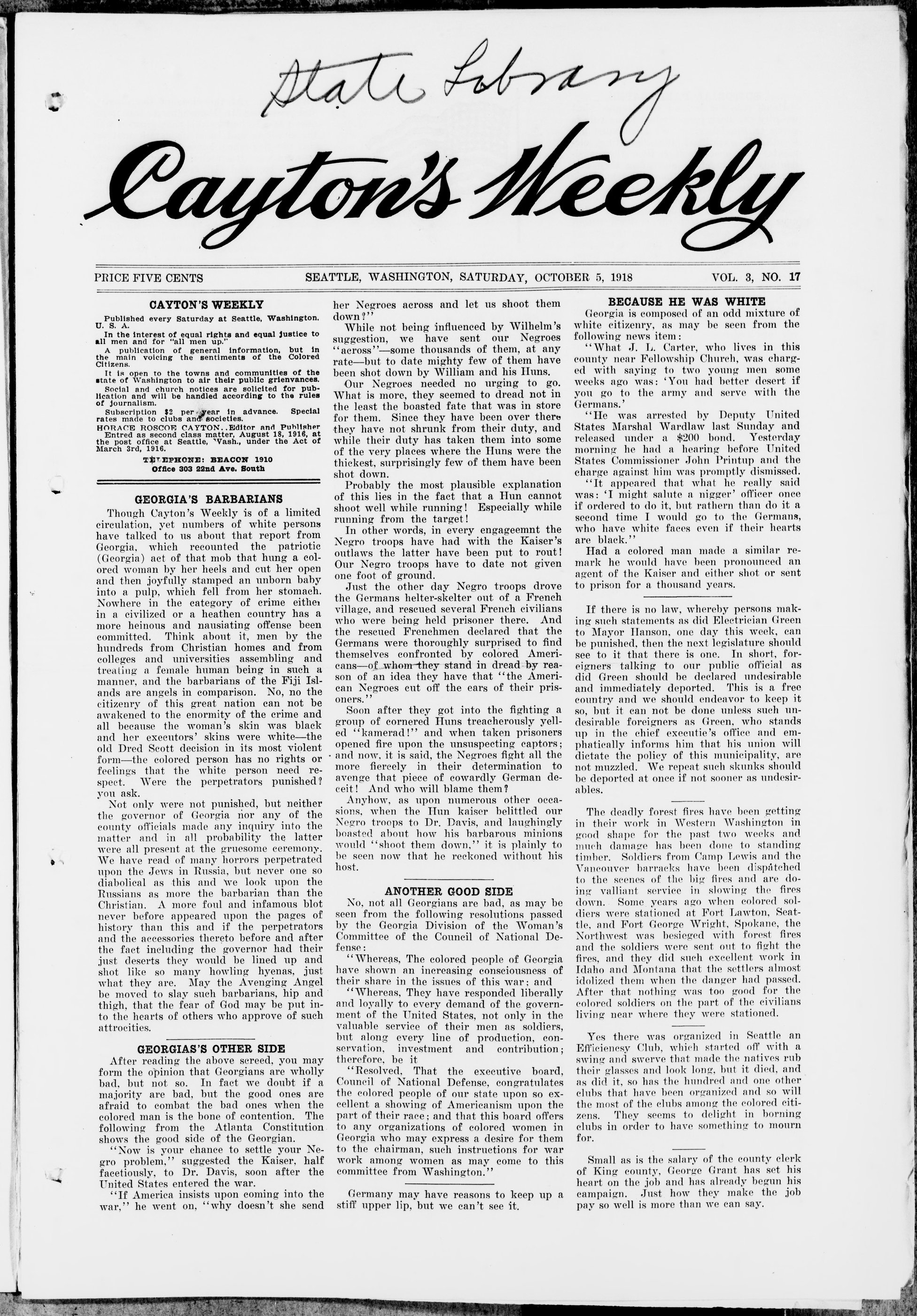
Cayton's Weekly
Saturday, October 5, 1918
Seattle, Washington
Page text (machine-generated)
Static Library
Cayton's Weekly
SEATTLE, WASHINGTON, SATURDAY, OCTOBER 5, 1918
---
PRICE FIVE CENTS
CAYTON'S WEEKLY
Published every Saturday at Seattle, Washington. U. S. A.
In the interest of equal rights and equal justice to all men and for "all men up."
A publication of general information, but in the main voicing the sentiments of the Colored Citizens. It is open to the towns and communities of the state of Washington to air their public grievances. Social and church notices are solicited for publication and will be handled according to the rules of journalism. Subscription $2 per year in advance. Special rates made to clubs and societies.
HORACE ROSCOF CAYTON..Editor and Publisher
Entred as second class matter, August 18, 1916, at
the post office at Seattle, 'Vash., under the Act of
March 3rd, 1916.
TELEPHONE: BEACON 1910
Office 303 22nd Ave. South
GEORGIA'S BARBARIANS
Though Cayton's Weekly is of a limited circulation, yet numbers of white persons have talked to us about that report from Georgia, which recounted the patriotic (Georgia) act of that mob that hung a colored woman by her heels and cut her open and then joyfully stamped an unborn baby into a pulp, which fell from her stomach. Nowhere in the category of crime either in a civilized or a heathen country has a more heinous and naussiating offense been committed. Think about it, men by the hundreds from Christian homes and from colleges and universities assembling and treating a female human being in such a manner, and the barbarians of the Fiji Islands are angels in comparison. No, no the citizenry of this great nation can not be awakened to the enormity of the crime and all because the woman's skin was black and her executors' skins were white—the old Dred Scott decision in its most violent form—the colored person has no rights or feelings that the white person need respect. Were the perpetrators punished? you ask.
Not only were not punished, but neither the governor of Georgia nor any of the county officials made any inquiry into the matter and in all probability the latter were all present at the gruesome ceremony. We have read of many horrors perpetrated upon the Jews in Russia, but never one so diabolical as this and we look upon the Russians as more the barbarian than the Christian. A more foul and infamous blot never before appeared upon the pages of history than this and if the perpetrators and the accessories thereto before and after the fact including the governor had their just deserts they would be lined up and shot like so many howling hyenas, just what they are. May the Avenging Angel be moved to slay such barbarians, hip and thigh, that the fear of God may be put into the hearts of others who approve of such attrocities.
GEORGIAS'S OTHER SIDE
After reading the above screed, you may form the opinion that Georgians are wholly bad, but not so. In fact we doubt if a majority are bad, but the good ones are afraid to combat the bad ones when the colored man is the bone of contention. The following from the Atlanta Constitution shows the good side of the Georgian.
"Now is your chance to settle your Negro problem," suggested the Kaiser, half facetiously, to Dr. Davis, soon after the United States entered the war.
"If America insists upon coming into the war," he went on, "why doesn't she send
her Negroes across and let us shoot them down?"
While not being influenced by Wilhelm's suggestion, we have sent our Negroes "across"—some thousands of them, at any rate—but to date mighty few of them have been shot down by William and his Huns.
Our Negroes needed no urging to go. What is more, they seemed to dread not in the least the boasted fate that was in store for them. Since they have been over there they have not shrunk from their duty, and while their duty has taken them into some of the very places where the Huns were the thickest, surprisingly few of them have been shot down.
Probably the most plausible explanation of this lies in the fact that a Hun cannot shoot well while running! Especially while running from the target!
In other words, in every engageemnt the Negro troops have had with the Kaiser's outlaws the latter have been put to rout! Our Negro troops have to date not given one foot of ground.
Just the other day Negro troops drove the Germans helter-skelter out of a French village, and rescued several French civilians who were being held prisoner there. And the rescued Frenchmen declared that the Germans were thoroughly surprised to find themselves confronted by colored Americans—of whom they stand in dread by reason of an idea they have that "the American Negroes cut off the ears of their prisoners."
Soon after they got into the fighting a group of cornered Huns treacherously yelled "kamerad!" and when taken prisoners opened fire upon the unsuspecting captors; and now, it is said, the Negroes fight all the more fiercely in their determination to avenge that piece of cowardly German deceit! And who will blame them?
Anyhow, as upon numerous other occasions, when the Hun kaiser belittled our Negro troops to Dr. Davis, and laughingly boasted about how his barbarous minions would "shoot them down," it is plainly to be seen now that he reckoned without his host.
ANOTHER GOOD SIDE
No, not all Georgians are bad, as may be seen from the following resolutions passed by the Georgia Division of the Woman's Committee of the Council of National Defense:
"Whereas, The colored people of Georgia have shown an increasing consciousness of their share in the issues of this war; and
"Whereas, They have responded liberally and loyally to every demand of the government of the United States, not only in the valuable service of their men as soldiers, but along every line of production, conservation, investment and contribution; therefore, be it
"Resolved, That the executive board, Council of National Defense, congratulates the colored people of our state upon so excellent a showing of Americanism upon the part of their race; and that this board offers to any organizations of colored women in Georgia who may express a desire for them to the chairman, such instructions for war work among women as may come to this committee from Washington."
Germany may have reasons to keep up a stiff upper lip, but we can't see it.
VOL. 3, NO. 17
BECAUSE HE WAS WHITE
Georgia is composed of an odd mixture of white citizenry, as may be seen from the following news item:
"What J. L. Carter, who lives in this county near Fellowship Church, was charged with saying to two young men some weeks ago was: 'You had better desert if you go to the army and serve with the Germans.'
"He was arrested by Deputy United States Marshal Wardlaw last Sunday and released under a $200 bond. Yesterday morning he had a hearing before United States Commissioner John Printup and the charge against him was promptly dismissed.
"It appeared that what he really said was: 'I might salute a nigger' officer once if ordered to do it, but rather than do it a second time I would go to the Germans, who have white faces even if their hearts are black."
Had a colored man made a similar remark he would have been pronounced an agent of the Kaiser and either shot or sent to prison for a thousand years.
If there is no law, whereby persons making such statements as did Electrician Green to Mayor Hanson, one day this week, can be punished, then the next legislature should see to it that there is one. In short, foreigners talking to our public official as did Green should be declared undesirable and immediately deported. This is a free country and we should endeavor to keep it so, but it can not be done unless such undesirable foreigners as Green, who stands up in the chief executive's office and emphatically informs him that his union will dictate the policy of this municipality, are not muzzled. We repeat such skunks should be deported at once if not sooner as undesirables.
The deadly forest fires have been getting in their work in Western Washington in good shape for the past two weeks and much damage has been done to standing timber. Soldiers from Camp Lewis and the Vancouver barracks have been dispatched to the scenes of the big fires and are doing valliant service in slowing the fires down. Some years ago when colored soldiers were stationed at Fort Lawton, Seattle, and Fort George Wright, Spokane, the Northwest was besieged with forest fires and the soldiers were sent out to fight the fires, and they did such excellent work in Idaho and Montana that the settlers almost idolized them when the danger had passed. After that nothing was too good for the colored soldiers on the part of the civilians living near where they were stationed.
Yes there was organized in Seattle an Efficienesy Club, which started off with a swing and swerve that made the natives rub their glasses and look long, but it died, and as did it, so has the hundred and one other clubs that have been organized and so will the most of the clubs among the colored citizens. They seems to delight in borning clubs in order to have something to mourn for.
Small as is the salary of the county clerk of King county, George Grant has set his heart on the job and has already begun his campaign. Just how they make the job pay so well is more than we can say.
EE ee ee ee aC ae a eee eee
EDITORIAL PARAGRAPHS
We Plty (he LPISh people when Nome rule 18
given to the Island. ‘‘We Irish must get
together,’’ exclaimed the dissenting ele-
ments, and once upon a time they aeci-
dentally got together and after they had
been together a short time every mother’s
son of them were totally disabled,
When the municipality of Seattle takes
over all of the street car systems within
her gates at a fancy price, then the jitneys
should at onee become a thing of the past
or be compelled to pay into the eity treas-
ury a heavy monthly stipend for the priv-
ilege of running.
Do not expect $200 to do the work of
$2000 and $30 per month to do the work
of $75 per month, In other words, you
who are desirous of buying real estate must
not expect $200 will make the first payment
on a home worth $5000 and then $30 per
month be the partial payments—that is not
rent.
In New York City women are making
good as cops, so comes the report. Well
that’s nothing strange for women make
good at everything they undertake. It’s
just naturally born in them and the oppo-
sition of man to the contrary notwithstand-
ing.
Shame on you, Editor Ryan, shame on
you, to want to defeat the only woman
nominated for the legislature in Pierce
county, just because she is a woman. In all
probability the woman would make a more
conscientious member than her Democratie
opponent, but best of all she is a Republi-
can while he is a Democrat.
These may be war times, but ‘‘believe
me’ the Republicans are planning to get in
the saddle these war times.
Years ago when Jimmy Hoge ‘‘hitched
his wagon to a star’’ the most of us thought
he was headed for a wreck, but he has been
hooked up with the stars so long that he
himself is now a star.
The swine has not as yet been driven
across the Rhine, but they are on their
way.
More than half of the peoples of the
world are now in the war. This is almost
the prophetic destruction of the world by
fire,
Bob Fox is a liberty loan expert and we
watch with much eagerness to see him go
over the top in the fourth.
Bulgaria took time by the forelock and
saved her bacon.
Jobs worth $110 per month have few
takers among the colored citizens of Se-
attle—truly prosperity is in the land.
News from over there has made the
welkin ving during the past week and so en-
couraging is that news that we are making
ourselves believe that the end is almost in
sight. Bulgaria has quite and accepted the
terms of the Allies; Turkey has practically
quit, owing to her reverses and before an-
other week has closed we predict that the
Germans will have but one ally left—the
Austro-Hungarian, No Germany is not as
yet whipped or at least sufficiently whipped
to sue for peace, but if the Kaiser was not
war mad he would sue for peace immedi-
ately, if not sooner. Germany may have
An old coon for eunning, but a young
coon for running,
retake
eaeeenes
Tok hk ke gt
asrtien
es oe
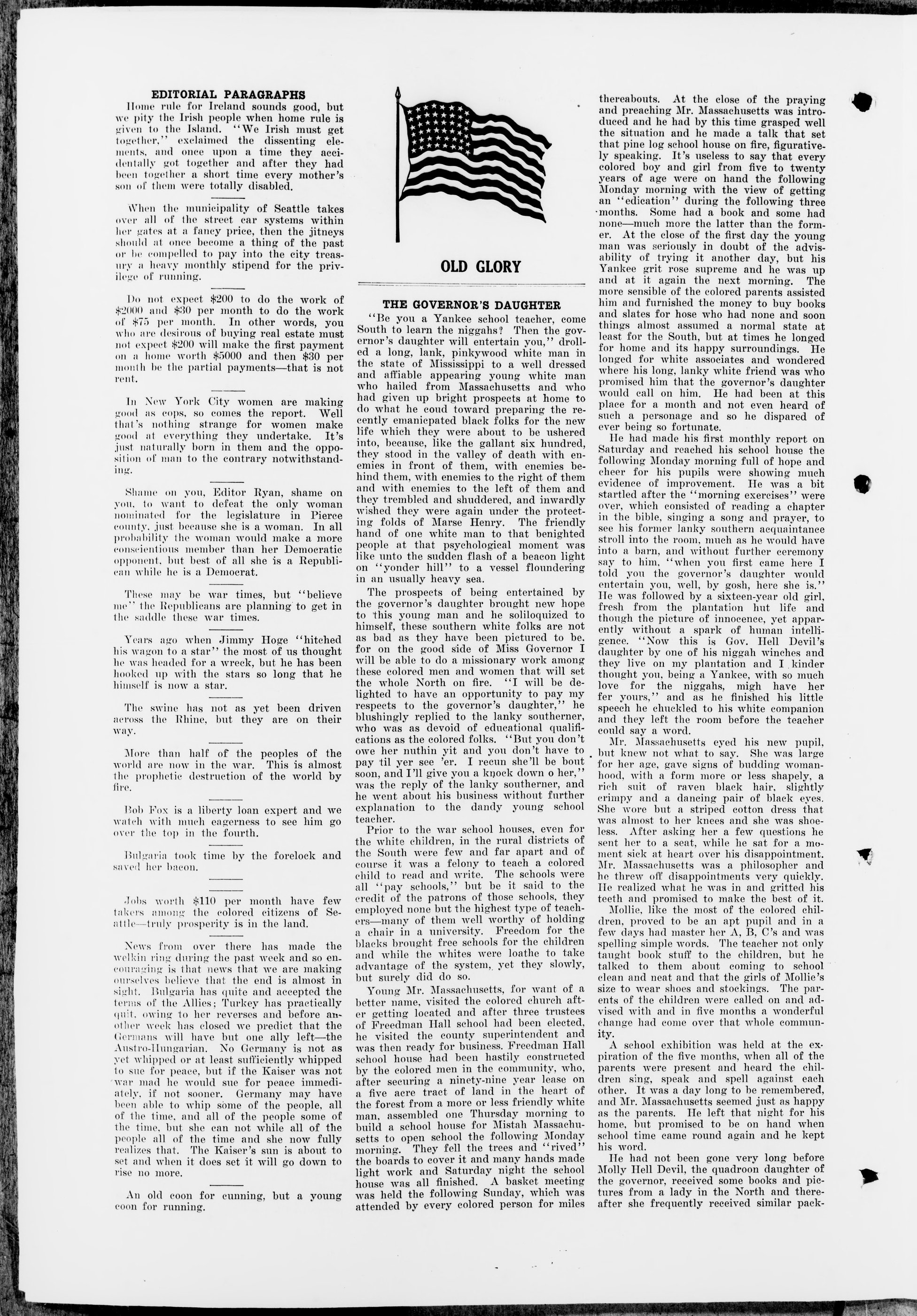
OLD GLORY
BOAR AN EVEN EAU EE Se
“Be you a Yankee school teacher, come
South to learn the niggahs? Then the gov-
ernor’s daughter will entertain you,’ droll-
ed a long, lank, pinkywood white man in
the state of Mississippi to a well dressed
and affiable appearing young white man
who hailed from Massachusetts and who
had given up bright prospects at home to
do what he coud toward preparing the re-
cently emanicpated black folks for the new
life which they were about to be ushered
into, because, like the gallant six hundred,
they stood in the valley of death with en-
emies in front of them, with enemies be-
hind them, with enemies to the right of them
and with enemies to the left of them and
they trembled and shuddered, and inwardly
wished they were again under the protect-
ing folds of Marse Henry. The friendly
hand of one white man to that benighted
people at that psychological moment was
like unto the sudden flash of a beacon light
on ‘‘yonder hill’’ to a vessel floundering
in an usually heavy sea.
The prospects of being entertained by
the governor’s daughter brought new hope
to this young man and he soliloquized to
himself, these southern white folks are not
as bad as they have been pictured to be,
for on the good side of Miss Governor I
will be able to do a missionary work among
these colored men and women that will set
the whole North on fire. ‘‘I will be de-
lighted to have an opportunity to pay my
respects to the governor’s daughter,’’ he
blushingly replied to the lanky southerner,
who was as devoid of educational qualifi-
cations as the colored folks. ‘‘But you don’t
owe her nuthin yit and you don’t have to
pay til yer see ’er. I recun she’ll be bout
soon, and I’ll give you a knock down o her,”’
was the reply of the lanky southerner, and
he went about his business without further
explanation to the dandy young school
teacher.
Prior to the war school houses, even for
the white children, in the rural districts of
the South were few and far apart and of
course it was a felony to teach a colored
child to read and write. The schools were
all ‘‘pay schools,’? but be it said to the
eredit of the patrons of those schools, they
employed none but the highest type of teach-
ers—many of them well worthy of holding
a chair in a university. Freedom for the
blacks brought free schools for the children
and while the whites were loathe to take
advantage of the system, yet they slowly,
but surely did do so.
Young Mr. Massachusetts, for want of a
better name, visited the colored church aft-
er getting located and after three trustees
of Freedman Tall school had been elected,
he visited the county superintendent and
was then ready for business. Freedman Hall
school house had been hastily constructed
by the colored men in the community, who,
after securing a ninety-nine year lease on
a five acre tract of land in the heart of
the forest from a more or less friendly white
man, assembled one Thursday morning to
build a school house for Mistah Massachu-
setts to open school the following Monday
morning. They fell the trees and ‘‘rived’’
the boards to cover it and many hands made
light work and Saturday night the school
house was all finished. A basket meeting
was held the following Sunday, which was
attended by every colored person for miles
duced and he had by this time grasped well
the situation and he made a talk that set
that pine log school house on fire, figurative-
ly speaking. It’s useless to say that every
colored boy and girl from five to twenty
years of age were on hand the following
Monday morning with the view of getting
an ‘‘edication’’ during the following three
‘months. Some had a book and some had
none—much more the latter than the form-
er. At the close of the first day the young
man was seriously in doubt of the advis-
ability of trying it another day, but his
Yankee grit rose supreme and he was up
and at it again the next morning. The
more sensible of the colored parents assisted
him and furnished the money to buy books
and slates for hose who had none and soon
things almost assumed a normal state at
least for the South, but at times he longed
for home and its happy surroundings. He
longed for white associates and wondered
where his long, lanky white friend was who
promised him that the governor’s daughter
would call on him, He had been at this
place for a month and not even heard of
such a personage and so he dispared of
ever being so fortunate.
He had made his first monthly report on
Saturday and reached his school house the
following Monday morning full of hope and
cheer for his pupils were showing much
evidence of improvement. Tle was a Dit
startled after the ‘‘morning exercises’’ were
over, which consisted of reading a chapter
in the bible, singing a song and prayer, to
see his former lanky southern acquaintance
stroll into the room, much as he would have
into a barn, and without further ceremony
say to him, ‘‘when you first came here I
told you the governor’s daughter would
entertain you, well, by gosh, here she is.’’
Tle was followed by a sixteen-year old girl,
fresh from the plantation hut life and
though the picture of innocence, yet appar-
ently without a spark of human _intelli-
gence. ‘“‘Now this is Gov. Tell Devil’s
daughter by one of his niggah winches and
they live on my plantation and I kinder
thought you, being a Yankee, with so much
love for the niggahs, migh have her
fer yours,’’ and as he finished his little
speech he chuckled to his white companion
and they left the room before the teacher
could say a word.
Mr, Massachusetts eyed his new pupil,
but knew not what to say. She was large
for her age, gave signs of budding woman-
hood, with a form more or less shapely, a
rich suit of raven black hair, slightly
erimpy and a dancing pair of black eyes.
She wore but a striped cotton dress that
was almost to her knees and she was shoe-
less. After asking her a few questions he
sent her to a seat, while he sat for a mo-
ment sick at heart over his disappointment.
Mr. Massachusetts was a philosopher and
he threw off disappointments very quickly.
He realized what he was in and gritted his
teeth and promised to make the best of it.
Mollie, like the most of the colored chil-
dren, proved to be an apt pupil and in a
few days had master her A, B, C’s and was
spelling simple words. The teacher not only
taught book stuff to the children, but he
talked to them about coming to school
clean and neat and that the girls of Mollie’s
size to wear shoes and stockings. The par-
ents of the children were called on and ad-
vised with and in five months a wonderful
change had come over that whole commun-
ity.
A school exhibition was held at the ex-
piration of the five months, when all of the
parents were present and heard the chil-
dren sing, speak and spell against each
other. It was a day long to be remembered,
Netter wah Nl Tecen ie oe Teena tw A OME CaTete aIeT at) ace
ages, all of which she greatly enjoyed, and they made a wonderful impression on her. Mr. Massachusetts was there for the opening day of school and greeted his pupils, one and all with almost pathetic tenderness. He mentally noted the wonderful improvement in Molly and almost stammered when he shook hands with her. Everybday loved Mr. Massachusetts and he seemed to love everybody, especially the children and played no favorites.
I's jest come to get your vize, Mistah Massatusets, bout Molly. I got a letter from some 'sity in de Nof wantin to edicate her, widout it costin me nuffin. I don't want to giv up my Molly, but I do want her to be a fin lady. Would you vize me to let her go." It was a happy moment for the teacher, but he concealed his happiness and looked puzzled.
"Molly is an unusually bright pupil, and if she could go North she would make a mighty fine lady. I believe I would let her go. It, however, is quite dangerous for young girls to travel alone, but my mother and sister, who are visiting the Cotton Exposition at New Orleans, will come by and take her with them, if you consent."
This pleased Molly's mother very much and she willingly consented. Mrs. Massachusetts, accompanied by her daughter, stopped over to see her son and to get Molly and even Molly's mother was surprised at the interest the two white women took in her daughter and wondered why they bought so many nice things for her. But Molly with her new found friends were soon an their way.
This proved to be a very successful school year for the Yankee teacher and he induced the fathers of a number of the boys and girls to send them off to Normal schools and universities. His exhibition that year was even better than the one prior. He left as usual the day school closed, but returned just as promptly for the next school year opening. He said to those who enquired of Molly that he had heard of her while away and learned she was getting along well. He told Molly's mother little more than to the others. Molly, however, wrote regularly to her mother and some of her friends, which kept her memory more or less green. The whole community went wild one Sunday at a basket meeting when "Unker Edmund's Zach, who had been to the post office, gave Molly's mother a great big letter. She got Brer Brown, the preacher, to open it for her, and instead of a letter it was a cabinet size photograph of Molly, who to them looked more like a king's daughter than a governor's daughter. There was a letter also, which said that Molly would visit the old home the coming summer. The preacher had difficulty in reassembling his congregation, there was so much to be said about Miss Molly.
Whether or not Mr. Massachusetts had any interest in what was being said about his former pupil or her expected visit to that place was his own secret as he showed no signs of having any interest in either. His school closed before Molly came. At the close of that exhibition he announced that he would not return any more. "My father has been electd governor of the state of Massachusetts and I will serve under him. He, however, lingered a day longer than usual, and Molly's mother cooked him an old fashioned southern dinner as her feeble reward for the kindness he had shown Molly.
That evening Mr. Massachusetts shook the dirt of Freedman Hall off his feet forever and as he did so a pang of regret came over him because he had given up his missionary work. For a twenty-mile radius Miss Molly was the model and fashion plate of the colored girls and the heart-breaker for the boys. She had not tonly developed into a most charming young woman, but had as much common sense as she did education. She had come south for a long vacation and thought she would teach school one term. She was unanimously chosen to teach Fredman Hall school and she was no less successful than had been Mr. Massachusetts.
While she seemed to be dead in love with
all the boys, yet she got many letters from the postoffice and once she got a picture out of one of the letters, which seemed to give her a great deal of pleasure, though she showed it to no one. Time seemed to wear heavily on her and her school was no sooner out than she left for the North and never again returned.
At a governors' conference held in New York Gov. Hell Devil of Mississippi was in attendance and so was Gov. Massachusetts of Massachusetts, who was attended by the adjutant general of the state. A brilliant reception followed the conference, at which the "400" was present. "This is my son, General Massachusetts," said Gov. Massachusetts to Gov. Hell Devil of Mississippi, and after the usual greetings the general said: "I had the pleasure of residing in your state for a while and I taught the first colored school ever opened for colored children, and I am delighted to present you to my wife, who, by the way, was one of my pupils down there and her name was Molly."
Now this quadroon girl had developed into one of the most handsome women in that state and was as mentally brilliant as she was facially beautiful. If she had the despised black blood in her veins it gave her husband and his parents no concern and she was truly the idol of the state house. Gov. Hell Devil stood speechless, for he saw standing before him his own self—not to serve him, but to receive him. Speak, he could not, and so he bowed himself away.
Gov. Hell Devil seems to be devoting the most of the evening to Mrs. Gen. Massachusetts," commented his wife "and I do not blame him, for she is a very charming young woman.' On reaching their room at the hotel that night, Gov. Hell Devil said to his wife: "Gov. Massachusetts and his son have invited us to spend a week with them and I have decided to accept the invitation," which left nothing for her to say, but consen and she was not averse to doing so.
The week was a happy one for the Southerners and Gov. Hell Devil and Mrs. Gen. Massachusetts were almost inseparable and yet the General did not seem bothered about it, which thing Mrs. Gov. Hell Devil could not understand and she left for her home none the wiser. The colored folks about Freedman Hall never learned of the fate of Miss Molly, but they often wondered where her mother got the money to build a fine home and live "jes lik whit folks" and ride about on the railroad with fine clothes and tip the porter.
THE IMITATIVE NEGRO
Imitation in itself is not a bad characteristic: it depends upon what you imitate. It is largely through imitation that civilization has been spread. It was because the barbarians imitated the civilization of Greece and Rome that north and central Europe is now civilized. Not that they are 6—CAYTON —10-3 d much better off for it, but at any rate they are civilized.
It is because the Negro is such a good imitator that he has acquired western civilization so fast. I have seen the British West Indian in London, and he is as English as a lord. I have seen the French West Indian in Paris, and he is as French as a marquis. I do not doubt that the Negro would make a perfectly good Chinaman, with the exception of the pigtail; and he is fast overcoming that difficulty. It is this ability to imitate and assimilate that has made it possible for the Negro in the United States to outdistance the American Indian in the race. The Indian, in spite of his advantages and opportunities, remains an Indian. The Negro, in spite of his handicaps and obstacles has become an American. The Negro is an American in language, customs, mode of thought and religion. The Indian is still just about as much of a savage as the law allows him to be.
But the dangers that go with the ability to imitate are equal to the benefits. For one who finds it easy to imitate good things
finds it just as easy, often easier, to imitate bad things. It is on this point that the Negro's facile gift has worked him woe; he has picked up the bad as well as the good. After all, the Indian is an awe inspiring sight; a sight that somehow inspires a certain sort of respect. He absolutely disdains to learn or copy either what the white man calls good or bad, but remains himself.
The dangers of the ability to imitate was impressed on the writer's mind when he saw the other night a crowd of young colored hoodlums ranging the streets of Harlem, breaking up the straw hats of passers-by, even foeing into shops to attack men. Where did they get the idea? If it was a custom that had come down to them from their African ancestors, it would demand some respect, even if it was heathenish; but, no, it is something they only recently learned from white men. And who are the white men they learned it from?—New York Age.
When a hunting dog tucks his tail and comes back to the hunters its time to "git up un git."
STATEMENT OF THE OWNERSHIP, MANAGEMENT, Circulation, Etc., Required by the Act of Congress of August 24, 1912, of Cayton's Weekly, published weekly at Seattle, Wash., for October, 1918.
State of Washington, County of King—ss.
Before me, a notary public, in and for the State and county aforesaid, personally appeared Horace Roscoe Cayton, who, having been duly sworn, according to law, deposes and says that he is the editor of Cayton's Weekly, and that the following is, to the best of his knowledge and belief, a true statement of the ownership, management (and if a daily paper, the circulation), etc., of the aforesaid publication for the date shown in the above capton, required by the Act of August 24, 1912, embodied in section 443, Postal Laws and Regulations, printed on the reverse of this form, to-wit:
1. That the names and addresses of the publisher, editor, managing editor, and business managers are: Publisher, editor, managing editor, business manager, Horace Roscoe Cayton, Seattle, Wash.
2. That the owners are: Horace Roscoe Cayton, Seattle, Wash.
3. That the known bondholders, mortgagees, and other security holders owning or holding 1 per cent or more of total amount of bonds, mortgages, or other securities are: None.
4. That the two paragraphs next above, giving the names of the owners, stockholders, and security holders, if any, contain not only the list of stockholders and security holders as they appear upon the books of the company but also, in cases where the stockholder or security holder appears upon the books of the company as trustee or in any other judiciary relation, the name of the person or corporation for whom such trustee is acting, is given; also that the said two paragraphs contain statements embracing affiant's full knowledge and belief as to the circumstances and conditions under which stockholders and security holders who do not appear upon the books of the company as trustees, hold stock and securities in a capacity other than that of a bona fide owner; and this affiant has no reason to believe that any other person, association, or corporation has any interest direct or indirect in the said stock, bonds, or other securities than as so stated by him.
5. That the average number of copies of each issue of this publication sold or distributed, through the mails or otherwise, to paid subscribers during the six months preceding the date shown above is 500.
HORACE ROSCOE CAYTON.
Sworn to and subscribed before me this 3rd day
of October, 1918.
EDWARD BRADY,
Notary Public in and for the State of Washington,
residing at Seattle. (Notarial Seal)
IN THE SUPERIOR COURT OF THE STATE OF
Washington for King County.
Lizzie Bridgewater, Plaintiff, vs. Frank Bridgewater,
Defendant.—No. 1918, and defend the above entitled
action in the above entitled court, and answer the
complaint oft he plaintiff, and serve a copy of your
answer upon the undersigned attorney for plaintiff
at his office below stated; and in case of your fail-
ure so to do, judgment will be rendered against you
according to the demand of the complaint, which
has been filed with the clerk of said court.
The object of the above entitled action is to ob-
tain a decree of divorce from the defendant by the
plaintiff on the grounds of drunkenness and cruelty.
ANDREW R. BLACK,
Attorney for Plaintiff.
P. O. Address, 316 Pacific Block, Seattle, Wash.'
Sept. 21—Oct. 2, 1918.
TUTT'S BARBER SHOP "He wants to see you." High-class Tonsorial Work. 300 Main Street, Seattle. Latest race papers. All kinds of toilet supplies.
TERMINAL CHILE PARLOR
218 Washington St.
Serves the best Chile Con Carne and
Light Lunches
Good Service
YOU ARE WELCOME
Mrs. Tena Anderson, Proprietress
---
```markdown
```
SUPERSTITIONS ABOUT ANIMALS
Watch the tame cow and the wild one will never hurt you.
An ass by mistake played on a flute.
A crowing hen and a whistling woman come to no good end.
If a black cat runs across the road in front of you, turn back.
A screeching owl at night on your house top means a death in the family.
For a rooster to crow in your door means a stranger is coming to visit you.
Wild geese flying north in the fall is followed by a hoar frost.
To admire the beauty of a snake means you will be bitten by one very soon thereafter.
When dogs howl in the night the spirits are walking about.
The owl and the rabbit once belonged to the human family.
The cows all go to prayer "old Christ? mas" night fifteen days after the regular Christmas.
The nesting of a wren in the eves of your house means good luck for the balance of the year.
A horse always snorts at night when there is danger ahead and has to be urged forward.
A cat has nine lives and unless you take them all the cat will come back.
Always kill the hen that crows or disease will overtake your barn yard fowls.
PENN UNDERTAKING COMPANY Funeral Directors and Embalmers "SUPERIOR SERVICE"
The only Colored Undertaking Establishment in the Northwest, owned, controlled, operated and financed by Colored people. Let your patronage be a business proposition, and you will benefit by it in Service, Quality and Cost. "Best service at Moderate Prices" is our motto. We are not acting as agents for other Undertakers, and are not using any agents to advertise our business. We make our own prices, and sell our own goods from our own Parlors. A visit from you will convince you of our ability to give service. We can save you time worry and money. Give us an opportunity. Calls promptly answered day or night.
P. Frazier, Mgr.
C. R. Anderson, Secy.
Parlors, 1215 E Marion St. Phone East 179.
SEVEN—Cayton 10-3 chl
THE SPICE OF LIFE
So It Seems—People ask who the Czecho-Slovaks are. They are the men who put the "trot" in Trotzky.—London Opinion.
Very Much So—"Have you any essential occupation?"
"Yes, sir. I walk the baby at night to keep it from crying."—Baltimore American.
Painful Memories—"Pa, what's phonetic spelling?"
"It's a way of spelling that I often got whipped for when I was your age."—Boston Transcript.
Reciprocal—"Perkins entertains a good opinion of himself."
"Well, it's reciprocal; his good opinion of himself entertain Perkins."—Jersey City Journal.
Meant "Two Down" of Course-An English newspaper man, reporting that famous baseball game before royalty, wrote that in
---
in the sixth inning the score against the Army was "two-love."—Boston Transcript.
Explained—"A sailor in time of war simply can't fall asleep at his post."
"Why not?"
"Because a man-of-war has to keep a wake when on the water."—Baltimore American.
His Second Thought—Head of the House (roaing with rage)—"Who told you to put that paper on the wall?"
Decorator—"Your wife, sir."
Head of the House (subsiding)—"Pretty, isn't it?"—Passing Show.
Out of His Class—Sergeant (surprising sentry)—"Why didn't you challenge that man who just passed?"
Newest Recruit—"Why, that's Kayo Hogan, sergeant, and he's got all o' ten pounds on me!"—Jersey City Journal.
Exempted—The Flag—"Oh, I'd go to the war quick enough, but mother wouldn't like me to. and I've never disappointed her since the day I was born."
The Snag—"Well, if she was hoping for a daughter, I'm sure you've done your best to console her."—Sidney Bulletin.
Nothing Much Doing—Will write you a few lines to let you know I am well and hoping to find ever one at home the same.
We had a battle with the Germans and drove them back five miles. We took a lot of prisoners, artillery and machine guns, and are still driving them back.
It is the first battle I have been in, but I didn't get excited and escaped without a scratch. It was an awful artillery and machine-gun fire.
News is scace, so will close, hoping to hear from you soon.
From your lovnig husband.
Private John Schwartz.
Liquid Notes—Secretary Josephus Daniels, by his recent order limiting the social privileges of naval officers even in the homes of their friends, has succeeded in making the song of the Navy, "Drink to me only with thine eyes."—Life.
Mistaken Identity—Warrior from Palestine (whose baby is about to be christened, and who has a bottle of Jordan water for the purpose)—"Eh, by the way, meenister, I ha'e brocht this bottle—"
Minister—"No' the noo, laddie! After the ceremony I'll be verra pleased!"—London Opinion.
Better Half, Better Votes-"I told Henietta that I was proud to see her vote just like a man," said Mr. Meekton.
"Did that pleae her?"
"No. The choice of phrase was unfortunate. She said that if she couldn't use better judgment than a man there would have been no need of her troubling about the vote in the first place."—Sketch.
How It Happened—Once a year the newsboys of a certain district of London are taken for an outing up the Thames by a gentleman of the neighborhood, when they can bathe to their heart's content.
As one little boy was getting into the water a friend observed, "I say, Bill, ain't yer dirty!"
"Yes," replied Bill. "I missed the train larst year."—Tit-Bits.
Confirmation in the Ranks—After church parade the padre said: "I wish to speak to those of you who have not been confirmed. Will the men divide themselves into two parties, please? Those who have, fall out on the right, and those who have not on the left."
Most fell out on the right.
In the shuffle this remark was heard, "You been confirmed, Bill?"
"Bet yer life. Got the marks on me arm yet."—Tit-Bits.
Thoughtful William—"William," snapped the dear lady, viciously, "didn't I hear
the clock strike two as you came in?"
the clock strike two as you came in?"
"You did, my dear. It started to strike ten, but I stopped it to keep it from waking you up."—Tit-Bits.
A Plea for German Chancellors—The working conditions under which the German imperial chancellors are compelled to operate must sooner or later become the cause of a scandal. Every man who has held that position since 1914 has been compelled to resign because of "failing health." Shorter hours, better housing, and more sanitary surroundings for imperial chancellors must be insisted upon in the peace negotiations.—Kansas City Star.
ALHAMBRA CASH GROCERY
H. Legg, Prop. W. H. Banks, Mgr.
We Carry a Full Line of Fancy and
Staple Groceries
WE KINDLY INVITE YOUR INSPECTION
Our New Store:
1201-3 Jackson St. Phone Beacon 505
VIOLA N. BERRY
Successful Masseur Facial Massage, Hair Shampooing and Scalp Treatment Open for Business Parlors 2103 E. James Tel.East.5694
CAYTON'S WEEKLY
(Office 303 22nd Ave. South) Regular, Reliable, Republican, Readable Wants 500 New Subscribers
This is a Sample of what it sends out Every Week
No Friends to Reward or Enemies to Punish
A Publication of Ideas Rather Than Personalities
Read for Yourself and be Convinced
Telephone Beacon 1910
IN THE SUPERIOR COURT OF THE STATE OF Washington for King County.
R. E. Warren, Plaintiff, vs. Lida Warren, Defendant. No. 130089. Summons for Publication. The State of Washington to the said Lida Warren, defendant: You are hereby summoned to appear within sixty (60) days after the date of the first publication of this summons, to-wit: Within sixty days after the 3rd day of August, 1918, and defend the above entitled action in the above entitled court, and answer the complaint of the plaintiff, and serve a copy of your answer upon the undersigned attorney for plaintiff, at his office below stated; and in case of your failure so to do, judgment will be rendered against you according to the complaint, which has been filed with the clerk of said court, the object of the above entitled action is for the dissolution of the bonds of matrimony existing between plaintiff and defendant upon the grounds of desertion and abandonment described in the complaint.
CRAWFORD E. WHITE
Attorney for Plaintiff.
Post Office and Office Address: 1308-4 L. C. Smith
Building, Seattle, King County, Washington, Phone
Elliott 1113.
CAYTON—9-12 .....Minnie .....bpxz
IN THE SUPERIOR COURT OF THE STATE OF
Washington for King County.
Washington for King County.
Florence Brice vs. Dwight Brice, Defendant.—No.
Summons by Publication.
The State of Washington to the said Dwight Brice,
Defendant:
You are hereby summoned to appear within sixty days after the date of the first publication of this summons, to-wit: within sixty days after the 13th day of September, 1918, and defend the above entitled action in the above entitled court, and answer the complaint of the plaintiff, and serve a copy of your answer upon the undersigned attorney for plaintiff at his office below stated; and in case of your failure so to do, judgment will be rendered against you according to the demand of the complaint, which has been filed with the clerk of said court.
The object of the above entitled action is to obtain a decree of divorce from the defendant by the plaintiff on the grounds of desertion.
ANDREW R. BLACK,
Attorney for Plaintiff
P. O. Address, 316 Pacific Block, Seattle, Wash.
Sept. 13—Nov. 1, 1918.
---