Cayton's Weekly
Saturday, January 18, 1919
Seattle, Washington
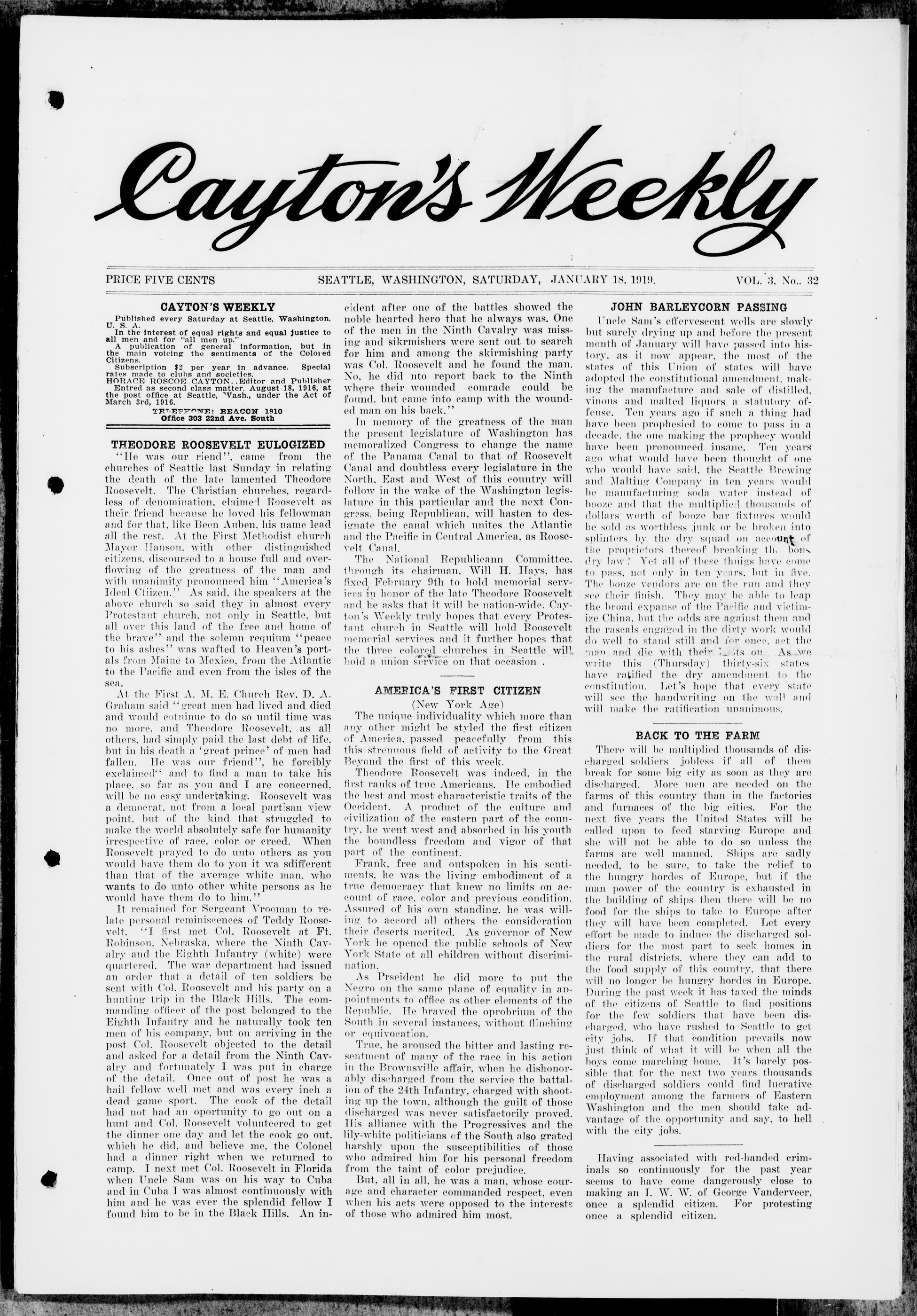
Page text (machine-generated)
Cayton's Weekly
SEATTLE, WASHINGTON, SATURDAY, JANUARY 18, 1919.
PRICE FIVE CENTS
CAYTON'S WEEKLY
Published every Saturday at Seattle, Washington. U. S. A. In the interest of equal rights and equal justice to all men and for "all men up." A publication of general information, but in the main voicing the sentiments of the Colored Citizens. Subscription $2 per year in advance. Special rates made to clubs and societies. HORACE ROSCOE CAYTON..Editor and Publisher Entred as second class matter. August 18, 1916, at the post office at Seattle, Vash., under the Act of March 3rd, 1916.
THREEPONE: BEACON 1910
OFFICE 303 22nd Ave. South
THEODORE ROOSEVELT EULOGIZED
"He was our friend", came from the churches of Seattle last Sunday in relating the death of the late lamented Theodore Roosevelt. The Christian churches, regardless of denomination, claimed Roosevelt as their friend because he loved his fellowman and for that, like Been Auben, his name lead all the rest. At the First Methodist church Mayor Hanson, with other distinguished citizens, discoursed to a house full and overflowing of the greatness of the man and with unanimity pronounced him "America's Ideal Ctiizen." As said, the speakers at the above church so said they in almost every Protestant church, not only in Seattle, but all over this land of the free and home of the brave" and the solemn requium "peace to his ashes" was wafted to Heaven's portals from Maine to Mexico, from the Atlantic to the Pacific and even from the isles of the sea.
At the First A. M. E. Church Rev. D. A. Graham said "great men had lived and died and would cotinue to do so until time was no more, and Theodore Roosevelt, as all others, had simply paid the last debt of life, but in his death a 'great prince' of men had fallen. He was our friend", he forcibly exclaimed" and to find a man to take his place, so far as you and I are concerned, will be no easy undertaking. Roosevelt was a democrat, not from a local partisan view point, but of the kind that struggled to make the world absolutely safe for humanity irrespective of race, color or creed. When Roosevelt prayed to do unto others as you would have them do to you it wa sdifferent than that of the average white man, who wants to do unto other white persons as he would have them do to him."
It remained for Sergeant Vrooman to relate personal reminiscences of Teddy Roosevelt. "I first met Col. Roosevelt at Ft. Robinson, Nebraska, where the Ninth Cavalry and the Eighth Infantry (white) were quartered. The war department had issued an order that a detail of ten soldiers be sent with Col. Roosevelt and his party on a hunting trip in the Black Hills. The commanding officer of the post belonged to the Eighth Infantry and he naturally took ten men of his company, but on arriving in the post Col. Roosevelt objected to the detail and asked for a detail from the Ninth Cavalry and fortunately I was put in charge of the detail. Once out of post he was a hail fellow well met and was every inch a dead game sport. The cook of the detail had not had an opportunity to go out on a hunt and Col. Roosevelt volunteered to get the dinner one day and let the cook go out, which he did, and believe me, the Colonel had a dinner right when we returned to camp. I next met Col. Roosevelt in Florida when Uncle Sam was on his way to Cuba and in Cuba I was almost continuously with him and he was ever the splendid fellow I found him to be in the Black Hills. An in-
cident after one of the battles showed the noble hearted hero that he always was. One of the men in the Ninth Cavalry was missing and sikrmishers were sent out to search for him and among the skirmishing party was Col. Roosevelt and he found the man. No, he did nto report back to the Ninth where their wounded comrade could be found, but came into camp with the wounded man on his back." In memory of the greatness of the man the present legislature of Washington has memoralized Congress to change the name of the Panama Canal to that of Roosevelt Canal and doubtless every legislature in the North, East and West of this country will follow in the wake of the Washington legislature in this particular and the next Congress, being Republican, will hasten to designate the canal which unites the Atlantic and the Pacific in Central America, as Roosevelt Canal.
The National Republicann Committee, through its chairman, Will H. Hays, has fixed February 9th to hold memorial services in honor of the late Theodore Roosevelt and he asks that it will be nation-wide. Cayton's Weekly truly hopes that every Protestant church in Seattle will hold Roosevelt memorial services and it further hopes that the three colored churches in Seattle will hold a union service on that occasion.
AMERICA'S FIRST CITIZEN
(New York Age)
The unique individuality which more than any other might be styled the first citizen of America, passed peacefully from this this strenuous field of activity to the Great Beyond the first of this week. Theodore Roosevelt was indeed, in the first ranks of true Americans. He embodied the best and most characteristic traits of the Occident. A product of the culture and civilization of the eastern part of the country, he went west and absorbed in his youth the boundless freedom and vigor of that part of the continent. Frank, free and outspoken in his sentiments, he was the living embodiment of a true democracy that knew no limits on account of race, color and previous condition. Assured of his own standing, he was willing to accord all others the consideration their deserts merited. As governor of New York he opened the public schools of New York State of all children without discrimination.
As Prseident he did more to put the Negro on the same plane of equality in appointments to office as other elements of the Republic. He braved the oprobrium of the South in several instances, without flinching or equivocation.
True, he aroused the bitter and lasting resentment of many of the race in his action in the Brownsville affair, when he dishonorably discharged from the service the battalion of the 24th Infantry, charged with shooting up the town, although the guilt of those discharged was never satisfactorily proved. His alliance with the Progressives and the lily-white politicians of the South also grated harshly upon the susceptibilities of those who admired him for his personal freedom from the taint of color prejudice.
But, all in all, he was a man, whose courage and character commanded respect, even when his acts were opposed to the interests of those who admired him most.
VOL. 3, No.. 32
JOHN BARLEYCORN PASSING
Uncle Sam's effervescent wells are slowly but surely drying up and before the present month of January will have passed into history, as it now appear, the most of the states of this Union of states will have adopted the constitutional amendment, making the manufacture and sale of distilled, vinous and malted liquors a statutory offense. Ten years ago if such a thing had have been prophesied to come to pass in a decade, the one making the prophecy would have been pronounced insane. Ten years ago what would have been thought of one who would have said, the Seattle Brewing and Malting Company in ten years would be manufacturing soda water instead of booze and that the multiplied thousands of dollars worth of booze bar fixtures would be sold as worthless junk or be broken into splinters by the dry squad on account of the proprietors thereof breaking the bond dry law? Yet all of these thnigs have come to pass, not only in ten years, but in five. The booze vendors are on the run and they see their finish. They may be able to leap the broad expanse of the Pacific and victimize China, but the odds are against them and the raseals engaged in the dirty work would do well to stand still and for once, act the man and die with their lives on. As we write this (Thursday) thirty-six states have ratified the dry amendment to the constitution. Let's hope that every state will see the handwriting on the wall and will make the ratification unanimous.
BACK TO THE FARM
There will be multiplied thousands of discharged soldiers jobless if all of them break for some big city as soon as they are discharged. More men are needed on the farms of this country than in the factories and furnaces of the big cities. For the next five years the United States will be called upon to feed starving Europe and she will not be able to do so unless the farms are well manned. Ships are sadly needed, to be sure, to take the relief to the hungry hordes of Europe, but if the man power of the country is exhausted in the building of ships then there will be no food for the ships to take to Europe after they will have been completed. Let every effort be made to induce the discharged soldiers for the most part to seek homes in the rural districts, where they can add to the food supply of this country, that there will no longer be hungry hordes in Europe. During the past week it has taxed the minds of the citizens of Seattle to find positions for the few soldiers that have been discharged, who have rushed to Seattle to get city jobs. If that condition prevails now just think of what it will be when all the boys come marching home. It's barely possible that for the next two years thousands of discharged soldiers could find lucrative employment among the farmers of Eastern Washington and the men should take advantage of the opportunity and say, to hell with the city jobs.
Having associated with red-handed criminals so continuously for the past year seems to have come dangerously close to making an I. W. W. of George Vanderveer, once a splendid citizen. For protesting once a splendid citizen.
---
---
EMBARRASSING MOMENTS
While traveling from Ogden to Protland some years ago, the train stopped twenty minutes for breakfast and the most of the passengers took advantage of the opportunity. I had spent many years in the West and my color had given me little or no trouble in getting the same accommodations in public places as were accorded to white citizens. With the other passengers I rushed into the dining room, but lest I might run up against a color prejudice snag, I sat at an unoccupied table. I had been beautifully served and was doing my bit like an adept, when in walked two Indian men, though dressed in citizens attire, they were big buck Indians just the same. They had no sooner entered that dining room than I began to swell up for I felt morally certain that the proprietor would seat them at my table and if he did I intended to show my American blood and either leave the table myself or insist that they be seated at some other table. While I sat there debating in my mind as to what course to persue, the proprietor espied the Indians and rushed for them and gave them a welcome that would have made a Roosevelt look to his laurels and instead of seating them at my table he seated them at the best table in the room and entertained them while three or four waiters fell all over themselves in their endeavor to show them in what high esteem they were held in that house. As they passed me they gave me a second look to be thoroughly convinced of my identity and then a look of disgust beclouded their faces. If you think that was not a most embarrassing moment for me, then I sasure you that you are off your trolly.
I was but nineteen past, when I first thought I would teach a summer school to help defray my expenses at the university the coming session. It was twenty-five miles from my country home to the county seat which had to be made on horseback and it was a long hard ride. I got to town about dark and rested that night preparatory to going before the superintendent the next day for my examination. The superintendent of public schools was a straight-laced Presbyterian preacher, who had never been known to smile or pass a pleasantry to any one being examined for a certificate to teach school and even men trembled in their boots when he would give them a once over. But I was soon at my answers and some time that afternoon I had turned in my last paper and began to feel good way down in my toes when I saw him reach for his certificate book. He had about completed the writing of the same when he suddenly turned on me and said. "Of course you are twenty-one." My embarrassment at that moment was simply awful, but quick as a flash I replied, "No, I am only nineteen past." He hesitated for a second and retorted, "Why did you not say you are twenty-one and save trouble for yourself?" "Because." I sharply replied, "I had no desire to lie about it." The color quickly came to his cheeks, showing his pique and he looked out of the window for a second, then he quickly turned to his paper and in a second more I had my certificate and I left the room without even saying good day.
Church rows are always very embarrassing for those listening to them, but taking no part in them. The reason church rows are more embarrassing than any other kind of rows is because the most of them have the idea that we are not patterning after the meek nad lowly Jesus when disputes and bickerings arise in the house of the Lord. It was down in Mississippi and I was in my late teens and acting secretary of a quarterly conference of the A. M. E. church. Something was before the conference that required the presence of two of the sisters of the church, both being more or less prominent in the community, and in the church affairs. From the very outset things began to grow hotter and hotter and they grew so very hot that it
embarrassed me (a sinner) to hear Christian folks talk so. I wanted to go out but my father objected and so I had to sit and listen to the fire works. Finally one sister got so excited that she jumped up and shouted at the other sister, "You are a liar, maddam." Quicker than a flash the other sister replied, "You are a damn liar, maddam." Not knowing what might befall a church edifice when such language was used therein I rushed for the door, and my dad sauntered out later and we left for home without having a complete record of the "previous meeting."
TOWN TOPICS
The Seattle Negro Business Men's League will meet Sunday, January 19th, at 300 Main Street. The annual election will be held on this occasion and a full membership should be present. Next Sunday at 2 p. m.
The Seattle Branch of the National Association for the Advancement of Colored People will hold its monthly meeting next Monday evening at the residence of H. Chandler.
Miss Anna Richardson, of the Chandler Fuel Co., is in the Lakeside Hospital, where she was operated on for acute appendicitis by Dr. J. A. Ghent.
Mr. and Mrs. S. A. Watts are wintering in Los Angeles and he writes, "This is a great place and we are highly enjoying ourselves."
Mrs. Candace Parker Black, widow of the late Andrew R. Black, has disposed of her home property and will give possession within thirty days.
A concert of the none such is being arranged to be held at the Grace Presbyterian church in the near future.
Tutt's colored baby dolls are on the move and if you do not hurry you will not get one. Mr. and Mrs. Floyd Wright will sojourn in Olympia while the legislature is in session.
For protesting against the wholesale lynching of colored men, women and children Booker T. Washington, son of the noted Tuskegee educator, was forced to flee from his Alabama home with his family and seek refuge in the North to save himself and family from a similar fate that overtook another colored family in Alabama a few days ago. Russia nor Germany never contended with more dangerous human hyenas than the average white man of the South and some day Uncle Sam will have to rebaptize those hed-handed murderers with another rain of fire and lead.
The riot of last Sunday in Seattle was uncalled for and without stopping to discuss who was at fault, the whole proceedings were un-American. For a group of men to get together and terrorize this or any other community in order to put the fear of hell in the hearts of the peace officers is nothing short of red handed anarchy and for peace officers to decide to make those who have different ideas from themselves "get off the yearth" is simply tyrannical and the position of the peace officers is no less inimical to good government than the anarchistic intolerance of the I. W. W. rioters.
Let's hope that the Corporation Counsel of Seattle will oppose the proposed telephone rate so vigorously that the telephone company will find it so uncomfortable in this city that it, like the street car company, will beg of the municipality to take over its entire plant and that too at a bargain, that it may be relieved of this dead body.
THE NEGRO AT THE PEACE TABLE By W. J. JOHNSON
A few weeks ago The Age spoke about the waste of effort being put forth in the election of a multiplicity of colored delegates to the peace conference. The thing has reached the absurd stage. It would have been all very well to have had two or three men chosen to go in a sort of advisory capacity, to use every possible means of bringing pressure to bear on the peace delegates, but we learn every day of full delegations being elected by various colored organizations all over the country. All of this misdirected zeal, energy and money is due mainly to ignorance; ignorance of world conditions and world quests.
All of these delegates have been chosen for the specific purpose of going to place before the representatives of the different nations the wrongs and injustices suffered by the American Negro. These steps have been taken without a realization of the fact that the Negro problem in the United States is a national and not an international question. The peace delegations of neither England, France or Italy would dare to broach it at the table; and it is hardly likely that the American delegation would voluntarily bring it up.
Japan and China may possibly protest against discrimination against Asiatics; but not even these two great colored nations would so far violate international precedent and courtesy as to bring up at the peace table a matter which will be regarded as a domestic question with which only the United States is concerned. I am not now speaking of what is within the bounds of common sense, of what is right and ought to be done; I am speaking of what, according to all the probabilities and in accordance with international law, precedent, courtesy and international red tape, will and will not be done. I am facing the cold facts.
As soon as the armistice was signed, a number of clear-visioned colored people began an agitation for a presentation of the cause of Africa and especially the former German colonies in Africa to the delegates to the peace conference and to the whole world. This brought some criticism from those who saw in such a move a desertion of the cause of the American Negro; but a broad and deep study of the matter will show that this was one of the wisest moves that could be taken. And for the simple reason that the question of Africa is an international question; it belongs at the peace table; every nation represented there, from England to Liberia, can freely discuss it. Africa, in fact, at bottom was the cause of the great war; and unless the African question is wisely and justly settled there can be no guarantees for future peace.
And so, shedding the right light and bringing the right pressure to bear on the future status of Africa and the African colonies are, perhaps, the very best means that could be taken to focus the attention of the peace delegates and the entire civilized world on the just claims of the Negro everywhere.
It does not take a great knowledge of history and world politics to realize that the problem of the Negro in the United States is not going to be settled around the peace table at Versailles. It takes only a little common sense and serious thought to understand that the Powers of Europe are not going to do very much, even if they could.
THE EMPORIUM
Soft Drinks. A Choice Line of Cigars and Tobacco. Candy Meals from 6 a.m. to 2 p.m. Chillie Con Carnie
C. GREER, Proprietor 24th and E. Madison East 207
DR. DAVID T. CARDWELL
Phone: Main 3433.
to change the laws and the disregard of laws in Georgia and Alabama and Mississippi.. The fight for democracy for the natives of Africa is an international question and belongs at the peace table; if it is won, the Negro in the United States will reap many of the benefits of the victory. But the fight for democracy for the people of African descent in the United States is not an international question and has no recognized place at the peace table. It is not on the same plane as the question of rights for the natives of Africa and India and other dependencies.
The Negro in the United States is not a subject race and does not accept the status of a subject race. He is a citizen of the United States, with all the rights of citizenship guaranteed him by the Constitution. The fact that he is often denied these rights is aside from the point, he is, nevertheless, legally as much a citizen of the United States as anybody else. Subject races all over the world are today struggling to have certain rights of citizenship written for them in the laws of the nations to which they bear allegiance; therefore, their cases naturally go for consideration before the international tribunal which is now assembling. But the American Negro is contending for the fulfillment of rights already guaranteed him by the Constitution and for the impartial interpretation and application of existing laws.
International law, the rule which is used by nations only to justify themselves in doing the things they want to do, will regard the American Negro as a full American citizen and any dissatisfaction he may have with his government as a purely local and domestic affair. Therefore, since no nation has a burning desire to dip into such a delicate matter, we may be sure that each one will avail itself of the excuse which international law provides and will duck the whole disagreeable business.
The Negro had just as well put away all ideas of quick, quack remedies for his condition. He had just as well realize that he has got to fight out his battle right here at home, at close quarters. He had just as well put out of his mind the idea that something will happen, that something will drop down from the skies which will make everything right for him.
We have just finished the great war for democracy. There were those of the race who thought and taught that all we needed to do while black boys were fighting over there was to buy Liberty Bonds and Thrift Stamps, to assist in Red Cross drives and other activities, to keep our mouths shut, and the war would do the rest.
The war is over and the miracle has not happened. And no miracle is going to happen. Miracles of that kind never happen. Only a couple of weeks ago the newspapers recorded the lynching of an honorably discharged colored soldier in Kentucky. And what was the crime for which he was lynched? He had resisted arrest by a constable. He did not even kill the constable; he merely knocked him down and walked off; for that he was lynched.
I do not mean to intimate that the war did not bring us a great many vital things, but the most vital thing it brought us was not things already accomplished for us, but the opportunity to accomplish things for ourselves. And the greatest opportunity it brought us was not the opportunity to fight
in France, but the opportunity and the right to fight more effectively here at home for the things in the name of which this war was waged.
Let us then get together on a united front with the understanding that the fight is not over, but has just begun.—New York Age.
BASE BALL CLOOR LINE
Speaking of base ball and the color line Dave Young in the New York Evening World has the following gossip:
In some ways the drawing of the color line in baseball is rather unfortunate, because it bars from the game some of the fineset players that have been developed. There are at least two colored teams in the United States that rank close up to the best of the big leaguers, and there are some individuals who could hold their own on any team in the country. Petway of the American Giants, for instance, is one of the finest playeres in the world; Lloyd, now dead, who for years played with colored teams, was a magnificent man in every department. Buckner, as a player and a comedian, has been for twenty years a great card, and at an age at which the majority of players retire to slippers and rheumatism he still can play a gallant third base, as almost any Palm Beach guest who has watched the Negro teams perform in winter will attest.
A dozen such players might be named. There is one genius, however, who has given the sport a great boost among colored people and that is "Rube" Foster, a man now well toward fifty, who still is a great pitcher and one of the finest field generals and students of baseball I ever have seen. Foster is a great basebeall man, a magnetic leaeder and a manager who, under most difficult conditions, has made good everywhere. Phone 2647 1034 Jackson GOLDEN WEST
Tailors and Cleaners. Clothes called for and delivered. Hats retrimmed and blocked. H. S. Frazier C. W. Curtest
TUTT HAS IT
Some years ago Mrs. Cayton read an essay before the Baptist Literary Society on
BLACK BABY DOLLS
which caused considerable comment and many persons in the city endeavored to get one, but failed.
TUTT HAS THEM
Though the black baby dolls arrived too late for the Christmas trade, yet one will ake your little girl a charming present, and there are some beautiful ones among them.
Kelly Miller's new book is attracting wide spread attention. It is known as Negro Soldiers In Our Wars.
Tutts High Brown toilet articles are rich and rare and he has a thousand dollar stock to select from.
Four first class tonsorial artists are always on duty in Tutt's Barber Shop.
We Solicit Your Inspection
TUTT'S BARBER SHOP
300 Main St.
He has taken his team from coast to coast and from Canada to Mexico, and has played more towns and perhaps more games than any man living. His team has played as high as 225 games in a year in all sorts of towns and cities, has made money and never has had trouble of any sereious nature. It has played against white teams in Southern cities, and has been popular.
His men play the game hard, fight all the time, but for conduct, for good nature, for sportsmanship and for clean language and clean play they are a model for any team of white men. Foster instructs his men as to their conduct on and off the field, tells them that, because of their color, they must behave better, control their tempers and their language better than white teams, and they do it. I sat on the bench one day listening to Rube direct his men. His knowledge of the strategy of the game and of inside play was remarkable and his discipline severe. There was not an angry word or an oath uttered by any player during the game.
It is the conduct and the good nature of the colored players and their self restarint that impressed me most with their professional teams. Their arguments with umpires even are tinged with good natured raillery rather than dislike and they show the officials more respect than the white players do.
Once, when the old Chicago Cubs were champions, they played a post-season game against a colored team, and had their hansd full. They could not hit the pitching, and some of them "got after" their opponents, who responded with good-natured ridicule of the champs. Tinker was trying a little "goat getting," and the mascot of the team, a black little fellow was laughing at him. Tinker thoughtlessly turned and called him "Nigger." At that moment one of the Negro players stepped up and said, very quietly: "Mister Tinker, that child that you call 'nigger' is my wife's baby."
He said it with such feeling and earnestness that Tinker, in a flash, was ashamed, and turning he grasped the man's hand and said: "I'm sorry I said that." Tinker tells the story himself, and adds that his respect for colored men has been greater since that time than ever before.
Poor Buckner, good-natured, jolly, was the butt of many a joke among the players. His brother, Bill Buckner, who was the trainer of Major Taylor, the bicycle champion, who helped train Fitzsimmons, Jeffries and other fighters and who was for yaers trainer of the Chicago White Sox, had a host of yarns about Buck. He told of a tailor who offered a suit of clothes for a home run. Buck hit the home run and got the suit. The day the suit was delivered he donned it and the team went to Milwaukee. The suit was black and white in checkerboards an inch square, and calculated to dazzle so, in the parade Buck insisted on riding with the driver on the seat of the carriage. On the way to the park they were caught in a sudden shower and Buck was drenched to the skin. He sat in the club house drying his new clothes while the other players put on their uniforms and went to the field. At game time Buck was missing. A hasty search was made and he was discovered almost dead in his locker. The suit had shrunk so rapidly it was choking him to death and they had to cut it off him to save his life.
From the way the legislature went after Gov. Lister's veto it looks very much like that the governor will be forced to draw heavily on the I. W. W. vote for his senatorial campaign. At the game of politics Gov. Lister is a past grand master, but his flirtation with the I. W. W.s may cost him his former popularity with the patriotic citizens of the state.
---
There were Negro players in the big league years ago, but the line was drawn. Darnell, a great catcher, worked in the big leagues in the olden days. Toledo once had a colored man who was declraed by many to be the greatest catcher of the time and greater even than his contemporary, Buck Ewing. Tony Mullane, than whom no pitcher ever had more speed, was pitching for Toledo, and he did not like to be the battery partner of a Negro.
"I had it in for him," Tony admitted, years later. "He was the best catcher I ever worked with, but I disliked a Negro and whenever I had to pitch to him I used to pitch anything I wanted without looking at this signals. One day he signalled me for a curve and I shot a fast ball at him. He caught it and walked down to me.
"Mr. Mullane,' he said, 'I'll catch you without signals, but I won't catch you if you are going to cross me when I give you a signal."
"And all the rest of that season he caught me and caught anything I pitched without knowing what was coming."
UNDER A HANDICAP
Tsianina—artist and idealist, granddaughter of a Cherokee chief and born and bred on an Indian reservation—is going to France. To the soldiers overseas she will sing the songs which have made her well known on the concert stage of this country. Happy in her mission, Tsianina sees another long step on the road of her ambition to bring about a better understanding between her race and the white people.
Of pure Indian blood, Tsianina does not know her exact age. No birth records are kept in the reservations. Twenty-eight is the acceptable age for service abroad, and she believes herself to be that old. Her birthplace was near Muskogee, Oklahoma, and she was educated at the Eufaula Indian School. Leaving school at the death of her mother, she and her brothers found that they had been mysteriously dispossessed of their lands, a hapening which did not increase their already scant confidence in the white race. Tsianina had her way to make in the world. Opportunity came to go with a family to Denver, where, still pondering the way to choose across the rough country of self-suport, so few trails of which were open to a girl of her race, chance led her to a music teacher who recognized the possibilities in her rich mezzo-contralto tones.
"I had no money," Tsianina said, "but when he made me an offer to give me lessons with the chance of repayment later, and found some one to make me an allowance on which to live while I studied, it gave me confidence. At the end of three years I was deeply in debt but the money obligation has all been cleared."
This was the beginning of the career of the only Indian public singer. Cadman's opera, "Shanewis," produced last winter by the Metropolitan Opera Company, is the story of Tsianina, who drilled Sophie Breslau in the leading role.
Her entrance into music was the means of creating the Indian girl's confidence in the white people and her dream to make them understand her race. "I doubt if my change in feeling could ever have been established except through the medium of an art." Tsianina said. "When I began my work I had all the traits common to my race, particularly to its women. I had the superstitions, the reticence, the feeling of being crushed by new conditions. All this I had to overcome. In my work in France I shall sing only Indian songs. I want everybody to know that we have music to express all emotion. We have songs for everything in our lives, each commonplace of our day. The first thing the Indian does on waking is to greet the sun with a song—the sun, which he believes to be the mother of all life."
Tsianina has always worn the Indian dress of beaded skins, except when she was at the Government school where a uniform is required. "And I always shall," she said. "The thing I wish most to do—and my music is only a means to that end—is
to prove to my people the possibility of holding fast to the best of our own racial habits and traits—our freedom, our straightfairwardness, our feeling for all things in nature, the trees, the rocks, the stars—while accepting the best of what civilization has to offer."
Tsianina has two brothers with the United States army. She is proud that they enlisted, proud of all the men of her race who are in the war as comrades of the whites.—Eva Chapell.
It is to be doubted whether any other human being who started life with a serious a serious defect ever did more, after being cured of it, to rid the world of similar defects, than Mabel Farrington Gifford has already done and yet she is practically at the beginning of her career. Handicapped as a stammerer, Mrs. Gifford was sympathetically equipped after her own cure to relieve others. Adding skill to sympathy, she has cured thousands of defective speech, developed the treatment of stammering from a primitive make-shift to an exact science and is at present training teachers to rid shell-shocked soldiers of the speech defects from which a great number suffer. She has been asked by Major Charles W. Richardson, in charge of the United States Division of Special Hospitals and Physical Reconstruction, to send him the name of each competent graduate she turns out and co-operate with the Surgeon-General's office in other ways.
As a young girl, living in Los Angeles, she determined to rid herself of stammering. She journeyed to Buffalo, where she took treatment in the Natural Speech Institute, then perhaps the most famous school for stammerers in America. There she secured some relief but was not entirely cured. Abdominal breathing and schooling in measured enunciation summed up the treatment in those days, when only a small percentage of speech defectives were completely relieved. These methods did not satisfy Miss Farringtotn—as she then was. She returned to Los Angeles and opened there a branch of the Buffalo school. But she said to herself, "There is a big psychological factor back of all this," and set out to discover it. She found that stammering is not a result of ordinary nervousness, as was supposed, but a definite disease or defect due to disturbance in the functioning of auditory speech centers. So she began to train these centers, working out original exercises to give her patients conscious control of the outer speech mechanism. Next came exercises in silent memory-images of perfect speech, i. e., she first trained the muscles and nerves—then the brain, bringing about perfect co-ordination, developing dormant, arrested faculties into healthy normal action.
During past years she has studied with many great teachers and has done an amazing amount of work in treatment and instruction. In 1916 she opened trial clinics in the public schools of San Francisco and Oakland, treating several hundred cases with success. But when she suggested to the San Francisco Board of Education a department for the treatment of defective speech. Mrs. Gifford was smilingly informed that she would not have enough cases to keep her busy. A test survey, however, was made and to the amazement of educational directors some fifteen hundred children were culled from the mass as pronounced specimens of defective speech. Eight thundred more were found in Oakland. The school board's objections were apologetically withdrawn and since that time Mrs. Gifford has organized a very effective system of treatment. The San Francisco school district is divided into five centers, which she visits regularly. In the past year and a half she has probably relieved and cured thousands of children, for under the use of fourteen corrected speech is practically certain. Patients of all ages are cured in the ratio of eight out of ten.
Perhaps the most interesting work contemplated by Mrs. Gifford in the near future, aside from that relating to soldiers, is
the elimination of foreign accents in the public schools. She is now plannnig to train teachers for special instruction in English pronunciation in districts where foreign residents abound. This is a work not before attempted and promises to prove immensely important within the next few years.—Louis. Stellman.
Within one month President Wilson will be at the White House again, directing things as of yore, but he will not remain long when he will return to Europe to assume the directorship of the Peace Conference—busy, busy man is he—what we wonder, would become of mortal man just now if Woodrow Wilson should suddenly die. It gives us the all-overs to think about it.
In our opinion Wil H. Hayes, chairman of the National Republican committee, will have one sweet old time breaking into the Solid South. He is undertaking what both Roosevelt and Taft flatly failed at and he has not a hundredth part as much leverage to work with as did either of them. It's a mistake, Mr. Hayes, and we advise you to forget it.
Feast of the Season
Don't miss the Musical De Luxe, at Grace Presbyterian Church, 22nd and East Cherry, Thursday, Jan. 30th at 8:15 P. M.
Conducted under the auspices of the Ladies Improvement Club.
Mrs. B. F. Tutt and Mr. C. R. Maclaren, managers.
You will enjoy it.
A. D. Richardson
Undertaker and Embalmer
Fully preared to handle those who pass away by the latest and most improved methods. Day and night service.
A. D. Richardson Undertaking Co.
1218 Jackson St.
Beacon 103
HUNTINGTON
HUNTINGTON
Phone East 179
PENN UNDERTAKING COMPANY Funeral Directors and Embalmers The only Colored Undertaking Establishment in the Northwest Owned, Managed and Financed by Colored Brain and Money. "Best service at moderate prices," is our motto. Your business will be highly appreciated. Calls promptly answered day or night. P. FRAZIER Funeral Director and Manager Parlors. 1215 East Marion St., Seattle
---