Cayton's Weekly
Saturday, March 8, 1919
Seattle, Washington
Page text (machine-generated)
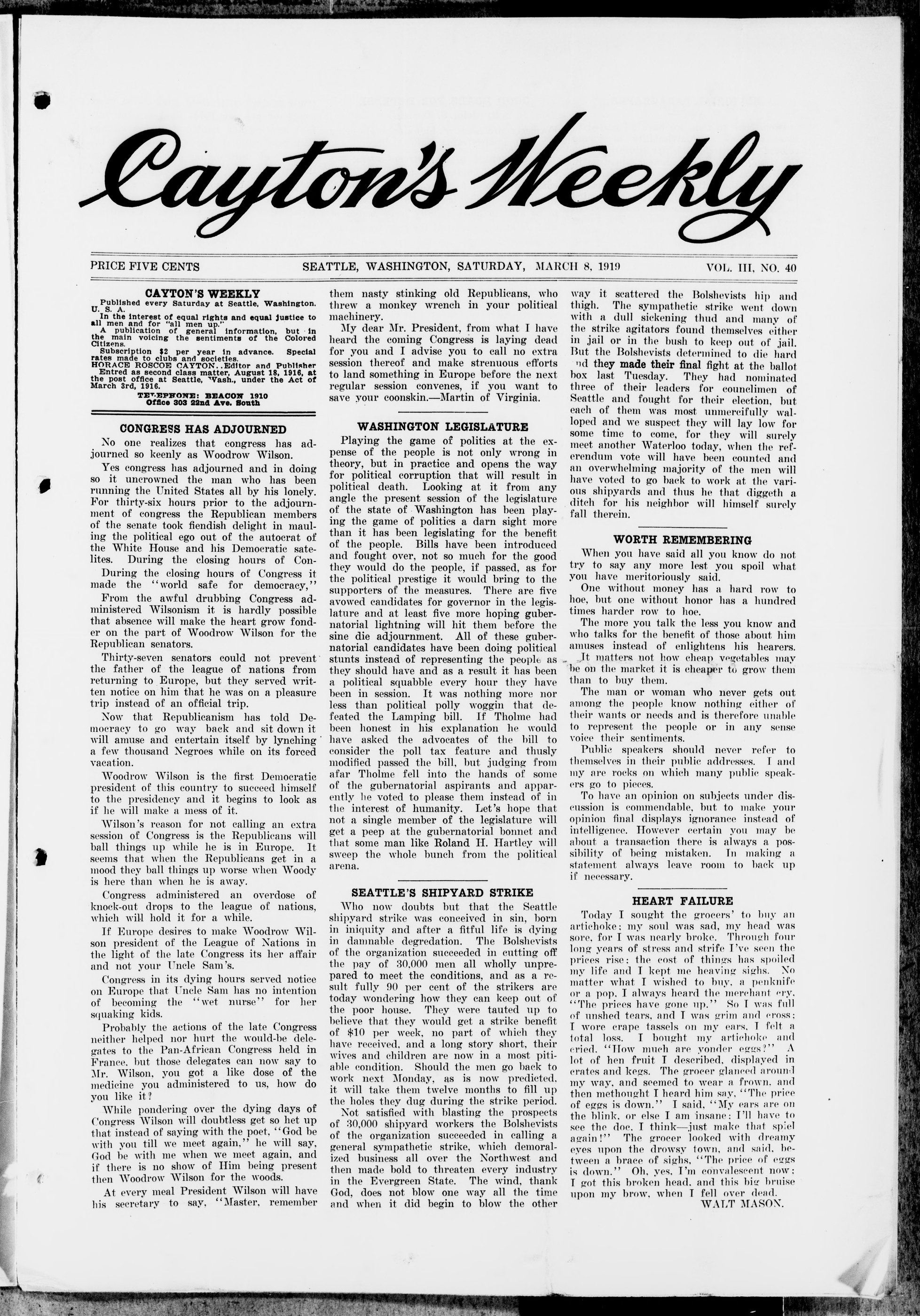
Cayton's Weekly
SEATTLE, WASHINGTON, SATURDAY, MARCH 8, 1919
PRICE FIVE CENTS
CAYTON'S WEEKLY
CAYTON'S WEEKLY
Published every Saturday at Seattle, Washington.
U. S. A.
In the interest of equal rights and equal justice to all men and for "all men up."
A publication of general information, but in the main voicing the sentiments of the Colored Citizens.
Subscription $2 per year in advance. Special rates made to clubs and societies.
HORACE ROSCOE CAYTON..Editor and Publisher
Entred as second class matter, August 18, 1916, at the post office at Seattle, Wash., under the Act of March 3rd, 1916.
TELEPHONE: BEACON 1910
Office 302 23d Ave. South
CONGRESS HAS ADJOURNED
No one realizes that congress has adjourned so keenly as Woodrow Wilson.
Yes congress has adjourned and in doing so it uncrowned the man who has been running the United States all by his lonely. For thirty-six hours prior to the adjournment of congress the Republican members of the senate took fiendish delight in mauling the political ego out of the autocrat of the White House and his Democratic satellites. During the closing hours of Con- During the closing hours of Congress it made the "world safe for democracy," From the awful drubbing Congress administered Wilsonism it is hardly possible that absence will make the heart grow fonder on the part of Woodrow Wilson for the Republican senators.
Thirty-seven senators could not prevent the father of the league of nations from returning to Europe, but they served written notice on him that he was on a pleasure trip instead of an official trip.
Now that Republicanism has told Democracy to go way back and sit down it will amuse and entertain itself by lynching a few thousand Negroes while on its forced vacation.
Woodrow Wilson is the first Democratic president of this country to succeed himself to the presidency and it begins to look as if he will make a mess of it.
Wilson's reason for not calling an extra session of Congress is the Republicans will ball things up while he is in Europe. It seems that when the Republicans get in a mood they ball things up worse when Woody is here than when he is away.
Congress administered an overdose of knock-out drops to the league of nations, which will hold it for a while.
If Europe desires to make Woodrow Wilson president of the League of Nations in the light of the late Congress its her affair and not your Uncle Sam's.
Congress in its dying hours served notice on Europe that Uncle Sam has no intention of becoming the "wet nurse" for her squaking kids.
Probably the actions of the late Congress neither helped nor hurt the would-be delegates to the Pan-African Congress held in France, but those delegates can now say to Mr. Wilson, you got a like dose of the medicine you administered to us, how do you like it?
While pondering over the dying days of Congress Wilson will doubtless get so het up that instead of saying with the poet, "God be with you till we meet again," he will say, God be with me when we meet again, and if there is no show of Him being present then Woodrow Wilson for the woods.
At every meal President Wilson will have his secretary to say, "Master, remember
them nasty stinking old Republicans, who threw a monkey wrench in your political machinery. My dear Mr. President, from what I have heard the coming Congress is laying dead for you and I advise you to call no extra session thereof and make strenuous efforts to land something in Europe before the next regular session convenes, if you want to save your coonskin.—Martin of Virginia.
WASHINGTON LEGISLATURE
Playing the game of politics at the expense of the people is not only wrong in theory, but in practice and opens the way for political corruption that will result in political death. Looking at it from any angle the present session of the legislature of the state of Washington has been playing the game of politics a darn sight more than it has been legislating for the benefit of the people. Bills have been introduced and fought over, not so much for the good they would do the people, if passed, as for the political prestige it would bring to the supporters of the measures. There are five avowed candidates for governor in the legislature and at least five more hoping gubernatorial lightning will hit them before the sine die adjournment. All of these gubernatorial candidates have been doing political stunts instead of representing the people as they should have and as a result it has been a political squabble every hour they have been in session. It was nothing more nor less than political polly woggin that defeated the Lamping bill. If Tholme had been honest in his explanation he would have asked the advocates of the bill to consider the poll tax feature and thusly modified passed the bill, but judging from afar Tholme fell into the hands of some of the gubernatorial aspirants and apparently he voted to please them instead of in the interest of humanity. Let's hope that not a single member of the legislature will get a peep at the gubernatorial bonnet and that some man like Roland H. Hartley will sweep the whole bunch from the political arena.
SEATTLE'S SHIPYARD STRIKE
Who now doubts but that the Seattle shipyard strike was conceived in sin, born in iniquity and after a fitful life is dying in damnable degredation. The Bolshevists of the organization succeeded in cutting off the pay of 30,000 men all wholly unprepared to meet the conditions, and as a result fully 90 per cent of the strikers are today wondering how they can keep out of the poor house. They were tauted up to believe that they would get a strike benefit of $10 per week, no part of which they have received, and a long story short, their wives and children are now in a most pitiable condition. Should the men go back to work next Monday, as is now predicted, it will take them twelve months to fill up the holes they dug during the strike period.
Not satisfied with blasting the prospects of 30,000 shipyard workers the Bolshevists of the organization succeeded in calling a general sympathetic strike, which demoralized business all over the Northwest and then made bold to threaten every industry in the Evergreen State. The wind, thank God, does not blow one way all the time and when it did begin to blow the other
VOL, III, NO, 40
way it scattered the Bolshevists hip and thigh. The sympathetic strike went down with a dull sickening thud and many of the strike agitators found themselves either in jail or in the bush to keep out of jail. But the Bolshevists determined to die hard and they made their final fight at the ballot box last Tuesday. They had nominated three of their leaders for councilmen of Seattle and fought for their election, but each of them was most unmercifully walloped and we suspect they will lay low for some time to come, for they will surely meet another Waterloo today, when the referendum vote will have been counted and an overwhelming majority of the men will have voted to go back to work at the various shipyards and thus he that diggeth a ditch for his neighbor will himself surely fall therein.
WORTH REMEMBERING
When you have said all you know do not try to say any more lest you spoil what you have meritoriously said.
One without money has a hard row to hoe, but one without honor has a hundred times harder row to hoe.
The more you talk the less you know and who talks for the benefit of those about him amuses instead of enlightens his hearers.
It matters not how cheap vegetables may be on the market it is cheaper to grow them than to buy them.
The man or woman who never gets out among the people know nothing either of their wants or needs and is therefore unable to represent the people or in any sense voice their sentiments.
Public speakers should never refer to themselves in their public addresses. I and my are rocks on which many public speakers go to pieces.
To have an opinion on subjects under discussion is commendable, but to make your opinion final displays ignorance instead of intelligence. However certain you may be about a transaction there is always a possibility of being mistaken. In making a statement always leave room to back up if necessary.
HEART FAILURE
Today I sought the grocers' to buy an artichoke; my soul was sad, my head was sore, for I was nearly broke. Through four long years of stress and strife I've seen the prices rise: the cost of things has spoiled my life and I kept me heaving sighs. No matter what I wished to buy, a penknife or a pop, I always heard the merchant cry, "The prices have gone up." So I was full of unshed tears, and I was grim and cross; I wore crape tassels on my ears, I felt a total loss. I bought my artichoke and cried. "How much are yonder eggs?" A lot of hen fruit I described, displayed in crates and kegs. The grocer glanced around my way, and seemed to wear a frown, and then methought I heard him say, "The price of eggs is down." I said, "My ears are on the blink, or else I am insane: I'll have to see the doc. I think—just make that spiel again!" The grocer looked with dreamy eyes upon the drowsy town, and said, between a brace of sighs, "The price of eggs is down." Oh, yes, I'm convalescent now; I got this broken head, and this big bruise upon my brow, when I fell over dead.
WALT MASON.
```markdown
```
EDITORIAL PARAGRAPHS
From time to time we have advocated in these columns ahe advisability of young colored men getting a better education than the young white men and we again urge it. In life the colored man will be either at the top or the bottom. If highly educated he will be at the top, if not well educated he will be at the bottom. For the colored man there is no middle ground. The young colored man well educated and with either a trade or a profession well mastered will have little or no trouble in getting by, but the young man with either a smattering of an education or none at all will have a hard time to get the most menial employment. At present an overwhelming majority of the young colored men quit school as soon as they have finished their course in the graded schools or after the first year in high school and for the battle of life they have nothing with which to protect themselves. To the colored boy the future is a long leap in the dark while to the white boy the future is a well paved highway unless he chooses to wander therefrom. If the colored boy be wise he will prepare himself to travel any kind of road that he may be forced upon and that he can not do unless while a boy and a youth he takes full and complete advantage of all educational opportunities. This means you.
"All things comes to him who waits," runs an old adage, and it still seems to hold good. The supreme court has upheld the Seattle street car deal and within the next forty days this city will own the entire system and as it is now paying so will it continue to pay. Under the city it will pay even more than under private ownership and yet cost the citizens less money to ride thereon. Every public utility Seattle has operated has been a financial success and yet dire calamity was predicted when she took the water system and a like calamity was predicted when she put in her own light system and yet both of these have been money makers from the very outset. The things that are for the public's accommodation should be owned by the public. In Seattle both the gas plant and the telephone system should be owned by the municipality and they will be in the no very distant future.
Why demand any more of Senator Tholme than any of the other twenty senators who voted against the Lamping bill? In our opinion the defeat of the bill was a mistake, if not a mistake an injustice, but the blame, if blame at all, should fall alike on the shoulders of each opposing senator. The poll tax feature would have made some people practice what they preach.
In the death of Harry R. Clise this community loses an ideal gentleman. The editor hereof for the past twenty-five years knew him intimately and he was a gentleman yesterday, today and tomorrow. So far as we know he never took a mean advantage of a fellow man.
Seventeen year locusts are booked for the middle West the coming summer and if they are the forerunners of war it must mean that the allies are to lick the stuffins out of Japan.
That unity of action urged by President Wilson is not so much for the good of the country as it is for the political good of Wilson.
Its well that that was Leg that Williams shot at on Twelfth and Jackson or he might have been hit.
But yesterday and Woodrow Wilson could sing, "The world is mine," congress, however, changed his tune.
Bolshevism in Seattle is striking one damn snag after another.
GOOD ROADS FOR DEFENSE
By John S. Crandell Formerly professor of highway engineering at Pennsylvania State College.
If we wanted to move troops along our coasts to protect them from enemy raids, could we do it? Have we good roads throughout the entire length of coast line to be able to move rapidly large bodies of soldiers at any season of the year from place to place along the shore? Can we move troops along our highways in the spring of the year from the interior of the land to the unguarded coasts? Can we move them over our roads at any time of the year? Of course we cannot. We never have had a comprehensive system of national highways. We never have had any system at all.
The ocean shore lines of the United States are 21,354 miles long, including bays and islands. The mileage of roads in the whole country is something over 2,000,000, so that
CAYTON'S WEEKLY
(Office 303 22nd Ave. South)
Regular, Reliable, Republican, Readable
Wants 500 New Subscribers
This is a Sample of what it sends out
Every Week
No Friends to Reward or Enemies to
Punish
A Publication of Ideas Rather Than
Personalities
Read for Yourself and Be Convinced
Telephone Beacon 1910
the entire area has only ten times as many miles of roads as the length of the shore lines. It takes a long time to build roads. Highway engineers are few and far between. Like other branches of engineering, the building of roads calls for a high degree of skill and common sense. There has not been enough encouragement given to highway engineers to tempt the young man into this fascinating branch. It should be part of the Government's work to give it. To take care of so huge a job as providing roads paralleling our shore lines, we must train our engineers for that work.
But shore-line roads are useless unless they connect with the back country, and that means the improvement of the existing roads and the construction of new ones. Old roads must be improved by reducing the heavy grades that now exist on many of them, and by providing the main ones with hard surfaces on well-drained subsoil.
Our road builders have had a taste of constructing highways in a hurry. In the camps and cantonments, one of the big problems was how to build roads in record time that would stand the traffic. Local conditions governed the choice of materials in many instances, but the majority of the improved roads were of the macadam type. Where the traffic was expected to be heavy a bituminous binder was selected. For the most part this binder was refined tar. In fact, out of the thirty-odd camps and cantonments coal tar was used to bind the macadam
roads in twenty of them, and eleven other camps or avaition fields used tar for surface treating the roads. (It seems strange that this material, once an unwelcome byproduct of illuminating gas and the coke industries, assumed the position of one of the principal factors in the waging of war. Dyestuffs, explosives, medicines, road material—they were but a few of its contributions.)
Reports from the war area told us that the roads there are built mainly of macadam, and that under the extremely heavy traffic, the bombing, and the other unusual conditions, these roads were the sole reliance of the armies. This is not surprising to those who have studied the road problem for years. Indeed, it was no more than was to have been expected. The only objection to these roads was the dust nuisance. The remedy for this would have been to send refined tar abroad to surface treat these roads.
In the building of the cantonment roads under pressure of time, much was learned by the engineers and contractors that would be of use in building such roads as are advocated above. As a rule, the average contractor builds about three miles of road a year. At the cantonments a mile of road was constructed every four days. Of course this does not mean that a mile of improved road was built in this short time, but a mile of earth road was constructed every four days, and on seven miles of such earth roads were placed tar-bound macadam tops. The cantonments had about twenty-five miles of roads built in ninety days.
There must be sufficient reasons why tar was used in so many of the camps, and these are not hard to seek. First of all, tar was to be had in nearly all parts of the country, thus doing away with costly and uncertain rail transportation; further, tar macadam is very quickly built with a minimum of equipment; and, lastly, such roads are good roads in every sense of the word. If the Government is again faced with building roads in a hurry, tar macadam will be the type of road that will first suggest itself to the engineers.
But there should be no need for the through roads to be built in rush jobs. We know what is needed, and we know how long it should take to build the necessary mileage of good roads if the money is appropriated for them. We know too what could very easily happen to us if enemy hordes swept down on our unprotected shores. The only consolation that we can call to mind is that they would be stuck as deep in the mud as ourselves.
What we need is a system of Government roads—Government-built and Government-maintained—that, meeting modern traffic conditions, will be useful in time of peace and necessary in time of war.
THE EMPORIUM
Soft Drinks. A Choice Line of Cigars and Tobacco. Candy Meals from 6 a.m. to 2 p.m. Chillie Con Carnie
W.S.S.
WAR SAVINGS STAMPS
ISSUED BY THE
UNITED STATES
GOVERNMENT
THE PASSING THRONG
The brand new undertaking parlors of A. D. Richardshon were thrown open to the public for inspection last Saturday and those who saw them said, well done. While this institution is neither a Bonney-Watson or Butterworth & Sons, yet it is highly commendable and stands an example of industry and determination. The establishment is complete within itself and does not have to do any farming out business. Mr. Richardson, the proprietor, is the only licensed and registered embalmer of color in the Northwest and with his profession he has joined business and as a result he has the foundation for an undertaking business that if half cared for will within the next two years be worth ten fold more than it is at the present time. Already Mr. Richardson is being patronized by the Chinese, Japanese and Jews as well as by his own people and he says on this point "my parlors are for the dead without regard to creed, color or condition."
MR. MANEY ANSWERED
Kindly allow space in your paper for the publication of this letter which is in refutation to the statement of Mr. Maney, published in your issue of March 1st, 1919. I assume all responsibility for the Charity Ball given at Renton Hill Hall on the evening of February 22, 1919, and also brand as deliberately false the statement of Mr. Maney that said ball was given or advertised for the benefit of the Tacoma Benevolent Orphanage. The ball was given and advertised under the heading of the Charity Committee for the benefit of colored orphans and no particular home was mentioned.
My intention was to give the proceeds, if any, to the Colored Orphanage at Charleston, S. C., as I had noticed an advertisement in the Charleston Messenger requesting bedding etc. for the Colored Home at Charleston.
Mr. Maney called at my home Friday eveing, February 21st, and I explained the matter to him fully and he remarked that he thought all proceeds from the ball should go to his orphanage at Tacoma, and to let the South look after their own orphans—"selfishness personified?"—although in his statement in your issue of the 1st inst. says that the proceeds would not have been accepted by his home had it been tendered.
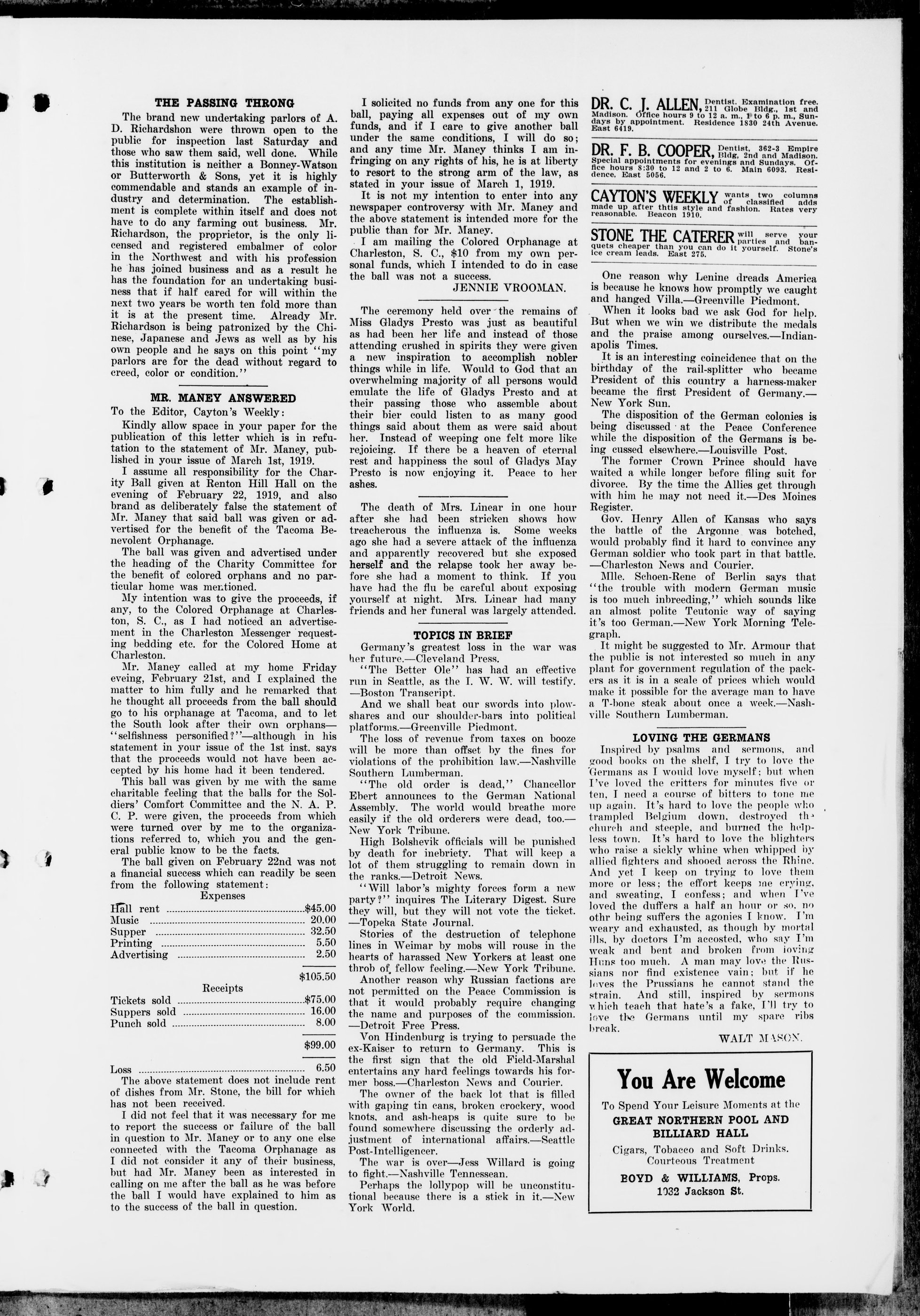
This ball was given by me with the same charitable feeling that the balls for the Soldiers' Comfort Committee and the N. A. P. C. P. were given, the proceeds from which were turned over by me to the organizations referred to, which you and the general public know to be the facts. The ball given on February 22nd was not a financial success which can readily be seen from the following statement:
Expenses
Hall rent ..... $45.00
Music ..... 20.00
Supper ..... 32.50
Printing ..... 5.50
Advertising ..... 2.50
$105.50
Receipts
Tickets sold ..... $75.00
Suppers sold ..... 16.00
Punch sold ..... 8.00
$99.00
Loss ..... 6.50
The above statement does not include rent of dishes from Mr. Stone, the bill for which has not been received.
I did not feel that it was necessary for me to report the success or failure of the ball in question to Mr. Maney or to any one else connected with the Tacoma Orphanage as I did not consider it any of their business, but had Mr. Maney been as interested in calling on me after the ball as he was before the ball I would have explained to him as to the success of the ball in question.
---
I solicited no funds from any one for this ball, paying all expenses out of my own funds, and if I care to give another ball under the same conditions, I will do so; and any time Mr. Maney thinks I am infringing on any rights of his, he is at liberty to resort to the strong arm of the law, as stated in your issue of March 1, 1919. It is not my intention to enter into any newspaper controversy with Mr. Maney and the above statement is intended more for the public than for Mr. Maney. I am mailing the Colored Orphanage at Charleston, S. C., $10 from my own personal funds, which I intended to do in case the ball was not a success.
JENNIE VROOMAN
The ceremony held over the remains of Miss Gladys Presto was just as beautiful as had been her life and instead of those attending crushed in spirits they were given a new inspiration to accomplish nobler things while in life. Would to God that an overwhelming majority of all persons would emulate the life of Gladys Presto and at their passing those who assemble about their bier could listen to as many good things said about them as were said about her. Instead of weeping one felt more like rejoicing. If there be a heaven of eternal rest and happiness the soul of Gladys May Presto is now enjoying it. Peace to her ashes.
The death of Mrs. Linear in one hour after she had been stricken shows how treacherous the influenza is. Some weeks ago she had a severe attack of the influenza and apparently recovered but she exposed herself and the relapse took her away before she had a moment to think. If you have had the flu be careful about exposing yourself at night. Mrs. Linear had many friends and her funeral was largely attended.
TOPICS IN BRIEF
Germany's greatest loss in the war was her future.—Cleveland Press.
"The Better Ole" has had an effective run in Seattle, as the I. W. W. will testify.—Boston Transcript.
And we shall beat our swords into plow-shares and our shoulder-bars into political platforms.—Greenville Piedmont.
The loss of revenue from taxes on booze will be more than offset by the fines for violations of the prohibition law.—Nashville Southern Lumberman.
"The old order is dead," Chancellor Ebert announces to the German National Assembly. The world would breathe more easily if the old orderers were dead, too.—New York Tribune.
High Bolshevik officials will be punished by death for inebriety. That will keep a lot of them struggling to remain down in the ranks.—Detroit News.
"Will labor's mighty forces form a new party?" inquires The Literary Digest. Sure they will, but they will not vote the ticket.—Topeka State Journal.
Stories of the destruction of telephone lines in Weimar by mobs will rouse in the hearts of harassed New Yorkers at least one throb of fellow feeling.—New York Tribune. Another reason why Russian factions are not permitted on the Peace Commission is that it would probably require changing the name and purposes of the commission.—Detroit Free Press. Von Hindenburg is trying to persuade the ex-Kaiser to return to Germany. This is the first sign that the old Field-Marshal entertains any hard feelings towards his former boss.—Charleston News and Courier.
The owner of the back lot that is filled with gaping tin cans, broken crockery, wood knots, and ash-heaps is quite sure to be found somewhere discussing the orderly adjustment of international affairs.—Seattle Post-Intelligencer.
The war is over—Jess Willard is going to fight.—Nashville Tennessean.
Perhaps the lollypop will be unconstitutional because there is a stick in it.—New York World.
DR. C. J. ALLEN, Dentist. Examination free. 211 Globe Bldg., 1st and Madison. Office hours 9 to 12 a. m., 1 to 6 p. m., Sundays by appointment. Residence 1830 24th Avenue. East 6419.
DR. F. B. COOPER, Dentist, 362-3 Empire Bldg, 2nd and Madison. Special appointments for evenings and Sundays. Office hours 8:30 to 12 and 2 to 6. Main 6093. Residence. East 5056.
CAYTON'S WEEKLY wants two columns of classified adds made up after this style and fashion. Rates very reasonable. Beacon 1910.
STONE THE CATERER will serve your parties and banquets cheaper than you can do it yourself. Stone's ice cream leads. East 275.
One reason why Lenine dreads America is because he knows how promptly we caught and hanged Villa.—Greenville Piedmont.
When it looks bad we ask God for help. But when we win we distribute the medals and the praise among ourselves.—Indianapolis Times.
It is an interesting coincidence that on the birthday of the rail-splitter who became President of this country a harness-maker became the first President of Germany.—New York Sun.
The disposition of the German colonies is being discussed at the Peace Conference while the disposition of the Germans is being cussed elsewhere.—Louisville Post.
The former Crown Prince should have waited a while longer before filing suit for divorce. By the time the Allies get through with him he may not need it.—Des Moines Register.
Gov. Henry Allen of Kansas who says the battle of the Argonne was botched, would probably find it hard to convince any German soldier who took part in that battle.—Charleston News and Courier.
Mlle. Schoen-Rene of Berlin says that "the trouble with modern German music is too much inbreeding," which sounds like an almost polite Teutonic way of saying it's too German.—New York Morning Telegraph.
It might be suggested to Mr. Armour that the public is not interested so much in any plant for government regulation of the packers as it is in a scale of prices which would make it possible for the average man to have a T-bone steak about once a week.—Nashville Southern Lumberman.
LOVING THE GERMANS
Inspired by psalms and sermons, and good books on the shelf, I try to love the Germans as I would love myself; but when I've loved the critters for minutes five or ten, I need a course of bitters to tone me up again. It's hard to love the people who trampled Belgium down, destroyed the church and steeple, and burned the helpless town. It's hard to love the blighters who raise a sickly whine when whipped by allied fighters and shooed across the Rhine. And yet I keep on trying to love them more or less; the effort keeps me crying, and sweating, I confess; and when I've loved the duffers a half an hour or so, no other being suffers the agonies I know. I'm weary and exhausted, as though by mortal ills, by doctors I'm accosted, who say I'm weak and bent and broken from loving Huns too much. A man may love the Russians nor find existence vain; but if he loves the Prussians he cannot stand the strain. And still, inspired by sermons which teach that hate's a fake, I'll try to love the Germans until my spare ribs break.
WALT MASON.
You Are Welcome
To Spend Your Leisure Moments at the
GREAT NORTHERN POOL AND
BILLIARD HALL
Cigars, Tobacco and Soft Drinks.
Courteous Treatment
BOYD & WILLIAMS, Props.
1032 Jackson St.
---
STOLEN FROM THIEVES
After five unsuccessful years of running horses, the owner had at last triumphed, but surely there was never such bad luck. He had won his first race all right, but the jockey was overweight.
The owner was gloomy. The jockey was gloomy. The aspect was decidedly gloomy, but it cleared somewhat when the owner sidled up to the jockey and said: "Can't you think of something to lessen your weight?"
"Don't think so, sir."
"Have you shaved?"
"Yes, sir, before the race."
"Finger nails clipped?"
An inspection showed that nothing was to be hoped for there, and the owner's face resumed its look of gloom, until suddenly another idea occurred to him. "Here," he said, "give me your false teeth when nobody is looking."
Just because a man is an officer in the territorials, it doesn't mean to say he can ride a horse. At least, that was the case with Col. Knut of the Tuttleton Tarriers. An inspection was to him a nightmare. So when the general commanding came along, Col. Knut sat on his horse uneasily. Then the band started to play. At the first bang of the drum the colonel's horse started two-stepping. With the fifes he tangoed. The colonel set his teeth and hung on grimly.
The Terriers got mightily excited. Would he stick on or not? Anxious to see the fun, they pushed forward until the front rank looked like a football crowd.
"Ease off there!" yelled the sergeant, angrily.
"No, 'e ain't," retorted an enthusiastic watcher, "but he will be in a minute!"
Preaching in one of the state capitals an Australian bishop noticed in his congregation a strange face. The following Sunday the same individual appeared, and later in the week the bishop met him in the street. The bishop stopped him, congratulated him upon his attendance at the cathedral and added: "You don't live here, do you?" "No," said the stranger; "I live way back," mentioning the name of the place. "Have you many Episcopalians there?" inquired the bishop. "No, sir," was the reply. "What we are mostly worried with is rabbits."
An Irishman presented himself before a magistrate to seek advice. "Sor," he said, "I kapes hens in my cellar, but th' wather pipes is bust an' me hens is all drownded." "Sorry I can't do anything for you," said the magistrate; "you had better apply to the water company." A few days later Pat again appeared. "Well, what now? What did the water company tell you?" queried the magistrate. "They told me, yer honor," was the reply, "to kape ducks."
A good story is told of a temperance meeting held in a well known town in the north of Ireland. The mayor and aldermen had consented to attend in their robes, and, as it happened, they were late in arriving, and to keep things going the audience started singing "Hold the Fort, for I Am Coming," but it was distinctly unfortunate that just as the mayor entered at the head of the imposing civic procession, the congregation happened to be singing the lines "The mighty host advancing, Satan leading on!"
Phone 2647
Tailors and Cleaners. Clothes called for and delivered. Hats retrimmed and blocked. H. S. Frazier C. W. Curtest
Mr. Quietly had screwed himself up to the striking point at last, and asked Selina Newgirl the great question.
"Do you suppose, Mr. Quietly," said she in reply, "that I'd ever marry a man so benighted as to carry a shoreshoe in his pocket for luck? I'm a modern woman, let me tell you."
Quietly paled. Then, recovering himself, he took out his horseshoe, laid it on his knees, patted it, and said gayly:
"Well, old fellow, I guess nobody'll ever doubt your efficacy after this!"
Mrs. Juggins bought a hat and paid dearly for it. Therefore, she was justified in her indignation on seeing Mrs. Belfrey in a copy of the said hat.
Mrs. Juggins spoke to the milliner about it.
Mme. Feathers listened patiently and then said:
"Yes, madam, the hat I sold Mrs. Belfrey is somewhat similar to yours; but I knew it was not for the same place of worship!"
A teacher was showing her class how to make different kinds of knots. Most of them were apt pupils, but there was one boy who did not seem to be interested.
"Patsy," said the teacher, "have you made any knots?"
"No," answered Patsy.
"No what?" asked the teacher, in a corrective tone.
"No knots," said the boy, surprised at the teacher's ignorance.
Jimson had heard news about Johnson that pained and grieved him. When he met Johnson he demanded:
"What's this I hear about you and your wife having trouble? Before you were married you told me you would go to the ends of the earth together."
"Yes," said Johnson, and there was a great weariness in his voice; "but I didn't know she wanted to go there in a taxi."
Percy (after the proposal)—"Have you ever loved before?"
Edith—"No, Percy! I have often admired men for their strength, courage, beauty, intelligence, or something like that, you know; but with you, Percy, it is all love —nothing else!"
GERMAN MENTAL MEALS
Mental suggestion is Germany's newest substitute for food. These imaginary meals are "served and eaten" with much ceremony among certain groups of German intellectuals, and the cult, on the authority of a Dutch dealer in antiques who landed in New York the other day, is increasing. Those who dine on suggestion, said the Dutch dealer, George W. Meers, of Amsterdam, take the idea very seriously. He describes a mental dinner, a mental table d'hote dinner, it seems, which partook somewhat of the nature of a religious rite. As the New York Globe quotes his description:
"A group of ten or twelve will gather around a table. Usually the table is bare of linen and silver, as well as food. The shades are drawn so that the total absence of eatables will not be so apparent.
The meal begins. It has been announced beforehand what the menu will comprise. Seated around the bare wooden table, with folded arms, the disciples concentrate on soup—if that is the first item on the table d'hote bill of fare—and the various sensations of sipping and swallowing are created in the minds of each by desperate, concerted thought. If it is turtle soup they have decided to feast their minds upon, the thoughts flow thick and green. For consomme they conjure up a thinner and more delicate fluid.
A prolonged sigh indicates the end of a course. The next item on the menu, perhaps, is filet of sole with creamy Holland-
aise sauce. After a decent interval, to allow imaginary waiters to clear off the empty soup-plates and bring on fresh imaginary viands, the second course begins. They linger over each mental mouthful. No sensation of odor or taste escapes them. To strengthen the imagination, many of them sit and "eat" with closed eyes. So on throughout the whole gamut of courses. Every meal is a banquet, from the hors d'oeuvre clear down to the Camembert cheese and toasted crackers. Wine flows freely.
It is claimed that conscientious application of principles of the cult will stimulate digestive organs. The functions, it is said, actually soothe the pangs of hunger.
Mr. Meers said that the food-substitutes concocted by German chemists had grown steadily worse. Epidemics of dysentery and kindred diseases were common, he said.
Food conditions at the prison-camps have reached such a state that prisoners and guards are escaping together over the Dutch frontier. Thousands of German deserters have reached Holland within the last few months. Most of them, says Mr. Meers, have plent yof money or loot. If they cross the border drest in their military uniforms they are immediately interned. If they succeed in changing to civilian clothes they are not molested. At any rate, the first thing they do upon arriving in the neutral country is to gorge themselves with as much food as the Dutch regulations will permit.
Mental meals may be beautiful in theory, but meat meals are filling to the stomach.
Cheasty's Good Clothes for Men and Women. You can't beat it. CHEASTY'S Second and Spring
RICHARDSON'S UNDERTAKING PARLORS
Embalmer and Funeral Director
1216-18 Jackson Street
Office, Beacon 103; Res., Main 5610
IN THE SUPERIOR COURT OF THE STATE OF Washington for the County of King.-No. 133363. Summons by Publication. J. Abe Fisher, Plaintiff, vs. Fred Therriault, and William Fisher and Eve S. Fisher, his wife, Defendants.
The State of Washington, to the said Fred Therriault. Defendant.
You are hereby summoned to appear within sixty days after the date of the first publication of this summons, to-wit, within sixty days after the 1st day of February, A. D. 1919, and defend the above entitled action in the above entitled court, and answer the complaint of the plaintiff, and serve a copy of your answer upon the undersigned attorney for plaintiff at his office below stated; and in case of your failure so to do, judgment will be rendered against you according to the demand of the complaint, which has been filed with the Clerk of said court. The object of the said action and the relief sought to be obtained therein is fully set forth in said complaint, and is briefly stated as follows:
To partition the following described real property: The East Forty-five (E. 45) feet of Lots Eighteen (18), Nineteen (19) and Twenty (20) in Block Thirteen (13) of Front Street Cable Addition to the City of Seattle, King County, Washington.
ANDREW J. BALLIET,
Attorney for Plaintiff.
P. O. Address: 320 Railway Exchange Bldg., Seattle, County of King, Washington.
First publication Feb. 1, 1919.
IN THE SUPERIOR COURT OF KING COUNTY, State of Washington.—In the Matter of the Estate of Erick J. Edlund, Deceased.—No. 24729. Notice to Creditors. Notice is hereby given that the undersigned has been appointed Executrix of the Estate of Erick J. Edlund, deceased, that all persons naving claims against said deceased are hereby required to serve the same, duly verified, on said Mary M. Edlund, or on Andrew J. Balliet, her attorney of record at the address below stated, and file the same with the Clerk of said court, together with proof of such service within six months after the date of the first publication of this notice, or the same will be barred.
Address: 320 Railway Exchange Bldg., Seattle, Wn.
ANDREW J. BALLIET,
Attorney for Estate.
320 Railway Exchange Bldg., Seattle, Wash.
First publication Feb. 8, 1919.