Cayton's Weekly
Saturday, February 21, 1920
Seattle, Washington
Page text (machine-generated)
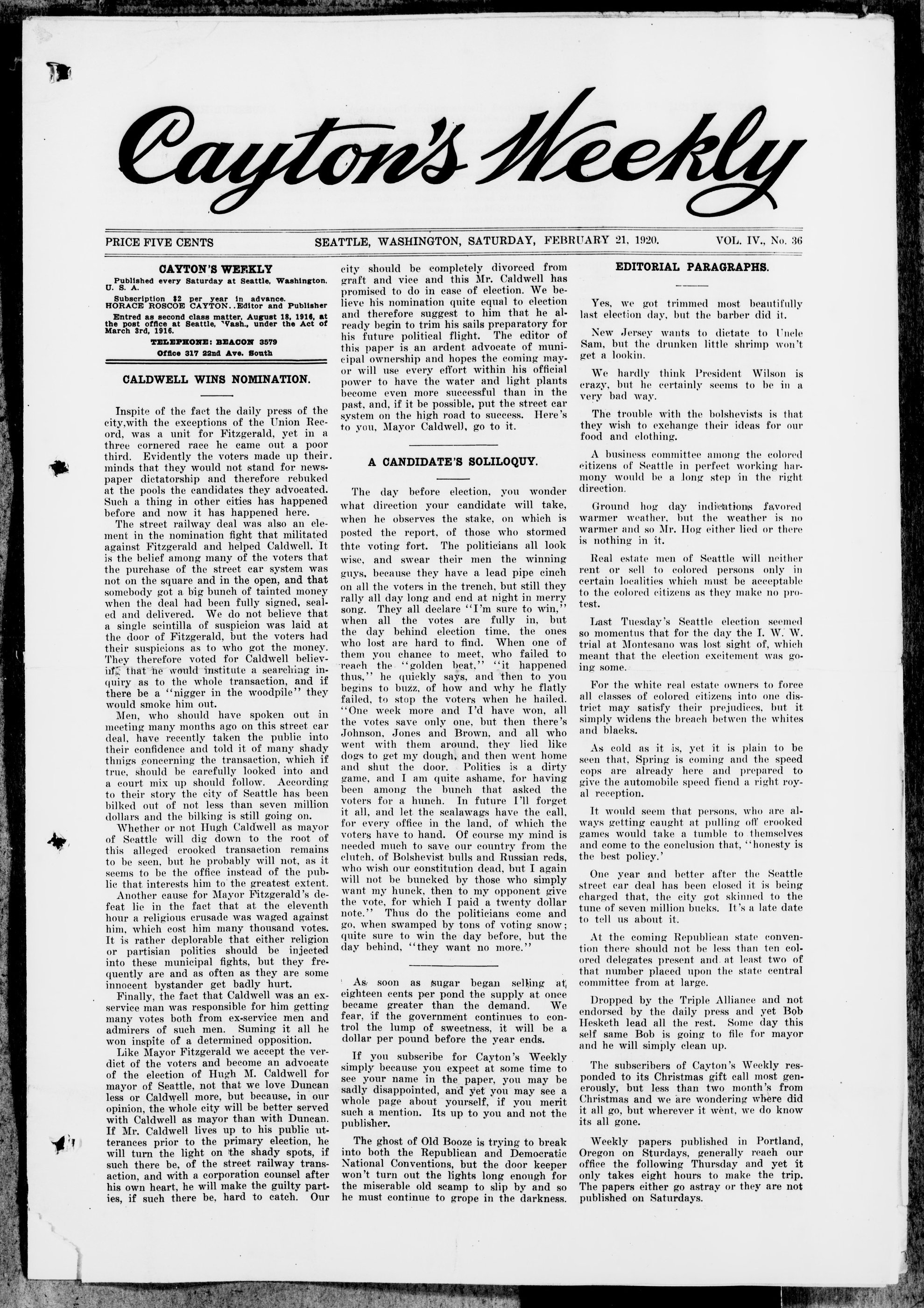
Cayton's Weekly
SEATTLE, WASHINGTON, SATURDAY, FEBRUARY 21, 1920.
PRICE FIVE CENTS
CAYTON'S WEEKLY
Published every Saturday at Seattle, Washington. U. S. A.
Subscription $2 per year in advance.
HORACE ROSCOE CAYTON..Editor and Publisher
Entred as second class matter, August 18, 1916, at the post office at Seattle, 'Vash., under the Act of March 3rd, 1916.
TELEPHONE: BEACON 3579
Office 317 22nd Ave. South
CALDWELL WINS NOMINATION.
Inspite of the fact the daily press of the city,with the exceptions of the Union Record, was a unit for Fitzgerald, yet in a three cornered race he came out a poor third. Evidently the voters made up their minds that they would not stand for newspaper dictatorship and therefore rebuked at the pools the candidates they advocated. Such a thing in other cities has happened before and now it has happened here.
The street railway deal was also an element in the nomination fight that militated against Fitzgerald and helped Caldwell. It is the belief among many of the voters that the purchase of the street car system was not on the square and in the open, and that somebody got a big bunch of tainted money when the deal had been fully signed, sealed and delivered. We do not believe that a single scintilla of suspicion was laid at the door of Fitzgerald, but the voters had their suspicions as to who got the money. They therefore voted for Caldwell believing that he would institute a searching inquiry as to the whole transaction, and if there be a "nigger in the woodpile" they would smoke him out.
Men, who should have spoken out in meeting many months ago on this street car deal, have recently taken the public into their confidence and told it of many shady thnigs concerning the transaction, which if true, should be carefully looked into and a court mix up should follow. According to their story the city of Seattle has been bilked out of not less than seven million dollars and the bilking is still going on. Whether or not Hugh Caldwell as mayor of Seattle will dig down to the root of this alleged crooked transaction remains to be seen, but he probably will not, as it seems to be the office instead of the public that interests him to the greatest extent. Another cause for Mayor Fitzgerald's defeat lie in the fact that at the eleventh hour a religious crusade was waged against him, which cost him many thousand votes. It is rather deplorable that either religion or partisian politics should be injected into these municipal fights, but they frequently are and as often as they are some innocent bystander get badly hurt.
Finally, the fact that Caldwell was an ex-service man was responsible for him getting many votes both from ex-service men and admirers of such men. Suming it all he won inspite of a determined opposition.
Like Mayor Fitzgerald we accept the verdict of the voters and become an advocate of the election of Hugh M. Caldwell for mayor of Seattle, not that we love Duncan less or Caldwell more, but because, in our opinion, the whole city will be better served with Caldwell as mayor than with Duncan. If Mr. Caldwell lives up to his public utterances prior to the primary election, he will turn the light on the shady spots, if such there be, of the street railway transaction, and with a corporation counsel after his own heart, he will make the guilty parties, if such there be, hard to catch. Our
city should be completely divorced from graft and vice and this Mr. Caldwell has promised to do in case of election. We believe his nomination quite equal to election and therefore suggest to him that he already begin to trim his sails preparatory for his future political flight. The editor of this paper is an ardent advocate of municipal ownership and hopes the coming mayor will use every effort within his official power to have the water and light plants become even more successful than in the past, and, if it be possible, put the street car system on the high road to success. Here's to you, Mayor Caldwell, go to it.
A CANDIDATE'S SOLILOQUY.
The day before election, you wonder what direction your candidate will take, when he observes the stake, on which is posted the report, of those who stormed the voting fort. The politicians all look wise, and swear their men the winning guys, because they have a lead pipe cinch on all the voters in the trench, but still they rally all day long and end at night in merry song. They all declare "I'm sure to win," when all the votes are fully in, but the day behind election time, the ones who lost are hard to find. When one of them you chance to meet, who failed to reach the "golden beat," "it happened thus," he quickly says, and then to you begins to buzz, of how and why he flatly failed, to stop the voters when he hailed. "One week more and I'd have won, all the votes save only one, but then there's Johnson, Jones and Brown, and all who went with them around, they lied like dogs to get my dough, and then went home and shut the door. Politics is a dirty game, and I am quite ashame, for having been among the bunch that asked the voters for a hunch. In future I'll forget it all, and let the scalawags have the call, for every office in the land, of which the voters have to hand. Of course my mind is needed much to save our country from the clutch, of Bolshevist bulls and Russian reds, who wish our constitution dead, but I again will not be buncked by those who simply want my hunck, then to my opponent give the vote, for which I paid a twenty dollar note." Thus do the politicians come and go, when swamped by tons of voting snow; quite sure to win the day before, but the day behind, "they want no more."
As soon as sugar began selling at eighteen cents per pond the supply at once became greater than the demand. We fear, if the government continues to control the lump of sweetness, it will be a dollar per pound before the year ends.
If you subscribe for Cayton's Weekly simply because you expect at some time to see your name in the paper, you may be sadly disappointed, and yet you may see a whole page about yourself, if you merit such a mention. Its up to you and not the publisher.
The ghost of Old Booze is trying to break into both the Republican and Democratic National Conventions, but the door keeper won't turn out the lights long enough for the miserable old scamp to slip by and so he must continue to grope in the darkness.
VOL. IV., No. 36
EDITORIAL PARAGRAPHS
Yes, we got trimmed most beautifully last election day, but the barber did it.
New Jersey wants to dictate to Uncle Sam, but the drunken little shrimp won't get a lookin.
We hardly think President Wilson is crazy, but he certainly seems to be in a very bad way.
The trouble with the bolshevists is that they wish to exchange their ideas for our food and clothing.
A business committee among the colored citizens of Seattle in perfect working harmony would be a long step in the right direction.
Ground hog day indications favored warmer weather, but the weather is no warmer and so Mr. Hog either lied or there is nothing in it.
Real estate men of Seattle will neither rent or sell to colored persons only in certain localities which must be acceptable to the colored citizens as they make no protest.
Last Tuesday's Seattle election seemed so momentus that for the day the I. W. W. trial at Montesano was lost sight of, which meant that the election excitement was going some.
For the white real estate owners to force all classes of colored citizens into one district may satisfy their prejudices, but it simply widens the breach between the whites and blacks.
As cold as it is, yet it is plain to be seen that, Spring is coming and the speed cops are already here and prepared to give the automobile speed fiend a right royal reception.
It would seem that persons, who are always getting caught at pulling off crooked games would take a tumble to themselves and come to the conclusion that, 'honesty is the best policy.'
One year and better after the Seattle street car deal has been closed it is being charged that, the city got skinned to the tune of seven million bucks. It's a late date to tell us about it.
At the coming Republican state convention there should not be less than ten colored delegates present and at least two of that number placed upon the state central committee from at large.
Dropped by the Triple Alliance and not endorsed by the daily press and yet Bob Hesketh lead all the rest. Some day this self same Bob is going to file for mayor and he will simply clean up.
The subscribers of Cayton's Weekly responded to its Christmas gift call most generously, but less than two month's from Christmas and we are wondering where did it all go, but wherever it went, we do know its all gone.
Weekly papers published in Portland, Oregon on Sturdays, generally reach our office the following Thursday and yet it only takes eight hours to make the trip. The papers either go astray or they are not published on Saturdays.
e
HAVE TO KEEP IT UP
Under the caption of Inconsistency appeared an article in a Chicago weekly paper complaining of the same thing that Cayton's Weekly has complained of from time to time, the treatment accorded to the colored man by the reporters of the daily press. The editor hereof not long since was moved to appeal to the management of a daily paper of this city to have the reporters of said daily paper modify their news-stories about the colored person of whom they had to write. Our complaint lie in the fact that, in a three inch article telling about a criminal Negro, the Negro designation was used just thirteen times. Now this Chicago publication is writing along the same line and here is what it says:
"Readers of newspapers are never at a loss to know what the nationality of a criminal might be—if he chances to be a member of our group. It will say "Bill Williams, Negro," or "Sam Jackson, Colorer," etc. It has no doubt been a great source of wonder to many and it certainly has always ben a source of annoyance to the members of our Race. Why should the nationality of the criminal, when he happens to be of a darker hue, be exploited simply for that reason? It certainly is not because a crime committed by one of us is any more of a serious offense than if committed by a "white" man. These lines were were inspired by the manner in which the arrest of five young men was reported in a recent issue of a local daily; the men are confessed burglars and suspected murderers. Here is the parapagraph mentioned, with the addresses omitted:
"The members of the alleged gang are Joseph Howard, Peter Real, Joseph Herzog, Charles Velinski and Joseph Bailey."
Here are five names, and each one is characteristic of a different nationality, carrying us, consecutively, through what might be American, Scandinavian, German, Jewish and possibly Irish, but not a word along that line is mentioned. On the page opposite the above was a big head line telling all about the efforts to lynch William Lockett, Negro slayer. If there isn't a word of incoexistency in practices of this sort we are greatly mistaken. Let us have the idea of mentioning the nationality of the criminal carried throughout the entire system of publicity in these cases or not at all. The criminal is a criminal no matter what his complexion, or race. It is practices of this sort that give those who are super-prejudiced a foundation for their radical ideas."
What good purpose can be served by designating one, who falls into the clutches of a daily newspaper reporter, as a Negro is beyond our explanation, but granting it be necessary to make the designation then, what good purpose can be served for repeating the designation a dozen or more times in a three inch article? Evidently the reporter is afraid the designated person will change color before the article is finished and that is why the Negro designation is constantly repeated.
To say the least it is but another mark of unfairness that is so unjustly heaped upon the colored man from time to time by the white man. Probably a reporter, who writes such articles per se bear the colored man no real ill will, but he is carrying out a nation-wide propaganda to humiliate the colored man whenever and wherever the white man comes in contact with him, and yet this is a country of educated Christian white folks. Would you think it?
Here You Are.
Chicago has added approximately 75,000 to her Libranian population since 1915, which is true of no other city. The New York Military Academy at Cornwall, N. Y., refused to let its football team play with the Poughkeepsie High School team because of the presence of a Libranian on the latter. Every member of the high school football team stood by their dark member however, and as a consequence of
the attempted discrimination Poughkeepsie school authorities not only refused to let the military school band use the high school auditorium for its concert but athletic relations were severed between the two schools. Prof. G. W. Carver of Tuskegee Institute claims to have produced a milk from peanuts that is a good substitute for cow's milk which it closely resembles.
Protests against the building of a separate school for Librarians in Cincinnati, O. were lodged with the Board of Education of that city by a large delegation of Librarian citizens. They contended that it was against the laws of the state to have separate schools. Two hundred men and women took the training course for farmers which was held at Tuskegee Institute in January. These courses are given to help the farmers improve their farms and to teach them to make each acre of land yield more and better products.
The Methodist Centenary Movement will provide $400,000.00 for schools for our race in the South. Half of this sum will go to Paine College in Augusta, Ga., the church's training school for teachers and preachers. The other half will go to schools owned by the Colored Methodist church. In addition to this the Southern Methodists will be assessed $52,000.00 annually for school work among our people.—Half Century Magazine.
JACK JOHNSON
American papers are again carrying stories of Jack Johnson the pugilist, and stirring up much interest not only in the sporting world but in police circles in his threatened home coming. Opinion is divided as to what his fate will be when he sets foot on American soil, some holding the prison doors will be closed on him, others that he will get off with a nominal fine. Time has a tendency to smooth out many wrinkles and temper many judgments and in this case his crime may not seem so unpardonable as it did in those yesterday.
We have no inclination to shield wrongdoing, if such the courts prove them to be, but we insist that prejudice and hostile popular sentiment shall play no part in meting out punishment. Our whole group suffered on account of the actions of one member in this particular instance. Jack Johnson was hearlded in the hostile press as being a leader and therefore expressing the views and sentiments of the rest of his group, a conclusion that was absolutely false and unjustified. He was a prize fighter with us, nothing more, nothing less, occupying the same position in the social scale with us Jess Willard and others of his ilk occupy in the Caucasian group.—Chicago Defender.
RABBIT PIE
Cut up the rabbit and boil the pieces in enough water to cover them until they are tender. Take out pieces and keep them in a warm place. Thicken the liquid in which the rabbit was cooked with a tablespoonful of flour and a tablespoonful of butter. Pick the flesh from the bones, placing in a baking pan, put over it two cupfuls of mashed potatoes and pour over the whole thickened liquid. Pour over the top a batter made of a cupful of sweet milk, an egg, two cupfuls of wheat flour, two tablespoonsful of butter, a teaspoonful of salt, two teaspoonfuls baking powder. Then put the pie in the oven and bake until it is done throughout and the crust is browned.
About once a month in the evening pour a cupful of kerosene down the sink; the next morning pour down two gallons of boiling water. The kerosene cuts away any grease that may have collected on the side of the exhaust pipe and the boiling water dissolves and washes it down, thus preventing the pipe from being stopped up.—V. C. L., Henderson, Ky.
USEFUL HINTS
The ugly little dust lines, and dirty patches one frequently sees where a picture was hung, can be prevented by placing a brass headed tack in each lower corner of the frame. This will permit the air to circulate behind it and the dust to drop to the floor instead of accumulating back of the picture.—F. . Lacy, Cairo, Ill. Before cleaning highly polished furniture, particularly mahogany, with oil or furniture polish, rub it well with a cloth wet with vinegar. The vinegar will remove the finger marks and greatly improve the appearance.—H. D. S., Marion, Ind.
When a garment becomes stained, streaked or shows circles from being partly dipped in cleansing fluid, it should be allowed to dry and then held over the steam from a kettle until the ring disappears.—M. R. E., Indianapolis, Ind.
To remove match marks from paint, rub the spots with a freshly cut lemon, apply a little vaseline, and rub dry with a soft cloth. It will be difficult to light matches on the same place again.—L. D., Portland, Me.
A splendid way to keep the raindrops from the windshield when driving through a storm, is to rub the surface of the windshield with kerosene oil, and the rain drops will roll off the glass instead of staying on and obstructing the view.—A. O. T. Cleveland, O.
When straining lard, drippings or any other hot liquid, I fasten the cloth through which I am straining to the retainer by means of clothes pins. This enables me to work alone without fear of burning myself.—O. J. U. Cleveland, Ariz.
A splendid rack for spools of thread can be made in the following manner: Take a board three inches wide and about one inch thick, and cut it as long as your drawer will permit. Drive small headed, two inch nails into the board to make holders for the spools. Put the nails a little more than an inch from each other. You will not only be able to find out just how much thread you have at a moment's notice, but your thread cannot become soiled or tangled so readily as it will laying loose in the drawers.
If you have a velvet bow that has become crushed, heat your curling iron, cover it with a damp cloth, and insert it into the loops, opening the curler wide. Then brush the velvet, and the nap will stand up as it did when new.—T. E. C. Indianapolis, Ind
If you have the misfortune to gouge a hole in the plaster in a room that has been papered, make a mixture of plaster of paris and glue and fill the hole. It will be necessary to work very fast as plaster of paris hardens very fast indeed and once hardened it is impossible to do anything with it. Use one half a pound of plaster of paris to one half a cup of dry glue and moisten the amount you wish to use until it is soft enough to spread. Smooth the plaster with a palette knife. When it dries, cover the plaster with a piece of the original paper with which the room has been papered. It is a good idea to fade the paper in the sun a few days until it matches the paper on the wall. Do not cut the patch of paper, tear the piece out the size you want it. The more irregular the patch the better job you will do.—F. H. Oldman.
Just before you hang out your clothes in the winter, wipe your clothes line carefully with a cloth wet with a strong salt solution. This will prevent the clothes from freezing to the line and thus tearing the clothes when you want to get them off. M. L. F., Minneapolis, Minn.
When a bottle of olives has been opened, pour off the brine and add one or two table sponfuls of olive oil. Replace the cork and shake the bottle well. Then let it stand about half an hour before serving them. Bulk olives, or canned olives should be placed in a glass jar and treated in the same manner. The olives will have a much better flavor and there will be no disagreeable briny taste.—E. M. J., Harvey, Ill.
THE PASSING THRONG
At the Asberry Methodist Church of this city, for the past month, the subject of Race Relationship, has been under discussion among the membership and a few days ago, Lorenza Graham, son of Rev. W. A. Graham, appeared before the society of the church that has been studying the above question, and talked concerning the relationship of the white and colored folks of this country. Mr. Graham is a graduate of the Broadway High and is quite studious in his habits, yet he has been unable to get employment, such as the white members of his class have secured and all because he is a colored man. Time and time again he has answered advertisements for competent help only to be abruptly turned down and that too without a moments consideration when he put in his appearance. Mr. Graham's experience however, is no different from the experience of all educated colored men and women. The question is, Does the public demand such a demarkation, so far as the colored man is concerned, or is it the prejudice of the man doing the hiring? In the North it seems to me that a majority of the white citizens have no objections to giving the colored man a square deal, but he does not get it. However, the studying of this question on the part of the Christian white citizenry will at least soften the situation if not wholly remedy it.
***
Rev. and Mrs. W. A. Major have my heartfelt sympathy in their recent bereavement and they have it to a greater extent, owing to my own recent bereavement of a like charcater. However, had I have never had a bereavement, in the loss of a child, still all of my soul sympathy would go out to this bereaved father and mother, and all because I intimately know the Rev. Major and know him to be a most beautiful character in the uplift work for the betterment of mankind without regard to race, color or conditions. I was not acquainted with his son, who recently passed to the great beyond, but, if he had the blood of his father, a good man has gone. I know that the Rev. Major rejoiced in the fact that he had a son, who had reached the manhood stage, and had begun to play his part in the affairs of men and that in his life of labor he would make himself no less useful than he had tried to do and the death of that son must be a bitter disappointment to him, but such disappointments come to us all and I know of no man more able to bear than the Rev. W. A. Major. The half blown rose of yesterday is but a memory of today, but now that it has faded and fallen its fragrance lingers with us, yea, even more embracing than in its beauty.
* * *
Among those attending the Triple Alliance convention last Saturday was John H. Ryan of Tacoma, formerly publisher of the Forum, a rabid Republican paper, likewise of Tacoma. Many years ago, Mr. Ryan worked for the editor hereof as advertising man on the Seattle Republican and we became pretty well acquainted with each other. In briefly discussing his recent change of political heart he said, "I am for the Triple Alliance because it is more favorable to the general success of the colored man than any other party, and continuing to look for the best thing for the colored man, I favor the Radical wing of the Triple Alliance because the Conservative wing is the same old "agin the nigger" as has been characteristic of organized labor for all these years. The Triple Alliance is going to sweep this state next fall more completley than did the Three Ring Circus under the 16 to 1 silver banner. "Mr. Ryan has always been a more or less enthusiast and knowing him as well as I do I am not inclined to take his ebulations seriously, and his rosiate political pictures of success to the contrary notwithstanding. I am going to continue with the Republican party, despite the fact many of its leaders do nothing to help the colored man to the front.
From a local "weakly" publication I learned last Saturday that the Hon. I. F. Norris had gone to Chicago, a Seattle delegate, to attend the Lincoln League Convention and I said to myself, when will wonders cease? For the past eight years Mr. Norris has been an active Democratic politician nad denounced the Republican party most vigorously because it had been untrue to "my people," and yet in the face of his past, he goes as a delegate to a rip roaring Republican Convention, which was held under the direction of Will Hays, chairman of the National Republican Committee, and the meeting under the leadership of Roscoe Simmons, the colored spell binder, who carries the colored vote in his vest pocket. Evidently Mr. Norris has suffered another political change of heart and he is getting close to Simmons with the view of being remembered, when Simmons will be distributing the loaves and fishes to the faithful. It has been said "wise men change, but fools, never," which, if true, must mean, I. F. is a wise old guy.
Lincoln's birthday has come and gone and, remarkable as it is, the colored citizens had nothing to say commendatory of him at least in a public function on that day. If any class of the citizenry of this country should extol and culogize the memory of Lincoln it should be the colored citizens and yet they were as mute as a mummy on his anniversary day. In times past, I have called the colored public's attention to this short coming of theirs, but it seems to have had no force or effect on those who should be interested, as the same indifference prevails each occurring anniversary. Some other president might have done exactly what Lincoln did, but Mr. Lincoln did do it and that is the milk in the cocoanut and it is the sacred duty of the colored citizens to forever revere his memory and, yea, verily, far outstrip the white man in paying homage to him. Not only did the colored citizens of Seattle overlook Lincoln's anniversary, but, they likewise forgot that of Frederick Douglas, which is conjointly celebrated with that of Lincoln, in view of the fact, the exact birthday of Douglas was not known, further than it was one day in February. Evidently the colored citizens are trying to forget themselves, which fully accounts for this negligence as to the memory of those responsible for their present conditions in this country.
PURELY PERSONAL
Mr. W. W. Wade and his younger daughter are sick with influenza.
Mr. Lester Hartfield has been confined to his bed for two weeks or more.
Miss Madge R. Cayton is still confined to her bed, though she seems to be gaining strength.
Miss Mabel Bird after an illness of some days is quite able to resume her studies at the University.
Miss Clara Reiley after a lingering illness covering many months passed away and was buried last Monday.
Mr. Robert Dishmore has added an attractive electric sign to the Entertainers' Cabiret which makes his place second to none.
Rev. D. A. Graham with his choir will have charge of the services of the Green Lake Methodist Church Sunday evening, February 29th.
President E. R. James of the Attuck Realty Company served the usual monthly dinner to the officers of the company last Tuesday evening.
Mrs. Nelson T. Fisher, Mrs. O. H. Winston, Mrs. W. L. Presto and Mrs. Lemuel Jenkens all served on election boards at the primary election last Tuesday. All of them are very worthy ladies and quite deserving of any recognition, politically or otherwise, that may be bestowed upon them by persons in positions to reward.
WASHINGTON'S WHITE HOUSE
Whether Hart or Hartley gets the job and George B. Lamping politically rob makes politicians scratch thier heads and loudly talk about the Reds. Our state already has a Hart, who from the job don't wish to part, and he is using all his wits to hold the gubernatorial bits. He makes appointments here and there, which should bring home the voting tare, but one success means failures three, who block his road with fallen tree. Nine points of law possession is an Hart thinks it will do the biz, and so he's jogging smoothly on and thinks he owns the White House lawn.
But Hartley is a man of nerves and from his course he never swerves. He argues, from a business stand and wants prosperity in the land, not for this or that especial man, but for every true American; and plays no favorites in the race, to capture the official place. Hartley thinks he'll cut the grass and likewise polish the White House brass, when election day has passed away and the preacher has been called to pray.
Lamping thinks the whole thing wrong, and sings the "clean sweep" song, as nothing else will save the state, from an ignominious bankrupt fate. "Our representatives serve the few and the governors do as they command them to; the poor man has no chance to rise with Hart or Hartley leading guys. The working men now see the point, and the White House ills I will amoint with Russian Reds in Haysed beds which I'll style our modern Teds."
A Coman too, I've heard it said, has eyes upon the White House bed, but he's a stranger to the bunch, which eats at Jones' chop house lunch, and so he'll hardly get a call to scrub the lovely White House hall.
Of a quartet you have thusly read, who will try to fill your head with such convincing argument that you'd give to them the government. This quartet soon to you will sing of how you'll have to do the thing; but you will have to kep in mind the voice that you had left behind, for each will sing on different days of how he will bring the golden rays.
J. W. EDMUNDS, OPH. D., Graduate Op. tometrist and Eye Specialist. Personal attention given in Eye examinations for Glasses. Fifteen years in Seattle. Balcony. Fraser-Paterson Co.
ROBERT B. HESKETH
9
Your support Solicited For Re-Election as COUNCILMAN (Three Year Term) Service—Satisfaction Co-Operation (Paid Advertisement)
Will Give a Plain, Fancy Dress and Masquerade Ball
Monday Eve., Feb. 23, 1920—All Night at Washington Hall, 14th and Fir Prizes for Ladies and Gentlemen COMMITTEE—James Titus Dial, Chairman; F. M. Gordon, Jerome Covington, W. Sanders, A. Purnell, T. Taylor; Leroy Bundy, Floor Manager. Music by Mrs. Smith's Full Orchestra
ATLAS POOL HALL Under New Management Wishes You a Happy New Year FELIX CRANE, Manager 1212 Main Street Seattle
```markdown
```
```markdown
```
STOLEN FROM THIEVES
Pat Murphy: "Brigit, I've got a job." Bridget Murphy (who is very tired of supporting the family: "Glory be!" Pat Murphy: "I shall want a new suit, an' ye can pawn me nightshirts to get it." Bridget Murphy. "Your nightshirts!" Pat Murphy: "Sure, an' for what should I be wanting them when I've got a job as night watchman and can only sleep in the daytime?"
Hubby: "The only way I can avoid these payments is to put everything I own in your name. There's one thing certain, if I don't own anything they can't collect from me." Wifey: "Oh. won't it be just lovely for me to have all that money to spend!"
Miss Plain: "Mamma says I'm too young to marry." Miss Pert: "Oh, well, she needn't worry about you, you'll not be too young by the time you find a man to propose to you."
While in London on a holiday, visitor was to have a look at the Thames. There was a steam shovel at work out in the river and he was standing and watching it. Suddenly he felt a tap on his shoulder and a man came forward with a grin.
"Say, there," said he, "isn't it wonderful. By gorry, now, just look at that thing goin' down there; now, look at it, isn't that wonderful? But, say, ould man, I wouldn't want to be the cove at the bottom filling that thing up, would you?"
Mike: "And why do you sell your night shirt, Pat?"
Pat: "Well, what good is it to me now, when I've got a new job of night watchman an' sleep in the day time."
A tiny girl whose mother has attained a great deal of popularity on account of her splnedid writings came in to her mother crying one day. "Lillian slapped me," she sobbed.
"Why did she do that?" asked her mother.
"Well, I slapped her."
"And why did you do that?"
"She—she called you names. She said, 'Your mother is so famous,' and I won't stand to have anybody calling you names.
A farmer woke up in the night saw an apparition at the foot of the bed and reaching for his gun, perforated the ghost with a bullet. In the morning he discovered that he had made a target of his own shirt.
"What did you do then?" inquired the friend to whom he was telling the story.
"Why, I knelt down and thanked God that I wasn't inside of it," replied the farmer piously.
Mary Willis: "Theatre audiences are gloomy gatherings, aren't they?"
Jane Gillis: "How so?"
Mary Willis: "They're always in tiers."
Ida—"Just one month ago Marie and I agreed that we would point out each other's faults without reserve."
Ruth—"And are you still doing it?"
Ida—"Dear me, no! Why, my dear, we haven't spoken to each other for twenty-nine days."
Two editors were chatting together. One of them was publishing a paper that was not to be relied upon for the accuracy of its statements.
"My dear fellow," said the first editor, "I think what you want is a bishop on your staff." "A bishop? "Why?" asked the other editor in astonishment. "Oh, because," answered the first editor, with a smile, "most of the statements in your paper are in sore need of confirmation."
A hardware dealer in great need of extra hands asked Jim Wilson, who was accounted the town fool, if he would work for him.
"What'll you pay?" asked Jim.
"I'll pay you all you're worth," answered the dealer.
Jim scratched his head a minute and announced decisively: "I'll be darned if I will work for that."
Small Boy (to a man who is hurrying toward the railroad station): "Carry yer bag, mister?"
Man: "No, thanks."
Small Boy: "I'll carry it all the way to the station for a dime."
Man (impatiently): "I tell you I don't want it carried."
Small Boy: "Don't yer?"
Man: "No, I don't."
Small Boy: "Well, what are you carrying it for?"
Mrs. Youngbride: "Not until I married did I realize how lucky my mother was."
Her Husband: "Well, she had me to help her wash the dishes and I have to do the dishes all alone."
O. P. Timist: "What is a sense of humor?"
Growcher: "A sense of humor is what makes you laugh at something that happens to somebody else which would make you mad if it happened to you."
The actor dodged, as by his head
A cabbage from the gallery sped. "Say, there," he cried, "will you Kindly throw the corned beef too?" Hicks: "When I was in New York I stopped at the best hotel there." Ricks: "Found it pretty expensive didn't you?" Hicks: "No, I only stopped to admire it." Wifie: "Fred, do you remember where you were in 1910?" Fred: "Why, no, dear, I don't remember. Why do you ask?"
Wifie: "Why I was reading today in the paper that in 1910 one person in every eight hundred was in prison and I wondered."
If your postage stamps stick together from dampness, they can be easily separated by putting a thin sheet of paper over the stamps and pressing them with a moderately hot iron.—I. U. F., New York, N. Y.
Cayton's Weekly telephone Beacon 3579.
You Are Welcome
GREAT NORTHERN POOL AND
BILLIARD HALL
Cigars, Tobacco and Soft Drinks.
BOYD & WILLIAMS, Props.
1032 Jackson St.
IN THE SUPERIOR COURT OF THE STATE OF Washington, for King County.—In Probate.
Washington in the state of Washington. In the manner of the estate of Frank DeLao, De-
cared No. 26763 Notice to Creditors
ceased.—No. 20108. Notice to Creditors.
Notice is hereby given that the undersigned has been appointed and has qualified as Executor of the estate of Frank DeLao, Deceased; that all persons having claims against said deceased are hereby required to serve the same, duly verified, on said John DeLao or his attorney of record at the address below stated, and file the same with the Clerk of said Court, together with proof of such service within six months after the date of first publication of this notice, to-wit, within six months from and after the 7th day of February, 1920, or the same will be barred.
Date of first publication February 7th, 1920.
JOHN DE LAO,
Executor of said Estate.
Address 701 Leary Building,
Seattle, Washington.
E. H. GUIE,
Attorney for Estate.
701 Leary Building, Seattle, Wash.
February 7th, March 6th, 1920.
MRS. L. T. GREEN
1101 Washington St., Seattle, Wash. Phone Main 4573. Hair Culture and Scalp Specialist. Will call at your home if desired. Graduate of Oxford College, St. Louis.
ALHAMBRA CASH GROCERY
FURNISHED ROOMS 317 22nd Ave. So. Rooms large and commodious, on car line, but walking distance. MRS. S. R. CAYTON 317 22nd Ave. So.
1000 1000 Thousands of Barrels of Refreshing, Exhilerating, Intoxicating Music Poured Out Nightly at the
Entertainer's Cabaret
1238 Main Street
By the Best
SYNCOPATED ORCHESTRA
on the Coast
DON'T MISS IT
ENTERTAINER'S CABARET
SANDERS & COMPANY
LOANS NEGOTIATED
1003-1004 L. C. Smith Building
Office Hours
From 8:30 A. M. to 5:30 P. M.
Seattle, Wash.
Elliott 4662
Phone East 179
Calls Made Promptly Day or Night
LEWIS & BLACKWELL
FUNERAL DIRECTORS and EMBALMERS
H. Alfred Lewis, Funeral Director
1215 East Marion St., Seattle
CAYTON'S WEEKLY
(Office 303 22nd Ave. South) Regular, Reliable, Republican, Readable Wants 500 New Subscribers
This is a Sample of what it sends out Every Week
No Friends to Reward or Enemies to Punish
A Publication of Ideas Rather Than Personalities
Read for Yourself and Be Convinced
Cayton's Weekly telephone Beacon 3579.
---