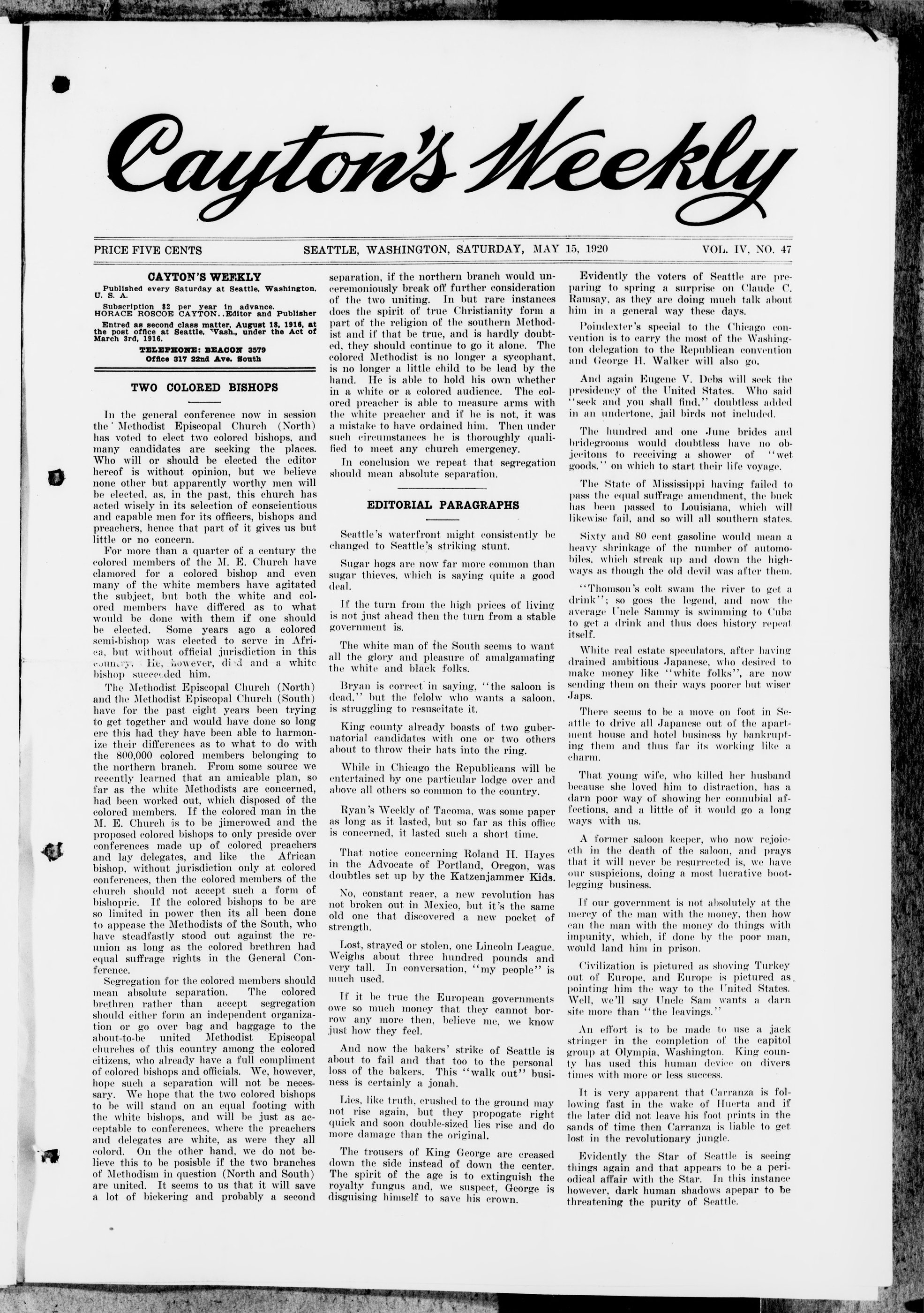
Cayton's Weekly
Saturday, May 15, 1920
Seattle, Washington
Page text (machine-generated)
Cayton's Weekly
---
PRICE FIVE CENTS
CAYTON'S WEEKLY
Published every Saturday at Seattle, Washington.
U. S. A.
Subscription $2 per year in advance.
HORACE ROSCOE CAYTON..Editor and Publisher
Entred as second class matter, August 18, 1916, at
the post office at Seattle, Wash., under the Act of
March 3rd, 1916.
TELEPHONE: BEACON 3579
Office 317 22nd Ave. South
TWO COLORED BISHOPS
In the general conference now in session the Methodist Episcopal Church (North) has voted to elect two colored bishops, and many candidates are seeking the places. Who will or should be elected the editor hereof is without opinion, but we believe none other but apparently worthy men will be elected, as, in the past, this church has acted wisely in its selection of conscientious and capable men for its officers, bishops and preachers, hence that part of it gives us but little or no concern.
For more than a quarter of a century the colored members of the M. E. Church have clamored for a colored bishop and even many of the white members have agitated the subject, but both the white and colored members have differed as to what would be done with them if one should be elected. Some years ago a colored semi-bishop was elected to serve in Africa, but without official jurisdiction in this country. He, however, died and a white bishop succeeded him.
The Methodist Episcopal Church (North) and the Methodist Episcopal Church (South) have for the past eight years been trying to get together and would have done so long ere this had they have been able to harmonize their differences as to what to do with the 800,000 colored members belonging to the northern branch. From some source we recently learned that an amicable plan, so far as the white Methodists are concerned, had been worked out, which disposed of the colored members. If the colored man in the M. E. Church is to be jimerowed and the proposed colored bishops to only preside over conferences made up of colored preachers and lay delegates, and like the African bishop, without jurisdiction only at colored conferences, then the colored members of the church should not accept such a form of bishopric. If the colored bishops to be are so limited in power then its all been done to appease the Methodists of the South, who have steadfastly stood out against the reunion as long as the colored brethren had equal suffrage rights in the General Conference.
Segregation for the colored members should mean absolute separation. The colored brethren rather than accept segregation should either form an independent organization or go over bag and baggage to the about-to-be united Methodist Episcopal churches of this country among the colored citizens, who already have a full compliment of colored bishops and officials. We, however, hope such a separation will not be necessary. We hope that the two colored bishops to be will stand on an equal footing with the white bishops, and will be just as acceptable to conferences, where the preachers and delegates are white, as were they all colord. On the other hand, we do not believe this to be posisble if the two branches of Methodism in question (North and South) are united. It seems to us that it will save a lot of bickering and probably a second
SEATTLE, WASHINGTON, SATURDAY, MAY 15, 1920
separation, if the northern branch would unceremoniously break off further consideration of the two uniting. In but rare instances does the spirit of true Christianity form a part of the religion of the southern Methodist and if that be true, and is hardly doubted, they should continue to go it alone. The colored Methodist is no longer a sycophant, is no longer a little child to be lead by the hand. He is able to hold his own whether in a white or a colored audience. The colored preacher is able to measure arms with the white preacher and if he is not, it was a mistake to have ordained him. Then under such circumstances he is thoroughly qualified to meet any church emergency. In conclusion we repeat that segregation should mean absolute separation.
EDITORIAL PARAGRAPHS
Seattle's waterfront might consistently be changed to Seattle's striking stunt.
Sugar hogs are now far more common than sugar thieves, which is saying quite a good deal.
If the turn from the high prices of living is not just ahead then the turn from a stable government is.
The white man of the South seems to want all the glory and pleasure of amalgamating the white and black folks.
Bryan is correct in saying, "the saloon is dead," but the felolw who wants a saloon, is struggling to resuscitate it.
King county already boasts of two gubernatorial candidates with one or two others about to throw their hats into the ring.
While in Chicago the Republicans will be entertained by one particular lodge over and above all others so common to the country.
Ryan's Weekly of Tacoma, was some paper as long as it lasted, but so far as this office is concerned, it lasted such a short time.
That notice concerning Roland H. Hayes in the Advocate of Portland, Oregon, was doubtles set up by the Katzenjammer Kids.
No, constant reaer, a new revolution has not broken out in Mexico, but it's the same old one that discovered a new pocket of strength.
Lost, strayed or stolen, one Lincoln League. Weighs about three hundred pounds and very tall. In conversation, "my people" is much used.
If it be true the European governments owe so much money that they cannot borrow any more then, believe me, we know just how they feel.
And now the bakers' strike of Seattle is about to fail and that too to the personal loss of the bakers. This "walk out" business is certainly a jonah.
Lies, like truth, crushed to the ground may not rise again, but they propogate right quick and soon double-sized lies rise and do more damage than the original.
The trousers of King George are creased down the side instead of down the center. The spirit of the age is to extinguish the royalty fungus and, we suspect, George is disguising himself to save his crown.
VOL. IV. NO. 47
Evidently the voters of Seattle are preparing to spring a surprise on Claude C. Ramsay, as they are doing much talk about him in a general way these days.
Poindexter's special to the Chicago convention is to carry the most of the Washington delegation to the Republican convention and George H. Walker will also go.
And again Eugene V. Debs will seek the presidency of the United States. Who said "seek and you shall find," doubtless added in an undertone, jail birds not included.
The hundred and one June brides and bridegrooms would doubtless have no objecitons to receiving a shower of "wet goods," on which to start their life voyage.
The State of Mississippi having failed to pass the equal suffrage amendment, the buck has been passed to Louisiana, which will likewise fail, and so will all southern states.
Sixty and 80 cent gasoline would mean a heavy shrinkage of the number of automobiles, which streak up and down the highways as though the old devil was after them.
"Thomson's colt swam the river to get a drink"; so goes the legend, and now the average Uncle Sammy is swimming to Cuba to get a drink and thus does history repeat itself.
White real estate speculators, after having drained ambitious Japanese, who desired to make money like "white folks", are now sending them on their ways poorer but wiser Japs.
There seems to be a move on foot in Seattle to drive all Japanese out of the apartment house and hotel business by bankrupting them and thus far its working like a charm.
That young wife, who killed her husband because she loved him to distraction, has a darn poor way of showing her connubial affections, and a little of it would go a long ways with us.
A former saloon keeper, who now rejoieeth in the death of the saloon, and prays that it will never be resurrected is, we have our suspicions, doing a most lucrative boot-legging business.
If our government is not absolutely at the mercy of the man with the money, then how can the man with the money do things with impunity, which, if done by the poor man, would land him in prison.
Civilization is pictured as shoving Turkey out of Europe, and Europe is pictured as pointing him the way to the United States. Well, we'll say Uncle Sam wants a darn site more than "the leavings."
An effort is to be made to use a jack stringer in the completion of the capitol group at Olympia, Washington. King county has used this human device on divers times with more or less success.
It is very apparent that Carranza is following fast in the wake of Huerta and if the later did not leave his foot prints in the sands of time then Carranza is liable to get lost in the revolutionary jungle.
Evidently the Star of Seattle is seeing things again and that appears to be a periodical affair with the Star. In this instance however, dark human shadows apear to be threatening the purity of Seattle.
---
and upon it great sums have been expended."
A New York banker expresses the opinion that there is something radically wrong when the janitor of a public school building receives higher pay than most of the teachers, and carpenters and plumbers receive larger incomes than many college presidents.
The Permanent Committee on Sabbath Observance of the Presbyterian Church, with headquarters in New York, has started a determined campaign against Sunday games, and "similar worldly enterprises." theaters, movies, dance halls, baseball
A man and wife at New Bern, N. C., who beat the woman's grandmother to death and were indicted for murder, got off with a fine of $5, while a colored man caught carrying home a small amount of whisky was sentenced to hard labor on the public roads for six months. Let the people think!
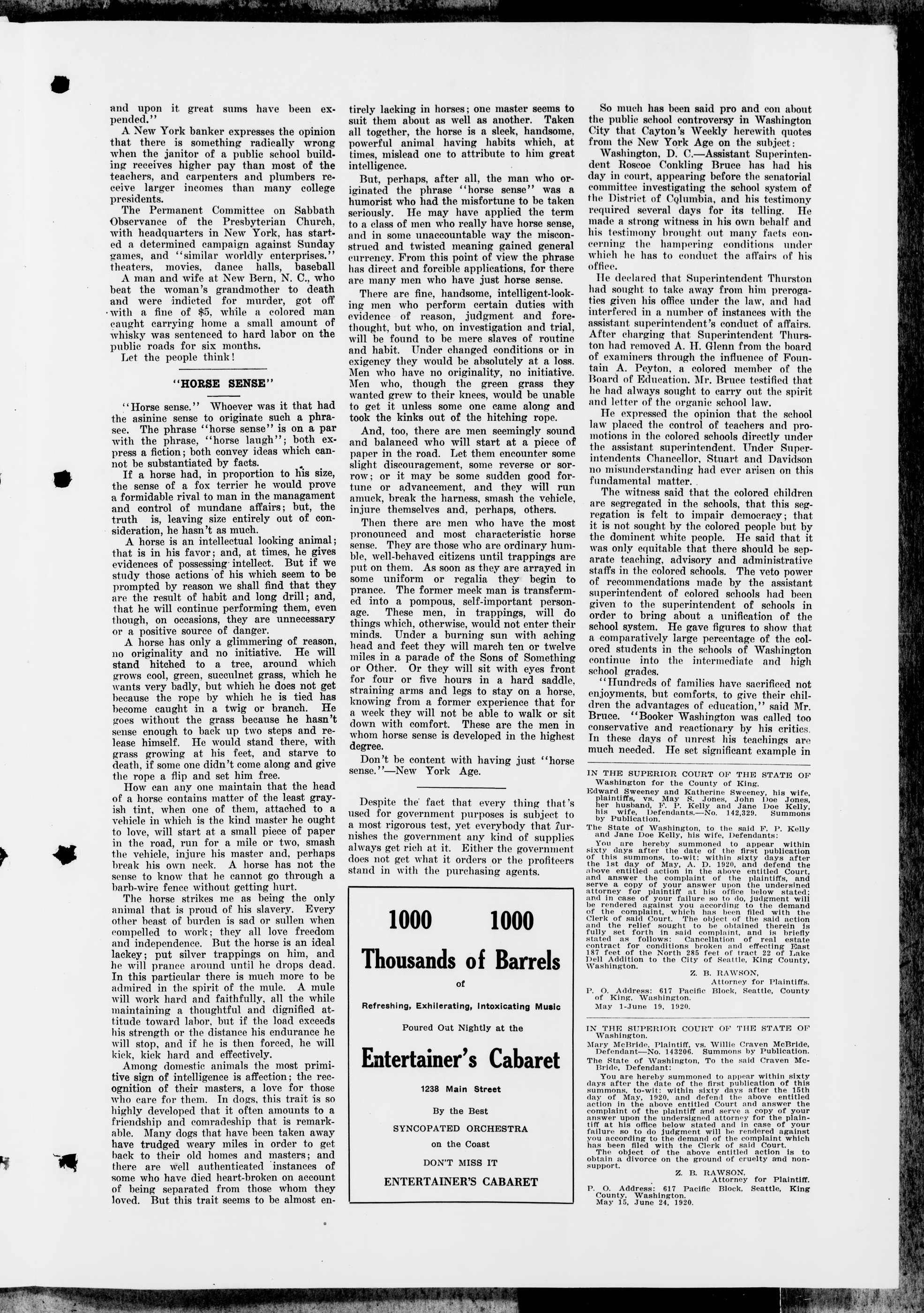
"HORSE SENSE"
"Horse sense." Whoever was it that had the asinine sense to originate such a phrase. The phrase "horse sense" is on a par with the phrase, "horse laugh"; both express a fiction; both convey ideas which cannot be substantiated by facts. If a horse had, in proportion to his size, the sense of a fox terrier he would prove a formidable rival to man in the management and control of mundane affairs; but, the truth is, leaving size entirely out of consideration, he hasn't as much.
A horse is an intellectual looking animal; that is in his favor; and, at times, he gives evidences of possessing intellect. But if we study those actions of his which seem to be prompted by reason we shall find that they are the result of habit and long drill; and, that he will continue performing them, even though, on occasions, they are unnecessary or a positive source of danger.
A horse has only a glimmering of reason, no originality and no initiative. He will stand hitched to a tree, around which grows cool, green, succulnet grass, which he wants very badly, but which he does not get because the rope by which he is tied has become caught in a twig or branch. He goes without the grass because he hasn't sense enough to back up two steps and release himself. He would stand there, with grass growing at his feet, and starve to death, if some one didn't come along and give the rope a flip and set him free.
How can any one maintain that the head of a horse contains matter of the least grayish tint, when one of them, attached to a vehicle in which is the kind master he ought to love, will start at a small piece of paper in the road, run for a mile or two, smash the vehicle, injure his master and, perhaps break his own neck. A horse has not the sense to know that he cannot go through a barb-wire fence without getting hurt.
The horse strikes me as being the only animal that is proud of his slavery. Every other beast of burden is sad or sullen when compelled to work; they all love freedom and independence. But the horse is an ideal lackey; put silver trappings on him, and he will prance around until he drops dead. In this particular there is much more to be admired in the spirit of the mule. A mule will work hard and faithfully, all the while maintaining a thoughtful and dignified attitude toward labor, but if the load exceeds his strength or the distance his endurance he will stop, and if he is then forced, he will kick, kick hard and effectively.
Among domestic animals the most primitive sign of intelligence is affection; the recognition of their masters, a love for those who care for them. In dogs, this trait is so highly developed that it often amounts to a friendship and comradeship that is remarkable. Many dogs that have been taken away have trudged weary miles in order to get back to their old homes and masters; and there are well authenticated instances of some who have died heart-broken on account of being separated from those whom they loved. But this trait seems to be almost en-
tirely lacking in horses; one master seems to suit them about as well as another. Taken all together, the horse is a sleek, handsome, powerful animal having habits which, at times, mislead one to attribute to him great intelligence. But, perhaps, after all, the man who originated the phrase "horse sense" was a humorist who had the misfortune to be taken seriously. He may have applied the term to a class of men who really have horse sense, and in some unaccountable way the misconstrued and twisted meaning gained general currency. From this point of view the phrase has direct and forcible applications, for there are many men who have just horse sense.
There are fine, handsome, intelligent-looking men who perform certain duties with evidence of reason, judgment and forethought, but who, on investigation and trial, will be found to be mere slaves of routine and habit. Under changed conditions or in exigency they would be absolutely at a loss. Men who have no originality, no initiative. Men who, though the green grass they wanted grew to their knees, would be unable to get it unless some one came along and took the kinks out of the hitching rope.
And, too, there are men seemingly sound and balanced who will start at a piece of paper in the road. Let them encounter some slight discouragement, some reverse or sorrow; or it may be some sudden good fortune or advancement, and they will run amuck, break the harness, smash the vehicle, injure themselves and, perhaps, others.
Then there are men who have the most pronounced and most characteristic horse sense. They are those who are ordinary humble, well-behaved citizens until trappings are put on them. As soon as they are arrayed in some uniform or regalia they begin to prance. The former meek man is transferred into a pompous, self-important personage. These men, in trappings, will do things which, otherwise, would not enter their minds. Under a burning sun with aching head and feet they will march ten or twelve miles in a parade of the Sons of Something or Other. Or they will sit with eyes front for four or five hours in a hard saddle, straining arms and legs to stay on a horse, knowing from a former experience that for a week they will not be able to walk or sit down with comfort. These are the men in whom horse sense is developed in the highest degree.
Don't be content with having just "horse sense."—New York Age.
Despite the fact that every thing that's used for government purposes is subject to a most rigorous test, yet everybody that furnishes the government any kind of supplies always get rich at it. Either the government does not get what it orders or the profiteers stand in with the purchasing agents.
1000 1000
Thousands of Barrels
of
Refreshing, Exhilerating, Intoxicating Music
Poured Out Nightly at the
Entertainer's Cabaret
1238 Main Street
By the Best
SYNCOPATED ORCHESTRA
on the Coast
DON'T MISS IT
ENTERTAINER'S CABARET
So much has been said pro and con about the public school controversy in Washington City that Cayton's Weekly herewith quotes from the New York Age on the subject: Washington, D. C.—Assistant Superintendent Roscoe Conkling Bruce has had his day in court, appearing before the senatorial committee investigating the school system of the District of Columbia, and his testimony required several days for its telling. He made a strong witness in his own behalf and his testimony brought out many facts concerning the hampering conditions under which he has to conduct the affairs of his office.
He declared that Superintendent Thurston had sought to take away from him prerogaties given his office under the law, and had interfered in a number of instances with the assistant superintendent's conduct of affairs. After charging that Superintendent Thurston had removed A. H. Glenn from the board of examiners through the influence of Fountain A. Peyton, a colored member of the Board of Education. Mr. Bruce testified that he had always sought to carry out the spirit and letter of the organic school law.
He expressed the opinion that the school law placed the control of teachers and promotions in the colored schools directly under the assistant superintendent. Under Superintendents Chancellor, Stuart and Davidson no misunderstanding had ever arisen on this fundamental matter.
The witness said that the colored children are segregated in the schools, that this segregation is felt to impair democracy; that it is not sought by the colored people but by the dominant white people. He said that it was only equitable that there should be separate teaching, advisory and administrative staffs in the colored schools. The veto power of recommendations made by the assistant superintendent of colored schools had been given to the superintendent of schools in order to bring about a unification of the school system. He gave figures to show that a comparatively large percentage of the colored students in the schools of Washington continue into the intermediate and high school grades.
"Hundreds of families have sacrificed not enjoyments, but comforts, to give their children the advantages of education," said Mr. Bruce. "Booker Washington was called too conservative and reactionary by his critics. In these days of unrest his teachings are much needed. He set significant example in
IN THE SUPERIOR COURT OF THE STATE OF Washington for the County of King.
Edward Sweeney and Katherine Sweeney, his wife, plaintiffs, vs. May S. Jones, John Doe Jones, her husband, F. P. Kelly and Jane Doe Kelly, his wife, Defendants.—No. 142,329. Summons by Publication.
The State of Washington, to the said F. P. Kelly and Jane Doe Kelly, his wife, Defendants:
You are hereby summoned to appear within sixty days after the date of the first publication of this summons, to-wit: within sixty days after the 1st day of May, A. D. 1920, and defend the above entitled action in the above entitled Court, and answer the complaint of the plaintiffs, and serve a copy of your answer upon the undersigned attorney for plaintiff at his office below stated; and in case of your failure so to do, judgment will be rendered against you according to the demand of the complaint, which has been filed with the Clerk of said Court. The object of the said action and the relief sought to be obtained therein is fully set forth in said complaint, and is briefly stated as follows: Cancellation of real estate contract for conditions broken and effecting East 187 feet of the North 285 feet of tract 22 of Lake Dell Addition to the City of Seattle, King County, Washington.
Z. B. RAWSON,
Attorney for Plaintiffs.
P. O. Address: 617 Pacific Block, Seattle, County of King, Washington.
May 1-June 19, 1920.
IN THE SUPERIOR COURT OF THE STATE OF Washington.
Mary McBride, Plaintiff, vs. Willie Craven McBride, Defendant—No. 143206. Summons by Publication.
The State of Washington, To the said Craven McBride, Defendant:
You are hereby summoned to appear within sixty days after the date of the first publication of this summons, to-wit: within sixty days after the 15th day of May, 1920, and defend the above entitled action in the above entitled Court and answer the complaint of the plaintiff and serve a copy of your answer upon the undersigned attorney for the plaintiff at his office below stated and in case of your failure so to do judgment will be rendered against you according to the demand of the complaint which has been filed with the Clerk of said Court.
The object of the above entitled action is to obtain a divorce on the ground of cruelty and non-support.
Z. B. RAWSON.
Attorney for Plaintiff.
P. O. Address: 617 Pacific Block, Seattle, King
County, Washington.
May 15, June 24, 1920.
```markdown
```
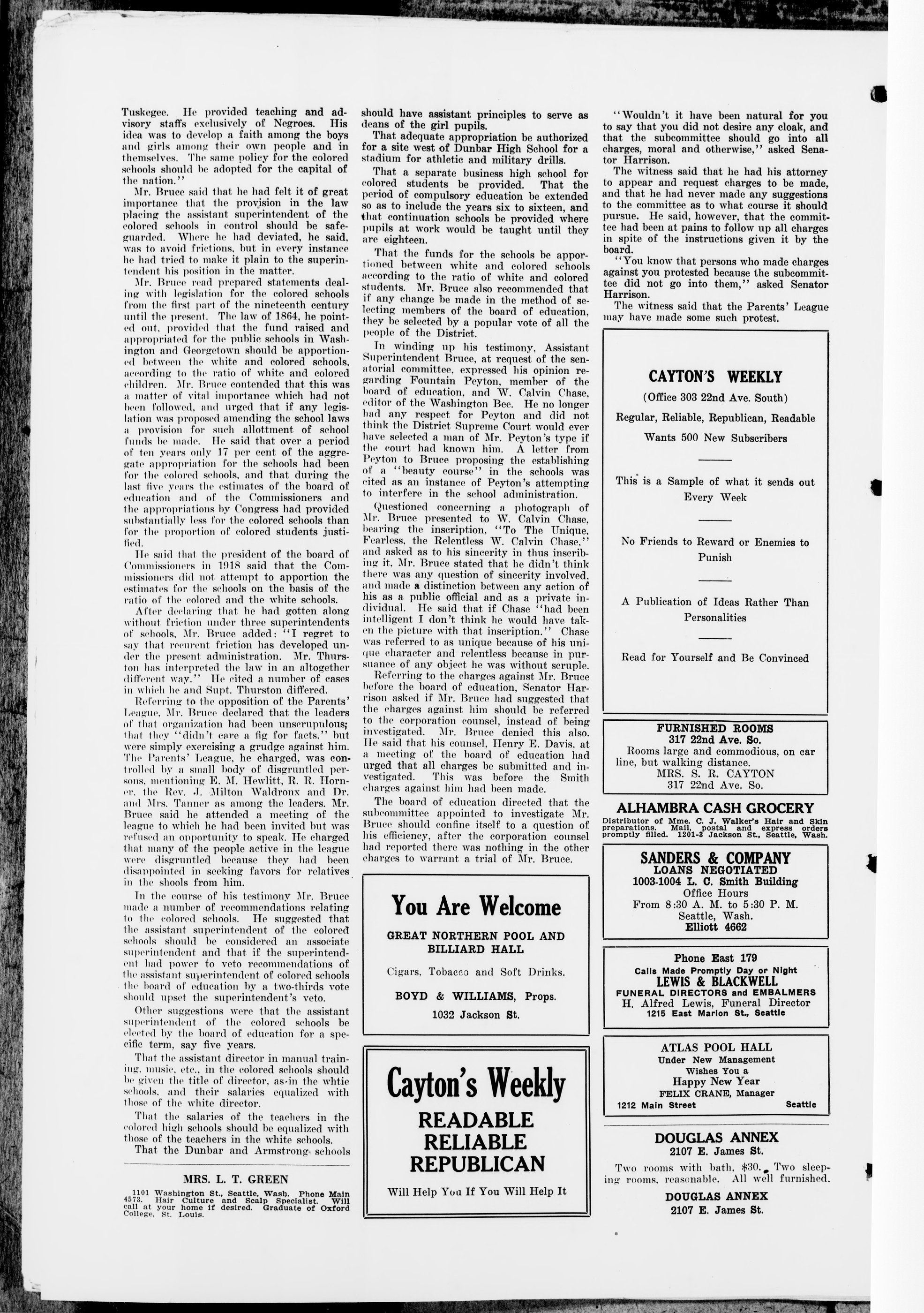
Tuskegee. He provided teaching and advisory staffs exclusively of Negroes. His idea was to develop a faith among the boys and girls among their own people and in themselves. The same policy for the colored schools should be adopted for the capital of the nation." Mr. Bruce said that he had felt it of great importance that the provision in the law placing the assistant superintendent of the colored schools in control should be safeguarded. Where he had deviated, he said, was to avoid frictions, but in every instance he had tried to make it plain to the superintendent his position in the matter.
Mr. Bruce read prepared statements dealing with legislation for the colored schools from the first part of the nineteenth century until the present. The law of 1864, he pointed out, provided that the fund raised and appropriated for the public schools in Washington and Georgetown should be apportioned between the white and colored schools, according to the ratio of white and colored children. Mr. Bruce contended that this was a matter of vital importance which had not been followed, and urged that if any legislation was proposed amending the school laws a provision for such allottment of school funds be made. He said that over a period of ten years only 17 per cent of the aggregate appropriation for the schools had been for the colored schools, and that during the last five years the estimates of the board of education and of the Commissioners and the appropriations by Congress had provided substantially less for the colored schools than for the proportion of colored students justified.
He said that the president of the board of Commissioners in 1918 said that the Commissioners did not attempt to apportion the estimates for the schools on the basis of the ratio of the colored and the white schools. After declaring that he had gotten along without friction under three superintendents of schools, Mr. Bruce added: "I regret to say that recurrent friction has developed under the present administration. Mr. Thurston has interpreted the law in an altogether different way." He cited a number of cases in which he and Supt. Thurston differed.
Referring to the opposition of the Parents' League, Mr. Bruce declared that the leaders of that organization had been unscrupulous; that they "didn't care a fig for facts." but were simply exercising a grudge against him. The Parents' League, he charged, was controlled by a small body of disgruntled persons, mentioning E. M. Hewlitt, R. R. Horner, the Rev. J. Milton Waldronx and Dr. and Mrs. Tanner as among the leaders. Mr. Bruce said he attended a meeting of the league to which he had been invited but was refused an opportunity to speak. He charged that many of the people active in the league were disgruntled because they had been disappointed in seeking favors for relatives in the shools from him.
In the course of his testimony Mr. Bruce made a number of recommendations relating to the colored schools. He suggested that the assistant superintendent of the colored schools should be considered an associate superintendent and that if the superintendent had power to veto recommendations of the assistant superintendent of colored schools the board of education by a two-thirds vote should upset the superintendent's veto. Other suggestions were that the assistant superintendent of the colored schools be elected by the board of education for a specific term, say five years.
That the assistant director in manual training, music, etc., in the colored schools should be given the title of director, as in the whitie schools, and their salaries equalized with those of the white director. That the salaries of the teachers in the colored high schools should be equalized with those of the teachers in the white schools. That the Dunbar and Armstrong schools
MRS. L. T. GREEN
1101 Washington St., Seattle, Wash. Phone Main 4573. Hair Culture and Scalp Specialist. Will call at your home if desired. Graduate of Oxford College, St. Louis.
should have assistant principles to serve as deans of the girl pupils. That adequate appropriation be authorized for a site west of Dunbar High School for a stadium for athletic and military drills. That a separate business high school for colored students be provided. That the period of compulsory education be extended so as to include the years six to sixteen, and that continuation schools be provided where pupils at work would be taught until they are eighteen.
That the funds for the schools be apportioned between white and colored schools according to the ratio of white and colored students. Mr. Bruce also recommended that if any change be made in the method of selecting members of the board of education, they be selected by a popular vote of all the people of the District.
In winding up his testimony, Assistant Superintendent Bruce, at request of the senatorial committee, expressed his opinion regarding Fountain Peyton, member of the board of education, and W. Calvin Chase, editor of the Washington Bee. He no longer had any respect for Peyton and did not think the District Supreme Court would ever have selected a man of Mr. Peyton's type if the court had known him. A letter from Peyton to Bruce proposing the establishing of a "beauty course" in the schools was cited as an instance of Peyton's attempting to interfere in the school administration.
Questioned concerning a photograph of Mr. Bruce presented to W. Calvin Chase, bearing the inscription, "To The Unique, Fearless, the Relentless W. Calvin Chase," and asked as to his sincerity in thus inscribing it, Mr. Bruce stated that he didn't think there was any question of sincerity involved, and made a distinction between any action of his as a public official and as a private individual. He said that if Chase "had been intelligent I don't think he would have taken the picture with that inscription." Chase was referred to as unique because of his unique character and relentless because in pursuance of any object he was without scruple
Referring to the charges against Mr. Bruce before the board of education, Senator Harrison asked if Mr. Bruce had suggested that the charges against him should be referred to the corporation counsel, instead of being investigated. Mr. Bruce denied this also. He said that his counsel, Henry E. Davis, at a meeting of the board of education had urged that all charges be submitted and investigated. This was before the Smith charges against him had been made.
The board of education directed that the subcommittee appointed to investigate Mr. Bruce should confine itself to a question of his efficiency, after the corporation counsel had reported there was nothing in the other charges to warrant a trial of Mr. Bruce.
You Are Welcome
GREAT NORTHERN POOL AND BILLIARD HALL
Cigars, Tobacco and Soft Drinks.
BOYD & WILLIAMS, Props.
1032 Jackson St.
Cayton's Weekly
READABLE
RELIABLE
REPUBLICAN
Will Help You If You Will Help It
---
"Wouldn't it have been natural for you to say that you did not desire any cloak, and that the subcommittee should go into all charges, moral and otherwise," asked Senator Harrison. The witness said that he had his attorney to appear and request charges to be made, and that he had never made any suggestions to the committee as to what course it should pursue. He said, however, that the committee had been at pains to follow up all charges in spite of the instructions given it by the board.
"You know that persons who made charges against you protested because the subcommittee did not go into them," asked Senator Harrison.
The witness said that the Parents' League may have made some such protest.
CAYTON'S WEEKLY
(Office 303 22nd Ave. South) Regular, Reliable, Republican, Readable Wants 500 New Subscribers
This is a Sample of what it sends out Every Week
No Friends to Reward or Enemies to Punish
A Publication of Ideas Rather Than Personalities
Read for Yourself and Be Convinced
FURNISHED ROOMS
317 22nd Ave. So.
Rooms large and commodious, on car
line, but walking distance.
MRS. S. R. CAYTON
317 22nd Ave. So.
ALHAMBRA CASH GROCERY
Distributor of Mme. C. J. Walker's Hair and Skin preparations. Mail, postal and express orders promptly filled. 1201-3 Jackson St., Seattle, Wash.
SANDERS & COMPANY
LOANS NEGOTIATED
1003-1004 L. C. Smith Building
Office Hours
From 8:30 A. M. to 5:30 P. M.
Seattle, Wash.
Elliott 4662
Phone East 179 Calls Made Promptly Day or Night LEWIS & BLACKWELL FUNERAL DIRECTORS and EMBALMERS H. Alfred Lewis, Funeral Director 1215 East Marlon St., Seattle
ATLAS POOL HALL
Under New Management
Wishes You a
Happy New Year
FELIX CRANE, Manager
1212 Main Street
DOUGLAS ANNEX
2107 E. James St.
Two rooms with bath, $30. Two sleeping rooms, reasonable. All well furnished.
DOUGLAS ANNEX
2107 E. James St.