Seattle Republican
Friday, January 18, 1901
Seattle, Washington
Page text (machine-generated)
The SEATTLE REPUBLICAN
VoL. VII., NO. 31
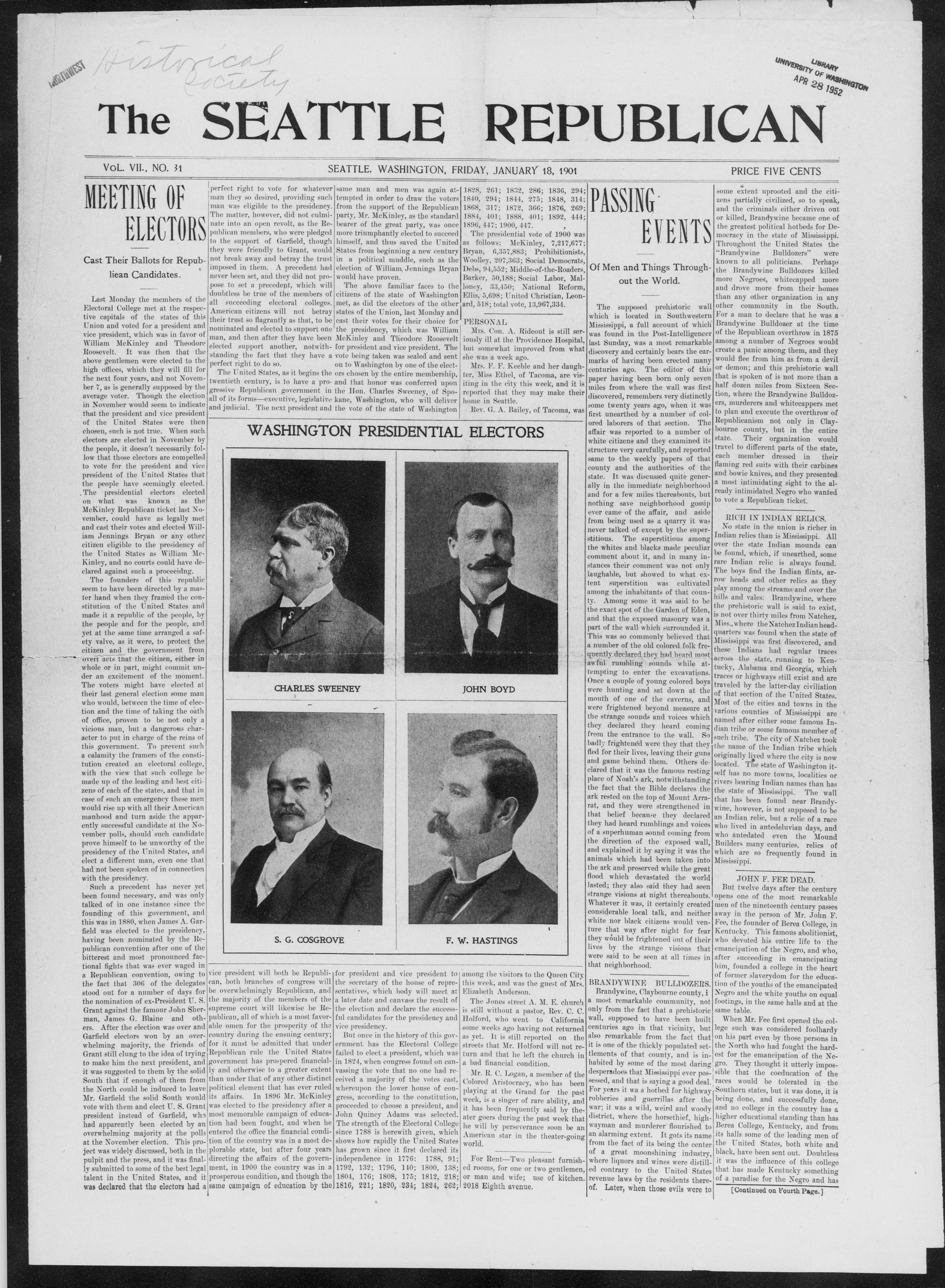
MEETING OF ELECTORS
MEETING OF ELECTORS
Cast Their Ballots for Republiean Candidates.
Last Monday the members of the Electoral College met at the respective capitals of the states of this Union and voted for a president and vice president, which was in favor of William McKinley and theodore Roosevelt. It was then that the above gentlemen were elected to the high offices, which they will fill for the next four years, and not November 7, as is generally supposed by the average voter. Though the election in November would seem to indicate that the president and vice president of the United States were then chosen, such is not true. When such electors are elected in November by the people, it doesn't necessarily follow that those electors are compelled to vote for the president and vice president of the United States that the people have seemingly elected. The presidential electors elected on what was known as the McKinley Republican ticket last November, could have as legally met and cast their votes and elected William Jennings Bryan or any other citizen eligible to the presidency of the United States as William McKinley, and no courts could have declared against such a proceeding.
The founders of this republic seem to have been directed by a master hand when they framed the constitution of the United States and made it a republic of the people, by the people and for the people, and yet at the same time arranged a safety valve, as it were, to protect the citizen and the government from overt acts that the citizen, either in whole or in part, might commit under an excitement of the moment. The voters might have elected at their last general election some man who would, between the time of election and the time of taking the oath of office, proven to be not only a vicious man, but a dangerous character to put in charge of the reins of this government. To prevent such a calamity the framers of the constitution created an electoral college, with the view that such college be made up of the leading and best citizens of each of the states, and that in case of such an emergency these men would rise up with all their American manhood and turn aside the apparently successful candidate at the November polls, should such candidate prove himself to be unworthy of the presidency of the United States, and elect a different man, even one that had not been spoken of in connection with the presidency.
Such a precedent has never yet been found necessary, and was only talked of in one instance since the founding of this government, and this was in 1880, when James A. Garfield was elected to the presidency, having been nominated by the Republican convention after one of the bitterest and most pronounced fac
tional rights that was ever waged in a Republican convention, owing to the fact that 306 of the delegates stood out for a number of days for the nomination of ex-President U. S. Grant against the famour John Sherman, James G. Blaine and others. After the election was over and Garfield electors won by an overwhelming majority, the friends of Grant still clung to the idea of trying to make him the next president, and it was suggested to them by the solid South that if enough of them from the North could be induced to leave Mr. Garfield the solid South would vote with them and elect U. S. Grant president instead of Garfield, who had apparently been elected by an overwhelming majority at the polls at the November election. This project was widely discussed, both in the pulpit and the press, and it was finally submitted to some of the best legal talent in the United States, and it was declared that the electors had a
perfect right to vote for whatever man they so desired, providing such man was eligible to the presidency. The matter, however, did not culminate into an open revolt, as the Republican members, who were pledged to the support of Garfield, though they were friendly to Grant, would not break away and betray the trust imposed in them. A precedent had never been set, and they did not pro- same man and men was again attempted in order to draw the voters from the support of the Republican party, Mr. McKinley, as the standard bearer of the great party, was once more triumphantly elected to succeed himself, and thus saved the United States from beginning a new century in a political muddle, such as the election of William Jennings Bryan would have proven.
1828, 261; 1832, 286; 1836, 295
1840, 294; 1844, 275; 1848, 313
1868, 317; 1872, 366; 1876, 261
1884, 401; 1888, 401; 1892, 44
1896, 447; 1900, 447.
The presidential vote of 1900 was as follows: McKinley, 7,217,67 Bryan, 6,357,883; Prohibitionist Woolley, 207,363; Social Democrat Debs, 94,552; Middle-of-the-Roader Barker, 50,188; Social Labor, Mi
pose to set a precedent, which will doubtless be true of the members of all succeeding electoral colleges. American citizens will not betray their trust so flagrantly as that, to be nominated and elected to support one man, and then after they have been elected support another, notwithstanding the fact that they have a perfect right to do so.
The United States, as it begins the twentieth century, is to have a progressive Republican government in all of its forms—executive, legislative and judicial. The next president and the above familiar faces to the citizens of the state of Washington met, as did the electors of the other states of the Union, last Monday and cast their votes for their choice for the presidency, which was William McKinley and Theodore Roosevelt for president and vice president. The vote being taken was sealed and sent on to Washington by one of the electors chosen by the entire membership, and that honor was conferred upon the Hon. Charles Sweeney, of Spokane, Washington, who will deliver the vote of the state of Washington
WASHINGTON PRESIDENTIAL ELECTORS
[Image of a man in a suit with a bow tie, facing slightly to the right. The background is a solid black color. There is no text or additional details in the image.]]
CHARLES SWEENEY
[Name]
for president and vice president to the secretary of the house of representatives, which body will meet at a later date and canvass the result of the election and declare the successful candidates for the presidency and vice presidency.
But once in the history of this government has the Electoral College failed to elect a president, which was in 1824, when congress found on canvassing the vote that no one had received a majority of the votes cast, whereupon the lower house of congress, according to the constitution, proceeded to choose a president, and John Quincy Adams was selected. The strength of the Electoral College since 1788 is herewith given, which shows how rapidly the United States has grown since it first declared its independence in 1776: 1788, 91; 1792, 132; 1796, 140; 1800, 138; 1804, 176; 1808, 175; 1812, 218; 1816, 221; 1820, 234; 1824, 262.
S. G. COSGROVE
vice president will both be Republican, both branches of congress will be overwhelmingly Republican, and the majority of the members of the supreme court will likewise be Republican, all of which is a most favorable omen for the prosperity of the country during the ensuing century; for it must be admitted that under Republican rule the United States government has prospered financially and otherwise to a greater extent than under that of any other distinct political element that has ever ruled its affairs. In 1896 Mr. McKinley was elected to the presidency after a most memorable campaign of education had been fought, and when he entered the office the financial condition of the country was in a most deplorable state, but after four years directing the affairs of the government, in 1900 the country was in a prosperous condition, and though the same campaign of education by the
M. H.
J. H.
1828, 261; 1832, 286; 1836, 294;
1840, 294; 1844, 275; 1848, 314;
1868, 317; 1872, 366; 1876, 269;
1884, 401; 1888, 401; 1892, 444;
1896, 447; 1900, 447.
The presidential vote of 1900 was as follows: McKinley, 7,217,677;
Bryan, 6,357,883; Prohibitionists, Woolley, 207,363; Social Democrats, Debs, 94,552; Middle-of-the-Roaders, Barker, 50,188; Social Labor, Malloney, 33,450; National Reform, Ellis, 5,698; United Christian, Leonard, 518; total vote, 13,967,334.
PERSONAL
Mrs. Con. A. Rideout is still seriously ill at the Providence Hospital, but somewhat improved from what she was a week ago.
Mrs. F. F. Keeble and her daughter, Miss Ethel, of Tacoma, are visiting in the city this week, and it is reported that they may make their home in Seattle.
Rev. G. A. Bailey, of Tacoma, was
JOHN BOYD
F. W. HASTINGS
among the visitors to the Queen City this week, and was the guest of Mrs. Elizabeth Anderson.
The Jones street A. M. E. church is still without a pastor, Rev. C. C. Holford, who went to California some weeks ago having not returned as yet. It is still reported on the streets that Mr. Holford will not return and that he left the church in a bad financial condition.
Mr. R. C. Logan, a member of the Colored Aristocracy, who has been playing at the Grand for the past week, is a singer of rare ability, and it has been frequently said by the theater goers during the past week that he will by perseverance soon be an American star in the theater-going world.
For Rent—Two pleasant furnished rooms, for one or two gentlemen, or man and wife; use of kitchen 2018 Eighth avenue.
PASSING EVENTS
Of Men and Things Throughout the World.
The supposed prehistoric wall which is located in Southwestern Mississippi, a full account of which was found in the Post-Intelligencer last Sunday, was a most remarkable discovery and certainly bears the earmarks of having been erected many centuries ago. The editor of this paper having been born only seven miles from where the wall was first discovered, remembers very distinctly some twenty years ago, when it was first unearthed by a number of colored laborers of that section. The affair was reported to a number of white citizens and they examined its structure very carefully, and reported same to the weekly papers of that county and the authorities of the state. It was discussed quite generally in the immediate neighborhood and for a few miles thereabouts, but nothing save neighborhood gossip ever came of the affair, and aside from being used as a quarry it was never talked of except by the superstitious. The superstitious among the whites and blacks made peculiar comment about it, and in many instances their comment was not only laughable, but showed to what extent superstition was cultivated among the inhabitants of that county. Among some it was said to be the exact spot of the Garden of Eden, and that the exposed masonry was a part of the wall which surrounded it. This was so commonly believed that a number of the old colored folk frequently declared they had heard most awful rumbling sounds while attempting to enter the excavations. Once a couple of young colored boys were hunting and sat down at the mouth of one of the caverns, and were frightened beyond measure at the strange sounds and voices which they declared they heard coming from the entrance to the wall. So badly frightened were they that they fled for their lives, leaving their guns and game behind them. Others declared that it was the famous resting place of Noah's ark, notwithstanding the fact that the Bible declares the ark rested on the top of Mount Arrarat, and they were strengthened in that belief because they declared they had heard rumblings and voices of a superhuman sound coming from the direction of the exposed wall, and explained it by saying it was the animals which had been taken into the ark and preserved while the great flood which devastated the world lasted; they also said they had seen strange visions at night thereabouts. Whatever it was, it certainly created considerable local talk, and neither white nor black citizens would venture that way after night for fear they would be frightened out of their lives by the strange visions that were said to be seen at all times in that neighborhood.
BRANDYWINE BULLDOZERS. Brandywine, Claybourne county, i a most remarkable community, not only from the fact that a prehistoric wall, supposed to have been built centuries ago in that vicinity, but also remarkable from the fact that it is one of the thickly populated settlements of that county, and is inhabited by some of the most daring deserpores that Mississippi ever possessed, and that is saying a good deal. For years it was a hotbed for highway robberies and guerrillas after the war; it was a wild, weird and woody district, where the horsethief, highwayman and murderer flourished to an alarming extent. It gets its name from the fact of its being the center of a great moonshining industry, where liquors and wines were distilled contrary to the United States revenue laws by the residents thereof. Later, when those evils were to
LIBRARY
UNIVERSITY OF WASHINGTON
APR 28 1952
PRICE FIVE CENTS
some extent uprooted and the citizens partially civilized, so to speak, and the criminals either driven out or killed, Brandywine became one of the greatest political hotbeds for Democracy in the state of Mississippi. Throughout the United States the "Brandywine Bulldozers" were known to all politicians. Perhaps the Brandywine Bulldozers killed more Negroes, whitecapped more and drove more from their homes than any other organization in any other community in the South. For a man to declare that he was a Brandywine Bulldozer at the time of the Republican overthrow in 1875 among a number of Negroes would create a panic among them, and they would flee from him as from a devil or demon; and this prehistoric wall that is spoken of is not more than a half dozen miles from Sixteen Section, where the Brandywine Bulldozers, murderers and whitecappers met to plan and execute the overthrow of Republicanism not only in Claybourne county, but in the entire state. Their organization would travel to different parts of the state, each member dressed in their flaming red suits with their carbines and bowie knives, and they presented a most intimidating sight to the already intimidated Negro who wanted to vote a Republican ticket.
RICH IN INDIAN RELICS
No state in the union is richer in Indian relics than is Mississippi. All over the state Indian mounds can be found, which, if unearthed, some rare Indian relic is always found. The boys find the Indian flints, arrow heads and other relics as they play among the streams and over the hills and vales. Brandywine, where the prehistoric wall is said to exist, is not over thirty miles from Natchez, Miss., where the Natchez Indian headquarters was found when the state of Mississippi was first discovered, and these Indians had regular traces across the state, running to Kentucky, Alabama and Georgia, which traces or highways still exist and are traveled by the latter-day civilization of that section of the United States. Most of the cities and towns in the various counties of Mississippi are named after either some famous Indian tribe or some famous member of such tribe. The city of Natchez took the name of the Indian tribe which originally lived where the city is now located. The state of Washington itself has no more towns, localities or rivers bearing Indian names than has the state of Mississippi. The wall that has been found near Brandywine, however, is not supposed to be an Indian relic, but a relic of a race who lived in antedeluvian days, and who antedated even the Mound Builders many centuries, relics of which are so frequently found in Mississippi.
JOHN F. FEE DEAD
But twelve days after the century opens one of the most remarkable men of the nineteenth century passes away in the person of Mr. John F. Fee, the founder of Berea College, in Kentucky. This famous abolitionist, who devoted his entire life to the emancipation of the Negro, and who, after succeeding in emancipating him, founded a college in the heart of former slaverydom for the education of the youths of the emancipated Negro and the white youths on equal footings, in the same halls and at the same table.
When Mr. Fee first opened the college such was considered foolhardy on his part even by those persons in the North who had fought the hardest for the emancipation of the Negro. They thought it utterly impossible that the coeducation of the races would be tolerated in the Southern states, but it was done, it is being done, and successfully done, and no college in the country has a higher educational standing than has Berea College, Kentucky, and from its halls some of the leading men of the United States, both white and black, have been sent out. Doubless it was the influence of this college that has made Kentucky something of a paradise for the Negro and has [Continued on Fourth Page.]
H. R. Cayton, Editor
Susie Revels Cayton, Associate
SUBSCRIPTION RATES.
One Year ..... $1.00
Six months ..... $1.00
Three Months ..... 60c
Advertising rates Furnished upon application
Entered at the Postoffice at Seattle as Second
Class Mail Matter.
Quay's election to the United
States senate means more trouble
for Mark Hanna.
Electing United States senators
during the past week was something
of a fad among the states of this
Union.
The reapportionment bill before the present legislature of this state seems fair and equitable, and The Republican hopes to see it become a law.
"Some papers may have editorial misfits," Mr. Tacoma Ledger, and it is likewise true that some cities have newspaper misfits, and we are of the opinion that Tacoma has more than its share.
Gov. Stanley, of Kansas, says: "Fusion is a fraud and should not be tolerated." It may be a fraud, Governor, but it is likewise a worry, and especially for Republicans who are office hungry.
Both Quay and Clark were turned down for seats in the United States senate last year, but this year they will have an opportunity to turn some of the other fellows down, if not for seats in the senate, then for other honors they seek.
From the late election figures compiled by one of the government statisticians, it is learned that but 209, 000 Prohibitionists voted for a president at the last general election Evidently the Prohibitionists are dying out for a lack of stimulants.
Neeley, the notorious embezzler of revenue receipts in Cuba, must return tot that island and stand trial for the crimes he committed. There is no alternative for this, as the highest court in the land has said so. He ought to have been back there months ago.
Talk about your claps of thunder from a clear sky, but Judge Cann heard one last Friday when it was announced that Judge George would be the next police judge, which was by odds the loudest one that he had ever heard. Just hold on to Mayor Humes, Judge Cann, and you will hear others.
There was more fuss and fume over the Vanderbilt-French marriage than over any other marriage in this country for a good many years, and all because the bridegroom was able to settle a three-million-dollar dowry on his bride. Slowly but surely is wealth becoming one of the chief corner-stones of our American civilization.
Seattle thinks she is entitled to one more supreme judge, Spokane thinks she is entitled to another supreme judge, and some of the outlying districts are clamoring for less territory for their judges, all of which shows very conclusively that judges are a very useful article in the Evergreen state. Less courting and there would be more prosperity in this country.
The advocacy of the labor unions of this state to have a compulsory arbitration law passed by the legislature is absurd to a degree. There is no danger of such a law ever being put on the statute books of this state with a legislature overwhelmingly Republican, simply because it would mean that the labor unions of this state would become the dictators of every man's investments.
Yes, Mr. Union Record, certain Seattle publications do send away for their half-tone cuts work, and they send away because they run up against the frozen facts of the Seattle Engraving Company. We all love to patronize home industries, but when home industries charge from 20 per cent, to 30 per cent, higher for the same kind of work as neighboring city industries, then to patronize home industries is the height of folly.
---
KANSAS' LYNCHERS.
Were a million or so of white persons situated in the very heart of Africa and surrounded by savages and savagedom, they could expect no worst treatment than some of the black folk of this country are now receiving in the heart of American Christian civilization. Punishment for crime in the United States, and especially when the criminal has a black face, has reached a point beyond all reasonable expectation. No one who lived in this country three decodes ago would have ever believed that any citizen of this country would have been burned at the stake for committing any degree of crime, much less an alleged section of this country that is showing its barbaric vindictiveness toward the black man, but apparently in every section of the United States is he being persecuted, imprisoned and burned at the stake for crime, in the North, in the South, in the East and in the West, all one and the same. He has been burned by the Southern rebels, by the Northern Yankees and by the Western frontiersman. The climax of this awful punishment meted out to the black man of this country seems to have been reached when one of them was burned at the stake in Kansas last Tuesday night, not more than twenty miles from the famous battle ground where John Brown and his followers, in opposing the extension of slavery in the United States, drenched the very earth with human gore advocating the rights of the oppressed black man, and not over sixty miles from the state capitol of Kansas, where the governor and his national guards are stationed and under the very walls of the Soldiers' Home and the United States military post, where United States soldiers by scores are stationed. It must seem to the Negro of this country that he has lost his last and only friend when Kansas, a state apparently created by Providence itself to champion his rights, has adopted the same kind of torture to punish the criminal Negro as did the Southern citizens, his ancient and arch enemy, a few years ago. The man burned at the stake last Tuesday was charged with only attempting to overtake a passing girl, and was thought to have committed a murder some months ago, but there was no tangible evidence of either. But as he stood on his funeral pyre, he protested his innocence and through he knew death in its most excruciating form would be his lot, yet he protested until devoured by the angry flames, that he was as innocent as the stars that shine. He may have been guilty, grant it that he was, still it is seldom that men will go to their death protesting their innocence when they are given repeated opportunities to confess the crime for which they are destined to die, and by this means prepare themselves to meet their God.
We read in history of how the Carthagenians put their Roman captives in barrels in which nails and sharp pointed instruments were driven and then rolled them down hills; we read of Nero compelling the Christians to walk on red-hot iron bars, to dring melted metal, to jump into seething furnaces and to do all manner of things that would serve as an intimidation to others who might desire to become Christians, and these things have all been held up to the young of each succeeding generation, that man might never again drift into Paganism, and that the Christian influence and spirit would still live among them. Who would have thought that the nineteenth and twentieth centuries in the United States would have produced such a state of affairs as existed in Colorado and Kansas, when in both places men were burned at the stake by howling mobs composed of persons, perhaps the leading Christion men of those communities.
Either Christianity is a roaring farce, is a snare and a delusion, is as false as it pretends to be fair, or the great majority of the people of the United States have never as yet experienced true Christianity. Each section of the United States vies with the other section, one state struggles to outstrip another state, and one county makes efforts to show more brutality than the other in their punishment to any individual of the Negro race who is charged with crime. That a state of affairs for a powerful, rich and opulent race, rich not only in the wealths of the world, but rich, if their teachings are to be believed, in the wealths of Christianity and civilization, of mistreating a weaker race, weak not only in the wealths of the world, but weak in
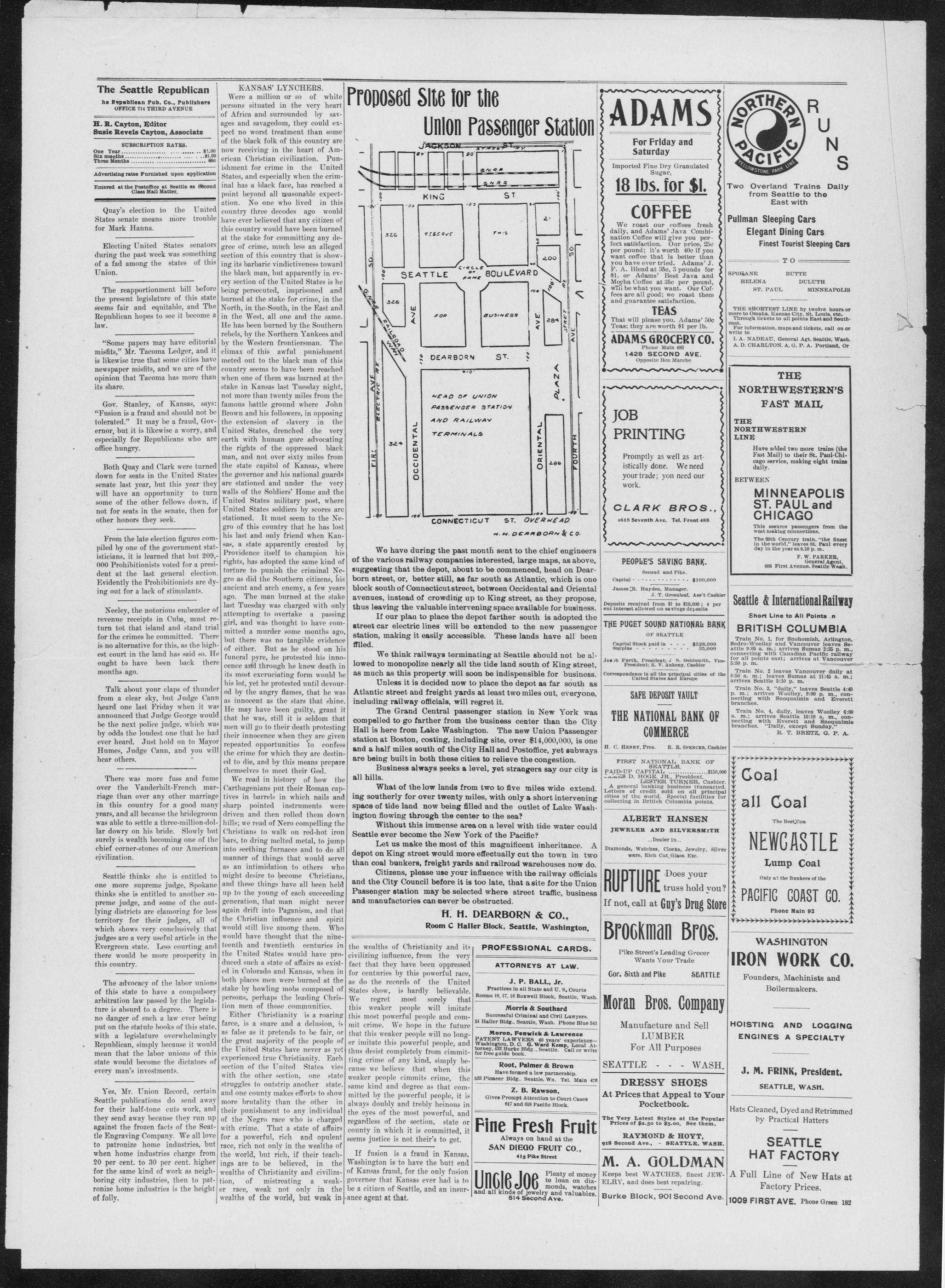
JACKSON ST.
STREET RY.
GNRR
GNRR
KING ST.
326
RESERVE
THIS
21
200
SEATTLE
CIRCLE
OR
RAME
BOULEVARD
326
AVE
FOR
BUSINESS
AVE.
284
STREET
DEARBORN ST.
FIRL
ELECTRIC AX
AVE
OCCIDENTAL
HEAD OF UNION
PASSENGER STATION
AND RAILWAY
TERMINALS
ORIENTAL
286
FOURTH
CONNECTICUT ST. OVERHEAD
We have during the past month sent to the chief engineers of the various railway companies interested, large maps, as above, suggesting that the depot, about to be commenced, head on Dearborn street, or, better still, as far south as Atlantic, which is one block south of Connecticut street, between Occidental and Oriental avenues, instead of crowding up to King street, as they propose, thus leaving the valuable intervening space available for business.
If our plan to place the depot farther south is adopted the street car electric lines will be extended to the new passenger station, making it easily accessible. These lands have all been filled.
We think railways terminating at Seattle should not be allowed to monopolize nearly all the tide land south of King street, as much as this property will soon be indispensable for business.
Unless it is decided now to place the depot as far south as Atlantic street and freight yards at least two miles out, everyone, including railway officials, will regret it.
The Grand Central passenger station in New York was compelled to go farther from the business center than the City Hall is here from Lake Washington. The new Union Passenger station at Boston, costing, including site, over $14,000,000, is one and a half miles south of the City Hall and Postoffice, yet subways are being built in both these cities to relieve the congestion.
Business always seeks a level, yet strangers say our city is all hills.
What of the low lands from two to five miles wide extend. ing southerly for over twenty miles, with only a short intervening space of tide land now being filled and the outlet of Lake Washington flowing through the center to the sea?
Without this immense area on a level with tide water could Seattle ever become the New York of the Pacific?
Let us make the most of this magnificent inheritance. A depot on King street would more effectually cut the town in two than coal bunkers, freight yards and railroad warehouses now do
Citizens, please use your influence with the railway officials and the City Council before it is too late, that a site for the Union Passenger station may be selected where street traffic, business and manufactories can never be obstructed.
H. H. DEARBORN & CO..
PROFESSIONAL CARDS.
ATTORNEYS AT LAW.
the wealths of Christianity and its civilizing influence, from the very fact that they have been oppressed for centuries by this powerful race, as do the records of the United States show, is hardly believable. We regret most sorely that this weaker people will imitate this most powerful people and commit crime. We hope in the future that this weaker people will no longer imitate this powerful people, and thus desist completely from cimmitting crime of any kind, simply because we believe that when this weaker people cimmits crime, the same kind and degree as that committed by the powerful people, it is always doubly and trebly heinous in the eyes of the most powerful, and regardless of the section, state or county in which it is committed, it seems justice is not their's to get.
---
If fusion is a fraud in Kansas, Washington is to have the butt end of Kansas fraud, for the only fusion governor that Kansas ever had is to be a citizen of Seattle, and an insurance agent at that.
J. P. BALL, Jr.
Practices in all State and U. S. Courts
Rooms 18, 17, 16 Roxwell Block, Seattle, Wash.
Morris & Southard
Successful Criminal and Civil Lawyers.
51 Haller Bldg., Seattle, Wash. Phone Blue 541
Moron, Fenwick & Lawrence
PATENT LAWYERS 40 years' experience—
Washington, D. C. G. Ward Kemp, Local
Attorney, 433 Burke Bldg., Seattle. Call or write
for free guide book.
Root, Palmer & Brown
Have formed a law partnership.
533 Pioneer Bldg., Seattle. Wn. Tail Main 476
Z. B. Rawson,
Gives Prompt Attention to Court Cases
617 and 618 Pacific Block.
Fine Fresh Fruit
Always on hand at the
SAN DIEGO FRUIT CO.,
415 Pike Street
Uncle Joe Plenty of money
to loan on diamonds,
watches
and all kinds of jewelry and valuables.
514 Second Ave.
COFFEE
We roast our coffees fresh daily, and Adams' Java Combination Coffee will give you perfect satisfaction. Our price, 25c per pound; it's worth 40c if you want coffee that is better than you have ever tried. Adams' J. F. A. Blend at 35c, 3 pounds for $1, or Adams' Best Java and Mocha Coffee at 35c per pound, will be what you want. Our Coffees are all good; we roast them and guarantee satisfaction.
TEAS
That will please you. Adams' 50c Teas; they are worth $1 per lb.
ADAMS GROCERY CO.
Phone Main 482
1428 SECOND AVE.
Opposite Bon Marche
JOB
PRINTING
Promptly as well as art-
istically done. We need
your trade; you need our
work.
CLARK BROS.,
1618 Seventh Ave. Tel. Front 488
PEOPLE'S SAVING BANK.
Second and Pike.
Capital - $100,000
James_R. Hayden, Manager.
J. T. Greenleaf, Ass't Cashier
Deposits received from $1 to $10,000; 4 per
ent interest allowed on savings deposits
THE PUGET SOUND NATIONAL BANK OF SEATTLE
Capital Stock paid in --- $528,000
Surplus --- $35,000
Jacob Furth, President; J. S. Goldsmith, Vice-President; R. V. Ankeny, Cashier
Correspondence in all the principal cities of the United States and Europe
SAFE DEPOSIT VAULT
THE NATIONAL BANK OF COMMERCE
H. C. HENRY, Pres. R. R. SPENCER, Cashier
FIRST NATIONAL BANK OF
SEATTLE.
PAID-UP CAPITAL.....$150,000
JAMES D. HOGE, JR., President.
LESTER TURNER, Cashier.
A general banking business transacted.
Letters of credit sold on all principal
cities of the world. Special facilities for
collecting in British Columbia points.
ALBERT HANSEN
JEWELER AND SILVERSMITH
..Dealer in...
Diamonds, Watches, Clocks, Jewelry, Silver
ware, Rich Cut Glass. Etc.
RUPTURE Does your
truss hold you?
If not, call at Guy's Drug Store
Brockman Bros.
Pike Street's Leading Grocer
Wants Your Trade
Gor. Sixth and Pike SEATTLE
Moran Bros. Company
Manufacture and Sell
LUMBER
For All Purposes
SEATTLE - - - WASH.
DRESSY SHOES
At Prices that Appeal to Your
Pocketbook.
The Very Latest Styles at the Popular
Prices of $2.50 to $5.00. See them.
RAYMOND & HOYT,
918 Second Ave., - SEATTLE, WASH.
M. A. GOLDMAN
Keeps best WATCHES, finest JEWELRY, and does best repairing.
Burke Block, 901 Second Ave.
NORTHERN
PACIFIC
YELLOWSTONE PARK LINE
R U N S
Two Overland Trains Daily
from Seattle to the
East with
Pullman Sleeping Cars
Elegant Dining Cars
Finest Tourist Sleeping Cars
SPOKANE BUTTE
HELENA DULUTH
ST. PAUL MINNEAPOLIS
THE SHORTEST LINE by twelve hours or more to Omaha, Kansas City, St. Louis, 460. Through tickets to all points East and Southeast.
For information, maps and tickets, call on or write to
I. A. NADEAU, General Agt. Seattle, Wash.
A. D. CHARLTON, A. G. P. A. Portland, Or
THE
NORTHWESTERN'S
FAST MAIL
THE
NORTHWESTERN
LINE
Have added two more trains (the Fast Mail) to their St. Paul-Chicago service, making eight trains daily.
BETWEEN
MINNEAPOLIS
ST. PAUL and
CHICAGO
This assures passengers from the west making connections.
The 20th Century train, "the finest in the world," leaves St. Paul every day in the year at 8.10 p. m.
F. W. PARKER,
General Agent.
606 First Avenue, Seattle Wash.
Seattle & International Railway
Train No. 1, for Snohomish, Arlington, Sedro-Woolley and Vancouver leaves Seattle 9:05 a. m.; arrives Sumas 2:25 p. m., connecting with Canadian Pacific railway and Mountains east, arrives at Vancouver 5:50 p. m.
Train No. 2 leaves Vancouver daily at 8:50 a. m.; leaves Sumas at 11:45 a. m.; arrives Seattle 5:10 p. m.
Train No. 3, "daily," leaves Seattle 4:40 p. m.; arrives Woolley, 9:00 p. m., connecting with Snoqualmie and Everett branches.
Train No. 4, daily, leaves Woolley 6:00 p. m.; arrives Seattle 10:10 a. m., connecting with Snoqualmie and Snoqualmie branches. "Daily," ceeps Sunday.
B. T. BRETZ G. B. A.
Coal
all Coal
The Best Coal
NEWCASTLE
Lump Coal
Only at the Bunkers of the
PACIFIC COAST GO.
Phone Main 92
WASHINGTON IRON WORK CO. Founders, Machinists and Boilermakers.
HOISTING AND LOGGING ENGINES A SPECIALTY
J. M. FRINK, President.
SEATTLE, WASH.
Hats Cleaned, Dyed and Retrimmed
by Practical Hatters
SEATTLE
HAT FACTORY
A Full Line of New Hats at
Factory Prices.
1009 FIRST AVE. Phone Green 182
---
Politics in the Evergreen state underwent a most radical change last Monday in the various state offices, as well as among the various county offices of the state. For the past four years the state offices have been held by Demo-Pops, more commonly known as fusionists, but at the last general state election the Republicans won in every particular, save and except the governorship, which was won for the second time by Hon. John R. Rogers, a fusionist. All of the state officers were installed into power last Monday morning, and in every instance they made a practical clean sweep of the deputies under the fusion officials, and Republican deputies now occupy those places. Gov. Rogers made no radical changes in his department, and perhaps will not, until after the legislature will have adjourned, when he can do so and not be interfered with by the legislature. If he makes any appointments while the legislature is in session such appointments come before it for ratification, and it is more than likely that some of his appointments would not be ratified. If he waits until after the legislature will have adjourned he can make appointments, and such appointees can hold office for two years, as it will be that long before another legislature convenes, and the governor hopes the next legislature will be Democratic. There will doubtless be some effort made by the legislature to curtail the appointive power of the governor, and give the major part of it, at least, to a state board, which will be created by the legislature, and perhaps consist of the governor, lieutenant governor and state auditor. If such a bill should become a law, and it is more than likely that it will, there will be a wild scramble among the Republicans to get positions in the various state departments which are filled by appointments.
Now that the seventh legislature is an actuality and it has settled the speakership contest, perhaps the most important thing that will come before it and settled it in favor of R. B. Albertson, of Seattle, it has begun to grind out legislation with a view of either making better laws or patching up old laws so that they will operate better than they have in the past. The speakership contest was quite a spirited one, and much future politics was brought to the surface in the contest. It is very generally admitted that the Levi Ankeny faction has managed to organize the legislature both in the upper and lower houses, and that is a feather in George U. Piper's cap. Mr. Rosenhaupt made a gallant fight for the speakership, but it was early seen that unless he could make some combination in Western Washington that he must lose. This he failed to do for some reason unknown to the Pie-Maker, hence his failure to land the choice plum. Mr. Albertson, who hails from King county, is an ardent Humes-Ankeny man, and the Ankeny people all over the state worked like beavers for his election. If the faction commonly known as the Wilson faction took any interest whatever in the contest they did so behind the screens, for they showed no interest in the matter to the public. Neither Wilson nor his friends are interested in this contest, nor did they take any part whatever in its settlement," said a prominent gentleman who is closely connected with the Wilson people, one day this week.
For the past two years the PieMaker has been endeavoring to convince the voters of this state that Thomas P. Fisk, who posed as a lawyer and who posed as making his living by practicing his profession in Seattle, was, in fact, making no effort to make a living out of the law business, but was simply doing professional politics at the bidding of a prominent citizen of this state, who is anxious to go to the United States
HOUSES AND LOTS
FOR SALE AND
TO LET
WHALLEY
&' EASTMAN
PHONE
MAIN 611
5-6 COLMAN BLD.
17 Per Cent. NET
This small amount of money will secure a piece of real estate producing $300 per year on rentals. Simply one of these chances that seldom comes to the real estate buyer nowadays.
You don't know what is the very best piano you can play on a piano until you have visited our piano room. It's an excellent showing of standard piano and you're really extraordinary prices. Credit is given on terms to suit your convenience. SHERMAN, CLAY & CO
senate. The Pie-Maker has further tried to convince the voters of the fact that Mr. Fisk worked on a salary for the past two years, while he was a resident of King county, and later developments have proven the correctness of the assertion. His change from King to Mason county was nothing more or less than his "superior officer" changing him from one point to another, with a view of strengthening his own political fences. Some two months ago the Pie-Maker made known the fact that Mr. Fisk would, in the future, be a Mason county citizen instead of a King county citizen. Now Mr. Fisk is secretary of the senate and is credited to Mason county, he having taken up his abode in that county a few weeks ago. If Mr. Fisk had a law practice or a law business that would make him a living, it seems most remarkably strange that he would accept the secretaryship of the state senate, which pays him but $5 per day, when it will require more than that amount for him to live at the Olympia hotel one day with another while he is there. To the Pie-Maker it looks as though his "superio officer" had commanded him to go to Olympia during the session of the legislature to hobnob with the members of both the legislature and "third house," with a view of forming political combinations with this and that community, and with this and that class of politicians in order to strengthen his superior officer's opportunities of being elected to the United States senate in 1903. Perhaps Mr. Fisk himself will never see the $5 per diem that he gets, but it will be turned over to his superior officer, or his superior officer will deduct the amount he earns as secretary of the senate from his regular salary.
If it be true that the Hon. Levi Ankeny has broken, politically speaking, with Ben Grossecup, then, for once in his political career, he has made no grievous political mistake. Ben Grossecup is not the man to be trusted in politics. He himself desires to succeed, and in order to succeed he will resort to any political strategy that is known to the wiles of the "curious" politician. The Wilson followers of this state have had quite a dose of Ben Grossecup, and they don't want any more of him. If reports be true, the Ankeny people have also had a good 'solid dose of Ben Grossecup, and they want no more of him, and so also will W. L. Jones be, after he has a good dose of him. If it be true that Ankeny and Grossecup have broken, there is no doubt but that Grossecup will form a faction of his own in the state, and it is currently reported that he will make an effort to bring Congressman Jones out for the United States senate in order to kill off the influence of Ankeny and Wilson in Eastern Washington, and to prevent King county from getting a senator, that she may have a "friend at court," as well as the Northern Pacific. The Pie-Maker, however, does not believe that Ben Grossecup is as anxious to break away from Levi Ankeny as he appears, for when he will have left the Ankeny people he will be practically without a following in the state, and when he is without a political following in this state he will be without a Northern Pacific job in this state, for that company is not anxious to have political dead horses on its hands.
Early in December there was something of a political estrange-
ment existing between Mr. Ankeny and his former manager in this county, George U. Piper, which was brought about by the demand of the Ben Grosscup people that Ankeny must discharge Piper if he desired to be United States senator. The friends of Mr. Piper made herculean efforts to bring about political harmony between him and Mr. Ankeny, and after some considerable correspondence and visitations by King county politicians they finally succeeded in convincing Mr. Ankeny that Mr. Piper was still the man to land him in the United States senate. As a result, Mr. Piper was invited to Mr. Ankeny's home to spend the Christmas holidays, which he did, and ex-State Senator Wooding and ex-Sheriff Van De Vanter were also invited over to Walla Walla to partake of Mr. Ankeny's hospitality, as well as to smooth things over between Mr. Piper and Mr. Ankeny. Now everything between the two is running as smoothly as a marriage bell. In Mr. Ankeny's eyes Mr. Piper showed his prowess as a politician when Bobby Albertson was elected speaker of the seventh legislature over such prominent politicians as Rosenhaupt, Falknor and Easterday. If he had ever learned to look upon Piper as a decaying politician, the results of the past week have changed his mind very materially, and there is no doubt now but that George will handle the sack, which will be furnished by Ankeny to corral the next legislature with a view of electing Ankeny to the United States senate.
Like a clap of thunder from a clear sky came the announcement from Mayor Humes last Friday that Justice of the Peace R. R. George had been appointed police judge for the ensuing two years. Judge George is a meritorious, honorable and upright gentleman and is deserving of the honor. The Pie-Maker is heartily glad to see him receive the honor, but the peculiar thing of the whole affair is that Mr. Humes has thrown down his old friend, Judge Cann, who has stood by him in all of his hard-fought political battles, and has endeavored to push the mayor forward in every way he possibly could. The appointment of Judge George meant simply this: Mr. Humes believed that he had gotten all the good he could out of Judge Cann, and inasmuch as Judge George was something of an independent Republican politician, not particularly married to any faction, he believed he would strengthen his political cards in the city with the better element of the citizens by appointing him police judge. In other words, he uses a man as long as there is a drop of help in him and then he throws him away. Judge Cann expected no such treatment at the hands of the mayor, and it was the greatest surprise he has ever had since he has been in public life. However, he hopes to survive.
As was surmised some weeks ago, School Superintendent Meredith, of this county, has refused to give up the office to which Mr. Hartranft has been appointed, and proposes to try to hold it through the influence of the courts. Prof. Hartranft was elected to a seven months' short term by the county commissioners last Monday, and he made the demand of Superintendent Meredith for the office, which was refused, whereupon he at once applied to Judge Tallman to issue a mandamus compelling Meredith to turn over the office to Hartranft.
Rev. Clark Davis, the preaching politician, who has been register of the board of regents at the state university for the past four years, has resigned, which is to take effect February 1. Four years ago, when fusion was at the zenith of its power, Mr. Davis believed he was a fit subject for the United States senate, and cut his cards to that end. How he strutted to and fro in the lobby of the Olympia hotel while the legislature was in session, trying to impress the various members of that body, who were stopping at the hotel, with the idea that he was one of Washington's greatest of great men. He failed to land anything, either the United States senatorship or a big appointive office at the hands of the governor; he soured at the governor and spoke of him almost disgracefully, but he was appointed a member of the board of regents of the state university, but owing to his vile tongue he was removed by the governor, but permitted to continue to act as register of
the board. He never lost an opportunity of driving a political knife into the governor, and continued to fight him until he was renominated for governor, and even then he did not do very much toward his re-election. Now he resigns, perhaps for the governor's political good, but most assuredly for the good of the university.
During the late campaign in this state the old fossil on the Times repeatedly asserted in his paper that Francis W. Cushman was an avowed enemy of Seattle, and that if he was returned to congress he would do all in his power to get the assay office moved to Tacoma and get all of the appropriations allotted to the state of Washington sent to Tacoma or some place leading to Tacoma, and that Seattle would have no "friend at court" to advocate its needs at the hands of the federal government. Late developments do not substantiate the statements made by the Times, and the enemies of Mr. Cushman in this city, for, instead of fighting Seattle and its onward growth, he has most gallantly come to its rescue, as it was but last week that he made in the halls of congress a fight for the Lake Washington canal appropriation, and charged the members of the committee with being sectional in the government appropriation, inasmuch as the ship canal at Seattle had almost been overlooked. It seems very apparent that his efforts will be successful in getting a large appropriation for this canal. Such men as Alden J. Blethen, J. T. Ronald and a few others, who took the initiative in defaming Mr. Cushman and branding him as a traitor, should now feel as though they have done a deserving young man an almost irreparable injustice. Though Mr. Cushman has been elected to congress, hailing as he does from Tacoma, he will be as fair to one section of this state as to another. Though King county did not give him a Republican majority as it did the Hoin. W. L. Jones, nevertheless he is too broad gauged to let such a political coincident interfere with his public duties.
"There is no chance for the poor man, even in the Electoral College," said the Hon. Sam Cosgrove one day this week, when the Electoral College favored Hon. Charles Sweeney as messenger from this state to carry the electoral vote to Washington City. How strange that such a remark should fall from the lips of a man as prominent in political, social and financial circles of this great state as is Mr. Cosgrove. If it be true that there is no chance for a poor man, especially a poor man of Mr. Cosgrove's calibre, then, in our opinion, this country is rapidly approaching the demission bow-wows. We have always been of the opinion that the man with the ability, vim and pluck, and especially the Caucasian of this country, was in line for anything within the gift of the people, and now, in one fell swoop, Mr. Cosgrove throws to the winds all of those favored fancies.
BROTHER IN BLACK
"It is only thirty-seven years since the Negro began to measure arms with the other races in America," comments an exchange, "and if the Negro makes equal progress within the next thirty-seven years it feels safe in saying that the Negro will not have to ride in Jim Crow cars and be the despised race of this country, but will be making others dring from the cup of reproach." In commenting on the actions of a mob down in Indiana for marrying a young white girl, the Tacoma Herald asks: "Why in the deuce should they lynch the man?" For the same reason that a black man is burned at the stake for committing the same kind of a crime that is considered a mere misdemeanor by a white man.
A Kansas paper thinks that the colored folk must learn to be producers as well as consumers if they expect to share a part of the wealth of this country. A very good idea and one that every colored man with a grain of common sense must eventually indorse, if he expects to see men of his color become a part and parcel of this government. A colored editor down East clips from a contemporary, and before the contemporary could accuse him of plagiarism, he himself admitted the fact in his own paper and apologized for so doing. Journalism in that section must be run on a higher order than in other sections that we know of.
Per Acre. Adjoining Car Line. Overlooking Lake Washington.
Fifteen Minutes From Pioneer Square
McGRAW & KITTENGER Room 6 Bailey Building
Daylight arrives late and leaves early these days
WELSBACH
Is the cheapest artificial light on earth
60 Candle Po
SEATTLE
2
C. R. COLLINS, Gen. M.
Bright White Light
Handle Power, one-half cent per
We Deliver It.
LITTLE GAS & ELECTRIC
214-216 Cherry Street
INS, Gen. Manager.
Bright White Light 60 Candle Power, one-half cent per Hour We Deliver It.
SEATTLE GAS & ELECTRIC CO.
214-216 Cherry Street
ONE SMALL AD. IN The Seattle Republican
The Seattle Republican
Will help to keep the paper going.
Your appr
could not
This
The Se
714 Thi
"The M
Cor. R.
ALL KINDS 6
WITH NEATN
our appreciation of a meritous cause
could not be shown in a better w
This Means You
e Seattle Republic
714 Third Ave. Telephone Main 305
Your appreciation of a meritous cause could not be shown in a better way.
This Means You!
The Seattle Republican 714 Third Ave. Telephone Main 305
The Minneapolis
Dr. R. R. and Yesler W
W. H. HENDER
KINDS OF TONSORIAL WORK EXEC
H NEATNESS AND DISPATCH
"The Minneapolis"
Cor. R. R. and Yesler Way W. H. HENDERSON, Prop.
ALL KINDS OF TONSORIAL WORK EXECUTED WITH NEATNESS AND DISPATCH
Headquarters for Hotel and Railroad Men
---
Light
alf cent per Hour
or It.
ELECTRIC CO.
Street
AD. IN
eattle
lican
a meritous cause
in a better way.
ns You!
Republican
Phone Main 305
T
"neapolis"
Yesler Way
W. H. HENDERSON, Prop.
L WORK EXECUTED
ESPATCH
HONING RAZORS A SPECIALTY
NEXT
PASSING EVENTS.
softened an intense race feeling that otherwise would have existed between the whites and the blacks to an extent as to make it possible for the two races, for the most part, to have lived together in Kentucky without many serious clashes. It was doubtless the influence of Berea College in this direction that prompted Chief Justice Harlan, the noted Kentucky jurist, who has for the past two decades been a member of the United States supreme bench, to always advocate the rights of the Negro, even where he was opposed by the Northern Republicans, who have pretended to be the Negro's best friend. On two different occasions Chief Justice Harlan has championed the civil rights of the Negro, when they were being trampled under foot, apparently so, by the other members of the supreme court. This oppressed race has no warmer friend than Justice Harlan of Kentucky, and certainly one of the best white friends that they have ever had was Mr. Fee, who has recently died, and who was the founder of the famous Berea College for their edification, as well as education.
TO WHITMAN'S MEMORY.
Did Whitman save Oregon? is a question that is being asked by the newspapers, by the students of history and the residents of the Northwest quite extensively at present. For years it has been considered that Rev. Marcus Whitman saved Oregon from being gobbled up by the British government. Such has been accepted by historians, by leading men of this country, and such has been advocated by the pioneer residents of the Northwest since and before the death of the famous pioneer. Now that Mr. Whitman is dead it seems all but sacrilegious to try to refute this pleasant memory by declaring that he had nothing to do with the saving of this Northwest territory. Perhaps he did and perhaps he did not save it, but there is one thing that everyone will admit, and that is that he tried to save it, and, if he did not save it, it was no fault of his. In this connection a very remarkable statement was made to a reporter of the Walla Walla Argus not long since by a Mr. A. C. Lloyd, in which he admits that most of the old pioneers knew that Mr. Whitman did not save the Northwest, in fact, did not have anything to do with it, but inasmuch as it got noised throughout the East that he did so, and that a college had been established in the Northwest in memory of the man, which was the means of getting large subscriptions from Eastern persons for its maintenance, no one ever cared to deny it. In other words, Mr. Lloyd gives the public to understand that so long as Rev. Whitman's name proved sufficient to fake the people in the East out of large sums of money they were perfectly willing to advocate that Whitman's ride saved Oregon. This, of all, is the most sacrilegious to the memory of the memorable Whitman, who was noted for his piety, for his Christian zealousness, purity and uprightness. It is hoped that the Argus misquoted Mr. Lloyd in this statement, and, if not, it is hoped that no one else in that community voices the same sentiment as does he in this connection.
UNCLE SAM'S LYNCH LAW
UNCLE SAM'S LYNCH LAW.
Throughout all Christendom, no other country is troubled with what is known as the "lynch law" as is the United States. In fact, no other country throughout Europe, Asia on Africa finds it necessary to resort to the lynch law, to punish some recurrent citizen of such country as in the domain of Uncle Sam. How strange that the United States, which boasts of having reached the highest pinnacle of civilization and which outstrips all of its competitors in Christian refinement, should be guilty of a lynch law record like unto that recorded for the year 1900. Grant it that every person lynched during the last year and at any time since the lynch law has been in vogue in this country, was guilty of the crime for which he was lynched, and that the crime was of a most heinous nature, yet it does seem that the civilization of this country would prevent the citizens from becoming worse criminals than the criminal they lynched. The New York Tribune, which has kept tab on the lynchings, is responsible for the assertion that during the sixteen years in which lynching has been in vogue in the United States 2,583 have been lynched, on an aver-
age of 161 a year, thirteen every month and three every week. During the year 1900 115 persons were executed by lynch law, 100 of whom were Negroes and eight white men. One hundred and seven of them occurred in the Southern states, and all but five of the victims were colored. Eight persons were lynched in the Northern and Western states, and of these three were white and five colored. Three Negroes were lynched in Colorado; two white men lynched in Kansas. In the South, Mississippi and Louisiana each had twenty lynchings, all Negroes. Georgia had sixteen, Florida nine, Alabama eight, Tennessee seven, Arkansas and Virginia six each. While the record of 1900 is below the average for the last sixteen years, it is in excess of the record of 1899.
WHIDBY ISLAND'S FEUD
A terrible race feud has broken out on Whidbyl island, in this state, between the white and Chinese farmers. The difficulty has been brewing for a number of months and years. For some reason the white farmers have been anxious and willing to drive the Chinese farmers from that island, owing to the fact that they find it impossible to compete with the Mongolians. Now for the white farmers of that or any other community to admit that they are unable to compete with the heathen Chinese as farmers is an admission that any white man, or any American regardless of his color, should be ashamed to make. The Republican is bitterly opposed to the Chinese and Japanese being brought into the United States as laborers, but, as it has repeatedly said, many of them have been permitted to come, and it is the duty of the citizen to protect them in their rights, so long as they are under the flag of this country. The labor unions of this country will not permit neither the Chinese nor Japs to do honest labor, such as as found in the cities. The logging camps, the coal mining camps and all other similar institutions will not let them work there, because labor will not compete with them. And now the farmers of this country are up in arms because the Chinese laborers betake themselves to some desolate community and dig and plow the soil for a living. There seems to be nothing left for them to do but to either ask this government to send them all home or become thieves and robbers pillaging and pilfering here and there and wherever anything can be found by them for a life subsistence. When a man wants to and will work, it is good Americanism to allow him to work, and if the Chinamen are objectionable as a skilled laborer and as a household laborer, then he should be permitted at least to dig the soil for a living.
ARE UNDULY EXERCISED
The laboring white men of this country seem unduly exercised just now over competing labor of different colors from ourselves. The Associated Press has just reported a similar occurrence in the state of Missouri, where a number of colored men who had gotten hold of good farms and were making excellent livings therefrom, perhaps doing better than their white neighbors, were being ordered to leave the community where they lived within twenty days after the notice was served upon them, or suffer vigilant committee vengeance. They were not only ordered to leave the community, but a number of white farmers who had given succor to those colored men were also ordered away, and in some instances both white and colored men were terribly mistreated by the regulators, and the wealthiest and most influential white man, his wife and children were shot to pieces and instantly killed and their homes burned, because he refused to quit the community where the colored farmers lived. The cause of this upheaval was that the Negroes were gaining wealth and standing in the community and making their farms paying farms, and not taking "white men's jobs," but raising hog and hominy in sufficient quantities to make jobs for white men. If white labor cannot compete with all other kinds of labor, then it is best for white laborers to quit laboring.
LEGAL NOTICES
At reasonable rates wanted for publication in
The Seattle Republican
Tel. Main 305 714 Third Avenue
FORCED SALE
Furniture Stoves
$30.000 Worth Receive real work
Reduction Former
Every Article Within
Seattle Ma
Upholst
1101 to 1105
OF
ture, Carpets,
toves, Etc.
00 Worth of merchandise, purchased at
Receiver's auction for a fraction of its
real worth, to be sold at an average
duction of One-Half
Furniture, Carpets, Stoves, Etc.
$30.000 Worth of merchandise, purchased at Receiver's auction for a fraction of its real worth, to be sold at an average
Former Prices.
Article Must Be Sold Within 10 Days
e Mattress and
Holstery Co.
to 1105 Second Ave.
ouncement that
d will present
in the thrilling
drama. "The
York," at the
all next week
insure a pack-
on the stage has
FOR.....
DRY GOODS, NOTIONS,
CLOAKS, MILLINERY
AND MEN'S FURMISHINGS
GO TO.....
WILSON'S
Second Avenue and University Street
Every Article Must Be Sold Within 10 Days
Seattle Mattress and Upholstery Co. 1101 to 1105 Second Ave.
The simple announcement that Mr. Lorin J. Howard will present Merry Katie Emmett in the thrilling sensational comedy drama, "The New Waifs of New York," at the Grand opera house all next week should be enough to insure a packed house. No lady on the stage has as wide a reputation as a soubrette, nor one so honestly earned in legitimate ways, and no play in life in New York has received such unstinted praise from the critics as has "The Waifs."
Commencing next Sunday evening, the splendid comedy adapted from the German, "At the White Horse Tavern," presented by King and Norcross' splendid company, headed by Minerva Dorr and Frank M. Norcross, and presented by special arrangement with Daniel and Charles Frohman, will be the attraction at the Third Avenue theater. "At the White Horse Tavern" is a high-class comedy. The company brings their own special scenery and the play will be presented by the same cast as seen here a few weeks ago.
According to a Denver paper, a prominent army officer who has recently returned from the Philippines says that the white soldiers do not stand the Philippine climate near so well as the colored soldiers, and that the colored soldiers at present are doing the most effective work. If the war department takes cognizance of this report it is more than likely that large numbers of colored troops will be stationed in the Philippine Islands, even after the insurgents have lain down their arms and peace has been declared throughout the archipelago.
T. Thomas Fortune, of the New York Age, who is also a regular contributor to the New York Tribune, says it was for the sake of white supremacy that the Republican party in the South was overthrown in 1876. "Not much wonder," he adds, "all imaginable political rascality has been perpetrated almost unchallenged by the American people and the worst of all is the reorganization of the Republican party in the South with the colored voter left out."
Secretary.
---
Starts Monday Jan. 21
Starts Monday Jan.21
Osborne, Tremper & Co., Inc.
Abstract and Title Examiners
Basement Mutual Life Bldg. Phone Mahl 548
D. B. SPELLMAN
Praecial Plumber and Gasfitter. Sanitary
Plumbing a specialty.
212 Columbi aSt.
WM. H. FiNCK
Pioneer Jeweler, Established 1882. Watches Jewelry, Silverware, Clocks and Optical Filters. Second Avenue, Seattle, Wash. 816 Second Avenue, Seattle, Wash.
Washington Dental and Photographic Supply Company
Kodaks and High Grade Cameras, 211 Columbia street, Seattle.
NOTICE TO CREDITORS.
IN THE SUPERIOR COURT OF KING County, State of Washington. In the matter of the estate of August Magnus, deceased, are hereby relied upon to give notice. Notice is hereby given that all persons having claims against the estate of August Magnus, deceased, are hereby relied upon to give notice that the necessary vouchers therefor, within one year from the date of the first publication of this notice, to E. F. Sweeney, the undersigned, at the office of Shane Smith, in the Bailey building, Seattle, Washington. E. F. SweenEY. Administrator with the will annexed of the estate of August Magnus, deceased, at the Bailey building, Washington, this December 8, 1900.
DATE of first publication Dec. 14, 1900.
NOTICE FOR PUBLICATION.
United States Land Office, Seattle,
Wash., Nov. 8, 1900.
Notice is hereto given that in compliance with the provisions of the act of Congress of June 3, 1858, entitled An Act to Establish a Public Land State of California, Oregon, Nevada, and Washington Territory, as extended to all the Public Land States by act of August 4, 1858. JAMES B. AADAR, of Seattle, county of Knng, state of Washington, has this day diled in this office his sworn statement, No. 7,258, for agriculture, and his sworn statement, No. 7,258, for agriculture, Section No. 18 in Township No. 23 N. Range No. 7 East, and will offer proof to show that the land sought is more valuable for its timber or stone than for agriculture, claim to said land before the Register and Receiver of this office at Seattle, Wash., on Thursday, the 24th ray of January. He names as witnesses: Benjamin Price, of Isaquah, Wash.; J. W. Upper, of Seattle, Wash.; William Goggins, of Sherwany. Any and all persons claiming adversely the above-described lands are requested to file their claims in this office on or before said 24th day of January, 1901.
This notice must be published once a week for ten consecutive weeks in a newspaper, posted near the land, and must be placed in the land office for the same period.
NOTICE is hereby given that the annual stockholders' meeting of the West Seattle Stockholders Association of Washington, will be held at the office of the company, Room 85 Sullivan Building, in the city of Seattle, Washington, at the time of the meeting, on July 7th, 1901, for the purpose of electing five trustees for the ensuing year and for the transaction of such other business as shall legally come before said meeting.
A. H. WINTRODE. President.
Secretary.
TAX CERTIFICATE.
IN THE SUPERIOR COURT OF THE State of Washington for King County. A. W. Young, plaintiff, vs. A. D. Austin, and all persons unknown, if any, having or claiming an interest or estate in and to the hereafter described real property, defendants. No. —. Notice and summons.
State of Washington to A. D. Austin,
who is the owner, or reputed owner, of,
and all persons unknown, claiming or
having an interest or estate in and to the
hereafter described real property.
You and each of you are hereby notified that the above named plaintiff, A. W. Young, is the holder of a delinquent tax certificate, No. 2844, dated January 31, 1898, and issued by the treasurer of King County, Washington for delinquent taxes on the following real property situated in King County, Washington, to-wit.
Lot No. three (2), of block No. twenty-one (21) of Northern Addition to the City of Seattle, Washington, according to the plat thereof of record in the office of the auditor of said King County.
That said certificate was issued on the 31st day of January, 1898, for the sum of $125 per the delinquent taxes for the years 1894 and 1895 on said above described property.
That said plaintiff is also the holder of a delinquent tax certificate. No. A 641, dated February 24, 1889, and on said tax certificate, the treasurer said King County for the sum of $2.94 for the delinquent taxes for the year 1887 on the above described property; and that said plaintiff is also the holder of a delinquent tax certificate. No. A 645, dated February 24, 1889, and on said tax certificate, the treasurer said King County for the sum of $2.94 for said certificate of delinquency on said February 20, 1889.
That said plaintiff is also the holder of a delinquent tax certificate. No. A 645, dated February 24, 1889, and on said tax certificate, the treasurer said King County for the sum of $5.08 for delinquent taxes for the year 1886 on the above described property. That said plaintiff is also the holder of a delinquent tax certificate, the treasurer said King County, the sum of $5.08 for said certificate of delinquency on said February 24, 1889, and that each of said certificate of delinquency bear interest on the date of delinquency at the rate of 15 per cent, per annum.
That the taxes for the following years are the same as the plaintiff, to-wit. The year 1888 the sum of $2.43; the year 1889 the sum of $2.97, which said sums bear interest at the rate of fifteen per cent, per annum from the date of delinquency of said taxes respectively.
You and each of you are hereby directed and summoned to appear within sixty days after the service of this notice and summons upon you, execlue the of the day service, and certify the entitled court service and defend this action or pay the amount due, together with the costs. In case of your failure so to do, plaintiff will apply for judgment, and judgment will be rendered to you, for said taxes and costs against the real property, laws and premises herein named.
A. W. YOUNG, Plaintiff of
Attorneys for Plaintiff
Postoffice Address: $3 Boston Block, Seattle, Washington.
First pub, of summons, Dec. 14, 1800.
IN THE SUPERIOR COURT OF THE
State of Washington for the County of
King. James Patterson, plaintiff, vs.
Emma Patterson, defendant. No. —
Summons by publication.
The State of Washington to the said Emma Patterson, defendant:
deendant.
You are hereby hereby requested to appear within sixty days after the date of the first publication of this summons, to-wit: within sixty days after the 7th day of Decembrer 1995, to answer the entitled action in the above entitled action, and answer the complaint of the plaintiff, and serve a copy of your answer upon the undersigned attorney for plaintiff, at his office. If your failure so to do, judgment will be rendered against you according to the demand of the complaint, which has been the object of the said action, so with the complaint, is as follows: To dissolve the bonds of matrimony existing between the plaintiff and the defendant and to award the community property to plaintiff.
P. O. Address: Rooms 16, 17 and 18, Roxwell block, Seattle, County of King, Washington.
Date of first publication Dec. 7, 1900.
SUMMONS FOR PUBLICATION.
IN THE SUPERIOR COURT OF KING County, St. Louis, Missouri. George T. Sampson, plaintiff, v. Henry Essey, Helen W. Kelsey, James McNaught, Jane Doe McNaught, his wife; J. E. Warders, Elizabeth Edwards and J. E. Naworth, plaintiffs. No. — Summons for Publication.
The State of Washington to the said Henry E. Kelsey, Helen W. Kelsey, Kelsey E. Kelsey, and Doe McNaught, his wife (whose true given name is to the plaintiff unknown):
You and each of you are hereby summoned to appear within sixty (60) days after the 14th day of December, this summons, to-wit: within sixty (60) days after the 14th day of December, 1900, and defend the above entitled action in the above entitled court, and answer the demand of your said answer upon the undersigned attorneys for the plaintiff at their o..ce below stated, and in case of your future so to do judgment will be rendered against you, and the demand of the complaint, which will be filed with the clerk of the said court.
Said action is brought and its objects are:
(1) To recover judgment against the defendant Henry E. Kelsey in the sum of five thousand dollars ($5,000.00) with twelve (12) per cent. interest therefrom from January 1, 1888, computed semi-annually, to January 1, 1888, computed semi-annually, to the total amount found due, and plaintiff's costs and disbursements herein, the said judgment to bear twelve (12) per cent. interest therefrom and December 1, 1888, with six (6) per cent. interest bond executed by the said Henry E. Kelsey to the Lombard Investment Company on December 2, 1888, dated December 1, 1888, and December 1, 1888, with six (6) per cent. interest payable July and January 1 of each year, evidenced by coupon notes originally attached to the said bond, and twelve (12) per cent. bond and mortgage securing it having been sold and assigned to the plaintiff.
(2) To foreclose the lien of that certain man given by the said Kelsey, then unmarried man given by the said Kelsey, then said bond according to its terms, which mortgage was recorded on December 28, 244, the accounts of King Gages, at page 244, of the records of King Gages, and covers the following described real property situated in King County, The northeast quarter (N, E. $ \frac{1}{4} $) of section twenty-seven (27), the west half of the northwest quarter (W, $ \frac{1}{2} $ of N. W. $ \frac{1}{4} $), the east half of the west quarter of the southeast quarter (S, W. $ \frac{1}{4} $ of S. E. $ \frac{1}{4} $) of section twenty-two in township twenty-six (26) north, range the foreclosure according to law, and the net proceeds thereof applied upon the said judgment, and foreclose the defendants above man and the defendants above persons claiming under them or any of them, of and from all interest in and right of premises, excepting the right of redemption under them (5) To obtain any other and further relief in the premises that may be just and
Attorneys for Plaintiff.
Postoffice Address: 5-6 Bailey Building,
Seattle, Washington.
First publication December 14, 1900.
NOTICE TO CREDITORS.
IN THE SUPERIOR COURT OF THE
State of Washington for King County,
In the matter of the estate of Dotha A.
A. Vey, deceased.
Notice given to the creditors
of Dotha A. McKelvey, deceased, requiring
all persons having claims against the
deceased to present them with the neces-
taries with one year after the
date of publication of the claim,
first published on the 14th day of December,
1900) to the undersigned, administra-
tor of the estate of the transaction
of business to-wit; a number 238 in
building, Seattle, Washington.
ROGER S. GREENE,
Administrator of the estate of said
deceased.
GREENE & GRIFITTHS, Attorneys.
First publication December 14, 1900.
SUMMONS BY PUBLICATION.
STRUVE, ALLEN, HUGHES & Mc
MICKEN,
Attorneys for Plaintiff,
Postoffice Address: 520 Bailey Building,
Shelter 10, 1200 W. 12th St.
Date of first publication Dec. 14, 1900.
TO SHOW CAUSE.
IN THE SUPERIOR COURT OF THE State of Washington for the County of King in probate the matter of the estate of William T. Wickware, ed. No. 2899. Order to show cause on Lizzle S. Wickware, administratrix of the estate of William T. Wickware, deceased, having filed her petition in this county in 1880, and having of this court for the sale of all the real estate of which the said deceased died seized for the purposes herein set forth, shall be
And it appearing to the court from said petition that the personal estate of the ministeriaz is not sufficient to pay the family allowance to the widow and minor children, said deceased, and that being lost to the said widow and minor child and that it is necessary to sell said real widow and minor child and that with the requirements of law in such case made and provided, it is ordered by the court that all persons interested in the case of the superior court on Friday, the 15th day of January, A. D. 1901, at the hour of 9:30 o'clock in the foremost of said day, at the court in the city of Seattle, in the County of King and State of Washington, then and after why an order of this court should not be granted to said Lizzie S. Weklware authorizing and empowering her to sell the said real estate of said deceased, at pub-
And it is further ordered that a copy of this order to show cause be published at least four successive weeks before the death of the person. In the battle Republica, a newspaper, printed and published in said County of King and of general circulation therein.
Done in open court this 13th day of December, 1900.
WM. HICKMAN MOORE
Judge of the
Date of first publication, Dec. 14, 1900.
DIVORCE NOTICE
IN THE SUPERIOR COURT OF THE
NATE OF Washington for King County.
He made a naff, vs. John M.
Webster, defendant. No. 31.065. Summons
for Publication. No. 10.065.
The Staat of Washington to the said John M. Webster, defendant:
to the said John M. Webster, defendant: You are hereby summoned to appear within sixty (60) days after the date of the first publication of this summons, to appear in court on the day of January, 1901, and defend the above entitled action in the above entitled court, and answer the complaint of plaintiff and serve a copy of your answer upon the defendant. In the office below stated; and in case of your failure so to do, judgment will be rendered against you according to the demand of the complaint, which has been made by the defendant. The object of the above entitled action is to dissolve the bonds of matrimony existing between plaintiff and defendant. ROOT, PALERM & BROWN. Postoffice Address: 529-533 Pioneer Building, Seattle, King County, Wash.
NOTICE TO CREDITORS.
IN THE SUPERIOR COURT OF THE
State of Washington, for King County.
In the matter of the estate of
Edwin B. Shah, deceased. No. 3738.
Notice to Creditors.
Notice is hereby given by the under-signed, administrativeatrix of the estate of Edwin B. Shank deceased having claims against said deceased or against his estate to present such c aims, with necessary vouchers to the first publication of this notice, to me at the law office of the building, northwest corner Columbia street, and Second avenue, Seattle, King County, Washington, the same being the place for the estate, the same being the said estate, or they will be forever barred. ETHEL A. SHANK Administatrix of the Estate of Edwin B. Shank, deceased.
Dated this 18th day of January, A. D.
1901.
Date of first publication January 18th,
A. D. 1901.
DIVORCE NOTICE.
IN THE SUPERIOR COURT OF THE
STATE of Washington for King County.
Elise Clerer, plaintiff, vs. William Car-
lor Clerer, No. —. Summons for
publication.
The State of Washington to the said
Washington, No. —. Summons for
publication.
You are hereby summoned to appear
with sixty (60) days after the first public
publication of this summons, to-wit: within
sixty (60) days after the 6th day of
December, 1994, and to answer the de-
ed action in the above entitled court, and
answer the complaint of the plaintiff, and
serve a copy of your answer on the un-
derlying complaint of the court, in office
belated, and in case of your
failure so to do, judgment will be rend-
ered against you according to the demands
of the court, which has been filed with
the clerk of said court.
The object of this action is to obtain a divorce and dissolution of the bonds of marriagem between the plaintiff and the defendant upon open admission and abandonment and neglect ad refusal of the defendant to make suitable provisions for his family, and that the custody be allotted to J. M. parties be awarded to the plaintiff and she have her costs and general equitable relief.
CLISE & KING,
Attorney for Plaintiff.
Postoffice Address: Roxana B. Boston Block, Seattle, King County, Washington.
First publication 14, 1900.
-------------------------------------------------------------------------
IN THE SUPERIOR COURT OF KING County, State of Washington. In the matter of the estate of Francis J. Monast, deceased, No. 3,700. Notice to creditors.
Notice is hereby given to all creditors and having claims against the estate of Francis J. Monast, deceased, to present their said claims, with the necessary vouchers attached, one year from the date of the first publication of this notice from his position on the 10th day of January, A.D. 1900, to the undersigned administratrix of said estate at her place of residence, to A. No. 225 Pontius avenue, in the city of Seattle, King county, Washington.
MONAST
Administratrix of the estate of Francis
J. Amstast, deceased.
Jane Amstast, chn. 11.