Seattle Republican
Friday, December 25, 1903
Seattle, Washington
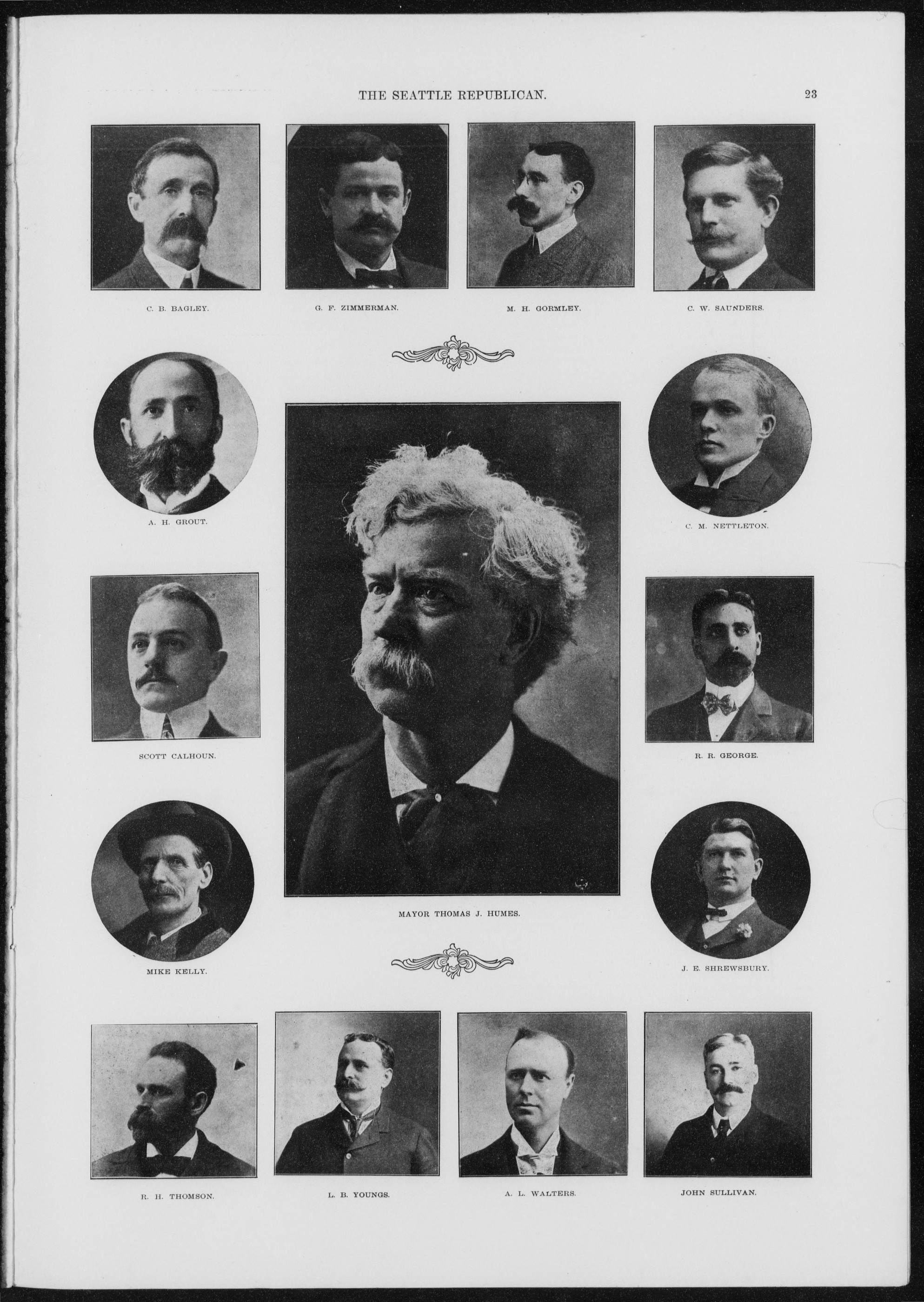
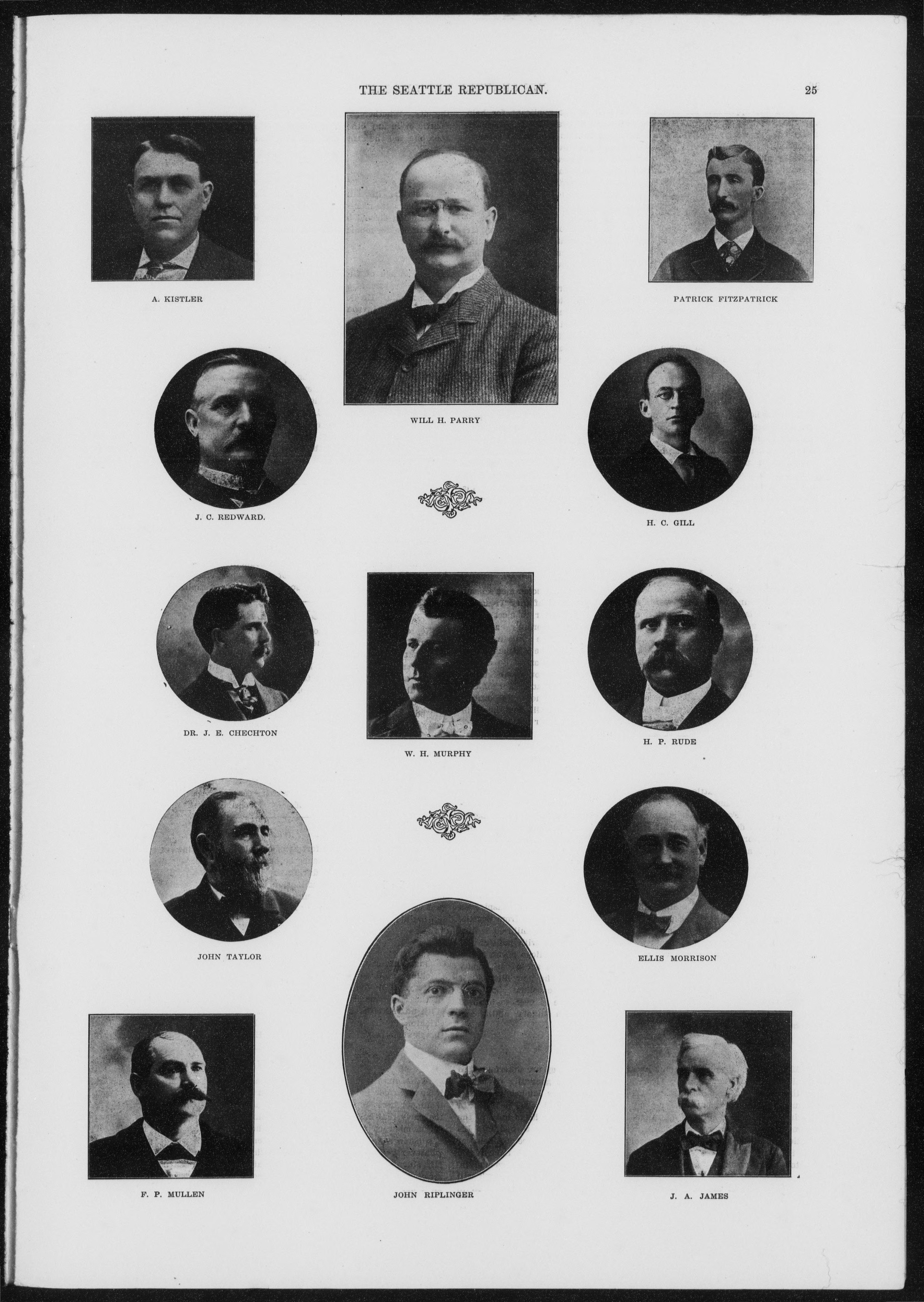
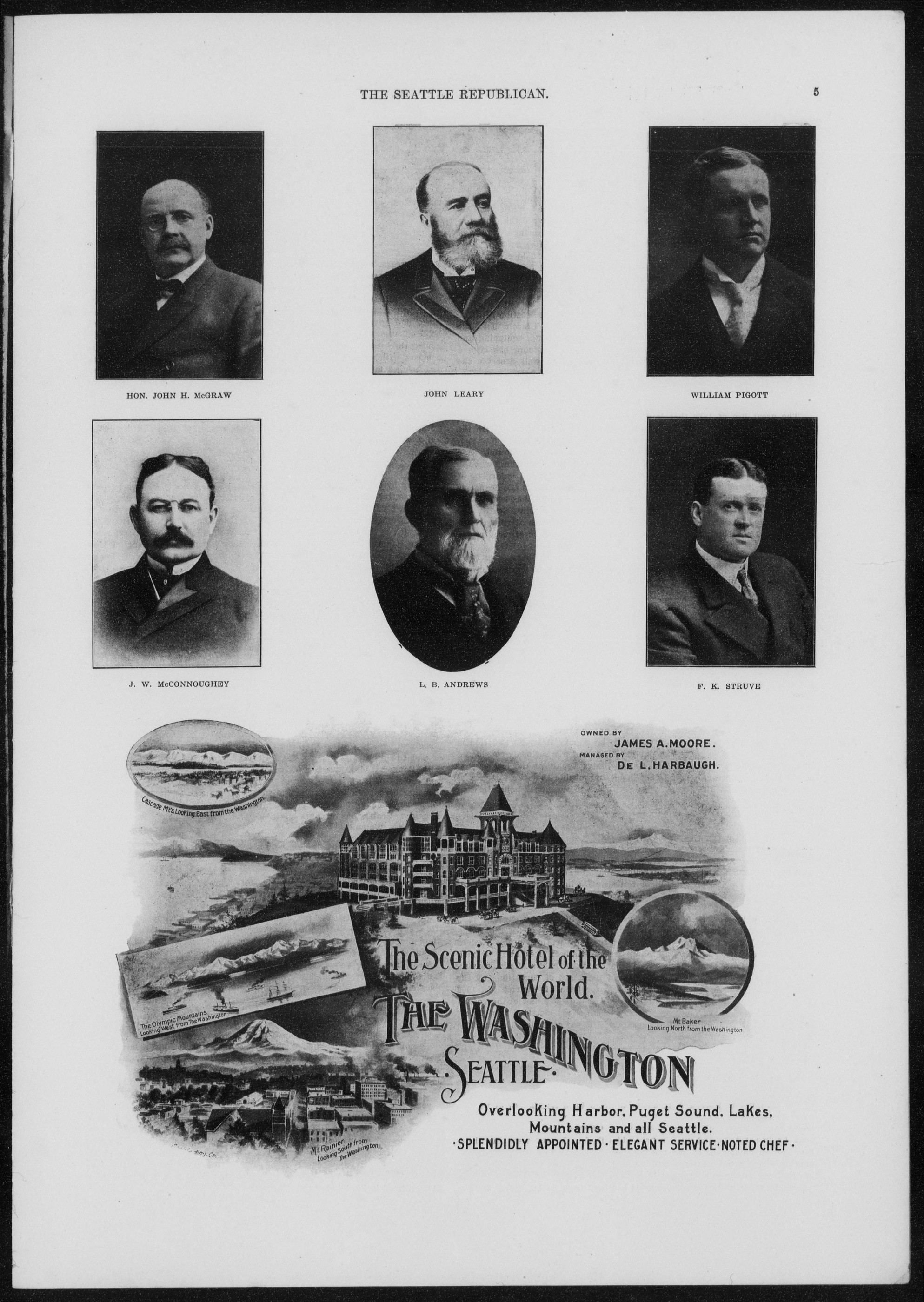
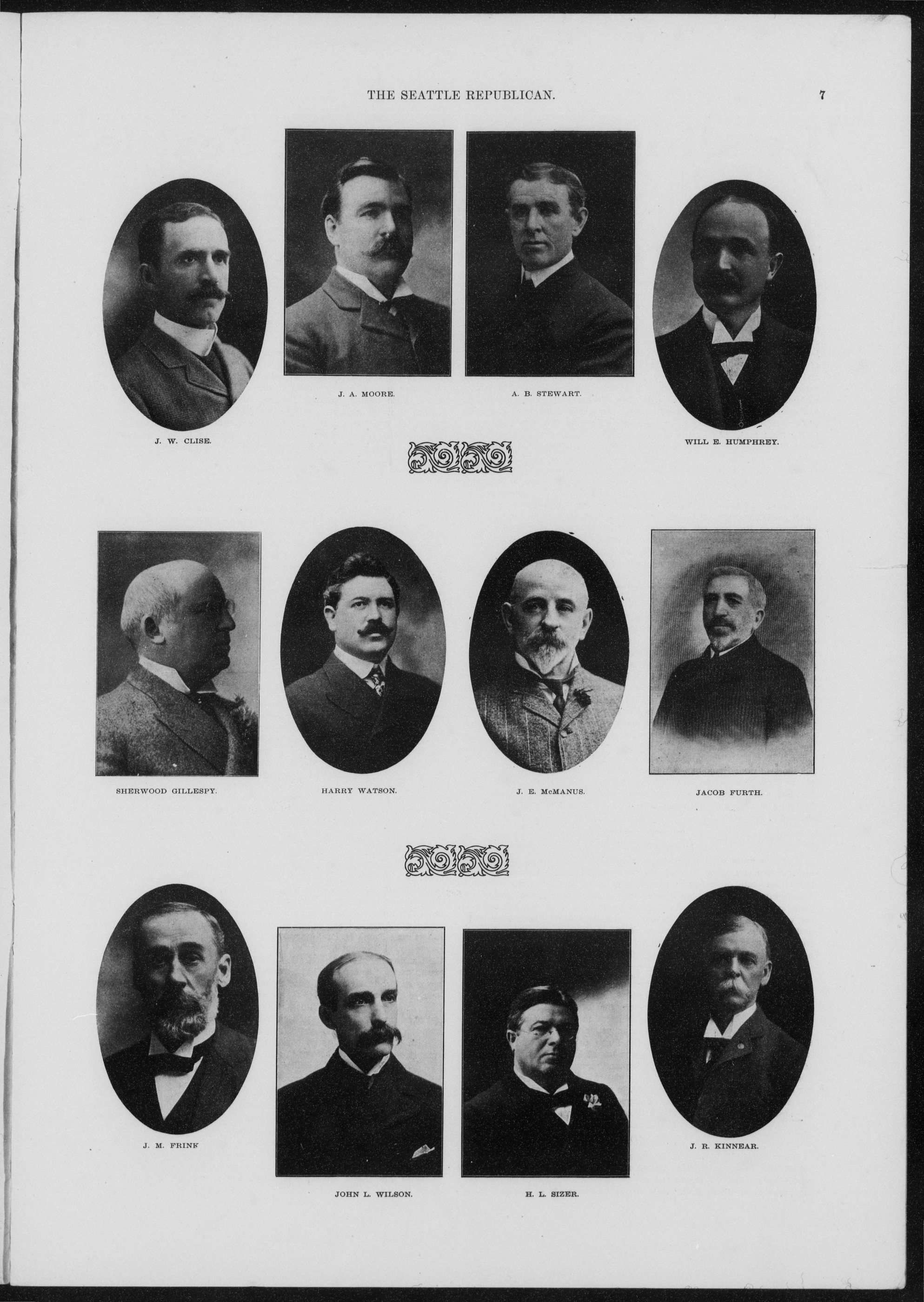
Page text (machine-generated)
LIBRARY
UNIVERSITY OF WASHINGTON
APR 29 1952
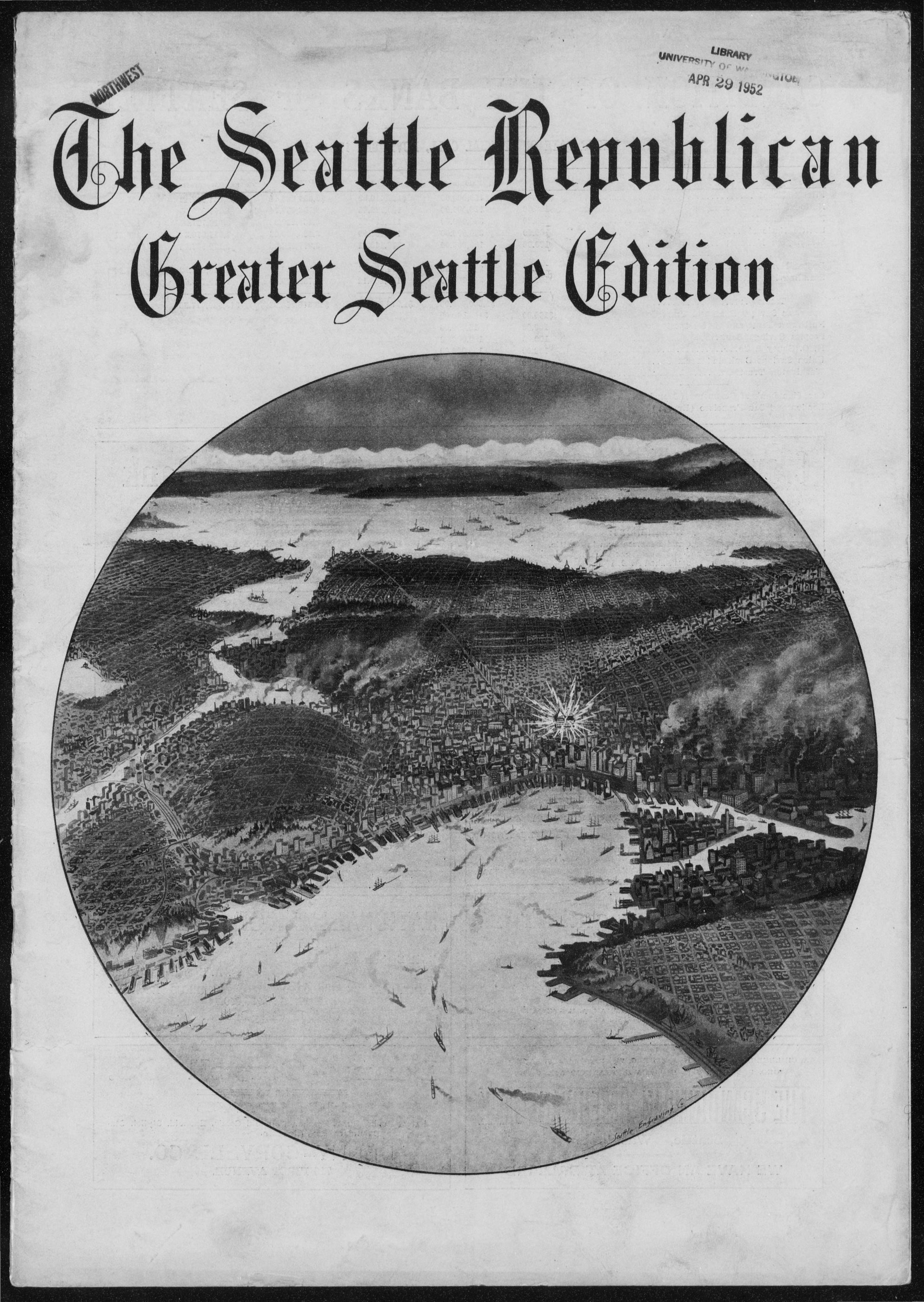
The Seattle Republican Greater Seattle Edition
Seattle Engraving Co.
[Name]
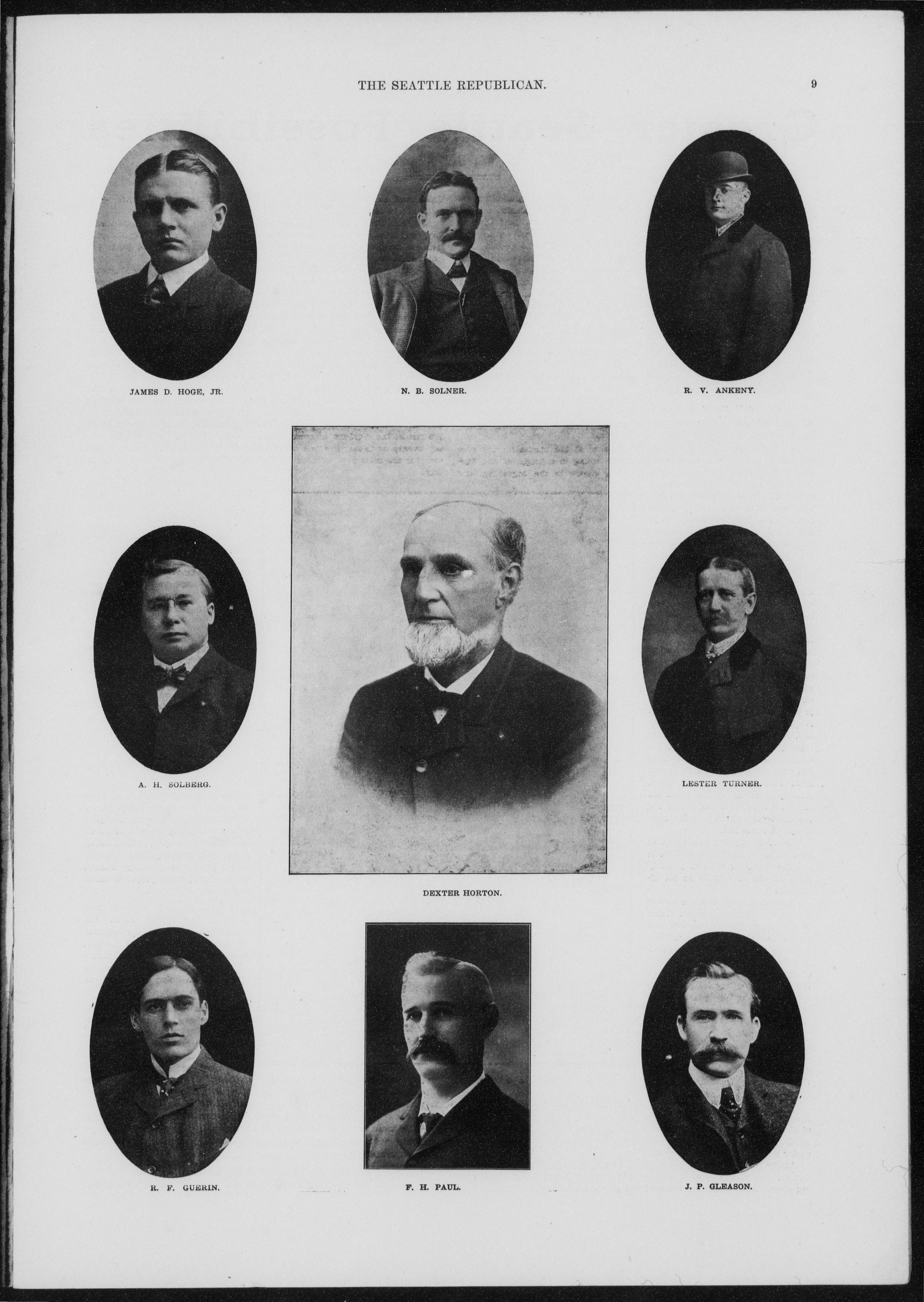
JAMES D. HOGE, JR.
A. H. SOLDSPS
A. H. SOLBERG.
[Picture of a man in a suit with a tie.]
R. F. GUERIN.
[Image of a man with a mustache and a suit, facing forward.]
N. B. SOLNER.
[Name not provided]
[Name not visible in the image]
DEXTER HORTON.
J. B.
F. H. PAUL.
9
[Picture of a man in a bowler hat and suit].
R. V. ANKENY.
[Image of a man with a mustache and a dark coat, facing slightly to the right.]
LESTER TURNER.
[Picture of a man with a mustache and a suit. The background is black. The man is facing the camera.]
J. P. GLEASON.
Greater Seattle Possibilities
By O. M. Moore
compass the southern half of Seattle Harbor, south of the railway which
which crosses the bay.
The business section of the city commences at the northeast corner of
the “flats” and extends northward, gradually rising to a height of one Kun-
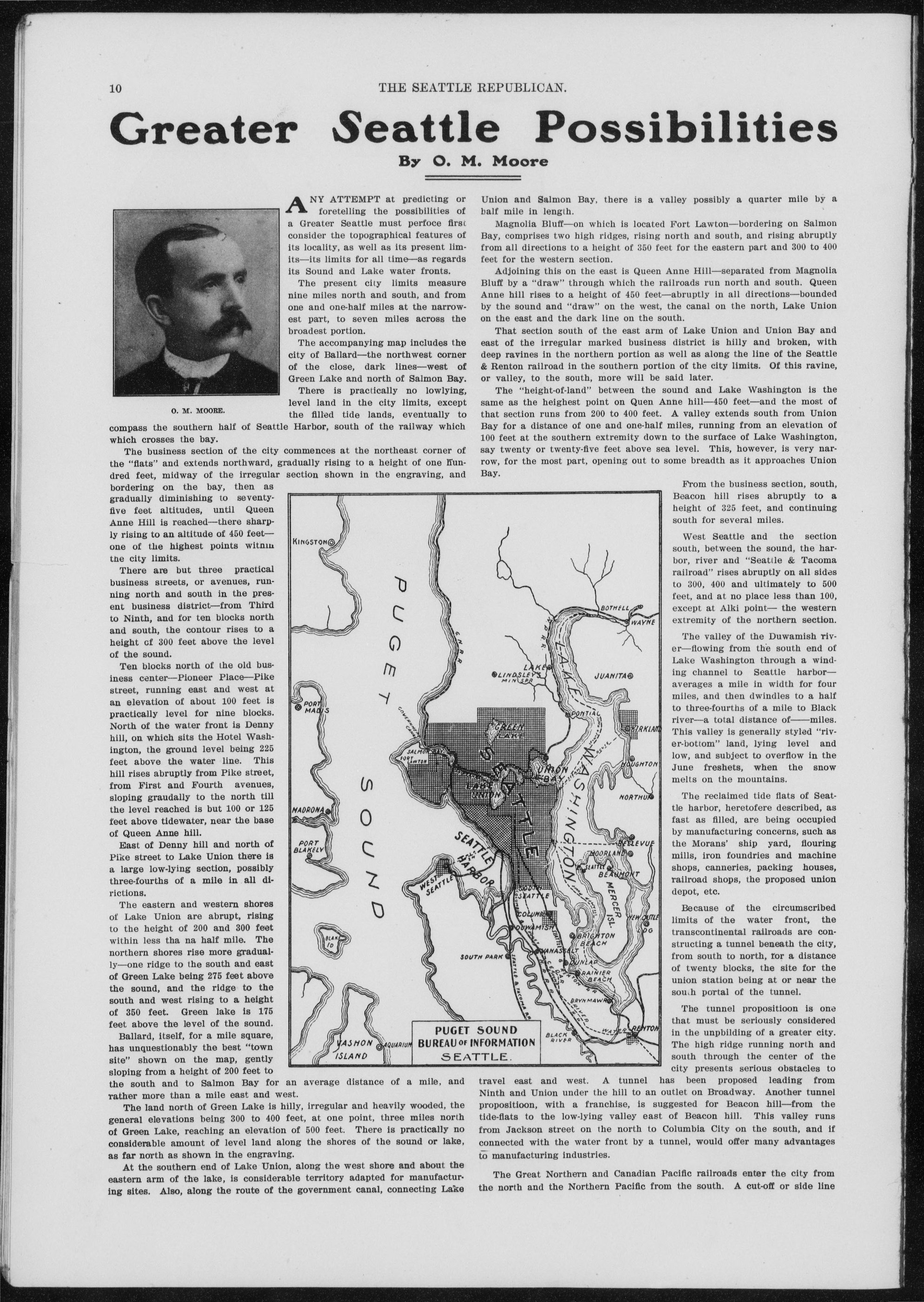
dred feet, midway of the irregular section shown in the engraving, and
tag Be
on me
ee
pee Sige
Samar ht gaa . Piss
aes A pare y
Pata Mn ay AEs
0. M. MOORE.
bordering on the bay, then as
gradually diminishing to seventy-
five feet altitudes, until Queen
Anne Hill is reached—there sharp-
ly rising to an altitude of 450 feet—
one of the highest points witnin
the city limits.
There are but three practical
business streets, or avenues, run-
ning north and south in the pres-
ent business district—from Third
to Ninth, and for ten blocks north
and south, the contour rises to a
height cf 300 feet above the level
of the sound.
Ten blocks north of the old bus-
iness center—Pioneer Place—Pike
street, running east and west at
an elevation of about 100 feet is
practically level for nine blocks.
North of the water front is Denny
hill, on which sits the Hotel Wash-
ington, the ground level being 225
feet above the water line. This
hill rises abruptly from Pike street,
from First and Fourth avenues,
sloping graudally to the north till
the level reached is but 100 or 125
feet above tidewater, near the base
of Queen Anne hill.
East of Denny hill and north of
Pike street to Lake Union there is
a large low-lying section, possibly
three-fourths of a mile in all di-
rictions,
The eastern and western shores
of Lake Union are abrupt, rising
to the height of 200 and 300 feet
within less tha na half mile. The
northern shores rise more gradual-
ly—one ridge to the south and east
of Green Lake being 275 feet above
the sound, and the ridge to the
south and west rising to a height
of 350 feet. Green lake is 175
feet above the level of the sound.
Ballard, itself, for a mile square,
has unquestionably the best “town
site’ shown on the map, gently
sloping from a height of 200 feet to
the south and to Salmon Bay fo!
rather more than a mile east and 9
The land north of Green Lake is
general elevations being 300 to 40
of Green Lake, reaching an elevati
considerable amount of level land
as far north as shown in the engrav
At the southern end of Lake Uni
eastern arm of the lake, is conside
A ATTEMPT at predicting or
foretelling the possibilities of
a Greater Seattle must perfoce first
consider the topographical features of
its locality, as well as its present lim-
its—its limits for all time—as regards
its Sound and Lake water fronts.
The present city limits measure
nine miles north and south, and from
one and one-half miles at the narrow-
est part, to seven miles across the
broadest portion.
The accompanying map includes the
city of Ballard—the northwest corner
of the close, dark lines—west of
Green Lake and north of Salmon Bay.
There is practically no lowlying,
level land in the city limits, except
the filled tide lands, eventually to
e Harbor. south of the railway which
« = i i
) | |
Kingsron@// ( |
\ U \
( e ) Vi — :
A FY \ of Hi So WAYNE
0 \: Kult
> Y
FUR |
Ic M sD Oeywaster Ast UUANITA®
| C7 GS Mle |
| € \ HEI A 0/1 ue
C a C Ese gy (aX ANC |
QO Ne OWNl
oes Yo ~~ |
Remand SS fo |
ane Sa QR evyp |
me C a CPE CS aycomeiing (|
“—< Rol Sgiiay |
SF Cc WAS LESSOR GED ‘Sy \ ws
‘ WARES 8 6
‘ie 0 i Y ects \ih Wy) ri Vl |
\ » \ YA) Kg" 9 ond 0M Wire
| aw Sandee” iy |
E S E OW 7 |
- ( BG sPmReaee (C
N DP CRP NEA
YY SS \ ny
SW >) Y SAY oernmawnsiy) J
| J \ SNS %)
7 ) 2 S ASH
lam pucet sound |,,,.0 Snape !
wy @ Siew BUREAU OF INFORMATION | **** ee a
i_¢ } SEATTLE. >
- for an average distance of a mile, and
nd west.
e is hilly, irregular and heavily wooded, the
» 400 feet, at one point, three miles north
vation of 500 feet. There is practically no
nd along the shores of the sound or lake,
graving.
Union, along the west shore and about the
siderable territory adapted for manufactur-
» of the government canal, connecting Lake
Union and Salmon Bay, there is a valley possibly a quarter mile by a
balf mile in length.
Magnolia Bluff—on which is located Fort Lawton—bordering on Salmon
Bay, comprises two high ridges, rising north and south, and rising abruptly
from all directions to a height of 350 feet for the eastern part and 300 to 400
feet for the western section.
Adjoining this on the east is Queen Anne Hill—separated from Magnolia
Bluff by a “draw” through which the railroads run north and south. Queen
Anne hill rises to a height of 450 feet—abruptly in all directions—bounded
by the sound and “draw” on the west, the canal on the north, Lake Union
on the east and the dark line on the south.
That section south of the east arm of Lake Union and Union Bay and
east of the irregular marked business district is hilly and broken, with
deep ravines in the northern portion as well as along the line of the Seattle
& Renton railroad in the southern portion of the city limits. Of this ravine,
or valley, to the south, more will be said later.
The “height-of-land” between the sound and Lake Washington is the
same as the heighest point on Quen Anne hill—450 feet—and the most of
that section runs from 200 to 400 feet. A valley extends south from Union
Bay for a distance of one and one-half miles, running from an elevation of
100 feet at the southern extremity down to the surface of Lake Washington,
say twenty or twenty-five feet above sea level. This, however, is very nar-
row, for the most part, opening out to some breadth as it approaches Union
Bay.
From the business section, south,
Beacon hill rises abruptly to a
height of 325 feet, and continuing
south for several miles.
West Seattle and the section
south, between the sound, the har-
bor, river and “Seatile & Tacoma
railroad” rises abruptly on all sides
to 300, 400 and ultimately to 500
feet, and at no place less than 100,
except at Alki point— the western
extremity of the northern section.
The valley of the Duwamish riv-
er—flowing from the south end of
Lake Washington through a wind-
ing channel to Seattle harbor—
averages a mile in width for four
miles, and then dwindles to a half
to three-fourths of a mile to Black
river—a total distance of——miles.
This valley is generally styled “riv-
er-bottom” land, lying level and
low, and subject to overflow in the
June freshets, when the snow
melts on the mountains.
The reclaimed tide flats of Seat-
tle harbor, heretofere described, as
fast as filled, are being occupied
by manufacturing concerns, such as
the Morans’ ship yard, flouring
mills, iron foundries and machine
shops, canneries, packing houses,
railroad shops, the proposed union
depot, etc.
Because of the circumscribed
limits of the water front, the
transcontinental railroads are con-
structing a tunnel beneath the city,
from south to north, for a distance
of twenty blocks, the site for the
union station being at or near the
souch portal of the tunnel.
The tunnel propositioon is one
that must be seriously considered
in the unpbilding of a greater city.
The high ridge running north and
south through the center of the
city presents serious obstacles to
1s been proposed leading from
utlet on Broadway. Another tunnel
gested for Beacon hill—from the
of Beacon hill. This valley runs
‘columbia City on the south, and if
nnel, would offer many advantages
travel east and west. A tunnel has been proposed leading from
Ninth and Union under the hill to an outlet on Broadway. Another tunnel
propositioon, with a franchise, is suggested for Beacon hill—from the
tide-flats to the low-lying valley east of Beacon hill. This valley runs
from Jackson street on the north to Columbia City on the south, and if
connected with the water front by a tunnel, would offer many advantages
to manufacturing industries.
The Great Northern and Canadian Pacific railroads enter the city from
the north and the Northern Pacific from the south. A cut-off or side line
THE SEATTLE REPUBLICAN.
that Seattle is an underrated community—a city set upon a hill; but beyond doubt King County's court house is a conspicuous landmark pre-eminently high—so high in fact that it must come down.
accommodate through traffic, north and south, especially for the convenience of freight trains passing the city. The opening of the government canal to Lake Union will add materially to the city's "water front," for business purposes, as the south end of the lake lies close to the geographical center of the city, and is easy of approach from all directions.
If the past is secure, and the trials and dangers of launching a new commonwealth, and laying the foundations of a world's metropolis are vanishing below the horizon as "has been," the present auspicious opening of the 20th Century may well boast of King County's well equipped regiment of judges, ex-judges and humble lawyers with which to fight and hold her own against the world. Is it overstating the figure to say that Seattle has 1000 citizens who are, or think they are, "learned in the law"? To marshal such an array, many real estate and insurance agents, editors, bankers, brokers and sisters-in-law must be counted in, even if some of them don't know enough law to hurt. But it is quite safe to say that several hundreds of bona fide lawyers keep office, counsel clients and attend courts and make livings in Seattle. Apart from municipal and justice courts, our superior court has no less than five departments, each presided over by a separate jurist, while from time to time special judges don the ermine to help clear the crowded dockets and overworked incumbents. The U. S. district and circuit courts and court of appeals sit regularly in this city. The facts of our state university and a U. S. military post, land office, and weather bureau being established here, are worthy of mention.
Because of the precipitous shores of Lake Washington, on the city's eastern border, the question of commerce on that lake will probably cut little figure, as far as the city proper is concerned. The lake, however, will prove a great and grand fresh water harbor for all shipping and a resort for boating and recreation for all time.
The completion of the canal to this lake will undoubtedly serve to build up numerous towns on the eastern shores of the lake and on Mercer Island as suburbs of "Greater" Seattle.
Greater Seattle's wholesale and retail business district will extend from the tide flats on the south to Lake Union and Queen Anne hill on the north, and back to the "first hill" on the east. As a matter of course, much of the retail business will extend out into various distant sections of the city. Broadway, from Pike to Roy, is fast developing into a retail business street.
Fremont—north of Lake Union—and Green Lake will practically have the business of prosperous towns, though each a part of our greater city.
an intelligent visitor of Seattle perched on Dwamish Head might well divine a priori the character of business that chiefly occupies the attention of our courts in addition to administration of decedents estates and granting divorces, the forest of shipping suggests admiralty—the mills, factories and rail cars suggest personal injuries—the multitude of new structures of all sorts suggests mechanics liens,—and the sight of the tenderloin district suggests crime—while commercial collections and mortgage foreclosures are few and far between. The records of our courts fully sustain such anticipations.
It will not be strange if Ballard, West Seattle and the communities to the south also join in the greater limits before many years.
Fully nine-tenths of the whole city—on high ground—must necessarily always be confined to residences and the present city limits have ample room for ten times the present population of 120,000 or more. West Seattle and its high extension south, as well as the southern extension of Beacon hill, will give room for other thousands and provide homes for the thousands and thousands who will make the Dumanish valley hum with hundreds of busy industries scattered from Elliott Bay to Black River, and possibly extending from these to the east till the town of Renton and foot of Lake Washington are reached.
The practice of assigning judicial honors to men venerable in years, experience and reputation seems to find little recognition here. Young men of push and enterprise forge their way to the front and win their spurs on the bench, and thus become the better prepared to enter the lists of forensic encounters on resuming the practice at the bar. The four years term prevailing in this state for superior court judges is quite too short for a high order of efficiency in the exalted position of judgeship. Under such short term in our popular system of elective judiciary, an incumbent of the bench, at a salary of $3000 per year, scarcely recovers from the aches, bruises and expenses of an active campaign first to get the nomination and then to carry the election, and scarcely gets warm in his seat and stiff in his dignity, before the prospects of a continuance in office for another term be considered, and plans reformed for stringing wires and laying pipe demand attention. The busy public is indifferent until the array of aspirants for judicial honors is lined up at the foot of the ticket at the county political convention. Among the politicians, the idea of the office seeking the fittest man, provokes a broad smile.
For the homes of a million families there is ample room between the shores of Lake Washington and Puget Sound. Other thousands will have suburban homes on Vashon and Bainbridge islands, of the sound; on Union island, of the lake, and on the prolific eastern shores of Lake Washington.
But the bucket brigade, the backbone of all great cities—the builders of homes, without whom there can be no Greater Seattle—where will the site of their toil be found?
I have named certain small and circumscribed localities for manufacturing sites, and must not omit Ballard.
There is but one considerable site for manufacturing in all this site for a greater city.
You say—"The tide flats, of course!"
With the tide flats all filled in there will not be adequate room for the backbone of a Greater Seattle, as we contemplate.
With the addition of the entire Dumanish valley to Black river there will be less space than is required for the industries of Chicago or of Pittsburg!
The King county bench is now well and ably filled by men faithful and assiduous in the discharge of their judicial duties. Therein they are helped by a large and able bar of lawyers drawn hither from almost every state in the Union. Leading firms and pioneer stand bys are constantly in evidence, but the bar within the last five years of our phenominal growth and prosperity has received and welcomed many able recruits from the East, South and Middle West. Thereto must be added the platoons of fresh and active young practitioners wheeled into the arena from the prosperous law school of our university.
With the straightening and dredging of the Dumanish river for a dozen miles there will be the site of manufacturing industries without which—the valley and the industries—there can be no Greater Seattle!
If you ask me "Why a Greater Seattle?" I will reply: Study the geography of Seattle's situation—study a globe and not a flat map. Observe the growing commerce of the Pacific and Seattle's proximity, as a seaport, to all trans-Pacific countries and to Alaska. For the whole Pacific coast there are three principal ports—the Bay of San Francisco, the Columbia River (?) and Puget Sound. The second may be practically eliminated, leaving 'Frisco and the Sound to contend for the mastery. The former is handicapped by distance. The Sound has every advantage. 'Frisco has one transcontinental railroad. Seattle has the Great Northern, the Northern Pacific and Canadian Pacific, with the Burlington entering over the Northern Pacific tracks, as will also the Union Pacific very soon.
In passing it may be noted that in many years neither Seattle's citizenship nor bar has been weakened by the withdrawal, with one exception, of any one to fill any high or useful position in the government of state or nation.
In conclusion, if in order from one no longer young in years or limited in observation, I beg leave to offer the following suggestions, viz:
(1) The bar of King County ought to have occasional social gatherings to become better acquainted and help create our esprit du corps and elevate the code of honor.
The largest freight and passenger steamers afloat will soon connect here with the various railroads, carrying the commerce of Occident and Orient. He who sees only the length of his own short span of life cannot grasp the idea of a Greater Seattle, but the old world will outlive most of us.
2 This bar ought to combine its influence and efforts to have a new court house built on the Yesler block as soon as practicable.
3. A public law library should be created and established forthwith in such new court house.
Legal Profession in Seattle By Joseph Shippen, Esq.
Legal Profession in Seattle By Joseph Shippen, Esq.
4. The term of office of a Superior Judge of Washington ought to be enlarged to eight years.
5 This bar ought to feel and manifest a special interest and regard for the professors and students of our State University Law School.
In the unending struggle of humanity against the world, the flesh and the devil, the church is supposed to wrestle with satan; the doctors promise to overcome all ills the flesh is heir to, and to whom but the lawyers is intrusted the fight against the world! This fight has been maintained in Seattle by the bench and bar for half a century with varying degrees of success, but on the average whole, the legal profession, as usual, has held its own.
6 This bar should be interested in the session of the Washington State Bar Association to be held here next July, and unitedly resolve to make it
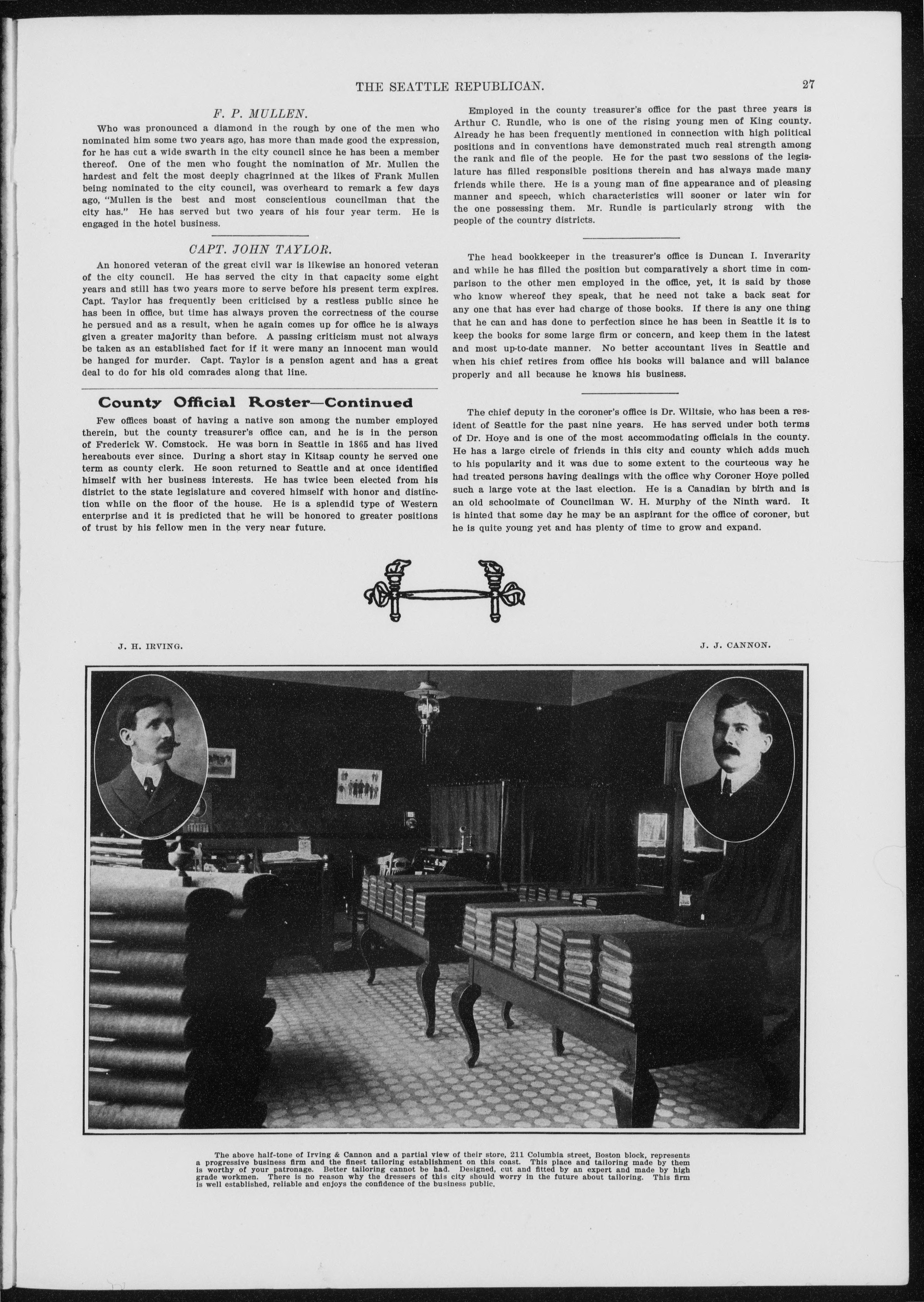
Although one of the comparatively new comers to Seattle, our subject, R. F. Guerin, has accomplished more for himself and Seattle than many another has done in a lifetime. In connection with his father he projected what is now known as the Ravensdale coal mining property and the Seattle and California railway proposition. Disposing of their holdings at a good figure, R. F. Guerin engaged in the brokerage business and is meeting with splendid success. A lawyer by profession, yet in his chosen field he has established an enviable reputation as a conservative business man, and is of that class of young men who, in years to come, will be pointed out as they who were wise builders of that portion of the Greater Seattle that fell to their lot to supervise. Seattle has opportunity for and welcomes all such who may seek its borders and cast their lot herein.
The pioneers boast that there were veritable giants in those early days of canoe transportation, and the Washington State Bar Association is regaled annually with vivid sketches of the ability and greatness of departed worthies, such as O. B. McFadden, James E. Wyche, Elisha P. Ferry, John B. Allen, et alios.
True it is that Seattle has always been an attractive center for lawyers, and of late its growth, resources, enterprise and prospects have combined to draw within its portals vigorous and ambitious minds in all departments of activity and business. Especially has our city attracted men devoted to the administration of the law. Rival cities may question our claim
You say—"The tide flats, of course!"
11
R. F. GUERIN.
THE SEATTLE REPUBLICAN.
The Law and the Law Boys By Wilson R. Gay
The great law of change, the great evolutionary law that is now by all admissions ruling the world, has caused to be formed great corporations and thereby there have ben produced wonderful inventions and wonderful instruments of power that were unknown a few years ago. These instruments of power are a menace in a way to the individual.
You asked me to write about the law—the law boys of Seattle. I agreed, making the condition that the sole title should be the one that appears hereto—that is, "The Law and the Law Boys." The reason that influenced me in so choosing of the subject and title is not exactly that I wished to be unique, but because I wanted no one to attempt to read the article unless he has an interest in the subject.
I am not going to attempt to write an article that will at all define the rights of life, but in natural society we would not have a railroad or a steamboat, not a flying machine, nor an electrical power of any kind, character or description; we would not even have a wagon. We would walk, unless we could find some inferior animal that would carry us around. The genius of man has made it otherwise. The genius of man, though, could not in justice take away the right to deny a fellow man his right to have his rights to walk around and be preserved. These great corporations, these great instruments of power, these great machines that are dangerous and sometimes destroy life, sometimes kill, and are often badly managed, has naturally caused to grow up a class of business which is commonly called the damage suit.
By the words "law boys" I mean those who, after all, are a set of "boys" who really ask but little of and truly receive but little from newspapers.
From time out of mind the lawyer has been regarded a little different than that of the ordinary man who sought by his talnts and abilities to get along in the world. His own education, environment, training and even arrogance has been of this character. The general public have so placed him. He has been called learned, an officer of the court and as professional and to him there has consequently been denied much that the average business man and the other "boys" with whom he came in contact instinctively felt and truthfully knew to be theirs as a matter justly due.
Unconsciously in the evolution of business affairs that have been going on about all of us, the lawyer has not escaped, and it only requires a little observation and thought to see that both are subject, after all, to the great law of change.
It has grown wonderfully in the last years, but no greater and no faster than has grown the methods by which the machine and the instruments and the things themselves which do hurt and do so often kill.
The word unconsciously which I use is a word that I hope will become impressive, for the reason that it seems to be a truth that mortals do not wholly, altogether and oftentimes not at all, recognize either consciously or unconsciously the great law of change so commonly now denominated the law of evolution.
These great associations have been able to sometimes buy a newspaper, control one, and oftentimes influence one, and there has been much written against what is called the damage lawyer, yet, if society would only stop for just five minutes to think, they would see what a blessing after all he is, Pessimist, Bear, Destroyer, though he may be in a way—they would then see what he has done for society, and then they would canonize him rather than crucify him.
Like it or not like it it matters but little, the lawyer of the "old time" has no longer a place which he can fill or where he is either wanted or is in demand.
Every day in the streets of Seattle we see men sweeping them and gathering up the offal, making the streets and the atmosphere sanitary. It was the damage lawyer that did that. Every day in the streets of Seattle and upon our public highways we see evidences of the efforts to sustain and preserve human limbs and conserve human life which the damage lawyer brought about. Every day in the handling of passengers and the handling of traffic we see the same, for it is in the traffic and handling of affairs of all kinds and descriptions mentioned that we now see human rights taken care of better than we did five years ago, two years ago, even. It was the damage lawyer that brought about such conditions. There is no need of prolonging the illustrations. It is the truth. Your life is safer today than ever before, and it was that class of lawyers that took care of that. They are on earth to stay.
The lawyer of today keeps one of two places in the world. It can be no better illustrated than by two words that we have seen so much in public print referring to a class who exist, and that is called the "bulls and the bears." The lawyer of today is either a builder or he is a destroyer. This may sound strange, and it may be too narrow a definition, but, after all, it only represents the two great classes of society—the optimist and the pessimist.
In the old time we thought of a lawyer as one who would be "a great pleader." Today the world demands a business lawyer—a man who can create. That means a man who can form associations—a man who can hold them together with profit. The world today demands of the lawyer that he be one who will keep his client out of court, not one who will get him or them into court. It is the great concerns and the great combinations formed within the law that are doing, after all—that is many of them—much for society. They have been created and maintained by lawyers.
This class of lawyers are called "ambulance chasers." Unquestionably, many of them do unduly seek this class of business. That is natural. But if the story would ever be told in print of the manner in which the other side—that is, the railroads and the street cars—resort to take care of their business, the "ambulance chaser" lawyer would never again be referred to in the matter of disapprobation.
The law is such a noble profession. When a father, a mother, a wife, a sister, a daughter, every kindred and every friend, have forsaken a poor devil of a man in trouble, and when he, in that awful predicament found, as is common, a lawyer who undertook his cause without money and without price; often a poor lawyer that listened to his story, who some way or another fathomed his heart of woe, his heart of trouble and his poor mind, then defended him. This occurs almost every day. I have often thought, and now think, that if Jesus of Nazareth had had even a poor lawyer to have spoken a word for him before a faltering judge in the midst of a clamoring mob, that He would not have had to carry His cross in a tottering, pitiful manner for two miles or more that he might be thereafter nailed upon it and crucified dead, suffered shame, in weakness asked if God, the Father, had forsaken Him. Then I remember with professional pride that after death, when all had left him, it was a lawyer—Joseph, the noble counsellor—that gave Him burial, in his new sepulchre.
Of a case I mention and it is easy to tell its story. A man was killed by a certain corporation's instrument. He was absolutely without fault. He had simply done a kind act, but after he was killed he was by the company's agent carried into town and there by doctors dissected to see if they could not find evidence in his stomach that he was intoxicated, to put a fault upon him. That suspicion was found false. He had a poor wife and seven children. They were gathered up by the company, carried off to a lodging house, a lawyer furnished them, the funeral expenses paid, friends kept fro mthem. The widow was gotten into court, made not only plaintiff for herself, but guardian ad litem for her seven children, and they all received a judgment of $5,000 by confession or admission for the life of that honest man, who, without fault, had lost his life. All done within seven days. That occurred within the last six months in this town! And if anybody can beat that against an "ambulance chasing" damage lawyer, he is a crackerjack from wayback.
To the lawyer comes everybody. He holds a society in his hand. They all come to the lawyer—some for counsel, some for comfort, some, of course, for not the best purposes.
The law profession is one that does not depend upon newspapers to bolster it, to foster it and to build it up. As I say, it will hereafter under the law of change—that is, that it is becoming more of a business institution than a profession. I look for it to appeal to the newspapers. I never was able to see why that a lawyer could not appeal to the public for his interest and growth, the same as a merchant. That time will come. It ought to come. It is right.
The law business needs only one more remark from me, and that is, the young man starting out in life should think well of its nature and its kind and its character before entering upon it. Influences that have been brought to bear have so arranged things now that the real poor man is almost debarred from court. They have got it so now that he must pay $4.00 to file his complaint; he must pay every witness in advance; he must pay $12.00 for a jury fee; he must pay for the sheriff's serving fees, and, of course, he should pay his lawyer something. He must pay clerk fees to draw papers, and then he must pay his own expenses while waiting on the long delays of court, and the like, then, if he wins (and he doesn't always win), then, if he has a good case or if he has won he must pay another clerk fee of $6.00 to pay a judgment of less than 200 words, and then he must pay another sheriff fee to levy, and he must put up then a bond, and then he must pay keeper fees, maybe, and there is put upon him such burdens of cost and expense that the average poor man is justified in saying that the courts of his country—the country he loves, the country that he pays frightful taxes to support, and the country that he would go and leave his wife and his babes and his home in war to defend, that in that country the courts are almost closed to him, the average poor man. It is a shame. It is a disgrace.
I said the lawyer is like the bulls and the bears—the optimists and the pessimists. I refer once more to that with this reflection. One class of lawyers create, another class destroy. Both are right. The bulls and the bears are both right. This sounds at the first instance inconsistent, but it is answered by saying that it is the law of life. There is no such thing in all the law of life as a complete optimistic building. We have to have our haltings; we have to have our pausings; we have to have our waitings; we have to have our corrections. The human mind is so far from being perfect at any time that it needs to be guarded or sometimes it goes agog and becomes frightfully intoxicated in its succes, even in well doing; therefore, the lawyer who creates, forms the greatest companies, keeps men out of courts, out of litigattion, he sometimes gets narrow, sometimes gets selfish, sometimes gets wicked, and needs often to be corrected, and therefore it is necessary to have in society the other lawyer, the pessimist, the fellow that will give him a black eye—knock him down in the street—will correct him. The language I have used is possibly a little dramatic, but after all it is the truth.
It is my opinion that our courts should be as free to us all as is the salvation of God, as the education of the child in our common schools, and it is my opinion that the time will come when the people will awake to that truth.
12
THE SEATTLE REPUBLICAN.
The Seattle Bench and Bar
C. W. Corliss stands high in the legal fraternity. He spends a great deal of his time on his ranche, but is at his office every day. He is thirty-eight years of age and has been in Seattle fifteen years.
Hon. Robert Brook Albertson, who hails from North Carolina, has lived here for nineteen years. Served as corporation counsel for Seattle, twice elected to the legislature, was speaker of the house and is now one of the superior court judges of this county.
Georgia sent us J. Henry Denning a very bright young attorney. He not only stands high among attorneys, but also with the citizens. He has been associated with the leading lawyers of the city and has been highly honored by his political party.
A son of Erin is John Arthur. Practiced law in Seattle sixteen years, is a leading Mason of the Northwest. Though fifty-four he is still in the vim and vigor of life and enjoys a most lucrative practice.
The bar of the state mourn the untimely death of the late lamented John B. Allen. Eminent in the affairs of state and nation his death cast a gloom from Olympia to Washington City.
Among the many attorneys who have done well in this city none have outstripped Lee De Vries. He is attorney for many of the big industrial concerns of this section and is pronounced one of the solid men of Seattle.
Eleven years residence in Seattle has detracted none from the first impression Frederick Bausman made on his arrival from Pennsylvania. He is forty-one, stands at the top as an attorney and practitioner and does a heavy legal business.
Prominent in legal, financial and even in social circles can be said of George De Steiguer. He has many good clients among all classes. He has been here fourteen years, is an Ohian by birth and is thirty-nine.
Texas never produced a brighter son than Alfred Battle. He has been a resident of Seattle since 1888, and is now of the firm of Ballinger, Ronald & Battle, one of the largest legal combinations in the city.
George Donworth is the quintesence of honesty as well as uprightness, not only as a legal light but in every walk of life. He hails from Maine and has been a brilliant success in the far West. He is forty-two years of age.
Four years service as superior court judge gave Hon. R. A. Ballinger an experience in his profession that is serving him well in practice at the present time. He is an Iowian by birth and is in his forty-fifth year.
John F. Dore, who passed to the great beyond a few months ago, was for many years one of the most successful criminal lawyers in the Northwest. His death was much missed by the profession.
Pennsylvania never sent out a cleaner cut young attorney than Judge W. R. Bell, a judge of the superior court. Since 1891 he has been a resident of Seattle and has proved a success both at the bar and on the bench.
Yankee blood may not flow in the veins of J. F. Douglas as he hails from Canada, but he has all the push of the genuine Yankee. Though only here three years he is at the head of a large practice. He is but twenty-nine.
W. L. Beddow is a lawyer in the true sense of the word. He has built up a clientel since casting his lot here some thirteen years ago that any man might envy. He is a Pennsylvanian by birth and is now thirty-five.
Nova Scotia is a long ways from here, but H. H. Eaton of that place is now a lawyer in this city. As a Kitsap prosecutor, a hustler for legal business in Seattle and a shrewd political manipulator he has been a success. He is in his forty-fifth year.
Blake & Williams, of which Henry F. Blake is senior member, is composed of two young men, each of whom is destined to have great success in this city. Mr. Blake is from Boston and has been here only six years. With his push, pluck and ability he will get there.
James J. Easley has practiced law in this city for the past twelve years and the greatest compliment that can be paid him is, he has always succeeded.
The Old North State sent us W. H. Bogle some four years ago and a splendid acquisition to the legal fraternity is he. In that brief time he has built up a splendid practice. He is in his forty-fourth year and has ambitions.
Germany has many noble sons in America and among them is Col. E. P. Edsen, who for twenty years has been a legal practitioner in Seattle. He is forty years of age, has accumulated a fortune from his profession and is enjoying it.
While R. F. Booth is but twenty-eight years of age yet few attorneys in the city has a better practice. Coming from Minnesota probably accounts for him knowing how to get up and get there and he does it.
Benton Embree, who hails from Oregon, has only been in Seattle six years, but being a Westerner it did not take him long to build up a splendid practice. He is in his thirty-third year and is one of the firm of Embree & Cole.
Wisconsin pineries produced a shrewd one in Edward Brady. His fifteen years life in Seattle have been fruitful ones for him. Though only forty-four he has earned and saved a vast fortune from his practice.
George Meade Emery is one of Seattle's most eminent jurists. Though only thirty-four he has served one term as superior court judge and made a most brilliant record. He has lived for fourteen years in Seattle and is one of her honored citizens.
Life has been a great success to Hon. W. H. Brinker. He has been repeatedly honored by his fellow citizens and is now enjoying a consultation practice that is second to none in the city. He was United States district attorney under Cleveland.
Fifteen years ago Ralph W. Emmons left Michigan and came to Seattle and began the practice of law. Few have done better than he in that time. He has just turned his fiftieth year, but does not look it.
A natural born jurist is often said of John K. Brown, who comes to us from New York. His fourteen years residence in Seattle have been successful ones. Though in his fifties yet he is destined to sooner or later be placed on the supreme bench.
R. E. Ferre, who has offices in the New York Block, is an attorney of pleasing manners, which has made him many friends and brought him numbers of clients. For the past year he has popularized himself on account of his stand in the Renton Hill-Packinghouse troubles.
Byers & Byers is the firm name of which Ovid A. Byers is the senior partner. He ranks high among the attorneys. He is forty years of age, hails from Pennsylvania, and has been a resident of Seattle fifteen years.
With his eminent father thirty-four years ago Pierre P. Ferry came to this state then a mere infant. Eight years ago he began the practice of law and has had a most flattering success. He is the attorney for Hon. John Leary and other retired capitalists.
Alpheus Byers is one of the strong attorneys of this city. He has spent twelve years here and ranks high as a citizen. He is a Pennsylvanian and is thirty-eight years of age. His splendid habits have made him an ideal man in the community.
Hon. Fredrick R. Burch, is a conspicuous figure in the courts of this state. Served one term in the legislature and was a prominent candidate for congress a year ago. He has been both a legal and political success.
State Emigration Agent Albert W. Frater was born in Illinois, was a banker in Kansas and a lawyer and promotor in Washington. He has lived in Seattle for ten years and practiced his profession for the most part. He aspires to the bench.
York state boasts of no stronger son mentally than Judge Thomas Burke. During his twenty-eight years residence here he has always been at the head of affairs. Though only fifty-seven he has retired from active practice having amassed a fortune from it in that time. The young men of the country would do well to emulate his life.
Thirty years ago in Pennsylvania Walter S. Fulton was born. While only a boy his parents moved to Seattle. He served two years as deputy prosecutor and one term as prosecutor and now has one of the largest clientels of any lawyer in the city.
With a personel peculiar to himself E. M. Carr is a striking figure among the many attorneys of this city. For twenty years he has lived here and has done well at his profession. He is forty-four and was born in Illinois.
Pennsylvania also furnished us Wilson R. Gay, who has won more cases at the bar than the average lawyer. During the ten years he has lived in Seattle four of them he was U. S. attorney. He is forty-four years old and is of the firm of Brady & Gay.
P. P. Carroll is the father of a lawyer family and is a Pennsylvanian by birth. He has been here twenty years and enjoys a most lucrative practice and is aided in the same by his son and daughter, both of whom stand high as attorneys.
James M. Gephart, who has practiced law in Seattle for the past fifteen years, is a true son of Pennsylvania. He is a most precise, concise and pains taking lawyer and those qualities are largely responsible for his great success.
Hon. S. S. Carlisle, who hails from Louisiana, is not only a lawyer but has served his country in a diplomatic way. He was consul to Bolivia. He has a remunerative practice and is a foremost citizen of Seattle.
Corporation Counsel Mitchell Gilliam is a most splendid type of Western man. He was born in Oregon, but has lived here for thirteen years. Few of his predecessors in office had the success as he. He is forty-four years of age.
John E. Carroll is only twenty-six, but is the law partner of his father. He was born in Louisiana, but is full of Northern push. He has lived here three years and stands well in the profession.
Maine has a few sterling sons out here too but none outstrips L. C. Gillman. As general counsel for the Great Northern he is one of the most important personages in Seattle. He is forty years of age and has been here for twenty years.
Representing as he does some of the largest business concerns in the state H. R. Clise must be ranked as one of the first-class attorneys of the city. He was born in Wisconsin, but has been in Seattle for fifteen years. He is forty-four.
Hon. Roger S. Greene has reached the top in his profession as a jurist and is now enjoying the fruits of a ripe old age, which hard labor in early life brings. He is sixty-three years of age and has been in Seattle for twenty-six years.
Edward E. Cushman, deputy U. S. attorney for this district, is an Iowalian by birth. He has been a resident of Seattle only a few years, but has lived in Washington for the past thirteen.
13
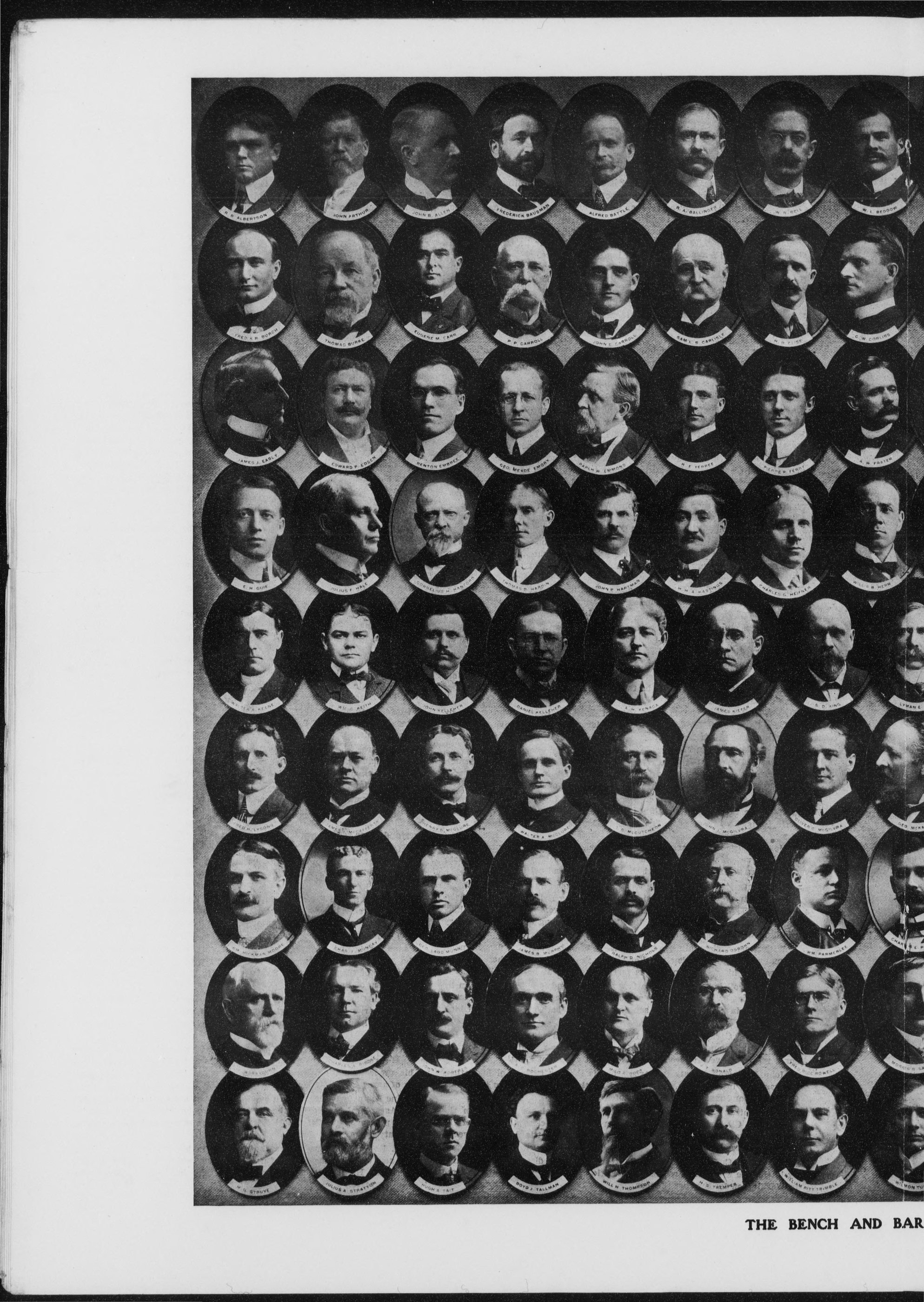
R. B. ALBERTSON
JOHN ARTHUR
JOHN B. ALLEN
FREDERICK BAUSMAN
ALFRED BATTLE
R. A. BALLINGER
W. B. BEIL
W. L. BEDDOW
FRED H. BURCH
THOMAS BURKE
EUGENE M. CARR
P. P. CARROLL
JOHN E. CARROLL
SAM L. S. CARLIELE
H. R. CLISE
C. W. CORLINS
JAMES J. EASLY
EDWARD P. EDSON
BENTON EMBREE
GEO. MERDE EMORY
RAPHL W. EMMONS
R. E. FERREE
PIERRE B. FERRY
A. W. FRATER
E. H. GUIK
JULIUS F. HALE
CORRELIUS H. HAWKES
THOMAS D. HARDIN
JOHN P. HARPMAN
M. H. A. HASTINGS
CHARLES G. HEIFNER
WILLIS B. MERN
WALTER S. KEENE
WILM C. KEENE
JOHN KELLEMER
DANIEL KELLEMER
A. H. KENDE
JAMES KIEFER
S. D. KING
LYMAN E.
SED H. LYSONS
JAMES M. LYSONS
THENRY E. MCGLURE
WALTER A. MCGLURE
D. MCGUTCHEON
JOHN J. MCGILVRA
Oliver J. MCGILVRA
GEO. MCGILVRA
CHAS J. MUNCAY
D. O. LADD MUNNE
JAMES B. MURPH
RALFH D. NICHALD
WICHARD ODBRON
WM PARMERLEY
M. R. ROBIN
CON W. ROBIN
M. E. ROBIN
T. RONALD
FREID B. ROWLEY
MORRIS B. SALAM
M. O. STRUVE
JULIUS A. STRATTON
NUGH A. TAIT
BOYD J. TALLMAN
WILL H. THOMPSON
H. S. TREMPER
WILLIAM PITT TRIMBLE
WILMON TU
THE BENCH AND BAR
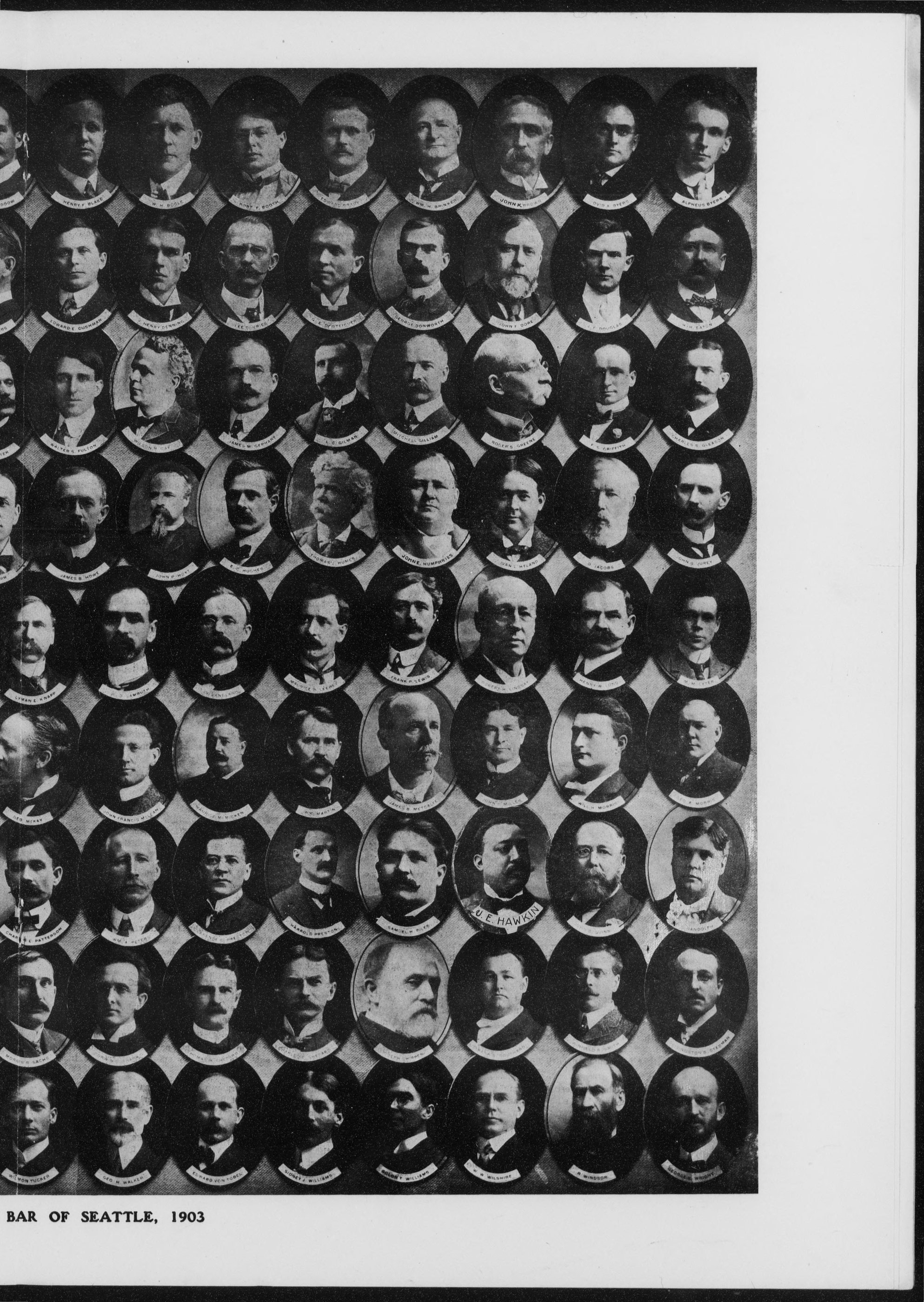
HENRY F. BLAKE
W. M. BOOLE
ROBY F. BOOTH
EDWARD BRARY
WM. H. BRINKER
JOHN K. BROWN
OVID A. BYERS
ALPHEUS BYERS
EDWARD E. CUSHMAN
J. HENRY DENNING
JEE D. WRIES
G. E. DISTEIGER
GEORGE DONWORTH
JOHN F. DORE
J. F. DOUGLAS
M. H. EATON
WALTER S. FULTON
WILSON R. CAY
JAMES M. GEPHART
A. C. GILMAR
MITCHELL GILLIAM
ROGER S. GREENE
F. E. GRIFFITH
CHARLES S. GLEASON
JAMES B. HOWE
JOHN P. HOWE
E. C. HUGHES
THOMAS HUMES
JOHNE E. HUMPHRIES
IVAN L. HYLAND
D. JACOBS
JOHN S. JUREY
LYMAN E. KNAPP
J. D. LAMBUTH
J. W. GENELEAN
WALKER B. LEENY
FRANK P. LEWIS
BERT W. LINGUA
HENRY W. LONG
M. M. LYTER
JOHN FRANCIS MILLAM
WAURICE M. MICKEN
WM. MARTIN
JAMES B. METRAUTE
JOHN S. MILLE
WILLE H. MORRIS
J. F. MORRIS
GEOD MCKAY
JOHN FRANCIS MILLAM
WAURICE M. MICKEN
WM. MARTIN
JAMES B. METRAUTE
JOHN S. MILLE
WILLE H. MORRIS
J. F. MORRIS
CHARLES E. PATTerson
WM. A. PETER
STRETTON H. PIKE TCHEN
WARROLD PRESTON
SAMUEL H. RILES
J. E. HAWKIN
JOHN S. RILES
K. MARSHALL J. JOHN S. RILES
K. MARSHALL J. JOHN S. RILES
MARSHALL J. JOHN S. RILES
VASTON B. GYEDMAN
WILWON TUCKER
GEOD M. WALKER
EDWARD VON TOBEL
SIDNEY J. WILLIAMS
BOLLOW T. WILLIAMS
F. W. WILSHIRE
R. WINDSOR
GEORGE R. WRIGHT
BAR OF SEATTLE. 1903
THE SEATTLE REPUBLICAN.
A. H. Kenaga came to Seattle some three years ago from Ohio his birth place. He formed a partnership with W. W. Wilshire and the two have built up a most remarkable practice. The Buckeye state is well represented in him.
Seattle Bench and Bar-Continued
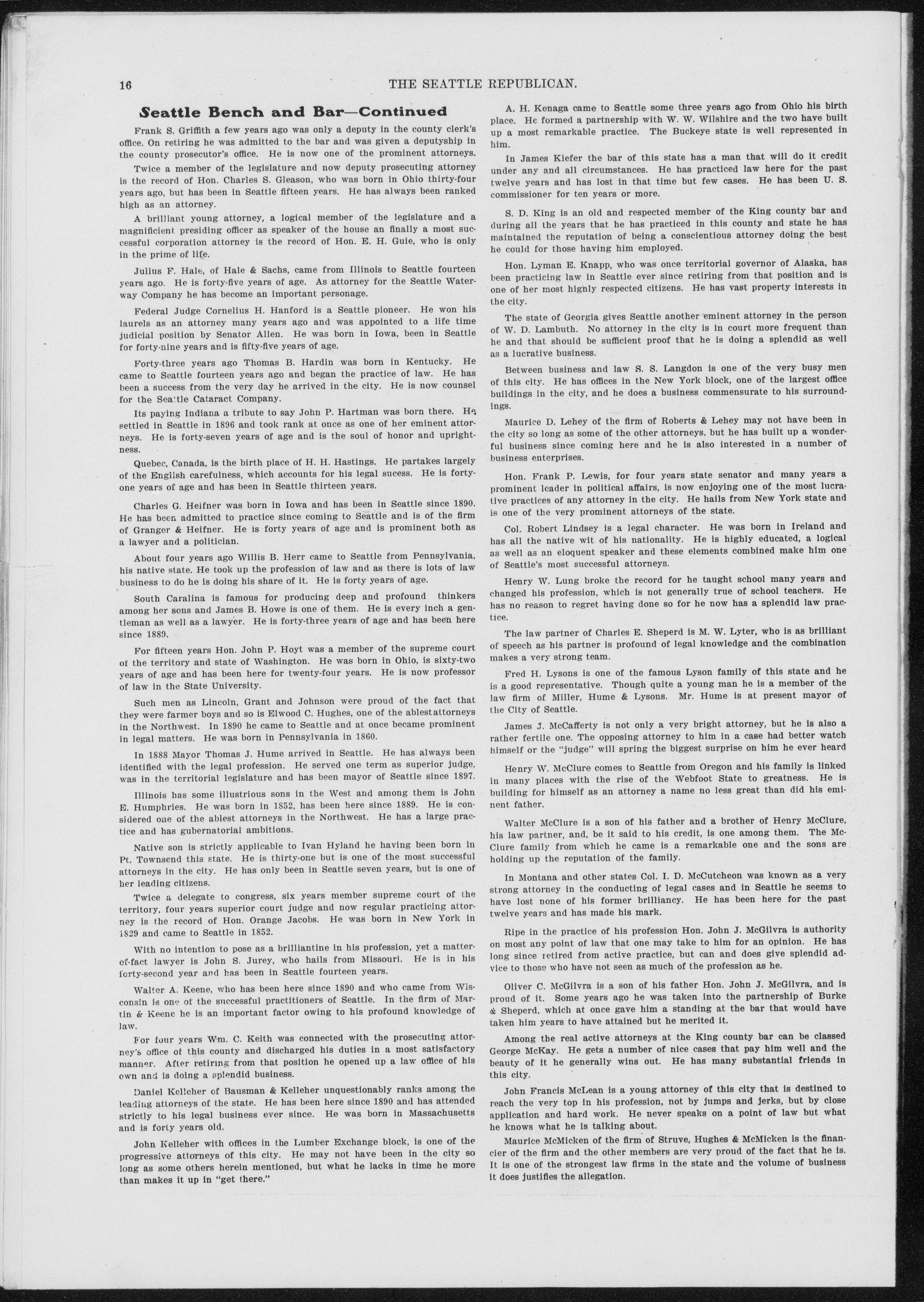
Frank S. Griffith a few years ago was only a deputy in the county clerk's office. On retiring he was admitted to the bar and was given a deputyship in the county prosecutor's office. He is now one of the prominent attorneys.
In James Kiefer the bar of this state has a man that will do it credit under any and all circumstances. He has practiced law here for the past twelve years and has lost in that time but few cases. He has been U. S. commissioner for ten years or more.
Twice a member of the legislature and now deputy prosecuting attorney is the record of Hon. Charles S. Gleason, who was born in Ohio thirty-four years ago, but has been in Seattle fifteen years. He has always been ranked high as an attorney.
S. D. King is an old and respected member of the King county bar and during all the years that he has practiced in this county and state he has maintained the reputation of being a conscientious attorney doing the best he could for those having him employed.
A brilliant young attorney, a logical member of the legislature and a magnificent presiding officer as speaker of the house an finally a most successful corporation attorney is the record of Hon. E. H. Guie, who is only in the prime of life.
Hon. Lyman E. Knapp, who was once territorial governor of Alaska, has been practicing law in Seattle ever since retiring from that position and is one of her most highly respected citizens. He has vast property interests in the city.
Julius F. Hale, of Hale & Sachs, came from Illinois to Seattle fourteen years ago. He is forty-five years of age. As attorney for the Seattle Waterway Company he has become an important personage.
Federal Judge Cornelius H. Hanford is a Seattle pioneer. He won his laurels as an attorney many years ago and was appointed to a life time judicial position by Senator Allen. He was born in Iowa, been in Seattle for forty-nine years and is fifty-five years of age.
The state of Georgia gives Seattle another eminent attorney in the person of W. D. Lambuth. No attorney in the city is in court more frequent than he and that should be sufficient proof that he is doing a splendid as well as a lucrative business.
Forty-three years ago Thomas B. Hardin was born in Kentucky. He came to Seattle fourteen years ago and began the practice of law. He has been a success from the very day he arrived in the city. He is now counsel for the Seattle Cataract Company.
Between business and law S. S. Langdon is one of the very busy men of this city. He has offices in the New York block, one of the largest office buildings in the city, and he does a business commensurate to his surroundings.
Its paying Indiana a tribute to say John P. Hartman was born there. He settled in Seattle in 1896 and took rank at once as one of her eminent attorneys. He is forty-seven years of age and is the soul of honor and uprightness.
Maurice D. Lehey of the firm of Roberts & Lehey may not have been in the city so long as some of the other attorneys, but he has built up a wonderful business since coming here and he is also interested in a number of business enterprises.
Quebec, Canada, is the birth place of H. H. Hastings. He partakes largely of the English carefulness, which accounts for his legal success. He is forty-one years of age and has been in Seattle thirteen years.
Hon. Frank P. Lewis, for four years state senator and many years a prominent leader in political affairs, is now enjoying one of the most lucrative practices of any attorney in the city. He hails from New York state and is one of the very prominent attorneys of the state.
Charles G. Heifner was born in Iowa and has been in Seattle since 1890. He has been admitted to practice since coming to Seattle and is of the firm of Granger & Heifner. He is forty years of age and is prominent both as a lawyer and a politician.
Col. Robert Lindsey is a legal character. He was born in Ireland and has all the native wit of his nationality. He is highly educated, a logical as well as an eloquent speaker and these elements combined make him one of Seattle's most successful attorneys.
About four years ago Willis B. Herr came to Seattle from Pennsylvania, his native state. He took up the profession of law and as there is lots of law business to do he is doing his share of it. He is forty years of age.
Henry W. Lung broke the record for he taught school many years and changed his profession, which is not generally true of school teachers. He has no reason to regret having done so for he now has a splendid law practice.
South Caralina is famous for producing deep and profound thinkers among her sons and James B. Howe is one of them. He is every inch a gentleman as well as a lawyer. He is forty-three years of age and has been here since 1889.
The law partner of Charles E. Sheperd is M. W. Lyter, who is as brilliant of speech as his partner is profound of legal knowledge and the combination makes a very strong team.
For fifteen years Hon. John P. Hoyt was a member of the supreme court of the territory and state of Washington. He was born in Ohio, is sixty-two years of age and has been here for twenty-four years. He is now professor of law in the State University.
Fred H. Lysons is one of the famous Lyson family of this state and he is a good representative. Though quite a young man he is a member of the law firm of Miller, Hume & Lysons. Mr. Hume is at present mayor of the City of Seattle.
Such men as Lincoln, Grant and Johnson were proud of the fact that they were farmer boys and so is Elwood C. Hughes, one of the ablest attorneys in the Northwest. In 1890 he came to Seattle and at once became prominent in legal matters. He was born in Pennsylvania in 1860.
James J. McCafferty is not only a very bright attorney, but he is also a rather fertile one. The opposing attorney to him in a case had better watch himself or the "judge" will spring the biggest surprise on him he ever heard
In 1888 Mayor Thomas J. Hume arrived in Seattle. He has always been identified with the legal profession. He served one term as superior judge, was in the territorial legislature and has been mayor of Seattle since 1897.
Henry W. McClure comes to Seattle from Oregon and his family is linked in many places with the rise of the Webfoot State to greatness. He is building for himself as an attorney a name no less great than did his eminent father.
Illinois has some illustrious sons in the West and among them is John E. Humphries. He was born in 1852, has been here since 1889. He is considered one of the ablest attorneys in the Northwest. He has a large practice and has gubernatorial ambitions.
Walter McClure is a son of his father and a brother of Henry McClure, his law partner, and, be it said to his credit, is one among them. The McClure family from which he came is a remarkable one and the sons are holding up the reputation of the family.
Native son is strictly applicable to Ivan Hyland he having been born in Pt. Townsend this state. He is thirty-one but is one of the most successful attorneys in the city. He has only been in Seattle seven years, but is one of her leading citizens.
In Montana and other states Col. I. D. McCutcheon was known as a very strong attorney in the conducting of legal cases and in Seattle he seems to have lost none of his former brilliancy. He has been here for the past twelve years and has made his mark.
Twice a delegate to congress, six years member supreme court of the territory, four years superior court judge and now regular practicing attorney is the record of Hon. Orange Jacobs. He was born in New York in 1829 and came to Seattle in 1852.
Ripe in the practice of his profession Hon. John J. McGilvra is authority on most any point of law that one may take to him for an opinion. He has long since retired from active practice, but can and does give splendid advice to those who have not seen as much of the profession as he.
With no intention to pose as a brilliantine in his profession, yet a matter-of-fact lawyer is John S. Jurey, who hails from Missouri. He is in his forty-second year and has been in Seattle fourteen years.
Oliver C. McGilvra is a son of his father Hon. John J. McGilvra, and is proud of it. Some years ago he was taken into the partnership of Burke & Sheperd, which at once gave him a standing at the bar that would have taken him years to have attained but he merited it.
Walter A. Keene, who has been here since 1890 and who came from Wisconsin is one of the successful practitioners of Seattle. In the firm of Martin & Keene he is an important factor owing to his profound knowledge of law.
Among the real active attorneys at the King county bar can be classed George McKay. He gets a number of nice cases that pay him well and the beauty of it he generally wins out. He has many substantial friends in this city.
For four years Wm. C. Keith was connected with the prosecuting attorney's office of this county and discharged his duties in a most satisfactory manner. After retiring from that position he opened up a law office of his own and is doing a splendid business.
John Francis McLean is a young attorney of this city that is destined to reach the very top in his profession, not by jumps and jerks, but by close application and hard work. He never speaks on a point of law but what he knows what he is talking about.
Daniel Kellcher of Bausman & Kelleher unquestionably ranks among the leading attorneys of the state. He has been here since 1890 and has attended strictly to his legal business ever since. He was born in Massachusetts and is forty years old.
Maurice McMicken of the firm of Struve, Hughes & McMicken is the financier of the firm and the other members are very proud of the fact that he is. It is one of the strongest law firms in the state and the volume of business it does justifies the allegation.
John Kelleher with offices in the Lumber Exchange block, is one of the progressive attorneys of this city. He may not have been in the city so long as some others herein mentioned, but what he lacks in time he more than makes it up in "get there."
16
THE SEATTLE REPUBLICAN.
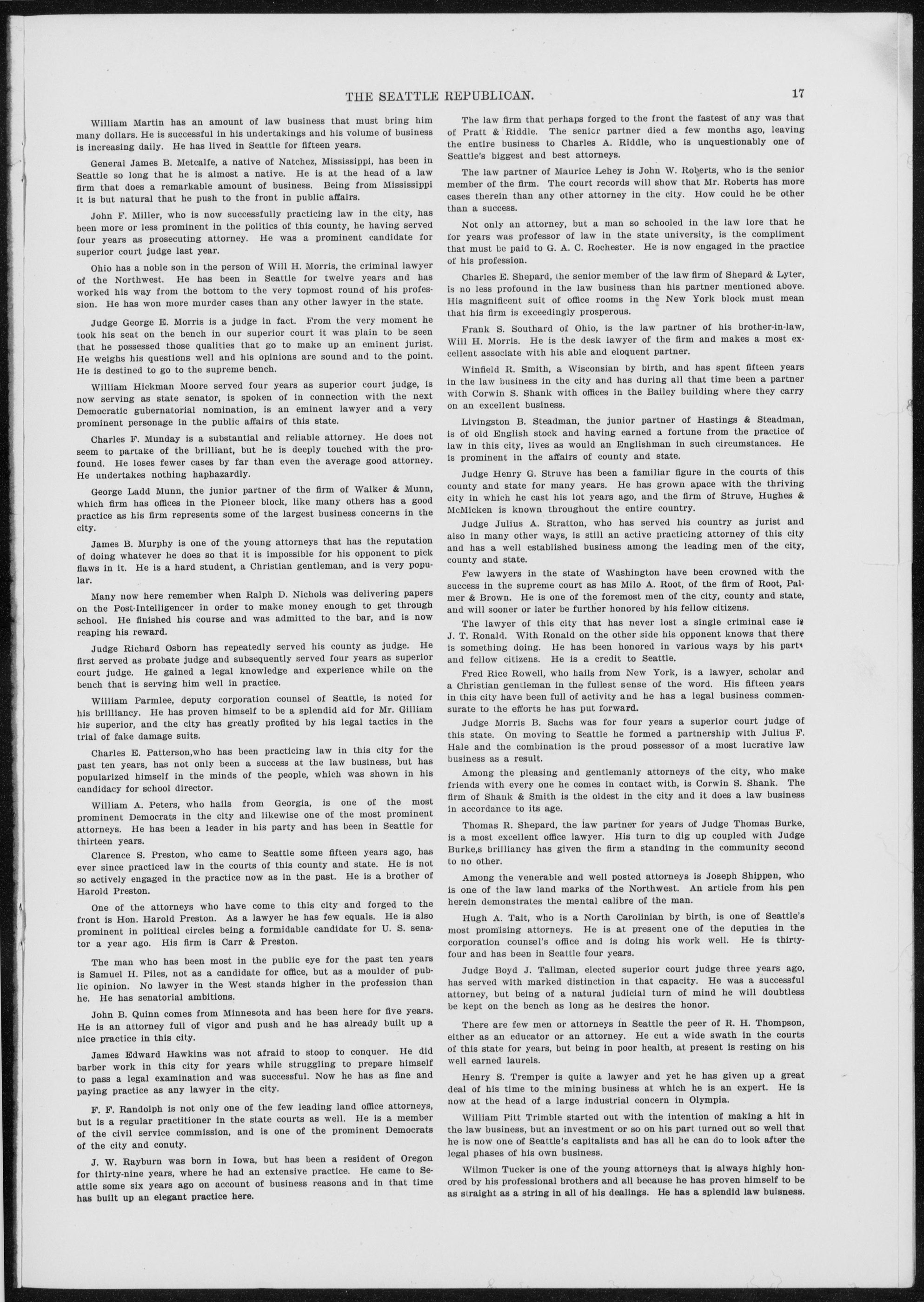
William Martin has an amount of law business that must bring him
many dollars. He is successful in his undertakings and his volume of business
is increasing daily. He has lived in Seattle for fifteen years.
General James B. Metcalfe, a native of Natchez, Mississippi, has been in
Seattle so long that he is almost a native. He is at the head of a law
firm that does a remarkable amount of business. Being from Mississippi
it is but natural that he push to the front in public affairs.
John F. Miller, who is now successfully practicing law in the city, has
been more or less prominent in the politics of this county, he having served
four years as prosecuting attorney. He was a prominent candidate for
superior court judge last year.
Ohio has a noble son in the person of Will H. Morris, the criminal lawyer
of the Northwest. He has been in Seattle for twelve years and has
worked his way from the bottom to the very topmost round of his profes-
sion. He has won more murder cases than any other lawyer in the state.
Judge George E. Morris is a judge in fact. From the very moment he
took his seat on the bench in our superior court it was plain to be seen
that he possessed those qualities that go to make up an eminent jurist.
He weighs his questions well and his opinions are sound and to the point.
He is destined to go to the supreme bench.
William Hickman Moore served four years as superior court judge, is
now serving as state senator, is spoken of in connection with the next
Democratic gubernatorial nomination, is an eminent lawyer and a very
prominent personage in the public affairs of this state.
Charles F. Munday is a substantial and reliable attorney. He does not
seem to partake of the brilliant, but he is deeply touched with the pro-
found. He loses fewer cases by far than even the average good attorney.
He undertakes nothing haphazardly.
George Ladd Munn, the junior partner of the firm of Walker & Munn,
which firm has offices in the Pioneer block, like many others has a good
practice as his firm represents some of the largest business concerns in the
city.
James B. Murphy is one of the young attorneys that has the reputation
of doing whatever he does so that it is impossible for his opponent to pick
flaws in it. He is a hard student, a Christian gentleman, and is very popu-
lar.
Many now here remember when Ralph D. Nichols was delivering papers
on the Post-Intelligencer in order to make money enough to get through
school. He finished his course and was admitted to the bar, and is now
reaping his reward.
Judge Richard Osborn has repeatedly served his county as judge. He
first served as probate judge and subsequently served four years as superior
court judge. He gained a legal knowledge and experience while on the
bench that is serving him well in practice.
William Parmlee, deputy corporation counsel of Seattle, is noted for
his brilliancy. He has proven himself to be a splendid aid for Mr. Gilliam
his superior, and the city has greatly profited by his legal tactics in the
trial of fake damage suits.
Charles E. Patterson,who has been practicing law in this city for the
past ten years, has not only been a success at the law business, but has
popularized himself in the minds of the people, which was shown in his
candidacy for school director.
William A. Peters, who hails from Georgia, is one of the most
prominent Democrats in the city and likewise one of the most prominent
attorneys. He has been a leader in his party and has been in Seattle for
thirteen years.
Clarence S. Preston, who came to Seattle some fifteen years ago, has
ever since practiced law in the courts of this county and state. He is not
so actively engaged in the practice now as in the past. He is a brother of
Harold Preston.
One of the attorneys who have come to this city and forged to the
front is Hon. Harold Preston. As a lawyer he has few equals. He is also
prominent in political circles being a formidable candidate for U. S. sena-
tor a year ago. His firm is Carr & Preston.
The man who has been most in the public eye for the past ten years
is Samuel H. Piles, not as a candidate for office, but as a moulder of pub-
lic opinion. No lawyer in the West stands higher in the profession than
he. He has senatorial ambitions.
John B. Quinn comes from Minnesota and has been here for five years.
He is an attorney full of vigor and push and he has already built up a
nice practice in this city.
James Edward Hawkins was not afraid to stoop to conquer. He did
barber work in this city for years while struggling to prepare himself
to pass a legal examination and was successful. Now he has as fine and
Li AE <n SARE GIA DN LE ORR GPS IE PER
Seattle’s biggest and best attorneys.
The law partner of Maurice Lehey is John W. Roberts, who is the senior
member of the firm. The court records will show that Mr. Roberts has more
cases therein than any other attorney in the city. How could he be other
than a success.
Not only an attorney, but a man so schooled in the law lore that he
for years was professor of law in the state university, is the compliment
that must be paid to G. A. C. Rochester. He is now engaged in the practice
of his profession.
Charles E. Shepard, the senior member of the law firm of Shepard & Lyter,
is no less profound in the law business than his partner mentioned above.
His magnificent suit of office rooms in the New York block must mean
that his firm is exceedingly prosperous. 4
Frank S. Southard of Ohio, is the law partner of his brother-in-law,
Will H. Morris. He is the desk lawyer of the firm and makes a most ex-
cellent associate with his able and eloquent partner.
Winfield R. Smith, a Wisconsian by birth, and has spent fifteen years
in the law business in the city and has during all that time been a partner
with Corwin S. Shank with offices in the Bailey building where they carry
on an excellent business.
Livingston B. Steadman, the junior partner of Hastings & Steadman,
is of old English stock and having earned a fortune from the practice of
law in this city, lives as would an Englishman in such circumstances. He
is prominent in the affairs of county and state.
Judge Henry G. Struve has been a familiar figure in the courts of this
county and state for many years. He has grown apace with the thriving
city in which he cast his lot years ago, and the firm of Struve, Hughes &
McMicken is known throughout the entire country.
Judge Julius A. Stratton, who has served his country as jurist and
also in many other ways, is still an active practicing attorney of this city
and has a well established business among the leading men of the city,
county and state.
Few lawyers in the state of Washington have been crowned with the
success in the supreme court as has Milo A. Root, of the firm of Root, Pal-
mer & Brown. He is one of the foremost men of the city, county and state,
and will sooner or later be further honored by his fellow citizens.
The lawyer of this city that has never lost a single criminal case ig
J. T. Ronald. With Ronald on the other side his opponent knows that there
is something doing. He has been honored in various ways by his party
and fellow citizens. He is a credit to Seattle.
Fred Rice Rowell, who hails from New York, is a lawyer, scholar and
a Christian genileman in the fullest sense of the word. His fifteen years
in this city have been full of activity and he has a legal business commen-
surate to the efforts he has put forward.
Judge Morris B. Sachs was for four years a superior court judge of
this state. On moving to Seattle he formed a partnership with Julius F.
Hale and the combination is the proud possessor of a most lucrative law
business as a result.
Among the pleasing and gentlemanly attorneys of the city, who make
friends with every one he comes in contact with, is Corwin S. Shank. The
firm of Shank & Smith is the oldest in the city and it does a law business
in accordance to its age.
Thomas R. Shepard, the law partner for years of Judge Thomas Burke,
is a most excellent office lawyer. His turn to dig up coupled with Judge
Burke,s brilliancy has given the firm a standing in the community second
to no other,
Among the venerable and well posted attorneys is Joseph Shippen, who
is one of the law land marks of the Northwest. An article from his pen
herein demonstrates the mental calibre of the man.
Hugh A. Tait, who is a North Carolinian by birth, is one of Seattle’s
most promising attorneys. He is at present one of the deputies in the
corporation counsel's office and is doing his work well. He is thirty-
four and has been in Seattle four years.
Judge Boyd J. Tallman, elected superior court judge three years ago,
has served with marked distinction in that capacity. He was a successful
attorney, but being of a natural judicial turn of mind he will doubtless
be kept on the bench as long as he desires the honor.
There are few men or attorneys in Seattle the peer of R. H. Thompson,
either as an educator or an attorney. He cut a wide swath in the courts
of this state for years, but being in poor health, at present is resting on his
well earned laurels.
Henry S. Tremper is quite a lawyer and yet he has given up a great .
deal of his time to the mining business at which he is an expert. He is
now at the head of a large industrial concern in Olympia.
William Pitt Trimble started out with the intention of making a hit in
i,
THE SEATTLE REPUBLICAN.
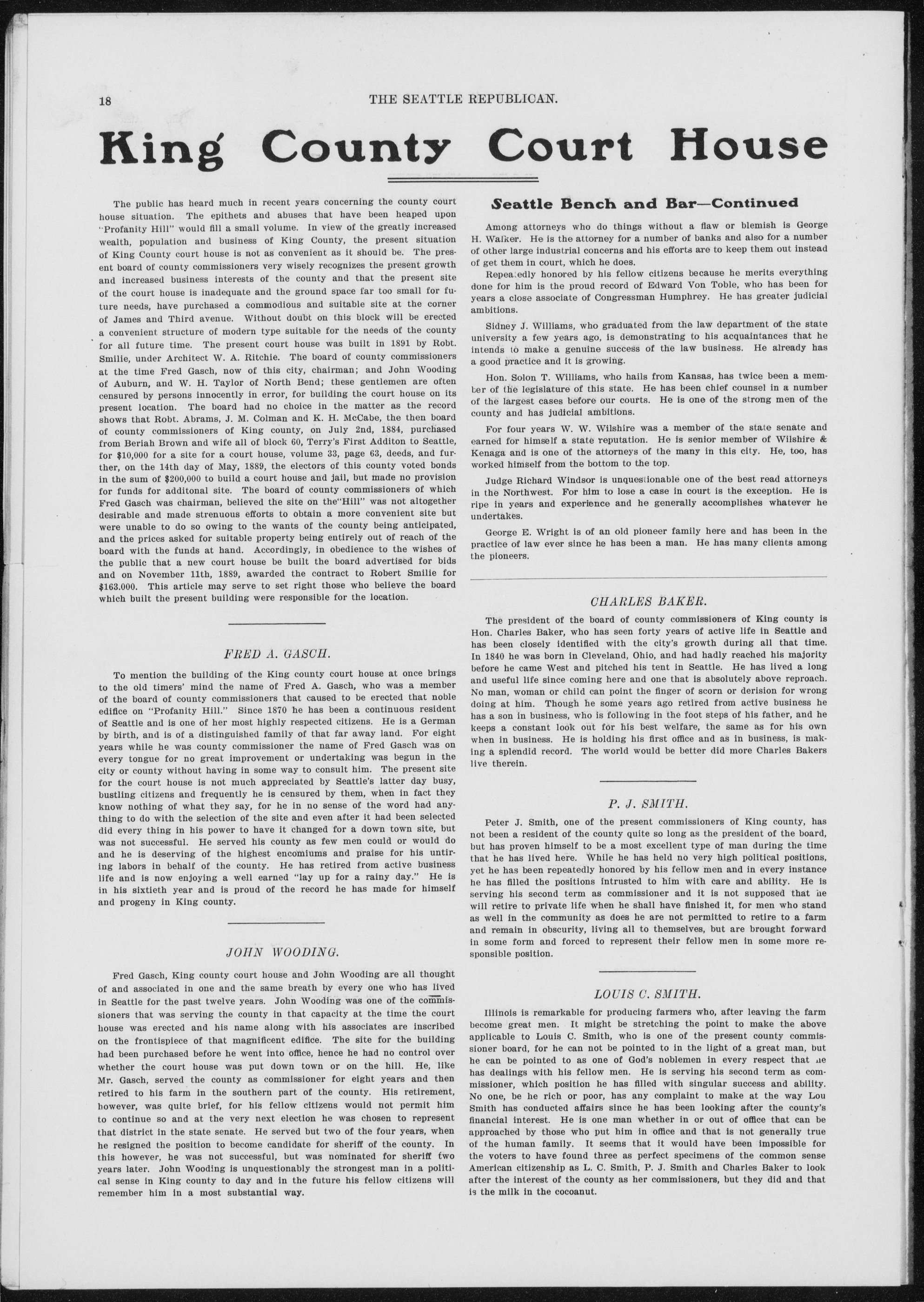
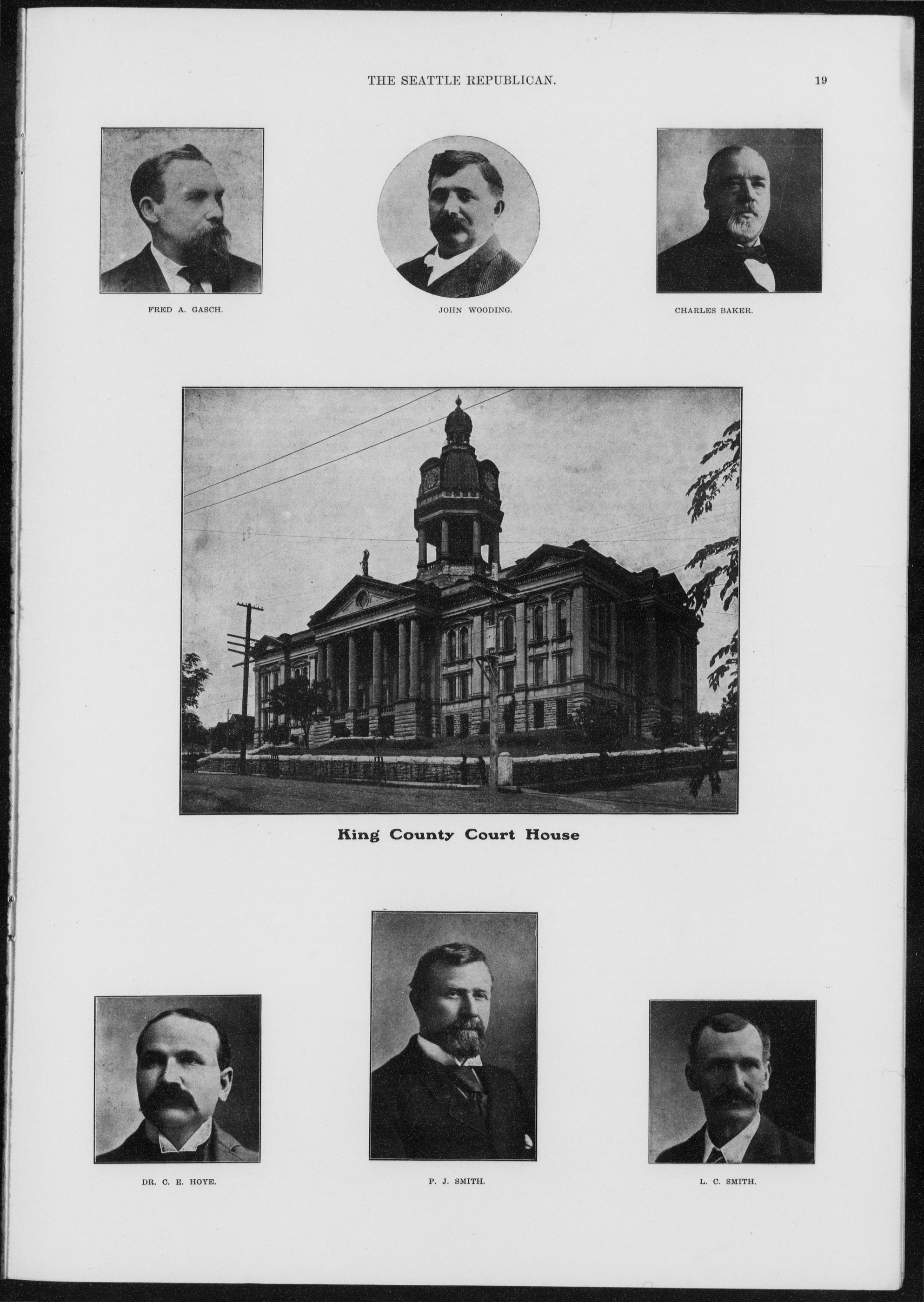
King County Court House
The public has heard much in recent years concerning the county court house situation. The epithets and abuses that have been heaped upon "Profanity Hill" would fill a small volume. In view of the greatly increased wealth, population and business of King County, the present situation of King County court house is not as convenient as it should be. The present board of county commissioners very wisely recognizes the present growth and increased business interests of the county and that the present site of the court house is inadequate and the ground space far too small for future needs, have purchased a commodious and suitable site at the corner of James and Third avenue. Without doubt on this block will be erected a convenient structure of modern type suitable for the needs of the county for all future time. The present court house was built in 1891 by Robt. Smilie, under Architect W. A. Ritchie. The board of county commissioners at the time Fred Gasch, now of this city, chairman; and John Wooding of Auburn, and W. H. Taylor of North Bend; these gentlemen are often censured by persons innocently in error, for building the court house on its present location. The board had no choice in the matter as the record shows that Robt. Abrams, J. M. Colman and K. H. McCabe, the then board of county commissioners of King county, on July 2nd, 1884, purchased from Beriah Brown and wife all of block 60, Terry's First Additon to Seattle, for $10,000 for a site for a court house, volume 33, page 63, deeds, and further, on the 14th day of May, 1889, the electors of this county voted bonds in the sum of $200,000 to build a court house and jail, but made no provision for funds for additional site. The board of county commissioners of which Fred Gasch was chairman, believed the site on the "Hill" was not altogether desirable and made strenuous efforts to obtain a more convenient site but were unable to do so owing to the wants of the county being anticipated, and the prices asked for suitable property being entirely out of reach of the board with the funds at hand. Accordingly, in obedience to the wishes of the public that a new court house be built the board advertised for bids and on November 11th, 1889, awarded the contract to Robert Smilie for $163.000. This article may serve to set right those who believe the board which built the present building were responsible for the location.
Seattle Bench and Bar-Continued
Among attorneys who do things without a flaw or blemish is George H. Walker. He is the attorney for a number of banks and also for a number of other large industrial concerns and his efforts are to keep them out instead of get them in court, which he does.
Repeatedly honored by his fellow citizens because he merits everything done for him is the proud record of Edward Von Toble, who has been for years a close associate of Congressman Humphrey. He has greater judicial ambitions.
Sidney J. Williams, who graduated from the law department of the state university a few years ago, is demonstrating to his acquaintances that he intends to make a genuine success of the law business. He already has a good practice and it is growing.
Hon. Solon T. Williams, who hails from Kansas, has twice been a member of the legislature of this state. He has been chief counsel in a number of the largest cases before our courts. He is one of the strong men of the county and has judicial ambitions.
For four years W. W. Wilshire was a member of the state senate and earned for himself a state reputation. He is senior member of Wilshire & Kenaga and is one of the attorneys of the many in this city. He, too, has worked himself from the bottom to the top.
Judge Richard Windsor is unquestionable one of the best read attorneys in the Northwest. For him to lose a case in court is the exception. He is ripe in years and experience and he generally accomplishes whatever he undertakes.
George E. Wright is of an old pioneer family here and has been in the practice of law ever since he has been a man. He has many clients among the pioneers.
The president of the board of county commissioners of King county is Hon. Charles Baker, who has seen forty years of active life in Seattle and has been closely identified with the city's growth during all that time. In 1840 he was born in Cleveland, Ohio, and had hadly reached his majority before he came West and pitched his tent in Seattle. He has lived a long and useful life since coming here and one that is absolutely above reproach. No man, woman or child can point the finger of scorn or derision for wrong doing at him. Though he some years ago retired from active business he has a son in business, who is following in the foot steps of his father, and he keeps a constant look out for his best welfare, the same as for his own when in business. He is holding his first office and as in business, is making a splendid record. The world would be better did more Charles Bakers live therein.
To mention the building of the King county court house at once brings to the old timers' mind the name of Fred A. Gasch, who was a member of the board of county commissioners that caused to be erected that noble edifice on "Profanity Hill." Since 1870 he has been a continuous resident of Seattle and is one of her most highly respected citizens. He is a German by birth, and is of a distinguished family of that far away land. For eight years while he was county commissioner the name of Fred Gasch was on every tongue for no great improvement or undertaking was begun in the city or county without having in some way to consult him. The present site for the court house is not much appreciated by Seattle's latter day busy, bustling citizens and frequently he is censured by them, when in fact they know nothing of what they say, for he in no sense of the word had anything to do with the selection of the site and even after it had been selected did every thing in his power to have it changed for a down town site, but was not successful. He served his county as few men could or would do and he is deserving of the highest encomiums and praise for his untiring labors in behalf of the county. He has retired from active business life and is now enjoying a well earned "lay up for a rainy day." He is in his sixtieth year and is proud of the record he has made for himself and progeny in King county.
P. J. SMITH.
Peter J. Smith, one of the present commissioners of King county, has not been a resident of the county quite so long as the president of the board, but has proven himself to be a most excellent type of man during the time that he has lived here. While he has held no very high political positions, yet he has been repeatedly honored by his fellow men and in every instance he has filled the positions intrusted to him with care and ability. He is serving his second term as commissioner and it is not supposed that he will retire to private life when he shall have finished it, for men who stand as well in the community as does he are not permitted to retire to a farm and remain in obscurity, living all to themselves, but are brought forward in some form and forced to represent their fellow men in some more responsible position.
LOUIS C. SMITH.
Fred Gasch, King county court house and John Wooding are all thought of and associated in one and the same breath by every one who has lived in Seattle for the past twelve years. John Wooding was one of the commissioners that was serving the county in that capacity at the time the court house was erected and his name along with his associates are inscribed on the frontispiece of that magnificent edifice. The site for the building had been purchased before he went into office, hence he had no control over whether the court house was put down town or on the hill. He, like Mr. Gasch, served the county as commissioner for eight years and then retired to his farm in the southern part of the county. His retirement, however, was quite brief, for his fellow citizens would not permit him to continue so and at the very next election he was chosen to represent that district in the state senate. He served but two of the four years, when he resigned the position to become candidate for sheriff of the county. In this however, he was not successful, but was nominated for sheriff two years later. John Wooding is unquestionably the strongest man in a political sense in King county to day and in the future his fellow citizens will remember him in a most substantial way.
Illinois is remarkable for producing farmers who, after leaving the farm become great men. It might be stretching the point to make the above applicable to Louis C. Smith, who is one of the present county commissioner board, for he can not be pointed to in the light of a great man, but he can be pointed to as one of God's noblemen in every respect that he has dealings with his fellow men. He is serving his second term as commissioner, which position he has filled with singular success and ability. No one, be he rich or poor, has any complaint to make at the way Lou Smith has conducted affairs since he has been looking after the county's financial interest. He is one man whether in or out of office that can be approached by those who put him in office and that is not generally true of the human family. It seems that it would have been impossible for the voters to have found three as perfect specimens of the common sense American citizenship as L. C. Smith, P. J. Smith and Charles Baker to look after the interest of the county as her commissioners, but they did and that is the milk in the cocoanut.
---
18
FRED A. GASCH.
JOHN WOODING.
CHARLES BAKER
P. J. SMITH.
LOUIS C. SMITH.
THE SEATTLE REPUBLICAN.
lowed by severe financial depression which was aggravated by the anti-Chinese agitation that suspended all public works and nearly all private enterprises as well.
The Seattle Republican Established 1894
In 1888 came an era of speculation all over the Pacific Coast and Seattle began one of its periodic booms. Unnumbered town plats were laid off all along the water front from the mouth of the Puyallup nearly to the Snohomish, and on both sides of Lake Washington. Thousands of so-called Seattle lots were sold at prices from four to ten times what the same lots will bring today, fifteen years later. The city is still feeling the ill effects of the fraud and misrepresentation then practiced by wholesale upon Eastern investors.
SUSIE REVELS CAYTON, Associate
In presenting the public with this brief booklet as a souvenir of Greater Seattle it is a pleasure to the management to in the outset state that it contains matter and faces that your children's children will be proud to read and see. The brief review of Hon. A. A. Denny, the father of Seattle, of a few of the pioneers, who were his colleagues in laying the foundation for this great city; of the Greater Seattle builders, who are bringing millions for investment to Seattle; of the busy bankers, who furnish the exchange which gives Seattle her standing in the financial world; of the bustling business men who send their agents in every direction to bring investors to the marts of the city; of the army of attorneys, who look after the legal phases in the city's race for greatness; of the careful and diligent city and county officials, who are ever on the alert for the city and county's best interest and success and finally of the various advertisers herein we point with pride and they add to the value of the publication. We heartily thank each and every one herein for whatever they may have contributed toward the successful issuing of the Greater Seattle Edition, and trust the year 1904 will be none the less propitious for you and each of you, both in private and public, than the years of 1903 and 1902, or any other year within the immediate past.
The great fire created an appearance of great prosperity. Property owners used the millions they received from the insurance companies and borrowed as many more to build houses and improve streets. So much money going into circulation gave employment to every mechanic and common laborer already here and attracted other thousands, so that in 1890 a large gain was apparent in population, but after deducting an indebtedness that was nearly all held abroad, there was no gain in wealth.
The constant drain required to pay first the interest on these borrowed moneys and following soon the principal practically bankrupted the public although the municipality was tided over without loss of credit. There is no need to dwell upon the conditions existing at that time. They will always remain a bitter memory with those who suffered and endured them.
About 1876 our people built their own railroad to the coal mines at Newcastle and Renton and a few years later branches were run on up Cedar river to Franklin and Black Diamond. Later the Seattle, Lake Shore & Eastern R. R. opened up the Issaquah mines and the coal and timber trade was so prosperous and profitable that it brought Seattle out from the ranks of Puget Sound towns and made a thriving city of it—small of course, but full of energy and ambition.
In choosing a title suitable and appropriate for this special edition of the Seattle Republican the above was not selected with the view of playing on the vanities of those citizens of the Queen City, who, by pluck and iron will power, have laid the foundation for a Greater Seattle that will soon be the New York of the Pacific Coast, that the management hereof might profit from the sale of a few extra copies of the paper, but because the facts and figures, as to the growth of Seattle since her great conflagration, which have been compiled and sent out by the most pains taking and accurate government officials, all tend to make good the claim of Seattleites that, we are to have a Greater Seattle in a very few years where now stands only Seattle.
It had to fight the Northern Pacific R. R. Co. for existence during the two decades following 1873 and the location of the so-called terminus at Tacoma, but this contest served to bring out all those qualities of its people that might have lain dormant otherwise. Every man felt it incumbent on him to join in advancing all enterprises that promised to attract capital and labor here. They built mills and factories, opened coal mines, established steamboat connections by means of a "mosquito fleet" to all points on Puget Sound. The manufacturers "rustled" for business and the merchants for trade, and when the Great Northern R. R. reached here in 1893, the N. P. R. R. surrendered and joined as loyally in the upbuilding of Seattle as it had formerly shown energy in fighting it.
The growth of Seattle since she went up in flames some fifteen years ago is little short of marvelous, but how could it be otherwise for, Is she not fed by boat loads of the precious metals from the golden graneries of Alaska? Is she not fed by multiplied tons of the finest fish ever taken from fresh or salt waters? Is she not fed by an inexhaustible timber market from which the wooden wares of the world are made? Is she not fed by a coal output second only to the great state of Pennsylvania? Is she not fed by the products of the farm and fruit fields of Eastern Washington, Oregon and Idaho, which fields and farms increase a hundred fold every year? Is she not fed by an Oriental trade, which trade even at the present time runs into the many millions annually and yet only in its infancy? Is she not fed by a hundred and one other streams that tend to make her great both numerically and financially? In view of all these could Seattle be other than Greater Seattle even before one has time to think how it really happened.
Down to the time of the location of the Territorial university and its construction here in 1861 Seattle had been only a little sawmilling village like Port Madison, Port Gamble and a dozen other milling points. Mechanics came here from Olympia, Steilacoom and other places to work on the building. They bought lots and built their homes. School was established as soon as the lower part of the building could be occupied and pupils came in from other places to attend. In many instances this resulted in the parents moving here and becoming a part of the permanent population. It is difficult to properly estimate the good felt at that time in this direction, nor the ever widening circle of its influence from that time down to the present.
The Indian war period of 1855-6 was a dark and gloomy one. The scattered communities were strengthened from time to time by immigration from Oregon and the Eastern states, farmers were surrounding themselves with home comforts and were happy and prosperous. The war stopped all this. About a dozen men, women and children were massacred, the settlers driven away, their houses and outbuildings burned, live stock shot or driven off, and for more than a year the outlying regions went back almost to primeval conditions, while the settlers were confined to their forts and stockades. Seattle, itself, narrowly escaped destruction at the hands of the savages. The whole population would have been massacred and the town wiped off the earth, but for the presence of a man-of-war in the harbor. As it was the sailors, marines and settlers had a lively fight for several hours, during which the advantage was at one time considerably with the Indians. However, the heroic efforts for defense finally prevailed and the assailants withdrew thoroughly demoralized. The whites lost two men killed and the loss among the natives, dead and wounded, was estimated at from thirty to fifty.
Greater Seattle's Progress
Seattle in its semi-centennial year, is a city of 125,000 population, to which may properly be added 20,000 for its suburbs, Ballard, Columbia, South Seattle, etc. This puts Seattle in third place among Pacific Coast cities.
The census of 1900 gave us less than 85,000 so that the increase has been fifty per cent. in three years. The census of 1890 gave about 44,000. It is doubtful if this number had been increased at the time of the beginning of the Klondike boom, owing to the hard times of 1892 and following years.
It would seem fair to attribute the greater part of this phenomenal increase of population and wealth to the commerce and trade with the Yukon and Alaska regions. If this be correct, by a parity of reasoning there will be a good healthy growth here for years to come as the result of the immense growth of business to the northward, not taking into account the increasing ocean traffic with other Pacific ports.
As was said in the introduction, Seattle's existence began fifty years ago. A few had settled at Alki Point prior to that but found it unsatisfactory for many reasons but particularly on account of lack of fresh water and because the north winds made landing of the craft in use at that period very dangerous, so early in the spring of 1852 they came over to the east side of Elliott bay, took donation claims and in due time filed plats of the town of Seattle.
Seattle gets this business because she is the natural center of it and it naturally gravitates here. The railroad and steamship companies have recognized this fact and are doing all they can to accelerate it. They have invested millions here to handle this business and the millions already expended are but a drop in the bucket compared to what they must expend here within the next few years.
About June 1st of the next year the first steam saw mill on Puget Sound began cutting lumber on the spot where Pioneer Place and the totem pole now grace the triangle. Lumber was in demand at good prices, and every body got work who wished so that food and clothing were easily obtained. Their wants were extremely simple in those days.
All but one of the founders of this city are dead, and in the nature of things he cannot be long for this world. A few of the children who came here in the beginning with their parents are alive but are long past middle age.
Prior to 1897 the growth was comparatively slow. In 1883 when the first transcontinental railroad was completed the whole territory felt its benefits immediately, especially Eastern Washington. Puget Sound towns shared in the prosperity for a time but the collapse of the Villard boom was fol-
VOL. X. NO. 28.
H. R. CAYTON, Editor
DECEMBER 25,1903
By Clarence B. Bagley
1
ee a
e REN ‘e”'
| | oa
: Pe eS Se at 2
As > a asl f ae ig a
eae | F qb ie ‘
ee ae | ' rll i are |
. ee | Fig ‘Ny Ee 3
eres es ce phe eee 4
1 Mas ail foo i ‘ Ee oe
ae -——-_¢
a ee
~~
io ID
a
DR. C. BE, HOYE.
THE SEATTLE REPUBLICAN.
ce
~
§
r. |
sas }
a |
: /
JOHN WOODING.
King County Court House
| a
Bs i
Se
LY
P, J. SMITH.
Bi aa Ri rca Bs Nl en re en a mi mate are coe
By
2 RETEEFS Oia meee eal tea at
Rie ane a iiiea ses otha
ce
ee a tae
ei ah emer tee
eet oe eae yt Mae
ee ae
Pe ke ee
ea cer i
ee ce es eats
Beis ctincc chaos
oe
SOREN ae ce ek queers
Bm ire ce
a ee ogy So a eee
ee ee
Beers ey Moline nL
ee ee
eg ae aie
Bee tos 7 a a oi
ee ee eee
Pe te ete
Se en ae
Bey gre ete are ee
en
lew Cee
Pe he ig aie a ae
Be se pee es eras
ae eee ae
ee sek Pe oy ane
ke
Baier el 0 ae ccc" ca han
- eee iat
1 RE TR ie ee eR
Be NP GH Se ae
ee ae
Bee) ae
BEEN Sea isrireene eee ant e
Bement ait ae aM
bee Byes eit ony <2
Bee it ere is
Beer e ict Oa a
hes = aera nee
Mee Ps Naren e Rectal ene he
reer maa ie tec chit orgs
ee OR
ee
ee cae
ope Ne ata
et a
eecerye e raee
Rc aivok ene
DE Ne nein ea sites
eee ne
See ema oe mA
fee ie ona
peparette Besa to
RCM tr A ar
eee aps E
a. 5 |
Paige
ee. ; 4
CHARLES BAKER.
Ret MO elie ee Wane
Pe Monee malls
SUE een
pear ae
Sees to na
Ce ety
oe
SMe Meas
tea ene
aie one
oe ee ee
= ss
ee ea
eM ae es
retinas) reeds ay oe
Pian Me cmske so ae aD
Beir ceoeea te
Nb hehe anges boa ct ales
L. C. SMITH.
King' County Official Roster
John W. Peter may have been admitted to the bar and he may have had considerable success in the practice of law, but he seems to be the right man in the right place as assessor of King county, to which position he was elected in 1902. Mr. Peter came to the state in 1889, but has only been in Seattle some six years. He was born in Metropolis, Illinois, in 1851. Since he was first installed into the office he has devoted his time and talent to bettering the condition thereof, and in that time he has succeeded most admirably. He lives in Ballard, a Seattle suburb, and is one of that Burg's most honored citizens. He is a leading worker in the Methodist church organization of that place and is active in a hundred and one ways in which the public of that community is vitally interested.
The rapid rise in the minds of the citizens of King county of Edward Cudihee, the present sheriff, is too well known to be here recounted. From a city detective he rose to the highest position in the county and that too despite the fact that he made the effort to do so through the aid of a party that was hopelessly in the minority. He has been twice elected to the high position he now fills and is widely spoken of in connection with the next Democratic gubernatorial nomination of this state. Mr. Cudihee is a thorough American and therefore the honors which have been given him by his fellow citizens have made neither the egotist or self-opinionated autocrat of him. He is a New Yorker by birth, is fifty-one years of age and has been in Seattle since 1889.
Chief Deputy Charles E. Plimpton, of the office of county clerk, is what the world is pleased to term the detail man. He is thoroughly conversant with every part and point about the office. He is now serving his second term under the present administration, but he served four years before under a different administration and during all of that time Charley Plimpton has been the man of the hour when in the office. The detail man, it is said, never gets higher in either private or public affairs than to know everything about some other man's business and nothing about his own, but a wider sphere is predicted for Mr. Plimpton for it is believed that he, sooner or later, will rise as high as the manipulator and political wire puller. He has lived many years in Seattle and is a heavy realty owner.
William Tecumsech Scott, prosecuting attorney of King county, has been more or less in the public eye for the past eight years. He served as corporation counsel for the city of Seattle for two years and made a most enviable record. Since that time he has been more or less prominent in the affairs of his party, and in 1902 he was nominated for prosecuting attorney and at the polls swept the county notwithstanding the fact it had overwhelmingly elected a Democrat prosecutor two years prior. Since he has held the office the gambling and anti-gambling crusade has been raging and for a time it seemed that he would be crushed between the two great millstones, but he cast his lot with the moral element of the city and it now looks as though he has made good in the minds of the leading people and will be vindicated with a renomination and election next year. He was born in Union county, Kentucky, in 1846, and came to Seattle in 1890.
It is D. K. Sickles, who is clerk of the probate department in the county clerk's office and, it is said to his credit that, it has never in the history of the office been more ably presided over than now. For accuracy and painstaking the attorneys of the city declare that Mr. Sickles has had no superior in that position. He is not far off when he declares, he never corrects errors, simply because he never makes them. Such things can be done, but those who can and do so are few and far apart. For two principal reasons Mr. Sickles was selected to fill this position: First because he was one of the most popular men in the county and would be a source of much strength to Mr. Koepfli, and secondly, because he was one of the most efficient men along the lines he would have to operate as probate clerk that could be found in the county. Clerk Koepfli therefore says he made no mistake in selecting him.
Charles A. Koepfli is the name of the present clerk of King county, who has so acceptably served the county in that capacity for the past three years. He is in no sense a politician, and is perhaps the one man at the court house, of all of them, that the office sought the man. After much persuasion his friends finally got his consent to allow the use of his name in connection with the nomination of county clerk, and when once in the fight he showed the kind of stuff he was made of for he held up his end at every point. He has no further political ambitions and at the expiration of his official term will again take up his private business and devote his entire time and energy thereto. He is a prominent member of the Woodmen of the World, which, perhaps, is the largest secret organization in the Northwest. He holds a responsible position in both the National and local organization. He is the secretary of the Seattle Undertaking Company, which business he will devote his time to in the future. He is a native of Iowa, is fifty years old and has been in Seattle since 1889.
Some men seem to be endowed with superior faculties along certain lines and as long as kept in that groove lead the procession, but there are some men who seem to be fitted to fill in wherever a man is needed and among this latter class James M. Brewster, the receiving deputy in the clerk's office, holds high rank. Another happy faculty about Mr. Brewster is he can make more friends in a minute than the average man in a year. If there is one other man that is more popular in the order of the Woodmen of the World in this city than C. A. Koepfli that man is J. M. Brewster. He has traveled over the country just enough to teach him how to meet his fellow man so as to gain his confidence and approval and he does not fail to take advantage of what he has learned, which is quite commendable in him. What is the use of getting experience if it is not turned to a good advantage at the proper time. No mistake was made in selecting Mr. Brewster for the position he fills in the office.
The man who goes out after a thing and stays with it is always the successful man in every undertaking. Such a man is John W. McConnaughey, the present treasurer of King county. Four years ago he made up his mind that he would like to hold that position, and set about to get it. How well he succeeded is known to every political worker in the county. After getting the office he began to shape the affairs thereof so that he or any one else could tell all about it on a minute's notice, and that in itself has given him such a splendid record that he is now in line for almost any kind of political promotion that he may ask for. He is an Ohian by birth, and is forty-three of age. He is one of the heavy realty owners of the county and is the senior member of the firm of McConnaughey & McConnaughey, owners of the Seattle Paint and Varnish Company, which is an extensive paint manufacturing concern.
Old England is famous for giving to the world some of its most sterling characters and of Hon. Edgar C. Raine, when he will have had time to accomplish more, she will feel as proud as any of her many sons who have come to the Western World. He came to America when only seven years of age and having received his education in our public schools, is thoroughly imbued with Uncle Samdom. He is now thirty years of age and has been in King county since 1894, living on a farm not far from Seattle. In 1900 he was elected to the legislature and so singular was his success at that session that he was returned practically without opposition two years later. He was much interested in school matters at both sessions of the legislature and did much for the aid of the State University at Seattle and other educational institutions in the various parts of the state. At present he is clerk in Judge Morris' court and is considered one of the most popular officials at the court house.
Dr. Charles E. Hoye, who has twice been elected coroner of King county, which, by the way, is one of the most responsible offices in the county, owing to the fact that the coroner of King county has more violent deaths to inquire into than all of the other counties in the state put together, is a most splendid type of man. As a physician he ranks very high, and as a citizen in the community none stands better. Nothing more clearly demonstrates that than the votes cast for him both times he was elected. Though his opponent was as strong a Democrat as Democrats generally are, yet Dr. Hoye ran ahead of his ticket each time. He will retire from office January, 1905, and will presumably continue his practice as before. It is reported that he has ambitions and aspirations to go higher in the political scale of life.
20
EDWARD CUDIHEE.
in the minds of the citizens of King's
ment sheriff, is too well known to be
active he rose to the highest position
the fact that he made the effort to do
was hopelessly in the minority. He has
son he now fills and is widely spoken
democratic gubernatorial nomination of
though American and therefore the honor
fellow citizens have made neither the
hat of him. He is a New Yorker by birth
in Seattle since 1889.
W. T. SCOTT.
Ansech Scott, prosecuting attorney of the city in the public eye for the past eight years, for the city of Seattle for two years. Since that time he has been more or less, and in 1902 he was nominated for preswept the county notwithstanding the award a Democrat prosecutor two years prior the gambling and anti-gambling crusade. He seemed that he would be crushed between cast his lot with the moral element, though he has made good in the minds of educated with a renomination and election in county, Kentucky, in 1846, and came
C. A. KOEPFLI.
appli is the name of the present clerk of the county in that capacity he no sense a politician, and is perhaps the all of them, that the office sought the ends finally got his consent to allow them the nomination of county clerk, and the kind of stuff he was made of for him. He has no further political affair this official term will again take up his entire time and energy thereto. He is a of the World, which, perhaps, is the largest. He holds a responsible position in station. He is the secretary of the S business he will devote his time to in this fifty years old and has been in Sea
JOHN W. M'CONNAUGHEY.
he goes out after a thing and stays with a every undertaking. Such a man is present treasurer of King county. Four of the would like to hold that position, and succeeded is known to every political work office he began to shape the affairs he would tell all about it on a minute's time such a splendid record that he is nowical promotion that he may ask for. Forty-three of age. He is one of the he is the senior member of the firm of Makers of the Seattle Paint and Varnish paint manufacturing concern.
DR. C. E. HOYE.
Hoye, who has twice been elected coronary, is one of the most responsible offi that the coroner of King county has no all of the other counties in the sta type of man. As a physician he ranks community none stands better. Nothing an the votes cast for him both time event was as strong a Democrat as Duran ahead of his ticket each time. In 195, and will presumably continue his
THE SEATTLE REPUBLICAN.
J. W. PETER. I have been admitted to the bar the practice of law, but he was assessor of King county. Peter came to the state in 1835. He was born in Metcalf called into the office he had condition thereof, and in the lives in Ballard, a Seattle and citizens. He is a leading of that place and is active of that community is vivi
C. E. PLIMPTON.
s E. Plimpton, of the office to term the detail man. And point about the office. I represent administration, but administration and during a man of the hour when it gets higher in either private or some other man's business is predicted for Mr. P. will rise as high as the number many years in Seattle
D. K. SICKLES.
who is clerk of the pro-
cess, it is said to his credit that
more ably presided over the
meys of the city declare tha-
n. He is not far off when
because he never makes tha-
n and do so are few and fa-
was selected to fill this po-
ular men in the county at
Koepfli, and secondly, beca-
ing the lines he would haw-
d in the county. Clerk I
selecting him.
J. M. BREWSTER.
be endowed with superior
cept in that groove lead the
to be fitted to fill in wh
pass James M. Brewster, the
rank. Another happy fac
ends in a minute than the
that is more popular in the
y than C. A. Koepfli that
the country just enough to
gain his confidence and a
of what he has learned, w
be use of getting experience
proper time. No mistake
ition he fills in the office.
C. E. RAINE.
us for giving to the world. Jon. Edgar C. Raine, when he will feel as proud as a eastern World. He came to us received his education in Uncle Samdom. He is now since 1894, living on affected to the legislature and it he was returned practi
[Image of a man with a mustache and a suit, facing forward.]
W. T. SCOTT.
W. T. SCOTT.
A. C. RUNDLE.
---
C. E. PLIMPTON.
---
M. B.
F. W. COMSTOCK.
THE SEATTLE REPUBLICAN.
THE SEATTLE REPUBLICAN.
[Image of a man in a suit with a bow tie and a mustache].
C. A. KOEPFLI.
DR. J.
[Name not visible]
PETER H. HARRIS
T. H.
DR. F. W. WILTSIE.
---
SMITH.
CANN.
J. M. BREWSTER.
---
DR. J. J. SMITH.
T. H. CANN.
J. W. PETER
21
M. H.
EDWARD CUDIHEE.
D. I. INVERARITY.
---
[Name not visible]
BENJAMIN LEVY.
[Name]
D. K. SICKLES.
SMITH.
The Thirtieth Senatorial District of
Mia and though he has been in K
only been officially identified with
us. He served one term in the lov
Senator Wooding's unexpired ten
years term to the senate to which
oored him at the last session by ele
DR. J. J. SMITH.
ith, who represents the Thirtieth Sen- tails from West Virginia and though he ten years, yet he has only been officially for the past five years. He served one in the senate, filling Senator Woodin two of another four years term to the 02. His associates honored him at the l
Dr. J. J. Smith, who represents the Thirtieth Senatorial District in the legislature hails from West Virginia and though he has been in King county for fourteen years, yet he has only been officially identified with her political history for the past five years. He served one term in the lower house, one term in the senate, filling Senator Wooding's unexpired term and has served two of another four years term to the senate to which he was elected in 1902. His associates honored him at the last session by elect-
[Name]
TUCKER. W. G. It of that body thus making him one of it is a regular practicing physician at Ea property interests.
making him one of the foremost mong physician at Enumclaw, where
ing him president of that body thus making him one of the foremost men of the state. He is a regular practicing physician at Enumclaw, where he has extensive property interests.
A. T. VAN DE VANTEB.
history of King county without the name he as incomplete as a history of Washington mentioned therein. He practically found which was organized soon after he occupied as Kent's first mayor. In 1894 he and four years. He has twice been elected a member of the senate and will be the next United States senator as wielding. He represents the Thirty-first day of age February next. He is a farmer a
without the name of A. T. Van O. the history of Washington without the practically founded the now three soon after he came to the county bycr. In 1894 he was elected to the twice been elected sheriff of Ki- senate and will be an importa- tates senator as will all of his assoc- the Thirty-first district. He will He is a farmer and horse breeder.
CKER.
It is ably represented by Hon. O. at district since 1890. He was fli- 92. He was born in Wisconsin for petty no man in the West can boast- and is as good as his bond. He start business men of the state, county and admitted to the bar.
A political history of King county without the name of A. T. Van De Vanter would be as incomplete as a history of Washington without the county of King mentioned therein. He practically founded the now thriving city of Kent, which was organized soon after he came to the county in 1885. He served as Kent's first mayor. In 1894 he was elected to the senate and served four years. He has twice been elected sheriff of King county and is now a member of the senate and will be an important factor in selecting the next United States senator as will all of his associates in this connection. He represents the Thirty-first district. He will be forty-five years of age February next. He is a farmer and horse breeder. County Officials.
O. A. TUCKER.
Bond Senatorial District is ably representa been a resident of that district since and was re-elected in 1902. He was born for integrity and sobriety no man in the than he, and his word is as good as his ladder among the business men of thecker has recently been admitted to the b
The Thirty-second Senatorial District is ably represented by Hon. O. A. Tucker, who has been a resident of that district since 1890. He was first elected in 1898 and was re-elected in 1902. He was born in Wisconsin forty-two years ago. For integrity and sobriety no man in the West can boast of a greater amount than he, and his word is as good as his bond. He stands at the top of the ladder among the business men of the state, county and city. Senator Tucker has recently been admitted to the bar.
ANDREW HEMRICH.
Andrew Hemrich is from Wisconsin, but since 1883. He is but fifty-eight years of s at the head of one of the largest busin est elected to the state senate from the T re-elected in 1902 and has made a most He is a brewer.
from Wisconsin, but has been a ree
ffty-eight years of age, but has seen
the largest business concerns in the
senate from the Thirty-third Distri
tion has made a most admirable reco
State Senator Andrew Hemrich is from Wisconsin, but has been a resident of Seattle since 1883. He is but fifty-eight years of age, but has seen much of life and is at the head of one of the largest business concerns in the state. He was first elected to the state senate from the Thirty-third District in 1898 and was re-elected in 1902 and has made a most admirable record in both sessions. He is a brewer.
WILLIAM HICKMAN MOORE.
Hickman Moore, the only Democrat ammts from this county, and who represents it, is one of the leading attorneys of the will be found among the "bench bar" of
only Democrat among the eight hold and who represents the Thirty-four ing attorneys of the state and counc e "bench bar" of this issue.
Judge William Hickman Moore, the only Democrat among the eight holdover state senators from this county, and who represents the Thirty-fourth Senatorial District, is one of the leading attorneys of the state and county and his portrait will be found among the "bench bar" of this issue.
22
Dr. J. J. Smith, who represents the T. the legislature hails from West Virginia and county for fourteen years, yet he has only be political history for the past five years. He house, one term in the senate, filling Sena and has served two of another four years tha was elected in 1902. His associates honored
J. B.
ing him president of that body thus making of the state. He is a regular practicing phas extensive property interests.
A political history of King county with Vanter would be as incomplete as a historical county of King mentioned therein. He practiced city of Kent, which was organized soon in 1885. He served as Kent's first mayor. Senate and served four years. He has twice county and is now a member of the senator in selecting the next United States states in this connection. He represents the Twenty-five years of age February next. He is County Officials.
The Thirty-second Senatorial District is a Tucker, who has been a resident of that district elected in 1898 and was re-elected in 1902. He two years ago. For integrity and sobriety not a greater amount than he, and his word is at the top of the ladder among the business city. Senator Tucker has recently been admired.
J.
E. C. RAINE.
E. C. RAINE.
State Senator Andrew Hemrich is from West
ment of Seattle since 1883. He is but fifty-ele
much of life and is at the head of one of the L
state. He was first elected to the state senate
in 1898 and was re-elected in 1902 and has
in both sessions. He is a brewer.
Judge William Hickman Moore, the only Dever state senators from this county, and who senatorial District, is one of the leading attes and his portrait will be found among the "be
THE SEATTLE REPUBLICAN
Matorial District in King has been in King identified with her term in the lower King's unexpired term senate to which he last session by elect-
Hon. William G. is a native son of to Seattle to live. term at office hold and he will yet re been in the United leading hotel man.
of the foremost men in numclaw, where he
of A. T. Van De Bington without the added the now thriv-ame to the county was elected to the elected sheriff of King and be an important all of his associ-istrict. He will be and horse breeder.
dated by Hon. O. A. 1890. He was first in Wisconsin forty- West can boast of his bond. He stands the state, county and ear.
State Senator H. Eatorial District, is hit the political ais. He came to Seattle place and has reside but devotes the most His father before a fast in his footsteps.
It can be said in political circles, a position but what the people. He now state legislature and four year term of Illinois in 1868, the continues to succeed soon be one of the in connection with will to some extent next United States.
[Name not provided]
but has been a resi- age, but has seen less concerns in the thirty-third District it admirable record among the eight hold- the Thirty-fourth Under Republic is the record of Be- treasurer. If King certainly knows some office since his first and especially to a breast to the enemy among his old com- this city appreciates have a greater rever- that as it will or not
W. G. POTTS
Hon. William G. Potts, who repre is a native son of Ireland and one to Seattle to live. He is serving h term at office holding, but the gods and he will yet reap his reward. been in the United States since 18 leading hotel man.
Hon. William G. Potts, who represents the Thirty-fifth Senatorial District, is a native son of Ireland and one of the truest young men that ever came to Seattle to live. He is serving his first term in the senate and his first term at office holding, but the gods have something greater in store for him and he will yet reap his reward. He is only thirty years of age, and has been in the United States since 1889 coming directly to Seattle. He is a leading hotel man.
J. H.
R. M. B.
State Senator Ritchey M. Kinney,atorial District, is, perhaps, one of the hit the political arena for a good cause. He came to Seattle when only twelve place and has resided here every year but devotes the most of his time to his father before him stood high and fast in his footsteps.
E. B. B.
It can be said of Hon. Edward B. in political circles, but whether people a position but what he succeeded in the people. He now represents the State legislature and will do so for four year term of office to which he Illinois in 1868, thus making him continues to succeed in politics in the soon be one of the important persons in connection with the seven other he will to some extent shape national life next United States senator from this
State Senator Ritchey M. Kinnear, who represents the Thirty-sixth Senatorial District, is, perhaps, one of the most popular young men that has hit the political arena for a good many years, especially in King county. He came to Seattle when only twelve years of age from Illinois, his birth place and has resided here every since. He has been admitted to the bar but devotes the most of his time to looking after his vast property interests. His father before him stood high in political circles and he is following fast in his footsteps.
It can be said of Hon. Edward B. Palmer that he is especially popular in political circles, but whether popular or not he has never aspired to fill a position but what he succeeded in his undertaking, showing strength with the people. He now represents the Thirty-seventh Senatorial District in the state legislature and will do so for two years more before serving out his four year term of office to which he was elected in 1902. He was born in Illinois in 1868, thus making him a comparatively young man, but if he continues to succeed in politics in the future as he has in the past he will soon be one of the important personages of this state. Already Mr. Palmer, in connection with the seven other hold-over state senators from this county, will to some extent shape national legislation as they will help to elect the next United States senator from this state.
ANDREW HEMRICH.
Under Republicans, under Democrat is the record of Benjamin Levy, who treasurer. If King county is in debt certainly knows something about it. Office since his first appointment there and especially to a new man elected breast to the enemy in defense of he among his old comrades he stands in this city appreciate such painstaking have a greater reward in store for that as it will or may, he is highly notion of trust for fourteen years. Is
Under Republicans, under Democrats and again under a Republican is the record of Benjamin Levy, who is chief deputy in the office of county treasurer. If King county is in debt or has any money in her vaults Levy certainly knows something about it. He has made himself so efficient in the office since his first appointment therein that he is now almost indispensible and especially to a new man elected to fill the office. Ben Levy bared his breast to the enemy in defense of his country in the Great Civil war, and among his old comrades he stands second to none. The business men of this city appreciate such painstaking officials as Mr. Levy and they may have a greater reward in store for him than a chief deputyship, but be that as it will or may, he is highly honored when he can hold such a position of trust for fourteen years. Is there another public official who can say as much?
s, who represents the Thirty-fifth Senatorial District and one of the truest young men that ever came is serving his first term in the senate and his first but the gods have something greater in store for him is reward. He is only thirty years of age, and has states since 1889 coming directly to Seattle. He is
R. M. KINNEAR.
By M. Kinnear, who represents the Thirty-sixth Semi- caps, one of the most popular young men that has for a good many years, especially in King county, in only twelve years of age from Illinois, his birth were every since. He has been admitted to the bar this time to looking after his vast property interests, stood high in political circles and he is following
E. B. PALMER.
n. Edward B. Palmer that he is especially popular whether popular or not he has never aspired to fill succeeded in his undertaking, showing strength with presents the Thirty-seventh Senatorial District in the al do so for two years more before serving out his to which he was elected in 1902. He was born in making him a comparatively young man, but if he politics in the future as he has in the past he will instant personages of this state. Already Mr. Palmer even other hold-over state senators from this county the national legislation as they will help to elect the or from this state.
BENJAMIN LEVY.
under Democrats and again under a Republican Ben Levy, who is chief deputy in the office of county pay is in debt or has any money in her vaults Levy is going about it. He has made himself so efficient in theiment therein that he is now almost indispensible man elected to fill the office. Ben Levy bared his defense of his country in the Great Civil war, and he stands second to none. The business men of a painstaking officials as Mr. Levy and they may store for him than a chief deputyship, but he is highly honored when he can hold such a posi-
E. B. PALMER
W. G. POTTS.
A. T. VAN DE VANTER
[Picture of a man in a suit with a bow tie].
R. M. KINNEAR
M. H.
C. B. BAGLEY.
[Name]
[Name]
A. H. GROUT.
M.
J. B. H.
SCOTT CALHOUN.
[Name]
MIKE KELLY.
[Name]
R. H. THOMSON.
---
THE SEATTLE REPUBLICAN.
[Name]
M. B.
G. F. ZIMMERMAN.
C
L. B. YOUNGS.
[Picture of a man with a mustache and a suit].
MAYOR THOMAS J. HUMES.
---
M.
---
```markdown
```
M. H. GORMLEY.
MES.
A. L. WALTERS.
23
[Image of a man with a mustache and wavy hair, wearing a suit and tie.]
C. W. SAUNDERS.
[Name not provided]
C. M. NETTLETON.
R. R. GEORGE.
[Name not provided]
J. E. SHREWSBURY.
[Name]
JOHN SULLIVAN.
---
The Mayor and His Appointees
THE SEATTLE REPUBLICAN.
24
R. H. THOMSON.
employe of the city to which the performance of duty that years has performed the duty of public works of this city is city when the financial vu administration the growth of the prosperity that she is since he has had charge of it said that in the neighborho have been expended and that not a scintilla of scandal even thought of, so far as he Mr. Thomson that should ancestor. If he does not at the city it will only be bec
If there is any one employee of the city to which the citizens are under obligations for faithful performance of duty that one is R. H. Thomson, who for the past ten years has performed the duties as city engineer and chairman of the board of public works of this city. Had not Mr. Thomson come to the rescue of the city when the financial vultures had almost ruined it under the Ronald administration the growth of Seattle would have been seriously crippled and the prosperity that she is now enjoying she would never have known. Since he has had charge of the engineering force of the city it can be safely said that in the neighborhood of ten million dollars internal improvements have been expended and that vast sum has been handled and disbursed and not a scintilla of scandal one way or the other has ever been breathed or even thought of, so far as he is concerned. That of itself is a compliment to Mr. Thomson that should make his children's children feel proud of their ancestor. If he does not see ten years more active service in the employ of the city it will only be because he will not accept it.
L. B. YOUNGS.
nomson on the board of pu-
water and light system of the he, too, has been a faithful friend after the same duties the associate. To have completely as Seattle, and that, too, the past eight years, is no later. Youngs is frequently co-under similar conditions which soon becomes apparent to man to smooth out the rough name.
By the side of Mr. Thomson on the board of public works L. B. Youngs, superintendent of the water and light system of the city, is permitted to take an honored seat, for he, too, has been a faithful and praiseworthy public servant, who has looked after the same duties that he now has charge of almost as long as his associate. To have complete control over the water system of so large a city as Seattle, and that, too, when it is growing as rapidly as it has for the past eight years, is no little job or undertaking. It is quite true that Mr. Youngs is frequently criticised about the water supply, but what man under similar conditions would not be, but after a sober second thought it soon becomes apparent to even his critics that he has done all that was human to smooth out the rough places and be just and fair to all one and the same.
A. L. WALTERS.
that Mayor Humes should be as to succeed Superintendent the affairs than he, who he He is thoroughly posted is city and since he has been worthy as a superior as he of the good judgment of his commissions of the city.
It was but natural that Mayor Humes should appoint A. L. Walters as superintendent of streets to succeed Superintendent Little, who died, for, who knew more about the affairs than he, who had been under Mr. Little for a number of years. He is thoroughly posted as to the streets and the street wants of this city and since he has been in office has proven himself just as praiseworthy as a superior as he was a subordinate. Another splendid evidence of the good judgment of Mayor Humes in appointing meen on the various commissions of the city.
JOHN SULLIVAN.
named as chief of the police an of the city was so rotten that the city of the dan was a herculean undertaking he could and today Seattle was at that time. There Chief Sullivan is not reall power to act according not be a baker's dozen of Sullivan is a very popular a contest between himself at a Catholic fair by votes in the two, when Chief Sullivan liked by his subordinates use in police circles.
Two years ago was named as chief of the police of the city by the mayor when the moral condition of the city was so rotten that the stench all but reached the skies. To rid the city of the dangerous criminal element that had flocked hither was a herculean undertaking, but Chief Sullivan set about the work as best he could and today Seattle is a Sunday school in comparison to what it was at that time. There are still criminals and grafters in the city, but Chief Sullivan is not responsible for them being here. If he was given full power to act according to the dictates of his own conscience there would not be a baker's dozen of them left in Seattle by Saturday night. Chief Sullivan is a very popular official, as was demonstrated not long since in a contest between himself and Ralph C. Cook, chief of the fire department, at a Catholic fair by votes for ten cents each for the most popular official of the two, when Chief Sullivan led him by a thousand votes. He is generally liked by his subordinates in the department, which is seldom, if ever, the case in police circles.
SCOTT CALHOUM.
seasons that the pioneer citizen who is watched through chap-
ugh all of those varying sti- a implicit confidence of his
justified in giving him the security, will unquestionably
son is Scott Calhoun, who s- vy selected as grade tax at-
active interest in politics as the footsteps of his fath-
one of the Republican coun-
free sons were all delegates to
county, thus demonstrating
were popular with the rank
gives strong indication of
Is one of the native sons that the pioneer citizens of Seattle are justly proud of. The infant who is watched through child and youthhood ripen into manhood and through all of those varying stages so conducts himself as to gain and hold the implicit confidence of his fellow citizens in such a manner that they feel justified in giving him the reins of public leadership on arriving at maturity, will unquestionably make his mark among men. Such a young man is Scott Calhoun, who some ten months ago the city council unanimously selected as grade tax attorney for the city. Mr. Calhoun has taken an active interest in politics since he reached his majority, thus following in the footsteps of his father and brothers. It was but a few years ago at one of the Republican county conventions that Dr. G. V. Calhoun and his three sons were all delegates and each from a different section of the city and county, thus demonstrating that the Calhouns, wherever they were living, were popular with the rank and file of the voters. Scott Calhoun, however, gives strong indication of being the politician of the family.
C. M. NETTLETON.
there be but one young man less ways and methods und ever seen in the West, Clarently at the side of the fist only at the head of the is also at the head of pract
If in this whole city there be but one young man that has been thoroughly schooled in business ways and methods under some of the shrewdest business manipulators ever seen in the West, Clark Nettleton is that one. For years he was constantly at the side of the famous Leigh S. J. Hunt, who, for a time, was not only at the head of the political machine of this county and state, but was also at the head of practically all of the financial
and industrial enterprises fostered by the citizens of this city, and amid all of his schemes and plans young Nettleton was his confidential man. It was the record that he made with Mr. Hunt that got him the place as city editor of the Post-Intelligencer, a position he filled with great credit and honor, and it was his success as city editor, coupled with his work for Hunt, that got him the place with C. J. Smith, and it was his splendid work with Mr. Smith that prompted his present employer to offer him a $5,000 salary per annum to leave Mr. Smith and become his head man. It was all of these things that prompted the mayor to nominate him as one of the civil service commissioners of which he is now a member. After relating the above brief sketch of the man, "I could tell you no more if I would preach you a sermon, and especially of him."
G. F. ZIMMERMAN.
ed business man that knew him so thoroughly identified it has much interested in its sub-reciation of such subordinates as they care to work for some changing his employes, regarder himself be forced to chase much experience with help, the things doubtless had much civil service commission, which applied at all times with compuls. The personnel of this company clerical positions to a lead attorney, who knows the real immerman, who has men by the usefulness to the city of Mayor Humes as chief executive and good judgment in selecting
It is the cold blooded business man that knows the real worth of the employee that has become so thoroughly identified with his business as to its every detail and is as much interested in its success as the owner himself, that shows his appreciation of such subordinates by giving them steady employment so long as they care to work for some one else. The business man who is constantly changing his employees, regardless of the cause for so doing, will sooner or later himself be forced to change his business. Mr. Zimmerman has had much experience with help, he being a successful business man and these things doubtless had much to do with the mayor placing him on the civil service commission, which has for its object the keeping of the city supplied at all times with competent persons to fill the various clerical positions. The personnel of this commission, C. M. Nettleton, who has risen from clerical positions to a leading business man; F. F. Randolph, a leading attorney, who knows the real value of good clerical help, and George F. Zimmerman, who has men by the scores in his employ, speaks volumes for its usefulness to the city of Seattle. Whatever else that may be said of Mayor Humes as chief executive of the city, there is no denying that he has used good judgment in selecting his various boards and commissioners.
R. R. GEORGE.
The fact that Justice R. R. Geer Justices of the peace for the State for the police court as municipaler and confirmed by the city having been first elected in the has presided over the police there has been a constant where "graft" has been the war not one accusation derogator and that of itself should be a stricter and more responsible pe
Notwithstanding the fact that Justice R. R. George was elected by the people as one of the justices of the peace for the Seattle precinct, in order for him to preside over the police court as municipal judge he had to be appointed by the mayor and confirmed by the city council. He is serving his second term, he having been first elected in 1900 and re-elected two years later. Though he has presided over the police court for the past two years in this city where there has been a constant warfare between vice and morality, and where "graft" has been the watchword, as is the case in all wide open towns, not one accusation derogatory to him has ever been breathed or alleged, and that of itself should be a sufficient recommendation to pass him on to a higher and more responsible position in life.
C. W. SAUNDERS.
with the beautiful is always avocation of life is that of persons able to expend a sur-ful ideas, and it was perfectly off of the park commission of the towns which would give Seattle a lot of any municipality in the city carry out his ideas, but it was in perfectly willing to stand onions, figuratively speaking, the constructed on paper and the real mansions and occupied by Park Commissioner Saunders a package system such as has reasonable amount of money in it.
He or she who deals with the beautiful is always attracted by the beautiful. Mr. Saunders' avocation of life is that of planning and designing elegant homes for those persons able to expend a sufficient amount of money to carry out his beautiful ideas, and it was perfectly natural when he became a full fledged member of the park commission of this city to at once begin to devise ways and means which would give Seattle one of the most beautiful systems of public parks of any municipality in the West. It's going to take thousands of dollars to carry out his ideas, but it will be money well spent, and the taxpayers seem perfectly willing to stand the cost. The hundred and one elegant mansions, figuratively speaking, that the architects, Saunders & Lawton, have constructed on paper and then watched their paper mansions become actual mansions and occupied by their owners, are all living testimonials of Park Commissioner Saunders' ability to beautify Greater Seattle with a package system such as has never before been seen in the West, if only a reasonable amount of money is appropriated by the city council for that purpose.
J. E. SHREWSBURY.
active members on the park newsbury. He has been a man with Mr. Saunders he has by the best system of parks or by profession and owns it is saying a great deal. Heently fitted up is, a thing in the neighborhood of twenty thirth and has been in Seattle
One of the most active members on the park commission of this city is James Edward Shrewsbury. He has been a memebr thereof only one year, but in connection with Mr. Saunders he has made every effort possible to give to the city the best system of parks in the Northwest. Mr. Shrewsbury is a barber by profession and owns the finest equipped shop in the state and that is saying a great deal. His shop is in the Hotel Butler, which he recently fitted up is, a thing of beauty," costing its oner somewhere in the neighborhood of twenty thousand dollars. He is a West Virginian by birth and has been in Seattle eleven years.
A. H. GROUT.
secretary of the civil service con- things said about him than a- He is not only secretary of the free employment bureau, bank and homes for more deser- e really looking for it than a
Who has acted as secretary of the civil service commission for the past five years, has more kind things said about him than almost any other man in the service of the city. He is not only secretary of the commission, but he has absolute charge of the free employment bureau, and is therefore instrumental in finding work and homes for more deserving persons, who are willing to work and are really looking for it than any one else. He studies
well both the applicants for situations as well as the applicant for help, and makes quite a bit of effort to find each such a person as will the more easily harmonize the one with the other, and in this Mr. Grout seems a perfect adept. Hundreds and thousands of persons have been sent to good homes by him for which he has subsequently been heartily thanked by such persons. He is complete master of the labor situation in this city, owing to the fact that he has given it close and careful study.
the city. Whether as city editor of the Post-Intelligencer, as comptroller of Seattle or in any other responsible public or private position he has always been one and the same man and that doubtless accounts for his great popularity.
Is serving his first term as councilman from the First Ward and his constituents are much pleased with his work in that body. He was a printer before being elected to office and, therefore, has the laboring man's interest at heart in his municipal legislation.
As an employee of the city, clerk of the board of public works, Mr. Bagley is a man in whom the most implicit confidence can be imposed. To him there is something more than to merely put in his time so as to draw his salary or the giving of pert answers as is so often the case on the part of persons under civil service regulations, but he strives to render value received for the salary he draws and be just as courteous and gentlemanly to persons dealing with the city as if he was in the employe of a private concern. Since he first entered the public service to the present time not one word of complaint has been breathed against him by any one and that is sufficient to justify the assertion that he is an ideal official. An article from his pen is found in another column hereof and it speaks more for the man than could be said by the writer in a small volume.
Who boasts of German parentage, a nationality so much admired in America, represents the Second Ward in the city council, and is an ideal business man. He does not allow the duties of councilman nor the duties of his business investment to interfere the one with the other and he therefore will have a business to return to when he retires from office. His work in the council meets general approval.
There is no reason why even a professional man can not serve as councilman if he and his constituents can only agree and yet not interfere with his professional duties. This has been demonstrated beyond a question of doubt by Councilman H. C. Gill, who represents the Third Ward in the council. Mr. Gill has the record of having gotten more measures through the council in the interest of his constituents than any one else therein save the gentleman from the Ninth with whom he very frequently locks horns. He enjoys a splendid law practice and is one of the leading citizens of the city.
However flowery a writer may be he cannot say more about John Riplinger, the present city comptroller of Seattle, than he truly merits. He is unqualifiedly one of the best men that ever came to Seattle. He is not only one of the best, but he is one of the best of the best. Pomp and ostentation are foreign to his make-up and so foreign that he is one and the same whether in or out of office and has just as many friends when out of office as when in office, a thing few other office holders can boast of. He is serving his first term as comptroller but no powers on earth can beat him for a second, a third and a fourth term if he will only allow the use of his name in that connection for that many terms. There is no reason why such men should not be boomed for the governorship, for they are certainly born and destined for greater things.
May well be dubbed the "father of the city council" for he has served as a member of that body longer than any one else save the gentleman from the Eight, who was first elected the same time as was Mr. James. He is one of Seattle's most substantial citizens and his constituents of the Fourth Ward have made him a fixture in the council. He has saved the city from being robbed of many thousands of dollars by persons who have no more interests in the city than to do so. He is a retired capitalist.
Having been a soldier may have a tendency of swelling some men's head, but such a feeling seems to have never entered the mind of City Treasurer Gormley. It is against the regulations of the city charter to elect a city treasurer to succeed himself, but, if it were not, Capt. Gormley has made such a splendid record he would be repeatedly elected if he so desired. He seems especially fitted to do such work and it is said that he will be given a similar position for the county at the next general election. The city of Seattle is to be congratulated on getting such brilliant young men to fill her various offices as John Riplinger, Matt H. Gormley and Corporation Counsel Mitchell Gilliam. And, digressing for a minute, the writer desires to say, if the voters of this city do not re-elect Mitchell Gilliam, they will make the mistake of their lives and will live to regret their rashness.
Represents one of the most important wards in the city. The Fifth was in much need of improvements two years ago and in casting about for a man that would accomplish the most good for it he was decided upon. He has had much experience in legislation as he was once speaker of the house of representatives of this state. Mr. Morrison has been more than successful in his efforts in the city council for his ward and now he has ambitions to fill the more important office of mayor of Seattle. He deals in real estate and bonds.
Is unquestionably one of the most popular municipal officers in the city. He has twice been nominated and elected for councilman-at-large and once for councilman from the Sixth Ward. He has never suffered defeat either at the primaries or at the polls, which bears out the statement that he is one of Seattle's most popular officials. Mr. Rude is a leading tailor.
For forty years Thomas H. Cann has been a resident of the Pacific Slope. Some of that time he spent in California, some in Oregon and the balance in Washington and Seattle. He has been for years a familiar figure on the streets of Seattle and has been very closely identified with the city's marvelous growth. For the past eight years he has been a judge on the bench in Seattle and doubtless has dealt with more criminals than any other one man in the Northwest. He is now in his seventy-sixth year, but still active and vigorous and looks as if he were twenty years younger than his actual age.
Is making his maiden effort at office holding, municipal or otherwise, and the Seventh Ward from whence he hails need not feel ashamed of the work he has done in that body during the past two years. Politics some times beat splendid men for renomination and this is threatened Mr. Redward, but for the good of the Seventh Ward and the city in general it is hoped that he will be overwhelmingly re-nominated and elected. He is a contractor and builder.
Whose name indicates his nationality is one of Seattle's most conspicuous characters. He has lived in the Duwamish district, a few miles from Seattle, for the past forty years and is known by every chick and child in a fifty mile radius. He has always been more or less connected with politics and during all that time never swerved an iota from the Republican party, which is not always true of men of his nationality. He has served as deputy sheriff of King county for many years, which position he now fills, but it is whispered about the streets that he stands a most excellent show next year to succeed the present Democratic sheriff. If he is ever so honored one feels safe in saying that he will fill the office with singular ability and honor both to himself and his constituents.
Just how one who has been as independent in the council as has Dr. Crichton could be so repeatedly elected to the same position is a political mystery. For fourteen years he has represented the Eighth Ward in the city council and for re-election next year no opposition is heard. With no reflection on his associates yet it can be truthfully said that Doc. Crichton is the quintessence of public honesty and uprightness and those things sometimes have their reward. He is a regular practicing physician.
Men who make up their minds early in life that they are determined to reach the top of the ladder of either fame or fortune generally reach one or the other and sometimes both. When Will H. Parry landed in Seattle, January 1888, he evidently set his pegs to that end and what he lacks in having already accomplished his aims and that too when he is only in the prime of his life, is not very much. He has but recently turned into his fortieth year, but he is president of the city council, vice-president of the Seattle General Contract Company, auditor of the Seattle & Lake Washington Waterway Company, treasurer of the chamber of commerce and interested on the side in a number of important industries, all of which will make him, within the next few years, one of the most important men in
Who comes from the Ninth Ward is a splendid specimen of manhood, and if he were not he would not have been able to have twice defeated Republican nominees for the same place in a ward which is two to one against the party that honored him with its nominations. He has made a most useful member of the council and the whole city is the gainer thereby. He has made a winning fight for improvements for his ward and has gotten whatever he has gone after. With such splendid workers in the council as Mr. Murphy it almost looks a desecration to allow partisan politics to creep into municipal affairs. He conducts a general merchandise store and meat market in Fremont.
26
C. B. BAGLEY.
in the city, clerk of the board whom the most implication is something more than to salary or the giving of pertinent persons under civil service received for the salary he easily to persons dealing with private concern. Since he first came not one word of complete and that is sufficient to judge. An article from his pen is more for the man than could
JOHN RIPLINGER
writer may be he cannot say a camptroller of Seattle, than he best man that ever came to Seattle one of the best of the best. He and so foreign that he is on has just as many friends who other office holders can boast but no powers on earth can form if he will only allow them any terms. There is no reason governorship, for they are cen
MATT H. GORMLEY.
ever may have a tendency of swims to have never entered them at the regulations of the city himself, but, if it were not, C. she would be repeatedly elected to do such work and it is said the county at the next generalitatulated on getting such bridges John Riplinger, Matt H. Gorm. And, digressing for a mi- nist this city do not re-elect Mi- their lives and will live to regi-
THOMAS H. CANN.
mas H. Cann has been a resident in California, some in a little. He has been for years has been very closely identifying the past eight years he has been has dealt with more crime. He is now in his seventy-six as if he were twenty years
MIKE KELLY.
les his nationality is one of Seed in the Duwamish district, and is known by every chie always been more or less conquer swerved an iota from the men of his nationality. He lives for many years, which posits streets that he stands a more present Democratic sheriff. In that he will fill the office w and his constituents.
WILL H. PARRY.
their minds early in life that ladder of either fame or fortune times both. When Will H. Iently set his pegs to that enlightened his aims and that took not very much. He has but this president of the city contract Company, auditor of the company, treasurer of the chamber a number of important indu
THE SEATTLE REPUBLICAN
PATRICK FITZPATRICK.
first term as councilman from the
h pleased with his work in that bo
to office and, therefore, has the la
municipal legislation.
A. KISTLER.
erman parentage, a nationality so the Second Ward in the city cou does not allow the duties of councilment to interfere the one with the business to return to when he reti meets general approval.
H. C. GILL.
on why even a professional man can be constituents can only agree and y es. This has been demonstrated by H. C. Gill, who represents them as the record of having gotten more interest of his constituents than any from the Ninth with whom he was splendid law practice and is one of
J. A. JAMES.
ed the "father of the city council" only longer than any one else save that he elected the same time as was Mr. substantial citizens and his constitution a fixture in the council. He has many thousands of dollars by person than to do so. He is a retired capi
ELLIS MORRISON.
of the most important wards in the improvements two years ago and in implish the most good for it he widence in legislation as he was once in this state. Mr. Morrison has been the city council for his ward and mertant office of mayor of Seattle. He
H. P. RUDE.
one of the most popular municipal nominated and elected for council in the Sixth Ward. He has never sat at the polls, which bears out the popular officials. Mr. Rude is a lo
J. C. REDWARD.
iden effort at office holding, municipal from whence he hails need not feel a body during the past two years. For renomination and this is three the Seventh Ward and the city in helmingly re-nominated and elected
DR. J. E. CRICHTON.
o has been as independent in the o repeatedly elected to the same p eeen years he has represented it and for re-election next year no in his associates yet it can be truth esence of public honesty and upove their reward. He is a regular
W. H. MURPHY.
the Ninth Ward is a splendid specifie should not have been able to have to the same place in a ward which is need him with its nominations. He h council and the whole city is the big fight for improvements for his w be after. With such splendid work most looks a desecration to allow p affairs. He conducts a general mont.
THE SEATTLE REPUBLICAN
Employed in the county treasurer's office for the past three years is Arthur C. Rundle, who is one of the rising young men of King county. Already he has been frequently mentioned in connection with high political positions and in conventions have demonstrated much real strength among the rank and file of the people. He for the past two sessions of the legislature has filled responsible positions therein and has always made many friends while there. He is a young man of fine appearance and of pleasing manner and speech, which characteristics will sooner or later win for the one possessing them. Mr. Rundle is particularly strong with the people of the country districts.
Who was pronounced a diamond in the rough by one of the men who nominated him some two years ago, has more than made good the expression, for he has cut a wide swarth in the city council since he has been a member thereof. One of the men who fought the nomination of Mr. Mullen the hardest and felt the most deeply chagrinned at the likes of Frank Mullen being nominated to the city council, was overheard to remark a few days ago, "Mullen is the best and most conscientious councilman that the city has." He has served but two years of his four year term. He is engaged in the hotel business.
The head bookkeeper in the treasurer's office is Duncan I. Inverarity and while he has filled the position but comparatively a short time in comparison to the other men employed in the office, yet, it is said by those who know whereof they speak, that he need not take a back seat for any one that has ever had charge of those books. If there is any one thing that he can and has done to perfection since he has been in Seattle it is to keep the books for some large firm or concern, and keep them in the latest and most up-to-date manner. No better accountant lives in Seattle and when his chief retires from office his books will balance and will balance properly and all because he knows his business.
An honored veteran of the great civil war is likewise an honored veteran of the city council. He has served the city in that capacity some eight years and still has two years more to serve before his present term expires. Capt. Taylor has frequently been criticised by a restless public since he has been in office, but time has always proven the correctness of the course he persued and as a result, when he again comes up for office he is always given a greater majority than before. A passing criticism must not always be taken as an established fact for if it were many an innocent man would be hanged for murder. Capt. Taylor is a pension agent and has a great deal to do for his old comrades along that line.
County Official Roster-Continued
The chief deputy in the coroner's office is Dr. Wiltsie, who has been a resident of Seattle for the past nine years. He has served under both terms of Dr. Hoye and is one of the most accommodating officials in the county. He has a large circle of friends in this city and county which adds much to his popularity and it was due to some extent to the courteous way he had treated persons having dealings with the office why Coroner Hoye polled such a large vote at the last election. He is a Canadian by birth and is an old schoolmate of Councilman W. H. Murphy of the Ninth ward. It is hinted that some day he may be an aspirant for the office of coroner, but he is quite young yet and has plenty of time to grow and expand.
Few offices boast of having a native son among the number employed therein, but the county treasurer's office can, and he is in the person of Frederick W. Comstock. He was born in Seattle in 1865 and has lived hereabouts ever since. During a short stay in Kitsap county he served one term as county clerk. He soon returned to Seattle and at once identified himself with her business interests. He has twice been elected from his district to the state legislature and covered himself with honor and distinction while on the floor of the house. He is a splendid type of Western enterprise and it is predicted that he will be honored to greater positions of trust by his fellow men in the very near future.
```markdown
```
Mr. H. H. H.
The above half-tone of Irving & Cannon and a partial view of their store, 211 Columbia street, Boston block, represents a progressive business firm and the finest tailoring establishment on this coast. This place and tailoring made by them is worthy of your patronage. Better tailoring cannot be had. Designed, cut and fitted by an expert and made by high grade workmen. There is no reason why the dressers of this city should worry in the future about tailoring. This firm is well established, reliable and enjoys the confidence of the business public.
F. P. MULLEN.
CAPT. JOHN TAYLOR.
J. H. IRVING.
27
J. J. CANNON.
J. J. CANNON.
F. R. McLAREN
ACME BUSINESS COLLEGE
Corner Third Avenue and Pike St.
SPECIALTIES—Machines for Home Practice; Bookkeeping by Office Pra
Graduates. Send a postal for our new Catalogue, it's a beauty.
F. R. McLAREN GEORGE THOMPSON
ACME BUSINESS COLLEGE
ACME BUSINESS COLLEGE Corner Third Avenue and Pike Street. SPECIALTIES—Machines for Home Practice; Bookkeeping by Office Practice; Thorough Course in English; Positions for Graduates. Send a postal for our new Catalogue, it's a beauty. McLAREN & THOMSON.
The accompanying illustration is a sort of trademark adopted by The Graham-Hickman Company, the people with the only Twentieth Century printshop in the northwest. It illustrates the lively youngster getting there "with both feet," with an armfull of business, and that is what this new company is doing, getting to the front and that "with the goods." The plant is located in a new three story and basement brick, 60x148 feet, at 1213-15-17 First avenue south, and the equipment is of the very best. Their line comprises folding boxes, colored labels and box wrappers, publications, book and job work, blank book making and binding. The plant is worth going far to see, and visitors are welcomed.
RIALTO
MCCARTHY'S
RIALTO
MCCARTHY'S
W. D. McCarthy's dry goods store, one of the leading retail dry goods houses in the Northwest.
28
THERE WITH THE GOODS
EVERY KIND OF FOLDING BOX
SEATTLE WASH.
GRAHAM HICKMAN CO.
SEATTLE, WASH.
DESIGNERS
BINDERS
PRINTERS
M
---
THE SEATTLE REPUBLICAN.
accompanying illustration is a sort of the people with the only Twentieth Century youngster getting there "with both feet new company is doing, getting to the floor a new three story and basement brick the equipment is of the very best. The wrappers, publications, book and job were going far to see, and visitors are welc
---
[Picture of a man in a suit with a tie and a mustache.]
Paper of this edition was supplied through Lewis Sears, who is the coast agent for the McClellan Paper Company, Minneapolis, Minn., manufacturers of all grades of fine book, cover, writing, ledger, bond and other class of papers. Office 214 and 216 James street, Seattle.
THE SEATTLE REPUBLICAN. Seattle Pioneers J. M. COLMAN.
Prominent Seattle Pioneers
Seattle—why not?
D. B. WARD.
2
HON. ARTHUR A. DENNY.
There is no such thing as chance in this world, in the accomplishment of great things, and while men oftimes build better than they know, because of their limitations, yet in the inception of plans that afterwards attain to large proportions there is well defined ideas in the mind of the instigator. Thus the city of Seattle is in no sense of a chance growth. The leader of a small company of people, the first to settle on the shores of Elliott Bay, was Arthur Armstrong Denny, the father of Seattle. Just fifty-two years ago the little company of emigrants, who had toiled all the summer to cross the mountains and deserts that divides this from the homeland of friends and kindred, sought shelter and a haven where now stands Seattle, the "Queen City." After providing shelter for his loved ones, A. A. Denny looked about him, and standing here on the banks of the American Mediterranean, his natural eye looking out upon its broad expanse, his mind's eye wandered over the sundown sea lying beyond, his prophetic gaze saw the march of oncoming thousands with the multiplication of human needs, the necessity for a center of population and industry, and the fitness of his chosen location to meet those demands, he, being a man of action and of destiny, as well, set to work to prepare for that which was so soon to be needed. A village was planned, its streets defined and property disposed of to those who desired. This, with many and various business enterprises conspired to bring wealth to Mr. Denny, but through the forty-seven years of his life in Seattle he was ever the plain citizen, the Christian gentleman, the approachable friend and valued counselor of all who sought of him. When duty called him to broader fields, as member of the territorial legislature and delegate to congress, he was found doing his duty for his chosen territory with the same benevolent simplicity and honesty of purpose that was such a marked characteristic with him. In 1898 Arthur A. Denny passed to his reward of the faithful, and his body rests in one of the beautiful cemeteries of the city that stands as a monument to his memory, but a far greater monument than even this great city of Seattle is that memory of a noble life well spent, not in selfish accumulations of things that perish, but in the doing willingly, patiently and unostentatiously, the common place, neighborly kindnesses and deeds of charity, that were such a part of his daily life. This monument will endure and is after all more honorable than the founding of a great city. Closely connected with the life work of A. A. Denny and a trusted companion, friend and co-partner in the building of Seattle and sharer with him of all the trials and labors incident to the building a home in the wilderness, was his brother, David T. Denny, who departed this life but last month.
ROBERT ABRAMS.
Robert Abrams rightly belongs on the page of the pioneers inasmuch as he was an associate of the honored Denny in laying the foundation of the present great city of Seattle and the records of this territory, state, county and city fully bear out this statement. Mr. Abrams reached what is now the state of Washington seven years after Mr. Denny had located here, yet he came to the Denny camp and took hold with a vim to help the brave pioneers mould a city out of the jungles of the forest and that they succeeded right well all of us now know. Heaven seems to have taken especial care in directing to this locality such noble souls as those whose names are inseparably linked with the founding and growth of this magnificent city. Once in the seventies Mr. Abrams represented this district in the legislature and subsequently he was elected one of the county commissioners of King county, and while serving four years in that capacity carved for himself in the annals of the history of the country a name that cannot be effaced. It was he who bought the site where now stands the King county court house, and it was he that fathered the election of voting $200.000 bonds for the erection of the present magnificent edifice that would do honor to a Massachusetts county, his native state. He is now in his sixty-seventh year, but is still full of business life and activity. Robert Abrams is the soul of honor wherever he is known, and the latter day citizens are proud of the fact that such men as the Dennies, Hortons, Abrams and other noble pioneers cast their lot on the shores of Puget Sound, where now stands Greater Seattle.
LYMAN B. ANDREWS.
For over forty years the subject of this review has resided in Seattle, and is thus one of its pioneers. Reared on a farm of the old Knickerbocker state, he was schooled to hard work. His early years in the wild West were spent in surveying government land. In 1863 he made the first discovery of coal near Gilman and secured holdings which were afterwards disposed of at good figures. He has been engaged in various pursuits in his adopted city and always taken a lively interest in political affairs, and for years has been a prominent factor in county and state affairs. He has twice attended the national conventions of his party. As clerk of the United States district court for more than ten years, clerk of the territorial legislature, member of city council, member of the first state constitutional convention, and member of the state senate, abundant opportunity has been afforded him to display his genius along political lines. Having performed all these duties well, it was but logical that he should be selected as register of the United States land office in this city, which position he now holds with satisfaction to all and with honor to himself.
J. M. COLMAN.
Nothing succeeds like success, is an old yet true saying, but the capital of that success which succeeds is an indomitable will, an honesty of purpose and a genius for work that demands success. J. M. Colman, the subject of this sketch, has made a success in life, and is now passing the evening tide thereof in Seattle, the city of his adoption, and where his ultimate success was achieved, in a manner well becoming and well earned by one who has lived the strenuous life that has been his. A Scotchman by birth, he came to America in 1854, being at that time twenty-two years of age. A good machinist, with a technical knowledge of engineering, he found plenty of opportunity to work. In 1861 he took Horace Greeley's advice and came West. After lucrative employment for a time he went into the lumber manufacturing business, first at Port Orchard, then in Seattle. In spite of two or three times being burned out, yet he succeeded in saving sufficient means which, plus his indomitable will, enabled him to construct the first railroad in Seattle, that to the coal fields at Renton. This he conducted successfully for a time and was able thereby to force recognition for the city of Seattle, from the Northern Pacific people, who were disposed to ignore the superior advantages of this city for Tacoma.
L. W. BONNEY.
Just fifty years ago there arrived in the little hamlet on the shores of Puget Sound, in the midst of the wild, wild West, a child who has since become the head of one of the most substantial firms in the great metropolis that he has seen and helped to rise from nothing to its present greatness. In 1853 the infant Seattle looked good to the parents of L. W. Bonney, and time has proven the wisdom of their judgment. It is given unto man once to die, and, go where he may, sooner or later he requires the services of the undertaker. That the proper funereal rites might be performed for those who were compelled to "pay the debt," Mr. Bonney early established himself in the undertaking business and by courteous treatment and fair dealing has enjoyed a large share of patronage in his line. The Bonney-Watson Company, funeral directors, as before stated, is one of the solid firms of the city. Although at the head of the firm, Mr. Bonney has retired from the active management and in a semi-retired manner is enjoying the fruits of a well spent life.
Why Elliott Bay?
Was the selection of Elliott Bay, upon the shores of which was to be built a great commercial emporium an accident, a mere chance in the wheel of fortune, or was it the result of careful consideration after a thorough investigation of natural advantages?
An affirmative answer to this last question will at once give an insight into the character and intelligence of the founders of the city.
In "pioneer days on Puget Sound" Hon. Arthur A. Denny says, the number of persons at Alki Point at this time, November 13th, 1851, was twenty-four, of whom twelve were adults; that two of these, viz: J. N. Lowe and Lee Terry concluded to locate a townsite and with that in view, made a joint location at Alki Point and named the place New York."
This location by Lowe and Terry was in the nature of a chance location and evidently did not measure up to Mr. Denny's ideas, for he tells us in his book from which we have just quoted, that "toward spring, Bell, Boren and myself * * * * had looked up the coast toward Puyallup . . . and did not like the prospect. In the month of February we began exploring Elliott Bay, taking soundings, and after a careful investigation of the harbor . . . we, on the 15th of February, 1852, located and marked three claims in one body." Further along in his interesting narrative Mr. Denny says: "Consequently Boren and I, on the 23rd day of May, 1853, filed the first plat of the town of Seattle."
So much by way of refuting the oft repeated statement that the location on Elliott Bay was an accident and that almost any other selection would have proved as favorable. Of course this is not saying there are not many other places along the shores and upon some of the many bays of the Sound where there are and will be other splendid towns and cities. That phase of the question we are not now discussing, but are simply answering the question as to why Elliott Bay was selected, not by chance but after careful and painstaking effort on the part of men of more than ordinary intelligence; men who had traveled for weary months and thousands of miles, not with idle purpose but with a determination to lay, here upon the shores of the most magnificent inland sea on the face of the globe, the foundation of a great city, backed by an empire of unlimited resources.
Why Seattle? Why not Some Other Name?
What in the eternal fitness of things could be more appropriate? Old Chief Se-at-tle (accent the second syllable), one of nature's noblemen, broad-gauge and far-seeing enough to realize that the white man belonged to a superior race, of which race he was therefore the old life-long friend. In thus perpetuating the name of the grand old man, these early pioneers honored themselves no less than the memory of the man whose name the Queen City so proudly bears. Seattle—why not? D. B. WARD.
Seattle—why not?
The Largest Exclusive Engraving House in the Northwest
SEATTLE ENGRAVING CO.
113 to 117 Third Ave. South
SEATTLE, - - U.S.A.
THE FIREHOUSE
JOHN E. McMANUS.
Elsewhere in this issue we publish a picture of Hon. John E. McManus, a miner of more than thirty years' experience, in different parts of the country, who has finally proven to the most skeptical that Western Washington contains mineral of great wealth. Ever since the Sunset Copper Mining Company, of Index, Washington, was incorporated, in June, 1897, until control of that corporation passed to W. H. Baldwin and associates, of Albany, New York, in July last, Mr. McManus has devoted his entire time and resources to proving the Sunset Mine, and single-handed and alone has accomplished the fact. If it had not been for his bulldog tenacity, or, in other words, his "staying" qualities, the ridicule of men (who ought to know better) prominent in the business world of Seattle, would have shut down the property and today one of the resources which will make Seattle a great city would have remained unexploited. The feature that is especially gratifying is that this proven property is practically at the doors of Seattle, and has encouraged every other company owning prospects in the Index district to put forward its best efforts to open up its claims. The opening of a valuable mine such as the Sunset undoubtedly is, will do more to make Seattle a stable proposition than almost any other thing, and we, therefore, take much pleasure in congratulating John E. McManus on his success and enterprise.
Mr. McManus for four years was state senator from Snohomish county, where he made an enviable record. He moved to Seattle some five years ago, where he at once took rank as one of her foremost business men. The firm of McManus & Son is known throughout the country.
Butterworth Block, containing the most complete undertaking establishment in the west. E. R. Butterworth & Sons.
Bailey Lunch Counter
M.J. Conant
Which serves the best midday luncheon in the city and is patronized daily by at least 500 of the leading and best business men of Greater Seattle. Major W. J. Conant is a most popular caterer, and will make it your worth while to visit his place for your midday luncheon.
Good Things To Eat
At PIDDUCK-ROSS Co.'s
720 Second Avenue
BUY CENTENNIAL'S
"BEST" FLOUR
Manufactured by
Centennial Mill Company
SEATTLE, WASHINGTON
ERRATA—GREATER SEATTLE POSSIBILITIES.
The article on the tenth and eleventh pages, written by me went to press" before certain errors had been corrected, and in Fifth paragraph, read "diminishing to 75 and 50 feet and Seventh paragraph, read, "North of Pike street and within Fourth line from top of second column, read, "ridges re Midway same column, read, "a total distance of twelve Last line, same column, read, "A cut-off or side line is not built to accommodate through traffic, north and south, and es Central paragraph, last column, read "Mercer island," f
. Moore, and entitled "Greater Seattle Possibilities," unfortunate justice to the writer, these corrections are made here: yes," etc.
see or four blocks of the waterfront," etc.
g north and south," etc.
yes."
Under construction along the east shore of Lake Washington, being only for the convenience of freight trains passing the city."
union, as printed.
The article on the tenth and eleventh pages, written by O. M. Moore, and entitled "Greater Seattle Possibilities," unfortunately "went to press" before certain errors had been corrected, and in justice to the writer, these corrections are made here: Fifth paragraph, read "diminishing to 75 and 50 feet altitudes." etc.
Last line, same column, read, "A cut-off or side line is now under construction along the east shore of Lake Washington, being built to accommodate through traffic, north and south, and especially for the convenience of freight trains passing the city." Central paragraph, last column, read "Mercer island," for Union, as printed.
BROADWAY
TELEPHONE
Home of Sunset Telephone Company, with 14,000 subscribers in Greater Seattle.
---
THE MUSEUM
COMEDY OPERA DRAMA
THEATRE THIRD AVE. THEATRE
Third Avenue Theater, E. L. Drew, Manager.
---
---
Seattle Theater, J. P. Howe, Manager.
Grand Opera House, John Cort, Manager.
CONDITION OF THE BANKS OF SEATTLE
UNDER DATE OF OFFICIAL CALL, NOVEMBER 17, 1903
NAME. Shares Par Cap. I
First National $100.00 $1,500
National Bank of Commerce 100.00 1,000
Bugget Sound National 100.00 3,000
Seattle National 100.00 3,000
Washington National 100.00 1,000
Exeter Horton & Co. 100.00 2,000
Scandinavian American 100.00 3,000
Totals $1,500
American Savings Bank and Trust Co. $100.00 $1,500
Northwest Trust and Safe Deposit Co. 100.00
Peoples Savings Bank 100.00 1,000
E. O. Shuey & Co. 100.00 1,000
Union Savings Bank and Trust Co. 100.00 1,000
Washington Trust Co. 100.00 3,000
Canadian Bank of Commerce (Branch) ...
London and San Francisco (Branch) .....
Shares Par Capital Stock Paid in Surplus Dept.
$100.00 $150,000.00 $122,410.59 $2,050.00
100.00 150,000.00 199,729.65 2,780.00
100.00 300,000.00 112,678.72 3,450.00
100.00 300,000.00 117,950.99 3,230.00
100.00 100,000.00 378,142.41 3,370.00
100.00 200,000.00 174,485.04 5,930.00
100.00 300,000.00 170,809.12 2,730.00
$1,500,000.00 $1,276,206.52 $23,570.00
$100.00 $100,000.00
100.00 15,600.00
100.00 100,000.00
100.00 100,000.00
100.00 100,000.00
100.00 300,000.00
First National Bank
OF SEATTLE, WASH.
OFFICERS:
LESTER TURNER, President.
MAURICE McMICKEN, Vice Prest.
R. F. PARKHURST, Asst. Cashier.
C. P. MASTERSON, Cashier.
NAME. Shares Par Capital Stock Paid in Surplus Deposits Loans, Discounts and Overdrafts Shares Book Value
First National $100.00 $150,000.00 $122,410.59 $2,054,882.41 $1,251,537.42 $181.60
National Bank of Commerce 100.00 150,000.00 199,729.65 2,786,060.74 1,599,829.65 233.15
Puget Sound National 100.00 300,000.00 112,678.72 3,456,220.38 2,012,727.92 137.55
Seattle National 100.00 300,000.00 117,950.99 3,230,426.46 1,917,676.31 139.31
Washington National 100.00 100,000.00 378,142.41 3,377,216.25 2,179,527.48 478.14
Dexter Horton & Co. 100.00 200,000.00 174,485.04 5,931,266.89 3,218,887.92 187.24
Scandinavian American 100.00 300,000.00 170,809.12 2,739,179.79 1,779,730.86 156.93
Totals $1,500,000.00 $1,276,206.52 $23,575,252.92 $13,959,917.56
American Savings Bank and Trust Co. $100.00 $100,000.00
Northwest Trust and Safe Deposit Co. 100.00 15,600.00
Peoples Savings Bank 100.00 100,000.00
H. O. Shuey & Co. 100.00 100,000.00
Union Savings Bank and Trust Co. 100.00 100,000.00
Washington Trust Co. 100.00 300,000.00
Canadian Bank of Commerce (Branch) London and San Francisco (Branch)
REFERENCES:
Every Bank and Business man in Seattle.
202 and 203 New York Building.
Established A. D. 1888.
JACOB FURTH, J. S. GOLDSMITH, R. V. ANKENY, President. Vice President. Cashier.
PUGET SOUND NATIONAL BANK, SEATTLE, Wash.
DIRECTORS:
JACOB FURTH. J. S. GOLDSMITH. R. V. ANKENY.
FREDERICK K. STRUVE. L. S. SCHWABACHER.
CORRESPONDENTS:
National Bank of the Republic, New York.
Commercial National Bank, Chicago.
First National Bank, St. Paul.
Farmers & Mercnants Bank, Los Angeles.
Bank of Montreal, Canada.
National Shawmut Bank, Boston.
Mechanics Bank, St. Louis.
Bank of California, San Francisco.
First National Bank, Portland.
Parrs Banks, Limited, London.
HERMAN CHAPIN, President. C. E. VILAS, Manager.
THE WASHINGTON NATIONAL BUILDING,
___ LOAN AND INVESTMENT ASSOCIATION
INCORPORATED 1889.
Issues Installment Stock, sharing in all the profits.
Pays interest at the rate of 4 and 5 per cent on deposits.
115 Cherry Street, SEATTLE, WASHINGTON
E. T. SMART, Manager. LENOS J. RICKARD, Secy. and Treas.
FEDERAL INVESTMENT CO.
FINANCIAL AGENTS
Real Estate and Insurance
INVESTMENTS, MORTGAGES, LOANS
RENT AND INTEREST COLLECTED, PROPERTY CARED FOR
Telephone Main 932
Rooms 40-41-42-43 Safe Deposit Bldg., Seattle, Washington, U. S. A.
PEOPLES' SAVINGS BANK
INCORPORATED DEC. 19th, 1889.
Commercial Savings and Trust, General Banking and Exchange.
Capital $100,000 Paid Up, with Authority to Increase to $1,000,000.
Cor Second Ave. and Pike St. SEATTLE, WASH.
BOARD OF DIRECTORS:
Edward C. Neufelder, President. R. H. Denny, Vice President.
Jos. T. Greenleaf, Cashier. John D. Farrell. Samuel Hill.
NATIONAL BANK OF COMMERCE
Union Savings and Trust Company
H. C. Henry, President.
R. R. Spencer, Cashier.
O. A. Spencer, Assistant.
CAPITAL STOCK $150,000.00 SURPLUS $199,729.65
DEPOSITS $2,786,060.74
General Banking Business.
SEATTLE, WASHINGTON
Paid Up Capital, $100,000.00 Surplus, $50,000.00
OFFICERS:
JAMES D. HOGE, JR., President, J. D. LOWMAN, A. B. STEWART, Vice President, N. B. SOLNER, Cashier.
Denny - Coryell Co.
FOR THE
HOLIDAYS
Latest Books, Burnt Leather, Celluloid Goods, Ebonoid, Stylish Stationery, Art Calendars, Etc., Etc., Etc.
A. CHILBERG, President, A. H. SOELBERG, Vice President, J. F. LANE, Cashier. GEO. R. FISHER, Asst. Cashier, WM. THAANUM, Asst. Cashier.
THE SCANDINAVIAN AMERICAN BANK
Seattle, Washington
WE HAVE AN OFFICE AT BALLARD
AMERICAN BANK
Washington
E AT BALLARD
HO
Latest Books, Burnt Leath
tionery, Art Calendars, Etc.,
DENNY =
716 F
[A group of men in formal attire, seated on a stoop, with a backdrop of a building with a large window. The men are dressed in suits, hats, and bow ties, and some are holding canes.]
[Name]
HON. A. A. DENNY.
REV. DANIEL BAGLEY.
[Picture of a man in a black suit with a bow tie, looking directly at the viewer. The background is plain white. There are no other discernible elements or text.]]
---
TWORTH L. W.
REV. G. F. WHITWORTH
PIONEER ASSOCIATION, JUNE, 1903
M. H.
[Name not visible]
---
ROBERT ABRAMS
L. W. BONNEY
J. B.
J. M. COLMAN
THE SEATTLE REPUBLICAN
Among the many successful men in Seattle it has been given to but few to attain to the varied successes that have come to ex-Governor John H. McGraw. Twenty-six years ago he cast his chances in Seattle and today, after many, successes and a few reverses, he is one of the substantial business men of the city. From a member of the police force he rose rapidly through various stages to sheriff of the county, which office he held for more than three terms, and was sheriff during the anti-Chinese riot of 1885, at which time he made an enviable record. Following this he engaged in law practice and then in banking, being for some years president of the First National. In 1892 he was the candidate of the Republican party for governor of the state, was elected by a good majority and served the state honorably and well, leaving a clean record of honesty and business methods. Following the discovery of gold in the Klondike, he spent a year in Alaska and secured holdings which, with a successful real estate business, is afford-
William Pigott is one of Seattle's leading builders and promoters. He is president of the Railway and Steel Supply Co., which concern handles all kinds of logging outfits. It also does an extensive business in all kinds of railway materials. Mr. Pigott is also president of the proposed Seattle Iron and Steel Co., which was recently organized, and means for its immediate operation have just been raised by those concerned. He is very prominent in municipal affiars and his name has been much spoken of in connection with the next Democratic nomination for mayor. He is an extensive realty holder in the city and reinvests every dollar he makes out of his respective investments into other enterprises. That Seattle is to be the New York of the Pacific Coast he firmly believes, and he is laying the foundation so that the natural growth of the city will bring fortunes to him. It is because such men as William Pigott and others like him cast their lots in Seattle that accounts for Seattle's great and rapid growth.
JOHN LEARY.
Methodism was not lacking for a worthy missionary in the Northwest when Rev. Daniel Bagley decided to cast his lot herein and work for his church among the natives and those of his own people who had wandered from their homes to this wilderness of woods in quest of fortunes. Though a Methodist in creed yet he worked in perfect harmony with the missionaries of other denominations in this section. He came to the Sound in 1852 in company with Dexter Horton, W. H. Shoudy, Aaron Mercer and their wives. He has but one living child, Clarence B. Bagley, honorable mention of whom has already been made in this treatise. He has lived a long, honorable and useful life here and enjoys the highest respect of all who know him. He was born in 1818. He has never been active in political affairs, but has always been found on the right side of all public questions.
Is another of the pioneers who a half a century ago pitched his tent on the grounds where now stands Seattle, and is a living example of what man can do if he only has the will. He was born at St. Johns, New Brunswick, in 1836, where he lived until quite a man. Early in life he came to the United States, and after doing business for a while "down East" got the fever to come to the far West, and in 1869 he pulled himself together in Seattle, which at the time, was a village of not more than a thousand inhabitants. He has lived here ever since, and all of that time has been closely identified with the growth of the city. After many business ventures, in which he was very successful, he took up law, and on being admitted, formed a partnership with James McNaught, but subsequently with H. G. Struve and J. C. Haines. In 1884 he was elected mayor. That he was highly successful is shown by the vast amount of property he now owns in the city, which is conservatively valued at a half million dollars. In 1892 he married Miss Lizzie Ferry, daughter of Hon. Elisha P. Ferry. For the past three years Mr. and Mrs. Leary have traveled in Europe and the Orient, but are now enjoying life under their own vine and fig tree.
"God bles the early missionaries to the Northwest" should be the prayer of every one living in Oregon and Washington today, for it was they of all men, who saved these two splendid states to the Union, and Rev. George F. Whitworth was one of that grand number. He, with others, came to the Puget Sound country in 1853, and Seattle being the most progressive trading point at that time, just as it is now the most progressive city, naturally attracted him. From that time to the present, though he is now bent with age, he has ostensibly worked for the upbuilding of the Presbyterian church, but generally for humanity without regard to denomination, creed, sex or nationality. He was born in Boston, England, in 1816, making him in his eighty-seventh year, and yet he is still active and aggressive in his work, making regular visits to Tacoma in the interest of a denominational school that is located there. When only twelve years of age he came to this country. He graduated from Hanover College, Indiana, and was ordained a preacher soon thereafter. Rev. Whitworth was one of the original men who opened up what is now known as the Newcastle mines.
More than a quarter of a century ago, J. R. Kinnear, cast his lot and his chances for a competency in this city of bright prospects and steady growth. A lawyer by profession he engaged in its practice which together with judicious investments of the fruits of his labors, has placed him among Seattle's great men, financially speaking. His ability as a lawyer and his personal worth as a man, a neighbor and a citizen has given him to a like position, independent of his dollars. He has always taken a lively interest in public matters and his influence has ever been felt along the line of civic betterments and improvements. He has served one term in the state senate, to the entire satisfaction of his constituents.
Some Facts Ab
out Telephones
Some Facts About Telephones
It is often asked why Indepents can afford to give better service at reduced rates. The answer is plain. The capitalization of the Bell licenses as reported to the New York Stock Exchange and the parent company (not including the recently authorized hundred million dollars) amounts to $533,211,809, which divided by 1,277,983 the total number of Bell subscribers stations as given by President Fish in his last annual report gives $417, as the average amount of stock and bonds per subscribers stations.
Very few people, especially on the coast, realize the wonderful growth of the use of telephones throughout the United States. Especially does it seem impossible that the Independents should have made such progress as to entirely outstrip the old Bell companies.
In 1894 before the advent of competition in telephones, the Bell Telephone Company of America had less than 238,000 subscribers' stations, with a total output of 582,000 telephones—the result of nearly twenty years' undisputed possession of the field.
If six per cent. is paid on the capitalization, each telephone should earn $25 a year above the cost of operatiton, maintenance, depreciation and royalty.
Bell Telephones ..... 1,020,647 Stations
Independent Telephones ..... 1,250,000 Stations
The energetic competition of the Independents has forced great improvements in service and wider circulation. A telephone connected with 5,000 other telephones is worth more than one connected with only 100 telephones, thus the expansion in use brought about by the push and energy of the Independents has made every telephone more valuable to its user.
In a pamphlet recently published by Vinton A. Sears of Boston, the home of the Bell Telephone, he gives the following statistics showing the status of the telephone industry.
BELL EXCHANGES.
Capitalization of sub-companies $373,383,609.
Am. Tel. & Tel. Co., stock 313,628,200.
Am. Tel & Tel. Co., bonds 28,000,000.
Number of Main Exchanges 1,514.
Number of Branch Offices 1,861.
Subscribers (Jan. 1, 1903). 1,277,983.
Most of this work has been done in the East and Middle West and has but recently begun on the coast.
Seattle is one of these points where this work has begun. The Independent Telephone Co. has now passed its construction period and is gaining subscribers at the rate of over 450 per month.
Its service is acknowledged to be far superior, and its growth promises to outstrip its rivals.
This is the pivotal point from which long distance lines will be built connecting other points along the coast until the history of telephony each of the Cascades will be repeated on the Pacific.
---
---
4
HON. JOHN H. McGRAW.
REV. DANIEL BAGLEY.
REV. GEORGE F. WHITWORTH.
On December 31, 1901, seven years later, the figures were:
INDEPENDENT EXCHANGES.
Invested Capital (approximately) ..... $ 200,000,000.
Number of Main Exchanges ..... 2,745.
Number of Village Exchanges ..... 2,685.
Subscribers (Jan. 1, 1903). ..... 1,370,000.
Capitalization per subscriber, $146.
---
WM. PIGOTT.
JOHN LEARY
JOHN R. KINNEAR
OWNED BY
JAMES A. MOORE.
MANAGED BY
DE L. HARBAUGH.
The Scenic Hotel of the World.
THE WASHINGTON
SEATTLE.
Overlooking Harbor, Puget Sound, Lakes,
Mountains and all Seattle.
• SPLENDIDLY APPOINTED • ELEGANT SERVICE • NOTED CHEF •
[Picture of a man in a suit with a bow tie. He has a mustache and is bald.]
HON. JOHN H. McGRAW
W. H.
J. W. McCONNOUGHEY
THE SEATTLE REPUBLICAN.
M. B.
JOHN LEARY
[Name]
L. B. ANDREWS
5
[Name not visible in the image]
WILLIAM PIGOTT
[Picture of a man in a suit and tie].
F. K. STRUVE
Greater Seattle Business Men
it and success has followed. He has always taken a deep interest in political matters and has been and still is a safe counsellor and earnest party worker. A. B. Stewart is one of Seattle's most honored citizens.
A hardy son of Nova Scotia is the subject of this sketch. While not handicapped by poverty at the beginning of his career, neither did the more fortunate condition of his parents act as a hindrance to the bringing forth of those qualities essential to a successful business life. After several years' business experience in his native land he sought the wide field of the great West, and here in Seattle since 1886 he has been a potent factor in the upbuilding, enlarging and beautifying of the "Queen City," which is the more queenly because of his investments and work herein. His business efforts have been along the line of real estate investments; in the purchase and improvement of property, both in platted additions and the erection of handsome business blocks, the more worthy of which are the Lincoln flats, the Lumber Exchange and the Arcade block, and in completing, equipping and opening to the public the Washington hotel. James A. Moore has been a mighty factor in the building of "Greater Seattle" and well deserves the successes that have come to him.
Congressman Will E. Humphrey, Seattle's eloquent representative in the halls of Congress, hails from the Hoosier state, and received his advanced education at Wabash College, Crawfordsville, which is the alma mater of that general, statesman and author, Lew Wallace, as well as of many other more or less noted persons. Coming West about a dozen years ago, where the opportunity for such genius as his has greater opportunity to expand, he, like other sensible people, settled in Seattle and soon took his place among the leading lights in his profession, that of the law. As a lawyer he has met with splendid success. Always taking a lively interest in politics, and being a fluent as well as a convincing speaker and debater, his services have always been in demand during political campaigns. When Seattle Republicans made up their minds that this part of the state should have a representative in Congress, it did not take long to decide that Will E. Humphrey was the man. While he has only just entered upon his career as a congressman, yet his ability is such that no fears are felt that he will disappoint his constituents.
The great fire of 1889 that laid the old Seattle low marked the beginning of the Greater Seattle that is now in course of construction. With the reconstruction that followed the destruction thus wrought many new men flocked to Seattle to take advantage of the opportunities then offered. One of these, but not coming as a mere adventurer or soldier of fortune, was the successful man of affairs, J. W. Clise. In the rebuilding and enlarging of Seattle, the Clise Investment Company, of which our subject is the head, has played a conspicuous part. Through it much Eastern capital has been profitably invested in this city, and through the genius of Mr. Clise Seattle has been benefited in many ways. One of the notable enterprises attributable to him is the Globe Navigation Company, that already has several large steam and sailing vessels engaged in the rapidly growing commerce of the Pacific. As an active member for years and now president of the Chamber of Commerce, he has been, and is, performing a conspicuous part in the planning as well as the building of "Greater Seattle."
Along by the side of the man who is able, by the force of his constructive and executive ability, to set on foot and successfully engineer great enterprises, and fully his equal, is the man who can, as the representative of vast interests, successfully manage and keep them adding to themselves of the wealth of the land. Such a man is Sherwood Gillespy, the general agent for the Pacific Northwest of the Mutual Life Insurance Company of New York, with headquarters in Seattle. Mr. Gillespy has been connected with this company for twenty years, and as general agent in Seattle for over seven years he has conducted the business to the entire satisfaction of the company, as to the increase in its volume and general character. He managed for the company the purchase and equipment of the model office building owned by it and the extensive addition to be added thereto will be under his direction. Mr. Gillespy is keenly alive to all that pertains to the unbuilding of Seattle, and is thoroughly in love with his chosen city.
In 1858 there arrived in California, direct from his native land, Austria, a youth of eighteen, who, with an indomitable will, plus Western American opportunities, has given Seattle one of her foremost and wealthiest citizens. Mr. Jacob Furth, president of the Puget Sound National Bank, the Seattle Electric Company, the Seattle-Tacoma Interurban railway, the Vulcan Iron Works, all of this city, and a land and stock company in Lincoln county. After following mercantile pursuits in California for nearly a quarter of a century, he came to Seattle more than twenty years ago and engaged in the banking business. This and the other many and varied enterprises in which he is interested, have caused his to be a busy life. Mr. Furth has always taken an active interest in public affairs, and was seriously considered as a compromise candidate for the United States Senate at the last session of the state legislature, and it is not at all improbable that the fortunes of politics may yet lift him from his money tables to the upper house in Congress.
From the old Keystone state, that commonwealth which has given to Seattle so many of her honored business and professional citizens, comes one of its younger successful business men. Eleven years ago the musical murmurings of the waves of the sundown sea, as they swished upon the evergreen shores of this goodly state, lured Harry Watson from his far Eastern home and here in Seattle the flood tide of opportunity was taken advantage of and the proverbial success has followed. Accepting an humble position with Bonney and Stewart, undertakers, he rapidly rose in the confidence and esteem of his employers, and upon the withdrawal of Mr. Stewart as manager because of having been appointed postmaster for Seattle, Mr. Watson became manager and later a member of the firm, and is still its active manager. Seattle has no more honorable and promising young business man than Harry Watson.
From the American farms have come some of our most successful business men. One of these, J. M. Frink, spent his boyhood and early manhood drawing sustenance and laying the foundation for the success that has since come to him from the prairie soil of Kansas. During the exciting times of '61 to '64 Mr. Frink did his part as a defender and protector of his nation's honor. In 1876 he arrived in Seattle and for a time found employment, first as a common laborer, then as a school teacher. In 1881 he engaged in a small way in the iron foundry business, from which has grown the Washington Iron Works Company, one of the largest institutions of its kind in the state, and of which Mr. Frink is and always has been president and business manager. Mr. Frink has always been active in public affairs, serving his city well, as councilman and member of the board of education and the state with distinction for eight years as senator from his district. In 1900 he was the Republican nominee for governor of the state, but owing to factional differences which split the party, he failed of election. Mr. Frink stands on a par with any or all others in the city as an honored, successful, self-made man.
A half century ago, and a little more, the subject of this sketch first saw the light of day in that good old state, New York, that has furnished so many men, good and true, to the nation. The earlier years of his business career were spent in mercantile pursuits. On coming to Seattle, thirteen years ago, he established a fire insurance agency, to which later was added life insurance, then real estate. By close application to details he has built up a lucrative business and is an investor in real property as well as a commission agent for others. Mr. Sizer is of that class of citizens who believe in law, order and right living, and is active in various enterprises for the suppression of vice and the amelioration of the woes incident thereto. As a citizen he is respected by all who know him.
George Washington Stetson, president and general manager of the Stetson-Post Mill Co. is unquestionably one of the best known men in the Northwest. He has been a resident of Seattle since 1864 and has been president and general manager of the mill company ever since 1874. Mr. Stetson is at the head of the largest concern in the Northwest, his mill turning out in the neighborhood of twenty millions feet of lumber every year. To accomplish this it requires the steady employment of never less than 125 men and frequently twice that number. Lumber from his mill is sent to every mart and port in the world and supplies the great bulk that is used in Seattle, where more local building is going on than in any other city in the United States. The success of the concern is largely due to the untiring efforts of Mr. Stetson. He is one of the mose public-spirited men in the city and Seattleites are justly proud that he is one of them. He is ably assisted in his labors by G. E. Bradley.
Royalty has few if any more successful and honored descendents than Alexander Bruce Stewart, the successful man of affairs, who is at the head of the Stewart and Holmes drug business, not only of Seattle but of various other parts of the Northwest. While descended from the royal family of Stuarts on his paternal side and of the noted Bruce family on his maternal side, he has not banked on his "blue blood" for the successes that have been his. Fortune has smiled not because of these, but in response to the application of good judgment and honest methods in business. He began his business career as a druggist in Nevada, but in 1882 he came to Seattle, where the opportunity for advancement has been equal to his genius to seize
6
JAMES A. MOORE.
Nova Scotia is the subject of this sketch at the beginning of his career, neither of his parents act as a hindrance to the essential to a successful business life. In his native land he sought the wily Seattle since 1886 he has been a potter and beautifying of the "Queen City," with his investments and work herein. The line of real estate investments; in property, both in platted additions and the works, the more worthy of which are the land the Arcade block, and in complete the Washington hotel. James A. the building of "Greater Seattle" and he come to him.
JAMES W. CLISE.
of 1889 that laid the old Seattle low in Seattle that is now in course of completion followed the destruction thus wrought to take advantage of the opportunities arising as a mere adventurer or soldier of affairs, J. W. Clise. In the rebuilding Investment Company, of which our sub-unit part. Through it much Eastern can be city, and through the genius of many ways. One of the notable enterprise Navigation Company, that already has engaged in the rapidly growing company for years and now president of the and is, performing a conspicuous part of "Greater Seattle."
JACOB FURTH.
arrived in California, direct from his ma, who, with an indomitable will, plus given Seattle one of her foremost and president of the Puget Sound National the Seattle-Tacoma Interurban railway city, and a land and stock company, mercantile pursuits in California for no more Seattle more than twenty years ago. This and the other many and varied, have caused his to be a busy live interest in public affairs, and was candidate for the United States Senate, and it is not at all improbable that him from his money tables to the
JAMES M. FRINK.
American farms have come some of our most these, J. M. Frink, spent his boyhood and laying the foundation for the success the prairie soil of Kansas. During the day did his part as a defender and protector arrived in Seattle and for a time four years, then as a school teacher. In 1883 iron foundry business, from which has Company, one of the largest institutes which Mr. Frink is and always has been. Mr. Frink has always been active in public councilman and member of the board ofion for eight years as senator from his can nominee for governor of the state which split the party, he failed of each any or all others in the city as an
ALEXANDER B. STEWART.
if any more successful and honored Stewart, the successful man of affairs, of Holmes drug business, not only of South Northwest. While descended from an informal side and of the noted Bruce family, ranked on his "blue blood" for the fact he has smiled not because of these, but judgment and honest methods in his as a druggist in Nevada, but in 1882 city for advancement has been equal to
THE SEATTLE REPUBLICAN.
HON. WILL E. HUMPHREY.
Will E. Humphrey, Seattle's eloquent re-
chairs from the Hoosier state, and re-
lish College, Crawfordsville, which is a
human and author, Lew Wallace, as well
as persons. Coming West about a dozo-
er such genius as his has greater oppo-
sible people, settled in Seattle and s-
lights in his profession, that of the la-
did success. Always taking a lively
as well as a convincing speaker and
in demand during political campaigns,
their minds that this part of the state
press, it did not take long to decide that
while he has only just entered upon his
ability is such that no fears are felt tha
SHERWOOD GILLESPY.
one of the man who is able, by the force of his unity, to set on foot and successfully exert his equal, is the man who can, as the successfully manage and keep them addi- and. Such a man is Sherwood Gillespy Northwest of the Mutual Life Insurance Parters in Seattle. Mr. Gillespy has been twenty years, and as general agent in Sussex the business to the entire satis-lease in its volume and general charcoal purchase and equipment of the model or passive addition to be added thereto will be keenly alive to all that pertains to thoroughly in love with his chosen city.
HARRY WATSON.
Keystone state, that commonwealth was of her honored business and profession, successful business men. Eleven years waves of the sundown sea, as they swiss goodly state, lured Harry Watson from Seattle the flood tide of opportunity vital success has followed. Accepting Stewart, undertakers, he rapidly rose employers, and upon the withdrawal I having been appointed postmaster for her and later a member of the firm, and has no more honorable and promising a.
HENRY L. SIZER.
ago, and a little more, the subject lay in that good old state, New York, and true, to the nation. The earlier yeas in mercantile pursuits. On coming to published a fire insurance agency, to which real estate. By close application to business and is an investor in real property others. Mr. Sizer is of that class, and right living, and is active in varie vice and the amelioration of the wo respected by all who know him.
G. W. STETSON
ington Stetson, president and general So. is unquestionably one of the best has been a resident of Seattle since a real manager of the mill company ever set of the largest concern in the Northwest school of twenty millions feet of lumber requires the steady employment of it by twice that number. Lumber from set in the world and supplies the great
si
gee
aN ,
J. W. CLISB.
upanoe len SAU Meat amnesia
emer etl
ee ere cae
HERG G SHE ict aos
z Sahai ava tee eat
Sr sees cael)
Bouma ee nate, on
; ES 2 sc rains
IVES SON aE ida Ertl
# Pa ie Se "i Er
Pe Pea
Pe F
ea Sci
i ee : y
Peta. ee
hye iar ate é a
Bee eS ‘|
a 4 hs, (! 2
‘ai Wedd | ae
-— ws
g ts
J. M. FRINK
THE SEATTLE REPUBLICAN.
PRAIA SS ERS TSC DR AEE SHE TED
i
—
i me Y
a oc
: ; J
2. Se
ae |
wie. geo ¥
a es
ua ; |
wits
%
Ca
5
J. A. MOORE.
HARRY WATSON.
JOHN L. WILSON.
a ia aPC ie iC Bi Pe
he we
a>
Fe ; 7
oe
tee RM 4
€
a
oo
RCV ENCY
Bone
—
A. B. STEWART.
J. E. MeMANUS.
H. L. SIZER.
eee mene:
re
£
7.
WILL E. ee
es ae
as ce a %
ye
gee ag ;
TS 4 Re mn:
' i bs
F o
J. R. KINNEAR.