Seattle Republican
Friday, March 3, 1905
Seattle, Washington
Page text (machine-generated)
Historical Society
SEATTLE REPUBLICAN
THE CITY COURT
VOL. XI. NO. 40
The image shows a large, dark-colored building with a high roof and multiple spires. It appears to be a grand structure, possibly a church or a palace, surrounded by trees and a fence. The building's architecture suggests a historical or cultural significance.
POLITICAL POT=PIE
POLITICAL POT=PIE
Right has almost prevailed at Olympia during the past week and the Ground Hog has been routed, horse and dagroon, in every pitched battle. Last Monday Governor Mead sent his veto of the capital removal bill to the senate, which was one of the best things that he has yet done, and that is saying a great deal. He not only put his stamp of disapproval on it, but he administered a rebuke to that notorious lobbyist that would have sent any one but IT home in tears. He, however, is not built that way. If there be an iota of shame in him he is not aware of it.
* * *
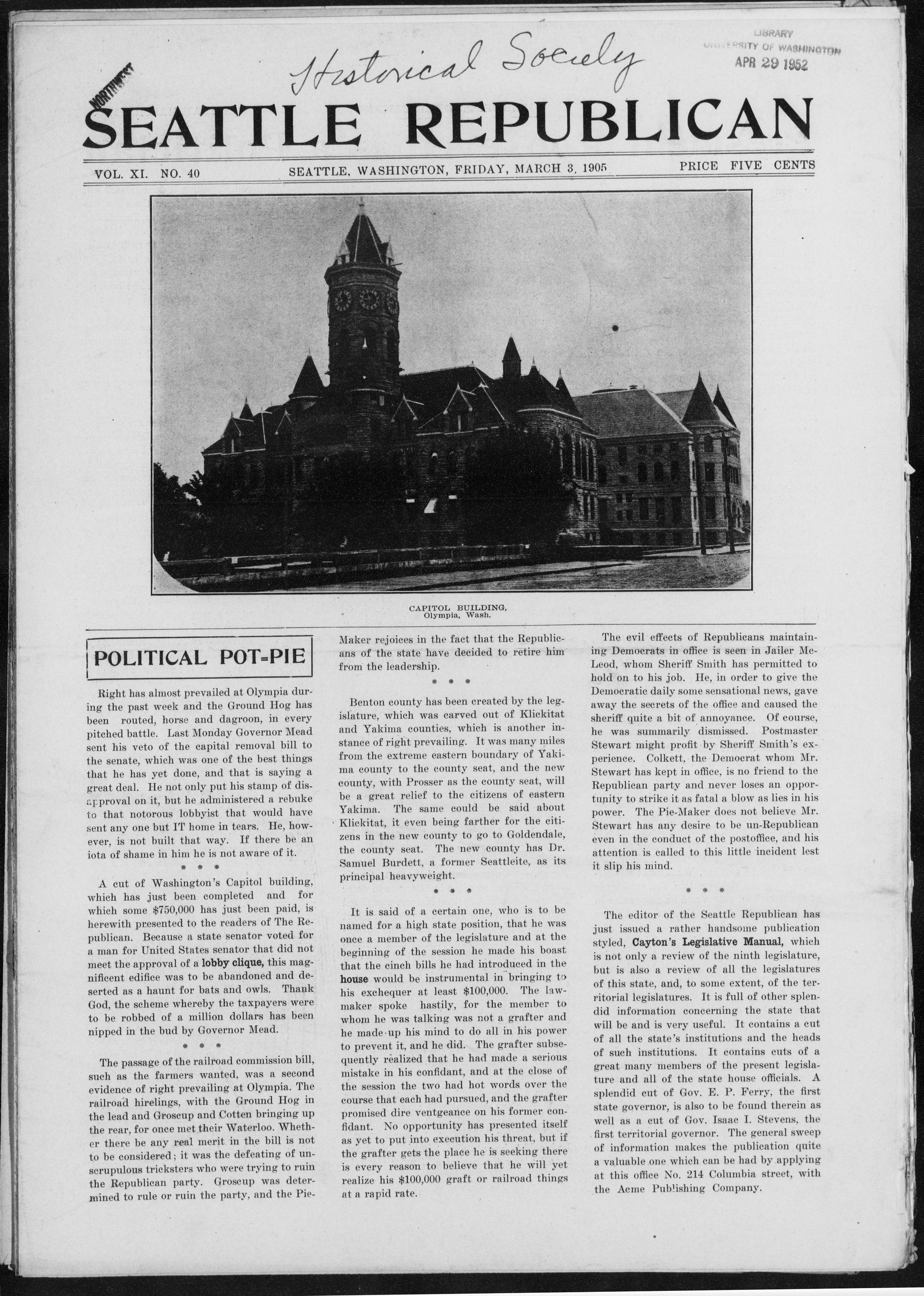
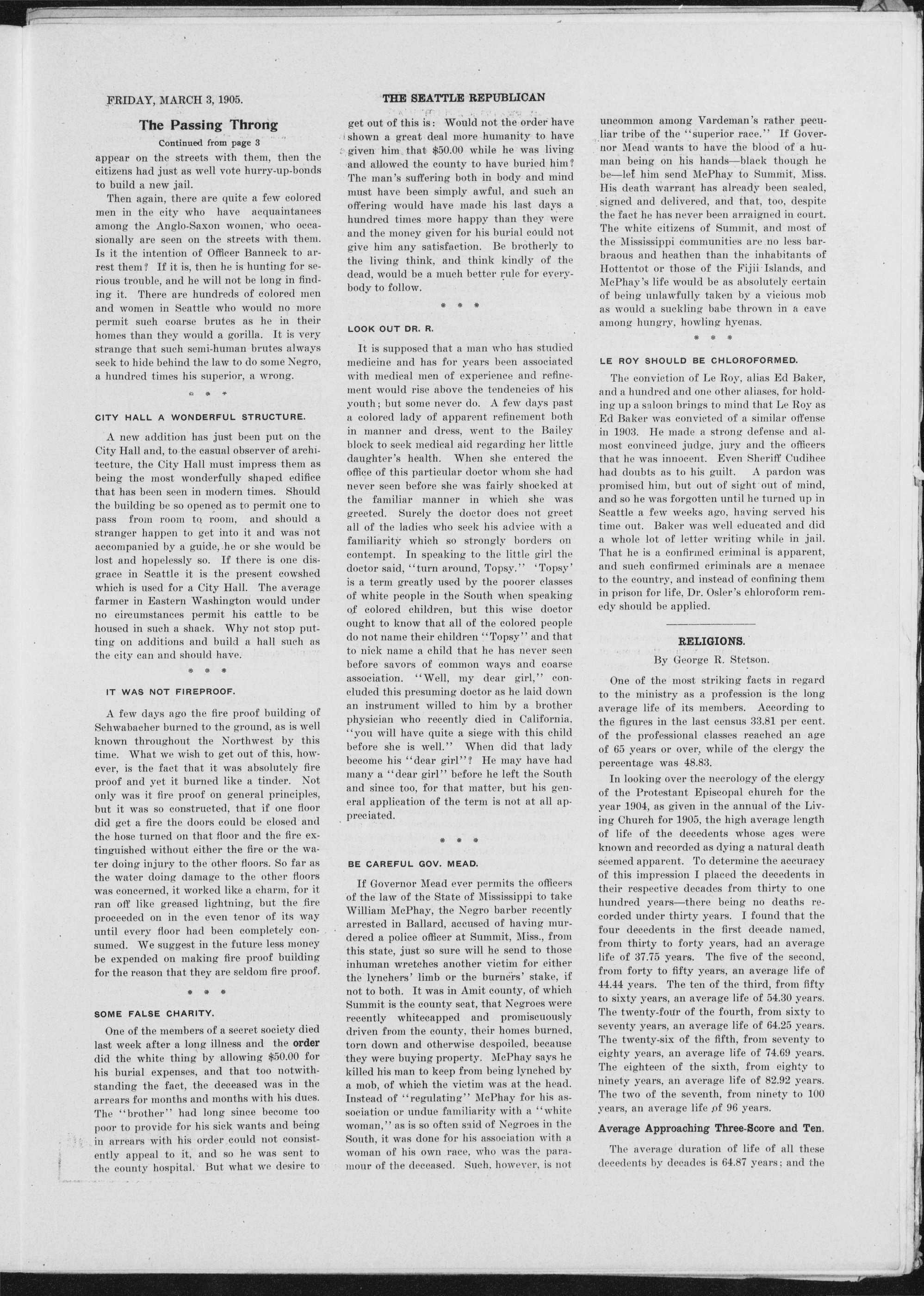
A cut of Washington's Capitol building, which has just been completed and for which some $750,000 has just been paid, is herewith presented to the readers of The Republican. Because a state senator voted for a man for United States senator that did not meet the approval of a lobby clique, this magnificent edifice was to be abandoned and deserted as a haunt for bats and owls. Thank God, the scheme whereby the taxpayers were to be robbed of a million dollars has been nipped in the bud by Governor Mead.
* * *
The passage of the railroad commission bill, such as the farmers wanted, was a second evidence of right prevailing at Olympia. The railroad hirelings, with the Ground Hog in the lead and Groscup and Cotten bringing up the rear, for once met their Waterloo. Whether there be any real merit in the bill is not to be considered; it was the defeating of unscrupulous tricksters who were trying to ruin the Republican party. Groscup was determined to rule or ruin the party, and the Pie-
---
SEATTLE, WASHINGTON, FRIDAY, MARCH 3, 1905
CAPITOL BUILDING Olympia, Wash. Maker rejoices in the fact that the Republicans of the state have decided to retire him from the leadership.
* * *
Benton county has been created by the legislature, which was carved out of Klickitat and Yakima counties, which is another instance of right prevailing. It was many miles from the extreme eastern boundary of Yakima county to the county seat, and the new county, with Prosser as the county seat, will be a great relief to the citizens of eastern Yakima. The same could be said about Klickitat, it even being farther for the citizens in the new county to go to Goldendale, the county seat. The new county has Dr. Samuel Burdett, a former Seattleite, as its principal heavyweight.
* * *
It is said of a certain one, who is to be named for a high state position, that he was once a member of the legislature and at the beginning of the session he made his boast that the cinch bills he had introduced in the house would be instrumental in bringing to his exchequer at least $100,000. The lawmaker spoke hastily, for the member to whom he was talking was not a grafter and he made up his mind to do all in his power to prevent it, and he did. The grafter subsequently realized that he had made a serious mistake in his confidant, and at the close of the session the two had hot words over the course that each had pursued, and the grafter promised dire ventgeance on his former confidant. No opportunity has presented itself as yet to put into execution his threat, but if the grafter gets the place he is seeking there is every reason to believe that he will yet realize his $100,000 graft or railroad things at a rapid rate.
LIBRARY
UNIVERSITY OF WASHINGTON
APR 29 1952
BLICAN
905 PRICE FIVE CENTS
The image shows a large, multi-story building with a distinctive roof featuring three peaks. The architecture is characterized by a combination of brickwork and stone detailing, giving it a robust and historical appearance. The building is likely a public institution, such as a school or a university, given its grand scale and architectural style.
The evil effects of Republicans maintaining Democrats in office is seen in Jailer McLeod, whom Sheriff Smith has permitted to hold on to his job. He, in order to give the Democratic daily some sensational news, gave away the secrets of the office and caused the sheriff quite a bit of annoyance. Of course, he was summarily dismissed. Postmaster Stewart might profit by Sheriff Smith's experience. Colkett, the Democrat whom Mr. Stewart has kept in office, is no friend to the Republican party and never loses an opportunity to strike it as fatal a blow as lies in his power. The Pie-Maker does not believe Mr. Stewart has any desire to be un-Republican even in the conduct of the postoffice, and his attention is called to this little incident lest it slip his mind.
* * *
The editor of the Seattle Republican has just issued a rather handsome publication styled, Cayton's Legislative Manual, which is not only a review of the ninth legislature, but is also a review of all the legislatures of this state, and, to some extent, of the territorial legislatures. It is full of other splendid information concerning the state that will be and is very useful. It contains a cut of all the state's institutions and the heads of such institutions. It contains cuts of a great many members of the present legislature and all of the state house officials. A splendid cut of Gov. E. P. Ferry, the first state governor, is also to be found therein as well as a cut of Gov. Isaac I. Stevens, the first territorial governor. The general sweep of information makes the publication quite a valuable one which can be had by applying at this office No. 214 Columbia street, with the Acme Publishing Company.
---
President Roosevelt is a Politician
By Jackson Tinker.
On his way to the capitol the other day, a former Democratic United States senator told an interesting story. "When Grover Cleveland was president," he said, "David B. Hill and Edward Murphy, who then were United States senators from New York, called at the White House and urged him to force Theodore Roosevelt out of the Civil Service Commission in which he was the dominant factor. Mr. Cleveland, after listening to their appeal, replied: 'Why, gentlemen, you are making a serious mistake. If we should get Mr. Roosevelt out of his position, he would go back to New York and make the Democratic party more trouble there than he does here. He is one the best politicians in our state.'" John Sharp Williams, the Democratic leader in the house of representatives, recently spoke of President Roosevelt in similar words, asserting that the Democratic party had under-estimated the president's ability "as a politician." Many others have testified recently to the same effect.
Many inquiries are heard as to why President Roosevelt has made such a forceful declaration for certain legislation which was not recommended in his party's national platform, and especially why he insisted upon remedial traffic rate legislation and moderate tariff revision or "modification"—this being the term he prefers.
It is no betrayal of confidence to give an outline of the president's reason for his attitude, as he is frank and open in revealing his intentions. While many of his friends and advisers were worried at what appeared to be critical times in the recent national campaign, the president approached election day with supreme confidence. One of his personal friends was asked what made the president so optimistic. "He believes that Judge Parker is not up with the times, and that the people have sized up Judge Parker as not being the man for the job," was the reply.
When the overwhelming defeat of the "reorganized" Parker Democracy had been registered at the polls, President Roosevelt was one of the first to take up the study of what had contributed to the result. This line of thought led to another, What must the Republican party do to retain the confidence of the American voters and be as popular in the next national campaign as in the one which has just closed?
The president had endeavored in the last two years to relieve the people from the injurious effects of unbridled combinations of capital, and he had won their confidence, he believed, largely on that account. But the deeper he had gone into the trust problem, and sought an effective remedy, the more he had become convinced that trusts were nurtured, and have grown powerful and defiant, largely through the discrimination which they enjoyed from the railroads, with the system of rebates, "community of interests," and unjust discrimination against the small and independent shipper, while the consumer received no benefit. Favors exacted by and given to special interests, for their private refrigerator cars, and other adjuncts, he per-
THE SEATTLE REPUBLICAN
ceived were at the very root of the trust evil. As good as the anti-trust legislation enacted in the last two years had been, the president gained the idea from all parts of the country that these special interests must be curbed still further and a "square deal for every man" guaranteed under the law. He talked long and earnestly with Philander C. Knox, who had been a corporation attorney before becoming attorney-general. He summoned Paul Morton from the Santa Fe Railroad to his cabinet, and had many animated discussions with him concerning the workings of the great railroad systems. He entertained at the White House A. J. Cassatt, Samuel Spencer, J. Pierpont Morgan, James J. Hill, President Mellen, and other railroad capitalists and executive heads, and absorbed their views. Large shippers and small shippers, too, engaged his attention, and he studied carefully the work of the Interstate Commerce Commission and what it had been able to accomplish. Then he summoned some of the railroad presidents again, and told them frankly that he was convinced that they were standing in the way of their own best interests by not being willing to accept moderate regulation of railroads by federal authority. "Gentlemen," he said, "you are only inviting still more radical action—government ownership." One of his visitors was shocked when the president, turning upon him in his abrupt manner, exclaimed: "The Republican party will not go up against any more 'stuffed clubs' in a good while. The Democratic party will not try that game again in this generation."
"What, then?" gasped his visitor.
"Social Democracy," came the astounding rejoinder. "That will be their next move, unless we Republicans with full power in the executive and legislative departments of the government satisfy the people and reform existing conditions. If we don't do this, we shall be overwhelmed."
The President "Unconstitutional".
It took time for these ideas to percolate through the brains of our "captains of industry." The president was assailed in corporation organs as having become a veritable Bryan. "Unconstitutional," that mystic word employed so often in attempts to defer the inevitable in American history, was aimed again at the White House. "The president can not force congress to adopt his revolutionary ideas," was asserted by men accredited with wisdom. But the seed had been well planted and the president went about his other duties, awaiting developments. He did not have to wait long, for quick and decisive came the acclaim of the people. "You're right, Mr. President, and we are with you." The White House mail became a flood of popular approbation. Then the president smiled in his inimitable way. The "agitation" was on.
Soon after he sent his annual message to congress, the president was asked if he believed congress would enact remedial traffic rate legislation this winter. "I don't know," he is said to have replied, "but if it does not, I will renew the appeal still more strongly
FRIDAY, MARCH 3, 1905.
next year; and if nothing is done then, I will come back all the stronger on the same line the third year; and by that time, I think the people will see to it that something is done. When the people of this country really make up their minds to do something or to have something done for them, they usually accomplish it." The president smiled broadly again, and his questioner had to agree with him.
An immense amount of evidence has come to the president concerning the injustice done and power exerted by the railroads. In one state, in a spirited contest over the election of a United States senator, two large railroad systems combined to elect one candidate. They showered "passes" and "retainers" on those representatives who were "working" the state for the railroads' candidate, but refused all facilities and courtesies to those who favored his opponent. In the great anthracite coal strike, thousands of tons of coal were "stalled" on the roads, because the railroads would not transport it and arouse the enmity of the coal operators. The secret rebate enjoyed by the Colorado Fuel and Iron Company, against all competitors, while the price of that corporation's stock went soaring in the stock exchanges, has been exposed recently—a rebate of $1.10 on every ton of coal it shipped. Whenever the beef trust, the coal trust, the Standard Oil monopoly, or any of the half-dozen other trusts, were scratched by the administration's investigators, their close connection and community of interest with the railroads was disclosed.
No man knows these secret "understandings" and pooling of interests better than President Roosevelt. He is no novice in this line. When governor of New York, his friends among the "reformers" used to criticize him for "compromising" with corporation interests which he wished to have pay their share of the taxes of the state. "That's the trouble with you," he told a delegation one day, "you are impractical. You want to accomplish just what you have mapped out, and in your own narrow way, or you will do nothing. I am after results, and if I can not get just what I would wish, I am going to take what I can get. Then I will try to get more later." President Roosevelt settled the coal strike when nobody believed he could. He agitated anti-trust legislation until he got some of it, and now he is trying to get more. If he succeeds again, his program will not then be played out. He believes in the national incorporation or chartering of corporations engaged in interstate commerce, including the carriers, insurance companies, and those other great combinations of capital, the trusts, which now obtain their charters in one state only to satiate their greed in many others with impunity. That step has not yet been reached in the president's program.
He does not believe in "Social Democracy." He fears it. He does not favor "government ownership" of railroads and other public utilities, and would keep the "highways of commerce open to all, on equal
G. W. H.
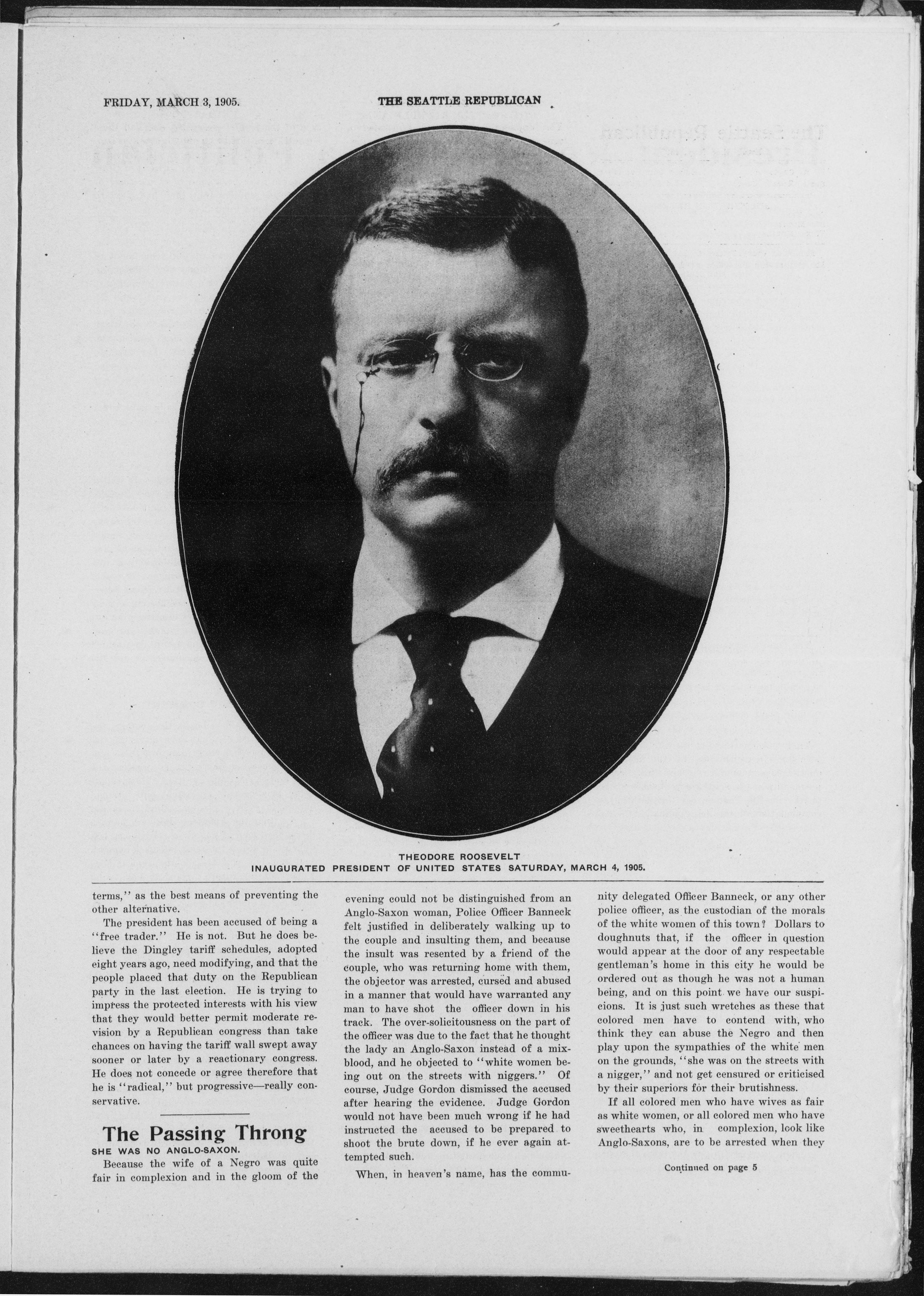
THEODORE ROOSEVELT INAUGURATED PRESIDENT OF UNITED STATES SATURDAY, MARCH 4, 1905.
FRIDAY, MARCH 3, 1905.
INAUGURATE
terms," as the best means of preventing the other alternative.
The president has been accused of being a "free trader." He is not. But he does believe the Dingley tariff schedules, adopted eight years ago, need modifying, and that the people placed that duty on the Republican party in the last election. He is trying to impress the protected interests with his view that they would better permit moderate revision by a Republican congress than take chances on having the tariff wall swept away sooner or later by a reactionary congress. He does not concede or agree therefore that he is "radical," but progressive—really conservative.
The Passing Throng SHE WAS NO ANGLO-SAXON.
Because the wife of a Negro was quite fair in complexion and in the gloom of the
evening could not be distinguished from an Anglo-Saxon woman, Police Officer Banneck felt justified in deliberately walking up to the couple and insulting them, and because the insult was resented by a friend of the couple, who was returning home with them, the objector was arrested, cursed and abused in a manner that would have warranted any man to have shot the officer down in his track. The over-solicitousness on the part of the officer was due to the fact that he thought the lady an Anglo-Saxon instead of a mixblood, and he objected to "white women being out on the streets with niggers." Of course, Judge Gordon dismissed the accused after hearing the evidence. Judge Gordon would not have been much wrong if he had instructed the accused to be prepared to shoot the brute down, if he ever again attempted such.
When, in heaven's name, has the commu-
nity delegated Officer Banneck, or any other police officer, as the custodian of the morals of the white women of this town? Dollars to doughnuts that, if the officer in question would appear at the door of any respectable gentleman's home in this city he would be ordered out as though he was not a human being, and on this point we have our suspicions. It is just such wretches as these that colored men have to contend with, who think they can abuse the Negro and then play upon the sympathies of the white men on the grounds, "she was on the streets with a nigger," and not get censured or criticised by their superiors for their brutishness.
If all colored men who have wives as fair as white women, or all colored men who have sweethearts who, in complexion, look like Anglo-Saxons, are to be arrested when they
Continued on page 5
The Seattle Republican
H. R. Cayton.....Editor and Publisher
Susie Revels Cayton.....Associate
SUBSCRIPTION RATES.
One Year .....$2.00
Six Months .....1.00
Three Months ......60
Published every Friday at 214 Columbia St.
Entered at the Postoffice at Seattle as Second-class Mail Matter.
A Peruvian, who came to the Northwest to live has committed suicide because he was continually taken for a Negro.
P. S.—He hasn't been taken for one since.
* * *
In a city and township near Cleveland, Ohio, there are reported 200 persons over 70 years of age. Just think of the chloroform that might have been used by these people, in celebrating, 30 years ago.
* * *
When Dr. William Osler advised that men celebrate their 40th birthday by chloroforming themselves, he gave the press and people something to talk about and they should at least show some degree of gratitude for that.
* * *
An accommodating writer has undertaken to tell "How one woman drives away rats." No one need waste time or paper telling us how one rat drives away women. We have all had demonstrations of that side of the woman versus rat question.
* * *
The Ohio supreme court has decided that Christian Science comes within the scope of the state medical law and the good people of Ohio may throw away their medicine phials and pray all they want to in order to cure their sick.
* * *
That "Competition is the life of trade" is clearly demonstrated by the fact that another street car line, yet on paper, has the power to place in Seattle seventeen new cars on the Seattle Electric car line for the accommodation of the dear public.
More than one person has secretly wished that he could bridle President Roosevelt, but the Arizona Rangers who are mostly former Rough Riders, have openly expressed a wish to saddle him. Gov. Brodie is to take to the president as a compliment from them the finest saddle that money can buy.
***
The pocket of a burglar, captured in the East, yielded up 21 latch keys. If the Seattle burglar goes into the latchkey business any more extensively than that, trying the kitchen door five or six times to see if it is really locked before going up stairs for the night may be counted as energy utterly lost.
***
Eggs are said to be currency in Mayo, Kerry and Leitrim and are received over the counter in payment for groceries and general haberdashery. Eggs have not yet reached so an exalted a value in Seattle, but it takes so much currency to pay for them that they figure no longer on the average man's menu.
---
THE SEATTLE REPUBLICAN
The Japanese government appointed a commission to study the causes and to suggest a remedy that may aid in correcting the national shortness of the Japanese soldiers. Regardless of what other people think of it the Russians are doubtless of the opinion that the Japanese soldiers are tall enough as they are.
It does not tend to whet one's appetite one bit, as he sips his morning cup of coffee and champs his buttered toast to remember that recent analysis showed solid filth in much of Seattle's milk. When the suggestion of the milk containing liquid manure comes to mind, just his toast and his morning paper are all the breakfast that he wants.
* * *
Ostrich tips will figure largely in the Spring millinery, writes one who is authority on that most interesting subject to women. When one thinks of the ostriches which will have their beautiful feathers heartlessly pulled out, instead of looking upon it as the most cruel and barbarous tortues which man can inflict upon a bird, it must be simply passed as another case of pain for beauty.
***
A New York shoemaker who has various customers who pay from $10 to $50 for their shoes, says that by a strange accident some of the most difficult feet to fit are those of the very rich. The average person can wear ready made shoes and be comfortably shod. All he needs to know is that his pocket book demands it and it is surprising how rapidly the peculiarities about his feet will disappear.
***
The regular quarterly change of police officers has taken place and those who have been working at night for the last three months will be divided into two squads, one to work in the mornings and the other to work in the afternoons. The morning and afternoon officers of the last three months will work at night. This arrangement is quite right but different from the way things are done at the city post office. There are men there who are forced to hold a night shift a year and more at the time.
* * *
At last a long time smell has been located by the city councilmen. The property owners on Beacon Hill, who for many years have borne with the bad odor nuisance, can now vent their spleen against the row of shacks, provided with no sewer facilities, located above the bottling works. Henry, owner of the slaughter house, has been vindicated for the councilmen have been to his slaughter house, on a damp day it must be admitted, stood quite close to Mr. Henry and declared that they detected no objectional smell.
```markdown
```
A report comes from London of a concert being held in a well. There was a scarcity of water in the Wooley Huntingdonshire and when at last a large new well was dug the villagers, to celebrate the event, had a prayer meeting around the well and afterwards the
---
men of the hamlet descended and had their concert. Seattle has an abundant water supply and hence needs no such wells, but many has been the time when the citizens of Seattle would have been glad to throw some of the concert singers that they had paid to hear into some good deep well.
\* \* \*
Prof. Moritz, head of the department of mathematics and astronomy at the state university, recently gave a lecture on "Mars." He compared Mars with the earth, and declared that, inasmuch as the conditions prevailing on both places were nearly identical, there was no reason why Mars was not inhabited, as well as the earth. Let this fact be well established and the all conquering "Yankee" will begin at once to figure out some way to reach Mars so as to be the first from America to homestead some land, squat on some quarter section, or buy up the cheap (?) oyster bed lands.
* * *
A south bound express which was stalled at Eden Center, midway between Buffalo, N. Y., and Jamestown, in a 40 foot snow drift had an unusual experience. As soon as the trainmen discovered that they must spend the night there a long distance telephone line was tapped, a telephone established on one of the coaches, and the passengers were able to communicate with friends in various cities. Benjamin Franklin nor Prof. Morris in their fondest dreams of the part electricity was to play in the advancement of the universe doubtless counted not upon a day which would record such an occurrence.
CURRENT COMMENT
The Jew is said to be, on the average, the most long-lived of New York city's inhabitants. The Jewish emigration into this country is something like twice as great as the Irish and German immigration. Deprived of social privileges to an extent and political honors to even a greater extent, it is not strange that the American Jew will become the monied man of tomorrow. It is even less difficult to see, on account of his longevity, that the Jew will also be the typical New Yorker of the future. Hard to believe by those who despise the Jew simply because he is a Jew, but true never the less.
* * *
The solution of the emigration problem lies in general restriction, reason many, but not so think others. There is room for thousands and thonsands more and why miser vacant lands. The greatest universal objection is based upon the character of the immigrants to the United States in the last two years. The most of those who passed through our legal gates represented what might be termed European dregs of people. During the fiscal year 1903-4, immigrants to the number of 812,870 were permitted to land in the states. The perplexing question is, how to so manage that the newcomers be desirable and that they do not become conjected in large cities, but be distributed over less thickly settled territories.
---
FRIDAY, MARCH 3, 1905.
The Passing Throng
Continued from page 3
appear on the streets with them, then the citizens had just as well vote hurry-up-bonds to build a new jail.
Then again, there are quite a few colored men in the city who have acquaintances among the Anglo-Saxon women, who occasionally are seen on the streets with them. Is it the intention of Officer Banneck to arrest them? If it is, then he is hunting for serious trouble, and he will not be long in finding it. There are hundreds of colored men and women in Seattle who would no more permit such coarse brutes as he in their homes than they would a gorilla. It is very strange that such semi-human brutes always seek to hide behind the law to do some Negro, a hundred times his superior, a wrong.
* * *
CITY HALL A WONDERFUL STRUCTURE
A new addition has just been put on the City Hall and, to the casual observer of architecture, the City Hall must impress them as being the most wonderfully shaped edifice that has been seen in modern times. Should the building be so opened as to permit one to pass from room to room, and should a stranger happen to get into it and was not accompanied by a guide, he or she would be lost and hopelessly so. If there is one disgrace in Seattle it is the present cowshed which is used for a City Hall. The average farmer in Eastern Washington would under no circumstances permit his cattle to be housed in such a shack. Why not stop putting on additions and build a hall such as the city can and should have.
* * *
IT WAS NOT FIREPROOF.
A few days ago the fire proof building of Schwabacher burned to the ground, as is well known throughout the Northwest by this time. What we wish to get out of this, however, is the fact that it was absolutely fire proof and yet it burned like a tinder. Not only was it fire proof on general principles, but it was so constructed, that if one floor did get a fire the doors could be closed and the hose turned on that floor and the fire extinguished without either the fire or the water doing injury to the other floors. So far as the water doing damage to the other floors was concerned, it worked like a charm, for it ran off like greased lightning, but the fire proceeded on in the even tenor of its way until every floor had been completely consumed. We suggest in the future less money be expended on making fire proof building for the reason that they are seldom fire proof.
SOME FALSE CHARITY.
One of the members of a secret society died last week after a long illness and the order did the white thing by allowing $50.00 for his burial expenses, and that too notwithstanding the fact, the deceased was in the arrears for months and months with his dues. The "brother" had long since become too poor to provide for his sick wants and being in arrears with his order could not consistently appeal to it, and so he was sent to the county hospital. But what we desire to
THE SEATTLE REPUBLICAN
get out of this is: Would not the order have shown a great deal more humanity to have given him that $50.00 while he was living and allowed the county to have buried him? The man's suffering both in body and mind must have been simply awful, and such an offering would have made his last days a hundred times more happy than they were and the money given for his burial could not give him any satisfaction. Be brotherly to the living think, and think kindly of the dead, would be a much better rule for everybody to follow.
LOOK OUT DR. R.
It is supposed that a man who has studied medicine and has for years been associated with medical men of experience and refinement would rise above the tendencies of his youth; but some never do. A few days past a colored lady of apparent refinement both in manner and dress, went to the Bailey block to seek medical aid regarding her little daughter's health. When she entered the office of this particular doctor whom she had never seen before she was fairly shocked at the familiar manner in which she was greeted. Surely the doctor does not greet all of the ladies who seek his advice with a familiarity which so strongly borders on contempt. In speaking to the little girl the doctor said, "turn around, Topsy." 'Topsy' is a term greatly used by the poorer classes of white people in the South when speaking of colored children, but this wise doctor ought to know that all of the colored people do not name their children "Topsy" and that to nick name a child that he has never seen before savors of common ways and coarse association. "Well, my dear girl," concluded this presuming doctor as he laid down an instrument willed to him by a brother physician who recently died in California, "you will have quite a siege with this child before she is well." When did that lady become his "dear girl"? He may have had many a "dear girl" before he left the South and since too, for that matter, but his general application of the term is not at all appreciated.
BE CAREFUL GOV. MEAD.
If Governor Mead ever permits the officers of the law of the State of Mississippi to take William McPhay, the Negro barber recently arrested in Ballard, accused of having murdered a police officer at Summit, Miss., from this state, just so sure will he send to those inhuman wretches another victim for either the lynchers' limb or the burners' stake, if not to both. It was in Amit county, of which Summit is the county seat, that Negroes were recently whitecapped and promiscuously driven from the county, their homes burned, torn down and otherwise despoiled, because they were buying property. McPhay says he killed his man to keep from being lynched by a mob, of which the victim was at the head. Instead of "regulating" McPhay for his association or undue familiarity with a "white woman," as is so often said of Negroes in the South, it was done for his association with a woman of his own race, who was the paramour of the deceased. Such, however, is not
uncommon among Vardeman's rather peculiar tribe of the "superior race." If Governor Mead wants to have the blood of a human being on his hands—black though he be—let him send McPhay to Summit, Miss. His death warrant has already been sealed, signed and delivered, and that, too, despite the fact he has never been arraigned in court. The white citizens of Summit, and most of the Mississippi communities are no less barbraous and heathen than the inhabitants of Hottentot or those of the Fijii Islands, and McPhay's life would be as absolutely certain of being unlawfully taken by a vicious mob as would a suckling babe thrown in a cave among hungry, howling hyenas.
* * *
LE ROY SHOULD BE CHLOROFORMED.
The conviction of Le Roy, alias Ed Baker, and a hundred and one other aliases, for holding up a saloon brings to mind that Le Roy as Ed Baker was convicted of a similar offense in 1903. He made a strong defense and almost convinced judge, jury and the officers that he was innocent. Even Sheriff Cudihee had doubts as to his guilt. A pardon was promised him, but out of sight out of mind, and so he was forgotten until he turned up in Seattle a few weeks ago, having served his time out. Baker was well educated and did a whole lot of letter writing while in jail. That he is a confirmed criminal is apparent, and such confirmed criminals are a menace to the country, and instead of confining them in prison for life, Dr. Osler's chloroform remedy should be applied.
RELIGIONS.
By George R. Stetson.
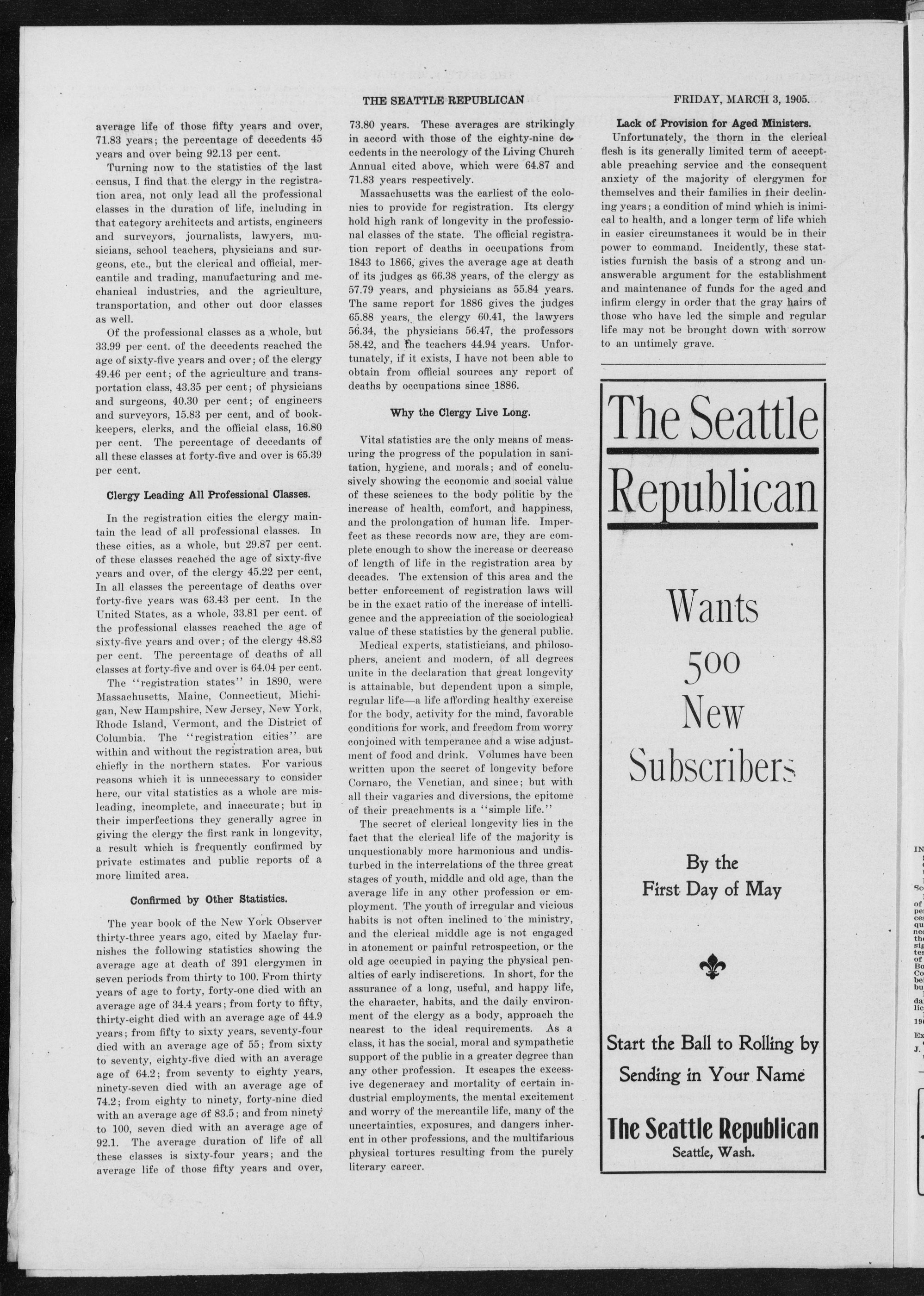
One of the most striking facts in regard to the ministry as a profession is the long average life of its members. According to the figures in the last census 33.81 per cent. of the professional classes reached an age of 65 years or over, while of the clergy the percentage was 48.83.
Average Approaching Three-Score and Ten.
The average duration of life of all these decedents by decades is 64.87 years; and the
average life of those fifty years and over, 71.83 years; the percentage of decedents 45 years and over being 92.13 per cent.
Turning now to the statistics of the last census, I find that the clergy in the registration area, not only lead all the professional classes in the duration of life, including in that category architects and artists, engineers and surveyors, journalists, lawyers, musicians, school teachers, physicians and surgeons, etc., but the clerical and official, mercantile and trading, manufacturing and mechanical industries, and the agriculture, transportation, and other out door classes as well.
Of the professional classes as a whole, but 33.99 per cent. of the decedents reached the age of sixty-five years and over; of the clergy 49.46 per cent; of the agriculture and transportation class, 43.35 per cent; of physicians and surgeons, 40.30 per cent; of engineers and surveyors, 15.83 per cent, and of bookkeepers, clerks, and the official class, 16.80 per cent. The percentage of decedants of all these classes at forty-five and over is 65.39 per cent.
Clergy Leading All Professional Classes.
In the registration cities the clergy maintain the lead of all professional classes. In these cities, as a whole, but 29.87 per cent. of these classes reached the age of sixty-five years and over, of the clergy 45.22 per cent. In all classes the percentage of deaths over forty-five years was 63.43 per cent. In the United States, as a whole, 33.81 per cent. of the professional classes reached the age of sixty-five years and over; of the clergy 48.83 per cent. The percentage of deaths of all classes at forty-five and over is 64.04 per cent.
The "registration states" in 1890, were Massachusetts, Maine, Connecticut, Michigan, New Hampshire, New Jersey, New York, Rhode Island, Vermont, and the District of Columbia. The "registration cities" are within and without the registration area, but chiefly in the northern states. For various reasons which it is unnecessary to consider here, our vital statistics as a whole are misleading, incomplete, and inaccurate; but in their imperfections they generally agree in giving the clergy the first rank in longevity, a result which is frequently confirmed by private estimates and public reports of a more limited area.
Confirmed by Other Statistics.
THE SEATTLE REPUBLICAN 73.80 years. These averages are strikingly in accord with those of the eighty-nine decedents in the necrology of the Living Church Annual cited above, which were 64.87 and 71.83 years respectively.
Massachusetts was the earliest of the colonies to provide for registration. Its clergy hold high rank of longevity in the professional classes of the state. The official registration report of deaths in occupations from 1843 to 1866, gives the average age at death of its judges as 66.38 years, of the clergy as 57.79 years, and physicians as 55.84 years. The same report for 1886 gives the judges 65.88 years, the clergy 60.41, the lawyers 56.34, the physicians 56.47, the professors 58.42, and the teachers 44.94 years. Unfortunately, if it exists, I have not been able to obtain from official sources any report of deaths by occupations since 1886.
Why the Clergy Live Long.
Vital statistics are the only means of measuring the progress of the population in sanitation, hygiene, and morals; and of conclusively showing the economic and social value of these sciences to the body politic by the increase of health, comfort, and happiness, and the prolongation of human life. Imperfect as these records now are, they are complete enough to show the increase or decrease of length of life in the registration area by decades. The extension of this area and the better enforcement of registration laws will be in the exact ratio of the increase of intelligence and the appreciation of the sociological value of these statistics by the general public.
Medical experts, statisticians, and philosophers, ancient and modern, of all degrees unite in the declaration that great longevity is attainable, but dependent upon a simple, regular life—a life affording healthy exercise for the body, activity for the mind, favorable conditions for work, and freedom from worry conjoined with temperance and a wise adjustment of food and drink. Volumes have been written upon the secret of longevity before Cornaro, the Venetian, and since; but with all their vagaries and diversions, the epitome of their preachments is a "simple life."
The secret of clerical longevity lies in the fact that the clerical life of the majority is unquestionably more harmonious and undisturbed in the interrelations of the three great stages of youth, middle and old age, than the average life in any other profession or employment. The youth of irregular and vicious habits is not often inclined to the ministry, and the clerical middle age is not engaged in atonement or painful retrospection, or the old age occupied in paying the physical penalties of early indiscretions. In short, for the assurance of a long, useful, and happy life, the character, habits, and the daily environment of the clergy as a body, approach the nearest to the ideal requirements. As a class, it has the social, moral and sympathetic support of the public in a greater degree than any other profession. It escapes the excessive degeneracy and mortality of certain industrial employments, the mental excitement and worry of the mercantile life, many of the uncertainties, exposures, and dangers inherent in other professions, and the multifarious physical tortures resulting from the purely literary career.
FRIDAY, MARCH 3, 1905
Lack of Provision for Aged Ministers.
Unfortunately, the thorn in the clerical flesh is its generally limited term of acceptable preaching service and the consequent anxiety of the majority of clergymen for themselves and their families in their declining years; a condition of mind which is inimical to health, and a longer term of life which in easier circumstances it would be in their power to command. Incidently, these statistics furnish the basis of a strong and unanswerable argument for the establishment and maintenance of funds for the aged and infirm clergy in order that the gray hairs of those who have led the simple and regular life may not be brought down with sorrow to an untimely grave.
---
The Seattle Republican
Wants
500
New
Subscribers
By the
First Day of May
Start the Ball to Rolling by Sending in Your Name
The Seattle Republican
Seattle, Wash.
FRIDAY, MARCH 3, 1905.
IN THE SUPERIOR COURT OF THE
State of Washington, in and for
King County.
No. 5022. Notice to Creditors.
In the mater of the estate of Leila
Max. Crotty deceased.
Notice is hereby given to the creditors of Leila May Crotty, deceased, to present their claims against said estate, with necessary vouchers, within one (1) year after the date of this notice, to the undersigned James L. Crotty, administrator of the estate of Leila May Crotty, deceased, at the office of Allison & Crotty, 109, 110, 111 Washington building, city of Seattle, county of King and state of Washington.
Dated at Seattle, Washington, this
27th day of January, 1905.
JAMES L. CROTTY.
Administrator of the Estate of Leila
May Crotty, Deceased.
H. D. ALLJSON.
H. B. ABBONSON
Aty. for Administrator.
First publication Jan. 27, 1905.
Last publication Feb. 24, 1905.
IN THE SUPERIOR COURT OF THE State of Washington, in and for the County of King.—In Probate. No. 5913. Notice to Creditors. In the matter of the estate of George G. Sunders, deceased.
To whom it may concern: Notice is hereby given and extended to the creditors of the estate of George G. Saunders, deceased, and to all persons having claims against said deceased, or his estate, that they are required to present said claims with the necessary vouchers, within one year after the date of this notice to the undersigned administrator of the estate of said George G. Saunders, deceased, at the office of the Pacific Coast Biscuit Company, corner of Occidental Avenue and Jackson street, in the city of Seattle, King county, state of Washington, the same being the place for the transaction of business for said estate.
Dated at Seattle, Washington, this 27th day of January, 1905, the day of first publication hereof. Last publication February 24, 1905. A. M. BROOKES. Administrator of the Estate of George G. Saunders. Deceased. IRA BRONSON & D. B. TREFETHE. Attus, for Administrator.
IN THE SUPERIOR COURT OF the State of Washington in and for the County of King.
In the matter of the dissolution and disincorporation of the Rival Clothing Company, a corporation. No. 45892. Notice.
Notice is hereby given that on the 18th day of January, 1905, the Rival Clothing Company, a corporation, filed its application in due form with the certificate of its officers for the dissolution and disincorporation of the said corporation, upon the grounds that all of the debts had been paid and that all of the stockholders had voted affirmatively, on the 16th day of January, 1905, to dissolve and disincorporate the said corporation.
That the said application will be heard in the Equity Department of the Superior Court of the State of Washington in and for King County, at the court room of said department, in the court house, in Seattle, King County, Washington, at 9:30 o'clock A. M., or as soon thereafter as the matter can be heard, on the 24th day of March, 1905.
Dated Seattle, Washington, this January 18, 1905.
OTTO A. CASE, Clerk.
By MAURICE THOMPSON,
Deputy.
HUMPHRIES & COLE.
Attorneys for Corporation.
602 Mutual Life Bldg., Seattle, Wash.
First publication Jan. 20, 1905; last publication March 17, 1905.
IN THE SUPERIOR COURT OF THE State of Washington, in and for King County.—In Probate. No. 5531. Notice to Creditors. In the matter of the estate of Roswell Scott, deceased. Notice is hereby given to the creditors of Roswell Scott, deceased, and to all persons having claims against said deceased, or his estate, that they are required to present said claims, with the necessary vouchers, within one year after the date of this notice, to the undersigned executrix of the last will and testament of said deceased, at the office of her attorney, J. M. Wiestling, 422-3-4 Boston block, in the City of Seattle, King County, State of Washington, the same being the place for the transaction of business for said estate.
Dated at Seattle, Washington, this 3rd day of March, 1905, the day of first publication hereof.
Last publication, 31st day of March, 1905.
MARY I. SCOTT.
Executrix of the Estate of Roswell Scott, deceased.
J. M. WEISTLING, Attorney for Executrix.
Seattle
Engraving Co.
13 THIRD AVE. S.
We make
printers plates
that print
5c PHONES INDEPENDENT
SUNSET MAIN 800
Want A Home?
If you want a home in either the City or the Country, you can get an excellent bargain on
Easy Terms
at the
Gilson Investment Co.
73 - 74 Sullivan Block
at the
Acme Publishing Co.
214 COLUMBIA ST.
BRIEFS
our
Specialty
Telephones: Sunset, Red 1971
Independent, 1306
IN THE SUPERIOR COURT OF
the State of Washington for King
County.
J. J. Smith, plaintiff, vs. J. Whitehouse, and — Whitehouse, his wife,
whose true first name is to plaintiff
unknown, and all persons unknown,
if any, having or claiming an interest
or estate in and to the hereinafter described real property, defendants.
No. .... Notice and Summons
State of Washington to J. Whitehouse and — Whitehouse, his wire, who are the owners or reputed owners of, and all persons unknown, claiming or having an interest or estate in and to the hereinafter described real property.
You and each of you (including said persons unknown, if any), are hereby further notified and summoned to be and appear within sixty days after the service of this notice, exclusive of the day of the date of the first publication, to-wit: within sixty days after the 14th day of January, 1905, in the above entitled Court and action, and defend this action and answer the complaint of said plaintiff and serve a copy of your answer on the undersigned attorney for plaintiff at his office below stated, or pay the amount, together with penalty, interest and costs. In case you fail so to do, judgment will be rendered against you and against each parcel of said real property for the sums due and amounts due upon and charged against each, including costs, ordering a sale of each parcel of said property for the satisfaction of the sums charged and found against it respectively as provided by law, and as prayed in plaintiff's complaint now on file in this cause and Court. L. L. SMITH. Plaintiff.
W. T. SCOTT, Pros. Attorney.
By JOHN C. MURPHY, Deputy.
Attorney for Plaintiff.
Office address 506 and 513 Marion
Block, Seattle, Wash.
First publication dated January 14, 1905.
THE SEATTLE REPUBLICAN
IN THE SUPERIOR COURT OF the State of Washington for King County.
G. Beninghausen, Plaintiff, vs. H. C. Wahlberg and — Wahlberg, his wife; N. Anderson and — Anderson, his wife; Nills Tobias Anderson and — Anderson, his wife, and all persons unknown, if any, having or claiming an interest or estate in and to the hereinafter described real property, Defendants.
No. 46336. Notice and Summons.
State of Washington to the above named defendants, who are the owners or reputed owners of, and all persons unknown, claiming or having an interest or estate in and to the hereinafter described real property.
You and each of you are hereby notified that the above named plaintiff is the holder of a certain delinquent tax certificate, numbered as hereinafter stated, issued by the County Treasurer of King County, State of Washington, embracing the following real property situated in said King County, Washington, and more particularly described as follows, to-wit: Delinquent Tax Certificate No. B27744, Lot 26, Block 7, Salmon Bay Second Addition to Seattle. That said certificate was issued on the 1st day of October, 1904, for the following sums and for delinquent taxes for the following years, to-wit: Tax Certificate No. B27744, for year 1897, 87 cents. That the taxes for the following subsequent years have been paid by the plaintiff upon said above described lots, to-wit: Lot 26, Block 7, Salmon Bay Second Addition to Seattle, 32 cents for year 1898, 38 cents for year 1899, 36 cents for year 1900, 39 cents for year 1901, 36 cents for year 1902, 33 cents for year 1903, which several sums bear interest at the rate of 15 per cent. per annum from said date of payment, and are all the unpaid and unredeemed taxes upon and against said real property.
You and each of you (including said persons, unknown, if any), are hereby further notified and summoned to be and appear within sixty days after the day of publication of this notice, exclusive of the day of first publication, in the above entitled Court and action, and defend this action and answer the complaint of said plaintiff and serve a copy of your answer on the undersigned attorney for plaintiff at his office below stated, or pay the amounts, together with penalty, interest and costs. In case you fail so to do, judgment will be rendered against you and against each parcel of said real property for the sums and amounts due upon and charged against each, including costs, ordering a sale of each parcel of said property for the satisfaction of the sums charged and found against it respectively as provided by law, and as prayed in plaintiff's complaint now on file in this cause and Court.
ERNEST B. HEROLD.
Attorney for Plaintiff.
Office address 226-30 Colman Bldg..
Seattle, Washington.
First publication dated March 5. 1905.
IN THE SUPERIOR COURT OF the State of Washington, in and for the County of King. Jennie Gaines, plaintiff, vs. William Gaines, defendant.—No. 44073.—Summons by Publication.
The State of Washington to the said William Gaines, defendant. You are hereby summoned to appear within sixty (60) days after the date of the first publication of this summons, to-wit: within sixty (60) days after the 23rd day of December, 1904, and defend the above entitled action in the above entitled court, and answer the complaint of the plaintiff and serve a copy of your answer upon the undersigned attorney for the plaintiff at his office below stated; and in case of your failure so to do, judgment will be rendered against you according to the demand of the complaint, which has been filed with the clerk of said court.
The object of said action is to obtain a decree of divorce on the grounds of non-support and abandonment. A. R. BLACK.
Attorney for Plaintiff
Office and P. O. Address: 315 Pacific
Pacific Building, Seattle, Washington.
Dec. 23-30.
IN THE SUPERIOR COURT OF the State of Washington, for King County. Summons. No. — H. Harrington, Ellen C. Harrington, plaintiffs, vs. Robert Wingate, individually, and as receiver of the Merchants National Bank of Tacoma, Washington, The Merchants National Bank of Tacoma, Washington, M. F. Hatch, and all other persons or parties unknown claiming any title, estate, lien or interest in the real estate described in the complaint of plaintiff, defendants.
To the above named defendants, including all persons unknown, claiming any title, estate, lien or interest in the real property described in plaintiffs' complaint in this action, to-wit, commencing at a point 60 rods from the center line of Section 32, Township 23, North of Range 3 East; thence running east to the waters of Puget Sound; thence in a southerly direction 60 rods; thence west 80 rods to the Chautauqua Road; thence north to the place of beginning, containing $32\frac{1}{2}$ acres of land, more or less.
You and each of you are hereby summoned to appear within sixty days after the first publication of this summons, to-wit, within sixty days after the 9th day of December, 1904, and defend the above entitled action in the above entitled court, and answer the complaint of the plaintiffs, and serve a copy of your answer upon the undersigned attorneys for
the plaintiff, at his office below stated; and in case of your failure so to do, judgment will be rendered against you according to the demand of the complaint, which has been filed with the clerk of the court.
The object of this action is to remove a cloud upon plaintiffs' title to said land arising by virtue of two certain mortgages covering said land, one for the sum of $900 and interest, made, executed and delivered April 18, 1889, by Warran J. Gordon, and Margretta McL. Gordon, his wife, to M. F. Hatch, and by him afterward assigned to defendant Merchants National Bank of Tacoma, the other for the sum of $200, made, executed and delivered by said Warran J. Gordon and Margretta McL. Gordon, his wife, to said Hatch, on the 5th day of July, 1892, and also to compel defendants, and each of them, to set forth the nature of their several claims to said real estate, and that all of said claims may be determined by decree of said court, and that plaintiffs be adjudged to be the owners of said land; that defendants and each of them be decreed to have no interest therein, and that defendants, and each of them, be forever barred from asserting any claim or interest in said lands, and for such other and further relief as may be just and equitable.
Dated at Seattle, Washington, this 7th day of December, 1904.
JAMES McNENY.
Attorney for Plaintiff.
Office and postoffice address: 504 Bailey Building, Seattle, Wash.
IN THE SUPERIOR COURT OF King county, state of Washington.
No. 5951—Notice to Creditors.
In the matter of the estate of Annette M. Haslehurst, deceased. No. notice is hereby given to the creditors of and all persons having claims against the estate of Annette M. Haslehurst, deceased, to present the same, together with the necessary vouchers, to the undersigned, executor of the last will and testament of said deceased, within one year after the date hereof, at the office of John K. Brown, Room 430 Pioneer building, Seattle, King county, Washington, that being the place for the transaction of the business of said estate.
Dated December 9, 1904.
FREDERICK M. HASLEHURST,
Executor of the last will and testa
Executor of the last will and testament of Annette M. Haslehurst, deceased.
IN THE SUPERIOR COURT OF the State of Washington for King County. Summons for Publication. Grace M. Roberts and William J. J. Roberts, her husband, plaintiffs, vs. Robert Kidd, — Kidd, his wife, James McNaught, — McNaught, his wife, J. M. Butler, — Butler, his wife, W. H. Davis, — Davis, his wife, defendants.
The State of Washington to Robert Kidd, — Kidd, his wife, James McNaught, — McNaught his wife, J. M. Butler, — Butler his wife, W. H. Davis, — Davis his wife, above named defendants.
You are hereby summoned to appear within sixty days after the date of the first publication of this summons, to-wit, within sixty days after the 9th day of December, 1904, and defend the above entitled action in the above entitled court, and answer the complaint of the plaintiffs, and serve a copy of your answer upon the undersigned attorney for plaintiff, at his office below stated; and in case of your failure so to do, judgment will be rendered against you according to the demand of the complaint, which has been filed with the clerk of said court.
That the object of this action is to obtain a decree determining all adverse claims of the defendants in the property hereinafter described, that by the decree it be declared and adjudged that the defendants have no state or interest whatsoever in or to said land and that the title of plaintiffs is good and valid, and that the defendants, and each of them be forver enjoined and debarred from asserting any claim whatever in and to said property, and for general relief. That the property above mentioned is situated in King County. State of Washington, and is particularly described as the west forty and one-half feet of lot nine, block twenty. Law's Addition to the City of Seattle.
H. H. EATON,
Plaintiff's Attorney.
Postoffice and office address: Room 70. Sullivan Building, Seattle, King County, Washington.
IN THE SUPERIOR COURT OF THE STATE OF WASHINGTON FOR KING COUNTY.
Emma Caldwell, plaintiff, vs. T. Ellis Caldwell, defendant. No. 46152. Summons.
The State of Washington to the said T. Ellis Caldwell, defendant:
You are hereby summoned to appear within sixty (60) days after the date of the first publication of this summons, to-wit: within sixty (60) days after the 17th day of February, 1905, and defend the above entitled action in the above entitled court, and answer the complaint of the plaintiff herein, and serve a copy of your answer upon the undersigned attorney for the said plaintiff at his office below stated; and in case of your failure so to do, judgment will be rendered against you according to the demand of the said complaint, which has been filed with the clerk of said court.
The object of this action is to obtain a decree of divorce, dissolving the bonds of matrimony now existing between plaintiff and defendant, on the ground of desertion.
BRUCE C. SHORTS.
Attorney for Plaintiff.
P. O. address 377 Colman Building, Seattle.
Date of first publication Feb. 17, 1905.
IN THE SUPERIOR COURT OF THE State of Washington, for King County.
G. Beninghausen, Plaintiff, vs. H. C. Wahlberg and _____ Wahlberg, his wife, N. Anderson and _____ Anderson, his wife, Nils Tobias Anderson and ____ Anderson, his wife, and all persons unknown, if any, having or claiming an interest or estate in and to the hereinafter described real property, Defendants. No. 46335. Notice and Summons.
State of Washington to the above named defendants, who are the owners or reputed owners of, and all persons unknown, claiming or having an interest or estate in and to the hereinafter described real property.
You and each of you are hereby notified that the above named plaintiff is the holder of a certain delinquent tax certificate, numbered as hereinafter stated, issued by the County Treasurer of King County, State of Washington, embracing the following real property situated in said King County, Washington, and more particularly described as follows, to-wit:
Delinquent tax certificate No. B 27743, lot 25, block 7, Salmon Bay 2nd Addition to Seattle.
That said certificate was issued on the 1st day of October, 1904, for the following sums and for delinquent taxes for the following years, to-wit:
Tax certificate No. B 27743, for year 1897, 87 cents.
That the taxes for the following subsequent years have been paid by the plaintiff upon said above described lot, to-wit:
Lot 25, block 7, Salmon Bay 2nd Addition to Seattle, 32 cents for year 1898, 38 cents for year 1899, 36 cents for 1900, 39 cents for year 1901, 36 cents for year 1902, 33 cents for year 1903. Which several sums bear interest at the rate of 15 per cent per annum from said date of payment, and are all the unpaid and unredeemed taxes upon and against said real property.
You and each of you (including said persons unknown, if any) are hereby further notified and summoned to be and appear within sixty days after the day of first publication of this notice, exclusive of the day of first publication, in the above entitled Court and action, and defend this action and answer the complaint of said plaintiff and serve a copy of your answer on the undersigned attorney for plaintiff at his office below stated, or pay the amounts, together with penalty, interest and costs. In case you fail so to do, judgment will be rendered against you and against each parcel of said real property for the sums and amounts due upon and charged against each, including costs, ordering a sale of each parcel of said property for the satisfaction of the sums charged and found against it respectively as provided by law, and as prayed in plaintiff's complaint now on file in this cause and Court.
Attorney for Plantth.
Office address, 226-30 Colman Bldg.
Seattle, Washington.
First publication, dated Mar 2, 1905.
IN THE SUPERIOR COURT OF THE
State of Washington, for King County,
G. Beninghausen, Plaintiff, vs. H. C.
Wahlberg and —— Wahlberg, his wife;
N. Anderson and —— Anderson, his
wife; Nills Tobias Anderson and ——
Anderson, his wife, and all persons
unknown, if any, having or claiming an
interest or estate in and to the hereinafter
described real property, Defendants. No.
46337. Notice and Summons.
State of Washington to the above
named defendants, who are the owners
or reputed owners of, and all persons
unknown, claiming or having an interest or
estate in and to the hereinafter described
real property.
You and each of you are hereby notified that the above named plaintiff is the holder of a certain delinquent tax certificate, numbered as hereinafter stated, issued by the County Treasurer of King County. State of Washington, embracing the following real property situated in said King County, Washington, and more particularly described as follows, to-wit: Delinquent tax certificate No. B 27745, lot 27, block 7, Salmon Bay 2nd Addition to Seattle. That said certificate was issued on the 1st day of October, 1904, for the following sums and for delinquent taxes for the following years, to-wit: Tax certificate No. B 27745, for year 1897, 87 cents. That the taxes for the following subsequent years have been paid by the plaintiff upon said above described lots, to-wit:
Lot 27, block 7, Salmon Bay 2nd Addition to Seattle, 32 cents for year 1898, 38 cents for year 1899, 36 cents for year 1900, 39 cents for year 1901, 36 cents for year 1902, 33 cents for year 1903. Which several sums bear interest at the rate of 15 per cent per annum from said date of payment, and are all the unpaid and unredeemed taxes upon and against said real property.
You and each of you (including said persons unknown, if any) are hereby further notified and summoned to be and appear within sixty days after the day of first publication of this notice, exclusive of the day of first publication, in the above entitled Court and action, and defend this action and answer the complaint of said plaintiff and serve a copy of your answer on the undersigned attorney for plaintiff at his office below stated, or pay the amounts, together with penalty, interest and costs. In case you fail so to do, judgment will be rendered against you and against each parcel of said real property for the sums and amounts due upon and charged against each, including costs, ordering a sale of each parcel of said property for the satisfaction of the sums charged and found against it respectively as provided by law, and as prayed in plaintiff's complaint now on file in this cause and Court.
ERNEST B. HERALD.
Attorney for Plaintiff.
Office address, 226-30 Colman Bldg.,
Seattle, Washington.
First publication dated Mar. 3, 1905
He stopped growing.
He was not greater than his occupation.
He never learned to look on the sunny side.
He stuffed his pocketbook, but starved his brain.
He had no use for sentiment which could not be cashed.
He never learned to take the drudgery out of his work.
He did not live in his upper stories, but in the basement of his being.
He regarded his business as a means of making a living instead of a life.
He lost his early friends by neglect, and had no time to cultivate new ones.
He never learned to enjoy little things, to see the uncommon in the common.
He never learned to lubricate life's machinery with laughter and good cheer.
He made life a grind, out of which he got neither pleasure, profit, nor instruction.
There was only one side of his nature developed, and that was the money-making side.
No face ever brightened at his approach, no heart thrilled at the sound of his voice.
Society bored him, children bored him, music and the drama were unknown languages to him.
He never learned to enjoy himself as he went along, but was always postponing his happiness.
He could not rise to his feet to speak at a public meeting, or to put a motion, if his life depended on it.
He used every means to develop his business, but none to develop his mind or to make himself a larger man.
When he retired from business he found that, in his struggle to get the means for enjoyment, he had murdered his capacity to enjoy.
He knew nothing about what was going on in the world outside of his own narrow circle; another state was like a foreign country to him.
He read only market reports in the newspapers. He never read articles in magazines, and books were an unknown quantity to him.
The idea of helping others, or of owing society, his city, or his nation, any duty, outside of caring for his own interests, never occurred to him.
Re creation, relaxation, or amusement of any kind was condemned by him as a wicked waste of valuable time which might be coined into dollars.
He was a giant in the store or factory, but a pigmy elsewhere. He was as awkward and ill at ease in a drawing-room as a bull in a china shop.
He had neither wife, nor child, nor friend, yet he lived penuriously and hoarded his gains as jealously as if some great issue depended on the result.
Nobody had power to interest him unless he thought he could get something out of him. If he could not see the dollar mark in the man, he dropped him.
He could talk "shop" fluently, but could not carry on intelligent conversation or express an opinion on any subject outside of his own line of business.
He knew nothing about politics or political parties, because he did not think them necessary to help his business along—which was the gauge of all his values.
Requests for aid for any charitable purpose, any philanthropic work, were gruffly refused with a curt. "If those people had done as I did they wouldn't need help."
All the softer human emotions, the tender sentiments, the blossoms of the finer side of a man's nature, were nipped in the bud as so many hindrances to his business.
Social conditions, the relation of nations to one another, the progress of science—all the great questions of the world—passed by him without even raising an interrogation point in his mind.—Ex.
```markdown
```
THE SEATTLE REPUBLICAN
PERSONAL.
Attorney J. P. Ball, of Honolulu, is in the city for a few days.
The Republican will publish any news items sent to the office. If you wish anything which interests you published send it in. No charges for news items.
Is the agricultural bee buzzing around Attorney Hawkins' bonnet? He was seen one day this week going down street with both overcoat pockets fairly crammed with garden seed packages.
Cards have been received in the city from Chaplain G. M. Prioleau, Ninth cavalary, U. S. A., announcing his marriage. The happy lady was a Miss Ethel G. Stafford. Bishop Grant officiated. Mr. and Mrs. Prioleau will be at home, Fort Riley, Kan., after March 13.
Mrs. J. T. Gayton is somewhat recovered from her illness and is at present making plans for her usual summer camping outing. A misprint, which spelled her name Cayton, in last week's paper led to some very amusing incidents among the friends of the two ladies.
G. W. H. Smith, the man who posed as a Zion M. E. minister and created so much disturbance in Seattle, is now in Tacoma. You know the rest! Such men should be silenced, so that they could not mask under the "church cloak" in order to the more easily deceive the people and get their money. Atorney Black was recently thrown into quite a dilemma. A lady called up his office by telephone and requested his presence at a dinner party. The office boy could not remember the lady's name, and thereby hangs a tale. After calling up every lady in the city whom he could possibly claim friendship with the attorney gave up in despair. Those who know him best could sympathize with him most.
Mrs. W. T. Hardin was in the city attending to business during the week. She reports their ranch in a thriving condition. Mrs. Hardin is interested in mushroom growing and is experimenting with that article of food to quite an extent. She finds it difficult, located as she is, to keep the mushroom plants in a uniform temperature, which retards their growth. The plant brings a good market price and the government is spending quite an amount to encourage its growth and development.
The bazar given at the Mt. Zion Baptist church was as pleasant an entertainment as has been given in Seattle for a long time. Mrs. R. A. Clark and Mrs. Pleasant Robinson, who were the promoters of the same, as well as all members of the Baptist church, wish to thank the ladies of the Art Club and all other friends who assisted them in making it a success. There is not yet a minister selected by the members of that church, but they are "looking around," taking their time, hoping that when they do call a leader they may call wisely.
BREWERY
YES SIR! HERE'S THE BEER, SIR!
RAINIER-THE ONLY BEER, SIR!
SEATTLE BREWING & MALTING CO.
SEATTLE / / / WASHINGTON & TELEPHONE NAIMIER JO.
I told you so."
Laughed the weather man during the recent COLD snap. The next time be prepared and have the laugh on him. Put in your COAL supply RIGHT NOW. Use NEW CASTLE LUMP for Furnaces NEW CASTLE NUT for Ranges
The Pacific Coast Co.
Foot of Dearborn St.
Phones: Exch. 99,-Coal office-Ind 92
Get LORRAINE'S High Grade
Tea & Coffee
We make a Specialty of Good Drink Goods. Spices of all kinds. 1211 E. Madison St. Phone Red 406, L 8108.
We are Selling
20-year Gold Filled Elgin or Waltham Watches this month for $12.00, and Ladies' Watches from $12.50 up. Lowest prices for good, honest watches ever offered.
HOUGHTON & HUNTER,
Jewelers 704 First Ave., Seattle.
Peoples' Savings Bank
Second and Pike. Capital $100,000
Deposits received from $1 to $10,000; 4
per cent interest allowed on savings
deposits.
E. C. Neufelder, President.
R. H. Denny, Vice President.
J. T. Greenleaf, Cashier.
SAFE DEPOSIT VAULT
THE NATIONAL BANK
OF COMMERCE
H. C. Henry, Pres.
B. R. Spencer, Cashier.
The Canadian Bank of Commerce
Head Office, Toronto. Established 1867
Capital .....$8,700,000
Surplus .....$3,500,000
London Office .....60 Bombard St
New York Office.....16 Exchange Place
Over 100 Branches in Canada and the
United States, including DAWSON
CITY, ATLIN, WHITE HORSE, VICTORIA and VANCOUVER in Canada
and SAN FRANCISCO, PORTLAND,
SEATTLE and SKAGWAY in U. S.
Accounts of banks, corporations, firms
and individuals received on favorable
terms.
Drafts, letters of credit and commercial
credits issued available in any part
of the world.
Interest allowed on Time Deposits.
Seattle Branch G. V. HOLT, Manager.
THE PUGET SOUND NATIONAL BANK
Capital stock paid in.....$528,000
Surplus ..... 35,000
Jacob Burth, Pres.; J. S. Goldsmith,
Vice- Pres.; R. V. Ankeny, Cash.
Correspondence in all the principal cities
of the United States and Europe.
FIRST NATIONAL BANK OF SEATTLE, WASH.
Paid up capital.....$150,000
LESTER TURNER, President.
C. P. MASTERSON, Cashier.
MAURICE McMICKEN, Vice- Pres.
F. F. PARKHURST, Asst. Cash.
A general banking business transacted. Letters of credit sold on all principal cities of the world. Special facilities
for collecting on British Columbia,
Alaska and all Pacific Northwest points.
We have a bank at Cape Nome.
We have a bank at Cape Nome.
"Ha Ha!
OF SEATTLE.
FRIDAY, MARCH 3, 1905.
Fashionable Finery URBAN'S
Ladies' Suits, Cloaks, Jackets and Skirts
Dressy Evening Waists
Exclusive Agency for Henderson's Corsets. Fine Line of Millinery in Stock
URBAN'S
1204 Second Av. Seattle Come and see for Yourself
BONNEY-WATSON CO.
Preparing bodies for shipping a specialty. All orders by telephone or telegraph promptly attended to. Telephone Main 13.
John H. McGraw Geo. B. Kittinger
REAL ESTATE
Fire and Marine Insurance.
Room B. Bailey Building.
Telephone Main 695
Building Material
Of all kinds. Delivered on short notice.
STETSON POST MILL CO.
Eestablished 1875. Tel. Main 3
J. M. FRINK. Phone Main 94 Prop. and Supt.
Washington Iron Works
Founders and Machinists.
Works, Grant Street Bridge Seattle
Both Phones 949 Established 1888
E. R. BUTTERWORTH & SONS
E R. BUTTERWORTH Mgr
Professional Funeral Directors
and Embalmers
1921 FIRST AV, SEATTLE
Albert Hansen
JEWELER AND SILVERSMITH. Diamonds, Watches, Clocks, Jewelry, Silverware, Rich Cut Glass, Etc.
Diamond Ice
Leaves no slime in the refrigerator because it is made from distilled artesian water. TELEPHONE PINK 159.
Moran Bros. Co.
For All Purposes
SEATTLE, WASHINGTON.
R. W. BUTLER
CONTRACTOR and BUILDER.
All work guaranteed and all contracts lived up to.
Phone Buff 1267. 2022 Eighth av.