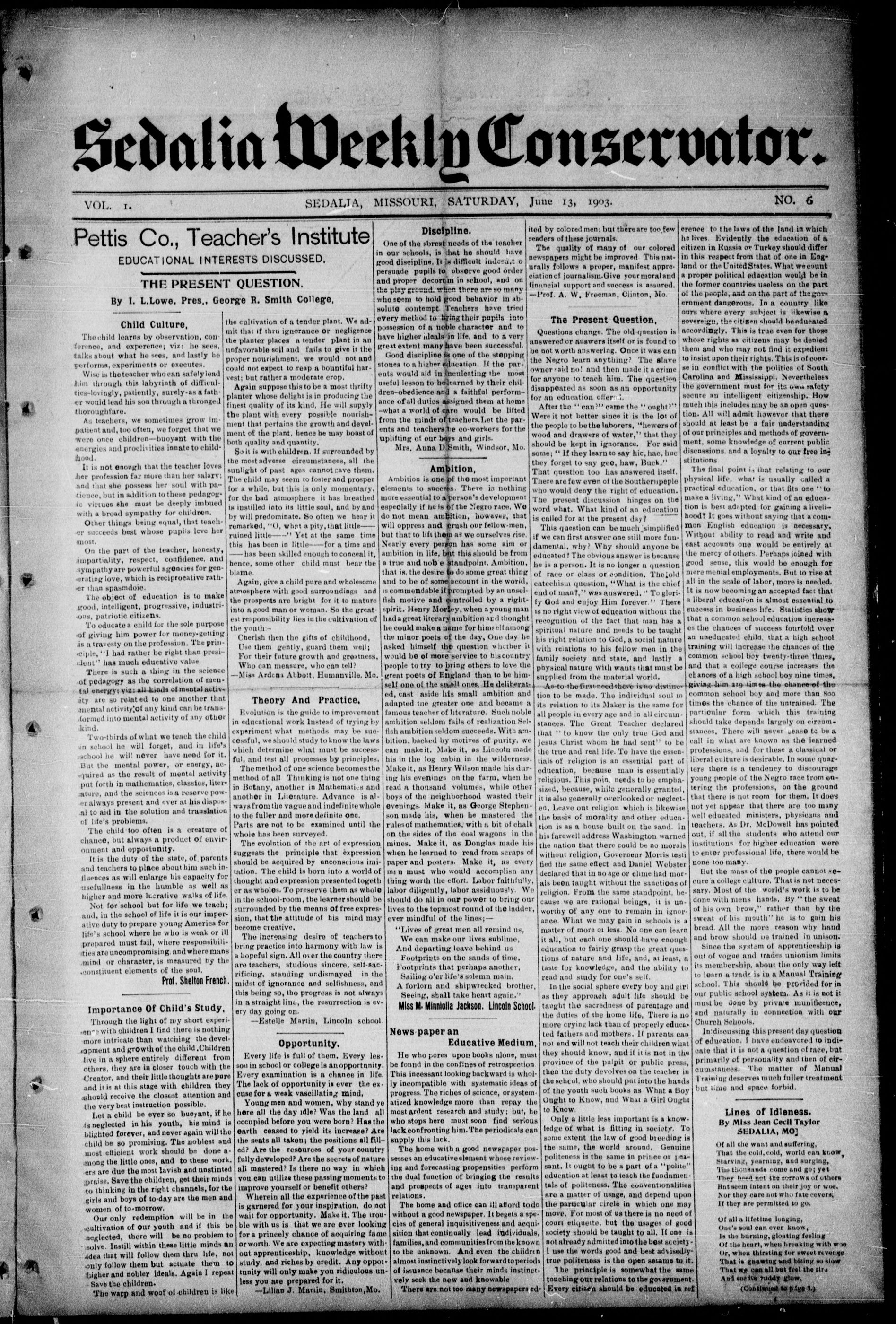
Sedalia Weekly Conservator
Saturday, June 13, 1903
Sedalia, Missouri
Page text (machine-generated)
Sedalia Weekly Conservator.
Pettis Co., Teacher's Institute EDUCATIONAL INTERESTS DISCUSSED.
THE PRESENT QUESTION.
By I. L.Lowe, Pres., George R. Smith College.
Child Culture.
child learns by observation, con- and experience; viz: he sees, but what he sees, and lastly he experiments or executes.
the teacher who can safely lead through this labyrinth of difficul- gly, patiently, surely-as a fath- lead his son through a thronged fare.
others, we sometimes grow im- mind, too often, we forget that we be children—buoyant with the
the cultivation of a tender plant. We admit that if thru ignorance or negligence the planter places a tender plant in an unfavorable soil and fails to give it the proper nourishment, we would not and could not expect to reap a bountiful harvest; but rather a moderate crop.
Again suppose this to be a most thrifty planter whose delight is in producing the finest quality of its kind. He will supply the plant with every possible nourishment that pertains the growth and devel- ment of the plant, hence he may boast of both quality and quantity.
So it is with children. If surrounded by the most adverse circumstances, all the sunlight of past ages cannot cave them. The child may seem to foster and prosper for a while, but this is only momentary, for the bad atmosphere it has breathed is instilled into its little soul, and by and by will predominate. So often we hear it remarked, "O, what a pity, that little—ruined little—" Yet at the same time this has been in little—for a time and has been skilled enough to conceal it, hence, some other child must bear the blame.
Again, give a child pure and wholesome atmosphere with good surroundings and the prospects are bright for it to mature into a good man or woman. So the greatest responsibility lies in the cultivation of the youth.
Cherish then the gifts of childhood, Use them gently, guard them well; For their future growth and greatness, Who can measure, who can tell?
Miss Ardena Abbott, Humanville, Mo.
Theory And Practice.
Evolution is the guide to improvement in educational work Instead of trying by experiment what methods may be successful, we should study to know the laws which determine what must be successful, and test all processes by principles. The method of one science becomes the method of all Thinking is not one thing in Botany, another in Mathematics and another in Literature. Advance is always from the vague and indefinite whole to the fuller and more definite one. Parts are not to be examined until the whole has been surveyed.
The evolution of the art of expression suggests the principle that expression should be acquired by unconscious imitation. The child is born into a world of thought and expression presented together as wholes. To preserve them as whole in the school-room, the learner should be surrounded by the means of free expression, that the attitude of his mind may become creative.
The increasing desire of teachers to bring practice into harmony with law is a hopeful sign. All over the country there are teachers, studious sincere, self-sacrificing, standing undismayed in the midst of ignorance and selfishness, and this being so, the progress is not always in a straight line, the resurrection is every day going on.
—Estelle Martin, Lincoln school.
Every life is full of them. Every lesson in school or college is an opportunity. Every examination is a chance in life. The lack of opportunity is ever the excuse for a weak vascillating mind. Young men and women, why stand ye here all the day idle? Was the land all occupied before you were born? Has the earth ceased to yield its increase? Are the seats all taken; the positions all filled? Are the resources of your country fully developed? Are the secrets of nature all mastered? Is there no way in which you can utilize these passing moments to improve yourself or benefit others?
Wherein all the experience of the past is garnered for your inspiration, do not wait for opportunity. Make it. The trouble with us is that we are ever looking for a princely chance of acquiring fame or worth. We are expecting mastery without apprenticeship, knowledge without study, and riches by credit. Any opportunity will only make you ridiculous unless you are prepared for it.
—Lillian J. Martin, Smithton, Mo.
VOL. 1.
Child Culture.
The child learns by observation, conference, and experience; viz: he sees, talks about what he sees, and lastly he performs, experiments or executes. Wise is the teacher who can safely lead him through this labyrinth of difficulties-lovingly, patiently, surely-as a father would lead his son through a thronged thoroughfare. As teachers, we sometimes grow impatient and, too often, we forget that we were once children—buoyant with the energies and proclivities innate to childhood. It is not enough that the teacher loves her profession far more than her salary; and that she possess her soul with patience, but in addition to these pedagogic virtues she must be deeply imbued with a broad sympathy for children.
Other things being equal, that teacher succeeds best whose pupils love her most.
On the part of the teacher, honesty, impartiality, respect, confidence, and sympathy are powerful agencies for generating love, which is reciprocative rather than spasmodoide.
The object of education is to make good, intelligent, progressive, industrious, patriotic citizens.
To educate a child for the sole purpose of giving him power for money-getting is a travesty on the profession. The principle, "I had rather be right than president," has much educative value.
There is such a thing in the science of pedagogy as the correlation of mental energy; viz: all kinds of mental activity are so related to one another that mental activity of any kind can be transformed into mental activity of any other kind.
Two-thirds of what we teach the child in school he will forget, and in life's school he will never have need for it. But the mental power, or energy, acquired as the result of mental activity put forth in mathematics, classics, literature, and the sciences is a reserve power always present and ever at his disposal to aid in the solution and translation of life's problems.
The child too often is a creature of chance, but always a product of environment and opportunity.
It is the duty of the state, of parents and teachers to place about him such influences as will enlarge his capacity for usefulness in the humble as well as higher and more lucrative walks of life. Not for school but for life we teach; and, in the school of life it is our imperative duty to prepare young America for life's school where he who is weak or ill prepared must fail, where responsibilities are uncompromising and where man's mind or character, is measured by the constituent elements of the soul.
Prof. Shelton French
Importance Of Child's Study.
Through the light of my short experience with children I find there is nothing more intricate than watching the development and growth of the child. Children live in a sphere entirely different from others, they are in closer touch with the Creator, and their little thoughts are pure and it is at this stage with children they should receive the closest attention and the very best instruction possible.
Let a child be ever so buoyant, if he is neglected in his youth, his mind is blighted forever, and never again will the child be so promising. The noblest and most efficient work should be done among the little ones, and to these workers are due the most lavish and unstinted praise. Save the children, get their minds to thinking in the right channels, for the girls and boys of to-day are the men and women of to-morrow.
Our only redemption will be in the cultivation of our youth and if this be neglected, there will be no problem to solve. Instill within these little minds an idea that will follow them thru life, not only follow them but actuate them to higher and nobler ideals. Again I repeat Save the children.
The warp and woof of children is like
SEDALJA, MISSOURI, SATURDAY, June 13, 1903.
Opportunity.
Discipline.
One of the sorest needs of the teacher in our schools, is that he should have good discipline. It is difficult indicat o persuade pupils to observe good order and proper decorum in school, and on the play ground, when there are so many who seem to hold good behavior in absolute contempt. Teachers have tried every method to bring their pupils into possession of a noble character and to have higher ideals in life, and to a very great extent many have been successful.
Good discipline is one of the stepping stones to a higher education. If the parents would aid in inculcating the most useful lesson to be learned by their children-obedience and a faithful performance of all duties assigned them at home-what a world of care would be lifted from the minds of teachers. Let the parents and teachers be co-workers for the uplifting of our boys and girls. Mrs. Anna D Smith, Windsor, Mo.
Ambition.
Ambition is one of the most important elements to success. There is nothing more essential to a person's development especially if he is of the Negro race. We do not mean ambition, however, that will oppress and crush our fellow-men, but that to lift them as we ourselves rise. Nearly every person has some aim or ambition in life, but this should be from a true and noble standpoint. Ambition, that is, the desire to do some great thing and to be of some account in the world, is commendable if prompted by an unselfish motive and controlled by a right-spirit. Henry Morley, when a young man had a great literary ambition and thought he could make a name for himself famong the minor poets of the day, One day he asked himself the question whether it would be of more service to his country people to try to bring others to love the great poets of England than to be himself one of the small ones. He deliberated, cast aside his small ambition and adapted the greater one and became a famous teacher of literature. Such noble ambition seldom fails of realization Selfish ambition seldom succeeds. With ambition, backed by motives of purity, we can make it. Make it, as Lincoln made his in the log cabin in the wilderness. Make it, as Henry Wilson made his during his evenings on the farm, when he read a thousand volumes, while other boys of the neighborhood wasted their evenings. Make it, as George Stephenson made his, when he mastered the rules of mathematics, with a bit of chalk on the sides of the coal wagons in the mines. Make it, as Douglas made his when he learned to read from scraps of paper and posters. Make it, as every man must who would accomplish anything worth the effort. Labor faithfully labor diligently, labor assiduously. We should do all in our power to bring our lives to the topmost round of the ladder ever mindful of the lines:—
"Lives of great men all remind us,
We can make our lives sublime,
And departing leave behind us
Footprints on the sands of time.
Footprints that perhaps another,
Sailing o'er life's solemn main.
A forlorn and shipwrecked brother,
Seeing, shall take heart again."
Miss M. Minnolla Jackson. Lincoln School.
News-paper an
Educative Medium
He who pores upon books alone, must be found in the confines of retrospection. This incessant looking backward is wholly incompatible with systematic ideas of progress. The riches of science, or systematized knowledge more than repay the most ardent research and study; but, he who stops here must soon find serious lack confronting him. The periodicals can supply this lack.
The home with a good newspaper possesses an educative element whose reviewing and forecasting propensities perform the dual function of bringing the results and prospects of ages into transparent relations.
The home and office can ill afford todo without a good newspaper. It begets a species of general inquisitiveness and acquisition that continually lead individuals, families, and communities from the known to the unknown. And even the children almost instinctively look forward to periods of issuance because their minds instinctively seek the new and knowable. There are not too many newspapers ed
ited by colored men; but there are too few readers of these journals. The quality of many of our colored newspapers might be improved. This naturally follows a proper, manifest appreciation of journalism.Give your moral and financial support and success is assured. Prof. A. W. Freeman, Clinton, Mo.
The Present Question
Questions change. The old question is answered or answers itself or is found to be not worth answering. Once it was can the Negro learn anything? The slave owner said no! and then made it a crime for anyone to teach him. The question disappeared as soon as an opportunity for an education offered.
After the "can?" came the "ought?" Were it not better since it is the lot of the people to be the laborers, "hewers of wood and drawers of water," that they should be kept in ignorance. For said some; "If they learn to say hic, haec, huc they forget to say gee, haw, Buck." That question too has answered itself. There are few even of the Southern people who would deny the right of education. The present discussion hinges on the word what. What kind of an education is called for at the present day?
This question can be much simplified if we can first answer one still more fundamental, why? Why should anyone be educated? The obvious answer is because he is a person. It is no longer a question of race or class or condition. The gold catechism question, "What is the chief end of man?" was answered, "To glorify God and enjoy Him forever." There is no right view of education without the recognition of the fact that man has a spiritual nature and needs to be taught his right relation to God, a social nature with relations to his fellow men in the family society and state, and lastly a physical nature with wants that must be supplied from the material world.
As to the first need there is no distinction to be made. The individual soul in its relation to its Maker is the same for all people in every age and in all circumstances. The Great Teacher declared that "to know the only true God and Jesus Christ whom he had sent" to be the true and real life. To have the essentials of religion is an essential part of education, because man is essentially religious. This point, needs to be emphasized, because, while generally granted, it is also generally overlooked or neglected. Leave out religion which is likewise the basis of morality and other education is as a house built on the sand. In his farewell address Washington warned the nation that there could be no morals without religion, Governeur Morris testified the same effect and Daniel Webster declared that in no age or cline had morals been taught without the sanctions of religion. From the same standpoint, because we are rational beings, it is unworthy of any one to remain in ignorance. What we may gain in schools is a matter of more or less. No one can learn it all, but each one should have enough education to fairly grasp the great questions of nature and life, and, at least, a taste for knowledge, and the ability to read and study for one's self.
In the social sphere every boy and girl as they approach adult life should be taught the sacredness of parentage and the duties of the home life. There is no more crying lack than of properly educated fathers and mothers. If parents can not and will not teach their children what they should know, and if it is not in the province of the pulpit or public press, then the duty devolves on the teacher in the school, who should put into the hands of the youth such books as What a Boy Ought to Know, and What a Girl Ought to Know.
Only a little less important is a knowledge of what is fitting in society. To some extent the law of good breeding is the same, the world around. Genuine politeness is the same in prince or peasant. It ought to be a part of a "polite" education at least to teach the fundamentals of politeness. The conventionalities are a matter of usage, and depend upon the particular circle in which one may move. For most of us there is no need of court etiquette, but the usages of good society should be taught to all. If one is not already admitted into the best society I use the words good and best advised true politeness is the open sesame to it. The principle is somewhat the same touching our relations to the government. Every citizen should be educated in ref
NO. 6
erence to the laws of the land in which he lives. Evidently the education of a citizen in Russia or Turkey should differ in this respect from that of one in England or the United States. What we count a proper political education would be in the former countries useless on the part of the people, and on the part of the government dangerous. In a country like ours where every subject is likewise a sovereign, the citizen should headcated accordingly. This is true even for those whose rights as citizens may be denied them and who may not find it expedient to insist upon their rights. This is of course in conflict with the politics of South Carolina and Mississippi. Nevertheless the government must for its own safety secure an intelligent citizenship. How much this includes may be an open question. All will admit however that there should at least be a fair understanding of our principles and methods of government, some knowledge of current public discussions, and a loyalty to our free institutions.
The final point is that relating to our physical life, what is usually called a practical education, or that fits one "to make a living," What kind of an education is best adapted for gaining a livelihood? It goes without saying that a common English education is necessary. Without ability to read and write and cast accounts one would be entirely at the mercy of others. Perhaps joined with good sense, this would be enough for mere mental employments. But to rise at all in the scale of labor, more is needed. It is now becoming an accepted fact that a liberal education is almost essential to success in business life. Statistics show that a common school education increases the chances of success fourfold over an uneducated child, that a high school training will increase the chances of the common school boy twenty-three times, and that a college course increases the chances of a high school boy nine times, giving him 210 times the chance of the common school boy and more than 800 times the chance of the untrained. The particular form which this training should take depends largely on circumstances. There will never cease to be a call in what are known as the learned professions, and for these a classical or liberal culture is desirable. In some quarters there is a tendency to discourage young people of the Negro race from entering the professions, on the ground that there is not room for them. It does not yet appear that there are too many well educated ministers, physicians and teachers. As Dr. McDowell has pointed out, if all the students who attend our institutions for higher education were to enter professional life, there would be none too many.
But the mass of the people cannot secure a college culture. That is not necessary. Most of the world's work is to be done with mens hands. By "the sweat of his own brow," rather than by the sweat of his mouth" he is to gain his bread. All the more reason why hand and brow should be trained in unison. Since the system of apprenticeship is out of vogue and trades unionism limits its membership, about the only way left to learn a trade is in a Manual Training school. This should be provided for in our public school system. As it is not it must be done by private munificence, and naturally in connection with our Church Schools.
In discussing this present day question of education, I have endeavored to indicate that it is not a question of race, but primarily of personality and then of circumstances. The matter of Manual Training deserves much fuller treatment but time and space forbid.
Lines of Idleness.
By Miss Jean Cecil Taylor
SEDALIA, MO]
Of all the want and suffering,
That the cold, cold, world can know,
Starving, yearning, and surging,
The thousands come and go; yet
They head not the sorrows of others
But seem intent on their joy or woe.
Nor they care not who fate cevers.
If they are permitted to go.
Of all a lifetime longing,
One's soul can ever know,
Is the burning, gloating feeling
Of the heart, when breaking with woe
Or, when thirsting for sweet revenge
That is gnawing and biting so slow
That we can all but feel the tire
And see its ruddy glow.
(Continued to page 3.)
This Space Will Notify You When Your Subscription Is Due
Contributions must be accompanied by name as an assurance of good faith.
All articles for publication must be in by Wednesday.
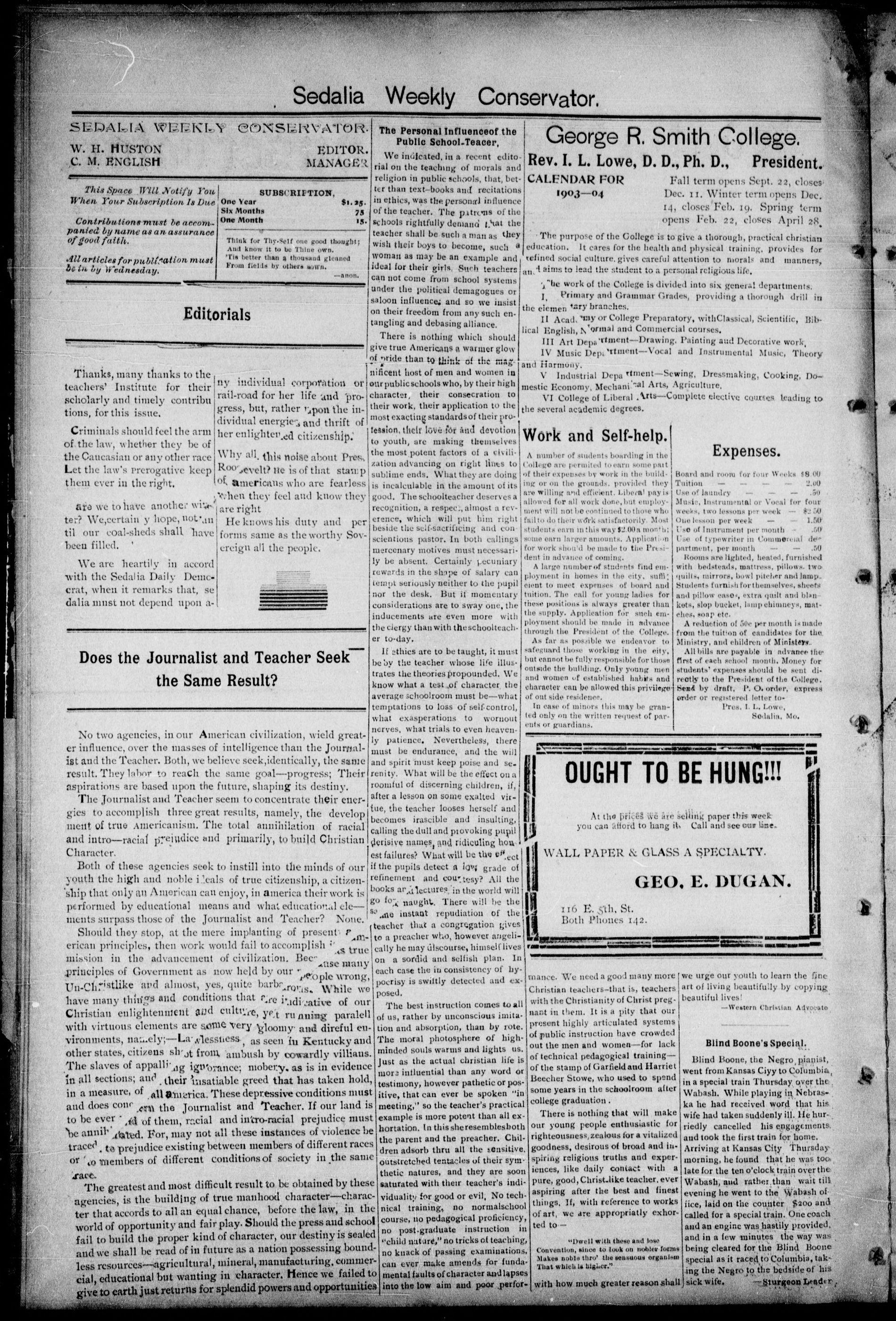
Editorials
Thanks, many thanks to the teachers' Institute for their scholarly and timely contributions, for this issue.
Criminals should feel the arm of the law, whether they be of the Caucasian or any other race Let the law's prerogative keep them ever in the right.
are we to have another winter? We, certain y hope, not, until our coal-sheds shall have been filled.
We are heartily in accord with the Sedalia Daily Democrat, when it remarks that, sedalia must not depend upon a-
Does the Journalist
Does the Journalist and Teacher Seek the Same Result?
Does the Journalist and Teacher Seek the Same Result?
No two agencies, in our American civilization, wield greater influence, over the masses of intelligence than the Journalist and the Teacher. Both, we believe seek,identically, the same result. They labor to reach the same goal—progress; Their aspirations are based upon the future, shaping its destiny. The Journalist and Teacher seem to concentrate their energies to accomplish three great results, namely, the development of true Americanism. The total annihilation of racial and intro—racial prejudice and primarily, to build Christian Character.
Both of these agencies seek to instill into the minds of our youth the high and noble ideals of true citizenship, a citizenship that only an American can enjoy, in america their work is performed by educational means and what educational elements surpass those of the Journalist and Teacher? None.
Should they stop, at the mere implanting of present american principles, then work would fail to accomplish its true mission in the advancement of civilization. Because many principles of Government as now held by our people wrong, Un-Christlike and almost, yes, quite barbarous. While we have many things and conditions that are indicative of our Christian enlightenment and culture, yet running paralell with virtuous elements are some very gloomy and direful environments, namely;—Lawlessness, as seen in Kentucky and other states, citizens shot from ambush by cowardly villains. The slaves of appalling ignorance; mobery, as is in evidence in all sections; and their insatiable greed that has taken hold, in a measure, of all America. These depressive conditions must and does concern the Journalist and Teacher. If our land is to be ever of them, racial and intro-racial prejudice must be annihilated. For, may not all these instances of violence be traced to prejudice existing between members of different races or to members of different conditions of society in the same
The greatest and most difficult result to be obtained by these agencies, is the building of true manhood character—character that accords to all an equal chance, before the law, in the world of opportunity and fair play. Should the press and school fail to build the proper kind of character, our destiny is sealed and we shall be read of in future as a nation possessing boundless resources—agricultural, mineral, manufacturing, commercial, educational but wanting in character. Hence we failed to give to earth just returns for splendid powers and opportunities
SUBSCRIPTION,
One Year $1.25.
Six Months 75.
One Month 15.
One Year $1.25.
Six Months 75
One Month 15.
Think for Thy-Self one good thought;
And know it to be Thine own.
'Tis better than a thousand gleaned
From fields by others sown.
—anon.
ny individual corporation or rail-road for her life and progress, but, rather upon the individual energies and thrift of her enlightened citizenship. Why all. this noise about Pres. Roosevelt? he is of that stamp of americans who are fearless when they feel and know they are right He knows his duty and per forms same as the worthy Sovereign all the people.
and Teacher Seek
Sedalia Weekly Conservator.
EDITOR
MANAGER
```markdown
```
The Personal Influence of the Public School-Teacer.
We indicated, in a recent editorial on the teaching of morals and religion in public schools, that, better than text-books and recitations in ethics, was the personal influence of the teacher. The patrons of the schools rightfully demand that the teacher shall be such a man as they wish their boys to become, such a woman as may be an example and ideal for their girls. Such teachers can not come from school systems under the political demagogues or saloon influence; and so we insist on their freedom from any such entangling and debasing alliance.
There is nothing which should give true Americans a warmer glow of pride than to think of the magnificent host of men and women in our public schools who, by their high character, their consecration to their work, their application to the most exacting standards of their profession, their love for and devotion to youth, are making themselves the most potent factors of a civilization advancing on right lines to sublime ends. What they are doing is incalculable in the amount of its good. The schoolteacher deserves a recognition, a respect, almost a reverence, which will put him right beside the self-sacrificing and conscientious pastor. In both callings mercenary motives must necessarily be absent. Certainly pecuniary rewards in the shape of salary can tempt seriously neither to the pupil nor the desk. But if momentary considerations are to sway one, the inducements are even more with the clergy than with the schoolteacher to-day.
If ethics are to be taught, it must be by the teacher whose life illustrates the theories propounded. We know what a test of character, the average schoolroom must be—what temptations to loss of self-control, what exasperations to wornout nerves, what trials to even heavenly patience. Nevertheless, there must be endurance, and the will and spirit must keep poise and serenity. What will be the effect on a roomful of discerning children, if, after a lesson on some exalted virtue, the teacher looses herself and becomes irascible and insulting, calling the dull and provoking pupil derisive names, and ridiculing honest failures? What will be the effect if the pupils detect a low grade of refinement and courtesy? All the books and lectures in the world will go for a naught. There will be the instant repudiation of the teacher that a congregation gives to a preacher who, however angelically he may discourse, himself lives on a sordid and selfish plan. In each case the in consistency of hy poziess is swiftly detected and exposed.
The best instruction comes to all of us, rather by unconscious imitation and absorption, than by rote. The moral photosphere of high-minded souls warms and lights us. Just as the actual christian life is more influential than any word or testimony, however pathetic or positive, that can ever be spoken "in meeting," so the teacher's practical example is more potent than all exhortation. In this she resembles both the parent and the preacher. Children adsorb thru all the sensitive, outstretched tentacles of their synthetic natures, and they are soon saturated with their teacher's individuality for good or evil. No technical training, no normalschool course, no pedagogical proficiency, no post-graduate instruction in "child nature," no tricks of teaching, no knack of passing examinations can ever make amends for fundamental faults of character and lapses into the low aim and poor perfor-
The purpose of the College is to give a thorough, practical christian education. It cares for the health and physical training, provides for refined social culture, gives careful attention to morals and manners, and aims to lead the student to a personal religious life.
The work of the College is divided into six general departments.
I. Primary and Grammar Grades, providing a thorough drill in the elementary branches.
II Acad. my or College Preparatory, with Classical, Scientific, Biblical English, Normal and Commercial courses.
III Art Department—Drawing. Painting and Decorative work.
III Art Depa rtment—Brewing, Painting and Decorative work.
IV Music Depa rtment—Vocal and Instrumental Music, Theory and Harmony.
V Industrial Depa rtment—Sewing, Dressmaking, Cooking, Domestic Economy, Mechanical Arts, Agriculture.
VI College of Liberal Arts—Complete elective courses leading to the several academic degrees.
OUGHT TO BE HUNG!!!
At the prices we are selling paper this week
you can afford to hang it. Call and see our line.
WALL PAPER & GLASS A SPECIALTY.
GEO, E. DUGAN.
116 E. 5th, St.
Both Phones 142.
Work and Self-help.
A number of students boarding in the College are permitted to earn some part of their expenses by work in the building or on the grounds, provided they are willing and efficient. Liberal pay is allowed for all work done, but employment will not be continued to those who fail to do their work satisfactorily. Most students earn in this way $2.00 a month some earn larger amounts. Application for work should be made to the President in advance of coming.
A large number of students find employment in homes in the city, suffi- cient to meet expenses of board and tuition. The call for young ladies for these positions is always greater than the supply. Application for such employment should be made in advance through the President of the College. As far as possible we endeavor to safeguard those working in the city, but cannot be fully responsible for those outside the building. Only young men and women of established habits and character can be allowed this privilege of out side residence. In case of minors this may be granted only on the written request of parents or guardians.
OUGHT TO
At the prices we are s
you can afford to hang it
WALL PAPER & GLASS
GEO
116 E. 5th, St.
Both Phones 142.
mance. We need a good many more Christian teachers-that is, teachers with the Christianity of Christ pregnant in them. It is a pity that our present highly articulated systems of public instruction have crowded out the men and women—for lack of technical pedagogical training—of the stamp of Garfield and Harriet Beecher Stowe, who used to spend some years in the schoolroom after college graduation.
There is nothing that will make our young people enthusiastic for righteousness, zealous for a vitalized goodness, desirous of broad and inspiring religious truths and experiences, like daily contact with a pure, good, Christ-like teacher, ever aspiring after the best and finest things. If, with reference to works of art, we are appropriatly exhorted to—
"Dwell with these and lose Convention, since to look on nobler forms Makes noble thro' the sensuous organism That which is higher."
with how much greater reason shall
Fall term opens Sept. 22, closes Dec. 11. Winter term opens Dec. 14, closes Feb. 19. Spring term opens Feb. 22, closes April 28.
is to give a thorough, practical christian
health and physical training, provides for
fearful attention to morals and manners,
personal religious life.
divided into six general departments.
Grades, providing a thorough drill in
laboratory, withClassical, Scientific, Bib-
mercial courses.
Ding, Painting and Decorative work,
ical and Instrumental Music, Theory
-Sewing, Dressmaking, Cooking, Do-
ts, Agriculture.
-Complete elective courses leading to
Expenses.
Board and room for four Weeks $8.00
Tuition — — — — — 2.00
Use of laundry — — — — .50
Music, Instrumental or Vocal for four
weeks, two lessons per week — $2.50
One lesson per week — — 1.50
Use of Instrument per month — .50
Use of typewriter in Commercial
department, per month — .50
Rooms are lighted, heated, furnished
with bedsteads, mattress, pillows, two
quilts, mirrors, bowl pitcher and lamp.
Students furnish for themselves, sheets
and pillow cases, extra quilt and
blankets, slop bucket, lamp chimneys, matches, soap etc.
A reduction of 50e per month is made
from the tuition of candidates for the
Ministry, and children of Ministry.
All bills are payable in advance the first of each school month. Money for students' expenses should be sent directly to the President of the College. Send by draft, P. O. order, express order or registered letter to Pres, I. L. Lowe, Sedalja, Mo.
DO BE HUNG!!!
are selling paper this week
ing it. Call and see our line.
ASS A SPECIALTY.
CO. E. DUGAN.
we urge our youth to learn the fine art of living beautifully by copying beautiful lives!
—Western Christian Advocate
Blind Boone's Special.
Blind Boone, the Negro pianist, went from Kansas City to Columbia in a special train Thursday over the Wabash. While playing in Nebraska he had received word that his wife had taken suddenly ill. He hurriedly cancelled his engagements and took the first train for home. Arriving at Kansas City Thursday morning, he found that he was too late for the ten o'clock train over the Wabash, and rather than wait till evening he went to the Wabash office, laid on the counter $200 and called for a special train. One coach and an engine was hastily provided, and in a few minutes the way was being cleared for the Blind Boone special as it raced to Columbia, taking the Negro to the bedside of his sick wife. —Sturgeon Leader
PERSONAL MENTION.
Oh God! In thy high bright heaven,
Forgive, forget, and relieve
These low earth-born prodigals
Who, by praying, wish to receive
Gifts, from thy infinite meadows,
Laurels, for those who believe.
Treasures, for the most worthy
Thou, and thou only, canst give,
Lowly penitents are we,
Submitting our hearts to thy care.
For thou we know will surely see
Earth spot that is rooted there.
FIX our hopes in thee
As a haven, when storms are near.
Safe from the storm-tossed sea,
And its moan so deep and drear.
As the eagle in its flight,
Eer it leaves its mountain evrid,
Eer it soars so high in ether,
Spreads his wings and looks about, nim
God stands, ever watching, waiting,
Guarding oer his erring children,
In the fullness of his glory;
Never tiring, never resting
Man goes forth to daily toll,
And at night on couch enfolded,
Dreaming dreams, now sad, then glad
Dreaming dreams, now good, then bad
First a sigh, next a tear,
Then a glad laugh; Oh how near!
Different scene are passing clear.
Passing by us year by year.
We must halt no; we must rest not;
But this par. drama view,
E'en ta' we part on this stage of action
watch until our life is thru.
Theo we see naught of the curtain
Still we feel it to be here.
This we know is truly certain.
Hands invisible must be near.
If you wish to beautify, straighten, and promote the growth of the hair try Mrs. Jackson's MAGIC HAIR ELIXIR. It will do it. Address, Mrs J W. Jackson, MINNIOLA COTTAGE Sedalia, Mo.
WHEELER and CHAMBERS shaves, hair-cuts and general Tonsorial work done.
Call and see us. 113,East Main street
Paper Hanging.
PLASTERING, PATCHING,
and CALCEMINING.
All work guaranteed. Call and see
me. Wm. Grey, 106E. Pettis.
Mrs. Davis keeps on hand a full
line of hair goods, such as braids,
bangs pompadours.
Also, facebleach and hairpomade.
We solicit your patronage
WRITE For Prices.
D. Y, STEEL,
Popular Tonsorial Artist
Courteous Treatment
Your Trade Solicited.
120 E.Main.
J. M. Harris. M. D.
Physician and Surgeon.
116 W. Main St., Sedalia, Mo.
Office hours 10 to 12 a. m., 4 30 to
6 30 p. m.
Residence, 236, W. Morgan St.
GENERAL TRANSFER
Piano & Furniture Mover
All work done with care at reason
able rates. WARREN CRAIGHEAD
'Phone 406 Residence 617 N. Lamine St.
gWm. M. RICHARDSON.
GENERAL BLACKSMITHING.
HORSE.SHOEING A SPECIALTY.
319 E. Main St. Sedalia, Mo.
Sedalia Weekly Consevator.
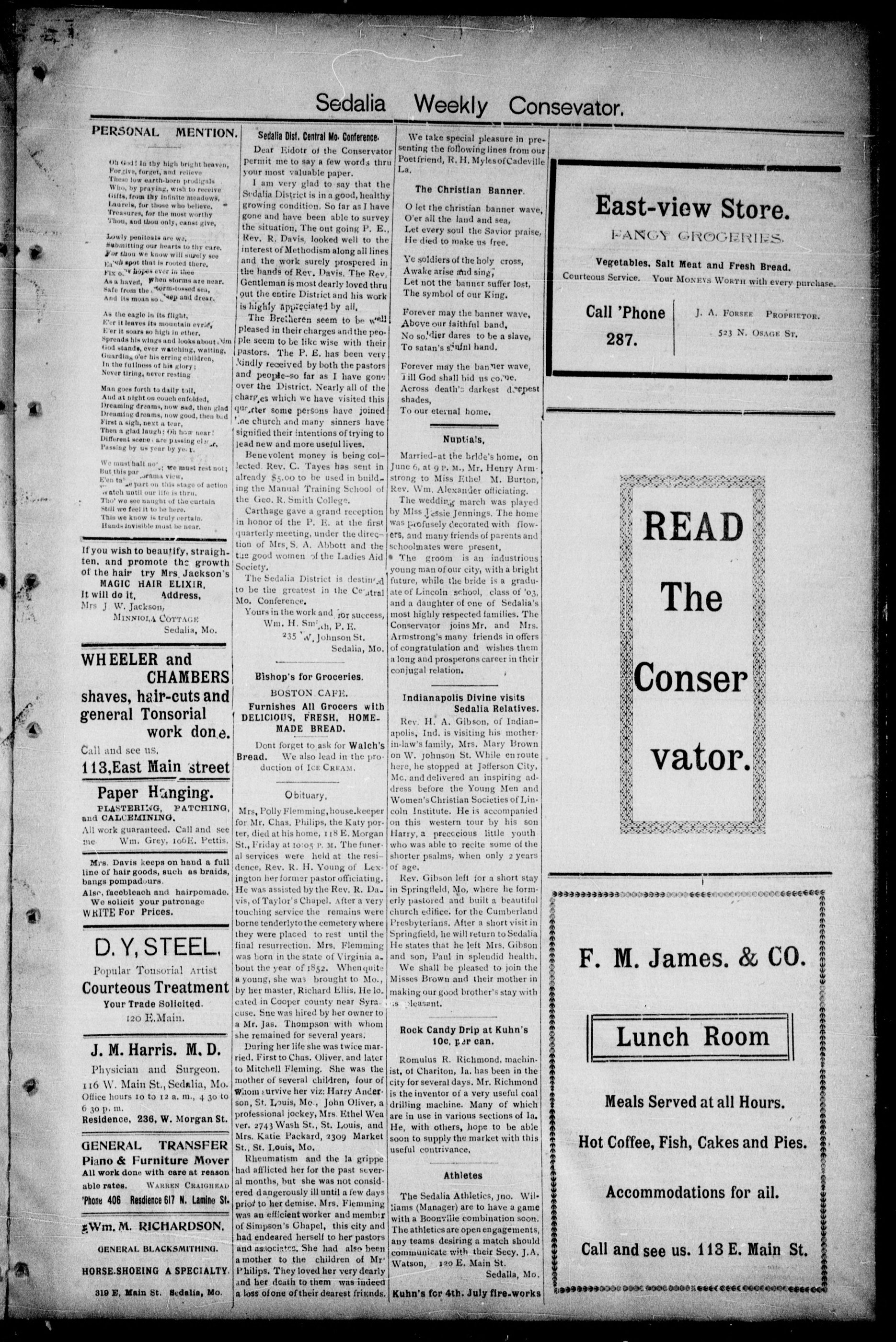
Sedalia Dist. Central Mo. Conference
Dear Eidotr of the Conservator permit me to say a few words thru your most valuable paper.
I am very glad to say that the Sedalia District is in a good, healthy growing condition. So far as I have gone and have been able to survey the situation, The out going P. E., Rev. R. Davis, looked well to the interest of Methodism along all lines and the work surely prospered in the hands of Rev. Davis. The Rev. Gentleman is most dearly loved thru out the entire District and his work is highly appreciated by all.
The Brethren seem to be well pleased in their charges and the people seem to be like wise with their pastors. The P. E. has been very kindly received by both the pastors and people so far as I have gone over the District. Nearly all of the charges which we have visited this quarter some persons have joined the church and many sinners have signified their intentions of trying to lead new and more useful lives.
Benevolent money is being collected. Rev. C. Tayes has sent in already $5.00 to be used in building the Manual Training School of the Geo. R. Smith College. Carthage gave a grand reception in honor of the P. E. at the first quarterly meeting, under the direction of Mrs. S. A. Abbott and the good women of the Ladies Aid Society. The Sedalia District is destined to be the greatest in the Central Mo. Conference.
is in the work and for success,
Wm. H. Smith, P. E.
235 W. Johnson St.
Sedalia, Mo.
Bishop's for Groceries.
Dont forget to ask for Walch's Bread. We also lead in the production of ICE CREAM.
Obituary.
Mrs, Polly Flemming, house-keeper for Mr. Chas, Philips, the Katy porter, died at his home, 118 E. Morgan St., Friday at 10:05 P.M. The funeral services were held at the residence, Rev. R. H. Young of Lexington her former pastor officiating. He was assisted by the Rev. R. Davis, of Taylor's Chapel. After a very touching service the remains were borne tenderly to the cemetery where they were placed to rest until the final resurrection. Mrs. Flemming was born in the state of Virginia about the year of 1852. When quite a young, she was brought to Mo., by her master, Richard Ellis. He located in Cooper county near Syracuse. She was hired by her owner to a Mr. Jas. Thompson with whom she remained for several years.
During her life she was twice married. First to Chas. Oliver, and later to Mitchell Fleming. She was the mother of several children, four of whom survive her viz: Harry Anderson, St. Louis, Mo., John Oliver, a professional jockey, Mrs. Ethel Weaver. 2743 Wash St., St. Louis, and Mrs. Katie Packard, 2309 Market St., St. Louis, Mo.
Rheumatism and the la gippe had afflicted her for the past several months, but she was not considered dangerously ill until a few days prior to her demise. Mrs. Flemming was an efficient worker and member of Simpson's Chapel, this city and had endeared herself to her pastors and associates. She had also been a mother to the children of Mr. Philips. They loved her very dearly and her death to them was indeed a loss of one of their dearest friends.
We take special pleasure in presenting the following lines from our Poetfriend, R. H. Myles of Cadeville La.
The Christian Banner.
O let the christian banner wave,
O'er all the land and sea,
Let every soul the Savior praise,
He died to make us free.
Ye soldiers of the holy cross,
Awake arise and sing,
Let not the banner suffer lost,
The symbol of our King.
Forever may the banner wave,
Above our faithful band,
No soldier dares to be a slave,
To satan's sinful band.
Forever may the banner wave,
Till God shall bid us co-ve.
Across death's darkest d-sepest
shades,
To our eternal home.
Nuptials.
Married-at the bride's home, on June 6, at 9 p. M., Mr. Henry Armstrong to Miss Ethel M. Burton, Rev. Wm. Alexander officiating. The wedding march was played by Miss Jessie Jennings. The home was profusely decorated with flowers, and many friends of parents and schoolmates were present.
The groom is an industrious young man of our city, with a bright future, while the bride is a graduate of Lincoln school, class of '03, and a daughter of one of Sedalia's most highly respected families. The Conservator joins Mr. and Mrs. Armstrong's many friends in offers of congratulation and wishes them a long and prosperous career in their conjugal relation.
Indianapolis Divine visits Sedalia Relatives.
Rev. H. A. Gibson, of Indianapolis, Ind. is visiting his mother-in-law's family, Mrs. Mary Brown on W. Johnson St. While en route here, he stopped at Jafferson City, Mc. and delivered an inspiring address before the Young Men and Women's Christian Societies of Lincoln Institute. He is accompanied on this western tour by his son Harry, a prececious little youth who was able to recite some of the shorter psalms, when only 2 years of age.
Rev. Gibson left for a short stay in Springfield, Mo, where he formerly pastored and built a beautiful church edifice, for the Cumberland Presbyterian. After a short visit in Springfield, he will return to Sedalia He states that he left Mrs. Gibson and son, Paul in splendid health. We shall be pleased to join the Misses Brown and their mother in making our good brother's stay with us pleasant.
Rock Candy Drip at Kuhn's 10c. per can.
Romulus R. Richmond, machinist, of Chariton, Ia. has been in the city for several days. Mr. Richmond is the inventor of a very useful coal drilling machine. Many of which are in use in various sections of Ia. He, with others, hope to be able soon to supply the market with this useful contrivance.
Athletes
The Sedalia Athletics, Jno. Williams (Manager) are to have a game with a Boonville combination soon. The athletics are open engagements, any teams desiring a match should communicate with their Secy. J.A. Watson, 120 E. Main St.
East-view Store.
FANGY GROGERIES. Vegetables. Salt Meat and Fresh Bread. teous Service. Your MONEYS WORTH with every
vegetables. Salt Meat and Fresh Breads Service. Your MONEVS WORTH with every
Vegetables, Salt Meat and Fresh Bread.
Courteous Service. Your MONEYS WORTH with every purchase.
Call 'Phone
287.
J. A. FORSEE PROPRIETOR.
523 N. OSAGE ST.
---
---
READ The Conser vator.
F. M. Ja
Lun
M. James. & CO
Lunch Room
F. M. James. & CO.
Meals Served at all Hours. Hot Coffee, Fish, Cakes and Pi Accommodations for all.
Coffee, Fish, Cakes and Pi Accommodations for all.
Hot Coffee, Fish, Cakes and Pies.
Call and see us. 113 E. Main St.
at and Fresh Bread.
NEYS WORTH with every purch
J. A. FORSEE PROPRIETOR.
523 N. OSAGE ST.
---
es. & CO.
Room
Cakes and Pies. tions for all.
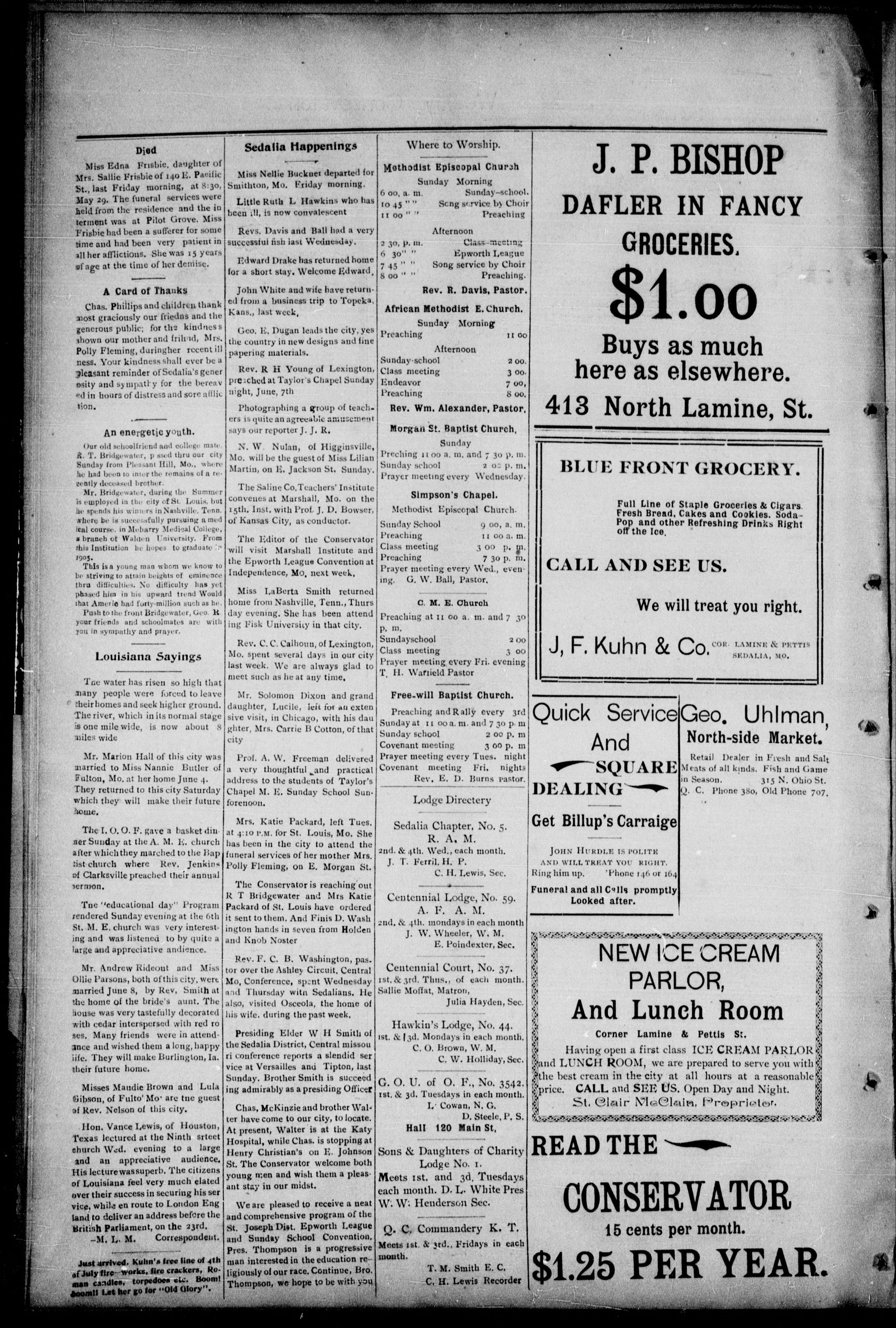
Died
Miss Edna Frisbie, daughter of Mrs. Sallie Frisbie of 140 E. Pacific St., last Friday morning, at 8:30, May 29. The funeral services were held from the residence and the interment was at Pilot Grove. Miss Frisbie had been a sufferer for some time and had been very patient in all her afflictions. She was 15 years of age at the time of her demise.
A Card of Thanks
Chas. Phillips and children thank most graciously our friedns and the generous public; for the kindness shown our mother and frihad, Mrs. Polly Fleming, duringher recent illness. Your kindness shall ever be a pleasant reminder of Sedalia's generosity and sympathy for the bereaved in hours of distress and sore affliction.
An energetic youth.
Our old schoolfriend and college mate, R. T. Bridgewater, pssed thru our city Sunday from Pleasant Hill, Mo., where he had been to inter the remains of a recently deceased brother.
Mr. Bridgewater, during the Summer is employed in the city of St. Louis, but he spends his winters in Nashville, Teen. where he is successfully pursuing a medical course, in Metharry Medical College, a branch of Walden University. From this Institution he hopes to graduate in 1905.
This is a young man whom we know to be striving to attain heights of eminence thru difficulties. No difficulty has yet phased him in his upward trend Would that America had forty-million such as he. Push to the front Bridgewater, Geo. R your friends and schoolmates are with you in sympathy and prayer.
Louisiana Sayings
The water has risen so high that many people were forced to leave their homes and seek higher ground. The river, which in its normal stage is one mile wide, is now about 8 miles wide
Mr. Marion Hall of this city was married to Miss Nannie Butler of Fulton, Mo. at her home June 4. They returned to this city Saturday which they will make their future home.
The I. O. O. F. gave a basket dinner Sunday at the A. M. E. church after which they marched to the Bap list church where Rev. Jenkins of Clarksville preached their annual sermon.
The "educational day" Program rendered Sunday evening at the 6th St. M. E. church was very interesting and was listened to by quite a large and appreciative audience.
Mr. Andrew Rideout and Miss Ollie Parsons, both of this city, were married June 8, by Rev, Smith at the home of the bride's aunt. The house was very tastefully decorated with cedar interspersed with red roses. Many friends were in attendance and wished them a long, happy life. They will make Burlington, Ia. their future home.
Misses Maudie Brown and Lula Gibson, of Fulto' Mo' are the guest of Rev. Nelson of this city.
Hon. Vance Lewis, of Houston, Texas lectured at the Ninth street church Wed. evening to a large and an appreciative audience. His lecture was superb. The citizens of Louisiana feel very much elated over their success in securing his service, while en route to London England to deliver an address before the British Parliament, on the 23rd.
Just arrived. Kuhn's free line of 4th of July fire-works, fire crackers, Roman candles, torpedoes etc. Boom! Boom! Let her go for "Old Glory".
Sedalia Happenings
Miss Nellie Buckner departed for Smithton, Mo. Friday morning.
Little Ruth L Hawkins who has been ill, is now convalescent
Revs. Davis and Ball had a very successful fish last Wednesday.
Edward Drake has returned home for a short stay. Welcome Edward,
John White and wife have returned from a business trip to Topeka, Kans., last week,
Geo. E. Dugan leads the city, yes the country in new designs and fine papering materials.
Rev. R H Young of Lexington, preached at Taylor's Chapel Sunday night, June, 7th
Photographing a group of teachers is quite an agreeable amusement says our reporter J. J. R.
N. W. Nulan, of Higginsville, Mo. will be the guest of Miss Lilian Martin, on E. Jackson St. Sunday.
The Saline Co. Teachers' Institute convenes at Marshall, Mo. on the 15th. Inst. with Prof. J. D. Bowser, of Kansas City, as conductor.
The Editor of the Conservator will visit Marshall Institute and the Epworth League Convention at Independence, Mo. next week.
Miss LaBerta Smith returned home from Nashville, Tenn., Thurs day evening. She has been attend ing Fisk University in that city.
Rev. C. C. Calhoun, of Lexington, Mo. spent several days in our city last week. We are always glad to meet such as he at any time.
Mr. Solomon Dixon and grand daughter, Lucile, left for an extensive visit, in Chicago, with his daughter, Mrs. Carrie B Cotton, of that city
Prof. A. W. Freeman delivered a very thoughtful and practical address to the students of Taylor's Chapel M. E. Sunday School Sunforenoon.
Mrs. Katie Packard, left Tues. at 4:10 P.M. for St. Louis, Mo. She has been in the city to attend the funeral services of her mother Mrs. Polly Fleming, on E. Morgan St.
The Conservator is reaching out R T Bridgewater and Mrs Katie Packard of St. Louis have ordered it sent to them. And Finis D. Washington hands in seven from Holden and Knob Noster
Rev. F. C. B. Washington, pastor over the Ashley Circuit, Central Mo, Conference, spent Wednesday and Thursday with Sedalians. He also, visited Osceola, the home of his wife, during the past week.
Presiding Elder W H Smith of the Sedalia District, Central missouri conference reports a slendid service at Versailles and Tipton, last Sunday. Brother Smith is succeeding admirably as a presiding Officer
Chas, McKinzie and brother Walter have come to our city, to locate. At present, Walter is at the Katy Hospital, while Chas. is stopping at Henry Christian's on E. Johnson St. The Conservator welcome both young men and wish them a pleasant stay in our midst.
We are pleased to receive a neat and comprehensive program of the St. Joseph Dist. Epworth League and Sunday School Convention. Pres. Thompson is a progressive man interested in the education religiously of our race. Continue, Bro. Thompson, we hope to be with you
2 30, p. m. Class-meeting
6 30" " Epworth League
7 45" " Song service by Choir
8 00" " Preaching.
African Methodist E. Church.
Sunday Morning
Preaching 11 00
Afternoon
Sunday-school 2 00.
Class meeting 3 00.
Endeavor 7 00.
Preaching 8 00.
Rev. Wm. Alexander, Pastor.
Morgan St. Baptist Church.
Sunday
Preching 11 00 a. m. and 7 30 p. m.
Sunday school 2 00 p. m.
Prayer meeting every Wednesday.
Simpson's Chapel.
Methodist Episcopal Church.
Sunday School 9 00, a. m.
Preaching 11 00 a. m.
Class meeting 3 00 p. m.
Preaching 7 30 p. m.
Prayer meeting every Wed., evening. G. W. Ball, Pastor.
C. M. E. Church
Preaching at 11 00 a. m. and 7 30 p. m.
Sundayschool 2 00
Class meeting 3 00
Prayer meeting every Fri. evening
T. H. Wartield Pastor
Free-will Baptist Church.
Preaching and Rally every 3rd
Sunday at 11 00 a.m. and 7 30 p.m
Sunday school 2 00 p.m
Covenant meeting 3 00 p.m
Prayer meeting every Tues. night
Covenant meeting Fri. nights
Rev. E. D. Burns pastor.
Lodge Directory
Sedalia Chapter, No. 5.
R. A. M.
2nd. & 4th. Wed., each month.
J. T. Ferril, H. P.
C. H. Lewis, Sec.
Centennial Lodge, No. 59.
A. F. A. M.
2nd. & 4th. mondays in each month
J. W. Wheeler, W. M.
E. Poindexter, Sec.
Centennial Court, No. 37.
1st. & 3rd. Thus., of each month.
Sallie Moffat, Matron,
Julia Hayden, Sec.
Hawkin's Lodge, No. 44.
1st. & 3d. Mondays in each month.
C. O. Brown, W. M.
C. W. Holliday, Sec.
G. O. U. of O. F., No. 3542.
1st. & 3d. Tuesdays in each month.
L. Cowan, N. G.
D. Steele, P. S.
Hall 120 Main St.
Sons & Daughters of Charity
Lodge No. 1.
Meets 1st. and 3d. Tuesdays
each month. D. L. White Pres
W. W: Henderson Sec.
Q. C. Commandery K. T.
Meets 1st. & 3rd., Fridays in each
month.
T. M. Smith E. C.
C. H. Lewis Recorder
Buys as much here as elsewhere.
BLUE FRONT GROCERY.
Full Line of Staple Groceries & Cigars. Fresh Bread, Cakes and Cookies. Soda-Pop and other Refreshing Drinks Right off the Ice.
CALL AND SEE US.
We will treat you right.
J, F. Kuhn & Co.
Quick Service
And
SQUARE
DEALING
Geo.
North
Retail I
Meats of al
in Season.
Q. C. Pho
uhn & Co. COR. LAMINE & PETTIS
SEDALIA, MO.
J, F. Kuhn & Co. COR. LAMINE & PETTIS SEDALIA, MO.
Geo. Uhlman North-side Market.
Retail Dealer in Fresh and Salt Meats of all kinds. Fish and Game in Season. 315 N. Ohio St. Q. C. Phone 380, Old Phone 707.
Get Billup's Carraige
JOHN HURDLE IS POLITE AND WILL TREAT YOU RIGHT. Ring him up. Phone 146 or 164
Funeral and all Cells promptly Looked after.
NEW ICE CREAM PARLOR, And Lunch Room
Corner Lamine & Pettis St. Having open a first class ICE CREAM PARLOR and LUNCH ROOM, we are prepared to serve you with the best cream in the city at all hours at a reasonable price. CALL and SEE US. Open Day and Night. St. Clair McClain, Proprietor.
READ THE