Sedalia Weekly Conservator
Saturday, June 27, 1903
Sedalia, Missouri
Page text (machine-generated)
Sedalia Weekly Conservator.
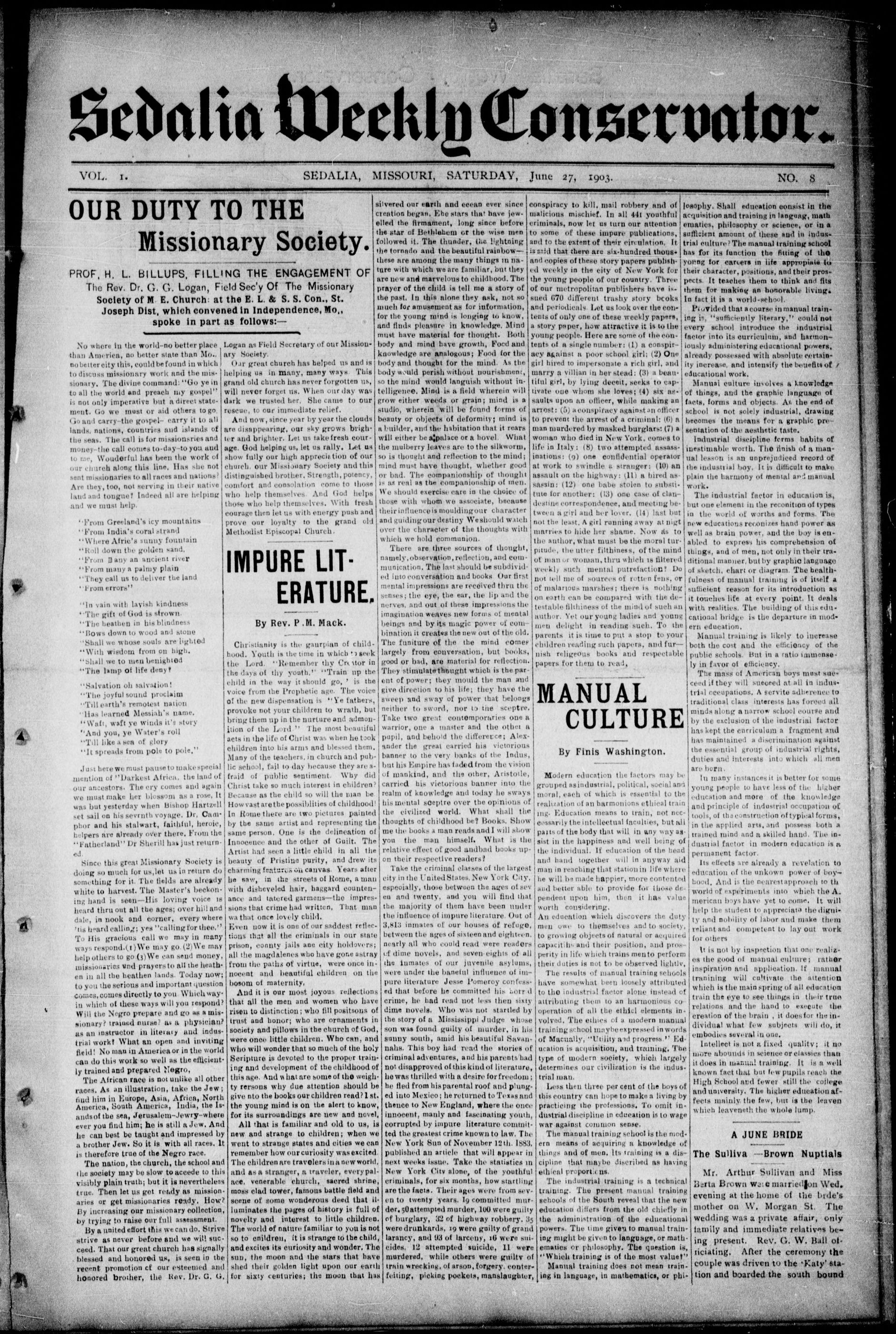
OUR DUTY TO THE Missionary Society.
PROF, H. L. BILLUPS, FILLING THE ENGAGEMENT OF The Rev. Dr. G. G. Logan, Field Sec'y Of The Missionary Society of M. E. Church: at the E. L. & S. S. Con., St. Joseph Dist, which convened in Independence, Mo., spoke in part as follows:—
VOL. 1.
OUR DUTY THE Mission
PROF, H. L. BILLUPS, FILLU
The Rev. Dr. G. G. Logan, Fic
Society of M. E. Church: at
Joseph Dist, which convene
spoke in part a
No where in the world-no better place than America, no better state than Mo., no better city this, could be found in which to discuss missionary work and the missionary. The divine command: "Go ye in to all the world and preach my gospel" is not only imperative but a direct statement. Go we must or aid others to go. Go and carry-the gospel- carry it to all lands, nations, countries and islands of the seas. The call is for missionsries and money-the call comes to-day-to you and to me. Wonderful has been the work of our church along this line. Has she not sent missionaries to all races and nations? Are they, too, not serving in their native land and tongue? Indeed all are helping and we must help.
*From Greeland's icy mountains
*From India's coral strand
*Where Afric's sunny fountain
*Roll down the golden sand.
*From Bany an ancient river
*From many a palmy plain
*They call us to deliver the land
*From errors"
*In vain with layish kindness
*The gift of God is strown.
*The heathen in his blindness
*Bows down to wood and stone
*Shall we whose souls are lighted
*With wisdom from on high.
*Shall we to men benighted
*The lamp of life deny?
"Salvation oh salvation!
"The joyful sound proclaim
"Till earth's remotest nation
"Has learned Messiah's name.
"Waft, waft ye winds it's story
"And you, ye Water's roll
"Till like a sea of glory
"It spreads from pole to pole."
Just here we must pause to make special mention of "Darkest Africa, the land of our ancestors. The cry comes and again we must make her blossom as a rose. It was but yesterday when Bishop Hartzell set sail on his sevrnth voyage. Dr. Camphor and his stalwart, faithful, heroic, helpers are already over there. From the "Fatherland" Dr Sherill has just returned.
Since this great Missionary Society is doing so much for us, let us in return do something for it. The fields are already white to harvest. The Master's beckoning hand is seen—His loving voice is heard thru out all the ages; over hill and dale, in nook and corner, every where 'tis heard calling; yes "'calling for thee." To His gracious call we may in many ways respond. (1) We may go. (2) We may help others to go (3) We can send money, missionaries and prayers to all the heathen in all the heathen lands. Today now, to you the serious and important question comes, comes directly to you. Which way in which of these ways will you respond? Will the Negro prepare and go as a missionary? trained nurse? as a physician? as an instructor in literary and industrial work? What an open and inviting field! No man in America or in the world can do this work so well as the efficiently trained and prepared Negro.
The African race is not unlike all other races. As an illustration, take the Jew; find him in Europe, Asia, Africa, North America, South America, India, the Islands of the sea, Jerusalem-Jewry-where ever you find him; he is still a Jew. And he can best be taught and impressed by a brother Jew. So it is with all races. It is therefore true of the Negro race.
The nation, the church, the school and the society may be slow to accede to this visibly plain truth; but it is nevertheless true. Then let us get ready as missionaries or get missionaries ready. How? By increasing our missionary collection, by trying to raise our full assessment.
By a united effort this we can do. Strive strive as never before and we will succeed. That our great church has signally blessed and honored us, is seen in the recent promotion of our esteemed and honored brother, the Rev. Dr. G. G.
SEDALIA, MISSOURI, SATURDAY, June 27, 1903.
Logan as Field Secretary of our Missionary Society.
Our great church has helped us and is helping us in many, many ways. This grand old church has never forgotten us, will never forget us. When our day was dark we trusted her. She came to our rescue, to our immediate relief.
And now, since year by year the clouds are disappearing, our sky grows brighter and brighter. Let us take fresh courage. God helping us, let us rally. Let us show fully our high appreciation of our church, our Missionary Society and this distinguished brother. Strength, potency, comfort and consolation come to those who help themselves. And God helps those who help themselves. With fresh courage then let us with energy push and prove our loyalty to the grand old Methodist Episcopal Church.
IMPURE LITERATURE.
By Rev. P.M. Mack.
Christianity is the gaurpian of childhood. Youth is the time in which to seek the Lord. "Remember thy Crutator in the days of thy youth," "Train up the child in the way it should go," is the voice from the Prophetic age. The voice of the new dispensation is "Ye fathers, provoke not your children to wrath, but bring them up in the nurture and admonition of the Lord." The most beautiful acts in the life of Christ was when he took children into his arms and blessed them. Many of the teachers, in church and public school, fail to day because they are afraid of public sentiment. Why did Christ take so much interest in children? Because as the child so will the man be. How vast are the possibilities of childhood! In Rome there are two pictures painted by the same artist and representing the same person. One is the delineation of Innocence and the other of Guilt. The Artist had seen a little child in all the beauty of Pristine purity, and drew its charming features on canvas. Years after he saw, in the streets of Rome, a man with disheveled hair, haggard countenance and tattered garments—the impressions that crime had written. That man wa that once lovely child.
Even now it is one of our saddest reflections that all the criminals in our state prison, county jails are city holdovers; all the magdalenes who have gone astray from the paths of virtue, were once innocent and beautiful children on the bosom of maternity.
And it is our most joyous reflections that all the men and women who have risen to distinction; who fill positions of trust and honor; who are ornaments in society and pillows in the church of God, were once little children. Who can, and who will wonder that so much of the holy Scripture is devoted to the proper training and development of the childhood of this age. And what are some of the weighty rersons why due attention should be give into the books our children read? I st. the young mind is on the alert to know, for its surroundings are new and novel,
All that is familiar and old to us, is new and strange to children; when we went to strange states and cities we can remember how our curiosity was excited. The children are travelers in a new world, and as a stranger, a traveler, every palace, venerable church, sacred shrine, moss clad tower, famous battle field and scene of some wonderous deed that illuminates the pages of history is full of novelty and interest to little children. The world of nature familiar to you is not so to children, it is strange to the child, and excites its curiosity and wonder. The sun, the moon and the stars that have shed their golden light upon our earth for sixty centuries; the moon that has
silvered our earth and ocean ever since creation began. Ebe stars that have jeweled the firmament, long since before the star of Bethlehem or the wise men followed it. The thunder, the lightning the tornado and the beautiful rainbow—these are among the many things in nature with which we are familiar, but they are new and marvelous to childhood. The prayer of the child is tell me a story of the past. In this alone they ask, not so much for amusement as for information, for the young mind is longing to know, and finds pleasure in knowledge. Mind must have material for thought. Both body and mind have growth, Food and knowledge are analogous; Food for the body and thought for the mind. As the body would perish without nourishment, so the mind would languish without intelligence. Mind is a field wherein will grow either weeds or grain; mind is a studio, wherein will be found forms of beauty or objects of deformity; mind is a builder, and the habitation that it rears will either be a palace or a hovel. What the mulberry leaves are to the silkworm, so is thought and reflection to the mind; mind must have thought, whether good or bad. The companionship of thought is as real as the companionship of men. We should exercise care in the choice of those with whom we associate, because their influence is moulding our character and guiding our destiny Weshould watch over the character of the thoughts with which we hold communion.
There are three sources of thought, namely, observation, reflection, and communication. The last should be subdivided into conversation and books. Our first mental impressions are received thru the senses; the eye, the ear, the lip and the nerves, and out of these impressions the imagination weaves new forms of mental beings and by its magic power of combination it creates the new out of the old. The furniture of the the mind comes largely from conversation, but books, good or bad, are material for reflection. They stimulate thought which is the parent of power; they mould the man and give direction to his life; they have the sweep and sway of power that belongs neither to sword, nor to the sceptre. Take two great contemporaries one a warrior, one a master and the other a pupil, and behold the difference; Alexander the great carried his victorious banner to the very banks of the Indus, but his Empire has faded from the vision of mankind, and the other, Aristotle, carried his victorious banner into the realm of knowledge and today he swails his mental sceptre over the opinions of the civilized world. What shall the thoughts of childhood be? Books. Show me the books a man reads and I will show you the man himself. What is the relative effect of good and bad books upon their respective readers?
Take the criminal classes of the largest city in the United States, New York City, especially, those between the ages of seven and twenty, and you will find that the majority of them have been under the influence of impure literature. Out of 3,813 inmates of our houses of refuge, between the ages of sixteen and eighteen, nearly all who could read were readers of dime novels, and seven-eights of all the inmates of our juvenile asylums, were under the banetal influence of impure literature Jesse Pomeroy confessed that before he committed his horrified crime, he had read not less then sixty dime novels. Who was not startled by the story of a Mississippi Judge whose son was found guilty of murder, in his sunny south, amid his beautiful Savannahs. This boy had read the stories of criminal adventures, and his parents had not disapproved of this kind of literature, he was thrilled with a desire for freedom; he fled from his parental roof and plunged into Mexico; he returned to Texas and thence to New England, where the once innocent, manly and fascinating youth, corrupted by impure literature committed the greatest crime known to law. The New York Sun of November 12th, 1883, published an article that will appear in next weeks issue. Take the statistics in New York City alone, of the youthful criminals, for six months, how startling are the facts. Their ages were from seven to twenty years. 19 committed murder, 50 attempted murder, 100 were guilty of burglary, 32 of highway robbery, 39 were drunkards, 19 were guilty of grand larceny, and 93 of larceny, 16 were suicides. 12 attempted suicide, 11 were murdered, while others were guilty of train wrecking, of arson, forgery, contefiting, picking pockets, manslaughter
conspiracy to kill, mail robbery and of malicious mischief. In all 441 youthful criminals, now let us turn our attention to some of these impure publications, and to the extent of their circulation. It is said that there are six-hundred thousand and copies of these story papers published weekly in the city of New York for the young people of our country. Three of our metropolitan publishers have issued 670 different trashy story books and periodicals. Let us look over the contents of only one of these weekly papers, a story paper, how attractive it is to the young people. Here are some of the contents of a single number: (1) a conspiracy against a poor school girl; (2) One girl hired to impersonate a rich girl, and marry a villian in her stead; (3) a beautiful girl, by lying deceit, seeks to captivate one whom she loves; (4) six assaults upon an officer, while making an arretr; (5) a conspiracy against an officer to prevent the arrest of a criminal; (6) a man murdered by masked burglars; (7) a woman who died in New York, comes to life in Italy; (8) two attempted assassinations; (9) one confidential operator at work to swindle a stranger; (10) an assault on the highway; (11) a hired assassin; (12) one babe stolen to substitute for another; (13) one case of clandestine correspondence, and meeting between a girl and her lover. (14) last but not the least. A girl running away at night marries to hide her shame. Now as to the author, what must be the moral turpitude, the utter filthiness, of the mind of man or woman, thus which is filtered weekly such mental putrefaction? Do not tell me of sources of rotten fens, or of malarious marshes; there is nothing on earth can be compared with the detestable filthiness of the mind of such an author. Yet our young ladies and young men delight in reading such. To the parents it is time to put a stop to your children reading such papers, and furnish religious books and respectable papers for them to read,
MANUAL CULTURE
By Finis Washington.
Modern education the factors may be grouped as industrial, political, social and moral, each of which is essential to the realization of an harmonious ethical training. Education means to train, not necessarily the intellectual faculties, but all parts of the body that will in any way assist in the happiness and well being of the individual. If education of the head and hand together will in any way aid man in reaching that station in life where he will be made happier, more contented and better able to provide for those dependent upon him, then it has value worth considering.
An education which discovers the duty men owe to themselves and to society, to growing objects of natural or acquired capacities and their position, and prosperity in life which trains men to perform their duties is not to be observed lightly. The results of manual training schools have somewhat been loosely attributed to the industrial factor alone instead of attributing them to an harmonious cooperation of all the ethic elements involved. The ethics of a modern manual training school may be expressed in words of Macqually, "Utility and progress." Education is acquisition, and training. The type of modern society, which largely determines our civilization is the industrial man.
Less then three per cent of the boys of this country can hope to make a living by practicing the professions. To omit industrial discipline in education is to wage war against common sense. The manual training school is the modern means of acquiring a knowledge of things and of men. Its training is a discipline that maybe described as having ethical proportions.
The industrial training is a technical training. The present manual training schools of the South reveal that the new education differs from the old chiefly in the administration of the educational powers. The time given to manual training might be given to language, or mathematics or philosophy. The question is, "Which training is of the most value?" Manual training does not mean training in language, in mathematics, or phi-
NO. 8
losophy. Shall education consist in the acquisition and training in language, math ematics, philosophy or science, or in a sufficient amount of these and in industrial culture? The manual training school has for its function the fitting of the young for careers in life appropriate to their character, positions, and their prospects. It teaches them to think and fits them for making an honorable living. In fact it is a world-school.
Provided that a course in manual training is, "sufficiently literary," could not every school introduce the industrial factor into its curriculum, and harmoniously administering educational powers, already possessed with absolute certainty increase, and intensify the benefits of educational work.
Manual culture involves a knowledge of things, and the graphic language of facts, forms and objects. As the end of school is not solely industrial, drawing becomes the means for a graphic presentation of the aesthetic taste. Industrial discipline forms habits of inestimable worth. The finish of a manual lesson is an unprejudiced record of the industrial boy. It is difficult to make plain the harmony of mental and manual work.
The industrial factor in education is, but one element in the reconition of types in the world of worths and forms. The new educations reconizes hand power as well as brain power, and the boy is enabled to express his comprehension of things, and of men, not only in their traditional manner, but by graphic language of sketch, chart or diagram. The healthfulness of manual training is of itself a sufficient reason for its introduction as it touches life at every point. It deals with realities. The building of this educational bridge is the departure in modern education.
Manual training is likely to increase both the cost and the efficiency of the public schools. But in a ratio immensely in favor of efficiency.
The mass of American boys must succeed if they will succeed at all in industrial occupations. A servite adherence to traditional class interests has forced all minds along a narrow school course and by the exclusion of the industrial factor has kept the curriculum a fragment and has maintained a discrimination against the essential group of industrial rights, duties and interests into which all men are born. In many instances it is better for some young people to have less of the higher education and more of the knowledge and principle of industrial occupation of tools, of the construction of typical forms, in the applied arts, and possess both a trained mind and a skilled hand. The industrial factor in modern education is a permanent factor.
Its effects are already a revelation to education of the unkown power of boyhood. And is the nearest approach to the world of experiments into which the American boys have yet to come. It will help the student to appreciate the dignity and nobility of labor and make them reliant and competent to lay out work for others.
It is not by inspection that one realizes the good of manual culture; rather inspiration and application. If manual training will cultivate the attention which is the main spring of all education train the eye to see things in their true relations and the hand to execute the creation of the brain, it does for the individual what few subjects will do, it embodies several in one.
Intellect is not a fixed quality; it no more abounds in science or classies than it does in manual training. It is a well known fact that but few pupils reach the High School and fewer still the college and university. The higher education affects mainly the few, but is the leaven which leaventh the whole lump.
A JUNE BRIDE
The Sulliva —Brown Nuptials
Mr. Arthur Sullivan and Miss Berta Brown were married on Wed. evening at the home of the bride's mother on W. Morgan St. The wedding was a private affair, only family and immediate relatives being present. Rev. G. W. Ball officiating. After the ceremony the couple was driven to the 'Katy' station and boarded the south bound
SEDALIA WEEKLY CONSERVATOR.
Published Every Saturday. Office, Room 13 G. R. Smith College
Application for second class mail rates filed, June 16, '03
This Space Will Notify You When Your Subscription Is Due
Contributions must be accompanied by name as an assurance of good faith.
All articles for publication must be in by Wednesday.
Editorials
A Thoughtful Leadership Asserting Itself.
A Thoughtful Leadership Asserting Itself.
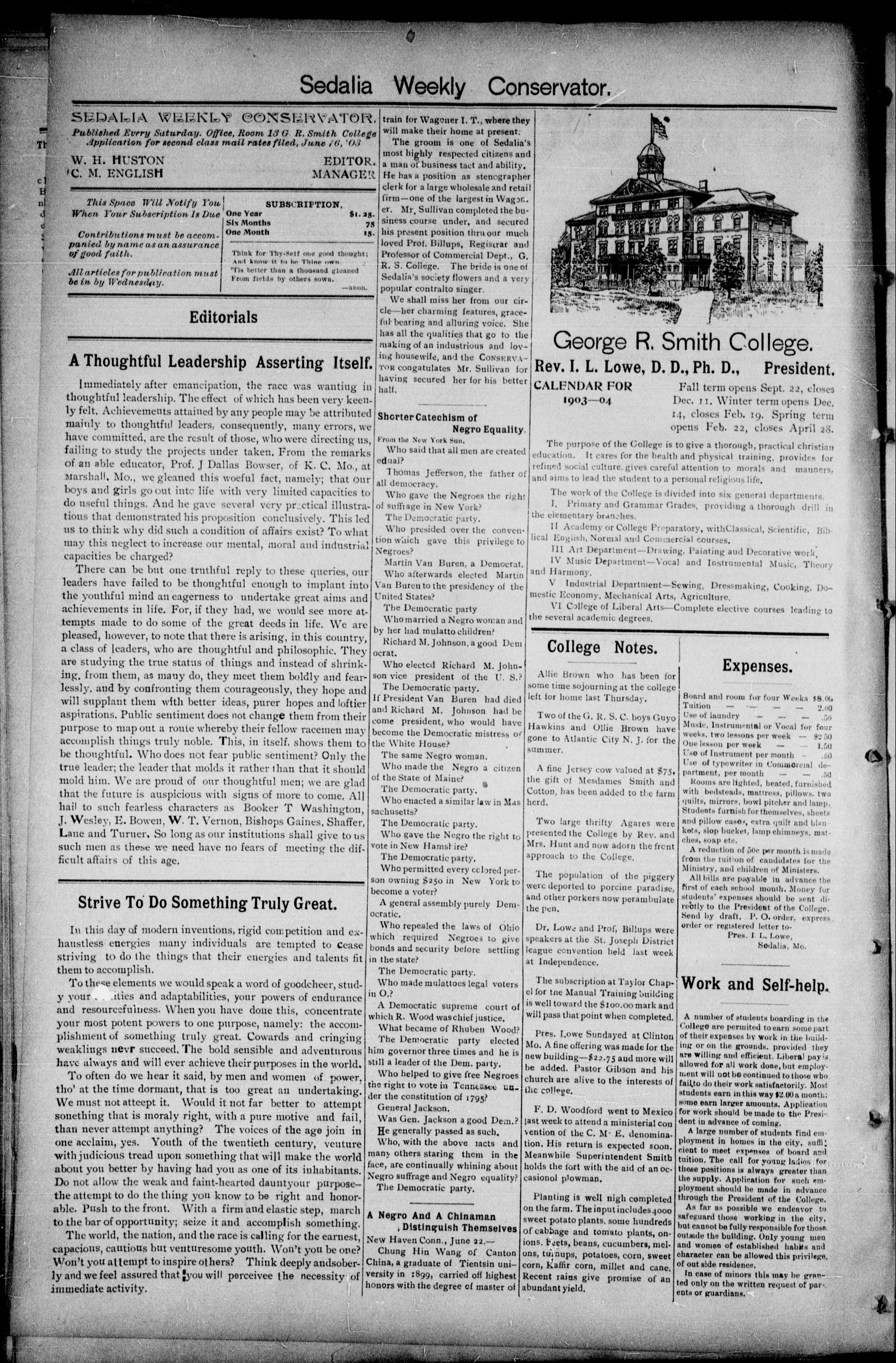
Immediately after emancipation, the race was wanting in thoughtful leadership. The effect of which has been very keenly felt. Achievements attained by any people may be attributed mainly to thoughtful leaders, consequently, many errors, we have committed, are the result of those, who were directing us, failing to study the projects under taken. From the remarks of an able educator, Prof. J Dallas Bowser, of K. C. Mo., at Marshall, Mo., we gleaned this woeful fact, namely; that our boys and girls go out into life with very limited capacities to do useful things. And he gave several very practical illustrations that demonstrated his proposition conclusively. This led us to think why did such a condition of affairs exist? To what may this neglect to increase our mental, moral and industrial capacities be charged?
There can be but one truthful reply to these queries, our leaders have failed to be thoughtful enough to implant into the youthful mind an eagerness to undertake great aims and achievements in life. For, if they had, we would see more attempts made to do some of the great deeds in life. We are pleased, however, to note that there is arising, in this country, a class of leaders, who are thoughtful and philosophic. They are studying the true status of things and instead of shrinking, from them, as many do, they meet them boldly and fearlessly, and by confronting them courageously, they hope and will supplant them with better ideas, purer hopes and loftier aspirations. Public sentiment does not change them from their purpose to map out a route whereby their fellow racemen may accomplish things truly noble. This, in itself, shows them to be thoughtful. Who does not fear public sentiment? Only the true leader; the leader that molds it rather than that it should mold him. We are proud of our thoughtful men; we are glad that the future is auspicious with signs of more to come. All hail to such fearless characters as Booker T Washington, J. Wesley, E. Bowen, W. T. Vernon, Bishops Gaines, Shaffer, Lane and Turuer. So long as our institutions shall give to us such men as these we need have no fears of meeting the difficult affairs of this age.
Strive To Do Something Truly Great.
In this day of modern inventions, rigid competition and exhaustless energies many individuals are tempted to cease striving to do the things that their energies and talents fit them to accomplish.
To these elements we would speak a word of goodcheer, study your cities and adaptabilities, your powers of endurance and resourcefulness. When you have done this, concentrate your most potent powers to one purpose, namely: the accomplishment of something truly great. Cowards and cringing weaklings nevr succeed. The bold sensible and adventurous have always and will ever achieve their purposes in the world.
To often do we hear it said, by men and women of power, tho' at the time dormant, that is too great an undertaking. We must not attept it. Would it not far better to attempt something that is moraly right, with a pure motive and fail, than never attempt anything? The voices of the age join in one acclaim, yes. Youth of the twentieth century, venture with judicious tread upon something that will make the world about you better by having had you as one of its inhabitants. Do not allow the weak and faint-hearted dauntyour purpose—the attempt to do the thing you know to be right and honorable. Push to the front. With a firm and elastic step, march to the bar of opportunity; seize it and accomplish something. The world, the nation, and the race is calling for the earnest, capacious, cautious but venturesome youth. Won't you be one? Won't you attempt to inspire others? Think deeply and soberly and we feel assured that you will perceive the necessity of immediate activity.
W. H. HUSTON
C. M. ENGLISH
SUBSCRIPTION,
One Year $1.25.
Six Months 75
One Month 15.
Think for Thy-Self one good thought;
And know it to be Thine own.
"Tis better than a thousand gleaned
From fields by others sown.
Sedalia Weekly Conservator.
EDITOR
MANAGER
train for Wagoner I. T., where they will make their home at present:
The groom is one of Sedalia's most highly respected citizens and a man of business tact and ability. He has a position as stenographer clerk for a large wholesale and retail firm—one of the largest in Wagoner. Mr. Sullivan completed the business course under, and secured his present position thru our much loved Prof. Billups, Registrar and Professor of Commercial Dept., G. R. S. College. The bride is one of Sedalia's society flowers and a very popular contralto singer.
We shall miss her from our circle—her charming features, graceful bearing and alluring voice. She has all the qualities that go to the making of an industrious and loving housewife, and the CONSERVATOR congatulates Mr. Sullivan for having secured her for his better half.
Shcrter Catechism of
Negro Equality.
From the New York Sun.
Who said that all men are created
edual?
Thomas Jefferson, the father of
all democracy.
Who gave the Negroes the right
of suffrage in New York?
The Democratic party.
Who presided over the convent
ion which gave this privilege to
Negroes?
Martin Van Buren, a Democrat.
Who afterwards elected Martin
Van Buren to the presidency of the
United States?
The Democratic party
Who married a Negro woman and
by her had mulatto children?
Richard M. Johnson, a good Democrat. Who elected Richard M. Johnson vice president of the U. S. The Democratic party.
The Democratic party.
If President Van Buren had died and Richard M. Johnson had be come president, who would have become the Democratic mistress of the White House?
The same Negro woman.
Who made the Negro a citizen of the State of Maine?
The Democratic party.
Who enacted a similar law in Mass
sachusetts?
The Democratic party.
Who gave the Negro the right to
vote in New Hamshire?
The Democratic party.
Who permitted every colored person owning $250 in New York to
become a voter?
A general assembly purely Democratic.
Who repealed the laws of Ohio
which required Negroes to give
bonds and security before settling
in the state?
The Democratic party.
Who made mulattoes legal voters in O.?
A Democratic supreme court of which R. Wood was chief justice.
What became of Rhuben Wood?
The Democratic party elected him governor three times and he is still a leader of the Dem. party.
Who helped to give free Negroes the right to vote in Tennessee under the constitution of 1795?
General Jackson.
Was Gen. Jackson a good Dem.?
He generally passed as such.
Who, with the above facts and many others staring them in the face, are continually whining about Negro suffrage and Negro equality?
The Democratic party.
A Negro And A Chinaman
New Haven Conn., June 22. Chung Hin Wang of Canton China, a graduate of Tientsin university in 1899, carried off highest honors with the degree of master of
HARVARD HIGH SCHOOL
The purpose of the College is to give a thorough, practical christian education. It cares for the health and physical training, provides for refined social culture, gives careful attention to morals and manners, and aims to lead the student to a personal religious life.
The work of the College is divided into six general departments.
I. Primary and Grammar Grades, providing a thorough drill in the elementary branches.
II. Academy or College Preparatory, withClassical, Scientific, Biblical English, Normal and Commercial courses.
III. Art Department—Drawing, Painting and Decorative work.
IV Music Department—Vocal and Instrumental Music, Theory and Harmony.
V Industrial Department—Sewing, Dressmaking, Cooking, Domestic Economy, Mechanical Arts, Agriculture.
VI College of Liberal Arts—Complete elective courses leading to the several academic degrees.
College Notes.
Allie Brown who has been for some time sojourning at the college left for home last Thursday.
Two of the G. R. S. C. boys Guyo Hawkins and Ollie Brown have gone to Atlantic City N. J. for the summer.
A fine Jersey cow valued at $75, the gift of Mesdames Smith and Cotton, has been added to the farm herd.
Two large thrifty Agares were presented the College by Rev. and Mrs. Hunt and now adorn the front approach to the College.
The population of the piggery were deported to porcine paradise, and other porkers now perambulate the pen.
Dr. Lowe and Prof. Billups were speakers at the St. Joseph District league convention held last week at Independence.
The subscription at Taylor Chapel for the Manual Training building is well toward the $100.00 mark and will pass that point when completed.
Pres. Lowe Sundayed at Clinton Mo. A fine offering was made for the new building—$22.75 and more will be added. Pastor Gibson and his church are alive to the interests of the college.
F. D. Woodford went to Mexico last week to attend a ministerial convention of the C. M· E. denomination. His return is expected soon. Meanwhile Superintendent Smith holds the fort with the aid of an occasional plowman.
Planting is well nigh completed on the farm. The input includes 4000 sweet potato plants, some hundreds of cabbage and tomato plants, onions. Feets, beans, cucumbers, melons, turnups, potatoes, corn, sweet corn, Kaffir corn, millet and cane. Recent rains give promise of an abundant yield.
Fall term opens Sept. 22, closes Dec. 11. Winter term opens Dec. 14, closes Feb. 19. Spring term opens Feb. 22, closes April 28.
as to give a thorough, practical christian health and physical training, provides for ful attention to morals and manners, personal religious life.
divided into six general departments.
Grades, providing a thorough drill in
diparatory, withClassical, Scientific, Bib-
mercial courses.
Painting, Painting and Decorative work,
ical and Instrumental Music, Theory
-Sewing, Dressmaking, Cooking, Do-
s, Agriculture.
-Complete elective courses leading to
Expenses.
Board and room for four Weeks $8.00
Tuition — — — — 2.00
Use of laundry — — — .50
Music, Instrumental or Vocal for four
weeks, two lessons per week — $2.50
One lesson per week — 1.50
Use of Instrument per month — .50
Use of typewriter in Commercial
department, per month — .50
Rooms are lighted, heated, furnished
with bedsteads, mattress, pillows, two
quilts, mirrors, bowl pitcher and lamp.
Students furnish for themselves, sheets
and pillow cases, extra quilt and blankets, slop bucket, lamp chimneys, matches, soap etc.
A reduction of 50c per month is made
from the tuition of candidates for the
Ministry, and children of Ministers.
All bills are payable in advance the first of each school month. Money for students' expenses should be sent directly to the President of the College. Send by draft, P. O. order, express order or registered letter to Pres. I. L. Lowe, Sedalia, Mo.
Work and Self-help.
A number of students boarding in the College are permitted to earn some part of their expenses by work in the building or on the grounds. provided they are willing and efficient. Liberal pay is allowed for all work done, but employment will not be continued to those who fail to do their work satisfactorily. Most students earn in this way $2.00 a month; some earn larger amounts. Application for work should be made to the President in advance of coming.
A large number of students find employment in homes in the city, sufficient to meet expenses of board and tuition. The call for young ladies for these positions is always greater than the supply. Application for such employment should be made in advance through the President of the College.
As far as possible we endeavor to safeguard those working in the city, but cannot be fully responsible for those outside the building. Only young men and women of established habits and character can be allowed this privilege, of out side residence.
In case of minors this may be granted only on the written request of parents or guardians.
If you wish to beautify, straighten, and promote the growth of the hair try Mrs. Jackson's MAGIC HAIR ELIXIR. It will do it. Address, Mrs J W. Jackson, MINNOLA COTTAGE Sedalia, Mo.
WHEELER and CHAMBERS shaves, hair-cuts and general Tonsorial work done.
Call and see us. 113,East Main street
Paper Hanging.
PLASTERING, PATCHING, and CALCEMINING.
All work guaranteed. Call and see me Win. Grey, 106E. Pettis.
Mrs. Davis keeps on hand a full line of hair goods, such as braids, bangs pompadours.
Also, facebleach and hairpomade. We solicit your patronage WRITE For Prices.
D. Y, STEEL.
Popular Tonsorial Artist
Courteous Treatment
Your Trade Solicited.
120 E.Main.
J. M. Harris. M. D.
Physician and Surgeon. 116 W. Main St., Sedalia, Mo. Office hours 10 to 12 a. m., 4 30 to 6 30 p. m. Residence. 236. W. Morgan St.
GENERAL TRANSFER
Piano & Furniture Mover
All work done with care at reason
able rates. WARREN CRAIGHEAD
'Phone 406 Resdience 617 N. Lamine St.
zWm. M. RICHARDSON.
GENERAL BLACKSMITHING.
HORSE-SHOEING A SPECIALTY
319 E, Main St. Sedalia, Mo.
Quick Service And SQUARE DEALING Get Billup's Carraige
JOHN HURDLE IS POLITE AND WILL TREAT YOU RIGHT. Ring him up. Phone 146 or 164 Funeral and all Calls promptly Looked after.
PERSONAL MENTION.
Ye Editor is out of town for a few days, in interest of the CONSERVATOR
Mr. A. L. Sullivan couse in Mon morning to visit his mother etc.
Miss Maud Cravens, of Fayette, Mo. passed thru from independence to her home Sunday night.
Henry Abell, caller for the Mo. Pac. at Jefferson City, visited home and friends last week,
James Woods, our special delivery clerk at the P. O., has been sojourning in St. Louis
---
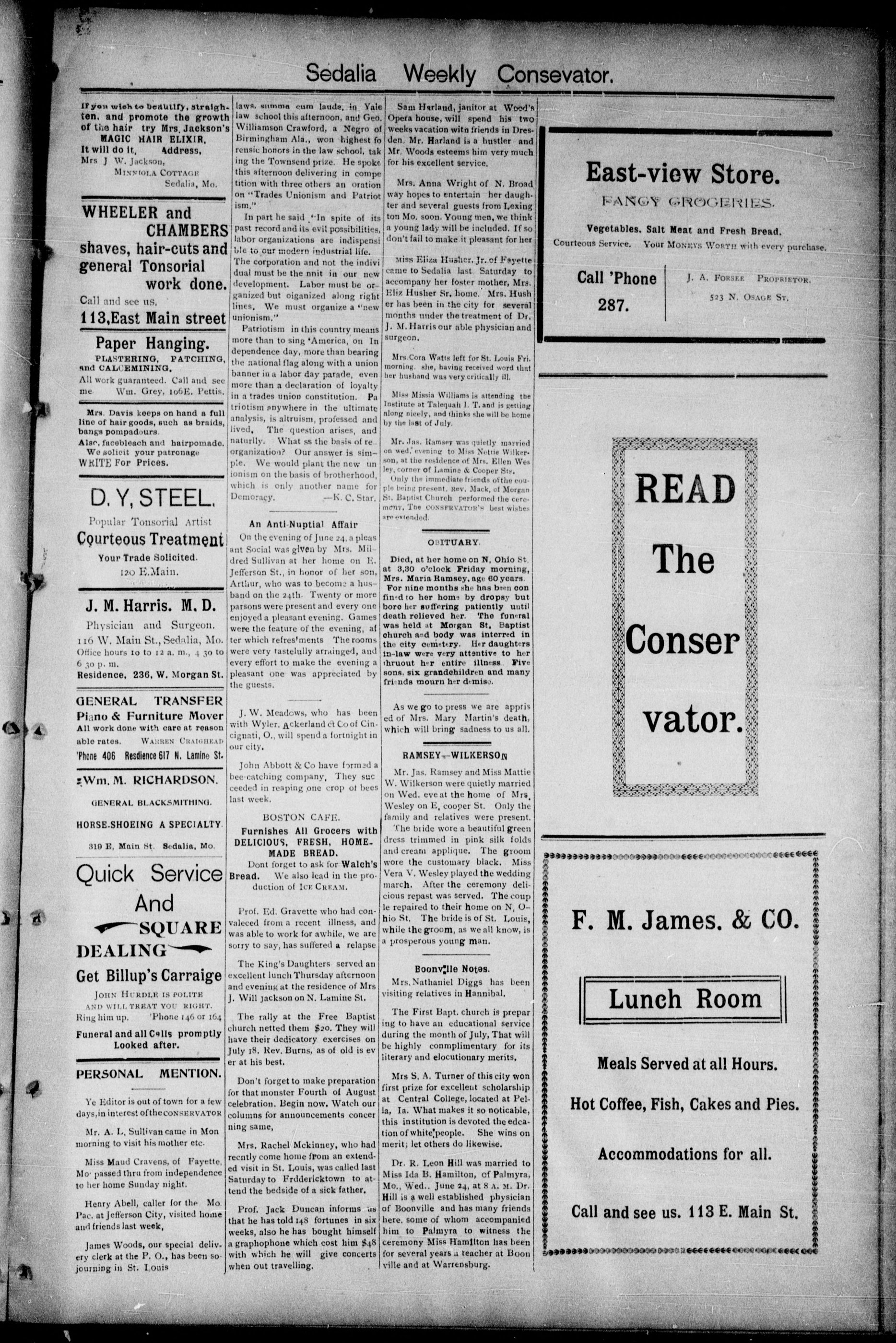
laws, summa cum laude, in Yale law school this afternoon, and Geo. Williamson Crawford, a Negro of Birmingham Ala., won highest for rensic honors in the law school, taking the Townsend prize. He spoke this afternoon delivering in competition with three others an oration on "Trades Unionism and Patriotism."
Sam Harland, janitor at Wood's Opera house, will spend his two weeks vacation with friends in Dresden. Mr. Harland is a hustler and Mr. Woods esteems him very much for his excellent service.
Mrs. Anna Wright of N. Broad way hopes to entertain her daughter and several guests from Lexing
In part he said, "In spite of its past record and its evil possibilities, labor organizations are indispensible to our modern industrial life. The corporation and not the individual must be the nunit in our new development. Labor must be organized but oiganized along right lines. We must organize a "new unionism."
Patriotism in this country means more than to sing America, on Independence day, more than bearing the national flag along with a union banner in a labor day parade, even more than a declaration of loyalty in a trades union constitution. Patriotism anywhere in the ultimate analysis, is altruism, professed and lived. The question arises, and naturally. What ss the basis of reorganization? Our answer is simple. We would plant the new unionism on the basis of brotherhood, which is only another name for Democracy. —K. C. Star.
An Anti-Nuptial Affair
On the evening of June 24, a pleas ant Social was given by Mrs. Mildred Sullivan at her home on E. Jefferson St., in honor of her son, Arthur, who was to become a husband on the 24th. Twenty or more parsons were present and every one enjoyed a pleasant evening. Games were the feature of the evening, after which refres'ments The rooms were very tastelully arrainged, and every effort to make the evening a pleasant one was appreciated by the guests.
J. W. Meadows, who has been with Wyler. Ackerland et Co of Cincinnati, O., will spend a fortnight in our city. John Abbott & Co have formed a bee-catching company. They succeeded in reaping one crop of bees last week.
BOSTON CAFE.
Furnishes All Grocers with DELICIOUS, FRESH, HOME- MADE BREAD. Dont forget to ask for Walch's Bread. We also lead in the production of ICE CREAM.
Prof. Ed. Gravette who had convaleced from a recent illness, and was able to work for awhile, we are sorry to say, has suffered a relapse
The King's Daughters served an excellent lunch Thursday afternoon and evening at the residence of Mrs J. Will jackson on N. Lamine St.
The rally at the Free Baptist church netted them $20. They will have their dedicatory exercises on July 18. Rev. Burns, as of old is ever at his best.
Don't forget to make preparation for that monster Fourth of August celebration. Begin now. Watch our columns for announcements concerning same,
Mrs. Rachel Mckinney, who had recently come home from an extended visit in St. Louis, was called last Saturday to Frddericktown to attend the bedside of a sick father.
Prof. Jack Duncan informs us that he has told 148 fortunes in six weeks, also he has bought himself a graphophone which cost him $48 with which he will give concerts when out travelling.
Sam Harland, janitor at Wood's Opera house, will spend his two weeks vacation with friends in Dresden. Mr. Harland is a hustler and Mr. Woods esteems him very much for his excellent service.
Mrs. Anna Wright of N. Broad way hopes to entertain her daughter and several guests from Lexington Mo. soon. Young men, we think a young lady will be included. If so don't fail to make it pleasant for her
Miss Eliza Husher, Jr. of Fayette came to Sedalia last Saturday to accompany her foster mother, Mrs. Eliz Husher Sr. home. Mrs. Husher has been in the city for several months under the treatment of Dr. J. M. Harris our able physician and surgeon.
Mrs. Cora Watts left for St. Louis Fri. morning. she, having received word that her husband was very critically ill.
Miss Missia Williams is attending the Institute at Talequah L. T. and is getting along nicely, and thinks she will be home by the last of July.
Mr. Jas. Ramsey was quietly married on wed. evening to Miss Nettie Wilkerson, at the residence of Mrs. Ellen Wesley, corner of Lamine & Cooper Sts. Only the immediate friends of the couple being present, Rev. Mack, of Morgan St. Baptist Church performed the ceremony. THE CONSFRYATOR'S best wishes are extended.
OBITUARY.
Died, at her home on N. Ohio St. at 3,30 o'clock Friday morning Mrs. Maria Ramsey, age 60 years. For nine months she has been confined to her home by dropsy but bore her suffering patiently until death relieved her. The funeral was held at Morgan St. Baptist church and body was interred in the city cemetery. Her daughters in-law were very attentive to her throut her entire illness. Five sons, six grandchildren and many friends mourn her demise.
As we go to press we are appris ed of Mrs. Mary Martin's death, which will bring sadness to us all.
RAMSEY-WILKERSON
Mr. Jas. Ramsey and Miss Mattie W. Wilkerson were quietly married on Wed. eve at the home of Mrs. Wesley on E, cooper St. Only the family and relatives were present. The bride wore a beautiful green dress trimmed in pink silk folds and cream applique. The groom wore the customary black. Miss Vera V. Wesley played the wedding march. After the ceremony delicious repast was served. The couple repaired to their home on N, Ohio St. The bride is of St. Louis, while the groom, as we all know, is a prosperous young man.
Boonville Notes.
Mrs. Nathaniel Diggs has been visiting relatives in Hannibal.
The First Bapt. church is preparing to have an educational service during the month of July, That will be highly complimentary for its literary and elocutionary merits.
Mrs S. A. Turner of this city won first prize for excellent scholarship at Central College, located at Pella, Ia. What makes it so noticable, this institution is devoted the education of white people. She wins on merit; let others do likewise.
Dr. R. Leon Hill was married to Miss Ida B. Hamilton, of Palmyra, Mo., Wed.. June 24, at 8 A. M. Dr. Hill is a well established physician of Boonville and has many friends here, some of whom accompanied him to Palmyra to witness the ceremony Miss Hamilton has been for several years a teacher at Boonville and at Warrensburg.
East-view Store.
Vegetables, Salt Meat and Fresh Bread. Courteous Service. Your MONEYS WORTH with every purchase
Call 'Phone
287.
---
READ The Conservator.
F. M. Ja
Lun
M. James. & C
Lunch Room
F. M. James. & CO.
Meals Served at all Hours. Hot Coffee, Fish, Cakes and Pi
Coffee, Fish, Cakes and Pi
Hot Coffee, Fish, Cakes and Pies.
Accommodations for all.
Call and see us. 113 E. Main
and see us. 113 E. Main
Call and see us. 113 E. Main St.
J. A. FORSEE PROPRIETOR.
523 N. OSAGE ST.
nes. & CO.
Room
Cakes and Pies.
113 E. Main St.
---
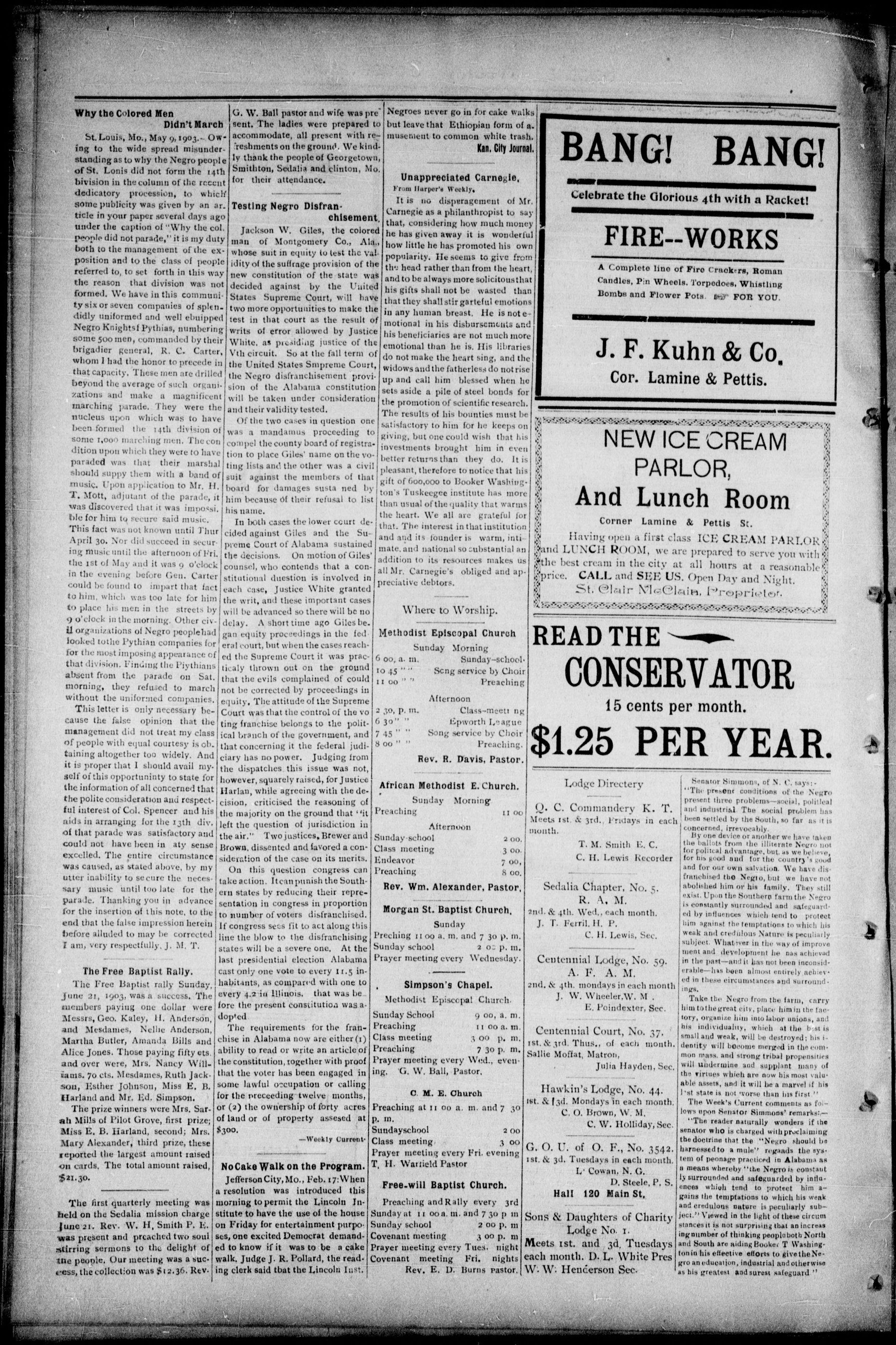
St. Louis, Mo., May 9, 1903. Owing to the wide spread misunderstanding as to why the Negro people of St. Louis did not form the 14th division in the column of the recent dedicatory procession, to which some publicity was given by an article in your paper several days ago under the caption of "Why the col. people did not parade," it is my duty both to the management of the exposition and to the class of people referred to, to set forth in this way the reason that division was not formed. We have in this community six or seven companies of splendidly uniformed and well equipped Negro Knightsf Pythias, numbering some 500 men, commanded by their brigadier general, R. C. Carter, whom I had the honor to precede in that capacity. These men are drilled beyond the average of such organizations and make a magnificent marching parade. They were the nucleus upon which was to have been formed the 14th division of some 1,000 marching men. The condition upon which they were to have paraded was that their marshal should supply them with a band of music. Upon application to Mr. H. T. Mott, adjutant of the parade, it was discovered that it was impossible for him to secure said music.
This fact was not known until Thur April 30. Nor did succeed in securing music until the afternoon of Fri the 1st of May and it was 9 o'clock in the evening before Gen. Carter could be found to impart that fact to him, which was too late for him to place his men in the streets by 9 o'clock in the morning. Other civil organizations of Negro people had looked to the Pythian companies for for the most imposing appearance of that division. Finding the Piythians absent from the parade on Sat. morning, they refused to march without the uniformed companies.
This letter is only necessary because the false opinion that the management did not treat my class of people with equal courtesy is obtaining altogether too widely. And it is proper that I should avail myself of this opportunity to state for the information of all concerned that the polite consideration and respectful interest of Col. Spencer and his aids in arranging for the 13th div. of that parade was satisfactory and could not have been in aty sense excelled. The entire circumstance was caused, as stated above, by my utter inability to secure the necessary music until too late for the parade. Thanking you in advance for the insertion of this note, to the end that the false impression herein before alluded to may be corrected I am, very respectfully, J. M. T.
The Free Baptist Rally.
The Free Baptist rally Sunday, June 21, 1903, was a success. The members paying one dollar were Messrs, Geo. Kaley, H. Anderson, and Mesdames, Nellie Anderson, Martha Butler, Amanda Bills and Alice Jones. Those paying fifty ets. and over were, Mrs. Nancy Williams. 70 ets. Mesdames, Ruth Jackson, Esther Johnson, Miss E. B. Harland and Mr. Ed. Simpson.
The prize winners were Mrs. Sarah Mills of Pilot Grove, first prize; Miss E. B. Harland, second; Mrs. Mary Alexander, third prize, these reported the largest amount raised on cards. The total amount raised, $21.30.
The first quarterly meeting was held on the Sedalia mission charge June 21. Rev. W. H, Smith P. E. was present and preached two soul stirring sermons to the delight of the people. Our meeting was a success, the collection was $12.36. Rev.
G. W. Ball pastor and wife was present. The ladies were prepared to accommodate, all present with refreshments on the ground. We kindly thank the people of Georgetown, Smithton, Sedalia and clinton, Mo. for their attendance.
Testing Negro Disfran-
Jackson W. Giles, the colored man of Montgomery Co., Ala. whose suit in equity to test the validity of the suffrage provision of the new constitution of the state was decided against by the United States Supreme Court, will have two more opportunities to make the test in that court as the result of writs of error allowed by Justice White, as presiding justice of the Vth circuit. So at the fall term of the United States Supreme Court, the Negro disfranchisement provision of the Alabama constitution will be taken under consideration and their validity tested.
Of the two cases in question one was a mandamus proceeding to compel the county board of registration to place Giles' name on the voting lists and the other was a civil suit against the members of that board for damages susta ned by him because of their refusal to list his name.
In both cases the lower court decided against Giles and the Supreme Court of Alabama sustained the decisions. On motion of Giles counsel, who contends that a constitutional question is involved in each case, Justice White granted the writ, and these important cases will be advanced so there will be no delay. A short time ago Giles began equity proceedings in the federal court, but when the cases reached the Supreme Court it was practically thrown out on the ground that the evils complained of could not be corrected by proceedings in equity. The attitude of the Supreme Court was that the control of the voting franchise belongs to the political branch of the government, and that concerning it the federal judiciary has no power. Judging from the dispatches this issue was not, however, squarely raised, for Justice Harlan, while agreeing with the decision, criticised the reasoning of the majority on the ground that "it left the question of jurisdiction in the air." Two justices, Brewer and Brown, dissented and favored a consideration of the case on its merits. On this question congress can take action. It can punish the Southern states by reducing their representation in congress in proportion to number of voters disfranchised. If congress sees fit to act along this line the blow to the disfranchising states will be a severe one. At the last presidential election Alabama cast only one vote to every 11.5 inhabitants, as compared with one to every 4.2 in Illinois. that was before the present constitution was adopted.
The requirements for the franchise in Alabama now are either (1) ability to read or write an article of the constitution, together with proof that the voter has been engaged in some lawful occupation or calling for the preceding twelve months, or (2) the ownership of forty acres of land or of property assesed at $300.
NoCake Walk on the Program.
NoCake Walk on the Program. Jefferson City, Mo., Feb. 17: When a resolution was introduced this morning to permit the Lincoln Institute to have the use of the house on Friday for entertainment purposes, one excited Democrat demanded to know if it was to be a cake walk. Judge J. R. Pollard, the reading clerk said tbat the Lincoln Inst.
Negroes never go in for cake walks but leave that Ethiopian form of amusement to common white trash. Kan. City Journal.
Unappreciated Carnegie. From Harper's Weekly.
It is no disperagement of Mr. Carnegie as a philanthropist to say that, considering how much money he has given away it is wonderful how little he has promoted his own popularity. He seems to give from the head rather than from the heart and to be always more solicitous that his gifts shall not be wasted than that they shall stir garteful emotions in any human breast. He is not emotional in his disbursements and his beneficiaries are not much more emotional than he is. His libraries do not make the heart sing, and the widows and the fatherless do not rise up and call him blessed when he sets aside a pile of steel bonds for the promotion of scientific research. The results of his bounties must be satisfactory to him for he keeps on giving, but one could wish that his investments brought him in even better returns than they do. It is pleasant, therefore to notice that his gift of 600,000 to Booker Washington's Tuskegee institute has more than usual of the quality that warms the heart. We all are grateful for that. The interest in that institution and and its founder is warm, intimate, and national so substantial an addition to its resources makes us all Mr. Carnegie's obliged and appreciative debtors.
Where to Worship.
Methodist Episcopal Church
Sunday Morning
6 00, a. m. Sunday–school-
10 45 " " Song service by Choir
11 00 " " Preaching
Afternoon
2 30, p. m. Class–meeting
6 30 " " Epworth League
7 45 " " Song service by Choir
8 00 " " Preaching.
African Methodist E. Church.
Sunday Morning
Preaching 11 00
Afternoon
Sunday-school 2 00,
Class meeting 3 00,
Endeavor 7 00,
Preaching 8 00.
Rev. Wm. Alexander, Pastor.
Sunday
Preching 1100 a.m. and 7 30 p.m.
Sunday school 2 00 p.m.
Prayer meeting every Wednesday.
Simpson's Chapel.
Methodist Episcopal Church.
Sunday School 9 00, a. m.
Preaching 11 00 a. m.
Class meeting 3 00 p. m.
Preaching 7 30 p. m.
Prayer meeting every Wed., evening. G. W. Ball, Pastor.
C. M. E. Church
Preaching at 11 00 a. m. and 7 30 p. m.
Sundayschool 2 00
Class meeting 3 00
Prayer meeting every Fri. evening
T. H. Wartield Pastor
Free-will Baptist Church.
Preaching and Rally every 3rd
Sunday at 11 00 a.m. and 7 30 p.m
Sunday school 2 00 p. m
Covenant meeting 3 00 p. m
Prayer meeting every Tues. night
Covenant meeting Fri. nights
Rev. E. D. Burns pastor.
BANG! BANG!
Celebrate the Glorious 4th with a Racket!
FIRE--WORKS
A Complete line of Fire Crackers, Roman Candles, Pin Wheels, Torpedoes, Whistling Bombs and Flower Pots. FOR YOU.
J. F. Kuhn & Co. Cor. Lamine & Pettis.
NEW IG
PART
And Lun
Corner Lamine
Having open a first cl
and LUNCH ROOM, we a
the best cream in the city a
price. CALL and SEE US
St. Clair McCl
READ THE
CONSER
15 cents p
$1.25 PF
Lodge Directory
Having open a first class ICE CREAM PARLOR and LUNCH ROOM, we are prepared to serve you with the best cream in the city at all hours at a reasonable price. CALL and SEE US. Open Day and Night. St. Clair McClain, Proprietor.
READ THE CONSERVATOR 15 cents per month. $1.25 PER YEAR.
Q. C. Commandery K. T.
Meets 1st. & 3rd., Fridays in each
month.
T. M. Smith E. C.
C. H. Lewis Recorder
Sedalia Chapter, No. 5.
R. A. M.
2nd. & 4th. Wed., each month.
J. T. Ferril, H. P.
C. H. Lewis, Sec.
Centennial Lodge, No. 59.
A. F. A. M.
2nd. & 4th. mondays in each month
J. W. Wheeler, W. M.
E. Poindexter, Sec.
Centennial Court, No. 37.
1st. & 3rd. Thus., of each month.
Sallie Moffat, Matron,
Hawkin's Lodge, No. 44.
1st. & 3d. Mondays in each month.
C. O. Brown, W. M.
C. W. Holliday, Sec.
G. O. U. of O. F., No. 3542.
1st. & 3d. Tuesdays in each month.
L. Cowan, N. G.
D. Steele, P. S.
Hall 120 Main St.
Sons & Daughters of Charity Lodge No. 1. Meets 1st. and 3d. Tuesdays each month. D. L. White Pres W. W: Henderson Sec.
ICE CREAM PARLOR,
unch Room
& Pettis St.
Mass ICE CREAM PARLOR are prepared to serve you with
at all hours at a reasonable
S. Open Day and Night.
ain, Proprietor.
ERVATOR
per month.
ER YEAR.
Senator Simmons, of N. C. says: "The present conditions of the Negro present three problems—social, political and industrial. The social problem has been settled by the South, so far as it is concerned, irrevocably.
By one device or another we have taken the ballots from the illiterate Negro not for political advantage, but, as we believe, for his good and for the country's good and for our own salvation. We have disfranchised the Negro, but we have not abolished him or his family. They still exist. Upon the Southern farm the Negro is constantly surrounded and safeguarded by influences which tend to protect him against the temptations to which his weak and credulous Nature is peculiarly subject. Whatliver in the way of improvement and development he has achieved in the past—and it has not been inconsiderable—has been almost entirely achieved in these circumstances and surroundings.
Take the Negro from the farm, carry him to the great city, place him in the factory, organize him into labor unions, and his individuality, which at the best is small and weak, will be destroyed; his identity will become merged in the common mass, and strong tribal propensities will undermine and supplant many of the virtues which are now his most valuable assets, and it will be a marvel if his 1st state is not worse than his first."
The Week's Current comments as follows upon Senator Simmons' remarks:— "The reader naturally wonders if the senator who is charged with proclaiming the doctrine that the "Negro should be harnessed to a mule" regaads the system of peonage practiced in Alabama as a means whereby "the Negro is constantly surrounded and safeguarded by influences which tend to protect him a-gains the temptations to which his weak and credulous nature is peculiarly subject." Viewed in the light of these circum stances it is not surprising that an increase number of thinking people both North and South are aiding Booker T Washington in his effective efforts to give the Negro an education, industrial and otherwise as his greatest and surest safeguard."
---