Sedalia Weekly Conservator
Friday, January 8, 1904
Sedalia, Missouri
Page text (machine-generated)
Sedalia Weekly Conservator.
12015
Sedal
VOL. 1.
VOL. 1.
JANUARY...1904
Sun. Mon. Tues. Wed. Thu. Fri. Sat.
1 2
3 4 5 6 7 8 9
10 11 12 13 14 15 16
17 18 19 20 21 22 23
25 26 27 28 29 30
F.M.
Frd.
L.Q.
9th.
N.M.
17th.
F.Q.
25th.
ELLA WHEELER WILCOX'S
TRIBUTE TO WOMAN.
New York, December 31.—Ella Wheeler Wilcox, moved by the pathetic stories of the heroism of mothers who tried to protect their children in the Iroquois Theatre fire, has written the following:
O fragile body and dependent brain.
O lesser vessel from the potter's hand.
In earth's tremendous, crucial hours of pain.
Let man in reverence stand.
From out the center of the primal source
God plucked two gifts and gave you with life's breath
Courage, majestic as his own great force.
And love, that laughs at death.
O pigmy of the wars of earth,
How pale your glover the centuries roll.
While deathless shines the splendor and the worth
DOCTORS TALKED RACE QUESTION.
The St. Louis Medical Society of Missouri met Saturday night for the usual weekly meeting in the Board of education rooms. The race question was again up in the society and the discussion occupied almost all the time. For a long time there has been a controversy in the society over the admission of Negro physicians, and so far they have been excluded.
The majority of the doctors are against the letting Negro practitioners, into the ranks, but there are some who favor innovation, and the question has been brought up many times.
Saturday night Dr. R. M. King and others talked on the subject, and the discussion was long and spirited.
The matter ended where it began, an indefinite action being taken, and the question is still an open one.
There was considerable miscellaneous routine business before the body.
Dr. A. R. Kieffer, president of the society, stated that he was against admitting the colored physicians.
"I have been against the thing from the start," said he, and am still against it.
I do not believe that they will ever decide to admit the Negroes, but I do not think that any serious difficulty will come of the contest for there are but few of the doctors that favor such a movement.
---
SEDALIA, MISSOURI, FRIDAY, JANUARY 8 1904.
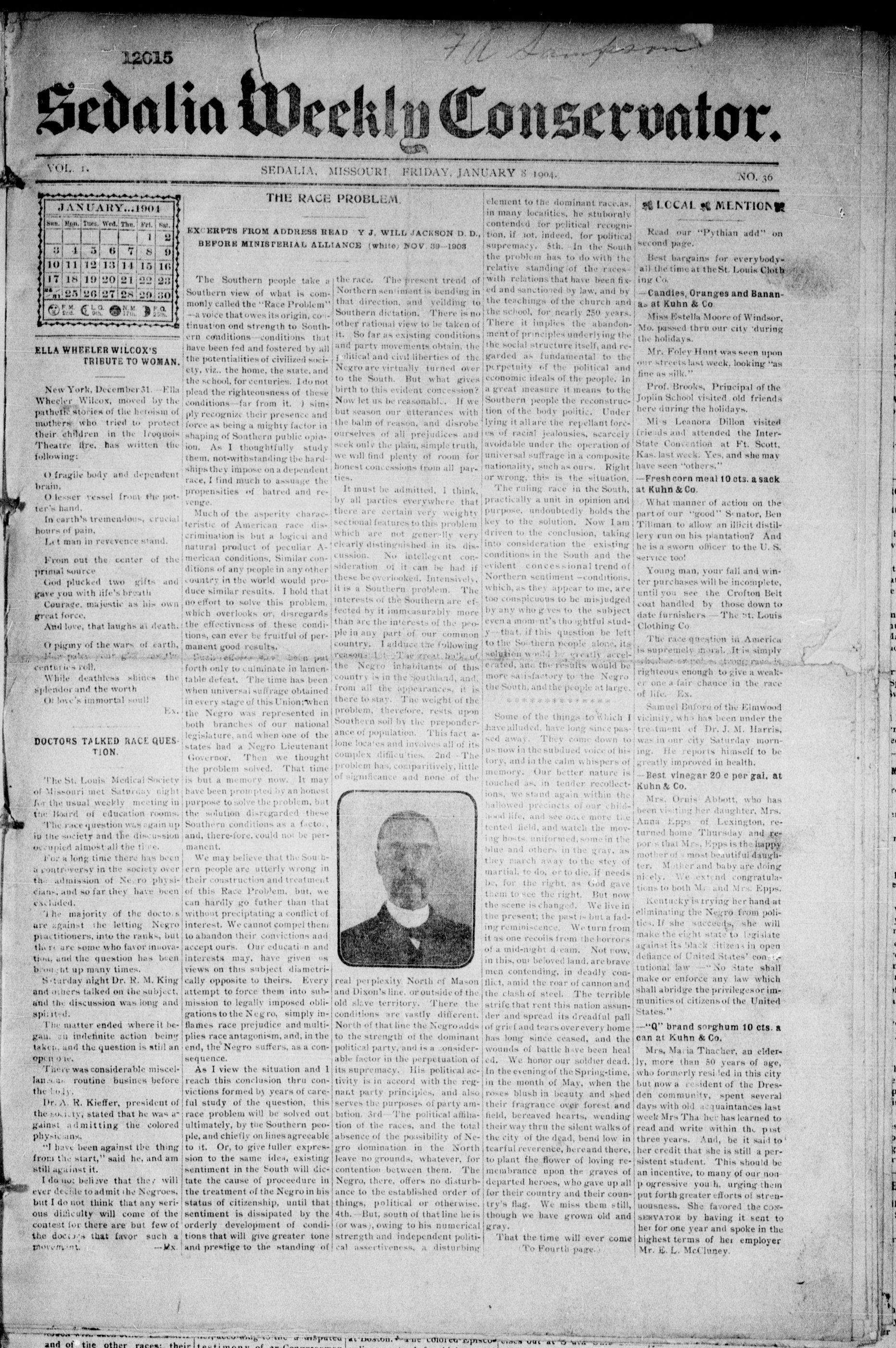
THE RACE PROBLEM
EXCERPTS FROM ADDRESS READ Y J. WILL JACKSON D. D. BEFORE MINISTERIAL ALLIANCE (white) NOV. 30-1903
The Southern people take a Southern view of what is commonly called the "Race Problem"—a voice that owes its origin, continuation on strength to Southern conditions—conditions that have been fed and fostered by all the potentialities of civilized society, viz., the home, the state, and the school, for centuries. I do not plead the righteousness of these conditions—far from it. ) simply recognize their presence and force as being a mighty factor in shaping of Southern public opinion. As I thoughtfully study them, not-withstanding the hardships they impose on a dependent race, I find much to assuage the propensities of hatred and revenge.
Much of the asperity characteristic of American race discrimination is but a logical and natural product of peculiar American conditions. Similar conditions of any people in any other country in the world would produce similar results. I hold that no effort to solve this problem, which overlooks or, disregards the effectiveness of these conditions, can ever be fruitful of permanent good results.
forth only to culminate in lamentable defeat. The time has been when universal suffrage obtained in every stage of this Union: when the Negro was represented in both branches of our national legislature, and when one of the states had a Negro Lieutenant Governor. Then we thought the problem solved. That time is but a memory now. It may have been prompted by an honest purpose to solve the problem, but the solution disregarded these Southern conditions as a factor, and, there-fore, could not be permanent.
We may believe that the Southern people are utterly wrong in their construction and treatment of this Race Problem, but, we can hardly go further than that without precipitating a conflict of interest. We cannot compel them to abandon their convictions and accept ours. Our education and interests may, have given us views on this subject diametrically opposite to theirs. Every attempt to force them into submission to legally imposed obligations to the Negro, simply inflames race prejudice and multiplies race antagonism, and, in the end, the Negro suffers, as a consequence.
As I view the situation and I reach this conclusion thru convictions formed by years of careful study of the question, this race problem will be solved out ultimately, by the Southern people, and chiefly on lines agreeable to it. Or, to give fuller expression to the same idea, existing sentiment in the South will dictate the cause of procedure in the treatment of the Negro in his status of citizenship, until that sentiment is dissipated by the orderly development of conditions that will give greater tone and prestige to the standing of
the race. The present trend of Northern sentiment is bending in that direction, and yelding to Southern dictation. There is no other rational view to be taken of it. So far as existing conditions and party movements obtain, the political and civil liberties of the Negro are virtually turned over to the South. But what gives birth to this evident concession? Now let us be reasonable. If we but season our utterances with the balm of reason, and disrobe ourselves of all prejudices and seek only the plain, simple truth, we will find plenty of room for honest concessions from all parties.
It must be admitted, I think, by all parties everywhere that there are certain very weighty sectional features to this problem which are not generally very clearly distinguished in its discussion. No intelligent consideration of it can be had if these be overlooked. Intensively, it is a Southern problem. The interests of the Southern are effected by it immeasurably more than are the interests of the people in any part of our common country. I addduce the following reason: 1st. The great bulk of the Negro inhabitants of this country is in the Southland, and from all the appearances, it is there to stay. The weight of the problem, therefore, rests upon Southern soil by the preponderance of population. This fact alone locates and involves all of its complex difficulties. 2nd. The problem has, comparatively, little of significance and none of the
P.
real perplexity North of Mason and Dixon's line, or outside of the old slave territory. There the conditions are vastly different. North of that line the Negro adds to the strength of the dominant political party, and is a considerable factor in the perpetuation of its supremacy. His political activity is in accord with the regnant party principles, and also serves the purposes of party ambition. 3rd—The political affiliation of the races, and the total absence of the possibility of Negro domination in the North leave no grounds, whatever, for contention between them. The Negro, there, offers no disturbance to the established order of things, political or otherwise. 4th.—But, south of that line he is (or was), owing to his numerical strength and independent political assertiveness, a disturbing
element to the dominant race, as in many localities, he stubornly contended for political recognition, if not, indeed, for political supremacy. 5th. In the South the problem has to do with the relative standing of the races with relations that have been fixed and sanctioned by law, and by the teachings of the church and the school, for nearly 250 years. There it implies the abandonment of principles underlying the social structure itself, and regarded as fundamental to the perpetuity of the political and economic ideals of the people. In a great measure it means to the Southern people the reconstruction of the body politic. Underlying it all are the repellant forces of racial jealousies, scarcely avoidable under the operation of universal suffrage in a composite nationality, such as ours. Right or wrong, this is the situation.
The ruling race in the South, practically a unit in opinion and purpose, undoubtedly holds the key to the solution. Now I am driven to the conclusion, taking into consideration the existing conditions in the South and the evident concessional trend of Northern sentiment -conditions, which, as they appear to me, are too conspicuous to be misjudged by any who gives to the subject even a moment's thoughtful study -that, if this question be left to the Southern people alone, its solution would be greatly accelerated, and the results would be more satisfactory to the Negro the South, and the people at large.
Some of the things to which I have alluded, have long since passed away. They come down to us now in the subdued voice of history, and in the calm whispers of memory. Our better nature is touched as, in tender recollections, we stand again within the hallowed precincts of our childhood life, and see once more the tented field, and watch the moving hosts, uniformed, some in the blue and others in the gray, as they march away to the stey of martial, to do, or to die, if needs be, for the right, as God gave them to see the right. But now the scene is changed. We live in the present; the past is but a fading reminiscence. We turn from it as one recoils from the horrors of a mid-night dream. Not now, in this, our beloved land, are brave men contending, in deadly conflict, amid the roar of cannon and the clash of steel. The terrible strife that rent this nation assunder and spread its dreadful pall of grief and tears over every home has long since ceased, and the wounds of battle have been healed. We honor our soldier dead. In the evening of the Spring-time, in the month of May, when the roses blush in beauty and shed their fragrance over forest and field, bereaved hearts, wending their way thru the silent walks of the city of the dead, bend low in tearful reverence, here and there, to plant the flower of loving remembrance upon the graves of departed heroes, who gave up all for their country and their country's flag. We miss them still, though we have grown old and gray.
That the time will ever come (To Fourth page.)
Spw
er
Ells
er
NO.36
LOCAL MENTION
Read our "Pythian add" on second page. Best bargains for everybody all the time at the St. Louis Clothing Co.
Candies, Oranges and Banana at Kuhn & Co.
Miss Estella Moore of Windsor, Mo. passed thru our city during the holidays.
Mr. Foley Hunt was seen upon our streets last week, looking "as fine as silk."
Prof. Brooks, Principal of the Joplin School visited, old friends here during the holidays.
Mi's Leanora Dillon visited friends and attended the Inter-State Convention at Ft. Scott, Kas. last week. Yes, and she may have seen "others."
Freshcorn meal 10 cts. a sack at Kuhn & Co.
What manner of action on the part of our "good" Senator, Ben Tillman to allow an illicit distillery run on his plantation? And he is a sworn officer to the U. S. service too!
Young man, your fall and winter purchases will be incomplete, until you see the Crofton Belt coat handled by those down to date furnishers — The st. Louis Clothing Co.
The race question in America is supremely moral. It is simply whether or not a strong race is righteous enough to give a weaker one a fair chance in the race of life. Ex.
Samuel Buford of the Elmwood vicinity, who has been under the treatment of Dr. J. M. Harris, was in our city Saturday morning. He reports himself to be greatly improved in health.
- Best vinegar 20 c per gai, at Kuhn & Co.
Mrs. Ornis Abbott, who has been visiting her daughter, Mrs. Anna Epps of Lexington, returned home Thursday and reports that Mrs. Epps is the happy mother of a beautiful daughter. Mother and baby are doing nicely. We extend congratulations to both Mr. and Mrs. Epps. Kentucky is trying her hand at eliminating the Negro from politics. If she succeeds, she will make the eight state to legislate against its black citizens in open defiance of United States' constitutional law — "No State shall make or enforce any law which shall abridge the privileges or immunities of citizens of the United States."
"Q" brand sorghum 10 cts. a can at Kuhn & Co.
Mrs. Maria Thacher, an elderly, more than 50 years of age, who formerly resided in this city but now a resident of the Dresden community, spent several days with old acquaintances last week Mrs Thacher has learned to read and write within the post three years. And, be it said to her credit that she is still a persistent student. This should be an incentive, to many of our nonp ogressive youth, urging them put forth greater efforts of strenuousness. She favored the CONSERVATOR by having it sent to her for one year and spoke in the highest terms of her employer Mr. E. L. McCluney.
SEDALIA WEEKLY CONSERVATOR
Published Every Friday Office, 102 E. Main St., Up Stairs
Entered June 16, '03 at Sedalia, Mo., as second class matter under Act of Congress of March 3, 79.
This Space Will Notify You
When Your Subscription Is Due
Contributions must be accompanied by name as an assurance of good faith.
All articles for publication must be in by Wednesday.
SUBSCRIPTION.
One Year $1.25.
Six Months 7.5
One Month 15.
Think for The Self one good thought:
And know it to be Thine own.
His better than a thousand cleaned
From fields by others sown.
W. H. HUSTON
C. M. ENGLISH
This Space Will Notify You When Your Subscription Is Due.
Contributions must be accompanied by name as an assurance of good faith.
All articles for publication must be in by Wednesday.
And, you thought that winter had broken!
"Asia for the Asiatics," is the Japanese doctrine. These plucky Mongolians certainly merits admiration from all liberty-loving progressive people. By their zeal and energy, they have already, in less than a century, forced themselves to the front as a second class power and, should she pluck victory from the brow of the wily Slav she will be granted a place among the great powers England, Germany, United States etc.
ANNEW CARNEgie's declaration that the Negro was more powerful than the Navy, carries greater significance with it than many less thoughtful than he would suppose. Annual indications bring into greater prominence the wonderful influence the production of cotton has on our National resources and development. If the production of this South-era Staple sways a mighty influence, what about the brains and brawn, that facilitates its growth and preservation?
---
The great political parties are alligning themselves for the coming National Campaign; partisan issues are being formulated, and official aspirants are beginning to marshail their cohorts. It may be safely predicted that the campaign of 1904 will be characterized by its wonderful amount of intelligent investigation by our enlightened citizenship. Indeed, the campaign of 1904 will be an educational campaign of the highest order.
Witvr about that citizens' ticket? Has the Republican local organization become so vitiated that it can not secure sufficient good citizens within its own ranks to clothe with official authority? O. have the good conservative element of our party become so "important" that they feel, that performing the suffrage franchise is beneath their dignified dignity? These queries we would certainly like to have answered. The local Republican organization, if it hopes to maintain itself must cease mugwumpism.
LOCAL POLITICS
THAT the Republican party is endebted to its negro constituents goes without contradiction. This fact is given additional prominence, when we consider how greatly the Negro element has contributed its ballot in aid of the party's success and for the carrying out of the party's principles. In many of the close states, counties and cities Republican success rests very materially with a few hundred Negro votes. So loyal has been this element to the Grand Old Party.
---
EDITOR.
MANAGE
SUBSCRIPTION.
One Year $1.25.
Six Months 7.5
One Month 15.
Think for The Self one good thought;
And know it to be Thine own.
'Tis better than a thousand cleaned
From fields by others sown.
—anon.
that she has ceased to consider it necessary for her to do anything except to come around a few days before election and "joily us up a bit." tell us how to "vote er straight" and go home and calculate their majorities. This kind of thing has gone far enough. We are cognizant of our worth and feel that the G. O. P. ought and should give us some consideration. Now as soon as we begin to agitate matters that pertain to your rights and aspiration, some raise the cry that we are not Republicans and other non-sense. Well, we can very conveniently be a Roosevelt Republican in in National affairs and then "walk" on some of the local deals that are hatched here about. Be it known from now onward that the conservator is after something for its. Negro constituents and that she is going after it with intelligent bravery and manly courage. She has pledged herself, locally, to race first, party next. We seek nothing for personal aggrandizement other than that some Negro be given something creditable that he may be the means of manifesting to the community his worth and integ- lence as a progressive citizen.
Having thrown the gauntlet we are ready now and will be ever ready for the fray. Let our patrons and readers be on the look out for matters that pertain to the welfare of your own interests. Be concerned about yourself once. Act the part of a manly man and give all to understand that you are beginning to read and think.
EMANCIPATION DAY SERVICE AT GEORGE R. SMITH COLLEGE.
That the Negroes, of this community, are truly acquainted with the proper idea of celebrating the occasion that commemorates the anniversary of their liberation from slavery, was fittingly demonstrated by the Literary and Patriotic service conducted at George R. Smith College on the first, at 3:30 P.M. Thru-out the service the spirit of intelligent patriotism and race love prevailed. And, be it said to the credit of Miss Prof. Wiltsee, that the music for the occasion could not have been more acceptably selected.
The service were conducted as per programme in last week's issue of this paper.
The nobbiest, neatest, and flasaiest suits of the season are of the Alfred Benjamin make, at the gents' emporium, St. Louis, Clothing Company, Corner Second and Ohio.
College students, and others, should give Kuhn & Co., a cal. Corner Lamine and Pettis sts.
DR W. P. THIRKIELD SPEAKS FOR THE NEGRO.
Prison System The Cause Of Crime.
Excerpts from opening address before Evangical Alliance at Cincinnati.
In Cinnn. on Monday Oct. 12. Dr. W. P. Thirkeld, corre sponding secretary of the Freedmen's Aid and Southern Educational Society, in delivering the opening address of the Evangelical Alliance and charged that the crimes committed by Negroes in the South were largely due to the chain gang prison system. He said.
In the black people we should keep in mind that since Appomattox nearly every Southern State has maintained schools of crime an organized institution for the training of criminals. This I charge against the convict lease system of the South. This system with its thousands of victims, has been the cause of much of the outbreak of crime among the black people, through its brutalizing and dehumanizing influence on thousands of Negroes.
"Under this system both prison and prisoner are farmed out under the control of private corporations - sold to the highest bidder.
"To the leases the body and soul of convicts are assigned. The motive of both States and leases is not morals, but money; not reformation but exploitation of criminals for gain. It is crime turned into a source of revenue; the brawn and blood of criminals bartered for gain.
"Criminals are scattered in branch prisons-quartered in rude stockades without proper sanitation, food or clothing. The average life of these convicts is less than ten years. Old and young are promiscuously chained and herded together. Even men and women are, in some camps, not separated. One warden of a State penitentiary protests in his report that under the present law and custom the penitentiary is the school of crime instead of being a reformatory institution. Of fifty under eighteen, nineteenths of them leave the prison much worse than when they came in."
"The outcome of the careful investigation of the convict lease system by the present Governor of Georgia was a revaluation of inhumanity, barbarity and shameless immorality. Much was unfit for the public press.
"During a period of two years over 1100 of these convicts escaped from Southern prisons. Think of 1100 thieves, murders, thugs, at large-lawless men roaming about in deliance of all law and order. Think of a system that has no reformatory element; no system to cure men of crime but that educates young criminals in crime, and that by barbarity, brutality brutalizes and dehumanizes men and sends out those that do not die under the horror of the system to debauch and degrades society. From such criminals what wonif there have come forth hundreds of morals monsters?
"The South should reform its present system and thus stop the education of criminals. The present system is a sowing of the wind, and it is bound to reap the whirlwind." - Ibs.
ARE YOU A K. OF P.?
If Not, Why N.
Do you not know that the is the strongest and most the age?
The four departments of the
SUBORDINATE
In this the members are protect each other in health and distress.
UNIFORM RANE
In this department our y ing a military education no other way, thus make more useful citizens.
know that the Knights of Pythias rest and most progressive order of
ments of the order are as follows:
NATE LODGE
members are united to care for and other in health as well as in sick-
ress.
RANK
ment our young men are receiv-
education which they can get in
, thus making them better and
citizens.
OURT
vives, mothers, widows, daughters
of Knights are united for the com-
of life.
ENT.
ment we are paying out annually
dollars to the widows and heirs of
ights.
to Lodge in your locality, con-
the District Deputy Gran-
or of your District, or write
Lloyd, 2629 Lucas Ave., St
o., for terms upon which tha
a Knights of Pythias Lodge.
Do you not know that the Knights of Pythias is the strongest and most progressive order of the age?
The four departments of the order are as follows:
SUBORDINATE LODGE
In this the members are united to care for and protect each other in health as well as in sickness and distress.
UNIFORM RANK
In this department our young men are receiving a military education which they can get in no other way, thus making them better and more useful citizens.
LADIES COURT
In this the wives, mother and sisters of Knights are mon purpose of life.
In this the wives, mothers, widows, daughters and sisters of Knights are united for the common purpose of life.
ENDOWMENT.
In this department we a thousands of dollars to the deceased Knights.
If you have no Lodge interfer with the Disc Chancellor of you A. W. Lloyd, 26 Louis, Mo., for te organize a Knigh
In this department we are paying out annually thousands of dollars to the widows and heirs of deceased Knights.
If you have no Lodge in your locality, con fer with the District Deputy Gram Chancellor of your District, or write A. W. Lloyd, 2629 Lucas Ave., St Louis, Mo., for terms upon which to organize a Knights of Pythias Lodge.
CONTRIBUTORS TO WORLD'S FAIR BOOK.
Contributors to the Missouri Volume now being prepared under the direction of the Missouri World's Fair Commission have been announced. There will be at least 100,000 copies of the book distributed from the Missouri Building during th World's Fair to the end of influencing, immigration and capital investment. Following are the subjects and the mea who will treat them: Climate A. E. Hackett, Director of the Missouri Weather Service, Horticulture, L. A. Goodman, Secretary of the State Horticultural Society; Education, W. T. Carrington, State of Superintendent of Public Schools and G. V. Buchanan, Superintendent of the Commission's Department of Education; Mining, Dr. George E. Ladd, President of the School of Mines; History, Dr. H. E. Robinson, President of the State Historical Society, Dr. Jonas Viles,
---
---
Professor of History in the State University; Flora, Dr. B. M. Duggar; Fauna, Dr. George Lefevre on Administration, Dr. Isadon Loeb, on Live Stock, Dr. F. B. Mumford; Surface and Soil of the State, Dr. C. F. Marbut, of the State University; on Agriculture Dr. H. J. Waters, Dean of the Missouri State Board of Agriculture; Mining Statistics, J. W. Marsteller; Taxation, Albert C Allen, Auditor of the State; Missouri Banks and Population, Sars B Cook, Secretary of State; Insurance, R.G. Yates, State Insurance Commissioner; Railroad Thomas M. Bradbury, Secretary of the Board of Railroad Commissioners; St. Louis, W. F. Sanders-Secretary of the Business Men's League; Kansas City, W. Winsborough, formerly secretary of the Manufacturers' Association; on Missouri by Councill Roy A. Hockensmith. Walter Williams will edit the volume.
COAT AND SKIRT STYLES.
Military Models in Conts Increasing in Favor and Full Skirts Are in Vogue.
The separate waist having fallen somewhat into distaster, it is a comfort to learn that the separate coat is very much the thing. Which is to say that it is entirely admissible to wear a half or three-quarter coat in dark material, with any sort of a dress shirt, says the New York Post. The loose coat of cloth, velvet, or other handsome, heavy material, provided with very wide sleeves and trimmed with a velvet or lace collar, is seen everywhere. Military coats are increasing in favor and some models are almost exactly like the fatigue jackets worn by American army officers. They have a fitted or half-fitted back, and are straight and loose in the front, extending about 12 inches below the waist. Flat braid borders a coat of this kind, the braid being carried around the top of the collar in a double row down the front and around the hem. All corners are square and the coat is closed with braid clasps. Epaulet pieces trim the shoulders.
Short coats are predicted by the keenest observers of fashion. There is no doubt that the general trend towards 1830 styles would logically bring in the short Eton with full sleeves and loose back, but fashion is not always logical in its processes.
One hears a great deal of the 1830 revival, but it does not really mean much more than that shoulders are made to droop and that skirts are full and flowing again. The fashionable figure does not by any means conform to that of 1830. Reference to fashion plates and to portraits of that period shows that wasp waists were admired and, quite a fair size of hips was allowed. Skirts were very full and very short, reaching barely to the ankle. Hoop-kirts do not appear, but so many ruffled and starched petticoats belonged to the feminine rolette that the general effect of the skirt was flaring and bell-like.
At the present, although full skirts are in vogue, fashion demands that the figure below the waist be made as slender as possible. The natural spring of the body, to quote an authority, must be concealed, or at least softered, as much as possible. To bring about this happy result corsets have been built with long extensions reaching far down over the hips in long points which are held in place by strips of elastic. Those that lace down the front are favorites; they assisting the concealing process in a manner short of marvelous.
Short skirts do belong to the 1820 period, but they belong to many others beside. Every so often women rebel against the trained skirt, and for a rest and change the short walking skirt comes in. It always goes out, and that within a short time, for flowing draperies are too graceful becoming and womanly ever to be wholly abandoned. The breathing spell of sensible skirts for street and informal wear is in at present and women are making the most of it.
STALL FOR LADY CONSTANCE.
Texas Ranchman Thought She Was a Horse and Fixed Things Right for Her.
The announcement that Lady Constance Mackenzie would arrive here on a certain date led to an amusing mistake, says an Alice (Tex.) report. The telegram informing R. J. Kleberg, of Santa Gertrudas ranch, of Lady Constance's proposed arrival came from a north Texas ranchman, where she had been visiting. Mr. Kleberg was absent, and the boss of his ranch received the telegram.
The ranch boss is not up on titles of nobility, and he thought that Lady Constance must be a fine blooded mare that Mr. Kleberg was sending to the ranch. He telephoned to J. B. Ragland, the livery stable man at Alice, who attends to such business for the ranch, that "Lady Mackenzie" would arrive on Friday night's train, and that as she was a high-bred animal and very valuable he would be expected to take special care of her until she could be forwarded to the ranch.
Mr. Ragland put a fine stall in the best condition at the stable and notified Mr. Anderson, the railroad agent, to have the car switched at a certain place, as he was anxious to get her out of the car as soon as possible after the arrival of the train.
Meantime Frank Ayers, of the Mosser Cosgrove hotel, received a telegram saying that Lady Constance Mackenzie would arrive on that night's train and that she wanted accommodations at the hotel. A little before train time Mr. Ragland and Mr. Ayers met at the station and both learned that they were there for the purpose of meeting an expected arrival named Lady Constance. There was no horse on the train, and Mr. Ragland admitted that the ranch boss must have made a mistake.
Deviled Duck, Creole Style.
Cut a tender, well-grown duck down the back, prick the flesh all over and rub the fowl with a mixture of French mustard, lemon juice, white ferment salt, vinegar and a little now-
Sedalia Weekly Conservator.
tered mace. Lay on a broiling troy over a clear fire for half an hour. paste with melted butter and turn until done on both sides. Take up on heated dish, pour over a cup of mushroom sauce and garnish with watercress. Serve with pepper mango- Good Housekeeping.
Raise Rates All Along the Line.
San Francisco, Jan. 6.—It is announced at the Southern Pacific company's offices that the western roads which have agreed upon the advance of west and eastbound freight rates, effective on January 18, are now arranging for an提前 of these rates.
MARKET REPORTS.
Chicago Live Stock
Chicago, Jan. 6—Cattle-Receipts, 25-
00. Good to prime steers, $1.55/6.75;
stockers and feeders, $2.50/4.25; Texas fed
steers, —
Hogs-Receipts, 45.000. Mixed and
sourcers, $4.69/4.90; good to choice heavy,
1.80/6.00, rough heavy, $4.59/4.70, light,
1.40/4.65; bulk of sales, $4.69/4.80.
Sheep-Receipts, 20.000. Good to choice
wethers, $4.00/4.90; western sheep, $3.65/
4.50; native umbs, $4.00/6.25; western
umbs, $4.65/6.25.
St. Louis Live Stock
St. Louis, Jan. 15—Cattle-Receipts, 4.00.
Beef steers, $3.56/5.29, stockers and
ceders, $2.26/3.49, cows and heifers, $2.52
4.15; Texas steers, $2.65/4.45; cows and
ceders, $2.16/3.00.
Flogs—Receipts, 9.500. Pigs and lights,
4.00; butchers and best heavy, $4.000.
heep—Receipts, 2.000. Natives, $3.800.
jams, $2.26/6.00.
Omaha Live Stock
Omaha, Jan. 6—Cattle-Receipts, 3,500
mile steers, $3.25/5.25; cows and heifers,
1.5/3.5/3.5; stockers and feeders, $2.50/4.00;
mives, $3.00/6.25.
Hogs—Receipts, 10,000. Heavy, $4,000
mixed, $4.50, $4.50; light, $4,400,4.00
milk of sales, $4.50,4.00.
Sheep—Receipts, $4.50,4.00. Western
years, $3.49,3.85; northern years, $3.49,3.85;
2.75/3.00; common and stockers, $2.50
mives, $4.50,5.75.
Kansas City Grain
Kansas City, Jan. 8—Wheaton—No. 2
hurd, 71c; No. 3, 689; 75c; No. 4, 624; 75c
No. 2 red, 86c; No. 3, 419; 85c. Corn—No. 2
mixed, 409; 409c; No. 2 white, 409; 409c; No. 3, 409c. Oats—No. 2 white, 357; 85c. No. 2
mixed, 357; 85c. Rya—No. 2, 48c. Hoy—Choice timothy, 4.00g; 9.50; choice prairie,
3.75g; 7.50g.
Chicago Cash Grain
Chicago, Jan. 6—Wheat-No. 2 red. 90
81¶; No. 3, 88¶; No. 5; No. 2 hard, 80¶; No. 3, 72¶; No. 6; No. 1 northern spring, 86¶; No. 3, 83¶; No. 3, 88¶; Corn—No. 2, 43¶; No. 3, 43¶; Oats—No. 2, 3¶; No. 3, 35¶.
Futures: Wheat—January, 86¶; May, 88¶; July, 83¶; September, 80¶; Corn—January, 43¶; May, 47¶; July, 47¶; 47¶; September, 46¶; Oats—January, 86¶; May, 35¶; 38¶; July, 20¶; September, 32¶.
St. Louis Cash Grain.
St. Louis, Jan. 6. -Wheat- No. 2 red,
cash, elevator, nominal; track, 9199; sec. 0.
2. hard, 7678; sec. 1. Corn- No. 2 cash, 44c
55c, 45c, 45c, 35c; track, 3c; track,
9199; sec. 0.2 white, 49c.
Kansas City Produce.
Kansas City, Jan. 6.—Eggs—Fresh, 24c
per doz.
Butter—Creamery, extra, 21c; dairy,
fancy, 19c; packing stock, 12c; cheese,
northern fall cream, 119c.
Poultry—Springs, 8c per lb.; hens,
8c per pound; ducks, 8c per pound;
geese, 648c per lb.; turkey hens, 12c lb;
young gobblers, 12c; pigeons, 75c per
doz.; squabs, 12c; doz. Choice
scalded, dressed poultry 1c above these
prices.
Game-per dozen Rabbits, 60c; sutpe,
60c/8c; ducks, mallard and redheads,
$0.00/4.00; mixed, $1.75; squirrels, 50c.
Potatoes-per bushel, $0.00/85c.
Fruit—Apples, $4.00/4.50 per barrel
oranges, $2.75/3.25 per box; lemons, $3.25
per box; grapes, 20c per bushel; cane
berries, per box, $1.75/2.00.
Vegetables—Cabbage, $2.25/3.50 per cwt.
ontons, $0.00/7c per bushel; turnips, 30c
per bushel; tomatoes, per crate, $2.25
/2.50.
New York, Jan. 6.—Martin V. Dolen, formerly a proxius Albany contractor, but who had just accepted a position as inspector of masoury in the construction of the Manhattan bridge across the east river, has met death in the compressed air of the caissons which are being used to lay the foundations on the river bed.
Railse Rates All Along the Line.
San Francisco, Jan. 6. It is announced at the Southern Pacific company's offices that the western roads which have agreed upon the advance of west and eastbound freight rates, effective on January 18, are now arranging for an expansion of these rates to points beyond Chicago.
Electric Wire Caused Fire
Electric Wire Caused Fire.
St. Louis, Jan. 6.—Crossed electric wires in the main electric subway under the education building at the world's fair caused a $3,000 fire. Chief Christie, of the fair fire department, was thrown from his buggy in going to the fire, and severely hurt.
The Kind That May Be Given to the Children Without Fear of Injury.
The old-style stick candy has red stripes running around it a spiral form. The body of the stick is white. It is slightly invaded with peppermint. It is very sweet and wholesome. Good enough for a king. So cheap that the poorest may have it. Six sticks for five cents. Enough to last a family of six two days. Break a stick in two in the middle, eat half of it after dinner, or after supper, if preferred. That is enough candy for one day.
It is good for children. Keep it in the house. Away up in the pantry, where the children can't help themselves. After dinner is over take it down, break a stick in two, pass it around. The children will like it intensely. They will like it all the better for not being able to get too much of it. Never let them have all they want of it. A half stick is enough, although a whole stick might be allowed occasionally. Old-fashioned stick candy. Six sticks for five cents. The best candy in the world. All the fancy stuff put up in boxes, that cost a dollar or more, cannot equal the old-fashioned stick candy. Six sticks of it contain more solid comfort and more nutritious than a wagonload of caramels and painted bonbons.
Keep it in the house. It is a good thing. Don't wait for the children to get so hungry for it that they will steal or beg to get it. Supply them with it. Feed their natural appetite for it. If you don't let them have it, they will get it themselves. Denying them of it will only create for them a morbid appetite which can only be paliated with something worse.
But be sure that you get the old-fashioned stick candy with spiral red stripes running round it. The best candy in the world. It is the candy of our forefathers. Our grandmothers used to eat it. Every parent can recall the delicious taste of it. Accept no other. Be sure that you get the proper trademark — red stripes running spirally round the stue... Beware of substitutes.
Old-fashioned stick candy. To be found in every country grocery store, and in all places where candy is kept, except, perhaps, a candy store. They have got above their hillness. They turn up their noses at the old-fashioned stick candy, and many children have learned to regard it as just a common, old, cheap candy. But it is the best candy in the world, the only candy that is really good.
H. S. X. U. WA. VALID.
When It Came to Actual Exertion
Re Was Always Provided
An energetic preacher, who went to take charge of a church in a remote country neighborhood, tells the following story of an unsuccessful attempt to teach the value of time to the most shiftless farmer he knew.
"This man's shed was tumbling down," says Mr. A., "and the first step toward its restoration was to get some stone for the underpinning. Just as long as the owner and I could lean over a rail fence and pass critical judgment on the respective merits of the stones in view all went well, and I had his hearty cooperation; but when it came to hauling the stones to the spot where they were needed, he began to raise objections.
"It's only three o'clock now, and we can do that this very afternoon."
"No, I rather guess not," said he. 'My whiffletree's over in the woods about a mile and a half off, where I was hauling wood last winter.' 'But I persuaded him to send a boy after the desired article, and it was ready for use soon after four.' 'Now we've got nearly two good hours for the job,' said I. 'Let's go to work.' 'But he raised a fresh objection:' 'There won't be time before milking.' 'By specious argument I succeeded apparently in showing him that we could do both jobs if no more moments were lost in discussion, and I felt confident that I had him now. Suddenly he drew his hand across his face, and my hopes were dashed to the ground by the irrefutable declaration: 'Come to think of it. I've got to shave!"
QUINN'S BAR
Choice Wines, Liquors, Cigars and Bootled Beer Everything Genuine. Remember the Place.
YOU CAN ALWAYS
GET WHAT YOU WANT
IN THE GROCERY LINE
AT
Sweringen & Co.,
523 N. Osage.
We can supply you with Fresh Butter, Eggs, and Fruits
and Chickens at all times—A fine lot of fresh and Dried
Fruits on hand—Give us your orders—Quick Delivery
GEISCHEN & VIEBROCK
The Weekly Conservator's Special Offer.
The management of The Sedalia WEEKLY CONSERVATOR, wishing to reach a thousand homes by the first of March, and believing our patrons will aid us in accomplishing this result, have agreed to send this, the most progressive and up to the standard colored newspaper in Central Missouri to any one for one dollar the year. This special offer will last for 30 days, so get in line and keep abreast of the times. Solicitors are wanted in every town. Address, C. ENGLISH, Manaer, The Conservator, 104 E. Main street, Sedalia, Missouri.
Check given with each purchase
Return $15 in checks and get
50cim trade.
The Weekly Conservator
The management of The Seed wishing to reach a thousand hoo and believing our patrons will result, have agreed to send this to the standard colored newspaper one for one dollar the year. The days, so get in line and keep ab are wanted in every own. Adder, The Conservator, 104 E. Ma
THE LATEST.
The latest, catchiest, and swellest styles of walk-over shoes, Stetson hats, neckties etc. in the city are to be found elaborately displayed at the St. Louis Clothing Company's establishment, corner Second and Ohio.
Yes indeed, Sweringen & Co., know their business when it comes to first class groceries and able delicacies.
Remember you can read the SEDALIA WEEKLY CONSERVATOR for 12 weeks or one year for only one dollar. Subscribe with James Wilson or W. H. Huston, else you may send to C. M. English, manager, 104 East Main St., Sedalia, Mo.
BOSTON CAFE.
Furnishes All Grocers with
DELICIOUS, FRESH,
HOME-MADE BREAD.
Dont forget to ask for
Walch's Bread.
We also lead in the production of
ICE CREAM.
W. BUGG J. G.
M. reeers rr i pl e w y ro e r o n n ne of at e yet ye f he ell pt is se on ge re ELL kk S rs h M M hf y
J. M. Harris. M. D.
Physician and Surgeon. 116 W. Main, St., Sedalia, Mo
10:00 to 12:00 a. m.
4:30 to 6:30 p. m.
Residence 236 W. Morgan St.
WANTED- Two young ladies or men above the age of 16, to learn the typo trade. Call at the conservator office 104 E. Main, upstairs. Sedalians preferred.
The citizens of Sedalia, expect soon to organize a K. of P. Lodge. Rev. P. M. Mack, Dr. J. M. Harris, Jerry Brown, Wm. Brashear, W. H. Hunter. W. H. Huston and others are laboring to that end.
Mrs. Joanna Smith, who is the mistress of the culinary department at Geo. R. Smith College, had as her guest, from last Thursday to Sunday, her brother, Mr. Belle, from Mexico, Mo.
Our Correspondence
UNION HILL
Union Hill was well represented at Slater Tuesday.
Harry White made a business trip to Arrow Rock, Saturday.
A. J. VanBuren and West Hardeman were in our midst Wednesday.
Arthur Conway west side the creek made a flying trip to Marshall Monday.
Miss Lucy A. VanBuren and W. Hardeman were guests of Mrs Sarah White Tuesday.
Mesdames Susan White and Jennie L. Van Buren were shopping in Arrow Rock Wednesday.
Mesdames Harry White and A. M. VanBuren were the guests Thursday of Mrs. Daniel Evitth of Napton.
Rev. C. R. Smith occupied the stand here Sunday. Owing to the inclement weather but a few attended.
Mr. Charlie Evitth of Nap'ton some one's every day's look and Sunday smiles, made his appearance Sunday.
Mrs. Mary F. Wood boarded the East bound C. and A. train Wednesday morning for St. Louis George Conway accompanied her as far as Slater.
Mr. and Mrs. Geo. Mills and Mrs. J. W. Mills and daughters. Pearlie and Nanna was the guest of Mr. and Mrs. Wm. Carter of Otreaville Tuesday afternoon.
Rev. C. R. Smith came down from Slater Thursday and sit with the church in watch meeting and to give God praise to see the outgoing of the old and the incoming of the New Year. Winter is here in full blast and every family the rich and poor alike abundant supply with cold. There is no complaint as to the scarcity of (coal) cold as every ran has received his portion in due season.
At this writing Mrs. S. White is improving slowly. It will be remembered that she fell down the steps leading to the cellar some eight weeks ago and sustained serious injury from which she has never recovered.
Misses Adline and Nanna L. Brooks two charming young ladies of Orearville attended the at Mrs. Margrette Brown Tuesday night, and all doubts was forever set at rest ttat Colonel Loyd Jackson caked-walked from a start to a finish.
GLASGOW
Mr. Dorsey Johnson of Chicago is visiting home folks.
Mr. George Cooper died Sunday after a brief illness of pneumonia
Mrs. Georgea Ell Smith and children of Topeka Kans. is visiting relatives and friends.
Mr. William Jenkins died Saturday and the funeral service was held Monday afternoon at Lewis Chapel.
Prof. A. R. Chinn who attended the "States Teachers' Association at St. Joseph returned home Friday.
Miss Allie U. Brown of Mexico also a student of Geo. R. Smith College was the guest of Miss Anna Weeds during the holidays.
Mr. Alvin Payne and Miss Edith who were spending the holidays at home returned to Lincoln Institute Monday to resume their studies.
Mr. Laurence of Denver Colo. and Miss Comora Stephen of St. Louis have returned home having been called here by the death of their father
Tie musical given by the young people of Lewis Chapel was quite a success and was witnessed by a large and an appreciative audience.
Mis Clara Reese and Mr. Oscar Tatum were united in marriage Wednesday and left immediately for St. Louis where they will make their future home.
Misses Emma Booker, Hattie Grant and Anna Woots, Messrs H. T. Reeves, J. H. Terril and Jessie Jackson, students of Geo. R. Smith College, spent the holidays at home.
BLACKBURN.
Mr. Thos. Stewart and a company of ladies went to Waverly Tuesday night to attend a dance. Miss Blackburn, of Sweet Springs, is the guest of Miss Mary McGuthrie. Miss Pollard was the guest of Miss Flora Shannon last week. All the Xmas festivities, beginning with the children, exercises Xmas eve, prove a success. The children were well trained. Well we have all enjoyed a merry xmas and and a happy new year. We should be thankful for we may never see another.
Born to the wife of Mr. L. Thompson, Dec 16, a hoy.
Mines Mary Arnold and Eliza Kinzy are on the sick list.
Scarlet fever is reported in our town, but is not as yet among our pupils.
MIAMI.
The holidays opened with an Xmas tree on the 24th at the Baptist church. Every one enjoyed himself.
The A. M. E. church had its tree christmas night which was well attended.
Electa court, No. 17, also entertained, and those present had a grand time.
Mt. Moriah Lodge A. F. A. M. marched in a body from their new hall to the African church Sunday, where their annual session was preached by Key. Chester.
David Brown came home to spend the holidays.
The young men met and organized a club, called the Young Mens' Club, Dec. 25. The officers are C: P. Beason, pres; T. L. Moore, vice; A. L. Hawkins, tres; E. Buckner, sec.
Otterville Items
Welcome New Year 1904
Mr. Jno. Black spent Xmas in Harrisonville among relatives returned Thursday.
Ms. Jno. Kellas of Ind. Ty. is visiting his sister Mrs. Samuel Wright.
Miss Della Tucker entertained company this week.
Prof. J. M. Morney visited friends here Monday.
Prof..J. Hogan and wife visited in the country Tuesday.
Mrs. Thos. Thompson Mr. W. Williams and Miss Emma Hogan visited Mrs Julius Hopkins Thursday.
Little Omelia Williams has been very sick this week.
Mr. Isam Smith of Smithton was in town Tuesday.
Mr. Jack Adams of Sedalia visited his brother Mr. Thompson this week.
Mr. and Mrs. Scott Outland left Wednesday for their home in Springfield Ill.
Mr. F. D. Finley spent a few days visiting his mother. Mr. C. Finley is filling his place in Sedalia.
Mrs. R. G. Smith wife of our able pastor was the guest of friends here this week.
Messrs Golden, Gaston, Wilson and Gravett attended services here Sunday night.
Arthur Harvey spent Xmas with home-folks in Longwood.
Mr. George Garret and wife returned home Tuesday from a few days visit with her parents.
An excellent programme rendered by the school under the management of Prof. Hogan added much to the Xmas pleasures.
Mrs. Mattie Ward and daughter were called home to witness the death of her brother Mr. Gabriel Doolan who had been sick for several weeks. He leaves two children mother and three sisters to mourn his demise. May the Lord Bless and comfort the little ones. The remains were laid to rest in the Otterville cemetery.
"Q" brand Syrup 10c a can at Kuhn & Co.
Edward Gravitte, who has been confined to his room since Aug. last, died Tuesday evening. Funeral services were held Thursday at 2:00 P.M.
During the holidays Rev. and Mrs. Ball had quite a number of callers in the persons of Mrs. Wilforng. Mrs. Anna Wright, and daughter Lucile, Misses Effie West, Viola Jackson, Fannie Counce and Mrs. Lizzie Herper. Their calls are all highly appreciated and Rev. Ball says the "latch string" always hangs out to them.
The Rev. Liggins, recently from the West Tenn. Conference but now of the Georgetown-Lincoln-Warsaw circuit of the C. M. E. denomination, was in our streets Tuesday. He called in to see us and ordered the paper to his address. Thanks Bro.
Mrs. H. L. Billups entertained at "Flinch" a few of her many friends Friday eve. Dainty refreshments were served.
Misses Jessie Jennings and Maggie Thomas have returned to Western University, Quindaro Kans.
A very Happy watch meeting was held at Simpson's Chapel of which Rev. Ball is pastor. Richard Ferguson and Morrie Davis departed for Hot Springs, Ark., Sunday morning.
THE RACE PROBLEM
(From First page.) when the white and black races of this Republic will be arrayed against each other in strife for dominant supremacy, as some seem willing to predict, is the remotest of the remote possibilities inherent in our composite natual life. I believe that it has been reserved for this continent alone, and for the people whose flag is the "Stars and Stripes," to exemplify, in the peaceful interdependent fellowship of the races the practical application of the Scriptural doctrine of the Fatherhood of God and the Brotherhood of man. It is the teaching of our religion, the spirit and genius of our Government and institutions, and the irresistable trend of our Christian civilization.
Clouds come, and clouds go. Some of them hang long and low. Two score years ago this day, amid the convulsive upheavals of a relentless internicine war, Abraham Lincoln, America's Patron Saint of constitutional liberty, announced to the world the final emancipation of 4,000,000 slaves in this country. The dark cloud of bondage hovered over these people for nearly two and half centuries. It too has passed away. I cannot dissuade myself from the reflection which possesses me, that we are living now in the early morning of a coming brighter day for this nation—a day, full orbed, whose angel of good will to all mankind, clothed in the glorious habiliments of Chri tian liberty and fraternity, and bearing upon its radiant face the smile of universal love—shall yet, in fullness, kiss the brow of the humblest citizen of this Republic, and there shall be peace.
Homer Garland Phillips, a recent graduate of Howard University, Law Dept., returned to Sedalia, his home, last Saturday. To say that he is heartily welcomed back would be putting it lightly, but coming as he does Attorney at Law, to practice his profession before the bar here, we feel safe in saying that the progressive element only can really heartily welcome him. Mr. Phillips also is a graduate of G. R. Smith College. Mr. Phillips is very well known here which will aid him greatly in establishing a law office. THE CONSERVATOR's staff, his old comrades, are loud in their voices of welcome.
THE REV. SMITH
REMEMBERED
The Smithton school with its teacher, Miss Martin, and janitor, Martin Reed, presented Rev. R G. Smith a bandsom Xmas present. Following are the donors: Jasper Smith, David Jackson, Amzie Phillips, Gilmore Belle, Decater Russell, Lula Phillips, Dora Bird, Myrtle Parker, Ethel Bird, Nettie Sayles and Mrs. Annie Creth. The pastor turns to the givers his sincere thanks and wishes them a very happy new year
NEW SUBSCRIBERS.
Rev. W. J. DeBoe,
Sedalia.
Richard Lawrence,
Marshall.
Mrs. Luther McKenny,
Fayette.
Mrs. Maria Thatcher,
Dresden.
Miss Maud Hogan,
Otterville.
Mrs. Mary F. Wood,
St. Louis.
---
Where to Worship.
Methodist Episcopal Church
Sunday Morning
Sunday School ..... 8:31
Song service ..... 10:14
Preaching ..... 11:14
Afternoon
Class Meeting ..... 6:00
Epworth League ..... 6:00
Song Service ..... 6:00
Preaching ..... 8:00
Prayer meeting every Wednesday evening
Rev R Davis, Pastor.
African Methodist E. Church.
Sunday Morning
Preaching ..... 11.00
Afternoon
Sunday School ..... 2.00
Class meeting ..... 3.00
Undevor ..... 7.00
Preaching ..... 8.00
Rev. Alexander, Pastor,
Morgan St. Baptist Church.
Preaching ..... 11.19
Sunday ..... 2.00 P.M.
Preaching ..... 7.30 P.M.
Prayer meetin every Wednesday evening
Rev. P. M. Muek, Pastor.
Simpson's Chapel.
Simpson's Chapel.
Methodist Episcopal Church.
Sunday School.....900 A.M.
Preaching.....11.00 A.M.
General Class.....3.00 A.M.
Preaching.....7.30 A.M.
Prayer meeting every Wednesday evening
G. W. Ball, Pastor.
C. M. E. Church
Prenaching every Sunday morning at 11.00
and evening at 7.30
Sunday school ..... 2.00 P.M.
Class meeting ..... 3.00 P.M.
Prayer meeting every Friday evening.
T. H. Warfield, Pastor.
Free-will Baptist Church.
Preaching and Rally every 3rd Sunday
at 11:00 A. M. and 7:30 P. M.
Sunday School.....2:00 P. M
Covenant meeting.....3:00 P. M
Prayer meeting every Tuesday evening
and Covenant meeting every Friday evening.
Rev. E. D. Burns, Pastor.
Lodge Directory
X
Q.C. Commandery, K. T.
Meet for regular business the first and third Fridays in each month. J. T. Ferril, E. C. C. H. Lewis, E.
S S U P K J H I T W Y
R. A. M. No.
Sedalia Chapter No. 1
Meets inside the second and fourth
Wednesday evenings in
neighborhood.
Visiting brothers all
ways welcome.
Wm. Ruby, H. P. C. H.
Lewis, See.
A. F. A. M.
M
Centennial Lodge, No. 59 meets in regular sessson the second and fourth Mondays in each month. J. P. Moffitt, W. M. J. I. Forril, sec.
Centennial Court, No. 37.
1st. & 3rd. Thus., of each month
Sallie Moffit, Matron,
Julia Hayden, Sec.
Hawkin's Lodge, No. 44.
1st. & 3d. Mondays in each month.
C. O. Brown, W. M.
C. W. Holliday, Sec.
G. U,O. of O, F
```markdown
```
Meets in regular session
the first and third tusson.
Hall 120 E. M. Stainb
D. Y. Stoole P. S.
Lodge No. 1.
Meets 1st. and 3d. Tuesdays each month. D. L. White Pres
W. W. Henderson Sec.