The Appeal
Saturday, March 10, 1900
St. Paul, Minnesota
Page text (machine-generated)
THE APPEAL KEEPS IN FRONT
BECAUSE:
4- It is the organ of ALL Afro-Americans.
5- It is the national language.
6- It asks no support but the people's.
JUSTIN M'GARTHY'S LATEST
HIS REMINISCENCES OF A LONG AND USEFUL CAREER.
Acecdotes and Personal Studies of the Leading Men of Two Hemispheres—First-Sight of London—A Parliamentary Reporter — The Duke of Wellington, John Bright, Dilasrue and Garbaldi—Literary London—Thackeray and Dickens—Entertaining Remarks on Parcell
一
Mr. Justin McCarthy possesses preeminently the art of being entertaining. He has caught from Macaulay certain rhetorical tricks that reconstructor for the audience, and forced their universal acceptance. He is not a great thinker, he is not a great doer, he is not a great literary artist. But his deeds have always been honorable and his thoughts and words have always been written histories that are ever readable, and will live as pleasant gossip about events rather than authoritative records of those events. He has failed as a novice, but he has persevered in perception nor the mastery of form which are necessary for the artist. But he has failed agreeably and honestly. He has ever regretted reading his fiction, and then after reading save as a transitory pleasure. His personality appears to have the same charm and the same defects as his writings. He has not almost every beloved friend, and he won't worth meeting. He seems to have won universal liking and universal esteem. Yet it was the liking and esteem that are accorded to the less forceful individual that he has not invented in the career of a great protagonist. His constitutional urban met answering urbanity, even from the men who disagreed with him politically, sexually and religiously, but who never feared him.
Needless to say that a man of this kindly and agreeable type is especially fitted for the chronicling of acceptable gospels about his more famous contemporaries. Two volumes of "Reminiscences" which the Harpers have in press for publication early next week amply corroborate this view. They constitute a storehouse of anecdotes and impressions that will remain as a permanent possession of the world.
It was in February, 1852, that Justin M. Carthy, then an eager young Irishman of twenty-two, born and bred in Cork city, in the South of Ireland, first came to London. Long before, he tells us, he had somehow made up his mind that he would settle in the metropolis some time and live by writing for newspapers and magazines, and even became the author of books. His equipment consisted of a tolerably good literary education and a certain mastery of shorthand. In Ireland at that time young men of his creed—for M. Carthy was and is a Catholic—were cut off from any share in the honors and the practical advantages of a university education. So he was forced to be content with such education as he could obtain at a private school. Luckily he fell in with competent teachers, but, luckier still, he had the faculty of absorbing knowledge through omnivorous reading.
"Mine, in fact, was a literary education altogether, the sort of education inspired and directed by a love of reading for reading's own sake. The only science of which I knew anything was astronomy, and the fact that in 1819 he and pictureque rather than scientific sense. One way and another I had made myself acquainted, and in many cases well acquainted, with all the great authors of Greece and Rome, of England and France, of Germany and Italy. This, then, was the sort of literary outfit with which I hoped to make a way for myself into London journalism and English literature.
But he confesses that, looking backward now upon those early days, he feels almost lost in wonder at the lack of judgment he showed in the direction of his first experiments. He sent a bundle of translations from Uhland's "Baldad" to Dickens' Household Words, which cared little for poetry and not at all for translations; he began a translation of Rhetoric "Lithos" and he forwarded a biography of Reese, and he was a drugmatic poet, to a London magazine of that time, devoted altogether to smart essays about London life and London society, about St. James' and St. Giles'. All these ventures proved disappointments, and Mr. McCarthy laughingly acknowledges that they remind him of Thackeray's amazing essay about the early career of the Cornhill Magazine and about the lady who wrote the first English translation of Feneon's "Telemache" would make a most interesting serial for the new period.
If at first, however, his literary ambition found glorious food for his literary imagination in the sights and scenes of London town. He I passed brought to me some association out of a book. The old lions on the south side called back Chunze to my mind. The Temple gardens on the north side once served Dickens and Thackeray. Enstache was a place to linger in and to haunt. The monastery on once Hall Falstaff was a place as he felt when he first made holiday in London, especially if he were a bookish Falstaff. He was a provincial life with associations drawn from English literature." As a kid who took interest in politics as a child, he was only natural that he wandered to see something of the houses of parliament. The first chance he got introduced him as a spectator in the
The debate was dry and dull. There were only a few peers there, but among those few was the Duke of Wellington. That fact compensated for every drawback. "I watched the duke as he sat with bowed head and stooping shoulders, and revelled in a sense of positive wonder at my own good fortune to be there and see him. There sat the victor of Waterloo—the man who had dethroned the great Napoleon. I was egotistic enough to exult in my own mind even then, over the important figure which I should be certain to make among my friends in my native city when I got back there, to tell them the truth. I was seen the Duke of Wellington, sitting on the foot of a lord's.
McCarthy did not merely see the duke—he also heard him. He heard him make a speech, and, although it was but a short speech and not remarkable for eloquence, it astonished and impressed the young Irishman more at the time than the greatest oration by the greatest parliamentary orator could have done. The duke had been offering to the house his opinion on the measure under consideration. Another lord was now criticising his remarks. In the course of his criticism this noble and learned personage ventured on the occasion of the feud, and, as he said, "I have never understood the measure now before the house. This drew the illustrious duke. He sprang to his feet in reply, and struck it table with indignant gesture. "My lord," he said, "my noble and learned lord has said that I don't understand this bill. Well, my lord,
THE APPEAL.
an that I can say is that I read the bill once, that I read it twice, that I read the three times, and if, after that, I don't understand the bill why then, my lords, all I have to say is that I must be a damned stupid fellow." Then the duke resumed his seat, and that was the only speech McCarthy ever heard him deliver.
The lad's first experience of the house of commons—a peculiar one—came some days later. From a friend he succeeded in getting an order for the strangers' gallery. He entered breathless with emotion, in a very agony of expectation. Which of the great orators was it likely he would hear first—Palmerston, Gladstone, Dismell, Abden or Bright? For a while the beating of his own heart was the only sound he heard. At last he grew calm. He could listen, he could distinguish tones. By degrees it began to dawn upon him that these tones were strangely familiar. His eyes corroborated the awful suspicion of his ears. The speaker occupying the floor of the house was a representative from the South of Ireland, from McCarthy's own county, a dull and prosy gentleman, with whose powers of boredom the youth had been intrigely familiar for years. This gentleman talked on and on for an hour, until McCarthy, angry as well as disappointed, left the gallery in his wrath and thereby forfeited his place.
It was not long before the young man succeeded in obliterating a position as paranormal. He now had an excellent chance to familiarize himself with the manner and style of the author, and at the same time, Familiarity in this case never led to the proverbial result. Mr. McCarthy never lost his capacity for heroism. For John Bright McCarthy always felt that as an orator Bright was more captivated than Gladstone. But when he expressed this opinion to Bright himself told McCarthy that he didn't know what he was talking about. Then the first argument the question as dispassionately as if the two men had been discussing the Cicero. He explained what whereas he Bright, could make an effective speech now and then. Gladstone was always at any moment but to mount his warhorse and lead a change. There was not a doubt that anyone could possibly think of 'right being affected about anything': was simply the sinner conviction of a man who had more capacity for continuous action than himself and was honestly anxious that the world should know the fact as well.
When Bright was not inclined to argue a question he had sometimes a rough, but not inscrutable, debate with a humorous turn of phrase which interceded controversy. During McCarthy's time the American writer on the liberal economy laying down the law to the government coming successively out of the struggle. The economist arrayed facts and figures together in the most literal manner, saying that even if the Northern states should come out of the struggle with a technical victory it must be only to shift the balance.
"When he found himself growing exhausted for want of breath he closed his eyes and said, 'Mr. Bright, what have you to say to that?' Bright pussed out for a moment, then he opened the door and then blainly replied, "Well, my opinion is that the Northern States will manage."
One man whom Bright despised was Disraeli. Yet even toward Disraeli his contempt was for the man in his public, not in his private character. He could not admire his novels, even as political studies. McCarthy remarked to him once that, after all, and when he had said everything we could say against Disraeli as a politician, there was something of which ordinary persons might feel proud in the fact that by his own abilities he had raised himself far above his original position in life and had become not only the colleague of peers, but sometimes the creator of peers. Bright replied that he too might feel proud of that if he did not remember something that was said in Lord Lytton's novel "Rienzl" about one who had risen above his own class, but had only contrived to do so by severing his interests and his sympathies altogether from the class out of which he had
Mr. McCarthy informs us that Bright and Dishen, when they met in the house of Dishen, had as high an opinion of Dishen had as high an opinion of Bright's eloquence as any of Bright's companions could have had. Were we sitting together one night—I think in the smoking room of of the house of commons—taking, like a pair in Kirklees, the taxes, ministers and kings, and, among other subjects, of the amount of time that we were sitting together a moment, Dishen pursued a moment and then said, "You know, Bright, what you and I come here for—both come here for the same purpose, but he assured me that it was impossible to convince Dishen that he was serious about the point and to argue the point and listened with a quiet, half-sarcastic smile, evidently quite satisfied in his own mind that a man who knew the point and listened with the desire of obtaining fame, Bright's objection to Dishen was founded mainly on the assumption that Dishen would not be anything else; and that, therefore, making his way to a high position in parliament and in society. This sort of assumption or co-occurrence belonged to Dishen, and he could not free himself from it. He judged everybody by a rigid moral standard and assumed that every mind, and which assumed that every mind possessed of intelligence must really be in favor of an extended electoral power, and was quite able to understand that a man might differ absolutely from him on the most essential principles of conscience and admiration.
Ma. McCarthy has an entertaining chapter on the exile world of London in 1880 in *The Great War*. He is the most interesting reminiscences. No foreigner in his time, he tells us, had so much to say. He had been welcomed by all the civic magnates. But Kossuth had been ignored by society, Gambaldi, on the contrary, was a great and charming figure in the gay world, but of the more serious.
The leaders of fashion rushed at him, the chief members of both political parties competed with each other for the honor of entertaining him. The cause of Italy was just then very popular in London, and the pope was very unpopular. Garabaldi was welcomed in one coterie as the man who had led the thousand of Marsala to the expulsion of the Bourbon king from Naples, and by another coterie as the man who, in the name of united Italy, had invaded the dominions of the pope. Only the Irish and the Catholics generally held aloof from him, and it need hardly be said that the Irish did not count for very much in London society. My first glimpse of Garabaldi introduced me to a very striking and picturesque figure. Everybody knows Garabaldi's
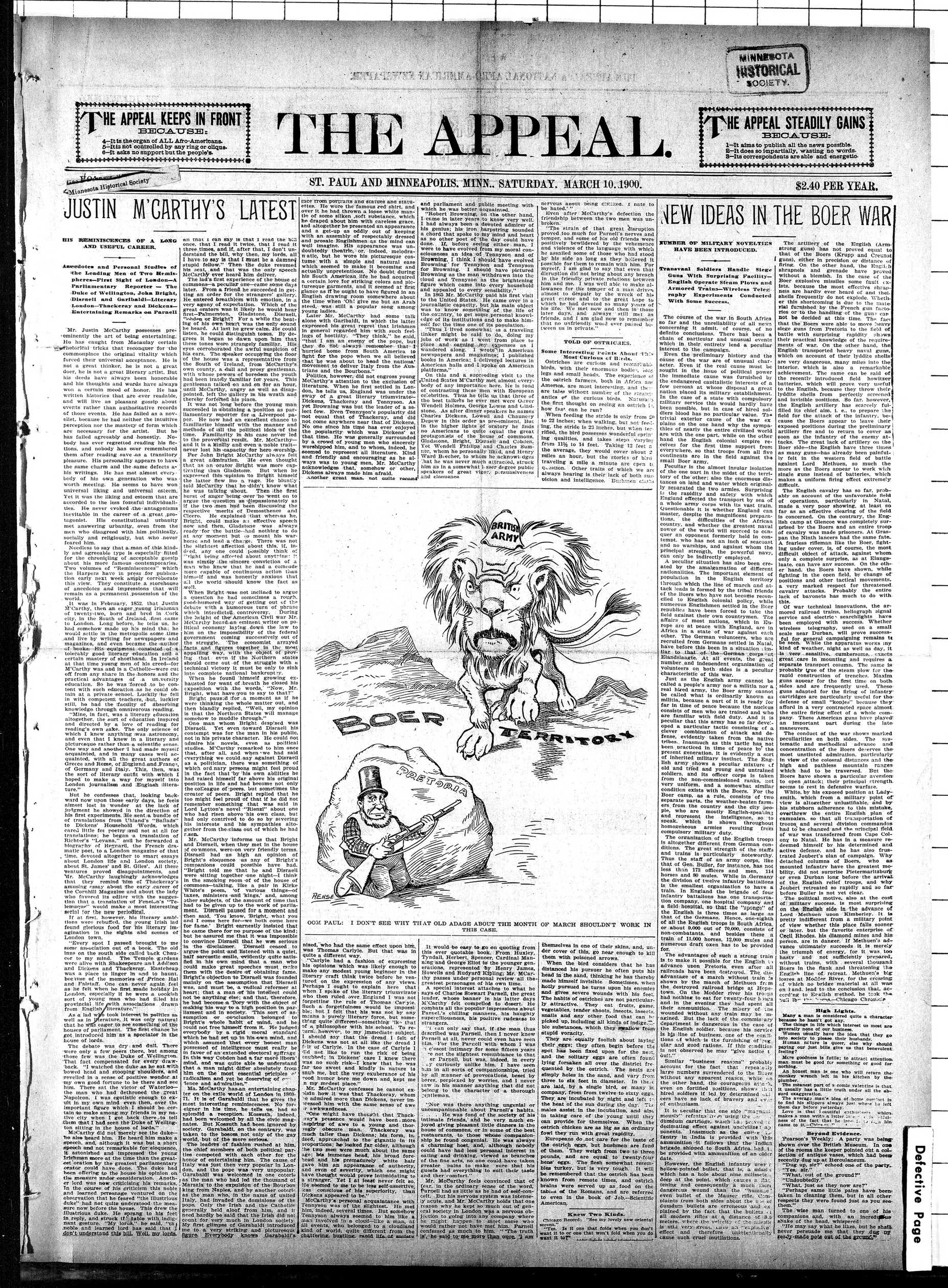
BRITISH ARMY
BOER TERRITORY
PRETORIA
REHSE
OOM PAUL: I DON'T SEE WHY THAT OLD ADAGE ABOUT THE MONTH OF MARCH SHOULDN'T WORK IN
THIS CASE.
race from portraits and statues and stateries. He wore the 'famous red shirt,' and he wore the 'famous black tie' of some silken, soft substance, which he draped about him with careless grace, and a get-up as oddly out in appearance with an assembly of respectfully dressed women, as well as the well imagined. His appearance was undoubtedly theatrical, or, indeed, melodrama, and his costume costume with a simple and stylish appearance which seemed to make it becoming and actually unpretentious. No doubt during the period of his career a certain love for striking colors and picturesque garments, and it seemed at first chance as if the ought to have figured out how to do it, but at about the time when 'Oh! give me but an Arab young ladies' still a popular song among young ladies.
Later Mr. McCarthy had some talk with the Auburn students, who expressed his great regret that I rishmanized in general regarded him with such feelings. He said that I am an enemy of the pope, that he do not always remember, that I should fight for the pope when we all believed that he was about to head the nation, that I was from the Austrians and the Bourbons.
Politics, however; did not engross young literacy's attention to the exclusion of literary attention, he told us. He told us, he tells us, England was under the great literary trivisevate—Dickens, he told us, yet Browning was but the leader of a select few. Even Teenytonny's popularity did not come anywhere near that of Dickens. No one since his time has ever enjoyed the attention of Dickens, and that time. He was generally surrounded by a crowd of young men who sincerely appreciated him, and it seemed to represent all literature. Kind and friendly and encouraging as he alluded to him, McCarthy acknowledges that somehow other, Dickens always made him afraid.
BOE
REHSE
OOM PAUL: I DON'T SEE WHY T
nized, who had the same effect upon him,
that But was in quite a different way.
"Carlyle had a fashion of expressing his opinions which was likely enough to allow any modest young beheader the literary honor he was venerated on the expression of any views. When I spoke of the explain here that who then ruled over England I was not forgetting the rule of Thomas Carlyle, but I felt that I was not by any means a purely literary force, but some means a philosopher with his school. To return, however, to my immediate subject, Dicenne was at all like the fell of Carlyle. In the case of Carlyle I like to run the risk of being snubbed; but I felt that no such risk—I knew that he was far too sweet and kindly in nature to good humber be exuberance of his good humor bore on and kept me in my modest place."
Mr. McCarthy confesses he cannot exe-
cuse himself that Thackeray, whom
he admired more than Thackeray, was
pressed him with the same sense of awe
or awkwardness. He we thought that Thackeray's presence would have been more
inspiring of awe to a young and thou-
ghful obscure man. Thackeray was
deeply impressed by Thackeray's deed, approached to the gigantic in its propor-
tions; he looked far older, but the
two men were much about the same
size. He was a head and his prematurely white hair gave him an appearance of authority,
and he might one might have thought would provoke a stranger. Yet I at least never felt so.
He seemed to me to be less self-assertive,
and more superiority, than Ockens appeared to be. McCarthy's personal acquaintance with Tennyson was of the slightest. He met Tennyson in a cloud-like a man, at
kind of world, quite different from chattering, chattering, rallie land of souls
"Robert Browning, on the other hand, I came in later years to know very well. I had always been a devoted admirer of his genius; his iron harpstring sounded a chord that spoke to my mind and heart as no other poet of the day could have done. It, before seeing either man, I were to have evolved from my moral consciousness an idea of Tennyson and of Browning, I think I should have evolved Browning for Tennyson and Tennyson for Browning. I should have pictured Browning as the man withdrawn into the cloud and Tennyson as the brightening figure which came into every household and appealed to every sensibility."
In 1855 Mr. McCarthy paid his first visit to the United States. He came over in a journalistic capacity, but his main object was to know something of the life of the country, to get some personal knowledge of its institutions and to make himself for the time one of its population.
"Thus I lived somewhat ... as a traveling tinker might be said to do, doing my jobs of work as I went from place to place and earning my expenses as I wandered along. I wrote in American newspapers and magazines; I published books in America; I delivered lectures in American halls and I spoke on American platforms."
On this and a succeeding visit to the United States M'Carthy met almost every body of any importance he has. He is totally aware of the peculiar ecistencies. Thus he tells us that three of the best talkers he ever met were Owen Gendell Holmes, George Lowes and Cindy Charles Dickens, Lowell and Chauney Deppe in this order as pre-eminent. But in the higher lights of oratory he finds that he is not a great protagonist of the house of commones, Gladstone, Bright, Desiriel and Cobden, Wet Wendell Phillips and Charles Sumner, and the great Ward Becher, to whom he acknowledges that he was never much attracted, struck him as in a somewhat sier degree public and a great viger, pernaciousness and齐omeness.
BRITISH ARMY
ETORIA
WHAT OLD ADAGE ABOUT THE MONTH
THIS CASE.
It would be easy to go on quoting from this ever quotable book. From Huxley, Tyndall, Herbert, Spencer, Cardinal Manning and George Elliot to the younger generations, represented by Henry James, Howells and Rudyard Kipling; Mr. McCarthy passes under personal review all the greatest personages of his own time.
A special interest attaches to what he says of Charles Stewart Parnell, the great leader, whose banner in his latter days McCarthy felt compelled to desert. He combats all the popular impressions about Parnell's chilling manners, his haughty supercliffousness, his positive rudeness to strangers.
"I can only say that, if the man thus described was Parnell, then I never knew Parnell at all, never could even have seen him. For the Parnell with whom I was a esest intimacy for some fifteen years he not the slightest resemblance to that
er Parnell, but was, indeed, in every way curiously unlike him. I have seen him in all sorts of companionships, tried by all manner of provocations, beset by bores, perplexed by worries, and I never saw in his manner anything that did not belong to the character of a thorough gentleman.
"Nor was there anything unengalal or uncompromising in Parallal's habit of being the long dog of the intimate friends, and he very much enjoyed giving pleasant little dinners in the house of commons, or in some of the best ships he found congenial. He was always a charming host, and, although nobody eating and drinking, viewed as branches of the fine arts, no one could have taken greater pain to make sure that his eating and drinking suit their taste and their comfort." Mr. McCarthy felt convinced that of ear, in the ordinary sense of the word, he had to be careful with such cutlery. But his nervous system was intensely acute, and Mr. McCarthy holds that one reason why he and so much of genetically identical people function into any company where he might happen to meet some who confessed as much to him. "The truth he' said to me more than once, I am
nervous about being closed. I note to be hated.
After McCarthy's defection the friendship between the two men was unbroken.
"The strain of that great disruption too many of oururnell's nerves and tempers, some of some of them positively bewildered by the vehemence he assailed some of his language with which he by his side as long as they believed it, and myself, I am glad to say that disruption did not bring about any breach between him and me. I was well able to lauwance for the temper of a man driven by his great career and to the great hope which he had devoted so many years of his life to those later days, and always to friends, and I am glad now to remember that word ever passed between us in private.
Some Interesting Points About This
Most Cruelty of People
Most Curious of Birds.
Ostrich are curious and rebellious birds, with enormous bodies, long legs and small heads. The ostrich farmers, both in Africa and America, are most interesting, and they are tales without number of the strange curious birds. Naturally the first thought being an ostrich is how fast can he run?
When feeding the stride is only from 29 to 22 inches; when walking, but not feeding, the stride is 23 inches, but when testing, it possesses wonderful springing qualities, and it can be from 11½ to 14 feet. Taking 12 feet at the average, they would cover about 2 miles an hour. But the stories of bird traveling a mile a minute are open to other traits of which we are always hearing and intelligence. But both usonction and intelligence.
OF MARCH SHOULDN'T WORK IN
themselves in one of their skins, and, under cover of this, go near enough to kill them.
When the bird considers that he has distanced his purrer he often puts his head in the sand, thinking he has thereby holted his purrer. Sometimes, when hotly pursued he can be scared and gives severe wounds with his feet. The habits of ostriches are not particularly attractive. They eat fruits, game, insects, and other food. They snatch and any other food that can be picked up, including all kinds of indigene substances, which they swallow from their mouths. They are actually foolish about laying their eggs; they often begin before the spot has been fixed upon for the nest, and the solitary eggs are often found burying all over the district free from predators. They simply holes in the sand, and vary from three to six feet in diameter. In these are laid, by a single bird, or many in company, from twelve to sixty eggs. They can be kept in the heat of the sun during the day. The males assist in the incubation, and also in taking care of the young until they can provide for themselves. When the birds are in the nest, the primary fowl they run with great rapidity.
Europeans do not care for the taste of the ostrich eggs, but bushmen are fond of them. They grow from two to three pounds, and are equal to twenty-four hens' eggs. The flesh somewhat resembles turkey, but is very tough. It will be remembered that the ostrich has been used in the manufacture of brains were served up as food on the tables of the Romans, and are referred to even in the book of Job - Scientific American.
Knew Two Kinds.
Chicago Record: "See my lovely new oriental"
Yes. Is it one that fold when you don't want it to expand or one that won't fold when you do want it to expand.
NEW IDEAS IN THE BOER WAR
Transaval Soldiers Handle Siege Guns With Surprising Facility—English Operate Steam Plovs and Armored Towers—Wireless Telegraphy Experiments Conducted With Some Success.
The course of the war in South Africa was the unreliability of all new concern and definite conclusions. There has been a chain of particular and unusual events which in their entirety led a peculiar firepower. Even the preliminary history and the cause of the war are of unusual characters. Even if the real cause must be determined, the immediate cause was furnished the endangered capitalistic interests of a few persons at whose disposal a great number of particular value. In the case of a state with compulsory service this would hardly have been possible, but in case of hired soldier service the particular value. The trivial exterior character of the plains on the one hand why the sympathies of nearly the entire civilized world are held up on the other hand the English colonial empire receives for the first time support from everywhere, so that troops from all five countries in the field against the small Boer army.
Peculiar is the almost insular solution of the one part in the mid of the terri-
tory, the other; also the enormous distances on land and sea, which
separated the two armies. Surprising is the rapidity and safety with which England effected the transport by sea of the troops to the vast train. Questionable it is whether England master, despite the magnificent preparations, the difficulties of the African coast, the naval power of the world will succeed. Quer an opponent formerly held in contempt, who has not an inch of seacast or naval power and against whom the principal strength of the navy, can only be indirectly employed.
A peculiar situation has also been created by the amalgamation of different nationalities in the English element of population in the English through which the line of march and attack leaks is formed by the tribal friends encountered by the colonists, who recounted to English colonial power numerous Englishmen settled in the Beeer field against their own territory and take the field against their own territory, affairs of most nations, which in Europe are an peace with England, are in conflict with France, and are other. The German volunteers, who are recruited from Germans settled in Natal, have also been in a situation similar to that in the English, a peculiar characteristic of this war.
Just as the English army cannot be called a people's army nor a militia nor a real hired army, the Boer army cannot be called what is ordinarily known as militia, because a part of it is ready for far in time of peace because the nucleus consists of men who are trained and who are familiar with field duty. And it is peculiar that this army has so far developed a particular tactic consisting of a clever combination of attack and defense, evidently taken from the native tribes. Inasmuch as this tactile has not been practiced in time of peace by the present generation, it is evidently a sort of inherited military instinct. The English army shows a peculiar mixture of old and tried and young and untrained soldiers, and its officer corps is taken from the non-commissioned ranks, not very uniform, and a somewhat similar condition exists with the Boers. For the Boer camp, as a rule, consists of two separate parts, the weather-beaten farmers from the country and the city people, who are mostly English-speaking and represent the intelligence, so to speak, which is shown throughout the homogeneous armies resulting from compulsory military duty.
The organization of the English troops is altogether different from German conditions and trains is particularly noteworthy. Thus the staff of an army corps, like those of the infantry, for instance, has not less than 173 horses and 80 mules. While in Germany the division of twelve infantry battalions has one transportable train. In England the brigade of four infantry battalions has one transportable company and a field hospital, 80 that the English is three times as large as the German. Hence, one-eighth of all the English troops are or about 9,000 out of 70,000, consists of non-combatants, and besides these a train of 11,000 horses, 12,000 mules and a mere draft oxen has to be provided for.
The advantages of such a strong train is to make it possible for the English to railroad have Pretoria even after all railroads have been built. The advantage of a march without train is shown by the march of Methuen from the railroad station at Hopetown. On the river there lived nothing to eat for twenty-four bushes and in the evening they had spent all their time on the river. The wounded without any may be maimed. But the lack of the commissary department is dangerous in the case of a bush, because his service is his line of business, the situations of which is the furnishing of regular and zoog rations. If this condition is not observed he may 'give notice to' the bush. Similar 'business reasons' probably account for the fact that repeatedly large numbers surrendered to the Bees on the other hand, the courageous attack even on fortified positions, shows that he could inflict if led by determined soldiers but lack of bravery and even of enthusiasm.
It is peculiar that one side "manual
mously" refrains to use the
dumdum cartridge, watch has proved
itself to be a useful tool in
ponents, inasmuch as the entire
fantry in India is provided with this
ammunition. It follows that the Indian
brigade shipped to South Africa had
provided with ammunition of an older
date.
However, the English infantry uses a hollow-pointed bullet, that is, a muzzle which has a hole about nine millimetre in diameter, to penetrate and consequently a much danker wound than the "thunny" even bullet of the Mauser rifle. Complaints from both sides about the use of a hollow-pointed bullet are plained by the fact that the bullets are all modern rifles at a distance of 32 meters, where the velocity of the bullet is still very high. We have an explosive bullet, therefore an intentionally cause such cruel mutilations.
$2.40 PER YEAR.
The artillery of the English (Armstrong guns) has not proved equal to that of the Boers (Krupp and Creuzot guns), either in precision or distance of firing. On the other hand, the English are not good at making the gun, but have not been without a blemish. In the case of Boer explosive missiles some fault exists, because the most effective shanneis are hardly ever heard of and their shells frequently do not explode. Whether thin short-程coming is due to the materials of the gun, the gun's gun-type or to the handling of the gun, the gun's gun-type or to the handling of the gun, the fact that the Boers were able to move heavy siege guns from Pretoria to the field of battle with surprising rapidity shows their practical knowledge of the requirements of war. On the other hand, the Boers are not very good at making the gun which on account of their lyddite shells are very dangerous, many miles into the interior, which is also a remarkable achievement. The same can be said of the recently introduced field howitzer batteries, which will prove very useful to the English, because they throw their lyddite guns to the ground, and invisible positions. So far, however, the English artillery has scarcely fulfilled its chief aim, i. e., to prepare the field for the attack of the infantry, because the Boers appear to leave their exposed positions during the preliminary air attack. The Boers are not so well as soon as the infantry of the enemy attacks. The great lack of artillery on the Boer side—the English have three times as many guns—has already been painfully felt in the western field of battle against Lord Methuen, so much the more as the Boers appear to work with some insignificant of batteries, which makes a uniform firing effect extremely difficult.
The English cavalry has so far, probably on account of the unfavorable field of operations, poor training, poor leadership, far as an effective clearing of the field is concerned. On the contrary, the Engagement by the Boers was impaired by the Boers and an entire troop of cavalry was made prisoners. At Graspan the nine lancers had the responsibility of protecting the Boers, fighting under cover, is of, of course, the most difficult object of attack, against whom the Boers have shown great elasticity, can have any success. On the other hand, the Boers have shown, while fighting the Boers, the positions of positions and other tactical movements, a very marked respect for threatened cavalry attacks. Probably the entire bulk of cavalry has much to do with
Of war technical innovations, the armored railroad trains, hellograph signal systems, and the armored railroad trains, have been employed with success. Whether wireless telegraphy, used on a small scale near Durham, will prove successful, or whether the railroad trains be seen. While the apparatus works any kind of weather, night as well as day, it is very sensitive, cumbersome, exacts the task of construction of separate transport colum. The same is probably true of the steam plow for the rand construction of trenches. Maxim the engineer, who works on sides and are frequently used. These guns adapted for the firing of infantry cartridges are particularly useful for the construction of trenches, afford in a very contracted space almost the entire firing effect of a whole company. These American guns have played an important part during the late maneuvers. The conduct of the war shows marked peculiarities on both sides. The system of the railroad trains consists of concentration of the Boers deerves the most unstinted admiration, particularly the view of the colossal distance and the high speed which had to be traversed. But the Boers have shown a particular aversion to open attack; their principal strength is the railroad trains.
White, by his exposed position at Lady-Smith, from a military of arms, and from a military of arms, his stubborn adherence to this mistake, overthrew the entire English plan of troops and several division commands had to be chanched and the principal field of war was transferred from Cape Colony, deemed himself by his determined and active defense, and he has also frustered detached columns of troops detached columns of Boers, as mounted infantry have the greatest mobility and surprise. Determitarians even Dunbar, who commanded the English relief troops, and why Joubert re-attreated rapidly, and so far succeeded.
The political motive, also at the cost of military success, is most surprising on the English side in the advance of the French, but it is pretty indifferent from a military point of view whether this place falls sooner or later, but the favorite enterprise of Cecil Rhodes, his diamond mines and his railway lines, ultimately succeeds it is merely the triumph of energy, for it was too hasty and not sufficiently prepared, without trains with several thousand miles of railway, and the English line of retreat. Methuen's big losses at Moder River, for the crossing of which no bridge material at all was on land, lead to the conclusion that, accustomed to the French, he be the bridge-Chicago Chronicle.
High Lights.
quite a character because he hasn't got any. The things in life which interest us most are
generally none of our business. We know that they go into society to please, their hobbies.
into society to please their husbands; should paying our just bills give us that benevolent reward? More goodness is futile; to attract attention, man must be good for something or good for someone.
An honest man is one who will return the monkey wren left in his kitchen by the meanstand part of a comic violet is that the monkey wren will truth under all the absurd exaggeration. The average man's idea of home comfort is that he will just just where he is left them day before yesterday. Love is that beautiful enthusiasm which manners have with the kindness of the fact that he has the name to it. Charles B. Beyond Evidence. Pearson's Weekly. A party was being held at the rooms the keeper pointed out a collection of antique vases, which had been recently dig at Berculaneum.
Defective Page
"Dug up, sir?" echoed one of the party.
"Yes, sir."
"What, out of the ground?"
"Undoubtedly."
"What, just as they now are?"
"Perhaps same little pains have been taken in cleaning them, but in all other cases they were found just as you see them."
The wise man turned to one of his
shields of the head, whispered
"He may say what he likes, but he shall never persuade me that they dug my ready-made pots out of the ground."
YOU READ
THE APPEAL
THE APPEAL.
A NATIONAL AFRO-AMERICAN NEWSPAPER
PUBLISHED WEEKLY BY
ADAMS BROS. EDITORS AND PUBLISHERS
49 E. 4th St. St. Paul, Minu
INSURED SINGUAREZUALLY IN
Saint Paul, Minneapolis, Chicago,
Louisville, St. Louis, Dallas.
ST. PAUL OFFICE,
No. 164 Union Block 4th and Cedar
J. Q. ADAMS, Publisher.
MINYZAPOLIS OFFICE.
Room Number 600 Onledia Rooft
H.ROBERTS, Manager.
CHICAGO OFFICE,
No. 823-5 Dearborn St. Suite 213-215
C. F. ADAMS, Manager.
LOUISVILLE OFFICE,
No. 312 West Jefferson St. Room 8
W. V. PENN, Manager.
ST. LOUIS OFFICE,
No. 1002 FRANKLIN AVENUE
J. H. HARRISON, Manager.
DALLAS OFFICE,
NUMBER 497 MAIN STREET
L. A. BROWN, Manager.
TERMS, STRICTLY IN ADVANCE:
Single copy, one year
$2.00
Single copy, six months
$1.10
Single copy, three months
60
When absent
to run without perpayment, the terms are $6
per month. If you pay the odd week,
or at the rate of $2.40 per week
Remittances should be made by Express Money Order, Post Office Money Order, item 1 Letter or Bank Draft. Postage stamps will be received as cash for the fractional parts of a dollar. Only one cent and two cent stamps taken.
Silver should never be sent through the mail. It is almost sure to wear a hole through the stamps and the cost, or else it may be stolen. Persons who send silver to us in letters do so at their own risk.
Marriage and death notices, ten lines or less $1. Each additional line 10 cents, Payment strictly in advance, and to be announced at all times from in season to be news.
Advertising in the public online, each insertion. There are fourteen報告語 in an inch, and about seven words in an agate line. No single advertisement less than $1. No postage is shown on the postage. No postage is shown on the three months contact. Each company all orders from parties unknown to us. Further particulars on application.
Reading notices 23 cents per line, each insertion. No discounts for time or space. Reading matter is set in brewer type—about six words to the line. All head lines count double.
The date on the address label shows when subscription expires. Renewals should be made two weeks prior to expiration, so that no paper may be missed, as the paper stops when time is out.
It occasionally happens that papers sent to subscribers are lost or stolen. In case you do not receive any number when due, inform us by email at the expiration of five days from that date. The carefully forward duplicate of the missing number.
communications to receive attention must be written only on one side of the paper; must be evenly spaced, anyway not later than Wednesday, and both sides of the author. No manuscript returns, unless written on both sides of the author.
In every letter that you write us never fail to
tell us that you are a student in a post-
office, post office county and state. Business
letters of all kinds must be written on separ-
ate paper. The student must master for
entrance. Entered as second
THE APPEAL wants good reliable agents to canvass for subscribers at points not already covered. Write for our extraordi- incements. Address.
THE APPEAL,
St Paul Minn.
SATURDAY, MARCH 10, 1900.
In accepting the Republican nomination for governor of Louisiana, D. Caffery, Jr., says: "The perversion and betrayal of representative government, of which the Democratic organization in this state has been guilty, justifies open radical and determined opposition, beyond the limits of party, and demands thorough, honest, and permanent reform."
The Republican state convention of Louisiana elected four delegates to national convention at Philadelphia. Two were white, Capt. A. T. Wemberly and ex-Governor William Pitt Kellogg, and two Afro-Americans, J. Madison Vance and Richard Sim. The delegates were instructed to vote for the renomination of President McKinley.
They say the race is not to the swift, nor the battle to the strong, but to him that holds out faithful to the end. This being true, the friends of the two governors on both sides may have
hopes. We have hopes, too; two hopes. One is that the trouble will soon be over and hope number two is that Taylor will win.
It seems that the Boers are getting a shade the worst of it recently. As our sympathies are not with them, we are not kicking.
RECENT INVENTIONS.
Improved earth-cutting head for hydraulic dredges has a shaft mounted on the lower end of the suction pipe, with a spiral cutter on the end of the shaft, which is revolved to stir up the dirt and bring it in proximity to the suction pipe. To prevent the sides of a bed from spreading apart and dropping the slats a new attachment is formed of a row of rods inserted in the side rails, with a turn buckle connecting them at the center, to draw the sides together and grip the slats.
An Oregon woman has patented an adjustable pot flower, having a two-part receptacle with overlapping edges, which are placed in place by a metallic band, the latter being raised or lowered on the conical pot to increase or decrease the size.
An invisible brake for bicycles is formed of rods connecting the grips inside the handlebar, involving disk set at the junction of the bar and head, which connects with a rod to depress the brake shoe when the grips are twisted.
Post holes of any size can be rapidly dug by a new implement, which has a conical boring tool, with a cutting blade inserted in one side, which cuts a section of earth out of the hole as it is revolved, the tool being lifted out and emptied when it becomes full. For drawing straight lines neatly and accurately, blurring a new implement has a sharp edge at the end of a handle, with a reservoir in the upper portion of the handle and a moistening pad connecting the disk with the reservoir to feed the ink to the disk as it is revolved on the paper.
THEATRICAL NOTES.
"The Greek Slave," brought over from London and played at the Herald Square theater, New York, failed from a bad cast.
Irving has taken in more money in Boston, it is said, than he did in New York. None, however, eclipses San Francisco's record.
A British syndicate is acquiring the theatrical property in New York, and may try to acclimate the peculiar British humor over here.
Gadski made her reappearance in New York at a concert for the benefit of St. Mark's hospital. The charity benefited nearly $5,000.
A negro musical conductor goes with the entertainment of Williams and Walker, a negro comedians. In Washington the local orchestra refused to make any music under his baton, and a white man was substituted.
Madeline Lucee Ryley, author of "An American Citizen," by birth an English woman, has settled down permanently in London. Mrs. Ryley, during her stage days, lived in the country for ten years. Gertrude Elliott, who pronounced a pronounced hit in London, is living in New York. Count Keyserling, who belongs to old Monrovia family, has written a play called "The Sacrifice of Spring," which is hailed in Berlin as the finest poetic drama, except Gerth Haumpmann's, of the time. It is a story of an abused and neglected girl, who, hearing her grandmother pray that she be less than that of her stepmother, who is very ill, may be taken, thinks it can be done and takes poison.
THE FEMININE OBSERVER.
When a dog wags his tail he means it.
The winter draperies of a house convert uglishness into beauty.
It is really so much easier to fight a battle than to run away from it.
a battle than to run away from it. A woman never knows a man's real disposition until she sees him intoxicated. It is the general girl that one thinks will die old maid who marries the beat. A lazy woman will learn to play the banjo because she can practice in a rocking chair. Some of the new dress trimmings could easily be mistaken for Christmas trc decorations. If haven't had the baby photographed, Christmas don't get it done for papa's New Year's girl. The girl who wears shoes that look as though she had borrowed her brother's is the one considered most stylish these days. The stitch that was once so much in vogue in the working of cardboard mottos is now revived for canvas table covers. Nothing on earth inspires such a feeling of independence as the knowledge that there are other persons and places when certain persons and places pall.
Women have always been considered just a wee bit lower than the angels, and now they are catching up as fast as possible, the wings sprouting forth from every hat worn by the followers of fashion.-Philadelphia Times.
REFLECTIONS OF A BACHELOR.
Love is a bee; marriage is the same bee with the sting pulled out.
No man objects to having his wife talk baby talk to him if she knows enough not to do it before people.
After a woman has been married about a year she never near as many tall screens in the bedroom.
A woman as a girl begins to think she wants to put her hand a foot above where her heart is when he tells her he was sick yesterday.
Take Laxative Bromo Quinine Tablets
All drugstores refund the money if it fails to cure. E. W. Grove's signature is on each box.
THE APREAL: A NATIONAL AFRO-AMERICAN NEWSPAPER
THE BOOK WORLD
Lewis, R. B.: Light
1858
Loguen, J. W.: As a S
mann
Logen, R. K.: History
Baptist Church
Lay, M. W.: Woman
Mars, Bilian P.: Life
McClellan, G. M.: Po
Morgan, J. H.: The M
Majors, M. A.: Noted.
Menard, J. Willis: I
Landscapes
Mixon, M. H.: A M
Moe of Jersey
Moore, Alice Ruth (Grs
Goodness of St. Ro
Moore, J. J.: History
Moore, J. J.:
THE FACE OF THE MISSING WOMAN
```markdown
```
Alphabetical List of Afro-American Authors and Their Works.
The following is a list of the books of Afro-American authors which are being gathered for the purpose of making an exhibit of the same in the Afro-American Exhibition. Cyrus Field Adams, of THE APPEAL, Chicago, Ill., has been appointed to look after the matter in the West. Any one who can furnish a book or pamphlet by an Afro-American author, on this list or having knowledge of such as are not on this list, will greatly aid this effort by interesting themselves to make certain that all books and pamphlets are duly represented in the collection. Labels which will carry books free through the skills will be furnished on application. If the book cannot be obtained, send description as follows: Name of author; title; size of book; place of publication; name of publisher; date of title; number of pages.
Allensworth, Allen: The Kiss. Allen, F. B.; Chips of History. Allen, Richard; Autobiography. Philadelphia, 1888; Autobiography, Philadelphia, 1793.
and Speeches, J. M. Ashley, 1895
and Speeches, J. M. Ashley, 1895
Ayler J. C., Guide Lipschutz, Princeton, 1895
Ayler J. C., Guide Lipschutz, Princeton, 1895
coog, 1890; Red Record, Chicago, 1895
coog, 1890; Red Record, Chicago, 1895
Soiren Cook, Souvenir Cook
Book, Washington
FACIAL MASSAGE---THE M
Maxement No. 1
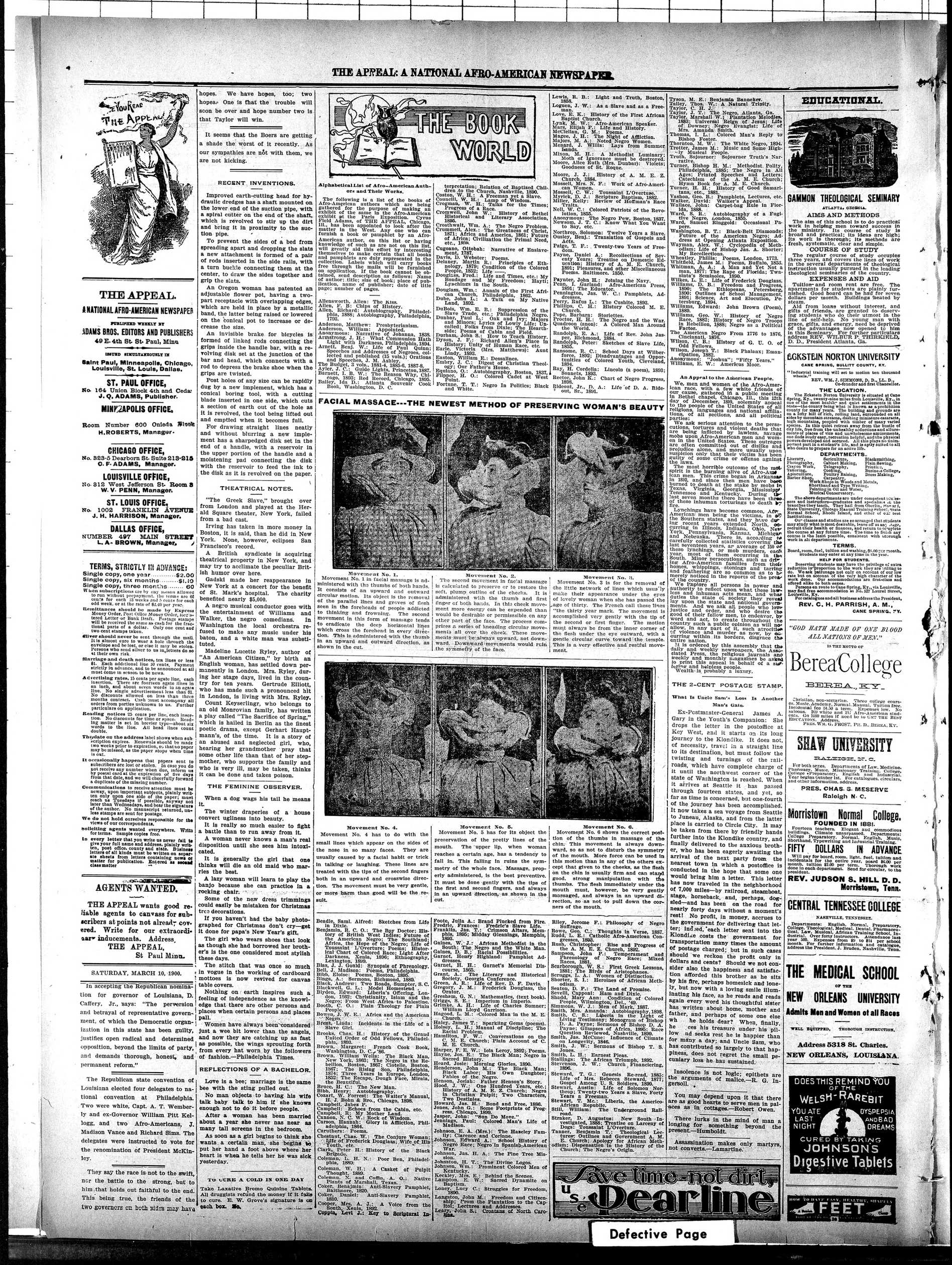
Movement No. 1 in facial massage is administered with the thumbs of both hands, of an upward and outward circular motion, and of the parallel lines and grooves of flesh seen in the foreheads of people addicted to alcohol and frowning. The second movement is used to tend to eradicate the deep horizontal which cross the deep inward in every direction. This is administered with the thumb and outward direction, as shown in the cut.
Movement No. 4.
Movement No. 4 has to do with the small lines which appear on the sides of the nose in so many faces. They are usually caused by a facial habit or trick in talking or laughing. These lines are treated with the tips of the second fingers both in an upward and crosswise direction. The movement must be very gentle, or more harm than good will be the result.
Beadle, Saml. Alfred: Sketches from Life in Dixie.
Benjamin, R. C. O.: The Boy Doctor; History of British West Indies; Future of the American Negro; The Southland: Africa, the Hope of the Negro; Life of Toussaint L'Overture; Poems; Historical Chart of Colored Race; Light After Darkness, Xenia, 1806; Ethnography, Lexington, 1899.
Blas, J. J. Gould: Synopsis of Phrenology. Bell, J. Madison: Poems, Philadelphia. Bibb, Eloise: Poems, Boston, 1895. Blinga, A.: Sermons, Richmond, 1899. Black, Andrew: Two Roads, Sumpter, S. C. Blackwell, G. I.: Model Homestead. Blyden, Edward: Liberia's Offering, London, 1892; Christianity, Islam and the Negro: From West Africa to Palestine. Booth, C. O.: Plain Theology for Plain People.
Bowen, J. W. E.: Africa and the American Negro.
Brent, Linda: Incidents in the Life of a Slave Girl.
Brooks, Chas. H.: History of the Grand United Order of Odd Fellows, Philadelphia, 1893.
Brown, Margaret: French Cook Book, Washington, D.C. 186
Brown, William Wells; The Black Man
Brown, William Wells; The Black Man
billion, Boston, 1881; Collette, Boston
1881; The Rising Son, Philadelphia
1882; The Rising Son, Philadelphia
1882; The Escape, London
1882; The Escape, London
the Beautiful, the Beautiful,
Bibb, Henry; Autobiography,
Cozart, W. Forrest; The Watters' Manual
Campbell, Jake B. Chicago, 1888.
Campbell: Echoes from the Cabin, etc.
Campbell, N.C. W. R. Wake of Widom.
Campbell, N.C. W. R. Wake of Widom.
Carson, Hannah: Glory in Affection, Phil-
lipson, 1880. Carruthers: Poems.
Chestnut, Clas. W.: The Conjure Woman:
Douglas, Wife of His
Youth, etc.
H. H.: History of the Black
Brigade.
Carson, H. N.: Poor Benn, Philadel-
phia, 1880.
Coleman, W. H.: A Casket of Pulpit Thought. 1889.
Cooper, Mrs. A. J. J. A Voice from the
Cooper, Lert J. K. Key to Scribentra I
Lert J. K. Key to Scribentra I
terpreter; Relation of Baptised Chil-
dren to Church, Nashville, 1850.
Coston, W. H.; Lamp of Wisdom.
Council, W. H.; Lamp of Wisdom.
Cromwell, Alex; The Times for the Times;
Progress of a Race.
Cromwell, John W.; History of Bethel
Cromwell, Win. A.; A. Negro Problem.
Cromwell, Alex.; The Great of India.
1871; Africa and America; 1861; Future
of Civilization the Primal Need, etc.
Cugano, Ottobah; Narrative of Enslave-
davis, D. Webster; Poems.
Delaney, Martin R.; Principles of Eth-
ology, D. Webster; Colored Peo-
ples, 1852; Life.
Douglas, Fred.: Life and Times, etc.: My
Tales. Hayt: Hayt's Memoirs. Hayt's
Loychins in the South.
Douglass, Wm.: Annals of the First African church, Philadelphia, 1882. Douglas, A. Talk on My Native Land, 1802. Dubois, Wm. E. R.: Suppression of the Bible. Dunbar Faul L.: Oak and Iy; Maltese. Dunbar Faul L.: Lyrics of Lowly Life; Unearths; Poems of Cabin and Field. Dyson, J. F.: Richard Allen's Place in History; Unity of Human Race, etc. Eakins, R. (Matthew). Aunt Linda, 1883.
Fortune. T. T.: Negro In Politics; Black
and White.
NEWEST METHOD OF PRESE
Movement No. 2.
The second movement in facial massage is calculated to preserve or to restore the skin's elasticity and firmness administered with the thumb and first finger of both hands. In this cheek movement more energy can be expended than the desirable or permissible on any other hand. This movement prises a series of kneading circular movements all over the cheek. These movements must be always upward, not downward, so that the movements would ruin the symmetry of the face.
K. M.
Movement No. 5 has for its object the preservation of the pretty lines of the mouth. The upper lip, when woman reaches a certain age, has a tendency to fall in. This falling in ruins the symmetry of the whole face. Massage, properly administered, is the best preventive. It must be done gently with the tips of the first and second fingers, and always in an upward direction, as shown in the image.
Foote, Julia A.: Brand Plucked from Fire.
Franklin, Jas. T.: Crown Alarm, Memphis,
1886; Midday Gleannings, Memphis,
Galines, W. J.: African Methodist in the
Man. Galines, D. B.: Racial Possibilities,
Garnet, Henry Highland: Pamplers Ad-
garnet, H. H.: Garnet's Memorial Dis-
course, H. H.: The Literary and Historical
Sociology, Georgia Conference,
Green, Gregory, J. M.: Frederick Douglass, the
Gresham, G. N.: Mathematics, (text book),
Giggs, S. E.: Imperium in Imperio,
Hill, William C.: James Summer,
William Lloyd Garrison.
Hill, Lloyd C.: Colored Man in the M. E.
Church.
Haley, James T: Sparkling Gems (poems).
James T. James: On the Discipline. The
Racial Problem.
Hamilton, F. Church; W. conversations on the
F. Church; Flain Account of C. M. E. Church
Harper, F. E. W.; Iola Levy 1802; Poema,
*Harpes of the Black Man*; Negro in
Sacred History; John Glorios 1808;
Sacred History; John Glorios 1808;
Henderson, John Glorios 1808;
Henderson, John Glorios 1808;
Fahnes of the Negro, Own Daughter;
Fahnes of the Negro, Own Daughter;
Howard, Jas. H.; Bond and Free, 1886.
Howard, Jas. H.; Footprints of Progress; Chicago, 1886.
Jasper, John: "Sun Do Move."
Jasper, John: "Colored Man's Life of Johnson, E. A. (Mrs.) The Hassler Family; Clarence and Corinne.
Jonger, R. Edward A.; School History of Negro War; Negro in Spanish-American War.
Johnson, Jas. H. A.: The Pine Tree Mistake
Johnson, H. T.: The Divine Logs.
Johnson, Wm.: Prominent Colored Men of
Kreecy, Mee. E.: Behind the Scenes.
Lampton, E. W.: Sacred Dynamite on
Loney, Locy C.: Strugles for Freedom,
1890.
Langan, John M.: Freedom and Citizenship;
From the Plantation to the Capitol;
Lectures and Addresses.
London, John S.: Crontats of North Carolina.
Save time-not dirt use Pearline
Lewis, R. B.: Light and Truth, Boston,
Loganian, J. W.: As a Slaw and as a Free-
er.
Mixon, M. H.; Moseley, A. Modestist Luminary; Moore, A. M.; Hath, A. B.; destroyed Moore, Alice H. M. (Mrs. Dana); Vilauer; Goodness of St. Rocque.
Moore, J. J.; History of A. M. E. Z. Mossel, Mrs. N. F.; Work of Afro-American Women.
Mossel, Mrs. N. F.; Toussaint L'Oventure.
Myrick, D. J.; Scripture Baptism, 1882; Review of Hoffman's Race Traits.
Nell, W. C.; Colored Patrols of the Revo-
nment. The Negro Pew, Boston, 1837.
Anonymous. The Negro Pew, Boston, 1837.
Nett, E. C.; Know What You Want to
Say, etc. 87.
Northrop, Sloane. Twelve Years a Slave.
Northrop, Sloane. Translation of Gospels and
Acts. (Juni.) 87.
Twenty-two Years of Freedom
dom_
Payne, Daniel A., *Recollections of Seven*:
History of Education; *History of A. M. E.* Church;
*History of A. M. E.* Church; *Collegiate Poems*, Baltimore, 1850.
Poems, Baltimore, 1850.
Poems, Joan J. Garland, *American Press*, Poems, Joan J. Garland, *American Press*.
Educator.
Pennington, Jas. W. C.: Pamphlets, Addresses.
Perry, Rufus L. : The Cushite, 1833.
Russell, C. H.: History Colored M. E.
Church.
Pope, Barbarn: Stortlettes.
War. The Negro and the War.
Quarrel (anon) : A Colored Man About
the World.
Randolph, E. A. : Life of Rev. John Jas-
sardolph.
Randolph, Peter: Sketches of Slave Life,
1855.
Ransom, R. C., School Days at Wilberforce
University, R. C., School Days at
tribunals of Colored Youth, Cleveland,
Cleveland
Ray, H. Cordellin: Lincoln (a poem), 1883.
Reynolds, John. *Chart of King Progress,*
1888.
Rector, John. *Chart of King Progress,*
1888.
Rithm, Jr. *Dr. J. A.* *Life of D. A. Ride-
out, Sr.*, 1891.
ERVING WOMAN'S BEAUTY
Movement No. 3.
Movement No. 3 is for the removal of the little network of lines which usually use the same curve to move a lovely woman when she has passed the age of thirty. The French call these lines "the thirty year mark. The movement is accomplished very gently with the tip of the finger. The movement must always be from the inner corner of the flesh under the eye outward, with a gentle circular curve toward the temple. This is a very effective and restful movement.
Movement No. 6.
Movement No. 6 shows the correct position of the thumbs in massage of the chin. This movement is always downward, so as not to disturb the symmetry of the mouth. More force can be used in this movement, but it is not accepted that given to the cheeks, as the flesh on the chin is usually firm and can stand good, strong manipulation with the thumbs. The flesh immediately under the mouth must, however, be very gently pressed. In an open rection, so as not to put on the corners of the mouth.
Riley, Jerome F.: Philosophy of Negro Sufrage.
Rudd, C. T.: Thoughts in Verse, 1887.
Rudd, L. E.: Catholic Afro-American Congress, 1883.
Baldwin, Rise and Progress of the A. M. E. Z. Church, 1892.
Sampson, John P.: Temperament and Pharmacology of Negro Race; Mixed Races, 1881.
Sensuol, W. S.: First Greek Lessons, 1885.
Serguels, L. A.: Women of Distinction.
Shore, L. K.: Heroines of African Methodism.
Seddon, D. P.: The Land of Promise.
Seddon, L. A.: The Land of Promise.
Shad, Mary Ann: Condition of Colored People, Wilmington, Del., 49.
Shad, Mary Ann: Condition of Colored People, Wilmington, Del., 49.
Smith, J. W.: Sermons of Bishop T. S.
Smith, L. H.: Earnest Pleas.
Stallings: The African Triumph, 1892.
Stevenson, J. W.: Church, Financiering.
Steward, T. G.: Genesis Re-read, 1883;
Life of Mrs. Rebecca Stewart, 1877;
Stewart, J. W.: The African Triumph,
Stewart, Asinlin: Life of Solomon North-
rop; twenty-two years a Slave, 2079.
Stewart, T. Mc.: Liberia, the Ameri-
can Republic.
Smith: The Underground Rail-
straker. D. G. Augustus: New South In-
ligated. Rigged. Larceny of Dogs: Toussaint L'Overture.
Tanner, Benjamin T.: Theological Le-
curses. T. W. H. H. H. H. H.
E. Church: Apology for African Me-
thodism; Dispensation in the History of the
Save time use Peace
Tyson, M. E.; Benjamin Banneker.
Tallies, Thos. W.; A Natural Trinity.
Taylor, C. H. J.
Taylor, J. T.; The Negro, Atlanta, Ga.
Taylor, J. T.: The Negro, Atlanta, Ga.
Taylor, Marshall W. I: Plantation Melodies,
University of Jesus; Life: The
Negro of Negro Engagement; Life of
Mrs. Ananda Smith.
Thomas, I. L.; K. *Manual Man's Reply to Thornton, M. W.: The White Ngor, 1894, Musical People and Some Highly-Musical People. Truth, Soujourner: Sojourner Truth's Narmer, Bishop H. M.; Methodist, Polity, Ages; Printed Speeches and Letters; Mechanism of the Church; Book of the M. E. Church; Turner, H. M.; History of Good Samaritans; Turner, H. M.; History of Good Samaritans.
Vashon, Geo. B.: Pampllets, Lectures, etc., Walker, David: Walker's Appeal. Walker, David: Carpet-bag Rule in Flower, 1888. Ward, S. R.: Autobiography of a Fugiard, S. Negro, London, 1855. Ward, Samuel Ringgold: Occasional Papers.
Whestley, Phillis: Poems, London, 1773.
Whiffle, James M.: Poems, Buffalo, 1853.
Whitman, A. A.: A Man and Yet Not
man, 1877; The Rape of Florida; Twa
man, 1877.
Williams, Edward: John Brown (Poem),
1889.
Williams, Edward: John Brown (Poem),
1889.
Race, 1882; History of Negro Troops, 1888; Negro as a Political Factor.
The American Negro From 1776 to 1876,
Chinchinati, 1876.
Wilhelm, History of the Negro.
Wilson, C. B.; History of G. U. O. of
Chelsea, F. W.
Wilson, J. O.; Black Prairie, D.
An Apparel to the American People
We, men and women of the Afro-American race, with a few friends, that are being inflicted by lawless, savage mobs upon Afro-American men and women in the United States. These outrages are often quitted but are not the same and prejudice alone, and more usually, the suspicion only that their victim has been guilty of some crime or offense against them.
The most horrible outcome of the mot-spirit is the burning alive of Afro-American men. This crime began in Arkansas, and since then men have been burned dead at the time. In Texas, Virginia, the Georgia, Mississippi Tennessee and Kentucky. During the last seven months there have been threeacid inhuman torturings to death.
Lynchings have become common. After American men being the victims, in the Southern states, and they have during recent years extended North occurring in Illinois, Indiana, Ohio, New York, Pennsylvania, Kansas, Michigan and Nebraska. There is, according to carefully collected statistics covering the last seventeen years, an average of 150 of these lynchings, or mob murders, each year, most of them occurring in the South. Minor persecutions, such as driving Afro-American families from their homes, whippings, stonings and tarring and feathering are so common as to be merely noticed in the reports of the press of the country.
We inprove all persons in power and authority to reflect upon what these lawless and inhuman acts mean, and what duties the state of society they reveal lay upon the state and national governments. And we ask all people who love justice and order, and who desire the good of their fellow men, to endeavor, by word and act, to create throughout the country such a public opinion as will allow, in any part of it, such atrocities of violence and murder as now, by occurring within its borders, disgrace the entire nation.
It is ordered by this assembly that the daily and weekly newspapers, the Associated Press, the religious journals and weekly and monthly magazines be asked to print this appeal in behalf of a suferling and helpless people.
Wealth is probably a luxury.
THE 2-CENT POSTAGE STAMP.
What Is Uncle Sam's Loss Is Another
Man's Gain.
Ex-Postmaster-General James A. Gary in the Youth's Companion: She drops the letter in the postoffice at Key West, and it starts on its long journey to the Klondike. It does not of necessity, travel in a straight line to its destination, but must follow the twisting and turnings of the railroads, which have complete charge of it until the northwest corner of the state of Washington is reached. When it arrives at Seattle it has passed through fourteen states, and yet, so as time is concerned, one-bourth of the journey has been accomplished. It now takes a sea voyage from Seattle to Juneau, Alaska, and from the latter place is carried to City. It may be taken from there by easily hands further into the Klondike and, finally delivered to the anxious brother, who has been eagerly awaisting the arrival of the next party from the nearest town in which a postoffice is conducted in the hope that some one would bring him a letter. This letter has now traveled to the neighborhood of 7,000 miles—by railroad, steamboat, stage, horseback, and, perhaps, dogged—and has been on the road for nearly forty days without a moment's rest! No profit, in money, accrues to the government for delivering to the land, sed, "theed, but in such cases should we rent the profit only in dollars and cents? the we not consider also the happiness that satisfaction afforded this brother as by his fire, perhaps homeied and loyally, but now with a loving illumination his face, as he reads and reads again every word his thoughtful sister has written about home, mother and father, and perhaps of some one else whi he holds dear? When, finally, he ces his treasure under his pillow and seeks rest he is happier than for many a day; and Uncle Sam, who has contributed so largely to that happiness, does not regret the small pecuniary loss he has sustained.
Insolence is not logic; epithets are the arguments of malice.—R. G. Ingersoll.
You may depend upon it that there are as good hearts to serve men in palaces as in cottages.—Robert Owen.
There lurks in the mind of man a longing for something beyond the present—Humboldt.
Assassination makes only martys. not converts—Lamarint.
THE HOTEL
GAMMON THEOLOGICAL SEMINARY
ATLANTA, GEORGIA.
AIMS AND METHODS
The aim of this school is to do practical work with students in the ministry, its course of study is broad, practical its ideas are high, work systematic, clear and simple.
COURSE OF STUDY
The regular course of study occupies three years, and covers the lines of work in the school. Instruction usually pursued in the leading theological seminaries of the country.
EXPENSES AND AID
Tuition for students. The apartments for students are plainly furnished. Good board can be had for seven per month. Buildings heated by steam.
Aid from loans without interest, and gifts of friends, are granted to deserving students who are the most ill-healthful line of self-help. No young man with grace, gifts, and energy, need be deprived of the ambigation of the things that are in this Seminary. For further particulars address REV. WILBUR P. THREKFIELD, D.D., President Atlanta, Ga.
ECKSTEIN NORTON UNIVERSITY
CANE SPRING, BULLIT COUNTY, KY.
Industrial training will eat to motion ten thousand wheels. REV. W.M. J. SIMMONS, D.D., LL.D.
THE LOCATION.
The Eckstein Norton University is situated at Cano Spring, Ky., twenty-nine miles from Louisville, Ky., in the west-east line of the South. The state is the only county being the state—the county being what is known as a prohibition on a lotty bill of rich, rolling land, surrounded on all sides by mountain streams, dating miniature cartacles of people with their own water-related species. In this quiet retreat away from the bustle of the city, the city is free from the healthy educational influence of the local and non-whom community; one dinside study, recreation, and health, and the physical development of the city, and the age-based and secured age-based transport parts in a student's life, and is apply suited to all who desire to prepare for an active life.
DEPARTMENTS.
Literary, Secretary, Cabinet Making, Plain Sewing, Film, Photography, Photography, Fishing, Business College, Aptitude, Poultry Raising, Dress Making,
The above departments are under competent use as the branches they teach. They have been from Oberlin, State University, Chicago Manual Training State, State University, Rhode Island, and other of these test Institutions.
Our classes are so are arranged that students learn to recognize the signs of illness and recruit their health or finances, and return to complete the course at any future time. The time to finish any course is consistent with a thorough work in all departments.
i
Deserving students may have the privilege of extra reduction in proportion to the work they are willing to do. We ask patronage not only on account of our low rate but on account of the very high character of the work done. Our accommodations are first-class and offered alike to both sexes.
Persons en route to Cane Spring, Ky., via Louisville, may find free accommodation at No. 527 Laurel Street.
may find free accommodation at No. 267 Laurent Street,
Louisville, KY.
For accommodation and all business address the President,
REV. C. H. PARRISH, A. M.,
CANE SPRING, KY.
"GOD HATH MADE OF ONE BLOOD
ALL NATIONS OF MEN."
IS THE NOTTO OF
BereaCollege
BEREA, KY.
Christian, non-sectarian. Three college courses
Nationwide. Normal Manual. Tuition free.
Incidental fee $3.50 a term. Excursion law.
No salaries. 299 white and 211 Afro-American students.
(600 miles if) must be to CHE THE BEST
EDUCATION. Address.
SHAW UNIVERSITY
RALLIESE, N.C.
For both sexes. Departments of Law, Medicine, Psychology, English, English and industry. Year begins between January and for catalogues, circulars, and admission forms.
PRES. CHAS S. MESERVE
Raleigh N.C.
Fourteen teachers. Elegant and commodious
departments. Unsurpassed. Department:
College Preparatory. Normal. Shorthand.
Typelling and industrial Training.
FIFTY DOLLARS IN ADVANCE
Will pay for board, room, light, fuel, tuition
and incidentals for the entire year, board $600
through work done in each department. Send for circular, to the president.
REV. JUDSON S. HILL D. D.
Morristown, Tenn.
NASHVILLE, TENNESSEE.
Departments: English, Normal, Preparatory, College, Theological Medical, Dental, Industrial, Law, Musical, African Training School, Industrial, Over forty instructors. Attendance last year 500. Expenses from $ 810 per school month. For further information and catalogue, address the President, J. Braden, Nashville, Tenn.
THE MEDICAL SCHOOL
OF THE
NEW ORLEANS UNIVERSITY
Admits Men and Women of all Races
WELL EQUIPPED, THOROUGH INSTRUCTION.
Address 5318 St. Charles.
NEW ORLEANS, LOUISIANA.
DOES THIS REMIND YOU
OF THE
WELSH-RAREBIT
YOU ATE
LAST
NIGHT
DYSPEPSIA
AND BAD
DREAMS
CURED BY TAKING
JOHNSONS
Digestive Tablets
HOW TO HAVE EASY, HEALTHY, SHAPELY
FEET
A Bedside
Gift
WEEKS RECORD IN MINNESOTA TAY'S CAPITAL.
The Saintly City and Saintly City Folks—Newy Items of Social, Religious and General Matters Among the People, Boll-ed Down.
Mr. Eddie Henry still remains quite ill.
Mrs. M. D. Pettis is on the sick list this week, but is improving.
Mr. Chas. Chavis of Indianapolis, Ind., was in the city this week.
The fall styles in the Gordon hat for men and women are exceptional. See them.
Mrs. Overallis is still confined to her bed from the effects of her accident some weeks ago.
No one can afford to pay something for nothing. The Gordon has established the right price for fine hats—not $.
One or two gentlemen roomers wanted. Apply at 527 St. Anthony avenue, or at THE APPEAL office.
TRY A MEAL AT JOHN GODPREYS, NO. 561 SIBLEY STREET, AND YOU WILL EAT NOWHERE ELSE.
Mrs. Lulu Gordon, the female barber who has a shop at 99 East Fifth street, was among the successful candidates at the recent barbers' examination.
Those of our patrons who desire to have matter published must get the same in this office not later than Thursday, otherwise it may be crowded out.
The ladies' of Biddle Circle, G. A. R., are preparing for a musical and literary entertainment to take place at Garfield Hall, Grand Block, on Friday evening, March 23.
Persons desiring to visit the Appeal office are hereby notified that it has been removed from the fifth to the third floor, Rooms 109 and 110, in the rear, Union Block.
Is your hair straight? If not send 50 cents to Ozonized Ox Marrow Co., a bottle of Ozonized Ox Marrow and 76 Wabash avenue, Chicago, Ill., for you can easily straighten it.
On or about March 15th railroad or hotel men may find three nice alcove rooms to rent, furnished or unfurnished. Apply at New Grand Opera House Barber Shop, 330 St. Peter street.
The best place to get the best-cooked most appetizing meals in the city is John Godrey's, No. 561 Sibley street, between Spruce and Temperance Sts. If you don't believe it, go and be convinced.
Jordan & Martin is the style of a new firm of tailors just started in our city. Their place of business is 513 Robert street. They are prepared to do anything in their line at reasonable prices. Call to see them.
John Godfrey, No. 561 Sibley street, is now prepared to accommodate roomers and boarders. Transients accommodated. Rooms large, light and clean. Meals, the best in the city. Tell all your friends about them.
A dinner at John Godfrey's means best satisfaction of the best sort of best cooked, best served food. It may be a little out of the way for some folks, but the meals you get fully repay one for walking for them.
If you wish a good shave, hair cut or shampoo, call at Richard Cusby's neat shop. No. 3741½ Minnesota street. First-class workmen only. isfaction guaranteed. Music for a occasions furnished on short notice.
THE WAITER'S MANUAL, the book that made Afro-American waiters famous, should be read by every waiter. It was adopted by the Headwaiters' Association as a guide. Compiled by W. Forrest Cozart, Hotel Beckel, Dayton, Ohio. Price only $1.00.
It will pay you to buy Union Label Patent Flour. Every sack is guaranteed to be made by Union Labor and from the Best of Hard Wheat. Try it and you will say it is the best. Remember the name, Union Label Patent. Sold by all Grocers. Don't take any other.
On next Friday evening, March 16, Mars Lodge will hold one of the largest initiating ceremonies ever held by the lodge. They have new paraphernalia and anticipate a grand time. St. Anthony Lodge of Minneapolis will assist. All Odd Fellows are invited to be present.
Sousa's only visit to St. Paul will occur Sunday at the Metropolitan, matinee and evening. His appearance with his full band and soloists has a sharper relish than usual, from the fact that less than ninety places in the United States will have a Sousa concert before next season.
Fanny Rice and her company come to the Metropolitan on Monday for a three days' engagement, presenting her triple bill performance, composed of three different plays at each and every performance. This is the style of entertainment in which *Rosina Vokes* gained fame and fortune.
Quarterly meeting at St. James A. M. E. church tomorrow. Rev. W. S. Brooks will preach at 3 p. m. The revival meetings continue with increasing success. Many are the slain of the Lord. New members to be received on Sunday morning and evening. Meetings continue next week.
On last Saturday Walter Beaver, who was before the municipal court on a charge of assaulting Mabel Wilson with a beer bottle some time ago, was held to the grand jury on the charge of an assault with a dangerous weapon. It seems beer bottles are bad things to monkey with, whether full or empty.
OFFICIAL CALL
Republican City Convention
To the Republican Electors of the City of Salt Lake
The Republican City and County Committee
registers votes for the Republican City and County
near Sixth Street in the City of Saint Paul to
didates for the offices of said city, a
ssemblyman, one alderman, one of the eleven
to be held on Monday, the eleventh and eleventh
powers for the sixth ward of said city, to
May 1, 1900, for the tenth ward of said city, to
it, and that convention shall assemble
of March 1800.
The bazaar representation in said convention
(50) votes, or major fraction thereof, cast for
electors at the election held November 3rd,
being paid by the electors, to one dollar each.
In accordance with the above appropriation
City of Saint Paul will be entitled to the fol-
fewcnt.
Ward. Total. 1 2
1 47 3 3
2 32 10 3
3 34 3 3
4 34 3 3
5 28 28 1
6 28 28 1
7 45 4 7
8 48 4 2
9 31 31 2
10 11 12 2
Total 338
The primary election for selection of delegates
and the electors, two (2) prescindents
ccee the two commisseries, the election prescint in said city on Wednesday,
and the polls be kept open, qualified, least
shall have an opportunity to do so, and shall
in each prescint, except as the same may be chie-
died prior to the date when said election will
prior to the date when said election will
who believe in the principle of all other ele-
tors, who believe in the principle of all other
invited to participate in the selection of de-
legates. Upon the completion of the count and an
will be the report of delegates elected
the city committee, Parlor "B". Windsor has
a complete list of delegates elected may be
Dated by Republic City and County
By Republic City and County
HILDER R.
CUSTEREN
JNO. F. SELLE. Secretary City and County
Republican City Convention and Primary Election
To the Republican Electors of the City of Saint Paul, Minnesota:
The Republican City and County Committee directs that a city convention of delegated representatives of the Republican party be held in Mozart hall, located on Franklin street for the convention. The committee nominates candidates for the following offices of said city, viz: Mayor, committee of nominating candidates, one alderman for each of the eleven wards of the city, two justices of the peace assemblymen, one alderman for each of the eleven wards of the city, two justices of the peace and the justice of the peace for the Sixth ward, one justice of the peace for the Tenth and Eleventh wards, and one constable for the Sixth ward of said city, to be voted for at the City Electoral May 1, 1900, and for the transaction of such other business as may properly come before the said convention shall assemble at 10 o'clock on Thursday, the 29th day of March, 1900.
All Republican electors, and all other electors, without regard to past political affiliations of the Republican party and indorse its policies, are invited to participate in the selection of the delegates to convention. Upon the completion of the count and announcement of the vote the primary chairman will forward the report of electors elected with the register of voters to the secretary of the city committee. Father "B." Window Hotel, immediately after the primaries, so that a complete list of delegates elected may be published the following morning.
Dated February 21, 1940.
By Republican City and County Committee.
HILER H. HORTON, Chairman City Committee.
CHESTER R. SMITH, Chairman County Committee.
JNO. F. SELE, Secretary City and County Committee.
St. Paul is indulging in the unique luxury of a lady barber, or perhaps it would be better to say a lady tonsorial artist, Mrs. L. Gordon. She may be found at No. 99 East Fifth street, and those who don't believe she can give as good satisfaction as any male biped in town need only to give her a trial to be fully convinced of their error.
tin has taken advantage of. A beautiful view of the Ile of White with the harbor of Southampton in the foreground shown. Another pretty picture is New York Harbor near Ellis Island. Several scenes in the Coeur d'Alene mountain showing the mining camps, the stam mills and giving an idea of the stirring and busy life of the minors are also shown. Indeed "A Yenile Yenile
The Oriental Hair Parlors, Mrs. E. J. Allen, prop. Fashionable hair dressing, shampooing, hair cutting, curling, manicuring, etc. Hair straightening and scalp treatment a specialty. Hair work to order. Calls made at residences; satisfaction guaranteed. Special sale on switches during the holidays. 205 Krahmer Block, N. E. cor. 7th and Sibley.
The great Frederick Warde Company, playing repertoire, is booked for an early appearance here. Mr. Warde is said to be supported by the strongest aggregation of actors got together since the days of the famous Booth and Barrett combination, including Minnie Tittell Brune as leading lady, who is said to be dividing honors with the star. Mr. Warde has added "The Duk'e Jester," a comedy by Espy Williams, to his repertoire, in which he is meeting with great success.
A YENUINE YENTLEMAN
At the Grand Opera House, St. Paul.
Mr. Ben Hendricks who will appear at the Grand next week in his new play "A Yennec Yeateman," by special arrangement with Mr. Jacob Litt, has within the short space of five years won an enviable place among the few really legitimate comedians now on the American stage. In the character of the so-called Anglo-American Swede Mr. Hendricks has been credited with making a distinct and valuable addition to the literature of the stage. Any man who has sufficient originality of thought and vigor of intellect to contribute a new character to the stage in these days of servile imitation and clownish imbecility deserves well of the public. Mr. Hendricks has given us a character that will endure a thoroughly quaint and original creation widely different from any other portrayal with which the American public is familiar. Mr. Hendricks's portrayal of the Swede is tuned in a heroic key and it is a higher order of comedy than was seen in his previous efforts. The play offers many opportunities for scotic display which Manager Arthur C. Aus
```markdown
```
who likes Miss Constance)—No, I assure you, Miss Constance in mirtation. Hence (who does not care for Mr. Jenks)—Ah, perhaps you have sent!
Mr. Jenkins (the Huge Woman)
Mr. Jenks (who likes Miss Constance)—No, I assure you, Miss Constance, I have never indulged in flirtation.
Miss Constance (who does not care for Mr. Jenks)—Ah, perhaps you have never had any encouragement!
THE APPEAL: A NATIONAL AFRO-AMERICAN NEWSPAPER
ION and Primary Election.
St Paul, Minnesota:
rates direct that a city convention of delegated
state mayor, president hall, located on Franklin street
nineteen and the apes of commuting canals
wards of the city, two justices of the peace
and the State Court, treasurer, are
awards to be voted for at large, and one
be voted for at the City Election, Tuesday
and the proper company before be-
come available at 10 o'clock on Thursday, the 28th day
election shall be one delegate for each city
the head of the Republican Presidential
1896, in each election precinct—each precinct,
the several election precincts in the
lowing number of delegates in said convention:
3 4 5 6 7 8 9 10 11 12 13 14 15
5 4 3 5 5 5 4 5 5
4 3 5 4 2 1 4
1 2 3 4 2 2 3
1 2 3 4 2 2 3
1 2 3 4 2 2 3
1 2 3 4 2 2 3
1 2 3 4 2 2 3
1 2 3 4 2 2 3
1 2 3 4 2 2 3
6 7 6 5 5 1 2
6 7 6 5 5 1 2
6 7 6 5 5 1 2
6 7 6 5 5 1 2
6 7 6 5 5 1 2
6 7 6 5 5 1 2
3 3 1 2 2 1 2 2 2
3 3 1 2 2 1 2 2 2
3 3 1 2 2 1 2 2 2
3 3 1 2 2 1 2 2 2
3 3 1 2 2 1 2 2 2
3 3 1 2 2 1 2 2 2
3 3 1 2 2 1 2 2 2
gates to attend the city convention afresaid,
committee, to sew, two years, to sue, to
announce the 28th day of March, 1896, to be held at the 28th day of March, 1896, at 6 o'clock p. m.
two hours, provided however, that the polls
will be held at the clock, depending on the
be held at the November, 1898, polling place
anged the further notice of said primary
parties and indicate its policies, are
agreed to said convention.
monument of the vote the primary chairman
with the register of votes to the secretary of
the legislature, immediately after the primaries, so that
published the following morning.
Committee.
HOUSE, Chairman City Committee.
SMITH, Chairman County Committee.
Committee.
tin has taken advantage of. A beautiful view of the Isle of White with the harbor of Southampton in the foreground is another. Notice pretty picture is New York Harbor near Ellis Island. Several scenes in the Coeur d'Alene mountains showing the campaigs, the stamp mills and giving an idea of the stirring and busy life of the minors are also shown. Indeed "A Yenuine Yentleman" is a very cestly and elaborate craft production. Mr. Hendricks will appear in the leading role and will be supported by the strongest company that has ever surrounded him.
MOUNTED INFA
THE RUSSIAN CAVALRY IN THE CIRCLE OF KAZAN.
And now a St. Louis clergyman has preached a sermon by telephone. When a man asks for a copy of his daily paper, his skip his coffee, and save his soul by wire, what more could be desired? —Aurora News.
WANTED-SEVERAL BRIGHT AND HONEST persons to represent us as Managers this and close by counties. Salary $600 a year and expenses. Straight bond-free, no more, no less. We are the bank in any town. It is mainly office work conducted home. Reference. Enclose self-addressed envelope. The DOMINION COMPANY, Dept. 3, Chicago.
No, I assure you, Miss Constance, I have
Jenks)—Ab, perhaps you have never had.
MOUNTED INFANTRY OF GEN. GATACRE'S COLUMN AT WORK.
MINNEAPOLIS.
DOINGS IN AND ABOUT
GREAT "FLOUR CITY."
Matters Social, Religious and Genetic
Which Have Happened and are to Happen
Among the People of the City on the
Falls.
Mrs. Depert Lee is on the sick list.
Rev. Lena Mason is in the city and
filled one of our pulpits last Sunday.
Quarterly meeting at St. Peter's
church last Sunday was largely attended.
Rev. Bundy, P. E., was present.
Communications or items of news
intended for publication in The Appeal
will receive attention if left at
West Hotel Drug Store.
The Appeal is mailed to most of the homes of the people of the Twin Cities, and if you wish matters to reach these homes you must publish them in the Appeal.
DR. R. S. BROWN, Physician and Surgeon. Office, rooms 405-6 Reeve building, 408 Nicollet avenue; telephone 548. Residence, 2339 Portland avenue; telephone 317-L south. Office hours: 9:30 to 12:30; 2 to 4:30; 7 to 8:30. Sundays, 9:30 to 11:20; 3 to 2.
Mr. I. S. Bogie, better known in court as the Bogie man, was roughly handled last week by Mr. John Morris, employed at the "New Store." Mr. Bogie had a warrant sworn out for his arrest, charging him with using brass knuckles. Mr. Morris was fined $25.
A week of prayer will begin at all Methodist churches in the country on March 25. It has been discovered that the membership of the Methodist church is less than it was two years ago and the bishops have decided to bring the matter directly before the people. Geo. W. Nelson, the East Side druggist, is keeping in line with the progress of the age, inasmuch as he is improving his store by the addition of an elegant up-to-date soda fountain, from which he promises will be drawn a
ENTRY OF GEN, GATACRE'S CO
—Sketch
sparkling soda, second to none in the city. When you are out wheeling give him a call. Albert S. Franklin and Lillian Butts, who eloped to Chicago recently and were arrested there, were released on habeas corpus, and were immediately married in the court house by Rev. R. C. Ransom, pastor of Bethel church. Requisition papers were issued for the arrest of the bride, but she has not been brought back.
Mr. W. M. Jenkins, the well-known hotel man of Minneapolis, has leased the flat No. 9 Second street north and has remodeled and refurnished it with all modern improvements. It is situated in a desirable location, being one block from the Nicollet house and three blocks from the West hotel. The rooms will be let to those who desire neat and comfortable rooms at reasonable rates. Call at No. 9 Second street north, first flat for W. M. Jenkins, proprietor
Mrs. Mack Brady, wife of Officer Brady, died last Friday evening at 9 o'clock, at St. Charles church, while attending Lenten services. She and her husband were sitting together and she complained of feeling ill. Shortly afterward she fell into her husband's arms in a faint. A physician was called, but before his arrival she had expired. Heart disease was the cause. She was nearly sixty-five years of age and had been married forty-one years. She was very well known and was loved by all who knew her. Funeral services were held Monday morning at St. Charles church, of which she was a member.
HARRY SHEPHERD'S
Reply to the Article in the Afro-American Advance.
The following appeared in the last issue of the Afro-American Advance: "Harry Shepherd, the colored photographer from St. Paul, has been dismissed from service in the negro exhibit department of the Paris exposition. Shepherd has been in the southern states for some time securing photographs for use in his department, but he took occasion while there to teach anarchy and advised the negroes to combine against the United States in the event of war with foreign powers. This, he says, is the
VISITOR
WANTY
Paul Minty 1908
Jones—I'm afraid it's getting a little late. Let's see how's the enemy Brown—Oh, that's all right. She's in bed.—Punch.
THE FEDERAL CONFERENCE
"Look here, Schlumpenhagen, you must help us at our smoking con-
ert. You play the flute, don't you?"
"Not ven dere ish anypotty apout."
"How's that?"
"Day won't let me." —Judy.
only solution of the race problem. When taxed with his misconduct he made no denials and after his discharge openly boasted to a reporter of a local paper of circulating inflammatory circulars while in the South. Shepherd has left Washington for the West. We regret to learn that Mr. Harry Shepherd has lost that, "fat position."
OLUMN AT WORK.
ed by a British officer for the London Graphic.
This race problem is a delicate question to deal with, particularly when a good position is at stake. Fortunate people are not without an army of enemies and conservatism ought always to be the watchword of the luck." The Advance should not lose any sheep over the "fast position" lost by Harry Shepherd. The business of the Shepherd Photo Company amounts annually to from $18,000 to $20,000, and Shepherd has expended more money in his method of fighting the Afro-Ameri- They Would
can's battles in the last few years than would be necessary to run half a dozen such papers as the Advance.
Besides, there was a certain sum set aside for the purpose of which Shepherd was commissioner, and that sum was exhausted when Shepherd had been out four weeks, and additional $29.10 would have to be approved before a single could be delivered to the commission.
As to dismissal, the only person who could dismiss a commissioned appointee would be Commissioner General Peck. And he being in Paris, this would necessitate a lapse of time long enough to allow the duration of Shepherd's commission. No American papers should be slow to copy reports from southern papers.
Moreover, there was a certain sum of money set aside for the work which Shepherd was commissioned to perform, and that sum was exhausted when Shepherd was been out four weeks, and additional $29.10 would have to be approved before a single photograph could be delivered to the commission.
As to dismissal, the only person who could dismiss a commissioned appointee is Commissioner General Peck, and being in Paris, would necessitate a letter of recommendation and expiration of Shepherd's commission. Another thing, Afro-American papers should be slow to copy reports from southern papers. The trouble between Shepherd and Colloway was created by photographs under the pictures of Shepherd. He was with which he had flooded the South two years before his appointment.
The editor of THE APPEAL was one of a party of three, in which Shepherd was a prominent figure, who spent time and money to fight the Afro-American's battle when certain theatrical managers in St. Paul decided to relegate their Afro-American patrons to the gallery on their several theaters. If the paragraphs on the margin of "Unsung Heroes" are am proud of the title, And if the Afro-American papers of this country are satisfied to fill their columns with frivolous matters, while a portion of our brothers and sisters in the South are being sentenced to prison on trivial charges and kept in perpetual bondage by being charged up for board on rainy days and Sundays, holding a contract systems, where in many cases men have been sent up for one year have been known to serve for five years or more—that is their business.
I work alone and along my own lines. If I fall, I am alone. I ask neither advice nor sympathy.
HARRY SHEPHERD.
Envy is the medicine of fools.
The "North-Western Limited."
These Private compartment Sleeping Cars excel others. That is natural because the relative amount of this line exceeds that of others—ask the knowing ones.
Each berth is provided with a brilliant reading lamp and necessary conveniences
THE
NORTH-WESTERN
LINE
CST.P.M.&ORT
THE SHOE
THAT SATISFIES
OUR
"Waukeezy,"
For ladies. They are made honest and beautiful, and have as much style and beauty as them, to get them or with com fort, as an shoe made.
Price $3.00
TRY A PAIR.
SEE OUR RUBBER SOLES.
TREADWELL
SHOE CO.
FORMERLY THE NEW ENGLAND
129-131 E. SEVENTH ST.
BEST LAUNDRY WORK
BEST LAUNDRY PRICES
Shirts, each.....10s
Collars, each.....1c
Cuffs, each.....1c
Underwear.....8c
Sheets, Pillow Slips,
Towels, Table Covers
and Napkins washed
and ironed .....
(in quantities of a dozen or more)
each 2 cents.
We Call For and Deliver.
STATE
TEAM.... LAUNDRY
222 W. NEVENTH ST.
Telephone 1600. Established 1886.
THOS. S. COOK
PHYSICIANS AND SURGEONS.
Offices: S. W. Cor. 12th and Robert
Dr. Cook's
OFFICE HOURS:
10 to 12 and 6 to 4
8 to and Nights
Over Lowe's Drug Store Phone, Main 388
St. Paul, Minn.
DR. H. J. BELL.
DENTIST
Special Attention Given to Crown and Bridge Work Preserving the Natural Teeth and Roots. Cor. 6th and Minnesota. ST. PAUL.
DR. VAL DO TURNER
PHYSICIAN AND SURGEON
Office, 27 E. Seventh St., Kendrick Block
Residence, 353 Sherburn Ave.
OFFICE HOUSE:
9 to 10 A.M.
18 to 2 and 4 to 8 P.M.
TELEPHONES:
Office, Dale 410-8
House, Dale 410-8
The Great Invention.
This New Artificial Limb is the greatest thing that was ever brought forward for the convenience of man. Write for instruction how to purchase one and send for catalogue.
AMERICAN ARTIFICIAL LIMB CO.
866 Websaha Street
St. Paul, Minn.
THE WORLD DIFFICIENCY "VIEWED BY THE APPEAL MAN."
A Compilation of a Collection of Happenings, Social and Otherwise Among the Afro-Americans of the Second City of This Glorious Union.
You must register Tuesday, March 13, or you cannot vote.
Bishop B. F. Lee, D. D., is in the city.
Be sure to register Tuesday, March 13, if you are not on the inst.
Bishop and Mrs. B. W. Arnett are guests of Rev. and Mrs. A. J. Carey this week.
Dr. J. W. Corbin, dentist, northwest corner of Twenty-ninth and State streets. "Phone S. 185, Chicago.
THE APPEAL is without question the best advertising medium through which to reach the Afro-Americans of Chicago.
Subscribers for THE APPEAL who wish to receive the paper must send written notice to the office, properly dated and signed.
Instruction in Spanish, French, Italian, Portuguese, German, Swedish, Bohemian, Latin or Greek. Terms reasonable. Apply at THE APPEAL office, 325 Dearborn street.
Do you want to preach? Learn at home, sent two-cent stamp to Prof. R. B. Heath, of correspondence Bible School, 2908 Magazine street, New Orleans, La.
The A. M. E. church has bought the property known as the Railroad Chapel, on Dearborn street, near 38th, for $30,000. The transfer was made Thursday, the negotiations being conducted by Attorney S. Laing Williams.
Wanted—To know the whereabouts of Mr. Lee Nance, who published "A Ribbon of a Depositism, Which during the World War I some stirring patriotic music. Address THE APPEAL, 323-325 Dearborn street, Chicago, Ill.
EEL SKINS FOR THE HAIR. Will make the hair grow where all other remedies fail. By mail, postpaid, 12c. Eel's dresses dandruff and prepares skin. By mail, postpaid, 50 cents. Northern Eel Skin and Oil Co., 193 Washington street, Chicago.
THE WATTER'S MANUAL, the book that made Afro-American waiters more professional. The waiter. Price only $1.00. It was adopted by the headwaiters' National Association as a guide. Compiled by W. Forrester, Hotel Bayton, Dayton, Ohio.
FAREWELL TO BISHOP ARNETT
He and his Wife Tendered a Reception at Quinta Chanel.
Bishop and Mrs. Benjamin W. Arnett were tendered a farewell reception at Quinn Chapel Tuesday night. The bishop has served the limit of four years as official head of the Fourth Presbyterian Church, the general conference meets his future location will not be known. It is said that there is a strong probability of his being assigned to the first district, which includes the New England States. The successor to Bishop Arnett will also be chosen at the next conference.
```markdown
```
The reception was made the more auspicious by the presence of four bishops, all of whom made brief talks. Bishop Abraham Grant, of Philadelphia, Bishop W. J. Gaines, of Atlanta, Ga., and Bishop B. F. Lee, of Wilberforce O. The exercises were held in the Autumn, followed by a banquet and after-communion, by George W. Gaines, presiding elder of the Fourth district, was toastmaster.
Births.
Daughter to Mrs. Moss, 5020 Dearborn street; Dr. B. Nelson.
Harriet Howard, 42 years, 6551 Halsted.
Frank A. Chenn, 52 years, 2937 LaSalle.
Lula Large, 22 years, 4923 Dearborn.
Mary Moulton, 45 years, 175 West Lakes.
Matilda Howard, 75 years, 4826 Langley.
Charity Calloway, 81 years, 153 Irving.
Good Weather
To avoid the Chicago article, Hot Springs, Ark., beats it. Now is the Chicago article, Hot Springs line. Write for illustrated printed matter, giving interesting views and full information. F. A. Hunt, Chicago Ticket Office, 97 Adams St., Chicago.
To Whom it may Concern:
Take notice that application will be made to the pardoning board at its headquarters in the state of Illinois, for the pardoning of Charles Jones, who was convicted by the December, A. D. 1898, term of criminal court of Chicago, sault, etc. J. E. JONES.
Bethel A. M. E. Church.
The pastor preached morning and evening to crowded houses as usual. A grand reception was given to B. W. Arnett. Wednesday by the Women's College of Music, solos by Mrs. Edward F. Morris, Dr. M. M. Moore prayed, Mrs. G. C. Booth delivered the address of welcome. Mrs. Katie D. Tillman read The Message Bearer". Music was read in quartet, Messra. Lacey, Johnson, Brown, Brown. Mrs. Daniel H. Williams read a paper on "Our Pioneer Women". Bishop B. F. Lee, D. D., delivered an address on "The Mite Missionary Song" followed by presentation to Mrs. Arnett by Mrs. Reverdy C. Ransom.
Olivet Baptist Church
Olivet school, corner of Twenty-seventh and Dearborn streets, was well attended, there being present 270; collection, $6.30. Thirty minutes were devoted to praise meeting. At the morning session, covenant meeted in the large number participated in the Lord's Prayer, and the pulpit was occupied by Rep Hamilton, who selected for the theme of his discourse, "Regeneration."
Five United with the church, five received the right hand of fellowship. B. Y. P. Union was well attended. Our next leader, Mr. Duncan. All are cordially invited to attend. Juniors conducted the song service. Juniors
meet every Sabbath at 3:30. All are cordially invited to attend.
Olivet still continues the revival meetings this week, led by the Sunday school superintendent and teachers.
Rev. J. F. Thomas, the pastor, is very much indisposed, but is now convalescent. He was not present with us.
Grace Presbyterian Church.
The King's Daughters had exercise Sunday at 2 p.m. The following program, Voluntary, Miss C. Hancock; inyocation, Rev. Moses Jackson; welcome address, Mrs. R. M. Hancock; "The Order," Miss Morehouse; vocal solo, "The Holy City," Mrs. Lee-Purnell;erman; sponsor, Rev. Dr. Carey; a short talk, Rev. Ransom; vocal solo, selected, Miss M. Wheeler.
Sam T. Jack's Theatre.
The Tammany Tigers, with new features, new faces, new acts, new costumes and new scenery, will open at Sam T. Jack's for one week only, Sunday matinee, March 11. This attracts a large audience, and reputation for its high standard of gossip, and it is stronger now than ever before. One of the features of the show is a laugable burlesque on Leslie Carter's "Zara." The Tigers are a musical group, the Hobo Ring." An unusual array of vaudeville acts with Mile, Paula and her trained serpents, are on the program. The others are Kitty Bingham, vocalist; Hines and Alton, expert actors; and Dancer, Dana, dancers, and dancers; Dancer, Dana, dancers in a laugable sketch, and J. W.ingham with his mechanical figures.
Mineo's Trocadero Theatre.
A show from Showville will be seen at Maciоo the Treccadero next week, and every devotee of gay burlesque will be given his fill when Sam T. Jack's Own company holds the boards. This company, organized by the Burlesque of burlesque, Sam T. Jack, is fun clever people. There are handsome girls in plenty, some original funmakers, and a list of rattling good specialty performers. Two burlesque performers will serve to open and conclude the bill: "Warm Reception" and "A Hot Time is Alaska." Between these burlettes there will be a series of vivid living shows, while the specialty olo will be of uncommon importance among the performers in this section of the bill will be Florence Beagh and Mabel Hazel, star soubrettes, Maddox Wayne, the messenger boy and the Mile. Beatrice, contortion dancer; Ginger, Nanningham, chal lenge dancers, and Sarah Morris, char acter change artist.
Alhambra Theatre
Sensational features, specialties and life-like pictures are introduced in "The Bowery After Dark," that will be seen at the Alhambra next week. The new scenery by Harley Merry will be in a new, original, up-to-date melodrama, founded on the story of a wealthy and beautiful belle, who went to New York with a young man, who deserted her and who finally landed in "Sulcide" the principal scenes in the play. This is a famous Bowery resort. It is one of the most beautiful New York. Slumming parties from the "upper ten" set of Fifth avenue meet the "lower five" of the East side there, and, of course, all the scenes are sensational. They are realistically dramatic. The interior of this famous live in full blast is shown and a variety of new special scenery is required.
In this act an oilo vaudeville is introduced. There are various other specialities in the play, which from behead to end possesses a strong local coloring and intense human interest. The Bowyer and intense human interest of snakes into which the hero is thrown, an opium joint and a sensational life-saving act with a ladder are other features. The company is a company, one including clever specialty artists.
Political Points
Congressman Hitt, of Mt. Morris,
has been renominated for congress.
Only preliminary work is being done at
the Cullom Chicago headquarters.
Republicans swept the city of
Omaha, Tuesday by a decided majority.
La Verne W. Noyes has been selected
as manager of Judge Carter's campaign.
The National Republican League has
been called to meet in St. Paul, Minn.
Tuesday, July 17, 1900.
JUDGE CARTER has secured a manager for his campaign. Now let him go ahead and get a delegate.
Maryland has about 45,000 voters
registered as illiterate, of which 18,500
are white and 26,500 are colored.
The South Town campaign committee
has opened headquarters at Rooms
607 and 608 Adm:ms Express Building.
The Summer Club met Tuesday night
and agreed to have a big meeting in
the interest of the South Town ticket.
GEORGIA Republicans, through the force of habit, went through the motions of holding a state convention Wednesday.
ALD. EUGENE R. PIKE has introduced an ordinance prohibiting the operation of "sandwich and wiennerwurst" wagons in the Second ward.
BERTH ARKNESSES HAGODAL TALMUD THORA AKLOLO has just indorsed S. J. Berkentadt for county commissioner on the Republican ticket. That ought to help some.
PRESIDENT IRWIN wants the people to have another vote on the proposition to vote $500,000 for three additional stories to the court house. It was defeated four years ago overwhelmingly.
THREE HUNDRED AND TWELVE women of Dubuque, Ia, who voted at the last election are enraged because the evening paper was published in the evening paper. When will the women quit kicking?
The Sixth Ward Taxpayers' Association, at its meeting yesterday, attacked the state board of equalization and now purposes an organized movement to abolish that body, as far as Cook county is concerned at least.
Republicans have under discussion a bit of gossip to the effect that Judge Carter is a candidate in the interest of Senator Cullom and is to be appointed judge whenever Cullom's bill creating a new district in Illinois is passed.
THE APPEAL: A NATIONAL AFRO-AMERICAN NEWSPAPER
Best Line to Chicago and St. Louis.
The Finest Train in the World leaves St. Paul daily at 8:05 P. M., for Chicago and St. Louis. Electric lighted, steam heated, with Standard and Compartment Sleeping Cars, Reclining Chair Cars, Pullman Buffet-Library-Smoking Car, and a Dining Car operated on the European plan.
Ticket Office, 400 Robert St. (Hotel Ryan.) Telephone, Main 36.
BEFORE AFTER
STRAIGHTINE is an elegant and highly perfumed pomade. It softens and invigorates the hair, makes the hair grow. Prevents it from falling out. Removes Dandruff; cures itching, irritating Scalp Diseases, giving a rich, long, and luxurious head of hair, so much to be desired. Perfectly harmless. We have sold hundreds of cans and never had a single complaint. Price 25c for large can at all druggists, or sent by mail to any address on receipt of price in stamps or silver. Address NILSON MAN'FO GO, Richmond, Va. Active Agents wanted. Write for terms.
GO TO THE.....
CENTRAL FURNITURE
206 NICOLLET AND
The Best and Cheapest
All Kinds and
Household
We sell on Easy Payment
GIVE US A CAR
P. S. FOOS
WISCONSIN
MANUFACTURE
Eagle Brand Butter
The Eagle Brand Butter is the highest
made and is fresh h
PRICE $ 20 CENT
Our Ice Cream is made from the same p
made from, flavored with pure f
30 CENTS PER QUART;
Special Prices For Churches
509 Saint Peter Street,
SAINT PAUL
T. F. DU
MANUFACTURE
Silk, Stiff and
AND THE VERY LATEST IN NOVELT
NO. 314 NICOLLET AVE.
SMITH MUS
RAL FURNITURE & CARPET CO.
NICOLLET AND 207 HENNEPIN AVS.
and Cheapest place in the city to Buy
All Kinds and Qualities of
Household Goods
In Easy Payments New or 2nd Hand Goods
GIVE US A CALL. ASK FOR,
FOOS . . . . . MANAGER
SCONSIN DAIRY
MANUFACTURERS OF
Brand Butter and Ice Cream
Butter Is the highest grade and best flavored of any butter
made and is fresh from our churns daily
ICE 10 CENTS PER POUND.
Is made from the same pure cream the Eagle Brand Butter is
from. flavored with pure fruits. Our prices are the lowest
16 F QUART; 50 CENTS HALF CALLON
Special Prices For Churches, Sunsets and House Parties
At Peter Street,
13 South Third Street,
NINT PAUL
MINNEAPOLIS
T. F. DUNLEVY
MANUFACTURER AND JOBBER IN
Stiff and Soft Hats
EVERY LATEST IN NOVELTIES. YOUR PATRONAGE DESIRED
NICOLLET AVE.
MINNEAPOLIS, MINN
TH MUSIC HOUSE
CENTRAL FURNITURE & CARPET CO.
The Best and Cheapest.place in the city to Buy All Kinds and Qualities of Household Goods
WISCONSIN DAIRY
MANUFACTURES OF
The Eagle Brand Butter is the highest grade and best favored of any butter made and is fresh from our churns daily
Silk, Stiff and Soft Hats AND THE VERY LATEST IN NOVELTIES. YOUR PATRONAGE DESIRED NO. 314 NICOLLET AVE. MINNEAPOLIS, MINN
442 WARASHA STREET, ST. PAUL, MINN.
Planos, Organs and Musical Merchandise, Sheet Mus
We do not boast of what we can do, but come in and see
on prices and terms.
BRUGE
GENERATOR CO. ... ACETYLEN
Best and Cheapest Light Known. Clean, Bright, Perfect
No Trouble. No Valves to Stick or Leak. No Ratchets,
Forks. No Faucets.
KARST & BREHER, Office and Factory, 183-187 W
MANUFACTURERS.
Cor. Excha
ans and Musical Merchandise, Sheet Music Books, etc.
coat of what we can do, but come in and see what we will do
on prices and terms.
OR CO. ... ACETYLENE GAS
And Cheapest Light Known. Clean, Bright, Perfect and Cheap
table. No Valves to Stick or Leak. No Ratchets, Levers or
No Faucets.
BREHER. Office and Factory, 183-187 W. Third St.
Planos, Organs and Musical Merchandise, Sheet Music Books, etc.
We do not boast of what we can do, but come in and see what we will do
on prices and terms.
Best and Cheapest Light-Known. Clean, Bright, Perfect and Cheapest
Trouble. Valves to Stick or Leak. No Ratchets, Levers or
Ratchers
Money refunded if goods are not as represented.
We are responsible. Send us your order by mail.
You can get anything in Hair Goods at the
European Hair Parlors.
The Best Workmanship
385 Wabasha Street, St. Paul.
ROMISE TO PAY,
deposit of $1,340,906, is what the Equitable Life Insurance Co.
insurance contracts. Their deposit for the pro-
ty holder, which is compied by law, is five times greater
any other life insurance company in the United States. For in-
ding rates and contracts, call on or address
The Best Workmanship 385 Wabasha Street. St. Paul
A PROMIS
Secured by a deposit of $1,540,900, is w of Iowa offers in their life insurance notice of policy in which is common that of any other life insurance conformation regarding rates and contract
Secured by a deposit of $1,340,906, is what the Equitable Life Insurance Co. of Iowa offers in their life insurance contracts. Their deposit for the protection of policy holders, which is compelled by law, is five times greater than that of any other life insurance company in the United States. For information regarding rates and contracts, call on or address
F. S. WEBB, 303 Pioneer Press Building.
BUY YOUR TEN AGRES ENOUGH.
Groceries
A. E. WORTHINGHAM
507 SECOND AVE. S.
Reliable Goods Lowest Prices
B. T. HUTCHINSON,
101-193 E. 5th Street, St. Paul.
Defective Page
Defective Page
A
Cor. Exchange, ST. PAUL
TEN ACRES ENOUGH.
TEN ACRES ENOUGH.
Did you ever hear of Mount Nebo Valley?
Call at my office and get posted on the best
website for the best prices: $15.90,
$15.90 per bike; a fine orchard in three
years; sugar beet factory now being built;
sugar beet; three crops of alfalfa in one
year; stock grow fat without other food;
sugar beet; three crops of alfalfa in one
year; balance in seven annual payments; buy
now before the lands advance in price; ex-
cursions every month.
B. T. HUTCHINSON,
101-103 E. 5th Street, St. Paul.
You recall the Western cow-boy, who at dinner in the city, suddenly whipped out his revolver and shot the butter-dish into frag-necks. The handi-sy z�hicked, "Why did you do that?" "Excuse me, man, I was habil-m my dear man," Habit / I "how the butter creep!" Gentle child of the west—he did not know that some butter was strong, much he's run.
Seriously, habit has a strong hold upon everyone. When one gets us to doing a thing he continues doing it. If—we are in the habit of buying some particular brand of flour you probably keeps buyin—it—through habit. You do not realize that there may be a superior article knocking at your door for admission.
DWIGHTS
FLOUR
has already earned its reputation for Super
demand, demands those who require something better than
mary grades. Your order is respectfully received.
If you cannot get it, telephone 1200.
If you cannot get it, Telephone 1500
at 12 30 30 30
"I must to the barber's; for, methinks,
I am marmalate hasty about the face."
PALACE BARBER SHOP,
200 Washington Ave. S. R. Del Roxo. Prop. (Under Washington Bank) Assisted by two class artists.
PORCELAIN LINED BATH TURNS AND SHOWER BATHS, Bath Room Open on Sundays FROM 8 to 10.
"Mama's rich recipe in bain balay, That supplies lubricates, and keeps in play, The various movements of this nice machine, Which asks such frequent periods of repair."
Minneapolis, Minn.
Wonderful Discovery
BEFORE AND AFTER TREATMENT.
OZONIZED OX MARROW
THE ORIGINAL-COFFEEGENT.
The only safe preparation in the world that makes nourishes the scalp prevents the a. fainting condition and used by thousands. Warranted insurance. Warranted Ox Marrow, as the premium never fails to be paid. Sold by dealers or send us $1.40 Postal or Cheques. Write your name and address辛励 to OZONIZED OX MARROW CO., 76 WARDING 16, CHICAGO, IL 61801.
ARTISTIC PHOTOGRAPHY
MODAKS AND SUPPLIES.
Developing and Finishing
PREVENTION.
Telephones 1071
HURD,
St. Paul.
of ox-
th.
25
18-
ARTIST PHOTOGRAPHER
101 EAST BIRTH STREET
Opa, Not My Home
Opp. Mat. Opera House,
Recording for the New York, Kansas,
and Chicago Buildings, Finishing and en-
saling. Lighting and Dark-Boom instructions
given free to those dealing with us. Tel. 1071
RIGGS & CO.
180-192 E. Third St., St. Paul.
PROCERIES
supply Hotels, Restaurants, Boarding Houses
all who buy in quantity. Call and see
what can be served.
W. R. MORRIS
Attorney at Law
PRACTICE IN ALL COURTS
817 Guaranty Loan Bldd. Minneapolis
409 First Avenue 80.
The popular and most centrally located, first class house in the city. Convenient to all car lines, the剧院 and depots. Located in the beast: of the retail business district.
EUROPEAN AND AMERICAN PLAN.
First class accommodations in every respect. Everything modern. Prices reasonable. Table board cannot be excelled. Your usturnage Solicited.
MRS. ADA NICHOLS. Proprietor.
```markdown
```
NO CURRE
NO HALL
DR. KEAN
157 E. Clark st. Chicago
Consultation personally by mail
Free of charge on Private, Private,
Darlington, Chicago, 618-740-2222
9 a.m. to 6 p.m. Sunday, 9 to 12 a.m.
Dr. E.N.
RAY
...DENTIST ...
Office-Cox, Tit and Wabasha, over Mealey's.
Tooth extracted by the leading physicians. Read the
following prices on available teeth and tilling.
Best teeth that can be made on American rub-
tish, all gold and platinum fillings, $45
pure gold fillings, $1 and up. Remember this
is no chewing denture but a way to preserve
a used is used. This is just "half" what other
dentist charge for the same work. All our
work guaranteed. Call us and we will go
shortage. Corner St. and Wabasha.
MILWAUKEE.
THE CREAM CITY OF THE LAKES
AND ITS POLKS.
One of all Sorts Gathered Together by
Our Ubiquitous Reporter and Served up
In Dainty Style for the Delectation of
Our Readers.
Mr. and Mrs. Edward Blackwell returned from Racine.
St. Mark's masquerade ball given at Kizer's Hall was a great success.
Mr. B. F. L. Taylor who has been on the sick list is able to out again.
Mr. G. J. Wheeler has resigned his position at the Plankton owing to ill health.
The fourth word Republican Club met Thursday evening at room 510 Germania Building.
Mr. and Mrs. Anderson White have gone to St. Paul, Mn., where they expect to reside in the future.
Mr. Richmond Cotlin accidently ran over a lady with his team of spirited horses and has been arrested. Attorney Marsh will defend him. Mr. American brunches. The editor does not need any help in his interiors. Whobuy a copy receives full value for his money.
Mr. Henry Blair has been ill a long time and there is no hope for her recovery. She has been removed to Trinity Hospital, where she will receive proper attention.
Mr. and Mrs. Blair of St. Paul is in the city and accepted a place at the Planktonik. Mr. Thompson is a fine singer in guitar and no doubt will make a hit with the fair sex.
we are glad to see that the Growler Society has reformed so large a number of ladies whose families ranch the. As small as ten cents per day it may look will $8.50 in one day.
Harry Lyons of Chicago and exmember of the St. Pauls arrested changed the stalemate from David Williams who has only one leg. Mr. Lyons has retained Attorney Marsh to defend him.
The hotel trust which is playing bib with the waiters. They have one or more hotels in the same town and a rush or buqueet comes from one hotel to the other with extra pay.
Mr. Bert Tate claims that he was insulted by a policeman while walking on the street with his white wife. He has preferred charged against the officer, who was laid off for 30 days by the police force. Mr. J. Miles has a bright and intelligent little A-fro-American boy 11 years old, for whom he desires to get a good home with some charitable family. Any one who wishes to see the little orphan may do so by calling at 408 Walls street. Mr. Chas. Slass of Salt Lake City, Utah, has gone to Minnesota, Minn., where he expects to find a wealthy young lady whom he can take back and give to his family. I am sure he dough need not apply as frizes and bangs do not count.
The APPEAL agent received a letter from Miss Maud E. Vorburgh of Detroit, Mich., informing him of the death of her father, Mr. Robert Vorburgh who died Fee. 17 of pennants after an illness. We are also friends of the family extend their sympathy.
The Sunday Club's program was as follows: Introductory Remarkz, Mr. Hawkins; Paper "Was Slavery a Dove Curse"; if what effect has it had on the race? Mrs. Gant; Song, Mrs. Slavery and Writer's Paper; Minor; Paper, Miss Browne in the history of the Race? Paper, Mr. Anderson, "The A-fro-American Women of Today."
Charles Sharp one of the bellmen at the Plankton met with a very painful accident. He what supposed was perfume, which he found on a dress he wore. He was shaken, and the Sharp poured the contents upon his head. Now he is trying to make his friends believe that one of those lydite shells came over and struck him on the head. It is lucky that his sight was not on. We have a number of boer-Afro-Americans in Milwaukee. We should like to know what the boers have done for the Negro. They landed in Cape Colony 305 years ago. The first thing did was to put the Negro into slavery. In 1834 England shouted slavery paying $8,000,000, to the boers. The boers then bonded go, which displeased the boers that many of them sold their farms and crossed the Orange and Vaal rivers. Here for many years they maintained their independence at the cost of continuous warfare with the natives until Engl. was born. The request of the boers. In the cities of the South African Republic a native negro is not allowed to walk on the sidewalk, he must keep in the middle of the street with the "other animals." The request of the Negro has a soul. No sensible person of the Negro deserved sympathy with the boers.
MUST PAY.
Subscriber Who Failed to Notify the
Publisher to Stop His Paper.
Justice Johnson, of St. Paul, has detailed review against John Gafrey, that if a subscriber desires to have a paper discontinued, the publisher the amount he owes for subscription, and make a request that the publisher the amount he owes for evidence in the case brought, the facts that Gafrey subscribed and paid for the View for one year, and that the subscriber not deemed to have received the paper. The court held, through no fault of the publishers, who had a judgment for the amount due and cost.
WHAT A BLACK MAN
Saw in a White Man's Country.
The above is the title of a book which has just been published by Rev. William S. Brooks, pastor of St. Peter's A. M. E. church, Minneapolis. It description of a visit of the author to Europe and especially to Sweden and Norway, the "land of the Midnight Sun." It is quite interesting in every particular and abounds with quiet wit and humor, together with much valuable information. It is dedicated to his wife, of whom he says: "Who has been not only encouragement but inspiration." There is a peculiar charm about the style of the author's writing which makes one feel he was listening to an oral presentation of the subject matter. And, as Rev. Noah Lathrop says of the book, in a prefactory note, "It reads to me as though it had been prepared for oral delivery, and I think he might do well to deliver it in that manner."
THE APPEAL takes great pleasure in commending the work as very pleasing and instructive.
Not Very Much
Miss Oldgirl—Do you think, Mr. Snifkins is sincere when he writes that he loves me more than tongue can tell?
Miss Peachblow—I dare say. He's tongue-tied, you know.—Easus City Independent.
Avarice starves its possessor to fatten those who come after, and who are eagerly awaiting the demise of the accumulator.—Greville.
WANTED—SEVERAL BRIGHT AND BON—est persons to represent us as Managers in this and close by counties Salary $900 a year and expenses. Straight bonus-dide, no more, no less salary. Position premaqment. Our references, any banking in my town. It is mainly office work conducted at home. Reference. Enclose self-addressed stamped ensoow, The Domock Company.
ST. PAUL
MOST WORSHIPFUL GRAND LODGE
Wm. R. Mornus, Grand Secretary.
817 Garage Bldg., Minneapolis, Minn.
PRIORER LOOD, No. 1. A. F. AND A. M. most
fortune, first forst and Robert street.
W. s. corner and Robert street.
Matters Masons in good standing always welcome.
W. A. H.WILLIAM, Sec. 148, A.WATER.
MINNESOTA LOBS. No. A. B. A. f. 458. A. B.
Monson Hall. No. A. B. f. 458. Monson Hall
Monson Hall W. S. corner of Fifth and
Robert streets. Master Mason in good standing.
Master Mason in good standing.
J. H. DELLINGHAM W. M.
G. CHAINMAN W. M.
S. SPRINGER Loving Noy. A. F. and A. M.
meets second and fourth month in each month at Masonic Hall S. W. ocurring Fifth and Robert St. Master Mason in good standing always welcome.
W. A. JOHNSON, W. M.
D. E. BEASLEY, Sec. C.
G. A. P. FARRER, W. M.
A. M. meets the second and fourth Tuesday in each month at Masonic Hall S. W. ocurring Fifth and Robert St. Master Mason in good standing always welcome.
JOHN Q. A. WILSON W. H.
W. CHAINMAN W. M.
BENNETT, CHAPTER 08. N.R. A. M. meets first and third Thursday in each month at Masonion of former of former of Royal Arch Mason in good standing always welcome.
DANIEL ROJF, H. W.
W. T. GASWAR Seyr. State Capitol.
PLIGRAM COMMANDER N. Y. K. Meets the second and fourth季度 in Masonic Hall S. W. corner Fifth and Robert St. Master Templar in good standing always welcome.
W. T. GASSAW, E. G.
DANIEL Boy, SCE. N. P. R. P. *Gleni Bldg*
MINNEAPOLIS
J. K. R. and L. L. L. and M. M. and S. and Tuesday in each month at Mussel Hall Sec and street between Hennepin and Nicolet Avz. Masons in good standing always welcome.
JOHN G. STRAER, W. J.
HARVET BURKE, Sec. Medical Block
ANEXON LODOR, A. F. and A. M. 60, 14, month the first and second - Monday in each month at Mussel Hall Second street between Hennepin and Nicolet Avz. Masons in good standing always welcome.
Geo. W. Day, W. J.
W. L. LXIN, Sec'y Lumber Exchange
North Sea. Construction building 3
United Supreme Council 33 of the A. and A. Rite for the Southern and Western jurisdictions.
The United States. Grand Orient at Warninges. D.O. & meta the second. Tuesday in each month.
AN machines in good standing always welcome.
J.A. V. KEXP 320 G. Sec'y 87 Guard
Lem Sbr.
MARS LODGE, No. 2202, meets second age fourth Wednesday in each month for bus's and the third Wednesday for instruction at Odd Fellows Hall. 258 E. 7th street.
T. R. HICKMAN, P. S. P. 325. A. IDWON
E. D. F. HICKMAN
HOUSEHOLD or RYR. No. 553. U. O. of G.
Meets first and third Monday in each month for
business for instruction, for instruction,
Odd Fellow III. 532 Wahara
MRS. SURE L. WALKER, M. N. G.
NHR. ID M. J.M. MONSON, R. 7% Summit Place
8T. JAMKS, A. M. E. CHURCH.
SUNDAY SERVICE: 11. A.M. 7:00 A.M. 7:00 P.M. Wed-
day prayer meeting; 8:00 P.M. Pastor visits
of the congregation; 10:00 P.M. Thursday.
Weddings, funerals, and the slide
made on campus.
REV. J. C. ANDERSON, Pastor
PLIGHAM BAPTIST CHURCH,
Cot, 18th and Cedar.
SUNDAY SERVICE: Preaching at 11:00 A.M. and
evening general prayer meeting. Friday evening
study Sunday School lesson. Funerals and weding
reception. REV. D. S. ORNER, Pastor. 405 Farrington
SUNDAY SERVICES: Morning Prayer, Liturgy
10 a.m. Sunday Mass, 10 a.m. Sunday
Vespers, 9:30 a.m. P.M., 9:30 a.m. Evensong and
Sermon, 10 a.m. Sunday Service
Lecture 8:30 p.m. Friday. Choir Rubabal and
Sermon, 10 a.m. Sunday Service
8:30 p.m. Friday. Choir Rubabal and
Sermon, 10 a.m. Sunday Service
8:30 p.m. Friday. Choir Rubabal and
Sermon, 10 a.m. Sunday Service
G.A.R.
BIDEN CURSE No. 88 LADIES OT The G. A.
Meets the first and third Tuesday afternoon
Garfield Post Hall Wabasa Street
Post Hall Wabasa Street
COMMON
KAYA MAYS SHORE 430, Cedar Fork.
MINNEAPOLIS
2. U. Q. Q. Q. F.
ST. ANTHONY LONGE, No. 3277, medica iis 1848
B. JAMES S. NOVOT, No. 3277, medica iis 1848
action of business, second and fourth Wendy
street, near Nielcot and Ibiscusville, av. 23
Nielcot and Ibiscusville, av. 23
JAMES A. SNOOT, P. S. P. O. LOS 62
KNIGHTS OF PYTHIAS
WAT. TURNER LODON. NO. 2. K. of P. meets C. second and fourth Thursdays in the month. Log Here in good standing welcome. At Laier T. The Fourth and B'gthth Ave. So.
J. W. Jackson, C. G.
JOHN A. CAEK, C. R. and S.
PRINCE OF MINNESOTA LONDON No. 1, K. of P. uses the first and third Thursday in each month. All Brothers in good standing welcome. At Marry's Hall Second street between Hempvin and E's list Ave's.
FRID'S COMFORT, C. @
R. D. WARN K. R. and S.
图 11
The astounding Witch 7 and you are an amount of just $1. Just as you with high heels. Every new man has a message, and I send you a heart and watch you and refer to the princess they will tell you to be her passionate or amenable to her gilded, cold, glittering guts, faintest, etc. They think of you as.
Send to cts. in silver stamps and receive two witches (8 for scc.) learn how to make a dollars easily.
Randolph Novelty Adv. Company
Union City, Indiana, U. S.
If you will send thirty 2-copy
postage stamps to THE / VPEA
Chicago, IL, this paper, will be
sent to your address on 3 month
trial. It's a delay! It will use