The Appeal
Saturday, March 24, 1900
St. Paul, Minnesota
Page text (machine-generated)
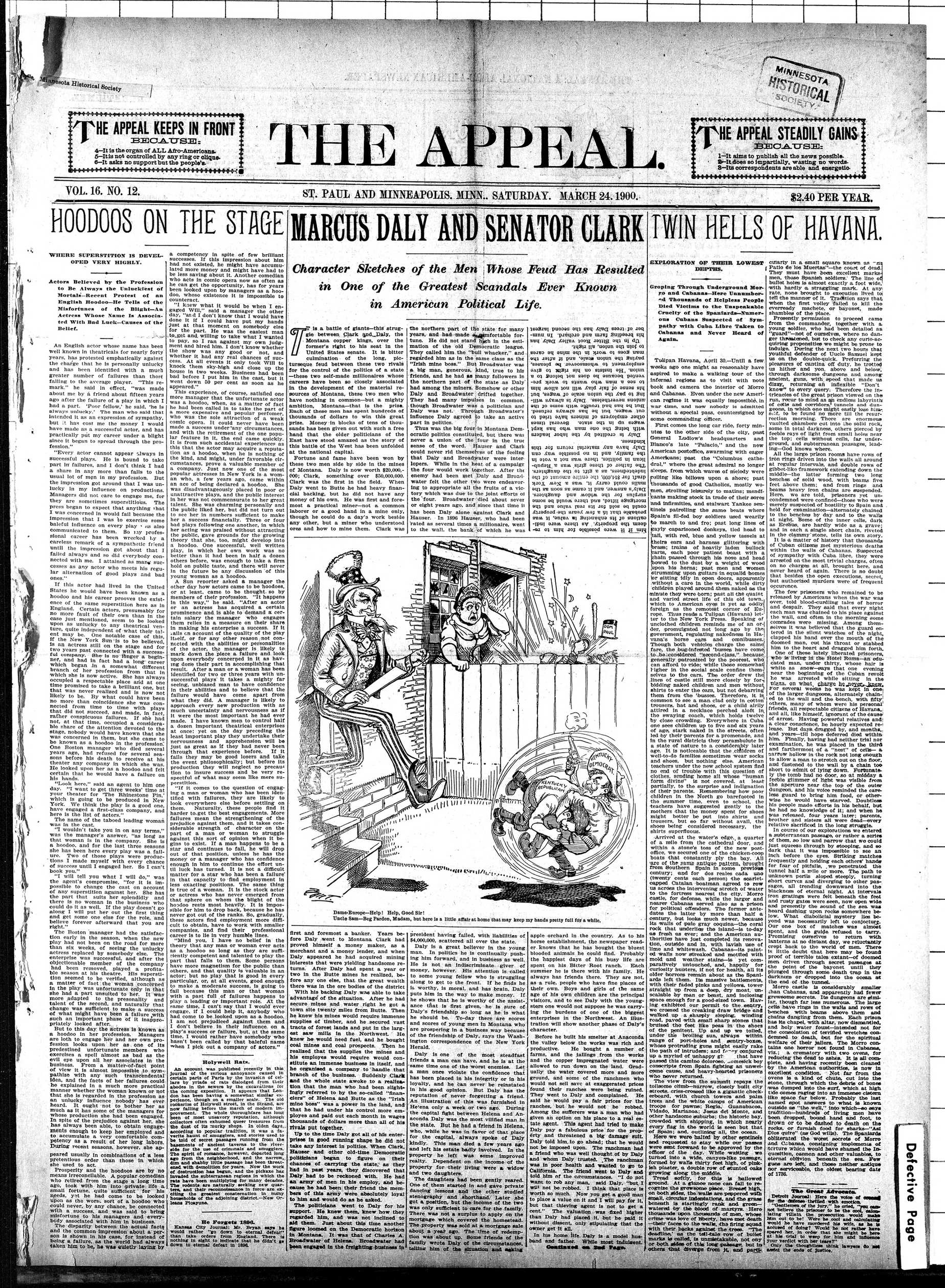
HOODOOS ON THE STAGE MARCUS DALY AND SENATOR CLARK TWIN HELLS OF HAVANA.
THE APPEAL KEEPS IN FRONT
BECAUSE:
4- It is the organ of ALL Afro-Americans.
5- It is not controlled by any ring or olique.
6- It asks no support but the people's.
VOL. 16. NO. 12.
WHERE SUPERSTITION IS DEVELOPED VERY HIGHLY.
Actors Believed by the Profession to Be Always the Unluckiest of Mortals—Recent Protest of an English Hoodoo—Hells of the Misfortunes of the Blight—An Actress Whose Name Is Associated With Bnd Luck—Causes of the Belief.
An English actor whose name has been well known in theatricals for nearly forty years, has protested emphatically against the misfortunes of the Hoodoo and has been identified with a much greater number of failures than falling to the average player. "This remark," he said in effect, "was made about me by a friend about fifteen years ago after the failure of a play in which I had a part. How does one make it, always unlucky." The man who said that intended it as an expression of sympathy, but it has cost me the money I have made have made a successful actor, and has possibly put my career under a blight since it began to spread through the profession."
"Every actor cannot appear always in successful plays. He is bound to take part in failures, and I don't think I had an experience in any more than fails to the usual let alone the impression got around that I was unlucky in my influence on productions. Managers did not care to engage me, for they are sometimes superstitious. The reason that anything I was concerned in work with the impression that I was to exercise some baleful influence on every play » as also communicated to them. So my professorship was been worked by a careless remark of the unlucky until the impression got about that I failed always and so did everybody connected with me. I attained as many successes as any actor who meets his regular intercession of good plays and bad ones."
If this actor had lived in the United States he would have been known as a hooodoo and his career prowess the existence of the same superstition here as in France. The actors he presumably for no more fault than the actors he case just mentioned, seem to be looked unlikely to any theatrical venues, questionable and may be. One notable case of this, if the New York Sum is to be believed, is that the fact had a long a career which began in the branch of her profession from the time she is now active. She has always occupied the role and at one time promised to take a brilliant role that was never realized and is now not so no more to be. By what could have been no more complete failures, if she had not, at all, been a share of the attention devoted to the stage, nobody would have known that she was a hooodoo, had refused for several seasons a role, had been a theater any company in which she was. He looked upon her as a hooodoo and felt that he would have a failure on his hands.
"Look here," said an agent to him one day. "I want to get three weeks' time at the station to play the Rihmstone Pin, which is located in York. We think the play is a good one, have engaged a first-class company, and here is the list of actors."
The name of the taboed leading woman was in the cast.
"I wouldn't take you in on any terms," was the manager's answer, "as long as a bohemian is in the company. She is a bohemian and she has been here every play was a failure. Two of those plays were produced made myself with every chance of success and I engaged her. So I can't book you." "I will tell you what I will do," was the manager's answer, "so you are possible to change the cast on account of any superstition against her. She has put that suit her business and she could do it as well. If the play doesn't go well on some one else, the first thing get some on her, and she believes forever after that you are right." Boston manager had the satisfaction early in the season, when the new play had not been on the road for more than a year, of seeing the unhappy actress replaced by a successful enterprise was successful, and after the objectionable member of the company was seasoned at the theatre, his superstition seemed to be verified, although as a woman concerned in the play was unfortunate she had a part unsuited to her. It was more adapted to the personality and the situation, and the phase of change was sufficient to make a success of what might have been a failure with an appropriately fitted phase of it inappropriately fitted after.
But to this day the actress is known as a hoodoo in her profession. Managers of the profession often session looks upon her as one of its predestined unfortunate members who exercises a spell almost as bad as the hoodoo itself. The business. From a matter-of-fact point of view it is almost impossible to sympathize with the idea, and the facts of her failures could he explained in a much more practical manner whether the woman known or not was a hoodoo. An unlucky influence nobody has ever heard. It ought not to bother her as she did not to keep the managers for whose production she had been. In spite of the prejudice against her, she has always been able, to obtain engagement, to keep her employed and to accumulate her wealth in petency as a result of her long labors. During recent seasons, however, she appeared usually in combinations of a less pretentious order than those in which Prosperity and the hoodoo are by no means irreconcilable. A popular comedian who was a hoodoo long time ago, took with him into prison, small fortune, quite sufficient for his business, he had come to be looked upon as the hoodoo could never, by any chance, be connected with a success, and was said to bring to him the business of every body associated with him by business.
The disparity between the actual facts and the common impression about a per- person is shown in his case, for instead of being taken to be, he was quietly laxed taken to be he was quietly laxed
a competency in spite of few brilliant successes. This impression about him existed, but it also accounted for a larger money and might have to be less saving about it. Another comedian who acts in comie opera now as often as he did in the past has been looked upon by managers as a boo-doo, whose existence it is impossible to counteract. what it would be when I engaged Will," and a manager the other day, "and I don't know that I would have had it, could have put my hands just at that, I could have put my hands for the part. He was the easiest man to get and willing to what I wanted him, I was against my own judgment and hired him to show the show was any good or not, and whether it had any real chances of succeeding, the sky-high one took Will to knock them sky-high and took house in two weeks. Business had been before I put him in the cast, but it was only 50 per cent as soon as he appeared."
This experience, of course, satisfied one more manager that the unfortunate actor was a hoodoo, when, as a matter of fact he had been called in to take the part of a more expensive and popular performer, who was the sole attraction of a weak comic opera. It could never have been made a success under any circumstances, and with the retirement of the one popular feature in it, the end came quickly. It is from such accidental experiences as this that the actor may acquire a reputation as a hoodoo, when he is nothing of the kind, and might, under favorable circumstances, prove a valuable member of a company. Just now one of the most popular actresses in New York is a woman who, a few years ago, came within an ace of being declared a hoodoo. She was disadvantageously placed in poor or unattractive plays, and the public interest in her was not commensurate to her great talent. She was charming personally and the public liked her, but did not turn out to be a member of the same队伍. There was her a success flamboyant. This, in which her plays following one another, in which her acting was praised without attracting the public, gave grounds for the growing theory that she, too, might develop into a hoodoo. One successful, well written play, in which her own work was no better than it had been in half a dozen others before, was enough to take a firm hold on public taste, and there will never in the future be any discussion of this young woman as a hoodoo.
A Sun reporter asked a manager the other day how actors came to be hoodies, or at least, came to be thought so by members of their profession. "It happens in this way," he said. "After an actor or an actress has acquired a certain prominence and is able to demand a certain salary the manager who engages them relies in a measure on their share in making his enterprise a success. If it all's on account of the quality of the play itself, or for any other reason not connected with the abilities or personalities of the actor, the manager is likely to mark down the place on the stage. It is likely everybody concerned in it as having done their part in accomplishing that result. After a man or a woman has been identified for two or three years with unsuccessful plays it takes a mighty far-seeing, unbiased man to have confidence in their abilities and to believe that the failure would have come apart from what they did. A manager is likely to approach every new production with as much uncertainty and nervousness as if it were the most important he had ever made. I have known men to control half a dozen important theatrical enterprises at once; yet on the day preceding the least important play they undertake their nervousness and apprehension will be just as great as if they had never been through what experience before. If it falls in their way may be good losers and take the event philosophically; but before its production they will neglect no precaution to insure success and be very respectful of what may seem like mere superstition.
"If it comes to the question of engaging a man or woman who has been identified with failures, they are likely to look everywhere else before settling on them. Naturally, these people find it harder to get the best engagements. More fallures mean the strengthening of the prejudice against them, and it takes considerable strength of character on the part of a man or woman to struggle against this sort of opinion when it begins to exist. If a man happens to be a star and continues to fall, he will drop out of that position, unless he has the money or a manager who has confidence enough in him to continue the effort until luck has turned. It is not a difficult matter for a star who has been a failure in that capacity to find employment in less exacting positions. The same thing is true of a woman. It is the stock actor or actress who has never emerged from that sphere on whom the blight of the hoodoo rests most heavily. It is impossible for him to drop back, because he has never got out of the ranks. So, gradually, these actors find employment more difficult to obtain, have to work with smaller companies, and find their professional career is to lie in very humble lives."
"Mind you, I have no belief in the theory that any man or woman ever acts scientifically competent and talented to play the part that falls to them. Some persons more knowledgeable for the public than other; but no play that is good in every particular, or, at all events, good enough to make factic, because going to play this man or woman with a past full of failures happens to play a leading or important role. At the same time, I am not engaged, if I could help it, anybody who had come to be looked upon as a hoochoo. I am not prejudiced against them and I am not prejudiced against the play's success or failure, but, at the same time, I would rather have somebody who knew when I pick out a company of actors."
Holywell Rats.
An account was published recently in this journal of the serious annoyance caused by yriads of rats dislodged from their cellars by yriads of rats dislodged from their cellars by the invasion of the coming expedition. It appears that London has been having a somewhat similar situation in the past, with rookeries of Holwell street, in the Strand, are now falling before the march of modern imminent danger, but been of most unsavory reputation, although collected in the form of its murky shops. In old days, according to popular tradition, it was a faction to record ancient taverns to the riverbank of secret passages running from the basements of ancient taverns to the riverbank of secret passages. The spirit of romance, however, departed long ago from the neighborhood, and the narrow, quiet streets were enveloped with demolition for years. Now the work of destruction has begun, and the plakek has been multiplied for many decades. The rats have been multiplying for many decades, and their reincarnation in force are exciting the greatest consternation in many households of the adjoining district—New Orleans Pleasure.
He Forgets 1896.
Kansas has rather "down to down" the rats than take orders from England. There is down to eternal death in 1894.
THE APPEAL.
GOM PAUL
KENTUCKY
DEMOCRAT
KENTUCKY
REPUBLICAN
Dame-Europe—Help! Help, Good Sir!
Dame-Europe--Help! Help, Good Sir!
Uncle Sam--Beg Pardon, Madam, but here is a little affair at home that may keep my hands pretty full for a while.
IT is a battle of giants—this struggle between Clark gnd-Daly, the Montana copper kings, over the former's right to sit in the United States senate, bolt culmination of the long, picturse feud between these two rivals for the control of the politics of a state—these two self-made millionaires whose lives were cut off in the development of the material resources of Montana, the two men who have nothing in common—but a mighty ambition, Montana—that is the prize. Each of these men has spent hundreds of thousands of dollars to win the prize. Money in blocks of tens of thousands has been given out with such a free hand that the older politicians of the East have stood amazed as the story of the feud has been unfolded at the national capital.
Fortune and fame have been won by these two men side by side in the mines of Montana. Daly is now worth $20,000. He was a miner, and Clark was the first in the field. When Daly went to Butte he had heavy financial backing, but he did not have any money to pay for his most a practical miner—not a common laborer or a good hand in a mine only, though he could do a day's work beside him. He worked in orches and to mine them. Clark was
Dame-Europe—Help! Help, G.
Uncle Sam—Beg Pardon, Mada
first and foremost a banker. Years before Daly went to Montana Clark had proved himself a money maker, as a merchant and a money lender, and when he was a banker he had interests that were yielding handsome returns. After Daly had spent a year or two in the Butte mines he realized, before any one else, that the great wealth of the state was in the mountains of the district. With his backing Daly was the advantage of the situation. After he had secure mines and water right he got a town site twenty miles from Butte. Then he knew his mines would require immense resources and the tracts of forest lands and put in the largest saw mills in the Northwest. He knew he would need fuel, and he bought coal mines and coal prospects. Then he and his employees supplied the mines and his employees would situate an immense business in itself, and he organised a company to handle that branch of the business. Suddenly Clark and the whole state awoke to a realization that he was not the only financially referred to by the so-called “financials” of Helena and Butte as the “financials” of Helena and Butte as a power in the land, and that he had under his control more empires than each month in wages thousands of dollars more than all of his rivals put together.
Up to the time Daly got all of his enterprises in good running shape he did not take any interest in politics. When Clark, Hauser and other old-time Democratic politicians began to figure on their chances of carrying the state, as they had in past years, they discovered that Daly had to be reckoned with. He had an army of men in his employ, and because he had been their friend the members of this army were absolutely loyal to him and would do as he asked.
The politicians went to Daly for his support. He knew them, knew how they regarded him, and was not inclined to add them. Just about this time another figure loomed on the Democratic horizon in Montana. It was that of Charles A. Broadwater of Helena. Broadwater had been engaged in the freighting business in
the northern part of the state for many years, and had made a comfortable fortune. He did not stand high in the estimation of the old Democratic league. They called him the "bull whacker," and regarded him as in the same class as the "Irish mine boss." But Broadwater was a big man, generous, kind, true to his friends, and he had as many followers in the northern part of the state as Daly had among the miners. Somehow or other Daly and Broadwater drifted together. They had many impulses in common, though Broadwater was a politician and Daly was not. Through Broadwater's influence Daly agreed to take an active part in politics.
Thus was the big four in Montana Democratic politics constituted, but there was never a union of the four in the true party. The Democratic party could never rid themselves of the feeling that Daly and Broadway were interlopers. While in the heat of a campaign rally, the party's enemy had been met Daly and Broadwater felt the other two were endeavoring to appropriate all the fruits of a victory which was due to the joint efforts of Daly and Broadway, and to eight years ago, and since that time it has been Daly alone against Clark and Hauser. In 1896 Hauser, who had been rated as several times a millionaire, went to the polls.
Good Sir!
m, but here is a little affair at home that may keep
president having failed, with liabilities of $4,000,000, scattered all over the state. Daly is a great believer in the young man, but he continually pushes him forward, and, in turn, he is not an indiscriminate, giver of money, however. His attention is called to some young fellow who is struggling with his life, and is worthy, is moral, and has brain. Daly puts him in the way to make money. If he shows that he is worthy of the assist, he then gives him, he is pure of Daly's kind. He should be. To-day there are scores and scores of young men in Montana who are prospring in a business way because of the friendship of Daly, says the Washougal correspondence of the New York Herald.
Daly is one of the most steadfast friends a man can have, and he is at the same time one of the worst enemies. Let a man once violate the confidence that man placed in his integrity or in his loyalty, and let him be in his good opinion. But Daly has the reputation of never forgetting a friend. An illustration of this was furnished in He's only a week or two ago. During capital fight between Helena and Anselm, he was in favor of the state. But he had a friend in Helena, who, while he was in favor of that place for the capital, always spoke of Daly kindly. This man died a few years ago and left his estate badly involved. In the property he left was, some improved in the income of the property for their living were a widow and two daughters.
The daughters had been gently reared. One of them started in and gave private lessons in the art of stoneography and shorthand. Later she got a position, but the income of the two was only sufficient to care for the family. They were unable to afford mortgage which covered the homeestead. The property was sold at a mortgage sale about a year ago. The time of redemption was in 1970, and the family wrote Daly of the circumstances, telling him of the situation and asking
Daily is credited by the labor leaders with being the one man who has kept workers up in the state. Several times the other employers of miners have ated to pay the union scale of wages, but the sense of fair play will not allow him to see a man who wants to work pre-emptive. He insists on his right to give employment to the union scale, and it is after the万人蜂 in the middle of the years. The union scale is the second largest, but of trees Daily has the second largest.
them it it were possible for him to redeem the property. As there were indications of its enhancing in value, it was probable that if a few years the property could be sold for its real value and the mortgage lifted, and there would be some surplus for the widow and daughters. Daily's answer, and it came as soon as the malls could carry it, was a New York draft for $14,000, the entire amount of the indebtedness, as a gift to the daughters. The father of these girls was a Republican in politics, there was not a vote in the family, and in no possible way can Daily have any material return for this
GOOM PAUL
KENTUCKY
DEMOCRAT
KENTUCKY
REPUBLICAN
my hands pretty full for a while.
apple orchard in the country. As to his horse establishment, the newspaper reader knows that he has bought the bluest blooded animals he could find. Probably he has been a visitor spent on his Bitter Root ranch. Each summer he is there with his family. He always has friends there. They are not, as a rule, people who have five places of age of his birth. Boys and girls of the same age of his birth visitors, and to see Daly with the youngsters one would not suppose he was carrying the burdens of one of the biggest enterprises in the Northwest. An illustration shows a show another phase of Daly's character.
Before he built his smelter at Anaconda the valley below the works was rich and productive. He bought a number of farms, and the fallings from the works and the copper impregnated water were allowed to run down on the land. Gradually the water covered more and more ground, and some of the ranchmen who would not sell save at exaggerated prices found their ranches were being ruined. They went to Daly and complained. He said he would pay a fair price for the ranches, but he would not be robbed. Among the sufferers was a man who had given an option on his place to a real estate agent. This agent had tried to make Daly pay a fabulous price for the property and threatened a big damage suit. Daly told him to go ahead; that he would not be imposed upon. The ranchman had a friend who was well thought of by Daly and whom Daly trusted. The ranchman was in poor health and wanted to go to California. The friend went to Daly and told him of the circumstances. "I do not want to rob any man," said Daly. "But I will not be robbed. I think that place is worth so much. Now you get a good man to place a value on it and I will pay for it, but that thieving agent is not to get a cent." The valuation was fixed higher than Daly had placed it, but he paid it without dissent, only stipulating that the owner get it all.
In his home life Daly is a model hus-
band and father. While most indulgent
homes are built for the family,
Groping Through Underground Morro and Cabanas—Here Unnumbered Thousands of Helpless People Died Victims to the Unspeakable Crucify of the Spandias—Numerous Cubans Suspected of Sympathy with Cuba Libre Taken to Cabanas and Never Heard of Again.
Tulipan Havana, April 30.—Until a few weeks ago one might as reasonably have aspired to make a walking tour of the infernal regions as to visit with note book and camera the interior of Morro and Cabanas. Even under the new American regime it was equally impossible, in what we might possibly be admitted without a special pass, counterinsigned by some commanding officer.
Arrived at the water's edge, a quarter of a mile from the cathedral door, and within a stone's toss of the new post office, we secured one of the chicken-coopers who had been brought to the same antique pattern, brought from Southern Spain in some previous century; and for dos reales cada unc (twenty cents each person) the scarlet-capped Catalan boatman agreed to row for a few days. The cathedral door, to the fortress nearest the city. Morrara castle, for defense, while the larger and nearer Cabanas served also as a prison for political offenders. The former antecedents of the latter by more than half a century, but by more than half its walls of pale gray coquina—the coral rock that underlies the island—is today as fresh as ever; and the American authorities have just completed its renovation, outside and in, with lavish use of the old building. The old building, which was the walls now streaked and mottled with mold and weather stains—is yet comparatively untouched, and, happily for curiosity hunters, if not for health, all its old walls remain about as the Spaniards left them. The old building, which was the walls now streaked and mottled with their faded pinks and yellows, tower straight up from a deep, dry moat, unscalable by man or beast, and inclosing space enough for a good-sized town. Have we had the time to think of the old building, we crossed the creaking draw bridge and walked up a sharply sloping, winding road, paved with small sharp stones that bruised the feet like peas in the shoes of the penitent. Up and up we toiled, and, in the same way, to the right, and, in the range of port-holes and sentry-boxes, whose protruding guns might easily rake the path of intruders; and, for¬ my conjured up a myriad of unhappy gr¬ that have passed this camino doloroso, «omesick boys have been making a fine fine and an unwell come cause, and heavy-heaving prisoners who never returned.
The view from the summit repays the oak tree—marrow, closely built city arbor, with a large canopy, arborboard, with church trees and palm trees and the white camps of American Indian Vidado, Marañones, Jesus del Monte, and other handmade suburbs; the historic bay, with ships in, in which nearly every flag is hoisted; the every flag of Spain; and, outlining all, the ocean. Here we were halted by other sentinels and others, who were sent forward to be approved by the officer of the day. While waiting, we were formed by walls thirty feet high, of pinkish plaster, a double row of stunted oaks growing in the middle. Trade and commerce is hallowed ground. At a glance none can fail to recognize the greaseome place. Breast high, small, circular indentations, and the grass beneath is starting rank and green—thousands upon thousands of men, whose crime was love of liberty, have met death with the toes to the walls, the firing squad with the rifles, the deadline, as the tail-tale cow of bushmarks is called, is unmistakable, not only because of the others that diverge from it, and north
$2.40 PER YEAR.
cularly in a small square known as "g. Patio de los Muertas"—the court of dead. They must have been excellent marks—men, those Spanish soldiers. The line of bullet holes is almost exactly a foot wide, with hardly a straggling mark. At any rate, none brought to execution lived to tell the manner of it. Tradition says that when the first volley failed to kill the everready machete, or bayonet, made shambles of the place.
Presently permission to proceed came from the commander, together with a young soldier, who had been detailed as "guard"—not of ourselves, where no danger was threatened, but to check any curiosity to the警卫. The men were bein—to indulge. During the next two months youthful defender of Uncle Samuel kept us on the double-quick. Preferring the pleasures of cantina off duty, he trotted us hither and yon, above and below, through darksome dungeons and among ancient, guns, with speed that made us dizzy, returning an inflexible "Don't know" to every query. Therefore the intrలaceles of the great prison viewed on the run, recur to mind as an endless labyrinth of cells and corridors, tunnels and dungeons, in which one might easily lose himself, to be found no more till the resurcration of the cell, have been a hour, many vaulted chambers cut into the solid rock, some in total darkness, others pierced by feeble rays of light from small holes near the top; cells without cells, far underground, and subterranean passages, leading—God knows where.
All the large prison rooms have rows of iron rings driven into the walls all around the prison. The walls are globetext-like framework extending down the middle—the latter forming two long benches of solid wood, with beams five inches thick. The benches heavy iron chains are suspended. Here, we are told, prisoners yet unarmed are held in a mysteriously suspected of hostility to Spain and held for examination—alternately chained to the benches by day and to the walls by night. The benches are Erebus, are hardy wide as a grave; and in each a single short chain, riveted in the clammy stone, tells its own story. In the cuban city, with Cuban citizens met mysterious death within the walls of Cabanas. Suspected of sympathy with Cuba libre, they were arrested and held on no charges at all, brought here, and never heard of again. There is no doubt that besides the open executions, secret, and globetexted murders were of frequent occurrence.
The few prisoners who remained to be held were taken when the war was over, told blood-counting officers and despair. They said that every night the captain would to his place against the wall, and often, in comrades were missing. Among them were two men, the guard seated in the silent watchers, clipped his hand over the mouth of the doomed prisoner, the heart and dragged him
One of these lately liberated prisoners, who is living in the Hotel Roma—an educated man, under thirty, whose hair is white as snow—says that one evening near the beginning of the Cuban revolt he was arrested while sitting in the plaza, on what, charge his noyer, knew for several weeks he was kept in one of the larger dungeons, alternately chained to the wall and the bench, with fifty others, many of whom were his personal friends, all respectable citizens of Havana, and all, like himself, ignorant of the cause of arrest. Having powerful relatives and a clear conscience, he hourly expected release. But days dragged by, and months, and years—till hope deferred died within him. Finally, having had neither trial nor examination, he was placed in the third and farthermost of a "nest" of cells—a narrow hollow in the rock not long enough to allow a man to stretch out on the floor, and fastened to the wall by a chain too short to admit of lying down. Fortunately the tomb had no door, so at midday a feeble glimmer of light was visible from the aperture near the top of the outer dungeon, and his voice reminded the careless guard to bring him food, or otherwise he would have starved. Doubtless his people made efforts in his behalf, but he had no knowledge of it; and when he was released, four years later, parents, brother and sisters all were dead—every relative sacrificed in the long struggle.
In course of our explorations we entered a subterranean passage, or rather a series of them, so low and narrow that we could just squeeze through by stooping, and so dark that it was impossible to see an inch before the eyes. Striking matches frequently and holding each other's hands for fear of pitfalls, we penetrated the tunnel half a mile or more. The path to unknown perils sloped steeply, turning short curves and diverging to other passages, all trending downward into the blackness of eternal night. At intervals from gratings were felt beneath the feet and rusty gates were seen, now open wide and presently the sound of the sea was heard dashing upon rocks somewhere below. What diabolical mystery lies beyond was necessarily left to conjecturing. Our one box of matches was almost spent, and the guide refused to tarry. Promising ourselves to return with lanterns at no distant day, we reluctantly crept back to the world of men. There is little doubt that here may be found proof of terrible tales extant—of doomed men driven through secret passages at the point of the bayonet until they plunged through some death trap in the darkness or dropped into the ocean at the end of the tunnel.
Morro castle is considerably smaller than Cabanas, and apparently had fewer grewsome secrets. Its dungeons are similar, though far less numerous. The large cells have rings in the walls and rows of banches with beams above them and chains dangling from them. Each prison has its chapel, with altar, now dismantled, and holy water fount—intended not for the consolation of terrified wretches condemned to death, but for the spiritual welfare of theirжillers. The Morro conditions of the horrors not found in Cabanas, viz., a cellar for the two, a two-bed, reducing, and having recently been cleaned by the American authorities, is now in excellent condition. Not far from the ovens is a kind of chute, cut into the stone, through which the debris of bones was dumped into the surf, which at high tide comes raging into an immense cleftern like space far below. Probably the last named spot answers to what is known outside as "the well," into which so-so says tradition—hundreds of living men have been dropped, bound hand and foot, to drown or to be dashed to death on the rocks, or furnish food for sharks—"Asi Dian" (as God wills). The Spanlards are not the worst secrets of Morro and Cbanas, consisting of implements of tincture which would have shamed the Inquisition, cannon and other valuables, to eternal obviation beneath the sea. Few guns are left, and those neither antique nor serviceable, the oldest bearing date of 1738.
Defective Page
"Gentleman of the jury," he cried, "you cannot believe the prisoner to be the cool,计算型 him to be! We're he cool and calculating accused of doing attack? Would he not rather have at his trial to weep for him and induce you vessel with her tears?" Omar then turned to Duncan.
Only the thoughtless think lawyers do not
assist the ends of justice.
YOU READ
THE APPEAL
PUBLISHED WEEKLY BY
ADAMS BROS. EDITORS AND PUBLISHERS
49 E.4th St St. Paul, Minu
IMMUED MUSEUMS IN
Saint Paul, Minneapolis, Chicago,
Louisville, St. Louis, Dallas.
ST. PAUL OFFICE,
No. 164 Union Block 4th and Cedar
J. Q. ADAMS, Publisher.
MINNY2APOLIS OFFICE,
Room Number 600 Onida Block
H.ROBERTS, Manager.
CHICAGO OFFICE,
No. 382-5 Dearborn St. Suite 218-215
O.F. ADAMS, Manager.
LOUISVILLE OFFICE,
No. 812 West Jefferson St. Room 3
W. V. PENN, Manager.
ST. LOUIS OFFICE,
No. 1002 FRANKELIN AVENUE
J. H. HARRISON, Manager.
DALLAS OFFICE,
NUMBER 497 MAIN STREET
L. A- BROWN, Manager,
TERMS, STRICTLY IN ADVANCE:
Single copy, one year..... $2.00
Single copy, three months..... $6.00
Single copy, three months..... $6.00
When substitutions are by any means allowed
cents for each 18 weeks and 5 cents for each
cents for each 18 weeks and 5 cents for each
week.
Remittances should be made by Express Money Order. Post Office Money Order, registered Letter or Bank Draft. Postage stamps will be received for the same cash for the fractional parts of a dollar. Only one cent and two cent stamps taken.
Silver should never be sent through the mail. It is almost sure to wear a hole through the envelope and be lost, or else it may be stolen. To be so, the silver to us in letters do so at their own risk.
Marriage and death notices, ten lines or less $1. Each additional line 10 cents. Payment strictly in advance, and to be announced at all must come in season, to be news.
Advising in the years 15 cents per agent line, each in insertion. Then, and about seven words in an agate line, No single advertisement less than $1. No discounts allowed on less than three months until the cash must accompany all orders from parties unknown to us. Further particulars on application.
Reading notices 25 cents per line, each insertion. No discounts for time or space. Reading matter is set in brover type—about six words to the line. All head lines count double.
The date on the address label shows when subscription expires. Renewals should be made two weeks prior to expiration, so that no paper may be品类,as the paper stops when time is out.
It occasionally happens that papers sent to subscribers are lost or stolen. In case you do not receive any number when due, inform us by mail card at the expiration of five days from that date. In the fully forward a duplicate of the missing number.
Communication to receive attention must be frequent. The most important is often upon one side of the paper; most often upon two sides of the paper; anyway not later than Wednesday, and not later than the author. No manuscript returned, unpublished, or unpublished by the author.
In every letter that you write us never, fail to
include the name of the person you are
posting, office county, state and business
letters of all kinds must be written on
paper or a card. The matter for publication. Resume as second
matter for publication.
AGENTS WANTED.
AGENTS WANTED.
THE APPEAL wants good reliable agents to canvass for subscribers at points not already covered. Write for our extraordi-
nary inducements. Address.
THE APPEAL,
St Paul Minu.
SATURDAY, MARCH 24, 1900.
OF GREAT INTEREST TO THE RACE.
The coming census is a matter of great interest to the Afro-American. He will be expected to answer the enumerator when he comes next June, and naturally wishes to make a good showing in the big volumes that are to be printed about the people of the United States. "The population schedule" is the one which concerns everybody. On it are questions about name, age, sex, color, relationship to the head of the family and where each individual was born, as well as where the parents of each were born. The enumerator will ask who can read and write and how many months the children have gone to school. He will ask about the prosperity of the family, whether only the man works for money or whether the women and children do, too, and whether they own or rent the house they live in. All the enumerator can do with this information when he gets it will be to write it out, too, so he will
not to tell anything about it, and then the papers will be sent to Washington to be worked out by electricity. The great books, when printed, will show how fast the Afro-American people have been improving and where they have made greatest progress.
Charles A. Foster, an old "freestater," died at the residence of his daughter in Walpole, Mass. Tuesday. He was once a resident of Kansas, and he was active in the free state movement. He was assistant secretary of the famous Topeka constitutional convention and was a member of the Topeka legislature at the time its meeting was dispersed by the United States dragoons under Colonel E. V. Summer July 4, 1856. He was elected attorney general under the constitution framed at Leavenworth in 1897, and was a member of the constitutional convention, but as the territory was admitted into the Union under the Wyandotte constitution he never served in the office.
In the early part of 1856 he was indicted with John Brown by the so-called Kansas "border ruffians" grand jury for conspiring against the peace and dignity of the territory of Kansas and of the government of the United States, but with many others he successfully evaded arrest. He was made a Master Mason in St John's lodge of Boston in December, 1856, and was a member of many other fraternities. He has resided in Quincy since 1866.
Citizens of Larium, the finest residence suburb of the big mining camp of Calumet, have appointed a committee to rid the town of "niggers." They object to having it called a vigilance committee and announce that only peaceable and legal methods will be used, but that the "niggers" must go. Afro-Americans were almost unknown there until a sewer contractor brought in several carloads from Tennessee and Alabama, eleven months ago. It seems that a number of white girls have eloped with the Afro-Americans and this is distasteful to the white males. In the South it is alleged that Afro-Americans rape white females and they are often lynched, without proof of their guilt. In the North the nice white girls are so anxious for black husbands that they elope with rough sewer hands. Queer, isn't it?
John Arende Bingham, famous in the nation's history—former minister to Japan, former distinguished Ohio congressman, one of the prosecutors of the assassins of President Lincoln, one of the leaders of the impeachment proceedings against President Johnson, and author of the fourteenth amendment to the constitution of the United States—died at Cadiz, O., Monday. He was of the old school of jurists and legislators of that state, a man of prominent ability, but who had been out of public life and notice for the last fifteen years. His age was 85.
Prominent Kansas and Western Republicans have started a movement to have J. R. Burton of this state make the speech at Philadelphia nominating President McKinley. The Western friends of Mr. Burton are not alone in this movement. Eastern leaders, including Governor Roosevelt, Senator Platt and others, it is claimed, are willing to accord this honor to Kansas and to Mr. Burton.
Judge Dunne has decided that man and wife are not one, but two. The old idea of a single entity was often the cause of considerable trouble when the entity began to discuss the question, "Which one?"
Captain Richard P. Leary, U. S. N. Governor of Guam, believes that the Constitution of the United States extends over Guam; so he has issued a proclamation forever abolishing slavery in Guam.
PETER JACKSON A WTECK.
Caused by Alcohol—Leaves for California to Repertoire.
Victoria, B. C., March 16.—Poverty-striken, enebled by disease caused by over-indulgence in alcohol, a complete wreck of his former self. Peter Jackson left today for Southern California, hoping to regain his health. Mymathics, frightened to defray champion made up of a purse his expenses. His chief occupation now is fondling the championship bait, one of the few remaining trophies of his static victories. In spite of poverty he refuses to sell it.
You may depend upon it that there are as good hearts to serve men in palaces in as cottages. Robert Owen.
TO CURE A COLD IN ONE DAY
Take Laxative Bromo Quinine Tabula. All defrungst drugs the money if it fails to cure. E. W. Grove's signature is on each box.
THE APPEAL: A NATIONAL AFRO-AMERICAN NEWSPAPER
THE BOOK WORLD
Turner, Bishop H. M.
Philadelphia, 1885;
Ages: Printed Speeches of the Hymn Book for A.
Turner, H. H. Historian, etc. 1881;
Vasbon, Geo B.: Pam
Walker, David: Walk
Walker, John: Carpe
Ida, 1888;
Ward, S. R.: And
live Negro, London
Ward, Samuel Ringgo
Joe.
Washington, B. T.: B
Future of the An
dress at Opening A
wayman, Alce. W.:
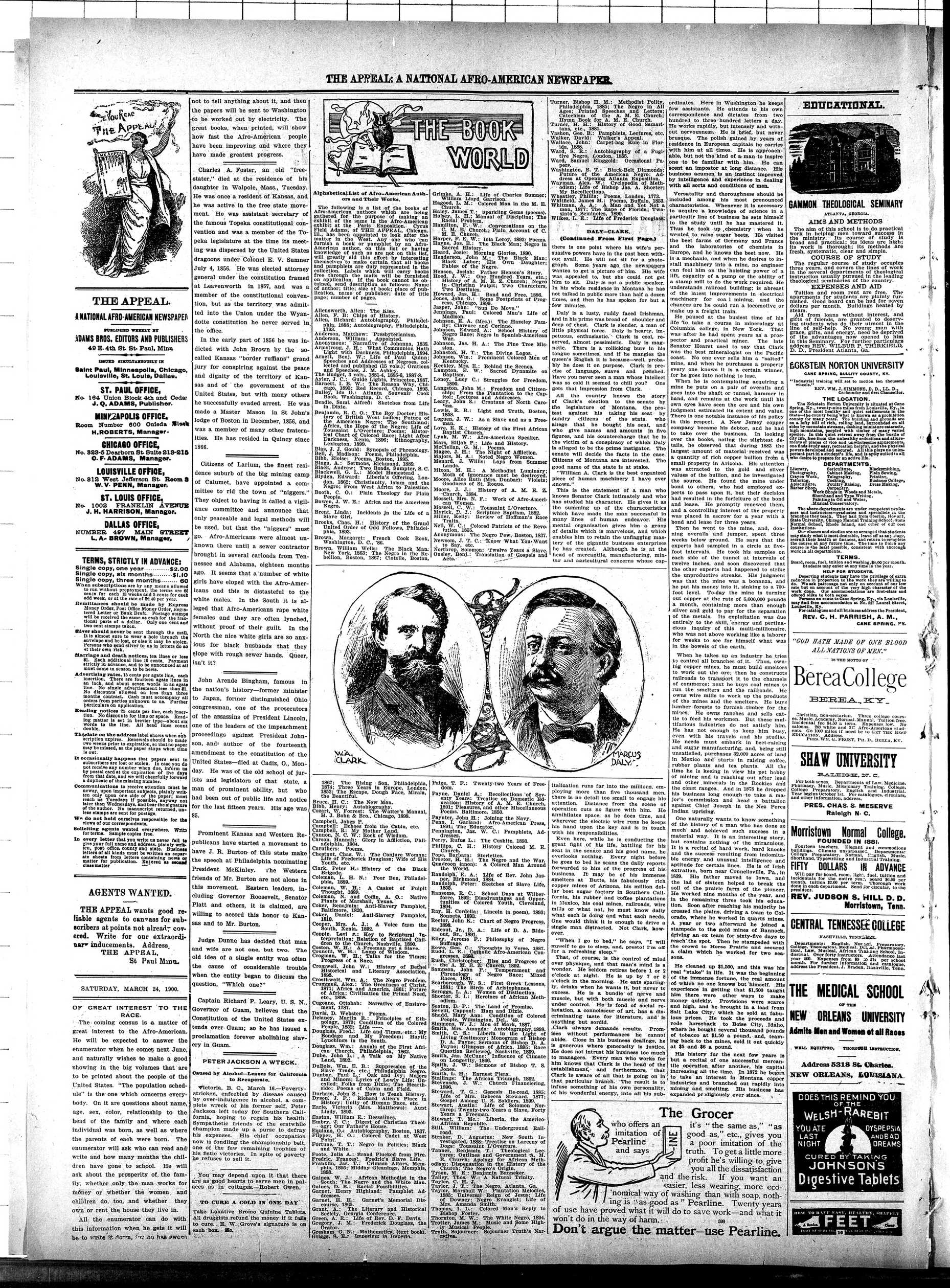
W.A. CLARK.
MARCUS DALY.
Alphabetical List of Afro-American Authors and Their Works.
The following is a list of the books of Afro-American authors which are being gathered for the purpose of making an exhibit of the same in the Afro-American Field of the Age of Exposition. Cyrus, Illi, has been appointed to look after the matter in the West. Any one who can work or pamphle, by an Afro-American author, is the author having knowledge of such as are not on this list, will greatly aid this effort by interesting themselves to make certain that all books are available to the public with the rest of the collection. Labels which will carry books free through the mails will be furnished on application. If the book cannot be obtained, please contact the author's name or publication, name of publisher; date of title page; number of pages.
Allensworth, Allen: The Kiss.
Allen, F. B.; Chips of History.
Allen, Richard: Autobiography, Philadelphia, 1888; Autobiography, Philadelphia, 1703.
Anderson, Matthew: Presbyterianism.
Anderson, William: Appointed.
Anonymous: Narrative of Jane Inna. 1838; Armstrong, J. H.: What Communion Hath Light with Darkness, Philadelphia, 1894.
Arnett, Ben. W.: Life of Paul Quinn.
Spock, John: The Assessor of Regress, Collected and published. 1916.
The Budget, 3 vols., 1881-4, 1885-6, 1887-8. Ayler, J. C.: Guide Lights, Princeton, 1887. Barnett, I. B. W.: The Reason Why, Chicago, 1893; Red Record, Chicago, 1895. Bailey, Ida D.: Atlanta Souvenir Cook Book, Washington, D.C.
Beadle, Sam. Alfred: Sketches from Life in Dixie.
Benjamin, R. C. O.: The Boy Doctor: History of British West Indies; Future of the American Negro: The Southland; Africa, the Hope of the Negro; Life of Toussaint L'Overture; Poems; Historical Chart of Colored Race; Light After Darkness, Xenia, 1896; Ethnography, Lexington, 1899.
Blas, J. J. Gould: Synopsis of Phrenology. Bell, J. Madison: Poems, Philadelphia. Bibb, Eloise: Poems, Boston, 1895. Binga, A.: Sermons, Richmond, 1889. Black, Andrew: Two Roads, Sumpter, S. C. Blackwell, G. L.: Model Homestead.
Lamb, Brigadio
Lamb, 1862; Christianity, Island
Negro; From West Africa to Palestine
Booth, C. O.; Plain Theology for Plain
People.
Bowen, J. W. E.: Africa and the Americar Negro.
Brent, Linda: Incidents In the Life of a Slave Girl.
Brooks, Chas H.: History of the Grand
Museum of Odd Fellows, Philadelphia,
1838.
Brown, Margaret: French Cook Book,
Washington, D. C., '86.
Brown, William Wells: The Black Man
Agro in the Re-
bellion, Boston, 1870.
W.A.
CLARK.
1867; The Rising Son, Philadelphia 1874; Three Years in Europe, London 1852; The Escape, Dough Face, Mirala, the Beautiful.
Bruce, H. C.: The New Man.
Bibb, Henry: Autobiography.
Cozart, W. Forrest: The Waiter's Manual.
H. J. Bohn & Bio., Chicago, 1888.
Campbell, Jabez P.
Campbell: Echoes from the Cabin, etc.
Campbell, R.: My Mother Land.
Cannon, N. C. W.: Rock of Wisdom.
Carson, Hannah: Glory in Affliction, Philadelphia, 1864.
Caruthers: Poems.
Chestnut, Chas. W.: The Conjure Woman; Life of Frederick Douglass; Wife of His Youth, etc.
Clark, Peter H.: History of the Black Bride.
Coleman, H. N.: Poor Ben, Philadelphi, 1889.
Coleman, W. H.: A Casket of Pulpit
Coleman, N. and Coffin, A. O.: Native
Man of Marshall, Texas.
Coleman, N. and Marshall, Texas.
Coleman, Anti-Slavery Pamphlet,
Baltimore, 1820.
Coleman Daniel: Anti-Slavery Pamphlet,
Baltimore, 1820.
Cooper, Mrs. A. J.: A Voice from the
Cooper, Mrs. A. J.: A Voice from the
Cooper, Levi K.: Key to Scriptural
Interpretation: Relation of Baptized Children
Coxen, W. H.: A Freeman who saved.
Coxen, W. H.: A Freeman who saved.
Cogman, W. H.: Lamp of Wisdom.
Cogman, W. H.: Lamp for the Times;
Progress of a Race.
Cromwell, John W.: History of Bethel
Historical and Literary Association,
1856.
Crostwalt, Wm. A. The Negro Problem,
1871; Africa and America, 1871; Africa and America, 1871; Future of Africa; Civilization the Primal Need,
1870; Cugnoan, Ottobah; Narrative of Enslavement, 1787.
Davis, D. Webster; Poems.
Dewey, D. Philosophy of Ethology, 1879; Condition of the Colored People, 1852; Life .....
Dewey, D. Philosophy of Times, etc.; My Bondage and My Freedom; Lychnine in the South.
Douglass, Wm.: Annals of the First African Church, Philadelphia, 1862.
Dube, John L.: A Talk on My Native Land, 1892.
DuBois, Wm. E. B.: Suppression of the Slave Trade. etc.: Philadelphia Negro Dunbar, Paul L.: Oak and Ivy; Majors and Minors; Lyrics of Lowly Life: Uncalled: Folks from Dixie; The Hearth
called: Folks from Dixie; The Heart-
talker; Durham, John S. How to Teach History,
Durham, John S. How to Teach History,
History; Unity of Human Race in
History; Unity of Human Race in
East, Victoria (Mrs. Matthews); Aunt
fasten, William E. Dessalines,
Embrury, J. C. Digest of Christian Theo-
lithic History.
Equinula, O. O.: Autobiography, Boston, 1837.
Flipner, H. O.: Colored Cedar at West
colon.
Fortune, T. T.: Negro In Politics; Black
and White.
Foote, Julia A.: Brand Pucked from Fire, Frederic, Francis: Fredric's Slave Life, Franklin, Jas. T.: Crismon Altem, Memphis, 1838: 1839 Middletown Gleaning, Memphis,
Gaines, W. J.; *Arkansas Methodist in the Man*,
Gaines, D. B.; *Racial Possibilities*,
Gaines, D. B.; *Gary Highland: Pampullet Ad-
dresses*,
Garnet's *Garnet's Memorial Disc*,
1955.
course, 1965.
Grant, A., *The Literary and Historical*
*Journal of American History*.
Green, A. R.: Life of Rev. D. F. Davis. Gregory, J. M.: Frederick Douglass, the Orator.
Gresham, G. N.: Mathematics, (text book).
Grigg, S. E.: Intervention in Imperio.
Geluko, A. H.: Life of Charles Sumner;
Hagood, L. M.: Colored Man in the M. E.
Hagood, L. M.: Colored Man in the M. E.
Haley, James T.; Sparkling Gems (poem).
Racial Problem of Discipline; The
Racial Problem
Hamilton, W. W.; Conversations on
E. Church; Plain Account of C.
M. E. Church.
harper, J. W.; W. Iloch Levy. 1852; Poema
harper, J. W.; W. Iloch Levy. 1852; Poema
harper, J. W.; W. Iloch Levy. 1852; Poema
Sacred History.
1800, Henderson, John M., The Own
Daughter, Fables of the Negro
Fables of the Negro
Howard Jas. H. Hickey and Free and 1886.
Jones, Charles. *Bond Footprints of Prog.*
Chicago, 1886.
Jasper, John. "Sun Do Move." *Life of*
Madison. *The Harper's Journal*.
Hazeley Fam. M. Clarence A.; Corbin Johnson. Edward A.: School History of Johnson. Edward Negro in Spanish-American War. James H. A. The Tree Pine Mist. son.
Johnston, H. T.: The Divine Logos.
Johnston, H. T.: Prominent Colored Men of
Kentucky.
Keeckey, Mrs. E.: Behind the Scenes,
Louis W. W.: Sacred Dynamite on
Baptism.
Loncey, C. Y.: C. Struggles for Freedom,
Langton, John M.: Freedom and Citizen-
ship.
Langton, John M.: Freedom and Citizen-
ship; Lectures and Addresses.
Langton, John M.: Croatans of North Caro
ina.
Langton, R. B.: Light and Truth, Boston,
Louis W. W.: As a Slave and as a Free-
man.
Loye, K. K. *History of the First African
Lynk, M. W. *Afro-American Speaker.
Mars, Elijah P. *Life and History.
Mullah, M. H. *Museum.
Magee, J. H. *The Night of Affliction.
Mjors, M. A. *Noted Negro Women.
Mennon, J. Wills: *Summers from
summer.
Mixon, M. H.: A Methodist Luminary; Moth of Ignorance must be destroyed. Moore, Alice Ruth (Mrs. Dunbar): Violets; Goodness of St. Roque.
Mossell, K.; Toussaint L'Overture.
Milteny, Kelly; Review of Hofmann's Race
Milteny, Kelly;
Nell, W. C.: *Colored Patriots of the Revolution*, 1855. *Among the Kings* Pew-Pew, 1837. Newsom, J. T. C.: *Know What You Want* to Say, etc. Northrop, Solomon: *Twelve Years a Slave*, Ousey, Benj. *Translation of Gospels and Stories*.
M. H.
Pulge, T. F.: Twenty-two Years of Freeze
Payne, Daniel A.: Recollections of Sev-
enty entry, the arrest on Domestic Ed
work, the arrest on Education Ed
Pictures, Pleasures, and other Miscellaneous
Pictures.
Paterny, John H.: H. Joaling the Navy.
Penn, I. G. Garland: Afro-American Press.
The Educator.
Pennlington, W. J. C. Pamphlets, Ad
dresses.
Perry, Rutus L. *The Cushite*, 1883.
Phillips, C. H. *History Colored M. E. Pope*; Pope Harper; Storiettes.
Proctor, H. H. *The Negro and the War, Quinquem (mon) A* Colored Man Around Randolph, E. A. *Life of Rev. John Jasper, Richmond*.
Randolph, Peter *Sketches of Slave Life, Randolph, Peter*; Sketches of Slave Life, Ransome, R. C. *School Days at Wilberforce, Disadvantages and Opportunities of Youth, Cleveland*.
Ransome, Cordina; Lincoln (a poem), 1883; Sounets, 1883.
Reporter, John K. *Clang of Negro Progress, Rideout, Jr., D. J. *Life of D. A. Rideout, Sr.*, 1891.
Rideout, George F. *Philosophy of Negro Suffrages*.
Rows, Geo. C. *Thoughts in Verse, 1857, African Afro-American Congress*, 1883.
Scarborough, W. S.: First Greek Lessons, 1881; The Birds of Aristophanes.
Scruogs, A.: Women of Distinction.
Shorter, S. I.: Heroines of African Methodism.
Seaton, D. P.: The Land of Promise.
Sevelii, Capponi: Ham and Dixie.
Shadd, Mary Ann: Condition of Colored Peoples, Wilmington, Del. 49.
Simmons, W. J.: Men of Mark, 1887.
Smith, Mrs. Amand: Autobiography, 1893.
Smith, C. S.: Liberia in the Light of Living Testimony; Monogram of Bishop D. A. Payne; Glimpses of African, 1895; Race Question Review, Nashville, 1899.
Smith, J. S.: Influence of Climate on Longevity, 1846.
Smith, J. W.: Sermons of Bishop T. S. Jones.
Smith, L. H.: Earnest Pleas.
Stallings: The African Triumph, 1892.
Stevenson, J. W.: Church Financing, 1896.
Steward, T. G.: Genesis Re-read, 1855; Life of Mrs. Rebecca Steward, 1877; Gospel Among U.S. Soldiers, 1890.
Stewart, Austin: Life of Solomon Northrop; Twenty-two Years a Slave, Forty Years a Freeman.
Stewart, T. M.: Liberia, the American African Republic.
Still, William: The Underground Railroad.
Straker D. A. Angstus: New South In-
dustrial Larceny of Dogs: Doesn't Lover O'Turt
Tyson, M. E.; Benjamin Banneker
Tyson, M. E.; Benjamin Banneker
Taylor, C. H.; Natural Prifinity
Taylor, C. H.
Taylor, J. T.: The Negro, Atlanta, Ga.
Taylor, J. T.: The Negro, Atlanta, Ga.
1888; Universal Reign of Jesus; Life
of Downey; Negro Evanglist; Life of
Mrs. Amanda Smith
Thomas, I. L.; Colored Man's Reply to
Blappo, Foster.
Thornton, M. W.: The White Negro, 1854.
Trotter, James M.: Music and Some High-
ly Musical People.
Truth, Sojourner: Sojourner Truth's Nar-
rative.
Turner, Bishop H. M.: Methodist Polity,
Bishop of Bristol. 1820-1870.
Ages: Printed Speeches and Letters;
Bible Studies. 1870-1890.
Hyhn Book for A. M. E. Church.
Turner, H. H.: History of Good Samaritan
Bishop of Bristol. 1820-1870.
Vason, Geo. B: Pamphlets, Lectures, etc.
Walker, David: Walker's appeal, etc.
Ward, Samuel R: Carpet-bag Inflation
1884, 1888.
Ward, S. R.: Autobiography of a Fugi-
d, London, 1858.
Ward, Samuel Ringold: Occasional Pa-
pers.
Washington, B. T.: Black-Belt Diamonds at dressing at Opening Atlanta Exposition. *Dressing at Opening Atlanta Exposition*. Life of Bishop Jas. A. Shorter. Whatever Phillip, *Foams, London, 1773*. Whitfield, James M. *Poems, Buffalo, 1858*. Whitfield, James M. *Poems, Buffalo, 1858*. mann, 1877: The Rape of Florida; Two
Sinta's Seminoles, 1800.
Wilkes, L. E.: Life of Frederick Douglass.
DALX-CLARK
(Continued From First Page.)
There is one point where his wife's persuasive powers have in the past been with him. He will not sit for a photograph. Some years ago, his wantee to take a picture of him. His wife was appealed to, but she could not get him to sit. Daly is not a public speaker. In his whole residence in Montana he has not lived in public more than half a dozen years. He has spoken for but a few minutes. Daly is a lusty, ruddy faced Irishman, and in his prime was broad of shoulder and deep of chest. Clark is slender, a man of little physical force. Daly is hearty, impetuous, enthulastic. Clark is cool, restless, and has a strong sense of reticence. There is a rolling burr in his tongue sometimes, and if he mangles the queen's English it is because—well, probably he does it on purpose. Clark is precise of language, saue and polished. He has a strong sense of warmth so was cold it seemed to chill you? One gets that impression from Clark.
All the country knows the story of Clark's election to the senate by the legislature of Montana, the pro-legislator in taking his seat by sunday's vote, and the senator who allege that he bought his seat, and who give names and amounts in five figures, and his countercharge that he is the victim of a conspiracy of which Daly Citizens of Montana are interested. The good name of the state is at stake. "William A. Clark is the best organized piece of human machinery I have ever known." Who is the statement of a man who knows Senator Clark intimately and who has studied his character. He gives it as the summing up of the characteristics which have made the man successful in his political career. The mental organization gives him a grasp of details which is marvelous, and which enables him to retain the unflying mastery of the gigantic business enterprises he has created. Although he is at the center of the business enterprises and agricultural concerns whose can-
MARCUS
DALY.
italization runs far into the millions, employing more than five thousand men, there is no detail too small to engage his attention. Distance from the scene of his death, the electric wires, the anilisates space, as he does time, and wherever the electric wires run he keeps his hand upon the key and is in touch with his responsibilities. Distance from the conducting the great fight of his life, battling for his seat in the senate and his good name, he overlocks nothing. Every night before he goes to bed he scans the daily reports forwarded to him of the progress of his life, and he smells the smelters at Bute, his fabulously rich copper mines of Arizona, his million dollar beet sugar factory in Southern California, his rubber and coffee plantations, his railroad, railways, wire mills or what not, he smells what each is doing and what each needs. One would think it is enough to drive a single man distracted. Not Clark, however.
"When I go to bed" he says, "I will myself to go to sleep, not I'm off! I am for a refreshing sleep."
That, of course, is the control of mind over physique, and that man's mind is a wonder. He seldom retires before 1 or 2 years, he is up by 7 or 8 o'clock in the morning, he drinks when he wants it, but never to excess. He is a bundle of nerve and muscle, but with both muscle and nerve under control. He is fond of social rebellion. He is fond of art, has a discriminating taste, for literature, and is anything but sordid. Clark always demands results. Promises without performances he cannot abide. Close in his business dealings, he is generousity is justice. He does not intrude on managers. Every man who works for him knows that Clark is the head of the establishment, and furthermore, that Clark is aware of all that is going on in him, the larger branch. The result is to infuse something more wonderful into his all-sub.
who offers an imitation of Pearline and says nomical way of ing is as good of use have proved what it will won't do in the way of harm. Don't argue the m
ordinates. Here in Washington he keeps few assistants. He attends to his own correspondence and dictates from two sources, and he is not always helpful. He works rapidly, but intensely and without nervousness. He is brief, but never brusque. The polish gained by years of residence in European capitals he carries with him is not as strong as he is, but not the kind of man to inspire one to be familiar with him. He can scent an impostor at long distance. His business acumen is an instinct improved with training. He is dealing with all sorts and conditions of men.
Versatility and thoroughness should be included among his most pronounced characteristics. Whenever it is necessary to work with particular line of business he sets himself to the study until he has mastered it. Thus he took up, chemistry when he went to raise sugar beets. He visited the beet farms of Germany and France and worked with the European Europe, and he knows the beet now. He is a mechanic, and when he destroys to install machinery into a mine, no engineer can fool him on the holding power of a machine. He stamped a stamp mille to do the work required. He understands railroad building; is abreast of the latest improvements in electrical machinery for coal mining, and the machine is a locomotive or make up a freight train. He paused at the busiest time of his life to take a course in mineralogy at Columbia college, in New York. That was after he had spent years as a proxies for the mining company. Senator Hearst used to say that Clark was the best mineralogist on the Pacific coast. No one ever sells him a "salted" mine, and when he purchases a property he gets the best winnower, for he goes into nothing to lose.
When he is contemplating acquiring a mine he puts on a pair of overalls and goes into the shaft or tunnel, hammer in his own eyes have seen the ore and his own judgment estimated its extent and value. There is one notable instance of his policy in this respect. A New Jersey copper company has seen that to take over the business. In looking over the books, noting the slightest details, he observed that during 1882 the largest amount of material received was from the gold mine in a small property in Arizona. His attention was attracted to the gold and silver values of the bullion, and he investigated the source. He found the mine under the control of the miners, and its ports to pass upon it, but their decision had resulted in the forfeiture of the bond and lease. He promptly renewed them, and a controlling interest of the property was acquired with a bond and lease for three years.
Then he went to the mine, and, douning overalls and jumper, spent three weeks below ground. He says that the experts had sampled in a circle at five-foot interval. He took his samples on a table, and then measured the twelve inches, and soon discovered that the other experts had happened to strike the unproductive streaks. His judgment was that the mine was a bonanza, and he put his money into it, sinking to a 700-foot depth. He found that the copper at the rate of 5,000,000 pounds a month, containing more than enough silver and gold to pay for the separation of the metals. Its exploitation was due entirely to the skill, energy and pertinacious inquiry of this multi-millionaire, and he saw it as like a binder for weeks to see for himself what was in the bowels of the earth.
When he takes up an industry he tries to control all branches of it. Thus, owning copper mines, he must build smelteries and railroads to transport it to the channels of commerce; next he buys coal mines to run the smelters and the railroads. He uses railroads to transport the mines and the smelters. He builts lumber forests to furnish timber for the mines. He owns ranches and sells cattle to feed his workmen. But these multinational companies have heath. He has not enough to keep him busy, even with his travels and his studies. He needs must embark in beet-raising and manufacturing, and being still unsatisfied, purposely fled to Mexico and starts in raining coffee, rubber plants and tea plants. All the time he is keeing in view his pet hobby of mining. He goes to Mexico and other minerals in the Rockies and the coast ranges. And in 1875 he dropped his business long enough to take a master commission and head a battalion of miners. Joseph in the New Peru Indian uprising.
One naturally wants to know something of the history of a man who has done so much and achieved such success in a career and has been a storyteller, but contains nothing of the man. It is a recital of hard work, hard knocks and the success resulting from indomita- tionary energy and unusual intelligence and skill. He was the farm of the ploner. He worked nine miles in the remaining three took his education. Soon after reaching his major he crossed the plains, driving a team to Col- eridge where he worked in quartz mines. A year later he stamped to the gold mines of Bannock, driving an ox team for sixty-five days to reach the spot. Then he stamped with a claim to Horse Prairie and secured a claim which he worked for two seasons.
He cleaned up $1,000, and this was his real "stake" in life. It was the beginning of the immense fortune, the real amount of money he had, and the experience in getting that $1,000 taught him there were other ways to make money quickly. Provisions were scarce from Salt Lake City, which he sold at low lour prices. He took the proceeds and rode horseback to Boise City, Idaho, where he bought thousands of tobacco at $1.50 a thousand, backing back to the mines, sold it out quickly at $ and $ a pound.
He history for the next few years is a recital of one successful mercantile business, which he increased all the time. In 1872 he began to take an interest in Montana copper industries and branched out rapidly into the mining business has expanded profligiously ever since.
it's "the same as," "as good as," etc., gives you a poor imitation of the truth. To get a little more profit he's willing to, give you all the dissatisfaction
THE HOTEL
The aim of this school is to do practical work in the ministry's course of study is broad and practical; its ideas are high; are fresh, systematic, clear and simple.
COURSE OF STUDY
The regular course of study occupies the majority of the curriculum in the several departments of theological instruction usually pursued in the leading theological schools of the country.
EXPENSES AND AID
Tuition and room rent are free. The school is well equipped and well-nished. Good board can be had for seven dollars per month. Buildings heated by stairs.
Aid from loans without interest, and gifts of friends, are granted to deserving students. A line of self-help. No young man with a degree can be admitted of the advantages now opened to him in this Seminary. For further particulars, see KIRKILD, D. D., President Atlanta, Ga.
EGKSTEIN NORTON UNIVERSITY
"Industrial training will set to motion ten thousand wheels." R.EV. WM, J. SIMMONS, D.L., LL.D., Co-founder and first Chancellor.
THE LOCATION.
The Eckhart School of Architecture at Glen Spring, EY, twenty-one miles from Leaville, EY, in Northampton, England. The county state being what is known as a prohibition area, the school is a forly of rich, rolling land on all sides by mountain streams, clothing miniature cars and horse-drawn carriages, and species. In this quick retreat away from the bounties of the countryside, places of peace and unwholesome amusements, the students will learn to develop powers developed and acquired. All this play no unimaginable part in a stronger work and is applied to all the duties to perform in the department.
DEPARTMENTS.
Library, Serpentine, Schmithing, Serpentine, Crayon Work, Telegraph, Printing, Crayon Work, Telegraph, Printing, Appreciation, Poultry Raining, Dress Making.
The above departments are under competent personnel branches by branches they. tell them from Harvard, New York, and other universities. We are in Normal School, Rhode Island, and other of our other normal schools. Our classes and studies are so arranged that students must attend classes in the course they recruit their health or finances, and to occupy the courses as any future time. The time to finish any course is at any future time. We work with in-depth work in all departments. **ERMS.**
Board, room, fuel, tuition and washing. $100 per month. Student must attend the year.
**HELP FOR STUDENTS.**
Deserving students may have the privilege of room, fuel, tuition and washing. We ask patrons not only on account of our low rates, but also on account of our work done. Our accommodations are first-class and
Fourier es route to Cans Spring, Ky., v.louisville, KY.
Louisville, Ky.
Fourier es route to No. 291 Laurent Street, Ky.
For cataloging, Ky.
For cataloging, Ky.
REV. C, H. HARRISH, A, M.
GANK, FW.
GANK, FW.
BereaCollege
BEREA, KY
Christian, non-sectarian. Three college
academy, Normal, Manual. Tuition
incidental. Bachelor's and 212 Afro-America
salons. 212 white and 212 Afro-America
need to be GET THE
EDUCATION. Address.
Three college low-
expenses now. Not
Afro-American stud-
e to get THE BEN
SHAW UNIVERSITY
RALEIGH, N.C.
For both sexes, Departments of Law, Medicine, Pharmacology, and Education. College Preparatory, English and industry. Year begins kindergarten. For catalogs, circulars, and catalogs, contact PRES. CHAS. S. MESERVE
Raleigh N.C.
Fourteen teachers. Elegant and commodoous buildings. Climate unpassive. **Departments:** Preschool, Primary, Secondary, Shorthand, Typewriting and Industrial Training.
FIFTY DOLLARS IN ADVANCE
Will pay for board, room, light, fuel, tuition and institute for the entire year. Board $6.00 per student. Through work done in each department. Send for circular, to be presiden.
REV. JUDSON S. HILL D. D.
Morristown, Tenn.
NASHVILLE, TENNESSEE.
Departments: English, Norfolk, Ipswich, Preparatory,
Campus, Theological, Theological, Educational,
Law, Musical, African Tail-and-School, Industrial,
Over forty instructors. Attendance last
day of 40. Expenses of $45.00 per school
month. For further information and catalogue,
address the President, J. Braden, resilient, Penn.
THE MEDICAL SCHOOL
OF THE
NEW ORLEANS UNIVERSITY
Admits Men and Women et all Races
WELL EQUIPPED, THOROUGH INSTRUCTION.
Address 5318 St. Charles.
NEW ORLEANS, LOUISIANA.
DOES THIS REMIND YOU OF THE WELSH-RAREBIT
YOU ATE LAST NIGHT
DYSPEPSIA AND BAD DREAMS
CURED BY TAKING JOHNSONS
Digestive Tablets
HOW TO HAVE EASY, HEALTHY, SHAPELY
A Beautiful Feet
FOOT MEDICATIONS
19
ST. PAUL.
WEEKS RECORD IN MINNESO.
TA'S CAPITAL.
The Saintly City and Saintly City folks-
hewy Items of Social, Religious and
General Matters Among the People, Bolled
Down.
Mr. John H. Dillingham is confined
to his bed with a severe case of lumbago.
No one can afford to pay something for
nothing. The Gordon has established the
right price for fine hats—not 55.
One or two gentlemen roomers
wanted. Apply at 527 St. Anthony
avenue, or at THE APPEAL office.
The prosecuting witness against Mrs.
Nellie Martina failed to appear in
the municipal court Thursday and she was
discharged.
Those of our patrons who desire to have matter published must get the same in this office not later than Thursday, otherwise it may be crowded out.
Persons desiring to visit the Appeal office are hereby notified that it has been removed from the fifth to the third floor, Rooms 109 and 110, in the rear, Union Block.
Is your hair straight? If not send 50 cents to Ozonized Ox Marrow Co., a bottle of Ozonized Ox Marrow and 76 Wabash avenue, Chicago, Ill., for you can easily straighten it.
Walking in the Twin Cities is always good, but prosperous times caused the residents of the Northwestern metropolis to drop fifty million nickels into Mr. Lowry's cash box during 1899.
Jordan & Martin is the style of a new firm of tailors just started in our city. Their place of business is 513 Robert street. They are prepared to do anything in their line at reasonable prices. Call to see them.
At the recent civil service examination for postoffice clerks there were twenty-one males who passed, among whom was Mr. Allen French, who stood fourteenth on the list, with an average of 76.5.
If you wish a good shave, hair cut or shampoo, call at Richard Cusby's new shop, No. 3741½ Minnesota street. First-class workmen only. Isfaction guaranteed. Music for a occasions furnished on short notice.
Mr. John Godfrey has moved his boarding house to No. 148 East Ninth street, between Robert and Jackson, and is now prepared to furnish those delightful meals. His new place is much more convenient to his patrons. All are invited to call and try a meal.
THE WAITER'S MANUAL, the book that made Afro-American waiters famous, should be read by every waiter. It was adopted by the Headwaiters' Associaton as a guide. Compiled by W. Forrest Cozart, Hotel Beckel, Dayton, Ohio. Price only $1.00.
Ulysses and Alonzo Hopkins were before Judge Orr Thursday on the charge of chicken stealing. The stolen chicken was claimed by Albert Washington, of 421 St. Anthony avenue. The boys were placed under the supervision of Probation Officer Bingham.
It will pay you to buy Union Label Patent Flour. Every sack is guaranteed to be made by Union Labor and from the Best of Hard Wheat. Try it and you will say it is the best. Remember the name, Union Label Patent. Sold by all Grocers. Don't take any other.
William Anderson, eldest son of N. Anderson, died Tuesday morning at 4 o'clock. Funeral service at the residence of his father, 245 Carroll street, Wednesday, 4 p. m., Rev. J. C. Anderson officiating, after which the body was taken to Hamilton, Ill., their former home, for burial in the family lot. Miss M. B. Montgomery accompanied the body.
St. Paul is indulging in the unique luxury of a lady barber, or perhaps it would be better to say a lady torsional artiste, Mrs. L. Gordon. She may be found at No. 99 East Fifth street, and those who don't believe she can give as good satisfaction as any male biped in town need only to give her a trial to be fully convinced of their error.
The Oriental Hair Parlors, Mrs. E. J. Allen, prop. Fashionable hair dressing, shampooing, hair cutting, curling, manicuring, etc. Hair straightening and scalp treatment a specialty. Hair work to order. Calls made at residences; satisfaction guaranteed. Special sale on switches during the holidays. 205 Krahmer Block, N. E. cor, 7th and Sibley.
The funeral of Mr. Edward P. Henry, son of Mrs. Addie Bellescene, who died Wednesday at his mother's home. No. 437 Rondo street, aged 24 years, was held at St. James A. M. E. church yesterday afternoon, Rev. J. C. Anderson officiating. He was a well-known and popular young man, and there was a large concourse of his friends present to pay their last tributes of respect.
Sunday, March 25, will be quarterly review at St. James' A. M. E. S. S. Quite an interesting time is promised. Features of exercises: Mrs. J. E. Porter will read a paper on "The Life of Christ as it Occurs in This Quarter's Lessons." Miss Allen will read a paper on "The Life of John the Baptist as it Occurs in This Quarter's Lesson." The school will do its best singing. All are welcome. J. P. Anderson, superintendent.
The announcement that "A Grip of Steel" will be seen here following "The Evil Eye," will be most welcome and read with interest. It is a strong romantic play, replete with heroes, startling situations and effective dialogue; but unlike the majority of plays in this class, it is absolutely clean in
---
NEW SUIT
It is therefore advisable to place your order early, as tailore-made garments are not thrown together like the Puerto Rican Tariff Bill, or a hand-medown article.
IT TAKES TIME
to draft the patterns, shrink the woolens, cut the cloth and adjust the garments to each individual figure in order to give them that expression which distinguishes. tailor-made from the ready-made styles.
(as they should be made, and, as we make them,) is a work of art, and works of art are not made wholesale.
Suits and Overcoats to Order, $20 to $50.
Trousers and Waistcoats (fancy), $5 to $12.
Remember—Our work is done in St. Paul.
OFFICIAL CALL.
Ward. Total 3 3 3 5 4 3 5 5 5 5 5 5 5 5 5 5
1 47 3 3 3 4 3 3 3 4 3 4 5 5 5 5
2 32 3 3 3 4 3 3 3 4 3 3 4 3 3 4 3
3 19 2 1 1 2 2 2 4 4 2 2 3 3 2 2 4 2
4 34 3 3 2 1 2 2 3 3 2 2 3 3 2 2 4 2
5 29 2 3 3 2 1 2 3 3 2 2 3 3 2 2 3 3
6 23 1 8 3 2 1 1 2 3 3 2 2 3 3 2 2 3 3
7 45 6 7 8 7 6 5 5 5 1 2 2 2 2 2 2 2
8 48 5 2 3 3 3 3 4 2 2 3 4 2 2 2 2 2
9 31 5 2 4 3 2 1 2 2 2 2 2 2 2 2 2
10 11 12 2 4 3 2 1 2 2 2 2 2 2 2 2 2
11 12 2 6 3 1 1 2 2 2 2 2 2 2 2 2
Total 336 The primary election for selection of delegates to attend the city convention aforesaid, and also for the election of two (2) precinct committees, to serve for two years, to succeed the previous year, to be held in 1986, shall be held in each election precinct in said city on Wednesday, the 28th day of March 1990, at 5 stock points, and the polls shall be kept open for at least two hours, provided, however, that the polls shall have been closed until all qualified voters present at 7 o'clock and during to vote. In the fall of 1986, the 1986 poll will be held in each precinct, except as the same may be changed in the further notices of said primary election, which will be posted in three public places in each precinct at least seven days prior to the date when said election will occur. All Republican electors, and all other electors without regard to past political affiliations, who believe in the principles of the Republican party and indorse its policies, are invited to participate in the election of delegates to said convention.
count, and an announcement of the vote the primary chairman will forward the report of delegates elected to the secretary of the city committee, Parlor "B," Windsor Hotel, immediately after the primaries, so that a complete list of delegates elected may be published the following morning. Dated February 24, 1990. By Republic City and County Committee. HILER H. HORTON, Chairman City Committee. GUNNER, Chairman City Committee. JNO. F. SELE, Secretary, City and County Committee.
its plat. The company interpreting the play is promised to be thoroughly competent and the scenic investment is effective and picturesque.
Charles Christman, a driver for the McAloster livery, in Minneapolis, claimed before the play that he was rested blu for reckless driving, allowed himself to be confident into allowing the play to liberty. Christman was arrested for running on University avenue. There was also a white woman in the buggy, but she claimed Christman claims that she was driving. He was, however, declared guilty and was sent to a workhouse for fifteen days as he could not cough up the price of five buggy rides.
There will be a meeting of the LAW ENFORCEMENT LEAGUE at Bethesda Baptist Church Minneapolis Tuesday night, March 27th. Everybody invited.
Political Points:
It seems that the Democrat candidate for mayor is to be Willis, Barton or Whitcomb, with the chances in the order they are named.
The withdrawal of Postmaster Robert A. Smith as a candidate for nomination as mayor by the Democrats has simplified matters somewhat. He was generally considered the strongest candidate the Democrats could put up.
Mayor Kiefer has declared his intention to become a candidate for re-nomination and has opened headquarters in Rooms 239 and 243 on the second floor of the Endicott building. His honor has proven himself to be a first-class politician as may be attested by his numerous successes and he evidently has his plans well in hand this time, as seems to be very easy in mind and sanguine of success.
Wealth is probably a luxury.
THE APPEAL: A NATIONAL AFRO-AMERICAN NEWSPAPER
BURLINGTON IOWA.
Mrs. Eliza Cartright and daughter Ada and Mrs. Holden are suffering with the grip.
Quite an interesting program will be rendered at the Birthday Social entertainment March 27th.
Mrs. Jas. Higgins entertained the members of her Sunday School Class last Saturday afternoon.
Oivet Baptist Church is still holding revival services. Rev. White of St. Louis is still in their midst services still continue every night.
A Renevcolent Society will be organized at St. John's A. M. E. Church for the benefit of the Afro-American ciizens of Burlington Thursday evening.
The Mite Missionary Society of St. John's A. M. E. Church will have a Missionary Tea and Spelling Bee, Tuesday evening March 20th, at the parsonage.
Invitations are out announcing that Rev. R. Knight of St. Mark's A. M. E. Church, Milwaukee, Wis., and Mrs. Mary Webb, of Burlington will be married March 29th. Rev. Knight is a grass widower also Mrs. Webb a grass widow and they have concluded to try it again.
New mericles for new returns of praise; and then these new returns will fetch in new mericles. If one mercy were not the beginning of another, we were undone—Henry.
WANTED—SEVERAL BRIGHT AND HONORABLE to represent us as Managers this and expense, Straight bone-fide, no more, no less, and a bank in any town. It is making reference, any bank in any town. Reference. Enclose self-addressed stamped envelope. The DOMINION COMPANY.
DOINGS IN AND ABOUT
GREAT "FLOUR CITY."
Matters Social, Religious and Geneva.
Which Have Happened and are to Happen.
Among the People of the City on the Falls.
Mr. Albert Moss has resigned his position at Mr. Scott Blake's and accepted one at the National Hotel.
Lawyer James L. Curtis has returned to the city after being absent for a month to attend the funeral of his father at Raleigh, N. C.
The A. M. E. O. C. Club had its annual sermon preached March 18th at St. Peter's church. A number of visiting Clubs were present.
Communications or items of news intended for publication in The Appeal will receive attention if left at West Hotel Drug Store.
Rev. D. S. Oner of St. Paul very kindly filled the pulpit at Bethesda Baptist Church last Sunday morning, Rev. Orner will preside there April first.
Miss Nettle Moden has professed religion and was baptized Sunday afternoon by Rev. Brooks.Miss Nettle is very slick at her home on Seventh St. and Hennepin Ave.
The Appeal is mailed to most of the homes of the people of the Twin Cities, and if you wish matters to reach these homes you must publish them in the Appeal.
DR. R. S. BROWN, Physician and Surgeon. Office, rooms 405-8 Reeve building, 408 Nicollet avenue; telephone 548. Residence, 2839 Portland avenue; telephone 317-L south. Office hours: 9:30 to 12:30; 2 to 4:30; 7 to 8:30. Sundays, 9:30 to 11; 12:30 to 2.
Geo. W. Nelson, the East Side drugist, is keeping in line with the progress of the age, inasmuch as he is improving his store by the addition of an elegant up-to-date soda tainton, from which he promises will be drawn a sparkling soda, second to none in the city. When you are out wheeling give him a call.
As a result of an investigation made by Chief Canterbury, of the Minneapolis fire department, into the fire in the Hennepin block, where Mrs. Crawford lost her life, a number of changes have been made in the fire department. Chief of these are the discharge of Fireman Unger from the department, and reducing Capt. Lent from captain to pipeman.
Mr. W. M. Jenkins, the well-known hotel man of Minneapolis, has leased the flat No. 9 Second street north and has remodeled and refurbished it with all modern improvements. It is situated in a desirable location, being one block from the Nicollet house and three blocks from the West hotel. The rooms will be let to those who desire neat and comfortable rooms at reasonable rates. Call at No. 9 Second street north, first flat for W. M. Jenkins, proprietor.
Mrs. Albert Franklin, formerly Miss DHLian Butts, now being held under charge of larceny, has had a number of offers of marriage by mall; one from a farmer 55 years of age, with one hundred acres of land. He wants a housekeeper and wants Lillian to wed him after she has escaped from her present trouble. A young farmer at Wilder, Minn., advises that she secure a divorce from her (colored) husband and come to see her husband. It is rumored that Lillian is the mother of a boy child and the Wilder farmer is the father of the said child. The boy is known as an adopted brother.
James Terry, convict at the Stillwater prison, is trying to get out on habeas corpus proceedings, and will have a hearing before Judge Crosby of the district court next Tuesday. Terry alleges that he has been confined in a solitary cell since July, 1898, but the information received from Stillwater is that he has been confined in a crank cell, being considered one of the most obstreperous prisoners in the institution. Terry was convicted of burglary at Minneapolis in 1895, and when Judge Smith passed sentence on him, Terry flew into a rage, and insulted the court, using the most obscene language at his command.
A man is pulling a net from a well with three children in it.
To those who so kindly extended their sympathy and assistance to me at the death of my beloved wife, I extend my sheer thanks and appreciation for their efforts to lighten my heavy burden of grief. I also want to thank my friends for the many beautiful floral pieces and especially my fellow officers of the police district; also to the pull-bearers for their kind services.
"If you loose the risk you are after—there are others; if you're duped by lilas rare, don't suscumb to foul despair, nor your costly clothing tear—there are others; if your friends desert and mock you—there are others; if your friends you—there are others; you're not the ones been treated in this way, so just look at ner and say—there are others."
THE FAMOUS PHASEY TROUSE.
In Chas. H. Yales "Evil Eye" at the Grand Opera House St. Paul.
At the Grand Opera House, St. Paul.
Following Frederick Warde at the Grand Opera House is announced the visit of an attraction which last season left behind it a most excellent reputation. It is Chas. H. Yale's superb fantastical mechanical spectacle "Evil Eye" better described as the "Many Merry Mishaps of Nid and the Wierd Wonderful Wandering of Nod." This being the big second edition of this popular success under the management and direction of its author Sidney R. Ellis. Since its previous visit here, this spectacle has undergone many changes, new music has been introduced, new balloons supplied and the costumeing and staging of the production has been made magnificently elaborate. Particular attention has been made to supplying a number of decidedly novel and effective electrical features. The mechanical effects will include some decidely novel features, among them the human windmill, the disappearing rooms, the catalytic draw bridge, the eccentric bicycle, the chase of the Evil Eye and the cling of the wooden shop. The scenic effects include picturesque Holland, the Cafe Eccentrique and the representation of the famous Castle of Drachenfels. The music will include some delightfully charming new creations in addition to the hits of last year. Among the specialty features of which there are a great number is included the special engagement from the Alhambra theatre, London, of the great Pharey troupe of corps of beautiful young ladies, who are accomplished vocalist, dancers and musicians who will be seen in a series of new and extraordinary features of their line. With the excellent record it made on the occasion of its last visit here and with the great local popularity of spectator comedy, it is safe to predict for the Evil Eye a most cordial welcome.
OUT OF THE MOUTHS OF BABES
A small north side miss, aged 4, was reproved by her mother, who said: "Even if I did not see you, Helen, God does." "Oh, He won't tell," was the little one's reply.
Little Willie—"The Bible says there will be no marrying in heaven. I wonder why?" Little Emma—"I don't know, unless it's because there won't be enough men to go round." "Now, Tommy," said his mother on Christmas morning, "you must remember that it is more blessed to give than to receive." "Yes. I know, mamma," replied Tommy, "but I ain't a bit selfish."
Avarice starves its possessor to fatten those who come after, and who are eagerly awaiting the demise of the accumulator.—Greeville.
BOYS
God has given man a soul and brains that he may traverse the remotest region and scale the highest altitude of human accomplishments in this world of knowledge.—Rev. Dr Adams.
The eyes of the world are looking to the conditions in South Africa. It is not military knowledge that is now needed by the British empire, but the "wisdom of the just."—Rev. W. F. Nichols.
NOTES OF THE STAGE:
Robert S. Mantell made his stage debut as the sergeant in "Arrah-na-Pogue," in England, in 1872. They cheered the actor derisively, "This," said he, as he dodged, "is what I call hallo mockery."—Syracuse Herald.
Rida Louise Johnson is the author of "Lord Byron," in which James Young is to star. She will be the leading woman.
Robert Taber assumes management of the Adelphi theater, London, March 10. He will produce a play by Laurence Irving.
Claverhouse, the historic Scotch hero, is the principal figure in the play in which Laurence Irving is writing for Robert Taber.
Martin Harvey will produce Herman Merivale's "Don Juan" at the Prince of Wales' theater in London about the middle of February.
Concerning "The Girl From Maxim's" Charles Frohman has issued an offer of $50,000 to the critic who can produce as good a farce.
Sarah Bernhadt is reported to be having a controversy with Edmund Rostand,author of her new play,"LAjgion," as to whether Coquelin or Gurtry shall take the leading role. She prefers Guitry.
The part of Anne of Austria in Jas. O'Neill's production of "The Muskeeters" is this season being played by Miss Norah O'Brien, a beautiful Baltimore girl, who last year starred in classical repertoire.
Dave Warfield has added a new dialect to his list. He is making an artistic success of James Whitcomb Riley's poetry. Heretofe Riley has been the only person who could do justice to his Hoiso language.
SHORT SERMONS.
This little life as we call it is the preparation for the life that never ends.—Rev. Dr. Holderby.
Facing our responsibilities to God and our duties to our fellowmen, the one thing needed is concentration.—Rev. D. C. Garret.
I am an optimist, but not a cross optimist who believes that all things are so good it is no use trying to make them better.—Rev. G. D. Smith.
The thought Paul makes clear is: All things a man has are to be held "in trust" for God and humanity—even to that splendid piece of property, life.—Rev. Ira Billman.
Light is used as the sublimest expression in figures of speech and is properly so used in the Bible in connection with the grandest idea known to man.—Rev. Dr. Buckley.
The church, with all its faults, never was so intelligent, so benevolent, so consecrated as now. The church has lifted the world to a higher plane than formerly.—Rev. Dr. MacArthur.
All the reforms of the ages have been consummated only after strenuous agitation and patient waiting. If the next century brings reforms our hopes will be realized.—Rev. Dr. Roberts.
There lurks in the mind of man a longing for something beyond the present.—Humboldt.
Insolence is not logic; epithets are the arguments of malice.—R. G. Ingersoll.
8 Vilemire Bignot
The "North-Western Limited."
These Private compartment Sleeping Cars excel others. That is natural because the Entire Equipment of this line excels that of others-ask the knowing ones.
Each berth is provided with a brilliant reading lamp and necessary conveniences.
Offices:
413Nicollet Ave.
Minneapolis,
and
395RobertStreet
St.Paul.
THE
NORTH-WESTERN
LINE
SEM & ORD
THE SHOE
THAT SATISFIES
—OUR—
"Waukeezy,"
For ladies They are made hand
and to wear, and
have as much
pairs, and
beauty in
them, to
wear it
with com
fort, as an
shoe made.
Price $3.00
TRY A PAIR.
SEE OUR RUBBER SOLES.
Only 35c
TREADWELL
SHOE CO.
FORMERLY THE NEW ENGLAND
129-131
E. SEVENTH ST.
DEWERT JACKSONPORT
BEST LAUNDRY WORK
BEST LAUNDRY PRICES
Shirts, each.....10c
Collars, each.....1c
Cuffs, each.....1c
Underwear.....8c
Sheets, Pillow Slips,
Towels, Table Covers
and Napkins washed
and ironed .....1111
(in quantities of a dozen or more)
each 2 cents.
We Call For and Deliver.
STATE
TEAM .... LAUNDRY
223 W. NHVENTH ST.
Telephone 1009. Established 1885
THOS. S. COOK JOHN E. Porter
Enk & Porter
PHYSICIANS AND SURGEONS.
Offices: S. W. Cor. 12th and Robert
Dr. Cook's
OFFICE HOURS:
10 to 12 and 2 to 4
8 to 9 and Nights
Dr. Porter's
OFFICE HOURS:
9 to 10 and 1 to 8
6 to 7 and Nights
Over Lowe's Drug Store Phone, Main 386
St Paul, Minn.
DR. H. J. BELL,
DENTIST
Special Attention Given to
Crown and Bridge Work
Preserving the Natural
Teeth and Roots.
Cor. 6th and Minnesota. ST. PAUL.
DR. VAL DO TURNER
PHYSICIAN AND SURGEON
Office, 27 E. Seventh St., Kendrick Block
Residence, 353 Sherburre Ave.
OFFICE HOURS:
9 to 10 A. M.
18 to 2 and 4 to S. P. M.
TELEPHONES:
Office, 1469-4
House, Dale 40-8
ST. PAUL, MINN.
The Great Invention.
This New Artificial Limb is
the greatest thing that was
ever brought forward for the
comfort of man. Write for
instruction how to purchase
one and send for catalogue.
AMERICAN
ARTIFICIAL
LIMB CO.,
946 Wabash Street
"a Park" Blvd.
---
CHICAGO.
A Compilation of Books of Happening, Social and Otherwise Among the Afro-Americans of the Second City of The Glorious Union.
Ex-senator T. T. Alain is in the city.
Dr. J. W. Corbin, dentist, northwest corner of Twenty-ninth and State streets. "Phone S. 185, Chicago.
THE APPEAL is without question that advertising medium through which to reach the Afro-Americans of Chicago.
Subscribers for THE APPEAL who wish to discontinue the paper must send written notice to the office, properly dated and signed.
Mr. Cyrus Field Adams will address the Men's Sunday Club at Quinn Chapel next Sunday, March 25, at 4 p. m. on "The Pioneers of Afro-American Journalism."
Instruction in Spanish, French, Italian, Portuguese, German, Swedish, Italian, Luther Greek. Terms reasonable. Apply at THE APPEAL office, 325 Dearborn street.
Do you want to preach? Learn at home. Send two-cent stamp to Prof. R. B. Hewitt for catalogue of Correspondence Bible School, 2908 Magazine street, New Orleans, La.
Wanted—To know the whereabouts of Mr. Lee Nance, who published "A Republic or a Despotism, Which?" during the World's Fair, also got out some stirring patriotic music. Address THE APPEAL, 323-325 Dearborn street, Chicago, Ill.
EEL SKINS FOR THE HAIR. Will make the hair grow where all other remedies fail. By mail, postpaid, 120. Eel's oil destroys dandruff and prevents hair from turning gray. Price, 50 cents. Northern Eel Skin and Oil Co., 193 Washington Street, Chicago.
THE WAITERS' MANUAL, the book that made Afro-American waiters famous, should be read by every waiter. Price only $1.00. It was adopted by the Headwaiters' National Association as a guide. Compiled by W. Forrest Cozart, Hotel Beckel, Dayton, Ohio.
Olivet Baptist Church.
Olivet school, corner of Twenty-seventh and Dearborn streets, was well attended, there being present 239; collection, $.03. Miss Flowers gave a speech on the morning service, praise meeting was conducted by the Sunday school. In the evening Rev. J. F. Thomas selected for the theme of his brief discourse, the 32nd Psalm, and stated that the church is being indisposed. Praise meeting convened. Eight united with the church. There was present with us Rev. Davis, of Arkansas. B. Y. P. Union was well attended. Our next leader, Mr. Crutchfield. All are cordially invited to attend. Mothers' union will convene Sunday, March 25. Rev. Ransom, of Bethel, will address the union, and an interesting program has been prepared. All are cordially invited to attend.
Revival meetings still continue.
Quinn Chapel A. M. E. Church.
Last Sabbath was a day of exceeding great interest at the Chapel, Dr. A. M. E. Church, morning and evening. The subject of the morning sermon was, "The Call of Levi": of the evening sermon "Religion in the Home." To-morrow will be quarterly meeting day. Preparation will be made to preach at 10:30 a.m., Mr. Booth in the afternoon and the pastor in the evening. Pastors and members of sister churches are cordially invited to attend. Mrs. Agnes Moody was largely attended. Mrs. Agnes Moody who, for many years has been the superintendent of the primary department, bade the school good by, as she will leave for Paris Saturday.
"The War of the Roses" is Paris Saturday.
The member of the church is enlisting in one army or the other preparatory to a financial rally on Easter Sunday.
Bethel A. M. E. Church.
Last Sunday was quarterly meetings, Rev. G. W. Gaines preached in the morning, and Rev. G. W. Gaines Sunday night the pastor will preach on "Success." At 1:30 p. m. the first quarterly Sunday School Union rehearsal on Friday, W. H. Twiggs, district superintendent.
Political Points:
Yates will get the Williamson county delegates.
* * *
J. J. Brown, candidate for Governor, is marching along with seven delegates.
Judge Carter addressed the political club of the Chicago College of Law, Monday evening.
The Republican primaries at McLeansboro, resulted in a victory for the Tanner men.
Dr. E. S. Miller, Dr. Geo. Hall and W. R. Cowan are on Judge Carter's campaign committee in the Fourth ward.
The Municipal Voters' League has indorsed Edward D. Connor, the Republican nominee, for alderman in the Fifth ward.
The Democratic State committee is out in earnest in its attempt to capture the Lower House of the next General Assembly.
The Fifth Congressional, District will renominate Benjamin F. Marsh. It is a Democratic district, but the Colonel gets elected every time.
Town of Lake Republics have opened headquarters for the spring campaign of 6058 Halstead street.
Alderman Fitch's petition as an independent candidate for alderman in the Third ward was filed with the city clerk Saturday.
Jacob Frank, the Republican candidate for alderman in the Sixth ward has a good chance to win, although the ward is strongly Democratic.
The board of election commissioners will have to approve the registration boards against voters served with suspect notices next Tuesday,
Wednesday, and Thursday, March 27,
28, and 28.
William Rexcrot, No. 3117 State
street, an Afro-American, was the last
manic candidate. He is aspirant to a
seat from the Third ward. This is the
sixth time he has attempted to enter
the city council. He had 445 names
on his petition.
Fred E. Erickson, Governor Tanner's
appointee as superintendent of the
State Employment Agency, on the
West Side, is a candidate for county
commissioner. He was on the board
for one term, but was retired two
years ago. Erickson claims the Seventeenth ward organization.
The Summer Club, Chicago's leading
Afro-American political organization,
decided, by a unanimous vote, to give
a big meeting in the interest of the
South Town ticket. This action was
received by the City of Cynthia
F. Adams, the Afro-American candidate
for South Town clerk, is a member
of the Summer Club.
Complete returns of the revised registration were received at the election commissioners' office Monday. From the gross figures as they stood at the close of the new registration, March 13. 101,058 names were stricken. This number is greater by 15,420 names than the total. Total number of names now on registration lists in Chicago, 347,872.
The Republican committee of Cook County adopted a program of "no secret" registration, the first move in that direction was to decide that the ward committeemen must have their reports in the hands of Secretary Simon on or before March 26. This, it was claimed, would afford the voters ample time to examine the formation of district districts, the location of polling places, and the lists of judges and clerks.
Deaths.
Daniel Rollins, 93 years, 442 5818.
Roscoe Thomas, 19 years, 456 36th.
George Kays, 81 years, 613 Ada.
Mrs. S. A. Beverley, 53 years, 176 N. O.
Zella Baker, 17 years, 6536 Aberdeen.
Wille Smiert, 19 years, 1461 State.
Charles Broks, 31 years, 2826 Dearborn.
Births.
Son to Mrs. Mamie Christian, 3827
La Salle; Mrs. L. Glover.
Son to Mrs. Wesley Harris, 6540
State; Dr. J. C. Millman.
Son—son and daughter—to Mrs.
President Galther, 451 368; Dr. Geo.
C. Hall.
PLEADS FOR UNITY.
**PEADS FOR UNITY.**
Professor Gresham Talks Sunday Forum at Bethel.
A strong effort among members of the Afro-Americans was made Sunday afternoon by Professor G. N. Grisham, of Kansas City, Mo., in his address before the Sunday Forum, at the Bethel Church.
The subject of his lecture was "Motives." President Edward E. Wilson, of the Men's Sunday Forum, presided at the meeting. Professor Grisham said, "Nature has arisen to its highest consciousness in man. Man is governed by motive. The ends of action are divided into two classes, irritants and stimulants. Under the caption irritants belong competition, criticism, and stress. The stimulants embrace example, expectation, praise and assistance."
Sam T. Jack's Theatre.
Watson's American Beauties have made such a decided hit at Sam T. Jack's that Manager Euson has decided to make all of the best burlesque shows on the road have played at this popular theater during the present season but this company leads them all in the act. The magnificence of their costumes. Two rattling burlesques with just enough ginger to make them interesting are open the bill. The Benjamin Plicin "mous empsonator," plays the leading part. He is assisted by five other good comedians and twenty young Idoles. A split-splitting farce, called "Tough Tough," touches the heart. There is a fine list of vaudeville act.
Barbers Wish to Close Sundays.
The movement in favor of Sunday closing barbers' shops may branch of business that never have shown any disposition to support it. The Illinois Journeymen Barbers' Association already has begun the meetings to be held weekly, beginning May. The barbers of the different sections of the city are to discuss the proposition of closing all barber shops on Sundays, either through the whole city, at least during the summer months.
Odd Follows Building
The six lodges in Chicago of the Grand United Order of Dell Fellows have had plans prepared by Architect George L. Harvey for an assembly hall structure, which will cost $40,000. The high, will be located in State street, fifty feet north of Forty-third, on a lot having a west front of fifty-five feet and a depth of 160. The building purchased a year ago and the money being in the treasury. Arrangements been made to begin the work of construction on March 1, but the labor troubles preclude anything being done for the present. The building will have two stores in the front, on each side of the main entrance, leading to the auditorium. This hall will seat 2,000 people. The floor space will have 2,500 feet and the gallery will seat 300 people. At one end will be a stage, other women's lodges will be located the second floor and on the third will be a number of lodgerooms for Masons, as well as Odd Fellows. The six lodges identified with the building Golden Fleece, Hutchinson, Western St. Eckel, West Chicago, and Lincoln.
Hopes deferred postpone the disappointment of things not realized.
WANTED—SEVERAL BRIGHT AND BONest persons to represent us as Managers in this and close by counties Salary $300 a year and expenses. Straight bonus-side, no more, no less salary. Position premanent. Our references, any bank money town. It is mainly office work conducted at home. References. Enclose self-addressed stanned envoy.
THE APPEAL: A NATIONAL AFRO-AMERICAN NEWSPAPER
Best Line to Chicago and St. Louis.
The Finesst Train in the World leaves St. Paul daily at 8:05 P.M., for Chicago and St. Louis. Electric lighted, steam heated, with Standard and Compartment Sleeping Cars, Reclining Chair Cars, Pullman Buffet-Library-Smoking Car, and a Dining Car operated on the European plan.
Ticket Office, 400 Robert St. (Hotel Ryan.) Telephone, Main 36.
BEFORE AFTER
STRAIGHTINE is an elegant and highly perfumed pomade. It softens and invigorates the hair, makes the hair grow. Prevents it from falling out. Removes Dandruff; cures itching, irritating Scalp Diseases, giving a rich, long, and luxurious head of hair, so much to be desired. Perfectly harmless. We have sold hundreds of cans and never had a single complaint. Price 25c for large can at all druggists, or sent by mail to any address on receipt of price in stamps or silver. Address NELSON MANFRO GO, Richmond, Va. Active Agents wanted. Write for test.
GO TO THE
CENTRAL FURNITURE
206 NICOLLET AND
The Best and Cheapest.
All Kinds and
Household
We sell on Easy Payment
GIVE US A CALL
P. S. FOOS
WISCONSIN
MANUFACTURE
Eagle Brand Butter
The Eagle Brand Butter is the highest
made and is fresh
PRICE $ 20 CENTS
Our Ice Cream is made from the same
made from, flavored with pure
30 CENTS PER QUART;
Special Prices For Churches
509 Saint Peter Street,
SAINT PAUL
T. F. DU
MANUFACTURES
Silk, Stiff and
AND THE VERY LATEST IN NOVEL
NO. 314 NICOLLET AVE.
SMITH MUS
442 WABASHA STREET
Planos, Organs and Musical Mer
We do not boast of what we can do,
on prices
BRUCE
GENERATOR CO. ... A
Best and Cheapest Light Known.
No Trouble. No Valves to Stick
Forks. No Paucers.
KARST & BREHER,
MANUFACTURERS.
FURNITURE & CARPET CO.
NICOLLET AND 207 HENNEPIN AVS.
and Cheapest, place in the city to Buy
All Kinds and Qualities of
Household Goods
Easy Payments New or 2nd Hand Goods
GIVE US A CALL. ASK FOR,
MANAGER
WISCONSIN DAIRY
MANUFACTURERS OF
Brand Butter and Ice Cream
Butter is the highest grade and best flavored of any butter
made and is fresh from our churns daily
ICE CENTS PER POUND.
made from the same pure cream the Eagle Brand Butter is
flavored with pure fruits. Our prices are the lowest
15 PER QUART; 50 CENTS HALF CALLON
Special Prices For Churches, Succes and Home Baths.
Peter Street,
13 South Third Street,
ST PAUL
MINNEAPOLIS
F. F. DUNLEVY
MANUFACTURER AND JOBBER IN
Stiff and Soft Hats
LY LATEST IN NOVELTIES. YOUR PATRONAGE DESIRED
COLLET AVE.
MINNEAPOLIS, MINN
TH MUSIC HOUSE
442 WABASHA STREET, ST. PAUL, MINN.
Music and Musical Merchandise, Sheet Music Books, etc.
at of what we can do, but come in and see what we will do
on prices and terms.
R CO. ... ACETYLENE GAS
Cheapest Light Known. Clean, Bright, Perfect and Cheap.
No Valves to Stick or Leak. No Ratchets, Leverers or
Faucets.
BREHER,
Office and Factory, 183-187 W. Third St.
SUPERERS.
Cor. Exchange, ST. PAUL.
CENTRAL FURNITURE & CARPET CO.
206 NICOLLET AND 207 HENNEPIN AVS. The Best and Cheapest place in the city to Buy All Kinds and Qualities of Household Goods
WISCONSIN DAIRY
MANUFACTURES OF
The Eagle Brand Butter is the highest grade and best flavor of any butter made and is fresh from our churns daily
T. F. DUNLEVY
MANUFACTURER AND JOBBER IN
AND THE VERY LATEST IN NOVELTIES. YOUR PATRONAGE DESIRED
NO. 314 NICOLLET AVE. MINNEAPOLIS, MINN
SMITH MUSIC HOUSE
Planos, Organs and Musical Merchandise, Sheet Music Books, etc.
We do not boast of what we can do, but come in and see what we will do
on prices and terms.
Best and Cheapest Light Known. Clean, Bright, Perfect and Cheap.
No Trouble. No Valves to Stick or Leak. No Ratchets, Levers or
Money refunded if goods are not as represented.
We are responsible. Send us your order by mail.
You can get anything in Hair floods at the
The Best Workmanship 385 Wabasha Street. St. Paul.
PROMISE TO PAY,
possit of $1,340,906, is what the Equitable Life Insurance Co.
their life insurance contracts. Their deposit for the pro-
holders, which is compiled by law, is five times greater
other life insurance company in the United States. For in-
ing rates and contracts, call on or address
F. S. WEBB, 303 Pioneer Press Building.
The Best Workmanship 385 Wabasha Street. St. Paul
A PROMISE
Secured by a deposit of $1,340,906, is waived of Iowa offers in their life insurance section of policy holders, which is common than that of any other life insurance or information regarding rates and contract
F. S. WI
Secured by a deposit of $1,340,906, in what the Equitable Life Insurance Co. of Iowa offers in their life insurance contracts. Their deposit for the protection of policy holders, which is compelled by law, is five times greater than that of any other life insurance company in the United States. For information regarding rates and contracts, call on or address
F. S. WEBB, 303 Pioneer Press Building.
BUY YOUR
TEN ACRES ENOUGH.
Groceries
Did you ever hear of Mount Nube Valley? Call me at my office and get posted on the web: fruit and sugar based. And in the world, as well as sugar best money now being paid can make a clear profit of $65 per acre on sugar beta; three crops of alfia in one acre. You can get up without a $600 for ten acres, water rights included: $1200, balance in seven annual payments; buy now before the sale of the advance in prices; ex-
507 SECOND AVE. S
Reliable Goods Lowest Prices
B. T. HUTCHINSON,
101-103 E. 5th Street, St. Paul,
P
European Hair Parlors,
TEN ACRES ENOUGH.
Did you ever hear of about Nobe Valley?
Call at my office and get petted on the best fruit truffle in the world. £150 but, the orchard in three years; sugar best factory now being baked; sugar best factory a clear proof of alfalfa or sugar best factory alfalfa or season; stock grown far without other food; balance in seven annual payments; now before the advance in prices; exorcises every month.
B T HUTCHINSON
You recall the Western cowboy who was a diner in the city, suddenly whipped out his revolver and shot the butter-dish into fragile dishes. "Do you do that?" "Beeze me, me, am, 'twas habit, my dear am, am," saw the butter-dish? "Gritic child of the way he got up to know that some butter was strong enough to run, the way he kept strong, how do everyone. When one gets to doing something he continues doing it. If you are in the diner of a business you buy, it—strong habit. You do not realise that there may be a super article knocking at 3 a.m. door for admission.
DWIGHTS FLOUR
has already earned its reputation for Super-
fortiority. These flares are in great demand for
their use in the classroom and for
mary grads. Your order is respectfully re-
quested at the dealers.
If you cannot get it, Telephone 1200
11. 94 9400
"I must to the barber's; for, must think,
I am marshal's bark about the face."
PALACE BARBER SHOP.
200 Washington Ave. S, R. D. Delko, Prop.
(Under Washington Bank). Assisted by
best artist.
PORLONIA LINED BATH TUBS AND SHOWER
BATHS, BATH ROOMS OPEN ON SUNDAYS
from 9 to 12.
"Maca's rich restorative his his bath.
Maca's rich restorative his his bath.
The various movements of this nice machine.
Which asks such frequent periods of repair."
Minneapolis, Minn.
Minnneapolis,
Minn.
Wonderful Discovery
BEFORE AND AFTER TREATMENT.
OZONIZED OX MARPOW
THE ORIGINAL—COPTORIFIED.
The only safe preparation in the world that maker curly Lat. straight, as showing where, it nourishes the scaly prevents the cost of 270 falling out and makes it grow. Sold over 40 years and used by thousands. Warranted. Armies. Beware of imitations. Get the Original Ozon-Head. OX MarpoW, as the genuine never fails to keep the hair pliable and beautiful. Only 80 Express Money Order for 8 bottles $1.40 Postal or costs. Sold by detestors or word. Express paid. Write your name and address plainly to OZONIZED OX MARPOW CO., 76 VABASH AVE, CHICAGO, ILLA
C. A. ZIMMERMAN,
101 East Sixth Street.
ARTISTIC PHOTOGRAPHY
MODAKS AND SUPPLIES.
Developing and Finishing.
FREE INSTRUCTION.
Telephone 1071
Dr. W. J. HURD,
01 E. 7th, St. Paul.
Pat. system of extracting teeth without pain. 25 years' successful use in thousands of cases. Plates. Bridge. Coverings. Fillings. Popular schools.
ARTIST PHOTOGRAPHER
101 EAST NINTH STREET
Opp. Nat. Opera House
Retouching for the trade. Kodaka Cameras and Chemicals. Developing, finishing and en-
larging Lahiri and Dairy room instruction
givenfree to those dealing with us. Tel. 129
RIGGS & CO.
180-182 E. Third St., St. Paul
PROCERIES
supply Hotels, Restaurants, Boarding Houses
and all who buy in quantity. Call and see
what can be saved.
W. R. MORRIS
Attorney at Law
FRACTICE IN ALL COURTS
617 Guaranty Loan BfD. Minneapolis
409 First Avenue 80.
The popular and most centrally located, first class house in the city. Convenient to all car lines, the剧院 and depots. Located in the heart of the retail business district.
EUROPEAN AND AMERICAN PLAN.
First class accommodations in every respect. Every modern modern. Prices reasonable. Table board cannot be excused. Your vatname Solicited.
MRS. ADA NICHOLS. Proprietor
---
NO CURE NO PAY. | DR. KEAN
Clark on Chicago.
Consultation per minute on all
free of charge on Physio, Newvo-
x, 8 a.m. to 10 a.m. Monday, 9 to 11 a.m.
Dr. E.N.
RAY
...DENTIST
Office—Cox, 7th and Wabasha, over Meeker's.
Weeks extracted without pain by the use of
the best equipment and by all the leading physicians. Read the
teeth that can be made on American rub-
ber. 23-karat gold crowns and cap.
81 gold fillings. 81 and up. Remember this
cap dentistry, but the very best ma-
chieza can go for the same work. All our
arrangements are made before going
to the dentist.
MILWAUKEE
THE CREAM CITY OF THE LAKES
AND ITS FOLKS.
things of all Sorts Gathered Together by
Ubiquitous Reporter and Served up
in Dainty Style for the Delectation of
Our Readers.
Mr. Calvin Lyons is on the sick list.
Mrs. L. Sanders who has been on the sick list is able to be out again.
Rev. G. Hamilton who has been indisposed for days is able to be out again.
Rev. G. Lamont has gone to South Bend, Ind. where he has accepted a position at the new Oliver.
The following is the vote for supervisor in the fourth ward on the 16th inst: William O'Connor W. Merryman, 89; W. T. Green, 75; J. M. Clark. If any one wants to know how many days it is from North Alabama all one has to do is to ask W. R. W. Watkins and J. W. Warren. You should have known that street cars have hours.
The funeral services of Mrs. J. L. Gaines were at St. Mark's A. M. E. Church, Rev. Dexter Bannon, and Rev. G. Hamilton. The floral designs were felt. The church was crowded with friend and relatives of the deceased.
The Widow Son Lodge No. 25. A. F. and A. M. have memorial services at St. Mark's A. M. E. Church, Rev. G. Hamilton. The people of the New York. Rev. G. Hamilton was the orator of the evening. There were addresses by W. T. Green, J. M. Milice, J. B. Burford and D. Knight.
Senator Katon called on THE APPEAL agent and informed that one of the unchanging committee claimed that he would vote for second ward who would vote for his candidate as $1 each. The agent told Mr. Katon that he would do as well to take a $5 bill and light his cigar with it as he would to the follow who claimed to have the second ward. The fourth ward are intelligent and can not be bought.
An Appeal to the American People:
We, men and women of the Afro-American race, with a few white friends of the African-American race, in Bethel chapel, Chicago, il. this 11th day of December, 1980, solemnly appeal all religious, languages and national affiliations, all sections and all political parties. We ask serious attention to the persecution of those being inflicted by lawless, savage men in the United States. These outrages are often committed out of dislike and suspicion only that their victim has been suspicion only that some crime or offense against the laws. The most horrible outcome of the medical men. This crime began in Arkansas and burned to death at the stake by mobs in Texas, Virginia, Georgia, Mississippi, last seven months there have been three inhuman torturings to die by fire.
Lynchings have become common. Armstrong, Amy, and the Southern states, and they have dived recently years extended North. ooing York, Pennsylvania, Kansas, Michigan, Pennsylvania, Kentucky, carefully collected statistics according to last seventeen years, an average of 150 of Lynchings, and of them occurring in the South. Minor persecution, such as drive homes, whippings, stonings and tarring upon the state and national government upon the state and national government in and order, all people who love justice and order, all people who love good of their fellow men, to endeavor, by good of their fellow men, to endeavor, throughout the country such a public place as the carring within its borders, disgrace the entire nation. By this assembly that the daily and weekly newspaper, the Amy, and the weekly and monthly magazines be asked to print this appeal in behalf of a sufering and helpless people.
And now a St. Louis clergyman has man can lie abed Sunday morning, read his daily paper, sip his coffee, and save his life that more could be desired?—Aurora News.
WHAT A BLACK MAN
Saw in a White Man's Country.
"He above is the title of a book which has
S. Brooks, pastor of St. Peter's A. M. E.
Brooks, Minneapolis. It description of a
visit of a author to Europe and espac-
ture of the Midnight Sun." It is quite inte-
resting in every particular and abounds
with much valuable information. It is de-
cated to his wife, of whom he says: "Who
has been not only encouragement but in-
spiration to the peculiar charm
about the style of the book, which makes on a feel he was listening to an oral presentation of the subject matter
the book, in a prefractory note, "It reads
to me as though it had been prepared for
oral delivery, and I think he might do
the APPEAL takes great pleasure in
commending the work as very pleasing
Not Very Nice
Miss Oldglir—Do you think, Mr. Sniffkins is sincere when he writes that he loves me more than tongue can tell?
Miss Peachblow—I dare say, He's tongue-tied, you know.—Kansas City Independent.
MUST PAY.
Subscriber Who Failed to Notify the
Publisher to Stop His Honor
"BUMBER to stop his paper."
decided in the case of the Odd Fellows' Review against John Gaffey, that if a subpoena be issued to his address, he must direct pay the publisher the amount he owes for subscription, and make a request that the publisher be paid. The evidence in the case brought forth the facts that Gaffey subscribed and paid $100,000 for the subscription he continued to accept it after his subscription had expired. Later he changed the publisher, and calmed not to bring the paper. This, the court held, was through no fault of the publishers, who had made a judgment for the amount and cost.
"The Wife of his Youth
No writer on kindred topics has made a greater impression on the discriminating writer than the stories Mr. Chessman not only manages to write, but underlying facts and inevitable conditioned facts in so doing he felicitously presents the merit of which is far above the average, and not one of all the writers upon "the stories" he writes. The stories trueste and illustrative, or a greater charm of manner. They (the stories) possess a full of careful studies from life, and to read and understand them is to know the matter involved in the race issue, the settling of which will require almost limitless sacrifice and suffering—Bridgeport (Conn.) Standard. Envy is the medicine of fools.
SUN
PICKER LENOR. No. I. A. F. and A. M. most the first Monday in each month at Masonic Hall. Master of Masonry in good standing. Master of Masonry in good standing always welcome. S. H. BADHLEY. W. M. W. A. HILMIDLAND, See M. W. M. MINNESOTA LENOR. No. I. A. F. and A. M. most the first and third Tuesday in each month at Masonic Hall W. S. corner of Fifth and Roberts streets. Master Mason in good standing.
G. M. W. H. J. H. DELINGHAN W. M.
G. J. CHALKENBURG SGC. 415 ST. ANTHONY.
W. H. SEEKEN, Loomis W. M.
W. H. SEEKEN, Loomis W. M.
Masonal Hall S. W. corner Fifth and Robert St.
Master Mason in good standing always welcome.
D. E. BEASLEY, Loomis W. M.
P. HOPEFT ASHEN Loomis, No. 4, A. F. and A. M.
Masonal Hall S. W. corner Fifth and Robert St.
Master Mason in good standing always welcome.
J. O. Q. WILSON, W. M.
W. C. WANCHU, Sec. Coder
BETHEN CHAPTER, No. 83 A. R. M. meets
and Thursday in each month at Masonal
Hall S. W. corner Fifth and Robert St.
Royal Arch Masons in good standing always
welcome.
DANIEL ROHF, H. P.
W. T. GASWALY, Sec. State Capitol.
FLIGHTMACHINE NO. 9. K. T. Meets on
January in Masonal Hall S. W. corner Fifth and
Robert streets. Knights Templar in good standing
always welcome.
W. T. GASWALY, E. G.
W. T. GASSAWAY. E Q.
DANIEL Roy, Sec, N.P. R. P. Gen'l Bldg
MINNEAPOLIS
J. K. R. and L. Lodey, No. mosts first and second Tuesday in each month at Massic Hall Seed and street between Hennepin and Nicollet Ave. Massons in good standing always welcome.
JOHN G. STERARTT, W. F.
HARVEY BURKE, Sec. Medical Block
AMERON LODOR A. F. and A. M. MO. 16. merry the first and second Monday in each month at Massic Hall Second street between Tessina and Nicollet Ave's. Massons in good standing always welcome.
GZO. W. DAY. W. V.
WM. LXERT Sec'y Lumber Exchange
KORTH SEAL CONSUMER OF THE FINEST
UNITED SPREME COUNCIL OF THE A.L. AND A.R.
Rite for the Southern and Western jurisdictions.
THE UNITED STATES. Grand Orient at Washington D.C.
C. meets the second Tuesday in each month. All business in good standing always welcome.
J.A. Y. KEXP S.O.G. Secy's 227 Guard
LOSS BURG.
OLD FELLOW
MARS LODGE, No. 2202, meets second are fourth Wednesday in each month for buspees and the third Wednesday for instruction at Gee Fellows Hall. 228 E. and stur
T. R. HICKMAN, P. S., 422 St. Anibouw
F. D. PARKER, N. G., 368 Edmund St.
HORSEHOUSE or RUTH No. 555 G. U, O. of C. P. Nestle and the Monday in each month for the year 1914, are at the Fellows Hall, 532 Wabasha. N. M. IBRA, M. JONSON, W. M. 374 Summit Place. M. IBRA, M. JONSON, W. M. 374 Summit Place.
ST. JAMKS, A. M. E. CHURCH
SUNDAY SERVICES: 11. O. M. 7:30 P.M. W. M.
prayer session meeting; 8:00 P.M. P. Virtues visits
to the church; 10:00 A.M. Thursday. Weddings, funerals and the sick
cannot on notice.
REV J. C. ANDERSON, Pastor
PILGRIM BAPTIST CHURCH,
Cor. 19th and Cedar.
SUNDAY SUNDAY: 12. O. M. 4:00 A.M. W. M.
Sunday at 12:00 c. clock. Wednesday
evening general prayer meeting. Friday evening
general prayer meeting. Funerals and wed-
dings promptly announced.
REV. D. S. ORNER, Pastor, 405 Farrington
ST. PHILIPS EPISCOPAL MISSION
453 Rice street, bet. Aurora and University.
SUNDAY SERVICES: Morning Prayer, Littersons and Sermon 11:00 A.M.; Sunday School and Children's Vespers 8:00 P.M.; Evensong and Sermon 8:00 P.M.; Wednesday Evening Prayer and Lecture 8:00 P.M.; Friday: Choir Rehearsal and Brotherhood of St. Andrew 8:00 P.M. All cordially invited. Scents free.
G. A. R.
BIDEN CURLEY No. 88 LAZER OT The $. A.
Meets the first and third Tuesday afternoon
Garfield Post Hall Wabasa Street
Garfield Post Hall Wabasa Street
Garfield Post Hall Wabasa Street
KAYER MYSTER 62, Cedar Ridge
MINNEAPO.IN
2. u. o. o. o. j.
ST. ANTHONY BUS. No. 2887, meets the first day of business, second and fourth Wednesday for instruction, at his mail. second street, west, for instruction, at his second street, north. N. G. JAMES A. SCOUT, P. S. P. O. L. G.
KNIGHTS OF PYTHIAS
M.A., TURKMEN Loon, No. 2. K. of. P. moss, and second and fourth Thursdays in the month. Bears in good standing welcome. At Labor Temple Fourth and Eighth Ave. So.
JOEL A. CASE, G. R. and S.
FRIEDRICH MONDEN LOUGHTON, I. M. J. P. KRUGER,
BOTH sisters in good standing welcome. At Hunger
Hall second street between Heatham and, if
you're lucky, Kirkwood.
R. D. WARR K. R. & B.
```markdown
```
Place her on your hand then watch her she twists, then, stands, falls, and thus TELLS YOUR PORTUNO
The With astoush
Witch -f you and all
Ender
Hard you say
amount of fun. Just the
thing I converse a crew
with laughter. Every move
ment has a meaning, and to
you place her on your sword
heart's hand and watch her
turnings and twists, and
refer to the printed directions
they will tell you whether she thinks him
of her passeimate or available
constant or changeable
jealous cold diligent, great
gets, fassless, etc. That
will also tell what she
thinks of you.
Read to sta. in silver
wristlet (8 for rose)
wristlet (8 for rose)
dailers only
Randolph Novel Company
watson city, England
If you will send third, 2-count
postage stamps to TBH, FPEAH
and sent to your address on 8 month
time. It's a daisy! It is easy to