The Appeal
Saturday, December 7, 1901
St. Paul, Minnesota
Page text (machine-generated)
THE APPEAL STEADILY GAINS
BECAUSE:
to publish all the news possible.
no impartially, wasting no words.
students are able and energetic.
TUSKEGEE
Annual Report of Principal Booker T. Washington.
VOL.17.NO.49
To the Trustees of the Tuskegee Normal and Industrial Institute:
Gentlemen: During the present school year 1,263 students have been in attendance, and the average daily attendance has been 1,010. About one-third have been young women and the remainder young men. The average age has been 18½, and none have been admitted under 14 years of age, and unless they have had some academic preparation. The students have come to us from 29 states and territories, and from 6 foreign countries, including 14 from Cuba and Porto Rico.
Aside from the students just named, who are in the regular industrial, academic and religious departments, there are 160 in the training school, which is taught upon the school grounds and teaches the students. The students is attended by the small children from the town of Tuskegee and the children of our teachers, and is not only used to benefit children of the town, but as a school of practice for those of our students who expect to become teachers. The school is located in the town of Tuskegee, which has an attendance of 88 students, and is composed of persons who work in the town during the day. An afternoon cooking class is also maintained in the town of Tuskegee for the benefit of the students. The cooking school, it is the aim to teach the best and latest methods of preparing and serving food, and other household duties. Most of those who attend the afternoon cooking school, also attend the night school. Thirteen are at the afternoon cooking school.
Counting those who are in regular attendance at the institution, together with those in the training school, town night school and the town afternoon cooking school, there is a total of 1.514 number does not include the hundreds of adults who are reached through the Tuskegee Annual Negro Conference, together with its numerous local Negro conferences. There are in the employ of the school, in the capacity of officers, academics, industrial instructors, assistants, clerks, etc., 109 persons. Since its beginning, 498 persons have received diplomas and certificates of graduation from its various departments, and these are at work in various fields of usefulness in every part of the Society. WORK OF GRADUATES. Aside from those who have graduated, it is safe to say that there are more than three thousand who have not remained long enough to receive a diploma or certificate, but who, nevertheless, have been so much benefited by the work they are doing praiseworthy work.
In the early years of the school, the larger proportion of our graduates became teachers. At the present time a very large proportion follow the trade or industry learned at this institution, and we are now able to combine their industrial knowledge with teaching, while still others teach a portion of the year and work at their trade the remainder of the time. The calls that come to us almost daily, not only from the Negro race, but also from other departments to enter various fields of usefulness, are many—more than we can supply. The calls from white people for our graduates to take charge of various departments of agriculture, are especially numerous. If we had the room and means, we could and opportunity to be the greatest usefulness for many times more graduates than we are sending out.
In accordance with a vote of the Trustees, Rev. R. C. Bedford, one of our trustees, is spending a portion of the work of our graduates and under-graduates, and one gratifying fact in connection with this inspection is that very few men and women who have spent any considerable time at this institution are to be found in idleness. Since the entire value of our work is to be tested by the success of our graduates, we feel that we cannot be too careful in keeping in close and accurate records of those who have been educated here. In several cases graduates of this institution are planting the methods and the spirit of this work in a surprising and interesting variety in various parts of the South. Especially is this true of the school known as the Mt. Meigs Institute, at Waugh Ala; the Snow Hill Industrial Institute, Snow Hill, Ala.; the Christiansen Institute, Denmark; Denmark Industrial School, at Denmark, S. C., as well as several others. It is a notable and encouraging fact that in the case of the schools at Snow Hill and Denmark, that the prime move of these schools have been Southern white men.
More and more each year we are aiming to secure the most promising students from a wide section of territory and to so train them that they return to their homes and give their communities the benefit of their training.
As fact as possible we are encouraging our graduates and others to introduce training in agriculture into the public schools of the South. This we think very important for the schools located in the small towns and rural districts.
In this industrial training, we keep specially in mind the emphasizing of those industries at which the students can find immediate employment as soon as they leave us.
GROWTH AND EXPANSION OF WORK.
The experiment when we began try
THE APPEAL.
ing some two years ago of giving training to a portion of our young women in such outdoor industries as gardening, horticulture, dairying, be-raising and poultry raising, is proving true of poultry raising. Several of the new agricultural buildings mentioned in my last report have been completed. All of these were buildings greatly needed. Among them a henryn. This new building gives us the opportunity fowls in the best manner. The same building gives us the friends whose gift made it possible for us to erect the henryn, also enabled us to build a new barn for the dairy cows, and a new dairy house. All three of these buildings were much needed and put us in a position to do more work. Dorothy Hall, the new Trades' Building for Girls, given by us by friends in New York, to which I made reference in my last report, is completed and was dedicated April 22, 1901. This is a very satisfactory building, and is in a position to give more effective training to 3 girls ever before.
A friend in Boston has given us $2,000 to be used in the erection of a training school building, and another in Connecticut has given $4,000 for a hospital. Both of these buildings are designed for erection and are much needed. Mr. Morris K. Jesup, of New York, has given $5,000 for a new barn for horses and mules. This building is also being constructed. This building has given $200,000 for a new library building, which is also in process of erection. In connection with all these buildings we are sticking to our original idea of having practically all of the work done by the labor of the students. This has been our most prosperous and encouraging year. The report of the Treasurer will show our financial condition in detail. Very largely through the medium of large meetings held in Boston, New York and Philadelphia and other centers, we in our work has not only been kept alive, but has grown and broadened.
FINANCIAL
The total money received for general purposes this year has been $189,782.30. Of this amount, $112,104.34 has been used to meet the current expenses of this year, and the remainder to meet prior obligations. The report of the Treasurer will show that the institution is practically free from debt, and friends can feel assured that whatever they give will be used for the school, and not in meeting debts.
Since my last report we have received for special buildings and other designated purposes in the direction of improving the plant, $288,008.25. Since last year the Endowment Fund amounted to $158,224.49. Since that time this fund has been increased to $252,971.02. The whole of this fund is invested in safe and conservative securities by our Enfield York. This committee consists of Mr. William H. Baldwin, Jr. 128 Broadway, New York; Mr. J. G. Phelps Stokes, 47 Cedar street, New York. The average interest now being received for the Endowment is about 4½ per cent.
The total amount received from all sources, for all purposes, $121,523.08.
It now costs annually to operate the school—it's departments not far from $100,000.
To meet this annual expense we are now assured of the following amounts: $4,500 from the state of Alabama. $1,400 from the "Peabody Fund." $800 from A. M. Fund. $2,000 from students' entrance fees. $12,000 from the John F. Slater Fund. $270 from the Woman's Home Mission Association, of Boston, as well as other amounts.
Added to these is the fund of our Endowment Fund, which is about $11,000, thus making a total of $22,070 that we can depend upon with reasonable certainty, leaving approximately $88.00 to be used for the school; the current expenses of the school. This money is secured mainly in the form of small gifts from indian schools and churches and other organizations in all parts of the country.
The amount named as needed for current expenses leaves out of account the money needed for buildings, machinery and other improvements of the plant.
Two-fifths of the total amount received during the past two years has gone into the permanent plant and En-
gineering. We have a right, I think, to point with pride to the small average cost of educating our students. The total number of students reached being $12,000, the current expenses charged being $1,000, the people bring the whole cost for each individual to $73. The greater proportion of what the students pay in the form of labor. They have paid toward the expenses in labor this year, $7,291.15.
Every effort is constantly being made to reduce the expenses of the institution, and to exercise the strictest control over them. At this point I cannot refrain from mentioning our indebtedness to six friends whose quiet, unrestricted generosity has lifted this year a great burden from our shoulders and placed them under our care. It can accomplish much more good than has ever been tried in its history. I am sorry that I cannot have the pleasure of giving their names, but I am proud to be one of them. (Continued on Fourth Page.)
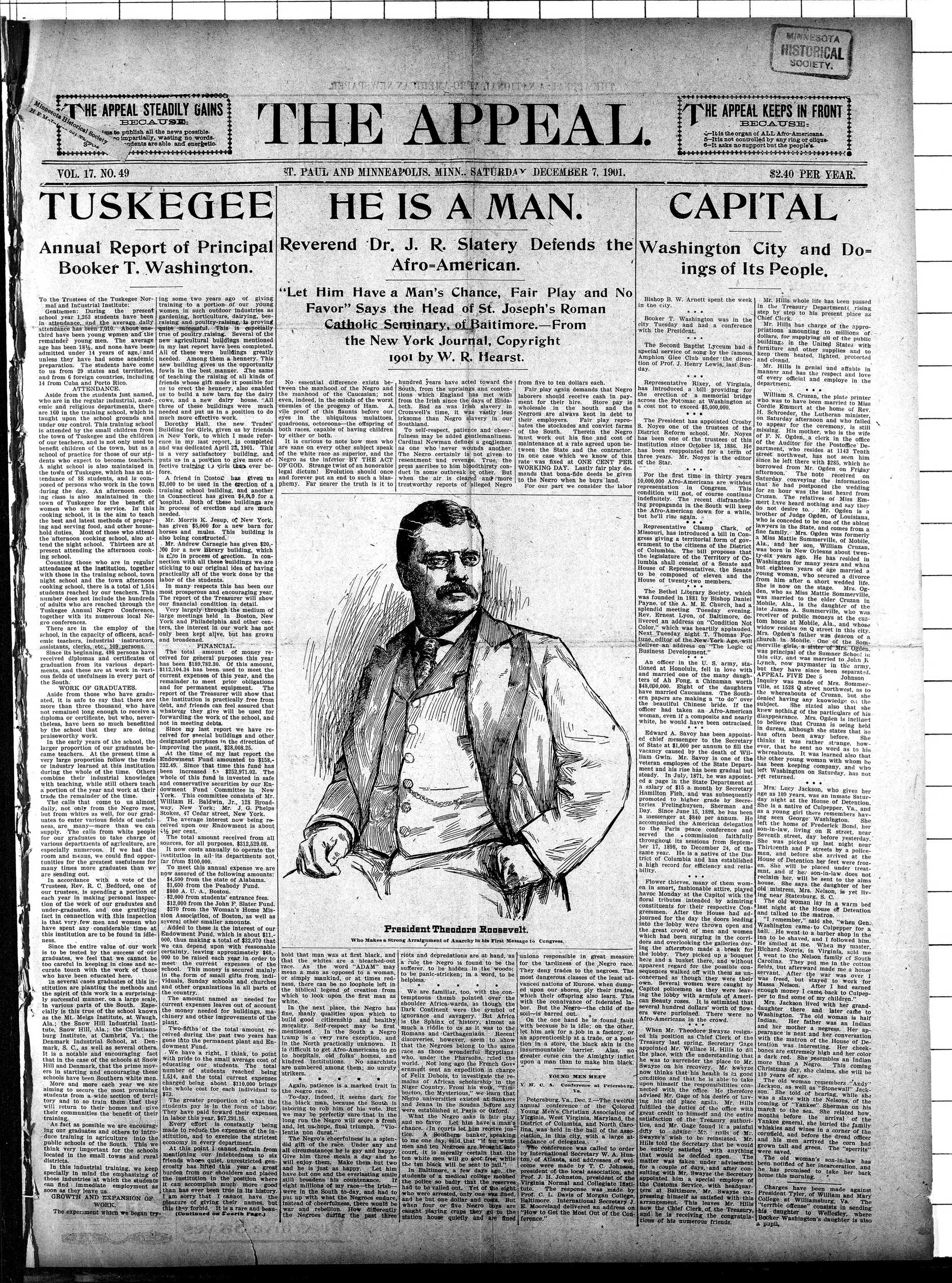
HE IS A MAN.
Reverend Dr. J. R. Slatery Defends the Afro=American.
"Let Him Have a Man's Chance, Fair Play and No Favor" Says the Head of St. Joseph's Roman Catholic Seminary, of Baltimore.—From the New York Journal, Copyright 1901 by W. R. Hearst.
President Theodore Roosevelt.
No essential difference exists between the manhood of the Negro and the manhood of the Caucasian; not even, indeed, in the minds of the worst enemies of the progeny of Ham. A manhood of the Negro owes eyes in the ubiquitous mutuos, quadroons, octoons—the offspring of both races, capable of having children by either or both.
It is curious to note how men who are sane on every other subject speak of the white race as superior, and the black race as inferior, OF GOD. Strange twist of an honorable legal dictum! Evolution should once and forever put an end to such a blasphemy. Far near the truth is it to
Pr
Who Makes a Stro
hold that man was at first black, and that the whites are a bleached-out race. As the word "ADAM" may mean a man as opposed to a woman, a man as opposed to a woman, a man as opposed to a woman, there can be no loophole left in the biblical legend of creation from which to look upon the first man as white.
In the next place, the Negro has finally qualified us to build good citizenship and healthy morality. Self-respect may be first mentioned. In the South a Negro tramp is a very rare exception, and in the North practically unknown. If we get Afro-Americans to go to hospitals and kindred institutions. No anarchists are numbered among them; no unruly strikers.
Again patience is a marked trait in the Negro race.
To-day, indeed, it seems dark for the black man, because the South is laboring to rob him of his vote. But we may be perfectly sure that in the Negro will accrue a fresh and let us hope, and triumph. "Violentia non durat."
The Negro's cheerfulness is a splendid gift of the race. Under any and all circumstances he is gay and happy. Give him three meals a day and he will be cheerful to them but two and he is just as happy. Let him have but one and the everlasting smile still broadens his countenance. If eight millions of my race—the Irish—were in the South to-day, and had to put up with what the Negroes endure, instead of cheerfulness, they would be war and rebellion. How differently the Negroes during the past three
hundred years have acted toward the South, from the uprisings and contentions which England has met with from the Irish since the days of Elidabeth. Bad as was Irish slavery in Canmore's time, it was vastly less than Annegro slavery in our Southland. To self-respect, patience and cheerfulness may be added gentlemanliness. Cardinal Newman defines a gentleman as one who never wounds another. Cardinal Newman certainly is not given to resentment. He press ascribes to him bloodthirsty conduct in some outbreak or other. But when the air is cleaned and more trustworthy reports of alleged Negro
President Theodore Roosevelt
Long Arraignment of Anarchy in his First Mees
riots and depredations are at hand, as a rule the Negro is found to be the sufferer, to be hidden in the woods, to be panic-stricken; in a word, to be helpless.
We are familiar, too, with the contemptuous thumb pointed over the shoulder Africa-wards, as though the Dark Continent were the symbol of ignorance and savagery. But Africa is the Sphinx of history, almost as much a riddle to us as it was to the Romans and Carthagenians. Recent discoveries, however, seem to show that the Negroes belong to the same race as those wonderful Egyptians who, under the Pharaohs, ruled the world. Not long ago the French Governments sent an expedition in charge of Felix Dubois, to investigate the remains of African scholarship in the Niger Country. From his work, "Timbucto, the Mysterious," we learn that Negro universities existed at Sankore and Jenna in the Soudan before any
What the Negro asks is fair play and no favor. Let him have a man's chance. In courts let him receive justice. A Southern banker, speaking to me one day, said that "If white men will go to court, it is morally certain that the ten white men will go gcot free, while the ten black will be sent to jail."
In Baltimore, a few days ago, the students of a medical college mobbed the police so badly that the response had to be called out. Yet of the eight who were arrested, only one was fired, and he but one dollar and coins. But when four or five Negro boys are caught playing crape they give to the station house quietly and are fined
from five to ten dollars each.
Fair play again demands that Negro laborers should receive cash in payment for their hire. Store pay is wholesale in the South and the North, and are valuable to their employers. Fair play reprobates the stockades and convivies farms of the South. Therein the Negro must work out his fine and cost of maintenance at a rate agreed upon before the contract is signed. In one case which we know of this rate was fixed at ONE CENT PER WORKING DAY. Lastly fair play demands that bona-fide deeds be given to the Negro when he buys land.
alt.
message to Congress.
unions responsible in great measure for the tardiness of the Negro race. They deny trades to the negroes. The most dangerous classes of the least advanced nations of Europe, when dumped upon our shores, ply their trades, which their offspring also learn. This is why the Negro is the greater labor. But the Negro—the child of the soil—is barred out. On the one hand he is found fault with because he is idle; on the other, let him ask for a job in a factory, or another job in a factory; in a store, the black skin is the insurmountable barrier. Alas, no greater curse can the Almighty inflict upon a man than to make him black
Petersburg, Va. Doc 2—The twelfth annual conference of the Colored Young Men's Christian Association of Virginia, West Virginia, Maryland, the District of Columbia, and North Carolina, was held in the hall of the association, in this city, with a large attendance of delegates. The office response called to order by International Secretary W. A. H. Johnson, of Atlanta, and addresses of welcome were made by T. C. Johnson, president of the local association, and Prof. J. H. Johnston, president of the Virginia Normal and Collegiate Institute. The response was made by Prof. C. L. Davis of Morgan College Baltimore. International Secretary J. E. Mooreland delivered an address on "How to Get the Most Out of the Conference."
THE APPEAL KEEPS IN FRONT
BECAUSE:
1-It is the organ of ALL Afro-Americans.
2-It is not controlled by any ring or oligue.
3-It asks no support but the people's.
CAPITAL
Washington City and Doings of Its People.
Bishop B. W. Arnett spent the week in the city.
Booker T. Washington was in the city Tuesday and had a conference with the President.
The Second Baptist Lyceum had a special service song by the famous Amphilip Glee Club under the direction of Prof. J. Henry Lewis, last Sunday.
Representative Rixey, of Virginia, has introduced a bill providing for the direction of a memorial bridge across the Potomac at Washington at a cost not to exceed $5,000,000.
The President has appointed Crosby S. Noyes one of the trustees of the District Reform school. Mr. Noyes has been one of the trustees of this institution since October 18, 1886. He has been reappointed for a term of three years. Mr. Noyes is the editor of the Star.
For the first time in thirty years 10,000,000 Afro-Americans are without representation in Congress. This condition will not, of course continue propaganda in the south disfranchising afro-Americans in the south will keep the Afro-American down for a while, but hell rise again.
Representative Champ Clark, of Missouri, has introduced a bill in Congress giving a territorial form of government to the citizens of the District of Columbia. The bill proposes that legislature of the Territory of Columbia pass a Senate and House of Representatives, Senate to be composed of eleven and the House of twenty-two members.
The Bethel Literary Society, which was founded in 1881 by Bishay Payne, of the A. M. E. Church, had a splendid meeting Tuesday evening. Rev. Ernest Lyon, of Baltimore, delivered an address on "Condition Not which was heartily applauded. Next, William Macfort. Fortune, editor of the New York Age, will deliver an address on "The Logic of Business Development."
An officer in the U. S. army, stationed at Honolulu, fell in love with and married one of the many daughters of Ah Fong, a Chinaman worth Eight of the daughters have married the Southern papers are making a "too beautiful Chinese bride. If the officer had taken an Afro-American woman, even if a composite and nearly white, he would have been ostracised
Edward A. Savoy has been appointed chief messenger to the Secretary of State at $1,000 per annum to fill the position caused by the death of William Gwennan, a veteran employee of the State Department and his rise has been gradual but steady. In July, 1871, he was appointed a page in the State Department at $15,000 a month by Secretary Hamilton Fish, and he promoted to higher grade by Secretaries Frelinghuysen, Sherman and Day. Since June 15, 1888, he has been appointed a page per annum. He accompanied the American delegation to the Paris peace conference and served the .commission faithfully throughout its sessions from September 1888 to December 24, of the same year. As the district of Columbia and has established a high record for efficiency and reliability.
Flower thieves, many of them women in smart, fashionable attire, played havoc Monday at the Capitol with the doral tribute intended by admiring congressmen. After the House hadjourned for the day the doors leading into the lobby were thrown open and the great crowd of men and women been surging in the corridors and owing their allegiance to the afternoon made a break for the lobby. They picked up a bouquet here and a basket there, and without hesitation they took the possible consequences walked off the floor concerned as though they were their own. Several women were caught by Capitol policemen as they were leaving Beauty roses, the armfuls of American beauty roses, and several hundred dollars' worth of flowers were purlined. There were no Afro-Americans in the crowd.
When Mr. Theodore Swayze resigned his position as Chief Clerk of the Treasury last spring, Secretary Gage appointed Mr. Wallace H. Hills to all the place, with the understanding that Mr. Swayze will be the place to Mr. Swayze on his recovery. Now thinks that his heath is in good condition and that he is able to take upon himself the responsibilities connected with the office. He therefore asked Mr. Swayze to leave having his old place again. Mr. Swayze fulfilled the duties of the office with great credit to himself and the entire satisfaction of the Treasury authorities, and Mr. Gage found it a painful experience of days, and after consulting with Mr. Swayze, his secretary appointed him a special empire the Customs Service, with headquarters at Baltimore, with headquarters at Baltimore, with headquarters. This leaves Mr. Hills now responsible for the Treasury, and he is receiving the gratifications of his numerous friends.
MINNESOTA
HISTORICAL
SOCIETY.
KEEPS IN FRONT
RECAUSE:
Of ALL Afro-Americans.
Lled by any ring or olique.
port but the people's.
$2.40 PER YEAR.
City and Do=s People.
Mr. Hills whole life has been passed in the Treasury Department, rising step by step to his present place as Chief Clerk.
Mr. Hills has charge of the appropriations amounting to millions of dollars, for supplying all of the public buildings, in the United States with furniture and other supplies and to keep them heated, lighted, protected and clean.
Mr. Hills is genial and affable in manner and has the respect and love of every official and employ in the department.
Mrs. Lucy Jackson, who gives her age as 100 years, was an inmate Saturday at the House of Detention. She is a native of Auburn, a, and as a young girl there remember being seen George Washington. She is the home of Frederick Bond, her mother on R street, near Seventh street, and before yesterday. She was picked up last night. Thirteenth and P streets by a police man, and before she arrived at the House of Detention her feet were frozely on the ground under treatment, and if her feet were not reclaim her, will be sent to the house. She says the daughter of her old mistress, Mrs. Nelson, is yet living with S. C. The old woman, a warm bed last night at the House of Detention and talked to the matron.
"I remember," said she, "when Gen. Washington came to Culpeper for a bathe. He went to a barber shop in the inn he had to have, and I followed him. He smiled at me, and my master, Richard Norris, in Virginia, I went to the Nielson family of South Carolina. They put me in the cotton fields, but afterward made me a house after the war was over I was freed, and after the war was worked for Massa Nelson. After I earned enough money I came back to Culpeper to find some of my children."
Mrs. Jackson lived with her granddaughter there and later carte to Washington. The old woman is half Indiana, the other was an Indian and her mother was a negress. Her appearance is neat and negress with the matron of the House of Detention was interesting. Her checkbones are extremely high and her color is a dark red. She resembles an Indian in Negro. This coming Christmas day she claims, she will be 110 years of age. The old woman remembers "Andy" Jackson, as well as "Stonewall" Jackson. She told of hearing, while she was the Nelsons, of the coming of "Yankee" man on his march to the sea. She said the months before the arrival of the Yankee general, she buried the family and wines in a corner of the cornfield, before the dread officer and his men served the corn had grown tall and green. The "sperite" were saved.
The old woman's son-in-law has been notified of her incarceration, and he has promised to take her back home this morning.
Charges have been made against President Tyler, of William and Mary College of Williamsburg, Va. The "terrible offense" consisted in sending his daughter to Wellesley, where Bocker Washington's daughter is also a pupil.
HAVE YOU READ
THE ARPEAL
ADAMS BROS. EDITORS AND PUBLISHERS
49 E. Bros. 4th St., St. Paul, Ill.
ISSUED SIMULTANEOUS IN
Saint Paul, Minneapolis, Chicago,
Washington, Louisville, St. Louis.
ST. PAUL OFFICE,
No. 110 Union Blk. 4th & Cedar,
J. Q. ADAMS, Publisher.
MINNEAPOLIS OFFICE,
Guaranty Loan Bldg. Room 811
HENRY ROBERTS, Manager.
CHICAGO OFFICE,
323-5 Dearborn St., Suite 310,
C. F. ADAMS, Manager.
WASHINGTON OFFICE,
No. 1919 Eleventh St., Northwest
CHAS E. HALL, Manager.
LOUISVILLE OFFICE,
No. 312 W. Jefferson St. Room 3
W. V. PENN, Manager.
ST. LOUIS OFFICE,
No. 1002 Franklin Avenue.
J. H. HARRISON, Manager.
TERMS, STRICTLY IN ADVANCE:
SINGLE COPY, ONE YEAR..... $2.00
SINGLE COPY, SIX MONTHS..... 1.10
SINGLE COPY, THREE MONTHS..... 60
When subscriptions are by any means allowed
60 cents for each 13 weeks and 5 cents for
each odd week, or at the rate of $4.00 per
week, be made to the letter Lester or Bank Draft. Passage
stamps will be received the same as cash for
one cent and two cents stamps taken. Only one
cent and two cents stamps taken.
Silver should never be sent through the mail.
The envelope and be lost; or it may be lost.
Persons who send silver to us in letters
marriage and other mail lines 10 lines or less.
Each additional line 10 cents. Payment
must be made at all times in must season to be mailed.
Advertising racks. 15 cents per agate line, each
in inch and about seven words in agate line. No single advertisements less than
1 inch must accompany the month's stamps. Must each accompany
all orders from parties unknown to us.
Reading notes 25 cents per line, each inertion.
No discounts for time or space. Reading
matter is seen in brochure. No discounts for time or space.
All line contents must be double.
On the address label shown when
subscription expires. Renewals should be
made two weeks prior to expiration, so
no paper may be missed, as the paper stop
It occasionally happens that papers sent to someone do not receive any number when due, inform us by postal card at the expiration of five days forward a duplicate of the missing number. Communications to receive attention must be new, upon important subjects, and not sent to the paper. The paper must reach us Tuesday if possible, anyway, and the nature of the author. No manuscript returned, unless stamps are sent for postage. We do not hold ourselves responsible for the soliciting agents wanted everywhere. Write or letter sample copies free. We never fail to give your full name and address, plainly your county and state. Busy letters of request are separate sheets from letters containing news or matter for publication at St. Paul, Entrance as such.
AGENTS WANTED.
THE APPEAL wants good reliable agents to canvass for subscribers at points not already covered. Write for our extraordinary inducements. Address,
Representative Moody, of Massachusetts, evidently intends to find out something about the Louisiana style of electing Congressmen by disfranchising the Afro-American. He has introduced the following resolution: "Resolved. That the Speaker shall appoint a select committee of eleven members, who shall inquire and have leave to report, by bill or otherwise, at any time, whether at the election in the State of Louisiana wherein the members of the House of Representatives from said State were chosen the right of any of the male inhabitants of said State, being twenty-one years of age and citizens of the United States, to vote at said election was by the constitution and laws of said State denied or inany way abridged contrary to the Constitution of the United States or the articles in addition thereto and amendment thereof; whether if the right of any person to vote was denied or abridged as aforesaid the members from said State chosen at said election are entitled to membership in this House, and whether it is expedient that Congress should enact appropriate legislation to enforce the provisions of the fourteenth' and fifteenth articles in addition to and
amendment of the Constitution of the United States."
Born in America, the hell hole of race prejudice, even the 'genius of Henry O. Tanner, the great Afro-American painter, was not recognized by the people of this country. Going to Paris his wonderful religious paintings won him the attention and admiration of the world of art. Incidentally a Caucassian-American lady, the daughter of a wealthy railroad man, who was an art student in the French capital, was attracted by the famous artist, and now she is Mrs. Tanner.
Mr. Tanner's most famous painting, "The Raising of Lazarus," was purchased by the French government for 100,000 francs, and hangs in the Galleries of the Luxembourg. Now that he has been recognized abroad Mr. Tanner is persona grata with American artists and people generally. His popularity is so great that the Ladies' Home Journal, the most widely circulated of American monthly periodicals, has just signed an agreement by which reproductions of Tanner's greatest biblical pictures will be published in that journal. Moral: Succeed in Europe and return to America.
The Southern Caucasians get very angry when an Afro-American editor calls attention to their failings. One gentleman who by the seven-eights Caucasian was obliged to leave Wilmington, N. C., between dark and dawn in order to preserve his skin entire, because he told the truth about Southern conditions.
Caucasian Ella Wheeler Wilcox speaks very plainly about race mixing in a recent article. The Southernners who prate about "social equality" will no doubt be "sore," but they'll not mob Ella for saving: "There are scores of handsome and brilliant men and women belonging to excellent families who are elite unconscious of the source to which their splendid teeth and waving auburn hair could be traced. From the old colonial days, down to the end of the civil war, the slave-holding gentleman frequently increased his list of chattels without attending public auctions or buying slaves. This ancestry is far more prevalent in America than we imagine or suspect."
The Washington Post pokes fun at Prof. Scarborough, of Wilberforce, calling him a "professional Negro," whatever that it, because he has written a communication which was published in the London Chronicle under the headline "A Terrible Chapter in American History." Prof. Scarborough has not told the half of the outrages pernitted upon a defenseless race. John C. Calhoun once said: "Show me a Negro who can conjugate the Greek verb and I'll say slavery is wrong." Scarborough is professor of Greek at Wilberforce and he has probably forgotten more about Greek than Calhoun ever knew. Scarborough is not only able to conjugate the Greek verb—he has written a series of Greek text books now in use in many institutions of learning and he is a black man too.
A suggestion has been made to the effect that Congress authorize the erection of a beautiful building to be known as McKinley Hall, suitable for a meeting place of semi-official gatherings, such as the international maritime conference, the international post congress, the international geographic congress, which is to meet here in 1904, pan-American conferences and similar bodies. There is now no such hall at the national capital, and one is much needed. A memorial building of this character would not only be useful and dignified, but it could from time to time be enriched with works of art of a distinctively national type. It is the belief of many eminent men that the United States is rich enough to be able to erect suitable memorials at the national capital to all three of the great men of its last half-century—Lincoln, Grant and McKinley.
Since the occurrence of the "Booker Washington incident" it has been the subject of discussion in many debating societies. The question has nearly split the literary circles of the Methodist church at White Plains, N. Y.
The subject chosen for the last meeting was "Was it right for President Roosevelt to invite Booker T. Washington to dine with himself and family at the White House?" Dobbs, a Southerner, took the negative side. Several times he referred to Washington as "the nigger," and said that a negro is not fit to dine with any white man's family. While some members of the society agreed with him his remarks met with a great deal of disapproval and he was given hisises and groans by a portion of his listeners.
THE APPEAL: A NATIONAL AFRO-AMERICAN NEWSPAPER
The citizens, or at least a portion of the Caucasian citizens, have offered the Bishops of the Methodist Church South a donation of 245 acres of land and $1,000 is promised if the Methodist church and the Methodist Church South would utilize confolly the same for an endowed institution of learning, last night made its report to the conference, accepting the same, but with an amendment that no Negro or person of Negro descent be permitted to enter the school. The conference as a whole adopted the committee's report, without alteration.
This Methodist Church South is supposed to be a church of the God who "made of one blood all nations of the earth."
"Justice to the Woman" is an appeal to mankind wrong supposed to have been the weaker sister by modern civilization, put it the oppressed of the Beetle Babcock. The book bears the imprint of A. G. McClurg & Co.
The Life of the Martyr President told in Actually the Necedes. Edited by Silsa G. Braatt, Illustrated, 250 pages, 75 cents net; postage 9 cents addition.
This book offers a narrative of Lincoln's life, composed of the best stories told by and about the Great Emu war.
With portrait and mass $ per and Brothers, New York.
Two Wars: An autobiography. S. G. French, Nashville. Tate Publishing. Many respects a remark appearing as it does when an odeguration, showing development and great change in the lifetime of the period in science of the period in war, is presented in Gen. Fred's rp.
President Roosevelt's first message to Congress is a striking document. The President has many things to say and he—just says them. There is no striving for rhetorical effect, although the message is an excellent composition. The most notable thing in the message is the scathing denunciation of anarchy. It is evident that the President does not consider the Afro-Americans as a race apart from other Americans. For this the people of the race are grateful. They ask only a man's chance and no favor.
Mrs. Janetella Robinson Murphy, of New York, has been entertaining Chicago society with what the daily papers call "darky song." The dailies go on to say "The darkies scampered out into the hall for a hoe down and a real 'nigger' time they had of it, while the white folks inside were trying their best to keep time with the music." We trust this is not true. No Afro-Americans should allow themselves to be used for such a purpose.
The Charleston Exposition opened this week. One hundred years ago Charleston equaled Boston in population. It was one of our busiest seaports. Deaf to reason it attempted to destroy the Union. The result is a part of history. If Charleston will turn its back to the past, give up its race prejudice, introduce some Northern brains into its business and commerce it will become one of the great cities of the country.
According to the Louisville papers two Afro-American women created a sensation by entering a Caucasian church last Sunday. "In some manner they escaped and avoided the ushers and entered the pew of Andrew Broaddus." who endured the ordeal without flinching." The terrible affair took place in an alleged house of God in America in the twentieth century!
Representative Crumpacker, of Indiana, says: "I venture that the time will come when the Southern people will rise up and call the fifteenth amendment blessed." The Congressman means well, but he evidently does not understand the Southerners' determination, that the Afro-American shall be deprived of all his rights in the South.
White waiters, members of unions in several of the big railroad centers of the country, are preparing to make a general fight on the employment of Afro-American waiters in dining cars. The plan is to unionize every branch of hotel and restaurant labor and admit barkeepers to membership. The whites allege that the Afro-Americans are willing to work for lower wages.
Mr. Moody, of Massachusetts, has introduced a bill in the House of Representatives for the protection of colored citizens against lynching in default of state protection. Why not include all citizens. The Afro-American has no desire for special legislation. Let the Government protect every citizen.
The Supreme Court of the United
States has handed down a decision
holding that the Philippine Islands
are, a part of the United States
and that there is no provision in the treaty
with Spain that the inhabitants should
not—become citizens of the United
States. _____
The importance of good pure reading matter for the growing mind cannot be overestimated. The Youths Companion, published at Boston, Mass., is the best periodical for the young printed in the English language.
There is a new wrinkle in the lynching business. Seven men accused of hanging an Afro-American were recently convicted of ASSAULT AND BATTERY.
Thomas Nelson Page, of Virginia, complains of the solidarity of the Afro-American 'Well—the whites are organized solidly against the race.
THE BOOK
WORLD
"Justice to the Woman" In an appeal of man's better nature in behalf of a serious one's purpose to have been done the weaker after by modern evaluation, put it the form of a story by Mrs. Bernie Batcock. The book bears the imprint of A.C. McFurg & Co.
The Life of the Martyr President told in. Authenticated Anecdotes. Edited by Siles G. Pratt. Illustrated. 12mo, cloth, to require, postage 3 cents addition, at this interesting book offers a narrative of Lincoln's life, composed of the best stories told by and about the Great Enant ipator.
With portrait and maps $2.90 net. per and Brothers, New York City. Two Wars: An antilography. By G.S.G. French. Subtitle from Conferate Publishing Co. "Two Wars" is many respects a remarkable publicer appearing as it does when its author an octagonian, showing the wonder of the world. The life of the last two years which he occurred in the lifetime of one man, particularly the advances made in military and of the period between the wars of which the book treats, as it rained in Gen. French's realistic de
Thomas Y. Crowell & Co., of New York City, have prepared an edition of what he calls *The Book of Dumas*, and have put it down in hand. Dumas, and have put it down in hand, has a new translation, with new illustrations, and with editorial features. The firm has been at work on the edition for several years.
American Political History to the Year: By John A. Conklin, 435 pp. 12 mo. $1.50. *The Book of Dumas*, the charm of a story entertainingly good, is the story not simply of bloody wars. It is an irresistible upward movement of mankind.
*Plantation Song*. A collection of Plantation melodies for My Lady's Burge and other Negro lyrics and monologues. By John A. Conklin, 435 pp. 12 mo. W. J. Wotts. $2. R. H. Russell New York. This is a fine compilation of New York's best-known books. The book is beautiful printed and illustrated with numerous engravings.
Deborah. A Tale of the Times of Judas Maccabaeus, by James M. Lulow. Illustrated by H. Revel Company, New York City.
Delornh is a book that will live. It is of irresistible power, full of commerce and adventure. Bishop Hurst says: "It embodies in a living and a fascinating robe of pure immanence the types of character and scene effects and the great events of actual history.
FROM PLANTATION MONGOS.
By Eil Shepard. R. H. Russell, Publisher.
Copyright, 1901, by Robert Howard Russell.
Love in Literature and Art. By Eisher Shepard. Net, Sikh Art, the Museum in New York. This book shows how love has been treated in literature, from the anatomy of a flower to the medical remnues and great dramas, down to the romance of Anthony and Chopatra, Venus and Adonis, Romeo and Juliet. The illustrations are reproductions of art from Raphael to Henry Jones. The authors include acarly every great name in Literature.
"Two Treaties of Paris," by Sidney Westerly, 1.25 net, Harper & Harper, New York.
This volume deals with our legal relationalism and its intelligent and concise outline of the course of authoritative opinion upon the human intelligence and federal government to acquire territory. Widely present many points, just differences in the opinions of justices of the supreme court in insular cases. Private Life of the court in the Georgian Islands of China. Translated by Arthur Burchard of China. Translated by Private Life of King Edward VII. "Historical Life of King Edward VII." Humorous and tenacious 10 cents additional. The author marks and timely book has left the markable and timely book has left the markable and timely book has now a resident of Paris. He has been recently condemned to death by the Sultan of the Ottoman Empire, and he suited he should return to Constantinople. "A Short History of the Revolution" by Everett Tomlinson. Doubleday. Page & Page presents the experiences of the people as presents the experiences of the people as trying period of our history. Historical rules are but the record of soldiers' deeds so the record of soldiers' deeds is trying period of our history. Historical rules are but the record of soldiers' deeds so the record of soldiers' deeds is trying period of our history. The book is a clear, stirring, impartial history of the American independence. There are 60 full paintings from old engravings, which and greatly to the interest of the narrative.
Alexander Hamilton, by C. A. Conant, 16 mo. 145 pp.; 65 cents net, Houghton Meffin & Co., Boston.
This is volume 10 of the Riverside Biographical series and a delightful little book it is. President Barfield described Alexander Hamilton as "the greatest American who ever trod the soil," and it is the consensus of opinion that Hamilton was the greatest constructive statesman the country has yet produced. Mr. Conant in his book gives a general estimate of Hamilton's powers rather than a detailed description of them. The fact there is undisputable proof that Negro blood coursed in Hamilton's veins lends additional charm to the Afro-American reader.
"The Woman Who Dares" by Ursula N. Gestefeld. In this novel the heroine seeks to find and realize her own individuality, who was true to her ideals and who finally succeeded in inducing her husband to share in her lofty aspirations.
The author is evidently in earnest and a great moral purpose is kept constantly in view. It is meant to show the in justice of the dual standard of morality. The subject although treated with force and tact is delicately handled. In a masterly way it shows that it is the sacred duty of every married woman to demand the absolute right to her own person in wedlock. Prizs 150 postpaid. Gestefeld Publishing Co., 127 East 23d street, New York.
Among the clever and original holiday books of the present year a high place must be acorded to "Plantation Songs for Mr. Lady's Banjo," and Other Negro Lords and Manologues." by Eli Shepperd. The humor and realism of the songs are greatly enhanced by twenty-five plantation scenes life of southern Negroes. The byways have the somontetty, the artless simplicity and the occasional flashes of genius found in actual utterances of this kind. It is more than likely that Mr. Shepperd's book will furnish some permanent contributions to the fund of classic Negro methodics.
General Alper's work on "The Spanish
Migrant" will attract wide attention
on account of the growing size of his administration of
students growing out of the University of
August 1, 1890, he held this important
what occurred during this period in con-
nection with the Spanish-American war is
viewed as a victory. Behind defending himself against
quadrats he still maintains the rank of
controversial literature will find this vol-
tue spirit of itself then. The book is one
of the most important works of
Prizes Catch many women. What do prizes amount to? Not worth considering. Cannot pay you for poorer work, greater expense and risk to clothes, which you get with an inferior washing powder. Any women with these BEARLINE has a prize, and will save enough to buy more and better knick-knacks. 682
Pearline Saves
his portrait and mans $20 net. Harper and Brothers, New York City.
Two Wars: An autobiography. By Gen. Robert B. Ware, a graduate of Publishers Co. "Two Wars" many respects a remarkable publication. He presents a biography of an octogonian, showing the wonderful development and great changes which have taken place in Gen. Ware's man, and particularly the advances under his scientific in the period between the two wars. The book is presented in Gen. French's realistic description in the battle of Monterey, Bucuresti, and that of Kenesaw, and others of the civil war.
His account of the condition of the Texas Indians, his reports to the government, and plans for their relief are interesting bits of history. The general, in his bright, characteristic way, tells many anecdotes of prominent persons he has known—U.S. Grant, his classmate at West Point, his comrade in arms in Mexico, and his opponent in the civil war; Gen. Scott, Jennie Lind and others.
The Real Latin Quarter of Paris by E. B. Berkeley Smith. Illustrated with about 100 drawings and camera snap shots by the author, the water-color color of the Sancha, and a water-color frontspieces of Hikim, Kilson Smith. 12mo, cioth. Price, $1.20; postage 13 cents. New York and London were built by the Smiths. In a seductive charm about that famousிரere is a "the New York Times," which is a depiction of Paris—the Latin Quarter—which is more known only by reputation. Wherein this, the analysis of the understood. The casual visitor, who has wandered through the Quarter, or who, and the time of the time, is to be taken through it by one of the same words not tell you of its fascinations. He cannot portray its life, or interpret its spirit. It is not possible to find the real in-mosphere of the place, or the true invariety of its throbbing, sad-and-gay existence. The reading of E. B. Berkeley Smith's delightful book, "The New York Times," is the first for Paris can be omitted, if need be, with far less actual loss in the way of information. The greater is, it is being called as the greater enjoyment than heretofore. Some of the "the New York Times" are a hundred sketches and photographs by author, two caricatures in color by the author. The first is Sancha and a water-color frontspiece by Smith. In the book, "The New York Times," he had the indusome color, make it particularly available to the author.
"One Times in Dixie-Land." by Mrs. Caroline Herrera is an exceptionally interesting book. While the books of the early years of the time being a history it presents with surprising vividness typical scenes and exasperations that are of the very spirit of history.
"Racen says that Jefferson always knew all about everything on the plantation." He knew the name of every tree, just when one was dead or needed nursing. He even told Gold, what pigs to kill, for he had names for them all.
"His habits were regular and systematic. He was a miser of his time, rose always at dawn, wrote and read until breakfast, breakfasted early, and dined from 3 to 4, and 9 and 10. He said in his life that the sun had not caught him in bed for fifty years. He always made his own fire. He drank water but once a day a single glass, when he returned from his ride. He are nearly, and must never be vegetable food, preferring French cooking."
"Jefferson's opinion of European royalty was expressed in a letter to Gen. Washington, in which he said: 'I can say with perfect safety that there is not a crowned head in Europe whose talents or merits would entitle him to be elected a vestry in my city by the people of any parish in America.'
"Jefferson was ambidextrous. He could write equally well with either hand. When his right wrist was broken he learned to use his pen with his left hand, which became the right to the other. It would have been impossible for him to be killed on his extensive correspondence without being able to relieve his right hand at intervals."
"Candle-Lightin' Time," by Paul Lawrenz, author, is the title of one of the books of poems of the year. The binding is a fine leather-bound, with books of poems of the year. The binding is enhanced by leaf and flower designs, illustrations, which compose a picturesque scene. The poem is the "Folk from Dixie," was taken from the book "The Decorations," by Margaret Armstrong, author, and blindly, make a poem in themselves.
and attack strikes a note herein as clear and immediate evidence of the need to the public. Lowly Life were given to the public.
In "Kishuu" he gives a very amusing story of a girl who wakes up to a Wen d fish begin to nibble, and de cook begin to jump. Its an angel he met de bitin, case de breath my heat de go "thump". It raises a awful down undah, an I raise a awful ballah belies a gallantin. As a big of yallah bally comes a gallantin. This poem is one of the most interesting character sketches in the book, and its verses are so vivid that romance around the cabin dwellers of Dikit. Group of Summer" breathes the aroma of the woods, and sparks with the bright waters through "Medada level as a fish."
"When Dey Listed Colored Soldiers" is one of the best in the set, and its colorings are the band of an artist. "Too bad buttons snapped," an his face was shiny, "so well she was shiny," too.
An' he looked so strong an' might in his coat o' sojer blue."
Dunbar's songs have lost none of their old time music, and there is in this publication a new testimony that he is carrying the work "work," published by Dodd, Mead & Co. New York, Price, $1.50 net.
A small volume of poems entitled "Cunningham for Tree Americana," has made its way to the library, and usually serious tone and seek to touch the heart of the reader, thus chase the author, Lieut. Richard E. S. Tortoise, graduate from Lincoln University, and for
seven years taught, school in Tennessee, and served in the Army. American war ably and well. He in now employed in the U. S. Treasury Department, and his career changed to verse during his leisure hours.
Lieut. Toomey has not essayed to versify in dialect, but in pure and strong English he strikes his lyre and run through the entire scale of harmony. Not all the lyrics found in this little volume are particularly the marks of an accepted genius. Riley and Dunbar may soar to more ethereal realms of poesy than this "soldier singer" but his efforts are well sustained and disclose glimpses of wide historical reading and a brilliant imagination.
In "Our Last Tribute" a poem dedicated to the Hon. Ge. C. White, we find some lines which approach the spirit of genius of our most ancient men, with enclosed face.
Speaks out this man for millions of his race.
Wrapped is the hall in silence, chained
Save that of hearing, which alert, intense.
Pain is on each face a look expectant,
A listening atmosphere permeates the scene. The hall, a work of art, histroic, grand. Where what is don may curse or bless the room. And later on he gets into his theme and describes with yild imagination White's last experience in the House of Representatives.
"Poured out his soul, but not in servile tears
Deplores the times, but not with cringing fears."
The volume is a valuable accession to race literature and Liatte. Toemey discloses the history of the book, a wide audience in futurity, Price $1, Scales Publishing Co., Washington, D. C. Scales Publishing Co., Washington, D. C. A small volume of selected art gems from the Cuban poets has recently made its way to Elijah Clarence Hills. D. C. Health Clarence Hills. $6.00. It's title, Barton Cuban. (Cuban ards) at once the inimitable, given any attention to Spanish literature.
In this volume are the best selections from the poetical works of Heredia, Placido, Avellaueda, Milanes, Mendive, Luaces and Zenen.
To the American public whose eyes have been riveted upon Cuba and everything Cuban since the Spanish-American war it is, indeed, a very welcome revelation of the aesthetic mind and soul of the "Pearl of the Antilles."
It is, however, to the songs of Placido, the mutilation poet to which especial attention is called. He was born at Havana, March 18, 1800. Although slavery existed in his time, Placido was born free. In his boyhood he received little education, his parents being very poor and he was compelled to study alone whenever opportunity presented itself from his employment as a Peinetero.
He must have read widely, for the results of his literary knowledge were soon made strikingly manifest in a novel called "Placida y Blanca," which placed him in the front rank of Spanish writers.
Of his poetry, Sales y Quroga, the Spanish critic, says: "This man in his half-stage was as a sublime and generous passions that no man can understand. Across the mistakes of form and prosedy there are brilliant sparks which initiate and flash; and I know of no other American poet. In addition to He, he is, that even approaches him in genius, in inspiration in nobility and dignity." He was accused of complicity in a conspicuous against the whites and was shot at Matanzo and 28, 51.
In his "Plegaria a Dios" (Prayer to God) which he composed in prison several days before his execution, and whose last appeal was the effect of the condened, alone would suffice to immortalize the name of the author, and it is the best proof that Placido was innocent of all crime.
Mas si cuadra a tu suma omnipotencia Que yo perecía cual malvado implo. Y que los hombres mi cadaver frio Ultrajon con maligna complacencia I Suene tu voz, y acte mi existencia I Complase en mi tu voluntad, Dios, mi.
But if it suits the omnipotent God That I should perish in my impity And the same may the corpse Shall violate with malignancessing complacence I dreamed, thy voice, end my existence Fulfill in me, my God, thy will.
The latest work from the men of Mr. Charles W. Chesnut, "The Marrow of Tradition," is a notable production. In-ded. it is the strongest and most absorbing story of Southern life, which has yet come from that sectional phase of American life. Cable, Page, Tourgee and Joel Chandler Harris have pened with, cunning fidelity stories of "Dixie land," and Harriet Beecher Stowe's great story was great because of the more influence it exerted, rather than its artistic finish. In the "Marrow of Tradition" we find every phase of Southern life painted with such rare fidelity that at last appears the cultured and industrious phase of Afro-American life, not over done, but just as we know it to be. At last the Southern white artistoerat, "poor white" antebellum Negro and cultured Afro-American are placed in juxta position in a chef d'œuvre of Charles W. Chesnut, which easily puts him in the front rank of American novelists.
F.
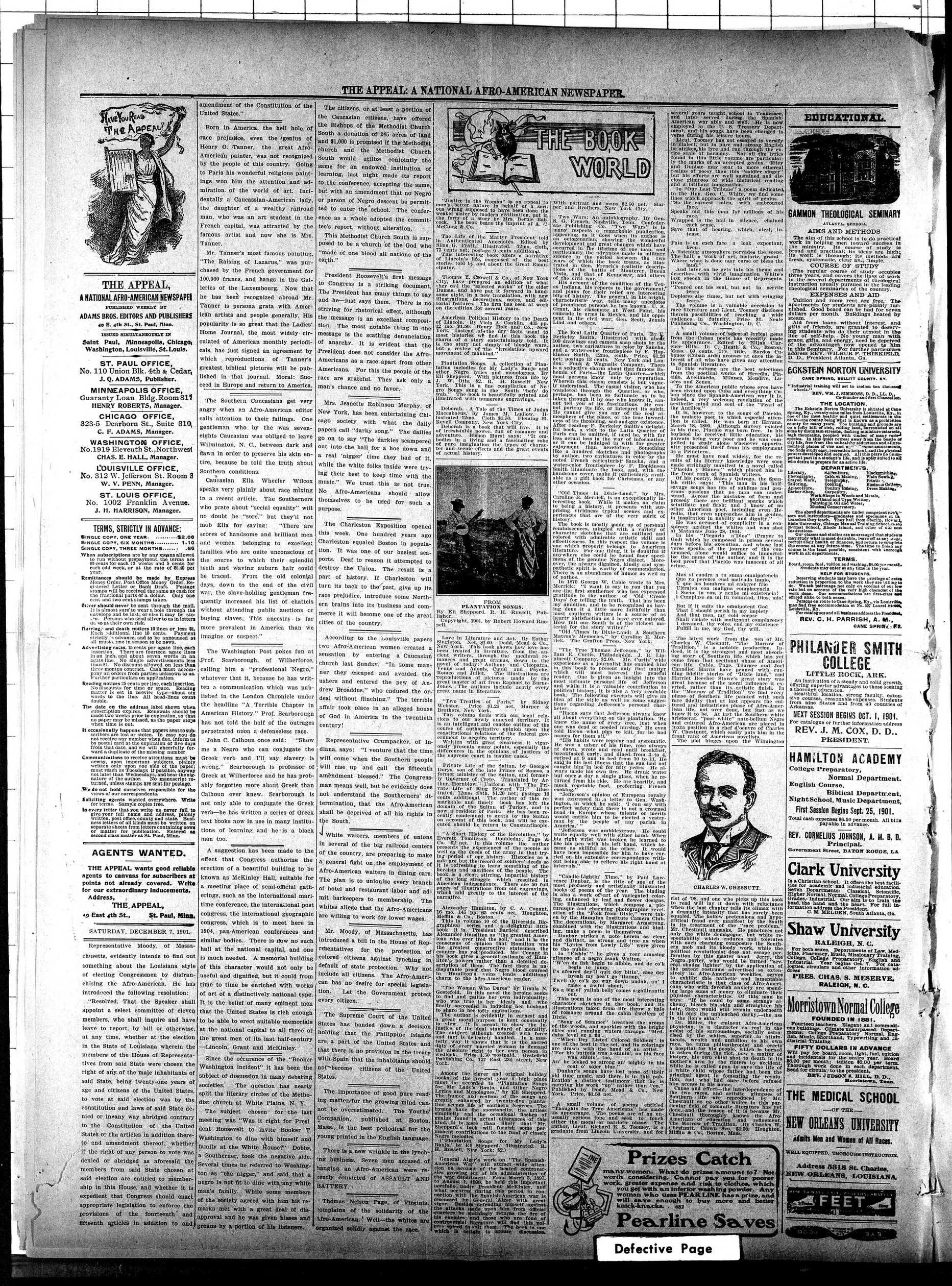
CHARLES W. OHESNUTT
A lot of '98, and one who pleks up this book in read with the endowment with reluctance when he has the last chapter tells its climax with a dramatic intensity that has rarely been a high-critical event by�pressions and�pro-
In its treatment of the race problem, the best-selling unmasks. He punctures not only the white and red, but the spectability which endures and tolerated such charming composure the Southern world. It is the most important of the political revolutionist does not escape perforation by this master hand. Jerry, the first one to be called "several shades lighters" by the application of the patent rostrums advertised so extensive, exce-
to exhibit this pathetic weeklies, serve-
characteristic in that class of Afro-Ameri-
who with feverish anxiety are spending
physical characteristics. Of this man he says: "If he could by some strange al-
hales there would still remain underneath it all only the unleached darky,—the ass
in Dr. Miller the eminent Afro-American
physician, is a character so real in the
subsequentings, socially ostra-
cised by the white and ambition to his own
rears of the turna philanthropist and erects
to ashes during the riot, now a matter of
history, his own child shot to death in its
fate while he is called upon to save the life of
a white child whose father had been the
character age in fomating the revolution
and who had to place before refused
him access to his home.
Cause and effect—the interdependence of the Southern life—are reproduced by Mr. Southern, life in a literal field of romantic literature has yet been established. Constraint "humbly known" the Afores Custhurt "throughly knows the Afores Custhurt." The Marrow of Tradition, by Chuck Houghton, Mifflin & Co. Boston, Mass.
OES
AIMS AND METHODS
The aim of this school is to do practical training men toward success in the ministry, business and practical; its ideas are high, fresh, systematic, clear and simple, fresh, systematic, clear and simple.
The regular course of study occupies three years, and covers the lines of work for the college, the movements of theological instruction usually practiced, and leading theological seminaries of the country.
EXPENSES AND AID
Tuition and room rent are free. The apartment is furnished. Good board can be had for seven dollars per month. Buildings heated by Aid from loans without interest, and students who do their utmost in the line of self-help. No young man with a degree in theology can benefit of the advantages now opened to him in this Seminary. For further particulars, see RIVERKILD, D. D., President Atlanta, Ga.
EGKSTEIN NORTON UNIVERSITY
The Ecklenburg Norton University is situated at Cane Creek, the most beautiful and quiet assignments in the most of the best health and quiet environments in the county for being the building and grounds for a college. We have beautiful mountain streams, chalk minarets, mountain peaks, with timber of many varied life, free from the unhealthy edictions and alterations that can occur in a study, recreation hospital, and the physical education part in a student's life, and is apply to all who desire to prepare for an active life.
**METHODS**
Literary, Photography, Calligraphy, Painting, Tailoring, Cooking, Business College, Barber shop, Carpentry, Metal and Wood, Shorthead and Type Writing, Music, Music Concertency.
The above departments are under competent new hands. We teach all branches they have held from Ourlin, Howell, Nuneaton, Chicago Manual Training College, of all institutions. They hall from Ourlin, Howell, Nuneaton, Chicago Manual Training College, of all institutions. They hall from Ourlin, Howell, Nuneaton, Chicago Manual Training College, of all institutions.
MATHS and studies are so arranged that students may study in most desirable place, at any age, any time. We have a course at any future time. The time to submit any work in all departments.
**FERMS.**
Board, room, fuel, tuition, $80.00 per credit. Students may enter as any time in the year.
**HELP FOR STUDENTS.**
Deserving college or art reduction in proportion to the work they are required to perform, students may be rate on account of any high character of the accommodations are frat-class and
Perrone route to Cane Spring, Ky., via Louisville, Ky., and Louisville, Ky., to Louisville, Ky., and Louisville, Ky., and all business addresses the Fraternity REV. C. H. PARRISH, A. M., CANE SPRING.
PHILANUER SMITH COLLEGE
offering superior advantages to those seeking Healthful location, strong faculty, extensive courses, reasonable expenses. Students from nine States and from 43 counties of NEXT SESSION BEGINS OCT. 1, 1901. For catalogue or further information address REV. J. M. COX, D. D.,
HAMILTON ACADEMY
Normal Department.
English Course,
Total cash expenses $8.50 per month. All bills payable in advance.
REV. CORNELIUS JOHNSON, A. M. B. D.
Principal.
In a Christian school, it offers the best facility for seven Departments: Classical, Scientific, Seven Departments: Industrial, Scientific, Grades, Industrial. Our aim is to train our information address the President.
For both sexes, Department of Law, Medical Pharmacy, Music, Missionary Training, College of Engineering, Industrial, Year begins Oct. 7. For carousels, circulars and other information adhere to PRES. CHAS. S. MESERVE. RALEIGH, N. O.
FOUNDED IN 1881.
Fourteenth. Elegant and commodious buildings. College Preparatory Normal, Engg. College. Typewriting and Industrial Training.
FIFTY DOLLARS IN ADVANCE
Will pay for board, room, light, fuel, tuition $6.00 per month; Typewriting $8.00 per month; tuition $2.00 per month.
Through work done in each department.
Send for resume.
REV. JUDSON S. HILL, D. D., Morristown, Teen.
THE MEDICAL SCHOOL
OF THE
NEW ORLEANS UNIVERSITY
Admits Men and Women of All Races.
WELL EQUIPPED, THOROUGH INSTRUCTION.
Address 5318 St. Charles,
NEW ORLEANS, LOUISIANA
HOW TO BE A MEDICAL SCHOOL SHARER
FEET
▲ WEEKS RECORD IN MINNESOTA'S CAPIT.
The Saintly City and Saintly City Folks—Newy Items of Social, Religious and General Matters Among the People, Boll-ed Down.
READ:
ELSEWHERE.
ABOUT THE
NEW GROCERY STORE.
COR. KENT AND UNIVERSITY AVE.
CHARLES F. COLEMAN, PROPRIETOR.
Mrs. J. H. Charleston has returned home after a three months' visit in Ohio and Illinois.
One or two gentlemen roomers wanted. Apply at 527 St. Anthony avenue, or at THE APPEAL office.
Remember the Men's Sunday Club, at St. James's church to-morrow afternoon at 4 P. M. An excellent program.
The Business Men's Social Club meets Monday evening at the Guaranty restaurant, Minneapolis, at $0.00 of clock.
Mr. A. French seems to step lighter and look brighter than ever since his return from the "Windy City," where they say he is all right.
Mr. and Mrs. S. C. Tyler have returned from St. Louis, Mo., where they have been spending a few days with their parents.
"The City Sports" company will be the attraction at the Star Theater an exceptionally strong aggregation and crowded houses will be the rule.
The Elk Express Co. now has a large, commodious store house, where furniture or other household goods may be stored at reasonable rates.
St. James A. M. E. Church, Fuller and Jay streets, Rev. J. C. Anderson, pastor. Morning theme, "The Claims of Evening theme, "Temption of Men."
The most popular place for people who take their meals down town is John Godrey's, No. 552 Wabasha street. Everything neat, clean and well cooked.
Is your hair straight? If not, send 50 cents to Ozonized Ox Marrow Co. 76 Wabasha avenue, Chicago, Ill., for a bottle of Ozonized Ox Marrow and you can easily straighten it.
Anyone who needs any information regarding the whereabouts of Mr. James Thompson, who used to work at the Ryan Hotel, will confer a favor by sending the same to THE APPEAL office at once.
If you wish a good shave, hair cut or shampoo at Richard Cousby's neat shop, No. 7471 Minnesota street. Workroom only. Safety guarantee. Music for all occasions furnished on short notice.
When you're out late at night,
and you wish a nice bite
Of food that will fill you with joys,
To a lunch wagon go,
And you'll get the best show
At Johnson & Williams" "Iroquois"
Write to Riley Allen, St. Anthony
Hill station, St. Paul, Minn., state the
date of your birth and enclose ten
cents, and he will send you a wonder-
ful life reading of character, ability
and prospects.
Gertrude Coghlan in "Vanity Fair"
will be the attraction at the Metropolitan Opera House beginning Sunday night and continuing for the first
week. For the last half of the
week "The Casino Girl", with the
usual matinees.
Elk Express, G. D. Carcissier, prop,
packing and shipping; hauling of all kinds;
coal and wood; large or small quantities.
When you wish anything in the
Main 1920-J. 1 Office 63
East 51th street.
Those of our patrons who desire to have matter published must get the same in this office not later than Thursday afternoon, otherwise it may be taken of any communication that is not signed by the author.
DR. J. E. PORTER, physician and Largeson, Room 410 Washburn building, Fifth street, opposite Court House. Office hours: 10 a.m. to 12 a.m. 2 p.m. to 4 p.m. 7 to 8 p.m. Telephone: 212-755-2000 roll street. Telephone, Dale. 464-13.
Messrs J. K. Johnson and A. Williams have started a new enterprise in the form of a night lunch wagon, which they have named the "Iroquois." They have a stand on Minnesota street between Sixth and Seventh, and are prepared to serve all comers.
The famous chef, John Godfrey, has moved his boarding house to No. 553 Washua street, between Tenth street and Eleventh street, and has conveniences, and is, getter than ever prepared to serve his guests. The monthly attendant rates. Meals, 25 cents. Sunday Transients accommodated.
Mrs. V. J. Henley's services have been solicited by one of the largest firms in the field for expert stenogramming after an appointment with the officials of the West Publishing Co. they have retained her and she will continue to fill the position she has held for many years.
Sam Baltimore, more, it will be remembered, "made a vicious assault on the staff of Miss Amelia, Williams, now Mrs. Joseph Turner, almost killing her, who was sentenced to eight years in the penitentiary, will complete his term and be released next Wednesday."
Pilgrim Baptist, Cedar and Summit Services, 10:45 a.m. 8 p.m. Morning: "The Renewing Power." Evening: "Christ, the Head of the Church."
The regular semi-monthly service of the S.C. Church goes on Hall Thursday, as usual was a very enjoyable affair for all present.
The reasons why you should buy your coal, wood, flour, feed, hay, etc., from C. W. Staehle, corner Rice, Carr generally have a money and get full measure, the best of goods, prompt delivery and in large or small quantities. It will pay you to try him Chunks, Soft Coke, Sawed and Best Hard Coal Telephone Male 1446.
Messy, Will Crayton and Louis Fye have been dancing sores at Elite Hall, No. 217 a street, on the first and third Thursday of each month during the
The Plymouth
"What Every Man Wants"
Will be found in the following list of practical gift suggestions.
Fancy Shirts—In striking colors, priced from 50c to $1.50.
Neckwear—A fine line of English Squares; Four-in-Hands, Tecks, Bows and Batwing Sling-Ties; in pretty patterns; priced from 25c to $1.50
Umbrellas—With feathers
**Gloves**-We've a big display of Buckskins, Woolen and Mocha Kid, from 25e to $1.50.
From 25e to $1.99, a'assignment of All-Wool, Mermos, Woof-Plated, Heavy Bailbrackan, Fleece Lined and Cashmere, from 25e to $4.00.
**Half Hose**-Our Holiday stock is complete with fresh, bright pattern, Egyptian Cotton, Cashmere, Mermos and Wool, from 10e to 50e.
**Swimwear**-Navy, royal, navy and fancy stripes, price from $1.00 to $4.00.
Ladies' Cloak Dept.
$: 7.50 worth $12.00—Pebble Cheviot Jacket—27 inches long, long storm collar, satin lined, pearl buttons, worth 0; special $7.50.
$: 10.00 Fine Kersey Jacket—27 inches long, double breasted, storm collar, bell sleeves, pearl buttons—casstor, red, blue, black and tan—worth $15.50; special $10.00.
$: 12.00 Fine Kersey and Montenac Coats—27 inches long, storm and notch collar, satin lined, good at $15.50; special $10.00.
At $16.50 and up to $30.00 Raglans and Newmarkets—Just received by express an immense shipment of these very popular garments. They come in all the popular materials and very latest effects. We can please you, no matter what price garment you desire. Our special prices $16.50 to $30.00.
At $5.00 Misses Coats—made with storm collars and double breasted, all colors and sizes, worth $6.50, special $5.
At $3.50 and up to $13.50 Children's Long School Coats—come to shoe top, variety of styles and collars, shoulder capes and storm collars, all sizes from 2 yrs. to 12 yrs. Special prices $3.50 up to $13.50.
Everybody Goes to The Plymouth This Year.
The Plymouth Corner, Seventh and Robert.
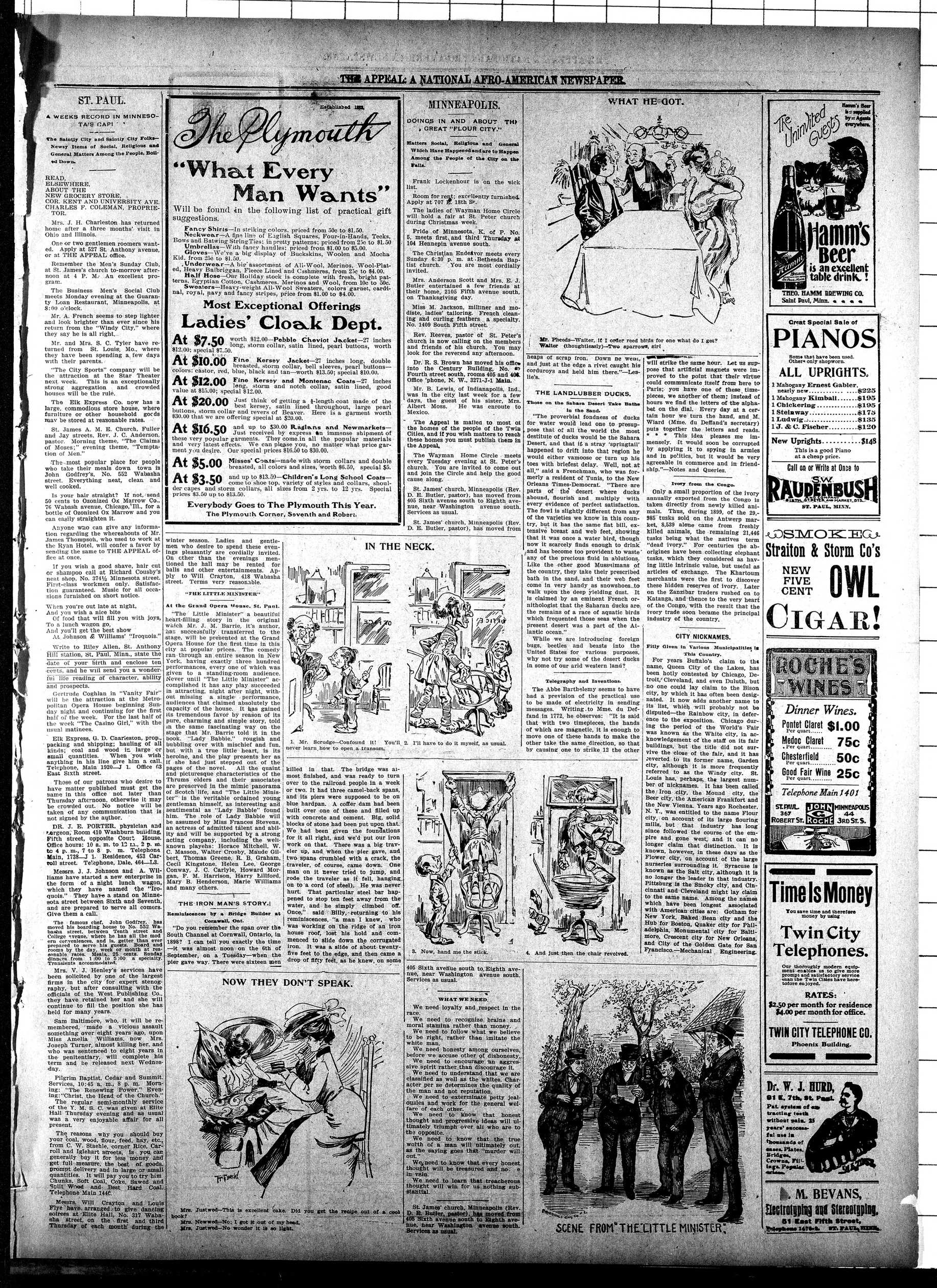
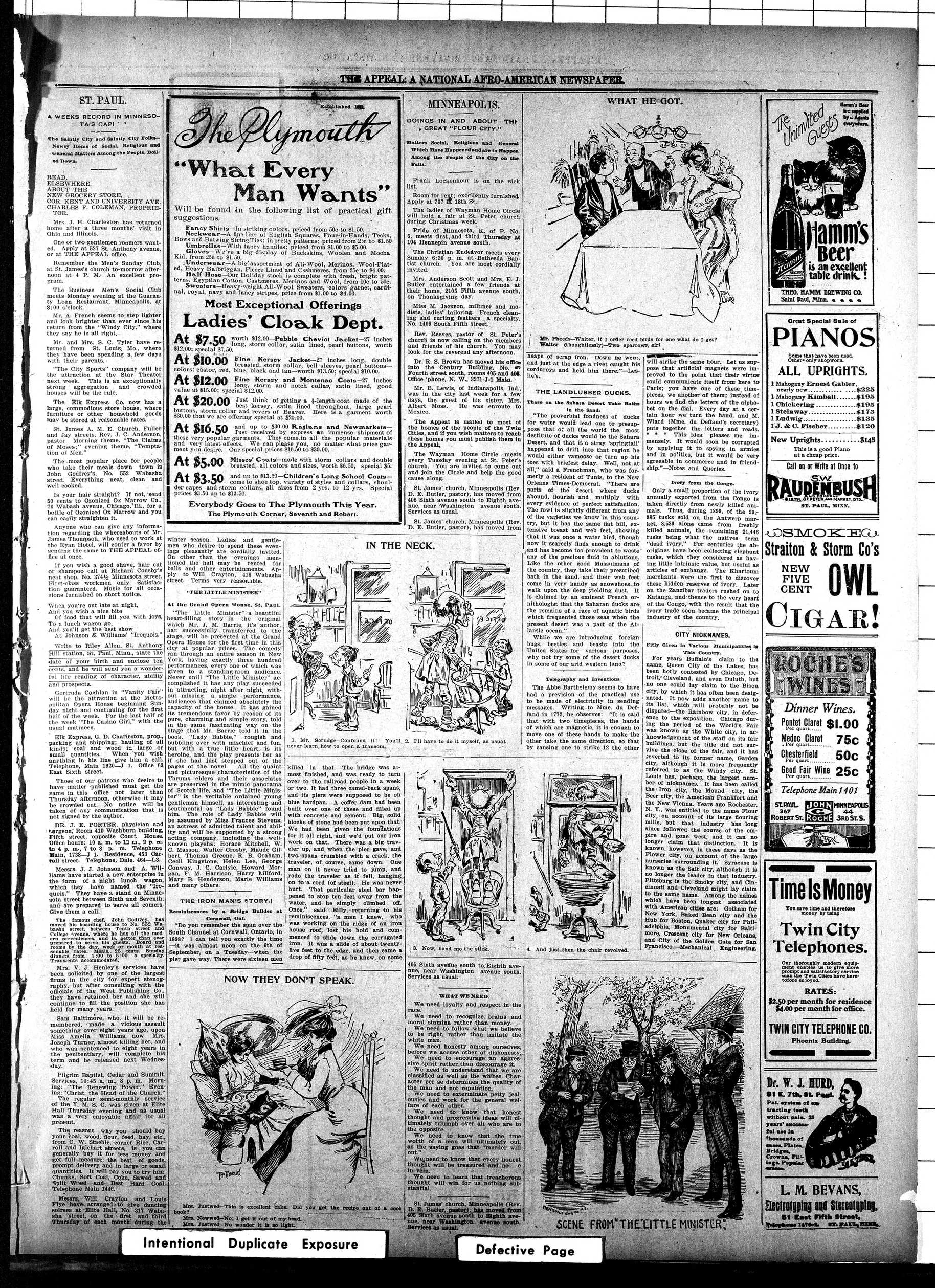
NOW THEY DON'T SPEAK.
Mrs. Justwed—This is excellent cake. Did you get the recipe out of a cool
winter season. Ladies and gentlemen who desire to spend these evenings on other than the evelings were mentioned the hall may be rented for balls and other entertainments. Appropriate WI (Wi-Fi) network on masaha street. Terms very regular.
"THE LITTLE MINISTER"
At the Grand Opera House, St. Paul.
"The Little Minister" a beautiful heart-telling story in the original watch Mr. J. M. Barrie, its author, has successfully transferred to the first opera house for the first time in this city at popular prices. The comedy ran through an entire season in New York, having exactly three hundred people, having given to a standing-room audience. Never until "The Little Minister" accomplished it has any play succeeded in attracting, night after night, without missing a single performance, capacity of the house. It has gained its tremendous favor by reason of its pure, charming and simple story, told in the same fascinating way on the stage that Mr. Barrie told it in the opera house. It bubbling over with mischief and fun, but with a true little heart, is its heroine, and the play presents her as if she had just stepped out of the house and picturesque characteristics of the Thrums elders and their associates are preserved in the mimic panorama of Scotch life, and "The Little Minister" is the veritable ordained young actress who is sentimental as "Lady Babbie" found him. The role of Lady Babbie will be assumed by Miss Frances Stevens, an actress of admitted talent and ability and will be supported by a strong cast of known plays: Horace Mitchell, W. C. Masson, Walter Crosby, Maud Gillebrant, Thomas Greene, R. B. Graham, Cecil Kingstone, Helen Lee, George Conway, C. Carlyle, Edward Mowrens, J. C. H. Hancock, Mary B. Henderson, Marie Williams and many others.
THE IRON MAN'S STORY.
Reminiscences by a Bridge Builder at Cornwall, Ont.
"Do you remember the span over the South Channel at Cornwall, Ontario, in 1888? I can tell you exactly the time—it was almost noon on the 6th of September, on a Tuesday—when the pier gave way. There were sixteen men
THE APPEAL: A NATIONAL AFRO-AMERICAN NEWSPAPER
IN THE NECK.
1. Mr. Scrudge-Confound it! You'll 2. I'll have to do it myself, as usual, never learn how to open a transm
killed in that. The bridge was almost finished, and was ready to turn over to the railroad people in a week or two. It had three camel-back spans, and its piers were supposed to be on blue hardpan. A coffer dam had been built over one of the filled up with concrete and cement. Big, solid blocks of stone had been put upon that. We had given the foundations for it all right, and wed put our iron work on that. There was a big traveler up, and when the pier gave, and two spans crumpled with a crack, the traveler, of course, came down. One man on it never tried to jump, and two spans in the traveler fell, hanging on to a corral. That particular steel bar happened to stop ten feet away from the water, and he simply climbed off. Once," said Billy, returning to his reminiscences, "a man I knew, who was working on the ridge of an iron house roof, lost his hold and commenced to slide down the corrugated iron. It was a slide of about twenty-five feet to the edge, and then came a drop of fifty feet, as he knew on some
A boy is hanging from a door by a rope. A boy is jumping from a chair.
MINNEAPOLIS.
DOINGS IN AND ABOUT THU,
GREAT "FLOUR CITY."
Matters Social, Religious and General
Which Have Happened and are to Happen
Among the People of the City on the
Falls.
Frank Lockenhour is on the sick
list.
Room for rent; excellent entry furnished.
Apply at 707 E. 18th St.
The ladies of Wayman Home Circle
will hold a fair at St. Peter church
during Christmas week.
Pride of Minnesota, K. of P. No.
meets first, and third Thursday at
140 Hennepin avenue south.
The Christian Endeavor meets every
Sunday at 6:30 p. m. at Bethesda Baptist
church. You are most cordially
invited.
Mrs. Anderson Scott and Mrs. E. J. Butler entertained a few friends at their home, 2105 Fifth avenue south, on thanksgiving day.
Miss M. Jackson, milliner and modiste, ladies' tailoring. French cleaning and curling feathers, a specialty. No. 1400 South Fifth street.
Rev. Reeves, pastor of St. Peter's is now calling on the members and friend groups. You may look for the reverend any afternoon.
Dr. R. S. Brown has moved his office into the Street Building. No. 20 Fourth street south, rooms 405 and 406 Office 'phone, N. W., 3271-J-1 Main.
Mr. B. Lewis, of Indianapolis, Ind., was in the city last week for a few days, the guest of his sister, Mrs. Albert Moss. He was enroute to Mexico.
The Appeal is mailed to most of the homes of the people of the Twin Cities and wishes matters to reach these homes you must publish them in the Appeal.
The Wayman Home Circle meets every Tuesday evening at St. Peter's church. You are invited to come out and join the Circle and help the good cause along.
St. James church, Minneapolis (Rev. D. E. Butler, pastor), has moved from 405 Sixth avenue south to Eighth avenue, near Washington avenue south. Services as usual.
St. James church, Minneapolis (Rev. D. E. Butler, pastor), has moved from
NECK.
2. I'll have to do it myself, as usual.
3. Now, hand me the stick.
405 Sixth avenue south to. Eighth avenue
north to. Kingston avenue south.
Services as usual
We need loyalty and respect in the race.
We need to recognize brains and moral stamina rather than money. We need to follow what we believe to be right, rather than imitate the white man. We need honesty ourselves, before accuse other of honesty. We need to encourage an alive spirit rather than discourage it. We need to understand that we are classified as well as the whites. Character per and not reputation. We need to exterminate pet jealousies and per the general welfare of each other.
We need to know that honest thought and progressive ideas will ultimately triumph over all who are to the opposite.
We need to know that the true worth of a man will ultimately out, as the saying goes that "murder will out."
We need to know that every honest thought will be treasured and no. e in vein.
We need to learn that treacherous thought will win for us nothing substantial.
St James' church, Minneapolis (Rev. D. R. Buder, pastor), has moved from 405 Sixth avenue south to Eighth avenue, near Washington avenue south. Services as usual.
WHAT HE GOT.
Mr. Phreeds—Walter, if I order reed birds for one what do I get?
Waiter (thoughtlessly)—Two sparrows, sir!
PARKER'S CHAP. 23.
SCENE FROM"THE'LITTLE MINISTER."
heaps of scrap iron. Down he went, and just at the edge a rivet caught his corduroys and held him there."—Leslie's.
THE LANDLUBBER DUCKS.
Those on the Sahara Desert Take Bath in the Sand.
"The proverbial fondness of ducks for water would lead one to presupose pose that of all the world the most destitute of ducks would be the Sahara Desert, and that if a stray "springtail" happened to drift into that region he would either vamoose or turn up his toes with briefest delay. Well, not at all," said a Frenchman, who was formerly a resident of Tunis, to the New Orleans Times-Democrat. "There are parts of the desert where ducks abound, flourish and multiply with every evidence of perfect satisfaction. The fowl is slightly different from any of the varieties we know in this country, but it has the same flat bill, extensive breast and web feet, showing that it was once a water bird, though now it scarcely finds enough to drink and has become too provident to waste and the precious fluid in ablutions, like the good Mussulmans of the country, the good prescribed bath in the sand, and the good beetle come in very handy as snowshoe or walk upon the deep yielding dust. It is claimed by an eminent French ornithologist that the Saharan ducks are the remains of a race of aquatic birds which frequented those seas when the present desert was a part of the Atlantic ocean."
While we are introducing foreign bugs, beetles and beasts into the States, we vary our purposes, why to do this, and what kind of land in some of our arid western land?
Telegraphy and Inventions.
The Abbe Barthelseum seems to have had a provision of the practical use to be made of electricity in sending messages. Writing to Mme. du Defand in 1772, he observes: "It is said that with two timepieces, the hands of which are magnetic, it is enough to move one of these hands to make the other take the same direction, so that by causing one to strike 12 the other
will strike the same hour. Let us suppose that artificial magnets were improved to the point that their virtue could communicate itself from here to Paris; you have one of these timepieces, we another of them; instead of hours we find the letters of the alphabet on the dial. Every day at a certain hour we turn the hand, and M. and M. duffield's secretary) puts together the letters and reads. * * * This idea would be densely. It would soon be corrupted by applying it to spying in armies and in politics, but it would be very agreeable in commerce and in friendship."—Notes and Queries.
Ivory from the Congo.
Only a small proportion of the ivory annually exported from the Congo is taken directly from newly killed animals. Thus, during 1899, of the 29,985 tusks sold on the Antwerp marshal's alone came from freshly killed animals including 21,446 tusks being what the natives "dead ivory." For centuries the aforeigners have been collecting elephant tusks, which they considered as having little intrinsic value, but useful as articles of exchange. The Khartoum merchants were the first to discover these hidden reserves of ivory. Later traders rushed on to Katanga, where traders rushed on to Kataanga, and the traders of the Congo, with the result that the ivory trade soon became the principal industry of the country.
CITY NICKNAMES.
Fifty Given in Various Municipalities in This Country.
For years Buffalo's claim to the name, Queen City of the Lakes, has been hotly contested by Chicago, Detroit, Cleveland, and even Duluth, but no one could lay claim to the Bison city, by which it has often been designated. It now adds another name to its list, which will probably not be disputed—the Rainbow city, in defence to the exposition. Chicago during the period of the World's Fair is known as the White city, in acknowledging the staff on its fair buildings, but the city invades the close of the fair, and it has severted to its former name, Garden city, although it is more frequently referred to as the Windy city. St Louis has, perhaps, the largest number of nicknames. It has been called the Iron city, the Mound city, the Beer city, the American Frankfort and the New Vienna. Years ago Rochester, N. Y., was entitled to the name Flour city, the count of its large flour mills, but the industry has long since followed the count of pre and gone west, and it can no longer claim that distinction. It is known, however, in these days as the Flower city, on account of the large nurseries surrounding it. Syracuse is known as the Salt city, although it is no longer the leader in that industry. Pittsburgh is the Smoky city, and Chinatown and Cleveland might lay claim to the name. Among the names which have longest associated with American cities is the Manhattan New York, Baked Been city, the Hub for Boston, Quaker city for Philadelphia, Monumental city for Baltimore, Crescent city for New Orleans, and City of the Golden Gate for San Francisco.—Mechanical Engineering.
The Uninvited Guests
Hamm's Beer
is = supplied
by = Agents
everywhere.
Hamm's
Beer
is an excellent
table drink!
THEO. HAMM BREWING CO.
Saint Paul, Minn.
Great Special Sale of
PIANOS
Some that have been used.
Other* only shopworn.
ALL UPRIGHTS.
1 Mahogany Ernest Gabler. $225
nearly new. $195
1 Mahogany Kimball. $195
1 Chickering. $195
1 Steilway. $175
1 Ludwig. $135
1 J. & C. Fischer. $120
New Uprights. $148
This is a good Piano
at a cheap price.
Call on or Write to One to
SW. RAUDENBUSH
ST. PAUL, MINN.
SMOKE
Straiton & Storm Co's
NEW
FIVE
CENT
OWL
CIGAR!
ROCHE'S
WINES
Dinner Wines.
Pontet Claret $1.00
Per quart
Medoc Claret 75c
Per quart
Chesterfield 50c
Per quart
Good Fair Wine 25c
Per quart
ST. PAUL
367
ROBERT ST. ROCHE
MINNEAPOLIS
44
3RD ST. S.
Time Is Money
You save time and therefore
money by using
Twin City
Telephones.
Our thoroughly modern equip-
ment enables us to give more
prompt and satisfactory service
until the two Giles have hereto-
fore enjoyed.
RATES:
$2.50 per month for residence
$4.00 per month for office.
TWIN CITY TELEPHONE CO.
Phoenix Building.
Dr. W. J. HURD,
61 E. 7th, St. Paul.
Pat. system of an
tracting tooth
without pain. 25
years' successful use in
thousands of
Boston, Plates,
Bridge,
Croton, Fili-
laga, Popular
urban.
M. BEVANS,
Electrotyping and Stereotyping.
61 East Fifth Street,
Philippe 1476-2. ST. PAUL, MN.
WEEKS RECORD IN MINNESOTA/S CAP!
The Sainty City and Sainty City Folk-
New Items of Social, Religious and
General Matters Among the People, Boiled
Down.
NEW GROCERY STORE.
COR. KENT AND UNIVERSITY AVE.
CHARLES F. COLEMAN, PROPRIETOR.
Mrs. J. H. Charleston has returned home after a three months' visit in Ohio and Illinois.
One or two gentlemen roomers wanted. Apply at 527 St. Anthony avenue, or at THE APPEAL office.
Remember the Men's Sunday Club, at St. James's church to-morrow afternoon at 4 P. M. An excellent program.
The Business Men's Social Club meets Monday evening at the Guaranty Loan Restaurant, Minneapolis, at 5:00 o'clock.
Mr. A. French seems to step lighter and look brighter than ever since his return from the "Windy City," where they say he is all right.
Mr. and Mrs. S. C. Tyler have returned from St. Louis, Mo., where they have been spending a few days with their parents.
"The City Sports" company will be the attraction at the Star Theater next week. This is an exceptionally good game, and crowded houses will be the rule.
The Elk Express Co. now has a large, commodious store house, where furniture or other household goods may be stored at reasonable rates.
St. James, A. M. E. Church, Fuller and Jay streets, Rev. J. C. Anderson, pastor. Morning theme, "The Claims of Evening theme, 'Temption of Men.'
The most popular place for people who take their meals down town is John Godfrey's, No. 552 Wabasha street. Everything neat, clean and well cooked.
If your hair is straight? If not, send 50 cents to Ozonized Ox Marrow Co. 76 Wabasha avenue, Chicago, Ill., for a bottle of Ozonized Ox Marrow and you can easily straighten it.
Anyone who can give any information to the whereabouts of Mr. James Thompson, who used to work at the Ryan Hotel, will confer a favor by sending the same to THE APPEAL office at once.
If you wish a good shave, hair cut or shampoo at Richard Coussby's neat shop, No. 374% Minnesota street. First-shave, workmanly. Salts-free. Music for all occasions furnished on short notice.
When you're out late at night,
And you wish a nice bite
Of food that will fill you with joys,
To a lunch wasgo goon,
And a best show
At Johnson & Williams" "Iroquois"
Write to Riley Allen, St. Anthony
Hill station, St. Paul, Minn., state the
date of your birth and enclose ten
cents, and he will send you a wonder,
ful life reading of character, ability
and prospects.
Gertrude Coghlan in "Vanity Fair"
will be the attraction at the Metro
politan Opera House beginning Sun
day night and continuing for the first
week of the year.
The "Caiano Girl" with the usual mattees.
Elk Express, G. D. Carleson, prop.
packing and shipping; hauling of all kinds;
coal and wood; large or small quantities.
When you wish anything in his nose give him a call
in 1920-J. 1. Office 8 East Sixth street.
Those of our patrons who desire to have matter published must get the same in this office not later than Thursday afternoon, otherwise it may be crowded out. Our notice will be communicated that is not signed by the author.
DR. J. E. PORTER, physician and Largeson, Room 410 Washburn building, Fifth street, opposite Court House. Office hours: 10 a.m. to 12 p.m. 2 p.m. to 4 p.m., 7 to 8 p.m. Telephone office: 610-255-1222, residence, 610-255-1222, road street, Telephone, Dale, 464-13. Messrs. J. J. Johnson and A. Williams have started a new enterprise in the form of a night lunch wagon, and are prepared to serve all comers. Guests have named the "Iroquois." They have a stand on Minnesota street between Sixth and Seventh, and are prepared to serve all comers. The famous chef, John Godfrey, has moved his boarding house to No. 552 Washua street, between Tenth Street and Washua street, and between Tenth Street and Convincences, and is,得更 than ever prepared to serve his customers of seven or more at reasonable rates. Meal: 25 cents. Sunday Transients accommodated.
Mrs. V. J. Henley's services have been solicited by one of the largest firms in the city for expert stenogramming of the West Publishing Co. they have retained her and she will continue to fill the position she has held for many years.
Sam Baltimore, who, it will be remembered, "made a vicious assault something over eight years ago, upon Joseph Turner, almost killing her, and who was sentenced to eight years in the penitentiary, will complete his term and be released next Wednesday."
Algrim Baptist, Cedar and Summit Church, 10:45 a.m. p. m. Morning: "The Renewing Power." Evening: "Christ, the Head of the Church."
The regular semi-monthly service of the M. S. C. was given at Elite Hall Thursday evening and as usual was a very enjoyable affair for all present.
The reasons why you should buy your coal, wood, flour, feed, hay, etc., from C. W. Stachie, corner Rice, Carrigan Street streets, in you can generally buy it less money and get get full measure, the best of goods, prompt delivery and in large or small quantities. It will pay you to try him Chunks, Soft Coal, Coke, Sawed and Split Coal and Best Hard Coal. Telephone Main 14:4C. Mesura Will Crayton and Louis Fye have arranged to give dancing with you a free show she on the first and third street of each month during the
Established 1822
The Plymouth
"What Every Man Wants"
Will be found in the following list of practical gift suggestions.
Fancy Shiris—In striking colors, priced from 50c to $1.50.
Neckwear—A fine line of English Squares, Four-in-Hands, Tecks, Bows and Batwing String Ties; in pretty patterns; priced from 25c to $1.50
Urthelas—With fancy handles; priced from $1.00 to $5.00.
Gloves—We've a big display of Buckskins, Woolen and Mocha Kid, from 25c to $1.50.
Underwear—A big assortment of Ali-Wool, Merinos, Wool-Plated, Heavy Balbriggan, Fleece Lined and Csshmeres, from 25c to $4.00.
Half Hose—Our Holiday stock is complete with fresh, bright patterns. Egyptian Cotton, Cashmeres. Merinos and Wool, from 10c to 50c.
Sweaters—Heavy-weight All-Wool Sweaters, colors garnet, cardinal, royal, navy and fancy stripes. price from $1.00 to $4.00.
Most Exceptional Offerings Ladies' Cloak Dept.
$7.50 worth $12.00—Pebble Cheviot Jacket—27 inches long, storm collar, satin lined, pearl buttons, worth $10.00; special $7.50.
$10.00 Fine Kersey Jacket—27 inches long, double breasted, storm collar, bell sleeves, pearl buttons; castor, red, blue, black and tan—worth $13.50; special $10.00.
$12.00 Fine Kersey and Montenac Coats—27 inches long, storm and notch collar, satin lined, good price at $15.00; special $12.00.
$20.00 Just think of getting a 4-length coat made of the best kersey, satin lined throughout, large pearl storm collar and revers of Beaver. Here is a garment worth $16.50 and to $20.00 Raglans and Newmarkets—Just received by express an immense shipment of very popular garments. They come in all the popular materials very latest effects. We can please you, no matter what price garry you desire. Our special prices $16.50 to $30.00.
$5.00 Misses Coats—made with storm collars and double breasted, all colors and sizes, worth $6.50, special $5.
$3.50 and up to $13.50—Children's Long School Coats—comes to shoe shop, variety of styles and collars, should come and storm collars, all sizes from 2 yrs. to 12 yrs. Special prices $3.50 up to $13.50.
Everybody Goes to The Plymouth This Year.
The Plymouth Corner, Seventh and Robert.
NOW THEY DON'T SPEAK.
Mrs. Justwed—This is excellent cake. Did you get the recipe out of a cool book?
Mrs. Newwed—No; I got it out of my head.
Mrs. Justwed—No wonder it is so light.
winter season. Ladies and gentlemen who desire to spend these evenings pleasantly are cordially invited. The hall is equipped the hall may be rented for balls and other entertainments. Appropriate street. Terms very reasonable.
"THE LITTLE MINISTER"
At the Grand Opera House, St. Paul.
"The Little Minister" a beautiful heart-touching story in the original heart-touching story, that has successfully transferred to the stage, will be presented at the Grand Opera House for the first time in this city at popular prices. The comedy ran through an entire season in New York, and its performances, every one of which was given to a standing-room audience. Never until "The Little Minister" accomplished it has any play succeeded in attracting, night after night, with its same audience. The audiences that claimed absolutely the capacity of the house. It has gained its tremendous favor by reason of its pure, charming and simple story, told in the same immediate way on the stage of the opera house. "Lady Babbie" roughish and bubbling over with mischief and fun, but with a true little heart, is its heroine, and the play presents her as a gentleman himself, and interesting and sentimental as "Lady Babbie" found him. The role of Lady Babbie will be assumed by Miss Frances Stevens, an actress of admitted talent and abil-ience, to be supervised by a strong acting company. Including the known plays: Horace Mitchell, W. C. Masson, Walter Crosby, Maude Gilbert, Thomas Greene, R. B. Graham, Cecil Kingstone, Helen Lee, George Gans, F. M. Harrison, Harry Lillford, Mary B. Henderson, Marie Williams and many others.
THE IRON MAN'S STORY.
Reminiscences by a Bridge Builder at Cornwall, Ont.
"Do you remember the span over the South Channel at Cornwall, Ontario, in 1888? I can tell you exactly the time—it was almost noon on the 6th of September, on a Tuesday—when the pier gave way. There were sixteen men
THE APPEAL: A NATIONAL AFRO-AMERICAN NEWSPAPER
IN THE NECK.
1. Mr. Scrudge-Confound it! You'll 2. I'll have to do it myself, as usual. never learn how to open a transom.
killed in that. The bridge was almost finished, and was ready to turn over to the railroad people in a week or two. It had three camel-back spans, and its pliers were supposed to be on blue hardpan. A coffer dam had been built over one of the filled up with concrete and cement. Big, solid blocks of stone had been put upon that. We had been given the foundations for it all right, and wed put our iron work on that. There was a big traveler up, and when the pler gave, and two spans crumbled with a crack, the traveler, of course, came down. One rode the traveler as a fall hanging on to a cord (of steel). He was never hurt. That particular steel bar happened to stop ten feet away from the water, and he simply climbed off, Once," said Billy, returning to his reminiscences, "a man I knew, who was working on the ridge of an iron house roof, lost his hold and commenced to slide down the corrugated iron. It was a slide of about twenty feet to the edge, and then came a drop of fifty feet, as he knew, on some
DOINGS IN AND ABOUT THI
GREAT "FLOUR CITY."
Matter Social, Religious and General
Which Have Happened and are to Happen
Among the People of the City on the
Falls.
Frank Lockenhour is on the sick list.
Room for rent; excellently furnished. Apply at 707 18th St.
The ladies of Wayman Home Circle will hold an afternoon Peter church during Christmas week.
Pride of Minnesota, K. of P. No. 5, meets first, and third Thursday at 104 Hemepin avenue south.
The Christian Endevor meets every Sunday 6:30 p. m. at Bethesda Baptist Church. You are most cordially invited.
Mrs. Anderson Scott and Mrs. E. J. Butler entertained a few friends at their home, 2105 Fifth avenue south, on Thanksgiving day.
Miss M. Jackson, milliner and modiste, ladies' tailoring, French cleaning and curling feathers, a specialty, No. 1409 South Fifth street.
Rev. Reeves, pastor of St. Peter's church is now pastor to the members and friends of his church. You may look for the reverend any afternoon.
Dr. R. S. Brown has moved his office into the Century Building, No. Fourth street south, rooms 405 and 406 office 'phone N. W. 3271-J 1 Main.
Mr. B. Lewis, of Indianapolis, Ind., was in the city last week for a few days, the guest of his sister, Mrs. Moss. He was enroute to Mexico.
The Appeal is mail to most of the homes of the people in Cities, and if you wish matters to reach these homes you must publish them in the Appeal.
The Wayman Home Circle meets every Tuesday evening at St. Peter's church. You are invited to come out and join the Circle and help the good cause along.
St. James' church, Minneapolis (Rev. D. Butler, pastor), has moved from 405 Shipyard south to Eighth avenue, near Washington avenue south. Services as usual.
St. James' church, Minneapolis (Rev. D. E. Butler, pastor), has moved from
NECK.
2. I'll have to do it myself, as usual.
3. Now, hand me the stick.
THE BOTTLEMAN'S BOTTLEMAN'S
405 Sixth avenue south to. Eighth avenue
north to Washington avenue south
Service as nurse
We need loyalty and respect in the race.
We need to recognize brains and moral stamina rather than money. We need to follow what we believe to be right, rather than imitate the weak. We need honesty among ourselves, before we accuse other of dishonesty. We need to encourage an aggressive spirit rather than discourage it.
We need to exterminate petty jealousies and work for the general welfare of each other.
We need to know that honest thought and progressive ideas will ultimately trump over all who are to the opposite.
We need to know that the true worth of a man will ultimately out, as the saying goes that "murder will not kill."
We need to know that every honest thought will be treasured and no. e in vein.
We need to learn that treacherous thought will win for us nothing substantial.
St. James' church, Minneapolis (Rev. D. E. Butler, pastor), has moved from 96th avenue south to Eighth avenue, and Washington avenue south. Services as usual.
Defective Page
WHAT HE GOT.
M. Pheeds—Walter, if I order reed birds for one what do I get? Walter (thoughtlessly)—Two sparrows, sir!
heaps of scrap iron. Down we went, and just at the edge a river caught his corduroys and held him there."—Leslie's.
will strike the same hour pose that artificial mag proved to the point the
THE LANDLUBBER DUCKS
Those on the Sahara Desert Take Baths in the Sand.
"The proverbial fondness of ducks for water would lead one to presupose that of all the world the most destitute of ducks would be the Sahara Desert, and that if a stray 'springtail' happened to drift into that region he would either vamose or turn up his toes with briefest delay. Well, not at all," said a Frenchman, who was formerly a resident of Tunis, to the New Orleans Times-Democrat. "There are parts of the desert where ducks abound, flourish and multiply with every evidence of perfect satisfaction. The towl is slightly different from any of the varieties we know in this country, but it has the same flat bill, extensive breast and web feet, showing that it was once a water bird, though now it scarcely finds enough to drink and has become too provident to waste the precious fluid in ablutions. Like the ducks in the desert, the country, they take their prescribed bath in the sand, and their web feet come in very handy as snowboys, to walk upon the deep yielding dust. It is claimed by an eminent French ornithologist that the Saharan ducks are the remains of a race of aquatic birds which frequented those seas when the present desert was a part of the Atlantic ocean."
While we are introducing foreign bugs, beetles and beasts into the kitchen, we don't know why not try some of the desert ducks in some of our arid western land?
Telegraphy and Inventions.
The Abe Barthlemy seems to have had a provision of the practical use to be made of electricity in sending messages. Writing to Mme. du Defand in 1772, he observes: "It is said that with two timepieces, the hands of which are magnetic, it is enough to move one of these hands to make the other take the same direction, so that by causing one to strike 12 the other
4. And just then the chair revolved.
SCENE FROM "THE
SCENE FROM "THE LITTLE MINISTER"
will strike the same hour. Let us suppose that artificial magnets were improved to the point that their virtue could communicate itself from here to Paris; you have one of these timepieces, we another of them; instead of hours we find the letters of the alphabet on the dial. Every day at a certain hour we turn the hand, and M. Wiard (Mme. du Delfaud's secretary) writes the letters and reads. * * * This idea places me immensely. It would soon be by applying it to spying in armies and in politics, but it would be very agreeable in commerce and in friendship." -Notes and Queries.
Ivory from the Congo
Only a small proportion of the ivory annually exported from the Congo is taken directly from newly killed animals. Thus, during 1899, of the 29,95 tusks sold on the Antwerp market, 8,539 alone came from freshly harvested animals, remaining 21,446 tusks being what the Congo called "dead ivory." For centuries the aforeigners have been collecting elephant tusks, which they considered as having little intrinsic value, but useful as articles of exchange. The Khartoum merchants were the first to discover these hidden reserves of ivory. Later on the Zanzibar traders rushed on to the Congo to collect the heart of the Congo, with the result that the ivory trade soon became the principal industry of the country.
CITY NICKNAMES.
Fifty Given in Various Municipalities in This Country.
For years Buffalo's claim to the name, Queen City of the Lakes, has been hotly contested by Chicago, Detroit, Cleveland, and even Duluth, but no one could lay claim to the Bison city, by which it has often been designated. It now adds another name to its list, which will probably not be disputed—the Rainbow city, in defense to the exposition. Chicago during the period of the World's Fair was known as the White city, in acknowledged the staff on its fair buildings, but the city vowed to live the close of the fair, and it has severted to its former name, Garden city, although it is more frequently referred to as the Windy city. St Louis has, perhaps, the largest number of nicknames. It has been called the Iron city, the Mound city, the Beer city, the American Frankfort and the New Vienna. Years ago Rochester, N.Y., was entitled to the name Flour on account of its large pouring milk industry has long since followed the course of the empire and gone west. It longer claim that distinction. It is known, however, in these days as the Flower city, on account of the large nurseries surrounding it. Syracuse is known as the Salt city, although it is no longer the leader in that industry. Pittsburgh is the Smoky city, and Chicago and Cleveland might lay claim to the same name. Among the names which have been longest associated with American cities are: Gotham for New York, Bakeen for Bean; the Hub for Boston; Bologna for Philadelphia, Memorial city for Baltimore, Crescent city for New Orleans, and City of the Golden Gate for San Francisco—Mechanical Engineering.
The Unlimited Guests
Hamm's Beer is supplied by = Agents everywhere.
Hamm's
Beer
is an excellent
table drink!
THEO. HAMM BREWING CO.
Saint Paul, Minn.
Great Special Sale of
PIANOS
Some that have been used.
Other only shopworn.
ALL UPRIGHTS.
1 Mahogany Ernest Gabler,
nearly new. $225
1 Mahogany Kimball. $195
1 Chickering. $195
1 Stelway. $175
Ludwig. $135
1 J. & C. Fischeer. $120
SW.
RAUDENBUSH
THE COMPANY
BIRTHDAY SERVICE AT JAMES, DTS.
ST. PAUL, MINN.
SMOKE
Straiton & Storm Co's
NEW
FIVE
CENT
OWL
CIGAR!
ROCHE'S
WINES
Dinner Wines.
Pontet Claret $1.00
Per quart
Medoc Claret 75c
Per quart
Chesterfield 50c
Per quart
Good Fair Wine 25c
Telephone Main 1401
ST. PAUL
367
ROBERT ST. JOHN G ROGHE
MINNEAPOLIS
44
3RD ST. S.
Time Is Money
You save time and therefore
money by using
Twin City
Telephones.
Our thoroughly modern equip-
ment enables us to give more
prompt and satisfactory service
than the Twin Cities have her-
tory enjoyed.
RATES:
$2.50 per month for residence
$4.00 per month for office.
TWIN CITY TELEPHONE CO.
Phoenix Building.
Dr. W. J. HURD,
91 E. 7th St. Paul.
Pat system of an
tracting tooth
without pain. 25
years' successful use in
thousands of
cases. Plates,
Bridge,
Crowns, Fittings, Popular
L. M. BEVANS,
Electrotyping and Stereotyping,
51 East Fifth Street,
Polophone 1479th. Ft. FAULK MARK
THE "WORLD'S FAIRCITY" VIEWED BY THE APPEAL MAN.
A Compilation of a Number of Happenings, Social and Otherwise, Among the Afro-Americans of the Second City of This Glorious Union.
Mrs. Jennie French is guest of Mrs. Bell at Loulvill avenue.
Mrs. E. Todell of Marshall is guest of Mrs. Cowan, 351 Fulton.
Mrs. John Robinson is guest of Mrs. Jessie Mark, Grand avenue.
Miss C. Jones will be the guest of Mr. and Mrs. J. B. Lewis Thanksgiving.
Mrs. P. Carroll of Galveston, Texas, is visiting friends in Chicago this week.
Rev. P. A. Hubbard, financial secretary of the A. M. E. Church, still continues very ill.
Mrs. Williams of 4341 Armour avenue is very ill and will be pleased to see her many friends.
Little Mary Lou Shaw is very ill with pneumonia at the home of her parents, 250 Michigan street.
Mrs. L. Todd will be the guest of Mrs. J. W. Seetho of 2730 LaSalle St. and will make Chicago her home.
Geo. B. Smith, a well-known young man through the West has come back to the city to spend the holidays.
Mr. George Knox, of Providence, R. L. has been visiting friends in Chicago for the past ten days—he is stopping at 246 Michigan street.
Mr. and Mrs. Johnson, of West Virginia, are visiting Mr. and Mrs. J. W. Williams, 221 E. twenty-sixth street. They are delighted with Chicago.
James H. Horter, in his power to make the coming county fair for the benefit of the Home a great success.
The many friends of Mrs. Edward H. Wright, wife of Ex-County Commissioner Wilt, will regret to learn that she is confined to her home by illness.
Rev. Dickey has opened a new church in the hall at 4600 Wentworth avenue and he said that he is working to see a large number of attendants.
Mrs. L. E. Ellsworth, 2826 Armon
venue, gave a birthday party to her
son Wednesday evening and a number
of young people were present and
enjoyed themselves.
Elder Robinson's mother died Wed
day evening, they prayed and we
received Mark's church Friday.
They are going to take her to
Kentucky. She will be buried there
Sunday.
Mrs. Green, 1708 Dearborn street,
one of the old residents of Chicago,
and the mother of Quinn Chapel, died
last week at her home. She leaves a
large circle of friends to mourn her
death.
Mr. Marise Lewis has been chosen
as international recording secretary
on the staff of Mr. J. R. Thompson,
Master Pre of the Railway Order of
the World, room 110 Auditorium
Building, Chicago.
St. Vincent's De Paul Charitable
Society will hold their annual meeting at
St. Monica's Catholic church, corner of
110th and Chapel, Sunday, Dec. 8.
This society has also a large membership
of Afro-Americans.
Although the last legislature passed a law authorizing the enlargement of the Eighth Battalion into a regiment, who is to blame in this matter. Will some of our military men answer.
The widow of Mr. James Brown, who was recently killed in the Wabash wreck, has been left in a destitute condition and she and her four litters are to receive the care and attention of the churches and the charitable societies.
All women in Illinois who are interested in the Southern Exposition are requested to communicate with Mrs. M. H. Anderson, 4609 Vincentens commissioner for the state appointed by N. A. C. W. convention at Buffalo.
The John Brown banquet given by the Sunday Forum at Institutional church, Thursday evening, was a grand and interesting affair. Hons. E. H. Wright, W. L. Martin, A. L. Roberts Dr. Davis delivered able addresses, Dr. Davis was master of ceremonies.
The argument made by Asst. State's Attorney F. L. Barnett in the American habes corpus case, before Judge Dunn, may, was especially able and demonstrable to prove that the is ablest habes corpus lawyer at the Chicago bar. Last Saturday's American contained his argument in full.
The Afro-American football game in this city on Thanksgiving afternoon is to be quite a society affair. Among some of the people recognized were misses Mamie Lewis, Eliza Caldwell, Nina B. Davis, Mamie Cook, Liceh Harris, Saddle Bradford, Messrs. Dr. Kelly, Walter Rollins, Joe Washington, Frank George, L. W. Washington.
Mrs. A. Jones of 4522 Armour avenue was visited by the committee of the Blue Cross society and found to be in a defiance condition with three habes crying with hunger on a normal amount given her by the committee of the societies to come to the rescue of this family and save her life.
The Phyllis Wheatley club held its regular meeting Wednesday at 2 p.m. at the residence of Mrs. Elijah Johnson, 4847 Armour avenue. Program: Symposium—Afro-American Women in Business. Music—Miss Edith Birney. Recitation—Miss Laura Spencer. Discussion by prominent club women.
Much interest is being manifested in the novel fruit entertainment to be given by the club in December.
Hon. Jno. F. Patty of New Orleans' La. is in the city, guest of Mr. and Mrs. Beauregard F. Moseley of 6112 Morgan street. Mr. Patty is one of the strongest men of the south, has been elected secretary of state in 1888 and was the port of New Orleans under President Harrison and for a number of years a member of the Louisiana state legislature. Mr. Patty is here prospecting and may locate here. If so he will be a valuable acquisition, as he is a former xer and would make an ideal citizen.
GINTER GROCERY CO.
23 SIXTH STREET SOUTH, MINNEAPOLIS, MINN. WE ARE THE FIRST AND ONLY FIRM IN THIS COUNTRY THAT SELLS GOODS DIRECT TO CONSUMERS AT WHOLESA
Corn Starch, 7 packages ..... 25c
Baking Soda, 7 packages ..... 20c
Tapioca, 10 pounds ..... 48c
Choice Carolina Rice, 5 pounds ..... 30c
3 pound packages imported Macaroni ..... 22c
Shred Coconut, 3 pounds ..... 40c
Quart bottle imported Olive Oil ..... 65c
1 quart bottle Quartal Olives ..... 35c
Cherry-Stuffed Olives, pints ..... 25c
Pint bottle Catsup, 3 bottles ..... 25c
Quart bottle Chow Chow ..... 23c
1/2 Pint bottle Worcestershire Sauce ..... 17c
6 pkgs Yeast Foam ..... 18c
5 pounds new Mixed Nuts ..... 60c
2 pound box Cream Candy Mixture box ..... 48c
5 pound box Good Mixture box ..... 45c
Matches, 20 boxes, 2000 per box ..... 35c
Just received a car extra fancy Apples ..... $1.85
Bushel boxes, per box, $1.50 to ..... $1.85
Hand picked Navy Beans, peck ..... 55c
Baker's Chocolate, lb ..... 32c
Baker's Cocoa, lb ..... 50c
3 cakes Sapolito ..... 23c
SOAP-Fairbanks' Plymouth Rock ..... $3.10
100 bars ..... $3.10
50 bars ..... $1.55
25 bars ..... 78c
Santa Claus Soap, per box 100 bars ..... $3.50
Santa Claus Soap, per box 50 bars ..... $1.75
BUTTER ..... $1.75
Fancy Creamery, 5-lb. jars ..... $1.25
Choice Creamery, 5-lb. jars ..... $1.15
Good Cooking Butter, 5-lb. jars ..... $8.50
10, 20, 32 and 60-lb. tubs, same as above prices.
Fancy Full Cream Cheese, 2 lbs ..... $2.50
Good Cream Cheese, 2 lbs ..... $2.00
New Edam Cheese, each ..... $8.50
COFFEES.
Our Mocha and Java brands famous throughout the United States.
5-lb. canns. $1.00 | 2½ lb. canns. .50c
Our No. 2 Blend -
7-lb. canns. $1.00
3½ lb. canns. .50c
This coffee is a very fine quality and cannot
be bought at retail for less than 20c to 25c lb.
8-lb. canns, good blend. $1.00
We will send Free a generous sample of our Tea or Coffee to any one who will lask for it. We know they will sell from the sample.
Pure Spices and Extracts.
14 oz. cans Black Pepper .....18c
14 oz. cans Cinnamon .....18c
14 oz. cans Ginger .....20c
14 oz. cans Allspice .....20c
14 oz. cans Moves .....20c
14 oz. cans Mustard .....20c
14 oz. cans Cream Tarter .....38c
14 oz. cans Nutmeg .....38c
1 pound can Price's Baking Powder .....38c
1 pound can Royal Baking Powder .....38c
1 pound can Glitter's Pride Baking Powder .....15c
5 lb. can Glitter's Pride Baking Powder .....65c
Our brand of Powder is warranted as good as Price's or Royal, or money refunded.
½ pint bottle Vanilla .....25c
½ pint bottle Lemon .....20c
SUGAR.
Best Granulated, 100 pounds bag .....$5.10
All other goods not quoted equally as
Country Orders packed and delivered to
express or money order. PRICES SUBJECT
CASH OR CREDIT
WE WANT NO M
qually as cheap as above prices
referred to Express or Freight De-
SUBJECT TO CHANGE.
CREDIT
NO MONEY!
All other goods not quoted equally as cheap as above prices. A charge of 20 cents will be made for any delivery in the city. Counties may charge a charge of 10 cents Depots free of charge. Mail orders must be accompanied by check, express or money order. PRICES SUBJECT TO CHANGE.
WE WANT NO MONEY!
change for part payment on a new one. The pay down on a stove elsewhere you can include of furniture, carpets or other necessary house payment will answer on the whole purchase.
St. Paul Housefurnis
133-135 East Seventh
CASH OR CREDIT
"A good cigar is a smoke";
Rudyard Kipling
The
YELLOW
KING
5¢CIGAR
change for part payment on a new one. The amount you will pay down on a stove elsewhere you can include on your bill of furniture, carpets or other necessary household goods—Same payment will answer on the whole purchase.
one. The amount you will
can include here on your bill
essary household goods—Same
purchase.
Furnishing Co.,
seventh Street.
CREDIT
THE MASTER
HART & MURPHY, MAKERS.
BANNING ADK CO.
THE MUSEUM
MISCELLANEOUS.
BUTTER
COFFEES
Pure Spices and Extracts.
```markdown
```
is a good cigar. The best that can be said of it falls short of the reality. Smoke the cigar. At all dealers.
SHE APPEARS A NATIONAL AFRO-AMERICAN NEWSPAPER
We handle only the choicest pickings, direct from the finest gardens. Many who could not afford the best quality can now do so.
Finest simp.duid—
1½ lbs. $1.00 | 1½ lbs. $5.00
Finnest Garden Flower Floromosa Oolong—
2½ lbs. $1.00 | 1½ lbs. $5.00
Nest English Basket Floromosa Oolong—
2 lbs. Fancy Pelcoe Ceylon $1.00 | 1 lbs. $5.00
chests Basket Fired Oolong or
English Breakfast $3.90
Call for samples.
MEATS AND FISH
Sugar Cured Hams 10%4c
Choice Bacon, lb 12c
Armour's Gold Brand Bacon, lb 16c
Ice Shallot, lb 17c
Fancy Dried Bread, lb 10c
10-lb pall Lard 98c
Pork, clear bean, lb 8%c
Monkfish Cod, 3 tlb, pkgs 22c
Horseradish, box 20c
1-lb cans Corn Beef, 3 cans 60c
2-lb cans Roast Beef, 3 cans 60c
1-lb cans Lunch Tongue, 3 cans 80c
1-lb cans Plum Pudding, 3 cans 35c
1-lb cans Carrot Leaf, 3 cans 50c
1/2-lb cans Chicken Loaf, 6 cans 80c
1/2-lb cans Deviled Ham and Tongue, per dozen 45c
per dozen.....45c
Holland Herring, 10-lb. kegs.....60c
CRACKER LIST.
Sodas 18 to 20 lbs. per box.....7c lb
Frosted Creams, 12 to 15 lb. boxes.....8½ lb
Oysters, 19 to 23 lbs., per box.....7c lb
Ginger Snaps, 17 lbs., per box.....7c lb
Fluted Vienna, 18 and 19 lbs. boxes.....9½ lb
Grahams, 14 to 16 lb. boxes.....8c lb
Cookies, 16 and 17 lb. boxes.....7c lb
Oat Meal, 13 lbs., per box.....8c lb
1 3-lb. package A B C Sodas.....23c
3 cartoons select Sodas.....25c
3 cartoons Grahams.....25c
3 cartoon Saratoga Flakes.....38c
3 cartoon Faust Oyster crackers.....25c
Uneeda Biscuit, per dozen packages.....55c
Sought Patent, made from the finest Minnesota wheat; and guaranteed as good as any on the market.
98-pound bags ..... $1.80
49-pound bags ..... 90c
Best Rye Flour. 25 pounds ..... 40c
Best Corn Meal, 25 pounds ..... 40c
Best Graham Flour, 25 pounds ..... 45c
Best New Buckwheat Flour, 25 pounds ..... 75c
Best Whole Wheat Flour, 25 pounds ..... 65c
Best Rolled Oats, 10 pounds ..... 25c
Rolled Wheat, 10 lbs. ..... 38c
Split Peas, 10 pounds ..... 35c
Pearl Barley, 10 pounds ..... 38c
Pettijohn's Food, 2 packages ..... 25c
Yokos, 2 packages ..... 23c
Quaker Oats, 3 2-lb. packages ..... 27c
EGGS.
4-dozen boxes, strictly fresh.....80c
4-dozen Good Western.....75c
Get one of our Original Monitor Ranges or Heater Ranges for it until you are satisfied. Monitor Ranges are the most economical in the world and guaranteed 15 years.
Why do we make this liberal offer? Because in a period extending over 20 years the Monitor Range has been used by those who are poor and people who not a single company has been registered against it. We are liberal with our customers in cases of misfortune in family, loss of position, or other reverses, and ex-tenuation to those in need. We are liberal with your old store in age.
The Plymouth Clothing House, Seventh and Robert.
"GOOD ENOUGH
FOR ANYBODY"
"CHEAP ENOUGH
FOR EVERYBODY"
PRIVATE
SMITH
CIGAR
KUHLES & STOCK,
MAKERS,
ST. PAUL, MINN.
IT'S ONLY
5¢
Known the World Over.
XOXO
WHOLESALE PRICES
WHOLESALE PRICES
Syrugs, Molasses, Jellies and Jams
5 gallon kegs Maple Syrup, per keg ..... $2.50
4 gallon kegs Cream Syrup ..... $1.25
4 gallon kegs No. 1 N. O. Molasses ..... $1.25
1 gallon cans Crystal Drip Syrup ..... $35
1 gallon cans No. 1 N. O. Molasses ..... $40
1 gallon cans choice Maple Syrup ..... $65
1 quart cans Maple Syrup ..... $23
1-quart bottles Choice Syrup ..... $28
15-b. pails Jelly ..... $35
5-b. pails Jelly ..... $14
10-b. apples Juice, Gery fine ..... $30
10-b. apples Apple Butter ..... $50
10-b. pails Pear Butter ..... $50
Very finest unpared Evap. Peaches, 5 lbs. .50c
Very finest unpared Evap. Pears, 5 lbs. .50c
Very finest unpared Evap. Apricots, 5 lbs. .45c
Very finest unpared Apricots, 5 lbs. .45c
Prunes, sizes, 80, 90 .10 lbs. .25c
Prunes, sizes 100, 110 .10 lbs. .35c
Prunes, sizes 80, 110 .10 lbs. .35c
Prunes, sizes 80, 110 .very fine, very box. .35c
Seedless Raisins, 4-crown, new, 3 lb. pkgs. .25c
Extra large California Fruits, 3 lb. 1- pkgs. .30c
Loose Muscatel Raisins, 10 lbs. .70c
Cake Muscatel Raisins, 10 lbs. .70c
Cake, Cranuts, 3 lb. 1- pkgs. .30c
Port Rican, 100 in a box. $3.75
Cu-Be-Tas, 25 in a box. $85
Quaker Maid, 50 in a box. $1.50
Wild Rose, 50 in a box. $95
Chicken Patties, heavy syrup, $1.90
31b. can
Choice Chicken Patties, heavy syrup, $1.90
the per dozen $1.30
Sliced Pineapples, 2-lb. cans, very fine, 1.70
Grated Pineapples, 2-lb. cans, very fine, 1.70
Very Fine Corn, 2-lb. cans, per doz. $85
Telephone Peas, per doz. $1.05
Good Peas, 2-lb. can, per doz. $75
Fine Golden Wax Beans, 2-lb. cans, 1.05
Good String Beans, 2-lb. can, per doz. $75
Squash, 3-lb. cans, per doz. $95
With a
Pumpkins, per doz. $95
Extra Cold Packed Tomatoes, per doz. $1.20
Alaska Salmon, red, per doz. $1.35
Mallard Brand Columbia River Salmon, red, extra fine, per doz. $1.50
Mallard Brand Steak Salmon, red, per doz. $1.75
Mustard Sardines, large boxes, per doz. $80
Good American Sardines, per doz. $50
Extra Fancy Imported Sardines, per doz. $1.75
Good Imported Sardines, per dozen $1.35
Best Imported Mushrooms, per dozen $2.60
Best Imported French Peas, per dozen $1.60
Best 1-lb. can Lobsters, per dozen $3.50
Gallon Apples, per dozen $5.55
Gallon Tomatoes, per dozen. $3.25
No less than half dozen cans of a kind sold.
In the Great Shoe Salesroom.
Emperor $3.50
The "Emperor" is the best of all the $3.50 Shoes made especially for us in all leathers on the latest most modern up-to-date lasts.
It is a pleasure to guarantee a shoe that will uphold claim made for it, giving the utmost comfort and action. We claim that a Shoe of equal value not be had for equal money, no matter where you A new pair for any pair that goes wrong.
New Fall Styles Ready.
The "Empress" is likewise the best of all the $3.50 for women.
Sole Agents for Hanan & Sons' Fine Shoes.
Clothing House, Seventh and Robert.
PRIVATE SMITH CIGAR
IT'S ONLY 5¢
At the World Over.
The Great Salesroom.
$3.50
the $3.50 Shoes for
mathers on the latest
shoe that will uphold
outmost comfort and
shoe of equal value
matter where you
es wrong.
Ready.
ost of all the $3.50
Sons'
and Robert.
PRIVATE
SMITH
NIGAR
'S ONLY
5¢
Over.
Nono
Men's
That's story in
Ace of the
either up
sort of le
Dove finds re
hero.
gets ru
worth.
THE
PRIN
A
SAM
All
Attc
17 Guar
CA
For
The Kind
Bears t
Signatur
Have y
moving w
Vell, it's
then you
The "Emperor" is the best of all the $3.50 Shoes for men, made especially for us in all leathers on the latest and most modern up-to-date lasts.
It is a pleasure to guarantee a shoe that will uphold every claim made for it, giving the utmost comfort and satisfaction. We claim that a Shoe of equal value cannot be had for equal money, no matter where you go. A new pair for any pair that goes wrong.
The "Empress" is likewise the best of all the $3.50 Shoes for women.
We are Sole Agents for Hanan & Sons' Fine Shoes.
Defective Page
DRIED FRUITS.
CIG/RS:
CANNED GOODS
Chicago or St. Louis
ASKYOUR HOME AGENT
FOR TICKETS VIA THE
BURLINGTON
EVERY Mother
With a family to buy Shoes for should trade here. Every advantage is offered as regards style and low price.
EVERY CHILD NEEDS SHOES.
Misses' Tan Shoes, in all the new spring styles, for $1.25, $1.35 and $1.75.
Children's Tan Shoes, new leather and pretty shapes, for 49c, $5c, 90c, $1.25 and $1.50.
TREADWELL SHOE CO.
129-131 E.SEVENTH ST.
JACKSON & ROBT
That's the whole
world. And there's no limit,
and there's no size or
size of leather.
Every worthy sort
wants it here. Come —
here. Come — and
come all your money's
worth.
THE MERCHANT
PRINCE OF CORNVILLE
A COMEDY BY
SAMUEL
EBERLY
GROSS
FOR SALE BY
All Booksellers.
Attorney at Law
PRACTICE IN ALL COURTS
17 Guaranty Loan Bld. Minneapolis
CASTORIA
For Infants and Children.
The Kind You Have Always Bought
Bears the
Signature of
Have you seen that elegant new
moving van of the Elk Express Co.?
Well, it's a corker. Don't forget them
then you need any expressing done.
Page
The best way to reach Eastern and Southern cities is via
via Burlington Route trains. Leaving Naperville on the Scenic Express in the morning, there is a ride along the Mississippi, reaching Chicago 9:35 p.m. Leaving in the evening on the Limited, you have the finest Elk River in the world, reaching Chicago 9:25 next morning.
For the new spring styles,
SEE OUR WINDOWS.
TUXEDO
W. R. MORRIS
SOCIETY DIRECTORY.
MOST WORKSHIPFUL GRAND LODGE
—OK—
Wm. R. Moomin, Grand Secretary.
817 Guaranty Bldg., Minneapolis, Mn.
PIONEER LODGE NO. I, A. F. AND A.
M. H. Moomin, Grand Secretary, a
month at Mascalle Hall, No. 319 Wabasha
street at F. M. H. M. Johnson, W.
M. W. H. M. Johnson, W. M.
PERFECT ASHILAR LODGE NO. 40, A.
F. A. and M. H. meet second and fourth
tuesdays at Mascalle Hall, No. 319 Wabasha
street at 8:00 P. M. B. Hurley, W. M.
J. H. Sherwood, P. S. 475 Martin St.
MARS LODGE, NO. 220, meet second
and fourth Wednesday in each month for
restoration at Odd Fellows Hall, 223 E.
Seventh St. Val D. Turner, N. G.; T. E.
Household OF RUTH, 533 G. U. of C. F. meet first and third Monday
in each month for business, second on
Monday at Odd Fellows Hall, 223 E. Seventh St. M. Lillian A. Turner,
223 E. Seventh St. M. Johnson, W. R.
No. 526 Rice street
ST. JAMES A. M. E. CHURCH. COR.
Fuller and Lay streets. Sunday services:
11:00 a. m.; 7:30 p. m. Wednesday prayer meeting, 8:00 p. m. Pastor visits on Monday and Tuesday at home Wednesday and Thursday. Weddings, funerals and the sick attended on November. Rev. J. C. Anderson. Pastor, 385 Loula St.
PILGRIM BAPTIST CHURCH. COR.
12th and Cedar. Sunday services: Preaching at 11 a. m. and 7:45 p. m. Sunday school every 12:30 o'clock. Wednesday evening study and every meeting. Friday and Sunday. Sunday school lesson. Fungerals and weddings promptly attended. Rev. W. D. Carter, Pastor, 539 Elfelt St.
ST. PHILIP'S EPISCOPAL MISSION: Corner Aurora avenue and Mackubin street—Sunday services: Early celebration of Hol Eucharist, 7:30 a. m. High celebration of Holy Eucharist first and third Sundays, 11:00 a. m. Matins, second and fourth Sundays, 11:00 a. m. Sunday school, 12:30 p. m. Brotherhood of St. Andrew, 6:30 p. m. Vespers, 7:30 p. m. Week services: Wednesday's Pronunciation class, 8:00 p. m. Friday's evening prayer, 8:00 p. m. Saturday, Hol Eucharist, 9 a. m. REV. A. C. V. CARTIER. Rector. 570 Central avenue.
MINNEAPOLIS
J. K. R. and L. W. R. No. masters first and last
seats. No. masters second and Nilotic last
seats. In good standing always welcome.
HARVEN BACK. See Medical Block
HARVEN BACK. See Medical Block
the first and second Monday in each month.
Masone Hall Second street between Masone
Masone Hall Second street between Masone
ways welcome.
W. G. W. Day, W. W.
W. L. W. Larson. Sec. Lacier Exciting
MINNEAPO_17
BY AIRMONT LORDS, NO. 2577, THE LANE and third street, between the intersection of Second Street and Second Street, between the intersection of their hall. Second street, between the intersection of their hall. N. G. JOHNSON, LORDS, N. G.
KNIGHTS OF PYCHIAS
MARK. TURNER LODGE, No. 8, K. of P. meets a sound and fourth Thursday in the month. At Laird Lodge, Fourth and Fifth Ave. 80. JOSHUA JACKSON, C. O. JOSEA A. CASE, C. R. and B. PHILLIP OF MINNESOTA LODGE No. 1, K. of P. meets the first and third Thursday in each month. At Hall Hall second street between Horton and I. Hall second street between Horton and I. AVE. 80. FREDRY CRAFTER, C. O. R. D. WARN, R. R. and S.
THE OF MYSTERY IS
A true Clairvoyant and Trance Medium who understands all secrets and reveals all mysteries. Tells past, present and all persons whose presence. Describes all persons who are interesting to you in life. Removes all obstacles, law suits troubles, gives luck in marriages, law suits and chance. Separates and unites. Cures opium, morphine, liquors and tobacco habilts, normal drugs and other sickness. Write to this wonderful woman. Answers all questions correctly.
N. B.-Send two-cent stamp for answer.
Seed full name, age and address, accompanied with $1.00 for life reading. Address: MRS. M. P. HARPER, 71H W. Spring street, Lima, Ohio.
50 YEARS' EXPERIENCE PATENTS
TRADE MARKS & COPYRIGHTS &.
Anyone sending a sketch and description may qualify for patent. The invention is probably patentable. Communicate invention to probably patented. Communicate patent free. Oldest agency for securing patent. Inspect through CO. recycles special notices, without charge, in the Scientific American.
A handsomely illustrated weekly, Largest collection of any scientific journal. Terms & conditions: WUNN & Co. 381 Broadway, New York
BEFORE AND AFTER TREATMENT.
OZOMIZED OX MARROW
The only safe preparation in the world that makes
the hair straight, soft and beautiful. Only
applicable to the scalp, prevent hair from falling
over the hair long, hold over 20 years and need
no treatment. Get the Original Ozomized
Ox Marrow from the pharmacy or a licensed
hair dresser. Mix one bottle, Bl. 4 for every bottle, we pay all
the costs of the treatment. With your name and address, only to
their satisfaction.