The Appeal
Saturday, April 5, 1902
St. Paul, Minnesota
Page text (machine-generated)
THE APPEAL STEADILY GAINS
BECAUSE:
1-It aims to publish all the news possible.
2-It does so impartially, wasting no words.
3-Its correspondents are able and energetic.
Y EARS ago a friendship was formed between Sara Bernhardt and Catulle Mendes, which waxed rather than waned until a few weeks ago, when it came to an abrupt end. The cause was primarily a play, but at the bottom it was money. The play is called "Santa Teresa," a drama in five acts and nine scenes, the beauty of which, so Mme. Bernhardt said in a subsequent letter, was almost enough to still her righteous indignation against the poet. It was finished a year ago and offered to Claretle of the Comedie Française. The date was set for its reading when one morning Edmond Rostanu, another of Mme. Bernhardt's poet friends, came to M. Mendes and asked him if he did not want to let the great actress see it. Mendes was all but sure of its acceptance at the Comedie and he hesitated, for having gone so far it would have been a serious thing to disappoint M. Claretle, who might refuse ever to allow him to present a play again. This he told M. Rostandu, and the messenger returned with the news to the actress. The next morning, however, M. Mendes received this telegram from London, signed "Sara."
"Dear and Beloved Foet: I should like to know before mapping out my season whether I shall have a chance to act your drama."
To this Mendes replied:
To this Menes replied: "Despotic Sovereign: Here is the situation: I have asked the Comete Francales for a meeting. I have the carelessness, if you do me the priceless joy and honor of taking 'Teresa' for next season, please order by telegraph. 'Teresa' will belong to you. But the Comete Francales will be closed to me forever after. You decide. Faithful adoration."
The same day Mme. Bernhardt replied: "Darling Friend—I thank you with heart overflowing with tenderness and gratitude. Situation this: I return with L'Aflon Oct. 1. I then play Theodora with Mme. Teresa to follow. This brings us to Mme. A, a splendid moment. What say you? A thousand joys, —Sara."
M. Menes answered: "Everything is settled, dear. There's the play and author are yours."
Santa Teresa was put into rehearsal and all went well until one day M. Menes learned that Mme. Bernhardt was to give up her theater on April 1 and to London, where she would make $20,000. The play could not possibly be produced until the middle of March, and there was left for it only two weeks in which it could run in Paris. He went to his beloved friend and demanded his play. Mme. Bernhardt gave it up and wept, and when he saw her tears he relented, and led her to a post. Rehearsals were resumed, but the poet was again seized with misglivings and some more, this time by a trick, he got 20 minuscript. Then he teleranded to her.
"Sara—is it not absurd to quarrel thus when one loves one another? Do butome now that you will not go to Palma, or to the other, until "Teresa" has ceased to draw, and we will begin to rehearse again after them. To this she replied; "Friend, Poet and Torturer—I will do the impossible. I promise you. But she didn't. Instead, asked the interviewer, who asked her if the trouble could not possibly be settled. She replied: "No, it is over; it is all over. My grief is deep, but my mind is made up. I will not be able to miss the topic from my mind. There can-be there will be—no communion hence-crea. I will be poet and the actress. All is dead and illusion and my hopes, my admiration, my friendship for that man. I have come out of this crisis physically almost a wreck, my brain giddy, but my brain is still alive. I will never see M. Catulli Mendes."
When M. Mendes heard this he wrote a long letter to a friend, in which he said:
"I try to smile. The hours go by. Sara has not replied to my wire. Doubtless she will not reply. I am not like the nightingale which has a light heart. Not only do I lose the chance of seeing my heroine. Impersonated by the most admirable of actresses, but I am deprived of a friend fervently beloved. Those who have not lived in the intimacy of Mme. Sara Bernhardt, who have not basked in the light which she diffuses about her, know not the lovable, penetrating charm of her friendship. And Sara says she will never see me more. It is the same tragic situation as that between Harace and Curiace. Sara "me connaît plus." But "Je la connaît encore, et c'est ce que me tuo." But though she may no longer receive me, she cannot prevent me from gazing on her. When she acts I shall be in a corner of the greater from being dazzled by her beauty, she from grace, her omnipotence of fragile expression, her genius. And writing the next day, I sing her praises with a justly excessive enthusiasm. Who knows but that some day the obstinate persistence of my worship, the unalterable stubbornness of my frevent adoration, may move her royal cruel heart to repentance?"—New York Commercial Advertiser.
MEDICAL NOTES.
Dr. Elgood, writing in the Lancet, records a case which may serve as a warning to all who use stoves. Two women were washing in a workroom. A large, hot-air drying room. The elder woman wanted to cook some potatoes on the lid of the stove and built up an unusually hot fire, closing the windows that the extra heat might not be noticed outside. Some time after the fire, the fire was in place, and the floor and found both women insensible. Rretched full length upon the floor. One revived and survived, but the elder died. The survivor remembered nothing of the circumstances but that she felt a "swimmy" feeling. The other was the only one to bear the door. An investigation showed that coal had been heaped into the stove until it had covered the inner opening of the stove pipe, thus blocking the flue and sending all the fumes and gases into the closed room. In the ordinary case, the fire was not a problem, and an accident could not easily occur, but in some parlor stoves the flue may be partially or wholly blocked. With the drafts closed, however, a quantity of carbonic oxide and carbonic acid gas, given off by the fire, was not present. The combustion, fills the room and causes at least a severe headache and a general tired out feeling, which is referred to anything but the right cause. This is as simple as kitchen stove as of the parlor stove, and, in the case of a fire, is miserable by slow poisoning by coal gas, which becomes in time chronic, there being an actual alteration of the blood. In summer this is not noticed so much, but the fire is more of a local one, and the foul air is diluted and rendered less noxious by the ingress of fresh air from without, but as soon as the coal weather necessitates the closing of the doors and windows the housewife's head is now in a state of a "foul" state. She is suffering from "stove," headache. When the coal is run under full blast, in the sleeping room, it is not exceedingly
dangerous, 'aside from the fact that it burns out the oxygen of the air and reain dangerous, 'and most dangerous, time; during the night the drafts are tightly closed, the dangerous gases emanating from the stove menace the drafts. The fuel also may be dangerous to life. Jainnes report a case in which a family stoves a fire to the illness of lead poisoning, and one of symptoms of lead investigation in this case showed that for the first time the illness in the family stoves obtains its normal barrels which had contained white lead beer used for firewood, and the furniture used for firewood. The air throughout the house, but not totally entered into the food cooked over the fire, is not always safe to use any old kind of wood for cooking or heating purposes.
Among the causes of kidney disease Dr. Davis places overcaring and indulgent Dr. Davis and thinks that cold and wet are factors that cause kidney orders, having a reflex action on the kidneys. A hard-working man who overloaded is liable to an attack of acute kidney disease, which can lead to chronic and serious, to other hand, a sedentary life, with the excessive use of meals as food leads to the development of acute inflammation of the kidneys, mends that the patient be put to bed and all food withheld for at least twenty-four hours should be given in small quantities and is continued until two quarters are taken daily.
Milk is especially good in these cases, nutrients, easily digested and absorbed, can be made so by the addition of starchy can be made so by the addition of starchy sugar fruits. Other food may be taken to be processed in green vegetables and fruit meat should be prohibited. Bread, but meat should be processed in green vegetables and fruit are permissible in meat. Meats rich in extractive materials should be used in eggs may be used and squash. Meats may be used and lamb may be cautiously eaten, but beef mutton and the coarser kinds of fish may be used in cocoa may be used in moderation, but almonds to be strictly forbidden in any form.
There are many diseases similar in character to writer's cramp, resulting from over use of certain muscles and nerves, among them being telegrapher's cramp and type-writer's cramp. These are diseases, so to speak, of "necessity," the result of constant application at a wage-earning occupation. Piano player's cramp, however, is not a disease of necessity, but of luxury as a rule. Not only is the piano player affected with this cramp, but actual diseases occur requiring surgical treatment and nervous exhaustion may be caused by piano playing when it becomes a task. Zabludewski does not class the disease of piano players among those of occupation, but says it is a disease resulting from inflammation of one or more nerves of the arms, having its origin in a muscle or joint which has been injured by too much piano playing. Most of these affected are pupils in conservatories, who have small and thin bones, or weak joints or hands much too small to comfortably span an octave. The treatment consists chiefly in rest, and not in massage and exercise. As a preventive of such trouble, Dr. Zabludewski believes that there should be a children's piano having smaller, closer set keys, that there is small hands may not be overstretched or overtaxed.
According to "Health," everything taken into the stomach affects it much more when the stomach is empty, because it is more susceptible with the organ, whereas if food is present it is mixed and diluted with this. A medicinal dose of prussic acid, for example, if taken after breakfast, but would cause uncomfortable situations if taken advantage of this fact would make a drug to be assimilated quickly by giving it on an empty stomach, but as a drug to be assimilated or after meals. Aerial substances may also be taken in a concentrated less, so when diluted, and least of all in pill form, as in the latter case it slowly dissolves too, for the same reason, given with homicidal intent or taken with suicidal purpose is less likely to prove fatal if taken after a meal, although in this case it may simply be a matter of slower action.
Gianders, occurring as a disease in man, is always due to inoculation of the spear germ, either from an animal or another of the skin or through the mucous membrane, and the germs may even be inspired and cause a species of pneumonia in the subject. A study of this subject, says that it manifests itself in one of two ways: in one spot, as on the arm, localized in one spot, as on the face, localized in a hardened swollen later becoming an ulcer and possibly leading to serious infection, or in the tissue of blood poisoning with ulceration, at many remote points from the site of infection sometimes difficult to distinguish from the site of infection. The French military law requires that suicides will henceforth be treated as suicides and may be acute or chronic and may heal spontaneously or increase in severity until it ends in death.
According to the French military law, the master suicides will henceforth be treated as suicides and may be acute or chronic and may heal spontaneously or increase in severity until it ends in death.
It is no secret that suicides are common in the French army and this is attributed to the soldiers by the officers and the brutalizing condition of the life which the suicides in our own army, which have become quite common among those in the Phillipines, are not due to inhumane acts, but are attributed to climatic influence.
Upshaw, referring to the heart in life insurance, says that in fleshy persons the heart's action is to be looked upon with suspicion. In applicants who are reformed, suspicious. In applicants who are reformed, suspicious. Tobacco heart is a practical entity, and sudden death from heart failure is not so common as to preclude the acceptance of such a risk as a life on.
PRESCRIPTIONS
For the treatment of acute pusturis
Dr. Hartshorne recommends: Acetate of
silver or silver of silver
½ drachm; wine of licece, drizzle of
tolu, ½ ounce. This one dose, to be
repeated four times daily.
The acetate is now the primary
treatment. To make it more convenient,
Tartrate of iron, sulphate of quinine, tartar
acid and extract of nux vomica, of each
one pill, to be repeated
three times a day.
As an ointment for rheumatoid joints
of the hands, acetate of nux vomica, of
olin and turpentine, of each 3 drachms;
lard 3 ounces. This is to be reduced freely
by the patient, and turpentine, of each
cyclic acid is, no doubt, abscessed, and
thus acts immediately on the system.
—Leon Noel.
Bees In His House.
James R. Clements captured a swarm of
the shades trees in front of his house.
He tried to hive them, but seemingly with poe-
ce keeping from his mind.
these cases, they have continued to
make their appearances, so the baby would be
would put of the coated skin.
THE APPEAL.
ST. PAUL AND MINNEAPOLIS, MINN., SATURDAY, APRIL 5, 1902.
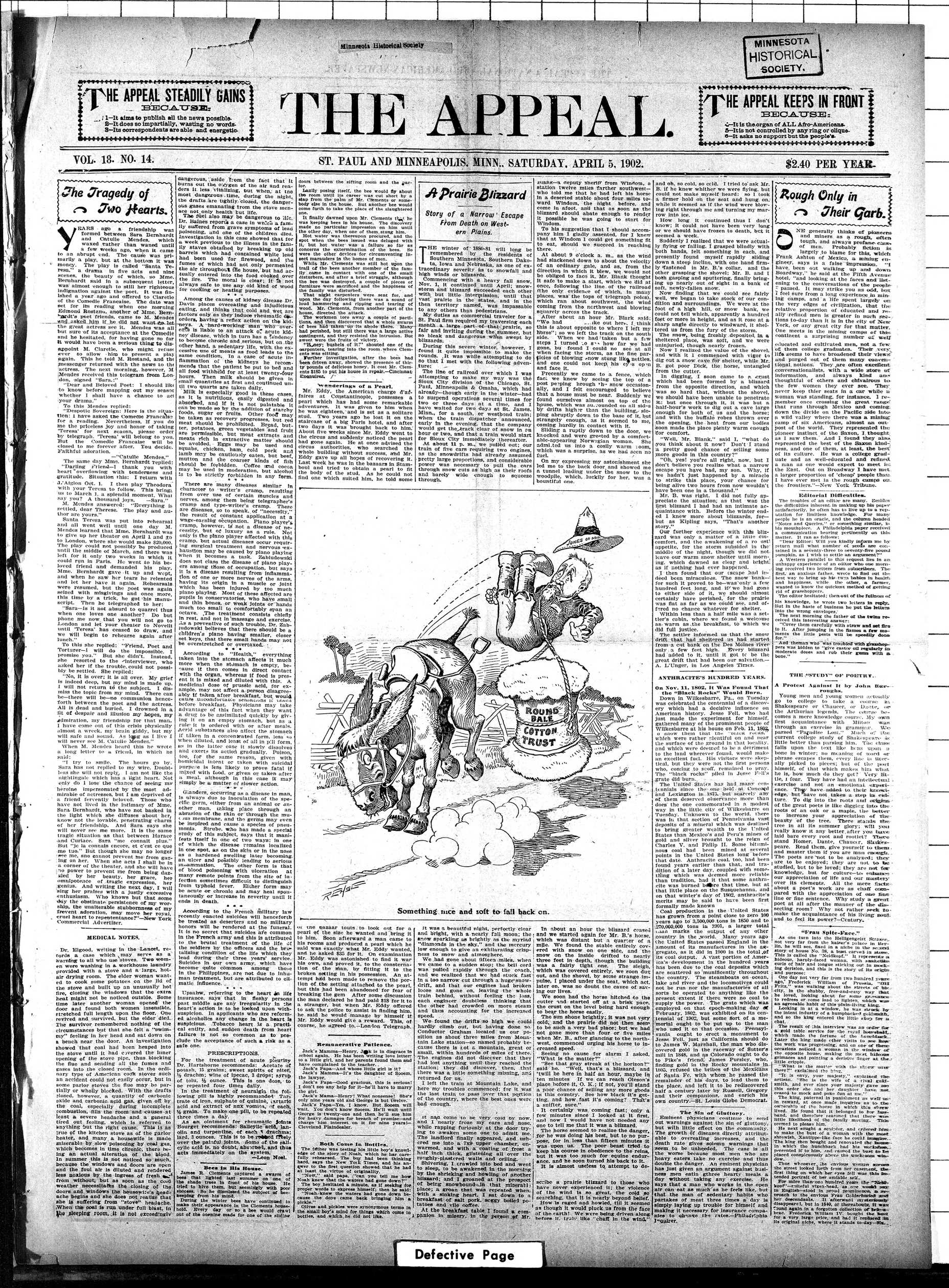
JONES OF ARN
ROUND BALE
COTTON
TRUST
Something nice and soft to fall back on.
Minnesota Historical Society
THE
ST. PAUL AND MINNE
doors between the sitting room and the gar-
Lately posing itself, the bee would fly about its career was cut short by a slap from a man in a body suit and a body also in the house. But another bee would come forth to take the place of the slaughtered it. Finally dawned upon M. Clements that he was keeping bees in his hibernation, and impressed on him until the other day, when one of them stung him. The bee was issued a failure so far as concern the extinction of the other devices for circumventing invasion. While M. Clements was still but upon the trail of the bee another member of the family was destroyed, the other disturbers, and after a brief struggle, although the bee was destroyed, a couple of pieces of wood lumbered on and the happiness of the family was disturbed. That night carpenters were sent for, and upon their arrival the bee lumbered on lumber hammering and ripping and tearing of wood. M. Clements, from another part of the
The workman tore away a couple of partitions, and the men had taken up its abode there. Many had perished, but still there was a large active contingent, and they resisted the intrusion. But the men had taken up its abode. "Lazy; bushels of H" shouted one of the carpenters, tearing into the room where Clem was.
Further investigation, after the bees had been driven away, showed the presence of this insect of delicous honey. It cost Mr. Clemens $185 to put his house in repair—Cindelman Enquirer,
wonderings of u Rearl
Mr. Eddy, the American charge d'armes, Constantinople, possesses a pearl that he adorned with adventures. It was given to him when he was a child, and he got as a solitary stone. Two years ago he set up a staircase of a big Paris hotel, and after a visit to him, to him, About five weeks since Mr. Eddy gave the circus and suddenly noticed the pearl and asked the authorities to advise the circus authorities, who were aware of whole building without success, and Mr. Eddy gave him the help in recovering it. Mr. Eddy was in the basin of a boul and tried to obtain a pearl to fit him, but he could not find one which suited him.
Someth
on theazar toouts; to look out for a part of the size he wanted and bring it to his room. He was taken to his rooms and produced a paper that said was exactly what Mr. Eddy wanted. Mr. Eddy was astonished to find it when his own, and proved it, to the consternation of the broken setting in his possession. The tempted had been made to remove the porch and put it back in the broken setting but this had been abandoned for fear of breaking the gem. After some discussion he struck at the heart of a strange court hat when Mr. Eddy offered to ask the police to assist in finding him, and Mr. Eddy would give him a reward. This, of course, he agreed to—London Telegraph.
Remacular Patience.
Jack's Mamma-Henry. *Joe* is in digree for
her. Jack's Mamma-Henry is to a little girl, and her parents found them and have complained to the teacher. *Joe* is girl it is! Jack's Mamma-Henry it is the daughter of $oom$,
the Mamma-Henry it is.
Jack's Papa--Good gracious, this is serious.
Jice's not any help for it--he'll have to marry
him.
Jack's Mama—Hearty! What nonsense! She's the boy we wanted, and I guess he is too. Jack's Paper-Xe. Yes, but Sooem will wait. You don't know Sooem. He will wait until Sooem is twenty-one and then he sure him for many charges of breach of promise, and charge him interest on it for nine year—Cleveland Plaindealer.
Both Come in Bottles.
The ninety-second testing his the knowledge of the story which he had cared for, the boy he had been thinking about, the boy he had been giving to the first question showed that he had at least the virtue of originality.
Nahow knew that the water had gone down? Noah knew that the water had gone down because the down was getting him a plique.
Nahow knew the waters had gone down because proper words to express himself, then he said: "Nahow knew the waters had gone down because the down was getting him a plique."
and pictures were synonymous terms in the small boys mind for things which come in bottles, and which he did not like.
THE winter of 1850-81 will long be remembered by the residents of Southern Minnesota, Southern Dakota, Iowa and Nebraska, as one of extraordinary severity as to snowfall and high winds or blizzards.
Commencing with a heavy fall snow, Nov. 1, it continued until April; snowstorm and blizzard succeeded each other with but little intermission, until that vast prairie in the states, and in the then territory named, was impassable to any others than pedestrians.
My duties as commercial traveler for a St. Paul firm require my traversing each month a large part of that prairie, so fair and inviting during the summer, but so bleak and dangerous when swept by blizzards.
During this severe winter, however, I found it quite impossible to make the rounds. It was while attempting to do so that I met with the following adventure:
The line of railroad over which I was attempting to make my way was the Sioux City division of the Chicago, St. Paul, Minneapolis & Omaha, which had already—though early in the winter—had to suspend operations several times for two or three days at a time, and I waited for two days at St. James, Minnesota, a south, or westbond train; when the train was brought in, the company would get the evening, that the company would get the track clear of snow in hour or two, and that a train would start for Sioux City immediately thereafter.
At about 11 p. m., we pulled out; our train of five cars requiring two engines, two asses, and a couple of pretty large proportions, and considered power was necessary to pull the cars through snow cuts as high as their roofs were wide enough to squeeze through.
something nice and soft to fall back
It was a beautiful night, perfectly clear and bright, with a nearly full moon; the snow sparkling us brightly as the myriad snowflakes low enough to give an exhilarating crispness to snow and atmosphere. When we came to a sudden stop, the belt cord was pulled rapidly through the coach, and we realized that we had stuck fast enough to get the engine drifting, and that our engines had broken loose and gone on, leaving the whole train within sight, without loss. We couldn't collect evidence of thinking the other had crowded on more steam and thus accounting for the increased pressure. We found the drifts so high we could hardly climb out, but having done so, Conductor Graham located us our position. The train lake station—so named probably because there is not a mountain, great or small, within hundred miles of there, that had lost anything until they reached the station; they did discover, then, that there was something missing, and returned for us. I left the train at Mountain Lake, and here my troubles commenced; for it was the train to pass over that portion of the country, where the best ones were bad enough.
at naq come to be very cold by now, and I nearly cry my ears and nose, while rapping furiously at the door try to awaken some one to admit me. He handled in my way and uncreamed me into a taz upper chamber warmed, and with a coating of frost a half inch thick, glistening all over the handland in my way, calling Shivering, I crawled into bed and went to sleep, to be awakened in the morning by the shrieking and howling of another mistress in real life, scoggy boiled potatoes and vile coffee. At the breakfast table I found a companion in misery, in the person of Mr. Defective Page
blank—a deputy sheriff from Windows, a station twelve miles farther south—toward Windsor, the night before, and in a deserted stable about four miles toward Windsor, the night before, and in a blizzard should shate enough to render it possible he was going to start for work. To his suggestion that I should accompany him I gladly assented, for I know at Windsor I could get something fit to do, should we succeed in reaching it. At about 9 o'clock a.m., as the wind had slackened down to about the velocity of a jet stream, I directed in which it blew, we would not be obliged to face it. Mr. Blank thought once, following the line of the railroad the only evidence of which, in many cases, which ran about southwest, the wind coming from the northwest and blowing squerely across the treasury, Mr. Blank said. "We had, like our own idea, like our own idea, like our own idea," I think it's about opposite to where I left my side. When we had taken it, we steps I turned to o'$^a$ how far we had gone, and when facing the storm, as the fine particles of blowing—now stung lkg nettles and one could not keep his ey's op-
Recently we came to a fence, which was found by the house, which was a house that was found by drifts higher than the building, and is being abruptly down to the base of it, but strangely enough, as it seemed to me, coming hardly in contact with it.
Sliding a ruptly down to the door, we knocked and were greeted by a comfortable and appearing Norwegian woman. She admitted us into a cosily warm room, which was a surprise, as we had seen no fuel.
On my expressing my astonishment she led me to the back door and showed me a tunnel leading under the snow to the woodpile, which, luckily for her, was a bountiful one.
JONES OF ANN
FOUND
SALE
BUTTON
BUST
In about an hour the blizzard ceased and we started again for Mr. B.s horse, which was distant but a quarter of a mile. We found the stable entirely covered with snow on one side, and the snow on the inside drifted to nearly three feet in depth, though the building was a fairly tight one. The sleigh, which was covered entirely, we soon dug out, and the shovel, by some strange impulse, I placed under the seat, which act later on, was no doubt the cause of saving our lives.
We soon had the horse hitched to the cutter and started off at a brisk pace, the crust on the level being hard enough to bear the horse easily.
The sun shone brightly; it was not very cold, and the prairie did not then seem to be such a very bad place; but we had not gone more than four or five miles when Mr. B. after glancing to the northwest, commenced urging his horse to increased speed.
Seeing no cause for alarm I asked, "What is the matter?"
"See that gray streak at the horizon?" said he. "Well, that's a blizzard, and 'twill be here in half an hour, maybe in ten minutes. If we can reach Oleson's place before it, O. K.; if not, you'll stand a poor chance of selling any more goods in this country. See how black it's getting, and how fast it's coming? That's a spitter, sure."
It certainly was coming fast; only a few minutes since I looked at it first. The horse seemed to be running, any one to tell me that it was a blizzard. The horse seemed to realize the danger, for he was doing his best, but to no purpose, for in less than fifteen minutes it was too cold to walk. He kept his course in obedience to the reins, but it was too much for equine endurance, and he soon turned his back to it. It is almost useless to attempt to de
How is raged and howled, till it seemed as though it would pluck us from the face of the earth! We were being driven along before it, truly like "chaff in the wind."
MINNESOTA HISTORICAL SOCIETY.
and so, oh cold, so cold. I tried to ask Mr. B. if he knew whither we were flying, but not make myself heartless so it took me a while, and while it seemed as if the wind were blowing right through me and turning my marrow into ice. I continued thus I don't know; it could not have been very long or we should have frozen to death, but it was suddenly I realised that we were actually flying or falling. I grasped blindly with both hands, felt something in each, and presently found myself rapidly sliding down the hill, the hand firmly fastened in Mr. B.'s coat, then other grasping the shovel; Mr. B. and I both gasping and sputtering, finally bringing the light in a bank of soft, newly-fallen snow. Now finding that we could see fairly well, we began to take stock of our conquest, and we fell back to a foot of a high hill, or snow bank, we could not tell which, apparently a hundred foot or more in height, and as it rose at the bottom, though nearly frozen, it sheltered us from the fury of the snow. The snow, being freshly deposited in a sheltered place, was soft, and we were uninjured, though nearly frozen, and with it I commenced with vigor to dig out a snow cave for shelter, while Mr. B. took the block, the horse, untangled from the curtsey.
In digging, I soon came to a crust which had been formed by a blizzard that was so strong that we was so hard that, without the shovel, we should have been unable to penetrate it, once through it, but it was a half-filled pit, so we had enough for both of us and the horses; and with the buffalo robes thrown over the opening, the heat from our bodies opened the place plenty warm enough for comfort. "Well, Mr. Blank," said I, "what do you think about it now? Don't stand a mile away from all the hills, telling some more goods in this country"? "Oh, yes! you're all right, now, but I don't know what to do, escape you have had, my son. Why, if we hadn't just happened by a miracle to strike this place, your chance for success would have been out of our hands now wouldn't have been one in the winter." Mr. B. was right. I did not fully appreciate the situation, as that was the case when we were in a brief acquaintance with. Before the winter ended I knew more about blizzards, for—but as Kipling says, "That's another case." Our further experience with this blizzard was only a matter of a little cessation, but as the storm subsided in the middle of the night, though we did not leave our warm snow shelter until morning, which dawned as clear and bright as morning.
I then found that our escape had indeed been miraculous. The snow bank—for such it proved to be—was only a few hundred feet long, and it was had gone to either side of it, we should almost certainly have perished, for the prairie was flat as far as we could see, and offered no chance whatever for shelter.
Within less than a half mile was a settler's cabin, where we found a welcome as warm as the breakfast, to which we did full justice.
The settler informed us that the snow drift that had sheltered us had started from a cut bank on the Des Moines river only a few feet high. Every blizzard had added to it, until it got to be the great drift that had been our salvation.
ANTHRACITE'S HUNDRED YEARS.
On Nov. 11, 1802, It Was Found That
the Earth Is Not In World War I
On Nov. 11, 1862, It was Found That John Down in Wilkesbarre, Pa., on Tuesday, was celebrated the centennial of a discovery which had a decisive influence on the development of the experiment for himself, just made the experiment for himself, gathered many of the prominent people of Wilkesbarre at his house on Feb. 11, 1862, and who were there to witness which were rather cleantilent and on near the surface of the ground in that locality, and which were deemed to be a detriment to the progress of the experiment an excellent fuel. His visitors were skeptical, but they were not the first persons who, coming to soff, remained to pray. The "black rocks" pilled in Jessie Fell
The United States has had many centennials since the one-held at Concord and Lexington in 1873, but scarcely any of them deserved observance more than does the one commemorated in a modest way in the little city of Wilkesbarre on Tuesday. Unknown to the world, there was in that section of Pennsylvania vast deposits of a mineral which was destined to bring greater wealth to the United States than Mexico's and Peru's mines of gold and silver brought to the reign of Charles V. and Philip II. Some bituminous coal had been mined at several points in the United States long before that date. Anthracite coal, too, had been found years earlier than that, and tradition of a later day, coupled with something which was deemed more reliable than tradition, had it that some anthracite was burned before that time, but at that little place on the Susquehanna, and on that winter's day of 1802, anthracite's merits may be said to have been first
Coal production in the United States has grown from a point close to zero years ago to 3,500,000 tons in 1850 and to 270,000,000 tons in 1901, a larger total than the average. The output of any other country in the world. Many years ago, the United States passed England in the amount of its manufactures in the aggregate, as it did in 1900 in the total of its coal output. A vast portion of America's production in the hundred years had been cut down to a small part of the country. The steamboats on ocean, lake and river and the locomotives could not be run nor the manufactories of all sorts be operated to anything like the present extent if there were no coal to supply the power. The grate which was employed on that epoch-making day was cut down to 1000,000. February, 1802, was exhibited on its centennial of 1902, but some sort of a memorial ought to be put up to the man who used it on that occasion. Pennsylvania ought to erect a monument to Jesse Fell, just as California shows to the U.S. President. It is not a man who discovered gold in the raceway of Sutter's mill in 1848, and as Colorado ought to do to Pike's friend, James Pursley, who, finding gold in the Rocky mountains in 1805, refused the bribes of the Mexicans of Santa Fe, with whom he passed the remainder of his days, to lead them to the place, and left it to be rediscovered half a century later by Russell, Gregory and their companions, and enrich his own country.—St Louis Globe Democrat.
SIN OF GIUTTONY.
Emilient physician must be able to out warnings against the sin of gluttony, but with little effect on the community, the growth of diseases directly attributable to gluttony can be fatal. Death rate gives solen warnings that seem to be unheeded. The case is all about heavy eaters no exercise and thus double the danger. An emilient physician has just given an argument against business day without taking any exercise. He says that a man who works in the open air can eat as much as he feels like, but he cannot eat as much as the partakes of meat three times a day is simply laying up trouble for himself and making it necessary for insurance companies to have rates -Philadelphia Journal.
The Sin of Gluttony
$2.40 PER YEAR-
NE generally thinks of pioneers and miners as a rough, often tough, and always profane careeer. Probably fiction is larger than that of Frank Ashton of Mexico, a mining engineer, says a is false impression. "If the engineer says he is up and down Boardway, he says he is up and down hotel," and looking at the faces and listening to the conversations of the people he may strike you as odd, lest I feel sure he is a camp, a life spent largely on the very edges of civilization, that the mission of educated and really refined miners is to work in camps to-day that is in the city of New York, or any great city for that matter. The mining camps of this continent are
educated and cultivated men, not a few of them college graduates. Their very life seems to have broadened their views and purged out of them many conventional notions. They are often excellent conversationalists, with a wide store of information, and always kind and thoughtful of others and chivalrous to the few women they ever see. They never keep their seats in a car while a woman was standing, for instance. I remember once crossing the great range that runs through Mexico and coming down the divide on the Pacific side into a wild valley where there was a mining camp of six Americans, almost an outpost of the world. They represented the pioneer instinct of the Saxon, I thought, as I saw them. And I found they also represented the best of the Saxon kindness, and one of them, at least, the best of its culture. He was a college graduate and as well-educated and refined a man as one would expect to meet in the East. Out on Broadway I have met a larger proportion of 'cheap' people than I have ever met in the rough camps on the frontiers."—New York Tribune.
Editorial Difficulties.
The troubles of an editor are many. Besides the difficulties inherent in making up the paper, the difficulties of writing for limitations knowledge. For many, the need to know the "Notes and Queries," or something similar, is the communication bearing particularly this matter. It ran as follows: "I will inform you briefly inform me by return mail what number of seeds are contained in a pumpkin as I wish to settle an argument."
A Western parallel to this request lies in an unhappy experience of an editor who one morning received two letters from subscribers. The first, an anxious father, wrote to find out the best way to bring up his two babies in health and happiness, while the other, a farmer, wanted to know the quickest method of getting rid of grasshoppers.
The editor hesitated; then out of the fullness of his knowledge, he wrote two letters in reply, but in the haste of business he put the letters into the wrong envelopes.
The next morning the father of the twins received this interesting answer:
"Cover them with stirs and set fire to it. After jumping in the fumes a few moments the little pests will be speedily done. And them waft was troiled with graffitiers was bidden to "give caster oil regularly in does and rub their gums with in bone."
THE "STUDY" OF POETRY.
A Protest Against It by John Kerr- roughs.
Young men and young women actually go to college to take a course in the Artithurgian legend, the Dante who comes a mere knowledge course. My own first acquaintance with Mister was a college professor who passed "Paradise Lost." Much of the current college study of Shakespeare is better than parsing him into a falls course. He himself, of that which makes him what he is, how much do they get? Very little fear. They have had an intellectual experience. They have added to their knowledge, but have not taken a step in culture. Increase your appreciation of the great roots in the art and origins of the great roots is in their roots of an oak or a maple, the better increase your appreciation of the great roots and roots of the tree in all its summer glory; with you really know it any better you have mastered the great root and rooster stand However, you are not to be enjoyed; they are to be studied, but to be loved; they are not for knowledge, but for culture to enhance their understanding of its elements. All the more facts about a poet's work are as chill comfort over its elements. What is the fine line or fine sentence. Why is the poet at all the after the manner of the dissecting room? Why not rather seek to understand it and to feel its power?-Century.
"Frau Spite-Face."
As one turn into the Hellenistic Strate-
ria, he will see, fixed in a niche in the
story of house No. 38, a bust curved in stance,
his head turned to the right, with a hideous,
hairy, barely-faced woman, with a curled
curls of hair and tongue sticking out in mack-
ered hair, and this is the story of its origin
and purpose:
One day he not far away from two hundred ye-
ears old, the young Prince of the Frat-
riss "was walking about the city of Prat-
fis," was walking about the city of Prat-
fis, looking back-and-face way that he
lovel, looking about to lighten, which wus-
e to redress or some load to lighten, which wus
to make himself the plain living king.
At the intent industry of a humpbacked goldmine,
the king entered the little shop for it
chat.
The result of this interview was an order for
which the king made other visits to see how
the world is made, making the most bible
grimaces and politicizing the larger at the
little cripple.
The matter with the sheer urge
exclaimed the time.
"It is envy, your majesty," explained the artisan. "She is the wife of a rival gksmith, and ever since your majesty gave me this order she and her daughter have not ceased to mock and poke fun at me."
The king, paternal in punishment as well as in reward, at once made inquiries as to the ownership of the house in which this screw lived. He found that it belonged to her husband and therefore reasoned that there was no right to the family moving. This seemed to please him.
He next sought a sculfor, and ordered him to make the bust of a woman with the most shrewdish, Xantippe-like face he could imagine. The king then bought and renovated the house in which the hunchback had his workshoe, presented it to him, and caused the bust to be placed conspicuously above the workroom window.
Thus whenever, the enliven woman across the street looked forth from her caskern, the first thing on which her eyes fell was this extended portrait of her amiable self.
For more than one hundred years the "Sesho Koto" is a useful vixen-head, as one would say "a man of high and good in business" (cf. Gidechmined an enclave of the enclave of Prana Gidechmined and her descendants). It afterwards
disappears, but in 1840, or thereabouts it was found again in a forgotten collection of Mocabram, Frederick William IV, bought the book for a very large price, and had it replaced in its original niche, where it stands to day—Ex.
LAVE YOU READ
THE APPEAL?
THE APPEAL,
A NATIONAL AFRO-AMERICAN NEWSPAPER
PUBLISHED WEEKLY BY
ADAMS BROS. EDITORS AND PUBLISHERS
49 E. 4th St., St. Paul, Minn.
ISSUED SIMULTANEOUSLY IN
Saint Paul, Minneapolis, Chicago,
Washington, Louisville, St. Louis.
ST. PAUL OFFICE,
No. 110 Union Blk. 4th & Cedar,
J. Q. ADAMS, Publisher.
MINNEAPOLIS OFFICE,
Guaranty Loan Bldg. Room 811
HENRY ROBERTS, Manager.
CHICAGO OFFICE,
323-5 Dearborn St., Suite 310,
C. F. ADAMS, Manager.
LOUISVILLE OFFICE,
No. 312 W. Jefferson St. Room 3
W. V. PENN, Manager.
ST. LOUIS OFFICE,
No. 1002 Franklin Avenue.
J. H. HARRISON, Manager.
TERMS: STRICTLY IN ADVANCE:
SINGLE COPY, ONE YEAR ..... $2.00
SINGLE COPY, SIX MONTHS ..... 1.10
SINGLE COPY, THREE MONTHS ..... 60
SINGLE COPY, WEEKLY ..... 100
We run without prepayments, the terms are
60 cents for each 13 weeks and 5 cents for
each 40 week, or at the rate of $2.40 per
week.
Remittances should be made by Express Money Order, Post Office Money Order, Registered Address, Postage Box, Postage Box, etc., to the same size as each of the samples will be received the same as cash for the fractional parts of a dollar. Only one cent and two cent stamps taken.
It is for the most part to be sent through the mail. If the mail is sent through the envelope and be lost; or else it may be stolen. Persons who send silver to us in lettera do not in their own risk.
The mail is sent to the 10 lines or less of the 8th and 9th lines of the 10 lines. Payment strictly, in advance, and to be announced at all must come in the season to be news.
Advertising rates, 15 cents per cigarette line, each in the line, and about seven words in an in agate line. No single advertisements less than $1.00. No discount allowed on less than the amount of the mail.
The mail is sent from parties unknown to us. Further particulars on application.
Reading notices 25 cents per line, each insertion. No discounts for time or space. Reading in the line, and about two words in the line. All head-line count dogb.
The date on the address label shows when the date is the date two weeks prior to expiration, so that no paper may be unissued.
The occasionally happens that papers sent to subsequent members are not not to be written. In case you do not receive any number when due, inform us by postal card at the expiration of five days from date of the mail. We are very far from admisible of the use of this type of
*Communications to receive attention must be written only upon ours of the paper, must reach us Tuesdays if possible, anyway not later than Wednesdays, and the签到 stamp turned, unless stamps are sent for postage. We do not hold ourselves responsible for the loss of our stamps.
Soliciting agents wanted everywhere. Write
for terms. Sample copies free.
in every letter that you write in un never fall to
the wrong hands. In writing, post office, county and state.
Bush writes of all kinds must be written on
paper of the same color. Kennedy as second
class master at St. John's.
AGENTS WANTED.
THE APPEAL wants good reliable agents to canvas for subscribers at polls not already covered. Write for our extraordinary inductees.
SATURDAY, APRIL 5. 1902.
The newspaper women of Boston are all right, all right. At a meeting held there by them on Wednesday they adopted the following resolutions, which speak for themselves:
"Resolved. That the New England Women's Press Association instruct its delegates to the biennial meeting of the General Federation of Women's Clubs, to be held in Los Angeles, Cal. in May, to consider, in all discussions and legislative acts of the convention, the necessity of maintaining the rights of our colored club women of paramount importance.
"To this end they shall vote for reorganization on state lines, according to the Massachusetts plan, if given opportunity; or for the best substitute for this measure approved by the leaders of the state delegation at the time, preserving the unity of the state's vote and influence by concerted action with other delegates."
In the Danish West Indies historic and commercial forces have mixed races as well as languages. It would take a Smithsonian expert to determine all the bloods and races which make up this mixed population. Here
C. W. H.
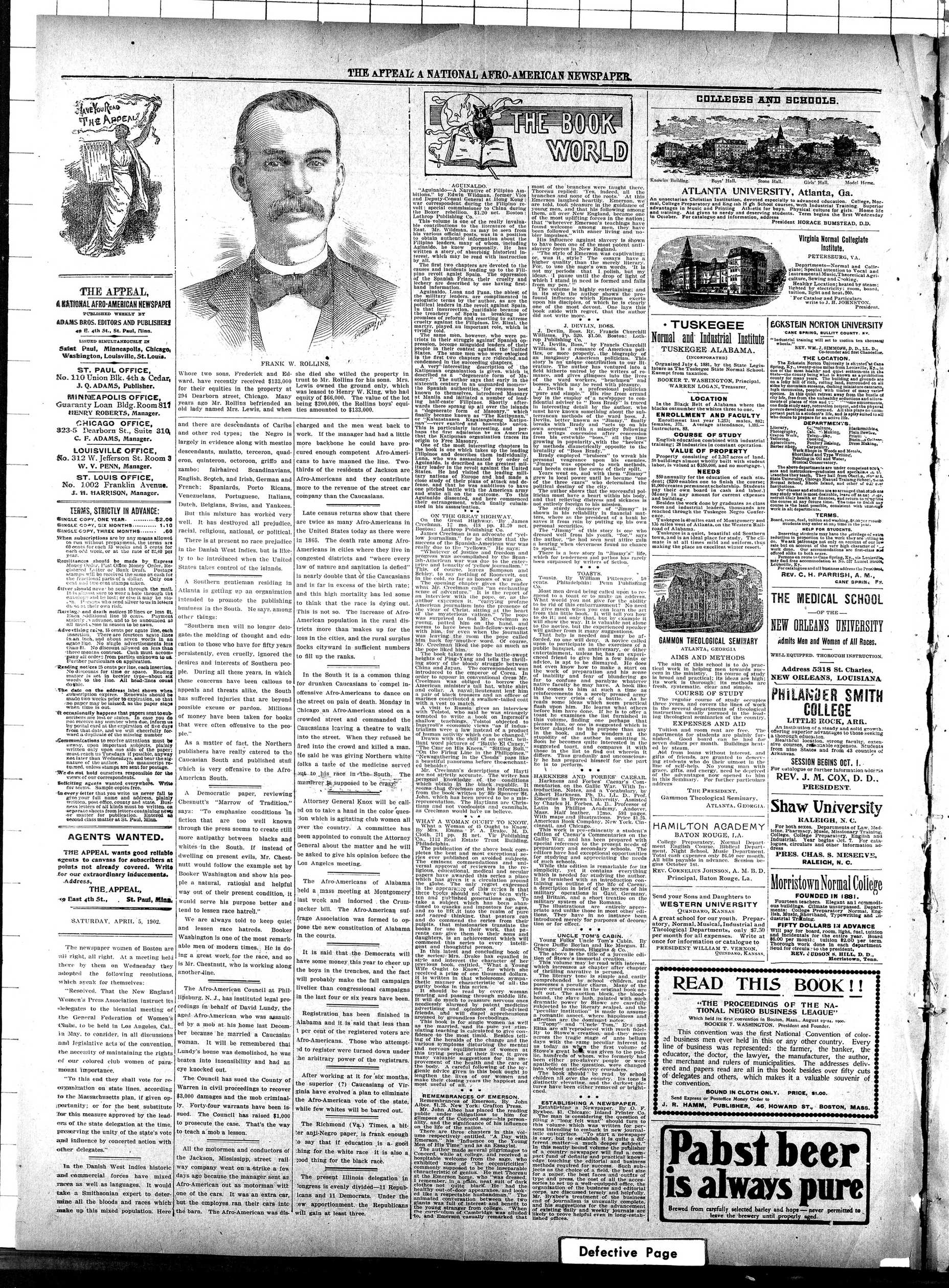
FRANK W. ROLLINS.
Whose two sons, Frederick and Edward, have recently received $13,000 for their equities in the property at 294 Dearborn street, Chicago. Many years ago Mr. Rollins befriended an old lady named Mrs. Lewis, and when and there are descendants of Carlsba and other red types; the Negro is largely in evidence along with mestizescendants, mulatto, terceron, quaderon, quinteron, octoonor, grifo and zambo; fairhaired Scandinavians, English, Scotch, and Irish, German and French; Spaniards, Porto Ricans, Venezuelans, Portuguese, Italians, Dutch, Belgians, Swiss, and Yankees. But this mixture has worked very well. It has destroyed all prejudice, racial, religious, national, or political. There is at present no race prejudice in the Danish West Indies, but is likely to be introduced when the United States takes control of the islands.
A Southern gentleman residing in Atlanta is getting up an organization intended to promote the publishing business in the South. He says, among other things:
"Southern men will no longer delegate, the molding of thought and education to those who have for fifty years persistently, even cruelly, ignored the desires and interests of Southern people. During all these years, in which these concerns have been callous to appeals and threats alike, the South has suffered injuries that are beyond possible excuse or pardon. Millions of money have been taken for books that were often offensive to the people."
As a matter of fact, the Northern publishers have really catered to the Caucasian South and published stuff which is very offensive to the Afro-American South.
A Democratic paper, reviewing Chesnutt's "Marrow of Tradition," says: "To emphasize conditions. Infection that are too well known through the press seems to create still more antipathy between blacks and whites in the South. If instead of dwelling on present evils, Mr. Chesnutt would follow the example set by Booker Washington and show his people a natural, rational and helpful way out of their present condition, it would serve his purpose better and tend to lessen race hatred."
We are always told to keep quiet and lessen race hatred. Booker Washington is one of the most remarkable men of modern times. He is doing a great work for the race, and so is Mr. Chesnutt, who is working along another line.
The Afro-American Council at Phillipsburg, N. J., has instituted legal proceedings in behalf of David Lundy, the aged Afro-American who was assaulted by a mob at his home last December because he married a Caucasian woman. It will be remembered that Lundy's house was demolished, he was beaten into insensibility and had an eye knocked out. The Council has sued the County of Warren in civil proceedings to recover $3,000 damages and the mob criminally. Forty-four warrants have been issued. The Council has raised $1,000 to prosecute the case. That's the way to teach a mob a lesson.
All the motormen and conductors of the Jackson, Mississippi, street railway company went on a strike a few days ago because the manager sent an Afro-American out as motorman with one of the cars. It was an extra car, but the employees ran their cars into the barn. The Afro-American was dite-
she died she willed the property in trust to Mr. Rollins for his sons. Mrs. Lewis owned the ground only, which was leased to Harry W. King who he equity of $66,000. The value of the lot being $200,000 the Rollins boys' equities amounted to $133,000.
charged and the men went back to work. If the manager had had a little more backbone he could have procured enough competent Afro-Americans to have manned the line. Two-thirds of the residents of Jackson are Afro-Americans and they contribute more to the revenue of the street car company than the Caucasians.
Late census returns show that there are twice as many Afro-Americans in the United States today as there were in 1865. The death rate among Afro-Americans in cities where they live in congested districts and "where every law of nature and sanitation is defied" is nearly double that of the Caucasians and is far in excess of the birth rate; and this high mortality has led some to think that the race is dying out. This is not so. The increase of Afro-American population in the rural districts more than makes up for the loss in the cities, and the rural surplus focks cityward in sufficient numbers to fill up the ranks.
In the South it is a common thing for drunken Caucasians to compel inoffensive Afro-Americans to dance on the street on pain of death. Monday in Chicago an Afro-American stood on a crowded street and commanded the Caucasians leaving a theatre to walk into the street. When they refused he fired into the crowd and killed a man. He said he was giving Northern white folks a taste of the medicine served out to his race in the South. The murderer is supposed to be crazy.
Attorney General Knox will be called on to take a hand in the color question which is agitating club women all over the country. A committee has been appointed to consult the Attorney General about the matter and he will be asked to give his opinion before the Los Angeles meeting.
The Afro-Americans of Alabama held a mass meeting at Montgomery last week and indorsed the Crumpacker bill. The Afro-American suffrage Association was formed to oppose the new constitution of Alabama in the courts.
It is said that the Democrats will have some money this year to cheer up the boys in the trenches, and the fact will probably make the fall campaign liveller than congressional campaigns in the last four or six years have been.
Registration has been finished in Alabama and it is said that less than 1 per cent of the registered voters are Afro-Americans. Those who attempted to register were turned down under the arbitrary power of the registrars.
After working at it for six months the superior (?) Caucasians of Virginia have evolved a plan to eliminate the Afro-American vote of the state, while few whites will be barred out.
The Richmond (Va.) Times, a bitter anti-Negro paper, is frank enough to say that if education is a good thing for the white race it is also a good thing for the black race.
The present Illinois delegation in congress is evenly divided—11 Republicans and 11 Democrats. Under the new apportionment, the Republicans will gain at least two.
THE AFPEAL: A NATIONAL AFRO-AMERICAN NEWSPAPER
---
THE BOOK
WORLD
— AGENIALDO.
"Agulmida by Edward L. Narrative of Filipino Antibiotics by Edward L. Narrative of the Great and Deputy-Consul General at Hong Kong, the American information about the Filipino Teo volt's special commission to China during the Boxer rebellion. $120 net. Boston."
This volume is one of the really invaluable contributions to the literature of the East. Mr. Wildman, as may be seen from his various official posts, was in a position to obtain authentic information about the Filipino leaders, many of whom, including Articholero, he knew, personally. He has written a story of absorbing historical in the text, which may be read with instruction by all.
The first two chapters are devoted to the causes and incidents leading up to the Filipino revolt said Spain. The oppression of the Spanish Friars, their cruelty and the inbornity described by one having first
Aguinado, Luna and Pana, the ablest of the military leaders, are complimented in the eulogies of the author of the author's own political leaders in the time of against Spain. In that insurrection, justifiable because of the treachery of Spain in breaking her promises of reform and resorting to extreme manure, the willpinos, Dr. Rizal, the martyr, played an important role, which is vividly told.
The same men, however, who were patriots in their struggle against Spanish oppressions, are the leaders of the people in their contest against the United States. The same men who were enliged in the first two chapters are ridiculed and condemned in the succeeding chapters.
The first three chapters, description of the Katipunan organization, are in which it is described as a "degenerate form of Masonry." The author says that early in the sixteenth century in an unguarded moment, the��Kakutai省杜尔图托,for rensons best known to themselves introduced the cause of the leading half-caste Filipinos. Shortly afterwards there sprang up all over the islands in a degenerate form of Masonry, which finally has known to be "Patriarchy" or "Kalmathaasen" (Kalangalangang Katipunman)—very exalted and honorable. This is particularly interesting, and perhaps the first of the Catipunan organization traces its origin.
The Free Masonry
One of the most interesting chapters in the history of the United States, the Philippines and describes them individually. Philippine nationalism, Aguinolao, is described as the greatest military leader in the revolt against the United States, and describes the nationalary nations of Europe and had made a decisive victory. He fense, and that he was subdued to have one pitched battle with the American army. Aguinolao disdented, and here commenced Aguinolao dissed, and here commenced finally culminated in his assassination.
ON THE GREAT HIGHWAY.
On the Great Highway, by James Creeley Boston: Lathrop Publishing Co. at Boston: Lathrop Publishing Co. on low journalism," for he claims that the success of the Spanish-American war was due to the
"Whatever of justice and freedom and progress was accomplished by the Spanish and American war," he wrote in the enterprise of the French and French-American Journalism. This, of course, leaves Sampson and Schley, to say nothing of Roosevelt, out in the cold, so far as honors of war go.
"We are going to complete the reader's response," he says, "because of the�ing what Mr. Creelman calls it as the report of an interview with the pope, or, as the author expresses it, "carrying profane increasing the intensity into the presence of the clear of Christ, skilling at the end of the mysterious vatican. " The pope was surprised to find Mr. Creelman so young, patted him on the hand, and to even take the end of the end of the end with him, for even when the journalist was leaving the room the pope called him back for another word. Of course, Mr. Creelman liked the pope as much as the pope's time.
The book takes one to the battle-swept heights of Ping-Yang and tells the thrilling story of the bloody struggle between China and Japan. The correspondent was introduced to the emperor of Corea. Mr. Creelman, in the eventual diary of Creelman, was obliged to show the American minister's tall hat, white shirt, and collar. A naval lieutenant lent him of a small trousers and an officer of marines, contributed a swallow-tailed coat with a rest to match.
A visit to Russia gives an interview with the author, who is tempted to write a book on Ingersoll's shallow teachings. Tolstoi objected to the tradition, which was a law instead of a product of human activity which can be changed. The tradition was the word pictures of "Battle El Caner," a giant word pictures of "Battle Bull." On the Führung Lane in the Flushing Ball, "Newsgathering in the Clouds" pass like a beautiful panorama before the enchanted man. Mr. Criccani's descriptions of Haiti and New Orleans provide personal knowledge of the conditions which obtain in the black republic. It is from the book written by Sr Spencer St. John, from the book written by Sr Spencer St. John, to be a misrepresentation. The Haitians and not vooooists and cannibals, as Criccani would have us believe.
WHAT A WOMAN UIGHT TO KNOW
A woman of 15 ought to Know. By Mrs. Criccani. Cloth. 211 pp. $1 net. Vir Publishing. Estate Trust Building, Philadelphia.
The publication of the above book complements ever published on avoided subjects, eminent commentations and unintelligible, educational, medical and secular awarded this series a place which has given it a special place in the globe. The only regret expressed by the authors is that these books should not have been written and published generations ago. To them we owe a great deal of thanks, donated to quacks and侵权的 for ages, to the authors of this book and sacred thinking, that pastors and do command the series from their books for use in our work, that parents can give them to their sons and that parents can give them to their daughters to comment this series to every intelligent person in this latest and concluding book of the series! Mrs. Drake has equaled in the previous book, entitled, "What a Young Jughut to Know, for which she taught it." It is written in that wholesome, sympathetic way in this series.
It should be read by every woman in the country. It will do much to reassure nervous ones needlessly alarmed by patient medicine. It will do much to reassure friends, and will dispel aprehensions and fears. This book is for single women as well as the married, and its pure yet stimulating content will provide evidence to the most timid. Besides telling of the heralds of the change and the changes in the period of their lives, it gives a detailed account of the progress of the health and the care of women in the period of their life. A gentle advice given in this book ought to lengthen the lives of our women and make their closing years the happiest and most successful of their lives. **REMEMBRAMENT OF EMERSON.** Responding to the demands of the Emerson Albe, $12.5, New York: Grafton Press. John Albe has placed the reading of this book among the glimpses of the Concord sage—his personification of the Concord sage of his influence on the life of the nation.
There are three chapters in this vol- tion. The first is "Influence on the Young Emerson," his "Influence on the Young Men of His Time," and as an Essayist, "Concord, while at college, and received a letter from the Emerson home, who was dressed at the Emerson home, who was dressed in clothes not quite black. He had the out-of-order appearance, and looked like animated conversation between the two men, and animated conversation between the young stranger from college. "When he to- dled, and Emerson casually emailed him."
most of the branches were taught there, all the branches, and none of the branches. The Emerson lambed heartily, Emerson, ween on the young men, and that his following them, all over New England, became one nation; that "wherever Emerson's teachings found welcome among men, they have grown up, with sister living and noobly upkeep." His influence against slavery is shown in the Emerson, with potent anti-slavery force in New England.
"The style of Emerson was captivating; he wrote essays, but he was a higher quality than the essays he have written. For, to use the sage's own words. It is a book of ideas, and not of ideas. I pause until the drop of light of which I stand in need is formed and falls away. The volume is highly entertaining; and in its style the author shows the prose with great clarity and upon his disciples, of which he is clearly one of the most devout. One lays this novel in great respect, that the author did not write more.
I. DEVLIN ROSS
J. Devlin, Boss, Rx. Francis Churchill
W. Devlin, $1.50. Boston, Bottle-
tropic Publishing Co.
J. Devlin, Boss. by *Frances Churchill W. J.* and, more or more properly, the biography of an imaginary American politician. This work is more or less a biography of the culture. The author has ventured into a microcosm by the writers of *Romance*, and the biography of the *word workers*, *henchmen* and *bosses*. The author may be relied with pleasure. J. Devlin may be relied with pleasure. His rise from errand man to *Boss Brady* is traced through a confidential toast to "Boss Brady" is traced through a confidential toast to "Boss Brady" must have known something about the subterranean methods of the word boss. J. Devlin breaks with Brady and "sets up on his own account with a minority following from his erstwhile "boss," all the time from his erstwhile "boss," all the time by methods diametrically opposite to the brutality of "Boss Brady." He is tempted to wreak his personal vengeance upon his enemies, and buchen came the cause of their split.
The author shows that the successful political campaign of the 1970s was that relieving distress and sickness is the key to winning.
The study was performed of "Jimmy" is shown in his reliability in financial matters, where as the president of a bank he saves it from ruin by putting up his own personal securities.
The "Jimmy" of this story is one who dressed well from his youth. "for," says the author, "he had seen neat attire gain a hearing when eleverness found no chance to speak.
To be a love story in "Jimmy's life, which for tenderness and pathos has rarely been surpassed by writers of fiction.
TOASTS.
TOASTS. By William Pittenger. 50 cents. Philadelphia: Penn Publishing Co.
Most men dread being called upon to respond to a toast or to make an address. What would you not give for the ability to be rid of this embarrassment? No need to give much when you can learn the art from this little book. It will tell you how to do it only that, but by example it will show the way. It is valuable not alone to the novice, but the experienced weaker will gather from it many suggestions.
That help is needed and may be afforded no one will deny. A novice called upon to support the public, the precrิµ期限, public banquet, an anniversary, or other entertainment, unless he has an experi-ential trend to give him a few hints or advice, is kept out of the order of the public, not even know how to make a start on the work of preparation and his sense of liability and fear of blundering go for the confusion of the public. A new form of native faculty he may have. A book like this comes to him at such a time as reinforces the alymphormed army in the very crisis of a battle. As a reads some ideas which seem practical before upon him. He learns what others do, and do not have to be on the coast before the ex-animals of the list furnished in this volume, finding one perhaps that is the same way that he is suggested which is better adapted to his surveys.
In the book, and he wonders at the stupidity of the author in omitting it, he becomes more interesting. It is suggested to art, and compares it with those in the list to find out wherein it differs. Thus gradually and unconsciously has prepared himself to the part he is perform.
HARKNESS AND FORRES CAESAR.
HARKNESS and Forbes Caesar's Commentaries, the Gallic War. With the death of Nix, the Redbury, Albert Harkness, Ph. D. L. L. D. Prof. Emeritus in Brown University. Assisted by்σιс هارس Forbes, A. C. Professor of Latin in Phillie Academy. Andress Mass. Half leather. 12mo. 593 pages. With maps and illustrations. Price $1.25 per page. New York, Inc. Cinnamon, and Chicago.
This work is pre-einemently a student's work. It is not a formal Gallic War, and has been prepared with special reference to the present needs of the students. The school editors have had exceptional opportunities for studying and appreciating the needs of this edition. While this edition is remarkable for its use of illustrations, everything which is needed for studying the book is furnished with an introduction containing a description in brief of the scenes of his military operations in Gaul, Germany. The illustrations are entirely appropriate and useful to the military system of the Romans. They have in no instance been used for purposes of decoration or for effect.
---
Young Polka Uncle Tone Cabin. By
Joseph H. Hammond, $1,895. Chicago:
Jameson, Hammond & Co. an edi-
tion of Stowe's immortal creation
which increases as chapters after chap-
ter.
The literary tone is simple and easily comprehended by school children, and possesses a peculiar charm. Many of the most�eneed to be the original book are left out. The auction blocks, the blood hound, the slave lash, painted with such dramatic power by Stowe are carefully subjected to the literary scalpel, and the "peculiar institution" is made to assume a romantic aspect, where happiness and affection are the dominant notes.
"Topsy" and "Uncle Tom". Eva and Eliza are all reproduced with much fidelity to Stowe's creation, and they move across the tragic stage of ante bellum days with the same peculiar interest to the today. It was when the first volume of Stowe's great book was given to the public, hundreds of whom who formerly had been either pro-slavery people or were apathetic on the question were changed into violent anti-slavery crusaders.
The book should be read by school children all over the country. Its tone is distinctly elevating, and the darkest pictures have been removed or brightened.
ESTABLISHING A NEWSPAPER.
Establishing a Newspaper. By O. F. Bybee, $1. Chicago: Inland Printer Co. The man is considering the question of filling a "long felt want" should turn to this volume which was written for persons intending to embark on new journalistic enterprises. "To start a newspaper is easy, but to establish it is quite a different matter—a much deeper subject." In this neatly bound volume the publisher of a country newspaper will find a compact fund of definite and practical knowledge touching the editorial and business methods required for success. Such subjects as the choice of a field, the best size for a paper, the best faces and outfits of type and press, the cost of all the accessories to set up a well-equipped office, the organization of the business and editorial corps, are discussed tersely and helpfully. Mr. Bybee's treatment of the business end of Journalism is unusually complete, and his suggestions for the advancement of existing quality and weekly journals are likely to prove helpful even in long-established offices.
Defective Page
COLLEGES AND SCHOOLS.
Knowledge Building. Boys' Hall. Stone Hall. Girls' Hall. Model Home.
ATLANTA UNIVERSITY, Atlanta, Ga.
An unrestricted Christian institution; devotes specially to advanced education. College, Normal, College Preparatory and Engish H gh School courses, with Industrial Training, career advantages in Music and Printing. Athletic for boys. Physical Education, Home and mailing. Aids given to study and deserving students. Term begins the first Wednesday in October. For catalogue and information, address President HORACE BUMSTEAD, D.D.
Virginia Normal Collegiate Institute.
PETERSBURG, VA.
Departments: Normal and Collegiate; Special attention to Vocational Instrumental Music; Theoretical Agriculture; Swimming and Diving; Healthy Location; heated by steam; lighted by electricity; room, board, tuition, library and desk; 500.
For Catalogue and Particulars write to J. H. JOHNSON. President
· TUSKEGEE Normal and Industrial Institute
Organized July 4, 1881, by the State Legislature of New York State Normal School exempt from taxation.
In the Black Belt of Alabama where the blacks outnumber the whites three to one.
IN FACULTY
Enrollment that year 1825, 982-
females, 371. Average attendance, 1838—
instructor, 88.
COURSE OF STUDY
Englisch in combination with industrial
training; 28 industries in cooperation.
VALUE OF PROPERTY
Property consisting of 2,267 acres of land,
50 buildings almost wholly built with student
labor, is valued at $180,000 and no mortgage.
NEEDS
$100 annually for the education of each student;
($200 enables one to finish the course;
$500 creates permanent scholarship. Student
pay their own board in cash and labor);
money in any amount for current expenses
and building costs.
Besides the work done by graduates as class
reached through the Tuskegee Negro Conference.
Tuskegee is 40 miles east of Montgomery and
135 miles west of Atlanta, on the Western Rail-
road in the state of Georgia.
Tuskegee is quiet, beautiful old Southern
town, and is an ideal place for study. The climate
is at all times mild and uniform, thus
making the place an excellent winter resort.
The aim of this school is to do to appreciate the inspiring men towards success in the mind and body; its ideas are high; it is broad and practical; its methods are high, fresh, systematic and clear. COURSE OF STUDY
The regular course of study occupies three years, and covers the lines of work in the field of theological instruction usually pursued in theological theological seminaries of the country.
EXPENSES AND AID
Tufted teachers are the apartments for students are plainly furnished. Good board can be had for the per month. Buildings heated by steam from loans without interest, and gifts from students who do their utmost in the work. Young man with gifts, gifts, gifts and energy, the advantages now opened to him for further studies. For further particulars address.
HAMILTON ACADEMY
BATON ROUGE, I.A.
College Preparatory, Normal Department
English, Bible, Criticism, Department
of History. Total cash expenses only $6.50 per month.
Total bills payable in advance. Session begins
now.
A great school for our youth. Prepara-
tions for theological Departments, only $7.50
per month for all expenses. Write at
mrs. kennedy for catalogue to
#RISKPENT, WALKHAM
PRESIDENT WILLIAM T. VERNON.
QUINDARO, KANSAS.
READ THIS
THE PROCEEDINGS OF
TIONAL NEGRO BUSINESS
Which held its first convention in Boston,
BOOKER T. WASHINGTON. Pre
This convention was the first National business men ever held in this or
line of business was represented: the
educator, the doctor, the lawyer, the
the merchant and rulers of municipality
---
READ THIS BOOK!!
"THE PROCEEDINGS OF THE NATIONAL NEGRO BUSINESS LEAGUE"
Which held its first convention in Boston, Mass., August 23-24, 1900.
BOOKER T. WASHINGTON, President and Founder.
This convention was the first National Convention of colored business men ever held in this or any other country. Every line of business was represented: the farmer, the banker, the educator, the doctor, the lawyer, the manufacturer, the author, the merchant and rulers of municipalities. The addresses delivered and papers read are all in this book besides over fifty cuts of delegates and others, which makes it a valuable souvenir of the convention.
BOUND IN CLOTH ONLY. PRICE, $1.00.
Send Express or Postoffice Money Order to
Pabst beer is always pure Brewed from carefully selected barley and hops — never permitted to leave the brewery until properly aged.
(INCORPORATED)
BOOKER T. WASHINGTON, Principal,
WARREN LOGAN, Treasurer,
LOCATION
THE PRESIDENT.
THE PRESIDENT.
Gammon Theological Seminary.
ATLANTA, GEORGIA
V. CORNELLI JOHNSON, A. M. B. D
Principal, Bornou Route, La.
President HORACE BUMSTEAD, D.J.
Departments - Normal and College
and instrumental Music, Theoretical
Agriculture, Sewing and Cooking.
Healthy Location heated by steam:
kitchen, dining room, board,
tuition, light and heat, $60.
For Catalog and Particulars.
"Industrial training will set to action ten thousands/wheels."
REV. WM. J. SIMMOWS, D. D., LL. D.
Co-founder and first Chancellor.
THE LOCATION.
The Eckstein Norton University is allotted at Cane Spring, Ky., twenty-nine miles from Louisville, Ky., in one of the most healthier and quiet settlements in the country. The country is known as a prohibition county for many years. The building and grounds are on a lofty hill of rich, rolling land, surrounded on all sides by mountain streams, dashing miniature cartracks, high mountains, peopled with timber of many varieties. In this quiet retreat away from the bustle of city life, free from the unhealthy seductions and all-cause mental problems of town and the "some measurements, one finds study easy, recreation helpful and the physical power developed and secured. All this plays no important part in a student's life, and is aptly suited to all who desire to prepare for an active life.
DEPARTMENT'S.
Literary, "culture," Blacksmiths, Photography, Cal. Making, Plain Sewing, Canyon Work, Teleg. by, Print.
Shooting, Goose. by, Business Co.,
Apaculture, Poultry, Raising, Dress Making,
Barber shop, Carnivary.
The above departments are under competent tutors. We teach in these schools. They hall from Gouerlan, our town, and teach their courses in the Normal School Training School, our Normal School, and Institutions. Students and studies are so arranged that students may study what is most desirable, leases of at any time, and return to school at any future time. The course at any future time, our course is the last possible, consistent with through work TERMS.
Board course fees for training and training, $80 per course, students may end the year.
HELP FOR STUDENTS.
Students may have the privilege of a study reduction in the course of time. We ask patrons not only on account of our work done, but on account of the very high character of our work done.
We offer to both students and patrons alike to both courses. Spring, **RY**, via Loussainville.
find free accommodation at No. 677 Lourdes St.
Locust Hill, FL 34455. Req. a bachelor's
degree and all business addresses the President.
REV. C, H. PARRISH, A. M.,
CANE SPRIN, F.
THE MEDICAL SCHOOL
NEW ORLEANS UNIVERSITY
WELL EQUIPPED. THROUGH INSTRUCTION.
Address 5318 St. Charles,
NEW ORLEANS, LOUISIANA
PHILANDER SMITH COLLEGE
Healthful location, strong faculty, extensive courses, responsible expenses. Students from nine States and from 43 counties of Arkansas.
SESSION BEGINS OCT. 1.
For catalogue or further information address
REV. J. M. COX, D. D..
PRESIDENT.
Shaw University
RALEIGH, N. C.
For both sexes, Departments of Law, Medical College, College Preparatory, English and College, College of Medicine. For catalogs, circulations, catalogs and dresses.
PRES. CHAS. S. MESEVE,
RALEIGH, N. C.
Morristown Normal College
FOUNDED IN 1881.
Fourteen teachers. Elegant and commodious buildings. Climate unsuppressed. Department: College. Prentice. Normal. Irish. Music. Shortland. Typewriting and administrative.
FIFTY DOLLARS IN ADVANCE
Will pay for board, room, light, fuel, tuition for the year. Board 80.00 per unit. Tuition 4,000 per month. Through work done in each department Seed for circuits to the publisher.
REV. JUDSON H. HILL, D. D., Morristown, Tenn.
IS BOOK II.
AGES OF THE NATIUS BUSINESS LEAGUE"
Boston, Mass., August 23-24, 1900.
DN. President and Founder.
First National Convention of colorists or any other country. Every one: the farmer, the banker, the manufacturer, the author, capitals. The addresses deliv- this book besides over fifty cuts
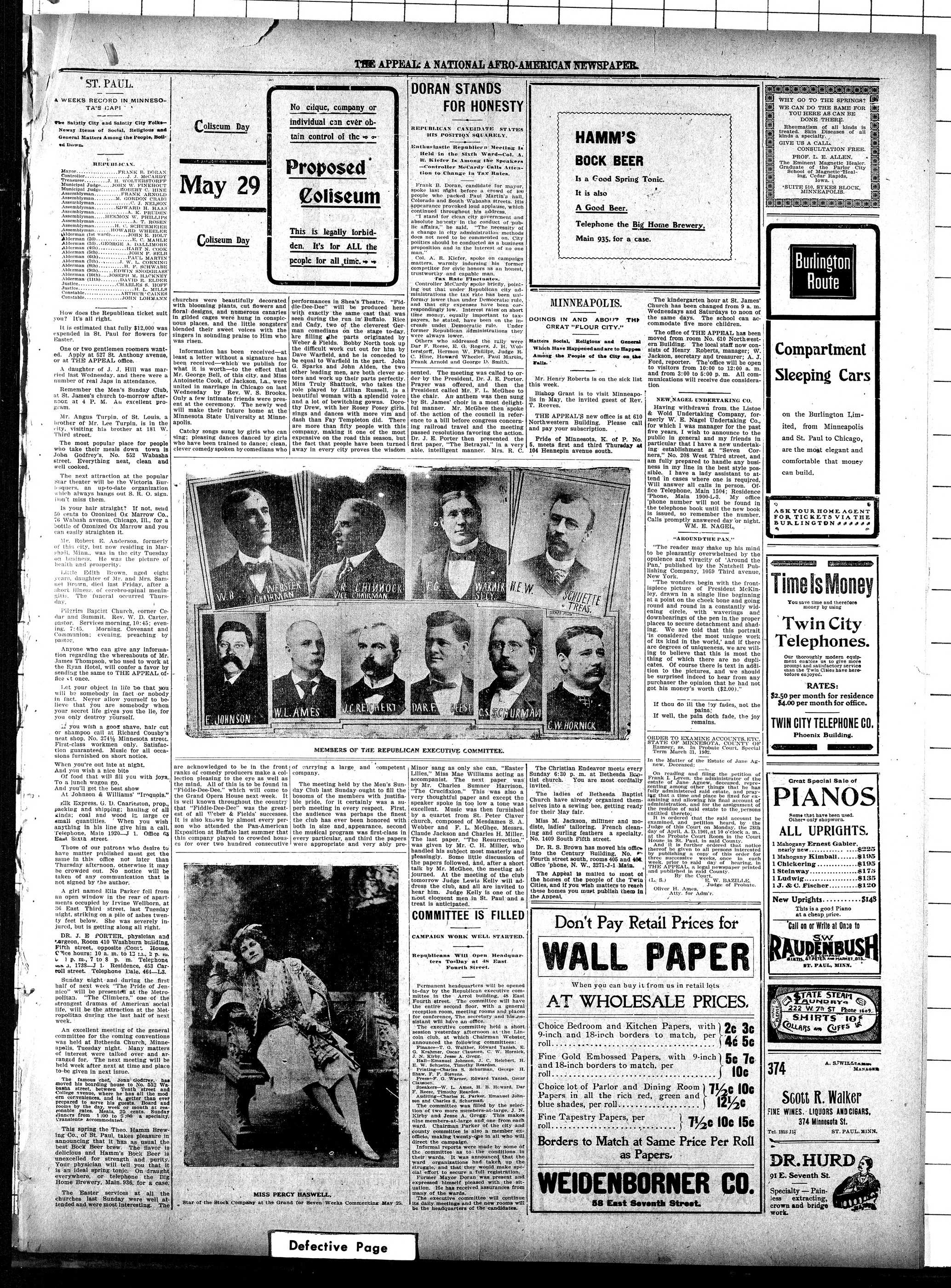
A WEEKS RECORD IN MINNESOTA'S CAPIT
The Saltyt City and Saltyt City Folks—Neway Items of Social, Religious and General Matters Among the People, Bolled Down.
REPUBLICAN.
Mayor.....FRANK B. DORAN
Controller.....J. B. McCARRY
Treasurer.....J. H. MURRAY
Municipal Judge.....JOHN W. FINEHORT
Municipal Judge.....ROERT C. HINE
Assemblyman.....FRANK ARNOLD
Assemblyman.....M. GORDON
Assemblyman.....C. J. NELSON
Assemblyman.....EDWARD H. HAAS
Assemblyman.....A. K. PRUDEN
Assemblyman.....HERMON W. HERMON
Assemblyman.....A. T. ROSEN
Assemblyman.....H. C. SCHURMEIER
Assemblyman.....HOWARD WELSLEER
Assemblyman (6th ward).....JOHN W. C. MAILLE
Alderman (2b).....E. C. MAILLE
Alderman (2b)·GEORGE A. DALLMORE
Alderman (5th).....JOHN F. SELB
Alderman (6th).....PAUL MARTIN
Alderman (6th).....M. H. SCHWABE
Alderman (8th).....EDWIN SNDGHASS
Alderman (10th)·JOSEPH M. HACKNEY
Alderman (11th).....A. A. HAWKINS
Justice.....CHARLES S. HOFF
Justice.....H. L. MILLS
Constable.....ARTHUR CAINES
Constable.....JOHN LOHmann
How does the Republican ticket suit you? It's all right.
It is estimated that fully $12,000 was expended in St. Paul for flowers for Easter.
One or two gentlemen roomers wanted. Apply at 527 St. Anthony avenue, or at THE APPEAL office.
A daughter of J. J. Hill was married last Wednesday, and there were a number of real Japs in attendance.
Remember the Men's Sunday Club, at St. James's church to-morrow afternoon at 4 P. M. An excellent program.
Mr. Angus Turpin, of St. Louis, a brother of Mr. Lee Turpin, is in the city, visiting his brother at 181 W. Third street.
The most popular place for people who take their meals down town is John Gofrey's. No. 552 Wabasha street. Everything neat, clean and well cooked.
The next attraction at the popular Star theater will be the Victoria Burquers, an up-to-date organization which always hangs out S. R. O. sign. Don't miss them.
Is your hair straight? If not, send 50 cents to Ozonized Ox Marrow Co., 76 Wabash avenue, Chicago, Ill., for a bottle of Ozonized Ox Marrow and you can easily straighten it.
Mr. Robert E. Anderson, formerly of this city, but now residing in Marshall, Minn., was in the city Tuesday on business. He was the picture of health and prosperity.
Little Edith Brown, aged eight years, daughter of Mr. and Mrs. Samuel Brown, died last Friday, after a short illness of cerebro-spinal meningitis. The funeral occurred Thursday.
Pilgrim Baptist Church, corner Cedar and Summit, Rev. W. D. Carter, pastor, Services morning, 10:45; evening, 7:45. Morning, Covenant and Communion; evening, preaching by pastor.
Anyone who can give any information regarding the whereabouts of Mr. James Thompson, who used to work at the Ryan Hotel, will confer a favor by sending the same to THE APPEAL office at once.
Let your object in life be that you will be somebody in fact or nobody in fact. Neyer allow yourself to believe that you are somebody when your secret life gives you the lie, for you only destroy yourself.
If you wish a good shave, hair cut or shampoo call at Richard Cousby's neat shop. No. 374% Minnesota street.
First-class workmen only. Satisfaction guaranteed. Music for all occasions furnished on short notice.
When you're out late at night, And you wish a nice bite
Of food that will fill you with joys, To a lunch wagon go.
And you'll get the best show
At Johnson & Williams' "Iroquois."
Elk Express, G. D. Carrieston, prop,
packing and shipping; hauling of all
kinds; coal and wood iz. large or
small quantities. When you wish
anything in his line give him a call.
Telephone, Main 1920—J 1. Office 63
East Sixth street
Those of our patrons who desire to
have matter published must get the
same in this office not later than
Thursday afternoon, otherwise it may
be crowded out. No notice will be
taken of any communication that is
not signed by the author.
A girl named Eila Parker fell from
an open window in the rear of apartments
occupied by Irvine Wellborn, at
36 East Third street, last Tuesday
night, striking on a pile of ashes twenty
feet below. She was severely
injured, is getting along all right.
DR. J. E FORTER, physicist,
argonaut, Room 410 Washburn building,
Fifth street, opposite Court.
Office hours: 10 a. m. to 12 a. m. 2
p. m. 7 to 8 p. m. Telephone
on J. 1738—J 1. Residence, 453 Carroll
street, Telephone Dale, 463—J.
Sunday night and during the first half of next week "The Pride of Jennico" will be presented at the Metropolitan. "The Climbers," one of the strongest dramas of American social life, will be the attraction at the Metropolitan during the last half of next week.
An excellent meeting of the general committee for the coming conventions was held at Bethesda Church, Minneapolis, Tuesday night. Many matters of interest were talked over and arranged for. The next meeting will be held week after next at time and place to be given in next issue.
The famous chef, John Godtrey, has moved his boarding house to No. 552 Waabana street, between Tenth street and College Avenue, where he has all the modern conveniences, and is, better than ever prepared to serve his guests. Board and rooms by the day week month at reasonable rates. Meals, 25 cents. Sunday, inners from 1:00 to 5:00 a specialty. Transients accommodated.
This spring the Theo. Hamm Brewing Co., of St. Paul, takes pleasure in announcing that it has as usual the best Bock Beer brew. The flavor is the deepest beer. Bock Beer unexcelled for strength and durity. Your physician will tell you that it is an ideal spring tonic. On draught everywhere, or telephone the Big Home Brewery, Main. 936, for a case. The Easter services at all the churches last Sunday were well attended and were most interesting. The
Coliseum Day
No ciique, company or individual can ever obtain control of the
May 29
Proposed Coliseum
This is legally forbid- den. It's for ALL the people for all time.
W.B. WEBSTER
CHAIRMAN
R. CHINWOCK
VICE CHAIRMAN
F.G. WARMER
SECY.
H.E.W. SCHUETTE
TREAS.
E. JOHNSON
W.L. AMES
J.C. REICHERT
DAR.F. REESE
C.S. SCHURMAN
C.W. HORNICK
churches were beautifully decorated with blooming plants, cut flowers and floral designs, and numerous canaries in gilded cages were hung in conspicuous places, and the little songsters blended their sweet voices with the singers in sounding praise to Him who was risen.
Information has been received—at least a letter without a signature has been received—which we publish for what it is worth—to the effect that Mr. George Bell, of this city, and Miss Antoinette Cook, of Jackson, La. were united in marriage in Chicago on last Saturday by Bey, W. S. Brooks. Only a few intimate friends attended at the ceremony. The newly wed will make their future home at the Minnesota State University at Minneapolis.
Catchy songs sung by girls who can sing; pleasing dances danced by girls who have been trained to dance; clean, clever comedy spoken by comedians who
W. B. VINES
CHAIRMAN
E. JOHNSON
W. L.
are acknowledged to be in the front ranks of comedy producers make a collection pleasing to the eye as well as the mind. All of this is to be found in "Fiddle-Dee-Dee," which will come to the Grand Opera House next week. It is well known throughout the country that "Fiddle-Dee-Dee" was the greatest of all Weber & Fields successes. It is also known by almost every person who attended the Pan-American Exposition at Buffalo last summer that this company played to crowded houses for over two hundred consecutive
THE APPEAL: A NATIONAL AFRO-AMERICAN NEWSPAPER
MEMBERS OF THE REPUBLICAN EXECUTIVE COMMITTEE.
performances in Shea's Theatre. "Fiddle-Dee-Dee" will be produced here with exactly the same cast that was seen during the run in Buffalo. Rice and Cady, two of the cleverest German comedians on the stage to-day, are filling the parts originated by Weber & Fields. Bobby North took up work and worked out for him by Dave Warfield, conceded to be equal to Warfield in the John G. Sparks and John Alden, the two other leading men, are both clever actors and work up their parts perfectly. Miss Truly Shattuck, who takes the role played by Lillian Russell, is a beautiful woman with a splendid voice and a lot of bewitching gowns. Dorothy Drew, with her Rosey Posey girls, sings and dances with more vim and dash than Fay Templeton did. There are people in this company, making it one of the expensive on the road this season, but the fact that people have been turned away in every city proves the wisdom
R. CHIMLOCK
VICE CHAIRMAN
AMES
J.C. REICHERT
MEMBERS OF THE REPUBLI
of carrying a large and competent company.
The meeting held by the Men's Sunday Club last Sunday ought to fill the bosoms of the members with justifiable pride, for it certainly was a superb meeting in every respect. First, the audience was perhaps the finest the club has ever been honored with both in size and, appearance, second the musical program was first-class in every particular, and third the papers were appropriate and very ably pre-
REPUBLICAN CANIDATE STATES
HIS POSITION SQUARELY.
Enthusiasm Republican Meeting Is
Held in the Sixth Ward—Col. A.
R. Kiefer is Among the Speakers
—Controller McCary Calls Atten-
tion to Change in Tax Rates.
Frank B. Doran, candidate for mayor,
spoke last night before a crowd of
190 people who packed Paul Martin's hall,
Committee for Public Works. His
appearance provoked loud applause,
which continued throughout his address.
"I stand for clean city government and
absolute honesty in the conduct of public
affairs," he said. "The necessity of a change in the city's budget does not need to be commented on. City politics should be conducted as a business proposition and in the interest of no one man.
Col. A. R. Kiefer, spoke on campaign
matters, warmly indorsing his former
competitor for civic honors as an honest,
trustworthy and capable man.
Controller McCaryd spoke briefly, pointing out that under Republican city administrations the tax rate has been uniformly lower than under Democratic rule, and responding low. Interest rates on short time money, equally important to tax-payers, he stated, have been on the increase under Democratic rule. Under Republican administrations they were always lower.
Others who addressed the rally were Dar F. Reese, E. G. Rogers, J. H. Woolley, and Howard Wheeler, and C. Hine, Howard Wheeler, Paul Martin, Frank Arnold and George D. Smith.
seated. The meeting was called to order by the F. Porter, Prayer was offered, and the President called Mr. F. L. McGhee to the chair. An anthem was then sung by St. James' choir in a most delightful manner. Mr. McGhee then spoke of the action of the council in reference to a bill before congress concerning railroad travel and the meeting passed resolutions favoring the action. The council presented the first paper, "The Betrayal of the Free, a valuable, intelligent manner," Mrs. P. C.
F.G. WARMER HE.
SLEY.
DAR F. REESE
C.S. SCHURM
CAN EXECUTIVE COMMITTEE.
Minor sang as only she can, "Easter Lilies," Miss Mae Williams acting as accompanist. The next paper was by Mr. Charles Sumner Harrison, "The Crucifixion." This was also a very thoughtful paper and except the speaker spoke in too low a tone was a plea for the audience to be furnished by a quartet from St. Peter's church, composed of Mdesames S. A. Webber and F. L. McGhee, Messrs. Claude Jackson and Charles H. Miller, The last paper, "The Resurrection," was given by Mr. C. H. Miller, who handled his subject most masterly and pleasingly. Some little discussion of the papers followed, and, after a short talk by Mr. McGhee, the meeting adjourned. At the meeting of the club tomorrow Judge Lewia Kill will attend to hear. Judge Jill will be one of the most eloquent men in St. Paul and a treat is anticipated.
COMMITTEE IS FILLED
Republicans Will Open Headquarters To Day-at 48 East Fourth Street.
Permanent headquarters will be opened to-day in the Republican executive mite in the Arrol building, 48 East Fourth street. The committee will have the entire second floor, with a general reception room, meeting rooms and places for conference. The secretary and this assistant will have an office.
The executive committee held a short session yesterday afternoon at the Lincoln Center. The secretary announced the following committees: Finance—G. W. Galther, Edward Anish, E. G. Krause, E. K. Worcick, C. W. Worcick, J. N. Kirby, Jeeves A. Gess, Hall-Emmanuel Johnson, J. C. Reichert, H. E. Schurch, Charles Rhyndesman, George H. Shaw, F. P. Stevens, G. F. Warner, Edward Vanish, Oscar Speaker—W. L. Ames, H. B. Howard, Dar F. Reese, Timothy Reardon.
Speaker—E. F. Reese, Emmanuel John-
son and Charles S. Schurman.
The committee was filled by the selection of two more members-at-large, J. N. Brennan and J. M. Hancock, nine members-at-large and one from each ward. Chairman Parker of the city and county committee is also a member ex-officio, making twenty-one in all who will direct the campaign.
Informal reports were made by some of the ward organizers in their words. It was announced that the ward organizations had taken up the struggle; and that they would make special effort to secure a full registration.
Former Mayor Doran was present and expressed himself pleased with the siting of the building. He provided assurances from many of the words.
The executive committee will continue its daily meetings and the new rooms will be the headquarters of the candidates.
HAMM'S
BOCK BEER
Is a Good Spring Tonic.
It is also
A Good Beer.
Telephone the Big Home Brewery,
Main 935, for a case.
Don't Pay Retail Prices for WALL PAPER
MINNEAPOLIS.
DOINGS IN AND ABOUT THE
GREAT "FLOUR CITY."
Matters Social, Religious and General
Which Have Happened and are to Happen
Among the People of the City on the
Falls.
Mr. Henry Roberts is on the sick list
this week.
Bishop Grant is to visit Minneapolis
in May, the invited guest of Rev.
T. Reeves.
THE APPEAL'S new office is at 610
Northwestern Building. Please call
and pay your subscription.
Pride of Minnesota, K. of P. No.
5, meets first and third Thursday at
104 Hennpin avenue south.
W. SCHUETTE
TREAS.
SPART HAIR
C.W. HORNICK
The Christian Endeavor meets every Sunday 6:30 p. m. at Bethesda Baptist church. You are most cordially invited.
The ladies of Bethesda Baptist Church have already organized themselves into a sewing bee, getting ready for their May fair.
Miss M. Jackson, milliner and modiste, ladies' tailoring. French cleaning and curling feathers a specialty. No. 1409 South Fifth street.
Dr. R. S. Brown has moved his office into the Century Building, No. Fourth street south, rooms 405 and 406. Office 'phone, N. W., 3271-3-1 Main.
The Appeal is mailed to most of the homes of the people of the Twin Cities and wish matters to reach these homes you must publish them in the Appeal.
Don't Pay Re WALL When you can buy it
The kindergarten hour at St. James' Church has been changed from 9 a.m. Wednesday and Saturdays to noon of the same days. The school can accommodate five more children.
The office of THE APPEAL has been moved from room No. 610 Northwestern Building. The local staff now consists of Henry. Roberts, manager; W. Jackson, secretary and treasurer. A. J. Ford, reporter. The office will be open from 3:00 to 5:00 a.m. and from 3:00 to 5:00 p.m. All communications will receive due consideration.
NEW,NAGEL UNDERTAKING CO.
Having withdrawn from the Listeo & Wold Undertaking Company, formerly W. E. Nagel Undertaking Co., for which I was manager for the past five years, I wish to announce to the public in general and my friends in particular that I have a new undertaking establishment at "Seven Corners". No. 208 West Third street, and am fully prepared to handle any business in my line in the best style possible. I have a lady assistant to attend in cases where one is required. Will answer all calls in person. Office Telephone, Main 1504; Residence Phone, Main 1900-L3. My office phone number will not be found in telephone book until the new book is issued, so remember the number. Calls promptly answered day or night. WM
"AROUND THE PAN."
"The reader may make up his mind to be pleasantly overwhelmed by the opulence and vivacity of 'Around the Pan,' published by the Ntshtte Publishing Company, 1059 Third avenue, New York.
"The wonders begin with the front-spiece picture of President McKenny, drawn in a single line beginning at a point on the cheek bone and going round and round in a constantly widening circle, with waverings and downhearings of the pen in the proper places to secure detachment and shading. We are told that this portrait 'is considered the most unique work of its kind in the world,' and if there are degrees of uniqueness, we are willing to believe that this is most the thing of which there are no duplicates. Of course there is text in addition to the pictures, and we should be surprised indeed to hear from any purchaser the opinion that he had not got his money's worth ($2.00)."
If thou do ill the 'joy fades, not the pains;
If well, the pain doth fade, the joy remains.
ORDER TO EXAMINE ACCOUNTS. ETC. SESSION OF MINNESOTA. COUNTY OF Ranney. See Court. Special Term March 31, 1902.
In the Matter of the Estate of Jane Agnew, Deceased:
In reading and reading the petition of Frank L. Leven, the administrator of the county, and the agnew, deceased, representing among other agnew, formally administered said estate, and prayed and placed and placed a place for examination and place be fixed for examination and administration, and for the assignment of administration, and said estate to the persons entitled thereto.
It is ordered that the account be committed to the petition heard, by the Judge. This Court Room is in the court of April. A.D. 1901, at 10 o'clock a.m. at the Probate Court Room in the Court of April. This order of this Court and. It is further ordered that notice thereof be given to all persons interested in the case. This order of this Court three successive weeks, once in each. In the APPALOOSA said day of hearing, in the THE APPALOOSA said day of hearing, in the published and published in said County.
By the Court.
(L. S.) W. BAZILLE. Judge of Probate.
Oliver H. Ames. Judge of Probate.
City, Adm.
on the Burlington Limited, from Minneapolis and St. Paul to Chicago, are the most elegant and comfortable that money can build.
ASK YOUR HOME AGENT FOR TICKETS VIA THE BURLINGTON
Time Is Money
You save time and therefore money by using
Twin City
Telephones.
Our thoroughly modern equipment enables us to give more prompt and satisfactory service than the Twin Cities have here before enjoyed.
RATES:
$2.50 per month for residence
$4.00 per month for office.
TWIN CITY TELEPHONE CO.
Phoenix Building.
Great Special Sale of
PIANOS
Some that have been used.
Other* only shopworn.
ALL UPRIGHTS.
1 Mahogany Ernest Gabler. nearly new. $225
1 Mahogany Kimball. $195
1 Chickering. $195
1 Steinway. $175
1 Ludwig. $135
1 J. & C. Fischer. $120
New Uprights. $143
This is a good Piano at a cheap price.
Call on or Write at Once to SW RAUDENBUSH
SIRTA, AVENID, HAMMEL, 912
ST. PAUL, MINN.
STATE STEAM
LAUNDRY
222 W 7th ST Phone 1609
SHIRTS 10%
COLLARS CUFFS
A. S. WILLIAMS MANAGER
Scott R. Walker
FINE WINES. LIQUORS AND CIGARS.
374 Minnesota St.
Tel. 1818 J13 ST. PAUL, MINN.
DR.HURD
91 E. Seventh St.
Specialty — Pain-
less extracting,
crown and bridge
work.
A Compilation of a Number of Happenings, Social and Otherwise, Among the Afro-Americans of the Second City of This Glorious Union.
Mrs. Andrew Watkins, of Columbia, Tennessee, is visiting her sister at 288 Twenty-sixth street.
THE APPEAL is without question the best advertising medium through which to reach the Afro-Americans of Chicago.
Mrs. Mary E. Rhinehardt, of Springfield, Ill., is in the city on a visit and is the guest of Mrs. Cresshaw, of 3010 LaSalle street.
Mrs. Josephine Robinson, of Denver, Col., is visiting Chicago and is the guest of Mr. and Mrs. Johnson, 6316 Champain Ave.
Subscribers for THE APPEAL who wish to discontinue the paper must send written notice to the office, properly dated and signed.
The Afro-American attorney who lost $100 on the result of the election is chief-first word Tuesday was nursing a severe headache Wednesday. Too bad!
James A. Scott, attorney-at-law, can be found at THE APPEAL office, during business hours. Prompt attention given all legal business entrusted to his care. The APPEAL has fixed advertising rates, and will not cut them in order to secure advertising. However, if you want to reach the people, advertise in THE APPEAL.
Married, on Tuesday evening, at the home of Mrs. Watkins, Twenty-six and LaSalle streets, Miss Susie Johnson, of Nashville, Tenn., to Mr. Jno. R. Lewis, of Montreal, Can.
The St. Louis people argue that as no exposition has ever been finished notice that the St. Louis will have been hardly begun in 1903.
Do you want to preach? Learn at home. Send two-cent stamp to Prof. R. B. Hewitt for catalogue of Correspondence Bible School, 2908 Magazine street, New Orleans, La.
If you wish a loan on household furniture, horse, wagon, diamonds, jewelry or real estate and are holding a sahilated position, call on John Q. Hewitt, Room 311, No 36 South Clark street.
A man in this city goes to sleep reading the newspaper, but every time any member of the family tries to take the paper he wakes up and says, "Here, you go," and then goes to sleep.-Wheaton News.
Parties having money to invest on chattles, diamonds, etc., call on John G. Grant & Co, Suite 311, No. 36 South Clark street. They will give two per cent per month on all money left with them to be loaned on above securities.
Mr. Al. Garrett, the principal owner of the Columbia Giants base ball club, ball club, and baseball partnership, reports his team in first-class condition and now ready to "play ball." "Home Run" Johnson is captain and manager.
Afro-American residents of Hyde Park have organized a co-operative company and will soon open a general store in the down town district. Such a movement deserves the most attention and good citizen. Success to the new store.
Information is wanted of Miss or Mrs. Kate White, who left Omaha a few years ago and is supposed to be in weighting about 125 lbs.强壮的 White's parents live at Atchison, Kan. Any information will be gladly received by Dr. P. C. Kebble, Pittsburg, Texas.
Maj. Ben, Johnson was the happy recipient last Tuesday of a handsome testimonial from his friends and co-workers, completion of twenty years in that branch of the public service. The Major is an efficient, capable and popular public official and certainly deserves the esteem of all good citizens.
Last Sunday - Easter - was a great day of the edifice of the edifice was a veritable bower of roses, and the large congregation seemed never happier upon this occasion. Bishop Grant and Dr. Carey delivered able and interesting service, a sum of money was raised-$2,000—which is to be paid on the church debt.
Alexander Harper, city accountant, has resigned, owing to the repeated cuts made in his salary since 1899. He was a professor of department when John P. Hopkins was mayor, and was considered to be a Hopkins and Sullivan follower, he was originally getting $3,600 a year. He was fired in 1911. Last year he was reduced to $1,200.
THE LAWSON GUILD NO. 2
The Lawson Guild No. 2 closed its annual session Wednesday, March 19th, at the residence of Mrs. W. F. Childs, 5138 Indiana Ave. The members returned all garments, consisting of 22 aprons of different patterns and 27 French gingham dresses. These were all beautifully made, which were shipped by Mrs. Lawson for Atlanta, Ga., as of Easter Tuesday, also as a photograph of our little junior member, Irwin Hudlin, with other articles of donation. The members have accomplished more this season than ever before, sending Mrs. Lawson 17 flannel night robes, 1 shirt and $5 as their Christmas donation. Too much credit cannot be taken on the other page. The Guild has asked and untiring interest of their work for "Sweet Charity" refreshments were served, after which they adjourned until September. The members are as follows: Mrs. J. D. Bryant, president; Mrs. J. J. N. Avendorph, secretary; Mrs. F. Childs, treasurer; Mesdames, W. Hayes, H. H. Persons; W. H. W. B. Blair, V. Cook, L. W. Cummins, C. Davis, D. P. French, J. Haney, R. J. Hendricks, W. Hudlin, E. Jones, E. Lewis, R. E. Moore, H. Pope, J. Wick-Hife, D. Smith, L. Jones. Honorary members: C. E. Bentley, W. W. Beasley, D. Dennison, Visitors: Mrs. H. F. Claven, M. H. Kersley, M. H. Joe Shoecraft, Mrs. Griffin. "Whosoever's giveth, a little child in my name, giveth unto me."
BOMBINIE MAKES IT STRONG.
The night before the night on "How we build a town with blood." Last night he roasted gambam and the testimony of reformed gamblers
KABO CORSETS
NO BRASS EYELETS
```markdown
```
Our New American Mammoth
THE BEST AND LARGEST MANGLE
FIRST ONE IN THE STATE.
Lowest Prices on Flat Work SHIRTS, 100. COLLARS and COUFFS, 10.
"GOOD ENOUGH FOR ANYBODY"
"CHEAP ENOUGH FOR EVERYBODY"
KUHLES & STOCK,
MAKERS,
ST. PAUL, MINN.
PRIVATE
SMITH
CIGAR
IT'S ONLY
5¢
Known the World Over.
1n Design.
Accomplishment.
Finish.
OF MARVELOUS MERIT, INCLUDING 20
STRAIGHT-FRONT
AND BOX EFFECT.
Creations of
Fascinating Grace.
BIAS-GORED
LONG SKIRT,
LOW BUST,
DEEP HIP,
PARIS CLASP,
HAND-FINISHED,
At $1.00 to $5.00.
"A good cigar is a smoke"
Rudyard Kipling
The
YELLOW
KING
5¢CIGAR
is a good cigar. The best that can be said of it falls short of the reality.
Smoke the cigar.
At all dealers.
HART & MURPHY, MAKERS.
BANNING ADVOC.
```markdown
```
THE APPEARANCE NATIONAL AFRO-AMERICAN NEWSPAPER
Surely Best FOR Large Figures IS THE Form-Reducing
Because it reduces too high abdomen from 4 to 6 inches without harm or discomfort, tending a sincere touch of elegance and making possible the true straight-front poise.
C. C. CO., NEW YORK.
THE TUXEDO MAN
#
that fashionable card parties constituted the devil's kindergarten to the gambling hell. He showed clearly that when church members teach their children to play cards in the home, they might be surprised if they spend their nights in gambling dens as many do now—Carroll County Mirror.
HELP THE ALTON FUND.
EVERY AFRO-AMERICAN IN IL LAND OUGHT TO GIVE SOME THING TO THE ALTON SCHOOL FIGHT. THE RIGHTS THE RACE ARE AT STAKE. THE APPEAL GIVES $10. HOW MUCH WILL YOU GIVE, READER?
RECEPTION FOR MRS. YATES
Mrs. Wm. Emanuel and Mrs. Clifford Johnson gave a reception Monday afternoon at the spacious home of Mrs. Emanuel Rhodes Ave. in honor of Mrs. J. Silane Yates, president of the National Federation of Mrs. Clubs. The house was beautifully decorated in white and gold. The table decorations were pink and white. Smiley served. The ladies enjoyed a heart to heart talk with Mrs. Yates, and understood more through the progress of the work in the office. Mrs. Yates departed at 5 o'clock, carrying with them pleasant remembrances of the affair. Those present were: Mesdames L. A. Davis, N. Avendorch, L. A. Mussie, Sarah Gray, F. A. Brennan, J. B. Clark, Clint, Cordelia M. West, J. Thomas Noah, D. Thompson, J. B. Crum, Harry Williams, Eva Lewis, L. Johnson, A. H. Roberts, E. H. Wright, W. A. Wilson, J. B. Falkner. Those making the presentation were: Mesdames Yates; McLain, president State Federation; Davis, Moody, Avendorch, Gray, Barnett and Brown.
YE EDITOR HEARS PADEREWSKI.
Miss Maud Hewson went to Chicago Saturday to hear the famous Paderewski fiddle on the piano. That reminds us that we once blowed yourself to hear the same musical idol exert himself. We freely admit that we could not get next to his soulful operations, and wondered why a few men had fits and a whole lot of women got fell on the work of a few corset steels in their artistic outburst of masculine manifestations of a ranshipful approval. Of course we admit that his flay with his hands and that his flay were nimble and full of action and that his body was flexible and followed poetically in the rhythm of motion, especially in side-stepping and ducking for thirty-seconds of a full note not yet due, but what we waited for and expected was some tunes, the kind of tunes that make men commit suicide or enlist in the army, but we couldn't get 'em, and at recess we departed from the day of the way and stopped in front of the hooch-like hiphில pavilion and took in a few Persian selection performed on a native tomtom, and then realized for the first time, and fully, that after all music was only a matter of taste and depended something on what you were in the habit of getting at home.—Lisbon (III). Comet.
MRS. J. SILONE YATES.
Tuesday was a strenuous day for Mrs. Josephine Silone-Yates, the distinguished and talented Afro-American woman of Kansas City, who is visiting in Chicago this week. In the afternoon she was the special guest of honor at a luncheon given by Mrs. Geo. A. Plummer at her palatial home on the campus of DeWalbarn-Bartlett was also present and a welsh-Bartlett dies from the Chicago Woman's Club. Later in the afternoon Mrs. Yates delivered an interesting and able address before the Social Economics department of the prominent club women of Chicago. In the evening Mrs. Yates was the guest at the banquet at the Institutional Church, 3225 Dearborn street, given Mrs. Josephine Silone-Yates a club. Mrs. Dawalbarn-Bartlett one hundred and fifty ladies were present. Mrs. Yates spoke on "Two Women's Meetings," giving an account of recent gatherings at Washington.
HER WATCH WOULDN'T GO.
We looked into her watch when she said: "The old thing wouldn't go." After a hasty glance we didn't wonder, her diagnosis was "indigestion." Pasted against the inside of the case were:
1. A portrait of her first love and a lock of his hair.
2. Some dear forget-me-nots
2. Some dear forget-me-nots.
3. A newspaper clipping announcing her heart engagement.
4. A fourteen clover.
Between the inner cover and the works were two pictures and a recipe for cold cream.
And still the obstinate thing refused to go.-Morris Herald Jewelers' Ad.
Worth of Rails Ordered by the Wabash.
The Wabash has just placed orders for more than $3,000,000 worth of 80-pound steel railings. This summer $1,000,000 in steel railings will be laid on the Wabash lines to Kansas City, to Omaha, and to Des Moines. Sixty thousand tons of steel railings will be laid on the Wheeling and Lake Erie tributary St. Augustus division. It is the intention to build railings for the Western lines down in time for the World's Fair in St. Louis. Contracts for the work will soon be let, and the construction will then immediately begin. Orders for these railings have just been placed by President Joseph Ramey, Jr. He said yesterday: "In the world is not too good for the World's Fair is going to bring hundreds of thousands of people into St. Louis. We intend to make our record for carrying visitors to the Fair eclipse that made the event a national-American Exposition at Buffalo."
The road is already figuring on an enlargement of service, and an addition to equipment to handle a tremendous heavy business. Increase in the company's revenue will increase the fiscal year, July 1, 1911, to January 31, 1922, have reached almost $1,000,000, and the passenger department has made the remarkable record several times in the past year in earnings of the freight department.
The company's Pittsburgh improvements are well under way. Everything in that direction will be completed in time for the Fair which is the most time of all the road's improvements.
A SYMPOSIUM ON LIARS.
The following symposium on "Liar's" worth reading, even if it fails to do the subject complete justice:
The liar whom the editor hates worst of all the year, the man two, when he was a child, he only received two, or three copies
Lindeke's
Apple &
Blossom
Flour
STANDS
ALONE.
SMOKE
Straiton & Storm Co's
NEW
FIVE
CENT
OWL
CIGAR!
RAMSEY COUNTY Afro-American Club. SOCIAL
378 Cedar St., St. Paul, Minn.
OFFICERS
J. W. WOODFORK, Pres.
J. L. PHERS, Supt.
JOHN MORGAN, Asst. Supt.
F. D. McCRACKEN, Sec.
ANDY COMBS, Asst. Sec.
C. E. CHARLESTON, Treas.
WM. GIBBS. Chef.
Tel. Main 1786-J1.
1
THE
Allright Shoe
For Men and Women
$3.50
Allright
IN STYLE
IN FIT
IN PRICE
IN NAME
IN QUALITY
For Sale By
TREADWELL SHOE CO.
129-131 E. Seventh St.
ST. PAUL MAIN MINN
P E. REID
J. J. HIRSHFIELD
Tel. 1949-J1. ST. PAUL.
Dr. W. J. HURD,
01 E. 7th, St. Paul.
Pat. system of an
tracting teeth
without pain. 25
years' successful use in
thousands of
cases. States.
Bridges,
Crowna, Fillinga. Popular
service.
The Monarch of Them All.
EXTRA QUALITY
DUNLAP & CO.
SUPPLIES
THE DUNLAP HAT.
R. A. LANPHER & CO. 333
ROBERT STREET
H
TELLS YOU PORTION
The Witch
Witch and you and
Endow
Endow you and you
and you bring
thing it brings
with a crown. They may
wear it with a crown. They may
place her on your bed
her hand and watch it
refer to the printed book
they think it thinks
her presence or smiles
her presence or smiles
her presence, cold, dilugue,
guts, foulness, etc. The
things they do.
Send is cta. In allow a shampo and receive two witches (8 for age.); she burn how to make a first Adlarn easily.
Tardolph Noverty Adv. Company
New York, Indiana, U. S. m.
THE ST. PAUL DAILY NEWS
Every day in the year except Sunday for, $1.00 per year.
Outside the City of St. Paul.
during the year, and refuses to pay.—Clarksville Graphic. "I text here that you take this one, the editor asks a liar who takes the paper seven or eight years, and when finally corrupted for settlement, says he never ordered the paper at all.—Pike County Post. The newspaper of the whole outfit is the man who takes the paper several years, then moves away without paying or saying anything about it, but the man is an honest man.—Elsbury Advance. Brethren, you all fall short of the truth. The biggest liar in the lot is the editor who publishes the obituary of a man who has done that they have gone to heaven.—Plymouth Independent.
POLITICAL NOTES
The next excitement will be the Republican primaries, which will take place the latter part of this month.
The young Afro-American independent candidate for alderman in the Second ward received but 78 votes Tuesday.
He was defeated in the First ward, but Tom Dixon went through in the Second without any opposition to speak about.
Mr. James Waggoner of the Second ward is said to be slated for the Republican nomination for the Legislature in the First senatorial district.
Will Cowan, manager of the Imperial building, Clark St. is the latest candidate for county commissioner.
He is a splendid business man and would make a good commissioner.
SEASICK CIGARS
Some Goods Lose Their Flavor in Cross the Ocean.
"Since our troops have been in the Philippines my friends among the officers stationed there have at frequent intervals been remembered with boxes of Manila cigars," remarked a member of Uncle Sam's fighting force, who was severely wounded at El Caney and is now on the retired list, to a Star reporter. "I have learned to prefer the tobacco of the far east to the domestic brand, and do not see how I now get along without the fragrant Manila. Recently I received a shipment of cigars. Once proved a sad disappointment. In the past they seemed to me to be entirely worthless. I puffed at one after another, but they simply could not be smoked. In despair I finally consulted a well-known tobaccoist. The situation was no problem to him. He promptly told me to lay the cigars aside for a few weeks, after which I would find them all tight. He was correct. When I sought an explanation the tobaccoist assured me in all seriousness that the cigars had been from the voyage across the Pacific, from the west. I have since learned that wine liquors are affected in a similar manner by ocean shipment."—Washington Star.
Fortunes Accidentally Found.
In the sure knowledge that man does not turn to God until he is in the greatest distress, I have placed $500 in notes between 141 and 142-Hamburg, 1879. The curious and welcome letter was found in Hamburg shopekeeper when, in dire misfortune, he had determined to sell the family Bible that had been in his possession for many years. Looking through it before taking it out of the house, he found the letter and bank notes. At such a critical time a fortune would not have been more welcome. The shopekeeper had failed in business, Lis wife had long been ill, and consequently he was much in the discovery of over $50,000 was the result of a game at hide-and-seek. Soon there were played, near the bank, in the Canton of Argove, Switzerland, when one of them, hiding from others, found a large box partly buried, it was almost filled with money, jewelry and other valuables. The father, on behalf of his children, claimed $5,000 as a reward for their find. His claim was contested, however, and the Swiss courts eventually awarded $500 to the children.-Answers.
NO BEAUX FOR CENTRAL GIRLS.
Singular Decree Promulgated by the Dresden postoffice. With the advent of the telephone girl trouble has come to the Dresden postoffice, says a correspondent of the Western Mall. About 30 young women employed in the telephone department at the municipality have goings-in attract to an inconvenient degree the young man population of the city. The male admirers and sweethearts collect in groups, and when the fair 300 troop out the mutual salutations are demonstrative to a degree usually reserved for the tete-a-tete. Not infrequently a score or so of young men, whose admiration is general is man particular, make their way into the town and pass critical review upon the whole 300 as they pass out. "Kiss in the street," as practiced in front of the Dresden postoffice, has at last reached proportions which austere authority can no longer permit, and the director of posts and telegraphs has just issued an order declaring that male escort to or from business is no longer required by the regulations. The subject is keenly debated in the Dresden press.
**Trained-Wolves.**
Bert Decker, a young sportsman of Tuscola, Ill., has succeeded in taming two wolves, and they are very valuable as hunters. He captured their, when encountered by a wolf, Witterson, and now, though they are as large as sheepdogs, they are quite tame and playful. Decker says the wolves can outrun dogs on the hunt, and are very long-winded. Their favorite way of catching a rabbit is to run alongside of him, put their nose underneath Mr. Cottontail, and throw him ten or twelve feet in the air, catching him in their mouths as he falls. The wolves always return to their master when called.
Decker's success has caused other sportmen to undertake the training of wolves to supplant dogs in hunting, and it is probable that wolves will find a place in future kennels. Charlottesville Correspondence Chadwick Enquiries.
ST. PAUL.
MOST WORSHIPFUL GRAND LODGE
OF
MINNESOPA, A. F. AND A. M.
John N. Neal, Grand Master.
Boston Blk., Minneapolis, Minn.
Wm. R. Monna, Grand Secretary.
Garanty Blvd., Minneapolis, Mn.
PIONEER LODGE NO. 1, A. F. AND A. M., meets first and third Mondays of each month at Mascotte, Hall, N. G. Quail street, at 8:00 P. M. H. G. Johnson, W. M.; W. A. Hilyard, Sec., 124 Atwater St.
No. 223. GRAND MASTER'S COUNCIL
No. 224. AND A. M. meets the second Friday in each month of the school's
No. 225. GRAND MASTER'S COUNCIL and Friday in each month of the school's
No. 226. MR. J. E. LTD. on Monday, 226. MEETS SECOND and fourth Wednesday in each month for business at the third Wednesday for instruction at Odd Fellows' Hall, 233 E.
R. Hickman, P. S., 422 St. Anthony Ave.
MARS LODGE, NO. 2202, MEETS SECOND and fourth Wednesday in the third Wednesday for instruction at Odd Fellows' Hall, 233 E.
R. Hickman, P. S., 422 St. Anthony Ave.
HOUSEHOLD OF RUTH, NO. 552, G. U. O. of C. F. meets first and third Monday
each month for business; second Monday for business at Odd Fellows' Hall, 233 E.
Seventh St. Mr. Sarah E. Kirtley, M. N. G.; Mrs. Ida M. Johnson, W. F.
No. 592 Rice Street.
ST. JAMES A. M. E. CHURCH, cor.
Fuller and Jay streets. Sunday services:
11:00 a. m.; 7:30 p. m. Wednesday prayer meeting, 8:00 p. m. Pastor visits on Monday and Tuesday at home Wednesday and sick attended on notice.
Weddings, funerals and the son. Pastor, 380 Lorde St.
PILGRIM BAPTIST CHURCH, Cor.
12th and Cedar, Sunday services: Preaching at 11 a.m. and 7:45 p.m. Sunday school at 12:30 o'clock. Wednesday evening general prayer meeting. Friday evening study Sunday school lesson. Funerals and weddings promptly attended. Rev. W. D. Carter, Pastor, 559 Elfelt St.
ST. PHILIP'S EPISCOPAL MISSIOE, corner Aurors avenue and Mackubin street. Sunday services: Early celebration of Holt Eucharist, 7:30 a.m. High celebration of Holy Eucharist first and third Sundays, 11:00 a.m. Matins, second and fourth Sundays, 11:00 a.m. m. Sunday school, 12:30 p.m. Brotherhood of St. Andrew, 6:30 p.m. Vespers, 7:30 p.m. Week services. We'm enddays, confirmation class, 8:00 p.m. Fridays, evening prayer, 8:00 p.m. Saturdays, Holy Eucharist, 9 a.m. REV. A. C. V. CARTIER, Hector, 570 Central avenue.
MINNEAPOLIS
J. K. H., and L�en, No. 1, month first and second Tuesday in each month at Masonic Hall See and street between Hennepin and Nicollet Ave's Masons in good standing always welcome.
JOHN G. STERNKTT, W.
Harvey Burke, Sec. Medical Block
ANGELEON LODON A. F., and A. M. no. 14., month the first and second Monday in each month Masonic Hall Second street between Masons and Nicollet Ave's. Masons in good standing ways welcome.
MINNEAPOLIS
a. u. a. a. c. j
BY ANTHONY LONDON, No. 207, 1977,刻录 the first
action of business and fourth and fourth for the
instruction, at their hall, Second street,
when Nikollet and Hennepau were N. G.
JAMES A. SCOOT, P. S. P. O. H. 33
KNIGHTS OF PYCHIAIS
S. TURKY LONDON, No. 1. L. of P. ments
and fourth Thursday in the month, the
birth in good standing welcome. At Lester
Fourth and Fifth AVE. W. JACKSON, C. O.
JOHN A. CASE, C. B. AND S.
FRIEND OF MARY M. MOLL, L. E. OF MASS
and third Thursday in web, with all
hobbies in good standing. At Hale
Hall second street between Hennepau and L.
diat Ave.
FRIEND OF MARY G. O.
R. D. WARD, R. E. AND S.
We Will Pay You
A DOLLAR A DAY
FOR LIFE!
The Pearson publishing Co.
43-43 E. 19th St. NEW YORK
50 YEARS' EXPERIENCE
PATENTS
TRADE MARKS
COPYRIGHTS & C.
Anyone sending a sketch and description may
candidly claim that the invention is probably patentable. Communities
investment is probably patentable. Massachusetts
is not liable for infringement. Massachusetts Co. 20077
specifies, notice, without charge, in the
Scientific American.
A handsomely illustrated weekly. Lawyer's
calculation of any scientific journal. Journal. $4 a
year, four months. $1. Bold by new dealers.
MUNN & Co. 361 Broadway. New York
WONDERFUL DISCOVERY
BEFORE AND AFTER TREATMENT.
OZONIZED X MARROW
THE ORIGINAL, COPYRIGHTED.
The only remedy in place for the sick and malnourished child or only hardship as shown above. It is not only a treatment for the sick and malnourished child or breastfeeding or eczema disorder and making it possible to relieve the discomfort caused by thrombosis. Warranted harmless. Beware of OX Marrow, as the question never fails to be answered. It is not a cure for the sick and malnourished child. Only 60 cents. Sold by druggers or on 500c for 60 cents. Sold by druggers or on 500c for 60 cents. Send post or egress w prior notice. No liability for delivery to a BOUNDARY OF KALLOW CO., 10 Riverside, Chicago.