The Appeal
Saturday, May 31, 1902
St. Paul, Minnesota
Page text (machine-generated)
THE APPEAL STEADILY GAINS
BECAUSE
1-It aims to publish all the news possible.
2-It does so impartially, wasting no words.
3- Its correspondents are able and energetic.
Recruits in the Navy.
N HOUR almost any day agent in the naval recruiting rendez-vous on lower Market street, San Francisco, will be interesting. With the great expansion of the United States an increasing demand for sailors boys. San Francisco's recruiting rendez-vous technical of many stations along our Atlantic coast, will be an increasing academy at Annapolis and the war college at Newport train American youth for naval order givers, the recruiting station at Annapolis, the academic age that are the nation's reliance in days of struggle. The man behind the gun in these days of scientific warfare is a perennial subject. While there is endless red tape about entering the offices of the higher authoritarian, the navy departments of door the recruiting station, the door One goes up unkempt stairs, past paper signs on the walls: "Wanted. Men for recruiting." A room in which there are few chairs a bench and a table littered; with papers and writing material. Very likely there is a sitting about, and always an officer of the navy, dressed scrupulously in bright uniform. There are little rooms leading applicants for Uncle Sam's service.
Oh, it is a very easy thing to get into the navy, providing you have a good constitution, hard muscles and a average character. However, if one has any thinking to do concerning enlistment in the navy, he must be recruiting officer's office and sign his name in any of the blank books. The recruiting officer's office and sign there Uncle Samuel does all the thinking for him. You will do well to think assiduously, my patriotic friend, before you leave the navy, while you walk the streets penniless, and you walk the ground, work at the force corps brief, and home on the farm—but when you have sigged Uncle Sam's naval rolls, that embolden old gentleman stairs your pay and you will do all your pondering for you. On the sturdy young men who came among in the navy one morning, was a chap whom we shall call Job Budd—a man of twenty-three years. There are several applicants for enlistment in the offices when Joe arrived. He was told to come up, sit in the leutenant, and not come up to the physical requirements of the service, and with a curt, "You're wanted, sir, by the leutenant, each man of twenty-three years out and down the stairs still a free man. At length the leutenant approached Joe and you want to enlist for" said the officer.
"To be seaman; I've served some at sca."
"Where were you born?"
"fear," but I've lived most of my life in Los Angeles."
"Can you prove it?" said the officer, while he looked the lad over and over, very easily. "Can you take your examination," said the lieutenant, after a moment's deliberation. " said the adjoining department, where he stripped to the skin, was weighed, measured, thumped,made, to withstand real letters across the name, color, name, picture, and record every identifying mark and certify that he was up the unquestioning standpoint. "What does that measure that measures every last man that rides the sea in a man-of-war, was taken out of one man, and asked him rapidly a question to test his knowledge of primary things aboard ship. What a topgallant mast! What's the name of this questioning and Joe sat down and reeved a purchase and tie strand knots that blind where the salt spray files and the water is running. Spliced two cable ends with a mastery that backed up his account of his sea
A clerk came in from another room with a bundle of paper. They were the enlisted men, applied for admission to the navy that morning. Joe Budd's was among them. He customarily called out, handsome, some of the officers, the eight in the bench went meekly forward, hat in hand. In a monotone the clerk perused the articles of agreement between the United States and the enlisted man in the navy as seriously as if to his death sentence, reading finished, the clerk said: "Joseph son will sign first, 'at your name there.' The had signed laboriously, sign here in this book, and also in this book."
"I didn't get that quite on the line," rays Budd, nologothetics, as the job endifies the register so full of ruler columns.
"That's all right, Budd. You belong to Uncle Sam now, and you've got a day pay coming to you," says the teacher at the beach. "And you are on Maui Island."
And so a bunch of eight defenders were added to our naval force and so rapid, decisive routine of acceptance and rejection. Seamen and coal passers are quickly examined and accepted or rejected at the rendezvous. The navy wants skilled laborers, the police, the police makers, blacksmiths, etc., for the fighting machine of to-day is a big machine. The big machine is a big big shop machinery. And it wants engineers and firemen as well as seamans and coal heavers.
The machine is at the rendezvous to examine skilled laborers, and when they pass this and the rigid medical examinations they are sent to the shops at Maui and the big big big shop machines, and engineers there, for Uncle Sam wants none not masters of trades. Of course the skilled labor enlisted is all for the big big big big shop yards are merely hired as civilians.
The government steamer left for Mars Island at 4 p. m., and twenty men were marched from the rendezvous to board her, some within an hour after passing an examination. At the wharf a middle aged little woman had a chance to give Joe Budd a tearful hug. Eighteen hours later Joe was, triggered out in his uniform on the receiving ship at the navy yard and lined up with a squad of recruits in front of the drill sergeant.
The morning Joe was given a suit of blue clothes, consisting of a shirt or jumper, and a tuxedo. Two suits of white duck overalls, two suits of light-blue underwear, one knitted cap for common wear and a typical flat-topped sailor cap for shore wear, socks, shoes, a black silk neckle, white tape for lacing up the shirt, a knife, brown canvas leggings for dress wear, a hammock to sleep in, two blankets, a mattress cover and a clothes bag.
For three months Joseph Budd was drilled thrice a day in a thousand and one movements for developing the seaman's muscles, his dexterity with cutlass and arrears. At became tedious after a while, and the other recruits murmured, but that did no good. The drill master, who heard similar complaints for year, Finally Joe Budd was transferred to a bat, clearly and became a man behind the gull in the service of his country.
The first thing a man-of-war recruits
bo'sun's mate's pipe and the bray of the marine "windminder"'s buple. The bushman's trumpets all hands forward awake at 5 o'clock in the morning. A hammock at 5 o'clock in the morning. A hammock at 5 o'clock on a bleak, chill morning. But when the "windminders' notes" note away, blasts on his pipe, followed by the bushman's trumpets. "time all hands" is sounded, the men are allowed six minutes to scramble out of their hammocks and stow them away in the hammock netting. The man who their hammocks and stow them away in the hammock netting this performance is spotted by the shef master-at-arms—and he does not go ashore on liberty with his shipmate.
The hammocks stowed, the officer of the deck (in his bare feet, generally, like the mes's forward, and therefore not quite so gallant and dignified-looking as he appears, when you go aboard on your visit) nods to the watchful bo'sun's mate, and the word, "Wasn't down," is passed on. Then the pumps below begin to thump, and for a solid hour, "green seas" pour over the decks. The scrubbing, mauling of gear, rubbing of anything and everything, rubble, are predigious. Every man, and every woman, is making a good and his business to get that station as clean as washed wool: If he does not get it clean, he is sent to "the mast," when his slouchiness is corrected by the inspecting officer. Every cranny and corner of a man-o'-war is numbered, for "cleaning purposes, from the to'gallant fo'c'sle to the after engine room, and every man-o'-var's man has a number to correspond to his cleaning station. While the men on deck are whitening the decks and scouring the guns and uncolling and rortowing loose gear, the black gang below are polishing up their intricate machinery and washing out blights. At 7 o'clock the po'sun's mate gets another nod from the officer of the deck; then he gives his pipe a bit of a whid and growls, "Knock off!" The men quit work where they stand and wash themselves for breakfast. The galley cooks get breakfast ready while the rest of the crew forward are cleaning. When "mess gear" is "piped" the mess cooks' strikers (generally apprentice
boys) quil down the swinging tables, and the painkin-served meals are on the tables in a fifty. The bluejackets are hungry, of course. The fcd is substantial, but the recruit must become accustomed to the way it is served.
The average man-o-war man regards his breakfast as only a foundation for a smoke-the best smoke of the day. On American men-o-war there is an open lantern, called the "smoking lamp," hanging, as a rule, at the break of the foe'sle. The corporal of the marine guard lights and extinguishes this lamp, in accordance with directions from the officer of the deck. When the smoking lamp is aglow the man-o-war's man may smoke himself black in the face. So the sailor bolts his breakfast for the sake of his first morning's smoke—for he has to crowd his breakfast, the smoke and the somewhat elaborate "policing" of himself and dressing up for quarters within the space of an hour. "Quarters," which is the first roll call of the day on a war ship, is sounded in the United States navy at 8:30 a. m. The men forward, bluejackets and marines, don't put on their best uniforms for ordinary quarters, but they must look neat and clean to stand their division officer's inspection.
The chief petty officers attached to divisions, above and below, call the roll and report to the division officers, the chief officer, and the commander. Finally the executive officer reports to the commanding officer, who stands at the cabin door. In port there are always men reported "absent ashore with the ship," and the chief officer (who suffer for it upon their return) are called. The man who is aboard the ship and misses quarters is halted to the stick by the chief master-at-arms, and the commander is given the dose of "extra duty" for his remembrance.
Immediately upon the dismissal of men from quarters the marine and ship's buglers in unison sound "drill call." There is a round of drills to fit all hands, in all the ship's departments, for every day in the week. Often several different drills are made in progress on the same deck. In the case of the ship's officers, the exercise callhenics of a sort by no means adopted to kindergartens. Most of the men come in for single-stick drill—a rather antiquated drill this, when it is considered how remote the probability is of modern men-o'-war getting sufficiently close together for cutlass to be of use. All hands also have co-master the use of the rifle. When a man-o'-war is tied up at a navy yard every one gets a dally dose of battalion drill in infantry formation ashore in the yard on the marines' parade ground. The other drills aboard ship are too small to be made for the men to use, the great guns; knotting and splitting, which means a mastery of all knots used on shipboard; exercise with scientific instruments; "arm and away," a hurry affair, requiring extreme alertness in maning the boats; "repelling boarders," another antiquated but exceedingly athletic drill; "abandon ship," which all hands hasily provision the boats and sheer off in them, often in midocean, when the sea is smooth; "collision quarters," a lightning-like closing of the doors of the war-tight compartments; and "the unrest of the ship's officers," a hustling or restorative practice, with ridles and revolvers, and drills a plenty, besides, too technical to be referred to.
The drills of the morning ordinarily last for an hour and a half, or until 10 o'clock, when the men are dismissed to mugle in the kitchen, and the men are smoking, "Turn to it" is sounded, and the men put finishing touches to their cleaning work of the morning. The men wash the kitchen, and when they wash up for dinner. About five minutes before this meal, the men begin to form the beer line. The chief master-arms at the main kitchen, and for which the men pay the bumboatmen.
At 1 o'clock "Turn to" goes again, and then for three or four hours the men forward put in the heavy work of the day. The chief bo'sun's mate always knows where to find work for the bluejackets. There is always a paymaster's store room to be "broken out" and restowed; always a magazine that needs overhauling; always ashes to be hauled up on elevators from the fire rooms, anchors to be repainted, ammunition boxes to be red-leaded, ship's sides to be scraped or scrubbed to a dazzling whiteness—in brief, the bo'sun's mate of a modern man-o'war is never at a loss for ideas, and one of the requirements of his rate is that he must always be able to find labor for four times the number of the ship's company.
When the men finally "knock off" at 4 or 5 o'clock, the only remaining duty is the call to evening's quarters about sundown. The mess-gear for, supper is piped, and when the meal is over all hands shift into the slouchiest clothes they possess in their dirty bags, and settle down for an evening of comfort. The studious go to the library, but the library is never overcrowded with men. There is always too much going on on the deck to make reading or letter-writing possible, except for serious men. The bluejackets and marines who possess musical instruments bring them out of their dirty bags and all hands among the musicians play different tunes at one
each other, the singers also-singing different ballads, as a rule, at no very great distinction; boxers have each of them the gloves they wear; the tie dancers form their special par-
THE APPEAL.
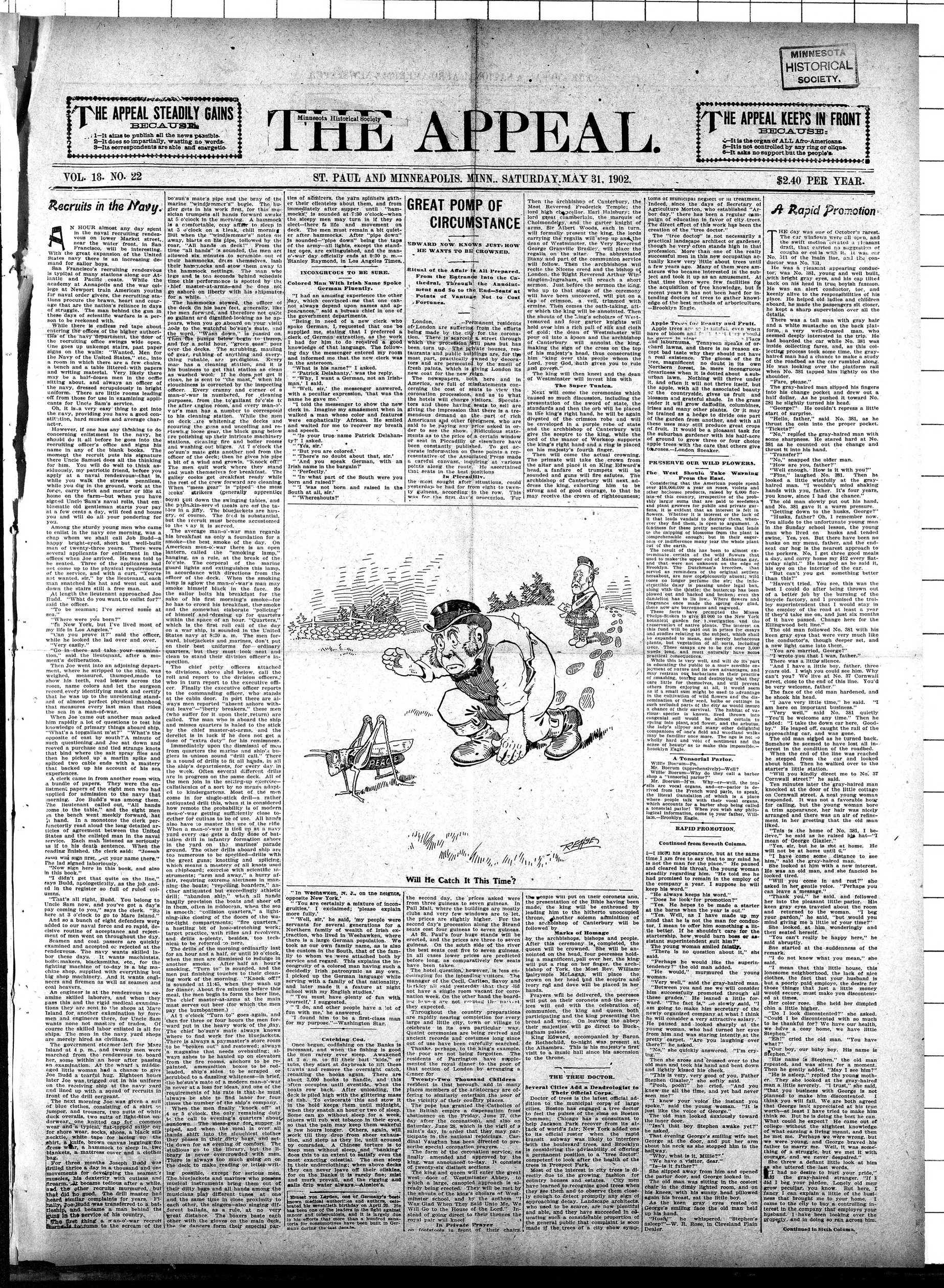
Will He Catch It This Time?
ties of admirers, the spinners gather their clientele about them, and from immediately after supper until "hammering" the sleepy men may turn in if they so elect—there is life and movement on deck. The men must remain a bit quieted, and the men's voices sounded—"pipe down" being the taps of the army—all lights, except the stand of men—warm and friendly, men—oar day after lunch, at 8:30. Stanley Raymond, in Los Angeles Times.
INCONGRUOUS TO BE SURE.
Colored Man With Irish Name Spoke German Fluently.
"I had an amusing experience the other day when I met a clerk who not always spend upon names and appearances," said a bureau chief in one of the government departments. "I asked the clerk who spoke German, I requested that one be supplied me, stating that I preferred a German clerk. I had for him to do required a good knowledge of that language. The following day the messenger entered my room and informed me that the new clerk was
"What is his name?" I asked. "What
would he want?" I replied. "Why
would he want a German, not an Irish
man," said.
"Well, sir," the messenger answered, "expression, that was the name he gave me." I told the messenger to show the new man his color and features, walked a man whose color and features were emphatically African. He smiled and asked for me to recover my breath and speech.
"Is your true name Patrick Delahan-
doy, 'Tyr, sir."
"In what part of the South were you born and raised?"
"Was not born and raised in the South?"
"Werehauts?"
PEACE
"in weenawken, N. J. on the neignties,
"You are certainly a mixture of incongruities, I exclaimed; 'please explain me,
"Well, sir, he said, 'my people were servants for several generations for a Northern family of wealth of Irish exile,
"There is a large German population. We took as our own family name, am is also the custom in the South, that of the family service and regard. This explains the incongruity of a colored man having such a German identity, I picked up the German language while serving with a family of nationality, and I went to a night school with my English studies."
You must have plenty of fun with yourself. I suggested.
I am a lot of the people have a lot of fun with me, be answered.
"I found him to be a first-class man for my purpose."—Washington Star.
Catching Coa.
Once again, codlifting on the Banks is necessary, and when fishing is good the men rarely ever sleep. Awakened at 2 a. m. to fill their boat "kids," or tubs, they start at daybreak to lift these trawls and remove the overnight catch, rerating the hooks again. There are about 800 to 1000 to handle, and often occupies until eventide, when the boats row back. After unloading, the deck is piled high with the glittering mass of fish. To eviscerate this and stow it in the hold keeps them until midnight, when they snatch an hour or two of sleeves. Some can go without sleep for a week, others will rub wet tobacco in their eyes, so that the pain may keep them wakeful a few hours longer. Others, again, will work till they drop from sheer exhaustion, and sleep as they lie until aroused by comrades. A Chinese torture is to keep men without sleep, and "banking" does this to an extent to satisfy even the most exacting celestial. The men sleep in their underclothing; when they are weak, they are very much off the edge of the fish. For on the Banks it is rarely fine; mist and mork prevail, and the rigging and sails drip water always.
Ernst von Leyden, one of Germany's best known medical authorities and author, April. He was the new head of the new military in Germany. He has been one of the leaders in the right against senator and tuberculosis, and it is largely due to his efforts that more than a hundred museums for consumptives have been built in Germany during the last decade.
GREAT POMP OF CIRCUMSTANCE
GREAT POMP OF CIRCUMSTANCE
Ritual of the Affair Is All Prepared.
From the Entrance Into the Cathedral, Through the Anointiment and So to the End-Sents at Points of Vantage Not to Coat Fortunes.
London. - Permanent residents of London are suffering from the efforts being made by the city for the coronation. There is scarcely a street through which a man has pass but has been torn up. The private restaurants and public buildings are, for the most part, practically owned by decorators and artisans, with the smell of fresh paints, which is giving London its new coat for the new reign.
The newspapers, both here and in America, are full of misstatements concerning the coronation processions, and as to what the hotels will charge visitors. Speculators and those having seats to sell are aware of the tremendous demand on the part of rich Americans and other foreigners, who are said to be paying any price asked in order to obtain the ceremonies as to the price of a certain window or seat in Pleadigh or elsewhere have been constantly published. To get acquainted with the Association of the Associated Press made a careful canvass, inquiring at various points along the route. He ascertained that seats in the building were representative of the Associated Press made a careful canvass, inquiring at various points along the route. In Pleadigh, the most sought after situations, could yesterday be bead for from eight to twenty-five dollars, and was for the first day's prosecution. The
Will He Catch It This Time?
the second day, the prices asked were from three guineas to seven guineas. In Pall Mall, where the buildings are mostly made of brick, the prices are slightly higher. For the second day's procession along the Strand seats cost four guineas to seven guineas, and the prices are slightly higher. For the second day's procession along the Strand seats cost four guineas to seven guineas, and the prices are three to seven guineas. On the south side of the river the best seats cost five to seven guineas, and the prices are before long, as comparatively few seats have been taken. The river, however, is less encouraging for the intending visitors. The manager of the Cecil, Savoy and Barkley all said, yesterday that they did not expect the intending nation week. On the other hand the boarding houses are not keeping the market expected. The country preparations are rapidly nearing completion for every large and little city, town or village to celebrate its own heritage, being believed and ancient records and costumes long since out of use have been carefully searched. The parish, perhaps the poor parish being belighted. The residents of Parrington have supplemented the royal dinner to the poor of that section of London by arranging a
Twenty-Two Thousand Children resident in that borough, and in many places of the British empire, are suffering to similarly entertain the poor of the vicinity of their country places. The pope has granted the ecclesiastical of the British empire a dispensation from abstinence on the Friday, June 27, (the day after the coronation), and also on Saturday, June 28, when he is sainthood's day, in order that they may participate in the national relicdings. Cardinal Taughan has been directed to preside over the sainthood's day, in order that they may participate in the national relicdings. The form of the coronation service, as finally amended and approved by the king, it consists of twenty-six distinct sections. The king and queen will enter the great hall and enter the anthem which a large, cannaped approach is already be erected. They will be met by the shouts of the king's choir of Westminster, an anthem known when They Said Unto Me. We Will Go to the House of the Lord." Instead of going direct to their thrones the royal rallr will know to the Private Prayer
Then the archbishop of Canterbury, the Most Reverend Frederick Temple; the lord high clergyman, Earl Halsbury; the lord great chamberlain, the marquis of Cholmondeley, and the garter knight of arms, Sir Albert Woods, each in turn, will formally present the king, the lords carrying the regalla will step up and the dean of Westminster, the Very Reverend George Granville Bradley, will place the regalla on the altar. The abbreviated litany and part of the communion service will follow. Then the archbishops will recite the Nicene creed and the bishop of London, the Right Reverend Arthur Winnington-Ingraham, will preach a short sermon. Just before the sermon the king, who up to that stage of the ceremony will have been uncovered, will put on a cap of crimson, a vell, trimmed with ermine. Then comes the oath-taking, after which the king will be annorted. Then the shouts of the king's scholars of West-removed and four garter knights will hold over him a rich pall of silk and cloth of gold; the dean of Westminster will pour oil into a spoon and the archbishop of Canterbury will annont the king, making the sign of the cross on the top of his majesty's head, thus consecrating him "king over this people whom the Lord, your God, hath given you to rule and govern."
The king will then kneel) and the dean of Westminster will invest him with
The Super Tunica.
Next will come the ceremonies which caused so much discussion, including the king's right hand, the standard and standards and then the orb will be placed in the king's right hand, he will be again enveloped in a purple robe of state and the schiapshole of Canterbury will have been placed in the lord of the manor of Workshop supports the sword right hand and a ring is placed in the left hand.
Then will come the actual crowning of the king, the altar and place it on King Edward's head, a fanfare of trumpets will be played, the archbishop of Canterbury will next address the king, exhorting him to be crowned, and may receive the crown of righteousness:
RELEASE
the people will put on their coronets and, the presentation of the Bible having been given to him, the hitherto unoccupied throne, another solemn admiration of the archbishop of Canterbury will be followed.
Marks of Honour
by the archbishops, bishops and people.
After this ceremony, is completed, the people will put on their coronets, pointed on the head, four peerses holding a magnificent, pal over her, the king will put on their coronets, the king will put on Yew of the Most Rev. William Dalrymple McLagan, will place the crown on her head and the sceptre and ivory dove will be placed in her Prayers will be delivered, the peerses will put on their coronets and the servants, communion, the king and queen both participating and the king presenting the bread and wine. On leaving the abbey their majesties will go direct to Buckingham, the king Edward, accompanied by Baron de Rothschild, to-night was present at the Alhambra. This is his majesty's first visit to the temple, which since his ascension to the
Several Cities Add a Dendrologist to Their Official Corps.
Doctor of trees is the latest official addition to the corps of large cities. Boston has engaged a tree doctor to feel the pulses of the elms on Boston streets. The consultant to help Jackson Park recover is lacking of world's fair; New York added one to its official roster when the rapid growth of the city with the boulevard trees, and Brooklyn is considering the advisability of offering a permanent position to a "tree doctor" at the health of the trees in Prospect Park.
Most of the interest in city trees is directly due to the growing fashion for colour, fashion and estate. City man have learned to recognize good trees when they see them and to observe them closely enough to detect promptly any sign of touching, landscaping or who need to be scavenge, are now plentiful and able, and they have succeeded in educating such a considerable proportion of the general public that compliant is soon made if the trees of a city show symp
toms or municipal neglect or in treatment. Indeed, since the days of Secretary of State John F. Kennedy, the term "bark day" there has been a regular campaign of education in favor of city trees. The direct effect of this work has been the creation of a "tree docto" is not necessarily a practical landscape architect or gardener, though he very often stands high in the park. The "tree docto" is not really successful men in this new occupation actually knew very little about trees until they were taught by experiencedateurs who became interested in the subject and took it up as an amusement. At the same time, the acquisition of free knowledge, but in recent years it has not been hard for inventors to create trees to gather knowledge of the best methods of arborecture — Brooklyn Esq.
Apple Trees for Beauty and Fruit. Apple trees are beautiful, even when bare of bloom and fruit. They should be grown in a place and laburnums. Tennyson speaks of or chard lawns, and there is no reason except bad taste why they should not have a real existence. The gloom of the first tree, magnificent no doubt in its own Northern forest, is mere incongruous dreariness when it is dotted about a suburban lawn. Nothing will thrive under it, and often it will not thrive itself, but the apple, with all the associated beauty or the countryside, gives us fruit and blossom and grateful shade. In the grass under it will grow daffodils, columns, irises and many other plants. Or it may be trained as a hedge to divide one part of the garden from another, and with all these uses may still produce great crops of fruit. It would be a pleasant task for the suburban gardener with his half-a-creed apple trees with the care that others give to roses. — London Speaker.
PRESERVE OUR WILD FLOWERS
The West Should Take Warning From the East
Considering that the American people spend over $18,000,000 a year on roses, violets and other holistic products, raised by 8,000 florists-of this country, irrespective of the probably larger sums that are paid to seedmence and plant growers for public and private gardens, it is evident that an interest is felt in flowers. Whether it is interest or the lack of interest, the nature of the plant, the nature of the plant, ever they find them, is open to argument. A findness for these pretty nectaries that leads to the snipping of blossoms from the plant is comprehensible enough; but in their eagerness or indifference many tear the whole plant out of the earth.
The result of this has been to almost exterminate certain of the wild flowers that used to make the upper end of Manhattan gay, and to make the upper end of Manhattan gay. Brooklyn. The Dutchman's breeches, that served as reminders of the original settlers' herabout, are now copiously absent; wild roses no longer perfume the stir; the indestructible daisy is paring under legal ban, along with the thistle; the buttercup has been plowed out and hacked and broken; even the dandelion has to lie low. Where flowers and flowers are cut, the flowers may glad, there now are barrenness and raged.
These facts have prompted the Misses Phelps-Stokes to give $3,000 to the New York botanical garden for 4 investigation, and the preservation of native plants. The interest in this fund will be paid out in prizes for essays and studies relating to the subject, which shall be made to the mean, not merely herbaceous plants, but regard as to delivery, including trees. These essays are to be for 3,000 words long, and must naturally have some practical consequences.
While this is very well, and will do its part in educating children about nature and its own advantages, and may restrain our barbarians in their practice of amusing, leaching and desecrating, and will protect them from enjoying at all, it would seem that our cultivation of wild flowers and the semination of their seed, bulbs or cuttings in such secluded areas would insure their survival in the natural biotic species is known. Seed thrown into soil to spring into plant and flower, and the arbuscular the lady's slipper and many other delightful flowers may be familiar one more. The age is not so wholly hard and void of sentiment and that may be made to this impossible—brooklyn Eagle.
A Tensorial Parlor
Mr. Boerum-Him "Why—r-well, the tone arrived from the French word parlor, to speak, the literal translation of which is a place where accounts for a barber shop being called a torsional parlor? When you wish any philanthropist to come to your father, William-Brooklyn Eagle.
RAPID PROMOTION
Continued from Seventh Column.
I—I KHOK his appearance, but at the same time I am free to say that to my mind he must be a man, and cleared his throat, the young woman steadily regarding him. "He told me he had promised to remain in the employ of a year. A year, he supposed he will keep his word." "He always keeps his word." "Does he look for 'promotion'?" "Yes. He hopes to be made a starter at the school." "Yes. Well, as I have made up my mind that he is not the man for conduct, I mean to offer him something a little more special, his startership, how would barn boss or assistant superintendent gift him?" "The young woman smiled friendly." "There is no question about it," she said.
"Perhaps he would like the superintendency" the old man added. "Would," murmured the young woman. "Very well," the gray hair-ridden man. "And me we will consider him successful in all these grades." He leaned a little forward. "The fact is," he slowly said, "I would make him secretary of the newly elected mayor." He will consider a very attractive salary. He paused and looked sharply at the young woman, who had turned her eyes on him. "How pretty, pretty carpet. "Are you laughing over there?" he asked. "No, she quickly answered. "I'm crying." Then she arose and crossed over to the old man and took his hand and bent down. "This is very, very good of you, Father Stephen Glazer," she softly said. "Pooh, pooh!" he cried. "And you know all the time, and yet had never seen me?"
"I knew your voice the instant. "You are just like the voice of Georgia. "
The old man looked anxiously toward the inner door.
"Isn't that boy Stephen awake yet?" he asked.
That evening George's smiling wife met George at the door, and put her arm down near a neck as she stopped him in the hallway. "Why, what is it, Mille?" "Why, what is it, pastor, dear." "Is it father?" She slipped away from him and opened the parlor door, and George looked in. The man was sitting on the cool chair in the dimly lit room, and on his knees, with his sunny head pillowed down, he sat the little boy. As the knelt boy placed on George's smiling face the old man held up his hand. "He was whipped," Stephen's sleepy." W. R. Rose, in Cleveland Plain Dealer.
MINNESOTA
HISTORICAL
SOCIETY.
$2.40 PER YEAR.
A Rapid Promotion
THE day was one of October's rarest, the car windows were all open, and the draft, that carried no suggestion of coughs or colls with it, was car No. 381, on a main line, and the conductor was No. 382.
He was a pleasant appearing conductor, 383, young and well built, with bright green hair, on back on his head in true boyish fashion. He was an alert conductor, toc, and he helped the old ladies and children aboard, he made the passengers sit closer, he kept a sharp supervision over all the doors. There was a tall man with gray hair and a white mustache on the back platform, a very well-dressed man, who was wearing a blue coat, who boarded the car while No. 381 was inside collecting fares, and, as this collecting process took some time, he made a grycky of the robed as the car rumbled along, as he looked over the platform rail when No. 381 tapped him lightly on the shoulder. "Pare, please," he said. The man slipped his fingers into his change pocket and drew out a half dollar. As he pushed it toward No. 381 he slightly turned his head. He couldn't repress a little start of surprise.
"Hello, father," said No. 351, as he
coin into the proper pocket.
"Tickets?" No, replied the gray-hatched man with
some sharpness. He stared hard at No. 351 as he
counted out the change and then
touched the older man.
"Transfer?" No, replied the older man.
"How many you, father?" No,
"Well enough. How is it with you?"
No, he looked at the older man and he
looked a little wistfully at the gray-hated man. "I wouldn't mind shaking hands with you, father. It's four years,"
No, he looked at the older man. "The old man slowly put out his hand, and No. 351 gave it a warm pressure."
No, he looked at the older man. "Husks, father?" Oh, I remember now. You allude to the unfortunate young man
Sunday school lesson the young man
wrote. Yes, yes. Yes, yes. But there have been no
husks on my menu, father, and the end-
ing of the day. He laughed as he said it,
the porchers. No, I get three good meals a day, and carry home my $12 every Saturday night. He laughed as he said it,
"But can't you get something better
"Haven't tried. You see, this was the best I could do after being thrown out and broken by, by the burning of the bicycle he tethered to, the tie superintendent that I would stay in the employ of the road at least a year if they take me on, and just six months if they take me on, and change here for the Ellingwood belt line." The old man followed No. 381 with his keen eyes that were very much like a camera set, and a new light came into them. "You are married, George?" "I wrote you that I was, father." "There are two." "And I have a little boy, father, three years old. I wish you could see him. Why can't you see to the live at No. 37 Cornwall." "You can see to the live at this father." You'd be very welcome, this father."
The face of the old man hardened, and he shook his head.
"I have very little time," he said. "I am here on important business." He asked, "What time are you quietly 'You'll be welcome any time.' Then he added: "I take the down car here, Goodby." He leaped off, caught the rail of the approaching car, and was gone. Then he turned back, Somehow he seemed to have lost all interest in the condition of the roadbed. He stepped to the end of the life was reached, he stepped back, and about him. Then he walked over to the starter's little station. "He met me to No. 37 Cornwall street," he said.
Ten minutes later the gray-haired man knocked at the door of the little cottage on Cornwall street. A neat young woman on her phone called, but the young woman bore a trim appearance, her hair was nicely arranged and there was an air of refinement in her greeting that the old man liked.
"This is the home of No. 381, I be afraid I missed his hat—I mean of George Glazer."
"Yes, sir, but he is not at home. He will not be at home until 6."
He has come some distance to see him, said the gray-haired man.
She looked at him with a new interest. He was an old man, and she fancied he to "Will you come in and rest?" she asked in her gentle voice. "Perhaps you can leave a message," she said, and followed her into the pleasant little parlor. His keen gray eyes traveled about the room and she saw the woman, "beg your patience," he said, so mind giving me a little of your time?
She looked at him, wonderingly and then seated herself, "I can be really happy here," he said abruptly.
She started at the suddenness of the remark.
"do not know what you mean," she said.
"I mean that this little house, this lonesome neighborhood, the lack of nice clothes, the fact that your husband is sick, the fact that you have those things that just a little money would secure, must make you discontented times. Her rose. She held her dimpled chin a little higher.
"Do I look disconcerted?" she asked.
"too much to be thankful for? We have to
weave have a cozy home, we have little
"Ench" cred the old man. "You have
what?"
"toy, our baby boy. His name is
Stephen."
"His name is Stephen," the old man repeated, and was silent for a moment.
Then he gently added, "May I see him?" She replied, "I repile the older mother. They learn man a little severely. "I trust," she said, that you business with George is not difficult to think you will fail. We are both agreed that George isn't appreciated at his true worth-at least he have tried to make him a better man. "What could he expect? He came out of college without the slightest knowledge of me. He met me. Perhaps we were wrong, but we were young, and George braved his fear of a struggle, but we met something of a struggle, but we met it with courage, and we never despaired." She shewed a defiant little look at him. "I had no desire to hurt your pride," she had the gray-haired stranger. "If I could you, Lonely old men grow fancier I can explain a little of the business that brought me to your home. I have learned the controlling interest in the company that brought me to your husband. I have been looking over the property, and in doing so ran across him.
HAVE YOU READ
THE ARPEAL?
THE APPEAL,
A NATIONAL AFRO-AMERICAN NEWSPAPER
PUBLISHED WEEKLY BY
ADAMS BROS. EDITORS AND PUBLISHERS
40 E. 4th St., St. Paul, Illan.
ISSUED SIMULTANEOUSLY IN
Saint Paul, Minneapolis, Chicago,
Washington, Louisville, St. Louis.
ST. PAUL OFFICE,
No. 110 Union Blk. 4th & Cedar,
J. Q. ADAMS, Publisher.
MINNEAPOLIS OFFICE,
Guaranty Loan Bldg. Room 811
HENRY ROBERTS, Manager.
CHICAGO OFFICE,
823-5 Dearborn St., Suite 310,
C. F. ADAMS, Manager.
LOUISVILLE OFFICE,
No. 312 W. Jefferson St. Room 3
W. V. PENN, Manager.
ST. LOUIS OFFICE,
No. 1002 Franklin Avenue.
J. H. HARRISON, Manager.
TERMS: STRICTLY IN ADVANCE
SINGLE COPY, ONE YEAR..... $2.08
SINGLE COPY, BIXON MONTHS..... 1.10
SINGLE COPY, THREE MONTHS..... 68
When subscriptions are by any amount allowed
to be made, the Peak Money Order, Registered
Bank, or at the rate of $2.40 per
each eod week, or at the rate of $4.90 per
each cent, and two cost stamps taken.
Only one cost and two cost stamps taken.
Silver should never be sent through the mail.
The envelope and be lost; or else it will
be mailed to a person who send silver to us in letters.
Mortgage and death notice 10 lines or less
Each additional line 10 cents. Payment
must all come in order to be news.
Advertising rates. 15 cents per agate line, each
insertion. There are fourteen agate lines
on the cover. No advertising fees on
agate line. No single advertisements less
three months contract. Cash must accuse
pany all orders from parties unknown to us.
Reading rates 25 cents per line, each insertion.
No discounts for time or space. Reading
rates to the line. All head-close calls
contain.
On the address, label shows what
subscription expires. Renewals should be
made two weeks prior to expiration, so that
no paper may be missed, or the paper stops
working.
It occasionally happens that papers sent to students are lingered on the desk when due, inform by postal card at the expiration of five days or forward a duplicate of the missing number. Communications to receive attention must be new, upon important subjects, posted in the same order as the papers must reach us Tuesdays if possible, anyway and in the nature of the author. No manuscript returned, unless stamps are sent for postage. We will accept stamps responsible for the views of our correspondent. Soliciting agents wanted everywhere. Write in every letter that you write in never fail to give your full name and address, plainly stating the nature of your letters of all kinds must be written on separate sheets from letters containing new information as second class matter at St. Paul, Minn.
AGENTS WANTED.
THE APPEAL wants good reliable agents to canvass for subscribers at points not already covered. Write for our extraordinary inducements.
SATURDAY, MAY 31, 1902.
The national crime of lynching has increased to so great an extent that it is to be made the subject of Congressional inquiry.
In the Senate the other day Mr. Gallinger, of New Hampshire, offered a resolution directing the Committee on the Judiciary to inquire into the subject of "lynching" in the United States and to report whether, under the laws and constitution of the country, there is any remedy for the evil
He said that there was nothing further from his purpose than the desire to precipitate a sectional controversy. Lynchning was not by any means confined to the South. Several horrible cases had occurred in the North; and white men, as well as black, had been lynched. All over the land there was intense interest in the matter.
Mr. Gallinger gave some statistics on the subject and then had the newspaper report read of the recent burning at the stake of the Afro-American, Dudley Morgan, in Texas.
The Spanish Inquisition, Mr. Gallinger said, did not furnish a case exceeding that one in inhumanity. Fox's "Book of Martyrs" was tame in com-
---
parison; and this had occurred not in interior Africa, nor in the islands of the sea, but in Christian America. The whole wretched business was a disgrace to American manhood, and in face of it the alleged atrocities in the Philippines paled into insignificance.
He apprehended that it would be said that the federal government was powerless and that the state had exclusive jurisdiction over such offenses. If so, the American people would like to know it, so that public sentiment might be aroused and that such inhuman atrocities should come to an end and the majesty of the law be vindicated.
It certainly makes all the difference in the world whose ox is gored. William Francis, of Marion, Ind., went to his home Sunday, and found two white men talking to his sister. Francis objected to their presence and ordered them to leave. They refused to do so, and Francis procured a revolver, which caused them to retreat. Francis fired two shots at them, which did not take effect. Richard Criswell, a neighbor, came running to the scene and was shot through the hand by Francis. Mrs. Sarah Francis, mother of the young man who was doing the shooting, attempted to take the weapon from her son and was shot in the left thigh.
He was taken to jail and when arraigned the next morning on the charge of attempted murder pleaded guilty and was sent to the penitentiary to prevent further trouble. This is what happens to an Afro-American who attempts to protect his sister. Suppose the colors of the participants in this affair were changed, there would have been three Afro-American men lynched and the son and mother would have been lauded to the skies for their bravery. It's a poor rule that won't work both ways in cases like this.
Representative Warnock, of Ohio, from the House Committee on Labor, reporting favorably the bill creating a commission to inquire into the condition of the Afro-American people of the United States, says, after reviewing the purposes of the bill:
"It is painfully apparent that although nearly forty years have elapsed since the Afro-American race was given its freedom, and although it has lived in the United States during all this time side by side with the white race, that there is less of harmony between the races to-day than there was at the time the race was given its freedom."
He adds that while the Afro-American can has made very great progress in many respects, yet it is true that great evils have crept into his social, economic and industrial life. The aim of the bill, according to the report, is to acquaint the Afro-American people, comprising, as they do, one-eighth of the population of the United States, with their true condition in this country, and to furnish information for the study of their sociological condition.
The bill provides for a commission of five persons, to be appointed by the President, who shall each receive $3,500 per annum and an allowance for actual traveling expenses. Allowance also is made for the expenses of the commission, consisting of clerks, stenographers, rent, printing, &c., not exceeding $12,000 per annum.
After thirty-five years Louisiana proposes to return to separate street cars for the races. The people who favor this claim that the Afro-American race is reverting to barbarian; that it is no longer safe to permit all Afro-Americans to enter cars in which there are ladies and children, and since it would be unsafe to intrust conductors with the right or duty of discriminating the taboo must be drawn against all.
That's the brutal logic of the Southern—all Afro-Americans must suffer because a few of the race are disorderly.
That is not the way to remedy the matter. If Afro-Americans do not behave themselves on the street cars
let them be arrested and punished according to the law.
Separating the races leaves the good and bad of each race together. This is wrong in principle and degrading in practice.
The Afro-American people are as a rule law-abiding citizens, but the oppression and the humiliation they are forced to endure may in time cause a revolt and bloodshed which will make the French Revolution appear as child's play.
The Afro-Americans are a long-suffering people, but the worm may turn.
UP FROM SLAVERY
Up From Slavery. By Booker T. Washington. $1.50. New York: Doubleday Page. C. Co.
Up From Slavery" by Prof. Booker T. Washington is a remarkable volume by a remarkable author. It is a dangerous enterprise at best, and should never be undertaken except by the great man of earth. The Prof. Washington be longs to the class of great men of our time.
the buying hounds, was fighting weakly at last, and when we buried him and he struck no more, we had the brutality of man finding pleasure and excitement in torture of beasts, will depart. "The outrage and puff, coercion,pathy, while his human tormentors nothing but aversion and execration The dimness of forest moun stream and isolated den, where live
One thousand Baltimore Negroes turned out in a street parade Monday in honor of one of their fellow-citizens, Joe Gans, who won a pugilistic championship. Here is an incident for those who desire to study the race question—Washington Post.
Caucasian-Americans have turned out by the thousands to honor Fitzsimmons, Sullivan and other Caucasian pugilists. We do not approve of prize fights, but if it is right for Caucasian plug-ups to honor their pugilistic heroes, the Afro-American riff-raff have the same right.
BE SURE TO ATTEND.
The meeting of the National Afro-American协会 at St. Paul, Minn., July 9-10, promises to be the largest yet held.
All railroads in the United States have made a rate of one fare plus $2 for students in Educational Association which meets in Minneapolis during the same week, and persons wishing to attend the Council meeting can purchase tickets at Minneapolis and ride over to St. Paul on street car for 10 cents. There is no color line in St. Paul. Every hotel in the city will receive ADA accommodations may also be secured with private families at reasonable rates.
An excellent programme has been prepared. The present status of the race and the best, means of improving conditions will be discussed by other colleague speakers as Mrs. Mollie Cholew, W. Welch, ex-Representative George H. Whittle, Mrs. Shilma Yates, Archibishop Ireland, Scott, Hon. H. C. Summ, W. H. Pledge, John C. Dancy, C. J. Perry, and a host of other silver-tongued orators.
CALL FOR MEETING
Of National Afro-American Council, at St. Paul, Missouri, 10th and 11th, and 11th, 1902.
To the members of the National Afro-American Council Delegates from Local Councils and Affiliated Organizations, such as Churches, Colleges, Be-nevolent Societies, Newspapers and other Recreation Organizations.
Greeting:
The Fifth Annual Session of the National Afro-American Council will be held in the State House at St. Paul, Minn., July 9th, 10th and 11th, 1902.
It is our earnest desire that every Church, College, Benevolent Society and other Race Organization shall be represented. It is greatly desired that this annual meeting shall be the largest and most potent for good of any which the Council has ever held. The condition of the race's affairs makes this consummation mandatory. Our main reason for meeting at St. Paul, Minnesota, is to create more enthusiasm in the work of the Council in the West.
We have just received notice from our Chief Counsel at Washington, D.C., A.A. Birney, Esq., who informs us that although subject to many delays and complications, arising from local and legal causes, the Louisiana test case is now in a fair way to reach final adjudication. There is urgent need for more money to carry on this legal contest, which we hope will be cheerfully contributed by the race.
The many stirring questions of race interest which claim immediate attention should inspire every Afro-American Church, College, Benevolent Society and other Race Organization to send representatives accompanied by the annual tax of $5.00 to this great National gathering. We have every reason to believe that the meeting will be largely attended.
BASIS OF MEMBERSHIP. (Article III of Constitution.)
Section 1. The Afro-American Council shall be composed of members as follows:
1st. All persons who hold life membership.
2d. Council Delegates, representing duly accredited Local Councils.
3d. All-facilitated Designs, representing
present co-operating with Afro-American
students co-operating with Afro-American
students.
Sec. 4. Every Local Afro-American Council shall be entitled to representation in the National Council by delegates elected on a basis of one delegate to every file (50 members, and delegates to qualify upon presentation of the Council and payment of ten cents for each member so represented. Provided, however, that any Local Council having legs of 60 members shall be entitled to one vote upon presentation of credentials and payment of the annual tax of $5.00.
Sec. 3. Religious and secular organizations which have for their aim and work the general and several elevation of the race, and which desire to be with the National Council may be represented by affiliated delegates, not more than two delegates to each organization. Sales delegates shall have the right to vote upon payment of $5.00 for each delegate.
Sec. 4. Editors of Africa and Europe papers, and Principals of Academic Schools and Colleges, may be admitted to membership in the National Council and to a vote upon presentation of credentials and payment of the annual tax of $5.00.
HALF FARE RATES ON RAILROADS. Delegates can secure half rates by purchasing tickets to the National Educational Association, which meets at Minneapolis, (Street car) and from Minneapolis to St. Paul is only 10 cents. July 7th to 11th.
extract from letter from letter from Mr. Erwin, Mr. E. A., gives the necessary information: which has been made by all railroad lines in the Minesapolis concession, our association is one fare for the round trip, plus $1 membership fee in N. E. A. for the purchase price of the ticket and is prepaid purchase price of the ticket and is attached to a special membership coupon office in Minneapolis for membership. The certificate will bear a coupon entailing the prepaid case request for the copy is in office before September 1. The N. E. A. office before September 1. The N. E. A. National Afro-American Council using railroad rate which has been granted to all railway tickets to be presented to be validated at the Minneapolis office of the General. ESPECIAL CAUTION. Be careful to buy tickets to the National Educational Association at Minneapolis, coupon railroad ticket offices in the Unit-1, let them three days before July 7. Let them elect their delegates as soon as possible elect their names to Cyrus Field Adams Securities 601 S Street N, W. Washington, D. C.
to expressions of St. Paul are prescribing
to expressions of St. Paul are prescribing
to expressions of St. Paul are prescribing
to expressions of St. Paul are prescribing
one. (Biggest one.)
ALEXANDER WALTERS.
Assistant.
T. THOMAS PORCELLA.
Chaplain, Executive Committee.
CYRUS RUSKIN.
General Secretary.
THE BOOK WORLD
UP FROM SLAVERY.
Up From Slavery. By Booker T. Washington. $1.50. New York: Doubleday Press.
"Up From Slavery" by Prof. Booker T. Washington is a remarkable volume by a research man. It is well illustrated. It is a dangerous enterprise at best, and should never be undertaken except by Prof. Washington be longs to the class of great men of our time, requires neither testimony nor proof, for it the baying, bounds, was fighting him, and he struck with man finding pleasure and recreation. In the outset and marshal torture of beasts, will depart. For nothing but aversion and excursion, the gimmes of forest, mountain stream and isolated den, where live stream and isolated den, where live river and isolated den, where live animal, be animals.
In writing of the place and date of his birth he says: "I was born on a plantation in Franklin County, Virginia. I am not quite sure of the exact date of my birth, but at any rate I suspect I must have been born somewhere and at sometime. There is conscious humor in this sentence, a spice of art, and the delicate sarcasm of a great man, protesting against the instigation of slavery—that institution which had made it impossible, either for himself or Frederick Douglass to know the exact day of birth."
Later on he says that he does not know who his father was—but that he knew that he was a white man.
"My life had it's beginning in the midst of the most miserable, desolate, and discouraging surroundings." "I was born in a typical log cabin, about fourteen by sixteen feet square. In this cabin I lived with my mother and a brother and sister till after the Civil War, when we were all declared free."
An account of his boyhood day—the struggle of his mother and elder brother, the first of his children, the first of his children, the first of a simple manner which forms the real charm of Mr. Washington's literary style—has a volume however so possesses as harm higher than any of the other orations of the preparatory and the upward tolling career of a youth who is a firm, a firm in the Hampton Industrial Institute, in search of an education with boundless hope and confidence. It is the only one of his own unknowns as his only assets. On this unknown, he divines the youthful enthusiast finally reached the digital, Richmond, where he arrived by the old life of his son. He was a living and a life of his life. He must have walked the streets till after midnight. At last I became so exhausted and so cold, and was so tired. I was hungry, and was every thing but I, reached extreme physical exhaustion, I reached upon action. I was the board side walk was considerably elevated. I waited for a few minutes till I was sure to see the sun and the sunset. I was under the sidewalk and lay for the night upon the ground. Mr. Washington then re-called the next day he went down to the road and was allowed to go to the captain of a ship, who was, unloading a cargo of pig iron that his work so pleased that he had to go to the ship at a number of days, sleeping under the sidewalks every night. Economizing in order to save more of the help than Hampton. He says that the man was not always without the city's assistance. He was tender a public reception by the citizens of Richmond in a church, not far from the same place. He had a good time of going around. That he has also at the invitation of friends been a guest in a Saratoga hotel, where he was formerly employed as a wait-
He writes a very entertaining chapter on the race problem in a very comprehensive and practical manner the race-problem at the South. It is not only a very serious challenge, but early struggles that we find Mr. Washington at his best, and note distinctly that he has a great ability to understand the efforts of the man whom Walter Pierce pronounces, "the most useful man in the West." His pronouns, "the most useful man in the West," are from Up Slavery to have a large sale in the United States, and he is the world. The work has been translated into Spanish, French, English, Arabic, Indian and other languages. The work is also being prepared in other languages. The story of the life of the little slave boy, John Brown, is one of the most recognized the recognized leader of 10,000,000 of Afro-American people is a thrilling and inspiring story. Brown is in simple, modest style. It truly reveals the recognition worth of one of the greatest men the world has known.
THE NEW-BORN CUBA.
The New-born Cuba. By Franklin Matthew Martin. New York and London. Harper Brothers.
"The New-born Cuba," by Franklin M. McCarthy, volumes dealing with conditions in the peasantry of the American republic, which has been the public's much has been written about the peoples, climate and resources of the country, and the range of expectations to find any solutions to these directions. It is therefore with absorbing interest the publication of the island under American auspices as told by Mr. Matthias, who has been than cleaning the streets, purifying the water supply, and putting all public works proper order in Havana, was the task of work of purifying the buildings of every village, "black holes" of thousands of dwellings. The walls of thousands of buildings were "black holes" of yellow fever and other infectious diseases. Mr. Matthias then tells of the scientist manner in which the sanitation of the city was improved, and practice and wide reputation, and that escaped the inspection of his corps of the requirements of Major Davis, a large quantities of quickline, and a solution of coatings of paint or whitewash."
Then followed a vanishing death rate, from its former scourge of yellow fever, from its back of great importance performed by the, the author, unauthorized government the installation of an honest customs servant and the abolition of bribery and blackmail. The work of feeding thousands of starving peasants upon the author, who shows that the work of reconstruction and that had been done, the sanitation of the large cities and have been incomplete and ineffective. The reconstruction of Cuba by the people has interested as an example of the human interesting as an example of the human interesting as an example of the many lessons of vital importance it has welfare and it remains to be seen when the people do not remain in the dark ways of the old Spanish does. It does not remain an independent nationality long. On the 20th of this present month the government to the Cuban people took place. The stars and sign of the Cuban Republic was unfurled—it was the saint siempre la bandera de la libertad y de la progresa.
IN THE FOREST
In the Forest. By Maxilliman Foster, $1.50. New York: Doubleday, Page & Co.
"In the Forest" is a contribution to the literature of our country of positive nature, and a celebration of wood-life, wherein the stately deer, the cunning coyote, the fierce, and the rugged man, not in the language of men, but in the significant speech of nature "in her nature," has made Mr. Foster has made a distinct depart- life. Mr. Foster has made a distinct depart- life, and unlike Kipling's "Jungle Stories," has animals simply in accord with the imperious law of nature, and do not talk.
He plays upon your sympathies by eloquent powers of description and narration, and in the story of "Legs," the coyote transported from his western habitat to the east to furnish in the chase amusement and excitement to men and dogs, one's sympathy goes out spontaneously, only to this poor beast, struggling at times against hunger and trusting to his speed and cunning to save himself from being tornt to pieces by the murderous pack of hounds at his heels. Time after time he eluded his tormentors, but his inevitable finish had to arrive, and when it did we find ourselves wishing him better luck. "Speed was now his only hope." The climb to the hilltop was stiff, but it left the hounds behind. He took fresh hope, but shortlived indeed. They were on him anew. No use. He must turn and fight, and against what odds. Over the hill came the horsemen, thundering down the slope. "Legs" in the midst of
the baying, hounds was, fighting but, the baying, And when the "pack buried him and the man, wonders when the brutality of man, man's pleasure and recreation in the torture of man, man's outcast and pariah, our sympathy, while his human tormentors merit
The volume is profusely illustrated by Carl Rungus, and he has interpreted the aquatics with court striking and picturesque.
THE GATE OF THE KISS.
The book of the Kiss, by John W. Harding, Bond Publishing. Rough edges, illustrated cover. Rough edges, illustrated cover. Orian. $1.50. Boston: Lothrop Publishing.
This is a Biblical story dealing with one of the most important events of Judah—the war between Hebekiah, the king, and Semnacherub, the terri-ral king. The story of Isaiah is one of the conspicuous figures.
But the hero is a younger man, a poet, and a scholar. He is a favorite at court and a friend of the together a fine type of Jewish man.
Sennacherib is envious of Judah's wealth and power, and is plotting against Hezekiah, using as tools the reactionary idol worshippers still strong in the Gapulion. Naphtis is enamored of one of the Assyrian conspirators of the marvelously beautiful woman who has been proscribed in Jerusalem for playing the part of Ashtoreth at an idolistic show. She politely blinds the Jewish noble to her real character, and is surprised while making love to her at a rendezvous, by one of his comrades, Talmon, a military officer, to whom Miraone's real nature and purpose have been revealed. As the Assyrian clowners have been very, this maiden has fallen in love with a tally, and tries to save him from impending disaster. Talmon is killed in the struggle which ensues, and Miraone is saved from captivity. Naphtia is blind in the truth, because her his house is on the other side. There she has never yet taken a stage to continue the plotting against Judah, and in a great battle the Assyrian hosts defeat the king, and Sennacherib encompasses Jerusalem. Meanwhile, the Assyrian has been on the other side, and the re-servant who loves him, the true character of his wife. Miraone escapes to Babylon, becoming the favorite of the king there. Naphtia's swears vengeance, and proceeds from the love devoted Vashti, to Babylon, where he kills Miraone in the presence of the king.
The faithful Vashti whose unrequited love element in the story, saves him and her murderer as she last favor from Naphtali with a vial of poison concealed in her release both from the terrible ordeal, which story compares with "Bess." Her story thereby. It has all the elements of a successful novel.
**YAIRL GIRL, OUGLY TO KNOW.** What your book to Knew first book in a Self and Sex Series to read. D. Dr. Vib Publishing Co. 1134 Real Easel Trust Building, Philadelphia. Price $10.00
This book to young girls is a companion volume to "What a Young Boy Ought to Know", the first in the self and sex series for the first time in 1984. D. D. The book before us is composed of a series of talks between a mother and daughter and the child is taught in a beautiful way the origin of her own being to know how to know how to answer her child truthfully and saved regarding the beginnings of human life, and where she has been restrained either by ignorance or false delicacy, she will find the right to the help needed, having the added assurance that its truthfulness is the right to be written by a wise and loving mother. To daughters who have been denied the guidance and counsel of a mother, the book has also been helpful. Its teachings are consciously brought into a source of the delicacy of the author's own personality. Dr. Allen is widely known as the National Superintendent of the Women's Christian Temperance Union, and imparts the importance of the=}
The book has won the heartfelt commendation of writers and teachers, and is worthy of the fullest confidence of parents everywhere.
WHAT A BOY OUGHT TO KNOW.
What a Young Boy Ought to Know.—The first book in a Self and Sex Series to boys and men, by Sylvanus Stall, D.D.
Vir Publishing Co., 1134 Real Estate
Trust Building, Phila. Price, $0.00.
This admirable little book handles a difficult subject in a difficult way. It is scientific, but can be understood by a standard of a very simple story. For purity, clearness and intensity is a without a rival in literature of its class. There is universal need for a book of this kind, and it should be read not only by the book but by others, man, preacher, mother, and especially by every one. In the country, to what extent and in what way teachers of the public school should impart information upon this subject depends upon the fact of the teacher and the conditions in the community but that every teacher should be intelligent upon this subject of personal purity for boys and girls there can be but one option: a book has been read, and is recommended to the right class. By such persons as Drs. Theodore L. Cuyar, seph. Cook, Josiah Strong, Bishop Vincent, Anthony Comstock, John Willis, Mrs. Alice Lee Moque, Drs. Kate Waller Farrell, Mary L. Lickmore, and many other equally prominent teachers and are we desire to add our heartiest editorial approval and commendation.
DOROTHY SOUTH
Dorothy South
By George Cary Eggleston $1.50.
Boston: Lothrop Publishing Co.
Mr. Eggleston deals in this book with the Virginians of the great plantations during the decade before the civil war, when not to be a Virginian was deemed by them a misfortune, if not a sin of omission. They looked upon their countrymen from the state of much as the Greeks looked upon foreigners they considered them "barbarians." Mr. Eggleston tells us at least for the purposes of his novel, which mingles a simple, most readable love story of a series of pictures of the life and the time and the place that are full of grace.
The Negro characters in the book, they are all slaves, were well treated by their masters and yell cared for because they were very valuable property.
Mr. Eggleston's hero is at first something of a prig, and some human very rapidly after circumstances has led him into the current of the plot. There is no dreamed here, even though the war fills the closing chapters of the book, which is mainly a picture of the peaceful, cultured, conservative, old-fashioned south of the past.
THE WESTCOTES.
The Westcotes. By A. T. Quiler-Conch. Cloth semi-flexible covers, $1. Philadelphia: Henry T. Contes & Co.
phil. Henry A. Cottes & Co. is a local landmark in the time of the Napoleonic wars, in the time of the Napoleonic era, in Blackwood's Magazine. The story, which deals with the intercourse of the French with the gentry of the neighborhood, hings with the gentry of the neighborhood, hings between the conventional British and the French, if somewhat uncertain. Frenchman. Love of French, sweet to try loyal heart, and after suffering, to be peace loving, in producing the local colors of the early nineteenth cen-
Couch is successful in producing the local colors of the early nineteenth century.
NEW CENTURY PLEASURE CURSE
President, J. H. Holmes; vice president, Miss F. T. Brokenberg; secretary, Miss R. Young; treasurer and Budget editor, W. C. Norris; manager, George Lawlor; critic, R. M. sensor, W. H. Sush; manager, W. H. Prans
FRIENDS OF ILLINOIS CLUB. PRESIDENT, R. A. Jackson; vice president, Wm. H. Johnson; financial secretary, King Jefferson; treasurer, Willis Sykes; recording secretary, B. D. Wilder; board of directors, T. F. Tyler, F. D. Hooker, J. W. Smith, R. Haddock, Alex Mitchell.
Knowles Building. Boys' Hall. Stone Hall. Girls' Hall. Model Home.
ATLANTA UNIVERSITY, Atlanta, Ga.
An浸教制Christian Institution, devoted especially to advanced education. College, Normal, College Preparatory and English High School courses, with Industrial Training. Superior education in Need and Training. Hard to do a physical culture for girls. Home life and training. Aid given to needy and deserving students. Term begins the first Wednesday in October. For catalogue and information, address
President HORACE BUMSTEAD, D.D.
Virginia Normal Collegiate Institute.
PETERSBURG, VA.
ECKSTEIN NORTON UNIVERSITY
CANE SPRING, BULLIT COUNTY, KY.
Industrial training will set to action ten thousand wheels.
REV. WM. J. SIMMONS, D. D., LL.D.
Co-founder and first Chancellor.
THE LOCATION.
The Eckstein Norton University is situated at Cape Spring, KY, twenty-nine miles from Louisville, KY, in one of the most health- and quiet settlements in the state—the county being what is known as a prohibition country for many years. The building and grounds come on a lofty hill of rich, rolling land, surrounded on all sides by mountain streams, dashing miniature�atares, high mountains, peopled with timber of many various species. In this quiet retreat away from the battle of City life, free from the unhealthy situations and allume-ments of places of vice and the unhealthy conditions and the one finds study easy, recreation neprout, and the physical powers developed and secured. All this play no unimportant role in the city life, and is apply suited to all who desire to prepare for an active life.
DEPARTMENTS.
Literary Photography, Crayon Work, Tailoring, Apaculture, Barbes, Thon.
Société de Co-founder, Cabi et Making, Telegraphy.
Cooking.
Foultry Retaining.
Blacksmithing.
Plain Gawling.
Prints.
Business.
Dress Making.
The above departments are under competent personnel and branches they teach. They hall from Goulin, New York to Chicago, Chicago Mauldin and other of old department institutions. They study and studies are so arranged that student may study in most desirable, leave of any age, and may study at any time. The student must attend the course at any future time. The time to finish work in all departments is TERMS.
BOARD, board, room, table, taking, teaching, maudin students may enter at any time in the year.
HELP FOR STUDENTS.
We have the printables for any reduction in proportion in the course. We ask patrons not only on account of our low rates of work done. Our accommodations are first-class and Patrons are route to, Come Spring, KY, to Louisville.
Persons en route to Cane Spring, Ky., via Louisville, May and free accommodation at No. 527 Laurel Street, Louisville, Ky.
For catalogues and all business address the Printer
WELL EQUIPPED. THROUGH INSTRUCTION.
Address 5318 St. Charles,
NEW ORLEANS, LOUISIANA
through education. strong faculty, extensive courses, reasonable expenses. Students must States and from 43 counties of Arkansas.
SESSION BEGINS OCT. 1.
for catalogue or further information address
REV. J. M. COX, D. D.
For both sexes. Departments of Law, Medical, Missionary, Missionary Training, College, College Program, Industrial, Year begins oct. 7. For catalogular circulars and other information ad-
Fourteen teachers. Elegant and commodious buildings. Climate unsuppressed. Departments: respiratory Normal, English, Music, Shortage, Typewriting and Industrial Training.
**FIFTY DOLLARS IN ADVANCE**
WITH TEACHING: tuition, fuel, tuition and incidentals for the entire term. $2.00 per month: tuition $2.00 per term. For further information, contact the department. For circuits to the president.
READ THIS BEST
THE PROCEEDINGS, OF
TIONAL NEGRO BUSINESS
Which held its first convention in Boston, Massi-
BOOKER T. WASHINGTON. President
This convention was the first National
ed business men ever held in this or any
line of business was represented: the farm
educator, the doctor, the lawyer, the man
the merchant and rulers of municipalities.
ered and papers read are all in this book
of delegates and others, which makes it a
convention.
BOUND IN GLOTH ONLY. PRICE
Send Express or Postoffice Money Order to
J. R. HAMM, PUBLISHER, 46 HOWARD
Pabst be
is always
Brewed from carefully selected barley and hops
leave the brewery until properly
IS BOOK!!
AGES OF THE NA-
BUSINESS LEAGUE"
Boston, Mass., August 23-24, 1900.
N. President and Founder.
At National Convention of color-
is or any other country. Every
the farmer, the banker, the
the manufacturer, the author,
capitalities. The addresses deliv-
this book besides over fifty cuts
READ THIS BOOK!!
"THE PROCEEDINGS OF THE NATIONAL NEGRO BUSINESS LEAGUE"
Which held its first convention in Boston, Mass., August 31-24, 1990.
BOOKER T. W. WASHINGTON. President and Founder.
This convention was the first National Convention of colored business-men ever held in this or any other country. Every line of business was represented: the farmer, the banker, the educator, the doctor, the lawyer, the manufacturer, the author, the merchant and rulers of municipalities. The addresses delivered and papers read are all in this book besides over fifty cuts of delegates and others, which makes it a valuable souvenir of the convention.
BOUND IN CLOTH ONLY. PRICE, $1.00.
Send Express or Postoffice Money Order to
Pabst beer is always pure Brewed from carefully selected barley and hops—never permitted to leave the
Defective Page
An unsectarian Christian Institution, devoted especially mal, College Preparatory and English High School courses admited in Music and Printing, Athletic for boys and training. Aid given to needy and deserving students in October. For catalogue and information, address Presid
TUSKEGEE
Normal and Industrial Institute
TUSKEGEE ALARAMA
Exempted July 4, 1881, by the State Legis
Exempted from taxation State Normal School
Exempted from taxation
BOOKER T. WASHINGTON, Principal.
WARREN LOGAN, Treasurer.
LOCATION
where the black outnumber the whites three-
times. ENROLLEMENT AND FACULTY
Enrollment Age range makes $22-
fee enrollment age attendance 100%
COURSE OF STUDY
English education combined with industrial-
training. VALUE OF PROPERTY
Property consisting of 2,267 acres of land, 50 buildings almost wholly built with student labor, is valued at $330,000, and no mortgage. $50 annually for the education of each student; ($200 enables one to finish the course; $250 permits permanent scholarship. Students may pay $100 for tuition. Money in any amount for current expenses. Besides the work done by graduates as class room and industrial leaders, thousands are reached through the Tuskegee Negro Conference.
Tuskegee is 40 miles east of Montgomery and
Tuskegee is 40 miles east of Montgomery, on the Western Railroad
of Alabama.
Tuskegee is a quiet, beautiful old Southern town, and is an ideal place for a summer. The lake is at all times mild and uniform thus making the place an excellent winter resort.
AIMS AND METHODS
The aim of this school is to do practical work in helping men towards success in broad and practical; its ideas are high, well organized, and clear; methods are fresh, systematic, clear and simple.
COURSE OF STUDY
The regular course of study occupies the first half of the course in the several departments of theological instruction usually pursued in the leading theological schools in the country.
EXPENSES AND AID
Tuition and room rent are free. The students are placed in platoons. Good board can be obtained for seven dollars per month. Buildings heat-treated.
Aid from loans without interest, and a loan from the school to students who do their internship in the line of self-help. No young man with a degree is deprived of the advantages not offered in the Seminary. For further particulars
HAMILTON ACADEMY
Baton Rouge
College Preparatory, Normal Department,
Night School, Music Department.
Total cash expenses only $6.50 per month.
Enroll in an advance. Session begins
October 1st.
RVV. CORNELIUS JOHNSON, A.M. B. M. D.
PRINCIPAL BATON ROUGE, LA.
Send your Sons and Daughters to
WESTERN UNIVERSITY
NORTH JOHANSEA
A great school for the Preparatory,
Normal, Musical, Industrial and Theological
classes. Write at least two courses
penses. Write at least for information or
cataloging.
PRESIDENT WILLIAM T. VERNON.
Coral is a shell of carbonate of time, inhabited by an animal, which can be collected under the microscope in any piece of live coral freshly taken from the water.
advanced education. College, Norw
ern industrial Training. Superior
superial culture for girls. Home life
term begin the first Wednesday
Departments—Normal and College
Music. Instrumental Music—Theoretical Agr
instrumental Music. Healthy Location; heated by steam
Healthy Location; heated by steam
board, board, tautilus, light and heat, 60.
For Catalog and Particulars
write to J. H. JOHNSTON.
President.
CANE SPRING
THE MEDICAL SCHOOL
—OF THE—
Admits Men and Women of All Races.
PHILANDER SMITH COLLEGE
RALEIGH, N. C.
PRES. CHAS. S. MESERVE;
RALEIGH, N. C.
FOUNDED IN 1881
REV. JUDSON S. HILL, D. D.
Morristown, Tenn.
A WEEKS RECORD IN MINESOTA'S CAPIT.
The Salaty City and Salaty City Folks—Neway Items of Social, Religious and General Matters Among the People, Bolted Down.
One or two gentlemen roomers wanted. Apply at 527 St. Anthony avenue, or at THE APPEAL office.
Next week at the Star the "Bowery Burlesques," an all-star troupe, first-water diamonds, every one.
Mrs. B. C. Carter has returned from her trip, much improved in health. Her many friends welcome her back again.
HOME IS MONEY. Shoes half-saled in fifteen minutes. St. Paul Shoe Repairing Shop, Minnesota near Fourth street.
Profs. J. A. Booker, of Little Rock, Ark., and L. S. Scruggs, of Macon, Mo. are guests of Mr. Harry B. Howard, 582 St. Anthony.
Messrs. R. C. Hoad and E. De Barbistate will next week open a barbershop on the corner of Selby avenue and St. Albans street.
Mrs. J. T. Young and daughter, of Mendesna, will be the guests of Mendesna j. B. Turner and W. Hackerney, of 292 Burburea ave.
WANTED—a good, sober, industrious barber. Wages $10 per week and half of earnings over $17. Address W. B. Wright, Sloux Falls, S. D.
The Elite Shoe Shining Parlor, No. 12 West Sixth street, J. B. Johnson, proprietor. Shoes shined or polished, mats for ladies. Shoes dyeing a specialty.
Mrs. T. E. Franklin entertained at dinner, Monday, Mrs. J. T. Young and little daughter, Cecil, of Minneapolis, Mrs. J. B. Turner and Mrs. J. W. Hackerney.
The most popular place for people who take their meals down town is John Godreys', No. 552 Wabasha everything, neat, clean and well cooked.
Is your hair straight? If not, send
50 cents to Ozonized Ox Marrow Co.
75 Wabash avenue, Chicago, Ill., for a
same or larger Marrow and you can
easily straighten it.
Gentlemen wishing nice furnished
rooms, with all conveniences, by the
week or month, at reasonable rates,
should apply at the Benton House, 228
West Third street, up stairs.
Anyone who can give any information
regarding the whereabouts of Mr. J
Ryan the Hotel, will confer a favor by
sending the same to THE APPEAL
office at once.
Let your object in life be that you
will be somebody in fact or nobody
in fact. Never allow yourself to be
a victim. Never allow yourself to be
your secret life gives you the lie, for
you only destroy yourself.
If you wish a good shave, hair cut or
shampoo at Richard Cousby's
neat shop, No. 274% Minnesota street.
First-class workmen only. Satisfaction
will be guaranteed. All occa-
cions furnished on short notes.
Mr. A. B. Buckner, who had some trouble with Charles H. Clark, a rental agent, a few days ago at the corral gate, pleaded guilty in the police court. Tuesday, and was allowed to sign a peace bond.
Elk Express, D. D. Charleston, prop, packing and shipping; hauling of all kinds; coal and wood in large or small quantities. When you wish to call the office, you can call Telephone, Main 13282 J. 1. Office, East Sixth street
Monday and Tuesday nights, and Wednesday matinee, at the Metropolitan, Mr. Nat Goodwin and Miss Maxine Elliott, in "When We Were Twenewednesday night," an American Citizen, half of the week the Frawley Company.
Those of our patrons who desire to have matter published must get the same in this office not later than Thursday afternoon, otherwise it may be crowded out. No notice will be given out. No communication that is not signed by the author.
DR. JOHN E. PORTER, physician and surgeon, office suite 410 Bradley Building. Fifth street, opposite Court House. Office hours: 10:00 m. to m. phone in room 178-31 J. Residence, 483 Carroll street. Telephone, Dale, 464 L. 2.
Gentry Brothers' dog and pig show will exhibit on Wabasha street and College avenue show grounds the week of June 2. beginning with a Monday matinee. The show is entertaining, matinee-like, and it has, however, attractions or adult lovers of animals.
Pilgrim Baptist, Cedar and Summit—Services. 1:45 a.m. $ m. p. Rev. W. D. Carter, pastor. Morning sermon by Rev. E. L. Serrugg. D. D. Subject "Freedom through the Knowl," and Our 4.00 p.o. year. Serve Rev. J. A. Booker, D. D. Subject, "The Secret of Paul's Success."
SAFE DEPOSIT AND STORAGE vaults—We invite your inspection. It costs little to place your papers, cash securities and valuables in absolute safety. Boxes in our vaults can be used for your boxes, trunks, etc., with us. St. Paul Trust Co., 133 Endicott Arcade
Visitors to the city, and residents also, who wish to get first class meals should call at John Godfrey's, No. 552 Wabasha street, between Tenth Street and College Avenue. Board and rooms are available rates. Best meals in the city. Regular meals 25 cents. Sunday dinners from 1:00 to 5:00 p. m. a special. ☑
Mr. G. K. Grissom, who before her marriage to have the position of stenographer of the Golden Rule, a place now held by her sister-in-law, Miss Hattie Grissom, has again been employed as stenographer in the mail order department. The good example which the proprietors of the Golden Rule have so long set in employing competent Afro-Americans, is one that several other business houses ought to follow.
The people of the Twin Cities have invited the members of the National Afro-American Council and the Nationwide Association to meet in St. Paul during the week when the National Teachers Association will be held in Minneapolis. This should bring together the largest
WILLIE WAS WISE.
Sister's Beau—So you don't know me, Willie?
Willie—Oh, yes, I do. You're the guy Ma says would be such a good catch for sister.
Beware of fire!
number of prominent men and women of the race ever gathered. There are only a few weeks left for the preparations and a general awakening should be had. Much work is to be done and must begin now. This is a matter in interest. LET US GET TOGETHER AND STICK TOGETHER
SPECIAL NOTICE
It is the desire of the General Committee having in charge the general arrangements for the meeting of the National Afro-American Council in all good, respectable, desirable citizenship, tend the reception and banquet which is to be given in honor of the delegates to the National Press Association and the National Council at the general armory of the State University of Florida. The director that such acceptable citizens may be accommodated with tickets if they desire them they are requested to forward the full names and addresses of each and every one they desire to attend the general committee. IQ. Adams, Union Block, St. Paul, on or before June 10 from the names of those sent in the list of eligibles will be made up. By order of Executive Committee, F. L. McGHEE, Chrm, J. O. ADAMS, Secv.
EDUCATIONAL MEETING
Largely Attended Meeting at Pilgrim Baptist Church.
There was a very largely attended meeting at Pilgrim Baptist Church, Thursday night, in the interest of education of the Afro-American in the South. After a song, "Stand Up for Africa," she addressed the Prof. J. A. Booker, president of Arkansas Baptist College, Little Rock Ark., was introduced, and spoke most eloquently and entertainingly on "The Educational Policy of Afro-American Schools at the South." He was jokingly asked to explain the president of Western College, Macon, Mo., who told of "The Relation of the Northern Afro-American to the Southern Schools." Madam Preston then, in her inimitable way, most pleasently read a number of Paul Lawrence Dunbar's works, including "The Influence of Mexico, spoke of "The Influence of these Schools upon the Religious Life of the Afro-American." Mrs. George Griggs was the next speaker, and she had no special topic. Her remarks were most timely and beneficial. The speaker was a woman, the speakers was our own F. L. McGhee, who made one of his impassioned appeals as only he can. The result was that about $34 was raised in a few moments to be divided between the two schools in question. All the speeches were excellent, and the meetup was a great success, engaging and beneficial our city has known for a long time.
TWELTH NIGHT.
At the Grand Opera House, St. Paul.
"Twelfth Night" has been selected as the second offering of the summer season of the Percy Haswell Stock Company at the Grand Opera House. This is one of Shakespeare's most popular books, most been popular in the Shakespearean repertory. Miss Haswell will appear as Viola, a part in which many eminent actresses have added to their laurels. The story of "The Twelfth Night" is the story of a maiden being ing in all the plays of the great hard. The play treats of the device of a shipwrecked maiden to escape scrutiny in a strange land, by assuming the clothes of her brother, whom she has been married to. The maiden is Viola, and in the guise of a boy, she becomes a page of the Duke Orsino. He is in love with the lady Olivia, who will have none of him, and when the Duke in despair sends the pretty page boy to carry his love to the maiden, the beauty falls in love with the messenger instead of with the master. The love scenes in which Olivia seeks to woo Viola are exquisitely delicate and humorous. Then the shipwrecked maiden starts resemblance to Viola, the Lady Olivia thinks he is the same, and straightway marries him. By the time she discovers her mistake, the Duke has found that the pretty page boy is in love with her heart, and all ends happily.
Miss Haswell will be Viola. Mr. Glimore will play the role of Benvola. Mr. Lewis will be the Duke. Miss Laura McGlivray will be the Lady Troi Mr. Alachie Hudson will be Dr. Toy Mr. Bacchus will be Jr. Mr. the redoublet Sir Andrew
THE APPEAL: A NATIONAL AFRO-AMERICAN NEWSPAPER
MINNEAPOLIS ELKS' FAIR.
MEXICAN VILLAGE
MOONLISH PALACE
OCEAN TRAIN ANIMAL SHOWS
ORIENTAL THEATRE
MIDWAY
PONY SHOWS
CONGRESS OF ALL NATION
Aguuechek. The production will be made on a lavish scale, with elaborate scenic investiture and historically correct costumes.
**FIGHT FOR PRINGIPLE.**
The Afro-Americans of Rochester, N. Y., the home of the "Old Man Eloise Donglass, are considerably wrought, over a civil rights case in that city.
Under chapter 1042, Laws of 1895, George W. Burks, a few weeks ago, sued Paul Bosso, proprietor of a non-profit property. The Powers building, for refusing to polish his shoes, and secured a verdict for $113.40. The defendant appealed and the case was reversed on the ground that a shoe polishing stand, maintained in public accommodation, is not a place of public accommodation.
MINNEA
MEXICAN VILLAGE
MIDWAY
THE MIDWAY
There is every indication that the ELKS fair, which will be in progress at Minneapolis for two weeks beginning Monday, June 2, will be in complete readiness for the public on the opening day.
The booths, numbering nearly 500, have already been completed so nearly completed that exhibitors can begin decorations at once.
On Wednesday the performers engaged in the fair, the first being the stand for a season of twenty weeks. It is said that there are over 200 performers, outside employees, and a menagerie of fifty animals.
The illumination of the 'fair' is to be made a special feature, nearly $300 will be offered to the courting the Court of Honor and arch alone.
In the Midway there will be a dozen or more tented show, including the Orientation Turkish artists; a congress of nations, in which there will be juggling, wire walking, fire eating, Hindo tricks, etc. In the Upper East Side of Algerians recently brought to
Last Wednesday evening the local branch of the National Afro-American counsel held an indignation meeting, where the case was appealed and that all the counsel he asked to subscribe to a fund for this purpose. Several outside branches of the National Afro-American council, including one in Washington, D. C., pressed their willingness to support an effort to carry the case to the highest courts of the country. The refusal of the Italian to shine the shoes of Burks is a small matter. The question of what the thing is what the people are opposing.
P. E. G. G.
MINNEAPOLIS.
DOINGS IN AND ABOUT THE GREAT "FLOUR CITY."
Matters Social, Religious and General Which Have Happened and are to Happen Among the People of the City on the Falls.
Don't forget the June concert at Bethesda.
There will be a fair held at the Episcopal Mission in the near future.
Query—Why not subscribe for The Appeal and stop borrowing your neighbor's paper?
Pride of Minnesota, K of P. No. 5, passed first, and third Thursday at 104 Hennepin avenue south.
The Christian Endeavor meets every Sunday 6:30 p. m. at Bethesda Baptist church. You are most cordially invited.
Mrs. Laura Gilbert Martin and family, of Indianapolis, are in the city, the guests of Mrs. H. J. Sample, 1726 Second ave. S.
Miss M. Jackson, miller and modiste, ladies' tailoring. French cleaning and curling feathers a specialty. No. 1409 South Fifth street.
Dr. R. S. Brown has moved his office into the Century Building. No. 404th street south, rooms 405 and 406. Office 'phone, N. W., 3271-1-J Main.
The Appeal is mailed to most of the homes of the people of the Twins Cities, and if you wish matters to reach these homes you must publish them in the Appeal.
The kindergarten hour at St. James'
APOLIS ELKS
MOONISH PALACE
PONY SHOW
SHOWING SOME OF THE LEADING
this country, and a troup of Arab acrobatics. In the Mexican village will be an imitation bull fight. There will be a dog and pony circus, a spectracope exhibition, a flying lady allusion. The animal show will be a strong feature. In the Japanese tea garden there will be a continuous vaudeville show and a ladies' band.
In addition to all this there will be seven open air spectacles. These include a high dive of ninety feet by Capt. Collins, who turns two summersaults in the descent, and rebounding to the air, turns another complete sommersault. Charles Bigby dives the same distance into a tank of water only three feet deep. Prof. Neuman makes daily balloon ascensions, with parachute.
The famous "Loop the Loop," of which there is so much talk, is an additional attraction, and will be shown in a tent which seats 50,000 people. The "Cycle Dazzle," a race on a circular track only twenty-four feet in diameter, will follow. There are other amusements beside the three-foot jams, a car, a plant, ponies and donkeys for riding in the streets of Cairo, and a big Ferris
Church has been changed from 9 a.m. Wednesdays and Saturdays to noon of the same days. The school can accommodate five more children.
There will be a grand mid-summer concert by the pupils of Mrs. Hale, assisted by local talent, at Bethesda Baptist Church, Monday evening, June 16, 1902. You cannot afford to miss this annual recital.
Mrs. Celestine Brown has opened the "Creole Kitchen," boarding-house style, at 405-407 Fifth ave. S. Regular meals, 25 cents. Short orders served. First-class furnished rooms in connection. N.W. Tel. 3434-L2.
The members of Bethesda Baptist church will have their grand rally Sunday, June 8. This will be preceded by an apron sale lasting three or four nights, beginning June 2. The proceeds will go to complete the basement of the church and make some needed repairs. Will you help out in this effort?
June Fair, at Bethesda Baptist Church, three nights, June 2, 3, and 4. First night, necktie and apron social. Second night, children's concert. Third night, stereoptican views. Sunday, June 8th, will be rally day. The pastors and congregations have been invited. Rev. W. D. Carter, pastor of the Pilgrim Baptist Church, St. Paul, will preach in the afternoon at 3 p.m.
ELKS FAR AND CARNIVAL
St. Paul has taken more interest that is ordinarily manifests in a Minneapolis park. A traveling keeper, Elks' Fair and Carnival, very for the reason that it is organized on a scale which will repay a visit of a good many miles. Aside from the fact that the attractions offered are of a high class, there are several oc- ge
Property Agent—Ah! here's a farmer that wants to look at the farm that I have for sale. I'll go out and fix the place up a little before he comes.
THE RETORT COURTEOUS.
Elephant—What did the camel say when the monkey referred to his humps?
cessions that call for a liberal turn-out from the Salmity City. Several hundred Elks are to march in the opening parade on June 2d. The following Wednesday is also to march in the Governor and his staff will attend. The United Commercial Travelers' Day, Thursday, and Eagles' Day, Friday, are occasions that will attract many members of those organizations from the Salmity City. There is also a automobile flower parade, in which St. Paul chauffees will take part, together with such events as public weddings, a car show, and a flower show is to be a feature and an Elks' Day, besides one dedicated to fraternal organizations generally. The show, on its merits, however,
S' FAIR.
ORIENTAL
MUSEUM
CONGRESS
ON
THE
NATION
ATTRACTIONS.
wheel, a Gypsy camp, temple of palmistry.
On the opening day there will be a big parade, which will start from the ground at a 'clock' will be ladies' day, Wednesday St. Paul day, Thursday wedding day, Friday Eagles' day, when the members of the church will be invited to attend their national conventions will visit the fair. Saturday there will be a parade on Monday, when there will be a parade on Tuesday, when there will be lodges, and it is expected that every lodges in the state and several from the Dakota州 will be present, and when the governor and his staff will be received Thursday will be United Comfort Gates to the grand council of that order will be in line. Friday will be Minneapolis Gates to the grand council of that order other public wedding. On Saturday Ellery's Royal Italian band is to give parade and concerts, both afternoon and evening.
is worth going to see regardless of special features. There is an attractive list of out of door spectacles, such as the "Cycle Dazzle," the "Loop," the "Cycle Dazzle," diving from a height of 100 feet, "a Slide for a ball," a balloon ascension and parachute leaps daily, trapeze and acrobatics, and more. For the more Midway shows, which include a Congress of Nations, an Oriental Theatre, a Moorish Palace and a menagerie of over 50 wild animals. All of these are for the general admission of 50 cents. Furthermore, there is an Industrial Street, in which a number of St. Paul firms will make a display. The elephant made a feature and the illumination of the arch at the entrance and the approach to it will alone cost $3,000.
THE RETORT
Hamm's New Velvet Beer.
The Theo. Hamm-Brewing Co., of St. Paul, notwithstanding the excellent brew of beer that it now furrows, agreeable the extra pale beer on the market the proper surpass anything in the line of bottle beer. This new beer is called "Velvet." It is an extra pale beer, having thick, agreeable hop flavor and just the right amount of sweetness to make it an ideal tonic beverage. This beer is guaranteed to be absolutely pure and wholesome and to be made of the best selected malt and imported bops. Telephone the Big Home Brewery. __all 395, for a case.
A SYMposium ON LARIES.
The following symposium on "Laries" is worth reading, even if it fails to do the work. Telephone the Big Home Brewery. __all 395, for a case.
The liar whom the editor hates worst of all is the man, who when dunned for a yea., subscription, says he only received two or three copies and refused to pay.—Clarksville Graphic.
Next to, not above this man, the editor hates a liar who takes the paper seven or eight years, and when he cornered for settlement, says he never the paper at all.—Pike County Post.
But the worst liar of the whole outfit is the man who takes the paper several years, then moves away without it, and then asks anything about it, and yet says he is an honest man—Elsbury Advance. Brethren, you all fall short of the truth. The biggest liar in the lot is the editor who publishes the obituary and inscribes lirs and intimates that they have to heaven—Plymouth Independent.
Rich and Industrial Woman.
Mrs. Emma, E. Forsythe, whose father was an American citizen and whose mother was the daughter of a Samaan chief, is believed to be the richest woman of all living in the South Pacific islands. Her father was American consul in Samao many years ago, and she was born there. At the age of 18, having been well educated, she married an Englishman, who soon died, leaving her a third wife thirty years ago. Mrs. Forsythe began trading in different parts of the south seas and made money fast. She now lives on the island of Neu Pommern, one of the Bismarck archipelago owned by Germany, where she has a plantation of 120,000 acres, with fifty European employees and hundreds of natives. Other lands on the islands, owned by Mrs. Forsythe, who is a very rich woman thoroughly contented to live in her beautiful island home.
His Opinion of Dr. Hale.
The Rev, Edward Everett Hale, who recently celebrated his eighteenth birthday, has a fund of humor on which he draws during his few moments of ease. A little while ago, while riding in a railroad train to a point distant from Boston, he was approached by the train news agent, who laid several books and magazines in the seat beside him. The old gentleman paid no attention to them, and the agent, probably knowing that he wanted some better, prettier, protected kind of his own works. Dr. Hale, assuming a grumness he did not feel, said: "I don't want it; it's trash." The news agent looked at him for a moment disgustedly and blurted out: "I guess you are a little too ignorant to appreciate a good book."—New York Times.
Loyal to America.
It is interesting to find how anxious the children of foreign parenage are to become true Americans and resent any inference to the contrary. This was practically illustrated not long ago in the Hancock school at the North End in Boston, where almost 98 per cent of the children are of foreign birth or parentage.
Mrs. Mary A. Livermore was once a pupil of the Hancock school, in the North End. After the annual alumni banquet old pupils visit the school and addresses are made. As Mrs. Livermore rose to speak, not long ago, she addressed the girls as "my little foreign sisters," when a small Italian girl sprang to her feet and said, "O lady, weaint foreigners now, we are Americans." Mrs. Livermore was intensely with the answer.
THE ST. PAUL DAILY NEWS
Every day in the year except Sunday for per year... $1.00
Outside the City of St. Paul.
Persons troubled with Gatarrh Hay-
Pever Asthma please take notice! We
cheerfully recommend to you the
HYGIENIC INHALER
Manufactured exclusively by the two
Colored, renowned, specialist in
Patient Medicine.
The HYGIENIC INHALER can
be had by seeding $1, cash or stamps
—TO—
MONROE & ALLEN
Suite 510 Sykes Block, Minneapolis,
Minnesota.
—0—
Satisfaction Guaranteed or Money
Cheerfully Refunded.
Burlington Route
The best way to reach Chicago or St. Louis
is via Burlington Route trains. Leaving on the Scenic Express in the morning you arrive at Chicago 9:35 p. m. Leaving in the evening you have the finest Electric lighted train in the world, reaching Chicago 9:20 next morning.
ASY. YOUR HOME AGENT
FOR TICKETS VIA THE
PURLINGTON
Time Is Money
You save time and therefore money by using
Twin City Telephones.
Our thoroughly modern equipment enables us to give more prompt and satisfactory service than the Twin Cities have here before on joyed.
RATES:
$2.50 per month for residence
$4.00 per month for office.
TWIN CITY TELEPHONE CO.
Phoenix Building.
Great Special Sale of
PIANOS
1 Mahogany Ernest Gabler.
nearly new ..... $225
1 Mahogany Kimball ..... $195
1 Chickering ..... $195
1 Steilway ..... $175
1 Ludwig ..... $135
1 J. & C. Fischer ..... $120
New Uprights ..... $148
This is a good Piano
at a cheap price.
Call on or Write at Once to
SW
RAUDENBUSH
SIXTH & TENTH AND MARVEL ST.
ST. PAUL, MINN.
STATE STEAM LAUNDRY
222 W. 22nd St. Phone 1609
SMIRTS, 101
COLLARS CURTS
374
A. J. SWILKEN
MANAGER
Scott R. Walker
FINE WINES, LIQUORS AND GIGARS,
374 Minnesota St.
Tel. 185 119
ST. PAUL, MINN.
DR. HURD
91 E. Seventh St.
Specialty - Painless extracting, crown and bridge
THE "WORLD'S FAIRCITY" VIEW
BY THE APPEAL MAN.
A Compilation of a Number of Happenings,
Social and Otherwise, Among the Afro-
Americans of the Second City of This
Glorious Union.
Miss Nannie Cook, 3238 Dearborn
St., after a splendid visit through the
South, has returned to the city.
THE APPEAL is without question
the best advertising medium through
which to reach the Afro-Americans of
Chicago.
GERTRUDE IMOGENE PALMER,
violiniste. Conerts, musicals, instruction.
Room 86 Auditorium, and 680
Austin Ave.
/Subscribers for THE APPEAL who
wish to discontinue the paper must
send written notice to the office, properly
dated and signed.
It is rumored that Miss Lizzie
Slaughter, of Louisville, Ky., and Mr.
John Johnson, a well-known business
man of Chicago, are soon to be married.
Prof. Hall's Dancing Class will give a benefit ball for the Old Folks' Home at Coliseum Annex June 9. It is a worthy cause, and deserves our support.
James A. Scott, attorney-at-law, can be found at THE APPEAL office, during business hours. Prompt attention given all legal business entrusted to his care.
THE APPEAL has fixed advertising rates, and will not cut them in order to secure advertising. However, if you want to reach the people, advertise in THE APPEAL.
The Columbia Giants defeated the Gunthers, Sunday, by the score of 8 to 6. On Decoration Day they will cross bats with the Marquettes at American League ball park.
Do you want to preach? Learn at home. Send two-cent stamp to Prof. R. B. Hewitt for catalogue of Correspondence Bible School, 2808 Magazine street, New Orleans, La.
JAMES JOHNSON, Teacher of violin, room 86 Auditorium building. Miss Gertrude Imogene Palmer and Mr. Felix Weir, assistant teachers. Wednesday and Saturday, Tuesday and Friday.
If you wish a loan on household furniture, horse, wagon, diamonds, jewelry or real estate and are holding a salaried position, call on John Q. Grant & Co., Room 311, No 36 South Clark street.
Parties having money to invest on chattels, diamonds, etc., call on John Q. Grant & Co., Suite 311, No 36 South Clark street. They will give two per cent per month on all money left with them to be loaned on above securities.
Mrs. Mattle Tandy, nee Davis, one of the prominent young ladies of Memphis, Tenn., after a splendid visit amongst relatives and friends in her old home, has returned to reside permanently in Chicago. Her present address is 3115 Dearborn St.
Information is wanted of Miss or Mrs. Kate White, who left Omaha a few years ago and is supposed to be in Chicago. She is a bright mulatto, weighing about 125 pounds. Miss Omaha is likely to receive any information will be gladly received by Dr. P. C. Kebble, Pittsburg, Texas.
Excursions to Boston via the Wabash Line.
The Wabash will sell tickets from Chicago to Boston and return, June 12, 13 and 14, at very low rates. Tickets will be good going via Niagara Falls and Hoosac Tunnel Route, via Montreal, or via New York and rail or boat lines. Final return limit July 31st. For rates, time cards and full information write F. A. Palmer, A. G. P. A. 97 Adams St., Chicago.
CHRISTIAN CONGRESS.
Ten Thousand Delegates Expect to Attend Meeting at Atlanta.
Atlanta, Ga.—The Afro-American young people's Christian and educational congress, a movement to urge aggressive Christian and educational work among the Negro young people throughout the United States, which will meet in Atlanta, Ga., August 6-11, will be the first event in the history of the Afro-American when all agencies and denominations have united in one effort for the promotion of learning among Afro-Americans. The denominations and their several boards with the agencies at work among the Afro-Americans, have each a representative upon the board of directors; the board of directors consisting of 100 members. The congress will be session 1, 1000 delegates expected to be present. Two thousand commissioners have been appointed to assist, in the work of all churches and religious societies as well as institutions of learning represented at this congress.
The railroads have granted a one-fare for the round trip. The fourth Sunday in May has been designated as a day of prayer for the movement and all ministers are requested on that day to deliver sermons on the Christian training of the young people with reference to this movement. Church organizations are also asked to hold special exercises.
`<CONTINENTALS>' NEW RECORD.
C lips two minutes Between. St. Louis and
New York.
The Wabash "Continental Limited" made a new record Thursday night between Decatur and St. Louis, cutting two minutes off the best previous record.
Engineer Braddock, with No. 607, a new high-speed engine, made the 105 miles from Decatur to Granite City in 101 minutes. A five-minute stop was taken. The child, making the actual running time minutes, averaged of 65.4 miles for the whole distance. Best previous time was ninety-eight minutes.
From Staunton to Carpenter, 10.2 miles, the time was seven minutes, or at the rate of 87.42 miles an hour.
The forty-seven miles from Boody to Honey Bend were made in forty minutes—70.5 miles an hour.
The train departed from Decatur an hour before the forty minutes late, and had beside the train the moment, President Ramsey's private vehicle, Wabash officials say that the new engines will make a hundred miles an hour before the summer is over—St. Louis Republic, April 11th, 1902.
"SHADOW AND LIGHT"
The title of the book is
volume 10 of 172 pages, the author of
which is
THE APPEARANCE NATIONAL AFRO-AMERICAN NEWSPAPER
The Plymouth
Suits, Waists, Skirts, Etc.
Women's swims Tailor-Made Suits—made of Superior Venetians, Homespuns, Broadcloths, etc.; striking designs in Eton, Blouse, Tight-Fitting or Fly Front Jacket effect; blue, brown and gray; artistically trimmed with Taffeta or $10.00 moire; worth $20, at.
Most Charming Suits.
Women's handsome Tailor-Made Suits—elegantly broadcloth and cheviot materials, exclusive designs in Eton or Jacket effect, beautifully trimmed with lace moire bands, newest flare or clinging-shape skirt, in black and colors, at . . .
Fineest Etamine Skirts—Women's swell French Skirts, lightest weight for summer wear, uni- imed kilt skirt, worth $15, at . . .
Women's handsome Tailor-Made Suits—elegantly made of broadcloth and cheviot materials, exclusive designs in Blouse, Eton or Jacket effect, beautifully trimmed with lace collar or moire bands, newest flare or clinging shape skirt, $14.75 in black and colors, at
Finest Etamine Skirts—Women's swell French Etamine Skirts, lightest weight for summer wear, un- $12.00 lined kilt skirt, worth $15, at
Silk and Lace Skirts.
Women's fashionable and charming Silk and Lace Skirts, beautifully made of fancy Silk or Point d'Esprit Lace, artistically trimmed; all with fine drop skirt; worth $15 and $12, at ... $10.00
Walking Skirts.
Women's Stylish Walking Skirts — made of fine Covert L cloth, Cheviot, Broadcloth or Melton, with invected pleat or close fitting; gradient1 fouce or plain flare effect; stitched or trimmed with taffeta or moire bands; worth up to $8, at ... $3.50
Women's Stylish Walking Skirts — made of fine
Covert Cloth, Cheviot, Broadcloth or Melton, with inverted
pleat or close fitting; gradient1 flounce or plain flare effect;
stitched or trimmed with taffeta or moire bands;
worth up to $8, at..... $3.50
Dress Skirts.
Women's extra fine Dress Skirts—made of elegant Cheviot
and Cicilian, in latest tucked and taylor-made effects, some
plain, others with tucked and moire folds, mostly made with
drop skirt or extra petticoat; worth up to $10
and $15, go at..... $7.50
Plymouth Corner.
Women's extra fine Dress Skirts—made of elegant Cheviot
and Cicilian, in extra tucked and tjor-made effects, some
plain, others with tucked and move folds, mostly made with
these portraits, written up to $7.50
and $15, go at...
Walking Skirts.
Dress Skirts.
OLD-TIME STATESMAN FORGOTTEN
Yet Oliver Elisworth Rendered Valuable Services to the Nation.
Why is it that Oliver Elsworth has received so little attention from biographers and historians? asks Frank Gaylord Cook in the April Atlantic. He was not born in Massachusetts or Virginia, in Connecticut, like Pennsylvania, the historic field has been meagerly tilled. Moreover, the dramatic and opportune quality of his work has been perceived only through the perspective of subsequent years. To negotiate an unpopular convention for a party just retiring from office in defeat and ignominy is not conducive to immediate fame. Nevertheless he has not been wholly overlooked by subsequent statesmen. Webster said of him: "For strength of wisdom, for sagacity, wisdom and sound good sense in the conduct of affairs, for moderation of temper, and general ability, it may be doubted if New England has yet produced his superior." What he said, as chief justice of the United States, to the g and jury at Savannah, in 1796, was the aim of his life: "So let us rear an empire sacred to the rights of men; and I commend a government of reason to the nations of the earth."
PROFESSOR LEARNED HER NAME
But the Answer Was Not Exactly What
He Expected.
An instructor in English in the Sheffield Scientific school tells the following story at the expense of a professor at Yale. The incident happened at a faculty tea, where Prof. Blank was adoring the occasion in his usual irresistible way. The professor, it is claimed, does not realize just how effective his charming talk and romantic eyes are. In the course of the afternoon he was introduced to an especially attractive young woman, whose name, being mumbled in the presentation, he did not catch. The two repaired to a sofa, where Prof. Blank was so thoroughly pleased with his new acquaintance that he determined to find out to whom he was talking. "You must forgive me," he began, tactfully, "but I am going to ask you a personal question. Please do tell me what your name is." The young woman looked at him with large, timid eyes a moment, and then whispered sweetly, "Ethel."
Theology and Truth.
Theology changes do not affect divine truth any more than the books of books affect the shape of the earth—Rana's Horn.
Women's stylish or Rainy Day Skirts, nicely stitched or with flounce effect, in black or col'ors, worth $2 and $2.50, at. $1.50
Women's new Gibson effect Moire or Peau de Soie Waists, in red, light blue, pink, white, etc., handsomely tucked or hemstitched, buttoned in back or front, really worth $7, at ... $5.00
White Waists.
Women's stylish White Waists, hemstitched or trimmed with embroidery, button front or back, also Mercerized. Gingham or Chambray Waists in all the new colors, worth $1.25, at ... $1.00
Military Waists.
Women's swell and chic White Lawn Military Waists, in all the newest effects, also those natty Gibbon Waists, prettily trimmed with embroidery or fancy stitching, button on side, worth $2.25, at ... $1.50
Women's stylish White Waists, hemstitched or trimmed with embroidery, button front or back, also Mercerized. Gingham or Chambray Waists in all the new colorings, worth $1.25, at ..... $1.00
Military Waists.
Women's swell and chic White Lawn Military Waists, in all the newest effects, also those nibty Gibson Waists, prettily trimmed with embroidery or fancy stitching, button on side, worth $2.25, at ..... $1.50
Finest Wash Waists.
Women's charming Wash Shirt Waists, made of fine Linens, handsomely trimmed with Lace Insertion, all-over lace or dainty handwork, worth $6, at... $4.50
Shirt Waists.
Made of Percale, in neat stripes and colors, such as lavender, pink and blue. Collar and cuffs trimmed with embroidery. Should be $1, sale price... $50c
Made of Chambray, in striped or plain colors, tucked and hemsstitched, collars finished with turnovers, waists tucked; best values ever offered at... $75c
Elegant selections of silk ginghams, dimities and lawns in pretty striped effects, plainly tailored, tucked wool design, stock collars. A splendid series of values at $1.00
eventh and Robert.
Made of Percale, in neat stripes and colors, such as lavender, pink and blue. Collar and cuffs trimmed with embroidery. Should be $1, sale price ..... 50c
Made of Chambray, in striped or plain colors, tucked and stitchmed, collars finished with turnovers, waists tucked; best values ever offered at. ..... 75c
Elegant selections of silk gingham, dimities and lawns in pretty striped effects, plainly tailored, tucked yoke design, stock collars. A splendid series of values at ..... $1.00
"A good cigar is a smoke"
Rudyard Kipling
The YELLOW KING 5¢CIGAR
is a good cigar. The best that can be said of it falls short of the reality.
Smoke the cigar.
At all dealers.
HART & MURPHY, MAKERS.
BANNING ADV.CO.
AGING
ING BEER
AGING BEER
Hamm's Beer is stored and aged in the only modern refrigerating plant in St. Paul. The air is pure and sweet and the temperature never varies.
This refrigere double the actual wants, so than any other beer on the ma One of the precautions makes Hamm's Beer absolute Call for Hamm'
This refrigerator plant has a capacity actual wants, so that Hamm's Beer is older beer on the market. the precautions of Honest Brewing that man's Beer absolutely pure and properly aged. mm's Beer AMERICAN TENT & AWNING CO. 16 W. Third St., St. Paul, Minn.
double the actual wants, so that Hamm's Beer is older than any other beer on the market. One of the precautions of Honest Brewing that makes Hamim's Beer absolutely pure and properly aged. Call for
THIS IS A MARKETING IMAGE. NO COPYRIGHT IS REQUIRED.
RAMSEY COUNTY
Afro-American Club.
SOCIAL
378 Cedar St., St. Paul, Minn.
OFFICERS
J. W. WOODWORK, Pres.
J. L. PHELPS, Supt.
JOHN MORGAN, Asst. Supt.
F. D. McCRACKEN, Sec.
ANDY COMBS, Asst. Sec.
C. E. CHARLESTON, Treas.
WM. GIBBS, Chef.
Tel. Main 1786-J1.
The elevator operators have now a membership of over fifty members. Seven new members were initiated at the last meeting.
S
es.
sept.
N, Asst. Supt.
sec.
st. Sec.
ESTON, Trea.
186-J1.
rs have now a
members. Seven
lated at the last
FLOUR
Miss Maude Denise of Chicago is said to be the only woman harbormaster in the United States. She is twenty-eight years old, was named in Louisville and has worked at the trade firm.
---
A
Silk Waists.
White Waists.
Shirt Waists.
THE FASHION
Send your orders to:
e. upgrades of prices.
f. Outside Outfits.
Telephone Connections.
D, W. BURKE, Mgr.
AWNINGS
WAGON COVERS
WAGON COVERS
UMBRELLAS
NORSE COVERS.
This is the brand.
The miller planned.
To be the finest in the land.
PILLSBURY'S
Now East and West His skill attest. And Pillisbury's BEAT leads all the rest
Do not fail to visit Chicago AND THE
Special Railroad Rates. The 14th of August to the 14th September, 1902 James W. Camp, Pres. Mrs. J. C. Snowden, Sec. J. H. Hudlun, Treas. For information address
J. H. PORTER, Chrm. W. & M. Com. 610 Garfield Blvd. Chicago Ill.
"Pretty nearly as good as HAMM'S" is high praise for any other BEER
KABO CORSETS
NO BRASS EYELETS
A
Do not fail
Greatest of all
Special Railroad Rates,
The
James W. Camp, Pres. Mrs. J.
For inf
J. H. PORTER, Chrm. W. & M
Coliscum Day
May 29
Coliseum Day
HAM
is high praise
BE
KAB
NO B
FOREMOST
in
Design,
Accomplishment,
Finish.
102 MODELS
OF MARVELOUS
MERIT, INCLUDING 20
STRAIGHT-FRONT
AND BOX EFFECT.
Creations of
Fascinating Grace.
BIAS-GORED
LONG SKIRT,
LOW BUST,
DEEP HIP,
PARIS CLASP,
HAND-FINISHED;
At $1.00 to $5.00.
```markdown
```
From the 14th of AUGUST to the 14th of SEPTEMBER, 1902.
The First Practical Demonstration Ever Given to the People of the North
of the
DEVELOPMENT AND GROWTH
of the
AFRO-AMERICAN in this SECTION.
A Grand Display
The Nation's First Big Event of
the 20th century. Chicago is
the freest and most hospitable
city in the United States.
The Greatest Summer Resort In The
WEST.
To visit Chicago
AND THE
Race Expositions.
4th of August to the 14th September, 1902.
C. Snowden, Sec. J. H. Hudlun, Treas.
Information address
I. Com. 610 Garfield Blvd. Chicago Ill.
No clique, company or
individual can ever ob-
tain control of the
Proposed
Coliseum
This is legally forbid-
den. It's for ALL the
people for all time.
Pretty nearly as good as MM'S" for any other BEER
0 CORSETS
GRASS EYELETS.
Surely Best FOR Large Figures IS THE Form-Reducing
Because it reduces too high abdomen from 4 to 6 inches without harm or discomfort, lending a sincere touch of elegance and making possible the true straight-front poise. Price. $2.50. Long or Short Waist. Or all dabbers or writers. STYLE ALBUM. C. C. CO., NEW YORK.
SOCIETY DIRECTORY.
ST. PAUL.
JOHN N. NEAL, A. F. AND A. M.
John N. Neal, Grand Master.
623 Boston H.K. Minneapolis, Mina.
Wm. R. Monria, Grand Secretary.
617 Guaranty Bldg., Minneapolis, M. on.
PIONEER LODGE NO. 1, A. F. AND A. M., meets first and third Mondays of each month at Masonic Hall, No. 319 Wabasha street, at 8:00 P.M. H. G. Johnson, W. M.; W. A. Hillyard, Sec. 124 Atwater St.
PERFECT ASHLAR LODGE NO. 40, A. F. and A. M., meets second and fourth Tuesdays at Masonic Hall, No. 319 Wabasha St., at 8:00 P.M. E.J. Brack. W. M. 524 Farrington Ave.; J. E. Porter, Sec. 453 Carroll St.
PAST GRAND MASTER'S COUNCIL No. 123, A. F. and A. M., meets the second Friday in each month at Labor Temple building, Minneapolis. All visiting P. G. M. in good standing cordially invited to attend W. R. Morris, W. G. M. Thomas R. Hickman, G. S., No. 422 Anthony Avenue, St. Paul.
MARS LODGE, NO. 2202, MEETS CO.
oud and fourth Wednesday in each month
for business and the third Wednesday for
instruction at Odd Fellows' Hall, 259 E
Seventh street, J. E. Porter, N. G.; Thos.
R. Hickman, P. S., 422 St. Anthony Ave.
HOUSEHOLD OF RUTH, NO. 553, 0, U
O. of C. C. Proects first, and third Monday
between the month of March and May 2009
day for instruction, at Odd Fellows' Hall,
253 E. Seventh St. Mrs. Sarah E. Kirtley,
M. N. G.; Mrs. Ida M. Johnson, W. R.,
No. 592 Rice Street.
ST. JAMES A. M. E. CHURCH, cor.
Fuller and Jay streets. Sunday services
11:00 a.m. to 7:30 m. Wednesday
meeting, 8:00 p.m. Pastor visits on Monday
and Tuesday; at home Wednesday and
Thursday. Weddings, funerals and the sick
attended on notice. Rev. J. C. Anderson
son pastor, 300 Louis St.
PILGRIM BARTST CHURCH, Cor.
12th and Cedar. Sunday services: Preaching
at 11 a.m. and 7:45 p.m. Sunday
school at 12:30 o'clock. Wednesday evening
general prayer meeting. Friday evening
and Sunday school lesson. Funerals are
and weddings promptly attended. Rev. W.
D. Carter, Pastor, 559 Effort St.
ST. PHILIP'S EPISCOPAL MISSION
corner Aurora avenue and Mackubin street,
Early Education. Early Education. 7:30 a.m. High celebration
Holy Eucharist first and third Sundays,
1:00 a.m. Matins, second and fourth
Sundays, 6:30 a.m. Brotherhood of St. Andrew, 6:30 p.m.
Vespers, 7:30 p.m. Week services:
Wednesdays, confirmation class, 5:00 p.m.
Sundays, confirmation class, 5:00
days, Holy Eucharist, 9 a.m. REV. A. C. V. CARTIER, Rector, 750 central Avenue
MINNEAPOLIS
J. K. H. . ARD LODGE. Ne. meets first and
second. J. K. H. . ARD LODGE. Ne. meets first and
second street between Hannepin and Nicolai.
Mason in good standing always welcome.
JOHN G. STERKERT. W.
HARRY BURY . A. F. and H. A. ro. M. m. m.
AIMER LODGE A. F. and H. A. ro. M. m. m.
the first and second Monday in each month.
Mason Hall Second street between Mason
Mason Hall Second street between Mason
Mason Hall Second street between Mason
Welcome.
MINI-EAPOJK
a. D. B. a. c. a.
ANTHONY LODGE, No. 3877, meets the late and
former head coach of the North Carolina
section of Nautilus, and fourth weekend
for instruction, at their ball, second street,
where Nielot et Hainamee will be held.
W. HAGE, N. G.
JAMES A. SCOTT, P. B. P. O. BOX 33.
KNIGHTS OF PYTHIAS
TURNER LODGE, No. 8, L. of P. meets,
N. of P. in good standing. In good standing
in good standing welcome. At Lalor Tum-
tour Fourth and Fifth Ave. W. JACKSON, C. G.
JOEL A. OGAN, C. R. and B.
PRIDE OF MINNESOTA LODGE No. 1, K. of P. meets
fair and third Thursday in each month. At
Hall Second street between Hainamee and I.
Mist Ave..
PRIDE OF MINNESOTA, G. B.
R. D. WAHN, K. R. and B.
We Will Pay You ADOLLAR ADAY FOR LIFE!
For securing the greatest number of $1 subscriptions to PEARSON'S MAGAZINE before December 1st, 1992, besides paying $70 a generous commission on every order. An income of $20 a year for life, paid as a time monthly or quarterly instalment. The World of the Largest prize eugy offered in the World for work which need interfere with no one's regular pursuit. Under the Life Expectancy Tables (N. Y. State) it means $15,600 to the boy or girl of 18 years; $9,450 to the man or woman of 60; adequate provision for old age to all. $PARON'S, though not yet three years old, has over $90,000 circulation and is the biggest dollar's-worth of the machine held. To study show a copy and explain its merits in the most insignificant of the great majority of cases. 2d Prize, $1,825; 3d Title $1,005; 4th Prize, $750—all in cash annuities. An initiative workers of any age who want to get on in the world are earnestly requested to write at once to the undersigned for full particulars. (five local references). No experience required. Sample copies and subscription blanks furnished. Agents Wanted. New!
The Pearson publishing Co. 45.45 E.S., NEW YORK
50 YEARS' EXPERIENCE
PATENTS
TRADE MARKS
DESIGNS
COPYRIGHTS & C.
Anyone sending a sketch and description may
certainly purchase a patent or inventions a probably patenteable. Communicate
tomatically condemned. Handbook on Patent
suit. Great agency for receiving patentees.
Patents taken through Munn & Co. recy-
cled works, without charge, in the
Scientific American.
A handsomely illustrated weekly. Largest dec-
culation of any scientific journal. Newspaper $3 a
year from months 8, 10, 14, 18, 22.
MUNN & Co 3618 Broadway, New York
WONDERFUL DISCOVERY
BEFORE AND AFTER TREATMENT.
OZONIZED OX MARROW
THE ORIGINAL—COPTISTER.
The only haircut that makes kinky or curly hair straight as shown above. It makes hair on or breaking off, cuts dandruff and makes the hair grow long, hold over 40 years and used by men and women for natural hair. Browns of imitation. Get the Original Ozonized OX Marrow, made from the finest hair and used for one bottle, for three bodies, we pay all express express and post express and express express. With your own money, you will be able to OZONIZED OX MARROW 00., 18 Wash & Wax, Chicago.