The Appeal
Saturday, June 28, 1902
St. Paul, Minnesota
Page text (machine-generated)
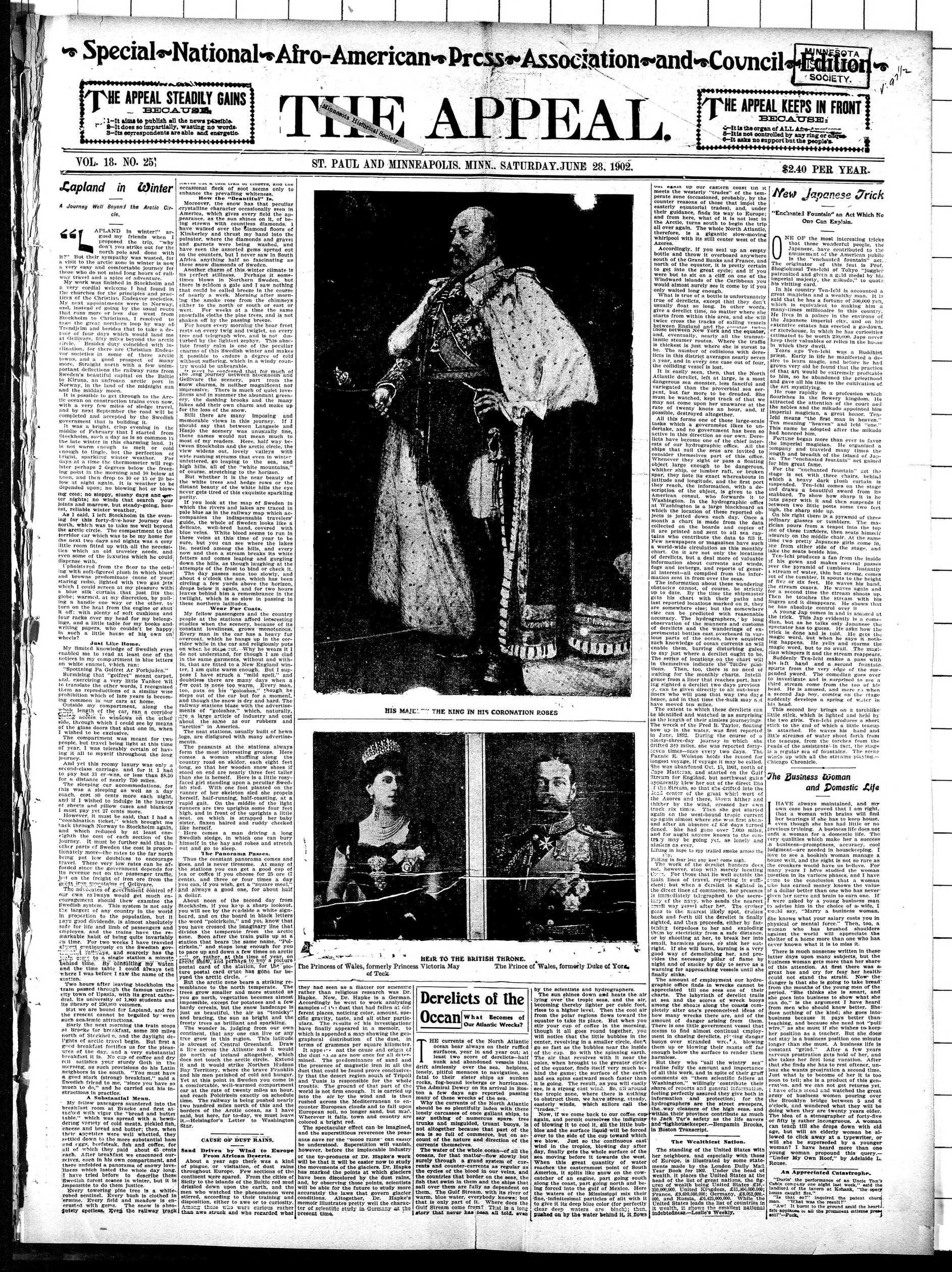
Special National Afro-American Press Association and Council Edition
THE APPEAL STEADILY GAINS
BECAUSE
1-It aims to publish all the news possible.
2-It does so impartially, wasting no words.
3- Its correspondents are able and energetic.
VOL. 18. NO. 25
A Journey Well Beyond the Arctic Circle.
APLAND in winter!" argued my friends when I proposed the trip, "why don't you strike out for the north."
it? It has sympathy was wasted, for a visit to the arctic zone in winter is now required and comfortable journey for those who do not travel far. A travel way, travel and a spice of adventure, was finished in Stockholm and a very good appointment found in the churches for the principals of the Christian Endeavor societies, Norway, and appointment societies. Norway, and appointment societies that runs more or less due west from Stockholm to Christiana. I resolved to travel to Trondheim and besides that to take a tour of four days which would land me at Gellivare, fifty miles beyond the arctic zone, for a visit to the arctic zone in Norway, in the land of the midnight sun and the midday moon. It is possible to get through to the Arctic zone, accepted by the Swedish government that it
It was a bright, crisp evening in the middle of February that I started from Stockholm in the late winter in this charming town. It is not warm enough to cool or melt or to tingle, the perfection of tristice, but the perfection of days at a time the thermometer will register perhaps 2 degrees below the freezing morning and 10 below at noon, and that is how low at night again. It is weather to be depended upon; no blowing hot or blowing cool; no sloppy, slushy days and wet nights, no joint and marrow, but steady-going, honest, reliable winter weather. I sailed last Stockholm in the evening, and I took the journey north, which was to take me well beyond the arctic circle. The compartment to the ship was to be my home for the next two days, and I had little room fitted up with all the necessities which an old traveler needs, and the luxuries which he could dispense with.
I upholstered from the floor to the cellar with soft-felt plush in blue and white blues and reds, plus a few staring reds), lighted with two gas jets which I could use with my cellar door, that just like globe; warmed, at my discretion, by pullman arm, on the heat from the engine or shut it off; with plenty of soft cushions and a little table for my belongings, and a little table for writing papers, who couldn't be happy in such a little house of his own on
Just Like Home.
My limited knowledge of Swedish even enabled me to read at least one of the book compilations in blue letters on white pages that I "Spotting Ma Pa Golfret For Arbjorden." "Surmlising that "golfret" meant carpet, a very little Yankee wille to translate the other words them as reproductions of a similar wise prohibition of late years is becoming the whole length of the car, ran a corridor Eating access to windows on the other length through which I could see by means of a camera, but not one in, when I wished to be exclusive. The compartment was meant for two pairs of velvet being light at this time of year, I was able to all it to myself throughout the long journey. This rotty luxury was only a second-class carriage and for it I had to pay but 31 er-wiles, or less than $8.50 for a distance of nearly 750 miles. For this was a sleeping accommodation for a day coach, cost 80 cents more each night, and if I wished to indulge in the luxury I must pay yet 27 cents.
However, it must be said, that I had a "combination ticket," which brought me back through Norway to Stockholm again, and which reduced by at least one-eighth the cost of each section of the journey. It must be further said that in other parts of Sweden the cost is proportionately more—the rates to the far north being put low doubtless to encourage travel. These very low rates can be afforded since the government depends for its revenue not on the passenger traffic, but on the freight of iron ore from the great from mountains of Gellivare.
The advocates of government control of our own railways would get much encouragement should the exam be the Swedish system. This system is not only the largest of any country in the world in proportion to the population, but it takes good dividends, is almost absolutely safe for life and limb of passengers and employees, and the trains have the remarkable habit of being quite invariably in time. For two weeks I have traveled a very continuously on the Swedish government's roads, and scarcely has the time to go to a single station a minute behind time. By consulting my Waten and the time table I could always tell where I was before I saw the name of the train passed through the famous university town of Uppsala, with its great cathedral, its university of 1,800 students and its library of 230,000 young
But we are bound for Lapandi, and we are bound to be aggrieled by even such academic attractions. Early the next morning the train stops at brake or breakfast, some 300 miles away, and the train stops at the lights of arctic travel before. But first a good breakfast fortifies us for the pleasure of the day, and a very substantial breakfast satisfies our sturdy Goth in the morning, as such provisions do his Latin, as such provisions do his French, as such provisions do his good sturdy (strong) breakfast, and a Swedish friend to me, "since you have so much to carry out, carried out his instructions in practice."
A Substantial Menu
My fellow passengers sauntered into the breakfast room at Bracke and first attacked the chicken, which was spread with a bewildering variety of cold meats, pickled fish, cheese and bread and butter; then, when the chicken was settled down to the more substantial ham and eggs, beefsteak, fish and coffee, for all to enjoy. After abled the 45 cents serves, each in his own compartment, and there unfolded a panorama of snowy loveliness which lasted the whole day long. The Swedish forest sceneries in winter, but it is impossible to do them justice. We were a whitered sentelion. Every bush is clothed in vermin. Every field and meadow is enclosed with safety gates. The safety gates.
How the "Beautiful" Is.
Moreover, the snow has that peculiar crystalline character occasionally seen in America, which gives every field the appearance, as the sun shines on it, of being strewn with countless diamonds. I have walked over the diamond floors of Kimberley and thrust my hand into the pulsator, where the diamonds and gravels and garnets were being washed, and have seen the assorted gems spread out on the counters, but I never saw in South Africa anything half so fascinating as these snow diamonds of Sweden.
Another charm of this winter climate is its perfect stillness. Perhaps it sometimes blows in Northern Sweden, but there is seldom a gale and I saw nothing that could be called breeze in the course of nearly a week. Morning after morning the smoke rose from the chimneys either to the north or south or east or west. The snow was a time the same snowfalls clothe the pine trees, and is not shaken off by the passing breeze.
For hours every morning the hour frost rests on every twig and twiglet, on every tree and telegraph wire, and is not disturbed by the lightest zephyr. This absolute frosty calm is one of the peculiar charms of this Swedish winter and makes it possible to endure a degree of cold without suffering, which in a windy country would be unbearable.
It must be confessed that for much of the long journey between Stockholm and Gellivare the scenery, part from the snow charms, is neither magnificent nor impressive. There is much of quiet loveliness and in summer the abundant greenery, the dashling brooks and the many lakes add their own charm and make up for the loss of the snow.
Still there are many imposing and memorable views in this journey. If I should say that between Langsele and Hasjo the scenery was unusually fine, these names would not mean much to most of my readers. Here, half way between Stockholm and the arctic circle, the view wildens out, lovely valleys with wide rushing streams that even in winter unfettered, go leaping to the sea, and high hills, all of the "white mountains," of course, stretching to the horizon.
But whether it is the near beauty of the white trees and hedge rows or the distant beauty of the white hills the eye never gets tired of this exquisite sparkling purity.
If you look at the map of Sweden in which the rivers and lakes are traced in blue as in the railway map which accompanies the guide, the whole of Sweden looks like a delicate, well-bred hand, covered with blue vines. White blood seems to run in the hills, and the water is sure, but you can see where the lakes lie, nested among the hills, and every now and then a stream breaks its white water down the hills, and down the hills, as though laughing at the attempts of the frost to bind or check it. The day passes none too slowly, and when the sun sets, the water clercing a few yards above the horizon, drops below it again, and for two hours leaves behind him a remembrance in the passing in these northern latitudes.
Wear Fur Coat.
My fellow passengers and the country people at the stations afford interesting studies when the scenery, because of its constant loveliness, grows monotonous, and the overcoat, which he hangs up in the corridor while in the car and religiously puts on his garments, do not understand, for though I can clad in the same garments, without and within, that are fitted to a New England winters. I am quite warm enough. But I suppose that the doubleslots there are many days when a fur coat is none too warm. Every man, too, puts on his "goloshes," though he does not wear a fur coat and though the snow is dry and hard. The railway stations blaze with the advertisements of "goloshes," which, naturally, are disgusted with many advertisements about the same as our rubbers and "articles" in America. The seat stations, usually built of hewn logs, are disgusted with many advertisements.
The peasants at the stations always come here to a woman shuffling along. Here comes a woman shuffling along country road on skidder, each eight feet long, so that her wooden snow shoes if she is near the three feet tall shifter she here is. She stands girl standing upon a peculiar Swedish sled. With one foot planted on the skidder, she propels herself halfway halfway on a rapid gait. On the middle of the light runners are two uprights some four feet high, in front of the uprights she stands, in front of her baby sister, faxen haired and rudely checked. Here comes a man driving a long Swedish sledge, in which one can bury himself in the hay and robes and stretch out and go to sleep.
Thus the constant panorama comes and goes, and is never tiresome. At many of the stations you can get a good cup of tea or coffee if you choose for 25 ores (7 cents), and three or four times a day you can, if you wish, get a "square meal," and always a good one, for about half a dollar.
About noon of the second day from Stockholm, if you keep a sharp lookout, you will see by the roadside a white signboard, and on the board in black letters the word "poleirkeln," and you know that you have crossed the imaginary line that divides the temperate from the arctic zone. Soon after the train pulls up at a station that bears the same name, "Polcirkeln," and stops long enough for you to pace up and down a few times on arctic coast, or, rather, at this time of year, on arctic shores, and perhaps to buy a picture postal card of the station, for the picture postal card crane has gone far beyond the arctic circle.
But the arctic zone bears a striking reef, impossible, except for potatoes and trees grow smaller and more stunted as you go north, vegetation becomes almost impossible, except for potatoes and trees grow smaller and more stunted as just as beautiful, the air as "tonick" and bracing, the sun as bright and the sun's rays as intense. The wonder is, judging from our own continent, that any one can live or any one can die in the arctic. It is abest of Central Greenland. Draw a line across the Atlantic and it would go north of iceland altogether, which is not the case. It is abest of it and it would strike Northeastern Bay Territory, where the brave Franklin Yet at this point in Sweden you come in a comfortable, well-warm compartment and reach Polarfield exactly on schedule time. The railway is being pushed nearly to the north, this and the borders of the Arctic ocean, said, but here, for to-day, we must leave Helsingor's Letter to Washington St.
CAUSE OF DUST BAINS.
Sand Driven by Wind to Europe
From Arizona Deserts
About a year ago there was a kind of plague, or visitation, of dust rains throughout Europe. Few sections of the continent were affected, but Sicily to the islands of the Baltic red mud drizzled down upon the earth, and the men who watched the phenomenon were amazed. They were in disposition, either to awe or to curiosity, and thus saw a struck and who recorded
THE APPEAL.
HIS MAJESTY THE KING IN HIS CORONATION ROBES
Royal Wedding
they had seen as a matter or science rather than religious research was Dr. Bentley's job. Accordingly he went to work analyzing samples of the dust that had fallen at different places, noticing color, amount, size, and granularity of the dust, and its investigations have finally appeared in a memoir, to which is appended a map showing the geographic distribution of granularity per square kilometer. It appears that the cause and origin of the dust was are now once for all determined, and the presence of magnetic iron in all the dust that could be found prove conclusively that the desert region south of Tripoli was the source of the trouble. The ground of that part of the world is not firm enough. It is carried up into the air by the wind and is then scattered over the Mediterranean and counter European clouds and to fall upon European soil, no longer sand, but mud. Wherever it falls, town and country are
The spectacular effect can be imagined, and the superstitious reverence the peasants save for the "mooo rains" can easily be understood. Superstition will vanish, however, before the implacable industry by-passes. By-passing the industry will be able it will be easier now to study the movements of the glaciers. Dr. Hapke has marked the points at which glaciers have been discolored by the dust rains, and by-passing the industry will be able for the future to study more accurately the laws that govern glacier conditions. Altogether, Dr. Hapke's memoir illustrates pretty well the characteristics study in Germany at the present time.
THE currents of the North Atlantic ocean bear always on their ruffled surfaces, year in and year out; at all times, sunk and abandoned vessels that drift almessly over the sea, helpless, lonely, pitiful missions to navigation, as well as the rocks, for-bound icebergs or hurricanes. The Admiral Dewey on its arrival in Boston a few days ago reported passing massive rocks, for-bound icebergs or hurricanes. Why the currents of the North Atlantic should be so plentifully laden with these lonely carcasses of once gullant ships, to be transported by trunk and misgled, truant buoys, is not altogether because that part of the sea is so full of commerce, but on account of the directions and direction of the currents themselves. The water of the whole ocean—of all the oceans, for that matter—flow slowly but surely a grand system of currents, which are the cycles of the blood in our veins, and the countries that border on the sea, the fish that swim in them and the ships that pass through them. The Gulf Stream, with its river of warm, blue water, everybody knows; but that is only part of it. Where does the river of warm, blue water come from them? story never has seen all told.
by the scientists and hydrographers. The sun shines down and heats the air up, and the water becomes thereby lighter per cubic foot, rises to a higher level. Then the cool air from the polar regions flows toward the earth, and you pour your cup of coffee in the morning, though it all goes round together, you will notice that the little bubbles in the center, revolving in a smaller circle, dangle from the cap. So with the spinning earth. The air that revolves with it near the earth brings up the water of the equator itself very much behind the game; the surface of the earth and sea spins eastward much faster than it is going down, result, as you will easily see, is a strong wind. The tropic zone, where there is nothing to obstruct them, we have strong, steady, easterly winds, which sailors call the
Now, if we come back to our coffee cup again, and permit ourselves the indignity of blowing it to cool it, all the little buddy over to the side of the cup toward which we blow. Just so the continuous east wind in the tropics, blowing day after day, finally gets the whole surface of the ocean between it towards the When it is great the water reaches the easternmost point of South America, it splits like snow on the cowcatcher of an engine, part going south and part coming into the Gulf of Mexico. Here the waters of the Mississippi mix their fine, infinitesimal particles of salt with it to give it its deep blue color (for perfectly balanced colors), pushed on by the water behind it, it flows
We again up our eastern coast un met the westerly "trades" of the temperate zone (occasioned, probably, by the counter reasons of those that impel the easterly equatorial trades), and, under their guidance, finds its way to Europe; and from here, what of it is not lost in the Arctic, turns south to begin the trip all over again. The whole North Atlantic, therefore, is a gigantic slow-moving whirlpool with its still center west of the Azores.
Accordingly, if you seal up an empty bottle and throw it overboard anywhere south of the Grand Banks and France, and north of the equator, it is pretty certain to get into the great cycle; and if you were but to sit on a cliff on one of the Windward islands of the Caribbean you would almost surely see it come by if you only waited long enough.
What is true of a bottle is unfortunately true of derelicts, except that they don't usually float so long. In other words, give a derelict time, no matter where she starts from within this area, and she will twice cross the tracks of sailing vessels between England and the Caribbean, and, even the New York and the Equator, and, eventually, nearly all the transatlantic steamer routes. Where the traffic is thickest is just where she is surest to be. The number of collisions with derelicts in this district averages nearly seven a year, and in every one case out of four, the colliding vessel is lost.
It is easily seen, then, that the North Atlantic sea ice, the most dangerous sea monster, less than a mile varigated than the proverbial sea serpent. The sea monster, Sho, must be watched, kept track of, may no come upon her unawares at the surface, and, hour, and, if possible, destroyed altogether.
this forms one of large-scale tasks, and government like to undertake it under the guidance of the hydrographic office. All the ships that have a hydrographic office must consider themselves part of this office. Whenever they sight or pass a floating ship, they are enough to be dangerous, whither ship, or spar, they note its exact whereabouts in latitude and longitude, and the first port of the information, with a description of the American consul, who forwards it to Washington. In the hydrographic office there is a large blackboard on which the location of the jets is jotted down each day. Once a month a chart is made from the data on the boards and copies of it are printed and the information tains who contribute the data to fill it. Few newspapers or magazines have such wide-wide circulation as this monthly chart, of derelicts, but a deal more of valuable information about currents and winds, fogs and icebergs, and reports of generals and naval officers. Information sent in from over the seas.
The information about these wanderings obstacles cannot, of course, be strictly ignored. It gives his chart with their paths and last reported locations marked on it, they are somewhere else; but the somewhere is not accurate. The hydrographers, by long observation of the manners and customs of the wanderings of experimental bottles can tell the important parts of the ocean, have acquired the ability to make sure will enable their barring disturbances to say just where a derelict ought to be. The series of locations on the chart will then be indicated in more positive position. The chart is ready to wait for the monthly charts. Intelligence from a liner that reaches port, have been given a few days' previow, can be given directly to the linerers who will pass that way two days' hence, and in that time the shuk may not
The extent to which these derelicts can be identified and watched is as surprising. The wreck of the Fred B. Taylor, bow up in the water, was first reported in 1952. A ninety-three-day journey in which she drifted 349 miles, she was reported for seven times—once every two days. The ship was lost in the ocean, a long-lost voyage. If voyage it may be called. She was abandoned Oct. 13, 1960, north of Cape Hatteras, and started on the Gulf of Mexico, apparently her clew out of the direct line to the Stream, so that she drifted into the local center of the great west of water. She was then drifted thither by the wind, crossed her own track six times. Then she got started on her west-bound tropic current and after an absence of 500 days turned dened. She had gone over 7,000 miles, and anyone knows the contrary may be going wet, as lonely and alimics as ever.
Lifting in hope to spy trailed smoke across the floor.
Failing in fear last any keel, come nigh.
The work of the drelief hunts does not have to be done; for those that we well outside the main lines of travel, the mainline is sufficient; but when a drelief is sighted in the direct lines of commerce, her presence is vital. The navy, who sends the nearest small war vessel after her, the cruiser goes to the nearest likely spot, cruises back and forth till the drelief is finally found. The cruiser, then, teaches torpedoes to her and exploding them by electricity from a safe distance, or by shooting at her, to break her into small, harmless pieces, or sink her out of the water. The navy has a good way of demolishing her, and provides the necessary pillar of flame by night and of smoke by day to serve as a warning for approaching vessels until she can sail.
The amount of employment our hydrographic office finds in wrecks cannot be determined by charts. The labyrinth of derelict trails at sea and the scores of wreck buoys completely alter one's preconceived idea of how many wrecks there are, and of the amount of danger arising from them. The scenery seems to find almost continual employment in chasing derelicts, plopping danger buoys over stranded wrecks, blowing them up or blowing their masts off far away, and scaring the scenery to harmless. Who "sail the winter sea" realize the amount and importance of all this work, and in spite of their grievous comments on "them scientific fellers at ashish's disposal" the attention they show of resorts and games informing feeling perfectly assured they give both in information and protection; for the way cleaners of the high seas, and within their province contribute as much to the way cleaners of the life savers and "ghighwaykeeper"—Benjamin Brooks, in Boston Transcript.
The Wealthiest Nation
The standing of the United States with her neighbors, and especially with those states created by the Union Daily Year Book for 1902. Under the head of wealth, it places the United States at the top of the list of countries of wealth being United States $16,500,000. United Kingdom $1,815,000,000. United States $1,000,000,000. Russia $4,255,000. While the United States leads the list of countries in national indebtedness—Lesslie's Weekly.
"Enchanted Fountain" an Act Which No One Can Explain.
ONE OF the most interesting tricks that those who travel to Japan, have contributed to the amusement of the American public are the "enchanted fountain" act. The originator of this amusement is Shogiokusai Ten-Ichi of Tokyo "jungle patrolled and given a gold medal by his mortal majesty, the milieu," to quote him.
In his country Ten-Ichi is accounted a great magician and a wealthy man. It is he who has a fortune of 500,000 yen, which is his share in the gold and on his extensive estates he erected a staircase in. In which he has curiosities estimated to be worth 29,000. Jaws never rorys in the house in which they dwell.
Years ago Ten-Ichi was a Buddhist priest. He manifested a desire to learn magic, and before he had grown very old he found that the practice of that art would be extremely profitable and abandoned the priesthood and gave all his money to the cultivation of the art mystifying.
Japan is rapidly in a profession which flourishes in the kingdom. He attracted the attention of the kingdom, the nobles and the mikado appointed him imperial magician, a great honor. Ten meaning the first man in heaven. Ten meaning the first and lilith "one". This name be adopted after the mikado honored him, beaten more than ever to favor the imperious magician. The organized company and traveled many the length and breadth of the island of Japan, the enchanted fountain" act gained for him great fame. The "enchanted fountain" act the stage is set with three chairs, behind the magician. The dark plush curtain is suspended, the dark plush curtain is drawn a beautiful sword from its scabbard. To show how sharp it is he sits with it and then suspends it between two liliths, two some feet high, the sharp side up. On his right there is a pyramid of three glasses or glasses, the magician poses in the top one of these tumblers, then seals it securely on the middle chair. At the same time two pretty Japanese girls come in, and the magician attaches the stage, and take the seats beside him.
the lichi produces a fan from the inside and makes several passes over the pyramid over the water, a stream of water, thin but strong, instantly the tumbler. It spouts to the height of five feet, the waves his hand, the stream ceases. For a second time the stream shoots up for a second time the stream with his fingers and it disappears downwards that he has absolute control over it.
A young Jap comes in and is amused at the first. This jap evidently is a comedian, but he is done and is told. He gets the spectator has to guess. He asks how he is done and is told. He gets the magic happens. He yells and storms the magic word, but to no avail. The musician whispers it and the stream reappears with his left hand and a second one spurs from the very edge of the suspended sword. The comedian goes over and shakes the third stream come from the toof his head. He is amused, and more so when a second Jap boy, coming on the stage develops a spring of water in his head. This second boy brings on a torchlike girl. He waves his hand and the two girls. Ten-lii produces a stick to the end of which a teacup is attached. He waves his hand and the teacup, the torches from the heads of the assistants—in fact, the stage is a regular sea of foats. The scene is the streams playing—Chicago Chronicle.
The Business woman and Domestic Life
HAVE always maintained, and my own case has proved that I am right. I have always been careful with her bearings if she has to keep home. Even though she has had little or no education truining. A business life does not require very qualities which make her a success in business-promptness, accuracy, coolness and friendliness. I love to see a bookish woman manage a house will, and the sight is not so rare as the crookers would have us believe. For question in its various phases, and I have a woman who has carved money knows that a dollar better than who has never asked for it. If I were asked by a young business man to advise him in the choice of a wife, I would say, "Marry a business woman. She knows what your salary costs you in a business woman who has brushed shoulders against the world will appreciate the shelter of a home more than one who has
There is much nonsense written in these latter days upon many subjects, but the business woman gets more than her share of this attention. At first there was a fall of a fire, and she felt the health could not stand the strain. Now, the danger is that she is going to take bread from the mouths of the young men of the period. "So I think the young man has been to be a business man, so that she can do," is the argument I have heard from men who should know better. She does nothing of the kind; she goes into business and she says she does nothing, and because she need not "pull wire," as she must if she wishes to keep her position as a teacher. But she does not stay is a business position one minute longer than she must. A business life is a business life. "And I know the nervous prostration gets hold of her, and she takes her first long vacation. After that she finds she has to rest oftener, unless she wants prostration a second time. I am so so good to tell," she is a product of this generation, and we can not get returns yet, I have often stood and watched the great arms of business women pouring over the brook, a little higher than the clock, and wondered what they will be doing when they are twenty years older. The idea of a stenographer of forty-five years of life is so incongruous. A woman can teach till she is the same age, but will an elderly woman be allowed to click away at a typewriter, or will she be superseded by a younger woman? I have heard more than one young woman propond this query.—Under My Own Roof," by Adelaide L. Rouse,
An Appreciated Catastrophe
"Durin" the performance of an Uncle Tone "Durin' the performance of an Uncle Tone" said the landlord the lavern at Kohkah, the open house caught fire. "It required the patent chair man." What was the result?" A! "It哭 to the ground amid the heartbeat or to all the prominent citizens press out!"—Puch
Negroes of the South Only Partially Emancipated.
THE negroes of the South have been as yet only partially emancipated, in that they are in a great degree still in the same deplorable state of industrial oppression and servitude in which they were plunged when Grant refused Lee's sword. The sincere philanthropist, the reformer and the negro educational dreamer are lacking in the first principles of success, to-wit, an intelligent or intimate knowledge of the situation. Hence the arm that is done the negro and those affected by a constant disturbance of th peace by wild theories on education and the political rights of the industrial slave of the South today. Booker T. Washington is the only person in the shape of a "platform reformer" that has ever touched on the candid truth as to the status and a remedy. Now, what are they? Status 1. The negro produces 10,000,000 bales of cotton and upward that brings on an average $5,000,000.
HAVE YOU READ
THE ARPEAL?
THE AFPEAL,
A NATIONAL AFRO-AMERICAN NEWSPAPER
PUBLISHED WEEKLY BY
ADAMS BROS. EDITORS AND PUBLISHERS
49 E. 4th St., St. Paul, Illin.
ISSUED SIMULTANEOUSLY
Saint Paul, Minneapolis, Chicago,
Washington, Louisville, St. Louis.
ST. PAUL OFFICE,
No. 110 Union Blk. 4th & Cedar,
J. Q. ADAMS, Publisher.
MINNEAPOLIS OFFICE,
Guaranty Loan Bldg. Room 811
HENRY ROBERTS, Manager.
CHICAGO OFFICE,
823-5 Dearborn St., Suite 310,
C. F. ADAMS, Manager.
LOUISVILLE OFFICE,
No. 312 W. Jefferson St. Room 3
W. V. PENN, Manager.
ST. LOUIS OFFICE,
No. 1002 Franklin Avenue.
J. H. HARRISON, Manager.
TERMS. STRICTLY IN ADVANCE:
SINGLE COPY, ONE YEAR ..... $2.00
SINGLE COPY, SIX MONTHS ..... 1.10
SINGLE COPY, THREE MONTHS ..... 50
When subscriptions are by any means allowed
to run without prepayment, the terms are each odd week, or at the rate of $4.50 per week.
Remittances should be made by Express
Monetary, Post Office, Order, Order, Re-
gistration, Post Office, Drift, Drift,
stamps will be received the same as cash for
the purchase of a dollar. Only one cash
and two tickets are required.
Silver should never be sent through the mall.
It is almost sure to wear a hole through the
envelopes and be lost or silver to my钥匙.
It is almost sure to be lost or silver to
do at their own risk.
Harrison, and death notice 60 lines or less.
Silver strictly 'a' advance, and to be announced at
all must come in season to be news.
Inserting rate $1.00 each, each cash
inserting rate $1.00 each, there are four unguite lines
in an inch, and about seven words in an
inch. There are four unguite lines
in an inch, and about seven words in an
inch. No discount allowed on less than
three months contract. Cash must accompany
all orders from a postal unknown to us.
Reading notices 25 cents per line, each insertion. The matter is set for 1 hour space. Reading notices are 10 cents per line. All head-line counts the date on the address label shown when subscription expires. Renewals should be made two weeks prior to expiration, so that no paper may be missed, or the paper stops in circulation. It occasionally happens that papers sent to touch-sensitive are lost or stolen. In case you do not receive a paper by postal card at the expiration of five days from that date, and we will cheerfully forward a duplicate of the missing number. Good communication must be nervey, and important subjects must be written only upon one side of the paper. must reach us Tuesday if possible, anyway written only upon one side of the paper. nature of the author. No manuscripts returned, unless stamps are sent for postage. We do not hold ourselves responsible for the soliciting agents wanted everywhere. Write for terms. Sample copies free.
for letters. Sample copies free.
In every letter that you write us never fall to
the wrong hands. You must be written,
written, post office, county and state,
ness letters of all kinds must be written
on separate sheets from letters containing new
letters. You must be written as second class matter at St. Paul, Minn.
AGENTS WANTED.
THE APPEAL wants good reliable agents to canvass for subscribers as points not already covered. Write for our extraordinary inducements. Address.
SATURDAY, JUNE 28, 1902.
That we still have some fair-minded friends among the Caucasians there are evidences given every day. And that we, like other people, are the architects of our own fortunes there is no doubt. To substantiate both of the foregoing assertions we reproduce an editorial from the Chicago Inter-Ocean of a recent date, as follows:
THE LEARNED BARBER
THE LEARNED BARBER.
"Columbia university last week conferred upon Moses Frazier, a student in the school of political science, the degree of master of arts. He had previously received from other
Mrs.
institutions the degrees of bachelor of philosophy, bachelor of laws, and master of philosophy. None of these distinctions, it should be noted, was "honorary." All represented work done according to the rules of the reputable institutions conferring them. feel justifiable pride. ferring of the degree upon George S. Star Baltimore, who last from the Princeton inary and is the fir to receive a degree
In the fact, taken by itself, that Mr. Frazier has accumulated four academic degrees there is nothing remarkable. What is remarkable is the environment from which he proceeded to them. Mr. Frazier is a barber and chiropodist, born in slavery in New Orleans in 1860. His trade, however necessary and useful, is not one usually associated with literature and science. Nevertheless, he made it the means to learning, can now write "M. A. (Col.)" after his name, and proposes to go on with his studies at a German university.
Heinrich Schliemann used to relate how, as a starving grocer's boy, he was fascinated by the music of Homeric hexameters chanted by a drunken university student, and made up his mind that some day he would know all there was to be known about the city to which they related. He was very poor, and apparently doomed to spend his life at the humblest tasks. But he set a goal for his ambition and reached it. In all the intense business activities that won him a fortune before he was 50, he never forgot his aim. That aim was to dig up ancient Troy, and in due time he dug it up, and so won world-wide fame.
We know not what influences inspired Moses Lenard Frazier, the barber's boy, with the love of learning and the resolution to obtain it. But he set a goal, and he never lost sight of it. He was past 30 before he could even go to college, but that made no difference. Nor was he ashamed of his trade. After being graduated from an Ohio college, he went to New York to study law and enter Columbia, but he was still a barber. As an expert at his trade he opened a successful school of dermatology and dermatology, and while wrestling with Blackstone and Adam Smith was also teaching others to care for afflicted feet and faces.
The moral of the learned barber's career seems to be that the man who has a definite object and is resolved to reach it always can do so, no matter what the apparent disadvantages of his environment may be."
There were three occurrences last week in which all Afro-Americans may
yearly, working the land at $2 an acre or on halves, with the landlord or merchant furnishing supplies, at enormous rates of interest, in many instances as high as 100 per cent, especially when the latter (the merchant) does the advancing.
2. With but few instances to the contrary, the fruit of the negro's entire labor goes at the end of the year to the landlord or the merchant, and this has been the case since 1865, thereby engendering in the breast of this industrial slave a hopeless conviction that, however he tolls, he can come only bread, meat and shelter, surprisingly meager and inferior in quality.
Remedy 1. Let the moneymen who claim sincerity in emancipation in the first instance complete their work by extending it to industrial emancipation by organizing banking institutions on the same principles as the southern merchants are operating except that they lend the negro laborers money at a reasonable rate of
feel justifiable pride. One was the conferring of the degree of Master of Arts upon George S. Stark, a resident of Baltimore, who last month graduated from the Princeton Theological Seminary and is the first Afro-American to receive a degree from Princeton, another was that the class oration at the annual class day exercises of Harvard University was delivered by Roscoe Conkling Bruce, a son of the late B. K. Bruce. The third was the ordination to the Catholic priesthood at Baltimore, Md., of Rev. John Henry Dorey, who is the second Afro-American to be so ordained in this country. All three events were notable ones in our history.
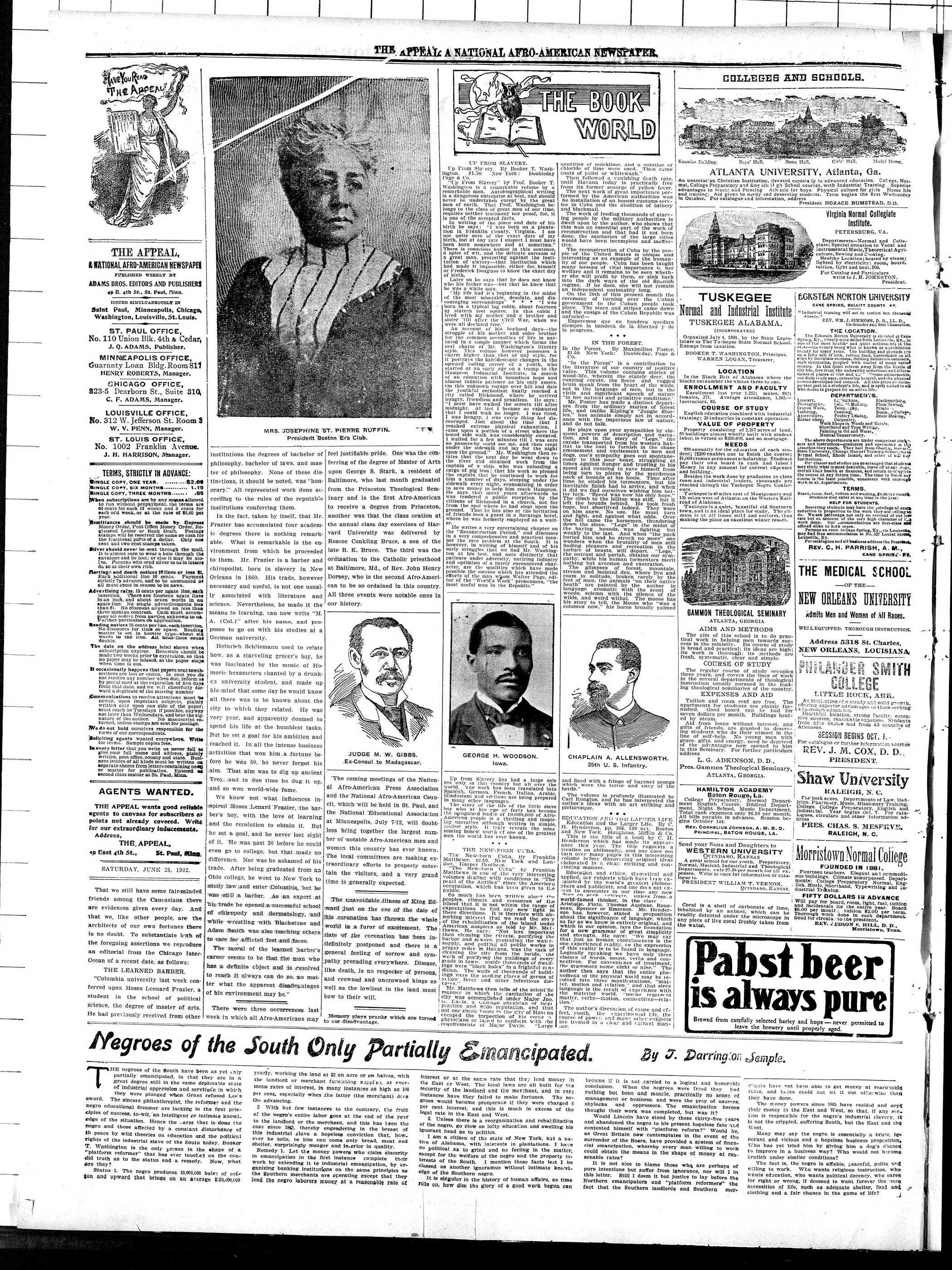
JUDGE M. W. GIBBS.
Ex-Consul to Madagascar.
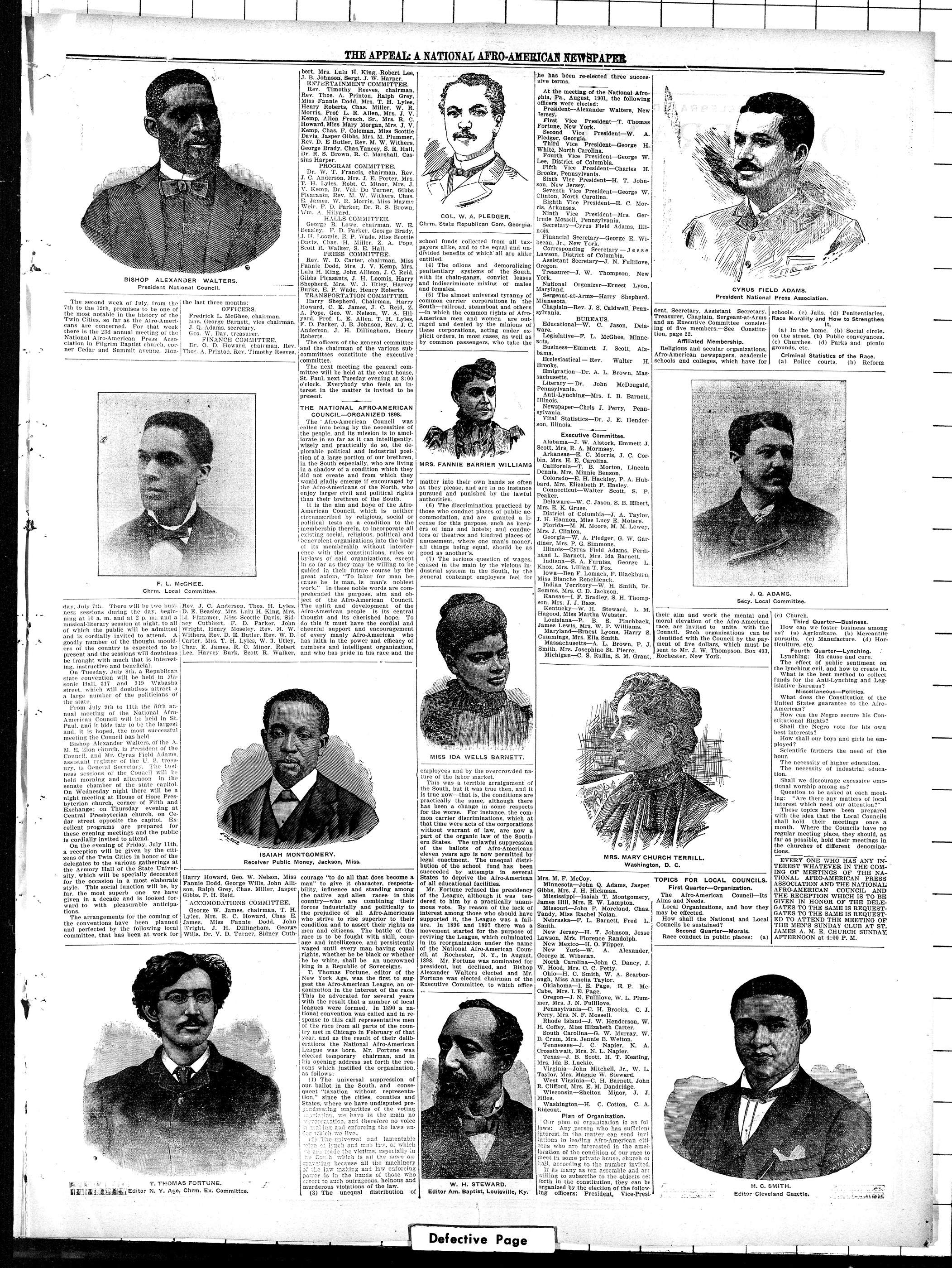
The coming meetings of the National Afro-American Press Association and the National Afro-American Council, which will be held in St. Paul, and the National Educational Association at Minneapolis, July 7-12, will doubtless bring together the largest number of notable Afro-American men and women this country has ever known. The local committees are making extraordinary efforts to properly entertain the visitors, and a very grand time is generally expected.
The unavoidable illness of King Edward just on the eve of the date of this coronation has thrown the whole world in a furor of excitement. The date of the coronation has been indefinitely postponed and there is a general feeling of sorrow and sympathy preading everywhere. Disease, like death, is no respecter of persons, and crowned and uncrowned kings as well as the lowliest in the land must bow to their will.
Memory plays pranks which are turned to our disadvantage.
THE APPEAL: A NATIONAL AFRO-AMERICAN NEWSPAPER
I am a citizen of the state of New York, but a native of Alabama, with interests in plantations. I have no political ax to grind and no feeling in the matter, except for the welfare of the negro and the property in the South. I mention these facts lest I be classed with another ignorant without intimate knowledge of the South. It is singular in the history of human affairs, as time rolls on, how dim the glory of a good work began.
THE BOOK
WORLD
Up From Slavery. By Booker T. Washington, $1.50 on New York: Dobleday Page & Co.
Up From Slavery by Prof. Booker T. Washington is a remarkable volume by a remarkable man. Autobiographical writing is a great part of the artist, but he has shown never to be undertaken except by the great men of earth. That Prof. Washington belongs to the class of great men of our time, requires neither testimony nor proof, for it is one of the accepted facts.
In the case of the birth of the man, and date of his birth he says: "I was born on a plantation in Franklin County, Virginia. I am not quite sure of the exact date of my birth, but at any rate I suspect that I must have been a sweeper and a sombre." There is conscious humor in this sentence, a spice of wit, and the delicate sarcasm of a great man, protesting against the institution of slavery—that institution which has made it impossible, either for himself or Frederick Douglass to know the exact day of birth.
Later on he says that he does not know who his father was—but that he knew that he was a white man.
"My life had been beginning in the midst of the most miserable, desolate, and discouraging surroundings."
*I was born in a typical log cabin, about fourteen by sixteen feet square. In this cabin I lived in my mother and a brother and sister till after the Civil War, when we were all declared free.
He writes a very entertaining chapter on the "Reconstruction Period," and discusses in it the manner in which the race problem at the South, however, in writing of himself and of his wife, was addressed at his best, and note distinctly that patience under adversity, uniting industry and the community, encountered character, are the qualities which are possible the success which has attended the efforts of the wom whom Walter Page, editor of *The American Journal of Education*, the most useful man in the Republic.
GEORGE H. WOODSON.
Iowa.
Up from Slavery has had a large sale in the country but all over the world, the work is done in Spanish, German, French, Italian, Arabic, Indianist and editions are being prepared in languages of the little slave boy who at his age of forty has become an American people is a thrilling narrative although written in simple, style, truly reveals the unassuming man who is the greatest men the world has ever known.
THE NEW-FORN CURA
New-born Cuba, By Franklin
Matthew Martin, New York and
London, Harper Brothers.
The New-born Celtic by Franklin Matthias volumes dealing with condition and interesting volumes dealing with condition and Pearl of the Antilles" since the American institution, which has been given to the public.
So much has been written about the Matthias of the Island that it is not within the range of expectations to find any new light in the Island that it is not within the range of an absorbing interest that we read the stories of the rehabilitation of the island under Matthias the thwes. He says: "Not less important than cleaning the streets, purifying the harbor and supply, and putting all public works in proper order in Havana, was the task of Matthias in the thousands of dwelling in town in thousands of buildings in work of purifying the buildings of every building. The walls of thousands of buildings were the adding places of germs of fever and other infectious diseases.
Mr. Matthews then tells of the scientific effort of the city to develop the city was accomplished under Major J. John Levis, a Chicago physician of burglaries, who not only inspected the city of Hat but escaped the inspection of his corps with the requirements of Major P. B.
interest or at the same rate that they lend money in the East or West. The local laws are all built for the security of the landlord and the merchant, and in rarer instances have they failed to make fortunes. The negroes would become prosperous if they were charged 8 per cent interest, and this is much in excess of the legal rate in the East and West.
2. Unless there is a reorganization and rehabilitation of the negro, go slow on lofty education and swelling his ignorant head as to politics.
The work of feeding thousands of starving people by the military authorities is dwelled upon by the show that this was an essential part of the work of reconstruction and that it not been done, the sanitation of the large cities, have been incomplete and ineffective. The reconstruction of Cuba by the people of Cuba has been taught more lessons of vital importance to her military forces, she will profit by them, or sink back into the dark ways of the old Spanish regime. She does, she will not remain a dependent citizen of Cuba, on the 20th of this present month the ceremony of turning over the Cuban government to the Cuban people took place. The stars and candles of the ensign of the Cuban Republic was unfurled.ques que su bandera quedara siempre la bandera de la libertad y de in progress.
IN THE FOREST.
In the Forest. By Maximilian Foster. $1.50. New York: Doubleday, Page &
"In the Forest" is a contribution to the literature of our country of positive value to wood-life, wherein the stately deer, the braving cowboy, the fierce and rugged horse, the coyote, the fierce and nature not in the language of men, but in the nature in her natural and primal condition. Mr. Foster has made a distinct department of wood-life, and unlike Kipling's "Jungle Stories," has animals simply act in accord-
and fixed with a fringe of bayonet prongs which, were the terror and envy of the herds. The volume is profusely illustrated by Carl Jungman, and he has interpreted the author's ideas with an art striking and picturesque.
Pabst b
is always
Brewed from carefully selected barley and h
leave the brewery until prop
at simplicity
We may say the
expression
in language
only three
uses and con-
treatment.
The
entire phene-
may be re-
lations that since
evidence with
is represent
activities—rela-
house and ce-
nial for-
niture
norest man-
By J. Darrington Semple.
it carried to a logical and honorable the negroes were freed they had and muscle, practically no sense of fitness, and were the prey of usurers, pressors. The emancipation heroes was completed, but was it? have stood by these thirty-five years nigro to his present hopeless fate and with "platform reform"? Would he, now contemplates in the event of the nigro, have provided a system of finance-whereby every man willing to work pans in the shape of money at rea- blame those who are perhaps of suffer from ignorance, nor will I in deem it but justice to lay before theors and "platform reformers" the mer- landlords and Southern mer-
become if it is not carried to a logical and honorable conclusion. When the negroes were freed they had nothing but bone and muscle, practically no sense of management or business, and were the prey of usurers, shylocks and oppressors. The emancipation heroes thought their work was completed, but was it?
Would Lincoln have stood by these thirty-five years and abandoned the negro to his present hopeless fate and contented himself with "platform reform"? Would he, Great Britain now contemplates in the event of the surgeries of the Boers, have provided a system of financial emancipation, whereby every man willing to work could obtain the means in the shape of money at reasonable rates?
It is not nice to blame those who are perhaps of pure intentions but suffer from ignorance, nor will I in this letter. Still I deem it but justice to lay before the Northern emancipators and "platform reformers" the fact that the Southern landlords and Southern, were
quantities of quicklime, and a solution of water, to make the dough, then came couts of paint or whitewash." Then followed a vanishing death rate, until Havana today is practically free of paint, and yellow fever. The next work of great importance formed by the American authorities was he installation of an honest customs servant, and the abolition of bribery and blackmail.
CHAPLAIN A. ALLENSWORTH.
25th U. S. Infantry.
---
EDUCATION AND THE LAPER LIFE
Education and the Larger Life. By C. H. Houghton and New York, Houghton, Mifflin & Flatman.
This is the title of a book by C. H. Houghton. It has made its appearance this year. It treats on philosophy, and one does not have many pages in this interesting volume but has bring original ideas elaborated in a clear, stirring and convincing manner.
Education and ethics, theoretical and practical, has been lauded by the world's greatest philosophers and publicists, and one does not expect to encounter our time any new ideas from a world-famed thinker, in the class
Aristotle, Plato, Thomas Aquinas, Rousseau, and the human subject has, however, attained a proposition about the significance of language, which we know is entirely original, and which in its own right has been used for a new grammar of great simplicity in the tongue. He says: "We may say that the language we have only three classes of words, nous, nousi, nouscives. For convenience of treatment, the 'grammars name eight or nine.' The 'grammars name four or five' the entire phenomena of the physical world are solved into three manifestations, 'maturation and relation,' and that since language is a material world, the material world, 'houses represent matter, verbs—motion, connectives—relation.' The author's discussion of cause and effect, youth, the experimental life, the source of power, and many other subjects are treated in a clear and correct man-
Knowles Building. Boys' Hall. Stone Hall. Girls' Hall. Model Home.
ATLANTA UNIVERSITY, Atlanta, Ga.
An unsectarian Christian Institution, devoted especially to advanced education. College, Normal, College Preparatory and Eng ish II gh School courses, with Industrial Training. Superior advantages in music and Printing. Athletic for boys. Physical culture for girls. Home life and uniting. A negent view and observing students. Term begins the first Wednesday. For catalogue and information.
Pabst beer is always pure
Brewed from carefully selected barley and hops — never permitted to leave the brewery until properly aged.
clients have not been able to get money at reasonable rates, and house could not let it out otherwise than they have done.
The money powers since 1865 have resided and kept their money in the East and West, so that, if any section is responsible for the negro's industrial slavery, it is not the crippled, suffering South, but the East and the West.
Many may say the negro is essentially a brute, ignorant and vicious and a hopeless business proposition. Who has yet tried him by giving him a dog's chance to improve in a business way? Who would not become brute and would similar conditions?
The fact is, the negro religious, peaceful, polite and willing to work. Who wants religious instruction, who wants education, who wants political decency, who cares for right or wrong, if doomed to want forever the care necessities of life, such as adequate shelter, food and clothing and a fair chance in the game of life?
HOTEL BERLIN
TUSKEGEE Normal and Industrial Institute
(INCORPORATED)
Organized July 4, 1881, by the State Legislature as The Tuskegee State Normal School. Exempt from taxation.
BOOKER T. WASHINGTON, Principal.
WARREN LOGAN, Treasurer.
LOCATION
the Black Belt of Alabama where the
blacks onunumber the whites three to one.
ENROLLEE
ACULTY
Enrollment last year 1.253; males 882;
females, 371. Average attendance 10:15.
instructors, 88.
COURSE OF STUDY
Enrollment combined with industrial
training; 28 industries in constant operation.
VALUE OF PROPERTY
Property consisting of 2,267 acres of land, 50 buildings almost wholly built with student labor, is valued at $350,000, and no mortgage.
**$50 annually for each of each student; ($200 enables one to finish the course; $100 creates permanent scholarship. Students $100 creates a scholarship. Money in any amount for current expenses and building. Work done by graduates as class room and industrial leaders, thousands are reached through the Tuskegee Negro Conference. Tuskegee is 40 miles east of Montgomery and reached at Atlanta, on the Western Railroad of Alabama.**
road of Alabama.
Ridges the quiet, beautiful old Southern town, and is an ideal place for study. The climate is at all times mild and uniform, thus making the place an excellent winter resort.
AIMS AND METHODS
The aim of this school is to do practical work in helping men towards success in their studies, and in broad and practical; its ideas are high in its work is thorough; its methods are fresh, systematic, clear and simple.
COURSE OF STUDY
The primary course of study occupies three years, and the departments in the several departments of theological instruction usually pursued in the leading theological series of the country.
EXPENSES OF AID
Tuition and room rent are also the apartments for students are plainly furnished. Good board can be had for up to two per month. Buildings heated by steam.
Aid from loans without interest, and gifts of friends, are granted to deserving students. Students are given a line of self-help. No young man with grace, gifts, and energy, need be deprived of advantages now opened to him in this Seminary. For further particulars address
L. G. ADKINSON, D. D., Pres. Gammon Theological Seminary, ATLANTA, GEORGIA
HAMILTON ACADEMY
Baton Rouge, La
College Preparatory, Normal Department Indian School, Central Department Night School, Music Department Total cash expenses only $6.50 per month. Total cash expenses advance. Session begins October 1st.
REV. CORNELIUS JOHNSON, A. M. B. D. PRINCIPAL BULBON ROUGE, LA.
Send your Sons and Daughters to WESTERN UNIVERSITY
A great school for our youth. Preparatory, Musical, Industrial and Theological Department, Industrial for 30 per month for all expenses. Write at once for information or catalogue to PRESIDENT WILLIAMY VERNON.
QUINDARO, KANSAS.
Coral is a shell of carbonate of time, coral is a animal, which can be readily detected under the microscope in any piece of live coral freshly taken from the water.
President HORACE BUMSTEAD, D.D.
PETERSBURG, VA.
Departments—Normal and Colle-
ciate; Special attention to Vocal and
instrumental Music; Theoretical Ari-
culture; from teaching to teaching.
Healthy Location; heated by steam;
lighted by electricity; room, board,
tuition, light and heat, $50.
For Catalog and Particulars
write to J. H. JOHNSTON,
President.
EGKSTEIN NORTON UNIVERSITY
CANE SPRING, BULLITT COUNTY KY.
Industrial training will set to motion ten thousand
weeks.
REV. WM. J. SIMMONS, D. D., LL. D.
Co-founder and first chancellor.
THE LOCATION.
The Egkstein Norton University is situated at Cane Spring, Ky., twenty nine miles from Louisville, Ky., in one of the most healthy and quiet settlements in the
county for many years. The building and ground
on a fifty mile of rich, rolling land, surrounded on all
sides by mountains, peopled with timber of many var-
ies success. In this quiet retreat away from the shuttle
of the city, the place of vice and uxury, some amusements,
masses of places of vice and uxury, powers developed and secured. All this plays no im-
portant part in a student's life and is not a vital
element in a positive life.
Literary
Culture
Ceramics
Photography
Calligraphy
Making
Painting
Tailoring
Cooking
Brunn
College
Appearance
Poultry Lasting
Dress Making
Dressing
The above departments are under competent work and are well trained to teach the branches they teach. They hail from Gainesville, Florida State University, Chicago Manual School, State University, Rhode Island, and other of our Institutions. Our classes and studies are so arranged that students can recruit their health or finances, and return to cogni-
cate the course at any future time. The time to finish any course is consistent with through work in all departments.
TERMS
Board, room, fuel, tuition and wishing, $5.00 per month, students must attend the course in the year.
HELP FOR STUDENTS
Deserving students may have the privilege of exam reduction in proportion to the work they are willing to do. Students must be willing to rate but on account of the very high character of the course, accommodations are first-class and offered to all.
Persons en route. To Case Spring, KY, via Louisville,
KY, for communication to No. 527 Laurel Street,
Louisville, KY.
for catalogues and a dictionary The Press
REV. C, H. HARRIS
CANE SPECIAL. C.P.
BARNES.
THE MEDICAL SCHOOL
OF THE
NEW ORLEANS UNIVERSITY
Admits Men and Women of All Races.
WELL EQUIPPED, THOROUGH INSTRUCTION.
Address 5318 St. Charles,
NEW ORLEANS, LOUISIANA.
PHILANDER SMITH
COLLEGE
LITTLE ROCK, ARR.
An institution of a steady and solid growth,
one of the most advantageous to those seeking
a thorough education.
Healthful location, strong faculty, extensive
classes, reasonable expenses. Students
from nine States and from 43 counties of
Arkansas.
SESSION BEGINS OCT. I.
For catalogue or further information address
REV. J. M. COX, D. D.
PRESIDENT
Shaw University
RALEIGH, N. C.
For both sexes, Departments of Law, Medicine, Pharmacy, Music, Missionary Training, College, Music Preparatory, English and Industrial Engines Oct. 7. For catalogues, circulars and other information address
PRES. CHAS. S. MESFRVE,
RALEIGH, N. C.
Fourteen teachers. Elegant and commodious buildings. Climate unsurpassed. Departments: College Preparatory Normal, Engl. Muky, Shimad, Typewriting and industrial Training.
FIFTY DOLLARS IN ADVANCE
Will pay for board, room, light, fuel, tuition and incidentals for the entire year. Board $4.00 per month; tuition £2.00 per term. Thorough work done in each department. Seed for circula. to the president,
REV. JUDSON S. HILL, D. D., Morristown, Tenn.
y and hops — never permitted to until properly aged.
HOME BRAND
Goods and you will always be happy.
The New Process Blue Flame Roasted Coffee is better strength and finer flavor than any other.
GRIGGS,
IMP
"Sharood S
SHAROOD
SHOE CO
more
is the
pain
they
are at
they
WESTERN
I have for sale o
in Minnesota and in
at $11. to $30 per acre
world. I also want
fine grazing lands in
per acre. This is th
you should invest you
E.
Cor. 6th and Jai
RIGGS, COOPER & CO
IMPORTERS and M
WHOLESALE C
ST. PAUL, M
IMPORTERS and MANUFACTURING WHOLESALE GROCERS,
ST. PAUL, MINN.
"Sharood Shoes Are Good Shoes"
And the more they are worn the more it is demonstrated that such is the fact. If everybody will try a pair of "C K S" or "R E Z" shoes, they will be convinced that they are the cheapest and best $3.50 value they ever wore, and will try it again.
Always Patronize Home Industry.
WESTERN FARM LANDS FOR SALE
have for sale over 80,000 acres of choice farm
needs and in the Red River Valley of North
to $30 per acre, as good farming lands as a
I also want to call attention to the 20,000
amazing lands in Western North Dakota at $2.7
e. This is the place—if you love to keep st
could invest your money in. Call on or address
E. G. MELLEM,
or 6th and Jackson, - ST. PAUL, MI
WESTERN FARM LANDS FOR SALE.
I have for sale over 80,000 acres of choice farming lands in Minnesota and in the Red River Valley of North Dakota at $11. to $30 per acre, as good farming lands as any in the world. I also want to call attention to the 20,000 acres of fine grazing lands in Western North Dakota at $2.75 to $4.50 per acre. This is the place—if you love to keep stock—that you should invest your money in. Call on or address,
E. G. MELLEM,
Cor. 6th and Jackson, - ST. PAUL, MINN.
HENRY P. UPHAM,
President.
E. H. BAILEY,
Vice Pres.
WM. A. MILLER,
Cashier.
The First National Bank,
ST. PAUL, MINN.
U. S. DEPOSITORY.
The First National Bank ST. PAUL, MINN. V. S. DEFOSITORY.
The First National Bank,
CAPITAL $1,000,000. SURPLUS $800,000.
DIRECTORS.
P. UPHAM. T. L. SCHURMEIER. JAMES N. HILL. E. W.
HILL. D. C. SHEPARD. E. H. CUTLER. H. E.
GENLEAF CLARK. C. D. GILFILLAN. F. B. CLARKE. W.
E. H. BAILEY. E. N. SAUNDERS. F. P. SHEPAR
STATEMENT OF THE CONDITION OF
The National German American E
Of Saint Paul Minnesota
DIRECTORS.
M. T. L. SCHURMEIER. JAMES N. HILL. E. W.
D. C. SHEPARD. E. H. CUTLER. H. E.
F. CLARK. C. D. GILPILLAN. F. B. CLARKE. W.
E. H. BAILEY. E. N. SAUNDERS. F. P. SHEPAR
STATEMENT OF THE CONDITION OF
National German American B
Of Saint Paul Minnesota
H. P. UPHAM. T. L. SCHURMUR. JAMES N. HILL. E. W. WINTER.
J. H. JILL. D. C. SHEPARD. E. H. CUTLER. E. H. THOMPSON.
GREENLEAF CLARK. C. D. GILFILLAN. F. B. CLARKE, W. A. MILLER.
E. H. BAILEY. E. N. SAUNDERS. F. P. SHEPARD.
STATEMENT OF THE CONDITION OF
The National German American
Of Saint Paul Minnesota
HOUSE - - - 231,000.00
$7,971,667.33
DIRECTORS
EUSER JOHN A. HUMMER A. H. LINDEKE J
JONSON O. P. LANTHER THOMAS WILSON J. W. LUSK
DEPOSITS
December 17, 1999 - $1,870,426.99
February 28, 1992 - $6,806,245.71
OFFICERS
LUSK, Pres. F. WEVERHAEUSER, Vic
PH LOCKKEY, Cashier. THEO DRAZ, Ass't Cash
SECURITIES BOUGHT A'D SOLD.
SAFE DEP
F. WEYERHAUSER JOHN A. HOMMER A. H. LINDEK JOHN H. ALLEN
F. C. JEFFERSON O. P. LANPIER THOMAS WILSON J. W. LUSK JOHSFH LUCKEY
"A good cigar
is a smoke"
Rudyard Kipling
The
YELLOW
KING
5¢CIGAR
is a good cigar. The best
that can be said of it falls
short of the reality.
Smoke the cigar.
At all dealers.
HART & MURPHY, MAKERS.
BANNING ADV. CO.
Capital Stock - - -
Surplus and Profits
Circulation - - -
Deposits - - -
Sharood Shoe Co.
E. H. BAILEY, Vice Pres.
THE BRAND
PAGMOLIN
COFFEE
YOU
What Do You
$18.00, $20.00
Rogers-Peet a
At a
Never
We're Ready to
Every one of these Suits
to merchant tailors's 30.
terns are handsome, the
quality. There are only
line, so don't delay.
season that we are willing to close out at once.....
AULTS
MANUFA
LE GROCER
PAUL, MINN.
d Shoes"
the
much
ry a
oes,
they
value
ain.
$350
Aristo
TRADE MARK
ST. PAUL, MINN.
DR SALE.
rice farming lands
of North Dakota
lands as any in the
20,000 acres of
at $2.75 to $4.50
keep stock—that
or address,
UL, MINN.
Wm. A. MILLER,
Cashier.
Bank,
$800,000.
E. W. WINTER.
H. E. THOMPSON.
E. W. A. MILLER.
S. SHEPARD.
OF
Can Bank
$1,000,000.00
profits - 116,421.59
- 50,000.06
- 6,806,245.71
$7,972,666.30
KE
LUSK
JOHN H. ALLEN
JOSFPH LUCKY
00 - $5,207,127.32
GER, Vice Pres.
'st Cashier.
SAFE DEPOSIT VAULTS
THE APPEAL: A NATIONAL AFFO-AMERICAN NEWSPAPER
YOU! Mr. Man, Read This!
$15
We're Ready to Deliver the Goods. Every one of these Suits is of the highest quality and equal to merchant tailors' $ 30.00 to $40.00 creations. The patterns are handsome, the styles correct, the fabrics of the best quality. There are only from one to three of a style in each line, so don't delay.
$28 Suits
Several lines of the finest creations of Rogers-Peet that we received so late in the
$20 AND
The Great Home Store.
P.J. BOWLIN LUXOR CO.
WHOLESAILERS EXCLUSIVELY
ST. PAUL, MN.
PART OF A BOTTLE OF
HUMBOLT
PURE 188D RYE
WHISKEY
IS BETTER THAN A
WHOLE BOTTLE OF
ORDINARY KINDS
SOLD BY
DEALERS.
Mr. Man,
Read This
You Think of Buying
$0.00 and $25.00
and Stein-Bloch Suits
Special Price of
Mind "Why."
To Deliver the Good
is of the highest quality and e
to $40.00 creations. The
styles correct, the fabrics of the
from one to three of a style in
Several lines of the finest creations of Rogers-Peet that we received so late in the to sell at cost in order $2
Boston
St. Paul
the Boston St. Paul
GOLDEN BELL
Cigars and Tobacco
OUR MOTTO
Live and Let Live.
OUR PRINCIPLE
Equal Rights for All.
OUR TRADE-MARK
"GOLDEN BELL"
Very Truly,
JOS. P. WHITWELL
---
Great Wash Goods Sacrifice
It's time to talk of reducing stocks. We never carry goods over from one season to another, but start each season with a fresh, new stock.
In keeping with this policy we have inaugurated the greatest clearing-out sale of Wash Goods the town has ever known. And it's not a sale of undesirable, passe patterns, but an offering of the season's choicest productions—the most wanted styles—at unheard-of low prices.
If You Have a Wash Goods Want Attend to it
A table of good Bistates in floral designs and neat small figures—styles equal to the high-priced goods. a yard.
All our Egyptian Tissues, Silk-finished Chambrays,
plain an striped; all our Glasgow Tissues and Plu-
mants; all our Zepter Tissues; all our Scotch
Ginghams—none reserved—go
at the spec.
¹9c³
price, a yard ...
Tissues and Plu-
years; all our Scotch
at the spe-
19c
Tow Sha—A fine linen-colored fabric with rich satin
stripes, interspersed with dainty colored figures, very
sheer—Just out and the leading New York fad. 39c
, a yard.
colors, black, navy,
s of dots. 10c
Extra Special—Mousseline de Soie, all plain col-
ors, the 50c quality. 29c
Bring This a t. With you.
We Don't Want Wings
50 pieces Duck Suitings, plain colors, black, navy,
white and red; also all colors and sizes of dots. 100
but we do want you to know that we can furnish you the leading Piances of the world at Prices and Terms that will meet with your favor.
STEINWAY, KNABE, KRANICH & BACH, IVERS & POND, EMERSON, LUDWIG.
Everything in the music line at W. J. DYER & BRO.
21-23 W. 5th St.
but we do want you to know that we can furnish you the leading Piances of the world at Prices and Terms that will meet with your favor.
STEINWAY, KNABE, KRANICH & BACH, IVERS & POND, EMERSON, LUDWIG.
Everything in the music line at W. J. DYER & BRO.
21-23 W. 5th St.
KENNETH CLARK, President
C. H. BIGELOW, Vice-President
GEO. H. PRINCE, Cashier
H. W. PARKER, Asst. Cashier
The Merchants National Bank
OF SAINT PAUL, MINNESOTA.
Capital One Million
UNITED STATES DEPOSITARY.
DIRECTORS
CRAWFORD LIVINGSTONE
J. H. SKINNER
D. R. NOYES
F. B. KELLOGG
KENNETH CLARK
LOUIS W. HILL
V. M. WATKINS
C. H. BIGELOW
E. N. SAUNDERS
GEO. H. PRINCE
L. P. ORDWAY
THE STATE SAVINGS BANK
GERMANIA LIFE BUILDING,
Fourth and Minnesota Sts.
ST. PAUL.
The only Bank in St. Paul exclusively for savings doing business under the savings bank law of the state as amended to date.
TAKES DEPOSITS OF $1.00 AND UPWARD.
TRUSTEES
Ferdinand Willius, C. G. Lawrence, John D. Ludden, Gustav Willius,
John D. O'Brien, William Constans, Harris Richardson,
John B. Sanborn, Thomas Fitzpatrick, C. P. Noyes,
W. B. Dean, Jul. M. Goldsmith.
The only Bank in St. Paul exclusively for savings doing business under the savings bank law of the state as amended to date.
TAKES DEPOSITS OF $1.00 AND UPWARD.
TRUSTEES
Ferdinand Willius, C. G. Lawrence, John D. Ludden, Gustav Willius,
John D. O'Brien, William Constans, Harris Richardson,
John B. Sanborn, Thomas Fitzpatrick, C. P. Noyes,
W. B. Dean, Jul. M. Goldsmith.
DEALERS IN Gents' Fine Clothing,
WEST SUPERIOR WIS. ST. PAUL, MINN.
AGING BEER
Hamm's Beer is stored and aged in the only modern refrigerating plant in St. Paul.
The air is pure and sweet and the temperature never varies.
This refrigerator plant has a capacity actual wants, so that Hamm's Beer is older other beer on the market.
Of the precautions of Honest Brewing that Hamm's Beer absolutely pure and properly aged.
double the actual wants, so that Hamm's Beer is older than any other beer on the market. One of the precautions of Honest Brewing that makes Hamm's Beer absolutely pure and properly aged. Call for
The North-west's Greatest Store.
Schur
Great War
It's time to talk of reducing stock
another, but start each season with a f
In keeping with this policy we have in
has ever known. And it's not a sale of
choiceest productions—the most wanted
If You Have a War
250 pieces of Scotch Lawns,
corded Batistes and
Belford Cords, priced
for at less than
half
2½C
A tait flora small to th
250 pieces of Scotch Lawns, corded Batistes and Belford Cords, priced for at less than half ..... 212C
30-inch Yarn Combed Lawn ..... 30-inch Fine Batistes ..... 30-inch Dresden Dimities ..... 30-inch Fast Black Lawns. Take your pick Friday for ..... All our Egyptian Tissues, Silk-finished plain and striped; all our Glasgow Tissue metics, Marvel Lenos and Sheer Zephyr;s; all Ginghams—none reserved—go at the cial price, a yard ..... 50 pieces Duck Suitings, plain colors, white and red; also all colors and sizes of do
C. B. BOWLBY,
PRESIDENT.
H. W. FAGLEY,
VICE-PRES. AND TREAS.
CORRECTION
Sixth and Robert Sts.
B
double the actual
than any other be
One of the
makes Hamm's B
Call for
Ham
Sixth and Wabasha, St. Paul.
150 pieces 36-inch Pencil all new patterns, purchased from a city jobber at a great concession. Price less than half. Yd.
5c
6c
Fine Embroidered Swissles, white and linen dots and lace stripes — New Pineapple big variety, lots of white groundwork with black stripes, figures and foulard patterns — Fine Imported Dimities—all specially prepared for sale
dots and lace stripes — New Pineapple Batistes, a big variety, lots of white groundwork with black stripes, figures and foulard patterns — Fine Imported Dimities—all specially pried for selling
Tow Sha—A fine linen-colored fabric with rich satin stripes, interspersed with dainty colored figures, very sheer—Just out and the leading New York fad. 39c
, a yard
We Don't Want Wings
For the flight of Time
GEO. H. PRINCE, Cashier
H. W. PARKER, Asst. Cashier
The Merchants National Bank
OF SAINT PAUL, MINNESOTA.
DIRECTORS
KRENTH CLARK
LOUS W. HILL
C. H. BIGLOW
C. H. BIGLOW
E. N. SAUNDERS
GEO. H. PRINCE
L. P. ORDWAY
GERMANIA LIFE BUILDING,
FLOAN & LEVEROOS,
Furnishing Gocds, Hats, Caps, Shoes, Etc.
Cor. Seventh and Jackson Sts.,
UPERIOR WIS. ST. PAUL, MINN.
THIS TRADE MARK
on Each Label of Good Ciga L. May & Co.'s
In Red on Each Label of Good Cigars.
Is the Place to Get Your
... FLOWERS ...
East Sixth Street. St. Paul
RUGGISTS OPEN DAY AND NIGHT
A. D. THOMPSON DRUG CO.
PRESCRIPTION DRUGGISTS
D ST. AND FIRST AVE. SOUTH, OPPOSITE POST OF
MINNEAPOLIS, MINN.
COR. THIRD ST. AND FIRST AVE. SOUTH, OPPOSITE POST OFFICE MINNEAPOLIS, MINN.
Agents for the Cross Stoves and Ranges And Thatcher Furnaces. Dealers in
Agents for the Red Cross Stoves and Ranges And Thatcher Furnaces. Dealers in Builders' Hardware, Tools, Tinware, Paints, Oils, Glass. Tin, Sheet Iron and Copper Workers. 519-521 University Ave., ST. PAUL, MINN.
SOLID OAK
Sam has
ers;
mar
SOLID OAK
CENTER TABLE,
Quartered oak top;
glass feet; strong,
well finished and libe-
ral sized. Only
$2.89
CASH OR CREDIT.
n Red on E
64 East
MODERN DRUGGISTS
COR. THIRD ST. AND
MIN
ST. PAUL'S MAMMOTH PAYMENT HOUSE
NORTH STAR
HOUSE
FURNISHING C?
434-436.WABASHA St. - ST. PAUL
"GOOD ENOUGH
FOR ANYBODY"
"CHEAP ENOUGH
FOR EVERYBODY"
PRIVATE
SMITH
CIGAR
KUHLES & STOCK,
MAKERS,
ST. PAUL, MNN.
IT'S ONLY
5¢
Known the World Over.
WINECKE
AND
DOERR'S
HLD BOX
GUARANTEES
QUALITY
HERTZ BROS.
THE APPEAL: A NATIONAL AFRO-AMERICAN NEWSPAPER
MILTON'S
Always the Best
Always Reliable
MILTON DAIRY CO.
COR. 9th & WABASHA STS.
10
Lindeke's
Apple &
Blossom
Flour
STANDS
ALONE.
Best Available The
THE OLD RELIABLE
"Plymouth"
Clothes the Whole Family from Head to Foot, and does it well and for the least money.
No one does more.
Money refunded or purchases gladly exchanged.
The "Plymouth" is as good as a bank.
THE PLYMOUTH
CLOTHING HOUSE,
ST. PAUL AND MINNEAPOLIS.
---
PILLSBURY'S Best Flour
PILLSBURY'S Vitos
PILLSBURY'S
FLAKED
WHEAT FOOD
Adapted by the
NORWESTERN SPRING WHEAT
COFFEE CO. OF AMERICA
WHEAT FOOD CO. OF AMERICA
MINNESOTA, U.S.A.
Were All Awarded
The Grand Prize
RELIABLE
SMOKE THE LE
“EL PATERNO” Ten Cent
“SIGHT DRAFT” Five Cent
W. S. CONRAD, Distrib
MINNEAPOLIS.
ICE CRE
Frozen from CREA
SPECIAL DISCOUNTS TO LODGES A
The Crescent Cream
BOTH PHONES. 3rd an
North Star Sh
MANUFACTURERS OF
es more. fundedases changed.
MINNEAPOLIS, WEISKOPF PAINT & WALL
BOHN SIPH
BOHN SIPHON SYSTEM Refrigerators Cut the ice bill in two.
THEY LEAD THE WORLD
at the Paris Exposition THEY LEAD THE WORLD
Best Flour
BURY'S Vitos
PILLSBURY'S Flaked
Wheat Food
Chelsbury's
BEST
XXXX
Milwaukee, WI
NOKE THE LEADERS
"EL PATERNO" Ten Cent Cigar.
SIGHT DRAFT" Five Cent Cigar.
W. S. CONRAD, Distributor
EAPOLIS. ST. PAUL
ICE CREAM
Frozen from CREAM.
NAL DISCOUNTS TO LODGES AND CHURCHES.
Crescent Creamery Co.
PHONES. 3rd and Minnesota.
North Star Shoe Co.
MANUFACTURERS OF
SMOKE THE LEADERS
"EL PATERNO" Ten Cent Cigar.
"SIGHT DRAFT" Five Cent Cigar.
W. S. CONRAD, Distributor
MINNEAPOLIS. ST. PAUL.
ICE CREAM
Frozen from CREAM.
SPECIAL DISCOUNTS TO LODGES AND CHURCHES.
The Crescent Creamy Co.,
BOTH 'PHONES.
3rd and Minnesota.
North Star Shoe Co. MANUFACTURERS OF
FINE SHOES
MINNEAPOLIS, - MINNESOTA
SKOPF PAINT & WALL PAPER CO.
MINNEAPOLIS, - MINN.
54 East Seventh St. ST. PAUL, MINN. Telephone Main 1588-4.
PILLSBURYS
VITUS
THE TOTAL
WHEAT FOOD
STERILIZED
WITH MILK FOOD
FROM MILK FOOD
PILLSBURYS MASSEUR FLOUR MILKS CO., LTD.
A BATTLE IN THE CAMPAIGN
A man with a long stick and a boy with a stick.
A Fourth of July Confession
A Fourth of July Confession
BY CHARLES EUGENE BANKS.
(Copyright, 1902, by Daily Story Pub. Co.)
"Mr. Arnold, I don't think you believe what you say."
"Indeed I do, Miss Darlington."
"Fourth of July is a farce? Then you really think that?"
"I mean to say that all the money spent in firing off crackers and burning rockets has no useful purpose."
"It expresses our feelings, I think, and that is all anything can do for us in this world."
"I do not agree with you. There are many simpler and more sensible ways of giving expressions to our emotions than by filling the air with noise and smoke. it is childish. Grown people ought to be able to show their patriotism in a more sensible way."
"Fudge. You are getting as dry and uninteresting as those old books you bury yourself in most of the time. I believe in life. Books are all well enough in their way, but that is generally a very tiresome way."
The hot blood surged into the face of the young man at the retort. He turned his gaze full on the girl at his side, but she was already turning away, calling softly to a robin hopping in the shade of an old apple tree that grew beside the gate leading into the farmhouse grounds.
"Milly!" he called, reproachfully.
"Walt till George Lounsbury comes home from New York to-morrow and you'll see what the Fourth of July means to a man with real red blood in his veins. He was up last year and brought more than a hundred dollars' worth of fireworks. I don't believe any one went to bed that night at all. The sky was filled with red fire and I realized for the first time what it meant to be an American."
"You mean the son of Farmer Lounsbury, I suppose?"
"Yes. He's a great man now, although he was born and grow up in this illiterate neighborhood."
"Miss Darlington, if you please, Mr. Shakespeare. Does your dingy old leather-covered books tell you that a young man has the right to address a young lady that he met only four weeks ago with as much familiarity as though she was his sister?"
The girl tossed her pretty head with an air that might have been learned in the court of a queen, although she had little knowledge of the ways of the world outside of Mohawk Valley. But was she not a woman, young, pretty, proud, whimsical—as most pretty young women are? And what need had she for instructions in the art of coquery? To the serious young student who had come into the neighborhood with no other idea than that of earning a modest living by teaching in the public school she had knowledge enough and to spare. He loved her, of course. There was no escape from that. She knew it, too, as well as though he had told her so with all the impassioned fervor of a Romeo. But he had not told her so. How could he when she met every attempt of his to utter what filled his heart with good-natured railery.
"Is he—is Mr. Lounsbury a friend of yours?"
"A friend of mine? Indeed he is. I have known him ever since I was a child. He is a great man now. Cashier in a bank in the city and trusted with tons of money. Wait till you see how things will move when he arrives."
He did wait, although with no pleasant anticipations. And that night he saw the rockets streaking across the sky and heard the honest country folk cheer the neatly dressed, smooth-spoken young man who set off whole packages of fire-crackers with far less thought that one of the wealthiest among them would have struck a match. And when it was all over, when the last red flame had faded out of the sky, the last pin-wheel had spit out its spiteful little life, the last bunch of fire-crackers popped and danced over the singed and trampled lawn, Arnold walked home alone through the woods, carrying the burnt end of a single cracker tightly clutched in his hand.
After all had he not been right when he told Milly that all this celebration was "noise and fury, signifying nothing?" She had boasted to him that Mr. Lounsbury would bring a hundred dollars' worth of fireworks from the city to voice the patriotism of the neighborhood. And her boast had been made good. A hundred dollars! Why, that was more than he wa: to get for the three months' term of teaching in the Randall district school. A hundred dollars! What could he not have done with the money that had been consumed in an evening, for the glory of patriotism? He thought of the long, dreary struggle behind him, and the dark, dreary, tedious days ahead and a great bitterness clutched at his heart and an unfamiliar oath rose in his throat and demanded that he give it tongue. What was all this boasted liberty if it brought nothing to one and so much to another? Why should this young country boy be favored by fate so that the best positions in a great city were his for the asking, while he, the student, the scholar, the man with a real purpose and a high aim, was left to win his wayamong his hopeless surroundings. Hopeless, indeed. For she had waken in his heart new aspirations, made even the frowning future bright with promise, she had turned from him with scarcely a word to join
THE APPEAL: A NATIONAL AFRO-AMERICAN NEWSPAPER
in the praise and adulation that was showered upon the successful man of the world.
She was heartless. He was sure of that now, and it was well that he had found no opportunity during the bustle of the day and evening to give her the written declaration he had found it impossible to make in spoken words. At least he was saved the humiliation of a refusal. Let it be burned with a' the other useless things of the day. He ran his hand into his pocket. It was empty. The letter he had penned in a fever of hope and despair was gone. He must have dropped it on the lawn. The thought of some one finding and reading it brought the blush to his cheek and sent him back over the fields with impatient strides. He left the beaten path and climbing the snake fence that divided the pasture land from the orchard hurried forward in the shadow of the trees. As he came out upon the lawn a white bit of paper gleaming in the dew-wet grass caught his eye and he sprang forward and eagerly caught it up. It was the envelope that had held his letter, but it had been opened and the letter was gone.
It is said that every man has one murder in his heart which he will be ready to commit if the proper moment arrives. To the great majority this moment never presents itself; only one in ten thousand is therefore forced to face the gallows. Whether this be true or not it was fortunate that the person so suddenly to face the young schoolmaster at that moment was beyond the power of his hands. A man would have to be a devil indeed to wish harm to a fine young woman with the fresh color of the country on her cheeks, the light of roguery in her eyes and the moonlight clothing her as a garment. And then if she laugh merrily and the next instant throw her arms about his neck and tell him he is "an old goose," he isn't likely to wish harm to his worst enemy.
"I read your letter all through, you silly old thing, and there isn't a word of truth in it. If there was I should be caught up to heaven uns minute. You were awfully scared when you found some one had opened it? Oh, I could see your eyes flash even in the moonlight. And you swore, too. I heard you; don't deny it. That's what decided me. Up to that time I was afraid you were too good to be human. There's just one thing more you must do before I'll promise not to refuse you. You've got to admit that the Fourth of July is the grandest day in the year and promise to celebrate it like a true American every year with real fire-crackers."
"I shall always hold the day sacred in my heart, dearest," he said, solemnly. "It has brought me——"
"Slavery, sri slavery. But, there, I'll try to make your chains as light as possible, and—Frank, I love you better than all the rockets in the world."
GUARDIAN WOULD NOT WORRY
Unique Distinction Made by Half-Witted North Carolinian.
Gov. Charles B. Aycock of North Carolina, in explaining a political proposition to an audience, told a story of a neighbor of his who was better equipped mentally than his friends believed.
"This fellow," said the Governor, "was regarded as half-witted, and a guardian was appointed for him and his property. Some time after he sold a horse to a neighbor, and the neighbor discovered that the animal he secured was balky, vicious and utterly worthless.
"The neighbor saw the half-witted fellow and demanded that the bargain be revoked and his money refunded, but the other laughed at him. 'I will have your guardian after you,' he threatened, 'and will tell him how you have swindled me.'
"But the half-witted one was not worried. 'My guardian will not care,' he asserted. 'He was appointed to see that others did not swindle me, and not to see that I did not swindle others.' That closed the argument."
JOKE LOST ON ENGLISHMÅN.
Made Literal Interpretation of Popular Slang Phrase.
Prof. Hinsdale of Hiram College is a believer in expressive language, even if it borders just a little upon slang. A short time ago the students at the college were clamoring for a certain textbook which was more popular than the one in use. Prof. Hinsdale was opposed to any change, and hints had no effect upon him. Finally one of the professors of mathematics, who was an Englishman and a graduate of Cambridge, was importted to present the claims of the class to Prof. Hinsdale.
In reply to the request of the professor, Prof. Hinsdale exclaimed:
"You may tell the class it will be a 'cold day' before I will introduce that book in this college."
The Englishman returned to the class and announced, "Prof. Hinsdale says: he will not introduce the book you ask for until winter."
He hasn't seen the joke yet.—New York Times.
When Christ is the alphabet life becomes God's literature.
THE DESCENT OF MAN
THE DESCENT OF MAN
Queer Manipulation of the Hands and Feet by the Young of the Human Race—Relics of the Tree-Glimbing Stage.
The baby has the power to move its toes independently—that wriggling of the toes so often commented upon by mothers. This form of movement is a heritage from those ancestors who, like modern monkeys, would have used the fingers of their hind feet as we do the fingers of our hands.
So in any zoological gardens monkeys may be seen hanging on to a bar above by their hands and using a hind foot (hand) to pick up things from the ground.
A frequent action with babies is to turn the soles of the feet sideways, opposite to one another, while the legs remain straight. Just this attitude would be assumed by a monkey when climbing a tree or walking on a branch in order to grasp the stem with its hind hands.
The inherited effects of thus grasping tree trunks or limbs with the hind hands are often very marked in young babies. The bow legs, which are a feature of infancy and a matter of some anxiety to mothers, are no more than the relics of the tree-climbing stage. And the mother need not be frightened about this character—any normally healthy baby will grow out of it soon enough.
Then if a young baby be held so that its feet touch the ground one may see that the feet are not put flat to the surface; instead, the outer portions of the feet rest on the ground, while the soles of the feet are more or less opposed to one another—they have the bough-grasping attitude.
It has been noticed above that monkeys use their hind paws like hands; their front paws they employ as implements by which to suspend their bodies from trees. For such purpose the thumb is not necessary; all that is required is a kind of grasping hook, which the fingers make efficient by themselves. The monkeys which do most tree climbing have quite lost their thumbs; their front hands are, in fact, merely grasping hooks.
Disuse of the thumb may be observed in other monkeys when they are grasping bars, and it is noticeable in babies when holding sticks or grasping a flower pot. An adult taking hold of a flower pot would put the thumb inside and make a lever of it. But the baby does not act like an adult; it does not put out its hand to take the flower pot as an adult would do. Instead, it dabs at the rim of the flower pot with the palm of its hand downward, just in the manner that a monkey dabs at a branch.
The manner in which babies hold their hands in a clasping attitude is a result of the ancestral bough-grasping habits. This attitude may be seen in monkeys generally, and in those species which lead the most aboreal life it has become a permanent feature, because of the difficulty of straightening the fingers after exertion—Pearson's Magazine.
SWAMPED WITH INVITATION3
Hundreds of Things Which Senator
Hanna Is Asked to Do.
Senator Hanna has received an invitation from every Republican state convention thus far held to be present and make an address. He has been asked to deliver diplomas at twenty colleges, while the requests for his presence from young ladies' seminaries and minor educational institutions are too numerous to count. In fact, the applications for his appearance have become so frequent that his secretary is kept busy declining them. Mr. Hanna signs the letters and smiles when he writes his autograph in a bold hand at the bottom.
And even his autograph is not without its value, says the Washington Post. He was asked not long ago to open a fair out in Ohio and wrote that it would be impossible for him to attend. The clever managers of the fair at once put up his letter and autograph at a raffle and realized a handsome sum.
The Thirsty One's Ruse
He wasn't a very prosperous appearing person, but the bartender in a Washington street refreshment 10 sort nadt much to do and talk with him, says the Boston Record. The man stood at the end of the bar and gazed down the length critically. Finally he asked: "Will you give me a drink if I tell you the length of this counter within three inches?" "Yes," said the barkeep. The visitor reached into a back pocket, pulled out a two-foot rule and began measurement. He laid down the rule but once or twice when the dispenser of cheer stopped him. "Here," he said, "never mind any more measuring. I guess it's on me, all right, all right."
Senatorial Astonishment.
Clark of Montana, the richest man in the senate, is also one of the hardest working. He attends his committee meetings faithfully, and spends hours pouring over wearisome bills about wearisome subjects.
A day or two ago the question of opening a certain Indian reservation came up. It was stated that the government held the land at $1,500,000.
"Is that all?" said Senator Clark. "Why, I know the land is worth more than that. Indeed, I will draw my check now for $1,500,000 and buy the land if I can."
The other member of the committee looked at Clark in astonishment.
"I had no idea," said Senator Petus, "that there was so much money in cash in the world."
Don't believe all you hear; you are fortunate if you can believe all you say.
Nothing scares a man worse than to have a woman begin to flirt with him instead of his beginning to flirt with her.
Evolution of Our Flag.
Although the United States is one of the youngest nations of the world, its flag is one of the oldest among the powers. The country's standard, with its thirteen stars and stripes, which was first unfurried June 14, 1777, just 125 years ago, has remained practically unchanged through the progress and growth of the country of which it saw the birth. The star-spangled banner which now floats over Uncle Sam's possessions on lands and seas, is unaltered, with the exception of the number and arrangement of the stars, from the one which Betsy Ross, at Gen. Washington's request, made at her home, No. 239 Arch street, Philadelphia.
The device of a rattlesnake was popular among the colonists, and its origin as an American emblem is a curious feature in our national history. It has been stated that its uss grew out of a humorous suggestion made by a writer in Franklin's paper
—the Pennsylvania Gazette—that, in return for the wrongs which England was forcing upon the colonists, a cargo of rattlesnakes should be sent to the mother country and "distributed in St. James Park and other places of pleasure." Col. Gadsen, one of the marine committee, presented to congress on the 8th of February, 1776, "an elegant standard, such as is to be used by the commander-in-chief of the American navy," being a yellow flag with a representation of a rattlesnake coiled for attack.
The Connecticut troops, who took part in the exciting times that followed Lexington and Bunker Hill, had a state banner with the state arms and motto, "Qui transtuilt susinet." The troops of Massachusetts adopted
First Flag Made by Betsy Ross.
First Flag Made by Betsy Ross.
the words, "An Appeal to Heaven."
Early New York records speak of different standards; indeed, the regiments from the different states, hastening to Washington's aid, flaunted flags of numerous devices, having only local interest and being only used on the occasion that originated them.
The first striped flag was flung to the breeze in America at Cambridge, Mass., Washington, headquarters, Jan. 2, 1776. It had thirteen stripes, alternate red and white, and the united crosses of St. George and St. Andrew on a blue field. When reported in England it was alluded to as the "thirteen rebellious stripes."
In 1775 a navy of seventeen vessels, varying from ten to thirty-two guns, was ordered. The senior of the five first lieutenants of the new Continental navy was John Paul Jones. He left it on record that the "Flag of America" was hoisted by his own hands on his vessel, the Alfred, the first time it was ever displayed by a man-of-war. This was probably the same design as the Cambridge flag used in January, 1776.
We now come to the time when the crosses of St. George and St. Andrew were taken from the Union flag and a blue field with white stars substituted for the symbol of English authority. One hundred and twenty-five years ago this June 14 the American congress, in session at Philadelphia, resolved "that the flag of the United States be thirteen stripes, alternate red and white; the union to be thirteen stars, white, on a blue field, representing a new constellation, the stars to be arranged in a circle."
Betay Ross enthusiastically undertook the work, and in a few days a beautiful star-spangled banner was ready to be unfurled. She had made one alteration in the design submitted by Washington. The General had made his stars six pointed, as they
The Flag As Altered in 1795. were on his coat-of-arms. Betsy Ross made her stars with five points—and five points have been used ever since. For several years Mrs. Ross made the flags for the government.
The first using of the stars and stripes in military service, it is claimed, was at Fort Stanwix, renamed Fort Schuyler, now Rome, New York, 1777. Aug. 2 of that year the fort was besieged by the British and Indians; the garrison was without a flag, but one was made in the fort. The red stripes were of a petticoat furnished by a woman, the white for stripes and stars were furnished by an officer, who gave his shirt for the purpose, and the blue was a piece of Col. Peter Gansevoort's military cloak. Three women worked on the flag, and it was raised to victory on the 22d of August, when the redmen and the English were defeated at the fort. The next record of the using of the Stars and Stripes is on the first anniversary of American independence.
Defective Page
which was celebrated at Philadelphia, Charleston, S. C., and other places, July 4, 1777. The banner was used at the battle of the Brandywine Sept. 11, 1777; at Germantown, Oct. 4 of the same year, and it also floated over the surrender of Burgoyne. This flag cheered the patriots at Valley Forge the next winter; it waved at Yorktown and shared in the rejoicings at the close of the war. Some of the first flags were made under difficulties and at great cost, the greatest ingenuity being required on occasions to secure the necessary materials for the banners. History tells us that Madame Wooster and Mrs. Roger Sherman made the first
Flag of the Colonies. national flag for the Connecticut troops used in the army from their own dresses. As long as the states remained thirteen in number the original design of the circle of stars was all right, but when, in 1791, Vermont, and in 1783 Kentucky were taken into the Union, it was decided to arrange the stars in the form of one huge constellation.
In 1795 it was decided to add a stripe as well as a star for each state which came into the Union, consequently in that year Vermont and Kentucky were marked on the flag, one by a white and the other by a red stripe; but some wise prophet, looking ahead some twenty or more years, saw that this plan of adding a stripe as well as a star for each state added to the Union would mean a constant changing of the flag, which would, in a few years, become so large and ungainly that its beauty would be lost. A committee in 1812 was elected by congress to decide upon a permanent design for the flag, and the result was that the thirteen original stripes were again used, the stars arranged on the blue field in the form of a square, with one constellation for each new state. In 1818 this plan was formally adopted by congress, and the flag, with its thirteen stripes and stars
The Flag As It Is To-day. correspondng in number to the states in the Union, became the established emblem of America.
HIT AT THE NEW PEDAGOGY.
Modern children, whose education is in the hands of "advanced" experimentalists, are the victims of every kindergarten fad and new-fangled method that pedagogy can devise. A boy who had been the patient of some school teacher's nonsense was brought by his mother to consult an oculist. The physician, says a New York paper, went about in the usual way to discover defects of vision.
He placed a chart before the boy. The first word was "hat."
"Now read this word," said the doctor.
"Hhhhuh-ah-tuhhh," gurgled the boy. "Then try this," said the doctor, pointing to "big."
"Buh-ih-guhhh," was the sputtering attempt.
"Madam," said the physician, "there is some trouble here that has nothing to do with vision. The vocal organs seem to be affected."
"Oh, no," answered the mother, "he pronounced the words correctly."
"Pronounced them."
"Yes; that was all right. That is the phonetic method he is taught in school. He used to speak and see as other people do before he began to learn this method." "Madam," said the doctor gravely, "sand him to a good school or take him out of the school and put him to reading good books in clear type. Then there'll be nothing the matter with his sight or his education, and he won't talk like a bullfrog."
The crown prince of Siam recently made much of in Vienna. On his arrival he wore a plain khaki uniform of English cut, with a tropical helmet which had a gold spike, while gold epaulets and colored orders contrasted well with the dull gray. Standing close to the emperor the prince scarcely reached his shoulder. Modesty prevented his taking the place of honor to the emperor's right offered him by his majesty as they entered the carriage to drive to the Hofburg. The prince lost no time in repairing to the tomb of the Capucins, where he laid a lovely wreath of hyacinths and violets on the late empress' sepulchre afterward depositing a wreath of beautiful tea roses and lilies on Crown Prince Rudolph's tomb.
A boat is being pushed by a large number of men.
A
ST. PAUL.
WEEKS RECORD IN MINESO
TA'S CAPIT
The Saint City City and Saint City City Folk-
Neway Items of Social, Religious and
General Matters Among the People, Bolled
Down.
EVERY ONE WHO HAS ANY IN-
TEREST WHATEVER IN THE COMING
OF MEETINGS OF THE NATIONAL AFRO-AMERICAN PRESS
ASSOCIATION AND THE NATIONAL AFRO-AMERICAN COUNCIL
THE RECEPTION WHICH IS TO BE
GIVEN IN HONOR OF THE DELE-
ED TO ATTEND THE MEETING OF
THE MEN'S SUNDAY CLUB AT ST.
JAMES A. M. E. CHURCH SUNDAY
AFTERNOON at 4:00 P. M.
Mrs. F. L. McGhee has returned from
her visit to Louisville, Ky.
One of the little boys of Mr. and
Mrs. W. A. Hilyard is seriously lll this
week.
The people generally are fixing up
in great shape for expected influx of
visitors the first week in July.
Mr. P. E. Reid returned from his trip to the South Wednesday and reports having had a fine time.
Mr. E. G. Rogers, the present clerk of courts of Ramsey county, has filed for the Republican nomination for the same office.
TIME IS MONEY. Shoes half-soled in fifteen minutes. St. Paul Shoe Repairing Shop, Minnesota near Fourth street.
Special rally Tuesday evening at St. James A. M. E. church. Pastors of all Afro-American churches are invited. Music by choir.
Mr. Marcellus L. Countryman, a prominent lawyer, has filed for the Republican nomination for Judge of the District Court of Ramsey county.
Nice furnished rooms for rent at 221 East Thirteenth street at reasonable rates by the week or month. Apply to J. J. Johnson or W. A. Williams.
The Elite Shoe Shining Parlor, No. 12 West Sixth street, J. B. Johnson, proprietie. Shoes shined or polished. Special chairs for ladies. Shoe dying a specialty.
The most popular place for people who take their meals down town is John Godrey's, No. 552 Wabash street. Everything neat, clean and well cooked.
Is your hair straight? If not, send 50 cents to Ozonized Ox Marrow Co., 76 Wabash avenue, Chicago, Ill., for a bottle of Ozonized Ox Marrow and you can easily straighten it.
Gentlemen wishing nice furnished rooms, with all conveniences, by the week or month, at reasonable rates, should apply at the Benton House, 228 West Third street, up stairs.
Mrs. E. C. Green, formerly of St. Paul, recently of Spokane, spent last week in this city enroute to Detroit and Canada. She was joined here by her sister, Mrs. Mamie Hale.
There will be a meeting of the St. Paul local council at No. 40 E. Third street next Wednesday evening. All the members are requested to be present. By order, S. E. Hardy, Pres.
FURNISHED ROOMS—Nicely furnished rooms for rent by the day, week or month, at No. 50 West Ninth street, between St. Peter and Exchange streets. Transients accommodated.
Let your object in life be that you will be somebody in fact or nobody in fact. Never allow yourself to believe that you are somebody when your secret life gives you the lie, for you only destroy yourself.
If you wish a good shave, hair cut or shampoo call at Richard Cousby's neat shop, No. 374% Minnesota street. First-class workmen only. Satisfaction guaranteed. Music for all occasions furnished on short notice.
Elk Express, G. D. Cartieston, prop. packing and shipping; hauling of all kinds; coal and wood in large or small quantities. When you wish anything in his line give him a call. Telephone, Main 1920-J J. Office 63 East Sixth street.
Those of our patrons who desire to have matter published must get the same in this office not later than Thursday afternoon, otherwise it may be crowded out. No notice will be taken of any communication that is not signed by the author.
DR. JOHN E. PORTER, physician and surgeon, office suite 410 Bradley Building, Fifth street, opposite Court House. Office hours: 10:00 a.m. to 12:00 m., 2:00 to 4:00 p. m. Telephone main 1738-J1. Residence, 453 Carroll street. Telephone, Dale, 464-L 3.
SAFE DEPOSIT AND STORAGE vaults—We invite your inspection. It costs little to place your papers, cash securities and valuables in absolute safety. Boxes in our vaults can be had for $4.00 per year. Store your boxes, trunks, etc., with us. St. Paul Trust Co., 138 Endicott Arcade. Visitors to the city and residents also, who wish to get first class meals should call at John Godfrey's, No. 552 Wabasha street, between Tenth street and College avenue. Board and rooms by the day, week or month at reasonable rates. Best meals in the city. Regular meals 25 cents. Sunday dinners from 1:00 to 5:00 p. m. a speciality. St. James A. M. E. church, Fuller and Jay streets, Rev. J. C. Anderson, Ph. D., pastor. Preaching in morning by the pastor. The "Children's Day" program will be rendered in the evening, both children and adults participating, and a class will graduate from the primary department and receive diplomas. All the exercises will be of special character.
The people of the Twin Cities have invited the members of the National Afro-American Council and the National Afro-American Press Association to meet in St. Paul during the week when the National Teachers' Association will be held in Minneapolis. This should bring together the largest number of prominent men and women of the race ever gathered. There are only a few weeks left for the preparations and a general awakening should be had. Much work is to be done and must begin now. This is a matter in which one is or should be interested. LET US GET TOGETHER AND STICK TOGETHER.
The funeral of Mrs. Amy Carter took place at St. James church of which she was a member for many years on last
THE
Mrs. Newwed—I'm a little worried about that new cook. I don't know how she is on fancy dishes.
NOT GUILTY.
First Hobo (in surprise)—You look mighty queer, Frosty. Have you taken a bite?
Second Hobo (ditto)—Why, Is there one missing?
Tuesday at 2:30 p. m. The Tuneral services were conducted by Rev. Timothy Reeves of Minneapolis and the pastor, Rev. J. C. Anderson, and were quite solemn and impressive. St. James' choir assisted by Mrs. Maud Webber furnished music. There was a large concourse of the friends of the deceased present to pay the last tributes of respect. There were numerous floral tributes. The deceased was over 65 years of age. She leaves a daughter, Mrs. Joseph Adams, two grand daughters, Mesdames O. S. Clalorne and W. T. Joyce, and grand son Mr. Arthur Adams and one great grand son to mourn their loss. Interment at Oakland.
The Charity club feel justly proud of the many congratulations and nice things that are being said of their enjoyable trip "down the river" Tuesday evening, although the moon was evidently full to overflow and failed to keep his engagement, nevertheless with aid of brilliant searchlights everybody enjoyed the beautiful scenery of Indian Mounds, Burlington Height Red Rock and even the "stock yards" (at a distance). The happy continuation of sweet music and pretty girls made merry the darkest hour. And the club feels that their greatest effort could but feebly express their sincere thanks to the matrons, young "Buds" and gallant Knights who so loyally made possible the success of this event. Mrs. Gee, W. Wills is visiting her mother, Mrs. James Cheyman, Springfield, Ohio. Mrs. J. E. Clark is also in Springfield attending the wedding of her sister, Blanche Keemer.
Next week the most thrilling event of the season at the Grand Opera house will be seen. This will be a production of the famous "Dr. Jekyll and Mr. Hyde," by the Percy Haswell Stock company. This remarkable play needs little advertisement. It is without exception the most startling thing ever conceived for a fertile man. Robert Louis Stevenson wrote many inimitable novels, none so weird and thrilling as "Dr. Jekyll and Mr. Hyde." In this, the two sides of a man's nature is personified. An eminent London physician discovers a certain drug which will transform a good man into an evil one, change all the features and personality, and permit the evil in him to have full and hideous sway. A second dose of the drug restores the man to his normal being. Dr. Henry Jekyll used his experiments upon himself, and his experiments in known as Edward Hyde. In the character Hyde he knocks down a little child and brally tramps on her. As Jekyll he pays for his pleasure. He commits a murder while in the personality of Hyde, the victim none other than Sir Danvers Carew, father of his prospective bride. Then the Hyde is transformed into the Jekyll and the good man, bitterly repenting of the crime committed by his evil nature, helps the detectives hunt for the murderer. What more dramatic and thrilling events can be imagined. The intrast of Hyde and Jekyll the setting transformation character into another upon the stage in full view of the audience, is a task which no actor dare undertake carelessly. Richard Mansfield plays the role only a few times each season, owing to the immense drain upon his nervous system. Mr. George Fawcett, director of the Haswell company, will undertake the role next week. He has studied it long and carefully and may be expected to give a very striking portrayal of the character Haswell will appear as Agnes Carew. of the company will be seen in the production. The play will be given in four acts and eight scenes. This will be one of the startling sensations of the season.
RINGLING'S CIRCUS.
Ringling's circus, which will be in St. Paul July 1, makes its strongest bid for popularity in the announcement event. The show has been entirely remodeled, while the list of performers, in every department of the programme, has been completely changed. There are new acts, new performers, new displays.
The exhibition opens with a fine display of horsemanship on a great scale, which has been described as a military horse ballet. John O'Brien.
THE APPEAL: A NATIONAL AFRO-AMERICAN NEWSPAPER
THE CINEMA
the famous horse trainer, has charge of it.
Among the acrobats are the Nelson family of ten, the Roberts family, the Pettits, the Dibolian brothers, the Leon sisters, and the three contortionists, Genero, Theol and Ethardo, the Dumbar trio, direct from Australia, the Holloway trio, of high wire acrobats the Banvards, Tybell sisters, Nettie Croll and Japanese equilibrists, from Jeddo.
A long list of riders travels with this show, including the Hobbs, Schade's, John and Michael Rooney, Albert and Madane Davenport, May Nicholls, Michael McCree, Julia Lowande and Albert Cullahall.
The trained animal section includes Capt. Webb's juggling seals, Prof. Wood's dg and pony circus, and Pearl Sowders' comedy elephants.
The clowns, Roman hippodrome and menagerie, are all standard features of every circus, and the Ringlings declare that their clowns are funny, their Roman races as exciting, and their menagerie as interesting as any other, if not more so.
happy pretty hour. greatest their young who so success of her springs also wedding event Opera be a Jekyll aswell workable It isurtiling fertileenson s, but s "Dr. the two notified. miscovtransl one, personal-have and dose to his used himself, unknown letter of child r. As e. He per none father en the Jekyllenting vil naor the
FINE SHOWING OF BANKS OF ST. PAUL.
The healthy condition of St. Paul's finances is demonstrated by the abstract issued by the comptroller of the currency taken from the returns of national banks. St. Paul occupies an enviable position in the matter of increase of bank deposits, the comparison between 1892—one of the biggest and best business years the country has even known—and the current year shows an increase in bank deposits. 1892 being $1,412,518 as compared to $24.780,000 for the present year.
One of the phenomenal instances of individual growth is that of the St. Paul National bank, which shows a gain over the year 1892 of 178 per cent, giving total deposits at the time of issuing, the latest statement of 284,300 in 1892 by the St. Paul showing made by any of the St. Paul national banks, and is therefore worthy of especial comment. Among the other national banks an instance is shown by each, the smallest being 40 per cent. Altogether St. Paul's showing is decidedly creditable and indicative of an extremely healthy condition of mercantile affairs.
BULL CON ALWAYS LANDS 'EM.
When a man is complimenced, he may not swallow it all, but he thinks there is something in it. Atchison Globe.
look mighty queer, Frosty. Have you taken a
b. Is there one missing?
Defective Page
MINNEAPOLIS
DOINGS IN AND ABOUT THE GREAT "FLOUR CITY."
Matters Social, Religious and General Which Have Happened and are to Happen Among the People of the City on the Falls.
Mrs. R. S. Brown is on the sick list.
Mr. Chas. Pasher was in the city last week.
Mrs. Chas. Britton is in Chicago for a few days.
Rev. D. W. Carter of St. Paul, was in town last week.
Wm. R. Morris, is a delegate to the Republican state convention.
If you won't boost, don't knock. The council banquet is an assured success.
Query—Why not subscribe for The Appeal and stop borrowing your neighbor's paper?
Mr. and Mrs. Milo Nichols have returned to the city after a two years' stay in St. Louis, Mo.
The Dunbair Literary society will give a reception for Mrs. Dunbair June 2nd at the home of Mrs. John Sellers.
The Christian Endeavor meets every Sunday 6:30 p. m. at Bethesda Baptist church. You are most cordially invited.
All of those that attended the lawn social given by the Chapter Eastern Star at the residence of Mrs. Sellers report a good time.
Miss M. Jackson, milliner and modiste, ladies' tailoring. French cleaning and curling feathers a specialty. No. 1409 South Fifth street.
Dr. R. S. Brown has moved his office into the Century Building, No. Fourth street south, rooms 405 and 406 Office 'phone, N. W., 3271-J-1 Main.
The Masonic lodges of the Twin Cities together with the Eastern Star listened to their annual sermon preached by Rev. J. C. Anderson of St. Paul.
The Appeal is mailed to most of the homes of the people of the Twina you wish matters to reach these homes you must publish them in the Appeal.
THE CITY OF BROOKLYN
FAMILIAR SCENE AT WILDW00 D.
The kindergarten hour at St. James' Church has been changed from 9 a.m. Wednesday and Saturday to noon of the same days. The school can accommodate five more children.
Mrs. Celestine Brown has opened the "Creole Kitchen," boarding-house style, at 405-407 Fifth ave. S. Regular meals, 25 cents. Short orders served. First-class furnished rooms in connection. N. W. Tel. 3434-L2, Minneapolis.
TO THE PUBLIC.
Owing to much misunderstanding regarding the reception to be tendered in honor of the conventions to be held next month, the committee deems it fit to say. That all officers of General Committee and chairmen of subcommittees with the following persons in Minneapolis, to-wit, Revs. Withers and Biller, Messrs. Harry Burke J. M. Miller, Harry White J. William Redmond are authorized to take the names of persons desiring tickets, and receive the money for the same. Officers of General Committee are: F. L. McGhee, Mrs. Geo. Barnett, J. Q. Adams, Geo. W. Day; chairmen of committees, Harry Shepherd, O. D. Howard, Geo. B. Lowe, W. T. Frances, Geo. W. James, Rev. W. D. Carter, Rev. Thos. Reeves. On such misunderstanding the committee has decided to extend the time within which tickets may be requested and procured until June 23rd. By order of the Committee of Arrangements. FREDERICK L. McGHEE.
Secretary
REPUBLICAN CONVENTION.
ENTION.
The Ramsey County public convention was held in Federation Hall on Wednesday. There were 100 onates, among them four Afro-Americans, viz.: Harry Robinson, Richard Farr, G. J. Charleston and E. P. Wade. Oscar Hallum presided. The committee adopted resolutions indorsing the national platform of 1900, mourning the death of President McKinley and of Cushman K. Davis, indorsing the administration of President Roosevelt, the attitude of the Minnesota delegation in congress and Congressman Fred Stevens, and instructed its delegates to the state convention to vote for the nomination of S. R. Van Sant for governor and Darius F. Reese for clerk of the Supreme court. Sixty-seven delegates to the state convention to be held in St. Paul next Tuesday were elected. At large, Theodore L. Schurmeier, Clerk.
Lester, Conde Ham-
35
Pwercy. Dwindy and soda, please. What are you drinking. Fwedy? Fwedy? Little kaiser water; it's Lent, y' know, and besides, Pwince Henry; mind must respect.
Pwcery-Dwandy and soda, please. What are you drinking. Fwedy?
Fwedy-A little Kaiser water; it's Lent, y' know, and besides, Pwice Henry, must be respected.
In, F. G. Warner, F. B. Doran, George Thompson, Harry Howard from the Eighth ward is the only Afro-American delegate to the state convention.
ARE YOU INTERESTED
In the welfare of the race? If so, at lend the meeting of the National Afro-American Council at St. Paul, Minn. July 9, 10, 1969.
AFRO-AMERICAN REPUBLICAN
VOTERS OF MINNESOTA.
Believing that our elevation must be done largely through our own efforts; that we can make our influence as a race and our importance as a part of the citizenship strongly felt and recognized, if we unite and centralize our power, a number of the citizens of the city of St. Paul, en masse assembled, voted to call a state convention of Afro-American Republicans to meet in the city of St. Paul, Minn., on the 8th day of July at 10:30 a.m., the convention to be held at the Hall, 317 and 319 Wabasha street, between Third and Fourth streets.
The apportionment of delegates to be as follows:
Any Afro-American Republican who is at this time a member of a Republican club in the state of Minnesota is eligible to attend the convention as a delegate, upon presentation of prover
D.
credentials from the club of which he is a member; or any Republican residing in a locality in Minnesota where there is no Republican club, is entitled to attend as a delegate and represent the locality where he resides.
All persons interested in the future of the race in the state of Minnesota are earnestly requested to be present on this occasion and assist in effecting an organization that will accomplish much good for the race.
(Signed)
HARRY HOWARD, Chairman,
F. D. PARKER, Secretary,
J. B. JOHNSON,
HARRY SHEPPERD,
D. E. BEARLEY,
W. T. FRANCIS,
REV. W. D. CARTER,
Committee on Call.
The citizens of St. Paul who can accommodate delegates and visitors attending the Afro-American Council are requested to communicate with the chairman of the accommodation committee, advising the number they will be able to entertain. The committee desires to urge the citizens to exert themselves to take care of the large number of guests who will attend, so that they can take respite for hospitality. Tens for lodging and two meals, $1.00 per day. GEO. W. JAMES, Chairman, 582 St. Authony Ave.
A TANGLED CASE
A
Judge—You were arrested for biting a piece out of your husband's check. You will be held thirty days to keep the peace and—Priest—Sirre. Your Honor, Ol lost the piece.
ATTENTION
In the welfare of the race? If so, attend the meeting of the National Afro-American Council at St. Paul, Minn., July 9, 10, 11, 1902.
Mrs. Fannie Barrier Williams, one of the most noted literary women of the race, will read a paper showing the progress of the race along literary lines.
Prof. W. E. B. DuBois, the great sociologist of Atlanta University, will give some of the results of his researches.
Hon. Clifford, Esq., a distinguished barrister of West Virginia, will be one of the speakers.
Hon. J. C. Napier, a noted lawyer and a member of the city council of Nashville, Tenn., will deliver an address.
Among the other great speakers are: E. E. Brown, Esq., of Boston; T. Thomas Fortune, of the New York Age; F. L. Barnett, Esq., of the Omaha Progress.
Mrs. Josephine St. Pierre Ruffin, of Boston, has been invited to speak. All railroads in the United States have made a rate of one fare plus $2 for the round trip to the National Educational Association, which meets at Minneapolis during the same week, and persons wishing to attend the council-meeting may purchase tickets to the N. E. A. at Minneapolis and ride over to St. Paul on a street car for 10 cents.
Hamm's New Velvet Beer
The Theo. Hamm Brewing Co., of St. Paul, notwithstanding the excellent brews of beer that it now furnishes, has just put a new extra pale beer on the market that promises to surpass anything in the line of bottle beer. This new beer is called "Velvet." It is an extra pale beer, having a rich, agreeable hop flavor and just the right amount of malt strength to make it an ideal tonic beverage. This beer is guaranteed to be absolutely pure and wholesome and to be made of the very best selected malt and imported hops. Telephone the Big Home Brewery, main 935, for a case.
"SHADOW AND LIGHT."
This is the title of an interesting volume of 372 pages, the author of which is Hon. Mifflin Wistar Gibbs, of this city. Judge Gibbs is not only the leading Afro-American citizen of Arkansas, but is regarded as one of the most prominent representatives of his race in the South. He is an entertaining writer, a finished scholar and a man of varied experience. He is self-made, full of energy and has been pushing himself forward for the past half century. He has filled several posts of distinction, and all creditably. He was at one time judge of the police of this city, afterward register of University of Arkansas, and public monies for the United States, and recently United States consul to Madagascar. His admirable work, "Shadow and Light," consists of an autobiography with reminiscences of the last and present century. The introduction was written by Prof. Booker T. Washington, in which a high compliment is paid to Judge Gibbs. "It is seldom," says Prof. Washington, "that one man, even if he has lived as long as Judge M. W. Gibbs, is able to record his impressions of so many widely separated parts of the earth's surface as Judge Gibbs can, or to recall personal experiences in so many important occurrences." The volume is embellished with many portraits of distinguished individuals who are subjects of the author's fruitful pen in the book. It is highly commended by the press and is meeting with a wide sale—Little Rock (Ark.) Gazette.
A WILD NIGHT IN BEARDSTOWN.
Doings tonight:
Beardstown circle No. 154, Royal
circle.
Protection lodge No. 22, A. O. U. W. Prayer meeting. Congregation church chapel.
Prayer meeting, German Methodist Episcopal church.
Prayer meeting, First Methodist Episcopal church.—Beardstown Illinoian-Star.
THIS TIME IT'S YEI EDITRESS.
There will be no preachment from ye editress this week. She is too busy eating strawberries. The mothers may raise their children just as they please.—Newton (Iowa) Journal.
Burlington Route
By providing the best of everything and paying close attention to details the
Dining Cars
a la Carte in service on Burlington Route trains have gained an international reputation. The "pay-for-what-you-order" plan is much more acceptable than the "dollar-a-meal" charge.
ASK YOUR HOME AGENT
FOR TICKETS VIATHE
BURLINGTON
A Happy Combination of Comfort
Luxurious Travel and Perfect Accomodations
IS VIA
THE
NORTH-WESTERN
LINE
C. ST. M. & O.R.Y.
Inquire for rates and information should you contemplate a trip well rounded out with pleasure. : : :
T. W. TFASDALE, Gen. Pas. Agt., St. Paul, Minn.
PIANOS
Soms that have been used.
Others only shopworn.
ALL UPRIGHTS.
1 Mahogany Ernest Gabler.
nearly new.....$225
1 Mahogany Kimball.....$105
1 Chickering.....$105
1 Steinway.....$174
1 Ludwig.....$175
1 J. & C. Fischer.....$140
New Uprights.....$143
This is a good! Piano
at a cheap price.
CALL ON OR WRITE AT 613-767-6000 TO
SW
RAUDENBUSH
613TH ST. PETER AND HARRIET DIST.
ST. PAUL, MINN.
STATE STEAM
LAUNDRY
222 W. 70TH ST. Phone 1609
SHIRTS 10¢
COLLARS AND CUFFS V.
RAMSEY COUNTY
Afro-American Club.
SOCIAL
205 S. Cedar St. St. Paul, Flin
378 Cecar St. St. Paul, Minn.
OFFICERS
J. W. WOODFORK, Pres.
J. L. PHELFS, Supt.
JOIN MORGAN, Asst. Supt.
F. D. McCRACKEN, Sec.
ANDY COMBS, Asst. Sec.
C. E. CHARLETON, Trea.
WM. GIBES, Chef.
Tel. Main 1786-J1.
We Will Pay You A DOLLAR DAY FOR LIFE!
For securing the greatest number of $1 subscriptions to PEARSON'S AGAZINE Before December 1st, 1999, the payment of the paydown was paid to the paydown of the regular O&G Obligations. In the course of $90 a year for life, pay-largest price ever offered in the Chord for work which need interfere with no one's regular pursuit. Under the Tax Compliance Policy (1999), the U.S. government is in need of a tax policy to be a way to do so. It is the most important to keep the world as commonly reformed. It is always a way to do so as well as the world are usually ready to do.
The Pearson publishing Co.
43.45 E.19th St., USA WY 6K
THE ST. PAUL DAILY NEWS
Every day in the year except Sunday for, $1.00 per year.....
Outside the City of St. Paul
```markdown
```
CHICAGO.
THE "WORLD'S FAIRCITY" VIEWED BY THE APPALAN MAN.
A Compilation of a Number of Happenings, Social and Otherwise, Among the Afro-Americans of the Second City of This Glorious Union.
Mr. and Mrs. P. P. S. Steele of the West Side, will soon visit relatives in Ohio.
Sam J. Franklin of the Board of Review office will spend his vacation at Indianapolis.
Miss Minnie Weaver, formerly of Tennessee, will hereafter reside with friends on the North side.
Mr. Young, an Afro-American undertaker of Cairo, Ill., spent several days in the city this week.
Mrs. Jennie White of Denver, Col., is again visiting friends in Chicago, after an absence of six months.
Mrs. Charles Jones, of the North Side, has returned from a three weeks' visit to relatives at Madisonville, O.
THE APPEAL is without question the best advertising medium through which to reach the Afro-Americans of Chicago.
GERTRUDE IMOGENE PALMER, violiniste. Concerts, musicales, instruction. Room 86 Auditorium, and 680 Austin Ave.
Maj. R. R. Jackson, assistant superintendent of Armour postal station, returned Monday from a ten days' visit to Ohio.
Subscribers for THE APPEAL who wish to discontinue the paper must send written notice to the office, properly dated and signed.
Paul Lawrence Dunbar, the poet and lecturer, has returned East after spending several weeks visiting relatives and friends in Chicago.
Mr. Ed Wilson and wife of the South Side contemplate spending a few weeks this summer visiting friends in Washington, D. C.
James A. Scott, attorney-at-law, can be found at THE APPEAL office, during business hours. Prompt attention given all legal business entrusted to his care.
W. H. A. Moore, the well-known journalist, will speak Sunday evening at the institutional church, on "Observations in South Carolina" during his recent trip.
THE APPEAL has fixed advertising rates, and will not cut them in order to secure advertising. However, if you want to reach the people, advertise in THE APPEAL.
Do you want to preach? Learn at home. Send two cent stamp to Prof. R. B. Hewitt for catalogue of Correspondence Bible School, 2908 Magazine street, New Orleans, La.
Miss Willie Helen Ingalls, grand-daughter of Mrs. Francis Bynum, 2754 La Salle street, graduated Friday from the Ward grammar school and next year will enter the high school.
JAMES JOHNSON, Teacher of violin, room 86 Auditorium building. Miss Gertrude Imogene Palmer and Mr. Felix Weir, assistant teachers. Wednesday and Saturday, Tuesday and Friday.
If you wish a loan on household furniture, horse, wagon, diamonds, jewelry or real estate and are holding a saluted position, call on John Q. Grant & Co., room 311, No 36 South Clark street.
Eugene Garner, well known to the boys at the Eighth Illinois Volunteers, has just returned from the Philippines. He was a private in Troop I of the Ninth cavalry. He speaks in high terms of the new country.
Parties having money to invest on chattels, diamonds, etc., call on John Q. Grant & Co., Suite 311, No 36 South Clark street. They will give two per cent per month on all moneys left with them to be loaned on above se curities.
Hon. Edward H. Deas of Charleston, S. C., is spending a few days in Chicago and will speak possibly at the Institutional church some evening next week. Mr. Deas is one of the leading Afro-American politicians of the state of "ben tillman."
Information, is wanted of Miss or Mrs. Kate White, who left Omaha a few years ago and is supposed to be in Chicago. She is a bright mulatto, weighing about 125 pounds. Miss White's parents live at Atchison, Kan. Any information will be gladly received by Dr. P. C. Kebble, Pittsburg, Texas.
The wedding of Dr. Albert Wilberforce Williams to Miss Mary Elizabeth Tibbs was solemnized at the residence of her sister, Mrs. J. W. Neeley, 4831 Armour avenue on last Wednesday evening and was a very notable and pleasant affair. After the ceremony a reception was held at the home of the happy couple No. 6510 Langley avenue, which was largely attended.
You and your friends are cordially invited the attend the Amateur Minstrel Club's Fourth Annual Picnic Monday, July 14th, 1902, at Monon Park. Train leaves Deaborn Station, Polk and Dearborn streets, at 10 a.m. prompt. Prof. Armant's choice orchestra, assisted by Professor Hall. Round trip 75 cents. Meals served at Monon Horse and Friends. No stops after leaving depot. Committee, Julius N. Avendorph, Frank B. Waring, Richard B. Harrison.
The home of Mr. and Mrs. J. W. Neeley, 4831 Armour avenue, was replendant with flowers and the elite of Chicago society on Wednesday evening, the occasion being the marriage of Dr. Albert, whose clients to Miss Mary Elizabeth Tibbs, formerly of Danville, Kentucky, and sister of Mrs. Neeley. The ceremony was performed by Rev. Dr. C. Ransom. The reception took place at 6510 Langley avenue where the happy couple will be at home after July 25.
Granville Childs of Cairo, Ill., came to Chicago last Saturday morning, attended the great American Derby at Washington Park and Sunday went to the ball game. Monday he conclude to undergo an operation for hernia from which complaint he had been a long sufferer. He went to the sanitarium of Dr. Delmer D. Richardson, 755 East Forty-five street Monday afternoon at 4 or 5 o'clock and died under the operation at 7 o'clock. Mr. Childs was a well-to-do Afro-American business man of Cairo and was well-known in Chicago.
Many awesome names come under the long-suffering notice of Axel R. Salmonson. Chicago's marriage license
clerk. But even he doubts when he was ever called upon to face a more serious proposition than was laid before a similar official in Wilkesbarre, Pa., a few days ago, when Joseph Andulzkiewenliszic and Pauna Dtwowroskaitleize sight a license to weel. Mr. Salmauro sight wondrous combinations of consentions then said with philosopher resignation: "Well, the country is to be congratulated that by this marriage one of the names is abolished, anyhow."
OLD-TIME STATESMAN FORGOTTEN
Ket Oliver Elsworth Rendered Valuphils
Services to the Nation
Why is it that Oliver Eilsworth has received so little attention from biographers and historians? asks Frank Gaylord Cook in the April Atlantic. He was not born in Massachusetts or Virginia. In Connecticut, like Pennsylvania, the historic field has been meagerly tilled. Moreover, the dramatic and opportune quality of his work has been perceived only through the perspective of subsequent years. To negotiate an unpopular convention for a party just retiring from office in defeat and ignominy is not conducive to immediate fame. Nevertheless he has not been wholly overlooked by subsequent statesmen. Webster said of him: "For strength of wisdom, for sagacity, wisdom and sound good sense in the conduct of affairs, for moderation of temper, and general ability, it may be doubted if New England has yet produced his superior." What he said, as chief justice of the United States, to the gry and jury at Savannah, in 1796, was the aim of his life: "So let we rear an empire sacred to the rights of men; and commend a government of reason to the nation of the earth."
PROFESSOR LEARNED HER NAME
An instructor in English in the Sheffield Scientific school tells the following story at the expense of a professor at Yale. The incident happened at a faculty tea, where Prof. Blank was adorning the occasion in his usual irresistible way. The professor, it is claimed, does not realize just how effective his charming talk and romantic eyes are. In the course of the afternoon he was introduced to an especially attractive young woman, whose name, being mumbled in the presentation, he did not catch. The two repaired to a sofa, where Prof. Blank was so thoroughly pleased with his new acquaintance that he determined to find out to whom he was talking. "You must forgive me," he began, tactfully, "but I am going to ask you a personal question. Please do tell me what your name is." The young woman looked at him with large, timid eyes a moment, and then whispered sweetly, "Ethel."
CHICAGO IS FOURTH GREAT PORT
Exceeded in Tonnage Only by London, New York and Hamburg.
In the thirty years since 1870 Chicago's shipping has more than quadrupled and in the tonnage of arrivals and clearances Chicago now ranks fourth among the ports of the world, following London, New York and Hamburg.
The latest figures relating to this matter are: London, 16,529,095 tons; New York, 16,445,320; Hamburg, 14,188,817; Chicago, 14,861,100; Antwerp, 13,573,472; Liverpool, 11,818,000, and Marseilles, 9,629,114.
Chicago leads all United States ports except New York in tonnage, and the constant extension of lake traffic has added not only to the commerce of Chicago, but likewise very largely to the commerce of Cleveland, now a very important port of entry; Detroit, Buffalo, Milwaukee, Duluth and Toledo.
The chief articles of commerce on the lakes are wheat, four, coal, iron and lumber. In 1871 the number of bushels of wheat passing through the Soo canal was 1,376,705, while last year the number of bushels was 60,000,000, or more than forty times as much as in 1871.
LITTLE ADVANCEMENT IN CANADA
Population Increases Only Through In-
nux of Undesirable Immigrants.
Not only has there been but little increase in the total population of Canada during the last twenty years, as is shown by the latest census, but according to the Montreal Star, what increase there has been is due largely to the influx of Chinese, Japanese, Scandinavians, Russians, Italians, Galicians and Poles. These replace people of British, Irish and French descent who migrate to the United States. Furthermore, Canada is serving as a dumping ground for immigrants excluded from the United States because of their undesirability. Within six months, some 4,600 immigrants of this sort, unable to cross the border, have been left stranded in Canada, and what this means is explained by a statement of Robert Watchorn, special United States immigration inspector at Sault Ste. Marie, to the effect that 98 per cent of rejected European immigrants are suffering from infectious diseases, the direct result of filth and lack of sanitary method.
A Delleate Position.
Wedding presents are frequently distinguished for their uselessness, and gift-making at any time is always attended with some danger, but there is a contractor near Albany who realizes that the most generous intentions are likely to turn out disastrously. The Albany Journal tells how it came about.
A faithful Irish employee announced his desire to take a month's vacation in order to visit his brother in the West. He had worked so well and steadily that his employer not only granted the request, but made him a present of a new valise. The night before Tim was to leave he received the gift, accompanied by a few appreciative words.
Tim stared at the valise for a moment and then asked: "What am I to do with that?"
"Why, put your clothes in it when you go away, of course," answered the contractor.
"Put me clothes in it, is it?" said Tim. "An' phwat will Oi wear if Oi put me clothes in thot?"—Youth's Companies.
THE APPEARANCE NATIONAL AFRO-AMERICAN NEWSPAPER
CALL FOR MEETING
Of National Afro-American Council, at St. Paul, Minn., July 9th, 10th and 11th, 1902.
To the members of the National Afro-American Council Delegates from Local Council, Local Council, such as Churches, Colleges, Benefevolent Societies, Newspapers and other organizations.
Greeting.
The Fifth Annual Session of the National Afro-American Council will be held in St. Paul, Minn., July 9th, 10th and 11th, 1902.
It is our earnest desire that every benefevolent Council and other Race Organized Society and its sented. It is greatly desired that this meeting shall be the largest and most potent of which the Council has ever held. The condition of the race's affairs makes this consummation our main reason for the State of Minnesota, is to create more enthusiasm in the work of the Council in the West.
we have just received notice from our A. Church, A. A. Birney, Esq., who inform us that although subject to many delays and causes, we are rising from local and legal causes, the heirs in a fair way to reach final adjudication. There is urgent need for more money. There is legal contest, which we hope will be cheerfully contributed by the race. The many stirring questions of race interest which claim immediate attention should include the American Church. College, Benevolent Society and other Race Organization to send repreparations compounded by the annual tax of $5.00 to this gathering. We have every reason to believe that the meeting will be largely attended THE BASIS OF MEMBERSHIP. (Article III of Constitution). Section 1. The Afro-American Council shall be comprised of members as follows: 1st. All persons who hold life membership.
2d. Council Delegates, representing duly accredited Local Councils.
3d. Affiliated Delegates, representing organizations of similar plans and purposes co-operating with Afro-American Council.
Sec. 2. E.C. Local Afro-American Council shall be entitled to represent all the National Council by delegates elected on a basis of one delegate to be the fifty (50) members, said delegates to qualify upon the return of the general trials and payment of ten cents for each member so represented. Provided, however, that any Local Council having less than fifty (50) members shall be entitled to one vote upon presentation of credentials and payment of the annual tax of $5.00.
Sec. 3. Religious and secular organizations which have for their aim and work the mental and moral elevation of the race which desire to co-operate with the National Council may be represented by affiliated delegates not to beuch than two delegates to each organization. Said delegates shall have the right to vote upon payment of $5.00 for each delegate.
Sec. 4. Efforts of Afro-American news-papers. And Principles may be admitted to the membership in the National Council and be entitled to a vote upon presentation of credentials and payment of the annual tax of $5.00.
HALF FARE RATES ON RAILROADS. Delegates can secure half rates by purchasing tickets to the National Educational Association, which meets at Minneapolis, (Street car fare from Minneapolis to St. Paul is only 10 cents), July 7th to 11th.
following extract from letter from Mr. E. Awang, the manager of the N. E. A., gives the necessary information. The rate which has been made by all organizations in the United States for our association is $20 per trip, plus $2 membership fee in N. E. A. This membership fee is included in the payment of the ticket and is represented by a special card attached, to be exchanged at the registration in Minneapolis for membership certification. The membership fee a coupon entailing the holder to a volume of proceedings of the Minneapolis convention for prepaid in case request for the copy is received. The fee before September 1. The N. E. A. is objection to the members of the National Educational Association at Minneapolis railroad rate which has been granted this association. It will be necessary for the organization to be presented to be validated at the Minneapolis office of the General Agent.
ESPECIAL CAUTION. Be careful. The National Educational Association at Minneapolis. Tickets will be on sale at all locations. Ticket offices in the United States three days before Cyrus Field Adams, Secretary, No. 633 St Street N, W, Washington, D. C.
The citizens of St. Paul are preparing to entertain the Council in first-class style and the trip promises to be a delightful one. (Signed)
ALEXANDER WALTERS.
President.
T. THOMAS FORDIN.
Chairman Executive Committee.
CYRUS FIELD ADAMS.
General Secretary.
DONT FAIL TO GO!
You will miss a great meeting, if you do not go to St. Paul, Minn., to the National Afro-American Council, July 9-10, 1902.
You must ask for tickets to the National Educational Association at Minneapolis. The rate will be one fare plus $2 for the round trip.
You ride on street cars from Minneapolis to St. Paul for ten cents.
An excellent program has been prepared. Mrs. Ida B. Wells-Barnett, the anti-lynching agitator, will speak to subject.
Mr. Jas, H. G. County Attorney at Topeka, Kan., will lead discussion on the subject "The Undoing of the 14th and 15th Amendments."
Mr. Guy is a strong lawyer and a forible talker and a clear reasoner. His subject will be discussed by I. H. Bradley, Kan., Chas. W. Scrutchin, Esq., Coln, and Geo. H. Woodson of Iowa. Coln, Pledger is invited to lead the discussion on the question "The Power of the National Government Project 'Citizens.'" It will be discussed by J. Madison Vance. New Orleans and Walter M. Farmer, Esq. Mo. Dr. W. T. Cannon, President of the Western University, will read the本章 of the New York Times, which will be discussed by Dr. Cui. F. More'and Ill., Dr. Leacat of cago. Dr. M. C. B. Mason will deliver one of the addresses at the reception. Hon. I. T. Montgomery, Miss, will discuss the status of the Negro in the South.
PRESS ASSOCIATION
The twenty-third annual meeting of the National Afro-American Press Association will be held in Pilgrim Baptist church, Cedar street and Summit avenue, St. Paul, Minn., Monday, July 7, 1902, commencing at 10 a.m.
All editors and publishers of boa fide newspapers and periodicals published in the interest of the Afro-American race are entitled to membership in the association. Each publication has but one role.
The time selected for the meeting is just prior to the meeting of the National Afro-American Council, so that it will be convenient for editors who attend that meeting to be present at the Press Association.
A rate of one fare plus $2 for the round trip may be obtained by purchasing tickets to the National Educational Association at Minneapolis.
The trip from Minneapolis to St. Paul is by street car, and costs 10 cents.
BE SURE TO ATTEND.
The meeting of the National Afro-American Council at St. Paul, Minn., July 9-10-11, promises to be the largest yet held. All railroads in the United States have made a rate of one fare plus $2 for the round trip to the National Educational Association which meets in Minneapolis during the same week, and persons wishing to attend the
Council meeting can purchase tickets to the N. E. A. at Minneapolis and ride over to St. Paul on street car for 10 cents. It has no color line in St. Paul. Every hotel in the city will receive Afro-Americans and accommodations may also be secured with many private families at reasonable rates.
An excellent programme has been prepared. The present status of the race and the best means of improving conditions will be discussed by such eloquent speakers as Mrs. Mol-Church, church, ex-Representative G. H. Whitley, Dr. Stone Yates, Archbishop Ireland, Dr. Scott, Hon. H. C. Summ, W. H. Pledger, John C. Dancy, C. J. Perry, and a host of other silver-tongued orators
A SYMPOSIUM ON LIAR8.
The following symposium on "Llars" is worth reading, even if it fails to do the subject complete justice:
The liar whom the editor hates worst of all is th.) man who, when dunned for a yea., subscription, says he only received two or three copies during the year, and refuses to pay. Clarksville Graphite.
Next to, if not above this one, the editor hates a liar who takes the paper seven or eight years, and when finally cornered for settlement, says he never ordered the paper at all. Poincy County Post.
But the worst liar of the whole outfit is the man who takes the paper several years, then moves away without paying or saying anything about it, and yet says he is an honest man. Elsbury Advance.
Brethren, you all fall short of the truth. The biggest liar in the lot is the editor who publishes the obituary of these aforesaid liers and intimates that they have gone to heaven. Plymouth Independent.
CHRISTIAN CONGRESS.
Ten Thousand Delegates Expect d to Attend Meeting at Atlanta.
Atlanta, Ga.-The Afro-American young people's Christian and educational congress, a movement to urge aggressive Christian and educational work among the Negro young people throughout the United States, which will meet in Atlanta, Ga., August 6-11, will be the first event in the history of the Afro-American when all agencies and denominations have united in one effort for the promotion of learning among Afro-Americans. The denominations and their several boards with the agencies at work and the Afro-Americans have each a representation on board of directors; the board of directors of 100 members. The congress will be in session five days, and 10,000 delegates are expected to be present. Two thousand commissioners have been appointed to assist in the work of all churches and religious societies as well as institutions of learning represented at this congress.
The railroads have granted a one-fare for the round trip. The fourth Sunday in May has been designated as a day of prayer for the movement and all ministers are requested on that day to deliver sermons on the Christian training of the young people with reference to this movement. Church organizations are also asked to hold special exercises.
FROOF OF THE MOCKERY OF LIFE
John D. Rocketfeller, Despite His Millions, Is Not to Be Forced.
Dame Nature has a way of striking a balance. The law of compensation—the adding to for every taking away; the taking away for every gift—still remains a trick of fortune. John D. Rockefeller commands the services of hundreds of thousands of men. He has millions upon millions and the power to possess anything on earth which money can buy. Yet he must live on toast, not being able to digest a square meal, and all his millions cannot make even one hair grow where one hair grew before. He can not smoke, though he could afford to pay $10,000 apiece for his cigars, and could light them with thousand dollar bills. He can afford to pay fabulous prices for rare old wines and he can not drink a glass of beer. With the power to make the brightest things in the world glitter about him every night, he must go to bed at 10 o'clock. Worth a thousand millions, he cannot afford to eat a sausage. Life is full of irony—New York Press.
Eminently Appropriate.
"The appropriate hymn is as far to seek as the right text," remarked a famous divine, "but occasionally it comes to hand without effort.
"A certain Presbyterian church once invited a preacher to address the Sunday school, who proved to be undeniably tedious. The children began playing, and the adults looked dismal.
"When the good man at last finished, there was a swish of drapery and the shifting of feet and a battery of coughs, which meant the sudder, discharge of long pent-up impatience. Then an elder arose who saw that the general restlessness must be turned in some harsh direction.
"Accordingly, he shot quickly and at a venture. 'Let us all unite in singing hymn 571,' suggested he. The audience was evidently delighted with the elder's choice, for there was rare heartiness in rendering the old favorite, 'Hallelujah! 'Tis Done.'"—New York Tribune.
Dslliked Paternity:
Rear Admiral J. A. Howell is noted for his genius as an inventor. So devoted was he for years to the development of torpedo warfare that most of his friends were greatly surprised when he found time to get married. Some years after this auspicious event a brother officer called at the Admiral's home and found the distinguished sailor seated on his doorstep and contemplating several of his children who were playing on the lawn in front of the house.
"It is strange to think of you as a father, Howell," remarked the visitor. "There was a time when no one thought of you as a married man. What induced you to take a wife?" "Well," returned the Admiral meditatively. "I got tired of hearing myself referred to as only 'the father of the modern torpedo.'"
Plausible.
"Science has proven," said the professor of
science at the university. "What there is no water,
the moon." Not that it was water, but we do
dare from that." The same excuse for its gettit
full so regularly, replied Mr. Frisch.-Booste.
```markdown
```
Do not fail the
Greatest of all
Special Railroad Rates. The 14
James W. Camp, Pres. Mrs. J. C.
For info
J. H. PORTER, Chrm. W. & M.
KAB
NO E
J. H. Porter, Chrm. W. & M. Com. 610 Garfield Blvd. Chicago Ill.
KABO CORSETS
NO BRASS EYELETS
FOREMOST Surely Best
in
Design,
Accomplishment,
Finish.
102 MODELS
OF MARVELOUS
MERIT, INCLUDING 20
STRAIGHT-FRONT
AND BOX EFFECT.
Creations of
Fascinating Grace.
BIAS-GORED
LONG SKIRT,
LOW BUST,
DEEP HIP,
PARIS CLASP,
HAND-FINISHED,
At $1.00 to $5.00.
CHAS. KL
Tailoring, Clear
```markdown
```
Suits made to order a specialty.
No. 52 East Fourth St., - ST. PAUL,
HARDWARE. P. E. REID J.
No. 52 East Fourth St., - ST. PAUL, MINN.
Get Ready for the Fourth of July.
BLANKS, REVOLVERS,
POWDER.
Hammocks for long and short;
all size;
HUBBER HOSE AND
LAWN MOWERS.
Sherwin-Williams Paint.
J. F. McGUIRE & CO.,
56 East Sixth Street.
HAVE
SEEN
HAVE YOU THE GordonHat
Headquarters for the Gordon.
From the 14th of AUGUST to the 14th of SEPTEMBER, 1902.
The First Practical Demonstration Ever Given to the People of the North
of the
DEVELOPMENT AND GROWTH of the
AFRO-AMERICAN in this SECTION.
A Grand Display
OF
RACE PROGRESS
The Nation's First Big Event of the 20th century. Chicago is the freest and most hospitable city in the United States.
The Greatest Summer Resort In The WEST.
to visit Chicago
AND THE
Race Expositions.
4th of August to the 14th September, 1902.
C. Snowden, Sec. J. H. Hudlun, Treas.
Information address
L. Com. 610 Garfield Blvd. Chicago Ill.
CORSETS
DRASS EYELETS
10
LOSTERMAN. ning and Repairing.
St., - ST. PAUL, MINN.
P. E. REID J. J. HIRSHFIELD
Wines, Liquors and Cigars.
40 East 3rd Street
Surely Best FOR Large Figures IS THE Form-Reducing
Because it reduces too high abdomen from 4 to 6 inches without harm or discomfort, lending a sincere touch of elegance and making possible the true straight-front poise. Price, $2.50. Long or Short Waist of all designers or write for STYLE ALBUM. C. C. CO., NEW YORK
ST. PAUL.
MINNESEOIA, A. F. AND A. M.
JOHN N. NEAL, Grand Master.
622 Boston Blk., Minneapolis, Minn.
WM. R. MORRIS, Grand Secretary.
617 Guaranty Blvd., Minneapolis, Mn.
PIONER LODGE NO. 1, A. F. AND A. M., meets first and third Mondays of each month at Masonell Hall, No. 319 Wabash Street, at 8:00 P.M. M. H. G. Johnson, W. M., meets second and fourth Waters, at 4:00 PERFECT ASHILR LODGE NO. 4, F. A. and A. M., meets second and fourth Tuesdays at Masonell Hall, No. 319 Wabash Street, at 9:00 P.M. E. J. Brack, W. M. 524 Farrington Ave.; A. E. J. Porter, See 453 Carroll St.
PAST GRAND MASTER'S COUNCH, AT 10:00 A.M., meets second Friday in each month at Labor Temple building, Minneapolis. All visiting P. G. M. in good standing cordially invited to attend, M. Morris, W. J. G. Thomas, R. Hickman, G. S., No. 422 W. Anthony Avenue, St. Paul.
ODD FETOWN
MARS LODGE, NO. 2202, MEETS 5:00 and fourth Wednesday in each month for instruction at Odd Fellows' Hall, 250 E. Seventh street. J. E. Porter, N. G.; R. T. R. Hickman, P. S., 422 St. Anthony Ave.
HOUSEHOLD OF RUTH, NO. 553, G. U. School for instruction at Odd Fellows' Hall, in each month for instruction; at Odd Fellows' Hall, M. N. G.; Mrs. Sarah E. Kirtley, M. N. G.; Mrs. daa M. Johnson, W. R. No. 362 Rice street.
ST. PAUL PATRIARCHY NO. 114, meets the second Monday in each month for instruction at Odd Fellows' Hall, All Patriarchs in good standing are invited to attend. W. R. Morris, M. N. G.; Mrs. daa M. Johnson, W. R. Francis, V. P.; Geo. B. Lowe, W. P. R., 4781 Wabasha.
ST. JAMES A. M. E. CHURCH, cor. 11:00 a.m. to 7:30 p.m. Wednesday prayer meeting, 8:00 p.m. Pastor visits on Monday, Wednesday, Thursday, Weddings, funerals on Thursday, sick attended on notice. Rev. J. C. Ander PULGIM BAPTIST CHURCH, Cor. 12th and Cedar. Sunday services: Preaching at M. a. m. and 7:45 p.m. Friday general prayer meeting. Friday evening study Sunday school lesson. Funerals and weddings promptly attended. Rev. W. R. Morris, M. N. G.; Mrs. daa M. Johnson, W. R. No. 362 Rice street.
ST. PHILIP'S EPISCOPAL MISSION corner Aurora avenue and Mackubin street Sunday services: Early celebration of Hof Euchstein corner, Euchrist first and third sundays, 11:00 a. m. Matina, second and fourth sundays, 11:00 a. m. Brotherhood of St. Andrew, 6:30 a. m. Vespers, 7:30 p. m. Week services: Wee-nedays, confirmation class, 8:00 p. m. evening prayer, 8:00 p. m. afternoon, REV. REN. V. CARTIER, Rector, 570 central Avenue
MINNEAPOLIS
J. K. W. AND LORD. No. mats first and two
K. W. and Tuesday in each month at Masonic Hall se-
cond and third. He is a Mason. Masons in good standing always welcome.
JOHN G. THREETBY, W.
HARVY BURKE. See Medical Block
AMOROUS LOUGH A. K. AND A. M. 14. mats first and second. January between brecoons. Masons in good standing and Nicollet ave. Masons in good standing ways welcome.
GEO. W. DAY, W.
W. LOWER AND LUNCHER.
MINI-EAPO.IN
a. b. c. d.
67 ANTHONY LONDA, No. 3877, stucco the size and third wedgehead, in each month for the trans and third wedgehead, for instruction, at their hand, second street, when Niceit and Itoue meet, at James A. Scoy, P. S., P. O. H. H. 8.
KNIGHTS OF PYTHIA
M. TAYNOR LONDA Yo. S. I. of P. meet, second and fourth Thursdays in the month I meet in good standing welcome at Lazaror Fourth and fifth Thursdays at J. W. JACKSON C. 6.
JOEL A. GAVR C. R. AND S.
FRIDAY OF MINNESOTA LONDA No. 12 of P. meet, second and fourth Thursdays in the month I meet in good standing welcome at Lazaror Hall Second street between Brickland and Art Ave.
374
A. S. WILLIAMS
MANAGER
Scott R. Walker
FIVE W. JES LIQUIDS AND CIGARS,
674 M nnesota st
Tel 181-315
ST. PAUL, A. M.
50 YEARS'
EXPERIENCE
PATENTS
TRADE MARKS
Copyrights &c.
Ayesse sendig a our opinion whether
gently ascertain our opinion whether in
communities seriously condemn, handbook
surely condemn, handbook sent from Oldest agency for securing patients,
sent from Oldest agency for securing patients,
special notice, without charge in
Scientific American.
A handsome illustrated weekly. Large-calculation of any scientific journal. Term. $15.
MUNN & Co. 361 Broadway, New York
Netch 20th St. W. Street.
WONDERFUL DISCOVERY
BEFORE AND AFTER TREATMENT.
OZONIZED OX MARROW
THE ORIGINAL—CONTIGENT.
The only solution for kinky or curly hair straight as shown above. It not only prevents hair from falling out or breaking out, but gives a great shine and helps the hair grow long. Hold over 40 years and used for infusions. Get the Original Ozonized OX MARROW to keep the hair straight, soft and beautiful. Only keep the hair straight, soft and beautiful, we will all express charges. Send post or expire u money to OZONIZED OX MARROW CO., 26 Waltham St., Chicago, IL 60601.
---