The Appeal
Saturday, September 13, 1902
St. Paul, Minnesota
Page text (machine-generated)
THE APPEAL STEADILY GAINS
BECAUSE
1-It aims to publish all the news possible.
2-It does so impartially, wearing a coat.
3-Its correspondents are able and energetic.
SWINDLE IN MAILS
SOME OF THE METHODS THE ARE
EMPLOYED IN CROOKED
SCHEDULE
VICTIMS IN RURAL DISTRICTS
Postoffice Inspector Tells of the Way in Which the Creditors Are Played Upon-Basis for the Unwary-How the Operations Are Conducted.
"By an indirect means conducted by the public the opportunities for swindling and defrauding the people, especially those residing in the rural districts, by the theft of the money been greatly reduced," an old pensioner said to a Star representative today, "by the exclusion of alleged newspapers and perilous second-class mails at the pound rate, as second-class mails at the pound rate, can never be entirely wiped out, but by checking the mediums for the circulation of their statements they may be somewhat curtailed.
"As some of these advertisements are not received in family newspapers of our time, the Star will find one or two intermediaries who have selected if decided novelty, and who will no doubt wonder why it is that someone will not trap into which they are expected to remember a family venerated. When it is remembered, the assistant attorner, general, through the assistant attorner, required eighty-three francklentmen to show cause why they should not have last year, and that sixty-two francklentmen against persons or concerns operating in fraudulent purposes, some idea of the magnitude of the business may be obtained."
How They Operate to Defraud.
“Hundreds of the fraudulent persons and concerns used these sheets as a means of getting their schemes directly into the people. Several of the latter instances of guilling the public is, and, in this connection, it will prove interest to note how the promoters of the techno-law of the country in human nature that there are myriads of people who entertain the belief that they enter than their neighbors and that they can beat the game.” But they fall down.
This upsets one popular theory as to swine and the other, which includes gold brick and counterfeit money frauds. The "innocent farmer" so often alluded to in his press dispatches is not such at all, but is made up of the same power to a farmer, living in a rural community, whose dishonest traits and self-believed shornness make them much a party to the purchase of the supposed counterfeit bills to the end that he may pass them off to the advantage upon its resulting goals. In the case of the innoceant "come-on" is therefore as much as a swindler as are the men in the cities where he is less than one of the green goods. This is one reason why come-on, who may have been robbed of their own money in exchange for rolls of sheep and meats, requires a path from either the public or police. And only in less degree do the persons who are the people of the country become the people of the business prey upon people's hungry capacity; their desire to get something of the money is being used to the other hand, as to the smartness, and, on the other hand, as to the innoce, ingenuousness and an honest effort to living or additional spending more.
"These operators secure the names and addresses of persons by various methods and are able to receive a letter like the following list amply appended in the waste basket. This swimsuit appends a dodge, for many of us are weak on that point. This letter is sent to lions principally. The audience added song entitled 'Wing In Stilng Heaven,' which by the request of the artist, has been dedicated to you, has been dedicated to you and is your honor. Your name appended to music site, elegantly gotten up. Most respectfully, 'SLAP-DASH MUSIC CO.'
"Of course the above name is given for the sake of illustration. The recipient of the letter is at once and she sends the remittance which may be named in the letter, say 'dedicated' stamped on its face, and is attached to her by the unknown friend, as it certainly is a surprise. She experiences a cheap piece of music with the word 'dedicated' stamped on its face, and is same piece of music is thus 'dedicated' to all who will bite at the hook. We are the Star not long ago exposed the method of disposing of fashion pawn in the same concern we recently put out of business in Chicago is right in line. Be very wary of
"Dear Friend: My ring deserves a better gift. The man men get it at way below his actual value I want you to have it. I am a lasting memory of good old times.
"A GRATEFUL FRIEND"
"With a pawn ticket, ports to be a pawn ticket. So eager people to be possession of diamonds at an auction chance offered by some one they don't know. The ticket is usually at a moderator's hand, but sometimes it is formed that the ring will be sent for the price of the ticket. They forward the ticket to the like, practically without market chance not the kind they had so confidently expected. Rather than confess to an ex-convict, they send their friends they keep silent. Some do not; hence we secured evidence to close out one of these friends.
"The word free" has to have an ever-lasting act to many people, and sharers act upon this known fact. In the past, the word ever came under my notice is the following, and note how the display type
"FREE — A FULL SIZED, HIGH-GRADE SEWING MACHINE — FREE, guaranteed for twenty years. Dropped cabinet, handsomely finished in carved oak, and has the best quality of its own. It is factory in the world, and has all the best improvements. TO INTRODUCE our pills in every village and town in the land, WE GIVE this liberal offer of a high-grade sewing machine to every person who will sell one eight-inch, 12-inch, 25-inch, 35-inch, 45-inch, 60-inch, 80-inch, 100-inch, 125-inch, 150-inch, 180-inch, 200-inch, 250-inch, 300-inch, 350-inch, 400-inch, 450-inch, 500-inch, 550-inch, 600-inch, 650-inch, 700-inch, 750-inch, 800-inch, 850-inch, 900-inch, 950-inch, 1000-inch, 1050-inch, 1100-inch, 1150-inch, 1200-inch, 1250-inch, 1300-inch, 1350-inch, 1400-inch, 1450-inch, 1500-inch, 1550-inch, 1600-inch, 1650-inch, 1700-inch, 1750-inch, 1800-inch, 1850-inch, 1900-inch, 1950-inch, 2000-inch, 2050-inch, 2100-inch, 2150-inch, 2200-inch, 2250-inch, 2300-inch, 2350-inch, 2400-inch, 2450-inch, 2500-inch, 2550-inch, 2600-inch, 2650-inch, 2700-inch, 2750-inch, 2800-inch, 2850-inch, 2900-inch, 2950-inch, 3000-inch, 3050-inch, 3100-inch, 3150-inch, 3200-inch, 3250-inch, 3300-inch, 3350-inch, 3400-inch, 3450-inch, 3500-inch, 3550-inch, 3600-inch, 3650-inch, 3700-inch, 3750-inch, 3800-inch, 3850-inch, 3900-inch, 3950-inch, 4000-inch, 4050-inch, 4100-inch, 4150-inch, 4200-inch, 4250-inch, 4300-inch, 4350-inch, 4400-inch, 4450-inch, 4500-inch, 4550-inch, 4600-inch, 4650-inch, 4700-inch, 4750-inch, 4800-inch, 4850-inch, 4900-inch, 4950-inch, 5000-inch, 5050-inch, 5100-inch, 5150-inch, 5200-inch, 5250-inch, 5300-inch, 5350-inch, 5400-inch, 5450-inch, 5500-inch, 5550-inch, 5600-inch, 5
under transection concerns under pliable and high-sounding titles us to mediate pliations and pliomas to incompetent persons at from $5 to $25 each. The advertisements will be posted on the website and as an institution of high standing: the is to extract dollars from the public.
The "Cherry Tree Trick?"
"What we call the 'cherry tree trick' is an instance where people who really wish work are imposed upon without mercy. A concern will advertise largely that it has 'easy' and congenial work to do at home, for which it will pay its patrons a salary of $20 per week." This work should never be undertaken, as it is a fraud. The farmer's daughter, or the factory girl, or men wish this work, may be reply to the advertisement, received, and received, and have to be sent to the write letters to their friends and friends, and they have the work to do, but they find they must also become patrons of the kind, philanthropic firm, and send $5 or $10 to purchase some cherry trees or apples trees, or some kind of nursery stock. So tempting is the belt of a weekly salary to merely write about the work they are supposed to be doing—describing the beautiful trees of the firm, or the won-do in unqualities some alleged magazine, that many sands of patrons are in the land readily send in their hard-earned money to become 'patrons,' receiving back a few worthless shoots of cherry trees, or the magazine for 'one whole year.' A fraudulent concern of this kind can clean up from $10,000 to $100,000 in a few months, and by the time the post-office authorities get after them will have moved to another town, and, under a name begun the operation all over the country, being upon the faithful adag- that "a new crop of fools is born every minute."
“In reply to the indignant letters from the swindled as to why the promised salary is not forthcoming, the firm resorts to all kinds of excuses as to why they do not pay it. In some instances, they were actually pay for a short time without a full notice to the postman. In case of arrest to assert that they fulfilled their contract. You see, these men know that the issuing of a fraud order stopping their mail cannot be secured in a day, and a warrant for an arrest, as the department must have in its possession a contract and satisfactory evidence of the fact before the date of the contract. Knowing that their business can be attacked effectively only in this way, these men become bold, retain counsel, secure delays, fighting the case often to the end, as in the meantime the mails are pouring remittances from all over the country, and will continue to do so just so long as the fraud order is not issued.
Other Tricks of the Trade of Fraud.
“The 'dot' counting and the 'easy puzzle contests' appeal to those who think they can beat the game, and these smart folks are, of course, beaten in the end.”
“The 'dot' counting is usually a money prize to be awarded to the best, and the recently counting the number of black dots in the circle, or 'who correctly solve the puzzle, both of which are so easy that the people fall over themselves in sending in correct answers. These poor, deluded people wonder in their own hearts that they would be able to pay for a money throw away their money in so reckless a fashion, and they anxiously await a reply to their letters.”
"And now to find the little joker, as he is in this fraud, too. They omitted to note in the advertisement, or noting it attached no importance to a very fine line of type which read in effect that all contestees shall be members of the firm's club of eligibles," and they are chagrined to learn later that to be such a member they must buy a particular article the firm sells, perhaps only at 50 cents or $1; and they also omitted to notice a line of fine type which read that in "the event of two or more persons correctly guessing the solution the prize shall be proportionately divided among the winners." Every contestee is notified that he "correctly guessed the answer, and, after getting their money, the prize they may receive will be a 1-cent postage stamp or a penny, that being their "quota" of the price as "proportionately divided."
"About the hardest instances of fraud the department has to reach with a fraud order are the 'home knitting machine,' the 'home embroidery making' and the 'home work' schemes. Understand, there are millions of women living in small towns and on far-out to real home employment would be a verita, ble godsend. It is these millions of women that these firms seek and succeed in reaching. The words 'profitable, steady, easy, home employment at good wages' are very alluring. The nature of the employment is usually only hinted at or not to the처벌. The victims find that they may be the particular knitting, crocheting or embroidery machines or 'outfits' the firm makes, which are sold at several times their actual value. The would-be working woman at home responds and sends her money. If she succeeds in 'making' any of the articles and sends them to the firm in the belief that they will be 'purchased' she finds them promptly retiring with a letter saying that they are 'unscrewed' in a 'fictitious' way and 'undetective' in a 'fictitious' way. Perhaps these deceived women will, attempt this hide-and-seek game with the alleged firm a dozen times before they really learn that there is no intention of buying her product. Sometimes out of thousands of cases a few cents worth of goods will be 'purchased' by the same reason as in the other cases, to give them a show to stand upon while they are fighting the case.
"As a general rule," concluded the inspector, "let the public remember that all gitters is not gold, and that they will play upon them." Washington State will play upon them.
Yes. Indeed
"When a man gets tired and ill he
when a woman gets tired and ill he
three wall-eyed pike, restored health and
a blister on his nose. When a woman
house and houseies if anybody looks at her,
house and houseies if anybody looks at her,
house and houseies if anybody looks at her,
Record-Herald.
"Most aghosts," said Uale Eben,
"dozen decide nuffin' excep de question
keep an ill de yuthun do de talkin'."
Thought and Action.
Some men think once before they speak, some twice, others not at all. Some think once before they act, some twice, others not at all. Some think until they have had a short "horizontal view" or a question, which is the will sleep on it; says the man of manhood on the morgow, with brain clean, he is Henry Watterson writes an editorial night, rewrites it tomorrow and has over night, rewrites it tomorrow and has reads the correct proof, proof and corrections, additions, subtractions, etc. finds that it is not what he wanted to say at all. Richard Grant White, America's best writer, that his best articles were ragged, sheet by sheet, to the composing room, dry, and when there was no possibility of revision. Many writers do their best under high pressure. New York Times.
Appendix:
In cities where water works water is generally drank, we find appendicitis a rather common malady. Farmers do not have it. They drink clear springs or well water. Croton water carries in solution a large quantity of sand, an utterly indigestible silica, which undoubtedly lodges in the vermiform appendage. It is all very well for a chicken to have sand in its gizzard, because such sand is its knife and fork, but a man has no business with sand in his appendix. I wonder that our dealers in so-called spring waters have not set forth this theory by way of advertisement. No man will deny that city water is alive with sand. Leave a bottleful standing overnight and see the deposit.—New York Press.
Mixed Metaphors
THE APPEAL.
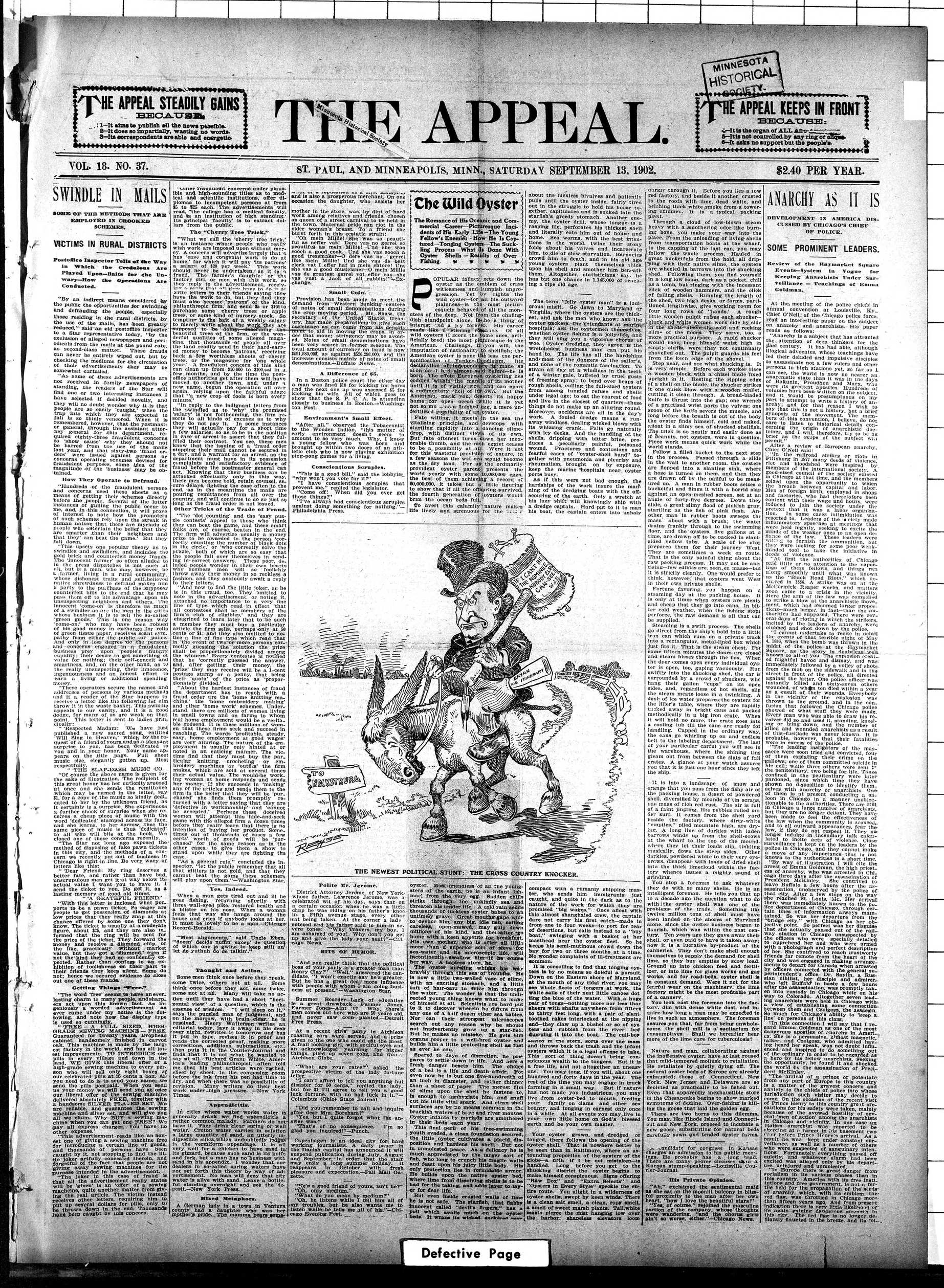
TO NECKSTBURG
REHGE
THE NEWEST POLITICAL
IF I CAN'T BE
THE DEMONNET
CAN SEE
MATTER
BRYAN
HIS IFNEBARY
TO
NECKSTBURG
REHSE
THE NEWEST POLITICAL STUNT: THE CROSS COUNTRY UNKNOWN
THE NEWEST POLITICAL STUNT: THE CROSS COUNTRY KNOCKER
D
so on a lava lamp management
occasion the daughter, who assists her
mother in the store was be that kind of
work among relatives and friends chosen
as queen of a street carnival to be held in
the store. She was a friend to the
elder woman's breast. To a friend she
burst forth in this cestialistic style. She was so
paintful as her new vault! She was so painte-
ful as mein Millie! Und she was so
paintful as mein Millie! Und she was so
good treashermor-O dere no vacrity
like mein Millie! Und she was de best
she has a good musician-er O de mein Millia
ve de greatest gerol vet effer vas- she
has a Jack of all, *rabbits*!"-Ex-change
Small Coin.
Provision has been made to meet the needs of the small denominations, banking centers of notes of small denominations and the crop moving period. Mr. Shaw, the President of United States treasury, has made provision for assistance as can come from his despatches. The note that must be made that money: strengency may be avoided. Notes of small denominations have a total amount of $25,000,000, the total amount of currency on hand is now $91,500,000, as against $52,250,000. Of small denominations—Buffalo News.
A Difference of 85
In a Boston police court the other day, a man accused of stealing and the next one up was questioned about showing his wife. All of which goes to business in Boston - Washington Fox.
Environment's Small Effect
"After all," observed the Tobaccoist to the Wooden Indian, "this matter of money is so much more important amount to so very much. Why know a young fellow who was born and up within two doors of an athletic club? You can exhibit pong games for a living.
Conscientious Scrubles.
"why won't you vote for it?"
"I have conscientious scruples that prevailed, relicted the legislator."
"Come off. When did you ever get those things?"
"always had conscientious scruples against nothing for nothing."—Philadelphia Press.
Polite Mr. Jerome.
District Attorney Jerome of New York, whose father, Lawrence Jerome, was a celebrated wit of his day, says that on a certain occasion when he was a little clap he was riding on his father's knee in a Fifth avenue stage, every other day being taken. At the corner a lady entered and his father said to him in some tones: "Why, Travers, my boy, I was a chauffeur, your only man to keep up and give the lady your seat?"—C.I. cago News.
HITS OF HUMOR.
"And you really think that the political boss of your party is a greater man than Henry Clay?" "Well," answered the cand. tian, "I don't exactly say he's greater. But he has a great claim for influence with people with whom I am doing business at present." Washington Star.
Summer Boarder—Lack of education is a great drawback. Farmer Jones. Farmers. Homer. "Ah!" said the men, comes out here who are 50 years old, and never saw corn, planted. "Detroit Free Press."
At a recent girl's party in Atchison roasting cars were served, and a prize was given. And the girl said the most a frail looking girl, with some of the most an acknowledged yearning for higher things, piled up seven cobs, and Wm.—Atchison Globe.
"What are your rates?" asked the prospective victim of the lady fortune teller.
"I can't afford to tell you anything but disaster for 60 cents," replied the lady, and she added, "I don't luck fortune, with no bad luck in it."-Columbus (Ohio) State Journal.
"Did you remember to call and inquire about the Bureau of Corrections, but you forgot what the answer."-That's of no consequence. I'm so glad you inquired"-Punch.
Copenhagen is an ideal city for hard working journalists. A daily pinner in the newspaper, he says, "I suspend publication during July, August and September, in order that the staff be able to cover reappears in October with fresh pleasure and expectation-Fail Mail Gauss-"It's a good friend of yours, isn't he?"-Oh, only medium."
"What do you mean by medium?" Oh, he listens while I tell him all of my troubles, but he also wants me to tell me all of my all of "Chicago Evening Bore."
The Wild Oyster
The Romance of His Oceanic and Commercial Career—Picturique Incidents of His Early Life—The Young Fellow's Enemies·How He Is Captured Tonging·The Survival Power What Is Doing With Oyster Shells—Results of Over Fishing
OPULAR fallacy sets down the oyster as the emblem of crass witlessness and lumpish unprogression. Yet by rights the oyster is the purist philosophy—is the most figuratively behaved of all the mon
OPULAR fallacy sets down the oyster as the emblem of crosswitness and lumpish unprogression. Yet by rights the wild oyster—for all his outward plainness—is the most picture-equally behaved of all the mon-
sters of the deep. Not from the chafing-dish standpoint alone, is he a thing of interest and a joy forever. His career reads like a stirring romance. Of all wild oysters (I scorn the tame ones, artificially bred) the most picturesque is the American. Challenge, if you will, the imputation of nationality to shellfish; the American oyster is none the less the personification of Yankee Dodgeism. His declaration of independence is made as scon as I d almost said before—he is born. The effective European oystering has qoddled within the mantle of its mother until it is of visible size, and can sport a rudimentary shell of its own. But the American, mark you, deerts its happy home for open ocean while it is yet not so mu, as a finished egg, a mere unfertilized possibility of an oyster.
Fate willing, it meets in the sea the vitalizing principle, and develops with startling rapidity into a dancing slime drop, with distinct views of its own. But fate oftenest turns down her inexorable thumb, and the rash eggiet causes to be a possibility at all. Were it not for this wasteful provision of nature, in a few seasons the wet sea would become as the dry land. For as the ordinarily provident oyster parent presents the world yearly with some 10,000,000 eggs, the best of them achieving a record of 60,000,000, it takes but a little niguring to show that if all the offspring survived, the fourth generation of oysters would brim the ocean beds full.
To avert this calamity nature makes life lively and strenuous for the year.
POLITICAL STUNT: THE CROSS COU
oyster, most friendless or all the youngsters of the earth, he is an infant lash-strike through the skull. Sudden chill strike through the heart. He threaten his tender life. A cold rainads thousands of luckless oyster babies to an adult with the same heart to devour him, any big, the tail sailing careless, open-mawed, may gulp down milch with the aid of a knife and then gourd him. His own mother, who is after all all much more than a superior sort of sieve for his own flesh, swallow him in spite incontently. swallow him in some her way. A hapless atom, he.
The oyster muffling whisks his way bravely through this sea of troubles. He is now a little two-walled vase of silme, with an exciting stomach, and a little turt of hair-cars to drive him through the water. The wonder is that the undirected young thing knows what to make of himself at all. Scientists are hard put to it to discover where he differs from any one of a half dozen other sea babies. Nor can their strongest microscopes search out any reason why he should not inadvertently grow up a star-fish. But he makes no mistake. He gets him organs proper to a well-bred oyster and builds him a little protecting shell as fast as ever he can.
Spared to days of discretion, he prepares to settle down in life. And here a fresh danger besets him. The choice of a bed is a life and death affair. For even now he is but one five-hundredth of an inch in diameter, and rather thinner than a sheet of paper. The merest film of silme upon the shell he fastens to is enough to asphyxiate him, and smut out his little vital spark. And clean surfaces are by no means common in the brackish waters of bay and river mountains. Oyster infants by myriads are smoothed in their beds each year.
This final peril of his free-swimming youth evaded, a clean foundation secured, the sea, and the land. He placed position and hardens his shell. But not in unmolested peace. As a delicacy he is much appreciated by the larger sort of fishermen upon his juicy little body. His only protection lies in formidable armor. Upon the native oyster bed, where lime was grown, he had for the taking, and adds layer to layer for dear life.
But even inside crusted walls of time he is not safe. The starfish, that fahby he called "devil's fingers," has a pull whistle. It devil's bodys. It wires its wrist.
Defective Page
about the luckless bivalves and patiently pulls until the oyster inside, fairly tired in the struggle to hold his house together, capitulates and is sucked into the oyster shell. In the enemy, the oyster dill, whose tougher rasping file, perforates his thickest shell and literally eats him out of house and intends in the world, twice folds about his valves and incarcerate him, to die of slow starvation. Barnacles grow on the oyster shell, age young oysters, plant themselves upon his shell and smother him ben-hath them. Altogether, statisticians may, be it, upon a ship of 1,140,000 of rearing a tipe old age.
The term "olly oyster man" is a ludicrous mifft. Go down to Maryland or Virginia, where the oysters are the thickest, the oyster packer the gettier, and the hospitals; ask the oystermen themselves, whether oyster fishing is a jolly life, and whether oyster dredging is a vicious chorus of woe. Oyster dredging is wretched business man can put his hand to. The life has all the hardships and none of the romance of the sailor's, and none of the romance of the strain all day at a windlass in the teeth of a winter gale, buffeted by cruel gusts of spray; to bend over heaps of rough shells from among tangleed refuse and shells under legal age; to eat the coarest of quarter-these things do not deal with wizzy shells. Moreover, accidents are all in the day's work. A fouled dredge means a run-in with closest of quarters—these shells dealing wilted blows with its whizzing corks with ice decks. And the handling of the shells, drapping with bitter brine, proclaims a peculiarly painful, poisoned wound. Fearful cases of "oyster-shell hand" together with pneumonia and pleurisy and rheumatism, brought on by exposure, marine hospitals near oyster ports busy.
As if this were not bad enough, the hardships of the work insure the marking of the dredging boats with the offencing of the earth. Only a wretch at sea can do this, and a dredge captain. Hard put to his boat, the captain enters into unhole
CANNOT BE
THE NUMBER WELL
CAN BE SEEN
IN THE LIBRARY
ENTRY KNOCKER.
compact with a rummy shipping master, who sends him immigrants just caught, and quite in the dark as to the watchers, who warn for which they are promised "b big wages" this almost shanghaised crew, the captain dare not carry his first catch—made in from one to four weeks—to port for fear of being swamped instead to a "b buy船," swinging with a masthead near the oyster feet. So he keeps his semi-multitude crowd down the bay for two or three at a time, with complaints of ill-treatment are sommons.
It is consoling to find that tonging oysters is by no means so doleful a pursuit. Down on the Eastern shore of Maryland, you see one fleet of tongers at work, the white sails of their little canoes dotting the blue of the water. With a huge net, sheers with shafts anywhere from fifteen to thirty feet long, with a pair of slant-toothed rakes interlocked at the nipples and rattles rubbish from the river bed dumping it into the boat. The cull-bowmer m the stern, sors over the mans and throws back the trusses the infant has built. This sort of thing doesn't bring conspicuous wealth to the tongers. But it is one. You may long to altogether an uneasy one. You may long to be the natural has not made you industrious, you live from oyster-bed to mouth, feeding your family on clams and other see bony and tonging in earnest only once a week. You own your own little home on God's blessed earth and be your own master.
Your oyster grown, and dredged or tonged, there follows the opening of the oyster shell. That is nowhere better to be seen than in Baltimore, where an astounding proportion of the oysters of the globe-a fifth if 1 be not mistaken—is handled. Long before you get to the shucking district the oyster begins to make himself conspicuous. Signs offering "Raw Box" and "Extra Selects" and "Oysters in Every Style" speckle the entire route. You alight in a wilderness of oyster shells, swept by keen winds. There is a clean salt smell, a clean, ropy smell, a smell of sweet marsh plants. Tall white masts pierce the mist hanging low over the harbor: shaneless elevators loom
MINNESOTA
HISTORICAL
SOCIETY.
THE APPEAL KEEPS IN FRONT
BECAUSE:
1. It is the organ of ALL ABO.
2. It is not controlled by any ring or elbow.
3. It asks no support but the people's.
darkly through it. Before you lie a row red factory, and beside it another, crusted to the roofs with lime, dead white, and belching thick white smoke from a towering chimney. It is a typical packing plant.
Through a cloud of low-blown steam heavy with a smothering odor like burning bone, you make your way into the place. From the unloading of living shells from transportation boats at the wharf, to the capping of the last can, you may follow the whole process. Hauled in great bucketfuls from the hold, all dripping with their native silme, the oysters are wheeled in barrows into the shucking shed. Following them, you find yourself in a long low room, dark as a pocket, chill as a tomb, but ringling with the incessant click of wooden hammers, and the click of falling shells. Running the length of the shed, two high desks, or forms, partitioned lengthwise, give working room for four long rows of "hands." A rough little wooden pulpit rakes each shucker-black, and white women work side by side in the sheds above the cold and reeking silme of the floors. They serve, too, a more practical purpose. A rapid shucker would soon bury himself waist high in empty shells, were they not continually shovelled out. The pulpit guards his feet from the keen edge of the shovel.
Step near, and see what shucking is. It is a wooden block with a shell blade fixed upright in it. Resting the ripping edge of a shucked blade, the shucker strikes the knife with a quick cut, cutting it clean through. A broad-bladed knife is thrust into the gap; one wrench grips the wrist parts the valves; one scoon of the knife, the other long before the breath is out of the body. Wounds himself, cold and naked, atonement. The trick is so neatly and easily done as if beautus, not oysters, were in question, and means quick work while the world stands.
Follow a filled bucket to the next step in the process. Passed through a slide in the pool, the bucket is floured into a slanting sink where a hose is turned on them, and then they are drawn off by the submerged to be measured bucketful and finishes with a hirth slot against an open-mesh screen, set at an angle of forty-five degrees. Down they are drawn off by the submerged to be measured drains frankly through to the swimming floor, and the oysters, five gallons at a time, are drawn off to be packed in slanted yellow filters to prepare them for their journey West. They are sometimes a week en route, and then they are prepared for the raw processing. It not be tiring—few edibles are seen, en masse but it is strictly cleanly. One would prefer to be in the pool, and the raw processing went West in their own private shells.
Fortune favoring, you happen on a scanning day at the packing house. It is not hard to find, and cheap that they go into cans. In bitter cold weather, when the fishing stops and the raw demand is all that can be supplied.
Steaming is a swift process. The shells go direct from the ship's hold into a little boat into a rectangular, metal-lined track just fits it. That is the steam chest. For some fifteen minutes the doors are closed and the door comes open every individual. When the door comes open every individual it is open, too, gaping vacuously. Run swiftly into the shudging shell, the car is held in a crowd of shuckers, who hang their hands over the sides, and, regardless of hot shells, slip the steam meats loose in a twinkling. A man prepares the oysters for the litter's tank, and takes away in bright cans and packed methodically in a big iron crate. When a cooling tub till the crate goes into handling. Capped in the ordinary way, the cans go whirling up and endless of your particular department. The last of your particular department is the warehouse, where the shining time gream out from between the slats of full crates. A glance at your watch assures that it is just one hour since they left the ship.
一
it is into a landscape of snow and orange that you pass from the fish air of the oil well, diversified by mount of powdered oil, diversified by mount of one mass of rich red rust. The air is full of a faint jingling, like pebbles rolled on the surface it comes from the shell yard beside the oil well. The empties "piled" mountain high, are drying. A long line of darkes with laden darkes, piled down the steep side at the wharf to the top of the mount, where they let their loads slip, tibbling darkes, piled down the steep side. Other darkes, powdered in their very brass, disappears with loads of dried shell into the thick limedoil within the facade that issues a noisy sound of grindle.
You stop a foreman to ask whatever they do with so many shells. He is an oyster foreman. He tells you that up to a dozen shells are needed with the oyster shell was one of the problems of the trade. Something like twelve million tons of shell must have been placed on a stone, since the oyster business began to flourish, which was within the past century. Ten years ago they gave away their shells now it is a lucrative by-product of the canneries. They don't make shell enough themselves to supply the demand for shell products. Ground up into chicken feed and fertilizer, or into lime for glass works and gas works, and for road-beda, oyster shell is used to make the shells more feculent on the machinery, the lime factory might be the most profitable part of a cannery. The foreman the foreman into the factory, dim with dense white dust, and expect to live in such an atmosphere. The foreman how long a man may be expected to live in such an atmosphere. The foreman some, the shell milk is a sanitarium for consumptives. Shall we hereafter hear more of the lime cure for tuberculosis?
Nature and man, collaborating against the inoffensive oyster, have at last roused that mild-tempered mollusk to retaliation. He retaliates by quietly dying off. The natural oyster beds of Europe are already exhausted; those of Connecticut, New York, New Jersey and Delaware are so depleted as practically to be fished out. Even that apparently inexhaustible store in the Cheesapeake begins to show marked symptoms of decline. Over-fishing is killing the goose that laid the golden egg.
There are two horns to this dilemma. You may, like Rhode Island and Connecticut and New York, proceed to incubate a new goose, substituting for natural beds carefully sown and tended oyster farms.
A candidate for congress in Kansas charges an admission to his public meetings. He probably has a long head. There are many poorer circuses than a Kansas stump-speaking-Louisville Courier-Journal.
His Private Opinion.
"Ah," exclaimed the sentimental maid as she sat on the moonlit balcony in bliss-
"Yes," he said, "the man in the heart," "How I love the beautiful stars!"
"Yes, of course," rejoined the masculine portion of the company, whose thoughts were wandering, "and the chorus girls ain't so worse, either." Chicago News.
DEVELOPMENT IN AMERICA DISCUSSED BY CHICAGO'S CHIEF OF POLICE.
SOME PROMINENT LEADERS.
Review of the Haymarket Square Event—System in Vogue for Keeping Anarchists Under Surveillance — Teachings of Emma Goldman.
At the meeting of the police chiefs in annual annual meeting of the Louisville, KY. Chief O'Neill of the Chicago Police read an interesting paper on the subject on anarchy and anarchists. His paper "Anarchy is a subject that has attracted the attention of deep thinkers for the century. It has had able, although illogical, teachings and teachings have led their deluded and misunderstood assassination not a few rulers and other persons in high stations yet, so far as I am aware, an anarchistic state than it was of Eskunin, Froudon and Marx, who volumes have been written on the subject, be presumptions on my part to attempt anarchy, and for that reason I wish anarchy; and for that reason I wish not a history, but a brief synopsis of the history of bers of this convention, I believe, do not care to listen to historical details confined to the subject, and I will, therefore, to be as the scope of the subject as permit.
After a review of European anarchy, Chier O'Neill said:
The railroad strikes or riots in Pittsburgh many deeds of violence, riot and bloodshed in the city, and members of the international society. A good-sized group of the society existed in the city that made up the labor force, seized upon the opportunity to widen their ranks, and hired a man, Men of foreign birth, employed in factories, who had therefore been hired to join the society. The pretext that it was a labor organization was resorted to. Leaders of the ackee inflammatory speeches at meetings that were intended to inform the minds of the weaker ones to an open defiance of the law. These leaders were men who were looking for something to work-minded tool to take the initiative in the city. "At first the authorities of Chicago paid little or no attention to the vaporization along smoothly until what was known as the Black Road Riots," which occurred in 1887. "They struck a show at the amarchistic movement, which had assumed larger proportions to strike a show at the amarchistic theorists had supposed. There were several days of rioting in which the strikers, were clubbed and shot down by the police.
cannot undertake to recite in detail the 4, 188, when the bomb was thrown in the 4, 188, when the bomb was thrown in the Square, to the police at the Haymarket known to all of you. The explosion creat- tion was immediately followed by a volley from the mab on the sidewalk and in the street against the latter. One police officer, instantly killed and sixty-seven others were killed, and the explosion as a result of their wounds. Everybody in the vicinity of the explosion was injured and stuff they were made. The fusion that followed the Chicago police officer stuff they were made. Every man who wished to be killed volver did so and used it, standing, kneel- ing, and wounded anarchists of the number of killed and wounded anarchists of this fusilade was never known. It is known that their fatalities were in excess of the police.
The leading instigators of the massacre were soon tried and convicted, four of them, explaining their crime on the gallows; one of them committed suicide in his cell; while three others were sent to the penitentiary, two being for life. Those confined in the penitentiary were later pardoned, since which time they have shown no disposition to identify themselves with anarchy or anarchists. One of them is at present conducting a saloon in Chicago in a manner unobjectionable to the authorities. There are still in Chicago a large number of anarchists, but they are no longer desiant. They have been made to feel the effectiveness of the law when the community is aroused, and to all outward appearances, fear the law, if they do not respect it. They no longer indulge in incendiary talk calculated to incite acts of violence. Close surveillance is kept on the leaders by the police in Chicago, and they cannot make a move of any importance that is not known to the authorities in a short time.
"By way of illustration I will cite the arrest of Emma Goldman, the high priestess of anarchy, who was arrested in Chicago three days after the assassination of President McKinley. She contrived to leave Buffalo a few hours after the assassination, unobserved by the police of that city. After a few stops on the way she reached St. Louis, etc. Her arrival there was immediately known to the police department of Chicago, through certain lines of information always maintained. So her departure from the "bridge city," which is Chicago as her objective point. So perfect as her disguise that she actually passed out of the way station in Chicago unsuspected by the officers who were specially detailed to apprehend her and who were armed with a photograph and perfect description of her. She contrived to reach crustwenty friends far remote from the heart of the city and was engaged in making arrangements to depart for Canada when arrested by officers connected with the general superintendent's office. Dr. Saylin, a Russian nihilist, her disciple and admirer, who left Buffalo in haste a few hours after the assassination, was promptly taken to the city in Chicago while on his way to Colorado. At another seven days in Chicago, an officer of the Chicago police, with a view of establishing some relation between them and Czolgosz, the assassin, so much for Chicago's ability to keep a line on persons of this class
"In this connection I will say that I regard Emma Goldman as one of the most dangerous apostles of anarchy in America. She is a persuasive, most magnetic talker, and Człogosz, who admitted having heard her speak, was not doubt influenced and inspired to do something out of the ordinary in order to be regarded as a hero by his fellow anarchists. Seeking the opportunity, he found it and shocked the world by the assassination of President McKinley.
"The arrival of a prince or potentate from any part of Europe to this country is a matter of the gravest concern and anxiety to the chiefs of police into whose jurisdiction such visitor may decide to come. On the occasion of the recent visit of Prince Henry to this country great precautions for his safety were taken, mainly because of the avowed hostility of several men of action among the anarchists in Chicago and vicinity. In one case an Italian was at war with a reported beeching at a target in his basement two days before Prince Henry's arrival. As a result he was kept under constant surveillance, as well as a number of others who were suspected of the primary intentions. Fortunately everything was not quietly, and whatever alarm had been excited was allayed only by his departure, uninjured and unmolested."
"In Europe there is great danger from the invaders of this country. America with its free institutions and free government, is not a ferrary of anarchy, which, with its emblem, the red dace, was carroted in Chicago more than any other city. Indication there is very little likelihood of its again gaining dangerous strength in the next few years, and finally faunthed in the breeds, and its
AVE YOU READ
THE APPEAL?
THE APPEAL,
A NATIONAL AFRO-AMERICAN NEWSPAPER
PUBLISHED WEEKLY BY
ADAMS BROS. EDITORS AND PUBLISHERS
49 E. 4th St. St. Paul, Minn.
ISSUED SIMULTANEOUSLY IN
Saint Paul, Minneapolis, Chicago,
Washington, Louisville, S.
ST.
UL OFFICE,
No. 110 Union Blk. 4th and Cedar,
J. Q. ADAMS, Publisher.
CHICAGO OFFICE,
323-5 Dearborn St., Suite 310,
C. F. ADAMS, Manager.
LOUISVILLE OFFICE,
No. 312 W. Jefferson St. Room 3
W. V. PENN, Manager.
ST. LOUIS OFFICE,
No. 100 Franklin Avenue.
J. H. HARRISON, Manager.
TERMS, STRICTLY !" 'DVANCE:
SINGLE COPY, ONE YEAR . . . $2.00
SINGLE COPY, BIX MONTHS . . . 1.10
SINGLE COPY, THREE MONTHS . . . . 60
When subscriptions are by any means allowed, 60 cents for each 13 weeks and . . . 5 cents for each cash旧, or at the rate of $4, per 40 cents each, or at the rate of $8, per 40 cents.
Remittances should be made by Express registered Letter or Bank Draft. Postage stamps will be received the same as cash for one cent and two cent stamps taken.
Silver should never be sent through the mail. It will be lost or be a hole through the envelope. Cash should be sent to who sends silver to in letters do so at the address of the person receiving it strictly in advance, and to be announced at all must come in season to be naws.
Advertising rates, 15 cents per agate line, each or three cents per inch, and about seven words in an inch, and about seven words in an inch, must be no more than $1. No discounts allow on less than three months contract. Cash must accompany cash to us. Further particulars on application.
Reading notes $25 cents per line, each insertion.
No matter is set in breviter type—about 8 cents to the line. All head lines count down.
The date on the address label shows when the letter was sent. It is made two weeks prior to expiration, so that no paper may be missed, as the paper stops it. It occasionally happens that papers sent tombstone numbers do not receive any number when due, informs by postal card at the expiration of five days from the date of mailing. Forward a duplicate of the missing number. Communications to receive attention must be written only upon one side of the paper; not written later on Wednesday, and bear the date turned, unless stamps are sent for postage. We do not hold ourselves responsible for the date of our correspondence everywhere. Write for terms. Sample copies free. In every letter that you write and never fail to write, post office county and state. Business separate sheets from letters containing new or matter for publication. Excerpts as second
AGENTS WANTED.
THE APPEAL wants good reliable agents to canvass for subscribers at points not already covered. Write for our extraordinary inducements. Address,
THE APPEAL,
49 East 11th St.,
St. Paul, Minn.
A few days since we read of an Afro-American shooting perhaps fatally two white men who objected to his presence in the car in which they were. We thought, well, the Jim Crow car law is responsible for the shooting. And we thought that it would have been very much better to have not had that senseless law. Then those three lives would not have been sacrificed. The shooter in this case was so enraged to think that he could not get seats for two women, because of the damnable law that he shot to kill when the men told him he was in the wrong car.
"LYNCH HIM"
Eleven people from their citizens were shot by Jeremiah Hunter and his wife, Negroes, who turned their home into a fort in resistance to cap
This was not in the wild west, but, in the immediate vicinity of New York city, Hunter and his wife, both old, were not hardened criminals. On the contrary, they were the trusted and faithful caretakers of a wealthy city man's suburban estate. They could fire a peaceable one man and his wife with the desperation of a Tracy must have been strong indeed, and it was. Hunter offense—but that does not matter—is sufficient to make him subject to arrest.
But he was a Negro. Instantly the cry "Lynch him!" was raised and a great crowd gathered.
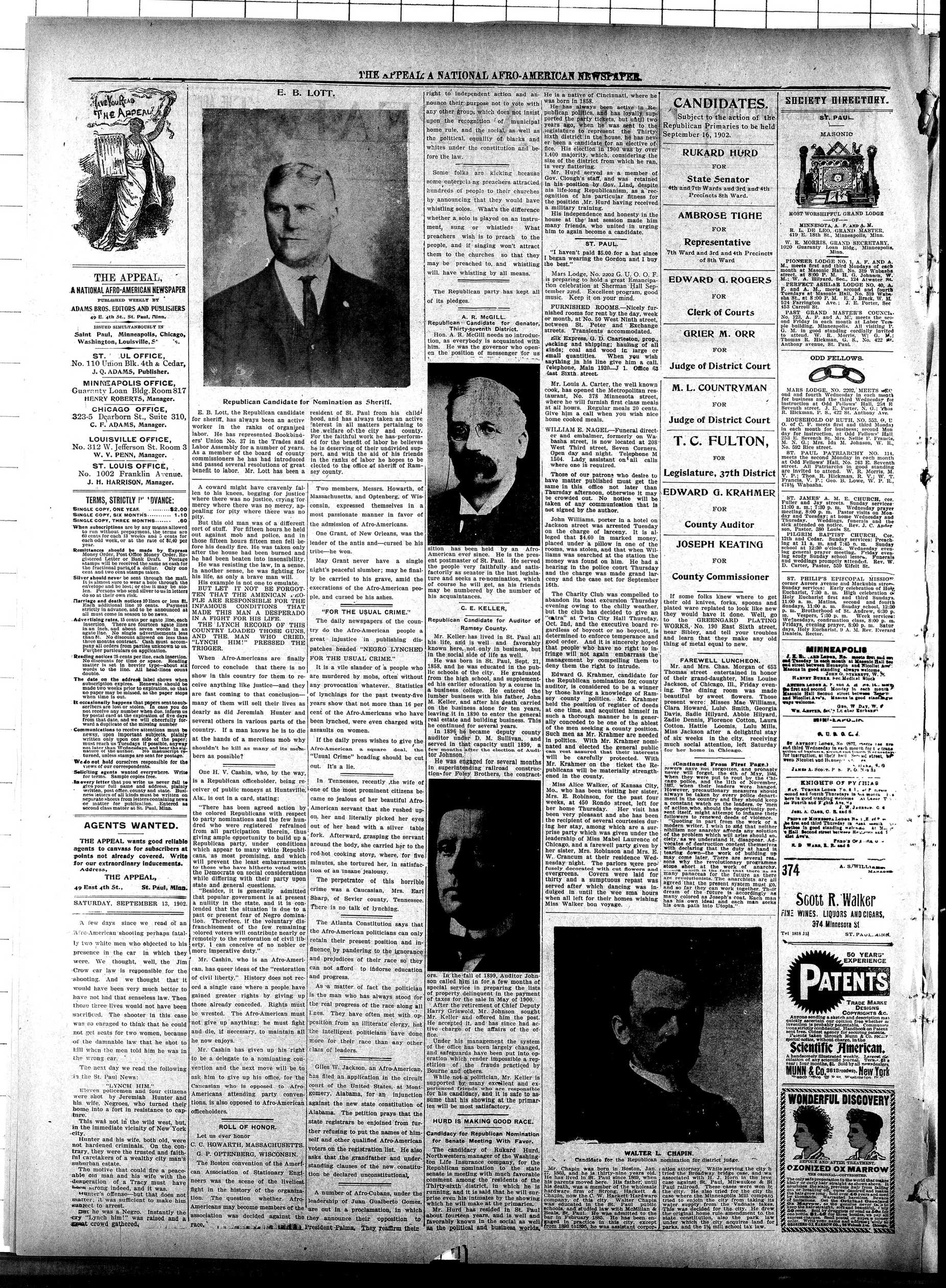
E. B. LOTT,
Republican Candidate for Nomination as Sheriff.
E. B. Lott, the Republican candidate for sheriff, has always been an active worker in the ranks of organized labor. He has represented Bookbinders' Union No. 37 in the Trades and Labor Assembly for a number of years. As a member of the肘肘attention commissioners he has had commissioners and passed several resolutions of great benefit to labor. Mr. Lott has been a
A coward might have cavely fallen to his knees, begging for justice where there was no justice, crying for mercy where there was no mercy, appealing for pity where there was no pity.
But this old man was of a different sort of stuff. For fifteen hours he held against mob and police, and in those fifteen hours fifteen men fell before his deadly fire. He was taken only after the house had been burned and he was killed. He was resisting the law, in a sense. In another sense, he was fighting for his life, only a brave man will.
Two members, Messrs. R. Massachusetts, and Openthe consin, expressed themes most passionate manner in the admission of Afro-Newer leader of the antis and—cuir—he won.
May Grant never have night's peaceful slumber; may he carried to his grave
is example is not one to emulate.
BUT YOU JUST WOULD BE FORGET
THEN THE AMERICAN GOLE
ARE RESPONSIBLE FOR THE
INFAMOUS CONDITIONS THAT
MADE THIS MAN A DESPERADO
IN A FIGHT FOR HIS LIFE.
THE LYNCH RECORD OF THIS
COUNTRY LOADED THOSE GUNS,
AND THE MAN WHO CRIED,
"LYNCH HIM!" PRESSSED THE
TRIGGER.
When Afro-Americans are finally
forced to conclude that there is no
show in this country for them to
receive anything like justice—and they
are fast coming to that conclusion—
many of them will sell their lives as
dearly as did Jeremiah Hunter and
several others in various parts of the
country. If a man knows he is to die
at the hands of a merciless mob why
shouldn't he kill as many of its members
as possible?
One H. V. Cashin, who, by the way, is a Republican officeholder, being receive of public moneys at Huntsville, Ala. is out in a card, stating: "There has been agreed action by the colored Republicans with respect to the arrest of those dressed who were registered refrained from all participation therein, thus giving ample opportunity to build up a Republican party, under conditions appropriate to such an occasion, as most promising, and which will prevent the least embarrassment to those who have hitherto voted with Democrats on social considerations and who will be arrested upon state and general questions.
"Besides, it is generally admitted that popular government is at present a nullity in the state, and it is contended that the situation is due to a past or present fear of Negro domination. Therefore, if the voluntary disaffection of the remaining colored voters will contribute remotely to the restoration of civil liberty, I can conceive of no nobler or more imperative duty."
Mr. Cashin, who is an Afro-American, has queer ideas of the "restoration of civil liberty." History does not record a single case where a people have gained greater rights by giving up those already conceded. Rights must be wrested. The Afro-American must not give up anything; he must fight and die, if necessary, to maintain all he now enjoys. Mr. Cashin has given up his right to be a delegate to a nominating convention and the next move will be to ask him to give up his office, for the Caucasian who is opposed to Afro-Americans attending party conventions, is also opposed to Afro-American officeholders.
Let us ever honor
C. C. HQWARTH, MASSACHUSETTS,
G. P. OPTENBERG, WISCONSIN
The Boston convention of the American Association of Stationary Engineers was the scene of the liveliest fight in the history of the organization. The question whether Afro-Americans may become members of the association was decided against the race.
THE APPEAL A NATIONAL AFRO-AMERICAN NEWSPAPER
resident of St. Paul from his childhood, and has always taken an active interest in all matters pertaining to the welfare of the city and county. For a faithful work he has performed for the benefit of labor he believes he is deserving of their undivided support, and with the aid of his friends ranks of labor he hopes to be elected the office of sherif of Ramsey county.
Two members, Messrs. Howarth, of Massachusetts, and Optenberg, of Wisconsin, expressed themselves in a most passionate manner in favor of the admission of Afro-American.
One Grant, of New Orleans, was the leader of the antis and—cursed be his tribe—he won.
May Grant never have a single night's peaceful slumber; may he finally be carried to his grave, amid the executions of the Afro-American people, and cursed be his ashes.
The daily newspapers of the country do the Afro-American people a great injustice in publishing dispatches headed "NEGRO LYNCHED FOR THE USUAL CRIME."
It is a vile slander of a people who are murdered by mobs, often without any provocation whatever. Statistics of lynchings for the past twenty-five years show that not more than 16 per cent of the Afro-Americans who have been lynched, were even charged with assaults on women.
If the daily press wishes to give the Afro-American a square deal, the "Usual Crime" heading should be cut out. It's a lie.
In Tennessee, recently, the wife of one of the most prominent citizens became so jealous of her beautiful Afro-American servant that she rushed upon, her and literally picked her eyes out of her head with a silver table fork. Afterward, grasping the servant around the body, she carried her to the red-hot cooking stove, where, for five minutes, she tortured her, in satisfaction of an insane jealousy.
The perpetrator of this horrible crime was a Caucasian, Mrs. Earl Sharp, of Sevier county, Tennessee. There is no talk of lynching.
The Atlanta Constitution says that the Afro-American politicians can only retain their present position and influence by pandering to the ignorance and prejudices of their race so they can not afford to indoise education and progress.
As a matter of fact the politician is the man who has always stood for the real progress of the race along all lines. They have often met with opposition from an illiterate clergy, but the intelligent politicians have done more for their race than any other class of leaders.
Giles W. Jackson, an Afro-American, has filed an application in the circuit court of the United States, at Montgomery, Alabama, for an injunction against the new state constitution of Alabama. The petition prays that the state registrars be enjoined from further refusing to put the names of himself and other qualified Afro-American voters on the registration list. He also asks that the grandfather and understanding clauses of the new constitution be declared unconstitutional.
right to independent action and announce their purpose not to vote with any other group, which does not insist upon the recognition of municipal home rule, and the social, as well as the political, equality of blacks and whites under the constitution and before the law.
Some folks are kicking because some enterprising preachers attracted hundreds of people to their churches by announcing that they would have whistling solos. What's the difference whether a solo is played on an instrument, sung or whistled? What preachers wish is to preach to the people, and if singing won't attract them to the churches so that they may be preached to, and whistling will, have whistling by all means.
The Republican party has kept all of its pledges.
A. R. McGILL
Republican Candidate for Senator,
Thirty-seventh District
thirty-seventh District.
For an introduction,
honor, as everybody is acquainted with him.
He was the governor who open
the position of messenger for us
J. B. H.
sition has been held by an Afro-American ever since. He is the present postmaster of St. Paul. He served the people very faithfully and satisfactly as senator in the last legislature and seeks a re-nomination, which of course goes as his friends may be numbered by the number of his acquaintances.
Republican Candidate for Auditor of Ramsey County.
Mr. Keller has lived in St. Paul all his life, and is well and favorably known here, not only in business, but in the social side of life as well.
He was born in St. Paul, Sept. 21, 1858 in schools of the city. He graduated from the high school, and supplemented his earlier education by a course in a business college. He entered the college in 1861 and John M. Keller, and after his death on the business alone for ten years, leaving it in 1890 to enter the general real estate and building business. This he continued for several years. He was a county auditor under D. M. Sullivan, and served in that capacity until 1899, a few months after the election of Auditor. He was engaged for several months in superintending railroad construction for Foley Brothers, the contract
1910
ors. In the fall of 1898, Auditor Johnson called him in for a few months of special service in preparing the lists of property delinquent in the payment of taxes for the sale in May of 1890. Auditor Johnson, Harry Griswold, Mr. Johnson sought Mr. Keller and offered him the post. He accepted it, and has had since active charge of the affairs of the office. Under his management the system of the office has been largely changed, and safeguards it for the office, organization which render impossible a repetition of the frauds practiced by Bourne and others. While not a politician, Mr. Keller is supported by many excellent and assistive colleagues. For his candidacy, and it is safe to assume that his showing at the primaries will be most satisfactory.
HURD IS MAKING GOOD RACE.
Candidacy for Republican Nomination for Senate Meeting With Favor. The candidacy of Rukard Hurd, Northwestern manager of the Washington Life Insurance company, for the Republican nomination to the state senate is meeting with much favorable comment among members of the Republican district, in which he is running, and it is said that he will surprise even his intimately by the showing which he will make at the primaries. Mr. Hurd has resided in St. Paul since 1971 and is favorably known in the social as well as the political and business worlds.
M. B.
He is a native of Cincinnati, where he was born in 1858.
He has always been active in Republican politics, and has loyal support for his party for years ago, when he was sent to the legislature to represent the Thirty-sixth district in the house, he has never been a candidate for an electorate of 1,400 majorities in 1900 was by over 1,400 majorities in considering the size of the district from which he ran, is very flattering.
Mr. Hurd served as a member of Gov. Clough's staff, and was retained by the governor, and, despite his life-long Republicanism, a recognition of his particular fitness for the position Mr. Hurd having received a military training.
His independence and honesty in the hard work and dedication he made him many friends, who united in helping him to again become a candidate.
ST. PAUL.
"I haven't paid $5.00 for a hat since I began wearing the Gordon and I buy the best."
Mars Lodge, No. 2202 G. U. O. O. F. is preparing to hold a great Emancipation celebration at Sherman Hall Septembr 16, a program good music. Keep it on your desk.
FURNISHED ROOMS — Nicely furnished rooms for rent by the day, week or month, at No. 50 West Ninth street, between St. Peter and Exchange streets. Transients accommodated.
Elk Express, G. D. Carteston, prop. packing and shipping; hauling of all goods to and from the small quantifies. When you wish anything in his line give him a call. Telephone, Main 1920—J. 1. Office 63 east Sixth street.
Mr. Louis A. Carter, the well known cook, has opened the Metropolitan restaurant, No. 378 Minnesota street, where he will furnish first class meals. Regular meals 20 cents. Give him a cook called meals. Wish you nice home cooked meals.
WILLIAM E. NAGEL—Funeral director and embaler, formerly on Wabasha street, is now located at 208 Wabasha Street, Dayton, Corners, Open day and night, Telephone 1504. Lady assistant on all calls where one is required.
Those of our patrons who desire to have matter published must get the same in this office not later thanursday afternoon otherwise it may be taken of any communication that is not signed by the author.
John Williams, porter in a hotel on Jackson street was arrested Tuesday on the charge of larceny. It is alleged that $4.60 in marked money,rooms, was stolen, and that when Williams was searched at the station the money was found on him. He had a hearing in the police court Thursday and the charge was made grand larceny, and the case set for September 16th.
The Charity Club was compelled to abandon its boat excursion Thursday evening owing to the chilly weather, but the club has decided to give an annual boat excursion on October 2nd, and the executive board regardless of boycott or no boycott, is determined to enforce temperance and good order. And it is sincerely hoped that the club will have no right to infringe on its management by compelling them to deny them the right to intrude.
Edward G. Krahmer, candidate for the Republican nomination for county auditor, is considered to be a winner by those having a knowledge of Ramsey County, held the position of register of deeds at one time, and acquitted himself in such a thorough manner he is generally conceded to be one of the ablest county position. Such men as Mr. Krahmer are politics. With Mr. Krahmer nominated and elected the general public can rest assured that their interests are carefully protected. With Mr. Krahmer, the ticket the Republicans will be materially strengthened in the county.
Miss Alice Walker, of Kansas City, Mo., who has been visiting her sister, Mrs. E. Robinson, for the past four weeks, at 450 Rondo street, left for Chicago, where she has been very pleasant and she has the recipient of several courtesies during her stay, among which are a surprise party which was given under the leadership of Miss Mabel Laurence of Chicago, and a farewell party given by her husband, Mr. W. Crancum at their residence Wednesday night. The parlers were profusely decorated with cut flowers and evergreens. Covers were laid for an and a sumptuous repast was served after the party, indulged in until the wee man hour when all left for their homes wishing Miss Walker bon voyage.
WALTER L.
Candidate for the Republican
Mr. Chapin was born in Boston, Jan. 12, 1920, and he was thirty years old. He has lived in St. Paul since 1898, when his parents moved here. His father, until his death, was a member of the world hardware firm. Strong, Hackett & Chapin, now the C. W. Hackett Hardware company of this city, Walter Chapin was educated in the St. Paul public school. He joined the company in Beaulais, St. Paul. He was admitted to the bar in February 1888. He has been en-rolled in the St. Paul College from 1896 to 1905, he was assistant corpora-
Subject to the action of the Republican Primaries to be held September 16, 1902.
RUKARD HURD
FOR
State Senator
4th and 7th Wards and 3rd and 4th
Precincts 8th Ward.
AMBROSE TIGHE
FOR
Representative
7th Ward and 3rd and 4th Precincts
of 8th Ward
EDWARD G. ROGERS
Clerk of Courts
GRIER M. ORR
FOR
Judge of District Court
M. L. COUNTRYMAN
FOR
Judge of District Court
T. C. FULTON,
FOR
Legislature, 37th District
EDWARD G. KRAHMER
FOR
County Auditor
JOSEPH KEATING
FOR
County Commissioner
If some folks knew where to get their old knives, forks, spoons and plated ware replaced to look like new they would be done. Well go to the GREENBAG PLANNING WORKS. No. 190 East Sixth street, near Sibley, and tell your troubles and learn that they make any old thing of metal equal to new.
FAREWELL LUNCHEON.
Mr. M. Morgan of 652 Thomas street, enters a McKinley of their grand-daughter, Miss Louise Jackson, of Chicago, Ill. Friday evening. The dining room was made beautiful by sweet flowers. Those flowers are Clara Howard, Lulu Smith, Georgia Davis, Sadie Hilary, Abbie Hilary, Zadie Dennis, Florence Coleman, Laura Cotton, Hattie Loomis, Lulu Mills, and six weeks in the city, receiving much social attention, left Saturday for her home in Chicago.
(Continued From First Page.)
owers have not forgotten, and probably never will forget, the 4th of May, 1956, when they were put to rout by the "filrago police, and the 11th of November, 1857 when leaders were hanged. However, precautionary measures always have taken by every police department in the country and they should keep a constant watch on the leaders, or "men of action, who should the opportunity pre-
"Quoting in part from the work of a modern writer, I wish to add that neither nihilism nor anarchy affords any solution of the problem which will arise should society, as we understand it, disappear. Adversarial relations, content themselves with declaring that the day of the tearing down—the work of building up may come later. There are several reasons why the revolutionary programme stops short at the work of anarchy, such as the rather far-reaching the many panaceas for the future as there are revolutionists. The anarchists are all agreed that the present system must go, and so far they can work together. Their demand of the future is accordingly as many colored as Joseph's coat. Each man has his own ideal group such as man seeks his own patio into Lipola."
CHAPIN. nomination for district judge.
ation attorney. While serving the city hity associated with H. J. Horn in the levee case against St. Paul, Milwaukee & St Paul involved. These cases were won by the he. He also tried for the city tha case where the Minneapolis Mill company had to obtain the city from adding water supply to the Vadnads lakes. This was defined for the city by the state constitution, also the park law amendment to the state constitution, also the park law amendment to the park law, which the 1½ mill school tax law.
SOCIETY DIRECTORY.
MOST WORSHIPFUL GRAND LODGE
—OF—
MINNESOTA, A. F. AND A. M.
R. L. DE LRO, GRAND MASTER.
419 E. 18th St., Minneapolis, Minn.
W. R. MORRIS, GRAND SECRETARY.
1020 Guaranty Loan Bidg., Minneapolis, Minn.
PIONEER LODGE NO. 1, A. F. AND A. M., meets first and third Mondays of each month at Masonic Hall. No. 319 Wabasha street, at 8:00 P.M., H. G. Johnson, W. M., W. A. Hilyard, Sec., 124 Atwater St.
PERFECT ASHLAB LODGE NO. 40, A. F. and A. M., meets second and fourth Tuesdays at Masonie Hall. No. 319 Wabasha St., at 8:00 P.M., E. J. Brack, W. M. 524 Carrington Ave.: J. E. Porter, Sec. 453 Carroll St.
PAST GRAND MASTERS COUNCIL,
Missouri, in each month at Labor Temple
building, Minneapolis. All visiting G.
M. in Missouri, at Labor Temple, M. to
attend, W. R. Morris, W. G. M.
Thomas H. Hickman, G. S. No. 422
Anthony avenue, St. Paul.
ODD FELLOWS.
MARS LODGE, No. 2202, MEETS
and on fourth Wednesday in each month
at Labor Temple, instruction at Odd Fellows Hall, 253 E seventh street, J. E. Porter, N. G.: The
household of RUTH, No. 533 G, U.
of C. F. meets first and third Monday
day for instruction, at Odd Fellows Hall,
253 E. Seventh street, M. F. Nelle F. Prentice,
day for instruction, at Odd Fellows Hall,
No. 532 Rice street.
ST. PAUL PATRICIAH NO. 114,
Minneapolis, at Odd Fellows Hall, No. 253 E.
seventh street, in good standing
are invited to participate in a
V. P.; Thos. R. Hickman, R. V.; W. T.
R. G. B. Lowe, W. P. R. 4758 Wabasha.
ST. JAMES A. M. E. CHURCH, cor.
Fuller and Jay streets. Sunday services
11:00 a. m.; 7:30 p. m. Wednesday prayer
meeting, 8:00 p. m. Pastor visits on Monday and Tuesday at home Wednesday and the
Thursday. Weddings, funerals and the
sundays intended to help Rev. J. C. Anderson, Pastor, 380 Lonia St.
PILGRIM BAPTIST CHURCH, Cor.
12th and Cedar. Sunday services: Preaching at 11 a. m. and 7:45 p. m. Sunday
school at 12:30 o'clock. Wednesday evening
general prayer meeting. Friday evening
study Sunday school lessons. Funerals and
weddings promptly attended. Rev. W. D. Carter, Pastor, 559 Elfitt St.
ST. PHILIP'S EPISCOPAL MISSION
corner Auros avenue and Mackubin street
Sunday services: Early celebration of Hol
Eucharist, 7:30 a. m. High celebration of
Holy Eucharist first and third Sundays.
1:00 a. m. Matins, second and fourth
Sundays, 11:00 a. m. Sunday school, 12:30 p. m.
Brotherhood of St. Andrew, 6:30 p. m.
Vespers, 7:30 p. m. Week services
Wednesdays, confirmation class, 8:00 p. m.
Fridays, evening prayer, 8:00 p. m. Saturday
days, Holy Eucharist, 9 A. M. Rev. Everard
Daniels, Rector.
MINNEAPOLIS
S. K. R., AND LONDON, R. mon. first and
tuesday in each month at Mascaline Hall see
Mason's in good standing always welcome.
JOHN G. HENKERT, W. K.
HARRY BENNETT in good standing always welcome.
HARRY BENNETT A. F. and J. M. are martyrs
first and second Monday in each month
Mascaline Hall Second street between Tiger
Mason's in good standing always welcome.
8th Anniversary Loved, No. 5971, 1st St. and third Wednesday in each month for 1st trans-action of business, around the fourth Wednesday for instruction, at their hall. See no street, between Nicolet and Homer's.
James A. Scott, P.S. P.O.N. 33
KNIGHTS OF PYTHIA9
8th. TURNER Loved No. 81, 1st St. and fourth Thursday in each month 1st�ers in good standing welcome. At Labor T. 1st St. North and F. 6th Ave. No. 3
J. W. Jackson, C. G. Jocel A. Oae, C. R. and 8
PRIDE OF MINNESOTA Loved No. 1, 1st St. and third Thursday in each month 1st at the brothee in good standing welcome. At Mass. Hall Second street between Homer's and 1st Street Ave's.
R.D. WARD, R. R. 1848
374
A. S.J.WILLIAMS
MANAGER
Scott R. Walker
FINE WINES. LIQUORS AND CIGARS,
374 Minnesota St
Tel 1818 113
ST. PAUL, AIRD.
---
A WEEKS RECORD IN MINNESOTA'S CAPITAL.
The Saintly City and Saintly City Folk-Newey Irene of Sacrific, Religious and General Matters Among the People, Behind Down.
WANTED—A TRUSTWORTHY GEN- man or lady in each county to manage business for an old established house of solid financial standing. A straight, bona fide gift to the county of 185 houses each Wednesday, with all expenses, direct from headquarters. Money advanced for expenses. Manager: 340 Caxton Bldg., Chicago.
VOTE FOR YOUR FRIENDS, TUESDAY
As there are no Afro-Americans who are candidates for any of the offices to be voted for on the 16th, they can only show their loyalty to themselves by voting for men who will recognize them in making appointments in their offices, when elected. Several of those who have cuts and sketches in The Appeal have given such assurances. There is one however, a case where nothing of the sort may be expected, and that is PHIL C. JUSTUS, candidate for sheriff. He says he can make more friends among the Afro-Americans by not appointing one of them than by doing so. He says it's impossible to satisfy them. So it is safe to bet that he will not offend them by appointing any one of them. REMEMBER THIS NEXT TUESDAY.
Primary election next Tuesday—vote for Republicans.
A large hall well filled with good people on the 22nd—Sherman Hall.
Everyone who knows what Emancipation means will be at Sherman Hall on the 22nd.
The Odd Fellows and their wives will be at Sherman Hall on the 22nd. Tickets, 35 cents.
The voters will make no mistake in voting for Nicholas Pottgeiser for County Commissioner and don't you forget it.
The tickets for the Odd Fellows entertainment on the 22nd cost 35 cents and that's 6 cents per hour for 6 hours' pleasure.
Sherman Hall is a very large place and will accommodate a great many people. The floor is delightful and it only costs 35 cents.
Congressman F. C. Stevens has a lead pipe cinch—no one against him. He'll have a walk over, too, at the regular election.
Miss Maud Boger, class of 1902, Provident Hospital, Chicago, Ill., a cousin of S. Edward Hall, is the guest of Mrs. B. R. Durant, $37 Payne Ave.
Nice furnished rooms for rent at 221 East Thirteenth street at reasonable rates by the week or month. Apply to J. J. Johnson or W. A. Williams.
The Elite Shoe Shining Parlor, No. 12 West Sixth street, J. B. Johnson, proprietor. Shoes shined or polished. Special chairs for ladies. Shoe dying a specialty.
The most popular place for people who take their meals down town is John Godfrey's. No. 552 Wabasha street. Everything neat, clean and well cooked.
A good combination for County Commissioners would be Joseph Keabing, R. H. Seng, Nicholas Pottigeen and C. A. Anderson. They are all good Republicans.
Is your hair straight? If not, send 50 cents to Ozonized Ox Marrow Co., 76 Wabash avenue, Chicago, Ill., for a bottle of Ozonized Ox Marrow and you can easily straighten it.
The story is being circulated that a great many people in the Twin Cities don't know what Emancipation means. Go to Sherman Hall on the 22nd, and see if they don't.
Gentlemen wishing nice furnished rooms, with all conveniences, by the week or month, at reasonable rates, should apply at the Benton House, 228 West Third street, up stairs.
The following Afro-Americans have been selected as judges at the primaries: H. Robinson and R. Farr in the Fourth ward; R. C. Minor, R. C. Howard in the Eighth ward.
What's in a name? Well The Thoroughbred Burlesquers will be the attraction at the Star theater next week. Now, watch the crowds as they wend their way to the popular house.
Pilgrim Baptist Church, corner Oedar and Summit, Rev. W. D. Carter, Mortgage services 10:45. Subjects "A New Preacher." Evening services 8 o'clock, subject, "Forgiving and Forgiven."
Maj. Wood of the 24th Infantry in command of 115 unassigned recruits, was in St. Paul Sunday. He left in the evening with 45 of the men for Fort Assinibone and the rest of them went to Forts Missoula and Harrison.
Let your object in life be that you will be somebody in fact or nobody in fact. Never allow yourself to believe that you are somebody when your secret life gives you the lie, for you only destroy yourself.
If you wish a good shave, hair cut or shampoo call at Richard Cousby's neat shop, No. 374% Minnesota street. First-class workmen only. Satisfaction guaranteed. Music for all occasions furnished on short notice.
The Star theater had a record week during the engagement of Rush and Fulton's City Club Company last week when 23,040 people passed in the doors. The previous record was made by Rice and Barton with 16,000 admissions.
Good for the Odd Fellows of St. Paul town.
They've found a date of great renown. And, since they've found this date so great, We'll all join in and celebrate— Monday, Sept. 22nd.
The superb attraction, King Dodo, with a choral court of seventy-five, will play a triumphant return engagement at the Metropolitan Opera House for four nights and a Wednesday matinee beginning Sunday night. Haverly's world famous minstrels will play the latter half of the week with the usual Saturday matinee.
Again the Odd Fellows come forth with an excellent entertainment in the way of an Emancipation celebration which will be given by Mars' Lodge at Sherman Hall, St. Paul, Sept. 22nd. This is an annual affair with the Odd Fellows. A fine orchestra has been secured. There will be a through car to Minneapolis at 2 o'clock a.m.
M. B.
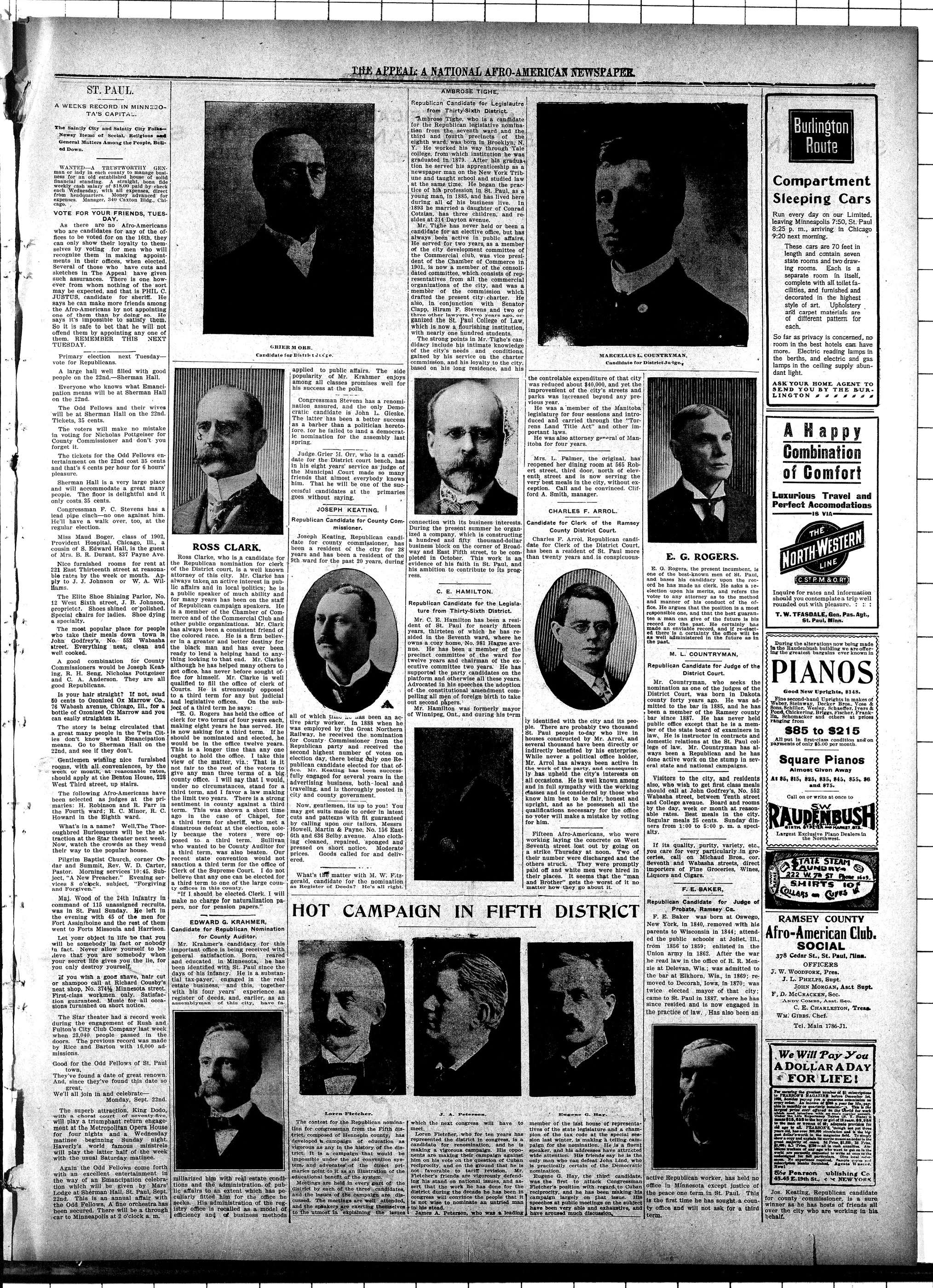
GRIER M ORR.
Candidate for District Judge.
M. H. H.
Ross Clarke, who is a candidate for the Republican nomination for clerk of the District court, is a well known attorney of this city. Mr. Clarke has always taken an active interest in public affairs and in local politics; he is a public speaker of much ability and for many years has been on the staff of a Republican campaign speakers. He is a member of the Chamber of Commerce and of the National Association of other public organizations. Mr. Clarke has always been a consistent friend of the colored race. He is a firm believer in a greater and better destiny for the black man and has ever been ready to lend a helping hand to anything looking to that end. Mr. Clarke although he has helped many others to get office, has never before sought office or himself. Mr. Clarke is well known for his court cases. He is stronely opposed to a third term for any but judicial and legislative offices. On the subject of a third term he says:
"E. G. Rogers has held the office of clerk for two terms of four years each, making eight years he has served. He is now asking for a third term. If he should be nominated and elected, he would be in the office twelve years. This is a longer time than any one ought to hold the office. I take this view of the matter, viz.: That is it not fair to the rest of the voters to be nominated for county office. I will say that I would under no circumstances, stand for a third term, and I favor a law making the limit two years. There is a strong sentiment in county against a third term. This was shown a short time ago in the case of Chapel, for a third term for sheriff, who met a disastrous defeat at the election, solely because the voters were opposed to a third term. Sullivan who wanted to be County Auditor for a third term, was also beaten. Our recent state convention would not sanction a third term for the office of Clerk of the Supreme Court. I do not want to be elected for a third term to one of the large county offices in this county.
"If I should be elected. Clerk. I will make no charge for naturalization papers, nor for pension papers."
Mr. Krahmer's candidacy for this important office is being received with general satisfaction. Born, reared and educated in Minnesota, he has been identified with St. Paul since the days of his infancy. He is a substantial tax-payer, engaged in the real estate business, and this, together with his four years of experience as a real estate broker, has made him a well-assembled person of this city, have fa
W. H.
miliorized him with real estate conditions and the administration of public affairs to an extent that has particularly been seen in his administration of the registry office is recalled as a model of efficiency and of business methods
ROSS CLARK
applied to public affairs. The side popularity of Mr. Krahmer enjoys among all classes promises well for his success at the polls.
Congressman Stevens has a renomination assured, and the only Democratic candidate is John L. Gieske. The latter has been a better success as a barber than a politician heretofore, for he failed to land a democratic nomination for the assembly last spring.
Judge Grier M. Orr, who is a candidate for the District court bench, has in his eight years' as judge of the Municipal Court made so many friends that almost everybody knows him. That he will be one of the successful candidates at the primaries goes without saying.
JOSEPH KEATING
Republican Candidate for County Com missioner.
Joseph Keating, Republican candidate for county commissioner, has been a resident of the city for 28 years and has been a resident of the 9th ward for the past 20 years, during
all of which time he has been an active party worker. In 1888 when he was employed by the Great Northern Railway, he received the nomination for County-Commissioner from the Republican party and received the second highest number of votes on election day, there being only one Republican candidate elected for that office. Mr. Keating has been successfully engaged for several years in the advertising business, both local and traveling, and is thoroughly posted in city and county government.
Now, gentlemen, its up to you! You may get suits made to order in latest cuts and patterns with fit guaranteed by calling upon our tailors. Messrs Howell, Martin & Payne, No. 156 East 6th and 63rd Selby avenue. Also clothing cleaned, repaired, sponged and pressed on short notice. Moderate prices. Goods called for and delivered.
What's the matter with M. W. Fitzgerald, candidate for the nomination as Register of Deeds? He's all right.
HOT CAMPAIGN IN FIFTH DISTRICT
A.
The contest for the Republican nomination for congressman from the Fifth district, composed of Hennessey county, has developed a campaign of education as vigorous as any in the history of the district. It is a campaign that would be impossible under the old convention system, and advocates of the direct principles point to it as an illustration of the educational benefit of the system.
Meetings are held in every part of the district by each of the three candidates, and the issues of the campaign are discussed. The meetings are well attended, and the speakers are exerting themselves to the utmost in explaining the issues
THE APPEAL: A NATIONAL AFRO-AMERICAN NEWSPAPER
Republican Candidate for Legislature from thirty-Sixth District.
Ambrose Tighe, who is a candidate for the Republican legislative nomination from the seventh ward and the third and fourth precincts of the eighth ward, was born in Brooklyn, N. H. He went on to study through Yale college, from which institution he was graduated in 1879. After his graduation he served his apprenticeship as a newspaper man on the New York Journal and taught school and studied law at the same time. He began the practice of his profession in St. Paul, as a young man, in 1885, and has lived here during all of his business live. In 1893 he married a daughter of Conrad Cotzian, has three children, and resides at 314 Dayton avenue.
Mr. Tighe has never held or been a candidate for an elective office, but has always been active in public affairs. He served for two years as a member of the city development committee of the Commercial club, was vice president of the Chamber of Commerce in 1901, is now a member of the consolidated committee, which consists of representatives from all the commercial organizations of the city, and was a member of the commission which drafted the present city charter. He also, in conjunction with Senator Clapp, Hiram F. Stevens and two or more other members, organized the St. Paul College of Law, which is now a flourishing institution, with nearly one hundred students. The strong points in Mr. Tighe's candidacy include his intimate knowledge of the city's needs and conditions, gained by his service on the charter commission, and his loyalty to the city, based on his long residence, and his
PETER H. BURGESS
connection with its business interests During the present summer he organized a company, which is constructing a hundred and fifty thousand-dollar business block on the corner of Broadway and East Fifth street, to be completed in October. This work is an evidence of his faith in St. Paul, and his ambition to contribute to its progress.
C. E. HAMILTON.
Republican Candidate for the Legislature from Thirty-Sixth District.
Mr. C. E. Hamilton has been a resident of St. Paul for nearly fifteen years, thirteenth of which he has resided in the Seventh ward, where he owns a cozy home, No. 981 Hague avenue. He has been a member of the precinct committee of the ward for twelve years and chairman of the executive committee two years. He has served as chairman of the platform and otherwise all these years. Advocated in his speeches the adoption of the constitutional amendment compelling all men of foreign birth to take out second philers.
Mr. Hamilton was formerly mayor of Winnipeg, Ont., and during his term
```markdown
```
M.
which the next congress will have to meet.
Loren Fletcher, who for ten years has represented the district in congress, is a candidate for renomination, and he is a strong supporter of institutions are making their campaign against him on his vote on the question of Cuban reciprocity, and on the ground that he is not a strong supporter of that question. Fletcher's friends are vigorously defending his stand on national issues, and assert that the work he has done for the district will be to instigate that congress will convince the people that it is not wise to nominate an untried man in his stead.
O.
the controllable expenditure of that city was reduced about $40,000, and yet the improvement of the city's streets and parks was increased beyond any previous year.
He was a member of the Manitoba legislature for four sessions and introduced and carried through the "Torres Land Title Act" and other important laws.
He was also attorney general of Manitoba for four years.
Mrs. L. Palmer, the original, has reopened her dining room at 565 Robert street, third door, north of eleventh street and is now serving the very best meals in the city, without exception. Call and be convinced. Clifford A. Smith, manager.
CHARLES F. ARBOL.
Candidate for Clerk of the Ramsey County District Court.
Charles F. Arrol, Republican candidate for Clerk of the District Court, has been a resident of St. Paul more than twenty years and is conspicuous-
[Image of a man in a suit and tie].
ly identified with the city and its people. There are probably two thousand St. Paul people to-day who live in houses constructed by Mr. Arrol, and several thousand have been directly or indirectly benefited by his enterprise. While never a political office holder, Mr. Arrol has always been active in the work of the party, and consequently has upheld the city's interests on all occasions. He is well known among and in full sympathy with the working classes and is considered by those who know him best to be fair, honest and upright, and as he possesses all the qualifications necessary for the office no voter will make a mistake by voting for him.
Fifteen Afro-Americans, who were working laying the concrete on West Seventh street lost out by going on a strike Thursday at noon. Two of their number were discharged and the others struck. They were promptly paid off and white men were hired in their places. It seems that the "man and Brother" gets the worst of it no matter how they go about it.
M. H.
member of the last house of representatives of the state legislature and a champion of the tax code at the special session of the legislature, he served as palligraph for the nomination. He is a fluent speaker, and his addresses have attracted wide attention. His friend may be the candidate, and what is practically certain of the Democratic nomination. Eugene G. Hay, the third candidate, fletcher the position with regard to Cuban reciprocity, and he has been making his campaign largely on that issue. His speech was well suited on the subject, be it very able to articulate, and have aroused much discussion.
PETER H. BURKE
E. G. ROGERS.
E. G. Rogers, the present incumbent, is one of the best-known men of St. Paul, and bases his candidacy upon the record he has made as clerk. He asks a re-election vote to any attorney as to the method and manner of his conduct of the office. He argues that the position is a most responsible one, and that the best guardian man can give to the future his record. He argues that he made an enviable record, and if re-elect-
M. L. COUNTRYMAN.
Republican Candidate for Judge of the District Court.
Mr. Countryman, who seeks the nomination as one of the judges of the District Court, was born in Dakota county forty years ago. He was admitted to the bar in 1885, and he has been a member of the Ramsey county bar since 1887. He has never held public office except that he is a member of the state board of eminent law. He is instructor in contracts and domestic relations at the St. Paul college of law. Mr. Countryman has always been a Republican and he has done active work on the stump in several state and national campaigns.
Visitors to the city, and residents also, who wish to get first class meals should call at John Godfrey's. No. 552 Wabasha street, between Tenth street and allege avenue. Board and rooms by rate. Bakeable rates. Best meals in the city. Regular meals 25 cents. Sunday dinners from 1:00 to 5:00 p. m. a specialty.
If its quality, purity, variety, etc., you care for very particularly in groceries, call on Michaud Bros., cor. Seventh and Wabasha streets, direct importers of Fine Groceries, Wines, Liquors and Cigars.
F. E. BAKER.
Republican Candidate for Judge of Probate, Ramsey Co.
F. E. Baker was born at Oswego, New York, in 1840, removed with his parents to Wisconsin in 1844; attended the public schools at Joliet, Ill., from 1856 to 1859; enlisted in the Union army in 1862. After the war he read law in the office of R. R. Menzie at Delevan, Wis.; was admitted to the bar at Elkhorn, Wis., in 1869; removed to Decorah, Iowa, in 1870; was twice elected mayor of that city; came to St. Paul in 1887, where he has since resided and is now engaged in the practice of law. Has also been an
THE MASTER OF THE WORLD
active Republican worker, has held no office in Minnesota except justice of the peace one term in St. Paul. This is the first time he has sought a county office and will not ask for a third term.
Compartment Sleeping Cars
Run every day on our Limited,
leaving Minneapolis 7:50, St. Paul
8:25 p. m., arriving in Chicago
9:20 next morning.
These cars are 70 feet in
length and contain seven
state rooms and two drawing
rooms. Each is a
separate room in itself,
complete with all toilet fac-
ilities, and furnished and
decorated in the highest
style of art. Upholstery
and carpet materials are
of different pattern for
each.
So far as privacy is concerned, no
room in the best hotels can have
more. Electric reading lamps in
the berths, and electric and gas
lamps in the ceiling supply abun-
dant light.
ASK YOUR HOME AGENT TO
SEND YOU BY THE BUR-
LINGTON
A Happy Combination of Comfort
Luxurious Travel and
Perfect Accomodations
IS VIA
THE
NORTH-WESTERN
LINE
C.ST.P.M.&O.R.Y
Inquire for rates and information
should you contemplate a trip well
rounded out with pleasure. : : :
T. W.T.FASDALE, Gen. Pas. Agt.,
St. Paul, Minn.
During the alterations now being made
in the Baudenbush building we are offering
the greatest bargains ever known in
Good New Uprights, $148.
Second-band Uprights in makes of
Webster, Schoeller, and Sons,
Schiller, Wesley, Schaffer, Ivors
and Briggs, Briggs, Fischer, Frank
Schomaker and others at prices
ranging from
$85 to $215
All put in first-class condition and on
payments of only $5.00 per month.
At 85, 815, 825, 835, 845, 855, 86
and 875.
Call on or write at once to
SW
RAUDENBUSH
SIXTH STREET AND HAMMET STRE.
Largest Exclusive Plano Dealers in
the Northwest.
STATE STEAM
LAUNDRY
222 W. 74 ST
Phone 1609.
SMIRTS 101
Dollars on Cures
RAMSEY COUNTY Afro-American Club. SOCIAL
OFFICERS
J. W. WOODFORK, Pres.
J. L. PHELPS, Supt.
JOHN MORGAN, Asst Supt.
F. D. McCRACKEN, Sec.
ANDY COMBS, Asst. Sec.
C. E. CHARLESTON, Treas.
WM. GIBBS, Chef.
Tel. Main 1786-J1.
We Will Pay You
A DOLLAR A DAY
FOR LIFE!
```markdown
```
VOTE FOR THE AFRO-AMERICAN'S FRIEND. SHERMAN S. SMITH. REPUBLICAN CANDIDATE FOR 40TH DISTRICT, COMPRISING THE FOURTH WARD.
MINNEAPOLIS
DOINGS IN AND ABOUT THE GREAT "FLOUR CITY."
Matters Social, Religious and General
Which Have Happened and are to Happen
Among the People of the City on the
Palls.
WANTED--A TRUSTWORTHY GENTLI-
teman or lady in each county to manage
business for an old established house of
solidarity, and to make weekly cash salary of $1500 paid by
check each Wednesday with all expenses
direct, from headquarters. Money advan-
ced for expenses. Manager, 340 Ca-
ton Blvd, Chicago.
J. W. DREGER,
Candidate for Sheriff Hennepin
Count.
JAMES D. SHEARER,
For Representative 40th District, Com-
prising Fourth Ward.
SHERMAN S. SMITH,
Republican Candidate for Senator 40th
District, Comprising the 4th
Ward.
Miss Mary Morgan has resigned her position as clerk in the register of deeds office.
Mrs. Basefield of St. Cloud, who has been the guest of Mrs. A. Scott, left for her home Thursday.
Mrs. Bettie Price of Monmouth, Ill., is in the city visiting her son, Mr. J. B. Elliott, of 1305 Washington avenue.
Mrs. Jenkins who has been visiting her sister, Mrs. True, left for her home in Chicago Thursday after a very pleasant visit.
Everybody knows J. W. Phillips, candidate for nomination as sheriff of Hennepin county. He is making a winning campaign.
Miss M. Jackson, milliner and modiste, ladies' tailoring. French cleaning and curling feathers a specialty. No. 1409 South Fifth street.
C
JOHN P. WALL
Republican Canbidate t
Sherif Hennepin CO
Bud Williams who makes a habit of driving other people's horses and carriages without permission, has been reported to the police. He will be watched hereafter.
Miss Jennie Hillyer who has been visiting friends in the city since July will leave next week for Augusta, Ga. where she will resume her duties as matron and teacher of the school.
Mrs. Celestine Brown has opened the "Creole Kitchen" boarding-house style, with 407 Fifth ave. S. Regular beds, 25 cents. Short orders served. First-class furnished rooms in connection. N. W. Tel. 3434-L2, Minneapolis.
E. P. Sweet at present county commissioner of Hennessey county from the north, 3434 Fifth ave. Ward, north of Hennessey, Third Ward, Tenth Ward, is a candidate for renomination. He has served his constituents very acceptibly and will doubtless be rewarded with a renomination.
W. R. Rogers, though one of the old settlers of the state is young yet. He is riding his old horse, "Black Vail," and is watching them all. He got hurt by the machinery under his charge and has had a tough time but is getting all right and will make it warm for some of the boys before he is through with them. He says the Douglass Republican Club will roll up a big majority for Eugene G. Hay, and don't you forget it.
GEORGE P. WILSON.
Republican Candidate for Senator from 41st District.
General Wilson is now senator from the Fifty-first District, composing the Fifth and Sixth wards of Minneapolis, and is asking the Republican voters of Minneapolis to vote for a renomination courtesy of a renomination and of course a re-election to the senate.
Republican Candidate for Renomination as Coroner, Hennepin County.
Dr. Williams was born in Illinois in 1864; brought up on a farm; educated in common and high schools of Wisconsin; entered the drug business in Minneapolis in 1883; graduated from State University Medical Department in 1889; has practiced medicine here for the past thirteen years; has been and is examining physician for the Modern Woodmen, Foresters and Macabees. He is also a member of the A. O. U. W., K. P., and K. K.
JAMES D. SHEARER,
Republican Candidate for Representative, 4th District, Composing the 4th Ward.
Mr. Shearer was born in Wisconsin, March 25, 1862. During his younger days he lived in Iowa, where he received his early education. After graduating from the Iowa state college he was for four years engaged in school and institute work in La Pore City and Waterloo, la. He came to Minneapolis in 1883, and was admitted to practice law in this state in 1885. Since then he has been actively engaged in the practice of his profession in this city. He has acquired a high standing at the bar, and his reputation for integrity and ability is unquestioned. He is one of the direc-
M.
Republican Candidate for Mayor of Minneapolis
tors of the Guaranty Savings and Loan association, and one of the trustees of the Savings Bank of Minneapolis. While in Minneapolis he has always lived in the Fourth ward, has been a holding publican and has always taken an active part in the political campaigns of his party. He has never before been a candidate for public office.
owned and personally operated a line of elevators in Minnesota, consin and Illinois.
He came to Minneapolis to r with his family, 17 years ago, and that time has been a hustling me of the Chamber of Commerce a extensive buyer of grain and see the best times came. Mr. having strong confidence, the
AN HONEST EXPRESSION,
W. L. Luce wrote a letter to Minne-
sapolis. Apply.
At the request of the committee responsible for Mr. Luce's campaign, he has written the following letter to the public, which explains his position: "To the Electors of Minneapolis: Gentlemen: After careful consideration on my behalf, I solicit the assistance of my friends, I ask your votes for the office of mayor of our city. I have lived here twenty years and have large interests. I know you want a wise, vigilant and effective administration. If, in your judgment, when you have heard what I shall say and what my friends will say for me, I honor you with your confidence. I shall hold your confidence given me. Minneapolis shown its desire for clean, honest government by condemning the corrupt officers who have disgraced its fair name. If elected I shall appoint a
M.
chief of police who will be given authority to act, and who will be held strictly to account for the use he makes of that authority. Every good man in office under me will be encouraged, and bad men, if any are shown to be so, will be sent away. I shall look over with watchful eyes, all bills which I will pay to the mayor, before I sign them. I shall keep myself in view the fact that the mayor is the public official representative of all the people, not a party or class. It will be my constant endeavor to do all in my power to advance whatever is for the commercial, the educational, the moral good of this city. Whatever brings men together with good will and compassion, I should keep good of the working men so always before me. They are the majority, and in the wealth producing power of the city hold the chief place. There are many vital questions pressing for consideration, which I cannot discuss in this address to the voters, but you may be sure of this. I shall ask you up, one by one, in such way as seemed appropriate to the Law and liberty, decency and economy I revere. I ask all classes of Republicans to support me at the primary election.
"W. L. Luce."
While Mr. W. L. Luce is well known among the large business men of the city and Northwest, for the benefit of voters of the outlying districts, the committee gives the following information:
Mr. Luce is a man of vast business experience. Starting as a clerk in a grocery store, his business sagacity won for him a large business. Entering the grain field, in a few years he
THE APPEAL: A NATIONAL AFFO-AMERICAN NEWSPAPER
owned and personally operated a large line of elevators in Minnesota, Wisconsin and Illinois.
He came to Minneapolis to reside, with his family, 17 years ago, and since that time he has been a member of the Chamber of Commerce and an extensive buyer of grain and seeds.
When the hard times came, Mr. Lucce having strong confidence in the future of Minneapolis, sold out his grain business and invested his money in improved real estate, among his pursuits, in the Corners and the Hampshire Arms. He is now one of the highest tax payers in Minneapolis, and an enthusiast in his belief in the greatness of this city.
Candidate for Nomination for Hennepin County Auditor.
Born in Minneapolis in 1863. Son of Chas. Scott, who witi Gen. Morgan, built the first machine shop and foundry at the Falls of St. Anthony. Early boyhood spent on a farm in St. Paul's public schools. He attended public schools and Michigan University. Has always taken active interest in politics and in 1896 was a member of the Republican Campaign Committee. Entered county auditor's office in 1897 as second deputy, holding that position until enlisted in the 13th Minnesota, service unit, hospitals and elsewhere in that regiment until it was mustered out.
W. D. WASHBURN, JR.
Candidate for the Senate From Forty-
First District—5th and 6th Wards.
Mr. Washburn was born in St. Paul,
educated in the Minnesota public
schools and graduated from Yale Uhl-
iversity in 1888. He has been engaged
in the four, lumber and railroad bus-
iness, and was for several years con-
nected with the editorial staff of the
Minneapolis Tribune. He is at present
interested in Minnesota lands,
Washburn has contributed many
newspaper and pamphlet articles in
favor of the policies of the Republican
party.
Mr. Washburn was a member of the House of Representatives in the last legislature and introduced and supported the Inheritance Tax, the Torrens' Law for the registry of titles, and the Delinquent' Tax Sale Law. Each of these measures was passed and is now a statute. Mr. Washburn is a strong supporter of the Primary Election Law, the Gross Earnings Law for the increase of railroad taxation and the constitutional amendments to permit the adoption of a more desirable taxation. He also supported the following measures: Board of Control Law, the Drainage Law, the law placing sheriff's office on salaries, the Primary Election Law, etc. He invites an examination of his record as a representative of his district in the lower house.
[Image of a man with a mustache and a suit].
Republican Candidate for County Attorney of Hennepin County.
James A. Kellog has been actively engaged in the practice of law in Minneapolis for 15 years, being attorney in some of the most important litigation in our courts. Before coming to Minneapolis, he was, for 15 years, engaged in law practice at Niles and in Berrie Co. Mich., where he was twice elected County Attorney, and given other political honors.
Popular priced Monte Carlos, Russian Blouses,
Pleated Jackets; Novelties in long garments, and
also a select assortment of Jackets and Capes in
all lengths and shapes; elegantly tailored, stylish
and perfect fitting
garments from..... $5 to $25
They come in white lawns, handsomely tucked and trimmed with insertion; value $1.75 to $2.50, for... 75c
The Plymouth Clothing House, Corner Seventh and Robert.
During his two terms as County Attorney he gave the county the least expensive administration that office ever had and the County Commissioners, although of different party, gave him a larger salary than was ever paid before or has ever been paid since. When he went in that office the county was over $3,000 in debt, but in a short time he had collected twice that sum from defaulted bonds and other obligations of the county. While County Attorney he prosecuted to conviction in every offense, from petit larceny to murder in the first degree, and during his 30 years of practice has appeared in every court from Justice of the Peace to the Supreme Court of the United States.
PETER H.
Mr. Kellogg was born in Huron Co. Ohio, and spent his boyhood working on a farm near Hillsdale, Mich., till 1864, when at the age of 14 years and 2 months he enlisted in Co. G., 44th Ind. Vol. Inf., and served till the close of the war. He was a private soldier and not a drummer boy. Coming out of school he attended the college at 16 years of age he attended Hillsdale, Mich. High School and College, working on a farm to pay his way through. He then taught school and read law nights and mornings. He made his first political speech when 19 years old, and in every campaign since has been an active worker
"Up York State," a new pastoral play by David Waldron, will give its local premiere at the Grand Opera House for one week beginning next Sunday night. Mr. Higgins' previous efforts as a playright include "Burr Oaks," "The Plunger," "Knklnapped," "The Vendeata," and "At Piney Ridge," but in this latest production he is said to have included rather more comedy and drama in its composition. The scenery of the play adorns Adrodackens and the action centers about the love romance of Darius Green, a young inventor, and his ward, Evelyn Blair. In the absence of the former his aunt endeavors, for selfish reasons to break the match She succeeds in having Evelyn contract an alliance with a money lender, the marriage is finally shown to be worthless. The role of the youthful inventor (whose name suggests the well known poem of J. T. Trowbridge) is said to be a very well drawn rural type, while the minor characters are said to be so drawn as to cleverly give the correct "atmosphere" of the time and place concerned. The piece was written by Charles Byrne, the present season at the 14th Street Theater New York, where it is credited with having scored a strong success, Mr. Higgins enacts the role of Darius Green and Miss Waldron of the heroine.
Charles A. Anderson, who wants to be county commissioner, was proprietor of the court house cigar stand during recent Republican administrations and lives in the Ninth ward.
Charles Passavant, Republican, used to be abstract clerk many years ago, the same office which he now seeks. The Republicans have a candidate for every office in the county.
Ex-Senator Nicholas Pottgleser is making a winning race for county commissioner. Everybody knows him and everybody likes him.
C. E. Kellar deputy auditor has filed for the auditorship and as he is fully qualified and has a host of friends his chances for the nomination are excellent.
First Ave. and 5th Street South, MINNEAPOLIS. Will Furnish Your House Complete from Cellar to Garret.
Candidate for Nomination on the REPUBLICAN TICKET
Sheriff of Hennepin County
Pretty
nearly as
good as
HAMM'S"
is high praise for any other
BEER
J. W
No
REP
62
New Fall Tailor-Made Suits—The newest blouse, Eton and dress effects are shown with new shaped skirts, flounce flare, tailor seams. The materials embrace all the popular styles of cloth. From ... $7.50 TO $25
New Fall Dress Skirts of black, grays and browns in meltons and golf suits, 9-gore shape, flare and flounce bottoms, tailor and slot seams at
$5.00, $7.50 and $9.00
Plain and striped madras, with cluster of tucks in back and front; value $1.75 to $3.00, for $1.00
Elk Express Company.
G. D. CHARLESTON, PROP.
Packing, Shipping and Storing.
WOOD AND COAL.
East Sixth Street,
ST. PAUL, MINN.
Tel. Main 1920-J1.
SENATOR.
CANDIDATES
Subject to the result of the
Republican Primaries of Hennepin County Sept. 16, 1902.
J. W. DREGER
FOR
Sheriff
Sheriff
JOHN P. WALL
FOR
Sheriff
LOREN FLETCHER
FOR
Congress
JAMES A. PETERSON
FOR
Congress
EUGENE G. HAY
Congress
JOHN F. CALHOUN
Senator 40th Dis'ct
E. P. SWEET
FOR
County Commissioner
EDWIN C. GARRIGUES
Representative 41st Dist.
5th and 6th Wards.
ARTHUR W. SELOVER
FOR
Representative 41st Dist.
Comprising 5th and 6th Wards
HENRY J. GJERTSEN
Senator 42nd District
"The Apostle of Good Roads."
GEORGE W. COOLEY
County Surveyor SHERMAN S. SMITH
Senator 40th District
Comprising the 4th Ward
JAMES D. SHEARER
FOR
Representative
40th District, Comprising 4th Ward
FRED H. BOARDMAN
County Attorney.
ALFRED E. MERRILL.
Republican Candidate for Alderman of 4th Ward.
A. E. Merrill was born at Maidstone, Vermont, 1845, and moved to Wisconsin, 1855. He worked his way in part through Appleton College, Wisconsin, by his own efforts.
Mr. Merrill carried on a lumber business in Wisconsin for 20 years or more; he employed at times 250 men—never had a strike. He reduced old saw mill work hours from 11½ to 10 hours a day. Mr. Merrill this Congressman Babcock. After this Congressman Babcock, Mr. Merrill's partner, introduced a bill to make Commissioner of Labor a member of President's cabinet.
Mr. Merrill has lived in the 4th ward of Minneapolis about 18 years. He has been in the council 3½ years. Is now interested in perfecting a pure water supply. As member of the Health Board of the city he was instrumental in establishing the most complete quarantine hospital in the state. He has been chairman of the Finance Committee of the council during his entire term, and as such has saved the taxpayers a great deal of money. Mr. Merrill resides at 1516 Harmon Place.