The Appeal
Saturday, July 11, 1903
St. Paul, Minnesota
Page text (machine-generated)
THE APPEAL KEEPS IN FRONT
BECAUSE:
1-It aims to publish all the news possible.
2-It is designed to inform fairly, wasting no words.
3- Its correspondents are able and energetic.
TRIBUTE TO BEECHER
ONE-TIME FOE TELLS OF HIS WONDERFUL EOLEQUENCE.
How the Matchless Orator Quelled Turbulent Mob Gathered to Howl Him Down—The Greatest Moment of a Great Life.
"I see they are going to build a memorial to Henry Ward Beecher," said my white-haired Southern friend, who, in spite of his soft voice and gravely gentle demeanor, had been a fire-eater in the old days. "It's time they did, and I shall send in my subscription."
I looked up surprised. "I thought you fought for the other side during the war."
"So I did, and perhaps that's why I know he deserves a monument," said the colonel, smiling. "I know he was the greatest orator who ever lived."
"Demosthenes and Cicero ain't in it, I suppose?"
"Not with him," the colonel insisted. "Let me tell you a story to prove it." So I settled back in my armchair—the colonel's reminiscences were always a little vacation in my work-a day life.
"You know during the war I was sent to England by the confederacy to work up public sentiment for our side. Well, there were a number of us, and we worked up a good deal of sentiment, so much so that Abe Lincoln began to take notice of it, and after a while he sent Beecher over to make some speeches against us.
"When Beecher landed in Liverpool the town was already billed for his first speech, and we were already there in force to see that he shouldn't make it. The night came and the hall was packed, largely with our sympathetic and with men whom we had interviewed to hoot and make cat calls, and utterly drown out the speaker's voice. It wasn't exactly generous, I admit, but you know, those were deserate days.
"So when he entered it was pandemonium let loose—you never heard such a rocket. He had to come in at the rear and walk the whole length of the hall down the middle asile through a howling mob of enemies. I can see him now as he braced myself, shook that man of his, walked slowly to the front and climbed the platform. He took off his overcoat deliberately and put it and his hat on a chair, he tested a reading desk that stood in the front, found it, loosed him, put out of the way. Then he turned, walked slowly to the front, faced the whirlwind a minute, and then said, in a voice that went through our yelling like a cannon ball through a cotton field.
'Boys, this ain't fair!'
"We forgot to yell for a minute, stopped to tread breath against him, and in that pause he hurled upon us the most wonderful sentence that ever fell from the lips of mortal man. A thousand times I have tried to reword it, but always in vain. I know only that it appealed to the British love of fair play, to the old, historic British sense of justice. And I know from that first moment every man of us forgot why he was there—utterly forgot himself and his country, and I know also that within ten minutes we were breaking the hush with cheers that took the roof off. Cheers, yes; sir, we who were there to silence him, who hated him and his cause. He had left, not till it was all over and we had left, that place of magic did we realize what we had done. If you can find in all history such another miracle wrought by an orator I'd like to know of it.
"I tell you, he was forever hurling thunderbolts that night that were lightning flashes from him. He was not like a man, but some supernatural power. Every soul there fell under the spell, even the reporters. The London papers all sent their best men, with orders to take him, but not one of them got beyond 'Boys, this saint fair.' The London Times actually discharged its representative because of his failure. Ten or fifteen years later I met Beecher. He agreed with me that that night in Liverpool was the great moment of his life, said that then, and then only, he had felt as though possessed by a god, as though uttering not his own words, but those of some other man. I thought that the one speech by which he would like to be remembered should have perished in the utterance."—Atlanta Constitution.
This is the Latest Disease.
Fantis is the latest malady to attack the human race. It is a disease to which only civilized people are subject. Moreover, it is prevalent in summer, and persons who frequent summer gardens and cafes are liable to be harmed. It is nothing more than an ordinary cold or neuralgia produced by the drafts created by electric faps. Nevertheless, physicians in a spirit of humor have chosen to give it a semi-scientific name, and many practitioners are confident the malady under its new nomenclature will prove as popular as la gripe or appendicitis.
When Money Talks.
Hush! good people—not a word!
Not the chimp of a bird—
Let me hear it be heard!
Money talk!
HAD EARNED UMPIRE'S SCORN.
Official Not Afraid of Being Hit by Such a Batter.
Melancholy had been doing her best to mark the umpire for her own but up to the eighth inning she had not been able to leave a dent. He was not of the few whom nature seems to have especially fitted for the responsibilities thrust upon them in this life. Quick of speech, haughty and overly caring and others, indirectly involved in the plea he delivered his decision in a way which almost invariably commanded respect even though it failed to carry conviction. But the penalty which he paid for success in his career, was a heavy one. His disposition was irrefriably ruined. He had become habitually sarcastic. A player on whom three strikes had just been called was speaking up with all the enthusiasm of a man who realised that this is a free country and the voice of the people as it ascends from the bleaching board is on his side.
"Tree strikes nottin" was the loud laconic comment which caused the empire to look upon him with a most resentful and exclaim! "What's dat?"
"I said tree strikes nottin, an' dat's what."
The altercation proceeded until, in a paroxysm of indignation the player lifted his bat as a weapon.
"Look out!" shouted one of the players. "He's goin' to hit ye."
But the umbrella never flinched.
"Don't ye have no fear," he said as he stood in statusque defiance "After what he's been doin' at the bat I don't feel that I'm runnin' no risks whatever. He may strike at me, but there ain't any mortal chance of his touchin' anything."—New York Times.
NOT MANY IN HEAVEN.
Why Little Girl Thought Few Would Be Eligible.
A small girl who lives in an elegant home on Central Park West has troubled her mother very much by her very careless regard for the truth. One day her mother had a very serious talk with the little daughter, and ended up by telling her that liars could not go to Heaven. The small daughter reflected for a time and then said: "Mamma, do you ever tell lies?" "Certainly not," replied her mother. Sudden recollections sweeping across her mind, she hesitated and added: "Sometimes, of course, when it is impossible for me to see people, I see downward for me am not at home. But that is meekly to keep from hurting their feelings. It is not lying.
That night when her father came home she said bluntly:
"Papa, do you ever tell lies?"
"Certainly not," replied her father, with astonishment and some indignation. Then he began to fidget a little, and after awhile added: "Of course, when I'm selling goods I can't always tell all I know about them. It's the other fellow's business to know what kind of goods they are. That isn't lying though; that's just business." The small girl reflected again, and after mature consideration, spoke. "I don't think that I want to go to Heaven," said she; "there won't be any one there but God and George Washington."—New York Times.
What Constitutes a Family:
The question as to what constitutes a "family" is often up before the railroad officials. Some railroads are quite liberal in their definitions. The Pennsylvania Railroad company's uefinition in regard to a pass bearing, a man's name and family is that it is only good for himself and members of his family who rely upon him for support.
Some of the European roads are more liberal. J. B. Hutchinson of the Pennsylvania Railroad company, who has just returned from a trip abroad, said: "I was struck with the liberal sense of work and work and family is good for on the Paris, Lyons and Mediterranean railroad." He had copied the instructions bearing on this subject. They were as follows: "A pass for one and family is good for father, mother, children, grandfather, grandmother, mother-in-law, father-in-law, brother, sister, brother-in-law, sister-in-law, uncle, aunt, nephew, niece and servants attached to the family."
The Woman's Joy.
I fondly held upon my knee
Firm, firm and weed;
With joy all mothers understand
I kissed her feet, each little hand.
The little eyes that yet I knew
Each tiny, dainty, ciselled ear.
The pretty face, so dear, so dear.
I sang an old, old melody.
That of my mother sang to me,
My dear apper, stretching breast
My dear girdle closer pressed.
Ams, mothers, if ours be the pain,
Ours, too, the bliss, the sacred gain;
My dear apper, stretching breast
Not give to us than motherhood.
-Kathleen Kavanagh in New Orleans
Pleasure.
Practical Philanthropy.
"Very often, I suppose," said the inquisitive person, "you are deceived by apparently deserving objects of charity whom you quietly help?" "Yes, indeed," replied the wealthy philanthropist; "it's just like throwing money away. Sometimes the very people you think will advertise you most never say a word about it."
Bobby's idea.
"Did you ever hear of the 'Hanging Gardens of Babylon'?" asked the Sunday school teacher.
"Yes, ma'am," responded little Bobby.
"And what were they used for?"
"To hanz people in 'am'am."
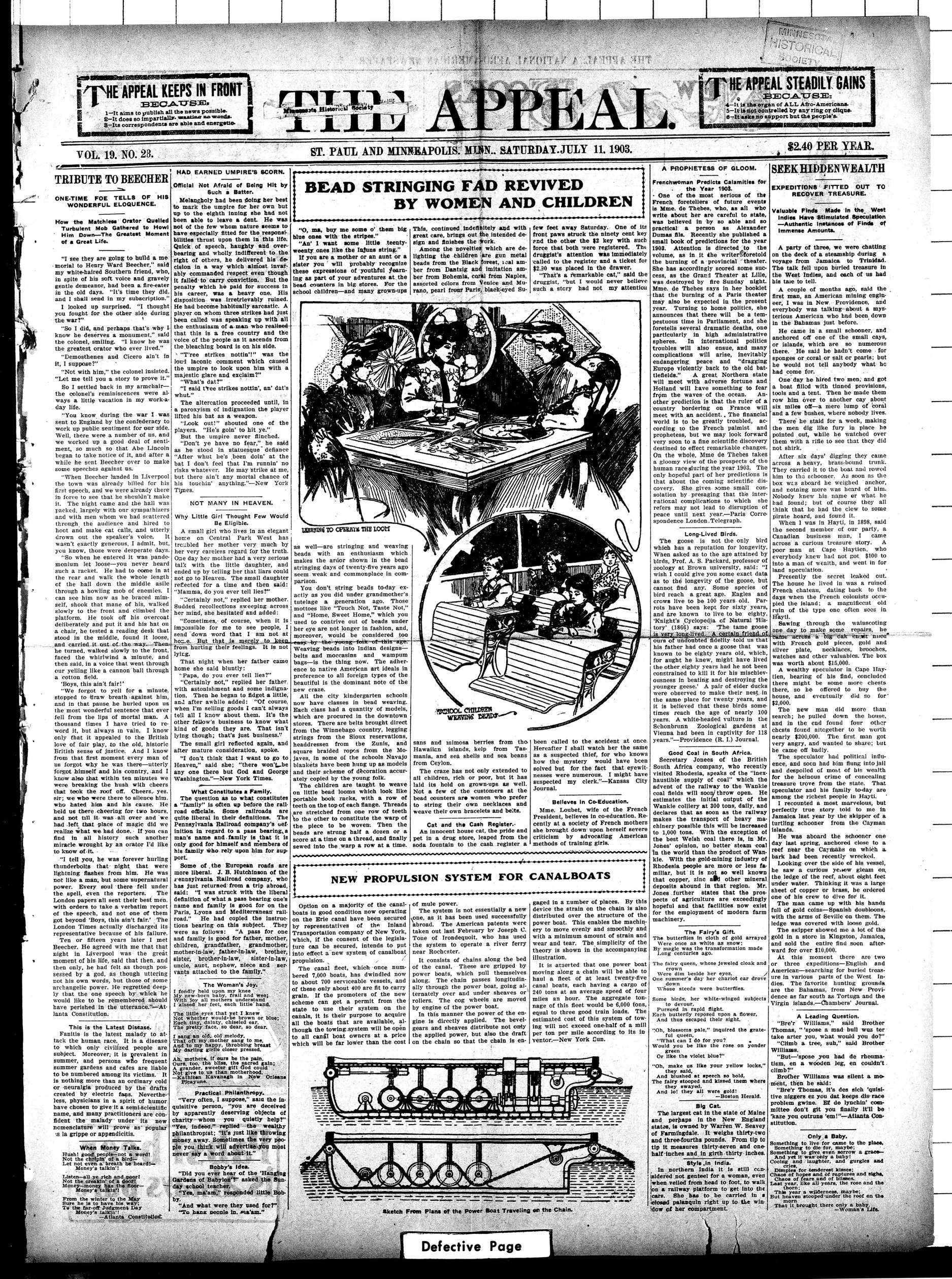
BEAD STRINGING FAD REVIVED BY WOMEN AND CHILDREN
O
NEW PROPULSION SYSTEM FOR CANALBOATS
Sketch From Plans of the Power Boat Traveling on the Chain.
"O, ms, buy me some o' them big blue ones with the stripes."
“An I want some little teeny
wonderly ones like the Infuns string.”
If you are a mother or an aunt or a sister you will probably recognize these expressions of youthful learning as part of your adventures at the bead counters in big stores. For the school children—and many grown-ups
THE
LEARNING TO OPERATE THE LOOK
as well—are stringing and weaving beads with an enthusiasm which makes the arder shown in the bead stringing days of twenty-five years ago seem weak and commonplace in comparison.
You don't string beads today exactly as you did under grandmother's tutelage a generation ago. Those mottos like "Touch Not, Taste Not" and "Home, Sweet Home," which you used to niveate out of beads under her eyes are not longer in fashion, and, however, would be considered too easy by the young folk of this age. Weaving beads into Indian designs—beats and moccasins and wampum bags—is the thing now. The adherence to native American art ideals in preference to all foreign types of the beautiful is the dominant note of the new craze.
All the city kindergarten schools now have classes in bead weaving. Each class had a quantity of models, which are procured in the downtown stores. There are belts brought direct from the Winnebago county, legging strings from the Sioux reservations, headaddresses from the Zunis, and square braided ropes from the Mojaves, in some of the schools Navajo blankets have been hung as models and their scheme of decoration accurately copied by the young folk. The children are taught to wear on little bead looms which look like portable book racks, knives, and rows of teeth on their hands. Flange threads are threaded from one row of teeth to the other to constitute the warp of the piece to be woven. Then the beads are strung half a dozen or a score at a time on a thread, and finally sewed into the warp a row at a time.
NEW PROPUL
Option on a majority of the canalboats in good condition now operating on the Erie canal have been secured by representatives of the Inland Transportation company of New York, which, if the consent of the legislature can be secured, intends to put into effect a new system of canalboat propulsion.
The canal fleet, which once numbered 7,000 boats, has dwindled now to about 700 serviceable vessels, and of these 400 are fit to carry grain. If the promoters of the new scheme can get a permit from the state to use their system on the canals, it is their purpose to acquire all the boats that are available, although the towing system will be open to all canal boat owners at a price which will be far lower than the cost
---
SCHOOL CHILDREN WEAVING DEADS
This, continued indemnitely and with great care, brings out the intended design and finishes the work. Among the novelties which are delighting the children are metal beads from the back and metal beads from the back and imitation amber from Bohemia, coral from Naples, assorted colors from Venice and Murano, pearl from Paris, black eyed Su
SCHOOL CHILDREN
WEAVING DEADS
sans and nimosa berries from the Hawaiian islands, kelp from Tasmania, and sea shells and sea beans from Ceylon. The craze has not only extended to all children, rich or poor, but it has laid its hold on grown-ups as well. Not a few of the customers at the bead counters are women who prefer to string their own necklaces and weave their own bracelets and belts.
Cat and the Cash Register.
An innocent house cat, the pride and pet in a drug store, leaped from the soda fountain to the cash register a
SION SYSTEM FOR
of mule power.
The system is not essentially a new one, as it has been used successfully abroad. The American patents were taken out last February by Joseph C. Tone of Irondequoit, who has used the system to operate a river ferry near Rochster.
It consists of chains along the bed of the canal. These are gripped by power boats, which pull themselves along. The chain passes longitudinally through the power boat, going alternately over and under sheaves or rollers. The cog wheels are moved by engine of the power boat.
In this manner the power of the engine is directly applied. The bevelgears and sheaves distribute not only the applied power, but also the draft on the chain so that the chain is en
```markdown
```
few feet away Saturday. One of its
front paws struck the ninety cent key
and the other the $2 key with such
force that both were registered. The
drugist's attention was immediately
called to the register and a ticket for
$2.30 was placed in the drawer.
"That's a remarkable cat," said the
drugist, "but I would never believe
such a story had not my attention
C
been called to the accident at once Hereafter I shall watch her the same as a suspected thief, for who knows how the mystery would have been solved but for the fact that eyewitnesses were numerous. I might have suspected my clerk."—Kansas City Journal.
Believes in Co-Education.
Mme. Loubet, wife of the French President, believes in co-education. Recently at a society of French mothers she brought down upon herself severe criticism by advocating American methods of training girls.
CANALBOATS
gaged in a number of places. By this device the strain on the chain is also distributed over the structure of the power boat. This enables the machinery to move evenly and smoothly with a minimum amount of strain and wear and tear. The simplicity of the theory is shown in the accompanying illustration.
It is asserted that one power boat moving along a chain will be able to haul a fleet of at least twenty-five canal boats, each having a cargo of 240 tons at an average speed of four miles an hour. The aggregate tonnage of this fleet would be 6,000 tons, equal to three good train loads. The estimated cost of this system of towing will not exceed one-half of a mill per ton per mile according to its inventor—New York Sun.
```markdown
```
A PROPHETESS OF GLOOM.
Frenchwoman Predicts Galamites for the Year 1903.
One of the most serious of the French foretellers of future events is Mme. de Thebes, who, as all who write about her are careful to state, was believed in by so able and so practical a person as Alexander Dumas fils. Recently she published a small book of predictions for the year 1903. Attention is directed to the volume, as in it the writer foretold the burning of a provincial theater. She has accordingly scored some success, as the Grand Theater at Lille, was destroyed by fire Sunday night. Mme. de Thebes says in her booklet that the burning of a Paris theater may also be expected in the present year. Turning to home politics, she announces that there will be a tempestuous time in Paris, the city of the French Republic, endangering peace and particularly in high administrative spheres. In international politics troubles will also ensue, and many complications will arise, inevitably endangering peace and "dragging Europe violently back to the old battlefields." A great Northern state will meet with adverse fortune and Holland will have something to fear from the waves of the ocean. Another prediction is that the ruler of a country bordering on France will meet with an accident. The financial world is to be greatly troubled, according to the French palmist and prophetess, but we may look forward very soon to a scientific discovery destined to effect remarkable changes. On the whole, Mme de Thebes takes a gloomy view of the prospects of the human race gliding through the earth, and she thinks that about the coming scientific discovery. She gives some small consolation by presaging that the international complications to which she refers may not lead to disruption of peace until next year—Paris Correspondence London. Telegraph.
Long-Lived Birds.
The goose is not the only bird which has a reputation for longevity. When asked as to the age attained by birds, Prof. A. S. Packard, professor of zoology at Brown university, said: "I wish I could give you some exact data as to the longevity of the goose, but cannot find any. Some species of bird reach a great age. Eagles and crows live to be 100 years old. Parrots have been kept for sixty years, and are known to live to be eighty. 'Knight's Cyclopedia of Natural History' (1866) says: 'The tame goose is very long-lived. A certain friend of ours of undoubted faith told us that his father had once a goose that was known to be eighty years old, which, for aught he knew, might have lived the other eighty years. It killed it for his mischievousness in beating and destroying the younger geese.' A pair of eider ducks were observed to make their nest in the same place for twenty years, and it is believed that these birds sometimes reach the age of nearly 100 years. A white-headed vulture in the Schonbrunn Zoological gardens at Vienna had been in captivity for 118 years."—Providence (R. I. Journal).
Good Coal in South Africa.
Good coal in the British South Africa company, who recently visited Rhodesia, speaks of the "inexhaustible supply of coal" which the advent of the railway to the Wankie coal fields will soon/throw open. He estimates the initial output of the Wankie colliery at 300 tons, daily, and declares that as soon as the railway makes the transport of heavy machinery possible this will be increased to 1,000 tons. With the exception of the best Welsh coal there is, in Mr. Jones' opinion, no better steam coal in the world than the product of Wankle. With the gold-mining industry of Rhodesia people are more or less less coal than copper, zinc and other mineral deposits abound in that region. Mr. Jones further states that the prospects of agriculture are exceedingly hopeful and that facilities now exist for the employment of modern farm machinery.
The Fairy's Gift.
The butterflies in cloth of gold arrayed
Were once as white as snow;
By magic was the transformation made
Long centuries ago.
The fairy queen, whose jeweled cloak and
crown
"Oh, blossoms pale," inquired the grateful queen,
"Oh, make us like your yellow locks," they said, and I sat at speech so hold. The fairy stopped and kissed them where they swayed.
The largest cat in the state of Maine and perhaps in the New England states, is owned by Warren W. Seavey of Farmingdale. It weighs thirty-two and three-fourths pounds. From tip to tip it measures thirty-seven and one-half inches and in girth thirty inches.
Style. in India.
In northern India it is still considered not genteel for a woman, even when veiled from head, when she comes to town to get into the cars. She has to be carried in a closed palanquin right up to the window of her compartment.
SEEK HIDDEN WEALTH
EXPEDITIONE FITTED OUT TO RECOVER TREASURE.
Valuable Finds Made in the West Indies Have Stimulated Speculation — Authentic Instances of Finds of Immense Amounts.
A party of three, we were chatting on the deck of a steamship during a voyage from Jamaica to Trinidad. The talk fell upon buried treasure in the West Indies, and each of us had his tale to tell.
A couple of months ago, said the first man, an American mining engineer, I was in New Providence, and everybody was talking about a mysterious American who had been down in the Bahamas just before.
He came in a small schooner, and anchored off one of the small cays, or islands, which are so numerous there. He said he hadn't come for sponges or coral or salt or pearls; but he would not tell anybody what he had come for.
One day he hired two men, and got a boat fitted with tinned provisions, tools and a tent. Then he made them row him over to another cay about six miles off—a mere lump of coral and a few bushes, where nobody lives. There he staid for a week, making the men dig like fury in place he pointed out, while he watched over them with a rifle to see that they did not shirk.
After six days' digging they came across a heavy, brass-bound trunk. They carried it to the boat and trunk him to the schooner. As soon as the box was aboard he weighed anchor, and not nothing more was heard of him. Nobody knew his name or what he had found; but of course they all think that he had the clew to some pirate hound, and found it.
When I was in Haiti, in 1898, said the captain of our party, a Canadian business man, I came across a curious treasure story. A poor man at Cape Haytien, who everybody knew had not got $100 to into a man of wealth, and went in for land speculation.
Presently the secret laeked out. The house he lived in was a ruined French chateau, dating back to the days when the French colonists occupied the island; a magnificent old ruin of the type one often sees in Haytil.
Sawing through the waluscoting one day to make some repairs, he came across a big cak ennured nixed with French gold pieces, gold and silver plate, necklaces, brooches, watches and other valuables. The box was worth about $15,000.
A wealthy speculator in Cape Haytien, hearing of his find, concluded there might be some more chests there, so he offered to buy the box and eventually did so for $2,000.
The new man did more than search; he pulled down the house, and in the end found four other chests found altogether to be worth nearly $200,000. The first man got very angry, and wanted to share; but he came off badly.
The speculator had political influence, and soon had him flung into jail and despoiled of most of his wealth for the heinous crime of concealing treasure trove from the state. That speculator and his family to-day are among the richest people in Haiti. I recounted a most marvelous, but purely true story told to me in Haiti that he yearned by the skimmer of a turtling schooner from the Cayman islands. He was aboard the schooner one day last spring, anchored close to a reef near the Caymans on which a bark had been recently wrecked. Looking over the side of his vessel, he saw a curious yellow gleam on the ledge of the reef, about eight feet under water. Thinking it was a large sheet of copper or brass, he ordered one of his crew to dive for it. The man came up with his hands full of gold coins—Spanish doublebones, with the arms of Swellon on them. The speculator was in the water. The snapper showed me a lot of the gold in a store in Kingston, Jamala, and sold the entire find soon afterward for over $10,000.
At this moment there are two or three expeditions—English and American—searching for buried treasure in various parts of the West Indies. The favorite hunting grounds are the Bahamas, from New Providence as far south as Tortuga and the Virgin Islands—Chambers' Journal.
A Leading Question.
"Bre'r Williams," said Brother Thomas, ""spose a mad bull wuz ter take arter you, what would you do?" "Climb a tree, a tree," said Brother Williams.
"But—spose you had de rheumatism, en a wooden leg, en couldn't climb?" Brother Williams was silent a moment, then he said:
"Bre'r Thomas, it's des sich 'quislive niggers you ea dat keeps dis race problem gwine. Ef de lynchin' committee don't git you finally it'll be kaze you outruns 'em'!—Atlanta Constitution.
Only a Baby.
Something to live for came to the place.
Something to give to give even a grace to
something to give even a grace to
And yet it was only a baby!
Cooling and laughter, and gurgles and
HAVE YOUR SUE
THE APPEAL?
ADAMS BROS. EDITORS AND PUBLISHERS
49 B. 4th St., St. Paul, Minneapolis
ISSUED SIMULTANEOUSLY IN
Saint Paul, Minneapolis, Chicago,
Washington, Louisville, St. Louis.
ST. CAUL OFFICE,
No. 110 Union Blk. 4th & Cedar,
J. Q. ADAMS, Publisher.
MINNEAPOLIS OFFICE,
Guaranty Loan Bldg. Room 817
HENRY ROOBETS, Manager.
CHICAGO OFFICE,
323-5 Dearborn St., Suite 310,
C. F. ADAMS, Manager.
LOUISVILLE OFFICE,
No. 312 W. Jefferson St. Room
W. V. PENN, Manager.
ST. LOUIS OFFICE,
No. 1002 Franklin Avenue.
J. H. HARRISON, Manager.
TERMS: STRICTLY IN ADVANCE:
SINGLE COPY, ONE YEAR ..... $2.06
SINGLE COPY, XIX MONTHS ..... 1.10
SINGLE COPY, THREE MONTHS ..... 80
When subscripions are made to the account, the terms are 60 cents for each 13 weeks and 5 cents for each odd week, or at the rate of $4.00 per cent.
Rentitances should be made by Express Money Order, or Bank Draft. Postage stamps will be received the same as cash for one cent and two cent stamps taken. Only one cent and two cent stamps taken.
Silver should never be sent through the mail. It is almost impossible to be lost; or it may be misplaced. Persons who send silver to us in letters do so at their own risk.
Each additional line 10 cents or less. Payment strictly by cash or credit. All payments in season to be news.
Advertising rates, 15 cents per agate line each insertion. There are fourteen agate lines in an agate line. No single advertisements less than $1.00. Advertising contract. Must accompany all orders from parties unknown to us. Further partners must on application.
No discountes for time or space. Reading matter is set on the line. All headlines come double.
The date on the address label shows when the subscription is due to the line. All headlines come double.
SINGLE COPY, ONE YEAR ..... $2.06
SINGLE COPY, XIX MONTHS ..... 1.10
SINGLE COPY, THREE MONTHS ..... 80
When subscripions are made to the account, the terms are 60 cents for each 13 weeks and 5 cents for each odd week, or at the rate of $4.00 per cent.
Rentitances should be made by Express Money Order, or Bank Draft. Postage stamps will be received the same as cash for one cent and two cent stamps taken. Only one cent and two cent stamps taken.
Silver should never be sent through the mail. It is almost impossible to be lost; or it may be misplaced. Persons who send silver to us in letters do so at their own risk.
Each additional line 10 cents or less. Payment strictly by cash or credit. All payments in season to be news.
Advertising rates, 15 cents per agate line each insertion. There are fourteen agate lines in an agate line. No single advertisements less than $1.00. Advertising contract. Must accompany all orders from parties unknown to us. Further partners must on application.
No discountes for time or space. Reading matter is set on the line. All headlines come double.
The date on the address label shows when the subscription is due to the line. All headlines come double.
It occasionally happens that papers sent to subordinates are lost or corrupted when due, inform by postal card at the expiration of five days from that date, and we will forward for review. We use the classification number Communications to receive attention must be new, upon important subjects, plainly written on paper, and not on Tuesdays if possible, anyway not later than Wednesdays, and bear the signature of the author, manuscript records of the author, and manuscript records of the author are sent to us. We do not hold ourselves responsible for the views of our correspondents.
Solliciting agents want to know where. Write to us at the following free number:
in every letter that you write us never fall to
give you we, office, county, and state. Business
letters of all types, on business
letters of all types, on business
or matter for publication. Entered as
matter for publication.
AGENTS WANTED.
THE APPEAL WANTS good reliable agents to canvass for subscribers at points not already covered. Write for our extraordinary inducements.
Address,
THE APPEAL,
49 East 4th St., St. Paul, Mlmm.
AMEN! AMEN!! AMEN!!!
"We ask Thee, Lord, that You will raise up a man who will be a damnable heresy that this is a white man's country, and that there is no place here for the black man. Raise the home, widow's son, who is now at his mother's knee, to the task of saving the black slave of to-day — not from the shackles ofจริง, but from the shackles of projec-dice, and save the black race from hatred, save the white man from his superfilious contempt, from his degradation, and lift him up until he can learn to love his fellowman framed in God's own image."
Prayer by Rev. Bewail Dwight Hillis, pastor of Plymouth Church, Brooklyn, New York.
SATURDAY, JULY 11, 1903.
The Montgomery Advertiser comes out boldly and declares that the Afro-American is not a citizen of the state of Alabama but a "ward who deserves the care and sympathy of every white man." The race is not hankering for any Alabama "sympathy."
A great responsibility rests upon the newspapers of the South. Instead of supporting without fear or favor the enforcement of the law, in many cases they extinute or apologize for the work done by mobs.
Grover Cleveland, Lyman Abbott, et al., who claim to be our friends and yet indorse or palliate the attitude of the South in abridging the rights of the Afro-American, are really our worst enemies.
People who happen to die in San Francisco just now will have some trunk to be getting properly buried as the grave diggers are on a strike.
---
THE SOULS OF BLACK FOLK.
The Souls of Black Folk. By W. E. Burge. Bk. I. 12.00. Chicago: A. McClung & Co.
It is probable that quite a large percentage of the Quaker people in the United States, it one judge, one spirit of prejudice which exists here, really do contain of souls under black colored skins.
opposes the higher training and ambition of our brighter minds—what habit of our brighter minds—does this—we must increasingly and firmly oppose them. By every civilized and peaceful spirit must strive to the rights which the world accords to men, clinging unwaveringly to those great words which the sons of the fathers would fail forget: "We hold these organizations which show the white and colored tables, are followed by a summary of statutes which shows that the total membership is over 40,000, an increase of over 60,000 since last year.
THE TRUÉ ABRAHAM LINCOLN.
The True Abraham Lincoln. By W.
The wave of color prejudice which has recently swept over the country, threatening the absolute undoing of one-seventh of the citizens of this land, by the denial of their simplest rights, and the attempt now being made by the South to relegate all Afro-Americans without regard, to the change and intelligence to a condition practical serfdom, makes "The Souls of Black Folk," by Prof. Du Bois, an Afro-American, a graduate of Fisk University, of Harvard University and of the University of Berlin and now professor of economics and history at Atlanta University, one of the most striking books in contemporary literature.
In his forethought the author says:
He had been buried many things which, if read with patience, may show the strange meaning of being black here in the dawning of the twentieth century. This meaning is not without interest to you, gentle reader, for the problem of the twentieth century is the problem of the color line.
"I pray you, then, receive my little book in all charity, studying my words with me, for the mistakes and fobles for shake the faith and passion that is in me, and seeking the grain of truth hidden there."
I have sought to sketch on vague, uncertain outline, the spiritual world in which ten thousand thousand Americans live and strive. First, in two chapters, I have tried to show what emancipation meant to them, and what was its aftermath. In a third chapter I have pointed out the slow rise of personal leadership, and criticised candidly the leader, who bears the chief burden of his race to-day. Then, in two other chapters I have sketched in swift outline the two worlds within and without the veil, and thus have come to the central problem of training men for life. I have in two chapters studied the struggles of the massed millions of the black peasantry, and in another have sought to make clear the present relations of the
"Leaving them the world of the white man, I have stepped within the veil, raising it that you may view faintly its deepest recesses—the meaning of its religion, the passion of its human sorrows, and the struggle of its greater souls."
Before the chief stands a bar of the borrow songs—some echo of haunting melody from the only American music which welled up from black souls in the dark past. And finally, need I add to what, in the speak here, am bone of the bone and fish of the flesh of them that live within the veil?
Book I, is called “Of Our Spiritual Strivings.” In it he says:
“Between me and the other world here is ever an unasked question unasked by some through wellness, delight; by others through the difficulty of rightly framing it. All, nevertheless, flutter round it. They approach me in a half-hesitant sort of way, eye me curiously or compassionately, and then, instead of saying is recently. How do you know the problem? I think I know an excellent colored man in my town, or, I fought at Mechanicsville; or, Do not these Southern outrages make your blood boil? At these I smile or am interested, or redo the polite in a good way. The occasion may require to be the real question. How does it feel to be a problem? I answer seldom a word.
"It is a peculiar sensation, this doubling of the self at one's self through the eyes of others, of measuring one's soul by the tape of one's own body and pity. One ever feels his twoness—American, a Negro; two souls two thoughts, two unencrocal stirrings, two unencrocal strangers, whose dogged strength alone keeps it from being torn asunder." The third essay is a criticism of Booker T. Washington, full and frank. The author
"Easily the most striking thing in the history of the American Negro since 1876 is the ascendency of Mr. Booker ington, a member of the American American Association when war was a day of astonishing commercial development, a day of astonishing, a sense of doubt and hesitation overtook the freemaking of the world. It was a fascinating time it was his first life in the same way. Mr. Wash-ram came, with a simple, definite programme, at the psychological moment, when the nation was a little ashamed of having bestowed so much sentiment on Negroes, and was a moreیلبسخینه خیانت و نگوید جاسپر. His programme of industrial education, conciliation of the South and submission and silence as to civil and political rights, was not wholly original, the free Negroes from 1870 to 1879. It was given to the other world industrial schools, had from the American Missionary association had from the first taught various trades; and Price and others had sought a way of the "honorable alliance" with the best of the Southerners. Mr. Washington first had a sub-linked these things; he put to their own own unlimited energy, and perfect faith into the programme, and changed it from a by-path into a very good and effective service of life. And the tale of the methods by which he could, this is a fascinating study of human life.
After detailing the greatness of Mr. Washington's task and the means of which he accomplished his aims and gain, the work of both the South and the north, he was:
"And yet this very singleness of vision is a mark of the successful man. It is as though nature must not succeed in the force of his men. So Mr. Washington's cult has gained unquestioning respect, his friends are legion, and his enemies are confounded, and his enemies are spoken of his 10,000,000 fellows, and one of the most notable figures in a nation of 70,000.
Then he says that among his own people Mr. Washington has encountered the strongest and most lasting opposition, amounting at times to bitterness and that there is among educated and thoughtful Afro-Americans in all parts of the land of feeling of deep regret, sorrow, and apprehension at the wide currency and ascendency which is of Mr. Washington's theories have gained. He continues:
Mr. Washington distinctly asks that black people give up, at least for the present, three things—1. political power; 2. insistence on civil rights; 3. higher education of the Negro youth—and concentrate all their energies on industrial education. The accumulation of wealth and the conciliation of the Socialist. This policy has been courageously and insistently advocated over a fifteen years, and has been triumphant for perhaps ten years. As a result of this tender of the palm branch, what has been the return? In these years there have occurred: 1. The disfranchise of the Negro; 2. The legal competition of a distinct status of will priority for the Negro; the steady withdrawal of aid from institutions for the higher train
"These movements are not, to be sure, direct results of Mr. Washington's teachings, but his propaganda has, without shadow of doubt, helped their speedier accomplishment. The question, then, comes to the possible and probable, that 10,000,000 men can make effective progress in economic lines if they are deprived of political rights, made a gravile caste, and allowed only the money to be used for developing their exceptional men? If his interest is to be a reason give any distinct answer to these questions it is an emphatic "No." And Mr. Washington thus faces the triple paradox of his career.
"1. He is striving nobly to make Negro artisans, business men and property owners, but is not possible under moderns, but is the most impetitive methods, for working men and property owners to defend their rights and exist without the right of suffrage.
2. He insists on thrift and self-respect, but at the same time counselly, to disengage with his own plans to revive the long-term such as is being to snap the manhood of any race in the long run.
"3. He advocates common school and industrial training, and depreciates institutions of higher learning, but neither the Negro common schools nor Tuskegee is used to make them open to the way we do not, for which we are in the course of training. In Negro colleges or tragedies, by their graduates,
"The black men of America have a duty to perform, a commitment to oppose a part of the work of their greatest leader. So far, they have not. The work of industry and industrial training for the masses, we must hold up his hands and lift them up, and glaring in the strength of this Joshua called of God and of man to lead them in their apologies for injustice. North or South, does not rightly require the privilege of performing the effects of caste distinctions, and
THE APPEAL: A NATIONAL AFRO-AMERICAN NEWSPAPER
opposes the higher training and ambition of our brighter minds so far as he, the South, or the nation, does this—we must be unceasingly and firmly up the way. By the civilized and a new method we every strive to be right which the world access the men, clinging unwaveringly to these great words which the sons of the fathers would fain forget; "We hold these truths to be self-evident: That all are do not are created equal; that we are endowed by their own will and certain inalienable things that among these are life, liberty, and the purest of happiness."
The writer is intensely in earnest, poetic, eloquent, passionate and sincere in his appeal to the prejudices of the world, and is very very clear from millions of the race. There is, however, one difcordant note, and that is the adverse criticism of Booker T. Washington. Mr. Washington's teachings have evidently been a common interest in the research of professor and he does the great advocate of industrial education a great injustice. There is no contradiction between the Washington theories and the world of the culture of good, high education, which is the adoption of industrialism does not mean the abandonment of any constitutional rights. Nowhere in his writings or his speeches has Mr. Washington's views of the people of the world; he has even advised them to hold on to every one now accorded and by the practice of industry and thrift to secure a firm possession of all now enjoyed and the acknowledgment of which will surely five,
Let Washington speak for himself. In one of his latest public utterances an American student of Arts and Sciences, among other things he said: "He has lived for over two centuries in the midst of the people who, from public school, in legislative halls and on many a battlefield, have been constantly upholding the doctrine of the common person. Of each human being can come only through his being permitted to exercise the most complex of others. Under these conditions the Negro naturally had wrought a cruel and unjust effect. If freedom is good for one race, it is equally helpful and necessary to the well being of those who are not free. Give me pleas of Patrick Henry. Give me liberty or give death. should have had no infidleness, that I did not have in him that which spurred him toward the acquiring of those quaint and wonderful things, either the white man at the North nor the white man at the South would have any respect for him."
"Patients, quietly, doggedly, persistently, through summer and winter, sunshine and shadow, by self-sacrifice, by foresight, by honesty and industry, we must re-enforce argument with results. One farm bought, one house built, one home sweetly and intelligently kept, one man who is the largest tax-payer or has the largest bank account, one school or church maintained, one factory running successfully, one truck garden profitably cultivated, one patient cured by a Negro doctor, one sermon well preached, one office well filled, one life cleanly lived—these will tell more in our favor than all the abstract eloquence that can be summoned to plead our cause. Our pathway must be up through the soil, up through swamps, up through forests, up through the streams, the rocks, up through com-
"In connection with our presence in this country should always be borne in mind that, unlike other races, we not only were forced to come into this country against our will, but were brought here in the face of our most earnest protest. Both as slaves and as freemen, we have striven to serve the interests of this country as best we could. We have cleared forests, builded railways, tunneled mountains, grown the cotton and the rice, and we have always stood ready to defend the flag. We have never disturbed the country by riots, strikes or lock-offs. Ours has been a peaceful, faithful service and life."
"In the race of all this I cannot believe I will not believe that a country that involves into its midst every type of European, from the highest to the very dregs of the earth, and gives these comers shelter protection and the highest encouragement, will refuse to accord the same protection and encouragement to her black citizens. I repeat here what I have often said in the South: The Negro seeks no special privileges. All that he asks of, or a opportunity—that the same law which is made by the white man and applied to the one race be applied with equal certainty other."
"And when say this, I repeat also that which I have said directly to the members of the board, that they should vention in the South—namely, that any revised state constitution that they have passed should interpret when an ignorant white man is concerned and another when an ignorant black man is concerned, nor the same justice for the highest statesmanship. These new constitutionals should citizenship for both races, and wherever they fail to do this, they are weak and are not accord with the constitution."
When in any country there are flaws which are not respected, which are trampled under foot and made up of them when applied to race and anything when applied to race. If the race is not only injustice for race, there is not only injustice for the person who is a lender of money, but the conscience, and the will to sapping of the growth of human beings, in kindness, justice, and all the higher, purer and sweetest, and in life. No race is designed to be either with an�ingering itself. No race can assist in lifting up another without itself being broadened and made more Christ-like.
We must not grow disapproach to despooners because of both all that was based on thirty-five years ago has not taken place just exactly as we wish, or as had been planned. Man's way is not always God's way. We must not be so far away from the golden rule were proclaimments of the centuries ago, and yet with all its growth and strivings, the Anglo-Saxon, citing him as an example, has not been the way we will agree with the reached the point. There were five living up to them in life. And yet, because of this failure, no one has yet been bold enough to propose that we should be prepared to be commandments on the golden rule. Evidently, we are not a good man, and a just have a standard of perfection that is immovable, unchangeable, applicable to all races, rich and poor, black and white, towards which its people must continue.
The age for settling great questions, either social or national, with the shotgun gun, the torch, and the quick brown fox jumps, it passed through the incapacity of such methods is probably of either race. I may be in doubt about some things connected with our future, but of one thing I feel personal and so much of the problem of the race, and that of the solution for any problem on earth. No one can ever lift up a race by continually calling attention to its weak points. The Negro, like a large group of black people, has always been a large element, rather than by its weakest.
"It is hard to find those who can so far control themselves as to discuss this subject with complete absence, or to support the whole process, to support the negro or a devil or an angel. He is neither, but just an ordinary human being. I deplore the spirit and the dispensability of any person who is the most well-being of the habit of continually dwelling upon the mistakes and weak points of any individual or race, without trying to suggest a remedy for those who are not and weakest. It is as well as who is guilty of downfall in this lives among the briers, the thorns, the stubble and the stumps of life. He is not content with cold, captious, unrelived criticism, but not negative criticism, but comes from and so long as he is progressive effort to do it when and make more useful the most unfortunate of God's creatures, is the individual who is living in the greenland, and who is continually drinking in groves and who is continually amusing in the beautiful flowers.
Though often beset behind and before, and on the right hand and on the left with difficulties that would seem well nigh insurmountable, I have the most complete faith in the ultimate adjustment of all the perplexing questions that weigh heavily upon us. More and more, as a race we are learning to exclaim with one of old:
"The stormy billows are high; their fury is mighty.
But the Lord is above them, and almighty and almighty."
BAPTIST ANNUAL
The American Baptist Year Book for 1903 has been issued by the publication society of that denomination at Philadelphia (paper, 25 cents). It gives full details of each of the seventeen general societies, which include five of women and two of young people. The State organ
izations, which show the white and col-
lored teeth, and the number of tables, are followed by a summary of statistics which shows that the total mem-
ber of the population has increased of over 60,000 since last year.
---
THE TRUE ABRAHAM LINCOLN.
The True Abraham Lincoln. By William Elevoy, Curtis, author of The True Thomas Jefferson. Crown 8vo. Cloth decorated; net. $2.
Philadelphia: J. B. Liphoott Company.
The True Abraham Lincoln is a new rare characters in history, the record of whose lives grow in interest with each succeeding generation, and which gleam brighter as time passes, instead of fading with the general wreck of life and things, by which they were environed.
These characters are unique and original and bear striking analogies to each other—the most important of which is the first of the first deathов of the American Civilization.
They may be called the guide posts of civilization, and may be named as, Christ, Socrates, Luther and Lincoln. It is about the latter that William Elevoy Curtis has written the title, "The True Abraham Lincoln."
The story of Lincoln is always absorbing and full of human interest. The volumes which have been written about him were also written by the same person—we have, however, read none of them which surpass in arrangement of literary detail. Mr. Curtis's publication. "De mortals nil nisi 'bonum" has exerted the power of the author's on the world.
In the literature fails to throw much light upon many of the eminent careers of distinguished statesmen and soldiers.
Mr. Curtis, however, writes in a natural manner about a natural man, who does not fail to be a youth, and as a man. Lincoln
These faults, however, serve as a striking contrast to the sublimity of his charisma, which had been attained before his assassination. The illustrations are profuse and some of the graphic apprehension of the Great Emperor's父利 life.
"Lincoln, the Leader of the Springfield Braces his intellectual development, from that of the average pioneer, upward and forward, to the striking power and force as to easily surpass in the logical presentation of his historical training in institutions, of higher education.
“The occasion upon which Lincoln displayed unusual power as an orator was the Bloomington Convention for the organization of the Republican party early in 1856. Never was an audience more completely electrified by human speech. The Committee which was composed of some members of all political parties, had adopted the name Republican, had taken extreme grounds against slavery, and had launched a new political organization; but it contained many discordant envious and hostile elements. The proceedings were who had watched the proceedings were anxious and comprehensive of dissention and calouary, and Lincoln, with his acute political perceptions, realized the danger, perhaps more keenly than any other man in the assembly. He saw before him a group of earnest, zealous, sincere men; willing to make tremendous sacrifices and undertake Titanic tasks, but at the same time most of them clung to their own theories and advocated their individual mids with a tenacity that promised to defeat their common purpose. Therefore, when he arose in response to the unanimous demand for a speech from the great orator of Springfield, his words were floods of wit and a purpose to have a bronze and amalgamate the patriotic emotions of his associates.
Those who were present say that at first he spoke slowly, cautiously, and in a monotone, but gradually his words grew in force and intensity until he swept the discordant souls of the assembly together and his hearers "arose from their chairs with pale faces and quivering lips and pressed unconsciously towards him." His influence was irresistible.
THE REAL BENEDICT ARNOLD.
The Real Benedict Arnold. By Charles Burr Todd, author of "The True Aaron Burr," 12mo. Cloth illustrated; net, $1.20. New York: A. S. Barnes & Co.
The "real" and "true" people seem to have the front of the stage just now.
An unpleasant impression has prevailed in many quarters that Benedict Arnold had been the only person to his country were ignored and his great fault was not over-emphasized per se. He was not over-emphasized per se to one country's far surpasses the other great one. He conduced in any wise. There may be, however, certain circumstances he deed and modify the bitter condensation*.
While not condoning Arnold's treason, Mr. Todd emphasizes that he conduced and shows conclusively that he four times saved the cause of the attack on Lake Champlain, and he landed on Lake Champlain (the first naval battle, by the way, in which our army defeated the British), valor, he gave the British such wholesome gifts, he gave us the plan of invasion from the north that year; second, by raising the Valley and putting to flight St. Lager's invading army marching to aid Burgoyne, he gave us the plan of battles of Saratoga, which, conjoined, Cressy included in the fifteen deeds of the world.
Mr. Todd also shows that it was the influence of Arnold's wife and his fear of losing her should her reasonable correspondence with the artist. The effect of the action which induced Arnold to be-tray his country, and not the gross injustice of Congress nor the calamities of paper generalis—the motives generally ascribed. The book is an original and unique contribution to revolutionary history. The illustrations are interesting and instructive; especially noteworthy is the reproduction of the burning of Arnold in effeg.
As death drew near, it is said his mind wondered, and he was again in America, sighting his battles with Washington and his old comrades in arms. In a lucid in-termal he asked that the Continental uniform of a major-general, in which he had escaped to the "Vulture," and which he had ever cherished, might be brought and put on him, with the epaules and sword-knots which Washington had given him as the bravest of the
THE MYSTERY OF MURRAY DAVEN-
PORT.
The Mystery of Murray Davenport, A Story of New York at the Present Day. By Robert, Nellson Stephens. Illustrated by C. E. Edwards. Boston: L. C. Page & Co. $1.50
The scene is New York. The hero a
dustry, but fortune has fanned upon
him: Mr Stephens is particular to seek
a familiar neighborhood. He aims to re-
produce York's architecture, its manners,
its customs. The well-appointed flat the
waterside neighborhood is called Bohemian cafe, the chaphouse, the water-
side neighborhood are generally common-
place enough to seem perfectly natural.
The "mystery" seems to be something
that must be accepted to accept it for what it is worth we cor-
tillarily will not quarrel. Everything is like-
ly enough except the explanation when
comes. It is the reader must lea-
nn for himself.
THE ARCHIERY OF SAMARA.
The Archery of Samara. By Henry Ilo-
wiz. $1.60. Philadelphia: Henry T.
R.
Mr. Hlowisw will remember the terrible treatment of the Poles during their civil war, and the massacre of most of the incidents narrated in his romance. He writes with the help of the Tartar dragon enthroned in St. Petersburg in the Tartar dragon that holds the half of the city, and he reads ready to crush him who dares to put a straw in his way. *Darkest* the palace, the piles an empire where the sun never sets, people by 130,000,000 of being killed. *Darkest* the palace, the piles an empire where the sun never sets, people by 130,000,000 of being killed. It is an unwieldy mass of heterogeneous humanity in various stages of degradation, at least
forty kinds of religiosists hating each other and all hating the pollock and the roach.
These sentiments form the undercurrent of the book and are in strange contradiction to what has been written of the old world. They are in keeping, however, with the latest newspaper accounts of the persecution of the Jews, which cannot be purchased by the state. It is largely contribution to current literature.
THE STORY OF THE SLAVE.
Slavery and Servitude in New Jersey. By Alfred H. Heston, the other of the New Jersey. H. Heston is the first of the New Jersey. J. J. Simickson Chew & Sons. Co., Carden.
This monograph is a recital of slavery and servitude as it existed in New Jersey, and is the first of the slavery-related period in America long before 1613, when the Dutch traders came with their cargo of human freight to Jamestown. The same day he was sent to theปัจจุบัน, which was the emblem taken in battle but those of their own nation who were convicted of theft and other crimes. African slavery was produced in the New Jersey, and the same year the land is the earliest recorded instance of ownership of African slaves. Many of the leading citizens engaged in the African slave trade were the record of the French and the old elder, whose ventures on the African coast always turned out well.
The return of the service to the Sunday following the arrival of a slave was not to be a result of these words: "An overturing Providence has been pleased to bring to this land of freedom another cargo of benighted heathen, enjoy the blessings of
Perth Amboy was New Jersey's chief port of entry, and blacks were to be seen there in goodly numbers, many of them freshly imported and still bearing their oral marks. In adults, so far from $200, $500, the system of white bondage, known as redemptive servitude, existed throughout the seventeenth and eighteenth centuries. This form of bondage was usually voluntary, and at the expiration of the redemptions, were merged into the mass of white population without any special taint of servitude. The importation into the colony of Negro slaves, who were found to be cheaper than white servants, checked in a measure of the cost of the redemption. In the early white convoics were shipped to New Jersey from the British Islands, and were merged into the mass of the population. An act providing for the gradual abolition of slavery was passed by the New Jersey District. The first act of 1826 and still later another 1846 did not bring about the complete emancipation of the slaves, although there were but 18 in the entire state when Lincoln's proclamation was issued. In 1850, Hon. Garret A. Hobart at the time a member of the state was introduced and had passed a bill which removed from the statutes the last vestige of slavery in New Jersey.
The little book contains much valuable information.
---
SALLY WISTER JOURNAL
Saundra, a senior, said, being a Quaker maiden's account of her experiences with officers of the Army, wrote in a letter to Albert Cook Myers. With reproductions of portraits, manuscripts, relics and artifacts, pp. 224. Philadelphia: Ferris & Leach.
Sally Wister's Journal is the record kept by a Quaker girl of 16 during a whi-ter famous in the history of this country, and the story of the old man, who was born with the sayings and doings of Americans soldiers visiting or quartered at the farm house, to their attentions to the writer and her friend Lyons, who had been and were of them, and he has been a member of a firm group of perils. Her "teeth rattled" and her "hand shook like an aspen leaf" when she first saw these soldiers, but she soon decreased to the other person, and the says to her Philadelphia friend: "My advice is summon up all your resolution, call a torture to your aid, and don't suffice to the dirting of him." The word "nothing like courage," is what I stand in need of myself. "As I soon discovered that soldiers are, but I am. They are, she says, very peaceful. Some of them, like them, that are very well followed."
One "is the most amiable of men; tall and gentle," whom the "following lines will be fully characterized."
"How skilled he is in each obliging art."
The midelst manners with the bravest
Heart.
And the soldier. A second is "monstrous tail and brown, but has a certain something in his face and conversation very agreeable." And when. "Here comes a glowing the man, Baddie, all, you know, etc."
The "He cannot be ex-toll'd for the graces of person, but for those of the mind he may justly be celebrated." He is large in his person, mainly, and an engaging countenance and address.
---
ROMANCE OF THE COMMONPLACE
ROBERT BURGESS $1,500 San Francisco
Gelett Burges $1,500 San Francisco
This is a volume of modern philosophy, which ranks in that class of essays made by professors, and says many clever things in his book. The professors discover many commonplace things written in a very uncommon manner. "The one who is most contagious of diseases, and few of us are immune. Some vignettes, but once an epidemic begins it is hard to confide it to her who asserts she never has the disease. It is a seed grown in fertile ground, it will germinate and flower long after you have forbidden it and bring forth fruit you never planted." Again: "Flattery is, however, an edible fruit, and not everyone who has the tac to decide at a glance just how much his victim will treat. The author treats of art, science and philosophy, and withal, with much of masterful art as to render this book of
---
Pictures of Swedish Life; or, Sven and her Children. By Mrs. Woods Baker, Pp. 408, $2.50. Engberg-Holmberg Publishing Co., Chicago.
The first is a very printed and elaborately illustrated volume. The author lived for many years in the "Land of the Midnight Sun." The illustrations are especially fine and cover every variety.
The author writes at length on the simplicity of living which characterizes all classes of Sweden's population and tells us that the strength of this people lies therein. The sons of the nobles are also made of the most life he accustomed to habits of life most simple and unpretending. In a chapter entitled "What's in a Name" the author shows still further the rule of simplicity of these people and says "We are much summer in Sweden and extremes meet. The highest and lowest have none. Oscar II. is simply Oscar II., dropping the Bernadotte. The humble farm laborer is but an unrestful life. He is the simple Britain. Anna or Maria. When a man in humble life has attained distinction even in unduly callings he may have a little which identifies him as "Tallor Larsen" or "Caperne and Trickson." The book is quite an excellent addition to the literature of travel.
THE SPIOLSIMEN.
The Spoilsem. A story of Ward politics. By Scott L. Litt. Author of Polliceman Flynn, 12 m. c. P. 324, $1.50. Boston: L. C. Page & Co.
A story of municipal politics depicting the common and common to practically all large cities. While no attempt has been made to describe the particular locality, the political methods used in particular localities are the experiences of men who have served the public in some capacity or other, and the experiences of some of the characters are literally true. The love interest centres around a socially wealthy young man to enter the local municipality to help the thread of the story which relates to the troubles and complications which follo
ANDREWS'S BOTANY.
Andrews's Botany all the Year Round. He teaches at the University of Georgia, Ga. Cloths, s92, s82, $1.00. American Book Company, New York. This book is admirably adapted for botanical work in the average high school, and is used in the classroom. It is based on observation, and in this respect meets the popular demand. It is used in observations, and from them to deduce safe conclusions. He is first taught to observe plants, and finally the author treats the essential organs of the plant are taken up, and finally the author treats the roundings—ecology. The book is accurate, and sufficiently full and complete to meet the needs of secondary schools.
WESTMINSTER
An unsectarian Christian Institution, devoted, specially to advanced education. College, Nornal College, Preparatory and Kng sh H gh school courses, with Industrial Training. Supervise and attend classes. Admit to college and attend and study. Aided given to needy and deserving students. Term begins the first Wednesday in October. For catalogue and information, address
Pabst beer is always pure Brewed from carefully selected barley and hops — never permitted to leave the brewery until properly aged.
THE HOTEL
TUSKEGEE Normal and Industrial Institute TUSKEGEE ALABAMA.
Organized July 4, 1881, by the State Legislature as the Tuskegee State Normal School BOOKER T. WASHINGTON, Principal. WARREN LOGAN, Treasurer.
LOCATION
In the Black Bott of Alabama where the blacks outnumber the whites three thirteen.
ENROLLMENT AND FACULTY
18 students, male, 188 females, 37.
Average attendance, 1105.
Instructors, 88.
COURSE OF STUDY
English education combined with industrial training; 28 industries in constant operation.
Property consisting of 2,427 acres of land, 59 buildings almost wholly built with student labor, is valued at $350,000, and no mortgage. NEEDS $85 annually for each of six students; ($200 enables one to finish the course; $3,000 creates permanent student loans; $2,500 cash and labor). Money in any amount for current expenses and building work done by graduates as class room and industrial leaders, thousands are reached through the Tuskegee Negro Conference.
Takkeesee is 40 miles east of Montgomery and 10 miles east of castle castle. It is located on Robinson. Alabam is an ideal place for study. The climate is at all times mild for study. The winter resort
FOUNDED IN 1881.
Montreal teachers, and university
masters, unsurpassed. Dipartments
College Preparatory, Normal, and Laval.
Middle school, and public school.
FIFTY DOLLARS. ADVANCE.
Pill pay for board, room, light, heat, tuition
and licenaries for the entire year. $30.00 per
month, tuition $20.00 per month,
debtors $20.00 per month for circuit, to t.
REV. JUDSON S. HILL D. O.
Morristown, Tenn.
Send your Sons and Daughters to
WESTERN UNIVERSITY
QUINDARO, KANAS
A great school for our expatriate
National School and Theological
Departments, only $7.50 per month for all ex-
penses. Write at once for information or cata-
PRESIDENT WILLIAM T. VERNON.
QUINDAHO, KANSAS.
WANTED Carrying THE AGENTS for REVELATION IN KENNESHIP; What the RACE Has Done and Is Doing in ART, Arts Letters, the Forum, the School and the Marts of Trade in his accomplishments on pages 299, engravings by Ivory, J. J. Pikin. Supervised and introduced the CONFERENCE Army, Addresses for description terms, and full particulars and what is said of the Demo-
New Ready
The New
Pittsburg
Wall
Papers
Lending Deskers everywhere
Valsable hints and colored
Reproductions free.
The Pittsburg Wall Paper Co.
New Brighton, Pa.
"FOOD FIT FOR THE GODS"
TOMMY LAMELLE
Chelsea
New York
Stayler's
White Wrapper.
GROCERS EVERYWHERE.
Send Posted to Stayler's M. St. & Irving PL. RV for Free Booklet, also name of your grocer if he does not handle the above.
Departments: Normal and Collegiate; Special attention to Vocal and instrumental Music and culture, Sewing and Cooking. Healthy Location, location system, lighting, light and heat. $90. For Catalog and Practice write to J. H. JOHNSTON. President:
"GOD HATH MADE OF ONE B100M ALL NATIONS OF MEN."
IS THE MOTTO OF Berea College
BEREA, KY.
Christian, non-sectarian. Three college courses in the Normal and Collegiate form. Expenses low. Nationality not required. 600 miles if needed to American high school education. Address: 1000 N. 10th St., Dr. D. Berea, KY
SHAW UNIVERSITY
RALEIGH, N. C.
For both sexes, Departments of Law, Medicine,
College Preparatory, English and industry,
College Preparatory, English and industry,
and other informa'ts, addresses, circulars
and other informa'ts.
PRES. CHAS. S. MESERVE
Raleigh N. C.
TILLOTSON COLLEGE AUSTIN, TEXAS.
OLDEST AND BEST SCHOOL
In Texas for Afro-American students.
Reputation unsurpassed. Trans-
lated regularly. Regular course. Music a
special feature of the school. Music a
advantages for earnest students seeking to
help themselves. Address
Rev. Marshall R. Gailes, A. M.
President. Austin, Texas.
AVERY COLLEGE
TRADES SCHOOL
ALLEGHENY, P. A.
A Practical, Literary and Industrial
Trades School for Afro-American Boys and
Girls. Allows students to build and a
separate building.
Address.
JOSEPH D. MAHONEY, Principal.
Michigan, Pa.
SAMUEL HUSTON COLLEGE
A CHRISTIAN SCHOOL
Experienced Faculty
Progressive in all departments, best Methods
of Instruction, Hard to teach. Students carefully
looked after. Students at work. Job
labor as well as think. For catalogue and
other information, write to the president,
R. S. LOVINGGOOD, AUSTIN, TEXAS.
The why some shop-
keepers do not sell
President
Suspenders
is they make more
money on imitations
50 cents and a dollar.
Ask at favorite shop,
or post prepaid from
C. A. Edgerton, Inc.
Box215, Shiley, Mass.
Send a credit for catalogue.
Use "Ceres" Flour for Success in Baking.
Best in the World
CERES
Fancy Roller Patent.
Ask your grocer for "Ceres" Flour
—refuse substitutes.
In happy homes, wherever found,
One heats the Washburn's merry pound
THEY PLAY
WASHBURN
MANDOLINS
GUITARS AND BANJOS
Unquired for Tone, Durability
and Workmanship.
We will gladly send free a beautiful Art
Set with Guitar accessories. Give Away
Mandolin" and "How to Play The Mandolin" if you will send us your address on a postal card.
LYON & HEALY, 144 Adams St.,
Chicago.
The World's Largest Band Store • Everything Easier to Buy™
TOM MURRAY
"He Make Shirt
to order
3 for $1.00"
NIEMANN BROS. LIBRARY BUILDING
7th and St. Peter Sts.
Best Quality, Lowest Prices
IS OUR MOTTO.
Your Trade
Merit
one.
Save Money on Your
Eatables by Buying
Of Us.
ANN'S PURE BAKING POWDER FREE with every pur-
f of our Astor House Coffee at 25c a pound. We do this for
reducing the above two articles. For tomorrow only.
net..... 20c Onions, per bunch..... 1c
lb. boxes..... $1.00 Picnic Hams, per lb..... 10c
the very best, per lb..... 10c
Highest Quality, Lowest Prices IS OUR MOTTO.
1 Can NIEMANN'S PURE BAKING POWDER FREE with every purchase of 2 pounds of our Astor House Coffee at 25c a pound. We do this for the purpose of introducing the above two articles. For tomorrow only.
Tomatoes, per basket..... 20c Onions, per bunch..... 1c
Cherries, red, in 10 lb. boxes..... $1.00 Picnic Hams, per lb..... 10c
Lard, the very best, per lb..... 10c
Plums, per basket..... 25c
Drifted flakes, per package..... 5c
Mother's Oats, per package..... 8c
Solda Old Home, per lb. pckg..... 4c
Jelly Glasses, each..... 2c
Olive Oil pure Lucca oil, 50c bot..... 25c
Olives, 30c bottle, at..... 15c
Grand Olives,
zines, plain and stuffed.
Tea, regular 60c grade..... 47c
grade, at..... 27c
Fruit Per
Package..... 4c
In Fruits and Vegetables.
Cheese, fancy Brick, per lb..... 11c Tea, regular 60c grade..... 47c
Coffee, regular 35c grade, at..... 27c
Uneeda Biscuit Per Package..... 4c
We carry the choicest things in Fruits and Vegetables.
We have Summer Drinks of all kinds.
Free demonstration of HOME BRAND PHOSPHATE every afternoon.
Keep cool by drinking Home Brand Phosphate.
NIEMANN BROS.
Free demonstration of HOME BRAND PHOSPHATE every afternoon.
Keep cool by drinking Home Brand Phosphate.
All members and friends are invited to attend the mortgage burning at the Pilgrim Baptist church next Wednesday evening, the 15th. A splendid programme will be rendered, after which refreshments will be served free.
Hon. F. L. McGhee returned Monday from the Afro-American council at Louisville, much elated over the reception, accorded to the delegates at that meeting, and very hopeful of good resulting from the action of the meeting.
ELK, EXPRESS CO., G. D. Charleston, Proprietor; G. J. Charleston, Manager. Packing, shipping and storing. Piano moving a spectacle. No. 39 E. Seventh street, cor. Cedar (basement). Telephone Main 2514 J 2.
If you wish with a good shave, hair cut or pamphoo call at Richard Cousby's nest shop. No. 3741% Minnesota street. First-class workmen only. Satisfaction guaranteed. Music for all occasions furnished on short notice.
For good home cooking go to the Metropolitan restaurant, No. 378 Minnesota street. First-class meals at all hours. Regular meals 20 cents. Meals to order at moderate prices. Iris Lou McLaughlan proprietor.
Shoes mended while you wait at Jarvis, 83 East Fourth street. Half pies, 50 and 75 cents. Prices reasonable for all kinds of repairing. Remember if they can be mended, Jarvis can do it on short notice. Jarvis, 83 E. st.
FOR SALE. — Good seven-room dwelling in first-class condition, bath, gas and cold water, gas, fine cellar, cull size lot. On Room 13. Arndel and Mackubin. Price, $2,300. For further particulars, call at The Appalachian office.
If you wish a dainty meal or lunch, night or day, just try Benton's Cafe. 351 Fort street — Seven room meals from ladies. Private room for ladies. Regular dinner 25 meals. Lunch counter. Everything first class and up-to-date.
Those of our patrons who desire to have matter published must get the same in this office not later than Thursday afternoon, otherwise it may be crowded out. No notice will be taken of any communication that is not signed by the author.
When you wish a sandwich or cup of coffee call at Mills' Sandwich Room, 444 Robert street, between Seventh and Eighteen, opposite Rook Rule, open from 5:30 to 2:30, industries delivered by messenger 10 cents extra. N. W. Telephone, main 2004 J. J. S. Mills, proprietor.
Owen Howell, No. 156 E. Sixth St., fashionable mallor. Gentlemen wishing overcoats of the latest cuts and patterns should call on them. Ladies' work also done. Clothing cleaned, repaired, sponged and pressed on short notice. Moderate prices. Goods called for and delivered.
SAFE. DEPOSIT AND STORAGE
rauits. We invite your inspection.
it costs little to place your papers,
cash securities and valuables in
absolute safety. Boxes in our vaults can
be had for $4.00 per year. Store
your boxes, trunks, etc., with us. St.
Paul Trust Co. 138 Incindio Arcade.
The reason why you should buy
your Coal, Wood, Flour, Feed, Hay,
etc. from C. W. STAHEL. Rice and
Carrol streets, is because you can get
prompt delivery, best goods, full measure.
Fuel of all kinds, and sawdust and
split wood in large or small quantities.
Everything else the right price.
Both telephones 1446.
Visitors to the city, and residents
also, who wish to get first class means
should walk at John Godfrey's. No. 552
shoes street, between Tenth street
and College avenue. Board and rooms
by the day, week or month at reasonable
rates. Best meals in the city.
Regular meals. 25 cents. Sunday
dinners from 1:00 to 5:00 n. m. a specialy.
The only institution in St. Paul exclusively for savings doing business strictly in accordance with the letter and spirit of the savings bank law of this state, as amended, and thereby avoiding the dangers and contingencies of commercial banking and trust business, is the State Savings Bank, Germania Life Bldg., 4th and Minn. Sts.
An Impressive Scene.
Saturday, July 11, 1903.
On Sunday occurred the funeral of
We Want Your Trade By Merit Alone.
23c
ST. PAUL.
WEEKS RECORD IN MINNESOTA'S CAPITAL.
The Saintly City and Saintly City Folks—Neway Item of Social, Religious and General Matters Among the People, Boulded Down.
WANTED—SEYERAL PERSONS OF character and good reputation in each state (one in this county required) to represent and advertise old established with business house of solid financial standing. Salary $2,000 weekly with expenses additional, all payable in cash direct each Wednesday from well off home and carriage furnished when necessary. References Enclose self-addressed envelope. Colonial Co. 334 Bearnstorn, Chicago.
Half soles, sewed, 75c; rubber jubes, 40c; Phone 1556-J2. Jarvis, 83 E. 4th.
"Col." Samuel E. Hardy was appointed special park policeman last week.
FOR RENT—Nicely furnished front room can be had at 197 West Sixth street.
"I haven't paid $5.00 for a hat since I began wearing the Gordon and I buy the best."
Miss M. L. Dover, Hot Springs, Ark. is the guest of Mrs. E. Jackson and Mrs. Crawford, 159 Lafon street.
FOR SALE—A first class gasoline range in good condition. Cost $26 will sell cheap. Apply at 527 St. Anthony avenue.
Charles E. Charleeston left for Milwaukee last week to assist Dr. C. D. Gray in arranging for the Milwaukee horse show.
Chas. Summer Harrison has returned to this city and paid the Appeal office a visit. He will be with us during his vacation.
The Men's Sunday Club will meet at Pilgrim Baptist Church to-morrow afternoon at 4 o'clock p. m. Public cordially invited.
Mrs. E. J. Allen has closed her place of business on Seventh street, and anyone wishing to leave orders for work should call at 602 Wabasha.
Mrs. J. E. Johnson and her son Peary passed through the city last week, on their return from the South, for their home at Duluth, Minn.
Miss Mary L. Harwell has associated with Miss B. M. Foley, in hair-dressing, manicuring and facial treatments, in the Chamber of Commerce building.
The most popular place for people who take their meals down town is John Godfrey's. No. 552 Wabasha street. Everything neat, clean and well cooked.
The annual Sunday school picnic of the Methodist and Baptist schools of St. Paul and Minneapolis will occur on Tuesday, July 16th, at Minneaha Falls.
There was an unusually large attendance at the morning services at St. James on Sunday and the music by Prof. Robinson and Miss Mae Williams was exceptionally fine.
Is your hair fine?
If not, send 60 cents to Ozonized Ox Marrow Co., 76 Wabash avenue, Chicago, Ill., for a bottle of Ozonized Ox Marrow and you can easily straighten it.
Meeting of the children for the purpose of organizing the juvenile department will take place at Masonic hall, 319 Wabasha street, July 14, at 2 p. m., by Mrs. T. E. Franklin.
THE NAGEL UNDERTAKING CO.
Wm. E, Nagel Manager, 208 West Third street, Telephone, Main 1504 Latest equipments in every line, Lady assistant when desired.
Gentlemen wishing nice furnished rooms, with all conveniences, by the week or month, at reasonable rates, should apply at the Benton House, 228 West Third street, up stairs.
Pilgrim Baptist, Cedar and Summit, services, 10:30 a.m. and 8 p. m. Rev. W. D. Carter, pastor, Morning: "Aidel By the Spirit in Prayer." Evening: "Man Hopeless Without Christianity."
To all who contemplate opening a savings account, we recommend The State Savings Bank, Germania Life Bldg. The only institution in St. Paul exclusively for savings. Opens accounts of $1 and upwards.
THE APPMAIR / NATIONAL AFRO-AMERICAN NEWSPAPER
Doraine, only daughter of Thos. R. and Loraine Hicken. The services were held from St. James A. E. church, at 10 o'clock in the morning preceding the regular Sunday services. The remains were borne in the church by six girls dressed in white and bearing bunches of white flowers. They were preceded by twelve little girls, all playmates and representatives of the Sunday school, of which she was a member, dressed in white and beautiful white flowers, and their march up the isle produced a sad but beautiful scene. They were Ardina Adams, Margret Adams, Alberta Bell, John Adams, Lucele Wheedin, Willa Moore, Florence Robinson, Ruth Lawrence, Edna Lawrence, Idel Blackburn and Myrtle. Those that bore the corpse were Lorene Beard, Marguerite Brennam, Ida May Johnson, Florence Vlore, "Lela Manning, and Carrie Gardner. The singing by her was led by Mrs. Webber. The church was filled with sympathizing friends and Rev. G. Waines preached an excellent sermon. The remains were interred in Oakland cemetery.
We desire to tender to our many friends our sincere thanks for the sympathy and condolence tendered us at the beloved daughter Doreline, also for the beautiful flowers Respectfully, Thomas and Lorene Hickman.
Henry N. Copp, attorney-at-law,
Washington, D.C., wants the addresses
of below named Afro-American soldiers,
who served in the Civil War; if
dead, their heirs. Information will be
paid for.
John W. Dent, 3rd Cavalry; Jerry
Smith, 3rd Artillery; Daniel Banks,
Albert Bates, Peter Brodby, Patton Gales,
Anderson Hoffman, George Vally,
Anderson Niles, William Robb,
Foggie Roney, Rowan Samuels, and
Willis Stone, 5th Cavalry; George
Bibb, Charles Cantwell, Jesse Dearn,
Louis Darbney, John Gault, Frank
McLarland, John Price, Dennis Robb,
and Washington Smith, 13th
Artillery; Charles Browne, George W.
Harmon and Simon Smith, 11th
Infanty; Huston Bailess, William Brodwell, Henry Clay, and Elias Smith, 27th Infanty; Edward Washington, and John C. Louss, 28th Infanty; Henry Crouch, Henry Harrison, Patrick Henry
Crouch, Henry Harrison, Patrick Henry
Crouch, George Sizemore, 34th Infanty; Granville Elliott, Matthew Felts,
David Hunt, Albert Jackson, William
Greatest Success
Because they are faultless
Because they are not co-
viduality.
Because they have the a-
nness of walking,
Because they are lighter
the wearer.
Because of the Flexibil-
discomfort can e
Dorothy Dodd
Greatest Success of the Year in Footwear WHY?
**Because** they are faultless fitting and retain their shape.
**Because** they are not commonplace style, but have a distinctive individuality.
**Because** they have the arch-supporting feature, which relieves the weariness of walking, and is indispensable to many feet.
**Because** they are lighter in weight than similar shoes and give comfort to the wearer.
**Because** of the Flexibility; they "give" with the foot; no stiffness or discomfort can exist.
Duffy Boots
Stork No. 801
Spring Sale
We show several exclusive and plain kid, lace and button many lines that sell for more money save the lifting of more than a pair of the "Dorothy Dodd" shoes lighter than ordinary shoes.
The feet are just so much are so much less tired.
The price of the "Dorothy Dodd" Shoe is ...
A few specials
Controlled excl
G. H. WALKER,
Manager.
At the Pl
We show several exclusive styles in high shoes, in patent, vici and plain kid, lace and button; the styles are perfect and fit equal to many lines that sell for more money. Then they are very light and save the lifting of more than one and one-half tons every day. A pair of the "Dorothy Dodd" Shoes are several ounces lighter than ordinary shoes.
Controlled exclusively in both St. Paul and Minneapolis
Established 1832.
The Plymouth
Clothing House
King, Tardy, and William Winn, 59th Infantry; Roger Edwards, 107th Infantry; Moses Able, Moses Ballard, Harrison Butler, Robert Burdette, John A. Cecil, Simon Cook, David Wilmot, Moses Etherton, Squire Garrison, Henry Hamilton, John W. Hopkins, Jerry Morris, Grandison Smith, Beverly Taylor and George Washington, 123rd Infantry; Timothy Filfan and Patrick McCormick, 183th Infantry.
Ministers of the gospel and secretaries of lodges, and others interested, may help worthy families by giving public announcement of the above list and posting it in conspicuous places.
JEAN MARTIN BROWN HOME.
Report of Donations by Afro-Americans for the Furnishing of a Room in the Home.
The Adelphai Glub takes this opportunity to thank its members and friends who assisted it in raising the sum of $45.50 for the fund of the Home. The following is a list of names
Defective Page
Card of Thanks
Soldiers' Addresses Wanted.
and amounts: The members who gave $1 are: Meadsses Adeline Howard, Ida Johnson, Anna Blackwell, Ella Adams, M. A. Morter, Mary Dillingham, Nellie Francis, Cecilia James, Luhu Rowe, Rebecca Godette, Gertrude Milton, Kate Allen, M. Barksdale, Corinne Carter, Laura Hickman, E. De Baptiste, Susie Walker, Addie Bellesen, Reid, Parker, Manning, Kemp.
Mrs. C. Howard and Mrs. Ewing, 50 cts. each; Mrs. Jennie Watson, $2; Mrs. Henrietta James gave $3, and collected $1 from Mr. Dickerson and $1 from Mort Mitchell.
Mrs. Elliott collected $1 each from C. B. Lazenberry, Geo. Davis, Wm. Hyde, W. B. Ellott.
Mrs. L. A. Turner collected as follows: Mrs. F. L. McGhee $5; Mrs. M. J. Herman of Nebraska $1; Mrs. I. Husp Pitts, E. Hall, O Howell A. McCrayman, E. Turner, M. Combs, F. McCrayman, 50 cts. each; S. Cuthbert and J. Q. Adams, $1 each; R. Chapman, 25 cts, and donated 75 cts. herself, making a total of $12.50. For printing $1 was paid, leaving a balance of $11.50.
The various donations to the society now stand as follows:
how stand as follows:
B. K. Bruce Club. $ 15.00
St. Philip's Mission 8.25
St. Mark's A. M. E. S. S., Du-
luth 5.00
Ladies Inter-State Club, Du-
luth ..... 5.00
H. J. Shelton, Duluth..... 2.00
L. Thompson ..... 2.00
John Chubb ..... 1.00
Miss Carrie Reid ..... 1.00
J. H. Loomis ..... .50
Total ..... $479.75
THE APPEAL WILL PUBLISH EACH WEEK THE NAME OF ORGANIZATIONS OR INDIVIDUALS WHO CONTRIBUTE TO THE FUND WHEN FURNISHED BY THE SECRETARY.
A Town Doubly Incorporated.
A Town Doubly incorporated.
A peculiar complication has arisen in Oregon over the question whether a town incorporated two times over is legally incorporated at all. A senate bill and a house bill incorporating the town of Adams in Umatilla county were passed by both houses and reached the governor, who signed them both. They were supposed to be exactly alike, but on examination it was found that the boundaries are slightly differently defined. In the bill which last became law and thus superseded the first bill the boundary lines do not go completely around the town.
The greatest showing of low shoes ever made at the price is made possible by the large number of exclusive styles controlled by us. We invite your examination of our display of Dorothy Dodd Oxford, and ask you to examine the patent vici kid, with light or heavy soles, and the plain kid patent or kid tips, Blucher effects, Gibson ties and plain lace; they are certainly pleasing the people and fit beautifully. The Price is $2.50.
What We Are Coming To.
Drink water and get typhoid. Drink milk and get tuberculosis. Drink winky and get the jimjams. Eat soup and get Bright's disease. Eat meat and encourage apoplexy. Eat oysters and acquire taxemia. Eat vegetables and weaken the system. Eat dessert and take to paresis. Smoke cigarettes and die early. Smoke cigars and get catarrh. Drink coffee and obtain nervous prostration. Drink wine and get the gout. In order to be entirely healthy one must eat nothing, and e-en before breathing one should see that the air is properly sterilized.—Southwestern World.
A Great Run.
"Did your new play have a good run in the West?"
"Not as good as the company that presented it. Some of them are running yet—poor devils."
509-511 Second Ave., So., - Minneapolis.
"Rich in Beauty."
The Baron George Augustus do Focke, seeking a bride in New York, has chosen a dressmaker's daughter. This is the first time, so far as can be determined, that Lexington avenue has contributed a mistress to a European baronial hall. The baron, with a spirit of originality that does him credit, fared beyond the confines of Fifth avenue and the restricted patrician purleus of Newport for a bride, and from all accounts he is not likely to have occasion to regret his choice. Unlike most international matches, in this one the wealth is on the bridegroom's side; the bride's dower is her beauty and her rare voice—New York World.
Who would believe that the prosperity of $e$ restaurant depends on which side of the street it is and which corner it happens to occupy? Yet there is a tradition that these details are of the utmost importance. The right side, according to this theory, is the west side, and the persons who hold it point triumphantly to a long list of establishments which prospered famously on one side, while the other is strewn with failures. A second part of this tradition holds that the restaurant, to succeed, must always be on the downtown corner. —New York Letter.
As a rule sharp business men are rather blunt. The worst enemy a man can have is a fool friend.
A felt hat biew on a tourist's head last year as he was leaning out of a railway train window in Sweden. Of the man himself nothing further is known, but the felt hat has become famous all over the north of Europe. An employee of the line picked up the hat where it lay and, being an honest man, he tried high and low to find its owner. Finally all local efforts falling, he ticketed it and sent it to the next station, to be claimed by the owner. No such person appeared and the hat was sent on from station to station, an additional ticket being stuck on each time it set out. Thus it has run through the whole of Sweden and Norway, has been at Upsala and Trondheim, at Christiania and Goteborg and Malmo, has been sent on to Zealand and Finland and is now being sent through the north of Germany, covered with labels inside and out. And if it is no longer a fit headgear it at all events a remarkable monument of northern honesty and perseverance.
COMING UP
Much Depends on Location.
Low Shoes
Patent Vick's, $3.00.
its
a patent, vici
d fit equal to
very light and
every day. A
FALCONER'S LAUNDRY,
First-Class Laundry Work.
MINNEAPOLIS.
DOINGS IN AND ABOUT THE CREAT "FLOUR CITY."
Matters Social, Religious and General Which Have Happened and are to Happen Among the People of the City on the Falls.
Mrs. Chas. Harris has returned from Des Moines.
Miss Harriet Weir is visiting relatives in Chicago.
Mrs. F. Danner, who has been on the sick list is slowly improving.
The Preacher's Aid society picnicked at Lake Como last week.
The Dunbar Literary club contemplate giving a picnic in the near future.
Some splendid items were received by this column last week to late for publication.
Quite a number of St. Paul folk attended the circus Saturday afternoon and evening.
Mrs. Chas. Turner of 2205 Fourth avenue, entertained Mrs. H. H. Tompsen at dinner Tuesday.
Miss Mayme Weir has gone to Minnetonka to spend a few hours, guest of Mrs. A. M. Corles.
A large crowd attended the entertainment given by Miss Nellie Hale at Minneaha Falls, Thursday evening.
Mrs. J. V. Kemp intertwined at progressive whist Monday evening in honor of Miss Mamie and Hattie Weir.
Mrs. George Barnett left Wednesday evening for Bostcn. She will be accompanied by Miss Hattie Loomis of St. Paul.
Last Tuesday Mr. and Mrs. Mann, moved into their newly built home on Thirty-first street and Columbus avenue.
Miss May Williams entertained at breakfast, last Sunday morning, Mrs. Bell Blair, Mr. Harden and Mr. Will Taylor, of Chicago.
Rev. D. E. Butler has broken into print with a castigation of the Negrorace, his article in the Tribune last week put us all to shame.
Mrs. Parker, mother of Mrs. H. C. Richardson, has returned from Louisville, Ky., having spent two weeks visiting friends and relatives.
Miss M. Jackson, milliner and modiste, ladies' tailoring. French cleaning and curling feathers a special. No. 1409 South Fifth street.
Mrs. H. H. Thompson of Tacoma, Wash., who has been the guest of Mrs. Brady, is visiting Mrs. Turner, 292 Sherburne avenue, St. Paul.
WANTED—In a good locality, furnished or unfurnished room, with or without, board. Address THE APEAL, 608 Nicollet avenue, Medical Block.
The Appeal is mailed to most of the homes of the people of the Twin Cities, and if you wish matters to reach these homes you must publish them in the Appeal.
Last Friday evening Masters LeRoy and Ralph Roberts, entertained a number of their young friends at a dance party. Mrs. A. Moss and Miss Jessie Waters assisted Mrs. Roberts in entertaining the young people.
Mrs. Celestine Brown has opened the "Creole Kitchen," boarding-house 5770, at 405-405. Fifth ave. S. Regular meals, 25 cents. Short orders served. First-class furnished rooms. Tion. N. W. Tel. 343-12. Minneapolis
A new enterprise has been started by Rev. and Mrs. M. W. Withers in the estate of an Industrial Home (100 percent American girls, at 240 85th St. where they will be trained in sewing, cooking, reading and writing, and general housework. May it be a success.
Mr. H. B. Rowe of our city, who has been visiting in Kentucky and Indiana recently, took unto himself a bride in the person of Miss Sue Belle Smith, one of Kentucky's famicus beauties. Mrs. Rowe has been a teacher in Lexington, Ky., for four years. She will arrive in our city shortly.
Not a large, but an appreciative audience witnessed the performance of Pro-Tem at Bethesda Baptist church Tuesday evening. The company was to a disadvantage because of lack of stage facilities, but on the whole, the play was a creditable performance and much credit is due Mrs. W. D. Carter for carefully drilling and training her company.
Announcements.
THE TRUSTEES OF THE STATE SAVINGS BANK have declared a semi-annual dividend at the rate of 3 per cent. per annum for the period ending July 1. Depositors entitled to interest will please present their books for entry after July 20th. The new interest period begins July 1. All Deposits Made on or before July 3 Will be Entitled to 6 Mons. Interest Jan. 1, 1904. JULM. GOLDSMITH. Treasurer.
NOT EXACTLY A TRUANT.
Officer Was Altogether Too Ready to Trust to Abbreviates
Trust to Apparances.
District Supt. Jacob Schaeffler of the department of education in the Bronx says that his truitor officer, John C. McKnight, went to Moiris Park on Wednesday, and seeing a little fellow on a horse made for him and ordered him to go to school. The little fellow called on a trainer for assistance. The latter, according to Mr. Schaeffler, said: "That boy may look young, but he is 29 years old, is married and has children, and I has been paying alimony for a year and a half." The truant man sought new delids for his work right away—New York Sun.
The Spring Rush
IS FAST APPROACHING
REAL ESTATE AND
FARM LAND DEALER
ERS ARE OFFERING
BARGAINS EACH DAY
IN
The St. Paul Daily News
WANT COLUMNS
Phone 158 or take your Ad to the nearest druggist
H. MOSLEY, MGR.
VISIT THE Jesamine Club POOL AND BILLIARDS
REAR 245 NICOLLET AVE.
TEL. 2429-J 1 MAIN.
JOHN M. GLEASON,
HIGH CLASS
UNDERTAKING
84 South Seventh St.
Telephone at Office
MINNEAPOLIS.
Burlington Route
St. Louis and the South
Are conveniently and comfortably reached by our two trains a day.
The Limited, leaving Minneapolis at 7:25, St. Paul
8:00 p. m., daily, arrives
in St. Louis the following afternoon. Combination
Compartment and Standard Sleepers and Reclining
Chair Cars.
The Scenic Express, leaving Minneapolis at 7:30,
St. Paul 8:05 a.m., except Sunday, arrives in St.
Louis early next morning. Sleeping cars from Rock
Island south.
This is the most direct route from Minneapolis and St. Paul to
Clinton, Davenport, Rock Island,
and all Mississippi River cities.
Passengers by either train make close connections with lines south,
southeast and southwest in St. Louis Union Station.
ASK YOUR HOME AGENT FOR
TICKETS VIA THE BURLINGTON ROUTE
McKibbin
Hats
NONE BETTER MADE
PENNYROYAL PILLS
General and Utility Guilds,
Bare, always reliable, Lafayette
Ladies' Guild, and many other
Guilds. Proved in King and Goddess
houses, raised with blue ribbon. Take
them and institutions. A Dragon, or some
other animal, may be used for
Halloween. By letter, by request,
by permission of the Royal London.
Oklahoma Chemical Co. Median Surgery
A for all Local Drugs.
The Leading * *
Afro-American Journal
Of the World.
THE APPRECI
Try an "ad" in It.
SMOKE
Straiton & Storm Co's
NEW FIVE CENT OWL
CIGAR!
A FEW GOOD THINGS, ORIGINAL AND SELECTED.
Deacon Knew Well What the Trouble With the Young Men Was Why Count Was Disatisfied With Bride's Dowry.
A Lesson on Ethics
"My darling," said a mother, taking leave of her newly-married daughter, "in wedded life there is much to bear and forbear; but remember this—never hit your husband with the paste roller or potato-masher. The presence of hair on your pastry or mashed potatoes would lower you in the esteem of your friends. If occasion arises the poker is quite as effective and more ladylike."
How Washington "Side-Stepped."
"George Washington had a very peaceful and happy married life," remarked the man who likes biographies.
"Had he?" responded the coarse and ill-informed person. "I'm glad to hear that. I always suspected that it might be different, owing to Washington's utter incapacity for telling anything but the truth."
Slip of the Tongue.
"I am going to have a number of friends to dinner to-night, and I will want some lobsters," said the citizen, rushing into the fish market.
"Yes," replied the fish dealer, rubbing his hands; "how many lobsters are you going to have?"
"Sir!"
"I mean how many lobsters will you require."
Exacting.
"So you had to close the show?"
"Yes," answered the manager with the plaid vest.
"What was the trouble?" "To much craze for realism. There was a counterfeit scene, and the actors said they couldn't go through with it unless they could see what money looked like once in a while."
The Same Old Game.
"And who," whispered a member of the legislative committee, "is to get the hot end of this deal?" "The people," wildly exclaimed the irate member who was floating with the reformers. "Oh, well, then, go ahead," said the first member, in a relieved tone. "I didn't know but what it was to be one of us for a change."
Fatal Error.
Markley—I was foolish enough to remark to my wife that I rather admired those new waists that button down the back. So she got one.
Ascum—Well, you practically told her to get it.
Markley—Oh, that was all right, but now she insists that she must have a maid to button it for her.
Poor Opinion of Esau
"What can you tell me about Esau?" asked the Sunday school teacher of the juvenile class. "Esau," replied a little fellow, with all the confidence of one who feels himself on safe ground, "was a weller what wrote a book and swapped the copyright for a mess of potash."
Was Worth More.
Count (to his fiancee's father, who is a rich banker)—You will only give $100,000 to your daughter as a dowry! I would have you remember, sir, that four-and-twenty ancestors will turn in their graves when I marry a commoner.
In the Country Church.
A man in a chair is resting his head on a pillow, while another man stands behind the pulpit, speaking to the congregation.
The Village Parson (preaching)—I tell you, brethren, fast horses are ruining our young men.
Deacon (just waking up)—No, it ain't. It's her slow ones.
Phoebe's Feet.
She (after the service)—What makes you think my feet are so small?
He—I noticed, while we were in church, that you seemed to have no trouble in getting them into my silk hat.—Serafs.
A. Sudden Departure.
A Sudden Departure.
Clapham—Didn't your new cook leave you rather suddenly?
Brixton—Yes. She got mixed in her dates. She had a policeman and a burglar call on her the same evening.
Taking No Chances.
Mr. Younghusband—Why don't you try your hand at cooking, dear?
Mrs. Y.-Well, I will if you will promise to continue to love me.
Varieties of Humming Birds.
There are 400 sorts of humming birds known to naturalists. They are found only in America.
Tunnel Far Below River.
The Severn tunnel in England has forty-five feet to 100 feet below the bed of the river.
First Woman Telegrapher.
The first woman telegraph operator was Sarah C. Bagley of Lowell, Mass., 1846.
84 miles an hour
This is the latest
Auto record.
It takes 3 months
for our brew to go
from the kettle to you.
Hamm's
"ALLRIGHT"
SHOE
LADIES, AND GENTS
PRICE $350
FOR SALE
BY
TREADWELL SHOE CO.
129.8131
E. 7TH ST
P. A. CO. SCPAUL.
"We, a jury composed of men who know cigar values, find that the plaintiff, the Judge Harlan Cigar, is entitled to recover 10 cents from every smoker."
Judge Harlan
5¢ Cigar
HART & MURPHY, MAKERS, ST. PAUL, MINN.
Agents for the
Cross Stoves and Rail
And Thatcher Furnaces.
Dealers in
Hardware, Tools, Tinware, Paints, Oil
in, Sheet Iron and Copper Workers.
221 University Ave. ST. PAUL, MIL
Red Cross Stoves and Ranges And Thatcher Furnaces.
Dealers in
Builders' Hardware, Tools, Tinware, Paints, Oils, Glass.
Tin, Sheet Iron and Copper Workers.
519-521 University Ave., ST. PAUL, MINN.
UNIVERSITY STONE COMPANY
For Cement Sidewalks always get an estimate from
UNIVERSITY STONE COMPANY
Prices Reasonable and all work Guaranteed.
JOBBERS AND RETAILERS
Is the Place to Get Your ... FLOWERS ... 64 East Sixth Street. St. Paul.
CEMENT BIDEWALK
STONE STEPS
DRIVEWAYS
CELLAR FLOORS, ETC.
THE APPEAL AT NATIONAL THE-AMERICAN NEWS PAPER
HERTZ BROS.
for the
es and Ranges
or Furnaces.
ares in
Finware, Paints, Oils, Glass.
d Copper Workers.
. ST. PAUL. MINN.
Telephone 423-J2 Dale
always get an estimate from STONE COMPANY
611 UNIVERSITY AVE.
ST. PAUL, MINN.
CHAS. G. JOHNSON
We furnish the house complete. Furniture, Carpets, Rugs, Curtains, Stoves, Ranges, Refrigerators & Housefurnishings.
Will E. Mathels Go.
Cor. 6th & Cedar Sts.
CASH OR CREDIT.
The Cheerful Idiot.
"What is the difference," asked the Cheerful Idiot, "between the sultan of Turkey and a travel-tired continental tourist?"
The victim didn't even bat an eye, "Because," resumed the uninterruptible, "one is the 'sick man of Europe' and the other is the man sick of Europe. He-he-he!"
Nothing In It.
At the request of the confirmed dyspeptic the operator was taking an X-ray photograph of the seat of his trouble.
"This, I suppose," remarked the sufferer, with a ghastly attempt to be facetious, "is what might be called taking light exercise on an empty stomach."
Mazie—He told me that he'd never seen me looking so well as I do now. Daisy—Why, the rude thing!—New York Sun.
The Same Way.
"I see that the skull of a monkey a million years old has been found in Wyoming."
"Now our professors can treat the Indians' ancestors as they have treated ours."
"Perfectly Hogman!
"I don't believe that man ever doceived anything in his life," said the enthusiastic friend.
"And yet," said Senator Sorghum,
"you want me to give him employment. You don't suppose I have time to teach him the rudiments of business, do you?"
His Reason.
Smithkins—There’s old Biffkins. I don’t care to meet him. Let’s turn this way. Last summer I requested a loan of $20.
Tiffkins—Well, he ought to have obliged you; he’s rich enough.
Smithkins—The trouble is he did.—Smart Set.
A Prejudiced Deduction.
Waggsby—“So De Wruyter says he wrote ninety-nine poems last year, does he?”
Naggsby—“I understood him to say better than a hundred.”
Waggsby—“That’s what I meant by ninety-nine. I’ve read his poems.”
Obatinacy.
“Sir,” she cried, “if you kiss me, I’ll shriek.”
"If it's all the same to you," he said
"it's inky, you got, chick first?"
politely, "why not shriek first.
"Sir," she coldly remarked, "I decline to shriek at all."
Then he kissed her.
What she Wanted I am 5 years old to-morrow, and I'm going to have a cake with five candles on it."
"So, you think we are not likely to imitate the barbaric splendors of ancient Rome?"
"Not the least danger. In this climate people want fur overcoats, not tunics and togas."
Even if Only a Compliment.
"When I visit Blackpool in the summer I always pay a visit to my old landlady."
"Well, I suppose it's only right that you should pay her something, old man."
Positively Brutal.
She (at the piano)—"How do you like my playing? I play only by ear, you know."
He (a savage bachelor)—"Hem! Why don't you consult an aurist?"
A Leading Question.
Bobble—Pa, is red a sign of danger?
Colonel Rumblossom—Yes; I believe so.
"Then why don't you sign the pledge?"—The Smart Set.
Joe—to win. You see, my malden effort wasn't a success.
Fully Equipped.
He—That little girl has her mother's looks.
She—Yes, and her father's temper.
T. L. Blood & Co.'s READY-MIXED PAINTS
ARE THOROUGHLY RELIABLE. ST.PAUL, MINN.
A. D. THOMPSON DRUG CO.
ST. AND FIRST AVE. SOUTH, OPPOSITE PO
MINNEAPOLIS, MINT
CE CREAM
COR. THIRD ST. AND FIRST AVE. SOUTH, OPPOSITE POST OFFICE MINNEAPOLIS, MINN.
ICE CREAM
DISCOUNTS TO LODGES AND CHURCH Crescent Creamery
SPECIAL DISCOUNTS TO LODGES AND CHURCHES. The Crescent Creamery Co.
New American Mammy
THE BEST AND LARGEST MANGLE
FIRST ONE IN THE STATE.
Best Prices on Flat W
13, 10q. COLLAR3 and COUFF9
State Steam Laundry
in 1609
822 West Seven
one 1413
THE LAMINATOR
Lowest Prices on Flat Work SHIRT3, 10q. COLLAR5 and CUFFS, 10.
ARE YOU SATISFIED WITH YOUR WORK IF NOT TRY US, WE DO WORK FOR PARTICULAR PEOPLE. LADIES' AND GENTS FINE WORK A SPECIALTY. WE CALL AND DELIVER FREE.
It Touches the Spot!
BICKWICK
YE
NZ
ONS.
PAUL.
APOLIS.
ERIES AT
ANCE, KY.
ND
MORE, MD.
HOW TO ENJOY MARRIED LU
This couple can go out w
Waiting for the fire to
it because
they have a gas range.
diness sake.
try — don't you cook with gas?
If further notice
even Gas Hang
meetings on our
website change.
It Touches the Spot!
PICKWICK
RYE
GEO.
BENZ
& SONS.
ST. PAUL,
MINNEAPOLIS.
DISTILLERIES AT
EMINENCE, KY.
AND
BALTIMORE, MD.
HOW TO ENJOY MARRIED LIFE This couple can go out without
MODERN DRUGGISTS
COR. THIRD ST. AND
MIN
ICE
Fr
SPECIAL DISC
The Cre
BOTH 'PHONES.
Our New
THE L
Lowest
SHIRT3, 10
State
Phone, Main 1609
Twin City Phone 1413
It To
PIC
RY
GEO.
BENZ
SONS.
ST. PAUL.
MINNEAPOLIS
DISTILLERIES A
EMINENCE, KY
AND
BALTIMORE, M
GOLFING
go out
the
GAS COOKS
FIND A
15 MINUTES
FIVE EVER READS
for goodness
why
We will, until further
sell an 18-inch oven G
for $15.00. Connections
present mains Free of Charge
OPEN DAY AND NIGHT
PRESCRIPTION DRUGGISTS
SOUTH, OPPOSITE POST OFFICE
LIS, MINN.
Frozen from CREAM.
GES AND CHURCHES.reamery Co.,3rd and Minnesota.
American Mammoth
LARGEST MANGLE
IN THE STATE.
Union Flat Work
MR3 and OUFFS, 10.
In Laundry,
822 West Seventh Street
536-538 WABASHA STREET.
the Spot!
WICK
MARRIED LIFE
can go out without
the fire to
raise
a gas range.
look with gas?
Paul Gas Light Co.
Defective Page
Luxurious Travel and
Perfect Accomodations
16 VIA
THE
NORTH-WESTERN
LINE
CSTPM&ORY
Inguire for rates and information
should you contemplate a trip well
rounded out with pleasure. : : :
T. W. TFASDALE, Gen. Pas. Agt.,
St. Paul, Minn.
SOCIETY DIRECTORY.
ST. PAUL.
MASONIC
MOST WORSHIPFUL GRAND LODGE
OF
MINNESOTA, A. F. AND A. M.
R. L. WY. 1490 GRAND MASTER.
419 E. 18th St., Minneapolis, Minn.
W. R. MORRIS, GRAND SECRETARY,
1020 Guaranty Loan Bldg., Minneapolis,
Minn.
PIONEER LODGE NO. 1, A. F. and A. M. meets first and third Mondays of each month at 8:00 P. M. S. H. Hadley, M. G. J. Charleston, Sec. 416 St. Anthony.
A. B. Meyers, W. M.
PERFECT ASHLAR LODGE NO. 40. A. F. and A. M. meets second and fourth Tuesdays at Masonic Hall. No. 319 Wabash St. at 8:00 P. M. J. H. Sherwood Ave. Inc.; J. E. Porter; Sec. Bradley Bldg.
PAST GRAND MASTER'S COURT NO. 123, A. F. and A. M. meets the second building. Minneapolis. All visiting P. G. in good standing cordially invited to attend R. Hickman, G. S. No. 492 Anthony avenue, St. Paul.
MARS LODGE, NO. 2202, MEETS
andond and equestrian, on Tuesday and Wednesday for
instruction at Old Fellows Hall, 228 G
Seventh street. J. E. Porter, N. G. 553
R. Hickman, P. S., 422 St. Anthony Ave.
HOUSEHOLD OF RUTH, NO. 553
in each month for business; second Monday
for instruction, at Old Fellows hall,
253 St. Anthony Ave. Mrs. Anna Mount
N. G. M. Mrs. Ida M. Johnson R. W. No.
916 Marion street.
ST. PAUL PATRIARCHY NO. 114
meets the second Monday in each month
at Old Fellows hall, 253 St. Anthony Ave.
Patriarchs in good standing are
invited to attend. W. R. Morris, M.
V. P.; Thos. R. Hickman, R. V.; W. R.
478% Washah.
ST. JAMES' A. M. E. CHURCH cor-
Fuller and Jay Street. Sunday services
11:00 a. m.; 7:30 p. m. Wednesday prayer
11:00 a. m.; 7:30 p. m. Tuesday and Wednesday
at home Wednesday and Thursday.
Weddings, funerals and sick attest on notice. Rev. J. C. A. Caster
PILGRIM BAPTIST CHURCH, Cor. 12th and Cedar. Sunday services: Prachung at 11 a. m. and 7:45 p. m. Sunday school at 12:30 o'clock. Wednesday evening general prayer meeting. Friday evening study Sunday school lessen. Funerals and weddings promptly attended. Rev. W. D. Carter, Pastor, 559 Elfelt St.
ST. PHILIP'S EPISCOPAL MISSION corner Aurora avenue and Mackubin street Sunday services: Early celebration of Holz Eucharist, 7:30 a. m. High celebration of Holy Eucharist first and third Sundays, 11:00 a. m. Matins, second and fourth Sundays, 11:00 a. m. Sunday school, 12:30 p. m. Brotherhood of St. Andrew, 6:30 p. m. Vespers, 7:30 p. m. Week services: We�nesdays, confirmation class, 8:00 p. m. Fridays, evening prayer, 8:00 p. m. Saturday, Holy Eucharist, 9 A. M. Rev. Everard Daniels, Rector.
37
Scott R. Walker
FINE WINES, LIQUORS AND CIGARS,
374 Minnesota St
Tel. 1818 J12
ST. PAUL, MINN.
50 YEARS
EXPERIENCE
PATENTS
TRADE MARKS
DESIGNS
COPYRIGHTS & C.
Anyone seeking a patent description may
quickly ascertain our opinion free whether at
invention is probably patentable. Communes
temporarily grounded. Handbook on Patent
sent free. Oldest agency for securing patents.
Widest extent through the CO. receive
prest notice, without charge, in the
Scientific American.
A handsome illustrated weekly. Largest集
store. Year; four months. B. Sold by new dealers.
MUNN & Co. 361 Broadway, New York
BEFORE AND AFTER TREATMENT.
OZONIZED OX MARROW
The only safe preparation in the world that makes kinky or curly hair straight as shown above. It works on the hair straight as it does on or breaking off, curse dandruff and makes the hair soft and shiny. Warranted harmless. Beware of instigations. Given by General Goods. As the manufacturer is not liable to keep the hair straight, soft and beautiful. Only for use with the hair straightener. B.4.46 for three bottles, we pay all costs on one bottle. B.4.46 for three bottles, we pay all costs on one order. Write your name and address plainly to the advertiser.
```markdown
```