The Appeal
Saturday, December 5, 1903
St. Paul, Minnesota
Page text (machine-generated)
---
THE BULL'S MISTAKE
UNWITTINGLY TACKLED THE CIRCUS GIANT.
And What Happened to the Brave but Unfortunate Bovine "Was a Plenty"—Tossed Through the Air and Landed in Disused Quarry Pond.
"Every now and then, you know," said the old circus man, "you see in the papers a paragraph headed 'Chased by an Infuriated Bull.' It is a simple little story, and it always runs about the same:
"As Farmer Jones of West Cheshire was crossing his pasture on Thursday last he was chased by an infuriated bull, and it goes on to tell how Farmer Jones barely escaped and all that, the bull hooking off the top rail of the fence just as Farmer Jones went over it, and so on.
"A simple little story, sure enough; and one that we've read a hundred times; but do you know if the newspapers should stop printing it I should miss it greatly? For somehow that little story has always interested me very much, and ever since a little experience that the greatest of all giants had once with an infiltrated bull it has interested me more still.
"We had a pasture lot right next to the home lot at the show's winter quarters, and in that pasture lot we had at one time a bull. The home lot and the house stand along the fence house stands aside a the fence.
"The giant stepped over the fence between the home lot and the pasture lot one day to make a short cut across the pasture to a point down the read, and just as he'd got pretty near across somebody back in the home lot holders out to him;
"Hey, Loofx! The bull!"
"The bull, down in one corner, had spied the giant making across the pasture, and it started for him at once. It didn't make any difference to the bull how big the giant was; you can't score a mad bull.
"Did the giant start and run away from it? He could have done it easy, but he didn't stig a pig. He just stood still the bull was about ten feet off him and then he side stepped just one step, which was equal to three steps of an ordinary man, and stood stock still again; and when the bull turned around to follow him, and just as he was ready to spring, the great giant took him by the horns.
"He gave the bull a swing and swing him clean off the ground and, around his head, and swung him into a hammer throw swirling a hammer before he throws it, and then he launched the bull into the air. And the bull went sailing over the pasture fence, and over the road, and over the fence beyond, and — dismembered!
"But it didn't take long to him. On that property across the road there was an abandoned quarry, that had been quarried out to the depth of about sixty feet, and had about ten feet of water in the hole at the bottom, and the bull had dropped into that quarry; and here he was when we got over and looked down the sides, swimming around in the water down below.
"Well, we got out some of our tent tackle that had been stored for the winter and got the bull out and put him back in the pasture lot, where he frisked around as gaily as ever, what you call deflated, but not dismused; and he'd have charged on the giant again in a place the giant had set the bull on the lot again.
"But that was something the giant never tried to do. He was a man of sense, the giant, and he knew that it was doomed the next time he threw down in as soft a spot as a pool of water, and he didn't want to hurt the bull, and so the giant and the bull never met grain.
"But that one meeting between them as you can easily imagine gave me a new interest in the time-honored little story that we see in the papers now and then under the heading of 'Chased by an Indurated Bull,' and every time I read it I think of what happened when the bull chased not Farmer Jones, but the greatest of all giants."-Chicago Inter. Ocean.
Afraid of the Dark.
Who's afraid in the dark!
"Oh not! I," said the owl,
"great scowl, and he wiped his eye
And flicked his jowl—To-woho!"
Said the dog "bark"
Out loud in the dark—Boo-oo!"
Said the cat "bark"
I'll scare any one who
Dares say that I do
Feat afraid, afraid!
"Afraid," said the mouse,
"Of dark in the house!
Hear me scatter.
What was the matter—
Squark!
Then the toad in the hole,
And the bug in the ground,
They both scared their heads.
And passed the word around.
And the bird in the tree,
And the fish and the bee,
Fish and the bee,
That you never did see
One of them afraid
In the dark!
But the little boy
Who dared to bed
Just raised the bedclothes
And covered his head!
—Buchmatt Enquirer.
Cause for Disappointment
One of the women passengers on the Cedric asked Senator Turner of the Alaskan Boundary Commission why the Canadians were so keenly disappointed over the line which the tribunal established. Because," said the senator, glancing at the Dominion representatives who was in the group, "we didn't draw the line along the St. Lawrence and through the lakes."
"Yes," retorted the Canadian, "the
United States included our gold, but
excluded it."
EASY TO KEEP HOUSE.
No Problem at All in the Jungles of the West Indies.
The negro housewife in the West Indian jungle finds housekeeping very easy. Fruit and vegetables grow wild all about the hut, and the river abounds with fish. On wash day all she has to do is to pick a few of the berries of the soapberry tree, take her clothes to the river, and use berries as she would use ordinary soap. Even her cooking pots grow on the trees, the calabash cut in has been being used for the cabbages used also for bowls, basins and jugs for carrying water from the river, while the small ones make excellent cups. In the afternoon, when she is ready for her cup of tea, the negress plucks a half dozen leaves from the lime bush stung at her door, boils them, squeezes the juice from a sugarcane for sweetening, and the coconut supplies the milk. Thus she has a delicious cup of tea without depending on the grocery for it. It makes mats for her floor out of the dried leaves of the banana, plaited and sewn together, as the old country people in this country make their rag mats.
LOOKING INTO THE FUTURE
Recent Benedict's Declaration as to his Infant Son.
A man—well call him Brown—was last year receiving congratulations because of the fact that he had at last succeeded in finding a member of the opposite sex who was willing to cook and make his bed for him for the consideration of a wifely title.
Brown was last week being congratulated because of the arrival of a scion and son.
Now Brown, by the way, was thirty-nine years of age when he married, and consequently was well qualified to give his opinions as to the state of matrimonial affiliation.
"When do you think is the proper time for a man to marry?" he was asked one day this week.
Brown looked wise. "Twenty-one," he replies. "Look at all the years of happiness I've lived." Scott! it that son of mine does not get married when he is twenty-one I'll horse-hip him."
In such channels run the thoughts of newly made parents!
How to Do Without Servants.
It behoves all house mothers to meet the question of how to do without servants. And in order to keep up the standard of mental, spiritual and physical excellence in women, they must be willing to consider that it would do better to live on plainer food, to have fewer ornaments to dust in their homes, to wear less elaborate garments, to wear less clothing with their children, to walk out under the beneficent skies of this fair land and to reflect on those things that are so abundantly set before the citizens of the twentieth century; that will make for an elevation of class, an entire levelling of conditions that depend on the grade of mind that meets them—Florence Jackson Stoddard, in Sunset Magazine.
Brown Know.
Senator Bacon of Georgia hss for
hobby the nation's most well-versed
He was talking one day about the effect of heat and cold, explaining with great thoroughness the rule that "heat expands and cold contracts." Suddenly he smiled. "I am reminded of a story," he said. "There was a boys' class in physics before which this rule came. The rule was discussed in its various aspect and bearing, and finally the teacher said: "Brown, suppose you give me a example of the rule. Can you do it?" "Yes, sir," said Brown. "In the summer, when it's hot, the days are long; and in winter, when it's cold, the days are short."
On Our Knees
Lord, what a change within us one short Spent in Thy presence will avail to make What burdens lighten! what temptations What parched grounds refreshed, as with knee We kneel, and all around us seems to lower; We weel and all the distant and the near We kneel in sunny outline, brave and clear We kneel, how weak—we rise, how full Why, therefore, should we do our ourselves this wrong Or other we are not always strong? That we are over everwear with care—That we should ever weak or heartless Anxious or troubled, when with us is And joy, and strength, and courage are with Thee.
—Trench.
Fair Play in Business
It is of vast importance to the future manhood of this country that scorn of unfairness should be universal. Above all, let it be applied strenuously to unfairness in business. We are a commercial people. Our boys must go into commerce. Our professions are so mingled with commerce that it is often hard to distinguish if they are professions. If we are to wink at unscrupulous business commerce then we will become to become a race of tricksters and manhood is dead within us—McClure's Magazine.
Mercantile Fleets.
Compared with the year 1901, the German, English, Danish, Dutch, French, Italian, Austro-Hungarian and Greek flags show an increase, especially the two latter; the Norwegian, Russian and Spanish flags show a decrease. Non-European flags are seldom seen at Hamburg. 1901 only one American ship, 1,417 tons, and Brazilian ship, 121 tons, and one Argentine ship, 1,068 tons, entered Europe.
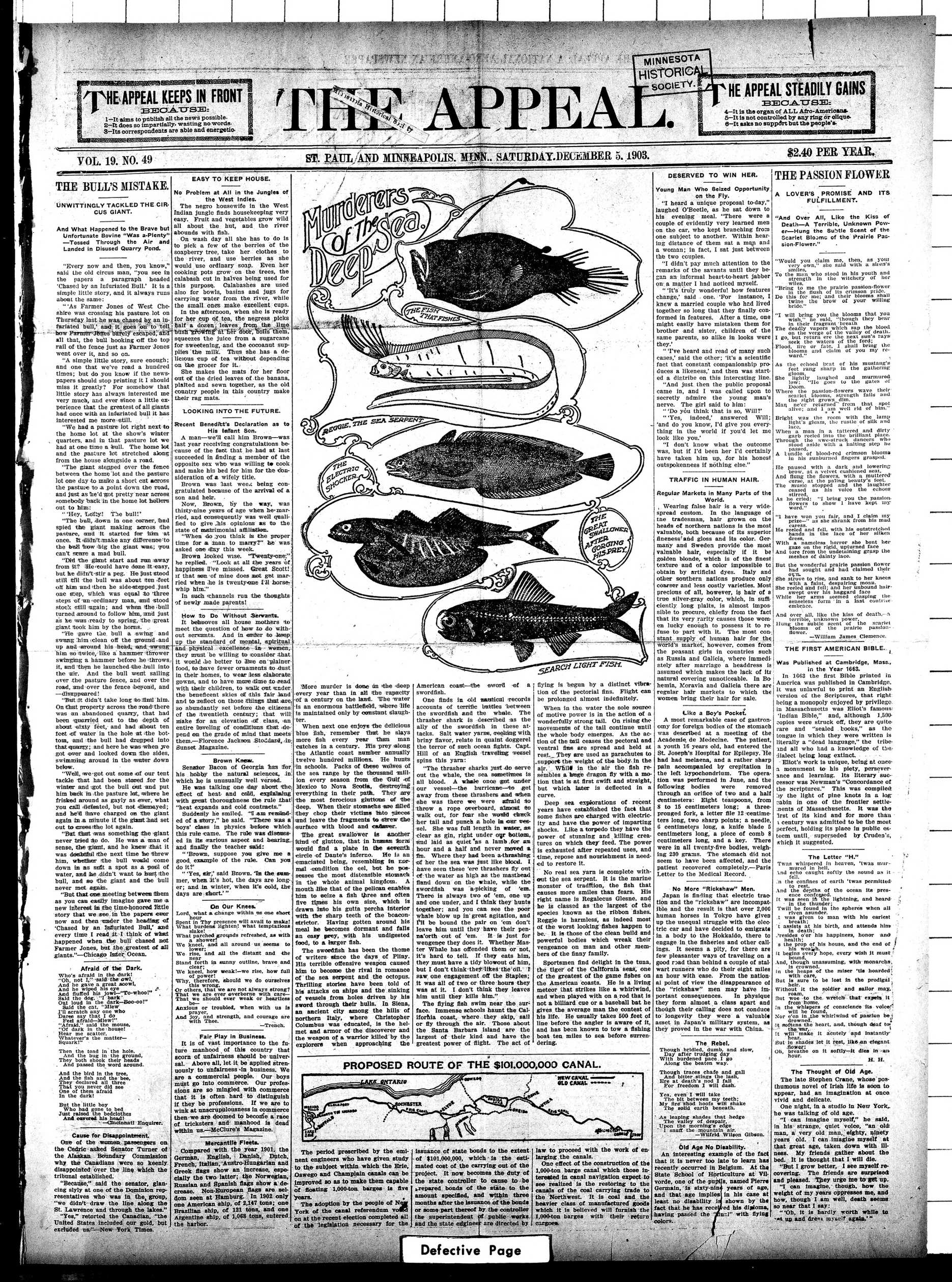
Murderers
Of The
Deep Sea.
THE FISH
THAT FISHES.
REGGIE, THE SEA SERPENT.
THE
ELECTRIC
SHOCKER.
THE
GREAT
SWALLOWER
AFTER
GORGING
HIS PREY.
SEARCH LIGHT FISH.
PROPOSED ROUTE OF THE $101,000,000 CANAL.
LAKE ONTARIO
NEW CANAL
OLD CANAL
ROCHESTER
FIR CANAL
ALVIE
ROSEID
UTICA
EAR CANAL
SUNTH TEA UNWANDA
LAKE LANE
More murder is done in the deep every year than in all the rapacity of a century on the land. The water is an enormous battlefield, where life is maintained only by constant slaughter. When next one learns the delicious blue fish, remember that he slays more fish every year than man catches in a century. His prey along the Atlantic coast number annually twelve hundred millions. He hunts in schools. Packs of these wolves of the sea range by the thousand million every season from the Gulf of Mexico to Nova Scotia, destroying everything in their path. They are the most ferocious gluttones of the world, and they chop their victims into pieces and leave the fragments to strew the surface with blood and causter.
The great swallower is another kind of glutton, that in human form would find a place in the seventh circle of Dante's inferno. He is an emaciated being, resembling in normal condition the eel, but he possesses the most distainable stomach in the whole animal kingdom. A mouth like that of the pelican enables him to seize a fish three and often five times his own size, which is drawn into his guts by the force of his mouth of the boasconstrictor. Having gotten around his meal he becomes dormant and falls an easy prey, with his undigested food, to a larger fish.
The swordfish has been the theme of writers since the days of Pliny. His terrible offensive weapon caused him to become the rival in romance of the sea serpent and the octopus. Thrilling stories have been told of his attacks on ships and the sinking of vessels from holes driven by his sword through their hulls. In Siena, an ancient city among the hills of northern Italy, where Christopher Columbus was educated, is the helmet and armor of the discoverer and the weapon of a warrior killed by the explorers when approaching the
PROPOSED F
LAKE ONTARIO
The period prescribed by the eminent engineers who have given study to the subject within which the Erie, Oswego and Champaign canals can be improved so as to make them capable of floating 1,000-ton barges is five years.
The adoption by the people of New York of the canal referendum voted on at the recent election completed all of the legislation necessary for the
American coast—the sword of a swordfish.
One finds in old nautical records accounts of terrific battles between the swordfish and the whale. The thrasher shark is described as the ally of the swordfish in these attacks. Salt water yarms, reeeping with briny flavor, relate in quant doggerel the terror of such ocean fishs. Capt. Hill of an English traveling vessel spins this yarn:
"The thrasher sharks just do serve out the whale, the sea sometimes is all blood. A whale once got under our vessel—the hurricane—to get away from these thrasher and when she was there we were afraid to throw a rope overboard, almost to walk out, for fear she would chuck her tail and punch a hole in our vessel. She was full length in water, as clear as gin, right under our bottom, and laid as quiet as a lamb for an hour and a half and never moved a fm. Where they had been a thrashing of her the sea was just like blood. I have seen these 'ere thrasheres fly out of the water as high as the masthead fland down on the whale, while the swordfish was a picking of 'em. There is always two of 'em, one and one under, and I think they hunts together; and you can see the poor whale blow up in great agitation, and I'll be bound the pair, but don't have the pair to have their nautilous out of 'em. It is just for wengence they does it. Whether Master Whale has offended them or not, it's hard to tell. If they eats him, they must have a tidy blowout of the oil. I don't think they likes the oil. I saw one engagement off the Staples; it was all of two or three hours they was at it. I don't think they leaves him until they kills him."
The flying fish swim near the surface. Immense schools haunt the California coast, where they skip, sail or fly through the air. Those about the Santa Barbara island are the largest of their kind and have the greatest power of flight. The act of
ROUTE OF THE $101,000
issuance of state bonds to the extent of $101,000,000, which is the estimated cost of the carrying out of the project. It now becomes the duty of the state controller to cause to be repaired bonds of the state to the amount specified, and within three months after the issuance of the bonds or some part thereof by the controller the superintendent of public works and the state engineer are directed by
Defective Page
flying is begun by a distinct vibration of the pectoral fins. Flight can be prolonged almost indefinitely. When in the water the sole source of motive power is in the action of a wonderfully strong tail. On rising the movements of the tail continue until the whole body emerges. As the action of the tail ceases the pectoral and ventral fins are spread and held at rest. They are used as parachutes to support the weight of the body in the air. While in the air the fish resembles a huge dragon fly with a motion that is at first swift and straight, but which latter is deflected in a curve. Deep sea explorations of recent years have established the fact that some fishes are charged with the ability and power of imparting power like a torpedo they have the power of stunning and killing creatures on which they feed. The power is exhausted after repeated uses, and time, repose and nourishment is needed to restore it.
No real sea yarn is complete without the sea serpent. It is the marine monster of tradition, the fish that causes more smiles than fears. His right name is Regaleucus Glesne, and he is classed as the largest of the species known as the ribbon fishes. Reggie is harmless, as indeed most of the fish he encounters are it. It is those of the clean build and powerful bodies which wreak their vengeance on man and other members of the funny family.
Sportsmen find delight in the tuna, the tiger of the California sea, one of the greatest of the game fishes on the American coasts. He is a living meteor that strikes like a whirlwind, and when played with on a rod that is not a billiard cue or a baseball bat he gives the average man the contest of his life. He usually takes 500 feet of water and has been known to tow a fishing boat ten miles to sea before surrendering.
10,000 CANAL.
NEW CANAL
OLD CANAL
law to proceed with the work of enlarging the canals.
One effect of the construction of the 1,000-ton barge canal which those interested in canal navigation expect to see realized is the restoring to the canals of the coal carrying trade to the Northwest. It is coal and the best value of manufactured goods which it is believed will furnish the 1,000-ton barges with their return cargoes.
```markdown
```
DESERVED TO WIN HER.
Young Man Who Seized Opportunity on the Fly.
"I heard a unique proposal to day," laughed O'Beelette, as he sat down to his evening meal. "There were a couple of evidently very learned men on the car, who kept branching from one subject to another. Within hearing distance of them sat a man and a woman; in fact, I sat just between them." "I didn't pay much attention to the remarks of the savants until they began an informal heart-to-heart jabber on a matter I had noticed myself.
"It's truly wonderful! how features change," said one. For instance, I knew a married couple who had lived together so long that they finally conformed in features. After a time, one might easily have mistaken them for brother and sister, children of the parents, so alike in looks were they."
"I've heard and read of many such cases," said the other; "it's a scientific fact that constant companionship produces a likeness," and then was started a distribe on this interesting line. "And just then the public proposal can be made, and secretly admire the young man's nerve. The girl said to him: "Do you think that is so, Will? "Yes, indeed," answered Will; 'and do you know, I'd give you everything in the world if you'd let me look like you.' "What knew the outcome was, but if I'd been her I'd certainly have taken him up, for his honest outspokenness if nothing else."
TRAFFIC IN HUMAN HAIR.
Regular Markets in Many Parts of the World
Wearing false hair is a very widespread custom. In the language of the tradesman, hair grown on the heads of northern nations is the most valuable, both because of its superior fineness* and gloss and its color. Germany and Sweden provide the most valuable hair, especially if it be golden blonde, which is of the finest texture and of a color impossible to wear in the cold. Other southern nations produce only coarser and less costly varieties. Most precious of all, however, is hair of a true silver-gray color, which, in sufficiently long plaits, is almost impossible to procure, chiefly from the fact that its very rarity causes those women lucky enough to possess it to refuse to part with it. The most constant supply of human hair for the world's market, however, comes from the peasant girls in countries such as Russia and Galicia, where immediately assumed which makes the lack of its natural covering unnoticeable. In Bohemia, Moravia and Galicia there are regular hair markets to which the women bring their hair for sale.
Like a Boy's Pocket
A most remarkable case of gastro-omyomy for foreign bodies of the stomach was described at a meeting of the Academie de Medecine. The patient, a youth 16 years old, had entered the St. Joseph's Hospital for Epilepsy. He had had meiagena, and a rather sharp pain accompanied by crepitation in the stomach. The operation was performed in June, and the following bodies were removed through an orifice of two and a half centimeters: Eight teaspoons, from 8 to 15 centimeters long; a three-ringed fork, a letter file 12 centimeters long, two sharp points; a needle, 6 centimeters long, a knife blade 5 centimeters long, a piece of comb 8 centimeters long, a key. There was a bloody ing 230 grams. The stomach did not seem to have been affected, and the patient recovered completely.—Paris Letter to the Medical Record.
No More "Rickshaw" Men
Japan is finding that electric traction and the "rickshaw" are incompatible and the result is that over 2,000 human horses in Tokyo have given up the unequal struggle with the elecric car and have decided to emigrate in a body to the Hokkalo, there to engage in the fisheries and other calls. It seems a pity, for there are few pleasant ways of travelling on a good road than behind a couple of stair runners who do their eight miles an hour with ease. From the national point of view the disappearance of the stair runners is a very important consequences. In physiuse they form almost a class apart and though their calling does not conduce to longevity they were a valuable asset in Japan's military system, as they proved in the war with China.
The Rebel.
Though bridged, dumb, and slow,
Day after trudging day
With it being a age
Along the beaten way.
Though traces chafe and gall
And bitter stings the lash,
Ere at death's not end
For the morning I will dash.
You ever I will take
The bit between my teeth;
My fire shod hoofs will shake
The solid earth beneath.
As leaping shades that hedge
The shear of the morning's edge
I snuff the mountain air.
—Wilfrid Wilson Gibson.
Old Age No Disability.
An interesting example of the fact
that it is never too late to learn has recently occurred in Belgium. At the State School of Horticulture at Vilvoorde, one of the pupils, named Pierre Germain, is sixty-nine years of age,
and that age implies in his case at least no disability is shown by the fact that he has received his diploma, having passed the "annul" with flying
THE PASSION FLOWER
A LOVER'S PROMISE AND ITS FULFILLMENT.
"And Over All, Like the Kiss of Death—A Terrible, Unknown Power—Under the Subtle Scent of the Scarlet Bloom of the Prairie Passion-Flower."
"Would you claim me, then, as your very own," she said with a sheer smile.
To the man who stood in his youth and strength in the witchery of her wiles,
"Do me the prairie passion-flower in the fush of its crisison pride. Do this for me, and their blooms shall the brow of your willing bride.
"I will bring you the blooms that you wish, he said, though they bear in the heart of the next aunts' rays the deadly worms which sap the blood on the verge of the vaboy of death. I go, be for them, the next aunts' rays seek the waters of the ford;
Flood or fate, I shall bring the blooms and claim of you my reward.
As the echoed bait of his mustang's feet rang sharp in the gathering air.
She lightly laughed and murmured
He goes to the gates of
Doom.
Where the passion-flowers wave their petals, the falls and the sight grows dim and Man nee'r returned from that spot. He is now in the garden, and Bright is the one with the lamp light's glam, the rustle of silk and lace. When man in a tattered and dirty garb reed into the brilliant place, he stands in the garden, stood aside with a hutting step he passed. A tattered blood-red crimson blooms in his sunburned fingers grasped.
As he crised: "I bring you the passion
wishes to show I have kept my
word.
He reeled and fell, with his outstretched hands in the lace of her silken dress. With a nameless horror she bent her knees, and tore from the undeathing grasp the meshes of dainty lace.
But the wonderful prairie passion flower had sought and had claimed their purpose. She strove to rise, and sank to her knees with a faint, despairing mound. She swept over his haggard face. While her arms seemed clasping the senseless form in a last contrainance. And over all, like the kiss of death—a terrible, unknown power, Hung the subtle scent of the scared mound of the prairie passion flower.
THE FIRST AMERICAN BIBLE.
Was Published at Cambridge, Mass., in the Year 1663.
In 1662 the first Bible printed in America was published in Cambridge. It was unlawful to print an English version of the Scriptures, that right being a monopoly enjoyed by privilege in Massachusetts was Eliot's famous Indian Bible, and, although 1,500 copies were drawn of the books, as are the sealed books, as a tongue in which they were written is literally "a dead language," the tribe and all who had a knowledge of the dialect being long extinct. Eliot's work is unique, being at once a monument to his piety, perseverance and learning. Its literary successor was Newman's "Concordance of the Scriptures." This was compiled by the light of pine knots in a log cabin in one of the frontier settlements of New York, the time of its kind and for more than a century was admitted to be the most perfect, holding its place in public oceum until, superseded by Cruden's, which it suggested.
The Letter "H."
Twas whispered in heaven, 'twas murured in helm,
and might oftify the sound as it fell.
in the remembrance of earth 'twas permitted to rest.
And the deaths of the ocean its pres-
iture was seen in the lightning, and heard in the thunder;
Twill the spheres when all riven asunder,
it was given to man with his earliest
t assists at his birth, and attends him
presides or his happiness, honor and
he is the prop of his house, and the end of his wealth.
it begins every hope, every wish it must
And, though unassuming, with monarchs,
in the heaps of the miser 'tis hoarded
But is sure to be lost in the prodigal
Within it the soldier and sailor may,
roam.
But woe to the wretch that expels it
home.
In the whispers of conscience its voice
Nor woe in the whirwind of passion be drowned.
it soothes the heart, and, though deat to
the ear,
it will make it acutely and instantly
heat.
In but shades it let rest, like an elegant dwarf.
On it softly-it dies in an
hour.
H. H.
The Thought of Old Age
The late Stephen Crane, whose posthumous novel of Irish life is soon to appear, and an imagination at once rich and delicate.
One night, in a studio in New York, he was talking of old age.
"I can imagine myself," he said, in his strange, quiet voice, "an old man, a very old man, eighty, ninety years old. I can imagine myself at that great age, taken down with illness. My friends gather about the bed. It is thought that I will die.
"But I grow better, I see myself recovering. The friends are surprised and pleased. They urge me to get up."
"I can imagine, though, how the weight of my years oppresses me, and how, though I am well, death seems so near that I say:
"Oh. it is hardly worth while to
at me and dress myself again."
HAVE YOU READ
THE APPEAL?
THE APPEAL,
A NATIONAL AFRD-AMERICAN HEWSPAPER
PUBLISHED WEEKLY BY
ADAMS BROS. EDITORS AND PUBLISHERS
49 B. 4th St., St. Paul, Minn.
ST. FAUL OFFICE,
No 110 Union Blk. 4th & Cedar,
J. Q. ADAMS, Publisher.
MNEAPOLIS OFFICE,
Gwarranty Loan Blqd. Room 1020
MARVEY B. BURK, Manager.
CHICAGO OFFICE,
823-5 Dearborn St., Suite 310,
F. C. ADAMS, Manager.
TERMS, STRICTLY IN ADVANCE:
SINGLE COPY, ONE YEAR.....$2.00
SINGLE COPY, SIX MONTHS.....1.10
SINGLE COPY, TREE MONTHS.....60
When subscriptions are by any means made, the terms and prices for each 13 weeks and 5 cents for each odd week, or at the rate of $2.40 per cent and two cent stamps taken. Resignations should be made by Express letter to the Bank or Bank Draft. Postage stamps will be received the same as cash for each cent week, or at the rate of $2.40 per cent and two cent stamps taken. Silver should never be sent through the mail, unless the envelope and be lost; or else it may be stolen. People who send silver to us in letters, letters and despatches 10 lines or less $1 each additional line 10 cents. Payment at all times must be received at all must come in season to be news.
Advertising rates, 15 cents per agate line, each insertion. There are fourteen agate lines inserted at each rate. No single advertisement less than the months continue. Must accompany all orders from parties unknown to us.
Reading rates 25 cents per line each insertion. No discounts for time or space. Reading words to the line. All headlines count double.
The date on the address label shows when subscriptions are due. Renewals should be made two weeks prior to expiration, so that no paper may be missed, as the paper stops working.
occasionally happens that papers sent to subcribers art画 or stolen. In case you do not receive a postal card at the expiration of five days, by postal card you must be furnished a duplicate of the missing number.
Communications to receive attention must be news, upon important subjects, plainly stated, and reach us thursday if possible, anyways. We reach us on Friday if possible, the features of the author. No manuscript returned, unless stamps are sent for postage.
We write our correspondence responsible for the views of our correspondents.
Soliciting agents wanted everywhere. Write for a letter that you write in your never full to give your full name and address, plainly written, post office, county and state, or be written on separate sheets from letters containing news of second class matter at St. Paul, Minn.
We ask Theo. Lord, that Thou will raise up a man who will save us from this new and damnable heresy that this is a white man's country, and that there is no place here for the black man. Raise up some widow's son, who is now at his mother's knee, to the task of saving the black slave of to-day — not from the shackles of iron, but from the shackles of prejudice, and save the black race from hatred, save the white man from his supercilious contempt, from his degradation, and life. Nix up until he can learn to live his fellowman framed in God's own image.
Prayer by Rev. Newell Dwight Mills. pastor of Plymouth Church, Brooklyn. New York.
The people who are constantly calling attention to the what they claim is the inherent deprivation of the Afro-American and his alleged weakness for assaulting white women, should note the recent ease of assault by a black man, an Afro-American man which was reported in a special to the Atlanta Constitution from Harmony Grove, Ga., November 23d. "Three young white men, Chandler, McClinnis and Fitchpatrick, went to the home of a Negro, broke the door down, threw the babe from the young house and took her into the field, about 100 yards from the house, and mercilessly assaulted her. They kept her there in awful agony for two hours. Neighbors heard her screams and went to the scene of the terrible crime, but the men were armed and would have been forced to stand at a distance and witness the assault and hear the screams and prayers of the woman."
Have Afro-Americans, ever, at any time, anywhere, committed a crime so horrible as this?
The action of the trustees of Trinity College in refusing, by a vote of 18 to 7, to accept the resignation of Prof. Bassett marks a new era in the South and shows that some progress is being made in the matter of freedom of speech. Recounted in an article Prof. Bassett made the assertion that Dr. Booker T. Washington is the greatest man the South has produced since Robert E. Lee. This statement aroused indignation among the editor, by Editor Joseph Daniels of the Raleigh News and Observer, who was burned in effigy by the students after the announcement of the decision of the trustees. Surely the spirit of tolerance in a Southern college gives out a statement which says, "The search for
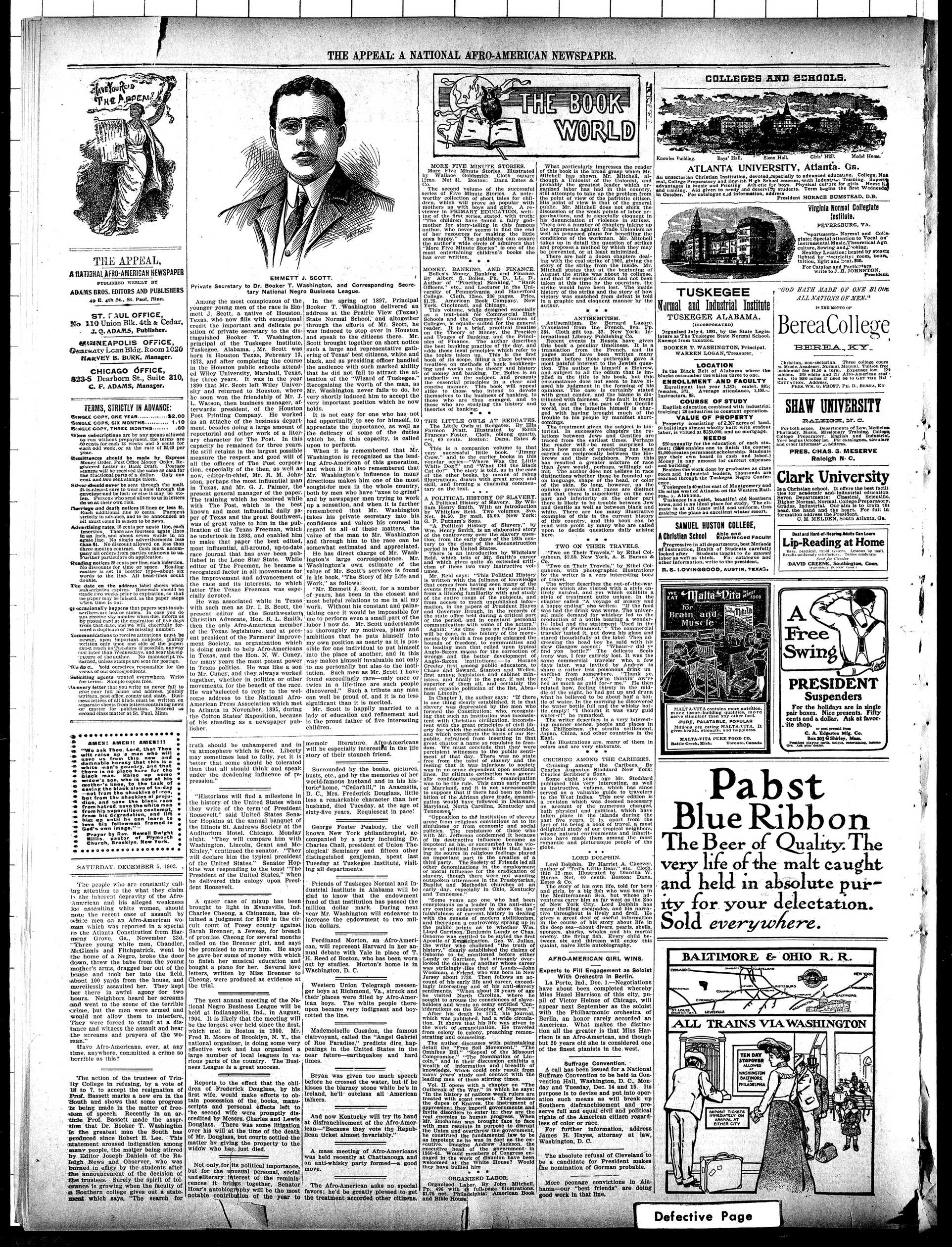
Valerie Fenton
Private Secretary to Dr. Booker T. Washington, and Corresponding Secretary National Negro Business League.
Private Secretary to Dr. Booker T. Washington, and Corresponding Secretary National Negro Business League.
Among the most conspicuous of the younger young men of the race is Emmet J. Scott, a native of Houston, Texas, who now fills with exceptional credit the important and delicate position of private secretary to the disbanded U.S. Army and the principal of the Tuskegee Institute, Tuskegee, Alabama, Mr. Scott was born in Houston Texas, February 13, 1873, and after completing the course in the Houston public schools attended Wiley University, Marshall, Texas, for three years, was in the University and returned to Houston, where he soon won the friendship of Mr. J. L. Watson, then business manager, afterwards president, of the Houston Post Printing Company. He worked as an attaché of the business department, besides doing a large amount of reportorial and other work. In this capacity he remained for three years. He still retains in the largest possible measure the respect and good will of all the officers of the Post corporation, especially of the then, as well as now, editor-in-chief, Mr. Johnston, perhaps, an influential, Mr. G. J. Palmer, the present general manager of the paper, the training which he received while with The Post, which is the best known and most influential daily paper of Texas and the great Southwest, was of great value to him in the publication of the Texas Freeman, a newspaper that he made to that paper the best edited, most influential, all-around, up-to-date race journal that has ever been published in the Lone Star State. While editor of the Freeman, he became a recognized factor in all movements for the improvement and advancement of Texas and its interests, to which later the Freeman was especially devoted.
He was associated while in Texas with such men as Dr. I. B. Scott, the present editor of the Southwestern Christian Advocate, Hon. R. L. Smith, the president of the Texas legislature, and at present president of the Farmers' Improvement Society, an organization which is doing much to help Afro-Americans in Texas, and the Hon. N. W. Cuney, in Texas, and the Hon. J. W. Cuney in Texas politics. He was like a son to Mr. Cuney, and they always worked together, whether in politics or other movements, for the benefit of the race. He was 'selected to reply to the welcome address to the National Afro-American Press Association which met in Atlanta in November, 1895, during the Cotton States' Exposition, because of his standing as a newspaper publisher.
truth should be unhampered and in an atmosphere which is free. Liberty may sometimes lead to folly, yet it is better that some should be tolerated that all should think and speak under the deadening influence of repression."
"Historians will find a milestone in the history of the United States when they write of the term of President Roosevelt," said United States Senator Hopkins at the annual banquet of the American Institute of Auditorium Chicago. Monday night, "They will compare him with Washington, Lincoln, Grant and McKinley," continued the senator. "They will declare him the typical president of the United States." Senator Hopkins was responding to the toast "The President of the United States when he delivered this eulogy upon President Roosevelt."
A queer case of mixup has been brought to light in Evansville, Ind. Charles Choug, a Chinahman, has obtained a judgment for $700 in the court of Posey county against the Brenner man, a Jewess for breach of promise. Choug for several months called on the Brenner man, and says she promised to merry him. He says he gave her sums of money with which to finish her musical education and to send letters, written by Miss Brenner to Cheong, were produced as evidence at the trial.
The next annual meeting of the National Negro Business League will be held at Indianapolis, Ind., in August, 1904. It is likely that the meeting will be the largest ever held since the first, Mr. Fred R. Moore of Brooklyn, in 1900, the national organizer, is doing some very effective work and has organized a large number of local leagues in various parts of the country. The Business League is a great success.
Reports to the effect that the children of Frederick Douglas, by his assistance, have taken the main possession of the books, manuscripts and personal effects left to 'the second wife of Messrs. Charles and Lewis Douglass. There was some litigation against the time of the death of Mr. Douglass, but settled the matter by giving the property to the widow who has just died.
Not only, for its political importance, but for the unusual personal, social and literary interest of the reminiscences it brings together, Senator Hear's autobiography will be the most notable contribution of the year to
THE APPEAL: A NATIONAL AFRO-AMERICAN NEWSPAPER.
In the spring of 1897, Principal Booker T. Washington delivered an address at the Prairie View (Texas) State Normal School, and altogether through the efforts of Mr. Scott, he was induced to stop over in Houston to meet with the president Scott brought together on short notice such a large and representative gathering of Texas' best citizens, white and black, and as presiding officer handled the audience with such marked ability that he did not fall to attract the attention of the teachers of the wealth of the man, as Mr. Washington never fails to do, he very shortly induced him to accept the very important position which he now holds.
It is not easy for one who has not had opportunity to see for himself, to appreciate the importance, as well as the desire to in some of the duties which in this capacity, is called upon to perform.
When it is remembered that Mr. Washington is recognized as the leading Afro-American of this generation, and when it is also remembered that Mr. Washington's influence in many schools is sought for men in the whole country, both by men who have "axes to grind" and by newspaper men trying to work up a sensation, and when it is further remembered that Mr. Washington takes his private secretary into his confidence and values the people he serves, the value of the man to Mr. Washington and through him to the race can be somewhat estimated and appreciated. He has direct charge of Mr. Washington's large correspondence. Mr. Washington's own estimate of the value of his services in his book, "The Story of My Life and Work," as follows:
"Mr. Emmett J. Scott, for a number of years, has been in the closest and most helpful relations to me in all my work. With it, it would be impossible for me to perform even a small part of the labor I now do. Mr. Scott understands so thoroughly my motives, plans and ambitions that he puts himself into my own position and allows all people on life's journey to put himself into the place of another, and in this way makes himself invaluable not only to me personally but also to the institution. Such men as Mr. Scott I have found exceedingly rare and valuable people discovered." Such a tribute any man can well be proud of, and it is no less significant than it is merited. Mr. Scott is happily married to a lady of education and refinement and is the proud father of five interesting children.
memoir literature. Afro-Americans will be especially interested in the life story of their staunch friend.
Surrounded by the books, pictures, busts, etc., and by the memories of her world-famous husband and in his historic home, "Cedarhill." in Anacastia, D. C., Mrs. Frederick Douglass, little less a remarkable character than her husband, died Tuesday, at the age of sixty-five years. Requiscat in pace!
George Foster Peabody, the well known New York philanthropist, accompanied by a many including Dr. Charles Chall, president of Union Theological Seminary and fifteen other distinguished gentleman, spent last Tuesday at Tuskegee Institute, visiting all departments.
Friends of Tuskegee Normal and Industrial Institute in Alabama will be glad to know that the endowment fund of that institution has passed the million dollar mark. During next month, the endowment will enewor to increase the endowment to two million dollars.
Ferdinand Morton, an Afro-American, will represent Harvard in her annual debate with Yale in place of T. H. Reed of Boston, who has been worn out by studies. Morton's home is in Washington, D. C.
Western Union Telegraph messenger boys at Richmond, Va, struck and their places were filled by Afro-American boys. The white people thereupon became very indignant and boycotted the line.
Mademoiselle Cuesdon, the famous clavoyant, called the "Angel Gabriel of Rue Paradise," predicts dire happenings in the United States in the near future—earthquakes and hard times.
Bryan was given too much speech before he crossed the water, but if he kissed the blarney stone while he's in Ireland, he'll outcall all American talkers.
And now Kentucky will try its hand at disfranchisement of the Afro-American—"Because they vote the Republican ticket almost invariably."
A mass meeting of Afro-Americans was held recently at Chattanooga and was all whisky party formed—a good move.
The Afro-American asks no special favors; he'd be greatly pleased to get the treatment accorded other citizens.
THE BOOK
WORLD
MORE FIVE MINUTE STORIES. ILLUATED by Wallace Goldsmith. Cloth square 120. Net. $1. Boston: Dana Estes & Co.
The second volume of the successful series of five minute stories. A notet worthy collection of short tales for children which will prove as popular with viewers with boys and girls.
The children have found a fairy god mother for story-telling in this famous author, who never seems to find the end of her resources for making the little ones happy. The publishers can assure the author's wide circle of address that "More Five Minute Stories" is one of the most entertaining children's books she
What particularly impresses the recent book is the broad group which Mitchell has shown. Mr. Mitchell, though, has the highest value in interest, probably the greatest leader which is organized labor has had in this course. He has been a major leader of the problem in the point of view of the patriotic city. He is the one who has the right to the point of view that of the general population. Mr. Mitchell is a good discussion of the weak points of labor, and he is especially about his denunciation of violence in stirring and the arguments against Trade Unions. There are a number of chapters taking into account the well as proposed plans for benefiting conditions of the Turkman. Mr. Miller has been in detail the session of an and and proposes a method by which they are prevented, or at least minimized.
There are half a dozen chapters
---
MONEY, BANKING, AND FINANCE.
Bolles's Money, Banking and Finance.
Bolles's Money, Banking and Finance.
Author of "Practical Banking," "Bank Officers," etc., and Lecturer in the University College, Cloth, 120m, 336 pages, Price, $1.25. American Book Company, New York. This volume, while designed especially as a text-book for Commercial High Schools, is equally suited for the general reader. It is a brief, practical treatise on the basic principles and uses of Banking, and the Principles of Finance. The author describes the basic banking practices and the topics which refer to the topics taken up. This is the first book of its scope. The book is a bank bookkeeping and works on the theory and history of money and banking. Dr. Bolles and the essential principles in a clear and concise manner. This book will appeal to those who are studying the history and theories of banking.
---
THE LITTLE OWLS AT REDGATES.
The Little Owls at Redgates by Edith
Frances Foster. Cloth, oblong quarte,
set, 60 cents. Boston: Dana, Estates &
Ethics.
This is a companion volume to that of *The Crow*; and to the earlier books in this popular series—"Where Was the Little Crow*," and to the earlier books in this series "The story is told, as in the case of the other books, by means of rebuttance, drawings, drawn by the author, skillful, charming a commentary on the text.
A POLITICAL HISTORY OF SLAVERY. A Political History of Slavery. by L. A. Browne. A Political History of Slavery. by Whitehall Reid. Two volumes. 8vo. Net. $4.50. By mail. $5.00. New York: HarperCollins.
"A Political History of Slavery," by Wm. Henry Smith, is an elaborated story of the Reconstruction, from the early days of the 18th century to the close of the Reconstruction. There is an introduction by Whitehall Reid, which gives us an extended criticism of these two very instructive volumes.
The Reid says: "This Political History is written with the fullness of knowledge from a lifelong familiarity with and study of the events from the inside as they occur from a lifelong familiarity with and study of the state office held during a critical period, and in conjunction with the gorges of the region.
Again: "As time toes on fuller justice movements by which a free people enlarged the bounds of freedom, to communities and to sealing men that they were not bound by the wrongs and the better development of Anglo-Saxon institutions;—to Horace Chase and Seward, Stanton and Welles, first among legislators and cabinet ministers to the peer, to the peer, to the superior of the nation, certainly the most capable politician of the list, Abraham Chase, the author says: "If there is one thing clearly established, it is that such an institution was inconsistent with the great principles of the Constitution; who, recognizing that such an institution was inconsistent with the great principles of civil liberty, whom we confessed from inserting in that great church a name so repulsive to freedom. We must conceive that the public sentiment from inserting in that day. There was no state free from that day. There was no state free from that day. There was no state injurious to society was in no sense dependent upon sectional ties, confided in the public sentiment expected; emancipation would have followed in Delaware, North Carolina, Kentucky and Tennessee."
"Opposition to the institution of slavery arose from religious convictions as to its moral foundations and religious policies. The resistance of those who with Mr. Jefferson condemned it because it was a violation of his impotent as his, or succumbed to the viciousness of it, played its source in religious feelings played an important part in the creation of a religious movement, and other denominations in the employment of moral influence for the eradication of slavery. The outspoken utterances in the Presbyterian, Baptist and Methodist churches at an alliance in Ohio, Kentucky and Tennessee.
Vol. II opens with a chapter on "The Outbreak of the War," in which he says he was treated with scant respect. They become the dupes of Knaves, the instrument of spite disorder to enter in; the real enemies to human progress. When he meets the real enemies with men resolute in purpose to disrupt the Union and overthrow the government, he construed the fundamental law to be the executive. Imagine Andrew Jackson, the executive head of the government in 1800, paged in the work of disunion have been welcomed at the White House? Would they have bullied him?
ORGANIZED LABOR.
Organized Labor. By John Mitchell.
Pp. 496 with 48 full-page illustrations.
Organized Labor: American Books and Bible Houses.
What particularly impresses the reader of this book is the broad grasp which Mr. Mitchell has shown. Mr. Mitchell, although a Unionist of the Unionist, and probably the greatest leader which organized labor has had in this country, still attempts to take up the problem from the point of view of the patriotic citizen. His point of view is that of the general public. Mr. Mitchell does not shirk the discussion of the weak points of labor organizations, and is especially eloquent in his denunciation of violence in strikes. There are a number of chapters taking up the arguments against Trade Unionism as well as proposed plans for benefiting the conditions of the workman. Mr. Mitchell takes up in detail the question of strikes and proposes a method by which they may be prevented, or at least minimized.
There are half a dozen chapters deal-
ing with the strike of the giving of
history of the strike by Mr. Mitchell
states that at the beginning of
August, the strike was about a collapse,
and the strike was taken at this time by the operators, the strike would be the strike and the story of the
victory was snatched from defeat is told
in a graphic and eloquent manner by the
---
Antisemitism. By Bernard Lazare. Translated from the French, Vo. Pp. 153. In the book You International Library Publishing Co. Recent events in Russia have given the author a great deal of translation from the French, and its pages must have been written many times. The author has most painful interest to the Jewish question. The author is himself a Hebrew, and his pages are filled in the title to his book, but this circumstance does not seem to have blighted his opinions. The case is certainly stated with great candor, and the blame is distributed with fairness. The fault is found in the author's world, but the Israelite himself is charged with having brought much of the blame to his people by manifest shortcomings.
The treatment given the subject is his histories between Jews and Gentiles are traced from the earliest times. Perhaps he learns how much of proselytising has been carried on reciprocally between the He-terans and the Jews, and has resulted a greater mixture of race and religion. The author does not believe in race distinctions whether these are founded upon the color of the skin. So long, however, as the opinion prevails that races are distinct from each other in part and inferiority on the other part there is likely to be trouble between Jew and Gentile. The author is too many illustrative examples of this country, and this book can be read with profit by many who are called upon to decide questions daily arising
---
TWO ON THEIR TRAVELS
Two on Their Travels," by Eth Colquhoun, $250. New York. A. S. Barnes & Co.
Two in Their Travels by Ethel Colquhoun, with photographic illustrations by the writer is a very interesting booz of travel.
The writer describes the out-of-the-place, which she visited with a style entirely natural, and yet which exhibits a style of treatment quite unique. In the case of the "one-hand," she may consider a happy ending: "she writes. If the food was bad the drink was worse. The universal male demand for unskyrk led to the action of the man, and the full label, and the statement. Used in the Houses of Parliament." The commercial traveler tasted it, put down his glass and stared thoughtfully the tabletop. The head boy he said with his slow Glasgow accent: "Whaur-r did y-find von bottle?" The delicate Scots, irony was, I fear entirely lost. It was a very long-time, so far as the other who few days later, was invited by Andrew to share a rather less poisonous drink unearth from somewhere. "Thank me," he said. "I think we had a much as-guld for-me." He then related how, feeling thirsty in the middle of the night, he had got up and drunk when he had been to the park. He was veryوحور. He was a watering弥散, he discovered the water bottle full and the whisky bottle empty: "I thought it was very good water-r." The woman is a very interesting writer describes in a very interesting manner scenes, people and places in the Philippines, the straits settlement, Japan, China, and other countries in the
The Illustrations are, many of them in colors and are very elaborate.
CRUISING AMONG THE CARIBEES.
Cruising among the Caribees. By Augustus Haddard New York. Charles S. Sullivan.
Some eight years ago Mr. Stoddard met a woman who was an instructive, volume, which has since served as a valuable guide to travelers and tourists. A revision which was deemed necessary accounted for the political and political, which have taken place in the islands during the past decade. The fact of its being a book of travel, a most delightful study of our tropical neighbor, has made it an important have made them among the most romantic and picturesque people of the world.
LORD DOLPHIN
Lord Dolphin, by Harlet A. Cieweer, is a 12-monster. Illustrated by Dinwina W. Horne, Not, 40 cents. Boston; Dana, 12 cents.
The story of his own life, told for boys and girls by a big fish who was born in a cave and ventures carry him as far west as the Zoo and many thrilling escapes, and his narrative throughout is lively and droll. He lives in the course of his story about life in the deep sea—about divers, pearls, shells, enemy, the fishing fish. Every child beaten, the fishing fish. You enjoy this quaint, naive little autobiography.
AFRO-AMERICAN GIRL WINS.
Expects to Fill Engagement as Soloist With Orchestra in Berlin.
La Porte, Ind., Dec. 1.—Negotiations have about been completed whereby Miss Hazel Harrison of this city, pupil of Victor Heinze of Chicago, will perform with the Philharmonic orchestra of Berlin, an honor rarely accorded an American. What makes the distinction all the greater is that Miss Harison will be the first but 20 years old she is considered one of the finest pianists in the west.
Suffrage Convention.
A call has been issued for a National Suffrage Convention to be held in Convention Hall, Washington, D. C., Monday and Tuesday, Dec. 14 and 15. Its purpose is to devise and put into operation such means as will break up Southern distranchissement and preserve full and equal civil and rights of the American citizen regardless of color or race. For further information, address James H. Hayes, attorney at law, Washington, D. C.
The absolute refusal of Cleveland to be a candidate for President makes the nomination of Gorman probable.
More peonage convictions in Alabama—our "best friends" are doing good work in that line.
Knowles Building. Boys' Hall. Stone Hall. Girls' Hall. Model House.
ATLANTA UNIVERSITY, Atlanta, Ga.
An unsectarian Christian Institution, devoted especially to advanced education. College, No. 1, College Preparatory and King's Island H gh School courses, with Industrial Training. Superior advantages in Music and Printing. Athletic for boys. Physical culture for girls. Home h and training. Aid to make and deserve students. Term begins the first Wednesday. For catalogue add information, address
Pabst Blue Ribbon The Beer of Quality. The very life of the malt caught and held in absolute purity for your delectation. Sold everywhere.
BALTIMORE & OHIO R. R.
CIRCAGO
SANDY
CLEVELAND
NEW YORK
PITTSBURG
PHILADELPHIA
COLUMBUS
CINCINNATI
WASHINGTON
DELTHOUSE
ST. LOUIS
LOUISVILLE
ALL TRAINS VIA WASHINGTON
TEN DAY STOPOVER
ALLOWED
WASHINGTON
BALTIMORE
PHILADELPHIA
DEPOSIT TICKETS
IMPREDICTLY ON
ARRIVAL AT
EITHER CITY
THE HOTEL
TUSKEGEE Normal and Industrial Institute
Organized July 4, 1881, by the State Legislature as The Laureate State Normal School. Exempt from taxation.
BOOKER WASHINGTON, Principal.
WARREN LOGAN, Treasurer.
LOCATION
In the Black Belt of Alabama where the blacks outnumber the whites three to one.
ENROLLMENT AND FACULTY
Enrollment last year, males: 182, females: 110.
Average attendance, 1:05, instructors, 88.
COURSE OF STUDY
English education course, industrial training in constant operation.
VALUE OF PROPERTY
Property consisting of 2,267 acres of land,
50 buildings almost wholly built with student
labor, is valued at $35,000, and no mortgage.
$5 annually for the education of each student;
$800 enables one to finish the course;
$1,000 creates permanent student housing;
$2,000 (cash and labor).
Money in any amount for current expenses
and building.
Work done by graduates as class
room and industrial leaders, thousands are
reached through the Tuskegee Negro Confer-
Tuskegee is 40 miles east of Montgomery and 136 miles west of Atlanta on the Western Railway.
Tweakers is a quiet, beautiful old Southern man. His mat is at all times mild and uniform, thus he is a gentleman. He is a man of character.
SAMUEL HUSTON COLLEGE.
A CHRISTIAN SCHOOL Experienced Faculty Instructor, with 10 years of Instruction, Health of Students carefully looked after. Students taught to do manual work, and other information, write to the president.
R.S. LOVINGGOOD, AUSTIN, TEXAS.
WE EAT Malta-Vita THE PERFECT FOOD
for Brain and Muscle
MALTA-VITA contains more nutrition,
more tissue-building qualities, more
neteractive vitamins and minerals.
PURE, PALATABLE, POPULAR
Millions are eating MALTA-VITA. It
gives health, strength, and happiness.
MALTA-VITA PURE FOOD CO.
Battle Creek, Mich.
Toronto, Canada
*apartments- Normal and College*
*Special attention to Vocal and*
*Instrumental Music, Theoretical Ag*
*culture, Sewing and Coking.*
*Healthy Location; heated by steac*
*lighted by Electricity; room, board,
tulition, light and cost, $60.*
For Catalog and Partic*
*write to J. H. JOHNSTON.*
President.
"GOD HATH MADE OF ONE BLOOM ALL NATIONS OF MEN."
IS THE MOTTO OF
Berea College
BEREA, KY.
Christiun, non-sectarian. Three college courses. Music. Academy. Normal. Manual. Tuition free. Incidental fee $4.00 a term. Expenses low. 20000000. 20000000. Aftro-American staff into. Go 1000 miles if need be to GET THE BEST EDUCATION. Address.
PRES. WM. G. FROST, PH. D., BEREA, KY
SHAW UNIVERSITY
RALEIGH, N.C.
For both sexes, Departments of Law, Medicine
and Surgery, College Preparatory, English and Industrial.
You begin lessons in catalogues, circular
and other activities.
PRES. CHAS. S. MESERVE
Raleigh N.C.
Clark University
In a Christian school. It offers the best facili-
ties of a Christian school. Seven Departments: Classical, Scientific
Higher Normal, Normal, College Preparatory
Head, Head of the School, Head, head the hand and the heart. For full in-
formation address the President.
C. M. MELDEN, South Atlanta, Ga.
Real and Hard of Hearing Adult Can Learn
Lip-Reading at Home
Easy, practical, rapid system. Less by mail.
Results uniform. Forms moderate
Sed for Great.
DAVID GREENE, Southington, Conn.
A Free Swing
PRESIDENT Suspenders
For the holidays are in single pair boxes. Nice presents. Fifty cents and a dollar. Ask at favorite shop.
or post prepaid from
C. A. Edgerton Mfg. Co.
Box 203 G Shirley, Mass.
President should use, and use, entertaining, instructive. Ask your dealer.
ost
ibbon
at Pilgrim Baptist Church corner of Cedar and Summit. Sunday Dec. 6th at 4:00 o'clock sharp. His subject will be
Dr. Waldron is one of the finest speakers in the United States and every one should avail himself of this opportunity to hear him.
EVERY BODY INVITED, ADMISSION FREE.
THE LADIES ARE ESPECIALLY INVITED.
ST. PAUL.
BEKS RECORD IN MINNESOTA'S CAPITAL.
The Saintly City and Saintly City Folk-way Items of Social, Religious and General Matters Among the People, Bold-Down.
WANTED-SEVERAL PERSONS OF character and good reputation in each state (one in this county required) to work in the wealthy business house of solid financial standing. Salary $21.00 weekly with ex-tenure. Each Wednesday from head offices. Horse and carriage furnished when necessary. References. Enclose self-addressed Co. Council Co. 324 Dearborn St., chicago.
If it's Hamm's, it's all right.
Isn't this lovely weather for Minnesota?
Miss Clara Howard, who has been quite ill, is somewhat improved.
Roomers wanted. Nice comfortable rooms. Apply at 159 La Fond street.
Half soils, sewed, 75c; rubber heels, 40c; Phone 1558-J2. Jarvis, 83 E. 4th.
"I haven't paid 45.00 for a hat since I began wearing the Gordon and I buy the best."
Mr. and Mrs. Howard McIntyre entertained the "Jolly Twelve" at whilst last Monday night.
Mrs. Geo. W. James is at St. Luke's hospital for the purpose of having another operation performed.
Have you called at the new, up-to-date tonsorial parlor, No. 74 E. Fifth street? Well, you'd ought to do so.
The Ivy Leaf Dancing Club will meet next Thursday, Dec. 10th. Only those on list of patrons will be admitted.
You are cordially invited to attend the Men's Sunday club, which meets at Pilgrim Baptist church tomorrow afternoon at 4 o'clock. Good program.
The most popular place for people who take their meals down town is John Godfrey's, No. 552 Wabasha street. Everything neat, clean and well cooked.
Splint coal from Independent mines for stoves, furnaces and ranges. Many prefer it to hard coal. Exclusive agents. Holmes & MacCaughey Co., Seven Corners. Try it. Office open from 7:30 a. m. to 6:30 p. m. Telephone 401, both phones.
Anyone who would like to go into an established business which pays well, can furnish $500 cash, may learn particulars by calling at THE APEAL office.
Pilgrim Baptist church, Cedar and Summit, Rev. W. D. Carter, pastor, Morning service, 10:45 communion; evening service, 8:00 p. m. Subject: "Keeping the Heart."
Is your hair straight? If not, send 60 cents to Ozonized Ox Marrow Co. 76 Wabash avenue, Chicago, Ill., for a bottle of Ozonized Ox Marrow and you can easily straighten it.
Mrs. E. J. Allen has opened a hair store at 38 W. Seventh street near Forbes, where she is prepared to fill orders in all branches of hair work. Scalp treatment a speciality.
Gentlemen wishing nice furnished room, with all conveniences, by the week or month, at reasonable rates, should apply at the Benton House, 228 West Third street, up stairs.
THE NAGEL UNDERTAKING CO.. Wm. E. Nagel Manager, 208 West Third street, Telephone, Main 1504. Latest equipments in every line. Lady assistant when desired.
The announcement of Judge Loren W. Collins of his candidacy for the governorship has met with a most hearty approval. Judge Collins is a fine man in every way, and would make an excellent governor.
For good home cooking go to the Metropolitan restaurant. No. 378 Minnesota street. First-class meals at all hours. Regular meals, 20 cents. Meals to order at moderate prices. Mrs. Lou McLaughlan, proprietor.
ELK EXPRESS CO., G. D. Charleston, Proprietor; G. J. Charleston, Manager. Packing, shipping and storing. Piano moving a speciality. No. 39 E. Seventh street, cor. Cedar (basement). Telephone Main 2514 J 2.
If you wish a good shave, hair cut or shampoo call at Richard Cousby's neat shop, No.374\*1 Minnesota street. First-class workmen only. Satisfaction guaranteed. Music for all occasions furnished on short notice.
Full line of framed and unframed pictures. Special prices for the holiday trade. Also make a specialty of oil portraits at moderate prices. Pictures framed to order. Lowe Picture Frame Co., 475 Wabasha street.
Shoes mended while you wait at Jarvis', 83 East Fourth street. Half holes, 50 and 75 cents. Prices reasonable for all kinds of repairing. Remember if they can be mended, Jarvis can do it on short notice. Jarvis, 83 E. 4th st.
CREOLE KITCHEN—"Meals like mother used to cook" 25 cents. Tehone steak served in short orders. Furnished rooms for gentlemen in collection. No. 378 Cedar street. Telephone Main 1786 J 1. L. H. Barber, Manager.
Mr. Louis Wilson, formerly of St. Paul but now a sort of "Wandering Jew," was in the city yesterday enroute from Sikra, Alaska, to New York, thence to England. He was
looking the picture of health and prosperity.
Those of our parrons who desire to have matter published must get the same in this office not later than Thursday afternoon, otherwise it may be crowd out. No notice will be 'aken of any communication that is not signed by the author.
Mr. W. M. Rideout, formerly of St. Paul but at present a resident of Whatcom, Wash., was in the city this week visiting old time friends. Mr. Rideout is engaged in the real estate business and is doing well. He was enroute to the East to visit relatives.
The police department made 386 arrests last month, divided among the stations as follows: Central, 267; Rondo, 37; Margaret, 36; Ducas, 43; Prior, 3. The total number of alarms responded to by the fire department was 72.
The Metropolitan Restaurant, No. 378 Minnesota street, has put in a pleasing, up-to-date feature. A delightful concert is furnished during meal hours by a large Edison phonograph, which plays all the popular airs and songs. You ought to call and hear it.
William Henry was given sixty days in police court Saturday for stealing an overcoat belonging to Sam Stoller, who keeps a second-hand store at 486 Minnesota street. The coat, hung on a "dummy," was exposed for sale, and disappeared five minutes afterward.
HOWELL & DAVIS, No. 156 E. Sixth street, fashionable tailors. Gentlemen wishing suits or overcoats of the latest cuts and patterns should call on them. Ladies' work also done. Clothing cleaned, repaired, sponged and pressed on short notice. Moderate prices. Goods called for and delivered.
Anything the matter with your stove, range or furnace? If there is, just call at the St. Paul Stove Repair Works, 126 West Seventh street, between Fifth and Exchange, and get it repaired. Any part of stove or range furnished. A number of good second-hand stoves for sale cheap. Both telephones 242-12.
BENTON'S CAFE, No. 204 West Third street, near "Seven Corners," the smallest place in town for up-to-date meals and lunches. Meals from 25 cents up. Private rooms for ladies. Regular dinner 25 cents. Lunch counter. Everything in first-class style. Open night and day. Private rooms for dinner parties.
The reason why you should buy your Coal, Wood, Flour, Feed, Hay, etc. from C, W. STAHEL, Rice and Carrol streets, is because you can get prompt delivery, best goods, full measure. Fuel of all kinds, sawdust and split wood in large or small quantities. Everything at the right price. Both telephones 1446.
Visitors to the city, and residents also, who wish to get first class meals should call at John Godfrey's, No. 552 Wabasha street, between Tenth street and College avenue. Board and rooms by the day, week or month at reasonable rates. Best meals in the city. Regular meals 25 cents. Sunday dinners from 1:00 to 5:00 p. m. a special y.
The only institution in St. Paul exclusively for savings doing business strictly in accordance with the letter and spirit of the savings bank law of this state, as amended, and thereby avoiding the dangers and contingencies of commercial banking and trust business, is the State Savings Bank, Germania Life Bldg., 4th and Minna Sts.
SAFE DEPOSIT AND STORAGE VAULTS.—We invite your inspection. It costs little to place your papers, cash securities and valuables in absolute safety. Boxes in our vaults can be had for $4 per year. Store your boxes, trunks, etc., with us. Northwestern Trust Co., 138 Endicott Arcade.
“Quincy Adams Sawyer,” the New England rural drama, will be seen at the Metropolitan for four nights and a Wednesday matinee, beginning next Sunday. It is a play in four acts, the scene depicting the interior of a postoffice at Mason's Corners, an old-fashioned sitting room, cross roads to Eastborough and the Pettigill farmyard.
Benton's cafe has moved from Fort to No. 204 West Third street. The new place has four private dining rooms, all nicely fitted up in the latest style. The cuisine is excellent in every particular, and persons who wish first-class food, served in first-class style, at moderate prices should call. A special invitation is extended to all to visit and inspect the new cafe.
COSMOPOLITAN BARBER SHOP, No. 74 E. Fifth street, Kemp & Williams, proprietors. A strictly up-to-date establishment. Two bath rooms, three hydraulic chairs, shoe shining stand, latest style of furnishings throughout. Children's hair cutting a speciality. Their motto is: "Absolute satisfaction." Fine line of smokers' articles. Public cordially invited.
The social given at the residence of Mrs. R. Ewing, No. 555 Charles street, Monday evening, for the benefit of Regiment No. 2 of the grand rally for St. James church, was a grand success in every way. Everybody had a good time. The social at the residence of Mesdames J. B. Turner and J. W. Hackern. Thursday evening was equally successful, and was a very pleasant affair.
ATTENTION, EVERYBODY! Go to Mills' Sandwich Rooms, Nos. 290 Robert street and 444 Robert street, to get genuine Mexican chill stew or chill mack, the new and popular "St. Paul sandwich"; oysters in any style; good coffee; all kinds of sandwiches to order. Open day and night, from 6:30 a.m. to 2:30 a.m. Nos. 290 Robert street, near the bridge, and 444 Robert street, between 7th and 8th. J. S. Mills, proprietor.
THE APPEAL: A NATIONAL AFRO-AMERICAN NEWSPAPER.
THE NEW STORE YOU'LL BE MORE THANKFUL
When the day does arrive, if supplied with the necessities of Thanksgiving. For instance, Table Linens, Napkins, Cloths, etc., or Carving Sets, Cut Glass, Silverware, Kitchen accessories and many more. Remember, we have them, and the prices are ALWAYS THE LOWEST. EVANS MUNZER, PICKERING & CO.
THE NEW YORK TIMES
COAL AND
FLOUR, FEE
FROM
C. W. ST
Everything at the right price.
"RUMMAGE SALE."
Given by Regiment No. 2, At St. James
A. M. E. Church Monday
and Tuesday.
There is a grand rally inaugurated
by St. James A. M. E. Church which
is to be prosecuted with all vigor until
the end. There are two contending
factions, one under the command of
Col. A. J. Bell, and the other under the
command of Col. J. H. Dillingham,
who commands Regiment No. 2.
Monday and Tuesday evenings, Dec. 7th and 8th, there will be a great rummage sale under the command of Adjutant Daniel Harding at St. James Church, and refreshments in connection with the sale. This is to be one of the most novel events, and a large number of articles useful and ornamental have been donated for this sale. Admission, 10 cents. Prior to the sale on Monday night the program will be rendered at 8:00 sharp.
ea at 8:00 sharp.
Solo . . . Prof. J. W. Luca
Solo . . . Mrs. B. Pierre
Paper . . . Mr. J. Webb
Solo . . . Mr. T. Thompson
Mandolin Solo . Master L. Lawrence
Solo . Miss Mary Harwell
Solo . Mr. J. E. Murphy
Solo . Miss Minnie Gardner
**Tuesday Night Program.**
Solo . Prof. J. W. Luca
Paper . . . "Judge" Johnson
"Why Young Men Should be Ready."
Solo . Master L. Lawrence
Paper . Mrs. T. H. Lyles
Solo . Mr. C. H. Miller
Several extras will be added.
During each day there will be a magnificent dinner served from 12 to 3 p. m. under the supervision of Mrs. R. Ewing, assisted by other ladies of the regiment. Supper will also be served from 6 to 11 by the ladies.
Thursday evening the final social will be given at the residence of Mrs. F. D. Parker, 320 Full street. Admission free. This is the grand wind up, and a good time is guaranteed. Everybody invited.
Col. Dillingham has offered as a prize to the one bringing in the largest amount of money for his regiment, the handsome oil painting of Frederick Douglass, valued at $50, now on exhibition at the store of the Lowe Picture Frame Co. No. 475 Wabasha street.
Of the Founding of Pilgrim Baptist
Church and Indicate Services
**Church and Dedicatory Services.**
On Sunday, Dec. 13, the members and friends of Pilgrim Baptist church will hold two interesting services.
One to celebrate the Fortieth Anniversary of the founding of the church and the other to delicate it to the service of God free from debt. Both of these services are to be made interesting and instructive. The Dedicatory services will be held at 11:00 a. m. and will consist in part of the following:
**Program.**
Organ Voluntary ..... "Praise God from Whom All Blessings Flow."
Responsive Reading ..... 23d Psalm, led by Pastor and Lord's Prayer.
Anthem ..... Choir
Scripture Reading ..... Deacon Bacon Prayer
Dedicatory Song.....Dedicatory Prayer.....Dedicatory Offering.....Benediction.
The Fortieth Anniversary will be celebrated at 7:45 p. m. with the following:
Program.
Organ Voluntary
"Praise God from Whom All Blessings Flow"
Presentation of charter members.
Material Development. Trustee James
Anthom ..... Choir
Sermon ..... Rev. Enos L. Scruggs, A. M. D. D.
Solo
Anniversary Offering
Benediction.
A cordial invitation is extended to
Defective Page
BUY YOUR
CLIFFORD A. SMITH,
Is very successful in making Clothes.
He is making clothes for all the boys and they are all well pleased. If you wish a Suit or Overcoat made give him a chance and he will please you.
STYLE, FIT AND QUALITY, IS HIS MOTTO
REPAIRING ON SHORT NOTICE.
412 Bradley Building,
5th Bet. Cedar and Wabasha.
D WOOD,
FED AND HAY
FROM
TAEHLE
RICE, CARROLL and IGLEHART STS.
all the citizens to be present on these occasions.
THE ORPHEUS JUBILEE SINGERS.
The World-Famous Artists Who Appeared in the Twin Cities for Four Concerts.
The Mason and Downs Orpheus Jubilee and Concert company appeared in four concerts in the Twin Cities this week, presenting practically the same program at each concert. Monday at St. Peter, Tuesday at Bethesda churches, Minneapolis; Wednesday at St. James and Thursday at Pilgrim churches, St. Paul. The audiences were not too eager that should have been considering the merits of the artists who appeared. But those who were present made up in warm applause and genuine appreciation for what was lacking in point of numbers.
Mr. Chas. H. Downs sang a baritone solo, "Promise of Life," by Cowen. His rendition of this selection would have made glad the heart of the composer as it did, that of the audience. He has a grand voice that shows forth much training. The stars of the company are: Miss Flora Bason, Queen of Song, and Mr. Gerard Miller. The Australian Premier Basso, Mr. Mil
C. GOTZIA
Manufacturer
Wholesale
BOOTS AND
Proprietor
Minnesota
Factory: Cor, Fifth and Rosabel Sts.
Salesrooms and Offices 242 to 280 Inclusi
THE ES
"A DESPERA
At the Grand
THE ESCAPE
"A DESPERATE CHANCE."
At the Grand Opera House.
"A Desperate Chance," a new melodrama by Theodore Kramer, will be presented at the Grand next week. The story is as follows: Two brothers, Ed and Jack Biddle, in attempting to rob a store shop, shoot the proprietor, and deliver letters sent to arsonists. They are sentenced to be hanged, but while waiting for the execution to take place Ed, who possesses a strange hypnotic power over women, makes love to the wife of the warden, who furnishes them with means of escape and goes with them. The of-
THE NEW TAILOR.
lar's rendition of the Old Gravedigger; by Henderson, a revelation in profundity, and we realized that we were listening to a singer whose voice stands alone for depths and sweetness. His appearance on the stage brought forth a storm of applause, for in him we see as has been said an Adonis in bronze, an artist, and a basso that sings base and sings it well.
Miss Flora Batson, Queen of Song, chose for her opening solo "Rose De Amor," by Arditi. This, was a gem well worth many times the price of admission. "Polly, the Cows are in the Corn" was her encerote, followed by a baritone solo, "Old Love Letters." If nothing more, this selection alone would mark her as one of the wonders of the century, as she sings this song in a good heavy baritone song, after having made in her first song a note that to us seemed an impossibility for its highness. The descriptive Duets by these two artists is a concert of itself. They introduce a complete scene taken from grand opera, making several changes of costume during its rendition and introducing the intermezzo from Cavalleria Rusticano "Courage," by Petrie and the Misserrese from I Travatore. The singing and accompanying of Mr. Wm. H. Mason sends the audience home, feeling satisfied of having heard the best Jubilee Company and the Singing and the concert Stage, Mason and Batson. The management should feel proud of having got together such an array of superior artists as the above, and we predict great success for them and admire their good taste as entrepreneurs and caterers to the public, and its wishes, long live the Orpheus Jubilee Singers, Batson and Millar and Messrs. Mason and Downs.
The Moonlight Maids, an up-to-date organization, with a lot of pretty girls and catchy music, will be the attraction at the Star theater next week. Matinee every day. Ladies' matinee Friday.
MONEY NEEDED.
The Legal and Legislative Bureau of the National Afro-American Council is out in a circular asking contributions to a fund to be used in bringing the case of Rev. H. T. Johnson, plaintiff, (Editor of the Christian Recorder) vs. the Pullman Company, before the supreme court of the United States. The case was recently tried in the federal court in New Jersey, and a jury awarded the plaintiff a verdict for the sum of $500, on May 18, 1903. The judge before whom the case was tried, entered an order setting aside the verdict and giving the jury a judgment. The judge Johnson was refused permission on a dining car operated by the Pullman Company, on the Seaboard Air Line Railroad. There is an urgent demand for money to press this suit, and any contribution may be sent to Jesse Lawson, Financial Secretary, Washington, D. C.; J. Madison Vance, Director, New Orleans, La.; F. L. McGee, Vice Director, St. Paul, Minn.
AN & CO.
Surfers and
Dealers in
ND SHOES
Attors of
Shoe Co.
Vive E. 5th St. ST. PAUL, MINN
CAPE
ATE CHANCE."
Opera House.
facers soon discover their flight and after an exciting chase, finally overtake and mortally wound the two men. The wife, as soon as released from the baneful influence of Ed, is forgiven and reunited with her husband, through their little child, who has a prominent part in the working out of the plot. From the foregoing it can be readily seen that there is ample opportunity for thrilling situations and exciting climaxes, none of which have been overlooked. The engagement is for one week, with the usual Wednesday and Saturday matinees.
THE STATE
THE STATE
COMING UP
MINNEAPOLIS.
DOINGS IN AND ABOUT THE CREAT "FLOUR CITY."
Matters Social, Religious and General Which Have Happened and are to Happen: Among the People of the City on the Falls.
Autumn Leaf Dancing School Monday, as usual.
The Presachers' Aid Society will meet at the residence of Mrs. J. L. Neal next Wednesday evening.
First class rooms and board, regular meals 25 cents. Sunday dinner, 35 cents. Hotel De Temple, 411 Second Ave. S.
A splendid program will be rendered at Bethesda every Sunday from 6:30 to 8 p. m., under the auspices of the Christian Congress.
Remember the December soiree of the Autumn Leaf Dancing School, Monday, Dec. 7th. No invitations have been issued; regular patrons cordially invited.
Madam Pierre is agent for the Magnetic hair straightener. She would be pleased to call on any who may choose to drop her a postal. Address 1127 3d Ave. S.
The Appeal is mailed to most of the homes of the people of the Twin Cities, and if you wish matters to reach these homes you must publish them in the Appeal.
Remember the December soiree of the Autumn Leaf Dancing school at Twining Hall, Minneapolis, Monday, Dec. 7th. No invitations issued; regular patrons cordially invited.
Mr. Henry Mosley, of the Jesemine club, was robbed of $300 last week. The combination of the safe being worked. This makes $500 Mr. Mosley has lost in the last few months.
The Energetai met at the home of Meadies Gray, and Harper last Friday evening. After transacting the business of the club dancing was indulged in and refreshments were served.
Prof. Howard's K. P. band and the Uniform Rank, K. of P., will give a dancing party the 2d and 4th Thursday evenings in each month during the winter, at Twining hall, 710 Hennepin avenue.
William Young was burned to death in a fire at 1005 Washington avenue South, Wednesday evening. Mr. Young was a brother of Mrs. Z. A. Pope. Mrs. Young was also seriously burned and injured.
After you have been to the theatre or to dancing school and should feel hungry, visit the Superior Cafe at 316 Hennepin avenue. They will be pleased to wait on you. Smiley & Monroe, pronifiers.
Mrs. Celestine Brown has opened the "Creole Kitchen," boarding-house style, at 405-407 Fifth ave. S. Regular meals, 25 cents. Short orders served. First-class furnished rooms in connection. N. W. 3434-2L, Minneapolis.
The Orpheus Concert company gave two concertes this week, one at St. Peters and the other at Bethesda, both of which were well attended. The chorus sings very fine, but the voice of Miss Batsen is not what it was ten years ago.
Before leaving the city Mr. Chas H. Calloway, who represents the Montana copper industry, left a few shares of stock in the company he is agent for, that can be disposed of. Any one interested in this kind of investment can obtain information on the subject from the assayer of the company represented by him, or his works in Minneapolis for a few days and will be required to meet those interested any afternoon after October 4, 1903, between the hours of 3 and 5 at 1020 Guaranty Loan building.
Mrs. Walter Smith died Monday morning at her home, 2820 Chicago avenue, of heart disease. The funeral services were held Thursday afternoon at St. Thomas' mission, of which she was a member. Many Friends and relatives were present at the services, the floral tribute was beautiful, and expresses the high esteem of this community. Mrs. Smith. Our friends go out for the bereaved husband and devoted father, who is left with six small children, who are just at the age to need a care that no one but a mother could give them.
A Modern Samson.
At Tisra Ssz Miklos, in Hungary, recently, Rudolf Tyrritz, a man of herculean proportions, was building a stable for a farmer. It was nearly finished when Tyrritz quarreled with his employer, and in the heat of the argument ran up, to one of the pillars of the stable and shook it with such force as to cause the whole building to collapse. Tyrritz himself was buried among the ruins, and later was dragged out dead.
Sympathetic Colors.
Science has made the discovery that every person is sympathetic to some particular color. This being the case, it is important that every person should learn what 'that color is. Nervous persons are said to find blues and greens soothing, while reds and yellows best suit the emotional temperament. The brain worker will find it beneficial to use a shade of his or her special color over the reading lamp.
Victims of Bright's Disease.
Only sixteen to one hundred victims of Bright's disease are under 45 years of age.
No Newspapers in Morocco.
The empire of Morocco is the most important state with out a newspaper.
WE WANT YOUR BUSINESS
We furnish the house complete. Furniture, Carpets, Rugs, Curtains, Stoves, Ranges, Refrigerators & Housefurnishings.
Will E. Mathels Go.
Cor. 6th & Cedar Sts.
CASH OR CREDIT.
H. MOSLEY, Man.
VISIT THE Jesamine Club POOL AND BILLIARDS
REAR 245 NICOLLET AVE.
TEL. 2429-4 1 MAIN.
STATE
SAVINGS
BANK.
Germania Life Bldg.,
Fourth and Minnesota Sts.
A Safety Depository
For the Savings of
the Wage Earner.
The only institution in St. Paul doing business strictly according to the savings bank law of the state was admitted to date, and thereby avoids the dangers of commercial banking and trust business. Accounts opened of $3 and upward. Lack of money from 10 a. m. to 3 p. m., except Sundays, from 9 a. m. to 12:30 p. m.
On Monday Evenings from 6 to 8.
Trustees—C. G. Lawrence, John B. Sanborn, Ferdinand Willis, Kehneth Clark, John O'Brien, Thomas Flipjack, Harris Richardson, Gustavus Willus, John D. O'Brien, William Constans, W. B. Dean, Julius M. Goldsmith.
EVERYONE KNEW THE GOODNESS OF GORDON CAPS NO ONE WOULD BE WITHOUT ONE.
ROCHES
WINES
Dinner Wines.
Pontet Claret $1.00
Per quart.....
Medoc Claret 75c
Per quart.....
Chesterfield 50c
Per quart.....
Good Fair Wine 25c
Per quart.....
Telephone Main 1401
ST. PAUL
367
ROBERT ST.
JOHN C. ROGHE
MINNEAPOLIS
44
3RD ST. S.
---
AMERICA'S GREAT CITY VIEWED B
THE APPEAL MAN.
A Compilation of a Number of Happier
Ings, Social and Otherwise, Among the
Afro-Americans of the Second City c
This Glorious Union.
Mrs. Katie D. Tillman has returned
from the East.
Dr. D. H. Williams has returned
from Nashville.
Rev. A. J. Carey has recovered from
his recent illness.
Mrs. Martha Patten will spend the
winter in Vicksburg.
If you wish everybody to see it, put
it in THE APPEAL.
Mrs. Kate Daniels is convalescing
from her recent illness.
Mr. D. B. Streetor, of Memphis, is
visiting friends in the city.
Suits to the amount of $67,945 are pending against "Elijah" Dowie:
Edward H. Wright, lawyer, 2963 Wash avenue, Telephone Douglass 3003.
J. Gray Lucas, the attorney, may be found at 59 Dearborn street, Suite 412.
The Appeal is on sale at Faulkner's Afro-American news stand, 3104 State street.
For a good meal, well served, go to R. S. Winston's new place, 3140 State street.
Lawyer J. Gray Lucas addressed the St. Stephen's Men's Sunday club last Sunday in a speech.
Mr. Alexander Stephens has leased the Waldorf Cafe, 3027 State street, and will run a first-class place.
Mrs. Mabel Roan gives instruction in short hand, typewriting and music at her studio, 2621 Wabash avenue.
Now that the car barn bandits are all rounded up, a necktie party is in order. It should be a four-in-hand tie.
"Ozonized ox marrow" is the best preparation for the hair. Sold by all druggists. Depot, 76 Wabash avenue, Chicago.
GERTRUDE IMOGENE PALMER violiniste. Concerts, musicales, in institution. Room 86 Auditorium, and 680 Austin Ave.
Subscribers for THE APPEAL, who wish to discontinue the paper must send written notice to the office, properly dated and signed.
Mr. James Lindsey, of the Rock Island R. R., went to Buffalo Monday, and from there started on a long trip through the Southwest.
Mr. Ben D. Bagby, of THE APPEAL in Chicago, may be found at the office, 323-325 Dearborn street from 12 to 1 o'clock every business day.
THE APPEAL has fixed advertising and will not cut them to secure advertising. However, if you wish to reach the people you must use THE APPEAL.
There was no talk of lynching the four bandits who deliberately murdered eight men. But then these killers are white men. That makes a difference.
Dowie lays a final command on his followers to deposit their money in Zion Bank, and declares that if the bank should collapse it would mean money spent in the service of God.
Peter Niedermeier, one of the car barn bandits, lays a clever plot to escape from the Harrison street station by a leap through a window, but is thwarted by the vigilance of Inspector Lavin.
JAMES JOHNSON, Teacher of violin, room 86 Auditorium building Miss Gertrude Imogene Palmer and Mr. Felix Weir, assistant teachers Wednesday and Saturday, Tuesday and Friday.
If you wish a loan on household furniture, horse, wagon, diamonds jewelry or real estate and are holding a salaried position, call on John Q Grant & Co., Room 311, No. 36 South Clark street.
At Quinn chapel, R. M. Patterson charged the trustees of the board of education with criminal extravagance and declared himself in favor of women as trustees with an Afro-American woman on the board.
Woman has won her right to the exclusive use of the broom, the mop, and the dust cloth. The committee of investigation of the Chicago Federation of Labor to adjust matters between the jantrons and their women co-laborers settled the point.
The men confessed that whatever skill they had acquired in manipulation was in consequence of training at woman's hands. To prevent future friction between the two unions a joint council of their own is to be established. The women will be seated in the Chicago federation.
Last Saturday evening Mrs. J. W. Miller, 3722 Dearborn street, entertained a few friends at her residence with a Dutch luncheon. All present voted the hostess a royal entertainer. Those present were Mrs. Georgia Stovall, Mrs. Mamie Shebly, Miss Eddie Stovall and Mrs. J. W. Miller, Messrs. R. T. Radcliffe, H. V. Greer, Frank White and Arthur Anderson.
The Walderf Cafe, 3027 State St., is again open to the public under new management. Mr. Alex. Stephens, of spouses' Hotel, 2832 State St., has purchased the Walderf and cordially invites the public to call and "look it over." Besides the two places mentioned above Mr. Stephens is also interested in an eating house at 1641 Michigan avenue. Mr. T. A. Motley, formerly agent at the Dearborn Station for one of the city's big transfer companies, is the new manager at The Walderf.
The Foresters' ball, given at the First Regiment Armory Thanksgiving evening was a grand success. Over $500 was cleared after expenses were paid. The gallant beaus and charming belles tripped the light fantastic toe to the splendid strains of Prof. Clark Smith's orchestra. Some of the prominent young society people present that the Appeal representative recognized were Misses Bessie Warren, Nancy Church, and Marjorie Jackson. Manile Burroughs, Margie Bell, Edith Clemens, Hattie Foe, Daisy Hoggett, Jennie Turner, and Miss Estelle Arnold Messrs. Greanie Smith, Frank George, Rolly Green, Harvy Groves, Morris Marshall, Robt. Tilford, Harvy Horsley, Jessie Stubbs, Willie Carroll, Robt. Shaw and W. Wellington Grayson.
OUR ADVICE: Order garments early before the rush begins.
Furs There are many kinds of furs, but discriminating buyers the country over NOW know furs of "Original" Albrecht to be THE furs of quality, of sterling worth—the per- hose style and quality is the result of per- pers and representatives of the "Original" with markets and style conditions at of both the old and new worlds.
Exhibit at the "Original" Albrecht store this year surpasses anything in v, and is approached only by the exhibits
furs. They are the furs of quality, of sterling worth—the personally selected furs whose style and quality is the result of personal contact by members and representatives of the "Original Fur House of Albrecht" with markets and style conditions at the leading fur centers of both the old and new worlds.
The Fur Exhibit at the "Original" Albrecht store this year surpasses anything in this part of the country, and is approached only by the exhibits
this part of the country, and is of the greatest stores in the largest cities. It is well worth inspection, and "lookers" are always welcome.
E. ALBRECHT & SON
The "Original" Albrecht.
Established 1835.
20 East Seventh St., St. Paul
A postal dressed "boot" bring your illustrated loquat-thematic thentic f published
"ALLRIGHT SHOE LADIES. AND PRICE FOR SALE BY TREADWELL SHOE CO.
P.A.CO. ST.PAUL
The "NEW BREW is a Bottle that’s new to but four months to us.
The name "Hamr has always stored the" Best" in be No money has spared in making the Best Bottle in the world
"NEW B
Order a case b
RIGHT"
HOE
AND GENTS
$50
129 & 131
E. 7th St.
HOE CO.
NEW
BREW"
tittle Beer
new to you
months old
me "Hamm"
always stood for
"in beer
they has been
in making
Bottle Beer
world
hmm's
BREW BREW"
case today
"ALLRIGHT"
SHOE
LADIES. AND GENTS
PRICE $350
FOR SALE
BY
TREADWELL SHOE CO.
129.8131
E.7th ST.
P.A.CO. ST PAUL.
The "NEW
BREW"
is a Bottle Beer
that's new to you
but four months old
to us.
The name "Hamm"
has always stood for
the"Best"in beer
No money has been
spared in making
the Best Bottle Beer
in the world
Hamm's
"NEW BREW"
Order a case today
PHIPPS
Catarrh Cure
YOUR FRIENDS and others to hear you need of it. You can cure yourself with ant and easy to use. You get relief at once. at drug store or by mall. Don't take any
St. Paul, Minn.
GOOD WANTS AGENCY.
Barnum, Minn., March 14, 1897.
Minn.: Gentlemen—I obtained some of it Sauk Centre, and it did me so much good it is not for sale here, and a great many us done me, want to try it; also send me here.
Yours truly.
G. E. JOHNSON.
IT'S VERY DISGUSTING TO YOUR FRI
hawking and spitting. There is no need of it.
Phipp's Catarrh Cure. It is pleasant and easy.
Price with nasal tube on, 50 cents at drug sto
other.
Prussian Remedy Co.
DONE SO MUCH GOOD WA
Barn
IT'S VERY DISGUSTING TO YOUR FRIENDS and others to hear you hawking and spitting. There is no need of it. You can cure yourself with Philipp's Catarrh Cure. It is pleasant and easy to use. You get relief at once. With nasal tube on 50 cents at drug store or by mail. Don't take any other.
```markdown
```
Prussian Medicine Co. St. Paul your medicine for Catarrh while at what I want to take an agency, as if my friends seeing the good it *herms*, etc. if you want an agent it
ard ad-
o our
wil
our il-
cata-
most
and au-
r book
A postal card addressed to our
bring you our illusion
jogue—the most artistic and au-
culous book
published
Cure Yourself of CATARRH.
THAT'S THE BUTTER
MILTON'S
STAR BRAND
BUTTER
THE beginning of our Famous
STAR BRAND BUTTER
Is in the selection of herds and the care of the milk on the farm; then a critical inspection of the milk at our skimming stations, doubtful quality cream doesn't go into the "Star Brand" vat. The result of this extra care, at the beginning, is a pure and EXTRA fine flavored butter. Since we began making "Star Brand" in 1888, nearly every store in town has an "Extra Brand" of butter; the paper cap is all the extra there is to it. Grocerymen and butchers don't make butter—they have it shipped from some outside creamery and repack it into jars or prints—consequently comes to you second-handed. Buy our "Star Brand," and you have the freshest, purest and best butter possible. Packed in 2, 3 and 5 lb. jars right from the churn.
MILTON DAIRY CO., COR. 9TH and WABASHA STS.
Do not suffer with any form of Indigestion or Stomach Trouble, as the worst cases can be cured by using
We can give you the names of hundreds of prominent people in this city that have been cured by using Mangorus, and some that will tell you that it has saved their lives. This wonderful remedy was discovered only six months ago. IT IS PURELY VEGETABLE.
HOYTS
SURE CURE
FOR PILES
Piles of People have Piles and Piles of People have been cured of Piles with Hoyt's Pile Cure.
IT REACHES THE SPOT.
Why suffer when a 50 cent tube may cure you. Used and recommended by physicians. A booklet with each tube. If your druggist don't have it send 50 cents by mail.
91 E. Seventh St.
Specialty — Painless extracting,
crown and bridge work.
To whom it may concern: I most heartily recommend "Hoyt's Sure Cure for Piles" to all who suffer from this annoying disease. I suffered with Piles for years, and tried various remedies, none of which afforded more than temporary relief. About six months ago I procured one tube of Hoyt's Sure Cure and used it according to directions two weeks, at the end of which time the ulcers disappeared and have not since returned. I believe the cure is complete.
D. S. MIRES.
Is the Place to Get Your . . . FLOWERS...
WONDERFUL DISCOVERY Curly Hair Made Straight By
Clothing House. The Old Reliable Clothing Corner,
21
Carries
Most People
In and out of
Minneapolis, Saint Paul
and
Chicago
more trains are run and more
passengers are carried via
THE
NORTH-WESTERN
LINE
CSFPMBORP
than any other railroad. That's
proof of the splendid service
offered by this popular and
ever, reliable road.
T. W. TEASDALE
General Passenger Agent
St. Paul, Minn.
SUGIRTY DIRECTORY.
ST. PAUL.
MASONIC
B. R. DURANT. GRAND SECRETARY.
831 Payne Ave. St. Paul, Minn.
PIONEER LODGE NO. 1. A. F. and A.
M. meets first and third Mondays of each
month at Masonic Hall. J. A. B. Myers, W. M.;
J. C. Charleston, Sec. 416 St. Anthony Ave.
PERFECT ASHILAR LODGE NO. 40. A.
F. and A. M. meets second and fourth
Tuesday at Masonic Hall. J. 316 Wah-
sha St., at 8:00 P. M. J. H. Sherwood,
W. M. 524 Farrington Ave.; J. E. Porter,
Sec. Bradley Bldg.
ODD FELLOWS.
St. Paul, Minn.
MARS LODGE, NO. 2202, MEETS WC and ond and Wednesday in each month for instruction at Odd Fellows' Hall, 281 Seventh street. J. E. Porter, N. G.; N. D. R. Hickman, P. S. 422 St. Anthony re.
HOUSEHOLD OF RUTH, N. 533, W. G.; N. D. R. Hickman, P. S. 422 St. Anthony re.
in each month for business; ond Fellows' Hall, 281 Seventh street. N. G.; Mrs. Ida M. Johnson, W. R. W. 916 Marlston St.
ST. PAUL PATRIARCHY NO. 114 meets the second Monday in each month for instruction at Odd Fellows' Hall, 281 Seventh street. All Patriarchies in good standing are invited to attend. W. R. Morris, M. P.; Phos. R. Hickman, R. V.; W. R. Morris, M. P.; Phos. B. G. Blowe, W. F. R. 478% Wabasha.
PAST GRAND MASTER'S COUCH NO. 123, A. F. and A. M., meets the second Monday in each month for building, Minneapolis. All visiting P. G. M. in good standing cordially invited to attend. W. R. Morris, W. G.; N. D. R. Hickman, P. S. 422 St. Anthony re.
Anthony avenue, St. Paul.
50 YEARS' EXPERIENCE
PATENTS
TRADE MARKS
FROM
COPYRIGHTS & C.
Anyone sending a sketch and description may
contact Patents & Co. for
invention is probably patentable. COMMUNICA-
tions strictly confidential. HANDBOOK on Patents
sent free, defect-free, secure. Patents taken through Munn & Co. receive
special notice, without charge, in the
Scientific American.
A handsomely illustrated weekly. Largest cir-
culation in the world. Published every year; four months. $1. Sold by all perennials.
MUNN & Co. 381 Broadway, New York
France Office, 80 F. St., Washington, D. D.