The Appeal
Saturday, January 30, 1904
St. Paul, Minnesota
Page text (machine-generated)
THE APPEAL KEEPS IN FRONT
BECAUSE:
1- It aims to publish all the news possible.
2- It does so in密秘ly, wasting no words.
3- Its correspondents are able and energetic.
TAKEN GOAT CENSUS
UNCLE SAM RECENTLY COUNTS
A SOURCE OF WEALTH.
From the Proud Angora to the Lowly
Common Varieties Which Lord, it
Over Vacant City Lots, All Have
Been Enumerated.
Uncle Sam has counted his goats.
The funny persons of the United
States had been paying attention to
them long before Uncle Sam did, but
they did not spread quite the same
facts about them. According to them
the goat is really only a humorous object,
living mostly on ash heaps and
eating loose property, such as shirts
hung out to dry.
But Uncle Sam finds that his goats
are extremely valuable possessions of
the United States. His census men
collected late June from all the
states and found to their amazement
that there are almost two millions
of goats in this country.
There are more than 1,871,000 on farms only. More than 700,000 of them are the beautiful Angora goats, but the rest, which are just the plain, ordinary, common goat, are not to be depressed. The value of all the goats on the farms is estimated at being a little more than three and a quarter millions of dollars.
Yet with all these goats in the country the United States still imports all of its goat skins from other lands. This is not due to the fact that the business isn't worth having, for last year the imports of goat skins amounted to twenty-five millions of dollars, but the fact appears to be that goat herders and breeders demand so little money and live so poorly that there is nothing in it for the American farmer, and he prefers to raise his goats for their hair, as in the case of Angoras, while he uses the common goat to furnish milk and meat.
The twenty-five million dollars' worth of goat skins that are imported by Uncle Sam each year gives work to many strange races, and draws on goat herds from Uruguay and Australia to the White Sea in Russia and Labrador in far northern Canada. On the oceanic peaks of the Azores, in the beautiful Madeira Islands, where the days are all as dreams, the sea and the wild country around the Black Sea high among the clouds of the Swiss Alps, the herds are feeding to-day to furnish skins for the shoes and gloves and other wearing material of the boys and girls of the United States. The soft, velvet skin that forms your gloves to-day may have passed through adventures before it reached you that would make a story in the most thrilling of story books seem pale. The goat that it may have scampered over the barren plains of Sardinia may have driven the Spanish mountainer may have driven her over the black mountain defiles of his native land to save her from the Turks. An Arab may have driven her through the pastures of the Holy Land.
Even the Himalayas, distant though they be from civilization, fed and sheltered goats to furnish American clothing. The fierce men of tripi escorted long caravans across the burning African lands to bring the goat skins safe to port that they might be shipped in New York and Boston on some of the most dangerous skins he poked her ugly and prosacal nose into all the lands of romance.
HIS WIFE A CHINESE LADY.
And Husband Had No Fear that She Would Elope.
A New York literary woman sojourning in San Francisco employed a superior Chinese servant, whose faithfulness was beautiful to behold. When a change of fortune necessitated hurried preparations for a trip to the orient, Lee was notified that his services would not be required longer.
"You no like me, me misse?" "Nonsense, Lee, I do like you, but I am going away to your China." "The man's face brightened." "My wife and ill boy there. Some day I go back."
A man who was assisting in the pathology and was supposed to be well bred, remarked facetiously:
"Aren't you afraid your wife will run away with some other Chinaman while you are away, Lee?" The Chinaman gave her one swift look of contempt, then quickly responded with a respectful bow:
"My wife no Melican woman—she Chinese lady."
Habits of Nonagenarlans.
In the study of the lives of seventy-three persons more than ninety years old living in the city of Dresden, Saxony, it has been discovered that all sleep in closed rooms at night and/or bathing, and all sleep eight or nine hours daily. They vary in some of their habits, but these three—plenty of sleep, and avoidance of draughts at night—are the most common. The conclusion of the government investigation points to these as essential elements of the secret of old age.
Smiles and Tears.
Through her tears my daring's smiling.
And the world is bright again.
As, when saddened hearts beguiling,
Breaks the sunlight through the rain;
But since tears must come to sadden,
Brinching with them bitter sighs,
May the smiles that follow gladden
In the rain of her eyes!
Hermit
THE APPEAL.
UMPIRE KNEW HIS CHANCE.
How He Collected Fines From Obstreperous Ball Players.
Representative Cooper of Texas was telling of the viscosities of the Texas Baseball league in the days when he was interested in the national game.
"We had a league one summer," said Cooper, "composed of Texas towns, but the people were too busy to go to ball games, or the ball playing wasn't good enough, or something else. At any rate, along in June the clubs got into very hard straits. The players had not been paid for weeks and none of them had a cent. They kept on playing because they were the best, that gave them with meal tickets and there was nothing else for them to do if they wanted to eat.
"A new umpire came down to Dallas one time and the players had fun with him. He grew very indignant and began plastering on fines. The players merely laughed at him. Before the game was over he had fined everybody about $100 apiece and nobody cared, for there wasn't $100 in the combined treasury of the league.
"That night the umpire saw the meal ticket used. Next day he provided himself with a conductor's punch and went into the game. A player was impertinent.
"Here, you,' said the umpire, 'come here.
"The player walked over, grinning.
"Let me see your meal ticket,' said the umpire. The player handed it out. Then the umpire produced his punch and punched out a lot of holes.
"I'll fine you six meals,' said he. 'Now get back into the game and behave yourself or you won't eat again this week."
"After that there was no more trouble."—Washington Post.
Night with Jack Ernest
Night with Jack Frost.
Jack Frost wakes up in snowblows.
Through the valleys and over the hills.
And he chanted a chilly "Good evening"
As he kissed the cold rivers and rills.
He colored the oaks and the maples.
With a pencil most rare and divine,
Till irresistible he gave them to
wear.
And etchings too quintim to define.
He chuckled with ghoulish expression.
Stridling swift 'ofer the flower-fringed
path
He blipped all the blossoms with merci
less hand.
And seeming insatiable wrath.
He cast o'r the green sunmach bushes
A sense of unspeakable dread,
But, a woke to the bright
morning sun.
Their leaves were a beautiful red.
He sang to the hogs and the sedges,
In a frozen and guttural tone;
He the pool with his frigid
white hips.
And a heart as cold as a stone.
He blared through his long hoary whiskers
A distressed and rasping refrain;
He shook out his locks to the fierce
northern blaze.
He whilered the mist and the rain.
He skipped o'er the panes of the windows.
Leaving picture unique in his trail:
He leaped on the lake till its surface grew hard.
Then rattled his showers of hall.
He leaped to the eaves and the trickles transformed into pendulous spires:
Then sent the soft snowflakes to bin-
nies.
While Aeolus thrummed on his lyres.
He came to the cheeks of the hassle,
and he laughed. He told her
he told her of sledges and dinke of bells.
With a sly and significant wink.
He returned to his home in the morning.
While he brooked his great whiskers
with green.
For the marvels he'd wrought in Luna's pale, light
Wealth in Steel Trust.
One-twelfth of the estimated wealth of the United States is represented at a meeting of the twenty-four directors of the United States Steel corporation, says World's Work. They represent as influential directors more than two hundred other companies. These companies operate nearly one-half of the railroad mileage of the United States. They are the great miners and carriers of coal and of the five insurance companies, two of which have assets of $700,000,000. In the steel board are men who speak for five banks and ten trust companies in New York city, including the First National, the National City and the Bank of Commerce, the three greatest banks in the country, and the head of important chains of financial institutions; for two banks and three trust companies in Philadelphia; for two banks and two trust companies in Boston; and for three companies in Boston and for one bank and one trust company in Pittsburg, besides banking institutions in smaller cities.
Bird's Remarkable Power
Mr. J. Lancaster, an American naturalist, who spent five years on the west coast of Florida studying birds there, came to the conclusion that, of all the feathered tenants of the air the frigate-bird can fly the longest without resting. He has seen one flying for a whole week night and day without repose. The frigate-bird can feed, collect materials for its nest, and even sleep on the wing. The spread of the wings can allow it to fly at a speed of ninety-six miles an hour without seeming to flap its wings very much.
Belated Story of Tom Reed.
The readiness of repatriate of the late Thomas B. Reed was never better illustrated than on one occasion when he went to visit a friend who lived at the top of a long and narrow flight of stairs. Half way up Reed missed his footing and fell to the bottom. His friend, hearing the rushed footing, shouted down to some darkness of the hall: "Who is that?"
"Tesr Eller rolling rapidly," drawed the man from Malcea as he picked him up.
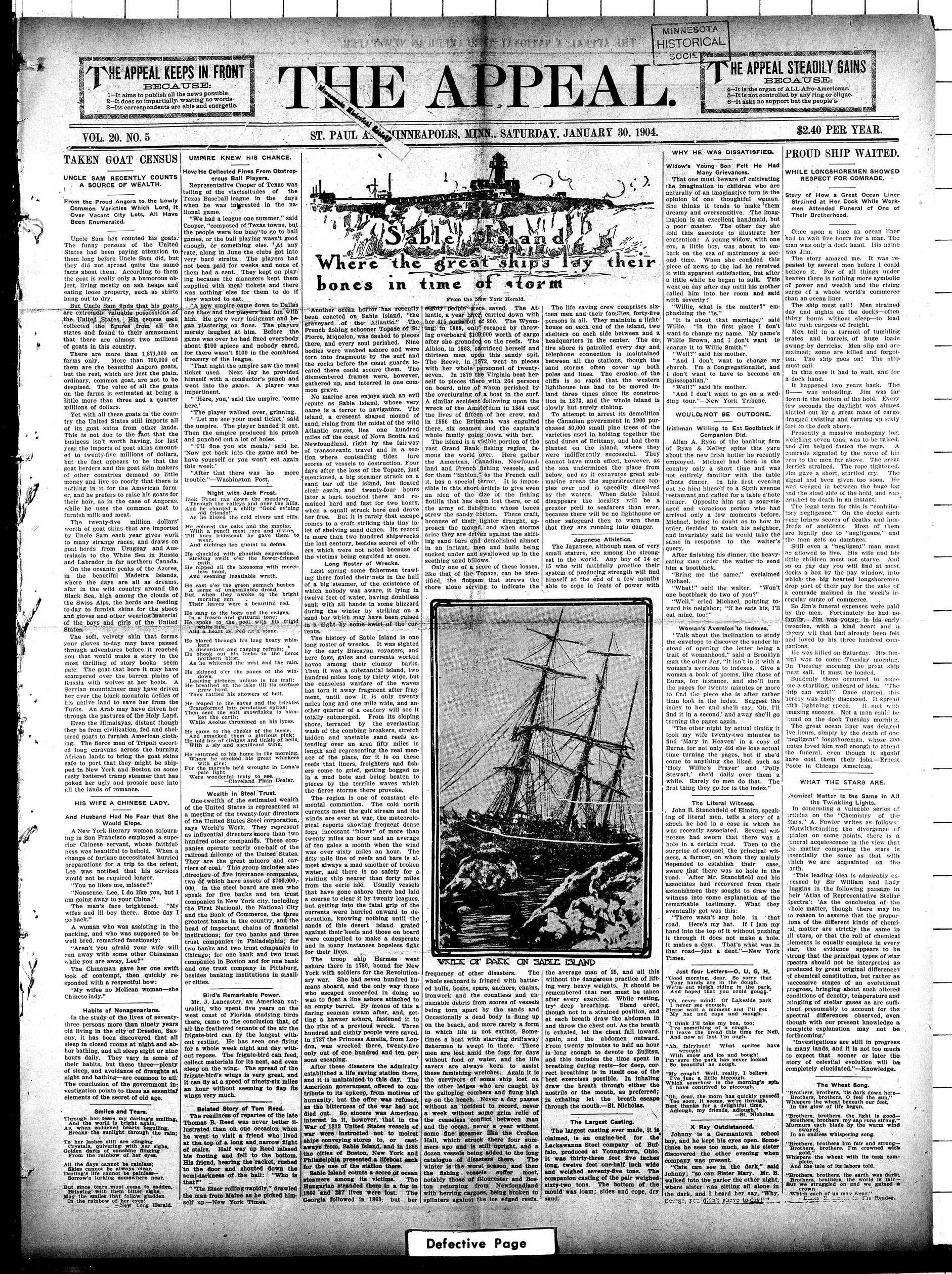
Sable Island Where the great ships lay their bones in time of storm
Another ocean horror has recently been enacted on Sable Island, "the graveyard of the Atlantic." The French fishing schooner Topaze of St Pierre, Miquelon, was dashed to pieces there, and every soul perished. Nine bodies were washed ashore and were torn into fragments by the surf and the rocks there before the coast guard cated there could secure them. The dismembered frames were, however, shattered, and intered in one common grave.
No marine area enjoys such an evil repute as Sable Island, whose very name is a terror to navigators. The island, a crescent shaped mound of sand, rising from the midst of the wild Atlantic surges, lies one hundred miles off the coast of Nova Scotia and Newfoundland, right by the fairway of transoceanic travel and in a section where contending tides lure scores of vessels to destruction. Four days after the loss of the Topaze, just mentioned, a big steamer struck on a sand bar off the island, but floated clear again, and which there and remained hard and fast for two hours, when a squall struck here and drove her free. But it is rarely that escape comes to a craft striking this tiny inlet of shelving sand dunes. Its record is more than two hundred shipwrecks the last century, besides scores of others which were not noted because of the victims being engulfed at once.
Long Roster
Last spring some fishermen trawling there fouled the nets in the hull of a boat, of the existence of which nobody was aware, it lying in twelve feet of water, having doubtless sunk with all hands in some blizzard during the winter by striking on a sand bar which may have been raised in a night by some swirl of the currents.
The history of Sabie Island is one long roster of wrecks. It was sighted by the early Biscayan voyagers, and here gales, gales and currents worked havoc among their clumy barks. Then it was a substantial island, two hundred miles long by thirty wide, but here gales, gales and currents have torn it away fragment after fragment, until now it is only twenty miles long and one mile wide, and another quarter of a century will see it totally submerged. From its sloping shore, terraced by the everlasting wash of the combing breakers, stretch hidden and unstable sand reefs extending over an area fifty miles in length and representing the real menace of the place, for it is on these reefs getting bogged and come to grief, getting bogged as in a mud hole and being beaten to pieces by the terrible waves which the fierce storms there provoke.
The region is one of constant elemental commotion. The cold north currents meet the gulf stream and the winds are ever at war, the meteorological reports showing frequent dense fogs, incessant "blows" of more than twenty miles an hour and an average of ten gales a month when the wind was over the sea. The gulf coast is most always a mudder of broken water, and there is no safety for a visiting ship nearer than forty miles from the eerie isle. Usually vessels that have gone ashore there had laid a course to clear it by twenty leagues, but getting into the fatal grip of the currents were hurried onward to destruction, knowing nothing until the sands of this desert island grated and the water were compelled to make a desperate and in many instances hopeless fight for their lives.
The troop ship Hermes went ashore there in 1780, bound for New York with soldiers for the Revolutionary war. She had seven hundred humans aboard, and the only way those escaped succeeded in doing so was to float a line ashore attached to an empty barrel. By means of this a daring seaman swam after, and, getting a hawser ashore, fastened it to the ribs of a previous wreck. Three hundred and eighty people were saved. In 1878 the Princess Amelia, from London, was wrecked there, twenty-five only out of one hundred and ten persons escaping.
After these disasters the admiralty established a life saving station there, and it is maintained to this day. The American government offered to contribute to its upkeep, from motives of humanity, but the offer was refused, as the bitterness of the war had not died out. So sincere was American interest in it, however, that in the War of 1812 United States vessels of war were instructed not to molest ships conveying stores to, or cast away from, Sable Island, and in 1855 the cities of New York and Philadelphia presented a lifesaving each for the use of the station there. Sable Island counts a score of ocean steamers among its victims. The Hungarian stranded there in a fog in 1860 and 287 lives were lost. The Georgia followed in 1863, but her
THE SHIP
WICK OF DARK ON SABLE ISLAND
eighty people were saved. The Atlantic, a year later carried down with her 415 pounds of 800. The Wyoming, in 1886, only escaped by throwing overboard $100,000 worth of cargo after she grounded on the reefs. The Albion, in 1868, sacrificed herself and thirteen men upon this sandy pit. The Reeve, in 1872, went to pieces with her whole personnel of twenty-seven. In 1879 the Virginia beat herself to pieces there with 264 persons on board, nine of whom perished by the overturning of a boat in the surf. A similar accident following upon the wreck of the Amsterdam in 1884 cost the lives of fifteen of her crew, and in 1886 the Britannia was engulfed there, six seamen and the captain's whole family going down with her.
The island is a visible portion of the vast Grand Bank fishing region, famous the world over. Here gather the American, Canadian, Newfoundland and French fishing vessels, and for them "Sabotins" as the French call it, has a special terror. It is impossible in this short article to give even an idea of the size of the fishing floatilla that has been lost there, or of the army of fishermen whose bones strew the sandy bottom. These craft, because they are from dredging, are the ground, and when storms arise they are driven against the shifting sand bars and demolished almost in an instant, men and hulls being sucked under and swallowed up in the seething sand billows. Only one of a score of these losses, like that of the Topaz, can be identified, the floatam that streshes the shore alone serving to indicate the
WRECK OF PARK ON S
frequency of other disasters. The whole seaboard is fringed with battered hulls, boats, spars, anchors, chains, ironwork and the countless and unamable debris from scores of vessels being torn apart by the sands and Occasionally a dead body is flung on the beach, and more rarely a form in which life is not extinct. Sometimes a boat with starving driftway fisherman is swept in there. These men are lost amid the fools for days without food or water, and the life savers are always keen to assist these famishing wretches. Again it is the survivors of some ship lost on the other ledges who are caught by the galloping combers and flung high up on the beach. Never day passes without an inshore ship, and these some grim reel of the ceaseless conflict between man and the ocean, never a year without some fine steamer like the Crofton Hall, which struck there four summers ago and is still upright, and a dozen vessels being added to the long catalogue of disasters there. The winter is the worst season, and then the fishing vessel suffers most, notably the oil spill, followed by settling from Newfoundland with herring carps, being broken to splinters against the ice reefs.
Defective Page
The life saved crew comprises sixteen men and their families, forty-five persons in all. They maintain a lighthouse on each end of the island, two shelters on each side between and a headquarters in the center. The entire shore is patrolled every day and telephone connection is maintained between all the stations, though the sand storms often cover up both poles and lines. The erosion of the cliffs is so rapid that the western lighthouse has had to be moved inland three times since its construction in 1873, and the whole island is slowly but surely sinking.
To attempt to arrest its demolition the Canadian government in 1900 purchased 80,000 small pine trees of the varieties used in holding together the sand dunes of Brittany, and had them planted on the island, where they were indifferently successful. They cannot have much effect, however, as the sea undermines the place from below, and as it excavates great submarine areas and is speedily dissolved by the waters. When Sable Island disappears the locality will be a greater peril to seafarers than ever, because there will be no lighthouse or other safeguard then to warn them that they are running into danger.
Japanese Athletics.
The Japanese, although men of very small stature, are among the strongest in the world. Any boy of 14 or older can be a strong system of producing strength will find himself at the end of a few months able to cope in feats of power with
DLE ISLAND
the average man of 25, and all this without the dangerous practice of lifting very heavy weights. It should be remembered that rest must be taken after every exercise. While resting, try deep breathing. Stand erect, though not in a strained position, and at each breath draw the abdomen in and throw the chest out. As the breath is exhaled, let the chest fall inward, again, and the abdomen rise. From now on minutes half an hour enough to devote to jujuja, and this includes the time spent in breathing during rests—for deep, correct breathing is in itself one of the best exercises possible. In inhaling draw the breath through either the nostrils or the mouth, as preferred; in inhaling let the breath escape through the mouth—St. Nicholas.
The Largest Casting.
The largest casting ever made, it is claimed, is an engine-bed for the Lackawanna Steel company of Buffalo, produced at Youngstown, Ohio. It was thirty-three feet five inches long, twelve feet one-half inch wide and weighed seventy-five tons. The companion casting of the pair weighed sixty-two tons. The bottom of the mould was loam; sides and cope, dry sand.
WHY HE WAS DISSATISFIED
Widow's Young Son Felt He Had
Many Gleavens.
That one must beware of cultivating the imagination in children who are naturally of an imaginative turn is the opinion of one thoughtful woman. She thinks it tends to make them dreamy and oversensitive. The imagination is an excellent handmaid, but a poor master. The other day she told this anecdote to illustrate her contention: A young widow, with one son, a little boy, was about to embark on the sea of matrimony a second time. When she confided this piece of news to the lad he received it with apparent satisfaction, but after a little while he began to sulk. This went on day after day until his mother called him into her room and said with severity: "Willie, what is the matter?" emphasizing the "is." "It is about that marriage," said Willie. "In the first place I don't want to change my name. My name's Willie Brown, and I don't want to change it to Willie Smith."
"And I don't want to change my church. I am a Congregationalist, and I don't want to have to become an Episcopalian." "Would I kiss his mother."
"And I don't want to go on a wed
ding tour."—New York Tribune.
WOULD NOT BE OUTDONE.
Irishman Willing to Eat Bootblack if
Companion Did
Allan A. Ryan of the banking firm of Ryan & Kelley spins this yarn about the new Irish butter he recently employed. Michael had been in the country only a short time and was not entirely familiar with the table d'hote dinner. In his first evening out he hired himself to a Sixth avenue restaurant and called for a table d'hote dinner. Opposite him sat a sour-visaged and voracious person who had arrived only a few moments before, Michael, being in doubt as to how to order, decided to watch his neighbor, and invariably said he would take the same in response to the waiter's question. After finishing his dinner, the heavy-eating man order the waiter to send him a bootblack.
“Bring me the same,” exclaimed Michael.
“What!” said the waiter. “Won’t one bootblack do two of you?”
“Well,” cried Michael, pointing toward his neighbor; “if he eats his, I’ll eat mine, too!”
Woman's Aversion to Indexes.
"Talk about the inclination to study the envelope to discover the sender instead of opening the letter being a trait of womanhood," said a Brooklyn man the other day, "it isn't it with a woman a book of poems, like those of Burns, for instance, and she'll turn the pages for twenty minutes or more to find the piece she is after rather than look in the index. Suggest the index to her and she'll say, 'Oh, I'll find it in a second,' and away she'll turn the pages again.
"The other night by actual timing it took my wife twenty-two minutes to find 'Mary in Heaven' in a copy of Burns, for not only did she lose actual time turning the pages, but if she'd come to anything she liked, such as 'Holy Willie's Prayer' and 'Polly Stewart,' she'd daily over them a while. Rarely do men do that. The first thing they go for is the index."
The Literal Witness.
John B. Stanchfield of Elmira, speaking of literal men, tells a story of a shock he had in a case in which he was recently associated. Several witnesses had sworn that there was a hole in a certain road. Then to the surprise of counsel, the principal witness, a farmer, on whom they mainly depended to establish their case, swore that there was no hole in the road. After Mr. Stanchfield and his assistant, Jasonahn they sought to draw the witness into some explanation of the remarkable testimony. What they eventually got was this: "There wasn't any hole in that road. Here's my hat. If I am my hand into the top of it without pushing it through it does not make a hole. It makes a dent. That's what is in that road—just a dent."—New York Times.
Just four Letters—O, U, G, H.
"Good morning, dear. So sorry that your hands are in the dough. What you did was good. And hoped that you could googly."
"I think I'll take my boa; too,
I'll leave the bread this time for Nell,
I'll leave the bread this time for Nell,
"My cough? Well, really, I believe. Which somehow in the morning's sph. I have contrived to plecough.
"Oh, dear, the morn has quickly passed. Best thanks for a delightful time. Adough, my friends, adough.
Nicholas.
X Ray Outdistanced.
Johnny is a Germantown school boy, and he kept his eyes open. Sometimes he sees too much, as his sister discovered the other evening when company was present. "Cata can see in the dark," said Johnny; "so can Sister Mary. Mr. B walked into the parlor and saw the girl sitting all alone in the dark, and I heard her say, Why, Cata, you said it!"
PROUD SHIP WAITED.
WHILE LONGSHOREMEN SHOWED
RESPECT FOR COMRADRE.
Story of How a Great Ocean Liner
Strained at Her Dock While Workmen
Attended Funeral of One of
Their Brotherhood.
Once upon a time an ocean liner had to wait five hours for a man. The man was only a dock手。他 name was Jim.
The story amazed me. It was repeated by several men before I could believe it. For of all things under heaven there is nothing more symbol of power and wealth and the rising surge of a whole world's commerce than an ocean liner.
The ship must sail! Men strained day and nights on the docks—often thirty hours without sleep—to load late rush cargoes of freight.
Men toil in a turmoil of tumbling crates and barrels, of huge loads swung by derricks. Men slip and are moulded; some are killed and forgotten. The ship goes on! The ship must sail
In this case it had to wait, and for a dock hand.
It happened two years back. The B— was unloading. Jim was far down in the bottom of the hold. Every few seconds the daylight was almost blotted out by a great mass of cargo dragged twisting and turning up sixty feet to the deck above. A mackayog log, weighing seven tons, was to be raised, and Jim helped fasten the rope. A comrade signaled by the wave of his arm to the men far above. The great derrick strained. The rope tightened. Jim gave a short, startled cry. The signal had been given too soon. He was wedged in between the huge log and the steel side of the hold, and was crushed to death in an instant.
The legal term for this is "contributory negligence". On the docks each time the boat sank, hundreds of accidents. Most of them are legally due to "negligence" and the man gets no damages.
Still even a "negligent" man must be allowed to live. His wife and his little children must not starve. And so on pay day you will find at most docks a box by the pay window, into which the bilt hearted longshoreman of a comrade maimed in the week's irregular surge of commerce. So Jim's funeral expenses were paid by the men. Fortunately he had no family. Jim was young, in his early twenties, with a kind heart and a theory wit that had already been felt and loved by his three hundred comparisons. Jim was killed on Saturday. His funeral was to come Tuesday morning. On Tuesday morning the great ship must sail. It must be loaded.
Suddenly there occurred to some one a startling, unheard of idea. "The ship can wait!" Once started, this ship would light up spaces with lightning speeches. It met with amazing success. Not a man could be found on the dock Tuesday morning. The great ocean liner was delayed five hours, simply by the death of one "negligent" longshoreman, whose 200 names loved him well enough to attend funeral, even though it should have been a special event. "Ernest Poole in Chicago American."
WHAT THE STARS ARE.
Chemical Matter Is the Same in All the Twinkling Lights.
In concending a valuable series of articles on the "Chemistry of the Stars," A. Fowler writes as follows: "Notwithstanding the divergence of opinion on some points, there is a general acquiescence in the view that the matter composing the stars is essentially the same as that with which we are acquainted on the earth.
"This leading idea is admirably expressed by Sir William and Lady Juggins in the following passage in their 'Atlas of Representative Stellar spectra': 'As the conclusion of the whole matter, though there may be no reason to assume that the proportions of the different kinds of chemical matter are strictly the same in all cases, the proportions of chemical elements is equally complete in star, the evidence appears to be strong that the principal types of star spectra should not be interpreted as produced by great original differences of chemical constitution, but rather as successive stages of an evolutionary progress, bringing about such altered conditions of density, temperature and mingling of stellar gases as are sufficient presumably to account for the spectral differences observed, even though with our present knowledge a planetation may not be forthcoming'.
"Investigations in still progress in many lands, and it is not too much to expect that sooner or later the story of celestial evolution will be completely elucidated."—Knowledge
The Wheat Song.
"Brothers, brothers, its dark down here-
Brothers, brothers, the sun"
"Wrapped up the breath beneath our feet,
in the glow of life begun."
"Brothers, brothers, the light is good-
Brothers, brothers, my sap runs strong"
"Murmur, which blade by the warm wind
murmur."
In an endless whispering song.
"Brothers, brothers I'm fair and strong—
Brothers, brothers, I'm crowned with
Whispers the wheat with its task com-
And the tale of its labors told.
Brothers, brothers, the earth was dark;
Brothers, brothers, the world is fair—
But angled on and we gained a crown
Which of us may wear:
East F. to the Reader.
HAVE YOUR RIGHT
THE APPEAL?
ST. PAUL OFFICE,
No. 110 Union Blk. 4th & Cedar,
J. O. ADAMS, Manager.
MINNEAPOLIS OFFICE,
Guaranty Loan Bldg. Room 1020
HARVEY B. BURK, Manager.
CHICAGO OFFICE,
323-5 Dearborn St., Suite 310,
C. F. ADAMS, Manager.
TERMS, STRICTLY IN ADVANCE:
42 occasionally happens that papers sent to us, receive any number when due, inform us by postal card as the expiration of five days for our collection, or a duplication of the missing number.
**Communication to receive attention must be written only upon one side of the paper; not later than Wednesday, and bear the signature of the author.** To manuscript receive not later than Wednesday, and bear the signature of the author. To manuscript receive not later than Wednesday, and bear the signature of the author.
**So do we hold ourselves responsible for the views of our correspondents.** Write for terms. Sample copies. Do write for terms. Sample copies.
In every letter that you write us never fail to read our letter to the house and please write, post office, county and state. Business letters of all kinds must be written on the cover of the letter or matter for publication. Entered as second class master at St. Paul, Minn.
**SATURDAY, JANUARY 30. 1904.**
So many people in recent years, bringing their race prejudices with them, that the poison has spread, and many Northern people are now affected by the
Evanson, once so free from color prejudice, is now strongly affected by the hellish caste spirit. This was shown at the Himman Debating Society of Northwestern University Tuesday, April 16, at the John P. Falkner, an Afro-American student was elected to membership by a majority of one vote. The membership of this society is limited to twenty-five. But two vacancies existed, and there were three to means. Two of these were Caucasians, the third an Afro American, the fourth an African American, the fourth an Afro American. Year Falkner won the third prize in the preliminary contest for representation of the university, his subject being "The Races." This year, in the preliminary contests, he won a place permitting him to contest for the final honor, and some of his friends thought he should be entitled to membership. Others, such as his wife, which is composed of 40 of the most brilliant young
There is a contingent in the university which is opposed to Faulkner and other Afro-American students, so when Faulkner's application came up for consideration there was opposition. It is said that there is a full meeting likely to be, we trust that the spirit of fair play which is so strong in the Northern people will prevent the Southern contingent, which is so bitter against Afro-Americans, from reversing the decision which made Faulkner a member of the society. The only thing which can be done is him to the skin, and such an objection is unworthy of people who claim to be Christians.
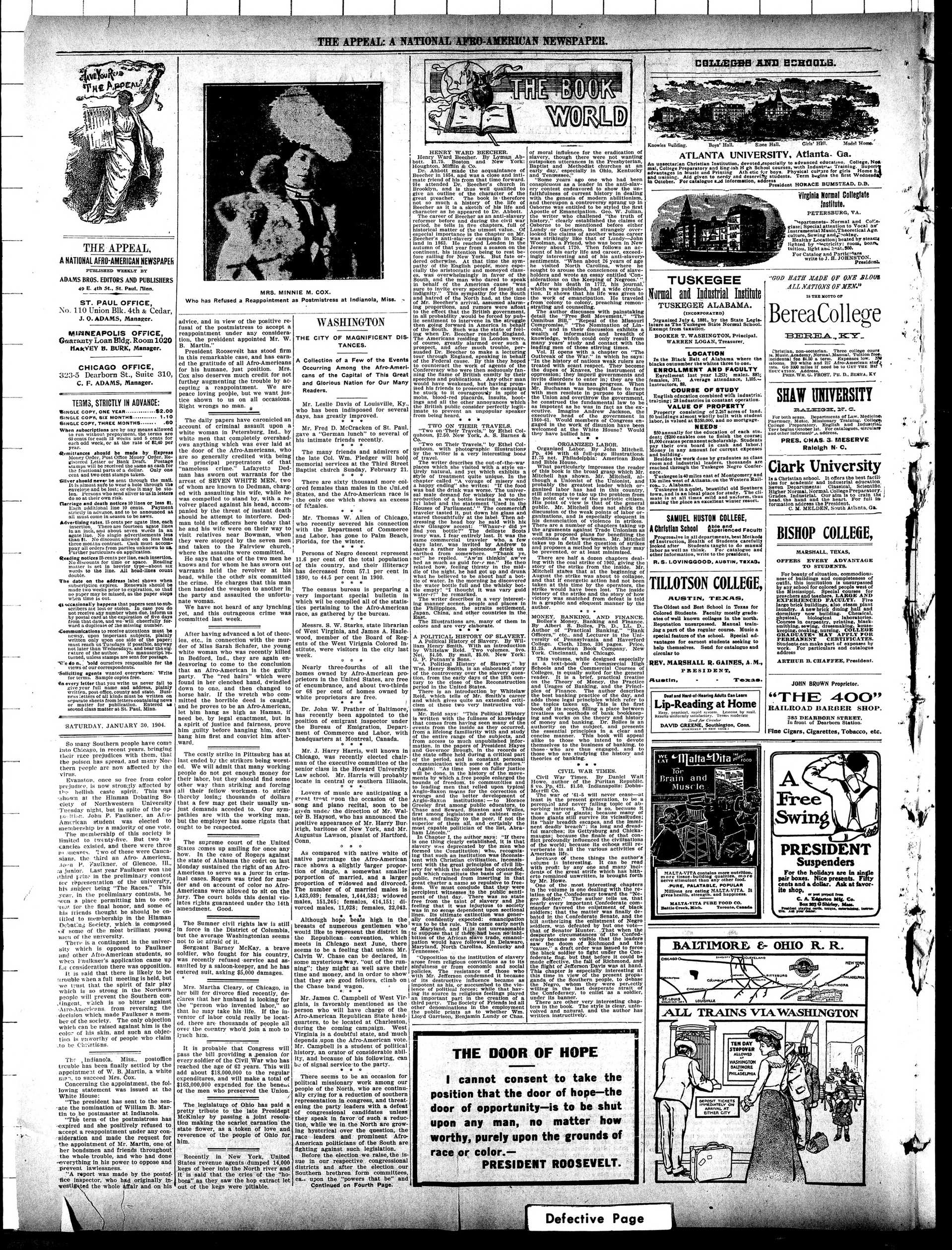
The, Indianaan, Miss., postoffice trouble has been finally settled by the appointment of W. B. Martin, a white man, to succeed Mrs. Cox.
Concerning the appointment, the following statement was issued at the White House.
The president has sent to the senate the nomination of William B. Martin to be postmaster at Indiana.
"The term of the postmistress has expired and she positively refused to accept a reappointment under any consideration and made a mistake," Mr. Marion one of her bondmen and friends throughout the whole trouble, and who had done everything in his power to oppose and prevent lawfulness by the postoffice inspector, who had originally investigated the whole affair and on his
0
Who has Refused a Reappointment as Postmistress at Indianola, Miss.
advice, and in view of the positive refusal of the postmistress to accept a reappointment under any consideration, the president appointed Mr. W. B. Martin. The president Roosevelt has stood firm in this remarkable case, and has earned the gratitude of all Afro-Americans for his humane, just position. Mrs. Cox also deserves much credit for not further augmenting the trouble by accepting a reappointment. We are leaving people, but we want justice shown to us on all occasions. Right wrongs no man.
WASHINGTON
THE CITY OF MAGNIFICENT DISTANCES.
A Collection of a Few of the Event Occurring Among the Afro-Americans of the Capital of This Great and Glorious Nation for Our Marty Readers.
Mr. Leslie Davis of Louisville, KJ
The daily papers have chronicled an account of criminal assault upon a white woman in Petersburg, Ind., by white men that completely overshadows anything which was ever laid at the door of the Afro-Americans, who are so generally credited with being the principal perpetrators of that assault, that the man has sworn out warrants for the arrest of SEVEN WHITE MEN, two of whom are known to Dedman, charged with assaulting his wife, while he was compelled to stand by, with a revolver placed against his head, accompanied by the threat of instant death should he attempt to interfere. Dedman told the officers here today that he would visit relatives near Bowman, when they were stopped by the seven men and taken to the Fairview church, where the assaults were committed.
He says that one of the two men he knows and for whom he has sworn out warrants held the revolver at his head, while the other six committed the crime. He charges that this man threw the weapon to another in the party and assaulted the unfortunate woman.
We have not heard of any lynching yet, and this outrageous crime was committed last week.
After having advanced a lot of theories, etc., in connection with the murder of Miss Sarah Schafer, the young girl was killed in Bedford, Ind., they are again endeavoring to come to the conclusion that an Afro-American is the guilty party. The "red hair" which were found in her clenched hand, dwindled down to one, and then changed to two. The second hair, fitted the horrible deed is caught, and he proves to be an Afro-American, let him hang as high as Haman, if need be, by legal enactment, but in a spirit of justice and fairness, prove his guilty before hanging him, don't him first and convict him afterward.
The costly strike in Pittsburgh has at last ended by the strikers being worsted. We will admit that many working people do not get enough money for their labor, but they should find some other way than striking and forcing all their workmen to strike thereby losing thousands of dollars that a few may get their usually unjust demands acceded to. Our sympathies are with the working man, but the employer has some rights that ought to be respected.
The supreme court of the United States comes up smiling for once any how. In the case of Rogers against the state of Alabama the court on last Monday ordered the state to serve a juror in criminal cases. Rogers was tried for murder and on account of color no Afro-Americans were allowed to sit on the jury. The court holds this denial violates rights guaranteed under the 14th amendment.
The Summer civil rights law is still in force in the District of Columbia, but the average Washingtonian seems not to be afraid of it.
Sergant Barney McKay, a brave soldier, who fought for his country, was recently refused service and assaulted by a salon-keeper, and he has entered suit, asking $5,000 damages.
Mrs. Martha Cleary, of Chicago, in her bill for divorce fled recently, declares that her husband is looking for the "paranoid who invaded" labor, so that he may take his life. The heir of labor could really be located, there are thousands of people all over the country who'd join a mob to lynch him.
It is probable that Congress will pass the bill providing a pension for every soldier of the Civil War who has been paid age of $25,000. This will add about $18,000,000 to the regular expenditures, and will make a total of $163,000,000 expended for the benevolent of the men who preserved the Union.
The legislature of Ohio has paid a pretty tribute to the late President McKinley by passing a joint resolution making the scarlet carnation the national flower and reverence of the people of Ohio for him.
Recently in New York, United States revenue agents dumped 14,000 kegs of beer into the North river and it is said that the cries of the "hoo-hoo" crowd have forced the cut out of the kegs were usable.
THE APPEAL: A NATIONAL AFRO-AMERICAN NEWSPAPER.
WASHINGTON
THE CITY OF MAGNIFICENT DISTANCES.
A Collection of a Few of the Events Occurring Among the Afro-Americans of the Capital of This Great and Glorious Nation for Our Many Readers.
Mr. Leslie Davis of Louisville, Ky., who has been indisposed for several days, has greatly improved.
Mr. Fred D. McCracken of St. Paul, gave a "German lunch" to several of his intimate friends recently.
The many friends and admirers of the late Col. Wm. Pledger will hold memorial services at the Third Street Baptist church Sunday, February 21.
There are sixty thousand more colored females than males in the United States and the Afro-American race is the only one which shows an excess of females.
Mr. Thomas W. Allen of Chicago, who recently severed his connection with the Department of Commerce and Labor, has gone to Palm Beach, Florida, for the winter.
Persons of Negro descent represent 11.6 per cent of the total population of this country, and their illiteracy has decreased from 57.1 per cent in 1890, to 44.5 per cent in 1800.
The census bureau is preparing a very important special bulletin in which will be compiled all of the statistics pertaining to the Afro-American race, as gathered by the bureau.
Messrs. W. St. Warks, state librarian of West Virginia, and James A. Hazlewood, member of the Board of Regents of the West Virginia Colored Institute, were visitors in the city last week.
☆ ☆ ★
Nearly three-fourths of all the homes owned by Afro-American proprietors in the United States, are free of encumbrance, and about two-thirds or 68 per cent of homes owned by white proprietors are free.
Dr. John W. Prather of Baltimore, has recently been appointed to the position of emigrant inspector under the Bureau of Emigration, Department of Commerce and Labor, with headquarters at Montreal, Canada.
Mr. J. Harry Harris, well known in Chicago, was recently elected chairman of the executive committee of the senior class in the Howard University Law school. Mr. Harris will probably locate in central or southern illinois.
Lovers of music are anticipating a great treat upon the occasion of the song and piano recital, soon to be given under the direction of Mr. Walter B. Hayson, who has announced the positive appearance of Mr. Harry Burke, baritone of New York, and Mr. Augustus Lawson, pianist of Hartford, Canada.
As compared with native white of native parentalage the Afro-American race shows a slightly larger proportion of single, a somewhat smaller proportion of married, and a larger proportion of married. The number of married males is 1,428,039; females, 1,444,533; widowed males, 151,245; females, 414,151; divorced males, 11,028; females, 22,043.
Although hope bells high in the breasts of numerous gentlemen who would like to represent the district in the Republican convention, which meets in Chicago next June, there seems to be a feeling that unless Mr. Calvin W. Chase can be declared, in order to "influence" them might as well save their time and money, and in order to show that they are good fellows, climb on the Chase band wagon.
Mr. James C. Campbell of West Virginia, is favorably mentioned as the person who will have charge of the Afro-American Republican State headquarters, to be located at Charleston, during the coming campaign. West Virginia depends upon the Afro-American vote. Mr. Campbell is a student of political history, an orator of considerable ability, and because of his following, can be of signal service to the party.
There seems to be an occasion for political missionary work among our people of the North, who are continually crying for a reduction of southern representation in congress, and threatening the party leaders with a defeat of congressional candidates unless they speak in favor of such a reduction. We have seen hysterical over the question, the race leaders and prominent Afro-American politicians of the South are fighting against such legislation.
Before the election we raise, the issue in our respective congressional districts and after the election our respective districts and after the election we raise, upon the "powers that be" and "continued on Fourth Page."
THE BOOK WORLD
THE DOOR OF HOPE
I cannot consent to take the position that the door of hope—the door of opportunity—is to be shut upon any man, no matter how worthy, purely upon the grounds of race or color.—
PRESIDENT ROOSEVELT.
HENRY WARD BECHEER
Holt. New York
Abbot. Boston and
New York
$1.75 Boston and
New York
TWO ON THEIR TRAVELS.
"Two on Their Travels," by Ethel Colquhoun, 22nd New York, A. S. Barnes & Co.
"Two on Their Travels," by Ethel Colquhoun, with photographic illustrations by the writer is a very interesting book of travel.
The writer describes the out-of-the-war places which she visited with a style entirely natural, and yet which exhibits a more natural, more l�ing quality of chapter called "A Voyage of misery and a happy ending," she writes: "If the food was bad the drink was worse. The universal male demand for uniskey led to the whole life of the world," she wrote, "and the traveler was the best of the House of Parliament." The commercial traveler tasted it, put down his glass and stared thoughtfully at the label. Then add-up was the best of the world, and she saw Glasgow accent: "Whaur-r did y-find you bottle?" The delicate Scots's irony was, I fear entirely lost. It was the sommier special order which feels days later, was invited by Andrew to share a rather less poisonous drink un earthed from somewhere. "Thank ye, no!" he replied. "Aw'm thinking I'm a very good man." He related how, "feeling thirsty in the middle of the night, he had got up and drunk what he believed to be about half a bottle of water. In the morning he discovered the world full of the whisky both the empty!" I thought it was very good water-r." he remarked.
The writer describes in a very interesting article the Philippines, the straits settlement Japan, China, and other countries in the East. The illustrations are, many of them in colors and are very elaborate.
A POLITICAL HISTORY OF SLAVERY. A Political History of Slavery. By William Reid. With Whitewater Reid. Two volumes, $8.00. Net. $4.50. By mail. $5.00. New York: George G. W. Press.
"A Political History of Slavery," by Wm. Henry Smith, is an elaborated story of slavery from the early days of the 18th century to the close of the Reconstruction period. There is an introduction by Whitewater Reid, which tells us that a extended criticism of these two very instructive volumes, Mr. Reid says: "This Political History is a knowledge of the knowledge of knowledge from access to much unpublished information, in the papers of President Hayes and in the state office held during a critical period of the period, and in constant personal experience."
Again: "As time goes on fuller, justice will be done, in the history of the move-up, which will be the policy of the movements of freedom, to communities and to leading men that relied upon typical Anglo-Saxon means for the correction of wrong-taxes." It was developed in the 1960s and 1970s institutions; to Horace Greeley first among public educators, to Chase and Seward, Stanton and Welles, first among legislators and cabinet minimization and the other people who do not superior of them all, and certainly the most capable politician of the list, Abraham Lincoln."
In Chapter 1, the author says: "If there is so much clearly established, it is that slavery was depreated by the men who formed the Constitution, who, recognizing that such an institution was inconclusive, was a Christian, and a person, as a tient with the most principles of civil liberty for which the colonies had contended, and which constitute the basis of our Republic, refrained from inserting in that way the law to the end of the 19th century. We must conclude that they were percipient witnesses to the public sentiment of that day. There was no state from the taint of the very same feelings that it is injurious to society was in no sense dependent upon sectional lines. Its ultimate extinction was generally confidently expected: emancipation was to the extent of the Act of 1960 was to the extent of Maryland, and it is not unreasonable to suppose that if there had been no inhibition of the African slave trade, emancipation would have followed in Delaware, and in the North Carolina, Kentucky and Tennessee.
“Opposition to the institution of slavery arose from religious convictions as to its sinfulness or from economic and social policies. The resistance of those who with Mr. Jefferson condemned it because of its destructive influence became as impotent as his, or succumbed to the violence of political forces; while that having its source in religious feelings played an important part in the creation of a third party. The Society of Friends led all other denominations in the employment the public prints as to whether Wm. Lloyd Garrison, Benjamin Lundy or Chas.
of moral influence for the eradication of slavery though there were not wanting outspoken utterances in the Presbyterian, Baptist and Methodist churches at an early day, especially in Ohio, Kentucky and Tennessee.
“Somewhat ago one who had been conspicuous as a leader in the anti-slavery contest endeavored to show the unfairfulness of current history in dealing with the genesis of modern abilitionism, and thereupon a controversy sprang up in the field of being a다운 짧게 짧게 Apostle of Emancipation. Geo. W. Julian, the writer who challenged “the truth of history,” clearly established the claims of Osborne to be mentioned before either Lundy or Garrison, but strangely over-the-way and the other. Another was strikingly like that of Lundy—John Woolman, a Friend, who was born in New Jersey about 1720. Then follows an account of his early life and career, exceedingly interesting and of his anti-slavery sentiments when he was 15 years of age. He visited North Carolina, who sought to arouse the consciences of slaveholders and wrote an essay entitled ‘Considerations on the Keeping of Negroes.’ After his death in 1772, his journal, which was published, had a wide circulation, and shows that his life was given to the world’s emancipation. He traveled from colony to colony, preaching monstrating and counseling.
The author discusses with painstaking detail the history of the Ommibus Bill. "Repeal of the Missouri Compromise," "The Nomination of Lincoln," "The wealth of information and breadth of knowledge, which could only result from the leadership of those those stirring times." "The Outbreak of the War," in which he says: "In the history of nations weak rulers are the dukes of Knaves, the instrument of oppression; they imperial governments and real enemies to human progress. When Mr. Buchanan was brought face to face with the Union and overthrow the government, as construed by the fundamental law to be as executive, Imagine Andrew Jackson, the first president in 1800-41. Would members of Congress gaged in the work of disunion have been the House? Would they have bullied him
ORGANIZED LARGE
Organized Labor. By John Mitchell
$7.75. Philadelphia: American Book
Bible House.
What particularly impresses the reader is the fact that Mitchell has shown, Mr. Mitchell, ally, the unionist of the Unionist, and probably the unionist of the problem from the organization labor has had in this country, the point of view of the problem from the point of view of the problem from the public. Mr. Mitchell does not discuss the weak points of labor or unionism, but rather his denunciation of violence in strikes. He argues against Trade Unionism well as proposed plans for benefiting the workers takes up in detail the question of strikes may be prevented, or at least minimized.
There are half a dozen chapters dealing with the story of the strike from the inside. Mitchell states that at the beginning of the strike, he and that if energetic action had not been taken at this time by the operators, the history of the strike and the story of how victory was snatched from defeat is told graphic and in a manner by the author.
MONEY, BANKING, AND FINANCE.
Boiler's Money, Banking and Finance. Boiler's Money, Banking and Finance. Author of "Practical Banking," "Bank of Pennsylvania," and Lecturer in the University of Pennsylvania College. Cloth, 12mo, 338 pages. Price. New York, Cincinnati, and New York, Chicago.
This volume, while designed especially for the text-book for Commercial High Schools, is equally suited for the general reader. It is a brief, practical treatise on the history of banking and Usages of Banking, and the Principles of Finance. The author describes these topics taken up. This is the first treatise on methods of bank bookkeeping and works on the theory and history of banking, and presents treatises on methods of bank bookkeeping on methods of bank bookkeeping on the subject, and presents the essential principles in a clear and concise manner, and alike to those who intend to devote themselves to the business of banking, to those who are thus engaged, and to those who are studying the history and theories of banking.
CIVIL WAR TIMES
Civil War Times. By Daniel Walt
Koehler. 100th Anniversary Edition.
8 yo. Pp. 421, 431. Indianapolis: Dobbs-
s & Co.
The war of '61-5 will never cease—at least in the present generation, to be a perennial and never falling topic of absorbing interest. This is so, because it was a war of giants; because many of those giants still survive its vicissitudes; its "hair breadth escapes, and the imminent deadly breach"; its long and dreadful marches; its Gettysburg and Chickamaugas; because the finale of that conflict profoundly influenced the civilizations of the world; because its echoes still reverberate in all the various activities of American life.
Because of these things the author's volume is interesting. It can be read with profit: by any one and many incidents of the great strife which has hitherto remained unwritten, is brought forth by Mr. Howe.
One of the most interesting chapters in the history of the Confederacy toward the "Negro Soldier." The author tells us, that the matter was finally addressed; the master favored the enlistment of black soldiers; that the matter was finally addressed; the master favored the enlistment of Negro soldiers, was defeated by but one vote—that the Confederacy had desperate circumstances of the Confederacy became so visible that the leaders were forced to take a "cause," a draft order was issued to force the black soldier to fight under the Confederacy. The consequence was made effective, the fall of Richmond, and the flight of Jefferson Davis was at hand. This time in view of the present propaganda of the Southern people, to debase the Confederacy, to enlist as a soldier, the Confederacy, to enlist as a soldier, there are other very interesting chapters in the book. The style is clear, unintrusive, and the author has written instructively.
OF HOPE
sent to take the
door of hope—the
city—is to be shut
no matter how
on the grounds of
ENT ROOSEVELT.
Defective Page
Knowles Building. Boys' Hall. Stone Hall. Girls' Hall. Model Home.
ATLANTA UNIVERSITY, Atlanta. Ga.
An unacastarian Christian Institution, devoted especially to advanced education. College, Normal, College Preparatory and English H gh School courses, with Industrial Training. Superior advantages in Music and Printing. Athletic for boys. Physical culture for girls. Home & School for needy and deserving students. Term begins the First Wednesday in October. For catalogue add information, address
WE LAT Malta-Vita the perfect food
For Brain and Muscle
MALTA-VITA contains more nutrition,
more tissue-building qualities, more
nerve stimulant than any other.
You may relish popular
Nittons are eating MALTA-VITA. It
gives health, strength, and happiness.
MALTA-VITA PURE FOOD CO.
Battle Creek, Mich. Toronto, Canada
A
Free
Swing
PRESIDENT
Suspenders
For the holidays are in single
pair boxes. Nice presents. Fifty
cents and a dollar. Ask at favori-
ite shop.
or post prepaid from
C. A. Dupont Mild Co.
Box 200 G Shirley, Mass.
President starts cards, unique, entertaining, in-
trusive. Ask your dollar.
BALTIMORE & OHIO R. R.
CINCINNATI
ST. LOUIS
LOUISVILLE
SAN FRANCISCO
CLEVELAND
PITTSBURG
WASHINGTON
NEW YORK
PHILADELPHIA
BALTIMORE
ALL TRAINS VIA WASHINGTON
TEN DAY
STOPOVER
ALLOWED
WASHINGTON
BALTIMORE
PHILADELPHIA
DEPOSIT TICKETS
IMMEDIATELY ON
DEPOSIT IN
EITHER CITY
THE HOTEL
TUSKEGEE Normal and Industrial Institute
Organized July 4, 1881, by the State Legislature as The Tuskegee State Normal School. Exempt from taxation.
BOOKER T. WASHINGTON, Principal.
WARREN LOGAN, Treasurer.
LOCATION
In the Black Belt of Alabama where the blacks outnumber the whites three to one.
ENROLLMENT AND FACULTY
Euroment last year 1,231; males 88%; females 112%. Average attendance, 1,033; Instructors, 88.
COURSE OF STUDY
English education combined with industrial training; 28 industries in constant operation.
Property consisting of 2,267 acres of land, 50 buildings almost wholly built with student labor, is valued at $300,000 and no mortgage. $50 annually for the education of each student; ($200 enables one to finish the course; $100 enables one to pay their expenses in cash and labor). Money in any amount for current expenses. Besides the work done by graduates as class room and labor, $100 is required through the Tuskegee North Conference. Buildings are 40 miles east of Montgomery and 136 miles west of Atlanta, on the Western Railroad. - Alabama. Beautiful, old Southern town, and is an ideal place for study. The client makes the place an excellent winter resort.
SAMUEL HUSTON COLLEGE
Progressive in all departments, best Methods
to teach the subject. Students looked
after. Students taught to do manual
labor as well as think. For catalogue and
research. For catalogue and research.
R. S. LOVINGBURY, AUDIEN, TEXAG.
TILLOTSON COLLEGE.
TILLOTSON COLLEGE.
AUSTIN, TEXAS,
The Oldest and Best School in Texas for
Colored Students. Faculty mostly graduates
of well known colleges in the north.
Reputation unsurpassed. Manual training
a part of the regular course. Music a
special feature of the school. Special advantages for earnest students seeking to help themselves. Send for catalogue and circular to
REV. MARSHALL R. GAINES, A.M.
PRESIDENT.
Deaf and Hard-of-Hearing Adults Can Learn
Lip-Reading at Home
Bare, practical rapid system. Lessons by mail.
Renault uniformly satisfactory. Terms moderate.
Send for Creator
DAVID GREENE, Southington, Conn.
FIRMWARE IN NEW YORK
WE EAT Malta-Dita THE PERFECT FOOD
For Brain and Muscle
*departments: Normal and College*
*School: New York University*
*instrumental Music, Theoretical Agric*
*culture, Sewing and *cooking*
*Healthy Location: room with seating*
*activity: room, board*
*tuition, light and *sat.*$80*
For Catalog and Parties, write
to J. H. JOHNSTON.
President
"GOD HATH MADE OF ONE BLOOD
ALL NATIONS OF MEN."
IS THE MOTO OF BereaCollege
BEREA, KY
Christian, non-sectarian. Three college courses
is. Music Academy, Normal University. Expres-
sions low. Law. Alumnos. 202 white and 217 Afro-American au-
thentics. 202 education. EDUCATION. Address:
800 W. 12th St. BEREA, KY 45010. PU D. BEREA, KY
PRES. WM. G. FROST, PH. D., BEREA, KY
SHAW UNIVERSITY
For both sexes. Departments of Law, Medicine
Pharmacy, Music, Music Training, College
College Preparatory, College Preparatory
Institute. For catalogues, circulars
and other informaTv. aAddress.
PRES. CHAS. S. MESERVE
Raleigh N. C.
Clark University
In a Christian school, it offers the best facilities for academic and industrial education. It has a Higher Normal, Normal, Normal, College Preparatory. Grades. Industrial. Our aim is to train the head the students so that we for full information address the President. C. M. MELDEN, South Atlanta, GA.
BISHOP COLLEGE.
MARSHALL, TEXAS.
OFFERS EVERY ADVANTAGE TO STUDENTS.
For beauty of situation, commodiousness of building and completeness of outfit, this institution is unsurpassed by any school for colored people west of the Mississippi. Special courses for prechores and teachers. LARGE AND EXPERIENCED FACULTY. Five large brick buildings, also steam plant laundry. A new brick dining hall and dormitory now building. Chemical, physical, biological, laboratories. Courses in carpentry, printing, blacksmithing, sewing, dressingmaking, housekeeping, cooking, nursing. COLLEGE GRADUATE MAY APPLY FOR PERMANENT CERTIFICATES. Students can make part of expenses by work. For particulars and catalogue address.
ARTHUR B. CHAFFEE, President.
JOHN BROWN Proprietor.
"THE 400" RAILROAD BARBER SHOP.
385 DEARBORN STREET.
In front of Dearborn Station.
Fine Cigars, Cigarettes, Tobacco, etc.
ST. PAUL
NGEKS RECORD IN MINNESOTA'S CAPITAL.
The Saint City and Saintly City Fells
Every Items of Social, Religious and
General Matters Among the People, Bell-
Down.
SATURDAY, JANUARY 30, 1904.
If it's Hamm's, it's all right.
Isn't this lovely weather for Minne-
sota?
"I haven't paid $5.00 for a hat since I began wearing the Gordon and I buy the best."
Have you called at the new, up-to-date tonsorial parlor, No. 74 E. Fifth street? Well, you ought to do so.
February 1st, according to the new gas franchise, the price of gas will be reduced to $1.15 per 1,000 cubic feet.
Capt. Joseph Burger of the Second Ward has filed as a candidate for assemblyman on the Republican ticket.
You are cordially invited to attend the Men's Sunday club, which meets at Pilgrim Baptist church tomorrow afternoon at 4 o'clock. Good program.
The most popular place for people who take their meals down town is John Godfrey's. No. 552 Wabasha street. Everything neat, clean and well cooked.
Anyone who would like to go into an established business which pays well, who can furnish $500 cash, may learn particulars by calling at THE APPEAL office.
The Lincoln Club is preparing for its annual banquet, which occurs on Lincoln's birthday anniversary, Feb. 12th. The banquet will take place at the Merchants' Hotel.
Is your hair straight? If not, send 50 cents to Ozonized Ox Marrow Co., 76 Wabash Avenue, Chicago, Ill., for a bottle of Ozonized Ox Marrow and you can easily straighten it.
Postmaster McGill, during a recent visit to Washington, secured a number of improvements in the postoffice operations, which will facilitate the delivery of mail greatly.
There has been some genuine oldtime Minnesota weather dished out to us for the last week. Thirty-three degrees below zero is enough to give anybody the cold shivers.
Mrs. E. J. Allen has opened a hair store at 363 W. Seventh street near Forbes, where she is prepared to fill orders in all branches of hair work. Scalp treatment a specialty.
THE NAGEL UNDERTAKING CO.
Wm. E. Nagel Manager, 208 West Third street, Telephone, Main 1504. Latest equipments in every line. Lady assistant when desired.
Gentlemen wishing nice furnished room, with all conveniences, by the week or month, at reasonable rates, should apply at the Benton House, 228 West Third street, up stairs.
A civil service examination will be held in Minnesota February 24 for the position of stenographer and typewriter with a knowledge of chemistry, in the department of agriculture.
Shoes mended while you wait at Javiv's, 83 East Fourth street. Hal goles, 50 and 75 cents. Prices reasonable for all kinds of repairing. Rec can do it on short notice. Jarvis, 83 E. 4th st.
The Men's Union club of St. James church will celebrate the anniversary of the birthday of Frederick Douglass on Thursday evening, Feb. 18th. A special program will be arranged for the occasion.
ELK EXPRESS CO., G. D. Charleston, Proprietor; G. J. Charleston, Manager. Packing, shipping and storing. Plano moving a retaility. No. 39 E. Seventh street, cor. Cedar (basement). Telephone Main 2514 J 2.
Full line of framed and unframed pictures. Special prices for the holiday trade. Also make a specialty of oil portraits at moderate prices. Pictures framed to order. Lowe Picture Frame Co., 775 Wabasha street.
Our able attorney, F. L. McGhee, made a great fight for his client, Calderone, in Minneapolis this week, and although he did win out, he saved the fellow's neck, and he will have some time to seek forgiveness for his sins.
If you wish a good home cooked meal "like mother used to cook," go to the Metropolitan Restaurant, No. 378 Minnesota street. First-class regular meals, 25 cents. Meals to order at moderate prices. Mrs. Lou Carter, proprietor.
Those of our patrons who desire to have matter published must get the same in this office not later than Thursday afternoon, otherwise it may be crowded out. No notice will be taken of any communication that is not signed by the author.
Miss Clara Elizabeth Howard, one of the charming daughters of Mr. and Mrs. Harry B. Howard, graduated last week from the St. Paul Mechanic Arts High school. She enjoys the distinction of being the first Afro-American girl to graduate from this school.
Why not go to the White Front Restaurant, 105 W. Third street, near Washington? Meals at all hours, day and right. Special 5 o'clock dinner daily, 25 cents. All the delicacies of the season to order on short notice. Tel. Main 2348 L. Mrs. Mattie Brown. Prop.
The Metropolitan Restaurant, No. 378 Minnesota street, has put in a pleasing, up-to-date feature. A delightful concert is furnished during meal hours by a large Edison photograph, which plays all the popular airs and songs. You ought to call and hear it.
The bill at the Star Sunday and each afternoon and evening of next week will be the Imperial Burlesquers. The Appeal has purchased the press and outfit of the Richardson Printing Company and added the same to the plant. Bring in your job printing. Best work at lowest prices.
HOWELL & DAVIS. No. 156 E. Sixth street, fashionable tailors. Gentlemen wishing suits or overcoats of the latest cuts and patterns should call on them. Ladies' work also done. Clothing cleaned, repaired, sponged and pressed on short notice. Moderate prices Goeds called for and delivered.
It Will Pay You To Throw away your old things and buy the newest, the most dependable and reliable
Furniture, Carpets, Stoves and Housefurnishings at your own prices at the
AUCTION SALE
10 a. m.
Two Sales Daily
2 p. m.
At the Wallblom store of the stock thrown on the market on account of the fire December 24.
$75,000
Worth Must Be Sold!
You buy at your own prices. Nothing reserved. Make your selections and the Auctioneer will put them up. Sales held at
Wallblom Store, 407 to 417 Jackson St.
A. G. Johnson, Auctioneer.
PORTER C. PECK, Manager for Insurance Company.
Anything the matter with your stove, range or furnace? If there is, just call at the St. Paul Stove Repair Works, 128 West Seventh street, between Fifth and Exchange, and get it repaired. Any part of stove or range furnished. A number of good second-hand stoves for sale cheap. Both telephones 242-12.
SAFE DEPOSIT AND STORAGE VAULTS.—We invite your inspection. It costs little to place your papers, cash securities and valuables in absolute safety. Boxes in our vaults can be had for $4 per year. Store your boxes, trunks, etc., with us. Northwestern Trust Co., 138 Endicott Arcade.
BENTON'S CAFE. No. 204 West Third street, near "Seven Corners," the sweetest place in town for up-to-date meals and lunches. Meals from 25 cents up. Private rooms for ladies. Regular dinner 25 cents. Lunch counter. Everything in first-class style. Open night and day. Private rooms for dinner parties.
Coal $4.50 Per Ton.
Splint coal from Independent mines for stoves, furnaces and ranges. Many prefer it to hard coal. Exclusive agents. Holmes & MacCaughey Co., Seven Corners. Try it. Office open from 7:30 a. m. to 6:30 p. m. Telephone 401, both phones.
Visitors to the city, and residents also, who wish to get first class meals should call at John Godfrey's, No. 552 Wabasha street, between North street and College Boulevard and rooms by day, week or month at reasonable rates. Best meals in the city. Regular meals 25 cents. Sunday dinners from 1:00 to 5:00 n. m. a. spectacle.
"The Sultan of Sulu" will be presented at the Metropolitan this afternoon and evening. The attraction Sunday night and during the first half of the week with the usual Wednesday matinee will be Daniel Sully, in "The Chief Justice." Miss Adelalde Thurston will be at the Metropolitan during the last half of next week in her new play, "Polly Primrose."
Benton's cafe has moved from Fort to No. 204 West Third street. The new place has four private dining rooms, all nicely fitted up in the latest style. The cuisine is excellent in every particular, and persons who wish first-class food, served in first-class style, at moderate prices should call. A special invitation is extended to all to visit and inspect the new cafe.
COSMOPOLITAN BARBER SHOP,
No. 74 E. Fifth street, Kemp & Williams, proprietors. A strictly up-to-date establishment. Two bath rooms, three hydraulic chairs, shoe shining stand, latest style of furnishings throughout. Children's hair cutting a speciality. Their motto is: "Absolute satisfaction." Fine line of smokers' articles. Public cordially invited.
ATTENTION, EVERYBODY! Go to Mills' Sandwich Rooms, Nos. 290 Robert street and 444 Robert street, to get genuine chill stew or chill macadam the new and popular "St. Paul oysters" in any style; good coffee; all kinds of sandwiches to order. Open day and night, from 6:30 a. m. to 2:30 a. m. Nos. 290 Robert street, near the bridge, and 444 Robert street, between 7th and 8th. J. S. Mills, proprietor.
On last Tuesday Mrs. Edward Gray, wife of the second-hand dealer, died at their residence and place of business. No. 107 West Third street, of heart trouble. She was 54 years of age, and leaves her husband and two daughters to mourn her loss. She was buried from the Catholic Cathedral, and her remains were interred in Calvary cemetery. Mr. Gray has been quite successful in his business established a few years ago and has about $3,000 in bank. The funeral was conducted by Undertaker Nagel.
PROGRAM.
Of the Men's Sunday Club at Pilgrim Baptist Church for the Month of January.
The following is a program of the principal features of the various meetings of the club:
January 31—Mr. J. Q. Adams; subject, "The Afro-American Newspaper and Its Influence."
Meetings every Sunday at 4 o'clock p. m. Everybody cordially invited.
St. Philips Mission.
Tuesday, February 2nd, being the anniversary of the Purification of the Blessed Virgin Mary, there will be a
THE APPEAL: A NATIONAL AFRO-AMERICAN NEWSPAPER.
Underwear $1.50 and $1.25 pure wool. 69c
75c wool fleeced, now.....39c
Men's Overcoats $25 Overcoats, now.....$11.50
$18 Overcoats, now.....$9.75
$12 Overcoats, now.....$6.75
Mittens $1.00 ones, now.....50c
50c ones, now.....25c
Boys' Clothing $4.00 Overcoats, now.....$1.19
$4.00 Suits, now.....$1.19
50c Knee Pants, now.....25c
SheepLined Coats $7.00 Coats, now.....$4.69
$8.00 Coats, now.....$6.50
$10.00 Coats, now.....$8.50
Men's Shoes $4.00 double sole Shoes, $2.45
$1.50 Overshoes, now.....98c
$1.25 Storm Alaskas ..... 89c
Men's Suits $20.00 Suits, now.....$10.75
$18.00 Suits, now.....$9.75
$15.00 Suits, now.....$7.77
Men's Caps 75c ones, now.....39c
$1.00 ones, now.....65c
$1.50 ones, now.....98c
Men's Trousers $5.00 Trousers, now.....$3.65
$4.00 Trousers, now.....$2.85
$3.00 Trousers, now.....$1.65
$2.00 Trousers, now.....$1.15
Seventh and Robert Streets.
Park-Down Sale
To Throw away your
best, the most dependable
, Stoves and House
=own prices at the
prices. Nothing reserved
will put them up. Sales
A Store, 407
A. G.
ER C. PECK, Manager for Insurance Co.
PASS OF LOW PRICE2S we guarantee perfect fit and
correct styles, artistic workmanship, all seams sew
ruits or Over
for $35
for $10 and $11 Trousers to
for $35
by the finest all-wool goods and the best of trimmings.
REGARDLESS OF LOW PRICES we guarantee perfect it and satisfaction or no sale. Custom styles, artistic workmanship, all seams sewed with silk, we handle only the finest all-wool goods and the best of trimmings.
Defective Page
special service at the mission at 8:00 p. m., at which time there will be the usual offering of candles. Reverends Johnson, Shutt, Pope, Wright, Ten Broeck, Andrews, Mitchard, Tartan, and Beebe be embarked. The rector of Gethsemani church, Minneapolis, will be the preacher.
"FOXY GRANDPA."
At the Grand Opera House.
"Foxy Grandpa," William A. Brady's latest novelty, described as a musical snapshot, will be the attraction at the Grand next week. The play owes its being to Joseph Hart and Carrie De Mar, who head the company brought together by Mr. Brady, who has given the piece a production. "Foxy Grandpa" is the work of a hitherto untried and unknown dramatist, R. Melville Baker, and its inspiration was a series of newspaper cartoons which have been amusing for years or year two, appalling first in the New York Times, and Herald. The principal character, Goodiebly Goodman—"Foxy Grandpa," is a dear old gentleman, who more heart than wisdom, and whose love for his grandons and determination to sacrifice himself for their amusement and benefit form the basis of the story. The plot is built around the complications resulting from a case of mistaken identity, Signor Bolero, a facial artist, having undertaken to impersonate "Foxy" for the amusement of a summer hotel party. Bolero and Foxy both become entangled in the snares of the Signorina Collona, a dashing Italian adventurer, from whose clumsy "Foxy" escapes by a clever use. Mr. Brady has engaged in the company, an attractive and a number of pretty girls to appear in the dances. Mr. Maris is the "Foxy Grandpa," and Miss Carolie De Mar plays his chief assistant and private secretary, Polly Bright. The scenery is said to be particularly pretty and artistic, and the costumes varied and gorgeous. The play has been a tremendous success wherever presented.
Card of Thanks.
Mr. and Mrs. Gus. Williams, of 580 Charles street, wish to return thanks to the Odd Fellows and Sisters of Household of Ruth and friends that were so kind during the recent illness and death of their brother, Jesse E. Grooms.
Mr. and Mrs. Gus. Williams.
DIED AT AGE OF 124 YEARS.
Woman Said She Had Been Slave at Mount Vernon
Champaign, Ill., Jan. 28.—After having lived in three centuries, Mrs. Mary Ann Bell died at her home in this city today at the age of 124 years. There is no doubt about the extreme age of the old woman, as she had records in her possession yellow and rotten with age, that prove her to have been born in 1780.
She first saw the light of day near Washington, D. C., her parents having been brought to this country from Africa and sold as slaves to Gen. Booker, a warm personal friend of George Washington.
She claimed that her first master often lent her to Washington and that she served in the Mount Vernon mansion for several years.
She claimed the mother of seven children the youngest of whom is seventy years old. Her husband died twenty eight years ago, and at the time of his death claimed to be over a century old.
ODELL INVITES THOMPSON.
Asked to Attend the Annual Reception at Albany.
Rochester, N. Y., Jan. 25.—Gov. Odell has extended a personal invitation to John W. Thompson, a prominent Afro-American of Rochester, to be present at the annual reception to be given at the executive mansion in Albany last Thursday. Mr. Thompson accepted the invitation.
Rochester will look upon Gov. Odell's invitation as significant, in view of the fact that at the meeting of the executive committee of the Afro-American council, held in Washington last month, Mr. Thompson was named as one of a committee of five to attend the national Republican convention and ask the leaders of the party what they proposed to do about the disfranchisement of the Afro-American voter in the South.
The Appeal is mated to most of the homes of the people of the Twin Cities, and if you wish matters to reach these homes you must publish them in the Appeal.
FALCO
First-C
COMING UP!
Best in Eve
509-511 Second Ave.
MINNEAPOLIS.
Matters Social, Religious and General
Which Have Happened and are to Happen
Among the People of the City on the
Falls.
Mrs. H. Wilson is on the sick list.
Quarterly meeting at St. Peters' A.
M. E. church Sunday.
Marie Thompson is slowly recovering from a severe attack of fever.
Madam Hale has issued invitations to a masquerade next Monday evening.
Miss Bertha Cheatem graduated from the South Side High school last Tuesday.
Miss Annie Walker, who has been visiting friends in the city, has returned to her home in Ohio.
First class rooms and board, regular meals 25 cents. Sunday dinner, 35 cents. Hotel De Temple, 411 Second Ave. S.
Miss Irene Koger will soon leave the city. She is going to St. Louis as maid, and will also visit her home in Hannibal, Mo.
A splendid program will be rendered at Bethesda every Sunday from 6:30 to 8 p.m., under the auspices of the Christian Congress.
The Preachers' Aid Society will meet at the residence of Mrs. John English, 3018 Eleventh avenue south, Wednesday evening, February 3rd.
Madam Pierre is agent for the Magnetic hair straightener. She would be pleased to call on any who may choose to drop her a postal. Address 1127 3d Ave. S.
The Ladies' Guild of St. Thomas Mission will meet at the residence of Mrs. G. W. Nelson, 941 Central avenue. Supper will be served and a programme rendered.
The oyster supper given by the Helping Hand Society at the home of Mrs. J. H. Cunningham, Thursday evening, was well attended, and the ladies cleared a neat little sum.
Mrs. Celestine Brown has opened the "Creole Kitchen," boarding-house style, at 405-407 Fifth ave. S. Regular meals, 25 cents. Short orders served. First-class furnished rooms in connexion.
The Helping Hand Society entertainment last Tuesday at St. Peters' A. M. E. church was a success. The solos by Mrs. A. McKenzie, W. Martin and Leon Diggs were praiseworthy.
Piano lessons taught, also instructswing. Plain sewing done at the Goodrich-Russell Afro-American Industrial Home. 2406-2408 17th Ave. So. Miss Lydia Walker, instructor.
Prof. Howard's K. P. band and the Uniform Rank, K of P., will give a dueling party the 2d and 4th Thursday evenings in each month during the winter, at Twining hall, 710 Hennepin avenue.
After you have been to the theatre or to dancing school and should feel hungry, visit the Superior Cafe at 316 Hennepin avenue. They will be pleased to wait on you. Smiley & Monroe, proprietors.
The entertainment given at Rev. D. E. Butier's church last Friday evening was a success financially, and the solo sang by Madam Pierre was excellent. Duett by Madam Pierre and Smith was well rendered.
The concert that was advertised to be given by the Southland Concert Company yesterday evening has been postponed until next Tuesday evening, they will appear at Bethesda Baptist church. Everybody is invited to be present and hear the golden-voiced tenor singer.
Before leaving the city Mr. Chas. H. Calloway, who represents the Montana copper industry, left a few shares of stock in the company he is agent for, that can be disposed of. Any one interested in this kind of investment can obtain information on the subject from the assayer of the company represented by Mr. Calloway, who is in Minneapolis for a few days and will be pleased to meet those interested any afternoon after October 4, 1903, between the hours of 3 and 5 at 1020 Guaranty Loan building.
CONVICTED OF MURDER.
Crump Gets Twenty-five Years for Killing His Son-in-Law.
Superior, Wis., Jan. 23. After remaining out sixty-six hours, the jury in the case of Charles Crump, charged with the murder of his white son-in-law, Gordon Campbell, this morning returned a verdict of guilty in the second degree. Judge Smith sentenced Crump to serve twenty-five years, the extreme limit. Campbell was shot three times, Jan. 6, at Crump's house.
CORRESPONDENT WANTED
With View to Matrimony—Good Chance for Young Lady. Manila, Philippine Islands. Editor Appeal: I have the honor to advertise through the columns of your valuable paper for a lady correspondent who possesses a good knowledge of stenography and typewriting. I desire this correspondent with a view to matrimony. I'll give references: Edward Cheatham, Quartermaster's Department, Washington, D. C.; T. Thomas Fortune, The Age, New York City; William McKinney, 1614 W. Houston street, San Antonio, Texas.
The lady must be between 18 and 21
years of age. My age is 21. Occupa-
tion, business manager for the firm of
Lack & Davis, Manila, P. I., and
Shanghai, Chnna.
Respectfully,
T. Nimrod McKinney,
P. O. Box 499,
Manila, P. I.
TOWLE'S
"LOG GABIN" Maple Syrup.
Absolutely Pure and Full Measure.
The STANDARD FROM OCEAN to OCEAN
TOWLE'S
LOG GABIN
MAPLE SYRUP
FOR RICHNESS OF FLAVOR
No Other Brand of Maple Syrup Equals it.
It is ABSOLUTELY PURE and is used by
the Leading Families, Hotels and Clubs in
the United States.
THE TOWLE MAPLE SYRUP CO.
ST. PUIL, MINN.
H. MOSLEY, Man
VISIT THE Jesamine Club POOL AND BILLIARDS
REAR 245 NICOLLET AVE.
TEL. 2429-J 1 MAIN.
STATE SAVINGS
BANK
Germania Life Bldg.,
Fourth and Minnesota Sts.
For the Savings of
the Wage Earner.
The only institution in St. Paul doing
business strictly according to the
savings bank law of the state as
amended to date, and paying the
dangers of commercial banking
and trust business. Accounts opened
of $1 and upward. Bank open daily
from 10 a. m. to 3 p. m., except Saturdays,
from 9 a. m. to 12 p. 30 m.
On Monday Evenings from 6 to 8.
Trustees—C. G. Lawrence, John B.
Sanborn, Ferdinand Willis, Kenneth
Clark. John D. Ludden, Thomas
Fitzpatrick, Harris Richardson, Gustav
Willis, John D. O'Brien, Wiliam
Constans, W. E. Dean, Julius M.
Goldsmith.
WE WANT YOUR BUSINESS
We furnish the house complete. Furniture, Carpets, Rugs, Curtains, Stoves, Ranges, Refrigerators & Housefurnishings.
Will E. Mathels Go.
Cor. 6th & Cedar Sts.
CASH OR CREDIT.
P. E. REID.
Wines, Liquors
and Cigars --
40 East Third St., ST. PAUL.
Telephone 1941-J 1.
MEAT CO.
Best Mutton Legs, per lb ..... 8c
Fall Lamb Legs, per lb ..... 9c
Spring Lamb Legs, per lb ..... 11c
Pig Pork Loins, per lb ..... 8c
2 lbs. Good Beefsteak ..... 15c
3½ lbs. Good Beefsteak ..... 25c
Best Rib Roast, per lb ..... 8, 10, 12c
Best Pot Roast, per lb ..... 6, 8c
Our Poultry is strictly fresh dressed.
Price always the lowest.
THE ST. PAUL DAILY NEWS
Every day in the year except Sunday for,
per year.....
$1.00
Outside the City of St. Paul.
AMERICA'S GREAT CITY VIEWED BY THE APPEAL MAN.
A Compilation of a Number of Happenings, Social and Otherwise, Among the Afro-Americans of the Second City of This Glorious Union.
There have been many fires during the cold snap.
Mr. Arthur Wells is in California for the winter.
If you wish everybody to see it, put it in THE APPEAL.
Miss Katherine Robinson, who has been sick is convalescing.
Rev. J. F. Thomas is improving rapidly from his recent illness.
Mr. Ben Graves has returned from an eight weeks' visit to St. Louis.
Edward H. Wright, lawyer, 2963 Wash avenue. Telephone Douglass 3003.
J. Gray Lucas, the attorney, may be found at 59 Dearborn street, Suite 412. The Appeal is on sale at Faulkner's Afro-American news stand, 3104 State street. For a good meal, well served, go to R. S. Winston's new place, 3140 State street. Mr. Lloyd Wheeler, Jr., has returned from Tuskegee whither he escorted his mother. Dr. Hobbs, a senior in the Northwestern Dental College, is seriously ill at Provident Hospital. Dr. and Mrs. Abbott, of Toronto, Canada, are in the city visiting their daughter, Mrs. Dr. Sears. Mr. and Mrs. Claud Alexander are making merry over the recent advent of an eight-pound baby girl. Mr. Walter Hicklin, who went to Springfield to attend the funeral of his mother, has returned to the city.
Mrs. Mabel Roan gives instruction in short hand, typewriting and music at her studio, 2621 Wabash avenue.
The sacred cantata, "Ruth, The Moabites," will be repeated February 1, for the benefit of Quinn Chapel.
Mrs. Louise Burnside, 3727 Vernon ave., has gone to Lexington, her old home, for a visit among relatives and friends.
THE APPEAL is without question the best advertising medium through which to reach the Afro-Americans of Chicago.
"Ozonized ox marrow" is the best preparation for the hair. Sold by all druggists. Depot, 76 Wabash avenue, Chicago.
Cole's Carbolisalve cures catarr. Insert a small quantity in the nostrils at night on retiring. 25 and 50 cents. All druggists.
The Waldorf Cafe, 3027 State St., is rapidly becoming the headquarters for those who like a good meal at a reasonable price.
GERTRUDE IMOGENE PALMER, violiniste. Concerts, musicales, instruction. Room 86 Auditorium, and 680 Austin Ave.
Subscribers for THE APPEAL, who wish to discontinue the paper must send written notice to the office, properly dated and signed.
Dr. C. E. Bently has returned from Nashville, where he delivered a course of lectures before the students of Meharry Medical College.
Mr. Ben D. Bagby, of THE APPEAL in Chicago, may be found at the office, 322-335 Dearborn street from 12 to 1 o'clock every business day.
Mr. Geo. D. Duncan has returned to the city for permanent residence, and has gone into the brokerage business in the Imperial building with Geo. A. Wilson.
A quartette of prominent eastern beauties, composed of Miss Mamie Sheppard, Miss Lulu Love, Miss Lou Smallwood and Miss Tessa Lee, will spend the coming summer in Chicago.
JAMES JOHNSON, Teacher or violin, room 86. Auditorium building. Miss Gertrude Imogene Palmer and Mr. Felix Weir, assistant teachers. Wednesday and Stursday, Tuesday and Friday.
If you wish a loan on household furniture, horse, wagon, diamonds, jewelry or real estate and are holding a salaried position, call on John Q. Grant & Co., Room 311, No. 36 South Clark street.
Information is wanted of Miss or Mrs. Kate White, who left Omaha a few years ago and is supposed to be in weighing pounds. Miss White is a bright mulatto, White's parents live at Atchison, Kan. Any information will be gladly received by Dr. P. C. Kebble, Pittsburg, Texas.
Mr. E. H. Faulkner and Mr. P. Hixon, proprietors of the Afro-American news office and shoe shining parlor at 3104 State street, deserve much credit for the energetic manner in which they have conducted their business. All the Afro-American papers are on sale there, besides cigars, candies, bootblack supplies, an artistic shine and good treatment from proprietors and employees.
The attention of the gentlemen is called to the advertisement of the SIX LITTLE TAILORS, which appears in this issue. They will suit you with suits that should suit the hardest to suit at prices that suit the pocket of any one. Give them a call before leaving an order elsewhere. No trouble to show goods and quote prices that cannot be duplicated for same styles and classes of goods.
In Memoriam.
To the friends of Mrs. Mollie Walker Davis, who recently died in Chicago, these sincere expressions from one who has realized the great worth of this lamented lady, may bear some consolation.
Favored since birth in wordy possession, her simple massuming and helpless spirit was not corrupted by the smiles of Fortune. But to have been other than kind, helpful and generous, would have been untrue to the nature of one whose life was granted for a space in dedication to noble purposes.
Bidding goodbye and alas! farewell to her home in Louisiana she came to
ALLRIGHT
SHOE
LADIES AND GENTS
PRICE $350
FOR SALE
BY
TREADWELL SHOE CO.
129.8131
E.7th SZ
P. P. CO. SCPAUL.
"EL PATERNO" Ten Cent Cigar. "SIGHT DRAFT" Five Cent Cigar.
"We, a jury composed of men who know cigar values, find that the plaintiff, the Judge Harlan Cigar, is entitled to recover 10 cents from every "smoker"
Judge Harlan 5¢ Cigar HART & MURPHY, MAKERS, ST. PAUL, MINN.
GREAT REDUCTION SALE
The Plymouth Clothing House, 7th and Robert.
JOBBERS AND RETAILERS
54 East Seventh St. ST. PAUL, MINN.
Telephone Main 1588-4.
MINNEAPOLIS.
"We, a jury composit
cigar values, find the
Judge Harlan Cigar
10 cents from every
Judge
5¢
HART & MURPHY
G. H. Walker, Manager.
GREAT RED
COCCO
BUY YOUR
COAL A
FLOUR, F
C. W. S
Everything at the right price.
WEISKOPF PAINT
JOBBERS A
54 East Seventh St.
Telephone
THE APEAL D NATIONAL ZEUS-AMERICAN NEWSPAPER
ST. PAUL.
of men who know
that the plaintiff, the
is entitled to recover
by smoker."
Harlan
Cigar
MAKERS, ST. PAUL, MINN.
Established 1882.
Pymouth
Clothing House
BUCTION SALE
Men's Shoes
$2.45
Greater shoe values cannot be had. Men's Box Calf, Velour Calf and Guaranteed Patent Colt and Enamel Shoes, Goodyear welt (union made). See our Seventh street window. Choice $2.45
Bing House, 7th and Roberts. AND WOOD, FED AND HAY
THAT'S THE LEAK
This is obtained only from coal having a high percentage of carbon and gas. Every grade of coal retailed by us is selected with the fixed principle of securing the highest percentage of carbon obtainable.
There is no coal in the city at a like price which can compare with our Eureka Lump, Egg $4.75 Per and Nut at.
T. C. Tel.
85
K.W. Tel.
82
PROMPT ATTENTION TO
T. C. Tel.
63
K. W. Tel.
Main 63
THE JONES &
"We deliver when a
her home in Chicago, where ere long she drew to herself by the law which always finds its own, the respect, friendship and love due her pure life and high character. In the words of one of her friends—"She proved a jewel wherever she went"—even as the fragrance lingers after the rose, the memory of her graciousness will remain.
is a
that
but f
to us
The
has a
the "B
No m
spark
the B
in the
Order
Male. 2909
Bentley.
Male. 6248
auritz.
Male. 1531
ey.
Male. 351
Dr. W. S.
Male. 434
R. S. Bent-
Male. 452
R. S. Bent-
365 Adison
e 27. 6025
5157 Dear-
3732 Ar-
2. 5201 Ar-
924 Indiana
5436 Drexel
4. 1250 In-
65. 5946
3. 927 West
45. 1910
359 Thir-
So truly she lived that in death she felt no fear; she slept and sleeping smiled. Bright be the awakening from that dream called death.
E. M. T.
BIRTHS.
Mrs. Calvin' Lester. Male. 2909
Princeton Ave. Dr. R. S. Bentley.
Mrs. Frank Smith. Male. 6248
Peoria street. Dr. N. J. Mauritz.
Mrs. Lulu Morehead. Female. 1531
State street Dr. J. A. Kelley.
Mrs. A. F. Codozoe. Female. 351
East Thirty-first street. Dr. W. S. Mackey.
Mrs. William Joiner. Female. 434
Twenty-ninth street. Dr. R. S. Bentley.
Mrs. William Taylor. Female. 452
Twenty-ninth street. Dr. R. S. Bentley.
DEATHS.
Bertha Blue. Age 14. 1365 Adlison Avenue.
Gertrude Alexander. Age 27. 6025 May street.
Luvicy Nelson. Age 71. 5157 Dearborn street.
Robert Lafont. Age 28. 3732 Armour avenue.
Anthony Fowler. Age 32, 5201 Armour avenue.
Mary B. Davis. Age 30. 3024 Indiana avenue.
Lizzie Collins. Age 32. 5436 Drexel Boulevard.
Andrew Randal. Age 54. 1250 Indiana avenue.
Romeo Williams. Age 65. 3946 Lake avenue.
Charles Brooks. Age 66. 927 West Lake street.
Samuel A. King. Age 45. 1910 Dearborn street.
Mary K. Smith. Age 37. 359 Thirty-first.
James Boyd. Age 28. 2419 South State street.
Senator Hanna positively denies that he will be a candidate for president.
Continued from Second Page.
point out the fact that the Northern Afro-Americans are barking up the wrong tree, so to speak, and that such a remedy should not be applied.
Previous to entering into the activities of the coming campaign there should be some kind of an understanding or else a "too the woods stunt" of the omnipresent Afro-American spell binder, who works upon our feelings and sympathizes with his everlasting cry, "Reduce Southern congressional representation," Southern Afro-American leaders are on record against it.
The Quay Statehood bill, which proposes to make one state out of Oklahoma and Indian Territories, is being freely discussed by prominent politicians and race leaders because of the clause which provides "That state of Oklahoma shall never enact any law restricting or abridging the right of suffrage on account of previous colony service, nor shall it be educational qualification ever be imposed on the right of suffrage."
out of Okla-
les, is being
ment politi-
cause of the
hat said state
enact any
ag the right
race, color
ervitude, nor
qualification
right of suf-
According to the last census there were 8,833 Afro-Americans in the former, and 36,853 in the latter territory, which would make an aggregate of 55,684, or a relative proportion of 36,854 to each 100,000 whites, in the new state.
In this connection it is interesting to note that in the proposed new state will be found Afro-Americans from most every state in the union, Texas, Arkansas and Tennessee contributing more largely and in the order named. As in all western communities, farming is the chief industry, and in the new state will be found 6,353 Afro-American farmers, who operate 528,414 acres, valued at $7,131,156. The last census report, which covered the year ending 1899, gave a value of $2,226,307 for the products raised during that year by these farmers. It is also gratifying to learn that of the 11,526 homes occupied by Afro-Americans in these territories, 6,039, or 52 per cent, are owned. Thus it can be seen that our brothers in the great southwest are doing their share in the uplift of the race, and if, as we hope, the Quay bill, as it now stands, becomes a law, these worthy and hustling citizens of color will become important factors in determining the political complexion of the new state.
Charles E. Hall.
```markdown
```
---
BIRTHS.
DEATHS.
WASHINGTON,
The "NEW BLUE" is a Bottle that's new but four m to us. The name has always the "Best" No money spared in the Best B in the world.
"NEW"
Order a ca
The "NEW
BREW"
is a Bottle Beer
that's new to you
but four months old
to us.
The name "Hamm"
has always stood for
the"Best"in beer
No money has been
spared in making
the Best Bottle Beer
in the world
Hamm's
"NEW BREW"
Order a case today
THE LIFE OF MARY C. BURTON
FARWELL, OZN
THE MUSEUM OF THE WORLD
CLIFFORD A. SMITH,
THE NEW TAILOR.
CLIFFORD A. SMITH,
THE NEW TAILOR.
Is very successful in making Clothes.
He is making clothes for all the boys and they are all well pleased. If you wish a Suit or Overcoat made give him a chance and he will please you.
STYLE, FIT AND QUALITY, IS HIS MOTTO
REPAIRING ON SHORT NOTICE.
412 Bradley Building,
5th Bet. Cedar and Wabasha.
UN KIRK & CO.,
GENERAL
HARDWARE,
Cutlery,
Crawford
Bicycles, Guns
and Sporting
Goods,
Builders' Hard
ware, Favorite
Stoves.
Tinware, Fishing
Tackle.
WHOLESALE
HARDWARE.
St. Paul, Minn.
DES FOR ALL THE FAMILY
TAKEN FROM LIFE:
BEFORE AND AFTER TREATMENT.
ORIGINAL
OZONIZED OX MARROW
(Copyrighted.)
This wonderful waterfall is the only safe preparation in the world that makes kinky or early half as it prevents the hair from falling out or breaking off, cured and flung out of the body. The waterfall is a very small, very low volume of water, and the first time it has been found to be a very small, very low volume of water, and the first time it has been found to be a very small, very low volume of water.
SUIERTY DIRECTION
ST. PAUL.
MASONIO
MOST WORSHIPFUL GRAND LODGE OF-
MINNESOTA A. F. AND A. M.
W. R. MORRIS, GRAND MASTER.
1020 Guaranty Loan Bldg., Minneapolis,
Minn.
B. R. DURANT, GRAND SECRETARY,
831 Payne Ave. St. Paul, Minn.
PIONEER LODGE NO. 1. A. F. and A.
M. meets first and third Mondays of each month at Masonic Hall, A. F. Mwrs. W. M.
7. J. Charleston, Sec. 416 St. Anthony Ave.
PERFECT ASHLAR LODGE NO. 40. A.
F. and A. M. meets second and fourth
Tuesdays at Masonic Hall. No. 219 Wabash
S. St. M. J. H. Sherwood.
W. M. 644 Farrington Ave.; J. E. Porter,
Sec. Bradley Bldg.
PAST GRAND MASTER'S COUNCIL
No. 123, A. F. and A. M. meet the sece-
rial Park and Fairfield M. A. meet the sece-
rial Park building. Minneapolis. All visiting P.
G. M. in good standing cordially invited
to attend. Hickman, R. G. V. G. M.
Thomas, R. Hickman, R. G. No. 427
Anthony avenue. St. Paul.
ODD FELLOWS.
MARS LODGE, NO. 2202, MEETS WEC
and fourth Wednesday in each month
for business and the holidays. Old Fellows Hall, 299
Seventh street. J. E. Porter, N. G.: G. B.
R. Hickman, P. S., 422 St. Anthony Ave.
HOUSEHOLD OF RUTH, NO. 553, O. D.
G. H. Porter meets the sece-
rial Park building. In each month for business; second Mon-
day for instruction; at Old Fellows Hall,
535 East. Seventh St., Mrs. Isabelle
Sedden, R. G. M. Johnson,
W. R. W. No. 916 Marston St.
ST. PAUL PATRIARCHY NO. 114
meets the second Monday in each month
of the school year. All Patriarchies in good standing
are invited to attend. W. R. Morrison,
M. Posh, R. Hickman, R. V.; W. V. Francis,
M. Geo. B. Lowe, W. J. R. 478½ Wabasha.
UNITED BROTHERS OF FRIENDSHIP.
NORTH STAR LODGE NO. 138, U. B. pares meets first and third Thursdays in
east street. Geo. B. Lowe, W. J. R. 478½ Wabasha.
Brothers in good standing always welcome. F. L. McGhee, W. M.; E. W. Lindsay, W. Secy. 343 Wabasha.
ST. JAMES A. M. E. M. CHURCH cor.
Fuller and Jay streets. Sunday services:
11:00 a.m; m: 7:30 p.; Wednesday prayer
at home and Tuesday; at home Wednesday
and Thursday. Weddings, funerals and
sick attendance on notice. Rev. J. C. A. scherer
at home and Tuesday; at home Wednesday
and Thursday. BAPTIST CHURCH, Cor.
12th and Cedar. Sunday services: Preschool
at 12:30 o'clock. School at 12:30 o'clock.
general prayer meeting. Friday evening
study Sunday school lesson. Funerals
at Wellington 400 Lily Street. Rev. W. D. Carter, Pastor, 530 Eldert St.
ST. PHILIP'S EMPCOPAL MISSION
corner Aurora avenue and Mackinbush street.
Sunday services: Early celebration of Holi.
Bucharest church, 9 a.m. and 10 a.m.
Euchristian first and third Sundays,
11:10 a.m. m. Matina, second and fourth
Sundays, 11:00 a.m. m. Sunday, s. pyhret, 12:30
m. m. Vespers, 12:30 a.m. m. Vespers, 7:30 p. m. Week services:
Weednays, confirmation class, 8:00 p. m.
Weednays, church prayer, 8:00 p. m.
Days Holy Easter, 9 a. M. Rev. Edward
Daniel, Rector.
50 YEARS EXPERIENCE
PATENTS
TRADE MARKS
DESIGNS
COPYRIGHTS & C.
Anyone sending a sketch and description may
have patented a device. Patent invention is probably patentable. Communications
strictly confidential, HANDBOOK on Patents
for it. Other documents (commensal
Patents taken through Munn & Co, receive
special notice, without charge, in the
Scientific American.
A handsomely illustrated weekly. Largest cir-
culation of any scientific journal. Terms, $3 a
year; four months, $1. Sold by all newadvertisers.
MUNN & Co. 361 Broadway, New York
Branch Office, 65 F. St., Washington, D.C.
STATE OF MINNESOTA, COUNTY OF
HARLEY, ESTATE Court.
In the Matter of the Estate of Frank L.
Rouse, Deceased.
On reading and filing the petition of Lottie House, representing that Frank L. Rouse has lately died intestate, a resident and imhabitant of the County of Ramsey and State of Minnesota, leaving goods, chattels and estate within this County, and praying that administration of said estate be to Lottie House granted.
It Is Ordered, That said petition be heard at a General term of this Court to be held at the Court House, in the City of St. Paul, in said County, on Monday, the 1st day of February, 1904, at 10 o'clock in the forenoon, and that notice of such hearing be given to all persons interested, by publishing this order at least once in each week for three successive weeks prior to said day of hearing, in the Appeal, a legal newspaper printed and published in said County.
Dated at St. Paul, this 6th day of January, 1904.
the Court.
B. J. MAYALL.
Judge of Probate.
(L. S.)
W. T. Francis,
Atty. for Petitioner.