The Appeal
Saturday, April 30, 1904
St. Paul, Minnesota
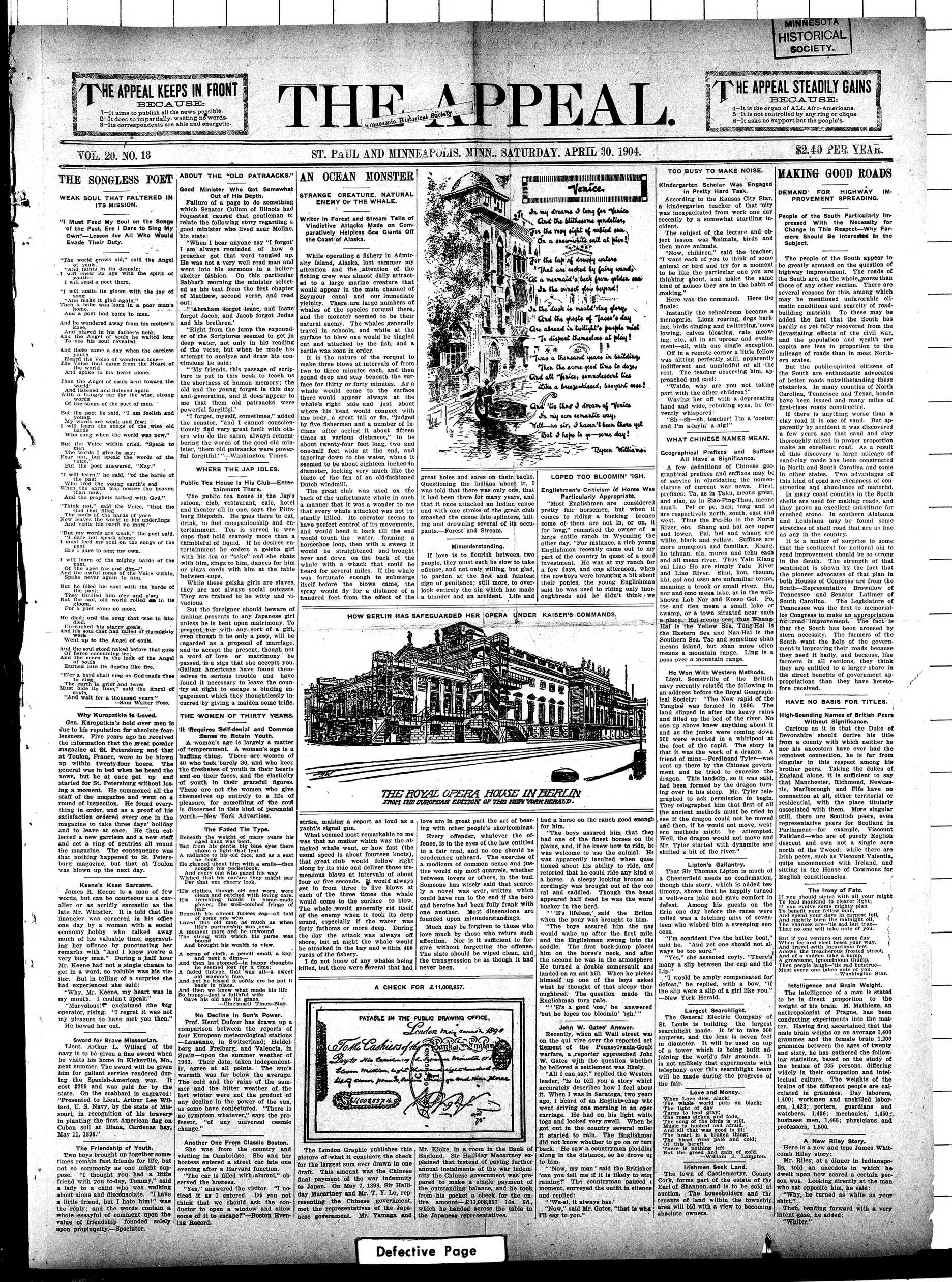
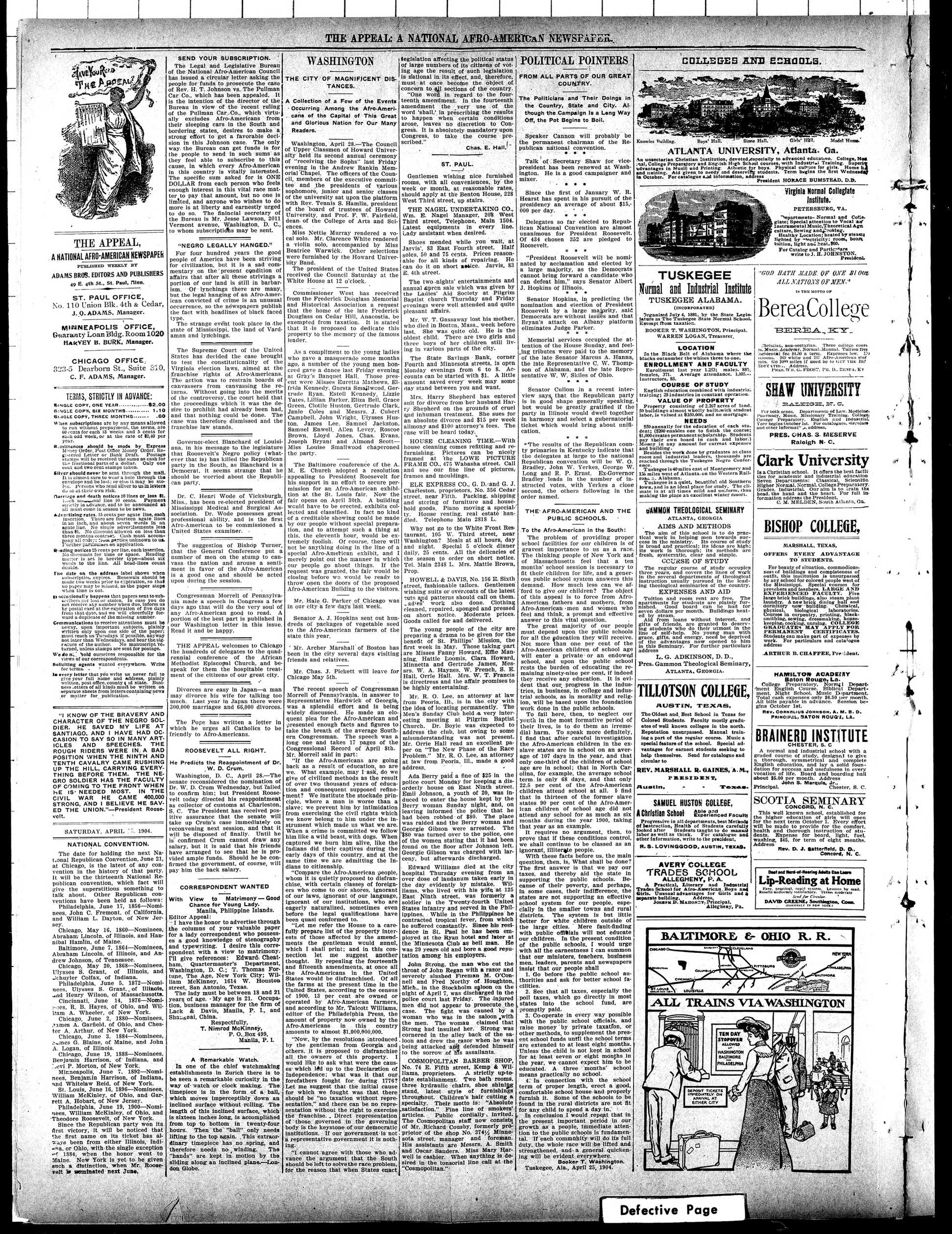
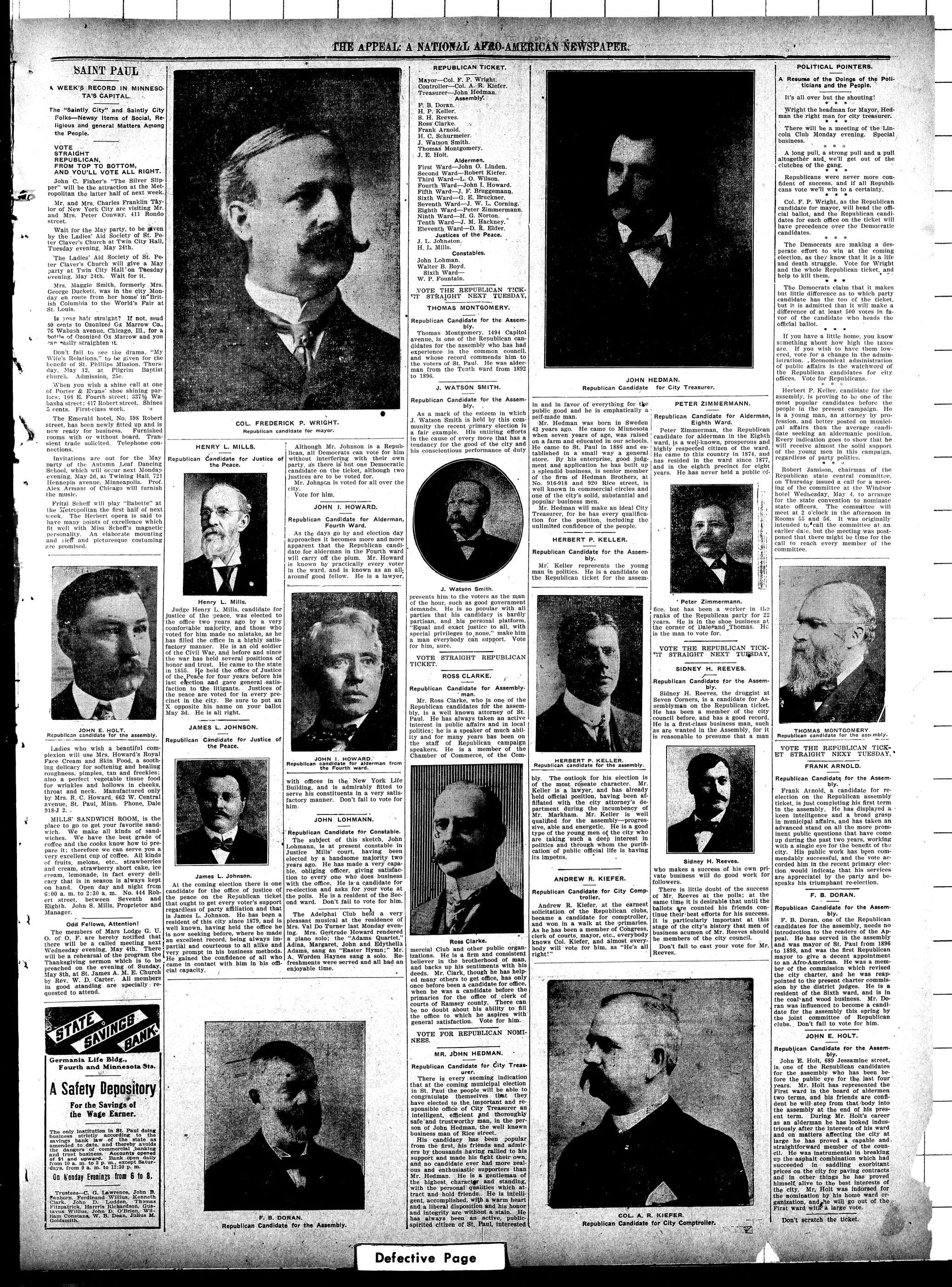
Page text (machine-generated)
THE APPEAL KEEPS IN FRONT
BECAUSE:
1- It aims to publish all the news possible.
2- It does so impartially, wasting no words.
3- Its correspondence is able and energetic.
THE SONGLESS POET
WEAK SOUL THAT FALTERED IN
ITS MISSION
"I must Feed My Soul on the Songs
of the Past, Ere I Dare to Sing My
Own"—Lesson for All Who Would
Evade Their Duty.
"The world grows old," said the Angel
"and fans in its despair;
I will cheer its age with the spirit of
my soul."
I will send a poet there.
"I will smile its gloom with the joy of
song
"And make it gloom again."
There a tabe was born in a poor man's
home.
And a poet had come to men.
And he wandered away from his mother's
home.
And played in his father's field;
And the Angel of souls he waited long
To see his soul revealed.
And there came a day when the carless
Heard the Voice of wondrous tone—
The Voice that came from the Heart of
the earth.
And spoke to his heart alone.
Then the Angel of souls bent toward the
world.
And institute but insistent against
him. He is strong, strong,
wild. Of the songs of the poet of men.
But the poet he said, "I am foolish and
young. My people are weak and few:
I will learn the songs of the wise old birds.
Writing when the world was new."
But the Voice within cried, "Speak to me."
The Voice I give to say.
Fear not, but speak the words of the voice.
But, not answered, "New."
"Think not," said the Voice, "that the God that filled
The souls of the bards of yore
Noble leaves the world to his underlings
And the souls of the poet say,
"But my words are weak," the poet said,
"I dare not speak alone;
I must med my soul on the songs of the past
Ere I dare to sing my own.
I will learn of the mighty bards of the past.
And the awful tones of the Voice within,
Spake never again to him.
But he filled his soul with the bards of the past;
He died; and the song that was in him
unragged his starry goals.
And the soul stood naked before that gaze of fierce consuming fire:
And the crown in the look of the Angel of souls
Burned into its depths like fire.
"Eer a bard shall sing as God made thee to sing
The sword in grief and tears
Must bide its time," said the Angel of souls,
"And wait for a thousand years"
—Sam Walter Foss.
Why Kuropatkin is Loved.
Gen. Kuropatkin's hold over men is due to his reputation for absolute fearlessness. Five years ago he received the information that the great powder magazine at St. Petersburg and that at Toulon, France, were to be blown up within twenty-four hours. The general was in bed when he heard the news, but he at once got up and started for St. Petersburg without losing a moment. He summoned all the staff of the magazine and went on a round of inspection. He found everything in order, and as a proof of his satisfaction ordered every one in the magazine to take three days' holiday and to leave at once. He then collapsed and set off to staff and set a ring of sentries all round the magazine. The consequence was that nothing happened to St. Petersburg magazine, but that at Toulon was blown up the next day.
Keene's Keen Sarcasm.
James R. Keene is a man of few words, but be courteous as a cavalier or as acridly sarcastic as the late Mr. Whistler. It is told that the financier was cornered in his office one day by a woman with a social economy hobby who talked away much of his valuable time, aggravating her offense by punctuating her remarks with "And I know you a very busy man." During a half hour Mr. Keene had not a single chance to get in a word, so voluble was his visitor. But in telling of a surprise she had experienced she said: "Why, Mr. Keene, my heart was in my mouth." "Could speak," she replied. "The big operator, rising. I regret it was not my pleasure to have met you then." He bowed her out.
Sword for Brave Missourian.
Lieut. Arthur L. Willard of the navy is to be given a fine sword when he visits his home in Kirkville, Mo., next summer. The sword will be given to the Spanish-American cost $200 and was paid for by the state. On the scabbed engraved: "Presented to Lieut. Arthur Lee Willard, U. S. Navy, by the state of Missouri, in recognition of his bravery in planting the first American flag on Cuban soil at Diana, Cardenas bay, May 11, 1898."
The Friendship of Youth.
Two boys brought up together sometimes remain fast friends for life, but not so commonly as one might suppose. "I thought you had a little friend with you to-day, Tommy," said a lady to a child who was walking about alone and disconsolete. "I have a little friend, but I hate him!" was the reply; and the words contain a whole essayful of comment upon the value of friendship founded solely upon propinquity.—Spectator.
ABOUT THE "OLD PATRAACKS."
Good Minister Who Got Somewhat Out of His Depth.
Failure of a page to do something which Senator Cullom of Illinois had requested caused that gentleman to relate the following story regarding a good minister who lived near Moline, his state:
"When I hear anyone say 'I forgot I am always reminded of how a preacher got that word tangled up. He was not a very well read man and went into his sermons in a helter-skelter fashion. On this particular Sabbath morning the minister selected as his text from the first chapter of Matthew, second verse, and read out 'Abraham forgot Isaac, and Isaac forgot Jacob, and Jacob forgot Judas and his brethren.'
"Right from the jump the expounder of the Scriptures seemed to get in deep water, not only in his reading of the verse, but when he made his attempt to analyze and draw his conclusions he said:
"My friends, this passage of scripture is put in this book to teach us the shortness of human memory; the old and the young forget in this day and generation, and it does appear to me that them old patraacks were powerful forgifult!"
"I forget, myself, sometimes," added the senator, "and I cannot consciously find very great fault with others who do the same, always remembering the words of the good old minister, 'them old patraacks were powerful forgifult.'"—Washington Times.
WHERE THE JAP IDLES.
Public Tea House Is His Club—Entertainment There.
The public tea house is the Jap's saloon, club, restaurant, cafe, hotel and theater all in one, says the Pittsburg Dispatch. He goes there to eat, drink, to find companionship and entertainment. Tea is served in wee cups that hold scarcely more than a thimbleful of liquid. If he desires entertainment he orders a geisha girl with his tea or "sake" and she chats with him, sings to him, dances for him or plays cards with him at the table While these geisha girls are slaves, they are not always social outcasts. They are trained to be witty and vivacious.
But the foreigner should beware of making presents to any Japanese girl unless he is bent upon matrimony. To present her with any sort of a gift, even though it be only a posy, will be regarded as a proposal of marriage, and to accept the present, though not a word of love or matrimony be passed, is a sign that she accepts you. You will be surprised to see herself in serious trouble and have found it necessary to leave the country at night to escape a binding engagement which they thoughtlessly incurred by giving a maiden some trifle.
THE WOMEN OF THIRTY YEARS.
It Requires Self-denial and Common Sense to Retain Youth. A woman's age is largely a matter of temperament. A woman's age is a baffling thing. There are women of 40 who look barely 30, and who keep the freshness of youth in their hearts and on their faces, and the elasticity of youth in their graceful figures. These are not the women who give themselves up entirely to a life of pleasure, for something of the soul is discerned in this kind of perennial youth—New York Advertiser.
The Faded Tin Type.
Beneath the weight of many years his
But from his gentle big blue eyes there
shone a light that lent a rainbow. A rainbow led to a seat he took. He got up and met with a smile—then sought his pocketbook. He wished that his carfare they might pay. Wished that his carfare they might pay. For that one cheery look.
"His clothes, though old and worn, were creamy and patched in. He himself wore in home-made gloves; the well-combined fringe of boots."
Beneath his almost furious cap—all told
of some one who
was a slave or when
A scrap of cloth, a pencil small, a key, and next a dime—happy and next a dime, happy thoughts he seemed lost for a time; A faded tintype, that was all—a sweet old woman's face, old woman's face, softly he he put it back in place.
And then we knew what made his life
sweeter. We knew what made Gabe's
gave, his old are his.
No Decline in Sun's Power
No Decline in Sun's Power.
Henry Dufur Hofwid has drawn a comparison between the reports of four European meteorological stations — Lausanne, in Switzerland; Heidelberg, and Peshbury, and Valeclay, in Spain—upon the summer weather 1903. Their data, taken independently, agree at all points. The sun's warmth was far below the average. The cold and the rains of the summer and the bitter weather of the last winter were not the product of any decline in the power of the sun, as some have conjectured. "There is no symptom whatever," says the professor, "of any universal cesmic change."
Another One From Classic Boston.
She was from the country and visiting in Cambridge. She and her husband were on one evening after a Harvard function. "The car is filled with alumul," observed the hostess.
"Yes," answered the visitor. "I noticited it as I entered. D) you not think that we should ask the conductor to open a window and allow some of it to escape!"—Boston Even
THE APPEAL.
AN OCEAN MONSTER
STRANGE CREATURE, NATURAL
ENEMY OF THE WHALE.
Writer in Forest and Stream Tells of Vindictive Attacks Made on Comparatively Helpless Sea Giants Off the Coast of Alaska.
While operating a fishery in Admiralty Island, Alaska, last summer my attention and the attention of the fishing was almost daily attracted to a large marine creature that would appear in the main channel of Seymour canal and our immediate vicinity. There are large numbers of whales of the species rorqual there, and the monster seemed to be their natural enemy. The whales generally travel in schools, and while at the surface to blow one would be singled out and attacked by the fish, and a battle was soon in order.
It is the nature of the orroral to make three blows at intervals of from two to three minutes each, and then sound deep and stay beneath the surface for thirty or forty minutes. As a whale would come to the surface with a large airplane always at the whale's right side and just about where his head would connect with the body, a great tail or fm. "judged by five fishermen and a number of Indians after seeing it about fifteen times at various distances," to be about twenty-four feet long, two and one-half feet wide at the end, and tapering to about one inch wide to be about eighteen inches in diameter, looking very much like the blade of the fan of an old-fashioned Dutch windmill.
The great club was used on the back of the unfortunate whale in such a manner that it was a wonder to me that every whale attacked was not instantly killed. Its operator seems to have perfect control of its movements, and would bend it back till the end would touch the water, forming a horseshoe loop, then with a sweep it would be straightened and brought over and down on the back of the whale. The whale would have heard for several miles. If the whale was fortunate enough to submerge itself before the blows came, the spray would fly for a distance of a hundred feet from the effect of the
HOW BERLIN HAS S
THE R
FROM THE
HOW BERLIN HAS SAFEGUARDED HER OPERA UNDER KAISER'S COMMANDS.
THE ROYAL OPERA HOUSE IN BERLIN
FROM THE EUROPEAN EDITION OF THE NEW YORK HERALD.
THE ROYAL OPERA HOUSE IN BERLIN
FROM THE EUROPEAN EDITION OF THE NEW YORK HERald.
strike, making a report as loud as a yacht's signal gun.
What seemed most remarkable to me was that no matter which way the attacked whale went, or how fast the usual speed is about fourteen knots), that great club would follow right along by its side and deliver those tremendous blows at intervals of about four or five seconds. would always get in from three to five blows at each of the three sides of the surface to blow, would the whale generally rid itself of the enemy when it took its deep sound, especially if the water was forty fathoms or more deep. During the day the attack was always off shore, but at night the whale would be attacked in the bay and within 400 yards of the fishery.
I do not know of any whales being killed, but there were several that had
A CHECK FOR £11,008,857.
PAYABLE IN THE
To the Cashiers of the
Day to His Excellency
Eleven mission, eight
half a crown pounds, and
110085716.
PAYABLE IN THE PUBLIC DRAWING OFFICE.
London May surname, 1899
To the Cashiers of the Bank of England
Pay to Nig. Exchearing of the payment of the sums 0.75
drown million, eight thousand, eight hundred and
half ten thousand pounds, six hundred and nine pounds.
110085716
The London Graphic publishes this picture of what it considers the check for the largest sum ever drawn in one draft. This amount was the Chinese final payment of the war indemnity to Japan. On May 7, 1898, Sir Halliday Macartney and Mr. T. Y. Lo, representing the Chinese government, met the representatives of the Japanese government. Mr. Yamaga and
Defective Page
Verice
In my dreams I long for Verice
And the blithesome gondolies
For the may eight of abiding sun
On a sunnywhite sail at pier!
For the lap of droopy waters
That are rocked by fairy sand;
At a mermaid's back from golden sea
In the sunset glow beyond!
In the dusk is mould'ring glory,
And the ghosts of Tasso's day
Are abroad in twilight's purple mist
To disport themselves at play!
Twins a thousand years in building,
Then the arme good time to doze,
And all Verice, somnolesscent lies
like a breeze-missed, buoyant rose!
And 'tis thus I dream of Verice
In my own romantic way,
Well—no sir, I haven't been there yet
But I hope to go—some day!
Byron Williamsi
great holes and sores on their backs.
Questioning the Indians about it, I was told that there was only one that, it had been there for many years, and that it once attacked an Indian canoe and with one stroke of the great club the Indians were attacking and drowning several of its occupants—Forest and Stream.
Misunderstanding.
If love is to flourish between two people, they must each be slow to take offense, and not only willing, but glad, to pardon at the first and faintest sign of penitence; still more to overthrow the person who has caused a blunder and an accident. Life and
SAFEGUARDED HER OPERA UNDER
ROYAL OPERA HOUSE IN
EUROPEAN EDITION OF THE NEW YORK
love are in great part the art of bearing with other people's shortcomings. Every offender, whatever the offense, is in the eyes of the law entitled to a fair trial, and no one should be condemned unheard. The exercise of a modicum of common sense and justice would nip most quarrels, whether between lovers or others, in the bud. Someone has wisely said that scarcely a novel was ever, written which could have run to the end if the hero and heroine had been fully frank with one another. Most dissensions are founded upon misunderstandings. Much may be forgiven to those who love much by those who return such affection. Nor is it sufficient to forgive without forgetting the offense. The slate should be wiped clean, and the transgression be as though it had never been.
REPUBLIC DRAWING OFFICE,
London May Sound in 1890
Bank of England
to the Trustees of the Bank of England
for the purpose of the following:
to issue and issue shares
and notes pursuant
to the terms of the Offer
and to the terms of the Offer
and to the terms of the Offer
Mr. Klake, in a room in the Bank of England. Sir Halliday Macartney explained that instead of paying further annual instalments of the war indemnity the Chinese government was prepared to make a single payment of the amount from his pocket a check for the entire amount—$11,088,587. 16s. d., which he handed across the table to the Japanese representatives.
LOPED TOO BLOOMIN' 'IGH.
Englishman's Criticism of Horse Was Particularly Appropriate.
"Most Englishmen are considered pretty fair horsemen, but when it comes to riding a bucking bronze some of them are not in, or on, for long," remarked the owner of a large cattle ranch in Wyoming the other day. "For instance, a rich young Englishman recently came out to my part of the country in quest of a good investment, and I saw, and one afternoon, when the cowboys were bragging a bit about their ponies, the young Englishman said he was used to riding only too toughbreds and he didn't think /we
KAISER'S COMMANDS.
BERLIN
MARK HORALD.
had a horse on the ranch good enough for him.
"The boys assured him that they had one of the finest horses on the plains, and, if he knew how to ride, he was welcome to use the animal. He was apparently insulted when questioned about his ability to ride, and retorted that he could ride any kind of a horse. A sleepy looking bronco acordingly was brought out of the coral and saddled. Though the beast appeared half dead he was the worst bucker in the herd.
"'E's lifeless', said the Briton when thepon was brought to him.
when the pony was brought to him.
"The boys assured him the nag would wake up after the first mile and the Englishman swung into the house, and he answered him on the horse's neck, and after the second he was in the atmosphere He turned a double somersault and landed on an ant hill. When he picked himself up one of the boys asked what he thought of that sleepy thouhbred. The question made the Englishman turn pale.
"'E's a good 'oss,' he answered 'but he lopes too bloomin' 'igh.'"
John W. Gates' Answer
Recently, all all Wall street was on the qui vive over the reported set tement of the Pennsylvania-Goulk warfare, a reporter approached John W. Gates with the question whether he believed a settlement was likely. "All I can say," replied the Western leader, "is to tell you a story which accurately describes how I feel about it. When I was in Saratoga, two years ago, I went driving one morning in an open carriage. He had on his light white toga and looked very swell. When he got out in the country several miles it started to rain. The Englishman did not know whether to go on or turn back. He saw a countryman plodding along in the distance, so he drove up to him.
"Now, my man" said the Britisher "can you tell me if it is likely to stop raining?" The countryman paused "surely you surveyed the outfit in silence and replied:"
"Wa-al, it always has."
"Now," said Mr. Gates, "that is what I'll say to you."
---
TOO BUSY TO MAKE NOISE.
Kindergarten Scholar Was Engaged in Gretty Hard Task.
According to the Kansas City Star, a kindergarten teacher of that "city was incapacitated from work one day recently by a somewhat startling incident.
The subject of the lecture and object lesson was animals, birds and then more animals.
"Now, children," said the teacher, "I want each of you to think of some animal or bird and try for a moment to be like the particular one you are thinking about, and make the same noises they are in the habit of making."
Here was the command. Here the finale:
Instantly the schoolroom became a menagerie. Lions roaring, dogs barking, birds singing and twittering, cows lowing, calves bleating, cats meowing, etc., all in an uproar and excitation—all, with one single exclamation.
Off in a remote corner a little fellow was perfectly still, apparently indifferent and unminful of all the rest. The teacher observing him, ap probed and said:
"Waldo, why are you not taking part with the other children?"
Waving her off with a depreciating hand and wide, rebuking eyes, he farently whispered to the teacher! I'm a 'ooster and I'm a 'aavin' a aig!"
WHAT CHINESE NAMES MEAN.
Geographical Prefixes and Suffixes
All Have a Significance.
A few definitions of Chinese geographical prefixes and suffixes may be of service in elucidating the nomenclature of current war news. First, prefixes: Ta, as in Taku, means great, and saiao, as in Siao-Ping-Thou, means small. Pei or pe, nan; tung and si are respectively north, south, east and west. Thus the Pei-Ho is the North River, etc. Shang and hal are upper and lower, and yellow. Suffixes are more numerous and familiar. Kiang ho chuan, ula, muren and tchu each and all mean river. Thus Yalu Kiang and Liao Ho are simply Rui River and Liao River. Shui, kou, thuan, khi, gol and ussu are unfamiliar terms, meaning a brook or small river. Hu, nor and ome mean lake, as in the well-known Lob Nor and Kosgo Gol. Po, te and tien mean a small lake or swamp, or a town situated near Waeng-Hai is the Yellow Sea, Tung-Hai is the Eastern Sea, Tao and sometime shan means island, but shan more often means a mountain range. Ling is a pass over a mountain range.
He Won With Western Methods
He Won With Western Methods.
Lieut. Somerville of the British navy recently related the following in an address before the Royal Geographical Society: "The New rapid of the Yangtse" was formed in 1898 of 500 men, who held heavy rains and filled up the bed of the river. No one up above knew anything about it and as the junks were coming down 500 were wrecked in a whirlpool at the foot of the rapid. The story is that it was the work of a dragon. A friend of mine—Ferdinand Tyler—was sent up there by the Chinese government and he tried to exercise the dragon. This landslide, so it was said, had been formed by the dragon turning over in his sleep. Mr Tyler telegraphed to ask permission to begin. They telegraphed to ask permission to the ancient dragons must be tried to see if the dragon could not be moved and, if he would not move, western methods might be attempted. Well, the dragon would not move and Mr. Tyler started with dynamite and shifted a bit of the river."
Lipton's Gallantry.
That Sir Thomas Lipton is much of a Chesterfield needs no confirmation, though this story, which is added testimony, shows that he happily turned a well-worn joke and gave comfort in defeat. Among his guests on the tour, he said, the rude were sailed was a fetching miss of seventeen who wished him a sweeping success.
"I'm confident I've the better boat," said he. "And yet one should not always be too sure."
"Yes," she assented coyly. "There's many a slip between the cup and the Lip."
"I would be amply compensated for defeat," he replied, with a bow, "if the slip were a slip of a girl like you."
—New York Herald.
Largest Searchlight.
The General Electric Company of St. Louis is building the largest searchlight mile. it is to take 300 amperes, and the lens is seven feet in diameter. It will be used on top of a tower which is being built joining the ground. It will likely that experiments with telephony over this searchlight beam will be made during the progress of the fair.
**Love and Money.**
When Love dies, slack! The whole world puts on black; It turns to lead gray. The roses slicken and fade. The song of birds is still. Music is hushed and afraid. And the heart is a broken thing; The blood runs pale and cold; Cries are nothing left But the greed is in gold. — William J. Lampon.
**Irishmen Seek Land.**
The town of Castlemarry, County Cork, former part of the state of Earl of Shannon, is to be sold at auction. The households and the tenants of land within the township area will bid with a view to becoming absolute owners.
MAKING GOOD ROADS
DEMAND' FOR HIGHWAY IMPROVEMENT SPREADING.
People of the South particularly Impressed With the Necessity for Change in This Respect—Why Farmers Should Be Interested in the Subject.
The people of the South appear to be greatly aroused on the question of highway improvement. The roads of the South are, on the whole, worse than those of any other section. There are several reasons for this, among which may be mentioned unfavorable climatic conditions and scarcity of road-building materials. To these may be added the fact that the South has hardly as yet fully recovered from the devastating effects of the civil war, and the population and wealth capita are less in proportion to the mileage of roads than in most Northern states.
But the public-spirited citizens of the South are enthusiastic advocates of better roads notwithstanding these obstacles. In many counties of North Carolina, Tennessee and Texas, bonds have been issued and many miles of first-class roads constructed. If there is anything worse than a clay road it is one of them. But apparently it was discovered a few years ago that sand and clay thoroughly mixed in proper proportion make an excellent road. As a result of this discovery a large mileage of sand-clay roads has been constructed in North and South Carolina and some in other states. Two advantages of this kind of road are cheapness of construction and abundance of material. In many coast counties in the South shells are used for making roads, and they are placed stone in southern Alabama and Louisiana may be found some stretches of shell road that are as fine as any in the country.
It is a matter of surprise to some that the sentiment for national aid to road improvement should be so strong in the South. The strength of that sentiment is shown by the fact that the pioneer advocates of that plan in both Houses of Congress are from the South-Representative Brownlow of Tennessee and Senator Latimer of South Carolina. The Legislature of Tennessee was the first to memorialize Congress to make an appropriation for road improvement. The fact that the South has been a broused by stern needs, the farmers of South need the help of the government in improving their roads because they need it badly, and because, like farmers in all sections, they think they are entitled to a larger share in the direct benefits of government appropriations than they have heretofore received.
HAVE NO BASIS FOR TITLES.
High-Sounding Names of British Peers Without Significance.
Curious as it is that the Duke of Devonshire should derive his title from a county with which neither he nor his ancestors have ever had the remotest connection, he is far from singular in this respect among his brother peers. Taking the dukes of England alone, it is sufficient to say that Manchester, Richmond, Newcastle, Mariborough and Fife have no connection at all, either territorial or residential, with the place titularly associated with them. More singular still, there are Scottish peers, even representative peers for Scotland in Parliament—for example, the account of the uncle of an English descent and own not a single acre north of the Tweed; while there are Irish peers, such as Viscount Valenta, quite unconnected with Ireland, and sitting in the House of Commons for English constituencies.
The Irony of Fate
The Irony of Fate.
If you should strive with all your might to help your fellow man, if you evolve some mighty plan to benefit your fellow man in earnest toil, and nightly burn the midnight oil, that no one will take note of you.
But if you venture out some day, When ice and sleet beat your way, and when the tracerous frosted street, and of a sudden take a bump, and when people laugh—it's sad buttrue—Most every one takes a knee. Washington Star.
Intelligence and Brain Weight.
Intelligence and brain weight.
The intelligence of a man is used to be in dipped, proportion to the weight of his brain. M. Mathihega, an anthropologist of Prague, has been conducting experiments into the matter. Having first ascertained that the male brain weights on an average 1,400 grammes and the female brain 1,200 grammes, between the ages of twenty and sixty, he has gathered the following statistics, based on the study of the brains of 235 persons, differing widely in their occupation and intellectual culture. The weights of the brains of the different people are calculated in grammes. Day laborers, 1,400 workmen and miskilled laborers, 1,430; musicians, 1,450; watchers, 1,466; physicians and professors, 1,600.
A New Riley Story.
Here is a new and true James Whitcomb Riley story:
Mr. Riley, at a dinner in Indianapolis, told an anecdote in which he dwelt upon how scared a certain persecutor was. "The man who sat opposite him, he said, "Why, he turned as white as your sirt."
AVE YOU READ
THE APPEAL
A NATIONAL AND AMERICAN MUSEUM
PUBLISHED WEEKLY BY
ADAMS BROS. EDITORS AND PUBLISHERS
40 E. 4th St., St. Paul, Minn.
ST. PAUL OFFICE,
No. 110 Union Blk. 4th & Cedar,
J. Q. ADAMS, Manager.
MINNEAPOLIS OFFICE,
Guarantee Loan Bldg. Room 1020
HARVEY B. BURK, Manager.
CHICAGO OFFICE,
323-5 Dearborn St., Suite 810,
C. F. ADAMS, Manager.
TERMS, STRICTLY IN ADVANCE:
LINGERIE COPY, ONE YEAR.....$2.00
SINGLE COPY, BIX MONTHS.....1.10
SINGLE COPY, THREE MONTHS.....60
When subscriptions are by any means allowed
to be sent to the address listed, 60 cents for each 13 weeks and 5 cents for each
eight weeks, or at the rate of $4.00 per
contribution should be made by Express
Money Order, Postal Mail or Bank Draft. Postage
stamps will be received the same as cash for
cash only. Each cent and each stamp刻款. Only one
cent and two cents stamp刻款.
Silver should never be sent through the mail.
Envelopes and书信 or face it may be stolen.
Persons who send silver to us in letters
mortgage and death notice 10 lines or less.
Each monetary line 10 cents. Payment
all must come in season to be news.
Advertising rates. 15 cents per agate line, each
invoice. There are fourteen agate lines
on the same line. No single advertisement less
than three months costume. Must account
all orders. No parties unknown to us.
Reading notes 30 cents per line, each insertion.
No discounts for time or space. Reading
notes to the line. No headlines to
countle.
The date on the address label shows when
subscriptions are made. Renewals must be
made two weeks prior to expiration, so that
no paper is missed, as the paper stops
time is cut.
Occasionally happens that papers sent to sub-
mitters do not receive any number when due, inform us
by postal card as the expiration of five days
or forward a duplicate of the missing number.
Communications to receive attention must be
necessary, upon important subjects, plainly
disclosed. If the information must reach us Tuesday if possible, any
nothing later than Wednesdays, and the signage
must be clear. If the information must reach us
unless stamps are sent for postage.
We do **nothing**, hold ourselves responsible for the
views of our correspondents.
Solliciting agents wanted everywhere. Write
In every letter that you write us never fail to give your full name and address, plainly your name, and clearly your own name, owner's letters of all kinds must be written on separate sheets from letters containing news or matter for publication.
"I KNOW OF THE BRAVERY AND CHARACTER OF THE NEGRO SOLDIER. HE SAVED MY LIFE AT SANTIAGO, AND I HAVE HAD OCCASION TO SAY SO IN MANY ARTICLES AND SPHEMES WHERE IN A BAD POSITION WHEN THE NINTH AND TENTH CAVALRY CAME RUSHING UP THE HILL, CARRYING EVERYTHING BEFORE THEM. THE NEGRO SOLDIER HAS THE FACULTY OF COMING TO THE FRONT WHEN HE IS NEEDED THE IN THE VIVAL WAYS, AND I CAME 400,000 STRONG, AND I BELIEVE HE SAVED THE UNION."—President Roosevelt.
SATURDAY. APRIL 1904.
NATIONAL CONVENTION
The date for holding the next National Republican Convention, June 21, at Chicago, is the latest of any convention in the history of the third National Republican convention, which fact will give the superstitions something to talk about. Other Republican conventions have been held as follows: Anne Arundel, of Illinois; Neesee, John C. Fremont, of California, and William L. Dayton, of New Jersey.
Chicago, May 6, 1860—Nominees, Abraham Lincoln, of Illinois, and Hannibal Hamlin of Maine.
Baltimore, June 7, 1864—Nominees, Abraham Lincoln, of Illinois, and Andrew Johnson, of Tennessee.
Chicago, May 20, 1868—Nominees, Ulysses S. Grant, of Illinois, and Andrew Johnson, of Indiana.
Cincinnati, June 14, 1876—Nominees, R. B. Hayes, of Ohio, and William A. Wheeler, of New York.
Chicago, June 2, 1880—Nominees, R. B. Hayes, of Chicago, and Chester A. Arthur, of New York.
Chicago, June 3, 1884—Nominees, James G. Blaine, of Maine, and John A. Logan, of Illinois.
Chicago, June 19, 1888—Nominees, Benjamin Harrison, of Indiana, and Eli P. Morton, of New York.
Chicago, June 19, 1888—Nominees, Benjamin Harrison, of Indiana, and Whitehall Reid, of New York.
St. Louis, June 16, 1896—Nominees, William McKinley, of Ohio, and Garrett A. Hobart, of New Jersey.
Philadelphia, June 16, 1896—Nominees, William McKinley, of Ohio, and Theodore Roosevelt, of New York.
Since the Republican party won its first victory, it will be noticed that the first name on its ticket has always been from either Illinois, Indiana, or Ohio with the single exception of Maine. New York is yet to be given such a distinction, when Mr. Roosevelt is nominated next June.
SEND YOUR SUBSCRIPTION.
The Legal and Legislative Bureau of the National Afro-American Council has issued a circular letter asking the people for funds to prosecute the case of Rev. H. T. Johnson vs. The Pullman Company, which is the intention of the director of the Bureau in view of the recent ruling of the Pullman Car Co., which virtually excludes Afro-Americans from their sleeping cars in the South and bordering states in the North. For a fair decision in this Johnson case. The only way the Bureau can get funds is for the people to send in such sums as they feel able to subscribe to this cause, in which every Afro-American person is eligible to receive. The specific sum asked for is ONE DOLLAR from each person who feels enough interest in this vital race matter to pay that amount, but no one is limited, and anyone who wishes to do more is at liberty and earnestly urged to pay the fee. The Bureau is Mr. Jesse Lawson, 2011 Vermont avenue, Washington, D. C. to whom subscriptions may be sent.
"NEGRO LEGALLY HANGED."
For four hundred years the good people of America have been striving for civilization, but it is a sad commentary on the 'present condition of affairs that after all these strivings a portion of our land is still in barbarism, but the legal hanging of an Afro-American convicted of crime is an unusual occurrence, so the newspapers publish the fact with headlines of black faced type.
The strange event took place in the State of Mississippi, the land of Vardaman and lyrchings.
The Supreme Court of the United States has decided the case brought to test the constitutionality of the Virginia election laws, aimed at the franchise of Afro-Americans, and canvassers from canvassing the returns. Without going into the merits of the controversy, the court held that the proceedings which it was the desire to prohibit had already been had, and that nothing could be done. The canvassers dismissed and the franchise law stands.
---
Governor-elect Blanchard of Louisiana, in his message to the legislature that Roosevelt's Negro policy (whatever that is) has killed the Republican in the South, as Blanchard is a Democrat, it seems strange that he should be worried about the Republican party.
Dr. C. Henri Wode of Vicksburg, Miss., has been re-elected president of Mississippi Medical and Surgical Association, a professional ability, and is the first Afro-American to be commissioned a United States examiner.
The suggestion of Bishop Turner, that the General Conference put a number of men on the stump to canvass the nation and arouse a sentiment in a good one and should be acted upon during the session.
Congressman Morrell of Pennsylvania made a speech in Congress a few days ago that will do the very soul of any Afro-American good to read. A portion of the best part is published in our Washington letter in this issue. Read it and be happy.
THE APPEAL welcomes to Chicago the hundreds of delegates to the quadrennial conference of the African Methodist Episcopal Church, and be speak for them the hospitable treatment of the citizens of our great city.
Divorces are easy in Japan—a man may divorce his wife for talking too much. Last year in Japan there were 300,000 marriages and 66,000 divorces.
The Pope has written a letter in which he urges all Catholics to be friendly to Afro-Americans.
ROOSEVELT ALL RIGHT.
He Predicts the Reappointment of Dr. W. D. Crum.
Washington, D. C., April 28—The senate reconsidered the nomination of Dr. W. D. Crum Wednesday, but failed to approve the vote. he told today his reappointment as collector of customs at Charleston, S. C. The President has received positive assurance that the senate will take up Crum case immediately. he said that it will be disposed of finally. Until he is confirmed Crum cannot draw any salary, but it is said that his friends have arranged to see that he is provided ample funds, he be convinced of the government, of course, will pay him the back salary.
CORRESPONDENT WANTED
Manila, Philippine islands.
Editor Appeal:
I have the honor to advertise through
the columns of your valuable paper for
a lady correspondent who possesses
a good knowledge of stenography
and typewriting. I desire this correspondent with a view to matrimony.
Till give references: Edward Cheat
Hannah, the honorary department
Washington, D. C.; T. Thomas Fortune,
Washington, D. C.; T. Thomas Fortune,
The Age, New York City; William
McKinney, 1614 W. Houston
street, San Antonio, Texas.
The lady must be between 18 and 21
years of age. Nineteen. Occupation,
business manager for the firm of
Lack & Davis, Manila, P. I, and
Shanghai, China.
Respectfully,
T. Nimrod McKinney,
P. O. Box 499,
Manila, P. I.
A Remarkable Watch.
In one of the chief watchmaking establishments in Zurich there is to be seen a remarkable curiosity in the way of watch or clock making. The timepiece is in the form of a ball, which moves imperceptibly down an inclined surface without rolling. The length of this inclined surface, which is sixteen inches long, is accomplished from top to bottom in twenty-four hours. Then the "ball" only needs to be "gapped" by a simple diurnal timepiece has no spring, and therefore needs no winding. The "hands" are kept in motion by the sliding along an inclined plane—London Globe.
```markdown
```
THE APPEAL: A NATIONAL AFRO-AMERICAN NEWSPAPER.
WASHINGTON
THE CITY OF MAGNIFICENT DISTANCES.
A Collection of a Few of the Events Occurring Among the Afro-Americans of the Capital of This Great and Glorious Nation for Our Many Readers.
Washington, April 28.—The Council of Upper Chassman of Howard University is second annual ceremony of "receiving Senior Annual Evening in the Andrew Rankin Memorial Chapel. The officers of the Council, members of the executive committee and the presidents of various sophomore, junior and senior classes of the university sat upon the platform of the university hall, in the presence of the board of trustees of Howard University, and Prof. F. W. Fairfield, dean of the College of Arts and Sciences.
Miss Nettle Murray rendered a vocal solo, Mr. Clarence White rendered a accompanied by Miss Beatrice Warwick. Other selections were furnished by the Howard University Band.
The president of the United States received the Council Saturday at the White House at 12 o'clock.
Commissioner West has received from the Frederick Douglass Memorial and Historical Association a request that the home of the late Frederick Douglass on Cedar Hill, Anacostia, be exempted from taxation. It is stated that it is proposed to dedicate this property to the memory of the famous leader.
As a compliment to the young ladies who gave a masquerade some months ago, a number of the young men honored gave a dance last Friday evening at Gray's Banquet Hall. Those present were Misses Euretta Mathews, Elena Gervis, Eustein Smallwood, Gertrude Yates, Ellen Kennedy, Eliza Yates, Lillian Parker, Eilzl Bell, Grace Green, Clotilde Huston, Gertrude Clark, Janie Cole and Messrs. J. Cubert Campbell, John Wright, Ulysses Huston, James Lee, Samuel Jackson, Samuel Enwell, Allen Levy, Roscoe Brown, John Jones, Chas Evans, Brunt Brunt and Alison Miss. Miss Louise Smallwood chaperoned the party.
The Baltimore conference of the A. M. E. Church adopted a resolution appealing to President Roosevelt for his support in an effort to secure permission for an Afro-American exhibition at the fair, and for a fair opening on April 30th. A building would have to be erected, exhibits collected and classified. In fact no kind of a creditable showing could be made by our people without special preparation, and to attempt such a thing at the fair would be extremely foolish. Or course, there will not be anything doing in the line of a special Afro-American exhibit, and I merely point out the manner in which our people go about things. If the request was granted, the fair would be closing before we would be ready to throw open the proposed Afro-American Building to the visitors.
Mr. Hale G. Parker of Chicago was in our city a few days last week.
Senator A. J. Hopkins sent out hundreds of packages of vegetable seed to the Afro-American farmers of the state this year.
Mr. Archer Marshall of Boston has been in the city several days visiting friends and relatives.
Mr. Chas. J. Pickett will leave for Chicago May 5th.
The recent speech of Congressman Morrell of Pennsylvania. in answer to Representative Hardwick of Georgia, and in being widely discussed. He made an eloquent plea for the Afro-American and presented enough facts and figures to take the breath of the average Southern Congressman. The speech was a long one and takes 17 pages of text, and April 8th. Mr. Morrell said in part:
"If the Afro-Americans are going back as a result of education, so are we. What example, may I ask, do we give of civilized methods as the result of education and consequent supposed refinement? We institute the stockade principle, where a man is worse than a slave; we prevent him by intimidation from exercising the civil rights which we know belong to him under the indictment. When a crime is committed we follow him like a wild beast, with dogs. When captured we burn him alive, like the Indians did their captures during the early days of this country, and at the same time we are admitting the Indians to court. In the Afro-American people, whom it is quietly proposed to disfranchise, with certain classes of foreigners who come to our shores, ignorant of our laws, ignorant of our language, ignorant of our institutions, who are eagerly naturalized, sometimes even more so, the institutions have been quasi conformed to.
"Let me refer the House to a carefully prepare list of the property interests of those affected by the amendments the gentleman would annul, and to the section let me suggest another thought. By repealing the fourteenth and fifteenth amendments, at once all the Afro-Americans in the United States would be disfranchised. Of all the amendments, the United States, according to the census of 1800, 13 per cent are owned or operated by Afro-American farmers, and according to Mr. Talcott Williams, editor of the Philadelphia Press, the United States in this country amounts to almost $1,000,000,000.
"Now, by the resolutions introduced by the gentleman from Georgia and others, it is proposed to disfranchise all the owners of this property. I believe that the owners which led up to the Declaration of Independence; what was it that our forefathers fought for during 1776? Let me suggest that the initial cause for which we fought was that there should be "no taxation without representation" and there can be no representation for the franchise. Direct representation of those, governed in the governing body is the keystone of our democratic institutions. If our government is not a representative government it is nothing. I cannot agree with those who advance the argument that the South should be left to solve the race problem, for the reason that States enact
legislation affecting the political status of large numbers of its citizens of voting age the result of such legislation is national in its effect, and, therefore, must at once become the object of concern to all sections of the country. "One word in regard to the fourteenth amendment. In the fourteenth amendment the very use of the shall in prescribes the result to have written certain conditions arose, leaves no discretion to Congress. It is absolutely mandatory upon Congress, to take the course prescribed."
ST. PAUL.
Gentlemen wishing nice furnished rooms, with all conveniences, by the week or month, at reasonable rates, should apply at the Benton House, 228 West Third Street, up stairs.
THE NAGEL UNDERTAKING CO., Wm. E. Nagel Manager, 208 West Third街, Telephone, Main 1504. Latest equipments in every line. Lady assistant when desired.
Shoes mended while you wait, at Jairus Fourth street, Half get on 50 and 75 cents. Prices reasonable for all kinds of repairing. He can do it on short notice. Jarvis, 83 E. 4th street.
The two nights' entertainments and annual open sale which was given by the Ladies' Aid Society at Pilgrim Baptist church Thursday and Friday evenings were well attended and quite pleasant affairs.
Mr. W. T. Gassaway lost his mother, who died in Boston, Mass, week before last. She was quite ill. He the two girls are two girls and three boys of her children still living in various parts of the city.
The State Savings Bank, corner Fourth and Minnesota streets, is open Monday evenings from 6 to 18. Accounts can be started with $1. A little amount saved every week, some day stand between and want.
Mrs. Jill Shepherd has entered suitor from her husband Harry Shepherd on the grounds of cruel and inhuman treatment. She sues for an absolute divorce and $15 per week alimony and $100 attorney's fees. The case will be heard today.
HOUSE CLEANING TIME—With house cleaning comes refitting and re-furnishing. Picture LOWE PICTURE FRAME CO. 475 Washabra street. Call and see our fine line of pictures, frames and mouldings.
ELK EXPRESS CO. G. D. and G. J. Charleston, proprietors, No. 356 Cedar street, near Fifth. Packing, shipping and storing of furniture and household goods. Piano moving a special event is handled. Telephone Main 2818 L.
Why not go to the White Front Restaurant, 105 W. Third street, near Washington? Meals at all hours, day and night. Special 5 o'clock dinner daily, 25 cents. All the delicacies of the season to order on short notice. Troop 2348 L. Mrs. Mattie Brown. Troop HOWELL & DAVIS L. 106 S. Fifth street, fashionable tailors. Gentlemen wishing suits or overcoats of the latest cuts and patterns should call on them.ades' work also done. Clothing cleaned, repaired, sponged and pressed on short notice. Moderate prices. Goods called for and delivered.
The young people of the city are preparing a drama for the first week in May. Phillips' Mission, the first week in May. Those taking part are Misses Fanny Howard, Effe Manne, Hattie Loomis, Clara Howard, Minnetta and Gertrude James, Messrs. W. A. Haynes, W. Brown, Mrs. O. M. Morris, Mr. W. T. Francis is directress and the affair promises to be highly entertaining.
Mr. R. O. Lee, an attorney at law from Peoria, Ill., is in the city with the idea of locating permanently. The Men's Sunday Club held a very interesting Church, Dr. Boyle was expected to address the club, but owing to some misunderstanding was not present. Mr. Orrie Hall read an excellent paper on "The New Phase of the Race Problem." Mr. R. O. Lee, an attorney from Peoria, Ill., made a good address.
Ada Berry paid a fine of $25 in the police court Monday for keeping a disorderly house on East Ninth street. Emil Johnson, a youth of 20, was induced to enter the house kept by the Berry woman Sunday night, and on Monday she had been robbed of $80. The place was raided and the Berry woman and Georgie Gibson were arrested. The $80 was turned over to the police, one of the women stating that it had been robbed. Georgie Gibson was charged with larceny, but afterwards discharged.
Edward Williams died at the city hospital Thursday evening from an over dose of laudanum taken early in the day evidently by mistake. At 125 East Ninth street, was formerly a soldier in the Twenty-fourth United States infantry and served in the Philippines. While in the Philippines he contracted tropical fever, from which he suffered constantly. Since his resuscitation he was employed at the Ryman hotel and later at the Minnesota Club as bell man. He was 29 years old and bore a good reputation among his employers.
John Strong, the man who cut the throat of John Regan with a razor and severely slashed Fireman M. O'Connell and Fred North of Houghton, Mich., in the Stockholm sloop on the police court last Friday. The injured men did not appear to prosecute the case. The fight was caused by a woman who was in the saloon with the men. The woman claimed that Strong had insulted her. Strong was cornered in the alley and asked for a razor when he was being attacked and defended himself to the sorrow of his assailants.
COSMOPOLITAN BARBER SHOP
No. 74 E. Fifth street, Kemp & Williams, proprietors. A strictly up-to-date establishment. Two bath rooms, three hydraulic chairs, show windows, and a curtain throughout. Children's hair cutting a specialty. Their motto is: "Absolute satisfaction." Fine line of smokers' articles. Public cordially invited. Children's adult clothing of Mr. Richard Cousby, former proprietor of the shop No. 374½ Minnesota street, manager and foreman. His assistants are Messrs. A. Smith and Oscar Sanders. Miss. A. Smith, nothing is desired in the torsional line call at the "Cosmopolitan."
POLITICAL POINTERS
FROM ALL PARTS OF OUR GREAT COUNTRY.
The Politicians and Their Doings in the Country, State and City. Although the Campaign is a Long Way Off, the Pot Begins to Boll.
Speaker Cannon will probably be the permanent chairman of the Republican national convention.
Talk of Secretary Shaw for vice-president has been renewed at Washington. He is a good campaigner and mixer.
Since the first of January W. R. Hearst has spent in his pursuit of the presidency an average of about $15,000 per day.
Delegates so far elected to Republican National Convention are almost unanimous for President Roosevelt. Of 434 Rosen 332 are pledged to Roosevelt.
"President Roosevelt will be nominated by acclamation and elected by a large majority, as the Democrats cannot bring forward a candidate who can defeat him," says Senator Albert J. Hopkins of Illinois.
Senator Hopkins, in predicting the nomination and election of President Roosevelt by a large majority, said Democrats are without issues and that Bryan's attack on Albany platform eliminates Judge Panter.
Memorial services occupied the attention of the House Sunday, and feeling tributes were paid to the memory of the late Senator Marc A. Hanna, the former Chairman of the Compromise of Alabama, and the late Representative W. W. Skiles of Ohio.
Senator Cullom in a recent interview says that the Republican party is in good shape generally speaking, but would be greatly gratified if the party in Illinois would dwell together harmoniously and select a gubernatorial ticket which would bring about unification.
*The results of the Republican county primaries in Kentucky indicate that the delegates at large to the national primary are John W. Yerkes, Bradley, John W. Yerkes, George W. Long and R. P. Ernst. Ex-Governor Bradley leads in the number of instructed votes, with Yerkes a close second, with others following in the order named.
THE-AFRO-AMERICAN AND THE
PUBLIC SCHOOLS.
To the Afro-American in the South
The problem of providing proper school facilities for our children is of gravest importance to us as a race. We need to be able to provide of Massachusetts feel that a ten months' school session is necessary to fit their life for life, and a generous public school system answers this need. We need to give our children to give our children? The object of this appeal is to force from Afro-American fathers and mothers, from Afro-American men and women who are not of African descent, an effective answer to this vital question.
The great majority of our people must depend upon the public schools for all the education they will receive. The African-American children of school age will enter a private or an endowed school, and upon the public school rests the burden of educating the rest of the population they receive any education. It is evident that our progress in the industries, in business, in college and industrial schools, as in morality and religion, has been made a real work done in the public schools.
To fail here, then, to neglect our youth in the most formative period of their lives, is to do them an irremediable harm. To speak more definitely, the Afro-American children in the exslave states are in school on an average of 107 days in the year, and that only one-third of the children of school age are in school; that in North Carolina they are in school; that in the term is only 68 days, and that only 22.5 per cent of the Afro-American children attend school at all. I find that in thirteen of the former slave states 90 per cent of the Afro-American children attend any school for as much as six months during the year 1900, taking that year as an example.
It requires no argument, then, to prove that if these conditions control, even if they are neglected as an ignorant illiterate people.
With these facts before us, the main question, then, is, What shall be done? The first answer is that we pay our taxes, and thereby aid the state in supporting the public schools. Because of their poverty, and poverty, their indifference, the states are not supporting an effective school system for our people, especially in the smaller towns and rural districts. The system is but little better for white children outside of the large cities. Mere fault-finding with public officials will not educate our children. In the present condition of our schools, we must with all the earnestness I can summon that our ministers, teachers, business men, leaders, parents and newspapers insist that our people shall 1. Go before the public school authorities and ask for better school facilities. 2. Be that all taxes, especially the poll taxes, which go directly in most states into the school fund, are promptly paid.
3. Co-operate in every way possible with the public school officials, and raise money by private taxation, or other methods, to supplement the present school fund. You can also to at least eight months. Unless the child is not kept in school for at least seven or eight months in the year, we cannot expect him to be educated. A three months' school means practically no school. 4. In connection with the school text of the school length, erect a good, comfortable school length, and properly furnish it. Some of the schools to be found in the rural districts are not fit for any child to spend a day in. In conclusion I would repeat that in our growth as a people, immediate attention to the public schools is fundamental. If each community will do its full duty, the whole race will be lifted and strengthened, and a general quickening will be evident everywhere.
Booker T. Washington.
Tuskegee, Ala., April 25, 1904.
Knowles Building. Boys' Hall. Stone Hall. Girls' Hall. Model Home.
ATLANTA UNIVERSITY, Atlanta. Ga.
An unrestricted Christian institution, devoted especially to advanced education. College, New
Valley, College Preparatory and English High School courses, with Industrial Training. Superior
advantages in Music and Printing. Athletic for boys. Physical culture for girls. Home life
in the institution. Aid given to enrol and decorate students. Term begins the first Wednesday
in October. For catalogue add information, address
BALTIMORE & OHIO R. R.
ALL TRAINS VIA WASHINGTON
TEN DAY STOPOVER
ALLOWED
AT
WASHINGTON
BALTIMORE
AT
PHILADELPHIA
DEPOSIT TICKETS
IMPREDIATED ON
ARRIVAL AT
EITHER CITY
THE HOTEL
TUSKEGEE Normal and Industrial Institute
Organized July 4, 1881, by the State Legis-
lature of New York, the Normal School
Exempt from taxation.
LOCATION
In the Black Belt of Alabama where the
blacks outnumber the whites three to one.
ENROLLMENT AND FACULTY
Enrollment last year 1,235; males, 86;
females, 1,166; Average attendance, 1,063;
instructor, 88.
COURSE OF STUDY
English education combined with industrial
training; 1,000 hours of operation.
VALUE OF PROPERTY
Property consisting of 2,267 acres of land,
50 buildings almost wholly built with student
labor, is valued at $350,000, and no mortgage.
**NEEDS**
$50 annually for each of the student;
$200 enables one to finish the course;
$3,000 creates permanent scholarship. Students
pay the cost of the course;
they own the land in any amount for current expenses
and building.
Besides work done by graduate as class
students, industrial leaders, thousands are
reached through the Tuskegee Negro Conference.
Tuskegee is 40 miles east of Montgomery and 16 miles west of Atlanta. on the Western Railway.
Takereke is a quiet, beautiful old Southern town in the heart of the countryside. Matsie is at all times mild and uniform, thus she is a perfect place to spend a quiet evening.
GAMMON THEOLOGICAL SEMINARY
ATLANTA, GEORGIA
The aim of this school is to do practical work in helping men towards success in broad and practical; its ideas are high; its work is thorough; its methods are fresh, the materials are good.
**COURSE OF STUDY**
The regular course of study occupies three years, and covers the lines of work in the school. Instruction usually pursued in the leading theological seminaries of the country.
**EXPENSES AND AID**
Tufted and room rent are free. The tuition is paid. Good board can be had for instruction per month. Buildings heated by steam. Aid from loans without interest, and grants for students who do their utmost in the line of self-help. No young man would be without the advantages now opened to him in the country. For further particulars see Admission.
TILLOTSON COLLEGE.
TILLOTSON COLLEGE.
The Oldest and Best School in Texas for Colored Students. Faculty mostly graduates of well known colleges in the north. Reputation unsurpassed. Manual training a part of the regular course. Music a special feature of the school. Special admissions for certain students needing help themselves. Send for catalogue and circular to REV. MARSHALL R. GAINES, A.M. PRESIDENT, Austin, Texas.
SAMUEL HUSTON COLLEGE
A CHRISTIAN SCHOOL Experienced Faculty
Progressive in all departments, best Methods
of Instruction, Health of Students carefully
labor as well as think. For catalogue and
other information, write to the president,
R. S. LOVINGGOOD, AUSTIN, TEXAS.
A Practical Literary and Industrial
Girls. Unusual advantages for Girls and
a separate building. Address.
JOSEPH D. MAHONY, MISCIPAL.
Allegiance, Pa.
BALTIMORE & OAK
CHICAGO
CLEVELAND
PITTSBURG
ST. LOUIS
LOUISVILLE
ALL TRAINS VIA W
TEN DAY STOPOVER
ALLOWED
IN WASHINGTON
DALTIMORE
PHILADELPHIA
DEPOSIT TICKETS
IMPREDIATELY ON
ANNOVAL AT
EITHER CITY
Defective Page
*Departmental: Normal and Coffee
*Faculty: Music, Engineering, Instrumental Music, Theoretical Agr
*Faculty: Music, Theoretical Agr
*Healthy Location: heated by steamer
*Location: boat, boat tuition, light and heat. $600.
For Catalog and Partic
write to J. H. JOHNSON
President.
"GOD HATH MADE OF ONE B1 00E
ALL NATIONS OF WEN."
BereaCollege
BEREA, KY.
Christian, nce-satellar. Three college courses
Music Academy, Normal, Manual. Tuition free
from $1,000. Tuition fees $250. Accouns. 292 white and 252 Afro-American stud-
nits, to 100 white if needed to GET TBF. Bif
sports, to 100 white if needed to GET TBF.
PRES. WM. G. FROST, PG. D. BEREA, KY
SHAW UNIVERSITY
For both sexes. Departments of Law, Moderate
Pharmacy, Music, Mission Training, College
Education, and Nursing. Indicate the year
You begin October 1st. For catalogues, steril
and other information, $ address.
PRES. CHAS. S. MESERVE
Raleigh N. C.
Clark University
Is a Christian school. It offers the best faculty in the country. Seven Departments: Classical, Scientific, Mathematics, Engineering, Grades, Industrial, Our aim is to train the students in the highest form. For full information address the President.
C. M. MELDEN, South Atlanta, Ga.
BISHOP COLLEGE.
OFFERS EVERY ADVANTAGE TO STUDENTS.
For beauty of situation, commodiousness of buildings and completion of work by any school for colored people west of the Mississippi. Special courses for experienced students. Experienced FACULTY. Five large brick buildings, also steam plant building, now building. Chemical, dormitory now building. Course in computer printing, blacksmithing, sewing, dressmaking, housekeeping. Course in graduate training. GRADUATES MAN APPLY FOR PERMANENT CERTIFICATES.
Students can make part of expenses by For particulars and catalog address.
ARTHUR B. CHAFFEE. Pre-ident.
HAMILTON ACADEMY
BRIAN BURKE
College Preparatory, Normal Department
ment English Course. Bible Department.
English Course. Music Department.
Total cash expenses only $6.50 per month.
All bills payable in advance. Session begins October
Recognize COURS JOHNSON, A.M. B.M. D.
PRACTICUM, SCHOOL ROUGE, LA;
BRAINERD INSTITUTE
A normal and industrial school with a
grade course of study, designed to give
the student symmetrical English education, and lay a solid foundation for success and usefulness in every
way. Boarding hall about $5.90 per month. Address
J. Mark S.曹, Jr.
Principal, Chester, S. C.
SCOTIA SEMINARY
CONCORD, N. C.
This well known school, established for
the higher education of girls will open
a new chapter of life. Boarding hall
will be made to provide for the comfort,
health and thorough instruction of
students. Expense for board, light, fuel,
address, $4, for term of eight months.
Address
Rev. D. K. J. Batterlee, D. D.
Concord, N. C.
Dust and Nest of Hearing Adults Can Learn
Lip-Reading at Home
Rav. practical, rapid system. Lessons by mail.
Recognition of achievement in moderate
Soul for Circular
DAVID GREENE, Southington, Comm.
OHIO R. R.
NEW YORK
PITTSBURG
PHILADELPHIA
WASHINGTON
BALTIMORE
LA WASHINGTON
SAINT PAUL
A WEEK'S RECORD IN MINNESOTA'S CAPITAL.
The "Saintly City" and Saintly City Folks—Newss items of Social, Religious and general Matters Among the People.
AND YOU'LL VOTE ALL RIGHT.
John C. Fisher's "The Silver Slipper" will be the attraction at the Metropolitan the latter half of next week.
Mr. and Mrs. Charles Franklin Taylor of New York City are visiting Mr. and Mrs. Peter Conway, 411 Rondo street.
Wait for the May party, to be given by the Ladies' Aid Society of St. Peter Claver's Church at Twin City Hall, Tuesday evening, May 24th.
The Ladies' Aid Society of St. Peter Claver's Church will give a May party at Twin City Hall on Tuesday evening, May 24th. Wait for it.
Mrs. Maggie Smith, formerly Mrs. George Duckett, was in the city Monday en route from her home in British Columbia to the World's Fair at St. Louis.
Is your hair straight? If not, send 50 cents to Ozonized Ox Marrow Co., 76 Wabash avenue, Chicago, Ill., for a bottle of Ozonized Ox Marrow and you can easily straighten it.
Don't fail to see the drama, "My Wife's Relations," to be given for the benefit of St. Phillips Mission, Thursday, May 12, at Pilgrim Baptist church. Admission, 25c.
When you wish a shine call at one of Porter & Evans' shoe shining parors; 108 E. Fourth street; 3371² Wabasha street; 417 Robert street. Shines 5 cents. First-class work.
The Emerald hotel, No. 598 Robert street, has been newly fitted up and is now ready for business. Furnished rooms with or without board. Transient trade solicited. Telephone connections.
Invitations are out for the May party of the Autumn Leaf Dancing School, which will occur next Monday evening, May 2d, at Twining Hall, 721 Hennepin avenue, Minneapolis. Prof. Alex Armant of Chicago will furnish the music.
Fritzi Scheff will play "Babette" at the Metropolitan the first half of next week. The Herbert opera is said to have many points of excellence which fit well with Miss Scheff's magnetic personality. An elaborate mounting and iieff and picturesque costuming are promised.
JOHN E. HOLT.
Republican candidate for the assembly.
Ladies who wish a beautiful complexion will use Mrs. Howard's Royal Face Cream and Skin Food, a soothing delicacy for softening and healing roughness, pimples, tan and freckles; also a perfect vegetable tissue food for wrinkles and hollows in cheeks, throat and neck. Manufactured only by Mrs. R. C. Howard, 662 W. Central avenue, St. Paul, Minn. Phone, Dale 918-J 2.
MILLS' SANDWICH ROOM, is the place to go to get your favorite sandwich. We make all kinds of sandwiches. We have the best grade of coffee and the cooks know how to prepare it; therefore we can serve you a very excellent cup of coffee. All kinds of fruits, melons, etc., strawberries and cream, strawberries, short cake, ice cream, marmalade in fact every delivery that is in season is always kept on hand. Open day and night from 6:00 a. m. to 2:30 a. m. No. 444 Robert street, between Seventh and Eighth. John S. Mills, Proprietor and Manager.
Odd Fellows. Attention!
The members of Mars Lodge G. U. O. of O. F. are hereby notified that there will be a called meeting next Wednesday evening, May 4th. There will be a rehearsal of the program the Thanksgiving sermon which is to be preached on the evening of Sunday, May 8th, at St. James A. M. E. Church by Rev. W. D. Carter. All members in good standing are specially requested to attend.
STATE SAVINGS BANK.
Germania Life Bldg.,
Fourth and Minnesota Sts.
A Safety Depository
For the Savings of
the Wage Earner.
The only institution in St. Paul doing
business strictly according to the
savings bank law of the state as
amended by law, holds
the diaries of commercial banking
and trust business. Accounts opened
of $1 and upward. Bank open, daily
from 10 a.m. to 9 p.m., except Satur-
days, from 9 a. m. to 12.30 p. m.
Trustees—C. G. Lawrence, John B. Sanborn, Ferdinand Willius, Kenneth Clark. John D. Ludden, Thomas Pflugerstake, Harris Robertson, Gus Tavus Willius, John D. Q'Brien, William Constans, W. B. Dean, Julius M. Goldsmith.
M. H.
COL. FREDERICK P. WRIGHT.
Republican candidate for mayor.
HENRY L. MILLS.
Republican Candidate for Justice of
the Peace.
Judge Henry L. Mills, candidate for justice of the peace, was elected to the office two years ago by a very comfortable majority, and those who voted for him made no mistake, as he has filled the office in a highly-satisfactory manner. He is an old soldier of the Civil War, and before and since the war has held several positions of honor and trust. He came to the state in 1855. He held the office of justice of the Peace for four years before his last election and gave general-satisfaction to the litigants. Justices of the peace are voted for in every precinct in the city. Be sure to put an X opposite his name on your ballot May 3d. He is all right.
JAMES L. JOHNSON
Republican Candidate for Justice of
the Peace.
At the coming election there is one candidate for the office of justice of the peace on the Republican ticket that ought to get every voter's support regardless of party affiliation and that is James L. Johnson. He has been a resident of this city since 1879, and is well known, having held the office he is now seeking before, where he made an excellent record, before always in partial and in all alike and inprocrupt in his business methods. He gained the confidence of all who came in contact with him in his official capacity.
=
Henry L. Mills
James L. Johnson.
Although Mr. Johnson is a Republican, all Democrats can vote for him without interfering with their own party, as there is but one Democratic candidate on the ticket, although two justices are to be voted for. Mr. Johnson is voted for all over the city.
JOHN J. HOWARD.
Republican Candidate for Alderman Fourth Ward.
As the days go by and election day approaches it becomes more and more apparent that the Republican candidate for alderman in the Fourth ward will carry off the plum. Mr. Howard is known by practically every voter in the ward, and is known as an all-around good fellow. He is a lawyer
JOHN I. HOWARD.
Republican candidate for adderman from
the Fourth ward.
with offices in the New York Life Building, and is admirably fitted to serve his constituents in a very satisfactory manner. Don't fail to vote for
JOHN LOHMANN.
Republican Candidate for Constable.
The subject of this sketch, John Lohmann, is at present constable in Justice Mills' court, having been elected by a handsome majority two years ago. He has made a very capable, obliging officer, giving satisfaction to every one who does business with the office. He is a candidate for re-election and asks for your vote at the polls. He is a resident of the Second ward. Don't fail to vote for him.
The Adelphai Club held a very pleasant musical at the residence of Mrs. Val Do Turner last Monday evening. Mrs. Gertrude Howard pondered piano music to "dams ordered" Adina, Margaret, John and Eddytella Adams, sang an "Easter Hymn." Mr. A, Worden Hays sang a solo. Freshworks were served and all had an enjoyable time.
THE APPEAL: A NATIONAL AFRO-AMERICAN NEWSPAPER
Mayor—Col. F. P. Wright.
Controller—Col. A. R. Kiefer.
Treasurer—John Hedman.
Assembly.
F. B. Doran.
H. P. Keller.
H. S. Heeves.
Ross Clarke.
Frank Arnold.
H. C. Schurmeier.
J. Watson Smith.
Thomas Montgomery.
J. E. Holt.
Aldermen.
First Ward—John O. Linden.
Second Ward—Robert Kiefer.
Third Ward—L. O. Wilson.
Fourth Ward—John I. Howard.
Fifth Ward—J. F. Bruggemann.
Sixth Ward—G. E. Bruckemann.
Seventh Ward—J. W. L. Corning.
Eighth Ward—J. M. Hackney.
Ninth Ward—H. G. Norton.
Tenth Ward—J. M. Hackney.
Eleventh Ward—D. R. Elder.
Justices of the Peace.
VOTE THE REPUBLICAN TICK
T STRAIGHT NEXT TUESDAY,
THOMAS MONTGOMERY
Republican Candidate for the Assembly.
Thomas Montgomery, 1494 Capitol avenue, is one of the Republican candidates for the assembly who has had experience in the common council, and whose record commends him to the voters of St. Paul. He was alderman from the Tenth ward from 1892 to 1896.
J. WATSON SMITH.
Republican Candidate for the Assembly.
As a mark of the esteem in which J. Watson Smith is held by this community the recent primary election is a fair example. His unifying efforts have helped to increase the tendency for the good of the city and his conscientious performance of duty
J. Watson Smith.
presents him to the voters as the man
of the hour, such as good government
demands. He is so popular with all
parties that his candidacy is hardly
partisan, and his personal platform,
"Equal and exact justice to all, with
special privileges to none," make him
a man everybody can support. Vote
for him, sure.
VOTE STRAIGHT REPUBLICAN
TICKET.
Republican Candidate for Assemblyman.
Mr. Ross Clarke, who is one of the Republican candidates for the assembly, is a well known attorney of St. Paul. He has always taken an active interest in public affairs and in local politics; he is a speaker of much ability and for many years has been on the staff of Republican campaign speakers. He is a member of the Chamber of Commerce, of the Com-
Ross Clarke.
mercial Club and other public organizations. He is a firm and consistent believer in the brotherhood of man, and backs up his sentiments with his deeds. Mr. Clark, then he has helped many others to get office, has only once before been a candidate before when he was a candidate before the primate of Ramsey county of clerk of Ramsey county. There can be no doubt about his ability to fill the office to which he aspires with general satisfaction. Vote for him.
There is every seeming indication that at the coming municipal election in St. Paul the people will be able to congratulate themselves that they have elected to the important and responsible office of City Treasurer an intelligent, efficient and thoroughly safe and trustworthy man, in the person of John Hedman, the well known business man of Rice street.
His candidacy has been popular from the first, his friends and admirers by thousands having rallied to his support and made his fight their own, and no candidate ever had more zealous and enthusiastic supporters than Mr. Hedman. He is a gentleman of the highest character and qualities which attract and hold friends. He is intelligent, accomplished, with a warm heart and a liberal disposition and his honor and integrity are without a stain. He has always been an active, public-spirited citizen of St. Paul, interested
M. H.
JOHN HEDMAN.
Republican Candidate for City Treasurer.
in and in favor of everything for the public good and he is emphatically a self-made man.
Mr. Hedman was born in Sweden 43 years ago. He came to Minnesota when seven years of age, was raised on a farm and educated in our schools.
He came to St. Paul in 1886 and established in a small way a general store. By his enterprise, good judgment and application he has built up a splendid business, is senior member of the firm of Hedman Brothers, at No. 916918 and 929 Rice street, is well known in commercial circles and one of the city's solid, substantial and popular business men.
Mr. Hedman will make an ideal City Treasurer, for he has every qualification for the position, including the unlimited confidence of the people.
PETER ZIMMER
Republican Candidate Eighth
Peter Zimmerman candidate for alder ward, is a well-know highly respected city He came to this co in and in the eighth years. He has never
HERBERT P. KELLER.
Republican Candidate for the Assembly.
Mr.' Keller represents the young man in politics. He is a candidate on the Republican ticket for the assem-
HERBERT P. KELLER.
Republican candidate for the assembly.
bly. The outlook for his election is of the most rosetate character. Mr. Keller is a lawyer, and has already held official position, having been affiliated with the city attorney's department during the incumbency of Mr. Markham. Mr. Keller is well qualified for the assembly—progressive, able and energetic. He is a good type of the young men of the city who are taking such a deep interest in politics and through whom the purification of public official life is having its impetus.
ANDREW B. KIEFER.
Republican Candidate for City Comptroller.
Andrew R. Kiefer, at the earnest solicitation of the Republican clubs, became a candidate for comptroller, and won in a walk at the primaries. As he has been a member of Congress, clerk of courts, mayor, etc., everybody knows Col. Kiefer, and almost every body will vote for him, as "He's all right!"
M.
PETER ZIMMERMANN
Republican Candidate for Alderman Eighth Ward.
Peter Zimmerman, the Republican candidate for alderman in the Eighth ward, is a well-known, prosperous and highly respected citizen of the ward. He came to this country in 1874, and has resided in the ward since 1877, and in the eighth precinct for eight years. He has never held a public cf.
Peter Zimmermann.
face, but has been a worker in the ranks of the Republican party for 22 years. He is in the shoe business at the corner of Dale and Thomas. He is the man to vote for.
VOTE THE REPUBLICAN TICK-IT STRAIGHT NEXT TUESDAY,
SIDNEY H. REEVES.
Republican Candidate for the Assembly.
Sidney H. Reeves, the druggist at Seven Corners, is a candidate for Assemblyman on the Republican ticket. He has been a member of the city council before, and has a good record. He is a first-class business man, such as are wanted in the Assembly, for it is reasonable to presume that a man
Sidney H. Reeves. who makes a success of his own private business will do good work for followers.
There is little doubt of the success of Mr. Reeves at the polls; at the same time it is desirable that until the ballots are counted his friends continue their best efforts for his success. It is particularly important at this stage of the city's history that men of business acumen of Mr. Reeves should be members of the city council.
Don't fail to cast your vote for Mr. Reeves.
POLITICAL POINTERS.
A Resume of the Doings of the Politicians and the People.
It's all over but the shouting!
Wright the headman for Mayor, Hedman the right man for city treasurer.
There will be a meeting of the Lincoln Club Monday evening. Special business.
A long pull, a strong pull and a pull altogether and we'll get out of the clutches of the gang.
Republicans were never more confident of success, and if all Republicans vote we'll win to a certainty.
Col. F. P. Wright, as the Republican candidate for mayor, will head the official ballot, and the Republican candidates for each office on the ticket will have precedence over the Democratic candidates.
The Democrats are making a desperate effort to win at the coming election, as they know that it is a life and death struggle. Vote for Wright and the whole Republican ticket, and help to kill them.
The Democrats claim that it makes little difference as to which party candidate the winner of the ticket, but it is admitted that it will make a difference of at least 500 votes in favor of the candidate who heads the official ballot.
If you have a little home, you know something about how high the taxes are. If you wish to have them lowered, vote for a change in the administration. Economical administration of public affairs is the watchword of the Republican candidates for city offices. Vote for Republicans.
Herbert P. Keller, candidate for the assembly, is proving to be one of the most popular candidates before the people in Congress. He is a young man, an attorney by profession, and better posted on municipal affairs than the average candidate seeking an aldermanic position. Every indication goes to show that he will receive almost the solid support of the young men in this campaign, regardless of party politics.
Robert Jamison, chairman of the Republican state central committee, on Thursday issued a call for a meeting of the committee at the Windsor hotel Wednesday, May 4. to arrange for the state convention to nominate state officers. The committee will meet at 2 o'clock in the afternoon in Rooms 55 and 56. It was originally intended to call the committee at an earlier date, but the meeting was postponed that there might be time for the call to reach every member of the committee.
THOMAS MONTGOMERY.
Republican candidate for the assembly.
VOTE THE REPUBLICAN TICKET
STRAIGHT NEXT TUESDAY.
FRANK ARNOLD
Republican Candidate for the Assembly
Frank Arnold, a candidate for reelection on the Republican assembly ticket, is just completing his first term in the assembly. He has displayed a keen intelligence and a broad grasp in municipal affairs, and has taken an advanced stand on all the more prominent public questions that have come up during the past two years, working with a single eye for the benefit of the city. His public work has been commendably successful, and the vote accorded him in the recent primary election would indicate that his services are appreciated by the party and bespeaks his triumphant re-election.
F. B. DORAN.
Republican Candidate for the Assembly.
F. B. Doran, one of the Republican candidates for the assembly, needs no introduction to the readers of the Appeal. He has served in the assembly and was mayor of St. Paul from 1896 to 1898, and was the first Republican mayor to give a decent appointment to an Afro-American. He was a member of the commission which revised the city charter, and he was reappointed to the present charter commission by the district judges. He is a resident of the Sixth ward, and is in the coal and wood business. Mr. Doran was influenced to become a candidate for the assembly this spring by the joint committee of Republican clubs. Don't fail to vote for him.
JOHN E. HOLT.
Republican Candidate for the Assem- ply.
John E. Holt, 689 Jessamine street, is one of the Republican candidates for the assembly who has been before the public eye for the last four years. Mr. Holt has represented the First ward in the board of aldermen two terms, and his friends are confident he will step from that body into the assembly at the end of his present term. During Mr. Holt's career as an alderman he has looked industriously after the interests of his ward and on matters affecting the city at large he has proved a capable and strategic memoir member. He was instrumental in breaking up the asphalt combination which had succeeded in saddling exorbitant prices on the city for paving contracts and in other things he has proved himself alive to the best interests of the city. Mr. Holt was indorsed for the nomination by his home ward organization, and he will go out of the First ward with a large vote.
The coming violin recital to be given by Mr. W. A. Robison at St. James A. M. E. Church on Thursday, May 19th, is attracting considerable attention. Mr. Robison is a pupil of Prof. W. W. Nelson of Odeon Hall, who speaks in glowing terms of the talent of his pupil. This is Mr. Robison's first public recital, and he will be assisted by some of the most talented ladies and gentlemen of the city. The event is confidently expected to be one of the most notable which has taken place in musical circles a long time. It is expected to quite a social event and it is undererstand that the ladies attending will not wear their hats or bonnets during the evening. The tickets are 25 cents and the church should be crowded. There are no reserved seats. The program will begin at 8:15 sharp, and no one will be allowed to be ushered to his seat during the rendition of any number.
Tenth Anniversary.
St. Phillip's Mission, corner of Aurora avenue and Mackubin street, will celebrate its tenth anniversary on Sunday, May 1. St. Phillip's and St. James' Day.
At the eleven o'clock service the vested choir under the direction of Chairman D. Pomerantz, will serve the Father's Communion Service in F. The following will be the order of service: Processional, Hymn 507—"The Son of God Goes Forth to War."
Introit, Hymn 425—"Thou Art the Way."
Kyrie ..... Stainer
Gloria Tibi ..... Stainer
Laus Christe ..... Stainer
Credo ..... Stainer
Hymn 174—"Firm All Thy Saints."
Sermon by the Rector.....
Rev. Everard Daniel.
Gloria.
Offertory Anthem—"Oh, Send Out Thy Light" ..... Chas. Gounod
Doxology.
Sursum Corda ..... Stainer
Sanctus ..... Stainer
Benedictus ..... Stainer
Agmus Dei ..... Stainer
Gloria in Excelsis ..... Old Chant
Nunc Dimittis ..... J. Barnby
Recessional, Hymn 679—"There is a Blessed Home."
CHAS. F. COLEMAN.
Dies at St. Joseph's Hospital—Funeral Today
Mr. Charles F. Coleman had an attack of appendicitis and was taken to St. Joseph's Hospital and operated upon April 23d. The operation was successful and he had passed the danger point from that disease, but on last Wednesday night kidney troubles, from which he had suffered for some time, developed into acute Bright's disease, which resulted in his death at 5 o'clock Thursday evening. Mr. Coleman is a native of Washington, D. C., and would be 32 years old today had he lived.
He leaves a wife, an eight-year-old son, mother, two brothers and a sister and a host of friends to mourn his death.
The pall bearers will be Dr. V. D Turner, F. L. McGhee, J. H. Loomis, W. J. Gardner, C. E. James, Dr. W. T. Francis. Interment at Calvary Cemetery. He was a member of the Catholic Order of Foresters.
JEAN MARTIN HOME.
Homes Are Provided for 127 Children by Minnesota Children's Home Society.
That 232 children were received during the year and 127 placed in homes was reported Thursday afternoon at the fifteenth annual meeting of the Minnesota Children's Home Society. The officers and directors gathered at the society building on Commonwealth avenue, St. Anthony Park. This building was given to the society by Capt Martin of Minneapolis, and was erected on a lot presented by Joseph Elsinger, of St. Paul. The value of the society's real estate and other property, according to reports read yesterday, is $66,875.44. The receipts last year, said Rev. E. P. Savage, superintendent of the society, were $17,251; the disbursements $16,904.31.
After the meeting a reception was given to friends of the society.
"WHY GIRLS LEAVE HOME."
At Grand Opera House, St. Paul...
The attraction at the Grand will be "Why Girls Leave Home," under the management of Vance & Sullivan. It tells the story of the temptations to which young girls are exposed in a large city, but points the moral that true nobility of character and soul is required. The play deals with the experiences of a young girl who becomes enamored of a highly polished city man, but who is at heart one of those who prey upon young women. The heroine follows her hero to New York and is there introduced to the gay life of the city. The incidents of the second act occur in a cafe, which gives opportunity for rich stage settings. She is discovered by her brother, who, in another part of the restaurant, recognizes the voice of his sister. She is concealed by her companions under the table. She is discovered brother and an exciting encounter, during which the brother in his anger kisses his sister. A woman who seeks to secure control of the young woman gives her chloroform and then accuses the brother of having murdered his sister, and he is arrested on that charge and sent to prison. The young woman is abducted by her evil companions, but escapes from the
place to which she has been taken by imprisoning the villain in a folding bed, and to add to the excitement a colored woman drowns in water. Before the man can be rescued from his double plight the girl has escaped. She reaches the prison just in time to save her brother from suicide, a dagger having been smuggled to him by the companions of the girl. There is a final reconciliation of the family, whose parents had refused to recognize her because of her evil companions, and the young woman, who but wiser persecuator, her troth to her village admirer who has remained her stamina friend throughout. There is plenty of comedy and the piece is handsomely staged.
SAFE DEPOSIT AND STORAGE VAULTS—We invite your inspection. It costs little to place your papers, cash securities and valuables in absolute safety. Boxes in our vaults can be had for $4 per year. Store your boxes, trunks, etc., with us. Northwestern Trust Co., 138 Endicott Arcade.
ALLRIGHT
SHOE
LADIES AND GENTS
PRICE $350
FOR SALE
BY
TREADWELL SHOE CO.
129.8131
E.7th S.
SMOKE THE LEADERS
"EL PATERNO" Ten Cent Cigar. "SIGHT DRAFT" Five Cent Cigar. W. S. CONRAD, Distributor
"We, a jury composed of men with cigar values, find that the place Judge Harlan Cigar; is entitled 10 cents from every smoker."
Judge Harlan
5¢ Cigar
HART & MURPHY, MAKERS,
Dorothy Sidd
Spring Boots $3, Oxford
of men who know
the plaintiff, the
entitled to recover
smoker"
Harlan
iğar
MAKERS, ST. PAUL, MINN.
Oxfords $2.50
"We, a jury composed of men who know cigar values, find that the plaintiff, the Judge Harlan Cigar, is entitled to recover 10 cents from every smoker."
Judge Harlan
5¢ Cigar
HART & MURPHY, MAKERS, ST. PAUL, MINN.
More different styles to show in these prices than ever before.
yles
rices
See the Swell Ideal Kid Oxford at $3, and Controlled Exclusively in the Twin Established The Plymouth
at $2, and Boots at $3.50
the Twin Cities by
Established 1882.
mouth
See the Swell Ideal Kid Oxford at $3, and Boots at $3.50 Controlled Exclusively in the Twin Cities by Established 1882. The Plymouth
CLIFFORD A. SMITH
The New and Successful
TAILOR
Has on inspection a new
---
MINNEAPOLIS.
We take special pains and fit the feet with the size required and guarantee to fit you right. Our salesmen have had years of experience and know their business.
Seventh and Robert,
St. Paul.
M.
THE APPEAL: A NATIONAL PRO-AMERICAN NEWSPIA
ST. PAUL.
Sixth and N.collet. Minneapolis.
Bargains in Clothing
Men's Suits, sold everywhere at $15. Our price.....$10
Clothing House
MINNEAPOLIS
DOINGS IN AND ABOUT THE GREAT "FLOUR CITY."
Matters Social, Religious and General Which Have Happened and Are to Happen Among the People of the City.
Mr. Owra Hall of St. Paul was in town last week on business.
Mr. A. Worden Haynes of St. Paul made a flying trip to this city last week.
Mrs. Edward Truesdale will leave shortly for an extended visit with her mother at Evanston, Ill.
Go to the Owl restaurant for good home cooked meals at 15 cents. Dinner from 11:30 a. m. to 2:30 p. m.
First class zooms and board, regular meals 25 cents. Sunday dinner, 35 cents. Hotel De Temple, 411 Second Ave. S.
The Eastern Star will give an entertainment at Kimball Hall, corner Nicollet avenue and Eighth street Monday evening, May 2.
The Ladies' Aid Society of St. Peter Claver church will give a May party at Twin City hall, St. Paul, Tuesday evening, May 24. Come over and join us.
Have your tailoring and repairing done by ANTHONY THE TAILOR, Suits, $15 and upward. Repairing done at reasonable rates. 212 Washington Ave. N.
Mr. Wm. R. Morris addressed a large audience at Linden Hills Congregational church last Sunday evening on the subject of how Africa looks to one who ought to know.
Piano lessons taught, also instructsewing. Plain sewing done at the Goodrich-Russell Afro-American Industrial Home, 2406-2408 17th Ave. So. Miss Lydia Walker, instructor.
Invitations are out for the May parity of the Autumn Leaf Dancing school to be given Monday evening, May 2, 1904, at 721 Hennepin avenue. Prof. Alex Armant of Chicago will furnish the music.
The Euergetal met last Wednesday evening at the residence of Mrs. J. V. Kemp and elected officers for the ensuing year. Mr. Ralph B. Grey was reelected president and Miss Cora Napier was elected secretary.
The Owl restaurant No. 243 Sixth avenue South is the place to go after the theater or dancing school. Regular dinner for 11:30 a. m. to 2:30 p. m. Private rooms upstairs. Open day and night. Special Sunday dinner. Regular dinner 15 cents. Monroe & Tyler, proprietors.
Before leaving the city Mr. Chas. H. Calkway, who represents the Montana copper industry, left a few shares of stock in the company he is agent for, that can be disposed of. Any one interested in this kind of investment can obtain information on the subject from the assayer of the company represented by Mr. Calloway, who is in Minneapolis for a few days and will be pleased to meet those interested any afternoon after October 4, 1903, between the hours of 3, and 5 at 1020 Guaranty Loan building.
An audience that filled St. Marks Parish House assembled last Thursday evening to listen to the recital given by Blanch Booth, dramatic reader. The large audience was well repaired for Miss Booth is a reader of rare ability. She is of the old school of actors, being a niece of the great actor Edwin Booth. Miss Booth read scenes from the School for Scandal, If I Were King, and from Hamlet, much to the delight of her audience. She was assisted by Mrs. Hudson, with a vocal solo, and Miss Brennum of St. Paul with a piano solo, both of which were good numbers. The whole affair was a splendid success and the priest and student fund was much increased.
CHARLES A. NIMOCKS.
Republican Candidate for City Comptroller, Minneapolis. On Charles A. Nimocks has been a resident and taxpayer of Minneapolis for thirty years. He is an acknowledged expert accountant of Minneapolis. He has been employed by the city council and the Commercial Club to investigate city accounts. His platform is: Reduced taxation, over-assessing special improvements must be stopped, modern and improved system of municipal accounting.
Seventh and Robert St.
The "NEW
BREW"
is a Bottle Beer
that's new to you
but four months old
to us.
The name "Hamm"
has always stood for
the"Best"in beer
No money has been
spared in making
the Best Bottle Beer
in the world
Hamm's
"NEW BREW"
Order a case today
Mrs. Elliot's Laundry Agency.
Main office 536-538 Wabasha Street. - - - St. Paul, Minn.
BOTH PHONES
THE MUSEUM OF THE ARTS
Defective Page
WONDERFUL
DISCOVERY
Curly Hair Made Straight By
TAKEN FROM LIFE:
BEFORE AND AFTER TREATMENT.
ORIGINAL
OZONIZED OX MARROW
(Copyrighted.)
This wonderful hair pomade is the only safe preparation in the world that makes kinky or curly hair grow long and silky. It makes the scab, prevents the hair from fallings, makes the scalp, prevents the hair from fallings, makes the hair grow long and silky. Sold over forty years and used in the first preparation ever sold for straightening the Original Ozonized Ox Marrow as the genuine never fails to cure it. It has always been used as a hair treatment, giving it shiny, life-like appearance so gentlemen and children. Elegantly perfumed. Owing to its superior quality, it is not possible for anybody to produce a prepara- tion in it, but it is used for every bottle. Only 50 cents. Sold by drugstores or the o $1.40 for three bottles. We pay all express charges. Please mention name of this paper when ordering. Write your name and address.
© OZONIZED OX MARROW CO.
75 Wabash Ave., Chicago, Illinois.
SUGIERTY DIRECTORY.
ST. PAUL.
MASONIC
MOST WORSHIPFUL GRAND LODGE OF
MINNESOTA A. F. AND A. M.
W. R. MORRIS, GRAND MASTER,
1020 Guaranty Loan Bldg., Minneapolis,
Minn.
B. R. DURANT, GRAND SECRETARY,
831 Payne Ave. St. Paul, Minn.
PIONEER LODGE NO. 1, A. F. and A. M., meets first and third Mondays of each month at Masonic Hall, No. 319 Wabasha Street at 8:00 p. m. A. B. Myers, W. M.; 3. J. Charleston, Sec., 416 St. Anthony Ave.
PERFECT ASHLAR LODGE NO. 40, A. F. and A. M., meets second and fourth Tuesdays at Masonic Hall, No. 219 Wabasha St., at 8:00 P. M. J. H. Sherwood, W. M., 524 Farrington Ave.; J. E. Porter, Sec., Bradley Bldg.
PAST GRAND MASTER'S COUNCIL No. 123, A. F. and A. M., meets the second Friday in each month at Labor Temple building, Minneapolis. All visiting P. G. M. in good standing cordially invited to attend. W. R. Morris, W. G. M.; Thomas R. Hickman, G. S., No. 421 St. Anthony Avenue, St. Paul.
Odd Fellows.
MARS LODGE, No. 2202, MEETS
ond and fourth Wednesday in each month
instruction at Odd Fellows' Hall, 28th
Seventh street. J. E. Porter, N. G.; Tho
R. Hickman, P. S., 422 St. Anthony re.
HOUSEHOLD OF RUTH, No. 553, U. Q.
G. H. It appears to be a local Model.
in each month for business; second Mon
day for instruction, at Odd Fellows' Hall
253 East. Seventh St. Mrs. Isabella
Bass, M. N. G. Mrs. M. John
son, W. R. No. 916 Marion St.
ST. PAUL PATRIARCHY NO. 11
meets the second Monday in each month
at Odd Fellows' Hall. No. 263 E. Savent
are invited to attend. W. R. Morris,
V. P. Thos. R. Hickman, R. V.; W. W.
P. N. P. Geo. B. Lowe, W. P. R.
478% Wabasha.
UNITED BROTHERS OF FRIENDSHIP.
NORTH STAR LODGE NO. 138, U. B. F., meets first and third Thursday in each month at hall No. 315 Wabasha welcome, J. C. Garner, W. M.; E. W. Lindsay, W. Sec'y, 343 Wabasha.
ST. JAMES' A. M. E. CHURCH cor. 11:00 a.m. to 7:30 p.m. Wednesday prayer meeting, 8:00 p.m. Pastor visit on dawn and Tuesday; at home Wednesday and skink attended on notice. Rev. J. C. A. Corso, pastor, 380 Louis St.
ALGHRAM BAPSTH COR. 12:00 a.m. Sunday services; Praaching at 11 a.m. and 7:43 p.m. Sunday school at 12:30 o'clock. Wednesday avenue study Sunday school lesson. Funerals and weddings promptly attended. Rev. W. D. Carter, Pastor, 550 Effelt St.
ST. PHILIP'S EPISCOPAL MISSION corner Aurora avenue and Mackublin street. Early Education, 7:30 a.m. High celebration of Holy Eucharist first and third Sundays, 11:00 a.m. Matins, second and fourth Sundays, 7:30 a.m. Brotherhood of St. Andrew, 6:30 p.m. Vespers, 7:30 p.m. Week service: Weddings, confirmation class, 8:00 p.m. Holy Eucharist, 9:40 days, Holy Eucharist, 9 A. M. Rev. Everard Daniels, Rector.
50 YEARS
EXPERIENCE
PATENTS
TRADE MARKS
DESIGNS
COPYRIGHTS & C.
Anyone sending a sketch and description may
quickly be admitted to the patent office. If
intention is probably patentable, Communications
strictly confidential. HANDBOOK on paper
from Munn & Co. direct agency for securing patent.
Patents taken through Munn & Co. receive
special notice, without charge, in the
Scientific American.
A handsomely illustrated weekly. Largest cir-
culation. Four months. $1. Sold by new dealers.
MUNN & Co. 361 Broadway. New York