The Appeal
Saturday, January 7, 1905
St. Paul, Minnesota
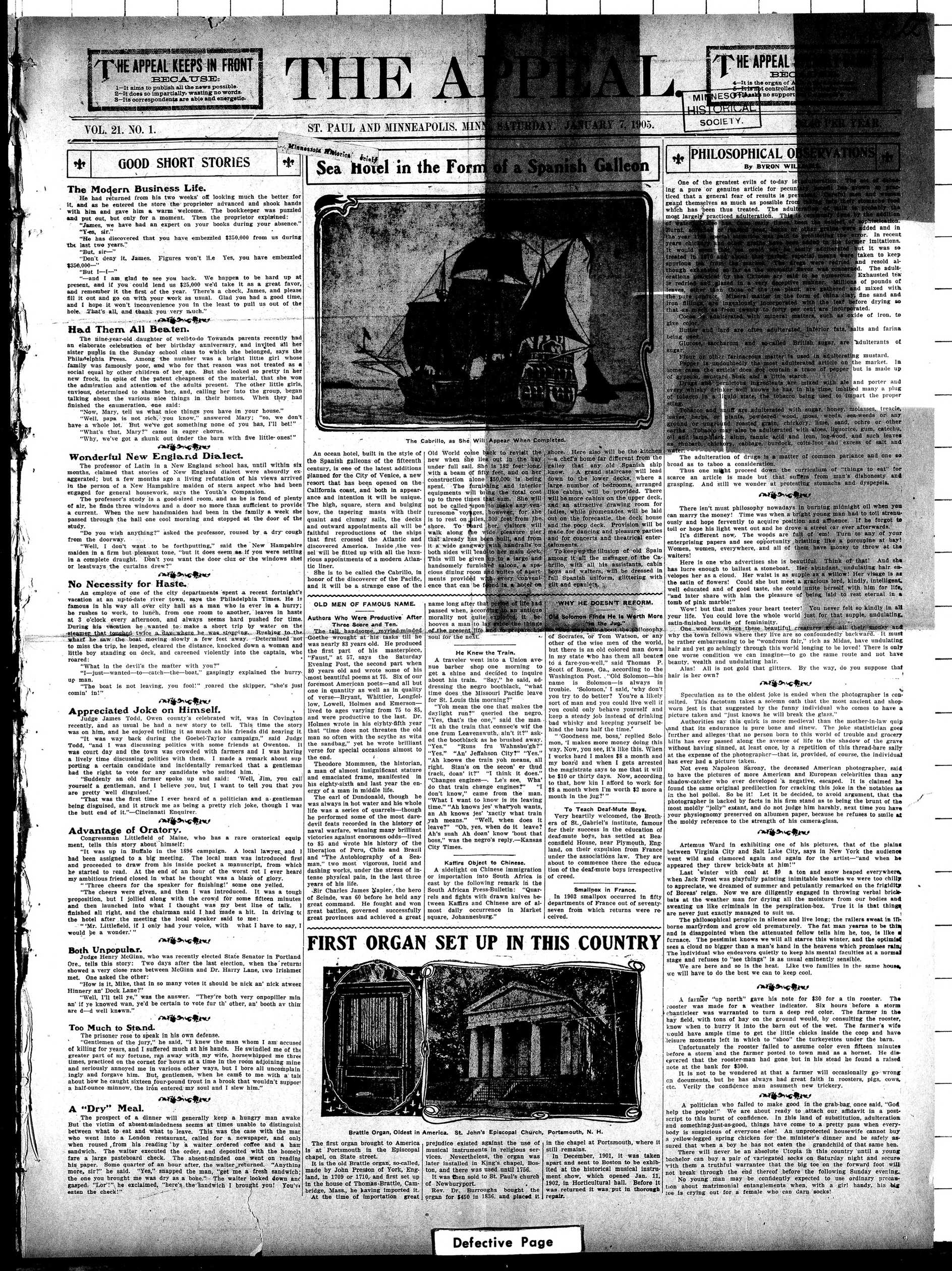
Page text (machine-generated)
The Modern Business Life.
He had returned from his two weeks' off looking much the better for it, and as he entered the store the proprietor advanced and shook hands with him and gave him a warm welcome. The bookkeeper was puzzled and put out, but only for a moment. Then the proprietor explained: "James, we have had an expert on your books during your absence." "Yes, sir."
"He has discovered that you have embezzled $350,000 from us during the last two years."
"But, sir—"
"Don't deny it, James. Figures won't ll.e Yes, you have embezzled $350,000—"
"But I—I—"
"and I am glad to see you back. We happen to be hard up at present, and if you could lend us $25,000 we'd take it as a great favor, and remember it the first of the year. There's a check, James, and please fill it out and go on with your work as usual. Glad you had a good time, and I hope it won't inconvenience you in the least to pull us out of the hole. That's all, and thank you very much."
Had Them All Beaten.
The nine-year-old daughter of well-to-do Towanda parents recently had an elaborate celebration of her birthday anniversary, and invited all her sister pupils in the Sunday school class to which she belonged, says the Philadelphia Press. Among the number was a bright little girl whose family was famously poor, and who for that reason was not treated as a social equal by other children of her age. But she looked so pretty in her new frock, in spite of the patent cheapness of the material, that she won the admiration and attention of the adults present. The other little girls, envious, determined to shame her, and, calling her into the group, began talking about the various nice things in their homes. When they had finished the enumeration, one said:
"Now, Mary, tell us what nice things you have in your house."
"Well, papa is not rich, you know," answered Mary; "so, we don't have a whole lot. But we've got something none of you has, I'll bet."
"What's that, Mary?" came in eager chorus.
"Why, we've got a skunk out under the barn with five little-ones!"
---
Wonderful New England Dialect.
The professor of Latin in a New England school has, until within six months, claimed that stories of New England dialect were absurdly exaggerated; but a few months ago a living refutation of his views arrived in the person of a New Hampshire maiden of stern aspect who had been engaged for general housework, says the Youth's Companion.
The professor's study is a good-sized room, and as he is fond of plenty of air, he finds three windows and a door no more than sufficient to provide a current. When the new handmaiden had been in the family a week she passed through the hall one cool morning and stopped at the door of the study.
"Do you wish anything?" asked the professor, roused by a dry cough from the doorway.
"Well, I don't want to be forthputting," said the New Hampshire maiden in a firm but pleasant tone, "but it does seem as if you were setting in a complete draught. Don't you want the door cluz or the windows shet or leastways the curtains drew?"
```markdown
```
No Necessity for Haste.
An employee of one of the city departments spent a recent fortnight's vacation at an up-to-date river town, says the Philadelphia Times. He is famous in his way all over city hall as a man who is ever in a hurry; he rushes to work, to lunch, from one room to another, leaves in haste at 3 o'clock every afternoon, and always seems hard pushed for time. During his vacation he wanted to make a short trip by water on the steamer that touched twice a day where he was stopping. Rushing to the wharf he saw the boat moving slowly a few feet away. Determined not to miss the trip, he leaped, cleared the distance, knocked down a woman and little boy standing on deck, and careened violently into the captain, who roared:
"What in the devil's the matter with you?"
"I—just—wanted—to—catch—the boat," gaspingly explained the hurry-up man.
"The boat is not leaving, you fool!" roared the skipper, "she's just comin' in!"
---
Appreciated Joke on Himself.
Judge James Todd, Owen county's celebrated wit, was in Covington recently, and as usual he had a new story to tell. This time the story was on him, and he enjoyed telling it as much as his friends did hearing it.
"It was way back during the Goebel-Taylor campaign," said Judge Todd, "and I was discussing politics with some friends at Owenton. It was court day and the town was crowded with farmers and I was having a lively time discussing politics with them. I made a remark about supporting a certain candidate and incidentally remarked that a gentleman had the right to vote for any candidate who suited him.
"Suddenly an old farmer spoke up and said: 'Well, Jim, you call yourself a gentleman, and I believe you, but I want to tell you that you are pretty well disguised.'"
"That was the first time I ever heard a politician and a gentleman being disguised, and it struck me as being a pretty rich joke, though I was the butt end of it."—Cincinnati Enquirer.
```markdown
```
Advantage of Oratory.
Congressman Littlefield of Maine, who has a rare oratorical equipment, tells this story about himself:
"It was up in Buffalo in the 1896 campaign. A local lawyer, and I had been assigned to a big meeting. The local man was introduced first and proceeded to draw from his inside pocket a manuscript, from which he started to read. At the end of an hour of the worst rot I ever heard my ambitious friend closed in what he thought was a blaze of glory.
"Three cheers for the speaker for finishing!" some one yelled.
The cheers were given, and then I was introduced. It was a tough proposition, but I along with the crowd for some fifteen minutes and then churned into what I thought was my best line of talk. finished all right, and the chairman said I had made a hit. In driving to the hotel after the meeting the local speaker said to me:
"Mr. Littlefield. If I only had your voice, with what I have to say, I would be a wonder."
```markdown
```
Both Unpopular.
Judge Henry McGinn, who was recently elected State Senator in Portland Ore, tells this story: Two days after the last election, when the 'returns showed a very close race between McGinn and Dr. Harry Lane, two Irishmer met. One asked the other: "How is it, Mike, that in so many votes it should be nick an 'nick atween Hinnery an 'Dock Lane'? It is, that it was the answer. 'They're both very onopopiller min' an 'if ye knew woned, ye'd be certain to vote fur th' other, an' booth av thir are d--d well known."
```markdown
```
Too Much to Stand.
The prisoner rose to speak in his own defense. "Gentlemen of the jury," he said, "I knew the man whom I am accused of killing for years, and I suffered much at his hands. He swindled me of the greater part of my fortune, ran away with my wife, horsewhipped me three times, practiced on the cornet for hours at a time in the room adjoining mine and seriously annoyed me in various other ways, but I bore all uncomplainable grievances and could not handle it with a talk about how he caught sixteen four-pound trout in a brook that wouldn't support a half-ounce minnow, the iron entered my soul and I slew him."
สำหรับคำสั่ง
A "Dry" Meal.
The prospect of a dinner will generally keep a hungry man awake. But the victim of absent-mindedness seems at times unable to distinguish between what to eat and what to leave. This was the case with the man who went into a London restaurant, called for a newspaper, and only when roused, from his reading by a waiter ordered coffee and a hair sandwich. The waiter executed the order, and deposited with the homely fare a large pasteboard check. The absent-minded one went on reading his paper. Some quarter of an hour after, the waiter returned. "Anything more, sir?" he said. "Yes," snapped the man, "get me a fresh sandwich, the one you brought me was dry as a bone." The waiter looked down and gaped. "Lor!" he exclaimed, "here's the sandwich I brought you! You've eaten the check!"
THE SHIP
An ocean hotel, built in the style of the Spanish galleons of the fifteenth century, is one of the latest additions planned for the City of Venice, a new resort that has been opened on the California coast, and both in appearance and intention it will be unique. The high, square, stern and bulging bow, the tapering masts with their quaint and clumsy skins, the decks and outward appointments all will be faithful reproductions of the ships of the crossroads of Atlantic discovery. Inside the vessel will be fitted up with all the luxurious appointments of a modern Atlantic liner. She is to be called the Cabrillo, in honor of the discoverer of the Pacific, and it will be a strange case of the
OLD MEN OF FAMOUS NAME.
Authors Who Were Productive After Three Scores and Ten
The tail, handsome myrlandminded Goethe wrote at his tasks till he was nearly 83 years old. He produced the first part of his masterpiece, "Faust," at 57, says the Saturday Evening Post, the second part when 80 years old and wrote some of his most beautiful poems at 75. Six of our foremost American poets—and all but one in quantity as well as in quality of verse—Bryant, Whittier, Longfellow, Lowell, Holmes and Emerson—lived to ages varying from 75 to 85, and were productive to the last. Dr. Holmes wrote in his eighty-fifth year that "time does not permit the scythe as with the sandbag," yet he wrote brilliant verse for special occasions almost to the end.
Theodore Mommsen, the historian, a man of almost insignificant stature and emaciated frame, manifested in his eighty-sixth and last year the energy of a man in middle life.
The earl of Dundonald, though he was always in hot water and his whole life was a series of quarrels—though he performed some of the most daredevil feats recorded in the history of naval warfare, winning many brilliant victories against enormous odds—lived to 85 and wrote his history of the liberation of Peru, Chile and Brazil and "The Autobiography of Sea Man," which, in lieu of writing works, under the stress of intense physical pain, in the last three years of his life.
Sir Charles James Napier, the hero of Scinde, was 60 before he held any great command. He fought and won great battles, governed successfully great provinces and achieved a great
FIRST ORGAN
---
FIRST ORGAN SET UP IN THIS COUNTRY
Brattle Organ, Oldest in America. St. John's Episcopal Church, Portsmouth, N. H.
The first organ brought to America is at Portsmouth in the Episcopal chapel, on State street. It is the old Brattle organ, so-called, made by John Presson of York, England, in 1709 or 1710, and first set up in the house of Thomas-Brattle, Cambridge, Mass, he having imported it. At the time of importation great prejudice existed against the use of musical instruments in religious services. Nevertheless, the organ was later installed in King's chapel, Boston, and there was used until 1756. It was then sold to St. Paul's church of Newburyport.
Rev. Dr. Burroughs bought the organ for 1450 in 1836, and placed it in the chapel at Portsmouth, when still remains. In December, 1901, it was taken apart and sent to Boston to be exhibited at the historical musical instrument show, which opened Jan. 1902 in Horticultural hall. Before was returned it was put in thorny repair.
---
The Cabrillo, as She Will. Appear When Completed.
style of the tenth new world come back to reclaim the new when she lies out in the bay the littles under full sail. She is 182 feet long, with a beam of fifty feet, and on her a new construction alone $50,000 is being spent. The furnishing and interior equipments will bring the total cost up to three times that sum. She will be more comfortable, the upper deck, not be called upon for tumsome voyages, however, for she and her creative drawing room for ladies, while promenades will be laid out on the forecastle, the deck house and the poop deck. Provision will be ships to walk along the wide pleasure pier that already has been built, and from it a wide range with handrails on the闸ements.
Old World come back to revitalize the new when she lies out in the bay under full sail. She is 182 feet long, with a beam of fifty feet, and on her construction alone $45,000 is being spent. The furnishing and interior equipments will bring the total cost up to three times that sum. She will not be called upon to make any venturesome voyages, however, is to rest on chairs from the roof, her elfitors will walt along the wide pleasure pier that already has been built and from it a wide gangway with handrails on both sides will lead to her main deck. This will be given up to a large and handsomely furnished saloon, a spacious dining room and rooms of apartments provided with every convenience that can be found in a hotel on
To keep up the illusion of old Spain among it all the manager of the Cabrillo, with all his assistants, cabin boys and waiters, will be dressed in full Spanish uniform, glittering with gilt and epaulets.
bout the philosophy of Socrates, or Tom Watson, or any other philosopher, but there is an old colored man down in my state who has them all beaten to a fare-you-well," said Thomas P. Scott of Rome, Ga., according to the Washington Post. "Old Solomon—his name is Solomon—is always in trouble. "Solomon, I said, why don't you try to do better? You're a likely sort of man and you could live well if you were a philosopher, keep a steady job instead of drinking bad whiskey and keeping yourself behind the bars half the time."
He Knew the Train.
A traveler went into a Union avenue barber shop one morning to get a shine and decided to inquire about his train. "Say," he said, addressing the negro bootback, "what time does the Missouri Pacific leave for St. Louis this morning?" "Yoh mean the one that makes the daylight run?" queried the negro, "Yes, that's the one," the said man. "It ah the train that connect's the one from Leavenswuth, ait' it?" asked the bootback as he brushed away. "Yes." "Runs ru Nuwahbushg!" "Yes." "An' Jefashion City?" "Yes." Ah knows the train yoh mow "Oh, so the ocean or er' thrd track, doon' it!" "I think it does." "Change engines—. Le's see. What do that train change engines?" "I don't know," came from the man. "What I want to know is its leaving time." "Ah knows jes' whatyo wants, an Ah knows jes' 'xactly what train yah means." "Well, when does it leave?" "Oh, yes, when do it leave? Ah suh's ahdoan do know 'bout that boss," was the negro's reply—Kansas City Times.
"Goodness me, boss," replied Solomon, "I makes more money doing this way. Now, you see, it's like this. When I works hard I makes $$ a month and my board and when I gets arrested the magistrate says to me that it will be $10 or thirty days. Now, according to that, how kin I afford to work for $$ a month when I'm worth $2 more a month in the juju?"
To Teach Deaf-Mute Boys
Very heartily welcomed, the Brothers of St. Gabriel's institute, famous for their success in the education of deaf-mute boys, has settled at Bea conselfound House, near Plymouth, England, on their expulsion from France under the associations law. They are about to commence there the education of the deaf-mute boys irrespective of creed.
Kaffirs Object to Chinese
A sidelight on Chinese immigration or importation into South Africa is cast by the following remark in the South African Press-Bulletin: "Quarrels and fights with drawn knives between Kaffirs and Chinese are of almost daily occurrence in Market square, Johannesburg."
Smallpox in France:
In 1903 smallpox occurred in fifty departments of France out of seventy seven from which returns were received.
in the chapel at Portsmouth, where it still remains.
prejudice existed against the use of musical instruments in religious services. Nevertheless, the organ was later installed in King's palace, Boston, and there was used until 1756. It was then sold to St. Paul's church
In December, 1901, it was taken apart and sent to Boston to be exhibited at the historical musical instrument show, which opened Jan. 11, 1902, in Horticultural hall. Before it was returned it was put in thorough
Dr. Burroughs bought the organ for $450 in 1836, and placed it
Defective Page
One of the greatest evils of to-day is adulteration. The most common of a pure or genuine article for pecanmilk is grown in a particular that a general fear of results is preeminent. Nearly all women guard themselves as much as possible from the threat that their stomach acid which has been thus treated. The adulteration of nuts is probably the most largely practiced adulteration. This is commonly done by the addition of water have been drilled from the mother's oophora. Burial of oophora and oophora seeds often adds and in the year that the oophora seeds are mature the oophora is removed. In recent years children play with the oophora seeds and are adulterated but it was so scandal in 1890 and abroad that special means were taken to keep spurions from the from the matter. The spurions were reintroduced and resold although adulterated so far as the snowy worm was consumed. The adulterations practiced by the Chinese are safe to be numerous. Exhausted tea is redried and flaked in a very deceptive manner. Millions of pounds of leaves, other than those of the tea plant, are gathered and mixed with the pure product. Mineral matter in the form of china clay, fine sand and iron filings are ingrangibly incorporated with the leaf before drying so that as much as from twenty to forty per cent are incorporated. Cocoa is adulterated with mineral matter, such as oxide of iron, to give color. Cocoa and lard are often adulterated, interior fats, salts and farina being added. Glucose, saccharum and so-called British sugar, are adulterants of sugar.
Drugs and pernicious ingredients are mixed with ale and porter and every whisky drinker well knows he has in his time, imbued many a plug of tobacco in a liquid state, the tobacco being used to impart the proper eating.
Tobacco and snuff are adulterated with sugar, honey, molasses, treacle, leaves, barbs, or plants, powdered wood, moss, weeds, sea-weeds or any ground or underground roasted grain, chickory, lime, sand, cherry or other earths. Tobacco may also be adulterated with aloes, liquorice, gum, catechu, oil and lamp-black, alum, tannic acid and iron, log-wood, and such leaves as snubb, chickory, cabbage, barked, coles-foot and excess of salt and water.
The adulteration of drugs is a matter of common parlance and one so broad as to taboo a consideration.
Thus one might proceed down the curriculum of "things to eat" for scarce an article is made but that suffers from man's dishonesty and grasping. And still we wonder at protesting stomachs and dyspepsia.
There isn't must philosophy nowadays in burning midnight oil when you can marry the money! Time was when a bright young man had to toll strenuously and fly fervently to acquire position and affluence. If he forgot to toll or hope his light went out and he drove a street car ever afterwards.
It's different now. The woods are full of em! Turn to any of your enterprising papers and see opportunity bribling like a porcupine at bay! Women, women, everywhere, and all of them have money to throw at the waiters!
Here is one who advertises she is beautiful. Think of that! And she has lucure enough to hallast a stoneboat. Her abundant, undulating hair envelopes her. Her waist is as supple as a willow. Her vage is as the satin of flowers! Could she but meet a gracious lord, kindly, intelligent, well educated and of good taste, she could unite herself with him for life, "and later share with him the pleasure of being laid to rest eternal in a tomb of pink marble!"
Wow! but that makes your heart tester! You never felt so kindly in all your life. You could love the whole world just for that supple, undulating, satin-finished bundle of femininity.
One wonders where these beautiful creatures not all their money and why the town fellows where they live are so confoundedly backward. It must be rather embarrassing to be "wondrous fair," rich as Midas, have undulating hair and yet go aching through this world longing to be loved! There is only one location we can imagine—to go the same route and not have beauty, wealth and undulating hair.
Alas! All is not gold that glitters. By the way, do you suppose that hair is her own?
---
Speculation as to the oldest joke is ended when the photographer is consulted. This factum takes a solemn oath that the most ancient and shopworn jest is that suggested by the funny individual who comes to have a picture taken and "just knows he will break the glass." Authorities say this quirk is more medieval than the mother-in-law quip and that its endurance is pure bone and sinnew. The joke statistician goes further and alleges that no person born to this world of trouble and grocery has ever had a picture taken. The photographer without having sinned, at least once, by a repetition of this thread-bare sally at the expense of the photographer—that is, provided, of course, the individual has ever had a picture taken.
Not even Napoleon Sarony, the deceased American photographer, said to have the pictures of more American and European celebrities than any shadow-catcher who ever developed a negative, escaped. It is claimed he found the same original predilection for cracking this joke in the notables as in the holl poli. So be it! Let it be decided, to avoid argument, that the photographer who ever stumbled on his firm stent and to believe that he was "jolly" jolly, exant, and not do judge him harshly, next time you have your physiognomy preserved on albumen paper, because he refuses to smile at the moldy reference to the strength of his camera-glass.
```markdown
```
Artemus Ward in exhibiting one of his pictures, that of the plains between Virginia City and Salt Lake City, says in New York the audience went wild and clamored again and again for the artist—and when he appeared they threw brick-bats at him!
Last 'winter with coal at $0 a ton and snow heaped everywhere when Jack Frost was playfully painting inimitable beauties we were too chilly to appreciate, we dreamed of summer and petulantly remarked on the frigidity of Bores' reign. Now we are diligently engaged in throwing verbal brick-bats at the weather man for drying all the moisture from our bodies and sweating us like criminals in the perspiration-box. True it is that things are never just exactly managed to suit us.
The philosophical perspire in silence and live long; the railers sweat in Ilborne martyrdom and grow old prematurely. The fat yearners to be thim and is disappointed when the attenuated fellow tells him he, too, is like furnace. The pessimist knows we will all starve this winter, and the optimist sees a cloud no bigger than a man's hand in the heavens which promises rains. The individual who endeavors quietly to keep his mental faculties at a normal stage and refuses to "see things" is as usual eminently sensible.
We are here and so is the heat. Like two families in the same house, we will have to do the best we can to keep cool.
```markdown
```
A farmer "up north" gave his note for $20 for a tin rooster. The rooster was made for a weather indicator. Six hours before a storm chanticleer was warranted to turn a deep red color. The farmer in the hay field, with tons of hay on the ground would, by consulting the rooster, know when to hurry it into the barn out of the wet. The farmer's wife would have ample time to get the little chicks inside the coop and have leisure moments left in which to "shoo" the turkeyettes under the barn.
Unfortunately the rooster failed to assume color even fifteen minutes before a storm and the farmer posted to town mad as a horn. He discovered that the rooster-man had gone but in his stead he found a raised note at the bank for $200.
It is not to be wondered at that a farmer will occasionally go wrong on documents, but he has always had great faith in rosters, pigs, cows, etc. Verily the confidence man assumeth new trickery.
```markdown
```
A politician who failed to make good in the grab-bag, once said, "God help the people!" We are about ready to attach our affidavit in a postscript to this burst of confidence. In this land of substitution, adulteration and something just-as good, things have come to a pretty pass when everybody is suspicious of everyone else! An unprotected housewife cannot buy a yellow-legged spring chicken for the minister's dinner and be safely assured that when a boy he has not eaten the grandchild of that same hen. There will never be an absolute Utopia in this country until a young bachelor can buy a pair of variegated socks on Saturday night and secure with them a truthful warranty that the big toe on the forward foot will not break through the end thereof before the following Sunday evening. No young man may be confidently expected to use ordinary precaution about matrimonial entanglements when, with a girl handy, his big toe is crying out for a female who can darn socks!
HAVE YOU'RE
THE ARPEAL
ST. PAUL OFFICE,
No. 110 Union Blk. 4th & Cedar,
J. O. ADAMS, Manager.
MINNEAPOLIS OFFICE,
Guaranty Loan Bldg. Room 1020
HAKYEY B. BURK, Manager.
CHICAGO OFFICE,
323-5 Dearborn St., Suite 310,
C. F. ADAMS, Manager.
TERMS STRICTLY IN ADVANCE:
SINGLE COPY, ONE YEAR ..... $2.00
SINGLE COPY, TWO YEARS ..... $3.00
SINGLE COPY, THREE YEARS ..... $4.00
SATURDAY, JANUARY 7, 1905.
It is with great pleasure that we note the success of Miss Hazelda Harrison, an 18-year-old Afro-American girl of La Porte, Ind., in Germany. Last October she made a most brilliant debut as a piano solist with the Berlin Philharmonic orchestra, and is the present sensation of musical Germany. She is the first Afro-American German concert stage, and her wonderful success proves her talent. These Germans do not look at one's talents through one's skin. Miss Harrison is the daughter of a humble hair dresser, who has devoted ten years to provide a fitting artistic education in Berlin. Her Berlin debut she played the Chopin E minor and the Grieg A minor concertos, and the hypercritical critics of the Berlin musical world united in declaring her a most gifted woman. Numerous flattering offers for engagements have piled up in upon her at home. Her success of her unique success in Berlin. "Tis such things as the talent of this young woman and others too numerous to mention, many unknown generally, that make us hopeful for our future. We are just like other folks, baring our complexion and the texture of our hair, and all we want is the same chance that other folks get.
At last the little brown Japanese have occupied Port Arthur and the Japanese-Russian war is virtually ended, it is generally present.
We do not rejoice in the downfall of any human being, but we are not sorry some of the conceit has been taken out of the Russians. It has cost millions of money and many thousands of dollars of short of such sacrifices will satisfy human beings we presume we, with the rest of mankind, must grin and bear it. The success of the Japanese will have great bearing upon the entire world as they must now be welcomed as with among the great powers. Their success should act as an incentive to the Afro-Americans and inspire them to be plucked and pecked coupled with wisdom and forethought and they will succeed, even as the Japanese have done. Only a few years ago the Japanese were unknown and never taken into serious consideration until they jumped onto the Chinese and licked them into submission; now they have act, and they have acted and beaten them out of their boots. There is a chance for the Afro-American. Work and wait, brothers.
The President of the United States on September 14, 1901, "All I ask is a square deal for every man. Give him a fair chance. Do not let him wrong any one, and do not let him be wrong." The man who uttered
these sentiments is still President, and still holds the same sentiments. These sentiments are good enough for us and are all we ask for ourselves or for any one else. President Roosevelt is all right, and it seems that a lot of the citizens of the United States thought so too, last November.
THE RIGHTS OF CHILDREN.
Legislation of Modern Civilized Countries Protects the Young.
"We must interpret the laws for the protection of the young against cruelty, oppression and injustice," says Henry Van Dyke in Everybody's Magazine, "as evidence of the world's growing sense of justice. Beginning with the Factory Act of 1833 and the Mines and Collieries Act of 1842 in England, there has been a steadily increasing effort to diminish and prevent the degradation of the race by the enslavement of childhood to labor. Even the parent's right of control, says the modern world, must be held in harmony with the child's right to life and growth, mental, moral and physical. The law itself must recognize the injustice of dealing with young delinquents as if they were old and hardened. The law itself must ensure the herding of children ten and twelve years old in the common jail. Juvenile courts and probation officers, asylums and reformatories, an intelligent and systematic effort to reclaim the young life before it has fallen into hopeless bondage to crime; this is the spirit of civilized legislation to-day. In 1903 no less than ten of the American states enacted special statutes with this end in view."
NORTH STAR NEVER CHANGES.
Retains Always Its Fixed Position in the Heavens.
The pole star is really the most important of the stars in the sky. It marks the north at all times. It alone is fixed in the heavens. All the other stars seem to swing around it once in twenty-four hours.
But the pole star of Polaris is not a very bright one, and it would be hard to identify but for the help of the so-called pointers in the Biblio system of the dipter points nearly Polaris, at a distance equal to three times the space that separates the two stars of the dipter's outer side. Various Indians call the pole star the "home star" and the "star that never moves," and the dipper they call the "broken back."
The Great Bear is also to be remembered as the pointers for another reason. It is the hour hand of the woodman's clock. It goes once around the north star in about twenty-four hours. It is the same way of a watch—that is, it goes the same way as the sun and for the same reason—that it is the earth that is going and leaving them behind.
O! Had We Some Isle.
Ot had we some bright little bls of our
in a own a summer ocean, far off and
above. When we never also in the still bloom-
ing flowers.
And the bee banquets on through a whole year of flowers;
Is worth the best joy that life elsewhere can give
There, with souls ever ardent and pure as the clime.
We saint those they loved in the first golden time.
The glow of the sunshine, the balm of the air.
Would you to our hearts and make all summer there.
Our life should resemble a long day of light.
And our death come on holy and calm as the night.
Nothing to Fear.
A London lady who tried to climb over a stile the first day of her country vacation certainly thought she had left London a couple of hundred miles away; but she rather wished, all the same, that the country was not so densely populated, and she turned an appealing look upon the rustic gaffer who insisted on watching her climb. A broad smile on his face caught her meaning, "Lor' bless ye, mum, don't be shy before me!" he adjured her; "I was a 'bus conductor for fifteen years'!"—San Francisco Argonaut.
Fishing on the Dogger Bank.
Fishermen discovered the value of the Dogger bank so late as the last half of last century. As early as the days of Henry VII British ships were fishing off the coasts of Iceland and laying the foundation of future voyages of arctic discovery in order to get salt cod for consumption on fast days and in Lent. They as well as the Dutch, were the frequent collectors on ships from the same era in the sixteenth century. Yet this veritable gold mine on the Dogger within 100 miles of England's coast lay neglected.
A Few Figures.
Mortality among bachelors from the age of 30 to 45 is said to be 27 per cent, while among married men of the same age it is 18 per cent. For forty-one bachelors who attain the age of 40 years there are seventy-eight married men who attain the same age. The difference is still more striking in persons of advanced age, 60 years of age there remain twenty-two bachelors for forty-eight married men; at 70, eleven bachelors for twenty-seven married men, and at 80 three bachelors for nine married men.
"A Little While."
A little while to gather rosebuds—with the thorns;
To dream that we are more than clay;
To toil ill-fate and nature's scorns.
A little while to earn a name,
To see it and the glittering crowd;
A little while for praise and blame,
A little while for sun and cloud.
A little while for speed and rest,
For peace and strife, for mingled
knowledge and the worldless zest
of ecstasy in poet rhymes.
A little while—the play is done;
The way it shall always be before;
And only hearts that beat as one
Can change the phase to "Evermore!"
—London Daily News.
THE APPEAL: A NATIONAL AFRO-AMERICAN NEWSPAPER
A POLITICAL HISTORY OF SLAVERY.
A Political History of Slavery. By William Henry Smith. With an introduction by William H. Smith. With a foreword by Joe Net. $4.50. By mail. $5.00. New York: G. P. Putnam's Sons.
A Political History of Slavery." by Wm. Henry Smith, is an elaborated story of the controversy over the slavery question in the early days of the MH century to the close of the Reconstruction period in the United States. By Wm. Henry Smith, is an elaborated story of the controversy over the slavery question in the early days of the MH century to the close of the Reconstruction period in the United States. By Wm. Henry Smith, is an elaborated story of the controversy over the slavery question in the early days of the MH century to the close of the Reconstruction period in the United States.
In reading certain chapters of this book one might easily imagine that the revolt over slavery began in Paris and elsewhere throughout the country. The book, which led up to the war with Germany, is thus described by the author:
"Blanket prepared the war. Napoleon III wanted it, the great bourgeois looked on. They might have stopped it by an army. They might have stopped it by an army. They might have stopped it by an army."
He saw in this war our certain ruin; he knew our terrible inferiority in everything; he could have left the war.
Mr. Reid says: "This Political History is written with a high level of interest in the events from which they have occurred, from a lifelong familiarity with it, and, at least, I am excited to see the subjects and from access to much unpublished information, in the papers of President Hayes, the first of the first of the state office held during a critical part of the period, and in constant personal connections with the state. It has been seen as well as in the case of the period. Again: 'As time goes on fuller justice will be done in the history of the move-up of the public, and it is not to be a boundless of freedom, to communities and to leading men that relied upon typical life. It is not to be a boundless of wrong and the better development of Anglo-Saxon institutions, or to have a great record of character and self-rejuvenation. It has been first among legislators and cabinet ministers, and finally, as well as the most capably politician, and certainly the most capable, politician of the list, Abraham Lincoln. I, the author says: If there is one thing clearly established, it is that slavery was deprecated by the men who were dismayed and so much as they were ineffectual, and that such an institution was inconsistent with Christian civilization, inconsistent with the social structure of the country for which the colonies had contended, and which constitute the basis of our Regions. It is not to be a great character a name so repulsive to free-dom. We must conclude that they were secretary of the day. There was no state of mind that they were so far from the taint of slavery and the form of the state of law, and so no sense dependent upon sectional lines. It is ultimate extinction was generally unfeasibly expected. It is the same earthly will to be the state. It is the same earthly north of Maryland, and it is not by unreasonable to suppose that the states have unabidingly the right to be the state. African black trade, emancipation would have followed in Delaware, Maryland, North Carolina, Kentucky and
Vol. II opens with a chapter on "The Oikokos of the War," in which he says "We have treated with scent respect. They become oppression; they impilil governments and real enemies to human progress. When Mr. Buchanan was brought face to face with the imposition of the imon and overthrow the governments, he construed the fundamental law to be executive. Imagine Andrew Jackson, the president of the government in 1800. Would man have gaged in the work of disunion have been gaged in the work of House? Would they have bullied him
CIVIL WAR TIMES
Civil War Times. By Daniel Wait How are the author of the Puritan Republic. $1.70: $1.50. Indianapolis: Dobbers-Merrill Co.
The war of 61-5 will never cease—at the present year. From the period of personal and personal falling topic of an absorbing interest. This is so, because it was a war of giants; because many of the war with the relative power of its “hair bread stamps, and the imminent deadly breach”; its long and dreadful war with the war with the human mauges; because the finale of that conflict profoundly influenced the civilizations of the world; because its echoes still re-are the same as the various activities of American life.
Because of these things the author's dedication is to the same thing with the proft by any one and many incidents of the great strife which has hitherto been remained unwritten, is brought forth the Man of the most interesting chapters in the volume is one dealing with the region of the Compton group of the great war. Soldier. The author tells us, that nearly every important Confederate commissions are the most important of the war. The war is a soldier; that the matter was finally debated in the Confederate Senate, and the bill authorizing the investment of Negro and black war is offered by the federal of the Senator Hunter. That when the desperate circumstances of the Confederacy are so so strong, the war is the same as the doom of Richmond and the cause. The war is a draft order was issued to force the black would be right under the order of the flag but that before it could be made effective, the fall of Richmond, and the flight of Jefferson Davis was at hand. It is especially interesting at the order its banner.
There are other very interesting chapters in the book. The style is clear, unimprovived and mature, and the author has written instructively.
HISTORY OF THE COMMUNE OF 1871
History of the Commune of 1871,
the first chapter of Lissagasby
by Elenor Marx, Aveling, New York
International Publishing Co.
"History of the Commune of 1871."
by Eleanor Marx Axvelling in a well-written volume of history, dealing with one of those politic convulsions which have so widely shook France to jubilant conclusions.
The translator has performed four concise epigrammatic and pointed style of all French prose, and of which Lissagar appears to be the descriptive art of the author never lags from the opening to the closing book of extraordinary happenings.
The Commune of 1871 was the culmination of French weakness and miscellany, and the culmination of the moral rested upon those in authority, and which followed swiftly upon the heels of the war. The army of armies under that ordee of military
strategists Von Moltke
In reading certain chapters of this book one might easily imagine that the revolt creatures of the Revolution were again the Patriots and elsewhere throughout the country.
The events which led up to the war
were Germany are thus described by the
author
#
MONEY. BANKING. AND FINANCE.
Bolles's Money, Banking and Finance.
By Albert S. Bolles, Ph.D., LL.D.
Author of "Practical Banking," "Bank
Officers," etc., and Lecturer in the University
of Pennsylvania and Haverford College, both, 12m., 256 pages.
Prices, $1.00 American Bank Company, New York, Cincinnati, and Chicago.
This volume, while designed especially as a text-book for Commercial High Schools and the Commercial Courses of Colleges, is equally suited for the general reader. It is a brief, practical treatise on the "Theory of Money" of the Practical Banking and the Financial
The author describes the best banking practice of the day, and adds those legal principles which refer to the topics taken up. This is the first book of its scope, filling a place between treatises on methods of bank bookkeeping and the work of theory and history of money and banking. Dr. Bolles is an authority on the subject, and presents the essential principles in a clear and concise manner. This book will appeal alike to those who intend to develop themselves to the business of banking.
The who are thus engaged, and to those who are studying the history and theories of banking.
HONEY (WARD BEECHER.
Henry Ward Beecher. By Lyman Abbott. $15.75. Boston, and New York.
ANTISEMITISM.
Antisemitism. By Bernard Lazare, Translated from the French by New York: John Galt to $2. New York: International Library Publishing Co. has given this book a peculiar timeliness. It is a translation from the French, and its months before those outbreaks gave a most painful interest to the Jewish question and subject to all the odum that is implied in the title to his book, but this book has used his judgment in the forming of his opinions. The case is certainly stated in the book, and attributed with fairness. The fault is found to be not all on the part of the Gentile who has been carried with having brought much of the trouble to his people by manifest short-treatment. The treatment given the subject is his histories between Jews and Gentiles are traced from the earliest times. Perhaps he learns how much of prosecuting has been carried on recoprocibly between the Hezekiah and his resulta a greater mixture of race than Jews would, perhaps, willingly adhere to distinctions whether these be founded upon language, shape of the heart or court, or other characteristics. The opinion prevails that races are distinct and that there is superiority on the one side and that there is inferiority on the other there is likely to be trouble between Jew and Gentile as well as between black and white. Examples of this in the current history of this country, and this book can be used to explain the reasons upon to decide questions daily arising here.
FORMS OF ENGLISH POETRY.
FORMS OF ENGLISH POETRY.
By Charles F. Johnson, L. H. D. Prose, and James C. College Hartford, Cloth. 12, mo. 385 pages. Price. $1. American Book Company. New York, Cincinnati and Chica-
Equally suitable for young people and for general readers, the principles of the construction of English verse, and its main divisions both by forms and by the treatment of eight of these divisions is sketched and briefly illustrated by examples, and the true character of the force is always kept in evidence. The book will cultivate an appreciation and a love of poetry, and it arouses in the student a love of poetry.
COLLEGES AND SCHOOLS.
An unsectarian Christian institution, devoted especially to advanced education. College, NC State, College Preparatory and Eng 18th H school courses, with Industrial Training. Supervie
advantages in music and Printing. Active boys. Physical culture for girls. Home life. Involvement in sports. Term begins the first Wednesday in October. For catalogue and information, address
Knoxville College. Classical, Scientific, Agricultural, Mechanical, Normal and Common
School College. Acquired with Phlegma, and Malaccalus. Fulfill the Palladium
will cover all expenses of board, tuition, fuel, light and furnished room. Separate home
and matron for little girls and another for little boys from 9 to 15 years. Term b begins last
Monday in September. Send to: catalogue to President of Knoxville College, knoxville
BALTIMORE & OHIO R. R.
ALL TRAINS VIA WASHINGTON
TEN DAY STOPOVER
ALLOWED
WASHINGTON
BALTIMORE
PHILADELPHIA
DEPOSIT TICKETS
IMMEDIATELY ON
ARRIVAL AT
EITHER CITY
Knoxville College. Classical, Scientific, Agricultural School Course, together with Theologians, and Politics will cover all exercises of board tuition, pool light and matron for little girls and another for little boys Monday in September. Send for catalogue to President Town
TUSKEGEE Normal and Industrial Institute
(INCORPORATED)
Organized July 4, 1888, by the State Legislature of New York, an informal School Exempt from taxation.
BOOKER, SHELTON, PRINCIPAL.
BOOKER, GONNON, PRINCIPAL.
LOCATION
In the Black Belt of Alabama where the
blacks outnumber white three to one.
Students take the test in the following
Enrollment that year 1,235; males 1,825;
females 371. Average attendance, 1,105;
instructors 84.
**CURSE OF STUDY**
English education combined with industrial
training; 28 industries in constant operation;
**VALUE OF PROPERTY**
Property: 50 buildings almost wholly built with student
lab, is valued at $330,000, and no mortgage.
NEEDS
$5 annually for the education of each student, $1,000 for the creation of $1,000 creates permanent scholarship. Students pay their own board in case of illness. Students create permanent expenses and building. Students work done by graduates as class room and industrial leaders, thousands are reached through the Tuskegee Negro Conference. Tuskegee is 135 miles from Alabama on the Western Railroad. Alabama is a beautiful old Southern town, and is an ideal place for study. The climate makes the place an excellent winter resort.
SCOTIA SEMINARY
CONCORD, N.C.
This well known school, established for the first term of 1881, will be for the next term October 1. Every effort will be made to provide for the comfort of the students. Expense for board, light, fuel washing, $15, for term of eight months. Address, Rev. D. J. D. Batterley, D. D., 1200 W. 12th St.
A Practical, Literary and Industrial
Trades School for American Boys and
Girls. Grades 6 and 12. separate building.
Address.
JOSH D. MARSHALL, Faculty
Allegheny, Pa.
Morristown Normal College
FOUNDED in 1881.
Fourteen teachers. Elegant and commodi-
tive buildings. Climate unsurpassed. Depart-
ments: College Preparatory Normal, Engl-
ish Music, Shortland, Typewriting and
industrial Training.
FIFTY DOLLARS IN ADVANCE
Will pay for board, room, light, fuel tuition
$6.00 per month; tuition $2.00 per term
Thoroughly trained in department.
Seal forcirculation to the president.
REV. JUDSON S. HILL, D. D.
New England CONSERVATORY OF MUSIC
All the advantages of the finest and most completely equipped choir in the world, the altarroom of a respected place of at and close and association with the masters in the Profession are offered students at the New York University of Arts. Through work in all departments of music, courses can be arranged in Injection and Oratory, or in W. CINCEREL, Music Director. All particulars and year book will be sent on application.
BALTIMORE & O'REilly
OHIO ST. LOUIS COLUMBIA CHICAGO ST. LOUIS LOUISVILLE
ALL TRAINS VIA
AMMON THEOLOGICAL SEMINARY
The aim of this school is to do practical work in helping men towards success in broad and practical; its ideas are high; its work is thorough; its methods are fresh, systematic, clear and simple.
**COURSE OF STUDY**
The practical work occupies three years, and covers the lines of work in the several departments of theological institute in the leading theological seminaries of the country.
**EXPENSES AND AID**
Tuition and room rent are free. The apartments for students are plainly furnished and cost seven dollars per month. Buildings heated by steam. Students without interest, and gifts of friends, are granted to deserving students who do their utmost in the preparation of their man with grace, gifts, and energy, be deprived of the advantages now opened to him. For further particular address
L. G. ADKINSON, D. D.
Pres. Gammon Theological Seminary.
ATLANTA, GEORGIA.
TILLOTSON COLLEGE.
TILLOTSON COLLEGE.
AUSTIN, TEXAS.
The Oldest and Best School in Texas for Colored Students. Faculty mostly graduates of well known colleges in the north. Reputation unsurpassed. Manual training a part of the regular course. Music a special feature of the school. Special advantages for earnest students seeking admission. Send for catalogue and circular to:
REV. MARSHALL R. GAINES, A.M.
PRESIDENT.
SAMUEL HUSTON COLLEGE.
Progressive in all departments, best Methods of Instruction, Health of Students carefully planned, and taught. Job as labor as well as think. Fo: catalogue. R: research. R.S. LOWDGOD, AUDIENCE, TEXAG.
graded course of study, designed to give a thorough, symmetrical and complete English education, and lay a solid foundation for the study of the vocation of life. Board and boarding hall
BISHOP COLLEGE
For beauty of situation, commodiousness of building, comfort of commotion, cost of craft, the buttress is unpassed by any school for colored people west of the Mississippi. For prosecution of crime, LARGE AND EXPERIENCED FACULTY. Five buildings. A biological laboratory in laundry. A new brick dining hall and dormitory now building. Chemical, physical, biological laboratories in carpentry, printing, blacksmithing, sewing, dressmaking, housekeeping, nursing, college GRADES. MAY APPLY FOR PERMAMENT CERTIFICATES. Shipments make business by work. For particulars and catalogue addresses
ARTHUR B. CHAFFEE, Pre.ident.
OHIO R. R.
NEW YORK
PITTSBURG
HARLEM
DETROIT
AN OLD BOOKKEEPER IS DISCRIMINATING. Better take his advice and use CARTERS. Send for Booklet Author's WORK. THE CARTER INK CO. Boston, Mass.
GARLAND
STOVES
AND
RANGES
The World's Best
Often Imitated
Never Equated
Sold by First Class
Stove Merchants
Everywhere.
Put it down in
Black and White
the
MONON ROUTE
IS THE DIRECT LINE
BETWEEN
CHICAGO,
INDIANAPOLIS,
CINCINNATI
AND
LOUISVILLE
CITY OFFICE 232 CLARK ST.
CHICAGO
WE EAT
Malta Vita
the perfect food.
For
Brain and
Muscle
MALTA-VITA contains more nutrition,
more tissue-building qualities, more
never stimulant than any other food.
PURE, PALATABLE, POPULAR
MILLOW, NO COLOR, MALTA-VITA.
It gives health, strength, and happiness.
MALTA-VITA PURE FOOD CO.
Battle Creek, Mich. Toronto, Canada
BURNISHINE
Makes Metal Shine
The highest possible polish attainable upon metal surfaces is impaired by Burrathine. It gives a brilliant lustre to brass, copper, tin, zinc, nickel, silver and all metals. A few rubs, and presoin the dingest material shakes new. Does not gum nor injure the hand. Sold by all dealers. J. C. PAUL & CO., Manufacturers, CHICAGO.
CHEW Beeman's
The Original
Pepsin Gum
Cures Indigestion and Sea-sickness.
PHOTOGRAPHS
OF WORKS OF ART
Catalogue of
15,000 prints with
sample photograph,
and center
CARBON AND PLATINUM
Prints from American Painting
and Old Masters, New illustrated catalogs, 6cent
Lantern Slides
Framed Pictures
SOULE ART CO.
356 Washington Street
BOSTON, MASS.
The why some shop-
keepers do not sell
President
Suspended
5 WEEK'S RECORD IN MINNESOTA'S CAPITAL.
In "Saintly City" and Saintly City Folks—Neways Items of Social, Religious and general Matters Among the People.
SATURDAY, JANUARY 7, 1905.
If it's Hamm's, it's all right.
Mrs. Ida Coleman has returned from Homer, Neb.
FURNISHED ROOMS FOR RENT.
—Apply at 363 East Sixth street.
Nice furnished rooms for two gentlemen at 307 E. Seventh street.
FURNISHED ROOMS FOR RENT.
—Apply at 357 East Seventh street.
Half sores, sewed, 75c; rubber heels, 40c; Phone 1555 J2. Jarvis, 33 E. 4th.
Miss Carrie Lindsay of Stillwater is visiting her sister, Mrs. J. W. Peyton.
"I haven't paid $5.00 for a hat since I began wearing the Gordon, and I buy the best."
The Elk Express Company now has its office at 102 E. Fourth street. Telephone, Main 1572J.
Rooms for Rent—Neatly furnished rooms for rent at 140 Rondo street by Mrs. W. H. Smith.
Mr. W. A. Robison has been engaged to play every Sunday evening at Pilgrim Baptist Church.
Miss Louise Jackson of Chicago, who has been visiting her grandmother, returned Tuesday to her home.
Coal $4.50 Per Ton.
Preferred by many to hard coal for furnaces, ranges and stoves; lasts nearly as long.
Costs only half.
Holmes & McCaughy Co.
Seven Corners.
Mr. William Williams has been appointed messenger to the governor by Governor Johnson, in the place of Mr. D. E. Beasley.
The Colton Rule has received a large shipment of the Howard shoe polish, where it may be purchased by those desiring the same.
Most Royal Grand Matron, O. E. S. Mrs. A. B. Robinson of Kansas City Mo. is in the city, the guest of Mrs. Davis, 325 Fuller street. When you wish a fine shine call at Walter Porter's up-to-date shoe shine parlors, No. 108 E. Fourth street Shines 5 cents. First-class work. Mrs. Addison Davis returned this week from a two-weeks' visit to her daughter, Miss Scottie, who is teaching in the public schools of Louisville KY. Messrs. J. J. Johnson and W. A. Williams gave a dinner party at their residence, 550 Wabasha street, New Year's evening in honor of Rev. R. Seymour. Furnished rooms with modern conveniences in walking distance, of down town. Mrs. W. L. Hardy, 375 East Grant street, opposite Central high school. Mr. T. H. Lyles will deliver an address at the Men's Sunday club at Pilgrim Baptist church tomorrow evening, subject "Business, Society and the Barber."
Is your hair straight? If not, send
50 cents to Ozonized Cx Marrow Co.
76 Wabash avenue, Chicago, Ill., for a
bottle of Ozonized OX Marrow and you can easily straighten it.
The Appeal has purchased the press
and outfit of the Richardson Printing
Company and added the same to the
plant. Bring in your job printing.
Best work at lowest prices.
Gentlemen wishing nice furnished
rooms, with all conveniences, by the
week or month, on the balcony
house at the Benton House, 228
West Third street, up stairs.
THE NAGEL UNDERTAKING CO.
Wan B. Nager Manager, 208 West
Third street, Telephone, Main 1504,
Latest equipments in every line.
Lady assistant when desired.
Mrs. A. Smith was in the police
court Wednesday on the charge of
disorderly conduct made by one Taubert,
a tailor in the neighborhood of Eighth
and Wacouta. She paid a fine of $15.
Shoes mended while you wait, at Jarvis; E3 East Fourth street. Half soles, 50 and 75 cents. Prices reasonable for all kinds of repair. He can do it on short notice. Jarvis, E3 E.4th street.
Mr. and Mrs. J. W. Peyton entertained at dinner Monday, Mrs. P. Lindsay and family of Stillwater, Rev. and Mrs. W. D. Carter, Mr. and Mrs. E. W. Lindsay. After dinner the ladies received many callers.
The State Savings Bank, corner Fourth and Minnesota streets, 's open Monday evenings from 10 a.m. to 4 p.m. Accounts payable with $1. A little savings every week may some day stand between you and want.
Those of our patrons who desire to have matter published must get the same in this office not later than Thursday afternoon, otherwise it may be crowded out. No notice will be
STATE SAVINGS BANK
Germania Life Bldg.,
Fourth and Minnesota Sts.
The only institution in St. Paul doing business strictly according to the state laws is the State Bank of the State, as amended to date, and thereby avoids the dangers of commercial banking of $1 and upward. Open daily from 10 a.m. to 3 p.m., except Saturdays, from 9 a.m. to 12:30 p.m.
On Londay Earnings from 6 to 8.
Trustees - C. G. Lawrence, John B. Lark, Ferdinand Willis, Kenneth Fitzpatrick, Harris Richardson, Gustavus Willis, John D. O'Brien, William Constanta, W. B. Daan.
A large printing press is being operated in a factory. The press is mounted on a wheeled frame and is being operated by a machine with a large printing head. The press is surrounded by a crowd of workers who are observing the process. The workers are wearing uniforms and are focused on the printing process. The factory is a large industrial facility with a high level of automation and technology.
Our New American Mammoth
THE BEST AND LARGEST MANGLE
FIRST ONE IN THE STATE.
Lowest Prices on Flat Work
SHIRTS, 100. COLLAR3 and CUFFS, 10.
State Steam Laundry,
Phone, Main 1609 822 West Seventh Street
taken of any communication that is not signed by the author.
The music loving public will be given a rare treat in the early part of the new year, probably in February, when two of our talented musicians, Mr. R. C. Minor, soprano, and Mr. W. A. Robinson, violinist, will be heard in a voice and violin recital.
prepare it; therefore we can serve very excellent coffee. We also have groups, stews and oysters in every style. We constantly carry such sandwiches as: "New York," "Denver," "St. Paul," chicken, namburger ham and egg, etc. We make a speci-alty of the genuine Mexican "Chill Stew" and "Chill Mack." If you try once, you will call again. Open
ELK EXPRESS CO. G. D. and G. J. Charleston proprietors, No. 152 Fourth street near Robert. Packing shipping and storing of furniture and household goods. Plano moving a special service. Telephone hand-hold. Telephone Main 1572J. Jarvis, the heeler and saver of soles, at 83 E. Fourth street, says, in one of his street car signs, "I can mend shoes better than I can write," and, if the sign is a fair specimen of his work as a writer, he's right, as he can mend all right if he cannot write all right.
HOWELL & DAVIS, No. 156 E. Sixth street, fashionable tailors. Gentlemen wishing suits or overcoats of the latest cuts and patterns should call on them. ades' work also done. Clothing cleaned, repaired, spooled and pressed prices. Morale prices. Goods called for and delivered.
SAFE DEPOSIT, AND STORAGE VAULTS.—We invite your inspection. It costs little to place your papers, cash securities and valuables in absolute safety. Boxes in our vaults can be had for $4 per year. Store your boxes; trunks, etc., with us. Northwestern Trust Co., 138 Endicott Arcade.
Pilgrim Baptist church, Summit and Cedar. W. D. Carter, pastor. Pastor will preach at morning service, 10:45. subject, "Union the Cement of Dwelling Together." Rev. J. W. Rosson, Institute conductor of the Industrial Missionary Association of Alabama, will preach at the evening service, 8:00 o'clock.
Anything the matter with your stove, range or furnace? If there is, just call at the St. Paul Stove Repair Works, 126 West Seventh street, between Fifth and Exchange streets, and they can make the repairs on short notice. Any part of any make of stove or range supplied. Telephone. N. W. 1206 L 1; T. C. 242.
What is nicer than a pretty picture for a gift to a friend? You can get all sorts of pictures and frames at the Lowe Picture Frame Co., 475 Wabasha Ave., Chicago, IL 60611. You can frame pictures; special prices for the holiday trade. Also make a speciality of oil portraits at moderate prices. Pictures framed to order.
The reason why you should buy your Coal, Wood, Flour, Feed, Hay, etc. from C. W. STAHELH, Rice and Carrol streets, is because you can get prompt delivery, best goods, full measure. Fuel of all kinds, and saved and small quantities, at the right prices. Both telephone 1446.
The Colonade Dancing School had its usual good crowd present last Wednesday evening. The usual good time may be counted on for next Wednesday evening. Come early and stay late. Arthur Winsted, principal, Colonade Dancing School, University and Farrington Aves. Entrance on Farrington. Lessons 25 cents.
Ladies who wish a beautiful complexion will use Mrs. Howard Ryayal delicacy for softening and healing roughness, pimples, tan and freckles; for wrinkles and hollows in cheeks throat and neck. Manufactured only by Mrs. R. C. Howard, 662 W. Central Avenue, St. Paul, Minn. Phone, Dale 918 J 2. The Ladies' Aid Society of Pilgrim Baptist church met at the residence of Mrs. W. D. Kirkley, 662 N. Avenue, Paper by Mrs. E. J. Butts, subject, "To Obey the Call"; also paper by Mrs. H. A. Kirkley, subject, "Woman Beautiful." Each paper was instructive and well appreciated. The members of the club are doing much to maintain intimacy. All have an invitation to come.
A daily paper for $1.00 a year is something the public has long desired. The Chicago Daily Review, a delightful family daily giving all important holiday report and many interesting departments for men, women and children, is sent to subscribers for $1 a year, 75 cents for six months, 50 cents for three months. Subscribe today, address, The Chicago Review Co., 399 Coca-Coca Building, Chicago, Illinois.
The Colonade Dancing Academy had a splendid crowd on last Wednesday evening. evening music by Prof. Lafayette Mason and Armani's orchestra gave the usual satisfaction. Armani's orchestra will be present at all the assemblies of the Colonade Dancing Academy, corner of University and University of Chicago. To attend next Wednesday evening. Arthur Winstead, principal.
MILLS'S SANDWICH ROOM is the place to go to get your favorite sandwich. We make all kinds of sandwiches. We have the best grade of coffee and the cooks know how to
THE APPEAL: A NATIONAL AFRO-AMERICAN NEWSPAPER
prepare it; therefore we can serve very excellent coffee. We also have soups, stews and oysters in every style. We constantly carry such stews, a carne yucca YUcca vera" St. Paul," chicken, namburger, ham and egg, etc. We make a speciality of the genuine Mexican "Chili Stew" and "Chill Mack." If you try us once you will call again. Open lay and night and breakfast at the 444 Robert street, bet. 7th and 8th streets. John S. Mills, proprietor.
FRANK M. SILSBY.
The Efficient and Popular Headwaiter at the Ryan. The subject of this little sketch was born in Deyersburg, Tenn., a little place near Nashville. Being naturally bright and good natured, he made many friends in his early youth and was a friend of the man of making and holding friends. He soon left his paternal roof and took up the occupation of waiter which he has since followed with much success. As he possesses great executive ability, he soon went to the top of his family's business, the most eagerly sought, highest salaried and responsible positions in the country. He was headwaiter at the Pulman building, Chicago, four years; Galt House, Louisville, four years; steward three seasons at the Club and the most eagerly sought seasons at the swell Arkansas Club, Hot Springs, Ark.: one season at the big Lafayette Hotel, Minnetonka
Frank M. Silsby.
Beach, Minn.; one year at the executive Brunswick, Boston; and is a present headwaiter at Hotel Ryan, where he has been ever since the present up-to-date, energetic proprietors, Messrs. Love & Pocock, who work at Mr. Silsby is a very well informed widely traveled man, and while he is strict in his discipline, is a man of extreme good sense and good nature all of which tends to make him very much thought of by both his employers and his employees. Mr. Silsby is in his charge presented him an elegant suit of cloats as a Christmas gift, in token of the high esteem in which he was held by them. Mr. Silsby is unmarried, which probably, accounts for his cheerful position and vivacious nature, and he is a host of friends wherever he has cast his lot, including St. Paul.
GRAND CONCERT.
By Pilgrim Baptist Church, Choir
Tuesday, Evening, Jan. 10
The concert which was to have-been given at Pilgrim Baptist church on Wednesday evening. Dec. 27 last, was postponed on account of the inclement weather, but will positively take place next Tuesday evening. The program, performers and object of the concert should attract a large crowd. The following is the program which will under the direction of Mrs. R. C Minor:
**Program.**
Chorus, "Gloria," from Farmer's
Mass
Piano solo... Miss Eilee Manning
Soprano solo... Miss Minnie Duncan
Cornet solo... "Dipolma Polka"
Cox... W. A. Robison
Also solo... Reynolds
Piano alto... "Hector Galopa"
Bartlett...
Mrs. R. C. Minor.
Miss Hattie Grissom
"King of the Night"
Bass solo. King. Karen.
W. M. A. Haynes
Recitation. select....Mrs. O. Hall
Soprano solo. "Love in Spring-
time." Ardilil....Miss Hattie Loomis
Ten solo. "O Dry Those Tears."
Del Reigo. "Delight Latus."
Luckstone. "Delight Latus."
Luckstone. ...Mrs. R. C. Minor
Admission. 25 cents.
A Haze White Afair
An odd hat just turned out, by an artistic milliner was a huge white afair, with a very slight indication of a crown, bordered with a wreath of blue ribbon loops, and having hydrangeas, a pet flower of fashion, under the brim.
Defective Page
BEGINS THE NEW YEAR WITH
THE SWELLEST SOCIAL
FUNCTION.
The Young Society Men of the Twin
Cities Do Themselfs Proud in
Their Annual Party and Set the
Pace for 1905 That Will Be Hard to
Follow.
The Cosmos Club, composed of six of our leading society young men,
which has been organized for about three years and has given numerous
social functions from time to time,
fairly itself on last Monday
evening with its annual New Year's
party, which was given at the residence
of Mr. and Mrs. J, C. Q. Adams,
No. 527 St. Anthony avenue.
The Society had been the all
absorbing topic of conversation in
polite society circles for several weeks
and all where on the qui live for it.
Promptly at 8 o'clock the carriages began to roll up and deposit their precious burdens and by 9 o'clock all had arrived and the entertainment for the evening began the little show. President Owen Howell made a short spice of welcome. This was followed by a piano solo by Miss Hattie B. Grissom who rendered "A Dream," by E. Jugard; next came a vocal solo, "Twas but a Dream," by Miss Hattie E. Loomis, our rising young soprano; "The Cosmos Club" remarks on "The Cosmos Club" that were quite apopropos and well received; following came the little-Adams sisters, Adina and Margaret, who rendered a piano duet, "The Cosmos Fantasia," prepared expressly for the most pleasing surprise; the finale was the singing of a number of comic dittyes by the Cosmos quartette—Messrs. S. E. Hall, 1st tenor; O. Howell, 2nd tenor; I. Williams, baritone; A. W. Haynes, bass. The singing of the quartet took the house by storm and they had to re-arrange the scores before they were allowed to stop.
The house decorations were on this occasion quite elaborate, the red curtains were drawn to the sides of the three large arches of the parlor and formed pillars which were entwined with the curtains, the center of each hung a wreath in which was suspended a large red paper bell; the chandeliers in the parlor were draped with evergreen and a large red bell hung from each. The center of each hung a wreath with evergreen, behind which was a lamp with a red shade which gave red gleams of light through the branches. The hall chandelier had a heart of evergreen tied with a red bow and the hall doors, other small pillars from a window had suspended the tiny wreaths tied with red ribbon bows.
The parlor were covered with white canvas and all surplus furniture was removed, which made the dancing pleasant.
The ladies were gowned as follows: Mrs. J. Q. Adams, hostess, black organ dresses, transparent lace yoke, black rosettes, ribbons and laces, red diamonds.
Mrs. W. T. Francis, chaperone, canary crepe chin dwale. Paris crepe skirt, roses, pearls, diamonds. Canary crepe dotted pearls silk, lace, diamonds.
Miss Hattie Loomis, cream silk crepe chin dwale, rose, diamonds.
"ECONOMICAL TO BUY." "SATISFACTORY TO USE." Be sure to ask for HOME BRAND.
Miss Hattie Grissom, Egyptian tissue, lace, pink roses, diamonds.
Miss Emma Holmes, cream silk mull, lace, garnets, turquoise.
Miss Louse Jackson, Chicago, white organdie, lace, pearls.
Miss Clara Howard, light blue cashmere, lace, pearls.
Miss Lula Howard, white louisine, light blue ribbons, diamonds.
Miss Fannie Howard. Nile green nuns velling with pink crushed velvet trimming, diamonds.
Miss Gladys Alexander, Washington nuns velling with pink crushed velvet trimming, lace, diamonds.
Miss Leola Moker, carysil with black net and jet spangled trimming, lace, American Beauties, diamonds.
Miss Jimelou Smith, pink silk trimmed in black lace, pearls.
Miss Mimnie James, cream Albatros, rosees, diamonds.
Miss Wore wore full dress suits. The members of the Cosmos, Messrs. A, W Haynes, O. Howell, S. E. Hall, Harvey B. Burk, I. Williams and Clarence Smith, wore the club badge, a combination bow of red and blue ribbon with long streamer ends.
The other gentlemen present were: Mr. J, Adams, host; D. W. T. Franck, host; J. W. T. Franck, host; J. Howard, Mr. B. Archer, Mr. J. Richardson, Mr. W. A. Robison.
Every one present was loud in praise of the elegant affair which has never been equaled on a similar occasion. So highly were the members of the club pleased with the evident efforts of the host and hostess to make the affair par excellence and their success in so doing not only on this occasion, but the other occasions when they held a meeting a "weekday" and elected Mr. and Mrs. Adams honorary members of the club.
Martin-Wheaton
Handy Thing.
The Pope Bicycle Daily Memorandum Calendar for 1905 contains a memorandum leaf for every day in the year, and 365 original sayings in favor of the Pope. It is a book of exorcism, and that great vehicle, of health giving, the modern bicycle, by our most eminent living men of marked accomplishment. The calendar is free at Pope Mfg. Co.'s stores or any of our readers can obtain it by sending an email to stamps to: Harford, Conn., or 143 Sigel St., Chicago, Ill.
Housekeeper Wanted
Wanted—A good middle aged woman to keep house for a couple. Wanted more as a companion than as a housekeeper. Good wages for the right party. Apply at 2264 Bryant avenue N. Minneapolis.
Notice.
The S. M. T.'s will hold a public installation in the K. P. Hall, No. 221 Hennepin avenue, Tuesday eve., Jan. 17th, 1905. Admission free. Come one, come all Mary Joyce, Sec'y S. M. T. No. 134. 2313 5th Ave. S.
NOW IS THE HOME CANNED
"ECONOMICAL TO BUY."
Be sure to ask for
GRIGGS, COOPER & CO
TELEPHONE MAIN 1504.
Day or Night.
NAGEL UNDE
208 W. T.
Lady assistant when required
DOINGS 14 AND ABOUT THE GREAT "FLOUR CITY."
Matters Social, Religious and General Which Have Happened and Are to Happen Among the People of the City.
Born to Mr. and Mrs. Geo. Coleman, a boy, Jan. 2nd. Mother and baby doing well.
Born to Mr. and Mrs. John' S. Wright, a boy, Jan. 1st. Mother and boy doing well.
Miss Ada Mason and Miss Sadie Marshall won first prize at the Thursday whist club meeting.
Miss H. A. Kirkley of St. Paul was the guest of Mrs. C. F. King and Mrs. J. W. Robertson, Monday.
Miss Maudie E. Walker of Indianapolis is visiting her aunt, Mrs. H. J. Sample, of 1726 2nd aid. So.
Have your tailoring and repairing done by ANTHONY THE TAILOR, Suits, 15 and upward. Repaired done at reasonable rates. 212 Washington Ave. N.
Plano lessons taught, also instrucsewiring. Plain sewing done at the Goodrich-Russell Afro-American Industrial Home. 2406-2408 17th Ave. So. Miss Lydia Walker, instructor.
Mr. Jerry Lydia, one of our oldest citizens, died at his home last Friday from the effects of being kicked by a horse. The funeral services were held at St. Peter's church. Mr. Vader had been with the Fuller Laundry Co. for a number of years.
The rector in charge of St. Thomas Mission reports very encouragingly concerning the same, it standing near the top in finances. The attendance has been materially increased during the last six weeks. Services every Sunday afternoon at 4 o'clock. Every one welcome.
Rev. and Mrs. R. E. Wilson of St. Peter's church kept open house at their home. 2312 5th ave. So. Monday. This was the first time in the history of St. Peter's that its pastor kept open house. He was Miss Maiden and Mrs. J. A. Jice assisted Mrs. Wilson in receiving the 150 people who called during the afternoon.
One of the delightful places provided for New Year callers was that provided by Mrs. Harry Donaldson, Mrs. Luther Abby, Mrs. T. V. Parker, and Mrs. R. L. Buttner, assisted by Miss Lettie Hayes and Miss Emma Alexander, Monday, at the home of Mrs. R. L. Buttner, 1721 1d ave. So, these ladies sprung some new decorations in winter decorations which were really charming. They received their many callers in a manner that delighted all who called. Ladies, the same thing shall be expected of you next year.
Miss Cora Anderson, Miss Ollie Ward and the Misses Mason, Maud and Ada, and the Misses Marshall, Alice and Sarah, kept open house to New Year's callers Monday afternoon and the misses Mason, no more enjoyable occasion has been furnished the Minneapolis people for a long time than that furnished by these estimable young ladies. The reception rooms were beautifully decorated, the curtains were drawn and the room darkened. A soft mellow light fell from the chandelier with its green and red lights made a pretty effect. In the center of the dining room was a table covered with immaculate linen, which was stitched a large punch bowl, at which the many callers were ad libitum.
I Think of Thee:
A Pathetic Letter:
A tenement house child of New York who spent a happy day in the home of a Settlement worker, wrote the following pathetic little account of her visit in a letter: "Miss Blank lives in a big, beautiful house. "There are three floors and lots of rooms. I should think it would be hard for them to find each other, there are so many rooms. It is not so hard to find each other. The floors are hard and shiny, with little pieces of carpet on them. No piece was big enough to cover a whole room."
ROUTE'S
WINES
Dinner Wines.
Pontet Claret $1.00
Per quart.....
Medoc Claret 75c
Per quart.....
Chesterfield 50c
Per quart.....
Good Fair Wine 25c
Per quart.....
Telephone Main 1401
ST. PAUL
367
ROBERT ST.
JOHN C.
ROCHÉ
MINNEAPOLIS
44
3RD ST. S.
TOWLE'S
Log Cabin
Maple Syrup
TOWLE'S
LOG CABIN
MAPLE SYRUP
Was awarded the GOLD
MEDAL at the World's Fair,
St. Louis, 1904, for absolute purity and richness of flavor.
The Approval of Millions of People Confirmed by the World's Greatest Exposition.
His Face On Every Box!
HOWARD'S
LIGHTNING
Shoe Polishes
NEW YORK A.C. HOWARD CHICAGO
W. EVANS, GEN'L AGT.
3371 Wabasha St., St. Paul,
and also on sale at the
Golden Rule.
Provision Co.,
447-449 WABASHA STREET.
Both Phones 741 Main.
St. Paul's - - -
Popular Market.
Good Goods and Best Possible Values For Your Money Always. WE GIVE TRADING STAMPS.
H. MOSLEY, MGR.
VISIT THE Jesamine Club POOL AND BILLIARDS
REAR 245 NICOLLEY AVE.
TEL. 242-81 MAIN.
Years of experience in skillful
making protect you when a
grateful stimulant is needed.
DON'T NIGHT
Scotch Whisky
IS BEST
P. E. REID. J. J. HIRSHPIELD.
Wines, Liquors
and Ligars . .
POWER OF TRUE SYMPATHY.
Giver Must Have Clear, High Standard of His Own.
From the top of a mountain you can see into the valley around about—your horizon is very broad, and you can distinguish the details that it encompasses; but, from the valley, you cannot see the top of the mountain, and your horizon is limited, says Annie Payson, Call in, in Leslie's Monthly.
This illustrates truly the breadth and power of wholesome human sympathy. With a real love for human nature—if a man has a clear, high standard of his own—a standard which he does not attribute to his own intelligence—his understanding of the lower standards of other men will also be very clear, and he will take all sorts and conditions of men into the region within the horizon of his mind. Not nly that, but he will recognize the fact when the standard of another man is higher than his own, and will be ready to ascend at once when he becomes aware of a higher point of view. On the other hand, when selfishness is sympathizing with selfishness, there is no ascent possible, but only the one little low place limited by the personal selfish interests of those concerned.
RAPID SPREAD OF PLANTS.
Seize Wide Stretches of Land in Gloe
orious Profusion.
It is marvelous how rapidly some plants will spread themselves over wide stretches of land, says Longman's Magazine. The writer was struck with the way in which the yellow charlock took possession of the line when the Meon Valley railway was being made a few years ago. The very next spring after the embankments were thrown up their sides were clothed with this rampant and conspicuous crucifier. A line of yellow across the country marked in many places the course of the railway. Poppies, too, for some unknown reason, will occasionally appear in strange and wonderful protusion. The striking instance related by Lord Macaulay may be quoted by way of illustration. After the battle of Landen the ground, he tells us, "during many months was strewn with skulls and bones of men and horses, and with fragments of hats and shoes, saddles and holsters. The next summer, the soil, fertilized by twenty thousand corpses, broke forth into millions of poppies."
Photography Foreshadowed.
La Fontaine, who died long before Scheele was born, gives in one of his fables a method of picture-making which may be regarded as foreshadowing the beautiful art which is now of service to mankind in so many different ways. It occurs under the title "Voyage Suppose," and a description runs as follows: "There was no painter in that country; but if anybody wished to have the portrait of a friend, of a picture, a beautiful landscape, or of any other object, water was placed in great basins of gold or silver, and then the object desired to be painted was placed in front of that water. After a while the water froze and became a glass mirror, on which an inefaceable image remained."—T. L. Hopeworth in Chambers' Journal.
Memories of Lady Tennyson.
Shortly after Lady Tennyson's marriage one of her women wrote the following: "We would find, Mrs. Tennyson alone in the large drawing room—always writing—arrayed in a dress of soft gray merino trimmed with velvet or fur, and with a long train, a piece of rich old lace, worn instead of a cap, drooping over her hair behind and coming to a point in front. She was extremely kind in lending us books; among these I particularly remember Fichte's philosophical works, which she admired greatly. Her manner was always most gracious and dignified—perhaps rather ranguid, but this arose chiefly from lack of vitality or physical strength."
An Orgy.
He went on a tear with a quart of root
And he filled himself full of old pop;
He tried to get silly on new sarsapallay.
But he found it was lacking in "drop"
So he went again with some ginger
champagne.
And he filled up with this brew.
It sparkles and blows and it tickles his
And he took "lemon sod" on the slide.
But the man's knee he drank and, fooled
him, a poor junk
The snuder he felt and more snude. Then he waded with vexation. It is not irrigation
That puts roxy dreams in the head;
I'll try the real stinginger"—he put in five
dollars.
And he wishes to-day he was dead.
—New York Herald.
How Not to Catch Cold.
People are more likely to catch cold in the back than they are generally aware of, and if neglected may prove a serious matter. The back, especially between the shoulders, should always be kept well covered, and never lean with your back against anything that is cold. Never sit with the back in a direct draught, and when warming it by the fire do not continue to keep the back exposed to the heat after it has become comfortably warm. To do so is debilitating—Journal of Health.
Games and Brains.
I have spent twelve years at the University of Cambridge and nine years of this period I have spent in teaching. I have always found that the fool at sports is the fool at books. Conversely, the good athlete is also a good student. The explanation is perfectly simple. A man or woman without brains cannot learn anything. They will be as great fools at games as they are fools at study.—Letter in London Mail.
CRAB LIVES ON COCOANUTS.
Able With His Pincers to Remove
Husks and Break Into Shell.
There is a crab which lives on the cocoanut. What a curious thing for a crab to eat! People used to say that the crab climbed the tree to get the nuts. But this is not believed to be true.
The crab eats the nuts that have fallen to the ground. He has a pair of strong pincers at the end of his front claws. When he has found a
THE NEW YORK TIMES
"We, a jury composed of cigar values, find that Judge Harlan Cigar, in 10 cents, from every Judge 5¢ C HART & MURPHY,
The New Brew
The Finest Bottle Beer
Hamm's
jury composed of men who know values, find that the plaintiff, the Harlan Cigar, is entitled to recoverents from every smoker.
Judge Harlan
5¢ Cigar
& MURPHY, MAKERS, ST. PAUL, MINN.
the "New
Brew"
The Finest
Bottle Beer
Hamm's
"We, a jury composed of men who know cigar values, find that the plaintiff, the Judge Harlan Cigar, is entitled to recover 10 cents from every smoker."
PHONES:
OFFICE: MAIN 2927-J1.
RESIDENCE: MAIN 1321-L1.
C. D. MAR
PHYSICIAN AND SURGEON,
PHOENIX BUILDING,
Seventh and Cedar, Room 506.
Residence: 277 Grove Street.
Mrs. Elliot's Lau
First-Class work Guaranteed,
Ladies, Shirt-waist
TRY
MRS. E.
AGENT P
Standard L
411 UNIVERSITY
Main Office 536-538 Wabasha Street
BOTH P
N. Weiler & S
Wine and L
Elliot's Laundry Agency
Mass work Guaranteed, Gloss or Domestic Finish.
Ladies, Shirt-waists a Specialty.
TRY US.
MRS. ELLIOTT
AGENT FOR THE
Standard Laundry Co.
411 UNIVERSITY AVENUE
e 536-538 Wabasha Street,
St. Paul, Minn.
BOTH PHONES
Heiler & Son's Family
Lane and Liquor House
First-Class work Guaranteed, Gloss or Domestic Finish. Ladies, Shirt-waists a Specialty. TRY US
N. Weiler & Son's Family Wine and Liquor House,
622 AND 624 UNIVERSITY AVE., CORNER DALE ST.
We carry a complete line of Wines, Liquors and Cord
save you money on giving us a trial. Our aim is to sati
Telephone orders given immediate attention.
N. W. DALE 523 S 1. BOTH PHONES. T.
Provision Compa
447-449 WABASHA STREET. Both Phone
OUR MOTTO: Good Goods at Low Price
We give TRADING STAMPS. Fill a bo
A complete line of Wines, Liquors and Cordials. We pay on giving us a trial. Our aim is to satisfy all tastierellers given immediate attention.
SALE 523 S 1. BOTH PHONES. T. C. 4158.
Provision Company
WABASHA STREET. Both Phones 741 Main.
OUR MOTTO: Good Goods at Low Prices.
We give TRADING STAMPS. Fill a book
We carry a complete line of Wines, Liquors and Cordials. We can save you money on giving us a trial. Our aim is to satisfy all tastes. Telephone orders given immediate attention.
N. W. DALE 523 S 1. BOTH PHONES. T. C. 4158.
Provision Company
THE APPEAL: A NATIONAL AFRO-AMERICAN NEWSPAPER.
Your Patronage Solicited.
Style, Fit and Quality Guaranteed.
Repairing.
412 Bradley Building,
5th st., between Wabasha and Cedar sts.
ST. PAUL, MINN.
OFFICE HOURS:
8 TO 12 A. M.
2 TO 5 P. M.
SUNDAY, 10 TO 12.
ST. PAUL, MINN.
nut to its mind he begins to tear away the husk, fiber by fiber.
And he hammers on the three weak places in the shell, which are called the eyes of the nut. He soon hammers a hole right through them.
He has another pair of pincers in his hinder claws. These are not so strong as the others, but the crab begins to scoop out the kernel with them.
He soon scoops out enough for his dinner. He lives in a deep hole, and the hole gets quite full of fibers of the cocoanaut which have been torn off. He rests on these as on a bed.
This coccaunt-cating crab is quite a delicacy. He gets so fat that sometimes a quart of oil is yielded from his body. You may think how strong the pincers of the crab must be to creak the hard shell of the coccaunt. A captain of a ship wanted to bring one of these crabs home. He shut the creature up in a tin box and tied the lid down with wire. He thought the crab could not possibly get out. But he was mistaken. The crab used his strong pincers to turn down the edges of the box and thus got away. In doing so he had even punched holes through the tin.
NEW TO "SAM" HOUSTON.
Westerner's First Introduction to Champagne and Pickles.
In England they have revived the old story of Gov. "Sam" Houston. Houston was dining at the white house in Washington. For the first time in his life he tasted champagne, which proved much to his liking. Toward the end of the banquet olives were handed round, these being an article of diet also not contained in the governor's philosophy. He took an olive in his mouth, and not liking the taste, promptly returned it to his plate. Just then President Jackson looked down the table. "How are you getting on, Gov. Houston?" he remarked. There was a moment's silence as the distinguished assemblage looked with interested curiosity at this—to them—new specimen of manhood from a distant and then comparatively unknown part of the west. "Well, president," the new governor calmly replied, "I like the cider, but dern your pickles."
The Beggar.
Tell me, beggar, with blinded eyes,
What do you wish to hold a joy?
Friendless and lonely and bladder-alas,
Knowest thou aught save misery?
"The sun shines warm on my gray, old head,
The wayside blossoms their fragrance sheed.
The sounds of the birds and the breath of the sea
Are all for me, are all for me!"
Tell me, beggar in lowly guise,
What do thou when the summer dies,
When the birds have flown to the South
"Somewhere I find an ingle warm,
And I cannot see you, but you hath no friend
To a soul in need who cannot lend.
Old Fido will drowse beowon my knee,
And so we wait till the sweet rain rain
Shall waken up again," agath.
DULUTH DOINGS.
Mrs. S. J. Mason of St. Paul spent Christmas week as the guest of her mother, Mrs. James Black of Duluth.
On Monday afternoon, Miss Ethel Black gave a matinee party in honor of her sister, Mrs. S. J. Mason of St. Paul.
Mrs. R. L. Stokes of 727 E. Sixth street entertained at 5 o'clock tea for Mrs. Mason of St. Paul. The decorations were in holly. A small tree beautifully illuminated, stood in the center of the table, each guest receiving a dainty souvenir. Covers were laid for nine, consisting of Mesdames S. J. Mason, J. M. Black, H. S. Merry, S. McNeal, Chas, Colby, E. Watts, W. B. Richardson, Nellie Wagner, R. L. Stokes.
On Thursday, Mrs. James Black was at home from 2 to 5 in honor of Mrs. S. J. Mason of St. Paul. Many ladies called during the afternoon and a very enjoyable afternoon was spent.
The ladies of the Interstate Club entertained Friday afternoon from 2 to 5 at the residence of Mrs. Chas. Bolby, in honor of Mrs. S. J. Mason of St. Paul. Mrs. Mason addressed the club and assured the members that they had the right idea of club work, comparing favorably with other club women. The ladies enjoyed the occasion hugely.
Mrs. H. S. Merry entertained Friday from 6 to 9 in honor of Mrs. S. J. Mason of St. Paul. The rooms and table were beautifully decorated and the dainties served were excellent. The ladies will long remember the occasion.
Mrs. Mason left Saturday morning for St. Paul, after spending a Merry Xmas at her old home.
Soldiers Addresses Wanted.
Henry' N, Copp, attorney-at-law,
Washington, D. C., wants the addresses
of below named Afro-American
soldiers, who served in the Civil War;
if dead, their heirs. Information will be
paid for.
John W. Dent, 3rd Cavalry; Jerry Smith, 3rd Artillery; Daniel Banks, Albert Bates, Peter Brodby, Paton Gles, Anderson 'Herson' Michael, George Nally, George Nickols, William Robbins, Joseph Roney, Rowan Samuels, and Willis Stone, 5th Cavalry; George Bibb, Charles Cantwell, Jesse Darnell, Louis Darbney, John Gault, Frank McIlarand, John Price, Dennis Roberts, and Washington Smith, 13th Artillery; Charles Browne, George W. Harmon and Simon Smith, 11th Infantry; Huston Balailess, William Brodwell, Henry Clay, and Elias Smith, 27th Infantry; Edward Washington, and John C. Louis, 28th Infantry; William A. Bates, George Cooper, Henry Crouch, Henry Harrison, Patrick Henry, and George Sizemore, 43rd Infantry; Granville Ellott, Mattes Felt, David Hunt, Albert Jackson, William King, Tardy, and William Winn, 53th Infantry; Roger Edwards, 107th Infantry; Moses Felt, Moses Ballard, Robert Burdette, John A. Coul Simon Cook, David Wilmot, Moses Ethan Squire Garrison, Henry Hamilton, John W. Hopkins, Morris, Grandison Squire Garrison, Beverly Taylor and George Washington, 123rd Infantry; Timothy Filan and Patrick Mc-cknick, 183th Infantry.
Ministers of the gospel and secretaries of lodges, and others interested, may help worthy clergy in the service of the above life and meeting it in conspicuous places.
KABO CORSETS
NO BRASS EYELETS
Design, Accomplishment, Finish.
102 MODELS
OF MARVELOUS
MERIT, INCLUDING 20
STRAIGHT-FRONT
AND BOX EFFECT.
Creations of
Fascinating Grace.
BIAS-GORED
LONG SKIRT,
LOW BUST,
DEEP HIP,
PARIS CLASP,
HAND-FINISHED,
At $1.00 to $5.00.
---
FREE Mending Done. Buttons Sewed On. Special Prices on Family Washing Give us a Trial.
Standard Laundry.
Standard Laundry.
JAS. NANKIVELL, Jr., Proprietor.
536-538 Wabasha Street,
BOTH TE
L. L. Mac
Is the Place
... FLO
64 East Sixth Street
BOTH TELEPHONES.
L. L. May & Co.'s
Is the Place to Get Your . . . FLOWERS . . .
64 East Sixth Street. St. Paul.
FLOUR, FEED AND HAY FROM
Everything at the right price.
M
LONG
Moore's
Stoves
Always
Please
A slight pull on the chain lifts the top, forming a hood which draws all smoke, or odors, from broiling, back into the range, thus preventing their escape into the room.
This is Moore's patent and is to be found on Moore's Ranges only.
Call and see the Hinged Top, the Oven Thermometer, which makes baking a sure thing; the Controller Damper, and other handy devices to be found only on Moore's Ranges.
Johnson Furniture and Carpet Co.
419-421 Jackson Street
BUY YOUR
Special Prices on Family Washing Give us a Trial.
Laundry.
ST. PAUL, MINN.
LEPHONES.
y & Co.'s
e to Get Your
WERS . . .
et. St. Paul.
ND WOOD
Rice, Carroll and Iglehart Sts.
Sent on Approval
TO RESPONSIBLE PEOPLE
Laughlin
FOUNTAIN PEN
Granized Finest Grade 14k.
SOLID GOLD PEN
To test the merits of this publication as an advertising medium we offer you choice of
These Two Popular Styles For Only
$1.00
Postpaid to any address
(By registered mail or e-mail)
Holder is made of the finest quality hard rubber. In four smooth parts, fitted with very highest grade, large size 14k. gel pen any flexibility desired — ink feeding device perfect.
Fiber style — Richly Gold Mounted for presentation purposes $1.00 extra.
Grand Special Offer
You may try the pen a week if you do not find it as representative, fully as fine a value as you can secure for three times its price in any other makes, if not entirely satisfactory in every respect, return it and we will send you $1.10 for it, the extra 10s. for your trouble in writing us and to show confidence in the Laughlin Pen. (Not one customer in 1000 has asked for their money back.)
Lay this Publication down and write NEW
Safety Pocket Pen Holder sent free of charge with each Pen.
ADDRESS
Laughlin Mig. Co.
474 Grindwell St. Detroit, Mich.
---
MOST WORSHIPFUL GRAND LODGE
OF
MINNESOTA, A. F. AND A. M.
W. R. MORRIS, GRAND MASTER,
1020 Guaranty Lpn Bldg., Minneapolis.
B. R. DURANT, GRAND SECRETARY,
315 Payne Ave., St. Paul, Minn.
PIONEER LODGE NO. 1. A. F. and A.
M., meets first and third Monday of each
month at Masonic Hall. No. 319 Wabasha
street at 8:00 p.m. D. E. Beasley, W. M.;
L. F. De Lyons, Secy., 560 Temperance
street.
PERFECT HILAR LODGE NO. 40. A.
F. and A. M., meets second and fourth
Tuesdays at Masonic Hall. No. 319 Wabasha
street at 500. M. J. H. Sheerwood,
M. 34 Farnhall Ave.; J. E. Porter,
Sec. Bradley Bldg.
ODD FELLOVA
MARS LODGE, NO. 2202, MEETS SECOND AND FOURTH WEDNESDAY in each month for business and the third Wednesday for instruction at Odd Fellows' Hall, 253 E. Seventh street. Daniel Roy. N. G.; Thos. R. Hickman, P. S., 422 St. Anthony Ave.
PAST GRAND MASTER'S COUNCIL, No. 123, G. U. O. of O. F. meets the second Friday in each month at Labor Temple building, Minneapolis. All visiting P. G. M. in good standing cordially invited to attend. W. R. Morris, W. G. M.; Thomas R. Hickman, G. S., No. 422 St. Anthony Avenue, St. Paul.
ST. PAUL PATRIARCHY NO. 114 meets the second Monday in each month at Odd Fellows' Hall, No. 263 E. Seventh street. All Patriarchs in good-standing are invited to attend. Thos. R. Hickman, P. S., G. M. P.; Geo. D. Lowe, W. P. R., 178½ Wabash.
HOUSEHOLD OF RUTH, NO. 552, U. O. of F, O. meets first and third Monday in each month for business; second for instruction, at Old Fellowship H. 252 Ensigns H. 195 Currier J. Currier Lindsay, M. N. G.; Mrs. Ida M. Johnson, W. R. No. 916 Marston S.
UNITED BROTHERS OF FRIEND-
NORTH ST LODGE NO. 138, U. B.
B. meets first and third Thursday in each
B. meeting and fourth Thursday in each
Brothers in good shudding always welcome.
J. C. Garner, W. M. J. Q. Adams,
(acting) W. Secy, 49 E. Fourth street.
ST. JAMES' A. M. E. CHURCH or
Fuller and Jay streets. Sunday services
at 10 a.m. and 11 a.m. meeting
at 8:00 p. m. Pastor visits on dun-
day and Tuesday; at home Wednesday
and Sunday meetings. Funerals and
sick attends on notice. Rev. J. C. A.
son. Pastor, 380 Louis St.
PILGRIM BAPTIST CHURCH, Cor.
12th and Cedar. Sunday services: Pra-
ching at 11 n. m. and 7:45 p. m. Sunday
general prayer meeting. General prayer meeting. Feldday
sunday school school lesson. Funerals
Rew. W. D. Carter, F pastor, 539 Eflett St.
ST. PHILIP'S EPISCOPAL / MISSION corner Aurora avenue and Mackubla street Sunday services: Early celebration of Holy Sunday services: Early celebration of Holy Sunday; Holy Eucharist first and third Sundays, 11:00 a.m. Matins, second and fourth Sundays, 12:00 a.m. Brotherhood of the Saints, brotherhood of the Saints, 6:30 p.m. Vespers, 7:30 p.m. Week services: Wednesdays, confirmation class, 8:00 p.m. Worship prayer, 8:00 p.m. Saturation day prayer, 8:00 p.m. A.M. Evenday Daniels, Rector.
50 YEARS' EXPERIENCE
PATENTS
TRADE MARKS DESIGNS
COPRIGHTS & C.
Anyone sending a sketch and description may quickly obtain a patent. Patent applications in probably patentable. Communications strictly confidential. HANDBOOK on Patents sent to Office, agency through Munn & Co. receive special notice, without charge, in the
Scientific American.
A handsome illustrated weekly. Largest circulation of any scientific journal. Terms, $5 a year; four months, $1. Sold by all newscalef.
MUNN & Co 361 Broadway, New York
Brance Office, 63 F St., Washington, D.C.
OSWALD WEIS,
GROCER
SPECIALITIES: Teas, Coffees, Fruits and Vegetables.
SPECIALISTS: Teas, Curties,
Fruits and Vegetables.
Full line of Canned Goods and
Fancy Groceries.
440 University Ave.
ST. PAUL. MINN.
WONDERFUL
DISCOVERY
Curly Hair Made Straight By
THE FACE OF A MAN
DEFORE AND AFTER TREATMENT.
ORIGINAL
OZONIZED OX MARROW
(Copyrighted).
This wonderful product is the only safe preparation in the world that makes kiky or chocolate so delicious. It is the only soap that imitates this soap, prevents the hair from falling out or breaking off, cures dandruff and makes five years and used by thousands. Warranted for strengthening kiky hair. Sold for strengthening kiky hair. Beware of Ozonized Ox Marrow is put up only in fifty cent size. Do not be misled by substituting it upon getting the genuine, as it never satisfies. It gives that healthy. Life-like appearance, ladies, gentlemen and children. Elegantly portraited. It is the best and most economical. It is not possible for anybody to produce a bottle of every bottle. Only 20 cents. Sold by drug store, postage, or $1.40 for three bottles, or charges. Send postal or express money order. Please mention name of this paper when order is placed.
OZONIZED OX MARROW CO.