The Appeal
Saturday, February 1, 1908
St. Paul, Minnesota
Page text (machine-generated)
THE APPEAL KEEPS IN FRONT
BECAUSE:
1-It aims to publish all the news possible.
2-It does so impartially, wasting no words.
8-Its correspondents are able and energetic.
In Many States Convivalists Can No Longer Enjoy Alcohol Good Cheer Beloved of Yore.
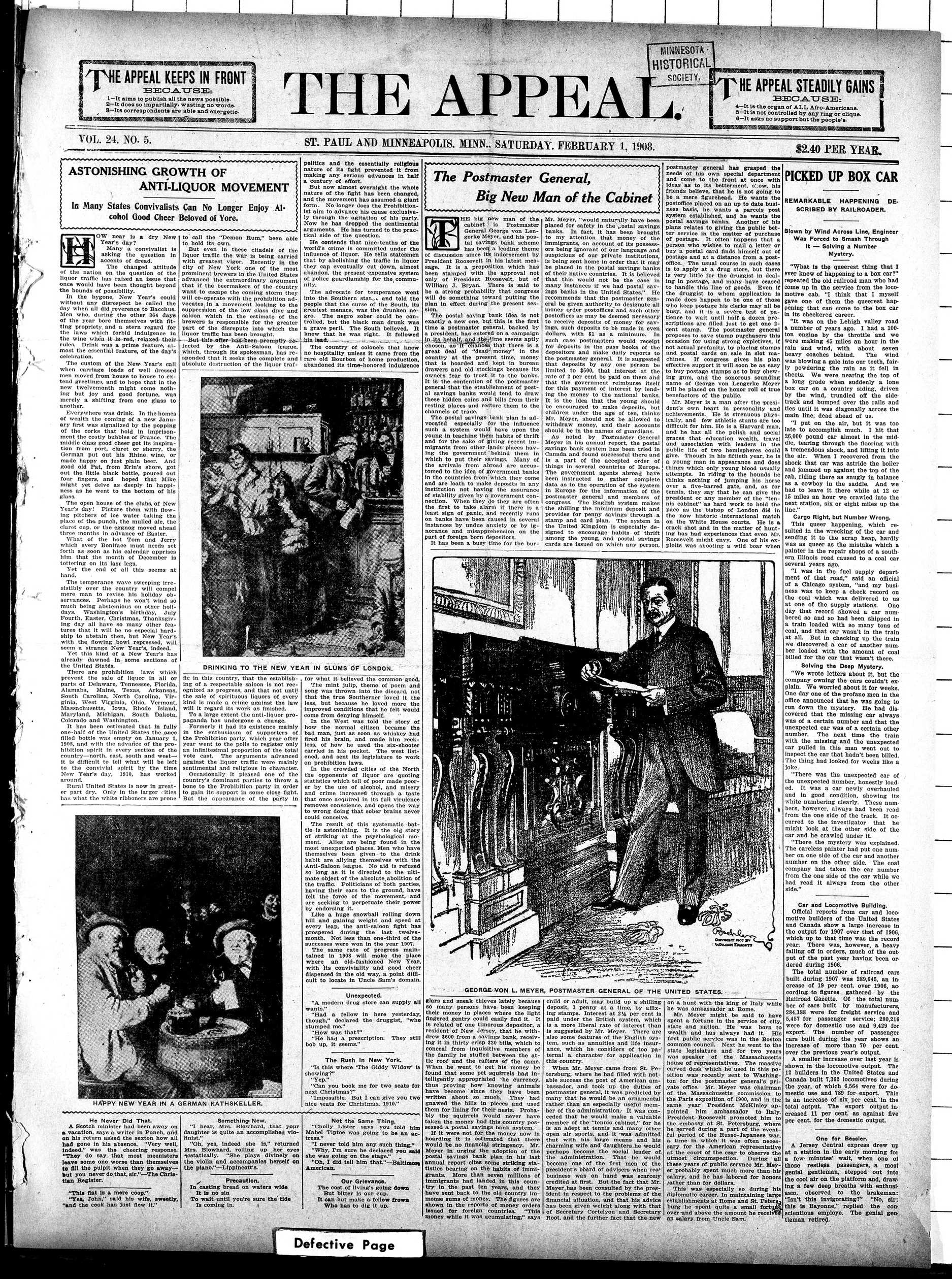
HAPPY NEW YEAR IN A GERMAN RATHSKELLER.
VOL. 24. NO. 5.
ASTONISHING GROV
ANTI-L
In Many States Convivalists
cohol Good Cheer
OW near is a dry New
Year's day?
H
What of the hot Tom and Jerry which every Bonnie must need sets forth as soon as his calendar apprises him that the month of December is taking on its last legs. It is the end of all this seems at hand.
The temperance wave sweeping irresistibly over the country will compel mere man to revise his holiday observances. Perhaps he won't wind so much being abstemious on other holidays as it will be on New York's Fourth, Easter, Christmas, Thanksgiving day all have so many other features that it will be no special hardship to abstain then, but New Year's with the flowing bow repressed, will seem to strange New Year's, indeed. It has already dawned in some sections of the United States.
There are prohibition laws which prevent the sale of liquor in all or parts of Delaware, Tennessee, Florida, Alamanda, Maine, Texas, Arkansas, Kentucky, West Virginia, Ohio, Vermont, Massachusetts, Iowa, Rhode Island, Maryland, Michigan, South Dakota, Colorado and Washington.
It has been estimated that in fully one of the United States the once filled hold of liquor was 1908, and with the advance of the prohibition spirit in every section of the country—north, east, south and west—it is difficult to tell what will be left to the convivial spirit by the time New year's day, 1910, has worked around.
Rural United States is now in greater part dry. Only in the larger cities what has the white ribboners are prone
HAPPY NEW YEAR IN A
A Scotch minister had been away on a vacation, says a writer in Punch, and on his return asked the sexton how all had gone in his absence. Wey well, indeed," was the cheering response. "They do say, that most meisters leave some one worse than themselves to fill the pulpit when they go away—but you never do that, sir."—The Christian Register.
"This flat is a mere coop."
"Yes, John," said his wife, sweetly, "and the cook has just flew it."
DRINKING TO THE NEW YEAR IN SLUMS OF LONDON
to call the "Demon Rum," been able to hold its own.
But even in these citadels of the liquor traffic the war is being carried with greater vigor. Recently in the city of New York one of the most prominent brewers in the United States advanced the extraordinary argument that if the beermakers of the country want to escape the coming storm they advocate in a movement the prohibition suppression of the low class dive and saloon which in the estimate of the brewers is responsible for the greater part of the disrepute into which the liquor traffic has been brought.
But this offer has been promptly resisted which, through its spokesman, has responded that it seeks the complete and absolute destruction of the liquor traf-
DRINKING TO THE NEW YE
fic in this country, that the establishing of a respectable saloon is not recognized as progress, and that not until it is recognized that the kind is made a crime against the law will it regard its work as finished. To a large extent the anti-liquor propaganda of the 1920s was
Formerly it had its existence mainly in the enthusiasm of supporters of the Prohibition party, which year after year went to the polls to register only an infinitesimal proportion of the total vote cast. The arguments advanced against the liquor traffic were mainly related to religious in character. Occasionally it was the country's dominant parties to throw a bone to the Prohibition party in order to gain its support in some close fight. But the appearance of the party in
GERMAN RATHSKELLER.
Something New.
"I hear, Mrs. Blowhard, that your daughter is quite an accomplished violinist."
"Oh, yes, indeed she is," returned Mrs. Blowhard, rolling up her eyes and pointing to the violin and accompanies herself on the piano."-Lippincott's.
To wait until you're sure the tide
Is coming in.
THE APPEA
HE big new man of the cabinet is Postmaster Owens of Pegerke Meyer, and his postal savings bank scheme has been a leading theme of discussion since its indorsement by President Roosevelt in his latest message. It is a proposition which has been stamped with support but not with hoodliness but with William J. Bryan. It is said to be a strong probability that congress will do something toward putting the plan in effect during the present session. The postal savings bank idea is not exactly a new one, but this is the first time a postmaster general, backed by a president, has entered on a campaign in its behalf, and the time seems aptly chosen, as it chances, that there is a great deal of "dead money" in the bank that is hoarded and kept in bureau drawers and old stockings because its owners fear to trust it to the banks. It the contention of the postmaster general that the establishment of postal savings banks would tend to draw hidden coins and bills from their restroom to restore them to the commerce of trade.
YEAR IN SLUMS OF LONDON.
The postal savings bank plan is advocated especially for the influence such a system would have upon the young in teaching them habits of thrift and embezzlement. The recent immigrants from other lands placed the government behind them in which to put their savings. Many of the arrivals from abroad are accustomed to the idea of government banks in the countries from which they come from. They are in any institution not having the they are in any institution given by a government connection. When they do they are often the first to take alarm if there is a least sign of panic, and recently runs banks have been caused in several instances. This has led to the ignorance and misapprehension on the part of foreign born depositors.
GEORGE VON L. MEYER
glars and sneak thieves lately because so many persons have been keeping their money in places where the light fingered gentry could easily find it. It is related to one timorous depositor, a girl named Martha, who drew $400 from a savings bank, receiving it in thirty crisp $20 bills, which to conceal from inquisitive members of the family he stuffed between the attic roof and the rafters of the same. When he wanted to get his money, found that some pet squirrels had intelligently appropriated the currency, thus proving how knowing animals have become since they have been written about so much. They had inwarded the bills in an attempt. Probably the squirrels would never have taken the money had this country possessed a postal savings bank system. If it were not for the money now in hawking Ms. it estimated that would be no financial stringency. Mr. Meyer in urging the adoption of the postal savings bank plan in his last annual report cities some striking statistics bearing on the habits of immigrating Ms. it estimated that immigrants had landed in this country in the past ten years, and they have sent back to the old country immense sums of money. The figures are shown in the reports of money orders for foreign countries. "This money while it was accumulating," says
politics and the essentially religious nature of its fight prevented it from making any serious advances in half a century of effort. But not almost overnight the whole nature of the war has been changed, and the movement has assumed a giant form. No longer does the Prohibitionist aim to advance his cause exclusively through the agitation of his party. Now he has dropped the sentimental arguments. He has turned to the practical side of the question. He has turned to the moments of the world's crime is committed under the influence of liquor. He tells statesmen that by abolishing the traffic in liquor they can eventually cut down, almost abandon, the present expensive system of police guardianship for the community. The advocate for temperance went into the Southern state, and told the people that the state had no greatest menace, was the drunken negro. The negro sober could be controlled, but the black man drunk was a grave peril. The South believed. It knew that he was right. It believed his lead. The country of colonels that knew no justice in the case of the rare old Bourbon of home production abandoned its time-honored indulgence
for what it believed the common good. The mint julip, theme of poem and song was thrown into the discard, not that the True Southernner loved it the less, but because he loved more the less, and the felt would come from denying himself.
In the West was told the story of how the normal citizen became the bad man, just as soon as whiskey had fired his brain, and made him reckon that he was the one who carried in his pocket. The west listened, and sent its legislature to work on prohibition laws.
In the crowded cities of the North the opponents of liquor are quoting themselves, and open the way to wrong doing that sober brains never come to grips. The result of this systematic battle is astonishing. It is the old story of striking at the psychological moment. Alies are being found in the most unexpected places. Men who have themselves been given to the drink have been given to the Anti-Saloon league. No aid is refused so long as it is directed to the ultimate object of the absolute, abolition of the traffic. Politicians of both parties, having their ears to the ground, have felt the force of the movement, and have felt the power to perpetuate their power by endorsing it.
A huge snowball rolling down hill and gaining weight and speed at every leap, the anti-saloon fight has been going on for a month. Not less than one-third of the successes were won in the year 1997.
The same rate of progress maintained in 1808 will make the place where an old-fashioned New Year, with its conviviality and good cheer dispensed in the old way, a point difficult to locate in Uncle Same's domain.
Unexpected.
"A modern drug store can supply all wants."
"Had a fellow in here yesterday, though," declared the druggist, "who stumped me."
"How was that?"
"He had a prescription. They still bob up, it seems."
# The Rush in New York.
"Is this where 'The Giddy Widow' is showing?"
"Yep."
"Can you book me for two seats for next Christmas?"
"Impassible. But I can give you two nice seats for Christmas, 1910."
# Not the Same Thing.
"Cholly Lister says you told him Mabel Tipote was going to be an actress."
"I never told him any such thing."
"Why, I'm sure he declared you said she was going on the stage."
"Oh, I did tell him that."—Baltimore American.
# Our Grievance.
The cost of living's going down
But bitter is our cup.
It can but make a few frown
Who has to dig it up.
Defective Page
The Postmaster General, Big New Man of the Cabinet
Copyright 1907 by WALDON TANGETS
GEORGE VON L. MEYER, POSTMASTER GENERAL OF THE UNITED STATES
HE big new man of the cabinet is Postmaster General George von Lengerkeyer Meyer, and his post savings bank scheme has been a leading theme
It has been a busy time for the bur-
Mr. Meyer, "would naturally have been placed for safety in the postal savings banks. In fact, it has been brought to my attention that money of the municipality is being ignored of our language and suspicious of our private institutions, is being sent home in order that it may be placed in the postal savings banks of their native countries. It is believed that many instances of we had postal savings banks in the United States." He recommends that the postmaster general be given authority to designate all money order post offices and such other institutions as necessary to receive deposits of money, such deposits to be made in even dollars, with $1 as a minimum. In such case postmasters would receipt for deposits in the pass books of the money order, and make daily reports to the postmaster general about that deposits by any one person be limited to $500, that interest at the rate of 2 per cent be paid on them and that the government reimburse itself the payment of interest by lending to the people. It is the idea that the young be encouraged to make deposits, but children under the age of ten, thinks Mr. Meyer, should not be allowed to make money, and their accounts should not be made up of things in several countries of Europe. The government agents abroad have been instructed to gather complete data as to the operation of the system in Europe for the information of the system in congress. The English system makes the shilling the minimum deposit and provides for penny savings through a stamp and card plan. The system in the United Kingdom is especially designed among the young, and postal savings cards are issued on which any person,
R, POSTMASTER GENERAL OF THE
postmaster general has grasped the needs of his own special department and come to the front at once with ideas as to its betterment, e.g., his friends believe, that he is not going to be a mere figurehead. He wants the necessity basis, he wants a parcel post system established, and he wants the postal savings banks. Another of his plans relates to giving the public better service in the matter of purchase of postage. It often happens that a postmaster makes a buy a postal card finds himself out of postage and at a distance from a post-office. The usual course in such cases is to apply at a drug store, but there is very little for the druggist in dealing in postage, and many have ceased to handle this line of goods. Even if a postmaster made does happen to be one of those who keep postage his clerks may all be busy, and it is a severe test of patience to wait until half a dozen prescriptions are filled just to get one 2-cent stamp. The postmaster general also to save stamp purchases this season not actual profanity, by placing stamps and postal cards on sale in slot machines. If congress will soon be as easy to buy postage stamps as to buy chewing gum, and the sonorous sounding words of the Meyer will be placed on the honor roll of true benefactors of the public.
Mr. Meyer is a man after the president's own heart in personality and achievements. He is strenuous physically, and few athletic stunts are too difficult for him. He is a Harvard man, and he has all the polish and social skills he needs. He is involved and association with leaders in the public life of two hemispheres could give. Though in his fiftieth year, he is a young man in appearance and does things only young blood usually attempts. In riding to the hounds he thinks of jumping his horse in a race, giving him tennis, they say that he can give the president or any member of the "tennis cabinet" as hard work to hold the pace as the bishop of London did in the now historic international match on the White House courts. He is a man with a winning has had experiences that even Mr. Roosevelt might envy. One of his exploits was shooting a wild boar when
Brachley
COPYRIGHT NOT BY
WALDON TANGETT
UNITED STATES.
on a hunt with the king of Italy while he was ambassador at Rome.
Mr. Meyer might be said to have spent a fortune in the service of city, state and nation. He was born to wealth and has always had it. His first public service was in the Boston common council. Next he went to the state legislature and for two years was speaker of the Massachusetts house of representatives. The massive carved desk which he used in this position was recently sent to Washington for the postmaster general's private office. Mr. Meyer was chairman of the Massachusetts commission to the Paris exposition of 1900, and in the same year President McKinley appointed him ambassador to Italy. President Roosevelt promoted him to the embassy at St. Petersburg, where he served during a part of the eventful period of the Russo-Japanese war, a time in which it was often necessary for the American representative at the court of the czar to observe the utmost circumspection. During all these years of public service Mr. Meyer probably spent much more than his salary, and he has labored for honors rather than for dollars.
This was especially so during his diplomatic career. In maintaining large establishments at Rome and St. Petersburg he spent quite a small fortune over and above the amount he received as salary from Uncle Sam.
$2.40 PER YEAR.
PICKED UP BOX CAR
REMARKABLE HAPPENING DESCRIBED BY RAILROADER.
"What is the queerest thing that I ever knew of happening to a box car?" repeated the old railroad man who had come up in the service from the locomotive cab. "I think that I myself gave one of them the queerest happening that can come to the box car in its checked career.
"It was on the Lehigh valley road a number of years ago. I had a 100-mile drive by the throttle and we were making 45 miles in the rain and wind, with about seven heavy coaches behind. The wind was blowing a gale into our teeth, fairly powdering the rain as it fell in sheets. We were nearing the top of a long grade when suddenly a lone box car on a country siding, driven by the wind, trundled on the sidetrack and bumped over the rails and ties until it was diagonally across the main line, dead ahead of us.
"I put on the air, but it was too late to accomplish much. I hit that 200-mile car almost in the middle, teetering, with a tremendous bump, and lifting into the air. When I recovered from the shock that car was astride the boiler and jammed up against the top of the cab, riding there as snugly in balance as a cowboy in the saddle. And we had to leave it there while at 12 or 15 miles an hour we crawled into the next station, six or eight miles up the line."
Cargo Right, but Number Wrong.
This queer happening, which resulted in the wrecking of the car and coming to the scrap heap, hardly was as queer as mistakes which a painter in the repair shop of a southern Illinois road caused to a coal car several years ago.
"I was in the fuel supply department of that road," said an official of a Chicago system, "and my business was to keep a check record on the coal which was delivered to us at one of the supply stations. One day that record showed a car numbered so and so had been shipped in a train loaded with so many tons of coal, and that car wasn't in the train at all. But in checking up the train we discovered a car of another number loaded with the amount of coal billed for the car that wasn't there.
Solving the Deep Mystery.
"We wrote letters about it, but the company owning the cars couldn't explain. We worried about it for weeks. One day one of the profane men in the office announced that he was going to run down the mystery. He had discovered that the missing car always was of a certain number and that the unexpected car was of a certain other number. The next time the train with the missing and the unexpected car pulled in this man went out to inspect the car that hadn't been billed. The thing had looked for weeks like a joke.
"There was the unexpected car of the unexpected number, honestly loaded. It was a car newly overhailed and in good condition, showing its numbering clearly. These numbers, however, always had been read from the one side of the track. It occurred to the investigator that he might look at the other side of the car and he crawled under it.
"There the mystery was explained. The careless painter had put one number on one side of the car and another number on the other side. The coal company had taken the car number from the one side of the car while he had read it always from the other side."
Car and Locomotive Building
Official reports from car and locomotive builders of the United States and Canada show a large increase in the output for 1907 over that of 1906, which up to that time was the record year. There was, however, a heavy falling off in orders, much of the output of the past year having been ordered during 1906. The total number of railroad cars built during 1907 was 283,645, an increase of 4 per cent. over 1906, according to figures from the Railroad Gazette. Of the total number of cars built by manufacturers, 284,188 were for freight service and 5,457 for passenger service; 280,216 were for domestic use and 9,429 for export. The number of passenger cars built during the year shows an increase of more than 70 per cent over the previous year's output. A smaller increase over last year is shown in the locomotive output. The 12 builders in the United States and Canada built locomotives during the period of which 9,565 were used by 789 for export. This is an increase of six per cent. in the total output. The export output increased 11 per cent. as against five per cent. for the domestic output.
One for Beasler.
A Jersey Central express drew up at a station in the early morning for a few minutes' wait, when one of those restless passengers, a most genial gentleman, stepped out into the cool air on the platform and, drawing a few deep breaths with enthusiasm, observed to the brakeman: "Isn't this invigorating?" "No, sir; this is Bayone" replied the conscientious employee. The genial genial man retired.
HAVE YOU READ
THE APPEAL?
THE APPEAL,
A NATIONAL AFRO-AMERICAN NEWSPAPER
PUBLISHED WEEKLY BY
ADAMS BROS. EDITORS AND PUBLISHERS
49 E. 4th St., St. Paul, Minn.
ST. PAUL OFFICE
No. 236 Union Block, 4th & Cedar.
J. Q. ADAMS, Manager
MINNEAPOLIS OFFICE
Guaranty Loan Bldg., Room 1020.
H. B. BURK, Manager.
CHICAGO OFFICE
323-5 Dearborn Street, Suite 660.
C. F. ADAMS, Manager
TERMS, STRICTLY IN ADVANCE:
The above is the original sample of the news showed to run without prepayment, the items are as follows: 60 cents for each 13 weeks and 5 cents for each odd week, or at the rate of $2.40 per year.
Remittances should be made by Express Money Order, Post Office Money Order, 16.
gistered Letter or Bank Draft. Postage stamps will be received the same as each for the fractional parts of a dollar. Only one of the two percent stamps taken.
Silver should have been purchased the man. It is almost sure to wear a hole through the envelope and be lost; or else it may be stolen. Persons who send silver to us in letters do so at their own risk.
Harrington and the others are 10 lines or less $1. Each additional line 10 cents. Payment strictly in advance, and to be announced at all must come in season to be news.
Advertising rates, 15 cents per agate line, each line is on the line, and about seven per aute in an inch, and about seven per aute. No single advertisements less than $1. No discount allowed on less than the amount of the price.
The new ad is in the new company all orders from parties unknown to us. Further particulars on application.
Reading notices 25 cents per line, each insertion. No discounts for time or space. Reading minutes is set in brewer type—about six words to the line. All head-lines count could be.
The date on the address label shows when subscription expires. Renewals should be made two weeks prior to expiration, so that no other member is issued, as the paper stops when time is out.
It occasionally happens that papers sent to subscribers are lost or stolen. In case you do not receive any number when due, inform us by postal end at the expiration of five days from that date, and we will cheerfully forward a duplicate of the missing number.
Communications to receive attentions must be newsy, upon important subjects, plainly written only upon one side of the paper; must reach us Tuesdays if possible, anyway not later than Wednesdays, and bear the signature of the author. No manuscript returned, unless stamps are sent for postage.
We do not hold ourselves responsible for the views of our correspondents.
Soliciting agents wanted everywhere. Write for terms. Sample copies free.
In every letter that you write is never fail to give your full name and address, plainly written, post office, county and state. Business letters of all kinds must be written on separate sheets from letters containing news or matter for publication. Entered as second class matter June 6, 1885 at the post office at St. Paul, Min., under act of Congress, March 3, 1879.
PRESIDENT ROOSEVELT.
Treat each man according to his worth as a man. Distrust all who would have any one class placed before any other. Other republics have fallen because the unscrupulous have substituted loyalty to class for loyalty to the people as a whole. —President Roosevelt's speech at Little Rock, Ark.
SATURDAY, FEBRUARY 1, 1908.
CIVILIZATION'S TRIUMPH.
A few years ago Persia was considered a semi-civilized country, the government being an absolute monarchy. Last year the Shah granted a constitution and a parliament.
Recent events prove that the Persian people are making great strides and the time is not far distant they will be up to the standards of American civilization as exemplified in Georgia and Mississippi.
The following is a cable to the Chicago Record-Herald:
"Teterah, Jan. 26.—Advices received here today from Yezid, capital of the Province of Habrame, in central Persia, announce a wholesale jail delivery and a lynching. It appears that a man named Renza was confined in the prison at the governor's residence, charged with murdering his brother. Crowds of citizens assembled, and demanded that the prisoner be handed over to them for punishment, and on the governor refusing to do so his residence was stormed by the mob, who released all the prisoners found in the jail except Renza, who was lynched, the rioters riddling his body with bullets"
GAS
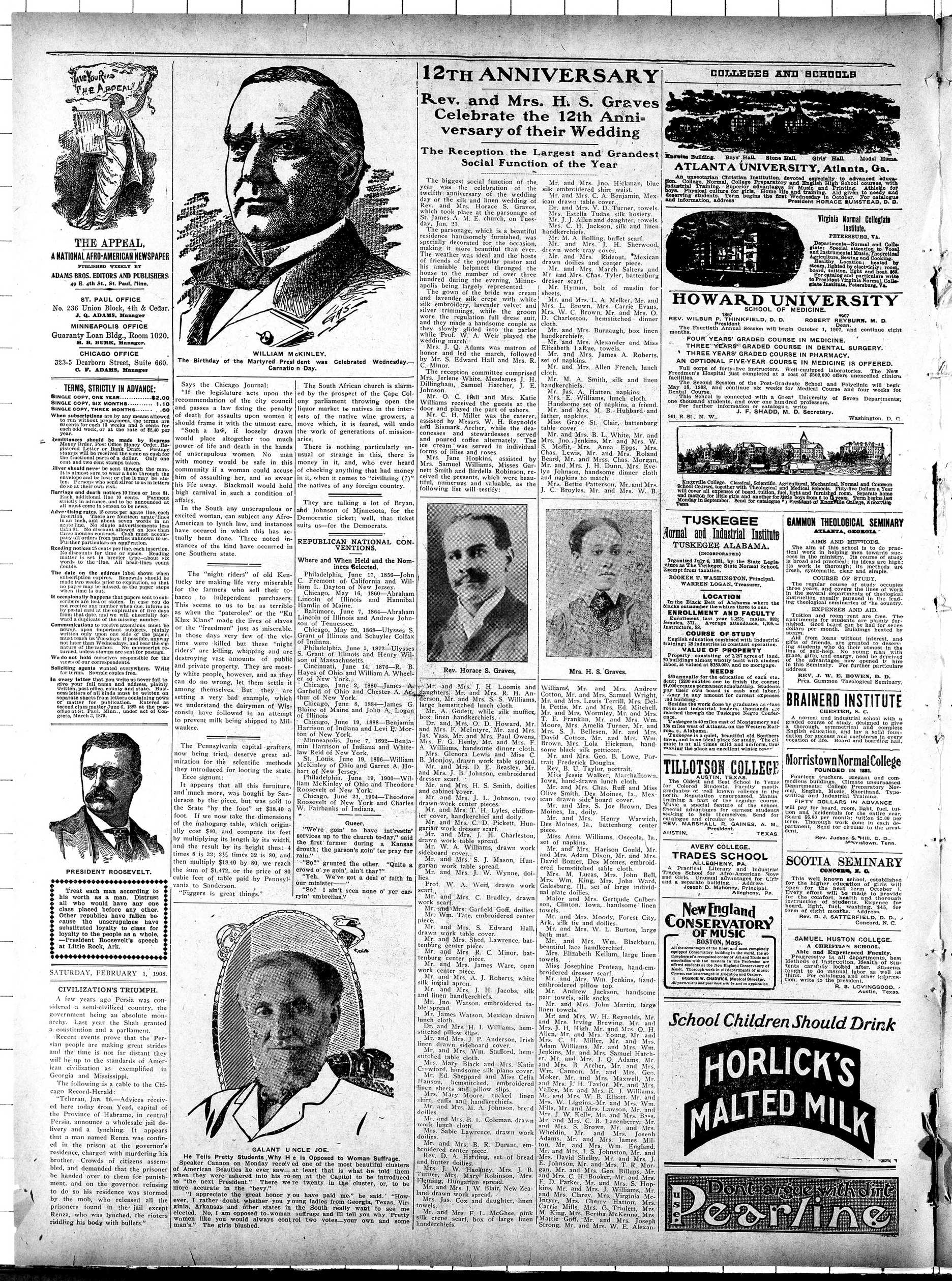
The Birthday of the Martyred President was Celebrated Wednesday. Carnatio n.Day.
"If the legislature acts upon the recommendation of the city council and passes a law fixing the penalty of death for assaults upon women it should frame it with the utmost care. "Such a laa, if loosely drawn would place altogether too much power of life and death in the hands of unscrupulous women. No man with money would be safe in this community if a woman could accuse him of assaulting her, and so swear his life away. Blackmail would hold high carnival in such a condition of affairs.
In the South any unscrupulous or excited woman, can subject any Afro-American to lynch law, and instances have occurred in which this has actually been done. Three noted instances of the kind have occurred in one Southern state.
The "night riders" of old Kentucky are making life very miserable for the farmers who sell their tobacco to independent purchasers. This seems to us to be as terrible as when the "pateroles" or the "Ku Klux Klans" made the lives of slaves or the "freedmen" just as miserable. In those days very few of the victims were killed but these "night riders" are killing, whipping and are destroying vast amounts of public and private property. They are mostly white people, however, and as they can do no wrong, let them settle it among themselves. But they are setting a very bad example, which we understand the dairymen of Wisconsin have followed in an attempt to prevent milk being shipped to Milwaukee.
The Pennsylvania capital grafters, now being tried, deserve great admiration for the scientific methods they introduced for looting the state. Ecee signum:
It appears that all this furniture, and much more, was bought by Sanderson by the piece, but was sold to the State "by the foot" at $18.40 a foot. If we now take the dimensions of the mahogany table, which originally cost $40, and compute its feet by multiplying its length by its width, and the result by its height thus: 4 times 8 is 32; 2½ times 32 is 80, and then multiply $18.40 by 80, we reach the sum of $1,472, or the price of 80 cubic feet of table paid by Pennsylvania to Sanderson.
"Figgers is great things."
M
GALANT UNCLE JOE
GALANT UNCLE JOE.
He Tells Pretty Students, Why He Is Oppose
Speaker Cannon on Monday received one of the of American Beauties he ever saw—at least the when any way he was into his room at the to "the next President." There we're twenty more accurate in the "bevy"
"I appreciate the great honor you have paver, I rather doubt whether you young ladies, girls, Arkansas and other states in the South elected. No, I am opposed to woman suffrage and women like you would always control two you man's." The girls blushed.
He Tells Pretty Students, Why He Is Opposed to Woman Suffrage.
Speaker Cannon on Monday received one of the most beautiful clusters of women Beauties he ever saw—at least that is what he told them when they mentioned he sat at Capitol to be introduced to "the next President." There were twenty in the cluster, or to be more accurate in the "bevy."
"I appreciate the great honor you have paid me," he said. "However, I rather doubt whether you young ladies from Georgia, Texas, Virginia, Arkansas and other states opposed to woman suffrage and ill tell you why. Pretty women like you are always control two votes-"your own and some man's." The girl blushed.
The South African church is alarmed by the prospect of the Cape Colony parliament throwing open the liquor market to natives in the interests of the native wine growers, a move which, it is feared, will undo the work of generations of missionaries.
There is nothing particularly unusual or strange in this, there is money in it, and, who ever heard of checking anything that had money in it, when it comes to "civilizing (?) the natives of any foreign country.
They are talking at a lot of Bryan, and Johnson of Minnesota, for the Democratic ticket; well, that ticket suits us—for the Democrats.
REPUBLICAN NATIONAL CONVENTIONS.
Where and When Held and the Nominees Selected
Philadelphia, June 17, 1856—John C. Fremont of California and William L. Dayton of New Jersey.
Chicago, May 17, 1860—Abraham Lincoln of Illinois and Hannibal Hamlin of Maine.
Baltimore, June 7, 1864—Abraham Lincoln of Illinois and Andrew Johnson of Tennessee.
Chicago, May 20, 1868—Ulysses S. Gates of Illinois and Schuyler Colaf of Indiana.
Philadelphia, June 5, 1872—Ulysses S. Grant of Illinois and Henry Wilson of Massachusetts.
Cincinnati, June 14, 1876—R. B. Heses of Ohio and William A. Wheeler of Chicago, June 2, 1880—James A. Garfield of Ohio and Chester A. Arthur of New York.
Chicago, June 8, 1884—James G. Bineke of Maine and John A. Logan of Chicago, June 19, 1889—Benjamin Harrison of Indiana and Levi R. Morton of New York.
Minneapolis, June 7, 1892—Benjamin Harrison of Indiana and Whitehead St. Lock, June 19, 1890—William Mckinley of Ohio and Garret A. Hoart of New Jersey.
Philadelphia, June 19, 1900—William McKinley of Ohio and theodore Roosevelt of New York.
Chicago, June 1, 2014—Theodore Roosevelt of New York and Charles W. Fairbanks of Indiana.
Queer.
"We're goin' to have int'resth' services up to the church to-day," said the first farmer during a Kansas drouth; the parson's goin' tether pray furrain.
"So" grunted the other. "Quite a crowd o' yein' goin' thar?"
"Yeh. We've got a deal o' faith in our minister."
"So? I ain't seen none o' yer carvin' umbrellas."
12TH ANNIVERSARY
Rev. and Mrs. H. S. Graves Celebrate the 12th Anniversary of their Wedding
The Reception the Largest and Grandest Social Function of the Year
The biggest social function of the year was the celebration of the twelfth anniversary of the wedding day or the silk and linen wedding of Rev. and Mrs. Horace S. Graves, which took place at the parsonage of St. James A. M. E. church, on Tuesday. The parsonage, which is a beautiful residence handsomely furnished, was specially decorated for the occasion, making it more beautiful than ever. The weather was ideal and the hosts of friends of the popular pastor and his amiable helpmeet thonged the house to the number of over three hundred during the evening, Minneapolis being largely represented. The couple of the bride was cream and lavender and lavender velvet, silver embroidery, lavender velvet, silver trimmings, while the groom wore the regulation full dress suit, and they made a handsome couple as they slowly glided into the parlor while Prof. W. A. Weir played the wedding march. Mr. Adams was matron of honor and led the march, followed by Mr. S. Edward Hall and Mrs. R. C. Minor.
The reception committee comprised Mrs. Jerlene White, Mesdames J. H. Dillingham, Samuel Hatcher, J. E. Johnson.
Mr. O. C. Hall and Mrs. Katie Williams received the guests at the door and played the role of Mr. C. H. Miller was the caretaker, assisted by Messrs. W. H. Reynolds and Bismark, Archer, while the deaconeses and stewardesses served and poured coffee alternately. The ice cream was served in individual forms of lilies and roses.
Ms. Jane Hopkins, assisted by Mrs. Susan Williams, Misses Garnett Smith and Bibbie Robinson, received the presents, which were beautiful, numerous and valuable, as the following list will testify:
Rev. Horace S. Graves.
Mr. and Mrs. J. H. Loomis and daughters, Mr. and Mrs. R. H. Anderson, Mr. and Mrs. S. S. Williams, large hematised lunch cloth, Mr. and Mrs. S. S. silk muffer, box line handkerchiefs, Dr. and Mrs. O. D. Howard, Mr. and Mrs. F. McIntyre, Mr. and Mrs. Jas. Vass, Mr. and Mrs. Paul Owens, A. Williams, hamburger dish, F. A. Williams, hamburger dish, Mrs. Glenora Lewis and Miss C. B. Monjoy, drawn work table spread, Mr. and Mrs. D. E. Beasley, Mr. and Mrs. J. B. Johnson, embroidered dresser scarf, Mr. and Mrs. H. S. Smith, doilies and cabinet voyer, Mr. and Mrs. J. L. Johnson, two drawn work center pieces, Mr. and Mrs. T. H. Lyles, chiffon cover, handkerchief and doily, Mr. and Mrs. J. H. Kuttang, Hungarian dresser scarf, Mr. and Mrs. J. H. Charleston, drawn work table spread.
Mr. W. A. Williams, drawn work sideboard cover.
Mr. and Mrs. S. J. Mason, Hungarian work table spread.
Mr. and Mrs. J. W. Wynne, doilies.
Prof. W. A. Weitdrawn work scarf,
Mr. and Mrs. C. Bradley, drawn work scarf.
Mr. and Mrs. S. Edward Hall drawn work table cover.
Mr. and Mrs. Shed. Lawrence, battenburg center piece.
Mr. and Mrs. R. C. Minor, battenburg center piece.
Mr. and Mrs. James Ware, open work center piece.
Mr. and Mrs. A. J. Roberts, white silk initial apron.
Mr. James Watson, Mexican drawr lunch cloth.
Dr. and Mrs. H. I. Williams, hem-stitched pillow slips.
Mary, Mrs Black and Mrs Katie
Crawford, handsome silk piano cover
and sheppard and Miss Celia
Hanson, wonderful coffered
linen sheets and pillow shams.
Mr. and Mrs. B. L. Coleman, drawn work lunch cloth. Mrs. Sabie Lawrence, drawn work doilies.
Mr. and Mrs. B. R. Durant, embroidered center piece.
Rev. D. A. Hatting, set of bread and butter dolies.
T. Wesley, Mrs. W. Hackeyn, Mrs. J. B. Turton, Mrs. J. B. Turton, Mrs. Fleming, Hungarian spread.
Mr. and Mrs. J. W Blair, New Zealand drawn work spread.
Mrs. Jas. Cox and daughter, linen towels.
Mr. and Mrs. F. L. McGhee, pink sikl
sikl scarf, scarf, of large linen
landerchiefs
Mr. and Mrs. Jno. Hickman, blue silk embroidered shirt waist.
Mr. and Mrs. C. A. Benjamin, Mexican drawn table cover.
Dr. and Mrs. Teller, towels, Estella tauk, silk hosiery.
Mr. J. J Allen and daughter, towels.
Mrs. C. H. Jackson, silk and linen handkerchiefs.
Mr. M. A. Bolling, buffet scarf.
Mr. and Mrs. J. H. Sherwood, drawn wool over trowel.
Mr. and Mrs. Rideout, Mexican drawn doilies and center piece.
Mr. and Mrs. March Salters and Mr. and Mrs. Chas. Tyler, battengroom dresser scarf.
Mr. Hyman, bolt of muslin for shirts.
Mr. and Mrs. L. A. Mekler, Mr. and Mrs. L. Brown, Mrs. Carrie Evans, Mrs. W. C. Brown, Mr. and Mrs. O. D. Charleston, hemstitched dinner cloth.
Mr. and Mrs. Burnaugh, box linen handkerchiefs.
Mr. and Mrs. Alexander and Miss Elizabeth LaRue, towels.
Mr. and Mrs. James A. Roberts, set of napkins.
Mr. and Mrs. Allen French, lunch cloth.
Mr. M. A. Smith, silk and linen handkerchiefs.
Mr. Jas. A. Hatten, napkins.
Mrs. E. Williams, lunch cloth.
Handsome set of napkins, a friend.
Mr. and Mrs. M. B. Hubbard and father, napkins.
Miss Grace St. Clair, battenburg table cover.
Mr. and Mrs. B. L. White, Mr. and Mrs. Jno. Jenkins, Mr. and Mrs. W. Mofit, Mrs. Anna Epps, Mrs. Mofit, Mrs. Anna Epps, Mrs. Mofit, Mrs. Mrs. Roland Beard, Mrs. Mrs. Mrs. Morgan, Mrs. and Mrs. J. H. Dunn, Mrs. Evelyn Johnson, handsome dinner cloth and napkins to match.
Mrs. Bettie Patterson, Mr. and Mrs.
J. C. Broyles, Mr. and Mrs. W. B.
A. B.
Williams, Mr. and Mrs. Andrew
Cotton, Mr. and Mrs. Samuel Wright,
Mr. and Mrs. Lewis Terrill, Mrs. Dela
Pettis, Mrs. and Mrs. Ed. Mitchell,
Mr. and Mrs. Owney, Mr. and Mrs.
T. E. Franklin, Mr. and Mrs.
Moore, Mrs. Amelia Turner, Mr.
and Mrs. S. J. Bellesen, Mr. and Mrs.
David Cotton, Mr. and Mrs. Wm.
Brown, Mrs. Lola Hickman, hand-
some black silk peltiket. Coo,
B. Lowe, Portrait Frederick Dock
Rev, B. U. Taylor, portrait
Miss Jessie Walker, Marshallown,
Iowa, hand-drawn lunch cloth.
Mr. and Mrs. Chas. Ruff and Miss Olive Smith, Des Moines, Ia., Mexican drawn side board cover.
Mr. and Mrs. S. Joe Brown, Des Moines, Ia.
Mr. and Mrs. Henry Warwich, Des Moines, Ia., battenburg center piece.
Miss Anna Williams, Osceola, Ia., set of napkins.
Mr. and Mrs. Harison Gould, Mr. and Mrs. Adam Dixon, Mr. and Mrs. David Bomer, Des Moines, embroidered hemstitched table cloth.
Mr. and Mrs. Wm. King, Mrs. John Ward, Galesburg, Ill. set of large individual plate dolls.
Maior and Mrs. Gerptude Culberson, Clinton, Iowa, handsome linen towels.
Mr. and Mrs. Moody, Forest City, Ark, silk tie and dolls.
Mr. and Mrs. W. L. Burton, large bath mat.
Mr. and Mrs. Wm. Blackburn, beautiful lace handkerchief. Mrs. Elizabeth Kellum, large linen towels.
Miss Josephine Proteau, hand-embroidered dresser scarf.
Mr. and Mrs. Wm. Jenkins, hand-embroidered dresser scarf.
Mr. orrewd, Jersey, hand-embroidery
Mr. Andrew Jackson, handsome pair towels, silk socks.
Mr. and Mrs. John Martin, large linen towels.
Mr. and Mrs. W. H. Reynolds, Mr. and Mrs. Irving Brewing, Mr. and Mrs. J. H. High, Mr. and Mrs. O. H. Allen, Mr. and Mrs. Young, Mr. and Mrs. C. H. Miller, Mr. and Mrs. Adam Williams, Mr. and Mrs. Wm. Jenkins, Mr. and Mrs. Samuel Hatcher, Mr. and Mrs. J. Q. Adams, Mr. and Mrs. B. Archer, Mr. and Mrs. Wm. Cannon, Mr. and Mrs. Geo Moker, Mr. and Mrs. Maxwell, Mr. and Mrs. J. H. Taylor, Mr. and Mrs. Valley, Mr. and Mrs. E. J. Williams, Mr. and Mrs. W. B. Elliott, Mr. and Mrs. W. Ligins, Mr. and Mrs. Wm. Mills, Mr. and Mrs. Lawson, Mr. and Mrs. J. W. Kelle, Mr. and Mrs. Bass, Mr. and Mrs. C. B. Lazenberry, Mr. and Mrs. S. Brown, Mr. and Mrs. Wheldin, Mr. and Mrs. Joseph Adams, Mr. and Mrs. James Mill, Mr. and Mrs. Wm. England, Mr. and Mrs. J. S. Johnston, Mr. and Mrs. David Shelby, Mr. and Mrs. J. E. Johnson, Mr. and Mrs. T. R. Morgan, Mr. and Mrs. G. G. Billup, Mr. and Mrs. C. H. Booker, Mr. and Mrs. F. D. Parker, Mr. and Mrs. S. H. Hopkins, Mr. and Mrs. J. Williams, Mr. and Mrs. Clarey, Mrs. Virginia, Mr. Intyre, Mrs. Cherry Hation, Mrs. Carrie Mills, Mrs. C. Triolett, Mrs. M. King, Mrs. Bertha McKenna, Mrs. Mattie Goff, Mr. and Mrs. Joseph Strong, Mr. and Mrs. W. E. Alexander
COMMERCE AND SCIENCE
An unectean Christian Institution, devoted especially to advanced education, offers English and High School courses, with industrial Training. Superior advantage. Boys' Physical culture for girls. Home life and training. Aid given to needy and ill children. Begins the first life and training. Information and information, address
President HORACE BUMSTEAD
HOWARD UNIVERSITY SCHOOL OF MEDICINE
The Fourtieth Annual Session will begin October 1, 1907, and continue eight months.
FULL CORP of forty-five instructors, Well-equipped laboratories. The New Freedman's Hospital just completed at a cost of $500,000 offers unexcelled clinical facilities. The Second Session of the Post-Graduate School and Polyclinic will begin May 18, 1906, and continue six weeks for Medical Course and four weeks for Dental Course. This School is connected with a Great University of Seven Departments; one thousand students, and over one hundred professors. For further information or catalogue, write J. F. SHADD, M. D. SECRETARY.
901 R. St., N. W.
Washington, D. C.
Knoxville College, Classical, Scientific, Agricultural, Mechanical, Normal and Common School Courses, together with Theological, and Medical Schools. Fifty-five Dollar a Year, for light and furnished room. Separate home and matron for little girls and another for little boys. Term beyond last Monday in September. Send to catalogue +) President of Knoxville College, knoxville
School Children Should Drink
HORLICK'S
MALTED MILK
Don't argue with dirt
Pearline
#
HOWARD UNI-
SCHOOL OF MED
1867
REV. WILBUR P. THINKFIELD, D. D.
President
The Fourth Annual Session will begin Oct.
months.
FOUR YEARS' GRADED COURSE IN
THREE YEARS' GRADED COURSE
THREE YEARS' GRADED COURSE IN
AN OPTIONAL FIVE-YEAR COURSE IN
full corps of forty-five instructors. Well-equ
lated Presidents Hospital just completed at a cost of
facilities.
The Second Session of the Post-Graduate
May 18th and continue six weeks for Me
Dental Course.
This School is connected with a Great Uri
and Thousand students and one hundred pts.
For further information or catalogue write
J. F. SHADD, M. D. S.
901 R St. N. W.
Knoxville College, Classical, Scientific, Agricultural
School, together with Theologics, and Medicine
will cover all expenses of great value.
and matron for little girls and another for little boys.
Monday in September. Send for catalogue *) Freddie
Tawn
TUSKEGEE Normal and Industrial Institute
Organized July 4, 1881, by the State Legislature. State Normal School exempt from taxation. Exempt from taxation. BOOKER T. WASHINGTON, Principal. WARREN LOGAN, TERAPEUT.
ENROLLMENT AND FACULTY
Enrollment last year 1.23; males 88; females 82.
Average attendance, 1105; Instructors, 88.
COURSE OF STUDY
English education combined with industrial training; English education combined with industrial training.
VALUE OF PROPERTY
Property consisting of 2,267 acres of land, 50 buildings almost wholly built with student labor, is valued at $350,000, and no mortgage. $50 annually for the education of each student; ($200 enables one to finish the course). $100 annually for the education of each student; pay their own bank in cash and labor, money in any amount for current expenses. Besides the work done by graduates as class room and industrial leaders, thousands of students are employed. Students are 40 miles east of Montgomery and 135 miles west of Atlanta on the Western Railroad. Alabama is a beautiful, beautiful old Southern town, and is an ideal place for study. The city is a pleasant place to enjoy the place an excellent winter resort.
TILLOTSON COLLEGE
The Oldest and Best School in Texas for College students. Graduates of well known colleges in the north. Reputation unassured. Manual equipment and paper. All school course Music a special feature of the school. Special advantages for earnest students help them. Send for catalog and return to REV. MARSHALL R. GAINES, A. M., President. AUSTIN. TEXAS
AVERY COLLEGE.
TRADES SCHOOL
ALLEGHENY, PA.
A Practical and Industrial Trades School for Afro-American Boys and Girls. Unusual advantages for Girls and a separate building.
Joseph D. Mahoney, Principal.
Allegeny, Pa.
New England CONSERVATORY OF MUSIC
BOSTON, Mass.
All the advantages of the finest and most completely equipped conservatory building in the world, the ample opportunities of a recognized course of Art and Music and association with the masters in the Profession are offered, meeting at the New England Conservatory of Music. Through work in all instrumental or music courses can be arranged in Education and Oratory. GEORGE W. CHOPPEL, Director. All particulars and your book will be sent on application
School Children's
HORLIO
LITED
Departments--Normal and College
Special Education to Vocal
and Instrumental Music, Theological
Agriculture, Swine and Cooking,
Baking and Desserting, heated by
steam, lighted by electricity, room
board, tuition, light and heat. $60
per student. Particular write to
President Virginia Normal College
Institute, Petersburg, Va.
UNIVERSITY
OF MEDICINE.
1907
D. ROBERT YEURN, M. D.
Dean.
Begin October 1, 1907, and continue eight
URSE IN MEDICINE.
URSE IN DENTAL SURGERY.
URSE IN PHARMACY.
URSE IN MEDICINE IS OFFERED.
Well-equipped laboratories. The New
cost of $500,000 offers unexcelled clinic
graduate School and Polyclinic will bek
for Medical Course and four weeks for
fear University of Seven Departments;
died professors.
e. write
M. D. Secretary.
Washington, D. C.
Agricultural, Mechanical, Normal and Common and Medical Schools. Fifty-five Dollars a Year, light and furnished room. Separate home, built by former students. Separate home, President of Lindenville College, Aurora.
GAMMON THEOLOGICAL SEMINARY
ATLANTA, GEORGIA
ADMS AND METHODS.
The aim of this form is to do practical work in helping men towards success in the ministry. Its course of study is bread and practical; its department are high; its work is thorough; its method are fresh, systematic, clear and simple.
COURSE OF STUDY.
The various courses of study occupies three years, and covers all of the work in the several departments of theological in the leading theological seminars.
Tuition and room rent are free. The Tuition fee is $150. All finished board can be had for seven dollars per month. Buildings heated by Aid from loans without interest, and Aid from loans with interest are granted to deserving students who are enrolled in line of self-help. No young man with Aid from loans without interest is deemed the advantages now opened in this Seminary. For further particulars address: REV. J. W. E. BOWEN, D. D., Pens. Gammon Theological Seminary.
BRAINERD INSTITUTE
CHESTER, S. C.
A normal and industrial school with a graded course of study, designed to give a thorough, symmetrical and complete English education, and lav a solid foundation for success and usefulness in every vocation of life. Board and boarding hall.
MorristownNormalCollege
Fourteen tracers, kieger and comm
departments, unsurpassed
Departments: College Premises,
mal, English, Music, Shorthand, Type-
writing, Training.
FIFTY DOLLARS will pay
will pay for board, room, light, fuel, fu-
tion and 'indications for the entire year,
per term. Through work done $2.00 per
per term. Through work done
department. Send for circular to the
resident.
Rev. Judson S. Will, D. D.
Marystown, Tenn.
SCOTIA SEMINARY
CONSTITUTION
This well known school, established for the higher education of girls will open for the first time. Every effort will be made to provide for the comfort, health and thorough education of students. Expense for board, light, water, meals, 45, for term of eight months. Address.
Rev. D. J. SATTERFIELD. D. D. Concord, N.C.
Abile and Experienced Faculty.
Progressive in all Departments, best
Methods of Instruction, Health of
Students carefully looked after. Stucca
taught to do manual labor as well as
think, write and other information,
write to the president.
R. 8. LOVINGGOOD.
Austin, Texas.
In Should Drink
The Klorsheim SHOE
For the man who cares
STANLEY
SHOE CO.
421 Robert Street, St. Paul
St. Paul
There's
A
Delight
In Knowing That
It's Good Butter.
Ordering
Star Brand
Always Gives
This
Assurance.
Churned Fresh
Every Day By The
MILTON, DAIRY CO.
Both Telephones 9th and Wabasha
N. W. Phones Main 2179-L Main 559-J2
SAMUEL G. THOMPSON
Attorney and Counselor at Law
PRACTICES IN ALL THE COURTS OF
THE STATE OF MINNESOTA.
Wills, Deeds, Contracts Etc., skillfully
drawn. Complicated Property
Matters and Accident Cases a Specialty.
THE FAMOUS
Duluth Brewing and Malting Co.
DULUTH, MINN.
LOUIS ARBOGAST
CHOICE GAME & MEATS Poultry
201.W. SEVENTH ST.
ST. PAUL, MINN.
JOS. TROST
GROCER
Cor. Rondo & Dale St
ST. PAUL
Both Phones ST. PAUL
CARL NELSON
DEALER IN
Fine Wines, Liquors and Cigars
Family Trade a Specialty
560 St. Anthony Avenue, Cor. of Kent
E. C. Phoce 4493 ST. PAUL, MINN.
JOHN THOORSELL V. E. THOORSILL
Thoorsell & Son
Funeral Directors and Embalmers
457 BROADWAY-PORTLAND BLK.
Tol. T. C. 2638.
N. W. Main 501.
Res.-T. C. 4620.
St. Paul, Minn.
JOHN H. HARRIS
GOL
GRAIN
BE
"You u
Everyone y
strictly l
DU
PAR
CIG
HART &
MNERS. s
If you see f
Anywh
You'll find
At Alb
GOLDEN
RAIN BEER
BEERS
you too!
everyone smokes
exactly High Grade
DUKE OF
PARMA
CIGARS
ART & MURPHY
FERS. ST. PAUL, N.
you see furs you
Anywhere else
I'll find them be
At Albrecht's
GOLDEN
GRAIN BELT
BEERS
"You too?"
Everyone smokes the
strictly High Grade
DUKE OF
PARMA
CIGARS
HART & MURPHY,
MNFRS. ST. PAUL, MINN.
Sixth and Minnesota Streets
"For Dress Up or P
MACPHERS
& LANGFORD
SKIRTS
Are the Best
Made
SPEC
"Gig Up or Play"
HERSON
BINGFORD
HARTS
The Best
Trade
NAME
IN EVERY
GARMENT
IF YOUR DEALER W
COME TO US
209 EAST 4
PECIAL
"For Dress Up or Play"
MACPHERSON
& LANGFORD
SKIRTS
Are the Best
Made
NAME
IN EVERY
GARMENT
IF YOUR DEALER WONT SUPPLY YOU
COME TO US, WE WILL.
209 EAST 4TH ST ST PAUL
Dining Room Chairs
A more handsome line of dining room chairs has never been shown in the city. We quote here a few of the many bargains for the day of the thanks.
Regular Special
No. 705 Weathered Oak
Leather Box Seat Diner $2.00 $1.50
No. 250 Golden Oak Wood
Seat Diner. 2.75 2.07
No. 250 Golden Oak Leather
Box Seat Diner. 3.50 2.63
THE WALLB
398 TO 408 JACKSON ST.
THE HOUSE THAT
ALLBLOM FU
JACKSON STREET, ST. PA
E THAT SAVES YOU
FALL WOOLENS
Have Just Arrived
All the Latest Shades in Brown,
Blue and Grey Serges
Overcoatings in Nobby Materials
CALL AND SEE THEM
PRESSING AND REPAIRING - DONE
C. A. SMITH, Tailor
109 Eighth St. Opposite Golden Rule
Telephone Main 3488-L
St. Paul, - - Minn.
GOLDEN
N BELT
ERS
"too?"
smokes the
High Grade
MAKE OF
RMA
ARS
MURPHY,
ST. PAUL, MINN.
furs you like
nere else
them better
precht's
Play"
MON
RD
NAME
EVERY
PARMENT
YOUR DEALER WONT SUPPLY YOU
COME TO US WE WILL.
09 EAST 4TH ST ST PAUL
SICALS—
Ruffalo
Bullets
Best Buffet Bargains ever
Regular Special
Price
No. 571 Weathered Oak. $16.00. $12.00.
No. 570 Weathered Oak. 17.15. 12.57.
No. 561 Weathered Oak. 30.45. 17.59.
No. 561 Early English. 16.50. 12.38.
No. 560 Early English. 24.50. 18.38.
No. 670 Golden Oak. 17.15. 18.38.
No. 296 Golden Oak. 28.50. 21.38.
No. 470 Golden Oak. 28.50. 21.38.
No. 424 Golden Oak. 45.00. 24.75.
No. 824 Golden Oak. 40.00. 30.00.
No. 186 Golden Oak. 60.00. 45.00
LOM FURNITURE & CARPET CO.
STREET, ST. PAUL, MINN.
SAVES YOU MONEY."
BOOK NOTES.
The Sunday School Lesson Commentary. for 1908.
milestone for 1908.
We have just received a copy of the National Baptist Sunday School Lesson Commentary for 1908. This book contains 390 pages, neatly bound, it is a well written and interesting volume. It contains a complete series of the study of the International Sunday School Lesson 1908, with the subjects and motto textsf or the lessons of the year 1909. It is the fifth volume and is by far the most complete of its kind
There are several interesting facts connected with the publication of this book, possibly, the most important being that it is the first of its kind ever attempted by the Afro-Americans in the United States, and is the only Baptist Commentary published in this country. The Afro-American Baptists have scored a wonderful victory through their secretary, Rev. R. H. Boyd, of Nashville, Tenn., in getting out this edition. The editors of the book are Rev. R. H. Boyd D. D. L.D., secretary of the National Baptist Publishing Board and founder of the National Baptist Publishing House, and Rev. W. E. Ellington, A. B., the editorial secretary of the Board.
The demand for the book has grown from 3,000, the first volume, until the present year it was decided to print 8,000 of the first edition. The indications are the entire edition will be disposed of.
Mr. A. K. Clark, the progressive proprietor of the Kendrick Restaurant, has secured new quarters at 156 E. Third street, where he will on next Monday open a first-class hotel and cafe. The hotel has 30 rooms, steam heated, and has all modern conveniences. There will be private dining rooms on the second floor, while the first floor will be devoted to the cafe, where meals may be had to order at all hours. There will be a regular dinner from 12 to 2:30 at 25 cents. Old and new patrons are cordially invited.
THE STATE SAVINGS BANK
Total Deposits, $3,000,000—Surplus
Fund. $60,000.
A savings account with this bank assures not only absolute safety, but it is an incentive to practice economy. Interest computed Jan. and July 1st at 3½ per cent per annum.
NOTICE! Every article sent to THE APPEAL for publication should bear the signature and address of the sender, as no unsigned article will be published.
HELP THE BOYS.
Contribute to the Gymnasium Fund of the Boys' Culture Club.
The Boys' Culture Club takes this opportunity to thank the twenty-seven (27) good citizens of St. Paul for contributing $26 of the $50 asked to pay for the gymnasium outfit which we have contracted for. This $50 was to have been paid on or before October 20, 1907, but owing to the fact that we failed to raise the stated amount on that date, we have asked for time to be extended, and the time was extended 30 days. Will you help us raise the remaining $24 within the next 30 days? Trusting that we have 24 are good friends that will give us $1 each for which we would be very thankful. Send all your contributions to Manager M. A. Bolling, 464 Arundel street. Boy's Culture Club.
The Kendrick Cafe, 156 E. Third street, threw open its doors to the public this week and is a pronounced success from the beginning. The appointments are quite elegant. There are eight tables and a large lunch counter. The service is prompt and good and the cuisine par excellence. The menu is rich and his amiable better half, know how properly care for their guests. When you wish a good meal try The Kendrick.
The Useful Poppy.
The florist was still pale from the Easter rush, but he had earned a great deal of money, and that made him talkative.
"Roses and illies yield," he said, "cologne, and violet petals, candied, are edible, but the most useful of all flowers is the poppy.
"The juice of the poppy gives us opium. The seed is pleasant and nutrition—poppy seed cake is one of the best cattle foods. And the oil answers a hundred purposes. It is used to mix artist's colors, to cook with (like olive oil), to make soap and in lamps
"Truly, beside the industrious poppy, the idle illy and the rose must hang their heads."
We Keep on Buying Gems.
Despite the fact that the importation of precious stones at the port of New York in February a year ago exceeded all previous records by more than $500,000, the gem importations for the month just passed beat February, 1906, by about $1,200,000, the amount being valued in all at $4,275,300, which is not only the largest amount for any February, but one of the greatest amounts ever brought in in a single month. Of this the cut precious stones and pearls amounted to $3,456,284, while the value of the uncut stones, principally diamonds, $319,016. January and February have started off as record-breaking months in jewel importations.
Strange Story of Lost Child.
A mother living on a homestead in the bush near Louth, New South Wales, lost her little girl, then two and a half years old, about four years ago. The child had wandered in search of flowers, and no trace could be found of her.
News came lately that a little white child had been found in a black's camp in Southwest Queensland. Photographs of the girl were forwarded, which in spite of the change that time and a nomadic life had made, the mother recognized, and her child has now been restored to her.
The Committee of twelve is arranging to circulate 50,000 copies of Mr. Andrew Carnegie's recent speech in Edinburgh on the progress of the Afro-American. Those wishing to secure copies of this address free of charge should write Prof. Hugh N. Browne, Secretary of the Committee, Chevney, Pa.
A modern brewery
in every respect
is the
BIG
Hamm
BREWERY
We have every
facility for mak-
ing and do make
the Best Beer
on the market.
Case or
draught.
CALL FOR IT
SHAROOD'S
REZ
Pneumatic Soles
$5.00 SHOE
THE DEAL COMFORT SHOE
Then start a little savings account with us. We assure not only absolute safety, but can help you to practice economy. Interest compounded January and July 1, each year at
HARN
GLASSES
Or too short in whole—the Hyperopic eye.
Combine the two in one eye and we have Astigmatism.
Properly adjusted glasses will correct these defects.
Medicines or waiting, never.
Symptoms that spring from these two simple eye malformations are manifold; such as eye and headaches, Indigestion, Dyspepsia, Nervous Debility, Chorea, Epilepsy and other ailments having their origin in lack of nerve force.
We correct all Defects of the human eye that glasses will remedy. Charges reasonable. Satisfaction guaranteed.
337 ROBERT STREET, ST. PAUL, MINN.
MOST WORSHIPFUL GRAND LODGE
MINNESOTA, A. F. AND A. M.
H. B. HOWARD, GRAND MASTER.
582 St. Anthony Ave. St. Paul.
JOSE H. SHERWOOD, GRAND SECY.
130 W. Arch St. St. Paul, Minn.
PIONEER LODGE No. 1, A. F and A. M. meets first and third Mondays of each month at Wagner Hall, cor. Charles street and Wagner Avenue, at 830 F. m. J. H. Dillingham, W. M. D. E. Beailey, Secy. 905 Marlon street.
PERFECT ASHLAR LODGE NO. 4, A. F. and A. M. meets second and fourth Tuesdays at Wagner Hall, Cor. Charles street at Wagner Avenue, at 800 p. m. W. D. Carter, W. M. 1000 Iglehart street.
Jose H. Sherwood, Secy. 130 W. Arch St.
MARS LODGE, NO. 2202, MEETS at Odd Fellows Hall, 221 West University, corner Farrington avenue. Entrance on Farrinton, S. E. Hall, N. G.; Thos. R. Hickman, P. S., 422 St Anthony avenue.
HOUSEHOLD OF RUTH, NO. 553 U.O. of O.F. meets first and third Monday in each month at Odd Fellows Hall, N.W. Cor. University and G.R. M.S. F.A. Mrs. Carrie Lindsay M.S., Marion St.
PAST GRAND MASTER'S COUNCIL
No. 123, G.U.O. of O.F. meets the second and fourth Friday in each month at Odd Fellows Hall, 221 W. University, corner Farrington. Entrance on Farrington. Wm. R. Morris, W.G.M.; Thos. R. Hickman, G.S., No. 422 St. Anthony avenue.
ST. PAUL PATRIARCHY NO. 114 meets second Monday in each month at Odd Fellows Hall, 221 W. University, corner Farrington. Entrance on Farrington avenue. Thos. R. Hickman avenue. R. V. P. W. R. Morris, P. M. V. P. R. Lowe, W. P. 175% W.B.
UNITED BROTHERS OF FRIENDSHIP
F. meets first and third Tuesday in each
month at Wagner Hall, cor. Western
and Charles. Brothers in good
weather we go to R. White W. M.
J. M. Q. Adams, W. Secy, 49 E. Fourth
street.
John H. Hayes Lodge No. 6. K. of P.
meets first and third Tuesdays
of the month at University and Farrington
Avenues, at S:00
C:00 Clock P. M. Knights of P.
tide to P. M. standing always
welcome.
HISTORICAL SQUARE
John H. Hayes, C.C., R. W. Gully, K. of R. and S.
389 Rondo.
BIDDLE CIRCLE, LADIES OF (a, A, R. meets first and third Tuesdays of each month in Supreme Court room, old capitol building, Mrs. M. J. Leavitt, Pres. Mr. J. R. White, Secy., Phoenix Bldz.
FIDELITY COURT OF CALANTHE NO. 345, N.A., S.A., E.A. A. and A. due to first and third Monday in each month at K. of P. Hall, 211 Hennepin Ave., Minneapolis, Mrs. Ione E. Gibbs, W. C., Mrs. Mattie R. Wade, R. of D. 115 Eighth Ave. So.
GOPHER LODGE NO. 105, I. B. P. O. E. of the World. meets second and fourth Thursday in each month at E.S. Hall, No. 126 East Third street, St. Paul, T. H. Lyle, E. R. D. C. Cotton, Secretary, 430 Rondo Street.
BILLGHIM BAPTIST CHURCH, Co. 12th and Cedar, Sunday services: Preaching at 11 a.m. and 7:45 p.m. Sunday school at 12:30 o'clock. Wednesday evening general prayer meeting. Friday evening study. Sunday school lesson. Themal and weddings promptly attended. Rev. W. Gutter, Pastor, 1000 Iglencart.
ST. JAMES' A. M. E. CHURCH, COR-
Fuller and Jay streets. Sunday services,
11:00 a. m. 7:30 p. m. Wednesday prayer
and superscript soqt in sajamsup, paupuy
jay and Thursday. Weddings, funerals
and the sick attended on notice.
Rev. H. S. Graves, Pastor,
Parsonage, Cor. Jay and Fuller.
ST. PHILIP'S EPHISCOPAL MISSION
corner Aurora avenue and Machubin street.
Sunday services; Early celebration of Holy
Sunday; First and third sundays.
11:00 a. m. Matins, second and fourth
Sundays, 11:00 a. m. Sunday, school, 12:30
p. m. Sunday, first and third sundays.
11:00 a. m. Vespers, 7:30 p. m. Week service:
Wednesdays, confession class, 8:00 p. m.
Fridays, evening prayer 8:00 p. m. Satur-
day, first and third sundays. Leadat,
Rector, 112 Carroll street
```markdown
```
60 YEARS' EXPERIENCE
PATENTS
TRADE MARKS DESIGNS
COPYRIGHT & C.
Anyone sending a sketch and description may
contact the author for opinion free whether
invention is probable or not. Communications
strictly confidential. HANDBOOK on Patents
suit free. Other rights reserved. Patents
taken through Munn & Co. receive
special notice, without charge, in the
Scientific American.
A handsomely illustrated weekly. Largest collection
of any scientific journal. Newly redesigned.
WUNN & Co. 361B Broadway, New York
Branch, D.C. F. St. Washington, D.C.