The Appeal
Saturday, March 27, 1909
St. Paul, Minnesota
Page text (machine-generated)
THE APPEAL KEEPS IN FRONT
RECAUSE:
1-It aims to publish all the news possible.
2-It does so impartially, wasting the words.
3- Its correspondents are able and energetic.
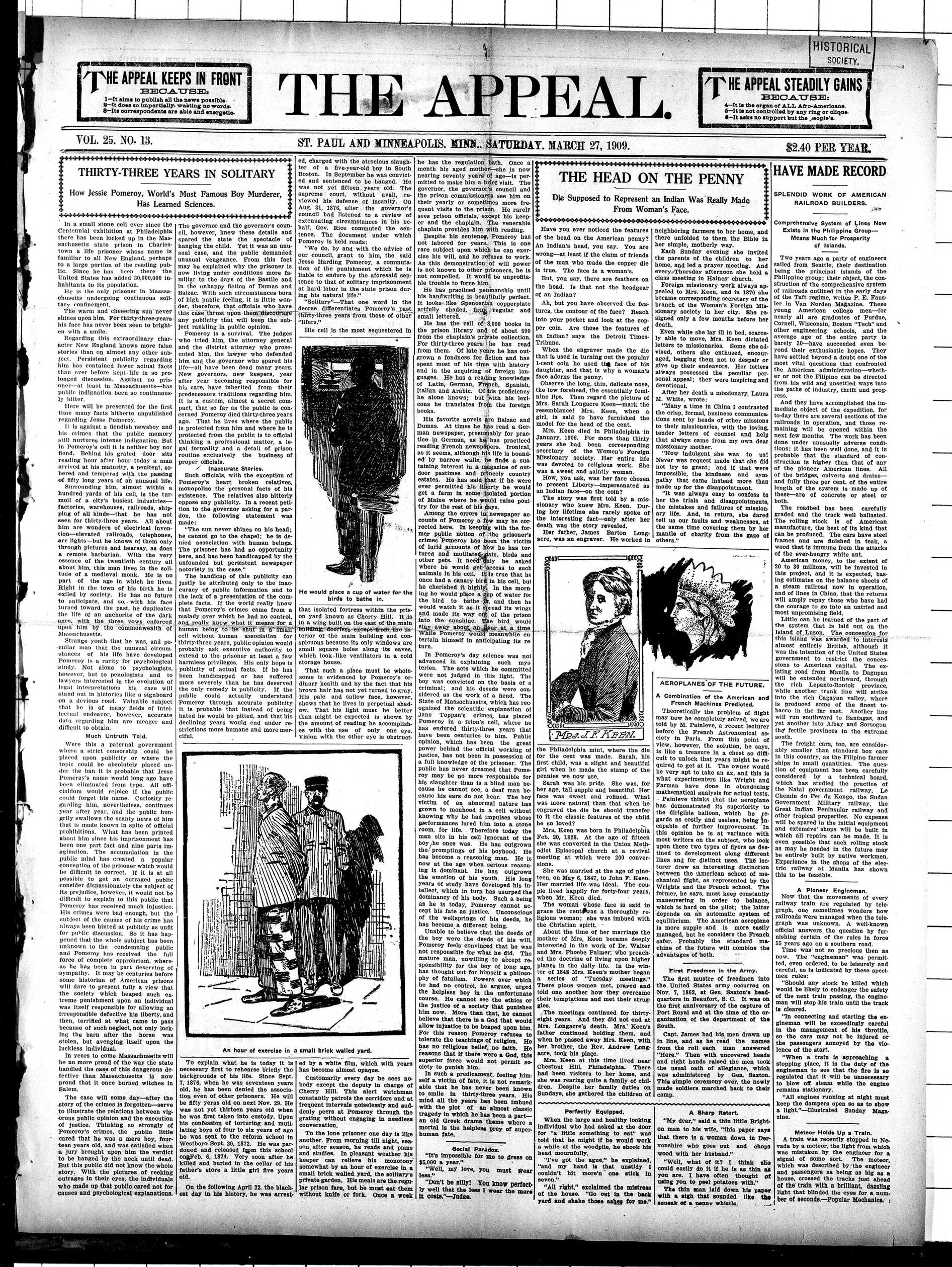
THIRTY-THREE YEARS IN SOLITARY
How Jessie Pomeroy, World's Most Famous Boy Murderer, Has Learned Sciences.
VOL. 25. NO. 13.
In a small stone cell ever since the Centennial exhibition at Philadelphia there has been locked up in the Massachusetts state prison in Charlestown a life prisoner whose name is familiar to all New England, perhaps to a large portion of the reading public. Since he has been there the United States has added 20,000,000 inhabitants to its population.
He is the only prisoner in Massachusetts undergoing continuous solitary confinement. The warm and cheering sun never shines upon him. For thirty-three years his face has never been seen to brighten with a smile.
Regarding this extraordinary character New England knows more false stories than on almost any other subject. Persistent publicity regarding him has contained fewer actual facts than ever before kept life in so prolonged discussion. Against no prisoner—at least in Massachusetts—has public indication been so continuously bitter.
Here will be presented for the first time many facts hitherto unpublished regarding Jesse Pomeroy.
It is against a fliendish newsboy and his crimes that the public memory still intends intense indignation. But in Pomeroy's case the boy nor friend. Behind his grated reading hour after hour a man arrived at his maturity, a penitent, so sobered and tempered with the passing of fifty long years of an unusual life.
Surrounding him, almost within a hundred yards of his cell, is the turmoil of a city's busiest industries—factories, warehouses, railroads, shipping of all kinds—that he has not seen for thirty-three years. All about him are wonders of electrical invention—elevated railroads, telephones, are lights—but he knows of them only through pictures and hearsay, as does a remote barbarian. With the very essence of the twentieth century all about him, this man lives in the solitude of a medieval monk. He is no part of the age in which he lives. Right in the town of his birth he is exiled by society. He has no future to anticipate, and so, with his face turned toward the past, he duplicates the life of an anchorage of the dark ages, with the three vows enforced upon him by the commonwealth of Massachusetts. Strange youth that he was, and peculiar man that the unusual circumstances of his life have developed Pomeroy is a rarity for psychological study. Not alone are psychologists, however, to but penalties, lawyers interested in the evolution of legal interpretations his case will stand in histories like a signboard on a devious road. Valuable subject that he is of many fields of intellectual endeavor, however, accurate data regarding him are meager and difficult to obtain.
Much Untruth Told.
Were this a paternal government where a strict censorship could be placed upon publicity or where the topic could be absolutely placed under the bar it is probable that Jesse Pomeray's name would long ago have been eliminated from type. All officialdom would rejoice if the public could forget his name. Curiosity regarding him, nevertheless, continues year after year, and the public humbly swallows the scanty news of him that is made known in spite of official prohibitions. What has been printed about him since his imprisonment is the fact and nine parts imagination. In the public mind has created the conception of the prisoner which would be difficult to correct. If it is at all possible to get an outraged public consider dispassionately the subject of its prejudice, however, it would not be difficult to explain to this public that Pomeray has received much injustice. His crimes were bad enough, but the subject of the causes of his crime has always been hinted at publicly as unfit for public discussion. So it has happened that the whole subject has been unknown to the condemning public and Pomeray has received the full force of complete opprobrium, whereas he has been in part deserving of sympathy. It may be centuries before will dare to present American prisoners will dare to present a view that the society which heaped upon the treme punishment upon an individual was itself responsible for allowing an irresponsible defective his liberty, and then, terrified at what came to pass because of such neglect, not only locking the barn after the horse was stolen, but avenging itself upon the luckless individual.
In years to come Massachusetts will be no more proud of the way the state handled the case of this dangerous defective than Massachusetts is now proud that it once burned witches in Salem.
The case will some day—after the story of the crimes is forgotten—serve to illustrate the relations between vigorous public opinion and the execution of justice. Thinking so strongly of Pomeroy's crimes, the public little cared that a mere boy, fourteen years old, and was satisfied when he was beaten, would be to be hanged by the neck until dead. But this public did not know the whole story. With the pictures of reeking outrages in their eyes, the individuals who made up that public cared not for causes and psychological explanations.
A
An hour of exercise in a small brick walled yard.
The governor and the governor's council, however, knew these details and spared the state the spectacle of hanging the child. Yet it was an unusual case, and the public demanded unusual vengeance. From this fact may be explained why the prisoner is now living under conditions more familiar to the days of the Bastille and in the unhappy fiction of Dumas and Balzac. With such circumstances born of high public feeling, it is little wonder that the prisoner this case thrust upon them discourage any publicity that will keep the subject ranking in public opinion.
Pomeroy is a survival. The judges who tried him, the attorney general and the district attorney who prosecuted him, the lawyer who defended him and the governor who spared his life—all have been dead many years. New governors, new keepers, year after year becoming responsible for his care, have inherited from their predecessors traditions regarding him. It is a custom, almost a secret compact, that so far as the public is concerned, Pomeroy died thirty-three years ago. He lives where the public is protected from him and where he is protected from the public is to official thinking a professional matter, a legal formality and a detail of prison routine exclusively the business of proper officials.
Inaccurate Stories.
Such officials, with the exception of Pomeroy's heart broken relatives, monopolize the personal facts of his existence. The relatives also bitterly oppose any publicity. In a recent petition to the governor asking for a pardon, the following statement was made:
"The sun never shines on his head; he cannot go to the chapel; he is denied association with human beings. The prisoner has had no opportunity here, and has been handicapped by the unfounded but persistent newspaper notoriously in the case."
The handicap of this publicity can be attributed to the inaccuracy and the lack of a presentation of the complete facts. If the world really knew that Pomeroy's crimes came from a malady over which he had no control, and really knew what it means for a human being to be shut in a small cell without human association for thirty-three years, public opinion would probably ask executive authority to extend to the prisoner at least a few harmless privileges. His only hope is publicity of actual facts. If he has been handicapped or has suffered more severely than he has deserved merely remedy to a reality. If the public could actually understand Pomeroy through accurate publicity it is probable that instead of being hated he would be plotted, and that his declining years would end under restrictions more humane and more merciful.
An hour of exercise in
To explain what he is today it is necessary first to rehearse briefly the backgrounds of his life. Since Sept. 7, 1876, when he was seventeen years old, he has been denied the association even of other prisoners. He will be fifty yeras old on next Nov. 23. He was not yet thirteen years old when he was first taken into custody. Upon his confession of torturing and mutilating boys of four to six years of age he was sent to the reform school in Westboro Sept. 20, 1872. He was parowned and released from this school on Feb. 6, 1874. Very soon after he killed and buried in the collar of his father's store a little girl five years old.
On the following April 22, the blackest day in his history, he was arrest-
THE APPEAL.
ed, charged with the atrocious slaughter of a five-year-old boy in South Boston. In September he was convicted and sentenced to be hanged. He was not yet fifteen years old. The supreme court, without avail, reviewed his defense of insanity. On Aug. 31, 1876, after the governor's council had listened to a review of extenuating circumstances in his beating, Rice commuted the sentence. The document under which Pomeroy is held reads, "We do, by and with the advice of our council, grant to him, the said Jesse Harding Pomeroy, a commutation of the punishment which he is liable to endure by the aforesaid sentence to that of solitary imprisonment at hard labor in the state prison during his natural life."
"Solitary!" That one word in the decree differentiates Pomeroy's past thirty-three years from those of other "ilfers."
His cell is the most sequestered in
he has the regulation bath. Once a month his aged mother—she is now nearing seventy years of age—is permitted to make him a brief visit. The governor, the governor's council and the prison commissioners see him on their yearly or sometimes more frequent visits to the prison. He rarely sees prison officials, except his keeper and the chaplain. The venerable chaplain provides him with reading. Despite his senteney, Pomeroy has not labored for years. This is one rare subject upon which he can exercise his will, and he refuses to work. This demonstration of will power is not the same as the demonstration of officers, he is uncompelled. It would be unprofitable trouble to force him.
He has practiced penmanship until his handwriting is beautifully perfect. It looks like Spencerian copperplate artfully shaded, firm, regular and small lettered.
He has the call of 8,000 books in the prison library and of about 500
Have you ever noticed the face of the head on the American pen of an Indian's head, you say. You wrong—at least if the claim of it of the man who made the copier is true. The face is a woman's. But you say, there are feathers the head. Is that not the head of an Indian?
Ah, but you have observed the tures, the contour of the face? into your pocket and look at the coin. Are those the features
He would place a cup of water for the birds to bathe in.
that isolated fortress within the prison on yard known as Cherry Hill. It is in a wing built on the east of the main building, doortrees, except from the interior of the main building and conspicuous because its only windows are small square holes in its eaves, which look-like ventilators in a cold storage house.
That such a place must be wholesome is evidenced by Pomeroy's ordinary health and by the fact that his brown hair has not yet turned to gray. His pale and sallow face, however, shows that he lives in perpetual shadow. That his light must be better than might be expected is shown by the amount of reading he accomplishes with the use of only one eye, Vision with the other eye is obstruct.
a small brick walled yard.
ed by a white film, which with years has become almost opaque.
Customarily every day he sees nobody except the deputy in charge of Cherry Hill. This alert watchman constantly patrols the corridors and at frequent intervals notelessly and suddenly peers at Pomeroy through the grating without engaging in needless conversation.
To the lone prisoner one day is like another. From morning till night, season after season, he reads and plans and studies. In pleasant weather his keeper can relieve his monotony somewhat by an hour of exercise in a small brick walled yard, the solitary's private garden. His meals are the regular prison fare, but he must eat them without knife or fork. Once a week
he has the regulation bath. Once a month his aged mother—she is now nearing seventy years of age—is permitted to make him a brief visit. The governor, the governor's council and the prison commissioners see him on their yearly or sometimes more frequent visits to the prison. He rarely sees prison officials, except his keeper and the chaplain. The venerable chaplain provides him with reading. Despite his sentence, Pomeroy has his rare subject. This is rare subject upon which he exercises his will, and he refuses to work. As this demonstration of will power is not known to other prisoners, he is not compelled. It would be unprofitable trouble to force him. He has practiced penmanship until his handwriting is beautifully perfect. It looks like Spencerian copperplate artfully shaded, firm, regular and small lettered. He has the call of 8,000 books in the prison library and of about 500 from the chaplain's private collection. For thirty-three years he has read from them. Of late years he has outgrown a fondness for fiction and has read his time with history and in the acquiring of foreign languages. He has a reading knowledge of Latin, German, French, Spanish, Italian and Arabic. Of his proficiency he alone knows; but with his lexicons he translates from the foreign books.
His favorite novels are Balacaz and Dumas. At times he has read a German newspaper, presumably for practice in German, as he has practiced reading French newspapers. Ironical, as it seems, although his life is bounded by narrow walls, he finds a sustaining interest in a magazine of outdoor pastimes and princely country estates. He has said that if he were ever permitted his liberty he would get a farm in some isolated portion of Maine where he would raise poultry for the rest of his days.
Among the errors in newspaper accounts of Pomeroy a few may be corrected in. In keeping with the former public notion of the prisoner's crimes Pomeroy has been the victim of lurid accounts of how he tortured and mutilated rats, birds and other pets. It need only be asked where he would get access to such animals in his cell. It is true that he has the canary bird in his cell, but he cherished it highly. In the morning he would take a cup of water for the bird to bathe in, and then he would watch it as it swirled wings and made its way out of the prison into the sunshine. The bird stay away about an hour at a time While Pomeroy would meanwhile entertain himself in anticipating its return.
In Pomeroy's day science was not advanced in explaining such mysteries. The acts which he committed were not judged in this light. The boy was convicted on the basis of a criminal; and his deeds were considered as the work of a friend. The State of Massachusetts, which has recognized the scientific explanation of Jane Topman's crimes, has placed Pomeroy in a felon's cell, where he has endured thirty-three years that have been centuries to him. Public opinion, which has been the great power behind the official working of justice, has not been in possession of a full knowledge of the prisoner. The public has never dreamed that Pomeroy may be no more responsible for his slaughter than is a blind man because he cannot see, a deaf man because his ears do not hear. The boy victim of an abnormal nature has grown to manhood and a cell without knowing why he had impulses whose performances lured him into a stone room for life. Therefore today the man sits in his cell ingredient of the boy he once was. He has been the promptings of his boyhood. He has become a reasoning man. He is now at the age when serious reasoning is dominant. He has outgrown the emotion of his youth. His long years of study have developed his intellect, which in turn has usurped the dominance of his body. Such a being as he is today, Pomeroy cannot accept his fate as justice. Unconscious of the wellsprings of his deeds, he has become a different being.
Unable to believe that the deeds of the boy were the deeds of his will, Pomeroy feels convinced that he was not responsible for what he did. The mature man, unwilling to accept responsibility for the boy of long ago, has thought out for himself a philosophy of fatalism. Powers over which he had no control, he argues, urged the helpless boy in the unfortunate He cannot see the ethics or the justice in a society that punishes him now. More often, he cannot believe that there is a God that would allow injustice to be heaped upon him. For this reason Pomeroy needs to tolerate the teachings of religion. He has no religious belief, no faith. He reasons that if there were a God, this superior force would not permit society to punish him.
In such a predicament, feeling himself a victim of fate, it is not remarkable that he has never been known to smile in thirty-three years. His mind all the years has been imbued with the plot of an almost classic tragedy in which he has been a part—an old Greek drama theme where a mortal is the helpless prey of superhuman fate.
Social Paradox
"It's impossible for me to dress on $,000 a year."
"Well, my love, you must wear less." Don't be silly! You know perfectly well that the less I wear the more it cost."—Judge
THE HEAD ON THE PENNY
Die Supposed to Represent an Indian Was Really Made From Woman's Face.
*
Have you ever noticed the features of the head on the American penny? An Indian's head, you say. You are wrong—at least if the claim of friends of the man who made the copper die is true. The face is a woman's. But, you say, there are feathers on the head. Is that not the headgear of an Indian? Ah, but you have observed the features, the contour of the face? Look into your pocket and look at the copper coin. Are those the features of an Indian? says the Detroit Times-Tribune. When the engraver made the die that is used in turning out the popular 1-cent coin he used the face of his daughter, and that is why a woman's face adorns the penny. Observe the long, thin, delicate nose, the low forehead, the essentially feminine lips. Then regard the picture of Mrs. Sarah Longacre Keen—mark the resemblance! Mrs. Keen, when a girl, is said to have furnished the model for the head of the cent. Mrs. Keen died in Philadelphia in January, 1906. For more than thirty years she had been corresponding with Women's Foreign Missionary society. Her entire life was devoted to religious work. She was a sweet and salty woman. How, you ask, was her face chosen to present Liberty—impersonated as an Indian face—on the coin?
The story was first told by a-missionary who knew Mrs. Keen. During her lifetime she rarely spoke of the interesting fact—only after her death was the story revealed. Her father, James Barton Long-acre, was an engraver. He worked in
MRS. J.F. KEEN.
the Philadelphia mint, where the die for the cent was made. Sarah, his first child, was a slight and beautiful girl when he made the stamp of the pennies we now use.
Sarah was his pride. She was for her age, tall supple and beautiful. Her face was sweet and refined. What was more natural than that when he engraved the die he should transfer to it the classic features of the child he so loved?
Mrs. Keeen was born in Philadelphia Feb. 20, 1828. At the age of fifteen she was converted in the Union Methodist Episcopal church at a revival meeting at which were 200 conversions.
She was married at the age of nineteen, on May 6, 1847, to John F. Keeen. Her married life was ideal. The couple lived happily for forty-four years, when Mr. Keeen died.
The woman whose face is said to grace the cent was a thoroughly religious woman; she was imbued with the Christian spirit.
About the time of her marriage the mother of Mrs. Keeen became deeply interested in the work of Dr. Welter and Mrs. Phoebe Palmer, who practiced the doctrine of living upon higher planes in the daily life. In the winter of 1848 Mrs. Keeen's mother began a series of "Tuesday meetings." There plous women met, prayed and told one another how they overcame their temptations and met their struggles.
The meetings continued for thirty-eight years. And they did not end at Mrs. Longacre's death. Mrs. Keen's father continued holding them, and when he passed away Mrs. Keen, with her brother, the Rev. Andrew Longacre, took his place. Mrs. Keen this time lived near the Hill this decade. The had been visitors to her home, and she was rearing a quite a family of children. Despite her family duties on Sundays, she gathered the children of
Perfectly Equipped.
When the large and healthy looking individual who had asked at the door for "a little something to eat" was told that he might if he would work a while at the woodpile, he shook his head mournfully.
"I've got the ague," he explained, "my hand is that unstidly I didn't hit more" one stick in seven.
"All right," exclaimed the mistress of the house. "Go out in the back yard and shake those ashes for me."
HISTORICAL
SOCIETY.
THE APPEAL STEADILY GAINS
BECAUSE:
4-It is the organ of ALL Afro-Americans.
5-It is not controlled by any ring or clique.
6-It asks no support but the people's.
neighboring farmers to her home, and there unfolded to them the Bible in her simple, motherly way.
Each Sunday evening she invited the parents of the children to her home, and led a prayer meeting. And every Thursday afternoon she held a meeting in Haines' church.
Foreign missionary lay work always appealed to Mrs. Keen and in 1970 she became corresponding secretary of the branch of the Woman's Foreign Missionary society in her city. She resigned only a few months before her death.
Even while she lay in bed, scarcely able to move, Mrs. Keen dictated letters to missionaries. Some she advised, others she enthused, encouraged, begging them not to despair or give up their endeavors. Her letters always possessed the peculiar personal appeal; they were inspiring and devotional.
After her death a missionary, Laura M. White, wrote:
"Many a time in China I contrasted the crisp, formal, business communication sent by heads of other missions to the missionaries, with the loving, tender letters of counsel and help that always came from my own dear missionary mother.
"How indulgent she was to us! Never was request made that she did not try to grant; and if that were impossible, the kindness and sympathy that came instead more than made up for the disappointment.
"It was always easy to confess to her the trials and disappointments, the mistakes and failures of missionary life. And, in return, she dared tell us our faults and weaknesses, at the same time covering them by her mantle of charity from the gaze of others."
AEROPLANES OF THE FUTURE.
A Combination of the American and French Machines Predicted.
Theoretically the problem of sight may now be completely solved, we are told by M. Painleve, a recent lecturer before the French Astronomical society in Paris. From this point of view, however, the solution, he says, is like a treasure in a chest so difficult to unlock that years might be required to get at it. The owner would be very apt to take an ax, and this is what experimenters like Wright and Farman have done in abandoning mathematical analysis for actual tests. Painleve thinks that the aeroplane has demonstrated its superiority to the dirigible balloon, which he regards as costly and useless, being incapable of further improvement. In this opinion he is at variance with most writers on the subject, who look upon these two types of fliers as destined to develop along different lines and for distinct uses. This lecturer and for distinct uses of the aeroplane between the American school and mechanical flight, as represented by the Wrights and the French school. The former, he says, must keep constantly maneuvering in order to balance, which is hard on the pilot; the latter depends on an automatic system of equilibrium. The American aeroplane is more supply and is more easily managed, but he considers the French safer. Probably the standard machine of the future will combine the advantages of both.
First Freedman in the Army
The first muster of freedmen into the United States army occurred on Nov. 7, 1862, at Gen. Saxton's headquarters in Beaufort, S. C. It was on the first anniversary of the capture of Port Royal and at the time of the organization of the department of the South.
Capt. James had his men drawn up in line, and as he read the names from the roll each man answered "Here." Then with uncovered heads and right hands raised the men took the usual oath of allegiance, which was administered by Gen. Saxton. This simple ceremony over, the newly made soldiers marched back to their camp.
"My dear," said a thin little Brighton man to his wife, "this paper says that there is a woman down in Dervonshire who goes out and chops wood with her husband."
"Well, what of it? I think she could easily do it if he is as thin as you are. I have often thought of using you to peel potatoes with."
The thin man laid down his paper with a sigh that sounded like the sousak of a benny whistle.
$2.40 PER YEAR.
HAVE MADE RECORD
SPLENDID WORK OF AMERICAN
RAILROAD BUILDERS.
Comprehensive System of Lines Now Exists in the Philippine Group—Means Much for Prosperity of Islands.
Two years ago a party of engineers sailed from Seattle, their destination being the principal islands of the Philippine group; their object, the construction of the comprehensive system of railroads outlined in the early days of the Taft regime, writes P. E. F. Laner in Van Norden Magazine. These young American college men—for nearly all are graduates of Purdue, Cornell, Wisconsin, Boston "Tech" and other engineering schools, and the average age of the entire party is—have succeeded even beyond their enthusiastic hopes. They have settled in doubt one of the most vital questions that confronted the American administration—whether or not the Filipino can be directed from his wild and unsettled ways into the paths of industry, thrift and progress. And they have accomplished the immediate object of the expedition, for to-day there are several sections of the railroads in operation, and those remaining will be opened within the next few months. The work has been done under unusually adverse conditions; it has been well done, and it is probable that the standard of construction is higher than that of any plane of American lines. All of the bridges, railroads, and fully three per cent. of the entire length of the system is made up of these—of concrete or steel or both.
The roadbed has been carefully graded and the track well ballasted. The rolling stock is of American manufacture, the best of its kind that can be produced. The cars have steel frames and are finished in teak, a wood that is immune from the attacks of the ever-hungry white ant. American money, to the extent of 20 to 30 millions, will be invested in the project, and on the balance sheets of a steam railway operation, and of lines in China, that the returns will amply repay those who have had the courage to go into an untried and most unpromising field. Little can be learned of the part of the system that is laid out on the Island of Luzon. The concession for this island was awarded to interests almost entirely British, although it was the intention of the United States government to restrict the concessions to American capital. The existing road from Manila to Dagupan will be extended northward, through the rich Lepanto-Bontok province, and another trunk line will strike into the rich Lagayan valley, where is produced some of the finest tobacco in the far east. Another will run southward to Bantagas, and yet another into Albay and Sorsogon the fertile provinces in the extreme south.
The freight cars, too, are considerably smaller than standard box cars in this country, as the Filipino farmer ships in small quantities. The question of equipment has been carefully considered by a technical board, which has studied the practice of the Natal government railway, Le Chemin du Fer du Kongo, the Sudan Government Military railway, the Great Indian Peninsular railway and other tropical properties. No expense is spent on the initial equipment and extensive stock will be built in which all repairs can be made. It is even possible that such rolling stock as may be needed in the future may be entirely built by native workmen. Experience in the shops of the electric railway at Manila has shown this to be feasible.
A Pioneer Englneman
Now that the movements of every railway train are regulated by telegraph, one sometimes wonders how railroads were managed when the telegraph was unknown. A well-known official answers the question by furnishing certain of the rules in force 55 years ago on a southern road. Time was not so precious then as now. The "engineman" was permitted, ordered, to be leisurely and careful, as is indicated by these specimen rules: "Should any stock be killed which would be likely to endanger the safety of the next train passing, the engineman will stop his train until the track is cleared. "In connecting and starting the engineman will be exceedingly careful in the management of his throttle, so the cars may not be injured or the passengers annoyed by the violence of the start. "When a train is approaching a stopping place, it is the duty of the engineman to see that the fire is so hot that it will be unnecessary to blow off steam while the engine remains stationary. "All engines running at night must keep the dampers open as to show a light."—Illustrated Sunday Magazine.
Meteor Holds Up a Train.
A train was recently stopped in Nevada by a meteor, the light from which was mistaken by the engineer for a signal of some sort. The meteor, which was described by the engineer and passengers as being big as a house, crossed the tracks just ahead of the train with a brilliant, dazzling light that blinded the eyes for a number of seconds—Popular Mechanics.
HAVE YOU READ
THE APPEAL?
THE APPEAL,
A NATIONAL AFRO-AMERICAN NEWSPAPER
PUBLISHED WEEKLY BY
ADAMS BROS. EDITORS AND PUBLISHERS
49 E. 4th St., St. Paul, Minn.
ST. PAUL OFFICE
No. 236 Union Block, 4th & Cedar.
J. C. ADAMS. Manager
MINNEAPOLIS OFFICE
Guaranty Loan Bldg., Room 1020.
H. B. BURK. Manager
CHICAGO OFFICE
323-5 Dearborn Street. Suite 660.
C. F. ADAMS. Manager
TERMS, STRICTLY IN ADVANCE
SINGLE COPY, ONE YEAR.....$2.00
SINGLE COPY, SIX MONTHS.....1.10
SINGLE COPY, THREE MONTHS.....60
When subscriptions are by any means allowed
to run without prepayment, the terms are
60 cents for each 13 weeks and 5 cents for
an annual week, or at the rate of $4.00 per
year.
Remittances should be made by Express
Money Order, Post Office Money Order, Re-
ceipt, or by a card. Receipts will be received the same as cash for
the fractional parts of a dollar. Only 0.01
cent and two cent stamps taken.
It is almost sure to wear a hole through the
envelope and be lost; or also it may be
stolen. Persons who send silver to in letters
"Tarridge and death notices" 10 lines or less $1.
Each additional line 10 cents. Payment
scriply in advance, and to be announced at
the time of receipt.
Advertising rates, 10 cents per agency line, each
insertion. There are fourteen scate lines
in an inch, and about seven words in an
inch. No discount advertisement
than 8%. No discount less than
three months contract. Cash must accompany
the notice from parties unknown to us.
Reading notices 25 cents per line, each insertion.
No discounts for time or space. Reading
matter is set in 'brevler type--about six
words to the line. All head-lines count
The date on the address label shows when subscription expires. Renewals should be made by mail, as no paper may be missed, as the paper stops when time is out.
In letters that contain papers sent to subscribers you do not receive any number when due, inform us when you receive the papers from that date, we will usherly forward a duplicate of the missing number.
Communications to receive attentions must be written only upon one side of the paper; must reach us Tuesday if possible, anyway or written on the back of the nature of the author. No manuscript return, unless stamps are sent for postage.
We do not hold responsible for the nature of the soliciting agents wanted everywhere. Write for terms. Sample cones free.
In every letter that you write or never fall to the notice of the soliciting agents, written post office, county and state. Business letters of all kinds must be written on the back of the notice or matter for publication. Entered as second class matter June 6, 1888 at the post office, March 3, 1879.
EX-PRESIDENT ROOSEVELT.
Treat each man according to his worth as a man. Distrust all who would have any one class placed before any other. Other republics have fallen because the unscrupulous have substituted loyalty to class for loyalty to the people as a whole. —President Roosevelt's speech at Little Rock, Ark.
SATURDAY, MARCH 27, 1909.
MR. GAITHER OF MARYLAND SPEAKS.
Mr. Gailer of Maryland, recently girded up his loins and made a great big speech, the main purpose of which, as we learn was as follows:
Mr. Gailer wants the Negroes and the country at large to understand that Republican success in the south, or in any state, does not mean Negro supremacy over the white race.
It would seem from the above that two parties, first, the country at large and second, the Negroes, are in a most dismal and woeful state of ignorance as to what "Republican success in the South" means, and Mr. Gaither kindly undertakes to dispel the ignorance. THE APEAL will let "the country at large" take care of itself and devote a little attention to the subject of Negro supremacy. Mr. Gaither's remarks about that point reminds THE APEAL of the Great Don Quixote's famous combat with the windmills, or Falstaff's encounter with the "misbegotten rogues in Kendall green." "It is mere flapdoodle of the purest kind."
W. H.
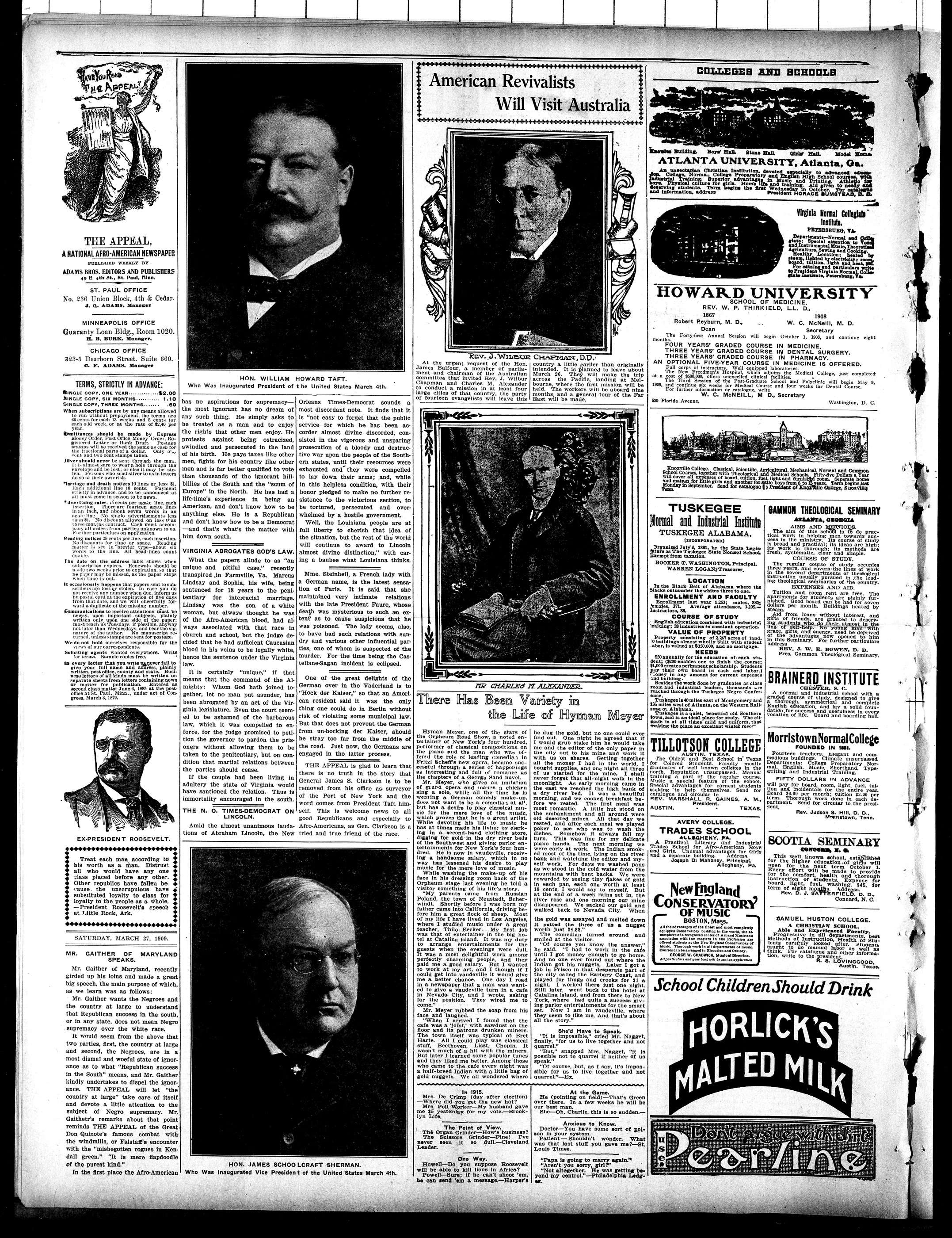
HON. WILLIAM HOWARD TAFT.
Who Was Inaugurated President of the United States March 4th.
P. H.
has no aspirations for supremacy—the most ignorant has no dream of any such thing. He simply asks to be treated as a man and to enjoy the rights that other men enjoy. He protests against being ostracized, swindled and persecuted in the land of his birth. He pays taxes like other men, fights for his country like other men and is far better qualified to vote than thousands of the ignorant hillbillies of the South and the "scum of Europe" in the North. He has had a life-time's experience in being an American, and don't know how to be anything else. He is a Republican and don't know how to be a Democrat—and that's what's the matter with him down south.
What the papers allude to as "an unique and pitiful case," recently transpired, in Farmville, Va. Marcus Lindsay and Sophia, his wife, being sentenced for 18 years to the penitentiary for interracial marriage. Lindsay was the son of a white woman, but always thought he was of the Afro-American blood, had always associated with that race in church and school, but the judge decided that he had sufficient Caucasian blood in his veins to be legally white, hence the sentence under the Virginia law.
It is certainly "unique," if that means that the command of the Almighty: Whom God hath joined together, let no man put asunder, has been abrogated by an act of the Virginia legislature. Even the court seemed to be ashamed of the barbarous law, which it was compelled to enforce, for the judge promised to petition the governor to pardon the prisoners without allowing them to be taken to the penitentiary, but on condition that martial relations between the parties should cease.
If the couple had been living in adultery the state of Virginia would have sanctioned the relation. Thus is immortality encouraged in the south.
THE N. O. TIMES-DEMOCRAT ON LINCOLN.
Amid the almost unanimous laudations of Abraham Lincoln, the New
Orleans Times-Democrat sounds a most discordant note. It finds that it is "not easy to forget that the public service for which he has been accorder almost divine discord, consisted in the vigorous and unsparing prosecution of a bloody and destructive war upon the people of the Southern states, until their resources were exhausted and they were compelled to lay down their arms; and, while in this helpless condition, with their honor pledged to make no further resistance to the victorious section, to be tortured, persecuted and overwhelmed by a hostile government. Well, the Louisiana people are at full liberty to cherish that idea of the situation, but the rest of the world will continue to award to Lincoln almost divine distinction," with caring a baubee what Louisiana thinks.
Mme. Steinhell, a French lady with a German name, is the latest sensation of Paris. It is said that she maintained very intimate relations with the late President Faure, whose death was mysterious to such an extent as to cause suspicions that he was poisoned. The lady seems, also, to have had such relations with sunry and various other influential parties, one of whom is suspected of the murder. For the time being the Castellane-Sagan incident is eclipsed.
One of the great delights of the German over in the Vaderland is to "Hock der Kaiser," so that an American resident said it was the only thing one could do in Berlin without risk of violating some municipal law. But that does not prevent the German from un-hocking der Kaiser, should he stray too far from the middle of the road. Just now, the Germans are engaged in the latter process.
THE APPEAL is glad to learn that there is no truth in the story that General James S. Clarkson is to be removed from his office as surveyor of the Port of New York and the word comes from President Taft himself. This is welcome news to all good Republicans and especially to Afro-Americans, as Gen. Clarkson is a tried and true friend of the race.
American Revivalists Will Visit Australia
---
7
REV. J. WILBUR CHAHMAN, D.D.
At the urgent request of the Hon.
James Balfour, a member of parliament and chairman of the Australian March 26. They will committee that invited Rev. J. Wilbur across the Pacific, bourne, the first to coord. with Charles M. Alexander to least the workers will large cities of that country, pay the party of fourteen evangelists will leave this. East, will be made.
MR CHARLES
There Has Been V
the Lif
THE LORD OF THE HOLY SACRED BIBLE
Hyman Meyer, one of the stars of the Orpheum Road Show, a noted entertainer of New York's four hundred, performer of classical compositions on the stage, and a friend of leading comedian in Fritzi Scheff's new opera, became successful through a series of happenings as interesting and full of romance as the musical, and he loved her. Mr. Meyer, who gives an imitation of grand opera and masas a chicken sing a solo, while all the time he is wearing a German comedy makeup, he has a desire to play classical music for the mere love of the music, which proves that he is a great artist. While devoting his life to music he times his life in the dressing room in hand-hand clothing store, digging for gold in the dry river beds of the Southwest and giving parlor entertainments for New York's four hundred. He is now in vaudeville receiving his first major role, which has lessened his desire to play music for the mere love of music. While washing the make-up off his face in his dressing room back of the Orpheum Road Show, he visited something of his life's story.
"My parents came from Russian Poland, the town of Neustadt, Scherwindt. Shortly before I was born my mother just Califia, a driving before him I was born in Los Angeles of my life I have lived in Los Angeles, where I studied music under a great teacher, Thilo Becker. My first job was a teacher at the market in Catalina island. It was my duty to arrange entertainments for the guests when the evenings were dull. It was a most delightful work among the students. But they paid me a good salary. But it was to work at my art, and I though if I could get into vaudeville it would give me a better chance. One day I read a book about a girl named to give a vaudeville turn in aanted to give a vaudeville turn in the Nevada City, and I wrote, asking for the position. They wired me to come.
Meyer rubbed the soap from his face and laughed.
"When I arrived I found that the cafe was a 'Joint', with sawdust on the floor and its patrons drunken miners, who were so drunk that Harte. All I could play was classical stuff, Beethoven, Liszt, Chopin. It wasn't much of a hit with the miners. But later I learned some popular tunes and I was able to play them who came to the cafe every night was a half-breed Indian with a little bag of gold nuggets. We all wondered where
Mrs. De Crimp (day after election)
—Where did you get the new hat?
Mrs. Poll Worker—My husband gave me $5 yesterday for my vote.—Brooklyn Life.
The Point of View.
The Organ Grinder—How's business?
The Scissors Grinder—Fine! I've never seen it so dull.—Cleveland Leader.
One Way.
Howell—Do you suppose Roosevelt will be able to kill lions in Africa?
Powell—Sure; if he can't shoot 'em, he can send 'em a message.—Harper's
country a little earlier than originally intended. It is planned to leave about 100 miles across the Pacific, landing at Melbourne, where the first mission will be held. The workers will be aboard nine ships in a general tour of the Far East will be.
M. ALEXANDER.
variety in
e of Hyman Meyer
he dug the gold, but no one could ever find out. One night he agreed that if I would grab stake him he would take me and the editor of the only paper in the city out to his mine and work it with us on shares. Getting together, I was at home in the world. I bought supplies and one night all about of us started for the mine. I shall never forget that all night walk in the moonlight. As early morning came in the east we reached the high bank of a dry river bed. It was a beautiful morning, and we cooked breakfast before we were dined. The first man was most romantic. A little red toood the embankment and all around were old deserted mines. All that day we rested, and after each meal we played poker to see who was to wash the dishes. Somehow it always fell my time. This was one for my delicate plan on hands. The next morning we were early at work. The Indianوکمولد almost of the time lying on the river bank and watching the editor and myself work. For days we washed pans as we stood in the cold water from the mountains with bent backs. We were rewarded by seeing tiny flakes of gold in the park. I was the worth at least 10 cents. I would say to any one at the end of a week rains set in, the river rose and one morning our mine disappeared. We sacked our gold and walked back to Nevada City. When
the gold was assayed and melted down
it netted the three of us a nugget
with just 44.88.
The money turned around and
smiled at the vsligator.
"Of course you know the answer," he said. "I had to work in the cafe until I got money enough to go home. And no one ever outd out where the hotel has nuggets. Later I got a job in Fresco in that desperate part of the city called the Barbary Coast, and played for thugs and crooks for $1 a night. I worked there just one night. Still, I had to back to the hotel at Catalina island, and from to New York, where had quite a success giving parlor entertainments for the smart set. Now I am in vaudeville, where they seem to like me. And that's about all the story."
**She'd Have to Speak.**
"It is impossible," cried Mr. Nagget, finally, "for us to live together and not quarrel." "He snapped Mrs. Nagget, "it is possible not to quarrel if neither of us speak."
"Of course, but, as I say, it's impossible for us to live together and not quarrel."—Ex.
**At the Game.**
He (pointing on field)—That's Green over there. In a few weeks he will be our best man.
"This is so weird."
son in your system.
Patient — Shouldn't wonder. What
was that last stuff you gave me?—St.
Louis Times.
"Papa is going to marry again."
"Aren't you sorry, girl?"
"Not altogether. He was getting
beeyond my control."—Philadelphia Ledg-
er.
```markdown
```
An unsecured Christian Institution, devoted especially to advanced education, provides English and High School courses, with industrial Training. Superior advantage. Physical education for girls. Home life and training. Aid given to needy and deserving students begins the first year. President HORACE BUMSTEAD, D.E. and information, address
HOWARD UNIVERSITY SCHOOL OF MEDICINE.
Knoxville College, Classical, Scientific, Agricultural, Mechanical, Normal and Common School Course, begins with Theological, and Medical Schools. Fifty-five Dollars a Year will cover all expenses of board, tuition, health, education, and matron for little girls and another for little boys from 6 to 12 years. Term begins last Monday in September. Send 10r catalogue $) President of Knoxville College, a knoxville
Teen.
HORLICK'S
MALTED MILK
Don't argue with dirt
Pearline
用
HOWARD UNI-
SCHOOL OF MED
REV. W. P. THIRKIELD,
1867
Robert Reyburn, M. D.,
Dean
The Forty-first Annual Session will begin Oc-
months.
FOUR YEARS' GRADED COURSE IN
THREE YEARS' GRADED COURSE IN
THREE YEARS' GRADED COURSE IN
AN OPTIONAL FIVE-YEAR COURSE IN
Full corps of instructors. Well equipped labora-
tors. The New Presidential Hospital, which is
at a cost of $600,000, offers unexcelled clinical
facilities. The Third Session of the Post-Graduate School
1909, and continue six weeks for Medical Course and
For further information or catalogue, write
W. C. McNEILL, M. D., Sec.
559 Florida Avenue.
Knoxville College. Classical, Scientific, Agricultural
School Course, together with Theological, and Medical
will cover all sciences of the human body, right as
and matron for little girls and another for little boys
Monday in September. Send for catalogue $) Preside-
Tenn
TUSKEGEE Normal and Industrial Institute
Organized July 4, 1881, by the State Legislature State Normal School Exempt from taxation
BOOKER W. T. WASHINGTON, Principal.
WARREN LOGAN$^2$Treasurer.
LOCATION
In the Black Belt of Alabama where the
blacks outnumber the whites three to one.
ENROLLMENT AND FACULTY
135, 135; males, 182;
emales, 371. Average attendance, 1,165.
instructors, 88.
COURSE OF STUDY
English education combined with industrial
training. Orientation.
VALUE OF PROPERTY.
VALUE OF PROPERTY
Property
Property almost wholly built with student
abor, is valued at $350,000, and no mortgage.
NEEDS
$50 annually for the education of each student.
$1,000 creates permanent scholarship. Students
pay their own board in cash and labor.
Coney is any amount for current expenses
reached through the Tuskegee Negro Conference.
Tuskegee is 40 miles east of Montgomery and
135 miles west of Atlanta, on the Western Rail-
road.
Tuskegee is a quiet, beautiful old Southern
town, and is an ideal place for study. The cli-
mate is making the place an excellent winter resort.
TILLOTSON COLLEGE
The Oldest and Best School in 'Texas for Colored Students. Faculty mostly graduates of well known colleges in the north. Reputation unsurpassed. Manual. Music a special feature of the school. Special advantages for earnest students seeking to help themselves. Send for catalogue and circular to: MAMES A. M.
REV. MARSHALL R. GAINES, A. M.
President.
AUSTIN. TEXAS
A Practical, Literary and Industrial Trades School for Afro-American Boys and Girls Literature, Antiquities for Girls and a separate building.
Joseph D. Mahoney, Principal.
Allegheny, Pa.
New England CONSERVATORY OF MUSIC
BOSTON, Mass.
All the advantages of the finest and most completely equipped Conservatory building the world, the academy is accredited by the American Music Association with the masters in the Profession are offered students at the New England Conservatory of Music. Through work in a department of music, Courses can be arranged in Excursion and Oratory.
GEORGE W. CHRADWICK, Musical Director.
Allergeny, Pa.
School Children SH HORLIO MALTED
Departments—Normal and College
glate; Special attention to Voc-
ual Instruction, Institute, Theoretical
Agriculture, Sewing and Cooking.
Health Location; heated by
air; light and keep warm.
For catalog and particular write
to President Virginia Normal Colle-
glate Institute, Petersburg, Va.
UNIVERSITY
OF MEDICINE.
IELD, L.L. D.,
1908
W. C. McNeill, M. D.
Secretary
begin October 1, 1908, and continue eight
USE IN MEDICINE.
USE IN DENTAL SURGERY.
USE IN PHARMACY.
USE IN MEDICINE IS OFFERED.
USE IN MEDICINE is offered.
conditions the Medical College, just completed
facilities.
School and Polyclinic will begin May 9,
and four weeks for Dental Course.
D., Secretary
Washington, D. C.
Agricultural, Mechanical, Normal and Common
Bachelor's degree. Mail resume to
light and furnished room. Separate home
bids from 6 to 15 years. Term begins last
of President of Knoxville College, 6 noxville.
GAMMON THEOLOGICAL SEMINARY
ATLANTA, GEORGIA
AIMS AND METHODS
The aim of this school is to do practical work in helping men towards success in the ministry. Its course of study is best and practical; its classes are high; its work is thorough; its methods are fresh, systematic, clear and simple.
The regular course of study occupies three years, and covers the lines of work in the school. Instruction usually pursued in the leading theological seminaries of the country. EXPENSES AND AID. Tuition. The apartments for students are plainly furnished. Good board can be had for seven per month. Buildings heated by steam.
Aid from loans without interest, and gifts of friends, are granted to deserving clients, their untimely in the line of self-help. No Gift of Grace, gifts, and energy, need be deprived of the advantages now opened to him in the seminary. For further particulars address REV, J. W. E. BOWEN, D. D. Pres, Gammon theological Seminary.
BRAINERD INSTITUTE
A. normal and industrial school with a
a course of study designed to give
a thorough
English education, and lay a solid found-
ation of life. Board and boarding hall
vocation of life. Board and boarding hall
Fourteen teachers. Elegant and com-
modious buildings. Climate unsurpassed
Departments: College Preparatory Nor-
thern High School, North High. Type-
writing and Industrial Training.
FIFTY DOLLARS IN ADVANCE
will pay for board room, lounge,
tuition and, incidentals for the entire year.
Board $6.00 per month; tuition $2.50 per term. Thorough work done in each department. Send for circular to the pres-
ident.
Rev. Judson S. Hill, D. D.
Merrittown, Tenn.
SCOTIA SEMINARY
concern. H.
This well known school, established for the higher education of girls will open for the first term October 1. Every effort will be made for the comfort, health and thorough formation of students. Expense for board, for instruction $45, for board of eight months. Addressee: Rev. D. J. SATTERFIELD, D. D., Concord, N.C.
Able and Experienced Faculty.
Progressive in all departments, best
Methods of Instruction, Health of Stu-
dents carefully looked after. Students
taught to do manual labor as well as
think. For catalogue and other information,
write to the president.
R. 8. LOVINGGOOD,
Austin, Texas.
In Should Drink
WEEKS RECORD IN MINNESOTA'S CAPITAL.
"Saintly City" and Saintly City
Polks—Newly items of Social, Religious and General Matters Among
the People.
SATURDAY, MARCH 27, 1909.
Eat "Krispy Crackers."
Get the habit of smoking Habit Cigars.
Mrs. S. Toby, who is at the hospital is still improving.
Where are you going?
Why to the "Busy Corner."
Read the ad of the "Magic Shampoo Dryer" on 4th page.
The Elk's ball Tuesday night was well attended and a success in every way.
Special Sunday dinner at the St. Louis Kitchen, 3117 Wabasha street, 35 cents.
Mr. Charles Miller now has charge of the laundry department of the Valet Tailoring Co.
Habit, the best 5 cent Cigar.
BAGS OF COAL FREE.
Smokeless nut coal, $4.75 per ton, in three-ton loads.
Get a free sample bag at our office before buying if you wish.
Holmes & Hallowell,
Seven Corners
For Magazines, Papers, Confectionries, Candies, Ice Cream
Soda, Cigars, Etc., Go to the Busy
Corner—Rondo and Western.
A very pleasant social for the benefit of the St. James pipe organ fund was held at the residence of Mr. Joseph Strong Thursday evening.
Did you who KNOW you are indebted for the paper you are reading make a New York resolution to pay what you owe? If so, please live up to your resolution.
Works' Biscuits are BEST.
Have your laundry work done by the Valet Laundry, Mr. Charles Milk Telephone, N. W. 848- J, or call at 154-156 E. Sixth street.
---
Res. 642 Rondo Tel. Dale 617-J-2
T. H. LYLES
Funeral Directors and Embalmers.
322 Wabasha St.
Calls Answered Day or Night In
Twin Cities.
Active Pall Bearers Furnished If
Desired.
Lady Assistant When Necessary.
Both Phones 508. St. Paul, Minn.
Get the habit of smoking Habit
Cigars.
Go to Holmes & Hollowell's coal office at seven corners and you can get a small bag of coal FREE for the asking. Its a sample of the sort of coal they sell for $4.75 per ton in three ton lots.
Shoes mended while you wait, at Jarvis, 354 Minnesota street. Half shoes, 50 and 75 cents. Prices reasonable for all kinds of repairing. He can do it on short notice. Jarvis 354 Minnesota Street.
Messrs. C. D. Pickett and Duff Charleston have assumed the management of the Porters' and Waiters' club, 317 Wabasha street, formerly managed by Christian & Perry.
VOCAL AND PIANO LESSONS given by Mrs. Addie Crawford Minor at it, Hours for instruction, Avery hours. Hours for instructive arrangement, to suit patrons. Tel. Dale 2192. Terms require.
Oh, yes. Oh, yes! You want to be on the look-out for the big vaudeville and Promenade to be given by North Star Lodge No.1. U. B. F. at Tachidha hall Tuesday, April 20. Everything new but the hall.
The REEBE SHINING PARLOR for ladies. September, 274% Minnesota street. Shoes shined, polished or dyed. All work well done, called for and delivered. H. A. Reese, proprietor, Phone 1794 Cedar.
FOR RENT: For man and, with use of house, price $10 per month. For further information, I. C. Goff, 590 East cook street, or call,付车 ave, car to Cook street.
KENT'S EXPRESS AND STORAGE Co. Office 292 W. Third St. Cor. Pleasant Ave. Competent help and careful handling. Prompt delivery, Wood and Coal in large or small quantities. Tel. Co. in 6083, Twin City 813. The invitation to attend for the wedding of Miss Jamelon Smith and Mr. Don Bonaparte, which will take place at the residence of the brides' mother, Mrs. George James,
THE STATE SAVINGS BANK
Fourth and Minnesota Sts., St. Paul,
insures not only absolute safety, but
its inountable, specified economy
and put away small sums whenever
convenient. Interest compounded Jan-
uary and July each year at 3% per
annum.
Deposits Over $3,000,000.00.
OFFICERS.
Charles P. Lawrence.
Kenneth Clark, V.Pres.
Charles G. Lawrence, Treas.
---
J
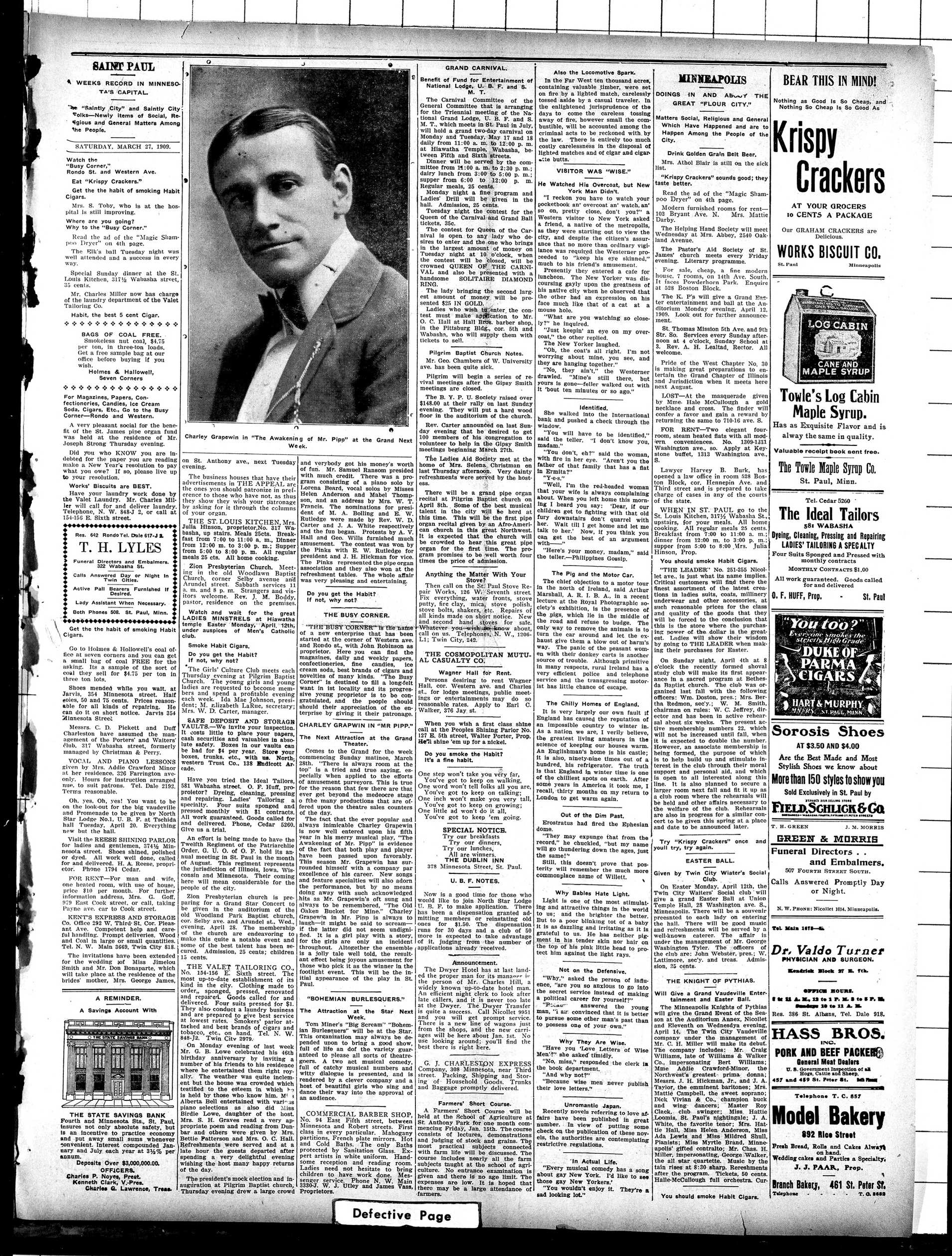
Charley Grapewin in "The Awakening of Mr. Pipp" at the Grand Next Week.
On St. Anthony ave., next Tuesday evening.
The business houses that have their advertisements in THE APPEAL are the ones you should patronize in preference to those who have not, as thus they show you wish your patronage by asking for it through the columns of our organ.
THE LOUIS KITCHEN. Mrs. Julia Hinson, proprietor 317. Wt. basha, up stairs. Meals 25cts. Breakfast from 7:00 to 11:00 a.m., Dinner from 12:00 to 3:00 p.m.; Supper from 5:00 to 8:00 p.m. All regular meals 25 ct. All home cooking.
Zion Presbyterian Church. Meeting in the old Woodland Baptist corner, by street and Arundel church. Sabbath services 11 a.m. and 8 p.m. Strangers and visitors welcome. Rev. J. M. Boddy, pastor, residence on the premises.
and verybody get his money's worth of fun. Mr. Samuel Ransom presided with much credit. They group consisting of a piano solo by Lorena Beard, vocal solos by Misses Helen Anderson and Mabel Thompson, and an address by Mrs. W. T. Prinsis. The nominations for presidents of Helen and Mabel and E. W. Rutledge were made by Rev. W. D. Carter and J. A. White respectively and the fun began. Protests by A. V. Hall and Geo. Wills furnished much amusement. The contest was won by the Pinks with E. W. Rutledge for president and J. H. Houser. The Pinks represented the piparron association and they also won at the refreshment tables. The whole affair was very pleasing and entertaining.
Do you get the Habit? if not, why not?
Watch and wait for the great
LADIES MINSTRELS at Hiawatha
temple Easter Monday, April, 12th
under auspices of Men's Catholic
club.
Smoke Habit Cigars.
The Girls' Culture Club meets each Thursday evening at Pilgrim Baptist Church. The young girls and young ladies are requested to become mem-bers and profitable evening each week. Ida K. Huff, president; M. Elizabeth LaRue, secretary; Mrs. W. D. Carter, manager.
SAFE DEPOSIT AND STORAGE VAULTS—We invite your inspection. It costs little to place your papers, cash securities and valuables in absolute safety. Boxes in our vaults can be had for $4 per year. Store your boxes, trunks, etc., with us. Northwestern Trust Co., 138 Endicott Arcade.
Have you tried the Ideal Tailors, 581 Wabasha street. O. F. Huff, proprotero? Dyeing, cleaning, pressing and repairing. Ladies' Tailoring a pressed monthly suits sponged and pressed monthly contracts. All work guaranteed. Cedar called for and delivered. Phone, Cedar 5260; Give us a trial.
An effort is being made to have the Twelfth Regiment of the Patriarchial Order, G. U. O. of O. F. hold its annual meeting in St. Paul in the month of August. This regiment represents the most successful Illinois, Iowa, Wisconsin and Minnesota. Their coming here will mean considerable for the people of the city.
Zion Presbyterian church is preparing for a Grand Star Concert to be given in the auditorium of the old Woodland Park Baptist church, Selby ave. and Arundel st., Wed. evening, April 28. The membership of the church are endeavoring to be quite notable event and some of the talent has been secured. Admission, 25 cents; children 15 cents.
THE VALET TAILORING CO.
No. 154-16. E. Sixth street. The most up-to-date establishment of its kind in the city. Clothing made to order, sponged, pressed, renovated and repaired. Goods called for and delivered. Four suits pressed for $1. They also conduct a laundry business at low cost to give best service at low cost. Their parlor attached and best brands of cigars and tobacco, etc. on hand. Tel. N. W. 848-J2. Twin City 2979.
On Monday evening of last week Mr. G. B. Lowe celebrated his 46th birthday anniversary by inviting a number of his friends to his residence where he entertained them right royally. The weather was quite inclement but the house was crowded which the esteem the situate in which is held by those who know him. Mr. Alberta Bell entertained with varis piano selections as also did Miss Birdle Louth, daughter of the host. Mrs. S. H. Graves read a very appropriate poem and reading from Dunbar and others were given by Mrs. Bette Patterson and Mrs. O. C. Hall. At late hour the guests departed after spending a very delightful evening wishing the many happy returns of the day. The president's mckey election and inauguration at Pilgrim Baptist church, Thursday evening drew a large crowd
and verybody got his money's worth of fun. Mr. Samuel Ransom presided with much credit. There was a pro program consisting of a piano solo by Lorea Heard, vocal solos by Misses Helen Anderson and Mabel Thompson, vocal solos by Misses Francis and Francis. The nominations for president of M. A. Bollining and E. W. Rutledge were made by Rev. W. D Carter and J. A. White respectively, and the fun began. Protests by A. V Hall and Geo. Wills furnished much amusement. The contest was won by knives with Rutledge for presided by J. H. Hickman. The Pinks represented the pipe organ association and they also won at the refreshment tables. The whole affair was very pleasing and entertaining.
Do you get the Habit?
If not, why not?
THE BUSY CORNER
"THE BUSY CORNER" is the name of a new enterprise that has been started at the corner of West ave. and Rondo st. with John Robinson as proprietor. Here you can find the magazines, daily and weekly papers, confectioneries, fine candies, ice cream and novelties of many kinds. The Corner' is destined to fill a long-felt want in its locality and its progressive young proprietor to be congratulated, and the people should should their appreciation of the enterprise by giving it their patronage.
CHARLEY GRAPWIN IN "MR PPP."
The Next Attraction at the Grand Theater.
Comes to the Grand for the week commencing Sunday matinee, March 28th. "There is always room at the top" is a tried and true saying, especially when applied to the efforts of amusement purveyors. This is true for the reason that few there are that ever get beyond the meedocre stage many productions that are offered upon the theatre sales counters of the day.
The fact that the ever popular and always imminible Charley Grapewain is now well entered upon his fifth year in his merry musical play, "The Fighter of the N. Pipp" is evidence of the fame of his work and have been massed upon favorably. This season Mr. Grapewain has surrounded himself with a company par excellence of his career. New songs and feature specialties will also adorn the performance, but by no means will he hit as Mr. Grapewain's oft sung and always to be remembered, "The Old Gaken Bucket for Mine." Charley Grapewain in Mr. Pipp is always to laugh—it might be said to scream—but it seems seem more fitted. It is a girl play in story for the girls are only an incident throughout. Altogether the ensemble is a jolly tale well told, the resultant effect being joyous amusement for those who pick it as the winner in the night event. This will be the initial appearance of the play in St Paul.
"BOHEMIAN BURLESQUERS."
The Attraction at the Star Next Week.
Tom Mineer's "Big Scream" "Boheman Burlesquers" will be at the Star. This organization may always be depended upon to bring a good show, and the staff will guarded to please all sorts of the goers. A two act musical comedy, full of catchy musical numbers and witty dialogue is presented, and is rendered by a clever company and a host of beautiful girls who sing and dance their way into the approval of an audience.
COMMERCIAL BARBER SHOP.
No. 94 East Fifth street, between Minnesota and Robert streets. First class in every particular. Mahogany partitions, French plate mirrors. Hot and Cold Baths. The only Baths. Expert artists in white uniform. Hard some reception and reading room. Ladies need not hesitate to bring children to have work done. Messenger service. Phone N. W. Main U. Utley and James Vass, Proprietors.
Defective Page
Benefit of Fund for Entertainment of National Lodge, U. B. F. and S. M. T.
The Carnival Committee of the General Committee that is arranging for the Trennial meeting of the National Grand Lodge, U. B. F. and S. M. T., which meets in St. Paul in July, will hold a grand two-day carnival on Monday and Tuesday, May 17 and 18 daily from 1:00 a.m. to 12:00 p.m. at Haiwatha Temple, Wabasha, between Fifth and Sixth streets.
Dinner will be served by the committee from 1:00 a.m. to 2:30 p.m.; dairy lunch from 3:00 to 5:00 p.m.; supper from 6:00 to 12:00 p.m. Regular meals, 25 cents.
Monday night a fine program and Ladies' dinner will be given in the Ladies' Admin. Room at 25 p.m.
Tuesday night the contest for the Queen of the Carnival and Grand Ball tickets, 35c.
The contest for Queen of the Carnival is open to any lady who desires to enter and the one who brings in the largest amount of money on Tuesday night at 10 o'clock, when the queens will be at closed will be crowned QUEEN OF THE CARNIVAL and also be presented with a handsome SOLIATRE DIAMOND RING.
The lady bringing the second largest amount of money will be presented $25 IN GOLD.
Ladies who wish to enter the contest must apply to Mr. O. C. Hail at Hall Bldg. barr shop in the Pittsburgh Bldg. 6th and Wabasha, who will supply them with tickets to sell.
Pilgrim Baptist Church Notes.
Mr. Geo. Chambers of W. University ave. has been quite sick.
Pilgrim will begin a series of revival meetings after the Gipsy Smith meetings are closed.
The B. Y. P. U. Society raised over $148.00 at their rally on last Sunday evening. They will put a hard wood floor in the auditorium of the church.
Rev. Carter announced on last Sunday evening that he desired to get 100 members of his congregation to volunteer to help in the Glipsy Smith meetings beginning March 27th.
The Ladies Aid Society met at the home of Mrs. Selena, Christon on last Thursday afternoon. Very dainty freshments were served by the hostess.
There will be a grand pipe organ recital at Pilgrim Baptist church on April 8th. Some of the best musical talent in the city will be hered at this time. This will be the first pipe organ recital given by an Afro-American church in this great Northwest. It is expected that the church will be crowded to hear this great pipe organ recital. The program promises to be well worth four times the price of admission.
Anything the Matter With Your Stove?
Then call on the St. Paul Stove Repair Works, 126 W. Seventh street. Fix everything, water fronts, stove pots, stove hoods, stove pots, stove bolts, shakers, etc. Repairs of all kinds made on short notice. New and second hand stoves for sale, for sale, for sale. How about, call on us. Telephones. N. W., 1206-LI; Twin City, 242.
THE COSMOPOLITAN MUTU.
AL CASUALTY CO.
Persons desiring to rent Wagner Hall, cor. Westave and Charles st. for lodge meetings, public meetings or entertainments may do so reasonable rates. Apply to Earl C. Walker, 276 Jay st.
When you wish with a first class shine call at the Peoples Shining Parlor No. 127 E. 5th street, Walter Porter, Prop. He's shine 'em up for a nickel.
Do you smoke the Habit?
It's a fine habit.
One step won't take you very far,
You've got to keep on walking.
One word won't tell folks all you are,
You've got to keep on talking;
One inch won't make you very tall,
You've got to keep on waving;
One little ad won't do it all,
You've got to keep 'em going.
SPECIAL NOTICE.
Try our breakfasts
Try our dinners
Try our lunches
All are winners.
THE DUBLIN INN
378 Minnesota Street, St. Paul.
Now is a good time for those who would like to join North Star Lodge U. B. F. to make application. There has been a dispensation granted additional fees for $1.50. The dispensation runs for 30 days and a club of 50 more is expected to take advantage of it. Judging from the number of applications already received.
**Announcement.**
The Dwyer Hotel has at last landed the proper man for its manager the person of Mr. Charles Hill, a widely known up-to-date hotel man. An efficient clerk to look after late callers, and it is never too late to arrive. The hotel is quite a success. Call Nicollet 9951 and you will get prompt service. There is a new line of wagons just from the shops, and the new carriages are also available. Anst. No. 1. Use looking around; you'll find the best there is right here.
G. J. CHARLESTON EXPRESS Company, 308 Minnesota, near third street. Store of Household and Stor- tures of Household and Baggage promptly delivered.
A Farmers' Short Course will be held at the School of Agriculture at St. Anthony Park for one month commencing September. The course consists of lectures, demonstrations and judging of stock and grains. The most practical subjects connected with farm life will be discussed. The course will allow all the farm subjects taught at the school of culture. No entrance examination is given and there is no age limit. The expenses are low. It is hoped that there may be a large attendance of
GRAND CARNIVAL.
Wagner Hall for Rent.
U. B. F. NOTES.
Announcement.
Farmers' Short Course
In the Far West ten thousand acres, containing valuable timber, were set on fire by a lighted match, carelessly tossed aside by a casual traveler. In the enlightened jurisprudence of the days to come the careless tossing away of fire, however small the combustible, will be accounted among the criminal acts to be reckoned with by the authorities. The costly carelessness in the disposal of lighted matches and of cigar and cigar-ite butts.
VISITOR WAS "WISE."
He Watched His Overcoat, but New York Man Didn't.
"I reckon you have to watch your pocketbook an 'overcoat an 'watch, an' so on, pretty close, don't you?" a Western visitor to New York asked a friend, a native of the metropolis, as they were starting out to view the city, and despite the citizen's assurance that no more than ordinary vigilance was required the Western proceeded to "keep his eye skinned," much to his friend's amusement.
Presently they entered a cafe for luncheon. The New Yorker was discoursing gayly upon the greatness of his native city when he observed that the other had an expression on his face much like that of a cat at a mouse hole.
"What are you watching so closely?" he inquired.
"Just keepin' an eye on my overcoat," the other replied.
The New Yorker langued.
"Oh, the coat's all right. I'm not worrying about mine, you see, and they are hanging together."
"No, they ain't," the Westerner drawled. "Mine's still there, but yours is gone—feller out with it 'bout ten minutes or so ago."
Identified.
She walked into the international bank and pushed a check through the window.
"You will have to be identified," said the teller. "I don't know you, madam."
"You don't, eh?" said the woman, with fire in her eye. "Aren't you the father of that family that has a flat in England?" "Yea."
"Well, I'm the red-headed woman that your wife is always complaining about. When you left home this morning I heard you say. 'Dear, if our children get to fighting with that old fury downstairs don't quarred with her. Wait till I get home and let me talk to her.' Now, if you think you can get the best of an argument with——"
"Here's your money, madam," said the teller—Philippines Gossin.
The Pig and the Motor Car
The chief objection to a motor tour in the north of Ireland, said Arthur Marshall, A. R. I. B. A., in a recent lecture at the Royal Photographic society's exhibition, is the presence of the pigs, which lie in the middle of the road and refuse to budge. The only way to remove the animals is to turn the car around and let the exhaust give them a blow out of harm's way. The panic of the peasant woman and their donkey carts is another source of their distress, although primitive in many respects, runners are very efficient police and telephone service and the transgressing motorist has little chance of escape.
The Chilly Homes of England
It is very largely our own fault if England has caused the reputation of an impossible country to winter in. As a nation we are, I verily believe, the greatest living amateurs in the science of keeping our houses warm. An Englishman's home is his castle; it is also, ninety-nine times out of a hundred, his refrigerator. The truth is that England in winter time is one of the chilliest spots on earth. After some years in America it took me, I recall, thirty months on my return to London to get warm again.
Out of the Dim Past
Erostratus had fired the Ephesian dome.
"They may expunge that from the record," he chuckled, "but my name with that thundering down the ages, just the same!" Still, this doesn't prove that postery will remember the much more commonplace name of Willett.
Why Bables Hate Light.
Light is one of the most stimulating and attractive things in the world to us; and the brighter the better. But to a poor blinking lot of a baby it is as dazzling and irritating as it is and he has neither pigment in his temples nor hair on the top of his pikiln littles to protect him against the light rays.
Not on the Defensive
"Why," asked the person of influence, "are you so anxious to go into the secret service instead of making a political career for yourself?" "Pleasure" answered the young man, "I am convinced that it is better to pursue some other man's past than to possess one of your own."
Why They Are Wise
"Have you Love Letters of Wise Men?" she asked timidly.
"No, miss," responded the clerk in the book department.
"And why not?"
"Because wise men never publish their love letters."
Unromantic Japan.
Recently novels referring to love affairs have been published in great number. In view of putting some check on the publication of these novels, the authorities are contemplating restrictive regulations.
In Actual Life.
"Every musical comedy has a song about gay New York. I'd like to see those gay New Yorkers." Our would enjoy it. They're a sad look lot."
MINNEAPOLIS
DOINGS IN AND ABOUT THE GREAT "FLOUR CITY."
Matters Social, Religious and General Which Have Happened and are to Happen Among the People of the City.
Drink Golden Grain Belt Beer.
Mrs. Athol Blair is still on the sick list.
"Krispy Crackers" sounds good; they taste better.
Read the ad of the "Magic Shampoo Dryer" on 4th page.
Modern furnished rooms for rent: 102 Bryant Ave. N. Mrs. Mattie Darby.
The Helping Hand Society will meet Wednesday at Mrs. Abbey, 2540 Oakland Avenue.
The Pastor's Aid Society of St. James' church meets every Friday evening. Literary programme.
For sale, cheap, a fine modern house, 7 rooms, on 14th Ave. South. It faces Powderhorn Park. Enquire at 528 Blockon Block.
The K. P's will give a Grand Easter entertainment and ball at the Audubon Monday evening, April 12, 1900. Look out for further announcement.
St. Thomas Mission 5th Ave. and 4th Str. So. Services every Sunday afternoon at 4 o'clock, Sunday School at 3. Rev. A. H. Lealtad, Rector. All welcome.
Pride of the West Chapter No. 30 is making great preparations to entertain the Grand Chapter of Illinois and Jurisdiction when it meets here next August.
LOST—At the masquerade given by Mute Hale McCullough a gold necklace and cross. The finder will confer a favor and gain a reward by returning the same to 710-16 ave. S.
FOR RENT—Two elegant fourroom, steam heated flats with all room conveniences. 1900-131 Washington ave. so. Apply at Keystone bulet, 1313 Washington ave. S.
Lawyer Harvey B. Burk, has opened a law office in room 528 Boston Block, cor, Hennepin Ave. and Third street and is prepared to take charge of cases in any of the courts on WHEN IN ST. PAUL go to the St. Louis Kitchen, 317% Wishawa St, upstairs, for your meals. All home cooking. All regular meals 25 cents. Breakfast from 7:00 to 11:00 a.m.; dinner from 12:00 m. to 3:00 p. m.; supper from 5:00 to 8:00 m. Julia Hinson, Prop.
You should smoke Habit Cigars.
"THE LEADER" No. 251-255 Nicole ave. is just what its name implies. Critical customers will find there the finest assortment of the latest creations underwear and other accessories, at such reasonable prices for the class and quality of the goods that they will be forced to the conclusion that this is the store where the purchasing power of the dollar is the greatest underwear and wisdom by going to THE LEADER when making their purchases for Easter.
On Sunday night, April 4th at 8 o'clock the recently formed shovel study club will make its first appearance in a sacred program at Bethesda Baptist church. The club was organized last fall with the following Board-formed, the purpose which chairman on rules: W. C. Jeffrey, director and has been in active rehearsal about six weeks. The present active membership numbers 22, which will not be increased until fall, when it is expected to double the number. However, an associate membership is available, the purpose which is to help build up and stimulate interest in the club through their moral support and personal aid, and which is open to all interested along this line. It is also planned to secure a larger room next fall and fit it up as a club room where the rehearsals will be held and other affairs must be completed. Club. Rehearsals are also in progress for a similar concert to be given this spring at a place and date to be announced later.
Try "Krispy Crackers" once and you try, try again.
EASTER BALL.
Given by Twin City Wiater's Social Club.
On Easter Monday, April 12th, the Twin City Waiters' Social club will give a grand Easter Ball at Union Temple Hall. 28 Washington ave. S., Minneapolis. There will be a souvenir presentation to the hall. There will be good music and refreshments will be served by a well-known caterer. The affair is under the management of Mr. George Washington Tyler. The officers of Mr. George Washington Tyler. The webber, pres. L. Lattimore, secy., and treas. Adm. 25 cents.
THE KNIGHT OF PYTHIAS
Will Give a Grand Vaudeville Entertainment and Easter Ball.
The Minneapolis Knights of Pythias will give the Grand Event of the Season at the Auditorium Annex, Nicollet and Eleventh on Wednesday evening, April 14. The Twin City Vaudeville company under the management of Mr. C. H. Miller will make its debut. The company includes: Mr. Craig Williams, late of Williams & Walker Co., impersonating Bert Williams; Mme Addie Crawford-Minor, the Northwest's greatest prima donna; Messrs. J. H. Hickman, Jr., and J. A. Taylor, the eminent baritones; Mrs. Mattie Campbell, the sweet soprano; Dick Vivian & Co., champion buck and wing dancers; Master Roy Cack, club singer; Miss Hattie Loomis, St. Paul's nightingale; J. A. White, the favorite tenor; Mrs. Hattie Hall, Miss Helen Anderson, Miss Ada Lewis and Miss Mildred Shull, Planists; Miss Myrtle Brand, Minneapolis gifted contralto; Mr. Chas. H. Miller, impersonating, George Walker, the all star quartette. Music by the rain rises at 8:30 sharp. Rereshments after the program. Tickets, 50 cents.
Halle-McCullough full orchestra. Cur
You should smoke Habit Cigars.
Nothing as Good Is So Cheap, and Nothing So Cheap Is So Good As
Krispy Crackers
AT YOUR GROCERS
10 CENTS A PACKAGE
Our GRAHAM CRACKERS are
Delicious.
WORKS BISCUIT CO.
St. Paul Minneapolis
St. Paul Minneapolis
XIMINMING CITY OF MINNEAPOLIS
AND PULLGROUND
LOG CABIN
CANE AND
MAPLE SYRUP
Towle's Log Cabin
Maple Syrup.
Has as Exquisite Flavor and is
alway the same in quality.
Valuable receipt book sent free.
The Towle Maple Syrup Co.
St. Paul, Minn.
The Ideal Tailors
581 WABASHA
Dyeing, Cleaning, Pressing and Repairing
LADIES' TAILORING A SPEC ALTY
Four Suits Sponged and Pressed with
monthly contracts
MONTHLY CONTRACTS $1.00
All work guaranteed. Goods called
for and delivered
O. F. HUFF, Prop. St. Paul
"You too?"
Everyone smokes the
strictly High Grade
DUKE OF
PARMA
CIGARS
HART & MURPHY
INTRY, ST PAUL, MINN
Sorosis Shoes
AT $3.50 AND $4.00
Are the Best Made and Most
Stylish Shoes we know about
More than 150 styles to show you
Sold Exclusively in St. Paul by
FIELD, SCHLICK & CO.
T. H. GREEN J. M. MORRIS
GREEN & MORRIS
Funeral Directors . . .
and Embalmers.
507 FOURTH STREET SOUTH.
Calls Answered Promptly Day
or Night.
N. W. PHONE: Nicolett 1014, Minneapolis.
Tol Main 1678
Dr. Valdo Turner
PHYSICIAN AND SURGEON.
Kendrick Block 27 W. 7th.
OFFICE HOURS.
8 at 11 A.M. 12 to 1 P.M. 1 M. to 5 P.M.
Sunday 10 to 11 A.M.
Res. 386 St. Albans, Tel. Dale 918.
HASS BROS.
INC.
PORK AND BEEF PACKER
General Meat Dealers
U.S. Government Inspection of all
Hogs, Cattle and Sheep.
457 and 459 St. Peter St.
Telephone T. C. 857
Model Bakery
Fresh Bread, Rolls and Cakes Always
on hand.
Wedding cakes and Parties a Specialty,
J. J. PAAR, Prop.
Branch Bakery, 461 St. Peter St.
Telephone T. G. 8689
Breaking Waves Dash High in London Hippodrome.
The latest feature at the London Hippodrome is a spectacle entitled "The Sands of Dee," which culminates in the rescue of the heroine, gagged and bound to a stake planted on the beach, just as the rising tide sends in great breakers which nearly overwhelm the girl.
Sinew rollers sweep across the state in a most realistic manner, and the hero, on the back of a swimming horse, barely reaches the fortunate heroine as the water laps about her shoulders.
The apparatus necessary for the production of waves is very simple. Seventy-nine feet above the stage, in the flies, are three great tanks, each capable of holding five tons of water and fitted with an arrangement whereby the water may be discharged in a solid mass as though the bottom had fallen out.
A wave-producing board is built up in the stage immediately beneath the tanks, says Harper's Weekly, extends across the full width of the procexium opening, and is concave in form, with the back ten feet high and the front edge only about twelve inches above the trough.
The falling water swirls as it strikes the hollow of this board and is projected in a solid sheet about thirty feet into the air before it breaks in the arena. A back cloth and water-proof paint aid materially in creating the illusion.
Nine waves dash into the arena at intervals of six seconds and the roar of the breakers is very similar to the surf. A high pressure main fills the tanks in three seconds after they are emptied.
A Thirteenth Century Drink
Thirteenth century tastes in food had few imitations. Besides the "fowl of Africa and the rare gadwit of Ionla" mentioned by Fitzstephen, gourmets in the time of King John used to regale themselves on herons, cranes, crows, storks, cormorants and bitterns. Some would wash their meals down with wine, but the majority drank mead or metheglin. Mead, according to Hollinshed, was only the washing of the combs after the honey had been taken from them, and so poor a beverage that it had to be spleeed, peppered or made palatable with sweetbriar or thyme. But metheglin contained one hundredweight of honey to twenty-four gallons of water, and must have been much more intoxicating than the strongest old ale of the present day.
Separated.
A regiment of soldiers were recently drawn up one Sunday for church parade, but the church was being repaired and could hold only half of them.
"Sergeant-major," shouted the colonel, "tell all the men who don't want to go to church to fall out on the reverse flank."
Of course, a large number quickly and gladly availed themselves of the privilege.
"Now, sergeant-major," said the colonel, "dismiss all the men who did not fall out and march the others to church—they need it most."
First Wedding in Eight Years
For the first time in eight years the wedding bells rang yesterday after the morning service at the parish church of Lindsell, Essex, which has been almost deserved owing to the dilapidation and decay of the cottages. Two laborers who have been waiting in this "Sweet Auburn" for cottages for some years led their brides to the altar, and the few villagers left made the occasion a memorable one.
Mrs. Gunner—Henry, you would persist in calling that last cook a vision. There was nothing pretty about her. Mr. Gunner—Not at all. Mrs. Gunner—Then why did you call her a vision? Mr. Gunner—Because visions fade nway. She remains only two days.
Of One Mind.
"The soil," remarked the political economist, "is what supports us all."
"Yes," rejoined the lawyer, "I must admit that real estate is at the bottom of three-fourths of all litigation."
"And," added the doctor, "a great deal of sickness is dueto the effuvia from the ground."
Dream That Didn't Come True.
Sapleigh—Do you know, Miss Ethel, I dreamt last night that you and I were married.
Miss Ethel—Oh, did you? How perfectly sweet! Now, tell me, who was my husband?
After a Fashion.
Rivers—Are you on speaking terms with Ruggies?
Brooks—O. yes; whenever we meet I tell him he's a sneaking scoundrel, and he tells me I'm a liar and a slanderer.
"My boy. I have nothing to leave you but debts."
"Yes dad."
"But be diligent and no doubt you can increase your inheritance."
Barker's New Legs.
"Have you seen Barker lately? He's on his last legs."
"No. Are they as bowed as his first ones?"
Minnesota Steam Laundry
314 MINNESOTA ST.
Send Us Your Work
OUR WORK WILL SATISFYY OU
ST. PAUL, MINN.
Straighten Your Hair
DEAR SIRS:—I have used only one bottle of your pomade and now I would not be without it for it makes my hair soft and straight and easy to comb and also starts a new growth.
MRS. W. F. WALKER, Sta. 1—Harriman, Tenn.
Ford's Hair
Pomade
(Formerly known as Ozonized Ox Martow)
Fifty years of success has proved its merits. The use of Ford's Hair Pomade makes stubborn, harsh, kinky or curly-hair straight, soft and glossy and easy to comb, and arrange in any style desired consistent with its length.
Removes and prevents dandruff, invigorates the scalp, stops the hair from falling out or breaking off and gives it new life and vigor.
Absolutely harmless—used with splendid results even on the youngest children.
Delicately perfumed, its use is pleasure, as ladies of refinement everywhere declare.
Ford's Hair Pomade has imitators. Don't buy anything else alleged to be "just as good." If you want the best results, buy the best Pomade—it will pay ou. Look for this name
Charlie Ford Print
If your druggist cannot supply you with the genuine, we will send you
One bottle regular size for - $0.50
Three bottles
Six
One bottle, small
We pay postage and express charges to all points in U.S.A. When ordering send Postal or Express Money Order. All orders shipped promptly on receipt of price. Address
The Ozonized Ox Marrow Co.,
153 East Kinxle St.
FORD'S HAIR POMADE is made only in Chicago by the above firm.
Agents Wanted Everywhere.
The Dale Street Pharmacy
FRED W. WEILER, Prop.
Come in and make our place your headquar
PURE DRUGS
Prescriptions our Specialt!
Toilet Articles, Perfumes, Station
Combs, Brushes, Etc.
Corner Dale St. and University Ave
ST. PAUL, MINN.
Tel. N. W. Dale 1140-J
J. B. Michels
396 DALE ST.
FANCY GROCERIES
We are here to please the people.
Agent for Dr. Lauretzen's Health Table
Malt Tonic. The only pure
Malt on the Market.
JOHN DORNSEIFF
Fine
Shoes
859 University, Corner Kent
Repairing
Mostly Done
St. Paul
PHONES { TWIN CITY 4382
N. W. DALE 8947
J. W. NELSON
DRUGGIST
Fine Cigars, Soda Water and
Toilet Articles
COR, KENT ST, AND UNIVERSITY AVE.
ST. PAUL.
Palatable and Effi-
At all Drug Store
MADE ONLY BY
THEO. HAMM BREWING CO.
BREWERS OF THE BEER
"Leads Them All
Main 939 PHONES
Capitol Steam Laundry
743 Wabasha St.,
First Class Work Satisfaction Gu-
ST. PAUL,
In City Carpet Cleaning
182 West Fourth Street, corner Exchange
D. HUESLER,
ST. PAUL,
evin City
182 W
O. HUESL
Carpets, Matting Rugs, Etc., Taken up
Cleaned, Re-laid, Packed, Packed for
Shipment or Stored. Rugs Made and
Sized. We make a SPECIALTY OF
CLEANING FINE IMPORTED AND
DOMESTIC RUGS.
phones; N. W. L.
Dimes are
ly when lock
savings acco
tion. "Plant
ings.
THE ST
SMOKE
EYE D
GOLDEN
GRAIN BELT'
BEERS
Dimes are little young dollars. They
may when locked up together. Treat your
Savings account and prove it to your ow-
nion. "Planted" dollars will add to your
savings.
THE STATE SAVINGS
93 East Fourth Street
IF YOU SMOKE, WHY NO
HABIT
BEST 5c. CIGAR ON EAR
HARM
GLASSES
EYE DEFECTS AND SYMPTO
GOLDEN
GRAIN BELT
BEERS
Dimes are little young dollars. They grow only when locked up together. Treat yourself to a savings account and prove it to your own satisfaction. "Planted" dollars will add to your earnings. THE STATE SAVINGS BANK 93 East Fourth Street
SMOKE
IF YOU SMOKE, WHY NOT
HABIT
BEST 5c. CIGAR ON EARTH
HARN
CLASSES
EYE DEFECTS AND SYMPTOMS.
Bye defects are few—symptoms many. There can be but two defects in the hung Theeeye may be too long in whole. The Lyopic eye. Or too short in whole—the Hyperopic eye. Combine the two in one eye and we have Properly adjusted glasses will correct the Medicines or waiting, never. Symptoms that spring from these two symptoms are manifold; such as eye and I question, Dyspepsia, Nervous Debility, Chor
There can be but two defects in the human Theeye may be too long in whole. Then weopic eye.
Or too short in whole—the Hyperopic eye.
Combine the two in one eye and we have A Properly adjusted glasses will correct these Medicines or waiting, never.
Symptoms that spring from these two simi-nations are manifold; such as eye and head-tion, Dyspepsia, Nervous Debility, Chorea, er ailiments having their origin in lack of ne. We correct all Defects of the human eye i-ramely. Charges reasonable. Satisfaction
HARMS OCULO CURES SORE EYES 25c PER 60
Theeye may be too long in whole. Then we have the Myopic eye.
Symptoms that spring from these two simple eye malformations are manifold; such as eye and headaches, Indigestion, Dyspepsia, Nervous Debility, Chorea, Epilepsy and other ailments having their origin in lack of nerve force.
We correct all Defects of the human eye that glasses will remedy. Charges reasonable. Satisfaction guaranteed.
F. H. HARM & BRO.
Weakness follows sickness. The cure for weakness is nourishment. Digesto is nourishment. It is a highly concentrated liquid food, predigested, and during the period of convalescence proves a most valuable aid to nature in her work of reconstruction.
Palatable and Efficient
At all Drug Stores
MADE ONLY BY
THEO. HAMM BREWING CO., ST. PAUL
BREWERS OF THE BEER THAT
"Leads Them All"
PHONES Twin City 16
Steam Laundry
3 Wabasha St.,
Satisfaction Guarantee
MINN.
Carpet Cleaning Work
Fourth Street, corner Exchange
PROPRIETO
GOLDEN
MAIN BELT
BEERS
take young dollars. They grow on
up together. Treat yourself to a
and prove it to your own satisfac-
d dollars will add to your earn
TE SAVINGS BANK
East Fourth Street
YOU SMOKE, WHY NOT
ABIT
5c. CIGAR ON EARTH
HARM
GLASSES
ECTS AND SYMPTOMS.
two defects in the human eye.
too long in whole. Then we have the
whole—the Hyperopic eye.
in one eye and we have Astigmatism
glasses will correct these defects.
ting, never.
spring from these two simple eye ma-
bold; such as eye and headaches, Ind
Nervous Debility, Chorea, Epilepaya
ing their origin in lack of nerve force.
effects of the human eye that glasses
are reasonable. Satisfaction guarantee.
CURES SORE EYES 25c PER BOTTLE.
efficient
O., ST. PAUL
THAT
"all"
Twin City 1643
dry
guaranteed
MINN.
Works
OPRIETOR
Tri-State, 1038
THE BOSTON EDITOR
The MAJOR SHAMPOO DRIVE HAIR STRAIGHT
LADIES everywhere now use this great tool to be the only perfect device for driving the wonders that WILL SURPLY THE HAIR and give it a natural fluffy and warm moth feather. Its regular use tends to incarnate of the hair in beautiful waves.
The Magic should not be mistaken for so poor imitations which are advertised. Let picture and see how it works. See how and substantial is the Aluminum Comb—18 stick, 1.34 inches wide, 4.12 inches long, will retain an even heat, and will not burn the hair or scalp. Look at the heavy steel heating bar, 7.16 inches square, and 4.12 inches long. It will take a moderate heat and retain it a long time, and will last a lifetime. The clamps for holding the comb are easy of adjustment, easy to keep in order and clean. The handle has it steel rod from end to end, making a handsome article for every lady's toiletable.
STEEL HEATING BAR
ONLY $100
MAGIC SHAMPOO
The Magic can be purchased
"You use Everyone's strictly for DURP PARC CIGA
HART & MNFRS. S
"Leads T
The MAGIC
SHAMPOO DRIER AND HAIR STRAIGHTENER
LADIES everywhere now use this great toilet necessity. Besides being the only perfect device for drying the hair quickly, it works in hair in that WILL SURELY STRAIGHTEN CURLY HAIR and gives it a natural shine and wavy appearance, so much desired. It irregular use tends to increase the growth of the hair in beautiful waves.
The Magic should not be mistaken for some of the poor installations which are advertised. Look at the picture and see it works. See how strong and substantial is the Aluminum Compb-1-8 inch thick, 1-3 8 inches wide, 4-1 2 inches long. It will retain an even heat, and will not burn the hair or scab. Look at the heavy steel heating tube 7.5 inches square, and 4-1 3 inches long. It will take in a moderate heat and retain it a long time, and will last a life-time. The clamps for holding the comb are easy for adjustment, easy to keep in order and clean. The handle has a solid steel rod from end to end, making handmade article for every lady's toilet table.
PAJUARE 21.04
SHAMPOO DRIER MFG.CO.
MINNEAPOLIS, MINN.
HOW TO USE THE MAGIC
STEEL HEATING BAR
ALUMINUM COMB
ONLY $100
The Handsome Aluminum Compb is never heated direct. The metal which holds it in place, are pressed by turning the handle. Then the heavy steel (like a curling iron) in gas or oil is slipped back into place, the handle is slipped back into place, the handle is ready, or use. Hundreds of ladies write as they would not attempt to arrange their hair without the Magic. Wrapping it firmly guarantee that it will straighten the curly hair to hair or scalp, and by keeping the hair from sandrif. and by keeping the growth of the hair. Half dried and stored in 20 minutes after shampoo by using the Magic.
Do not despair of shampoo, buy the genuine, get the best-mold to fashionable hair for years, it always gives satisfaction.
AGENTS WANTED IN EVERY TOWN
MAGIC SHAMPOO DRIER CO., MINNEAPOLIS, MINNESOTA
The Magic can be purchased at Donaldsons Glass Block
"You too?"
Everyone smokes the
strictly High Grade
DUKE OF
PARMA
CIGARS
HART & MURPHY,
MNFRS. ST. PAUL, MINN.
"Leads Them All"
Hamm's Beer leads them all. In every way-in PURITY, AGE and FLAVOR. If you drink Hamm's once, you will never be satisfied with any other beer.
THEO. HAMM BREWING CO.
ST. PAUL
ORDER A CASE
ORDER A CASE BY PHONE 935
ORDER A CASE BY PHONE 935
ST. PAUL
XASONIO
MOST WORSHIPFUL GRAND LODGE
JOSE H. SHERWOOD, GRAND SECK
130 W. Arch St. St. Paul, Minn.
PIONER LODGE No. 1. A. F. and A. M. meets first and third Mondays of each month at Wagner Hall, cor. Charles street at Wagner Hall, at 8:00 p.m. j. M. H. Dillingham, W. M.; D. E. Beailey, Secy.
905 Marion street.
PERFECT ASHLAR LODGE No. 4. A. F. and A. M. meets first and third Mondays at Wagner Hall, cor. Lafond and Thomas sts., at 8:00 p.m. j. M. A. Bolling, W. M. Jose H. Sherwood, Secy. 130 W. Arch St.
MARS LODGE, NO. 2202, MEETS at Odd Fellows Hall, 221 West University, corner Farrington avenue, Entrance on Odd Fellows Hall, at Thos. S. Hickman, P. S. 422 St. Anthony avenue.
HOUSEHOLD OF RUTH, NO. 4. G. U. of O. F. meets first and third Mondays in each month at Odd Fellows Hall, at Cor. University and Farrington, Mrs. Amelia Turner, M. N. G., Mrs. Ida M. Johnson, W. R., No. 916 Marion St.
PAST GRAND MASTER'S COUNCIL
123 G. U. of O. F. meets the second fourth Monday in each month at Odd Fellows Hall, 221 West University, corner Farrington, Entrance on Odd Fellows Hall, 221 West University, Mrs. Morris, W. G. M.; Thos. R. Hickman, S. G. No. 422 St. Anthony avenue.
ST. PAUL PATRIARCHY NO. 114. meets second Monday in each month at P. Hall, Cor. of University, corner Farrington Hall, Entrance or tonne avenue. Thos. R. Hickman (acting) R. V. P; W. R. Morris, P. M. V. F. Geo. B. Lowe, P. R. 178% Wabasha. Manuscript
HOUSEHOLD OF RUTH NO. 776 U. O. F. meets second and fourth Tuesday of enrolment. ple Hall, Cor. Fourth street and Eight ave. South. Mrs. Emily Newton, M. N. G.; Mrs. Margaret Williams, W. R.
UNITED BROTHERS OF FRIENDSHIP. NORTH STAR LODGE NO. 138. U. B. meets first and third Tuesdays at Tschilda Hall, Cor. Arundel and Lafond. Brothers in good stand-always welcome. O. Howell, W. M. J. Q. Adams, W. Secy. 49 E. Fourth street.
John H. Hayes Lodge No. 6, Kl of P. meets first and third Tuesdays in each month at hall, cor. of University and Farrington Hall. Avues. 8:00 c'clock P. K. Knights of Pythias in good standing always welcome. G. C. R.
KALI OF FIERCE
John H. Hayes, C. C., R.
W. Gully, K. of R. and S.
389 Rondo.
BIDDLE CIRCLE, LADIES OF G. A.
R. meets first and third Tuesdays of each
week, and supplies third Tuesdays of each
capitol building, Mrs. M. P. Tom, R.
Mr. J. R. White, Secy. Phoenix Bldg.
FIDELITY COURT OF CALANTEH
N. H. A. M. R. A. and A. A.
meets first and third Monday in each
month at K. of P. Hall, 211 Hennepin
Ave., Minneapolis, Mrs. Minerva
E. Barnett, W. C.; Miss Arlene M. Scott,
R. of D. 25, W. 29th St.
GOPHER LODGE NO. 105, I. B. P. O.
E. of the World, meets second and
fourth Thursday in each month at Elks
Paul, W. H. Johnson, E. R.; R. of
M. Johnson, secretary, 376 Minnesota.
PILGRIM BASTIST CHURCH, Cor.
12th and Cedar, Sunday school in each
at 11 a. m. and 7:45 p. m. Sunday
school at 12:30 o'clock. Wednesday evening
study Sunday school lesson. Friday evening
study Sunday school lesson. Wedding and
weddings promptly attended. Rev. W.
D. Carter, Pastor, 582 St. Anthony avd.
ST. JAMES' A. M. E. CHURCH, COR
Fuller and Jay streets. Sunday services,
1:40 a.m. 7:00 p.m. Wednesday prayer
meeting, 8:00 a.m. Sunday prayer
-soupau suqt i:sappau, pau xampou
day and Thursday. Weddings, funerals
and the sick attended on notice.
Religious services. Corr. Jay and Fuller.
Parsonage, Corr. Jay and Fuller.
ST. PHILIP'S EPISCOPAL MISSION
corner Aurors avenue and Mackubai street.
Early celebration of Holy
Eucharist, 7:30 a.m.
Holy Eucharist, first and thiru Sundays,
1:40 a.m. Matins, second and fourth
Holy Eucharist, first and thiru Sundays,
1:40 a.m. Matins, second and fourth
Holy Eucharist, first and thiru Sundays,
1:40 a.m. Brotherhood of St. Anne,
2:30 a.m. Vespers, 7:30 p.m. Week service:
diesesdays, confirmation class, 8:00 p.m.
Friday, 8:00 p.m. Week service:
diesesdays Holy Eucharist, 8:00 a.m. M. Rev.
A. H. Lealtad, Rector, 514 Full St.
HOTEL DWYER.
224 Washington Av. S. Minneapolis, Minn.
JOHN H. HARRIS
CHAS. W. DWYER, PROP.
Hotel Dwyer has been refitted and
refurnished and is in first class order
throughout. Rooms with heat, electric light and bath, by the day, week or month. Hotel always open for business. Terms reasonable.
DR. HURD
91 E. SEVENTH ST.
Specialty — Painless extracting, Crown and Bridge Work.
BRUCKNER BROS.
WORKED IN
MEATS GROCERIES
445 W. University Near Arundel