The Appeal
Saturday, September 2, 1911
St. Paul, Minnesota
Page text (machine-generated)
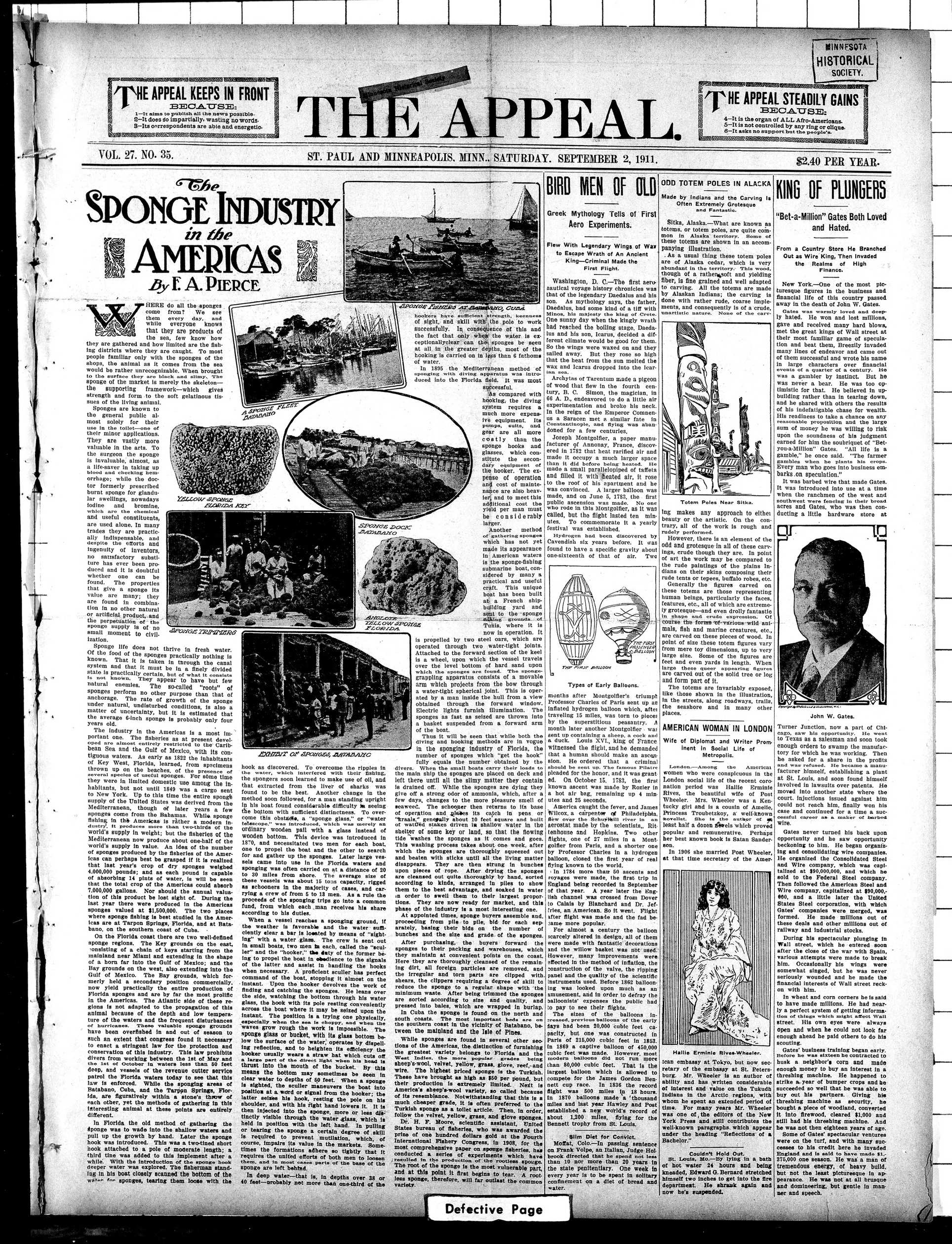
The SPONGE INDUSTRY in the AMERICAS By F. A. PIERCE
A SPONGE FLEET
hook as discovered. To overcome the ripples in the water, which interfered with their fishing, the spongers soon learned to make use of oil, and that extracted from the liver of sharks was found to be the best. Another change in the method soon followed, for a man standing upright in his boat found considerable difficulty seeing the bottom with sufficient distinctness. To oversee the sponges, a man with a telescope," was introduced, which was merely ordinary wooden pail with a glass instead of wooden bottom. This device was introduced in 1870, and necessitated two men for each boat, one to propel the boat and the other to search for and gather up the sponges. Later large vessels came into use in the Florida waters and sponging was often carried on at a distance of 20 to 30 miles from shore. The average size of the sponges was about 15 tons capacity, rigged as schooners in the form of cases, and carrying a crew of from 5 to 13 men in a rule the proceeds of the sponging trips go into a common fund, from which each man receives his share according to his duties.
When a vessel reaches a sponging ground, if the weather is favorable and the water sufficiently clear a bar is located by means of "sighting" with a water glass. The crew is sent out in small boats, two men in each, the "sculler" and the "hooker," the duty of the former beaker and the boat, to incidence to the signals of the latter to indicate the hooks when necessary. A proficient sculler and command of the boat, stopping it almost on the instant. Upon the hooker devolves the work of finding and catching the sponges. He leans over the side, watching the bottom through his water glass, the hook with its pole resting conveniently across the boat where it may be seized upon the instant. The position is a trying one physically, especially when the waves grow rough the work is impossible the sponge glass or bucket, with its glass bottom below the low surface of the water, operates by dispelling reflection, and to heighten its efficiency the hooker usually wears a straw hat which cuts off a large part of the direct light when his head is thrust into the mouth of the bucket. By this means the bottom may sometimes be seen in the depths of 50 feet. When a sponge is sighted, the maneuvers the boat into position at a word or sign on the hook; the latter seizes his hook, resting the hook on shoulder, and with his right hand lower it. It is then injected into the sponge, more or less distinctly visible through the water glass, which is held in position with the left hand. In pulling or tearing the sponge a certain degree of skill is required to prevent mutilation, which, of course, impairs its value in the markets. Some time, it is adhere so tightly that it requires the united parts of both men to loosen them, and in most cases parts of the base of the sponge are left behind.
In deep water—that is, in depths over 28 or 40 feet—probably not more than one-third of the
THE APPEAL KEEPS IN FRONT
BECAUSE:
1-It aims to publish all the news possible.
2-It does so impartially, wasting no words.
3-Its correspondents are able and energetic.
VOL. 27. NO. 35.
W
W HERE do all the sponges come from? We see them every day, and while everyone knows that they are products of the few know how they are gathered and how lumpy the districts where they are caught. To most people familiar only with the sponges of the shops, the animal as it comes from the sea would be rather unrecognizable. When brought to the surface they are black and slimy. The sponge of the market is merely the skeleton—supporting framework—which gives strength and form to the soft gelatinous tissues of the lily animal.
Sponges are known to the general public almost solely for their use in the toilet—one of their minor applications. They are vastly more valuable in the arts. To the surgeon the sponge is invaluable, almost, as a life-saver in taking up wound care and of oralorrhage; while the doctor formerly prescribed burnt sponge for glandular swellings, nowadays iodine and bromine, which are the chemical and useful constituents, are used alone. In many trades they are practically indispensable, and imply the efforts and ingenuity of inventors, no satisfactory nature has ever been produced and it is doubtful whether one can be found. The properties that give a sponge its value are many; they are found in combination in no other natural or artificial product, and the impression of the sponge body is of small moment to civilization.
10
YELLOW SPONGE
FLORIDA KEY
small moment to civilization.
Sponge life does not thrive in fresh water. Of the food of the sponges practically nothing is known. That it is taken in through the canal system and that it must be in a finely divided state is practically certain, but of what it constitutes is not known. They appear to have but few natural enemies. The so-called "roots" of sponges perform no other purpose than that of anchorage. The rate of growth of the sponge under natural, unhurried conditions, is also a matter of uncertainty, but it is estimated that the average 6-inch sponge is probably only four years old.
The industry in the Americas is a most important one. The fisheries as at present developed are almost entirely restricted to the Caribbean Sea and the Gulf of Mexico, with its contiguous waters. As early as 1822 the inhabitants of Key West, Florida, learned, from specimens thrown up on the beaches, of the presence of them in the useful sponges. For some time they were in limited use among the inhabitants, but not until 1836 was a cargo sent to New York. Up to this time the entire sponge supply of the United States was derived from the Mediterranean, though of later years a few sponges come from the Bahamas. While fishing in the Americas is rather a modern industry, it produces more than two-thirds of the world's supply in weight; but the fisheries of the Mediterranean now produce about one-half of the world's supply in value. An idea of the number of sponges produced by the fisheries of the Americas can perhaps best be grasped if it is realized that last year's crop of dry sponges weighed 4,000,000 pounds; and as each pound is capable of absorbing 14 plants of water, it will be seen that the number of sponges Americas could absorb 7,000,000 gallons. Nor is there annual valuation of this product be lost sight of the last year there were produced in the Americas sponges valued at $1,500,000. The two places where sponge fishing is best studied in the Americas are at Tarpon Springs, Florida, and at Bataano, on the southern coast of Cuba.
On the Florida coast there are two well-defined sponge regions. The Key grounds on the east, consisting of a chain of keys starting from the mainland near Miami and extending in the shape of a horn far into the Gulf of Mexico; and the Bay grounds on the west, also extending into the Gulf of Mexico. The Bay grounds, which formerly held a secondary position commercially, did practically the entire production of Florida sponge and are by far the most prolific in the Americas. The Atlantic side of the regions is not adapted to the propagation of this animal because of the depth and low temperature of the waters and the frequent disturbances of hurricanes. These valuable sponge grounds have been overfished in and out of season to such an extent that congress found it necessary to enact a stringent law for the protection and conservation of this industry. This law prohibits divers from working between the 1st of May and the 15th of June, by for the worst deep, and vessels of the revenue cutter service patrol the Florida waters today to see that this law is enforced. While the sponging areas of Batabano, Cuba, and the Tarpon Springs, Florida, are figuratively within a stone's throw of each other, yet the methods of gathering in this interesting animal at these points are entirely different. In Florida the old method of sponging the sponge was to wade into the shallow waters and pull up the growth by hand. Later the sponge hook was introduced. This was a two-timed short hook attached to a pole of moderate length; a hook was then used to implement after a while. With the introduction of deeper water was explored. The fisherman standing in his boat closely scanned the bottom of the water for sponges, tearing them loose with the
THE APPEAL.
THE BOAT
FLEET
EXHIBIT OF SPONORS DATABANG
hookergs have sufficient strength, keenness of sight, and skill with the pole to work successfully. In consequence of this and the fact that only when the water is exceptionally clear can the sponges be seen at all in the greater depths, most of the hooking is carried on in less than 6 fathoms of water.
In 1895 the Mediterranean method of sponging with diving apparatus was introduced into the Florida field. It was most successful.
As compared with hooking, the diving system requires a much more expensive equipment. Its mumps, suits, and gear are all more costly than the sponge hooks and glasses, which constitute the secondary equipment of the hooker. The expense of operation and cost of maintenance are also heavier, and to meet this additional cost the yield per man must be considerably
DALAPARO
ANGLO CHE
is propelled by two steel oars, which are operated through two water-tight joints. Attached to the forward section of the keel is a wheel, upon which the vessel travels over the level bottom of hard sand upon which the sponges are found. The sponging-apparatus consist of a water-joint object from the bow through a water-joint spherical joint. This is operated by a man inside the hull from a view obtained through the forward window. Electric lights furnish illumination. The sponges as fast as seized are thrown into a basket suspended from a forward arm of the boat. Thus it will be seen that while both the diving and hooking methods are in vogue in the sponging industry of Florida, the number of sponges which "get the hook"
tully equidus the number outfitted by the divers the hulls of the main ship sippees are placed on deck and left there until all the slimy matter they contain is drained off. While the sponges are dying they give off a strong odor of ammonia, which, after a few days, changes to the more pleasure smell of seawed. The schooner then returns to its base of operation and places its catch in pens or "kraals," generally about 10 feet square and built of wattled stakes driven in shallow water in the shelter of some key or land, so that the flowing tide washes the sponges as it comes and goes. This washing process takes about one week, after which the sponges are thoroughly squeezed out and beaten with sticks until all the living matter disappears. They are then strung in bunches upon pieces of oope, after drying the sponges to a hardness of about 10 according to kinds, arranged in piles to show them to the best advantage, and soaked in water in order to swell them to their largest proportions. They are now ready for market, and this phase of the industry is a most interesting one.
ripples in the divers. When the small bait in rishing, the main ship the sponges of oil, and left there until all the marks was drained off. While the gage in the give off a strong odor of upright few days, changes to the seeing seaweed. The schooner t to over of operation and places or "water kraals," generally about merely an watted stakes driven
divers. When the small boats carry their oars to the main ship the sponges are placed on deck and left there until all the slimy matter they contain is drained off. While the sponges are dying they give off a strong odor of ammonia, which, after a few days, changes to the more pleasure of seaweed. The schooner then returns to its base of operation and places its catch in pens or "krans," generally about 10 feet square and built of watered stakes driven in shallow water in the shelter of some key or land, so that the flowing tide washes the sponges as it comes and goes. This washing process takes about one week, after which the sponges are thoroughly squeezed out and the sticks are removed by the living matter disappears. They then attract the mite-mite upon pieces of rope. After drying the living matter are cleaned out quite thoroughly by hand, sorted according to kinds, arranged in piles to show them to the best advantage, and soaked in water in order to swell them to their largest proportions. They are now ready for market, and this phase of the industry is a most interesting one.
At appointed times, sponge buyers assemble and, proceed from pile to pile, bid for each separately, basing their bids on the number of sponges and the size and grade of the sponges. After purchasing, the buyers forward the sponges to their packing and warehouses, which they maintain at convenient clean points on the coast, and the irregularly contained particles are removed, and the reduced and the larger sponges are fitted with shears, the clapper requiring a degree of shrinkage to the sponge to a regular shape with the minimum waste. After being trimmed with the sponges are sorted according to size and quality, and burgled in bales, which are wrapped in burlap. In Cuba the sponge is found on the north and south coasts. The most important beds are on the southern coast in the vicinity of Batabano, between the mainland and the Isle of Pines.
While sponges are found in several other sections of the Americas, the distinction of furnishing the greatest variety belongs to Florida and the indies, the most popular grades being sheepswool fellet, yellow grass, glove, reef, and wire. The highest priced sponges are the Turkish. These have brought as high as 850 pound, but their production is extremely limited. Tex is America's sheep-wool variety, so called because of its resemblance. Notwithstanding that this is a much cheaper grade, it is often preferred to the Turkish sponge as a toilet article. Then, in order, follow the velvet, yellow, grass, and glove sponges. Dr. H. F. Moore, scientific assistant, United States bureau of fisheries, who was awarded the prize of one hundred dollars gold at the Fourth International Fishery Congress, in 1908, for the most comprehensive paper on sponge fisheries, has sold a series of experiments which have resulted in the production of the rooftop sponge. The root of the sponge is the most important part, and at this point it first begins to tear. A rootless sponge, therefore, will far outlast the common variety.
At appointed times, sponge buyers assemble and, proceeding from pile to pile, bid for each separately, basing their bids on the number of bunches and the size and grade of the sponges. After purchasing, the buyers forward the sponges to their packing and warehouses, which they maintain at convenient points on the coast. Here they are thoroughly cleansed of the remaining dirt, all foreign particles are removed, and the irregular and torn parts are clipped with shears, the clippers requiring a degree of skill to remove the irregular, regular shape with the minimum waste. After regular sponges are sorted according to size and quality, pressed into bales, which are wrapped in burlap. In Cuba the sponge is found on the north and south coasts. The most important beds are on the southern coast in the vicinity of Batabano, between the mainland and the Isle of Pines. While sponges are found in several other sections of the Americas, the distinction of furnishing the greatest variety belongs to Florida and the West Indies, the more popular grades being sheep-wool, velvet, yellow, grass, glove, reef, and wire. The highest priced sponge is the Turkish. These have brought as high as $50 per pound, but production is extremely limited. Next is America, not knowing that this is a much cheaper grade, it is often referred to the Turkish sponge as a toil article. Then in order, follow the velvet, yellow, grass, and glove, Dr. H. F. Moore, scientific assistant, United Bureau of fisheries, who was awarded the prize of one hundred dollars gold at the Fourth International Fishery Congress, in 1908, for the most comprehensive paper on sponge fisheries, has conducted a series of experiments which have resulted in the production of the rootless sponge, and at this point it first begins to tear. A rootless sponge, therefore, will far outlast the common variety.
Defective Page
SPONGE DOCK
BATABANO
ANGLOTE
YELLOW SPONGE
FLORIDA
As compared with hooking, the diving system requires a much more expensive equipment. Its pumps, suits, and gear are all more costly than the sponge hooks and glasses, which constitute the secondary equipment of the hooker. The expense of operation and cost of maintenance are also heavier, and to meet this additional cost the yield per man must be considerably larger.
Another method of gathering sponges which has not yet made its appearance in American waters is the sponge-fishing submarine boat, considered by many a practical and useful craft. This unique boat has been built in the building yard and sent to the sponge fishing grounds of Tunis, where it is now in operation.
BIRD MEN OF OLD
Greek Mythology Tells of First Aero Experiments.
Flew With Legendary Wings of Wax to Escape Wrath of an Ancient King—Criminal Made the First Flight.
Washington, D. C.—The first aeronautical voyage history chronicles was that of the legendary Daalusal and his son. As mythology says, the father, Daalusal, had some kind of a tiff with Minos, his majesty the king of Crete. One sunny day when the kingly wrath had reached the boiling stage, Daalusal and his son, Icarus, decided a different climate would be good for them. So the wings were waxed on and they sailed away. But they rose so high that the heat from the sun melted the wax and Icarus dropped into the icarus.
Archytes of Tarsum were a pigeon of wood that flow in the fourth century, B. C. Simon, the magician, in 66 A. D. endeavored to do a little air experiment and broke his neck. In the reign of the Emperor Commenus a Saracen met a similar fate in Constantinople, and flying was abandoned for a few centuries.
Joseph Montgolfier, a paper manufacturer of Annayon, France, discovered in 1782 that heat rarified air and made it occupy a much larger space than it did before being heated. He made a small parallelepiped of taffeta and filled it with heated air, it rose the roof of his apartment and he was made, on January 4, 1783, the first public ascension was made, who rode in this Montgolfier, as it was called, but the flight lasted ten minutes. To commemorate it a yearly festival was established.
Hydrogen had been discovered by Cavendish six years before. It was found to have a specific gravity about one-sixteenth of that of air. Two
THE FIRST PROSINGER BALLOON
THE FIRST BALLOON
Types of Early Balloons.
months after Montgolfier's triumph Professor Charles of Paris sent up an inflated hydrogen balloon which, after travelling 15 miles, was torn to piece by the superstitious peasantry. A month later another Montgolfier was sent up containing a sheep, a cock and a duck. Louis XVI, king of France witnessed the flight, and he demanded that a human should make an ascension. He ordered that a criminal should be sent up. The famous Pilgrimage of the soul was granted. On October 15, 1783, the known ascension was made by Rozier in a hot air bag, remaining up 4 minutes and 25 seconds. America caught the fever, and James Willecx, a carpenter of Philadelphia, saw over the Schuylkill river in an aerostat made by the scientists, Rittenhouse and Hopkins. Two other flights, one of 27 miles in a Montgolfier from Paris, and a shorter one by Professor Charles in a hydrogen balloon, closed the first year of real flying known to the world. In 1784 more than 40 ascents and royages were made, the first trip in England being recorded in September 1785. The english channel was crossed from Calais by Blanchard and Dr. Jeffries, an American. So it went. Flight after flight was made and the fat became more popular.
For almost a century the balloon scarcely altered in design, all of them were made with fantastic decorations and the wallow basket was not used. However, many improvements were affected in the method of inflation, the construction of the valve, the ripping of the valve and the scientific instruments used. Before 1862 balloons was looked upon much as an amusement, and in order to defray the balloonists' expenses the public had to pay to see their flights. The sizes of the balloons increased, previous balloons of the early days had been 20,000 cubic feet capacity, but one was constructed in Paris of 215,000 cubic feet in 1853. The balloon of the balloon of 450,000 cubic feet was made. Modern balloons did not run more than 80,000 cubic feet. That is the largest balloon which is allowed to compete for the James Gordon Bennett cup race. In 1836 the record flight was 500 miles in 18 hours. In 1870 balloons made a 'thousand miles and last year Hawley and Post established a new world's record of about 1,200 miles, flying for the Bennett trophy from St. Louis. Slim Diet for Convict
Moffat, Colo—In passing sentence on Frank Volpe, an Italian, Judge Holbrook directed that he spend not less than 10 nor more than 20 years in the state penitentiary. One week in every year is to be spent in solitary confinement on a diet of bread and water.
ODD TOTEM POLES IN ALACKA
Made by Indians and the Carving is Often Extremely Grotesque and Fantastic.
Sitka, Alaska.—What are known as totems, or totem poles, are quite common in Alaska territory. Some of these totems are shown in an accompanying illustration.
As a usual thing these totem poles are of Alaska cedar, which is very tough in the territory. This wood, though of a hardy type, will yield fiber, is fine grained and adapted to carving. All the totems are made by Alaska Indians; the carving is done with rather rude, coarse implements, and consequently is of a crude, unartistic nature. None of the carv
Totem Poles Near Sitka.
Ing makes any approach to either beauty or the artistic. On the contrary, all of the work is rough and rudely performed.
However, there is an element of the odd and protesque in all of these carvings, crucified through they are. In point of art the work may be compared to the rude paintings of the plains Indians on their skins composing their rude tents or tenes, buffalo robes etc.
Generally the figures carved on these totems are those representing human beings, particularly the faces, features, etc., all of which are extremely grotesque and even drolly fantastic in shape and crude expression. Of course the forms of various wild animals, fish and marine creatures, etc., are carved on these pieces of wood. In point of size these totem figures vary from mere toy dimensions, up to very large size. Some of the figures are feet and even yards in length. When large these queer appearing figures are carved out of the solid tree or log and form part of it.
The totems are invariably exposed, like those shown in the illustration, in the streets, along roadways, trails, the seashore and in many other places.
AMERICAN WOMAN IN LONDON
Wife of Diplomat and Writer Prominent in Social Life of Metropolis.
London.—Among the American women who were conspicuous in the London social life of the recent coronation period was Halle Ermine Rivke, the beautiful wife of Post Wheeler. Mrs. Wheeler was a Kentucky girl and is a cousin of Amelia Princess Troubetzkoy, a well-known novellist. She is the author of least half a dozen novels which proved popular and remunerative. Perhaps her best known book is Satan Sanderson.
In 1906 she married Post Wheeler, at that time secretary of the Amer-
Hallie Erminie Rives-Wheeler. ican embassy at Tokyo, but now secretary of the embassy at St. Petersburg. Mr. Wheeler is an author of ability and has written considerable of interest and value on the Tukudh Indians in the Arctic regions, with whom he spent an extended period of time. For many years Mr. Wheeler was one of the editors of the New York Press and still contributes the well-known paragraphs which appear under the heading "Reflections of a Bachelor."
St. Louis, Mo.-By lying in a bath of hot water 24 hours and being kneaded, Edward G. Bernard stretched himself two inches to get into the fire department. He shrank again and now he's suspended.
$2.40 PER YEAR:
KING OF PLUNGERS
From a Country Store He Branched Out as Wire King, Then Invaded the Realms of High Finance.
New York.—One of the most picturesque figures in the business and financial life of this country passed away in the death of John W. Gates.
Gates was warmly loved and deeply hated. He won and lost millions, gave and received many hard blows, met the great kings of Wall street at their most familiar game of speculation and beat them, Brezely invaded many lines of endeavor and came out of them successful and wrote his name in large characters over financial events of a quarter of a century. He was a gambler by instinct. But he was never a bear. He was too optimistic for that. He believed in upbuilding rather than in tearing down, and he shared with others the results of his indefatigable chase for wealth. His readiness to take a chance on any reasonable proposition and the large sum of money he was willing to risk upon the soundness of his judgment earned for him the soubriquet of "Bet you-a Million" Gates. "All life is a gamble." Once said, the farmer was奖励ed when plants were harvested. Every man who goes into business embarks on speculation.
It was barbed wire that made Gates. It was introduced into use at a time when the ranchmen of the west and southwest were fencing in their broad acres and Gates, who was then conducting a little hardware store at
John W. Gates.
Turner Junction, now a part of Chicago, saw his opportunity. He went to Texas as a salesman and soon took enough orders to swamp the manufactory for which he was working. Then he asked for a share in the profits and was refused. He became a manufacturer himself, establishing a plant at St. Louis, and soon found himself involved in lawsuits over patents. He moved into another state where the court, injections issued against him could not reach him, finally won his case and continued for a time a successful career as a maker of barbed wire.
Gates never turned his back upon opportunity and he saw opportunity beckoning to him. He began organizing and consolidating wire companies. He organized the Consolidated Steel and Wire company, which was capitalized at $90,000,000, and which he sold to the Federal Steel company. Then followed the American Steel Wire company, capitalized at $90,000,000, and a little later the United States Steel corporation, with which Gates' companies were merged, was formed. He made millions out of these deals and other millions out of railway and industrial stocks.
During his spectacular plunging in Wall street, which he entered soon after the close of the war with Spain, various attempts were made to break him. Occasionally his wings were somewhat singed, but he was never seriously wounded and he made the financial interests of Wall street reckon with him.
In wheat and corn corns he is said to have made millions. He had nearly a perfect system of getting information of things which might affect Wall street. His own eyes were always open and when he could not look far enough ahead he paid others to do his scouting. Gates' business training began early. Before he was sixteen he contracted to husk a neighbor's corn and made enough money to buy an interest in a threshing machine. He happened to strike a year of bumper crops and he succeeded so well that he was able to buy out his partners. Giving his threshing machine as security, he bought a piece of woodland, converted it into firewood, cleared $1,000 and he was not then washing machine. And he was not then washing years of age. Some of Gates' spectacle ventures were on the turf, and many manures to his credit here he invaded England and is said to have made $1,375,000 one season. He was a man of tremendous energy, of heavy build, but not the least pictureque in appearance. He was not at all bruise and domineering, but gentle in manner and speech.
HAVE YOU READ
THE APPEAL?
PUBLISHED WEEKLY BY
ADAMS BROS. EDITORS AND PUBLISHERS
49 E. 4th Street, St. Paul, Minn.
ST. PAUL OFFICE
J. Q. ADAMS, Manager.
No. 236 UNION BLOCK, 4TH & CEDAR
MINNEAPOLIS OFFICE
JASPER GIBBS, Manager.
GUARANTY LOAN BLDG., Room 1020
CHICAGO OFFICE
C. F. ADAMS, Manager.
323-5 DEARBORN ST., SUITE 660
TERMS STRICTLY IN ADVANCE
SINGLE COPY, ONE YEAR.....$2.00
SINGLE COPY, SIX MONTHS.....1.00
SINGLE COPY, THREE MONTHS.....60
When subscriptions are by any means allowed to run without prepayment, the terms are 60 cents for each 13 weeks or 10 cents for each week, or at the rate of $2.40 per year.
Remittances should be made by Express Money Order, Post Office Money Order, Postage Stamps or Bank Mail. Postage Stamps will be the same cash for the fractional parts of a dollar. Only one cent and two cent stamps may be used.
Silver should never be sent through the mail. It is almost sure to wear a hole through the envelope and be lost; or else it may be stolen. Persons who send her to us in letters do so at their own risk.
Marriage and death notice 10 lines or less $1. Each additional line 10 cents. Payment strictly in advance, and to be accepted at all must come in season to be news.
Advertising rates, 15 cents per agate line, each insertion. There are fourteen words in an agate line. No single advertisements less than $1. No discount allowed on less than three months contract. Cash must accompany all orders to us. Further particulars on application.
Reading notices 25 cents per line, each insertion, should discount for time over the expiration, and discount type—about six words to the line. All headlines count double.
The date on the address label shows when subscription expires. Renewals should be made within the time limit, so that no paper may be missed, as the date is usually printed on the back.
It occasionally happens that papers sent to subscribers are lost or stolen. In case you do not receive any number when due, inform us by postal card at the address of the company that date, cate of the missing number.
Communications to receive attention must be written on the back of the paper; must reach us Tuesdays if postages are due, and bear the signature of the author. No manuscript returned, unless stamps are sent for postage.
We do not hold ourselves responsible for the views of our correspondents.
Solliciting agents wants everywhere.
In every letter to me, Sample copies free,
fail to give your full name and address,
fail to give your county and state.
Business letters tell me they be
written on separate sheets from letters
containing news or matter for public
use. Business letters to me June 1, 1885 at the postoffice at St. Paul, Minn., under act of Congress, March 2, 1885.
M.
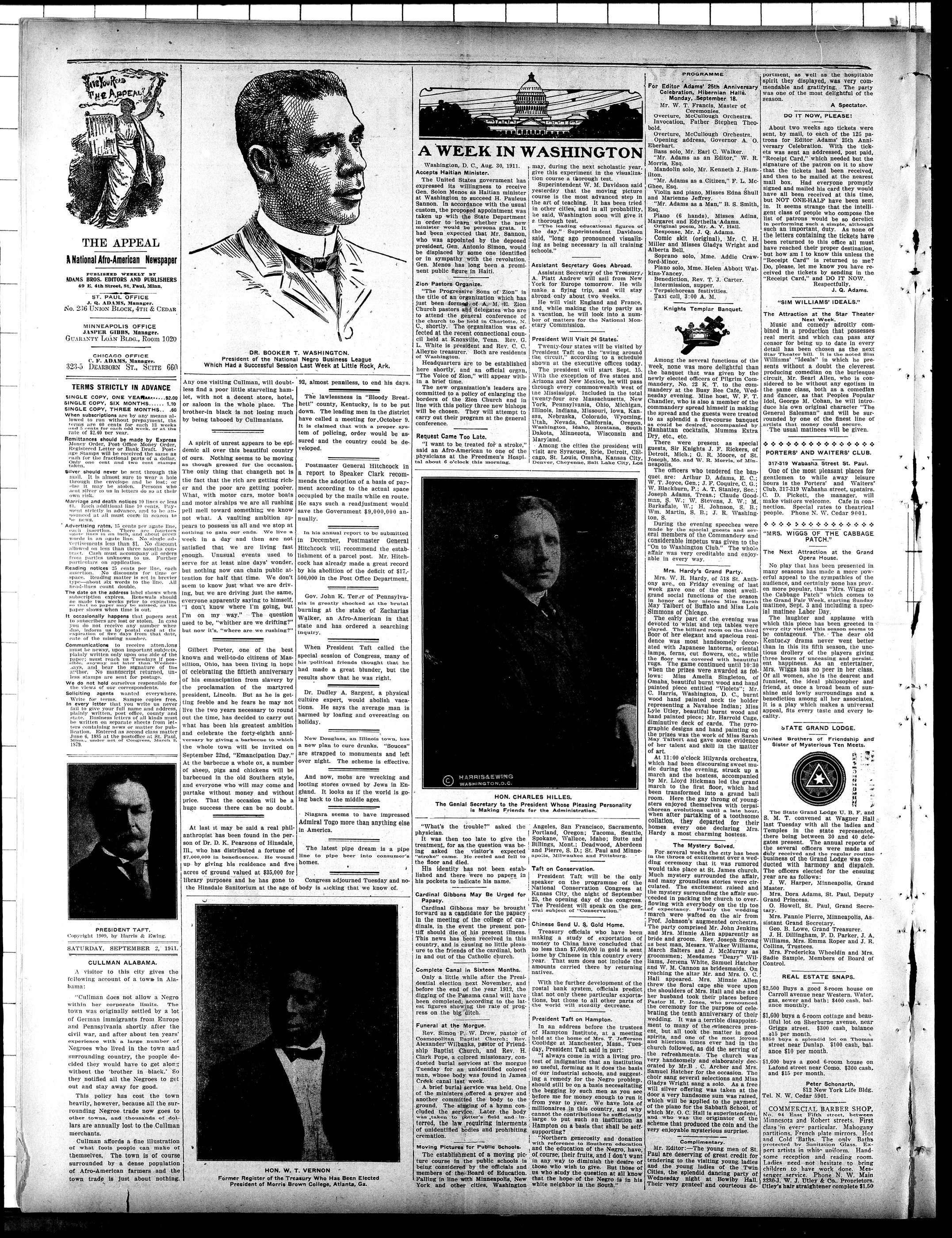
PRESIDENT TAFT.
Copyright 1909, by Harris & Ewing.
SATURDAY, SEPTEMBER 2, 1911
CULLMAN ALABAMA.
A visitor to this city gives the following account of a town in Alabama:
"Cullman does not allow a Negro within her corporate limits. The town was originally settled by a lot of German immigrants from Europe and Pennsylvania shortly after the civil war, and after about ten years' experience with a large number of Negroes who lived in the town and surrounding country, the people decided they would have to get along without the 'brother in black.' So they notified all the Negroes to get out and stay away for good.
This policy has cost the town heavily, however, because all the surrounding Negroe trade now goes to other towns, and thousands of dollars are annually lost to the Cullman merchants.
Cullman affords a fine illustration of what tools people can make of themselves. The town is of course surrounded by a dense population of Afro-American farmers and the town trade is just about nothing.
Chiff Ro.
DR. BOOKER T. WASHINGTON. President of the National Negro Business League Which Had a Successful Session Last Week at Little Rock, Ark.
DR. BOOKER T. WASHINGTON. President of the National Negro Business League Which Had a Successful Session Last Week at Little Rock, Ark.
JOHN H. HARRIS
HON. W. T. VERNON
Former Register of the Treasury Who Has Been Elected
President of Morris Brown College, Atlanta, Ga.
Any one visiting Cullman, will doubtless find a poor little starveling hamlet, with not a decent store, hotel, or saloon in the whole place. The brother-in black is not losing much by being tabooed by Cullmanians.
---
A spirit of unrest appears to be epidemic all over this beautiful country of ours. Nothing seems to be moving as though greased for the occasion. The only thing that changeth not is the fact that the rich are getting richer and the poor are getting poorer. What, with motor cars, motor boats and motor airships we are all rushing pell mell toward something we know not what. A vaulting ambition appears to possess us all and we stop at nothing to gain our ends. We live a week in a day and then are not satisfied that we are living fast enough. Unusual events used to serve for at least nine days' wonder, but nothing now can chain public attention for half that time. We don't seem to know just what we are driving, but we are driving just the same, everyone apparently saying to himself, "I don't know where I'm going, but I'm on my way." The question used to be, "whither are we drifting?" but now it's, "where are we rushing?"
Gilbert Porter, one of the best known and well-to-do citizens of Massillon, Ohio, has been living in hope of celebrating the fiftieth anniversary of his emancipation from slavery by the proclamation of the martyred president, Lincoln. But as he is getting feeble and he fears he may not live the two years necessary to round out the time, has decided to carry out what has been his greatest ambition and celebrate the forty-eighth anniversary by giving a barbecue to which the whole town will be invited on September 22nd, "Emancipation Day." At the barbecue a whole ox, a number of sheep, pigs and chickens will be barbecued in the old Southern style, and everyone who will come and partake without money and without price. That the occasion will be a huge success there can be no doubt.
At last it may be said a real philanthropist has been found in the person of Dr. D. K. Pearsons of Hinsdale, Ill., who has distributed a fortune of $7,000,000 in beneficences. He wound up by giving his residence and five acres of ground valued at $35,000 for library purposes and he has gone to the Hinsdale Sanitorium at the age o
92, almost penniless, to end his days.
The lawlessness in "Bloody Breathett" county, Kentucky, is to be put down. The leading men in the district have called a meeting for, October 9. It is claimed that with a proper system of policing, order would be assured and the country could be developed.
Postmaster General Hitchcock in a report to Speaker Clark recommends the adoption of a basis of payment according to the actual space occupied by the mails while en route. He says such a readjustment would save the Government $9,000,000 annually.
In his annual report to be submitted in December, Postmaster General Hitchcock will recommend the establishment of a parcel post. Mr. Hitchcock has already made a great record by his abolition of the deficit of $17,500,000 in the Post Office Department.
Gov. John K. Terer of Pennsylvania is greatly shocked at the brutal burning at the stake of Zacharias Walker, an Afro-American in that state and has ordered a searching inquiry.
When President Taft called the special session of Congress, many of his political friends thought that he had made a great blunder, but the results show that he was right.
Dr. Dudley A. Sargent, a physical culture expert, would abolish vacations. He says the average man is harmed by loafing and overeating on holiday.
New Douglass, an Illinois town, has a new plan to cure drunks. "Souces" are strapped to monuments and left over night. The scheme is effective.
And now, mobs are wrecking and looting stores owned by Jews in England. It looks as if the world is going back to the middle ages.
Niagara seems to have impressed Admiral Togo more than anything else in America.
The latest pipe dream is a pipe line to pipe beer into consumer's homes.
Congress adjourned Tuesday and no body is kicking that we know of.
THE CAPITOL
A WEEK IN WASHINGTON
HARRIS&EWING
WASHINGTON,D.C.
HON. CHARLES HILLES.
The Genial Secretary, President, Use, Leasing Personality is Making Friends in the Administration.
Washington, D. C., Aug. 30, 1911.
Accepts Haitian Minister.
The United States government has expressed its willingness to receive Gen. Solon Menos as Haitian minister at Washington to succeed H. Pauleus Sannon. In accordance with the usual custom, the proposed appointment was taken up with the State Department in order to learn whether the new minister would be persona grata. It had been expected that Mr. Sannon, who was appointed by the deposed president, Gen. Antonio Simon, would be displaced by some one identified or in sympathy with the revolution. Gen. Menos has long been a prominent public figure in Haiti.
Zion Pastors Organize.
"The Progressive Sons of Zion" is the title of an organization which has just been formed of A. M. E. Zion Church pastor and delegates who are to attend the general conference of the church to be held in Charlotte, N.C., shortly. The organization was effected at the recent connection council held at Knoxville, Tenn. Rev. G. L. White is president and Rev. C. C. Alleyne treasurer. Both are residents of Washington. Heads are to be established here shortly, and an official organ, "The Voice of Zion," will appear within a brief time. The new organization's leaders are committed to a policy of enlarging the borders of the Zion Church and in line with this policy three new bishops will be chosen. They will attempt to carry out their program at the general conference.
Request Came Too Late
"I want to be treated for a stroke," said an Afro-American to one of the physicians at the Freedmen's Hospital about $ 6 a clock this morning.
HARRIS&EWING
WASHINGTON,D.C.
HON. CHA
The Genial Secretary to the Pr
is Making Friends
"What's the trouble?" asked the physician.
It was then too late to give the treatment, for as the question was being asked the visitor's expected "stroke" came. He reeled and fell to the floor and died.
His identity has not been established and there were no papers in his pockets to indicate his name.
Cardinal Gibbons May Be Urged for Papacy.
Cardinal Gibbons may be brought forward as a candidate for the papacy in the meeting of the college of cardinals, in the event the present pontiff should die of his present illness.
This news has been received in this country, and is causing no little pleasure to the friends of the cardinal, both in and out of the Catholic church.
Complete Canal in Sixteen Months.
Only a little while after the Presidential election next November, and before the end of the year 1912, the digging of the Panama canal will have led to a recording to the latest nuggets showing the rate of progress on the big ditch.
Funeral at the Morgue.
Rev. Simon P. W. Drew, pastor of Cosmopolitan Baptist Church; Rev. Alexander Wilbanks, pastor of Friendship Baptist Church, and Rev. H. Clark Pope, a colored missionary, conducted burial services at the morgue Tuesday for an unidentified colored man, whose body was found in James Creek canal last week.
A brief burial service was held. One of the ministers offered a prayer and another committed the body to the ground. The singing of a hymn concluded the service. Later the body was taken to potter's field and interred, the law requiring interments of unidentified bodies and prohibiting cremation.
Moving Pictures for Public Schools.
The establishment of a moving picture course in the public schools is being considered by the officials and members of the Board of Education. Falling in line with Minneapolis, New York and other cities, Washington
---
may, during the next scholastic year, give this experiment in the visualization course a thorough test. Superintendent W. M. Davidson said yesterday that the moving picture course is the most advanced step in the art of teaching. It has been tried in other cities, and in all probability, he said, Washington soon will give it a thru-through. "The leading educational figures of the day," Superintendent Davidson said, "long ago pronounced visualizing as being necessary in all training schools."
Assistant Secretary Goes Abroad.
Assistant Secretary of the Treasury, A. Pitt Andrew will sail from New York for Europe tomorrow. He will make a flying trip, and will stay abroad only about two weeks. He will visit England and France, and, while making the trip partly as a vacation, he will look into a number of matters for the National Monetary Commission.
President Will Visit 24 States
Twenty-four states will be visited by President Taft on the "swing around the circuit," according to a schedule shown at the executive offices today. The president will start Sept. 15. With the exception of five states and Arizona and New Mexico, he will pass through every commonwealth west of the Mississippi. Included in the total twenty-four are Massachusetts, New York, Pennsylvania, Ohio, Michigan, Illinois, Indiana, Missouri, Iowa, Kansas, Nebraska, Colorado, Wyoming, Utah, Nevada, California, Oregon, Washington, Idaho, Montana, South Dakota, Minnesota, Wisconsin and Maryland. Among the cities the president will visit are Syracuse, Erie, Detroit, Chicago, St. Louis, Omaha, Kansas City, Denver, Cheyenne, Salt Lake City, Los
RLES HILLES.
President Whose Pleasing Personality
for the Administration.
Angeles, San Francisco, Sacramento
Portland, Oregon; Tacoma, Seattle
Spokane, Wallace, Idaho; Butte
Billings, Mont.; Deadwood, Aberdeen
and Pierre, S. D.; St. Paul and Minne
apolis, Milwaukee and Pittsburg.
Taft on Conservation.
President Taft will be the only speaker on the programme of the National Conservation Congress at Kansas City, the night of September 11, 2001, and the congress. The President will speak on the general subject of "Conservation."
Chinese Send U, S, Gold Home.
Treasury officials who have been making a study of exportation of money to China have concluded that no less than $7,000,000 in gold is sent by Chinese in this country every year. The sum does not include the amounts carried there by returning natives.
With the further development of the postal bank system, officials predict that not only are the exportations, but those to all other parts of the world will steadily decrease.
President Taft on Hampton.
In an address before the trustees of Hampton Institute, at a meeting held at the home of Mrs. T. Jefferson Coolidge at Manchester, Mass., Tuesday, President Taft said in part: "I always come in with a living protest of indignation that an institution so formal, forming as it does the basis of our inquiry, and suggesting a remedy for the Negroes should still be on a basis necessitating the begging by such men as you see before me for money enough to run it from year to year. We have lots of millionaires in this country, and why cannot the contributions be sufficiently large to put such an institution as Hampton on a basis that shall be self-supporting? "Northern generosity and donation with reference to Southern education and the education of the Negroes, have, of course, their fruits, and I do not want in any way to diminish the desire of those who wish to give. But then we us who study the question at all know that the hope of the Negro is in his white neighbor in the South."
---
PROGRAMME
For Editor Adams' 25th Anniversary
Celebration, Hibernian Hall's
Monday, September 18.
Mr. W. T. Francis, Master of
Ceremonies.
Overture, McCullough Orchestra.
Invocation, Father Stephen Theo
bold.
Overture, McCullough Orchestra.
Opening address, Governor A. O
Eberhart.
Bass solo, Mr. Earl C. Walker.
"Mr. Adams as an Editor," W. R.
Morris, Esq.
Dandelin solo, Mr. Kenneth J. Hamilton.
"Mr. Adams as a Citizen," F. L. Mc
Ghee, Esq.
Violin and piano, Misses Edna Shull and Marienne Jeffrey.
"Mr. Adams as a Man," B. S. Smith Esq.
Piano (6 hands), Misses Adina, Margaret and Edythella Adams.
Original poem, Mr. A. V. Hall.
Response, Mr. J. Q. Adams.
Comic skit (original), Mr. C. H. Miller and Misses Gladys Wright and Albora Bell.
Soprana solo, Mme. Addie Crawd for-morin.
Piano solo, Mme. Helen Abbott Watkins-Yancey.
Benediction, Rev. T. J. Carter.
Intermission, supper.
Terpsichorean festivities.
Taxi call: 3:00 A. M.
Knights Templar Banquet.
Among the several functions of the week, none was more delightful than the banquet that was given by the newly elected officers of Pilgrim Commandery, No. 22 K. T. to the commandery with Regy host, W F. T. Chandler, who is also a member of the commandery spread himself in making the spread and the guests were treated to as splendid a five-course banquet as could be desired, accompanied by Manhattan cocktails, Mumms Extra Dry, etc., etc.
There were present as special guests, Sir Knights J. F. Rickers, of Detroit, Mich.; G. R. Moore, of St. Joseph, Mo. and W. R. Morris, of Minneapolis.
The officers who tendered the banquet are: Arthur D. Adams, E. C.; W. T. Joyce, Gen.; J. F. Coquire, C. G.; W. Blackburnp., P.; A. F. Stanley,sec; Joseph Adams, Treas.; Claude Goodman, S. W.; W. Stevens, J. W.; M. Barksdale, W.; H. Johnson, S. B.; Wm. Martin, S. B.; J. R. Washington, S.
During the evening speeches were made by the special guests and several members of the Commandery and considerable impetus was given to the "On to Washington Club." The whole affair was very creditable and enjoyable in every way.
Mrs. Hardy's Grand Party
Mrs. W. R. Hardy, of 518 St. Anthony ave., on Friday evening of last week gave one of the most swell-grand social functions of the season to the faces Miss Sarah May Talbert of Buffalo and Miss Lois Simmons of Chicago.
The early part of the evening was devoted to whist and ten tables were played. The billiard room on the third floor of her elegant and spacious residence was most handsomely decorated with Japanese lanterns, oriental lamps, ferns, cut flowers, etc., while rugs, cork boards with beautiful rugs. The game continued when the prizes were awarded as follows: Miss Amelia Singleton, of Omaha, beautiful burnt wood and hand painted piece entitled "Violet's"; Mr. C. Harris, Washington, D. C., burnt wood hand painted neck tie holder representing a Navahoe Indian; Miss Lyle Utley, beautiful burnt wood and hand painted piece; Mr. Harrod Cage, diminutive deck of cards. The pyrographic designs and hand painting on the table was the work of Miss Sarah May Taberley, some evidence of her talent and skill in the matter of art.
At 11:00 0'clock Hilyarda orchestra, which had been discoursing sweet music during the evening, struck up a march and the hostess, accompanied by Mr. Lloyd Hickman led the grand march to the first floor, which had been transformed into a grand ball room. Here the gay throng of youngsters enjoyed themselves with terpsichorean evolutions until a late hour, when after partaking of a toothsome collation, they departed for their homes every one declaring Mrs. Hardy a most charming hostess.
The Mystery Solved.
For several weeks the city has been in the throes of excitement over a wedding ceremony that it was rumored would take place at St. James church. Much mystery surrounded the affair, and many groundless stories were circling. The excitement raised and the mystery surrounding the affair succeeded in parking the church to overflowing with everybody on top of expectancy. Finally the wedding march were wafted on the air from Prof. Johnson's augmented orchestra. The party comprised Mr. John Jenkins and Mrs. Minnie Allen apparently as bride and groom. Rev. Joseph Strong as best man, Messrs. Walker Williams, March Salters and J. McMurray as groommen; Mesdames "Deary" Williams, Jeriena White, Samuel Hatcher and W. M. Cannon as bridesmaids. On entering the altar Mr. and Mrs. O. C. Hall married Mrs. Minnie Allen threw the shoulders of Mrs. H. and she and her husband took their pastor H. P. Jones, who pronounced the ceremony for the purpose of celebrating the tenth anniversary of their wedding. It was a terrible disappointment to many of the swineaces present, but all took the matter in good spirits, and one of the most joyous and hilarious times ever was in the church followed, as did the serving of the refreshments. The church was very handsomely and elaborately decorated by Mr.B. C. Archer and Mrs. Shrubbins for the occasion. The choir sang several selections and Miss Gladys Wright sang solo. As a free will silver offering was taken to a door a very humbly sum was raised, which will be applied to the payment of the piano for the Sabbath School, of which Mr. O. C. Hall is superintendent, and who was the originator of the scheme that produced the coin and the very enjoyable mysterious surprise.
Mr. Editor:—The young men of St. Paul are deserving of great credit for tendering to the visiting young ladies and the young ladies of the Twin Cities, the splendid dancing party of Wednesday night at Bowlby Hall. Their very genteel and courteous de-
portment, as well as the hospitable spirit they displayed, was very commendable and gratifying. The party was one of the most delightful of the season. A Spectator.
About two weeks ago tickets were sent, by mail, to each of the 125 patrons for Editor Adams' 25th anniversary Celebration. With the tickets was sent an addressed, post paid, "Receipt Card," which needed but the signature of the patron on it to show that the tickets had been received, and then to be mailed at the nearest mail box. Had everyone promptly signed and mailed his card they would have all been received at this time, but NOT ONE-HALF have been sent in. It seems strange that the intelligent class of people who compose the list of patrons would be so derelict in performing such a simple, although such an important, duty. As none of the letters containing the tickets have been returned to this office all must have reached their proper destination, but how am I to know this unless the "Receipt Card" is returned to me? Do, please, let me know you have received the tickets by sending in the "Receipt Card," and DO IT NOW. Respectfully, J. Q. Adams.
"SIM WILLIAMS' IDEALS."
The Attraction at the Star Theater Next Week
Music an comedy adroitomy combined in a production that possesses real merit and which can pass any consoror for being a comedian detail has been chosen as the next Star Theater bill. It is the noted Sim Williams' "Ideals" in which he presents without a doubt the cleverest producing comedian on the burlesque circuit, Mr. Searl Allen, who is considered to be without any egotism in the same class, both as a comedian and 'dancer, as that Peoples Popular Idol, George M. Cohan, he will introduce his own original character "The General Salesman" and will be surrounded by one of the finest line of artists that money could secure.
PORTERS' AND WAITERS' CLUB.
317-319 Wabasha Street St. Paul.
One of the most pleasant places for gentlemen to while away leisure hours is the Porters' and Waiters Club, 317-319 Wabasha street, upstairs.
C. D. Pickett, the manager, will make visitors welcome. Cafe in connection. Special rates to theatrical people. Phone N. W. Cedar 9001.
"MRS. WIGGS OF THE CABBAGE
PATCH."
The Next Attraction at the Grand Opera House.
No play that has been presented in many seasons has made a more powerful appeal to the sympathies of the audience, and certainly none has proven more popular, than "Mrs. Wiggs of the Cabbage Patch" which comes to the Grand Fair Week, starting Sunday matinee, Sept. 3 and including a special matinee Labor Day. The laughter and applause with which this piece has been greeted in every city visited this season seems to be contagious. The. The dear old Kentucay drama never went better than in this its fifth season, the unfortunate drollery of the players giving a reassuring and persistent happiness. A reassuring and persistent Mrs. Wiggs has no peer in her class. Of all women, she is the dearest and funniest, the ideal philosopher and friend, at once a broad beam of sunshine mid lowly surroundings and a benediction among all her associates, it is a play which makes a universal appeal, fits every taste and every locality.
STATE GRAND LODGE.
United Brothers of Friendship and
Sister of Mysterious Ten Meets.
The State Grand Lodge U. B. F. and S. M. T. convened at Wagner Hall last Tuesday with all the ladies and Temples in the state represented, there being between 30 and 40 delegates present. The annual reports of the several officers were made and received, and the regular routine business of the Grand Lodge is conducted with harmony and dispatch. The officers elected for the ensuing year are as follows: J. W. Harper, Minneapolis, Grand Master.
Mrs. Dora Adams, St. Paul, Deputy Grand Princess.
O. Howell, St. Paul, Grand Secretary.
Mrs. Fannie Pierce, Minneapolis, Assistant Grand Secretary.
Geo. B. Lowe, Grand Treasurer.
J. H. Dillingham, F. D. Parker, J. A. Williams, Mrs. Emma Roper and J. R. Crawford, trustees.
Mrs. Fredrika Wheeldin and Mrs. Sadie Sample, Members of Board of Control.
REAL ESTATE SNAPS.
$2,500 Buys a good 8-room house on
Carroll avenue near Western. Water,
gas, sewer and bath; $400 cash, balance
monthly.
$1,600 buys a 6-room cottage and bea-
tiful lot on Sherburne avenue, near
Griggs street. $300 cash, balance
$15 per month.
$350 buys a splendid lot on Thomas
street near Dunlap. $100 cash, balance
$10 per month.
$1,600 buys a good 6-room house on
Lafond street near Como. $300 cash,
and $15 per month.
Peter Schonarth,
$12 New York Life Bldg.
Tel. N. W. Cedar 5901.
COMMERCIAL BARBER SHOP.
No. 94 East Fifth street, between
Minnesota and Robert streets. First
class in every particular. Mahozany
partitions, French plate mirrors. Hot
and Cold Baths. The only Baths
protected by Sanitation Glass. Expert
artists in white uniform. Handsome
reception and reading room.
Ladies need not hesitate to bring
children to have work done. Messenger
service. Phone N. W. Main
3330 J. W. J. Utley & Co. Pronletrons.
Ulley's hair straightener complete $1.50
WEEK'S RECORD IN MINNESOTA'S CAPITAL.
The "Saintly City" and Saintly City Folks—Newsey items of Social, Religious, Political and General Matters Among the People.
SATURDAY, SEPTEMBER 2, 1911.
PLEASE
SEND IN THAT
RECEIPT CARD.
President will be in St. Paul Oct. 25.
Mrs. R. B. Chapman is spending a few days at Anoka.
Mr. and Mrs. Clarence Mills have moved to Minneapolis.
Mr. and Mrs. W. T. Francis left yesterday for a quiet trip to Indianapolis.
Mr. Daniel Roy, who has been on the sick list for some time, does not improve.
Miss Irma Valley entertained a few friends at a card party on Thursday afternoon.
FOR RENT to man and wife, nice furnished room. Apply at 919 Marlon street.
If you believe in reciprocity patronize the business houses that are advertised in THE APPEAL.
Prof. W. A. Weir took a trip to Indianapolis to witness the big meeting of the Knights of Pythias.
Res. 642 Rondo Fel. Dale 617-J 2
T. H. LYLES
Funeral Directors and Embalmers.
322 Wabasha St.
Calls Answered Day or Night in
Twin Cities.
Active Pall Bearers Furnished If
Desired.
Lady Assistant When Necessary.
Both Phones 508. St. Paul, Minn.
When in Minneapolis on warm days,
stop in the "Little Unique," 405 Fifth
Ave. S., and get a cool drink.
Mrs. Catherine Blackwell, of Evanson,
Ill., is visiting her son Mr. E. H.
Blackwell of W. Central ave.
Rev. J. E. Ford of Jacksonville, Fla.,
filled the pulpit of Pilgrim Baptist
church last Sunday morning.
Mrs. M. E. Donley and Mrs. S. A. Revelts of Rockford, Ill., are visiting Mrs. J. W. Blair, 5 Rondo street.
Jennie Wilson and Trilby Crawford were in police court Tuesday, charged with robbing a white man of $190.
Anyone wish any sheet metal work done would do well to call on Ed. Hinderer & Son. See ad elsewhere.
Mr. J. B. Turner is still quite sick, his condition having been made more serious by the recent death of his wife.
3 BIG SNAPS
9-Room house on Charles street between Dale and St. Albans. All modern, South facing.
6-Room house on Charles street between Dale and St. Albans. All modern, North facing.
9-Room house on Rondo street between Farrington and Virginia. Modern except heat.
All on easy terms.
Apply to Jos. Eurist,
MINNESOTA REALTY CO.,
516 N. Y. Life Bldg.
Judge and Mrs. Jamison, who have been the guests of Mrs. C. M. Hatton, left for their home, Topeka, Kan.
Tuesday.
The Newport restaurant, 378 MID nesota street, is serving very swell meals and is growing in popularity every day.
Mr. G. W. King, the jolly little (?) manager of the Maceo Club, was in the city Monday, driving around in his motor car.
The records show 42 deaths in St. Paul last week, the lowest number of any week but one since the records have been kept.
The baths at Harriet island closed for the season yesterday. The number of bathers for the season exceeds any previous season.
Mr. J. H. Charleston, after an extended trip to Chicago, Indianapolis, etc., returned home last week very highly delighted with his trip.
The funeral of Oscar Bigley, 10-year-old son of John Bigley of Marion street, was preached at Pilgrim Baptist church Tuesday afternoon.
FOR SALE—The splendid residence No. 540 Rondo street, at a bargain. Apply to C. D. Pickett, Porters and Walters Club, 317 Wabasha st.
A REMINDER.
THE STATE SAVINGS BANK
THE STATE SAVINGS BANK.
93 East Fourth Street.
Invites the saving accounts of frugal wage-earners; it is well fitted to take care of them.
per annum.
DEPOSITS OVER $4,350,000.00
Charles P. Noyes.
President
Louis Betz,
Treasurer.
O LOOK HERE!
CHARITYENTERTAINMENTS
MONDAY EVE. SEP. 4
These Entertainments are Given to Raise the Funds for the Winter's Fuel Supply
GOOD MUSIC REFRESHMENTS
Admission 35 Cents O. Howell, Chairman
Mr. J. H. Dillingham has been appointed on the custodian's force at the Court House and began the discharge of his duties yesterday.
Miss Era Lindsay, after a pleasant visit to Mt. Clemens, Benton Harbor, Chicago, Indianapolis and St. Paul has returned to her home in Stillwater.
Mrs. George C. Sleet, after a very delightful trip of several weeks, visiting relatives and friends in Kentucky and Illinois, returned home this week.
SPIRELLE CORSET, Cora E. Anderson corsetier. Any lady wishing to be properly corseted call or address 365 Aurora Ave. Tel. N. W. Dale 1345.
The orders for cuts of persons and houses and places of business for the souvenir edition of the EDITOR'S SILVER JUBILEE are coming in at a very satisfactory rate. Everyone who wishes to get a cut in this great edition should not delay, but send in the order now, before it is too late.
THE BUSY BEE CAFE, 317 Wabasha street (up stairs) W. F. T. Chandler, proprietor. Everything new but the name. First-class meals will be served a la carte at all hours. A splendid regular dinner will be served from 11:30 a. m. to 3:00 p. m., at 25 cents. Open day and night. Tel. N. W. Dale 1345.
Mr. Frank Vance, an old soldier and an old citizen, died yesterday at 797 Whitall street. His funeral will be held at Lyles' undertaking rooms this afternoon at 2:00 o'clock. Interment at Oakland.
Miss Lillian McCoy entertained at dinner Wednesday, in honor of Miss Cora Howard of Winnipeg, Miss Sarah May Talbert of Buffalo, and Miss Lois Simmons of Chicago. Covers were laid for ten.
The members of Alpha Assembly No. 1, Knights of Alpha will meet Tuesday evening Sept. 5. A full attendance is desired as a splendid report from the Supreme Controller is to be made.
VOCAL AND PIANO LESSONS given by Mrs. Addie Crawford Minor at her residence 471 W. Central ave. only. Hours for instruction arranged true. to suit patrons. Tel. Dale 2192. Terms reasonable.
The young men of St. Paul gave a private dancing party to the visiting strangers and the young ladies of the Twin Cities, at Bowley Hall, Wednesday evening. A large number had a most enjoyable time.
FOR SALE—Nice new six-room duplex house, hardwood finish, a real bargain, 788 and 790 St. Anthony av. Price $4,300. Will make agreeable terms. Well rented at present. Kane & Co., 610 Globe bldg.
Mrs. J. P. Hamilton of Des Moines, Ia., is in the city, visiting her son and daughter, Mr. and Mrs. K. J. Hamilton, of 521 Aurora avenue. Mrs. Hamilton is treasurer of the State Federation of Afro-American Women of Iowa.
There were 69 cuts of churches, homes and places of business in the Quarto-Centennial Souvenir Edition of THE APPEAL last September. There ought to be more in the coming Souvenir Edition. GET IN ON THE GROUND FLOOR.
The funeral of Wm. Brown, who died suddenly last week in South St. Paul, was held at Lyles undertaking rooms last Sunday. Rev E. H. McDonald officiating. The remains were taken to St. Louis, the old home of the deceased, for interment.
HOUSEWIVES who wish nice fresh fruits and vegetables delivered at their homes should telephone to T. H. Monroe, Cedar 2066, or leave orders with Mrs. S. A. Hilyard 12.5 E.9th street. He is the only Afro-American vehicle pledder in the city.
F. H. Harm & Bro, the popular jewelers and opticians, formerly of 237 Robert street, have moved to larger and better quarters at No. 14 East Sixth street, between Vabasha and Cedar, where they will be pleased to see all old and new patrons.
Last Monday afternoon Miss Willa Moore entertained Misses Cora Howard, Olive Howard, Gladys Wright, Adina Adams and Ida Loomis at a dainty luncheon and in the evening Miss Olive Howard took the party to the Shubert, as a theater party.
On last Monday evening Rev. and
Mrs. E. H. McDonald gave a reception in honor of Rev. Dr. J. E. Ford of Jacksonville, and his mother at their residence on W. Central ave. A large number called during the evening and all had a very pleasant time.
Mrs. J. C. Craig, Mrs. Gertrude Shortridge and Miss Francis Reeder, of Keokun, Iowa, who have been guests of Mrs. A. B. Harris, of Rondo street. From here Mesdames Craig Shortridge go to Denver and Miss Reeder will return to High School in Keokun.
THE ST. LOUIS KITCHEN Mrs. Julia Hinson, proprietor, No. 138 E 3d St, up stairs. Meals 25 cts. Breakfast from 7:00 to 11:00 a.m., Dinner from 12:00 m. to 3:00 p. m.; Suppen from 5:00 to 8:00 p. m. All regular meals 25 cts. All home cooking. Tel. T. S. 2718.
A number of gentlemen gathered at the residence of W. T. Francis, Esq., last Monday evening for the purpose of meeting Judge W. I. Jamison of Topeka, Kan. The evening was very pleasantly passed in "swapping yarn" and playing whist. A delightful lunch was served.
REFRESHMENTS
O. Howell, Chairman
The orders for cuts of persons and houses and places of business for the souvenir edition of the EDITOR'S SILVER JUBILEE are coming in at a very satisfactory rate. Everyone who wishes to get a cut in this great edition should not delay, but send in the order now, before it is too late.
THE BUSY BEE CAFE, 317 Wabasha street (up stairs) W. F. T. Chandler, proprietor. Everything new but the name. First-class meals will be served a la carte at all hours. A splendid regular dinner will be served from 11:30 a. m. to 3:00 p. m., at 25 cents. Open day and night. Tel. N. W., Cedar 4525.
ALBION W. HOLDEN—Fine house painting, hand oil, finishing, varnishing, staining, wall tinting, etc., done on short notice. First class, durable work guaranteed. General repairing and jobbing of all kinds. Send or leave orders at 527 St. Anthony Ave., or telephone Dale 2055. Estimates furnished.
THE VALE TAILER LOIC CO. No. 154-156 E. Smith street. The most up-to-date establishment of its kind in the city. Clothing made to order, pressed, renovated and repaired. Golds called for and delivered. Four suits for $1. They are prepared to give best service at lowest rates. Tel. N. W. Cedar 4302 O. Howell, manager.
The funeral of Oscar Bigley, was held at Pilgrim Baptist church, Tuesday, Rev. E. H. McDonald officiating. There was a large audience and many floral tributes. The deceased was a member of the I. X. L. Band and the band was present in a body and escorted the remains to last resting place. Lyles undertaker; interment at German Lutheran cemetery.
LADIES' AND GENTLEMEN'S TAILORING—Mme. Faslion Williams, fashionable modiste, has rearranged her parliars and has secured the services of Mr. J. Wilson, a first class and is prepared to make to order man-tailored for both women and men. Call and see fine line of samples of exclusive fabrics Suite 508 Pittsburgh Bldg cor 5th and Wabasha.
The "Newport Restaurant" is the sign now on the windows of what was formerly the "Dublin Inn," 378 Minnesota street. The new proprietor is Mr. Curtice Raymond. The place has been newly fitted up and furnished and will be first-class in every particular. A regular dinner will be served from 11:30 a.m. to 2:30 p.m. for 25 cents. A la carte meals at all hours. Satisfaction guaranteed.
Mr. and Mrs. Geo. Melker left this week for Atlantic City, N. J. Mr. Melker goes as the representative of Fezzan Temple, Nobles of the Mystic Shrine to attend the Imperial Council of the Mystic Shrine, Mrs. Melker is a delegate from Fezzan Court to the Grand Court of the Daughters of Isis. After attending to their official duties they will spend some time visiting points of interest in the East.
Mr. Jose H. Sherwood and wife left this week for Atlantic City, N. J. Mr. Sherwood will attend the annual meeting of the Imperial Council of the Nobles of the Mystic Shrine in which he holds the office of Imperial Chief Rabban. Mrs. Sherwood is a delegate from Zazzlece Court to the Grand Court of the daughters of Isis. After attending to the official business they will spend some time visiting points of interest in the East.
Mrs. T. H. Lyles, 642 Rondo street gave a reception in honor of Judge and Mrs. W. I. Jamison, of Topeka, Kan., Mrs. Philip Hunton of Detroit, Nich., Mrs. Singleton of Omaha, Nich., Mrs. L. Lyles of Jackson, Ill., Mrs. Charles Walker, of Luttington, Ky. Friday of last week Mr. Lyles was assisted by Mesames F. D. Parker, C. H. Booker, W. T. Francis and R. B. Chapman. Musical numbers were rendered by Mrs. B. C. Archer and the hostess.
Mrs. Elizabeth C. Carter, of New Bedford, Mass., President of the National Association of Afro-American women made a very pleasant visit to her friend Mrs. T. H. Lyles during her short stay in St. Paul, in company with Mrs. Ione G. Gibbs and Mrs. John Allison of Minneapolis. They had quite a conference on state and national work. Mrs. Lyles was one of the seven women who were appointed on the committee that helped to organize the National Association at Washington, D. C., in 1896.
The patrons and patronesses who have received their tickets for Editor Adams' 25th Anniversary Celebration and have not sent in the receipt cards are earnestly requested to do so at once.
---
HIBERNIAN HALLS.
Cor. Sixth, Seventh and Franklin Streets Have Been Secured for Editor Adams' Silver Jubilee, September 18.
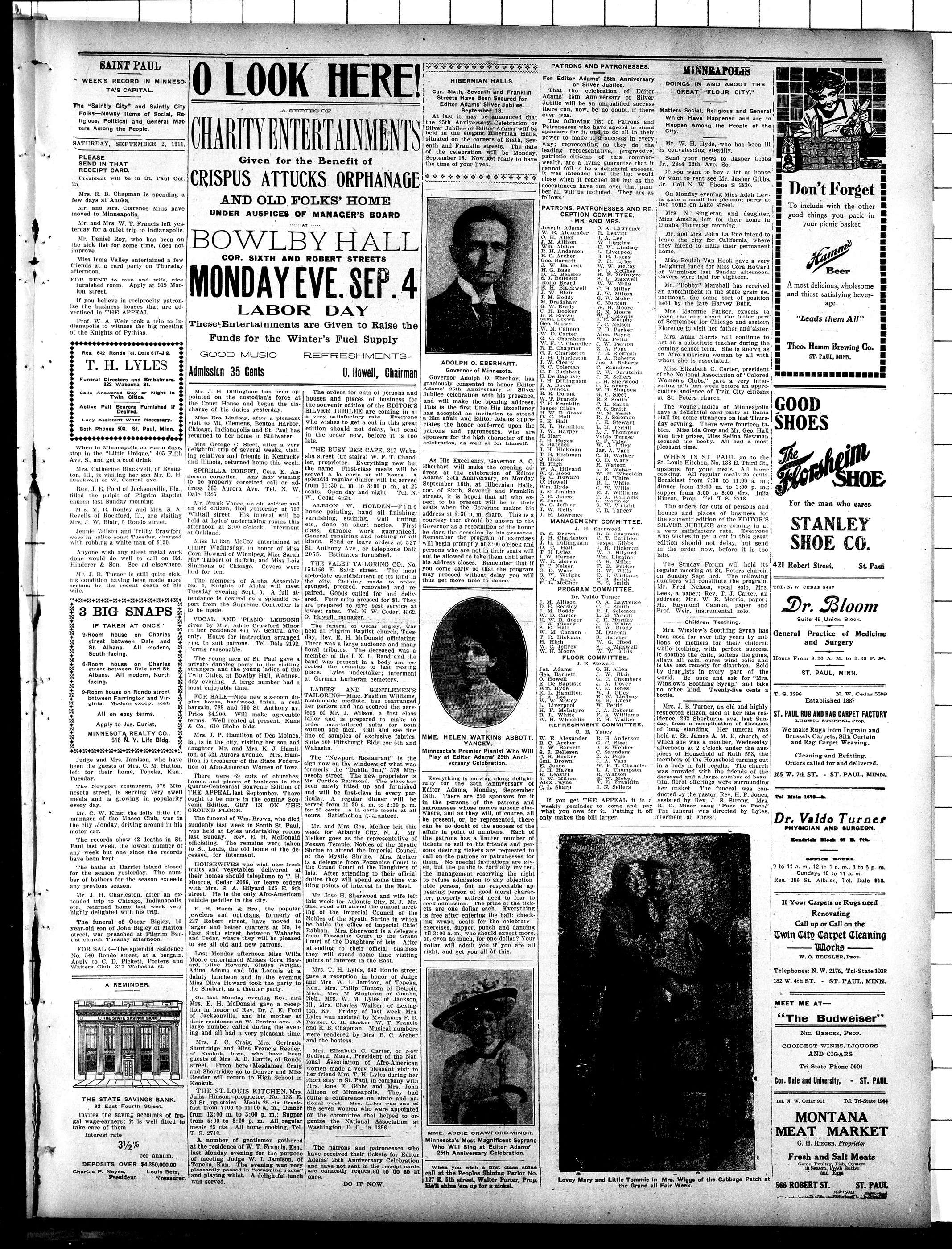
At last it may be announced that the 25th Anniversary, Celebration or Silver Jubilee of Editor Adams will be held in the elegant Hibernian Halls, situated on the corners of Sixth, Seventh and Franklin streets. The date of the celebration will be Monday, September 18. Now get ready to have the time of your lives.
1913
ADOLPH O. EBERHART Governor of Minnesota.
Governor Adolph O. Eberhart has graciously consented to honor Editor Adams' 25th Anniversary or Silver Jubilee celebration with his presence, and will make the opening address. This is the first time His Excellency has accepted an invitation to attend a like affair and Editor Adams appreciates the honor conferred upon the patrons and patronesses, who are sponsors for the high character of the celebration, as well as for himself.
As His Excellency, Governor A. O. Eberhart, will make the opening address at the celebration of Editor Adams' 25th Anniversary, on Monday September 18th, at Hibernian Hall, cor. of Sixth, Seventh and Franklin streets, is it hoped that all who expect to be present will be in their seats when the Governor makes his address at 8:30 p. m. sharp. This is a courtesy that should be shown to the Governor as a recognition of the honor. Remember the occasion by his presence. Remember that he will begin promptly at 8:00 o'clock and persons who are not in their seats will not be allowed to take them until after his address closes. Remember that if you come early so that the program may proceed without delay you will thus get more time to dance.
A.
Minnesota's Premier Pianist Who Will Play at Editor Adams' 25th Anniversary Celebration.
Everything is moving along delightfully for the 25th Anniversary of Editor Adams, Monday, September 18th. There are 250 sponsors for it in the persons of the patrons and patronesses whose names appear elsewhere, and as they will, of course, all be present, or, be represented, there can be no doubt of the success of the affair in point of numbers. Each of the patrons has a limited number of tickets to sell to his friends and persons desiring tickets are requested to call on the patrons or patronesses for them. No special invitations are given, but the public is cordially invited, the management reserving the right to refuse admission to any objectionable person, but no respectable appearing person of good moral character, properly attired need to fear to seek admission. The price of the tickets are one dollar each. Everything is free after entering the hall: checking wraps, seats for the celebrating exercises, supper, punch and dancing 'till 3:00 a.m., who should expect more, or even, as much, for one dollar? Your dollar will admit you if you are all right, and get you all of this.
M.
MME. ADDIE CRAWFORD-MINOR.
Minnesota's Most Magnificent Soprano
Who Will Sing at Editor Adams'
25th Anniversary Celebration.
When you wish a first class shine
call at the People's Shining Parlor No.
127 E 5th street, Walter Porter, Prop.
He'll shine 'em up for a nickel.
THE MASTER OF THE MUSIC
Lovey Mary and Little Tommie in Mrs. Wilgs of the Cabbage Patch at the Grand all Fair Week.
For Editor Adams' 25th Anniversary or Silver Jubilee
That the celebration of Editor Adams' 25th Anniversary or Silver Jubile will be an unqualified success there can, now, be no doubt, if there ever was.
The following list of Patrons and Patronesses who have agreed to stand sponsors for it, and to do all in their power to make it a success in every way; representing as they do, the leading representative, progressive, patriotic citizens of this commonwealth, are a living guarantee that it will be a helpful success. It was intended that the list should close when it reached 200 but as the acceptances have run over that number all will be included. They are as follows:
MR. AND MRS.
Joseph Adams O. A. Lawrence
J. Sander Leavitt
O. H. Allen J. A. Hawk
J. M. Allison J. Wiggins
Wm. Alston E. W. Lindsay
B. C. Archer L. H. Liverpool
Geo. Barnett T. H. Lyles
J. W. Barnett W. W. McCoy
W. H. Beasley W. F. McGhee
D. E. Beasley H. E. Beasley
S. J. Bellen S. L. Maxwell
E. H. Bard W. W. Mills
E. H. Bard H. W. Baird
J. W. Blair J. W. Milton
J. M. Boddy G. W. Moker
M. Bradshaw G. Morgan
W. H. Baird G. Moore
C. H. Booker G. N. Moore
R. S. Brown W. R. Morris
F. S. Braymphy
Geo. Brown F. C. Nelson
W. M. Cannon D. Parker
W. D. Carter Alex. Payne
G. W. Chambers Wm. Pettit
W. F. Chambers J. W. Chambers
R. B. Chapman Z. A. Pope
G. J. Charleston T. E. Rickman
J. H. Charleston J. A. Roberts
J. A. Dove F. C. Jasman
B. C. Coleman C. S. Saunders
C. T. Cuthbert C. W. Scrutchin
E. De Baptiste J. N. Sellers
J. H. Hingman J. W. Woodward
C. J. A. Shaw M. Duncan H. W. Simpson
W. D. Durant G. C. Sheet
W. T. Francis B. C. Smith
T. E. Franklin C. L. Smith
Jasper Gibbs C. S. Smith
H. C. Greer H. C. Smith
C. H. C. Hall J. E. Stewart
K. L. Hamilton L. M. Terril
L. J. Harper L. J. Thompson
H. Harper W. H. Turner
J. H. Hayes C. P. Teller
S. Hatcher W. J. Uley
J. H. Hickman Jas. A. Vass
J. H. Hickman C. R. Huffer
Q. Hicks O. D. Ware
H. High W. Ratson
W. G. Hilaryd A. S. Weber
R. C. Howard W. J. White
O. Howell B. L. White
M. J. Hyle W. G. Wills
B. C. Almins F. A. Williams
C. E. Jones F. Wormley
R. J. Waffrey S. W. Wright
J. W. Kelly C. E. Yancey
J. R. Lawrence
J. H. Sherwood
R. S. Brown
C. E. Chapman
J. H. Charleston
C. E. Curtbert
J. H. Dillingham
Jasper Gibbs
O. C. Hall
W. H. Hickman
J. W. Harper
Wm. Lignigs
W. R. Morris
C. G. Miller
D. P. Parker
O. D. Ware
W. W. Willis
S. W. Wright
E. J. Williams
S. W. McKee
E. S. Smith
F. L. Mchee
PROGRAM COMMITTEE.
Dr. Valdo Turner
M. A. Millon
O. A. Lawrence
D. E. Beasley
C. L. Smith
D. H. Hickman
W. D. Carter
L. M. Terrill
W. H. B. Greer
J. E. Murphy
J. W. Greer
S. E. Hall
W. M. Cannon
M. Duncan
T. H. Hickman
S. Hatcher
W. C. Jeffrey
S. L. Maxwell
W. H. Moore
W. W. Mills
Jos. Adams O. H. Allen
Geo. Barnett O. W. Blair
O. Howell G. C. Chambers
E. De Baptiste J. A. Dover
E. De Wade C. E. Wade
N. L. Hamilton W. J. Utley
A. J. Lee E. W. Lindsay
G. C. Goy G. C. Lucas
L. Liverpool W. Pettit
H. F. McIntyre J. A. Roberts
B. L. White F. A. Williams
W. H. Wheelin C. H. Walker
REFRESHMENT COMMITTEE.
C. B, Yancy
W. E. Alexander R. H. Anderson
B. C. Archer R. H. Bee
W. B. Bartlett A. S. Waber
S. J. Bellesen C. Saunders
C. H. Booker Z. A. Pope
E. J. Brown W. F. Vass
M. J. Brown W. F. Chandler
J. H. Hayes L. J. Thompson
R. Leavitt R. Watson
G. M. Mitchell T. F. Franklin
C. L. Sharp J. N. Sellers
If you get THE APPEAL it is a
weekly reminder to come and pay
what you owe for it. Putting it off
only makes the bill larger.
MINNEAPOLIS
DOINGS IN AND ABOUT THE GREAT "FLOUR CITY."
Matters Social, Religious and General Which Have Happened and are to Happen Among the People of the City.
Mr. W. H. Hyde, who has been ill is convalescing steadily.
Send your news to Jasper Gibbs Jr., 2844 12th Ave. So.
If you want to buy a lot or house or want to rent see Mr. Jasper Gibbs, Jr. Call N. W. Phone S 3830.
On Monday evening Miss Adah Lewis is gave a small but pleasant party at her home on Lake street.
Mrs. N. Singleton and daughter, Miss Amelia, left for their home in Omaha Thursday morning.
Mr. and Mrs. John La Rue intend to leave the city for California, where they intend to make their permanent home.
Miss Beulah Van Hook gave a very delightful lunch for Miss Cora Howard of Winnipeg last Sunday afternoon. Covers were laid for eighteen.
Mr. "Bobby" Marshall has received an appointment in the state grain department, the same sort of position held by the late Harvey Burk.
Mrs. Mammie Parker, expects to leave the city about the latter part of September for Chicago and eastern Florence to visit her father and sister.
Mrs. Anna Morris will continue to act as a substitute teacher during the coming school term. She is known as an Afro-American woman by all with whom she is associated.
Miss Elizabeth C. Carter, president of the National Association of "Colored Women's Clubs," gave a very interesting talk last week before an appreciative audience of Twin City citizens at St. Peters church.
The young, ladies of Minneapolis gave a delightful card party at Dania Hall for some strangers on last Thursday evening. There were fourteen tables. Miss Ida Grey and Mr. Geo. Hall won first prizes, Miss Selina Newman secured the booby. All had a most pleasant time.
WHEN IN ST. PAUL to go the St. Louis Kitchen, No. 138 E. Third St., upstairs, for your meals. All home cooking. All regular meals 25 cents. breakfast from 7:00 a.m. to 11:00 a.m.; dinner from 12:00 m. to 3:00 p.m.; supper from 5:00 to 8:00 Mrs. Julia Hinson, Prop. Tel. T. S. 2718.
The orders for cuts of persons and houses and places of business for the souvenir edition of the EDITOR'S SILVER JUBILEE are coming in at a very satisfactory rate. Everyone who wishes to get a cut in this great edition should not delay, but send in the order now, before it is too late.
The Sunday Forum will hold its regular meeting at St. Peters church. on Sunday Sept. 3rd. The following numbers will constitute the program. Mr. Fred Nelson, vocal solo, Mrs. Fred Nelson, vocal solo, Mrs. Carver, an address; Mrs. W. R. Morris, paper; Mr. Raymond Cannon, paper and Prof. Weir, instrumental solo.
Children Teething.
Mrs. Winslow's Soothing Syrup has been used for over fifty years by millions of mothers for their children while teething, with perfect success. It soothes the child, softens the gums, allays all pain, cures wind colds and is the best remedy for diarrhea. Sold by drug_ists in every part of the world. Be sure and ask for "Mrs. Winslow's Soothing Syrup," and take no other kind. Twenty-five cents a bottle.
Mrs. J. B. Turner, an old and highly respected citizen, died at her late residence, 292 Sherburne ave, last Sunday, from a complication of diseases of long standing. Her funeral was held at St. A. James. M. A. E. church, of which she was a member, Wednesday afternoon at 2 o'clock under the auspices of Household of Ruth 553, the members of the Household turning out in a body in full regalia. The church was crowded with the friends of the deceased and a large number of beautiful floral offerings were surrounding her casket. The funeral was conducted by the pastor, Rev. H. P. Jones, assisted by Rev. J. S. Strong. Mrs. R. C. Minor sang "Face to Face," The funeral was directed by Lyies, interment at Forest.
BEEF
To include with the other good things you pack in your picnic basket
Hamm's Beer
A most delicious, wholesome and thirst satisfying beverage
"Leads them All"
Theo. Hamm Brewing Co.
ST. PAUL, MINN.
GOOD
SHOES
The
Horsheim
SHOE
For the man who cares
STANLEY
SHOE CO.
421 Robert Street. St. Paul
TEL. N. W. CEDAR 5447
Dr. Bloom
Suite 45 Union Block.
General Practice of Medicine
and Surgery
Hours From 9:30 A. M. to 2:30 P. M.
ST. PAUL, MINN.
T. S. 1296 N. W. Cedar 5599
Established 1887
ST. PAUL RUG AND RAG CARPET FACTORY
LUDWIG STOPPEL. Prop.
We make Rugs from Ingrain and
Brussels Carpets, Silk Curtain
and Rag Carpet Weaving.
285 W. 7th ST. - ST. PAUL, MINN
Tel. Main 1678—A.
Dr. Valdo Turner
PHYSICIAN AND SURGEON.
Kendrick Block 27 B. 7th.
OFFICE HOURS.
9 to 11 a.m., 12 to 1 p.m., 3 to 5 p.m.
Sundays 10 to 11 a.m.
Res. 386 St. Albans, Tel. Dale 918.
If Your Carpets or Rugs need
Renovating
Call up or Call on the
Twin City Carpet Cleaning
WORKS
W. O. HEUSLER, Prop.
Telephones: N. W. 2176, Tri-State 1038
182 W. 4th ST. - ST. PAUL, MINN.
MEET ME AT—
"The Budweiser"
NIC. HERGES, PROP.
CHOICEST WINES, LIQUORS
AND CIGARS
Tri-State Phone 5004
Cor. Dale and University, - ST. PAUL
Tel. N. W. Cedar 911 Tel. Tri-State 1964
MONTANA
MEAT MARKET
G. H. RIEGER, Proprietor
Fresh and Salt Meats
Game, Poultry, Fish, Oysters
in Season, Fresh Butter
and Eggs
566 ROBERT ST. ST. PAUL
The Best Investment on Earth, is the Earth
CHESTER REALTY COMPANY
1227 METROPOLITAN LIFE BLDG.
MINNEAPOLIS MINN.
STATE OF MINNESOTA, COUNTY OF Kansas--ss. In Probate Court. In the Matter of the Application for License to Sell the Real Estate of Rose A. Sweeney, Insane. The State of Minnesota to All Whom
On reading and filing the petition of Ellen Carroll, Representative of the above named Ward, praying that it be satisfied that the real estate belonging to said Ward and it appearing by said petition, to the satisfaction of the court, that it be satisfied that the said Ward to sell said real estate, that all persons interested in said estate be cited and required to appear before said Probate Court on Monday, the 25th day of September, A. D. 1914, Court House in the City of St. Paul, in said County, then and there to show cause, if any there be, why license to sell said real estate, and representative to sell said real estate, according to the prayer of said petition, and that this citation be served thereof in The Appeal, according to law.
WITNESS the Judge of said Court, St. Paul this 25th day of August,
[911]
[Nel of] E. W. BAZILLE,
Probate Court) Judge of Probate.
Attest: F. W. Gosewisch,
Clerk of Probate.
[O'Malley and]
STATE OF MINNESOTA, COUNTY OF
HUMMINGBIRD Court, Second JUD
District.
Anthony Kubik, Josephine Kubik, plantiffs, against Martin Kiuwa, Designer Kujawa, John J. Kujawa, Designer Kujawa, John J. Kujawa, Designer Kujawa, Frank Podgorski, Anthony Kujawa and Anna Kujawa, also all on one page, title, estate, interest, or lien in the real estate described in the Complaint herein, defendants.
The Minnesota to the above named Defendants:
You are hereby summoned and remitted to answer the complaint and plaintiffs to answer the complaint and plaintiffs which said complaint is on the file in the Court House in the City of St. Paul, County of Ramsey and State of Minnesota, and to serve a copy of your complaint at his office in rooms $88-89 Union Block, corner Fourth and Cedar streets, in the City of St. Paul, County of Minnesota, and the said summons and the plaintiffs in this action will take complaint within the time aforesaid, judgment for the relief demanded in said
Office 88-89 Union Block, 11th and Cedar streets.
Residence 655 W. University Ave., St.
Park, Minn.
STATE OF MINNESOTA, COUNTY OF
Kamsey, District Court, Second Judicial
Anti-Trust Bank and Josephine Kuiwa-
blak, Plaintiffs against Martin Kuiwa,
Anna Kuiwa, Delia Kuiwa, Elizabeth
Kuiwa, Mary Podgorski,
Frank Podgorski, Anthony Kuiwa,
Anna Kuiwa; also all other persons,
unknown, claiming any right,
title estate, interest or lien in the
real estate described in the Complaint herein.
Notice is hereby given, that an accu-
tion by the above named Plaintiffs against
the above named Defendants, Martin
Kuiwa, Delia Kuiwa, John J. Kuiwa,
Anna Kuiwa, Elizabeth Kuiwa, Frank Podgorski, Anthony Kuiwa,
Anna Kuiwa, also all other per-
sons, title estate, interest or lien in the real
estate described in the Complaint herein.
That said action is to quiet title in
the plaintiffs in the lands and premises
hereinafter described.
The premises affected by said action are located in the City of Chicago and State of Minnesota, and are described as follows: Lot Thirty (30), Block Twenty-seven (27), Block Twenty-seven (27), Arlington Hills Addition to St. Paul, according to the order in the office of the Register of
Afro-Americans OF THE TWIN CITIES!
We own and control a large acreage of land in Pine County, Minnesota, which we are offering for sale at reasonable prices and on attractive terms.
The soil is of rich loam suitable for grains. clover, grasses, root crops, gardening and commercial fruit growing.
All lands offered by us have been selected and are some of the very best.
The prices and terms are made attractive with the view of inducing you to become identified with the development of this district.
A word from you will promptly bring complete information. THIS IS THE OPPORTUNITY FOR AN INVESTMENT OR A HOME.
COPENHAGEN SNUFR
We guarantee that Copenhagen Snuff is now and always has been absolutely pure snuff, that it complies with the laws of every State and all federal laws. American Snuff Company. 111 Fifth Ave., New York.
Deeds in and for Ramsey County and
State of Minnesota.
Date June 14th, 1911.
FREDERICK O. K. MCGHEE,
Plaintiff's Attorney.
Office 88-89 Union Block, Cor. 4th
& Cedar, St. Paul, Minnesota.
CHESTER REALTY CO.
1227 Metropolitan Life Building
Minneapolis, Minn.
The farmer is probably more nearly
independent than any other man.
can work as he pleases, and vote as he
pleases. It makes no difference what
opinion he has expressed, his land
will yield just the same.
Young men, get a good agricultural
education and stay on the farm. The
day is not far distant when men will
be taken from between the plow
handles and placed in the legislative halls,
the halls of congress, and in governors'
chairs. The same honors will be
conferred on farmers that are
conferred on others.
Write or call and let us tell you
about the "Land of Opportunity" for
the Afro-American.
Tel. N. W. Cedar 940 T.-S. 789
St. Paul
Steam Laundry
"The Sanitary Laundry"
Works: 289-291 Rice Street
Offices: { 489 Wabasha St.
443 Broadway St.
W. B. Webster, Prop. St. Paul
Northwestern Stamp Works. MANUFACTURERS OF Rubber and Metal STAMPS
If you see furs you like Anywhere else You'll find them better At Albrecht's Sixth and Minnesota Streets
"CURLEY'S BAR"
122 East Third Street
Finest Brands of Imported and Domestic
Wines, Liquors and Cigars
N. C. CAMPBELL, Prop.
THE BOSTON EDITOR
```markdown
```
Wins
The race for popular
superior quality by
"Leads T
Wins Again
The race for popular favor has been won
superior quality by
Hamm's
Beer
"Leads Them All"
THE WINNER
The race for popular favor has been won on superior quality by
Theo. Hamm Brewing Co.
St. Paul, Minn.
EYE DEFECTS A
Eye defects are few—syne
There can be but two defe
The eye may be too long
Myopic eye.
Or too short in whole—the
Combine the two in one e
Properly adjusted glasses
Medicines or waiting, ne
Symptoms that spring from
ormations are manifold; such
gestion, Dyspepsia, Nervous
other ailments having their c
We correct all Defects of
will remedy. Charges reason
HARMS OCULO CURES S
F. H. HAF
OPTIC
EYE DEFECTS AND SYMPTOMS
defects are few—symptoms many.
There can be but two defects in the human eye
eye may be too long in whole. Then we
eye.
Too short in whole—the Hyperopic eye.
Observe the two in one eye and we have Asti-
perly adjusted glasses will correct these d
icines or waiting, never.
Symptoms that spring from these two simple
isms are manifold; such as eye and headac
Dyspepsia, Nervous Debility, Chorea, Epi-
ments having their origin in lack of nerve
correct all Defects of the human eye th
edy. Charges reasonable. Satisfaction g
HARMS OCULO CURES SORE EYES 25c PER BOTT
H. HARM & BF
OPTICIANS,
HARR
CLASSIC
EYE DEFECTS AND SYMPTOMS.
Theeye may be too long in whole. Then we have the Myopic eye.
Symptoms that spring from these two simple eye malformations are manifold; such as eye and headaches, Indigestion, Dyspepsia, Nervous Debility, Chorea, Epilepsy and other ailments having their origin in lack of nerve force.
We correct all Defects of the human eye that glasses will remedy. Charges reasonable. Satisfaction guaranteed.
Dimes are little young dollars. They gr
gly when locked up together. Treat yourse
savings account and prove it to your own sa
tion. "Planted" dollars will add to your
ings.
THE STATE SAVINGS B
93 East Fourth Street
N. W. Cedar 939 PHONES
Capitol Steam Laundry
ies are little young dollars. They grow
on locked up together. Treat yourself
on account and prove it to your own sa
"Planted" dollars will add to your
STATE SAVINGS B
93 East Fourth Street
939 PHONES
Capitol Steam Laundry
Dimes are little young dollars. They grow only when locked up together. Treat yourself to a savings account and prove it to your own satisfaction. "Planted" dollars will add to your earnings.
Capitol Steam Laundry
743 Wabasha St.,
First Class Work Sa
ST. PAUL.
Mass Work Satisfaction Guar PAUL. M
First Class Work Satisfaction Guaranteed
Steel Ceilings. Roofing Guttering and Spouting All Kinds of Sheet Metal, Stove and Furnace Repairing
313 Minnesota St. Paul, Minn.
HOUSE
H. Q. of
Monday
lows Hall
Farrington
Mrs. Carm
street.
PAST O.
No. L2, G.
ond and f.
Odd Fello
corner Par
ton. Winn.
Hickman.
avenue.
ST. PA
pecta sec.
Odd Fello
corner Par
ton avenue.
R. V. P. P.
Geo. B. L.
HOUSE
H. Q. Q.
Tuesday
ple Hall.
Ave. South
Miss Cerv.
UNITED
NORTH
E. Meets
Wagner
Charles st
ing always.
J. Q. Ada
RAMSE
Meets sec.
Wagner
Charles st
ing always.
M. A. D. St.
Street.
John H.
389 Rondo
BIDDLE
beyond
S AND SYMPTOMS.
—symptoms many.
Two defects in the human eye.
Long in whole. Then we have the
eye—the Hyperopic eye.
Some eye and we have Astigmatism.
Classes will correct these defects.
Long, never.
Giving from these two simple eye mal-
such as eye and headaches, Indi-
vidious Debility, Chorea, Epilepsy and
neir origin in lack of nerve force.
Data of the human eye that glasses
reasonable. Satisfaction guaranteed.
ES SORE EYES 25c PER BOTTLE.
ARM & BRO.
TICIANS.
young dollars. They grow on- together. Treat yourself to a prove it to your own satisfac- dollars will add to your earn- SAVINGS BANK Fourth Street PHONES Tri-State 1643 team Laundry
Satisfaction Guaranteed
MINN.
ST. PHILIP'S EPISCOPAL MISSION
corner Aurora avenue and Mackublin street.
Early schooling of Hosea
Eucharist, 7:30 a.m. Hosea
Holy Eucharist, first and third sunday,
11:30 a.m. Matina, second and fourth
sunday, m. Sunday school, 12:30
m. brotherhood of m. m. Wee-serves, 7:30 p.m. Wee-serves,
Wednesdays, confirmation class, 3:00 p.m.
m. evening prayer, 8:00 p.m. m. Satur-
day of the Lord, 8:00 p.m. m. Hosea
A. H. Leatell, Repr. 7:44 Fuller St.
Scientific American.
A handpollr illustrated weekly. Largest circulation of any scientific journal. Terms, $3 a year; four months. $1. Sold by all news dealers.
MUNN & Co. 361 Broadway, New York
Branch Office, 625 F St., Washington, D.C.
BOTH PHONES 600
HAAS BROS.
(Incorporated)
General Meat Dealers
Blue Ribbon Hams and Bacon
U. S. Government inspection of all Cattle, Hogs and Sheep
Family, Hotel and Restaurant
Trade a Specialty
457-459 St. Peter
Saint Pual
DR. HURD
91 E. SEVENTH ST.
Specialty — Pain-
less extracting,
Crown and Bridge
Work.
Tri-State 1643
MOST WORSHIPFUL GRAND LODGE OF
MINNESOTA, A. F. AND A. M.
J. H. SHERWOOD, GRAND MASTER
180 W. Arch St. St. Paul.
C. H. ROBINSON, GRAND SECRETARY
1821 Fifth Ave. S. Minneapolis.
PIONEER LODGE NO. 1. F. AND A. M. Meets first and third Mondays of each month at Wagner Hall, cor. West-am Ave. and Charles street, at $500 m. n. w. T. Frances W. M., J. H. Charleston, Secy., 636 W. University.
PERFECT ASHLAR LODGE NO. 4. F. and A. M. meets second and fourth Tuesdays at Wagner Hall, cor. Western Ave. and Charles street, at $500 m. n. w. L. A. Melker, W. M., J. E. Murphy, Secy., 1354 Thomas street.
BETHEL CHAPTER NO. 28 R. A. M.
Meets second Tuesday in each month
at Wagner Hall, cor. Western Ave. and
Charles Street, at 8:00 P. M. Wm. Stevens,
H. P. A. D. Adams, Sec. 411
Charles Street.
MARS LODGE NO. 2202 G. U. O. of
F. O. meets second and fourth Wednesdays
West University, cor. Fellows Hall, 221
West University, cor. Fellows Hall, 221
avenue. Entrance on Farrington. B.
950 St. Anthony Ave. F. O. meets
950 St. Anthony Ave.
HOUSEHOLD OF RUTH, NO. 553 G.
U. O. of F. O. meets first and third
Monday in each month at Odd Fellows
University and Farrington. Mrs Susie Walker. N. G.
Mrs. Carrie E. Lindsay. W. R. 126 Arch
street.
PAST GRAND MASTER'S COUNCIL
No. 123, G. U. O. of F. O. meets the second
and fourth Fellows Hall, 221 W. University
Odd Fellows Hall, 221 W. University
corner Farrington. Entrance on Farrington.
Wm. R. Morris, W. G. M.: Thos. R.
Hickman, S. G. No. 422 St. Anthony
avenue.
ST. PAUL PATRIARCHY NO. 114
meets second Monday in each month at
14 Fallowes Hall. Earns 100% University
corner entrance. Earns 100% tuition
tones. Thous. R. Hickman (acting)
R. V. P.; W. R. Morris, P. M. V. P.
Geo. B. Lowe, W. P. R.; 178% Wabasha.
HOUSEHOLD OR RUTH NO. 776
U. O. O. F. meets second and fourth
weekdays. Fourth street. Fourth
Palm Hall, Cor. Fourth street and
Eighth Ave. South, Mrs. S. Darague, M. N. G.; Miss Cera Napier, W. R.
UNITED BROTHERS OF FRIENDSHIP
NORTH LODGE NO. 138, U. R.
F. Meets 3rd Thursday in each month at
Wagner Hall, cor. Western Ave. and
charles street. Brothers in good stand-
ing. Wagner Hall, cor. M. J.
Q. Adams, W. S. 49, E. H.
RAMSEY LODGE NO. 3, U. B. F.
Meets second Friday in each month at
Wagner Hall, cor. Western Ave. and
Charles Street. Brothers in good stand-
ing always welcome. M. A. Davis, W.
M. A. D. Adams, W. S. 411 Charles
Street.
Hayes Lodge No. 6, K. of K. of
meets first and third Tuesa-
cer, at 8:00
cor. of University and Par-
ington Avenue, at 8:00
Pythias in good standing
always welcome.
C. of K. of K. of K. of
UNITED STATES OF AMERICA
John H. Hayes, C. C. R.
W. Gully, K. of R. and s.
389 Rondo.
BIDDLE CIRCLE, LADIES OF G. A. R. meets first and third Tuesdays of each month in Supreme Court room, old capita of building Mrs. Tress. Mrs. J. R. White, Secy., Phoenix Bug.
FIDELITY COURT OF CALANTHE NO. 345, N. A. S. E. A. E. A. A. and A. meets first and third Monday in each month in Minneapolis, Mrs. Minerva E. Barnett, W. C.; Miss Arlene M. Scott, R. of D. 5, W. 29th St.
PILGRIM BAPTIST CHURCH, Oct. 12th and Cedar. Sunday services: Preschool at 12:30 o'clock. 12:45 m. Sunday school at 12:30 o'clock. Weekly general prayer meeting. Prayed evening study Sunday school lesson. Funerals and weddings promptly rev. Rev. E. H. McDonald, Pastor.
PLOVER LODGE NO. 105, I. B. P. O. E. of the World, meets second and fourth Thursday in each month at Elk Hall on 10th and 11th street St. Paul. Owen Howell, E. R. R. M. Johnson. Sec. 376 Minnesota.
ST. JAMES' A. M. E. E. CHURCH. COR
Fuller and Jay streets. Sunday services.
11:00 a. m. 7:30 p. m. Wednesday prayer
Monday and Tuesday. Weddings. Monday
and Thursday. Weddings. June 10
and the sick attended on notice.
50 YEARS' EXPERIENCE
PATENTS
TRADE MARKS DESIGNS
COPYRIGHT A.C.
Anyone sending a sketch and description may quickly ascertain our opinion free whether an invention is patentable by any patent attorney strictly confidential. Handbook on Patents sent free. Oldest agency for securing patents. Patents taken through Mum & Co. receive special notice, without charge, in the