The Appeal
Saturday, March 18, 1916
St. Paul, Minnesota
Page text (machine-generated)
If you have ought that's fit to sell,
Use printer's ink, and use it well.
Wilson Has Failed In Foreign and Domestic Policies.
ROOT SHOWS HIS ERRORS.
Address as Temporary Chairman of New York Republican Convention Points Out Sins of Democratic Commission and Omission"We Have Lost Influence Because We Have Been Brave In Words and Iresolute In Action."
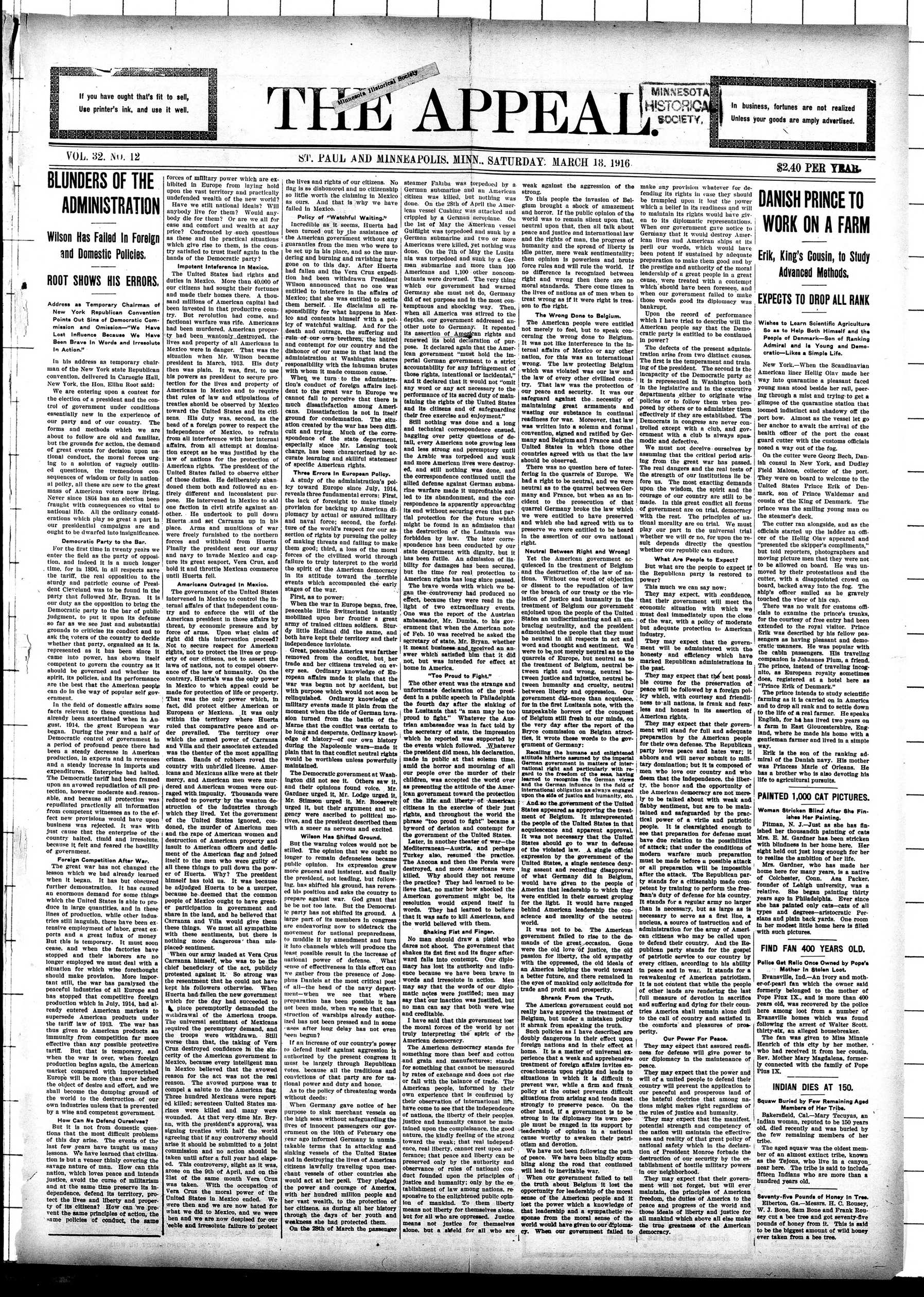
In his address as temporary chairman of the New York state Republican convention, delivered in Carnegie Hall, New York, the Hon. Ellu Root said: We are entering upon a contest for the election of a president and the control of government under conditions essentially new in the experience of our party and of our country. The forms and methods which we are about to follow are old and familiar, but the grounds for action, the demand of great events for decision upon national conduct, the moral forces urging to a solution of vaguely outlined questions, the tremendous consequences of wisdom or folly in national policy, all these are new to the great masses of Republican voters now living. Never since 1818 has an election been fraught with consequences so national life. All the ordinary considerations which play so great a part in our presidential campaigns are and ought to be dwarfed in insignificance.
Democratic Party to the Bar.
For the first time in twenty years we enter the field as the party of opposition, and indeed it is a much longer time, for in 1896, all respects save the tariff, the real opposition to the sturdy and patriotic course of President Cleveland was to be found in the party that followed Mr. Bryan. It is our duty as the opposition to bring the Democratic party to the bar of public judgment, to put it upon its defense so far as we see just and substantial grounds to criticise its conduct and to ask the voters of the country to decide whether that party, organized as it is, represented as it has been since it power, has shown itself competent to govern the country as it should be governed and to spirit, its policies, and its performance are the best that the American people can do in the way of popular self government.
In the field of domestic affairs some facts relevant to these questions had already been ascertained when in August, 1914, the great European war began. During the year and a half of Democratic control of government in a period of profound peace there had been a steady decrease in American production, in exports and in revenues and a steady increase in imports and expenditures. Enterprise had halted. The Democratic tariff had been framed upon an avowed repudiation of all projections for moderate and reasonable, and because full protection was repudiated practically all information from competent witnesses to the effect new provisions would be imposed business was rejected. It was with just cause that the enterprise of the country halted, timid and irresolute, because it felt and feared the hostility of government.
Foreign Competition After War
Foreign Competition After War. The great war has not changed the lesson which we had already learned when it began. It has but obscured further demonstration. It has caused an enormous demand for some things. The United States is able to produce in large quantities, and in these lines of production, and in other industries still languish, there have been extensive employment of laborers at exports and a great indus of贸 But this is a temporary. It must soon cease, and when the factories have stopped and their laborers are no longer employed we must deal with a situation for which wise forethought should make provision. More important still, the war has paralyzed the peaceful industries of all Europe and has stopped American markets to supersede American products under the tariff law of 1913. The war has thus given to American competition far more effective than any possible protective when the war is temporary, and when the war is completed production begins again, the American market compared with the American Europe will be more than ever before the object of desire and effort, and we shall become the dumping ground of the world to the destruction of our own industries unless that is prevented by a wise and competent government.
How Can We Defend Ourselves?
How Can We Defend Ourselves?
But it is not from domestic questions that the most difficult problems of this day arise. The events of the last few years have taught us many lessons. We have learned that civilization is but a veneer thinly covering the savage nature of man. How can this nation, which loves peace and intends justice, avoid the curse of militarism and at the same time preserve its independence, defend its territory, protect the livelihoods of society and property of its citizens? How can we prevent the same principles of action, the same policies of conduct, the same
forces of military power which are exhibited in Europe from laying hold upon the vast territory and practically undefended wealth of the new world?
Have we still national ideals? Will anybody live for them? Would anybody die for them? Or are we all for ease and comfort and wealth at any price? Confronted by such questions as these and the practical situations in which we live, the country satisfied to trust itself again in the hands of the Democratic party?
Impotent Inteferance In Mexico
Impotent Inference in Mexico. The United States had rights and duties in Mexico. More than 40,000 of our citizens had sought their fortunes and made their homes there. A thousand millions of American capital had been invested in that productive country. But revolution had come, and factional warfare was rife. Americans had been murdered. American property and had been wantonly destroyed, the lives property of all Americans in Mexico when he was president. That was the situation when Mr. Wilson presided in March, 1913. His duty then was plain. It was, first, to use his powers as president to secure protection for the lives and property of Americans in Mexico and to require that rules of law and stipulations of treaties should be observed by Mexico toward the United States and its citizens. His duty was, second, as the head of a foreign power to respect the independence of Mexico, to refrain from interference with her internal affairs, from all attempt at domination except as he was justified by the law of nations for the protection of American rights. The president of the United States failed to observe either of those duties. He deliberately abandoned them both and followed an entirely different and inconsistent purpose. He intervened in Mexico to aid civilians in civil life against another. He intervened in Mexico to Huerta and set Carranza up in his place. Arms and munitions of war were freely furnished to the northern forces and withdrawn from Huerta. Finally the president sent her army and navy to invade Mexico and capture its great seaport, Vera Cruz, and hold it and throttle Mexican commerce until Huerta fell.
Americans Outraged in Mexico.
The government of the United States intervened in Mexico to control the internal affairs of that independent country and to enforce the will of the American president in those affairs by threat, by economic pressure and by force of arms. Upon what claim of right did this intervention proceed? Not to secure respect for American rights, not to protect the lives or property of our citizens, not to assert the rights of our citizens, not to assert the law of humanity. On the contrary, Huerta's was the only power in Mexico to which appeal could be made for protection of life or property. That was the only power which, in fact, did protect either American or European or Mexican. It was only within the territory where Huerta ruled that comparative peace and order prevailed. The territory over which the armed power of Carranza and Villa and their associates was the theater of the most appalling crimes. Bands of robbers roved the country with unbridled license. Americans and Mexicans alike were at their mercy, and American men were murdered and American women were thousands were reduced to poverty by the destruction of the industries through which they lived. Yet the government of the United States ignored, condoned, the murder of American men and the rape of American women and insult to American officers and defilement of the American flag and joined itself to the men who were guilty of all these things to pull down the power of Huerta. Why? The president himself has told us. It was because he adjudged Huerta to be a usurper, because he deemed that the common people of Mexico ought to have greater participation in government and in the land, and he believed that Carranza and Villa would give these things. We must sympathize with these sentiments, but there is nothing more dangerous than misplaced sentiment.
When our army landed at Vera Cruz Carranza himself, who was to be the chief beneficiary of the act, publicly protested against it. So strong was the resentment that he could not have kept his followers otherwise. When Huerta had fallen the new government which for the day had succeeded to place peremptory demanded the withdrawal of the American troops. The universal sentiment of Mexicans required the peremptory demand, and the troops were withdrawn. Still worse than that, the taking of Vera Cruz destroyed confidence in the sincerity of the American government in Mexico, because every intelligent man in Mexico believed that the avowed reason for the act was not the real reason. The avowed purpose was to capture the American flag. Three hundred Mexican American flags killed; seventeen United States marines were killed and many were wounded. At that very time Mr. Bryan, with the president's approval, was签订 treaties with the half the agreement that if any controversy should arise it should be submitted to a joint commission and no action should be taken until a full year had elapsed. This controversy, slight as it was, arose on the 6th of April, and on the 21st of the same month Vera Cruz was taken. With the occupation of Vera Cruz the moral power of the warened in Mexico ended. We were then and we are now hated for what we did to we are and we were then and we are now desplaced for our 'eble and irresolute failure to protect
THE APPEAL. MINNESOTA HISTORICAL SOCIETY.
ST. PAUL AND MINNEAPOLIS. MINN.. SATURDAY. MARCH 18. 1916
the lives and rights of our citizens. No steamer Falaba was torpedoed by a German submarine and an American citizen was killed, but nothing was done. On the 18th of April the American vessel Cushing weak against the aggression of the flag is so disboroned and no citizenship so little worth the claiming in Mexico so little worth the claiming in Mexico
to this people the invasion of Berlin as ours. And that is why we have brought a shock of amazement failed in Mexico.
Policy of "Watchful Waiting."
Incredible as it seems, Huerta had been turned out by the assistance of the American government without any guaranties from the men who were to be set up in his place, and so the murdering and burning and ravishing have gone on to this day. After Huerta had fallen and the Vera Cruz expedition been withdrawn President Wilson announced that no one was entitled to interfere with Mexico; that she was entitled to set them herself. He declares all responsibility for what happens in Mexico and contents himself with a policy of watchful waiting. And for the death and outrage, the suffering and ruin of our own brethren, the hatred and contempt for our country and the dishonor of our name in that land the Washington shares responsibility with the inhuman brutes with whom it made sense. When we turn to the administration's conduct of foreign affairs incident to the great war in Europe we cannot fail to perceive that there is much dissatisfaction among Americans. Dissatisfaction is not in itself ground for condemnation. The situation created by the war has been difficult and trying. Much of the correspondence of the state department, including Lansing took charge, has been characterized by accurate learning and skillful argument of specific American rights.
Three Errors In European Policy.
A study of the administration's policy toward Europe since July, 1914, reveals three fundamental errors: First, the lack of foresight to make timely provision for backing up American diplomacy by actual or assured military and naval force; second, the forfeiture of the world's respect for our assertion of rights by pursuing the policy of threaten and failing to make them threats and a loss of the moral forces of the civilized through failure to truly interpret to the spirit of the American democracy in its attitude toward the terrible events which accompanied the early stages of the war.
First, as to power:
When the war in Europe began, free, peaceable little Switzerland instantly mobilized upon her frontier a great army of trained citizen soldiers. Sturdy little Holland did the same, and both have kept their territory and their independence involate.
Great, peaceable America was farther removed from the frontier, but her citizens traveled on every sea. Ordinary knowledge of European affairs made it plain that the war was begun not by accident, but with purpose which would not soon be relinquished. Ordinary knowledge of military events made it plain from the moment when the tide of German invasion turned from the battle of the Marne that the conflict was certain to be long and desperate. Ordinary knowledge of history—of our own history during the Napoleonic wars—made it plain that in that conflict neutral rights would be worthless unless powerfully maintained.
The Democratic government at Washington did not see it. Others saw it, and its opinions found voice. Mr. Gardner answered loudly. Lodge urged it. Mr. Stimson urged it. Mr. Roosevelt urged it, but their argumentgency were ascribed to political motives, and the president described them with a sneer as nervous and excited.
Wilson Has Shifted Ground.
But the warning voices not be still stilled. The opinion we ought not longer to remain defenseless, became public opinion. Its expression, more general and insistent, and finally the president, not leading, but following, has shifted his ground, has reversed his position and asks the country to prepare against war. God grant that he be not too late. But the Democratic party has not shifted its ground. A large part of its members in congress are endeavoring now to sidetrack the movement for national preparedness, to middle it by amendment and turn it into a law which will produce the least possible result in the increase of national power of defense. What sense of effectiveness in this effort can we gather from the presence of Joseph Daniels at the most critical post of all—the head of the navy department—when we see that where preparation has been possible it has not been made, when we see that construction of warships already authorized has not been pressed and in some cases after long delay has not even been begun? If an increase of our country's power to defend itself against aggression is motivated by the present congress it must be used to republican votes, because all the traditional and convictions of that party are for national power and duty and honor. As to the policy of threatening words without deeds:
When Germany gave notice of her purpose to sink merchant vessels on the high seas without safeguarding the lives of innocent passengers our government on the 10th of February one year ago informed Germany in unmistakable terms that in attacking and sinking vessels of the United States and in destroying the lives of American citizens lawfully traveling upon merchant vessels of other countries she would act at her peril. They pledged the power and courage of America, with her hundred million people and her vast wealth, to the protection of her citizens as during all her history through the days of her youth and weakness she had protected them.
On the 28th of March the passenger
steamer Fataba was torpedoed by a German submarine and an American citizen was killed, but nothing was done. On the 28th of April the American vessel Cushing was attacked and crippled by a German airplane. On the 1st of May the American vessel Gulfight was torpedoed and sunk by a German submarine and two or more Americans were killed, yet nothing was done. On the 7th of May the Lusiana was torpedoed and sunk by a German submarine and more than 100 Americans and 1,100 other noncombatants were drowned. The very thing which our government had warned Germany she must not do, Germany did of set purpose and in the most contemptuous and shocking way. Then when all America was stirred to the depths, our government addressed an order to Germany. It repeated its assertion and its rights and renewed its bold declaration of purpose. It declared again that the American government "must hold the strict accountability for any infringement of those rights, intentional or incidental," and it declared that it would not "omit the demand or that it would not the performance of its sacred duty of maintaining the rights of the United States and its citizens and of safeguarding their free exercise and enjoyment."
Still nothing was done and a long and technical correspondence ensued, haggling over petty questions of detail, every American note growing less and less strong and peremptory until the Arabic was torpedoed and sunk and more American lives were destroyed, and still nothing was done, and the correspondence continued until the allied defense against German submarine warfare made it unprofitable and led to its abandonment, and the correspondence is apparently approaching its and without securing even that partial protection for the future which might be found in an admission that the destruction of the Lustania was forbidden by law. The later correspondence has been conducted by our state department with dignity, but it has been futtle. An admission of liability for damages has been secured, but the time for real protection to American rights has long since passed. The brave words with which we began the controversy had produced no effect, because they were read in the light of two extraordinary events. One was the request of the Austrian ambassador, Mr. Dumba, to his government that when the American note of Feb. 10 was received he selected the secretary of state, Mr. Bryan, which it meant business and received an answer which satisfied him that it did not, but was intended for effect at home in America.
"Too Proud to Fight."
The other event was the strange and unfortunate declaration of the president in a public speech in Philadelphia the fourth day after the sinking of the Lusiana that "a man may be too proud to fight". Whatever the Austrian ambassador was in fact told by the secretary of state, the impression which he reported was supported by the events which followed. Whatever the president did mean, his declaration, made in public at that solemn time, amid the horror and mourning of all our people over the murder of their children, was accepted the world over as presenting the attitude of the Americas to the world in the face of the injustice of the life and liberty of American citizens in the exercise of their just rights, and throughout the world the phrase "too proud to fight" became a byword of derision and contempt for the government of the United States.
Later, in another theater of war—the Mediterranean-Austria, and perhaps Turkey also, resumed the practice. The Ancona and then the Persia were destroyed, and more Americans were killed. Why should they not resume the practice? They had learned to believe that, no matter how shocked the Americans were, their resolution would expand itself in words. They had learned to believe that it was safe to kill Americans, and the world believed with them.
Shaking Fist and Finger.
No man should draw a pistol who dares not shoot. The government that shakes its fast first and its finger afterward falls into contempt. Our diplomacy has lost its authority and influence because we have been brave in words and irresolute in action. Men may say that the words of our diplomatic notes were justified; men may say that our inaction was justified, but no man can say that both were wise and creditable.
I have said that this government lost the moral forces of the world by not truly interpreting the spirit of the American democracy.
American diplomacy stands for something other than beef and cotton and grain and manufactures: stands for something that cannot be measured by rates of exchange and does not rise or fall with the balance of trade. The American people, informed by their own experience that is confirmed by their observation of international life, have come to see that the independence of nations, the liberty of their peoples, justice and humanity cannot be maintained upon the complacension, the good nature, the kindly feeling of the strong toward the weak; that real independence, real liberty, cannot rest upon sufferance; that peace and liberty can be preserved only by the authority and observance of rules of national conduct; that justice and humanity: only by the establishment of law among nations, responsive to the enlightened public opinion of mankind. To them liberty means not only for themselves alone, but for all who are oppressed. Justice means not justice for themselves alone, but a shield for all who are
weak against the aggression of the strong.
To this people the invasion of Belgium brought a shock of amazement and horror. If the public opinion of the world was to remain silent upon that, neutral upon that, then all talk about peace and justice and international law and the rights of man, the progress of humanity and the spread of liberty is idle pain, mere weak sentimentality; the power of powerless and brute force rules and will rule the world. If no difference is recognized between right and wrong then there are no moral standards. There come times in the lives of nations as of men when to treat wrong as if it were right is treason to the right.
The Wrong Done to Belgium.
In Wrong Done to Belgium.
The American people were entitled not mercy to feel, but to speak concerning the home to Belgium. It was not like interference in the internal affairs of Mexico in the other nation, for this was an international wrong. The law protecting Belgium which was violated was our law and the law of every other civilized country. That law was the protection of our peace and security. It was our safeguard against the necessity of maintaining great armaments and wasting our substance in continual readiness for war. Moreover, that law was written into a solemn and formal convention, signed and ratified by Germany and Belgium and France and the United States in which those other countries agreed with us that the law should be observed.
There was no question here of interfering in the quarrels of Europe. We had a right to be neutral, and we were neutral as to the quarrel between Germany and France, but when an incident to the presence of that quarrel Germany broke the law which we were entitled to have preserved and which she had agreed with us to preserve we were entitled to be heard in the assertion of our own national right.
Neutral Between Right and Wrong! Yet the American government acquiesced in the treatment of Belgium and the destruction of the law of nations. Without one word of objection or dissent to the repudiation of law or the breach of our treaty or the violation of justice and humanity in the treatment of Belgium our government has been unable to States an undiscriminating and all-embracing neutrality, and the president admonished the people that they must be neutral in all respects in act and word and thought and sentiment. We were to be not merely neutral as to the quarrels of Europe, but neutral as to the treatment of Belgium, neutral between justice and injustice, neutral between humanity and cruelty, neutral between liberty and oppression. Our government did more than acquiesce, for in the first Lusiana note, with the unspeakable horrors of the conquest of Belgium still fresh in our minds, on the very day after the report of the Bryce commissioned these words to the government. Recalling the humans and enlightened attitude hitherto assumed by the imperial government in matters of international right and participation with respect to the conquest, the government learned to recognize the German views and the German influence in the field of international obligation as always engaged in the conquest.
And so the government of the United States appeared as approving the treatment of Belgium. It itmrepresented the people of the United States in that acquiescence and apparent approval. It was not necessary that the United States be involved in the defense of the violated law. A single expression by the government of the United States, a single sentence denying assent and recording disapproval of what Germany did in Belgium, would have given to the people of America that leadership to which they were entitled in their earnest groping for the light. It would have ranged and led the leadership the conscience and morality of the neutral world. It was not to be. The American government failed to rise to the demands of the great occasion. Gone were the old love of justice, the old passion for liberty, the old sympathy with the oppressed, the old ideals of freedom, helping the world toward a better future, and helped in the eyes of mankind only solicitude for trade and profit and prosperity.
The American government could not really have approved the treatment of Belgium, but under a mistaken policy it shrank from speaking the truth. Such policies as I have described are doubly dangerous in their effect upon foreign nations and in their effect at home. The American government experience that a weak and apprehensive treatment of foreign affairs invites encroachments upon rights and leads to situations in which it is difficult to prevent war, while a arm and frank policy at the outset prevents difficult situations from arising and tends most strongly to preserve peace. On the other hand, if a government is to be strong in its diplomacy its own people must be ranged in its support by a government in a national cause worthy to awaken their patriotism and devotion. We have not been following the path of peace. We have been blindly stumbling along the road that continued will lead to inevitable war. When our government failed to tell the truth about Belgium it lost the opportunity for leadership of the moral sense of the American people and it lost the opportunity of knowledge of that leadership and a sympathetic response from the moral sense of the world would have given to our diplomacy. When our government failed to
In business, fortunes are not realized Unless your goods are amply advertised.
make any provision whatever for defending its rights in case they should be trampled upon it lost the power which a belief in its readiness and will to maintain its rights would have given to its diplomatic representations. When our government gave notice to Germany that it would destroy America and American ships at its peril our allies would have been potent if sustained in preparation to make them good and by the prestige and authority of the moral leadership of a great people in a great cause, were treated with a contempt which should have been foreseen, and when our government failed to make those words good its diplomacy was bankrupt.
Upon the record of performance which I have tried to describe will the Democratic party be entitled to be continued in power?
The defects of the present administration arise from two distinct causes. The first is the temperament and training of the president. The second is the incapacity of the Democratic party as it is represented in Washington both in the legislative and in the executive departments either to originate wise policies or to follow them when proposed by others or to administer them if they are established. The Democratic congress are never controlled except a club, and government with a club is always spasmatic and defective.
We must not deceive ourselves by assuming that the critical period arising from the great war has passed. The real dangers and the real tests of the strength of our institutions lie before us. The most exacting demands upon the wisdom, the spirit and the courage of our country are still to be made. In this great conflict all forms of government are on trial, democracy with the rest. The principles of national morality are on trial. We must play our part in the universal trial whether we will or not, for upon the result depends directly the question whether our republic can endure.
What Are People to Expect?
But what are the people to expect if the Republican party is restored to power?
This much we can say now:
They may expect, with confidence, that their government will meet the economic situation with which we must deal immediately upon the close of the war, with a policy of moderate but adequate protection to American industry. They may expect that the government will be administered with the honesty and efficiency which have marked Republican administrations in the past. They may expect that the best possible peace for the preservation of peace will be followed by a foreign policy which, with courtesy and friendliness to all nations, is frank and fearless and honest in its assertion of American rights.
They may expect that their government will stand for full and adequate preparation by the American people for their own defense. The Republican party loves peace and hates war; it aborts and will never submit to military domination; but it is composed of men who love our country and who deem that the independence, the liberty, the honor and the opportunity of the American democracy are not merely to be talked about with weak and faby sentiment, but are to be maintained and safeguarded by the practical power of a vitile and patriotic people. It is clearledight enough to prepare for defense must have due priority in the face of attack; that under the conditions of modern warfare much preparation must be made before a possible attack or all preparation will be impossible after the attack. The Republican party stands for a citizenship made competent by training to perform the freeman's duty of defense for his country. It stands for a regular army no larger than is necessary, but as large as is necessary to serve as a first line, a nucleus, a source of instruction and of administration for the army of American citizens who may be called upon to defend their country. And the Republican party stands for the gospel of patriotic service to our country by every citizen, according to his ability in peace and in war. It stands for a reawakening of American patriotism, and for the accolades that will the people of other lands are rendering the last full measure of devotion in sacrifice and suffering and dying for their countries America shall remain alone dull to the call of country and satisfied in the comforts and pleasures of prosperity.
Our Power For Peace.
They may expect that assured readiness for defense will give power to our diplomacy in the maintenance of peace.
They may expect that the power and will of a united people to defend their country in the application of our peaceful and prosperous land of the hateful doctrine that among nations might make right regardless of the rules of justice and humanity.
They may expect that the manifest, potential strength and competency of the nation will maintain the effectiveness and reality of that great policy of the United States in the protection of President Monroe for the destruction of our security by the establishment of hostile military powers in our neighborhood.
They may expect that their government will not forget, but will ever maintain, the principles of American freedom, the duties of America to the peace and progress of the world and to the security of all mankind which above all else make the true greatness of the American democracy.
$2.40 PER YEAR.
DANISH PRINCE TO WORK ON A FARM
Erik, King's Cousin, to Study Advanced Methods.
EXPECTS TO DROP ALL RANK
Wishes to Learn Scientific Agriculture so As to help Both Himself and the People of Denmark—Son of Ranking Admiral and is Young and Democratic—Likes a Simple Life.
New York.—When the Scandinavian American liner Hellig Olav made her way into quarantine a pleasant faced young man stood beside her rail, piercing through a mist and trying to get a glimpse of the quarantine station that loomed indistinct and shadowy off the port bow. Almost as the vessel let go her anchor to await the arrival of the health officer of the port the coast guard cutter with the customs officials nosed a way out of the fog.
On the cutter were Georg Bech, Danish consul in New York, and Dudley Field Malone, collector of the port. They were on board to welcome to the United States Prince Erik of Denmark, son of Prince Waldemar and cousin of the King of Denmark. The prince was the smiling young man on the steamer's deck.
The cutter ran alongside, and as the officers started up the ladder an officer of the Hellig Olav appeared and told the skippers's compliments, and moved picture mates, photographers and moving picture mates, that were not to be allowed on board. He was moved by their protestations and the cutter, with a disappointed crowd on board, backed away into the fog. The ship's officer smiled as he gravely touched the visor of his car.
There was no wait for customs officials to examine the prince's trunks, for the courtesy of free entry had been extended to the royal visitor. Prince Erik was described by his fellow passengers as having pleasant and democratic manners. He was popular with the cabin passengers. His traveling companion is Johannes Plum, a friend. The prince, instead of traveling incognito, as European royalty sometimes does, registered at a hotel here as "Prince Erik of Denmark." The prince intends to study scientific farming as it is carried on in America and to drop all bank and to settle down to the life of a farmer two years English, for he has lived two years on a farm in East Gloucestershire, England, where he made his home with a gentleman farmer and lived in a simple way. Erik is the son of the ranking admiral of the Danish navy. His mother was Princess Marle of Orleans. He has a brother who is also devoting his life to agricultural pursuits.
PAINTED 1,000 CAT PICTURES
Woman Stricken Blind After She Finishes Her Painting.
Pitman, N. J.-Just as she has finished her thousandth paintings of cats Mrs. E. M. Gardner has been stricken with blindness in her home here. Her sight held out just long enough for her to realize the ambition of her life.
Mrs. Gardner, who has made her home here for many years, is a native of Colchester. Conn. Asa Packer, of the high university, was a relative. She has painted thirty years ago in Philadelphia. Ever since she has painted only cats—cats of all types and degrees—aristocratic Persians and plain back yards. One room in her modest little home is filled with such pictures.
FIND FAN 400 YEARS OLD.
Police Get Relic Once Owned by Pope's Mother In Stolen Loot. Evansville, Ind.—An ivory and mother-of-pearl fan which the owner said formerly belonged to the mother of Pope Plux IX., and is more than 400 years old, was recovered by the police here among loot from a number of Evansville homes which was found following the arrest of Walter Scott. thirty-air, an alleged housebreaker. The fan was given to Miss Minnie H. H. of Evansville her mother, who had received it from her. Rev. Mother Mary Magdalena, formerly connected with the family of Pope IX.
INDIAN DIES AT 150.
Squaw Buried by Few Remaining Aged Members of Her Tribe.
Bakersfield, Cal.-Mary Tecuyas, an Indian woman, reputed to be 150 years old, died recently and was buried by the few remaining members of her tribe.
The aged squaw was the oldest member of an almost extinct tribe, known as the old Indian to live in a canyon near here. The tribe is said to include fifteen Indians who are more than a hundred years old.
Seventy-five Pounds of Honey in Tree.
Elberton, Ga.-Messers, H. C. Rousey, W. J. Bone, Sam Bone and Frank Rousey cut a bee tree and got seventy-five pounds of honey from it. This is said to be the biggest amount of wild honey ever taken from a bee tree.
HAVE YOU READ
THE APPEAL?
THE APPEAL
AN AMERICAN NEWSPAPER
ISSUED WEEKLY
J. Q. ADAMS, EDITOR AND PUBLISHER
ST. PAUL OFFICE
No. 301-2 Court Block, 24 E. 4th st.
J. Q. ADAMS, Manager.
MINNEAPOLIS OFFICE
No. 2812 Tenth Avenue South
J. N. SELLERS, Manager.
TERMS STRICTLY IN ADVANCE
SINGLE COPY, THREE MONTHS. . . 60
SINGLE COPY, SIX MONTHS. . . 1.10
SINGLE COPY, ONE YEAR. . . 2.00
When subscriptions are by any means allowed to run without prepayment, the tenure for each cent for 12 weeks and 1 cent for each week, or at the rate of $2.40 per year.
Remittances should be made by Express Money Order, Post Office Money Order, Registered Letter or Bank Draft. Post-Remittance stamps will be received the same as for the financial parts of a dollar. Only one cent and two cent stamps taken.
Silver should never be sent through the mail. It is almost sure to wear a nail through the envelope and be lost; or else it will be lost. Person who sent silver to us in letters so at least own risk.
Marriage and death notice 10 lines or less 11. Each additional line 10 cents. Payment strictly in advance, and to be an account at all must come in season to the news.
Advertising rates, 15 cents per agate line, each insertion. There are fourteen agate lines and about seven an agate line. No discount verifications less than $1. No discount allowed on less than three months contract. Must accompany all orders from the company per us. Further participants on application.
Reading notices 25 cents per line, each insertion. No discounts for time or space. Reading matter is set in brevter type—about six words to the line. All need lines count double.
The date on the address label shows when paper shows when time is out. Subscription expires prematurely should be noted prior to expiration so that no paper may be missed, as the it occasionally happens that papers sent to subscribers are lost or stolen. In case you do not receive any number when due, inform us by postal card at the expiration of five days from that date, date of the missing number.
Communications to receive attentions to the company only upon one side of the paper; must reach us Tuesdays if possible, anyway not later than Wednesdays, only written upon one side of the paper; must reach us Tuesdays if possible, anyway not later than Wednesdays, only written upon one side of the paper; No manuscript returned unless stamps are sent for postage.
we do not hold ourselves responsible for the views of our correspondents.
solicitting agents wanted everywhere.
Write 'or terms. Sample copies free.
in every letter that you write us we surrender fall to give your full name and address, plainly written, post office, county and state. Business letters of all kinds must be written in a formal manner containing news or matter for publication. Entered as second class matter June 4, 1858 at the postmaster at St. Paul, Wien, under act of Congress, March 4, 1858.
SATURDAY, MARCH 18, 1916.
PSYCHOLOGY OF PREJUDICE.
Last week the St. Paul Pioneer Press contained a very remarkable editorial which has been so generally and favorably commented upon that we reproduce it for the benefit of exchanges and some people who did not see it. It certainly has the right ring. The occasion which inspired it was a meeting of the National Association for the Advancement of Colored People:
PSYCHOLOGY OF PREJUDICE.
"It is the duty laid upon every American to rid himself of race prejudice so far as may be. And, this being America, race prejudice should be entirely banished from our national life, if not obliterated from our personal attitudes.
"In any event, no American has a right, the smallest personal right, to speak or think his race prejudices in public. That is un-American and registers him not an American. It difficult to be at best, this ridding one's self of prejudice particularly of race prejudice. There appears to be no corollary of tolerance to the American proposition of liberty. But, never was there a moment in our history when the call to this difficult achievement was so loud, or the opportunity so large.
"And, at this moment when every man feels prejudices and every man knows it is laid upon him to act so far as possible free from prejudices, there is a very large opportunity to consider and banish a certain race prejudice. We have had the race with us almost from the beginning and will have it to the end. Much injustice has been wrought and will be wrought if
THE SIN OF SILENCE
To sin by silence protest makes cover The human race has test. Had no voice in injustice, ignorance quisition yet would guillotines decide on The few who dare speak again to rip many.—Ella Wheel
To sin by silence when we should protest makes cowards out of men. The human race has climbed on protest. Had no voice been raised against injustice, ignorance and lust, the inquisition yet would serve the law, and guillotines decide our least disputes. The few who dare must speak and speak again to right the wrongs of many.—Ella Wheeler Wilcox.
we do not confirm or grant of not
operation but friendliness to this
race.
"On Tuesday night at the Plymouth church and for the society which nationally is pledged to urge the banishment of this prejudice, the society for the amelioration of the conditions of the colored people, President Vina-ton of the University will speak on "The Psychology of Prejudice." It is an illumination of which we are all in need. Too often our prejudice is a matter of instinct, without any psychology, any mental side to it. To discover where we err, and where we fail to manifest any intelligence, should go far to cure us of our medieval ill. And at this moment, the ill will which weave, as Americans, an amalgam of all will much in need of as an understanding of prejudice, leading to its elimination, or at least its subordination in public affairs."
SAINT CVRS TO ENTERTAIN CAPITAL "SASSIYT."
Mr. and Mrs. Jean Harald St. Cyr are entering upon a social campaign in Washington which is to be so lavish that "sassiety" will sit up and take notice. One of the most elegant residences on Connecticut avenue, built by the late A. M. Lathrop, a merchant prince, and occupied last season by Mrs. Thomas F. Walsh, has been leased by the St. Cyr and they will keep open house at a series of brilliant social functions.
Never heard of the St. Cyrs? Well, Jean Harald St. Cyr was not many years ago John Thompson, a waiter in a Chicago restaurant. He was ambitious and feeling that the name John Thompson was a handicap, he changed it to Jean Harald St. Cyr. Then he made love to a rich widow and married her, and when her death occurred a few months later he became heir to about $200,000. Shortly after the death of his wife, he arrayed himself in some loud clothes and made love to Mrs. "Silent" Smith, a widow with $50,000,000, and in a short while captured and married her. With fifty millions in his possession "sassiety" will forget all about the humble origin of "Mr. St. Cyr" and will receive him and his bride with open arms. It is said that "Mr. Saint Cyr" does not care a rap what the general public thinks of him—and who would with $50,000,000?
Only one daily paper in St. Louis had the courage and manhood not only to fight against segregation but to severely rebuke the other papers which stood for the unholy thing.
The St. Louis Post-Dispatch, the Pulitzer paper, in an admirable editorial, set forth its view of the situation as follows:
"The forces backing the segregation movement were so powerful that they were able to control newspapers and induce them to abandon their principles. That they should mislead for a time a large number of voters is not a matter of wonderment.
"Of course the ordinances adopted under the initiative will have to stand the tests of the courts. We do not believe that they will survive. If they do not we do not look for a solution of the problems they were planned to meet. We believe that they are mistakes and that they will be recognized as mistakes and set aside in favor of the principles they violate. We hope, however, the experiment of segregation will not lead to serious consequences.
"The racial problems with which they are planned to deal must be solved on a sound basis of justice and liberty and with a broader spirit of humanity than are embodied in these measures."
It is said that the intelligent colored people of Saint Louis will fight
THE MAN WO @ DARES
I honor the ma-
sclentious discharge
to stand alone; the
ant, intolerant ju-
demn, the counter-
may be averted, a
friends grow cold,
duty done shall be
applause of the w
ances of relatio
I honor the man who in the conscientious discharge of his duty dares to stand alone; the world, with ignorant, intolerant judgment, may condemn, the countenances of relatives may be averted, and the hearts of friends grow cold, but the sense of duty done shall be sweeter than the applause of the world, the countenances of relatives or the hearts of friends.—Charles Summer.
se when we should
wards out of men.
us climbed on pro-
been raised against
he and lust, the in-
serve the law, and
our least disputes.
he must speak and
right the wrongs of
er Wilcox.
segregation to a finish and that they must do, for upon the proper settlement of this question depends their very existence. Segregation is spreading all over the country and money must be raised to carry the question to the Supreme Court of the United States.
THE APPEAL hereby subscribes five dollars to the fighting fund and and has forwarded that amount to the National Association for the Advancement of Colored People at New York, the same to be added to the fund for carrying the matter to the court of last resort. Who will follow suit?
"BASIS OF SOCIAL STRIFE."
In a recent address before the Sunday Evening Club, Bishop Charles D. Williams handed out some straight goods. We quote three sterling paragraphs:
"Nine-tenths of our social strife come from trying to know people by labels or numbers. We require a great deal more temperance and virtue from the tramp who comes to the back door and asks for cold victuals than we do from the society youth who comes into the drawing-room and asks for our daughter's hand.
"Think of the simple Russian, German and French peasants across the sea tonight, murdering each other. If you went through the ranks most of them wouldn't know what it is all about. They are doing it just because some one in authority has labeled the other fellow—'enemy.'"
"The secret of nearly all our hatred and indifference toward our neighbors is because we don't know them. We are all slaves to names and titles; we hate to face realities. We are getting morally color blind to the finer shades of right and wrong. Often we are afraid to be alone with our real selves for fear we should get acquainted with them."
THE REASON WHY
A distinguished foreigner who is touring the United States had this to say relative to his impressions of the race question in this country:
"I have always been interested in what is called the race question in the United States and since my arrival I have endeavored to study it from every viewpoint and if possible find some reasons for its existence.
"After I had met so large a number of intelligent, well educated, refined and cultured colored people I was at a loss to understand the reasons for the bitter race prejudice and the attempts in various parts of the country to segregate people of color.
"The problem was largely solved when I attended at Evanston, Illinois recently a conference of the various branches of Methodism and in which the colored branches had representation.
"That a body so-called Christians should find it necessary to even discuss the question of segregating any class of people was so contrary to the spirit of Christianity that I was greatly surprised; but after a Southern delegate had in a vigorous speech opposed segregation, I was dumb-founded to see a bishop of a colored Methodist church arise and make a speech favoring the separation of his branch from the proposed union of Methodism. He referred to his members as "white folks" Negroes" and said they wished to be set apart. It was a disgusting revelation.
"The whole thing is now clear. Some ignorant, short sighted self-seeking leaders are seeking segregation in the church for some personal reasons. Evidently they are not versed in history or they would know that they
who in the con-
ge of his duty dares
the world, with ignor-
gment, may con-
nances of relatives
and the hearts of
but the sense of
sweeter than the
world, the counten-
are playing with fire. If they are segregated in the House of the Lord, segregation civilly and socially follows as a natural sequence. Old colored men who were reared in slavery are apt to have slavish ideas and the only hope of the colored people is that the young men, the clear-headed thinking young men, will take charge of the situation and push to the rear the truckling leaders who are willing to sell their birthright for a mess of potage."
HONORABLE SECRETARY VISITS
UNIVERSAL SECRETARY VISITS.
"The Honorable, the Secretary of the Treasury," W. G. McAdoo, has started for South America. He is accompanied by Senator Fletcher of Florida. The United States is reaching out for Central and South American trade and these two worthy segregationists will no doubt receive a rousing hearty welcome from the warm hearted Latin Americans.
In Brazil the "Honorable Secretary" will meet many prominent citizens, high officials and merchants who are colored men of various shades, from a bright yellow to a lustrous black, and he has made a great mistake if he has not included among his impedimenta samples of the famous segregated water closet which was invented by former "Honorable Assistant Secretary of the Treasury" William and installed in the treasury building at Washington by "The Honorable, the Secretary of the Treasury" McAdoo. Doubtless this new-fabled Democratic contrivance would greatly impress many of the men of various mixtures of Indian, Negro, Portuguese and Spanish bloods, "The Honorable the Secretary of the Treasury" will have the HONOR of meeting.
And it is appropriate that "The Honorable, the Secretary of the Treasury" should steam away on the U. S. armored cruiser Tennessee. The name Tennessee, as well as that of every other state in the murder zone of the United States, is one for segregationists to conjure by, reeking as it does with civic injustice, race prejudice jimcrow laws, religious cant, hypocrisy and lynching.
PLUCK AND PREPAREDNESS
Deputies from the Illinois state fire marshal's office have begun an investigation into a fire which occurred Wednesday in the home of Fred R. Jefferson, a colored man who resides in Oak Park, a suburb of Chicago. Jefferson charges that his house was set on fire purposely because of race prejudice.
This blaze was the second attempt made to burn Jefferson's home. The first occurred in April, 1914. The latest blaze occurred about 1:30 o'clock. The Jefferson's would probably have burned in their beds had not the flare of the burning gasoline awakened them.
Mrs. Jefferson carried out their little daughter Faith. Jefferson himself could not get a connection over either of the two telephones which he has in his house and ran to a neighbor's house to call the fire department. After this he saw a white man run away from the house and stumble over a hedge, and was yelling when he disappeared, and it is believed he was wounded by a shot which Jefferson fired from his rifle. Like a sensible man Jefferson has learned the lessons of preparedness, and keeps a rifle, a shotgun and a revolver in the house, not to mention a huge dog, which is on watch in the basement. He is ready to give house burners a warm reception.
Jefferson's house cost $3,500 and is free from debt. He has been a student at the Art Institute, where he took a prize, and is a member of the Chicago Guards' band, a Hull house organization.
THE APPEAL congratulates Mr. Jefferson on his pluck and preparedness and hopes that the next cowardly scoundrel who attempts to burn his home may receive a bullet through his back into his vile heart.
THE LIAR AND HIS LIES.
Recently in Richmond in the more or less "grand old commonwealth of Virginia," colored citizens according to the Daily Times-Dispatch, honored a Catholic priest who had worked among the colored people, by presenting him a silver tea service. So far, so good, but in his speech the colored brother who made the presentation speech said that "the white, and colored people of Richmond lived side by side in most harmonious relations and that there was not the least sign of race prejudice."
Now somebody has lied. Either the Times-Dispatch has misquoted the speaker or he has deliberately falsified. The Planet, the Reformer and the St. Luke Herald newspapers published by colored people has stated scores of times that rank prejudice exists and certainly the enactment of the city segregation ordinance which does not permit colored and white people to live "side by side."
In truth the talk about "harmonious relations" is mostly bunk and it has been handed out for years by the bootlickers who for personal reasons to curry favor with their oppressors.
"Harmonious relations," "not the least sign of prejudice" and such expressions are lies and the man who utters them knows that he is a liar.
Voliva the prophet of Zion City insists that the earth is flat. Many years ago, Rev. John Jasper of Richmond, Va., declared that the "Sun do move." He attracted considerable attention, and that's just about all that Volva desires at this time.
COLORED COMMITTEE
REFUSED A HEARING IN WASHINGTON BY VINSON OF GEORGIA.
On Bills Favoring Jim Crow Cars and Making Marriage of Colored and White People a Crime—Rep. Tinkham Conducted Hearing' Alone.
(From the Boston Guardian.)
Mr. Archibald H. Grimke, president of the Washington, D. C., Branch of the National Association for the Advancement of Colored People, reports in the Boston Herald of Monday his attempt to get a hearing on bills for separate street cars and against intermarriage of white and Colored persons, introduced into Congress. He says that Rep. Ben Johnson, of Kentucky, chairman of the District Committee, ignored his request and a hearing before the sub-committee was secured through Congressman George Holden Tinkham of Boston. When this Colored committee appeared Rep. Tinkham telephoned to sub-committee chairman. Rep. Vinson of Georgia, that some citizens were on the scene, brought him to the scene. The latter however, on viewing these citizens took rep. Tinkham into an ante-room and practically accused him of deception in that those present were Colored Americans, supposing they were white ones, who favored the bills. He flatly refused to hear this committee and is alleged to have said to Rep. Tinkham:
"I never was more astonished in my-life when I saw the committee rooms filled with a lot of niggers and mongrels."
Tinkham Conducts Hearing
Rep. Tinkham then conducted the hearing himself, having a stenographic report made of everything said. Presumably no white member of the organization was present, and no Colored woman spoke. Colored men mentioned as speaking were Dean Kelly Miller and Prof. Geo. W. Cooke of Howard University, Mr. Grimke, Mr. Whitefield McKinlay, a wealthy business man, ex-Collector of the Port of Georgetown, James A. Cobb, Esq., and ex-Asst. W. S. District Attorney of D. C.
Indifferent to South's Aggression.
The article says that there will be no printed report of these arguments, because Colored persons are not considered as citizens by the Democratic majority in Congress, and that the South has deprived the Colored people of all representation in Congress (of course with the acquiescence of the Republican North) and introduces hostile bills upon which now it tries to refuse a hearing, and asks how long it is disregard of the rights of Colored citizens under the Constitution to go unchecked by the "American nation." Mr. Grimke summarizes the arguments used, especially against the stigmatizing and degrading anti-intermarriage bills as follows:
We showed why the bills ought not to become law; that white and Colored people have been riding in the same cars since 1865, without race friction; that there is no public demand for separate cars and street companies are opposed to them; and that we do not advocate the inter-marriage of the cars from it, yet we were opposed to these anti-marriage bills because there is no necessity for such a law, as inter-marriage between the races is very rare and is, in fact, a negligible quantity in the District of Columbia, as such marriages constitute but a fraction of one per cent of the marriages, the district. We went further and deeper, and showed that such a law would operate not to use public morals but to lower them; nor to prevent the inter-mixture of the races but to make amalgamation appallingly easy.
Laws Against Inter-Marriage Do Not Stop but Increase inter-mixture of Colored Blood.
He showed how such laws operate to preserve race purity in the South by establishing double moral and legal standards, and how white men can and do live in concubinage with Colored women there, having children by them with impunity; that they live in lawful union with white women in the South and in unlawful union with black women in their world at one and the same time, producing in consequence a yastime of mixed bloods every year. We showed Colored women had the same legal redress against white men, which white women possess, by action for seduction and bastardy process, and that if these white men could be forced legally to support their Colored children, could be brought to book by criminal law for adultery and fornication, Colored women, there would be vastly the mixture of the races in the South, and the going on there at present, and that the South is opposed not to illicit intercourse between the races, but only to legal sexual relations between them.
Must Judge A Group by Its Beat.
No one can be said to know any class of people who has not been in intimate and sympathetic relation with the best as well as the worst of the class. We compare many persons who live in the South, and think they know the colored race, with others who have had no such contact, but who have come into intimate and sympathetic relations with large numbers of that race whom their Southern friends have never known; and of the two sets of people we should say that the second knew the colored people better than the first. They know aspirations among them that the others do not enter into and appreciate, do not enter into and appreciate, they know capabilities by directive, with the best of the race which others are vicious of; they know qualities which only respect and sympathy can bring out; they know possibilities to which others by their very acquaintance are blinded. If those who know the colored race through the mass and by observation merely could know what individual possibilities are demonstrated in growing numbers of the elect, and would be courageously candid with themselves, they would revise their judgments and possibly soften their prejudices. At any rate, they ought to credit to those on whom they charge ignorance of the colored race the values that come from knowing how many of that race are the members of the dominant race in the highest abilities and in the clearest ears. No estimate is worth much which does not take people at their beef.
Griffon
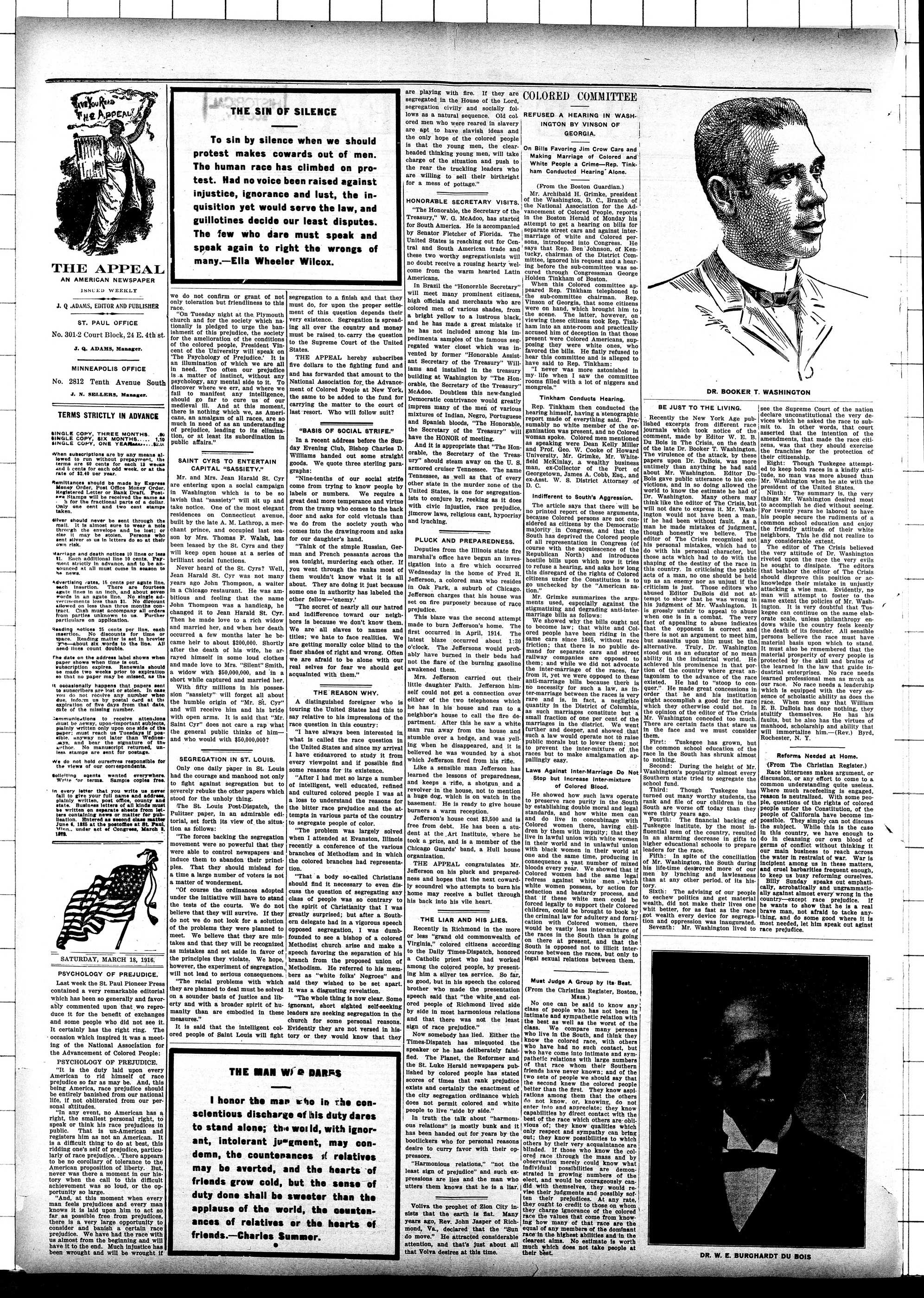
DR. BOOKER T. WASHINGTON
BE JUST TO THE LIVING.
Recently the New York Age published excerpts from different race journals which took notice of the comment, made by Editor W. E. B. Du Bois in the Crisis, on the death of the late Dr. Booker T. Washington. The virulence of the attack, by these papers upon Dr. DuBois, was more untimely than anything he had said about Mr. Washington. Editor DuBois gave public utterance to his convictions, and in so doing allowed the world to know the estimate he had of Dr. Washington. May he may think like the editor of the Crisis will not dare to express it. Mr. Washington would not have been a man, if he had been without fault. As a man he made mistakes of judgment, though honestly we believe. The editor of the Crisis recognized not his personal mistakes, which had to do with his personal character, but those acts which had to do with the shaping of the destiny of the race in this country. In criticising the public of illness he may be held up as an enemy of the race. The criticism is just. Those editors who abused Editor DuBois did not attempt to show that he was wrong in his judgment of Mr. Washington. It is grossly unfair to appeal to abuse when one is in a combat. The very fact of appealing to abuse indicates that the opponent is correct and there is not an argument to meet him, but upon him must be the alternative. In Washington stood out as an educator of the ability in the industrial world. He achieved his prominence in that portion of the country where great antagonism to the advance of the race existed. He had to "stoop to conquer." He made great concessions in order that he and his institution might accomplish a good for the race which they otherwise could not. In the opinion of editor of the Crisis Mr. Washington conceded to that there are certain facts that stare us in the face and we must consider them.
First: Tuskegee has grown, but the common school education of the race in the South has shrunk almost to nothing.
Second: During the height of Mr. Washington's popularity almost every Southern state tried to segregate the school fund.
Third: Though Tuskegee has turned out many worthy students, the rank and file of our children in the South are worse off today than they were thirty years ago.
Fourth: The financial backing of Tuskegee institutes by the post of the financial men of the country, resulted in an alarming decrease in gifts to higher educational schools to prepare leaders for the race.
Fifth: In spite of the conciliation of Mr. Washington, the South during his life-time destroyed more of our by lynching and lawlessness than at any other period of its history.
Sixth: the advising of our people to eschew politics and get material wealth, did not make their lives one whit better, for as fast as the race was conquered, segregation and oppression was imminent. Seventh: Mr. Washington lied to.
THE
M. B.
DR. W. E. BURGHARDT DU BOIS
see the Supreme Court of the nation declare unconstitutional the very devices which he asked the race to submit to. In other words, that court asserted that the intention of the amendments, that made the race citizens, was that they should exercise the franchise for the protection of their citizenship. Eight: Though Tuskegee attempted to keep both races in a kindly attitude, no man was more abused than Mr. Washington when he ate with the president of the United States. The summary is, the very things Mr. Washington desired most to accomplish he died without seeing. For twenty years he labored to have his people secure the rudiments of a common school education and enjoy the friendly attitude of their white neighbors. This he did not realize to any considerable extent.
The editor of The Crisis believed the very attitude of Dr. Washington riveted upon the race the very evils he sought to dissipate. The editors that belabor the editor of The Crisis should disprove this position or acknowledge their mistake in unjustly no man will attempt to foster the same extent the policies of Mr. Washington. It is very doubtful that Tuskegee can continue on the same elaborate scale, unless philanthropy endows while the country feels keenly the death of its founder. All sensible persons believe the race must have material basis upon which to stand. It must also be remembered that the race must be protected of every person is protected by the skill and brains the learned in the law that guide industrial enterprises. No race needs learned professional men as much as our race. No race needs a leadership which is equipped with the very essence of scholastic ability as does the race. When men say that William Dubois has done nothing, they stuffy Dubois has faults, but he also has the virtues of manhood, scholarship and ability that will immortalize him.—(Rev.) Byrd, Rochester, N. Y.
Reforms Needed at Home
(From The Christian Register.)
Race bitterness makes argument, or discussion, or any effort to come to a common understanding quite useless. Where much racefeeling is engaged, reason is neutralized. With some people, questions of the rights of colored people of California, Constitution, of the people of California have become impossible. They simply cannot be the subject. While this is the case in this country, we have enough to do in cleansing our own blood of germs of conflict without thinking it our main business to reach across the water in restraint of war. War is incipient among us in these matters, and cruel barbarities frequent enough, to keep us busy reforming ourselves. Billy Sunday speaks out emphatically, acrobatically and ungrammatically, most every wrong in the country—except we adjudicate. If he wants to show that he brave man, not afraid to tackle anything, and do some good where it is most needed, let him speak out against race prejudice.
THE BEST OF THE WEEK
ST. PAUL
WEEK'S RECORD OF HAPPENINGS
IN MINNESOTA'S CAPITOL.
The "Saintly City" and Saintly City
Folks—Neway Items of Social, Re-
ters Among the People.
Iligious, Political and General Mat-
PHONE TRI-STATE 2776
SATURDAY, MARCH 18, 1916
Dr. Val Do Turner made a business trip to Chicago last week leaving Friday evening and returning Sunday.
Some women are constituted that they are unhappy unless they have something to worry about—some men also.
Dr. H. I. Williams, the dentist, Kendrick block, has redecorated and refinished his dental parlors in a very elegant manner.
Mr. and Mrs. Simeon Harris, 350 Fuller St., be happy over the arrival of a boy girl at their home on Tuesday of this week.
The Home Banquet Hall may be engaged for private parties only. Sober
OFFICE CEDAR 8048 RES. DALE 1465
W. T. FRANCIS
LAWYER
SUITE 579
AMR, NATL. BANK BLOG.
COR. FIFTH AND CEDAR
ST. PAUL
and gentlemanly conduct must be guar-
anteed. Clarence M. Tibbs.
Mrs. G. C. Cook of St. Louis arrived
in the city last Sunday morning to be
the guest of her daughter, Mrs. James
Hatton, 599 St. Anthony Ave.
Mr. B. C. Archer acted as Judge and Mr. Evan Anderson as Clerk in the second precinct of the eighth ward on primary election day last Tuesday. The Behville, 412 Carroll street, I. A. Gross, prop. Neatly furnished rooms with heat, light and bath. Rates reasonable. Tel. Dale 313—Advertisement. Mr. Samuel Lambert, 599 St. Anthony Ave., an employee of the G. N., slipped and fell on ice on Rondo St.,
INSIST on
Purity
BREAD
AT YOUR GROCER'S
on Monday of this week and broke his right arm.
Miss Katie Palmer who has conducted a rooming house for a number of years on the corner of Ninth and Robert streets has moved to 311 St. Peter street.
Mr. Lincoln Manley, 870 Simcoe St, suffered a stroke of paralysis on Tuesday evening and was picked up unconscious on Wabasha St., and taken to the City Hospital.
A contemporary asks: "What has become of the old fashioned girl who used to do the dishes while mamma played, 'Silver Threads Among the Gold' on the piano?"
For God so loved the world that He gave His only begotten Son that who-
Both Phones 508. St. Paul, Minn.
T. H. LYLES
Funeral Directors and Embalmers
150 W. Fourth St.
Res. 678 St. Anthony, Tel. Dale 2947
Calls Answered Day or Night in
Twin Cities.
Active Pall Bearers Furnished If
Desired.
Lady Assistant When Necessary.
soever believeth in Him should not
perish but have everlasting life. John
3:16—Selected by E. W. Gilles.
Mrs. M. Pifts of Winnipipe, en route
to Homer, Nebraska, to visit her
father stopped over in the city several
hours on Tuesday the guest of Mrs.
Mattie McGhee, 665 University Ave.
FOR RENT—Modern rooms, gas,
bath, steam heat. Gentlemen prefered.
Meals furnished if desired. Apply
to Mrs. Luhu Johnson 563 W. Central
Ave. Tel Summit 188. (2-52)
Miss Irene L. Salters and Mr. A. A. Harris, were quietly married on Monday evening in the presence of the
ONWARD!
There is no such thing as standing still. Unless a person advances he must slide backward. One of the most powerful springs helping toward progress is a growing savings bank account. One dollar is enough to start an account.
93 East Fourth Street
1890 1915
immediate families at the Pilgrim Baptist church by Rev. B. N. Murrell.
Mrs. J. C. Broyles, 883 Rondo St., who was called to Kansas City some time ago on account of the illness of her father, wired her husband on Wednesday that her father had passed away.
Lovers of good music should not fail to attend the FREE Municipal Concert at the Auditorium next Tuesday evening. The Mozart Club and Miss Garda Mabon will appear on the program.
PUBLIC STENOGRAPHER — MRS. H. I. WILLIAMS, OFFICE ATATT, W. T. FRANCIS, SUITE 329 AMERICAN NATIONAL BUILDING, FIFTH AND CEDAR. ALL WORK CONFIDENTIAL.
A good resolution for the subscribers of THE APPEAL who are in arrears to make is: "GOD HELPING ME, I WILL PAY THE APPEAL WHAT I OWE, THIS YEAR." But, don't stop at resolving, PAY.
Rev. E. H. McDonald left last Monday for Salt Lake, Denver and Omaha on business. He will return next Thursday. The pulpit of Memorial Baptist church will be filled tomorrow by Rev. J. S. Strong.
A number of ladies met at the home of Mrs. J. E. Glass, 925 Sherburne Ave. on Thursday afternoon of last week and organized a friendship club. Mrs. Glass, president; Mrs. W. R. Godette, treasurer and Mrs. Gasaway, secretary.
VOCAL AND PIANO LESSONS GIVEN BY MRS. ADDIE GRAW-POMINOR HE THERESA 320 FARRINGTON AVE. HOURS ARRANGED TO SUIT PUPILS TERMS VERY REASONABLE. TEL. DALE 1597.
"SHINE UM UP!" When you wish your shoes shined or polished in the most artistic and satisfactory style, go to the PEOPLES' SHINING PARLOR, W. H. Porter, Propr., 349 Minnesota street, between 4th and 5th—Advertisement.
Mr. John Sinkbels, a young man, died from an accident at the City hospital. Lyles, the undertaker, took charge of the remains on an order to the man's guardian, and shipped them to Burke, S. D., Wednesday afternoon.
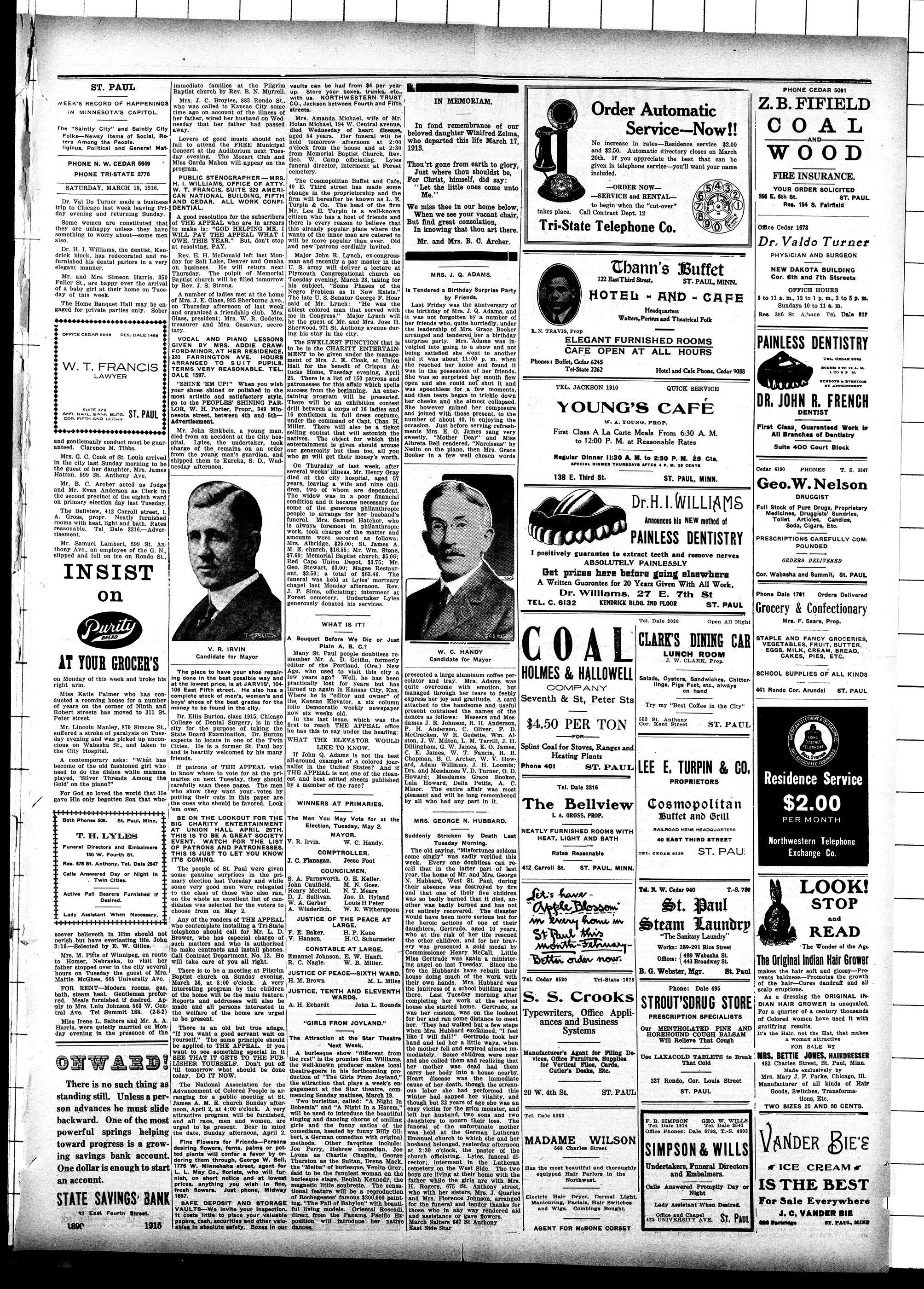
V. R. IRVIN
Candidate for Mayor
The place to have your shoe repairing done in the best possible way and at the lowest price, is at JARV18, 106 East Fifth Street. He also has a complete stock of the men's, women's and boys' shoes of the best grades for the money to be found in the city. Dr. Ellis Burton, class 1915, Chicago College of Dental Surgery, is in the city for the purpose of taking the State Board Examination. Dr. Burton expects to locate in one of the Twin Cities. He is a former St. Paul boy and is heartily welcomed by his many friends. If patrons of THE APPEAL wish to know whom to vote for at the primaries on next Tuesday, they should carefully scan these pages. The men will show how they voted by putting their cuts in this paper are the ones who should be favored. Look 'em over.
BE ON THE LOOKOUT FOR THE BIG CHARITY ENTERTAINMENT AT UNION HALL APRIL 25TH. THIS IS TO BE A GREAT SOCIETY EVENT. WATCH FOR THE LIST OF PATRONS AND PATRONESES. THIS IS JUST TO LET YOU KNOW IT'S COMING.
The people of St. Paul were given some genuine surprises in the primary election last Tuesday and while some very good men were relegated to the class of those who also ran, on the whole an excellent list of candidates was selected for the voters to choose from on May 2.
Any of the readers of THE APPEAL who contemplate installing a Trt-State telephone should call for Mr. L. D. Brower, who has especial charge of such matters and who is authorized to make contracts and install phones. Call Contract Department, No. 12. He will take care of you all right.
There is to be a meeting at Pilgrim Baptist church on Sunday evening, March 26, at 8:00 o'clock. A very interesting program by the children of the home will be the main feature. Reports and addresses will also be made and all persons interested in the welfare of the home are urged to be present.
There is an old but true adage, "If you want a good servant wait on yourself." The same principle should be applied to THE APPEAL. If you want a good servant wait on yourself SEE THAT IT GETS TO THE PUBLISHER YOURSELF. Don't put off 'till tomorrow what should be done today. DO IT NOW.
The National Association for the Advancement of Colored People is arranging for a public meeting at St James A. M. E. church Sunday afternoon, April 2, at 4:00 o'clock. A very attractive program will be furnished, and all race, men and women, are urged to be present. Bear in mind the date, Sunday afternoon, April 2.
Fine Flowers for Friends—Persons desiring flowers, ferns, palm or potted plants will confer a favor by ordering them through, George W. Bell, 1776 W. Minneahaule street, agent for L. L. May Co., florists, who will furnish, on short notice and at lowest prices, anything you wish in fine, flowers. Just phone, Midway 1657.
SAFE DEPOSIT AND STORAGE VAULTS—We invite your inspection, it costs little to place your valuable papers, cash, securities and other valuables in absolute safety. Boxes in our
vaults can be had from $4 per year up. Store your boxes, trunks, etc., with us. NORTHWESTERN TRUST CO., Jackson between Fourth and Fifth streets.
Mrs. Amanda Michael, wife of Mr. Holan Michael, 194 W. Central avenue, died Wednesday of heart disease, aged 54 years. Her funeral will be held tomorrow afternoon at 2:00 o'clock from the house and at 2:30 from Memorial Baptist Church, Rev. Geo. W. Camp officiating. Lyles funeral director, interment at Forest cemetery.
The Cosmopolitan Buffet and Cafe, 40 E. Third street has made some change in the proprietorship and the firm will hereafter be known as L. E. Turpin & Co. The head of the firm Mr. Lee E. Turpin is a well-known there who has a host of friends and there is a very reason to believe that this already popular place where the wants of the inner man are catered to will be more popular than ever. Old and new patrons cordially invited.
Major John R. Lynch, ex-congressman and recently a pay master in the U. s Army will deliver a lecture at Plymouth Congregational church on Tuesday evening, March 28, taking for his subject, "Some Phases of the Negro Problem as It Now Exists." The late U. S. Senator George F. Hoar said of Mr. Lynch: "He was the ablest colored man that served with me in Congress." Major Lynch will be the guest of Mr. and Mrs. Jose H. Sherwood, 971 St. Anthony avenue during his stay in the city.
THE SWELLEST FUNCTION that is to be is the CHARITY ENTERTAINMENT to be given under the management of Mrs. J. E. Cloak, at Union Hall for the benefit of Crispus Attucks Home, Tuesday evening, April 15. There are 155 patrons and patronesses for the affair and success from the beginning. An entertaining program will be presented. There will be an exhibition contest drill between a corps of 16 ladies and 16 gentlemen in full dress costume, under the command of Capt. Chas. H. Miller. There will also be a ticket selling contest that will astonish the crowd. For which this entertainment is given then, the generosity but then, all you who go will get their money's worth.
On Thursday of last week, after several weeks' illness, Mr. Henry Gray died at the city hospital, aged 57 years, leaving a wife and nine children, two of whom are dependent. The widow was in a poor financial condition and it became necessary for the generous philanthropic people to arrange for his husband's funeral. Mrs. Samuel Hatcher is always foremost in philanthropic work, took charge of the matter and amounts were secured as follows: Mrs. Albridge, $25.00; St. James A. M. E. church, $16.55; Mr. Wm. Stone, $7.60; Memorial Baptist church, $5.06; Red Caps Union Depot, $3.75; Mr. Geo Stewart, $3.00; Magee Restaurant, $3.46. The funeral was held at Lyle's mortuary chapel last Monday afternoon. Red J. P. Sims, officiating; interment at Forest cemetery. Undertaker Lyles generously donated his services.
WHAT IS IT?
A Bouquet Before We Die or Just Plain A. B. C.?
Many St. Paul people doubtless remember Mr. A. D. Griffin, for newly editor of the Portland, (Orc.) New Age, who used to visit this city a few years ago? Well, he has been practically lost for years but has turned up again in Kansas City, Kan. Where he is "editor and owner" of the Kansas Elevator, a six column folio Democratic weekly newspaper now six weeks old.
In the last issue, which was the first to reach THE APPEAL office he has this to say under the heading: WHAT THE ELEVATOR WOULD LIKE TO KNOW.
If John Q. Adams is not the best all-around example of a colored journalist in the United States? And if THE APPEAL is not one of the cleanest and best edited sheets published by a member of the race?
WINNERS AT PRIMARIES
The Men You May Vote for at the
Election, Tuesday, May 2.
MAYOR.
V. R. Irvin. W. C. Handy.
COMPTROLLER.
J. C. Flanagan. Jesse Foot
COUNCILMEN.
S. A. Farnsworth. O. E. Keller.
John Caulfield. M. N. Goss.
Henry McColl. N. T. Mears
J. S. Jullivan. Jno. D. Hyland
W. A. Gerber Louis H Peter
A. Windlerich. W. E. Witherspoon
CONSTABLE AT LARGE.
Emanuel Johnson. E. W. Hanft.
R. C. Nagle. W. B. Miller.
JUSTICE OF PEACE—SIXTH WARD.
H. M. Brown. M. L. Miles
JUSTICE, TENTH AND ELEVENTH WARDS.
A. H. Echardt. John L. Rounds
"GIRLS FROM JOYLAND."
The Attraction at the Star Theatre Next Week.
A burlesque show "different from the rest" is the promise Sim Williams, the well-known producer makes local theatre-goers in his forthcoming production of "The Girls From Joyland," the attraction that plays a week's engagement at the Star theatre, commencing Sunday matinee, March 19.
Two burtlets, called: "A Night In Bohemia" and "A Night In a Harem," will be used to introduce the beautiful singing and dancing chorus of smiling girls and the funny antics of the comedians, headed by funny Billy Gilbert, a German comedian with original methods. Other favors include: Joe Perry, Hebrew comedian, Joe Lyons as Charlie Chaplin, George Thurston as the Sultan, Drena Mack, the "Melba" of burlesque, Venita Grey, said to be the funniest woman on the burlesque stage, Beulah Kennedy, the magnetic little soubrette. The sensational feature will be a reproduction of Rochegeses' famous $200,000 painting, "The Fall of Babylon" with beautiful living models, Oriental Roseadirect from the Panama Pacific Exposition will introduce her native dances.
IN MEMORIAM.
In fond remembrance of our beloved daughter Winifred Zelma, who departed this life March 17, 1913.
We miss thee in our home below,
When we see your vacant chair,
But find great consolation,
MRS. J. Q. ADAMS.
la Tendered a Birthday Surprise Party by Friends.
Last Friday was the anniversary of the birthday of Mrs. J. Q. Adams, and it was not forgotten by a number of her friends who, quite hurriedly, under the leadership of Mrs. Grace Booker arranged and tendered her a birthday surprise party. Mrs. Adams was inveigled into going to a show and not being satisfied she went to another friend she was about to m. when she read her home and was in the possession of her friends. She was so surprised her mouth flew open and she could not shut it and was speechless for a few moments, and then tears began to trickle down her cheeks and she almost collapsed. She however gained her composure and joined with those present, to the number of about 40, in enjoying the occasion. Just before serving refreshments, she was greeted with sweetly, "Mother Dear" and Miss Albreta Bell rendered, "Narcissus" by Nedin on the piano, then Mrs. Grace Booker in a well chosen words
1872
W. C. HANDY
Candidate for Mayor
presented a large aluminum coffee percolator and tray. Mrs. Adams was quite overcome with emotion, but managed to touch her face to feebly express her joy and gratitude. A card attached to the handsome and useful present contained the names of the donors as follows: Messers and Mesdames J. E. Johnson, R. H. Anderson, P. H. Anderson, C. Oliver, F. D. McCracken, R. W. Godet, Wm. Alston, J. W. Milton, L. M. Terrill, J. H. Dillingham, G. W. James, E. O. James, C. E. James, W. V. T. Fancis, R. B. Chapman, B. C. Williams, J. H. Louis; Drs. and Mesdames V. D. Turner, O. D. Howard; Mesdames Grace Booker, Lula Howard, Della Pettis, A. C. Minor. The entire affair was most pleasant and will be long remembered by all who had any part in it.
MRS. GEORGE N. HUBBARD.
Suddenly Stricken by Death Last Tuesday Morning.
The old saying, "Misfortunes seldom come singly" was sadly verified this week. Every one doubtless can recall that in the latter part of last year, the home of Mr. and Mrs. George N. Hubbard, West St. Paul, during their absence was destroyed by fire and that one of their five children was so badly burned that it died, another was badly burned and has not yet entirely recovered. The disaster would have been more serious but for the heroic actions of one of their sisters, who was a long-time employee for 10 years, who at the risk of her life rescued the other children, and for her bravery was presented a gold medal by Commissioner Henry McCall. Little Miss Gertrude was again a ministering angel on last Tuesday. Since the fire the Hubbards have rebuilt their house doing much of the work with their own hands. Mrs. Hubbard was the janitress of a school building near there. Last Tuesday morning after completing her work at the school she started home. Gertrude, as was her custom, was on the lookout for her and ran some distance to meet her. They had walked a few steps to the school building, exclaiming like I will fall". Gertrude took her hand and led her a little ways, almost immediately. Some children were near and she called them and realizing that her mother was dead had them carry her body into a house nearby. Heart disease was the immediate cause of her death, though the strenuous labor she had performed this winter had sapped her vitality, and though but 32 years of age she was an easy victim for the grim monster, and left her husband, two sons and two daughters to mourn their loss. The mother was held at the German Lutheran Emanuel church to which she and her husband belonged, yesterday afternoon at 2:30 o'clock, the pastor of the church officiating. Lyles, funeral director; interment in the Lutheran cemetery on the West Side. The two boys are living at their home with the father while the girls are with Mrs. H. Rogers, 675 St. Anthony street, who with her sisters, Mrs. J. Quarles and Mrs. Florence Johnson, arranged for the funeral and tender thanks for those who in any way rendered aloof flowers. March Salters 647 St. Anthony East Side Star
No increase in rates—Residence service $2.00
and $2.50. Automatic directory closes on March
20th. If you appreciate the best that can be
given in telephone service—you'll want your name
included.
takes place. Call Contract Dept. 12 Tri-State Telephone Co.
Thann's
122 East Third Street,
HOTEL - ANN
Headquarters
Waiters, Porters and T
R. N. TRAVIS, Prop
ELEGANT FURNISHED
CAFE OPEN AT ALL
Phones: Buffet, Cedar 6245
Tri-State 2262 Hotel an
TEL. JACKSON 1910 QU
YOUNG'S CA
W. A. YOUNG, PROP.
First Class A La Carte Meals From
to 12:00 P. M. at Reasonable
Regular Dinner 11:30 A. M. to 2:30 P.
SPECIAL DINNER THURSDAYS AFTER 4 P. M.
ann's Buffet
Street, ST. PAUL, MINN.
AND CAFE
Headquarters
Porters and Theatrical Folk
FINISHED ROOMS
T ALL HOURS
HOTEL - AND - CAFE
R. N. TRAVIS, Prop
ELEGANT FURNISHED ROOMS
CAFE OPEN AT ALL HOURS
QUICK SERVICE
S CAFÉ
NG, PROP.
Meals From 6:30 A. M.
Reasonable Rates
M. to 2:30 P. M. 25 Cts,
8 AFTER 4 P. M. 35 CENTS
W. A. YOUNG, PROP.
First Class A La Carte Meals From 6:30 A. M.
to 12:00 P. M. at Reasonable Rates
Regular Dinner 11:30 A. M. to 2:30 P. M. 25 Cts,
SPECIAL DINNER THURSDAYS AFTER 4 P. M. 36 CENTS
Dr.H.I.WILLIAMS
Announces his NEW method of
PAINLESS DENTISTRY
act teeth and remove nerves
PAINLESSLY
are going elsewhere
Years Given With All Work.
227 E. 7th St
DG. 2ND FLOOR
ST. PAUL
Tel. Dale 2026 Open All Night
CLARK'S DINING CAR
LUNCH ROOM
J. W. CLARK, Prop.
I positively guarantee to extract teeth and
ABSOLUTELY PAINLESS
Get prices here before going
A Written Guarantee for 20 Years Given
Dr. Williams, 27 E.
TEL. C. 6132 KENDRICK BLDG. 2ND FLOOR
COAL
HOLMES & HALLOWELL
COMPANY
Seventh & St, Peter Sts
$4.50 PER TON
Tel. Dale 202
CLARK'S
LUR
J. W
Salads, Oysters,
lings, P
Try my "B"
553 St. Anthro
Cor. Kent St.
I positively guarantee to extract teeth and remove nerves
ABSOLUTELY PAINLESSLY
Get prices here before going elsewhere
A Written Guarantee for 20 Years Given With All Work.
Dr. Williams, 27 E. 7th St
TEL. C. 6132 KRENCKR BLDG. 2ND FLOOR ST. PAUL
Salads, Oysters, Sandwiches, Chitter-
lings, Pigs Feet, etc., always
on hand
Try my "Best Coffee in the City"
553 St. Anthony
Cor. Kent Street
ST. PAUL
LEE E. TURPIN & CO.
PROPRIETORS
Cosmopolitan
Buffet and Grill
RAILROAD MENS HEADQUARTERS
40 EAST THIRD STREET
TEL. GEDAR 9128
ST. PAU
Tel. N. W. Cedar 940
T.S. 789
St. Paul
Steam Laundry
"The Sanitary Laundry"
Works: 289-291 Rice Street
Offices: { 489 Wabasha St.
443 Broadway St.
B. G. Webster, Mgr. St. Paul
Phone: Dale 495
STROUT'SDRUG STORE
PRESCRIPTION SPECIALISTS
Our MENTHOLATED PINE AND
HOREHOUND COUGH BALSAM
Will Relieve That Cough
Use LAXACOLD TABLETS to Break
That Cold
237 Rondo, Cor. Louis Street
ST. PAUL
20 W. 4th St. ST. PAUL
Tel. Dale 5252
MADAME WILSON
563 Charles Street
F. B. SIMPSON GEO. W. WILLS
Tel. Dale 1914 Tel. Dale 2541
Office Phones: Dale 6798, T.-S. 4803
SIMPSON & WILLS
Undertakers, Funeral Directors
and Embalmers.
Calls Answered Promptly Day or
Night
Lady Assistant When Desired.
Office and Chapel
423 UNIVERSITY AVE.
ST. PAUL
---
1234567890
```markdown
```
138 E. Third St.
Splint Coal for Stoves, Ranges and Heating Plants
Phone 401 ST. PAUL
The Bellview
I. A. GROSS, PROP.
NEATLY FURNISHED ROOMS WITH
HEAT, LIGHT AND BATH
412 Carroll St. ST. PAUL, MINN
Let's have
"Apple Blossom"
in every home in
St Paul this
month-February
Better order now.
S. S. Crooks
Typewriters, Office Appliances and Business Systems
Manufacturer's Agent for Filing Devices, Office Furniture, Supplies for Vertical Files, Cards, Cutler's Desks, Etc.
Has the most beautiful and thoroughly equipped Hair Parlors in the Northwest.
Electric Hair Dryer, Dermal Light, Manicuring, Facials, Hair Switches and Wigs. Combings Bought.
AGENT FOR McBONE CORSET
6 5 4 3 2
7 8 9 0
ALBERT
KING
1870
Hotel and Cafe Phone, Cedar 9088
ST. PAUL, MINN.
Z. B. FIFIELD
COAL
AND
WOOD
FIRE INSURANCE.
YOUR ORDER SOLICITED
156 E. 6th St.
ST. PAUL
Res. 154 S. Fairfield
Office Cedar 1673
Dr. Valdo Turner
PHYSICIAN AND SURGEON
NEW DAKOTA BUILDING
Cor. 6th and 7th Stsreets
OFFICE HOURS
9 to 11 a. m., 12 to 1 p. m., 3 to 5 p. m.
Sundays 10 to 11 a. m.
Rea. 386 St Albans Tel. Dale 919
PAINLESS DENTISTRY
```markdown
```
First Class, Guaranteed Work is
All Branches of Dentistry
Suite 400 Court Block
Cedar 6190 PHONES T. S. 3347
Geo.W.Nelson
DRUGGIST
Full Stock of Pure Drugs, Proprietary
Medicines, Druggists' Sundries,
Toilet Articles, Candies,
Soda, Cigars, Etc.
PRESCRIPTIONS CAREFULLY COM-
POUNDED
ORDERS DELIVERED
Cor. Wabasha and Summit, St. PAUL
Phone Dale 1761 Orders Delivered
Grocery & Confectionary
Mrs. F. Sears, Prop.
STAPLE AND FANCY GROCERIES,
VEGETABLES, FRUIT, BUTTER,
EGGS, MILK, CREAM, BREAD,
CAKES, PIES, ETC.
SCHOOL SUPPLIES OF ALL KINDS
441 Rondo Cor, Arundel ST. PAUL
AMERICAN TELEPHONE & TELEPHONE
LONG DISTANCE
TELEPHONE
BULL STREET
AND ASSOCIATED COMPANIES
Residence Service
$2.00
PER MONTH
Northwestern Telephone
Exchange Co.
BUNNY
The original hair grower makes the hair soft and glossy—Prevents baldness—Promotes the growth of the hair—Cures dandruff and all scalp eruptions.
As a dressing the ORIGINAL INDIAN HAIR GROWER is unequaled. For a quarter of a century thousands of Colored women have used it with grafting results.
It's the Hair, not the Hat, that makes a woman attractive
FOR SALE BY
MRS. BETTIE JONES, HAIRDRESSER
483 Charles Street, St. Paul, Minn.
Made exclusively by
Mrs. Mary J. F. Parke, Chicago, Ill.
Manufacturer of all kinds of Hair Goods, Switches, Transformations, Etc.
TWO SIZES 25 AND 50 CENTS.
VANDER BIE'S
ICE CREAM
THE DOINGS IN AND ABOUT THE
GREAT "FLOUR CITY."
Matters Social, Religious and General
Which Have Happened and are to
Happen Among the People of the
City.
J. N. SELLERS, MANAGER
2812 Tenth Avenue So.
Tel. N. W. South 3372.
SATURDAY, MARCH 18, 1916.
Mr. Albert McClure is still unable
to be out.
Mr. W. Doston is up and around
and is again able to be out.
Mr. Sam Scott is very ill at the
home of his mother, on Fifth avenue.
Miss Clarist Lucas was the guest
of Miss Rieva Washington at noon
on Tuesday, at dinner.
Mr. John Adams, Jr., and Mr. Chester Kennedy were Minneapolis visitors on Saturday and Wednesday evenings.
Miss Mildred Plummer has been very ill for the past two weeks. She is now getting along nicely under the care of Dr. Redd.
Miss Eunice Smith was in the hospital Thursday all day, where she went to have her tonsils removed, under the care of Dr. Redd.
When you are hungry and want something real good to eat, served in first-class style, just go to the France Cafe, Fifth avenue, South, cor, Third street.
The annual Memorial and Thanksgiving services of Ames lodge 106 I. B. P. O. E. W. will be held at St. Peter A. M. E. church Sunday evening, April 9. Gopher Lodge of St. Paul will join in the service.
Mr. and Mrs. G. Shull, Mr. and Mrs. Clarence McCullough and Mr. and Mrs. Oliver Taylor, of St. Paul, were entertained at whist on Thursday evening at the residence of Mrs. John Washington. A very delightful luncheon was served.
Lawyer Wm. R. Morris who for the past 14 years has had his office in suite 1020 Metropolitan Life building, has moved two floors lower down, to 818 same building. Mr. Morris has had offices in the building for more than a quarter of a century.
Persons whose pianos need tuning should call on Prof. L. W. Anderson, 2737 11th Ave. South, Phone N. W. South 3755. He is a piano specialist and does tuning and repairing, also voicing and regulating. His motto is: "Satisfaction or no pay." Prices reasonable.
Citizens and visitors in Minneapolis should bear in mind that they can get the best service in the city at Stewart's Hotel and Cafe, 246-50 Fourth Ave., So. Dining room for ladies and gentlemen open from 6:00 a.m. to 12:30 p.m. daily. All cordially invited. Remember the dining room closes at 12:30 p.m.
Some time last October, it will be remembered, that Mr. Martin Brown's car was run into by a car belonging to Mr. E. O. Palzelle and considerably damaged. Brown entered suite against Palzelle for damages. The suit came to trial before a jury in the Municipal last Monday, and a verdict was rendered in court. $162.83. Wickersham & Churchill of the were Brown's attorneys. Judge M. D. Purdy of the law firm of Landcaster, Simpson & Purdy represented Palzelle.
Ames Lodge 106 Elks, is preparing a big treat for the people. They will give a THREE DAY'S CARNIVAL at Elks Hall, corner 8th Ave. S. and 4th St., March 21-22-23. Three nights of fun, rattle and enjoyment. All sorts of booths, ticket selling contest for a gold watch, kangaroo court every night, concert every night, dancing every night, Refreshments in great abundance. Not an idle moment. A mission only TEN CENTS. P. H. Southall, chairman; Geo. Holbert, secretary. Some time may be expected. Go to it!
FOURTEENTH SEASON
A NIGHT OF THE BLUES FOR THE BLUES
MRS. McCULLLOUGH CORDIALLY
INVITES PATRONS TO ATTEND
THE BLUE MONDAY PARTY AND
MARCH SOIREE GIVEN BY THE
AUTUMN LEAF DANCING CLUB,
MONDAY EVENINGS, MARCH 6TH
AND MARCH 20TH, AT LANE'S
HALL, COR. 8TH AND NICOLLET,
COME AND HEAR YOUR FAVORITE
"BLUES" SUNG WHILE YOU
DANCE.
```markdown
```
N. W. PHONE COLFAX 3596
MRS. ROBERT A. VAN HOOK
FASHIONABLE DRESSMAKING
AND LADIES' TAILORING
PARTY GOWNS A SPECIALTY
3612 ELLIOTT AVENUE
MINNEAPOLIS, MINN.
ALBION W. HOLDEN
PAPERHANGER
527 ST. ANTHONY AVENUE
PHONE DALE 2055
POSTAL SAVING BANK.
Open to Everyone, Whether Patrons
of the Offices or Not.
Postmaster General Burleson has
issued a circular stating that every
person in the United States ten years
old or over may open an account in
a postal savings bank after July 1st.
One does not have to live where the
postoffice is but may open an account
by mail.
Postal receipts have broken
all previous records the past year.
During the eight months prior to
April 1st there was a net gain in
deposits of $19,000,000.
The St. Paul bank was organized
Sept. 1, 1911, and up to the present
time has received in deposits $2,505.
The same amount was given to
withdrawals have amounted to $1,789,
890, leaving a credit to the depositors
May 1st, of $744,196. Interest to the
BIG CARNIVAL Stewart Hotel
I.B.P.O.E
OF TH WORLD
AMES 109
CERVUSALCES
3 NIGHT
TUESDAY WEDNESDAY
Mar. 21 Mar. 22
Rival Queen Concert
SELLING FOR GOLD
, Musical Concert, Ice Cream, Cake, S
ks, Etc. SOM'THIN' DOIN' EV'Y MIN
NIVAL COMMITTEE THE ENTIRE LOD
HALL, Chrm. GEO. HOL
TICKETS
ar 8760. Res. Ph
DERICK D. McCRACKI
Carnival Qu
TICKET SELLING F
Kangaroo Court, Musical Concert,
Drinks, Etc. SOMTHI
CARNIVAL COMMITTEE
P. H. SOUTHALL, Chrm.
10C TICK
Office Phone Cedar 8760.
FREDERICK D
Carnival Queen Contest
Carnival Queen Contest
TICKET SELLING FOR GOLD WATCH
Kangaroo Court, Musical Concert, Ice Cream, Cake, Sanwiches Soft Drinks, Etc. SOM'THIN' DOIN' EVY MINIT.
CARNIVAL COMMITTEE THE ENTIRE LODGE
P. H. SOUTHALL, Chrm. GEO. HOLBERT, Secy.
(Former) secretary to Congressman Stevens.)
73,000 Acres of Excellent Farm M WISCONSIN AND MINNES AND SCHOOLS. LOW PR
Excellent Farm Land in the Hardwood IN AND MINNESOTA. NEAR GOOD HOOLS. LOW PRICES AND EASY TRACT Court Block. 24 East
73,000 Acres of Excellent Farm Land in the Hardwood Districts of WISCONSIN AND MINNESOTA. NEAR GOOD TOWNS AND SCHOOLS. LOW PRICES AND EASY TERMS. Suite No. 410 Court Block. 24 East Fourth Street ST. PAUL, MINNESOTA.
ANNOUN
Attorney J. Louis B. will hereafter handle real investments, in connection with this business, requiring knowledge should provide lawyer.
I have a number of f and for sale, I also have Second Mortgages for sale.
REAL ESTATE, MO
J. Louis
ANNOUNCEMENT
Honey J. Louis Ervin announces that sheafter handle real estate and real estate, in connection with his law business, requiring a great deal of mortgage should properly be handled.
He a number of flats and houses for sale, I also have a number of Fin Mortgages for sale.
J. ESTATE, MORTGAGES, BOX 177
J. Louis Ervin
303 Court Block
ANNOUNCEMENT!
Attorney J. Louis Ervin announces that he will hereafter handle real estate and real estate investments, in connection with his law practice. This business, requiring a great deal of legal knowledge should properly be handled by a lawyer. I have a number of flats and houses for rent and for sale, I also have a number of First and Second Mortgages for sale.
amount of $15,618.50 has already been paid to depositors and $97,580 worth of United States government bonds purchased.
The St. Paul Bank has 5,093 open accounts subject to withdrawal, with accrued interest at a moment's notice.
Our institution is ranked among the four highest in the country in amount of deposits and the depositors are of every nationality.
Postmaster Raths says he hopes to bring the deposits up to $1,000,000 during the coming year.
Tri-State Service.
The Tri-State telephone service is being installed in the office of THE APPEAL and at the Editor's residence, so that hereafter our office and home will be accessible through their exchange and we will be right in line for the new automatic service which is near at hand. THE APPEAL man visited the Tri-State offices recently and through the courtesy of Manager Williams witnessed a practical demonstration of the innumerable benefits the company is making for the further improvement of its facilities that has always been of the highest state. Mr. L. D. Brower, the colored representative of the company has worked out a plan for the harmonious transfer of large numbers to the improved service without expense or inconvenience. He has issued a circular letter which merits the careful perusal of every one who receives the same. Mr. Brower is the son of Mr. Jesse Brower, a retired Kansas farmer who, last year was appointed by Governor Capper as a delegate to represent the state at the California Fair. His sister, Miss L. C. Brower, governor of the Brower Cafe at Mackinaw Island, Mich., for the past five years has handled the bulk of the high class business of that famous resort. His brother, Mr. C. E. Brower is proprietor of the Lethbridge Exchange, Lethbridge, Alberta and has the only pawnbroker's license in Southern Alberta
---
---
FIRE.
PLATE GLASS.
AUTOMOBILE.
TORNADO.
SICK
ACCIDENT
LIFE.
Tel. Cedar 8477
ELK'S HALL
Cor. Eighth Ave. So. and Eighth St.
MINNEAPOLIS
3 NIGHTS 3
TUESDAY WEDNESDAY THURSDAY
Mar.21 Mar.22 Mar.23
Three Nigets of Fun, Frolic and Enjoyment
Queen Contest
G FOR GOLD WATCH
Concert, Ice Cream, Cake, Sanwiches Soft
MTHIN' DOIN' EV'Y MINIT.
MITTEE THE ENTIRE LODGE
GEO. HOLBERT, Secy.
TICKETS 100
Res. Phone Cedar 8246
K. D. McCRACKEN
Farm Land in the Hardwood Districts of NNESOTA. NEAR GOOD TOWNS NEW PRICES AND EASY TERMS. 24 East Fourth Street
INCLEMENT!
Louis Ervin announces that he
handle real estate and real estate
connection with his law prac-
quiring a great deal of legal
properly be handled by a
of flats and houses for rent
have a number of First and
for sale.
MORTGAGES, BONDS
Louis Ervin
Court Block
He conducts the largest furniture establishment of its kind in that province. Mr. Brower is working to earn funds with which to purchase live stock for a 326 acre farm which he acquired through six years of home-steading hardship in Southern Alberta. He has tided over the advantages of pioneer life for the past nine years and should have loyal support in his present work. Not out of sympathy, but because he represents a business proposition whereby we get better returns for our dollars, take a step forward in the line of progress, experience no inconvenience, and our social institutions that need money badly will be given substantial aid for their co-operation in his plans.
CITATION ON PETITION FOR LETTERS OF ADMINISTRATION.
STATE OF MINNESOTA, COUNTY OF Ramsey.—ss. In Probate Court.
In the matter of the estate of Charles C. Beaulieu.
The State of Minnesota to All Whom It
Cuffs, Decedent.
Town of Minnesota to All Whom It
May Govern.
caafe Judge of Probate.
. His His
Priestor Attest:
F. W. GOSEWISCH,
Leth- Club of Probate.
pawn- W. T. FRANCIS,
Aberta. Attorney,
Suite 329 Am. Natl. Bank.
REAL ESTATE
SALES.
RENTALS.
MORTGAGES.
LOANS.
CARE
OF
PROPERTY.
ST. PAUL
246-50 Fourth Ave So.
J. E. STEWART, Manager
FINEST ESTABLISHMENT OF ITS KIND IN THE UNITED STATES.
Twenty Elegant, Steam Heated, Electric Lighted Rooms for Gentlemen Only, Free Bath. Rates Reasonable.
Lobby, Reading and Lounging Room, Buffet and Grill Room, Billiard Room, Dining Room, Barber Shop and Bath, Private Dining and Reception Room for Ladies.
A LA CARTE MEALS AT ALL HOURS. BEST SERVICE.
REGULAR DINNER
Dally, From 1 to 6 P. M. 25 to 35 Cts.
Sunday, 35 to 50 Cents.
Special Terms for Private Parties,
Banquets, Etc.
MINNEAPOLIS, MINNESOTA.
Phone Nlc. 9769.
Main 9592 T. B. 3073
PORTERS' AND WAITERS'
HOTEL
FOR MEN ONLY
GLOVER SHULL, Manager
Rates 50 cents per day
309 Hennepin MINNEAPOLIS
Phone Main 2560
Phone Main 2560 Quick Service
The France Hotel & Cafe
MRS. J. M. MASK, PROP.
300-302 Fifth Ave. So.
First Class A La Carte Meals at All
Hours. Chinese Dishes a Specialty.
REGULAR DINNER 25 CENTS
Cor. Third Street MINNEAPOLIS.
SAINT PAUL
Today is "Orange Day." It's the proper caper to eat an orange.
There were 414 births and 242 deaths in St. Paul during February.
Mrs. C. H. Miller was hostess to the Handicraft Art club on Thursday afternoon.
The Drowsy Whist club met with Mr. and Mrs. James Roberts on Thursday evening.
Mrs. Jerome Covington, 556 Central Ave., has been sick for several days with puerisy.
Mrs. R. C. Chapman, 606 St. Anthony Ave., entertained the B. L. C. club on Friday afternoon.
Chitterlings may be obtained at any time at Young's Cafe. Call or phone your order.
The Adelphia club met on Tuesday afternoon with Mrs. B. F. Edwards, 244 W. Central Ave.
As a rule people don't believe more than half you say. But, candidly now, can you blame 'em?
When a man is completely down and out, his enemies stop kicking him and his friends begin.
Mr. and Mrs. John Brown, 329 Avon St., announce the arrival of a little son on Monday of last week.
The infant daughter of Mr. and Mrs. O. C. Hall, 727 St. Anthony Ave., died on Tuesday of last week.
FOR -RENT -Nice five-room flat, Apply at 471 W. Central avenue. Phone, Dale 2192. (2-12-4)
Mrs. S. Wright of Des Moines, Iowa, is in the city visiting her niece, Mrs. John Brown, 2293 Avon St.
The Afternoon Art club met with Miss Albreta Bell, 531 St. Anthony Ave., on Wednesday afternoon.
A man should have plenty of backbone for himself—and plenty of ham bone for the rest of his family.
Nothing pleases some people more than to hear disagreeable things about other people whom they don't like.
FOR RENT—Nice fourroom flat, second floor, 378 Jay street. Price $15.00. Phone Dale 7557. (3-4-5)
FOR RENT—A nice front room with heat, gas and bath. Apply at 548 Wabasha street. Tel. Cedar 2462. (2-12-3)
A number of social events are scheduled to take place in the new Union Hall in the near future. Watch for dates.
Misses Mae and Bertha Williams were at home to the Maids and Matron club of the Twin Cities on Wednesday afternoon
Articles mailed to THE APPEAL for publication must bear the name and address of the sender, to insure publication.
SIMPLE RULES PREVENT FIRES.
Here are some instructions given by the state's insurance department for prevention of fires:
Don't put ashes in wooden boxes or barrels. Use metal cans. Don't throw hot ashes against fences or buildings.
Don't permit rubbish, paper, and greasy rags to accumulate.
Repairing Old Pianos
W. J. Dyer & Bro. are doing some of the finest work in the country in repairing and re-finishing old pianos. The original beauty of tone is fully restored and the pianos come out of their shop with re-finished cases looking like new. Charges are reasonable. You can find out just what it will cost to have your piano made like new by asking them to make an estimate, for which there is no charge.
A man in a suit stands in front of a table with a lamp, a book, a salt shaker, a glass, and a bottle.
The one little touch
that makes the
thought of an appet-
tizing sandwich
more inviting---a
bottle of
N.W. BROWN 1400
TRI-STATE 935
Theo. Hamm Brew
D. Hamm Brewing Co., Saints
AN EXTENSION OF
TELEPHONE LOCATED
PART OF THE HOUSE
50¢ PER MONTH
THE
NORTHWESTERN TELE
EXCHANGE
COM
UR BOTH PH
DAL AND WOOD
FLOUR, FEED AND HAY
FROM
C. W. STAEHLE
ge Transfer Moving
All kinds of hauling
at the right price Rice, Carroll and
WM. EVANS Ph
Fair Shop Shoe Shining Shop Shoe
39½ Wabasha Street, near Four
Theo. Hamm Brewing Co., Saint Paul
AN EXTENSION OR EXTRA TELEPHONE LOCATED IN ANY PART OF THE HOUSE FOR 50¢ PER MONTH
THE NORTHWESTERN TELEPHONE EXCHANGE COMPANY
COAL AIR
FLOUR, FE
ET
C. W. S.
Baggage Transfer
All kinds
Everything at the right price
Back to Old Home WM. P
Tailor Repair Shop Shoe S
339% Wabasha S
C. W. STAEHLE
Baggage Transfer Moving Vans
All kinds of hauling
Everything at the right price Rice, Carroll and Iglehart Sts.
Back to Old Home WM. EVANS Phone Cedar 8081
Tailor Repair Shop Shoe Shining Shop Shoe Repair Shop
339½ Wabasha Street, near Fourth
Suits Steamed and Pressed 25c.
Top Coats Steamed & Pressed 15c.
Mens Suits Dry Cleaned 1.00
Hats Cleaned and Blocked 50c
Pants Steamed and Pressed 15c
Overcoats Steamed & Pressed 25c
Ladies' Suits Dry Cleaned 1.25
Panama Hats Cleaned & Block'd 50c
EXPERT SHOE REPAIRING WHICH Laundry Agency We Buy and S
DE REPAIRING WHILE YOU WAIT. REASON
Nancy We Buy and Sell Old Clothes We C
Save money on your laundry.
FLAT WORK 24 cents per dozen.
Washed and Ironed.
Phone us and our wagon will call.
Both Phones 939
CAPITOL STEAM LAUNDRY.
"The Old Reliable Laundry."
Sedar 9282 Laundry
BUTLEY'S PLACE
BER SHOP POOL PARLOR LUNC
ing, Hair Cutting, Shampooing, Head and
assage. Best Brands of Cigars and Tobac
Afro-American Newspapers
LIGHT EXPRESSING
DOL PARLOR OPEN SUNDAYS TIL 10:00 P
WABASHA ST. ST. P
SUITS
RED 35¢ PHONE DALE 3823 MEN'S SUITS
DRY CLEANER
UTLEY'S
BARBER SHOP PO
Shaving, Hair Cutting, S
Massage. Best Brand
Afro-Ameri
LIGHT E
POOL PARLOR OPEN
311 WABASHA S
MEN'S SUITS 35¢ PHONE
PRESSED
UTLEY'S PLACE
BARBER SHOP POOL PARLOR LUNCHES
Shaving, Hair Cutting, Shampooing, Head and Face
Massage. Best Brands of Cigars and Tobacco
Afro-American Newspapers
LIGHT EXPRESSING
POOL PARLOR OPEN SUNDAYS 'TIL 10:00 P. M.
311 WABASHA ST. ST. PAUL
MEN'S SUITS 35¢ PHONE DALE 3823 MEN'S SUITS $1
PRESSED DRY CLEANED
CLIFFORD A. SMITH
421 W. UNIVERSITY AVENUE
LADIES WORK A SPECIALTY CALL FOR ANI
use Pear
Don't argue with earlin
use Don't argue with dirt Pearline
P
BUY YOUR
Tel. Cedar 9282
FULL SUIT
OVERCOAT $25
Brewing Co., Saint Paul
AN EXTENSION OR EXTRA
TEPHONE LOCATED IN ANY
PORT OF THE HOUSE FOR
50¢ PER MONTH
NORTHWESTERN TELEPHONE
EXCHANGE
COMPANY
MARS L.
O. F. Meeday in each
and Kent N.
Ranmoor N.
850 St. Antoine
FREDER
9005, G. U.
fourth Moe
Hall, corner
8:00 p. m.
R. Lvann, N.
ST. PAUL
Meets high
Union Hall
Streets, at
R. V. P.
HOUSES
U. O. of O.
day in
corner Aurie
p. m. Mrs.
Mrs. Carrie
bridge Stree
HOUSES
U. O. of O.
tuesday in
ple Hall, O
Ave, South
Miss Coral
GOPHER
AND WOOD
FEED AND HAY
FROM
M. STAEHLE
Moving Vans
binds of hauling
Rice, Rice, Carroll and Iglehart Sts.
M. EVANS Phone Codar 8081
Shoe Shining Shop Shoe Repair Shop
Shiba Street, near Fourth
Laundry Office
RY'S PLACE
POOL PARLOR LUNCHES
ing, Shampooing, Head and Face
Brands of Cigars and Tobacco
American Newspapers
RIGHT EXPRESSING
OPEN SUNDAYS TIL 10:00 P. M.
A ST. ST. PAUL
PHONE DALE 3823 MEN'S SUITS
DRY CLEANED $1
ST. JAM
Faller and
loes. 11:00
prayer meet
on Monday
noday and
Parsonage
Sims, Past
Jones, Past
S. PHIL
corner Au
street. Signa
tion of Holi
ceation thir
Sunday
and fourth
school. 12:3
Andrew. 6:3
Week晨
class. 8:00
p. m.
9:00 a. m.
885 thomas.
ZION PR
Parkington
day week
8:00 P. M.
Young People
week
a rige with dirc
rline
Anyone se
quickly asc
handson in
tions strictly
sent from
Patents to
special notice
Scien
A handson
collection of
year: four m
MUNN &
Brush O
Hamm's
Preferred
Stock
BOTH PHONES 1446
Pants Steamed and Pressed 15c
Overcoats Steamed & Pressed 25c
Ladies' Suits Dry Cleaned 1.25
Panama Hats Cleded & Block'd 5c
We Call and Deliver
CALL FOR AND DELIVER
ST. PAUL
MOST WORSHIPFUL GRAND LODGE
OF-
MINNESOTA, A. F. AND A. M.
H. J. SHELTON, Grand Master,
609 E. Sixth St., Duluth, Minn.
G. L. HOAGE, Grand Secretary,
590 Charles St., St. Paul, Minn.
PIONEER LODGE NO. 1, F. AND A. M. Meets first and third Monday in each month at Aurora and Kent Streets, at 8:00 p.m. A. B. Benjamin, W. M.; J. H. Dillingham, Secy., 569 Rondo.
PERFECT ASHAR LODGE NO. 4, F. AND A. M. Meets second and fourth Tuesday in each month at Union Hall, Aurora and Kent Streets, at 8:00 p.m. R. M. Johnson, W. M.; Oliver Taylor, Secy.
BETHEL CHAPTER NO. 28, R. A. M. Meets second Thursday in each month at Union Hall, Aurora and Kent Streets, at 8:00 p.m. John A. Sayles, Secy., 479 Rondo Street.
PILGRIM COMMANDERY NO. 22, Knights Templar, Meets third Monday in each month at Union Hall, corp. of A. M. and Kent Street. W. T. Joyce, E. C. J. A. Sayles, Secy., 479 Rondo Street.
ODD FELLOWS
MARS LODGE NO. 2202, G. U. O. OF
MARS meets second and fourth Wednesday
in each month at Hall, Aurora
and Kent Streets at 8:00 p. m.
S. L. Ransom, N. G.; J. Wesley Kelly, P. S.
850 St. Anthony Avenue.
FREDERICK DOUGLASS LODGE NO.
9005, G. U. O. of O. F. meets second and
third Monday in each month at Union
Hall, corner Aurora and Kent Streets,
at 8:00 p. m. M. P. Lewis, N. G. at
K. Lynn, P. S. 275 Carroll Avenue
ST. PAUL PATRIARCHY NO. 114.
Meets third Monday in each month
at Union Hall, corner Aurora and Kent
Streets, at 8:00 p. m. M. George B. Lowe,
R. V. P.; Augustn Jones, W. P. R.
HOUSEHOLD OF RUTH NO. 558, G.
U. O. OF meets first and third Monday
in each month at Union Hall, corner
Aurora and Kent Streets, at 8:00
p. m. A. Azle Stephens, M. N. G.
Mrs. Carole E. Lindsay, W. R. 918 Wood-
bridge Street.
Minneapolis.
HOUSEHOLD OF RUTH NO. 776
HOUSEHOLD meets second and fourth
Tuesday in each school day.
Plea Hall, Cor. Fourth street and Eighth
South, Mrs. S. Daragee, M. N. G.
Miss Cora Napier, W. R.
GOPHER LODGE NO. 105, F. B, P. O.
E. of the World, Wednesday. Wednesday
in each month at St. Anne's,
Aurora and Kent Streets, O. C.
Kent, R. M. Johnson, Secy, 527
Kent Street.
AYES LODGE No. 9. "P
first and third rides
from Castle Hall 221 W.
Uni. curity cor. Farrington
Katharina in good
standing affair, James Thomas, C. C. Jase,
Benderson, V. C.; 148 K
R of St Albans street.
UNIVERSIDAD DE MADRID
UNIVERSIDAD DE MADRID
HIDDLE CIRCLE, LADIES OF G. A.
B. meets first and third Tuesdays of each
week. Supreme Court room, old cap
(tol building M. S. J. Leavitt. Pre-
Mr. J. R. White. Secv. . Phoenix Bldg
FIDELITY COURT OF CALANTHO
NO. 346, N. A. S. A. B. A. A.
A. meets first and third Monday.
month at k. of P. Hall. 211 Hennep
Barnett. Minneapolis. Mrs. Minneva
Barnett. W. W. Arlene M. Scott.
R. of D. 25 W. 29th St.
NAT TURNER LODGE NO. 2, K. OP.
P. Minneapolis, meets second and
fourth week. in each month at
Labor Temple Bldg. Second floor.
corner Fourth street and fifth
街 at 8:15 p. m. All Knights
in good bath at 8:15 p. m. Welcome. Ralph
Watson, C. C.; Wm. W. Fewer. K. R. 521
Washington Ave. N.
CHURCHE8
PILGRIM BAPTIST CHURCH. CEDAR street and Summit avenue. Sunday services and teaching at 11:00 a.m. and 8:00 p.m. in Rice School. B. Y. 8:00 p.m. in G. 4:56 p.m. in M. Prayer service Wednesday 8:00 p.m. in Funeral services, Wednesday 8:00 p.m. attended. Rev. B. N. Mumu Res. $33 West Central avenue. Pastor's study at church. Tel. Jackson 346.
MEMORIAL BAPTIST CHURCH. corner Rice and Flower streets. Sunday services: Preaching, 11 a.m. and 8 p.m.; Sunday School 12:45; Deaconess meeting 7; B. Y. P. U. 7:30 p.m. Public catholic invited. Rev. E. H. McDonald, pastor, 651 W. Central avenue.
ST. JAMES A. M. E. CHURCH. COR. Fuller and Jay streets. Fuller, 11:00 a.m. and 7:30 p.m. Wednesday meeting 8:00 p.m. Pastor visits on Monday, Wednesday and Thursday, evening, for a carriageage 435 Jay street. Rev. J. P. Sisler, Jones, Pastor.
DESIGNS
CORRIGENTS & C.
Anyone sending a sketch and a book
quickly will receive our opinion free whether an
authority or a friend will secure
storiously confidential. HANDOUT ON Book
sanitent free. Oldest agency for securing patents.
Oldest agency for receiving special notice, without charge, in the
Scientific American.
A handmadely illustrated weekly. Largest ever.
Special notice, four months. $1. Sold by new edition.
MUNN & Co 381 Broadway, New York
Office, 212-345-6000.