The Appeal
Saturday, November 30, 1918
St. Paul, Minnesota
Page text (machine-generated)
In business, fortunes are not realized Unless your goods are amply-advertised.
WHEN THE YANKS STRUCK ON MEUSE
American Doughboys Faced Three Fortified Defense Systems.
NOTHING COULD STOP THEM
Interesting Description of One of the Last Big Fights in Which Pershing's Troops Were Engaged.
With the First-American Army. Three fortified defensive systems guarded the German positions between the Argonne and the Meuse when the Americans burst through them.
The advanced line, the enemy's old line, called the Hagen stellung; his intermediate line ran a kilometer or two behind it, according to the configuration of the terrain, hills, streams and woods, and was called the Volker stellung. Behind that ran his main reserve line of defense, the Kremhilde stellung, a continuation of the Brunhilde stellung, which runs through Champagne.
At their first bound the attacking waves of doughbags swept over the first two fortified zones with their barbed-wire entanglements cut to pieces by the preliminary bombardment, and in several points they penetrated the Kremhilde stellung, which pivoted in the Alire-Neue sector on Montfaucon.
The three-hour artillery preparation between 2:30 and 5:30 o'clock in the morning had driven the enemy to his deepest dugouts and the advanced assault troops were in the trenches throwing gas bombs and grenades down the stairways into the underground bombproof shelters before the Boches can get upstairs.
Reducing Strongholds.
Between the three different lines of intrenched positions the Boches had installed series of strong points, machine gun nests, sometimes emplaced in concrete and steel pillboxes, or else merely set in strong, natural, commanding positions. The system for reducing these strongholds was identical with that already practiced by the enemy in his various offensive operations.
The advanced waves of storming troops go forward in open order, worked their way between the strong points, often by worming along for considerable distances on their stomachs, or by crawling on and knees through woods or along ravines. Arriving in the rear of these positions, the published count of other and proceeded forward, leaving empiers to work their way back in the rear of the strong points and pick off the Boches machine gunners in many cases.
It was the job of the succeeding waves of assault, with their light machine guns and their little trench mortars mounted on light, two-wheeled carts hauled by man power to reduce these strong points with or without the aid of artillery, tanks, or airplanes. The most advanced waves were entirely safe from the machine gun positions once they passed them, as the Boches usually could not work their guns toward their own rear, the emplacement having been organized with a view to firing ahead or on the flanks only. Furthermore, if the Germans fired toward the rear, they would reveal their presence to the succeeding attacking waves which would put them out of action before they could swing around again.
Why Casualties Are Light
It is because the attacking waves went forward deployed in extended formation and behind a curtain of fire of bursting shells, a creeping barrage, that casualties among attacking troops were so much lighter than anyone unfamiliar with these tactics might imagine.
The doughbogs passed Montafon, which was a hive of machine gun nests in their advance toward Nantillos and Clerges, and it was not until the day after the town had been practically surrounded that the last enemy resistance was crushed there. After penetrating well beyond Montafon on either side, American patrols of twos and threes began to reconnoitre the town and the chateau which stands on a tent-like ridge commanding the two in Directions, the patrols which entered from the north, from behind, worked their way through the ruins of shell-shattered houses right up to the front of the town, where they sniped the German machine gunners in the back, as they were firing on American patrols advancing from Cuisy. Prisoners were taken from the deep dugouts 50 and 60 feet below the ruined town two days after the Americans had established themselves in the town.
Finds "Funny Man" in House.
St. Louis, Mo.—Peter Fefes of this city was aroused from a deep dream of peace by the elbow of his three-year-old daughter, who jabbed him in the ribs. The child lisped: "Papa, who's dat funny mans in here?" Fefes jumped from his bed to investigate and the "funny mans," who proved to be a burglar, fled out the back way. He had taken $221 from Fefe's pocket.
TAKE UP PEACE WORK
Great Britain Ready for Industrial Change-Over.
Huge Munitions Plants Prepared for Switch to Peace-Time Operations.
London—England has her plans all laid for the great industrial change-over.
There are about 5,000 large concerns which have been engaged in munitions work.
These factories have been preparing for months for the "quick change" and are ready to switch to peace-time operations immediately.
Munitions is by no means the only branch of industry where sharp readjustments will be necessary. But the same statement of preparedness holds true generally.
The ministry of reconstruction, which has been operating for more than a year, and which has made an extensive survey of the industrial problem, has aided manufacturers who have been engaged on war work in the preparations for the advent of peace. And it has worked out plans for converting many government-operated plants into production of materials which will be sorely needed.
To show how extensively the ministry has worked, 20 subcommittees of experts have completely surveyed as many parts of the neighboring field as have drawn plans for change over, which have been placed at the disposal of the industrial chiefs.
Demobilization plans have been given careful study, and, while the official report has not yet been issued, it is known that it provides for disbanding by the needs of different trades, and not by military units. Men with large families will also be released early.
The ministry of reconstruction has dwelt particularly on the possibility of development of industries making articles formerly imported from Germany—such as electrical apparatus, hardware, stamped metal and telephone apparatus. And it is flatly stated that "Britain is going to make a lot more of these things for herself after the war."
International Film Service
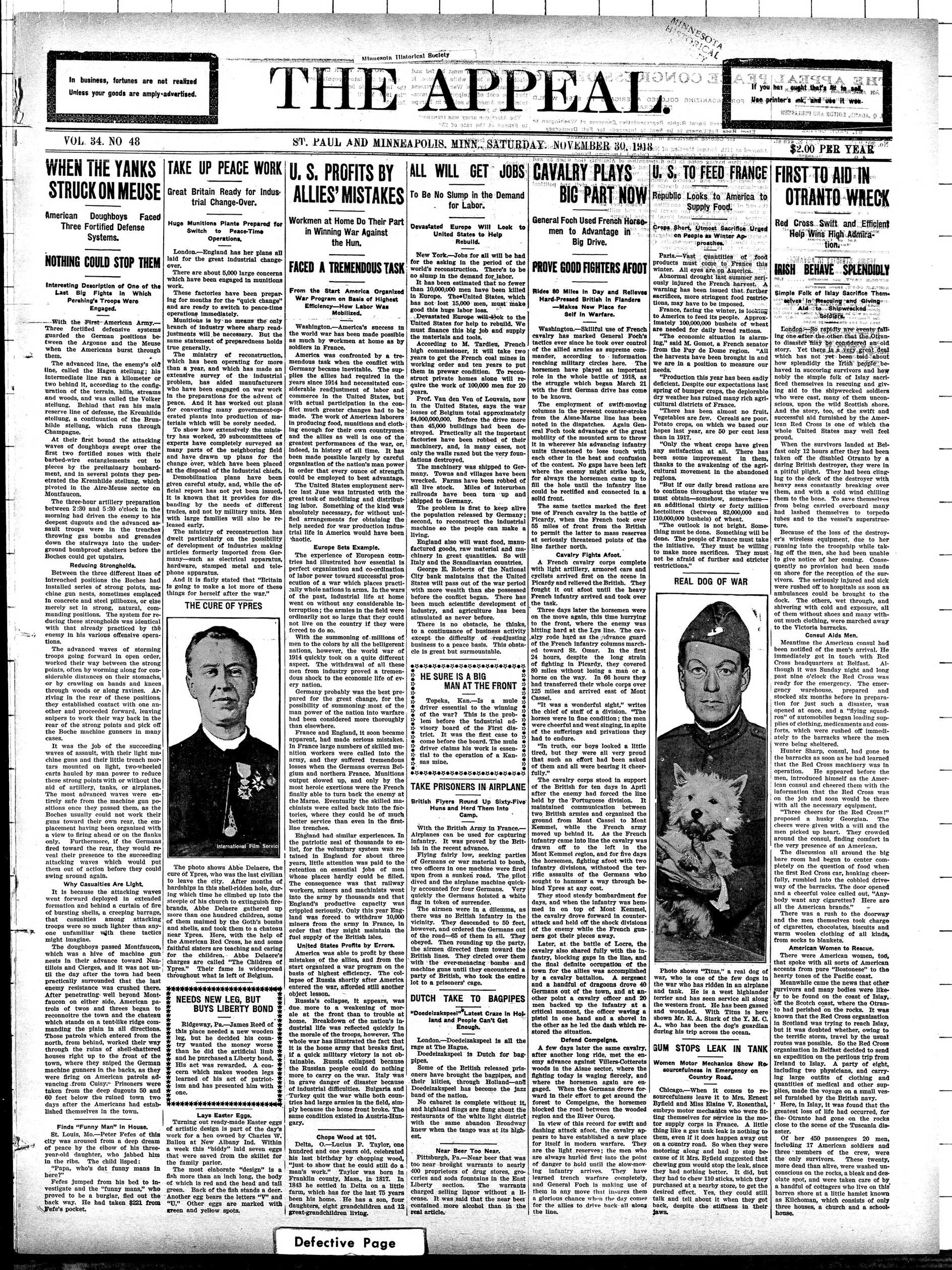
The photo shows Abbe Delaere, the cure of Ypres, who was the last civilian to leave the city. After months of hardships in this shell-ridden hole, during which time he climbed up into the steeple of his church to extinguish firebrands, Abbe Delaere gathered up more than one hundred children, some of them maimed by the Goth's bombs and shells, and took them to a chateau near Ypres. Here, with the help of some faithful sisters, he crossed the heart of some faithful sisters and cared for the children. Abbe Delaere's charges are called "The Children of Ypres." Their fame is widespread throughout what is left of Belgium.
NEEDS NEW LEG, BUT
BUYS LIBERTY BOND
Ridgway, Pa.—James Reed of this place needed a new wooden leg, but he decided his country wanted the money worse than he did the artificial limb and he purchased a Liberty bond. His act was rewarded. A concern which makes wooden legs learned of his act of patriotism and has presented him with one.
---
Lays Easter Eggs.
Turning out ready-made Easter eggs of artistic design is part of the day's work for a hen owned by Charles W. Ballon at New Albany Ind. Within a week this "biddy" ladd seven eggs that were saved from the skillet for the family parlor.
The most elaborate "design" is a fish more than an inch long, the body of which is red and the head and tail green. Back of the fish stands a deer. Another egg bears the letters "V" and "U." Other eggs are marked with green and yellow spots.
THE APPEAL.
U. S. PROFITS BY ALLIES' MISTAKES
U. S. PROFITS BY ALLIES' MISTAKES
Workmen at Home Do Their Part in Winning War Against the Hun.
FACED A TREMENDOUS TASK
From the Start America Organized War Program on Basis of Highest Efficiency—How Labor Was Mobilized.
Washington.—America's success in the world war has been made possible as much by workmen at home as by soldiers in France.
America was confronted by a tremendous task when the conflict with Germany became inevitable. The supplies the allies had required in the years since 1914 had necessitated considerable readjustment of labor and commerce in the United States, but with actual participation in the conflict much greater changes had to be made. The work of American laborers in food production, munitions and clothing enough for their own countrymen and the allies as well is one of the greatest performances of the war, or, indeed, in history of all time. It has been made possible largely by careful organization of the nation's man power in order that every ounce of strength could be employed to best advantage. The United States employment service last June was intrusted with the great task of mobilizing and distributing labor. Something of the kind was necessary, for without unified arrangement, the nation would not help needed for war production industrial life in America would have been chaotic.
Europe Sets Example.
The experience of European countries had illustrated how essential is perfect organization and co-ordination of labor power toward successful prosecution of a war which places practically whole nations in arms. In the wars of the past, industrial life at home went on without any considerable interruption; the armies in the field were ordinarily not so large that they could not live on the country if they were forced to do so.
With the summoning of millions of men to the colors by all the belligerent nations, however, the world war of 1914 quickly took on a quite different aspect. The withdrawal of all these men from industry proved a tremendous shock to the economic life of every nation.
Germany probably was the best prepared for the great change, for the possibility of summoning most of the man power of the nation into warfare had been considered more thoroughly than elsewhere.
France and England, it soon became apparent, had made serious mistakes. In France large numbers of skilled men were called into the army, and they suffered tremendous losses when the Germans overran Belgium and northern France. Munitions output slowed up, and only by the most heroic exertions were the French finally able to turn back the enemy at the Marne. Eventually the skilled machinists were called back into the factories, where they could be of much better service than even in the first-line trenches.
England had similar experiences. In the patriotic zeal of thousands to enlist, for the voluntary system was retrained in England for about three years, little attention was paid to the retention on essential jobs of men whose places hardly could be filled. The consequence was that railway workers, miners and machinists went into the army by thousands and that England's productive capacity was crippled seriously. Only this year England was forced to withdraw 10,000 miners from the army in France, in order that they might maintain the fuel supply of the British isles.
United States Profits by Errors.
America was able to profit by these mistakes of the allies, and from the start organized a war program on the busts of highest efficiency. The collapse of Russia shortly after America entered the war, afforded still another object lesson. Russia's collapse, it appears, was due more to a weakening of morale at the front than to trouble at home. Breakdown of the nation's industrial life was reflected quickly in the morale of the troops, however. The whole war has illustrated the fact that it is the home army that breaks first, if a quick military victory is not obtainable. Russia collapsed because the Russian people could do nothing more to carry on the war. Italy was in grave danger of disaster because of industrial difficulties. Bulgaria and Turkey quit the war while both countries had large armies in the field, simply because the home front broke. The same condition existed in Austria-Hungary.
Chops Wood at 101.
Delta, O.-Lucius P. Taylor, one hundred and one years old, celebrated his last birthday by chopping wood, "just to show that he could still do a man's work." Taylor was born in Franklin county, Mass., in 1817. In it, he raised a farm, which has for the last 75 years been his home. He has a son, four daughters, eight grandchildren and 12 great-grandchildren living.
Defective Page
ALL WILL GET JOBS
To Be No Slump in the Demand for Labor.
Devasasted Europe Will Look to United States to Help Rebuild.
New York—Jobs for all will be had for the asking in the period of the world's reconstruction. There's to be no slump in the demand for labor.
It has been estimated that no fewer than 10,000,000 men have been killed in Europe. The United States, which has not lost 15,000 men, must make good this huge labor loss.
Devastated Europe will look to the United States for help to rebuild. We must finance this big job and supply the materials and tools.
According to M. Tardieu, French high commissioner, it will take two years to get the French coal mines in working order. To put them in prewar condition, we must construct private homes alone will require the work of 100,000 men for 20 years.
Prof. Van den Ven of Louvain, now in the United States, says the war losses of Belgium total approximately $4,000,000,000. Before the drive more than 45,000 buildings had been destroyed. Practically all the important factories have been robbed of their machinery, and, in many cases, not only the walls razed but the very foundations destroyed.
The machinery was shipped to Germany. Towns and villages have been wrecked. Farms have been robbed of all live stock. Miles of interurban railroads have been torn up and shipped to Germany.
The problem is first to keep alive the workers, second, to reconstruct the industrial machine so the people can make a living.
England also will want food, manufactured goods, raw material and machinery in great quantities. So will Italy and the Scandinavian countries. George E. Roberts of the National City bank maintains that the United States will pass out of the war period with more wealth than she possessed before the conflict began. There has been much scientific development of the war, and has been stimulated as never before. There is no obstacle, he thinks, to a continuance of business activity except the difficulty of readjusting business to a peace basis. This obstacle is great but surmountable.
HE SURE IS A BIG MAN AT THE FRONT
Toppea, Kan.-Is a mule driver essential to the winning of the war? This is the problem before the industrial advisory board of the First district. It was the first case to come before the board. The mule driver claims his work is essential to the operation of a Kansas mine.
TAKE PRISONERS IN AIRPLANE
British Flyers Round Up Sixty-Five Huns and Herd Them Into Camp.
With the British Army in France.—Airplanes can be used for capturing infantry. It was proved by the British in the recent advance. They made quicker parties of Germans or war material to bomb, two officers in one machine were fired upon from a sunken fire. The pilot dived and the airplane machine quickly accounted for four Germans. Very quickly the Germans hoisted a white flag in token of surrender. The airmen were in a dilemma, as there was no British infantry in the vicinity. They descended to 50 feet, however, and ordered the Germans out of the road—65 of them in all. They obeyed. Then rounding up the party, the alarms did the harm to them. The British lines. They circled over them with the ever-menacing bombs and machine guns until they encountered a party of British, who took the entire lot to a prisoners' cage.
DUTCH TAKE TO BAGPIPES
"Doeelzakspeel"Latest Graze in Holland and People Can't Get Enough.
London.—Doeclaziskel is all the rage at The Hague.
Doeclaziskel is Dutch for bagpipes.
Some of the British released prisoners have brought the bagpipes, and their kiltles, through Holland—and Doeclaziskel has become the jazz band of the nation.
Cabaret is complete without it, and highland dancers dung about the restaurants of the white light district with the same abandon Broadway knew when the tango was at its highest.
Near Beer Too Near
Pittsburgh, Pa.—Near beer that was too near brought warrants to nearly 400 proprietors of drug stores, groceries and soda fountains in the East Liberty section. The warrants charged selling liquor without a license. It was said that the near beer stores had more alcohol than in the real article.
CAVALRY PLAYS
BIG PART NOW
CAVALRY PLAYS
BIG PART NOW
General Fooh Used French Horsemen to Advantage in Big Drive.
PROVE GOOD FIGHTERS AFOOT
Rides 80 Miles in Day and Relieve Hard-Pressed British in Flanders—Makes New Place for Self in Warfare.
Washington—Skillful use of French cavalry has marked General Foch's tactics ever since he took over control of the allied armies as supreme commander, according to information reaching military circles here. The horsemen have played an important role in the whole battle of 1918, as in which began March 21 with the first German drive has come to be known.
The employment of swift-moving columns in the present counter-stroke from the knee-Marche line has been noted in the dispatches. The real Foch took advantage of the great mobility of the mounted arm to throw it in wherever his advancing infantry units threatened to lose touch with each other in the heat and confusion of the contest. No gaps have been left where the enemy might strike back, for always the horsemen came up to fill the hole until the infantry line could be rectified and connected in a solid front.
The same tactics marked the first use of French cavalry in the battle of Picardy, when the French took over 55 miles of front from the British to permit the latter to mass reserves at seriously threatened points of the farther north.
Cavalry Fights Afoot.
A French cavalry corps complete with light artillery, armored cars and cyclists arrived first on the scene in Picardy and relieved the British. They fought it out afloat until the heavy French infantry arrived and took over the task.
Three days later the horsemen were on the move again, this time hurrying to the front, where the enemy was riding on the Lys line. The cavalry pole had led as the officer of the French infantry columns marched toward St. Omar. In the first 24 hours, despite the long strain of fighting in Picardy, they covered 80 miles without losing a man or a horse on the way. In 66 hours they had transferred their whole corps over 125 miles and arrived east of Mont Cassel.
"It was a wonderful sight," writes the chief of staff of a division. "The horses were in fine condition; the men were cheerful and went singing, in spite of the sufferings and privations they had to end."
And the boys looked a little tired, but they were all very proud that such an effort had been asked of them and all were bearing it cheerfully."
The cavalry corps stood in support of the British for ten days in April after the enemy had forced the line held by the Portuguese division. It maintained communication between two British armies and organized the ground from Mont Cassel to Mont Kemmel, while the French army moved up behind it. As the French infantry came into line the cavalry was the first to move in, and the line in the Mont Kemmel region, and for five days the horsemen, fighting afloat with two infantry divisions, withstood the terrific assaults of the Germans who sought to hammer a way through behind Ypres at any cost. They stood steady bombardment for days, and when the infantry was hemed in on top of Mont Kemmel, the cavalry drove forward in counterattack and held off the shock divisions of the enemy while the French gunners got their pieces away. Later, at the battle of Locre, the cavalry also shared fully with the infantry, blocking gaps in the line, and the final definite occupation of the town for the allies was accomplished by a cavalry battalion. A sergeant and a handful of dragoons drove 40 Germans out of the town, and at another point a cavalry officer and 20 infantry soldiers held a critical moment, the officer waving a pistol in one hand and a shovel in the other as he led the dash which restored the situation.
Defend Compelane.
A few days later the same cavalry, after another long ride, met the enemy advance against Villers-Cotteret woods in the Aisne sector, where the fighting today is waging fiercely, and where the horsemen again are engaged. When the Germans drove forward in their effort to get around the forest to Complegne, the horsemen blocked the road between the wooded region and the River Ourcq. In view of this record for swift and dashing attack afoot, the cavalry appears to have established a new place for itself in modern warfare. They are the light reserves; the men who are always hurled first into the point of danger to hold until the slow-moving infantry arrives. They have the much warfare completely, and General Foch has them in any move that insures them a glorious chance when the day comes for the allies to drive back all along the line.
U. S. TO FEED FRANCE
Republic Looks to America to Supply Food.
Crops Short, Utmost Sacrifice, Urged on People as Winter Ap-proaches.
Paris—Vast quantities of food products must come to France this winter. All eyes are on America. Abnormal drought last summer seriously injured the French harvest. A warning has been issued that further sacrifices, more stringent food restrictions, may have to be imposed.
France, facing the winter, is looking to America to feed its people. Approximately 100,000,000 bushels of wheat are needed for daily bread rations.
"The economic situation is alarming," said M. Gomot, a French senator from the Puy d'Dome region. "All the harvests have been brought in and we are in a position to measure our needs.
"Production this year has been sadly deficient. Despite our expectations last spring of bumper crops, the deplorable dry weather has ruined many rich agricultural districts of France.
"There have been almost no fruit. Vegetables are few. Cereals are poor. Potato crops on which we based our hopes last year, are 50 per cent less than in 1917.
"Only the wheat crops have given any satisfaction at all. There has been some improvement in them, thanks to the awakening of the agricultural movement in the abandoned regions.
"But if our daily bread rations are to continue throughout the winter we must obtain—somehow, somewhere—an additional thirty or forty million hectoliters (between 82,000,000 and 110,000,000 bushels) of wheat.
"The outlook is not bright. Something must be done. Something will be done by people. France must take the initiative very early to make more sacrifices. They must not be afraid of further and stricter restrictions."
REAL DOG OF WAR
THE DOGS
Photo shows "Titus," a real dog of war, who is one of the few dogs in the war who has ridden in an airplane and tank. He is a west highlander terrier and has seen service all along the western front. He has been gassed and wounded. With Titus is here shown Mr. E. A. Stark of the Y. M. C. A., who has been the dog's guardian during his trip across the ocean.
GUM STOPS LEAK IN TANK
Women Motor Mechanics Show Resourcefulness in Emergency on Country Road.
Chicago.—When it comes to resourcefulness leave it to Mrs. Ernest Byfield and Miss Elaine V. Rosenthal, embryo motor mechanics who were fitting themselves for service in the motor supply corps in France. A little thing like a gas tank leak is nothing to them, even if it does happen away out on a country road. So when they were motoring along and had to stop because of it Mrs. Byfield suggested that chewing gum would stop the leak, since they had nothing better. It did, but they chewed chew 110 sticks, which they purchased at a nearby store, to get the desired effect. Yes, they could still talk and tell about it when they got back, despite the stiffness in their
$2.00 PER YEAR
FIRST TO AID IN OTRANTO WRECK
Red Cross, Swift and Efficient Help Wins High Admira tion
Simple Folk of Islay Sacrifice Themselves in Rescueing and Giving Aid to Shipwrecked Soldiers
London—So rapidly are events falling one after the other that the Ortano disaster may be considered an old story. Yet there is a very great deal which has not yet been told about how splendidly the Irish people behaved in succoring survivors and how nobly the simple folk of Islay sacrificed themselves in rescuing and giving aid to the shipwrecked soldiers who were cast, many of them unconscious, upon the wild Scottish shore. And the story, too, of the swift and successful aid furnished by the American Red Cross is one of which the whole United States may well feel proud. When the survivors landed at Belfast only 12 hours after they had been taken off the disabled Ortano by a darkly British destroyer, they were in five plight; they had been clinging to the deck of the destroyer with heavy seas constantly breaking over them, and with a cold wind chilling them to the bone. To save themselves from being carried overboard many had lashed themselves to torpedo tubes and to the vessel's superstructure.
Because of the loss of the destroyer's wireless equipment, due to her running into the troopship while taking off the men, she had been unable to give notice of her coming. Consequently no provision had been made on shore for the reception of the survivors. The seriously injured and sick were rushed to hospitals as soon as armies could be brought to the dock. The crew shivering with cold and exposure, all of them without shoes and many without much clothing, were marched away to the Victoria barracks.
Consul Aids Men.
Meantime the American consul had been notified of the men's arrival. He immediately got in touch with Red Cross headquarters at Belfast. Although it was Sunday night and long past nine o'clock the Red Cross was ready for the emergency. The emergency warehouse, prepared and stocked six months before in preparation for just such a disaster, was opened at once, and a "flying squadron" of automobiles began loading supplies of clothing, medicaments and complements rushed off immediately to the barrens where the men were being sheltered.
Hunter Sharp, consul, had gone to the barricks as soon as he had learned that the Red Cross machinery was in operation. He appeared before the men, introduced himself as the American consul and cheered them with the information that the Red Cross was on the job and soon would be there with all the necessary equipment.
"Three cheers for the Red Cross!" proposed a husky Georgian. The cheers were given with a will and the men picked up heart. They crowded around the consul, finding comfort in the very presence of an American.
He discussed all around the big bare roof in the room, pleated on the question of food when the first Red Cross car, honking cheerfully, rumbled into the cobbled driveway of the barracks. The door opened and a cheerful voice called out, "Anybody want any cigarettes? Here are all the American brands."
There was a rush to the doorway and the men themselves took charge of cigarettes, chocolates, biscuits and sweets, of all kinds, from socks to blankets.
American Women to Rescue.
There were American women, too, that spoke with all sorts of American accents from pure "Bostonese" to the hearty tones of the Pacific coast.
Meanwhile came the news that other survivors and many bodies were likely to be found on the coast of Islay, off the Scotch coast, where the Otranto had perished on the rocks. It was known that the Red Cross organization in Scotland was trying to reach Islay, but it was doubted whether, owing to the terrific storm, travel by the usual routes was possible. So the Red Cross organization in Belfast decided to send an expedition on the perilous trip from Ireland to Islay. A party of eight, including two physicians, and carrying large outfits of clothing and quantities of medical and other supplies, made the voyage on a small vessel furnished by the British navy.
Here, in Islay, it was found that the greatest loss of life had occurred, for the Ortanto had gone on the rocks to the scene of the Tuscania disaster.
Of her 450 passengers 20 men, including 17 American soldiers and three members of the crew, were the only survivors. These twenty, more dead than alive, were washed unconscious on the rocks, a bleak and desolate spot, and were taken care of by a handful of cottagers who live on this barren shore at a little hamilton known as Kilchoman, which consists of only three houses, a church and a schoolhouse.
No. 80L-2 Court Phoca, 24 H. 41th st.
S. Q. ADAMS, Manager.
PHONE: N. W. CEDAR 8040.
MINNESOTA OFFICE
Mr. 2003 Tenth Avenue 1001
A. R. GRAHAM, Minneapolis
TERMS, STRICTLY IN ADVANCE:
SELLS COFT, one year 1000
SELLS COFT, the months 1,000
SELLS COFT, three months ..... 20
Amplitude should be made by Employer Money Order, Post Office Memory Order, Re-
sults for the most than three months. For some
weeks will be lost by the cost of the Fractional parts of a dollar. Only one
cost and two stantage taken.
Silver should never be sent through the mail. In the same part to worse a hole through the
ventures and the other of the time it may be ste-
tured. For some who did, the loss to in lotters
to be in their own risk.
Marriage and death parties 10 lines or less. Payment
only in advance, and to be announced at all
most come in season to be news.
Advocates' rights is the right to give this, such
as in such, and about seven weeks in an
is on the other side. No single advertising does
last. He dismentalized on less than
more unleashed. Thank not to be
very ill evidence from parties unknown to us.
Resting notices 10 sets per line, each insign
No discounts for time or space. Reading
is the right to be in a lower form about all
weeks to the line. All hold-less event
The date on the address label where your postal stationery should be placed. Remainder should be on the paper may be inserted on the paper steps when time is out.
If circumstances impede that paper cost to postmaster, postmaster may pay the recipient may when due, inform to pay person card or the expiration of five days or word a duplicate of the missing number.
Communications to receive a statement must be written, open important information, plainly stated, and must reach on days if possible, must not reach on Wednesday, and hear the tip of the finger unless stamps are sent for postage.
We do not hold excuses responsible for the failure of our correspondence.
We write to you where we write for you. Sample text follows.
In every letter that you write us never fail to
give your full name and address, plainly
written, and confidentially and stern. Build
some letters of all kinds must be written or
expare to show from letters containing news
or matter for publication.
"Any prejudice whatever will be inaccurateable M those who do not share in it themselves truces to it and flicker it and accept it as a law of nature." —John Stuart Mill.
AND THE WAR IS OVER!
Now that fighting has ceased and war is practically at an end, the report comes that R. W. Tyler, colored war correspondent has arrived at the front. And again, Col. Charles Young has been assigned to Camp Grant, near Rockford, Ill., and is due there in a few days to take command of a "colored development battalion." It seems that the "gentlemen of the minimum" got what they asked for. Relative to Col. Young, the following order of the War Department is interesting reading: The first move to demobilize the army will be the discharge of development battalions in all camps in this country. The development units are composed of drafted men who did not meet physical requirements or who needed special drill or discipline to bring them into full military value.
There are about 50,000 of these troops, and their honorable discharge will come as soon as they receive the physical examination required before a man is discharged.
HOME-GROWN AND HOME-MADE.
Food Administrator Hoover issued a statement under date of November 5, election day, saying that if recommendations of the Food Administrator are put into effect, every dish served in American hotels, clubs and other eating places on Thanksgiving Day, will be made from home-grown products. But the people of the country went him one better. On that day they voted not only for home-grown food but for home-made goods of all kinds. They voted to put back into power the party that stands for "Made-in-America." A few days before, Mr. Hoover issued a statement urging the re-election of a Democratic Congress—a Congress that stands for a free trade policy, opening our markets to the products of cheap labor in other lands. Mr. Hoover would have us eat from plates made in Germany, on table cloths made in Great Britain, with cutlery also made in Europe. He would have us wear clothes made in Japan, cover our floors with matting made in China, and buy our wool in Australia or South Africa. But for the purposes of
PEACE CONGRESS DEC.16
PLAN FOR ORGANIZING COLORED AMERICANS TO SEEK WORLD DEMOCRACY.
A National Colored Equal Rights Representative Congress at Washington to Elect Race Petitioners to be Sent to Intercede for Full Democracy for Colored Americans in the World Peace Adjustment.
Adopted at 11th Annual Meeting of National Equal Rights League in Chicago, Sept. 19, 1918, and Offered to the Colored American People.
The time having come in the dispensation of Almighty God when by and through a terrible world war of blood and devastation the doctrine of world democracy has become the slogan and avowed policy of Allied Nations in two hemispheres, and Colored Americans being still the victims of caste discriminations of the most drastic kind with regard to civil and political rights and even the right to life itself, an historic and imperative call has come to Colored America to exhaust every peaceable means to bring to pass the end of the undemocratic condition in which they alone, of all citizens, live in the country which is the moral leader and military savior of the Allied Nations. Hence the National Equal Rights League to carry out the vote of this body to have the cause for the enjoyment of full democracy by Colored Americans presented at the world peace negotiations and that such representatives may be the chosen delegates of Colored America, shall call a National Equal Rights Representative Congress at the National Capitol on December 16, 17, 18, 1918, to elect such peace petitioners for this, the only group denied democracy in the U. S. A.
Delegates to this Representative Congress shall be elected on the following basis: Every Colored community is hereby invited and authorized to send delegates through the organization of Equal Rights Leagues. Every such league already or hereafter organized shall be entitled to send one delegate to this representative assembly and an additional delegate for each 50 members over the first 50. Every local religious, labor, civic, fraternal organization of the race may on request to the corresponding secretary of the league become officially an affiliated member and send delegates to this assembly, one every 50 members.
Every organizational organization for the rights of Colored Americans shall be entitled and invited to send two delegates-at-large, each such delegate to be entitled to one vote.
The executive officers of this league, the president, secretary, treasurer, chairman of executive committee of the District of Columbia branch and the National Executive Committee shall issue the call and make the arrangements for this representative assembly.
The registration fee for delegates shall be one dollar.
This representative assembly shall elect the race petitioners for the errand to the seat of the peace negotiations for full democracy for Colored Americans.
N. B.—Race-loyal citizens are eligible to form Equal Rights Leagues and notify Cor. Secy, W. Monroe Trotter, 34 Cornill, Boston, Mass.
The Committee.
Wm. Monroe Trotter, Mass., Chairman Rev. B. P. Maddox, Ill.
Rev. A. A. Burns, Ga. Secretary. Rev. S. T. Taylor, Miss.
J. T. M. Graham, Tenn. E. T. Morris, Mass.
Rev. A. C. Powell, N. Y. Rev. J. D. Odon, Cal.
Jos. H. Stewart, D. of C. Rev. Wm. B. Baber, Mich.
Rev. B. J. Prince, Ill. Lee L. Brown, Ky.
Rev. J. R. Little, Miss. Edw. Richardson, Okla.
Dr. Wm. Howard, So. Car. Rev. E. W. Moore, Ohio.
J. B. Coleman, Mo. Rev. H. D. Prowd, Cal.
NEWLY ELECTED OFFICERS 1918-1919
President, Rev. E. W. Moore, Columbus, Ohio; 1st vice-pres., N. S. Taylor, Greenville, Miss.; 2nd vice-pres., Rev. A. Clayton Powell, New York, N. Y.; Rec. Secy. J. L. Nelll, D. of C.; Asst. Rec. Secy., Mrs. Lula Simms, Chicago, Ill.; Treasurer, Thomas Esq., Washington, D. C.; National Organizer, Prof. Allen W. Whaley, Washington, D. C.; Chaplain, Rev. B. J. Prince, Chicago, Ill.; Sergeant-At-Arms, Edw. Richardson, Arcadia, Okla. Mrs. Ida B. Wells Barnett was elected National Publicity Chairman and Rev. S. R. Gipson, national lecturer to co-operate with the organizer.
a Thanksgiving (?) Dinner he would have us eat food grown in America. The statement issued by the people on November 5 was some improvement on the statement issued by Mr. Hoover.
iam Hohenzollern, he said. "This is a thing we must fight against. We are a long way behind England as a democracy.
"The king does not figure in politics
EXTINCTION OF THE HYPHEN.
A suggestion has been made in the Mail Bag which the Dispatch and Pioneer Press wish to extend to its limit and then unqualifiedly approve. It applies to the absolute abolishment of the hyphen, in its racial sense, henceforward and forever. If the war has done anything, it has made us all Americans, 100 per cent test. It has left the hyphen extinct. Hereafter there is, in our Americanism, no room for dilution or limitation. The new order of things includes all possible combinations of hyphenism and is not limited to the nationalities over which we have scored a victory in the name of liberty. It takes in friend and foe alike. A man can be no more an Anglo-American or a Franco-American than a German-American. In our patriotic lexicon there is no hyphen. When a man is born an American or becomes one of his free will through the process of law he is at the end and the summit. We amplify this suggestion by our Mail Bag friends and give it our cordial indorsement.
The foregoing excerpt from the St. Paul Pioneer-Press has our hearty approval and we beg to add that the Afro ought to be taken out of the Afro-American and the Negro out of the Negro-American. The war for democracy has been fought and won, let us all now be just—AMERICANS.
THE THRONE TOPPLES
It is a fairly safe guess that for a while officialdom at the National Capital will not be so self-assertive. This thing of directing the activities of the people in every little detail, and giving peremptory orders in matters of small consequence, with belated discoveries that mistakes had been made became intolerable. The people resented it at the polls, and they will resent it again when they get a chance in 1920. Autocracy in America has not been entirely overthrown but it is topping it to its fall.
BISHOP WARNS AMERICA
In a recent address in Chicago Bishop Charles D. Williams of Michigan warned against a Pan-Americanism as a substitute for Pan-Germanism. Among other things Bishop Williams said: "There are people in this country who would use us annex Mexico and substitute an American kaiser for Will
WARNING!
FIGHTING has ceased, but our war work is not done until peace is permanently established, the war bills have been paid, our army is brought back home and demobilized and industry readjusted to normal conditions. Hungry nations must be fed and shell-torn cities rebuilt, and the United States must lend the money to do it. Buy War Savings Stamps
bus, Ohio; 1st vice-pres., N. S. Taylor, A. Clayton Powell, New York, N. Y.; Rec. Seyc, Mrs. Lula Simms, Chicago, Washington, D. C.; National Organizer, D. C.; Chaplin, D. B. J. Prince, Chichardson, Arcedia, Okla. Mrs. Ida B. Publicity Chairman and Rev. S. R. Gipth the organizer.
Ilam Hohenzollern," he said. "This is a thing we must fight against. We are a long way behind England as a democracy.
"The king does not figure in politics
LIEUT. EUR
Lieut. Europe's colored race track at Auteuil, where ican Military Hospital No. 5), September, 1918.
LIEUT. EUROPE'S COLORED BAND
THE FESTIVAL
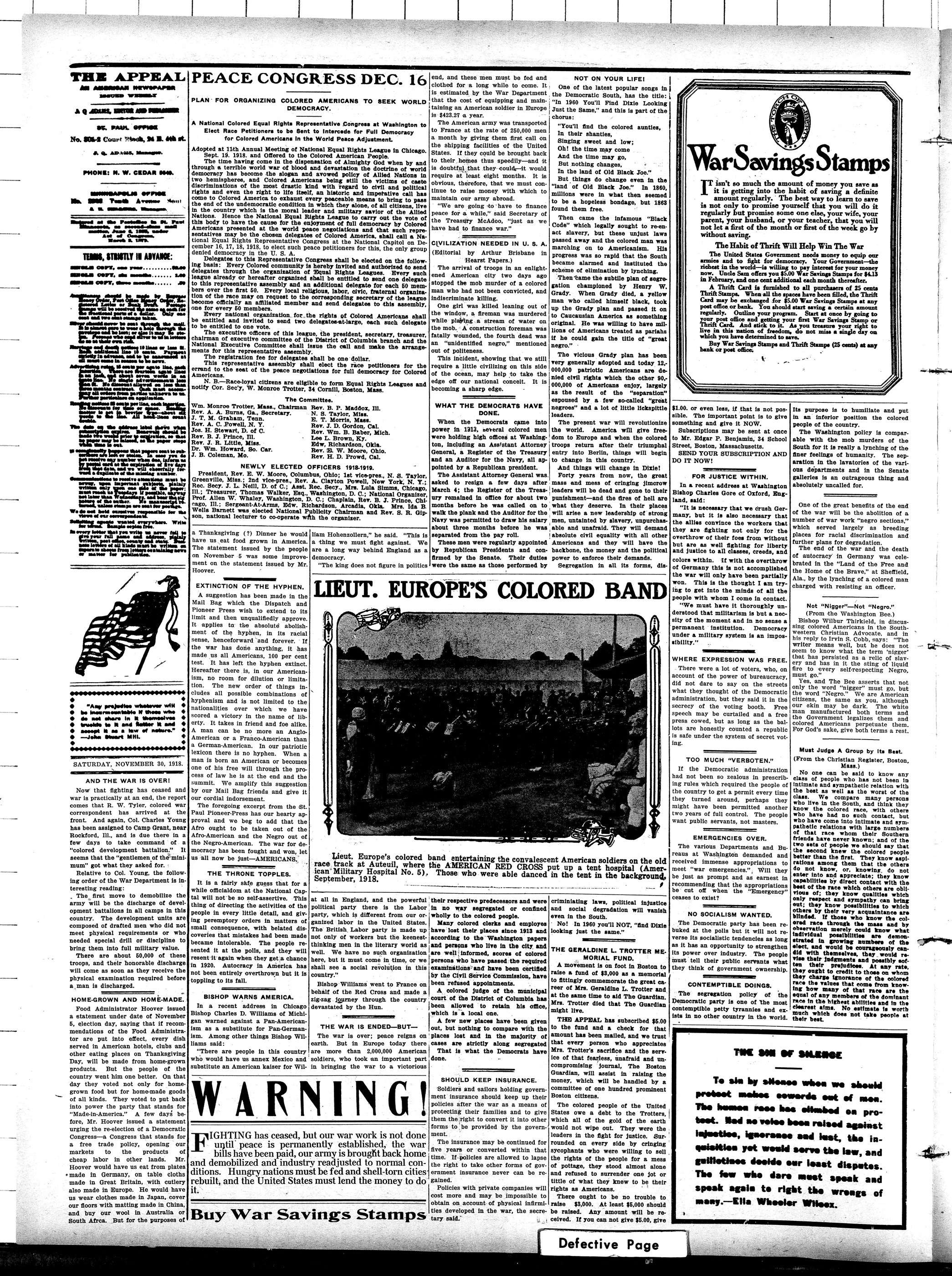
Lieut. Europe's colored band entertaining the convalescent American soldiers on the old race track at Auteuil, where the AMERICAN RED CROSS put up a tent hospital (American Military Hospital No. 5). Those who were able danced in the tent in the background, September, 1918.
Lieut. Europe's colored band entertaining the convalescent American soldiers on the old race track at Auteuil, where the AMERICAN RED CROSS put up a tent hospital (American Military Hospital No. 5). Those who were able danced in the tent in the background, September, 1918.
at all in England, and the powerful political party there is the Labor party, which is different from our organized labor in the United States. The British Labor party is made up not only of workers but the keenest-thinking men in the literary world as well. We have no such organization here, but it must come in time, or we shall see a social revolution in this country."
Bishop Williams went to France on behalf of the Red Cross and made a zig-zag journey through the country devastated by the Hun.
their respective predecessors and were in no way segregated or confined wholly to the colored people.
Many colored clerks and employees have lost their places since 1913 and according to the Washington papers and persons who live in the city and are well informed, scores of colored persons who have passed the required examinations and have been certified by the Civil Service Commission, have been refused appointments.
A colored judge of the municipal court of the District of Columbia has been allowed to retain his office,
criminizing laws, political injustice and social degradation will vanish even in the South.
No! In 1960 you'll NOT, "find Dixie looking just the same."
THE GERALDINE L. TROTTER MEMORIAL FUND.
A movement is on foot in Boston to raise a fund of $3,000 as a memorial to fittingly commemorate the great career of Mrs. Geraldine L. Trotter and at the same time to aid The Guardian. Mrs. Trotter died that The Guardian might live.
THE WAR IS ENDED—BUT—
The war is over; peace reigns on earth. But in Europe today there are more than 2,000,000 American soldiers, who took an important part in bringing the war to a victorious NING!
but our war work is not done mentally established, the war army is brought back home
end, and these men must be fed and clothed for a long while to come. It is estimated by the War Department that the cost of equipping and maintaining an American soldier in Europe is $423.27 a year. The American army was transported to France at the rate of 250,000 men a month by giving them first call on the shipping facilities of the United States. If they could be brought back to their homes thus speedily—and it is doubtful that they could—it would require at least eight months. It is obvious, therefore, that we must continue to raise money with which to maintain our army abroad. "We are going to have to finance peace for a while," said Secretary of the Treasury McAdoo, "just as we have had to finance war."
CIVILIZATION NEEDED IN U. S. A.
(Editorial by Arthur Brisbane in
Hearst Papers.)
The arrival of troops in an enlighten-
ened American city two days ago
stopped the mob murder of a colored
man who had not been convicted, and
indiscriminate killing.
One girl was killed leaning out of
the window, a fireman was murdered
while playing a stream of water on
the mob. A construction foreman was
fatally wounded, the fourth dead was
an "unidentified negro," mentioned
out of politeness.
This incident, showing that we still
require a little civilizing on this side
of the ocean, may help to take the
edge off our national conceit. It is
becoming a sharp edge.
WHAT THE DEMOCRATS HAVE
DONE.
When the Democrats came into power in 1913, several colored men were holding high offices at Washington, including an Assistant Attorney General, a Register of the Treasury and an Auditor for the Navy, all appointed by a Republican president. The Assistant Attorney General was asked to resign a few days after March 4; the Register of the Treasury remained in office for about two months before he was called on to walk the plank and the Auditor for the Navy was permitted to draw his salary about three months before he was separated from the pay roll. These men were regularly appointed by Republican Presidents and confirmed by the Senate. Their duties were the same as those performed by
band entertaining the convalescence the AMERICAN RED CROSS Those who were able danced
their respective predecessors and were in no way segregated or confined wholly to the colored people. Many colored clerks and employees have lost their places since 1913 and according to the Washington papers and persons who live in the city and are well informed, scores of colored persons who have passed the required examinations and have been certified by the Civil Service Commission, have been refused appointments. A colored judge of the municipal court of the District of Columbia has been allowed to retain his office, which is a local new. A few new places have been given out, but nothing to compare with the places lost and in the majority of cases are strictly along segregated That is what the Democrats have
SHOULD KEEP INSURANCE.
Soldiers and sailors holding government insurance should keep up their policies after the war as a means of protecting their families and to give them the right to convert it into other forms to be provided by the government.
The insurance may be continued for five years or converted within that time. If policies are allowed to lapse the right to take other forms of government insurance never can be regained.
Policies with private companies will cost more and may be impossible to obtain on account of physical infirmities developed in the war, the secretary said.
NOT ON YOUR LIFE!
One of the latest popular songs in the Democratic South, has the title: "In 1960 You'll Find Dixie Looking Just the Same," and this is part of the chorus:
"You'll find the colored aunties, In their shanties, Singing sweet and low; Oh! the time may come And the time may go, But nothing changes, In the land of Old Black Joe."
But things do change even in the "land of Old Black Joe." In 1860, millions were in what then seemed to be a hopeless bondage, but 1863 found them free.
Then came the infamous "Black Code" which legally sought to re-enact slavery, but these unjust laws passed away and the colored man was marching on to Americanism. His progress was so rapid that the South became alarmed and instituted the scheme of elimination by lynching. Then came the subtile plan of segregation championed by Henry W. Grady. When Grady died, a yellow man who called himself black, took up the Grady plan and passed it on to Caucaussian America as something original. He was willing to have millions of Americans treated as pariads if he could gain the title of "great negro."
The vicious Grady plan has been very generally adopted and today 12,000,000 patriotic Americans are denied civil rights which the other 90,000,000 of Americans enjoy, largely as the result of the "separation" espoused by a few so-called "great negroes" and a lot of little lickspit leaders.
The present war will revolutionize the world. America will give freedom to Europe and when the colored troops return after their triumphal entry into Berlin, things will begin to change in this country.
And things will change in Dixie! Forty years from now, the great mass and mess of cringing jimcrow leaders will be dead and gone to their punishment—and the fires of hell are what they deserve. In their places will arise a new leadership of strong men, untainted by slavery, unpurchasable and unafraid. They will demand absolute civil equality with all other Americans and they will have the backbone, the money and the political power to enforce their demands.
Segregation in all its forms, dis
ORED BAND
ent American soldiers on the old put up a tent hospital (Amer- in the tent in the background.
criminating laws, political injustice and social degradation will vanish even in the South. No! In 1960 you'll NOT, "find Dixie looking just the same."
THE GERALDINE L. TROTTER MEMORIAL FUND.
A movement is on foot in Boston to raise a fund of $3,000 as a memorial to fittingly commemorate the great career of Mrs. Geraldine L. Trotter and at the same time to aid The Guardian. Mrs. Trotter died that The Guardian might live.
THE APPEAL has subscribed $5.00 to the fund and a check for that amount has been mailed, and we trust that every person who appreciates Mrs. Trotter's sacrifice and the service of that fearless, unafraid and uncompromising journal, The Boston Guardian, will assist in raising the money, which will be handled by a committee of one hundred prominent Boston citizens.
The colored people of the United States owe a debt to the Trotters, which all of the gold of the earth would not wipe out. They were the leaders in the fight for justice. Surrounded on every side by cringing sycophants who were willing to sell the rights of the people for a mess of pottage, they stood almost alone and refused to surrender one jot or title of what they knew to be their rights as Americans.
There ought to be no trouble to raise $3,000. At least $5,000 should be raised. Any amount will be received. If you can not give $5,000, give
Defective Page
THE TORCH OF LIBRARY
WarSavingsStamps
It isn't so much the amount of money you save as
it is getting into the habit of saving a definite
It is getting into the habit of saving a definite amount regularly. The best way to learn to save is not only to promise yourself that you will do it regularly but promise some one else, your wife, your parent, your husband, or your teacher, that you will not let a first of the month or first of the week go by without saving.
The Habit of Thrift Will Help Win The War
The United States Government needs money to equip our armies and to fight for democracy. Your Government—the richest in the world—is willing to pay interest for your money now. Uncle Sam offers you $5.00 War Savings Stamps for $4.13 in February, and one cent additional each month thereafter.
A Thrift Card is furnished to all purchasers of 25 cents Thrift Stamps. When all the spaces have been filled, the Thrift Card may be exchanged for $5.00 War Savings Stamps at any post office or bank. You should start saving a certain amount regularly. Outline your program. Start at once by going to your post office and getting your first War Savings Stamp or Thrift Card. And stick to it. As you treasure your right to live in this nation of freedom, do not miss a single day on which you have determined to save.
Buy War Savings Stamps and Thrift Stamps (25 cents) at any bank or post office.
To sin by silence when we should protect makes ewards out of men. The human race has climbed on protest. Had no voice been raised against injustice, ignorance and lust, the inquisition yet would serve the law, and guillotines decide our least disputes. The few who dare must speak and speak again to right the wrongs of many.—Ella Wheeler Wilcox.
$1.00. or even less, if that is not possible. The important point is to give something and give it NOW. Subscriptions may be sent at once to Mr. Edgar P. Benjamin, 34 School Street, Boston, Massachusetts. SEND YOUR SUBSCRIPTION AND DO IT NOW!
FOR JUSTICE WITHIN:
In a recent address at Washington Bishop Charles Gore of Oxford, England, said:
"It is necessary that we crush Germany, but it is also necessary that the allies convince the workers that they are fighting not only for the overthrow of their foes from without but are as well fighting for liberty and justice to all classes, creeds, and colors within. If with the overthrow of Germany this is not accomplished the war will only have been partially won. This is the thought I am trying to get into the minds of all the people with whom I come in contact
"We must have it thoroughly understood that militarism is but a necessity of the moment and in no sense a permanent institution. Democracy under a military system is an impossibility."
WHERE EXPRESSION WAS FREE.
There were a lot of voters, who, on account of the power of bureaucracy, did not dare to say on the streets what they thought of the Democratic administration, but they said it in the secrecy of the voting booth. Free speech may be curtailed and a free press cowed, but as long as the ballots are honestly counted a republic is safe under the system of secret voting.
TOO MUCH "VERBOTEN."
If the Democratic administration had not been so zealous in prescribing rules which required the people of the country to get a permit every time they turned around, perhaps they might have been permitted another two years of full control. The people want public servants, not masters.
EMERGENCIES OVER.
The various Departments and Bureaus at Washington demanded and received immense appropriations to meet "war emergencies." Will they be just as prompt and as earnest in recommending that the appropriations be cut off when the "Emergency" ceases to exist?
NO SOCIALISM WANTED
The Democratic party has been rebuked at the polls but it will not reverse its socialistic tendencies as long as it has an opportunity to strengthen its power over industry. The people must tell their public servants what they think of government ownership
CONTEMPTIBLE DOINGS:
The segregation policy of the Democratic party is one of the most contemptible petty tyrannies and exists in no other country in the world.
Its purpose is to humiliate and put in an inferior position the colored people of the country.
The Washington policy is comparable with the mob murders of the South for it is really a lynching of the finer feelings of humanity. The separation in the lavatories of the various departments and in the Senate galleries is an outrageous thing and absolutely uncalled for.
One of the great benefits of the end of the war will be the abolition of a number of war work "negro sections;" which served largely as breeding places for racial discrimination and further plans for degradation.
The end of the war and the death of autocracy in Germany was celebrated in the "Land of the Free and the Home of the Brave," at Sheffield, Ala., by the lynching of a colored man charged with resisting an officer.
Not "Nigger"—Not "Negro." (From the Washington Bee.)
Bishop Wilbur Thirkield, in discussing colored Americans in the Southwestern Christian Advocate, and in his reply to Irvin S. Cobb, says: "The writer means well, but he does not seem to know what the term 'nigger' that has persisted as a relic of slavery and has in it the sting of liquid fire to every self-respecting Negro, must go." Yes, and The Bee asserts that not only the word "nigger" must go, but the word "Negro," we are American citizens, the same as we, although our skin may be dark. The man manufactured both terms and the Government legalizes them and colored Americans perpetuate them. For God's sake, give both terms a rest.
Must Judge A Group by its Best. (From the Christian Register, Boston, Mass.)
No one can be said to know any class of people who has not been in intimate and sympathetic relation with the best as well as the worst of the class. We compare many persons who live in the South, and think they know the colored race, with others who have have had no such contact, but who have come into intimate and sympathetic relations with large numbers of the race whom their Southern friends have never known; and of the two sets of people who should say that the second knew the colored people better than the first. They know applications among them that the others do not know, or, knowing, do enter into and appreciate; they know capabilities by direct contact with the best of the race which others are obliqued of; they know qualities which only respect and sympathy can bring out; they know possibilities to which others by their very acquaintance are blinded. If those who know the colored race through the mass and by observation merely could know what individual possibilities are demonstrated in growing numbers of the object, and would be courageously canidid themselves, they would reviise their judgments and possibly soften their prejudices. At any rate, they ought to trust to those on whom they charge ignorance of the colored race the values that come from knowing how many of that race are the equal of any members of the dominant race in the highest abilities and clearest aims. No estimate is worth much which does not take people at their best.
a7. PAUL
‘VEaws RECORD OF HAPPENINeS.
Wt MINNESOTA'S CAPITOL
Tha “aimtty Oty" and Saintly Oity
rotme—Newoy Heme, of social, Re
Rigtus, and General
tors Among the Pocste.
PHONE: N. W. CRDAR Bete
SATURDAY, NOVEMBER 30, 1918.
“In the Name ef Liberty—SAVE
FREEDOM FOR ALL FOREVER.
Gonserve om coal by burning wood.
PATRONIZE OUR ADVERTIaERa!
Mrs. William G. Hood is on the sick
list this week.
Mrs. E. Ervin, St. Anthony Ave,, is
Mil at her home.
Mr. J. Q. Adams, Jr., after a ten
days’ illness is again at THE APPEAL
office,
Attorney B. S. Smith of Minneapolis
was a St. Paul visitor on Monday of
this week.
W. T. FRANCIS |
LAWYER :
seth nce ST. PAUL
es
Mrs, Ester Green was a dinner guest
Sunday at the home of Mr. and Mrs.
BE. W. Lindsay.
Mr. and Mrs. J, E, Thompson have
taken one of the apartments at 665
University Ave,
Mrs. S. J. Mason, 1045 Cress Ave.,
entertained the Self Culture Club Wed-
nesday afternoon.
Mr. and Mrs. Donald Brady and lit-
tle son of Minneapolis were calling on
Paul friends last Sunday.
RE be 6 rs ‘Wille TT It
Vanver Bie's
# ICE CREAM $
For Sale Everywhere
J.C. VANDER BIE
Partridge and Brunson Sts.
‘ST. PAUL, MINN.
Mrs. W. R. Hardy, 518 St. Anthony
Ave., has been admitted to member-
ship in the St, Paul Association.
Mr. and Mrs. F. C. Tobie, 990 Gaul-
tier St., entertained at dinner Sunday
for Mr. Frank Stewart of Chicago.
The Whist club met on Monday
night of this week with Mr. and Mrs,
James A. Lee, 700 Sherburne Ave.
FOR RENT—Fiveroom flat, modern
except heat, 790 St. Anthony avenue.
Low rent for the winter. Tel. Dale
7816.
Omics: Coser ves 7-8. mi Bee
Bont ofS Bt Anthony Ave.
‘Fol. Baie Beer
T. H. LYLES
FUWEGAL BIRECTeR AND
Sun ALR
‘Tria Clty Calle Amewored
ey or Might
Lady Asctetant When Desired
0 W. Foneth mt. BT. PAUL
FOR RENT—A rear cottage, five
rooms, bath, gas range, nice yard,
378% Jay street. Tel. Dale 17557.
11-23.)
Miss Jessie Odin and Miss Ruth
Shuck of Topeka, Kan., are the guests
of Lt, and Mrs. Hugh Shuck, 460
Rondo St.
Mr. and Mrs. Clarence Roper and
Mrs. H. I. Williams were dinner guests
of Mr. and Mrs. Walter Goins Thanks-
giving day.
Mrs. Sim Wilson left Thudyday for
Washington, D. C., to visit relatives
and will likely remain until after
‘Christmas.
Pig === Pen
A pig is put in a
pen to prevent it
from running away
as it is, then; hard
to catch.
Money roundand
and ‘rolls when lost
or needlessly spent
and is hard to re-
place.
Money should be
put into a bank,
where it will be sa-
fe, and available
when really needed
STATE SAVINGS BANK
MUTUAL
93 East Fourth Street
Ee
Mra. Mattie McGheo and daughter
Miss Ruth, were guests of Mrs. Min
fnfe Plummer of Minneapolis, Thanks
giving day.
‘The ladies of the Folksong Coterl
gave several selections before the Oper
Forum at the Athletic club on Monda;
of this week.
FOR RENT—Two furnished room
suitable for man and wife or tw
gentlomen. Apply at 608 St, Anthon)
Ave. Tel. Dale 2392.
Mrs, Emma Jackson of Anoka, wh«
‘was operated on at City Hospital last
Saturday, is improving rapidly and
‘will soon return home.
Mrs, R, L. Allen, 849 Albemarle St.
jwho has for the past five weeks been
visiting her mother in Des Moines, Ia.
has returned to the city.
Mr. and Mrs. George Lucas, 624
Rondo street, entertained at dinner
Thanksgiving: Dr. C. E. Cheeks and
Atty. Hammond Turner.
YOR RENT—Furnished rooms
with housekeeping privileges. Ap-
ply to Mrs. R. Young, 408 Arundel
St. Tel. Dale 3201. (9-14-18)
Mrs. B, F, Edwards, 244 W, Central
Ave,, was hostess Tuesday afternoon
to the Adelphia Club. Lieut. A. L.
Hatchett was a visitor, and made a
very pleasing speech
Mr. F, G. ‘Thomas, of Minneapolis,
was in St. Paul yesterday working In.
terest in the big ball on Dec. sth in
Minneapolis. See the big advertise:
ment on fourth page.
Mr. and Mrs. J. Q. Adams, 527
St. Anthony avenue, entertained at
dinner Thanksgiving: Rev. J. C. An-
derson, Mr. R. M. Johnson and Miss
Adah Lewis of Minneapolis.
In this was manifested the love of
Ged toward us, because that God seat
Mis oaly begottes Som into the world
that we might live through Him—1
John 4:9.—Selected by B. W. Gilles,
HOUSEHOLD OF RUTH NO. 563, 2.
U.'O. of O. . moats the third Monday
In each month at Union ‘Halt corner of
Mra: Mabel Hatton, Ai N. Gr: Mera. Garé
rie B. Lindsay, W. R, 9i8 Woodbridge
itreat.
One of the several ‘Thanksgiving
presents for Crispus Attackus Home
was a wagon load of groceries from
Hancock School, another was a ton of
coal secured through Mr. Louis Liver-
pool.
Mr. C. L. Sharp, 521 Rondo street,
who has been confined in the hospital
in Aberdeen, 8. D., suffering from an
attack of influenza returned home last
Saturday and is rapidly recovering his
health. °
‘The body of Norwood Turner, son of
the late William Turner of this city,
was brought here from Chicago this
week for burial in the family lot. He
is survived by his mother and one
brother.
‘Mrs. Lizsie A. Battles, formerly 913
Rico street, has yaoved her hair and
millinery parlors to 262 W. Seventh
street, corner of Walnut, where she
will be pleased to meet old and new
castomers.
Mr. 8. P, Maywether, 949 St, Anth-
ony ‘Ave., received official announce-
ment of the death of his brother, Lt.
M. W. Maywether, who was killed in
action while fighting on the French
sector, October 10.
"Tis sald that music is an ald to
good digestion so A. A. Coleman, pro-
prietor of the New Floros Cafe, 12,W.
Bixth Streét, has installed an electric
plano and now his patrons may have
music with thelr meals.
At the woman suffrage luncheon
given in the honor of Mrs. Louis Moel-
ler, of Minneapolis, at Field & Schlick
Tea Rooms last Saturday, Mrs. W. R,
Hardy was present upon invitation and
enjoyed the occasion hugely.
‘The Handicraft Art Club met Fri
day afternoon with Mrs, Harriet Hall,
996 Iglehart Ave, Final arrangements
have been made for the club's annual
and sale of Christmas gifts to be held
at Union Hall, Dec. 5th and 6th.
A special committee is raising funds
in the Twin Cities to equip Crispus
Attucks Home with an iron fire escape
and to make other needed tmprove-
ments. It is hoped that the public
will make liberal contributions to this
worthy cause,
Zion Presbyterian church held
Thanksgiving services at 10:00 a. m,
Thursday, and it was the best in the
history of the church in point of at-
tendance and the offering was also
the best. Rev. G. W. Camp, the pastor
preached the sermon,
‘The ban on flour has been lifted
and white flour may now be bought
without substitutes. We are now al-
lowed three pounds of sugar per cap-
ita and Dec. 1, will be allowed four
pounds per capita monthly allowance
for household purposes.
Now, that Mr. A. A. Coleman, of
New Fioros Cafo, 12 W. Sixth street
has a place where no one, lady or
gentleman, needs to be ashamed oF
afraid to ‘go, the people ought to
show thelr appreciation. by patronis-
tng his nice, clean up-to-date cate,
Mr, Jorry Lee, familliarly known as
“Uneio Jerry,” an attache of
“Thann’s,” 40 East Third street had
a fine twelve pound turkey sent to iim
by an old triend of Yankton, 8. D.
If aid not arrive until yesterday’ but
was none the less thankfully received.
The members of. the 16th Battalion,
or Home Guard Band took Thanks.
giving dinner at the New Floros Cafe,
12 W. Sixth street, ‘There were 23
mT Pt
Se epee
at PRYOR'S CAFE. Nothing but the
best will be served. Call and be con-
vinced.
Talking about Thanksgiving hosts,
Mr. R.N. Travis, of 40 Bast Third,
surpassed them all. In his upstairs
cafe he had as his guests during the
afternoon and evening last Thursday,
between 300 and 400 persons to par-
take of his hospitality. ‘The menu
comprised oyster soup, combination
salad, ‘roast turkey, cranberry sauce,
mashed potatoes, bread, butter, coffee,
ete. Can any one beat it? Twelve
large turkeys were served.
The Astoria Sanitary System, the
clothes cleaning, repairing and press-
ing establishment, 368 Wabasha street,
formerly conducted by W. Evans and
R. H, Anderson, has made a change
in proprietors. 'W. Evans has retired
from the firm and Archie Brown suc-
ceeds him. The firm name now is
Anderson & Brown. Mr. Brown brings
to the firm considerable practical ex-
perience and customers may rest as-
sured that wants will be properly
eared for. Your patronage solicited.
Miss Hattie Hobbs who was laid up
with sickness for six weeks is again
attending to her duties at Field &
Schlick’s. She desires to tender
thanks to.the many friends who re-
membered her during her illness, es-
pecially the members of Pilgrim Bap-
tist church and the Pastor’s Aid So-
clety of Memorial Baptist church,
She is planning to have one of her
phenomenal personal rallies for Cris-
pus Attucks Home and as she always
succeeds in her flnaricial transactions,
it is certain that she will give a good
account of herself this time. Every-
body solicited should help her.
The great Peace-Thanksgiving pa-
rade on Thanksgiving Day was the
grandest ever witnessed in St. Paul.
There were fully 10,000 persons in the
parade representing every nationality,
race variety, and creed of our cosmo.
politan population and was avery
pleasing demonstration of democracy.
The colored peoples part was very
catistactory in every way and the ap-
pearance of the Home Guard, the Red
Cross and the Sixteenth Battalion
Band of 40 pieces in the second divi-
sion was quite a notable feature of the
parade and was warmly greeted with
applause by the 50,000 people that
witnessed the monster parade,
Again THE APPEAL man is glad
to tender thanks to’Rev. Daniel Hard-
ing, of Lake City, Minn., for remem-
bering him by sending a fine young
ten pound national bird for his
Thanksgiving dinner. This is the
third time that Rev. Harding has re-
membered Mr. and Mrs. J. Q. Adams
and family in the same way and they
are all more than ever thankful for
his kindly remembrance. Evidently
Rev. Harding is a believer in the ad-
age: “One good turn deserves an-
other”; and as, “The Lord loveth a
cheerful giver”; it is the hope of the
Adams family ‘that he will find it,
“More blessed to give than to receive,"
at any rate that is the sincere wish
of the Adams family,
The joint Thanksgiving service of
the churches at Memorial Baptist
chureh, Thursday morning, attracted
a large audience that was amply re-
warded for its presence by the ex-
cellent sermon preached by Rey. J. C.
Anderson of St. James A. MM. E.
Chureh. ‘The musie was furnished by
a choir made up from members of the
several church choirs. Rev. T. J. Carr,
pastor of Memorial, read the ‘scrip.
rir lesson and introduced Rev. Ander-
son, Prayers were offered by Rev.
W. F. T. Chandler and Deacon J. H.
Hickman. The usual Thanksgiving
collection for Crispus Attucks Home
was raised amounting to $76.06. A
Thanksgiving dinner was served in
the church parlors after the service.
The largest crowd ever in Union
Hall, with the possible exception of
the ‘opening “night, completely jam-
med the building’ on Tkanksgiving
night, the occasion being the joint en-
tertainment of the 16th Battalion Band
and Mars Lodge, Odd Fellows. ‘There
were two orchestras and dancing in
the auditorium and in one of the up-
stairs halls, ‘There was a splendid
program presented by Master of Cere-
monies C. H. Miller and Lieut. W. H.
Howard, director of the band and or.
chestra. The band gave a concert of
five classic numbers; Miss Katheryn
Tandy, read from’ Dunbar; little
Misses Dorothy and Irma Hall rend-
ered a delightful little skit, “Smiles.”
Minneapolis was very largely repre-
sented and everybody had a good time.
A number of the colored soldiers from
over there who are now at Fort Snell-
ing were present as special guests of
the occasion.
There were lots of ‘Thanksgiving
dinners among the folks Thursday
that were ‘ine as a number of folk
who enjoyed them will attest but
none surpassed and few, if any,
equalled the pre-Thankegiving six
o'clock dinner that was given Wednes-
day by Mr. and Mrs. R. EB. Cousby,
290 N. St. Albans street. “It was abso:
lutely perfect: in table appointments,
culinary excellence, and service.
‘Twas a repast fit for the gods! ‘The
ment included: olives, radishes,
celery; pickles, oyster cocktails, little
neck clam chowder, broiled mountain
trout, baked white potatoes, roast
Virginia turkey, dressing, cranberry
sauce, rutabagas, potatoes, peas, Roman
punch, shrimp and fresh "tomato
salad,’ Hnglish plum pudding, burnt
brandy, white hard’ sauce, nespolitan
cream, layer cake, toasted cheese,
beets, ‘hard crackers, Ince deml tasse,
<andeind ‘whicueia’ Wake cee
CITATION ON PETITION TO SELL
STATE OF MINNESOTA, COUNTY OF
Hamsey~aa. “Probate Come
Inthe Matter, of ‘the “application for
‘License te Sell the ABEL Sutate “Cr
~ Abbie’ Sackeos, alse Known as Abbie
Singleton Becedent,
‘The State of Blinnesota to All Whom it
hay ‘Concern:
Ot FEAHINE And Ming the petition of
ackey B. Halener eprenentative.ot the
petake 0 (ecaned, prayin
Hcense “be “to her granted to sell the
Teal gatais of which said deceased ded
Selzed: ang ‘it ‘appearing by suid: peti
tlon that there is not suifciént personal
getate in tho hands of said representa:
five'*to. pay the. debts outstanding
Against the deceaned, ana {he lorases
ahd expenses’ ‘of “adminiatrations ad
that Tels" Mecessnry, tn order tS pay
such debi, Negacies ‘and expenses, BRK
for the best Uaterest of sulk’ asake te
seh ‘sala’ reat estates
He ig nerators Ordered, That ail per.
sons Interented in onld Geiate be dead
And requited to appear before ania Pros
Rate’ Goure on aldday che shih dey
November, AD. 1018" at ton greisek fe
the ‘forenbon, ‘atthe Court Siowse: Ie
the City ef-St" ‘paut, tn'aaid’ County
then ana there {0° show: cause, ray
there "be, why license “ahould’ not be
Eranted to"suld representative to: seil
Sald'real ceeate: according {9 the prayer
of sald petition, and thal, hla atten
ie Strvel'by publication thereor in ke
Abpeal according te lew.
settiiness fig Bdge of ania Court thi
‘of Octobe $518"
a4 "E,W, BAZILLE,
Judge of Probate.
(Seat 9f Brovate couse ee
dest! $f. WoWssegisch:
Gleri! of Probate.
oe i qt kee
a ee
COME TO THE < ay
SOLDALR= 7%
BOY STORE @&.5a
<> Buy Gifts for Your
ae Entire Family
‘e : : —ON—
= @ Goodman’s Credit Plan
- ; Pay as A
Meet Goodman Little as ¢ Week
Wear Diamonds
( We Do as We Advertise or Your Money Refunded d)
“Tq Elgin or Waltham
ACh |] Military Wrist Watch
ry
f ee fp Sse atu" uainwes oat ga
If }) our soldier boy an Elgin or Wal- A
CS) ie yin wee tee 9] G2
nd osteo en
el TERMS 50c A WEEK
{ Your Money Refunded if You Can Buy Cheaper for Cash)
15-Jewel Bracelet Watches s)
You could not think of a better time to buy a » Fi
ERS REA MR TIN Wola
ee
ela and 20-year gold filled case. Has convertible Aa Rais omu INES
Sane Saree Ge
11.75 | 5 NG]
° a Week Oe:
—_ EGS —
ao, Fas rin wae
jeee (Oiiclacik) ae
(RE AG coodlaws
ie
A Diamond
“ie ier boas gullasiee
gee heey cilia ee
Sis sees semen
bot pane sor multe
Sait coe oer ee
sell of eee ee
met 6 Berens saa cr
meee
Piwrenée $10 to $600
FRANK A. UBEL “sb
° Street
JEWELER — OPTICIAN — OPTOMETRIST
——The TC Bors Furniture
Select the Instrument
of Your Choice
NOW
‘The worl’ foremost makes are J Terma as low a8
represented In. our immense TTA eae... 85
stock of new, storage and sample Gagan
pianos and player pianos which [= =e 1
we are offering at savings of $100 i By a .
Te nears | UD
for Christmas defivery. a
| ed
FRE E\| at aw
| ia |
30. daye Free Trial in your] Hh Pn
own home if you want it. | Aiea See |
New standard.make, high grade, |'Steinway, upright, In aplendid
mevegeny, pnt rsa Gua | sana onde ae” g's
anteed for 25 years $178 tiful tone ..........
Monee vena ona abe $15
Everett, upright, used @ 41 | In fine condition...
but In good condition New England this Is a $
Kimball, in good con. $139 good practice piano... 69
dition .....-- +000 Player Piano, almost as good as
Plano wainat cane” $298 | tone ne... $3ZS
J ia The Favorite of
ay. Music Lovers
aT yes Columbia Grafonola
Way seioct trom our immense stock of the
pl 4 : various models. All sizes and finishes
iat Chateente Manhibee shoud aee
: eat tected "now in order to avoid dieap: |
PA eS rep caatnen, eral
Laleesiee Emote $85
uy now Jory voun sient
Ee. BROPES HEE:
lcenaaserae ron a
| Soracce — EVERmmgermewoMt = ys1c*
Defective Page
BEF ee ee
‘i ao”
New Floros Cate
- A. A. COLEMAN, PROPRIETOR
Original Mexican Chili Gon Carne A ‘Spelaity
Exceptional A La Garte Meals And Service
The Most Centrally Located Cafe And Best
12 W. 6TH.8T. © scrmmaxr eve SAINT PAUL
er
WHILE You wait
ASTORIA -i- SANITARY -!- SYSTEM
CLEANING a REPAIRING 2 PRESSING
Dry Cleaning 368 WABASHA (Shee Repairs
Suits Sponged| “ear vith street (Dyed &Shited
and Pressed | WECALL AND DELIVER] Laundry
Now Collars | ww. eckson 20s6| Baths
R. H. Anderson Archie Brown
ee EEE
PRYOR’S CAFE
soe ST. PAUL
————————— ey
eae AA a wii
. WHEN IN THI TWIN CITIES DON'T FAIL To visiT
Reaver rnon THANN’S venrcccron
HOTEL, CAFE AND POOL ROOM
HEADQUARTERS FOR RAILROAD AND
THEATRICAL FOLK encase
40 E. THIRD ST, ST. PAUL “er
Dr.H.1. WILLIAMS
©
Announces his NEW method of
I positively guarantee te extract tecth and remove nerves
ABSOLUTELY PAINLESSLY
Gat prices here before going slaswhere
A Weltten Guarantee for 20 Years Given With All Work.
Dr. Williams, 27. E. 7th St
TEL. C. 6132 KENDRICK BLDG. 2ND FLOOR ST. PAUL
Puowzn [FN SERA S08 wa ELSA DaLtver
UP-TOWN SANITARY SHOP
SHOES - REPAIRING - cLornes,
SUITS SPONGED FRENCH DRY
AND PRESSED CLEANING
GENTS SUITS DRY LADIES SUITS DRY
CLEANED $1.25 CLEANED $1.60 & UP
330 WABASHZA BT. ST. PAUL, MINN.
KARRAS DRUG CO.
(Formerly Straight Bros.)
PRESCRIPTION DRUGGISTS
” 740 RONDO, COR. GROTTO
Telephone Orders Promptly Delivered
ELECTRIC SUPPLIES DRUG SUNDRIES KODAK SUPPLIES
OVERTON’S HYGENIC “HIGH BROWN PREPARATION”
Mrs. Olive Howard-Crothswait, is still with us as phzrmacist
T. 8 PHONE 85 407 N. W, PHONE DALE 181
TEL DALE €731 LEADING BRANDS CIGARS
‘THE GENTLEMENS' RESORT
BARBER SHOP POOL ROOM
. + ann — 5
| SHINING PARLOR
WALKER WILLIAMS) PROP.
i EGP RO" ST. PAUL
———— ee
| Suits and Overcoats Made To Order
Ladies Work A Specialty. Clean.
ing, Pressing And Repairing.
| 329 Dale St. St. Paul
FB. SIMPSON GEO. W. WILLS|
‘Tel. Dale 1914 ‘Tel. Dale 2641
Office Phones:
Cedar 1024 ‘Tri-State 24 240]
Undertakers, Funeral Directors
and Embalmers
Calle Anewered Promptly Day or
Night
Lady Assistant When Desired
ax War Fount sr. ST. PAUL
MRS. CO. MONJOY-JONES
aameep xonen
718 ST. ANTHONY AVR. 87. PAUL
orrice ve. —
SACHEON zane DALE 7010
AND 210.0 P. M,
SUNDAYS BY AProwTIENT
DR. C. E. CHEEKS
DENTAL SURGEON
rinay cLase GUARANTEED WORK
IN ALL BRANCHES OF DENTISTRY
“Oakorm Buse,
ime sexe = ST. PAUL
oo
BEAUTY PARLOR
MRS. M. LOVE, PROP
LATEST ELECTRICAL EQUIPMEN:
“SCALP AND FACIAL TREATMENT
HAIRDRESSING, SHAMPOOING
MASSAGING, MANICURING
\ CHIROPODY.
paint haei
gainers
310 RONDO 87. sr. PAT
THE BOHNS IN AND ABOUT THE
GREAT "FLOUR CITY."
Mattare Social, Religious and General
Which Have Happened and are to
Happen Among the People of the
City.
J. N. BELLERS, MANAGER
2812 Tenth Avenue 80.
Pel. N. W. South 3672.
SATURDAY, NOVEMBER 30, 1918.
Mr. Earl Stewart and wife are in
Chicago.
Atty. B. S. Smith was in St. Paul on
business last Monday.
Ames Lodge, Elks, will meet first
Tuesday in December.
The rally for winter expenses at St.
Peter church is very active.
Mr. and Mrs. Donald Brady and son, spent last Sunday in St. Paul, calling on friends.
Mr. Martin Brown, now at Camp Grant, Ill., witnessed the Camp Dodge football game at Chicago.
Mrs. Minnie Plummer, entertained Mrs. Mattie and Miss Ruth McGhee of St. Paul, Thanksgiving.
Miss Frances Mask leaves shortly for Washington, D. C., to assume her duties in the post office department.
Rumor has it that Rev. D. E. Beasley and Atty. W. R. Morris will be among the advisers of Mayor elect Meyers.
Dr. and Mrs. E. W. Burton were guests of his father and mother, in St. Paul, at a family dinner Thanksgiving Day.
The big ball of Co. D at Arcadia Dancing Palace last Monday was a big affair. The hall was packed and everybody had a big time.
Mr. Joseph Levy returned from a trip to Camp Dodge this week and reports that the soldiers there expect to spend Christmas at home.
It is understood that former detective Hardin will be appointed as deputy by Sheriff Martinson and that John Allison will be retained as court bailiff.
Ames Lodge No. 106, Elks, is preparing to give a grand Installation Ball at Arcadia Dancing Academy on Monday, Jan. 6th, 1919. First ball of the year. Get ready!
Efforts are on foot looking toward the appointment of a colored man in the office of County Attorney Nash, the choice lying between Attorneys Gale P. Hilyer and A. R. Skinner.
Mesames Price and Smeddler, of the Hair Shop, 715 Sixth Ave. N., have originated a new electric pressing comb that is superior to those now on the market and they cordially invite the ladies to call and test its merits.
Mesdames Price & Smeddier of the Hair Shop now have a full line of the Kashmir preparations for the toilet that are the "Royal Road to Beauty," manufactured by Kashmir Chemical Co., Chicago, the beat in the world. Come and see.
Mesdames Price and Smeddier, of the Hair Shop, 715 Sixth Avenue North, now have a splendid display of Kashmir toilet goods in a show window of a large store adjoining their place of business. See their new hygienia sanitary hair brushes and Royal Rouge.
The friends of Mrs. Carrie Price of the Hair Shop, 715 Sixth Avenue No., on Wednesday of last week, tendered her a surprise anniversary party that was greatly enjoyed by all present, about sixteen. The decorations were in pink and white. Mrs. Price received a number of handsome presents. Dancing was the feature of the evening.
Now, everybody get ready to enjoy the grand Peace Jubilee Ball to be given at Arecadia Dancing Palace under auspices of Pride of Minnesota Lodge No. 5, K. of P., on Monday evening, Dec. 9. This is the ball that was postponed from October 28. The returned wounded soldiers will be special guests. The music will be furnished by the Home Guard Orchestra, Prof. J. F. Stevens, director. (Oct. 28 tickets good for admission.) Admission 50 cents, taxis at 1:45.
ANNOUNCEMENT.
The Dining Room and Cafe of Stewarts Arts Hotel, 246 Fourth Avenue So., Minneapolis, is now under the sole and exclusive management of Mr. A. B. Van Hook, whose reputation as chef and caterer is well known to be second to none.
The dining room will be open from 7:00 a. m. to 2:30 a. m. and will be managed by Mrs. Mildred Jones with a corp of competent and obliging waitresses. There will be music at all times and pleasing up-to-date cabaret entertainments at least three each week. Prices will be quite reasonable for the excellent service that will be given. The ladies and gentlemen of the Twin Cities are cordially invited to call.
A specialty will be made of Club Sandwiches and and Oyster Loaf for lunches.
Telephone Main 2831
CARD OF THANKS
It is with grateful hearts we sincerely thank our many friends of the Twin Cities for their uniring acts of kindness shown us during the long sad hours of the illness and loss of our beloved daughter, Ruth, also for the consoling letters of sympathy and the numerous beautiful floral offerings. Bless, oh Lord, we pray Thee, these dear friends forever and ever.
Rev. and Mrs. D. E. Beasley.
Mrs. M. Moseley Witers Gives Patriotic Reading.
By special request of Mrs. Dr. Mary G. Andrews of 1809 Vine Place. Mrs. M. Moseley Witers, Dramatic Reader, rendered the beautiful pathetic poem "Y. M. C. A. Huts" at the West Nicolet Avenue, New Thought Center to a large and appreciative audience (white); at the close of her rendition, many were in tears, and her congratulations were many and ardent. Mrs. Witers not only won for herself several pupils (white) by this reading, but also received the cordial invitation from the chairman of The Trustee Board. Mrs. Donaldson, to appear in a full evening's reading, under auspices of the center. Mrs. Witers has accepted, and plans are being formulated for the recital about the middle of December, 1918.
PEACE JUBILEE BALL
PRIDE OF MINN. LODGE NO. 5
AT
A DANCING PALACE
amland, 5th St. So., Opposite Court House
AY EVE'G, DEC. 9
HOME GUARD ORCHESTRA
MITTEE OF ARRANGEMENTS
MUSIC BY HOME GUARD ORCHESTRA
F. G. Thomas, Chairman
Wm. Moden
F. Terry
J. Waters
C. Lewis
RECEPTION COMMITTEE
Everett Jackson, Chairman
B. Ashe
E. Boyd
G. Shull
C. W. Dwyer
Busey
F. Bonaparte
FLOOR COMMITTEE
Wm. Clack, C. C. Chairman
S. G. West
J. L. Gibson
Taxis 1:45
For Her
LUGGAGE SHOP, Sixth and Cedar
es by Quality, Fit and Style, Not
y the Price Per Pair"
"Select Shoes by Quality, Fit and Style, Not by the Price Per Pair"
STANLEY
SHOE CO.
THE FURSHEIM
SHOE
STANLEY
SHOE CO.
BERT ST. ST. PAUL
N. W. Dodar 2002
Tul-State R2304
DOLAN & SULLIVAN
FISH, POULTRY, BUTTER, LARD, BFG.
OYSTERS AND GAME IN SHASON.
OUR FISH SHIPPED DIRECT.
WE DRESS OUR POULTRY.
421 ROBERT ST. ST. PAUL
FE MILK
NE: SUMMIT 80
T. S. 84 002
ESOTA MILK COMPANY
PHONE: SUMMIT 80
T. S. 84 002
MINNESOTA MILK COMPANY
Don't argue with dirt
Pearline
KNIGHTS
ARCADIA D
Formerly Dreamland, 5
MONDAY
MUSIC BY HOME
COMMITTEE
F. G. T.
P. H. Southall
Wm. Critic
RECEPTION
Everett
B. A
Dr. J. H. Redd
L. Patton
W. Busey
FLOOR
Wm. Cla
J. W. Burke
Admission 50c
Useful Christmas Gifts
```markdown
```
HARTMAN
A fashion by Wardrobe Trunk
GARLAND LUG
"Select Shoes by
by the
STANLEY
SHOE CO.
N. W. Codar 7638
Trib. State 26491
HANDLAND
MEATS, FISH, POUL
OYSTERS A
OUR FISH
WE DREW
463 JACKSON STREET
SAFE
PHONE
MINNESOTA
MUSEUM OF
ART
MUSEUM OF
ART
J. Waters
C. Lewis
G. Shull
C. W. Dwyer
J. L. Gibson
Taxis 1:45
Please do your Christmas buying now. Our stock now, is very complete. By making a small deposit, we will hold your selections.
For Her
Hand Bags
Toilet Sets
Novelty Bags
Manicure Sets
Umbrellas
Sewing Baskets
and many other
useful gifts
For Him
Traveling Bags
Sult Cases
Belts
Bill Books
Collar Bags
Dressing Cases
STANLEY
SHOE CO.
854 RICE STREET
VICTOR
OCT. 1918
Fetching Vocal and Instrumental Numbers Among the New November Records
88596—La Travista (Now Command Me).....Verdi
Duet, Amelita Galli-Curci and Gluseppe De Luca
The Radiance of Your Eyes, Retain Need
18501—Cohen Gets Married.....Monro
Cohen on His Honeymoon.....Monro
Hear the New Records in OUR Parlors and Make Your Christmas Selections Now
W.J. DYER & BRO. 21-23 West Fifth St.
Herein is love, not that we loved God, but that He loved us and sent his Son to be the propitiation for our sins. 1 John 4:10—Selected by E. W. Gilles.
MRS. BOBERT A. VAN HOOK
FASHIONABLE DRESSMAKING
AND LADIES’ TAILORING
PARTY GOWNS A SPECIALTY
1006 SIXTH AVENUE NORTH
MINNEAPOLIS, MINN.
CITATION FOR HEARING ON PETITION FOR ADMINISTRATION.
STATE OF MINNESOTA, COUNTY OF Ramsey, so in J. Probate Court.
In executor of the Estate of Alice Brooks, also known as Alice Jackson, Decedent.
The State of Minnesota to All Whom It May Concern:
The petition of Fannie Powell having been heard in this Court, representing the Allies in the Allied invasion of Jackson, then a resident of the County Jackson, then a resident of the County died intestate on the 15th day of March 1913, and praying that letters of ad-duality should estate be granted o Nannie Garrick.
It is Ordered. That said petition be interested in said matter be and thereby and required to appear before this date, the 6th day of December, 1948, at 10 o'clock noon or as soon thereafter as said matter can be heard, at the Probate Court of St. Paul, in said County, and show cause, if any they have, why said matter has been cited in his citation be served by the publication thereof in the Appeal according to the stated date of the citation at least 14 days before the day of hearing to each of the heirs of such names and addresses are known and appear from the files of this Court.
Witness the Judge of said Court this 16th day of November, 1948, at E. W. BAZILLE,
Judge of Probate.
(Seal of Probate Court)
(Test: F. W. Gosewich)
St. Paul Steam Laundry
"The Sanitary Laundry"
Works: 289-291 Rice Street
near Summit
Branch Office: 443 Broadway St.
W. B. Webster, Mgr. St. Paul
Northern Savings Bank
IN COMMUNICATION WITH
THE NATIONAL ACADEMY OF
SOCIAL SCIENCE
Start Them Right
This Christmas
Teach thrift to your children while they are young. A "Northern Savings" account will do this.
It will arouse their interest, touch their sense of pride, and cultivate the saving habit early in life.
Assure them a prosperous future. Can you think of a more sensible gift?
A Christmasy envelope will be provided for each bank book.
Northern Savings Bank
Robert at Seventh, St. Paul
SOME OF THE LATEST SONG HITS AND TWO
BUTTON BUSTING COHEN STORIES BY SILVER.
18497—Everything Is Peaches Down in Georgia—
American Quartet
Carolina, I'm Coming Back—Peerslieve Quartet
18502—That Soothing Sonerade ..... Henry Burr
On the Level, You're a Little Devil—duet—
Clark and Burr
18505—Oui, Oui, Marie (wee, wee, Marie)
"THE PEOPLE'S BIG VICTROLA STORE"
TWO
FIFTY
TWO
252
TWO
FIFTY
TWO
Mild, Rich, Satisfying!
5c
Try It Once and You'll Become a 252
"Fan"!
Sold by the Good Dealers
Ask any Cigar Dealer for 'the King of Nickel Smokes'
MADE ONLY BY
HART & MURPHY
SMOKE MAKERS SINCE 1857. SAINT PAUL, U.S.A.
Do You Know, that it is CHEAPER to send your family washing to the "Old Reliable" the
than to pay a "wash lady" big wages, furnish meals, soap and fuel--and then worry all day. We iron all the flat pieces, and starch all the rough dry ones. COURTEOUS DRIVERS. GOOD SERVICE CAPITOL STEAM LAUNDRY N. W. Cedar 4622 Tri-State 21939
Here's the breakfast that makes men smile
All the Latest Medical Sanitary Equipment, Licensed Repair Artists in Soap Treatment, Hairdressing, Shampooing, Hairdressing, Facial Massage, Chiropody.
ELECTRIC HAIR PRESSER—DERMA BEAUTY LIGHT—OVERTON'S HYGIENIC "HIGH BROWN" PREPARATIONS WILL BE USED AND SOLD.
LADIES!
Do You Know, that it is your family washing to Capitol Steam than to pay a "wash la meals, soap and fuel-- We iron all the flat pi rough d COURTEOUS DRIVERS CAPITOL STEAM N. W. Cedar 4622
Here'
th
LOG CABIN
SYRUP
It's the delightful way of getting the wonderful food value of wheat—mankind's most dependable and economical food.
Log Cabin St.Paul
Golden brown wheat cakes
—packed full of nourishment—and
TOWLE'S
LOG CABIN
CANE AND
MAPLE SYRUP
Log Cabin Syrup not
only makes wheat cakes
a real treat, but adds
nourishment—makes a
balanced meal.
MASONIC LODGE MEETINGS.
Worthy Visitors Welcomed.
Union Hall—Kent and Aurora.
PIONEER LODGE NO. 1.
Meets First and Third Monday.
J. H. Dillingham, W. M.
569 Rondo St.
Ira S. Ashe, Secretary,
325 Rondo St.
PERFECT ASHLAR NO. 4.
Meets second and Fourth Tuesday.
L. A. Melker, W. M.
455 St. Anthony Ave.
Ira S. Ashe, Secretary,
235 Rondo street.
ODD FELLOWS
MARS LODGE NO. 2802, G. U. O. OF
O. P. Monroe, M. O. OF
day in each month at Union Bank, Aurora
and Kent streets at 8:00 p.m. j. M. H.
Dillen, J. I. Ira S. Ashe, Sec.
235 Rondo street.
FREDERICK DOWLASS LODGE NO. 9004, G. H. O. OF
fourth Monday in each month at Union
Hall, corner Aurora and Kent streets at
M. O. OF. L. O. Lyons, M. O. Of. M. Edward
A. Matton, P. L. 118 W. Areh street.
PIONER LODGE NO. 1, P. AND A. M.
meets first and third Monday in each
month at Union Hall, corner of Aurora
ST. PAUL PARKARCHY NO. 124.
first Monday in each month at Union
Hall, at 8:00 p.m. K. M. K.
R. W.; August Jones, P. M.
R. W.; August Jones, P. M.
M. G. J. Lyons, K. P.
235 Rondo street. Aurora.
PERFECT ASHAR LODGE NO. 4, E. and A. M. Meets second and fourth. Today in each month at Union Hall, Con. A. M. and Kent streets, at 3:35 P.M. John A. Baylor, W. M., Ira E. Ashe, Secy., 335 Rondo street.
BETHEL CHAPTER NO. 28, R. A. M. and A. M. Meets third Thursday in every other month at Union Hall, on other north streets at 3:00 P.M. R. P. P. Jackson, H. P.; John A. Baylor, Secretary, 479 Rondo street.
PILGRIM COMMANDERY NO. 28, Knights Templar. Meets fourth Thursday in every other month at Union Hall, on other north streets at 3:00 P.M. W. F. T. Chandler, E.C.; Charleston, Secy., 636 University avenue.
FREZAN TEMPLE NO. 26, MOBILLE OF THE MYSTIC SHINE, meets third Friday each month at Union Hall, occupier of A. M. and the streets at 3:00 P.M. O.D. Howard, 111 Post, Goo. H. H. O.S. Rev., 590 Charles street.
MINNESOTA
HOUSEHOLD OF HIGHER NO. 716 A.
5.00 A. F. meets second and fourth
Tropical Green in the fourth of Emperial Park, Cor. E.P. and the North West South.
A.S. South. H.P. S. P. and the North West West.
Mitsubishi, N.S. and the North West West West.
Stewart Hotel
248-50 Fourth Av. So.
J. BDW. STEWART, Preprieter
CHARLES BRODY, Manager
FINEST ESTABLISHMENT OF ITS
KIND IN THE UNITED STATES.
Twenty Elegant, Steam Heated, Elec-
tric Lighted, Rooms. Free Bath.
Rates Reasonable.
Lobby, Reading and Lounging Room,
Gentlemen's Grill Room, Billiard
Room, Dining Room, Barber
Shop and Bath, Private
Dining and Reception
Rooms for Ladies.
SPECIAL TEMPERANGE
BEVERAGES.
Special Terms for Private Parties.
Banquets, Ets.
TELEPHONES
Office: Main 2009; Jubilee 374; Mining Room Main 2001
MINNEAPOLIS, MINN.
N. W. Main 2892 PHONE 36 078
PORTERS' AND WAITERS'
HOTEL
FOR MEN ONLY
RATES REASONABLE
GLOVER SHULL, PRESS.
B. L. BOYD, SUC. L. WEBBLER, MEX.
311 Monnopin MINNEAPOLIS
PAINLESS DENTISTRY
S
P.O. Box 2005
Room: 10 A. M. to 10 K.
4 to 5 P. M.
Braids and Browns by
Appointment
DR. W. ELLIS BURTON
DENTAL BURGEON
First Class Guaranteed Work in
All Branches) of Dentistry
715 Sixth Ave. No. 500 No. 1.
MINNEAPOLIS
HAMMOND TURNER
ATTORNEY AT LAW
Pittsburgh, PA
American Legal, Inc.
Palm Beach and Glen Park.
ST. PAUL