The Appeal
Saturday, January 3, 1920
St. Paul, Minnesota
Page text (machine-generated)
In business, fortunes are not realized Unless your goods are amply advertised. VOL. 35. NO. 1
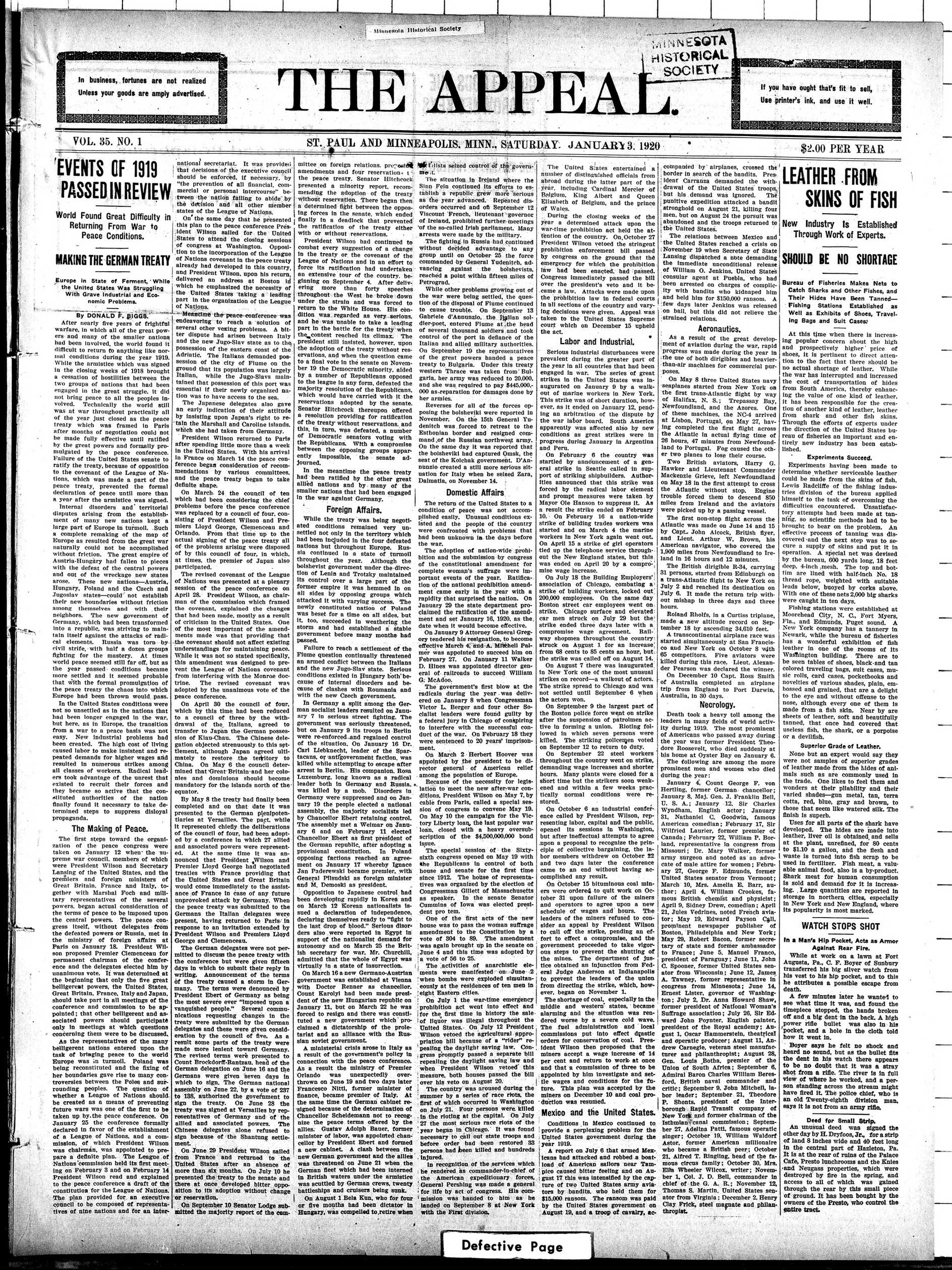
EVENTS OF 1919 PASSED IN REVIEW
World Found Great Difficulty in Returning From War to Peace Conditions.
MAKING THE GERMAN TREATY
Europe in State of Ferment, While the United States Was Strugging With Grave Industrial and Economic Problems.
BY DONALD F. BIGGS
After nearly five years of frightful warfare, in which all powers and many of the smaller nations had been involved, the world found it difficult to return to anything like normal conditions during the year 1919. While the armistice which was signed in the closing weeks of 1918 brought a cessation of hostilities between the two groups of nations that had been engaged in the great struggle, it did not bring peace to all the peoples involved. Technically the world still was at war throughout practically all of the year just closed as the peace treaty which was framed in Paris after months of negotiation could not be made fully effective until ratified by the great powers and formally promoted by the peace conference. Failing the United States Senate to ratify the treaty because of opposition to the covenant of peace, the nations, which was made a part of the peace treaty, prevented the formal declaration of peace until more than a year after the armistice was signed.
Internal disorders and 'territorial disputes arising from the establishment of many new nations kept a large part of Europe in turmoil. Such a complete remaking of the map of Europe as resulted from the great war naturally could not be accomplished without friction. The great empire of Austria-Hungary had fallen to pieces with the defeat of the central powers and out of the wreckage new states arose. These new nations—Austria, Hungary, Poland and the Czech and Jugoslav states—could not establish their new boundaries without friction among themselves and with their neighbors. The new government of Germany, which had been transformed into a republic, was striving to maintain a defence against the attacks of radical civil strife, with half a dozen groups fighting for the mastery. At times world peace seemed still far off, but as the year passed conditions became more settled and it seemed probable that with the formal promulgation of the peace treaty the chaos into which Europe had been thrown would pass.
In the United States conditions were not so unsettled as in the nations that had been longer engaged in the war, but here, as in Europe, the transition from a war to a peace basis was not easy. New industrial problems had been created. The high cost of living caused labor to make insistent and repeated demands for higher wages and resulted in numerous strikes among all classes of workers. Radical leaders took advantage of the unrest that existed to recruit their forces and they became so active that the constituted authorities of the nation finally found it necessary to take determined steps to suppress disloyal propaganda.
The Making of Peace.
The first steps toward the organization of the peace congress were taken on January 12 when the supreme war council, members of which were President Wilson and Secretary Lansing of the United States, and the premiers and foreign ministers of Great Britain, France and Italy, together with Marshal Foch and military representatives of the several powers, began actual consideration of the peace congress, which was upheld upon the central powers. The peace congress itself, without delegates from the defeated powers or Russia, met in the ministry of foreign affairs at Paris on January 18. President Wilson proposed Premier Clemenceau for permanent chairman of the conference and the delegates elected him by unanimous vote. It was determined at the beginning that only the five great belligerent powers, the United States, Great Britain, France, Italy and Japan, should take part in all meetings of the congress, and that other belligerent and associated powers should participate only in meetings at which questions concerning them were to be discussed.
As the representatives of the many belligerent nations entered upon the task of bringing peace to the world Europe was in turnm. Poland was being reconstituted and the fixing of her boundaries gave rise to many controversies between the Poles and surrounding peoples. The question of whether a League of Nations should be created as a means of preventing future wars was the first to be taken up by the peace conference. On January 25 the conference formally declared in favor of the establishment of a League of Nations, and a commission, of which President Wilson was chairman, was appointed to prepare a definite plan. The League of Nations' commission held its first meeting on February 3 and on February 14 President Wilson read and explained to the peace conference a draft of the constitution for the League of Nations. The plan provided for an executive council to be composed of representatives of nine nations and for an inter-
national secretariat. It was provided that decisions of the executive council should be enforced, if necessary, by "the prevention of all financial, commercial or personal intercourse" between the nation falling to abide by the decision and all other member states of the League of Nations.
On the same day that he presented this plan to the peace conference President Wilson sailed for the United States to attend the closing sessions of congress at Washington. Opposite to the incorporation of the League of Nations he coveted in the peace treaty already had developed in this country, and President Wilson, upon his return, delivered an address to Boston in which he emphasized the necessity of the United States taking a leading part in the organization of the League of Nations.
Meantime the peace conference was endeavoring to reach a solution of several other vexing problems. A bitter dispute had arisen between Italy and the new Jugo-Slav state as to the possession of the eastern coast of the Adriatic. The Italians demanded possession of the city of Flume on the ground that its population was largely Italian, while the Jugo-Slav maintained that possession of this port was essential if their newly organized nation was to have access to the sea.
The Japanese delegates also gave an early indication of their attitude by insisting that Japan's right to retain the Marshal Islands, which she had taken
President Wilson returned to Paris after spending little more than a week in the United States. With his arrival in France on March 14 the peace conference began consideration of recommendations by various committees, and the peace treaty began to take definite shape.
On March 24 the council of ten which had been considering the chief problems before the peace conference was replaced by a council of four, consisting of President Wilson and Premiers Lloyd George, Clemenceau and Orlando. From that time up to the actual signing of the peace treaty all of the problems arising were disposed of by this council of four, in which, at times, the premier of Japan also participated.
The revised covenant of the League of Nations was presented at a plenary session of the peace conference on April 28. President Wilson, as chairman of the commission which framed the covenant, explained the changes that had been made, mostly as a result of criticism in the United States. One of the most important of the amendments to the covenant should not affect existing understandings for maintaining peace. While it was not so stated specifically, this amendment was designed to prevent the League of Nations covenant from interfering with the Monroe doctrine. The revised covenant was adopted by the unanimous vote of the peace conference.
On April 30 the council of four, which by this time had been reduced to a council of three by the withdrawal of the Italians, agreed to transfer to Japan the German possession of Klaun-Chau. The Chinese delegation objected strenuously to this settlement, although Japan agreed ultimately to restore the territory to China. On May 6 the council deterred the Great Britain and her colonies and mandatory should become mandates for the islands north of the equator.
By May 8 the treaty had finally been completed and on that date it was presented to the German朋potentierites at Versailles. The pact, while it represented chiefly the deliberations of the council of four, had been adopted by a conference in which 27 allied and associated powers were represented. At the same time it was announced that President Wilson and Premier Lloyd George had negotiated treaties with France providing that the United States and Great Britain would immediately to the assistance of France in case of any future war. While the peace treaty was submitted to the Germans the Italian delegates were present, having returned to Paris/ in response to an invitation extended by President Wilson and Premiers Lloyd George and Clementeau.
The German delegates were not permitted to discuss the peace treaty with the conference but were given fifteen days in which to submit their reply in writing. Announcement of the terms of the treaty caused a storm in Germany. The terms were denounced by President Ebert of Germany as being the most severe ever "imposed upon a vanquished people." Several communications requesting changes in the treaty were submitted by the German delegates and these were given consideration as a result some parts of the treaty as a result made more lenient toward Germany. The revised terms were presented to Count Brockordt-Rantzau head of the German delegation on June 16 and the Germans were given seven days in which to sign. The German national assembly on June 22, by a vote of 237 to 138, authorized the government to sign the treaty. On June 28 the treaty was signed at Versailles by representatives of Germany and of the allied and associated powers. The Chinese delegates alone refused to sign because of the Shantung settlement.
On June 29 President Wilson sailed from France and returned to the United States after a period of more than six months. On July 10 presented the treaty to the senate and there at once developed bitter opposition to its adoption without change or reservation.
On September 10 Senator Lodge submitted the majority report of the com-
Minnesota Historical Society
THE APPEA
ST. PAUL AND MINNEAPOLIS, MINN., SATURDAY. JANUARY 3. 1920
mittee on foreign relations, present amendments and four reservation to the peace treaty. Senator Hitchcock presented a minority report recommending the adoption of the treaty without reservation. There began then a determined fight between the opposing forces in the senate, which ended finally in a deadlock that prevented the ratification of the treaty either with or without reservations.
Cities seized control of the government.
The situation in Ireland where the Sainte Foin continued the efforts to establish a republic grew in serious as the year advanced. Repaired disorders occurred and of September 12 Viscount French, lieutenant governor of Ireland, prohibited further-meetings of the so-called Irish parliament. Many arrests were made by the military.
The United States entertained a number of distinguished officials from abroad during the latter part of the year, including Cardinal Mercier of Belgium, King Albert and Queen Elizabeth of Belgium, and the prince of Wales.
During the closing weeks of the year, a determined attack upon the war-ready prohibition act held the attention of
President Wilson had continued to combat every suggestion of a change in the treaty or the covenant of the League of Nations and in an effort to force its ratification had undertaken an extensive tour of the country, beginning on September 4. After delivering more than forty speeches throughout the West he broke down under the strain and was forced to return to the White House. His condition was regarded as very serious, and he was unable to take a leading part in the battle for the treaty when the contest reached its climax. The president still insisted, however, upon the adoption of the treaty without reservation, and when the question came to a final vote in the senate on November 19 the democratic minority, aided by a number of Republicans opposed to the league in the form of defeat the majority resolution of the Republicans, which would have carried reservations adopted by the senate. Senator Hitchcock thereupon offered a resolution providing for ratification of the treaty without reservations, and this, in turn, was defeated, a number of Democratic senators voting with the Republicans. With a compromise between the opposing groups apparently impossible, the senate adjourned.
In the meantime the peace treaty had been ratified by the other great allied nations and by many of the smaller nations that had been engaged in the war against Germany.
While the treaty was being negotiated conditions remained very unsettled not only in the territory which had been in included in the four defeated nations but throughout Europe. Russia continued in a state of turmoil throughout the year. Although the bolshievest government under the direction of Lenin and Trotsky maintained its control over a large part of the former empire it was hemmed in on all sides by opposing groups which attacked it with varying success. The newly constituted nation of Poland was beset for a time on all sides, but it soon, succeeded in weathering the storm and had established a stable government before many months had passed.
Failure to reach a settlement of the Flume question continually threatened an armed conflict between the Italian and the new Jugo-Slav state. Serious conditions existed in Hungary both because of internal disorders and because of clashes with Roumania and wift the new Czech government.
In Germany a split among the German socialist leaders resulted on January 7 in serious street fighting. The government was seriously threatened, but on January 9 its troops in Berlin were re-enforced and regained control of the situation. On January 16 Dr. Carl Liebkehner, leader of the Spartacus, or antigovernment faction, was killed while attempting to escape after arrest in Berlin. His companion, Rosa Luxemburg, long known as a radical leader both in Germany and Russia, was killed in disorder. Germany were suppressed in January 19 the people elected a national assembly, the majority socialists led by Chancellor Ebert retaining control. The assembly met a Wernar on January 6 and on February 11 elected Chancellor Ebert as first president of the German republic, after adopting a provisional constitution. In Poland opposing factions reached an agreement on January 17 whereby Ignace Jan Paderewski became premier, with General Pilsudski as foreign minister and M. Demoski as president. Opposition to Japanese control had been developing rapidly in Korea and on March 12 Korean nationalists issued a declaration of independence, declaring themselves ready to "fight to the last drop of blood". Serious disorders also occurred. The national demand for autonomy and on March 21 the British secretary for war, Mr. Churchill, admitted that the whole of Egypt was virtually in a state of insurrection.
On March 16 a new Germano-Austrian government was established at Vienna with Doctor Renner as chancellor. Count Karolyi had been president of the new Hungarian republic on January 11, but on March 22 he was forced to resign and there was constituted a new government which proclaimed a dictatorship of the proteriat and an alliance with the Russian soviet government. A minister of state rose in Italy as the government's policy in connection with the peace conference. As a result the ministry of Premier Orlando was unexpectedly overthrown on June 19 and two days later Francesco Nitti, former minister of finance, became premier of Italy. At the same time the German cabinet resigned because of the determination of Chancellor Scheidmann not to recognize the peace terms offered by the allies. Gustav Adolph Bauer, former minister of labor, was appointed chancellor by President Ebert and formed a new cabinet. A clash between the new German government and the unchanged on June 21 when the German fleet which had been interned in British waters under the armistice was scuffled by German crews, twenty battleships and cruisers beaten. On August 1 Bela Kun, who for four or five months had been dictator in Hungary, was compelled to retire when
Foreign Affairs.
Ustiza seized control of the government.
The situation in Ireland where the Sinn Fein continued its efforts to establish a republic grew more serious as the year advanced. Repeated disorders occurred and on September 12 Viscount French, lieutenant governor of Ireland, prohibited further meetings of the so-called Irish parliament. Many arrests were made by the military.
The fighting in Russia had continued without decided advantage to any group until on October 25 the force commanded by General Yudenich, advancing against the bisholves, reached a point within fifteen miles of Protograd.
While other problems growing out of the war were being settled, the question of the disposal of Flume continued to cause trouble. On September 13 Gabriele d'Annonzio, the Italian soldier-poet, entered Flume at the head of several thousand soldiers and took the port in defence of the Italian and French coasts. On September 19 the representatives of the great powers handed a peace treaty to Bulgaria. Under this treaty western Thrace was taken from Bulgaria, her army was reduced to 20,000, and she was required to pay $445,000,000 as-reparation for damages done by her armies.
Reverses for all of the forces opposing the bolshevki were reported in November. On the 15th General Yudenich was forced to retreat to the Estonian border and resigned command of the Russian northwest army. On the same day it was reported that the bolshevki had captured Omsk, the seat of the Kolchak government, D'Annunzi created a still more serious situation for Italy when he seized Zara, Dalmatia, on November 14.
The return of the United States to a condition of peace was not accomplished easily. Unusual conditions existed and the people of the country were confronted with problems that had been unknown in the days before the war.
The adoption of nationwide prohibition and the submission by congress of the constitutional amendment for complete woman's suffrage were important events of the year. Ratification of the national prohibition amendment came early in the year with a rapidity that surprised the nation. On January 29 the state department proclaimed the ratification of the amendment and set January 16, 1920, as the date when it would become effective.
On January 9 Attorney General Gregory tendered his resignation, to become effective March 4, and A. Mitchell Palmer was appointed to succeed him on February 27. On January 11 Walker D. Hines was appointed director general of railroads to succeed William G. McAdoo.
The government's first blow at the war ended during the year was delivered on January 8 when Congressman Victor L. Berger and four other Socialist leaders were guilty by a federal jury in Chicago of conspiring to interfere with the successful conduct of the war. On February 18 they were sentenced to 20 years' imprisonment.
On March 2 Herbert Hoover was appointed by the president to be director general of American relief among the population of Europe.
Because of the necessity for legislation to meet the new after-war conditions, President Wilson on May 7, by cable from Paris, called a special session of congress to convene May 19. On May 10 the campaign for the Victory Liberty loan, the last popular war loan, closed with a heavy oversubscription of the $4,500,000,000 bond issue.
A special session of the Sixtexth congress opened on May 19 with the Republicans in control of both house and senate for the first time since 1912. The house of representatives was organized by the election of Congressman Gillett of Massachusetts as speaker. In the senate Senator Cummins of Iowa was elected president pro tem.
One of the first acts of the new house was to pass the woman suffrage amendment to the Constitution by a vote of 304 to 89. The amendment was again brought up in the senate on June 4 and this time was adopted by a vote of 304 to 89.
The duties of anarchic elements were manifested on June 2 when bombs were exploded simultaneously at the residences of ten men in eight Eastern cities.
On July 1 the war-time emergency prohibition act went into effect and for the first time in history the sale of liquor was illegal throughout the United States. On July 12 President Wilson vetored the agricultural appropriation bill because of a "tiger" repealing the daylight saving law. Congress promptly passed saving law and repealing daylight saving law. President Wilson vetored this measure, both houses passed the bill over his veto on August 20.
The country was aroused during the summer by a series of race riots, the first of which occurred in Washington on July 21. Four persons were killed in the rioting at the capital. On July 27 the most serious race riots of the year began in Chicago. It was found necessary to call out state troops and before order had been restored 33 persons had been killed and hundreds injured.
In recognition of the services which he rendered as commander-in-chief of the American forces, General Pershing was made a general for life by act of congress. His commission was handed to him as he landed on September 8 at New York with the First division.
Domestic Affairs
Defective Page
The United States entertained a number of distinguished officials from abroad during the latter part of the year, including Cardinal Mercier of Belgium, King Albert and Queen Elizabeth of Belgium, and the prince of Wales.
During the closing weeks of the year a determined attack upon the war-time prohibition act held the attention of the country. On October 27 President Wilson vetoed the stringent prohibition enforcement bill passed by congress on the ground that the emergency for which the prohibition law had been enacted, had passed, over the president's veto and it became a law. Attacks were made upon the prohibition law in federal courts in all sections of the country and varying decisions were given. Appeal was taken to the United States Supreme court which on December 15 upheld the act.
Labor and Industrial.
Serious industrial disturbances were prevalent during the greater part of the year in all countries that had been engaged in war. The series of great strikes in the United States was inaugurated on January 9 by a walkout of marine workers in New York. This strike was of short duration, however, as it ended on January 12, pending the arrival of dispatches by the war labor board. South America apparently was affected also by new conditions as great strikes were in progress during January in Argentina and Peru.
On February 6 the country was startled by announcement of a general strike in Seattle called in support of striking shipbuilders. Authorities announced that this strike was forced by the radical labor element and prompt measures were taken by Mayor Ole Hanson to suppress it. As a result the strike ended on February 10. On February 16 a nation-wide strike of building trades workers was started and on March 4 the marine workers in New York again went out. On April 15 a strike of girl operators tied up the telephone service through the England states, but this was ended on 20 by a compromise wage increase. On July 18 the Building Employers' association of Chicago, combating a strike of building workers, locked out 200,000 employees. On the same day Boston street car employees went on strike. Chicago surface and elevated car men struck on July 29 but the strike ended three days later with a compromise wage agreement. Railway shopmen throughout the country struck on August 1 for an increase from 68 cents to 85 cents an hour, but the strike was called off on August 14. On August 7 there was inaugurated in New York one of the most unusual strikes on record—a walkout of actors. The strike spread to Chicago and was not settled until September 6 when the actors won. On September 9 the largest part of the Boston police force went on strike after the suspension of patrolmen active in forming a union. Rioting followed in which seven persons were killed. The striking policemen voted on September 12 to return to duty.
On September 22 steel workers throughout the country went on strike, demanding wage increases and shorter hours. Many plants were closed for a short time but the strikers soon weakened and within a few weeks practically normal conditions were restored.
On October 6 an industrial conference called by President Wilson, representing labor, capital and the public, opened its sessions in Washington, but after ineffectual calls to agree to a compromise to accomplish a principle of collective bargaining, the labor members withdrew on October 22 and two days later the conference came to an end without having accomplished any result.
On October 15 bituminous coal miners were ordered to quit work on October 31 upon failure of the miners and operators to agree upon a new schedule of wages and hours. The leaders of the miners refused to consider an appeal by President Wilson to call off the strike, pending an effort to effect a compromise, and the government proceeded to take vigorous steps to prevent the shutting of the mine. A law that the州 obtained an injunction from Federal Judge Anderson at Indianaapolis to prevent the leaders of the union from directing the strike, which, however, began on November 1.
The shortage of coal, especially in the middle and western states, became alarming and the situation was rendered worse by a severe cold wave. The fuel administration and local commissions put into effect drastic orders for conservation of coal. President Wilson then proposed that the miners accept a wage increase of 14 per cent and return to work at once and that a commission of three to be appointed by him investigate and settle wages and conditions for the future. This plan was accepted by the miners on December 10 and coal production was resumed.
Mexico and the United States.
Conditions in Mexico continued to provide a perplexing problem for the United States government during the year 1919.
A report on July 7 that armed Mexicans had attacked and robbed a boatload of American sailors near Tampico caused bitter feeling and on August 17 this was intensified by the capture of two United States army aviators by bandits, who held them for $15,000 ransom. The ransom was paid by the United States government on August 19, and a troop of cavalry, ac
Labor and Industrial
companied by airplanes, crossed the border in search of the bandits. President Carranza demanded the withdrawal of the United States troops, but his demand was ignored. The punitive expedition attacked a bandit stronghold on August 21, killing four men, but on August 24 the pursuit was abandoned and the troops returned to the United States.
The relations between Mexico and the United States reached a crisis on November 19 when Secretary of State Lansing dispatched a note demanding immediate unconditional release of William O. Jenkins, United States consular at Puebla, who had been arrested on charges of complicity with bandits who dismaped him and held him for $150,000. few days later Jenkins was released on bail, but this did not relieve the strained relations.
Aeronautics.
As a result of the great development of aviation during the war, rapid progress was made during the year in the use of both dirigibles and heavier-than-air machines for commercial purposes.
On May 8 three United States navy seaplanets started from New York on the first trans-Atlantic flight by way of Halifax, N. S.; Trepassay Bay, Newfoundland, and the Azores. One of these machines, the NC-4 arrived at Lisbon, Portugal, on May 27, having completed the first flight across the Atlantic in actual flying time of 26 hours, 47 minutes from Newfoundland to Portugal. Fog caused the other two planes to lose their course.
Two British aviators, Harry G. Hawker and Lieutenant Commander Mackenzie Grieve, left Newfoundland on May 18 in the first attempt to cross Atlantic without stop. Engine trouble forced them to descend 850 miles from Ireland and the aviators were picked up by a passing vessel.
The first non-stop flight across the Atlantic was made on June 14 and 15 by Captain John Alcock, British Rye, and Lieutenant W. Brown, his American navigator, who covered the 1,900 miles from Newfoundland to Ireland in 16 hours and 12 minutes.
The British dirigible R-34, carrying 31 persons, started from Edinburgh on a trans-Atlantic flight to New York on July 2 and reached its destination on July 6. It made the return trip without mishap in three days and three hours.
Roland Rhoffs, in a Curtiss triplane, made a new altitude record on September 18 by ascending 34,610 feet.
A transcontinental airplane race was started simultaneously at San Francisco and New York on October 8 with 65 competitors. Five aviators were killed during this race. Lieut. Alexander Pearson was declared the winner. On December 10 Capt. Ross Smith of Australia completed an airplane trip from England to Port Darwin, Australia, in 30 days.
Necrology.
Death took a heavy toll among the leaders in many fields of world activity during 1919. The most prominent of Americans who passed away during the year was former President Theodore Roosevelt, who died suddenly at his home at Oyster Bay on January 6. The following are among the more prominent men and women who died during the year:
$2.00 PER YEAR
LEATHER FROM SKINS OF FISH
LEATHER FROM SKINS OF FISH
New Industry Is Established Through Work of Experts.
SHOULD BE NO SHORTAGE
Bureau of Fisheries Makes Nets to Catch Sharks and Other Fishes, and Their Hides Have Been Tanned—Fishing Stations Established as Well as Exhibits of Shoes, Traveling Bags and Suit Cases:
At this time when there is increasing popular concern about the high and prospectively higher price of shoes, it is pertinent to direct attention to the fact that there should be no actual shortage of leather. While the war has interrupted and increased the cost of transportation of hides from South America, thereby enhancing the value of one kind of leather, it has been responsible for the creation of another kind of leather, leather from shark, and other fish skins. Through the office of the United States under the direction of the United States reau of fisheries an important and entirely new industry has been established.
Experiments Succeed.
Experiments having been made to determine whether serviceable leather could be made from the skins of fish, Lewis Radliffe of the fishing industries division of the bureau applied himself to the task of overcoming the difficulties encountered. Unsatisfactory attempts had been made at tanning, so scientific methods had to be brought to bear on the problem. An effective process of tanning was discovered and the next step was to secure a supply of skins and put it in operation. A special net was devised by the bureau, 600 yards long, 18 feet deep, 4-inch mesh. The top and bottom are lined with half-inch No. 18 rope, weighted with suitable leeds below, buoyed by corks above. With one of these nets, 2,000 big sharks were caught in ten days.
Fishing stations were established at Moorhead City, N. C., Fort Myers, Fla., and Edmunds, Puget Sound. A New York company has a tainery in New York, while the bureau of fisheries has a wonderful exhibition of fish leather in one of the rooms of its Washington Store. There are to be seen tables of shoes, black and tan colored travel bags, suit cases, music rolls, card cases, pocketbooks and novels of various styles, plain, embossed and grained, that are a delight to the eye and without offence to the nose, although every one of them made from a fish skin. Near by are sheets of leather, soft and beautifully tanned, that once had covered that useless fish, the shark, or a porpoise or a devilfish.
Superior Grade of Leather.
None but an expert would say they were not samples of superior grades of leather made from the hides of animals such as are commonly used in the trade. One likes to feel them and wonders at their pliability and their varied shades—gun metal, tan terra cotta, red, blue, gray and brown, to those that seem like watered silk. The finish is superb.
Uses for all parts of the shark have developed. The hides are made into leather, liver oil is obtained and sells at the plant, unrefined, for 80 cents to $1.10 a gallon, and the flesh and waste is turned into fish scrap to be used in fertilizer. Fish meat, a valuable animal food, also is a by-product. Shark meat for human consumption is sold and demand for it is increasing. Large quantities are reported in storage in northern cities, especially in New York and New England, where its popularity is most marked.
WATCH STOPS SHOT
In a Man's Hip Pocket, Acts as Armor Against Rear Fire.
While at work on a lawn at Fort Augusta, P., C. F. Boyer of Sunbury transferred his big silver watch from his vest to his hip pocket, and to this he attributes a possible escape from death.
A few minutes later he wanted to see what time it was, and found the timepiece stopped, the hands broken off and a big dent in the back. A high power rifle bullet was also in his pocket, and a hole in the cloth told how it went in.
Boyer says he felt no shock and heard no sound, but as the bullet flies to be no doubt that it appears to be no doubt that it is a stray shot from a ride. The river is full view of where he worked, and a person standing across the stream might have fired it. The police chief, who is an old Twenty- sixth division man, says it is not from an army rifle.
Deed for Small Strip.
An unusual deed was signed the other day by H. Dryfoos, Jr., for a strip of land 8 inches wide and 40 feet long in the central part of Hazleton, Pa. It is at the rear of ruins of the Palace Cafe, Presto lunchrooms and the Kules and Neuguss properties, which were destroyed by fire in the spring, and which were restored through the rear by this small pieces of ground. It has been bought by the owners of the Presto, who control the entire tract.
MINNEAPOLIS OFFICE
No. 2812 Fourth Avenue South
J. N. SELLERR, Manager.
Entered at the Postoffice in St. Paul
Minnesota, as second-class-mail
matter, June 6, 1883, under
Act of Congress,
March 3, 1879.
TERMS. STRICTLY IN ADVANCE:
SINGLE COPY, three months.....50
SINGLE COPY, six months.....1.00
SINGLE COPY, six year.....$2.00
**remittances about** be made by **Express**
**Note Ordered by** Registered
**Registered Letter** or Bank Draft. For
**stamps** will be received the same as cash for
**stamps** that are parts of a dollar. Only one
cent and two cents are allowed.
Silver should never be seet through the mail.
It is almost sure to wear a hole through the
mail. It is also it may be stolen. Fervous
warns you of the risk in letters do so on their own risk.
**Harrage and death notices** 10 lines or less $1.
**Court notices** 10 lines or less $7. Signature
satisfies in advance, and to be announced at
all must come in season to be news.
**Advertising rates** 15 cents per笔 line, each
in an inch, and about seven笔 lines
on an笔 line. No single advertisement less
than a discount allowed on less than
three months. No discount allowed on
company all orders from parties unknown to us.
Further partisans on application.
**Reading notices** 15 cents per line, each insertion.
No matter is set in brevier type-about six
words to the line. All head lines count
**the date on the address label shows when**
subcription expires. Renewals should be
made two weeks prior to expiration, so that
may be missed, as the paper stops
when time is out.
1) occasionally happens that papers sent to sub-
nets do not receive any number when due, inform
by postal card at the expiration of five days
or by email at the address on the order
a duplicate of the missing number.
Communications to receive attentions must be
neway, upon important subjects, plainly
disclosed, and not to be missed. We must
reach us Tuesday if possible, anyway
not later than Wednesday, and bear the硅
turned, unless stamps are sent for postage.
We do not hold ourselves responsible for the
views of our correspondents.
Students should be aware everywhere. Write
for terms. Sample copies free.
In every letter that you write us never fail to give your full name and address, plainly written, post office, county and state. Kindness letters of all kinds must be written on separate sheets from letters containing news or matter for publication.
"Any prejudice whatever will be insurmountable if those who do not share in it themselves truckle to it and flatter it and accept it as a law of nature." — John Stuart Mill.
---
SATURDAY, JANUARY 3, 1919.
THE NEW YEAR, 1920.
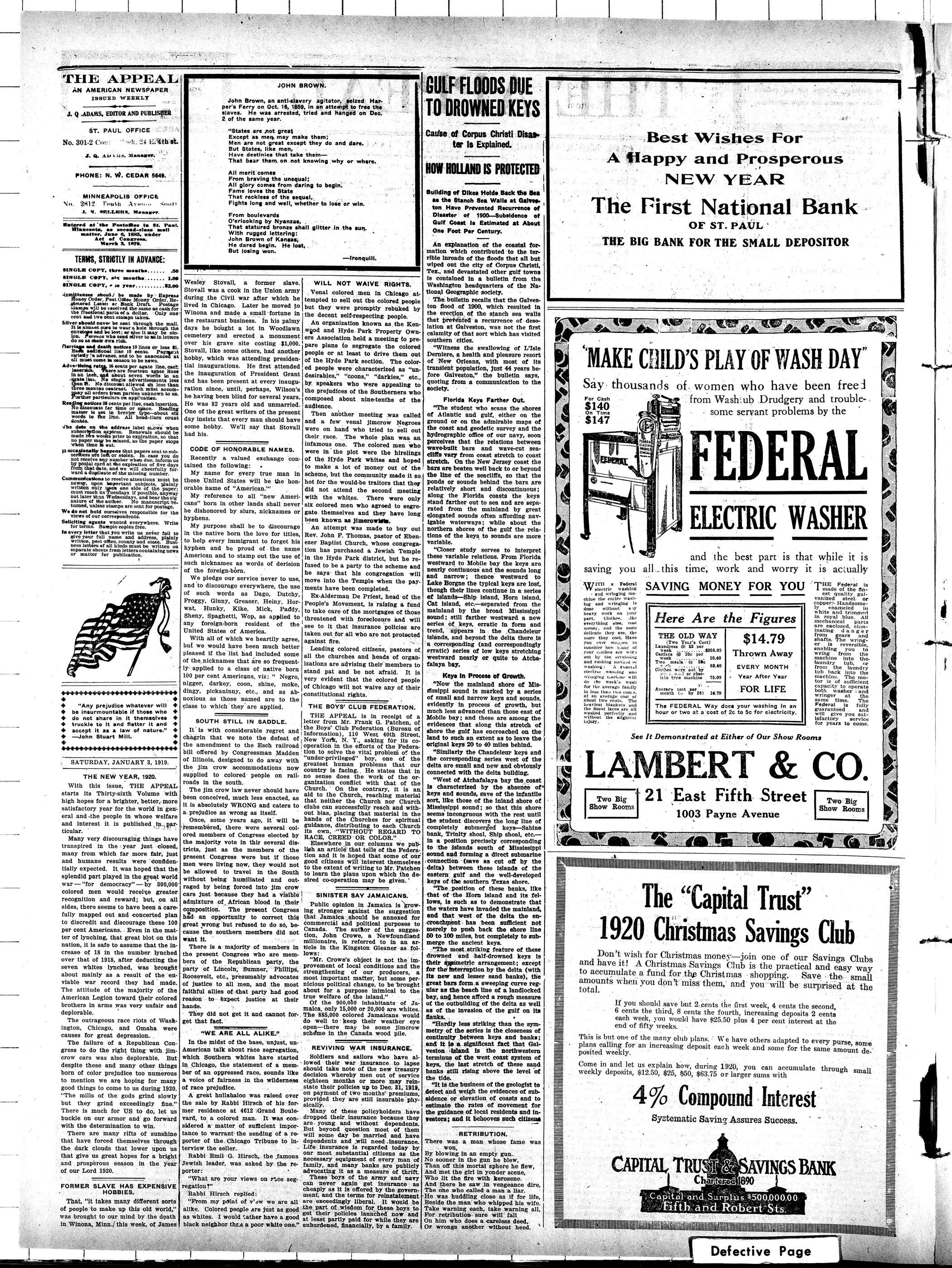
With this issue, THE APPEAL starts its Thirty-sixth Volume with high hopes for a brighter, better, more satisfactory year for the world in general and -the people in whose welfare and interest it is published in particular.
Many very discouraging things have transpired in the year just closed, many from which far more fair, just and humane results were 'confidently expected. It was hoped that the splendid part played in the great world war—"for democracy"—by 600,000 colored men would receive greater recognition and reward; but, on all sides, there seems to have been a carefully mapped out and concerted plan to discredit and discourage these 100 per cent Americans. Even in the matter of lynching, that great blot on this nation, it is safe to assume that the increase of 18 in the number lynched over that of 1918, after deducting the seven whites lynched, was brought about mainly as a result of the enviable war record they had made. The attitude of the majority of the American Legion toward their colored brothers in arms was very unfair and deplorable.
The outrageous race riots of Washington, Chicago, and Omaha were causes for great depression.
The failure of a Republican Congress to do the right thing with jim-crow cars was also deplorable. But despite these and many other things born of color prejudice too numerous to mention we are hoping for many good things to come to us during 1920.
"The mills of the gods grind slowly but they grind exceedingly fine." There is much for US to do, let us buckle on our armor and go forward with the determination to win.
There are many rifts of sunshine that have forced themselves through the dark clouds that lower upon us that give us great hopes for a bright and prosperous season in the year of our Lord 1920.
FORMER SLAVE HAS EXPENSIVE
HOBBIES.
That, "it takes many different sorts of people to make up this old world," was brought to our mind by the death in Winona, Minn., this week, of James
John Brown, an anti-slavery agitator, seized Harper's Ferry on Oct. 16, 1859, in an attempt to free the slaves. He was arrested, tried and hanged on Dec. 2 of the same year.
"States are not great
Except as men may make them;
Men are not great except they do and dare.
But States, like men,
Have destinies that take them—
That bear them, on not knowing why or where.
Wesley Stovall, a former slave. Stovall was a cook in the Union army during the Civil war after which he lived in Chicago. Later he moved to Winona and made a small fortune in the restaurant business. In his palmy days he bought a lot in Woodlawn cemetery and erected a monument over his grave site costing $1,000. Stovall, like some others, had another hobby, which was attending presidential inaugurations. He first attended the inauguration of President Grant and has been present at every inauguration since, until, perhaps, Wilson's he having been blind for several years. He was 82 years old and unmarried. One of the great writers of the present day insists that every man should have some hobby. We'll say that Stovall had his.
CODE OF HONORABLE NAMES.
Recently a valued exchange contained the following:
My name for every true man in these United States will be the honorable name of "American."
My reference to all "new Americans" born in other lands shall never be dishonored by slurs, nicknames or hyphens.
My purpose shall be to discourage in the native born the love for titles, to help every immigrant to forget his hyphen and be proud of the name American and to stamp out the use of such nicknames as words of derision of the foreign-born.
We pledge our service never to use, and to discourage everywhere, the use of such words as Dago, Dutchy, Froggy, Glinny, Greaser, Heiny, Horwat, Hunky, Kike, Mick, Paddy, Sheny, Spaghetti, Wop, as applied to any foreign-born resident of the United States of America.
With all of which we heartily agree, but we would have been much better pleased if the list had included some of the nicknames that are so frequently applied to a class of native born 100 per cent Americans, viz: "Negro, nigger, darky, coon, shine, moke, dingy, pickanlno, etc., and as abnoxious as those named are to the class to which they are applied.
SOUTH STILL IN SADDLE
It is with considerable regret and chagrin that we note the defeat of the amendment to the Esch railroad bill offered by Congressman Madden of Illinois, designed to do away with the jim crow accommodations now supplied to colored people on railroads in the south. The jim crow law never should have been conceived, much less enacted, as it is absolutely WRONG and caters to a prejudice as wrong as itself.
Once, some years ago, it will be remembered, there were several colored members of Congress elected by the majority vote in this several districts, just as the members of the present Congress were but if those men were living now, they would not be allowed to travel in the South without being humiliated and outraged by being forced into jim crow cars just because they had a visible admixture of African blood in their composition. The present Congress had an opportunity to correct this great wrong but refused to do so, because the southern members did not want it.
There is a majority of members in the present Congress who are members of the Republican party, the party of Lincoln, Summer, Phillips, Roosevelt, etc., presumably advocates of justice to all men, and the most faithful allies of that party had good reason to expect justice at their hands.
They did not get it and cannot forget that fact.
"We ARE ALL ALIKE."
In the midst of the base, unjust, un-American talk about race segregation, which Southern whites have started in Chicago, the statement of a member of an oppressed race, sounds like a voice of fairness in the wilderness of race prejudice.
A great hullabaloo was raised over the sale by Rabbi Hirsch of his former residence at 4612 Grand Boulevard, to a colored man. It was considered a matter of sufficient importance to warrant the sending of a reporter of the Chicago Tribune to interview the seller.
Rabbi Emil G. Hirsch, the famous Jewish leader, was asked by the reporter:
"What are your views on race segregation?"
Rabbi Hirsch replied:
"From my point of view we are all alike. Colored people are just as good as whites. I would rather have a good black neighbor than a poor white one."
WILL NOT WAIVE RIGHTS.
Venal colored men in Chicago attempted to sell out the colored people but they were promptly rebuked by the decent self-respecting people.
An organization known as the Kenwood and Hyde Park Property Owners Association held a meeting to prepare plans to segregate the colored people or at least to drive them out of the Hyde Park section. The colored people were characterized as "undesirables," "coons," "darkies," etc., by speakers who were appealing to the prejudices of the Southernners who composed about nine-tenths of the audience.
Then another meeting was called and a few venal jimcrow Negroes were on hand who tried to sell out their race. The whole plan was an infamous one. The colored men who were in the plot were the hirelings of the Hyde Park whites and hoped to make a lot of money out of the scheme, but the community made it so hot for the would-be traitors that they did not attend the second meeting with the whites. There were only six colored men who agreed to segregate themselves and they have long been known as jimcrow.
An attempt was made to buy out Rev. John F. Thomas, pastor of Ebenezer Baptist Church, whose congregation has purchased a Jewish Temple in the Hyde Park district, but he refused to be a party to the scheme and he says that his congregation will move into the Temple when the payments have been completed.
Ex-Alderman De Priest, head of the People's Movement, is raising a fund to take care of the mortgages of those threatened with foreclosure and will see to it that insurance policies are taken out for all who are not protected against fire.
Leading colored citizens, pastors of all the churches and heads of organizations are advising their members to stand pat and be not afraid. It is very evident that the colored people of Chicago will not waive any of their constitutional rights.
THE BOYS' CLUB FEDERATION.
THE APPEAL is in receipt of a letter from Mr. Frank G. Patchen, of the boys' Club Federation (Bureau of Information), 110 West 40th Street, New York, N. Y., asking for its cooperation in the efforts of the Federation to solve the vital problem of the "under-priviled" boy, one of the greatest human problems that our country is facing. He states that in no sense does the work of the organization conflict with that of the Church or the contrary, it is an aid to the Church teaching material that neither the Church nor Church clubs can successfully reach out bias, placing that material in the hands of the Churches for spiritual guidance, distributing to each Church its own, "WITHOUT REGARD TO RACE, CREED OR COLOR."
Elsewhere in our columns we publish an article that tells of the Federation and it is hoped that some of our good citizens will interest themselves to the extent of writing to Mr. Patchen to learn the plans upon which the desired co-operation may be given.
SINISTER SAY JAMAICANS.
Public opinion in Jamaica is growing stronger against the suggestion that Jamaica should be annexed for commercial and political purposes to Canada. The author of the suggestion, John Crowe, a Newfoundland millionaire, is referred to in an article in the Kingston Gleaner as follows:
"Mr. Crowe's object is not the improvement of local conditions and the strengthening of our producers, a most important matter, but some pernicious political change, to be brought about for a purpose imical to the true welfare of the island."
Of the 900,000 inhabitants of Jamaica, only 15,000 or 20,000 are whites. The 885,000 colored Jamaicans would do well to keep their weather eye open—there may be some jimcrow scheme in the Canada wood pile.
REVIVING WAR INSURANCE.
Soldiers and sailors who have allowed their war insurance to lapse should take note of the new treasury decision whereby men out of service eighteen months or more may reinstate their policies up to Dec. 31, 1919, on payment of two months' premiums, provided they are still insurable physically.
Many of these policyholders have dropped their insurance because they are young and without dependents. But beyond question most of them will some day be married and have dependents and will need insurance. Life insurance is regarded today by our most substantial citizens as the necessary equipment of every man of family, and many banks are publicly advocating it as a measure of thrift.
These boys of the army and navy can never again get insurance as cheaply as it is offered by the government, and the terms for reinstatement are occasionally liberal. It would be the part of the government that boys to get their policies launched, at least partly paid for while they are unburdened, financially, by a family.
Cause of Corpus Christi Disaster Is Explained.
HOW HOLLAND IS PROTECTED
Building of Dikes Holds Back the Sea as the Stanch Sea Walls at Galveston Have Prevented Recurrence of Disaster of 1900—Subsidence of Gulf Coast is Estimated at About One Foot Per Century.
An explanation of the coastal formation which contributed to the terrible inroads of the floods that all but wiped out the city of Corpus Christi, Tex., and devastated other Gulf towns is contained in a bulletin from the Washington headquarters of the National Geographic society.
The bulletin recalls that the Galveston flood of 1900, which resulted in the erection of the stanch sea walls that prevented a recurrence of desolation at Galveston, was not the first calamity of that sort which has visited southern cities.
"Witness the swallowing of L'Isle Derniere, a health and pleasure resort of New Orleans, with most of its transient population, just 44 years before Galveston," the bulletin says, quoting from a communication to the society.
Florida Keys Farther Out.
"The student who scans the shores of Atlantic and gulf, either on the ground or on the admirable maps of the coast and geodetic survey and the hydrographic office of our navy, soon perceives that the relations between wave-built bars and wave-cut seacliffs vary from coast stretch to coast stretch. On the New Jersey coast the bars are beaten well back to or beyond the line of the seacliffs, so that the ponds or sounds behind the bars are relatively short and discontinuous; along the Florida coasts the keys stand farther out to sea and are separated from the mainland by great elongated sounds often affording navigable waterways; while about the northern shores of the gulf the relations of the keys to sounds are more variable.
"Closer study serves to interpret these variable relations. From Florida westward to Mobile bay the keys are nearly continuous and the sounds long and narrow; thence westward to Lake Borgne the typical keys are lost, though their lines continue in a series of islands—Ship island, Horn island, Cat island, etc.—separated from the mainland by the broad Mississippi sound; still farther westward a new series of keys, erratic in form and trend, appears in the Chandeleur islands, and beyond the delta there is a corresponding (and correspondingly erratic) series of low keys stretching westward nearly or quite to Atchafalaya bay.
Keys in Process of Growth.
"Now the mainland shore of Mississippi sound is marked by a series of small and narrow keys and sounds, evidently in process of growth, but much less advanced than those east of Mobile bay; and these are among the evidences that along this stretch of shore the gulf has encroached on the land to such an extent as to leave the original keys 20 to 40 miles behind.
"Similarly the Chandeleur keys and the corresponding series west of the delta are small and new and obviously connected with the delta building.
"West of Atchafalaya bay the coast is characterized by the absence of keys and sounds, save of the infantile sort, like those of the inland shore of Mississippi sound; so that this shore seems incongruous with the rest until the student discovers the long line of completely submerged keys—Sabine bank, Trinity shoal, Ship shoal, etc—in a position precisely corresponding to the islands south of Mississippi sound and forming a direct submarine connection (save as cut off by the delta) between these islands of the eastern gulf and the well-developed keys of the southern Texas shore.
"The position of these banks, like that of the Horn island and its fellows, is such as to demonstrate that the waters have invaded the mainland, and that west of the delta the encroachment has been sufficient not merely to push back the shore line 50 to 100 miles, but completely to submerge the ancient keys.
"The most striking feature of these drowned and half-drowned keys is their symmetric arrangement; except for the interruption by the delta (with its new and lesser sand banks), the great bars form a sweeping curve regular as the beach line of a landlocked bay, and hence afford a rough measure of the outbuilding of the delta as well as of the invasion of the gulf on its flanks.
"Hardly less striking than the symmetry of the series is the closeness of continuity between keys and banks; and it is a significant fact that Galveston-island is the northwestern terminus of the west coast system of keys, the last stretch of these sand banks still rising above the level of the tide.
"It is the business of the geologist to detect and weigh the evidences of subsidence or elevation of coasts and to estimate the rates of movement for the guidance of local residents and investors; and it behooves such citizens
RETRIBUTION.
By blowing in an empty gun.
No sooner in the gun he blew.
Than off this mortal sphere he flew.
And met the girl in yonder scene.
Who lit the fire with kerosene.
And there he saw in vengeance dire.
The one who called a man a alar.
He was huddling close as if for life.
Beside the man who whipped his wife
who such take warning all,
For retribution there will be.
On him who does a careless deed,
Or wrongs another without heed
Best Wishes For
A Happy and Prosperous
NEW YEAR
The First National Bank
OF ST. PAUL
THE BIG BANK FOR THE SMALL DEPOSITOR
women who have been freed from Wash.ub Drudgery and troublesome servant problems by the
For Cash
$140
On Time
$147
FEDERAL
ELECTRIC
MACHINE
COOLER
FEDERAL
WITH a Federal electric washing and wringing machine the entire washing and wringing is done about 10 or 15 minutes work on your part. Clothes, like everything else, cost money, and the more delicate they are the heavier they cost. Here you ever stop to consider how many of your clothes are worn and wringed and rubbed and washing: A general electric washing and wringing machine will work for the average family in less than two hours, at an average cost of the heaviest blanks and the finest laces are all washed perfectly and the smallest injury.
SAVING MONEY FOR YOU
Here Are the Figures
THE OLD WAY
(Two Year's Cost)
Laundress @ $2 per week
Carfate @ 10c per carfate
Two meals @ 38c
Gloves worn out by your co-worker type machine
Average cost per month (by 24) $14.79
$14.79
Thrown Away
EVERY MONTH
Year After Year
FOR LIFE
The FEDERAL Way does your washing in an hour or two at a cost of 2c to 5c for electricity.
THE Federal is made of the finest quality galvanized steel, or copper. Handsome, but manmade white and trimmed in royal blue. All mechanical parts are closed, insulating danger from gears and shafts. The wringer is reversible, enabling you to wring from the material into the laundry tub from the laundry tub back into the machine. The motor is of capacity to operate both washer and wringer at the same time. Federal is fully guaranteed, and will give you satisfaction for years to come.
The "Capital Trust" 1920 Christmas Savings Club
Don't wish for Christmas money—join one of our Savings Clubs and have it! A Christmas Savings Club is the practical and easy way to accumulate a fund for the Christmas shopping. Save the small amounts when you don't miss them, and you will be surprised at the total.
If you should save but 2 cents the first week, 4 cents the second, 6 cents the third, 8 cents the fourth, increasing deposits 2 cents each week, you would have $25.50 plus 4 per cent interest at the end of fifty weeks.
This is but one of the many club plans. We have others adapted to every purse, some plans calling for an increasing deposit each week and some for the same amount deposited weekly.
Come in and let us explain how, during 1920, you can accumulate through small weekly deposits, $12.50, $25, $50, $63.75 or larger sums with
WEEK'S RECORD OF HARPENINGS
IN MINNESOTA'S CAPITOL
The "Saintly City" and Saintly City
Polks—Neway items of social, Religious, Political and General Matters Among the People.
PHONE: N. W. CEDAR 5649
SATURDAY, JANUARY 3, 1919.
THINK IN INTEREST—SAVE
WE WISH ALL A HAPPY NEW YEAR!
IF YOU HAVE NOT PAID YOUR SUBSCRIPTION FOR THE APPEAL IT IS DUE AND SHOULD BE PAID AT ONCE. THIS MEANS YOU. A DISCOUNT OF 28% WILL BE ALLOWED ON ALL SUBSCRIPTION BILLS PAID DURING THE MONTH OF JANUARY.
This year being Leap Year, there are 366 days in it.
Do you wish to learn French? For terms, Tel. Dale 857 or Dale 8246.
Mr. K. W. Mckey went to the hospital Friday of last week for an operation for hernia.
Don't wait until it begins to sprinkle before starting to lay in something for a rainy day.
Attorney W. T. Francis spent last Monday in Stillwater in connection with a pardon matter.
Miss Loucella James, 632 Central Ave., has been confined to her home this week with a cold.
OFFICE CEDAR 8948 RES. DALE 1465
W. T. FRANCIS
LAWYEF
SUITE 329
AMR, NAIL, BANK BLDG,
COR, FIFTH AND CEDAR
ST. PAUL
Rev. Daniel Hardin of Lake City,
Minn., spent New Year's in the city
greeting old time friends.
Mrs. Paul L. Caldwell, 1399 Sherburne Ave., was hostess to the Handicraft Art Club. Friday afternoon.
Mr. and Mrs. Andrew Jackson, 603 St. Anthony Ave., entertained at dinner Christmas, covers were laid for fifteen.
```markdown
```
Mr. and Mrs. Wm. Martin were dinner guests Sunday at the home of Mr. and Mrs. Walker Williams, 850 Courtland. St.
Mr. and Mrs. Geo. H. Lucas were dinner guests Christmas day at the home of Mr. and Mrs. W. W. Mills, 548 Aurora Ave.
Mrs. Carrie Mills, 642 Rondo St., is spending the holidays with her daughter, Mrs. W. Stanton and family of Chicago.
ROOMS WANTED—Three or four nice rooms furnished or unfurnished. Must be in a first class neighborhood. Tel. Cedar 5335.
Office: Cedar 508 T.-S. 21 508
Res.: 678 St. Anthony Ave.
Tel. Dale 2047
T. H. LYLES
FUNERAL DIRECTOR AND EMBALMER
Twin City Calls Answered
Day or Night
Lady Assistant When Desired
150 W. Fourth St. ST. PAUL
Atty. and Mrs. W. T. Francis and
Mr. and Mrs. R. B. Chapman were
guests of Mr. and Mrs. C. E. James
Christmas night.
Mr. and Mrs. Quitman Hicks, 953
Rondo St., entertained at a family
dinner party on Christmas day. Covers were laid for twelve.
The editor of THE APPEAL has
been drawn for service on the grand
jury of Ramsey County for three
months, beginning January 5th.
Mrs. Norman Bradshaw arrived in
the city Christmas morning from Chicago to spend Christmas with her husband. She will return this week.
When you wish to write a letter home, you can get paper and envelopes FREE at the "Gentlemen's Resort," cor. St. Anthony and Kent.
Mr. A. F. Bradford of 406 Rondo street is spending the holidays with his mother, Mrs. E. Lowery and sister, Mrs. H. A. Boyd, of Nashville, Tenn.
PIONER LODGE NO. 1, F. AND A. M. meets first and third Monday in each month at Union Hall, corner of Aurora streets, at 8:00 p.m. J. H. Dillingham, W. M. W. S. Archer, Seyc, 493 Carroll Ave.
Dr. V. D. Turner had his tonsils removed on last Saturday and suffered a severe hemorrhage therefrom. He was detained from the office several days.
A good New Years resolution:
"Resolved that I will go to the State Savings Bank each payday and add at least 10% of my pay to a savings account Savings earn interest.
State Savings Bank
93 East Fourth Street
Mr. and Mrs. James Fraction, 69
Macalester Ave., are the parents of
a baby boy which was born on Dec.
16th. The young man weighed but
four pounds at birth.
St. Paul Lodge of Elks, Gopher No.
105 and Minneapolis Lodge, Ames
No. 106, donated $10.00 each to
provide Christmas cheer for the inmates
of Crispus Attucks Home.
Don't wait to buy your groceries
on Sunday as you may not be able
to get them. The authorities are ar-
ranging to enforce the law against
selling groceries on Sunday.
Mrs. Mary B. Tallert of Buffalo,
N. Y., National President of the
Women's Federation is in the city
the guest of her sister, Mrs. W. R.
Hardy, 518 St. Anthony Avenue.
A number of friends and relatives
assembled at the home of Mr. and
Mrs. Edward James, 274 Kent St., on
New Year's night and enjoyed a
regular old fashioned get-together: party.
Rev. E. H. McDonald, formerly of St. Paul and Pittsburgh, now residing in Hannibal, Mo., was in the city a few days ago the guest of Mr. and Mrs. Tolbert Bush, 346 Parnell street.
HOUSEHOLD OF RUTH NO. 553, G. U. of O. F., meets the third Monday in each of the four streets at 8:00 P. M. Mrs. Julia Billups, M. N. G.; Mrs. Carr. Lindsay, W. R., 918 Woodbridge street.
FOR SALE—A first-class full-dress suit for a medium sized man. Cost $75 and is as good as new. Will be sold at a bargain. Apply at P. H. Jackson's Barber Shop, 337 St. Peter street.
On Friday evening of last week Mr. J. Q. Adams accidentally fell from the door of the elevator in the Court Block and was so severely shaken up that he has been confined to his home ever since.
Mr. C. H. Miller, the only male member of the popular D. Y. W. K. Y. Club entertained the club Tuesday evening with an elaborate dinner and Christmas tree party at his home 428 Edmund St.
They had the usual splendid time at the Shriners' 12th Annual Ball last Monday evening. Mr. McKinley Brown and his partner Mrs. John Ransom won the prize of $5 in the waltz contest.
Mr. Walker Williams, at the "Gentlemen's Resort," cor. St. Anthony and Kent, will furnish paper and envelopes FREE for any gentleman who wishes to write letters to friends or foes.
Miss Elizabeth Cuthbert, 340 Iglehart Avenue, who recently returned from New York City, where she was in training at Lincoln hospital, having suffered a nervous breakdown is very ill at St. Luke's hospital.
Ladies, Mrs. Natalie Johnson, 439 Carroll avenue is corsetier for the STARTE CORSET CO., and invites you to call and have her demonstrate their corset or she will call on you if you call Summit 1177 on your phone.
Mr. Andrew Jackson, traveling instruction of dining and sleeping car crews of Canadian Pacific Ry. Co., with headquarters at Winnipeg, spent the Christmas, holidays with his wife at their home, 606 St. Anthony avenue.
Miss Adina Adams who came from Chicago Christmas Day to visit her parents returned Sunday night accompanied by her sister Miss Eydhella, who returned yesterday, to begin her duties as U. S. Census Enumerator in the twelfth ward.
The custom of New Year's calling was not so generally observed as usual. Thursday but the "Original Six": W. T. Francis, Dr. Valdo Turner, R. B. Chapman, George W. James, A. V. Hall and S. Edward Hall made the rounds just the same.
Miss Alverta Phillips, last June graduate of University of Minnesota, recently appointed social service worker through Wilder Charities for St. Paul Jeft last Saturday to accept a position at White Plains, N. Y., at a large increase in salary.
PUBLIC STENOGRAPHER — Mrs. Harriet E. Williams, stenographer for Atty. W. T. Francis, suite 329 Metropolitan Bank Building, corner Cedar and Fifth Street, will do typewriting for anyone desiring her services, at reasonable rates. Tel. Cedar 8948.
The officers, members and auxiliaries of St. James church joined in giving a New Year's Reception in honor of the new members recently added to the church, from 3 to 9 p. m. Thursday. A splendid concert followed that was also very enjoyable.
Mrs. Wm. R. Morris, and little daughter and Mrs. LaForce of Minneapolis were St. Paul visitors on last Saturday afternoon, coming over to spend the afternoon with Mrs. Lucy French, who has been confined to her home for several years by illness.
The readers of THE APPEAL will find it much to their advantage to patronize the advertisers who place their advertisements in it, thus showing that they particularly desire your patronage. Tell them you saw their ads in THE APPEAL and that will help you and us, too.
Mr. and Mrs. Wm. B. Tandy, 593 Iglehart Ave., entertained Monday night twelve couples of their friends at an old fashioned Yuletide party. Several enjoyable games were played. Prizes were won by Mrs. C. H. Roper and Mr. Hammond Turner. A delicious midnight buffet luncheonette was served.
Dr. H. I. Williams, the well known dentist who has been resting for several months, has again taken up his profession and may be found at his old location on the second floor of the Kendrick Block, 27 East Seventh street. He invites old and new patrons to call and receive the same courteous treatment and good work as of old.
The Excelsior Class of Pilgrim Baptist Sunday School was entertained by Mrs. Alice Smith of Cathedral Place last Tuesday night. A birthday time was held. The class presented Mr. Francis, its teacher, with one year's subscription to the Literary Digest and a gift bond on Browning King & Co. The teacher gave each member of the class a present.
The recently advanced plant to put an organ in the Auditorium seems to be meeting with universal approval and Mayor Hodgson has named a committee of 100 representative citizens of the city to plan the campaign to secure the necessary more than 1,000 having been seen aboard Attys. W. T. Francis and Hammond Turner have been named on the committee.
In Memoriam
In loving memory of my dearly beloved wife, Mary, B. Dillingham, who departed this life one sad year ago this day January 5, 1919.
God knows how much I miss you. I am living in hope that I shall see you again and we shall meet to part, no never.
John B. Dillingham
The ladies of Household of Ruth, 4671 G. U. O. of O. F., are making great preparations for a Valentine Masque Party at Union Hall Wednesday evening, Feb. 11. A prize will be given to the lady wearing the hand-somest and to the gentleman wearing the most comical costume. Wait and watch for further particulars.
The following interesting program was given Bst Sunday at the meeting of the Forum at Pilgrim-on-the Hill. Mr. Andrew Jackson—The Porters Mutual Benefit Association of Canada. Duet—Dorothy and Ermine Hall. Mr. Fred Inge—Address on music. Mrs. Mattie Blair—Solo (Since You went Away); Paul Crane—Address on Art. Miss Katherine Tandy Reading. Miss Parker—Solo. Miss Anna. Arnold—Paper Toussaint L'Overture.
The United Social Six were honored with a Christmas Eve dinner party at the residence of Mr. Eugene Harris, 553 Rondo. The party was of extraordinary interest and the final plans were laid for the entertainment of the extremely hopeful Twin City friends at the United Social Six. Sixth annual dancing party at Union Hall on Christmas night. Mr. John Williams was guest of honor and made several worthy suggestions which were readily accepted.
The Christmas Dancing Party of the United Social Six was the most brilliant affair of our social holiday season. A large number of friends of the Club were assembled at this affair than ever before. The costumes were gaily gorgeous and the merry songs were lively and the celebrations of the season. The United Social Six Santa Claus distributed presents from the extremely attractive and beautiful Christmas tree which radiated its feeling of pleasure to all about it by means of its effective lighting. The evening was thoroughly enjoyed by all present.
On Tuesday night at St. Peter Claver's Catholic church special services were held in recognition of Father S. L. Theobald's nine years of service in the parish, and in celebration of the paying off of the mortgage on the church property. A special song service by the choir under direction of E. H. Slater were given as follows: A "Vinil solo by Emil Culotta," "The Crucifix," baritone solo; Wallace Dailey; "Ave Maria," sonrano solo, Mrs. John Salvator, and "O Salutaris," soprano solo, Mrs. Hattie Oliver. Miss Cella Maley sang "Stabat Mater" during the benediction.
MEMORIAL MENTIONINGS.
The year just passed was a year of constructive work with Memorial Baptist Church, along both spiritual and material lines. Over four thousand dollars were raised by the church and its auxiliaryes and nearly a hundred members added. $267.00 were paid for interest and $2,000 were paid on the principal debt.
Christmas was made delightful for every one last Friday evening by the Sunday school program, the Christmas tree and old Santa Claus.
Mr. Wm. Mapp, of St. Paul, and Mrs. Augusta Morton, of Minneapolis were married at the home of Mr. Mapp, 598 Robert Street, Wednesday evening, December 24th, Rev. T. J. Carr, officiating.
Our Christmas sermon was preached Thursday morning by Rev. N. H. Jeltz, D. D. Both sermon and attendance were good.
The clubs winning blue ribbons of honor last year are the Twilight Circle, Mrs. C. H. Spaulding, Pres., reporting $597.00 and the Busy Bee Club, Mrs. Della Williams, Pres., reporting $590.00.
Let all people attend divine services tomorrow. Preaching at 11 a. m. and 7 p. m. S. S. at 10 a. m. B. Y. P. N. at 6 p. m.
Tel. Dale 5252 Wholesale and Retail
Largest and Best Equipped Hair Parlor in N. W.
$10,000 Stock of Hair Goods.
WILSON'S
Hair Manufacturing, Millinery Co.
and Beauty Parlors
C. F. O N. F. WILSON, PROPS.
DISTRIBUTORS OF THE FAMOUS KASHMIR, HIGH BROWN
AND BLACK AND WHITE TOILET PREPARATIONS.
NOTAH ANTISCEPTIC MEDICATED POMADE.
Shampoo Cultivating Combs.
$5. Special Creole Switches $5.
Our Method of Cultivating Hair Entirely Different.
PRICES REASONABLE FOR FIRST CLASS SERVICE
425 UNIVERSITY AVE.
SAINT PAUL, MINN.
Hair Manufacturing
and Beauty
C. F. O N. F. W.
DISTRIBUTORS OF THE FAMOUS
AND BLACK AND WHITE TOW
NOTAH ANTISCEPTIC E
Shampoo Cultiv
85. Special Creel
Our Method of Cultivating
PRICES REASONABLE FOR
425 UNIVERSITY AVE.
KARRAS I
(Formerly Str
Manufacturing, Millinery
and Beauty Parlors
C. P. & N. F. WILSON, PROPS.
BUYERS OF THE FAMOUS KASHMIR, HIGH
BLACK AND WHITE TOILET PREPARATIONS
NOTAH ANTISCEPTIC MEDICATED POMADE.
Shampoo Cultivating Combs.
$5. Special Creole Switches $5.
Air Method of Cultivating Hair Entirely Different
ICES REASONABLE FOR FIRST CLASS SERVI
ERSITY AVE.
SAINT PAUL
RRRAS DRUG
(Formerly Straight Bros.)
KARRAS DRUG CO.
PRESCRIPTION DRUGGISTS
740 RONDO, COR. GROTTO
Telephone Orders P
ELECTRIC SUPPLIES DRUG S
OVERTON'S HYGENIC "HIG
T. S. PHONE 85 407
Tel. Cedar 9282
UTLEY'S
BARBER SHOP LUN
Shaving, Hair Cutting, Shar
Massage. Shoe Shining. B
Tobacco. Newspapers
Class Home Cooked
POOL PARLOR OPEN E
311 WABASHA ST.
Telephone Orders Promptly Deliveries
SUPPLIES DRUG SUNDRIES KODA
BUTTON'S HYGENIC "HIGH BROWN PREPARA
IONE 85 407 N. W. PHONE E
Sedar 9282 Laundry
STLEY'S PLACE
LUBER SHOP LUNCH POOL PARLOR
Bag, Hair Cutting, Shampooing, Head and
Message. Shoe Shining. Best Brands of Cigars,
Cigarocco. Newspapers and Magazines. Fi-
t Class Home Cooked Meals served in rear
POOL PARLOR OPEN EVERY NIGHT UNTIL
WABASHA ST. ST. P.
L. DALE 4963 QUICK SERVI
ELECTRIC SUPPLIES DRUG SUNDRIES KODAK SUPPLIES
OVERTERT HYGENIC "HIGH BROWN PREPARATION"
UTLEY'S PLACE BARBER SHOP LUNCH POOL PARLOR Shaving, Hair Cutting, Shampooing, Head and Face Massage, Shoe Shining. Best Brands of Cigars and Tobacco. Newspapers and Magazines. First Class Home Cooked Meals served in rear.
311 WABASHA ST. ST. PAUL
TEL. DALE 4963
COLEMAN'S CAFE
B. C. COLEMAN, PROPRIETOR
388 KENT STREET
COR. ST. ANTHONY
ST. PA
1920
We thank you for
ronage during
and wish you
and pro
New
The
Amer
HOUSE FUN
22-24 E.7th. St.
Northwestern
MANUFACT
Rubber and
Metal STA
OF EVERY D
110 EAST THIRD ST.
We thank you for your valued p
ronage during the past year
and wish you a joyous
and prosperous
New Year
The
America
HOUSE FURNISHING
22-24 E.7th. St. near Waba
northwestern Stamp W
MANUFACTURERS OF
and
STAMPS
OF EVERY DESCRIPTION
THIRD ST.
ST. PA
We thank you for your valued patronage during the past year and wish you a joyous and prosperous New Year
The American
HOUSE FURNISHING CO.
22-24 E.7th. St. near Wabasha
Northwestern Stamp Works.
Rubber and Metal STAMPS
LOG CABIN
SYRUP
Here's the breakfast that makes men smile
It's the delightful way of getting the wonderful food value of wheat—mankind's most dependable and economical food. Log Cabin R St.Paul
St. Paul, Minn.
Defective Page
During, Millinery Co.
Beauty Parlors
WILSON, PROPS.
FAMOUS KASHMIR, HIGH BROWN
TOILET PREPARATIONS.
MEDIC MEDICATED POMADE.
Multivating Combs.
Creeole Switches $5.
Giving Hair Entirely Different.
FOR FIRST CLASS SERVICE
SAINT PAUL, MINN.
DRUG CO.
Straight Bros.)
Promptly Delivered
SUNDRIES KODAK SUPPLIES
HIGH BROWN PREPARATION"
N. W. PHONE DALE 151
Laundry Office
S PLACE
BRUNCH POOL PARLOR
Shampooing, Head and Face
Best Brands of Cigars and
Cars and Magazines. First
Meals served in rear.
EVERY NIGHT UNTIL 12
ST. ST. PAUL
QUICK SERVICE
ST. PAUL
for your valued pat-
ing the past year
you a joyous
rosperous
new Year
erican
URNISHING CO.
St. near Wabasha
Stamp Works.
ACTURERS OF
DESCRIPTION
ST. PAUL, MINN.
e's the breakfast
that makes men smil
Golden brown wheat cakes
—packed-full of nourish-
ment—and
TOWLE'S
LOG CABIN
CANE AND
MAPLE SYRUP
Log Cabin Syrup not only makes wheat cakes a real treat, but adds nourishment—makes a balanced meal. Products Co. Paul, Minn.
```markdown
```
R. N. TRAVIS, PROP. THANN'S JERRY LEE, MGR.
HOTEL, CAFE AND POOL ROOM
HEADQUARTERS FOR RAILROAD AND
THEATRICAL FOLK
PORTERS' AND WAITERS'
INFORMATION BUREAU
GENTLEMEN'S HEADQUARTERS
FINE FURNISHED ROOMS IN CONNECTION
7 EAST THIRD ST.
B. E. COLEMAN, MGR.
ST. PAUL
ASTORIA -- SANITARY -- SYSTEM
CLEANING REPAIRING PRESSING
Dry Cleaning
Suits Sponged
and Pressed
New Collars
368 WABASHA
Near Fifth Street
WE CALL AND DELIVER
PHONE
N. W. Jackson 2096
Shoe Repairs
Dyed & Shined
Laundry
Baths
R. H. Anderson Archie Brown
NEXT TO PARKER'S DRUG STORE, ST. PAUL.
COSMOPOLITAN GROCERY
First Class Staple and Fancy Groceries Vegetables, Fruits, Confectionery, Ice Cream Cigars, Tobacco, Cigarettes.
Strictly Cash and Carry System
558 ST. ANTHONY SAINT PAUL
PHONES N. W. CEDAR 8081
TRI-STATE 25485
NIGHT PHONE:
N. W. CEDAR 9088
AIL TO VISIT
S JERRY LEE, MGR.
POOL ROOM
BROAD AND
LK
ST. PAUL
KNOWN AS
"THANN"
FREE BATHS
D WAITERS'
IN BUREAU
HEADQUARTERS
MS IN CONNECTION
ST. PAUL
JOHN H. HARRIS
QUICK SERVICE WE CALL AND DELIVER
MITARY SHOP
CLOTHES
FRENCH DRY
CLEANING
LADIES SUITS DRY
CLEANED $1.50 & UP
ST. PAUL, MINN.
YOU WAIT
TARY - - SYSTEM
RING PRESSING
BASHA
On Street
D DELIVER
N E
son 2096
Shoe Repairs
Dyed & Shined
Laundry
Baths
Archie Brown
BUG STORE, ST. PAUL.
A. E.
F. B. SIMPSON GEO. W. WILLS
Tel. Dale 1914 Tel. Dale 2541
Office Phones:
Cedar 1024 Tri-State 24 240
SIMPSON & WILLS
Undertakers, Funeral Directors
and Embalmers
Calls Answered Promptly Day or
Night
Lady Assistant When Desired
Office and Chapel
WEST FOURTH ST. ST. PAUL
224
WE WISH ALL A HAPPY NEW YEAR!
IF YOU HAVE NOT PAID YOUR SUBSCRIPTION FOR THE APPEAL IT IS DUE AND SHOULD BE PAID ONCE. THIS MEANS YOU. A DISCOUNT OF 25% WILL BE ALLOWED ON ALL SUBSCRIPTION BILLS PAID DURING THE MONTH OF JANUARY.
Never dispute with a man more than 70 years of age, or with a woman of any age.
Headquarters are to be opened here in the interest of Senator Hiram Johnson and will be in charge of Andy Rahn.
Mr. Charles E. Butler, the popular taxicab man, now has his office at Stewart's Hotel, 246 Fourth avenue S., Tel. Main 2869.
The Hair Shop, 715 Sixth Ave. N., has in stock all the new "NILE QUEEN" toilet articles manufactured by the Kashmir Chemical Co., Chicago. They are the last word in beautifiers.
Mesdames Price & Smeddler, 715 Sixth Ave. No., having just graduated from the Ynell School, are now prepared to give Scientific Swedish Body Massage to those desiring this excellent treatment at office or residence. Tel. Hyland 5633.
Pride of the West Co. No. 1, Uniform Rank K. P., the Twin Cities' finest, and staff, will give a military dance at the Coliseum, Lake street and 27th avenue S., Monday night, January 5, 1920. Watch their step and further notices.
Gentlemen, when you are in St. Paul call at the "Gentlemen's Resort" cor. St. Anthony and Kent, for a shave, game of pocket billiards or for free stationery to write letters to your home town. Mr. Walker Williams, proprietor, will treat you right.
CARD OF THANKS.
I wish to thank my many friends and acquaintances for their sympathy and kindness to me during the last illness and at the death of my beloved wife. I also tender my thanks to the pastor and officers of Bethesda Baptist church; Rev. D. E. Beasley, the chair and Mr. John Allison for their services. Also to Bethesda Missionary Society, Mr. Henry Mortimer, Miss Peaches. Fishback, Mr. and Mrs. Charles Harrison; the Pulpit Aid Society of Bethesda, Mr. and Mrs. W. M. Williams, Mrs. B. G. Sunrise, Mrs. Lillian Fisher, and to the others who failed to affix cards, for their beautiful floral tributes.
Respectfully,
JOHN W. ELTIS,
20 W. 29th St.
WHAT KIND OF BEE ARE YOU?
By Elbert W. Gilles.
I know a bee,
"A used to be,"
A very worthy man is he;
But what he's going now to be.
Is not apparent yet to me.
I know a bee,
"A going to be,"
A very worthy man is he;
But what he's going to do or be,
Is not apparent yet to me.
I know a bee,
A bumble bee,
A trouble maker rife is he;
For making trouble here and there,
He is a peach without compare.
I know a bee,
A honey bee,
A worker diligent is he;
With wholesome food for all mankind,
His hive with honey sweet is lined.
What kind of bee
Are you to be?
As you go forth upon life's sea,
An active, useful, working bee
Or drone or trouble maker free?
Minneapolis
MRS. ROBERT A. VAN HOOK
FASHIONABLE DRESSMAKING
AND LADIES' TAILORING
PARTY GOWNS A SPECIALTY
722 SIXTH AVENUE NORTH
MINNEAPOLIS, MINN.
STATE OF MINNESOTA, COUNTY OF Ramsey-Municipal Court, City of St. Paul.
S. S. Crosby, Plaintiff, vs. Harley G. Sullivan, Defendant, Summons.
The State of Minnesota to the above named Defendant;
You Harley G. Stiles are hereby summoned and required to answer the comment entitled, which complaint is on file in the office of the Clerk of said Court in the office of the Faul, County of Ramsey, and State of Missouri, a copy of your answer to said complaint on the subscriber, at his office, in the office of the Globe Blade, within ten days after the service of this summons upon you, ex-actually, within ten days after if you fail to answer the said complaint within the time aforesaid, the plaintiff in this action will take judgment against you, and twenty-two dollars ($122.00) with interest thereon at the rate of six per annum since December 22, 1915 together with the costs and disbursements herein.
Dated November 29th, A. D. 1915,
St. Paul, MN.
Plaintiff Attorney, St. Paul, Minn.
Office 602-4 Globe Bldg.
(12-13-19)
HOURS: 9 A. M. TO 1 P. M.
AND 2 TO 6 P. M.
SUNDAYS BY APPOINTMENT
DR. C. E. CHEEKS
DENTAL SURGEON
FIRST CLASS GUARANTEED WORK
IN ALL BRANCHES OF DENTISTRY
64 W. SEVENTH ST.
DAKOTA BLDG.
SUITE 203-204
ST. PAUL
FIRSTMILITARYBALL
We extend to our many friends a hearty invitation. General William R. Morris and staff in full unifoum will be present. There will be an exhibition drill by the Company's prize drill team.
Col. F. G. Thomas, Chairman; Sergt. Clarence A. Hughes, Sir Knight John Thornton, Sir Knight Franchie Mack, Sir Knight W. W. McCoy
EVERYBODYINVITED
LOOK AMES NO. 106 LOOK "ON TO KANSAS CITY" CLUB
South Side Auditorium
Twelth Avenue, South and Third Street, Minneapolis
We will endeavor to make this a real evening of fun and frolic for young and old. Notice!
The first 10 ladies in masque will be admitted free. Grand unmasquing promenade at 12:30. Music with pep enough for everyone.
SIX PRIZES WILL BE AWARDED FOR THE
Finest ladies costume
Best lady character
Most comical lady character
Finest gents costume
Best gentc character
Most comical gent character
EVERYBODYINVITED
TERMS TO SUIT
MARQUETTE, AVE. AT FIFTH
MINNEAPOLIS
Madame Love's Wonderful Hair Preparations
MADAME LOVE'S HAIR GROWER
Is absolutely pure and genuine.
Stops hair from falling out, gives vigor to the roots and causes an abundant growth.
Apply twice each week.
MADAME LOVE'S PRESSING OIL
Makes the hair straighter, softer and more glossy. Keeps its natural color, stops breaking off, and makes the hair beautiful.
Mad. Love's Wonder Hair Grower...50c
Double Strength Hair Grower...60c
Madame Love's Temple Grower...50c
Madame Love's Pressing Oil...50c
St. Paul Steam Laundry "The Sanitary Laundry" Works: 289-291 Rice Street near Summit Branch Office: 443 Broadway St. W. B. Webster, Mgr St. Paul
HUCKLEBERRY
You can prepare wonderful breakfasts with
The family will never tire of pancakes with that "mother's pancake" flavor, the flavor that makes Pillsbury pancakes so delightful.
Did you ever sit down to a breakfast of piping hot, golden brown Pillsbury pancakes, served with fresh butter and dripping with syrup? If you haven't you are missing what thousands of others are enjoying every morning. Try a breakfast of these tempting pancakes with that "mother's pancake" flavor. Pancakes are prepared in a few moments with Pillsbury's Pancake Flour you have only to add water.
All members of Pillsbury's Family of Foods are absolutely guaranteed. Buy Pillsbury's Pancake Flour—Pillsbury's Best Flour—Pillsbury's Wheat Cereal and Pillsbury's Health Bran.
PILLSBURY FLOUR MILLS
COMPANY
MINNEAPOLIS, MINNESOTA
Pillsbury's
BEST
XXXX
minneapolis, minnesota
Pillsbury's
Pillsbury's
Pillsbury's
colth Bran
PP-2-183
HOTEL NIG. 5064 PHONES RES. HYLAND 5716
LOUIS McCRAY, MANAGER
The Twin City Exchange
C. W. DWYER, PROPRIETOR
MODERN HOTEL, CAFE, BILLIARD PARLOR AND BARBER SHOP
Soft Drinks and Smokers Needs
Special Rates to Railroad, Hotel and Theatrical People
Uniforms Tailored Domestic Help Furnished
OFFICE OF C. W. D. TRANSFER CO.
507-9-11 Fourth St. S. Minneapolis, Minn
Makes a specialty of Limousine Service and showing the Twin Cities and suburbs. Rates Reasonable.
246 4th Ave. So.
Stewart Hotel FORMERLY WITH PENCE AUTO CO. MINNEAPOLIS
Defective Page
Northern Savings Bank
IN CONNECTION WITH
AMERICAN NATIONAL BANK
UNITED STATES
Start 1920 Right
Open a Savings
Account
With $1 or More, and
“Let Us Serve You”
TRUSTEES
Ben Baer, President.
H. Thrason, Vice Pres.
Otto Bregner, Vice Pres.
L. H. Ickler, Cashier.
H. B. Hunason.
W. L. Goodkind.
H. W. McQuaid.
C. C. Eureen.
Clas. H. F. Smith.
J. H. Weed.
Adolf Bremer.
NORTHERN
SAVINGS BANK
SEVENTH at ROBERT
SAINT PAUL
DO YOU KNOW
THAT FOR SERVICE AND QUALITY THE
Capitol Steam Laundry
CANNOT BE SURPASSED
We do French Dry Cleaning, Dyeing and Wet or Rough
Dry Laundering. A trial will convince you that
this is the laundry you want.
PHONE AND A DRIVER WILL CALL
CEDAR 4622
TRI STATE 21939
743 WABASHA ST.
SAINT PAUL
A. C. GUYE
INSURANCE BROKER
Health, Accident, Life and
Fire Insurance
Individual policies written from 1 month to 70 yeaas. Premiums from 5 to 50 cents weekly. Benefits paid weekly and monthly.
Call or write
420-22 Palace Bldg. or 253 15th Ave S. Minneapolis, Minn.
TEL. DALE 7056 RES. DALE 3146
Leifman Bros.
RONDO TAILORING CO.
CUSTOM TAILORS
FULL LINE OF GENTS FURNISHINGS
CLEANING. REPAIRING PRESSING
497-499 RONDO ST. ST. PAUL, MINN.
THE HAIR SHOP
All the Latest Electrical Sanitary Equipment, Licensed Expert Artists, Scalp Treatment, Hair Care, Manicuring, Manicuring, Facial Massage, Chiropractic