The Appeal
Saturday, June 2, 1923
St. Paul, Minnesota
Page text (machine-generated)
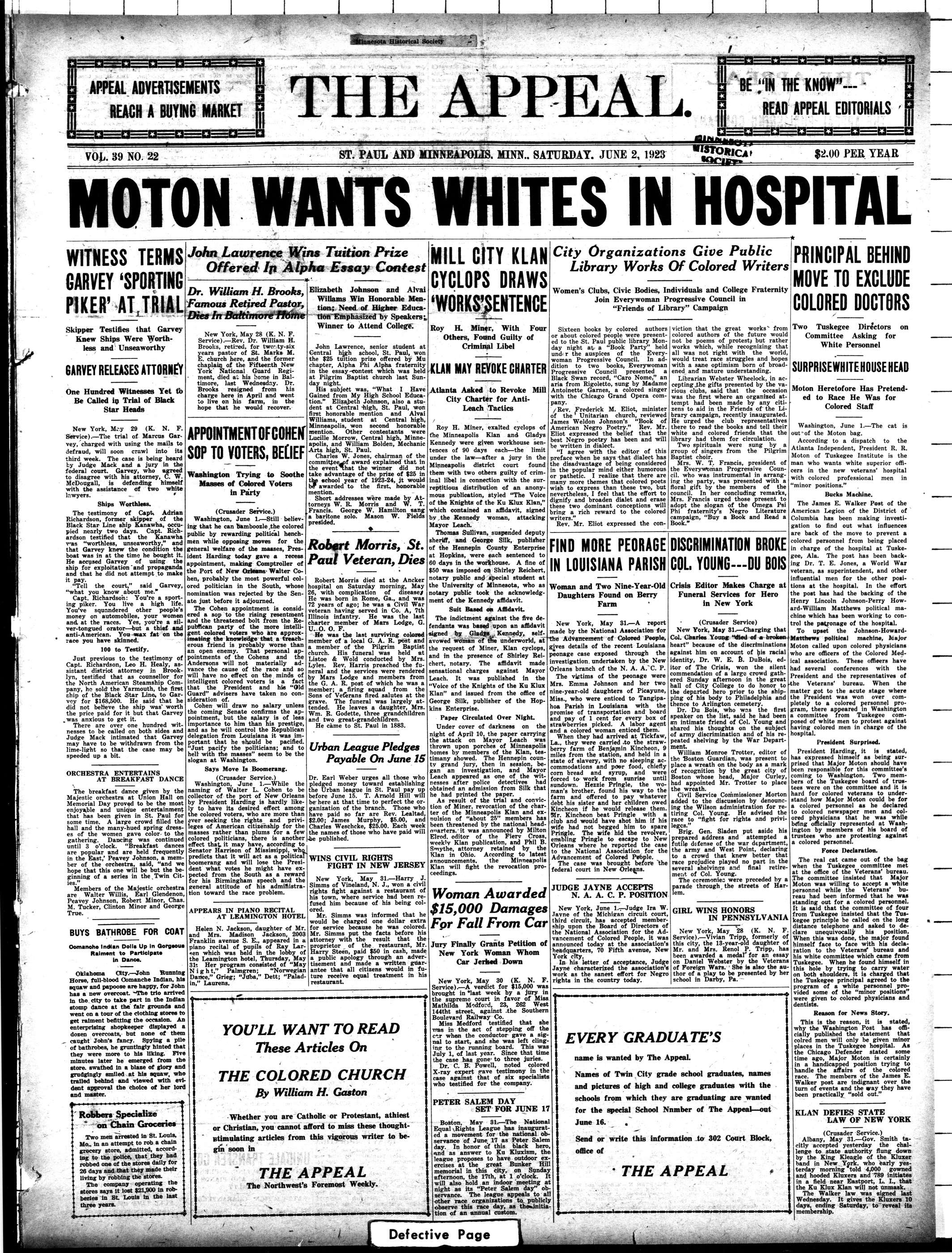
MOTON WANTS WHITES IN HOSPITAL
APPEAL ADVERTISEMENTS
REACH A BUYING MARKET
VOL. 39 NO. 22
MOTON
WITNESS TERMS
GARVEY 'SPORTING
PIKER' AT TRIAL
John Lawren
Offered
Dr. William H.
Famous Retired
Dies In Battima
Skipper Testifies that Garvey Knew Ships Were Worthless and Unseaworthy
GARVEY RELEASES ATTORNEY
One Hundred Witnesses Yet to Be Called in Trial of Black Star Heads
New York, May 29 (K. N. F. Service).—The trial of Marcus Garvey, charged with using the mails to defraud, will soon crawl into its third week. The case is being heard by Judge Mack and a jury in the federal court. Garvey, who agreed to disagree with his attorney, C. W. McDougall, is defending himself with the assistance of two white lawyers.
Ships Worthless.
The testimony of Capt. Adrian Richardson, former skipper of the Black Star Line ship Kanawha, occupied nearly two days. Capt. Richardson testified that the Kanawha was "worthless, unseaworthy," and that Garvey knew the condition the boat was in at the time he bought it. He accused Garvey of using the ship for exploitation and propaganda and that he did not attempt to make it pay.
"Tell the court," said Garvey, "what you know about me." Capt. Richardson: You're a sporting piker. You live a high life. You've squandered other people's money on automobiles, your women and at the races. Yes, you're a silver-tongued orator—but a thief and anti-American. You wax fat on the race you have skipped.
100 to Testify.
Just previous to the testimony of Capt. Richardson, Leo H. Healy, assistant district attorney in Brooklyn, testified that as counselor for the North American Steamship Company, he sold the Yarmouth, the first ship of the Black Star Line, to Garvey for $168,500. He said that he did not believe the ship was worth the price paid for it but that Garvey was anxious to give it. The ship loved one hundred witnesses to be called on both sides and Judge Mack intimated that Garvey may have to be withdrawn from the lime-light so that the case may be speeded up a bit.
ORCHESTRA ENTERTAINS
AT BREAKFAST DANCE
The breakfast dance given by the Majestic orchestra at Union Hall on Memorial Day proved to be the most enjoyable and unique entertainment that has been given in St. Paul for some time. A large crowd filled the hall and the many-hued spring dresses of the women gave color to the gathering. Dancing was continued until 3 o'clock. "Breakfast dances are popular and are held frequently in the East,' Peavey Johnson, a member of the orchestra, said, "and we hope that this one will be but the beginning of a series in the Twin Cities."
Members of the Majestic orchestra are Walter Willis, Earl Glendon, Peavey Johnson, Robert Minor, Chas, M. Tucker, Clinton Minor and George True.
BUYS BATHROBE FOR COAT
Omanche Indian Dolls Up in Gorgeous Ralment to Participate in Dance.
Oklahoma City.—John Running Horse, full-blood Comanche Indian, his squaw and papoose are happy, for John has a new overcoat. The trio arrived in the city to take part in the Indian stomp dance at the fair grounds and went on a tour of the clothing stores to get ralment befitting the occasion. An enterprising shopkeeper displayed a dozen overcoats, but none of them caught John's fancy. Spying a pile of bathrobes, he gruntly hinted that they were more to his liking. Five minutes later he emerged from the store. swathed in a blaze of glory and grudgingly smiled at his squaw, who trailed behind and viewed with evident approval the choice of her lord and master.
Two men arrested in St. Louis, Mo., in an attempt to rob a chain grocery store, admitted, according to the police, that they had robbed one of the stores daily for 28 days and that they made their living by robbing the stores. The company operating the stores says it lost $21,500 in robberies in St. Louis in the last three years.
John Lawrence Wins Tuition Prize Offered In Alpha Essay Contest
YOU'LL WANT TO READ
These Articles On
THE COLORED CHURCH
By William H. Gaston
Whether you are Catholic or Protestant, atheist or Christian, you cannot afford to miss these thought-stimulating articles from this vigorous writer to begin soon in
THE APPEAL
The Northwest's Foremost Weekly.
Dr. William H. Brooks, Famous Retired Pastor, Dies In Baltimore Home
New York, May 28 (K. N. F. Service).—Rev. Dr. William H. Brooks, retired, for twenty-six years pastor of St. Marks M. E. church here, and the former chaplain of the Fifteenth New York National Guard Regiment, died at his home in Baltimore last week. He was resigned from his charge here in April and went to live on his farm, in the hope that he would recover.
APPOINTMENT OF COHEN SOP TO VOTERS, BELIEF
Washington Trying to Soothe Masses of Colored Voters in Party
(Crusader Service.)
Washington, June 1.—Still believing that he can bambooze the colored public by rewarding political henchmen while opposing moves for the general welfare of the masses, President Harding today gave a recess appointment, making Comptroller of the Port of New Orleans. Walter Cohen, probably the most powerful colored politician in the South, whose nomination was rejected by the Senate just before it adjourned.
The Cohen appointment is considered a sop to the rising resentment and the threatened bolt from the Republican party of the more intelligent colored voters who are approximating the knowledge that a treacherous friend is probably worse than an open enemy. That personal appointments of the Cohens and the Andersons will not materially aid the cause of the race and will have no effect on the minds of intelligent colored voters is a fact that the President and his "Old Guard" advisers have taken no consideration of.
Cohen will draw no salary unless the coming Senate confirms the appointment, but the salary is of less importance to him than his prestige, and as he will control the Republican delegation from Louisiana it was important that he should be pacified. "Just pacify the politicians; and to hell with the masses" seem to be the slogan at Washington.
Says Move Is Boomerang.
(Crusader Service.)
Washington, June 1.—While the naming of Walter L. Cohen to be collector of the port of New Orleans by President Harding is hardly likely to have its desired effect among the colored voters, who are more than ever seeking the rights and privileges of American citizenship for the masses rather than plums for a few colored politicians, there is another reason why the Senator Harrison of Mississippi, who predicts that it will act as a political boomerang and will lose the President what votes he might have expected from the South as a reward for his Birmingham speech and the general attitude of his administration toward the race problem.
APPEARS IN PIANO RECITAL
AT LEAMINGTON HOTEL
Helen N. Jackson, daughter of Mr. and Mrs. Madison Jackson, 2003 Franklin avenue S. E., appeared in a piano recital of pupils of Ray Larsen which was held in the lobby of the Leamington hotel, Thursday, May 31: Her program consisted of "May Night," Palmgren; "Norwegian Dance," Grieg; "Juba," Dett; "Paladin," Laurens.
Minnesota Historical Society
THE A
ST. PAUL AND MINNEAPOLIS
ANTS W
ins Tuition Prize
pha Essay Contest
MILL CI
CYCLOPS
THE APPEAL.
Elizabeth Johnson and Alvai Willams Win Honorable Mention; Need of Higher Education Emphasized by Speakers; Winner to Attend College.
John Lawrence, senior student at Central high school, St. Paul, won the $25 tuition prize offered by Mu chapter, Alpha Phi Alpha fraternity in the essay-contest which was held at Pilgrim Baptist church last Sunday night.
His subject was, "What I Have Gained from My High School Education." Elizabeth Johnson, also a student at Central high, St. Paul, won honors from念念 and Alma Williams, student at Central high, Minneapolis, won second honorable mention. Other contestants were Lucille Morrow, Central high, Minneapolis, and William Bolden, Mechanic Arts high, St. Paul.
Charles W. Jones, chairman of the committee of award explained that in the event that the winner did not take advantage of the prize of $25 in the school year of 1923-24, it would be awarded to the first, honorable addresses were made by Attorneys W. R. Morris and W. T. Francis. George W. Hamilton sang a baritone solo. Mason W. Fields presided.
Robert Morris, St.
Paul Veteran, Dies
Robert Morris died at the Anker hospital on Saturday morning, May 26, with complication of diseases. He was born in Rome, Ga., and was 72 years of age; he was a Civil War veteran having served in Co. A, 7th Illinois infantry. He was the last charter member of Mars Lodge, G. U. O. O. F.
He was the last surviving colored member of a local G. A. R. post and a member of the Pilgrim Baptist church. His funeral was held at Listeo & Wold conducted by Mrs. Lyles. Rev. Harris preached the funeral and the services were rendered by Mars Lodge and members from the G. A. R. post of which he was a member; a firing squad from the Sons of Veterans fired salutes at the grave. The funeral was largely attended. He leaves a daughter, Mrs Wm. R. Godette, three grandchildren and two great-grandchildren.
He came to St. Paul in 1883.
Urban League Pledges Payable On June 15
Dr. Earl Weber urges all those who pledged money toward establishing the Urban league in St. Paul pay up before June 15. T. Arnold Hill will be here at that time to perfect the organization of the branch. Those who have paid so much to Reeve Carlson, 20.00, Murphy, 5.00, and Charles Weschcke, $25.00. Each week the names of those who have paid will be published.
WINS CIVIL RIGHTS
FIGHT IN NEW JERSEY
New York, May 31.—Harry J. Simms of Vineland, N. J., won a civil rights fight against a restaurant of his town, where service had been refused him because of his being colored.
Mr. Simms was informed that he would be charged one dollar extra for service because he was colored. Mr. Simms put the facts before his attorney with the result that the proprietor of the restaurant, Mr Harry Steen, paid $50 in cash, made a public apology through an advertisement and made a written guarantee that all citizens would in future receive equal treatment in his restaurant.
ANT TO READ
articles On
RED CHURCH
from H. Gaston
atholic or Protestant, atheist
afford to miss these thought-
this vigorous writer to be-
APPEAL
is Foremost Weekly.
Defective Page
APP
MINNEAPOLIS, MINN.. SAT
WHIT
MILL CITY KLAN CYCLOPS DRAWS 'WORKS'SENTENCE
MILL CITY KLAN CYCLOPS DRAWS 'WORKS'SENTENCE
Roy H. Miner, With Four Others, Found Guilty of Criminal Libel
KLAN MAY REVOKE CHARTER
Atlanta Asked to Revoke Mill City Charter for Anti-Leach Tactics
Roy H. Miner, exalted cyclops of the Minneapolis Klan and Gladys Kennedy were given workhouse sentences of 90 days each—the limit under the law—a after a jury in the Minneapolis district court found them with two others guilty of criminal libel in connection with an surreptitious distribution of an anonymous publication, styled "The Voice of the Knights of the Ku Klux Klan," which contained an affidavit, signed by the Kennedy woman, attacking Mayor Leach.
Thomas Sullivan, suspended deputy sheriff, and George Silk, publisher of the Hennepin County Enterprise at Hopkins, were each sentenced to 60 days in the workhouse. A fine of $50 was imposed on Shirley Reichert, notary public and special student at the University of Minnesota, who as notary public took the acknowledgment of the Kennedy affidavit.
Suit Based on Affidavit.
The indictment against the five defendants was based upon an affidavit signed by Gladys Kennedy, self-avowed woman of the underworld, at the request of Miner, Klan cyclops, and in the presence of Shirley Reichert, notary. The affidavit made sensational charges against Mayor Leach. It was published in the "Voice of the Knights of the Ku Klux Klan" and issued from the office of George Silk, publisher of the Hopkins Enterprise.
Paper Circulated Over Night
Under cover of darkness on the night of April 10, the paper carrying the attack on Mayor Leach was thrown upon porches of Minneapolis homes by members of the Klan, testimony showed. The Hennepin county grand jury, in session, began an investigation, and Mayor Leach appeared as one of the witnesses after police detectives had obtained an admission from Silk that he had printed the paper.
As result of the trial and conviction of Miner, revocation of the charter of the Minneapolis Klan and expulsion of "about 25" members has been threatened by the national headquarters. It was ananced by Milton E. Kloss, editor of the Flew Cross, weekly Klan publication, and Phil B. Smythe, attorney retained by the Klan in Ohio. According to latest announcements, the Minneapolis Klan will fight the revocation proceedings.
Woman Awarded
$15,000 Damages
For Fall From Car
Jury Finally Grants Petition of New York Woman Whom Car Jerked Down
New York, May 30 (K. N. F. Service).—A verdict for $15,000 was brought in "last week" for jury in favor of Miss Mathilda Modford, 23, 262 West 144th street, against the Southern Boulevard Railway Co.
Miss Medford testified that she was in the act of stepping off the car when the conductor gave a signal to start, and she was left clinging to the running board. That was July 1, so last week this time the car had gone to three juries. Dr. C. B. Powell, noted colored X-ray test gave testimony in the case against that of six specialists who testified for the company.
Boston, May 31—The National Equal Rights League has inaugurated a movement for the national observance of June 17 as Peter Salem day. In honor of this black hero, and as answer to Ku Kluxism, the league proposes to have outdoor exercises at the great Bunker Hill memorial in this city, on Sunday afternoon, the 17th, at 1 o'clock. It will also hold an indoor meeting at night as its "Peter Salem day" observance. The league appeals to all other race organizations to publicly observe this race day, as the initiation of an annual custom.
City Organizations Give Public Library Works Of Colored Writers
Women's Clubs, Civic Bodies, Individuals and College Fraternity Join Everywoman Progressive Council in "Friends of Library" Campaign
EVERY GRADUATE'S
name is wanted by The Appeal.
Names of Twin City grade school graduates, names and pictures of high and college graduates with the schools from which they are graduating are wanted for the special School Nnmber of The Appeal—out June 16.
Send or write this information to 302 Court Block, office of
THE APPEAL
Sixteen books by colored authors or about colored people were presented to the St. Paul public library Monday night at a "Book Party" held under the auspices of the Everywoman Progressive Council. In addition to two books, Everywoman Progressive Council presented a Black Swan record, "Caro Nome," an aria from Rigoleto, sung by Madame Antoinette Garnes, a colored singer with the Chicago Grand Opera company.
/Rev. Frederick M. Eliot, minister of the Unitarian church, reviewed James Weldon Johnson's "Book of American Negro Poetry." Rev. Mr. Eliot expressed the belief that the best Negro poetry has been and will be written in dialect.
"I agree with the editor of this preface when he says that dialect has the disadvantage of being considered in the popular music with pathetic I realize that there are many themes that colored poets wish to express than these two, but nevertheless, I feel that the effort to dignify and broaden dialect and erase these two dominant conceptions will bring a rich reward to the colored writers."
Rev. Mr. Eliot expressed the con-
Woman and Two Nine-Year-Old Daughters Found on Berry Farm
New York, May 31—A report made by the National Association for the Advancement of Colored People, gives details of the recent Louisiana peonage case exposed through the investigation undertaken by the New Orleans branch of the N. A. A. C. P. The victims of the peonage were Mrs. Emma Johnson and her two nine-year-old daughters of Picayune, Miss., who were enticed to Tangipahoa Parish in Louisiana with the promise of transportation and board and pay of 1 cent for every box of strawberries picked. A labor agent and a colored woman enticed them.
When they had arrived at Tickfaw, La., they were carried to the strawberry farm of Benjamin Kincheon, 9 miles from the station, and held in a state of slavery, with no sleeping accommodations and poor food, chiefly corn bread and syrup, and were forced to work from sunrise until sundown. Hezzie Pringle, the woman's brother, found his way to the farm and offered to pay whatever debt his sister and her children owed Kincheon if he would release them. Mr. Kincheon beat Pringle with a club and would have shot him if his wife had not begged him to spare Pringle. The wife hid the revolver, enabling Pringle to escape to New Orleans where he reported the case to the National Association for the Advancement of Colored People. The case was brought before the
The case was brought before the federal court in New Orleans.
JUDGE JAYNE ACCEPTS
N. A. A. C. P. POSITION
New York, June 1—Judge Ira W. Jayne of the Michigan circuit court, third circuit, has accepted membership upon the Board of Directors of the National Association for the Advancement of Colored People, it was announced today at the association's headquarters, 70 Fifth avenue, New York City. A letter of acceptance, Judge Jayne characterized the association's work as the sanest effort for Negro rights in the country today.
BE "IN THE KNOW"--- READ APPEAL EDITORIALS
viction that the great works' from colored authors of the future would not be poems of protest; but rather works which, while recognizing that all was not right with the world, would treat race struggles and hopes with a sane optimism born of broadened and mature understanding.
Librarian Webster Wheelock, in accepting the gifts presented by the various clubs, said that the occasion was the first where an organized attempt had been made by any citizens to aid in the Friends of the Library campaign, recently inaugurated.
He urged the club representatives there to read the books and tell their white and colored friends that the library had them for circulation.
Two spiritualists were sung by a group of singers from the Pilgrim Baptist choir.
Mrs. W. T. Francis, president of the Everywoman Progressive Council, was entrusted in arranging the may, was presented with a floral gift by the members of the council. In her concluding remarks, Mrs. Francis urged those present to adopt the slogan of the Omega Psi Phi fraternity's Negro Literature campaign, "Buy a Book and Read a book."
DISCRIMINATION BROKE COL. YOUNG----DU BOIS
Crisis Editor Makes Charge at Funeral Services for Hero in New York
(Crusader Service)
New York, May 81.—Charging that Col. Charles Young "died of a broken heart" because of the discriminations against him on account of his racial identity, Dr. W. E. B. DuBois, editor of The Crisis, won the silent commendation of a large crowd gathered Sunday afternoon in the great hall of City College to do honor to the departed hero prior to the shipping of his body to Philadelphia and thence to Arlington cemetery. Dr. Du Bois, who was the first speaker on the list, said he had been an intimate friend of Col. Young and shared his thoughts on the subject of army discrimination and of his repeated shelving by the War Department. William Monroe Trotter, editor of the Boston Guardian, was present to place a wreath on the body as a mark of recognition by the great city of Boston whose head, Major Curley, had appointed Mr. Trotter to place the wreath. Civil Service Commissioner Morton added to the discussion by denouncing the Wilson administration for retiring Col. Young. He advised the race to "fight for rights and privileges." Brig. Gen. Sladen put aside his prepared address and attempted a futile defense of the war department, the army and West Point, declaring to a crowd that knew better that race prejudice played no part in the several shelvings and final retirement of Col. Young.
The ceremonies were preceded by a praise through, the streets of Harlem.
GIRL WINS HONORS
IN PENNSYLVANIA
New York, May 28 (K. N. F. Service)—Vivian Tripp, formerly of this city, the 13-year-old daughter of Mr. and Mrs. Renol P. Tripp, has been awarded a medal for an essay on Daniel Webster by the Veterans of Foreign Wars. She is also the author of a play to be presented by her school in Darby, Pa.
$2.00 PER YEAR PITAL
PRINCIPAL BEHIND MOVE TO EXCLUDE COLORED DOCTORS
Two Tuskegee Directors on Committee Asking for White Personnel
SURPRISEWHITEHOUSEHEAD
Moton Heretofore Has Pretended to Race He Was for Colored Staff
Washington, June 1.—The cat is out of the Moton bag.
According to a dispatch to the Atlanta Independent, President R. R. Moton of Tuskegee Institute is the man who wants white superior officers in the new veterans' hospital with colored professional men in "minor positions."
Bucks Machine.
The James E. Walker Post of the American Legion of the District of Columbia has been making investigation to find out what influences are back of the move to prevent a colored personnel from being placed in charge of the hospital at Tuskegee, Ala. The post has been backing Dr. T. E. Jones, a World War veteran, as superintendent, and other influential men for the other positions at the hospital. In the effort the post has had the backing of the Henry Lincoln Johnson-Perry Howard-William Matthews political machine which has been working to control the patronage of the hospital. To upset the Johnson-Howard-Matthews political machine, Major Moton called upon colored physicians who are officers of the Colored Medical association. These officers have had several conferences with the President and the representatives of the Veterans' bureau. When the matter got to the acute stage where the President was won over completely to a colored personnel program, there appeared in Washington a committee from Tuskegee composed of white men to protest against having colored men in charge of the hospital.
President Surprised.
President Harding, it is stated, has expressed himself as being surprised that Major Moton should have been responsible for this committee's coming to Washington. Two members of the Tuskegee board of trustees were on the committee and it is hard for colored veterans to understand how Major Moton could be for a colored personnel as he declared to colored newspaper men and colored physicians that he was while being officially represented at Washington by members of his board of trustees who are protesting against a colored personnel.
Force Declaration.
The real cat came out of the bag when the Tuskegee committee met at the office of the Veterans' bureau. The committee insisted that Major Moton was willing to accept a white personnel while the Veterans' bureau had been informed that he was standing out for a colored personnel. It is said that the committee of four from Tuskegee insisted that the Tuskegee principle be called on the long distance telephone and asked to declare unequivocally his position. When this was done, the major found himself face to face with his declaration to the "Veterans' bureau" of the white committee which came from Tuskegee. When he found himself in this hole by trying to carry water on both shoulders, it is charged that the Tuskegee principal agreed to the program of a white personnel provided some of the "minor positions" were given to colored physicians and dentists.
Reason for News Story
This is the reason, it is stated, why the Washington Post has officially published the statement that colored men will only be given minor places in the Tuskegee hospital. As the Chicago Defender stated some time ago, Major Moton is certainly in a handcapper position trying to do the same for the black race. The members of the James E. Walker post are indignant over the turn of events and the way they have been practically "sold out."
KLAN DEFIES STATE
LAW OF NEW YORK
Albany, May 31—Gov. Smith tacitly accepted yesterday the challenge to state authority flung down by the King Kleagle of the Kluxer band in New York, who early yesterday morning told 4,000 gowned and hooded Kluxers and lioned in a field near Eastport, L. L., that this day was the day The Walker law was signed last Wednesday. It gives the Kluxers 10 days, ending Saturday, to reveal its membership.
J. Q. Adams ..... Editor-in-Chief
Roy Wilkins ..... Managing Editor
Odell D. Smith ..... Business Manager
Advertising Rates on Application
Entered at the Postoffice in St. Paul, Minnesota, as second-class mail matter, June 6, 1885, under Act of Congress, March 3, 1879.
A CHANGE FOR VOTERS
In the forthcoming primaries and the election to follow the colored voters of the twin cities have the greatest opportunity that has ever come to them to select a senator to the senate of the United States.
The crucial vote will be in the cities, where Hallam, Preus, Burnquist and Schall fight for the ballots.
It is acknowledged among politicians who know, that in ordinary elections in St. Paul the colored vote holds the balance of power. In this election, with fourteen candidates, nine of whom are Republicans, all scrambling for the nomination, the man who can swing a block of votes in the two cities will no doubt carry the cities.
A block of black votes is waiting for the right man to declare himself. Party lines mean nothing. The black citizen is interested, of course, in the tariff, in immigration, in freight rates, the world court; and the shipping tangle, but those are too far away as yet. He wants to know how a candidate will vote on the Dyer anti-lynching bill which will be re-introduced in the next congress. He wants to know that the candidate does not countenance any such infamous organization as the Ku Klux Klan. The best man will lose black and white votes a-plenty is any suspicion exists that he is being backed by the klan.
At least one candidate's stand on these matters is known. Thomas D. Schall, of Minneapolis, was one of the Rules committee of the House that made possible the passing of the Dyer bill in that body. Colored voters have yet to hear from Judge Hallam, Gov. Preus, James J. Carley, Magnus Johnson and the rest. A rumor that Judge Hallam was being backed by the klan has brought no formal denial from the candidate, and although this is an issue that is paramount with colored voters, the judge has not attempted to set them right on the matter. If colored voters will keep these things in mind and hold the vote for the man who declares himself upon them as well as upon other issues, they will aid materially in electing a successor to Knute Nelson in the United States Senate.
READ BLACK AUTHORS
Librarian Webster Wheelock spoke truly Monday night when he asked assembled colored club representatives to tell their friends about the library's list of works by colored authors, "because many of them do not know that the books are on our shelves."
One of the surest ways of developing race pride—the real article, based upon accomplishment, not rumor and boasting is to become acquainted with books and magazines by and about colored people.
No better edited magazine of its type can be found than The Crisis; no more signal journalistic accomplishment was ever recorded than the May educational number of The Messenger; no more scholarly, unbiased journal exists than Carter G. Woodson's Journal of Negro History. Space will not permit citation of the many works of merit in poetry and prose by colored men and women, nor of the works pro and con by white authors.
Last year the Omega Psi Phi fraternity one of the colored Greek letter societies began a movement to encourage the reading of Negro literature by colored people and especially colored students, from the elementary grades through the university. The shelves of the St. Paul public library offer a chance to heed the suggestion of this fraternity, for here is as complete a collection of the works of black authors as can be found in almost any library in the country. The superior accommodation given by the employees is the talk of all visitors. Buy the books of colored authors—if you are able; if you are not, go down to the library and ask an attendant for the books you wish.
BOOKER T.'S BOOMERANG
(Chicago Whip.)
Interesting things are happening down at Tuskegee Institute, where massive buildings, colossal structures and green stretches of smooth campus pay mute testimony to the money-raising genius of Booker T. Washington. The Southern people are threatening to blow up these buildings, demolish those beautiful grounds and assassinate Robert Rus-
sa Moton, the successor of the late Booker T. It was Booker T., who skillfully hoodwinked his own people, caught the ear of the white South and put his hand into the pocket of the benevolent North—thus Tuskegee and its lofty walls. It was Booker T. who startled the world with his program for black people. He promulgated and advocated pure industrial education of the masses of his race, his words had magical effect upon his hearers when he said: "We propose to prepare the negroes to serve the white man better, we propose to produce better cooks, butlers and servants." He made it extremely difficult for the educators of the black men's minds to secure donations to carry on their work. He stamped and stigmatized his people with the badge of unfitness for the higher things in life, he organized the National-Negro Business League and used it as a pawn upon the political chess board and in the words of Judge Abernathy, a white man of the South, he succeeded in doing his race more harm than the white plague of consumption; but Tuskegee is now in jeopardy and according to our opinion it will be eventually destroyed by the white South to which he pledged his people. The wolf he petted has tasted blood and now seeks to destroy that which remains of Booker T. It is the law of compensation, it is inexorable. The pendulum which swings out must swing back again and the boomerang that Booker T. hurled from the ramparts of Tuskegee is now flying back bent on striking into the vital heart of his brain child with murderous destruction in its wake.
A hospital has been established at Tuskegee by the government of the United States, a hospital for the black veterans of the recent Armageddon. Moton, Booker T.'s pawning, fawning successor, proposed that white men come to black Tuskegee and conduct this hospital but when these white men came and started to call Moton and his fellows by their first names, such as Bob, Charlie, Warren, Mary and Sallie a flush of indignation rose upon the faces of black Americans accompanied by a storm of protest. "It is a shame; it is unfair," they cried, but the white South answers that you are but servants and technical slaves. Booker T. said so and you can't get away with anything like that down here; you never wanted social courtesy before and by the eternal Gods you shall not have it now. Did not Booker T., himself, say that the races be separate as the fingers of the hand? And did he not say that every black man must know his place? What do you mean by rising up now claiming respect and recognition and the right of self-determination? You can't do it.
Booker. T's bones lay moulding in the grave but his spirit like Banquo's ghost will not down. It is an evil spirit. Sometimes the evil that men do lives after them. Booker T. has spoken and he has written and "none of our piety nor our wit can lure him back to cancel half a line nor all our tears wipe out a word of it." The boomerang must return to the grave when Banquo's T's boomerang is now an impending danger. Watch it.
Health Talks
By E. S. WEBER, D. D. S.
Any questions regarding subjects in these articles or other dental work should be addressed to the Health Editor of the Appeal. Dr. Weber will publish the answers each week in this column.
THE CARE OF ARTIFICIAL DENTURES.
There are a goodly number of people, both young and old, who are wearing artificial dentures, more commonly known to the lalys as, plates or false teeth. There are various types and fuller cases and many varieties of partial dentures. Regardless of what type of plate you are wearing it's very important that it is kept clean. It is strange to say that some people seem to think that one does not have to be cane teeth, but that both the deform with natural teeth. They base their argument on the fact that artificial teeth are made of non-vital substance, hence they are not subject to disease as are the natural or vital teeth. They base their argument on the sight of the fact that these dentures can collect food and form calculus and they also harbor bacteria.
Artificial dentures or bridges, either fixed or removable pieces, should receive more attention in the matter of cleanliness than the nat-
ural teeth. This is necessary because neglect is sure to bring serious inflammation sooner or later. Deposits and food debris will work under the plate and will decompose, causing inflammation of the mucous membrane. Neglect of proper cleavage of the plate, or a fulness of the plate, it will also render the mouth very foul and offensive.
The mucus membrane over which the plate rest should receive a very thorough cleaning with a brush—one having bristles rather softer than those used for cleaning the natura teeth. The plate itself should be brushed twice daily over evening. Soaking it in some antiseptic solution is not sufficient. For cleaning you may sprinkle them with ordinary baking soda and scrub them vigorously with a stiff brush and water; or you may use any of the cleaning powders or soap. There are other advantages to this purpose, but they have no special advantage over the agents named. And another thing, KEEP YOUR DENTURE IN YOUR MOUTH ALL THE-TIME except for cleaning purposes. Some people take them out at night and put them to soak. There is not any particular reason that you actually get better results when the plate or plates are worn all the time.
Just for the sake of bringing this a little closer home I shall tell you, of a case that I had. I made a set of plates for a man who before losing his leg, he was neglectful and careless. The plates fit wonderful and the appearance of them was fine, so much so that the patient never experienced any discomfort whatever. I told him how to care for the dentures and cautioned him not to eat them daily. About six months later this patient came in complaining of having a sore mouth and not being able to eat. I asked him how long his mouth had been in that condition. He said he was examined the plates and his mouth. The plates were fithy and lined with food debris inside and out, and his gums were infamed with little ulcers here and there. I asked him how long had it been since he last cleaned his mouth. He said that he had never taken them and they felt so comfortable and nice. Well folks, by the time I finished lecturing to him about cleanliness he made a firm promise never to neglect his mouth again. I see this man with a smile without telling me that his plates are fine and that he brushes them daily.
Deacons Vote to Expel Own Children From Church
Sixteen members of the Baptist church at Murray, Ky., were recently expelled on various charges, including the playing of bridge and other card games, non-participation in church activities, swearing, and other violations of the church covenant. Six of those excluded were children of deacons of the church voting for the expulsion. The church has made a practice of excluding from membership all members who violate the church creed.
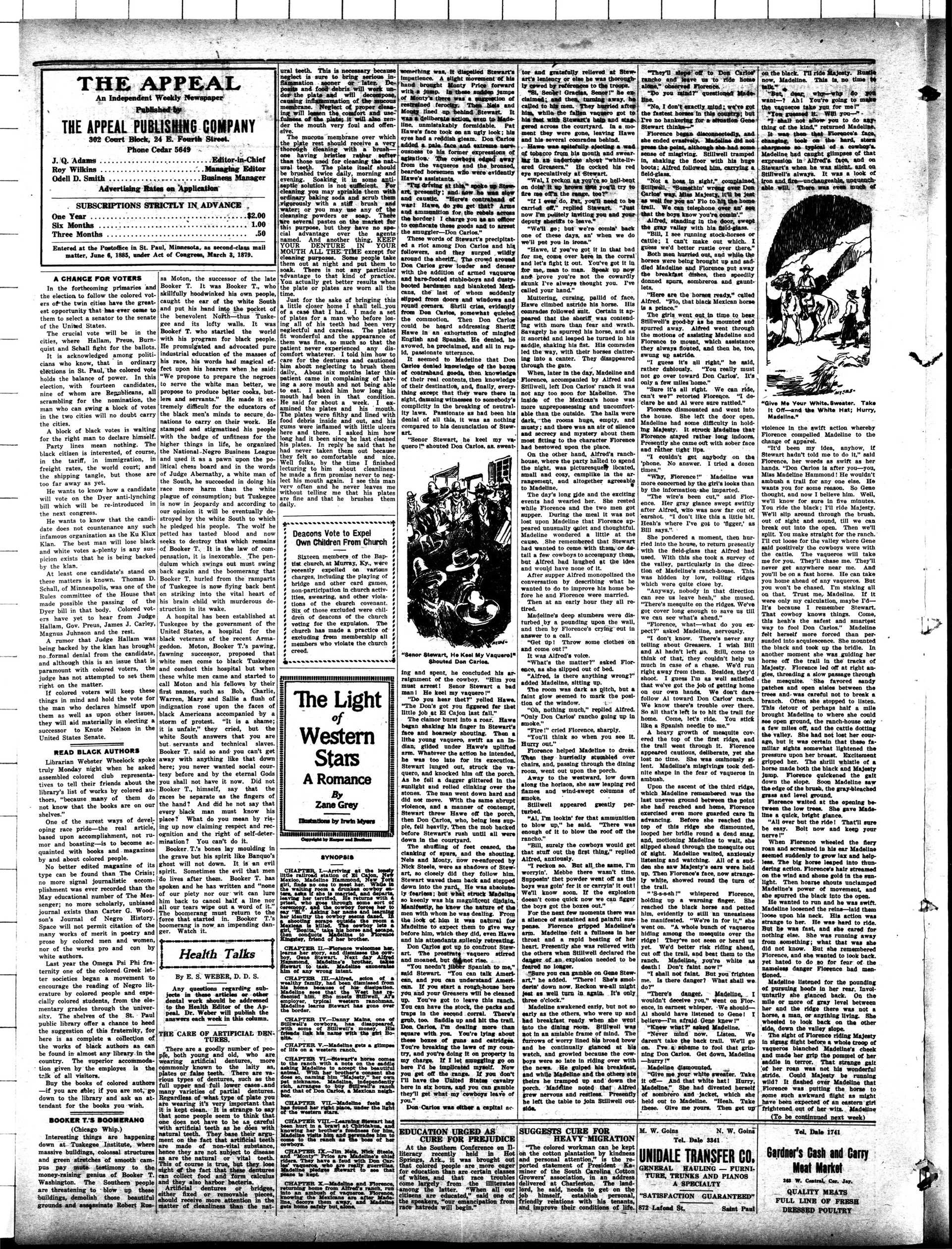
The Light
of
Western
Stars
A Romance
By
Zane Grey
Illustrations by Irwin Myers
8YNOP818
CHAPTER I.—Arriving at the lonely little railroad station of El Cajon, New Mexico, he finds no one to meet her. While in the waiting room a drunken cowboy entices her to leave her terrified. He returns with a knife to the cowboy's room, and the cowboy forces her to say "Hi." Asking her name and learning her name, the cowboy scrape outside the room a Mexican is killed. The cowboy lets a shooting scrape outside the room, and then conducts a Maledine to Florence Kingstey, friend of her brother.
CHAPTER II.—Florence welcomes her, and the cowboy, Gene Stewart, next day Alfred Hammond, Maledine's brother, takes Maledine and exorcizes him of any wrong intent.
CHAPTER III.—Alfred, sion of a wealthy family, has been dismissed from his job. Maledine sees that the West has reemerged. She meets Stillwell Alarm, Maledine's friend, with some of Stillwell's money. Maledine learns Stewart has gone over the border.
CHAPTER IV.—Danny Mansha, one of Maledine's friends, with some of Stillwell's money. Maledine links his name with the girl Girl Bob.
CHAPTER V.—Maledine gets a glimpse of life on a western ranch.
CHAPTER VI.—Stewart's horse comes to the ranch with a note on the saddle asking Madeline to accept the beautiful animal. With her brother's consent she does so, naming him "Majesty," her own nickname. Madeline, independently rich, arranges to buy Billwell's ranch and that of Don Carlos, a Mexican neighbor.
CHAPTER VIL.—Madeline feels she has found her right place, under the light of the western stars.
CHAPTER VIII.—Learning Stewart had been hurt in a brawl at Chirichana, and knowing her brother's fondness for him, Madeline visits him and persuades him to come to the ranch as the boss of her cowboys.
CHAPTER IX.—Jim Nels, Nick Steele, and "Monty" Price are Madeline's chief riders. They have a feud with Don Carliel's vaquera, who are really guerrillas. Madeline takes the stewart to see that peace is kept.
CHAPTER X.—Madeline and Florence, returning home from Alfred's ranch, run into an ambush of vaquera. Florence, knowing the Mexicans are after Madeline's decoys them away, and Madeline gets home safely but alone.
something was, it dispelled Stewart's impatience. A slight movement of his hand brought Monty Price forward with a jump. In these sudden jumps of Monty's there was a suggestion of restrained ferocity. Then Nels and Monty lined up behind Stewart. It was a deliberate action, even to Madeline, unmistakably formidable. Pat Hawce's face took on an ugly look; his eyes had a reddish gleam. Don Carlos added a pale face and extreme nervousness to his former expressions of agitation. The cowboys edged away from the vauques and the bronzed, bearded horsemen who were evidently assistants. "For the cowboys this" spoke up Stewart, present and now in the jaw and caustic. "Here's contraband of I have. Howe you do get that!" Arms and ammunition for the rebels access to confiscate these goods and to arrest the smuggler—Don Carlos."
These words of Stewart's precipitated a riot among Don Carlos and his followers, and they aurged wildly around the sheriff. The crowd around Don Carlos grew looser and denser with the addition of armed vazquez and bare-footed stable-boys and dusty-booted hardmen and blanketed Mexicans, the last of whom suddenly slipped from doors and windows and round corners. Shrill clrills, evidently from Don Carlos, somewhat quieted the commotion. Then Don Carlos could be heard addressing Sheriff Haewe in an exhortation of mingled English and Spanish. He denied, he avowed, he preclaimed, and all in rapid, passionate utterance.
It seemed to Madeline that Don Carlos desired knowledge of the boxes of contraband goods, then knowledge of their real contents, then knowledge of their destination, and finally, everything except that they were there in sight, damning witnesses to somebody's complicity in the breaking of neutrality laws. Passionate as had been his denial of all this, it was as nothing compared to his denunciation of Stewart.
"Senor Stewart, he keel my vaquero!" shouted Don Carlos, as sweet
M. M.
"Senor Stewart, He Keel My Vaquero!" Shouted Don Carlos. ing and spent, he concluded his arraignment of the cowboy. "Him you must arrest! Senor Stewart a bad man! He keel my vaquero!" "Do you hear the tether" yelled Hawe. "The Don got you figgered for the little job at El Cajon last fall." The clamor burst into a roar. Hawe began shaking his finger in Stewart's face and heartily shouting. Then a little young vaquero, swift as an Indian, under Hawe's uplifted arm. Whatever the action he intended, he was too tired to execute. Stewart lunged out, struck the vaquero, and knocked him off the stone. As he fell a dagger glittered in the sunlight and rolled clinking over the stones. The man went down hard and did not move. With the same abrupt violence, and a manner of contempt, Stewart threw Hawe off the porch, then Don Carlos, who, being less supp, fell heavily. The man had backed before Stewart's rush until all were down in the courtdar.
The shuffling of feet ceased, the clanking of spurs, and the shouting. Nels and Monty, now reenforced by Nick Steele, were as shadows of Stewart, so closely did they follow him. Stewart waved them back and stepped down into the yard. He was absolutely fearless; but what struck Madeline so keenly was his magnificent disdain. Manifestly, he knew the nature of the men with whom he was dealing. From the look of him it was natural for Madeline to expect them to give way before him, which they did, even Hawen and his attendants snailly retreating. Don Carlos got up to confront Stewart. The prostrate vaquero stirred and moaned, but did not rise.
"You needn't jibber Spanish to me," said Stewart. "You can talk American, and you can understand American. If you start a rough-house here you and your Greens will be cleaned up. You've got to leave this ranch. You can have the stock, the packs and traps in the second corral. There's grub, too. Saddle up and hit the trail. Don Carlos, I'm dealing more than square with you. You're lying about these boxes of guns and cartridges. You're breaking the laws of my country, and you're doing it on property in my charge. If I let smuggling go on here I'd be implicated myself. Now you get off the range. If you don't I'll have the United States cavalry here six hours, and you can gamble they'll get what my cowboys leave of you."
Don Carlos was either a capital nc
EDUCATION URGED AS
CURE FOR PREJUDICE
At the Southern Conference on II-literacy recently held in Hot Springs, Ark., it was brought out of the classroom for education than are certain classes of whites, and that race troubles come largely from the illiterates among the latter. When all our students are taught the speakers, "our emancipation from race hattens will begin."
tor and gratefully relieved at Stewart's lenency or else he was thoroughly owed by references to the troops.
"Si, Sebut! Gracie, Senor!" he explained; and then turning away, he called to his men. They hurried after him, while the fallen vavaro got to his feet with Stawart's hips and staggered across the courtyard. In a moment they were gone, leaving Have and his several comrades behind. Have was aptly ejecting a wad of tobacco from his mouth and swearing in an understone to "white-lieder Greaser." He cocked his red eye speculatively at Stewart. He reckoned as you're so hell-bent on dolphinning that you'll try to fire me off the range, too? "If I were do, Fat, you'll need to be carried off," replied Stewart. "Just now I'm politely inviting you and your deputy sheriffs to leave." "We'll go; but we're comma' back one of these days, an' when we do we put you in irons."
"Have, if you've got it in that bad for me, come over here in the corral and let's fight it out. You've got it in for me, man to man. Speak up now and prove you're not the cowardly skin I've always thought you. I've called your hand."
Muttering, cursing, palied of face, Have him comrades astirde his horse. His comrades followed suit. Certain it appeared that the sheerft was contending with more than fear and wrath. Savagely he spurred his horse, and as it snorted and leaped he turned in his saddle, shaking his fist. His comrades led the way, with their horses clattering into a canter. They disappeared through the gate.
When, later in the day, Madeline and Florence, accompanied by Alfred and Stillwell, left Don Carlos' ranch it was not any too soon for Madeline. The inside of the Mexican's home was more unprepossessing and uncomfortable than the outside. The halls were dark, the rooms huge, empty, and musty; and there was an air of silence and secrecy and mystery about them most fitting to the character Florence had bestowed upon the place. On the other hand, Alfred's ranch house, where the party halted to spend the night, was picturesque located, small and cozy, camplike in the arrangement, and altogether agreeable to Madeline.
The day's long ride and the exciting events had weared her. She rested while Florence and the two men got supper. During the meal it was not lost upon Madeline that Florence appeared unusually quiet and thoughtful. Madeline wondered a little at the cause. She remembered that Stewart had wanted to come with them, or detail a few cowbys to accompany them, but Alfred had laughed at the idea and would have none of it.
After supper Alfred monopolized the conversation by describing what he wanted to do to improve his home before he and Florence were married. Then at an early hour they all retired.
Madeline's deep slumers were disturbed by a pounding upon the wall, and then by Florence's crying out in answer to a call.
"Get up! Throw some clothes on and come out!"
It was Alfred's voice.
"What's the matter?" asked Florence, as she slipped out of bed.
"Alfred, is there anything wrong?" added Madeline, sitting up.
The room was dark as pitch, but a faint glow seemed to mark the position of the window.
"Oh, nothing much," replied Alfred.
"Only Don Carlos' rancho going up in smoke."
"Fire!" cried Florence, sharply.
"You'll think so when you see it. Hurry out."
Florence helped Madeline to dress.
Then they hurriedly stumbled over chairs, and passing through the dining room, went out upon the porch.
Away to the westward, low down along the horizon, she saw leaping red flames and wind-awept columns of smoke.
Stillwell appeared greatly perturbed.
"Al. I'm lookin' fer that ammunition to blow up," he said. "There was enough of it to blow the roof off the rancho."
"Bill, surely the cowboys would get that stuff out the first thing," replied Alfred, anxiously.
"I reckon so. But all the same, I'm worryin', Mebbe there wasn't time, Suppinsp' that powder went off as the boys was goin' for it or carryin' it out! Well know soon. If the explosion doesn't come quick now we can finger the boys got the boxes out."
For the next few moments there was a silence of sustained and painful suspense. Florence gripped Madeline's arm. Madeline felt a fullness in her throat and a rapid beating of her heart. Presently she was relieved with the others when Stillwell declared the danger of an explosion needed to be feared no longer.
"Sure you can gamble on Gene Stewart', he added. "There! She's smoalderin' down now. Reckon we all might jest as well turn in again. It's only three o'clock."
Madeline awakened early, but not so early as the others, who were up and had breakfast ready when she went into the dining room. Stillwell was not in an amiable frame of mind. The furrows of worry lined his broad brow and he continually glanced at his watch, and grownleased because the cowboys were so late in riding over with the news. He gulped his breakfast, and while Madeline and the others theirs he trumped up and down the porch. Madeline noted that Alfred grew nervous and restless. Presently he left the table to join Stillwell outside.
"The colored workman can be kept on the cotton plantation by kindness and personal attention," is the reported statement of President Kaminer of the South Carolina Cotton Growers' association, in an address to the governor of North Carolina, he said, needs to get on the job himself, establish personal, friendly relations with his tenants, and improve their conditions of life.
"They'll slope off to Don Carlos rancho and leave us to ride home alone," observed Florence. "Do you mind?" questioned Madeline. "No, I don't exactly mind; we've got the fastest horse in this country, but I've no hankering for a situation Gene Stewart thinks—" Florence began disconnected, and she ended awake. Madeline did not press the point, although she had some sense of misgiving. Stillwell tramped in, shaking the floor with his huge boots; Alfred followed him, carrying a field-glass. "Not a boss, in sight," complained Stillwell. "Somehain's wrong over Don Carlos' war Miss Majesty, it'll be as well for you an' Flo to hit the home trail. We can telephone over an' see that the boys know you're comin'." Alfred, standing in the door, swept the gray valley with his field-glass.
"Bill, I see running stock-horses or cattle; I can't make out which. I guess we'd better rustle over there." Both men hurried out, and while the horses were being brought up and saddled Madeline and Florence put away the breakfast dishes, then speedily donned spurs, sombreros and gauntlets.
"Here are the horses ready," called Alfred. "Flo, that black Mexican horse is a prince."
The girls went out in time to bear Stillwell's good-by as he mounted and spurred away. Alfred went through the motions of assisting Madeline and Florence to mount, which assistance they always flouted, and then he, too, swung up astirte.
"I guess it's all right," he said, rather dubiously. "You really must not go over toward Don Carlos," it's only a few miles home.
"Sure it's all right. We can ride, can't we wet?" retorted Florence. "I declare he and Al were rattled."
Florence dismounted and went into the house. She left the door open. Madeline had some difficulty in holding Majesty. It struck Madeline that Florence stayed rather long indoors. Presently she came out with sober face and rather tight lips. "I couldn't get anybody on the 'phone. No answer. I tried a dozen times." "Why, Florence!" Madeline was more concerned by the girl's looks than by the information she imparted.
She pondered a moment, then hurried into the house, to return presently with the field-glass that Alfred had used. With this she took a survey of the valley, particularly in the direction of Madeline's ranch-house. This was hidden by low, rolling ridges which were quite close by.
"Anyway, nobody in that direction can see us leave hea," she mused.
"There's mesquite on the ridges. We'll get cover long enough to save us till we can see what's ahead."
"Florence, what—what do you expect?" asked Madeline, nervously.
"I don't know. There's never any thing about Greensers. I wish Bill and think of us as. She, come to think of that, that she wouldn't much in case of a chase. We'd run right away from them. Besides, they'd shoot. I guess I'm as well satisfied that we've got the job of getting home on our own hands. We don't dare follow Al toward Don Caroline. Ranch. We know there's trouble over there. So all that's left is to hit the trail for home. Come, let's ride. You stick like a Spanish needle to me."
A heavy growth of mequite covered the top of the first ridge, and the trail went through it. Florence appeared cautious, deliberear, yet she lost no time. She was omniously silent. Madeline's misgivings took definite shape in the fear of vaqueros in ambush.
Upon the ascent of the third ridge, which Madeline remembered was the last uneven ground between the point she had reached and home. Florence exercised even more guarded care in advancing. Before she reached the top of this ridge she dismounted, looped her bridle round a dead snag, and motioning Madeline to wait, slipped ahead through the mesquite out of sight. Madeline waited, anxiously listening and watching. All of a sudden she saw Majesty's ears were held up. Then Florence's face, now strangely white, showed round the turn of the trail.
"S--s-sh!" whispered Florence, holding up a warning finger. She reached the black horse and petted him, evidently to still an uneasiness he manifested. "We're in for it," she went on. "A whole bunch of vauques hiding among the mesquite over the ridge! They've not seen or heard us yet. We'd better risk riding ahead, cut off the trail, and beat them to the ranch. Madeline, you're white as death! Don't faint now!" "I shall not faint. But you frighten me. Is there danger? What shall we do?" "There's danger. Madeline, I wouldn't deceive you," went on Florence, in earnest whisper. We should- Al should have listened to Gene! I bobbed. I'm afraid I should have. "Know what?" asked Madeline. "Never mind now. Listen. We don't take the back trail. We'll go on. I've a scheme to fool that grinning Don Carlson. Get down, Madeline—hurry!" Madeline dismounted.
"Give me your white sweater. Take it off— And that white hat! Hurry, Madeline." She had divested herself of sombrero and jacket, which she held out to Madeline. "Heah. Take these. Give me yours. Then get up
on the black. I'll ride Majesty. Hustle now, Madeline. This is no time to talk.
"But, dear, why—who do you want—? Are You're going to make the queen take on me for me!" The queen seized it. Will you—" I shall not allow you to do anything of the kind," returned Madeline. It was then that Florence's face, changing, took on the hard, stern sharpness no typical of a cowboy's Madeline had caught glimpses of that expression in Alfred's face, and on Stewart's when he was silent, and on Stillwell's always. It was a look of iron and fire—unchangeable, unquenchable will. There was even much of
A
"Give Me Your White. Sweater. Take It Off—and the White Hat; Hurry, Madeline."
violence in the swift action whereby Florence compelled Madeline to the change of apparel.
"I'd been my idea, anyhow, if Stewart hadn't told me to do it," said Florence, her words as swift as her hands. "Don Carlos is after you—you, Miss Madeline Hammond! He wouldn't ambush a trail for any one else. He wants you for some reason. So Gene thought, and now I believe him. Well, we'll know for sure in five minutes. We'll slip around through the brush, out of sight and sound, till we can break out into the open. Then well split. You make straight for the ranch. I'll cut loose for the valley where Gene said positively the cowboys were with the cattle. The vaucheros will take me for you. They'll chase me. They'll never get anywhere near me. And you'll be on a fast horse. He can take you home ahead of any vaucheros. But you won't be chased. I'm stalking on that. Trust me, Madeline. If it were only my calculation, maybe I'd—It's because I remember Stewart. That cowboy knows things. Come. You can walk away to fool Don Carlos. Madeline felt herself more forced than persuaded into acclinecence. She mounted the black and took up the bridle. In another moment she was guiding her horse off the trail in the tracks of Majesty. Florence led off at right angles, threading a slow passage through the mesquite. She favored sand patches and open aisles between the trees and—was careful not to break a branch. Often she stopped to listen. This detour of perhaps half a mile brought Madeline to where she could see open ground, the ranch-house only a few miles off, and the cattle dotting the valley. She had not lost her courage, but it was certain that these fences were open and that she needed the pressure upon her breast. Bracely gripped her. The shrill whistle of a horse made both the black and Majesty jump. Florence quickened the gait down the slope. Soon Madeline saw the edge of the brush, the gray-bleached grass and level ground.
Florence waited at the opening between the low trees. She gave Madeline a quick, bright glance. "All over but the ride! That'll sure be easy. Bolt now and keep your nerve."
When Florence wheeled the ferry roan and screamed in his ear Madeline seemed suddenly to grow lax and lessful. The big horse leaped into thundering action. Florence's hair streamed on the wind and shone gold in the sunlight. Then hoarse shouts unclamped Madeline's power of movement, and she spurred the black into the open. He wanted to run and he was swift. Madeline loosened the reins—lid them loose upon his neck. His action was strange to her. He was hard to ride. Madeline was tired, and she cared for nothing else. She was running away from something; that was she did not know. But she remembled Florence, and she wanted to look back, yet hated to do so for fear of the nameless danger Florence had mentioned.
Madeline listened for the pounding of pursuing hoofs in her rear. Involuntarily she glanced back. On the mile or more of gray level between her and the ridge there was not a horse, a man, or anything living. She wheeled to look back on the other side, down the valley slope.
The sight of Florence riding Majesty in sizg flight before a whole troop of vaqueur blanched Madeline's cheek and made her grip the pommel of her saddle in terror. That strange gain of her roan was not his wonderful stride. Could Majesty be running wild? It flashed over Madeline that Florence was putting the horse to some such awkward flight as might have been expected of an eastern girl frightened out of her wits. Madeline
The "Saintly City and Saintly City Folks—Neway Items of Social, Religious, Political and General Matters Among the People.
THE APPEAL ASKS AS A SPECIAL FAVOR THAT ITS READERSIVE PREFERENCE TO THE ADVERTISER WHO SEEK THEIR PATRONAGE BY ADVERTISING IN IT. SHOP IN THE APPEAL BEFORE SHOPPING ELSEWHERE.
Richard H. Anderson continues to improve at his home, 912 Gaultier street.
Mrs. Samuel Brown and son Floyd, are visiting relatives in Brooklyn, N. Y.
The stork visited Mrs. Robert Marshall of Minneapolis at St. Marys hospital, Sunday A. M., and left a fine boy.
Mrs. B. M. Miller is at St. Marys hospital in Rochester, Minn., for treatment.
Mrs. Amelia Turner, who has been ill for several weeks, was taken to Ancker hospital last week.
Mrs. M. A. Johnson, 975 St. Anthony avenue, entertained the Handicraft Art club Friday afternoon.
PIONEEE LORGE NO. I. F. AND A. M. mrs. M. A. and third Monday in each month at Masonie Hall, 588 Rondo St., at 8:00 P. M.; G. W. L. Jackson, W. M.; J. H. Dillingham, Secy., 569 Rondo St. Tel. Dale 6872.
Mr. T. R. Hickman who spent the winter in Canada, is in the city visiting with his family on St. Albans street.
The Charity Sewing Circle will meet Monday, June 4, at the home of Mrs. Minnie Archer, 579 W. Central avenue.
William J. Arnold, Jr., son of Mr. and Mrs. W. J. Arnold of Anoka, was graduated from the Anoka high school last night.
HOUSEHOLD OF RUTH NO. 553, G. U. O. of O. F., meets the third Monday in each month at Union Hall, corner of Aurora and Brown, at 6:00 P. M.; Jesse Brown, M. N. G. Carrie E. Lindsey, W. R. 426 Rondo street.
Mrs. Carrier Mills entertained Mr. George Hancock of Chicago at dinner Sunday. Mr. Hancock and Mrs. Mills were childhood friends and schoolmates.
Office: Cedar 0508 Res.: Dale 2947
Res.: 678 St. Anthony Ave.
MRS. T. H. LYLES
Successor to
T. H. LYLE UNDERTAKING CO.
150 W. Fourth St. ST. PAUL
FOR SALE—Eight-room house, 638 St. Anthony avenue; hot water heat, electricity, sleeping porch and laundry. Price $4,500. Can be used for two families. Inquire at 707 St. Anthony avenue. Tel. Dale 1865.
Mr. and Mrs. G. Harvey of St. Albans street, have purchased a home at 758 St. Anthony avenue, will take up their residence there about July 1.
Announcement cards were received of the marriage of Miss Ellegile Matilda Boyd of Chickasha, Okla., and Mrs. John S. Mills of Council Bluffs, Iowa. Mr. Mills is the son of Mrs. Carrie Mills of this city.
FOR RENT—Two furnished front rooms, respectable mixed couple preferred, two single rooms, gentlemen only. Hotels and commissaries five minute walk. Address The Appeal office, 602 Court Block, 24 E. 4th St.
Mr. and Mrs. Wm. H. Martin of Minneapolis announce the marriage of their daughter Elizabeth, to Mr. E. E. Ward in Winnipeg, Can. Mr. and Mrs. Ward expect to go to Vancouver shortly and will spend the summer on the coast.
P. Eugene Davenport, who was graduated from the college of education at the University of Minnesota last June, has accepted the position of instructor of education and supervisor of teachers at Slater State Normal school, Winston-Salem, N. C.
Be sure and attend the Vaudeville and Dansant by the Fortnightly Club of Queen of Sheba Chapter No. 24, O. E. S., in honor of Electa Grand Chapter of the Iowa Jurisdiction. Thursday evening, June 21, 1923. Vaudeville under the direction of Mr. Charles Miller. Music by Mrs. Birdie Meade's Orchestra.
Mrs. E. Johnson, a sister-in-law of Mrs. J. B. Johnson, who recently came from Jelfco, Tenn., to reside here, was given a surprise party last Thursday afternoon by 30 members and friends of the Ladies' Aid Society of Pilgrim Baptist church. It was a very enjoyable affair which gave Mrs. Johnson and family - a hearty welcome to our city.
DEPOSITS
Made on or before June 5th receive one month interest July 1, 1923.
THE STATE SAVINGS BANK
93 E. FOURTH ST.
4% INTEREST ON SAVINGS COMPOUNDED QUARTERLY
New York.—What was the name of the Indian princess of early colonial days who saved Capt. John Smith from execution?
"Pocahontas" would be the answer from almost any American school child versed in American history.
And "Wrong" would be the retort of M. H. Leech of Greenwich, Conn., who has started a movement to have history textbooks altered in their stories of America's most famous native princess.
Stirred by recent reports of a search in London for the Indian princess' grave for the purpose of having her body brought home after nearly three centuries, Mr. Leech made a study of old historical sources, and says he has found that "Pocahontas" was merely the nickname or "little name" coined by her father, the powerful King Pow-hatan, in a moment of tenderness.
It means "little tomboy." The princess' real name, Mr. Leech declares, was "Matoaka."
Of more than a dozen prominent educators whom Mr. Leech wrote concerning his discovery, it was news to all save one, he said. The one was Harris Hart, superintendent of public instruction of the state of Virginia, who wrote Mr. Leech that Pocahontas had been recognized by her real name of "Matoaka" in her native state, although most folk even there clung to the diminutive "Pocahontas." Among the authorities Mr. Leech etes is a document written in the script of William Strachey, secretary of the Virginia colony, who arrived with Lord Delaware in 1610. He wrote: "Pocahontas, or Matoaka, the daughter of Powhatan, is married to a discreet English gentleman, Master Rolfe, after she had renounced idolatry and been bantized."
Strachey added that Pocahontas was the "little name" given to children in accordance with an old Indian custom, although she was called Matoaka "at more ripe years."
Mr. Leech also cited the inscription on a painting by Simon de Passe, done shortly after she had made her triumphal entry into England in 1616 as John Rolfe's wife. The inscription reads:
"Matoaka, alias Rebecca (her baptismal name), daughter of the powerful prince of Powhatan, emperor of the Virginia."
Columbus, Ohio.—Investigation of the activities and mode of living of prehistoric man in Ohio a thousand years ago will be resumed in June by the Ohio State Archaeological and Historical society.
Under the personal supervision of Dr. W. C. Mills, curator of the Archaeological museum, thorough exploration of the Hopewell group of prehistoric mounds northwest of Chillicothe, Ohio, is planned.
This group of mounds is at least 1,000 years old, Doctor Mills believes, and was built by the ancestors of the aborigines found in Ohio by the first white men to penetrate into the wilderness. These prehistoric inhabitants in some respects showed a high state of civilization.
Earlier theories that these early inhabitants of the Buckeye state were addicted to making human sacrifices have been exploded, Dr. Mills declares.
Previous investigation of other mound groups, notably the Mound City group just north of Chillicothe, which was finished last summer, has revealed that these early dwellers used copper, silver, gold and iron for utensils, implements, ornaments and other purposes. The iron was meteoric iron, which, being malleable, they fashioned into many useful things. Copper was used for ornaments and pins. These prehistoric men also knew how to use dowel pins skillfully to hold things together which they had made. They have left drills and chisels as testimony of their mechanical skill, and obsidian has been found in their mounds.
A pearl necklace valued at $15,000, found last summer by chance, is the most valuable relic discovered so far.
Find Harpoon 50 Years
Bergen. In the carcass of a whale caught in the Davis strait, Greenland, and recently brought into a Norwegian port, the head of an old harpoon has been found, deeply imbedded in the blubber. Experts declare that the whale must have carried the harpoon in its body for some fifty years, since it is of a pattern used by American whalers when they fished the Greenland coasts half a century ago.
Paris.—A few weeks ago Mile. Ernestine Labelle, twenty years old, wore her whites fox fur to a dance at St. Uraine, near here. A friend jokingly snapped the head of the animal on the girl's nose, and as a result the girl is now dead of blood poisoning, caused by the animal's teeth.
Miss Nettle Adams Lewis, daughter of Rev. P. M. Lewis, will appear here in a piano recital June 2. Miss Lewis will leave shortly to attend the summer course at the Kansas State Teachers' college at Emporia, Kan.
Officers elected in addition to those named above were Bertha Mee Dickerson vice president of the Allen C. E. league; for the Mite Missionary society, Mrs. W. S. Smith first vice president; Mrs. M. Madison, secretary; Mrs. Leda Bell, assistant secretary.
EVERYBODYINVITED
A Man of Thirty
strode up to our savings teller's window and made his usual $10 deposit.
"Just past the $5,000 mark," said the teller as he blotted the entry.
"Yes," replied the depositor, "I've reached my first objective." There was grim satisfaction in his tone.
"Soon I'm going to invest that in good five per cent bonds. The $250 interest every year, added to my deposits, ought to make the next $5,000 easier."
THE FIRST NATIONAL BANK
of Saint Paul
The Big Bank for the Small Depositor
TWO NEW RECORDS BY
Ethel Waters
QUEEN OF ALL BLUES SINGERS'
AND KIRK JAZZ MASTERS
BLACK SWAN
RECORDS
ONLY
RECORDS
USING
NEGRO VOICES
AND MUSECIANS
EXCLUSIVELY
I Ain't Gonna Marry and
Settle Down
Brown Baby
Memphis Man
Midnight Blues
Royal Waters
Made Us
Down Home
Harry
Pippen
Agents
and
Dublin
Ward
Everywhere
54th SEVENTH AVENUE
BLACK SWAN PHOTOGRAPH COMPANY
NEW YORK CITY
GOOD THINGS TO EARTH
BIG BARGAINS IN EVERY DEPARTMENT
ALL-RACE CONFERENCE will soon be sent out by the Committee of Arrangements, appointed by the Conference of the Civil Rights Organizations, and headed by Prof. Kelly Miller. In the meantime: all secretaries of organizations, lodges, labor unions, women's clubs, churches, etc., and other interested persons, are requested to communicate their names and addresses, together with name of
their organization, to the secretary of the conference in order that a formal invitation may be forthcoming. Wherever possible to dispense with red tape, organizations should do so and not wait for a formal invitation. The call is published in the press should take action according to the basis of representation which will be laid down in the call. Address: Cyril V. Brigge, Secretary of Conference, 2299 Seventh Avenue, New York City.
The Ormand
Exclusive Models of Comfort and Elegance
Distinctive of
THE Edwin Clapp
SHOE
Male St. Paul Agency
The Stanley Reem
Shoe Co.
400 Robert Street — William A. Ramsgate
STOP COUGHING!
BROTCHNER'S COUGH SYRUP
WILL STOP COUGHS
AND COLDS
Prescriptions Property Prepaired
-at-
Brotchner's Pharmacy
Dale & Rondo
Tel. Dale 3454
Dale 2689
Dale 8823
Walter W. Siggelkow
FUNERAL DIRECTOR
EMBALMER
498 W. University Ave., Cor.
Mackubin.
Residence: 424 W. Central
THE KLINKER PHARMACY
Prescription Druggists
FILMS—SODAS—CANDIES
740 Rondo St. Dale 0151
4% 4%
SAFE DEPOSIT BOXES
Are an Insurance Against
Loss of Valuable Papers
Such as
Bonds Abstracts Stocks
Jewels Your Will Deeds
Receipts Notes Policies
Insurance
Rent a Box Now At The
NORTHERN
SAVINGS
BANK
Seventh at Robert
In the Heart of the Retail District
St. Paul
Steam Laundry
"The Sanitary Laundry"
Works: 289-291 Rice Street
near Summit
Branch Office: 443 Broadway St.
W. B. Webster, Mgr. St. Paul
A GOOD-LOOKING CAR
AT AN
ECONOMICAL PRICE
STAPLES-CHEVROLET CO.
181 W. SIXTH STREET
Studebaker EST.1852 Reputation--Honesty--Square Dealing A Good Place To Buy That Used Car
STUDEBAKER CO.
---this Trunk
5 Ply Fiber
Constructed
$16.75
Made by Garland
None but the best materials ever are used in any
Garland product. This trunk has two trays, is fi-
ber bound, is reinforced with steel runners, top and
sides, has steel corners, snap lock and draw bolts.
Sixth
at
Cedar
GARLAND
LUGGAGE SHOP
Sixth
at
Cedar
W. H. MYERS
STAPLE AND FANCY GROCERIES
E. F. THIENES
WE SPECIALIZE IN FRESH
FRUITS AND VEGETABLES
7 Avenue.
STANDARD FROM OCEAN TO O
THE STANDARD FROM OCEAN TO OCEAN
TOWLE'S
LOG CABIN
SYRUP
The American
HOUSE FURNISHING CO.
22-24 E.7th. St. near Wabasha
International
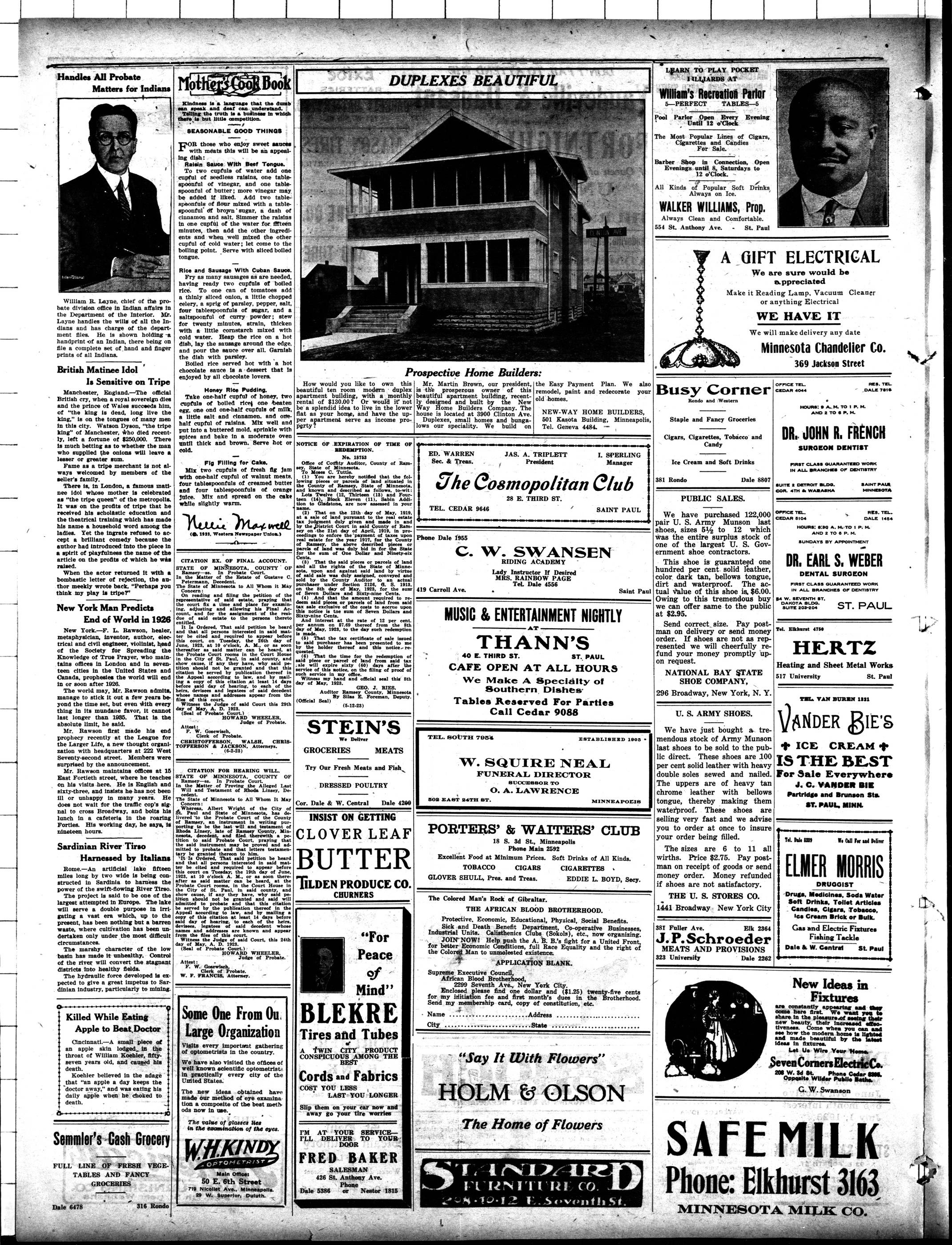
William R. Layne, chief of the probate division office in Indian affairs in the Department of the Interior. Mr. Layne handles the wills of all the Indians and has charge of the department files. He is shown holding a handprint of an Indian, there being on file a complete set of hand and finger prints of all Indians.
British Matinee Idol
Manchester, England.—The official British cry, when a royal sovereign dies and the prince of Wales succeeds him, of "the king is dead, long live the king." is on the tongues of many men in this city. Watson Dyson, "the tripe king" of Manchester, who died recently, left a fortune of $250,000. There is much betting as to whether the man who supplied the onions will leave a lesser or greater sum.
Fame as a tripe merchant is not always welcomed by members of the seller's family.
There is, in London, a famous matinee idol whose mother is celebrated as "the tripe queen" of the metropolis. It was on the profits of tripe that he received his scholastic education and the theatrical training which has made his name a household word among the ladies. Yet the ingrate refused to accept a brilliant comedy because the author had introduced into the piece in a spirit of playfulness the name of the article on the profits of which he was raised.
When the actor returned it with a bombastic letter of rejection, the author weekly wrote back, "Perhaps you think my play is tripe?"
End of World in 1926
New York—F. L. Rawson, healer, metaphysician, inventor, author, electrical and civil engineer, violinist, head of the Society for Spreading the Knowledge of True Prayer, who maintains offices in London and in seventeen cities in the United States and Canada, prophesies the world will end in or soon after 1926. The world may, Mr. Rawson admits, manage to stick it out a few years beyond the time set, but even with every thing in its mundane favor, it cannot last longer than 1935. That is the absolute limit, he said. Mr. Rawson first made his end prophecy recently at the League for the Larger Life, a new thought organization with headquarters at 222 West Seventy-second street. Members were surprised by the announcement.
Mr. Rawson maintains offices at 15 East Fortieth street, where he teaches on his visits here. He is English and sixty-three, and insists he has not been ill or unhappy in many years. He does not wait for the traffic cop's signal to cross Broadway, and boits his lunch in a cafeteria in the roaring Forties. His working day, he says, is nineteen hours.
Sardinian River Tirso
Rome.—An artificial lake fifteen miles long by two wide is being constructed in Sardinia to harness the power of the swift-flowing River Tirso. The project is said to be one of the largest attempted in Europe. The lake will serve a double purpose in irrigating a vast era which, up to the present, has been nothing but a barren waste, where cultivation has been undertaken only under the most difficult circumstances. The marshy character of the low basin has made it unhealthy. Control of the river will convert the stagnant districts into healthy fields. The hydraulic force developed is expected to give a great impetus to Sardinian industry, particularly to mining.
Cinchnati.—A small piece of an apple skin lodged, in the throat of William Koehler, fifty-seven years old, and caused his death.
Koehler believed in the adage that "an apple a day keeps the doctor away," and was eating his daily apple when he choked to death.
Mothers Cook Book
Kindness is a language that the dumb can speak and deaf can understand. Telling the truth is a business in which there is but little competition.
SEASONABLE GOOD THINGS
FOR those who enjoy sweet sauces with meats this will be an appealing dish:
Raisin Sauce With Beef Tongue.
To two cupfuls of water add one cupful of seedless raisins, one tablespoonful of vinegar, and one tablespoonful of butter; more vinegar may be added if liked. Add two tablespoonfuls of flour mixed with a tablespoonful' of brown sugar, a dash of cinnamon and salt. Simmer the raisins in one cupful of the water for fifteen minutes, then add the other ingredients and when well mixed the other cupful of cold water; let come to the bolling point. Serve with sliced boiled tongue.
Rice and Sausage With Cuban Sauce.
Fry as many sausages as are needed,
having ready two cupfuls of boiled rice.
To one can of tomatoes add a thinly sliced onion, a little chopped celery, a sprig of parsley, pepper, salt, four tablespoonfuls of sugar, and a saltspoonful of curry powder; stew for twenty minutes, strain, thicken with a little cornstarch mixed with cold water. Heap the rice on a hot dish, lay the sausage around the edge, and pour the sauce over all. Garnish the dish with parsley.
Bolled rice served hot with a hot chocolate sauce is a dessert that is enjoyed by all chocolate lovers.
Honey Rice Pudding.
Take one-half cupful of honey, two cupfuls of boiled rice one heaten egg, one and one-half cupfuls of milk a little salt and cinnamon, and one-half cupful of raisins. Mix well and put into a buttered mold, sprinkle with spices and bake in a moderate oven until thick and brown. Serve hot or cold.
Flg Filling for Cake.
Mix two cupfuls of fresh fig jam with one-half cupful of walnut meats, four tablespoonfuls of creamed butter and four tablespoonfuls of orange juice. Mix and spread on the cake while slightly warm.
Nellie Maxwell
(©, 1923, Western Newspaper Union.
CITATION EX. OF FINAL ACCOUNT.
STATE OF MINNESOTA COUNTY OF REFERENCES.
In the Matter of the Estate of Gustave C. Petermann, Decedent.
The State of Minnesota to All Whom it May Concern.
On reading and filing the petition of the representative of said estate, praying that court may time immediately his examination, including an allowance his父亲 account, and for the assignment of the residue of said estate to the persons thereto entitled. Ordered, That said petition be heard and that all persons interested in said matter be cited and required to appear before the Court. On June 18, 2023, at 10 o'clock, A. M., as soon thereafter as said matter can be heard, at the Probate Court rooms in the Court House of St. Paul, S.C., said court shows cause, if any they have, said petition should not be granted and that this citation be served by publication thereof in the Courthouse. In a copy of this citation at least 14 days before said day of hearing, to each of the heirs, devisees and legates of said decedent whose names and addresses appear from the
Witness the Judge of said Court this 29th day of May, A. D. 1823. (Seal of Probate Court). HOWARD WHEELER. Judge of Probate. Attest: F. W. Gosewich, Clerk of Probate. CHRISTOFFERSON, WALSH, CHRISTOFFERSON & JACKSON, Attorneys. (6-2-23)
CITATION FOR HEARING WILL. STATE OF MINNESOTA, COUNTY OF Ramsey—In Probate Court. In Ramsey New Jersey Last Will and Testament of Rhoda Linede, Decedent of Minnesota to All Whom It May Concern:
Whereas, Albert Wright of the City of St. Paul and State of Minnesota, has deserved county of Ramsey, an instrument in writing porting to be the last will and testament of Rhoda Linsey, late of Ramsey County, Minn., to the court of the Court to said Probate Court, praying that the said instrument may be proved and added to the letters testament, be granked thereon to him.
It is Ordered, That said petition be heard and that all persons interested in said matter be cited and required to appear before this court on Tuesday, the 19th day of June 1923, at 10 o'clock A.M., or as soon thereafter as said matter can be heard, at the Probate Court rooms, in the Court House in the City of St. Paul, in said county, and show cause, if any they have, why said petition should not be granted and said will admitted to probate and that this citation be served by the publication thereof in the Appeal according to law, and by mailing a copy of this citation at least 14 days before said day of hearing, to each of the heirs devisees, legatees of said decedent whose names and addresses are known and appear from the files of this court.
Witness the Judge of said Court, this 24th day of May. (Seal of Probate Court.)
HOWARD WHEELER.
Judge of Probate.
Attest:
F. W. Gosewisch,
Glossary of Probate.
W. F. FRANCIS, Attorney.
Some One From Our Large Organization
Visits every important gathering of optometrists in the country.
We have also visited the offices of well known scientific optometrists in practically every city of the United States.
The new ideas obtained have made our method of eye examination a composite of the best methods now in use.
The value of glasses lies in the examination of the eyes.
W.H.KINDY
OPTOMETRIST
Main Office:
50 E. 6th Street
719 Nicollet Ave. Minneapolis.
29 W. Superior, Duluth.
CLINTON AVE
How would you like to own this beautiful ten room modern duplex apartment building, with a monthly rental of $130.00? Or would it not be a splendid idea to live in the lower flat as your home, and have the upper apartment serve as income property?
NOTICE OF EXPIRATION OF TIME OF
PERMISSION
Office of County Auditor, County of Ramsey, State of Minnesota.
(1) Your name.
(1) You are hereby notified that the following pieces or parcels of land situated in the County of Ramsey, State of Minnesota, and Lots Twelve (12, Thirteen (13) and Fourteen (14), Block Eleven (11), Sabin Addition to Gladstone, are now assessed in your name.
(2) That on the 12th day of May, 1919, at a sale of land pursuant to the real estate act of 1919, the County Auditor by the District Court, issued County of Ramsey on the 21st day of April, 1919, in proceedings to enforce the payment of taxes upon real estate for the year 1919, the County of Ramsey issued described parcels of land was duly bid in for the State for the sum of One Dollar and Ninety-six Grosso. (3) That the said pieces or parcels of land and all the rights of the State of Minnesota, upon and against said land by virtue of the County Auditor to be sold by the County Auditor to an actual purchaser under Section 2126, G. S. 1913, on the 8th day of May, 1923, for the sum
(4) And that the amount required to redeem said pieces or parcels of land from said tax sale exclusive of the costs to accrue upon this notice is the sum of Seven Dollars and Sixty-nine Cents.
And interest at the rate of 12 per cent. per annum on $7.69 thereof from the 8th day of May, 1928, to the day such redemption is made.
(5) That the tax certificate of sale issued to the purchaser has been presented to me by the holder thereof and this notice is requested.
(6) That the time for the redemption of said taxes will expire sixty (60) days after the service of this notice, on the filing of proof of such service in my office.
Witness my hand and official seal this 8th day of May, 1928.
GEO. J. RIES.
Auditor Ramsey County, Minnesota
By Silas E. Foreman, Deputy.
(Official Seal)
(5-12-23)
STEIN'S
We Deliver
GROCERIES
MEATS
Try Our Fresh Meats and Fish
DRESSED POULTRY
Cor. Dale & W. Central Dale 4200
INSIST ON GETTING
CLOVER LEAF
BUTTER
TILDEN PRODUCE CO.
CHURNERS
"For Peace of Mind"
BLEKRE
Tires and Tubes
A TWIN CITY PRODUCT CONSPICUOUS AMONG THE BEST
Cords and Fabrics
Prospective Home Builders:
hislex Mr. Martin Brown, our president, the prosperous owner of this beautiful apartment building, recently designed and built by the New Way Home Builders Company. The house is located at 3900 Clinton Ave. Duplexes, small homes and bungalows our speciality. We build on
ED. WARREN
Sec. & Treas.
JAS. A. TRIPLETTE
President
The Cosmopolit
28 E. THIRD ST.
TEL. CEDAR 9646
Phone Dale 1955
C. W. SWAN
RIDING ACADEMY
cosmopolita
28 E. THIRD ST.
V. SWANS
RIDING ACADEMY
Lady Instructor If Desired
MRS. RAINBOW PAGE
Tel. Dale 4556
MUSIC & ENTERTAINMENT
AT
THAN
40 E. THIRD ST.
CAFE OPEN AT A
We Make A Sp
Southern D
Tables Reserved
Call Cedar
TEL. SOUTH 7954
W. SQUIRRE
FUNERAL DIN
SUCCESSOR
O. A. LAWR
502 EAST 24TH ST.
PORTERS' & WAKE
18 S. 3d St., Min
Phone Main 2
Excellent Food at Minimum Prices.
TOBACCO CIGARS
GLOVER SHULL, Pres. and Treas.
ENTERTAINMENT
AT
HANN'S
MIRD ST. S
OPEN AT ALL H
Make A Special
Southern Dishes
Reserved For
Call Cedar 9088
SQUIRE NET
GENERAL DIRECTOR
SUCCESSOR TO
O. A. LAWRENCE
S' & WAITER
18 S. 3d St., Minneapolis
Phone Main 2592
Minimum Prices. Soft Drink
CIGARS CIGAR
Tres. and Treas. ED
MUSIC & ENTERTAINMENT NIGHTLY
40 E. THIRD ST. ST. PAUL
CAFE OPEN AT ALL HOURS
We Make A Specialty of
Southern Dishes
Tables Reserved For Parties
Call Cedar 9088
W. SQUIRE NEAL
FUNERAL DIRECTOR
SUCCESSOR TO
O. A. LAWRENCE
PORTERS' & WAITERS' CLUB
Excellent Food at Minimum Prices. Soft Drinks of All Kinds.
TOBACCO CIGARS CIGARETTES
GLOVER SHULL, Pres. and Treas. EDDIE L. BOYD, Secy.
The Colored Man's Rock of Gibraltar.
THE AFRICAN BLOOD
Protective, Economic, Educational,
Sick and Death Benefit Department
Industrial Units. Calisthenics Clubs ()
JOIN NOW! Help push the A. B.
for better Economic Conditions, full R
the Colored Man to unmolested existence
APPLICATION I
Supreme Executive Council,
African Blood Brotherhood,
FRICAN BLOOD BROTHE
omic, Educational, Physical
Benefit Department, Co-
listhenics Clubs (Sokols),
push the A. B. B.'s fight
Conditions, full Race Equa
unmolested existence.
APPLICATION BLANK.
Council,
brotherhood,
Sick and Death Benefit Department, Co-operative Businesses, Industrial Units. Calisthenics Clubs (Sokols), etc., now organizing. JOIN NOW! Help push the A. B. B.'s fight for a United Front, for better Economic Conditions, full Race Equality and the right of the Colored Man to unmolested existence.
Enclosed please find one dollar and ($1.25) twenty-five cents for my initiation fee and first month's dues in the Brotherhood. Send my membership card, copy of constitution, etc.
STANDARD FURNITURE CO. 208.10.12 E. Seventh St.
the Easy Payment Plan. We also remodel, paint and redecorate your old homes.
NEW-WAY HOME BUILDERS,
501 Kasota Building, Minneapolis,
Tel. Geneva 4484.
TRIPLETT
President
I. SPERLING
Manager
politan Club
HIRD ST.
WANSEN
ACADEMY
For If Desired
BOW PAGE
Suite 4556
Saint Paul
TAINMENT NIGHTLY
AT
ANN'S
ST. PAUL
AT ALL HOURS
Specialty of
In Dishes
Used For Parties
Dar 9088
We ha
pair U. S.
shoes, si
was the
one of the
ernment
This s
hundred d
color darn
dirt and
tual value
Owing to
we can o
at $2.95.
Send o
man on o
order. I
resented d
fund you
on reque
NATION
SE
296 Broad
U.
RE NEAL
DIRECTOR
SOR TO
WRENCE
MINNEAPOLIS
WAITERS' CLUB
Minneapolis
Main 2592
ices. Soft Drinks of All Kinds.
LEARN TO PLAY POCKET
ILLIARDS AT
William's Recroation Parlor
5-PERFECT TABLES-5
Pool Parlor Open Every Evening
Until 12 o'Clock
The Most Popular Lines of Cigars,
Cigarettes and Candies
For Sale.
Barber Shop in Connection, Open
Evenings until 8, Saturdays to
12 o'Clock.
All Kinds of Popular Soft Drinks
Always on Ice.
WALKER WILLIAMS, Prop.
Always Clean and Comfortable.
554 St. Anthony Ave. - St. Paul
A GIFT
We a
Make it Read
or a
WI
We wi
Mi
Busy Corner
Rondo and Western
381 Rondo
We have purchased 122,000 pair U. S. Army Munson last shoes, sizes $1½ to 12 which was the entire surplus stock of one of the largest U. S. Government shoe contractors.
This shoe is guaranteed one hundred per cent solid leather, color dark tan, bellows tongue, dirt and waterproof. The actual value of this shoe is $6.00. Owing to this tremendous buy we can offer same to the public at $2.95.
Send correct size. Pay postman on delivery or send money order. If shoes are not as represented we will cheerfully refund your money promptly upon request.
296 Broadway, New York, N. Y.
We have just bought a tremendous stock of Army Munson last shoes to be sold to the public direct. These shoes are 100 per cent solid leather with heavy double soles sewed and nailed. The uppers are of heavy tan chrome leather with bellows tongue, thereby making them waterproof. These shoes are selling very fast and we advise you to order at once to insure your order being filled.
The sizes are 6 to 11 all wirths. Price $2.75. Pay postman on receipt of goods or send money order. Money refunded if shoes are not satisfactory.
THE U. S. STORES CO.
1441 Broadway New York City
381 Fuller Ave. Elk 2364
J.P.Schroeder
MEATS AND PROVISIONS
323 University Dale 2262
SAFE
Phone: Elk
MINNESOT
I. SPERLING Manager
SAINT PAUL
Saint Paul
ESTABLISHED 1905
MINNEAPOLIS
A GIFT ELECTRICAL
SAFEMILK Phone: Elkhurst 3163
MINNESOTA MILK CO.
Staple and Fancy Groceries
Cigars, Cigarettes, Tobacco and
Candy
Ice Cream and Soft Drinks
31 Rondo Dale 8807
PUBLIC SALES.
U. S. ARMY SHOES.
T
A. E.
IT ELECTRICAL
We sure would be
appreciated
Cleaning Lamp, Vacuum Cleaner
anything Electrical
WE HAVE IT
will make delivery any date
Minnesota Chandelier Co.
369 Jackson Street
OFFICE TEL.
CEDAR 4044
RES. TEL.
DALE 7816
HOURS: 9 A.M, M TO 1 P.M.
AND 2 TO 6 P.M.
SURGEON DENTIST
FIRST CLASS GUARANTEED WORK
IN ALL BRANCHES OF DENTISTRY
2 DETROIT BLDG. SAINT PAUL.
4TH & WABASHA MINNESOTA
SUITE 2 DETROIT BLDG.
COR. 4TH & WABASHA
OFFICE TEL.
CEDAR 8104
HOURS: 8:30 A. M. TO 1 P. M.
AND 2 TO 6 P. M.
SUNDAYS BY APPOINTMENT
FIRST CLASS GUARANTEED WORK
IN ALL BRANCHES OF DENTISTRY
54 W. SEVENTH ST.
DAKOTA BLDG.
SUITE 203-204
ST. PAU
Tel. Eikhurst 4750
HERTZ
Heating and Sheet Metal Works
517 University St. Paul
TEL. VAN BUREN 1331
VANDER BIE'S
ICE CREAM
IS THE BEST
For Sale Everywhere
J. C. VANDER BIE
Partridge and Brunson Sta.
ST. PAUL, MINN.
Tel. Dale 8339 We Call For and Deliver
ELMER MORRIS
DRUGGIST
Drugs, Medicines, Soda Water
Soft Drinks, Toilet Articles
Candies, Cigars, Tobacco,
Ice Cream Brick or Bulk.
Gas and Electric Fixtures
Fishing Tackle
Dale & W. Central St. Paul
New Ideas in
Fixtures
are constantly appearing and they
come here first. We want you to
share in the pleasure of seeing their
new beauty, their increased effec-
tiveness when you can and
see how the modern home is lighted
and made beautiful by the latest
ideas in fixtures.
Let Us Wire Your Home.
Seven Corners Electric Co.
208 W. 3d St. Phone Cedar 8308.
Oppolite Wilder Public Baths.
G. W. Swanson
MILK
hurst 3163