The Appeal
Saturday, October 13, 1923
St. Paul, Minnesota
Page text (machine-generated)
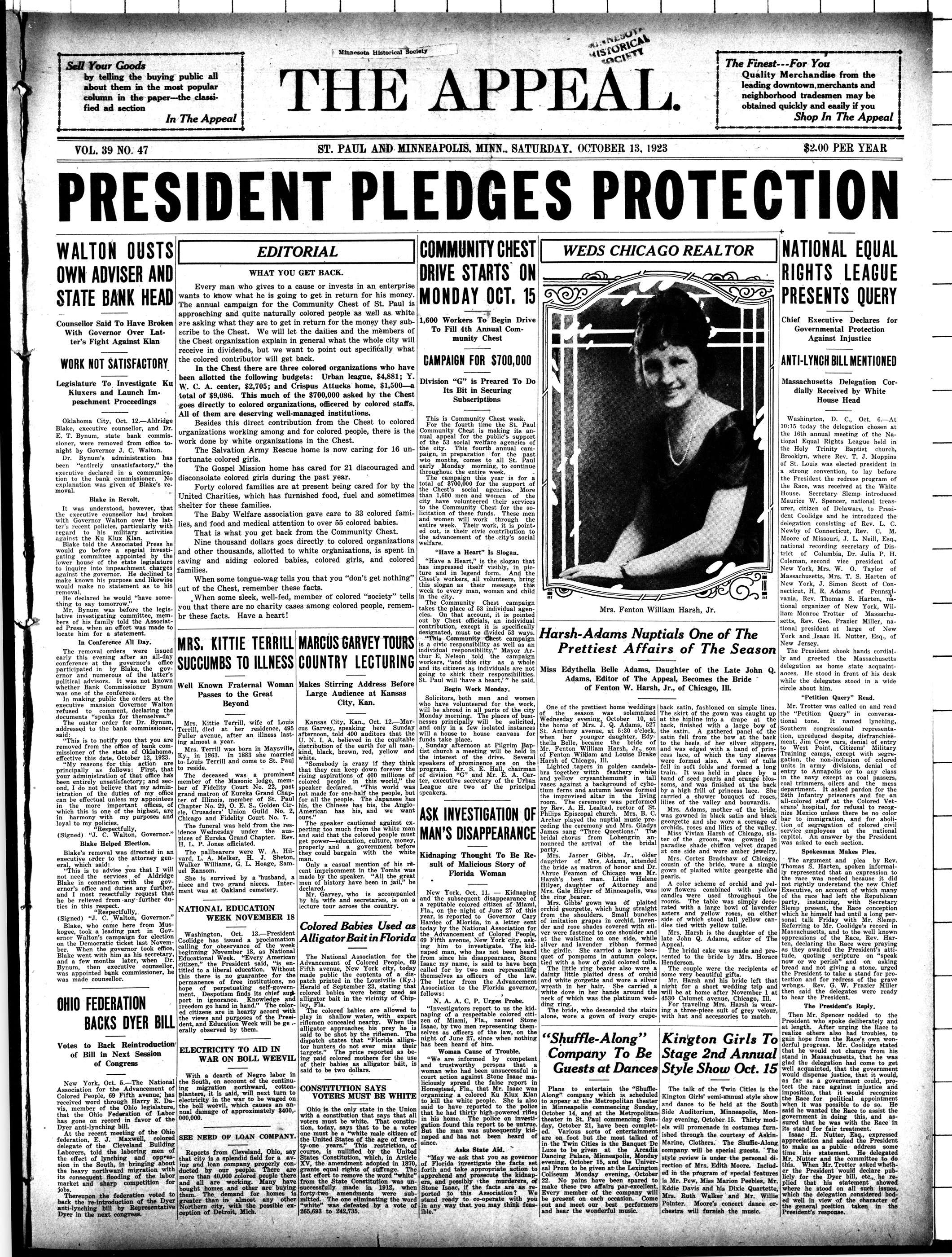
PRESIDENT PLEDGES PROTECTION
Sell Your Goods by telling the buying public all about them in the most popular column in the paper-the classified ad section In The Appeal
VOL. 39 NO. 47
WALTON OUSTS OWN ADVISER AND STATE BANK HEAD
WALTON OUSTS OWN ADVISER AND STATE BANK HEAD
Counsellor Said To Have Broken With Governor Over Latter's Fight Against Klan
WORK NOT SATISFACTORY
Legislature To Investigate Ku Kluxers and Launch Impeachment Proceedings
Oklahoma City, Oct. 12.—Aldridge Blake, executive counselor, and Dr. E. T. Bynum, state bank commissioner, were removed from office tonight by Governor J. C. Walton.
Dr. Bynum's administration has been "entirely unsatisfactory," the executive declared in a communication to the bank commissioner. No explanation was given of Blake's removal.
Blake in Revolt
It was understood, however, that the executive counsellor had broken with Governor Walton over the latter's recent policies, particularly with regard to his military activities against the Ku Klux Klan. Blake told the Associated Press he would go before a special investigator committee appointed by the lower house of the state legislature to inquire into impeachment charges against the governor. He declined to make known his purpose and likewise would make no statement as to his removal. He declared he would "have something to say tomorrow." Mr. Bynum was before the legislative investigator, member of the family told the Associated Press, when an effort was made to locate him for a statement.
In Conference All Day.
The removal orders were issued early this evening after an all-day conference at the governor's office participated in by Blake, the governor and numerous of the latter's political advisors. It was not known whether Bank Commissioner Bynum was one of the confertees.
The ouster order for Dr. Bynum, addressed to the bank commissioner, said: "This is to notify you that you are removed from the office of bank commission of the state of Oklahoma, effective this date, October 12, 1923. "My reasons for this action are principally as follows: First, that your administration of that office has been entirely unsatisfactory; and second, I do not believe that my administration of the duties of my office can be effectual unless my appointees are of improved impulses of office, which is one of the highest, are in harmony with my purposes and loyal to my policies.
Blake's removal was directed in an executive order to the attorney general, which said:
"This is to advise you that I will not need the services of Aldridge Blake in connection with the governor's office and duties any further, and I most respectfully request that he be relieved from any further duties in this respect.
"Respectfully,
(Signed) "J. C. Walton, Governor."
(Signed) J. C. Walton, Governor
Blake, who came here from Muskogee, took a leading part in Governor Walton's campaign for election on the Democratic ticket last November. He took office, Blake went with him as his secretary, and a few months later, when Dr Bynum, then executive counsellor, was appointed bank commissioner, he was made counsellor.
OHIO FEDERATION BACKS DYER BILL
OHIO FEDERATION BACKS DYER BILL
Votes to Back Reintroduction of Bill in Next Session of Congress
New York, Oct. 5.—The National Association for the Advancement of Colored People, 69 Fifth avenue, has received word through Harry E. Davis, member of the Ohio legislature, that the Ohio Federation of Labor has gone on record in favor of the Dyer anti-lynching bill.
At the recent meeting of the Ohio federation, E. J. Maxwell, colored delegate of the Cleveland Building Laborers, told the laboring men of the effect of lynching and oppression in the South, in bringing about the heavy northward migration with its consequent flooding of the labor market and sharp competition for jobs.
Thereupon the federation voted to back the re-introduction of the Dyer anti-lynching bill by Representative Dyer in the next congress.
EDITORIAL
WHAT YOU GET BACK.
Every man who gives to a child wants to know what he is going to approach and quite naturally are asking what they are to get in scribe to the Chest. We will let the Chest organization explain in receive in dividends, but we will the colored contributor will get it.
In the Chest there are three been allotted the following buds: W. C. A. center, $2,705; and C. total of $9,086. This much of the goes directly to colored organiza- All of them are deserving well-n. Besides this direct contrib- organizations working among and work done by white organization. The Salvation Army Rescue fortunate colored girls.
The Gospel Mission home has disconsolate colored girls during Forty colored families are a United Charities, which has fur- shelter for these families.
The Baby Welfare associat- lies, and food and medical attenti- That is what you get back Nine thousand dollars goes and other thousands, allotted to saving and aiding colored baby families.
When some tongue-wag tells cut of the Chest, remember thes When some sleek, well-fed, n you that there are no charity cas br these facts. Have a heart!
MRS. KITTIE TERRILL SUCCUMBS TO ILLNESS
Every man who gives to a cause or invests in an enterprise wants to know what he is going to get in return for his money. The annual campaign for the Community Chest of St. Paul is approaching and quite naturally colored people as well as white are asking what they are to get in return for the money they subscribe to the Chest. We will let the dailies and the members of the Chest organization explain in general what the whole city will receive in dividends, but we want to point out specifically what the colored contributor will get back.
In the Chest there are three colored organizations who have been allotted the following budgets: Urban league, $4,881; Y. W. C. A. center, $2,705; and Crispus Attucks home, $1,500—a total of $9,086. This much of the $700,000 asked by the Chest goes directly to colored organizations, officered by colored staffs. All of them are deserving well-managed institutions.
Besides this direct contribution from the Chest to colored organizations working among and for colored people, there is the work done by white organizations in the Chest.
The Salvation Army Rescue home is now caring for 16 unfortunate colored girls.
The Gospel Mission home has cared for 21 discouraged and disconsolate colored girls during the past year.
Forty colored families are at present being cared for by the United Charities, which has furnished food, fuel and sometimes shelter for these families.
The Baby Welfare association gave care to 33 colored families, and food and medical attention to over 55 colored babies.
That is what you get back from the Community Chest.
Nine thousand dollars goes directly to colored organizations and other thousands, allotted to white organizations, is spent in saving and aiding colored babies, colored girls, and colored families.
When some tongue-wag tells you that you "don't get nothing" cut of the Chest, remember these facts.
When some sleek, well-fed, member of colored "society" tells you that there are no charity cases among colored people, remember these facts. Have a heart!
MRS. KITTIE TERRILL MARCUS GARVEY TOURS SUCCUMBS TO ILLNESS COUNTRY LECTURING
Well Known Fraternal Woman Passes to the Great Beyond
Mrs. Kittie Terrill, wife of Louis Terrill, died at her residence, 495 Fuller avenue, after an illness lasting almost a year.
Mrs. Terrill was born in Maysville, Ky., in 1863. In 1883 she married to Louis Terrill and come to St. Paul to reside.
The deceased was a prominent member of the Masonic lodge, member of Fidelity Court No. 22, past grand matron of Eureka Grand Chapter of Illinois, member of St. Paul Chapter No. 29, O. E. S. Golden Circle, Crusaders' Union Guild No. 2, Chicago and Fidelity Court No. 7.
The funeral was held from the residence Wednesday under the auspices of Eureka Grand Chapter. Rev. H. L. P. Jones officiated.
The pallbearers were W. A. Hilvard, L. A. Melker, H. J. Sheton, Walker Walker, G. L. Hoage, Samuel Ransom.
She is survived by a husband, a niece and two grand nieces. Interment was at Oakland cemetery.
NATIONAL EDUCATION
WEEK NOVEMBER 18
Washington. Oct. 13.—President Coddie has issued a proclamation calling for observance of the week beginning November 18, as National Educational Week. "Every American citizen," the President said, "is entitled to a liberal education. Without this there is no guarantee for the permanence of free institutions, no hope of perpetuating self-government. Despotism finds its chief import - ignorance. Knowledge and wisdom are in hand." The colored citizens are in hearty accord with the views and purposes of the President, and Education Week will be generally observed by them.
ELECTRICITY TO AID IN
WAR ON BOLL WEEVII
With a dearth of Negro labor in the South, on account of the continuing migration northward, cotton planters, it is said, will next turn to electricity in the war to be waged or the boll weevil, which causes an annual damage of approximately $400,000,000.
SEE NEED OF LOAN COMPANY
Reports from Cleveland, Ohio, say that city is a splendid field for a availing and loan company properly conducted by our people. There are more than 40,000 colored people there and all are working. Many have bought homes and other are buying them. The demand is strong. Northern city, almost any other Northern city, with the possible exception of Detroit, Mich.
THE APPEAL.
ST. PAUL AND MINNEAPOLIS, MINN.. SATURDAY. OCTOBER 13, 1923
because or invests in an enterprise
to get in return for his money.
Community Chest of St. Paul is
colored people as well as white
return for the money they sub-
titute the dailies and the members of
general what the whole city will
want to point out specifically what
back.
The colored organizations who have
gets: Urban league, $4,881; Y.
Christus Attucks home, $1,500—a
the $700,000 asked by the Chest
institutions, officered by colored staffs.
managed institutions.
Station from the Chest to colored
and for colored people, there is the
men in the Chest.
Home is now caring for 16 un-
has cared for 21 discouraged and
the past year.
It present being cared for by the
finished food, fuel and sometimes
Gave care to 33 colored fami-
ton to over 55 colored babies.
From the Community Chest.
Directly to colored organizations
of white organizations, is spent in
bies, colored girls, and colored
You that you "don't get nothing"
the facts.
Member of colored "society" tells
less among colored people, remem-
MARCUS GARVEY TOURS
COUNTRY LECTURING
Makes Stirring Address Before Large Audience at Kansas City, Kan.
Kansas City, Kan., Oct. 12.—Marcus Garvey, speaking here Sunday afternoon, told 400 auditors that the U. N. I. A. believed in the equitable distribution of the earth for all mankind, black, brown, red, yellow and white.
"Somebody is crazy if they think that they can keep down forever the rising aspirations of 400 millions of colored people in this world!" the speaker declared. "This world was made for one-half the people, but for all the people. The Japanese has his, the Chinese has his, the Anglo-American has his, and we want ours."
The speaker cautioned against expecting too much from the white man and said that the colored people must get power—education, culture, money, property and a government before they could bargain with the white man.
Only a casual mention of his recent imprisonment in the Tombs was made by the speaker. "All the great men of history have been in jail," he declared.
Mr. Garvey, who is accompanied by his wife and secretaries, is on a lecture tour across the country.
Colored Babies Used as Alligator Bait in Florida
The National Association for the Advancement of Colored People, 69 Fifth avenue, New York city, today made public the contents of a dispatch printed in the Lousville (Ky.) Herald of September 23, stating that colored babies were being used as alligator bait in the vicinity of Chipley, Fla.
The colored babies are allowed to play in shallow water, with expert riflemen concealed nearby. When the alligator approaches his prey he is said to be shot by the riflemen. The dispatch states that "Florida alligator hunters do not ever miss their targets." The price reported as being paid colored mothers for the use of their babies as alligator hait, is said to be two dollars.
CONSTITUTION SAYS
VOTERS MUST BE WHITE
Ohio is the only state in the Union with a constitution that says that all voters must be white. That constitution, today, says that to be a voter one must be a "white male citizen of the United States of the age of twenty-one years." This restriction, of course, is nullified by the United States Constitution, which, in Article XV, the amendment adopted in 1870, grants equal rights of suffrage. The last effort to remove the word "white" from the State Constitution was unsuccessfully made in 1912, when forty-two amendments were submitted. The one eliminating the word "white" was defeated by a vote of 265.693 to 242.735.
COMMUNITY CHEST DRIVE STARTS ON MONDAY OCT. 15
1,600 Workers To Begin Drive To Fill 4th Annual Community Chest
CAMPAIGN FOR $700,000
Division "G" is Preared To Do Its Bit in Securing Subscriptions
This is Community Chest week.
For the fourth time the St. Paul Community Chest is making its annual appeal for the public's support of the 53 social welfare agencies of the city. This fourth annual campaign, in preparation for the past wto months, comes to all St. Paul early Monday morning, to continue throughout the entire week.
The campaign this year is for a total of $700,000 for the support of the Chest's social agencies. More than 1,600 men and women of the city have volunteered their services to the Community Chest for the solicitation of these funds. These men and women will work through the entire week. Their work, it is pointed out, is their civic contribution to the advancement of the city's social welfare.
"Have a Heart" Is Slogan.
"Have a Heart," is the slogan that has impressed itself visibly, in picture and in legend form. And the Chest's workers, all volunteers, bring this slogan as their message this week to every man, woman and child in the city.
The Community Chest campaign takes the place of 53 individual agencies. On that account, it is pointed out by Chest officials, an individual contribution, except it is specifically designated, must be divided 53 ways.
This Community Chest campaign is responsible as well as an individual contribution. Maybury, thur E. Nelson told the campaign workers, "and this city as a whole and its citizens as individuals are not going to shirk their responsibilities. St. Paul will 'have a heart.'" he said.
Begin Work Monday.
Solicitors, both men and women who have volunteered for the work, will be abroad in all parts of the city Monday morning. The places of businesses principally will be solicited, and only in a few isolated instances will a house to house canvass for funds take place. Sunday afternoon at Pilgrim Baptist Church, a meeting will be held in the interest of the drive. Several speakers of prominence are on the program. Mr. S. E. Hall, chairman of division "G" and Mr. E. A. Carter, executive secretary of the Urban League are two of the principal speakers.
ASK INVESTIGATION OF MAN'S DISAPPEARANCE
Kidnaping Thought To Be Result of Malicious Story of Florida Woman
New York, Oct. 11. — Kidnaping and the subsequent disappearance of a reputable colored citizen of Miami, Fla., on the night of June 27 of this year, is reported to Governor Cary Hardee of Florida, in a letter sent today by the National Association for the Advancement of Colored People, 69 Fifth avenue, New York city, asking him to investigate. The kidnaped man, who has not been heard from since his disappearance, Stone Isaac my name, is said to have been called for by two men representing themselves as officers of the law. The letter from the Advancement Association to the Florida governor, follows:
N. A. A. C. P. Urges Probe.
"Investigators report to us the kidnaping of a respectable colored citizen of Miami, Fla., named Stone Isaac, by two men representing themselves as officers of the law, on the night of June 27, since when nothing has been heard of him.
Woman Cause of Trouble.
"We are informed by competent and trustworthy persons that a comma who had been unsuccessful in court action has mistaken Stone Isaac maliciously spread the false report in Homestead, Fla., that Mr. Isaac was organizing a colored Klu Klu Klan to kill the white people. She is also said to have reported to the police that he had thirty high-powered rifles in his home. The police on investigation found this report to be untrue. But the man was subsequently kidnapped and has not been heard of since.
Asks State Aid.
"May we ask that you as governor of Florida investigate the facts set forth and take appropriate action to apprehend and prosecute the kidnappers, and possibly the murderers, of Stone Isaac, if the facts are as reported to this Association? We stand ready to co-operate with you in any way that you may think feasible."
HISTORICAL SOCIETY
SURDAY. OCTOBER 13, 19
WEDS CHICA
I
Mrs. Fenton William Harsh, Jr.
Harsh-Adams Nuptials One
Prettiest Affairs of The
Miss Edythella Belle Adams, Daughter of the
Adams, Editor of The Appeal, Becomes
of Fenton W. Harsh, Jr., of Chicago
Harsh-Adams Nuptials One of The Prettiest Affairs of The Season
Miss Edythella Belle Adams, Daughter of the Late John Q. Adams, Editor of The Appeal, Becomes the Bride of Fenton W. Harsh, Jr., of Chicago, Ill.
One of the prettiest home weddings of the season was solemnized Wednesday evening, October 10, at the home of Mrs. J. Q. Adams, 527 St. Anthony avenue, at 5:30 o'clock, when her younger daughter, Edythella Belle, became the bride of Mr. Fenton William Harsh, Jr., son of Fenton William and Louise Drake Harsh of Chicago, Ill.
Lighted tapers in golden candelabra together with feathery白 and yellow crystanthemums in tall vases against a background of cytoium ferns and autumn leaves formed the improvised altar in the living room. The ceremony was performed by Rev. A. H. Lealtad, rector of St. Philips Episcopal church. Mrs. B. C. Archer played the nuptial music preceding the ceremony and Mrs. Gladys James sang "Three Questions." The bridal chorus from Lohengrin announced the arrival of the bridal party.
Mr. Jasper Gibbs, Jr., older daughter of Mrs. Adams, attended the bride as matron of honor and Dr. Ahrue Feamon of Chicago was Mr. Harsh's best man. Little Helene Hilyer, daughter of Attorney and Mrs. Gale Hilyer of Minneapolis, was the ring bearer.
back satin, fashioned on simple lines of the season was solemnized Wednesday evening, October 10, at the home of Mrs. J. Q. Adams, 527 St. Anthony avenue, at 5:30 o'clock, when her younger daughter, Edythella Belle, became the bride of Mr. Fenton William Harsh, Jr., son of Fenton William and Louise Drake Harsh of Chicago, Ill.
Lighted tapers in golden candelabra together with feathery白 and yellow crystanthemums in tall vases against a background of cytoium ferns and autumn leaves formed the improvised altar in the living room. The ceremony was performed by Rev. A. H. Lealtad, rector of St. Philips Episcopal church. Mrs. B. C. Archer played the nuptial music preceding the ceremony and Mrs. Gladys James sang "Three Questions." The bridal chorus from Lohengrin announced the arrival of the bridal party.
Mr. Jasper Gibbs, Jr., older daughter of Mrs. Adams, attended the bride as matron of honor and Dr. Ahrue Feamon of Chicago was Mr. Harsh's best man. Little Helene Hilyer, daughter of Attorney and Mrs. Gale Hilyer of Minneapolis, was the ring bearer.
Mrs. Adams, mother of the bride was gowned in black satin and black georgette and she wore a corsage of orchids, roses and lilies of the valley. Miss Vivian Harsh of Chicago, sister of the groom, was gowned in paradise shade chiffon velvet drape at one side and wore amber jewelry.
Mrs. Cortez Bradshaw of Chicago cousin of the bride, a simple gown of plaited white georgette and pearls.
A color scheme of orchid and yellow flowers combined with yellow candles were used throughout the
Mrs. Gibbs' gown was of plaited orchid georgeette, which hung straight from the shoulders. Small bunches of imitation grapes in orchid, lavender and rose shades covered with silver were fastened to one shoulder and at the waistline on one side, while silver and lavender ribbon formed the girdle. She carried a large bouquet of pompoms in autumn colors, tied with a bow of gold colored tulle. The little ring bearer also wore a dainty little plaited dress of orchid and white gorgette and wore a silver wreath in her hair. She carried a white dove in her hands around the neck of which was the platinum wedding ring. The bride, who descended the stairs alone, wore a gown of ivory crepe-
"Shuffle-Along" Company To Be Guests at Dances
Plans to entertain the "Shuffle-Along" company which is scheduled to appear at the Metropolitan theater in Minneapolis commencing Sunday, October 14, and at the Metropolitan theater in St. Paul commencing Sunday, October 21, have been completed. Various sorts of entertainment are on foot but the most talked of in the Twin Cities is the Banquet De Luxe to be given at the Arcadia Dancing Palace, Minneapolis, Monday evening, October 15, and the Univer-From 10 p.m. given at the Coliseum, Monroeville evening, October 22. No pains have been spared to make these two affairs ex-cellent. Every member of the company will be present on each occasion. Come out and meet our best performers and hear the wonderful music.
---
Artials One of The
airs of The Season
Daughter of the Late John Q.
appeal, Becomes the Bride
, Jr., of Chicago, Ill.
back satin, fashioned on simple lines.
The skirt of the gown was caught up at the hipline into a drape at the back, finished with a large bow of the satin. A gathered panel of the satin fell from the bow at the back to the heels of her silver slippers, and was edged with a band of princess lace, of which the tiny sleeves were formed also. A veil of tulle fell in soft folds and formed a long train. It was held in place by a band of seed pearls and orange blossoms, and was finished at the back by a high frill of princess lace. She carried a shower bouquet of roses, lilies of the valley and bouvardis.
Mrs. Adams, mother of the bride, was gowned in black satin and black georgette and she wore a corsage of orchids, tees and lilies of the valley.
Miss Vivian Harsh of Chicago, sister of the groom, was gowned in paradise shade chiffon velvet draped at one side and wore amber jewelry.
Mrs. Cortez Bradshaw of Chicago, cousin of the bride, wore a simple gown of plaited white georgette and pearls.
A color scheme of orchid and yellow flowers combined with yellow candles were used throughout the rooms. The table was simply decorated with a large bowl of lavender asters and yellow roses, on either side of which stood tall yellow candles tied with yellow tulle.
Mrs. Harsh is the daughter of the late John Q. Adams, editor of The Appeal.
The bridal cake was made and presented to the bride by Mrs. Horace Henderson.
The couple were the recipients of some very beautiful gifts.
Mr. Harsh and his bride left that night for a short wedding trip and will be at home after November 1 at 4530 Calumet avenue, Chicago, Ill.
For traveling Mrs. Harsh is wear
with hat, and accessories to watch.
Kington Girls To Stage 2nd Annual Style Show Oct.15
The talk of the Twin Cities is the Kington Girls' semi-annual style show and dance to be held at the South Side Auditorium, Minneapolis, Monday evening, October 15. Thirty models will promenade in costumes furnished through the courtesy of Askin Marine, Clothers. The Shuffle-Along company will be special guests. The style review is under the personal direction of Mrs. Edith Moore. Included in the program of special features is Mr. Pew, Miss Marion Peebles, Mr. Eddie Davis and his Dixie Quartette, Mrs. Ruth Walker and Mr. Willie Pointer. Moore's concert dance orchestra will furnish the music.
The Finest---For You Quality Merchandise from the leading downtown,merchants and neighborhood tradesmen may be obtained quickly and easily if you Shop In The Appeal
---
$2.00 PER YEAR
NATIONAL EQUAL RIGHTS LEAGUE PRESENTS QUERY
NATIONAL EQUAL RIGHTS LEAGUE PRESENTS QUERY
Chief Executive Declares for Governmental Protection Against Injustice
ANTI-LYNCH BILL MENTIONED
Massachusetts Delegation Cordially Received by White House Head
Washington, D. C., Oct. 6.—At 10:15 today the delegation chosen at the 16th annual meeting of the National Equal Rights League held in the Holy Trinity Baptist church, Brooklyn, where Rev. T. J. Moppins of St. Louis was elected president in a strong convention, to lay before the President the redress program of the Race, was received at the White House. Secretary Slemp introduced Maurice W. Spencer, national treasurer, citizen of Delaware, to President Coolidge and he introduced the delegation consisting of Rev. L. C. Newby of Connecticut, Rev. C. C. M. Moore of Missouri, J. L. Neill, Esq., national recording secretary of District of Columbia, Dr. Julia P. H. Coleman, second vice president of New York, Mrs. W. O. Taylor of Massachusetts, Mrs. T. S. Harten of New York, J. Simon Scott of Connecticut, H. R. Adams of Pennsylvania, Rev. Thomas S. Harten, national organizer of New York, William Monroe Trotter of Massachusetts, Rev. Geo. Frazier Miller, national president at large of New York and Isaac H. Nutter, Esq., of New Jersey.
The President shook hands cordially and greeted the Massachusetts delegation as home state acquaintances. He stood in front of his desk while the delegates stood in a wide circle about him.
"Petition Query" Read
Mr. Trotter was called on and read the "Petition Query" in conversational tone. It named lynching, Southern congressional representation, unreduced despite, disfranchisement, Jim Crow cars, denial of entry to *West Point*, Citizens Military Training Corps, militia segregation, the mans-inclusion of unified units in army divisions, denial of entry to Amapolis or to any class in the navy except as coal passers, coal trimmers, oilers and the mess department. It asked pardon for the 24th Infantry prisoners and for an all-colored staff at the Colored Veterans' hospital, for refusal to recognize Mexico unless there be no color immigration, and for abolition of the immigration of service employees at the national capitol. An answer by the President was asked to each section.
Spokesman Makes Plea.
The argument and plea by Rev. Thomas S. Harten, spoken informally represented that an expression to the race was needed because it did not rightly understand the new Chief Executive, on account of which many of the race had left the Republican party, instancing, with Secretary Robert F. Kennedy, which he himself had until a long personal talk Friday with Mr. Slemp. Referring to Mr. Coolidge's record in Massachusetts, and to the well known oppressions of the Race, Rev. Harten, declaring the Race were praying as they awaited the President's attitude, quoting scripture on "speak now or perish" and on asking bread and not giving a stone, urged protection and for redress of the grave wrongs. Rev. G. W. Frazier Miller then said the delegates were ready to hear the President.
The President's Reply.
Then Mr. Spencer nodded to the President who spoke deliberately and at length. After urging the Race to realize others also had troubles, to gain hope from the Race's own wonderful progress. Mr. Coolidge stated that he would not change from his stand in Massachusetts, that he was glad the delegation had come to get well acquainted, that the government would dispense justice, that it would, as far as a government could, protect the race against injustice and position, to recognize the Race for political appointment when it was possible to do so. He said he wanted the Race to assist the government in doing this, and assured that he was with the Race in its stand for fair treatment. Itaac H. Nutter, Esq., expressed appreciation and asked the President to make as a public address some time his statement. He delegated Mr. Nutter and the committee to do this. When Mr. Trotter asked whether the President would declare publicly for the Dyer bill, etc., he replied that his statement showed where he stood on all such issues. He said that the president boded well in view of the character, the general position taken in the President's response.
Phone Cedar 5649
J. Q. Adams .....Editor-in-Chief
Roy Wilkins .....Associate Editor
Odell D. Smith .....Business Manager
Urlin L. Clark .....Advertising Manager
Advertising Rates on Application
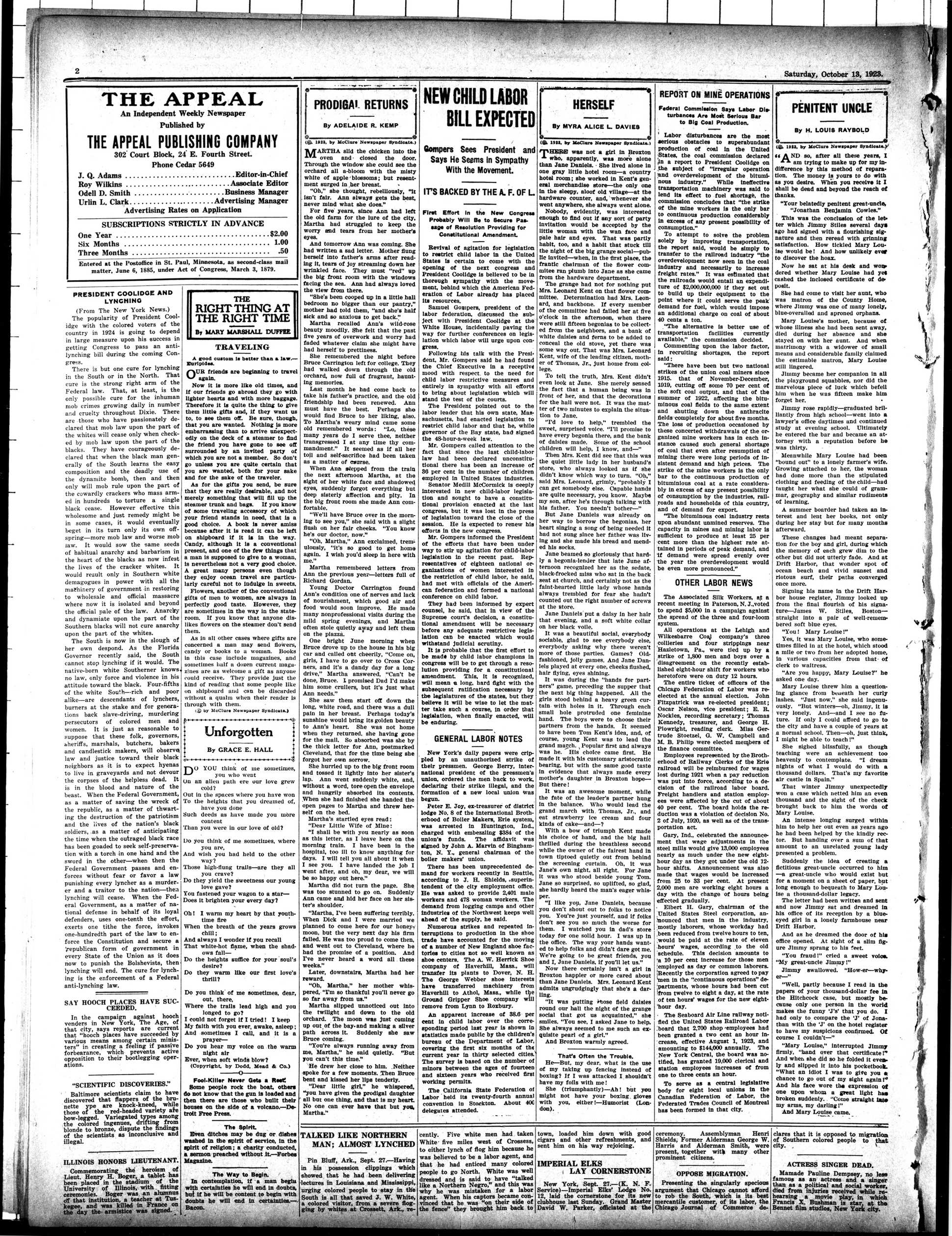
PRESIDENT COOLIDGE AND LYNCHING
(From The New York News.) The popularity of President Coolidge with the colored voters of the country in 1924 is going to depend in large measure upon his success in getting Congress to pass an antilynching bill during the coming Congress.
There is but one cure for lynching in the South or in the North. That cure is the strong right arm of the Federal law. That, at least, is the only possible cure for the inhuman mob crimes growing daily in number and cruelty throughout Dixie. There are those who have passionately declared that mob law upon the part of the whites will cease only when checked by mob law upon the part of the blacks. They have courageously declared that when the black man generally of the South learns the easy composition and the deadly use of the dynamite bomb, then and then only will mob rule upon the part of the cowardly crackers who mass armed in hundreds to torture a single black cease. However effective this wholesome and just remedy might be in some cases, it would eventually beget in its turn only its own offspring—more mob law and worse mob law. It would sow the same seeds of habitual anarchy and barbarism in the heart of the blacks as now infest the lives of the cracker whites. It would result only in Southern white demagogues in power with all the machinery of government in restoring to wholesale and official massacre where now it is isolated and beyond the official pale of the law. Anarchy and dynamite upon the part of the Southern blacks will not cure anarchy.
The South is now in the slough of her own despond. As the Florida Governor recently said, the South cannot stop lynching if it would. The native-born white Southerner knows no law, only force and violence in his attitude toward the black. Four-fifths of the white South—rich and poor alike—are descendants of lynchers, burners at the stake and for generations back slave-driving, murdering persecutors of colored men and women. It is just as reasonable to suppose that these folk, governors, sheriffs, marshals, butchers, bakers and candlestick makers, will observe law and justice toward their black neighbors as it is to expect hyenas to live in graveyards and not devour the corpses of the helpless dead. It is in the blood and nature of the beast. When the Federal Government, as a matter of saving the wreck of the republic, as a matter of thwarting the destruction of the patriotism and the lives of the nation's black soldiers, as a matter of anticipating the time when the outraged black race has been goaded to seek self-preservation with a torch in one hand and the sword in the other—when then the Federal Government passes and enforces without fear or favor a law punishing every lyncher as a murderer and a traitor to the nation—then lynching will cease. When the Federal Government, as a matter of national defense in behalf of its loyal defenders, uses one-tenth the effort, exerts one tite the force, invokes one-hundredth part of the law to enforce the Constitution and secure a republican form of government in every State of the Union as it does now to punish the Bolsheviks, then lynching will end. The cure for lynching is the enforcement of a Federal anti-lynching law.
SAY HOOCH PLACES HAVE SUCCEEDED.
In the campaign against hooch venders in New York, The Age, of that city, says reports are current that "hooch places have succeeded by various means among certain miners" in creating a more active environment which prevents active opposition to their bootlegging operations.
"SCIENTIFIC DISCOVERIES."
Baltimore scientists claim to have discovered that flappers of the brunette ype are knock-kneed, while those of the red-headed variety are bow-legged. Varied types among the ingemens, drifting from blonde to bronze, dispute the findings of the scientists as inconclusive and illegal.
ILLINOIS HONORS LIEUTENANT.
Commemorating the heroes of Lieut. Henry H. Boger, a tablet has been placed in the stadium of University of Illinois, with fitting of the nose. Boger is an alumnus of that institution, a teacher at Tuskegee, and was killed in France on the day the armistice was signed.
Editor-in-Chief
Associate Editor
Business Manager
Advertising Manager
les on Application
RICTLY IN ADVANCE
$2.00
1.00
.50
Paul, Minnesota, as second-class mail
set of Congress, March 3, 1879.
THE RIGHT THING AT THE RIGHT TIME By MARY MARSHALL DUFFEE
A good custom is better than a law—Euripides.
OUR friends are beginning to travel again.
Now it is more like old times, and if our friends go abroad they go with lighter hearts and with more baggage.
Therefore it is quite the thing to give them little gifts and, if they want us to, to see them off. Be sure, though, that you are wanted. Nothing is more embarrassing than to arrive unexpectedly on the deck of a steamer to find you surrounded by an invited party of which you are not a member. So don't go unless you are quite certain that you are wanted, both for your sake and for the sake of the traveler.
As for the gifts you send, be sure that they are really desirable, and not merely something that will fill up the steamer trunk and bags. If you know of some traveling accessory of which your friend stands in need, that is a good choice. A book is never amiss because after it is read it can be left on shipboard if it is in the way. Candy, although it is a conventional present, and one of the few things that a man is supposed to give to a woman, is nevertheless not a very good choice. You can enjoy ocean travel are particularly careful not to indulge in sweets. Flowers, another of the conventional gifts of men to women, are always perfectly good taste. However, they are sometimes in the way in the stateroom. If you know that anyone dislikes flowers on the steamer don't send them.
As in all other cases where gifts are concerned a man may send flowers, candy or books to a woman. Books in this case include magazines, and sometimes half a dozen current magazines are as welcome a gift as anyone could receive. They provide just the information needed on shipboard and can be discarded without a qualm when their reader is through with them.
© by McClure Newspaper Syndicate.)
---
DO YOU think of me sometimes,
you who went
On an alien path ere our love grew
cold?
Out in the spaces where you have won
To the heights that you dreamed of,
have you done
Such deeds as have made you more
content
Than you were in our love of old?
Do you think of me sometimes, where
you are,
And wish you had held to the other
way?
Those high-flung trails—are they all
you crave?
Do they yield the sweetness our young
love gave?
You fastened your wagon to a star—
Does it brighten your every day?
Oh! I warm my heart by that youth-
time fire
When the breath of the years grows
chill;
And always I wonder if you recall
That white-hot flame, when the shadows fall—
Do the heights suffice for your soul's
desire?
Do they warm like our first love's
thrill?
Do you think of me sometimes, dear,
out, there.
Where the trails lead high and you
lensed to go?
I could not forget if I fried! I keep
My faith with you ever, awake, sleep.
And sometimes I call, and it is a
prayer—
Do you hear my voice on the warm
night air
Ever, when soft winds blow?
(Copyright, by Dodd, Mead & Co.)
Fool-Killer Never Gets a Rest!
Some people rock the boat, others do not know that the gun is loaded and then there are those who built their houses on the side of a volcano—Detroit Free Press.
The Spirit.
Even ditches may be dug or dishes washed in the spirit of service, in the spirit of religion; a charity conducted, a sermon preached without it—Forbes Magazine.
The Way to Begin.
In contemplation, if a man begin with certainties he will end in doubts, but if he will be content to begin with doubts he will end in certainties—Bacon.
TRAVELING
Unforgotten
By GRACE E. HALL
The Spirit
PRODIGAL RETURNS
BY ADELAIDE R. KEMP
(© 1923, by McClure Newspaper Syndicate.)
MARTHA slid the chicken into the oven and closed the door. Through the window she could see the orchid and a bloom with the misty white oil of apple. They put bresent surged in her breast.
"Oh," she thought, rebelliously, "it isn't fair. Ann always gets the best, never mind what she does."
For five years, since Ann had left the old farm for the lure of the city, Martha had struggled to keep the worry and tears from her mother's eyes.
And tomorrow Ann was coming. She had written a sad letter. Mother flung herself into father's arms after reading it, tears of joy streaming down her wrinkled face. They must "red" up the big front room with the windows facing the sea. Ann had always loved the view from there.
"She's been cooped up in a little hall bedroom no bigger than our partry," mother had told them, "and she's half sick and so anxious to get back."
Martha recalled Ann's wild-rose beauty moodly. She felt that the past five years of overwork and worry had faded whatever claim she might have had herself to pretreats.
She said she might night before Bruce Carrington left for college. They had walked down through the old orchard, now full of fragrant, haunting memories.
Last month he had come back to take his father's practice, and the old friendship had been renewed. Ann must have the best. Perhaps she would find Bruce to her liking, also. To Martha's weary mind came some old remembered words: "Lo, these women do I serve thee, neither transgressions nor their commandment." It seemed as if all her toll and self-sacrifice had been taken as a matter of course.
When Ann stepped from the train the night after morning Martha, at the sight of her white face and shadowed eyes, suddenly forgot everything but deep sisterly affection and plty. In the big front room she made Ann comfortable.
"We'll have Bruce over in the morning to see you," she said with a slight flush on her fair cheeks. "You know he's our doctor, now."
"Oh, Martha," Ann exclaimed, tremulously, "it's so good to get home again. I wish you'd sleep in here with me."
Martha remembered letters from Ann the previous year—letters full of Richard Gordan.
Young Doctor Carrington found Ann's condition one of nerves and lack of nourishment, which good air and food would soon improve. He made many nonprofessional visits during the mild spring evenings, and Martha often stole quiet away and left them on the plaza.
One bright June morning when Bruce drove up to the house in his big car and called out cheerly, "Come on girls, I have to go over to Cross Corners, and its a dandy day for a long drive," Martha answered, "Can't be done, Bruce. I promised Dad I make him some crullers, but it just what Ann needs."
She saw them start off down the long, white road, and there was a dull pain in her breast. Perhaps today's sunshine would bring its golden beauty to Ann's heart. She was not home when they returned, she having gone for the mail. So absorbed was she by the thick letter for Ann, postmarked Cleveland, that for the time being she forgot her own sorrow.
She hurried up to the big front room and lapped light into her white's lap. Ann went suddenly her envelopes without a word, tore open the envelopes and hungrily absorbed its contents. When she had finished she handed the open pages to Martha and threw herself on the bed.
Martha's started eyes read: "Dear Little Wife of Mine:
"I shall be with you nearly as soon as this letter, as I leave here on the morning train. I have been in the hospital, too ill to know anything for days. I will tell you all about it when I see you. I have landed the job I went after, and oh, my dear, we will be so happy out here."
Martha did not turn the page. She was too stunned to go on. Suddenly Ann came and hid her face on her sister's shoulder.
"Martha, I've been suffering terribly. When Dick and I were married we planned to come here for our honey-moon, but the very next day his firm failed. He was too proud to come then, and went out to Cleveland, where he had the promise of a position. And I've never heard a word all these weeks."
Later, downstairs, Martha had her reward.
"Oh, Martha," her mother whispered, "I'm so thankful you'll never go so far away from us."
Martha slipped unnoticed out into the twilight and down to the old orchard. The moon was just coming up out of the bay and making a silver path across it. Suddenly she saw Bruce coming.
"You're always running away from me, Martha," he said quietly. "But you can't this time."
He drew her close to him. Neither spoke for a few moments. Then Bruce beant and kissed her lip tenderly. "Oh, gosh!" she whispered, "you have given the prodigal daughter all but one thing, and that is my heart. No one can ever have that but you, Martha."
TALKED LIKE NORTHERN
MAN; ALMOST LYNCHED
Pin Bluff, Ark., Sept. 27—Having in his possession clippings which showed that he had been delivering lectures in Louisiana and Mississippi, urging colored people to stay in the South is all that saved J. W. White, a colored visitor, from a severe flogging by whites at Crossett, Ark., re
NEW CHILD LABOR BILL EXPECTED
Gompers Sees President and Says He Seems in Sympathy With the Movement.
IT'S BACKED BY THE A. F. OF L.
First Effort in the New Congress Probably Will Be to Secure Passage of Resolution Providing for Constitutional Amendment.
Revival of agitation for legislation to restrict child labor in the United States is certain to come with the opening of the next congress and President Coolidge is believed to be in thorough sympathy with the movement, behind which the American Federation of Labor already has placed its resources.
Samuel Gompers, president of the labor federation, discussed the subject with President Coolidge at the White House, incidentally paving the way for further conferences on legislation which labor will urge upon congress.
Following his talk with the President, Mr. Gompers said he had found the Chief Executive in a receptive mood with respect to the need for child labor restrictive measures and entirely in sympathy with all efforts to bring about legislation which will stand the test of the courts.
The President pointed out to the labor leader that his own state, Massachusetts, had enacted legislation to restrict child labor and that he, while engaged in that by state, had signed the 48-hour-a-week law.
Mr. Gompers called attention to the fact that since the last child-labor law had been declared unconstitutional there has been an increase of 36 per cent in the number of children employed in United States industries.
Senator Medill McCormick is deeply interested in new child-labor legislation and sought to have a constitutional provision enacted at the last congress, but it was lost in the press of legislation toward the close of the session. He is expected to renew his efforts in the new congress.
Mr. Gompers informed the President of the efforts that have been under way to stir up agitation for child-labor legislation in the recent past. Representatives of eighteen national organizations of women interested in the restriction of child labor, he said, had asked the American federation and formed a national conference on child labor.
They had been informed by expert counsel, he said, that in view of the Supreme court's decision, a constitutional amendment will be necessary before any adequate restrictive legislation can be enacted which would withstand judicial scrutiny.
It is probable that the first effort to be made by child labor champions in congress will be to get through a resolution providing for a constitutional amendment. This, it is recognized, will mean a long, hard fight with the subsequent ratification necessary by the legislatures of the states, but they believe it will be wise to let the master take such a course, in order that legislation, when finally enacted, will be enduring.
GENERAL LABOR NOTES
New York's daily papers were crippled by an unauthorized strike of their pressman. George Berry, international president of the pressman's union, ordered the men back to work, declaring their strike illegal, and the formation of a new local union was begun.
Peter E. Joy, ex-treasurer of district lodge No. 8 of the International Brotherhood of Boiler Makers, Erie system, was arrested in Huntington, Ind., charged with embezzling $384 of the union's funds. The affidavit was signed by John A. Marvin of Binghamton, N. Y., general chairman of the boiler makers' union.
There has been unprecedented demand for workers recently in Seattle, according to J. H. Shields, superintendent of the city employment office. He was asked to provide 2,401 male workers and 478 female workers. The demand from logging camps and other industries of the Northwest keeps well ahead of the supply, he said.
Numerous strikes and repeated interruptions to production in the shoe trade have accounted for the moving of a number of New England shoe factories to cities not so well known as shoe centers. The A. W. Herrick shoe company of Haverhill, Mass., will transfer its plants to Dover, N. H. The George Webber shoe interests have transferred machinery from Haverhill to Athol, Mass., while the Ground Gripper Shoe company will remove from Lynn to Roxbury.
An apparent increase of 38.6 per cent in child labor over the corresponding period last year is shown in statistics made public by the children's bureau of the Department of Labor, covering the first six months of the current year in thirty selected cities. The survey is based on the number of minors between the ages of fourteen and sixteen years who received first working permits.
The California State Federation of Labor held its twenty-fourth annual convention in Stockton. About 400 delegates attended.
cently. Five white men had taken White-five miles west of Crossness, to either lynch of fog him because he was believed to be a labor agent, and that he had enified many colored people to go North. White was well dressed and is said to have "tulled like a Northern Negro." This was what he did for a labor agent. When his captors became convinced that he was "on their side of the fence" they brought him back to
HERSELF
BY MYRA ALICE L. DAVIES
(© 1983, by McClure Newpaper Syndicate).
THERE was not a girl in Broxton who, apparently, was more alone than Jane Daniels. She lived alone in one gray little hotel room—a country hotel room; she worked in Kent's general merchandise store—the only one in the sleepy, aloof old village—at the hardware counter, and, whenever she went anywhere, she always went alone. Nobody, evidently, was interested enough to find out if any sort of party invitation would be accepted by the little woman with the wan face and pale hair and eyes. That was partly habit, too, and a habit that stuck till the night of the big grange social—public invited—when, in the first place, the frantic chairman of the flower committee ran plumb into Jane as she came from the hardware department.
The grange had not for nothing put Mrs. Leonard Kent on that flower committee. Determination had Mrs. Leonard, and backbone. If every member of the committee had failed her at five o'clock in the afternoon, when there were still fifteen begonias to be collected from the neighbors, and a bank of flowers and mail to add to conceal the old stove, yet there was some way out. That was Mrs. Leonard Kent, wife of the leading citizen, mother of Thomas, Jr., just home from college.
To tell the truth, Mrs. Leonard Kent even don't look at Jane. She merely sensed the fact that a human being was in front of her, and that the decorations for the hall were not. It was the matter of two minutes to explain the situation. "Jane," to help to help," trembled the sweet, surprised voice. "I'll promise to have every begonia there, and the bank of daisies made. Some of the school children will help, I know, and—"
Then Mrs. Kent did see that this was the quiet little lady in her husband's store, who always looked as if she didn't know which way to turn. "Oh," said Mrs. Leonard, grimly, "probably I can get somebody else. Capable hands are quite necessary, you know. Maybe my son, after he's through talking with his father. You needn't bother—" But Jane Daniels was already on her way to borrow the begonias, her heart singing a song of being needed it had not sung since her father was living and she made his bread and mended his socks. Jane beamed so gloriously that hardy a begonia-lender that late June recognized her as the sedate, black-fronted one who sat in the back at church, and certainly not the faint-hearted little lady whose hands always trembled for fear she hadn't counted out the right number of screws at the store. Jane Daniels put a daly in her hair that evening, and a soft white collar on her black volle.
It was a beautiful social, everybody sociable, glad to see everybody else, everybody asking why there weren't more of those parties. Games? Old-fashioned, jolly games. And Jane Daniels played at every one, cheeks flushed, hair flying, eyes shining.
It was during the "hands for partners" game, preceding the supper that the girls stood big thing happened. All the girls stood a heavy green curtain with holes in. There was a small hole protruded one feminine hand. The boys were to choose their partners from the hands. It seemed to have been Tom Kent's idea, and, of course, young Kent was to lead the grand march. Popular first and always was. His choice came first. He made it with his customary aristocratic bearing, but with the same good taste in evidence that always made every mother's daughter in Broxton hope—But there!
It was an awesome moment, while the leader's partner hung in the balance. Who could hold the grand march with Thomas, Jr., and eat strawberry ice cream and four kinds of cake—and—?
With a bow of triumph Kent made his choice of hand, and the big hall thrilled during the breathless second while the owner of the fairest hand in town tipped quietly out from behind the screening curtain. Oh, it was Jane's own night, all right. For Jane it was who stood beside young Tom. It was surprised, so uplifted, so glad, she hardly heard the man's eager whisper.
"I like you, Jane Daniels, because you don't shout out to folks to notice you. You're just yourself, and if folks don't see you so much the worse for them. I watched you in dad's store today for one solid hour. I was up in the office. The way your hands wanted to help folks and didn't dare got me. We're going to be great friends, you and I, Jane Daniels, if you'll use us." In a brooklyn happier or more cared about than Jane Daniels, Mrs. Leonard Kent admits ungrudgingly that she's a darling.
"It was putting those field daisies round our hall the night of the grange social that got us acquainted," she said. She was asked Jane to help. She always seemed to me such an exquisite pair of a girl." And Broxton warmly agreed.
That's Often the Trouble
He—But, my dear, what is the use of my taking up fencing instead of boxing? If I was attacked I shouldn't have my fills with me!
She (trumphantly)—Ah! but you might not have your boxing gloves with you, either!—Humorist (London).
town, loaded him down with good cigars and other refreshments, and sent him on his way rejoicing.
New York, Sept. 27.—(K. N. F.
Service)-Imperial Elks' Lodge No.
12, laid the cornerstones for new
Garden and Grand Master
David, W. Parker, officiated at the
REPORT ON MINE OPERATIONS
Federal Commission Says Labor Disurbances Are Most Serious Bar to Big Coal Production.
Labor disturbances are the most serious obstacles to superabundant production of coal in the United States, the coal commission declared in a report to President Couldore on the subject of "irregular operation and overdevelopment of the bituminous industry." While ineffective corporation machinery was said to lend the fuel to coal, the commission concludes that the "strike of the mine workers is the only bar to continuous production considerably in excess of any present possibility of consumption."
To attempt to solve the problem solely by improving transportation, the report said, would be simply to transfer to the railroad industry "the overdevelopment now seen in the coal industry and necessarily to increase the railroads would entail an expenditure of $2,000,000 if they set out to build up their equipment to the point where it could serve the peak demand for fuel, which would impose an additional charge on coal of about 40 cents a ton.
"The alternative is better use of transportation facilities currently available," the commission decided.
Commenting upon the labor factor, in recruiting shortages, the report said:
"There have been but two national strikes of the union coal miners since 1915, that of November-December, 1919, cutting off some 70 per cent of the soft coal output, and that of the summer of 1922, affecting the bituminous coal fields to the same extent and shutting down the anthracite fields completely for about five months. The loss of production occasioned by these concerted withdrawals of the organized mine workers has in each instance caused such general shortage of that even after resumption of mining they have been the most persistent demand and high prices. The strike of the mine workers is the only bar to the continuous production of bituminous coal at a rate considerably in excess of any present possibility of consumption by the industries, railroads and households of this country, and of demand for export.
"The bituminous coal industry rests upon abundant unmined reserves. The capacity in mines and mining labor is sufficient to produce at least 25 per cent more than the highest rate attained in periods of peak demand, and, indefinitely, would be the year the overdevelopment would be even more pronounced."
OTHER LABOR NEWS
The Associated Silk Workers, at a recent meeting in Paterson, N.J., voted to spend $5,000 in a campaign against the spread of the three and four-loom system.
All operations at the Lehigh and Wilkesbarre Coal company's three collieries and four strippings near Hazelown, Pa. were tied up by a strike of 1,800 men and boys over a disagreement on the recently established eight-hour shift for workers who heretofore were on duty 12 hours.
The entire ticket of officers of the Chicago Federation of Labor was re-elected at the annual election. John Fitzpatrick was re-elected president; Oscar Nelson, vice president; E. R. Nockles, recording secretary; Thomas Kennedy, treasurer, and George H. Plowright, reading clerk. Miss Gertrude Stoezel, G. W. Campbell and M. B. Philip were elected members of the finance committee.
Employees represented by the Brotherhood of Railway Clerks of the Erie railroad will be reimbursed for wages lost during 1921 when a pay reduction was put into force, according to a decision of the railroad labor board. Freight handlers and station employees were affected by the cut of about 40 per cent. The board holds the reduction was a violation of decision No. 2 of July, 1920, as well as of the transportation act.
Gary, Ind., celebrated the announcement that wage adjustments in the steel mills would give 13,000 employees nearly as much under the new eight-hour shift under old 12-hour shifts. Announcement was also made that wages would be increased from 25 to 38 per cent. At present 2,000 men are working eight hours a day with the change of hours being effected gradually.
Elbert H. Gary, chairman of the United States Steel corporation, announced that men in the industry, mostly laborers, whose workday had been reduced from twelve hours to ten, would be paid at the rate of eleven hours' wages, according to the old schedule. This decision amounts to a 10 per cent increase for those men employed as day or common laborers. Recently the corporation agreed to pay men in the "continuous operations" departments, whose hours had been cut from twelve to eight a day, at the rate of ten hours' wages for the new eight-hour day.
The Seaboard Air Line railway notified the United States Railroad Labor board that 2,700 shop employees had been granted a two cent an hour increase, effective August 1, 1923, and amounting to $144,000 annually. The New York Central, the board was notified, has granted 19,000 clerical and station employee increases of from one to three cents an hour.
To serve as a central legislative body for eight local unions in the Canadian Federation of Labor, the Montreal has been formed in that city.
cermemony. Assemblyman Henri Shields, Former Alderman George W. Smith, Former Smith, were present, together with many other prominent citizens.
OPPOSE MIGRATION
Presenting the singularly specious argument that Chicago cannot afford to rob the South, which is its best bet, the Chicago Journal of Commerce de-
Saturday. October 13. 1923.
By H. LOUIS RAYBOLD
"AND so, after all these years, I am trying to make up for my indifference by this method of reparation. The money is yours to do with as you desire. When you receive it I shall be dead and beyond the reach of thanks.
"Your belatedly penitent great-uncle, "Jonathan Benjamin Cowles." This was the conclusion of the letter which Jimmy Stiles several days ago had signed with a flourishing signature and then reread with grinning satisfaction. How tickled Mary Louise would be! And how unlikely ever to discover the hoax.
Now he sat at his desk and wondered whether Mary Louise had yet cashed the inclosed certificate of deposit.
She had come to visit her aunt, who was matron of the County Home, where Jimmy was one of many lonely, blue-everal and aproned orphans.
Mary Louise's mother, because of whose illness she had been sent away, died during her absence and she stayed on with her aunt. And when matrimony with a widower of small means and considerable family claimed the estimable matron, Mary Louise still lingered.
Jimmy became her companion in all the playground squabbles, nor did the marvelous piece of luck which befell him when he was fifteen make him forget her.
Jimmy rose rapidly—graduated brilliantly from high school—went into a lawyer's office daytimes and continued study at evening school. Ultimately he entered the bar and became an attorney with a reputation before he was thirty.
Meanwhile Mary Louise had been "bound out" to a lonely farmer's wife. Growing attached to her, the woman had done more than the stipulated clothing and feeding of the child—taught her what she could of grammar, geography and similar rudiments of learning.
A summer boarder had taken an interest and lent her books, not only during her stay but for many months afterward.
These changes had meant separation for the boy and girl, during which the memory of each grew dim to the other but did not utterly fade. And at Drift Harbor, that wonder spot of ocean beach and vivid sunset and riotous surf, their paths converged once more.
Signing his name in the Drift Harbor house register, Jimmy looked up from the final flourish of his signature—James W. Stiles, Boston—straight into a pair of well-remembered soft blue eyes.
"You! Mary Louise!"
Yes, it was Mary Louise, who sometimes filled in at the hotel, which stood a mile or two from her adopted home, in various capacities from that of clerk to waitress.
"Are you happy, Mary Louise?" he asked one day.
Mary Louise threw him a questioning glance from beneath her curly lashes. "Just now," she said ingeniously. "But winters—oh, Jimmy, it is very lonely. And—and I see no future. If only I could afford to go to the city and have a couple of years at a normal school. Then—oh, just think, I might be able to teach!"
She sighed bifully, as though teaching were an achievement too heavenly to contemplate. "I dream nights of what I would do with a thousand dollars. That's my favorite air castle in Spain."
That winter Jimmy unexpectedly won a case which netted him an even thousand and the sight of the check brought back to him the words of Mary Louise.
An intense longing surged within him to help her out even as years ago he had been helped by the kindly rector. But handing over a sum of that amount to an unrelated young lady presented a problem.
Suddenly the idea of creating a fictitious great-uncle occurred to him—a great-uncle who would exist but for a moment on a sheet of paper, but long enough to bequeath to Mary Louise a thousand-dollar legacy. The letter had been written and sent and now Jimmy sat and dreamed in his office of its reception by a blue-eyed, a lonely farmhouse near Drift Harbor. And as he dreamed the door of his office opened. At sight of a silm figure Jimmy sprang to his "eet.
"You fraud!" cried a sweet voice. "My great-uncle Jimmy."
Jimmy swallowed. "How-er—whyr—"
"Well, partly because I read in the papers of your thousand-dollar fee in the Hitchcock case, but mostly because I saw him in the world makes the funny 'Js' that you had only to compare the 'J' of Jonathan with the 'J' on the hotel register to have my suspicions confirmed. Of course I couldn't—"
"Mary Louise," interrupted Jimmy firmly, "hand over that certificate!" And when she did so he folded it evenly and slipped it into his pocketbook. "What an idiot I was to give you a chance to go out of my sight again!" And his face wore the expression of one upon whom a great light has broken suddenly. "Come straight into my arms, my darling!"
And Mary Louise came.
clares that it is opposed to migration of Southern colored people to that city.
Mamade Pauline Dempsey, no less famous as an actress and a singer than as a political and social worker, died from injuries received while re-earned by the play, in which Francis X. Bushman, the Bennet film studio, New York city.
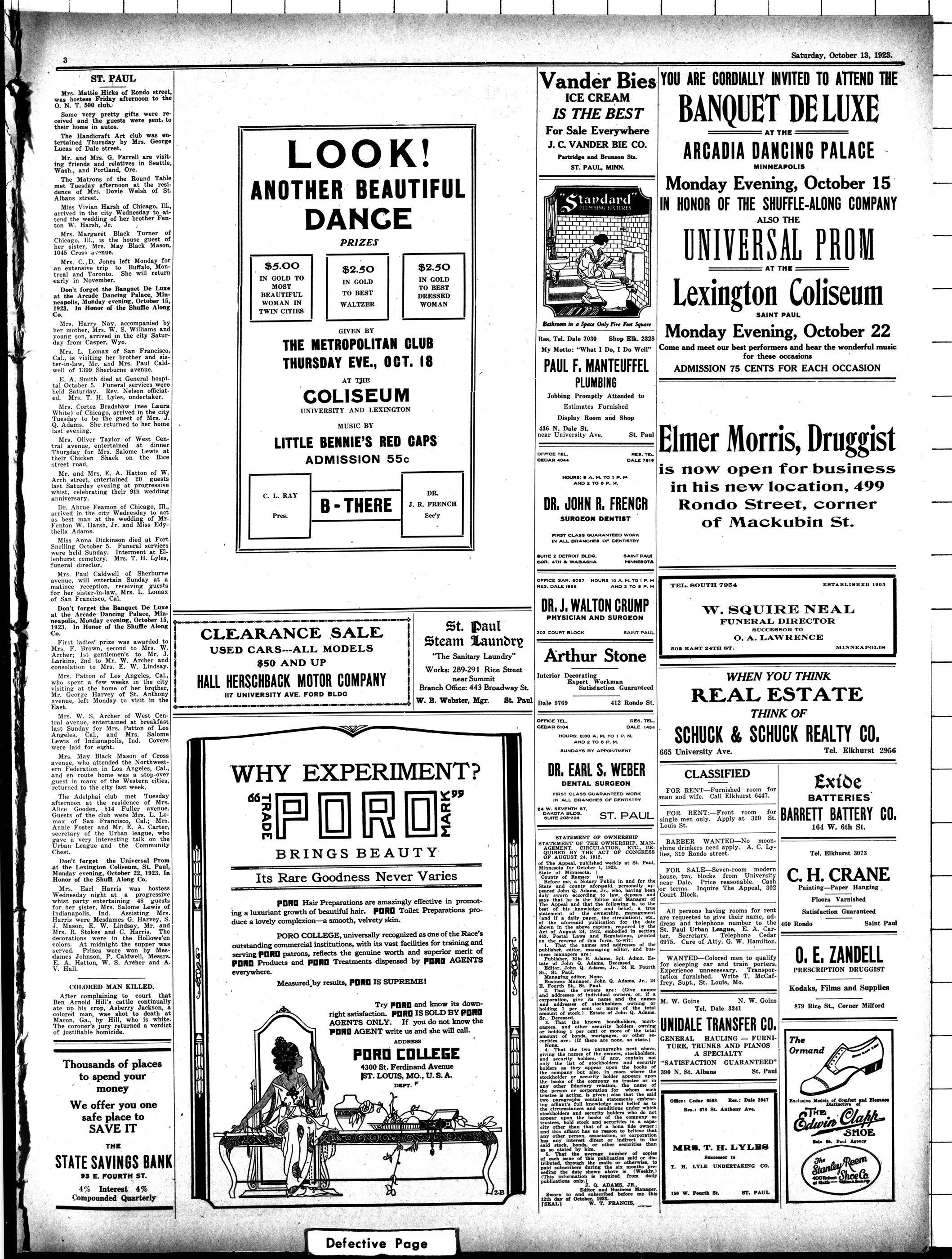
Mrs. Mattie Hicks of Rondo street, was hostess Friday afternoon to the O. N. T. 500 club.
Some very pretty gifts were received and the guests were sent, to their home in autos.
The Handicraft Art club was entertained Thursday by Mrs. George Lucas of Dale street.
Mr. and Mrs. G. Farrell are visiting friends and relatives in Seattle, Wash., and Portland, Ore.
The Matrons of the Round Table met Tuesday afternoon at the residence of Mrs. Dovie Welsh of St. Albans street.
Miss Vivian Harsh of Chicago, Ill., arrived in the city Wednesday to attend the wedding of her brother Fenton W. Harsh, Jr.
Mrs. Margaret Black Turner of Chicago, Ill., is the house guest of her sister, Mrs. May Black Mason, 1045 Cross avenue.
Mrs. C. D. Jones left Monday for an extensive trip to Buffalo, Montreal and Toronto. She will return early in November.
Don't forget the Banquet De Luxe at the Arcade Dancing Palace, Minneapolis, Monday evening, October 15, 1923. In Honor of the Shuffle Along Co.
Mrs. Harry Nay, accompanied by her mother, Mrs. W. S. Williams and young son, arrived in the city Saturday from Casper, Wyo.
Mrs. L. Lomax of San Francisco, Cal., is visiting her brother and sister-in-law, Mr. and Mrs. Paul Caldwell of 1399 Sherburne avenue.
E. A. Smith died at General hospital October 5. Funeral services were held Saturday. Rev. Nelson officiated. Mrs. T. H. Lyles, undertaker.
Mrs. Cortez Bradshaw (nee Laura White) of Chicago, arrived in the city Tuesday to be the guest of Mrs. J. Q. Adams. She returned to her home last evening.
Mrs. Oliver Taylor of West Central avenue, entertained at dinner Thursday for Mrs. Salome Lewis at their Chicken Shack on the Rice street road.
Mr. and Mrs. E. A. Hatton of W. Arch street, entertained 20 guests last Saturday evening at progressive whist, celebrating their 9th wedding anniversary.
Dr. Ahrue Feamon of Chicago, Ill., arrived in the city Wednesday to act as best man at the wedding of Mr. Fenton W. Harsh, Jr. and Miss Edythella Adams.
Miss Anna Dickinson died at Fort Snelling October 5. Funeral services were held Sunday. Interment at Elenhurst cemetery. Mrs. T. H. Lyles, funeral director.
Mrs. Paul Caldwell of Sherburne avenue, will entertain Sunday at a matinee reception, receiving guests for her sister-in-law, Mrs. L. Lomax of San Francisco, Cal.
Don't forget the Banquet De Luxe at the Arcade Dancing Palace, Minneapolis, Monday evening, October 15, 1923. In Honor of the Shuffle Along Co.
First ladies' prize was awarded to Mrs. F. Brown, second to Mrs. W. Archer; 1st gentlemen's to Mr. J. Larkins, 2nd to Mr. W. Archer and consolation to Mrs. E. W. Lindsay.
Mrs. Patton of Los Angeles, Cal., who spent a few weeks in the city visiting at the home of her brother, Mr. George Harvey of St. Anthony avenue, left Monday to visit in the East.
Mrs. W. S. Archer of West Central avenue, entertained at breakfast last Sunday for Mrs. Patton of Los Angeles, Cal., and Mrs. Salome Lewis of Indianapolis, Ind. Covers were laid for eight.
Mrs. May Black Mason of Cross avenue, who attended the Northwestern Federation in Los Angeles, Cal., and en route home was a stop-over guest in many of the Western cities, returned to the city last week.
The Adelphai club met Tuesday afternoon at the residence of Mrs. Alice Gooden, 514 Fuller avenue. Guests of the club were Mrs. L. Lomax of San Francisco, Cal.; Mrs. Annie Foster and Mr. E. A. Carter, secretary of the Urban league, who gave a very interesting talk on the Urban League and the Community Chest.
Don't forget the Universal Prom at the Lexington Coliseum, St. Paul, Monday evening, October 22, 1923. In Honor of the Shuffl Along Co.
Mrs. Earl Harris was hostess Wednesday night at a progressive whist party entertaining 48 guests for her sister, Mrs. Salome Lewis of Indianapolis, Ind. Assisting Mrs. Harris were Mesames G. Harvey, S. J. Mason, E. W. Lindsay, Mr. and Mrs. R. Stokes and C. Harris. The decorations were in the Hollowe'en colors. At midnight the supper was served. Prizes were won by Mesames Johnson, P. Caldwell, Messrs. E. A. Hatton, W. S. Areher and A. V. Hall.
COLORED MAN KILLED.
After complaining to court that Ben Arnold Hill's cattle continually ate up his crop, Asberry Jackson, a colored man, was shot to death at Macon, Ga., by Hill, who is white. The coroner's jury returned a verdict of justifiable homicide.
LOOK!
ANOTHER BEAUTIFUL
DANCE
PRIZES
$5.00
IN GOLD TO
MOST
BEAUTIFUL
WOMAN IN
TWIN CITIES
$2.50
IN GOLD
TO BEST
WALTZER
$2.50
IN GOLD
TO BEST
DRESSED
WOMAN
GIVEN BY
THE METROPOLITAN CLUB
THURSDAY EVE., OCT. 18
AT THE
COLISEUM
UNIVERSITY AND LEXINGTON
MUSIC BY
LITTLE BENNIE'S RED CAPS
ADMISSION 55c
C. L. RAY
Pres.
B - THERE
DR.
J. R. FRENCH
Sec'y
WHY EXPERIMENT?
66 TRADE PORO MARK 99
BRINGS BEAUTY
Its Rare Goodness Never Varies
PORO Hair Preparations are amazingly effective in promoting a luxuriant growth of beautiful hair. PORO Toilet Preparations produce a lovely complexion—a smooth, velvety skin.
PORO COLLEGE, universally recognized as one of the Race's outstanding commercial institutions, with its vast facilities for training and serving PORO patrons, reflects the genuine worth and superior merit of PORO Products and PORO Treatments dispensed by PORO AGENTS everywhere.
Measured by results, PORO IS SUPREME!
Try PORO and know its downright satisfaction. PORO IS SOLD BY PORO AGENTS ONLY. If you do not know the PORO AGENT write us and she will call.
ADDRESS
PORO COLLEGE
4300 St. Ferdinand Avenue
ST. LOUIS, MO., U. S. A.
DEPT. F
CLEARANCE SALE
USED CARS---ALL MODELS
$50 AND UP
HALL HERSCHBACK MOTOR COMPANY
117 UNIVERSITY AVE. FORD BLDG
Defective Page
St. Paul
Steam Laundry
"The Sanitary Laundry"
Works: 289-291 Rice Street
near Summit
Branch Office: 443 Broadway St.
W. B. Webster, Mgr. St. Paul
Vander Bies
ICE CREAM
IS THE BEST
For Sale Everywhere
J. C. VANDER BIE CO.
Partridge and Brunson Sts.
ST. PAUL, MINN.
"Standard"
PLUMBING FIXTURES
Bathroom in a Space Only Five Feet Square
Res. Tel. Dale 7030 Shop Elk. 2328
My Motto: "What I Do, I Do Well"
PAUL F. MANTEUFFEL
PLUMBING
Jobbing Promptly Attended to
Estimates Furnished
Display Room and Shop
436 N. Dale St.
near University Ave. St. Paul
OFFICE TEL.
CEDAR 4044
RES. TEL
DALE 7816
HOURS: 9 A. M. TO 1 P. M.
AND 2 TO 6 P. M.
DR. JOHN R. FRENCR
SURGEON DENTIST
FIRST CLASS GUARANTEED WORK
IN ALL BRANCHES OF DENTISTRY
SUITE 2 DETROIT BLDG.
COR. 4TH & WABASHA
SAINT PAUL
MINNESOTA
OFFICE GAR. 6097 HOURS 10 A. M. TO 1 P. M
RES. DALE 1966 AND 2 TO 8 P. M
DR. J. WALTON CRUMP
PHYSICIAN AND SURGEON
303 COURT BLOCK SAINT PAUL
Arthur Stone
Interior Decorating
Expert Workman
Satisfaction Guaranteed
Dale 9769 412 Rondo St.
OFFICE TEL. RES. TEL.
CEDAR 6104 DALE 1454
HOURS: 8:30 A. M. TO 1 P. M.
AND 2 TO 6 P. M.
SUNDAYS BY APPOINTMENT
DR. EARL S. WEBER
FIRST CLASS GUARANTEED WORK IN ALL BRANCHES OF DENTISTRY
STATEMENT OF OWNERSHIP
STATEMENT OF THE OWNERSHIP, MAN-
JURY BY THE ACT OF CONGRESS
QUIRRED BY THE ACT OF CONGRESS
OF AUGUST 24, 1912.
3. That the known bondholders, mortgages, and other security holders own the amount of bonds, mortgages, or other securities are: (If there are none, so state.) one.
4. That the two paragraphs next above, giving the names of the owners, stockholders, and security holders, any, contain no interest in the stockholder or security holders as they appear upon the books of the company but also, in cases where the stockholder or security holder appears upon the company, any other fiduciary relation, the name of the person or corporation for whom such relations are made, any two paragraphs contain statements embracing affiant's full knowledge and belief as to the circumstances and conditions under which such relations are made, do not appear upon the books of the company as trustees, hold stock and securities in a capacity, and this affiant has no reason to believe that any other person, association, or corporation has any interest direct or indirect in the company or other securities than as so stated by him.
5. That the average number of copies of the information contained in the mail, otherwise, to paid subscribers during the six months preceding the date shown above is (Weekly). The amount is required from daily publications only.)
J. Q. ADAMS, JR.
Editor and Business Manager.
Sworn to and subscribed before me this
12th day of October, 1923.
[SEAL]
W. T. FRANCIS,
Monday Evening, October 22 Come and meet our best performers and hear the wonderful music for these occasions ADMISSION 75 CENTS FOR EACH OCCASION
Elmer Morris, Druggist
is now open for business in his new location,499 Rondo Street, corner of Mackubin St.
W. SQUIRE NEAL FUNERAL DIRECTOR SUCCESSOR TO O. A. LAWRENCE
CLASSIFIED
FOR RENT—Furnished room for man and wife. Call Elkhurst 6447.
FOR RENT:—Front room for single men only. Apply at 320 St. Louis St.
BARBER WANTED—No moonshine drinkers need apply. A. C. Lylies, 319 Rondo street.
FOR SALE—Seven-room modern house, two blocks from University near Dale. Price reasonable. Cash or terms. Inquire The Appeal, 302 Court Block.
All persons having rooms for rent are requested to give their name, address and telephone number to the St. Paul Urban League. E. A. Carter, Secretary. Telephone Cedar 6975. Care of Atty. G. W. Hamilton.
WANTED—Colored men to qualify for sleeping car and train porters. Experience unnecessary. Transportation furnished. Write T. McCaffrey, Supt., St. Louis, Mo.
M. W. Goins N. W. Goins
Tel. Dale 3341
UNIDALE TRANSFER CO.
GENERAL HAULING — FURNITURE, TRUNKS AND PIANOS
A SPECIALTY
"SATISFACTION GUARANTEED"
390 N. St. Albans St. Paul
Office: Cedar 0508 Res.: Dale 2947
Res.: 678 St. Anthony Ave.
MRS. T. H. LYLES
Successor to
Saturday, October 13, 1923.
INVITED TO ATTEND THE
DELUXE
IN THE
FACING PALACE
MINNEAPOLIS
Long, October 15
BUFFLE-ALONG COMPANY
IN THE
DEAL PROM
IN THE
Coliseum
PAUL
Long, October 22
ers and hear the wonderful music
occasions
FOR EACH OCCASION
is, Druggist
for business
location, 499
feet, corner
xubin St.
ESTABLISHED 1905
RE NEAL
DIRECTOR
ASSORI TO
JEVRENCE
MINNEAPOLIS
YOU THINK
ESTATE
K OF
BUCK REALTY CO.
Tel. Elkhurst 2956
Exide BATTERIES BARRETT BATTERY CO. 164 W. 6th St.
Tel. Elkhurst 3073
C. H. CRANE
Painting—Paper Hanging
Floors Varnished
Satisfaction Guaranteed
460 Rondo Saint Paul
O. E. ZANDELL
PRESCRIPTION DRUGGIST
Kodaks, Films and Supplies
879 Rice St., Corner Milford
The Ormand
Exclusive Models of Comfort and Elegance
Distinctive of
THE
Edwin Clapp
SHOE
Sole St. Paul Agency
The
Stanley Reem
400 Robert Shoe Co.
at North — Waltham, Mass.
---
4
MINNEAPOLIS
Don't forget the Banquet De Luxe at the Arcade Dancing Palace, Minneapolis, Monday evening, October 15, 1923. In Honor of the Shuffle Along Co.
Don't forget the Universal Prom at the Lexington Coliseum, St. Paul, Monday evening, October 22, 1923. In Honor of the Shuffle Along Co.
Don't forget the Universal Prom at the Lexington Coliseum, St. Paul, Monday evening, October 22, 1923. In Honor of the Shuffi Along Co.
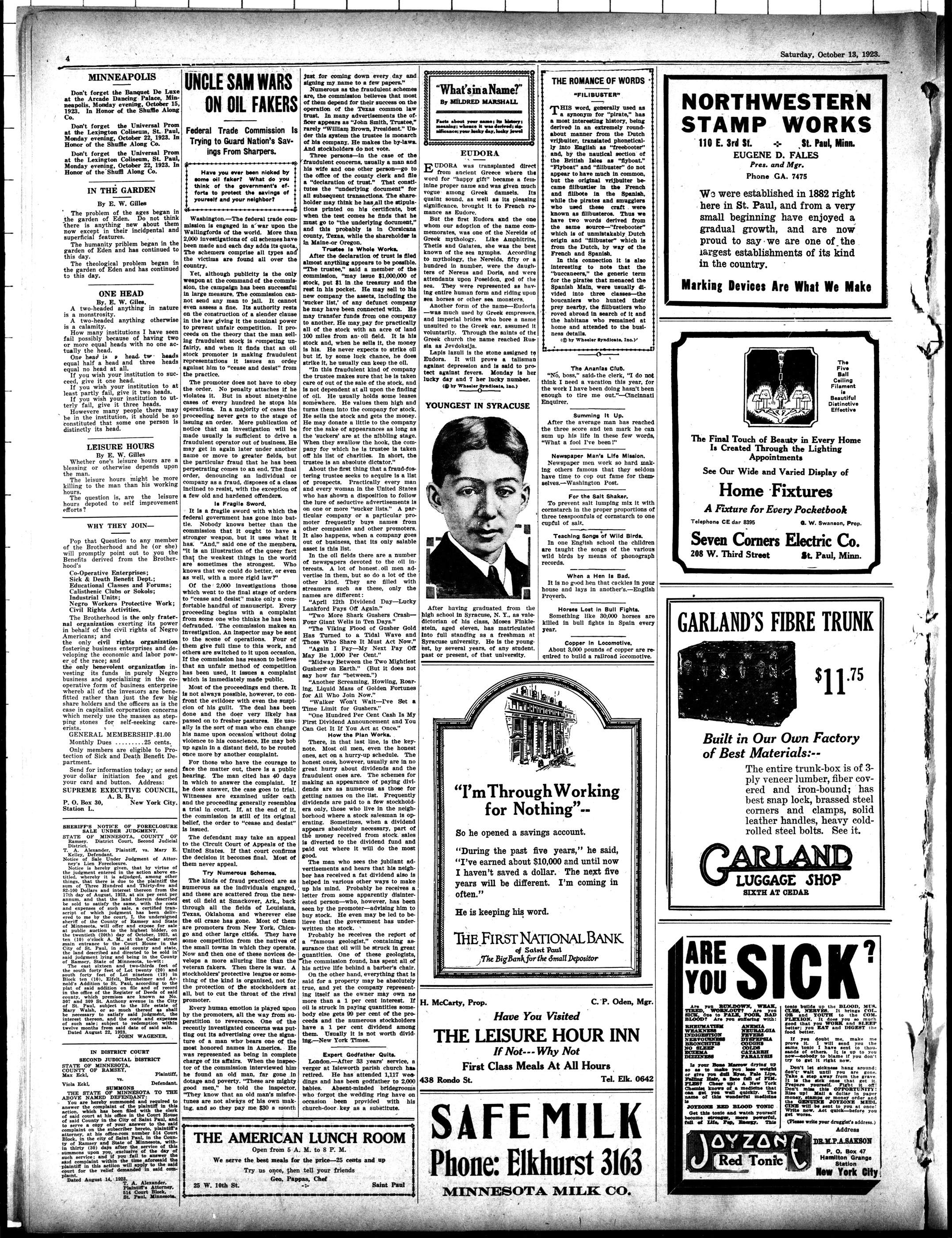
IN THE GARDEN
By E. W. Gilles
The problem of the ages began in the garden of Eden. Do not think there is anything new about them now except in their incipient and superficial features.
The humanity prblem began in the garden of Eden and has continued to this day.
The theological problem began in the garden of Eden and has continued to this day.
ONE HEAD
A two-headed anything in nature is a monstrosity.
A two-headed anything otherwise is a calamity.
How many institutions I have seen fail possibly because of having two or more equal heads with no one actually the head.
On one head two heads equal half a head and three heads equal no head at all.
If you wish your institution to succeed, give it one head.
If you wish your institution to at least partly fail, give it two heads.
If you wish your institution to utterly fail, give it three heads.
However many people there may be in the institution, it should be so constituted that some one person is distinctly its head.
LEISURE HOURS
Whether one's leisure hours are a blessing or otherwise depends upon the man.
The leisure hours might be more killing to the man than his working hours.
The question is, are the leisure hours depoted to self improvement efforts?
WHY THEY JOIN
Pop that Question to any member of the Brotherhood and he (or she) will promptly point out to you the Benefits derived from the Brotherhood's Co-Operative Enterprises:
Co-Operative Enterprises;
Sick & Death Benefit Dept.
Emergency Lines and Forums;
Calisthenic Clubs or Sokols;
Industrial Units;
Negro Workers Protective Work;
Civil Rights Activities.
The Brotherhood is the only fraternal organization exerting its power in behalf of the civil rights of Negro Americans; and.
the only civil rights organization fostering business enterprises and developing the economic and labor power of the race; and the only benevolent organization investing its funds in purely Negro business and specializing in the cooperative form of business enterprise whereb all of the investors are benefitted rather than just the few big share holders and the officers as is the case in capitalist corporation concerns which merely use the masses as stepping stones for self-seeking careers.
GENERAL MEMBERSHIP. $1.00
Monthly Dues .....25 cents.
Only members are eligible to Protection of Sick and Death Benefit Department.
Send for information today; or send your dollar initiation fee and get your card and button. Address:
SUPREME EXECUTIVE COUNCIL,
A. B. B.
P. O. Box 30,
New York City.
Station L.
SHERIFF'S NOTICE OF FORECLOSURE
SALE UNDER JUDGMENT
STATE OF MINNESOTA, COUNTY OF
Ramsey. District Court, Second Judicial
District.
T. A. Alexander, Plaintiff, vs. Mary E.
Kelley, Defendant.
Notice of Sale Under Judgment of Atto-
r
Notice hereby given, that by virtue of the judgment entered in the action above entitled, whereby it is adjudged, among other things, that the law, due to the plan and the law of Hundred and Thousand-five and 82-100 Dollars and interest thereon from the 17th day of August, 1925, at six per cent per annum, and that the land therein described in the Act of 1925, and the same, and the expenses of such sale, a certified transcript of which judgment has been delivered to me by the court. I, the undersigned hereto, under the배族自治县法典,of Minnesota, will offer and expose for sale at public auction to the highest bidder, on the twentieth (20th) day of October, 1925, at ten (10) clock A.A., at the dard at the entry into the Court House in the City of St. Paul, in said county and state, the land described and directed to be sold in said judgment lying and being in the County of St. Paul's State. Minnesota, with the fact of The east sixteen and two thirds feet of the south forty feet of Lot twenty (20) and south forty feet of Lot, nineteen (19) in Borderside, and the other three (19) in the Court,乃 the Effecti, Berners and the mold of the Addition to St. Paul, according to the plot of said addition on file and of record in the office of the Register of Deeds of said county and state, the Act of 1925, the first of the 17th and 309 and 399th. Anthony avenue in the City of St. Paul, subject to the life estate of Mary Walsh, or so much thereof as shall be made, to the said interest thereon and the costs of such sale; subject to redemption within twelve months from said date of said sale.
Dated August 22, 1925.
JOHN WAGENER
IN DISTRICT COURT
SUMMONS
THE STATE SOSTA TO THE
ABOVE NAMED DEFENDANT;
ABOVE NAMED DEFENDANT:
You are hereby summoned and required to answer the complaint of the plaintiff in this action, which will be filed at his office in the Court House of said County in the City of Saint Paul, and to serve a copy of your answer to the said complaint on the subscriber's office number 514 Court Block, in the city of Saint Paul, in the County of Ramsey and State of Minnesota, within thirty (30) days after the service this summons was filed; such service; and if you fail to answer the said complaint within the time aforesaid the plaintiff in this action will apply to the court for the relief demanded in said complaint.
Dated August 14, 1923.
T. A. Alexander,
Plaintiff's Attorney,
514 Court Block,
St. Paul, Minnesota.
THE AMERICAN LUNCH ROOM
Open from 5 A. M. to 8 P. M.
We serve the best meals for the price—25 cents and up
Try us once, then tell your friends
Geo. Pappas, Chef
25 W. 10th St. -- Saint Paul
UNCLE SAM WARS ON OIL FAKERS
Federal Trade Commission Is Trying to Guard Nation's Savings From Sharpers.
Have you ever been nicked by some oil faker? What do you think of the government's efforts to protect the savings of yourself and your neighbor?
Washington.—The federal trade commission is engaged in a war upon the Wallingfords of the world. More than 2,000 investigations of oil schemes have been made and each day adds its quota. The schems comprise all types and the victims are found all over the country.
Yet, although publicity is the only weapon at the command of the commission, the campaign has been successful in large measure. The commission cannot send any man to jail. It cannot even assess a fine. Its authority rests on the construction of a slender clause in the law giving it the nominal power to prevent unfair competition. It proceeds on the theory that the man selling fraudulent stock is competing unfairly, and when it finds that an oil stock promoter is making fraudulent representations it issues an order against him to "cease and desist" from the practice.
The promoter does not have to obey the order. No penalty attaches if he violates it. But in about ninety-nine cases of every hundred he stops his operations. In a majority of cases the proceeding never gets to the stage of issuing an order. Mere publication of notice that an investigation will be made usually is sufficient to drive a fraudulent operator out of business. He may get in again later under another name or move to greater fields, but the particular fraud that he has been perpetrating comes to an end. The final order, denouncing an individual or company as a fraud, disposes of a class inclined to resist, with the exception of a few old and hardened offenders.
Is Fragile Sword.
It is a fragile sword with which the federal government has gone into battle. Nobody knows better than the commission that it ought to have a stronger weapon, but it uses what it has. "And," said one of the members, "it is an illustration of the queer fact that the weakest things in the world are sometimes the strongest. Who knows that we could do better, or even as well, with a more rigid law?" Of the 2,000 investigations those which went to the final stage of orders to "cease and desist" make only a comfortable handful of manuscript. Every proceeding begins with a complaint from some one who thinks he has been defraunded. The commission makes an investigation. An inspector may be sent to the scene of operations. Four of them give full time to this work, and others are switched to it upon occasion. If the commission has reason to believe that an unfair method of competition has been used, it issues a complaint which is immediately made public.
Most of the proceedings end there. It is not always possible, however, to confront the evildoer with even the suspicion of his guilt. The deal has been done and the doer very likely has passed on to fresher pastures. He usually is the sort of man who can change his name upon occasion without doing violence to his conscience. He may bob up again in a distant field, to be routed once more by another complaint.
For those who have the courage to face the matter out, there is a public hearing. The man cited has 40 days in which to answer the complaint. If he does answer, the case goes to trial. Witnesses are examined under oath and the proceeding generally resembles a trial in court. If, at the end of it, the commission is still of its original belief, the order to "cease and desist" is issued.
The defendant may take an appeal to the Circuit Court of Appeals of the United States. If that court confirms the decision it becomes final. Most of them never appeal.
Try Numerous Schemes.
The kinds of fraud practiced are as numerous as the individuals engaged, and these are scattered from the newest oil field at Smackover, Ark, back through all the fields of Louisiana, Texas, Oklahoma and wherever else the oil craze has gone. Most of them are promoters from New York, Chicago and other large cities. They have some competition from the natives of the small towns in which they operate. Now and then one of these novices develops a more alluring line than the veteran fakers. Then there is war. A stockholder's protective league or something of the kind is organized, not for the protection of the stockholders at all, but to cut the throat of the rival promoter.
Every human emotion is played upon by the promoters, all the way from superstition to reverence. One of the recently investigated concerns was putting out its advertising over the signature of a man who bears one of the most honored names in America. He was represented as being in complete charge of its affairs. When the inspector of the commission interviewed him he found an old man, far gone in dotage and poverty. "These are mighty good men," he told the inspector. "They know that an old man's misfortunes are not always of his own making, and so they pay me $30 a month
just for coming down every day and signing my name to a few papers."
Numerous as the fraudulent schemes are, the commission believes that most of them depend for their success on the operation of the Texas common law trust. In many advertisements the officer appears as "John Smith, Trustee," rarely "William Brown, President." Under this system the trustee is monarch of his company. He makes the by-laws. And stockholders do not vote.
Three persons—in the case of the fraudulent concerns, usually a man and his wife and one other person—go to the office of the county clerk and file a "declaration of trust." That constitutes the "underlying document" for all subsequent transactions. The shareholder may think he has all the stipulations printed on his certificate, but when the test comes he finds that he must go to "the underlying document," and this probably is in Corsicana county, Texas, while the shareholder is in Maine or Oregon.
Trustee Is Whole Works
After the declaration of trust is filed "almost anything appears to be possible. "The trustee," said a member of the commission, "may issue $1,000,000 of stock, put $1 in the treasury and the rest in his pocket. He may sell to his new company the assets, including the "sucker list," of any defunct company he may have been connected with. He may transfer funds from one company to another. He may pay for practically all of the stock with an acre of land 100 miles from an oil field. It is his stock and, when he sells it, the money is his. He never expects to strike oil but if, by some luck chance, he does strike it, he usually can keep the oil.
"In this fraudulent kind of company the trustee makes sure that he is taken care of out of the sale of the stock, and is not dependent at all upon the finding of oil. He usually holds some leases somewhere. He values them high and turns them into the company for stock. He sells the stock and gets the money. He may donate a little to the company for the sake of appearances as long as the 'suckers' are at the nibbling stage. When they swallow the hook, the company for which he is trustee is taken off his list of charities. In short, the trustee is an absolute dictator."
About the first thing that a fraud-fostering trustee seeks to acquire is a list of prospects. Practically every man and every woman in the United States who has shown a disposition to follow the lure of seductive advertisements is on one or more "sucker lists." A particular company or a particular promoter frequently buys names from other companies and other promoters. It also happens, when a company goes out of business, that its only salable asset is this list.
In the oil fields there are a number of newspapers devoted to the oil interests. A lot of honest. oil men advertise in them, but so do a lot of the other kind. They are filled with streamers such as these, only the names are different:
"April 12th Dividend Day—Lucky Lankford Pays Off Again."
"Two More Shark Gushers Crash—Four Giant Wells in Ten Days."
"The Viking Flood of Gusher Gold Has Turned to a Tidal Wave and Those Who Share It Must Act Now." "Again I Pay—My Next Pay Off May Be 1,000 Per Cent." "Midway Between the Two Mightiest Gushers on Earth." (But it does not say how far "between.") "Another Screaming, Howling, Roaring, Liquid Mass of Golden Fortunes for All Who Join Now." "Walker Won't Wait—I've Set a Time Limit for Gushers." "One Hundred Per Cent Cash Is My First Dividend Announcement and You Can Get It If You Act at Once."
There, in that last line, is the keynote. Most oil men, even the honest ones, act on a hurry-up schedule. The honest ones, however, usually are in no great hurry about dividends and the fraudulent ones are. The schemes for making an appearance of paying dividends are as numerous as those for getting names on the list. Frequently dividends are paid to a few stockholders only, those who live in the neighborhood where a stock salesman is operating. Sometimes, when a dividend appears absolutely necessary, part of the money received from stock sales is diverted to the dividend fund and paid out where it will do the most good.
The man who sees the jubilant advertisements and hears that his neighbor has received a fat dividend also is helped in various other ways to make up his mind. Probably he receives a letter from some apparently disinterested person—who, however, has been seen by the promoter—advising him to buy stock. He even may be led to believe that the government has underwritten the stock. Probably he receives the report of a "famous geologist," containing assurance that oil will be struck in great quantities. One of these geologists, the commission found, has spent all of his active life behind a barber's chair.
On the other hand, everything that is said for a property may be absolutely true, and yet the company representing itself as the owner may own no more than a 1 per cent interest. If oil is struck in paying quantities somebody else gets 99 per cent of the proceeds and the numerous stockholders have a 1 per cent dividend among them. Usually it is not worth dividing.—New York Times.
Expert Godfather Quits
London.—After 33 years' service, a verger at Isleworth parish church has retired. He has attended 1,117 weddings and has been godfather to 2,000 babies. Absent-minded bridegrooms who forgot the wedding ring have on occasion been provided with his church-door key as a substitute.
"I'm Through Working for Nothing"--
So he opened a savings account.
"During the past five years," he said,
"I've earned about $10,000 and until now I haven't saved a dollar. The next five years will be different. I'm coming in often."
He is keeping his word.
THE FIRST NATIONAL BANK
of Saint Paul
The Big Bank for the Small Depositor
SAFEMILK Phone: Elkhurst 3163
MINNESOTA MILK CO.
"What's in a Name?"
By MILDRED MARSHALL
Facts about your name; its history;
meaning; whence it was derived; sign-
ificance; your hecky day, lucky jewel
EUDORA
EUDORA was transplanted direct from ancient Greece where the word for "happy gift" became a feminine proper name and was given much vogue among Greek damsels. Its quaint sound, as well as its pleasing significance, brought it to French romance as Eudore.
But the first Eudora and the one whom our adoption of the name commemorates, was one of the Nereldis of Greek mythology. Like Amphitrite, Thetis and Galatea, she was the best known of the sea nymphs. According to mythology, the Nereldis, fifty or a hundred in number, were the daughters of Nereus and Doris, and were attendants upon Poseidon, god of the sea. They were represented as having entire human form and riding upon sea horses or other sea monsters.
Another form of the name—Eudorda—was much used by Greek empresses, and imperial brides who bore a name unsuited to the Greek ear, assumed it voluntarily. Through the saints of the Greek church the name reached Russia as Jevdokslja. Lapis lazull is the stone assigned to Eudorda. It will prove a talisman against depression and is said to protect against fevers. Monday is her lucky day and 7 her lucky number.
YOUNGEST IN SYRACUSE
[Name]
After having graduated from the high school in Syracuse, N. Y., as valedictorian of his class, Moses Finklein, aged eleven, has matriculated into full standing as a freshman at Syracuse university. He is the youngest, by several years, of any student, past or present, of that university.
THE ROMANCE OF WORDS
THIS word, generally used as a synonym for "pirate," has a most interesting history, being derived in an extremely roundabout manner from the Dutch vrubitor, translated phonetically into English as "freebooster" and, by the nautical section of the British Isles as "flyboat." "Flyboat" and "filbuster" do not appear to have much in common, but the original vrubitor became filibuster in the French and filbote in the Spanish, while the pirates and smugglers who used these craft were known as filbusteros. Thus we have two words derived from the same source—"freebooter" which is of unmistakably Dutch origin and "filbuster" which is from the Dutch, by way of the French and Spanish.
In this connection it is also interesting to note that the "buccaneers," the generic term for the pirates that menaced the Spanish Main, were usually divided into three classes—the bouncarians who hunted their prey nearby, the filibusters who roved abroad in search of it and the habitans who remained at home and attended to the business details.
The Ananfas Club.
"No, boss," said the clerk, "I do not think I need a vacation this year, for the work I have been doing hasn't been enough to tire me out."—Cincinnati Enquirer.
Summing It Up.
After the average man has reached the three score and ten mark he can sum up his life in these few words, "What a fool I've been!"
Newspaper Man's Life Mission.
Newspaper men work so hard making others famous that they seldom have time to cop out fame for themselves.—Washington Post.
For the Salt Shaker.
To prevent salt lumping mix it with cornstarch in the proper proportions of three teaspoonfuls of cornstarch to one cupful of salt.
Teaching Songs of Wild Birds.
In one English school the children are taught the songs of the various wild birds by means of phonograph records.
When a Hen Is Bad.
It is no good hen that cackles in your house and lays in another's.—English Proverb.
Horses Lost in Bull Fights.
Something like 30,000 horses are killed in bull fights in Spain every year.
Copper in Locomotive.
About 3,000 pounds of copper are required to build a railroad locomotive.
```markdown
```
NWHWESTERN
AMP WORKS
St. St. Paul, Minn.
BUGENE D. FALES
Pres. and Mgr.
Phone GA. 7475
established in 1882 right
St. Paul, and from a very
beginning have enjoyed a
growth, and are now
say we are one of the
establishments of its kind
country.
Services Are What We Make
The Five
Ball
Ceiling
Filament
is
Beautiful
Distinotive
Effective
Much of Beauty in Every Home
Used Through the Lighting
Appointments
Wide and Varied Display of
Home Fixtures
Live for Every Pocketbook
8395
A. W. Swanson, Prop.
Corners Electric Co.
St. Paul, Minn.
D'S FIBRE TRUNK
NORTHWESTERN STAMP WORKS
110 E. 3rd St. St. Paul, Minn.
EUGENE D. FALES
Pres. and Mgr.
Phone GA. 7475
We were established in 1882 right here in St. Paul, and from a very small beginning have enjoyed a gradual growth, and are now proud to say we are one of the largest establishments of its kind in the country.
Marking Devices Are What We Make
The Five Ball Ceiling Filament is Beautiful Distinotive Effective
The Final Touch of Beauty in Every Home Is Created Through the Lighting Appointments
See Our Wide and Varied Display of
Home Fixtures
A Fixture for Every Pocketbook
Telephone CE dar 8395
G. W. Swanson, Prop.
Seven Corners Electric Co.
208 W. Third Street
St. Paul, Minn.
GARLAND'S FIBRE TRUNK
Built in Our Our of Best Material
In Our Own Factory Materials:-- The entire trunk-box is of 3ply veneer lumber, fiber covered and iron-bound; has best snap lock, brassed steel corners and clamps, solid leather handles, heavy cold-rolled steel bolts. See it.
ARLAND
LUGGAGE SHOP
SIXTH AT CEDAR
GARLAND
LUGGAGE SHOP
SIXTH AT CEDAR
ARE YOU SICK?
Are you BUN-DOWN, WEAK, TIRED, WORK OUT? Are you SICK to PALE, POOR, RED BLOOD? Are you suffering with:
RHEUMATISM ANEMIA NEURALGIA WEAKNESS FEVERS INDIGESTION NASTY MEMA BRONCHITIS OUGHES NO SLEEP COLORS BUZZES CATARRH DIZZINESS PARALYSES
Is your Bone Marrow drying up so as to make you lose weight or give you dull Eyes, Pale Lips, Failing Hair, a race full of PIM-FLEES? Cheer up! A New York Chemist knows of a medicine that can get you well quickly. The name of this wonderful medicine is JOYZONE RED BLOOD TONIC.
Get this tonic and watch yourself become stronger, more powerful, full of Life, Pop, Energy. This tonic builds up the BLOOD, MUS. CLES, NERVES. It brings COLLISION to YOUR YOUTH to the COPELECTION. You are so much good that you WORK and SLEEP better; you EAT and DIGEST the food better.
If you doubt me, make me prove it. I will send you the same tonic I have sent to thou-self, and I am up to you now—nobody to blame if you don't try to get it right now.
Don't let sickness hang around; don't wait until you are gone. Take a step away from the cave. It is the sick ones that get it. Prepare yourself. Fight it off! Don't leave it on your body. Rise up! Mail a dollar in paper money, stamps or money order and the JOYZONE RED TONIC MEDICINE will be sent to you once. Write now. Act quick—before you get worse.
(Please write your druggist's address.)
Address
DR.M.P.A.SAKSON
P. O. Box 47
Hamilton Grange Station
New York City
Saturday, October 13, 1923.