State Ledger
Saturday, July 27, 1901
Topeka, Kansas
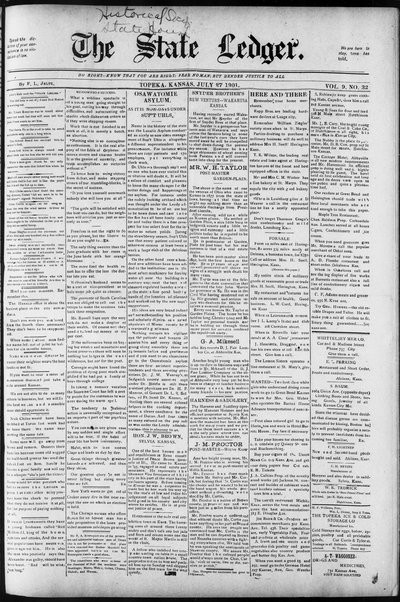
Page text (machine-generated)
Speak the dictates of your conscience is no violation of law.
Don't kick read the "STATE LEDGER."
The old lady is out of jil and Dad Nation is wanting out.
Mr. Linen Breeches was in round about town last week but time will soon tell him Jack Frost wants to see him.
The Santa Fe is the road to take to avoid accidents only one in a long white.
The School Board has received bids for winter's fuel.
Some fool killer is always round and about look out for him else he will kill you
When a man gets drunk he can only remember the man that licked him when he was sooner.
Most old men would rather young men would call them dad in fact dad is like the paper that it is all the dad up to date.
Nick Chiles sends Chief Stahl the meaning of heart, Titled "All we want is to be left alone" signed- Mckinley Club.
Chas. Curtis is again out for conges from the way the wind seems to blow he may yet be happier.
Some of the old funny females here and there ought to be chronicled in the pup rs they act so awful funny.
Mayer Hughes scared the showman out of his wits and one hundred sixty five dollars came up as a result.
Some elderly man and especially boys in country towns eat more ice cream than the maiden or other fishable ladies
Probate Judge Campen Pleasae all who come here for license at Hutchin on h is an ex-soldier and also lost a son in the Philippines not a year ago.
Remember us not the fellow who talk the most to you of his friendly devotion to you serves you best as a friend.
Mind your own business. Remember this.
The HERALD office is about the busiest place in the city now-a-days.
Don't you wish you was loved like the fourth class postmans? They don't have to be reappointed.
When some jealous man finds his name left out of print he hollers for six months hence,
Some woman want divorce be cause their neighbor wears the best looking out fit.
If you want to hear a mess of nonesense discussed just take a ride around Kansas.
We are not able to do as many others in business, but we will do the best we can and a sensible man should appreciate it.
Nick Chiles would have been mobbed at Turon last week had he been there. We came near serving the same fate.
Some men will go away from home and remain. Deserts their families because some old wigged up bald-head granny has used the rabbit foot on him. Surely he leaves a good family and will say in a whisper "she's just the ticket."
Some would be wise persons who fail to recieve the LEDGER as promt as some other incisy journals have the cheek to pretend that they do not receive it at all, for the purpose of paying nothing at all.
Down at Leavenworth they have a young Irishman called "Red McDonald, king of the bu m s, spotters and crooks, And the several populations have sworn vengeance against him. He is also the man who postively says that Alexander was guilty, should have been burnt. 'Red will be wise, 'ere long,"
The State Ledger.
DO RIGHT--KNOW THAT YOU ARE RIGHT; FEAR NOMAN; BUT RENDER JUSTICE TO ALL
What a sublime spectacle is of a young man going straight to his goal, cutting his way through difficulties, and surmounting obstacles which dishearten others as it they were stepping stones.
Work that is not finished is no work at all, it is merely a botch, an abortion.
"Nothing else is so contagious as enthusiasm. It is the real allegory of the fable of Orpheus: it moves stones and charms brutes It is the genius of sincerity, and truth accomplishes no victories without it."
To know how to wring victory from defeat, and make stepping stones of our stumbling-blocks, is the secret of success.
"It you love yourself overmuch nobody else will love you at all"
"The gods will be satisfied with the best you can do, but the neighbors will criticise you just as severely as ever."
Freedom is not the right to do as you please, but the liberty to do as you ought to...Ex.
The only thing sweeter than the June graduate with her roses is the June bride with her orange blossoms
The more food the health resort has to offer the less the doctor lets you eat.
Wilhemina's husband seems to be a sort of vice-president or to hole some job quite as obscure.
The governor of South Carolina was not obliged to call out the troops to make the senators take back their resignation.
Mr. Russell Sage says the very rich do not make a display of their wealth. Of course not: they need it to lend out money at six per cent.
If the millionaries keep on buying big estates and mountains and forest preserves there will soon be nothing but lodges in the vast wilderness, but not for the poet.
Carnegie might have found the problem of dying poor much simplified if he had put a family of boys through college
In taking a summer vacation the Supreme Court has left a pretty puzzle for the statesman to wor over during the warm spell.
The tendency to habitual action is universally recognized as an important part of our psychical nature.
You can not in any given case by any sudden and single effort will to be true, if the habit of your life has been insincerity.
Habit, with its iron sinews Claps and leads us day by day.
Great things through greatest hazards are achieved, and then they shine,
Our greatest glory is not in never falling but rising every time we fall. Ex
New York wants to get rid of Croker every day in the year except the one on which an election is held.
The Chicago woman who offers $1,000 for an honest man has a safe proposition if she loses provided museum privileges go along
Mr. B. A. Kosenquist one of the prominent and substantial business men of Osage city is out for postmaster at that place it was rumored that Banker Marshall had been appointed but it is not true Mr. Rosenquist stands a good show.
The councilmen who were in favor of the dismissal of Hall the murderer were Snattinger, Myers, Web:x, Griley, Chaney, Nichols, and Warnes.
TOPEKA, KANSAS, JULY 27 1901.
OSAWATOMIE ASYLUM.
AS IT IS NOW-DAYS UNDER SUP'T UHLS.
Never in the history of the state was the Lunatic Asylum conducted so nicely as now since management of Sup't Uhis is altogether a different superintendent to his predecessors. For instance while there are 1050 patients and 170 employees, yet everything is clock work.
Dr. Uhls is a thorough sup't and no one who have ever visited this institution will doubt it. It will be a solace of comfort and pleasure to know the many changes for the better doings and happenings at the asylum. For instance under the rudely looking orchard which was thought under the Leedy administration to be of no use but to be hewn down and cast in to the fire has all been finely cared for and today there is a fine prospect for fine select fruit for the imates as nature yeilids. During the strawberry season, Sup't Uhls saw that every patient colored or otherwise receive at least twice a week a large dish of the delicious berries.
On the other hand over a hundred new additions have been added to the institution; one is the most select machinery for forcing water all over the building in a sanitary way; next the best and cleanest regulated laundry system in the state: a fine pond built hands of the lunatics all planned and worked out by the new super's suggestions.
His ideas are very broad indeed and notwithstanding his position and scholarly dignity, as a noted physician of Miami county he is a reasonable gentleman
Nothing escapes his vigilant eye the patients and tenants all admire him and every thing is going along smoothly there are 74 tenants ladies and gentleman and if you want to see cleaniiness go to the Osawatomie asylum there are four assistant superintendents and three assisting physicians. Dr. J. W. Vannuy's, or Sedgwick county assistant supt under Dr. Biddle is still there assistant physicians are Dr. H. P. Monroe, of Garnett Dr. L. R. Sellers, of Ft. Scott Dr. Kooms, of Sterling there are several colored helpers in the cooking department, a clever coachmn by the name of Ducan. And four times as many colored on the pay roll as was under the Leedy administration- this is pleasing to us.
HON.J.W.BROWN SYLVIA KANSAS.
One of the best known men and republicans in Reno county is Justice of Peace Brown formerly of Ill., He came to Kansas in '93, engaged in real estate and insurance. He represents the Shawnee Fire Insurance of this city in his part of the state having exclusive agency. Before coming to Kansas he was a carpenter by trade but he has work his way up by the study of law and today his judgement on all legal subjects hold good in his county and city where he resides. He is at present justice of peace.
Hutchinson is the only real prohibition town in Kans. The knowing ones sit around these freezy nights and don't talk any but jails and fines and giving some one the worst of it. Mayor Martin is still in the chair.
A fellow who imbibed too treey was waiting on table in a small country town eating house. The proprietor got on to him and packed him up on Sunday and skipped him on the first train for the west quietly,
SNYDER BROTHER'S NEW VENTURE—WAKARUSA KANSAS.
Having recently visited Wakarusa, we met Mr. Snyder of the firm of Snyder Bros. at that place. Mr. Snyder is a prosperous business man of Wakarusa and says unless the farmers bring in some of the last year's corn they have stored away he will be compelled to shut down during the present dry season. However he has large shipments of wheat coming from Parsons and will convert same into chop for the present.
MR.W.H.TAYLOR POST-MASTER
GARDEN-PLAIN.
The above is the name of one the veteran of Ohio who came to Kansas in 1877 from the state of Iowa, having at that time we might say nothing more than an honorable discharge from President Lincoln.
After running wild for a while on Kansas plains. He settled at Garden Plain, a nice little burg in Sedgwick county and a little religion and economy and a little politics today he is reputed to be worth more than $15000.
He is postmaster at Garden, Plain for past time but his real ousiness is that of a real estate dealer.
He has been post-master since 1892, built the first house in the city. He is 57 years of age and its well preserved self shows no signs of a struggle with death for many years.
Mr. Taylor was one of the delegates to the state convention that nominated the late John Martin for governor in '84. He was in the Civil War having mustered out in 64. His greatest and serious injury was deafness for this he receives a nominal pension.
Every one honors Mr. Taylor at Garden Plaine. The home he has held so long. Chester Long and Mr. Taylor are personal friends and he is holding on through these many years for services rendered the republican party.
G. A. Mikesell
Who Represents D, J, Fair Lumber Co, at Abbyville Kas,
Another bright young man who is up-to-date in business ways and lines is Mr. Mikesell of the D, J, Fair Lumber Company at the above place. While he has not been at Abbyville very long yet he has been in charge of lumber business for many years, he is making many friends in his new position,
HARNESS & SADDLERY.
The Harness and Saddlery operated by Manager Holmes and his efficient proprietor at Syivia Kas, is meeting with success, Mr. Holmes the manager has been at this work for many years and we predict for them much success as it is the only place where you can obtain harness made to order.
J. M. PROCTOR
POST-MASTER—WILLIIS KANS
Another bright young man, Mr, J. M. Proctor who is serving his second term as post-master at Willis Kansas.
Mr. Proctor has done much for both Mr. Bailey and Mr. Curtis, but feeling that Mr. Curtis was the choice and he wanted to be on the band wagon his whole precinct without a disserting vote stood by Mr. Curtis.
Mr. Proctor is a native of Brown county, 35 years of age and was born just in 4 miles from his post-office.
Mr. Proctor wants it understood that without doubt Mr. Curtis can have anything in his part of Brown county. He says the people are convinced that Mr. Curtis is the man and he can depend on Brown and Neinaha counties with a fighting everywhere else. We told him he was speaking the sentiments of Shawnee county. We assure Mr. Proctor that't he colored people would always unite on Chas, Curtis, "sink or swim, live or die, survive or perish." Geo. Hungate the auctioneer has gone to Elliwood.
HERE AND THERE
Remember your home merchants.
Rapp Bros. are leading hardware dealers at Osage city.
Remember William Ziegler' variety store when in St. Marys.
Parties desiring to purchase a multinary business will do well to address Mrs H. Snell' Herington Kans.
T. R. Wilson, the leading real estate and loan agent at Herington has one of the finest and best equipped offices in the state.
Mr. and Mrs C. M. Winker has a fine bakery at St. Marys. They supply the city with good bakery goods
When in Louisburg giive A D Weaver a call in the restaurant line he has a neatly appointed place.
Don't forget Thurman Crago's nice confectionery and mild drinks, Louisburg Ka
FORSALE
Farm 10 miles east of Herington, 80 acres 3½ miles north of Delema, a business town, for 1850 Call or address Mrs: H. Snell. Herington, Kans.
(Mention this paper)
My entire stock of millinery goods at reasonable price or trade Mrs. H. Snell, Herington, Kans.
My restaurant and fixtures for sale on account of health. Good business. L. W. Curd, Heringon Kans
When in Leavenworth remember J. L. Lacey's Hotel and club room. 218 Cherokee street.
When in Rossville take your meals at A. A Cless' restaurant
J. Henrietta, Druggest, now has his own store at 116 East 6th street. Give him a call.
The Lemon Sisters operates a fine restaurant at St. Mary's, give them a call.
WANTED—Two first class white girls who understand dining room work to go to Great Bend Kansas to work for Mrs. Geo. Weber who operates the Barton House Advance transportation if necessary.
—First class colored girl to go to Herington and work in Hotel Barreta House. Pay fare if necessary
Take your houses for shoeing to L. D goodwin 517 Quincy St. general Blacksmithing.
Buy your cigars of the Union News Co. 509 Kans. Ave. and get your daily papers free Cut rate R. R. Tickets
J. A. Calkins Prop. of the novelty wood works 316 Jackson St. contract and builder of cabinent work tand kitchen cabinet a specialty give him a trial.
The Labeth restaurant Wichita Kans. serves the best meals and gives the best accommodations 313 E. Douglas Ave.
JOE BAHR & Co. -Produce an commission merchants 302 Kans. Ave. Tel. 438. Their specialties are, early Vegetables Fish, Fruit and produce at wholesale price A. Irwin and son meats and groceries fish poultry and game vegetables also country produce and butter 603 Kas. Ave.
When you want a good 15 and 25c. meal go to the German Hotel 227 Kansas, Ave, Geo. Wenthe Prop.
We are here to stay, time has told.
VOL. 9. NO. 32
S. Rabinwitz keep gents clothing Hats, Caps&c, Give him a call 218 Kansas avenue,
Young & Sons for flour and feed 328 N Main street Hutchinson Kans.
Mr. L, B. Cory, the bright young manager of the Coal & Coke Co., of Hutchinson is all right, his main office is Kansas City.
The Nobby is the place to patronize, Mr, D, B. Cox, prop 107 St Main street for meats, Hutchinson Kansas.
The Cottage Hotel, Abbyville is all new modern improvements and Mr, Havercroft its efficient prop is doing well and is highly pleasing to its guest. The hotel held its first celebration not long ago and its doors were open to the public and quite a pleasant time had,
Our readers at Great Bend and Hoisington should trade with their local merchants who are kind enough to take this paper.
Maple Tree Restaurant.
Chas. Baldwin Prop. Carbondale Kas. Lunches served at all hours Cigars, Confectionery and ice cream.
When you need groceries give Mr. Morrowa call the popular merchant of Oskal oosa.
Give a share of your trade to A. D. Plumbs restaurant and short order. Oskaloosa Kas.
When in Oskaloosa call and see the big display of fire works at Burnetts restaurant also a full line of confectionery cigars and mild drinks.
C. F, Adams meats and grocer es, 935 N. Kans ave,
Try Geo. Hammel—the old reiable Draper and Tailor. He will make you a suit of clothes to fit. Every thing guaranteed...50g kans ave.
WHITTELSEY MER CO,
Cor 2nd & Madison Street
Phone 732 City
Give them a call.
E. L. PERRING
Restaurant and Short Order,
Fruits and confectioney.
S BAUM.
1064 Union Ave. (opposite depot) Clothing Boots and Shoes, turing Goods, Jewelry of all kinds. Kansas City Mo.
Since the scientist have decided that disease germs are communicated by kissing, Boston babies will probably organize a society to prevent candidates from becoming too familiar, Ex.
P. M. LIGHTNER
New and Second-hand goods bought and sold. Abilene, Kans
Harness and also dealer in saddle lery goods. Sylvia, Kans.
W. R. TEDRICK
Whole sale dealer in 'Boss Patent Flour' and m'll feed. 320 N. Main street.
Hutchinson, Kans.
H. F. Williams, Pres.
Wm. L. Dickey, Secy & Treas.
THE TOPEKA ICE & COLD STORAGE CO
Manufactured Ice.
Cold Storage for eggs, butter, apples, poultry and all perishable goods,
Cor Curtis & Tyler st.
Trackage to all Railroads. Correspondence solicited.
N, Topeka. Phone 657
A. T. WAGGONER
DRUGS AND
MEDICINES.
731 Kansas Ave.
YOUT RADE SOLICITED
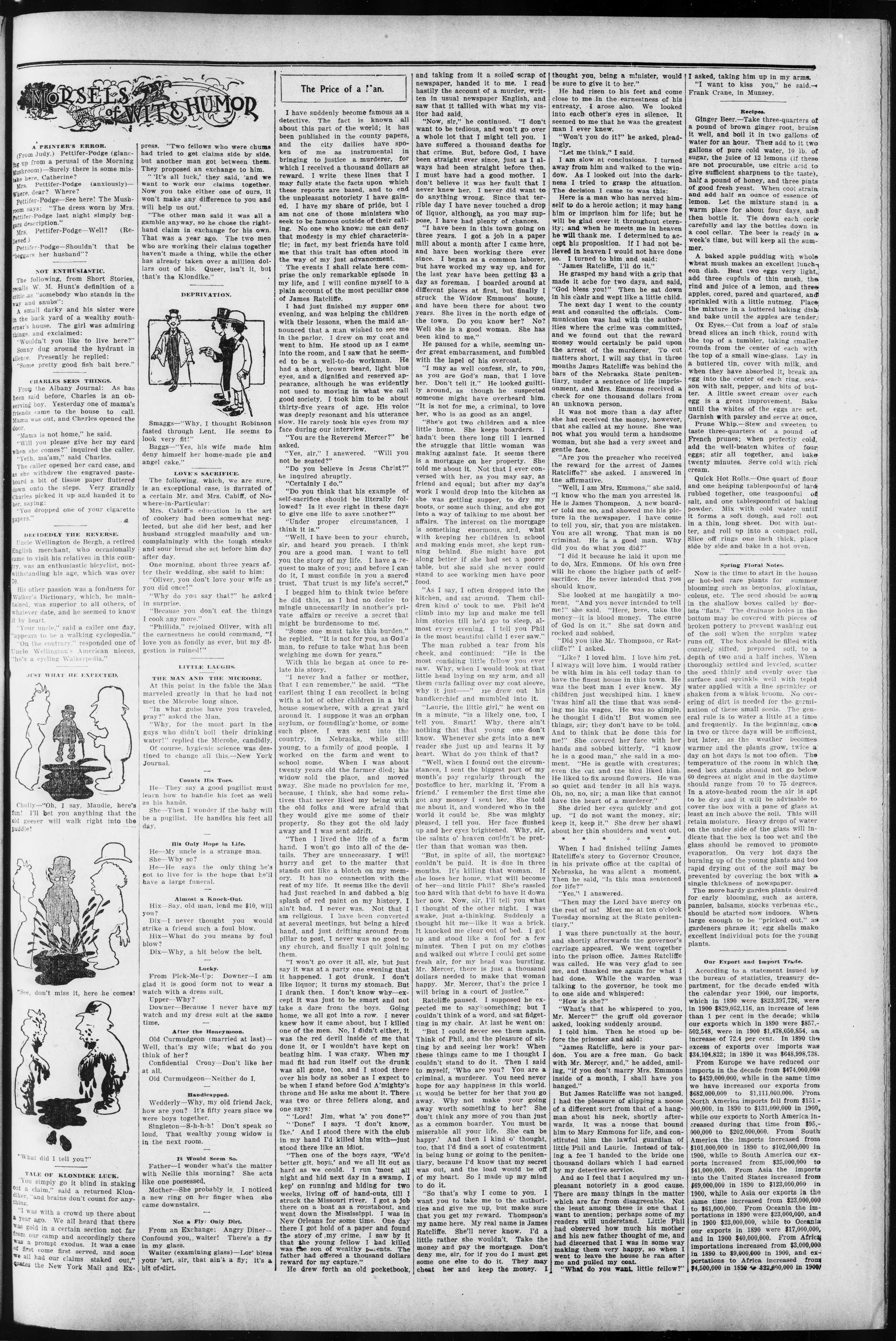
MORSELS of WIT & HUMOR
(From Judy.) Pettifler-Podge (glancing up from a perusal of the Morning mushroom)—Surely there is some mistakes here, Catherine?
Mrs. Pettifer-Podge (anxiously)—Where, dear? Where?
Pettifer-Podge—See here! The Mushroom says: "The dress worn by Mrs. Pettifer-Podge last night simply begears description."
Mrs. Pettifer-Podge—Well? (Relieved.)
Pettifer-Podge—Shouldn't that be beggars her husband?"
NOT ENTHUSIASTIC.
The following, from Short Stories, recalls W. M. Hunt's definition of a critic as "somebody who stands in the way and snubs":
A small darky and his sister were in the back yard of a wealthy southern's house. The girl was admiring things, and exclaimed:
"Wouldn't you like to live here?"
Sonny dug around the hydrant in silence. Presently he replied:
"Some pretty good fish bait here."
CHARLES SEES THINGS
From the Alibany Journal: As has been said before, Charles is an observing boy. Yesterday one of mama's friends came to the house to call. Mama was out, and Charles opened the door. "Mama is not home" he said.
Mama is not home. He said,
"Will you please give her my card
when she comes?" inquired the caller.
"Yeth, ma'am," said Charles.
The caller opened her card case, and
as she withdrew the engraved paste-
board a bit of tissue paper fluttered
down onto the steps. Very grandly
Charles picked it up and handed it to
her, saying:
"You dropped one of your cigarette
papers."
DECIDEDLY THE REVERSE.
Uncle Wellington de Bergh, a retired
English merchant, who occasionally
came to visit his relatives in this country,
was an enthusiastic bicyclist, not-
withstanding his age, which was over
70.
His other passion was a fondness for
Walker's Dictionary, which, he main-
tained, was superior to all others, of
whatever date, and he seemed to know it
by heart.
"Your uncle," said a caller one day, "appears to be a walking cyclopedia." "On the contrary," responded one of Uncle Wellington's American nieces, "he's a cycling Walkerpedia."
JUST WHAT HE EXPECTED.
Cholly—"Oh, I say, Maudie, here's fun! I'll bet you anything that the old geeser will walk right into the puddle!
"See, don't miss it, here he comes!
"What did I tell you?"
"You simply go it blind in staking out a claim," said a returned Klon-diker, "and brains don't count for anything.
"I was with a crowd up there about a year ago. We all heard that there was gold in a certain section not far from our camp and accordingly there was a prompt exodus. It was a case of first come first served, and soon we all had our claims staked out," contends the New York Mail and Ex-
press. "Two fellows who were chums had tried to get claims side by side, but another man got between them. They proposed an exchange to him. "It's all luck,' they said, 'and we want to work our claims together. Now you take either one of ours, it won't make any difference to you and will help us out.' "The other man said it was all a gamble anyway, so he chose the right-hand claim in exchange for his own. That was a year ago. The two men who are working their claims together haven't made a thing, while the other has already taken over a million dollars out of his. Queer, isn't it, but that's the Klondike."
DEPRIVATION.
Smaggs—"Why, I thought Robinson fasted through Lent. He seems to look very fit!"
Baggs—"Yes, his wife made him deny himself her home-made pie and angel cake."
LOVE'S SACRIFICE
The following, which, we are sure, is an exceptional case, is narrated of a certain Mr. and Mrs. Cabiff, of Nowhere-in-Particular:
Mrs. Cabiff's education in the art of cookery had been somewhat neglected, but she did her best, and her husband struggled manfully and uncomplainingly with the tough steaks and sour bread she set before him day after day.
One morning, about three years after their wedding, she said to him:
"Oliver, you don't love your wife as you did once!"
"Why do you say that?" he asked in surprise.
"Because you don't eat the things I cook any more."
"Phillida," rejoined Oliver, with all the earnestness he could command, "I love you as fondly as ever, but my digestion is ruined!"
LITTLE LAUGHS.
THE MAN AND THE MICROBE.
At this point in the fable the Man marveled greatly in that he had not met the Microbe long since.
"In what guise have you traveled, pray?" asked the Man.
"Why, for the most part in the guys who didn't boil their drinking water!" replied the Microbe, candidly.
Of course, hygienic science was destined to change all this.—New York Journal.
Count4 His Toes
He—They say a good pugilist must learn how to handle his feet as well as his hands.
She—Then I wonder if the baby will be a pugilist. He handles his feet all day.
His Only Hope in Life
He—My uncle is a strange man.
She—Why so?
He—He says the only thing he's got to live for is the hope that he'll have a large funeral.
Almost a Knock-Out
Hix—Say, old man, lend me $10, will you?
Dix—I never thought you would strike a friend such a foul blow.
Hix—What do you means by foul blow?
Dix—Why, a hit below the belt.
Lucky.
From Pick-Me-Up: Downer—I am glad it is good form not to wear a watch with a dress suit.
Upper—Why?
Downer—Because I never have my watch and my dress suit at the same time.
After the Honeymoon.
Old Currmudgeon (married at last)— Well, that's my wife; what do you think of her?
Confidential Crony—Don't like her at all.
Old Currmudgeon—Neither do I.
Handicapped.
Wedderly—Why, my old friend Jack, how are you? It's fifty years since we were boys together.
Singleton—S-h-h-h! Don't speak so loud. That wealthy young widow is in the next room.
It Would Seem So.
Father—I wonder what's the matter with Neilie this morning? She acts like one possessed.
Mother—She probably is. I noticed a new ring on her finger when she came downstairs.
Not a Fly: Only Dirt.
From an Exchange: Angry Diner--
Confound you, waiter! There's a fly
in my glass.
Waiter (examining glass)—Lor' bless
your 'art, sir, that ain' a fly; it's a
bit of dirt.
The Price of a I'an.
I have suddenly become famous as a detective. The fact is known all about this part of the world; it has been published in the county papers, and the city dailies have spoken of me as instrumental in bringing to justice a murderer, for which I received a thousand dollars as reward. I write these lines that I may fully state the facts upon which these reports are based, and to end the unpleasant notoriety I have gained. I have my share of pride, but I am not one of those ministers who seek to be famous outside of their calling. No one who knows me can deny that modesty is my chief characteristic; in fact, my best friends have told me that this trait has often stood in the way of my just advancement.
The events I shall relate here comprise the only remarkable episode in my life, and I will confine myself to a plain account of the most peculiar case of James Ratcliffe.
I had just finished my supper one evening, and was helping the children with their lessons, when the maid announced that a man wished to see me in the parlor. I drew on my coat and went to him. He stood up as I came into the room, and I saw that he seemed to be a well-to-do workman. He had a short, brown beard, light blue eyes, and a dignified and reserved appearance, although he was evidently not used to moving in what we call good society. I took him to be about thirty-five years of age. His voice was deeply resonant and his utterance slow. He rarely took his eyes from my face during our interview.
"You are the Reverend Mercer?" he asked.
"Yes, sir," I answered. "Will you not be seated?"
"Do you believe in Jesus Christ?" he inquired abruptly.
"Certainly I do."
"Do you think that his example of self-sacrifice should be literally followed? Is it ever right in these days to give one life to save another?"
"Under proper circumstances, I think it is."
"Well, I have been to your church, sir, and heard you preach. I think you are a good man. I want to tell you the story of my life. I have a request to make of you; and before I can do it, I must confide in you a sacred trust. That trust is my life's secret."
I begged him to think twice before he did this, as I had no desire to mingle unnecessarily in another's private affairs or receive a secret that might be burdensome to me.
"Some one must take this burden," he replied. "It is not for you, as God's man, to refuse to take what has been weighing me down for years." With this he began at once to relate his story.
"I never had a father or mother, that I can remember," he said. "The earliest thing I can recollect is being with a lot of other children in a big house somewhere, with a great yard around it. I suppose it was an orphan asylum, or foundling's home, or some such place. I was sent into the country, in Nebraska, while still young, to a family of good people. I worked on the farm and went to school some. When I was about twenty years old the farmer died; his widow sold the place, and moved away. She made no provision for me, because, I think, she had some relatives that never liked my being with the old folks and were afraid that they would give me some of their property. So they got the old lady away and I was sent adrift.
"Then I lived the life of a farm hand. I won't go into all of the details. They are unnecessary. I will hurry and get to the matter that stands out like a blotch on my memory. It has no connection with the rest of my life. It seems like the devil had just reached in and dabbed a big splash of red paint on my history. I ain't bad. I never was. Not that I am religious. I have been converted at several meetings, but being a hired hand, and just drifting around from pillar to post, I never was no good to any church, and finally I quit joining them.
"I won't go over it all, sir, but just say it was at a party one evening that it happened. I got drunk. I don't like liquor; it turns my stomach. But I drank then. I don't know why—except it was just to be smart and not take a dare from the boys. Going home, we all got into a row. I never knew how it came about, but I killed one of the men. No, I didn't either, it was the red devil inside of me that done it, or I wouldn't have kept on beating him. I was crazy. When my mad fit had run itself out the drunk was all gone, too, and I stood there over his body as sober as I expect to be when I stand before God A'mighty's throne and He asks me about it. There was two or three fellers along, and one says:
"Lord! Jim, what a' you done?"
"Done! I says. 'I don't know, Ike.' And I stood there with the club in my hand I'd killed him with—just stood there like an idiot.
"Then one of the boys says, 'We'd better git, boys,' and we all lit out as hard as we could. I run 'most all night and hid next day in a swamp. I kep' on running and hiding for two weeks, living off of hand-outs, till I struck the Missouri river. I got a job there on a boat as a rostabout, and went down the Mississippi. I was in New Orleans for some time. One day there I got hold of a paper and found the story of my crime. I saw by it that the young fellow I had killed was the son of wealthy parents. The father had offered a thousand dollars reward for my capture."
He drew forth an old pocketbook,
and taking from it a soiled scrap of newspaper, handed it to me. I read hastily the account of a murder, written in usual newspaper English, and saw that it tallied with what my visitor had said.
"Now, sir," he continued. "I don't want to be tedious, and won't go over a whole lot that I might tell you. I have suffered a thousand deaths for that crime. But, before God, I have been straight ever since, just as I always had been straight before then. I must have had a good mother. I don't believe it was her fault that I never knew her. I never did want to do anything wrong. Since that terrible day I have never touched a drop of liquor, although, as you may suppose, I have had plenty of chances.
"I have been in this town going on three years. I got a job in a paper mill about a month after I came here, and have been working there ever since. I began as a common laborer, but have worked my way up, and for the last year have been getting $3 a day as foreman. I boarded around at different places at first, but finally I struck the Widow Emmons' house, and have been there for about two years. She lives in the north edge of the town. Do you know her? No? Well she is a good woman. She has been kind to me."
He paused for a while, seeming under great embarrassment, and fumbled with the label of his overcoat.
"I may as well confess, sir, to you, as you are God's man, that I love her. Don't tell it." He looked guiltily around, as though he suspected someone might have overheard him. "It is not for me, a criminal, to love her, who is as good as an angel.
"She's got two children and a nice little home. She keeps boarders. I hadn't been there long till I learned the struggle that little woman was making against fate. It seems there is a mortgage on her property. She told me about it. Not that I ever conversed with her, as you may say, as friend and equal; but after my day's work I would drop into the kitchen as she was getting supper, to dry my boots, or some such thing, and she got into a way of talking to me about her affairs. The interest on the mortgage is something enormous, and, what with keeping her children in school and making ends meet, she kept running behind. She might have got along better if she had set a poorer table, but she said she never could stand to see working men have poor food.
“As I say, I often dropped into the kitchen, and sat around. Them children kind o’ took to me. Phil he’d climb into my lap and make me tell him stories till he’d go to sleep, almost every evening. I tell you Phil is the most beautiful child I ever saw.”
The man rubbed a tear from his cheek, and continued: “He is the most confiding little fellow you ever saw. Why, when I would look at that little head laying on my arm, and all them curls falling over my coat sleeve, why it just—” he drew out his手kerchief and mumbled into it.
“Laurie, the little girl,” he went on in a minute, “is a likely one, too. I tell you. Smart! Why, there ain’t nothing that that young one don’t know. Whenever she gets into a new reader she just up and learns it by heart. What do you think of that?
"Well, when I found out the circumstances, I sent the biggest part of my month's pay regularly through the postoffice to her, marking it, 'From a friend.' I remember the first time she got any money I sent her. She told me about it, and wondered who in the world it could be. She was mighty pleased, I tell you. Her face flushed up and her eyes brightened. Why, sir, the saints o' heaven couldn't be prettier than that woman was then.
"But, in spite of all, the mortgages couldn't be paid. It is due in three months. It's killing that woman. If she loses her home, what will become of her—and little Phil? She's rassled too hard with that debt to have it down her now. Now, sir, I'll tell you what I thought of the other night. I was awake, just a-thinking. Suddenly a thought hit me—like it was a brick. It knocked me clear out of bed. I got up and stood like a fool for a few minutes. Then I put on my clothes and walked out where I could get some fresh air, for my head was bursting. Mr. Mercer, there is just a thousand dollars needed to make that woman happy. Mr. Mercer, that's the price I will bring in a court of justice."
Ratcliffe paused. I supposed he expected me to say something; but I couldn't think of a word, and sat fidgeting in my chair. At last he went on:
"But I could never see them again. Think of Phil, and the pleasure of sitting by and seeing her work! When these things came to me I thought I couldn't stand to do it. Then I said to myself, 'Who are you? You are a criminal, a murderer. You need never hope for any happiness in this world. It would be better for her that you go away. Why not make your going away worth something to her? She don't think any more of you than just as a common boarder. You must be miserable all your life. She can be happy.' And then I kind o' thought, too, that I'd find a sort of contentment in being hung or going to the penitentiary, because I'd know that my secret was out, and the load would be off of my heart. So I made up my mind to do it.
"So that's why I come to you. I want you to take me to the authorities and give me up, but make sure that you get my reward. Thompson's my name here. My real name is James Ratcliffe. She'll never know. I'd a little rather she wouldn't. Take the money and pay the mortgage. Don't deny me, sir, for if you do I must get some one else to do it. They may cheat her and keep the money. I
thought you, being a minister, would be sure to give it to her."
He had risen to his feet and come close to me in the earnestness of his entreaty. I arose also. We looked into each other's eyes in silence. It seemed to me that he was the greatest man I ever knew.
"Won't you do it?" he asked, pleadingly.
"Let me think," I said.
I am slow at conclusions. I turned away from him and walked to the window. As I looked out into the darkness I tried to grasp the situation.
The decision I came to was this:
Here is a man who has nerved himself to do a heroic action; it may hang him or imprison him for life; but he will be glad over it throughout eternity; and when he meets me in heaven he will thank me. I determined to accept his proposition. If I had not believed in heaven I would not have done so. I turned to him and said: "James Ratcliffe, I'll do it." He grasped my hand with a grip that made it ache for two days, and said, "God bless you!" Then he sat down in his chair and went like a little child.
The next day I went to the county seat and consulted the officials. Communication was had with the authorities where the crime was committed, and we found out that the reward money would certainly be paid upon the arrest of the murderer. To cut matters short, I will say that in three months James Ratcliffe was behind the bars of the Nebraska State penitentiary, under a sentence of life imprisonment, and Mrs. Emmons received a check for one thousand dollars from an unknown person. It was not more than a day after she had received the money, however, that she called at my house. She was not what you would term a handsome woman, but she had a very sweet and gentle face.
“Are you the preacher who received the reward for the arrest of James Ratcliffe?” she asked. I answered in the affirmative.
"Well, I am Mrs. Emmons," she said. "I know who the man you arrested is. He is James Thompson. A new board-told me so, and showed me his picture in the newspaper. I have come to tell you, sir, that you are mistaken. You are all wrong. That man is no criminal. He is a good man. Why did you do what you did?"
"I did it because he laid it upon me to do, Mrs. Emmons. Of his own free will he chose the higher path of self-sacrifice. He never intended that you should know.
She looked at me haughtily a moment. "And you never intended to tell me!" she said. "Here, here, take the money—it is blood money. The curse of God is on it." She sat down and rocked and sobbed.
"Did you like Mr. Thompson, or Ratchiff?" I asked.
"Like? I loved him. I love him yet, I always will love him. I would rather be with him in his cell today than to have the finest house in this town. He was the best man I ever knew. My children just worshipped him. I knew 'twas him all the time that was sending me his wages. He was so simple, he thought I didn't! But women see things, sir; they don't have to be told. And to think that he done this for me!" She covered her face with her hands and sobbed bitterly. "I know he is a good man," she said in a moment. "He is gentle with creatures; even the cat and the bird liked him. He liked to fix around flowers. He was so quiet and tender in all his ways. Oh, no, no, sir; a man like that cannot have the heart of a murderer."
She dried her eyes quickly and got "I do not want the money, sir; keep it, keep it." She drew her shawl about her thin shoulders and went out.
When I had finished telling James Ratcliffe's story to Governor Crounce, in his private office at the capital of Nebraska, he was silent a moment. Then he said, "Is this man sentenced for life?" "Yes," I answered.
"Then may the Lord have mercy on the rest of us! Meet me at ten o'clock Tuesday morning at the State penitentiary."
I was there punctually at the hour, and shortly afterwards the governor's carriage appeared. We went together into the prison office. James Ratcliffe was called. He was very glad to see me, and thanked me again for what I had done. While the warden was talking to the governor, he took me to one side and whispered:
"How is she?" "What's that he whispered to you, Mr. Mercer?" the gruff old governor asked, looking suddenly around.
I told him. Then he stood up before the prisoner and said:
"James Ratcliffe, here is your pardon. You are a free man. Go back with Mr. Mercer, and," he added, smiling, "if you don't marry Mrs. Emmons inside of a month, I shall have you hanged."
But James Ratcliffe was not hanged. I had the pleasure of slipping a noose of a different sort from that of a hangman about his neck, shortly afterwards. It was a noose that bound him to Mary Emmons for life, and constituted him the lawful guardian of little Phil and Laurie. Instead of taking a fee I handed to the bride one thousand dollars which I had earned by my detective service.
And so I feel that I acquired my unpleasant notoriety in a good cause. There are many things in the matter which are far from disagreeable. Not the least among these is one that I want to mention; perhaps some of my readers will understand. Little Phil had observed how much his mother and his new father thought of me, and had discerned that I was in some way making them very happy, so when I went to leave the house he ran after me and pulled my coat.
"What do you want, little fellow?"
I asked, taking him up in my arms.
"I want to kiss you," he said.→
Frank Crane, in Munsey.
Recipes.
Ginger Beer.—Take three-quarters of a pound of brown ginger root, bruise it well, and boil it in two gallons of water for an hour. Then add to it two gallons of pure cold water, 10 lb. of sugar, the juice of 12 lemons (if these are not procurable, use citric acid to give sufficient sharpness to the taste), half a pound of honey, and three pints of good fresh yeast. When cool strain and add half an ounce of essence of lemon. Let the mixture stand in a warm place for about four days, and then bottle it. Tie down each cork carefully and lay the bottles down in a cool cellar. The beer is ready in a week's time, but will keep all the summer.
A baked apple pudding with whole wheat mush makes an excellent luncheon dish. Beat two eggs very light, add three cupuples of thin mush, the rind and juice of a lemon, and three apples, cored, pared and quartered, and sprinkled with a little nutmeg. Place the mixture in a buttered baking dish and bake until the apples are tender. Ox Eyes.—Cut from a loaf of stale bread slices an inch thick, round with the top of a tumbler, taking smaller rounds from the center of each with the top of a small wine-glass. Lay in a buttered tin, cover with milk, and when they have absorbed it, break an egg into the center of each ring, season with salt, pepper, and bits of butter. A little sweet cream over each egg is a great improvement. Bake until the whites of the eggs are set. Garnish with parsley and serve at once.
Prune Whip.—Stew and sweeten to taste three-quarters of a pound of French prunes; when perfectly cold, add the well-beaten whites of four eggs; stir all together, and bake twenty minutes. Serve cold with rich cream.
Quick Hot Rolls.—One quart of flour and one heaping tablespoonful of lard rubbed together, one teaspoonful of salt, and one tablespoonful of baking powder. Mix with cold water until it forms a soft dough, and roll out in a thin, long sheet. Dot with butter, and roll up into a compact roll. Slice off rings one inch thick, place side by side and bake in a hot oven.
Spring Floral Notes.
Now is the time to start in the house or hot-bed rare plants for summer blooming such as begonias, gloxinias, coleus, etc. The seed should be sown in the shallow boxes called by florists "flats." The drainage holes in the bottom may be covered with pieces of broken pottery to prevent washing out of the soil when the surplus water runs off. The box should be filled with coarsely, sifted, prepared soil, to a depth of two and a half inches. When thoroughly settled and leveled, scatter the seed thinly and evenly over the surface and sprinkle well with tepid water applied with a fine sprinkler or shaken from a whisk broom. No covering of dirt is needed for the germination of these small seeds. The general rule is to water a little at a time and frequently. In the beginning, once in two or three days will be sufficient, but later, as the weather becomes warmer and the plants grow, twice a day on hot days is not too often. The temperature of the room in which the seed box stands should not go below 60 degrees at night and in the daytime should range from 70 to 75 degrees. In a stove-heated room the air is apt to be dry and it will be advisable to cover the box with a pane of glass at least an inch above the soil. This will retain moisture. Heavy drops of water on the under side of the glass will indicate that the box is too wet and the glass should be removed to promote evaporation. On very hot days the burning up of the young plants and too rapid drying out of the soil may be prevented by covering the box with a single thickness of newspaper.
The more hardy garden plants desired for early blooming, such as asters, pansies, balsams, stocks verbenas etc., should be started now indoors. When large enough to be "pricked out," as gardeners phrase it; egg shells make excellent individual pots for the young plants.
Our Export and Import Trade.
According to a statement issued by the bureau of statistics, treasury department, for the decade ended with the calendar year 1900, our imports, which in 1890 were $23,397,726, were in 1900 $29,052,116, an increase of less than 1 per cent in the decade; while our exports which in 1890 were $857,502,548, were in 1900 $1,478,050,854, an increase of 72.4 per cent. In 1890 the excess of exports over imports was $34,104,822; in 1890 it was $648,998,738. From Europe we have reduced our imports in the decade from $474,000,000 to $439,000,000, while in the same time we have increased our exports from $682,000,000 to $1,111,000,000. From North America imports fell from $151,000,000, in 1890 to $131,000,000 in 1900, while our exports to North America increased during that time from $95,000,000 to $202,000,000. From South America the imports increased from $101,000,000 in 1890 to $102,000,000 in 1900, while to South America our exports increased from $35,000,000 to $41,000,000. From Asia the imports into the United States increased from $69,000,000 in 1890 to $123,000,000 in 1900, while to Asia our exports in the same time increased from $23,000,000 to $61,000,000. From Oceania the importations in 1890 were $23,000,000, and in 1900 $23,000,000, while to Oceania our exports in 1890 were $17,000,000, and in 1900 $40,000,000. From Africa importations increased from $3,000,000 in 1890 to $9,000,000 in 1900, and exportations to Africa increased from $4,500,000 in 1890 to $22,000,000 in 1900.
Members of a church in Buffalo will take roomers and boarders during the Pan-American exposition and apply part of the proceeds to clearing up the church debt.
A Tall Men's club has been organized in the University of Pennsylvania. It has twelve members, each of whom is 6 feet 2 inches tall or more. Six other men, termed "shorties," because they are only 6 feet 1 inch, are associate members.
A landslide occurred recently in Switzerland. An inn and its garden and outbuildings slid down a hillside a distance of thirty-five feet, without being in the least injured. Two stately elm trees in the garden were also moved without injury.
The French government has just appropriated funds for the erection of a bronze statue of June Nicot, who first introduced tobacco in Europe in 1550. It was from his name that the word "nicotine" was derived. This statue will be situated in front of the main government tobacco manufactory in Paris.
The Irish member who recently began a speech in the House of Commons in his "native tongue" was out of order. He declared that Irish was the only language in which he could adequately set forth the wrongs of Ireland. Certainly good Irish is better than bad English—and not so painfully common.
George W. Putnam, a descendant of the famous Revolutionary general, is said to be the oldest railway mail clerk in the country. He was appointed by Lincoln in 1861, and has been in the service ever since. His home is in Westfield, Ohio, but his "run" is between Ashtabula and Oil City, on a branch of the Lake Shore road.
A terrible tragedy of revenge occurred in the court in Naples. A young man named Glacomo Simcoli was charged with the murder of another young man named Negrim, and on his being brought into court a brother of Negrim, a boy of 16, dashed between the guards and stabbed the accused in the stomach. Simcoli fell in a dying condition.
A Russian clergyman whose church is located at Woods Run, Pa., has been making a census of his countrymen in the United States and finds that there are in all only about 600. Those, not include many thousands who he explains, are real Russians, and do though speaking the Russian language and belonging to the Greek church, are merely of Slavic blood in partial degree.
Beltrami county, in northern Minnesota, is bankrupt, and conditions verge on anarchy. Judge and jurors have struck for their pay, and the sheriff, who has been caring for the prisoners at his own expense, threatens to turn them loose and close the gaol. The trouble is caused by a decision of the court allowing the various logging companies doing business in Beltrami county to avoid paying their back taxes, upon which the county depends for its revenues.
Arabi Pasha was the man who headed the revolt against foreign control in Egypt in 1882. He was taken prisoner by the English and banished to Ceylon. In the eighteen years of his captivity his name has been almost forgotten. It is said that he will soon be liberated, and that he will return to his native country. Conditions political and other, have undergone great changes for the better in Egypt since 1882, and the British government runs no risk now in setting him free. He has given no trouble while in exile, and will return, an old man, to a happier and more prosperous Egypt than he has ever known, or than the success of his political enterprise could have known.
Speaking of youthful offenders, a Kansas City justice says: "I have had nine boys publicly whipped with a rawhide by their lawful guardians. Not one of them has ever been back in court for an offense, and every one of the nine is now leading an exemplary life. On the other hand, boys whom I sent to jail six years ago for petit larceny are now men serving terms in the penitentiary for serious crimes." The justice concludes that a jail sentence transforms a hoodlum into a hero—to other hoodlums, of course—and in jail he acquires new knowledge of vice, so that he is better prepared and more determined, when he comes out, to follow criminal courses. But the boy who is whipped is ridiculed and disowned by his "gang," and there is nothing for him to do but to be good and go to work.
Proposition is under way to make an endeavor to lighten to some extent the equipment of an infantry soldier in heavy marching order. The board of ordinance for fortifications will undoubtedly take this matter up in the near future and give it careful consideration. When it is taken into account that a soldier of infantry under heavy marching orders has to carry seventy-three pounds, fifteen and one-half ounces, exclusive of the water in his canteen, which weighs approximately three pounds, it will be seen that this question is worthy of action.
MATTERS OF INTEREST TO
AGRICULTURISTS.
ome Up-to-Date Hints About Cultivation of the Soil and Yields Thereof
Horticulture, Viticulture and Floriculture.
Lessons from Farming Experience.
A Manitoba farmer writes to one of our exchanges of the lessons to be gleaned from the season of 1900 which was abnormally dry during April, May and most of June which naturally discouraged.
Then abundant rains watered the country and revived the perishing crops. Rains continued during harvesting which considerably damaged the short crops and so encouraged the weeds that the work was very difficult. Hail also added to losses sustained by farmers. Threshing returns showed an average wheat yield of about eight bushels to the acre which sold at an average price of 50 cents per bushel. Potatoes yielded well, however, and none of the grain crops were an absolute failure, so farmers are not grumbling much. The lessons learned from the season by the writer referred to were summarized as follows:
First. Summer fallow, when well prepared, is the safest land for crop in all seasons, and without a rotation of crops the land should be summer fallowed every third year.
Second. Put the seed well down with a press drill.
Third. Cultivate the land with the harrows just before the grain is up, and go over it again when it is a few inches high with a light harrow or the weeder. To those who follow this method weeds have lost a good deal of their terror, and cultivation holds the moisture.
Fourth. After the land (especially light soil) has been cropped and summer fallowed for years, it is bound to lift with the wind. A sub-surface packer will help, for it is a good implement; but nothing less than grass root fibre will hold the soil. Brome grass seems to fill the bill. The seed has been expensive, but will soon be cheaper.
Fifth. Any farmer, with all his crop on one farm, ought to insure against hail. Before insuring, make sure of the "ins and outs" of the company you insure with.
Sixth. Every farmer should have some other source of revenue than the wheat crop. So much has been said upon "mixed farming" that it is needless to dwell upon it here, but this year has given an object lesson that may be of some service.
Seventh. Every farmer knows that a crop may not come up to his expectations, even in a favorable season; but if there is an element of chance each succeeding year demonstrates more clearly that good farming pays, and the man who combines science with experience will most surely prosper.
Eighth. Be careful about incurring liabilities upon the strength of next year's crop.
Birds and Horticulture.
William E. Praeger of the University of Illinois, says:
Before the days of scientific investigation enactments against the birds as destroyers of fruit and grain were not rare. In 1820, Bridgewater, Mass., successfully exterminated the greater part of her bird population, deterioration of nearly all crops was the immediate result and the policy towards the birds was quickly changed. In Virginia and Carolina at one time war was especially waged on the woodpeckers till it was found that the forests and orchards were suffering from wood-boring insects. During the French revolutions guns came for the first time into the hands of the people and great scarcity of food prevailed, so all birds were indiscriminately shot; the effects on orchards, fields and vineyards were soon so apparent that, in many districts, stringent laws for their protection were enforced. Prussia once, believing it would benefit agriculture, ordered a tax of twelve birds' heads to be paid annually by each farmer; it took Prussia just two years to learn by sad experience the error of her ways. I could enumerate many such instances. Even within the present decade a committee of the house of commons, appointed to investigate a plague of field mice that was destroying the crops in several counties in the British Isles, reported that it was chiefly due to the scarcity of owls and hawks, so recommended the protection of birds of prey.
We of Illinois may congratulate ourselves that birds have not disappeared from our land as they have from other less fortunate districts. It is true birds are fewer than they used to be, but this decrease is chiefly among the larger species. Lovers of nature may regret that so many interesting forms are disappearing, and the increasing scarcity of game birds and waterfowl will deprive us of an important food supply; but it is the small birds of the field and orchard in which the farmer is most interested and these, save in a very few localities are practically as numerous as ever. But the same causes are now at work that have elsewhere produced such serious consequences. Our population is increasing, our cities are growing, the prairies are tilled, the woods and marshes are disappearing. Whatever its effect on the birds we look with righteous pride on the material growth of our state. But there is another side to the picture on which we must look with feelings far otherwise than pride. Cheap firearms are everywhere, birds are shot indiscriminately for "the fun of the thing," many thousands are slaughtered for millinery purposes,
Italians and others who eat anything that wears feathers, however small, are congregating in many of our towns, nests innumerable are destroyed by youthful egg collectors. In the face of such wanton destruction it is time the friends of the birds should bestir themselves for it is an old saying that "prevention is better than cure."
Early Rhubarb or Pleplant
Press Bulletin 69 of the Oklahoma Experiment Station says: This vegetable can be forced into an early growth in the spring by covering the plants in the open garden with about one foot of fresh manure in February or March. The manure should cover a space two or three feet square about each plant. It is a good plan to place some boards or old barrel staves around the plant to hold the manure in place. If the boards are close together and stand a foot or so above the manure they will do a great deal to protect the young leaves from the frost. After the manure has been on the ground for a few days a hole five or six inches in diameter should be dug over the plant in the manure to aid the plant in starting through the manure. Most of the early growth is made from the food stored in the roots the previous summer. To secure the best development of the plants and roots, the plants should be set in rows four feet apart and two feet apart in the row and given clean, shallow cultivation throughout the summer. Three or four inches of well-rotted manure should be well worked into the soil around the plant in the spring. Plants receiving good cultivation will last five or seven years without renewing. Forcing the plants may have a tendency to weaken them and shorten the life of the plantation.
Another method of forcing the plants is to lift the plants, with a large ball of the surrounding soil, from the garden and place in a cellar or slow hotbed. Keep the roots well bedded in soil and moist. Light is not necessary for their growth. This method is quite satisfactory as it can be carried out any time during the winter. The plants will produce edible stems within four weeks after they are placed in their warmer location. The plants will do best if the ground has been frozen once or twice before plants are lifted from the garden.
Four Great Exporting Nations
Four Great Exporting Nations.
The United States now stands at the head of the world's exporting nations.
The complete figures for the calendar year 1900 when compared with those of other nations show that our exports of domestic products are greater than those of any other country. The total exports of domestic merchandise from the United States in the calendar year 1900 were $1,453,013,659, those from the United Kingdom, which has heretofore led in the race for this distinction, were $1,418,348,000, and those from Germany, $1,050,611,000.
Additional interest is given to the first rank which the United States now holds as an exporting nation by the fact that a quarter of a century ago she stood fourth in that list. In 1875 the domestic exports of the United States were $497,263,737; those of Germany, $607,096,000; those of France, $747,489,000; and those of the United Kingdom, $1,087,497,000. Today the United States stands at the head of the list, the United Kingdom second, Germany third, and France fourth, with the figures as follows: United States, $1,452,013,659; United Kingdom, $1,418,348,000; Germany $1,050,611,000; France, $787,000,000. All of these figures, it should be remembered, relate to the exports of domestic products. Thus in the quarter-century, the United States has increased her exports from $497,263,737 to $1,453,013,659, or 192 per cent; Germany, from $607,096,000 to $1,050,611,000, or 73 per cent; the United Kingdom, from $1,087,497,000 to $1,418,348,000, or 34 per cent, and France from $747,489,000 to $787,060,000, or 5 per cent.
For the Horses
Dip the bridle bits in water in cold weather before putting them in the horses' mouths. If you doubt the necessity put your tongue to a frosty nail. Use oil on the wagon in winter. Axle grease stiffens in cold weather—becoming dry and hard.
Uncheck while standing and blanket in cold weather.
Horses like a kind voice, and are not deaf as a rule. Do not yell at them.
Horses get tired and nervous and hungry and thirsty. Give them good beds to sleep on.
Don't make the load too heavy.
Sharpen their shoes in icy weather
Give them always a lunch at noon.
Her Annexed Majesty:
"Her majesty, Liliuokalani." Those are the words on the face of an injunction issued out of Judge Humphrey's court, enjoining the late queen and J. H. Wilson from removing sand from below high-water mark at Weikiki beach, says the Hawaiian Star. The words were written by the attorney-general of the territory of Hawaii in the injunction and the paper is signed by the first judge of the court without alteration. This is the first time since the overthrow of the monarchy in 1893 that the words "her majesty" have been used in an official paper in connection with Queen Liliuokalani. The change from "Mrs. Dominis" to "her majesty, Liliuokalani" was not an accident, by all accounts. It is the intention of the territorial government to so style the late ruler in all official matters. It will be observed that the word "queen" is left out.
A beefsteak dipped in liquid air becomes as hard as stone, and can be ground into a fine powder.
The Fight with Weeds.
In the battle with weeds the first point is not to let weed seeds be carried onto bare land. For this reason there are fields where bare fallows are never advisable, as, for illustration, a field adjoining a road overrun with weeds. The practice of leaving land thus bare is very often the cause of the same land being subsequently overrun with weeds, which can only be extirpated by years of expensive operations. The land owner frequently imagines that he has no interest in thistles, wild lettuce, and other weeds that line the roadside adjoining his premises. But he has a very decided financial interest in them, for they are the great store house from which his farm is seeded. While he is asleep, the winds are whipping the heads of the ripening weeds and carrying the seeds over his land to find a lodgment wherever there is an unused spot of ground. It will make to make war on such weeds for the purpose of cutting off the supply of new seeds. If the weeds along the roadside be mowed a number of times during the growing season they will cease to reproduce themselves and in their stead grass will appear. This will be taking possession of the enemy's entrenchments.
We must prevent weed seeds from getting into the manure, as this is one of the ways in which they are kept on the farm. The screenings of the grain, if full of weed seeds should be disposed of in some way that will keep them out of the manure pile, and when the chaff is likewise full of weed seeds it will be found cheaper to burn it than to use it for bedding, by which means it finds its way into the manure. Under an ideal system of manure handling this chaff would go into a compost where the seeds would be destroyed, but we have no such certainty of their destruction at the present time. Therefore we must do the next best thing and prevent the seeds from getting into the manure at all.
Biennial and perennial weeds are, of course, more difficult to destroy than are the annuals, and frequently have to be given special attention. Plowing is the strongest measure that can be used against them, but many of the larger weeds will have to be dealt with individually. We have never seen the farm where hand work did not have to be used to some extent in getting rid of weeds.
Expensive Poison for Potato Buns
The Maine Experiment Station, in bulletin 68, takes up the question of poisons for potato beetles. It reports so adversely on "Bug Death," a patent insecticide, that anyone reading the bulletin will certainly not buy the powder named. In part it says:
Whatever value the material has is dependent upon the strong dislike which the bugs show for it, rather than to any insecticidal qualities which it may have. The price as advertised ranges from 15 cents for a single pound to 8 cents in the largest package which the company puts out. At the rate applied in these experiments it would cost $8.00 per acre for the material for each application. Two applications a fortnight apart would be needed to keep the potatoes free from bugs. When applied to vines not covering the ground an application at the rate of 40 pounds per acre was without effect, so it would seem that the second application must be as great as the first. To partly protect would cost for the Bug Death $8.00 per acre, while to thoroughly protect against bugs would cost $16.00 for materials. The "Perfection Shaker" is a covered tin dish with small holes in the bottom. Applied with this shaker a man would be kept very busy and might develop a lame wrist in the attempt to apply 100 pounds in one day. In Aroostok county there are in the neighborhood of 25,000 acres of potatoes on which the bugs must be killed within a few days' time. In the presidential election of 1896 the county polled 6,472 votes. It would take ten days for these voters to protect the potato plants from bugs applying Bug Death with the Perfection shaker. A farmer growing 20 to 50 acres would find it impossible to get the help necessary to apply Bug Death at the right time.
One pound of Paris green, or other arsenites applied at two different times will do all the work of 200 pounds of Bug Death. The Paris green can be applied with power sprayer at the rate of 20 to 30 acres a day, and a thorough application of Bordeaux mixture can be applied at the same time with only the added cost of materials (about 40 to 45 cents an acre). Reckoning a man's time at 15 cents an hour it would cost at least for materials and labor $18 an acre to apply Bug Death twice. For $2.50 an acre can be treated four times with Bordeaux mixture and a reliable poison.
Cattle Killed on Canadian Railways
We notice by a Canadian exchange that the Canadian Pacific Railway has agreed to compensate stockmen for cattle killed on their tracks at the following rates:
Calves ..... $12.50
Yearlings ..... 17.50
Two-year-olds ..... 25.00
Cows ..... 25.00
Three-year-old steers ..... 32.50
Four-year-old steers and up ..... 40.00
Bulls ..... 40.00
The low price for bulls is acceptable to stockmen, for they argue that no man owning a high-priced bull will permit him to run at large with the herds.
Of the agricultural imports of the United States during 1895-1899, amounting in average annual value to $366,944,708, more than one-half came from tropical countries.
When there is room in the heart there is room in the house.
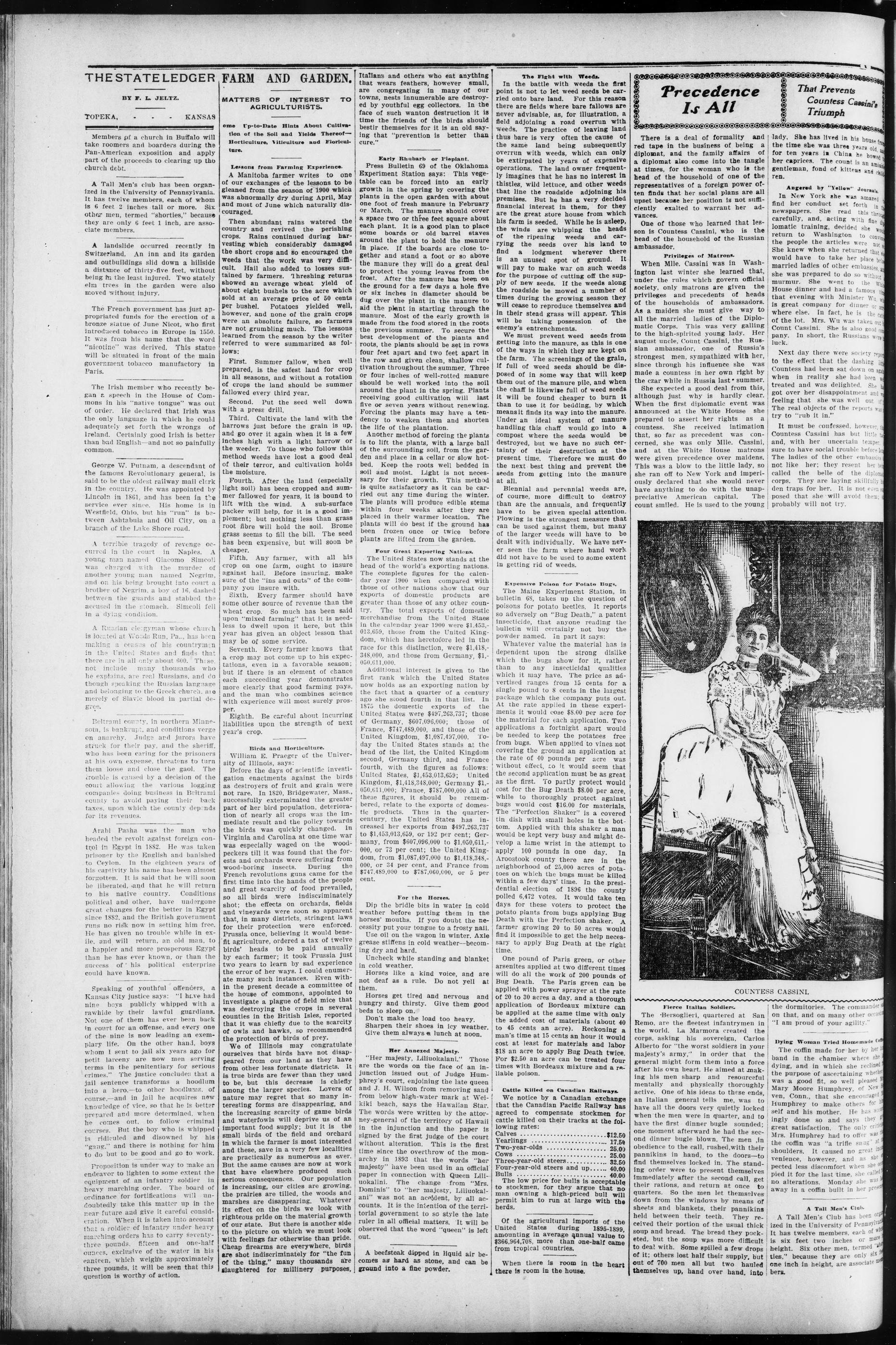
Precedence Is All
There is a deal of formality and red tape in the business of being a diplomat, and the family affairs of a diplomat also come into the tangle at times, for the woman who is the head of the household of one of the representatives of a foreign power often finds that her social plans are all upset because her position is not sufficiently exalted to warrant her advances.
One of those who learned that lesson is Countess Cassini, who is the head of the household of the Russian ambassador.
lady. She has lived in his house from the time she was three years old and for ten years in China he bowed her caprices. The count is an amiable gentleman, fond of kittens and children.
Angered by "Yellow" Journal.
In New York she was amazed to find her conduct set forth in the newspapers. She read this through carefully, and, acting with fineomatic training, decided she would return to Washington to continue the people the articles were not to.
When Mile, Cassini was in Washington last winter she learned that, under the rules which govern official society, only matrons are given the privileges and precedents of heads of the households of ambassadors. As a maiden she must give way to all the married ladies of the Diplomatic Corps. This was very galling to the high-spirited young lady. Her august uncle, Count Cassini, the Russian ambassador, one of Russia's strongest men, sympathized with her, since through his influence she was made a countess in her own right by the czar while in Russia last summer.
She expected a good deal from this, although just, why is hardly clear. When the first diplomatic event was announced at the White House she prepared to assert her rights as a countess. She received intimation that, so far as precedent was concerned, she was only Mile, Cassini, and at the White House matrons were given precedence over maidens. This was a blow to the little lady, so she ran off to New York and imperiously declared that she would never have anything to do with the unappreciative American capital. The count smiled. He is used to the young
COUNTE
M.
COUNTESS CASSINI
Pierce Italian soldiers.
The Bersoglieri, quartered at San Remo, are the fleetest infantrymen in the world. La Marmora created the corps, asking his sovereign, Carlos Alberto for "the worst soldiers in your majesty's army," in order that the general might form them into a force after his own heart. He aimed at making his men sharp and resourceful mentally and physically thoroughly active. One of his ideas to these ends, an Italian general tells me, was to have all the doors very quietly locked when the men were in quarter, and to have the first dinner bugle sounded; one moment afterward he had the second dinner bugle blown. The men in obedience to the call, rushed, with their pannikins in hand, to the doors—to find themselves locked in. The standing order were to present themselves immediately after the second call, get their rations, and return at once to quarters. So the men let themselves down from the windows by means of sheets and blankets, their pannikins held between their teeth. They received their portion of the usual thick soup and bread. The bread they pocketed, and the soup was more difficult to deal with. Some spilled a few drops of it; others lost half their supply, but out of 700 men all but two hauled themselves up, hand over hand, into
---
Privileges of Matrons.
lady. She has lived in his house for the time she was three years old and for ten years in China he howed her capriches. The count is an amusing gentleman, fond of kittens and chickens.
Angered by "Yellow" Journal.
In New York she was amazed to find her conduct set forth in the newspapers. She read this thriller carefully, and, acting with fineomatic training, decided she would return to Washington to convey the people the articles were not. She knew when she returned that she would have to take her place before married ladies of other embassies or she was prepared to do so without murmur. She went to the Wu House dinner and had a famous friend that evening with Minister Wu who is great company for dinner or anywhere else. In fact, he is the child of the lot. Mrs. Wu was taken out to Count Cassini. She is also good on pany. In short, the Russians were luck.
Next day there were society reports to the effect that the dashing in Countess had been sat down on an as when in reality she had been treated and was delighted. She got over her disappointment and feeling that she was well out of The real objects of the reports was try to " rub it in." It must be confessed, however, in Countess Cassini has but little to and, with her uncertain temper, sure to have social trouble before The ladies of the other embassies not like her; they resent her called the belle of the diplomacy corps. They are laying skillfully den traps for her. It is not even posed that she will avoid them; probably will not try.
```markdown
```
the dormitories. The commander on that, and on many other occasions "I am proud of your agility."
Dying Woman Triled Homemade Coff
Flying Woman Fried Homemade
The coffin made for her by her band in the chamber where she dying, and in which she reclined the purpose of ascertaining whether was a good fit, so well pleased was Mary Moore Humphrey, of Newven, Conn., that she encouraged Humphrey to make others for his self and his mother. He has always done so and says they are great satisfaction. The only criticism Mrs. Humphrey had to offer was the coffin was a "trifle snug" at shoulders. It caused no great invenience, and as she expected less discomfort when she pitied it for the last time, she called no alterations. Monday she was away in a coffin built in her press
A Tall Men's Club has been organized in the University of Pennsylvania. It has twelve members, each of which is six feet two inches or more height. Six other men, termed "whites," because they are only six feet one inch in height, are associate members.
That Prevents
Countess Cassini's
Triumph
A Tall Men's Club
State Ledger.
.. BY
F. L. JELTZ.
SUBSCRIPTION six months 75c
One Year 1.50
ALL SUBSCRIPTIONS CASH IN ADVANCE
ntered at post office at Topeka, Kansas, at sec
adclass-rates.
Published every Saturday at 431 Kan. ave
1.00 in advance.
PHYSICIANS.
OFFICE HOURS:
9 TO 12 A. M,
2 TO 5, 7 TO 9 P.M,
SUNDAY:
10 TO 11 A. M,
1 TO 3, 7 TO 8 P.M,
DR. W. J. COTTRELL,
Physician and Surgeon
OFFICE 411 KANSAS AVE,
RESIDENCE 201 JACKSON ST
Tele 635, Topeka, Kansas,
I. A. SHIELDS M. D.
Physician and Surgeon,
Office and, Residence 1331 VanBuren St
call proaptlyattended.
S A. BOAM M. D.
Physician & Surgeon.
421 Kans. Ave, Tel. 573 Residence 1407 W, Tenth St.
H. B. HO
PHYSICIAN and SURGEON,
833 Kans Ave
All calls
promptly attended. Tel. 14.
Tel. 895.
DR: C. A. TAYLOR.
PHYSICIAN and SURGEON.
Office Hours, 9 to 11 a. m.
From 2 to 5 p. m.
OFFICE 226½ KAS, AVE.
(Cover Kohl's Drug Store,)
Wm. B, Swan, M. D
725 Kansas Avenue,
Topeka, Kansas.
Office hours, 7:10 to 12 m, 2:00 to 4:30 pm
Residence 024 Bachanai St.
Bell Telephone, 660
GEORGE DICK, M. D
Homoepoathist
Residence 626 Fillmo !St.
Telephone 360.!
Office 807 Kansas Avenus.
PHYSICIAN and SURGEON.
OFFICE HOURS; 9 TO II A.M.
2 TO 5, and 7 TO Q P.M.
Sunday Hours. 1 to 3 P.M.
OFFICE 404 Kas., Ave. Tele. 635
(Over Wallace Drug Store.)
DR. J. C. ISERMAN,
Office 112 East 6th street
Calls Promptly Attended To.
Special Attention Given, to Disease
Stomach and Lungs and Female Troubl-
les Office Hours: - 12 - 2 to 5 - 7 to 9
DR. F. H. SCHOLLE;
Physician and Surgeon
[515 Kansas Avenue Topeka Kans.
Tel 592.
THE PALACE DRUG STORE
732 Kansas Avenue.
C. M. HINES.
Topeka, Kansas
J. M JAMISON, M. D.,
Office 506 East 4th Street.
Office Hours:
From 8 to 10 A. M.
1 P. M. to 3 P. M.
7 1 P. M. to 9 P. M²
Special attention diseases of women and
private diseases.
C. F. MENNINGER, M. D.
Office 727 Kansas Ave.
Telephone 19.
Office Hours:
11-12 A. M.
2-5 P. M
Residence 125 Topeka Ave.
Telephone 85.
S. G. STEWART, M. D.
OFICE 621 KANSAS AVE.
DR. PAGE'S PHARMACY
111 East 5th Street
Full line of Drugs and Toilet articles and Medicines.
Give him a call.
GIBRALTAR DRUG CO:
833 KANSAS AVENUE
Topeka, Kansa
HOMEPATHIC REME
ART MA*
TERIALS
Miller's pharma-
6th & 1OP1KA AVE
Drug,sMedicines, Prescript s Carefully
Compounded. Give Us a Trial.
H. L. TROMP
Manufacturer of
HIGH GRADE CIGARS
804 Kans. Ave. Topeka Kans,
LEWIS G. FERRRELI.
ATTORNEY AT LAW.
And Real Estate special attention paid to
nonresident claims. Olathe Kans.
GUST.JOHNSON.
DEALER IN,
OSAGE CITY SHAFT COAL
and all other kinds.
608 East Second St. Tel. 557
J, E. RODMAN,
FLORIR/ST,
Plants for windows and beding. Societ
emblems in flowers a specialty. Green
houses 12th and Monroe Sts. Store 501 W
8th S.
C. F RODIGER'S.
Dye and Cleaning Works.
820 Kans, Ave. Topeka Kansas.
(Phone 957)
TOPEKA CREMATORY CO.
Watch Jule's
Comic adds
In this space
Is just like the things
He gives to eat.
ALWAYS FRESH and NEW
JULE'S
He who has good things to eat.
Topeka Kans.
Restaurant.
J, E, PETERSON—or Marquette, runs the best HOTEL and RESTAURANT in the city give him a call.
HOLE IN WALL
When in LAWRENCE stop at WEYER-MULLER'S RESTAURANT—SHORT ORDER. Open Dry and Night
720 Mass., Street.
A share of your patronage is desired.
Tele. 349.
BLUE FRONT GROCERY,
Staple and Fancy Groceries Fresh and Sal
Meats Flour Feed and Provisions, Country
Produce taken in Exchange. Highest Mar-
ket price paid in cash or trace, 1002 Kans
Ave, North Topeka, Tel, 283 C, W, Thompson
Pap.
GOLD KING BAKINGPOWDER made by H. H. Parker the best in the market, 1001 Kas. ave
THE LANDIS HOME
BAKERY,
Many years experience. French home Bakery 316 E. 4tn St.
C. W. WILLITS, FRANK CONWELL
WILLITS & CONWEIL,
UNDERTAKERS
..and Licensed Embalmers..
A FULL LINE OF
COFFIN, CASKETS AND ROBES AT
REASONABLE PRICES,
1006 N, Kansas Avenue,
Tel. 850, North Popek:
S. H. DOWN'S
| 306 Kansas Avenu
For Garden and flower seeds, and
lawn grass, and Hardy roses and
plants.
306 Kansas avenue.
GILLETTE & NICHOLSON,
Lumber COAL Blinds-
Lath Moulding
Sash
1001 Kans AAE.
I
TO
824
Kansas
Ave.
to get thisUm-
brella Recovered and repaired
J. A. RILLINGS, Prod.
J. W KELLEY,
DEALER IN
Staple and Fancy Groceries. Give Him n
Call. 119 N. Main Street. Ottawa, Kas
WE CAN DO IT. IF YOU WISH AN IDEA WORKED OUT WE CAN DO IT Let us help you build your Machines, Make your patterns, Models, TOPEKA FOUNDRY. SECOND and JACKSON STREET
Atv rv reasonable prices. Cur small expenses make it possible for us to sell goods surprisinglycheap. See our windows for bar ainsn foot wear.
PCR HARDWARE and STOVES
Screen Doors, Ice Cream Freezers, Hammocks n' Garden Tools.
These are the thingsyou need Give hima call. 828 Kansas
LILLEY & CO. Dealers In. lumber, coal baled hay sash doors blinds, paints oils, lime sand & cement.
WM. KLINGE
TAILOR.
Fine Tailoring at reasonable prices.
Fit and Workmanship guaranteed.
---
TENTS & AWNINGS.
Flags, Tarp pulls: Wagon covers, Horse
covers: Ets
304 Kansas Ave. Phone 612.
114 East 4th Street,
The Union Tailor will make you a suit of Clothes at reasonable prices. Pants from $4 50 and up. When you want something done in his line give him a call. Repairing* and cleaning neatly done.
If you are hard up see Unc e Sam at 512 Kansas ave. He will fix you out.
Louis Charovas has three fine stores at 508-425-416 Kansas avenue. If you want confectionery and ice cream call on his three fine stores and you will be served right.
Repairing of all kinds at the U. S. Cycle Co, 118 E. 8th St, Give them a call
Go to H. L. Tromp for all kinds of fine cigars and tobbacco. 804 Kansas avenue.
Fitzgerald and Lanran are leaders in high class groceries, vegetables and fruits. Oysters always in stock. 310 East 4th street.
W. R. Murphy is the leading photographer in this city 116 W. 5th St Newton Kans.
Andy Unruh has the finest and neatest candy store and bakery in Newton remember his place 212 Main St.
Proudlit and Perkins are among the leading caterers or the city they operate The Magnet a newly remodled concern, they handle nothing but the best line the market affords. Give them a call 417 Kans. Ave Remember Passion's Department he sells every thing you need in housekeeping. 739 Mass St. Lawrence Kas.
615, N KansasAve.
Dealer in staple and fancy groceries of all kinds. Fresh bread Butter and Eggs, Cigars and Ic bacco. Fine salt and smoke meats. Try us for bargains and you will become a customer.
Berry's Grocery. 615 North Ka
Ave.
WHOLE SALE & RETAIL FISH & MEAT MARKET.
Always open from 6 a.m. to 8 p.m.
We supply all the city dealers with fresh fish of all kinds.
123 W. 6th St.
Rahrer's Restaurant
All kinds of repairs for your wheel at
Topeka Cycle Co. 112 W. 8th St.
E.H. UPSHAW.
Peoples Feed, 537 Kansas Avenue, North
Topeka. Full weights. Goods promptly
delivered.
ZERCHER & PGOL,
BOOKS, STATIONERY, OFFICE SUP.
PLIES.
527 Kansas Avenue.
We solicit a share of your patronage
TOPEKA, KANS.
Cleaning and Repairing neatly done. 512½ Kansas Avenue. Topeka.
PINKSTON BROS..
Flour Feed and Grain. Reliable Dealers. Headquarters for anything you want in their line. Call and see them—517 N. Main St Wichita, Kans.
WE MAKE CLOTHES
That it
N. H Wolff Tailor 429 Kans.
Ave.
COPYRIGHT
HEARICKCA
812 KA
BAUHCM
THE LEAD
In the manufacture of the most
market. Business larger than
Churches, Entertainments and
Tele 253
MARICKCARRIAGE CO.
312 KANS, AVENUE
AUHCMAN BRID
THE LEADERS AS USU
Manufacture of the most DELICIOUS ICE CHE
Business larger than ever. Special attent
entertainments and Social Parties.
e 253
Office 23rd & Lincoln
HEARICKCARRIAGE CO. 812 KANS, AVE.
In the manufacture of the most DELICIQUS ICE CREAM in the market. Business larger than ever. Special attention given to Churches, Entertainments and Social Parties. Tele 253 Office 23nd & Lincoln St
E. G, KINLEY.
Man
Carriages, Phaeet
Special Attention Given to Order Work,
424 and 426
Cut Flowers Funeral
MRS, M.
Tel. 176.
J. RAF
Manufacturer
Carriages, Paheo Bus ness Wagons.
In Given to Order Work, Repairing, Painting, Trimm ing
424 and 426 Jackson Street
flowers Funeral Designs. Palms and Fe
MRS, M. E HOLLCARR
FLORIST.
119 W. 6th Street,
. RAFFELOC
Carriages, Phaeto Business Wagons.
Special Attention Given to Order Work, Repairing, Painting, Trimm ing & Rubber Tires
424 and 426 Jackson Street
Cut Flowers Funeral Designs. Palms and Ferns.
MRS, M. E HOLLCARFT;
J. RAFFELOCH
For Clothing, and Gents Furnishing Goods New and Up-To-Date Clothing. Gents Furnishings, Shoes, Hats, Etc. 130 Kansas Avenue. Topeka, Kansas. (Next door to Svymns' Crocery Co.)
TOPEKA
Pure Tea and
109 E. Sixth Street
WE CAN
WE CAN
IF YOU WISH AN IDEA
Let us help you build your Mac
TOPEKA
SECOND and J
JAMES
DEAR
Mides, Tallow
108 and 110 Fast Th
Pays highest price
REFERENCE; Chas. Wolf Jacking Co
SHOES FOR
FOR STYLE, FOR
At tv rv reasonable价
make it possible for u
sycheap. See our win
wear.
Not Cheap Shoes, I
BRANDL'S CAS
128 South Main St
Fourth door North First Nation
LOUIS VANDORP.
Screen Doors, Ice Cream Free
these are the things you need
TOPEKA SPICE MILLS
Fire Tea and Spices
Sixth Street.
WE CAN DO IT
WE CAN DO IT
YOU WISH AN IDEA WORKED OUT WE CAN
you build your Machines, Make your pattern
TOPEKA FOUNDER
SECOND and JACKSON, STREET.
JAMES. SMITH
DEALER IN
Sides, Tallow, Hurs and Pelts
1110oFast Third Street Topeka
Pays highest prices for consignment trade
Chas. Wolf Jacking Co Topeka R. G. Dunn Coml Ag
HOES FOR EVERY BOX
FOR STYLE, FOR WEAR, FOR COMFORT
reasonable prices. Cur small e
possible for us to sell goods.su
See our windows for bar and
Not Cheap Shoes, But Good Shoes Cheap.
INDL'S CASH SHOE ST.
South Main Street. Ottawa, K
North First National Bank.)
GO TO
WANDORP.
FOR HARDWARE an
en Doors, Ice Cream Freezers, Hammocks n' Garden-T
e things you need
Give hima call. 828
WE CAN DO IT
108 and 110Fast Third Street Topeka Kas Pays highest prices for consignment trade. REFERENCE; Chas. Wolf Jacking Co. Topeka R. G. Dunn. Comt' Agency Topeka.
SHOES FOR EVERY BODY
Not Cheap Shoes, But Good Shoes Cheap. BRANDL'S CASH SHOE STORE 128 South Main Street. Ottawa, Kansas. (Fourth door North First National Bank.)
COPE & CO.
FRUIT &
COMMISSION
118-120 Kans Ave.
LILLE
lumber, coal
QUIT & PRODUC
COMMISSION MERCHANT
Kans Ave. Topeka, Ka
LILLEY & CO
Dealers In.
ber, coal, baled h
doors, blinds, po
FRUIT & PRODUCE COMMISSION MERCHANTS 118-120 Kans Ave. Topeka, Kans.
Abilene Monument Co.
Granite and Marble Monuments. St. tuary, Coping, Columns and Fancy Carved Column Caps All Fine Cut stone Work done in Neat and Latest Styles. Abilene, Kans.
Tel. 176.
TO RIDE IN STYLE. and comfort too, you need one of our carriages. They have the perfection of style, the height of luxury and assurance of safety. We are showing the at est styles in pleasure vehicles for Summer driving.
MARRIAGE CO. OF
ANS, AVE.
MAN BROS.
ERS AS USUAL
at DELICIOUS ICE CREAM in the
an ever. Special attention given to
Social Parties.
Office 23rd & Lincoln St.
ufacturer
Co Bus ness Wagons.
Repairing, Painting, Trimm ing & Rubber Tires
6 Jackson Street
Designs. Palms and Ferns.
E HOLLCARFT;
ORIST.
119 W. 6th Street, Topeka
FELOCH
SPICE MILLS
and Spices etc.
CAN DO IT
CAN DO IT.
WORKED OUT WE CAN DO IT
mines, Make your patterns, Models,
FOUNDRY.
BACKSON, STREET.
S. SMITH,
SAILER IN
W. Eurs and Pelts.
Third Street Topeka Kas-
tes for consignment trade.
Topeka R. G. Dunn Comt Agency Toqeka.
EVERY BODY
WEAR, FOR COMFORT.
Prices. Cur small expenses
to sell goods surprising-
windows for bar ainsn foot
But Good Shoes Cheap.
SH SHOE STORE
Street. Ottawa, Kansas.
National Bank.)
GO 10
FCR HARDWARE and STOVES
zakers, Hammocks and Garden-Tools.
Give hima call. 828 Kansas
PRODUCE N MERCHANTS Topeka, Kans. Y & CO. baled hay. blinds paints
MESSERS JOHNSTON and
GENERAL BLACKSMITH
WAKARUSA KANSAS,
The men who have their
filled at present are Mr.
Johnston and Son, they are
a good deal of work in the
of wood-work, horse-
blowing, machine and can
painting, the farmers are con-
vited to give this firm
trade. Johnston and Son
Wusa, Kansas,
When in Lawrence try
Ratliffs meals 20 cents best
the city 625 Mass. St.
Olatha merchants want
trade. Don't go to Kan City
you can be suited at home
S. Eliot for groceries
serve you right 183 Bridge
Lawrence Kans.
Go to gallas and Zeeb to
thing you want in staple and
cy groceries 213 Locust St.
rence Kans.
Give Mr. Protach a c
Mass. St.
Stop at H A. Klauer's
good 5 and 10 ct smoke 94
Ave
Geo. Davies makes pan
suit and fit 921 Mass. St Lau
Kans.
See that our Lawrence
assist our advertisers.
All our Lawrence reader
of course trade with our
tisers.
Get your horses clipped at
barn, $1.50 each. 515 Quint
JOSEPH ARILEY
boot and shoe manufactu
all kinds of repairing at
table prices. Men's half-
ladies 40ct, children's 30
Stand.
MILIT & HALL
DRUGISTS & DEALERS in
of Drugs and Patent medicines, Pric-
and Varnishes, Toilet articles and
ery. 422 Kaus. Ave. Your trade
solicited.
MRS. E. MOSIETEL
Gives meals for 10 and 15 cents
Douglas St. Wichita Kaus. Also
full line of ci jars, tobbacco and tea
drinks.
MISS MARY E. KIE
Hair dressing and all hair work done in the best
and grades. Your trade is
147 Main St. Wichita, K
Groceries and Country P
Qeensware. Fruits, Cigars,
cos, Flour and Feed. 334
Avenue.
STANDARD D.ESS CUTTING
EMY,
Mrs. L. F. Filoon Manager
Standard Square Inch Tayler system up to date in every style and finds taught to cut and fit their own
Good positions to right parts, or write the only system in the work without change or alteration. N. 6th and Polk St. Topska Kassas.
H.A. KLAUER
Carries All the LATEST
of cigars and also a FULLY
Tobacco and smoking
His cigars are made in T
526 Kans ave.
GO TO
JACOB HOUS
For Clothing.
And Gents Furnishing
and Caps.
927 Mass St., Lawrence
Dodd Brothers
...DEALERS IN...
All of the leading GRANITES and
BLE MONUMENTS. Our Design
modern and up-to-date. Clearing
monuments in cutting insculp.
i y.
112 South Lawrence St.
Wichita, K.
...THE...
NEW IDEA
BAKERY & CANDY FAC
to South Main Street,
W-D. WORK, Mg',
Plaza