State Ledger
Saturday, June 7, 1902
Topeka, Kansas
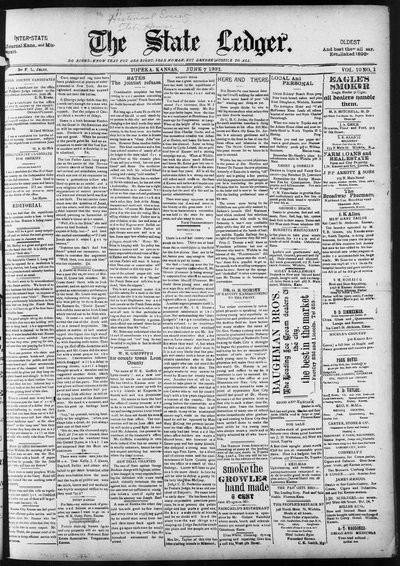
Page text (machine-generated)
INTER-STATE Journal Kans., and Missouri.
Bv F. L. JELTZ.
LYON COUNTY CANDIDATES
I am a candidate for the office of Probate Judge subject to the republican convention, June 28.
E. N. Evans.
I am a candidate for the office of sheriff, subject to the republican convention held June 28 '02.
Dennis O'Connor.
I am a candidate for the office of Sheriff subject to the decision of the republican convention held June 28.
Millard Wilhite.
I am a candidate for for the office of county treasurer, subject to the republican convention June 28.
W. K. Griffith
INDEPENDENT CANDIDATE
FOR SHERIFF.
ANNOUNCEMENT
I am a candidate for Sheriff of Shawnee county on the Independent ticket for the fall election. I have lived in this county for many years and have a wide acquaintance. If I am elected I shall do all in my power to carry out the duties of the office.
EDITORIAL
It is too bad that the republicans has to continue under a boss to keep them in line. Bossism is being resurrected.
There will be a good many surprises off and on before the next governor makes his seat in January next.
Mr. Bailey is a great and good man but the hand that did it is chilly and cold to a "dark skin."
The honorable Chester I. Long will again be opposed for a re-election in the big district, but Long will not listen to preachers and calamity howlers he'll saw wood as usual.
We don't want to be misunderstood on the Bates article. We know of no other business his kind who refuses to admit the colored boys on account of color except some "club." There are some gentlemanly jointist here in business, but we long the Frank Bates strife. I all have to go if he does handle Schlitz beer.
The good people along the Arkansers at this this time are holding revivals to keep back the approaching food which is claimed to be ten feet deep of water headed this way. Kansas people are never satisfied. Last year his time they were praying for rain, and now they are praying for it to stop.
There are persons who claim and pretend to operate hotels and places to accommodate the public, and their rooms board and other accommodations are of the cheapest and lowest that could be given yet they keep out a plain board and shingle to fool the people and say to their victims "comn" and they are too infernal lazy to aid their beds of the lice and bed bugs. We are getting tired of this class.
When a colored man in any honorable business gets the best of so meien to the extent of a dollar they go round bellowing to every one they must that you beat them out of a dollar but they never tell how often the patent medicine man" or the show taker" or the "soap man" beat them of course they keep this as you m a y ce they are shame to t e l l on these skunks' who really robs them. Funny world.
When the editor and associate arrived at Wichita the morning of the 28 the first man we saw was the Hon. Nick Chiles with a bunch of papers less than 50 pounds, like the little girl; "who will buy my flowers."
There were so many people in Wichita especially at the Carey Hotel till they looked like one seething mass of humanity.
When time and tide rolls on together you can safely get on Craddock or Bailey tor one of them will be governor next January, '03.
Kansas City Kansas can feel proud of her efficient police service and itsifiable chief, Mr. Zimmer who has shown to the twin cities that that they up to date in every respect. Mr. James Walsh, the present chief of detectives is doing efficient service with his forces.
---
The State Ledger.
DO RIGHT--KNOW THAT YOU ARE RIGHT; FEAR NOMAN; BUT RENDER JUSTICE TO ALL.
Coor songs and rag time have been prohibited at places of entertainment in New York. An enlightened sentiment has yawned them out over the nation.
A Chicago judge holds that $15 a week isn't enough for a man who has a wife and two children to support. But the judges of Chicago think a number of things.
There is a kick because Frederick the Great in the American statue will be represented as a young man. Frederick as a young man was not great. When he arrived at the pearly gates he had an explanation to make on the Von Katte incident and it is doubtful if he is admitted, Ex.
The late Father Lane, long popular as the pastor of the Roman Catholic church of Saint Theresa and several pet anecdotes, among which was one of an encounter between a pretentious yellow who liked to pose as an inndel, and a very religious old lady who it her explanations of sacred phenomena were not always lucid was firm in her faith. The encounter came about over the question of Jonah, and the whale, and the self-styled infidel insisted that the story was absurd, pointing to formation of the whale's throat as his reason.
"Well, it's in the Bible," she said when he had finished. "I cannot explain it fully; but—" and here she smiled contentedly, "I'll ask Jonah about it when I get to heaven."
"Suppose you don't find him there?" asked her tormentor, anxious to continue the argument. "Well, then, you may ask him!" was her rejoinder. Ex.
A dinner at House of Commons was a part the experience of William H. Crane last summer. Mr. Crane dined there with an Irish member, and an appetizer was suggested as a necessary preliminary to the feast. Mr. Crane was agreeable, following strictly the generally wise policy to do in Rome as the Romans do, "David Harum" ordered the same as his Irish friend which turned out to be Irish whiskey. It came—a neat half pint served the size of the drink with some inward trepidation. The others in matter of fact mannel-tipped the liquor into high standing glasses, which they then filled up with foaming soda water. Then they quiffed off the decoction with gusto, and Mr. Crane did the same with a silent prayer for the future. Conversation followed which dragged with a delay in serving dinner, until a thought struck a member and he suggested another drink, which met with the unanimous approval (bar one) of the party. The order was given without reference to the guest and soon another half pint of strong Irish whiskey re-tested on the table in front of the American actor. He eyed it a moment, and then his pent up feelings burst forth.
"Say," he queried, turning heatedly to his neighbor, "when you chaps take a drink, do you always take one of that size?" "We do, was the chorused reply. Well, all I've got to remark, then returned from the wanderer from the United States, is that I am not surprised that the Boer war continues. Ex.
There were some men like the H u n. Tom Kelly, J. J. Hanna, Dayhoff, Bailey and others who tailed to get there breakfast after their nomination from the mere fact the horse of politicians were too thick, hence and old sandwich was highly accepted suffice to say they went "to it".
PERRY KANSAS
For Sale—my entire stock of groc-
ories and fixtures at a reasonable
price; my reason I want to go on a
arm. M. K, Getty, Perry, Kansas.
TONGANOXIE KANSAS
Parties desiring homes farms
and city property will do well to
see or address the National Real
Estate Association. Tonganoxie
Kansas.
Considerable complaint has been coming to our sanctum concerning our "affable jointist" Frank Bates who no doubt knows all about the colored boys.
Not long ago a Santa Fe co instructor met one of his old coed stand-by ex-porters in this city and after ex-changing a few kind words they strolled over to the above joint at 414 Kas avenue, in the front room is a barber shop but in the rear is what is known among bums as a "cheap John" concern. However Bates handles Schlitz beer. This kind conductor and a first class colored member of nearly all of the lodges in the state asked for a glass of beer at this romantic place. "I can sell you a drink, but not your friend" said Bates. The conductor walked out with his colored friend cursing and raising "cold weather."
Of course Mr. Bates has no authority for his unkind act, he has not even a technicality. Mr. Bates has a right so discriminate as to character but not on no first class colored gentlemen our government does not l look at a man's color, they look at his fitness, character and merit and what a man stands for. Of course Mr. Bates don't give a dam who does the voting. He is selling whiskey under Parker now in open violation of the law and some of the dam fool Negroes were foolish enough to vote and holler Parker till their throats were sore and now as Sam Jones says "sow whiskey and reap yingos drunkards." Hones Mr. Bates in keeping with his policy has become a manace and an eyesore to every respectable colored voter of Mayor Parker and when the time comes not even Parker will want it but no other Democrat or conservatins will ever be elected in this city again for none of the colored people will vote for a man who winks at a "shyster" like Frank Bates and tells him to go ahead, "dam the niggers."
This is not a personal matter it is not like asking for a meal in the best hotel in the city it is the business carried on in an illegitimate way and such rascals as the Frank Bates stripe have become so bold as to refuse or to serve all men in that particular so long as they are respectable to the rules of a joint. Recently a government official was refused there for no other reason than his "color." Mr. Bates may understand what the 14 and 15 amendments say about these things and "ere" long he may be called to explain in fact he should be persecuted.
W. R. GRIFFITH for county treas Lyon County
The name of W. R. Griffith of Lyon county is not a new one hence he needs no introduction. He has lived in Kansas over 40 years, in fact he came up with his many friends at Emporia, he stands well and is a prominent man. He seems to have the lead for office of county treaurer and as he is so well known to all classes and having proven a true friend to all, he does not doubt his nomination for that office. The convention will be on June 28th and he will make a good fight to succeed Mr. Johnson, the present incumbent of the treasurer's office.
Mr. Griffiths friendship is very wide indeed if he has an enemy it is wholly unknown, hence he cannot expect anything but success when the time comes.
NEW TRIAL GRANTED
The case of State against George Buckner charge with highman robber, y has changed in some respects favoring the defendant with a new trail which virtually torinimates the case against him as the circumstances in the case were not sufficient to convig him before a court of equity and justic his attorney was Joseph Reed
A man at Eureka the other day told his wife good by five times and every time he would say good by he would start away from her and then come back again and then go agate each time he would press her to his big rustic lips. He furnished amusement for the crowd.
WICHITA NOTES
There was a great convention held here last week by the republicans of Kansas to nominate all the state of officers for the next two, four and six years
The head of the state ticket was named for Governor, Hon. W. J. Bailly of Nemaha county. Mr. Bailys popularity began from the time he was nominated at Hutchinson four years ago for Congressman at Large. When at the height of his zenith he became an aspirant for congress to succeed Hon. Charles Curtis, and on that momentous occasion was defeated at Horton, and hence his boom for a time was silenced. Later on being backed by Cyrus Leland, the ex-political boss of Kansas and a stirring campaign was on. When at Wichita last week the above result followed and hence Mr. Bailley goes into one or the most important offices in the state for at least four years. All in all the entire state ticket is a strong one and will reflect much credit on the State of Kansas and restore and inspire confidence to the anxious public who so keenly feel the need of a fair and impartial administration,
There were many surprises at the convention just closed and never in the history of this great state will there be as harmonious a convention as was held in the state for many years, and also many to come.
EMFORIA NOTES
There is a red hot county campaign on here. There are at least three dozen candidates in the field for the few places that are to be let, hence you can imagine that the worst is yet to come.
We find it looking over the list that our capable under-sheriff, Mr Dennis O'connor is being strongly supported for sheriff to succeed his brother Sheriff O'connor. No doubt these young men and rumors says they will of course stand by Dennis who has more than one place as the next chieftain of the highest office in Lyon county.
Another aspect presents itself in the person of Mr. J. E Evans a prominent lumberman at this place. Not withstanding the "State Ledger's" large circulation he stoutly refused to be courteous and sailed he did not care whether he was nominated or not Mr. Evans should remember that a few men in Lyon county can have office when they want it, but when we find a man who don't want it. It is not very likely that the people will confer such a favor on an irritable candidate who is like a crab apple who can not stand the appearance of a dark skin. The people would be very unwise to stand by Evans for county treasurer. Another turn of affairs is about to take place in the county superintendents office and that is one Carver who is out for count. Sup't with a few years experience is teacher of the county. He is going before the convention as a republican and thinks that is all he needs to say to be nominated county sup't, while on the other hand he will be opposed by Miss Mary McCray, the present incumbent for that office. Miss McCray has only had one term and like other office holders she wants a second term; she however is a Demo-pop and has many friends. She defeated a strong man two years ago Prot. Lyon, by a close call of eleven votes and the commissioners of Lyon County gave her the office as a result of their findings. Carver will have to put on a little more deceit before he will be able to defeat a pretty lit the lady like Miss McCray.
Judge C. L. Bachellor wants to be Probate Judge, he is an old resident of Emporia. He came here in early days: He has been hold-many responsible positions positions, he is at present the police judge and has made a good one, He has a wide circle of friends and he no doubt will land the place from the way things are shaping up. [judge Bachellor needs the place and the people are with him.
Mrs Dr. Taylor of this city has from visiting friends in Missouri,
Doc Brown the once famous drawing card is still walking for cakes and we have never heard of poor "old doc" winning any thing as yet.
Some people thinks its nice to tell big stories about what salary they are their friends received.
Dr C. H. C. Jordan, the founder of the south american remedies is doing a fine business at his office 610 Minnesota ave Kans. city Kans. Dr. Jordan is a scholary gentleman and is coming to the front he has of one the finest offices and labatories in the state. The STATE-LEDGER wishes him great success for we know he is sure to succeed.
Wichita has two colored physicians in the person of Drs Harrison and Farmer Dr Farmer the new physician formerly of Kans city is starting "off" nicely and is getting a fine practice while his appearance is somewhat against yet he is convincing the people at Wichita that he knows his profession to the letter and is sure to be classed with the leading professional men of his race.
The corner stone laying by the Oddfellows was quite ably assisted by Jackson's juvenile 23rd Regiment band which rendered fine selections for the occasion with credit to this fraternity it was a very creditable affair while they did not receive the proper treatment at the hands of loafers and the Topeka Railway line a to right of way however they did well
Price C. Thomas a well know ex Wyandate politician but now of Shawnee who went to Wichita in the interest of the "PLAINDEALER" did not tarry long, rumor says the crowd, "too' dense for a populist to get in his smooth work at selling newspapers hence he soon threw up the sponge and "skedadled" it takes a newspaper man Mr. Thomas to do business at conventions.
DR. G. E. HORSEY OF KAS CITY KANSAS COMING TO THE FRONT.
The writer occasionally takes great pleasure in speaking of our coming young men especially as barristers and professional men in the medical field we have before our many readers the name of Dr. Geo. Horsey a young man who recently graduated from Maharry Medical College at Nashville Tenn. coming to Kans. City a stranger he began the practice of medicine and today he has an innumerable number of calls and "callers" such young men as this prigh physician will make their mark in this world. Dr. Horsey is yet young and suffice to say he if continues is sure to succeed. Dr. Horsey has a fine office at 500 Minnesota ave Kan. City where it is to be seen second to none in point of appearance Kan. City should feel proud of Dr. Horey by reason of fine practice built in that city in such a short time Dr. Horsey also fears the honored distinction of many one of school mates immediately after graduating and coming to Kans. City they have settled down to make the best of life he is a young man who always wears a smile and is highly admired by all who know him.
The Western Press Association consisting of many of the leading men of the race, meets in Topeka Aug. 3 and 4. The city will be turned over to the editors of the race.
smoke the GROWLER hand made
5 CENT
rank Klingman, Mfr.
FAIRCHILD'S RESTAURANT
A neat restaurant is now in operation by Mr. Hubert Fairchild where meals, lunch and refreshments are served give him a trial Oskaloosa Kans.
Elias White, cleaning, dyeing pressing and repairing. Give him a call 104, West 5th Street.
Union Bakery' Busch Bros. prep
Fine fresh bread, cakes and pies
East Douglas st, Wiehita, Kansas
The Arlington Hotel and "Cafe
McPherson Kans. Leads all othere
in point of service and Style Charles
Baumbough. Prop.
When you come to Topeka stop at
the Adams House oldest and most rei-
liable Hotel in North Topeka. H L
Hering. Prop
When you read our paper and
want a good place to puv Harness
and Saddery goods go to William
Remmers. Marion Kans.
Remember Mr. Sheedy's place for
refreshments while in Wichita 309 N
Main.
EMERY & CONKLIN
Dealers in Staple and Fancy Groceries -314 Neoshoe St, Lawrence
Remember the Rocky Mountain Tea for Constipation, Dyspepsia and billiousness. Fos sale by all druggists.
C. M. Yates dealer in groceries flour and confectionery and a fine line of anned goods fresh bread a specialty 15 west 4th st.
GEORGE C. BEACH.
Dealer in groceries, feed and salt meats, flour, feed, hay, fish, oysters fresh fruit in their season. Terms cash 218 West sixth Street telephone 233
BURNETTS RESTAURANT
is the place to take your meals and lunch, Ice cream and all kinds of mild drinks. Oskaloosa, Kans
Ladie's and gentlemen's suit repaired, cleaned, pressed and dyed, Hats cleaned and blocked, All work guaranteed, 117 N. Lawrence Avenue, Wichita, Kansas,
WILEY & GALLEMORE Dealers in New and Second hand goods, bought sold and exchanged. Give them a call 408 N. Main street, Wichita, Kans.
BAUGHMAN BRO'S. The Reading Ice Cream dealers Of the city. the best in the market Factory 23d and Lincoln, Tel 253
RIGGS AND HANCOCK
feed hay and grain. Garden and field seeds, alfalfa seed in large or small Quantities. Florence Kans
FOR SALE
My entire stock of groceties and fixtures very cheap good business see J. H. Wernstom, 215 West 4th Street, Toprka
A first class upright piano worth $350 for 300, at reasonable price down. Here is a bargain. See Mr Carlson, 427 Fillmore St, Topeka
KEILMAN
Upholstering and furniture re paringmatresses renovated on mde to order good work reason able prices. Central Hotel TEL 28 Lawrence Kansas.
THE PAD* GET1 BRO:—
The Leading livy. Feed and Sale Stable. Florence Kans.
THE PROPEL'S RESTAUR NT
346 North Main St, Wichita.
Meals at all hours.
Short Order a'specialty,
Hot chili. Sandwiches, fresh pigs fe et,
Pies, cakes, doughnuts.
Pan cakes (From 6 to 10 a.m.—
Ice cream on Sunday.
Meal tickets $3.00
Furnished Rooms.
C. K. Smith, Mg
---
OLDEST And best they all say. Established 1892.
VOL. 10 NO. 1
EAGLE'S
SMOKER
Single Binder 5c Cigar,
all dealers handle
them.
M. R. MITCHELL, M. D
931 North Van Buren St, Topeka Kans.
Phone 246
J. S. GRICE
Groceries, Flour and Feed, 9c3
W 6th Street.
S. E. KLENTZ
MILLINERY
Human Hair Goods, Etc.
153 N Main St. Wichita, Kan
FARM LOANS and
REAL ESTATE
Farm and City Property.
J.W. Kenner and Son, Eureka, Ks.
J P.P ARROTT & SONS
215 N. Main Street
Wal paper, window shades, Glass, pain's
and oils,
Wichita, Kansas.
The
Broadway Pharmacy,
Northeast Cor, Broadway and
Shawnee Ave.
Leavenworth, Kansas.
L.K Allen
MERCHANT TAILOR
420 Com'l St. Atchison, Kansas.
The laundry operated by M.
T, B, Simms, 524 Kansas avenue, North Topeka, is doing good business, for two years the proprietor of this concern lost money but now he has added to his business several new order, wagons in order to accommodate his, large trade, Mr Sims for a number of years was supt of the Santa Fe hospital laundry and gave satisfaction All in all he did good service
S. M. RCHRING
Boot and Snoe Repairing,
5251-2 Kansas Avenue,
Shoe Shining Parlor
Shine Or Polish 5 Cts.
Parlor will be open until 5 Sunday
1 p. m. RubberJee's put on whi'le
you wait.
B. D. ZIMMERMAN.
Direct Importer and Jobber of
China, Glass and Queensware,
Lamps and Burners.
614 Com'l St Atchison, Kans.
MICKLE'S GROCERY
300 Kansas Ave
Carriej a full line of Staple and
Fancy groceries and country pro-
PARK HOTEL
South of City Hall, Jno., Madden 17
$1,00 per day, Beds only 25 & 50
Dodge City
FUKNITURE, CARPETS, UNDERTAK
ING. PIANOS and ORGANS
Garden City
Karasan
E. D. TAYLOR.
Real Estate, Ins. and Fire Insurance
Farm loans made, Special attention given
e leasing lands; Kinley, Kansas,
GEO, E. MACA
RETAIL, GROCERS,
Flour, Feed, Queensware; Etc.
Garden City Kansas
HARDWARE & FARM; MACHINERY
Gasoline Engines, pumps and Windmills.
In fact every thing in a first class Hardware
Store. GARDEN CITY, KANS.
CONNELLY'S
Confectionery, Ice Cream parlor,
Cigars and Tobacco. Give them
your trade, 427 Kansas avenue,
The Monarch Clothing House
A COHEN....410 Kansas Ave
JAMES MANUOS
Dealer in fine Confectionery. Ice
Cream, Cigars and Tobacco,
808 and 831 Kansas avenue.
J.H. SCHLEGEL—for meats.
907 West 6th Street. Tel, 84,
MILLER & CO.,
New and Second Hand Store
Goods bought sold and exchanged
Next to Carey Hotel. Wichita,
Kansas.
A. T. WAGGONER
DRUGS AND MEDICINES
Your trad solicited .
731Kan Ave
CONDENSED NEWS TELEGRAMS
A dispatch from Rome says that Mgr. Falconio, the papal delegate in Canada, has been definitely selected to succeed Cardinal Martenelli as papal delegate in the United States.
The chancellor of the exchequer, Sir Michael Hicks-Beach, answering a question in the house of commons, finally announced that it was not proposed to remove the tax on grain from budget.
A cargo of pineapples on the steamer Havana, which has just arrived in New York, from Cuba, was the largest ever exported from the island. it consisted of 7,609 barrels and '13,920 crates, or more than 1,250,000 pineapples.
Replying to a question in the house of commons, the secretary, Mr. Brodrick, said the total number of Boer prisoners in South Africa and else where was 25,565, of which 783 were under 16 and 1,025 were over 60 years of age.
The United States training ship Hartford, formerly Farragrat's flagship, celebrated in the battle of Mobile, sailed over the scene of her former victory at moon Tuesday and anchored at o'clock in the afternoon on the river opposite Mobile.
The following Indian school teachers have been appointed: George B. Brown, of Fredonia, Kas., at Luntah, U; Will S. Maxwell, of Arkansas City, Kas., at Sac and Fox, Iowa; Charles W. Edmlister, of Glendale, Kas., at Cantonment, O. T.
The battleship Illinois, tagging of Rear Admiral Crownhield, commanding the European station, will leave the Mediterranean so as to arrive at Splithead on June 24, to take part in the naval ceremonies at the coronation of King Edward. The big naval review takes place on June 28.
According to the Boersen Courier, Herr Krupp has brought to perfection a gun, the projectile from which is capable of penetrating the best and thickest armor plate he manufactures. Emperor William has already witnessed trials of this gun and was exacted a promise from Herr Krupp to receive it exclusively for the use of use German army.
The report of the directors of the Suez Canal Company for 1901 shows that the receipts from transit dues have, for the first time, exceeded $20,000,000. A dividend was declared Shipping aggregating $10,823,860 tons traversed the canal in 1901. The cargoes shipped beyond Suez consisted largely of petroleum and railroad material.
The Emperor of Japan and the foreign minister, J. Komoura, have telegraphed their congratulations to King Edward and the British government, respectively, on the signing of the South African peace agreement. The Japanese press is unanimous in expressing gratitude of great British calm persistence and of the vastness of her resources.
- W. J. C. Kenyon, general manager of the South Omaha stock yards, has purchased the stock yards and the packing plant of the Lincoln Packing Company, at Lincoln, Neb., and 3,000 acres of grazing land adjacent. Mr. Kenyon will take possession at once. The packing house will not be operated at present, but the yards will be enlarged from time to time.
Bishop Grandin, first Roman Catholic bishop of St. Albert, died at St. Albert, Man., after a lengthy illness. His see included the entire territory of Alebrata, and he was the senior bishop of Canada, having been consecrated in 1859. He went to the Northwest about the year 1851, and traveled the entire North country, including the Mackenzie river district, on snowshoes and by dog trains. He was most popular with his people.
The president has issued a declaration of meaning of section 8 of the civil service rules relating to the procedure in removals from office in the government service. The declaration an nounces that, to prevent all misunderstanding and improper constructions of that section, the term "just cause," as used therein, is to mean any cause other than one merely political or religious which will promote the effort of that service and that nothing in the rules shall be construed to require the examination of witnesses, or any trial or any hearing except in the disregard of the officer making the removal.
The census report on agriculture in Colorado shows that the 24,700 farms of the state enumerated June 1, 1900, were valued at $106,344,035. of this valuation, 15 per cent was in buildings and the remainder in land and other improvements than buildings. The value of farm implements and machinery was $4,746,765, and live stock $19,944,311, making the total of farm property $161,045,111. The total value of farm products of the state for 1899 was $33,048,576, of which 49 per cent was in animal products and the remainder in crops, including forest products and produced on farms and ranges. The total value of farm products exceeds that of 1899 by 152 per cent. The gross farm income for 1899 was $26,855,745 and income upon investment 17 per cent.
Robert Little, editor of the North China News, is published at Shanghai, is in New York. He is one of the best posted men in the war East on Chinese affairs.
Baron Oppenheimer, of the German legation at Cairo, has arrived in Washington. The Baron has come to the United States to study railroads, and especially their effect on the development of this country. The German government will apply the knowledge obtained by the Baron to the railway scheme it is prosecuting from Constantinople to Bagdad.
James N. Rogers, prominent in Baptist circles and well known in California, has, after much study and correspondence with learned Moslems, embraced Mohammedanism. He says cannot be charged as being mercantory in his religion, as he expects nothing but ostracism as a consequence of his change.
In passing on the case of the Hanover National bank, of New York, as Max Moyes, the United States supreme court, in an opinion delivered by Chief Justice Fuller, decided the national bankruptcy law to be constitutional.
KANSAS NEWS BRIEFS.
Edwin F. Wallis, of Valley Falls, has been appointed a mason at Haskell Indian school.
Arthur F. Goodwin of Fort Scott has been appointed a special laborer at the New York navy yard.
The salary of the postmaster at Parsons has been increased from $2,500 to $2,600, and at Olathe from $2,000 to $2,100.
Seven rural free delivery routes will be established on July 15 at Caldwell, Summer county; length of routes, 171% miles; population served, 2,400.
On July 15 an additional rural delivery route will be established at Clearwater, Sedgwick county; length of route, 23 miles; population served, 300.
The postmaster general has ordered the establishment of free delivery service at McPherson on September 1, with two carriers, one substitute, and ten street letter boxes.
Senator W. A. Harris has written that he will be home to attend the Populus convention June 24.
The president has sent to the senate the nomination of James E. Stevens, to be postmaster at Goodland.
The report of the city assessor for the present year, gives Salina a population of 7,255, an increase of 1,191 since 1900.
Will R. Hosford, of Wichita, has been appointed a messenger boy in the weather bureau to be located outside of Washington.
General Funston has accepted the invitation of William Allen White, president of the Kansas Day club, to deliver an address at the next meeting.
Miss Elsie Songer, a school girl of Junction City, and Loyal Fairman, discharged soldier, eloped from Fork Riley, Sunday. They were married e route to Indiana.
The Topeka water works company has offered to sell its plant to the city for $550,000. The city has offered $550,000. It is believed that a compromise will be reached whereby the city will acquire a water works plant without building a new one.
Judge Hook of the federal court has decided that he has no jurisdiction over crimes committed on the Indian reservations. Dennis Speer, the Pottawatomie Indian who murdered his wife and mother-in-law a year ago, has been turned over to the state authorities at Topeka for prosecution.
The case against T. A. Kramer, the attorney for Jessie Morrison, in the famous Eldorado murder trial, who was charged with bribing jurors, has been dismissed in the county court at Emporia, the prosecutor failing to appear. Jessie Morrison is soon to be tried a third time for the killing of Mrs. Olin Castle by cutting her throat with a razor.
Warden Jewett of the Kansas prison says he is selling binding twine as fast as he can haul it out. "Much of it is being sold to individuals or to Alliance societies where a number of farmers club together. "The bulk of the twine is going to Eastern and Southern Kansas. The harvest is nearly all down there. We won't have enough twine to supply the state's demand."
Instead of $25,000 for improvements in Emporia's electric plant it has been decided to spend only $3,000. Competent architects have decided that the old building can be improved and new dynamos put in for the sum named, and that the result will be equal to a new plant on a new site at a cost of $35,000. Emporia now owns her waterworks and electric plant, and is saving money on each. In a short time, it is thought, she will have an electric street car line of her own.
The internal revenue receipts for the district of Kansas for the month of May, as shown by the report of Internal Revenue Collector James M. Simpson, were $47,417.45. The collections were divided as follows: Collection on lista, $63.57; beer stamps, $2,332; spirit stamps, $82.89; cigar and cigarette stamps, $6,669.38; tobacco stamps, $490.79; special tax stamps, $1,451.37; oleomargarine stamps, $32.75; mixed flour stamps, $6; documentary stamps, $2,292.25; proprietary stamps, $47.40.
At Fort Scott the other day a man sold a horse to another man, saying, "he isn't a good looker, but in every other way he is all right." The purchaser took the horse home and found he was stone blind in both eyes. He roared about the deceit and brought the matter before a board of arbitration, when the seller said: "I told Bill that horse was a good looker, and he ain't." And the board, having some appreciation of humor and an understanding of the mysterious ways of the English language, decided against the buyer.
In the Hood prize debate at the College of Emporia the second prize, which formerly was $10, was raised this year by Major Hood to $20 and the first prize was $30 as it has been in previous years. Frank McCabe won first prize. Harry Miller won second prize, both of the Matonian society. The two winners denied the question: "Resolved. That the annexation of Cuba with the consent of her people would be to the best interest of the United States." The Philologic society uphold the affirmative side of the question and was represented by Donald McCory and Bola Wright.
Sick and penniless, Frank Myers, a veteran of the Philippines, lies helpless in his room at a boarding house at 257 Larmer street, Denver, Col. Myers enlisted at Fort Scott, in Company F, Eighteenth infantry, and spent almost three years in active service in the Southern Philippines. He was mustered out last April, and was on his way home to see his mother, in Fort Scott, when taken sick in Denver. His money is now exhausted and his mother is too poor to send a fund to relieve his distresses and written an appeal (or request) mayor of Denver. Representatives of the Cröcker Relief corps investigated the case and will care for Myers until he can be taken home.
Oscar Webb, colored, during a family quarrel in Philadelphia, Thursday, shot and killed his wife and mother in Germantown, a suburb of that city. He then turned the revolver upon himself and inflicted a fatal wound.
A sensation has been created in Swedish court circles by the discovery that one of the crown jewels is missing from the royal treasury. It is a beautiful ruby of 255 carats, and is an historic gem that formed part of the royal regalia. The police of all the European capitals have been warned to be on the alert.
General Maximo Gomez has published an open letter at Havana, in which he refuses to accept the annual pension of $6,000 provided for nim in a resolution which is now before the Cuban house of representatives. General Gomez asks his friends to defeat this resolution, saying it would be unfair to him to accept money so long as the other Cuban soldiers have not been provided for. General Gomez asserts he has a bill against the government for war services which some day will have to be paid, but that he is willing to wait until such time as Cuba can pay all her soldiers.
Senator W. A. Harris has written that he will be home to attend the Populist convention June 24.
The president has sent to the senate the nomination of James E. Stevens, to be postmaster at Goodland.
The report of the city assessor for the present year, gives Salina a population of 7,255, an increase of 1,191 since 1900.
Will R. Hosford, of Wichita, has ben appointed a messenger boy in the weather bureau to be located outside of Washington.
General Funston has accepted the invitation of William Allen White, president of the Kansas Day club, to deliver an address at the next meeting.
Miss Elsie Songer, a school girl of Junction City, and Loyal Fairman, a discharged soldier, eloped from Fort Riley, Sunday. They were married en route to Indiana.
The new gas well at Abilene is down over 850 feet and is going through a slate formation that is thought to be very favorable for oil. The contract is for 1,500 feet and this depth will be reached within a week.
The attorneys for O. W. Coffelt, charged with the murder of Santa Fe Detective Montgomery, have filed a motion in the district court at Winfield asking for a change of venue. They allege that Judge Lawrence is prejudiced against Coffelt. The motion was overruled.
Representative Reeder has introduced in the house a bill granting a pension of $50 a month to Mrs. Edith L. Draper, a widow of the late Captain N. S. Draper, Captain Draper, an officer in the marine corps, was killed in the Spanish war. Mrs. Draper once lived at Ellsworth. She now resides in Washington.
The Topeka board of education has decided not to employ any married women as teachers in the future. During the past year seven married women have taught in the Topeka schools. The position taken by the board is that married women should be supported by their husbands and that the jobs as teachers should be given to single women who are forced to support themselves and perhaps others.
Blooded stock item from the Highland Vidette: "What is the pedigree of your calf?" asked a would-be buyer of a farmer. "Well," said the farmer, "all I know about it is that his father gored a book agent to death, tossed a justice of the peace on top of the barn and stood a lightning rod man in his head in a fence corner. His mother chased a female lecturer two miles one day. If that ain't pedigree enough to ask $4 on you needn't take him."
While trying to ford Brush creek, seven miles south of Pittsburg, a buggy containing Welsh Welsh, son of "Jack" weiss, and Miss Anna Jenkins, both of Pittsburg, was upset by the high water and Welsh and the horse were drowned. The girl was carried about forty yards down stream and ooag in some brush w od, which saved her life. Young Welsh had been collecting for his father, the local agent of the A. B. C. Brewing company, and had started on a collecting trip south of town.
Judge Hazen of the district court at Topeka has dissolved the temporary injunction granted against the American Book Company, restraining them from doing business in Kansas. The action was brought by the Crane Publishing Company, of Topeka, with the purpose in view of annulling certain contracts given by the state textbook commission for furnishing books to the Kansas schools. The contracts have been approved by the proper authorities, and the company will furnish the books according to the terms agreed upon.
Twelve years ago Alfred R. Ware was hurt on account of a defective road in Pleasant Grove township, Greenwood county. He brought suit for $800 damages. Ten years ago he got judgment in the district court for that amount. The township has been employing all sorts of tactics to keep from paying the judgment and has succeeded in staying it off for ten years. Tuesday, Ware got a writ of mandamus from the supreme court ordering the township to pay the bill or show cause on July 2 why it should not do so.
On June 23 there will be a meeting of the chess players of Kansas in Junction City. The purpose of the meeting is to organize a state association and to play a tournament. An invitation has been extended to all players in the state. In the morning of June 23 there will be a business meeting of the proposed association, at which time the organization will be effected. At his meeting arrangements will be made for the tournament, which will begin at 2 o'clock the same day. Three prizes will be awarded. At the meeting of the association arrangements will be made for a state correspondence and tournaments to begin our September 1, 1902. Arrangements for he state meeting are under the management of O. C. Brett, Humboldt, and Henry Muenzenmeyer, Junction Cit./.
Don Carlos, the Spanish pretender, is not apparently allowed to settle in one place for any length of time. Of late he has been living at Baanyuls-sur-mar, but the French government has, requested him to move into the interior of France.
Professor Rudolph Virchow has recovered from the accident he met with a few months ago. The other day he was able to leave Berlin for the country, where he will reside for some months to come, leave of absence having been granted him for the whole summer term.
It is announced that Whitalew Rald, special envoy of the United States to the coronation of King Edward, will have the honorary degree of doctor of laws conferred upon him by Cambridge university at the same time that this degree is given to Professor H. W. Parker, professor of music at Yale university.
Justice Scott, in the criminal branch of the supreme court in New York, has set September 22 as the date for the beginning of the second trial of Edward B. Molineau, accused of the murder of Mr. Kate Adams.
OKLAHOMA BRIEFS.
Charles O. Cole of Oklahoma City has been appointed clerk in the treasury department.
The following persons have been appointed railway mail clerks: Henry O. Clark, of Muskogee, I. T.; Dell J. Evans, of Jones; O. E. Carle, of Luther, and Josiah A. Leitter, of Yoakum, O. T.
Richard Lowe, 14 years old, son of Judge J. G. Lowe, a prominent lawyer of El Reno, was drowned while swimming in the Canadian river. He was seized with cramps and sank before held could reach him.
The comproller of the currency has approved the application of the following persons to organize a national bank, of Wauurieka, with a capital of $25,000: J. A. Overstreet, Kingfisher; A. J. Seay, George Newer, J. G. Condit and P. S. Nagle.
C. G. Jones, acting for the St. Louis & San Francisco railroad, has purchased the franchise and survey of the Oklahoma City & Southern railroad. He has let the contract for the construction of the road from Oklahoma City to Coalgate, a distance of 116 miles. The contract was awarded to Johnston Bros. and the work will cost 2 million dollars.
Local detectives captured Ida Lee at Des Moines, Ia., and turned her over to Deputy Sheriff Bartell, of Oklahoma City. The woman's name, when masquerading as a man, is Lee Hale. Some time ago detectives received word to be on the lookout for a woman who had been suspected of having secured $400 in cash, two diamond rings and a gold watch, from a man. Her capture occurred in a Des Moines resort.
INDIAN TERRITORY
A postoffice has been established at Sawokla, Creek nation, with Robert F. Bradford as postmaster.
Members of the Illinois Audubon Society, after years of attempted moral saslon, have begun aggressive action to stop the sale of birds and bird plumage in Chicago for millinery purposes. Notices citing the law and threatening prosecution were signed by a number of prominent Chicagoans, members of the society, and sent to every adult dealer in military goods in Chicago, warning them. The action was taken after a conference with state and federal officials, and directors of kindred societies all over the United States.
A decree of divorce has been granted by the common pleas court at Chicago, o. To, Rose Melville, widely known as the impersonator of the character of "Sis Hopkins." She sued as Rose Hardy, wife of Harry Hardy; that they were married at Marion, O. January 7, 1889; that her husband is a resident of Plaqu, O. and that for the past four years they have lived apart. Mrs. Hardy was restored to her maiden name of Smoch.
Mrs. Bailey Bartlett, an original Daughter of the Revolution, is dead from pneumonia at Orange, N. J. She was 99 years old and was the widow of Bailey Bartlett, Jr., of Massachusetts, a son of the Bailey Bartlett of that state who was a member of the first Continental congress and a close friend of Washington, John Adams and John Hancock. Her father, Moses Long, served in the Revolution.
The American Steel and Wire Company, it is said, has secured title to 100 acres of land in the southern part of Beaumont, near the Burt refinery, and intends to erect a 55,000,000 factory on the site at an early day. It is expected that the factory will employ at least 3,000 people.
The largest mass of pure rock salt in the world lies under the province of Galicia, Hungary. It is known to be 550 miles long, 20 miles broad, and 250 feet in thickness.
An order for 400,000 fairy lamps for coronation illuminations in London has just been received by a Birmingham firm.
Incandescent electric lamps give out much more heat than is commonly supposed. Only 6 per cent of the energy of the current is turned into light, the remaining 94 per cent being given off in heat.
The late Bret Harte was a good deal of a reacute, in that respect resembling Hawthorne more than any other man of letters.
"Don't die!" she wailed, when he was brought home to her after a collision with a trolley car.
"I'll try not to," he answered.
"I knew you would," she said. "You are always so good and thoughtful, and you have such a head for business. You can afford to die. Why, if you should, the company would get off with the payment of a paltry $5,000, while if you live a cripple we may get as high as $50,000. Oh, it would be worse than folly to die under the circumstances." —Chicago Post.
Mrs. Parke—What kind of servants do you prefer—white or black, Irish or German?
Mrs. Lane—I've gotten beyond that. I'm looking for servants that prefer me.—Puck.
The official immigration figures for the port of New York for May, issued Monday, show that $2,054 immigrants were landed during the month, as against 73,667 for April.
Japanese is the latest language to be added to the list taught at the University of Chicago, according to an announcement made in the course of study for the summer quarter. Professor Yasihaki, a graduate of Northwestern university, has been selected to teach the subject. There are a number of students in the university who expect to go to Japan as missionaries.
Twenty of the largest planing mills in Chicago, have been united in a new corporation called the American Sash and Door Company.
The board of classification of the United States general appraisers has decided that swans are birds and not poultry, under the Dingley tariff law. The collector at Port Townsend has assessed, a duty of 3 cents a pound on some swans that had been bred in captivity, and a protest was made which the board has sustained. Under the decision the swans will come free.
I present to the readers of this paper a few testimonial letters and names of former patients whom I have cured of rupture, believing that the afflicted would rather correspond with some one who has been cured than read what I might say about myself. You can more fully investigate and convince yourself as to the merits of my treatment. You might doubt any statements I might make, but you cannot help but believe the statements of those I have cured. I will ask you to write to any or all of them. If you are satisfied with what they say about my reliability and methods of treatment, write to me or call and see me. Remember that in all cases I guarantee a cure and do not accept one cent of money until you are well. Consultation by mail or in person is entirely free. I will be pleased to correspond with you regarding your
McPherson, Kans, June 8, 1989.
I had a very hard case of rupture for years, sufferings that lasted for three weeks and was cured in three weeks. I cannot say too much for him. I know he can do just what he says he can do. The Doctor does it. I ask one question. The doctor can give the best guarantee he can possibly give to any person afflicted as I was. I will answer anyone who wishes to know more about my case. OLSON.
My Dear Doctor: I desire add my testimonial to those you have cared of rupture. My case was a bad one and you made a permanent cure in a short time. I had pain and I never had a fever. I will not be back for your care and will not be back in the condition I was in and dollars. I thank you and would recommend your pain pill to any of your patients. I will be full of yours. PLEASE BARGAIN! Indiana Ave.
Dear Doctor: I wish to state that I can most hear you recommend your rupture treatment. Since early youth I had been seriously troubled with a right chest rupture that was pronounced by a serious chest injury. I was in dangerous surgical operation. Healing of your rupture is very important. Some am and I did a lot of pain (after I was on the weeks) am now sound and well. Your treatment is all that you claim for it.
The "Weber Junior"
Pumper
In all complete, ready to
attach pump, equals 30 mm
cubic feet but little
cubic feet but little
cubic feet. In shipped
cubic feet, also used
can be used
power
purpose
2½ H. P.
covered, all commen-
dence can open, any
one guaranteed. Other sites
also covered. Weber One & Gau-
don Engine Co. Box 113
Lannas City, Bo
There is no foundation for the reports that Mr. Kruger is ill. On the contrary he is enjoying good health.
A certain member of the legal profession, whose name is omitted for reasons which will appear obvious, was asked some years ago by a young negro to defend him on the charge of murder.
"How much money have you got?" asked the lawyer.
"None, sah."
"Any friend or relative who'll raise some for you?"
"Humph!" muttered the attorney,
"Say, you don't want a lawyer. You
want a minister." — Philadelphia
Times.
"Have you invested any money?"
"Yes, indeed. I bought the loveliest railroad! The broker told me it was a perfect bargain, marked down from $1 million dollars to $499,999.98." - Washington Post.
For the first time in the history of the congregational church the degree of bachelor of divinity has been conferred on a woman. Miss Florence A. Fensham, of Commanche, Purdue received that title at the recent annual convocation of the Chicago Theological Seminary in the First Congregational church in Chicago.
A bright young woman was very deeply interested in her Sunday school class, and endeavored to make the little ones understand different verses in the Bible more clearly by letting them finish each sentence.
The Democrats of the six New England states are preparing for an organization of the "Yankee states" for Democratic work. It is in the hands of the young men of the party and promises well. A Maine man is president and a New Hampshire Democrat secretary of the new league. They are to gather together the national committee and the chairmen of state committees of the six states into an executive committee, a body of eighteen, which will meet in Boston are long.
MISSORE CURATOR
FURTHER WHERE ALL EUK
Bequeathed to good cause. Use
up to three. Send by digests.
CONSUMPTION
The Locusts.
Those Cincinnatians who have been much in the country of late have probably noticed the number of insects of a kind not often seen clinging to the larger trees and covering the ground beneath. These insects are none other than the famous 17-year locusts. Their entrance upon the scene has just begun. In some places the ground is already alive with them. There will be many more, however, before the summer is past.
There is a popular fiction that these 17-year locusts are an all-destroying pest. Such, however, is not the case. Very young trees and shoots of older ones are sometimes injured by the locusts. Mature trees and shrubbery, however, are seldom at all affected by the attacks of these insects. They cover the ground and fasten their curious forms to oaks and other big trees in great numbers, but upon the future of these trees they have little influence.
In the old days the red-skinned inhibitors of the American contingent did not look upon the arrival of the locusts in the light of a necessary evil as it is looked upon today. On the contrary they hailed the appearance of the first of the breed above ground with great celight and fell to eating his followers with much relish. The American of today will scarcely follow in the footsteps of his red-skinned predecessor in this respect. On realizing that the locust is in reality not a serious menace to agriculture, however he may be able to regard the coming of the 17-year swarms with less aversion than formerly. But whether he likes them or not, they will come. The regularly timed appearance of the insects is a most curious natural phenomenon. Eighteen hundred and eighty-five was the date of their last appearance. Now they have arrived again promptly on schedule time. And incidentally sparrow and other enterprising denizens of the air are glad. Less particular than their human contemporaries of the land, these little pirates of the air will readily adapt the time-honored example of that other wild dweller in the land, the American Indian, and devour the locust with great eagerness and dispatch.
The last time the locust made his appearance above ground the English sparrow was less in evidence in the United States than he is today. Others of us have noticed the increase of the breed with alarm and disgust. Possibly the locust also will learn the real significance of the great truth concerning the English sparrow before he has been many days in the land—and that to his evident distress—Cincinnati Times-Star.
In Brazil the newspapers of Rio Janeiro report that the police have made a prisoner of the famous adventurer, Luis Galvez, who invaded the territory of Acero some three years ago and established there an ephemeral republic, of which he proclaimed himself the president. Galvez was promptly ousted by other adventurers, who finally were themselves driven away by the troops of Bolivia. It appears that Galvez had established in the zoological garden of Rio Janeiro a game of "elota," and that, not satisfied with the gains procured him by that perfectly lawful game, he was exploiting a game of "biclo," which is forbidden by the law.
"Maria," said the colored citizen "I feel lak my time hes come at las; I is mighty low."
"Ain't you been eatin' de kunnel's watermillions?"
"Oh, yes."
"Well, didn't you know he dore plzened de las' one er dem?"
"Did he cupm um?"
"How?"
"Dat settles me. But, Maria—"
"What do you want?"
"I wuz all day at um, en I eat nine befo' I quit." Atlanta Constitution.
A Long Forgotten Monarch
A cable item that starts a long train of historical memories is the announcement that Don Francisco de Assis, ex-King of Spain, died at Epinay, France, on Thursday.
This long-forgotten monarch was 80 years of age. Thirty-four years have nearly passed since he was expelled from Spain, with the late Queen Isabella II, who was both his wife and his cousin. It was to Queen Isabella and her ministers that the United States made an offer in the fitties to buy Cuba for "spot cash," not exceeding $100,000,000, an offer which they haughtily but, as later events showed, foolishly rejected.
It was Isabella's formal abduction, in 1870, that started the intigue to put a prince of the house of Hohenclerm on the Spanish throne which led to the great war between France and Germany. Finally Isabella's son, Alfonso XII, became king, and his son, the present boy king, is to be crowned on May 17 next, just a month after the passing of his grandfather, whose very existence was unknown to mankind until the cable brought word he was dead.—New York World.
Distinguished potentates of the Old World who have expressed a desire to visit the world's fair at St. Louis are Emperor Menelik of Abyssinia, the Khedive of Egypt, and King Oscar of Sweden.
Jerome C. Knowlton, professor of law in the University of Michigan, tells a story of the time when United States Senator Quarles, of Wisconsin, was a student. One morning Quarles went to his class in chemistry without having studied his lesson. The chemistry professor asked the students to recite in the order in which they were seated, and Quarles hid behind a youth of massive frame. But the professor knew he was there, and when it came to his turn the old gentleman called out in a shrill tone: "Quarles, your ears are too long to hide there."
When Gavarni, the French artist who has just been commemorated in Paris, was in London, over fifty years ago, he chose to live in St. Giles', frequented all the low dens of the city, took part in prize fights, rubbed shoulders with thieves and pickpockets, sent sketches which have earned a worldwide reputation to L'Illustration, and when he returned to Paris to continue his marvelous series of cartoons, he wrote that no one could have any idea of what constituted wealth and poverty, luxury and misery, who had not visited London.
RUPTURE When Cure
COUNTRY PUBLISHERS CO., KANSAS CITY, VOL. 3. NO. 1.
DR. ERNEST HENDERSON.
Write For My Treaties on the Care of
Rupture Sept Free.
Another Bad Case Permanently Cured in
a New York Grave for Some.
Suffered for Years—Pronounced Incura-
tive by other Doctors.
WM LYNN Benson Kas
BARRAL
DELAC
BARRAL
DELAC
MILK NOT MOND WITH WATER.
W. T. Woody, Lomax, Neb., says:
Your Extractor enables us to make
124 lb. of milk. L. S. Rush, Cutler,
Munroe, Minn., says:
A pound since using your extractor'.
Money Refunded after two weeks trial,
If Extractor is not as represented.
GOOD SARAH'S CHEESE.
O. P. Chandler & Co.
References: Nat'l Bank of 400 West Sixth Street,
Commerce and Express Co.'s.
KASASIA City, MO.
GANGER
A Cure Guaranteed.
Noney accepted until patient is well. 100 page
Dr. E. O. Smith, 10th & Maple St., Kansas City, Mo.
"None." despairingly replied the
micro. "I use nobody terri cum t' me
micro."
"Yes," said Miss Billions, "father encourages me in taking an interest in business."
"The idol had eyes," she said, "but it couldn't-t-"
"Heart!" they once more correctly
"It had a nose, but couldn't—"
"Blow it!" the children confidently shouted. New York Everting Sun.
It's a poor rule that doesn't work at least four or five ways.—Life
Lutheran Minister Tell of His Care
After further reading
**Writing 16 Years**
I suffered a six year illness, a rupture and during all of the time I wore a dress of trusses day and mid ht, with the hope of being able all failed they can only rupture in place.
Upon the advice of Rev. F. Pfeffer, of Saskatoon, Mr. I consulted Dr. Ernest Mackenzie, of the rupture and during all of the time I wore a dress of trusses day and mid ht, with the hope of being able all failed they can only rupture in place.
Upon the advice of Rev. F. Pfeffer, of Saskatoon, Mr. I consulted Dr. Ernest Mackenzie, of the rupture and during all of the time I wore a dress of trusses day and mid ht, with the hope of being able all failed they can only rupture in place.
Anyone desiring more information will please apply to me, personally or by letter. I am Responding.
**JOIN SAUER**
**Nov. 14, 1800**
**Kansas City, Mo. June 3, 1800**
—many times the rupture —with the aid of a dress —are scarcely taken from —with the aid of a dress —stantly grow worse and the pain so great I must stay longer to recover. In our interview —to help your treatment: —To my surprise you are in need after such a long time of suffering —and sound and well. I paid your fee with peace and still feel that I owe you a gift of gratitude by inducing others to pay you for treatment.
I will gladly write to anyone about my case. I considered your order of receiving, no payment curre-
ture, gift, or any other kind of assistance. I gave it meidence in your treatment.
The Following Have Been Cared of Epitome and are selected at Random from the following: Please Enclose a Stamp for their Please. Mike Gaynor, 20 Welling St. Kansas City, M. A. K. Olson, McPherson, Kuns. Hobert J. Brock, county attorney, Mabattkau
N. M. Kent, 401 Orchard St. Chicago, Ill.
tucar Dillon, 401 Campbell St. Kansas City,
H. M. McDonnall, Dennison, Kans., City Kia
A. Young, 418 Winner Ave., Akron, Ohio
J. H. Sammick, plumbing, Kansas City, Mo.
W. C. Pankey, ground, 21 Central Ave, Kans.
W. C. Peak, grocer, 21 Central Ave. Kansas City, Kansas.
M. S. Welch, care Goodlander Milling Co.,
Scott Scott
Scott, Kans.
F. F. Fucker, 1617 Brooklyn Ave.
'Ck Me.'
M.
Mo.
Mo. Wiltman, 410 Landis Court, Kansas City, Mo.
Rev. F. Fleiffer, Sedalia, Mo.
R. J. Champion, Armour Station, Kansas City, Kansas.
Rev. W. Wood, merchant, Greenwood, Mo.
Chas. T. Stimson, 421 Lumond St. St. Joe, Mo.
Will B. Caslor, 11 N. Spring Ave. St. Louis, Mo.
Phelps, Kansas City, Mo.
K. R. Brillott, 421 Lumond St. St. Louis, Mo.
R. B. Griffith, Temple Bldg. Kansas City, Mo.
Thos. McMahon, 749 N. 7th St. St. Louis, Mo.
E. R. McMahon, restaurant Keeper 100 N. 7th St. St. Louis, Mo.
Child 15 months old.
G, F. Shaw, assistant county survey, in
presentation. Mo. Baker, Hall's Summit, Mo.
ADDRESS
DR. ERNEST HENDERSON
DR. HENDERSON
St. Kansas City, Mo.
Graduate in age and longitude
A Regular Graduate in Web
Design for 28 Years Special
Practice
SPECIAL, DISEASES, Nervous disability diseases, Cures guaranteed or money refunded for medical or inquiries medicines used. No time limit from business. Medication sentency where for optimum and lowest cost for optimum and lowest cost. Consult
Stricture cured without infirmities, in manure cure detention from business. A manure cure from business. A Sund for book, which fully explains this disease. Varicocyte, Hydrocele and Phimosis radically cured without pain. Book for both sixes, 36 paces 72 paces cases, effects and cure—sealed in pain wrapper for 60-cast stamp—of at least
Home 8 a.m. to 8 p.m. Sundays 11 a.m. to 12.
FREE MUSEUM OF ANATOMY for Men.
The WEBER 14 H. P.
Gasoline Engines
for a running
drome, culture,
art, recreation.
Free catalogue
all machines.
Wool Gear.
Gasoline Engines.
FREE MUSEUM
Kansas City, Mo.
MORPHINE
LIQUOR Cocaine, Chlorine, Opium
days. "Pay if you Rains in this
B. B. Ralph 218 Rintto bldg., Kansas City, Mo.
Deserved to be Licked.
Chairman Cooper of the house com-
ttee on insular affairs is a lauy.
He is frequently called upon by com-
tients to defend them in court he
at his home in Wisconsin, relates
the Washington Post. A voter came
him last summer and asked him to
court for him in an assault case.
The man was beaten by the compla-
nition that the defender ant had beaten him. He exhibited the bruises and contusions.
"What did you beat this man so
mercifully for?" asked the judge.
matterfully for: asked the judge,
"Your honor, I'll tell you, explain
the defendant. "He and I were play-
sevenup, I was six and he was two,
dealt and he begged. I made him
play the three and for love he
played the two. I played the kid
for high and he took it with an a-
then he came back at me with the
queen and caught my jacket, tight the
friendship ceased."
"I'll dismiss this case," declared the
judge, "for the reason that my
who would beg with such a nand is no
honest and should be licked."
It is claimed that in "Du Harry" Mr.
Leslie Carter has the longest part ever
written.
"I raised the wages of all my m
this month," said the farmer, "I
deed," said the man from town. "I
I paid 'em all in potatoes I raised
my own place." -Yonkers Staatsman
The fire and police board of New
has issued instructions to Chief of
lice Armstrong to close all wine root
and to enforce the ordinance exclu-
d women from saloons.
Justices Peckham and McKenna
the only two of the nine members
the supreme court who are not col-
gradates.
A statistician who has been figu-
nates on industries in New England is
that building and engineering en-
prises in Massachusetts and the ne-
noring states are declining. The the
value of contracts awarded on as-
built engineering enterprises
to the end of April has been only F
079,000, as against $25,715,000
in same period last year. The decline
the first week in April was more
$150,000. Only 11 per cent of the
contracts were for the construction
factories and manufacturing build-
—New York Sun.
C. G.
Vessel
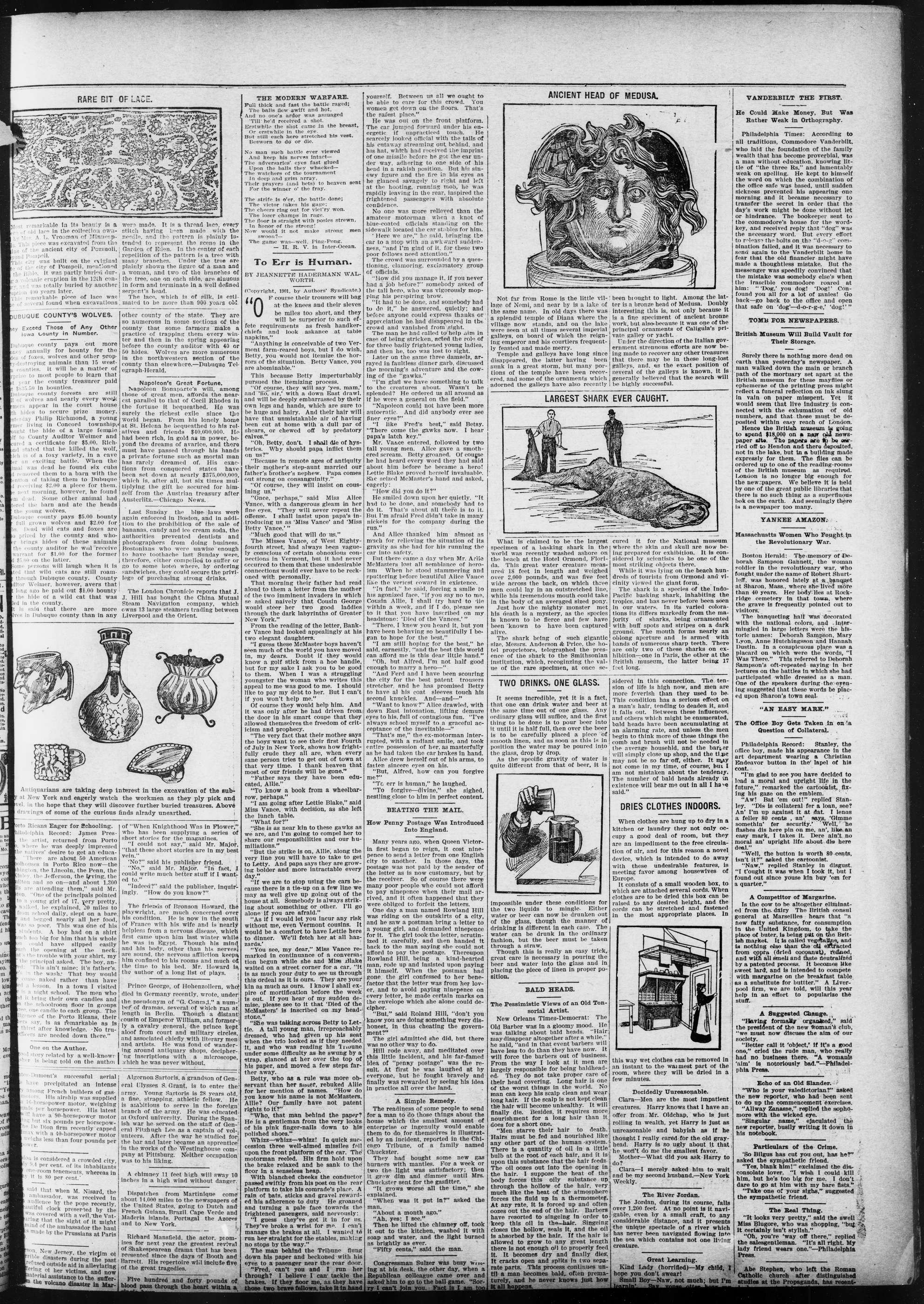
Antiquarians are taking deep interest in the excavation of the subway at New York and eagerly work the workmen as they ply pick and level, in the hope that they will discover further buried treasures. Above drawings of some of the curious finds already unearthed.
Most remarkable in its beauty is a piece of old lace in the collection owner Mrs A. L. Vroman of Minneapolis. This piece was excavated from the site of the ancient city of Pezzoni, good Pompeii. This city was built on the original site of the city of Pompeii, mentioned the Bible. It was partly buried during a colocaic eruption in the 12th century and was totally buried by another eruption 400 years later. This remarkable piece of lace was found several times when excavations
DUBUQUE COUNTY'S WOLVES.
ney Exceed Those of Any Other Iowa County in Number.
Duhique county pays out more money annually for the burea for the des of foxes, wolves and other proprydestroying animals than 15 west county. It will be a matter of prince to understand that the county treasurer paid 200,000 in bounties.
Dubuque county forests are still all of wolves and nearly every weed insects appear in the court house with hides to secure prize money, yesterday Philip Richmond, a young living in Concord township, bought the hide of a large female羊 to County Auditor Welmer and cured a certificate for $5.00. Richmond stated that he killed the wolf, which is of a foxy breed, and the battle. When the dead he found six cubs he removed them to a barn with the portion of taking them to Dubuque and receiving $2.00 a piece for them, the next morning, however, he found them dead. Some other animal had taken the barn and ate the heads of the young wolves.
Dubuque county pays $5.00 bounty for full grown wolves and $2.00 for the dead wild cats and foxes are so prized by the county and who brings in these animals the county auditor he will receive warranty for $1.00 for the former $5.00 on the latter.
Some persons will laugh when it is suggested that wild cats are still roaming through Dubuque county. County attorney Wilmer, however, avers that it long ago he paid out $1,000 bounty the bible of a wild cat that was killed in a fire. It is said that there are more cats in Dubuque county than in any
Antiquarians are taking deep in
y at New York and eagerly watch
vel. in the hope that they will dis
drawings of some of the curious
Porto Ricans Eager for Schooling.
Philadelphia Record: James Press,
the artist, returned from Porto
Rica where he was deeply impressed
the natives' desire to get an educator.
There are about 50 American
polynesians in Porto Rica now—the
bishopton, the Lincoln, the Penn,
the Niley, the Jefferson, the living,
the milton and so on—and about 1,300
lis are attending them," said Mr.
Briston. "One of the principalals pointed
to a young girl of 17, very pretty,
walked, he explained, 20 miles to
from school daily, slept on a bare
and banged nearly all her food,
so poor. This was one of his
students. A boy had on a shirt
much too big for him that his whole
could have slipped easily
at the trouble with our shirt, ray
the principal asked. The boy, an-
ered: "This nintime; it's father's,
in the wash. That boy would
become naked rather than have
a lesson. In a town I visited
was a night school. The men who
and it bring their own candles and
on the schoolroom floor in groups
one tree to each group. The
because of the Porto Ricans, their
say, is as remarkable as is
thirst after knowledge. No tru-
plicaries are needed down there."
good story related by a well-known officer is being told on the author's Dumont's successful aerial have precipitated an intense campaign French builders of gas-motors. His airstrip was supplied by a 16-horsepower motor, weighting pounds per horsepower. His latest will have a 90-horsepower motor but six pounds per horsepower. The De Dion firm recently capped Dumon is considered a crowded city, only 4.3 per cent, of its inhabitants, one-room tenements, whereas inay it is 80 per cent.'
It is said that when M. Nisard, the ambassador, was received in audience by the pope recently, beautiful clock presently was covered with a vell, the Vattaring that the sight of it might mind of the ambassador the haul is made by the Prussians at Paris
orien, New Jersey, the victim of
磐Ti灾 disasters during the past
refreshed outside aid in alleviating
during of her victims, and now
material assistance to the suffer-
er the volcanic disaster in Mar-
were made. It is a thread lace, every stitch having been made with the needle, and the pattern is plainly intended to represent the scene in the Garden of Eden. In the center of each repetition of the pattern is a tree with many branches. Under the tree are plainly shown the figure of a man and a woman, and two of the branches of the tree, one on each side, are adnuous in form and terminate in a well defined serpent's head. The lace, which is of silk, is estimated to be more than 900 years old.
other county of the state. They are so numerous in some sections of the county that some farmers make a practice of trapping them every winter and then in the spring appearing before the county auditor with 40 or 50 hides. Wolves are more numerous in the northwestern section of the county than elsewhere.—Dubuque Telegraph-Herald.
Napoleon's Great Fortune
Napoleon Bonaparte's will, among those of great men, affords the nearest parallel to that of Cecil Rhodes in the fortune it bequeathed. He was surely the richest exile since the world began. From his lonely home at St. Helena he bequeathed to his relatives and friends $40,000,000. He had been rich, in gold as in power, beyond the dreams of avarice, and there must have passed through his hands a private fortune such as mortal man would have imagined. His decisions from conquered states have been set down at nearly $275,000,000, which is, after all, but six times multiplying the gift he secured for himself from the Austrian treasury after Austerlitz.—Chicago News.
Last Sunday the blue laws wirs again enforced in Boston, and in addition to the prohibition of the sale of bananas, candy and ice cream soda, the authorities prevented dentists and photographers from doing business. Because who were aware enough to have toothache last Sunday therefore, either compelled to suffer or to some hotel where, by ordering sandwiches, they could secure the privilege of purchasing strong drinks.
The London Chronicle reports that J. J. Hill has bought the China Mutual Stores company, which owns 13 large steamers trading between Liverpool and the Orient.
interest in the excavation of the sub-
the workmen as they ply pick and
cover further buried treasures. Above
finds alrady unearthed.
of "When Knighthood Was in Flower,"
who has been supplying a series of
short stories for the magazines.
"I could not say," said Mr. Major. "that these short stories are in my best vein." "No?" said his publisher friend. "No," said Mr. Major. "In fact, I could write much better stuff if I wanted to." "Indeed?" said the publisher, inquiringly. "How do you know?"
The friends of Bronson Howard, the playwright, are much concerned over his condition. He is now in the south of France with his wife and is nearly helpless from a nervous disease, which first came upon him last winter while he was in Egypt. Though his mind is clear, his body other than his ears are sound, the nervous affection keeps him confined to his rooms and much of the time to his bed. Mr. Howard is the author of a long list of plays.
Prince George, of Hohencolllern, who died in Germany recently, wrote, under the pseudonym of "G. Conard," a number of dramas, several of which ran at length in Berlin. Though a distant cousin of Emperor William, and formerly a cavalry general, the prince kept aloof from court and military circles, and associated chiefly with literary men and artists. He was fond of wandering around antiquary shops, deciphering inscriptions with a microscope, which he was never without.
Algernon Sartoris, a grandson of General Ulysses S. Grant, is to enter the army. Young Sartoris is 28 years old, a fine, strapping, athletic fellow. He is ambivalent, serve in the foreign branch of the army. He was educated at Oxford university. During the Spanish war he served on the staff of Volunteer Fitzhugh Lee as a captain of volunteers. After the war he studied for the bar and later became an apprentice in the works of the Westinghouse company at Pittsburg. Neither occupation was to his liking.
A chimney 11 feet high will sway 10 inches in a high wind without danger.
Dispatches from Martinique come about 14,000 miles to the newspapers of the United States, going to Dutch and French Guiana, Brazil Cape Verde and Madera islands, Portugal the Azores and to New York.
Richard Mansfield, the actor, promises for next year the greatest revival of Shakur O'Regan rama that has been presented since the days of Booth and Barrett. His repertoire will include five of the great tragedies.
Five hundred and forty pounds of blood pass through the heart within a
THE MODERN WARFARE.
Full thick and fast the battle raged;
The balls flew swift and hot,
And no one's arder was assuged
in his hand.
Estrwhile the shot came in the breast,
Or erstwhile in the eye.
But still each hero stretched his vest.
Besworn to do or die.
No man such battle ever viewed
And keep his nerves intact.
The watchers are fast lured
Upon the balls they whacked—
The watchers of the tournament
In deep and grim array.
Their prayers and beats to heaven sent
For the fray.
In honor of the strong!
Now would it not make strong men
swoon?
The game was—well, Ping-Pong.
— H. R. V. in Inter-Ocean.
To Err is Human.
BY JEANNETTE HADERMANN WAL-
WORTH.
(Copyright, 1901, by Authors' Syndicate.)
"F course their trousers will bag
at the knees and their slaves
be miles too short, and they
will be superior to such ef-
fete requirements as fresh handker-
chiefs and look askance at table
napkins."
"Anything is conceivable of two Vermont farm-reared boys, but I do wish,
Betty, you would not itemize the
horrors of the situation. Betty Vance, you
are abominable."
This because Betty imperturbably
pursued the itemizing process.
"Of course, they will say 'yes, man',
'no,' shr., with a down East draw,
and will be deeply embarrassed by their
own legs and hands, which are sure to
be unmistakable air of having
been cut at home with a dull par of
shears, or chewed off by predatory
calves."
"Oh, Betty, don't. I shall die of hysterics. Why should papa inflict them on us?"
"Because in remote ages of antiquity their mother's step-aunt married our father's brother's nephew. Papa comes out strong on consanguinity."
"Of course, they will insist on cousinning us."
"Once, perhaps," said Miss Alice Vance, with a dangerous gleam in her fine eyes. "They will never repeat the offense. I shall insist upon papa's introducing us as 'Miss Vance' and 'Miss Betty Vance.'"
"Much good that will do us."
The Misses Vance, of West Eighty-fourth street, had always been vaguely conscious of certain obnoxious connections in Vermont, but it had never occurred to them that these undesirable connections would ever have to be reckoned with personally.
That morning their father had read aloud to them a letter from the mother of the two imminent invaders in which she asked naively that Cousin George would steer her two good laddies through the dark labyrinths of Greater New York."
From the reading of the letter, Banker Vance had looked appealingly at his two elegant daughters.
"I guess these McMaster boys haven't seen much of the world you have moved it up to," she said. "If they would go golf stick from the hoe handle, but for my sake I ask you to be good to them. When I was a struggling youngster the woman who writes this appeal to me was good to me. I should like to pay my debt to her. But I can't if you won't help me."
Of course they would help him. And it was only after he had driven from the door in his smart coupe that they allowed themselves the freedom of criticism and prophecy.
"The very fact that their mother says the boys want to see their first Fourth of July in New York, shows how frightfully crude they all are, when every sane person tries to get out of town at that very time. I thank heaven that most of our friends will be gone."
"Father says they have been educated, Allie."
"To know a book from a wheelbarrow, perhaps."
"I am going after Lettie Blake," said Miss Vance, with decision, she left the lunch table.
"What for?"
"She is as near kin to these gawks as we are, and I'm going to compel her to share our responsibilities and our humility."
"But the strike is on, Allie, along the very line you will have to take to get to Letty. And papa says they are growing holder and more intractable every day."
"If we are to stop using the cars because there is a tie-up on a few line we may as well give up going out of the house at all. Somebody is always striking about something or other. I'll go alone if you are afraid."
If I would let you incur any risk without me, even Vermont cousins. It would be a comfort to have Lettie here to dinner. We'll fetch her at all hazards."
"You see, my dear," Miss Vance remarked in continuance of a conversation begun while she and Miss Blake waited on a street corner for a car. "It is as much your duty to see us through this ordeal as it is ours. They are your kin as much as ours. I know I shall expire of mortification before the week is out. If you hear of my sudden demise, please see to it that 'Died of the McMasters' is inscribed on my headstone."
"She was talking across Betty to Lettie. A tall young man, improachably dressed, who had given up his seat when the tro looked as if he needed help, and who had taken his T-shirt and some difficulty as he swung by a strap, glanced at her over the top of his paper, and moved a few steps farther away.
Betty, who as a rule was more observant than her sister, rebelled Allie for her mention of names. "How do you know his name is not McMasters, Allie? Our family have not patent rights to it?"
"Who, that man behind the paper? He is a gentleman from the very looks of his pink finger-nails down to his polished shoes." Whitz—whizz—whizz! In quick succession three well-alarmed missiles fell upon the front platform of the car. The motorman reeled. His firm hold upon the brake relaxed and he sank to the floor in a senseless heap. With blanched cheeks the conductor passed swiftly from his post on the rear platform to take his comrade's place. A rain of sticks, sticks and gravel rewarded his adherence to duty. He gronned and turning a pale face towards the frightened passengers, said nervously: "We've broken a wrist for me. I can't manage the brakes at all. I wanted to run her straight for the stables, making no stops by the way." The man behind the Tribune flung down his paper and beckoned with his eyes to a passenger near the rear door. "Fred, can't you and I run her through? I believe I can tackle the brakes. If they floor me, as they have those two brave fellows, take it in hand
yourself. Between us all we ought to be able to care for this crowd. You women get down on the floors. That's the safest place."
He was out on the front platform. The car jumped forward under his energetic if unpracticed touch. He scarcely looked official with the tails of his cutaway streaming out behind, and his hat, which had received the imprint of his face, he beheared he got the door way, adhering to one side of his head in a raikish position. But his sinuey figure and the fire in his eyes as he glanced savagely to right and left at the hooting, running mob, he was rapidly leaving in the rear, inspired the frightened passengers with absolute confidence.
No one was more relieved than the amateur motorman when a knot of blue-coated officials standing on the sidewalk located the car stobies for him. 'Here we are,' he said, bringing the car to a stop with an awkward suddenness, and the glint of for these two porous need attention."
The crowd was surrounded by a questioning, clamoring exclamatory group of officials.
"How did you manage it, if you never had a job before?" somebody asked of the tall hero, who was vigorously mopping his perspiring brow. It had to be done, and somebody had to. It had to be answered quietly, and before anyone could express thanks or appreciation he had disappeared in the crowd and vanished from sight. The man he had called to help aim in case of being stricken, acted the role of three badly frightened young ladies, and then he, too was lost to sight. Later on the same three damsels, arrayed in faultless dinner garb, discussed the promising picture and the cowing gawks. "I'm glad we have something to talk to the creatures about. Wasn't he splended? He ordered us all around as if he were a general on the field." "Napoleon could not have been more autocratic. And did anybody ever see finer eyes?" "Fred's best," said Betsy, "There came the gawks now. I hear pansa's latch key."
Mr. Vance entered, followed by two tall young men. Alice gave a smothered scream. Betty groaned. Of course he had heard every word they had said about him before he became a hero! Lettie Blake proved herself invaluable. Reed McMaster's hand and asked, eagerly: "How did you do it?"
He smiled down upon her quietly. "It had to be done, and somebody had to do it. That's about all there is to it. But I'm afraid Fred didn't take in many nickels for the company during the run."
And Alice thanked him almost as much for relieving the situation of its gravity as she had for his running the car into safety.
But there came a day when Mr. Arlie McMasters lost all bluemance of heroism. When he stood stammering and sputtering before beautiful Alice Vance like the verest coward in existence.
"In fact," he said, forcing a smile to his agonized face, "if you say no to me, Cousin Allie, I shall try hard to die within a week, and if I do, please see to it that you have inscribed on my headstone: 'Died of the Vances.'"
"There, I knew you heard it, but you have been behaving so beautifully I began to hope for the best." he said, carrently, and the best this world can afford me is this dear little hand.
"Oh, but Alfred, I'm not half good enough to marry a hero—"
"And Ferd and I have been scouring the city for the best patent trousers stretcher, and he has promised Betty to have al his coat sleeves touch his second knuckles. And—and—"
"Want to know?" Alice drawled, with down East intonation, lifting demure eyes to his, full of contagious fun. "I've always school myself to a graceful acceptance of the inevitable—"
"That's me, the ex-motorman interrupted, with a rant smile, and took entire possession of her masterfully as he had taken the car brakes in hand. Alice drew herself out of his arms, to fasten sincere eyes on his."
"But, Alfred, how can you forgive me?"
"To err is human," he laughed.
"To forgive—divine," she sighed, nestling close to him in perfect content.
BEATING THE MAIL.
How Penny Postage Was Introduced Into England.
Many years ago, when Queen Victoria first began to reign, it cost ninepence to send a letter from one English city to another. In those days, the postage was not paid by the sender of the letter as is now customary, but by the receiver. So of course there were many poor people who could not afford to pay ninepence when their mail arrived, and it often happened that they were obliged to forfeit the letters. Rowland Hill was riding on the emigrants of city, and he saw a postman bring a letter to a young girl, and demanded ninepence for it. The girl took the letter, scrutinized it carefully, and then handed it back to the man saying she could not afford to pay the postage. Thereupon Rowland Hill, being a kind-hearted man, rode up and insisted upon paying it himself. When the postman had gone the girl confessed to her benefactor, and he insisted to avoid paying ninepence every letter, he made certain marks on the envelope which she alone could decipher.
"But," said Roland Hill, "don't you know you are doing something very dishonest, in thus cheating the government?" The girl admitted she did, but there was no other way to do. He meditated over this little incident, and his far-famed idea of "penny postage" was the result. At first he was laughed at by everyone, but he fought bravely and finally was rewarded by seeing his idea in practice all over the land.
A Simple Remedy.
The readiness of some people to send for a man to do those things about the house which the smallest amount of enterprise or ingenuity would enable them to do for themselves is illustrated by an incident, reported in the Chicago Tribune, of a family named Chuckster. He had bought some new gas burners with mantles. For a week or two the light was satisfactory; then it grew dim and dimmer until Mrs. Chuckster sent for the gasfitter.
"It grows worse all the time," she explained.
"When was it put in?" asked the man.
man.
"About a month ago."
"Ah, yes; I see."
Then he lifted the chimney off, took it out to the kitchen, washed it with soap and water, and the light burned as brightly as ever.
"Fifty cents," said the man.
Congressman Sulzer was busy writing at his desk, the other day, when a Republican colleague came over and asked him to go to the ball game. "Sorry I can't join you. Fact is I am too
A
LARGEST SHARK EVEN Caught!
Not far from Rome is the little village of Nomi, and near by is a lake of the same name. In old days there was a splendid temple of Diana where the village now stands, and on the lake were seen at all times several imperial galleries, on board of which the reigning emperor and his courtlers frequently feasted and made merry. The temple and the long since disused basin, the latter having been sunk in a great storm, but many portions of the temple have been recovered, and some of the ornaments which adorned the galleries have also recently
LARGEST SHARK
What is claimed to be the largest specimen of a basking shark in the world was recently washed ashore on the beach at the Hotel Ormond, Florida. This great water creature measured 18 feet in length and weighed over 2,000 pounds, and was five feet tall. The shark men could lay in an outstretched line, while his tremendous mouth could take in the body of an averaged sized pony. Just how the mighty monster met his death is a mystery, as the species is known to be fierce and few have been known to have been captured alive.
The shark being of such gigantic size, Messrs. Anderson & Bock, hotel owners, dug a grapefruit the presence of the shark to the Smithsonian institution, which, recognizing the value of the rare specimen, at once se-
TWO DRINKS. ONE GLASS.
It seems incredible, yet it is a fact, that one can drink water and beer at the same time out of one glass. Any ordinary glass will suffice, and the first thing to be done is to pour beer into it until it is half full, then over the beer is to be carefully placed a piece of smooth linen, and as soon as this is in position the water may be poured into the glass, drop by drop.
As the specific gravity of water is quite different from that of beer, it is
Impossible under these conditions for the two liquids to mingle. Either water or beer can now be drunken out of the glass, though the manner of drinking is different in each case. The water can be drunk in the ordinary fashion, but the beer must be taken such a straw
Though this is really an easy trick, great care is necessary in pouring the beer and water into the glass and in filling the piece of linen in proper position.
BALD HEADS.
The Pessimistic Views of an Old Tonsorial Artist.
New Orleans Times-Democrat: The Old Barber was in a gloomy mood. He was talking about bald heads. "Hair may disappear altogether after a while," he said, "and in that event barbers will have less to do than they have now. It will force the barbers out of business. From the way I look at it men are largely responsible for being baldheaded. They do not take proper care of their head covering. Long hair is one of the worst things in the world. No man can keep a scalp clean and wear long hair. If the scalp is not kept clean the hair will become unhealthy. It will finally die. Besides, it requires more nourishment for a long hair than it does for a short one.
"Men starve their hair to death. Hairs must be fed and nourished like any other part of the human system. There is a quantity of oil in a little bulb at the root of each hair, and it is upon this substance that the hair feeds. The oil oozes out into the opening in the hair. I suppose the heat of the body forces this oily substance up through the hollow of the hair, very much like the heat of the atmosphere forces the fluid up in a thermometer. At any rate, it is forced up and often oozes out the end of the hair. Barbers have resorted to singing in order to keep this oil in the hair. Singing closes the hollow, seals it, and the oil is absorbed by the hair. If the hair is allowed to grow to any great length there is not enough oil to properly feed it. It becomes dry and finally dies. It cracks open and splits in two separate parts. This process continues until a man becomes bald, often prematurely, and he never knows just how it all happens.
been brought to light. Among the latter is a bronze head of Medusa. Doubly interesting is this, not only because it is a fine specimen of ancient bronze work, but also because it was one of the principal ornaments of Caligula's private galley or yacht. Under the direction of the Italian government strenuous efforts are now being made to recover any other treasures of the gallies, these long-lost gallies, and, as the exact position of several of the gallies is known, it is generally believed that the search will be highly successful.
EVER CAUGHT.
cured it for the National museum where the skin and skull are now being prepared for exhibition. It is considered by scientists to be one of the most striking objects there.
While it was lying on the beach hundreds of tourists from Ormond and vicinity viewed the giant form. The shark is a species of the Indo-Pacific basking shark, inhabiting the tropics, and has never before been seen in our waters. In its varied colors its differs markedly from the majority of sharks, being ornamented with buff spots and stripes on a dark ground. The mouth forms nearly an oblong aperture and is surrounded by more or fewer shark teeth. There are only two of these sharks on exhibition—one in Paris, the other at the British museum, the latter being 17 feet long.
sideder in this connection. The tension of life is high now, and men are more feverish than they used to be. This condition has a serious effect on a man's hair, tending to deaden it, and it falls out. Between these influences, and others which might be enumerated, bald heads have been accumulating at an alarming rate, and unless the men begin to think more of these things the comb and brush will not be needed in the average household, and the bad hair may only close up shop, and the tape may not be so far off, either. It may not come in my time, of course, but I am not mistaken about the tendency. The number of bald heads already in existence will bear me out in all I have said."
DRIES CLOTHES INDOORS.
When clothes are hung up to dry in a kitchen or laundry they not only occupy a good deal of room, but they are an impediment to the free circulation of air, and for this reason a novel device, which is intended to do away with these undesirable features, is meeting favor among housewives of Europe. It consists of a small wooden box, to which are attached several cords. When clothes are to be dried this box can be raised to any desired height, and the cords can be stretched and fastened in the most appropriate places. In
this way wet clothes can be removed in an instant to the warmest part of the room, where they will be dried in a few minutes.
Decidedly Hureasonable
Clara—Men are the most impatient creatures. Harry knows that I have an offer from Mr. Oldchap, who is just rolling in wealth, yet Harry is just as unreasonable and babyish as if he thought I really cared for the old grayhead. Harry is so ugly about it that he won't do me the smallest favor. Mother—What did you ask Harry to do?
Clara—I merely asked him to wait and be my second husband.—New York Weekly.
The River Jordan.
The Jordan, during its course, falls over 1,200 feet. At no point is it navigable, even by a small craft, to any considerable distance, and it presents the unique spectacle of a river which has never been navigated flowing into the sea which contains not one living creature.
Great Learning.
Kind Lady (horrified)—My child, I hope you not swear!
Small Boy—Naw, not much; but I'm learner!
He Could Make Money, But Was Rather Weak in Orthography.
Philadelphia Times: According to all traditions, Commodore Vanderbilt, who laid the foundation of the family wealth that has become proverbial, was a man without education, knowing little of the world, and weak on spelling. He kept to himself the word on which the combination of the office safe was based, until sudden sickness prevented his appearing one morning and it became necessary to transfer the secret in order that the day's work might be done without let or hindrance. The bookkeeper sent to the commodore's house for the wordkey, and received reply that "dog" was the necessary word. But every effort to release the bolts on the "d-o-z" combination failed, and it was necessary to find a new word to fear that the old financier might have made a thoughtless mistake. But the messenger was speedily convinced that the mistake was somebody else's when the frascible commodore roared at him: "Dog, you dog! 'Dog!' Confound you all for a lot of aenis. Go back—go back to the office and open that safe on 'dog'—d-o-r-g-e, 'dog!'
TOMB FOR NEWSPAPERS.
British Museum Will Build Vault for Their Storage.
Surely there is nothing more dead on earth than yesterday's newspaper. A man walked down the main or branch path of the mortuary set apart at the British museum for these mayflies or ephemera of the printing press might reflect a funeral reflection on ink slung in vain on paper misspept. Yet it was seen that live industry is conducted on numbers, and that these must be deposited within easy reach of London. Hence the British museum is going to spend $18,000 on a new old newspaper site. The papers are to be carried off to Hendon and there deposited, not in the lake, but in a building made expressly for them. The files can be ordered up to one of the reading-rooms of the British museum as required. In the big room of the new-papers. We believe it is held by one of the great public libraries that there is no such thing as a superfluous bok on the earth. And seemingly there is a newspaper too many.
YANKEE AMAZON:
Massachusetts Women Who Fought in the Revolutionary War.
Boston Herald: The memory of Deborah Sampson Gannett, the woman soldier in the revolutionary war, who fought under the name of Robert Shurtleff, was honored lately at a banquet at Sharon, Mass., where she lived more than 40 years. Her body lies at Rockridge cemetery in that town, where the grave is frequently pointed out to visitors.
The banquet hall was decorated with the national colors, and intermingled in large letters were the historic names: Deborah Sampson, Mary Lyon, Anne Hutchinson and Hannah Dustin. In a conspicuous place was a wreath in which were the words, "I Was There." This referred to Deborah Sampson's oft-repeated saying in her lectures on the battles in which she had participated while dressed as a man. One of the speakers during the evening suggested that these words be placed upon Sharon's town seal.
The Office Boy Gets Taken in on 's
Question of Collateral.
Philadelphia Record: Stanley, the office boy, made his appearance in the art department wearing a Christian Endeavor button in the lape of his coat.
"I'm glad to see you have decided to lead a moral and upright life in the future," remarked the cartoonist, fixing his gaze on the emblem.
"Aw, far, em out!" replied Stanley. "Dis be collateral for a loan, see? An' I up against it at flat. I lenas a feller 80 cents, an', says, 'Gimme somethin' her security.' Well, he flashes his见 pin on me, an', like an easy mark, I takes it. Dere ain't no moral an' upright life about dis here deal."
Well, the button is worth 80 cents, isn't it? asked the cartoonist.
"Naw," replied Stanley in disgust. "I ought it was when I took it, but I found out since youse kny buy 'em for a quarter."
In the cow to be altogether eliminated from the dairy The British consul general at Marselles hears that "a new fatty substance, for consumption in the United Kingdom, to take the place of buter, is being put on the British market. It is called vegetale, and is nothing else than the oil extracted from copa (dried coconut), refined, and with all smell and taste neutralized by a patented process. It becomes like sweet lard, and is intended to compete with the other oils as a substitute for butter." A Liverpool firm, we are told, will this year help in an effort to popularize the stuff.
A Suggested Change
"Having formally organized," said the president of the new woman's club, "we must now discuss the aim of our society. "Better call it 'object', if it's a good one," orried the rude man, who really had no business there. "A womanis aim" is notoriously bad"—Philadelphia Press.
Echo of an Old Slander. "Who is your valedictorian?" asked the new reporter, who had been sent to do up the commencement exercises. "Allway Zanasse," replied the sophomore with the wicked eye. "Singular name," ejaculated the new reporter, burying writing it down in his notebook.
Particulars of
Particulars of the Crime.
'But Bigus has cut you out, has he?' asked the sympathetic friend.
'Yes, blank him!' exclaimed the disconsolete lover. 'I wish I could kill him, but he's too big for me. I don't dare to attack him or my bare fists.'
'Take one of your sights,' suggested the sympathetic friend.
The Real Thing.
"It looks very pretty," said the swell Miss Blugore, who was shopping, "but it certainly isn't stylish."
Oh, "you're way off there," replied the salesgentleman. "It's all right. My last wear wears one." -Philadelphia Press.
Abe Stephen, who left the Roman Catholic church after distinguished studies at the Propaganda, has recent
state hedger
F. L. JELTZ!
A; W. HARRIS associate
TERMS $2.00 per year,
" 6 mo's $1.00
" 3 mo's 50
Mr. Robert M. Cracken one of the
Veteran Nursery man of Wichita is
located on North Main at he has had
a good season with his Sedgwick
nursery and hopes to continue in
tuture.
THE
BLISS JEWELRY Co
Carries a full line of cut glass.
Fine Jewelry—Call and see them.
504 Comt's Street
Akshawan, Kansas
Sawin & Douglass
UNDEBTAKERS
And
EMBALMERS
305 Comt's street
Ackhawan, Kansas
ABEL'S
DRUG STORE
Have the best cough medicine
made Try it!
Cor 34 and Chekkee Mts. Leavenworth Ks.
OLD RELIABLE RESTAURANT
400% Kansas Avenue
Mrs. Goe Muller p.r.p.
Best service and mealsfor 15c in
the city, good clean beds from 25c
up Call and you will call again
C. V. Jacobs
BAKER and CONFECTIONER
Ice Cream and Cake, McCain and Lunch.
Tel.4378 320 Co. A.
Attickson, Kansas.
PINE 'BZOS
Deserts In
Staple and Fancy Groceries
187 Bridge St,
LAWRENCE, KANS.
Tel No 251
J. KANE & CO
The Family Drug Store
Your Trade Solicited!
TopekaDrug Co.
PRESCRIPTION DRUGSTORE
732 Kansas Avenue.
KING NOTEL
MRS. L. T. WOODY, Prop
831 Vermont, Street,
Lawrence, Kansas
Meals 15c, Lodging 25c, Newly
fixed np in every particular, 16
fine rooms,
W.M. KINCE
TAILOR.
Yaitoning at personalizable prices.
Land and Workmanship guaranteed,
Cleaning and Repairing neatly due.
512½ Kansas Avenue. Topeka
FRANK LOUD
906 E. 4th St
Dealer in Presbyterian Bishl Bessit Fish Co.
utility.
ZERCHER & POOL
BOOKS, STATIONERY, OFFICE SUPP
FLIER
527 Kansas Avenue
We solicit a share of your patronage
TOPEKA, KANS.
THE TOPEKA ICE & COLD
STORAGE CO
Cold Storage for eggs, butter, apples, poultry and all perishable goods,
Cor Curtis & Tyler st
Trackage to all, Railroads, Correspondence slanted
E. Trucks, Phone 657
G. L. BAUGHMAN M. J.
Office 525 Kaw Ave, Hours 9 o'clock 11: 400 5
Diseases of Women a specialty
Residence 1322, Lincoln st
H. F. Williams, Presid
Wm. L. Dick, Secy & Treas
PINKSTON PROS.
Flour Feed and Grain, Reliable Dealers. Headquarters for any thing you want in their line Call and see them - 517 N Main
MISS MARY E. KIETH,
Hair dressing and all kinds of hair work done in the best styles and grades. Your trade solicitee 47 Main St. Wichita, Kans
ATTORNEY AT LAW.
And Real Estate's special attention paid to
president claims, Olatie Kans.
WILMAN
Ieweler-717 Mass St;
Good work Guaranteed with'per.
ect satisfaction. Lawrence Ks
Scott & Hughes,
Denton 10
Obtaple and Fancy Groceries, Flour
Feed, also Coal and Wood.
153 Bridge St, Nort Lawrence Ks
H. L. TROMP
Manufacturer of
HIGH GRADE CIGARS
804 Kans, Ave. Iuppea Kans,
J. E. PODMAN
LORIK/S?
Plants for windows and bedding. Society
embodies in flowers a speciality. Green
flowers 12th and Monroe soa. Store 5 W
Roxb.
When you want a general list of school supplies call on Mr. T. M. James, jr., Post-office, North Topeka, book store.
Grocries and Meats.
The nearest grocery, in the city is the one operated by Mr. J. J. Wernstrom at 213 and 15 west 4th street they carry a full line of groceries, meats, can goods especially flour and feed give 'them a call J. H. Wernstrom prop.
MISSCEL JANE OUS ADS
GOINGS & ALLYAN
1133 Kansas Ave.
Fond and all kinds of floor and gras. Prie
reasonable. Give them a call.
BUSINESS COLLEGE.
Prot M A Pond has changed his
Business College to 521 Kan a
avenue. Parties desiring to take a
business course should call on ad
address him there.
NEW IDEA
BAKERY & CANDY FACTORY
110 South Main Street Oktawa Kan
W. H. WORK Phone 33
P. S. LIGHTNER
New and Second-hand goods
bought and sold. Abilene, Kan.
Jumber, Lime.
Master, Cement.
Brick, Coal and Builder's Ware.
Let us figure your
A.O. BEACH, Mgr.
710 E. 4th street.
C F RODIGER
Dye and Cleaning Works
820 Kane, Ave. Topeka Kansas.
i Phone,9571
! WE MAKE CLOTHES!
That!
N. H. Wolff Tailor 429 Kansas:
Ave
S. H. DOW N'S
306 Kans Avenue For Garden and flower seeds, and awn grass, and Hardy roses and, plant.
MKS.E. MOSTEIR
Gives meals for 10 and 15 cents 720
Douglas St. Wichita Katz. Also, carries
all line of cloars, tobacco and temperance
sticks.
Jeweler and Graduated Optician
Jewelry, Silverware, Watches Creek
keepsiring neatly
429 Kansas Ave. Topeka
TOPEKA BUSINES.
COLLEGE
523 Quincy Street
plus far the member ship inr
this institution increases every y
H yea want a go on oursay education
calls or address
H. Strickler Topeka Kans
JOSEPH ARTLE
foot and shoe manufacturer does
all kinds of repairing at reas-
able prices. Men's half coles 50
ladies 40ct, children's 30 cents.
Stand 400 Kans.
Rahrer's Restaurant
515 East Fifth St.
Opposite Santa Fe Depot,
C, A, RAHRER, Prop.
All kinds of repairs for your wheel at
Topeka Cycle Co. 112 W 8th S.
FALK & CO.
PUMPS
WIND-MILLS
And PLUMBING GOODS
General Supplies.
Onlysanitry Place in the city.
McPherson, Ka 0525
RUSH
K. FREED and RAY.
Avenue.
OBLE & CO.
Local and Eastern Investors
S. EONVILMORTAGES
Phone 454 505 Jackson St. Topeka, Ks.
Designs. Palms and Ferns.
HOLLCRAFT
CRIST.
817 Kansas Ave Topeka
SMITH
ER IN
Furs and Pelts.
BirdStreet Topeka Kas'
Street St. Joseph, Mo.
Bets, Not Bank of St. Joe, Bank of Topeka
Financial Agents to Local and Eastern Investors
REAL ESTATE FIRE INS EONVHMORTAGES
and Building
Telephone 446 501 Jackson St. Tampa, Kate
Mides, Tallow, Furs and Pelts.
108 and 110 East Third Street Topeka Kas
and 124 S. 2nd street St. Joseph, Mo
Wolf Lacking Co. Topeka, NB Bank of St. John, Bank of Topeka
Buy your machine Bread Perfectly Fine at 11 F Vespers 113 East 6th St,
Get your prescriptions at the Henrietta Drug Co. A complete stock of new goods on hand. 116 East 6th st Don't forget to take the best said the "Fairy-Dream". hence stop in at Proudfit and Perkins and get just what the Fairy meant. A wholesome meal 417 Kans. Ave.
The Creamery is the place best in town to take your meals Open all night. Mr. C. L. Scott, prop. 726 Kansas Avenue.
When you want shots see Mr. C. P. Theis, 422½ Conn's Street Emporia Kansas, The Reliable Dealer.
Proudfit and Perkins, the Caterers are serving one among the best people of Topeka. They have the nearest and nicest place in the city. Give them a call, 417 K. Av.
H. HOLTWICK
MANUFACTURER OF
high grade Cigars
AND ALL KINDS OF SMOKING
ARTICLES
H.A.KLAUER
H.A. KLAUER
Carries All the LATEST brands of cigars and also a FULL LINE of Tobacco and smoking articles.
His cigars are made in Topeka.
¢26 Kansve
LANDIS HOME BAKERY
Many years experience, French house Bakery 316 E. 4th St
SUBSCRIBE FOR THE STATE LEDGER
A Seven Column Paper filled with news from every where.
$1.50 PER ANNUM
THOSE WHO OWE
SHOULD HURRY TO
411 KANSAS AV.
WIND MILL
J. W. WILSON
Dealer in Candies, Fruits, Ice
Cream, Cold drinks and all kinds
of refreshments, Cigars and To-
te coffees. 102 East 6th Street.
FRANK SACHS & SON.
FLORIST...
Floral designs and cut flowers
a special y.
Office: 119 W. 6th Street.
Phone 64. Green House W. 10th
FRONT
C. M. THOPPESON PROP.
4022 N. KENNEDY AVE.
Phone 283.
Full line of everything kept in a
first class Grocery. Cash paid for
butter, eggs and poultry.
We pay the the highest price in
the city.
Genuine Mexican Cheile..Hon Tomales,Cakes, Pies. Lunch,Cip. and Tobacco.
TRUJILLO & COMACHO props
W. K. TEDRICK
Whole sale dealer in 'Poss Patent Flour' and
mill feed. 320 N. Main street.
Hutchinson Kane.
WILLIAN REED
REFRESHMENTS
Finest reception in the city. At SantaFet.
Hotel. 401 Maidson st.
TOPEKA, CREMATORY CO.
L. Z. HOWE Manager
214 East Fifth Street. Phone 817 Creamstory
Topeka Kans.
JONE S RESTAURANT
529 kans avenue. North Topeka
SERVES
and short order. Everything thing the ma-
尉 afords. Give him a call.
Dead Brew,
...DEALERS IN...
All of the leading GRANTES and MARKE
BLE MONUMENTS. Our Designs are a
modern and up-to-date. Cleaning up oll
monuments ancutting inscriptions a specia
ly.
S. BAU am
1064 Union Ave. (opposite depot
Clothing Boots and Shoes, fur-
ing Goods, Jewelry of al-
kinds. Kansas C
H. GENTH
Bake and C
113 East Fourth Street
HERE And THERE
PHYSICANS
DR. W. H. H. SMITH,*
special Attention given to Caucasian 16岁
and all Diseases applicable to Women.
15 years experience.
Center 6th and Kansas Avenue.
Office, Over Hatch's Drug Store.
DR. F. H. SCHOLLE
Physician and Surgeon
515 Kansas Avenue Topeka Kans
Tel 597.
DR. O. A. TAYLOR.
Physician and SURGEON.
Office House, 9 to 11 a.m.
From 10 to 5 p.m.
OFFICE 2606 KAS, AVF.
Over Kohl's Drug Store.
H. B. HOGEBOOM
Physician and DURGON
833 Kans Ave.
I. A. SHIELDS M. D.
PHYSICIAN AND SURGEON
Office and Residence 1331 VanBuren St
calls principally attend e
S. A. BOAM M. D.
Physician & Surgeon.
421 Ken Ave. Tel. 573 Residence 1407 W. Tenth St.
G. STEWART, M. D.
OFICE 621 KANSAS AV.
Telephone 544.
Residence 112 East 7th Street
DR J. C. ISERMAN
Office 112 East 6th street
Calls Properly Attended To.
Special Attention: Given to Disease
Stomach and Lungs and Feeble Trouble
Office Hours: 12-8 to 1-7 to 9.
GEORGE DICK, M. D.
Hometeopath II.
Residence 6125 Fillme 81
Telephone 264.
Office 607 Kansas Avenue.
W. m. B. Swan, M. D.
725 Kansas Avenue,
Tupoka,
Kansas.
office hours: 11:00 a.m. to 12:00 p.m.
Residence 624 Buchanan St.
Bell Telephone, 001.
C. F. MENNINGER, M. D
Office 727 Kansas Ave
Telephone 1.
Office Hours.
11-12 P. M.
12-5 P. M.
Residence 115 Tupoka Ave.
Tuesday, June 26.
J. M JAMISON, M. D.
Office 506 East 4th Street
Office Hours.
From 8 to 10 A. M.
P. M. to 10 P. M.
P. M. to 9 P. M.
special attention diseases of women and
private diseases.
Wm. E. JACKSON, M. D
PHYSICIAN and SURGEON,
OFFICE HOURS; 9 TO 11 A.M.
2 TO 5, and 7 TO 9 P. M!
Sunday Hours, 1 to 3 P. M.
OFFICE 404 Kas Ave
(Over Wallace Drug Store.)
KEITH & HAZKK.
NUGICINTS & DEPALEKS in gil kind of Drugs and Patent medicines, Paints, Oils and Varnishes. Toilet articles and Perfem-
gery. 422 Kars. Ave. Yourtrade is kindly solicited.
GIBRALTAR DRUG CO.
$33 KANSAS AVENUE
Topope Kars.
HOMEPATHIC REMED
RT MA*
TERIALS
DR. PAGE & PHARMACY
111 East 5th Street
Full line of Drugs and Toilet arti-
cles and Medicines.
Give him a call.
Miller's pharma-
ii
6th & 10PEKA AVE.
Drugs, Medicines, Pr scripts & Carefully
Compounded, Give Us a Trial.
W. WILLIES, FRANK CONWELL
WILLITS & CONWELL,
UNDERTAKERS
...and Licensed Embalmers...
A FULL LINE OF
COFFIN, CASKETS AND ROBS AT
REASONABLE PRICES,
1066 N. Kansas Ave.
Cor 2nd & Madison Street
Phone 732 City
Give then. a cal!
over 75 Different Of new and Handsome
Cheap carriages are expensive at any price. Not how cheap, how good, we could sell you for little money was the object we in view when we made our selections.
have some surries and two seated carriages to elaborate character than we have dared to make of "small profits and quick sales" is app. You will find the following makes first choice. H. H. BABCOCK, Watertow, N. Y. STAVER CARRIAGE CO., Chicago, Ill. WATERTON CARRIAGE CO., Watertown, PARSONS VEHICLE CO., Columbus, O. MOON BROS., CARRIAGE CO., St. La. LA PORT CARRIAGE CO., La Port, BLESS-M'VICAR CARRIAGE CO., M. S. R. BAILEY, Amesbury, Mass.
In selecting your carriage look well
Hearick Carr
carries and two seated carriages of a more ex-
acter than we have dared to carry best
all profits and quick sales" is applied to ther
find the following makes first class in every pa-
BABOOCK, Watertow, N. Y.
ER CARRIAGE CO., Chicago, Ill.
BERTON CARRIAGE CO., Waterton, N. Y.
BONS VEHICLE CO., Columbus, Ohio.
N BROS., CARRIAGE CO., St. Louis, Mo.
PORT CARRIAGE CO., La Port, Ind.
M'VICAR CARRIAGE CO., Macon, Mo.
BAILEY, Amesbury, Mass.
Using your carriage look well to quality.
Nearick Carriage
Our great success of last year has encouraged us to branch out her and in the two car-loads of STLHM VEHICLES just received!
have some surries and two seated carriages of a more expensive elaborate character than we have dared to carve before. But rule of "small profits and quick sales" is applied to these goods.
You will find the following makes first class in every particular:
H. H. BABOOCK, Watertow, N. Y.
STAVER CARRIAGE CO., Chicago, Ill.
WATERTON CARRIAGE CO., Waterton, N. Y.
PARSONS VEHICLE CO., Columbus, Ohio.
MOON BROS., CARRIAGE CO., St. Louis, Mo.
LA PORT CARRIAGE CO., La Port, Ind.
BLESS-M'VICAR CARRIAGE CO., Macon, Mo.
S. R. BAILEY, Amesbury, Mass.
In selecting your carriage look well to quality as well.
COUGHLIN-MARTIN
```markdown
```
PENINSULA
702 K
THE
702 Kansas
THE
BOR EXCHANGE
N R BBINS, Prop.
DQUARTERS For All KINDS of GROCERIES
Fruit & Vegetable
Apples in Storage, Price ranging from 10c to 50c
PEARL FLOUR specialty, Guaranteed
$1.05 per Sk. Big "C" Hight Pate at 95c
411 KAN, AVE,
Independent
TOPEKA SPICE MILL
Tea and Spices
Sixth Street.
THE
IMPERIAL BILL
Hall and Pool-room
SON 11c. Give me a call.
222 Kansas
PENINSULAR
PENINSULAR
LABOR
HEADQUARTER
FRUIT &
2000 Bbl Apples in St
FAMOUS PEARL F
made, $1.05 per Sf
N R BBINS,
HEADQUARTERS For All KINDS
FRUIT & VEGET
2000 Bbl Apples in Storage, Price ranging
F/MOUS PEARL FLOUR specialty, (C
made, $1.05 per Sk. Big "C" Hight
411 KAN, AV
HEADQUARTERS For All KINDS of GROCERIES
FRUIT & VEGTABLE
2000 Bbl Apples in Storage, Price ranging from $0 to $0 per
F/MOUS PEARL FLOUR speciality, Guaranteed and
made, $1.05 per Sk. Big "C Hight Patent $0 per Sk.
Bell. Phone yāy
TOR
Pure Tea
109 E. Sixth St
IMPERIAL
Hall of
O A. ANDERSON
TOPEK A SPICE
Pure Tea and Spice
09 E. Sixth Street.
THE
IMPERIAL B
Hall and Poor
A. ANDERSON Inc. Give me a call.
222
TOPEKA SPICE MILLS
Pure Tea and Spices etc
109 E. Sixth Street.
THE
IMPERIAL BILLAR
Hall and Pool-room
O A. ANDERSON 1167. Give im a call.
222 Kans. Ave.
J. E. PEARS
RESTAURANT and CONFECTIONERY
Cigars, Tobbaccos and mild Drinks. Lunches and Lov
Call and see me and I will serve you right.
John Pears, Prop. 210 North Kane
RESTAURA Cigars, Tobbaccos and m Call and see me and I w John Pears, P
RESTAURANT and CONFEC
gars, Tobbaccos and mild Drinks.
ll and see me and I will serve you right.
John Pears, Prop,
RESTAURANT and CONFECTIONERY
baccos and mild Drinks. Lunches a
me and I will serve you right.
John Pears, Prop. 210 North
Just Arrived
812 Kansas avenue.