Twin City Star
Thursday, July 21, 1910
Minneapolis, Minnesota
Page text (machine-generated)
DULUTH THE TWIN CITY STAR ST. PAUL
MINNESOTA HISTORICAL SOCIETY.
VOL I. Single Copies 5 Cents.
Frank McDonald, nephew of Rev. McDonald arrived in the city last week and has taken up his abode with his uncle.
Rev. McDonald has been indisposed during the week, but is feeling somewhat better at this writing, overwork in trying to prepare for the coming of his companion has had its effect upon the Rev. gentleman. But through the goodly spirited efforts of some of the generous hearted members of the church and other good friends, things are beginning to look like home again.
Mr. and Mrs. Sears entertained at their home in Iglehart St., last Monday evening, July 18, in honor of Mrs. Toliver and daughter, mother and sister of Mr. Toliver of our city and quite a few friends were present and spent a very pleasant evening.
The Misses Helen and Birdle White who have been the guests of Mr. and Mrs. O. C. Hall during the past month left Thursday, July 13 for their home, Memphis, Tenn., after spending a most delightful visit in our city.
Mrs. Nellie Butler of Fuller St. left Tuesday night, July 16th for Spokane, Washington to join her husband. She will make her stay indefinite.
Mr. Earl Jones has a broad smile on his face the last few days and the boys are receiving cigars cause born to Mr. and Mrs. Earl Jones a 10 lb. girl. Sat. July 16, 1910. Mother and daughter doing well.
Rev. H. S. Graves has entirely recovered from his recent illness and is attending to his usual duties.
Mr. B. C. Archer has been quite ill with an attack of appendicitis, he is improving slowly.
Mr. B. R. Durant has also been on the sick list but is now convalescing.
Mrs. John Summers, who has been quite ill for the past few weeks is slowly convalescing.
Mrs. R. Beaud will give a birthday party in honor of her daughter's 20th birthday, Friday evening, July 22, 1910.
Miss Ida May Johnson of 916 Marion St. entertained the bride and groom, Mr. and Mrs. Bob. Douglas July 15, quite a number of young people were present. Dancing and cards were indulged in until a late hour.
Mr. C. H. Miller left Wednesday night, July 20th and with him Mr. C. D. Jackson and 4 musicians to give a concert at Eveleth, Minn., about 75 miles from Duluth, they will give two concerts before returning home Sunday morning, July 24.
St. Phillips Picnic Postponed.
ST. PHILLIPS MISSION PICNIC which was to be held at SPRING PARK, LAKE MINNETONKA, on the GREAT NORTHERN RAILWAY, JULY 21st, has been POSTONED to THURSDAY, JULY 28th. Trains leave St. Paul 9:05 A. M., and 1:30 P. M. Leave Minneapolis 9:35 A. M., and 2 P. M. Music by the FAMOUS HALE McCULLOUGHS ORCHESTRA—adv.
The U. B. F. Boat Excursion was in every way a great success, and the organization deserves great credit. The feature of the evening was the music by the I. X. L. band, who (although they had played during the afternoon "in their Auto Ride" to Como, and through the principal streets) was able to hold the crowd. "They are the goods."
The editor of this paper is trying to give the news—and its worth the money—Pay your subscription in advance if you want it sent.
Next week at the Grand Opera House the play Alabama will be presented and again Mr. C. H. Miller, who has become a regular asset to the Neal Stock Co., will supply a Colored quartet for the week, viz. Messra. A. V. Hall, J. H. Hickman, Jr., C. D. Jackson, C. H. Miller. The St. Paul Star correspondent expects to see our home team triumph and will witness the games as a Gopher Rooter—Miller.
DULUTH
DULUTH—SUPERIOR.
In accepting the invitation to represent the Star at the head of the Lakes I do so with the hope that I may have the support of all the people, for the common good, that I may err as little as possible. It will be my aim to be as liberal as consistent, but in no case need any one think that I shall fail to publish things as they appear to me. The spreading of gossip or the dissemination of flattery is not the real purpose of even a Negro paper and I shall not have anything to do with such matters, but will give every consideration to all things pertaining to the welfare of the community in general.
The Fraternal Societies, Clubs, etc., deserving notices of coming events should send copy early for prompt service. The entire community has my thanks in advance for what ever support they may give.
Mr. George H. Adams, of 115 E. 5th St., who has been confined to his home for the past two weeks with a serious attack of Rheumatism and an affection of the eyes is slowly recovering and expects to be able to assume his duties as Clerk in the City Division at the local Post Office at an early date.
ANNOUNCEMENT.
In accordance with our notice of last week, beginning with this issue, the Head of the Lakes Department of the Star will be in charge of Mr. George B. Kelley, better known to the profession as "King Kelley." All matters in this territory should be referred to him, as it is our aim to make this Department truly representative of the people of Duluth and Superior in all its branches and we are confident, with our knowledge of Mr. Kelley's ability that this field will be well taken care of. The paper will be for sale at First National Bank by Mr. W. B. Richardson for the present. We hope to have it on sale at all the places convenient to the general public in the near future.—Editor.
The Golden Key Club of Superior and the Douglas Club of Duluth gave a joint picnic at South End Park, Superior, Tuesday, July 12, 1910. A large crowd was in attendance and all report an enjoyable time.
DECEASED.
The Grim Reaper visited this community twice during the past week and removed two young people. Mr. James Whistler, died Sunday, July 10th and was buried Friday, July 15th, from Durham and Crawford's undertaking parlors, attended by his lifelong friends Mr. and Mrs. Benjamin Smith and a number of his acquaintances, Mr. Whistler was 38 years of age. Tuberculosis is given as the cause of his death.
Miss Edna Coguire, daughter of John and Clara Coguire of St. Paul, died Friday, July 8th at St. Mary's Hospital, Superior, of the dreaded White Plague and was buried from Le Sage's undertaking parlors, attended by her aged grandmother, whom she had attended in her declining years and Mrs. Ewing, Mrs. Grayson and the "Busy Bee" Club of which organization she was president.
Repeated messages to her immediate relatives failed of response. The passing of Miss Coguire was truly sad and yet her life was so devoid of selfishness and her efforts so given up to doing good that her reward seems secure and peace that earth does not know must surely be hers. Her profession of religion was severe in its simplicity and her memory will live long after all that is mortal has passed into decay.
BBB ST. PAUL GOPHERS
TUESDAY, JULY 26, 1910
C. B. PICKETT, President, ARBY COOMBS, Secretary
JUDGE JOHNSON, Gun, Mar, WILL SMITH, V, Press,
LEN OLIVER, EDIZIE BODY, JACOB GILLES, KID BOW
Steamlear leaves of Jackson St. 8:45 p. m.
Tickets 50c
Reinroachments
MINNEAPOLIS, MINN., JULY 21, 1910.
MINNEAPOLIS
Mr. J. S. Dykes, our mechanical genius is laid up from a blow received, while cranking his "auto" on last Monday. He is under doctor's care.
Mr. Carroll Thomas has left for Montreal, to stay 2 weeks. His wife will remain in St. Paul.
Mr. Chas. W. Brown, our popular Electrician, is open for more contracts. (See ad.) He wishes to inform the Star readers that he is an agent and not financially interested, and those who promised to pay him their subscription will "DO IT NOW", or be cut off.
The Union Sunday School picnic at Como, was not patronized by the Mill City Set. They didn't know of the change from Minnehaha.
Mr. Willis Neal has returned home after an operation for cancer.
Mr. Chas. S. Chase of Chase Hotel is sick at his home. He has been troubled with pleurisy, but did not take his bed until a short time ago. He is a member of the K. of P. and Elks.
Mr. Harry Price, of Boston, Mass., formerly of the Hotel Upton, is in St. Paul. He likes the Westerners.
HOW DO YOU SPEND YOUR
MONEY?
The time has come for us to spend our money where we are treated best. And to give our support to such persons as those who, by their treatment to us as patrons, show us their consideration. If you want Toilet Articles, Drugs and Prescriptions. Go to PETERSON, the DRUGGIST, at Seven Corners. He treats you right. Mr. Richard Newton has returned from her trip to Kansas City, and says that "she had a most enjoyable visit."
Will tell you at the Syndicate Excursion, Tuesday night, July 24th. Carl-D. Pickett.
WELL, WELL, WELL!
Who? "Our Bobby" Marshall.
Miss Rose Lewis of Milwaukee, a sister of Mrs. Chas. Chase is much improved since her arrival a week ago. Mrs. Chase was called to Milwaukee to see her and they returned together.
Miss Carrie Parker and Mrs. N. Rowe are entertaining relatives from Chicago, their mother Mrs. D. R. Hickey, their sister-in-law. Mrs. Eugenie Parker and her daughter Gertrude, and their sister Lizzie Parker, who is visiting from Canada.
I hope the Gophers win. But I'll see which one does.
"The Lelands They will win."
Jack Simms.
The home team, "The Gophers" will do credit to us, if they don't win. So let's have a good time, may the Best team win. I like 'em both.
DECEASED.
The funeral of Mr. Alfred Scott, 2817 Elliott Ave., Minneapolis, who was killed in the Soo yards at St. Paul, July 12, was held on July 15th at Bethesda Baptist Church. Rev. T. J. Carter officiating.
The funeral was one of the largest seen in our city for a long time. The church was crowded and the services were very appropriate. He was a member of the G. U. O. O. F., who were in charge. His casket was draped with the U. S. Flag. Mr. Scott having served in the regular army. The floral tributes were numerous, and the renditions by the "Choir" were impressive. The whole gathering seemed to share the grief of the bereaved widow and daughter. The J. M. Morris Undertaking Co., had charge of the remains. Interment in Lakewood. Mr. Scott was a porter for the Soo Line, and was killed on his way to his car. The rail-road men of the Twin Cities showed their respect by their large attendance.
Soldier Rest! Thy warfare o'er. Taps!
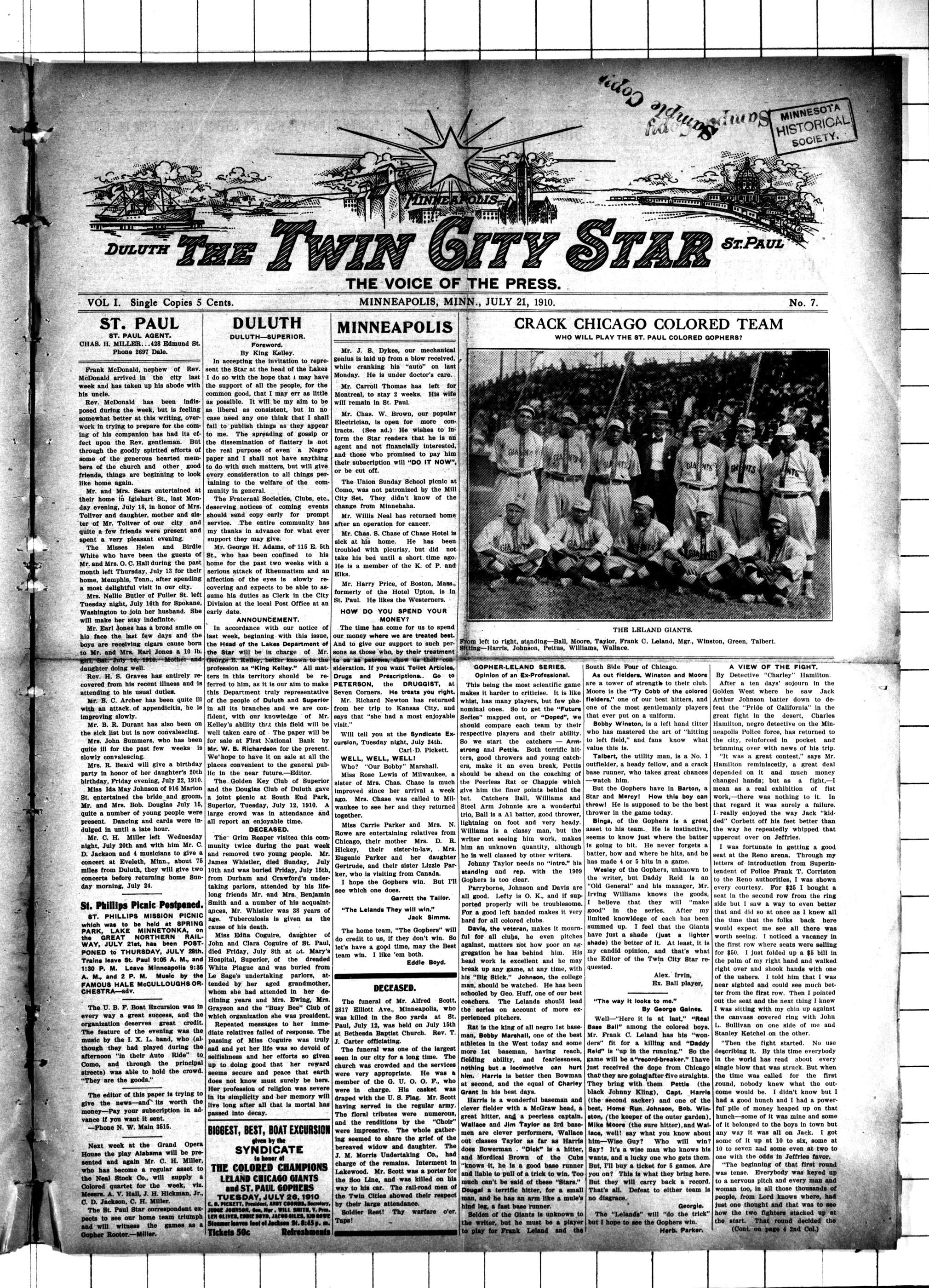
CRACK CHICAGO COLORED TEAM WHO WILL PLAY THE ST. PAUL COLORED GOPHERS?
GIANTS
This being the most scientific game makes it harder to criticise. It is like whist, has many players, but few phoneminal ones. So to get the "Future Series" mapped out, or "Doped", we should compare each team by their respective players and their ability. So we start the catchers — Armstrong and Pettis. Both terrific hitters, good throwers and young catchers, make it an even break, Pettis should be ahead on the coaching of the Peerless Rat or Chapple which give him the finer points behind the bat. Catchers Ball, Williams and Steel Arm Johnnie are a wonderful trio, Ball is a A1 batter, good thrower, lightning on foot and very heady. Williams is a classy man, but the writer not seeing him work, makes him an unknown quantity, although he is well classed by other writers. Johnny Taylor needs no "intro," his standing and rep. with the 1909 Gophers is too clear. Parryborne, Johnson and Davis are all good. Lefty is O. K., and if supported properly will be troublesome. For a good left handed makes it very hard for all colored clubs.
Davis, the veteran, makes it mournful for all clubs, he even pitches against, matters not how poor an aggregation he has behind him. His head work is excellent and he may break up any game, at any time, with his "Big Stick." Johnson, the college man, should be watched. He has been schooled by Geo. Huff, one of our best coaches. The Lelands should lead the series on account of more experienced pitchers. Rat is the king of all negro 1st baseman, Bobby Marshall, one of the best athletes in the West today and some more 1st baseman, having reach, fielding ability, and fearlessness, nothing but a locomotive can hurt him. Harris is better then Bowman at second, and the equal of Charley Grant in his best days.
Harris is a wonderful baseman and clever fielder with a McGraw head, a great hitter, and a peerless captain. Wallace and Jim Taylor as 3rd basemen are clever performers, Wallace out classes Taylor as far as Harris does Bowerman. "Dick" is a hitter, and Mordical Brown of the Cubs "knows it, he is a good base runner and liable to pull of a trick to win. Too much can't be said of these "Stars." Dougal a terrific hitter, for a small man, and he has an arm like a mule's hind leg, a fast base runner. Selden of the Giants is unknown to the writer, but he must be a player to play for Frank Leland and the
South Side Four of Chicago.
As out fielders. Winston and Moore are a tower of strength to their club. Moore is the "Ty Cobb of the colored fielders," one of our best hitters, and one of the most gentlemanly players that ever put on a uniform.
Bobby Winston, is a left hand titter who has mastered the art of "hitting to left field," and fans know what value this is.
Talbert, the utility man, is a No. 1 outfielder, a heady fellow, and a crack base runner, who takes great chances—watch him.
But the Gophers have in Barton, a Star and Mercy! How this boy can throw! He is supposed to be the best thrower in the game today.
Binga, of the Gophers is a great asset to his team. He is instinctive, seems to know just where the batter is going to hit. He never forgets a batter, how and where he hits, and he has made 4 or 5 hits in a game.
Wesley of the Gophers, unknown to the writer, but Daddy Reid is an "Old General" and his manager, Mr. Irving Williams knows the goods, I believe that they will "make good" in the series. After my limited knowledge of each has been summed up. I feel that the Giants have just a shade (just a lighter shade) the better of it. At least, it is my candid opinion, and that's what the Editor of the Twin City Star requested.
Alex. Irvin,
Ex. Ball player.
"The way it looks to me." By George Gaines.
Well—"Here it is at last," "Real Base Ball" among the colored boys. Mr. Frank C. Leland has his "wonders" fit for a killing and "Daddy Reid" is "up in the running." So the game will be a "record-breaker." I have just received the dope from Chicago that they are going after five straights. They bring with them Pettis (the black Johnny Kling), Capt. Harris (the second sacker) and one of the best, Home Run Johnson, Bob. Winston, (the keeper of the outer garden), Mike Moore (the sure hitter), and Wallace, well! say what you know about him—Wise Guy? Who will win? Say? It's a wise man who knows his wants, and a lucky one who gets them. But, I'll buy a ticket for 5 games. Are you on? This is what they bring here. But they will carry back a record. That's all. Defeat to either team is no disgrace.
Georgie.
The "Lelands" will "do the trick" but I hope to see the Gophers win.
Mach Barker.
No. 7.
A VIEW OF THE FIGHT.
By Detective "Charley" Hamilton.
After a ten days' sojourn in the Golden West where he saw Jack Arthur Johnson batter down to defeat the "Pride of California" in the great fight in the desert, Charles Hamilton, negro detective on the Minneapolis Police force, has returned to the city, reinforced in pocket and brimming over with news of his trip.
"It was a great contest," says Mr. Hamilton reminiscently, a great deal depended on it and much money changed hands; but as a fight, I mean as a real exhibition of fist work,—there was nothing to it. In that regard it was surely a failure.
I really enjoyed the way Jack "kidded" Corbett off his feet better than the way he repeatedly whipped that uppercut over on Jeffries.
I was fortunate in getting a good seat at the Reno arena. Through my letters of introduction from Superintendent of Police Frank T. Corriston to the Reno authorities, I was shown every courtesy. For $25 I bought a seat in the second row from the ring side but I saw a way to even better that and did so at once as I knew all the time that the folks back here would expect me see all there was worth seeing. I noticed a vacancy in the first row where seats were selling for $50. I just folded up a $5 bill in the palm of my right hand and walked right over and shook hands with one of the ushers. I told him that I was near sighted and could see much better from the first row. Then I pointed out the seat and the next thing I knew I was sitting with my chin up against the canvass covered ring with John L. Sullivan on one side of me and Stanley Ketchel on the other.
"Then the fight started. No use describing it. By this time everybody in the world has read about every single blow that was struck. But when the time was called for the first round, nobody knew what the outcome would be. I didn't know but I had a good hunch and I had a powerful pile of money heaped up on that hunch—some of it was mine and some of it belonged to the boys in town but any way it was all on Jack. I got some of it up at 10 to six, some at 10 to seven and some even at two to one with the odds in Jeffries favor.
"The beginning of that first round was tense. Everybody was keyed up to a nervous pitch and every man and woman too, in all those thousands of people, from Lord knows where, had just one thought and that was to see how the two fighters stacked up at the start. That round decided the (Cont. on page 4 2nd Col.)
Most Important Happenings Told in Brief.
PERSONAL
Paul Sorrente, a foundry employee at Florence, N. J., collapsed from heat, was packed in ice by friends and in a short time froze to death.
Mrs. Fannie Blumstein of New York and her five children slept under a board walk at Coney Island for five days because her baby needed outdoor air and she was too poor to take her any other place.
Oscar T. Tamm, a wealthy native son of St. Louis, but more recently established at Tamms, Ill., crossed the Arctic circle, 250 miles of Patea, Sweden, on July 2 with the American flag flying from his steering gear. He has written to St. Louis friends of the achievement, of witch he is proud.
Mrs. Maud Glavis, wife of Louis R. Glavis, one of the principal witnesses in the Ballinger-Pinchot hearing, fled an amdavit in the superior court at Seattle, Wash., in which she alleges her husband offered her a government position and attorney fees if she would consent to a divorce. Glavis began a suit for divorce last winter.
Capt. Robert E. Scott, commander of the British antarctic expedition, left London for New Zealand, where he will join the others of the party on board the exploring steamer Terra Nova.
Miss Dorothy Miller of East Thirty-eighth street, Chicago, was married at Omaha, Neb., to Matsuzo Shofu, a Japanese traveling salesman from New York city.
Mrs. Mary Baker G. Eddy, head of the Christian Science church, observed her eighty-ninth birthday quietly in her Brookline home. Mrs. Eddy was in perfect health.
GENERAL NEWS.
Antonia Mangano of Cleveland, O., who beat Joseph Mackley of Toledo, a wife murderer, with a crucifix, in a fight in the penitentiary at Columbus a week ago, died from the injuries sustained during the fight.
The grand jury called to investigate the lynching of Carl Etherington, the anti-saloon detective, convened. There is excitement over rumors regarding the action to be taken.
Reports from the dry-farming country between Cheyenne and the Nebraska line, say that the heaviest rain of the season has fallen, insuring maturity of crops threatened by prolonged drought.
Secretary of State Curry and several friends were injured near Eureka, Cal., when their automobile skidded and plunged down a 40-foot embankment.
The threatened strike of street car men in New Orleans has been averted. The men voted to accept the company's offer to pay them $22\%$ cents an hour for the first year, 23 cents for the second and $23\%$ cents for the third.
Joseph G. Cannon, speaker of the house of representatives, collapsed from the heat at Winfield, Kan., on the shautauqua platform after speaking for an hour and three-quarters. Prompt old prevented him from fainting, but he was unable to continue his address. Later he recovered and no ill effect is expected to result.
Albert Keddle, aged twenty-one years, was shot by Detective Ira Rickett of the Anti-Saloon league force at East Liverpool, O. Keddle was standing on the sidewalk when Detective Rickett attempted, it is alleged, to shoot Alvin Dawson, twenty-one years old. Threats were made to lynch the detective, but he was finally landed behind the bars.
The counting of the strike vote taken by the Grand Trunk and Central Vermont conductors and trainmen was concluded and, according to Vice-President Murdock of the trainmen, it shows that of the 3,000 votes cast on the Grand Trunk and 350 on the Central Vermont less than fifty were against a strike to enforce the demands of the men.
Naval officers recently reprimanded at Washington for disputing among themselves will be transferred to the Pacific coast and the Phillippines.
Mrs. Helen Philbrick, author of several books, among them "The Idiot and the Insane," and known as the mad woman of the Rockies, murdered her seven-year-old daughter by chloroforming her on her ranch near Miles City, Mont., and then committed suicide by taking prussic acid. The Ladies' Catholic Benevolent association met in Cleveland, O., in annual convention with Elizabeth B. McDowall of Buffalo presiding.
Milwaukee has raised $30,000 for entertaining the national grand encampment of the Knights of Pythias, which opened August 1 to 10.
It is estimated that 16,000 men are out of employment as a result of the strike of employees of the Grand Trunk railroad system. The strike order was obeyed by 6,000 conductors and trainmen and the company locked out 10,000 men in the shops in the hope that they would accept the positions deserted by the conductors and trainmen.
General Estrada, president of the Nicaraguan provisional government, has sent to Consul General Sussman, at New Orleans, and he to the state department at Washington, an intercepted telegram sent by Jose Madriz, claimant to the Nicaraguan presidency, to Gen. Roberto Gonzalez, commander of the Madriz forces at San Ubaldo, instructing the latter to shoot without trial all rebels and prisoners taken by his men.
Congressman Victor Murdock, Kansas Insurgent leader, made a bitter attack in Speaker Cannon in a speech at Emporia, Kan., declaring that the speaker was not only a "stand-patter," but a "stand-stiller" who had consistently fought every effort toward progress since he had dominated the house. At a conference held at Cincinnati between representatives of the Bucks Stove & Range company of St. Louis and of several unions the matters in dispute were settled and written agreements were entered into. The stove plant will be a union shop. President Samuel Gompers of the American Federation of Labor, presided at the meeting, which resulted in the settlement. Mr. and Mrs. N. J. McEvilly and little daughter Mary, of Dysart, Ia., were killed when the Freeport passenger train on the Chicago & Northwestern railroad struck their automobile at Peck's Crossing, near Aurora, Ill.
Because of an article by Theodore Roosevelt condemning prize fighting in the Outlook, the last issue of the magazine has been barred from sale in Hutchinson, Kan. The magazine comes under the ban of a recent ordinance which prohibits the exhibition of prize fight pictures and the sale of newspapers or magazines printing such pictures or stories of prize fights.
Illinois miners and operators have been unable to reach any agreement in the controversy over wages, according to a statement from President T. L. Lewis of the United Mine Workers. The next chief justice of the United States Supreme court probably will succeed the late Chief Justice Fuller as a member of the permanent court of arbitration at The Hague.
Two men arrested in Sacramento, Cal., for horse stealing, are suspected of being bandits who held up and robbed the Southern Pacific fast mall April 17 at Goodyear, Cal.
Dean C. Worcester, American secretary of interior for the Philippines, was set upon by renegade Moros, on the island of Palawan, and escaped assassination only through the alertness of his bodyguard, who shot down the outlaws, killing three of them outright and severely wounding several others.
Three thousand five hundred trainees and conductors of the Grand Trunk railway and 350 of the Central Vermont, a line controlled by the Grand Trunk, quit work as the result of an automatic strike order. It is claimed the walkout will tue up the entire system from Portland, Me., to Chicago. In addition, 5,000 men engaged in shop work will be laid off temporarily.
Joseph G. Cannon has no intention of dropping out of the contest for the speakership of the next house of representatives. At Emporia, Kan., he said that he would abide by the will of the Republican caucus if the Republicans control the next congress, but that no "muckraking magazines" could make him say he would not be a candidate.
Representative E. H. Madison of Kansas, of the joint Ballinger congressional committee, declared that no conclusions had been reached in the investigation affecting Secretary Richard A. Ballinger. His statement was made in response to a report printed to the effect that the secretary of the interior will be exonerated under a vote already taken.
Theodore Roosevelt has announced he will not take part in the congressional campaign in Herkimer and Oneida counties, where his nephew, Theodore Douglas Robinson is seeking the Republican nomination. In the event Mr. Robinson is nominated, Mr. Roosevelt declared he would make several speeches in his district.
H. J. Aifress, saloon steward of the White Star Dominion liner Megantic, is positive that Doctor Crippen, the alleged London wife slayer, arrived at Montreal on that steamship and his statements are corroborated by two other shipmates.
Ernst Paul Weber, who came to this country June 17, has been ordered deported by the department of commerce and labor at Washington. He is said to be wanted by the German authorities for alleged embezzlement from the Bank of Egypt at Cairo.
Suits alleging 140 violations of the 28-hour act, affecting the transportation of live stock, were filed at Pittsburg against the Pennsylvania lines west.
Former Councilman M. L. Swift, Jr., of Pittsburg was sentenced to eight months in jail for accepting bribes for his votes on two ordinances and fined $100. He will appeal.
The convention of the American Flint Glass workers at Toledo decided to ask for an increase of ten per cent. in wages at a conference with the manufacturers at Atlantic City.
Minnesota brewers have protested at the barring of beer from the Moorhead (Minn.) Indian lands. The government has been called on for a ruling as to whether beer is a spiritual honour.
TWIN CITY STAR.
STRIKERS REFUSE TO ARBITRATE
CANADIAN'S MINISTER'S OFFER WILL BE SPURNED, SAYS MURDOCK.
ENGINEERS KEEP OUT OF FIGHT
Efforts to Move Grand Trunk Trains But Partly Successful. — Freight Blocked at Detroit and Aid of Breakers Is Sought.
Ottawa, July 21.—MacKenzie King, the Canadian minister of labor, says he will use every opportunity which offers to obtain at least temporary compromise between the striking conductors and trainmen and the Grand Trunk.
The Canadian government is prepared to pay all the expenses of arbitration, and if both sides agree, a board of arbitration can be constituted under the railway and labor disputes act."
Arbitration Not to be Thought of.
Montreal, July 21.—The news out of Ottawa that the minister of commerce and labor was trying to get both sides of the Grand Trunk strike together on a basis of arbitration, provoked Vice-President Murdock of the strikers to a sharp retort.
"Arbitration," he said, "is out of the question. As far as we are concerned there will be no arbitration. The company did not talk arbitration until they had nagged the men to a finish. Now they want it. We will have none of it."
The Grand Trunk is gaining ground but very slowly. More passenger trains were operated. A beginning was made to restore the local suburban service and a couple of freights were made up and started.
President Stone of the Brotherhood of Engineers wired his members that their position was neutral and urged them to observe strict neutrality. Specifically the engineers were told not to act as pilots for green conductors.
Strike Breakers Recruiting.
Detroit, July 21.—Local Grand Trunk railway officials succeeded with the help of strike breakers, in switching several cars of coal from Milwaukee Junction to the sidings of local dealers. With this exception not a pound of freight has been moved here since the striking trainmen left their posts Monday night.
During the day strike breakers continued to be recruited in considerable numbers and it is said little difficulty is anticipated in securing a full quota of men within a day or two.
Though squads of police have been on duty in the Grand Trunk yards, there has been no disorder.
Passenger Traffic Resumed.
Boston, July 21. — One slight outbreak by strike sympathizers at Island Pond, Vt., the closing of a mill at Monson, Mass., because of lack of supplies, and the resumption of the complete passenger schedules on almost every line, marked the second day of the strike on the Grand Trunk and Central Vermont railroad systems in New England.
MILLING PEACE IS SOUGHT.
English and American Directors of Pillsbury Company to Adjust Differences.
Minneapolis, July 21.—A get together meeting of the English and American directors of the Pillsbury Mills company will take place this month in London, according to Minneapolis members of the company and John S. Pillsbury and Ralph Whalen, representing the American interests, probably will seek to adjust a misunderstanding existing among some English directors who are said to be dissatisfied with the expense of the receivability of the company at the time of its organization.
Minneapolis members of the firm are not backward in saying that members of the English directorate have hampered the company seriously by their delays in transacting business, and by their continued protest against the receivership charges which they claim were exorbitant.
The Pillsbury interests put up $2,000,000 at the time of the reorganization to carry on the business in America, receiving in return for their services the first $100,000, and the American members getting 7½ per cent which has amounted to $150,000 and anything above this amount has been divided equally.
Official Census Figures.
Washington, July 21.—Census returns show Jackson, Miss., 21,262; Bartlesville, Okla., 8,181; Corpus Christi, Tex., 8,299.
Newcastle, England, July 21.—The situation surrounding the strike of employees of the Northwestern railroad was aggravated as the result of the failure of representatives of the railway and the strikers to reach a basis of understanding after a four hours' conference in which the railway officials made proposals for a discussion and redress of the grievances.
In addition to the railway employees, thousands of coal miners are idle because of the company's inability to run freight trains.
BUREAU OF R. R. ECONOMICS
DESIGNED TO PROMOTE BETTER UNDERSTANDING WITH PUBLIC.
Presidents of Several Big Lines Have
The New Scheme In
Charge.
Chicago, July 21.—Plans for the establishment of a bureau of railway economics at Washington, D. C., by the railroads of the country are announced. The purpose of the new bureau is the collection and diffusion of correct information in regard to railroad rates, the relation these rates bear to the cost of commodities and discussion of matter of general interest in the transportation field. The railroads believe the work of this bureau will result in a better understanding between the public, the shippers and the railroads, and that many differences will not only be lessened but removed by the light thrown upon the transportation situation.
The committee which has in charge the plans for the railway bureau is composed of W. C. Brown, president of the New York Central lines; E. P. Ripley, president of the Atchison, Topeka and Santa Fe railroad; W. H. Finley, president of the Southern Railway; Darius Miller, president of the Burlington system, Daniel Willard, president of the Baltimore & Ohio railroad, and B. L. Winchell, president of the St. Louis and San Francisco railroad.
CENSUS OF THE DIAMOND
American Association.
Minneapolis, 4; Indianapolis, 2.
St. Paul, 8; Louisville, 7.
Kansas City, 10; Columbus, 4.
Toledo, 3; Milwaukee, 2.
Standing of the Teams.
Won. Lost. Pct.
Minneapolis ..... 64 33 .660
St. Paul ..... 55 39 .585
Toledo ..... 53 39 .576
Kansas City ..... 45 44 .506
Columbus ..... 40 48 .455
Milwaukee ..... 39 51 .433
Indianapolis ..... 37 56 .398
Louisville ..... 34 57 .374
National League.
Cincinnati, 6; New York, 5.
Boston, 3; Pittsburg, 2.
Chicago, 1; Brooklyn, 0.
Philadelphia, 11; St. Louis, 2.
Standing of the Teams.
Won. Lost. Pct.
Chicago 50 29 .633
New York 45 33 .577
Pittsburg 41 34 .547
Cincinnati 42 39 .519
Philadelphia 37 40 .481
St. Louis 36 45 .444
Brooklyn 34 46 .425
Boston 32 51 .386
American League.
Washington, 8; Cleveland, 4.
Philadelphia, 2; Chicago, 0.
Detroit, 3; Boston, 2.
New York, 2; St. Louis, 1.
Won. Lost.
Pct.
Philadelphia ..... 55
24 ..... 696
New York ..... 48
32 ..... 600
Boston ..... 49
33 ..... 598
Detroit ..... 45
39 ..... 536
Cleveland ..... 34
21 ..... 453
Washington ..... 32
48 ..... 400
Chicago ..... 31
48 ..... 392
St. Louis ..... 24
53 ..... 312
Minny League.
Duluth, 3; Red Wing, 2.
Eau Claire, 9; La Crosse, 5.
Superlor, 6; Rochester, 1.
Wausau, 6; Winona, 1.
Standing of the Teams.
Won. Lost.
Pct.
Eau Claire ..... 46
23 ..... 667
Winona ..... 39
31 ..... 557
Superlor ..... 39
31 ..... 557
Wausau ..... 36
32 ..... 529
Rochester ..... 33
34 ..... 493
La Crosse ..... 30
41 ..... 423
Duluth ..... 28
40 ..... 412
Red Wing ..... 26
44 ..... 371
Freight Rates Are Suspended.
Washington, July 21.—Important advances in freight rates recently made by the railways in Eastern territory will be suspended voluntarily by the railroads until Nov. 1 next. This agreement was made by a committee representing the carriers and Chairman Knapp of the Interstate Commerce Commission.
DAILY MARKET REPORT.
Chicago Live Stock.
Chicago., July 21—Market 5c to 10c lower; beeves, $5.10@8.40; western steers, $5@6.90; stockers and feeders, $3.60@5.60; cows and heifers, $2.65@6.60; calves, $6.76@9.
Hogs—market dull; light, $8.60@9; mixed, $8; heavy, $8@6.65; rough, $8@8.25; good to choice; heavy, $8.25@8.65; pigs, $8.60@9.05.
Sheep—market steady; native, $2.50@4.10; western, $2.40@4.15; yearling, $4.00@4.40; lambs; native, $4.50@4.70.
Twin City Markets.
Minneapolis, July 21—Wheat, Sept., $1.17½%; Dec., $1.15½%; No. 1 northern, $1.20; No. 2 northern, $1.20; No. 1 Durum, 84c; No. 3 corn, 57c; No. 3 white oats, 44c; barley, 61c; No. 2 rye, 72c; No. 1 flax, $1.19.
Duluth, July 21—Wheat, Sept., $1.19½%; Dec., $1.16½%; No. 1 northern, $1.19½%.
South St. Paul, July $1.—Cattle—
Steers, $5.25@6.60; cows, fair, $4.00@
5.00; calves, $5.00@6.00; hogs, $8.20@
8.25; sheep, yearlings, $8.00@7.90;
lambs, $7.00@8.50.
Twin City Markets
To Colored Americans and their Fellow Countrymen.
Greetings:—
By vote of the Executive Committee and by order of the President this call of the National Independent (formerly Negro-American) Political league is issued for the 3rd annual meeting at Atlantic City, New Jersey, August 4th and 5th, 1810.
This national convention of Colored citizens is called under what grave conditions touching the object of this organization, the supreme aim of which is to maintain and secure for all Colored Americans the same rights and privileges of citizenship as the enjoyed by the other citizens of these United states of America? In the southern states 95 per cent of the nine million Colored citizens of the United States are deprived of the exercise of the ballot, the fundamental right under our system of government, without which there is for citizens neither protection nor freedom. This rape of the ballot is consummated in plain violation of the national constitution which forbids denial of the right to vote because of race or color. The executive head of the federal government within sixteen months officially admitted this disfranchisement in inaugural address and palliated the violation of the federal constitution instead of declaring his purpose to enforce the law in obedience to the oath he had just solemnly taken. President Wm. H. Taft even intimated the legality of those devices for nullifying the 15th amendment by state laws which are as much worse than fradulent practices as law is stronger than custom. The legislative branch of the federal government, specifically clothed with power to enforce the suffrage articles of the constitution, has viewed with apathy and inaction their flagrant violation save when actively condoning it by seating congressmen elected under the violation as against contestants entitled to seats if the federal law had been obeyed in their districts in the South. The judicial branch has dodged the issue in all cases brought involving southern disfranchisement laws, thus by persistent refusal of relief, strengthening the nullification and emboldening the nullifiers of the supreme law of the land.
In view of the very nature of our republican institutions, as well as of the declared reasons for our existence as an independent government, is not this condition sufficiently serious to twelve millions of Colored Americans to justify and necessitate a national convention, and sufficiently alarming to all believers in our country's destiny and defenders of her democracy and of her fair name to compel their sympathy and support?
But what train of evils were let loose upon Colored Americans with disfranchisement! In the southern states unequal and oppressive laws have destroyed all their civil rights, excluding them from public places, of business, of accommodation, or resort, even public parks and public libraries, barring from state, quasi-public and the public schools, forcing them into separate and inferior schools, fastening upon them the public ignominy and cast stigma of segregation in public travel, casting them even into peonage. They are under the tyranny of taxation without representation. Left in that hapless and helpless condition of citizens without voice as to law-maker, law-enforcer, or law interpreter, they are not only the victims of injustice in the courts, but, deplied all trial by court or jury, are they the prey of the flendish white mob, until now the almost daily lynching of human beings has disgraced our country before the civilized world.
Inevitably this race persecution infects the north, Color prejudice is on the increase. Discrimination based on color in civil rights and in economic opportunities is gaining ground. Jim-crow cars have reached the borders of the national capitol, twice color disfranchisement has raised its horrid head above Mason and Dixon's line, while bloody race riots and barbarous lynchings have reached up to Illinois, even to the home of the martyrned Lincoln.
Most harmful and portentous of all in this crusade of race hate and color prejudice is the action, under the present administration, of the federal government itself. For the first time in the United States a president has officially proclaimed color a political disability. By his declaration that he would not appoint Colored citizens to office where white citizens objected, he completed southern disfranchisement. It is Colored soldiers who are the victims when for the first time a battalion is discharged wholesale and without trial because of an alleged affray with civilians, and the new departure, aggravated by the failure to establish individual guilt after trial, is boldly continued. That unique degradation of free citizens, segregation by color in public carriers, has been sanctioned and nationalized by a federal commission, while the federal court in support declares the right of even an interstate railroad to segregate Colored passengers.
Unless one-eighth of the citizens of the United States are to be reduced to political serfdom, unless our Republic is to abandon democracy for the caste of color, this present trend must be resolutely opposed. Graver crisis in a Republic could hardly be. Colored Americans, rally to your own defense. From every town and city send delegates to this annual meeting, there to deliberate and organize for self-protection against this menace. And let all true patriots of whatever race, all friends of liberty, battle with us for equality of citizenship, for true democracy, that this may be in very truth the home of the brave and the land of the free. By order of the president, ALEXANDER WALTERS, WM. MONROE TROTTER, Corresponding Secretary. June 22, 1910, 21 Cornhill, Boston, Mass.
Send your notes to the Star office—and they will be inserted, or a satisfactory reason given. We want to "interest the classes" and "represent the masses"—Ed.
Right From the Shoulder.
To the Editor of The Journal.
In view of the fact that so many acts of violence have been reported since the fight at Reno, in which the whites seem to have been the aggressors, I am moved to inquire what has become of our Anglo-Saxon sense of fair play and our boasted superiority as a race. Jack Johnson has demonstrated his physical superiority by defeating the supposedly invincible champion of the whites.
And in the realm of intellect, we meet some colored people who challenge our admiration and command our respect on account of their achievements. In an eastern college recently a colored girl easily defeated all her white competitors and carried off all the honors.
In all comparisons of this kind, it must be borne in mind that the colored people are heavily handicapped and labor under great disadvantages. Under the circumstances, it ill becomes us to make invidious comparisons.
The opinion seems to prevail, quite generally, that, as a race, the blacks are quite inferior to the whites in virtue and morality. But what have we to boast of in this regard? What virtues do we possess that may not be found among the colored people? What vices have they which we have not? What crimes are there, from petit larceny to lynching and burning at the stake, that whites have not committed.
Is sin less sinful, vice less repulsive or crime less heinous when committed a person with a white skin?
Has any colored person ever descended to a depth of degradation or bestiality so low that he could find no white companions?
We have had superior advantages. We ought to be a superior race, but we cannot demonstrate our superiority by lynching blacks, shooting up colored settlements or by depriving them of their rights under the law. I can hardly repress a sneer when I read of the spasm of moral sentiment that is sweeping over the country since the battle at Reno. "The hope of the white race" was defeated by a black man and suddenty we behold that prize-fighting has become shockingly brutal and demoralizing, and moving pictures of the fight are declared to be disgusting and immoral exhibitions. Chicago, the city of beer, boodlers and Busse, of Bathhouse John and Hinky Dink, where municipal corruption has gone to seed, and graft, tax-dodging and white slavery flourishes, has suddenly been transformed and views with disfavor the thing she once delighted in. Then priests and politicians, lawmakers and lawbreakers, saints and sinners take up the cry, "sunpress those pictures."
But suppose the white champion had been the victor, who except the Christians, who always oppose such things, would have uttered a note of protest?
Jeffries would have met with an ovation wherever he went. Cities and towns everywhere would have greeted him with acclamations of joy. Chicago would have met him with brass bands and given him the freedom of the city. The moving pictures would have been exhibited everywhere and no such thing as a race riot would have been apprehended.
In conclusion let me say that it is to be hoped that the outcome of all this turmoil may be the abolition of prize-fighting in every state in the union.
—F. A. Towne.
Minneapolis, July 15.
GOOD FOOD, QUICK SERVICE,
MODERATE PRICES, MORERN CONVENIENCE. STEP UPSTAIRS
WHILE GOING BY. 208 HENNEPIN AVE.
WORK FOR THE SOUTH.
One of the most encouraging utterances from the south that we have heard in a long time is that of Judge John L. Hopkins, of George, who, the Atlanta Constitution says, stands at the head of the bar of Georgia. He has been a dweller in three epochs—that before the war, the reconstruction period, and the present rise out of destitution and disorder. He was chosen by the state legislature and by the combined legal talent of the state to recodify the laws of the state. The Constitution speaks of him in superlatives. He has written a communication to that paper, the keynote of which is in the following extract:
"I am an old man sitting to one side at the end of a long road and watching the procession troop by — — And I tell you, calmly and with deliberation, weighing my words with the care of one who has learned to be economical with emphasis, that the greatest problem of our day—your day, more accurately speaking—is the making of citizens instead of criminals out of the masses of the negroes that everywhere in the south eddy and swirl into the body politic of the Anglo-Saxon.
—Minneapolis Journal.
WHEN IN ST. PAUL, STOP AT THE ST. LOUIS KITCHEN. YOUR APPETITE WILL BE SATISFIED, AND YOU WILL BE WELL SERVED.
To all subscribers of the Twin City Star:
If you have been led to believe that the Editor of the "Weekly Visitor" (Mr. O. A. Lawrence), was interested in this paper, when you subscribed, and you are a paid-up subscriber, I will refund your subscription at your request.
Chas. S. Smith, owner.
Notice the "Utley ad" in this issue.
HAL CHASE CALLED GREATEST FIRST BASEMAN
Friends of the guardian of the New York Highlanders' initial sack say he is the peer of any other man playing the position. Chase is one of a few left handers, playing first, and there is no doubt that he is a star.
NOBODY IN SIGHT TO WHIP JACK JOHNSON
Defeat of Jeffries Leaves No Fighter on Whom the White Race Can Depend to Wrest the Champion Away From the Black Man—Says He Will Not Fight Langford.
一
一
By KNOCKOUT.
Jack Johnson now finds himself in much the same position that Jim Jeffries was in when he defeated Jack Munroe back in 1904. There is nobody for him to fight. Johnson has proven beyond the shadow of a doubt that he is the peer of any man in the mitt game and if he takes care of himself it will be a long time before any man will be able to take the championship crown from his head.
Sam Langford talks of fighting Jack and has challenged the big black for a battle. Johnson says he will pay no attention to the def, declaring such a fight would not draw. "I don't think Langford can whip Kauffman or Ketchell," said Jack, "and everybody knows neither of these men have a chance with me."
Tommy Ryan has been coaching a big Irishman known as Con O'Kelly. Under Ryan's instructions O'Kelly won his first battle, a fight with a man named Comiskey, whom no person ever heard of, but foxy Tommy isn't going to put his man against Johnson for some time to come, if at all.
Johnson is so much better than any other man now in the ring that the only hope for the white race lies in some unknown being developed in the next year or two who can get him into the ring out of condition as he has been in several battles since he defeated Tommy Burns.
Up to the time Johnson fought Jeffries there were many who said the negro didn't have the necessary punch to defeat a good man. This no doubt was due to the big black's peculiar style of milling. He always has been content to take his time and go easy with an opponent. Before the fight with Jeffries, Johnson said he intended to prove that he did have the punch, and he did.
Then there were the people who said that Johnson had a "yellow streak." If he has Jeffries was unable to find it, and if Jeffries couldn't make it show there's little chance for any other man to do so. Jim Corbett was one of those who openly declared that Johnson was lacking in bravery. "Jeffries will make him jump out of the ring," said Corbett. Again "Pompadour Jim" was wrong. It is a notorious fact that Corbett never has been able to pick a winner. He thought Burns would whip Johnson. He thought Gans would defeat Nelson. We all know the results of those battles.
Corbett complained before the fight that Jeffries did not box enough. He made the same excuse after Jeffries was knocked out. There probably is some truth to this, but it is doubtful whether the result would have been any different.
Now comes the question: Could Johnson have whipped the Jeffries that whipped Bob Fitzsimmons? It's a hard question to answer and the experts fall to agree. From present day indications it is doubtful whether there ever was a better man than Johnson. John L. Sullivan was the kind of man who is made to order for Johnson's style of fighting. Sullivan's wild swings and bull like rushes would have been easy for Jack. Johnson would have peppered John L. the way he did Jeffries. He would have met these rushes with the famous upper cut and would have had no difficulty in blocking the swings. A fight between Johnson and Jim Corbett would have been pretty to see, but Corbett never had the punch that would have
whipped Johnson, and it is doubtful if Jim would have weathered more than one or two uppercuts. For my part I believe Bob Fitzsimons in his prime would have been a harder man for Johnson to whip than any of them. But Bob would have been at the same disadvantage as he was with Jeffries. Thirty or 40 pounds difference in weight would have been too much even for the freckled one.
We have got to give it to Johnson, and it is to be hoped that he behaves himself. That big purse he won will pay many a fine for auto speeding and he will make much more in the next year or so on the stage. One result of the fight was to increase the feeling of dislike between the races. It caused riots all over the country between whites and blacks, and in these battles, the blacks being outnumbered, got the worst of it. One of the worst of the fights was in Washington, and Major Sylvester, chief of the capital police, issued an order the next day forbidding the showing of the moving pictures of the battle in that city.
REGULAR PLAYING PUTS
CONFIDENCE IN MERKLE
Fred Merkle, the Glants' first baseman, is a Toledo boy, and has been a member of the New York National league club since August, 1907. Until this season Merkle was a substitute, playing both in the infield and outfield, but now he is a regular and one of Manager McGraw's most valuable players. Merkle has covered first base exceptionally well this season and also has been hitting in timely fashion. He is about 24 years old and began playing professionally with the Tecumseh club of the Southern Michigan league in 1907, the Glants buying his release for $2,500. In 1908 Merkle had the misfortune to fall to touch second in a game played with the Cubs, this omission practically costing the Glants the pennant and interfering with Merkle's work for a long time. When Tenney was crippled last year Merkle covered first base in clever style, and this season his work has been exceptionally good. Playing regularly Merkle has gained lots of confidence in himself and has practically forgot ten the incident of September, 23, 1908. He is now making the fans forget Fred Tenney.
Kinsella Is Resourceful.
There is no limit to the resources of President Kinsella of the Springfield team of the Three I league when it comes to acquiring players. As rapidly as one pitcher shows signs of weakness he gets rid of him and sends for another. Although carrying a half-dozen stars, he has brought back St. Guarden, the southpaw, who was sold last fall, but who has been with St. Paul this year. Kinsella's bottomless pocket-book makes it hard for the other clubs to keep up with him. Kinsella has purchased First Baseman McCauley of the West Ends of Chicago.
Kelly Starts Off Well
In the first game in which he played for the Chicago Sox, "Red" Kelly a Notre Dame, made good with the crowd. He got two hits that helped to win the game. George Browna also a new member of Comiskey's team, started off like a winner. In the Sox could hit the ball like they field and play the bases they would be higher up in the pennant race.
TWIN CITY STAR.
Seeking the Stolen Service
By T. S. STRIBLING
Down on Decatur street, near the wharf, Westlake stood indolently observing the old French quarter. It was all very attractive to his unacustomed eye, the Creole children plashing in the surface sewage, the rough uneven cobbles, the quiet, weather-beaten houses with their grilled iron work, the babel of strange tongues.
As he was about to turn away to his cruising launch at the foot of the street, there was a sudden disturbance among the playing children. Three rough men, carrying a bag, burst up the street at full tilt, while behind them, shrieking, pursued a young woman.
When she came even with the young man, she paused for an instant. "Help me, M'sieul!" she panted.
"What's the matter?"
She threw up her arms in an extravagant Creole gesture. "They have stolen the duke's service!" Then, as if despairing his aid, she started once more to run after the now distant men.
The accusation sounded formidable enough to Westlake, who likewise fell into a quick run and was presently beside the girl once more. She glanced around and saw who it was. "Find a policeman!" the girl gasped. By the time they gained the water front the three men were disappearing behind the piled-up freight on the wharf. A policeman was standing near.
"Help!—thieves!" cried the girl. "Follow us!" roared Westlake as he plunged on with his pretty burden after the vanishing men. The officer, an active fellow, broke into a long, running stride. The three reached the rim of the wharf together. The robbers were well out in the river in a launch. "Halt!" from the blue coat, drawing a revolver. The men in the launch continued straight on; one of them also drew a pistol. Both guns fired simultaneously. A bit of lead clipped viciously near Westlake's ear. "I have a launch," exclaimed the young man; "let's get in that." "You keep in sight of them in your launch," planned the bluecoat, "and I'll run up here after the patrol boat—it's the fastest thing on the river." "And you?" Westlake turned to the girl.
"Make haste to your boat, 'Misieu,' seizing his arm and pushing him forward. The Lance, in which Westlake was making his Mississippi river tour, lay just below them, at the docks. The two hurried down into the slim little cruiser, cast off hurriedly, and swung into the yellow current. "Take the wheel while I start the engine," ordered Westlake. The girl obeyed, and the Lance began to glide with accelerating speed after the fleeing men. The Lance proved to be by far the better boat of the two. She skimmed through the fleet of anchored merchantmen, dodged in and out, escaped the puffing deep-bellied tugs, and clung tenaciously to the dodging trail of the launch. "What is the duke's service, anyway?" asked Westlake close to the girl's ear.
"A table service made of gold," she explained, turning her head from the beating wind, "worth about thirty thousand. It has a long history, too."
"I hope we'll get it back—Westlake's my name. What's yours?"
The girl flashed a smile at him. "Olympie Berlachaux—I wish the patrol boat would come on; we shall soon be right up on the men."
They were not more than seventy-five yards distant from the fugitives when suddenly one of the men in a blue jumper turned and opened fire on the Lance with his revolver. The ball splashed water about ten feet from the Lance's prow.
The girl laughed excitedly. "Why didn't I think of it before—I'm going to cripple their engine." She shifted herself for shooting, raised the riffle up to her flushed cheek, glanced down the barrel and fired.
They saw the bullet strike, close to the launch's water line.
"The boat shakes so, it threw me off," she explained earnestly. "You try," handing the weapon to Westlake. Suddenly the launch paused, swung about broadside and all three men began a fusillade on the Lance. The bullets came whistling through the low canvas cabin.
"Check her!" cried Olympie. "Our rifle will hold true at a distance and their pistols won't."
Westlake hurried to the engine and did as he was told. Olympie crouched in the prow and began to fire on the men.
"What are they stopping to fight for?" asked Westlake. "That's a foolish thing for them to do."
"Perhaps I hit their engine."
Westlake was ramming a buckshot shell into his other gun when he heard behind him the swift puttering of another launch. It was the patrol, and the thieves turned on their speed once more and drove their launch straight into the bank. The three men leaped out and climbed up the sloping wharf just as the Lance and patrol dashed up. The knot of officers fired on the fleeing men. One of them stumbled, but jumped up again and disappeared among the saddled little houses that
make up that section of New Orleans.
A moment later, both the Lance and the patrol lay at the wharf. The officers leaped out and hastily pursued the thieves.
"M'sieu," cried the girl, "did you notice that the men didn't have the bag with them when they ran off?"
"That's a fact!" declared Westlake.
"Come on, let's look in their boat—there it lies right below the patrol cutter."
Rifle and shot gun still in hand, the two ran around to the launch. There was nothing in sight, and Westlake began pulling up the loose decking. But the plate was not to be found. Fully five minutes they spent ransacking the launch, but to no avail.
"Did they throw it overboard?" asked Westlake.
The girl shrugged her shoulder. "I can't see what they did with it."
Returning to the Lance, the two sat down. "Perhaps they divided it up and ran off with it that way," suggested Westlake.
The girl's lips trembled. "Oh, M'sleu, that service has been in our family for hundreds and hundreds of years. Long ago, Napoleon created a Berlachaux Duke, and among other things gave him that service, and now it will be melted up—by thieves." The girl dropped her arms limply on the Lance's leather cushions, tears sparkled in her black eyes.
"Ugh, look at those fellows," whispered the girl. "They look so mean. Don't go to the launch after all. Push off the boat and let's go home."
Westlake arose, went to the prow of his boat which had run some little distance out on the slanting wharf, bent over it and began lifting and pushing it back into the water.
"Sit on the very back seat," he called to the girl. "That will help me."
She moved to the place indicated, and he lifted at the prow again.
Suddenly Olympie shrieked and immediately the two ruffians fell on the young fellow, choking and kicking him.
Westlake fought back viciously. Throwing up an arm, he caught a strangle hold on one of the dirty necks and clamped down on it with all the strength of a trained athlete. The fellow gurgled for a moment, pulled at his imprisoned head; then his body limpened. Westlake felt a sharp sting in his back; following that came a dull heavy thwack.
His assailants were suddenly free He felt Olympie's arms about him pulling at him. "Jump in! Jump in! Hurry! Oh. you're cut!"
He scrambled into the boat, which his exertions had loosened and they floated out. The two men lay in a loose pile on the wharf, one-half strangled, the other insensible from a blow dealt with the butt of the rifle. Mechanically, Westlake went back and started up the engine. "You hit him? he asked turning to the girl. 'He would have killed me.' She touched his shoulder impulsively. "I don't care two straws about that plate. You must let me fix your shoulder, you'll bleed to death before I can get you to a hospital." "But what made those idiots attack me in my own boat?" queried Westlake puzzled. "It was the most uncalled-for assault I ever heard of." "They are low, mean men. Have you any soft old cloth that I can stop that bleeding with?" Westlake laughed. "If you will bind me up, you'll find some under the rear seat."
Olympic hurried back for the cloth. "Get off your coat," she called, as she went.
Once more the Lance was approaching its old moorings. All at once, from the rear of the boat, Olympie gave a wild shriek.
Westlake jerked around, utterly startled. "What's the matter now?
But a sight of her was sufficient. In each hand she held a big golden salver. "The Duke's Service!" she cried. "Here it is under the rear seat in your own boat!"
Westlake stared, dumbfounded.
"What does it mean? Did I steal it?"
Suddenly the girl began half to laugh, half to cry. "Oh, to think, to think!" Then becoming serious she said, "I know. We were so close on them, they thought the police would catch them, so they hid it in the first convenient place they found—which was your launch. They intended to come back after it, but we chased them in the very boat they used as a hiding place."
Westlake stared in amazement.
"That's why they stopped to shoot at us, and why they came back to attack me."
"Sure, that's it." Suddenly her mood changed. "But you poor, poor boy, I wish they had kept the old stuff."
"Pshaw, that doesn't amount to much."
"It does, indeed. The whole value of this plate doesn't repay me for having made you suffer." She shook her pretty head sadly.
"You can make it even some other way, perhaps?"
"What is it?" she glanced at him.
"You are not married, are you? or engaged?"
She colored swiftly and scrutinized the golden plate on her knee. "I'm not—but I don't see what that has to do with it."
SPONGE FISHING
A
AN OLD FISHERMAN
N THAT eager search for the an
secret of life—never more zealous
ly prosecuted in our day, mo
and never with more startling and the
baffling results—the lowest forms of living organizations take on a new interest as apparently leading us nearer and nearer to the narrow portal in that thin partition which separates the things that live from all others. The claims which have been made that science has been able to compel inert substances to pass through this portal and to live are yet to be verified. In the capacious and sheltered bosom of the deep sea is found the home of very many of these mysteries, and may perhaps be found their solution and the beginning of living. Meanwhile, without inquiring too closely into their genesis, practical man has laid violent hands on many of these humbler brethren and made them subject to his daily needs and luxuries. Chief among these are the sponges, "perhaps the very lowest of the Protozoa." The long controversy as to whether they were animal or vegetable has been terminated by assigning them to the higher rank; but they betray a surprising number of points of resemblance with the plants, both in life and death.
To begin with, they effect reproduction of their kind by gemmation, or budding, and by true ova or eggs. The United States government has recently published a learned little pamphlet by a North Carolina professor on the feasibility of "raising sponges from the eggs." It seems that the two sexes are found combined in one individual. The eggs, in great number, are discharged through the large apertures, called oscula, on the surface of the sponge, and swim off into the big world as larvae, propelling themselves by the slender hair-like processes of protoplasm or cilia, with which their solid, oval little bodies are covered. In size they frequently attain the length of a millimeter, one-twenty-fifth of an inch. When bred in the laboratory this wandering existence lasts only a day or two; the infant navigator soon anchors himself to some firm basis, loses his cilia and his oval farm and flattens down into a minute incrustation on the rock or other base, spreading out into an irregular shape. This becomes a true sponge in fundamental structure, but without reproductive organs, and the length of time required to reach the adult stage is not yet known.
If a living sponge is cut with a knife and the severed portions placed together, even in a new position, they speedily reunite; but if the portions are of different species, no such union, it is sad, ever takes place. If the individual sponges are brought together they also coalesce into one, than which nothing more confusing in the case of an animal can be conceived. On the other hand, the strong ammoniacal odor of the dying sponges on the decks of the fishing vessel would the decks of the fishing vessels would serve to convince beyond doubt the least sensitive nostrils that this was indeed animal life.
In the Levant fisheries, on the coasts of Canada, Barbary and Syria, the depth of the water necessitates diving, the diver maintaining his_connection with the boat by a cord attached to a flat, triangular piece of stone which he takes down with him. These eastern sjonges are much superior in quality to those from the West Indies and the coast of Florida. The Greek fisheries of the Morea use a flat five or six pronged instrument, and generally injured their sponges by tearing, it is said.
The American Sponges are classified as follows by the sponges and buyers: Sheepswool, yellow, grass, velvet or boat, and glove, with a few other unimportant varieties. The average value per pound in 1900 was $2.67 for sheepswool, 59 cents for yellow, 28 cents for grass and 37 cents for all others. The total yield of the sponge fishery for this year was 418,125 pounds, with a total value of $567,685. This yield is not sufficient to meet the demand, and large quantities are imported every year, the greater part coming from the Bahama islands, Cuba, Haiti, Greece, Austria-Hungary and Turkey. During 1900 there was
an exportation of 71,642 pounds of domestic sponges, valued at $32,199, mostly of grass sponges, for which there is very little demand in this country. It is probable that the progress of science and the enormous increase in all kinds of sanitary and antiseptic precautions will largely diminish the use of sponges, as has been already the case for hospitals, toilet purposes, etc. When received by the buyers the sponges are still far removed from a condition in which they can be placed on the general market. It is necessary to clean them thoroughly, so that no foreign substances remain in them, and to trim off the rough edges to give a symmetrical appearance. This work is carried on in the large warehouses which the buyers maintain at convenient places along the coast. Unfortunately, other processes are also employed, such as loading, to increase the weight, rock salt, glucose, molasses, lead, gravel, sand and stone being all used, according to the government's official report. These substances are mixed with water in water-tight bins and the sponges immersed in them until they are thoroughly soaked. They are then run through a nordinary clothes-wringer or laid on an inclined rack and allowed to drain into the bins. The more conscientious buyers are obliged to resort to these measures in order to compete with their less scrupulous business rivals. The bleaching is done at the large wholesale houses or by the jobbars in the trade, and as lime and acids are used, this process weakens the fiber and shortens the usefulness of the sponge. A perfectly harmless method of bleaching employed by the spongers gives a white or golden tone for specimens or presentation sponges. This consists merely of washing them in soapy water, and, after covering them with soap-suds, hanging them on the masts of the boats or on poles on the shore. The action of sunlight and of the nightly dews completes the work. For transportation the sponges are baled in buriap, each kind by itself, the bales representing a net weight of sponge of from 15 to 50 pounds. For compressing them, sponge presses, very like those used for cotton, are employed.
Notwithstanding all these transformations, the usual sponge of daily use will give us a very fair idea of the structure of the original living animal. In general, the lower orifices may be taken to be the oscular or cloacal openings, through which the waste particles are the ova pass out, though there is in some species but one of these openings. The inhalant pores, which take the place of mouths, are much smaller, and through them is introduced the water, carrying with it both air and the organic particles for the support of life. Communication between these exterior openings is established in the interior of the mass by a system of ciliated passages or canals connected with minute chambers. This fibrous mass is supported by a species of skeleton or calcareous or silicious spicules, all sponges being divided by scientists into two orders Calcispondiae and Silicispondiae, according to the nature of these skeletons.
Though the scientific investigation of these animals has been carried very far by careful investigators, there are still some important matters to be elucidated, as may be inferred from a passage in the latest edition of the "Encyclopedia Britannica:" it is becoming increasingly apparent that the term mesoderm cannot be applied with propriety to the skeletal genous parenchyma of sponges, and that they can no more be characterized as "Mesodermalia" than can the Alcyonarians." ARTHUR HEWITT.
His Opportunity.
"You never saw a man more delighted than Flutterby is!"
"What's the cause?"
"He's going to get a public hearing for his poems at last."
"In print?"
"Not exactly. He's been sued for breach of promise and all his poems are to be read in open court."—Cleveland Plain Dealer.
THE TWIN CITY STAR
THURSDAY, JULY 21, 1910
Entered in the Post office at Minneapolis, June 23, as second class matter.
Subscription by Mail, Postpaid.
ONE YEAR ..... $2.00
SIX MONTHS ..... 1.25
THREE MONTHS ..... 7.5
Rates covering postage to all foreign countries, Philippine Islands and Insular possessions.
Foreign subscriptions solicited.
Published every Thursday by
CHARLES SUMNER SMITH,
128 Cedar av., Minneapolis, Minn.
CHAS. S. SMITH .....Editor
Phone N. W. Main 3515
CITY AGENT.
CHAS. W. BROWN, 725 Wash. Ave. S.
Phone 1404 Nicollet.
All personal advertisements in the
local columns must be paid for in ad-
vance.
THE ST. PAUL DAILY NEWS SAYS "Is this the way our colored brother is going to act when he gets to the front in anything?"
Has he never been to the front in anything. Did you know that this country has had wars and the negro was "always to the front", and he got to the front at San Juan, but only through Divine Providence. Read Scribner's back numbers, and ask no questions.
They have shown sporting fight pictures, only 2 scenes:
Jack entering the ring.
Referee stopping the "murder."
That's all.
The Star, does not advertise as a JOB PRINTING CO., but will give the best results for all work contracted by them. Printed at least cost.
SPORTING.
Cyclone Joe Williams, for the Giants and Lefty Pangburn, of the Gophers, (Star hurdlers of their respective teams) will be the feature of the opening game. "Rat Johnson" may catch Williams, and Armstrong will hold the famous "No hit Davis, Bobby Marshall, the Gopher 1st Sacker, and Wallace, the "King of infielders", are also star players. The Gophers have secured for this season a valuable addition to their "Classy pitching staff", the Ex-University of Ill's Star, Louis Johnson, and although Johnson (Rat) and Wallace are now with the visitors, the home teams maintains their usual strength, with their reserve which manager Williams has secured.
Editor,
The Mt. Damon Co. U. R. will give their excursion on August 16th. Don't forget the date.
Why is it that they have not selected a colored umpire for this series, or one of each race! They really need two, and "photo-decisions" are up to date in games of this class—There are colored men on hand, who are equal to the task. Billy Williams of St. Paul, or Alex Irwin of Minneapolis. Get a colored umpire! They'll let him live.
ONE OF OUR CLUBS.
The Ramsey Co., Afro-American Club. (Social) Is an organization which the citizens of the Twin Cities should be proud of. Its membership, which is very large, is composed of the best element of our race, and its roster, has on it the names of men, who in every way are a credit to the organization, which secured its charter in 1901. The club rooms are located at 115 E. Third St., St. Paul, and its appointments are in keeping with the class who enjoy its comforts. The Library and Reading room is elaborately furnished in Mission style, and the library contains congressional records, late editions of current literature, and volumes from our best authors. The pool and billiard room is also quite a feature. The whistroom is large and well fitted with several tables, there are many hard fought games, which would command the criticism of the best players in he congress. The main feature of this club is the buffet, and its appointments. It is in plain view, and the choicest of beverages are kept, at their proper temperature, and prepared by the "celebrated mixologist" Mr. Andy Coombs, (the steward). It is gratifying to know that the men of the "Twin Cities" are able to support this club, and its members and their friends, whenever they pass enroute always find their club rooms in good shape and in charge of either of these
SPORTS
( Cont. from page 1, 1st Col.) question in everybody's mind. Jeffries had no chance for the belt after that minute and you couldn't have scared up a bet in his favor anywhere. The betting dropped from all Jeffries with takers to all Johnson with no takers. But you couldn't blame any one for refusing to place more money on the white man. He stood no chance at all and it was all too evident.
I don't believe Corbett even believed that Jeffries would win after he saw his showing in the opening round. Corbett kept running around the ring saying this and that and urging Jeffries on and trying to fluster Jack but Jack jus' kep on smillin', an' kidding him right back and all the time poking over jolts that stung the white man and closed his eyes and started his mouth to swelling. It was just like that for the rest of the fight except the last two rounds' when it was sickening. The champion would wade in right and left, cutting Jeffries face at will and placing sharp jabs where ever he wanted to. The finish was just as you have read.
Reno is a funny place. I had to pay 25 cents for a cup of coffee and one doughnut. For $3 a night, I rented a room that was so small, I had to stand on the bed to put my pants on and go out into the hall to change my mind. Thieves were thick as flies. Just as I was going to sleep, the night before the fight I heard a burglar picking the lock on my door. I sat up in bed and shouted through the door, 'What are you doing' and he yelled back, kinder of mad "What the hell's the matter with you. Why don't you go to sleep."
"The police had a big job on their hands but they managed to keep stealing down to a minimum. They had the town jail full of crooks from all over the country and kept them there until after the crowds left. I took one of the first trains back and reached home on the Sunday following.
"That's a great country out there. There is something in the air that makes a man throw his shoulders back and take large full breaths. But the air I breathed in the dusty old Union depot on Bridge Square, certainly tasted good to me. That is liable to be the last big fight and the championship of the world is therefore liable to rest for good in the black man's hands. I am glad I witnessed it."
Call on "Our Colored Tailors"—They advertise, and solicit your patronage.
Mr. "Phil. Reid" will leave for N. Y. Sunday evening. From there he sails for Europe on Wednesday, 27th, for a lengthy trip.
Mr. Geo. B. Kelley of Duluth will be the STAR REPRESENTATIVE at Duluth. This is gratifying news to our readers, and it is known that the "HEAD OF THE LAKES" correspondent will make good.
CAN YOU GET A GOOD MEAL IN
ST. PAUL—WELL, TRY THE ST.
LOUIS KITCHEN, 317½ WABASHA
ST. COOKING UNEXCELLED. SERVICE UP TO DATE, AND REMEMBER THE SUNDAY SPECIAL—CALL UP T. 8, 2718, AND HAVE WHAT YOU WANT, AS YOU WANT IT,
AND YOU'LL ENJOY IT.
Now, that the excitement and talk of the Big Fight has subsided and "the hope of the white race" has received, at the hands of Jack Johnson, a beating—that, he, Sam. Berger and Corbett will never forget. The sports of the Twin Cities are now discussing the probable outcome of another interesting contest, Daddy Reid's Famous Gophers will meet Frank Lelands Chicago Giants on July 24-28 inclusive. The teams represent an aggregation of players whose peers are to be found only in Major Leagues. From past performances we know the material "Daddy" has secured through his alert manager and no matter the result, those who are fortunate to witness the contest will witness some snappy, brilliant and interesting ball. Well, Twin City Ball Fans the slogan is: Let's assemble at Lexington Park and "Root" for Gopher welfare Daddy Reid and the success of the Home Team. Bobby Marshall is in form.—"Kid Rowe."
The "Gophers"—Bellieve me—
Andy Coombs—Mixologist.
SPECIAL TRAIN FROM CHICAGO
Will arrive Sunday morning. A train bearing two "Special Pullmans" will arrive in St. Paul via Northwestern, bearing Maj. R. R. Jackson and F. C. Leland with his Chicago Leland Giants, also their relatives and friends who will visit St. Paul for the World's Championship Games at Lexington Park.
TWIN CITY STAR
The Idol of the Gridiron.
The Star of the Diamond.
The Pet of the Lady Fans.
PETER
BOBBY MARSHALL.
ADVERTISEMENTS.
WHO IS THE SYNDICATE? LOOK FOR THEIR ADV.
For rent.—Neatly furnished room for gentlemen.—418 Cedar Ave.
BOBBY MARSHALL.
ADVERTISEMENTS.
WHO IS THE SYNDICATE? LOOK FOR THEIR ADV.
For rent.—Neatly furnished room for gentlemen.—418 Cedar Ave.
Neatly furnished rooms, all modern conveniences, good locality. Mrs. J. B. Glover, 1415 4th Ave. So.
CALL ON DAN WILLIAMS, 306 3rd ST. SOUTH, FOR YOUR MEALS. HE SERVES WELL AND SOLICITS YOUR PATRONAGE. HOME COOKING IS HIS SPECIALTY. CALL ONCE, AND A TRIAL WILL CONVINCE YOU. WILL YOU DO IT?
THE ST. P.
WOR
Who Will Play the Leland
25th, 26th, 27th and
McDougal, S. S.; Bowman, 2nd B.; Barton, C.
THE ST. PAUL CO.
WORLD'S COLOR
Play the Leland Chicago G.
26th, 27th and 28th, for the
; Bowman, 2nd B.; Pangburn, P.; Taylor,
Barton, C. F.; Westly, L. F.;
THE ST. PAUL COLORED GOPHERS WORLD'S COLORED CHAMPIONS
Who Will Play the Leland Chicago Giants, at Lexington Park, July 24th, 25th, 26th, 27th and 28th, for the World's Colored Championship.
THE FOOTBALL TEAM
McDougal, S. S.; Bowman, 2nd B.; Pangburn, P.; Taylor, 3rd B.; Bings, R. F.; Armstrong, Catcher; Davis, Pitcher; Barton, C. F.; Westly, L. F.; Johnson, P.; Marshall, 1st B.
A. E.
MANAGER, IRVING WILLIAMS of the St. Paul Gophers.
MANAGER, IRVING WILLIAMS of the St. Paul Gophers.
STPC
WALLACE
The king of infielders.
atrical People.
Bay Station, Dar
THE STAR" is on Sa
COMMERCIAL TON
Who Said Bee
There is always a pleasure in cool glass or two of sparkling
Golden Grain
THE BARBER'S CAFE
awaiting you. There can be no pure or better beer brewed than these and for flavor, well just judge for yourself. MINNEAPOLIS BREWING CO. AUL COLORED GO O'S COLORED CHAMPION
The "Well Dressed Man" "Will do Well"
to call on
The Vaaso Tailors
CLEANERS - DYERS
BRANCH 358 3rd St. So. MAIN STORE 1023 4th Ave. So., MINNEAPOLIS. MINN.
Correct Fit Guaranteed Workmanship Unexcelled
Our Stock Contains 500 Samples of Fashionable Suitings.
WE SOLICIT YOUR PATRONAGE
WM. M. GARRETT, Manager
THOROUGHLY MODERN IN EVERY CONVENIENCE
Two hundred steam heated outside rooms. Superb dining room service.
Bar with restaurant attached. Special Rates to Railroad Men and Theatrical People. Baggage free to and from all stations. Opposite Back Bay Station, Dartmouth St. Prices Moderate.
GOLDEN
GRAIN BELT
BEERS
FIRST CLASS IN EVERY PARTICULAR
Electric Massage, Hot and Cold Baths, Porcelain Bath Tubs, Handsome Reception Room. Artists in Full White Uniform.
FINEST BRANDS FOREIGN AND DOMESTIC CIGARS
94 East Fifth Street
ST. PAUL, MINN.
TEL. CEDAR 3330
W. J. UTLEY & CO.
PROPRIETORS
Phones: N. W. Nlc. 1534 ... Notary Public
Tri-State 719
WILLIAM H. H. FRANKLIN
Lawyer
1020 Metropolitan Life Bldg.
General Practice, Minneapolis, Minn.
N. W. PHONE DALE 2697
CHAS. H. MILLER CONCERT CO.
Miss Hattie Loomis, Miss Helen Anderson
Mrs. Addle Minor,
Mrs. S. E. Hall, Accompanist
TUXEDO QUARTETTE
W. A. Hilyard John Drake J. A. White
C. D. Jackson.
Singers and Musicians Furnished For All
Occasions.
428 Edmund Street St. Paul, Minn.
HOTEL CHASE
Nearly furnished rooms. Special service given to railroad men and the traveling public. Modern conveniences. Easily reached from any point in the city. All cars pass the door. CHAS. S. CHASE, Prop.
THE DUBLIN INN,
ORIGINAL CHOP HOUSE
for Good Things to Eat
R. S. HARRIS, Prop.
378 MINNESOTA MINNESOTA STR.,
ST. PAUL, MINN.
TELEPHONE CEDAR 1794
"Home of Good Shaving"
Special Attention Given To Children
NOW AT 318½ THIRD AVE. SOUTH
CHAS. W. BROWN
725 Washington Ave. So.
Tel. Nic. 1404 Minneapolis, Minn.
Phones: N. W. Main 2066, Tri-State 10218
ACORN TAILORS
HIGH-CLASS REPAIRERS
CLEANERS AND DYERS
Strict Attention Given to Ladies' Work
518 South Fourth St., Minneapolis.
SPECIAL TRANSFER EXPRESS
Office With 1022 FIRST AVE. 80.
W. B. BENNETT.
Expert Finishers and Woodworkers. Up-
holstering.
WHEN IN ST. PAUL CALL ON YOUR OLD FRIENDS
PHIL E. REID J. J. HIRSHFIELD
40 EAST 3rd STREET
CHOICE WINES, LIQUORS AND CIGARS
Phone Cedar 9128 Up-Stair Phone Cedar 9126
ST. PAUL, MINN.
Tonsorial Parlor
240 WEST 40TH STREET
BETWEEN 7th
and 8th AVENUES
NEW YORK
REAL ESTATE & RENT AGENCY
Do you want to
Rent a Room
Rent a House
Rent a House
Own a Home
If so call or write
HENRY L. VINIGAR
DO IT
319½ 3rd St. S.
NOW
Minneapolis
Sent your notes to the "Star" office.