Twin City Star
Friday, January 2, 1914
Minneapolis, Minnesota
Page text (machine-generated)
DULUTH THE TWIN CITY STAR ST.PAUL
ective Page
VOL. 4 Single Copies 5 Cents
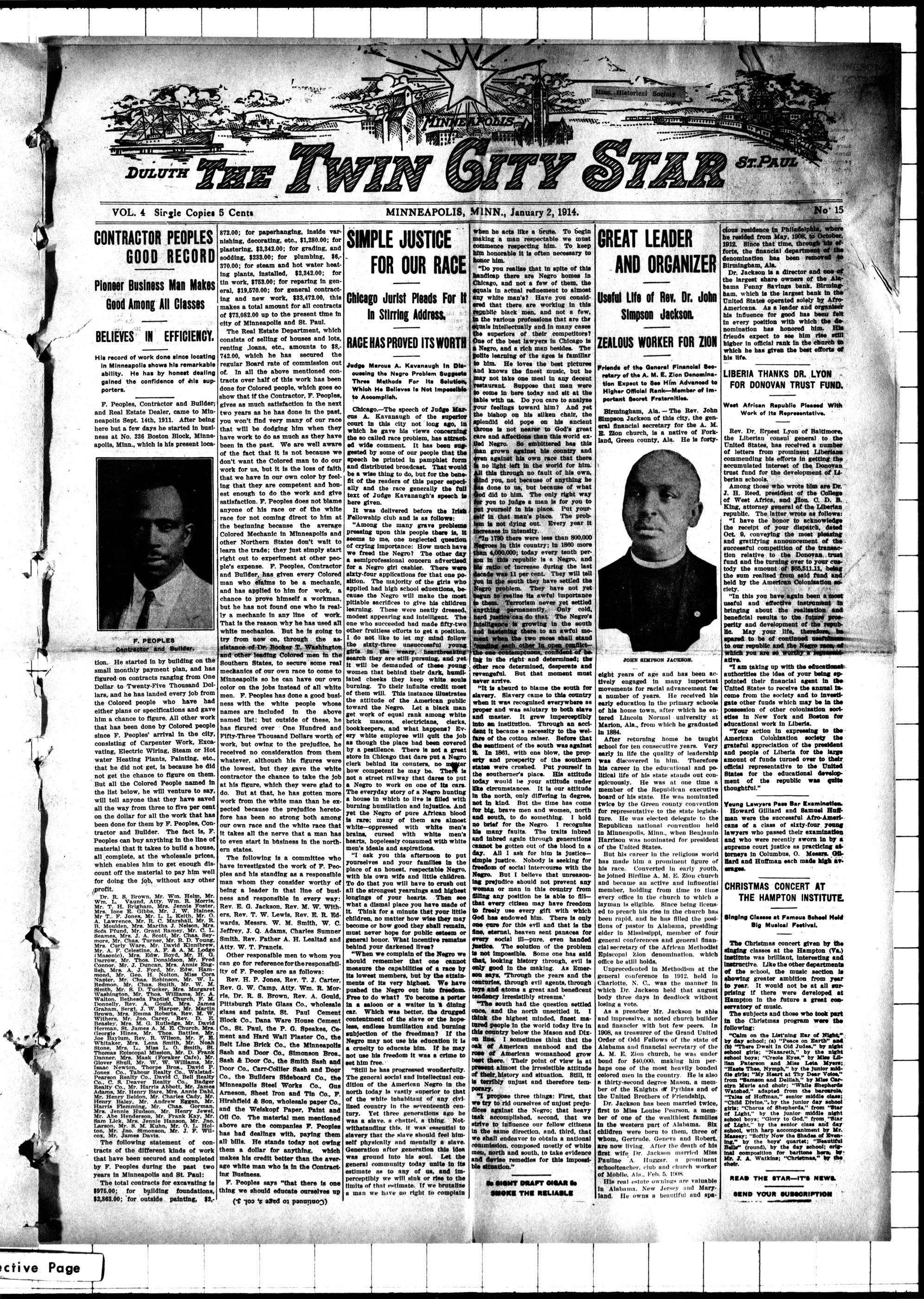
CONTRACTOR PEOPLES
GOOD RECORD
Pioneer Business Man Makes
Good Among All Classes
872.00; for
nishing, de-
plastering,
sodding, $2
370.00; for
ing plants,
tin work, $1
9,57
ing and n
makes a to
of $73,082.0
city of Min
872.00; for paperhanging, inside varnishing, decorating, etc., $1,280.00; for plastering, $3,342.00; for grading, and sodding, $233.00; for plumbing, $6,370.00; for steam and hot water heating plants, installed, $2,342.00; for tin work, $753.00; for repairing in general, $19,570.00; for general contracting and new work, $33,472.00, this makes a total amount for all contracts of $73,082.00 up to the present time in city of Minneapolis and St. Paul.
The Real Estate Department, which consists of selling of houses and lots, renting, loans, etc., amounts to $8,742.00, which he has secured the regular Board rate of commission out of. In all the above mentioned contracts over half of this work has been done for Colored people, which goes on show that if the Contractor, F. Peoples, gives as much satisfaction in the next two years as he has done in the past, you won't find very many of our race that will be dodging him when they have work to do as much as they have been in the past. We are well aware of the fact that it is not because we don't want the Colored man to do our work for us, but it is the loss of faith that we have in our own color by feeling that they are competent and honest enough to do the work and give satisfaction. F. Peoples does not blame anyone of his race or of the white race for not coming direct to him at the beginning because the average Colored Mechanic in Minneapolis and other Northern States don't wait to learn the trade; they just simply start right out to experiment at other people's expense. F. Peoples, Contractor and Builder, has given every Colored man who claims to be a mechanic, and has applied to him for work, but he has not found one who is really a mechanic in any line of work. That is the reason why he has used all white mechanics. But he is going to try from now on, through the assistance of Dr. Booker T. Washington and other leading Colored men in the Southern States, to secure some real mechanics of our own race to come to Minneapolis so he can have our own color on the jobs instead of all white men. F. Peoples has done a good business with the white people whose names are included in the above named list: but outside of these, he has figured over One Hundred and Fifty-Three Thousand Dollars worth of work, but owing to the prejudice, he received no consideration from them whatever, although his figures were the lowest, but they gave the white contractor the chance to take the job at his figure, which they were glad to do. But at that, he has gotten more work from the white man than he expected because the prejudice heretofore has been so strong both among our own race and the white race that it takes all the nerve that a man has to even start in business in the northern states.
The following is a committee who have investigated the work of F. Peoples and his standing as a responsible man whom they consider worthy of being a leader in that line of business and responsible in every way: Rev. E. G. Jackson, Rev. M. W. Witers, Rev. T. W. Lewis, Rev. E. R. Edwards, Messrs. W. M. Smith, W. C. Jeffrey, J. Q. Adams, Charles Summer Smith, Rev. Father A. H. Lealtad and Atty. W. T. Francis.
Other responsible men to whom you can go for reference for the responsibility of F. Peoples are as follows:
Rev. H. P. Jones, Rev. T. J. Carter, Rev. G. W. Camp, Atty. Wm. R. Morris, Dr. R. S. Brown, Rev. A. G. Pittsburgh Plate Glass Co., wholesale glass and paints, St. Paul Cement Block Co., Dana Ware House Cement Co., St. Paul, the P. G. Speakes, Cement and Hard Wall Plaster Co., the Belt Line Brick Co., the Minneapolis Sash and Door Co., Simonson Bros. Sash & Door Co., the Smith Sash and Door Co., Carr-Collier Sash and Door Co., the Builders Sideboard Co., the Minneapolis Steel Works Co., Gus Arneson, Sheet Iron and Tin Co., F. Hirshfield & Son, wholesale paper Co., and the Welskopf Paper, Paint and Oil Co. The material men mentioned above are the companies F. Peoples has had dealings with, paying them all bills. He stands today not owing them a dollar for anything, which makes his credit better than the average white man who is in the Contracting Business.
The following statement of contracts of the different kinds of work that have been secured and completed by F. Peoples during the past two years in Minneapolis and St. Paul: all bills. H them a demo makes his age white n business
F. Peoples says "that there is one thing we should educate ourselves up
(£ 900 is asked 0 paranuncu)
```markdown
```
BELIEVES IN EFFICIENCY.
His record of work done since locating in Minneapolis shows his remarkable ability. He has by honest dealing gained the confidence of his supporters.
F. Peoples, Contractor and Builder, and Real Estate Dealer, came to Minneapolis Sept. 14th, 1911. After being here but a few days he started in business at No. 236 Boston Block, Minneapolis, Minn., which is his present loca-
M. B.
tion. He started in by building on the small monthly payment plan, and has figured on contracts ranging from One Dollar to Twenty-Five Thousand Dollars, and he has landed every job from the Colored people who have had either plans or specifications and gave him a chance to figure. All other work that has been done by Colored people since F. Peoples' arrival in the city, consisting of Carpenter Work, Excavating, Electric Wiring, Steam or Hot water Heating Plants, Painting, etc., that he did not get, is because he did not get the chance to figure on them. But all the Colored People named in the list below, he will venture to say, will tell anyone that they have saved all the way from three to five per cent on the dollar for all the work that has been done for them by F. Peoples, Contractor and Builder. The fact is, F. Peoples can buy anything in the line of material that it takes to build a house, all complete, at the wholesale prices, which enables him to get enough discount off the material to pay him well for doing the job, without any other profit.
The total contracts for excavating is
$975.00; for building foundations,
$2,863.00; for outside painting, $2-
(Continued to page 2, col. 3.)
SIMPLE JUSTICE FOR OUR RACE
Chicago Jurist Pleads For It In Stirring Address.
RACE HAS PROVED ITS WORTH
Judge Marous A. Kavanaugh In Discussing the Negro Problem Suggests Three Methods For Its Solution, Which He Believes is Not Impossible to Accomplish.
Chicago.—The speech of Judge Marcus A. Kavanaugh of the superior court in this city not long ago, in which he gave his views concerning the so called race problem, has attracted wide comment. It has been suggested by some of our people that the speech be printed in pamphlet form and distributed broadcast. That would be a wise thing to do, but for the benefit of the readers of this paper especially and the race generally the full text of Judge Kavanaugh's speech is here given.
It was delivered before the Irish Fellowship club and is as follows:
"Among the many grave problems pressing upon this people there is, it seems to me, one neglected question of crying importance: How much have we freed the Negro? The other day a semiprofessional concern advertised for a Negro girl cashier. There were sixty-four applications for that one position. The majority of the girls who applied had high school educations, because the Negro will make the most pittable sacrifices to give his children learning. These were neatly dressed, modest appearing and intelligent. The one who succeeded had made fifty-two other fruitful efforts to get a position. I do not like to let my mind follow the sixty-three unsuccessful young girls in the weary, heartbreaking search they are still pursuing, and yet it will be demanded of these young women that behind their dark, humiliated cheeks they keep white souls burning. To their infinite credit most of them will. This instance illustrates the attitude of the American public toward the Negro. Let a black man get work of equal rank among white brick masons, electricians, clerks, bookkeepers, and what happens? Every white employee will quit the job as though the place had been covered by a pestilence. There is not a great store in Chicago that dare put a Negro clerk behind its counters, no matter how competent he may be. There is not a street railway that dares to put a Negro to work on one of its cars. The everyday story of a Negro hunting a house in which to live is filled with burning humiliation and injustice. And yet the Negro of pure African blood is rare; many of them are almost white—oppressed with white men's brains, cursed with white men's hearts, hopelessly consumed with white men's ideals and aspirations.
"I ask you this afternoon to put yourselves and your families in the place of an honest, respectable Negro, with his own wife and little children. To do that you will have to crush out all the strongest yearnings and highest longings of your hearts. Then see what a dismal place you have made of it. Think for a minute that your little children, no matter how wise they may become or how good they shall remain, must never hope for public esteem or general honor. What incentive remains behind your darkened lives?
"When we complain of the Negro we should remember that one cannot measure the capabilities of a race by its lowest members, but by the attainments of its very highest. We have pushed the Negro out into freedom. Free to do what? To become a porter in a saloon or a waiter in a dining car. Which was better, the drugged contentment of the slave or the hopeless, endless humiliation and burning subjection of the freedman? If the Negro may not use his education it is a cruelty to educate him. If he may not use his freedom it was a crime to set him free.
"Still he has progressed wonderfully. The general social and intellectual condition of the American Negro in the north today is vastly superior to that of the white inhabitant of any civilized country in the seventeenth century. Yet three generations ago he was a slave, a chattel, a thing. Notwithstanding this, it was essential to slavery that the slave should feel himself physically and mentally a slave. Generation after generation this idea was ground into his soul. Let the general community today unite in its estimate as to any of us, and imperceptibly we will sink or rise to the limits of that estimate. If we brutalize a man we have no right to complain
when he acts like a brute. To begin making a man respectable we must commence respecting him. To keep him honorable it is often necessary to honor him.
"Do you realise that in spite of this handicap there are Negro homes in Chicago, and not a few of them, the equals in actual refinement to almost any white man's? Have you considered that there are working in this republic black men, and not a few, in the various professions that are the equals intellectually and in many cases the superiors of their competitors? One of the best lawyers in Chicago is a Negro, and a rich man besides. The polite learning of the ages is familiar to him. He loves the best pictures and knows the finest music, but he may not take one meal in any decent restaurant. Suppose that man were to come in here today and sit at the table with us. Do you care to analyze your feelings toward him? And yet the bishop on his silken chair, the splendid old pope on his ancient throne is not nearer to God's great care and affections than this world oiled Negro. So embittered has this man grown against his country and even against his own race that there is no light left in the world for him. All this through no fault of his own, mind you, not because of anything he has done to us, but because of what God did to him. The only right way for you to judge a man is for you to put yourself in his place. Put yourself in that man's place. The problem is not dying out. Every year it increases in intensity.
"In 1790 there were less than 800,000 Negroes in this country; in 1860 more than 4,000,000; today every tenth person in this republic is a Negro, and his ratio of increase during the last decade was 11 per cent. They will tell you in the south they have settled the Negro problem. They have not yet begun to realize its awful importance to them. Terrorism never yet settled anything permanently. Only cold, hard justice can do that. The Negro's intelligence is growing in the south and hastening there to an awful moment when the two races shall stand pumbling each other in open conflict—the one contemptuous, confident of being in the right and determined; the other race determined, desperate and revengeful. But that moment must never arrive.
"It is aburd to blame the south for slavery. Slavery came to this country when it was recognized everywhere as proper and was salutary to both slave and master. It grew imperceptibly into an institution. Through an accident it became a necessity to the welfare of the cotton raiser. Before that the sentiment of the south was against it. In 1861, with one blow, the property and prosperity of the southern states were crushed. Put yourself in the southerner's place. His attitude today would be your attitude under circumstances. It is our attitude in the north, only differing in degree, not in kind. But the time has come for big, brave men and women, north and south, to do something. I hold no brief for the Negro. I recognize his many faults. The traits inbred and inbred again through generations cannot be gotten out of the blood in a day. All I ask for him is justice—simple justice. Nobody is seeking for freedom of social intercourse with the Negro. But I believe that unreasoning prejudice should not prevent any woman or man in this country from filling any position he is able to fill—that every citizen may have freedom to freely use every gift with which God has endowed him. There is only one cure for this evil and that is the fine, eternal, heaven sent panacies for every social ill—pure, even handed justice. The solution of the problem is not impossible. Some one has said that, looking history through, evil is only good in the making. As Emerson says. Through the years and the centuries, through evil agents, through toys and a great and beneficent tendency irresistibly streams.'
"The south had the question settled once, and the north unsettled it. I think the highest minded, finest matured people in the world today live in this country below the Mason and Dixon line. I sometimes think that the oak of American manhood and the rose of American womanhood grow best there. Their point of view is at present almost the irresistible attitude of their history and situation. Still, it is terribly unjust and therefore temporary.
"I propose three things: First, that we try to rid ourselves of unjust prejudices against the Negro; that heavy task accomplished, second, that we strive to influence our fellow citizens in the same direction, and, third, that we shall endeavor to obtain a national commission, composed mostly of white men, north and south, to take evidence and devise remedies for this impossible situation."
So SIGHT DRAFT CIGAR So SMOKE THE RELIABLE
GREAT LEADER AND ORGANIZER
ZEALOUS WORKER FOR ZION
Friends of the General Financial Secretary of the A. M. E. Zion Denomination Expect to See Him Advanced to Higher Official Rank—Member of Important Secret Fraternities.
Birmingham, Ala. — The Rev. John Simpson Jackson of this city, the general financial secretary for the A. M. E. Zion church, is a native of Forland, Green county, Ala. He is forty-
大
eight years of age and has been actively engaged in many important movements for racial advancement for a number of years. He received his early education in the primary schools of his home town, after which he entered Lincoln Normal university at Marion, Ala., from which he graduated in 1884.
After returning home he taught school for ten consecutive years. Very early in life the quality of leadership was discovered in him. Therefore his career in the educational and political life of his state stands out conspicuously. He was at one time a member of the Republican executive board of his state. He was nominated twice by the Green county convention for representative to the state legislature. He was elected delegate to the Republican national convention held in Minneapolis, Minn., when Benjamin Harrison was nominated for president of the United States.
But his career in the religious world has made him a prominent figure of his race. Converted in early youth, he joined Birdine A. M. E. Zion church and became an active and influential member, holding from time to time every office in the church to which a layman is eligible. Since being licensed to preach his rise in the church has been rapid, and he has filled the positions of pastor in Alabama, presiding elder in Mississippi, member of four general conferences and general financial secretary of the African Methodist Episcopal Zion denomination, which office he still holds.
Unprecedented in Methodism at the general conference in 1912, held in Charlotte, N. C., was the manner in which Dr. Jackson held that august body three days in deadlock without losing a vote.
As a preacher Mr. Jackson is able and impressive, a noted church builder and financier with but few peers. In 1908, as treasurer of the Grand United Order of Odd Fellows of the state of Alabama and financial secretary of the A. M. E. Zion church, he was under bond for $40,000, making him perhaps one of the most heavily bonded colored men in the country. He is also a thirty-second degree Mason, a member of the Knights of Pythias and of the United Brothers of Friendship.
Dr. Jackson has been married twice, first to Miss Louise Pearson, a member of one of the wealthiest families in the western part of Alabama. Six children were born to them, three of whom, Gertrude, Geneva and Robert, are now living. After the death of his first wife Dr. Jackson married Miss Pauline A. Huggar, a prominent schoolteacher, club and church worker of Mobile, Ala., Feb. 5, 1908. His real estate ownings are valuable in Alabama, New Jersey and Maryland. He owns a beautiful and spa-
clous residence in Philadelphia, where he resided from May, 1908, to October, 1912. Since that time, through his efforts, the financial department of the denomination has been removed to Birmingham, Ala.
Dr. Jackson is a director and one of the largest share owners of the Alabama Penny Savings bank. Birmingham, which is the largest bank in the United States operated solely by Afro-Americans. As a leader and organizer his influence for good has been felt in every position with which the denomination has honored him. His friends expect to see him rise still higher in official rank in the church to which he has given the best efforts of his life.
LIBERIA THANKS DR. LYON FOR DONOVAN TRUST FUND.
West African Republic Pleased With Work of Its Representative.
Rev. Dr. Ernest Lyon of Baltimore, the Liberian consul general to the United States, has received a number of letters from prominent Liberians commending his efforts in getting the accumulated interest of the Donovan trust fund for the development of Liberian schools.
republic. The latter wrote as follows: "I have the honor to acknowledge the receipt of your dispatch, dated Oct. 9, conveying the most pleasing and gratifying announcement of the successful competition of the transaction relative to the Donovan, trust fund and the turning over to your custody the amount of $65,511.11, being the sum realized from said fund and held by the American Colonization society.
"In this you have again been a most useful and effective instrument in bringing about the realisation and beneficial results to the future prosperity and development of the republic. May your life, therefore, be spared to be of continued usefulness to our republic and the Negro race, of which you are so worthy a representative.
"I am taking up with the educational authorities the idea of your being appointed their financial agent in the United States to receive the annual income from the society and to investigate other funds which may be in the possession of other colonization societies in New York and Boston for educational work in Liberia.
"Your action in expressing to the American Colonization society the grateful appreciation of the president and people of Liberia for the large amount of funds turned over to their official representative to the United States for the educational development of the republic was quite thoughtful."
Young Lawyers Pass Bar Examination
Howard Gilliard and Samuel Huffman were the successful Afro-Americans of a class of sixty-four, young lawyers who passed their examination and who were recently sworn in by a supreme court justice as practicing attorneys in Columbus, O. Messrs. Gilliard and Huffman each made high averages.
CHRISTMAS CONCERT AT THE HAMPTON INSTITUTE
Singing Classes at Famous School Hold Big Musical Festival.
The Christmas concert given by the singing classes at the Hampton (Va.) institute was brilliant, interesting and instructive. Like the other departments of the school, the music section is showing greater ambition from year to year. It would not be at all surprising if there were developed at Hampton in the future a great conservatory of music.
The subjects and those who took part in the Christmas program were the following:
"Calm on the List'ning Ear of Night," by day school; (a) "Peace on Earth" and (b) "There Dwelt in Old Judeus," by night school; (c) "Nascent in Night," by night school boys; "Creole Eyes," by Miss Lilian Paterson and Miss Leta Myers; "Haste Thee, Nymph," by the junior middle girls; "My Heart at Thy Dear Video," from "Samson and Dellah," by Miss Carla Murle and choir; "While Shepherds Watched," adapted from the baroque, by Miss Carla Murle; "Child Divine," by the junior day school girls; "Chorus of Shepherds," from "Star of Light," by the junior middle night school boys; "Glory to God," from "Star of Light," by the senior class and day school, with harp accompaniment by Mr. Massey; "Softly Now the Shades of Evening," by the boy's quartet; "Chorus of Night," by the school original composition for baritone horn by Mr. J. A. Watkins; "Christmas," by the choir.
READ THE STAR—IT'S NEWS.
SEND YOUR SUBSCRIPTION
MINNEAPOLIS
In this great city of ours, we need more consecrated men and women to throw out the life line to rescue the perishing souls. Rev. T. J. Carter, Pastor Bethesda Baptist Church.
The People's Christian Mission, REV. G. W. MITCHELL, PASTOR 1204 Washington Ave. Se.
Funeral and Wedding notices are to be paid for in advance.
Rev. E. W. Gilles conducts Bible and missionary training classes as follows: (With Mr. and Mrs. Johnson, 526 7 Avenue North, Tuesday evenings, with Mr. and Mrs. St. Clare, 411 11 Avenue, North, Friday evenings.
BETHESDA BAPTIST CHURCH
11 A. M. A New Year's Friendly
Interogation.
12:30. Sunday School.
6:30 P. M. B. Y. P. U.
8. P. M. A Good Resolution.
Come and Enjoy New Year's Services with us.
The pastor has been busy preaching funerals, which tells us that the Death Angel is in our city. Are you ready, if he should come to your home?
The public is always welcome to Bethesda Church.
Rev. T. J. Carter, Pastor.
Mr. and Mrs. C. D. Howard served a Colation Saturday evening, Dec. 27, at 8 p. m., after which cards and dancing were indulged till 11:30, and an enjoyable evening was spent. Those present were Mr. and Mrs. Nimrod Johnson, Mr. and Mrs. Jas. Burke, Mr. and Mrs. W. Williams, Mr. and Mrs. Nator Smith, Mr. and Mrs. R. C. Gordon, Mr. and Mrs. H. Jackson, Mrs. M. Kemp, Mrs. M. Hall, Mrs. Maxie Stewart, Messrs J. Clayborn, O. Clark, J. West and Harry Jones.
HOME COOKING CAFE.
MRS. A. G. CHARLESTON.
Mrs. A. G. Charleston has opened a Home Cooking Café at 1302 So. Third St., Minneapolis, where she serves home-cooked meals at reasonable prices. She invites your patronage.
Mr. and Mrs. F. Peoples entertained at Christmas dinner, Thursday. Covers were laid for six.
Mrs. J. Baylum has moved to 3517 4th Ave. S.
Mrs. Mattle Benner and Miss Jessie Adams of St. Paul were guests of their sister Mrs. Wm. Hyde at Xmas dinner. Mrs. R. B. Moulden and Mrs. M. Rutledge were guests also.
Mrs. Robert A. Anderson, of 718 Bryant Ave. North, was removed from her home to Dr. A. W. Abbott's private sanitarium for a surgical operation which will be performed Monday morning at 9:30.
Mr. and Mrs. John Garrett, 1003 6th Ave. No., entertained a few friends on Christmas Day, among them Mr. and Mrs. Arthur Bodene, and Mr. H. L. Davis. The affair was a family dinner.
MINNEAPOLIS SUNDAY FORUM
The Forum meets Sunday, January 4, 1914, at St. Peters Church at 3:30 p. m. An excellent program is promised.
Mr. and Mrs. C. E. Charleston of St. Paul, have moved into their new home, 474 St. Anthony Ave., which they recently purchased.
Mr. David Heunebrew of St. Paul has rented his house, 924 La Fond St., which was recently completed by F. Peoples, the contractor, who completely satisfied him.
Does your subscription expire this month? Please inform us as to renewal.
Any person who has paid for this paper, without receiving it, will be given a year's subscription on proof of their statement.
Dr. Judy, the dentist, has resigned his position with the eNew York Painless Dentists, and will confine his work to his office at 3533 4th Ave. So., where he will receive his patients at all hours. Phone N. W. Cofax 1846.
Messra. Benj. Jones and Clarence Bell are making good in their recent business venture. They have the Barber Shop and Pool Room, formerly conducted by Mr. H. D. Parker at 244 Third Ave. So., and are doing their best to give satisfaction to their customers.
You must send your subscriptions if you want the Trin City Star, or order it discontinued.
---
ELKS ELECT OFFICERS.
Ames Lodge No. 106, I. B. P. O. E. W. held their election of officers on Tuesday, Dec. 23rd, and the following officers were elected to guide the afairs of this popular Lodge of the Twin Cities, for the ensuing year: George W. Holbert, Exalted Ruler; Thomas Galbraith, Esteemed Leading Knight; Silas West, Esteemed Loyal Knight; P. H. Southall, Est. Lecturing Knight, Ross Hamilton, Tyler; Wm. R. Morris, as Fin. Sec., and Wm. Stirman as Treas. were holdovers, their terms not expiring until June.
M. B.
GEO. W. HOLBERT.
We take this opportunity of calling the public's attention to the high calibre of this Lodge and their intention to still further advance, both their own and their race's interests. They have many plans which will include pleasure to the public and profit to them-selves, which, from time to time will be unfolded through the columns of the Star. Although they already number among their ranks most of the representative and progressive men of the race, extra efforts will be put forth during the coming year to increase, not only their membership, but to improve the calibre and moral character of the Lodge. Ames is no longer an experiment, but one of the fixtures of the fraternal life of Minneapolis and with its present high standard of officers, there is no reason why she should not have one of the most successful years of her history, under the guidance of the present officers, with the united support of the members.
STARKS-SPENCER.
Mr. H. H. Starks of Duluth, Minn., and Miss Macy Spencer of Memphis, Tenn., arrived in the city Sunday and were the guests of Mr. and Mrs. D. W. Raynor. On Monday, Dec. 29, they were married at the home of his mother, Mrs. Lulu St. Claire, 411 11th Ave. No., by Rev. E. R. Edwards. After the ceremony an enjoyable dinner was served. Mr. Starks left for Duluth on the 11 P. M. train, on account of his business, leaving his bride at the home of his mother. He will return shortly as they expect to make their home in the Twin Cities.
Our exposure of vice conditions in this city has been costly to this publication, but beneficial to the community. We have lost friends, because of our agitation, many who are considered the best Negroes in the city. Every pressure has been brought to bear against the continuance of the Twin City Star, which is now considered a dangerous publication. Even some of the clergy are fighting the Editor, who will in due season retaliate with some sensational truths.
Mr. Boyd Francisco won the pool contest at the Citizen's Club on Tuesday night. He was presented with a jointed cue by Manager Chas. Brody. Mr. Walter Donahue of The Cross Trio, musicians, was second. The games were very interesting.
Mr. John washington, 1500 Penn Ave. No. returned last week from Henderson, Ky., where he spent a pleasant visit.
The "Weaver Bros." Entertainers were the feature at the Twin City Stag Club last Sunday night as guests of the Young Men's Progressive Club.
Many who complain that they do not get the Star have been cut off and they will get it on the renewal of their subscription by check or P. O. order.
When the Clubs were ordered to close at 2 a. m. it was known that many men earning over $12 per week had no homes, several hard working men had lived in these dives.
THE ST. LOUIS KITCHEN.
You can get a good meal, clean service, and courteous attention at the St. Louis Kitchen, 138 E. Third St. St. Paul. Mrs. Hinson is universally known for her good cooking.
ST. LOUIS KITCHEN, 138 E. 3rd St. St. Paul, Minn.—Advertisement.
(Tinued from page 1.)
CONTRACTOR'S GREAT RECORD.
NATIONAL
Department Work
to, and that is to either get a specification, or get some friend to make out a specification or come to his office and he will make out one for you free of charge; as it is impossible for any two men to figure alike without a guide. All the white people have their specifications so there will be no mistake in having all to figure alike, and whenever you want No. 1 material, there will be no chance for a contractor to put in No. 3 or No. 4 material as has been done so much. We should not at any time accept verbal figures because there is nothing to hold a man to unless it is in writing, then it is up to you to either accept it or turn it down until you have signed it yourself. There have been many times that F. Peoples has figured on work in both Minneapolis and St. Paul and was the lowest figure, where the other contractors tried to bluff the client to make them pay for the trouble of figuring on the work. F. Peoples would like to make this very plain: that no contractor, no matter who he is or how much money he has, has no chance to collect money for figuring on jobs, as he has no right until you have signed up with him.
I. F. Peoples, want to take this opportunity to thank all of the Colored People for all the business I have transacted for them because they have given me more business in such a short time than I could ever have expected of them. If I only do half of the business in the next two years that I have done in the past, I will be perfectly satisfied because I can readily see that you mean for me to stay here."
F. Peoples has an office clerk who is doing public stenography in connection with her regular work. If at any time you have letters of any kind to write, or legal papers to draw up, you will find her competent to handle anything in the stenographic line. She has a very large trade from white as well as colored as she does the very best work at the most reasonable price.
BROWNING IS OPTIMISTIC.
New Jersey Congressman Defends
Ability of Colored Federal Employees.
New Jersey Congressman Defends Ability of Colored Federal Employees. Washington.-This city is stirred an never before on account of the great agitation which is going on in reference to the segregation of white and colored civil service employees in the various departments of the government service. The protest presented to the president not long ago and the investigation made by a representative of the National Association For the Advancement of Colored People have gone far toward awakening a sense of justice in the minds of those responsible for the existence of segregation among the clerks and other federal employees. In an address recently delivered in this city by Representative W. J. Browning of New Jersey he said:
"Civil liberty, whether enjoyed in whole or in part, has demonstrated the ability of colored citizens to advance in the scale of human progress against great odds. Much, it is true, that citizenship is supposed to confer is denied, but in many states the franchise is freely exercised, and this, it should be remembered, in states where this privilege is not likely to be withdrawn by circumvention of the constitution or other device and where numerical strength weighs heavily in the political equation. This strength has usually been on the side of good government.
"We know that the full measure of representation is not accorded, but recognition of this principle is found in the filling of offices and positions of honor and trust in every branch of the government service and in the army and navy. They are here in the departments, and they would not be here if they lacked ability and efficiency. They are here because the equal opportunity was given them to enter through the door of a civil service examination. They are not here because they belong to a certain race or class, but in spite of that fact. They are participating in government, doing the government work, are a part of the machinery.
"The flag, the only flag they have ever known, floats over every government building in which they work—the common flag of every American citizen, signifying unity as one in all things pertaining to the common welfare. Here the standard is efficiency; here all are civil servants; here class, social, religious and political distinctions have no rightful place. Each and all are American citizens, nothing more and nothing less than American citizens.
"I venture to assert that there are few men today anywhere in this country who would be willing to return to the system which the abolitionists strove to stamp out and which was stamped out. There may be, and doubtless are, men who, while feeling that way about the institution of slavery, nevertheless are hostile to the colored man. This feeling is engendered by race prejudice and is manifested in ways only too well known to the public."
SUBSCRIBE FOR THE STAR.
NATIONAL W. C. T. U.
AN OPEN LETTER.
The National Woman's Christian Temperance Union has launched a campaign for National Constitutional Prohibition in 1920.
We believe in ourselves; but infinitely more in the God who said: "Be not afraid nor dismayed by reason of this great multitude; for the battle is not your but God's."
We realize that it would be disastrous to the race, if in the final triumph of virtue over vice, the church over the liquor traffic; our women were found poorly represented in the great organization of the National Woman's Christian Temperance Union, which knows no woman by her creed or color.
To forestall such a calamity, we are calling for volunteers all over the Nation.
January 1, 1914, has been set apart as out fast day, on which day all who are interested in the wellbeing of the race are called upon to unite with us that there might be a great awakening of our women to this the opportune time to fall into line and help save our race from this vile form of slavery which the white man's civilization has forced upon us.
At our National Convention in Asbury Park, N. J., in November, Ohio's colored women led the nation in making a great gain of membership; New York came next. The whole nation must rally. The liquor traffic knows no race, section, nor condition in its work if evil. WE MUST BE ON DUTY when the last blow for liberty of home, race and nation is struck. Texas will rally for 1,000 paid members. Tennessee and Arkansas 500 each. Mrs. George E. Haynes, Fisk University, Nashville, Tenn., has been chosen as our Secretary of Advisory Committees of College Work. Miss Mary A. Lynch, Livingston College, Salsbury, N. C., is Chairman of Committee on Press Work.
I cheerfully introduce these capable earnest women who will help lead our ranks to victory over the greatest enemy we have known since emancipation.
We believe in the press as one of the greatest means of helping to establish truth and justice.
We therefore humbly ask that you will give space in your valuable columns of the next issue for this letter. We further beg that you will let appear in a later issue if not along with this letter, the enclosed copy of excerpts from Dr. Booker T. Washington; Prof. Kelly Miller, Howard University, Washington, D. C.; Dr. C. V. Roman, Meharry Medical College, Nashville, Tenn.; Dr. Sutton E. Griggs, Memphis, Tenn.; Bishop C. R. Harris, Salisbury, N. C.; Dr. R. E. Jones, New Orleans; Dr. J. H. N. Waring, Washington, D. C.
This letter goes to not less than 200 newspapers and we call upon all to help praying with us on January 1 for this special blessing that 1914 may be a year of jubilee for the womanhood of the race in achievement for "God and Home and Native Land."
Texarkana, Tex., National Supt.
AMANDA SMITH,
Sebring, Fla.
ELLA SHEPPARD MOORE,
Nashville, Tenn., Associates.
By Dr. Booker T. Washington, in the "Worlds Work Magazine, New York City, November, 1913—
"I am trying to get the white people to realize that since no color line is drawn in the punishment of crime, no color line should be drawn in the preparation for life, in the kind of education, in other words, that makes for useful, clean living. I am trying to get the white people to see that in hundreds of counties in the South it is costing more to punish colored people for crime than it would cost to educate them. I am trying to get all to see that ignorance, poverty, and weakness invite and encourage the stronger race to act unjustly toward the weak, and that so long as this condition remains, the young white men of the South will have a fearful handicap in the battle of life."
When you have a social, or any gathering worthy of mention, select some member as press agent, and get the names, especially the initials of persons present, and forward it to your newspaper. Do not wait to depend on your time or memory. It is necessary that we get the full names of those present
FORUM MEETING.
The Forum meets the first Sunday in each month at St. Peter's A. M. E. Church, and on the third Sunday each month at Bethesda Baptist Church.
FORUM MEETING.
To the Race Loving Women and Men of the United States.
The Constitutional League of Oklahoma with Lawyer William Harrison, of Oklahoma City as its leading attorney is contesting with vigor the "Jim Crow" laws of Oklahoma. He will, the last of November or the first of December, bring before the United States Supreme Court the case of McCabe et al vs. The Atchison, Topeka and Santa Fe Railway So., et al.
We are informed that jurist say that the Oklahoma case is the best prepared of its kind of any case yet put before the United States Supreme Court, and that it will now have to meet the issue squarely.
There is one feature of this case that will be settled which will effect all of the Negroes in the United States and that is the Inter-State passenger law. If he succeeds it will put an end to all Jim Crowism, so far as Inter-State passengers are concerned. They will not even be subject to the Intr-State laws of the South.
Hence we hereby appeal to every liberty loving woman, man and friend of the Negroe race in this country to make a contribution to the expense of fighting this cas. We think it is high time, if Negroes want liberty, they should be willing to pay something towards it.
A few race loving men and women in the Oklahoma League, led by the Rev. W. H. Jernagin, D. D., who is now pastor of the Mount Carmel Baptist church, Washington, D. C., have great sacrifice to bring the case through lower courts to its present stage and Mr. Harrison has practically given his service for nothing; but must be rewarded.
We are informed that two able constitutional lawyers of Boston and New York will assist in this case.
Therefore let everyone who is interested send at least $1. All contributions to be sent to Rev. W. H. Jernagin, D. D., 420 Q street, N. W., Washington, D. C., who will receipt you for the same. He is a reputable, straightforward, Christian gentleman, and will make an honest report of all money sent him.
If persons making contributions do not object, their names will be published in the leading papers of their state. Yours for justice,
S. W. Layton, Philadelphia, Pa., President Woman's Convention Auxiliary National Baptist Convention.
Nannie H. Burroughs, Washington,
D. C. Secretary Woman's Convention Auxiliary National Baptist Convention.
P. S.—Editors of the race who are interested will please copy.
ADVERTISE IN THE STAR
and get good results.
READ OUR ADVERTISEMENTS.
Good Beer is
Beer is Strengthening
Good Beer is Strengthening
There is strength in a pure beer like Hochsteiner
Brewed under sanitary conditions
Purest of ingredients
The beer without a headache
The Leading Bottle Beer Brewery
BOTH PHONES 66 MINNEAPOLIS, MINN
irella
(NOT SOLD IN STORES)
BOTH PHONES 66 MINNEAPOLIS, MINN
Spirella CORSETS
will give you lithe, uncorseted grace and constant comfort, yet mould your figure to the present fashion. They are fitted to your measure in your own home by a trained corsetiere—the Spirella way. A telephone call or post-card will bring an expert to your home to explain the Spirella service and boning in detail.
---
---
Kobstein
The power of
PURITY BREWING CO.
PURITY BREWING CO.
Order a Case Today
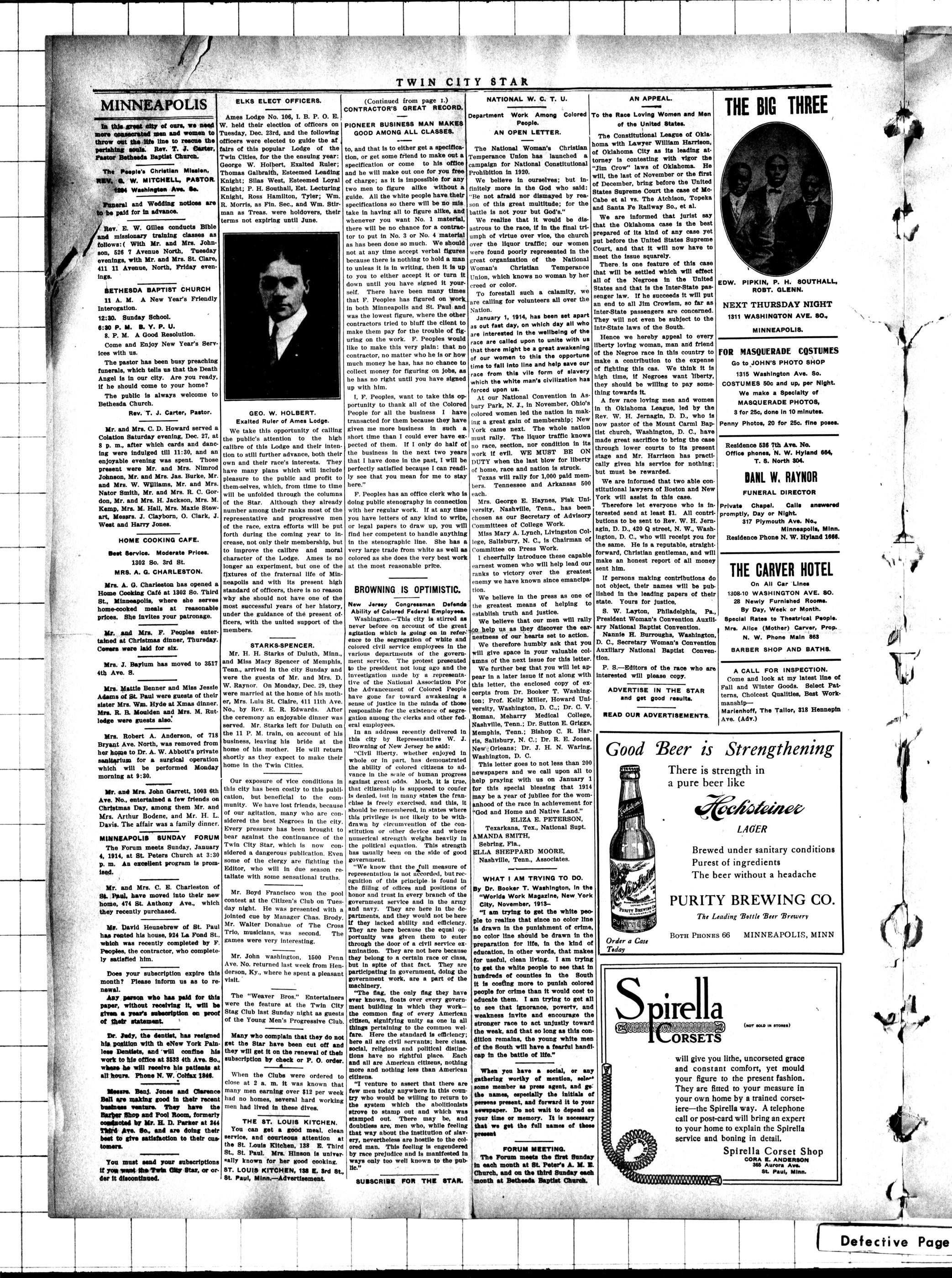
THE BIG THREE
EDW. PIPKIN, P. H. SOUTHALL,
ROBT. GLENN.
NEXT THURSDAY NIGHT
1311 WASHINGTON AVE. 80.
FOR MASQUERADE COSTUMES
Go to JOHN'S PHOTO SHOP
1315 Washington Ave. So.
COSTUMES 50c and up, per Night.
We make a Specialty of
MASQUERADE PHOTOS,
3 for 25c, done in 10 minutes.
Penny Photos, 20 for 25c. fine poses.
Residence 586 7th Ave. No.
Office phones, N. W. Hyland 664,
T. S. North 304.
DANL W. RAYNOR
FUNERAL DIRECTOR
Private Chapel. Calls answered promptly, Day or Night.
317 Plymouth Ave. No.
Minneapolis, Minn.
Residence Phone N. W. Wyland 1666.
THE CARVER HOTEL
On All Car Lines
1308-10 WASHINGTON AVE. 80.
28 Newly Furnished Rooms.
By Day, Week or Month.
Special Rates to Theatrical People.
Mrs. Alice (Mother) Carver, Prop.
N. W. Phone Main 863
BARBER SHOP AND BATHS
A CALL FOR INSPECTION.
Come and look at my latest line of Fall and Winter Goods. Select Patterns, Chicest Qualities, Best Workmanship—
Marienhoff, The Tallor, 318 Hennepin Ave. (Adv.)
(NOT SOLD IN STORES)
Spirella Corset Shop
CORA E. ANDERSON
365 Aurora Ave.
St. Paul, Minn.
Defective Page
ective Page
802 NICOLLET AVE.
WILL MAKE YOUR WATCH KEEP TIME.
We do the best WATCH, CLOCK and JEWELRY REPAIRING in the city at lowest prices.
SPECIAL AGENTS for the HAMILTON, ELGIN, WALTHAM and ROCKFORD RAILROAD WATCHES.
S.O. Auburn Ave., St. Paul
Lunches, Soft Drinks, Fancy Groceries,
Confections and Cigars. Give us
your patronage. Mrs. Maggie Jenkins,
R. W. Hopkins.—Advertisement.
DO IT NOW!!! DON'T WAIT!!!
Come in, and have your teeth fixed and pay in Weekly or Monthly installments. We have Dr. H. Pierce, "the famous extractor" with us every Monday and Friday and by special appointment. N. W. Colfax 1846.
RED CROSS DENTAL PARLORS
DR. M. W. JUDY, Mgr.
3533 4th Ave. So. Minneapolis.
SMOKE THE BEST 5C CIGAR Sight Draft
W. S CONRAD CO., Distributors
NO. 1. WESTERN AVE., MINN.
NO. 140. E. 6th ST., ST. PAUL.
Southern Theatre
SevenCorners
15th and Washington Avenues So.
Refined Vaudeville
Moving Picture Shows
Continous Performance
Admission 10 Cents
Children 5 Cents
Peterson, The Druggist 1501 Washington Ave. So.
TOILET ARTICLES, DRUGS
PRESCRIPTIONS.
He Sollicits You: Patronage.
POPULAR PRICED SHOE REPAIRING
WE FIX 'EM WHILE YOU WAIT
Men's Sewed Soles.....75u
Ladies " ".....60u
Men's Nailed " ".....60 and 60u
Rubber Heels " ".....40u
Ladies' and Boys' nailed soles.....40u
SEVEN CORNERS SHOE REPAIR SHOP
ORDER FOR HEARING PETITION TO
SELL LANDS.
STATE OF MINNESOTA,
County of Hennepin.
PROBATE COURT.
In the Matter of the Guardianship of
Henry F. Fletcher.
honorship of Henry Fellman, insane.
On receiving and filling the petition of Carolina Fellman, Guardian or above, he received the real estate her granted to sell the real estate therein described belonging to said Ward, and it appearing before said the Court, it could be for the bene of said Ward, to sell said real estate: It is therefore Ordered, that all persons in the county of Carolina appear before said Probate Court, at a special term thereof to be held on Monday, the 19th day of January, 1914, at the County House, in said County, then and there to show cause (if any there be) why the petition of Carolina Fellman, Guardian or above, be interested, by publishing this order once in each week for three successive weeks prior to said day of hearing, in the Twin Cities, printed and published in said County.
Dated at Minneapolis, this 15th day of December, 1913.
By the Court:
JOHN A DAHL,
Judge of the State Court.
Dec. 26, 1913. - Advertisement.
TO BOYCOTT STORES THAT SELL "NIGGER" BROWN.
New York, December 18.—Many of the colored residents here, especially women, are incensed over department sores advertising a new shade of goods called "nigger brown." They regard this as an insult to the race, even though the color may be as alluring as is the color of a "tantalizing brown." Protests have been made to the officials of some of the stores and a boycott has been threatened.
SUBSCRIBE FOR THE STAR.
---
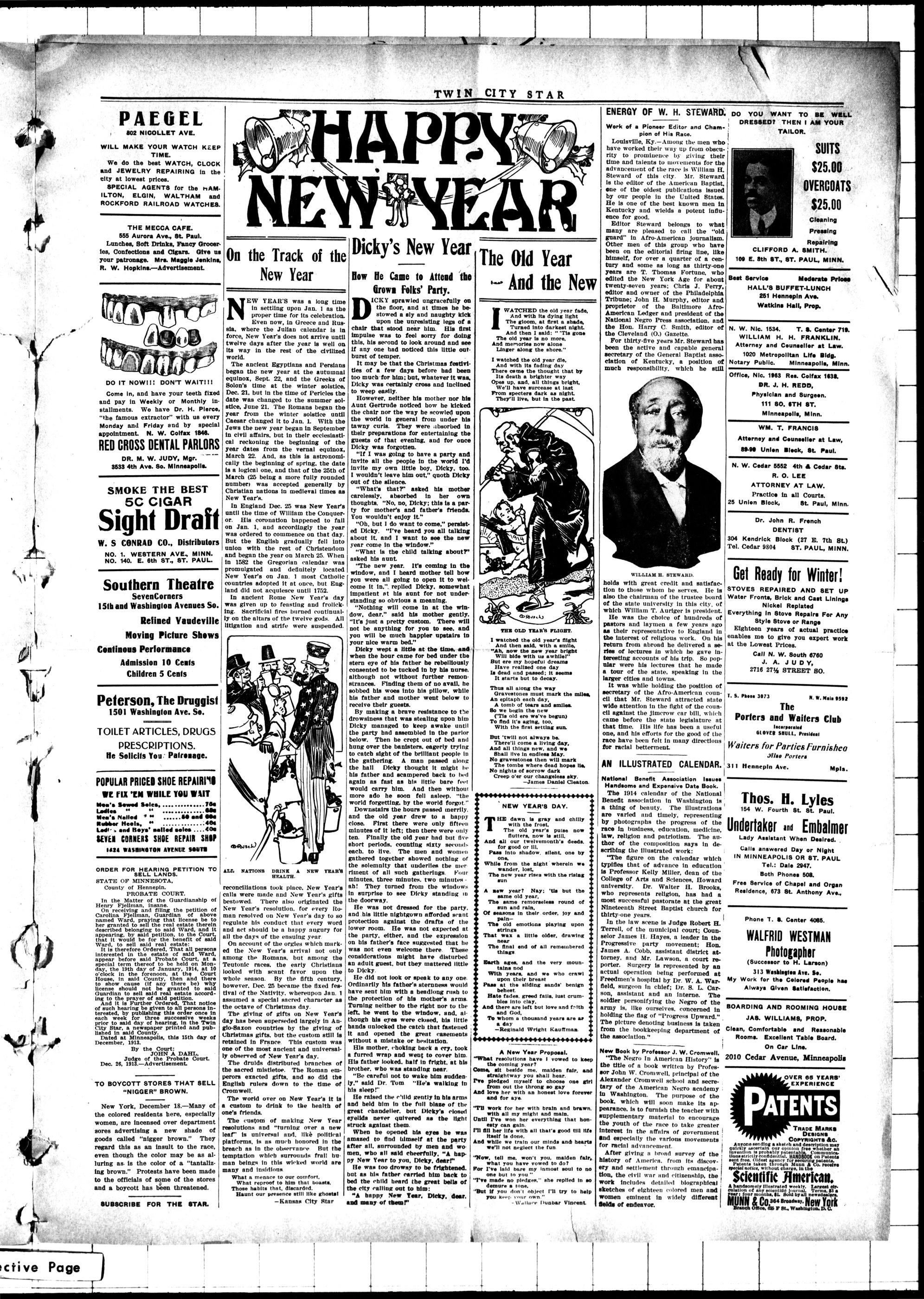
HAPPY
NEW YEAR
On the Track of the New Year
NEW YEAR'S was a long time in settling upon Jan. 1 as the proper time for its celebration. Even now, in Greece and Russia, where the Julian calendar is in force, New Year's does not arrive until twelve days after the year is well on its way in the rest of the civilized world.
The ancient Egyptians and Persians began the new year at the autumnal equinox, Sept. 22, and the Greeks of Solon's time at the winter solstice, Dec. 21, but in the time of Pericles the date was changed to the summer solstice, June 21. The Romans began the year from the winter solstice until Caesar changed it to Jan. 1. With the Jews the new year began in September in civil affairs, but in their ecclesiastical reckoning the beginning of the year dates from the vernal equinox, March 22. And, as this is astronomically the beginning of spring, the date is a logical one, and that of the 25th of March (25 being a more fully rounded number) was accepted generally by Christian nations in medieval times as New Year's.
In England Dec. 25 was New Year's until the time of William the Conqueror. His coronation happened to fall on Jan. 1, and accordingly the year was ordered to commence on that day. But the English gradually fell into union with the rest of Christendom and began the year on March 25. When in 1582 the Gregorian calendar was promulgated and definitely located New Year's on Jan. 1 most Catholic countries adopted it at once, but England did not acquiesce until 1752. In ancient Rome New Year's day was given up to feasting and frolicking. Sacrificial fires burned continually on the altars of the twelve gods. All litigation and strife were suspended.
@Ausch
ALL. NATIONS DRINK A NEW YEAR'S HEALTH.
reconcilations took place. New Year's calls were made and New Year's gifts bestowed. There also originated the New Year's resolution, for every Roman resolved on New Year's day to so regulate his conduct that every word and act should be a happy augury for all the days of the ensuing year.
On account of the orgies which marked the New Year's arrival not only among the Romans, but among the Teutonic races, the early Christians looked with scant favor upon the whole season. By the fifth century, however, Dec. 25 became the fixed festival of the Nativity, whereupon Jan. 1 assumed a special sacred character as the octave of Christmas day.
The giving of gifts on New Year's day has been superseded largely in Anglo-Saxon countries by the giving of Christmas gifts, but the custom still is retained in France. This custom was one of the most ancient and universally observed of New Year's day.
The drudgs distributed branches of the sacred mistletoe. The Roman emperors exacted gifts, and so did the English rulers down to the time of Cromwell.
The world over on New Year's it is a custom to drink to the health of one's friends.
The custom of making New Year resolutions and "turning over a new leaf" is universal and like political platforms, as is much honored in the breach as in the observance. But the temptation which surrounds frail human beings in this wicked world are many and insidious.
TWIN CITY STAR
APP
N YE
YEAR
Dicky's New Year
How He Came to Attend the Grown Folks' Party.
DICKY sprawled ungracefully on the floor, and at times he bestowed a sly and naughty kick upon the unresisting legs of a chair that stood near him. His first impulse was to feel sorry for doing this, his second to look around and see if any one had noticed this little outburst of temper.
It may be that the Christmas festivities of a few days before had been too much for him; but, whatever it was, Dicky was certainly cross and inclined to weep easily.
However, neither his mother nor his Aunt Gertrude noticed how he kicked the chair nor the way he scowled upon the world in general from under his tawny curls. They were absorbed in their preparations for entertaining the guests of that evening, and for once Dicky was forgotten.
"If I was going to have a party and invite all the people in the world I'd invite my own little boy, Dicky, too. I wouldn't leave him out," quoth Dicky out of the silence.
"What's that?" asked his mother carelessly, absorbed in her own thoughts. "No, no, Dicky; this is a party for mother's and father's friends. You wouldn't enjoy it."
"Oh, but I do want to come," persisted Dicky. "I've heard you all talking about it, and I want to see the new year come in the window."
"What is the child talking about?" asked his aunt.
"The new year. It's coming in the window, and I heard mother tell how you were all going to open it to welcome it in." replied Dicky, somewhat impatient at his aunt for not understanding so obvious a meaning.
"Nothing will come in at the window, dear." said his mother gently.
"It's just a pretty custom. There will not be anything for you to see. and you will be much happier upstairs in your nice warm bed."
Dicky wept a little at the time, and when the hour came for bed under the stern eye of his father he rebelliously consented to be tucked in by his nurse, although not without further remonstrances. Finding them of no avail, he sobbed his woes into his pillow, while his father and mother went below to receive their guests.
By making a brave resistance to the drowsiness that was stealing upon him Dicky managed to keep awake until the party had assembled in the parlor below. Then he crept out of bed and hung over the banisters, eagerly trying to catch sight of the brilliant people in the gathering. A man passed along the hall Dicky thought it might be his father and scampered back to bed again as fast as his little bare feet would carry him. And then without more ado he soon fell asleep. "the world forgetting, by the world forget."
Downstairs the hours passed merrily, and the old year drew to a happy close. First there were only fifteen minutes of it left; then there were only ten. Finally the old year had but five short periods, counting sixty seconds each. to live. The men and women gathered together showed nothing of the solemnity that underlies the meriment of all such gatherings. Four minutes, three minutes, two minutes-ah! They turned from the windows in surprise to see Dicky standing in the doorway.
He was not dressed for the party, and his little nightgown afforded scant protection against the drafts of the lower room. He was not expected at the party, either, and the expression on his father's face suggested that he was not even welcome there. These considerations might have disturbed an adult guest, but they mattered little to Dicky.
He did not look or speak to any one. Ordinarily his father's sternness would have sent him with a headlong rush to the protection of his mother's arms. Turning neither to the right nor to the left, he went to the window, and, although his eyes were closed, his little hands unlocked the catch that fastened it and opened the great casements without a mistake or hesitation. His mother, choking back a cry, took a furred wrap and went to cover him. His father looked, half in fright, at his brother, who was standing near. "Be careful not to wake him suddenly," said Dr. Tom. "He's walking in his sleep!" He raised the child gently in his arms and held him in the full blaze of the great chandelier, but Dicky's closed eyelids never quivered as the light struck against them.
When he opened his eyes he was amazed to find himself at the party after all, surrounded by men and women, who all said cheerfully, "A happy New Year to you, Dicky, dear!" He was too drowsy to frightened, but as his father carried him back to bed the child heard the great bells of the city calling out to him: "A happy New Year, Dicky, dear, and many of them!"
---
---
The Old Year
And the New
WATCHED the old year fade,
And with its dying light
The gloom, at first a shade,
Turned into darkest night.
And I saw its gone
The old year is no more.
And memories now alone
Linger along the shore."
I watched the old year die,
And with its fading day
There came the thought that by
its death a brighter way
Opes up, and, all things bright,
Welcomes the day.
From specters as night.
They'll live, but in the past.
1914
© 1914
THE OLD YEAR'S FLIGHT.
I watched the old year's flight
And then said, with a smile,
"Ah, now the new year bright
Will bide with us awhile!"
But ere my hopeful dreams
Have realised one day
In dead and passed; it seems
It starts but to decay.
Thus all along the way
Gravestones must mark the milies,
An epitaph each day,
And one of our many smiles.
So we begin the new
("Tis old ere we've begun")
To find it's aging, too,
With the first setting sun.
But 'twill not always be.
There'll come a living day,
And all things new, and we
Shall live in endless May.
No gravestones then will mark
The tombs where dead hopes lie,
No plough or grave the day
Creep o'er our unpleasant sky.
-James Daniel Cleaton.
THE dawn is gray and chilly
with the frost.
Pass into shadow, silent, one by one.
While from the night wherein we wander, lost.
The new year rises with the rising sun
Of seasons in their order, joy and pain-
The old emotions playing upon strings
That wax a little older, drawing near
The final end of all remembered things
Earth ages, and the very mountains nod
With years, and we who crawu
mourn their breast
Pass to the sands' benign
behest
Hate the greed fails, lust crum-
ble into clay.
A New Year Proposal.
"What resolutions have I vowed to keep the coming year?
Come, sit beside me, maiden fair, and straightway you shall hear.
I pledged myself to choose one girl from each gain throng so gay
And love her with an honest love forever and for aye.
"I'll work for her with brain and brawn, with all my might and main.
Until you've won her everything that honestly can gain itself is done.
I'll fill her life with all that's good till life itself is done.
And while we train our minds and hearts we'll not neglect the fun
"Now, tell me, won't you, maiden fair, what you have vowed to do?
For I've laid bare my innest soul to no one but to you"
"I've made no pledges," she replied in so demure a tone.
"But if you don't object I'll try to help you. Keep me down."
Dunbar Dunbar Vincent
ENERGY OF W. H. STEWARD
Work of a Pioneer Editor and Champion of His Race. Louisville, Ky.-Among the men who have worked their way up from obscurity to prominence by giving their time and talents to movements for the advancement of the race is William H. Steward of this city. Mr. Steward is the editor of the American Baptist, one of the oldest publications issued by our people in the United States. He is one of the best known men in Kentucky and wields a potent influence for good.
Editor Steward belongs to what many are pleased to call the "old guard" in Afro-American journalism. Other men of this group who have been on the editorial firing line, like himself, for over a quarter of a century and some as long as thirty-one years are T. Thomas Fortune, who edited the New York Age for about twenty-seven years; Chris J. Perry, editor and owner of the Philadelphia Tribune; John H. Murphy, editor and proprietor of the Baltimore Afro-American Ledger and president of the National Negro Press association, and the Hon. Harry C. Smith, editor of the Cleveland (O.) Gazette. For thirty-five years Mr. Steward has been the active and capable general secretary of the General Baptist association of Kentucky, a position of much responsibility, which he still
[Name]
WILLIAM H. STEWARD.
holds with great credit and satisfaction to those whom he serves. He is also the chairman of the trustee board of the state university in this city, of which William T. Auriger is president.
He was the choice of hundreds of pastors and laymen a few years ago as their representative to England in the interest of religious work. On his return from abroad he delivered a series of lectures in which he gave interesting accounts of his trip. So popular were his lectures that he made a tour of the state, speaking in the larger cities and towns.
It was while holding the position of secretary of the Afro-American council that Mr. Steward attracted state wide attention in the fight of the council against the jimcrow car bill, which came before the state legislature at that time. His life has been a useful one, and his efforts for the good of the race have been felt in many directions for racial betterment.
AN ILLUSTRATED CALENDAR.
National Benefit Association Issues Handouts and Expensive Date Book.
The 1914 calendar of the National Benefit association in Washington is a thing of beauty. The illustrations are varied and timely, representing by photographs the progress of the race in business, education, medicine, law, religion and patriotism. The author of the composition says in describing the illustrated work:
"The figure on the calendar which typifies that of advance in education is Professor Kelly Miller, dean of the College of Arts and Sciences, Howard university. Dr. Walter H. Brooks, who represents religion, has had a most successful pastorate at the great Nineteenth Street Baptist church for thirty-one years.
In the law scene is Judge Robert H. Terrell, of the municipal court; Counsel James H. Hayes, a leader in the Progressive party movement; Hon. James A. Cobb, assistant district attorney, and Mr. Lawson, a court reporter. Surgery is represented by an actual operation being performed at Freedmen's hospital by Dr. W. A. Warfield, surgeon in chief; Dr. S. L. Carson, assistant and an interne. The soldier personifying the Negro of the army is, like ourselves, concerned in holding the flag of "Progress Upward." The picture denoting business is taken from the bookkeeping department of the association."
New Book by Professor J. W. Cromwell.
"The Negro In American History" is the title of a book written by Professor John W. Cromwell, principal of the Alexander Cromwell school and secretary of the American Negro academy in Washington. The purpose of the book, which will soon make its appearance, is to furnish the teacher with supplementary material to encourage the youth of the race to take greater interest in the affairs of government and especially the various movements for racial advancement.
After giving a broad survey of the history of America, from its discovery and settlement through emancipation, the civil war and citizenship, the work includes detailed biographical sketches of eighteen colored men and women eminent in widely different fields of endeavor.
DO YOU WANT TO BE WELL
DRESSED? THEN I AM YOUR
TAILOR.
SUITS
$25.00
OVERCOATS
$25.00
Cleaning
Pressing
Cleaning
Pressing
Repairing
CLIFFORD A. SMITH.
109 E. 8th ST., ST. PAUL, MINN.
Best Service Mederate Prices
HALL'S BUFFET-LUNCH
251 Hennepin Ave.
Watkins Hall, Prop.
N. W. Nic. 1634. T. S. Center 719.
WILLIAM H. H. FRANKLIN.
Attorney and Counsellor at Law.
1020 Metropolitan Life Bldg.
Notary Public. Minneapolis, Minn.
Office, Nic. 1963 Res. Colfax 1638.
DR. J. H. REDD,
Physician and Surgeen.
111 SO. 6TH ST.
Minneapolis, Minn.
WM. T. FRANCIS
Attorney and Counsellor at Law,
89-90 Unilem Block, St. Paul.
N. W. Cedar 5552 4th & Cedar Sta.
R. O. LEE
ATTORNEY AT LAW.
Practice in all Courts.
25 Unilem Block, St. Paul, Minn.
Dr. John R. French
DENTIST
304 Kendrick Block (27 E. 7th St.)
Tel. Cedar 9804 ST. PAUL, MINN.
Get Ready for Winter!
STOVES REPAIRED AND SET UP
Water Fronts, Brick and Cast Linings
Nickel Replated
Everything in Stove Repairs For Any
Style Stove or Range
Eighteen years of actual practice
enables me to give you expert work
at the Lowest Prices.
Call N. W. South 6760
J. A. J U D Y,
2716 27½ STREET SO.
T. S. Phone 3073 N. W. Main 9592
The
Porters and Waiters Club
Incorporated
GLOVER SHULL, President
Waiters for Parties Furnisheo
Also Porters
311 Hennepin Ave. Mpls.
Thos. H. Lyles
154 W. Fourth St. St. Paul.
Undertaker and Embalmer
Lady Assistant When Desired.
Calls answered Day or Night
IN MINNEAPOLIS OR ST. PAUL
Tel.: Dale 2947.
Both Phones 508.
Free Service of Chapel and Organ
Residence, 673 St. Anthony Ave.
Phone T. 8. Center 4085.
Photogopher
(Successor to H. Larson)
313 Washington Ave. Se.
My Work for the Colored People has
Always Given Satisfaction.
BOARDING AND ROOMING HOUSE
JAS. WILLIAMS, PROP.
Clean, Comfortable and Reasonable
Rooms. Excellent Table Board.
On Car Line.
2010 Cedar Avenue, Minneapolis
OVER 65 YEARS' EXPERIENCE
PATENTS
TRADE MARKS
COPYRIGHTS & C.
Anyone sending a sketch and description may quickly ascertain our opinion free whether an intrusion is probably patentable. Communications strictly confidential. HANDBOOK on Patents sent free. Oldest agency for securing patents. Patents taken through Munn & Co. receive special notice, without charge, in the Scientific American.
A handsomely illustrated weekly. Largest distribution of any scientific journal. Terms & a year; four months. $1. Sold by all new editors.
MUNN & Co. 364 Broadway. New York Branch Office, 625 F. St., Washington, D.C.
THE TWIN CITY STAR
o6 ESSIVE.
Wol. q.iFriday, Jan. 2, 1914. No. 15.
fe the Post Office at Min-
bs second class matter.
SPUBLIGHED EVERY FRIDAY BY
\SSHARLEs SUMNER SMITH,
MEMBER |
TIONAL NEGRO PRESS
ASSOCIATION
TA419 Washington Ave. Sa, Minne
y apotte. Minn,
: Phone: N. W. Nic. 2824
“Head of the Lakes” Representative
Geo. B. Kelley Duluth, Mien,
Subscription by Mall, Postpaid.
SIX MONTHS .............065 1.20
THREE MONTHS ............. 5
ADVERTISING RATES.
Ne advertisement inserted without
cash in advance.
1 column Inch, 1 Insertion, $1.00.
1 ol, tuch—18 insertions (3 mos.) $5.00
Rpecial rates furnished en application
Reading notices ......10 cents aline.
6 werds constitute a line.
‘The above rates apply te all class
fieations as follows, except Births
Notices, Barter and Exchange and al
Cards of Thanks, Obituaries, Meeting
‘eds. preceding Male Help.
Birthe, Deaths, Cards of Thanks
and Meeting Notices — Minimum
sharge, 20 for 15 words or less. Over
8 words, one cent fer each werd.
all personal advertisements in the
local columous must be paid for in ad
vance,
All public comment Inserted only
‘ever the author's signature
Subscribers wishing the Twin City
Star” discontinued at the expiration
of thelr subscriptions sLould notity
we to that effect; otherwise we shal!
‘eonsider it thelr wish to have it con
tinued. Order for discontinuance
taust be accompanied by payment of
oll arrears.
Unsigned notices wilt not be In
‘serted In these columns.
‘We are net responsible fer the
Views ef our contributors,
4 BETTER PoLITiCe
Gomething can be done by
goed laws, more can be done by
Renest administration of the
laws, but most of all can be done
ty frowning resolutely on the
Preachers of vague discontent.
Ia our political and social lite
alike, tn order permanently to
succeed, we must base our con-
duct on the Decalogue and the
Golden Rule Quack remedies of
the universal cure-all type are
generally as noxious to the body
politic as to the body corporal.
‘We must do our duty by the
state, We must frown down
Gishonesty and corruption and
war for bovesty and righteous-
pess.—Theodore Roosevelt.
A HAPPY NEW YEAR!
MAKING FIGHT FOR JUSTICE.
Recent Events Show Growing Resent-
ment Against Race Segregation.
‘No man ever gave utterance to words
fraught with more truth than those of
Lincoln when he asserted “this repub-
Me can not long endure half slave and
half free.” And because of the belief
in such a sentiment the colored people
are making dignified protests through.
ext the country against discrimination
‘em dctount of race and color.
‘The late Stewart L. Woodford said
om one occasion while speaking at a
Wterary society of Afro-Americans in
Brooklyn in which he volced the sen-
timents of his white fellow citizens,
“We never freed the slaves until we
had to, and we will never accord to
them as free men all the rights and
privileges which belong to them until
we have to.”
Crispus Attucks, credited as being
the first to shed his blood in the Amer-
fean Revolution, said to bis comrades
when he saw the British troops ad-
vaneing on Boston. “Strike at the root.
for there Is the nest.” Mrs. A. W.
Hunton at the Beecher centennial cele
Beation in Brooklyn, Oct. 21, in the
course of an able address on Beecher’s
attitude toward freedom for the col-
red race said that the colored people
should fight color prejudice to death.
‘The open letter to President Wilson
recently sent from the Constitutior
Yeague, the Boston and Baltimore pro-
test mass meetings are all indications
of the growing spirit of resentment
among colored Americans against in
Justice tn all of its hideous forms.
Always ts i faith t= someone or
something that inspires us to lift our
‘werk above the commonplace.
Re aR | Ss ANT
eo beh cele
Sie eka
em Vighel
Aba 2: aes, ce 4 rei ie
ee i ake
%& BB pty
‘ws N he)
SS o\ Wi” ea
es i Bs
—_\ ~*~ :
: ar)
q * rh
§ rt Se
pare) ee
pd fe 4
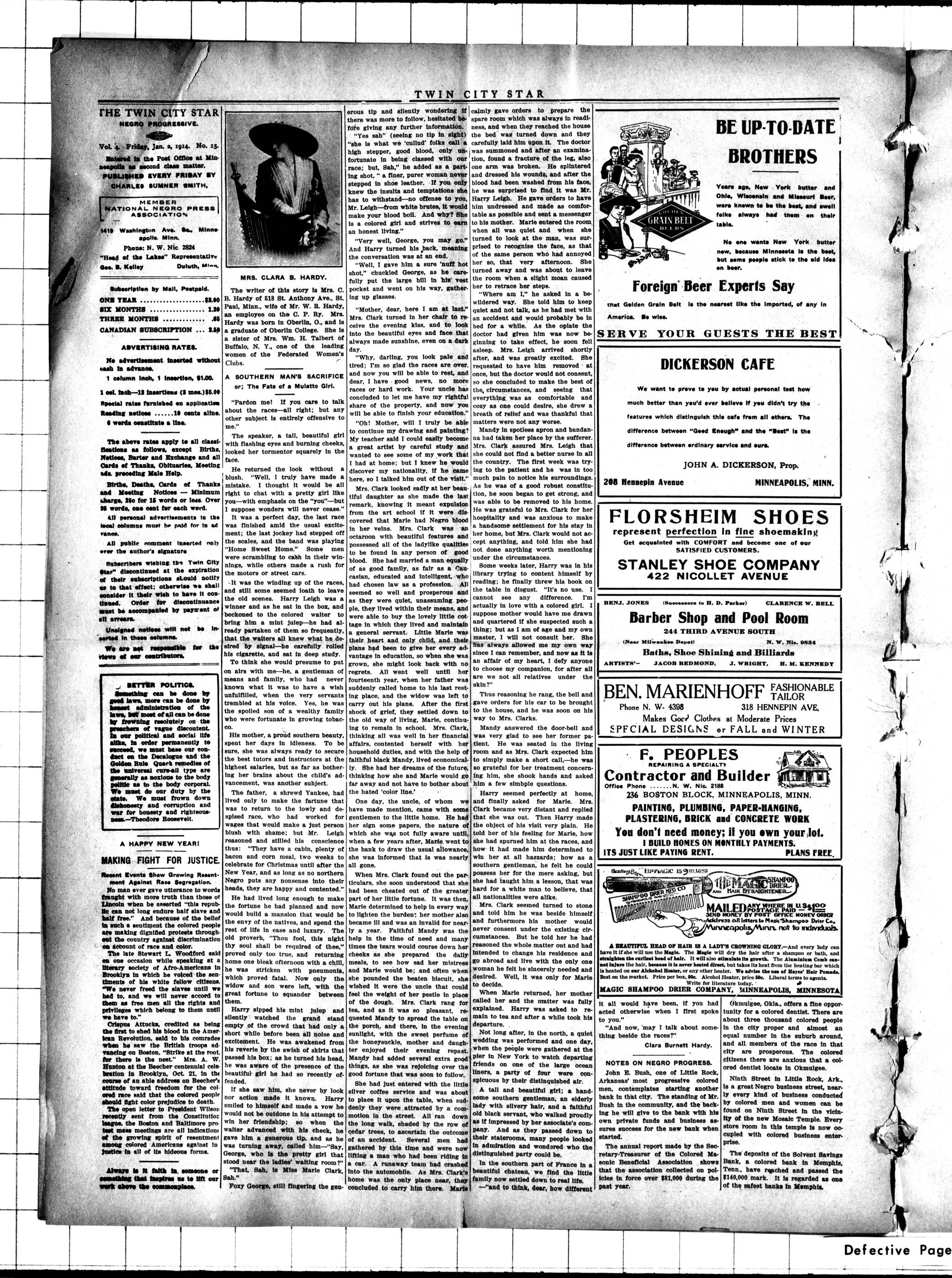
MRS. CLARA B. HARDY.
The writer of this story is Mrs. C.
B. Hardy of 618 St. Anthony Ave., St.
Paul, Minn., wife of Mr. W. R. Hardy,
an employee on the C. P. Ry. Mrs.
Hardy was born in Oberlin, O., and is
a graduate of Oberlin College. She is
a sister of Mrs. Wm. H. Talbert of
Buffalo, N. Y., one of the leading
women of the Federated Women's
‘Clubs. cr
A SOUTHERN MAN'S SACRIFICE
or; The Fate of a Mulatto Girl.
“Pardon me! If you care to talk
about the races—all right; but any
other subject is entirely offensive to
me.”
‘The speaker, a tall, beautiful girl
with flashing eyes and burning cheeks,
looked her tormentor squarely in the
tace.
He returned the look without a
blush, “Well, I truly have made a
mistake. I thought it would be all
right to chat with a pretty girl Itke
you—with emphasis on the “you"—but
I suppose wonders will never cease.”
It was a perfect day, the last race
was finished amid the usual excite-
ment; the last jockey had stepped off
the scales, and the band was playing
“Home Sweet Home.” Some men
were scrambling to cash in their win-
nings, while others made a rush for
the motors or street cars.
It was the winding up of the races,
and still some seemed loath to leave
the old scenes. Harry Leigh was a
winner and as he sat in the box, and
Deckoned to the colored waiter to
bring him a mint julep—he had al-
ready partaken of them so frequently,
that the waiters all knew what he de-
‘sired by signal—he carefully rolled
his cigarette, and sat in deep study.
To think she would presume to put
on airs with me—he, a gentleman of
means and family, who had never
known what it was to have a wish
unfulfilled, when the very servants
trembled at his voice. Yes, he was
the spoiled son of a wealthy family
who were fortunate in growing tobac-
co.
His mother, a proud southern beauty,
spent her days in idleness. To be
sure, she was always ready to secure
the best tutors and instructors at the
highest salaries, but as far as bother-
ing her brains about the child's ad-
vancement, was another subject.
‘The father, a shrewd Yankee, had
lived only to make the fartune that
was to return to the lowly and de-
spised race, who had worked for
wages that would make a just person
blush with shame; but Mr. Leigh
Teasoned and stilled his conscience
thus: “They have a cabin, plenty of
bacon and corn meal, two weeks to
celebrate for Christmas until after the
‘New Year, and as long as no northern
Negro puts any nonsense into their
heads, they are happy and contented.”
He had lived long enough to make
the fortune he had planned and now
would bufld a mansion that would be
the envy of the natives, and spend the
Test of life in ease and luxury. The
old proverb, “Thou fool, this night
thy soul shall be required of thee,”
proved only too true, and returning
home one bleak ofternoon with a chill,
he was stricken with pneumonia,
which proved fatal. Now only the
widow and son were left, with the
great fortune to squander between
them.
Harry sipped his mint julep and
silently watched the grand stand
empty of the crowd that had only a
short while before been all noise and
excitement. He was awakened from
his reverie by the swish of skirts that
passed his box; as he turned his head,
he was aware of the presence of the
beautiful: girl he had so recently of-
fended.
It she saw him, she never by look
nor action made it known. Harry
smiled to himself and made a vow he
would not be outdone in his attempt to
win her friendship; so when the
waiter advanced with his check, he
gave him @ generous tip, and as he
was turning away, called him—"Say,
George, who is the pretty girl that
stood near the ladies’ waiting room?”
“That, Sah, is Miss Marie Clark,
Sah,”
Foxy George, still fingering the gen-
‘ei:
TWIN CITY STAR
there was more to follow, hesitated be
fofe giving any further information.
“yes sah” (seeing no tip in aight)
“she is what we ‘cullud’ folks eall
nigh stepper, good blood, only uit
fortunate in being classed with our
race; but, Sah,” he added as a part-
ing shot, “a finer, purer woman <
stepped in shoe leather. If you
new the insults and temptations she
has to withstand—no offense to you,
Mr. Leigh—from white brutes, it would
make your blood boil. And why? She
is a colored girl and strives to earn
an honest living.”
“Very well, George, you may go.”
And Harry turned his pack, meaning
the conversation was at an end.
“Well, I gave him a sure ‘nuff hot
shot,” chuckled George, as he care
fully put the large bill in his’ vest
pocket and went on his way, gather-
ing up glasses.
“Mother, dear, here I am at last”
Mrs. Clark turned in her chair to re-
celve the evening kiss, and to look
into the beautiful eyes and face that
always made sunshine, even on a dark
day.
“Why, darling, you look pale and
tired; I'm so glad the races are over,
and now you will be able to rest, and
dear, I have . good news, no more
races or hard work. Your uncle has
concluded to let me have my rightfu
share of the property, and now you
will be able to finish your education.”
“Oh! Mother, will I truly be able
to continue my drawing and painting?
My teacher said I could easily become
a great artist by careful study and
wanted to see some of my work that
Thad at home; but I knew he would
discover my nationality, if he came
here, so I talked him out of the visit.”
‘Mrs. Clark looked sadly at her beau-
tiful daughter as she made the last
remark, knowing it meant expulsion
from the art school if it were dis
covered that Marie had Negro blood
in her veins. Mrs. Clark was an
octaroon with beautiful features and
possessed all of the ladylike qualities
to be found in any person of good
blood. She had married a man equally
of as good family, as fair as a Cau
casian, educated and intelligent, -whc
had chosen law as a profession. All
seemed so well and prosperous and
as they were quiet, unassuming. peo
ple, they lived within their means, and
were able to buy the lovely little cot
tage in which they lived and maintain
a general servant. Little Marie was
their heart and only child, and thete
plans had been to give her every ad-
vantage in education, so when she was
grown, she might look back with no
regrets. All went well until her
fourteenth year, when her father was
suddenly called home to his last rest-
ing place, and the widow was left to
carry out his plans. After the first
shock of grief, they settled down to
the old way of living, Marie, continu-
ing to remain in school. Mrs. Clark,
thinking all was well in her financial
attairs, contented herself with her
household duties, and with the help of
faithful black Mandy, lived economical
ly. She had her dreams of the future,
thinking how she and Marie would ge
tar away and not have to bother about
the hated ‘color line.”
One day, the uncle, of whom we
have made mention, came with some
gentlemen to the little home. He had
her sign some papers, the nature of
which she was not fully aware until,
when a few years after, Marie went to
the bank to draw the usual allowance,
she was informed that is was nearly
all gone.
‘When Mrs. Clark found out the par-
ticulars, she soon understood that she
had been cheated out of the greater
part of her little fortune. It was then,
Marie determined to help in every way
to lighten the burden; her mother also
became ill and was an invalid for near:
ly a year. Faithful Mandy was the
help in the time of need and many
times the tears would course down her
cheeks as she prepared the daily
meals, to see how sad her mistress
and Marie would be; and often when
she pounded the beaten biscuit, she
wished it were the uncle that could
feel the weight of her pestle in place
of the dough. Mrs. Clark rang for
tea, and as it was so pleasant, re
quested Mandy to spread the table on
the porch, and there, in the evening
sunlight, with the sweet perfume of
the honeysuckle, mother and daugh-
ter enjoyed their evening repast.
Mandy had added several extra good
Chings, an she wie reteleiue over tam
spare room which was always in readi-
ness, and when they reached the house
the bed wad turned down and they
carefully laid him upon it. The doctor
was summoned and after an examina-
tion, found a fracture of the leg, also
one arm was broken, He splintered
and dressed his wounds, and after the
vlood had been washed from his tace,
he was surprised to find it was Mr.
Harry Leigh. He gave orders to have
him undressed and made as comfor-
table as possible and sent a messenger
to his mother. Marle entered the room
when all was quiet and when she
turned to look at the man, was sur-
prised to recognize the face, as that
of the same person who had annoyed
her so, that very afternoon. She
turned away and was about to leave
the room when a slight moan caused
her to retrace her steps.
“Where am I,” he asked in a be-
wildered way. She told him to keep
quiet and not talk, as he had met with
an aceldent and would probably be in
bed for a while. As the opiate the
doctor had given him was now be-
sinning to take effect, he soon fell
asleep. Mrs. Lelgh arrived shortly
after, and was greatly excited. She
requested to have him removed * at
once, but the doctor would not consent,
so she concluded to make the best of
the, clreumstances, and seeing that
everything was as comfortable and
cory as one could desire, she drew a
breath of relief and was thankful that
matters were not any worse.
Mandy in spotless apron and bandan-
na had taken Ker place by the sufferer.
Mrs, Clark assured Mrs, Leigh that
she could not find a better nurse in all
the country. The first week was try.
{ing to the patient and he was in too
much pain to notice his surroundings
‘As he was of a good robust constitu
tion, he soon began to get strong, and
was able to be removed to his home.
He was grateful to Mrs. Clark for her
hospitality and was anxious to make
a handsome settlement for his stay in
her home, but Mrs. Clark would not ae-
cept anything, and told him she had
not done anything worth mentioning
under the circumstances.
Some weeks later, Harry was in his
Ubrary trying to content himself by
reading; he finally threw his book on
the table in disgust. “It's no use. 1
cannot see any difference. I'm
actually in love with a colored girl. I
suppose mother would have me drawn
and quartered if she suspected such a
thing; but as I am of age and my own
master, I will not consult her. She
Was" always allowed me my own way
since I can remember, and now as it is
an affair of my heart, I defy anyone
to choose my companion, for after all
fare we not all relatives under the
skin?”
‘Thus reasoning he rang, the bell and
gave orders for his car to be brought
to the house, and he was soon on his
way to Mrs, Clarks.
Mandy answered the door-bell and
was very glad to see her former pa.
tlent. He was seated in the living
room and as Mrs. Clark expected him
to simply make a short call—he was
so grateful for her treatment concern:
ing him, she shook hands and asked
him a few stmbple questions.
Harry seemed perfectly at home,
and finally asked for Marle. Mrs
Clark became very distant and replied
that she was out. ‘Then Harry made
the object of his visit very plain. He
told her of his feeling for Marle, how
she had spurned him at the races, and
how ft had made him determined to
win her at all haszards; how as a
southern gentleman, he felt he could
possess her for the mere asking, but
she had taught him a lesson, that was
hard for a white man to believe, that
all nationalities were alike.
Mrs. Clark seemed turned to stone
and told him he was beside himself
and furthermore his mother would
never consent under the existing cir-
cumstances. But he told her he had
reasoned the whole matter out and had
Intended to change his residence and
g0 abroad and live with the only one
woman he felt he'sincerely needed and
desired. Well, it was only for Marle
to decide.
When Marie returned, ‘her mother
called her and the matter was fully
explained. Harry was asked to re-
main to tea and after a while took his
departure,
Not long after, in the north, a quiet
wedding was performed and one day,
when the people were gathered at the
pier in New York to watch departing
friends on one of the large ocean
aos BE UP-TO-DATE
Sis 'G,_, BROTHERS
LL ney Yours age, New York butter and
(Cos Le 11 Ohle, Wiecensin and Misseurl eer,
Ps Aa were knewn te be the best, and swell
A GRAIN BELT > i) always had them en their
an LS No ene wants New York butter
Se Tov seme pense sek te the ol tea
on beer.
‘ Foreign Beer Experts Say
mat Geiden Grain Belt is the nearest like the imported, of any in
America. Be wise.
SERVE YOUR GUESTS THE BEST
DICKERSON CAFE
‘We want te preve te yeu by actual personal test how
much better than yeu’d ever belleve If yeu didn’t try the
features which distinguish this cafe frem all ethers. The
difference between “Geed Eneugh” and the “Best” Is the
difference between erdinary service and eure.
JOHN A. DICKERSON, Prop. ‘
208 Hennepin Avenue MINNEAPOLIS, MINN.
——_—————
represent perfection in fine shoemaking
Get acquainted with COMFORT and become one of our
SATISFIED CUSTOMERS.
STANLEY SHOE COMPANY
422 NICOLLET AVENUE
| BENS. JONES — (Suocessors to H. D. Parker) CLARENCE W. BELL
Barber Shop and Pool Room
244 THIRD AVENUE SOUTH
(Near Milwaukee Depot) N. W, Nic. 9984
Baths, Shoe Shining and Billiards
ARTISTS’ JACOR REDMOND, J. WRIGHT, HL. M. KENNEDY
BEN. MARIENHOFF [faitor“2"=
] ° TAILOR
Phone N. W- 4398 318 HENNEPIN AVE,
Makes Goc? Clothes at Moderate Prices
SPFCIAL DESIGNS or FALL and WINTER
~F:PEOPLES 5-73
REPAIRING A SPECIALTY * s a
Contractor and Builder ¢CHWwW)
Office Phone .......N. W. Nic, 2188
236 BOSTON BLOCK, MINNEAPOLIS, MINN.
PAINTING, PLUMBING, PAPER-HANGING,
PLASTERING, BRICK and CONCRETE WORK
You don’t need money; if you ewn your lot. —
I BUILD HOMES ON MONTHLY PAYMENTS,
ITS JUST LIKE PAYING RENT. PLANS FREE,
Meoting Bay, LUPPUAGIC IS QIDLONG eee
Ee nn SHAMPOO
i gages aS) : > PAGO ree”
ae eon PE a STRAIGHTENER
Se Senn
co MAIL EDesemarenussqoc
(UIs ED Te ee
oi DF erase aller te Mask Shamnpae Drie Ce,
<2 apo hsMunn. not to individuals.
‘A BEAUTIFUL BEAD OF HAIR IS A LADY'S CROWNING GLORY.—And every Indy can|
have it if she will use the Mage. The Magle will dry the hair after a shampoo or bath, and
straighten the carlicat head of hair. Tt wil also etimulate ite growth. ‘The Aluminium Camb ean-|
not injure the hair, because it la never heated direct, but takes Its hent from the heating bar which|
is heated on eur Aichohol Heater, or any other heater. We advise the use of Hayes’ Halt Pomade,
Best on the market. Price per box, Se. Alcohol Heater, price 6c, Liberal terme to agenta,
‘Write for literature today. -
MAGIC SHAMPOO DRIER COMPANY, ‘%INNEAPOLIS, MINNESOTA|
mi
it all would have been, if you had| Okmulgee, Okla,, offers a fine oppor
acted otherwise when I first spoke| tunity for a colored dentist. There are
to you.” about three thousand colored people
“And now, ‘may I talk about some-|in the city proper and almost ar
thing beside the races?” equal number in the suburb around
Clara Burnett Hardy. |and all members of the race in that
" city are prosperous. The colores
NOTES ON NEGRO PROGREss. | Itizens there are anxious that a col
John E. Bush, one of Little Rock,
Arkansas’ most progressive colored
men, contemplates starting another
bank in that elty, ‘The standing of Mr.
Bush in the community, and the back-
ing he will give to the bank with his
own private funds and business as-
sures success for the new bank when
started.
‘The annual report made by the Sec
retary-Treasurer of the Colored Ma-
sonic Beneficial Association shows
that the association collected on pol-
foles in force over $81,000 during the
past year.
Okmulgee, Okla., offers a fine oppor-
tunity for a colored dentist. There are
about three thousand colored people
in the city proper and almost an
equal number in the suburb around,
and all members of the race in that
city are prosperous. The colored
citizens there are anxious that a col-
ored dentist locate in Okmulgee.
Ninth Street in Little Rock, Ark,
{s a great Negro business street, near
ly every kind of business conducted
by colored men and women can be
found on Ninth Street in the vicin-
ity of the new Mosaic Temple. Every
store room in this temple is now oc
eupled with colored business enter.
prise.
‘The deposits of the Solvent Savings
Bank, @ colored bank in Memphis,
Tenn., have reached and passed the
$140,000 mark. It is regarded as one
of the safest banks in Memphis,
Defective Page