Twin City Star
Saturday, October 17, 1914
Minneapolis, Minnesota
Page text (machine-generated)
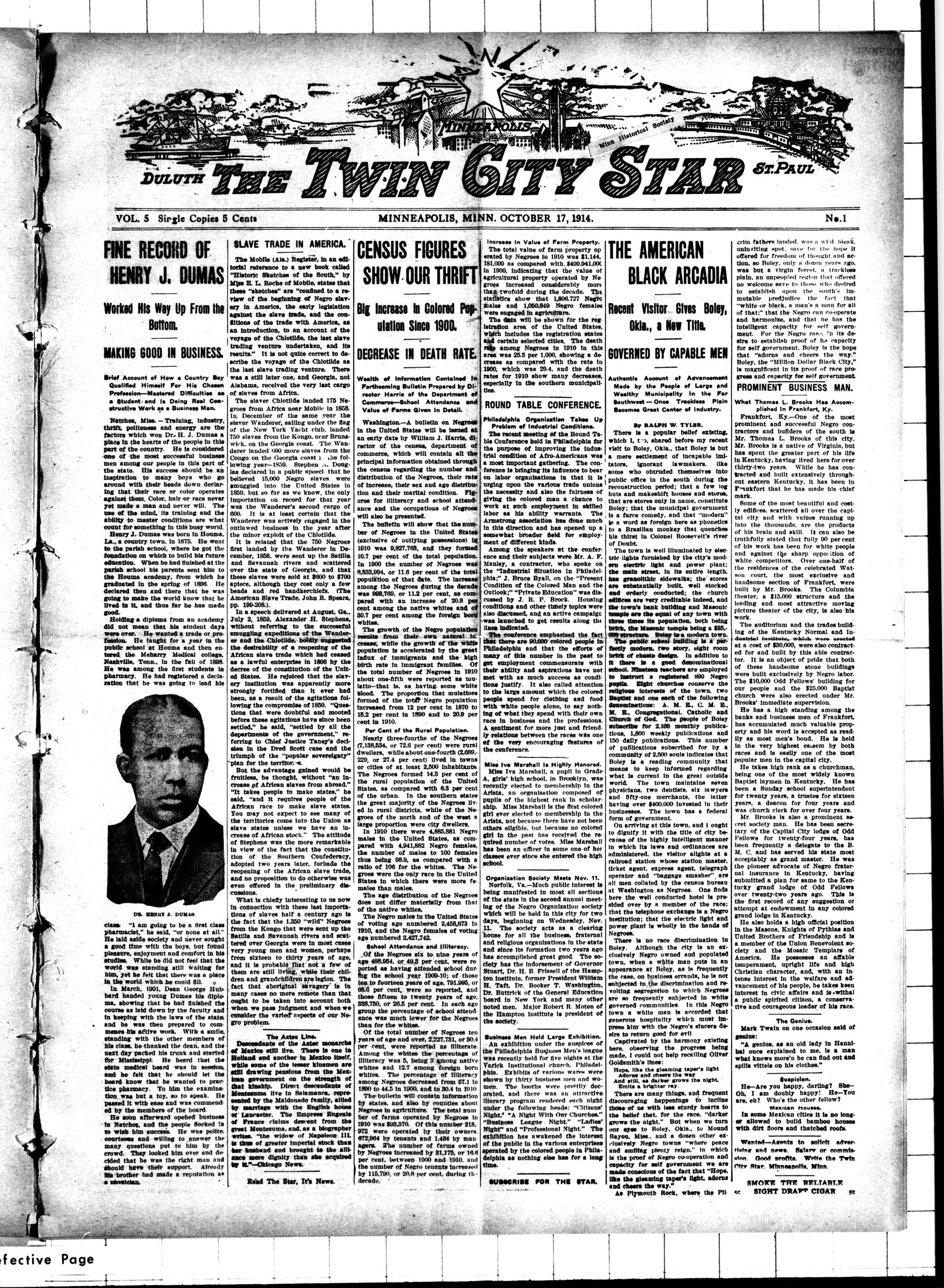
DULUTH THE TWIN CITY STAR ST.PAUL
fective Page
VOL. 5 Single Copies 5 Cents
FINE RECORD OF
HENRY J. DUMAS
Worked His Way Up From the
Bottom.
SLAVE
The Memorial ret
"Historic
Miss E. L.
these "sk
view of f
ery in A
against t
sitions o
an intro
voyage o
---
MAKING GOOD IN BUSINESS.
Brief Account of How a Country Boy Qualified Himself For His Chosen Profession—Mastered Difficulties as a Student and Is Doing Real Constructive Work as a Business Man.
Natches, Miss. — Training, industry, thrift, politeness and energy are the factors which won Dr. H. J. Dumas a place in the hearts of the people in this part of the country. He is considered one of the most successful business men among our people in this part of the state. His success should be an inspiration to many boys who go around with their heads down declaring that their race or color operates against them, Color, hair or race never yet made a man and never will. The use of the mind, its training and the ability to master conditions are what count for something in this busy world. Henry J. Dumas was born in Houma, La., a country town, in 1875. He went to the parish school, where he got the foundation on which to build his future education. When he had finished at the parish school his parents sent him to the Houma academy, from which he graduated in the spring of 1896. He declared then and there that he was going to make the world know that he lived in it, and thus far he has made good.
Holding a diploma from an academy did not mean that his student days were over. He wanted a trade or profession. He taught for a year in the public school at Houma and then entered the Meharry Medical college, Nashville, Tenn., in the fall of 1898. He was among the first students in pharmacy. He had registered a declaration that he was going to lead his
DR. HENRY J. DUMAS.
class. "I am going to be a first class pharmacist," he said, "or none at all."
He laid aside society and never sought a good time with the boys, but found pleasure, enjoyment and comfort in his studies. While he did not feel that the world was standing still waiting for him, yet he felt that there was a place in the world which he could fill.
In March, 1901, Dean George Hubbard handed young Dumas his diploma, showing that he had finished the course as laid down by the faculty and in keeping with the laws of the state and he was then prepared to commence his active work. With a smile, standing with the other members of his class, he thanked the dean, and the next day packed his trunk and started for Mississippi. He beard that the state medical board was in session, and he felt that he should let the board know that he wanted to practice pharmacy. To him the examination was but a toy, so to speak. He passed it with ease and was commended by the members of the board.
He soon afterward opened business in Natchez, and the people flocked to wish him success. He was polite, courteous and willing to answer the many questions put to him by the crowd. They looked him over and decided that he was the right man and should have their support. Already his brother had made a reputation as a physician.
SLAVE TRADE IN AMERICA.
The Mobile (Ala.) Register, in an editorial reference to a new book called "Historic Sketches of the South," by Miss E. L. Roche of Mobile, states that these "sketches" are "confined to a review of the beginning of Negro slavery in America, the early legislation against the slave trade, and the conditions of the trade with America, as an introduction, to an account of the voyage of the Chlotilde, the last slave trading venture undertaken, and its results." It is not quite correct to describe the voyage of the Chlotilde as the last slave trading venture. There was a still later one, and Georgia, not Alabama, received the very last cargo of slaves from Africa.
The slayer Chilotlide landed 175 Negroes from Africa near Mobile in 1858. In December of the same year the slayer Wanderer, sailing under the flag of the New York Yacht club, landed 750 slaves from the Kongo, near Brunswick, on the Georgia coast. The Wanderer landed 600 more slaves from the Congo on the Georgia coast in the following year-1859. Stephen N. Douglas declared in a public speech that he believed 15,000 Negro slaves were smuggled into the United States in 1859, but so far as we know, the only importation on record for that year was the Wanderer's second cargo of 600. It is at least certain that the Wanderer was actively engaged in the outlawed business in the year after the minor exploit of the Chilotlide. It is related that the 750 Negroes first landed by the Wanderer in December, 1858, were sent up the Satilla and Savannah rivers and scattered over the state of Georgia, and that these slaves were sold at $600 to $700 apiece, although they cost only a few beads and red handkerchiefs. (The American Slave Trade, John R. Spears, pp. 199-208.)
In a speech delivered at August, Ga., July 2, 1859, Alexander H. Stephens, without referring to the successful smuggling expeditions of the Wanderer and the Chlotlide, boldly suggested the desirability of a reopening of the African slave trade which had ceased as a lawful enterprise in 1808 by the decree of the constitution of the United States. He rejoiced that the slavery institution was apparently more strongly fortified than it ever had been, as a result of the agitations following the compromise of 1850. "Questions that were doubtful and mooted before these agitations have since been settled," he said, "settled by all the departments of the government," referring to Chief Justice Taney's decision in the Dred Scott case and the triumph of the "popular sovereignty" plan for the territories.
But the advantage gained would be frutless, he thought, without "an increase of African slaves from abroad." "It takes people to make states," he said, "and it requires people of the African race to make slave states. You may not expect to see many of the territories come into the Union as slave states unless we have an increase of African stock." The attitude of Stephens was the more remarkable in view of the fact that the constitution of the Southern Confederacy, adopted two years later, forbade the reopening of the African slave trade, and no proposition to do otherwise was even offered in the preliminary discussions.
What is chiefly interesting to us now in connection with these last importations of slaves half a century ago is the fact that the 1,350 "wild" Negroes from the Kongo that were sent up the Satilla and Savannah rivers and scattered over Georgia were in most cases very young men and women, perhaps from sixteen to thirty years of age, and it is probable that not a few of them are still living, while their children and grandchildren are legion. The fact that aboriginal savagery is in many cases no more remote than that ought to be taken into account both when we pass judgment and when we consider the varied aspects of our Negro problem.
The Aztec Line.
Descendants of the Astec monarchs of Mexico still live. There is one in Holland and another in Mexico itself, while some of the lesser kinsmen are still drawing pensions from the Mexican government on the strength of that kinshp. Direct descendants of Montesquia live in Salamanca, represented by the Maldonado family, allied by marriage with the English house of Lancaster. The Empress Eugenie of France claims descent from the great Montezuma, and, as a biographer writes, "the widow of Napoleon III is thus of greater imperial stock than her husband and brought to the alliance more dignity than she acquired by it."—Chicago News.
Read The Star, It's News.
MINNEAPOLIS, MINN. OCTOBER 17, 1914.
CENSUS FIGURES SHOW OUR THRIFT
DECREASE IN DEATH RATE.
Wealth of Information Contained In Fortheooming Bulletin Prepared by Director Harris of the Department of Commerce—School Attendance and Value of Farms Given In Detail.
Washington.—A bulletin on Negroes in the United States will be issued at an early date by William J. Harris, director of the census, department of commerce, which will contain all the principal information obtained through the census regarding the number and distribution of the Negroes, their rate of increase, their sex and age distribution and their marital condition. Figures for illiteracy and school attendance and the occupations of Negroes will also be presented.
The bulletin will show that the number of Negroes in the United States (exclusive of outlying possessions) in 1910 was 9,827,763, and they formed 10.7 per cent of the total population. In 1900 the number of Negroes was 8,833,994, or 11.6 per cent of the total population of that date. The increase among the Negroes during the decade was 983,769, or 11.2 per cent, as compared with an increase of 20.8 per cent among the native whites and of 30.7 per cent among the foreign born whites.
The growth of the Negro population results from their own natural increase, while the growth of the white population is accelerated by the great influx of immigrants and the high birth rate in immigrant families. Of the total number of Negroes in 1910 about one-fifth were reported as mulatto—that is, as having some white blood. The proportion that mulattoes formed of the total Negro population increased from 12 per cent in 1870 to 15.2 per cent in 1890 and to 20.9 per cent in 1910.
Per Cent of the Rural Population.
Nearly three-fourths of the Negroes (7,138,534, or 72.6 per cent) were rural dwellers, while about one-fourth (2,689,229, or 27.4 per cent) lived in towns or cities of at least 2,500 inhabitants. The Negroes formed 14.5 per cent of the rural population of the United States, as compared with 6.3 per cent of the urban. In the southern states the great majority of the Negroes lived in rural districts, while of the Negroes of the north and of the west a large proportion were city dwellers. In 1910 there were 4,885,881 Negro males in the United States, as compared with 4,941,882 Negro females, the number of males to 100 females thus being 98.9, as compared with a ratio of 106 for the whites. The Negroes were the only race in the United States in which there were more females than males. The age distribution of the Negroes does not differ materially from that of the native whites. The Negro males in the United States of voting age numbered 2,458,873 in 1910, and the Negro females of voting age numbered 2,427,742.
School Attendance and Illiteracy. Of the Negroes six to nine years of age 488,954, or 49.3 per cent, were reported as having attended school during the school year 1909-10; of those ten to fourteen years of age, 791,995, or 89.6 per cent, were so reported, and those fifteen to twenty years of age, 388,750, or 26.5 per cent. In each age group the percentage of school attendance was much lower for the Negroes than for the whites. Of the total number of Negroes ten years of age and over, 2,227,731, or 30.4 per cent, were reported as illiterate. Among the whites the percentage of illiteracy was 5, being 3 among native whites and 12.7 among foreign born whites. The percentage of illiteracy among Negroes decreased from 57.1 in 1800 to 44.5 in 1900, and to 30.4 in 1910. The bulletin will contain information by states, and also by counties about Negroes in agriculture. The total number of farms operated by Negroes in 1910 was $83,370. Of this number 218,972 were operated by their owners. 672,964 by tenants and 1,434 by managers. The number of farms owned by Negroes increased by 81,175, or 16.6 per cent, between 1900 and 1910, and the number of Negro tenants increased by 115,790, or 20.8 per cent, during the decade.
Increase in Value of Farm Property.
The total value of farm property operated by Negroes in 1910 was $1,144,181,000 as compared with $499,941,000 in 1900, indicating that the value of agricultural property operated by Negroes increased considerably more than twofold during the decade. The statistics show that 1,906,727 Negro males and 1,060,849 Negro females were engaged in agriculture. The data will be shown for the registration area of the United States, which includes the registration states and certain selected cities. The death rate among Negroes in 1910 in this area was 25.5 per 1,000, showing a decrease as compared with the rate in 1900, which was 29.4. and the death rates for 1910 show many decreases, especially in the southern municipalities.
ROUND TABLE CONFERENCE.
Philadelphia Organization Takes Up
Problem of Industrial Conditions. The recent meeting of the Round Table Conference held in Philadelphia for the purpose of improving the industrial condition of Afro-Americans was a most important gathering. The conference is bringing its influence to bear on labor organizations in that it is urging upon the various trade unions the necessity and also the fairness of giving the colored man a chance to work at such employment in skilled labor as his ability warrants. The Armstrong association has done much in this direction and has opened up a somewhat broader field for employment of different kinds. Among the speakers at the conference and their subjects were Mr. A. F. Manley, a contractor, who spoke on the "Industrial Situation In Philadelphia;" J. Bruce Byall, on the "Present Condition of the Colored Man and the Outlook;" "Private Education" was discussed by J. R. P. Brock. Housing conditions and other timely topics were also discussed, and an active campaign was launched to get results along the lines indicated.
The conference emphasized the fact that there are 90,000 colored people in Philadelphia and that the efforts of many of this number in the past to get employment commensurate with their ability and aspirations have not met with as much success as conditions justify. It also called attention to the large amount which the colored people spend for clothing and food with white people alone, to say nothing of what they spend with their own race in business and the professions. A sentiment for more just and friendly relations between the races was one of the very encouraging features of the conference.
Miss Iva Marshall is Highly Honored. Miss Iva Marshall, a pupil in Grade A, girls' high school, in Brooklyn, was recently elected to membership in the Arista, an organization composed of pupils of the highest rank in scholarship. Miss Marshall is the first colored girl ever elected to membership in the Arista, not because there have not been others eligible, but because no colored girl in the past has received the required number of votes. Miss Marshall has been an officer in some one of her classes ever since she entered the high school.
Organization Society Meets Nov. 11.
Norfolk, Va.—Much public interest is being manifested in most all sections of the state in the second annual meeting of the Negro Organization society which will be held in this city for two days, beginning on Wednesday. Nov. 11. The society acts as a clearing house for all the business, fraternal and religious organizations in the state and since its formation two years ago has accomplished great good. The society has the endorsement of Governor Stuart, Dr. H. B. Frissell of the Hampton institute, former President William H. Taft, Dr. Booker T. Washington, Dr. Buttrick of the General Education board in New York and many other noted men. Major Robert R. Moton of the Hampton institute is president of the society.
Business Men Hold Large Exhibition.
An exhibition under the auspices of the Philadelphia Business Men's league was recently held for five nights at the Varkich Institutional church. Philadelphia. Exhibits of various wares were shown by thirty business men and women. The booths were pretty decorated, and there was an attractive literary program rendered each night under the following heads: "Citizens' Night," "A Night With Our Churches," "Business League Night," "Ladies' Night" and "Professional Night." The exhibition has awakened the interest of the public in the various enterprises operated by the colored people in Philadelphia as nothing else is a long time.
SUBSCRIBE FOR THE STAR.
THE AMERICAN BLACK ARCADIA
Authentic Account of Advancement Made by the People of Large and Wealthy Municipality In the Far Southwest — Once Trackless Plain Becomes Great Center of Industry.
By RALPH W. TYLER.
There is a popular belief existing, which I, to, shared before my recent visit to Boley, Okla., that Boley is but a mere settlement of incapable imitators, ignorant lawmakers, like some who obtruded themselves into public office in the south during the reconstruction period; that a few log huts and makehift houses and stores, that are stores only in name, constitute Boley; that the municipal government is a farce comedy, and that "modern" is a word as foreign here as phonetics to a Brazilian monkey that quenches his thirst in Colonel Roosevelt's river of Doubt.
The town is well illuminated by electric lights furnished by the city's modern electric light and power plant; the main street. in its entire length, has granitoclastic sidewalks; the stores are substantially built, well stocked and orderly conducted; the church edifices are very creditable indeed, and the town's bank building and Masonic temple are the equal of any town with three times its population, both being brick, the Masonic temple being a $35,000 structure. Boley is a modern town. The public school building is a perfectly modern, two story, eight room brick of chateau design. In addition to it there is a good denominational school. Nineteen teachers are employed to instruct a registered 890 Negro pupils. Eight churches conserve the religious interests of the town. two Baptist and one each of the following denominations: A. M. E., C. M. E., M. E., Congregational, Catholic and Church of God. The people of Boley subscribe for 2,100 monthly publications, 1,800 weekly publications and 150 daily publications. This number of publications subscribed for by a community of 2,500 souls indicates that Boley is a reading community that means to keep informed regarding what is current in the great outside world. The town maintains seven physicians, two dentists, six lawyers and fifty-one merchants, the latter having over $400,000 invested in their businesses. The town has a federal form of government.
On arriving at this town, and I ought to dignify it with the title of city because of the highly intelligent manner in which its laws and ordinances are administered, the visitor alights at a railroad station whose station master, ticket agent, express agent, telegraph operator and "baggage smasher" are all men collated by the census bureau at Washington as Negroes. One finds here the well conducted hotel is presided over by a member of the race: that the telephone exchange is a Negro institution; that the electric light and power plant is wholly in the hands of Negroes.
There is no race discrimination in Boley. Although the city is an exclusively Negro owned and populated town, when a white man puts in an appearance at Boley, as is frequently the case, on business errands, he is not subjected to the discrimination and revolting segregation to which Negroes are so frequently subjected in white governed communities. In this Negro town a white man is accorded that generous hospitality which must impress him with the Negro's sincere desire to return good for evil
Captivated by the harmony existing here, observing the progress being made, I could not help recalling Oliver Goldsmith's lines:
Hope, like the gleaming taper's light
Adorns and cheers the way
And still, as darker grows the night,
Emits a brighter ray.
There are many things, and frequent discouraging happenings to incline those of us with less sturdy hearts to the belief that, for the race, "darker grows the night." But when we turn our eyes to Boley, Okta, to Mound Bayon, Miss., and a dozen other exclusively Negro towns "where peace and smiling plenty reign," in which is the proof of Negro co-operation and capacity for self government we are made conscious of the fact that "Hope, like the gleaming taper's light, adorns and cheers the way."
As Plymouth Rock, where the Pil
No.1
grim fathers linded, was a wild bleak, uninviting spot, save for the hope it offered for freedom of thought and action, so Boley, only a dozen years ago, was but a virgin forest, a trackless plain, an unpeopled region that offered no welcome save to those who desired to establish upon the south's immutable predjudice the fact that "white or black, a man's a man for all of that;" that the Negro can co-operate and harmonize, and that he has the intelligent capacity for self government. For the Negro race, "in its desire to establish proof of his capacity for self government. Boley is the hope that "adorns and cheers the way." Boley, the "Million Dollar Black City," is magnificent in its proof of race progress and capacity for self government.
PROMINENT BUSINESS MAN.
What Thomas L. Brooks Has Accomplished In Frankfort, Ky.
Frankfort, Ky.—One of the most prominent and successful Negro contractors and builfers of the south is Mr. Thomas L. Brooks of this city. Mr. Brooks is a native of Virginia, but has spent the greater part of his life in Kentucky, having lived here for over thirty-two years. While he has contracted and built extensively throughout eastern Kentucky, it has been in Frankfort that he has made his chief mark.
Some of the most beautiful and costly edifices, scattered all over the capital city and with values running up into the thousands, are the products of his brain and skill. It can also be truthfully stated that fully 90 per cent of his work has been for white people and against the sharp opposition of white competitors. Over one-half of the residences of the celebrated Watson court, the most exclusive and handsome section of Frankfort, were built by Mr. Brooks. The Columbia theater, a $15,000 structure and the leading and most attractive moving picture theater of the city, is also his work.
The auditorium and the trades building of the Kentucky Normal and Industrial institute, which were erected at a cost of $30,000, were also contracted for and built by this able contractor. It is an object of pride that both of these handsome stone buildings were built exclusively by Negro labor. The $10,000 Odd Fellows' building for our people and the $25,000 Baptist church were also erected under Mr. Brooks' immediate supervision.
He has a high standing among the banks and business men of Frankfort, has accumulated much valuable property and his word is accepted as readily as most men's bond. He is held in the very highest escem by both races and is easily one of the most popular men in the capital city.
He takes high rank as a churchman, being one of the most widely known Baptist laymen in Kentucky. He has been a Sunday school superintendent for twenty years, a trustee for sixteen years, a deacon for four years and was church clerk for over four years. Mr. Brooks is also a prominent secret society man. He has been secretary of the Capital City lodge of Odd Fellows for twenty-four years, has been frequently a delegate to the B. M. C, and has served his state most acceptably as grand master. He was the pioneer advocate of Negro fraternal insurance in Kentucky, having submitted a plan for same to the Kentucky grand lodge of Odd Fellows over twenty-two years ago. This is the first record of any suggestion or attempt at endowment in any colored grand lodge in Kentucky. He also holds a high official position in the Masons, Knights of Pythias and United Brothers of Friendship and is a member of the Union Benevolent society and the Mosaic Templars of America. He possesses an affable temperament, upright life and high Christian character, and, with an intense interest in the welfare and advancement of his people, he takes keen interest in civic affairs and is within a public spirited citizen, a conservative and courageous leader of his race.
The Genius.
Mark Twain on one occasion said of genius:
"A genius, as an old lady in Hannibal once explained to me, is a man what knows more'n he can find out and spills vittels on his clothes."
$uspicolon
He—Are you happy, darling? She—Oh, I am doubly happy! He—You are, eh? Who's the other fellow?
Mexican Houses.
In some Mexican cities it is no longer allowed to build bamboo houses with dirt floors and thatched roofs.
Wanted—Agents to solicit advertising and news. Salary or commission. Good profits. Write the Twin City Star. Minneapolis, Minn.
SMOKE THE RELIABLE
SIGHT DRAFT CIGAR
LOOK! We are going to the
GRAND ENTERTAINMENT
Given under the auspices of
ST. ANTHONY LODGE NO. 2877
AT MASONIC HALL,
24th Street and 5th Ave. So., Minneapolis
THURSDAY EVENING, NOV. 5TH, 1914.
Progressive Whist from 8 Until 10 P. M., Beginning at 8 o'clock sharp.
There Will be Two Prizes, 1st and Booby. Nothing Under 10 to Win the Booby.
Dancing from 10 P. M. Until 12:30.
Music Will be Rendered by Prof. Clarence Johnson.
REFRESHMENTS WILL BE SERVED
ADMISSION 35 CENTS.
COME OUT AND HAVE A NICE TIME
COMMITTEE:
P. E. Hart, Chairman; J. W. Harper, Jr., Jno. W. Harper, Sr., W.
Lattimore, Clay Williams, Chas. Sexton, A. J. Evans,
Geo. Peale, Geo. Banks, J. Withers.
HERE WE ARE AGAIN!
THE 2ND MONTHLY DANCE WILL BE GIVEN BY
CASON BROS. ORCHESTRA
Monday Evening, Nov. 16, 1914 at
MASONIC HALL, 24th ST. AND 5th AVE. SO. MINNEAPOLIS
Come Out And Enjoy a Real Sociable Evening.
Music For All Latest Dances.
T. E. CASON T. F. STEVENS EARL C. CASON
Manager Leader Asst. Manager
ADMISSION 35c.
NEGRO VOTERS LEAGUE OF HENNEPIN COUNTY at KNIGHTS OF PYTHIAS HALL
8th Ave. So. and 4th St., Minneapolis
THURSDAY EVENING, OCTOBER 29, 1914 at 8 P. M.
The following speakers will appear:
HON. GEO. R. SMITH and ATT'Y THOS. D. SCHALL
Candidates for Congress
JUDGES JOHN H. STEEBLE DANIEL J. JOSEPH W. MOLYNEAUX
Candidates for re-election to the District Bench
JUDGE W. W. BARDWELL
For re-election Municipal Bench
MAYOR WALLACE G. NIVE. COUNTY AUTOBY JAMES ROBERTSON
Candidates for re-election
ATTORNEY O. M. PEABODY—For Probate Judge
SHERIFF OTTO S. LANGUM—For Re-election
DR. WALTER WILLIAMS—For Coroner
REP. E. J. WESTLAKE—For Senate
HON. THOS. KNEELAND, HON. ADOLPH W. HERDER
Candidates for Legislature
HON. GEO. V. MERRIL L—For City Treasurer
HON. HARRY DOWNS—Councilman 8th Ward
ALBERT BASTIS, ESQ.—For Councilman 6th Ward
GOOD MUSIC
REFRESHMENT
ST. PETER'S A. M. E. CHURCH.
22nd St. near 10th Ave. So.
Rev. Thos. B. Stovall, Pastor.
Rev. T. W. Lewis, P. E., will preach morning and evening.
Class at 12 M.
Paid Advertisement
Prepared for F. C. Stevens by P. K.
Giffillan, 601 Lincoln Ave., St. Paul
for which $6.00 is to be paid.
Rev. Edwards of St. James A. M. E. Church will preach at 3 o'clock. The Lord's Supper will be served by the Presiding Elder, assisted by the visiting ministers. The Choir will furnish music at every service. All services on time. Comel and be happy with us to the Glory of God.
ST, JAMES A. M. E. CHURCH,
Rep. Westlake will speak Sunday
night on "Goodness by Legislation."
Mr. Thomas O. Rogers, an old railroad employee has proven up his claim at Plaza, N. D. which he drew in the land drawing. Tom has 100 acres for which he refused $3,500. He made a good crop this year, 500 bushels of wheat and 200 bushels of flax. He has returned to St. Paul, where he has located his family at 273 St. Anthony Ave. The railroad boys will be glad to hear of "Tom's" success.
Mrs. Shedd Lawrence has returned from an Eastern trip.
Mrs. Geo. W. Duckett is home again after spending a while in Canada, visiting relatives.
Mrs. Victoria Clay-Haley of St. Louis, was entertained at dinner by Mr. and Mrs. Jose H. Sherwood, 971 St. Anthony Ave., on Oct. 11th.
Mr. Clarence Cameron White the celebrated violinist was the house guest of Mr. and Mrs. J. H. Sherwood of St. Anthony Ave. while in the city, He appeared in recital at St. James Church to a good audience and greatly pleased his hearers.
Mrs. Marie Taylor has moved from St. Albans St. to 553 Rondo St.
Mr. and Mrs. James R. Charleston have moved to 408 Cathedral Place.
A FOOTBALL STAR.
Steve Hopkins, was the attraction of the football game on Wednesday, between Mechanic Arts and Johnson High. School. football teams at Lexington Park. Hopkins is one of the coming Negro football stars and is a master of the game.
Mr. John M. La Coste returned Monday from a ten day's hunting trip around Aberdeen, S. D., he had a reward of 65 ducks.
Mr. and Mrs. C. W. Hawkins have moved to 556 7th Ave. No.
Mr. Geo. W. Clawson of Enderlin, N. D., has returned from Chicago, where he went to visit his sister-in-law, Lucy Williams of Baltimore, Md. She is visiting him at Enderlin. Mr. Clawson is employed on one of the official cars of the Soo Ry.
Mr. Samuel Brassfield has moved to Anoka.
Remember the Odd Fellows,
Massonic Hall, Nov. 6th.
Prepared for F. C. Stevens by P. K. Giffillan, 601 Lincoln Ave., St. Paul, for which $6.00 is to be paid.
1424
HON. FREDERICK C. STEVENS.
FOR EFFICIENCY
FREDERICK C. STEVENS
for
CONGRESS
Candidate for Re-Election.
THE FRIEND OF OUR PEOPLE.
Mrs. Chas. Sumner Smith arrived home last Sunday after a visit to her mother and relatives in Boston, where she was very ill since August, and is rapidly improving.
There will be a Union Service of the B. Y. P. U's. of Pilgrim Baptist Church of St. Paul and Bethesda Baptist Church, Minneapolis on Sunday evening, Oct. 25th at Bethesda Church. The program includes "A Paper" by Miss Lillian Gould, "Bass Solo", Mr. Earl Walker; Addresses by Rev. D. E. Beasley and M. A. Bolling. Refreshments will be served after service. Program promptly at 6:30 P. M.
Mrs. E. B. Thornton who has been visiting in Anoka will be the guest of Mrs. Kinslow, 2316 5th Ave. So., for a few weeks before returning to St Louis.
Mrs. Fannie Casey, sister of Mrs. John Monroe died this week at City Hospital. She had ill several weeks.
For Rent—Nice furnished Front Room, modern conveniences, hot water and heat, one block from Chicago Ave. Line. Call at 3920 Elliott Ave So.—(Advertisement.) FURNISHED ROOM—Cheap rent, near car line, comfortable and convenient. Call at 1522 5th St. So., Minneapolis. Mrs. A. G. Charleston. MARRIAGE NOTICE. Mr. Geo Peale and Mrs. Eller Scott were quietly married by Rev T. J. Carter Oct. 20th in the parlor of Bethesda Baptist Church, 1120 8th St. So., in the presence of a few of her friends.
---
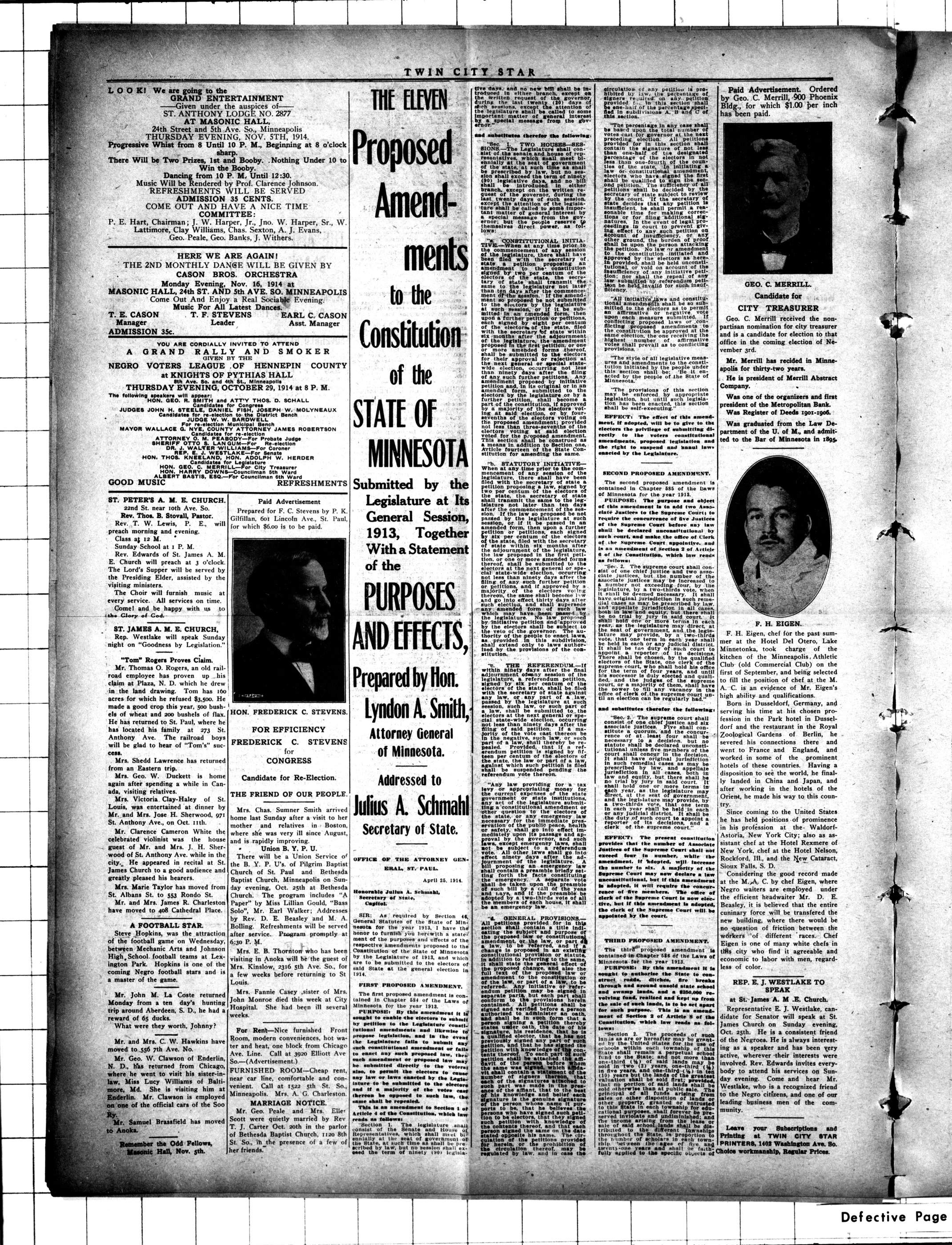
THE ELEVEN five days, and no one produced in either the written request during the last such sessions, except the legislature shall important matter of by a special messa error.
Proposed Amend-
ments to the Constitution of the STATE OF MINNESOTA
Submitted by the Legislature at Its General Session, 1913, Together With a Statement of the
PURPOSES AND EFFECTS,
Prepared by Hon.
Lyndon A. Smith,
Attorney General
of Minnesota.
Addressed to Julius A. Schmahl Secretary of State.
OFFICE OF THE ATTORNEY GENERAL, ST. PAUL.
Honorable Julian A. Schmhl,
Secretary of State,
Capitol.
SIR: As required by Section 46,
General Statutes of the State of Minnesota for the year 1913. I have the permission you herewith a statement of the purposes and effects of the respective amendments proposed to the Constitution of the State of Minnesota by the Legislature of 1913, and which are to be submitted to the electors of said State at the general election in 1914.
FIRST PROPOSED AMENDMENT.
The first proposed amendment is contained in Chapter 584 of the Laws of Minnesota for the year 1913.
PURPOSE: By this amendment it is sought to enable the electors to submit by petition to the Legislature constitutional amendments and likewise to propose legalization, and in the event the Legislature fails to submit any amendment or fails to enact any such proposed law, then such amendment or proposed law may be submitted directly to the voters also, to permit the electors to cause any law or laws enacted by the Legislature to be submitted to the electors and if a majority of the votes cast thereon be opposed to such law, the same shall be repealed.
This is an amendment to Section 1 of Article 4 of the Constitution, which law reads as follows:
"Section 1. The legislature shall consist of the Senate and House of Representatives, which shall meet be ennially at the seat of government of the State, at such time as shall be prescribed by law, but no session shall exceed the term of ninety (90) legisl-
tive days, and no new bill shall be introduced in either branch, except on war time, the request of the governor, during the war twenty (20) days such sessions, except the attention of the legislature shall be called to some important matter of general interest, special message from the governor.
and substitutes therefor the following:
"Sec. 1. TWO HOUSES-SESSIONS.—The Legislature shall constitute a senate and house of representatives, alternately at the seat of government of the state, at such time as shall be required, and at such time as shall exceed the term of ninety (90) legislative days, and no bill shall be introduced in either branch, except written request of the governor, during the last twenty days of such session, except the attention of the legislature.—The Legislature shall exceed the important matter of general interest by a special message from the governor; but the people reserve to themselves direct power, as follows:
b. STATUTORY INITIATIVE When at any time prior to the commencement of any session of the court, the law is held with the secretary of state, a petition proposing a law, signed by the person of the elector of the state, the necessary state shall transmit the same to the legislature not later than ten days before the election of the�. If the law is proposed be not passed, the law is also proposed in such session, or if it be passed in an unproposed form, upon further petition or petitions, each signed by six per cent of the electors of the state, filed with the secretary of state, filed with the adjournment of the legislature, the law proposed in the first petition, the other of the electors of the school, the other of the electors of the school, shall be submitted to the electors at the next general or special state-wide election, occurring at the end of each year, and the following of any such further petition or petitions, and if approved by a majority, the law should be on record, and the same shall become law, and go into effect thirty days after such election, and shall supersede the same and form the which may have been passed by the legislature. No law proposed by initiative petition and approved the law shall be submitted to the vote of the governor. The authority of the people to enact laws, the proportion of this subordance, shall extend only law, in authority of the constitution.
"c. THE REFERENDUM.—If within ninety days after the final adjudication of the motion, the petition signed by six per centum of the electors of the state, shall be filed any law, or any part of a law, passed by the legislature at such a law, or any part of a law, passed by the legislature at such a law, shall be submitted to the electors at the next general or special not less than ninety days after the filing of said petition. If a majority of the vote cast thereon be rejected, the petition shall be part of a law, shall thereby be repealed. Provided, that if a referee, or a judge, ten per centum of the electors of the state, the law or part of a law, filed shall be suspended pending the referendum vote thereon.
"Any law providing for a tax levy or appropriating money for government or state institutions, any act of the legislature submitting other question to the electors of the state, or any emergency law necessary for the immediate press or safety, shall go into effect immediately upon its passage and applaws, except emergency laws, shall not be subject to a referendum effect ninety days after the adjournment of the legislature. A bill proposing an emergency law requiring forth the facts constituting the emergency. A separate vote of such bill by a call of the yeas and tays, and if the preamble be approved, a vote of the members of each house, it shall be an emergency law.
circulation of any petition is prohibited by law, the percentage of signers required on any petition provided for. In this section shall one petition be the percentage specified in subdivisions A, B and C of this section.
"The percentage in any case shall be based upon the total number of votes cast for governor at the next election, provided for in this section shall contain the signature of not less than one-half of the designation provided for in this section shall not less than one-fourth of the counties of the state. In initiating a case or constitutional amendment, the elector shall sign the first shall be qualified to sign the second petition. The sufficiency of all petitions shall be decided by the secretary of state to review by the court. The secretary of state decides that any petition is reasonable, the shall be made making corrections or for filing additional signatures. In the event of legal prosecution, the petitioning effect to any such petition on account of insufficiency, or any other ground, the burden of proof shall be imposed on the petition. No law or amendment to the constitution initiated and approved by the electors as heretofore, the burden of proof, institutional, or on account of the insufficiency of any initiative petition; nor shall the repeal of any petition be invalid for such insufficiency.
"All initiative laws and constitutional amendments shall be so submitted to the electors as to permit and affirmative legislative votes upon each measure submitted. If conflicting proposed laws or conflicting proposed amendments are the constitution be served at the same election, the one receiving the highest number of affirmative votes shall prevail as to conflicting provisions.
"The style of all legislative measures enacted by the people under this section shall be: 'Be it enacted by the people of the State of Minnesota.'
"The provisions of this section may be ordered to approve legislation, but until such legislation has been enacted, this section shall be self-executing."
EFFECT: The effect of this amendment, if adopted, will be to give to the electors the privilege of submitting directly to the voters constitutional amendments, proposed legislation and the right to suspend and banul laws enacted by the Legislature.
The second proposed amendment is contained in Chapter 585 of the Baws of Minnesota for the year 1913.
PURPOSE: The purpose and object of this amendment is to add two Associate Justices to the Supreme Court; to require the concurrence of five Justices of the Supreme Court before any law shall be declared unconstitutional by such court, and make the office of Clerk of the Supreme Court appellative, and is an amendment of Section 2 of Article 6 of the Constitution, which law reads as follows:
"Sec. 2. The supreme court shall consist of one chief justice and two associate justices; the associate justices may be increased to a number not exceeding four, by the shall be by a two-thirds vote, when it shall be by a third vote, when have original jurisdiction in such remedial cases as may be prescribed by law, both in law and equity; but there shall be no trial by jury in said court. It shall alsomore terms in each year, as the legislature the seat of government, and the legislature may provide, by a two-thirds vote, that the court be held in each or any judicial district. It shall be the duty of such court to appoint a reporter of its decisions, shall be a judge of the electors of the State, one clerk of the supreme court, who shall hold his office for years, and until his successor is duly elected, and, the judges of the supreme court, or a majority of them, shall have the office of clerk of the supreme court until an election can be regularly had."
and substitutes therefor the following
"Sec. 2. The supreme court shall consist of one chief justice and six associate a quorum, and the concurrence of at least four shall be appointed, but no statute shall be declared unanimous tutional unless five members of the court shall concur in the decision. It shall be prescribed in such remedial cases as may be prescribed by law, and appellate law in law and equity, but there shall be no trial by jury in said court. It shall be more terms in each year, as the legislature direct, at the seat of government, and the legislature may provide, by law, in each year shall be held in each or any judicial district. It shall be appointed a reporter of its decision and a clerk of the supreme court."
EFFECT: The present constitution provides that the number of Associate Justices of the Supreme Court shall not exceed four in number, while the amendment, if adopted, will increase the number to six. A majority of the Supreme Court may now declare a law unconstitutional, but if this amendment is adopted, it will require the concurrence of five members. The office of clerk of the Supreme Court is now elective, but if this amendment is adopted, the clerk of the Supreme Court will be appointed by the court.
THIRD PROPOSED AMENDMENT.
The third proposed amendment is contained in Chapter 588 of the Laws of Minnesota for the year 1913.
PURPOSE: By this amendment it is sought to authorise the State to construct roads, ditches, fire breaks through and around unsold state school and swamp lands, and a $250,000 revolving fund, realised and kept up from the sale of such lands, is to be set apart for such purpose. This is an amendment of Section 2 of Article 8 of the Constitution, which law reads as follows:
Section 2. The proceeds of such landis as are or hereafter may be granted to the school, the use of schools within each township State shall remain a perpetual school fund to the State; and not more than four (4) years shall be sold in two (2) years, one-third (½) in five years, and one-third (½) in ten (10) years, the land of the greatest value shall be sold that no portion of said landis shall be sold otherwise than at public sale. The property or other disposition arising from sales or other disposition shall be preserved inviolate and undiminished; the income arising from the lease or sale of said school lands shall be distributed throughout the State, in proportion to the number of scholars in each township between the ages five and twenty-five, that shall be fully applied to the specific objects of
Paid Advertisement. Ordered by Geo. C. Merrill, 900 Phoenix Bldg., for which $1.00 per inch has been paid.
P. H.
Geo. C. Merrill received the nonpartisan nomination for city treasurer and is a candidate for election to that office in the coming election of November 3rd.
Was graduated from the Law Department of the U. of M., and admitted to the Bar of Minnesota in 1895.
51
F. H. Eigen, chef for the past summer at the Hotel Del Otero, Lake Minnetonka, took charge of the kitchen of the Minneapolis, Athletic Club (old Commercial Club) on the first of September, and being selected to fill the position of chef at the M. A. C. is an evidence of Mr. Eigen's high ability and qualifications.
Born in Dusseldorf, Germany, and serving his time at his chosen profession in the Park hotel in Dusseldorf and the restaurant in the Royal Zoological Gardens of Berlin, he severed his connections there and went to France and England, and worked in some of the prominent hotels of these countries. Having a disposition to see the world, he finally landed in China and Japan, and after working in the hotels of the Orient, he made his way to this country. Since coming to the United States he has held positions of prominence in his profession at the Waldorf-Astoria, New York City; also as assistant chef at the Hotel Rexmere of New York, chef at the Hotel Nelson, Rockford, Ill., and the New Cataract, Sioux Falls, S. D.
Considering the good record made at the M. A. C. by chef Eigen, where Negro waiters are employed under the efficient headwaiter Mr. D. E. Beasley, it is believed that the entire culinary force will be transferred the new building, where there would be no question of friction between the workers of different races. Chef Eigen is one of many white chefs in this city who find it agreeable and economic to labor with men, regardless of color.
REP. E. J. WESTLAKE TO SPEAK
Representative E. J. Westlake, candidate for Senator will speak at St. James Church on Sunday evening, Oct. 25th. He is a consistent friend of the Negroes. He is always interesting as a speaker and has been very active, wherever their interests were involved. Rev. Edwards invites everybody to attend his services on Sunday evening. Come and hear Mr. Westlake, who is a recognized friend to the Negro citizens, and one of our leading business men of the community.
Leave your Subscriptions and Printing at TWIN CITY STAR PRINTERS, 1402 Washington Ave. So. Choice workmanship, Regular Prices.
Defective Page
fective Page
DO YOU WANT TO BE WELL
DRESSED? THEN I AM YOUR
TAILOR.
SUITS
$25.00
OVERCOATS
$25.00
Cleaning
Pressing
Repairing
THE CARVER HOTEL
213 ELEVENTH AVE. SO.
28 Newly Furnished Rooms.
By Day, Week or Month.
Special Rates to Theatrical People.
Mrs. Alice (Mother) Carver, Prop.
N. W. Phone Main 863
BARBER SHOP AND BATHS.
Porters and Waiters Club
Incorporated
Waiters for Parties Furnisheo
Also Porters
311 Hennepin Ave. Mpls
LEWIS EWING, MANAGER.
SMOKE THE BEST
5C CIGAR
Sight Draft
W. S CONRAD CO., Distributors
NO. 140. E. 6th ST., ST. PAUL.
NO. 1. WESTERN AVE., MINN.
Peterson, The Druggist 1501 Washington Ave. So.
TOILET ARTICLES, DRUGS
PRESCRIPTIONS.
No Solicits Your Patronage.
Office, Nic. 1963 Res. Colfax 1638.
DR. J. H. REDD,
Physician and Surgeon.
111 SQ, 6TH ST.
Minneapolis, Minn.
WM. T. FRANCIS
Attorney and Counsellor at Law,
88-80 Union Block, St. Paul.
DR. W. H. WRIGHT.
DENTIST.
Phone Nic. 1963
111 So. 6th St Minneapolis, Minn.
N. W. Main 2936. T. S. Center 1270.
REAL ESTATE.
RENT
Do you want to BUY
SELL
See ROBERT HAYWARD
1501 Washington Ave. So., Minn.
"Kid" Martin, Prop. N. W. Nic. 1250
MARTIN'S ROOMS
Newly Furnished — Steam Heated
Electric Lighted—Near Car Line
205 11th AVE. SO.
MINNEAPOLIS, MINN.
Judge Johnson's Dances
Judge Johnson will hold his dances every 2nd and 4th Thursday evening—at Union Temple Hall, 28 Washington Ave. So. Admission 25c. Special nights 35c.
THE ST. LOUIS KITCHEN.
You can get a good meal, clean service, and courteous attention at the St. Louis Kitchen, 138 E. Third St., St. Paul. Mrs. Hinson is universally known for her good cooking.
ST. LOUIS KITCHEN, 138 E. 3rd St.
St. Paul, Minn.—Advertisement.
MRS. H. I. WILLIAMS.
TYPEWRITER, STENOGRAPHER
Atty. Francis' office.
89 Union Block, St. Paul, Minn.
DAN'S RESTAURANT
306 So. 3rd St., Minneapolis
HOME COOKING My Specialty
N. W. Main 2767
Daniel Williams, Prop.
the original grants or appropriations.
"Investment of Funds."—Suitable
tature for the investment for the
principal of all funds which have heretofore arisen or which may hereafter
investment of such lands, or the income from such lands accruing in any way before
the sale or disposition thereof, in inter-
est of the State of Minnesota, issued
after the year one thousand eight hundred and sixty (1860), or of such other
funds, may, by law,
from time to time direct.
"Swamp Lands.-Division of process of swamp lands, land of the State, or other aftercrops to the state, shall be appraised and秧 in the same manner and by the same price shall be the same, less one-third (1%), as is provided by law for the appraisal of provisions of title one (1) of Chapter thirty-eight (28) of the General Statutes derived from sales of swamp lands, as aforesaid, shall forever be preserved (1) of the undiminished (1)% of the provisions of said principal shall be appropriated to the common one-fifth of the state. The remaining one-fifth of the appropriated to the educational and charitable institutions of the State in the relative cost of cost to support said institutions."
and adds thereto the following:
"A revolving fund of not over Two Hundred Fifty, Thousand Dollars, derived from the funds derived from the sale of school and swamp lands, to be the commercial value of ditches and fire breaks in, through and around unsold school and swamp lands, such fund to be replaced with the enhanced value realised from the sale of such lands so benefited."
EFFECT: The effect of this amendment, if adopted, will be to permit the State to improve the school and swamp lands of the State out of monies derived from the sale of such lands, and to bring the State into line with the conditions of the Swamp Land Grant as to drainage of such lands, by providing the ultimate application of the avail of such grant to the common school fund of the State and the educational and charitable institutions thereof.
FOURTH PROPOSED. AMENDMENT.
The fourth proposed amendment is contained in Chapter 587 of the Laws of Minnesota for the year 1913.
PURPOSE: By this amendment it is proposed to repeal the provisions of Section 11 of Article 9 of the Constitution, which section now reads as follows.
Section 11. There shall be published by the treasurer, in at least one newspaper printed at the seat of government, in the office of the governor in each year, and in the next volume of the acts of legislature, detailed statements of all money drawn from the treasury, and detailed statements what purpose and to whom paid, and by what law authorized; and also of all authority and by whom.
EFFECT: The Constitution requires the treasurer to publish yearly a detailed statement of the money drawn from the treasury during the preceding year, giving the names of the persons to whom paid and the purposes for which it was expended. It also requires a like statement of the names of the persons, and the sources, as to money received, and in both cases a statement of the law under which payments were made, or money paid into the treasury. The effect of this amendment, if the same be adopted, will be to repeal the section of the Constitution mentioned and insofar relieve the treasurer from such publication and the State from the expense thereof. This change in the Constitution, however, would not prevent the Legislature from directing by law that such, or a different publication, of the same or other information, should be made by the treasurer.
FIFTH PROPOSED AMENDMENT.
The fifth proposed amendment is contained in Chapter 688 of the Laws of Minnesota for the year 1913.
PURPOSE: The purpose of this amendment is to permit the permanent school and university funds of this State to be invested in first mortgage loans upon improved and cultivated farm lands of the State. This amendment would change Section 6 of Article 8 of the Constitution, which new reads as follows:
"Sec. 6. The permanent school and university fund of this state may be made by the board of education in the school district, city, town or village of this state, but no such investment shall be made under approval by the board of education in the school district, city, town or village of the investment of the permanent school fund and the permanent such loan or investment be made when the bonds to be issued or purchased would make the entire bonded indebtedness of the county, school district, or the assessed valuation of the taxable real property of the county, school district, or the assessed valuation of the taxable bonds; nor shall such loans or indebtedness be made at a lower rate of interest than three (3) per cent per annum (6) years, nor for a longer period than twenty (20) years, and no change of interest for taxation. Village or of county lines shall relieve the property in such town, school district, county, village or city in this state at any time from such bonds from any liability for taxation to pay such bonds."
and substitute therefor the following
Section 6. The permanent school and university fund of this state may be invested in the bonds of an country school district city, town or village of this state, and in first mortgage loans secured upon improved and cultivated farm land for investment or loan shall be made in-effect and the board commissioners designated by law to regulate the investment of the department school fund and permanent university fund of this state nor shall such loan or investment be made when the bonds to be issued by the school and to make the entire bonded indebtedness exceed 15 percent of the assessable valuation of the taxable property of the country school district city, town or village issuing such bonds; nor shall any farm loan or investment be made when such value of the farm land is for the purpose of the actual cash value of the farm land mortgaged to secure the investment; nor shall such investment or loan be made at a lower rate of 10% per annum, nor for a shorter period than five years, nor for a longer period than two years, and the other city, village or county times shall relieve the real property in such town, school and university, and the other city, village or county times shall state at the time of issuing of such bonds from any liability for taxation to pay such bonds.
EFFECT: The present Constitution authorizes the investment of the pro-
TWIN CITY STATE
manent school and university funds of this State in the bonds of any county, school district, city, town or village of this State. This amendment, if adopted, will permit in addition to the foregoing investments, said school and university funds to be invested also in first mortgage loans secured upon im- and cultivated farm funds of this State. The present constitution provides that no amendment shall be made for a longer period than twenty years, while the proposed amendment extends the period to thirty years.
proposed to add to Article 1. T ment to Article 1. Constitution of people in legal voters of approval or the approval of a public body be known as said Article 1. read as follow:
"Bush of the
SIXTH PROPOSED AMENDMENT.
The sixth proposed amendment is contained in Chapter 59 of the Laws of Minnesota for the year 1913.
PURPOSE: The purpose of this amendment is to make the form of office of the Judge of Probate four years. This is an amendment of Section 7 of Article 6 of the Constitution, which now reads as follows:
"Section 7. There shall be established in each organized county in the State a probate court, which shall be a time and places as may be prescribed by law. It shall be held by one judge, who shall be elected by the voters of the county during his continuance in office. He shall be a resident of such county at the time of his election, and reside there during his continuance in office. He shall be a resident of such county provided by law. He may appoint his own clerk where none has been elected; but signature may authorise the election, the compensation, or probate for one clerk or register of probate for such county, whose powers, duties, and compensation are probate by law. Probate court shall have jurisdiction over the estates of deceased persons and persons under membership, but no other jurisdiction, except as prescribed by this Constitution."
and substitutes therefor the followings
Section 7. Probate Court—Judges to be Elected—Jurisdiction. "Judges are elected in each organized county in the county to a probate court, which shall be a court of record, and be held at such time and for a period of four years law. It shall be held by one judge, who shall be elected by the voters of the county for a four years. He shall be a resident of such county at the time of his election and aside therein during his continuation period of compensation shall be provided by law. He may appoint his own clerk who will administer the legislature may authorize the election by the electors of any county of one clerk or register of probate for one county of such powers, duties, term of office and compensation shall be prescribed by the legislature by the estates of deceased persons and persons under guardianship, but no other jurisdiction except as prescribed by this Constitution.
EFFECT: The present Constitution provides that the office of Judge of Probate shall be two years and if this amendment is adopted the term of such office will be four years.
SEVENTH PROPOSED ADMENDMENT.
The seventh proposed amendment is contained in Chapter 590 of the Laws of Minnesota for the year 1913.
PURPOSE: The purpose of said amendment is to fix and limit the number of State Senators.
Section 2 of Article 4 of the Constitution now reads as follows:
"Section 2. The number of members who compose the Senate and House of Representatives, by law, but the representatives in the Senate shall never exceed one member for each House of Representatives, and in the House of Representatives one member for every 2,000 inhabitants. The representation in both houses shall be equally distributed among the different sections of the State, in proportion to the population thereof exclusive of Indians not taxable under the provisions of law.
It is proposed to substitute therefor the following:
"Section 1. That Section 2 of Article 4 of the Constitution of the State shall be amended so as to read as follows:
"Section 2. In the next and succeeding reapportionments of Senate members, the Senate shall be composed of sixty-three (63) members and the House of Representatives shall be composed of such numbers as may be prescribed by law. The representation in both Houses shall be practicable, throughout the different sections of the states in proportion to the population thereof, exclusive of Indiana and the districts, but no County or any of the provisions of law. Provided, however, that a County may be divided into seven districts, but no County or any of the thereof shall ever constitute or be a person more than seven (7) Senators, than seven (7) Senators shall ever be apportioned to any one County."
EFFECT: The object of this amendment is to limit the State Senate to sixty-three members and to prevent any one county having more than seven senators.
EIGHTH PROPOSED AMENDMENT
The eighth proposed amendment is contained in Chapter 591 of the Laws of Minnesota for the year 1913.
PURPOSE: The purpose of this amendment is to encourage the planting, cultivation and protection of useful forest trees and it is proposed to add an entirely new section to Article 9 of the Constitution, to be known as Section 17A, and which shall read as follows:
"Section 1. The following amendment to Article Nine (9) of the Constitution, to the Minnesota, is hereby proposed to the State of Minnesota, for their approval or rejection, which amendment is known as Section 17a of said Article Nine (9), that is to say:
"Section 17a. For the purpose of encouraging the planting, cultivation and protection of useful forest trees, an enacted providing for the payment by the State of an annual bounty of one hundred Dollars and Fifty Cents ($2.50) per year for a term, in each case of not more than Ten (10) years, and not exceeding Ten (10) years, and one person who shall plant, cultivate and protect useful forest trees upon his own land."
EFFECT: This amendment, if adopted, will permit the Legislature to enact laws providing for the payment by the State of a limited bounty for a limited term, to persons who shall plant, cultivate and protect useful forest trees upon their own land.
The ninth proposed amendment is contained in Chapter 592 of the Laws of Minnesota for the year 1913.
proposed to add an entirely new section to Article 6 of the Constitution to be known as Section 7 and which shall read as follows:
"Section 1. The following amendment to Article eight (8) of the Constitution of the State of Minnesota, proposed to legal voters of said state for their approval or their rejection, which amendment when so approved shall be amended given seven (7) of said Article eight (8) and shall read as follows:
"Such of the school and other public lands of the state as are better adapted for the production of timber, be set apart as state foresta, or other state forests as the legislature may provide, and the legislature may grant the same on forestry principles. The net revenue therefrom shall be used for the purpose for which the lands were granted to the state."
EFFECT: The effect of this amendment, if adopted, will authorise the Legislature to set apart for state school forests or other state forests state: public lands which are better adapted for timber than for agriculture, and to manage the same upon forestry principlen.
TENTH PROPOSED AMENDMENT.
The tenth proposed amendment is contained in Chapter 593 of the Laws of Minnesota for the year 1913.
By this amendment it is proposed to add to Article 7 of the Constitution an entirely new section, providing for a recall, which shall read as follows:
Section 1. That Article Seven (7) of the Constitution of the State of Minnesota is hereby amended by adding thereto, at the end of said Article, a new section which shall be numbered Section 10 of Article Seven (7) and which shall read as follows:
"Section 10. Every public official in Minnesota, elective or appointee, is subject to recall from office by the subject of his electoral district as herein provided. A petition demanding his recall, by law, which number shall not be less than the number of electors in his district as shall be per centum or more than thirty per centum of the total number of electors in his district at the last preceding election, shall be filed in the office of the nomination for nomination to such office as may be provided by other office as may be provided by law and the officer in whose office the special election for such recall. If such official shall resign within such office, such petition is filed, the vacancy in such office will be filled as may be provided by law; but if he shall not be so resign, the vacancy in such office will be filled twenty-five days after the filing of the petition, shall be called to defer whether such official shall be recalled by such election shall be printed, in not more than two hundred words such official's justification in office. Such official shall continue to perform the duties of his office until he shall have held office and no petition shall be signed or filed for the recall of any judicial election, ruling or act complained of in the petition. Such additionalization of this section and proceedings thereunder shall be provided for such election, such election no person shall be held office and no petition shall be signed or filed for the recall of any judicial election, ruling or act complained of in the petition. Such additionalization of this section and proceedings thereunder shall be provided for such election, such election no person shall be held office and no petition shall be signed or filed for the recall of any official. Any person election, shall be inelegible to fill the vacancy caused by his recall."
PURPOSE AND EFFECT: The purpose of this amendment is to enable a certain number of voters to petition and cause to be submitted to a vote the question of removing from office any elective or appollative public official.
ELEVENTH PROPOSED AMENDMENT
The eleventh proposed amendment is contained in Chapter 594 of the Laws of Minnesota for the year 1813. By this amendment it is proposed to add an entirely new section to Article 9 of the Constitution, to be known as Section 18, which shall read as follows:
"Section 1. The following amendment to Article 9 of the Constitution of the State of Minnesota is hereby proposed to the people of the state to be enacted a jjection, which amendment, if approved, shall be known as Section 18 of Article 9 of the Constitution and shall read as follows:
"Section 18. Laws may be enacted providing for the taxation of dogs, and the value of the dog, and from the fund derived from such tax, authorizing payment of the damages sustaining the owners of other domestic animals by reason of injuries caused by dogs."
PURPOSE AND EFFECT. The present basis for taxing dogs is upon actual value. The proposed amendment, if adopted, will permit the Legislature to enact laws changing this basis. It is proposed to create a fund out of which owners of domestic animals may be reimbursed for loss sustained by reason of injuries caused by dogs.
St. Paul, Moy G. 1914.
Mr. Jolina A. Schmalb,
Secretary of the
Dear Sir: Referring to proposed Constitutional Amendment No. 4 would say An state expert printer I have given the publications involved in this proposed amendment special thought, and am of opinion both these publications are entirely superfluous. The extensive annual publication "in a daily newspaper published at the capital city" attracts absolutely no attention. The annual report of the state treasurer is published in book form, and to an extent that the publication specially concerned to secure a copy form strictly with the law as it is at present, means the expenditure, under reasonably favorable printing contracts, of approximately $6,000, a sum which can be used to excellent advantage under conditions which ordinarily suggest the greatest care and economy upon the part of those under whose direction the printing fund is expended.
LYNDON A. SMITH.
Attorney General.
J. T. MANNIX,
State Expert Printer
4
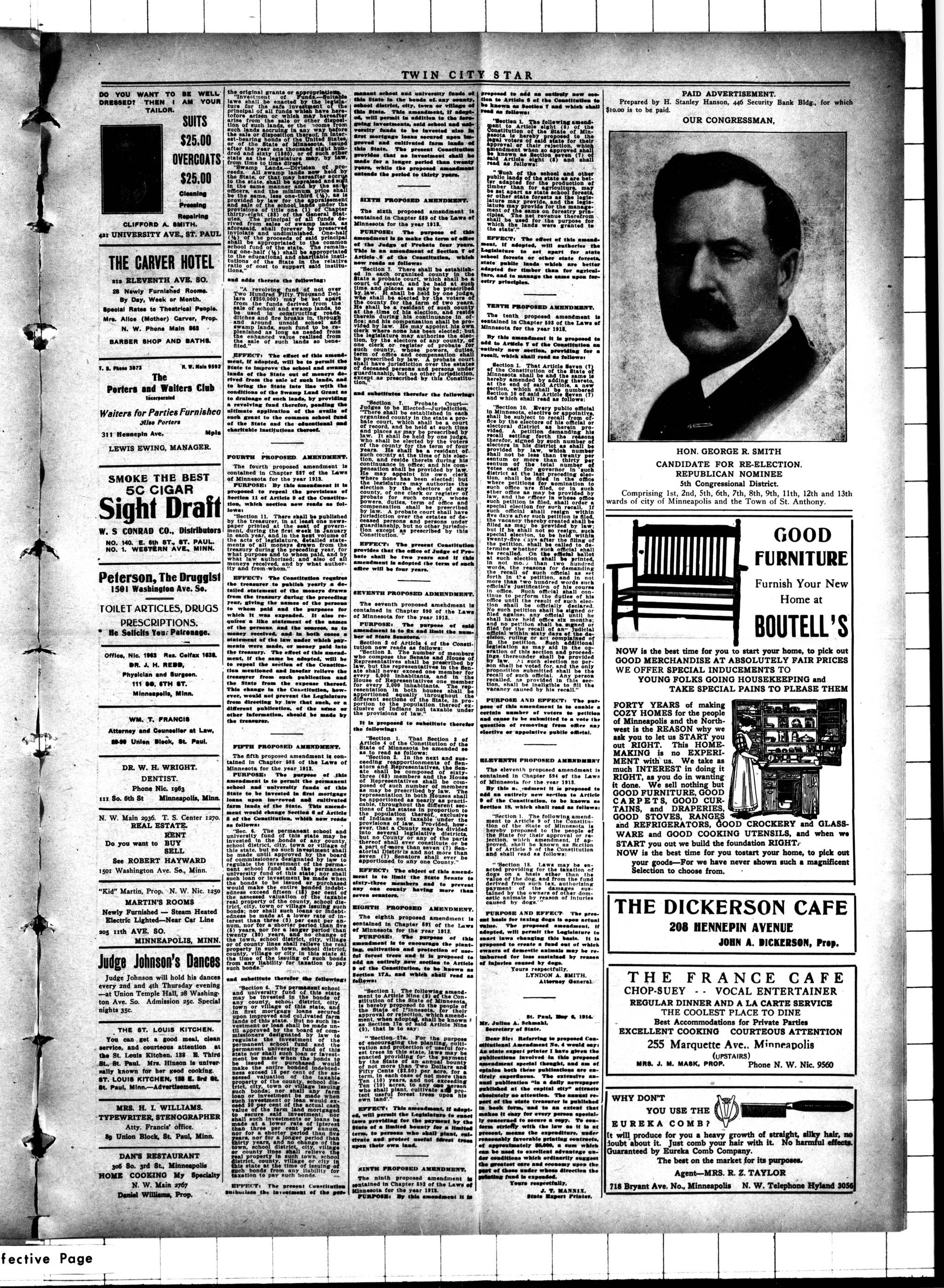
HON. GEORGE R. SMITH
CANDIDATE FOR RE-ELECTION.
REPUBLICAN NOMINEE
5th Congressional District.
Comprising 1st, 2nd, 5th, 6th, 7th, 8th, 9th, 11th, 12th and 13th
wards of city of Minneapolis and the Town of St. Anthony.
GOOD
FURNITURE
Furnish Your New
Home at
BOUTELL'S
NOW is the best time for you to start your home, to pick out
GOOD MERCHANDISE AT ABSOLUTELY FAIR PRICES
WE OFFER SPECIAL INDUCEMENTS TO
YOUNG FOLKS GOING HOUSEKEEPING and
TAKE SPECIAL PAINS TO PLEASE THEM
and REFRIGERATORS, GOOD CROCKERY and GLASS-WARE and GOOD COOKING UTENSILS, and when we START you out we build the foundation RIGHT.
OW is the best time for you tostart your home, to pick out your goods—For we have never shown such a magnificent Selection to choose from.
THE FRANCE CAFE
CHOP-SUEY -- VOCAL ENTERTAINER
REGULAR DINNER AND A LA CARTE SERVICE
THE COOLEST PLACE TO DINE
Best Accommodations for Private Parties
EXCELLENT COOKING COURTEOUS ATTENTION
255 Marquette Ave.. Minneapolis
(UPSTAIRS)
MR8. J. M. MASK, PROP.
Phone N. W. Nic. 9560
FORTY YEARS of making COZY HOMES for the people of Minneapolis and the Northwest is the REASON why we ask you to let us START you out RIGHT. This HOMEAKING is no EXPERIMENT with us. We take as much INTEREST in doing it RIGHT, as you do in wanting it done. We sell nothing but GOOD FURNITURE, GOOD CARPETS, GOOD CURTAINS, and DRAPERIES, GOOD STOVES, RANGES
and REFRIGERATORS, GO
WARE and GOOD COOKIE
START you out we build the
NOW is the best time for you
your goods—For we have
Selection to choose from.
THE DICKEN
208 HENNEL
JO
THE FRANK
CHOP-SUEY -- VO
REGULAR DINNER AND
THE COOLEST
Best Accommodation
EXCELLENT COOKING
255 Marquette
(UPS)
MRS. J. M. MASK, PROP.
WHY DON'T
YOU USE THE
EUREKA COMB?
It will produce for you a heavy
doubt about it. Just comb your
Guaranteed by Eureka Comb Co
The best on the ma
```markdown
```
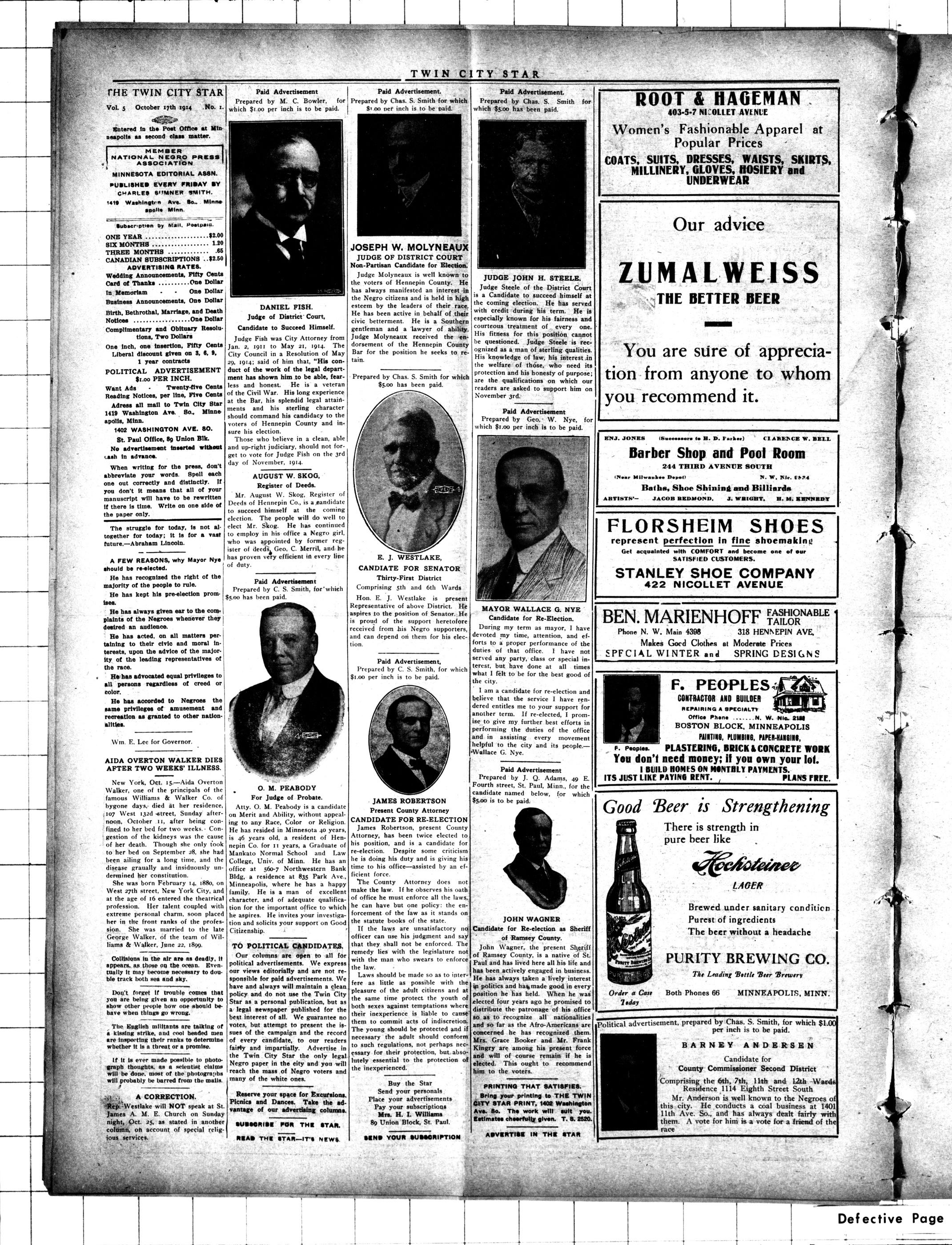
THE TWIN CITY STAR
Vol. 5 October 17th 1914 No. 1.
Entered in the Post Office at Minneapolis as second class matter.
MEMBER
NATIONAL NEGRO PRESS
ASSOCIATION
1419 Washington Ave. So... Minne
spolie Minn.
Subscription by Mail, Postpaid.
ONE YEAR ..... $2.00
SIX MONTHS ..... 1.20
THREE MONTHS ..... .65
CANADIAN SUBSCRIPTIONS .. $2.50
ADVERTISING RATES
ADVERTISING RATES.
Wedding Announcements, Fifty Cents
Card of Thanks ..... One Dollar
In Memoriam ..... One Dollar
Business Announcements, One Dollar
Birth, Bethrothal, Marriage, and Death
Notices ..... One Dollar
Complimentary and Obituary Resolutions, Two Dollars
One inch, one insertion, Fifty Cents
Liberal discount given on 3, 6, 9,
1 year contracts
POLITICAL ADVERTISEMENT
$1.00 PER INCH.
Want Ads ..... Twenty-five Cents
Reading Notices, per line, Five Cents
Adress all mail to Twin City Star
1419 Washington Ave. So., Minneapolis, Minn.
No advertisement inserted without cash in advance.
When writing for the press, don't abbreviate your words. Spell each one out correctly and distinctly. If you don't it means that all of your manuscript will have to be rewritten if there is time. Write on one side of the paper only.
The struggle for today, is not altogether for today; it is for a vast future.—Abraham Lincoln.
A FEW REASONS, why Mayor Nye should be re-elected.
He has recognized the right of the majority of the people to rule.
He has kept his pre-election promises.
He has always given ear to the complaints of the Negroes whenever they desired an audience.
He has acted, on all matters pertaining to their civic and moral interests, upon the advice of the majority of the leading representatives of the race.
He has advocated equal privileges to all persons regardless of creed or color.
He has accorded to Negroes the same privileges of amusement and recreation as granted to other nationalities.
AIDA OVERTON WALKER DIES
AFTER TWO WEEKS' ILLNESS.
New York, Oct. 15.—Aida Overton Walker, one of the principals of the famous Williams & Walker Co. of bygone days, died at her residence, 107 West 132d street, Sunday afternoon, October 11, after being confined to her bed for two weeks. Congestion of the kidneys was the cause of her death. Though she only took to her bed on September 28, she had been ailing for a long time, and the disease graunately and insiduously undermined her constitution. She was born February 14, 1880, on West 27th street, New York City, and at the age of 16 entered the theatrical profession. Her talent coupled with extreme personal charm, soon placed her in the front ranks of the profession. She was married to the late George Walker, of the team of Williams & Walker, June 22, 1889.
Collisions in the air are as deadly, it appears, as those on the ocean. Eventually it may become necessary to double track both sea and sky.
Don't forget if trouble comes that you are being given an opportunity to show other people how one should behave when things go wrong.
The English militants are talking of a kissing strike, and cool headed men are inspecting their ranks to determine whether it is a threat or a promise.
If it is ever made possible to photograph thoughts, as a scientist claims will be done, most of the photographs will probably be barred from the malls.
Rep. Westlake will NOT speak at St. James A. M. E. Church on Sunday night, Oct. 25, as stated in another column, on account of special religious services.
Paid Advertisement
Prepared by M. C. Bowler, for which $1.00 per inch is to be paid.
M. H. C.
Judge Fish was City Attorney from Jan. 2, 1911 to May 21, 1914. The City Council in a Resolution of May 29, 1914; said of him that, "His conduct of the work of the legal department has shown him to be able, fearless and honest. He is a veteran of the Civil War. His long experience at the Bar, his splendid legal attainments and his sterling character should command his candidacy to the voters of Hennepin County and insure his election. Those who believe in a clean, able and up-right judiciary, should not forget to vote for Judge Fish on the 3rd day of November, 1914.
AUGUST W. SKOG, Register of Deeds.
Mr. August W. Skog, Register of Deeds in Hennepin Co., is a candidate to succeed himself at the coming election. The people will do well to elect Mr. Skog. He has continued to employ in his office a Negro girl, who was appointed by former register of deeds Geo. C. Merril, and he has proven very efficient in every line of duty.
Prepared by C. S. Smith, for'which $00 has been paid.
4
Atty. O. M. Peabody is a candidate on Merit and Ability, without appealing to any Race, Color or Religion. He has resided in Minnesota 40 years, is 46 years old, a resident of Hennepin Co. for 11 years, a Graduate of Mankato Normal School and Law College, Univ. of Minn. He has an office at 560-7 Northwestern Bank Blldg, a residence at 835 Park Ave., Minneapolis, where he has a happy family. He is a man of excellent character, and of adequate qualification for the important office to which he aspires. He invites your investigation and solicits your support on Good Citizenship.
TO POLITICAL CANDIDATES.
Our columns are open to all for political advertisements. We express our views editorially and are not responsible for paid advertisements. We have and always will maintain a clean policy and do not use the Twin City Star as a personal publication, but as a legal newspaper published for the best interest of all. We guarantee no votes, but attempt to present the issues of the campaign and the record of every candidate, to our readers fairly and impartially. Advertise in the Twin City Star the only legal Negro paper in the city and you will reach the mass of Negro voters and many of the white ones.
Reserve your space for Excursions. Picnics and Dances. Take the advantage of our advertising columns.
READ THE STAR-IT'S NEWS.
TWIN CITY STAR
Paid Advertisement.
Prepared by Chas. S. Smith for which $1.00 per inch is to be paid.
Paid Adverti
Prepared by Chas.
which $5.00 has been
PETER H. HARRIS
Judge Molyneaux is well known to the voters of Hennepin County. He has always manifested an interest in the Negro citizens and is held in high esteem by the leaders of their race. He has been active in behalf of their civic betterment. He is a Southern gentleman and a lawyer of ability. Judge Molyneaux received the endorsement of the Hennepin County Bar for the position he seeks to retain.
Prepared by Chas. S. Smith for which $5.00 has been paid.
4
Comprising 5th and 6th Wards
Hon. E. J. Westlake is present
Representative of above District. He
aspires to the position of Senator. He is proud of the support heretofore
received from his Negro supporters,
and can depend on them for his election.
Paid Advertisement,
Prepared by C. S. Smith, for which
$1.00 per inch is to be paid.
PETER H. BURKE
CANDIDATE FOR RE-ELECTION James Robertson, present County Attorney, has been twice elected to his position, and is a candidate for re-election. Despite some criticism he is doing his duty and is giving his time to his office—assisted by an efficient force. The County Attorney does not make the law. If he observes his oath of office he must enforce all the laws, he can have but one policy: the enforcement of the law as it stands on the statute books of the state. If the laws are unsatisfactory no officer can use his judgment and say that they shall not be enforced. The remedy lies with the legislature not with the man who swears to enforce the law.
Laws should be made so as to interfere as little as possible with the pleasure of the adult citizens and at the same time protect the youth of both sexes against temptations where their inexperience is liable to cause them to commit acts of indiscretion. The young should be protected and if necessary the adult should conform to such regulations, not perhaps necessary for their protection, but absolutely essential to the protection of the inexperienced.
Buy the Star
Send your personales
Place your advertisements
Pay your subscriptions
Mrs. H. I. Williams
89 Union Block, St. Paul.
SEND YOUR SUBSCRIPTION
Paid Advertisement.
Prepared by Chas. S. Smith for which $5.00 has been paid.
1
JUDGE JOHN H. STEELE.
Judge Steele of the District Court is a Candidate to succeed himself at the coming election. He has served with credit during his term. He is especially known for his fairness and courteous treatment of every one. His fitness for this position cannot be questioned. Judge Steele is recognized as a man of sterling qualities. His knowledge of law, his interest in the welfare of those, who need its protection and his honesty of purpose; are the qualifications on which our readers are asked to support him on November 3rd.
Paid Advertisement
Prepared by Geo. W. Nye, for which $1.00 per inch is to be paid.
J. B.
During my term as mayor, I have devoted my time, attention, and efforts to a proper performance of the duties of that office. I have not served any party, class or special interest, but have done at all times what I felt to be for the best good of the city.
I am a candidate for re-election and believe that the service I have rendered entitles me to your support for another term. If re-elected, I promise to give my further best efforts in performing the duties of the office and in assisting every movement helpful to the city and its people.—Wallace G. Nye.
Paid Advertisement
Prepared by J. Q. Adams, 49 E. Fourth street, St. Paul, Minn., for the candidate named below, for which $5.00 is to be paid.
JOHN WAGNER
Candidate for Re-election as Sheriff of Ramsey County.
John Wagner, the present Shgriff of Ramsey County, is a native of St. Paul and has lived here all his life and has been actively engaged in business. He has always taken a lively interest in politics and has made good in every position he has held. When he was elected four years ago he promised to distribute the patronage of his office so as to recognize all nationalities and so far as the Afro-Americans are concerned he has recognized them. Mrs. Grace Booker and Mr. Frank Kingry are among his present force and will of course remain if he is elected. This ought to recommend him to the voters.
PRINTING THAT SATISFIES.
Bring your printing to THE TWIN
CITY STAR PRINT, 1402 Washington
Ave. So. The work will suit you.
Estimates cheerfully given. T. S. 2520.
ADVERTISE IN THE STAR
ROOT & HAGEMAN
403-5-7 NICOLLET AVENUE
Women's Fashionable Apparel at
Popular Prices
COATS, SUITS, DRESSES, WAISTS, SKIRTS,
MILLINERY, GLOVES, HOSIERY and
UNDERWEAR
You are sure of appreciation from anyone to whom you recommend it.
ENJ. JONES (Successors to H. D. Parker) CLARENCE W. BELL
Barber Shop and Pool Room
244 THIRD AVENUE SOUTH
(Near Milwaukee Depot) N. W. Nic. 8834
Baths, Shoe Shining and Billiards
ARTISTS'— JACOB REDMOND, J. WRIGHT, H. M. KENNEDY
represent perfection in fine shoemaking Get acquainted with COMFORT and become one of our SATISFIED CUSTOMERS. STANLEY SHOE COMPANY 422 NICOLLET AVENUE
Phone N. W. Main 4398 318 HENNEPIN AVE. Makes Good Clothes at Moderate Prices SPFCIAL WINTER and SPRING DESIGNS
F. Peoplea. PLASTERING, BRICK & CONCRETE WORK You don't need money; if you own your lot. I BUILD HOMES ON MONTHLY PAYMENTS. ITS JUST LIKE PAYING RENT. PLANS FREE.
F. Peoples.
You don't
I BUIL
ITS JUST LIKE
Good T
Kobbitin
PURITY BREWING CO.
Order a Case Today
```markdown
```
Kochteiner
Brewed under sanitary condition Purest of ingredients The beer without a headache
Comprising the 6th, 7th, 11th and 12th Wards Residence 1114 Eighth Street South Mr. Anderson is well known to the Negroes of this city. He conducts a coal business at 1401 11th Ave. So., and has always dealt fairly with them. A vote for him is a vote for a friend of the race
Defective Page