Twin City Star
Saturday, March 20, 1915
Minneapolis, Minnesota
Page text (machine-generated)
MINNEAPOLIS MINN HISTORICAL SOCIETY
DULUTH THE TWIN CITY STAR ST.PAUL
fective Page
VOL. 5 Single Copies 5 Cents
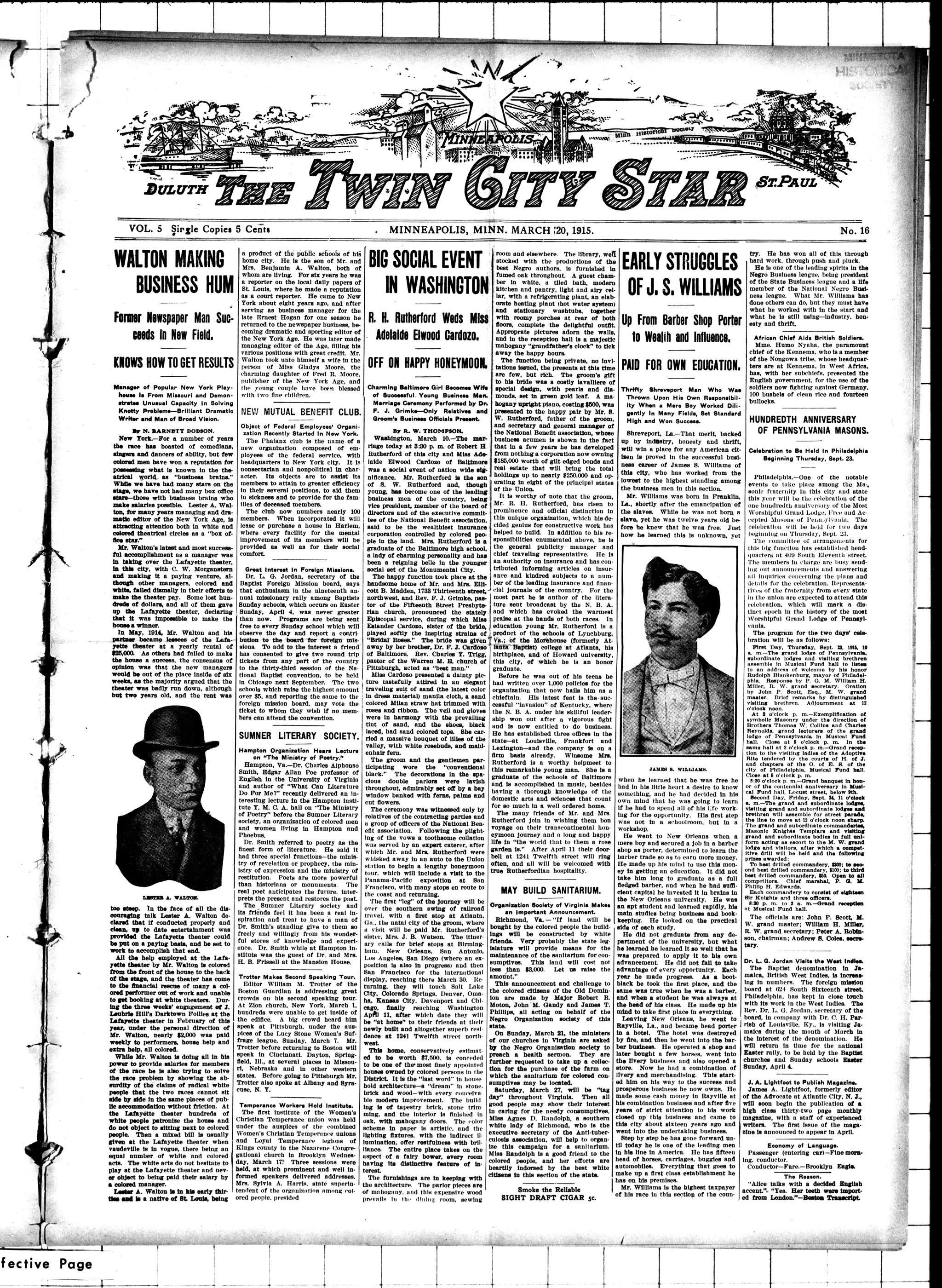
WALTON MAKING BUSINESS HUM
Former Newspaper Man Succeeds In New Field.
a product home city Mrs. Ben whom are a reporter St. Louis, as a court York about serving a late Erne returned to coming dr the New Y managing various po
The club now numbers nearly 100 members. When incorporated it will lease or purchase a house in Harlem, where every facility for the mental improvement of its members will be provided as well as for their social comfort.
Great Interest in Foreign Missions.
Dr. L. G. Jordan, secretary of the Baptist Foreign Mission board, says that enthusiasm in the nineteenth annual missionary rally among Baptists Sunday schools, which occurs on Easter Sunday, April 4, was never greater than now. Programs are being sent free to every Sunday school which will observe the day and report a contribution to the board for foreign missions. To add to the interest a friend has consented to give two round trip tickets from any part of the country to the thirty-third session of the National Baptist convention, to be held in Chicago next September. The two schools which raise the highest amount over $5, and reporting the same to the foreign mission board, may vote the ticket to whom they wish if no members can attend the convention.
SUMNER LITERARY SOCIETY.
Hampton Organization Hears Lectures on "The Ministry of Poetry"
Hampton, Va.—Dr. Charles Alphonso Smith, Edgar Allan Poe professor of English in the University of Virginia and author of "What Can Literature Do For Me?" recently delivered an interesting lecture in the Hampton institute Y. M. C. A. hall on "The Ministry of Poetry" before the Sumner Literary society, an organization of colored men and women living in Hampton and Phoebus. Dr. Smith referred to poetry as the finest form of literature. He said it had three special functions—the ministry of revelation or prophecy, the ministry of expression and the ministry of restitution. Poets are more powerful than historians or monuments. The real poet anticipates the future. interprets the present and restores the past. The Sumner Literary society and its friends feel it has been a real inspiration and treat to have a man of Dr. Smith's standing give to them so freely and willingly from his wonderful stores of knowledge and experience. Dr. Smith while at Hampton institute was the guest of Dr. and Mrs. H. B. Frissell at the Mansion House.
Trotter Makes Second Speaking Tour.
Editor William M. Trotter of the Boston Guardian is addressing great crowds on his second speaking tour.
At Zlon church, New York. March 1, hundreds were unable to get inside of the edifice. A big crowd heard him speak at Pittsburgh, under the auspices of the Lucy Stone Women's Suffrage league, Sunday, March 7. Mr. Trotter before returning to Boston will speak in Cincinnati. Dayton, Springfield, Ill., at several places in Missouri, Nebraska and in other western states. Before going to Pittsburgh Mr. Trotter also spoke at Albany and Syracuse, N. Y.
Temperance Workers Hold Institute.
The first institute of the Women's Christian Temperance union was held under the auspices of the combined Women's Christian Temperance unions and Loyal Temperance legions of Kings county in the Nazarene Congregational church in Brooklyn Wednesday, March 17. Three sessions were held, at which prominent and well informed speakers delivered addresses.
Mrs. Sylvia A. Harris, state superintendent of the organization among colored people, presided
---
KNOWS HOW TO GET RESULTS
Manager of Popular New York Playhouse Is From Missouri and Demonstrates Unusual Capacity in Solving Knotty Problems—Brilliant Dramatic Writer and Man of Broad Vision.
By N. BARNETT DODSON.
New York.—For a number of years the race has boasted of comedians, singers and dancers of ability, but few colored men have won a reputation for possessing what is known in the theatrical world as "business brain." While we have had many stars on the stage, we have not had many box office stars—those with business brains who make salaries possible. Lester A. Walton, for many years managing and dramatic editor of the New York Age, is attracting attention both in white and colored theatrical circles as a "box office star."
Mr. Walton's latest and most successful accomplishment as a manager was in taking over the Lafayette theater, in this city, with C. W. Morganstern and making it a paying venture, although other managers, colored and white, failed dismally in their efforts to make the theater pay. Some lost hundreds of dollars, and all of them gave up the Lafayette theater, declaring that it was impossible to make the house a winner.
In May, 1914, Mr. Walton and his partner became lessees of the Lafayette theater at a yearly rental of $25,000. As others had failed to make the house a success, the consensus of opinion was that the new managers would be out of the place inside of six weeks, as the majority argued that the theater was badly run down, although but two years old, and the rent was
Lester A. Walton.
too steep. In the face of all the discouraging talk Lester A. Walton declared that if conducted properly and clean, up to date entertainment was provided the Lafayette theater could be put on a paying basis, and he set to work to accomplish that end. All the help employed at the Lafayette theater by Mr. Walton is colored from the front of the house to the back of the stage, and the theater has come to the financial rescue of many a colored performer out of work and unable to get booking at white theaters. During the three weeks' engagement of J. Leubrie Hill's Darktown Follies at the Lafayette theater in February of this year, under the personal direction of Mr. Walton, nearly $2,000 was paid weekly to performers, house help and extra help, all colored.
While Mr. Walton is doing all in his power to provide salaries for members of the race he is also trying to solve the race problem by showing the absurdity of the claims of radical white people that the two races cannot sit side by side in the same places of public accommodation without friction. At the Lafayette theater hundreds of white people patronize the house and do not object to sitting next to colored people. Then a mixed bill is usually given at the Lafayette theater when vaudeville is in vogue, there being an equal number of white and colored acts. The white acts do not hesitate to play at the Lafayette theater and never object to being paid their salary by a colored manager. Lester A. Walton is in his early thirties and is a native of St Louis, being
a product of the public schools of his home city. He is the son of Mr. and Mrs. Benjamin A. Walton, both of whom are living. For six years he was a reporter on the local daily papers of St. Louis, where he made a reputation as a court reporter. He came to New York about eight years ago, and after serving as business manager for the late Ernest Hogan for one season he returned to the newspaper business, becoming dramatic and sporting editor of the New York Age. He was later made managing editor of the Age, filling his various positions with great credit. Mr. Walton took unto himself a wife in the person of Miss Gladys Moore, the charming daughter of Fred R. Moore, publisher of the New York Age, and the young couple have been blessed with two fine children.
NEW MUTUAL BENEFIT CLUB.
Object of Federal Employees' Organization Recently Started in New York.
ization Recently Started In New York. The Phalanx club is the name of a new organization composed of employees of the federal service, with headquarters in New York city. It is nonsectarian and nonpolitical in character. Its objects are to assist its members to attain to greater efficiency in their several positions, to aid them in sickness and to provide for the families of deceased members.
MINNEAPOLIS, MINN. MARCH 20, 1915.
BIG SOCIAL EVENT IN WASHINGTON
Charming Baltimore Girl Becomes Wife of Successful. Young Business Man. Marriage Ceremony Performed by Dr. F. J. Grimke—Only Relatives and Groom's Business Officials Present.
By R. W. THOMPSON.
Washington, March 10.—The marriage today at 3:30 p. m. of Robert H Rutherford of this city and Miss Adelaide Elwood Cardozo of Baltimore was a social event of nation wide significance. Mr. Rutherford is the son of S. W. Rutherford and, though young, has become one of the leading business men of the country, being vice president, member of the board of directors and of the executive committee of the National Benefit association, said to be the wealthiest insurance corporation controlled by colored people in the land. Mrs. Rutherford is a graduate of the Baltimore high school, a lady of charming personality and has been a reigning belle in the younger social set of the Monumental City. The happy function took place at the handsome home of Mr. and Mrs. Elliott B. Madden, 1733 Thirteenth street, northwest, and Rev. F. J. Grimke, pastor of the Fifteenth Street Presbyterian church, pronounced the stately Episcopal service, during which Miss Eslander Cardozo, sister of the bride, played softly the inspiring strains of "Bridal Rosees." The bride was given away by her brother, Dr. F. J. Cardozo of Baltimore. Rev. Charles Y. Trigg, pastor of the Warren M. E. church of Pittsburgh, acted as "best man."
Miss Cardozo presented a dainty picture tastefully attired in an elegant traveling suit of sand (the latest color in dress material) manila cloth, a sand colored Milan straw hat trimmed with roses and ribbon. The veil and gloves were in harmony with the prevailing tint of sand, and the shoes, black laced, had sand colored tops. She carried a massive bouquet of lilies of the valley, with white rosebuds, and maidenhair fern.
The groom and the gentlemen participating wore the "conventional black." The decorations in the spacious double parlors were lavish throughout, admirably set off by a bay window banked with ferns, palms and cut flowers.
The ceremony was witnessed only by relatives of the contracting parties and a group of officers of the National Benefit association. Following the plighting of the vows a toothsome collation was served by an expert caterer, after which Mr. and Mrs. Rutherford were whisked away in an auto to the Union station to begin a lengthy honeymoon tour, which will include a visit to the Panama-Pacific exposition at San Francisco, with many stops en route to the coast and returning.
The first "leg" of the journey will be over the southern swing of railroad travel, with a first stop at Atlanta Ga., the natal city of the groom, where a visit will be paid Mr. Rutherford's sister, Mrs. J. B. Watson. The itinerary calls for brief stops at Birmingham, New Orleans, San Antonio, Los Angeles, San Diego (where an exhibition is also in progress) and then San Francisco for the international display, reaching there March 30. Returning, they will touch Salt Lake City, Colorado Springs, Denver, Omaha, Kansas City, Davenport and Chicago, finally reaching Washington April 11, after which date they will be "at home" to their friends at their newly built and altogether superb residence at 1241 Twelfth street northwest.
This home, conservatively estimated to be worth $7,500, is conceded to be one of the most finely appointed houses owned by colored persons in the District. It is the "last word" in household architecture—a "dream" in stone, brick and wood—with every conceivable modern improvement. The building is of tapestry brick, stone trimming, and the interior is finished in oak, with mahogany doors. The color scheme in paper is artistic, and the lighting fixtures, with the indirect illumination, offer restfulness with brilliance. The entire place takes on the aspect of a fairy bower, every room having its distinctive feature of interest.
The furnishings are in keeping with the architecture. The parlor pieces are of mahogany, and this expensive wood prevails, in the dining room, sewing
room and elsewhere. The library, well stocked with the productions of the best Negro authors, is furnished in fumed oak throughout. A guest chamber in white, a tiled bath, modern kitchen and pantry, light and airy cellar, with a refrigerating plant, an elaborate heating plant (hot water system) and stationary washubs, together with room porches at rear of both floors, complete the delightful outfit. Appropriate pictures adorn the walls, and in the reception hall is a majestic mahogany "grandfather's clock" to tick away the happy hours.
The function being private, no invitations issued, the presents at this time are few, but rich. The groom's gift to his bride was a costly lavalliere of special design, with pearls and diamonds, set in green gold leaf. A mahogany upright piano, costing $500, was presented to the happy pair by Mr. S. W. Rutherford, father of the groom, and secretary and general manager of the National Benefit association, whose business acumen is shown in the fact that in a few years he has developed from nothing a corporation now owning $185,000 worth of gilt edged bonds and real estate that will bring the total holdings up to nearly $250,000 and operating in eight of the principal states of the Union.
It is worthy of note that the groom, Mr. R. H. Rutherford, has risen to prominence and official distinction in this unique organization, which his decided genius for constructive work has helped to build. In addition to his responsibilities enumerated above, he is the general publicity manager and chief traveling representative. He is an authority on insurance and has contributed informing articles on insurance and kindred subjects to a number of the leading insurance and financial journals of the country. For the most part he is author of the literature sent broadcast by the N. B. A. and which has evoked the warmest praise at the hands of both races. In education young Mr. Rutherford is a product of the schools of Lynchburg, Va.; of the Morehouse (formerly Atlanta Baptist) college at Atlanta, his birthplace, and of Howard university, this city, of which he is an honor graduate.
Before he was out of his teens he had written over 1,000 policies for the organization that now hails him as a chieftain. His latest feat is the successful "invasion" of Kentucky, where the N. B. A. under his skillful leadership won out after a vigorous fight and is now entitled to do business. He has established three offices in the state—at Louisville, Frankfort and Lexington—and the company is on a firm basis already. Winsome Mrs. Rutherford is a worthy helpmeet to this remarkable young man. She is a graduate of the schools of Baltimore and is accomplished in music, besides having a thorough knowledge of the domestic arts and sciences that count for so much in a well ordered home. The many friends of Mr. and Mrs. Rutherford join in wishing them bon voyage on their transcontinental honeymoon journey and a long and happy life in "the world that to them a rose garden is." After April 11 their doorbell at 1241 Twelfth street will ring often, and all will be welcomed with true Rutherfordian hospitality.
MAY BUILD SANITARIUM
Organization Society of Virginia Makes an Important Announcement.
Richmond, Va. - "If land will be bought by the colored people the buildings will be constructed by white friends. Very probably the state legislature will provide means for the maintenance of the sanitarium for consumptives. This land will cost not less than $3,000. Let us raise the amount."
This announcement and challenge to the colored citizens of the Old Dominion are made by Major Robert R. Moton, John M. Gandy and James T. Phillips, all acting on behalf of the Negro Organization society of this state.
On Sunday, March 21, the ministers of our churches in Virginia are asked by the Negro Organization society to preach a health sermon. They are further requested to take up a collection for the purchase of the farm on which the sanitarium for colored consumptives may be located.
Saturday, March 27, will be "tag day" throughout Virginia. Then all good people may show their interest in caring for the needy consumptives. Miss Agnes D. Randolph, a southern white lady of Richmond, who is the executive secretary of the Anti-tuberculosis association, will help to organize this campaign for a sanitarium. Miss Randolph is a good friend to the colored people, and her efforts are heartily indorsed by the best white citizens in this section of the state.
Smoke the Reliable
SIGHT DRAFT CIGAR 5c.
EARLY STRUGGLES OF J. S. WILLIAMS
PAID FOR OWN EDUCATION.
Thriffy Shreveport Man Who Was Thrown Upon His Own Responsibility When a Mere Boy Worked Diligently In Many Fields, Set Standard High and Won Success.
Shreveport, La.—That merit, backed up by industry, honesty and thrift, will win a place for any American citizen is proved in the successful business career of James S. Williams of this city, who has worked from the lowest to the highest standing among the business men in this section.
Mr. Williams was born in Franklin, La., shortly after the emancipation of the slaves. While he was not born a slave, yet he was twelve years old before he knew that he was free. Just how he learned this is unknown, yet
JAMES B. WILLIAMS.
when he learned that he was free he had in his little heart a desire to know something, and he had decided in his own mind that he was going to learn if he had to spend all of his life working for the opportunity. His first step was not in a schoolroom, but in a workshop. He went to New Orleans when a mere boy and secured a job in a barber shop as porter, determined to learn the barber trade so as to earn more money. He made up his mind to use this money in getting an education. It did not take him long to graduate as a full fledged barber, and when he had sufficient capital he invested it in brains in the New Orleans university. He was an apt student and learned rapidly, his main studies being business and bookkeeping. He looked on the practical side of each study. He did not graduate from any department of the university, but what he learned he learned it so well that he was prepared to apply it to his own advancement. He did not fall to take advantage of every opportunity. Each year he made progress. As a bootblack he took the first place, and the same was true when he was a barber, and when a student he was always at the head of his class. He made up his mind to take first place in everything.
Leaving New Orleans, he went to Rayville, La., and became head porter in a hotel. The hotel was destroyed by fire, and then he went into the barber business. He operated a shop and later bought a few horses, went into the livery business and also opened a store. Now he had a combination of livery and merchandising. This started him on his way to the success and prosperous business he now owns. He made some cash money in Rayville at his combination business and after five years of strict attention to his work closed up this business and came to this city about sixteen years ago and went into the undertaking business.
Step by step he has gone forward until today he is one of the leading men in his line in America. He has fifteen head of horses, carriages, buggies and automobiles. Everything that goes to make up a first class establishment he has on his premises.
Mr. Williams is the highest taxayer of his race in this section of the coun-
try. He has won all of this through hard work, through push and pluck. He is one of the leading spirits in the Negro Business league, being president of the State Business league and a life member of the National Negro Business league. What Mr. Williams has done others can do, but they must have what he worked with in the start and what he is still using—industry, honesty and thrift.
African Chief Aids British Soldiers. Mme. Humo Nyaha, the paramount chief of the Kennema, who is a member of the Nongowa tribe, whose headquarters are at Kennema, in West Africa, has, with her subchiefs, presented the English government, for the use of the soldiers now fighting against Germany, 100 bushels of clean rice and fourteen bullocks.
HUNDREDTH ANNIVERSARY OF PENNSYLVANIA MASONS.
Celebration to Be Held In Philadelphia
Beginning Thursday, Sept. 23.
Philadelphia.—One of the notable
events to take place among the Masse-
sonic fraternity in this city and state
this year will be the celebration of the
one hundredth anniversary of the Most
Worshipful Grand Lodge, Free and
Accepted Masons of Pennsylvania. The
celebration will be held for two days
beginning on Thursday, Sept. 23.
The committee of arrangements for
this big function has established head-
quarters at 409 South Eleventh street.
The members in charge are busy send-
ing out announcements and answering
all inquiries concerning the plans and
details for the celebration. Represent-
atives of the fraternity from every state
in the union are expected to attend this
celebration, which will mark a distin-
ct epoch in the history of the most
Worshipful Grand Lodge of Pennsylvania.
The program for the two days' celebration will be as follows:
First Day, Thursday, Sept. 23, 1915, 10 a.m.—The grand lodge of Pennsylvania,
subordinate lodges and visiting brethren
assemble in Musical Fund hall to listen
to an address of welcome by his honor
Rudolph Blankenburg, mayor of Philadelphia.
Response by P. G. M. William H.
Miller, R. W. grand secretary. Oration
by John P. Scott, Esq., M. W. grand
master remarks by distinguished
visiting brethren. Adjournment at 12
o'clock noon.
Dr. L. G. Jordan Visits the West Indies
The Baptist denomination in Jamaica, British West Indies, is increasing in numbers. The foreign mission board at 624 South Sixteenth street, Philadelphia, has kept in close touch with its work in the West Indies. The Rev. Dr. L. G. Jordan, secretary of the board, in company with Dr. C. H. Parish of Louisville, Ky., is visiting Jamaica during the month of March in the interest of the denomination. He will return in time for the national Easter rally, to be held by the Baptist churches and Sunday schools Easter Sunday, April 4.
J. A. Lightfoot to Publish Magazine.
James A. Lightfoot, formerly editor of the Advocate at Atlantic City, N. J., will soon begin the publication of a high class thirty-two page monthly magazine, with a staff of experienced writers. The first issue of the magazine is announced to appear in April.
Economy of Language.
Passenger (entering car)—Fine morning, conductor.
Conductor—Fare.—Brooklyn Eagle.
The Reason.
"Alice talks with a decided English accent." "Yes. Her teeth were imported from London."—Boston Transcript.
Peoples Christian Assembly.
Rev. G. W. Mitchell, Pastor,
1204 Washington Ave. So.
Come! and Serve the Lord.
ST. PETER'S A. M. E. CHURCH.
22nd St. near 10th Ave. So.
Rev. Thos. B. Stovall, Pastor.
ST. JAMES A. M. E. CHURCH,
318 8th Ave. So., Minneapolis.
Rev. E. R. Edwards, Pastor.
We would appreciate what you owe us, or a part of it, Mr. Delinquent Subscriber.
MR. JOHN A. WITHERS.
Your attention is called to the subject of the above cut. Mr. Withers, who is struggling to compete with every opposition in business. He deserves the support of the members of his race. Mr. Withers is well experienced in the Express business. He is prepared for this work in every detail.
LET WITHERS DO IT!
He can save you from $1 to $5 on moving household goods—also on storage.
He will move your Pianos, Baggage called for and Delivered. Rubbish Removed. Call on him for your Coal and Wood.
Give him a Tralal and be Satisfied. He solicits your patronage, and is entitled to it. He must have it.
CALL UP MAIN 3474.
J. A. WITHERS,
504 6th Ave. No., Minneapolis
COLORED COMMERCIAL CLUB
New Organization Gaining Member-
bership.
Amid the clamor of wars and howls of persecution and segregation, the Negro is more than holding his own, and is still surging forward. Minneapolis is adding her small portion in behalf of her dark hued sons of the West in the organization of the North Side Colored Commercial Club. The Club tends to embrace all that is for the uplift and progression of the colored man. During its short life, great strides have been made and the membership has been growing by leaps and bounds and enthusiasm runs high, as shown by the attendance and interest expressed in the meeting last Thursday. The Club hopes to be in permanent quarters in a few days, and then Watch us Grow. The hearty co-operation of all the well thinking men of the Twin Cities, is asked in this great effort. If you haven't heard of the organization, get busy and see either Mr. J. A. Withers, president, or Mr. Walter Evans, secretary.
Undertaker Lawrence is suffering from a broken ankle.
Rev. and Mrs. Mitchell have returned from a trip through Northern Minnesota and Dakota.
The Twin City Charity Club gave a St. Patrick Supper at St. James Church. After a short program refreshments were served by the ladies. The work of the Club is progressing nicely.
See Mrs. Johnson's Laundry Adv. and give her your patronage. Her prices equal all competitors and her work is satisfactory.
No women are allowed in the Clubs. This order was issued last Saturday.
Mrs. Julia Cisney was taken very ill last week. She is recovering under the care of Dr. Brown.
Mr. Chas. Welborn has resigned from the police department. There are only two officers, James A. Roberts and A. G. Thompson left on the force.
Mrs. Margaret Fields Lee is improving.
Mr. Albert A. Ford, the well known Soo Line porter is rapidly recovering his health after several months of rheumatism.
The Elks Marching Club on Monday night was a success.
Mr. Oscar Ware is serving on the jury of the District Court.
Miss Marie Thompson is at Walker, Minn., where she is rapidly regaining her health.
STAR "AS"—BRING RESULTS
Don't Let Go to Church Movement Lose Impetus
only help yourself, but you'll help inspiring sights is the father of us duties. His wife is proud of children never will mock at resplendid worker in the national
has been a splendid religious awakening bodies of all denominations in the United States last year, so by the Federal Council of the This includes not only Christian, number of church members is now
IS BEEN AN AWAKENING DON'T DR. THERE WERE THOUSANDS MOVEMENT WHEN IT WAS ONE OR TWO SUNDAYS AND THIS APPEAL IS SPECIALLY DIOING TO CHURCH? IT DOESN'T PUR OR SO ON THE SABBATH IS YOU GIVE IT TO HIM?
It he cannot arrange his affairs to bath in the worship of his Crea- e it to your God.
SUNDAY.
GO TO CHURCH Don't Let Go to Church Movement Lose Impetus
GO TO CHURCH Don't Let Go to Church Movement Lose Impetus
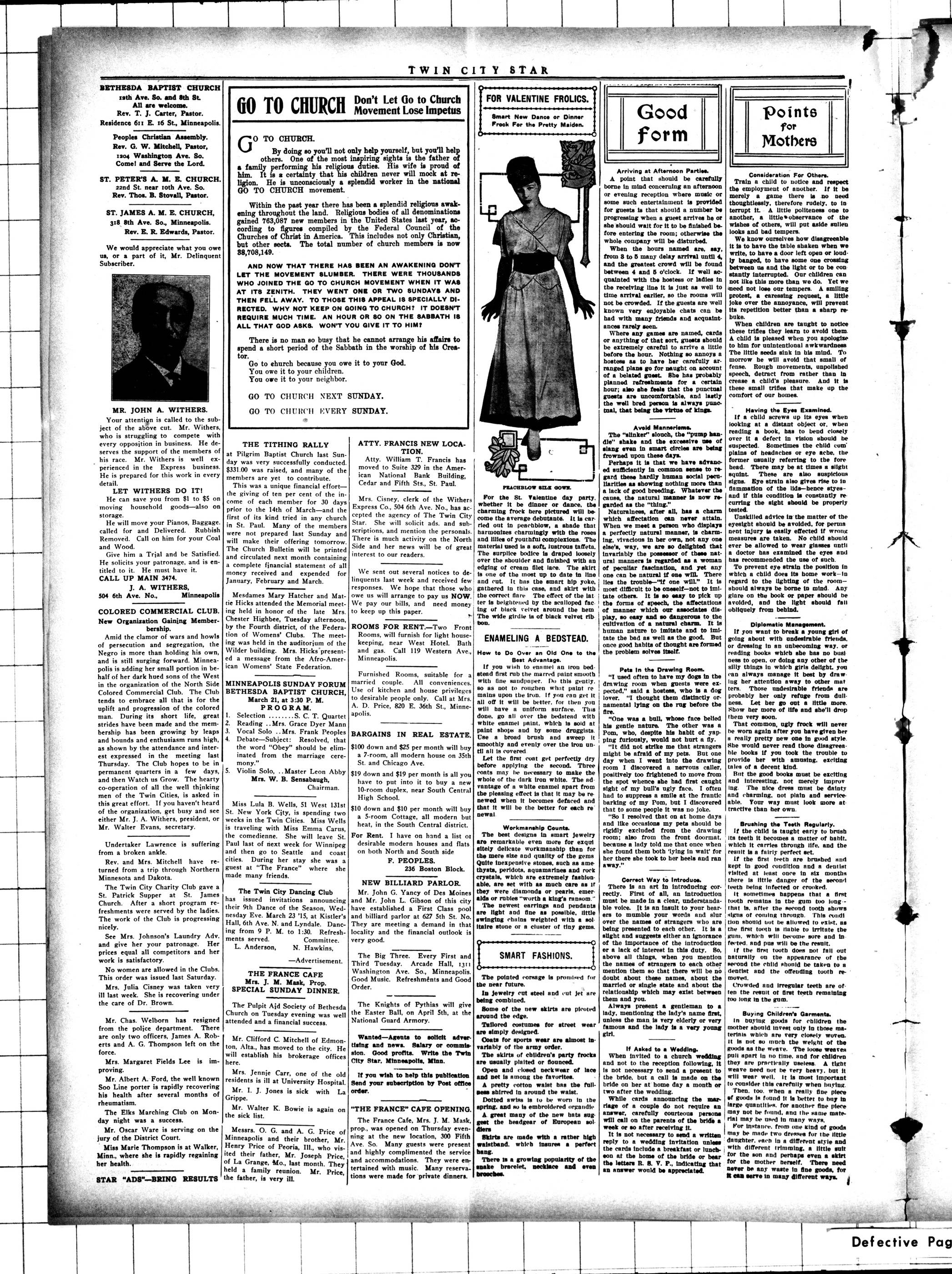
By doing so you'll not only help yourself, but you'll help others. One of the most inspiring sights is the father of a family performing his religious duties. His wife is proud of him. It is a certainty that his children never will mock at religion. He is unconsciously a splendid worker in the national GO TO CHURCH movement.
Within the past year there has been a splendid religious awakening throughout the land. Religious bodies of all denominations gained 763,087 new members in the United States last year, according to figures compiled by the Federal Council of the Churches of Christ in America. This includes not only Christian, but other sects. The total number of church members is now 38,708,149.
AND NOW THAT THERE HAS BEEN AN AWAKENING DON'T LET THE MOVEMENT SLUMBER. THERE WERE THOUSANDS WHO JOINED THE GO TO CHURCH MOVEMENT WHEN IT WAS AT ITS ZENITH. THEY WENT ONE OR TWO SUNDAYS AND THEN FELL AWAY. TO THOSE THIS APPEAL IS SPECIALLY DIRECTED. WHY NOT KEEP ON GOING TO CHURCH? IT DOESN'T REQUIRE MUCH TIME. AN HOUR OR SO ON THE SABBATH IS ALL THAT GOD ASKS. WON'T YOU GIVE IT TO HIM?
There is no man so busy that he cannot arrange his affairs to spend a short period of the Sabbath in the worship of his Creator.
Go to church because you owe it to your God.
GO TO CHURCH NEXT SUNDAY.
GO TO CHURCH EVERY SUNDAY.
Mrs. Cisney, clerk of the Withers Express Co., 504 6th Ave. No., has accepted the agency of The Twin City Star. She will solicit ads. and subscriptions, and mention the personals. There is much activity on the North Side and her news will be of great interest to our readers.
We sent out several notices to delinquents last week and received few responses. We hope that those who owe us will arrange to pay us NOW. We pay our bills, and need money to keep up this paper.
ROOMS FOR RENT.—Two Front Rooms, will furnish for light house-keeping, near West Hotel. Bath and gas. Call 119 Western Ave., Minneapolis.
Furnished Rooms, suitable for a married couple. All conveniences Use of kitchen and house privileges to desirable people only. Call at Mrs A. D. Price, 820 E. 36th St., Minneapolis
BARGAINS IN REAL ESTATE
$100 down and $25 per month will buy a 7-room, all modern house on 35th St. and Chicago Ave.
$19 down and $19 per month is all you have to put into it to buy a new 10-room duplex, near South Central High School.
$10 down and $10 per month will buy a 5-room Cottage, all modern but heat, in the South Central district.
For Rent. I have on hand a list or desirable modern houses and flats on both North and South side
Mr. John G. Yancy of Des Moines and Mr. John L. Gibson of this city have established a First Class pool and billiard parlor at 627 5th St. No. They are meeting a demand in that locality and the financial outlook is very good.
The Big Three. Every First and Third Tuesday. Arcade Hall, 1311 Washington Ave. So., Minneapolis. Good Music. Refreshments and Good Order.
The Knights of Pythias will give the Easter Ball, on April 5th, at the National Guard Armory.
Wanted—Ageuts to solicit advertising and news. Salary or commission. Good profits. Write the Twin City Star, Minneapolis, Minn.
If you wish to help this publication Send your subscription by Post office order.
The France Cafe, Mrs. J. M. Mask, prop, was opened on Thursday evening at the new location, 300 Fifth Ave. So. Many guests were present and highly complimented the service and accommodations. They were entertained with music. Many reservations were made for private dinners.
---
You owe it to your neighbor.
THE TITHING RALLY
at Pilgrim Baptist Church last Sunday was very successfully conducted. $331.00 was raised, and many of the members are yet to contribute. This was a unique financial effort—the giving of ten per cent of the income of each member for 30 days prior to the 14th of March—and the first of its kind tried in any church in St. Paul. Many of the members were not prepared last Sunday and will make their offering tomorrow. The Church Bulletin will be printed and circulated next month containing a complete financial statement of all money received and expended for January, February and March.
Mesdames Mary Hatcher and Mattie Hicks attended the Memorial meeting held in honor of the late Mrs. Chester Highbee, Tuesday afternoon, by the Fourth district, of the Federation of Womens' Clubs. The meeting was held in the auditorium of the Wilder building. Mrs. Hicks presented a message from the Afro-American Womens' State Federation.
MINNEAPOLIS SUNDAY FORUM
BETHESDA BAPTIST CHURCH,
March 21, at 3:30 P.M.
1. Selection .....S. C. T. Quartet
2. Reading ..Mrs. Grace Dyer Mann
3. Vocal Solo ..Mrs. Frank Peoples
4. Debate—Subject: Resolved, that the word "Obey" should be eliminated from the marriage ceremony."
5. Violin Solo, ..Master Leon Abby
Mrs. W. B. Sensabaugh,
Chairman.
Miss Lula B. Wells, 51 West 131st St. New York City, is spending two weeks in the Twin Cities. Miss Wells is traveling with Miss Emma Carus, the comedienne. She will leave St. Paul last of next week for Winnipeg and then go to Seattle and coast cities. During her stay she was a guest at "The France" where she made many friends.
The Twin City Dancing Club has issued invitations announcing their 9th Dance of the Season, Wednesday Eve. March 23 '15, at Kistler's Hall, 6th Ave. N. and Lyndale. Dancing from 9 P. M. to 1:30. Refreshments served. Committee. L. Anderson, N. Hawkins. —Advertisement.
THE FRANCE CAFE
Mrs. J. M. Mask, Prop.
SPECIAL SUNDAY DINNER.
The Pulpit Ajd Society of Bethesda Church on Tuesday evening was well attended and a financial success.
Mr. Clifford C. Mitchell of Edmonton, Alta., has moved to the city. He will establish his brokerage offices here.
Mrs. Jennie Carr, one of the old residents is ill at University Hospital.
Mr. I. J. Jones is sick with La Gripe.
Mr. Walter K. Bowie is again on the sick list.
Messrs. O. G. and A. G. Price of Minneapolis and their brother, Mr. Henry Price of Peoria, Ill., who visited their father, Mr. Joseph Price, of La Grange, Mo., last month. They held a family reunion. Mr. Price, the father, is very ill.
TWIN CITY STAR
ATTY. FRANCIS NEW LOCATION.
Atty. William T. Francis has moved to Suite 329 in the American National Bank Building, Cedar and Fifth Sts., St. Paul.
NEW BILLIARD PARLOR
FOR VALENTINE FROLICS.
Smart New Dance or Dinner
Freck For the Pretty Maiden.
PEACHBLOW SILK GOWN.
For the St. Valentine day party, whether it be dinner or dance, the charming frock here pictured will become the average debutante. It is carried out in peachblow, a shade that harmonizes charmingly with the roses and lilies of youthful complexions. The material used is a soft, lustrous taffeta. The surplice bodice is draped loosely over the shoulder and finished with an edging of cream filet lace. The skirt is one of the most up to date in line and cut. It has the smart hip yoke, gathered in this case, and skirt with the correct flare. The effect of the latter is heightened by the scalloped facing of black velvet around the hem. The wide girdle is of black velvet ribbon.
ENAMELING A BEDSTEAD.
How to Do Over an Old One to the Best Advantage.
If you wish to enamel an iron bedstead first rub the marred paint smooth with fine sandpaper. Do this gently, so as not to roughen what paint remains upon the iron. If you can get it all off it will be better, for then you will have a uniform surface. This done, go all over the bedstead with white enamel paint, which is sold at paint shops and by some druggists. Use a broad brush and sweep it smoothly and evenly over the iron until all is covered.
Let the first coat get perfectly dry before applying the second. Three coats may be necessary to make the whole of the dark iron white. The advantage of a white enamel apart from the pleasing effect is that it may be renewed when it becomes defaced and that it will be the better for each newal.
Workmanship Counts
The best designs in smart jewelry are remarkable even more for exquisitely delicate workmanship than for the mere size and quality of the gems Quite inexpensive stones, such as amethysts, peridots, aquamarines and rock crystals, which are extremely fashionable, are set with as much care as if they were diamonds or pearls, emeralds or rubles "worth a king's ransom." The newest earrings and pendant are light and fine as possible, little swinging chains weighted with a solitaire stone or a cluster of tiny gems.
SMART FASHIONS
The pointed corsage is promised for the near future.
In jewelry cut steel and cut jet are being combined.
Some of the new skirts are pleated around the edge.
Tallored costumes for street wear are simply designed.
Dotted swiss is to be worn in the spring, and so is embroidered organdie. A great many of the new hats suggest the headgear of European soldiers. Skirts are made with a rather high walstband, which insures a perfect hang. There is a growing popularity of the snake bracelet, necklace and even brooches.
Good form Arriving at Afternoon Parties.
A point that should be carefully borne in mind concerning an afternoon or evening reception where music or some such entertainment is provided for guests is that should a number be progressing when a guest arrives he or she should wait for it to be finished before entering the room; otherwise the whole company will be disturbed. When the hours named are, say, from 3 to 5 many delay arrival until 4, and the greatest crowd will be found between 4 and 5 o'clock. If well acquainted with the hostess or ladies in the receiving line it is just as well to time arrival earlier, so the rooms will not be crowded. If the guests are well known very enjoyable chats can be had with many friends and acquaintances rarely seen.
Where any games are named, cards or anything of that sort, guests should be extremely careful to arrive a little before the hour. Nothing so annoys a hostess as to have her carefully arranged plans go for naught on account of a belated guest. She has probably planned refreshments for a certain hour; also she feels that the punctual guests are uncomfortable, and lastly the well bred person is always punctual, that being the virtue of kings.
Avoid Mannerisms.
The "slinker" slouch, the "pump handle" shake and the excessive use of slang even in smart circles are being frowned upon these days.
Perhaps it is that we have advanced sufficiently in common sense to regard these hardly human social peculiarities as showing nothing more than a lack of good breeding. Whatever the cause, the natural manner is now regarded as the "thing."
Naturalness, after all, has a charm which affectation can never attain. When we meet a person who displays a perfectly natural manner, is charming, vivacious in her own, not any one else's, way, we are so delighted that invariably the possessor of these natural manners is regarded as a woman of peculiar fascination, and yet any one can be natural if one will. There lies the trouble "if one will." It is most difficult to be oneself—not to imitate others. It is so easy to pick up the forms of speech, the affectations of manner which our associates display, so easy and so dangerous to the cultivation of a natural charm. It is human nature to imitate and to imitate the bad as well as the good. But once good habits of thought are formed the problem solves itself.
Pets In the Drawing Room.
"I used often to have my dogs in the drawing room when guests were expected," said a hostess, who is a dog lover. "I thought them distinctly ornamental lying on the rug before the fire.
"One was a bull, whose face belled his gentle nature. The other was a Pom, who, despite his habit of yapping furiously, would not hurt a fly.
"It did not strike me that strangers might be afraid of my pets. But one day when I went into the drawing room I discovered a nervous caller, positively too frightened to move from the spot whence she had first caught sight of my bull's ugly face. I often had to suppress a smile at the frantic barking of my Pom, but I discovered that to some people it was no joke.
"So I resolved that on at home days and like occasions my pets should be rigidly excluded from the drawing room; also from the front doormat, because a lady told me that once when she found them both 'lying in wait' for her there she took to her heels and ran away."
Correct Way to Introduce.
There is an art in introducing correctly. First of all, an introduction must be made in a clear, understandable voice. It is an insult to your hearers to mumble your words and slur over the names of strangers who are being presented to each other. It is a slight and suggests either an ignorance of the importance of the introduction or a lack of interest in this duty. So, above all things, when you mention the names of strangers to each other mention them so that there will be no doubt about these names, about the married or single state and about the relationship which may exist between them and you.
Always present a gentleman to a lady, mentioning the lady's name first, unless the man is very elderly or very famous and the lady is a very young girl.
If Asked to a Wedding.
When invited to a church wedding and not to the reception following, it is not necessary to send a present to the bride, but a call is made on the bride on her at home day a month or two after the wedding.
While cards announcing the marriage of a couple do not require an answer, carefully courteous persons will call on the parents of the bride a week or so after receiving it.
It is not necessary to send a written reply to a wedding invitation unless the cards include a breakfast or lunchon at the home of the bride or bear the letters R. S. V. F., indicating that an answer would be appreciated.
Points for Mothers
Train a child to notice and respect the employment of another. If it be merely a game there is no need thoughtlessly, therefore rudely, to interrupt it. A little politeness one to another, a little observance of the wishes of others, will put aside sullen looks and bad tempers.
We know ourselves how disagreeable it is to have the table shaken when we write, to have a door left open or loudly banged, to have some one crossing between us and the light or to be constantly interrupted. Our children can not like this more than we do. Yet we need not lose our tempers. A smiling protest, a caressing request, a little joke over the annoyance, will prevent its repetition better than a sharp rebuke.
When children are taught to notice these trifles they learn to avoid them. A child is pleased when you apologize to him for unintentional awkwardness The little seeds sink in his mind. To morrow he will avoid that small of fense. Rough movements, unpolished speech, detract from rather than in crease a child's pleasure. And it is these small trifles that make up the comfort of our homes.
Having the Eyes Examined.
If a child screws up its eyes when looking at a distant object or, when reading a book, has to bend closely over it a defect in vision should be suspected. Sometimes the child complains of headaches or eye ache, the former usually referring to the forehead. There may be at times a slight squint. These are also suspicious signs. Eye strain also gives rise to in flammation of the lids—hence styes—and if this condition is constantly recurring the sight should be properly tested.
Unskilled advice in the matter of the eyesight should be avoided, for permanent injury is easily effected if wrong measures are taken. No child should ever be allowed to wear glasses until a doctor has examined the eyes and has recommended the use of such.
To prevent eye strain the position in which a child does its home work—in regard to the lighting of the room—should always be borne in mind. Any glare on the book or paper should be avoided, and the light should fall obliquely from behind.
Diplomatic Management
If you want to break a young girl of going about with undesirable friends, or dressing in an unbecoming way, or reading books which she has no business to open, or doing any other of the silly things in which girls delight, you can always manage it best by drawing her attention away to other matters. Those undesirable friends are probably her only refuge from dullness. Let her go out a little more. Show her more of life and she'll drop them very soon.
That common, ugly frock will never be worn again after you have given her a really pretty new one in good style. She would never read those disagreeable books if you took the trouble to provide her with amusing, exciting tales of a decent kind.
But the good books must be exciting and interesting, not merely improving. The nice dress must be dainty and charming, not plain and serviceable. Your way must look more attractive than her own.
Brushing the Teeth Regularly
If the child is taught early to brush its teeth it becomes a matter of habit, which it carries through life, and the result is a fairly perfect set.
If the first teeth are brushed and kept in good condition and a dentist visited at least once in six months there is little danger of the second teeth being infected or crooked.
It sometimes happens that a first tooth remains in the gum too long that is, after the second tooth shows signs of coming through. This condition should not be allowed to exist, as the first tooth is liable to irritate the gum, which will become sore and infected, and pus will be the result.
If the first tooth does not fall out naturally on the appearance of the second the child should be taken to a dentist and the offending tooth removed.
Crowded and irregular teeth are often the result of first teeth remaining too long in the gum.
Buying Children's Garments
Buying Children's Garments.
In buying goods for children the mother should invest only in those materials which are very closely woven. It is not so much the weight of the goods as the weave. The loose weaves pull apart in no time, and for children they are practically useless. A tight weave need not be very heavy, but it will wear well. It is most important to consider this carefully when buying. Then, too, when a really fine piece of goods is found it is better to buy in large quantities, for another fine piece may not be found, and the same material may be used in many ways.
For instance, from one kind of goods may be made two dresses for the little daughter, each in a different style and with different trimming, a little suit for the son and perhaps even a skirt for the mother herself. There need never be any waste in fine goods, for it can serve in many different ways.
Defective Pag
effective Page
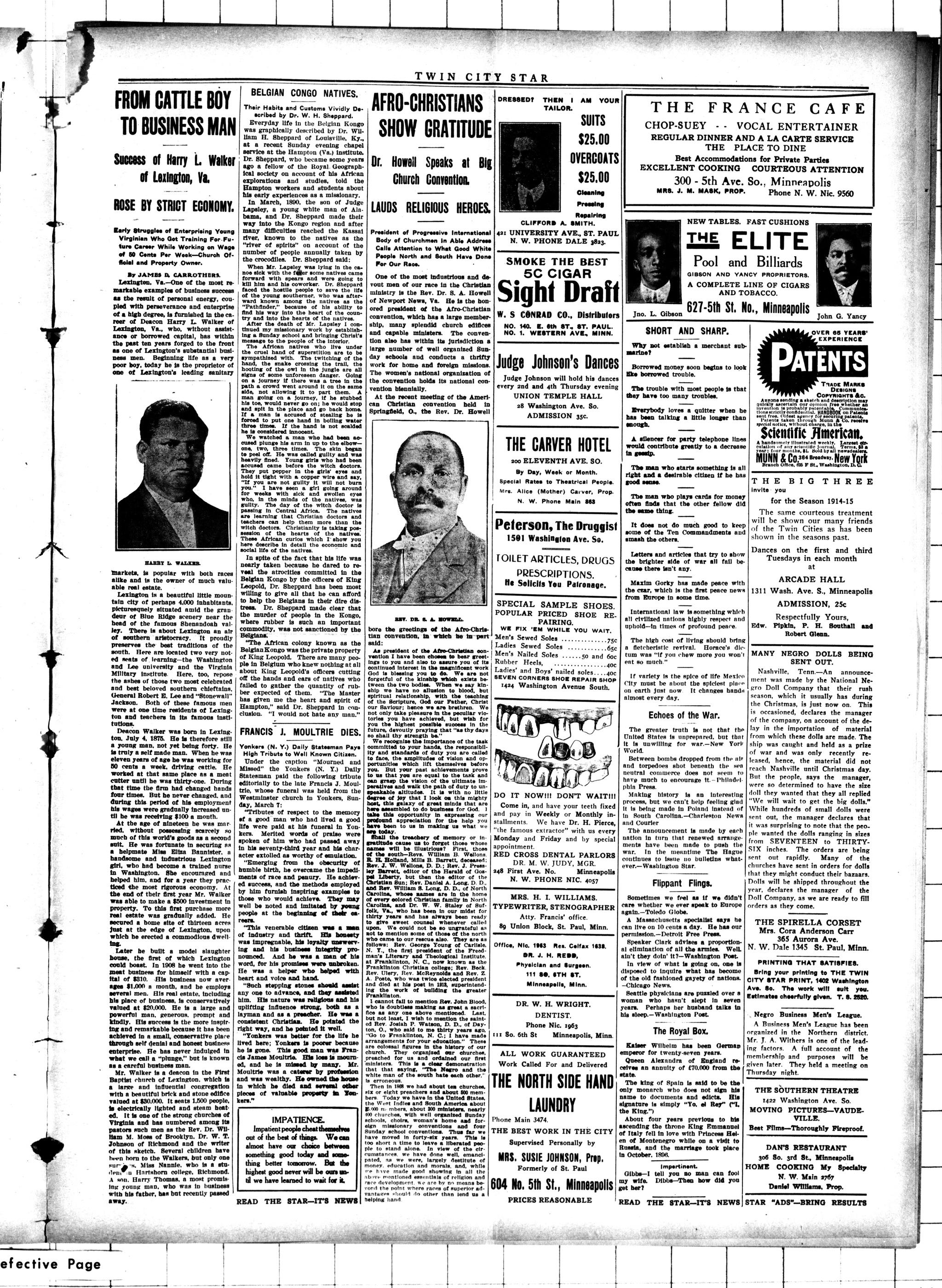
FROM CATTLE BOY TO BUSINESS MAN
Success of Harry L. Walker of Lexington, Va.
ROSE BY STRICT ECONOMY.
Early Struggles of Enterprising Young Virginian Who Get Training For-Future Career While Working on Wage of 50 Cents Per Week—Churchh Official and Property Owner.
By JAMES D. CARROTHERS.
Lexington, Va.-One of the most remarkable examples of business success as the result of personal energy, coupled with perseverance and enterprise of a high degree, is furnished in the career of Deacon Harry L. Walker of Lexington, Va., who, without assistance or borrowed capital, has within the past ten years forged to the front as one of Lexington's substantial business men. Beginning life as a very poor boy, today he is the proprietor of one of Lexington's leading sanitary
M.
HARRY L. WALKER
markets, is popular with both races alike and is the owner of much valuable real estate.
Lexington is a beautiful little mountain city of perhaps 4,000 inhabitants, picturesquely situated amid the grandeur of Blue Ridge scenery near the head of the famous Shenandoah valley. There is about Lexington an air of southern aristocracy. It proudly preserves the best traditions of the south. Here are located two very noted seats of learning—the Washington and Lee university and the Virginia Military institute. Here, too, repose the ashes of those two most celebrated and best beloved southern chiefflets, General Robert E. Lee and "Stonewall" Jackson. Both of these famous men were at one time residents of Lexington and teachers in its famous institutions.
Deacon Walker was born in Lexington, July 4, 1875. He is therefore still a young man, not yet being forty. He is truly a self made man. When he was eleven years of age he was working for 50 cents a week, driving cattle. He worked at that same place as a meat cutter until he was thirty-one. During that time the firm had changed hands four times. But he never changed, and during this period of his employment his wages were gradually increased until he was receiving $100 a month.
At the age of nineteen he was married, without possessing scarcely so much of this world's goods as a second suit. He was fortunate in securing as a helpmate Miss Eliza Bannister, a handsome and industrious Lexington girl, who had become a trained nurse in Washington. She encouraged and helped him, and for a year they practiced the most rigorous economy. At the end of their first year Mr. Walker was able to make a $500 investment in property. To this first purchase more real estate was gradually added. He secured a home site of thirteen acres just at the edge of Lexington, upon which he erected a commodious dwelling.
Later he built a model slaughter house, the first of which Lexington could boast. In 1908 he went into the meat business for himself with a capital of $310. His business now averages $1,000 a month, and he employs several men. His real estate, including his place of business, is conservatively valued at $20,000. He is a large and powerful man, generous, prompt and kindly. His success is the more inspiring and remarkable because it has been achieved in a small, conservative place through self denial and honest business enterprise. He has never indulged in what we call a "plunge," but is known as a careful business man.
Mr. Walker is a deacon in the First Baptist church of Lexington, which is a large and influential congregation with a beautiful brick and stone edifice valued at $30,000. It seats 1,500 people, is electrically lighted and steam heated. It is one of the strong churches of Virginia and has numbered among its pastors such men as the Rev. Dr. William M. Moss of Brooklyn, Dr. W. T. Johnson of Richmond and the writer of this sketch. Several children have been born to the Walkers, but only one surges, Miss Nannie, who is a student in Hartshorn college, Richmond. A son, Harry Thomas, a most promising young man, who was in business with his father, has but recently passed away.
BELGIAN CONGO NATIVES.
Their Habits and Customs Vividly Described by Dr. W. H. Shenanqi
Everyday life in the Belgian Kongo was graphically described by Dr. William H. Sheppard of Louisville, Ky., at a recent Sunday evening chapel service at the Hampton (Va.) institute. Dr. Sheppard, who became some years ago a fellow of the Royal. Geographical society on account of his African explorations and studies, told the Hampton workers and students about his early experiences as a missionary. In March, 1800, the son of Judge Lapsley, a young white man of Alabama, and Dr. Sheppard made their way into the Kongo region and after many difficulties reached the Kassai river, known to the natives as the "river of spirits" on account of the number of people annually taken by the crocodiles. Dr. Sheppard said:
When Mr. Lapsley was lying in the canoe sick with the feather some natives came forward with spears and were going to kill him and his coworker. Dr. Sheppard faced the hostile people to save the life and brought southerner, who was naked, ward known to him. He called the "Pathfinder," because of his ability to find his way into the heart of the country and into the hearts of the natives.
After the death of Mr. Lapsley I continued my missionary work by establishing a Sunday school and bringing Christ's message to the African natives who live under the cruel hand of superstition are to be sympathized with. The twitching of the hand, the snake crossing the trail, the hooting of the owl in the danger are all signs of some unforeseen danger. Going along the path a crowd went around it on the same side, not allowing it to part them. A man going on a journey, if he stubbed his toe, would never go on; he would stop and spit in the place and go back home. If a man is accused of stealing he is forced to put one hand in boiling water three times, because it is not scalded he is considered innocent.
We watched a man who had been accused plunge his arm in up to the elbow—one, two, three times. The skin began to peel off. He was called guilty and was heavily nausea. Young girls who had been accused plunge their arms in up to the elbow. They put pepper in the girls' eyes and hold it tight with a copper wire and say, "If you are not guilty it will not burn you." I have seen a girl going around for weeks with sick and swollen eyes two, three, and four times in guilty. The day of the witch doctor is passing in Central Africa. The natives are learning that Christian doctors and teachers can help them more than the witch doctors. Christianity is taking possession of the hearts of the natives. The natives are teaching you here describe in detail the economic and social life of the natives.
In spite of the fact that his life was nearly taken because he dared to reveal the atrocities committed in the Belgian Kongo by the officers of King Leopold, Dr. Sheppard has been most willing to give all that he can afford to help the Belgians in their dire distress. Dr. Sheppard made clear that the murder of people in the Kongo, where rubber is such an important commodity, was not sanctioned by the Belgians.
"The African colony known as the Belgian Kongo was the private property of King Leopold. There are many people in Belgium who knew nothing at all about King Leopold's officers cutting off the hands and ears of natives who failed to gather the quantity of rubber expected of them. "The Master has given me the heart and spirit of Hampton," said Dr. Sheppard in conclusion. "I would not hate any man."
FRANCIS J. MOULTRIE
Yonkers (N. Y.) Daily Statesman Pays High Tribute to Well Known Citizen. Under the caption "Mourned and Missed" the Yonkers (N. Y.) Daily Statesman paid the following tribute editorially to the late Francis J. Moultrie, whose funeral was held from the Westminster church in Yonkers, Sunday, March 7: "Tributes of respect to the memory of a good man who had lived a good life were paid at his funeral in Yonkers. Merited words of praise were spoken of him who had passed away in his seventy-third year and his character extolled as worthy of emulation. "Emerging from the obscurity of humble birth, he overcame the impediments of race and penury. He achieved success, and the methods employed by him furnish inspiring examples to those who would achieve. They may well be noted and imitated by young people at the beginning of their careers.
"This venerable citizen was a man of industry and thrift. His honesty was impregnable, his loyalty unweerving and his business integrity pronounced. And he was a man of his word, for his promises were unbroken. He was a helper who helped with heart and voice and hand.
"Such stepping stones should assist any one to advance, and they assisted him. His nature was religious and his uplifting influence strong, both as a layman and as a preacher. He was a consistent Christian. He pointed the right way, and he pointed it well.
"Yonkers was better for the life he lived here; Yonkers is poorer because he is gone. This good man was Francis James Moultrie. His loss is mourned, and he is missed by many. Mr. Moultrie was a caterer by profession and was wealthy. He owned the house in which he died and several other pieces of valuable property in Yonkers."
IMPATIENCE
Impatient people cheat themselves out of the best of things. We can almost have our choice between something good today and something better tomorrow. But the highest good never will be ours until we have learned to wait for it. READ THE STAR-IT'S NEWS
TWIN CITY STAR
AFRO-CHRISTIANS SHOW GRATITUDE
President of Progressive International Body of Churchmen in Able Address Calls Attention to What Good White People North and South Have Done For Our Race.
One of the most industrious and devout men of our race in the Christian ministry is the Rev. Dr. S. A. Howell of Newport News, Va. He is the honored president of the Afro-Christian convention, which has a large membership, many splendid church edifices and capable ministers. The convention also has within its jurisdiction a large number of well organized Sunday schools and conducts a thrifty work for home and foreign missions. The women's national organization of the convention holds its national convention biennially.
At the recent meeting of the American Christian convention held in Springfield, O., the Rev. Dr. Howell
JOHN H. BURKE
BEV. DR. S. A. NOWELL.
bore the greetings of the Afro-Christian convention, in which he is part said:
As president of the Afro-Christian convention I have been chosen to bear greetings to the African people, your continued interest in the magnificent work God is blessing you to do. We are not forgetful of the kinship which exists between the two bodies. When we say kinship we have no allusion to blood, but spiritual relationship, with the teaching of the Scripture, God our Father, Christ our Saviour; hence we are brethren. We not only take pleasure in the peculiar vicariousness of our work, but each you the highest possible success in the future, devoutly praying that "as thy days so shall thy strength be."
We recognize the importance of the task committed to your hands, the responsibility and standards of duty you are called to fulfill, and the opportunities which lift themselves before you. But your past achievements prove to us that you are equal to the task and can grasp the vision of the ultimate imperatives and walk the path of duty to unleash your potential. The degree of joy that I look on this mighty host, this galaxy of great minds that are here assembled to do business for God. I take this opportunity in expressing our profound appreciation for the help you need to us in making us what we are today.
Shall the treachery of memory or ingratitude cause us to forget those whose names will be illustrious? First, those of the south—Revs. William B. Wellons. R. H. Holland, Mills B. Barrett, deceased; Rev. J. W. Wellons. D. D.; Rev. J. Pressman. D. D.; Rev. J. Pope. Gospel Liberty, but then the editor of the Christian Sun; Rev. Daniel A. Long. D. D, and Rev. William S. Long. D. D, of North Carolina, whose names are in the home of every colored Christian family in North Carolina, and Dr. W. W. Staley of Suffolk, Va., who has been in our midst for thirty years and has always been ready to give his counsel whenever called upon. We could not mention some of those of the north who came to our rescue also. They are as follows: Rev. George Young of Carlisle, N. Y., the first president of the Freeman's Literary and Theological Institute, at Franklinton, N. C., now known as the Franklinton Christian college; Rev. Beck Rev. Ullery, Rev. McReynolds and Rev. Z. Ullery, Rev. McReynolds and died at his post in 1913, superintending the work of building the greater Franklinton.
I cannot fall to mention Rev. John Blood, who is doubtless making as great a sacrifice as any one above mentioned. Last, but not least, I wish to mention the sainted Rev. Josiah P. Watson, D. D., of Dayton, O., who said to me thirty years ago, "Go to Franklinton, N. C.; I have made arrangements for your education." These are colossal figures in the history of our church. They organized our churches, and for some time maintained our first ministers. This is a clear demonstration that that saying, "The Negro and the white man of the south hate each other." is erroneous.
Then in 1888 we had about ten churches, six or eight preachers and about 500 members. Today we have in the United States, the West Indies and South America about 400 churches, with well organized Sunday schools, choirs, woman's home and foreign missionary conventions and four Sunday school conventions. Thus far we have moved in forty-six years. This is too show time to leave a liberated people stand and stand on the ground. As circumstances, we have done well, emancipated, as we were, largely destitute of money, education and morals, and, while we have made good showing in all the above mentioned essentials of religion and education, we have also found the point where races of superior advantages should do other than lend us a helping hand.
DRESSED? THEN I AM YOUR
TAILOR.
SUITS
$25.00
OVERCOATS
$25.00
Cleaning
Pressing
Repairing
CLIFFORD A. SMITH.
421 UNIVERSITY AVE., ST. PAUL
N. W. PHONE DALE 3823.
SMOKE THE BEST 5C CIGAR
W. S CONRAD CO., Distributors
NO. 140. E. 6th ST., ST. PAUL.
NO. 1. WESTERN AVE., MINN.
Judge Johnson's Dances
Judge Johnson will hold his dances every 2nd and 4th Thursday evening UNION TEMPLE HALL 28 Washington Ave. So. ADMISSION 35c.
THE CARVER HOTEL
200 ELEVENTH AVE. SO.
By Day, Week or Month.
Special Rates to Theatrical People.
Mrs. Alice (Mother) Carver, Prop.
N. W. Phone Main 863
Peterson, The Druggist 1501 Washington Ave. So.
TOILET ARTICLES, DRUGS
PRESCRIPTIONS.
He Solicits You Patronage.
SPECIAL SAMPLE SHOES.
POPULAR PRICED SHOE RE-
PAIRING.
WE FIX 'EM WHILE YOU WAIT.
Men's Sewed Soles ... 75c
Ladies Sewed Soles ... 65c
Men's Nailed Soles ... 50 and 60c
Rubber Heels, ... 40c
Ladies' and Boys' nailed soles ... 40c
SEVEN CORNERS SHOE REPAIR SHOP
1424 Washington Avenue South.
DO IT NOW!!! DON'T WAIT!!!
Come in, and have your teeth fixed and pay in Weekly or Monthly installments. We have Dr. H. Pierce, "the famous extractor" with us every Monday and Friday and by special appointment.
RED CROSS DENTAL PARLORS
DR. M. W. JUDY, MGR.
248 First Ave. No. Minneapolis
N. W. PHONE NIC. 4057
MRS. H. I. WILLIAMS.
TYPEWRITER, STENOGRAPHER
Atty. Francis' office.
8g Union Block, St. Paul, Minn.
Office, Nic. 1963 Res. Celfax 1638.
DR. J. H. REDD,
Physician and Surgeon.
111 80, 6TH ST.
Minneapolis, Minn.
DR. W. H. WRIGHT.
DENTIST.
Phone Nic. 1963
111 So. 6th St Minneapolis, Minn.
ALL WORK GUARANTEED
Work Called For and Delivered
THE NORTH SIDE HAND
LAUNDRY
Phone Main 3474.
THE BEST WORK IN THE CITY
Supervised Personally by
MRS. SUSIE JOHNSON, Prop.
Formerly of St. Paul
604 No. 5th St., Minneapolis
PRICES REASONABLE
THE FRANCE CAFE
CHOP-SUEY - - VOCAL ENTERTAINER
REGULAR DINNER AND A LA CARTE SERVICE
THE PLACE TO DINE
Best Accommodations for Private Parties
EXCELLENT COOKING COURTEOUS ATTENTION
300 - 5th Ave. So., Minneapolis
MRS. J. M. MASK, PROP. Phone N. W. Nic. 9560
NEW TABLES. FAST CUSHIONS
THE ELITE
Pool and Billiards
GIBSON AND YANCY PROPRIETORS.
A COMPLETE LINE OF CIGARS
AND TOBACCO.
627-5th St. No., Minneapolis
SHORT AND SHARP.
Why not establish a merchant submarine?
Borrowed money soon begins to look like borrowed trouble.
The trouble with most people is that they have too many troubles.
Everybody loves a quitter when he has been talking a little longer than enough.
A silencer for party telephone lines would contribute greatly to a decrease in gossip.
The man who starts something is all right and a desirable citizen if he has good sense.
The man who plays cards for money often finds that the other fellow did the same thing.
It does not do much good to keep some of the Ten Commandments and smash the others.
Letters and articles that try to show the brighter side of war all fall because there isn't any.
Maxim Gorky has made peace with the czar, which is the first peace news from Europe in some time.
International law is something which all civilized nations highly respect and uphold—in times of profound peace.
The high cost of living should bring a feticheral revival. Horace's dictum was "if you chew more you won't eat so much."
If variety is the spice of life Mexico City must be about the spiciest place on earth just now. It changes hands almost every day.
Echoes of the War.
The greater truth is not that the United States is unprepared, but that it is unwilling for war.—New York World.
Between bombs dropped from the air and torpedoes shot beneath the sea neutral commerce does not seem to have much to encourage it.—Philadelphia Press.
Making history is an interesting process, but we can't help feeling glad it is being made in Poland instead of in South Carolina.—Charleston News and Courier
The announcement is made by each nation in turn that renewed arrangements have been made to push the war. In the meantime The Hague continues to issue no bulletins whatever.—Washington Star.
Flippant Flings.
Sometimes we feel as if we didn't care whether we ever speak to Europe again.-Toledo Globe.
A Massachusetts specialist says he can live on 10 cents a day. He has our permission.-Detroit Free Press.
Speaker Clark advises a proportional elimination of all the armies. Well, ain't they doin' it?-Washington Post.
In view of what is going on, one is disposed to inquire what has become of the old fashioned gayety of nations.
-Chicago News.
Seattle physicians are puzzled over a woman who hasn't slept in seven years. Perhaps her husband talks in his sleep.-Washington Post.
Kaiser Wilhelm has been German emperor for twenty-seven years.
Queen Alexandra of England receives an annuity of £70,000 from the state.
The king of Spain is said to be the only monarch who does not sign his name to documents and edicts. His signature is simply "Yo, el Rey" ("I, the King.")
About four years previous to his ascending the throne King Emmanuel of Italy fell in love with Princess Helen of Montenegro while on a visit to Russia, and the marriage took place in October, 1896.
Impertinent.
Gibbs—I tell you no man can fool my wife. Dibbs—Then how did you get her?
READ THE STAR—IT'S NEWS
Jno. L. Gibson
The Royal Box.
OVER 65 YEARS' EXPERIENCE
PATENTS
TRADE MARKS DESIGNS
COPYRIGHTS & C.
Anyone sending a sketch and description may quickly ascertain our opinion free whether an invention is probably patentable. Communications strictly probable. HANDBOOK on Patents sent free. Oftest agency for securing patents. Invents taken from Munn & Co. receive special notice, without charge, in the
Scientific American.
A handbook illustrated weekly. Papers, catalog of any scientific journal. Tenure. 81 a year; four months. $L. Sold by all newadvertisers.
MUNN & Co. 364 Broadway. New York
Branch Office, 625 F St., Washington, D.C.
THE BIG THREE
invite you
for the Season 1914-15
The same courteous treatment will be shown our many friends of the Twin Cities as has been shown in the seasons past.
Dances on the first and third
Tuesdays in each month
at
ARCADE HALL
1311 Wash. Ave. S., Minneapolis
Respectfully Yours,
Edw. Pipkin, P. H. Southall and
Robert Glenn.
MANY NEGRO DOLLS BEING
SENT OUT.
Nashville, Tenn.—An announcement was made by the National Negro Doll Company that their rush season, which it usually has during the Christmas, is just now on. This is occasioned, declares the manager of the company, on account of the delay in the importation of material from which these dolls are made. The ship was caught and held as a prize of war and was only recently released, hence, the material did not reach Nashville until Christmas day. But the people, says the manager, were so determined to have the size doll they wanted that they all replied "We will wait to get the big dolls." While hundreds of small dolls were sent out, the manager declares that it was surprising to note that the people wanted the dolls ranging in sizes from SEVENTEEN to THIRTY-SIX inches. The orders are being sent out rapidly. Many of the churches have sent in orders for dolls that they might conduct their bazaars. Dolls will be shipped throughout the year, declares the manager of the Doll Company, as we are ready to fill orders as they come.
N. W. Dale 1345 St. Paul, Minn.
Bring your printing to THE TWIN CITY STAR PRINT, 1402 Washington Ave. So. The work will suit you. Estimates cheerfully given. T. S. 2520.
Negro Business Men's League.
A Business Men's League has been organized in the Northern district. Mr. J. A. Withers is one of the leading factors. A full account of the membership and purposes will be given later. They held a meeting on Thursday night.
THE SOUTHERN THEATRE
1422 Washington Ave. So.
MOVING PICTURES—VAUDE-VILLE.
Best Films—Thoroughly Fireproof.
DAN'S RESTAURANT
306 So. 3rd St., Minneapolis
HOME COOKING My Specialty
N. W. Main 2767
Daniel Williams, Prop.
STAR "ADS"—BRING RESULTS
John G. Yancy
CHARLES SUMNER SMITH,
1419 Washington Ave. So.,
Minneapolis, Minnesota.
Entered in the Post Office at
Minneapolis as second class matter.
MEMBER
NATIONAL NEGRO PRESS
ASSOCIATION
Subscription by Mail, Postpaid.
ONE YEAR ..... $2.00
SIX MONTHS ..... 1.00
THREE MONTHS ..... .65
CANADIAN SUBSCRIPTIONS $2.50
ADVERTISING RATES.
One inch, one insertion, Fifty Cents
Liberal discount given on 3, 6, 9,
Months, or 1 year contracts.
Want Ads ..... Twenty-five Cents
Reading Notices, per line, Five Cents
Wedding Announcements, Fifty Cents
Card of Thanks ..... One Dollars
In Memoriam ..... One Dollar
Business Announcements, One Dollar
Death Notices ..... Fifty Cents
When writing for the press, don't
abbreviate your words. Spell each
one out correctly and distinctly. If
you don't it means that all of your
manuscript will have to be rewritten
if there is time. Write on one side of
the paper only.
Address all mail to Twin City Star
1419 Washington Ave. So.
Minneapolis, Minnesota.
THE NEGROES' CHANCE.
A Rebuke to Discrimination.
Now that there may be an election to decide the liquor traffic in Minneapolis, the Negro voter is confronted with a condition whereby he may resent the many discriminations against his race. His vote is wanted by the liquor dealers who have in many instances led the fight in the "A Dollar a Drink" agitation against Negroes. Will he, as a voter, exercise his ballot as a weapon of defense; is the important topic? We feel that every Negro is especially justified in voting "Dry" on this particular issue. Such places as Weil's, A. M. Smith's and many others, who do not want the Negro should be made to suffer. The liquor dealers have sanctioned every form of segregation. They begin with the sale of rot-gut whiskey to Negroes with bare walls and a sawdust floor and end with "bottled in bond" amid plate glass and ornamental tile with "Negro trade not wanted." 'Tis true we have some jobs etc., but what are they to be purchased at the price of race inferiority and humiliation? The battle is drawn between two factions of the whites. The Negro is now a factor. The stone that the builders rejected will become the head stone of the corner—if good judgment and honesty pre-prevails.
Evila of Enforced Segregation.
The Negroes of the South are possessed of two most excellent qualities—a desire for education which fills every Negro school as soon as it is opened, and a hunger for land which makes them eager to secure their own homes and farms. The South needs laborers. Its resources have only just begun to be developed. There is wealth in the soil and under the ground that has scarcely been touched. The Negro and white people of the South have come up under the same traditions, and except as they have been disturbed by politicians and demagogues they have lived side by side in the greatest harmony. The right sort of education which emphasizes Christian service, makes white men and black men better and more helpful neighbors.
In some parts of the South the Negroes of their own accord have settled in certain sections by themselves. In Mound Bayou in Mississippi and in other places they have their towns governed by Negroes. It is well that they should have the opportunity which these Negro settlements afford of developing and demonstating their powers of self-government; but any enforced segregation will result, as Dr. Weatherford shows, only in harm to both whites and blacks. It would end in the Negro moving in large numbers to the cities, which do not afford him as good opportunities as the country for the development of integrity, thrift, and character. It would thus deprive the Southern white man of the labor he needs.
The "Clubs" are passing, almost passed. Few realize the many privileges formerly enjoyed by the management of these social clubs, and their very liberal toleration by the police authorities. At one time they seemed to be able to withstand the attacks of every force of reform, but now they are tootering under their own strife and disunion. They had become a source of annoyance to the public and police and some of the managers even ignored the orders from the authorities. They banded for supposed protection employing Atty. W. R. Morris. This was their undoing. Not only were they subject to the attacks from other members of the profession, but the practical politics of the fraternal organizations could not be applied to the Negro clubs. Mr. Morris was unable to give protection to illegitimate business and he had no pull with the police. Pull was lacking among the owners, the police gave them every chance to push each other out of business and they have almost succeeded. It is but fair to say that the order was rather drastic. We do not know the cause because it had been held "that such places existed because Negro men and women were not wanted in white places." Now that the authorities have taken action in the matter, and there is no place, af amusement conducted by Negroes, we request that His Honor, Mayor Nye, give us the protection of his office and if necessary revoke the licenses of those who refuse to serve Negroes in public places. We are proud to state that so far as women are concerned, at least one place Oliver's Cabaret was conducted as cleanly as any white place of its kind in the city. We do not contend that the best women of the city patronize these places, but many of the supposed best visit the buffet flats. We have not been asked our opinion in this matter by the powers of either side. It is a lawyers' battle and we are looking on—but we state these truths with fairness. If the moral conditions of our women would be better protected by the elimination of these public places, we would say that is a good thing, but we see no betterment, when buffet-flats are run, where the privacy is more inviting to our women than the publicity of the clubs. When the police department will make an active crusade against these private institutions of crime, and punish the keepers and inmates,—when we are given our rights as citizens in public places—when our church workers will attempt to rescue the fallen, instead of casting out into utter darkness the fortunate victims of illspent lives, then we can say that "It is good." But until then it has added to our race degeneracy. Clean up the real source of the evil, the buffet-flats. Many of these places are run by white women, whose patrons include some of our best citizens. If there is to be a clean-up, do it right! Get at the root of the evil.
Music and Race Prejudice.
The concerts and recitals of the New York Music School Settlement, which have usually brought together almost as many white people as black, have served as a channel of communication between the white race and the black race. Thousands of white people have, by means of these concerts, come to recognize, as they never have before, that the Negro race has capacities and talents which need only proper development and direction to enable that race to take its rightful position in the family of races. Mr. David Bispham, the famous American baritone, in a concert which he gave a year or two ago at the Harvard Club to an audience of several hundred college men, said, when he reached the last number on his program, "I have been singing this afternoon the songs of many foreign composers. I shall close with two songs of an American composer. I regret to say that I did not discover this composer myself, but learned of him only through the writings of German musicians. He is not as well known in his own country as he should be. I suppose the reason for this is that he is a Negro, but I want to say to you gentlemen that there is no color line in art. When I find a composition of merit it makes no difference to me whether it be written by a white man or a black man or a red man." He then proceeded to sing Will Marion Cook's "Exhortation," to the immense enjoyment of his audience. It cannot be doubted that through music, the universal language, there is bound to come in time a better understanding between the two races.
Southern Workman.
ATY. FRANCIS NEW LOCA TION.
Atty. William T. Francis has moved to Suite 329 in the American Bank Building, Cedar and Fifth Sts., St. Paul.
SUBSCRIBE FOR THE STAR
TWIN CITY STAR
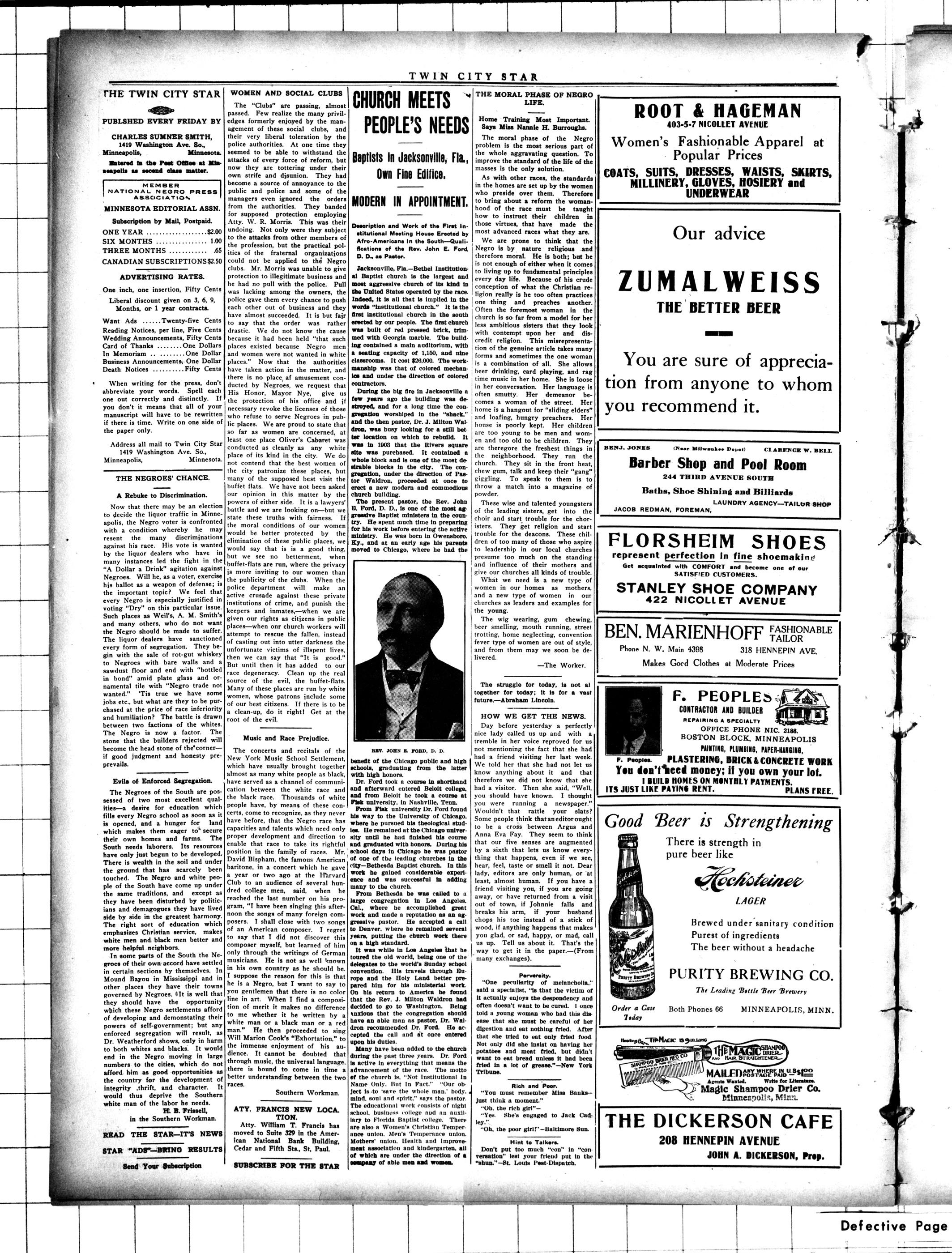
CHURCH MEETS PEOPLE'S NEEDS
Description and Work of the First Institutional Meeting House Erected by Afro-Americans In the South—Qualifications of the Rev. John E. Ford, D. D., as Pastor.
Jacksonville, Fla.—Bethel Institutional Baptist church is the largest and most aggressive church of its kind in the United States operated by the race. Indeed, it is all that is implied in the words "institutional church." It is the first institutional church in the south erected by our people. The first church was built of red pressed brick, trimmed with Georgia marble. The building contained a main auditorium, with a seating capacity of 1,150, and nine classrooms. It cost $26,000. The workmanship was that of colored mechanics and under the direction of colored contractors.
During the big fire in Jacksonville a few years ago the building was destroyed, and for a long time the congregation worshiped in the "shack," and the then pastor, Dr. J. Milton Waldron, was busy looking for a still better location on which to rebuild. It was in 1903 that the Rivers square site was purchased. It contained a whole block and is one of the most desirable blocks in the city. The congregation, under the direction of Pastor Waldron, proceeded at once to erect a new modern and commodious church building.
The present pastor, the Rev. John E. Ford, D. D., is one of the most aggressive Baptist ministers in the country. He spent much time in preparing for his work before entering the active ministry. He was born in Owensboro, Ky., and at an early age his parents moved to Chicago, where he had the
M. B.
REV. JOHN E. FORD, D. D.
benefit of the Chicago public and high schools, graduating from the latter with high honors.
Dr. Ford took a course in shorthand and afterward entered Beloit college, and from Beloit he took a course at Fisk university, in Nashville, Tenn.
From Fisk university Dr. Ford found his way to the University of Chicago, where he pursued his theological studies. He remained at the Chicago university until he had finished his course and graduated with honors. During his school days in Chicago he was pastor of one of the leading churches in the city—Bethesda Baptist church. In this work he gained considerable experience and was successful in adding many to the church.
From Bethesda he was called to a large congregation in Los Angeles. Cal., where he accomplished great work and made a reputation as an aggressive pastor. He accepted a call to Denver, where he remained several years, putting the church work there on a high standard.
It was while in Los Angeles that he toured the old world, being one of the delegates to the world's Sunday school convention. His travels through Europe and the Holy Land better prepared him for his ministerial work. On his return to America he found that the Rev. J. Milton Waldron had decided to go to Washington. Being anxious that the congregation should have an able man as pastor, Dr. Waldron recommended Dr. Ford. He accepted the call and at once entered upon his duties.
Many have been added to the church during the past three years. Dr. Ford is active in everything that means the advancement of the race. The motto of the church is, "Not Institutional In Name Only. But In Fact." "Our object is to 'save the whole man.' body, mind, soul and spirit," says the pastor. The educational work consists of night school, business college and an auxiliary to Florida Baptist college. There are also a Women's Christian Temperance union. Men's Temperance union. Mothers' union. Health and Improvement association and kindergarten, all of which are under the direction of a company of able men and women.
THE MORAL PHASE OF NEGRO LIFE.
The moral phase of the Negro problem is the most serious part of the whole aggravating question. To improve the standard of the life of the masses is the only solution.
As with other races, the standards in the homes are set up by the women who preside over them. Therefore to bring about a reform the womanhood of the race must be taught how to instruct their children in those virtues, that have made the most advanced races what they are.
We are prone to think that the Negro is by nature religious and therefore moral. He is both; but he is not enough of either when it comes to living up to fundamental principles every day life. Because of his crude conception of what the Christian religion really is he too often practices one thing and preaches another. Often the foremost woman in the church is so far from a model for her less ambitious sisters that they look with contempt upon her and discredit religion. This misrepresentation of the genuine article takes many forms and sometimes the one woman is a combination of all. She allows beer drinking, card playing, and ragtime music in her home. She is loose in her conversation. Her language is often smutty. Her demeanor becomes a woman of the street. Her home is a hangout for "sliding elders" and loafing, hungry preachers. Her house is poorly kept. Her children are too young to be men and women and too old to be children. They are theregore the freshest things in the neighborhood. They run the church. They sit in the front heat, chew gum, talk and keep their "gang" giggling. To speak to them is to throw a match into a magazine of powder.
These wise and talented youngsters of the leading sisters, get into the choir and start trouble for the choristers. They get religion and start trouble for the deacons. These children of too many of those who aspire to leadership in our local churches presume too much on the standing and influence of their mothers and give our churches all kinds of trouble. What we need is a new type of women in our homes as mothers, and a new type of women in our churches as leaders and examples for the young. The wig wearing, gum chewing, beer smelling, mouth running, street trotting, home neglecting, convention fever type of women are out of style, and from them may we soon be delivered.
The struggle for today, is not al together for today; it is for a vast future.—Abraham Lincoln.
HOW WE GET THE NEWS.
Day before yesterday a perfectly nice lady called us up and with a tremble in her voice reproved for us not mentioning the fact that she had had a friend visiting her last week. We told her that she had not let us know anything about it and that therefore we did not know that she had a visitor. Then she said, "Well, you should have known. I thought you were running a newspaper." Wouldn't that rattle your slats? Some people think that an editor ought to be a cross between Argus and Anna Eva Fay. They seem to think that our five senses are augmented by a sixth that lets us know everything that happens, even if we see, hear, feel, taste or smell it not. Dear lady, editors are only human, or at least, almost human. If you have a friend visiting you, if you are going away, or have returned from a visit out of town, if Johnnie falls and breaks his arm, if your husband chops his toe instead of a stick of wood, if anything happens that makes you glad, or sad, happy, or mad, call us up. Tell us about it. That's the way to get it in the paper.—(From many exchanges).
"One peculiarity of melancholia," said a specialist, "is that the victim of it actually enjoys the despondency and often doesn't want to be cured. I once told a young woman who had this disease that she must be careful of her digestion and eat nothing fried. After that she tried to eat only fried food. Not only did she insist on having her potatoes and meat fried, but didn't want to eat bread unless it had been fried in a lot of grease."—New York Tribune.
Rich and Poor.
Mint to Talkers.
Don't put too much "con" in "con-
versation" lest your friend put in the
"shun."—St. Louis Post-Dispatch.
The Worker.
Perversity.
ROOT & HAGEMAN
403-5-7 NICOLLET AVENUE
Women's Fashionable Apparel at
Popular Prices
COATS, SUITS, DRESSES, WAISTS, SKIRTS,
MILLINERY, GLOVES, HOSIERY and
UNDERWEAR
You are sure of appreciation from anyone to whom you recommend it.
Barber Shop and Pool Room
244 THIRD AVENUE SOUTH
Baths, Shoe Shining and Billiards
LAUNDRY AGENCY—TAILOR SHOP
ACOB REDMAN, FOREMAN,
FLORSHEIM SHOES represent perfection in fine shoemaking Get acquainted with COMFORT and become one of our SATISFIED CUSTOMERS. STANLEY SHOE COMPANY 422 NICOLLET AVENUE
BEN. MARIENHOFF FASHIONABLE TAILOR
Phone N. W. Main 4398 318 HENNEPIN AVE.
Makes Good Clothes at Moderate Prices
Heating Boil
TR MAGIC 19 9 IN LONG
THE MAGIC SHAMPOO DRIER
AND HAIR STRAIGHTENER.
SHAMPOO DRIER MED CO.
MAILED ANY WHERE IN U.S.$100
POSTAGE PAID
Agents Wanted. Write for Literature.
Magic Shampoo Drier Co.
Minneapolis, Minn.
THE DICKERSON CAFE
208 HENNEPIN AVENUE
JOHN A. DICKERSON, Prop.
F. Peoples.
You don't
I BUILD
ITS JUST LIKE
Good T
Kelbottin
PURE DRINKING CO.
PURE DRINKING CO.
Order a Case
Today
Heating Bar
MALWEISS
THE BETTER BEER
are sure of appreciation anyone to whom recommend it.
(Near Milwaukee Depot) CLARENCE W. BELL
Shop and Pool Room
14 THIRD AVENUE SOUTH
Shoe Shining and Billiards
LAUNDRY AGENCY—TAILOR SHOP
FOREMAN,
SHEIM SHOES
Perfection in fine shoemaking
with COMFORT and become one of our SATISFIED CUSTOMERS.
KEY SHOE COMPANY
NICOLLET AVENUE
ARIENHOFF FASHIONABLE TAILOR
Main 4398 318 HENNEPIN AVE.
Good Clothes at Moderate Prices
F. PEOPLES
CONTRACTOR AND BUILDER
REPAIRING A SPECIALTY
OFFICE PHONE NIC. 2188.
BOSTON BLOCK, MINNEAPOLIS
PAINTING, PLUMBING, PAPER-HANGING,
PLASTERING, BRICK & CONCRETE WORK
need money; if you own your lot.
HOMES ON MONTHLY PAYMENTS.
PLAYING RENT. PLANS FREE.
Beer is Strengthening
There is strength in
pure beer like
OFFICE PHONE NIC. 2188.
BESTON BLOCK, MINNEAPOLIS
PAINTING, PLUMBING, PAPER-HANGING,
TERING, BRICK & CONCRETE WORK
money; if you own your lot.
IS ON MONTHLY PAYMENTS.
RENT. PLANS FREE
is Strengthening
e is strength in
beer like
Hochsteiner
Brewed under sanitary condition
Purest of ingredients
The beer without a headache
PURITY BREWING CO.
The Leading Bottle Beer Brewery
Both Phones 66 MINNEAPOLIS, MINN.
THE MAGIC SHAMPOO
DRIER
HAIR STRAIGHTENER
ING CO
Brewery
Our advice
Defective Page