Twin City Star
Saturday, August 7, 1915
Minneapolis, Minnesota
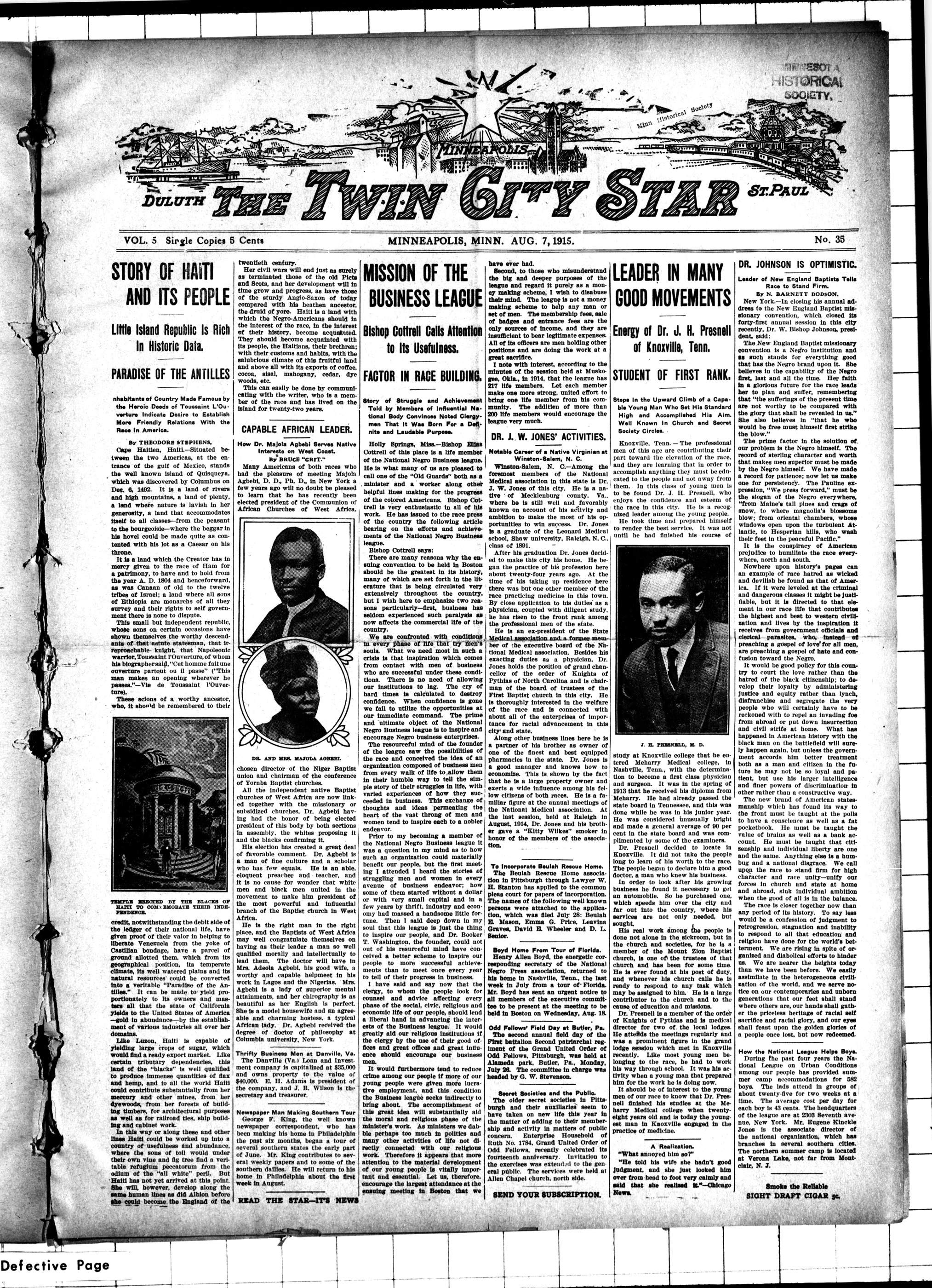
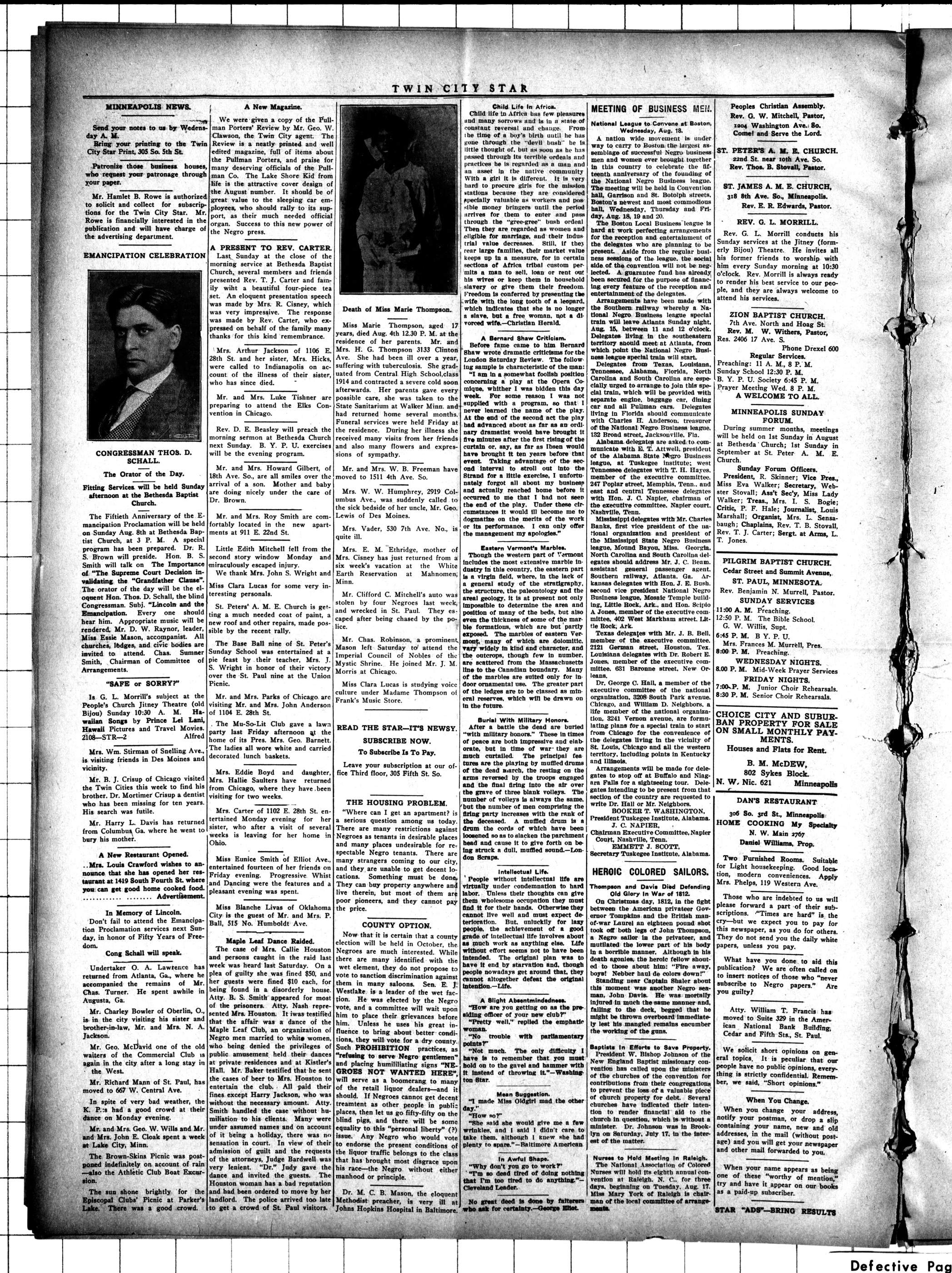
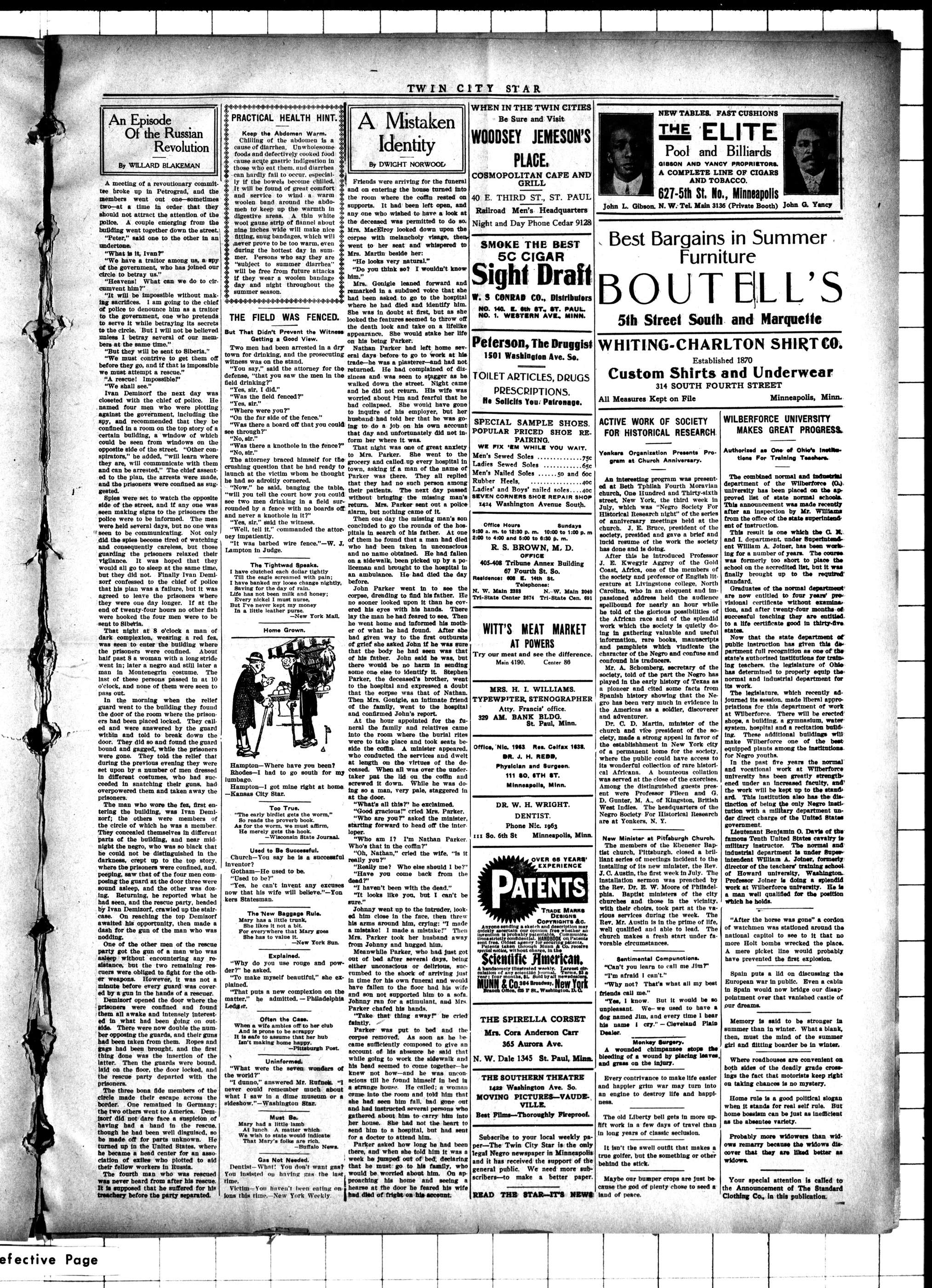
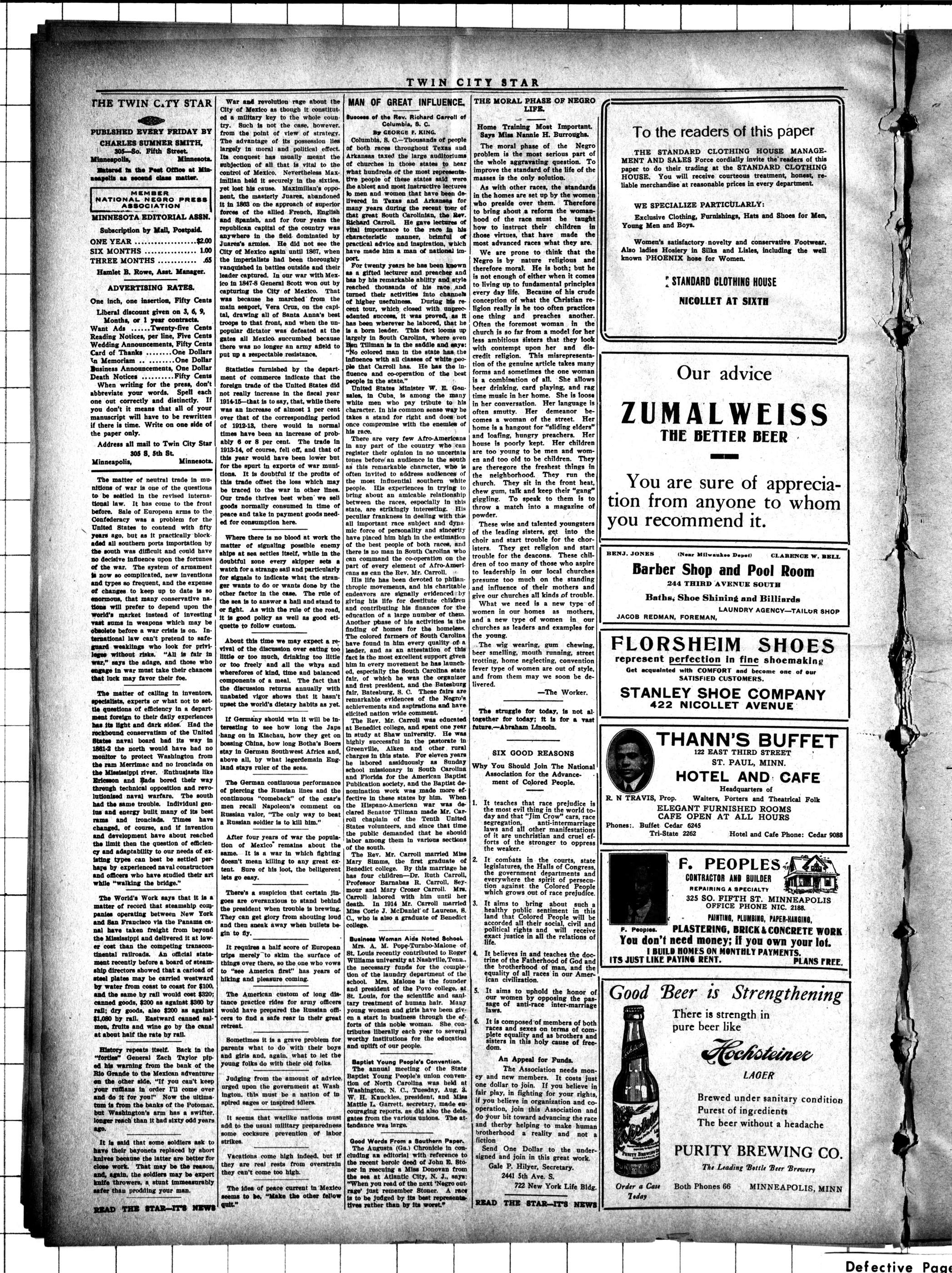
Page text (machine-generated)
MINNEAPOLIS
MINN HISTORICAL SOCIETY
DULUTH THE TWIN CITY STAR ST.PAUL
Defective Page
VOL. 5 Single Copies 5 Cents
STORY OF HAITI AND ITS PEOPLE
inhabitants of Country Made Famous by the Heroic Deeds of Toussaint L'Ouverture Indicate Desire to Establish More Friendly Relations With the Race In America.
BY THEODORE STEPHENS.
Cape Haitien, Haiti—Situated between the two Americas, at the entrance of the gulf of Mexico, stands the well known island of Quisqueya, which was discovered by Columbus on Dec. 6, 1492. It is a land of rivers and high mountains, a land of plenty, a land where nature is lavish in her generosity, a land that accommodates itself to all classes—from the peasant to the bourgeoisie—where the beggar in his hotel could be made quite as contented with his lot as a Caesar on his throne.
It is a land which the Creator has in mercy given to the race of Ham for a patrimony, to have and to hold from the year A. D. 1804 and henceforward, as was Canaan of old to the twelve tribes of Israel; a land where all sons of Ethiopia are monarchs of all they survey and their rights to self government there is none to dispute.
This small but independent republic, whose sons on certain occasions have shown themselves the worthy descendants of that astute statesman, that irreproachable knight, that Napoleonic warrior, Toussaint l'Ouverture, of whom his biographers said, "Cet homme fatume ouverture partout ou il passe" ("This man makes an opening wherever he passes."—Vie de Toussaint l'Ouverture).
These scions of a worthy ancestor, who, it should be remembered to their
TEMPLE RECREATED BY THE BLACKS OF HAITI TO COMMEMORATE THE INDEPENDENCE.
credit, notwithstanding the debit side of the ledger of their national life, have given proof of their valor in helping to liberate Venezuela from the yoke of Castilian bondage, have a parcel of ground allotted them, which from its geographical position, its temperate climate, its well watered plains and its natural resources could be converted into a veritable "Paradise of the Antilles." It can be made to yield proportionately to its owners and masters all that the state of California yields to the United States of America—gold in abundance—by the establishment of various industries all over her domains.
Like Luzon, Haiti is capable of yielding large crops of sugar, which would find a ready export market. Like certain tributary dependencies, this land of the "blacks" is well qualified to produce immense quantities of flax and hemp, and to all the world Haiti could contribute substantially from her mercury and other mines, from her dyewoods, from her forests of building timbers, for architectural purposes as well as for railroad ties, ship building and cabinet work.
In this way or along these and other lines Haiti could be worked up into a country of usefulness and abundance, where the sons of toll would under their own vine and fig tree find a veritable refugium pecatorum from theodium of the "all white" peril. But Haiti has not yet arrived at this point, she will, however, develop along the same human lines as did Albion before she could become the England of the
twenteth century.
Her civil wars will end just as surely as terminated those of the old Picts and Scots, and her development will in time grow and progress, as have those of the sturdy Anglo-Saxon of today compared with his heathen ancestor, the druid of yore. Haiti is a land with which the Negro-Americans should in the interest of the race, in the interest of their history, become acquainted. They should become acquainted with its people, the Haitians, their brethren; with their customs and habits, with the salubrious climate of this fruitful land and above all with its exports of coffee, cocoa, sisal, mahogany, cedar, dye woods, etc.
This can easily be done by communicating with the writer, who is a member of the race and has lived on the island for twenty-two years.
CAPABLE AFRICAN LEADER.
How Dr. Majola Agbebi Serves Native Interests on West Coast.
By BRUCE "GRIT."
Many Americans of both races who had the pleasure of meeting Majola Agbebi, D. D., Ph. D., in New York a few years ago will no doubt be pleased to learn that he has recently been elected president of the Communion of African Churches of West Africa.
DR. AND MRS. MAJOLA AGBEBI.
chosen director of the Niger Baptist union and chairman of the conference of Yornba Baptist churches.
All the independent native Baptist churches of West Africa are now linked together with the missionary or subsidized churches, Dr. Agbebi having had the honor of being elected president of this body by both sections in assembly, the whites proposing it and the blacks confirming it.
His election has created a great deal of favorable comment. Dr. Agbebi is a man of fine culture and a scholar who has few equals. He is an able, eloquent preacher and teacher, and it is no cause for wonder that white men and black men united in the movement to make him president of the most powerful and influential branch of the Baptist church in West Africa.
He is the right man in the right place, and the Baptists of West Africa may well congratulate themselves on having as their leader a man so well qualified morally and intellectually to lead them. The doctor will have in Mrs. Adeola Agbebi, his good wife, a worthy and capable helpmeet in his work in Lagos and the Nigerias. Mrs. Agbebi is a lady of superior mental attainments, and her chiography is as beautiful as her English is perfect.
She is a model housewife and an agreeable and charming hostess, a typical African lady. Dr. Agbebi received the degree of doctor of philosophy at Columbia university, New York.
Thrifty Business Men at Danville, Va. The Danville (Va.) Loan and Investment company is capitalized at $35,000 and owns property to the value of $40,000. E. H. Adams is president of the company, and J. R. Wilson is the secretary and treasurer.
Newspaper Man Making Southern Tour George F. King, the well known newspaper correspondent, who has been making his home in Philadelphia the past six months, began a tour of several southern states the early part of June. Mr. King contributes to several weekly papers and to some of the southern dailies. He will return to his home in Philadelphia about the first week in August.
READ THE STAR-IT'S NEWS
MINNEAPOLIS, MINN. AUG. 7, 1915.
MISSION OF THE BUSINESS LEAGUE
Story of Struggle and Achievement Told by Members of Influential National Body Convincives Note Clergymen That It Was Born For a Definite and Laudable Purpose.
Holly Springs, Miss.—Bishop Ellias Cottrell of this place is a life member of the National Negro Business league. He is what many of us are pleased to call one of the "Old Guards" both as a minister and a worker along other helpful lines making for the progress of the colored Americans. Bishop Cottrell is very enthusiastic in all of his work. He has issued to the race press of the country the following article bearing on the efforts and achievements of the National Negro Business league.
Bishop Cottrell says:
There are many reasons why the ensuing convention to be held in Boston should be the greatest in its history, many of which are set forth in the literature that is being circulated very extensively throughout the country, but I wish here to emphasize two reasons particularly-first, business has seldom experienced such paralysis as now affects the commercial life of the country.
We are confronted with conditions in every phase of life that try men's souls. What we need most in such a crisis is that inspiration which comes from contact with men of business who are successful under these conditions. There is no need of allowing our institutions to lag. The cry of hard times is calculated to destroy confidence. When confidence is gone we fail to utilize the opportunities at our immediate command. The prime and ultimate object of the National Negro Business league is to inspire and encourage Negro business enterprises.
The resourceful mind of the founder of the league saw the possibilities of the race and conceived the idea of an organization composed of business men from every walk of life to allow them in their humble way to tell the simple story of their struggles in life, with varied experiences of how they succeeded in business. This exchange of thoughts and ideas permeating the heart of the vast throng of men and women tend to inspire each to a nobler endeavor.
Prior to my becoming a member of the National Negro Business league it was a question in my mind as to how such an organization could materially benefit our people, but the first meeting I attended I heard the stories of struggling men and women in every avenue of business endeavor; how some of them started without a dollar or with very small capital and in a few years by thrift, industry and economy had massed a handsome little fortune. Then I said deep down in my soul that this league is just the thing to inspire our people, and Dr. Booker T. Washington, the founder, could not out of his resourceful mind have conceived a better scheme to inspire our people to more successful achievements than to meet once every year to tell of their progress in business.
I have said and say now that the clergy, to whom the people look for counsel and advice affecting every phase of the social, civic, religious and economic life of our people, should lend a liberal hand in advancing the interests of the Business league. It would greatly aid our religious institutions if the clergy by the use of their good offices and great offices and great influence should encourage our business men.
It would furthermore tend to reduce crime among our people if more of our young people were given more lucrative employment, and this condition the Business league seeks indirectly to bring about. The accomplishment of this great idea will substantially aid the moral and religious phase of the minister's work. As ministers we dable perhaps too much in politics and many other activities of life not directly connected with our religious work. Therefore it appears that more attention to the material development of our young people is vitally important and essential. Let us, therefore, encourage the largest attendance at the ensuing meeting in Boston that we
have ever had.
Second, to those who misunderstand the big and deeper purposes of the league and regard it purely as a money making scheme, I wish to disabuse their mind. The league is not a money making scheme to help any man or set of men. The membership fees, sale of badges and entrance fees are the only sources of income, and they are insufficient to bear legitimate expenses. Of its officers are men holding other positions and are doing the work at a great sacrifice.
I note with interest, according to the minutes of the session held at Muskogee, Okla., in 1914, that the league has 217 life members. Let each member make one more strong, united effort to bring one life member from his community. The addition of more than 200 life members would encourage the league very much.
DR. J. W. JONES' ACTIVITIES.
Notable Career of a Native Virginian at Winston-Salem, N. C.
Winston-Salem, N. C.—Among the foremost members of the National Medical association in this state is Dr. J. W. Jones of this city. He is a native of Mecklenburg county, Va.. where he is still well and favorably known on account of his activity and ambition to make the most of his opportunities to win success. Dr. Jones is a graduate of the Leonard Medical school, Shaw university, Raleigh, N.C. class of 1891.
After his graduation Dr. Jones decided to make this city his home. He began the practice of his profession here about twenty-four years ago. At the time of his taking up residence here there was but one other member of the race practicing medicine in this town. By close application to his duties as a physician, coupled with diligent study, he has risen to the front rank among the professional men of the state.
He is an ex-president of the State Medical association and a former member of the executive board of the National Medical association. Besides his exacting duties as a physician, Dr. Jones holds the position of grand chancellor of the order of Knights of Pythias of North Carolina and is chairman of the board of trustees of the First Baptist church in this city. He is thoroughly interested in the welfare of the race and is connected with about all of the enterprises of importance for racial advancement in this city and state.
Along other business lines here he is a partner of his brother as owner of one of the finest and best equipped pharmacies in the state. Dr. Jones is a good manager and knows how to economize. This is shown by the fact that he is a large property owner and exerts a wide influence among his fellow citizens of both races. He is a familiar figure at the annual meetings of the National Medical association. At the last session, held at Raleigh in August, 1914, Dr. Jones and his brother gave a "Kitty Wilkes" smoker in honor of the members of the association.
To Incorporate Beulah Rescue Home.
The Beulah Rescue Home association in Pittsburgh through Lawyer W. H. Stanton has applied to the common pleas court for papers of incorporation.
The names of the following well known persons were attached to the application, which was filed July 28: Beulah E. Mason, Emma G. Price, Leavina Graves, David E. Wheeler and D. L. Senior.
Boyd Home From Tour of Florida.
Henry Allen Boyd, the energetic corresponding secretary of the National Negro Press association, returned to his home in Nashville, Tenn., the last week in July from a tour of Florida.
Mr. Boyd has sent an urgent notice to all members of the executive committee to be present at the meeting to be held in Boston on Wednesday, Aug. 18.
Odd Fellows' Field Day at Butler, Pa.
The second annual field day of the First battalion Second patriarchal regiment of the Grand United Order of Odd Fellows, Pittsburgh, was held at Alameda park, Butler, Pa., Monday, July 26. The committee in charge was headed by G. W. Stevenson.
Secret Societies and the Public.
The older secret societies in Pittsburgh and their auxiliaries seem to have taken on new life this year in the matter of adding to their membership and activity in matters of public concern. Enterprise Household of Ruth No. 1784, Grand United Order of Odd Fellows, recently celebrated its fourteenth anniversary. Invitation to the exercises was extended to the general public. The services were held at Allen Chapel church, north side.
SEND YOUR SUBSCRIPTION.
LEADER IN MANY GOOD MOVEMENTS
Energy of Dr. J. H. Presnell of Knoxville, Tenn.
STUDENT OF FIRST RANK.
Steps In the Upward Climb of a Capable Young Man Who Set His Standard High and Accomplished His Aim. Well Known In Church and Secret Society Circles.
Knoxville, Tenn. - The professional men of this age are contributing their part toward the elevation of the race, and they are learning that in order to accomplish anything they must be educated to the people and not away from them. In this class of young men is to be found Dr. J. H. Presnell, who enjoys the confidence and esteem of the race in this city. He is a recognized leader among the young people.
He took time and prepared himself to render the best service. It was not until he had finished his course of
J. H. PRESNELL, M. D.
study at Knoxville college that he entered Mehary Medical college, in Nashville, Tenn., with the determination to become a first class physician and surgeon. It was in the spring of 1913 that he received his diploma from Mehary. He had already passed the state board in Tennessee, and this was done while he was in his junior year. He was considered unusually bright and made a general average of 90 per cent in the state board and was complimented by some of the examiners. Dr. Presnell decided to locate in Knoxville. It did not take the people long to learn of his worth to the race. The people began to declare him a good doctor, a man who knew his business. In order to look after his growing business he found it necessary to get an automobile. So he purchased one, which speeds him over the city and far out into the country, where his services are not only needed, but sought.
His real work among the people is done not alone in the sickroom, but in the church and societies, for he is a member of the Mount Zion Baptist church, is one of the trustees of that church and has been for some time. He is ever found at his post of duty, and whenever his church calls he is ready to respond to any task which may be assigned to him. He is a large contributor to the church and to the cause of education and missions.
Dr. Presnell is a member of the order of Knights of Pythias and is medical director for two of the local lodges. He attends the meetings regularly and was a prominent figure in the grand lodge session which met in Knoxville recently. Like most young men belonging to the race, he had to work his way through school. It was his activity when a young man that prepared him for the work he is doing now. It should be of interest to the young men of our race to know that Dr. Presnell finished his studies at the Meharry Medical college when twenty-eight years old and is today the youngest man in Knoxville engaged in the practice of medicine.
"He told his wife she hadn't good judgment, and she just looked him over from head to foot very calmly and said that she realized it."—Chicago News.
No. 35
DR. JOHNSON IS OPTIMISTIC
Leader of New England Baptists Tella Race to Stand Firm.
By N. BARNETT DODSON.
New York.—In closing his annual address to the New England Baptist missionary convention, which closed its forty-first annual session in this city recently, Dr. W. Bishop Johnson, president, said:
The New England Baptist missionary convention is a Negro institution and as such stands for everything good that has the Negro brand upon it. She believes in the capability of the Negro first, last and all the time. Her faith in a glorious future for the race leads her to plan and suffer, remembering that "the sufferings of the present time are not worthy to be compared with the glory that shall be revealed in us." She also believes in "that he who would be free must himself first strike the blow."
The prime factor in the solution of our problem is the Negro himself. The record of sterling character and worth that makes men superior must be made by the Negro himself. We have made a record for patience; now let us make one for persistency. The Pauline expression, "We press forward," must be the slogan of the Negro everywhere, "from Maine's tall pines and crags of snow, to where magnolia's blossoms blow; from oriental chambers, whose windows open upon the turbulent Atlantic, to Hesperian hills, who wash their feet in the peaceful Pacific."
It is the conspiracy of American prejudice to humiliate the race everywhere, north and south.
Nowhere upon history's pages can an example of race hatred as wicked and devilish be found as that of America. If it were leveled at the criminal and dangerous classes it might be justifiable, but it is directed to that element in our race life that contributes the highest and best to western civilization and lives by the inspiration it receives from government officials and clerical parasites, who instead of preaching a gospel of love for all men, are preaching a gospel of hate and confusion toward the Negro.
It would be good policy for this country to court the love rather than the hatred of the black citizenship; to develop their loyalty by administering justice and equity rather than lynch, disfranchise and segregate the very people who will certainly have to be reckoned with to repel an invading foe from abroad or put down insurrection and civil strife at home. What has happened in American history with the black man on the battlefield will surely happen again, but unless the government accords him better treatment both as a man and citizen in the future he may not be so loyal and patient, but use his larger intelligence and finer powers of discrimination in other rather than a constructive way.
The new brand of American statesmanship which has found its way to the front must be taught at the polls to have a conscience as well as a fat pocketbook. He must be taught the value of brains as well as a bank account. He must be taught that citizenship and individual liberty are one and the same. Anything else is a humbug and a national disgrace. We call upon the race to stand firm for high character and race unity—unify our forces in church and state at home and abroad, sink individual ambition when the good of all is in the balance. The race is closer together now than any period of its history. To say less would be a confession of judgment to retrogression, stagnation and inability to respond to all that education and religion have done for the world's betterment. We are rising in spite of organized and diabolical efforts to hinder us. We are nearer the heights today than we have been before. We easily assimilate in the heterogeneous civilization of the world, and we serve notice on our contemporaries and unborn generations that our feet shall stand where others are, our hands shall gather our precious heritage of racial self sacrifice and racial glory, and our eyes shall feast upon the golden glories of a people once lost, but now redeemed.
How the National League Helps Boys
During the past four years the National League on Urban Conditions among our people has provided summer camp accommodations for 582 boys. The lads attend in groups of about twenty-five for two weeks at a time. The average cost per day for each boy is 43 cents. The headquarters of the league are at 2303 Seventh avenue, New York. Mr. Eugene Kinclek Jones is the associate director of the national organization, which has branches in several southern cities. The northern summer camp is located at Verona Lake, not far from Montclair, N. J.
Smoke the Reliable
SIGHT DRAFT CIGAR ge.
MINNEAPOLIS NEWS.
Send your notes to us by Wednesday A. M.
Ring your printing to the Twin City Star Print, 305 So. 5th St.
Patronize those business houses, who request your patronage through your paper.
Mr. Hamlet B. Rowe is authorized to solicit and collect for subscriptions for the Twin City Star. Mr. Rowe is financially interested in the publication and will have charge of the advertising department.
EMANCIPATION CELEBRATION
C. H. H.
Fitting Services will be held Sunday afternoon at the Bethesda Baptist Church.
The Fiftieth Anniversary of the Emancipation Proclamation will be held on Sunday Aug. 8th at Bethesda Baptist Church, at 3 P. M. A special program has been prepared. Dr. R. S. Brown will preside. Hon. B. S. Smith will talk on The Importance of "The Supreme Court Decision invalidating the "Grandfather Clause". The orator of the day will be the eloquent Hon. Thos. D. Schall, the blind Congressman. Subj. "Lincoln and the Emancipation. Every one should hear him. Appropriate music will be rendered, Mr. D. W. Raynor, leader, Miss Essie Mason, accompanist. All churches, lodges, and civic bodies are invited to attend. Chas. Sumner Smith, Chairman of Committee of Arrangements.
"SAFE or SORRY?"
Is G. L. Morrill's subject at the People's Church Jitney Theatre (old Bijou) Sunday 10:30 A. M. Hawaiian Songs by Prince Lei Lani, Hawaii Pictures and Travel Movies. 2108-STR-2 Alfred
Mrs. Wm. Stirman of Snelling Ave., is visiting friends in Des Moines and vicinity.
Mr. B. J. Crisup of Chicago visited the Twin Cities this week to find his brother. Dr. Mortimer Crisup a dentist who has been missing for ten years. His search was futile.
Mr. Harry L. Davis has returned from Columbus Ga. where he went to bury his mother.
A New Restaurant Opened.
..Mrs. Louis Crawford wishes to announce that she has opened her restaurant at 1419 South Fourth St. where you can get good home cooked food. Advertisement.
In Memory of Lincoln.
Cong Schall will speak.
Undertaker O. A. Lawrence has returned from Atlanta, Ga., where he accompanied the remains of Mr. Chas. Turner. He spent awhile in Augusta, Ga.
Mr. Charley Bowler of Oberlin, O., is in the city visiting his sister and brother-in-law, Mr. and Mrs. N. A. Jackson.
Mr. Geo. McDavid one of the old waiters of the Commercial Club is again in the city after a long stay in the West.
Mr. Richard Mann of St. Paul, has moved to 667 W. Central Ave.
In spite of very bad weather, the K. P.'s had a good crowd at their dance on Monday evening.
Mr. and Mrs. Geo. W. Wills and Mr. and Mrs. John E. Cloak spent a week at Lake City, Minn.
The Brown-Skins Picnic was postponed indefinitely on account of rain—also the Athletic Club Boat Excursion.
The sun shone brightly for the Episcopal Clubs' Picnic at Parker's Lake. There was a good crowd.
A New Magazine.
We were given a copy of the Pullman Porters' Review by Mr. Geo. W. Clawson, the Twin City agent. The Review is a neatly printed and well edited magazine, full of items about the Pullman Porters, and praise for many deserving officials of the Pullman Co. The Lake Shore Kid from life is the attractive cover design of the August number. It should be of great value to the sleeping car employees, who should rally to its support, as their much needed official organ. Success to this new power of the Negro press.
A PRESENT TO REV. CARTER.
Last Sunday at the close of the morning service at Bethesda Baptist Church, several members and friends presented Rev. T. J. Carter and family wiht a beautiful four-piece tea set. An eloquent presentation speech was made by Mrs. R. Cisney, which was very impressive. The response was made by Rev. Carter, who expressed on behalf of the family many thanks for this kind remembrance.
Mrs. Arthur Jackson of 1106 E. 28th St. and her sister, Mrs. Hicks, were called to Indianapolis on account of the illness of their sister, who has since died.
Mr. and Mrs. Luke Tishner are preparing to attend the Elks Convention in Chicago.
Rev. D. E. Beasley will preach the morning sermon at Bethesda Church next Sunday. B. Y. P. U. exercises will be the evening program.
Mr. and Mrs. Howard Gilbert, of 18th Ave. So., are all smiles over the arrival of a son. Mother and baby are doing nicely under the care of Dr. Brown.
Mr. and Mrs. Roy Smith are comfortably located in the new apartments at 911 E. 22nd St.
Little Edith Mitchell fell from the second story window Monday and miraculously escaped injury.
We thank Mrs. John S. Wright and Miss Clara Lucas for some very interesting personals.
St. Peters' A. M. E. Church is getting a much needed coat of paint, a new roof and other repairs, made possible by the recent rally.
The Base Ball nine of St. Peter's Sunday School was entertained at a pie feast by their teacher, Mrs. J. S. Wright in honor of their victory over the St. Paul nine at the Union Picnic.
Mr. and Mrs. Parks of Chicago are visiting Mr. and Mrs. John Anderson of 1104 E. 28th St.
The Mu-So-Lit Club gave a lawn party last Friday afternoon at the home of its Pres. Mrs. Geo. Barnett. The ladies all wore white and carried decorated lunch baskets.
Mrs. Eddie Boyd and daughter, Mrs. Hallie Saulters have returned from Chicago, where they have been visiting for two weeks.
Mrs. Carter of 1102 E. 28th St. entertained Monday evening for her sister, who after a visit of several weeks is leaving for her home in Ohio.
Miss Eunice Smith of Elliot Ave., entertained fourteen of her friends on Friday evening. Progressive Whist and Dancing were the features and a pleasant evening was spent.
Miss Blanche Livas of Oklahoma City is the guest of Mr. and Mrs. P. Ball, 515 No. Humboldt Ave.
Maple Leaf Dance Raided.
Maple Leaf Dance Raided. The case of Mrs. Callie Houston and persons caught in the raid last week was heard last Saturday. On a plea of guilty she was fined $50, and her guests were fined $10 each, for being found in a disorderly house. Atty. B. S. Smith appeared for most of the prisoners. Atty. Nash represented Mrs. Houston. It was testified that the affair was a dance of the Maple Leaf Club, an organization of Negro men married to white women, who being denied the privileges of public amusement held their dances at private residences and at Kistler's Hall. Mr. Baker testified that he sent the cases of beer to Mrs. Houston to entertain the club. All paid their fines except Harry Jackson, who was without the necessary amount. Atty. Smith handled the case without humiliation to his clients. Many were under assumed names and on account of it being a holiday, there was no sensation in court. In view of their admission of guilt and the requests of the attorneys, Judge Bardwell was very lenient. "Dr." Judy gave the dance and invited the guests. The Houston woman has a bad reputation and had been ordered to move by her landlord. The police arrived too late to get a crowd of St. Paul visitors.
TWIN CITY STAR
THE CHILDREN OF THE
WESTERN WESTERN WESTERN
Miss Marie Thompson, aged 17 years, died Aug. 4th 12.30 P. M. at the residence of her parents. Mr. and Mrs. H. G. Thompson 3133 Clinton Ave. She had been ill over a year, suffering with tuberculosis. She graduated from Central High School,class 1914 and contracted a severe cold soon afterwards. Her parents gave every possible care, she was taken to the State Sanitarium at Walker Minn. and had returned home several months. Funeral services were held Friday at the residence. During her illness she received many visits from her friends and also many flowers and expressions of sympathy.
Mr. and Mrs. W. B. Freeman have moved to 1511 4th Ave. So.
Mrs. W. W. Humphrey, 2919 Columbus Ave., was suddenly called to the sick bedside of her uncle, Mr. Geo. Lewis of Des Moines.
Mrs. Vader, 530 7th Ave. No., is quite ill.
Mrs. E. M. Ethridge, mother of Mrs. Cisney has just returned from a six week's vacation at the White Earth Reservation at Mahnomen, Minn.
Mr. Clifford C. Mitchell's auto was stolen by four Negroes last week, and wrecked in St. Paul. They escaped after being chased by the police.
Mr. Chas. Robinson, a prominent Mason left Saturday to attend the Imperial Council of Nobles of the Mystic Shrine. He joined Mr. J. M. Morris at Chicago.
Miss Clara Lucas is studying voice culture under Madame Thompson of Frank's Music Store.
READ THE STAR-IT'S NEWSY
SUBSCRIBE NOW.
To Subscribe Is To Pay.
Leave your subscription at our office Third floor, 305 Fifth St. So.
THE HOUSING PROBLEM
"Where can I get an apartment? is a serious question among us today. There are many restrictions against Negroes as tenants in desirable places and many places undesirable for respectable Negro tenants. There are many strangers coming to our city, and they are unable to get decent locations. Something must be done. They can buy property anywhere and live therein, but most of them are poor pioneers, and they cannot pay the price.
COUNTY OPTION
Now that it is certain that a county election will be held in October, the Negroes are much interested. While there are many identified with the wet element, they do not propose to vote to sanction discrimination against them in many saloons. Sen. E. J. Westlake is a leader of the wet faction. He was elected by the Negro vote, and a committee will wait upon him to place their grievances before him. Unless he uses his great influence to bring about better conditions, they will vote for a dry county. Such PROHIBITION practices, as "refusing to serve Negro gentlemen" and placing humiliating signs "NEGROES NOT WANTED HERE", will serve as a boomerang to many of the retail liquor dealers—and it should. If Negroes cannot get decent treatment as other people in public places, then let us go fifty-fifty on the blind pigs, and there will be some equality to this "personal liberty" (?) issue. Any Negro who would vote to endorse the present conditions of the liquor traffic belongs to the class that has brought most disgrace upon his race—the Negro without either manhood or principle.
Dr. M. C. B. Mason, the eloquent Methodist preacher, is very ill at Johns Hopkins Hospital in Baltimore.
Child Life in Africa. Child life in Africa has few pleasures and many sorrows and is in a state of constant reversal and change. From the time of a boy's birth until he has gone through the "devil bush" he is little thought of, but as soon as he has passed through its terrible ordeals and practices he is regarded as a man and an asset in the native community With a girl it is different. It is very hard to procure girls for the mission stations because they are considered specially valuable as workers and possible money brings until the period arrives for them to enter and pass through the "gree-gree" bush ordeal. Then they are regarded as women and eligible for marriage, and their industrial value decreases. Still, if they rear large families, their market value keeps up in a measure, for in certain sections of Africa tribal custom permits a man to sell, loan or rent out his wives or keep them in household slavery or give them their freedom. Freedom is conferred by presenting the wife with the long tooth of a leopard, which indicates that she is no longer a slave, but a free woman, not a divorced wife.-Christian Herald.
A Bernard Shaw Criticism.
Before fame came to him Bernard Shaw wrote dramatic criticisms for the London Saturday Review. The following sample is characteristic of the man: "I am in a somewhat foolish position concerning a play at the Opera Comque, whither I was bidden this day week. For some reason I was not supplied with a program, so that I never learned the name of the play. At the end of the second act the play had advanced about as far as an ordinary dramatist would have brought it five minutes after the first rising of the curtain or. say, as far as Ibsen would have brought it ten years before that event. Taking advantage of the second interval to stroll out into the Strand for a little exercise, I unfortunately forgot all about my business and actually reached home before it occurred to me that I had not seen the end of the play. Under these circumstances it would ill become me to dogmatize on the merits of the work or its performance. I can only offer the management my apologies."
Eastern Vermont's Marbles.
Eastern Vermont's Marbles.
Though the western part of Vermont includes the most extensive marble industry in this country, the eastern part is a virgin field, where, in the lack of a general study of the stratigraphy, the structure, the paleontology and the areal geology, it is at present not only impossible to determine the area and position of many of the beds, but also even the thickness of some of the marble formations, which are but partly exposed. The marbles of eastern Vermont, many of which are dolomitic, vary widely in kind and character, and the outcrops, though few in number, are scattered from the Massachusetts line to the Canadian boundary. Many of the marbles are suited only for indoor ornamental use. The greater part of the ledges are to be classed as mineral reserves, which will be drawn on in the future.
Burial With Military Honors
Burial With Military Honors.
After a battle the dead are buried "with military honors." These in times of peace are both impressive and elaborate, but in time of war they are much curtailed. The principal features are the playing by muffled drums of the dead march, the resting on the arms reversed by the troops engaged and the final firing into the air over the grave of three blank volleys. The number of volleys is always the same, but the number of men comprising the firing party increases with the rank of the deceased. A muffled drum is a drum the cords of which have been loosened so as to slacken the parchment head and cause it to give forth on being struck a dull, muffled sound.—London Scraps.
Intellectual Life.
People without intellectual life are virtually under condemnation to hard labor. Unless their thoughts can give them wholesome occupation they must find it for their hands. Otherwise they cannot live well and must expect deterioration. But, unluckily for lazy people, the achievement of a good grade of intellectual life involves about as much work as anything else. Life without effort seems not to have been intended. The original plan was to have it end by starvation and, though people nowadays get around that, they cannot altogether defeat the original intention.-Life
A Slight Absentmindedness.
"How are you getting on as the presiding officer of your new club?"
"Pretty well." replied the emphatic woman.
"No trouble with parliamentary points?"
"Not much. The only difficulty I have is to remember that you must hold on to the gavel and hammer with it instead of throwing it."—Washington Star.
Mean Suggestion.
"I made Miss Oldgirl mad the other day."
"How so?"
"She said she would give me a few wrinkles, and I said I didn't care to take them, although I knew she had plenty to spare."—Baltimore American
In Awful Shape.
"Why don't you go to work?"
"I'm so dead tired of doing nothing that I'm too tired to do anything."—Cleveland Leader.
No great deed is done by filterers who ask for certainty.—George Elliot.
MEETING OF BUSINESS MEN.
National League to Convene at Boston, Wednesday, Aug. 18.
A nation wide movement is under way to carry to Boston the largest assemblage of successful Negro business men and women ever brought together in this country to celebrate the fifteenth anniversary of the founding of the National Negro Business league. The meeting will be held in Convention hall, Garrison and St. Botolph streets, Boston's newest and most commodious hall, Wednesday, Thursday and Friday, Aug. 18, 19 and 20.
The Boston Local Business league is hard at work perfecting arrangements for the reception and entertainment of the delegates who are planning to be present. Aside from the regular business sessions of the league, the social side of the convention will not be neglected. A guarantee fund has already been secured for the purpose of financing every feature of the reception and entertainment of the delegates.
Arrangements have been made with the Southern railway whereby a National Negro Business league special train will leave Atlanta Sunday night, Aug. 15, between 11 and 12 o'clock. Delegates living in the southeastern territory should meet at Atlanta, from which point the National Negro Business league special train will start. Delegates from Texas, Louisiana, Tennessee, Alabama, Florida, North Carolina and South Carolina are especially urged to arrange to join this special train, which will be provided with separate engine, baggage car, dining car and all Pullman cars. Delegates living in Florida should communicate with Charles H. Anderson, treasurer of the National Negro Business league, 132 Broad street, Jacksonville, Fla.
Alabama delegates are asked to communicate with E. T. Attwell, president of the Alabama State Negro Business league, at Tuskegee institute; west Tennessee delegates with T. H. Hayes, member of the executive committee. 247 Poplar street, Memphis, Tenn., and east and central Tennessee delegates with Hon. J. C. Napier, chairman of the executive committee. Napier court, Nashville, Tenn.
Mississippi delegates with Mr. Charles Banks, first vice president of the national organization and president of the Mississippi State Negro Business league, Mound Bayou, Miss. Georgia, North Carolina and South Carolina delegates should address Mr. J. C. Beam, assistant general passenger agent, Southern railway, Atlanta, Ga. Arkansas delegates with Hon. J. E. Bush, second vice president National Negro Business league, Mosaic Temple building, Little Rock, Ark., and Hon. Scipio A Jones, member of the executive committee, 402 West Markham street, Little Rock, Ark.
Texas delegates with Mr. J. B. Bell, member of the executive committee. 2121 German street, Houston, Tex. Louisiana delegates with Dr. Robert E. Jones, member of the executive committee. 631 Baronne street, New Orleans.
Dr. George C. Hall, a member of the executive committee of the national organization, 3208 South Park avenue, Chicago, and William D. Neighbors, a life member of the national organization, 3241 Vernon avenue, are formulating plans for a special train to start from Chicago for the convenience of the delegates living in the vicinity of St. Louis, Chicago and all the western territory, including points in Kentucky and Illinois.
Arrangements will be made for delegates to stop off at Buffalo and Niagara Falls for a sightseeing tour. Delegates intending to be present from that section of the country are requested to write Dr. Hall or Mr. Neighbors.
BOOKER T. WASHINGTON,
President Tuskegee Institute, Alabama.
J. C. NAPIER,
Chairman Executive Committee, Napier Court, Nashville, Tennessee.
EMMETT J. SCOTT,
Secretary Tuskegee Institute, Alabama.
HEROIC COLORED SAILORS.
Thompson and Davie Died Defending Old Glory In War of 1812
On Christmas day, 1812, in the fight between the American privateeer Governor Tompkins and the British man-of-war Laurel an eighteen pound shot took off both legs of John Thompson, a Negro sailor in the privateeer, and mutilated the lower part of his body in a horrible manner. Although in his death agonies, the heroic fellow shouted to those about him: "Fire away, boys! Nebber haul de colors down!" Standing near Captain Shaler about this moment was another Negro seaman, John Davis. He was mortally injured in much the same manner and, falling to the deck, begged that he might be thrown overboard immediately lest his mangled remains encumber the working of the guns.
Baptists In Efforts to Save Property.
President W. Bishop Johnson of the New England Baptist missionary convention has called upon the ministers of the churches of the convention for contributions from their congregations to prevent the loss of a valuable piece of church property for debt. Several churches have indicated their intention to render financial aid to the church in question, which is without a minister. Dr. Johnson was in Brooklyn on Saturday, July 17, in the interest of the matter.
Nurses to Hold Meeting in Raleigh.
The National Association of Colored Nurses will hold its eighth annual convention at Raleigh. N. C., for three days, beginning on Tuesday, Aug. 17. Miss Mary York of Raleigh is chairman of the local committee of arrangements.
Peoples Christian Assembly.
Rev. G. W. Mitchell, Pastor,
1204 Washington Ave., So.
Come! and Serve the Lord.
ST. PETER'S A. M. E. CHURCH
22nd St. near 10th Ave. So.
Rev. Thos. B. Stovall, Pastor.
ST. JAMES A. M. E. CHURCH,
318 8th Ave. So., Minneapolis.
Rev. E. R. Edwards, Pastor.
REV. G. L. MORRILL
Rev. G. L. Morrill conducts his Sunday services at the Jitney (formerly Bijou) Theatre. He invites all his former friends to worship with him every Sunday morning at 10:30 o'clock. Rev. Morrill is always ready to render his best service to our people, and they are always welcome to attend his services.
ZION BAPTIST CHURCH.
7th Ave. North and Hoag St.
Rev. M. W. Withers, Pastor,
Res. 2406 17 Ave. S.
Phone Drexel 600
Regular Services.
Preaching: 11 A. M., 8 P. M.
Sunday School 12:30 P. M.
B. Y. P. U. Society 6:45 P. M.
Prayer Meeting Wed. 8 P. M.
A WELCOME TO ALL
MINNEAPOLIS SUNDAY
FORUM.
During summer months, meetings will be held on 1st Sunday in August at Bethesda Church; 1st Sunday in September at St. Peter A. M. E. Church.
Sunday Forum Officers.
President, R. Skinner; Vice Pres., Miss Eva Walker; Secretary, Webster Stovall; Ass't Sec'y, Miss Lady Walker; Treas., Mrs. I. S. Bogie; Critic, P. F. Hale; Journalist, Louis Marshall; Organist, Mrs. L. Sensabaugh; Chaplains, Rev. T. B. Stovall, Rev. T. J. Carter; Sergt. at Arms, L. T. Jones.
Cedar Street and Summit Avenue,
ST. PAUL, MINNESOTA.
Rev. Benjamin N. Murrell, Pastor.
SUNDAY SERVICES
11:00 A. M. Preaching.
12:50 P. M. The Bible School.
G. W. Willis, Supt.
6:45 P. M. B Y. P. U.
Mrs. Frances M. Murrell, Pres.
8:00 P. M. Preaching.
WEDNESDAY NIGHTS.
8:00 P. M. Mid-Week Prayer Services
FRIDAY NIGHTS.
7:00 P. M. Junior Choir Rehearsals.
8:30 P. M. Senior Choir Rehearsals.
CHOICE CITY AND SUBUR-
BAN PROPERTY FOR SALE
ON SMALL MONTHLY PAY-
MENTS.
B. M. McDEW,
802 Sykes Block.
N. W. Nic. 621 Minneapolis
306 So. 3rd St., Minneapolis
HOME COOKING My Specialty
N. W. Main 2767
Daniel Williams, Prop.
Two Furnished Rooms. Suitable
for Light housekeeping. Good loca-
tion, modern conveniences. Apply
Mrs. Phelps, 119 Western Ave.
Those who are indebted to us will
please forward a part of their sub-
scriptions. "Times are hard" is the
cry—but we expect you to pay for
this newspaper, as you do for others.
They do not send you the daily white
papers, unless you pay.
What have you done to aid this publication? We are often called on to insert notices of those who "never subscribe to Negro papers." Are you guilty?
Atty. William T. Francis has moved to Suite 329 in the American National Bank Building, Cedar and Fifth Sts., St. Paul.
We solicit short opinions on general topics. It is peculiar that our people have no public opinions, everything is strictly confidential. Remember, we said, "Short opinions."
When You Change.
When you change your address, notify your postman, or drop a slip containing your name, new and old addresses, in the mail (without postage) and you will get your newspaper and other mail forwarded to you.
When your name appears as being one of these "worthy of mention," try and have it appear on our books as a paid-up subscriber.
STAR "ADS"—BRING RESULTS
```markdown
```
Defective Pag
effective Page
By WILLARD BLAKEMAN
A meeting of a revolutionary committee broke up in Petrograd, and the members went out one—sometimes two—at a time in order that they should not attract the attention of the police. A couple emerging from the building went together down the street. "Peter," said one to the other in an undertone. "What is it. Ivan?"
"We have a traitor among us, a spy of the government, who has joined our circle to betray us."
"Heavens! What can we do to circumvent him?"
"It will be impossible without making sacrifices. I am going to the chief of police to denounce him as a traitor to the government, one who pretends to serve it while betraying its secrets to the circle. But I will not be believed unless I betray several of our members at the same time."
"But they will be sent to Siberia."
"We must contrive to get them off before they go, and if that is impossible we must attempt a rescue."
"A rescue! Impossible!"
"We shall see."
Ivan Demizorz the next day was closed with the chief of police. He named four men who were plotting against the government, including the spy, and recommended that they be confined in a room on the top story of a certain building, a window of which could be seen from windows on the opposite side of the street. "Other conspirators," he added, "will learn where they are, will communicate with them and can be arrested." The chief assented to the plan, the arrests were made, and the prisoners were confined as suggested.
Spies were set to watch the opposite side of the street, and if any one was seen making signs to the prisoners the police were to be informed. The men were held several days, but no one was seen to be communicating. Not only did the spies become tired of watching and consequently careless, but those guarding the prisoners relaxed their vigilance. It was hoped that they would all go to sleep at the same time, but they did not. Finally Ivan Demlzorf confessed to the chief of police that his plan was a failure, but it was agreed to leave the prisoners where they were one day longer. If at the end of twenty-four hours no other fish were hooked the four men were to be sent to Siberia.
That night at 8 o'clock a man of dark complexion, wearing a red fez, was seen to enter the building where the prisoners were confined. About half past 8 a woman with a long stride went in; later a negro and still later a man in Montenegrin costume. The last of these persons passed in at 10 o'clock, and none of them were seen to pass out.
In the morning when the relief guard went to the building they found the door of the room where the prisoners had been placed locked. They called and were answered by the guard within and told to break down the door. They did so and found the guard bound and gagged, while the prisoners were gone. They told the relief that during the previous evening they were set upon by a number of men dressed in different costumes, who had succeeded in snatching their guns, had overpowered them and taken away the prisoners.
The man who wore the fez, first entering the building, was Ivan Demizorf; the others were members of the circle of which he was a member. They concealed themselves in different parts of the building, and near midnight the negro, who was so black that he could not be distinguished in the darkness, crept up to the top story, where the prisoners were confined, and peeping, saw that of the four men composing the guard at the door three were sound asleep, and the other was dozing. Returning, he reported what he had seen, and the rescue party, headed by Ivan Demizorf, crawled up the staircase. On reaching the top Demizorf awaited his opportunity, then made a dash for the gun of the man who was nodding.
One of the other men of the rescue party got the gun of a man who was asleep without encountering any resistance, but the two remaining rescuers were obliged to fight for the other weapons. However, it was not a minute before every guard was covered by a gun in the hands of a rescuer. Demizorf opened the door where the prisoners were confined and found them all awake and intensely interested in what had been going on outside. There were now double the number opposing the guards, and their guns had been taken from them. Ropes and gags had been brought, and the first thing done was the insertion of the latter. Then the guards were bound, laid on the floor, the door locked, and the rescue party departed with the prisoners.
The three bona fide members of the circle made their escape across the border. One remained in Germany; the two others went to America. Demiortz did not dare face a suspicion of having had a hand in the rescue, though he had been well disguised, so he made off for parts unknown. He turned up in the United States, where he became a head center for an association of exiles who plotted to aid their fellow workers in Russia.
The fourth man who was rescued was never heard from after his rescue. It is supposed that he suffered for his treachery before the party separated.
PRACTICAL HEALTH HINT.
Keep the Abdomen Warm. Chilling of the abdomen is a cause of diarrhea. Unwholesome foods and defectively cooked food cause acute gastric indigestion in those who eat them, and diarrhea can hardly fail to occur, especially if the bowels become chilled. It will be found of great comfort and service to wind a warm woolen band around the abdomen to keep up the warmth in digestive areas. A thin white wool gauze strip of flannel about nine inches wide will make nice fitting, snug bandages, which will never prove to be too warm, even during the hottest day in summer. Persons who say they are "subject to summer diarrhea" will be free from future attacks if they wear a woolen bandage day and night throughout the summer season.
THE FIELD WAS FENCED.
But That Didn't Prevent the Witness Getting a Good View.
Two men had been arrested in a dry town for drinking, and the prosecuting witness was on the stand.
"You say," said the attorney for the defense, "that you saw the men in the field drinking?"
"Yes, sir, I did."
"Was the field fenced?"
"Yes, sir."
"Where were you?"
"On the far side of the fence."
"Was there a board off that you could see through?"
"No, sir."
"Was there a knothole in the fence?"
"No, sir."
The attorney braced himself for the crushing question that he had ready to launch at the victim whom he thought he had so adroitly cornered.
"Now," he said, banging the table,
"will you tell the court how you could
see two men drinking in a field sur-
rounded by a fence with no boards off
and never a knothole in it?"
"Yes, sir," said the witness.
"Well, tell it" commanded the attorney impatient.
"It was barbed wire fence."—W. J. Lampton in Judge.
The Tightwad Speaks.
I have clutched each dollar tightly
Till the eagle screamed with pain;
I have locked the house tightly,
Saving for the day of rain.
Life has not been milk and honey;
Every nickel I must nurse,
But I've never kept my money
In a little leather purse.
Home Grown.
Hampton—Where have you been?
Rhodes—I had to go south for my
lumbago.
Hampton—I got mine right at home
-Kansas City Star.
Too True.
"The early birdlet gets the worm,"
So reads the proverb book.
As for the worm, we must affirm,
He merely gets the hook.
—Wisconsin State Journal.
Used to Be Successful.
Church—You say he is a successful
inventor?
Gotham—He used to be.
"Used to be?"
"Yes, he can't invent any excuses
now that his wife will believe."—Yon
kers Statesman.
The New Baggage Rule.
Mary has a little trunk,
She likes it not a bit.
For everywhere that Mary goes
She has to value it.
"Why do you use rouge and powder?" he asked.
"To make myself beautiful," she explained.
"That puts a new complexion on the matter," he admitted. — Philadelphia Ledger.
Often the Case.
When a wife ambles on to her club
And is prone to be scrappy
It is safe to assume that her hub
Isn't making home happy.
—Pittsburgh Post.
Uninformed.
"What were the seven wonders of the world?"
"I dunno," answered Mr. Rufnick. "I never could remember much about what I saw in a dime museum or a sideshow."—Washington Star.
Must Be.
Mary had a little lamb
At lunch. A matter which
We wish to state would indicate
That Mary's folks are rich.
—Buffalo News.
Gas Not Needed.
Dentist—What! You don't want gas? You insisted on having gas the last time.
Victim—You haven't been eating onions this time.—New York Weekly.
TWIN CITY STAR
A Mistaken Identity
By DWIGHT NORWOOL
Friends were arriving for the funeral and on entering the house turned into the room where the coffin rested on supports. It had been left open, and any one who wished to have a look at the deceased was permitted to do so. Mrs. MacElroy looked down upon the corpse with melancholy visage, then went to her seat and whispered to Mrs. Martin beside her:
"He looks very natural."
"Do you think so? I wouldn't know him."
Mrs. Gonigle leaned forward and remarked in a subdued voice that she had been asked to go to the hospital where he had died and identify him. She was in doubt at first, but as she looked the features seemed to throw off the death look and take on a lifelike appearance. She would stake her life on his being Parker.
Nathan Parker had left home several days before to go to work at his trade—he was a plasterer—and had not returned. He had complained of dizziness and was seen to stagger as he walked down the street. Night came and he did not return. His wife was worried about Him and fearful that he had collapsed. She would have gone to inquire of his employer, but her husband had told her that he was going to do a job on his own account that day and unfortunately did not inform her where it was.
That night was one of great anxiety to Mrs. Parker. She went to the grocery and called up every hospital in town, asking if a man of the name of Parker was there. They all replied that they had no such person among their patients. The next day passed without bringing the missing man's return. Mrs. Parker sent out a police alarm, but nothing came of it.
Then one day the missing man's son concluded to go the rounds of the hospitals in search of his father. At one of them he found that a man had died who had been taken in unconscious and no name obtained. He had fallen on a sidewalk, been picked up by a policeman and brought to the hospital in an ambulance. He had died the day before.
John Parker went in to see the corpse, dreading to find his father. He no sooner looked upon it than he covered his eyes with his hands. There lay the man he had feared to see. Then he went home and informed his mother of what he had found. After she had given way to the first outbursts of grief she asked John if he was sure that the body he had seen was that of his father. John said he was, but there would be no harm in sending some one else to identify it. Stephen Parker, the deceased's brother, went to the hospital and expressed a doubt that the corpse was that of Nathan. Then Mrs. Gonigle, an intimate friend of the family, went to the hospital and confirmed John's report.
At the hour appointed for the funeral the family and relatives came into the room where the burial rites were to take place and took seats beside the coffin. A minister appeared, who conducted the services and dwelt at length on the virtues of the deceased. When all was over the undertaker put the lid on the coffin and screwed it down. While he was doing so a man, very pale, staggered in at the door.
"What's all this?" he exclaimed.
"Good gracious!" cried Mrs. Parker.
"Who are you?" asked the minister, starting forward to head off the interloper.
"Who am I? I'm Nathan Parker. Who's that in the coffin?"
"Oh, Nathan," cried the wife, "Is it really you?"
"Really? Who else should I be?"
"Have you come back from the dead?"
"I haven't been with the dead."
"It looks like you, but I can't be sure."
Johnny went up to the intruder, looked him close in the face, then threw his arms around him, crying: "I made a mistake! I made a mistake!" Then Mrs. Parker took her husband away from Johnny and hugged him.
Meanwhile Parker, who had just got out of bed after several days, being either unconscious or delirious, succumbed to the shock of arriving just in time for his own funeral and would have fallen to the floor had his wife and son not supported him to a sofa. Johnny ran for a stimulant, and Mrs. Parker chafed his hands.
"Take that thing away!" he cried faintly.
Parker was put to bed and the corpse removed. As soon as he became sufficiently composed to give an account of his absence he said that while going to work the sidewalk and his head seemed to come together—he knew not how—and he was unconscious till he found himself in bed in a strange house. He called; a woman came into the room and told him that she had seen him fall, had gone out and had instructed several persons who gathered about him to carry him into her house. She had not the heart to send him to a hospital, but had sent for a doctor to attend him.
Parker asked how long he had been there, and when she told him it was a week he jumped out of bed, declaring that he must go to his family, who would be worried about him. On approaching his home and seeing a hearse at the door he feared his wife had died of fright on his account.
WHEN IN THE TWIN CITIES Be Sure and Visit
WOODSEY JEMESON'S
PLACE.
COSMOPOLITAN CAFE AND GRILL
40 E. THIRD ST., ST. PAUL
Railroad Men's Headquarters
Night and Day Phone Cedar 9128
SMOKE THE BEST
5C CIGAR
Sight Draft
W. S CONRAD CO., Distributors
NO. 140. E. 6th ST., ST. PAUL.
NO. 1. WESTERN AVE., MINN.
Peterson, The Druggist
1501 Washington Ave. So.
TOILET ARTICLES, DRUGS
PRESCRIPTIONS.
He Solicits You! Patronage.
SPECIAL SAMPLE SHOES.
POPULAR PRICED SHOE RE-
PAIRING.
WE FIX 'EM WHILE YOU WAIT.
Men's Sewed Soles ... 75c
Ladies Sewed Soles ... 65c
Men's Nailed Soles ... 50 and 60c
Rubber Heels, ... 40c
Ladies' and Boys' nailed soles ... 40c
SEVEN CORNERS SHOE REPAIR SHOP
1424 Washington Avenue South.
Office Hours Sundays
9:30 a.m. to 12:30 p.m. 10:00 to 1:00 p.m.
2:00 to 4:00 and 5:00 to 6:30 p.m.
R. S. BROWN, M. D.
OFFICE
405-408 Tribune Annex Building
67 Fourth St. So.
Residence: 608 E. 14th St.
Telephones:
N. W. Main 2388 N.-W. Main 2040
Tri-State Center 2674 Tri-State Cen. 691
WITT'S MEAT MARKET
AT POWERS
Try our meat and see the difference.
Main 4190. Center 86
MRS. H. I. WILLIAMS.
TYPEWPITER, STENOGRAPHER
Atty. Francis' office.
329 AM. BANK BLDG.
St. Paul, Minn.
Office, Nic. 1963 Res. Celfax 1638.
DR. J. H. REDD,
Physician and Surgeon.
111 SO. 6TH ST.
Minneapolis, Minn.
DR. W. H. WRIGHT.
DENTIST.
Phone Nic. 1963
111 So. 6th St Minneapolis, Minn
OVER 65 YEARS' EXPERIENCE
PATENTS
TRADE MARKS DESIGNS
COPYRIGHT & G.
Anyone sending a sketch and description may quickly ascertain our opinion free whether an institution seriously confidential. HANDBOOK on Patents sent free. Oldest agency for securing patents, It takes them through Humann & Co. receive special notice, without charge, in the
Scientific American.
A handsomely illustrated weekly. Largest civil simulation of any scientific journal. Tyman R. B. year; four months. $1. Sold by all newadvertisers.
MUNN & Co. 384 Broadway, New York
Branch Office, 625 F. St., Washington, D. C.
THE SPIRELLA CORSET
Mrs. Cora Anderson Carr
365 Aurora Ave.
N. W. Dale 1345 St. Paul, Minn.
THE SOUTHERN THEATRE
1422 Washington Ave. So.
MOVING PICTURES—VAUDE-
VILLE.
Best Films—Thoroughly Fireproof.
Subscribe to your local weekly paper—The Twin City Star is the only legal Negro newspaper in Minneapolis and it has received the support of the general public. We need more subscribers—to make a better paper.
READ THE STAR-IT'S NEWS
Best Bargains in Summer Furniture BOUTELL'S 5th Street South and Marquette
Custom Shirts and Underwear 314 SOUTH FOURTH STREET
A.
John L. Gibson. N. W. Tel. Main 311
Best Bargains
Furniture
BOUT
5th Street South
WHITING-CHAR
Establish
Custom Shirts
314 SOUTH FO
All Measures Kept on File
ACTIVE WORK OF SOCIETY FOR HISTORICAL RESEARCH
Yonkers Organization Presents Program at Church Anniversary.
An interesting program was presented at Beth Tphilah Fourth Moravian church, One Hundred and Thirty-sixth street, New York, the third week in July, which was "Negro Society For Historical Research night" of the series of anniversary meetings held at the church. J. E. Bruce, president of the society, presided and gave a brief and lucid resume of the work the society has done and is doing.
After this he introduced Professor J. E. Kwegyir Aggrey of the Gold Coast, Africa, one of the members of the society and professor of English literature at Livingstone college, North Carolina, who in an eloquent and impassioned address held the audience spellbound for nearly an hour while he told of the glorious possibilities of the African race and of the splendid work which the society is quietly doing in gathering valuable and useful information, rare books, manuscripts and pamphlets which vindicate the character of the Negro and confuse and confound his traducers.
Mr. A. Schomberg, secretary of the society, told of the part the Negro has played in the early history of Texas as a pioneer and cited some facts from Spanish history showing that the Negro has been very much in evidence in the Americas as a soldier, discoverer and adventurer.
Dr. C. D. Martin, minister of the church and vice president of the society, made a strong appeal in favor of the establishment in New York city of a permanent home for the society, where the public could have access to its wonderful collection of rare historical Africana. A bounteous collation was served at the close of the exercises. Among the distinguished guests present were Professor Fileen and G. D. Gunter, M. A., of Kingston, British West Indies. The headquarters of the Negro Society For Historical Research are at Yonkers, N. Y.
New Minister at Pitfurburgh Church.
The members of the Ebenezer Baptist church, Pittsburgh, closed a brilliant series of meetings incident to the installing of its new minister, the Rev. J. C. Austin, the first week in July. The installation sermon was preached by the Rev. Dr. E. W. Moore of Philadelphia. Baptist ministers of the city churches and those in the vicinity, with their choirs, took part at the various services during the week. The Rev. Mr. Austin is in the prime of life, well qualified and able to lead. The church makes a fresh start under favorable circumstances.
Sentimental Compunctions.
"Can't you learn to call me Jim?"
"I'm afraid I can't."
"Why not? That's what all my best friends call me."
"Yes, I know. But it would be so unpleasant. We—we used to have a dog named Jim, and every time I hear his name I cry."—Cleveland Plain Dealer.
Monkey Surgery.
A wounded chimpanzee stops the bleeding of a wound by placing leaves and grass on the injury.
Every contrivance to make life easier and happier grim war may turn into an engine to destroy life and happiness.
The old Liberty bell gets in more uplift work in a few days of travel than in long years of classic seclusion.
It isn't the swell outfit that makes a true golfer, but the something or other behind the stick.
Maybe our bumper crops are just because the god of plenty chose to seed a land of peace.
M. B. H.
in Summer
ture
TELL'S
in and Marquette
BLTON SHIRT CO.
issued 1870
and Underwear
OURTH STREET
Minneapolis, Minn.
WILBERFORCE UNIVERSITY
MAKES GREAT PROGRESS
Authorized as One of Ohio's Institutions For Training Teachers.
The combined normal and industrial department of the Wilberforce (O.) university has been placed on the approved list of state normal schools. This announcement was made recently after an inspection by Mr. Williams from the office of the state superintendent of instruction.
This result is one which the C. K. and I. department, under Superintendent William A. Joiner, has been working for a number of years. The course was formerly too short to place the school on the accredited list, but it was finally brought up to the required standard.
Graduates of the normal department are now entitled to four years' provisional certificate without examination, and after twenty-four months of successful teaching they are entitled to a life certificate good in thirty-five states. Now that the state department of public instruction has given this department full recognition as one of the state's authorized institutions for training teachers, the legislature of Ohio has determined to properly equip the normal and industrial department for its work. The legislature, which recently adjourned its session, made liberal appropriations for this department of work at Wilberforce. There will be erected shops, a building, a gymnasium, water system, hospital and a recitation building. These additional buildings will make Wilberforce one of the best equipped plants among the institutions for Negro youths.
In the past five years the normal and vocational work at Wil伯力佛 university has been greatly strengthened under an increased faculty, and the work will be kept up to the standard. This institution also has the distinction of being the only Negro institution with a military department under direct charge of the United States government.
Leutenant Benjamin O. Davis of the famous Tenth United States cavalry is military instructor. The normal and industrial department is under Superintendent William A. Joiner, formerly director of the teachers' training school of Howard university, Washington. Professor Joiner is doing a splendid work at Wil伯力佛 university. He is a man well qualified for the position which he holds.
"After the horse was gone" a cordon of watchmen was stationed around the national capitol to see to it that no more Holt bombs wrecked the place. A mere picket line would probably have prevented the first explosion.
Spain puts a lid on discussing the European war in public. Even a cabin in Spain would now bridge our disappointment over that vanished castle of our dreams.
Memory is said to be stronger in summer than in winter. What a blank, then, must the mind of the summer girl and fitting boarder be in winter.
Where roadhouses are convenient on both sides of the deadly grade crossings the fact that motorists keep right on taking chances is no mystery.
Home rule is a good political slogan when it stands for real self rule. But home bossism can be just as inefficient as the absentee variety.
Probably more widowers than widows remarry because the widows discover that they are liked better as widows.
Your special attention is called to the Announcement of The Standard Clothing Co., in this publication.
---
Entered in the Post Office at Minneapolis as second class matter.
MEMBER
NATIONAL NEGRO PRESS
ASSOCIATION
MINNESOTA EDITORIAL ASSN.
Subscription by Mall, Postpaid.
ONE YEAR ..... $2.00
SIX MONTHS ..... 1.00
THREE MONTHS ..... .65
Hamlet B. Rowe, Asst. Manager.
ADVERTISING RATES.
One inch, one insertion, Fifty Cents Liberal discount given on 3, 6, 9,
Months, or 1 year contracts.
Want Ads .....Twenty-five Cents
Reading Notices, per line, Five Cents
Wedding Announcements, Fifty Cents
Card of Thanks .....One Dollars
In Memoriam .....One Dollar
Business Announcements, One Dollar
Death Notices .....Fifty Cents
When writing for the press, don't
abbreviate your words. Spell each
one out correctly and distinctly. If
you don't it means that all of your
manuscript will have to be rewritten
if there is time. Write on one side of
the paper only.
Address all mail to Twin City Star
305 S. 5th St.
Minneapolis, Minnesota.
The matter of neutral trade in munitions of war is one of the questions to be settled in the revised international law. It has come to the front before. Sale of European arms to the Confederacy was a problem for the United States to contend with fifty years ago, but as it practically blocked all southern ports importation by the south was difficult and could have no decisive influence upon the fortunes of the war. The system of armament is now so complicated, new inventions and types so frequent, and the expense of changes to keep up to date is so enormous, that many conservative nations will prefer to depend upon the world's market instead of investing vast sums in weapons which may be obsolete before a war crisis is on. International law can't pretend to safeguard weaklings who look for privileges without risks. "All is fair in war," says the adage, and those who engage in war must take their chances that luck may favor their foe.
The matter of calling in inventors, specialists, experts or what not to set siege questions of efficiency in a department foreign to their daily experiences has its light and dark sides. Had the rockbound conservatism of the United States naval board had its way in 1861-2 the north would have had no monitor to protect Washington from the ram Merrimac and no ironclads on the Mississippi river. Enthusiasts like Ericsson and Bads bored their way through technical opposition and revolutionised naval warfare. The south had the same trouble. Individual genius and energy built many of its best rams and ironclads. Times have changed, of course, and if invention and development have about reached the limit then the question of efficiency and adaptability to our needs of existing types can best be settled perhaps by experienced naval constructors and officers who have studied their art while "walking the bridge."
The World's Work says that it is a matter of record that steamship companies operating between New York and San Francisco via the Panama canal have taken freight from beyond the Mississippi and delivered it at lower cost than the competing transcontinental railroads. An official statement recently before a board of steamship directors showed that a carload of steel plates may be carried westward by water from coast to coast for $100, and the same by rail would cost $320; canned goods, $200 as against $380 by rail; dry goods, also $200 as against $1,080 by rail. Eastward canned salmon, fruits and wine go by the canal at about half the rate by rail.
History repeats itself. Back in the "forties" General Zach Taylor piped his warning from the bank of the Rio Grande to the Mexican adventurer on the other side. "If you can't keep your ruffians in order I'll come over and do it for you!" Now the ultimatum is from the banks of the Potomac, but Washington's arm has a swifter, longer reach than it had sixty odd years ago.
It is said that some soldiers ask to have their bayonets replaced by short knives because the latter are better for close work. That may be the reason, and, again, the soldiers may be expert knife throwers, a stunt immeasurably safer than prodding your man.
READ THE STAR-IT'S NEWS
War and revolution rage about the City of Mexico as though it constituted a military key to the whole country. Such is not the case, however, from the point of view of strategy. The advantage of its possession lies largely in moral and political effect. Its conquest has usually meant the subjection of all that is vital to the control of Mexico. Nevertheless Maximilian held it securely in the sixties, yet lost his cause. Maximilian's opponent, the masterly Juarez, abandoned it in 1863 on the approach of superior forces of the allied French, English and Spanish, and for four years the republican capital of the country was anywhere in the field dominated by Juarez's armies. He did not see the City of Mexico again until 1867, when the imperialists had been thoroughly vanquished in battles outside and their leader captured. In our war with Mexico in 1847-8 General Scott won out by capturing the City of Mexico. That was because he marched from the main seaport, Vera Cruz, on the capital, drawing all of Santa Anna's best troops to that front, and when the unpopular dictator was defeated at the gates all Mexico succumbed because there was no longer an army afield to put up a respectable resistance.
Statistics furnished by the department of commerce indicate that the foreign trade of the United States did not really increase in the fiscal year 1914-15—that is to say, that, while there was an increase of almost 1 per cent over that of the corresponding period of 1912-13, there would in normal times have been an increase of probably 6 or 8 per cent. The trade in 1913-14, of course, fell off, and that of this year would have been lower but for the spurt in exports of war munitions. It is doubtful if the profits of this trade offset the loss which may be traced to the war in other lines. Our trade thrives best when we sell goods normally consumed in time of peace and take in payment goods needed for consumption here.
Where there is no blood at work the matter of signaling possible enemy ships at sea settles itself, while in the doubtful zone every skipper sets a watch for a strange sail and particularly for signals to indicate what the stranger wants to do or wants done by the other factor in the case. The rule of the sea is to answer a hall and stand to or fight. As with the rule of the road, it is good policy as well as good etiquette to follow custom.
About this time we may expect a revival of the discussion over eating too little or too much, drinking too little or too freely and all the whys and wherefores of kind, time and balanced components of a meal. The fact that the discussion returns annually with unabated vigor shows that it hasn't upset the world's dietary habits as yet.
If Germany should win it will be interesting to see how long the Japs hang on in Kiachau, how they get on bossing China, how long Botha's Boers stay in German Southwest Africa and, above all, by what legerdemain England stays ruler of the seas.
The German continuous performance of piercing the Russian lines and the continuous "comeback" of the czar's men recall Napoleon's comment on Russian valor, "The only way to beat a Russian soldier is to kill him."
After four years of war the population of Mexico' remains about the same. It is a war in which fighting doesn't mean killing to any great extent. Sure of his loot, the belligerent lets go easy.
There's a suspicion that certain jingoes are overanxious to stand behind the president when trouble is brewing. They can get glory from shouting loud and then sneak away when bullets begin to fly.
It requires a half score of European trips merely to skim the surface of things over there, so the one who vows to "see America first" has years of hiking and pleasure coming.
The American custom of long distance practice rides for army officers would have prepared the Russian officers to find a safe rear in their great retreat.
Sometimes it is a grave problem for parents what to do with their boys and girls and, again, what to let the young folks do with their old folks.
Judging from the amount of advice urged upon the government at Washington, this must be a nation of inspired sages or inspired idlers.
It seems that warlike nations must add to the usual military preparedness some cocksure prevention of labor strikes.
Vacations come high indeed, but if they are real rests from overstrain they can't come too high.
The idea of peace current in Mexico seems to be, "Make the other fellow quit."
TWIN CITY STAR
Success of the Rev. Richard Carroll of Columbia, S. C.
By GEORGE F. KING.
Columbia, S. C.-Thousands of people of both races throughout Texas and Arkansas taxed the large auditoriums of churches in those states to hear what hundreds of the most representative people of these states said were the ablest and most instructive lectures to men and women that have been delivered in Texas and Arkansas for many years during the recent tour of that great South Carolinian, the Rev. Richard Carroll. He gave lectures of vital importance to the race in his characteristic manner, brimful of practical advice and inspiration, which have made him a man of national import.
For twenty years he has been known as a gifted lecturer and preacher and has by his remarkable ability and style reached thousands of his race, and turned their activities into channels of higher usefulness. During his recent tour, which closed with unprecedented success, it was proved, as it has been wherever he labored, that he is a born leader. This fact looms up largely in South Carolina, where even Ben Tillman is in the saddle and says: "No colored man in the state has the influence with all classes of white people that Carroll has. He has the influence and co-operation of the best people in the state."
United States Minister W. E. Genzales, in Cuba, is among the many white men who pay tribute to his character. In his common sense way he takes a stand for right and does not once compromise with the enemies of his race.
There are very few Afro-Americans in any part of the country who can register their opinion in no uncertain tones before an audience in the south as this remarkable character, who is often invited to address audiences of the most influential southern white people. His experiences in trying to bring about an amicable relationship between the races, especially in this state, are strikingly interesting. His peculiar frankness in dealing with this all important race subject and dynamic force of personality and sincerity have placed him high in the estimation of the best people of both races, and there is no man in South Carolina who can command the co-operation on the part of every element of Afro-Americans as can the Rev. Mr. Carroll.
His life has been devoted to philanthropic movements, and his charitable endeavors are signally evidenced by giving his life for destitute children and contributing his finances for the education of a large number of them. Another phase of his activities is the finding of homes for the homeless. The colored farmers of South Carolina have found in him every quality of a leader, and as an attestation of this fact is the most excellent support given him in every movement he has launched, especially the South Carolina state fair, of which he was the organizer and first president, and the Batesburg fair, Batesburg, S.C. These fairs are remarkable evidences of the Negro's achievements and aspirations and have elicited nation wide comment.
The Rev. Mr. Carroll was educated at Benedict college, and spent one year in study at Shaw university. He was highly successful in the pastorate in Greenville, Alken and other rural charges in this state. For eleven years he labored assiduously as Sunday school missionary in South Carolina and Florida for the American Baptist Publication society, and the Baptist denomination work was made more effective in these states by him. When the Hispano-American war was declared Senator Tillman made Mr. Carroll chaplain of the Tenth United States volunteers, and since that time the public demanded that he should labor among them in various sections of the south.
The Rev. Mr. Carroll married Miss Mary Simms, the first graduate of Benedict college. By this marriage he has four children—Dr. Ruth Carroll, Professor Barnabas R. Carroll, Seymour and Mary Crozer Carroll. Mrs. Carroll labored with him until her death. In 1914 Mr. Carroll married Miss Corle J. McDaniel of Laurens, S. C., who is also a graduate of Benedict college.
Business Woman Aids Noted School
Mrs. A. M. Pope-Turnbo-Malone of St. Louis recently contributed to Roger Williams university at Nashville, Tenn., the necessary funds for the completion of the laundry department of the school. Mrs. Malone is the founder and president of the Povo college, at St. Louis, for the scientific and sanitary treatment of human hair. Many young women and girls have been given a start in business through the efforts of this noble woman. She contributes liberally each year to several worthy institutions for the education and uplift of our people.
Baptist Young People's Convention.
The annual meeting of the State Baptist Young People's union convention of North Carolina was held at Washington, N. C., Tuesday, Aug. 3. W. H. Kauckles, president, and Miss Mattle L. Garrett, secretary, made encouraging reports, as did also the delegates from the various unions. The attendance was large.
Good Words From a Southern Paper.
The Augusta (Ga.) Chronicle in concluding an editorial with reference to the recent heroic deed of John E. Stoner in rescuing a Miss Donovan from the sea at Atlantic City, N. J., says:
"When you read of the next 'Negro outrage' just remember Stoner. A race is to be judged by its best representatives rather than by its worst."
THE MORAL PHASE OF NEGRO LIFE.
The moral phase of the Negro problem is the most serious part of the whole aggravating question. To improve the standard of the life of the masses is the only solution.
As with other races, the standards in the homes are set up by the women who preside over them. Therefore to bring about a reform the womanhood of the race must be taught how to instruct their children in those virtues, that have made the most advanced races what they are.
We are prone to think that the Negro is by nature religious and therefore moral. He is both; but he is not enough of either when it comes to living up to fundamental principles every day life. Because of his crude conception of what the Christian religion really is he too often practices one thing and preaches another. Often the foremost woman in the church is so far from a model for her less ambitious sisters that they look with contempt upon her and discredit religion. This misrepresentation of the genuine article takes many forms and sometimes the one woman is a combination of all. She allows beer drinking, card playing, and rag time music in her home. She is loose in her conversation. Her language is often smutty. Her demeanor becomes a woman of the street. Her home is a hangout for "sliding elders" and loafing, hungry preachers. Her house is poorly kept. Her children are too young to be men and women and too old to be children. They are theregore the freshest things in the neighborhood. They run the church. They sit in the front heat, chew gum, talk and keep their "gang" giggling. To speak to them is to throw a match into a magazine of powder.
These wise and talented youngsters of the leading sisters, get into the choir and start trouble for the choristers. They get religion and start trouble for the deacons. These children of too many of those who aspire to leadership in our local churches presume too much on the standing and influence of their mothers and give our churches all kinds of trouble. What we need is a new type of women in our homes as mothers, and a new type of women in our churches as leaders and examples for the young.
The wig wearing, gum chewing, beer smelling, mouth running, street trotting, home neglecting, convention fever type of women are out of style, and from them may we soon be delivered.
The struggle for today, is not altogether for today; it is for a vast future.—Abraham Lincoln.
SIX GOOD REASONS
Why You Should Join The National Association for the Advancement of Colored People.
1. It teaches that race prejudice is the most evil thing in the world today and that "Jim Crow" cars, race segregation, anti-intermarriage laws and all other manifestations of it are unchristian and cruel efforts of the stronger to oppress the weaker.
2. It combats in the courts, state legislatures, the Halls of Congress, the government departments and everywhere the spirit of persecution against the Colored People which grows out of race prejudice.
3. It aims to bring about such a healthy public sentiment in this land that Colored People will be accorded all their social, civil and political rights and will receive exact justice in all the relations of life.
4. It believes in and teaches the doctrine of the Fatherhood of God and the brotherhood of man, and the equality of all races in our American civilization.
5. It aims to uphold the honor of our women by opposing the passage of anti-race inter-marriage laws.
6. It is composed of members of both races and sexes on terms of complete equality and as brothers and sisters in this holy cause of freedom.
The Association needs money and new members. It costs just one dollar to join. If you believe in fair play, in fighting for your rights, if you believe in organization and cooperation, join this Association and do your bit toward advancing the race and therby helping to make human brotherhood a reality and not a fiction
Send One Dollar to the undersigned and join in this great work.
The Worker.
To the readers of this paper
THE STANDARD CLOTHING HOUSE MANAGEMENT AND SALES Force cordially invite the readers of this paper to do their trading at the STANDARD CLOTHING HOUSE. You will receive courteous treatment, honest, reliable merchandise at reasonable prices in every department.
WE SPECIALIZE PARTICULARLY:
Exclusive Clothing, Furnishings, Hats and Shoes for Men, Young Men and Boys.
Women's satisfactory novelty and conservative Footwear. Also ladies Hosiery in Silks and Lisles, including the well known PHOENIX hose for Women.
ZUMALWEISS THE BETTER BEER
You are sure of appreciation from anyone to whom you recommend it.
BENJ. JONES (Near Milwaukee Depot) CLARENCE W. BELL
Barber Shop and Pool Room
244 THIRD AVENUE SOUTH
Baths; Shoe Shining and Billiards
LAUNDRY AGENCY—TAILOR SHOP
JACOB REDMAN, FOREMAN,
FLORSHEIM SHOES
represent perfection in fine shoemaking
Get acquainted with COMFORT and become one of our
SATISFIED CUSTOMERS.
STANLEY SHOE COMPANY
422 NICOLLET AVENUE
T
R. N TRAVIS, Pro
ELI
CAI
Phones.: Buffet Co
Tri-Sta
F. Peopies.
You don't need
I BUILD
ITS JUST LIKE P
Good B
Cabotia
PUNITY BREWING CO.
WEST BROOK, NY
Order a Case Today
F. PEOPLES
CONTRACTOR AND BUILDER
REPAIRING A SPECIALTY
325 SO. FIFTH ST. MINNEAPOLIS
OFFICE PHONE NIC. 2188.
PAINTING, PLUMBING, PAPER-HANGING,
PLASTERING, BRICK & CONCRETE WORK
need money; if you own your lot.
D HOMES ON MONTHLY PAYMENTS.
PAYING RENT. PLANS FREE.
Beer is Strengthening
SO. FIFTH ST. MINNEAPOLIS
OFFICE PHONE NIC. 2188.
PAINTING, PLUMBING, PAPER-HANGING,
ERING, BRICK & CONCRETE WORK
money; if you own your lot.
IS ON MONTHLY PAYMENTS.
RENT. PLANS FREE
is Strengthening
e is strength in
beer like
Hochsteiner
Brewed under sanitary condition Purest of ingredients The beer without a headache PURITY BREWING CO. The Leading Bottle Beer Brewery
ING CO
r Brewery
PURITY BREWING CO.
The Leading Bottle Beer Brewery
Both Phones 66 MINNEAPOLIS, MINN
There is strength in pure beer like
Defective Page