Twin City Star
Saturday, February 24, 1917
Minneapolis, Minnesota
Page text (machine-generated)
ective Page
RAILROADS GET READY FOR WAR
Working Hard to Clear Up Freight Congestion.
Commission Appointed With Plenary Powers to Clear Tracks For Movement of Large Bodies of Troops in an Emergency—Border Mobilization Has Given Invaluable Experience.
The railroads of the country, in order to be completely ready to cooperate with the war department in the event of a national emergency, will exert all efforts to have the present freight congestion cleared up.
A commission appointed several days ago by the American Railway association will deal with the situation. The commission has plenary powers. The activities of this commission will be concerned solely with the congestion problem. In the case of eventualities calling for the movement by rail of large bodies of troops and military supplies it is likely the American Railway association will appoint still another commission to act under the direction of the war department.
Border Commission Acts.
This commission, it is believed, will include the members of the border transportation commission, which handled the movement of troops to the border. On that commission were Fairfax Harrison, president of the Southern railway; R. H. Alishton, president of the Chicago and Northwestern; W. G. Besler, president of the Central Railroad of New Jersey, and A. W. Thompson, vice president of the Baltimore and Ohio railroad.
The experience of the railroads in the mobilization of the national guard will prove invaluable, it is believed, in any future troop movements. The border transportation commission has issued a report dealing with the mobilization from its transportation point of view, which said:
"Reports of representatives at mobilization points developed the fact that by reason of the character of the facilities provided some delay and inconvenience were caused by the loading of troops and their supplies. There was also concern expressed by the war department as to danger of congestion at the border. While nothing of the kind occurred, it is conceivable that where larger bodies might be concentrated than was the case in this instance there might have been serious difficulty in the unloading of troops and supplies and their removal from railway premises.
Difficulties Experienced.
"Difficulty was experienced at times in ascertaining the actual equipment required for any specified movement for several reasons. Tourist cars were always desired, and it was not possible for roads on initial points to ascertain whether all or a part would be available. Coaches were held, therefore, in excess of real requirements. Correct advices could not always be obtained from the camp quartermasters. Reports showing the movement of troop trains were sent by the railroads direct to the quartermaster general. They were sometimes incomplete and in many cases delayed. We cannot find that any great hardship resulted from this, but it is conceivable that in a larger movement this would be a most important feature."
IF A RENTED HEN HATCHES,
WHO OWNS THE CHICKENS?
Fowl Fails to Lay Up to Contract to Reduce Cost of Living.
Renting a hen may be a good way to keep down the high cost of eggs, but the lay of the last minstrel is no more pathetic than the last lay of the hen—when one is paying 60 cents a month for the fowl.
Anyway, that is what John Byrnes of Milltown, N. J., thinks, and he has started suit at New Brunswick against Justice of the Peace Joseph Headley for false representation.
Headley rented a hen to Byrnes for 60 cents a month. She laid two or three eggs and then stopped. At the same time she discovered a nest of twelve eggs, which she hatched.
But her maternal activities interfered with her egg laying duties, and Byrnes claims Headley knew his hen was about at the end of her productivity.
Another vexing question is, Who owns the chickens?
SMOKE "SIGHT DRAFT"
THE BEST 5c. CIGAR
WAR NOW COSTS GREAT BRITAIN $29,000,000 A DAY
In asking the house of commons to give the-government $2,750,000,000 for expenses until next June Chancellor of the Exchequer Bonar Law stated that the war is now costing Great Britain $28,950,000 a day, an increase of $5,000,000 a day since the beginning of the financial year, March 31, 1916.
SAYS U BOAT CAMPAIGN IS DOOMED TO FAILURE
Best Protection Against Submarines Is Gun Mounted on Merchantman, Asserts Transatlantic Traveler.
English and American voyagers on the steamship New York, which has just arrived from Europe, are unanimous, so far as opinions could be gathered, in the conviction that Germany had already done her worst in submarine warfare and that the destruction and capture of the undersea craft by the allies was going on at a rate disastrous to the Berlin government. The weapons used most effectively against submarines, it was said, were guns mounted on merchant vessels, guns of warships convoying merchantmen and nets.
Guns mounted fore and aft on merchantmen were said by many to be all the protection against submarines needed. One American citizen who had been abroad for many months in a position that might enable him to have accurate information, but who was not free to let his name be used, expressed this belief emphatically.
"Out of seventy-eight armed merchantmen which were attacked by submarines," he said, "seventy-four succeeded in destroying or driving off the submarines and in reaching French ports untouched, two arrived disabled by torpedoes and two were sunk. On the other hand, so far as I have been able to learn, every unarmed and otherwise unprotected vessel that has been attacked by a submarine has been sunk.
"Germany's assertion that she will shut off England from the world by the use of submarines would be paralleled if Lloyd George were to announce tomorrow that he intended to send an army of 500,000 men into Berlin next week. We couldn't do it, and Germany can't do what she threatens either. I am surprised that people in America take the threat so seriously."
AVIATORS LEAD CHARGE.
Fly Ahead, Pointing Out Weak Spots In Enemy Lines.
The steamship Chicago, which has just arrived from Europe, brought in thirty-nine French soldiers on the way to their homes in Canada on furough, Robert McCreary of East Aurora, N. Y., and Frederick Zinn of Chicago, the former a driver for the American ambulance corps and the latter an American aviator, come from the front to spend their leave with relatives. Zinn was wounded while serving in the foreign legion and spent five months in a hospital. His later activities have been in the aviation branch of the service.
"Avlators," he said, "are now leading regiments and sometimes whole divisions in charges against the Germans. A capable aviator rises high above the German lines and then signals with a system known as optical telegraphy to the commands beneath him. It is much like the fire control on battleships, where the men at the guns do not see the target, but are able to strike it. The signaling system has just been perfected. When an advance of infantry is ordered the men are not only directed, but the lines are guided away from exceptional peril and toward weak spots in the enemy line. In other words, the work of a general or colonel in directing an advance now devolves on a lieutenant occupying an observer's seat in an air plane."
Lynching Record In the United States.
The National Association For the Advancement of Colored People shows the negligence of officers of the law who fail to carry out their sworn duty in protecting persons charged with crime from mob violence. Under the heading "Life, Liberty and the Pursuit of Happiness," on our own side of the border, among the colored citizens, the association shows that for the past thirty years there have been an average of ninety-two colored persons lynched or hanged without the semblance of a trial to prove their innocence or guilt.
Read the Negro Papers.
WHAT UNCLE SAM, AT WAR,WOULD DO
COMMANDEERING SUPPLIES
Railroads, Steamships and All Vehicles Would Be Taken Over at Once—Conscription For All Men if Volunteer Force Is Insufficient—Suspension of Habeas Corpus Act.
If by an overt act by any land the United States government is forced to declare war against that country Uncle Sam, acting on military needs, could and would be transformed from an easy going, indulgent, tolerant old fellow into a most powerful ruler, as powerful as any potentate on earth, as has been demonstrated on other occasions when exigencies of war demanded drastic action.
Measures Likely to Be Taken.
Here are some of the things which Uncle Sam will be pretty sure to do under the stress of war:
Resort promptly to conscription of all abledodied men—single men first—between eighteen and forty-five years of age, with those limits extended, if necessary, for the army and navy.
There will be no conscription if volunteers come forward in sufficient numbers to meet the requirements of the president's first call.
Commander all automobiles, auto trucks, motorcycles, horse vehicles and horses, munition and other plants, for all of which the government would pay, of course.
Commander all railroads and street railway lines, telegraph and telephone lines, all steamboats, ships and other craft.
All food supplies except sufficient for civilian population on a reduced rate, gasoline and all other things required for the conduct of the war.
Suspend Habeas Corpus Act.
Suspend the habeas corpus act, thus taking away the last prop of those who might extend aid or comfort to the enemy. This act was suspended during the war between the states. It came to a final test in Baltimore in May, 1861. John Merryman, a leading citizen of Baltimore county, had been arrested on the charge of treason. A petition was filed in the United States circuit court in his behalf by his counsel, praying for the issuing of habeas corpus, which was granted by Chief Justice Taney of the United States supreme court and refused by Generall Cadwallader of the army. Subsequently Chief Justice Taney issued an attachment for contempt of court. The question was referred to President Lincoln and was never heard of again. This and other acts by Uncle Sam during the civil war period should convince all that the government has ample authority to take care of itself. If necessary detention camps can be established, where all enemy citizens will be compelled to reside until the war is over. Here are some more steps the government could and undoubtedly would take to insure the safety of the country:
Stop runs on savings and other banks.
Prohibit exportation of all foodstuffs and other supplies which this government might need.
In fact, Uncle Sam would demonstrate on short notice and without formal preliminaries that under the stress of war he is "some pumpkins."
SAVE APPENDIX MOVEMENT
IS ON IN SOUTH DAKOTA
No Pay For Doctors Who Remove a Good One if Bill Passes.
No matter that the doctors say your appendix is a useless member of your innards, that its only modern mission inside of you is a trouble maker, the South Dakota legislature is to consider a bill for its protection.
The bill if passed will ordain that if any doctor decides that a citizen's appendix is the cause of the pains that double him up and thereupon removes the aforesaid appendix he must send the same to the state laboratory, and if then, on due investigation, it be found that the appendix is wholly innocent—that it is a hale and hearty appendix—then the victim need not pay the bill.
RENEW YOUR SUBSCRIPTION
Do not waste your time making promises to our agents. Send your money by Express or Post Office Order or in cash or postage stamps.
CHICAGO ENJOYS MUSICAL FEAST
Celebrates Composers' Day With Harmony and Eloquence.
RACIAL MELODIES EXTOLLED
J. Rosamond Johnson, Composer and Singer, Recalls Dvorak's Praise of Negro Music as Orily Original American Source—Banquet Closes Memorable Occasion.
Chicago.—This city is rapidly developing into a musical center. During the past year it has welcomed many noted colored musicians, among them Mrs. Maud Cuney Hare of Boston, but it was reserved to Miss Eloise Davis Carey, a graduate of Northwestern university and a short story writer of brilliancy and promise, to give Chicago recently the musical sensation of the season. She conceived the idea of celebrating Composers' day and honoring composers of African descent.
The result was that the Sunday Afternoon Club of the Institutional Church, of which Rev. A. J. Carey, D. D., is pastor, gave a recital, with J. Rosamond Johnson, the composer baritone of New York city, as the star, which not only filled the auditorium, but also crowded the galleries.
The unique feature of the recitai was that several of the compositions of J. Rosamond Johnson. "Deep River" and another composition of H. T. Burleigh and "Listen to the Lambs," by Dett, colored composers, were rendered during the evening, as well as the works of some of the world's masters of song.
Mr. Johnson was supported by Bethel choir, James A. Mundy choirmaster; E. Marie Summers, reader, and Pauline James Lee, contralto. Walter E. Gossett was the accompanist.
An unexpected pleasure was afforded the audience by the appearance of Clarence Lee, violinist, who played with feeling and power. His handling of the bow revealed not only perfect mastery of the instrument, but that fire and passion which made Joseph Douglass famous as a violinist.
Miss Lee appeared in Indian costume and sang Indian songs. Her singing of "The White Dawn Is Stealing," by Charles Cadman, was thrilling and appealing. And her intense, magnetic personality, her full soprano and the thrilling contralto showed at their best in her singing of "The Rose," by Lieurance. Professor Mundy's chorus did Dett's "Listen to the Lambs" justice and that is saying a great deal.
But the audience was interested most in the star of the evening, J. Rosamond Johnson, the composer and head of the musical settlement of New York. Mr. Johnson's singing was not extraordinary, but he made a decided hit as an entertainer and instructor nevertheless. He has a dignified and impressive personality.
He prefaced his second appearance by stating that the motif of "Walk Together, Children," was developed by Anton Dvorkar in the "Symphony to the New World," which is played every year. He also stated that Dvorkar said that the Negro melodies were the only original American music and that the motif in "Go Down, Moses." was as strong as the motif in Siegfried. Then Mr. Johnson illustrated several spirituals, such as "Swing Low, Sweet Charlot," "Walk Together, Children," and "Nobody Knows the Trouble I See," and sang "Lil Gal," his own composition.
In his third appearance Mr. Johnson changed his program. After he had sung "I Attempt From Love's Sickness to Fly," by Purcell, he displayed his skill as a pianist. He played "The Banjo Song," his own composition, with technique and power. Then he played and sang "Under the Bamboo Tree," another of his own productions, and closed with the "Levice Scene" and "Roll Them Cotton Bales," which took the house by storm. On the whole, Mr. Johnson is a pleasing and gifted entertainer. After the exercises the invited guests required to the Neighborhood Parlor, where the Composers' day banquet, embracing ten courses, was served. Miss Annabel Carey, Miss Emma Simpson Davis, P. B. Prescott, Jr., and Dr. H. W. B. Garnes formed the banquet committee.
Mrs. A. J. Carey, an alumna of Atlanta university, who made a reputation as a teacher in the southland, prepared a set of postprandial speeches, which rivaled the brilliant concert and the delicious food. Literature, art, music and the drama were discussed not only in their racial and Negro, but in their broad and universal aspects.
Rev. A. J. Carey was toastmaster, and he was a master of the art of saying "multum in parvo" and of aptly introducing the speakers. The following toasts were responded to: "The Heritage of a Race a Source of Song and
Story," by Patrick B. Prescott, Jr.; "The Present Era of Golden Opportunity For the Afro-American Composers," by Mrs. David Manson; "The Music of Coleridge Taylor," by T. Theodore Taylor; "The Church and the Stage," by the writer, and "When Rosamond Plays," by Alfred Anderson. J. Rosamond Johnson responded.
Miss Eloise Davis Carey, the presiding genius, was billed to respond to the toast "Variety In Afro-American Compositions." Her duties as manager prevented her speaking, but her appearance in the banquet room was groeeted with applause.
Business Thrift of Race In Chicago.
The latest reports on the number of business enterprises among our people in Chicago show that the number has increased from 400 to 731 since 1914. In many other large cities of the country similar progress is noted in the business and professional activities of the race.
INSANE WOMAN DIES
CAUSE OF DEATH INVESTIGATED.
Husband admits striking her in self-defense. Coroner's verdict "blow did not cause her death."
Mrs. Noah Moss, formerly Mrs. Renfro, of Omaha, Neb., died Feb. 17th at the State Insane Asylum at St. Peter, Minn. Her body was sent here for burial and the authorities at St. Peter did not hold a post mortem after communicating with Dr. R. S. Brown, who did not think it necessary. Mrs. Moss had an altercation with her husband and he admitted that he struck her on the head in self defense. She complained of her head to persons and later was found wandering about St. Paul in a demented condition, one of the most violent cases. She was brought to St. Paul by Sheriff Archie Buck. Commissioner Bates, Drs. Wanous and Phelps examined her and she was committed to St. Peter. She had been attended by Dr. Redd, Dr. Brown and a white physician. Owing to her evident signs of insanity no physical examination was made by the Saintly experts.
Cause of Ouarrel.
The reported cause of the trouble was that Mrs. Moss demanded money, also visited Dr. R. S. Brown, who held in trust a sum of money belonging to Mr. Moss. It was not as much as he had told her. Dr. Brown admitted having a certain amount and told her to have Mr. Moss come and get it. Dr. Brown corroborated this statement, when interviewed, and said that "Mr. Moss had placed his money elsewhere." Friends of the deceased said that "She was interested in knowing about her husband's affairs" and others say that "She wanted to get her husband's money to give to her gentlemen friend" (who he is, nobody knows). Several ladies of the Federated Women's Clubs expressed a desire to have her death investigated, and offered assistance. The Star placed the matter in the County Attorney's hands, and called up Commissioner Bates, while Mr. Moss was present. The Star did not know of any relatives, but knew that a post mortem should be held. He also informed detective Passolt of the police dept. There was much talk about not being able to convict, and the usual official alibi's were offered. Mrs. Beatrice Ewing, a sister of Mrs. Moss was doing all in her power to find the cause of death. The question of the "Jurisdiction of the Coroner" and "the husband's consent" were the issues confronted. County Attorney Rees asked for an inquest. Deputy Coroner Hobbs refused to hold one. The Star did not think that "death from exhaustion" a sufficient proof under the circumstances, or that Dr. Brown as a party in the premises representing Mr. Moss, should say whether a post mortem was necessary. An investigation should have been invited by Mr. Moss, and no unusual proceedings should have been taken. The officials said the autopsy should be held, but it took nearly three days to decide to hold it. County Atty. Rees ordered an inquest Wednesday, the day of the funeral. After the services the body was taken to the County Morgue and an autopsy was perfored by Dr. Hobbs, Dr. Brown was present.
The Coroner's verdict was that
"she did not die from the effects of a blow."
The Star believes that this investigation was necessary in this case. The Editor has no personal interest in the matter, and it is his duty to present the facts about Negroes along the same lines that the white papers investigate happenings among white people.
When more publicity is given to much of the suspicious causes of death and privileges given certain Negroes when only Negroes are concerned, it will be better for the race as a whole.
The Funeral Services.
Rev. T. B. Stovall preached the funeral sermon at St. Peter's A. M. E. Church. There was a large attendance of friends of the deceased. He paid a high tribute as follows, "She was a woman of beautiful physique, strong personal bearing, unquestionable intelligence and of a jovial disposition." The obituary real in substance, "Anna May Moss, born in Dallas, Texas, Feb. 28, 1891, died at St. Peter Insane Asylum Feb. 17, 1917, where she was confined 2 weeks. She was married to Noah Moss in October 1916. She leaves a father in Dallas, a husband and sister in Minneapolis and a brother in the Insane Asylum in St. Joseph, Mo."
Rev. Stovall said, "This is a blow to my very heart, a duty that I perform with great sadness. When I married the deceased last wall, I remember well, how clearly did ring out those words I will! I will! A few weeks after her marriage she presented a letter from her church in Omaha and said "her pastor gave it reluctantly because he did not want her to leave his church." I received a very strong letter from him recommending Mrs. Moss very highly which said that he hoped that she would be well taken care of in Minneapolis; because she was a member worthy of every Christian consideration. She proved herself a worthy member and regular attendant. She was contemplating joining the auxillaries, but her husband became very ill and she said, "as soon as he got stronger she could get out and work more." We do not know her condition during her illness, whether she became rational at times or not, but she lived a Christian and died a Christian. We do not know the cause of her death. God will make it all right. She shall awake in his likeness with a perfect mind and pure soul. I walked down the isle on last Quarterly meeting Sunday after communion and shook her hand and said, "how beautiful! what a healthy woman?" There were no marks of any grief or sorrow. Nothing but perfect health, bidding fair to live a long time." He consoled the mourners and the remains were viewed by the congregation and many were in tears.
The foregoing statements of Rev. Stovall is in direct contrast to many rumors—that "She married for money" and "lived a dual life." Mrs. Moss was unable to defend herself and as The Star knew nothing of the case until a few days before her death, it demanded an investigation for proof of death. We made no accusations, or presented no evidence to bring a conviction. Had Mr. Moss been indicted, The Star would not have shown sympathy or mercy but would have acted fairly and impartially. Now that the "blow" did not cause death, all must accept the verdict. There are many suspicious phases of this case, and the procedure, the legal, was somewhat unusual and tardy. Mr. Moss is a sufferer from heart trouble and has recently recovered from a serious attack. The Star hopes that the result will be satisfactory to al concerned.
BISHOP EDSALL'S DEATH.
The funeral of Bishop S. C. Edsall was held this week. Several members of St. Thomas Mission, Rev. A. H. Lealtad, pastor, attended. The Young Girls' Benefit Club sent a beautiful floral cross, bearing the clubs initials. Bishop Edsall was a friend of the Negro people, and did much to aid the building of a church in this city.
The National Equal Rights League was organized by W. Monroe Trotter of Boston, Mass., at St. Peter A. M. E. Church, and is working in harmony with the N. A. A. C. P.
TWIN CITY ENTERTAINERS
PRE-LENTAL BALL?
WEDNESDAY EVE. FEBRUARY 28TH, 1917
AT THE UNION TEMPLE HALL
YOU ARE CORDIALLY INVITED
ADMISSION 35c.
Milwaukee Depot, Minneapolis. Send your notes to us by Wednesday A. M.
"GET-TO-GETHER" CELEBRATION.
By The Sunday Forum.
The "get-together meeting" held by the Sunday Forum on Tuesday evening was not as well attended as expected. Everything was in readiness for the reception of the strangers, and their absence showed the lack of "the community spirit" which was the purpose of the Forum to develop. A program, consisting of a piano selection by Miss Marienne Jeffrey and a vocal solo by Mrs. Marcel Ricks Bundrant were credibly rendered. A reading, by Prof. W. J. Bundrant, was highly appreciated. Remarks by members of the Forum and a review of the work by Pres. Jeffrey concluded the program. Several young ladies served refreshments. Just why the public will not support the Forum is a question, also whether the Forum or the public is to blame.
Mrs. Luther Abbey is arranging to hold the Mock Inauguration at St. Peter's Church. Several prominent persons have decided to participate.
A lecture course will be held at St. James Church as soon as arrangements are completed. Rev. I. W. Bess will assist in forming a Sunday afternoon Club, where men of the race, who personify progress will be heard on subjects of vital importance.
The Arcadia Restaurant is receiving a large share of patronage and among its patrons are the best known citizens. A visit during lunch hours will prove that Prop. Simmons is making good.
THE COMING REVIVAL
The Twin City Ministers have extensive plans for a Religious Revival during May. A house to house canvass will be made. Rev. Chas. Morris, the noted Baptist preacher and temperance lecturer, will hold a series of meetings. Organizations will be asked not to hold any social affairs during May. Every church will hold meetings. Rev's. Stovall, Beasley, Withers, Mitchell, Battles and Bess of Minneapolis attended the meeting on Sunday. There was not a creditabe response to the call, but it is expected that there will be a great religious revival which will be a great help to the community. Success to the movement.
MRS. DONOVAN ENTERTAINS
MRS. DONOVAN ENTERTAINS.
A reception was given at the home of Mrs. W. R. Donovan in honor of her sister, Mrs. Frances Worix, of St. Joseph, Mich. on Feb. 16. The color scheme was red and yellow, red heart decorations and streamers, jonquils and tullips. Mrs. Ella Perkins and Mrs. Alice Smith assisted the hostess. In the receiving line were also Mrs. T. V. Graves. Mrs. Gray of Seattle, and Mrs. Harry Worix of Montana. The guests were Mesdames S. E. Hall, J. H. Sherwood, Florence Cloak, J. B. Blair, K. E. Bond, Melker and Foster of St. Paul—Mesdames F. Peoples, Clarence W. Bell, F. W. Parkinson, L. Douglass, J. W. Bundrant, Nellie Walker, Harry Grever, Wm. Cratic, N. J. Wright. Fite, Noah Stone, James Burkes, Harry Robinson, O. A. Lawrence, H. Kenslow, Misses Nellie Cloak and Edith Stone served at the punch bowl. Dainty refreshments were enjoyed. The reception was from 2 to 5 P. M., and was a pleasand and profitable afternoon.
Mr. Daniel Piper has returned from Columbus, O., his former home, after an extended stay. Mrs. Piper expects to join him later. He likes Minneapolis and speaks highly of the many advantages here as compared with Columbus, since the recent exodus from the South.
Mr. Marcellus De Vaughn has moved to 3604 Elliott Ave.
Mrs. M. M. Shaefer was removed from the hospital to her home on Findley Pl., last Thursday by her brother, Mr. Jas. Graham. She is improving rapidly.
Read the Negro Papers.'
ADVERTISE HERE — IT PAYS
M.
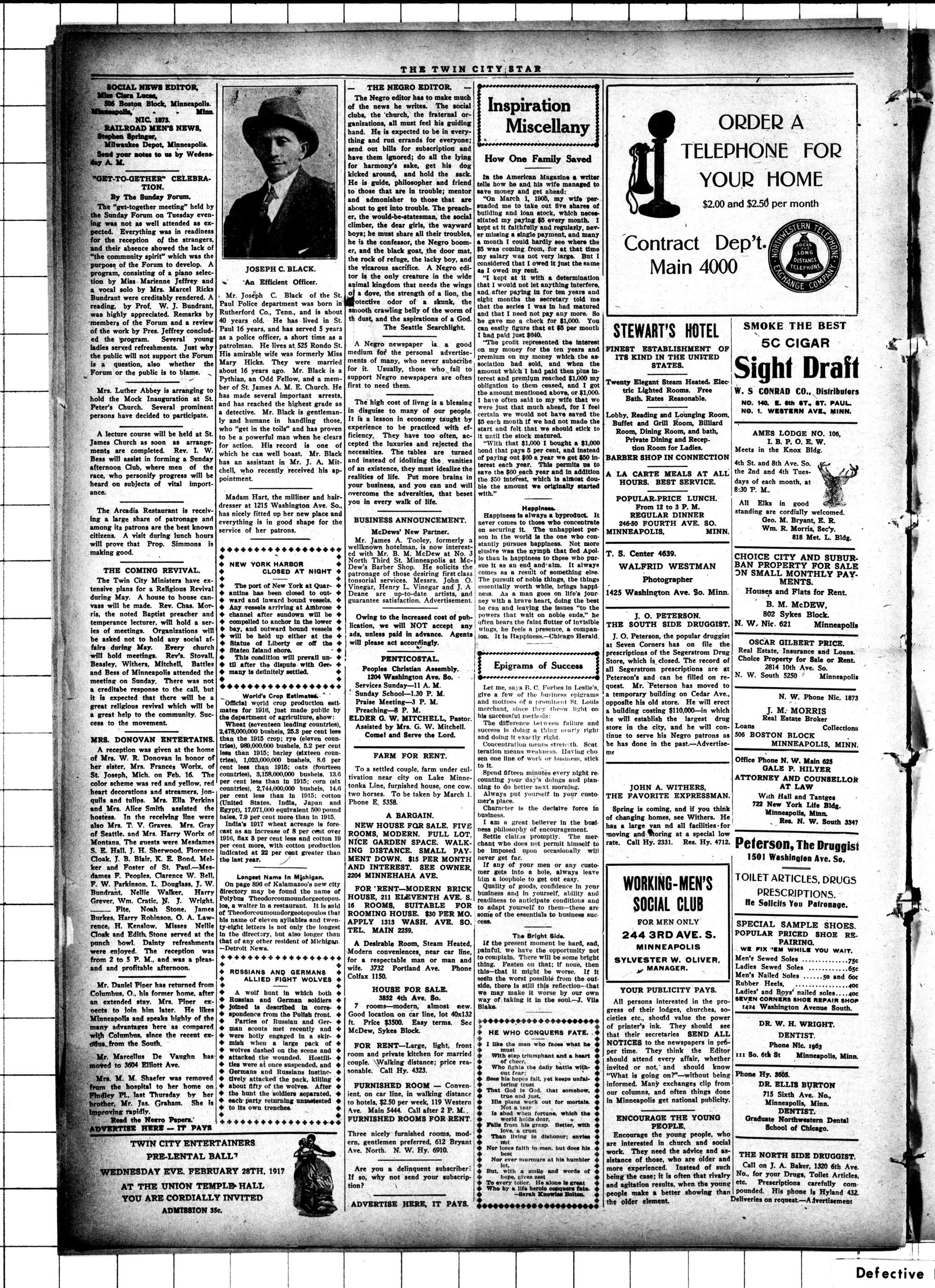
JOSEPH C. BLACK.
An Efficient Officer.
Mr. Joseph C. Black of the St. Paul Police department was born in Rutherford Co., Tenn., and is about 40 years old. He has lived in St. Paul 16 years, and has served 5 years as a police officer, a short time as a patrolman. He lives at S25 Rondo St. His amiable wife was formerly Miss Mary Hicks. They were married about 16 years ago. Mr. Black is a Pythian, an Odd Fellow, and a member of St. James A. M. E. Church. He has made several important arrests, and has reached the highest grade as a detective. Mr. Black is gentlemanly and humane in handling those, who "get in the toils" and has proven to be a powerful man when he clears for action. His record is one of which he can well boast. Mr. Black has an assistant in Mr. J. A. Mitchell, who recently received his appointment.
Madam Hart, the milliner and hairdresser at 1215 Washington Ave. So., has nicely fitted up her new place and everything is in good shape for the service of her patrons.
```markdown
```
NEW YORK HARBOR
CLOSED AT NIGHT
The port of New York at Quar-
antine has been closed to out-
ward and inward bound vessels.
Any vessels arriving at Ambrose
channel after sundown will be
compelled to anchor in the lower
bay, and outward bound vessels
will be held up either at the
Statue of Liberty or off the
Staten Island shore.
This condition will prevail until after the dispute with Germany is definitely settled.
World's Coop Estimates
World's Crop Estimates.
Official world crop production estimates for 1916, just made public by the department of agriculture, show: Wheat (seventeen leading countries), 2,478,000,000 bushels, 25.3 per cent less than the 1915 crop; rye (eleven countries), 98,000,000 bushels, 5.2 per cent less than 1915; barley (sixteen countries), 1,023,000,000 bushels, 8.6 per cent less than 1915; oats (fourteen countries), 3,158,000,000 bushels, 13.6 per cent less than in 1915; corn (six countries), 2,744,000,000 bushels, 14.6 per cent less than in 1915; cotton (United States, India, Japan and Egypt), 17,071,000 equivalent 500 pound bales, 7.9 per cent more than in 1915.
India's 1917 wheat acreage is forecast as an increase of 8 per cent over 1916, flax 8 per cent less and cotton 19 per cent more, with cotton production indicated at 22 per cent greater than the last year.
Longest Name In Michigan.
On page 896 of Kalamazoo's new city directory may be found the name of Polybus Theodorcoumoundorgeopoulos, a waiter in a restaurant. It is said of Theodorcoumoundorgeopoulos that his name of eleven syllables and twenty-eight letters is not only the longest in the directory, but also longer than that of any other resident of Michigan. —Detroit News.
* **RUSSIANS AND GERMANS**
* **ALLIED FIGHT WOLVES**
A wolf hunt in which both Russian and German soldiers joined is described in correspondence from the Polish front. Parties of Russian and German scouts met recently and were hotly engaged in a skirmish when a large pack of wolves dashed on the scene and attacked the wounded. Hostilities were at once suspended, and Germans and Russians instinctively attacked the pack, killing about fifty of the wolves. After the hunt the soldiers separated, each party returning unmolested to its own trenches.
A
THE TWIN CITY STAR
THE NEGRO EDITOR.
The Negro editor has to make much of the news he writes. The social clubs, the church, the fraternal organizations, all must feel his guiding hand. He is expected to be in everything and run errands for everyone; send out bills for subscription and have them ignored; do all the lying for harmony's sake, get his dog kicked around, and hold the sack. He is guide, philosopher and friend to those that are in trouble; mentor and admonisher to those that are about to get into trouble. The preacher, the would-be-statesman, the social climber, the dear girls, the wayward boys; he must share all their troubles, he is the confessor, the Negro boomer, and the black goat, the door mat, the rock of refuge, the lacky boy, and the vicarous sacrifice. A Negro editor is the only creature in the wide animal kingdom that needs the wings of a dove, the strength of a lion, the protective odor of a skunk, the smooth crawling belly of the worm of th dust, and the aspirations of a God.
A Negro newspaper is a good medium for the personal advertisements of many, who never subscribe for it. Usually, those who fail to support Negro newspapers are often first to need them.
The high cost of livng is a blessing in disguise to many of our people. It is a lesson in economy taught by experience to be practiced with efficiency. They have too often, accepted the luxuries and rejected the necessities. The tables are turned and instead of idolizing the vanities of an existence, they must idealize the realities of life. Put more brains in your business, and you can and will overcome the adversities, that beset you in every walk of life.
BUSINESS ANNOUNCEMENT.
Mr. James A. Tooley, formerly a wellknown hotelman, is now interested with Mr. B. M. McDew at No. 3 North Third St. Minneapolis at McDew's Barber Shop. He solicits the patronage of those desiring first class tonsorial services. Messrs. John O. Vinegar, Henry L. Vinegar and J. A Deane are up-to-date artists, and guarantee satisfaction. Advertisement.
Owing to the increased cost of publication, we will NOT accept any ads, unless paid in advance. Agents will please act accordingly.
PENTICOSTAL.
Peoples Christian Assembly.
1204 Washington Ave. So.
Services Sunday—11 A. M.
Sunday School—1.30 P. M.
Praise Meeting—3 P. M.
Preaching—8 P. M.
ELDER G. W. MITCHELL, Pasto.
Assisted by Mrs. G. W. Mitchell.
Comel and Serve the Lord.
FARM FOR RENT.
To a settled couple, farm under cultivation near city on Lake Minnetonka Line, furnished house, one cow, two horses. To be taken by March 1. Phone E. 5358.
A BARGAIN
NEW HOUSE FOR SALE. FIVE
ROOMS, MODERN. FULL LOT.
NICE GARDEN SPACE. WALK-
ING DISTANCE. SMALL PAY-
MENT DOWN. $15 PER MONTH
AND INTEREST. SEE OWNER.
2204 MINNEHAHA AVE.
FOR RENT—MODERN BRICK
HOUSE, 211 ELEVENTH AVE. S.
16 ROOMS, SUITABLE FOR
ROOMING HOUSE. $30 PER MO.
APPLY 1313 WASH. AVE. SO.
TEL. MAIN 2259.
A Desirable Room, Steam Heated,
Modern conveniences, near car line,
for a respectable man or man and
wife. 3732 Portland Ave. Phone
Colfax 1150.
7 rooms—modern, almost new. Good location on car line, lot 40x132 ft. Price $3500. Easy terms. See McDew, Sykes Block.
FOR RENT—Large, light, front room and private kitchen for married couple. Walking distance; price reasonable. Call Hy. 4323.
FURNISHED ROOM — Convenient, on car line, in walking distance to hotels. $2.50 per week, 119 Western Ave. Main 5444. Call after 2 P. M. FURNISHED ROOMS FOR RENT.
Three nicely furnished rooms, modern, gentlemen preferred, 612 Bryant Ave. North. N. W. Hy. 6910.
Are you a delinquent subscriber?
If so, why not send your subscription?
ADVERTISE HERE, IT PAYS.
Inspiration Miscellany
How One Family Saved
In the American Magazine a writer tells how he and his wife managed to save money and get ahead:
"On March 1, 1905, my wife persuaded me to take out five shares of building and loan stock, which necessitated my paying $5 every month. I kept at it faithfully and regularly, never missing a single payment, and many a month I could hardly see where the $5 was coming from, for at that time my salary was not very large. But I considered that I owed it just the same as I owed my rent.
"I kept at it with a determination that I would not let anything interfere, and after paying in for ten years and eight months the secretary told me that the series I was in had matured and that I need not pay any more. So he gave me a check for $1,000. You can easily figure that at $5 per month I had paid just $640.
"The profit represented the interest on my money for the ten years and premium on my money which the association had sold, and when the amount which I had paid then plus interest and premium reached $1,000 my obligation to them ceased, and I got the amount mentioned above, or $1,000. I have often told to my wife that we were just that much ahead, for I feel certain we would not have saved the $5 each month if we had not made the start and felt that we should stick to it until the stock matured.
"With that $1,000 I bought a $1,000 bond that pays 5 per cent, and instead of paying out $0 a year we get $50 interest each year. This permits us to save the $0 each year and in addition the $50 interest, which is almost double the amount we originally started with."
Happiness is always a byproduct. It never comes to those who concentrate on securing it. The unhappiest person in the world is the one who constantly pursues happiness. Not more elusive was the nymph that fed Apolon than is happiness to those who pursue it as an end and aim. It always comes as a result of something else. The pursuit of noble things, the things essentially worth while, brings happiness. As a man goes on life's journey with a brave heart, doing the best he can and leaving the issues "to the powers that wait on noble ends," he often hears the faint flutter of invisible wings, he feels a presence, a companion. It is Happiness.—Chicago Herald.
Epigrams of Success
Let me, says B. C. Forbes in Leslie's, give a few of the business epigrams and mottoes of a prominent St. Louis merchant, since they throw light on his successful methods:
The difference between failure and success is doing a thing nearly right and doing it exactly right.
Concentration means strength. Scatteration means weakness. Having chosen one line of work or business, stick to it.
Spend fifteen minutes every night recounting your day's doings and planning to do better next morning.
Always put yourself in your customer's place.
Character is the decisive force in business.
I am a great believer in the business philosophy of encouragement.
Settle clauses promptly. The merchant who does not permit himself to be imposed upon occasionally will never get far.
If any of your men or any customer gets into a hole, always leave him a loophole to get out easy. Quality of goods, confidence in your business and in yourself, ability and readiness to anticipate conditions and to adapt yourself to them—these are some of the essentials to business success.
The Bright Side.
If the present moment be hard, sad, painful, we have the opportunity not to complain. There will be some bright thing. Fasten on that; if none, then this—that it might be worse. If it seem the worst possible from the outside, there is still this reflection—that we may make it worse by our own way of taking it in the soul.-J. Villa Blake.
HE WHO CONQUERS FATE.
I like the man who faces what he must
With step triumphant and a heart of cheer.
Who dies the daily battle without fear;
Sees his hopes fall, yet keeps unfaltering trust
That God is God, yet somehow, true and just,
His plans work out for mortals.
Not a tear
Is shed when fortune, which the world holds dear.
Falls from his grasp. Better, with love, a crust
Than living in dishonor; envies who
Nor loses faith in men, but does his best
Nor ever murmurs at his humbler lot.
But, with a smile and words of hope, gives zest
To every toiler. He alone is great
Who by a life heroic conquers fate.
—Sarah Knowles Bolton.
Happiness.
ORDER A TELEPHONE FOR YOUR HOME $2.00 and $2.50 per month
Contract Dep't. Main 4000
Sight Draft
W. S CONRAD CO., Distributors
NO. 140. E. 6th ST., ST. PAUL.
NO. 1. WESTERN AVE., MINN.
AMES LODGE NO. 106,
I. B. P. O. E. W.
Meets in the Knox Bldg.
4th St. and 8th Ave. So.
the 2nd and 4th Tues-
days of each month, at
8:30 P. M.
JOHN A. WITHERS,
THE FAVORITE EXPRESSMAN.
WORKING-MEN'S
SOCIAL CLUB
FOR MEN ONLY
244 3RD AVE. S.
MINNEAPOLIS
WE FIX 'EM WHILE YOU WAIT.
Men's Sewed Soles .....75c
Ladies Sewed Soles .....65c
Men's Nailed Soles .....50 and 60c
Rubber Heels, .....40c
Ladies' and Boys' nailed soles.....40c
SEVEN CORNERS SHOE REPAIR SHOP
1424 Washington Avenue South.
THE NORTH SIDE DRUGGIST.
Call on J. A. Baker, 1320 6th Ave.
No., for your Drugs, Toilet Articles,
etc. Prescriptions carefully
compounded. His phone is Hyland 432.
Deliveries on request—Avertisement
---
I
STEWART'S HOTEL
FINEST ESTABLISHMENT OF ITS KIND IN THE UNITED STATES.
Twenty Elegant Steam Heated, Electric Lighted Rooms. Free Bath. Rates Reasonable.
Lobby, Reading and Lounging Room, Buffet and Grill Room, Billiard Room, Dining Room, and bath, Private Dining and Reception Room for Ladies.
BARBER SHOP IN CONNECTION
A LA CARTE MEALS AT ALL HOURS. BEST SERVICE.
POPULAR-PRICE LUNCH.
From 12 to 3 P. M.
REGULAR DINNER
246-50 FOURTH AVE. SO.
MINNEAPOLIS, MINN.
T. S. Center 4639.
WALFRID WESTMAN
Photographer
1425 Washington Ave. So. Minn.
THE SOUTH SIDE DRUGGIST.
J. O. Peterson, the popular druggist at Seven Corners has on file the prescriptions of the Segerstrom Drug Store, which is closed. The record of all Segerstrom prescriptions are at Peterson's and can be filled on request. Mr. Peterson has moved to a temporary building on Cedar Ave., opposite his old store. He will erect a building costing $110,000—in which he will establish the largest drug store in the city, and he will continue to serve his Negro patrons as he has done in the past.—Advertise me
Spring is coming, and if you think of changing homes, see Withers. He has a large van nd all facilities-for moving and storing at a special low rate. Call Hy. 2331. Res. Hy. 4712.
SYLVESTER W. OLIVER.
MANAGER.
YOUR PUBLICITY PAYS.
All persons interested in the progress of their lodges, churches, societies etc., should value the power of printer's ink. They should see that their secretaries SEND ALL NOTICES to the newspapers in procer time. They think the Editor should attend every affair, whether invited or not, and should know "What is going on?"—without being informed. Many exchanges clip from our columns, and often things done in Minneapolis get national publicity.
ENCOURAGE THE YOUNG PEOPLE
Encourage the young people, who are interested in church and social work. They need the advice and assistance of those, who are older and more experienced. Instead of such being the case; it is often that rivalry and agitation results, when the young people make a better showing than the older element.
NORTHWESTERN TELEPHONE
LOGIST AND LONG
DISTANCE TELEPHONE
EXCHANGE COMPANY
SMOKE THE BEST 5C CIGAR
```markdown
```
All Elks in good
standing are cordially welcomed.
Geo. M. Bryant, E. R.
Wm. R. Morris, Sec'y.
818 Met. L. Bldg.
CHOICE CITY AND SUBUR-
BAN PROPERTY FOR SALE
ON SMALL MONTHLY PAY-
MENTS.
Houses and Flats for Rent.
B. M. McDEW,
802 Sykes Block.
N. W. Nic. 621 Minneapolis
OSCAR GILBERT PRICE.
Real Estate, Insurance and Loans.
Choice Property for Sale or Rent.
2814 10th Ave. So.
N. W. South 5250 Minneapolis
J. M: MORRIS
Real Estate Broker
Loans Collections
506 BOSTON BLOCK
MINNEAPOLIS, MINN.
Office Phone N. W. Main 625
GALE P. HILYER
ATTORNEY AND COUNSELLOR
AT LAW
With Hall and Tantges
722 New York Life Bldg.
Minneapolis, Minn.
Res. N. W. South 3347
Peterson, The Druggist 1501 Washington Ave. So.
TOILET ARTICLES, DRUGS
PRESCRIPTIONS.
He Solicits You Patronage.
SPECIAL SAMPLE SHOES.
POPULAR PRICED SHOE RE-
PAIRING.
DR. W. H. WRIGHT.
DENTIST.
Phone Nic. 1963
111 So. 6th St Minneapolis, Minn.
Phone Hy. 3605.
DR. ELLIS BURTON
715 Sixth Ave. No.
Minneapolis, Minn.
DENTIST.
Graduate Northwestern Dental
School of Chicago.
Defective
Our Expert Optician will give your eyes a thorough examination FREE and tell you frankly whether you need glasses or not. If you do need glasses he will fit you with a fine looking pair at a very moderate price. Bring your repair work here. Prices are most moderate.—THE LEADER DEPT. STORE, Third and Nicollet.
THANN'S BUFFET
KEYSTONE BUFFET
1313 Wash
FOR LADIES &
Music Every Day fro
Kidd Mitchell, Prop:
LADIES SPECIALLY
INSTRUCTION
KEYSTONE BUFFET and CLUB CAFE"
ELOCUTION and SPANISH
Taught by
PROF. J. W. BUNDRANT
3616 Fourth Ave. So., Minneapolis
Tel.: N. W. Colfax 4835.
It is said that the Bank of France has an invisible studio in a gallery be hind the cashiers, so that at a given signal from one of them any suspected customer can instantly have his photograph taken without his knowledge
Lincoln In a Historic Minute
In "Reminiscences of a Wartime Statesman and Diplomat" Frederick W. Seward, son of Lincoln's secretary of state wrote:
"Thursday, Jan. 1, 1863, was marked by an event that will always be memorable in history. Slaves in all the regions remaining in rebellion were to be on that day declared entitled to freedom. The emancipation proclamation had been duly prepared at the state department and was ready for President Lincoln's signature.
"At noon, accompanying my father, I carried the broad parchment in a large portfolio under my arm. We, threading our way through the throng in the vicinity of the White House, went upstairs to the president's room, where Mr. Lincoln speedily joined us. The broad sheet was spread open before him on the cabinet table. Mr. Lincoln dipped his pen in the ink and then, holding it a moment above the sheet, seemed to hesitate. Looking around, he said:
"I never in my life felt certain that I was doing right more than I do in signing this paper. But I have been receiving calls and shaking hands since 9 o'clock this morning till my arm is stiff and numb. Now, this signature is one that will be closely examined, and if they find my hand trembled they will say, "He had some compunctions." But anyway it is going to be done."
"So saying he slowly and carefully wrote his name at the bottom of the proclamation. The signature proved to be unusually clear, bold and firm even for him, and a laugh followed at his apprehension. My father after appending his own name and causing the great seal to be affixed had the important document placed among the archives. Copies were at once given to the press."
Mr. Lincoln was not the "orator of the day" upon the occasion of the dedication of the soldiers' cemetery at Gettysburg. That honor belonged to Edward Everett, who fulfilled his duties there by delivering one of his elaborate orations that kept him on his feet for more than two hours. It is said to have been a splendid oration, and yet it is clean forgotten, while Lincoln's little speech, prepared on his knee as he was traveling in the cars to Gettysburg, is known all over the world.
Page
Defective Page
N. W. PHONE MAIN 3487, MINNEAPOLIS, MINN. REGULAR DINNER 25 CENTS
1313 Wash. Ave. South
FOR LADIES & GENTLEMEN
Music Every Day from 2 P. M. to 11 P. M.
Kidd Mitchell, Prop: MINNEAPOLIS, MINN.
LADIES SPECIALLY INVITED EVERY DAY.
N. W. MAIN 2259
The Gettysburg Speech.
BUFFET
CAFE
STREET
ANN.
of
Historical Folk R. N. TRAVIS, Prop.
FINISHED ROOMS
AT ALL HOURS
Hotel and Cafe Phone: Cedar 9088
Souvenirs for Ladies every
Wednesday afternoon and Evening
A. Ave. South
& GENTLEMEN
from 2 P. M. to 11 P. M.
MINNEAPOLIS, MINN.
INVITED EVERY DAY.
If You're in
SIOUX FALLS, S. D.
You'll find Comfort at
WYATTS' ROOMING HOUSE
(Exclusively for Colored People.)
229 West 6th St.
Barber Shop—Cigars
C. J. (Kid.) Wyatt, Prop.
OUR UNDERPRICED ANNEX
OUR UNDER PRICED
NOW OFFERS MARVELOUS VALUES IN DEPENDABLE, SEASONABLE APPAREL, TO REDUCE STOCKS QUICKLY. COATS, FURS, DRESSES, SUITS, WAISTS, HOUSE-DRESSES AND MILLINERY. At Low Prices that the Economical can not Afford to Overlook E.E. Atkinson Co.
LIBERAL SUBSCRIPTION
OFFER.
Special $3.00 Combination.
We offer a Combination Subscription to our readers for 1917. We will give you your choice of any Negro NEWSPAPER or MAGAZINE, and THE TWIN CITY STAR, mailed to your address anywhere in the U. S. for THREE DOLLARS. Cash in advance. Get your home paper sent direct to you. Forward all orders to
THE TWIN CITY STAR, .... Room 302.
305 So. 5th St., Minneapolis.
Several improvements have been made at Bethesda Baptist Church. The new concrete steps are a valuable as well as ornamental addition to the building. Rev. Beasley expects a larger attendance this fall and i doing what he can to make Bethesda the most comfortable church among our people.
PUBLIC STENOGRAPHER
Agent and Correspondent for The Twin City Star.
Miss Clara Lucas will receive your advertisements and news Call on her at 506 Boston Block. She is a competent stenographer and will write your letters or handle any business correspondence. All matters confidential.
ADVERTISE HERE, IT PAYS.
THE TWIN CITY STAR
What Housewives Are Glad to Know
Smart Walking Suit
The handsome suit for street wear is a semi-empire model, and it is featured in dark green, burgundy, navy blue, taupe, brown or black. The coat is three-quarter length, with panel front
THE WOMEN'S WORLD
and back, and the shirred, belled sides extend into large, flat pockets that give the fashionable long, straight hip. The high roll collar is inset with self colored velvet and edged with seal fur. The skirt has pockets to match those on coat. Buttons are of bone, preferably tinted to match. Design by Franklin Simon & Co., New York city.
Substitutes For Meat That
Meat is always high priced and especially so now, says Miss Leonora Richards, assistant in domestic science in the Kansas State Agricultural college. There are many foods which have the same nutritive value as meat, and these may be used as meat substitutes. Baked beans, cheese fondu, macaroni and cheese, baked rice and cheese, cheese souffle, corn and cheese souffle, and rice with lentils may be served as substitutes for meat and are much cheaper in preparation. Eggs are an excellent meat substitute and may be prepared in a variety of ways, but their present high price is prohibitive.
Persons who cannot eat without meat should buy the cheaper cuts, such as flank steak, rump and chuck roasts, heart, liver and chuck steak. These cuts contain the same amount of nutriment as the more expensive cuts, but are not so tender. In order to make the cheaper cuts of meat palatable they should be cooked slowly at a low temperature. Stewing is preferable. Seasoning with highly flavored vegetables and spices improves the flavor.
Kitchen Wrinkles
When boiling meat start it only at the boiling point, then let it simmer till tender.
When you accidentally spill hot grease on the bare floor dash cold water on it at once. This hardens the grease so that it can be scraped up before much of it soaks into the floor.
Tire Saving Device.
An ingenious device consisting of a magnet carried in front of each of the two forward wheels of an automobile and in close proximity to the ground has just been invented, according to the Popular Science Monthly. It will prevent the puncturing of pneumatic tires by automatically picking up magnetic particles such as chips of metal, tacks, nails and the like.
The magnet is pivoted to the front end of an extending arm attached to the front axle wheel spindle, so that it will swing with the wheel during steering and always remain in front of it.
SATAN IN EDEN.
Lang syne, in Eden's bonny yaird
When youthfu' lovers first were
pair'd
And all the soul of love they shared;
The raptured hour,
Sweet on the fragrant flowery
swaird,
In shady bower,
Then you, ye auid snck drawing
dog—
Ye cam' to paradise ingo
And ploy'd on man cursed broog
(Shake be your fa')
And gied the infant warld a shog
Maist ruin'd a'.
-Burns.
PRESIDENT WILSON PROCEEDING OFFICE. CHIEF JUSTICE WHIT OF OFFICE. VICE PRESIDENT DENT TAFT AT RIGHT.
40,000 Will Take Parade on
THE FIRST CALL TO THE PRESIDENT'S CALL
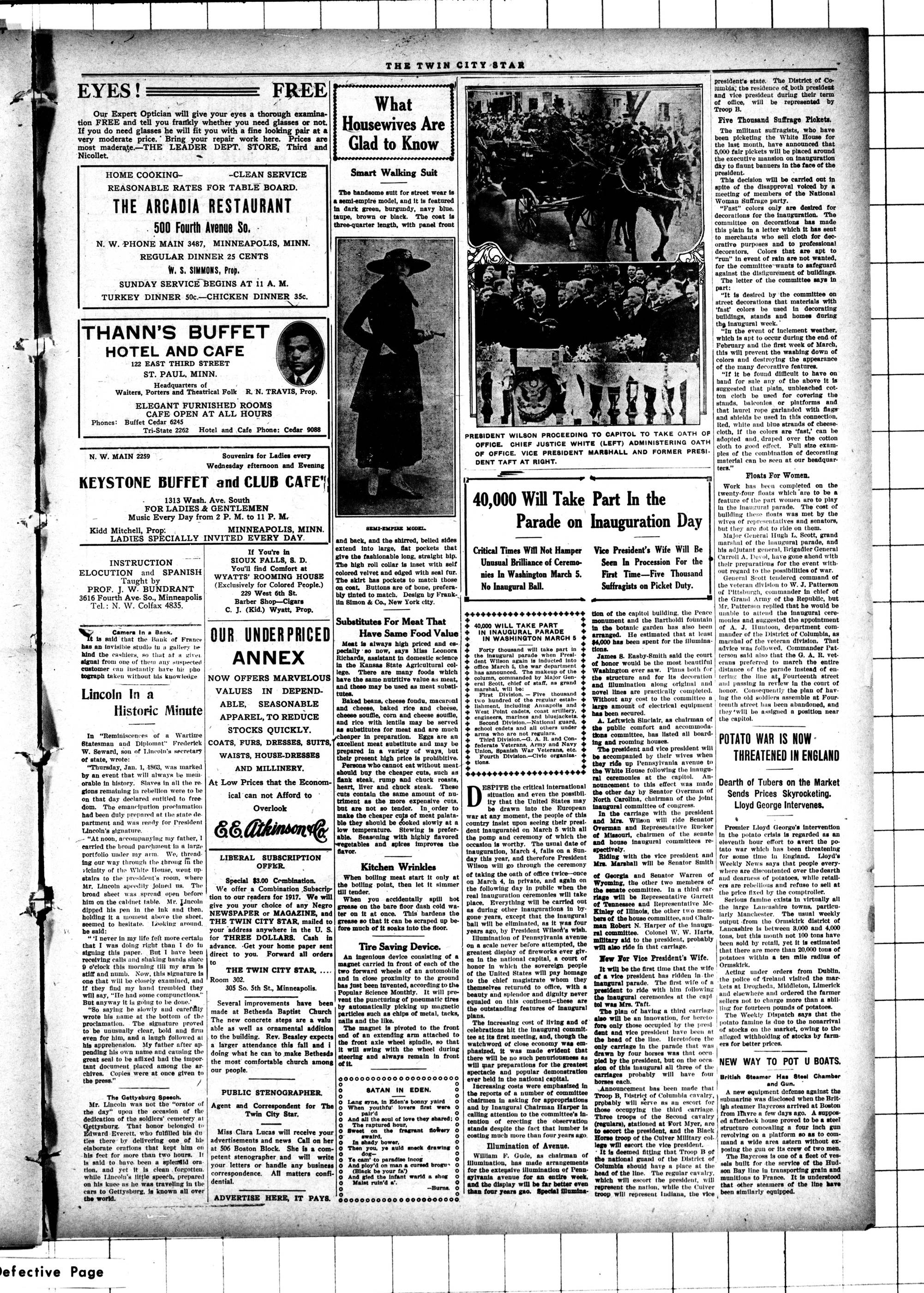
PRESIDENT WILSON PROCEEDING TO CAPITOL TO TAKE OATH OF OFFICE. CHIEF JUSTICE WHITE (LEFT) ADMINISTERING OATH OF OFFICE. VICE PRESIDENT MARSHALL AND FORMER PRESIDENT TAFT AT RIGHT.
40,000 Will Take Part In the Parade on Inauguration Day
Critical Times Will Not Hamper Unusual Brilliance of Ceremonies In Washington March 5. No Inaugural Ball.
40,000 WILL TAKE PART
IN INAUGHAWN PARADE
IN WASHINGTON MARCH 5
Forty thousand will take part in the inaugural parade when President Wilson again is inducted into office March 5, the war department has announced. The makeup of the column, commanded by Major General Scott, chief of staff, as grand marshal, will be:
First — — — Five thousand two hundred of the regular establishment, including Annapolis and West Point cadets, coast artillery, engineers, marines and bluejackets.
Second Division.—National guard, school cadets and all others under army who are not regiments.
Third Division.—G. A. R. and Confederate Veterans, Army and Navy Union, Spanish War Veterans, etc.
Fourth Division.—Civic organizations.
DESPITE the critical international situation and even the possibility that the United States may
be drawn into the European war at any moment, the people of this country insist upon seeing their president inaugurated on March 5 with all the pomp and ceremony of which the occasion is worthy. The usual date of inauguration, March 4, falls on a Sunday this year, and therefore President Wilson will go through the ceremony of taking the oath of office twice—once on March 4, in private, and again on the following day in public when the real inauguration ceremonies will take place. Everything will be carried out as during other inaugurations in bygone years, except that the inaugural ball will be eliminated, as it was four years ago, by President Wilson's wish.
Illumination of Pennsylvania avenue on a scale never before attempted, the greatest display of fireworks ever given in the national capital, a court of honor in which the sovereign people of the United States will pay homage to the chief magistrate whom they themselves returned to office, with a beauty and splendor and dignity never equaled on this continent—these are the outstanding features of inaugural plans.
The increasing cost of living and of celebrations hit the inaugural committee at its first meeting, and, though the watchword of close economy was emphasized, it was made evident that there will be no such penuriousness as will mar preparations for the greatest spectacle and popular demonstration ever held in the national capital.
Increasing costs were emphasized in the reports of a number of committee chairmen in asking for appropriations and by Inaugural Chairman Harper in calling attention to the committee's intention of erecting the observation stands despite the fact that lumber is costing much more than four years ago.
Illumination of Avenue.
William F. Gude, as chairman of illumination, has made arrangements for the extensive illumination of Pennsylvania avenue for an entire week, and the display will be far better even than four years gao. Special illumina-
Vice President's Wife Will Be Seen In Procession For the First Time—Five Thousand Suffragists on Picket Duty.
tion of the capitol building, the Peace monument and the Bartholdi fountain in the botanic garden has also been arranged. He estimated that at least $4,000 has been spent for the illuminations.
James S. Easby-Smith said the court of honor would be the most beautiful Washington ever saw. Plans both for the structure and for its decoration and illumination along original and novel lines are practically completed. Without any cost to the committee a large amount of electrical equipment has been secured.
A. Leftwich Sinclair, as chairman of the public comfort and accommodations committee, has listed all boarding and rooming houses.
The president and vice president will be accompanied by their wives when they ride up Pennsylvania avenue to the White House following the inaugural ceremonies at the capitol. Announcement to this effect was made the other day by Senator Overman of North Carolina, chairman of the joint inaugural committee of congress. In the carriage with the president and Mrs. Wilson will ride Senator Overman and Representative Rucker of Missouri, chairmen of the senate and house inaugural committees respectively. Riding with the vice president and Mrs. Marshall will be Senator Smith
of Georgia and Senator Warren of Wyoming, the other two members of the senate committee. In a third carriage will be Representative Garrett of Tennessee and Representative McKinley of Illinois, the other two members of the house committee, and Chairman Robert N. Harper of the inaugural committee. Colonel W. W. Harts, military aid to the president, probably will also ride in that carriage.
New For Vice President's Wife.
It will be the first time that the wife of a vice president has ridden in the inaugural parade. The first wife of a president to ride with him following the inaugural ceremonies at the capitol was Mrs. Taft.
The plan of having a third carriage also will be an innovation, for heretofore only those occupied by the president and vice president have been at the head of the line. Heretofore the only carriage in the parade that was drawn by four horses was that occupied by the president, but on the occasion of this inaugural all three of the carriages probably will have four horses each.
Announcement has been made that Troop B, District of Columbia cavalry, probably will serve as an escort for those occupying the third carriage. Three troops of the Second cavalry (regulars), stationed at Fort Myer, are to escort the president, and the Black Horse troop of the Culver Military college will escort the vice president.
It is deemed fitting that Troop B of the national guard of the District of Columbia should have a place at the head of the line. The regular cavalry, which will escort the president, will represent the nation, while the Culver troop will represent Indiana, the vice
president's state. The District of Columbia, the residence of both president and vice president during their term of office, will be represented by Troop B.
Five Thousand Suffrage Pickets.
The militant suffragists, who have been picketing the White House for the last month, have announced that 5,000 fair pickets will be placed around the executive mansion on inauguration day to flaunt banners in the face of the president.
This decision will be carried out in spite of the disapproval voiced by a meeting of members of the National Woman Suffrage party.
"Fast" colors only are desired for decorations for the inauguration. The committee on decorations has made this plain in a letter which it has sent to merchants who sell cloth for decorative purposes and to professional decorators. Colors that are apt to "run" in event of rain are not wanted, for the committee wants to safeguard against the disfigurement of buildings.
The letter of the committee says in part:
"It is desired by the committee on street decorations that materials with 'fast' colors be used in decorating buildings, stands and homes during the inaugural week."
"In the event of inclement weather, which is apt to occur during the end of February and the first week of March, this will prevent the washing down of colors and destroying the appearance of the many decorative features.
"If it be found difficult to have on hand for sale any of the above it is suggested that plain, unbleached cotton cloth be used for covering the stands, balconies or platforms and that laurel rope garlanded with flags and shields be used in this connection. Red, white and blue strands of cheese-cloth, if the colors are 'fast,' can be adopted and, draped over the cotton cloth to good effect. Full size examples of the combination of decorating material can be seen at our headquarters."
Floats For Women.
Work has been completed on the twenty-four floats which are to be a feature of the part women are to play in the inaugural parade. The cost of building these floats was met by the wives of representatives and senators, but they are not to ride on them.
Major General Hugh L. Scott, grand marshal of the inaugural parade, and his adjutant general, Brigadier General Carroll A. Devel, have gone ahead with their preparations for the event without regard to the possibilities of war.
General Scott tendered command of the veteran division to W. J. Patterson of Pittsburgh, commander in chief of the Grand Army of the Republic, but Mr. Patterson replied that he would be unable to attend the inaugural ceremonies and suggested the appointment of A. J. Huntoon, department commander of the District of Columbia, as marshal of the veteran division. That advice was followed. Commander Patterson said also that the G. A. R. veterans preferred to march the entire distance of the parade instead of entering the line at Fourteenth street and passing in review in the court of honor. Consequently the plan of having the old soldiers assemble at Fourteenth street has been abandoned, and they will be assigned a position near the capitol.
POTATO WAR IS NOW THREATENED IN ENGLAND
Dearth of Tubers on the Market Sends Prices Skyrocketing. Lloyd George Intervenes.
Premier Lloyd George's intervention in the potato crisis is regarded as an eleventh hour effort to avert the potato war which has been threatening for some time in England. Lloyd's Weekly News says that people everywhere are discontented over the dearth and dearness of potatoes, while retailers are rebellious and refuse to sell at the price fixed by the comptroller.
Serious famine exists in virtually all the large Lancashire towns, particularly Manchester. The usual weekly output from the Ormskirk district of Lancashire is between 3,000 and 4,000 tons, but this month not 100 tons have been sold by retail, yet it is estimated that there are more than 20,000 tons of potatoes within a ten mile radius of Ormskirk.
Acting under orders from Dublin, the police of Ireland visited the markets at Drogheda, Middleton, Llmerick and elsewhere and ordered the farmer sellers not to charge more than a shilling for fourteen pounds of potatoes. The Weekly Dispatch says that the potato famine is due to the nonarrival of stocks on the market, owing to the alleged withholding of stocks by farmers for better prices.
NEW WAY TO POT U BOATS.
British Steamer Has Steel Chamber and Gun. A new equipment defense against the submarine was disclosed when the British steamer Baycross arrived at Boston from Hirve a few days ago. A supposed afterdeck house proved to be a steel structure concealing a four inch gun revolving on a platform so as to command a wide area astern without exposing the gun or its crew of two men. The Baycross is one of a fleet of vessels built for the service of the Hudson Bay line in transporting grain and munitions to France. It is understood that other steamers of the line have been similarly equipped.
MATERIAL in the Post Office at Minneapolis as second class matter.
MEMBER
NATIONAL NEGRO PRESS
ASSOCIATION
Subscription by Mall, Postpaid.
ONE YEAR ..... $2.00
SIX MONTHS ..... 1.00
THREE MONTHS ..... .65
Hamlet B. Rowe, Local Agent.
Want Ads ..... Twenty-five Cents
Reading Notices, per line, Five Cents
Wedding Announcements, Fifty Cents
Card of Thanks ..... One Dollar,
In Memoriam ..... One Dollar
Business Announcements, One Dollar
Death Notices ..... One Dollar
We do not run free ads, or over-run
the time contracted for by our advertisers We respect their right to
advertise at intervals, and rather have
them do so, than to run continuously
an "adv." and an increasing account.
Minneapolis, Minnesota
The Star Phone is Hyland 5580.
DOUGLASS~AS JOURNALIST.
What James McCune-Smith Said of Our Militant Hero In 1855.
In an article written in 1855 James McCune-Smith, the great advocate of human rights and freedom of the slaves, said of Frederick Douglass in part:
"But his sojourn in England was more than a joy to Mr. Douglass. It awakened him to the consciousness of new powers that lay in him. From the pupilage of Garrisonism he rose to the dignity of a teacher and a thinker; his opinions on the broader aspects of the great American question were earnestly and incessantly sought from various points of view, and he must, perforce, bestir himself to give suitable answer.
"With that prompt and truthful perception which has led their sisters in all ages of the world to gather at the feet and support the hands of reformers, the gentlewomen of England were foremost to encourage and strengthen him to carve out for himself a path fitted to his powers and energies in the life battle against slavery and caste to which he was pledged. And one stirring thought, inseparable from the British idea of the evangel of freedom, must have smitten his ear from every side:
"Horeditary bondmen, know ye not. When we free, these must strike the blow!"
"The result of this visit was that on his return to the United States he established a newspaper. This proceeding was sorely against the wishes and the advice of the leaders of the American Anti-slavery society, but our author had fully grown up to the conviction of truth which they had once promulgated, but now forgotten—to wit, that in this own elevation, self elevation, colored men have a blow to strike 'on their own hook' against slavery and caste. Differing from his Boston friends in this matter, diffident in his own abilities, reluctant at their dissuadings, how beautiful is the loyalty with which he still clung to their principles in all things else and even in this!
"The arduous nature of his labors from the date of the establishment of his paper may be estimated by the fact that anti-slavery papers in the United States, even while the organs of and when supported by anti-slavery parties, have, with a single exception, failed to pay expenses. Mr. Douglas has maintained and does maintain his paper without the support of any party and even in the teeth of opposition of those from whom he had reason to expect counsel and encouragement.
"He has been compelled at one and the same time and almost constantly during the past seven years to contribute matter to its columns as editor and to raise funds for its support as lecturer. It is within bounds to say that he has expended $12,000 of his own hard earned money in publishing this paper, a larger sum than has been contributed by any one individual for the general advancement of the colored people.
"There had been many other papers published and edited by colored men, beginning as far back as 1827, when the Rev. Samuel E. Cornish and John B. Russworm, a graduate of Bowdin college and afterward governor of Cape Palmas, published the Freedmen's Journal in New York city. Probably not less than 100 newspaper enterprises have been started in the United States by free colored men, born free, and some of them of liberal education and fair talents for this work.
"But one after another they have fallen through, although in several instances anti-slavery friends contributed to their support. It had almost been
given up as an impracticable thing to maintain a colored newspaper when Mr. Douglass, with fewest early advantages of all his competitors, essayed and has proved the thing perfectly practicable and, moreover, of great public benefit.
"This paper, in addition to its power in holding up the hands of those to whom it is especially devoted, also affords irrefutable evidence of the justice, safety and practicability of immediate emancipation. It further proves the immense loss which slavery inflicts on the land, while it dooms such energies as his to the hereditary degradation of slavery."
Brooklyn's Douglass Celebration
Brooklyn's Douglass Celebration. The big Brooklyn Douglass celebration will be held in the auditorium of the boys' High school on Friday evening, Feb. 23. The Rev. Dr. C. P. Cole, pastor of the Bridge Street A. M. E. church, will preside. The various churches and other organizations of the city have taken much interest in the plans for the celebration, which is expected to be the largest ever held in honor of Frederick Douglass in Brooklyn. George E. Wilbecan is chairman of the general committee of arrangements, N. B. Dodson secretary and M. P. Saunders treasurer.
Mrs. Milliken Heads Art Needle Club.
The Neighborhood Art Needle club,
a thrifty organization at Indianapolis,
Ind., has announced the following
named persons as officers of the club
for 1917: Mrs. H. C. Milliken, president;
Mrs. Agnes Durett, vice president;
Mrs. Carrie Taylor, secretary;
Mrs. James Pinkston, assistant secretary;
Mrs. James Smith, treasurer,
and Mrs. Hattle Butler, reporter.
Anniversary of Queen Esther Court.
Queen Esther Court of Calanthe at Pittsburgh has arranged an elaborate program for the celebration of its seventh anniversary on Thursday evening.
Feb. 22. The function will be held at 1428 Boyle street, north side. The court is in fine condition and has many loyal workers in its membership.
CAUSE OF UNREST AMONG COLORED LABORERS SOUTH
Movement Northward Due to Lew Wages and Other Handicaps.
Wilson Jefferson, in concluding in the Evening Post of New York an exhaustive discussion of the effect of the European war upon the colored American, says: To get a glimpse of the possibilities wrapped up in Negro labor one has only to investigate the more progressive of the manufacturing cities of the south. Birmingham, Ala., depends almost wholly upon the Negro for its unskilled and semiskilled labor. Nashville, Atlanta, Memphis and Jacksonville do likewise. But in all of these towns, save in some instances in Birmingham, wages are too low, housing conditions are poor and the advantages for recreation and pleasure exceedingly limited.
It will be from these localities that Negroes will emigrate to the middle west and east and to localities where wages are good and where there are opportunities for pleasure and self-improvement. No class of labor remains satisfied indefinitely under oppressive conditions. The Negro laborer is no exception to the rule. He has tried the south. He is willing to try the past and middle west. All he has awaited is a genuine call, based upon a real and lasting need.
This movement eastward and westward of unskilled Negro labor will both directly and indirectly help the professional Negro. The younger element of Negro workers, those of ambition and of some training in the schools, will be constantly emerging from the unskilled to the semiskilled and skilled classes, with a consequent increase in their payrolls and a betterment in their methods of living.
This will give the Negro professional man a hold in many not strictly Negro communities and will give him what a few of his colleagues now possess in the larger centers—a clientele that will be of all colors and of all races. It will allow those of marked natural ability to rise higher in their profession than they would if limited in their practice to only one race and class.
A decidedly better treatment of the Negro, both in the north and in the south, will grow out of this scattering of the race. The old condition grew out of the fact that the demand for his labor has been limited and the supply unlimited. Other influences, some sinister and some not so sinister, have worked against him. In the south it has been that old and seemingly ineradicual prejudice which would give to him only those things which the white man did not want.
Not infrequently the ostracism that came to the Negro in the east and middle west came by virtue of the fact that in religion, in race and sometimes in politics he has been an outsider. It is not unnatural in the small community for the priest to intercede with the employer for his flock and for those of his persuasion. Neither is it out of the ordinary for the politician to desire to control jobs out of the narrow range of political appointments. Closer ties still are those of race and language and nationality. The Negro heretofore, with merely sentiment on his side, has not been able to overcome these barriers. But, if all signs fail not, the conflict now raging will so lessen the effectiveness of these agencies that the black man will not find it difficult to win a place and hold it in our larger industrial and economic scheme of things.
THE TWIN CITY STAR
Douglass Centenary Poem.
By WALTER E. HAWKINS.
They laid him on the altar, and he bore the lash and good,
To brutal arrogance and greed a prey.
He gave his sacrificial blood while broken 'neath the load
As there on slavery's altar long he lay.
His daily bread was bitter dregs as all hell could afford.
Like Him who bore the sins of all, earth gave him no abode.
Yet in his agony he knew that night dawns into day.
Men called him slave, but such as he was infinitely free,
Free in his untamed heart to feel the right.
He read the prophet's vision in the night.
A blight and curse was all his need, the slaver's lash his fee. Upon this cold unyielding rock of grim adversity.
Whetted his eagle pintons and like eagle took the height.
When waves of hatred swelled and broke across his weighted soul Nor right nor left he swerved, but kept the race.
When war gods lashed the elements into a blackened scroll
And men lost heart because the dregs turned bitter in the bowl
He thought not of himself, but of his persecuted race.
Upright, sun crowned, divinely blest with rare celestial fire.
In his great heart was Joshua's strength; his voice was David's lyre,
His clear toned notes resounding o'er the flood.
He raised us from our low estate and taught us to aspire
Up to the hills of God, where all is beautiful and good.
Ethiopia stood o'er the chasm and poured out her tears like rain.
And her broken heart was dying of its woe.
And her ors reached the Almighty,
ton her sons and daughters alone.
What she lost in death and sorrow,
what she lost in grief and pain
Heaven repaid her in the freedom
which thy life did much to gain
When it gave us thee, O Douglass,
quite a hundred years ago.
Yes, this stern browed, fearless titan
blew his trumpet in the land
When his bleeding race was hurt and sore distressed,
And he sounded the alarm, made men hear and understand
That the burden of his race was in his breast,
And his words were flames of fire and his tongue a burning brand,
Solon of the seed of Nimrod and a rod in Aaron's hand.
And he summoned men to judgment for the heartsore and oppressed.
We count him great and justly hold him worthy of the name.
No truer statesman ever pressed the sod.
Up to the highest rounds of life from out the nearest shame
He forged his way into a just reward.
No pen can paint the anguish of the depths from which he came.
He fought his way to freedom, and he forged his way to fame,
And he wrote his name in deathless light among the sons of God.
He was our good Sir Galahad, whose true sword wavered not
When all the world condoned the sin and vice.
He changed into a chapel his accursed
slavery mart
Polluted long by human sacrifice.
His rostrum, built of whipping posts
whose human souls were murdered.
where human souls were shot,
Raised freedom's altar and a church
upon the sin cursed spot,
Put wings upon his cross whereon he
sailed to paradise.
High School Girls In Two Act Comedy.
The dramatic circle of the High
School Girls' club in Brooklyn
prepared for "The Conspirators," a comedy in two acts, to be given at the
Lexington avenue branch of the Brooklyn Young Women's Christian association Friday evening, Feb. 16. Mrs. Blanche Wade Wright, director of the dramatic department of the club, showed much skill in perfecting the girls for the various features of the play. Mrs. Wright is a public school teacher and has always taken an active part in other literary work among the young people of Brooklyn.
Dines Investment Company Directors.
Harry Ratcliff, vice president of the Eureka Investment company, gave a dinner recently in honor of the members of the board of directors of the company at his home on Catharine street, Philadelphia. Mr. Ratcliff has the distinction of being the first porter on the first parlor car run by the Pennsylvania railroad. He was in the employ of the company for thirty years. Mr. Ratcliff retired from the service of the Pennsylvania railroad in 1913. He is sixty-nine years of age.
SIX GOOD REASONS Why You Should Join The National Association for the Advancement of Colored People. 1. It teaches that race prejudice is the most evil thing in the world today and that "Jim Crow" cars, race accorded all their social, civil and political rights and will receive exact justice in all the relations of segregation, anti-intermarriage laws and all other manifestations of it are unchristian and cruel efforts of the stronger to oppress the weaker. 2. It combats in the courts, state legislatures, the Halls of Congress, the government departments and everywhere the spirit of persecution against the Colored People which grows out of race prejudice.
3 It aims to bring about such a healthy public sentiment in this land that Colored People will be accorded all their social, civil and political rights and will receive exact justice in all the relations of life.
4. It believes in and teaches the doctrine of the Fatherhood of God and the brotherhood of man, and the equality of all races in our American civilization.
5. It aims to uphold the honor of our women by opposing the passage of anti-race inter-marriage lawa.
6. It is composed of members of both races and sexes on terms of complete equality and as brothers and sisters in this holy cause of freedom.
An Appeal for Funds.
The Association needs money and new members. It costs just one dollar to join. If you believe in fair play, in fighting for your rights, if you believe in organization and code your bit toward advancing the race and thereby helping to make human brotherhood a reality and not a fiction
Sec'y R. A. Skinner, 2817 Chicago Ave., Minneapolis.
SCALP TREATMENT and
HAIR GROWING.
Mrs. Maggie Martin wishes to announce that she is the Minneapolis Agent for MADAM C. J. WALKER'S Wonderful Hair Grower and Preparations.
Special attention given to Tetter, Eczema and Growing hair on temples. A full line of Goods. Personal Instructions and Demonstrations can be obtained at
3013 GARFIELD AVE.
MINNEAPOLIS, MINN.
MRS. MAGGIE MARTIN ACS.
MRS. MAIGIE MARTIN, AGT.
N. W. PHONE SOUTH 1742
J & H Wet W
J & H WET WASH LAUNDRY
3753-57 CEDAR A
We maintain that we can wash cheap
We make this claim, because we ha
dries in the United States.
OUR PRICE IS 25 POUNDS OF FAM
VHEN DRY.
CALL S
DR. DEINARD ON "DOUGLASS."
J & H Wet Wash Laundry 3753 55,57 CEDAR AVE
J&H WET WASH LAUNDRY
J&H
3753-S7 CEDAR AVE
J&H WET WASH LAUNDRY
We maintain that we can wash cheaper and better than the housewife.
We make this claim, because we have one of the largest, most modern and sanitary Wet Wash Laun-
dries in the United States.
OUR PRICE IS 25 POUNDS OF FAMILY WASHING FOR 65 CENTS. CLOTHES WEIGHED
VHEN DRY.
Our Auto-trucks and wagons deliver Everywhere.
CALL SNELLING 1509. DREXEL 1269.
The achievements of a great man belong to the entire world. At the birth of a race or a nation, there is always some great man. Douglass does not belong to the colored race only; he belongs to the world. He is worthy of a position in history alongside Moses, Washington and Lincoln. Douglass' life conveys to me a most worthy lesson. I cannot contemplate the achievements of Frederick Douglass. He furnishes me an argument that I wish to proclaim from the housetops; that there is no superior race or inferior races. The colored race has many examples of its capabilities and possibilities. It has not yet produced a Shakespeare; but the white race with its advanced civilization has produced but one Shakespeare.
Had the colored race produced but one Frederick Douglass it would have disproved the theory of the inferiority of races. Rabbi S. N. Deinard.
STOP! LOOK! The Only Colored MEAT MARKET
IN MINNEAPOLIS,
AT 429 SIXTH AVENUE NORTH
IN CONNECTION WITH
THE CUT RATE GROCERY S
P. J. Buford,
W. W.
Not the biggest but the best. Our prices as low
We deliver to all parts of the city.
Call N. W. Main 2515 or Res. Nic. 2421 and
people will give you prompt service day or night.
CUT RATE GROCERY STORE
ord,
the biggest but the best. Our prices as low as the rest.
to all parts of the city.
I. W. Main 2515 or Res. Nic. 2421 and the Cut-Rate
il give you prompt service day or night.
Call N. W. Main 2515 or Res. Nic. 2421 and the Cut-Rate People will give you prompt service day or night
A
The Waiters' and Porters' Club
GLOVER SHULL, PRES.
311 HENNEPIN AVE. MINNEAPOLIS
EDDIE BOYD, SECY. LEE WHEELER, MANAGER
F. PEOPLES
HOME BUILDING CO.
CONTRACTORS AND BUILDERS
818 METROPOLITAN LIFE BLDG.
OFFICE PHONE NIC. 1534
don't need money; if you own your lot.
I BUILD HOMES ON MONTHLY PAYMENTS.
COTTAGES AND FOUR FAMILY FLATS
LIKE PAYING RENT. PLANS FREE
Beer is Strengthening
F. Peoples.
You don't
I BUILD
COTTA
ITS JUST LIKE
Good B
You don't need money;
I BUILD HOMES ON MO
COTTAGES AND FOU
TS JUST LIKE PAYING RENT.
Good Beer is
You don't need money; if you own your lot. I BUILD HOMES ON MONTHLY PAYMENTS. COTTAGES AND FOUR FAMILY FLATS ITS JUST LIKE PAYING RENT. PLANS FREE
Good Beer is Strengthening
Kochstein
PURITY BREWING CO.
PURITY BREWING CO.
PURITY BREWING CO.
The Leading Bottle Beer Brewery
Both Phones 66 MINNEAPOLIS, MINN
WET WASH LAUNDRY
better than the housewife.
of the largest, most modern and sanitary Wet Wash Laun-
WASHING FOR 65 CENTS. CLOTHES WEIGHED
Our Auto-trucks and wagons deliver Everywhere.
NG 1509. DREXEL 1269.
Order a Case Today
Wash
H. J&H WET
CEDAR AVE
cheaper and better t
we have one of the
FAMILY WASH I
LL SNELLING 15
Wash Laun
J&H WET WASH LAUNDRY
per and better than the housewife.
have one of the largest, most modern
FAMILY WASHING FOR 65 CENTS
Our Auto-trucks are
SNELLING 1509. DREXEL 126
Spirella CORSETS
JAYES 2012
THIRD EDITION
e
---
There is strength in pure beer like Hochsteiner
Brewed under sanitary condition
Purest of ingredients
The beer without a headache
PURITY BREWING CO.
will give you lithe, uncorseted grace and constant comfort, yet mould your figure to the present fashion. They are fitted to your measure in your own home by a trained corsetiere—the Spirella way. A telephone call or post-card will bring an expert to your home to explain the Spirella service and boning in detail.
A
HOMES FOR RENT
LAGER
Spirella Corset Shop
CORA E. CARR
365 Aurora Ave.
St. Paul, Minn.