Twin City Star
Saturday, March 10, 1917
Minneapolis, Minnesota
Page text (machine-generated)
DULUTH THE TWIN CITY STAR ST. PAUL MINNESOTA HISTORICAL SOCIETY
timber lands.
"I have been enabled to bring into this country through my connection in Central and South America, the West Indies and Hayti thousands of dollars' worth of native products."
Mr. Fairweather left New York some days ago for an extended trip through Central and South America to buy 5,000,000 cocainus and other oil bearing nuts for a New York manufacturing concern.
Mr. Fairweather is also representing a number of New York merchants who are desirous of introducing their goods in these countries. There is a big field in South America for enterprising Negroes.
RECORD OF CRIME AMONG EDUCATED COLORED PEOPLE
Senator Vardaman's Statement of the Facts Is Overdrawn.
Senator Vardaman's statement that Negroes who can read and write are more criminal than the illiterates is reexamined by Judge Gilbert T. Stephenson of Winston-Salem, N. C., in the South Atlantic Quarterly. His method is that of instances rather than a comprehensive survey, but his figures are convincing, says the New York Evening Post. The president of Atlanta university says that, although the university follows the record of its graduates with great care, not a single one, so far as the authorities know, has ever been arrested for crime.
Fisk university reports one graduate convicted and another dropped from the list for immoral conduct. Shaw university has almost as good a record. If such dangerous institutions as these do not develop criminal instincts in their students there can be nothing surprising in the failure of the industrial colleges to do so.
Not one of the 300 graduates of the Agricultural and Technical college at Greensboro, N. C., has been convicted of crime and only five of the 2,000 who have matriculated, two of the five being expelled students. Less than half a dozen of the graduates of Hampton have been imprisoned for crime, and the same holds true for Tuskegee. As to the ability to read and write and no more, half of the Negro convicts in the Mississippi penitentiary had so much education and half lacked it. In the Atlanta county jail, however, seventy-five of the 100 Negroes could read and write. This looks damaging, but as only fifty had finished the first grade in school and none had gone through the eighth grade it would seem that if a little education is bad a little more is excellent.
INDIAN PREFERS NEGROES.
Native In Customs Service' In New York Has Many Friends.
The following appears in the current issue of the Bulletin Journal of the Surveyors and Customs Welfare association. Mr. Tolbert, who is a genuine American, unlike his white brethren prefers the association of the Negro, though a genuine Indian. The Mohawks are the aristocrats of the Indian tribes.
"The oldest living Mohawk Indian is in the customs service at the port of New York. William A. Tolbert, who was born in New York city eighty years ago and who was appointed a night inspector in the customs service thirty-five years ago, is still on duty in the office of Deputy Collector J. Castree Williams.
"Mr. Tolbert has the unique distinction of being the only employee of undoubted American ancestry in the customs service at New York. His parents, who belonged to the Mohawk tribe, removed from the Onondaga reservation to the city in the nineteenth century. There are now none surviving of those to whom the Indians were a familiar figure many years ago on West street, between Cortlandt and Beach streets, where from crude stands on the sidewalk they sold moccasins, baskets and other trinkets which they themselves made by hand."
Fine High School In Washington, D.C. The Dunbar high school now has an enrollment of 1,149 pupils, and the faculty embraces forty-eight teachers in the various departments. The graduating class last June numbered 112 pupils. The new building, rated as the "last word" in school architecture, is one block long and has the appearance of a feudal castle. It has an immense auditorium, scores of classrooms, drill hall, lunch rooms and kitchen, rest rooms, laboratories, a fine pipe organ and every educational accessory that modern methods of instruction call for. The school is a credit to the race and is an addition to the uplifting influences of the nation's capital of which every citizen is justly proud.
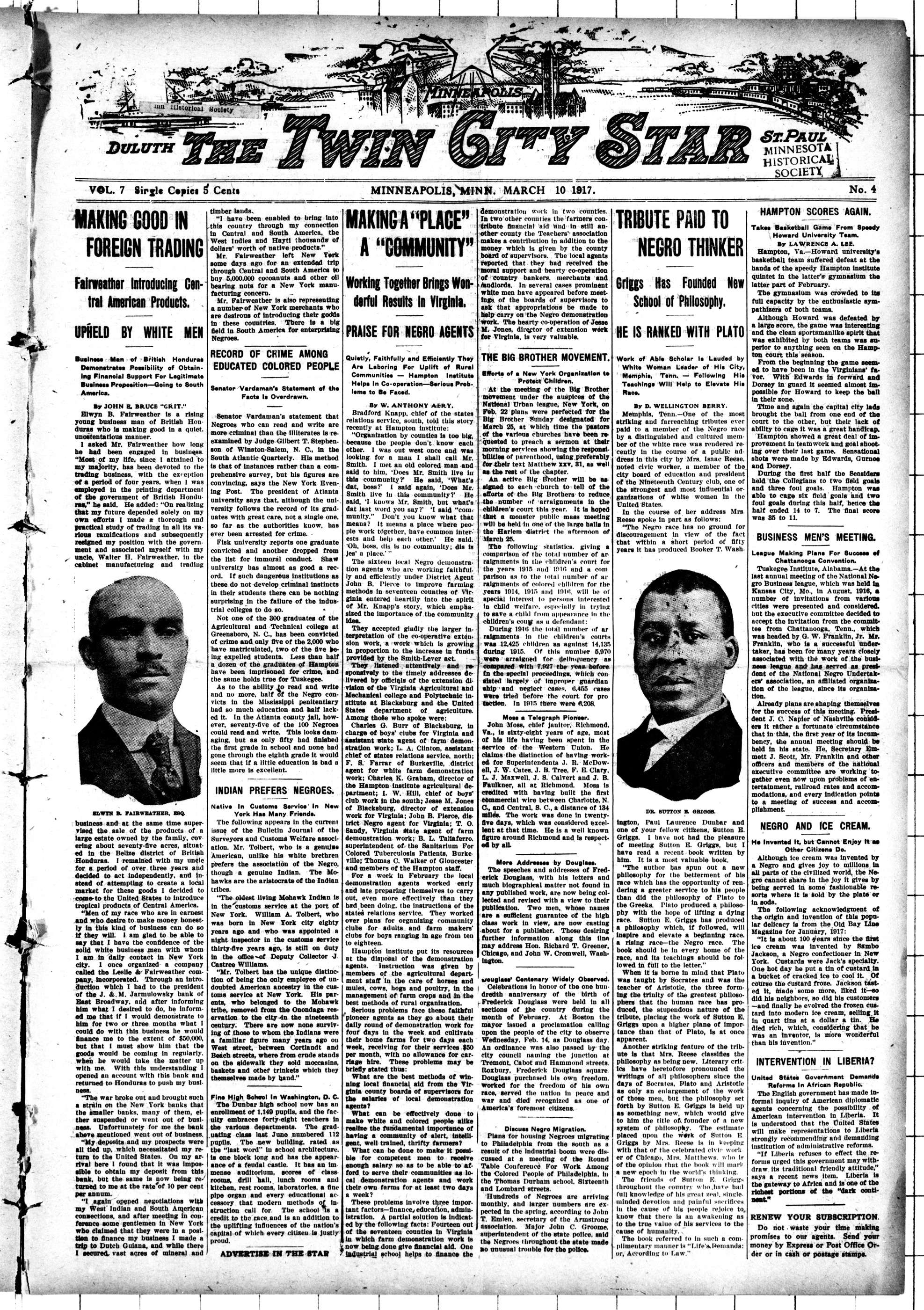
MAKING GOOD IN FOREIGN TRADING
Fairweather Introducing Central American Products. UPHELD BY WHITE MEN
Business Man of British Honduras Demonstrates Possibility of Obtaining Financial Support For Legitimate Business Proposition—Going to South America.
BY JOHN E. BRUCE "GRIT."
Elwyn B. Fairweather is a rising young business man of British Honduras who is making good in a quiet, unostentatious manner.
I asked Mr. Fairweather how long he had been engaged in business "Most of my life, since I attained to my majority, has been devoted to the trading business, with the exception of a period of four years, when I was employed in the printing department of the government of British Honduras," he said. He added: "On realizing that my future depended solely on my own efforts I made a thorough and practical study of trading in all its various ramifications and subsequently resigned my position with the government and associated myself with my uncle, Walter B. Fairweather, in the cabinet manufacturing and trading
ELWIN B. FAIRWEATHER, ESQ.
business and at the same time supervised the sale of the products of a large estate owned by the family, covering about seventy-five acres, situated in the Belize district of British Honduras. I remained with my uncle for a period of over three years and decided to act independently, and instead of attempting to create a local market for these goods I decided to come to the United States to introduce tropical products of Central America. "Men of my race who are in earnest and who desire to make money honestly in this kind of business can do so if they will. I am glad to be able to say that I have the confidence of the solid white business men with whom I am in daily contact in New York city. I once organized a company called the Leslie & Fairweather company, incorporated. Through an introduction which I had to the president of the J. & M. Jarmulowsky bank of East Broadway, and after informing him what I desired to do, he informed me that if I would demonstrate to him for two or three months what I could do with this business he would finance me to the extent of $50,000, but that I must show him that the goods would be coming in regularly, when he would take the matter up with me. With this understanding I opened an account with this bank and returned to Honduras to push my business.
"The war broke out and brought such a strain on the New York banks that the smaller banks, many of them, either suspended or went out of business. Unfortunately for me the bank above mentioned went out of business.
"My deposits and my prospects were all tied up, which necessitated my return to the United States. On my arrival here I found that it was impossible to obtain my deposit from this bank, but the same is now being returned to me at the rate of 10 per cent per annum.
"I again opened negotiations with my West Indian and South American connections, and after meeting in conference some gentlemen in New York who claimed that they were in a position to finance my business I made a trip to Dutch Guiana, and while there I secured vast acres of mineral and
ADVERTISE IN THE STAR
MAKING A "PLACE"A "COMMUNITY"
PRAISE FOR NEGRO AGENTS
Quietly, Faithfully and Efficiently They Are Laboring For Uplift of Rural Communities — Hampton Institute Helps In Co-operation—Serious Problems to Be Faced.
By W. ANTHONY AERY.
Bradford Knapp, chief of the states relations service, south, told this story recently at Hampton institute:
"Organization by counties is too big, because the people don't know each other. I was out west once and was looking for a man I shall call Mr. Smith. I met an old colored man and said to him, 'Does Mr. Smith live in this community?' He said, 'What's dat, boss?' I said again, 'Does Mr. Smith live in this community?' He said, 'I knows Mr. Smith, but what's dat last word you say?' I said "community." Don't you know what that means? It means a place where people work together, have common interests and help each other.' He said. 'Oh, boss, dis is no community; dis is jez "a place."'
The sixteen local Negro demonstration agents who are working faithfully and efficiently under District Agent John B. Pierce to improve farming methods in seventeen counties of Virginia entered heartily into the spirit of Mr. Knapp's story, which emphasized the importance of the community idea.
They accepted gladly the larger interpretation of the co-operative extension work, a work which is growing in proportion to the increase in funds provided by the Smith-Lever act. They listened attentively and responsively to the timely addresses delivered by officials of the extension division of the Virginia Agricultural and Mechanical college and Polytechnic institute at Blacksburg and the United States department of agriculture. Among those who spoke were: Charles G. Burr of Blacksburg, in charge of boys' clubs for Virginia and assistant state agent of farm demonstration work; L. A. Clinton, assistant chief of states relations service, north; F. S. Farrar of Burkeville, district agent for white farm demonstration work; Charlea K. Graham, director of the Hampton institute agricultural department; I. W. Hill, chief of boys' club work in the south; Jesse M. Jones of Blacksburg, director of extension work for Virginia; John B. Pierce, district Negro agent for Virginia; T. O. Sandy, Virginia state agent of farm demonstration work; B. L. Taliaferro, superintendent of the Sanitarium For Colored Tuberculosis Patients, Burkeville; Thomas C. Walker of Gloucester and members of the Hampton staff.
For a week in February the local demonstration agents worked early and late preparing themselves to carry out, even more effectively than they had been doing, the instructions of the states relations service. They worked over plans for organizing community clubs for adults and farm makers' clubs for boys ranging in age from ten to eighteen.
Hampton institute put its resources at the disposal of the demonstration agents. Instruction was given by members of the agricultural department staff in the care of horses and mules, cows, hogs and poultry, in the management of farm crops and in the best methods of rural organization.
Serious problems face these faithful pioneer agents as they go about their daily round of demonstration work for four days in the week and cultivate their home farms for two days each week, receiving for their services $50 per month, with no allowance for carriage hire. These problems may be briefly stated thus:
What are the best methods of winning local financial aid from the Virginia county boards of supervisors for the salaries of local demonstration agents?
What can be effectively done to make white and colored people alike realize the fundamental importance of having a community of alert, intelligent, well trained, thrifty farmers?
What can be done to make it possible for competent men to receive enough salary so as to be able to afford to serve their communities as local demonstration agents and work their own farms for at least two days a week?
These problems involve three important factors—finance, education, administration. A partial solution is indicated by the following facts: Fourteen out of the seventeen counties in Virginia in which farm demonstration work is now being done give financial aid. One industrial school helps to finance the
demonstration work in two counties. In two other counties the farmers contribute financial aid and in still another county the Teachers' association makes a contribution in addition to the money which is given by the county board of supervisors. The local agents reported that they had received the moral support and hearty co-operation of country bankers, merchants and landlords. In several cases prominent white men have appeared before meetings of the boards of supervisors to ask that appropriations be made to help carry on the Negro demonstration work. The hearty co-operation of Jesse M. Jones, director of extension work for Virginia, is very valuable.
THE BIG BROTHER MOVEMENT.
Efforts of a New York Organization to Protect Children.
At the meeting of the Big Brother movement under the auspices of the National Urban league, New York, on Feb. 22 plans were perfected for the Big Brother Sunday designated for March 25, at which time the pastors of the various churches have been requested to preach a sermon at their morning services showing the responsibilities of parenthood, using preferably for their text Matthew xxv, 81, as well as the rest of the chapter.
An active Big Brother will be assigned to each church to tell of the efforts of the Big Brothers to reduce the number of arraignments in the children's court this year. It is hoped that a monster public mass meeting will be held in one of the large halls in the Harlem district the afternoon of March 25.
The following statistics, giving a comparison of the total number of arraignments in the children's court for the years 1915 and 1916 and a comparison as to the total number of arraignments of colored children for the years 1914, 1915 and 1916, will be of special interest to persons interested in child welfare, especially in trying to save a child from appearance in the children's court as a defendant:
During 1916 the total number of ar
raignments in the children's courts
was 12,425 children as against 14,135
during 1915. Of this number 5,970
were arraigned for delinquency as
compared with 7,927 the year before.
In the special proceedings, which
consisted largely of improper guardian
ship and neglect cases, 6,455 cases
were tried before the court for pro
protection. In 1915 there were 6,208.
Moss a Telegraph Pioneer
John Moss, chief janitor, Richmond, Va., is sixty-eight years of age, most of his life having been spent in the service of the Western Union. He claims the distinction of having worked for Superintendents J. R. McDowell, J. W. Cates, J. B. Tree, F. E. Clary, L. J. Maxwell, J. S. Calvert and J. B. Faulkner, all at Richmond. Moss is credited with having built the first commercial wire between Charlotte, N. C., and Central, S. C., a distance of 184 miles. The work was done in twenty-five days, which was considered excellent at that time. He is a well known figure around Richmond and is respected by all.
More Addresses by Douglass
The speeches and addresses of Frederick Douglass, with his letters and much biographical matter not found in any published work, are now being collected and revised with a view to their publication. Two men, whose names are a sufficient guarantee of the high class work in view, are now casting about for a publisher. Those desiring further information along this line may address Hon. Richard T. Greener, Chicago, and John W. Cromwell, Washington.
Douglass' Centenary Widely Observed. Celebrations in honor of the one hundredth anniversary of the birth of Frederick Douglass were held in all sections of the country during the month of February. At Boston the mayor issued a proclamation calling upon the people of the city to observe Wednesday. Feb. 14, as Douglass day. An ordinance was also passed by the city council naming the junction at Tremont, Cabot and Hammond streets. Boxbury, Frederick Douglass square Douglass purchased his own freedom. worked for the freedom of his own race, served the nation in peace and war and died recognized as one of America's foremost citizens.
Discuss Negro Migration.
Plans for housing Negroes migrating to Philadelphia from the south as a result of the industrial boom were discussed at a meeting of the Round Table Conference For Work Among the Colored People of Philadelphia, in the Thomas Durham school, Sixteenth and Lombard streets. Hundreds of Negroes are arriving monthly, and larger numbers are expected in the spring, according to John T. Emlen, secretary of the Armstrong association. Major John C. Groome, superintendent of the state police, said the Negroes throughout the state made no unusual trouble for the police.
TRIBUTE PAID TO NEGRO THINKER
Work of Able Scholar is Lauded by White Woman Leader of His City, Memphis, Tenn. — Following His Teachings Will Help to Elevate His Race.
By D. WELLINGTON BERRY.
Memphis, Tenn.—One of the most striking and farreaching tributes ever paid to a member of the Negro race by a distinguished and cultured member of the white race was rendered recently in the course of a public address in this city by Mrs. Isaac Reese, noted civic worker, a member of the city board of education and president of the Nineteenth Century club, one of the strongest and most influential organizations of white women in the United States.
In the course of her address Mrs. Reese spoke in part as follows:
"The Negro race has no ground for discouragement in view of the fact that within a short period of fifty years it has produced Booker T. Wash-
DR. SUTTON E. GRIGGS.
ington, Paul Laurence Dunbar and one of your fellow citizens, Sutton E. Griggs. I have not had the pleasure of meeting Sutton E. Griggs, but I have read a recent book written by him. It is a most valuable book.
"The author has spun out a new philosophy for the betterment of his race which has the opportunity of rendering a greater service to his people than did the philosophy of Plato to the Greeks. Plato produced a philosophy with the hope of lifting a dying race. Sutton E. Griggs has produced a philosophy which, if followed, will inspire and elevate a beginning race, a rising race—the Negro race. The book should be in every home of the race, and its teachings should be followed in full to the letter."
When it is borne in mind that Plato was taught by Socrates and was the teacher of Aristotle, the three forming the trinity of the greatest philosophers that the human race has produced, the stupendous nature of the tribute, placing the work of Sutton E. Griggs upon a higher plane of importance than that of Plato, is at once apparent.
Another striking feature of the tribute is that Mrs. Reese classifies the philosophy as being new. Literary critics have heretofore pronounced the writings of all philosophers since the days of Socrates, Plato and Aristotle as only an enlargement of the work of those men, but the philosophy set forth by Sutton E. Griggs is held up as something new, which would give to him the title of founder of a new system of philosophy. The estimate placed upon the work of Sutton E. Griggs by Mrs. Reese is in keeping with that of the celebrated civic worker of Chicago, Mrs. Matthews, who is of the opinion that the book will mark a new epoch in the world's thinking.
The friends of Sutton E. Griggs throughout the country who have had full knowledge of his great zeal, single-minded devotion and painful sacrifices in the cause of his people rejoice to know that there is an awakening as to the true value of his services to the cause of humanity.
The book referred to in such a complimentary manner is "Life's Demands: or, According to Law."
No.4
HAMPTON SCORES AGAIN.
Takes Basketball Game From Speedy Howard University Team.
BY LAWRENCE A. LEE.
Hampton, Va.-Howard university's basketball team suffered defeat at the hands of the speedy Hampton institute quintet in the latter's gymnasium the latter part of February.
The gymnasium was crowded to its full capacity by the enthusiastic sympathizers of both teams.
Although Howard was defeated by a large score, the game was interesting and the clean sportsmanlike spirit that was exhibited by both teams was superior to anything seen on the Hampton court this season.
From the beginning the game seemed to have been in the Virginians' favor. With Edwards in forward and Dorsey in guard it seemed almost impossible for Howard to keep the ball in their zone.
Time and again the capital city lads brought the ball from one end of the court to the other, but their lack of ability to cage it was a great handicap.
Hampton showed a great deal of improvement in teamwork and goal shooting over their last game. Sensational shots were made by Edwards, Gurnoe and Dorsey.
During the first half the Seasiders held the Collegians to two field goals and three foul goals. Hampton was able to cage six field goals and two foul goals during this half, hence the half ended 14 to 7. The final score was 35 to 11.
BUSINESS MEN'S MEETING.
League Making Plans For Success of Chattanooga Convention.
Tuskegee Institute, Alabama. At the last annual meeting of the National Negro Business league, which was held in Kansas City, Mo., in August, 1916, a number of invitations from various cities were presented and considered, but the executive committee decided to accept the invitation from the committee from Chattanooga, Tenn., which was headed by G. W. Franklin, Jr. Mr. Franklin, who is a successful undertaker, has been for many years closely associated with the work of the business league and has served as president of the National Negro Undertakers' association, an affiliated organization of the league, since its organization.
Already plans are shaping themselves for the success of this meeting. President J. C. Napler of Nashville considers it rather a fortunate circumstance that in this, the first year of its incumbency, the annual meeting should be held in his state. He, Secretary Emmett J. Scott, Mr. Franklin and other officers and members of the national executive committee are working together even now upon problems of entertainment, railroad rates and accommodations, and every indication points to a meeting of success and accomplishment.
NEGRO AND ICE CREAM.
He Invented it, but Cannot Enjoy it as Other Citizens Do.
Although ice cream was invented by a Negro and gives joy to millions in all parts of the civilized world, the Negro cannot share in the joy it gives by being served in some fashionable resorts where it is sold by the plate or in soda.
The following acknowledgment of the origin and invention of this popular delicacy is from the Old Bay Line Magazine for January, 1917:
"It is about 100 years since the first ice cream was invented by Sambo Jackson, a Negro confectioner in New York. Custards were Jack's specialty. One hot day he put a tin of custard in a bucket of cracked ice to cool it. Of course the custard froze. Jackson tasted it, made some more, liked it—so did his neighbors, so did his customers—and finally he evolved the frozen custard into modern ice cream, selling it in quart tins at a dollar a tin. He died rich, which, considering that he was an inventor, is more wonderful than his invention."
INTERVENTION IN LIBERIA?
United States Government Demand
Reforms in African Republic.
The English government has made informal inquiry of American diplomatic agents concerning the possibility of American intervention in Liberia. It is understood that the United States will make representations to Liberia strongly recommending and demanding institution of administrative reforms. "If Liberia refuses to effect the reforms urged this government may withdraw its traditional friendly attitude," says a recent news item. Liberia is the gateway to Africa and is one of the richest portions of the "dark continent."
RENEW YOUR SUBSCRIPTION.
SOCIAL NEWS EDITOR,
Miss Clara Lucas,
506 Boston Block, Minneapolis.
Minneapolis, Minn.
NIC. 1873.
RAILROAD MEN'S NEWS,
Stephen Springer,
Milwaukee Depot, Minneapolis.
Send your notes to us by Wednes-
day A. M.
STEWART'S CABARET
— SPECIAL —
SUNDAY 50c DINNER
and Cabaret Entertainment
from 5 to 8 P. M.
MENU
Cream of Tomato Soup
Baked White Fish
Roast Beef or Lamb
Stewed Corn Mashed Potatoes
June Peas Pineapple Sherbet
Head Lettuce Salad
Creamed Rice Pudding
Tea, Coffee or Milk
Miss Esmeralda Statham, Miss
Toy Brown and Miss Zella Hunter
are entertaining at
Stewart's Club and Hotel
at 244 4th Ave. So.
Miss Mary Ray of St. Paul
appears from 5 to 8 P. M.
ATTUCKS HOME MEETING.
The Crispus Attucks Home Assn., will hold their regular meeting on Sunday, March 11th, at 2:30 P. M., at St. Peter A. M. E. Church. The public are cordially invited to attend. Mrs. Bessie Miller, Pres.
THAT DANGEROUS LIE.
A lie is always the cause of trouble and oftimes brings about serious results. Misrepresentations on the part of husband or wife will sooner or later cause a breach in their domestic relations. Many men, whose fraternal emblems signify that they are "on the square" and they will "defend the truth" will conspire to pull a crooked deal and protect a lie, especially when a woman is the victim. A woman should know something about her husband's affairs, and her motives cannot be considered entirely selfish or mercenary. A court of domestic relations is needed and will probably be authorized at this session of the legislature. A real adjustment will do much to prevent a family quarrel or a murder.
DEATH OF MRS. BERNICE LEE.
Mrs. Bernice Lee, aged 33, died March 2, in St. Paul, after a lingering illness. Funeral services were held Monday. Rev. J. M. Henderson officiated. Her mother, Mrs. Libby Kimborough of Oscaloosa, Ia., visited her several weeks during her illness. She leaves a father Noah Kimborough, a mother, a sister, Miss Naomi, and two brothers, Alfonso of Cleveland, O., and Harold of Minneapolis, and two daughters.
The family extends their sincerest thanks for the sympathy, attention and floral offerings during her illness and death.
MINNEAPOLIS SUNDAY FORUM.
A GOOD MEETING.
The meeting of the Forum last Sunday was the best in recent years, and it appears that the public is unwilling to take advantage of the Forum's work. Despite many personal prejudices, the demonstration of talent, the report of social service work and the discussion of current topics should interest a greater number of our people.
The program was very instructive and especially interesting. Miss Elenor Barksdale of St. Paul rendered two of her charming vocal selections. Mrs. I. S. Bogie gave a good report of social service work. Mr. D. W. Raynor sang to his own accompaniment. He is always a favorite. A memorial service to the late Mr. Robert Marshall will be held at the Easter Sunday meeting at St. Peter Pres. Jeffrey made a brief talk urging better department among the young people. The committee on the recent "get-together meeting" reported "a success and thanked all who assisted." Mr. Otis Murray, the violinist, made his first appearance and received much applause on his renditions. Miss Marienne Jeffrey accompanist.
Atty R. A. Skinner delivered one of the best addresses recently heard by the Forum. He handled his subject "Duty", without fear or favor—and reminded his hearers of the lack of race pride by those who claim to represent the best element of our race. He deplored the neglect of duty among our people along many lines and spoke of the general indifference on the part of many towards the N. A. A. C. P. of which he is the secretary. His remarks rang with severe criticism and were roundly applauded.
A PREACHER'S PLAIN TALK.
St. James A. M. E. Church is suffering temporarily under the discipline of Rev. I. W. Bess, but it will rise above its many troubles. He is making a clean sweep, and will not tolerate conditions that have distressed St. James, the mother church. There has been wholesale stealing and grafting on this church from chitterling parties to real estate deals, and Rev. Bess has investigated and found facts. He spoke plainly in his Sunday night sermon of the duty of the church members, and hopes to begin with a new system to bring about a Christian spirit for the support of the church, Rev. and Mrs. Bess have made a good impression since in Minneapolis.
He has tried to unite the fragments of two factions, who were at war when he came here. He has been successful. It is deplorable that St. Peter A. M. E. Church has not taken a public stand to assist its "Mother Church." St. James is a mission church and because of its locality it can do good service. Like the People's Christian Assembly, it has a greater field than the other "society" churches. The public should help St. James Church, and those who attend its meetings (tho held in humble surroundings) will surely hear the gospel truth preached by-a fearless and intelligent man.
He says that "this field has been overworked by church solicitors. Many white people had said they have given enough money to endow Negro churches, and he intends to use his best efforts to get a congregation willing to support his church."
This is a forward movement by Rev. Bess. There will always be good white friends to assist our churches when we show signs of self support. Negroes are coming from the Southland, where they have the habit of contributing to, rather than soliciting for churches, and The Star hopes to see the Negro churches able to pay their pastors, that they may devote their time to their work within the church. Rev. Bess is to be encouraged, because he has not followed the beaten path of suspicion and destruction, but has blazed a trail which leads to race unity and uplift.
GREAT REVIVAL MEETINGS
REV. V. S. COOPER
The Great Evangelist of Fayette,
Mo., at the
ZION BAPTIST CHNRCH
7th and Hoag Ave. No.
Sundays, 11 A. M.—3 P. M. and 8 P. M., Weekdays 8 P. M. except Saturdays.
COME! YOU ARE WELCOME
Mr. Richard Mann left Wednesday for Chicago to accompany the remains of his brother, Henry Mann of Chicago to Milan, Tenn. He had been sick several weeks. Mr. Alex. Mann is sick at Milan where he accompanied his sister after attending his brother in Chicago. He will return home in a few days.
ELKS TAKE NOTICE
The funeral of Brother John Simms will be held Monday, March 12, at St. Peter A. M. E. Church at 2:30 P. M. All members of Ames Lodge and brother Elks are urgently requested to attend.
Mrs. James T. Quarles, of St. Paul spent Tuesday afternoon in Minneapolis.
Mrs. S. L. Thornton, of Oakland, Cal., is visiting Mrs. T. V. Botts, of 3724 Minnehaha Ave., for an in-
Mr. Chas. W. Dwyer is confined to his home, 1015 So. 5th St., with an attack of stomach trouble.
Mrs. Hattie G. Hall of St. Paul, has arranged a series of weekly musicals for the befit of Pilgrim Baptist Church.
Mrs. Eliza Wilson entertained several at the residence of Mr. Andrew Quinn, 530 10th Ave. No., on Saturday night.
Mr. Martin Brown has taken up the study of law. He finished a course in business law and it is his ambition to complete the full course. Sucoess to Mr. Brown, who is one of our energetic young men.
THE TWIN CITY STAR
A WHITE WOMAN EXPOSED.
Clara Cameron, white, who has been known as the widow of the late Joe. Blackwell, the Negro saloonkeeper, has been exposed. She is supposed to have caused the trouble between Mr. and Mrs. Blackwell, the latter dying in the insane asylum and Joe, was not mentally responsible before he died. Clara has broken up another home. The woman, whose husband she associated with, is one of the respectable women of our race. She has many letters and other evidences of Clara's affections and threats, Clara's mother, Mrs. J. L. Cameron, 2105 16th Ave. So, claims not to have known of her daughter's life, and they attempted to intimidate Mrs. Carr, who had the support of the best people of the city. Such as Clara cause much prejudice by breaking up many Negro homes. The Star knows some more about her and does not want to connect up others at this time. Clara should play black or white straight across the board and not both ends against the middle. She has been thrown out of her white lodge in disgrace and criminal action may be brought against her.
A CARD OF THANKS.
Frank Fisher Explains.
About three weeks ago, upon the advice of friends, I was induced to go to the University hospital for treatment. There I was informed that the particular treatment I would need would have to be paid for, that is, the actual cost of the medicine. It was decided to allow my friends to help me and I asked Mr. George Holbert to prepare and look after some papers to that effect. He did so and placed one in each of four colored places where my friends congregate. In the meantime after a thorough diagnosis of my case I was advised not to take the treatment at this time, so I returned to my home after a weeks' stay at the hospital. As quickly as possible my friends were notified of this and Mr. Holbert took steps to take up the papers upon which a tidy little sum had already been contributed. I received no returns from the one placed at Mr. Shull's Club as Mr. Shull seemed to doubt the authenticity of the papers, or the honor of those handling it and I am informed returned everybody's money who had subscribed upon it. This he did without any authority or instruction from me and I sincerely regret the very wrong impression that has gone about through Mr. Shull's rather unusual and unauthorized action. However I thank those friends who by their actions showed their good will and friendship, as it was not their fault I did not receive what they intended I should. From the other places I received the amount of $36.00 as follows: From Stewart's Club $12.00; Mitchell's Saloon $1.50; South Side Club $22.50; which was duly delivered to me by Mr. Holbert, for which I am very grateful, and thankful to those who assisted in the collection.
Frank T. Fisher, 501 11 Ave. So.
—Paid Advertisement.
Mr. John Simms, who had been very ill many weeks with tuberculosis, died Tuesday morning at the Hopewell Hospital. He was a member of Ames Lodge of Elks, who arranged the burial. Mr. Simms was known as "Jock" and was a native of Hopkinsville, Ky.
Mr. Athern Rivers is slowly recovering from an attack of rheumatism.
Mr. Joseph J. Duncan, 3920 4th Ave. So., is ill at his home.
Mrs. Geo. W. Ricks is sick at her home, 740 No. 3rd St.
The news of the death of Mr. Wm. Bell of Chicago, was a shock to his many friends. He was employed on the Milwaukee Ry., in charge of a dining car. Mr. Bell was a splendid character, and commanded the respect of all who knew him. Hs widow has their sympathy.
The Mock Inaugural at St. Peter Church was fairly well attended.
The St. Peter A. M. E. Monitor, a neat publication by Rev. Stovall, appeared this week. It is newsy and may fill the usual "long felt want."
Mrs. Wm. Hyde visited her former home in Fargo, on account of the illness of her mother.
The Golden West Hotel of Seattle, Wash., was raided on alleged violation of the Federal Liquor Laws. A full account appeared in The Portland Advocate.
STEWART'S NEW MANAGER.
Mr. Charles Brody is the new manager of Stewart's Twin City Club and Hotel. He is well known and is making material changes for the comfort and convenience of all patrons.
Mrs. Gene Bell of 1711 Wash. Ave. No. has moved to Chicago.
Mr. Stephen Springer is making a good record as a student at the Minnesota Business College.
Read the Negro Papers.
PENTICOSTAL
Padulae Christiani Asiendhi
People Christian Assembly
1204 Washington Ave. So.
Services Sunday—11 A. M.
Sunday School—1.30 P. M.
Praise Meeting—3 P. M.
Preaching—8 P. M.
ELDER G. W. MITCHELL, Pastor.
Assisted by Mrs. G. W. Mitchell.
Comel and Serve the Lord.
A Negro newspaper is a good medium for the personal advertisements of many, who never subscribe for it. Usually, those who fail to support Negro newspapers are often first to need them.
The high cost of living is a blessing in disguise to many of our people. It is a lesson in economy taught by experience to be practiced with efficiency. They have too often, accepted the luxuries and rejected the necessities. The tables are turned and instead of idolizing the vanities of an existence, they must idealize the realities of life. Put more brains in your business, and you can and will overcome the adversities, that beset you in every walk of life.
Owing to the increased cost of publication, we will NOT accept any ads, unless paid in advance. Agents will please act accordingly.
THE COMING REVIVAL
The Twin City Ministers have extensive plans for a Religious Revival during May. A house to house canvass will be made. Rev. Chas. Morris, the noted Baptist preacher and temperance lecturer, will hold a series of meetings. Organizations will be asked not to hold any social affairs during May. Every church will hold meetings. Rev's. Stovall. Beasley, Withers, Mitchell, Battles and Bess of Minneapolis attended the meeting on Sunday. There was not a credita response to the call, but it is expected that there will be a great religious revival which will be a great help to the community. Success to the movement.
Madam Hart, the milliner and hairdresser at 1215 Washington Ave. So., has nicely fitted up her new place and everything is in good shape for the service of her patrons.
ENCOURAGE THE YOUNG PEOPLE
Encourage the young people, who are interested in church and social work. They need the advice and assistance of those, who are older and more experienced. Instead of such being the case; it is often that rivalry and agitation results, when the young people make a better showing than the older element.
EN-ROUTE THE PHILIPPINES.
Mrs. Nellie McCullough received a letter from her son Philip, who had reached Yokohoma after a pleasant ocean voyage. He is going to the Philippine Islands, where he has a position as private secretary to the owner of a large rice plantation.
KNIGHTS ENJOY SMOKER.
The Uniform Rank of the Knights of Pythias held a Smoker at their Castle Hall on Thursday eve. Several visitorms were present and prospective members were given applications. Every effort is being made by the officers to have a large following to the coming encampment at St. Louis.
The N. A. A. C. P. will give a grand public reception after Easter and arrangements are being made to make it a big civic and social event.
A new undertaking firm will be ready to do business at an early date. Watch for the announcement.
WOMEN FORM ORGANIZATION.
Business Women of Washington Seeking to Batter Their Condition.
ing to Better Their Condition.
The women wage earners of the District of Columbia are setting an example for their sisters in the states. At the suggestion of the labor forces of the community and to enhance their chances for advancement in the economic world a number of well known business women met recently at the Columbia academy, 704 T street, northwest, and formed a permanent organization called the Women's Wage Earners' Association of the District of Columbia.
Miss Jeannette Carter, pension attorney, presided. Officers were elected as follows: President, Miss Jeannette Carter; secretary, Dr. Julia P. H. Coleman, and treasurer, Mrs. Mary Church Terrell. Judge R. H. Terrell, T. Thomas Fortune and Wellington A. Adams assisted. The new organization will be affiliated with the American Federation of Labor.
The Arcadia Restaurant is receiving a large share of patronage and among its patrons are the best known citizens. A visit during lunch hours will prove that Prop. Simmons is making good.
STEWART'S HOTEL
FINEST ESTABLISHMENT OF
ITS KIND IN THE UNITED
STATES.
Twenty Elegant Steam Heated, Electric Lighted Rooms. Free Bath. Rates Reasonable.
Lobby, Reading and Lounging Room,
Buffet and Grill Room, Billiard Room, Dining Room, and bath,
Private Dining and Reception Room for Ladies.
BARBER SHOP IN CONNECTION
A LA CARTE MEALS AT ALL
HOURS. BEST SERVICE.
POPULAR-PRICE LUNCH.
From 12 to 3 P. M.
REGULAR DINNER
246-50 FOURTH AVE. SO.
MINNEAPOLIS, MINN.
T. S. Center 4639.
WALFRID WESTMAN
Photographer
1425 Washington Ave. So. Minn.
JOHN A. WITHERS,
Spring is coming, and if you think of changing homes, see Withers. He has a large van nd all facilities for moving and storing at a special low rate. Call Hy. 2331. Res. Hy. 4712.
WORKING-MEN'S SOCIAL CLUB
244 3RD AVE. S.
MINNEAPOLIS
SYLVESTER W. OLIVER,
MANAGER.
N. W. Cedar 8190. Res. Dale 8935
HAMMOND TURNER
Attorney at Law
Suite 321, American Nat'l Bank
Fifth and Cedar Sts.
St. Paul.
FURNISHED ROOMS FOR RENT.
FOR RENT—Large, light, front room and private kitchen for married couple. Walking distance; price reasonable. Call Hy. 4323.
FOR RENT—5 Room, modern flat, furnace heat, within walking distance reasonable rent—1917 5th Ave. So., Phone So. 4948.
Three nicely furnished rooms, modern, gentlemen preferred, 612 Bryant Ave. North. N. W. Hy. 6910.
FOR RENT—MODERN BRICK HOUSE, 211 ELEVENTH AVE. S. 16 ROOMS, SUITABLE FOR ROOMING HOUSE. $30 PER MO. APPLY 1313 WASH. AVE. SO. TALN MAIN 2259.
J. O. PETERSON.
THE SOUTH SIDE DRUGGIST.
J. O. Peterson, the popular druggist at Seven Corners has on file the prescriptions of the Segerstrom Drug Store, which is closed. The record of all Segerstrom prescriptions are at Peterson's and can be filled on request. Mr. Peterson has moved to a temporary building on Cedar Ave., opposite his old store. He will erect a building costing $110,000—in which he will establish the largest drug store in the city, and he will continue to serve his Negro patrons as he has done in the past.—Advertise-
YOUR PUBLICITY PAYS.
All persons interested in the progress of their lodges, churches, societies etc., should value the power of printer's ink. They should see that their secretaries SEND ALL NOTICES to the newspapers in proper time. They think the Editor should attend every affair, whether invited or not, and should know "What is going on?"—without being informed. Many exchanges clip from our columns, and often things done in Minneapolis get national publicity.
SEND YOUR SUBSCRIPTION
Do not delay in sending in your indebtedness for the Twin City Star
ADVERTISE HERE — IT PAYS.
Read the Negro Papers.
SMOKE THE BEST
5C CIGAR
Sight Draft
W. S CONRAD CO., Distributors
NO. 140. E. 8th ST., ST. PAUL.
NO. 1. WESTERN AVE., MINN.
CHOICE CITY AND SUBURBAN PROPERTY FOR SALE ON SMALL MONTHLY PAYMENTS.
Houses and Flats for Rent.
B. M. McDEW,
802 Sykes Block.
N. W. Nic. 621 Minneapolis
OSCAR GILBERT PRICE.
Real Estate, Insurance and Loans.
Choice Property for Sale or Rent.
2814 10th Ave. So.
N. W. South 5250 Minneapolis
N. W. Phone Nic. 1873
J. M. MORRIS
Real Estate Broker
Loans Collections
506 BOSTON BLOCK
MINNEAPOLIS, MINN.
Office Phone N. W. Main 625
GALE P. HILYER
ATTORNEY AND COUNSELLOR
AT LAW
With Hall and Tantges
722 New York Life Bldg.
Minneapolis, Minn.
Res. N. W. South 3347
Peterson, The Druggist 1501 Washington Ave. So.
TOILET ARTICLES, DRUGS
PRESCRIPTIONS.
He Solicits You Patronage.
SPECIAL SAMPLE SHOES.
POPULAR PRICED SHOE RE-
PAIRING.
WE FIX 'EM WHILE YOU WAIT.
Men's Sewed Soles.....75c
Ladies Sewed Soles.....65c
Men's Nailed Soles.....50 and 60c
Rubber Heels,.....40c
Ladies' and Boys' nailed soles.....40c
SEVEN CORNERS SHOE REPAIR SHOP
1424 Washington Avenue South.
DR. W. H. WRIGHT.
DENTIST.
Phone Nic. 1963
111 So. 6th St Minneapolis, Minn.
Phone Hy. 3605.
DR. ELLIS BURTON
715 Sixth Ave. No.
Minneapolis, Minn.
DENTIST.
Graduate Northwestern Dental
School of Chicago.
THE NORTH SIDE DRUGGIST.
Call on J. A. Baker, 1320 6th Ave.
No., for your Drugs, Toilet Articles,
etc. Prescriptions carefully com
pounded. His phone is Hyland 432.
Deliveries on request—Advertisement
INSTRUCTION
ELOCUTION and SPANISH
Taught by
PROF. J. W. BUNDRANT
3616 Fourth Ave. So., Minneapolis
Tel.: N. W. Colfax 4835.
PUBLIC STENOGRAPHER
Agent and Correspondent for The
Twin City Star.
Miss Clara Lucas will receive your
advertisements and news. Call on her
at 506 Boston Block. She is a competen
stephographer and will write
your letters or handle any business
correspondence. All matters confi-
dential.
LIBERAL SUBSCRIPTION
OFFER
Special $3.00 Combination.
We offer a Combination Subscription to our readers for 1917. We will give you your choice of any Negro NEWSPAPER or MAGAZINE, and THE TWIN CITY STAR, mailed to your address anywhere in the U. S. for THREE DOLLARS. Cash in advance. Get your home paper sent direct to you. Forward all orders to
THE TWIN CITY STAR, .... Room 302.
305 So. 5th St., Minneapolis.
Are you a delinquent subscriber?
If so, why not send your subscription?
---
RACE SEEKS NEW ABIDING PLACES
Hundreds of Thousands Have Left the Southland.
CAUSES OF GREAT EXODUS
Summary of Facts and Figures In History of Migration of Colored People From the South Since the Beginning of the European War-72,000 Are Skilled Laborers.
By RALPH W. TYLER.
Since the beginning of the great European war 326,876 colored people from the south have gone north, the larger per cent of whom have gone north during the last eight months of 1916. That this noticeable and unusual migration of the race to the north should attract country wide attention and invite very serious discussion in the public press of both the north and south is perfectly natural because of the possible effect this migration may have on the economic and social conditions north and south.
These 326,876 natives of the southland going north have scattered themselves over Ohio, Indiana, Illinois, Michigan, the northwestern states, Pennsylvania, Delaware, New Jersey, New York, Connecticut and Massachusetts. Were Dr. Booker T. Washington living, what would be his position relative to this unusually large migration of his race from the south's Knowing him as I did and enjoying his confidence as I did, I believe I commit no error in stating he would have strenuously discouraged it.
That the shortage of labor supply was responsible for northern employers sending south to take from "Dixie" the muscle she had depended upon for more than 250 years is apparent to all. That the race long subjected to segregation, very meager school facilities and the denial of suffrage should regard the north, with its equal school privileges and the right of suffrage unrestricted, as a promised land is but natural.
Every time a burning of Negroes, like the recent horrible Waco (Tex.) affair, occurs in the south, with an unjustifiable lynching of a reputable, well to colored man, like the recent Abbeville (S. C.) affair, the Negroes in the south ask the divine Creator in piteous wails the question, "O Lord, how long?" When foreigners left to fight in defense of their respective countries, leaving jobs and positions vacant, and the world war paralyzed foreign immigration, compelling the northern employer to send his agents south for Negro laborers, so glad were they to leave a section where for 250 years their labor and fidelity had been requiled with poor wages, scant school facilities, discrimination, denial of suffrage and lynching that 326,876 of them exclaimed, "We are coming, Father Abraham, three hundred thousand strong!"
From the most reliable sources, after careful investigation, I find that these 323,876 colored citizens who have moved north since 1914 came from the following states in the following numbers: Georgia, 46,870; South Carolina, 27,500; North Carolina, 35,280; Florida, 10,800; Mississippi, 34,210; Louisiana, 15,850; Arkansas, 23,500; Tennessee, 20,620; Virginia, 45,650; Kentucky, 21,580; Texas, 10,670; Oklahoma, 5,380
Now, where did all these 329,876 blacks go—to what state? Crossing the Mason and Dixon line, this black caravan moved into what they have long regarded as the promised land and distributed themselves as follows: 45,000 of them stopped in Ohio, 32,000 wended their way to Indiana, 54,000 extended their pilgrimage to Illinois, 18,000 went to Michigan, 73,000 stopped in Pennsylvania, 59,000 settled in the Empire State, 15,000 took up their habitat in Delaware and New Jersey, 25,000 distributed themselves over the New England states.
Of these 326,876 who have left the south since the beginning of the European war 72,000 of them were skilled laborers, the remainder being common laborers, who took the place of Italians, Slavs and Hungarians on construction work, in mines, mills and manufacturing plants. Kentucky contributed a large per cent of the skilled labor, possibly because of her nearness to the field of labor demand, and Virginia and Alabama, due doubtless to the location in these states of the two great industrial schools, Hampton and Tuskegee, were large contributors to the skilled labor class.
My investigations give me assurance that the vast majority of these persons who have come north are steady, sober, industrious men of robust health who seek an asylum in the free north, with its better wages and better opportunities for the education of their progeny. They went north not at the behest of politicians to colonize certain doubtful districts, but they went north to do honest labor. The hope, because of why they came and the type of men who came, is indulged that this mighty migration of blacks from the south to the north means an earlier solution of a long-debated problem and an adjustment of labor conditions in the north that will remove the menace of strikes. Negro labor seldom, if ever, strikes for either higher pay or shorter hours. Like the patient ox, well fed and groomed, he waxes fat on labor with good treatment and leaves to the foreign immigrant labor the privilege and pleasure of indulging in strikes.
OPPORTUNITY OFFERED TO NEGROES IN THE ARMY
Government Will Give Educated Men Chance to Become Officers.
A military training camp for colored men is advocated in an open letter from Dr. J. E. Spingarn, well known as a friend of the Negro race, who says:
"To the Educated Colored Men of the United States:
"It is of the highest importance that the educated colored men of this country should be given opportunities for leadership. You must cease to remain in the background in every field of national activity and must come forward to assume your right places as leaders of American life. All of you cannot be leaders, but those of you who have the capacity for leadership must be given an opportunity to test and display it.
"There is now just such an opportunity possible for you in case of war to become leaders and officers instead of followers and privates. Major General Leonard Wood of the United States army, commanding the department of the east, has promised that if 200 of you apply for admission he will organize and maintain a military training camp for colored men, with just the sort of training to fit you to serve as officers of volunteers in case of war. "I do not believe that colored men should be separated from other Americans in any field of life. But the crisis is too near at hand to discuss principles and opinions, and it seems to me that there is only one thing for you to do at this juncture, and that is to get the training that will fit you to be officers, however and wherever and whenever this training may be obtained. If 200 of you do not send applications immediately the opportunity may be lost forever.
"The camp will be conducted on exactly the same principles as the military training camp held at Plattsburg, N. Y., where thousands of men have received intensive training in military service. It will be under the direction of United States army officers. It will last four weeks. The date has not been fixed, but it will probably begin early in June. The status of every student at the camp will be that of a cadet, just as at West Point.
"I understand that the transportation to and from the camp will be defrayed by the government and that the subsistence and training at the camp will be free. It is probable that every man will have to pay his own fare to the camp and that after he arrives his traveling expenses will be refunded and his fare home paid. The only expense will be the cost of the uniform, which each man must furnish himself. This consists of a khaki blouse, khaki breeches, two olive drab shirts, web belt, campaign hat and cotton leggings, costing in all about $8 or $10. Any good russet walking shoes will do. The outfit may be purchased on arrival at camp, or, better still, from the Army and Navy Co-operative company, with branches in New York, Washington and Philadelphia. Almost any sporting goods store can furnish the outfit, which must be of the regular army pattern. Those who wish to do some study in advance are advised to read 'Moss' Manual of Military Training.'
"Candidates must be between the ages of twenty and forty-five, in vigorous health and of good moral character. Men who are graduates or undergraduates of colleges, high schools, normal, agricultural or industrial schools or other institutions of learning are preferred, but any man of intelligence, character and ability may join. Previous military experience is not necessary. If you are not a graduate or undergraduate of some institution it might be advisable to have a letter of recommendation from some person of repute.
"Send in your own application immediately. But that is not enough. Go out among your friends and persuade them to do the same. We must not let this chance slip. We must have as many colored officers as possible."
"Applications should be sent to Dr. J. E. Spingarn, 9 West Seventy-third street, New York. A brief letter, with a few details about yourself, will be sufficient for the present. We must persuade General Wood that over 200 men want to join 'immediately.'
Brooklyn Pays Honor to Douglass. The one hundredth anniversary of the birth of Frederick Douglass, the noted colored educator and orator, was celebrated in Brooklyn at a dinner held at Rockwell terrace, under the auspices of the Citizens' club of Brooklyn. This organization, which is of a nonpartisan nature, has for its purpose the furtherance of men of the colored race.
The principal speaker of the evening was Municipal Court Justice Robert H. Terrell of the municipal court of the District of Columbia, one of the few court officials in the United States who have Negro blood in their veins. Judge Terrell's address dwelt upon the achievements of Douglass and pointed out various important positions of trust held by men of the race.
Chicago Association Holds Meeting. The annual meeting of the Chicago branch of the National Association For the Advancement of Colored People was held at Abraham Lincoln Center. Oakwood boulevard and Langley avenues, Chicago. Former Judge Edward O. Brown delivered the president's address, and other speakers were Miss Catherine Johnson, Miss Minnie E. Low, Mrs. Cella Parker Woolley, Miss S. P. Breckinridge and Judge Robert McMurdy. A. K. Maynard read the secretary's report, and Dr. C. E. Bentley presented the statement of the treasurer.
THE TWIN CITY STAR
Inspiration Miscellany
How One Family Saved
In the American Magazine a writer tells how he and his wife managed to save money and get ahead: "On March 1, 1905, my wife persuaded me to take out five shares of building and loan stock, which necessitated my paying $5 every month. I kept at it faithfully and regularly, never missing a single payment, and many a month I could hardly see where the $5 was coming from, for at that time my salary was not very large. But I considered that I owed it just the same as I owed my rent.
"I kept at it with a determination that I would not let anything interfere, and after paying in for ten years and eight months the secretary told me that the series I was in had matured and that I need not pay any more. So he gave me a check for $1,000. You can easily figure that at $5 per month I had paid just $640.
"The profit represented the interest on my money for the ten years and premium on my money which the association had sold, and when the amount which I had paid then plus interest and premium reached $1,000 my obligation to them ceased, and I got the amount mentioned above, or $1,000. I have often sald to my wife that we were just that much ahead, for I feel certain we would not have saved the $5 each month if we had not made the start and felt that we should stick to it until the stock matured.
"With that $1,000 I bought a $1,000 bond that pays 5 per cent, and instead of paying out $80 a year we get $50 interest each year. This permits us to save the $60 each year and in addition the $50 interest, which is almost double the amount we originally started with."
Happiness.
Happiness is always a byproduct. It never comes to those who concentrate on securing it. The unhappiest person in the world is the one who constantly pursues happiness. Not more elusive was the nymph that fed Apolon than is happiness to those who pursue it as an end and aim. It always comes as a result of something else. The pursuit of noble things, the things essentially worth while, brings happiness. As a man goes on life's journey with a brave heart, doing the best he can and leaving the issues "to the powers that wait on noble ends," he often hears the faint flutter of invisible wings, he feels a presence, a companion. It is Happiness.—Chicago Herald.
Epigrams of Success
Let me, says B. C. Forbes in Leslie's, give a few of the business epigrams and mottoes of a prominent St. Louis merchant, since they throw light on his successful methods:
The difference between failure and success is doing a thing nearly right and doing it exactly right.
Concentration means strength. Scatteration means weakness. Having chosen one line of work or business, stick to it.
Spend fifteen minutes every night recounting your day's doings and planning to do better next morning.
Always put yourself in your customer's place.
Character is the decisive force in business.
I am a great believer in the business philosophy of encouragement.
Settle claims promptly. The merchant who does not permit himself to be imposed upon occasionally will never get far.
If any of your men or any customer gets into a hole, always leave him a loophole to get out easy.
Quality of goods, confidence in your business and in yourself, ability and readiness to anticipate conditions and to adapt yourself to them—these are some of the essentials to business success.
The Bright Side
If the present moment be hard, sad, painful, we have the opportunity not to complain. There will be some bright thing. Fasten on that; if none, then this—that it might be worse. If it seem the worst possible from the outside, there is still this reflection—that we may make it worse by our own way of taking it in the soul. J. Vila Blake.
HE WHO CONQUERS FATE.
I like the man who faces what he must
With step triumphant and a heart of cheer,
Who marries the daily battle without fear;
Sees his hopes fall, yet keeps unfaltering trust
That God is God, that somehow, true and just,
His plans work out for mortals.
Not a tear
Is shed when fortune, which the world holds dear,
Falls from his grasp. Better, with love a crust
Than living in dishonor; envies not
Nor loses faith in men, but does his best
Nor ever murmurs at his humbler lot,
But, with a smile and words of hope, gives zest
To every toller. He alone is great
Who by a life heroic conquers fate.
—Sarah Knowles Bolton.
KANSAS FARMERS MEET AT TOPEKA
Industrial Institute Host of Many Rural Visitors.
FEATURES OF THE PROGRAM
Sunflower State Agricultural Association Holds Tenth Annual Session Under Unusually Favorable Circumstances—Big Exhibition of Farm and Dairy Products Is Shown.
Topeka, Kan.-The Sunflower State Agricultural association met in tenth annual session at the Industrial and Educational institute, which is called the western Tuskegee, for three days in December, and, while the weather was cold, it was the greatest and most successful meeting held in the history of the organization.
The association is composed of farmers of Kansas and is to this section of the country what the Tuskegee annual farmers' conferences are to the people of Alabama and surrounding country. This is the work of Dr. William R. Carter, founder of the school and also founder of the association. The officers are: William R. Carter, president; J. C. Carson, Mrs. M. Bolin, C. P. Gannaway, vice presidents; J. G. Groves, treasurer; J. R. Rogers, chairman executive committee; Mrs. Ida M. Woods, director of women's department; Arthur Emery, secretary.
Farmers were here from all parts of the state, and there were a number of visitors from other sections of the country. They not only studied better farming, but the question of better health formed an important part in the meeting. Representatives from the state board of health, the Society For the Cure and Prevention of Tuberculosis of Kansas spoke, giving sound advice to the farmers, as well as to the people in the city. Among the other experts who addressed the association were Clinton J. Calloway of Tuskegee Institute, representative of the National Rural School association; Dr. Homer C. Lyman of Atlanta, of the International Sunday School association; J. B. Fitch, Manhattan, Kan., of the dairy department of the Agricultural College of Kansas; Mrs. Lydia DeVilbiss, M. D., of the division of child hygiene; W. W. Russell, expert lecturer on poultry husbandry and representative of the American Poultry Journal C. D. McClasskey of Topeka, Capper Printing company; J. G. Groves, expert potato grower.
While these specialists spoke and gave special advice to the farmers, the farmers also had their say, and it was interesting to hear them tell their own story, some in a crude way, but it was worthy of a place among the men who had reached the top. There were many interesting characters present.
Mrs. H. C. Wilson furnished an interesting exhibition, for exhibits of farm produce, needlework, domestic science and poultry formed a part of the session, and prizes were awarded. She came with everything that could be canned, turnip and mustard greens. pickled; rugs made from rags, shirt waist made from crude sacks that had been dyed, quilts made by hand. The one made from American flags, which she herself had made, was unique.
The poultry exhibition brought forward some of the finest fowls in America. One hem valued at $100, owned by W. W. Russell, was attractive.
All the sessions of the association were held in the chapel of the institute, and Dr. W. R. Carter presided. In his opening remarks he pointed out the many avenues opened to the whole race, to all the citizens of Kansas especially, was that to be found on the farm. "The soil has never drawn the color line and never will," said President Carter, "and since we made a fortune for others in the days of slavery, now let us make some of it for ourselves. The most independent man in the country today is the farmer. "Man must prepare for farming just as he prepares for anything else. As the doctor studies the human body and medicine, as the minister studies theology and the Bible, as the lawyer studies law, so should the farmer study the soil. Get the wealth from the earth that God has planted there for every man, woman and child."
"One of the most gratifying things that have been done for the young people by the state of Kansas is that they have been given a decent place to be born—a state clean, full of inspiration. In proportion to its population we have more churches, more students in school, more Sunday schools." These were the words of E. W. Hoch.
Special music was furnished by the students of the institute, as well as the school band and orchestra. The people were loud in their praises of the music.
Friday night following the program prizes were awarded. One of the most helpful addresses delivered was the one by Professor Galloway of Tuskegee institute. It was inspiring to the farmers, visitors, faculty and students.
Beneficent Work of the Urban League. The employment department of the National League on Urban Conditions Among Colored People (New York office) secured positions for 1,374 persons during 1916. The amount received for the support of the league was $17,543 and the amount paid for special work was $13,723.
PINÉY WOODS COUNTRY LIFE SCHOOL IS MAKING GOOD
New Principal Laurence C. Jones Provides For Ambitious Students.
One of the most worthy and progressive of the younger schools in the south for the education of colored youth is the Piney Woods Country Life at Braxton, Miss. This institution, as far as its limited equipment allows, is meeting the needs of the masses in its section of the state in a very large way. That the people of this thickly populated part of Mississippi are anxious to give their children a chance to educate themselves became more evident at the opening of the school in October than at any time since it has been established.
The largest number of boys and girls reported for entrance on the opening day, Oct. 11, than at any other time, and Professor Laurence C. Jones, the principal, rather than turn any one away decided to run them in two periods, some during the day and others at night. But even this method has not given room enough.
The institution is in need of funds with which to erect a larger building for classrooms, chapel and a dormitory building. Any one who can and will give to such an institution any funds, however small, will be giving to a worthy cause and may be assured that his gift will be wisely used. The following is an illustration of how white friends of the race regard the work which the school is doing under the management of Professor Jones:
As a mark of appreciation for his old black mammy, "Aunt Lunkey," to whom he told all his woes and who nursed all his injuries in childhood days, G. W. Dulaney, a wealthy Missourian, has made a donation of $500 to the school. In a letter to Professor Laurence C. Jones Mr. Dulaney says that he desires to make the gift as a mark of love for the dear old mammy, feeling that it will be used as a useful monument to her memory and hoping that it may result in the development of such another beautiful character as Aunt Lunkey.
"My grandfather paid $400 for Aunt Lunkey before the war," said Mr Dulaney, "but in spite of the fact that her freedom was promptly given her at the time of the war she had always been attached to the family and considered herself a member."
DANIELS DODGES ISSUE.
Secretary of the Navy Refuses to Discuss Recruiting Colored Men.
The Democratic administration at Washington has run the gantlet of race prejudice, especially in so far as it applies to the colored people. Thrift, intelligence, loyalty to the fug and efficiency seem to count for naught. An exhibition of such unfairness on the part of an official of the present administration toward our race is given in an article which appeared in the New York Evening Telegram of Dec. 18.
The Telegram says: "The color line has been drawn in the navy by Joseph Daniels, the secretary, who at the hearing of the navy estimates before the house naval affairs committee disapproved of the suggestion that Negroes might be accepted as recruits. Mr. Daniels had made various recommendations for meeting the shortage of officers and men, none of which seemed adequate to the members of the committee.
"Representative Oscar Callaway, Democrat, of Texas finally asked the secretary what he thought of the advisability of obtaining Negro recruits, calling his attention to statements by officers that the Negro troops were good soldiers and good fighters."
"Secretary Daniels did not approve the suggestion. Instead he waved his hand to the committee stenographer, asking that his reply be not made a part of the record, and then, leaning back in his chair, said: "Mr. Callaway, if you will excuse me I would prefer not to discuss that matter."
Elsie Denson Dies at 125 Years of Age.
Mrs. Elsie Denson of Brooks county,
Ga., who has recently passed away
in the one hundred and twenty-fifth
year of her age, was a landmark in
the county for many years. Her
descendants number hundreds and as far
back as five generations. She was a
woman of sturdy habits, strong constitution
and great faith in the ability
of the race to make progress in business,
religion and education. The people
of the community and its environs
will hold memorial services for the deceased veteran for a whole day, possibly during the Christmas holidays,
when most people of the rural districts
are at leisure a week.
Pollard to Follow Medical Profession.
The name of Fred Pollard will live long in athletic annals. He is the newest addition to the long list of athletic stars among the young men of our race. Pollard is a native of Chicago and is twenty-one years of age. He is only five feet six and one-quarter inches high and weighs 150 pounds. He is a great hurdler as well as football player. He expects to become a physician and is laying at Brown university, Providence, R. I., the foundation for a future course in medicine.
Second Anniversary of Crystal Club
Among the large social events scheduled for the last week in January, 1917 at Pittsburgh, is the second anniversary of the Crystal club. There will be a recital, with Samuel Ransom of Carlisle school as the star lyrical tenor of the occasion.
Plan Includes Courses of Study at Noted Institutions of Learning.
In order that an opportunity may be given to able young men and women who desire to devote their time to social service, but who lack training, the National League on Urban Conditions Among Negroes provides two classes of fellowship, as follows: Fellowships of $50 per month for eight months from about Oct. 15 to about June 15, being necessary living expenses in New York city. In addition a loan of $100 in the form of tuition is made by the New York School of Philanthropy upon recommendation. It is to be repaid when the student is subsequently engaged on salary by some organization.
Fellowships of $150, being approximately necessary living expenses at Nashville, Tenn., and tuition at Fisk university.
These fellowships are open to those who have made a definite decision to engage in social work of some form approved by the executive board of the league. Such work includes secretaryships of betterment organizations, recreation and playground supervisors, superintendents of charitable institutions, probation officers and similar service.
The fellows in New York city take their courses of study at the New York School of Philanthropy, with the privilege of some courses at Columbia university, and obtain their practical experience by two months in the Charity Organization society of New York and through social service work under the supervision of the National Urban league and in connection with several other agencies in the city of New York.
The fellows in Nashville take their courses of study at Fisk university and get their practical experience through the activities of Bethlehem House, a settlement operated jointly by the National Urban league. Fisk university and the Woman's Missionary Council, M. E. Church South, and in the work of the Public Welfare league and other organizations of the city of Nashville.
Persons who make application for these fellowships will be required to pass a preliminary examination. This examination will be of a general nature and designed to test the applicant's general education and knowledge. It will be based upon entrance examinations given in past years by the New York School of Philanthropy since successful applicants will have to pass an entrance examination. The candidate must also be successful in passing the entrance examination at the School of Philanthropy; otherwise no payment on fellowship will be made. This entrance examination in some cases may take the place of the preliminary examination.
A candidate to be eligible must be a citizen of the United States, have passed his or her twenty-first birthday by the 1st of September in the year following the one in which application is made. The candidate must be able to present a doctor's certificate of sound health, declare his or her intention to engage in some social work approved by the league and must have completed a course in a college of good standing or its equivalent.
In making its decision the league will take into account the candidate's previous school work, general personality, capacity for executive duties and for leadership, general intelligence on current affairs, ability in knowledge of and fondness for outdoor sports and recreation. Applications for 1917-18 must be received on or before March 1, 1917.
No payment is made on fellowships unless the candidate is successful in passing the entrance examination at the School of Philanthropy. Any one interested should write for an application blank to Dr. George E Haynes, National League on Urban Conditions Among Negroes, 2303 Seventh avenue, New York city, or Fisk university, Nashville, Tenn.
FIXING STATUS OF RACES.
Kentucky's Task of Distinguishing White Colored People From Caucasian.
The following news item in the New York World, dated Louisville, Ky., Dec. 14, relates to the relations between the races. The dispatch, according to the World, says:
"Our grandchildren and great-grandchildren will be marrying persons having Negro blood in their veins unless Negro births are registered with greater care," said W. L. Heiser, state registrar of vital statistics, before a meeting of Kentucky city and county health officers here.
"Numbers of quadroons," said Mr. Heiser, "cannot be distinguished from white persons, and the resultant conditions are a real peril to Kentucky."
He urged a national system of compulsory registration of vital statistics. Local registrars, he said, should for the protection of future white generations observe the greatest care in accurately fixing the racial status of children when registered.
Success of a Richmond (Va.) Society.
The National Ideal Benefit Society of Richmond, Va., Dr. A. W. Holmes, president, has made great progress during the year in all departments of its work. It will enter the new year, 1917, with a large increase in its membership and a sound financial policy. The success of the society is largely due to the fact that it keeps its pledge to the members and pays its bills.
The Rev. Dr.-W. T. Johnson, pastor of the First Baptist church, Richmond, is one of the directors and a leading spirit in the membership.
PUBLISHED EVERY FRIDAY BY
CHARLES SUMNER SMITH,
305—So. Fifth Street.
Minneapolis, Minnesota.
Entered in the Post Office at Minneapolis as second class matter.
MEMBER
NATIONAL NEGRO PRESS
ASSOCIATION
MINNESOTA EDITORIAL ASSN.
To Subscribe Is To Pay.
Subscription by Mail, Postpaid.
ONE YEAR ..... $2.00
SIX MONTHS ..... 1.60
THREE MONTHS ..... 65
Hamlet B. Rowe, Local Agent.
ADVERTISING RATES.
One Inch—1 Insertion—One Dollar.
Liberal discount given on 3, 6, 9,
Months, or 1 year contracts.
Want Ads ..... Twenty-five Cents
Reading Notices, per line, Five Cents
Wedding Announcements, Fifty Cents
Card of Thanks ..... One Dollar;
In Memoriam ..... One Dollar
Business Announcements, One Dollar
Death Notices ..... One Dollar
We do not run free ads, or over-run
the time contracted for by our advertisers. We respect their right to
advertise at intervals, and rather have
them do so, than to run continuously
an "adv." and an increasing account.
Write all Checks payable to
The Twin City Star.
Address all mail to Twin City Star
203 8, 5th St.
Minneapolis, Minnesota.
The Twin City Star stands for
equal rights for all American citizens.
I am against Catholic, Protestant, or Jew, if the representative of any of these creeds does anything against the American spirit. I demand wholehearted and undivided loyalty to the United States. I denounce as a crime against the country the effort by any section of our people, of whatever origin to perpetuate racial divisions in this country.-Theodore Rosevelt, in Metropolitan, Dec. 1916.
QUESTION OF PRINCIPLE.
Our Countrymen's Patriotism Must Not Be Judged by Sectional Sentiment.
In an article by R. K. McWoodson which appeared recently in the New York Sun on the attitude of the northern and southern white people toward the colored people as individuals and as a race and whether the colored man should fight for his country in case of war the writer says:
It is true that the black man is no more the pet of the north. There was a time that he was, but it seems now that he is the "pest" of the south and the puzzle of the north. The southerners may not be too nearsight to see the black man's future nor the northerners too farsight to see his present condition. But it does seem that neither north nor south has very much sight when it comes to seeing the black man in the right light. One is prejudice blind, and the other is color blind.
The white people of the south see too much of him, and the white people of the north see too little of him, and, as a rule, the white people of the north judge the black race by the few they see in the northern cities. They must go south to see the black man. We mean the majority of the progressive black men and women. There are many leaders in the north who are a strong type of the worth and value of the black man's genius.
The white people of the south are said to love the individual black man and hate the black race and the northerners to hate the individual and love the race. And here we find the black man again between two extremes. The southerners see too much of him and the northerners see too little of him.
The first blood shed for America's independence was by Crispus Attucks, a black man. in Boston. A question comes in my mind now: Should a black man shoulder a gun and go to war and fight for this country, a country which denies him the rights of citizenship under a flag which offers him no protection, strips him of his manhood by enacting laws which keep him from the ballot box, disfranchised, segregated, discriminated against, lynched, burned at the stake, crowed and disarmed? If he fights, and fight he must, for what does he fight?
Mr. McWoodson's argument is quite logical, but the attitude of white people north or south, whether favorable or unfavorable toward the colored race, cannot blot out its loyalty to Old Glory. The Negro will continue to fight for his country and also fight for the rights and protection which the constitution and the flag guarantee to all Americans without regard to race, color or previous servitude.
Sharon Baptist Church Celebration.
The Sharon Baptist church, Baltimore, celebrated its thirty-second year as a religious corporation in February.
The church was founded by the Rev. Dr. William M. Alexander, who is its president pastor. Dr. Alexander is widely known as a Baptist minister and an able advocate of home and foreign missions.
Farmers Hold Annual Meeting at Utica Institute. STORIES OF SUCCESS HEARD
Principal William H. Holtzclaw In Vigorous Address to Representative Gathering Says South is Best Place For the Colored People—Health and Home Owning Discussed.
By HORACE D. SLATTER.
Utica, Miss.—The usual experience meeting of former conferences became this year, 1917, a veritable school, where men and women vied with each other in asking questions that would make their burdens lighter, that would make their community better and that would put them all in position to render better service one to another and to understand their peculiar problems day by day. This in a nutshell describes the thirteenth annual session of the Utica institute farmers' conference recently held in this town. The conference lasted two days and was presided over by William H. Holtzclaw, principal of the school. The meeting was attended by several hundred farmers from the surrounding neighborhoods. Many educators, ministers and other professional and business men were also in attendance.
Principal Holtzclaw in his advice to the farmers in the south with reference to migration to northern centers was pointed and vigorous, but he maintained that the south was the better place for the Negro. However, he recognized the right of any individual to change his residence if he thinks best to do so.
The declarations adopted by the conference were just as frank as the address of Principal Holtzclaw. They recounted the progress made by the Negro, congratulated him thereon, but did not fall in the meantime to point out the need for the development of the country round about them, the prevention of so much disease, the suppression of crime and the building of home life.
Problems of health, community life and farm improvement were considered in a vigorous manner by the conference. County Superintendent F. M. Coleman laid major stress upon the importance of agriculture in the life of the people, urged larger co-operation on the part of the Negro ministers in the large amount of uplift work the Negro teachers were doing in the county and told just what the county department of education was doing to help the colored people in Hinds county.
The wonderful fertility of the soil and the varied nature of the yield that would be possible under intelligent farming were demonstrated by Professor George W. Carver of Tuskegee institute in a manner that easily made blim the feature of the conference. Unassuming, quite like a farmer in appearance, he hardly impresses one as a member of learned societies that have for their object the promotion of science. He was the most pronounced advocate of diversification and incidentally struck the national hegira a hard blow when he showed what the Negro farmer could do with the Mississippi soil the year round. Reducing the high cost of living would be an easy matter if the farmers would raise a goodly amount of their own stuff, according to Professor Carver, who showed how from the velvet bean bread, coffee, candies and foodstuff could be made.
Concrete examples of the influence the institute had exercised over the people of the community were afforded by a number of talks from farmers present, typical among which was that of R. D. Morrison, who since the beginning of these conferences had purchased a farm of 190 acres, had taken the lead in his community near Edwards and had succeeded in raising among the colored people more than $1,000 with which they had elected a modern three room school building. To this Julius Rosenwald added $800, and lately a blacksmith shop has been erected. Cooking, carpentry and blacksmithing were taught in addition to the common school branches.
Henry Kennard stated that he had always worked as a renter or share cropper and wanted to purchase a home. He sought tight from some one in the conference who had succeeded. John Tynner, who had been buying a home for ten years, told how it could be accomplished and made the point that it was better to be ten years buying a home than to rent twenty, as many had done. Sam Field recounted an incident that illustrates the value and influence of the personal relations between some white and colored men in the south when he showed how by the exercise of diplomacy he succeeded in getting the use of a first class mule from his white tandlord.
United States Demonstration Agent J. H. Tanner gave some common sense advice and urged the farmers to stick to the pig as a valuable help to get out of debt or to accumulate money. He told the farmers that they were welcome to take advantage of the co-operative shipping of hogs and stated that in the last shipment of a car and a half from Utica a number of Negro farmers had participated.
THE TWIN CITY STAR
DOUGLASS HOME FUND CAMPAIGN
Effort to Clear Noted Leader's Estate of Heavy Debt.
SCOPE OF THE MOVEMENT
National Association of Women's Clubs Outlines Plan For Paying Off $15,000 Mortgage by Popular Subscriptions. Notable Group of White Women to Aid—Mrs. Talbert's Leadership.
By JOHN E. BRUCE "GRIT."
The National Association of Colored Women, of which Mrs. Mary B. Talbert of Buffalo is president, is making a herculean effort to raise funds to lift the $15,000 mortgage off of the Douglass home at Anacostia, District of Columbia, and the disgrace off the race for which Mr. Douglass suffered insult and contumely at the hands of organized mobs, for its past neglect, apathy and failure to show its appreciation of the greatness of Frederick Douglass, by coming forward now as he came forward in the days when our forbears writed in chains of slavery, and denounced in virile language the hell black crime of human slavery. These good women of the National Association of Colored Women have or are about to circularize the teachers and pupils of our-Sunday schools and day schools throughout the United States urging co-operation with their association by the formation of Sunday school and day school leagues and that the teachers in the schools become members of these leagues and such adult members of the Sunday schools as may be interested in the project.
Ten is the number required to form a league. These teachers and others organizing leagues are requested to offer their leagues as a Christmas present to the National Association of Colored Women. This can be done by sending at once for an application blank and the payment of 10 cents per year per capita. No other dues or assessments are allowed or expected. The money thus sent is to be used for postage, stationery and literature, "to make our voice heard," read the circular before me. And "surely you will realize with us that we need the very closest cooperation during these days in which we are traveling through the wilderness. Our president has issued a call to save the home of Frederick Douglass. We want you to help us save that home. Will you hold a short memorial service on Sunday, Feb. 18, and tell the children something about Douglass, who framed the immortal sentence, "God and one are a majority?"
If you love your race and if you are proud of the achievements of its great men and believe in honoring them for the deeds they have wrought send for a program and other details about Douglas day to Mrs. Mary B. Talbert, 521 Michigan avenue, Buffalo. Mrs. Talbert informs me that Mrs. Nettle L. Napier, 120 Fifthstreet avenue, North Nashville, Tenn., has been appointed special treasurer to receive all contributions for this fund. Mrs. Napier is a daughter of the late Hon. John M. Langston and the wife of Hon. James C. Napier, former register of the United States treasury.
Another interesting point in her letter is that among the women affiliating with her organization are a group of the most noted white women in the United States, a few of whose names are as follows: Jane Addams, Zona Gale, Grace Abbott, Anna Strunsky Walling, Katherine Leckie, Rhetta Walling, Katherine Leckie, Rheta Childs Dorr, Miss Fola La Follette, Florence Woolston, Sophronia Breckenridge, Esther L. Kohn, Mary Rozet Smith, Harriet P. Thomas and Anna O'Hargan Shinn.
This is a gratifying list and ought to be sufficient to spur our people on in a mighty effort to save the home of Frederick Douglass and to make it the Negro's mecca for generations yet unborn. Every Negro boy throughout this land should be asked to give from 1 to 25 cents as his contribution to this object, and every Negro man and woman with any red blood in their veins ought for their own self respect to give at least $1.
There should be a rivalry between the boys and girls of school age to see which can raise the largest subscription toward this fund. I believe our girls could raise $500 more than the boys because they have got more vim and push in them than some of our boys. The contest is on, and time will develop whether we Negroes can do big things in a big way. Douglass was a great leader and a great man, but not ten Negroes in a hundred really know how useful and great he was. We don't read enough about our own leaders.
Atlanta Constitution Sound Warnings.
In discussing the exodus of colored people from Georgia and its cause the Atlanta Constitution says: "Back to the law' is a slogan that should appeal everywhere upon purely a moral basis; but, if it will not in sufficient force, then we are confronted now by the possibility of serious industrial calamity which must follow upon the removal of Georgia's best and most satisfactory farm labor."
Ian't This Rough?
Bella—A poet wrote a sonnet on my face the other day. Stella—Did he write it on the lines?
SIX GOOD REASONS
Why You Should Join The National Association for the Advancement of Colored People.
1. It teaches that race prejudice is the most evil thing in the world today and that "Jim Crow" cars, race accorded all their social, civil and political rights and will receive exact justice in all the relations of segregation, anti-intermarriage laws and all other manifestations of it are unchristian and cruel efforts of the stronger to oppress the weaker.
2. It combats in the courts, state legislatures, the Hallo of Congress, the government departments and everywhere the spirit of persecution against the Colored People which grows out of race prejudice.
3. It aims to bring about such a healthy public sentiment in this land that Colored People will be accorded all their social, civil and political rights and will receive exact justice in all the relations of life.
4. It believes in and teaches the doctrine of the Fatherhood of God and the brotherhood of man, and the equality of all races in our American civilization.
5. It aims to uphold the honor of our women by opposing the passage of anti-race inter-marriage laws.
6. It is composed of members of both races and sexes on terms of complete equality and as brothers and sisters in this holy cause of freedom.
An Appeal for Funds.
The Association needs money and new members. It costs just one dollar to join. If you believe in fair play, in fighting for your rights, if you believe in organization and code your bit toward advancing the race and therby helping to make human brotherhood a reality and not a fiction.
Send One Dollar to the undersigned and join in this great work.
Sec'y R. A. Skinner, 2817 Chicago Ave., Minneapolis.
SCALP TREATMENT and HAIR GROWING.
Mrs. Maggie Martin wishes to announce that she is the Minneapolis Agent for MADAM C. J. WALKER'S Wonderful Hair Grower and Preparations.
Special attention given to Tetter, Eczema and Growing hair on temples. A full line of Goods. Personal Instructions and Demonstrations can be obtained at 3013 GARFIELD AVE. MINNEAPOLIS, MINN. MRS. MAGGIE MARTIN, AG'1. N. W. PHONE SOUTH 1742
BUSY SOCIAL WORKER.
Miss Uxenia B. Scott Will Promote Welfare of Houston's People.
Dr. George E. Haynes, professor of social science at Fisk university and executive secretary of the National League on Urban Conditions Among Colored People, has received word that Miss Uxenia B. Scott, one of the public schoolteachers of Houston, Tex., has just been appointed by the Houston social service bureau as district secretary of the Neighborhood House For Colored People. This appointment scores another success for the social service training center conducted by the co-operation of the Bethelem House of the Woman's Missionary council, M. E. Church South, Fisk university and the National League on Urban Conditions Among Negroes. She received part of her training at Nashville on one of the scholarships offered by the National Urban league.
Miss Scott finished the Houston high school and entered Fisk university in 1909. She pursued the four year course in education, receiving a degree of B. A. in education in 1913. During her college course she took special electives in social science and social service. During one of her summer vacations in Nashville she was volunteer supervisor of the first playground conducted in that city for colored children.
The following year Miss Scott was awarded one of the scholarships in social service offered at Nashville by the National League on Urban Conditions Among Negroes. Upon graduation at Fisk, she went to Houston to teach in the public schools, but kept up her interest in social work and developed quite an interest in playground work among the colored children of that city, supervising a free playground almost every summer and promoting such work during the school year.
Her interest grew with this volunteer work so that last summer she attended the summer school of the Chicago School of Civics and Philanthropy, giving special attention to playground and recreation work in order to better fit herself for the service she was giving to her home city. Her appointment as the first colored worker under the municipal social service bureau of Houston, Tex., comes as a result of her training and her promise for the future.
Dr. Haynes has commended her zeal for such work, and when the announcement of her appointment came said that he regarded her selection as a bright promise of social betterment among colored people in the progressive southwestern metropolis, because Miss Scott showed from the time of her undergraduate days up to the present a fine spirit for community service.
GLOVER SHULL, PRES.
311 HENNEPIN AVE. MINNEAPOLIS
EDDIE BOYD, SECY' LEE WHEELER, MANAGER
F. PEOPLES
HOME BUILDING CO.
CONTRACTORS AND BUILDERS
818 METROPOLITAN LIFE BE
OFFICE PHONE NIC. 153
don't need money; if you own you
I BUILD HOMES ON MONTHLY PAYMENTS.
COTTAGES AND FOUR FAMILY FLATS
LIKE PAYING RENT.
Beer is Strengthe
818 METROPOLITAN LIFE BLDG.
OFFICE PHONE NIC. 1534
money; if you own your lot.
NES ON MONTHLY PAYMENTS.
AND FOUR FAMILY FLATS
RENT. PLANS FREE.
You don't need money I BUILD HOMES ON COTTAGES AND F ITS JUST LIKE PAYING RENT.
Good Beer is Strengthening
There is strength in pure beer like
Hochsteiner
LAGER
Hochsteiner LAGER Brewed under sanitary condition Purest of ingredients The beer without a headache
PURITY BREWING
The Leading Bottle Beer Brewer
Case Both Phones 66 MINNEAPOLIS
Auto
& H. Wet Wash Launcher
3753-55-57 Cedar Avenue
Grade Specialists in Wet Wash and Family Launderer
WORK IS OUR BEST ADVERTISEMENT
IN 2259 Souvenirs for Ladies
Wednesday afternoon
ONE BUFFET and CLUB
1313 Wash. Ave. South
FOR LADIES & GENTLEMEN
Music Every Day from 2 P. M. to 11 P. M.
Michell, Prop.
MINNEAPOLIS
DIES SPECIALLY INVITED EVERY
ANN'S BUFFET
HOTEL AND CAFE
122 EAST THIRD STREET
ST. PAUL, MINN.
Headquarters of
Botters, Porters and Theatrical Folk R. N. TRAVY
ELEGANT FURNISHED ROOMS
CAFE OPEN AT ALL HOURS
Buffet Cedar 6245
Tri-State 2262 Hotel and Cafe Phone: C
S! F
Robert Optician will give your eyes a thorough
and tell you frankly whether you need glass
ed glasses he will fit you with a fine looki-
ate price. Bring your repair work here.
State.—THE LEADER DEPT. STORE,
RITY BREWING CO.
The Leading Bottle Beer Brewery
Phones.66 MINNEAPOLIS, MINN
PURITY BREWING CO. The Leading Bottle Beer Brewery
Wet Wash Laundry
55-57 Cedar Avenue
Specialists in Wet Wash
and Family Laundering
OUR BEST ADVERTISEMENT
Souvenirs for Ladies every
Wednesday afternoon and Evening
BUFFET and CLUB CAFE'
313 Wash. Ave. South
LADIES & GENTLEMEN
Day Day from 2 P. M. to 11 P. M.
MINNEAPOLIS, MINN.
Specially Invited Every Day.
S BUFFET
AND CAFE
THIRD STREET
SUL, MINN.
quarters of
and Theatrical Folk R. N. TRAVIS, Prop.
FURNISHED ROOMS
OPEN AT ALL HOURS
6245
2262 Hotel and Cafe Phone: Cedar 9088
J. & H. Wet
3753-55-57
High Grade Special
Dry Wash and Fax
OUR WORK IS OUR B
High Grade Specialists in Wet Wash Dry Wash and Family Laundering OUR WORK IS OUR BEST ADVERTISEMENT
KEYSTONE BUFFET
1313 Was
FOR LADIES
Music Every Day f
Kidd Mitchell, Prop.
LADIES SPECIALLY
THANN'S B
HOTEL AND
122 EAST THIRD S
ST. PAUL, MI
Headquarters
Waiters, Porters and Theat
ELEGANT FUR
CAFE OPEN
Phones: Buffet Cedar 6245
Tri-State 2262 H
1313 Wash. Ave. South FOR LADIES & GENTLEMEN Music Every Day from 2 P. M. to 11 P. M. Kidd Mitchell, Prop. MINNEAPOLIS, MINN. LADIES SPECIALLY INVITED EVERY DAY.
Our Expert Optician will gition FREE and tell you frankly If you do need glasses he will fit very moderate price. Bring you most maderate.-THE LEADER Nicollet.
n will give your eyes a thorough examina- frankly whether you need glasses or not. We will fit you with a fine looking pair at a string your repair work here. Prices are LEADER DEPT. STORE, Third and
Our Expert Optician will give your eyes a thorough examination FREE and tell you frankly whether you need glasses or not. If you do need glasses he will fit you with a fine looking pair at a very moderate price. Bring your repair work here. Prices are most moderate.—THE LEADER DEPT. STORE, Third and Nicollet.
Benevolent Work of Women's Council.
The Women's Council at Indianapolis recently presented a light comedy entitled "Just For Fun" at Pythian castle for the benefit of the Alpha Home For Aged Women and also to assist in the new work of the Y. W. C. A. Mrs. W. E. Brown is president of the council.
If You're in SIOUX FALLS, S. D.
You'll find Comfort at WYATTS' ROOMING HOUSE (Exclusively for Colored People.)
229 West 6th St.
Barber Shop—Cigars
C. J. (Kid.) Wyatt, Prop.
---
---
A
A.
Kelkstein
PURITY BREWING CO.
PURITY BREWING
Order a Case
Today
Brex 1269
N. W. MAIN 2259
EYES!
If You're in
SIOUX FALLS, S. D.
You'll find Comfort at
WYATTS" ROOMING HOUSE
(Exclusively for Colored People.)
229 West 6th St.
Barber Shop-Cigare
C. J. (Kid.) Wyatt, Prop.
```markdown
```
HOLLYWOOD CAFE
Automatic 61809
FREE