Twin City Star
Saturday, November 10, 1917
Minneapolis, Minnesota
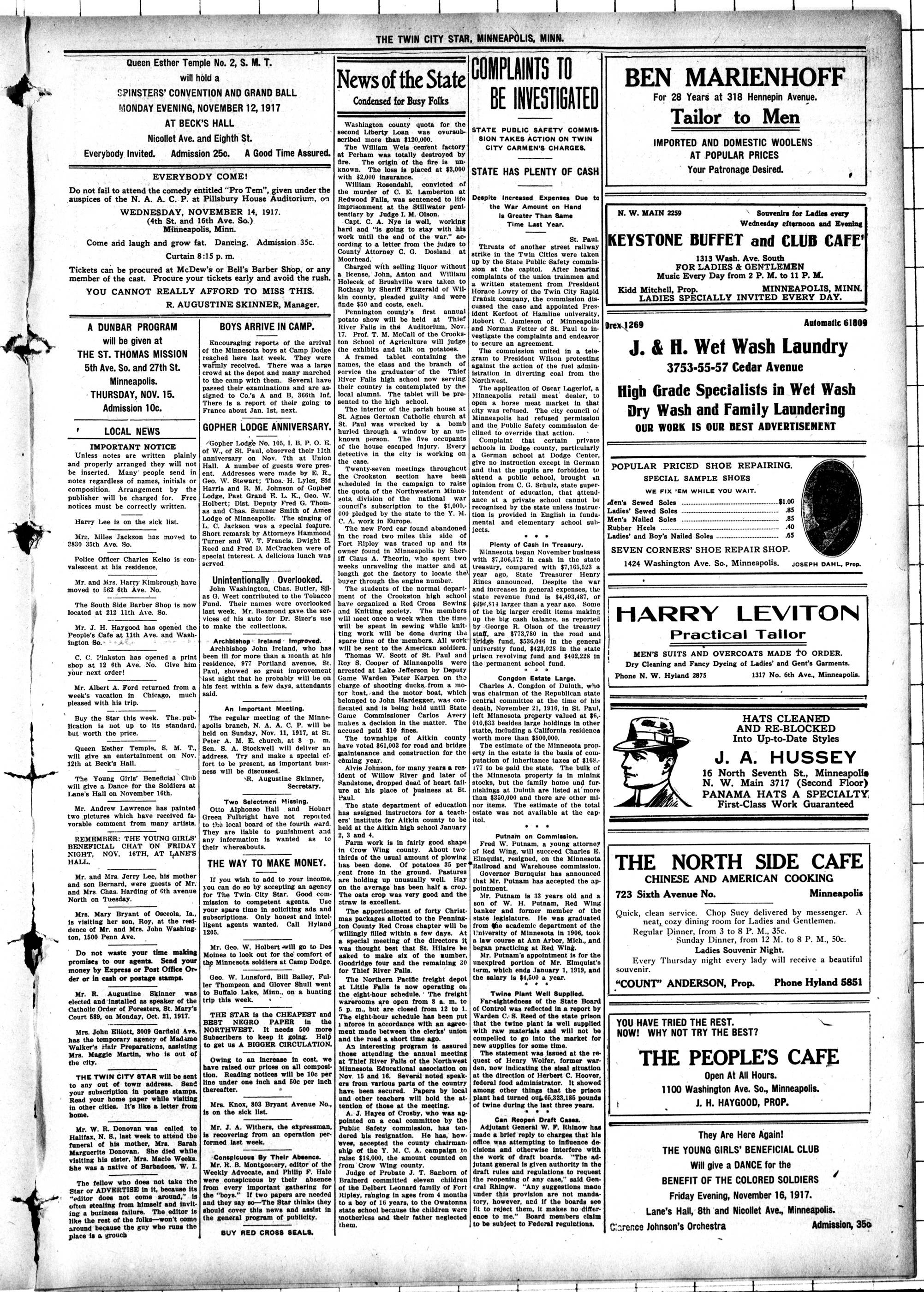
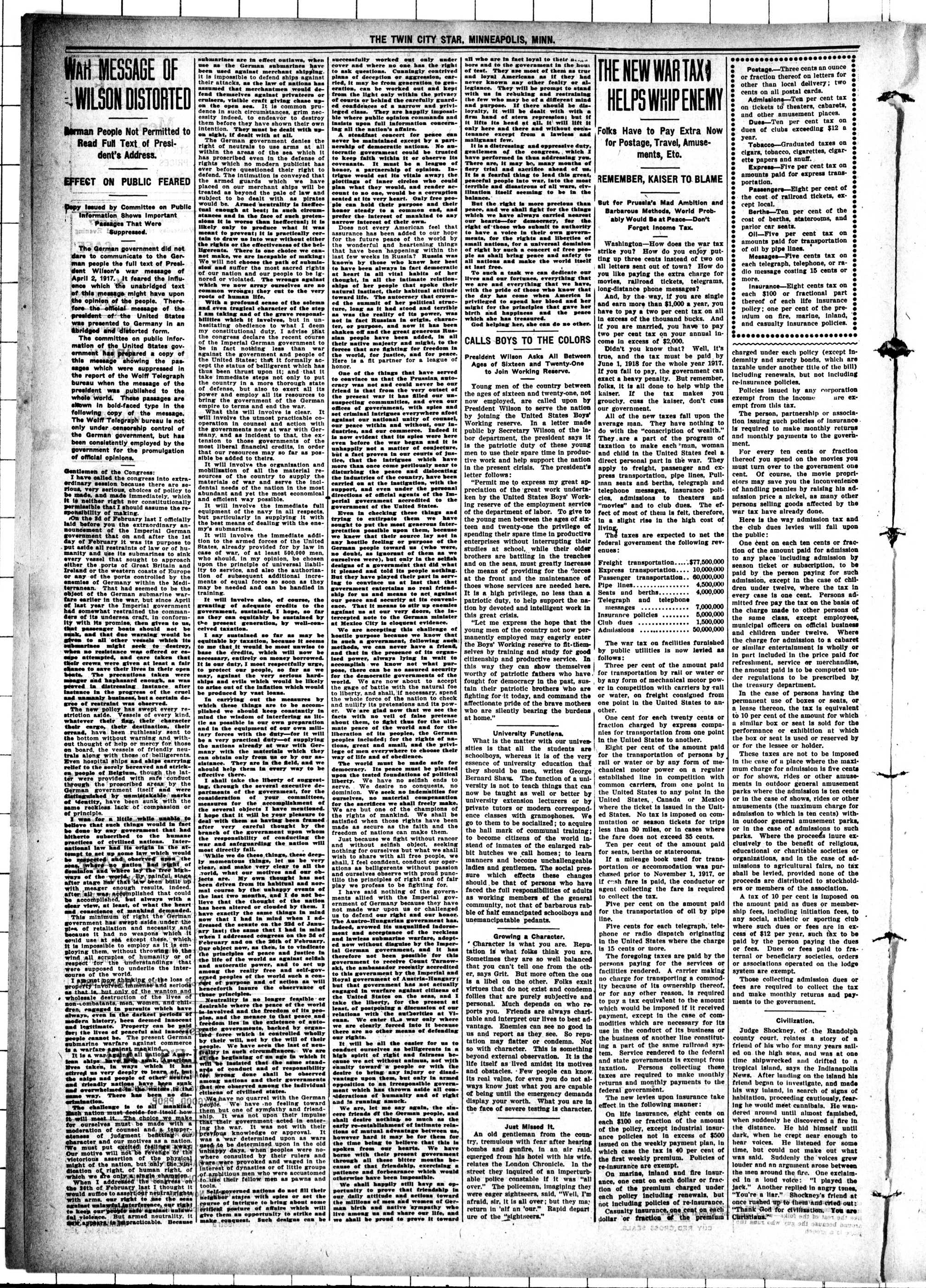
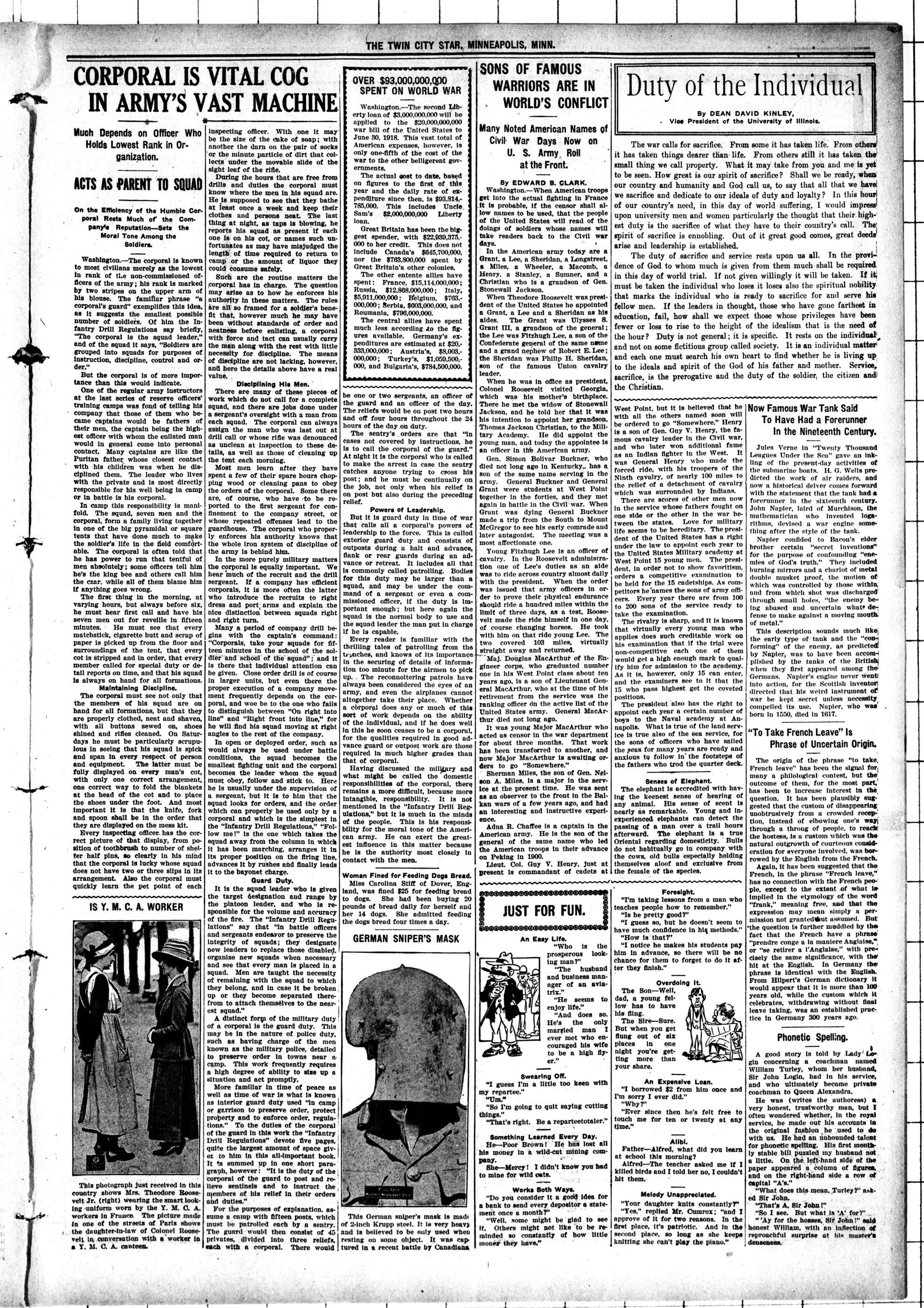
Page text (machine-generated)
THE TWIN CITY STAR.
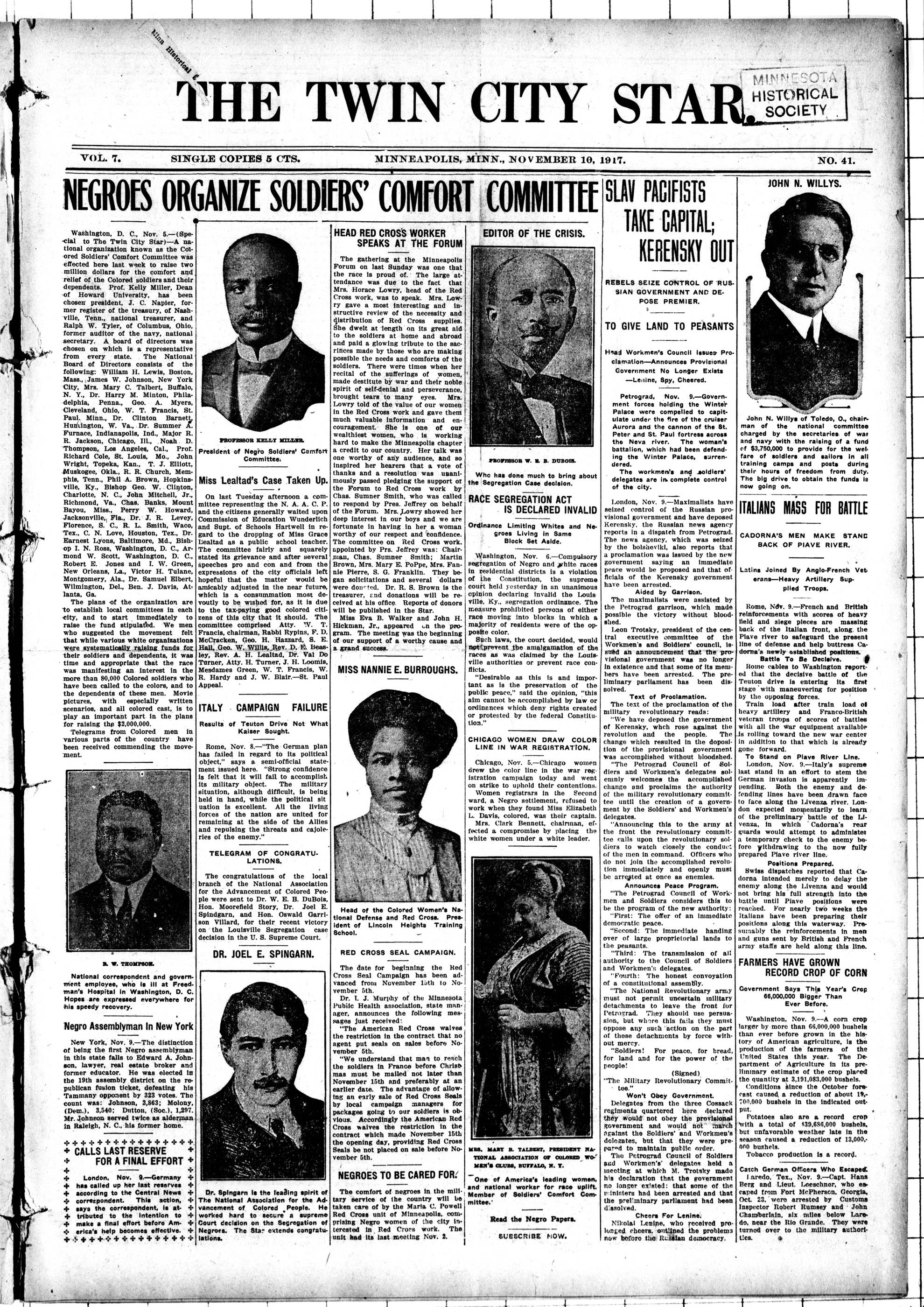
NEGROES ORGANIZE SOLDIERS' COMFORT COMMITTEE
VOL. 7.
Washington, D. C., Nov. 5.—(Special to The Twin City Star)—A national organization known as the Colored Soldiers' Comfort Committee was effected here last week to raise two million dollars for the comfort and relief of the Colored soldiers and their dependents. Prof. Kelly Miller, Dean of Howard University, has been chosen president, J. C. Napier, former register of the treasury, of Nashville, Tenn., national treasurer, and Ralph W. Tyler, of Columbus, Ohio, former auditor of the navy, national secretary. A board of directors was chosen on which is a representative from every state. The National Board of Directors consists of the following: William H. Lewis, Boston, Mass., James W. Johnson, New York City, Mrs. Mary C. Talbert, Buffalo, N. Y., Dr. Harry M. Minton, Philadelphia, Penna, Geo. A. Myers, Cleveland, Ohio, W. T. Stress, St. Paul, Minn., Dr. Clinton Barnett, Huntington, W. Va., Dr. Summer A. Furnace, Indianapolis, Ind., Major R. R. Jackson, Chicago, Ill., Noah D. Thompson, Los Angeles, Cal., Prof. Richard Cole, St. Louis, Mo., John Wright, Topeka, Kan., T. J. Ellott, Muskogee, Okla., R. R. Church, Memphis, Tenn., Phil A. Brown, Hopkinsville, Ky., Bishop Geo. W. Clinton, Charlotte, N. C., John Mitchell, Jr., Richmond, Va., Chas. Banks, Mount Bayou, Miss, Perry W. Howard, Jacksonville, Fla., Dr. J. R. Levey, Florence, S. C., R. L. Smith, Waco, Tex., C. N. Love, Houston, Tex., Dr. Earnest Lyons, Baltimore, Md., Bishop I. N. Ross, Washington, D. C., Armond W. Scott, Washington, D. C., Robert E. Jones and I. W. Green, New Orleans, La., Victor H. Tulane, Montgomery, Ala., Dr. Samuel Elbert, Wilmington, Del., Ben J. Davis, Atlanta, Ga.
The plans of the organization are to establish local committees in each city, and to start immediately to raise the fund stipulated. We men who suggested the movement felt that while various white organizations were systematically raising funds for their soldiers and dependents, it was time and appropriate that the race was manifesting an interest in the more than 80,000 Colored soldiers who have been called to the colors, and to the dependents of these men. Movie pictures, with especially written scenarios, and all colored cast, is to play an important part in the plans for raising the $2,000,000.
Telegrams from Colored men in various parts of the country have been received commending the movement.
R. W. THOMPSON.
National correspondent and government employee, who is ill at Freedman's Hospital in Washington, D. C. Hopes are expressed everywhere for his speedy recovery.
Negro Assemblyman In New York
New York, Nov. 9.—The distinction of being the first Negro assemblyman in this state falls to Edward A. Johnson, lawyer, real estate broker and former educator. He was elected in the 19th assembly district on the republican fusion ticket, defeating his Tammany opponent by 232 votes. The count was: Johnson, 3,863; Molony, Dem.), 3,540; Dutton, (Soc.), 1,297. Mr. Johnson served twice as alderman in Raleigh, N. C., his former home.
CALLS LAST RESERVE
FOR A FINAL EFFORT
London, Nov. 9. Germany has called up her last reserves according to the Central News correspondent. This action, says the correspondent, is attributed to the intention to make a final effort before America's help becomes effective.
SINGLE COPIES 5 CTS.
PROFESSOR KELLY MILLER.
President of Negro Soldiers' Comfort Committee.
Miss Lealtad's Case Taken Up.
On last Tuesday afternoon a committee representing the N. A. A. C. P. and the citizens generally waited upon Commission of Education Wunderlich and Supt. of Schools Hartwell in regard to the dropping of Miss Grace Lealtad as a public school teacher. The committee fairly and squarely stated its grievance and after several speeches pro and con and from the expressions of the city officials left hopeful that the matter would be amicably adjusted in the near future which is a consummation most devoutly to be wished for, as it is due to the tax-paying good colored citizens of this city that it should. The committee comprised Atty. W. T. Francis, chairman, Rabbi Rypins, F. D. McCracken, Geo. H. Hazzard, S. E. Hall, Geo. W. Willis, Rev. D. E. Beasley, Rev. A. H. Lealtad, Dr. Val Do Turner, Atty. H. Turner, J. H. Loomis, Mesdesame Green, W. T. Francis, W. R. Hardy and J. W. Blair.—St. Paul Appeal.
ITALY CAMPAIGN FAILURE
Results of Teuton Drive Not What Kaiser Sought.
Rome, Nov. 8.—"The German plan has failed in regard to its political object," says a semi-official statement issued here. "Strong confidence is felt that it will fail to accomplish its military object. The military situation, although difficult, is being held in hand, while the political situation is excellent. All the living forces of the nation are united for remaining at the side of the Allies and repulsing the threats and cajoleries of the enemy."
TELEGRAM OF CONGRATULATIONS.
The congratulations of the local branch of the National Association for the Advancement of Colored People were sent to Dr. W. E. B. DuBois, Hon. Moorefield Story, Dr. Joel E. Spindgarn, and Hon. Oswald Garrison Villard, for their recent victory on the Louisville Segregation case decision in the U. S. Supreme Court.
DR. JOEL E. SPINGARN.
Dr. Spingarn is the leading spirit of The National Association for the Advancement of Colored People. He worked hard to secure a supreme Court decision on the Segregation of Negroes. The Star extends congratulations.
MINNEAPOLIS, MINN., NOVEMBER 10, 1917.
HEAD RED CROSS WORKER SPEAKS AT THE FORUM
The gathering at the Minneapolis Forum on last Sunday was one that the race is proud of. The large attendance was due to the fact that Mrs. Horace Lowry, head of the Red Cross work, was to speak. Mrs. Lowry gave a most interesting and instructive review of the necessity and distribution of Red Cross supplies. She dwelt at length on its great aid to the soldiers at home and abroad and paid a glowing tribute to the sacrifices made by those who are making possible the needs and comforts of the soldiers. There were times when her recital of the sufferings of women, made destitute by war and their noble spirit of self-denial and perseverance, brought tears to many eyes. Mrs. Lowry told of the value of our women in the Red Cross work and gave them much valuable information and encouragement. She is one of our wealthiest women, who is working hard to make the Minneapolis chapter a credit to our country. Her talk was one worthy of any audience, and so inspired her hearers that a vote of thanks and a resolution was unanimously passed pledging the support of the Forum to Red Cross work by Chas. Sumner Smith, who was called to respond by Pres. Jeffrey on behalf of the Forum. Mrs. Lowry showed her deep interest in our boys and we are fortunate in having in her a woman worthy of our respect and confidence. The committee on Red Cross work, appointed by Prs. Jeffrey was: Chairman, Chas. Sumner Smith; Martin Brown, Mrs. Mary E. PoPpe, Mrs. Fannie Pierre, S. G. Franklin. They began solicitations and several dollars were donated. Dr. R. S. Brown is the treasurer, and donations will be received at his office. Reports of donors will be published in the Star.
Miss Eva B. Walker and John H. Hickman, Jr., appeared on the program. The meeting was the beginning of our support of a worthy cause and a grand success.
MISS NANNIE E. BURROUGHS.
Head of the Colored Women's National Defense and Red Cross. President of Lincoln Heights Training School.
RED CROSS SEAL CAMPAIGN.
The date for beginning the Red Cross Seal Campaign has been advanced from November 15th to November 5th.
Dr. I. J. Murphy of the Minnesota Public Health association, state manager, announces the following messages just received:
"The American Red Cross waives the restriction in the contract that no agent put seals on sales before November 5th.
"We understand that man to reach the soldiers in France before Christmas must be mailed not later than November 15th and preferably at an earlier date. The advantage of allowing an early sale of Red Cross Seals by local campaign managers for packages going to our soldiers is obvious. Accordingly the American Red Cross waives the restriction in the contract which made November 15th the opening day, providing Red Cross Seals be not placed on sale before November 5th.
NEGROES TO BE CARED FOR.
The comfort of negroes in the military service of the country will be taken care of by the Maria C. Powell Red Cross unit of Minneapolis, comprising Negro women of the city interested in Red Cross work. The unit had its last meeting Nov. 2.
EDITOR OF THE CRISIS.
PROFESSOR W. R. B. DUBOIS.
Who has done much to bring about the Segregation Case decision.
RACE SEGREGATION ACT
IS DECLARED INVALID
Ordinance Limiting Whites and Negroes Living in Same Block Set Aside.
Washington, Nov. 6.—Compulsory segregation of Negro and white races in residential districts is a violation of the Constitution, the supreme court held yesterday in an unanimous opinion declaring invalid the Louisville, Ky., segregation ordinance. The measure prohibited persons of either race moving into blocks in which a majority of residents were of the opposite color.
Such laws, the court decided, would not prevent the amalgamation of the races as was claimed by the Louisville authorities or prevent race conflicts.
"Desirable as this is and important as is the preservation of the public peace," said the opinion, "this aim cannot be accomplished by law or ordinances which deny rights created or protested by the federal Constitution."
CHICAGO WOMEN DRAW COLOR LINE IN WAR REGISTRATION.
Chicago, Nov. 5.—Chicago women drew the color line in the war registration campaign today and went on strike to uphold their contentions. Women registrars in the Second ward, a Negro settlement, refused to work when they found Miss Elizabeth L. Davis, colored, was their captain. Mrs. Clark Bennett, chairman, effected a compromise by placing the white women under a white leader.
M.
MRS. MARY B. TALENT, PRESIDENT NATIONAL ASSOCIATION OF COLored WO-
MEN'S CLUBS, BUFFALO, N. Y.
One of America's leading women,
and national worker for race uplift.
Member of Soldiers' Comfort Committee.
SLAV PACIFISTS TAKE CAPITAL; KERENSKY OUT
SLAV PACIFISTS TAKE CAPITAL; KERENSKY OUT
REBELS SEIZE CONTROL OF RUSSIAN GOVERNMENT AND DEPOSE PREMIER.
TO GIVE LAND TO PEASANTS
Head Workmen's Council Issues Proclamation—Announces Provisional Government No Longer Exists
—Lenine, Spy, Cheered.
Petrograd, Nov. 9.—Government forces holding the Winter Palace were compelled to capitulate under the fire of the cruiser Aurora and the cannon of the St. Peter and St. Paul fortress across the Neva river. The woman's battalion, which had been defending the Winter Palace, surrendered.
The workmen's and soldiers' delegates are in complete control of the city.
London, Nov. 9.—Maximalists have seized control of the Russian provisional government and have deposed Kerensky, the Russian news agency reports in a dispatch from Petrograd. The news agency, which was seized by the bolshevik, also reports that a proclamation was issued by the new government saying an immediate peace would be proposed and that officials of the Kerensky government have been arrested.
Aided by Garrison.
The maximalists were assisted by the Petrograd garrison, which made possible the victory without blood-shed.
Leon Trotsky, president of the central executive committee of the Workmen's and Soldiers' council, issued an announcement that the provisional government was no longer in existence and that some of its members have been arrested. The preliminary parliament has been dissolved.
Text of Proclamation.
The text of the proclamation of the military revolutionary reads:
"We have deposed the government of Kerensky, which rose against the revolution and the people. The change which resulted in the deposition of the provisional government was accomplished without bloodshed.
"The Petrograd Council of Soldiers and Workmen's delegates solemnly welcomes the accomplished change and proclaims the authority of the military revolutionary committee until the creation of a government by the Soldiers' and Workmen's delegates.
"Announcing this to the army at the front the revolutionary committee calls upon the revolutionary soldiers to watch closely the conduct of the men in command. Officers who do not join the accomplished revolution immediately and openly must be arrested at once as enemies.
Announces Peace Program.
"The Petrograd Council of Workmen and Soldiers considers this to be the program of the new authority:
"First: The offer of an immediate democratic peace.
"Second: The immediate handing over of large proprietorial lands to the peasants.
"Third: The transmission of all authority to the Council of Soldiers and Workmen's delegates."
"Fourth: The honest convoyation of a constitutional assembly.
"The National Revolutionary army must not permit uncertain military detachments to leave the front for Petrograd. They should use persuasion, but where this fails they must oppose any such action on the part of these detachments by force without mercy.
"Soldiers! For peace, for bread, for land and for the power of the people!
(Signed)
"The Military Revolutionary Committee."
Won't Obey Government.
Won't Obey Government.
Delegates from the three Cossack regiments quartered here declared they would not obey the provisional government and would not march against the Soldiers' and Workmen's delegates, but that they were prepared to maintain public order.
The Petrograd Council of Soldiers and Workmen's delegates held a meeting at which M. Trotsky made his declaration that the government no longer existed; that some of the ministers had been arrested and that the preliminary parliament had been dissolved.
Cheers For Lenine.
Nikolai Lenine, who received prolonged cheers, outlined the problems now before the Russian democracy.
NO. 41.
[Picture of a man in a suit with a tie].
John N. Willys of Toledo, O., chairman of the national committee charged by the secretaries of war and navy with the raising of a fund of $3,750,000 to provide for the welfare of soldiers and sailors in all training camps and posts during their hours of freedom from duty. The big drive to obtain the funds is now going on.
ITALIANS MASS FOR BATTLE
ITALIANS MASS FOR BATTLE
CADORNA'S MEN MAKE STAND
BACK OF PIAVE RIVER.
Latins Joined By Anglo-French Veterans—Heavy Artillery Supplied Troops.
Rome, Nov. 9.—French and British reinforcements with scores of heavy field and siege pieces are massing back of the Italian front, along the Plave river to safeguard the present line of defense and help buttress Cadorma's newly established positions.
Battle To Be Decisive.
Home cables to Washington reported that the decisive battle of the Teuton drive is entering its first stage with maneuvering for position by the opposing forces.
Train load after train load of heavy artillery and Franco-British veteran troops of scores of battles with all the war equipment available is rolling toward the new war center in addition to that which is already gone forward.
To Stand on Plave River Line. London, Nov. 9.—Italy's supreme last stand in an effort to stem the German invasion is apparently impending. Both the enemy and defending lines have been drawn face to face along the Livenza river. London expected momentarily to learn of the preliminary battle of the Livenza, in which Cadorna's rear guards would attempt to administer a temporary check to the enemy before withdrawing to the now fully prepared Plave river line.
Positions Prepared.
Swiss dispatches reported that Cadora intended merely to delay the enemy along the Livenza and would not bring his full strength into the battle until Piave positions were reached. For nearly two weeks the Italians have been preparing their positions along this waterway. Presumably the reinforcements in men and guns sent by British and French army staffs are held along this line.
FARMERS HAVE GROWN
RECORD CROP OF CORN
Government Says This Year's Crop
66,000,000 Bigger Than
Ever Before.
Washington, Nov. 9.—A corn crop larger by more than 66,000,000 bushels than ever before grown in the history of American agriculture, is the production of the farmers of the United States this year. The Department of Agriculture in its preliminary estimate of the crop placed the quantity at 3,191,083,000 bushels.
Conditions since the October forecast caused a reduction of about 19,700,000 bushels in the indicated output.
Potatoes also are a record crop with a total of 439,686,000 bushels, but unfavorable weather late in the season caused a reduction of 13,000,000 bushels.
Tobacco production is a record.
Catch German Officers Who Escaped, Laredo, Tex., Nov. 9.—Capt. Hans Berg and Lieut. Loeschner, who escaped from Fort McPherson, Georgia, Oct. 23, were arrested by Customs Inspector Robert Rumsey and John Chamberlain, six miles below Laredo, near the Rio Grande. They were turned over to the military authorities.
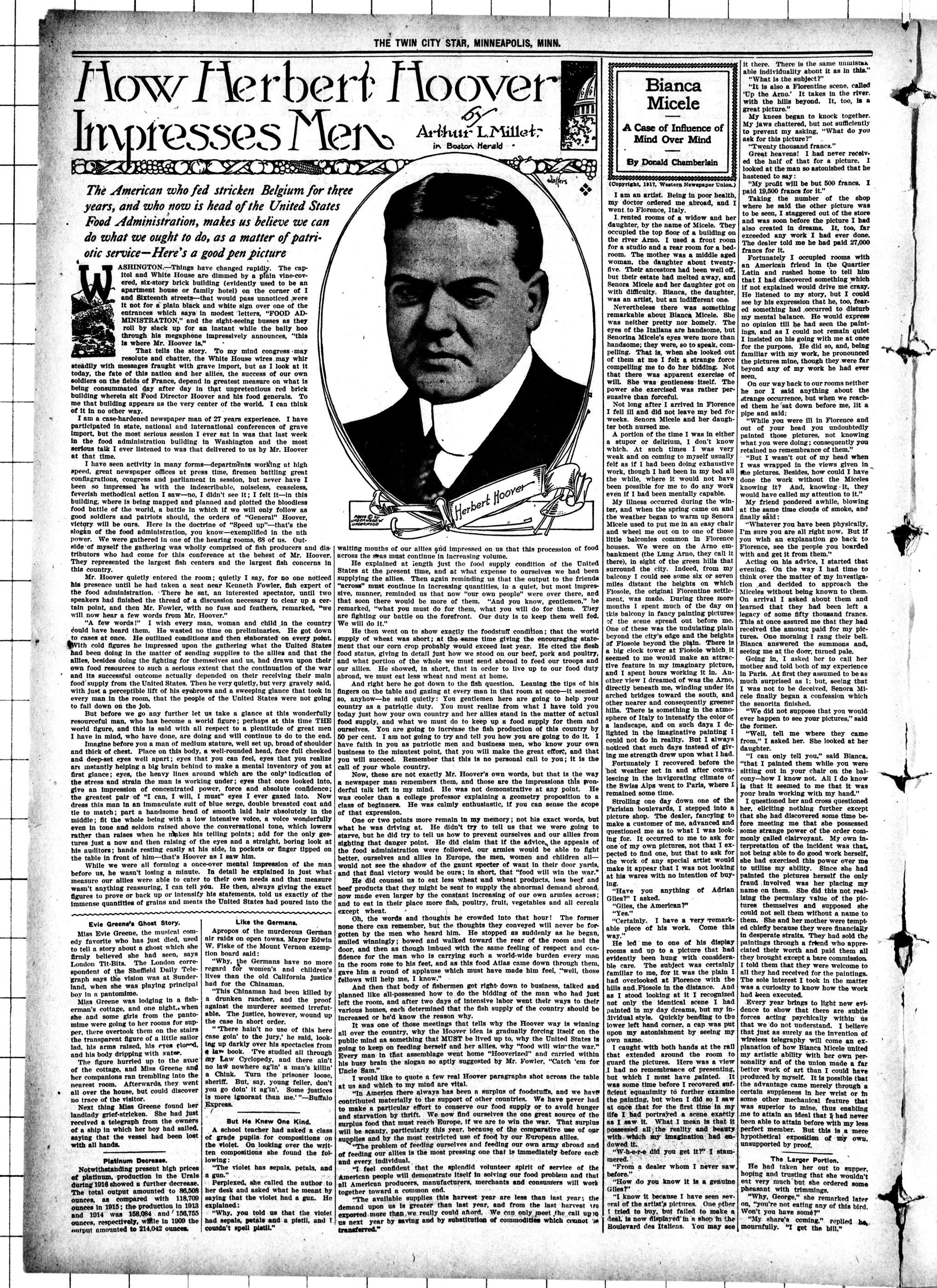
How Herbert Hoover Impresses Men Arthur L. Millet in Boston Herald
The American who fed stricken Belgium for three years, and who now is head of the United States Food Administration, makes us believe we can do what we ought to do, as a matter of patriotic service—Here's a good pen picture
ASHINGTON.—Things have changed rapidly. The capitol and White House are dimmed by a plain vine-covered, six-story brick building (evidently used to be an apartment house or family hotel) on the corner of I and Sixteenth streets—that would pass unnoticed were it not for a plain black and white sign over one of the entrances which says in modest letters, "FOOD ADMINISTRATION," and the sight-seeing busses they roll by slack up for an instant while the bally hoo is through his megaphone impressively announces, "this is where Mr. Hoover is."
That tells the story. To my mind congress may resolute and chatter, the White House wires may whir
steadily with messages fraught with grave import, but as I look at it today, the fate of this nation and her allies, the success of our own soldiers on the fields of France, depend in greatest measure on what is being consummated day after day in that unpretentious red brick building wherein sit Food Director Hoover and his food generals. To me that building appears as the very center of the world. I can think of it in no other way.
I am a case-hardened newspaper man of 27 years experience. I have participated in state, national and international conferences of grave import, but the most serious session I ever sat in was that last week in the food administration building in Washington and the most serious talk I ever listened to was that delivered to us by Mr. Hoover at that time.
I have seen activity in many forms—departments working at high speed, great newspaper offices at press time, firemen battling great conflagrations, congress and parliament in session, but never have I been so impressed his with the indescribable, noiseless, ceaseless, feverish methodical action I saw—no, I didn't see it; I felt it—in this building, where is being mapped and planned and plotted the bloodless food battle of the world, a battle in which if we will only follow as good soldiers and patrols should, the orders of "General" Hoover, victory will be ours. Here is the doctrine of "Speed up"—that's the slogan of the food administration, you know—exemplified in the nth power. We were gathered in one of the hearing rooms, 68 of us. Outside of myself the gathering was wholly comprised of fish producers and distributors who had come for this conference at the behest of Mr. Hoover. They represented the largest fish centers and the largest fish concerns in this country.
Mr. Hoover quietly entered the room; quietly I say, for no one noticed his presence until he had taken a seat near Kenneth Fowler, fish expert of the food administration. There he sat, an interested spectator, until two speakers had finished the thread of a discussion necessary to clear up a certain point, and then Mr. Fowler, with no fuss and feathers, remarked, "we will now hear a few words from Mr. Hoover."
"A few words!" I wish every man, woman and child in the country could have heard them. He wasted no time on preliminaries. He got down to cases at once. He outlined conditions and then elaborated on every point. With cold figures he impressed upon the gathering what the United States had been doing in the matter of sending supplies to the allies and that the allies, besides doing the fighting for themselves and us, had drawn upon their own food resources to such a serious extent that the continuation of the war and its successful outcome actually depended on their receiving their main food supply from the United States. Then he very quietly, but very gravely said, with just a perceptible lift of his eyebrows and a sweeping glance that took in every man in the room, that the people of the United States were not going to fall down on the job.
But before we go any further let us take a glance at this wonderfully resourceful man, who has become a world figure; perhaps at this time THE world figure, and this is said with all respect to a plentitude of great men I have in mind, who have done, are doing and will continue to do to the end.
Imagine before you a man of medium stature, well set up, broad of shoulder and thick of chest. Place on this body, a well-rounded head, face full checked and deep-set eyes well apart; eyes that you can feel, eyes that you realize are instantly helping a big brain behind to make a mental inventory of you at first glance; eyes, the heavy lines around which are the only indication of the stress and strain the man is working under; eyes that once looked into, give an impression of concentrated power, force and absolute confidence; the greatest pair of "I can, I will, I must" eyes I ever gazed into. Now dress this man in an immaculate suit of blue serge, double breasted coat and tie to match; part a handsome head of smooth laid hair absolutely in the middle; fit the whole being with a low intensive voice, a voice wonderfully even in tone and seldom raised above the conversational tone, which lowers rather than raises when he makes his telling points; add for the only gestures just a now and then raising of the eyes and a straight, boring look at his auditors; hands resting easily at his side, in pockets or finger tipped on the table in front of him—that's Hoover as I saw him.
While we were all forming a once-over mental impression of the man before us, he wasn't losing a minute. In detail he explained in just what measure our allies were able to cater to their own needs and that measure wasn't anything reassuring, I can tell you. He then, always giving the exact figures to prove or back up or intensify his statements, told us exactly of the immense quantities of grains and meats the United States had poured into the
W
steadily with messages fraught with gist today, the fate of this nation and her soldiers on the fields of France, depend being consummated day after day in building wherein sit Food Director Hoe me that building appears as the very one of it in no other way.
I am a case-hardened newspaper man participated in state, national and intl import, but the most serious session I in the food administration building a serious talk I ever listened to was that at that time.
I have seen activity in many forms speed, great newspaper offices at preconfigations, congress and parliament been so impressed as with the indle feverish methodical action I saw—no, building, where is being mapped and put food battle of the world, a battle in a good soldiers and patriots should, the victory will be ours. Here is the docto slogan of the food administration, you power. We were gathered in one of the side of myself the gathering was whole tributors who had come for this com. They represented the largest fish cent this country.
Mr. Hoover quietly entered the rei his presence until he had taken a seat the food administration. There he s speakers had finished the thread of a tain point, and then Mr. Fowler, will now hear a few words from Mr. A "a few words!" I wish my rn could have heard them. He wasted no to cases at once. He outlined condition With cold figures he impressed upon had been doing in the matter of send allies, besides doing the fighting for the own food resources to such a serious and its food outcome actually do food supply from the United States. That with just a perceptible lift of his eyebrow every man in the room, that the people to fall down on the job.
But before we go any further let resourceful man, who has become a w world figure, and this is said with all I have in mind, who have done, are do Imagine before you a man of medium and thick of chest. Place on this body and deep-set eyes well apart; eyes that are instantly helping a big brain behind first glance; eyes, the heavy lines are the stress and strain the man is work give an impression of concentrated the greatest pair of "I can, I will, I dress this man in an immaculate suit to match; part a handsome head middle; fit the whole being with a lo even in tone and seldom raised above rather than raises when he makes his tures just a now and then raising of his auditors; hands resting easily at the table in front of him—that's Hoover.
While we were all forming a one before us, he wasn't losing a minute, measure our allies were able to cater wasn't anything reassuring. I can tell figures to prove or back up or intensif immense quantities of grains and meat
Evie Greene's Ghost Story.
Miss Evle Greene, the musical comedy favorite who has just died, used to tell a story about a ghost which she firmly believed she had seen, says London Tit-Bits. The London correspondent of the Sheffield Daily Telegraph says the vision was at Sunderland, when she was playing principal boy in a pantomime.
Miss Greene was lodging in a fisherman's cottage, and one night, when she and some girls from the pantomime were going to her rooms for supper, there overtook them on the stairs the transparent figure of a little sailor lad, his arms raised, his eyes closed, and his body dripping with natus.
The figure hurried up to the aunt of the cottage, and Miss Greene and her companions ran trembling into the nearest room. Afterwards, they went all over the house, but could discover no trace of the visitor.
Next thing Miss Greene found her landlady grief-stricken. She had just received a telegraph from the owners of a ship in which her boy had sailed, saying that the vessel had been lost with all hands.
Platinum Decrease.
Notwithstanding present high prices of platinum, production in the Urals during 1916 showed a further decrease. The total output amounted to 86,508 ounces, as compared with 118,709 ounces in 1915; the production in 1913 and 1914 was 158,084 and 156,755 ounces, respectively, while in 1909 the output amounted to 214,042 ounces.
THE TWIN CITY STAR. MINNEAPOLIS. MINN.
for three
States
can
i-
Herbert Hoover
PHOTO BY
MARY WILSON
LINDENWOOD
waiting mouths of our allies and impressed on us that this procession of food across the seas must continue in increasing volume.
He explained at length just the food supply condition of the United States at the present time, and at what expense to ourselves we had been supplying the allies. Then again reminding us that the output to the friends "across" must continue in increasing quantities, in a quiet, but most impressive, manner, reminded us that now "our own people" were over there, and that soon there would be more of them. "And you know, gentlemen," he remarked, "what you must do for them, what you will do for them. They are fighting our battle on the forefront. Our duty is to keep them well fed. We will do it."
He then went on to show exactly the foodstuff condition; that the world supply of wheat was short; at the same time giving the encouraging statement that our corn crop probably would exceed last year. He cited the flesh food status, giving in detail just how we stood on our beef, pork and poultry, and what portion of the whole we must send abroad to feed our troops and our allies. He showed, in short, that in order to live up to our food duty abroad, we must eat less wheat and meat at home.
And right here he got down to the fish question. Leaning the tips of his fingers on the table and gazing at every man in that room at once—it seemed so, anyhow—he said quietly: You gentlemen here are going to help your country as a patriotic duty. You must realize from what I have told you today just how your own country and her allies stand in the matter of actual food supply, and what we must do to keep up a food supply for them and ourselves. You are going to increase the fish production of this country by 50 per cent. I am not going to try and tell you how you are going to do it. I have faith in you as patriotic men and business men, who know your own business to the minutest point, that you will make the great effort, and that you will succeed. Remember that this is no personal call to you; it is the call of your whole country.
Now, these are not exactly Mr. Hoover's own words, but that is the way a newspaper man remembers them, and those are the impressions this wonderful talk left in my mind. He was not demonstrative at any point. He was cooler than a college professor explaining a geometry proposition to a class of beginners. He was calmly enthusiastic, if you can sense the scope of that expression.
One or two points more remain in my memory; not his exact words, but what he was driving at. He didn't try to tell us that we were going to starve, but he did try to tell us how to prevent ourselves and our allies from sighting that danger point. He did claim that if the advice of the food administration were followed, our armies would be able to fight better, ourselves and allies in Europe, the men, women and children all—would not see the shadow of the gaunt specter of want in their door yards, and that final victory would be ours; in short, that "food will win the war."
He did counsel us to eat less wheat and wheat products, less beef and beef products that they might be sent to supply the abnormal demand abroad, now made even larger by the constant increasing of our own armies across; and to eat in their place more fish, poultry, fruit, vegetables and all cereals except wheat.
Oh, the words and thoughts he crowded into that hour! The former none there can remember, but the thoughts they conveyed will never be forgotten by the men who heard him. He stopped as suddenly as he began, smiled winningly; bowed and walked toward the rear of the room and the door, and then as though imbued with the same feeling of respect and confidence for the man who is carrying such a world-wide burden every man in the room rose to his feet, and as this food Atlas came down through them, gave him a round of applause which must have made him feel, "well, those fellows will help me, I know."
Like the Germans.
Apropos of the murderous German air raids on open towns, Mayor Edwin W. Fliske of the Mount Vernon exemption board said:
"Why, the Germans have no more regard for women's and children's lives than the old California justice had for the Chinaman.
And then that body of fishermen got right down to business, talked and planned like all-possessed how to do the blinding of the man who had just left the room, and after two days of intensive labor went their ways to their various homes, each determined that the fish supply of the country should be increased or he'd know the reason why.
"This Chinaman had been killed by a drunken rancher, and the proof against the murderer seemed irrefutable. The justice, however, wound up the case in short order.
It was one of those meetings that tells why the Hoover way is winning all over the country, why the Hoover iden is gradually forcing itself on the public mind as something that MUST be lived up to, why the United States is going to keep on feeding herself and her allies, why "food will win the war." Every man in that assemblage went home "Hooverized" and carried within his busy brain the slogan so aptly suggested by Mr. Fowler, "Catch 'em for Uncle Sam."
"There hain't no use of this here case goln' to the jury," he said, looking up darkly over his spectacles from law book. "I've studied all through my Law Cyclopedy, and there ain't no law nowhere ag'in' a man's killin' a Chink. Turn the prisoner loose, sheriff. But, say, young feller, don't you go doln' it ag'in'. Some justices is more ignorant than me.'"—Buffalo Express.
I would like to quote a few real Hoover paragraphs shot across the table at us and which to my mind are vital.
"In America there always has been a surplus of foodstuffs, and we have contributed materially to the support of other countries. We have never had to make a particular effort to conserve our food supply or to avoid hunger and starvation by thrift. We now find ourselves the one great source of the surplus food that must reach Europe, if we are to win the war. That surplus will be scanty, particularly this year, because of the comparative use of our supplies and by the most restricted use of food by our European allies.
But He Knew One Kind.
A school teacher had asked a class of grade pupils for compositions on the violet. On looking over the written compositions she found the following:
"The problem of feeding ourselves and feeding our own army abroad and of feeding our allies is the most pressing one that is immediately before each and every individual.
"I feel confident that the splendid volunteer spirit of service of the American people will demonstrate itself in solving our food problem and that all American producers, manufacturers, merchants and consumers will work together toward a common end.
"The violet has sepals, petals, and a gun."
Perplexed, she called the author to her desk and asked what he meant by saying that the violet had a gun. He explained:
"The available supplies this harvest year are less than last year; the demand upon us is greater than last year, and from the last harvest we exported more than we really could afford. We can only meet the call upon us next year by saving and by substitution of commodities which cannot be transferred."
"Why, you told us that the violet had sepals, petals and a pistil, and I couldn't spell pistil."
THE DOME
Bianca
Micele
A Case of Influence of
Mind Over Mind
By Donald Chamberlain
(Copyright, 1917, Western Newspaper Union).
I am an artist. Being in poor health, my doctor ordered me abroad, and I went to Florence, Italy.
I rented rooms of a widow and her daughter, by the name of Micele. They occupied the top floor of a building on the river Arno. I used a front room for a studio and a rear room for a bedroom. The mother was a middle aged woman, the daughter about twenty-five. Their ancestors had been well off, but their estate had melted away, and Senora Micele and her daughter got on with difficulty. Blanca, the daughter, was an artist, but an indifferent one.
Nevertheless there was something remarkable about Bianca Micele. She was neither pretty nor homely. The eyes of the Italians are handsome, but Senorina Micele's eyes were more than handsome; they were, so to speak, compelling. That is, when she looked out of them at me I felt a strange force compelling me to do her bidding. Not that there was apparent exercise of will. She was gentleness itself. The power she exercised was rather persuasive than forceful. Not long after I arrived in Florence I fell ill and did not leave my bed for weeks. Senorina Micele and her daughter both nursed me.
A portion of the time I was in either a stupor or delirium, I don't know which. At such times I was very weak and on coming to myself usually felt as if I had been doing exhaustive work, though I had been in my bed all the while, where it would not have been possible for me to do any work even if I had been mentally capable.
My illness occurred during the winter, and when the spring came on and the weather began to warm up Senora Micele used to put me in an easy chair and wheel me out on to one of those little balconies common in Florence houses. We were on the Arno embankment (the Lung Arno, they call it there), in sight of the green hills that surround the city. Indeed, from my balcony I could see some six or seven miles distant the heights on which Flosole, the original Florentine settlement, was made. During three more months I spent much of the day on this balcony in fancy painting pictures of the scene spread out before me. One of these was the undulating plain beyond the city's edge and the heights of Flosole beyond the plain. There is a big clock tower at Flosole which it seemed to me would make an attractive feature in my imaginary picture, and I spent hours working it in. Another view I dreamed of was the Arno, directly beneath me, winding under its arched bridges toward the south, and other nearer and consequently greener hills. There is something in the atmosphere of Italy to intensify the color of a landscape, and on such days I delighted in the imaginative painting I could not do in reality. But I always noticed that such days instead of giving me strength drew upon what I had.
Fortunately I recovered before the hot weather set in and after convalescing in the invigorating climate of the Swiss Alps went to Paris, where I remained some time.
Strolling one day down one of the Parisian boulevards, I stepped into a picture shop. The dealer, fancying to make a customer of me, advanced and questioned me as to what I was looking for. It occurred to me to ask for one of my own pictures, not that I expected to find one, but that to ask for the work of any special artist would make it appear that I was not looking at his wares with no intention of buying.
"Have you anything of Adrian Giles?" I asked.
"Giles, the American?"
"Yes."
"Certainly. I have a very remarkable piece of his work. Come this way."
He led me to one of his display rooms and up to a picture that had evidently been hung with considerable care. The subject was certainly familiar to me, for it was the plain I had overlooked at Florence with the hills and Flossole in the distance. And as I stood looking at it I recognized not only the identical scene I had painted in my day dreams, but my individual style. Quickly bending to the lower left hand corner, a cap was put upon my astonishment by seeing my own name.
I caught with both hands at the rail that extended around the room to guard the pictures. Here was a view I had no remembrance of presenting, but which I must have painted. It was some time before I recovered sufficient equanimity to further examine the painting, but when I did so I saw at once that for the first time in my life I had portrayed a scene exactly as I saw it. What I mean is that it possessed all the reality and beauty with which my imagination had endowed it. "W-h-e-r-e did you get it?" I stammered.
"From a dealer whom I never saw before."
"How do you know it is a genuine Gilles?"
"I know it because I have seen several of the artist's pictures. One other I tried to buy, but failed to make a deal, is now displayed in a shop in the Boulevard des Itallens. You may see
It there. There is the same unmistakable individuality about it as in this."
"What is the subject?"
"It is also a Florentine scene, called 'Up the Arno.' It takes in the river, with the hills beyond. It, too, is a great picture."
My knees began to knock together. My jaws chattered, but not sufficiently to prevent my asking, "What do you ask for this picture?"
"Twenty thousand francs."
Great heavens! I had never received the half of that for a picture. I looked at the man so astonished that he hastened to say:
"My profit will be but 500 francs. I paid 19,500 francs for it."
Taking the number of the shop where he said the other picture was to be seen, I staggered out of the store and was soon before the picture I had also created in dreams. It, too, far exceeded any work I had ever done. The dealer told me he had paid 27,000 francs for it.
Fortunately I occupied rooms with an American friend in the Quartier Latin and rushed home to tell him that I had discovered something which if not explained would drive me crazy. He listened to my story, but I could see by his expression that he, too, feared something had occurred to disturb my mental balance. He would express no opinion till he had seen the paintings, and as I could not remain quiet I insisted on his going with me at once for the purpose. He did so, and, being familiar with my work, he pronounced the pictures mine, though they were far beyond any of my work he had ever seen.
On our way back to our rooms neither he nor I said anything about the strange occurrence, but when we reached them he sat down before me, lit a pipe and said:
"While you were ill in Florence and out of your head you undoubtedly painted those pictures, not knowing what you were doing; consequently you retained no remembrance of them."
"But I wasn't out of my head when I was wrapped in the views given in the pictures. Besides, how could I have done the work without the Miceles knowing it? And, knowing it, they would have called my attention to it."
My friend pondered awhile, blowing at the same time clouds of smoke, and finally said:
"Whatever you have been physically, I'm sure you are all right now. But if you wish an explanation go back to Florence, see the people you boarded with and get it from them."
Acting on his advice, I started that evening. On the way I had time to think over the matter of my investigation and decided to approach the Miceles without being known to them. On arrival I asked about them and learned that they had been left a legacy of some fifty thousand francs. This at once assured me that they had received the amount paid for my pictures. One morning I rang their bell. Blanca answered the summons and, seeing me at the door, turned pale. Going in, I asked her to call her mother and told both of my experience in Paris. At first they assumed to be as much surprised as I; but, seeing that I was not to be deceived, Senora Micele finally began a confession which the senorita finished. "We did not suppose that you would ever happen to see your pictures," said the former.
"Well, tell me where they came from," I asked her. She looked at her daughter.
"I can only tell you," said Blanca, "that I painted them while you were sitting out in your chair on the balcony—how I know not. All I do know is that it seemed to me that it was your brain working with my hand."
I questioned her and cross questioned her, eliciting nothing further except that she had discovered some time before meeting me that she possessed some strange power of the order commonly called clairvoyant. My own interpretation of the incident was that, not being able to do good work herself, she had exercised this power over me to utilize my ability. Since she had painted the pictures herself the only fraud involved was her placing my name on them. She did this not realizing the pecuniary value of the pictures themselves and supposed she could not sell them without a name to them. She and her mother were tempted chiefly because they were financially in desperate straits. They had sold the paintings through a friend who appreciated their worth and paid them all they brought except a bare commission. I told them that they were welcome to all they had received for the paintings. The sole interest I took in the matter was a curiosity to know how the work had been executed.
Every year brings to light new evidence to show that there are subtle forces acting psychically within us that we do not understand. I believe that just as surely as the invention of wireless telegraphy will come an explanation of how Bianca Micele united my artistic ability with her own personality and of the union made a far better work of art than I could have produced by myself. It is possible that the advantage came merely through a certain suppleness in her wrist or in some other mechanical feature that was superior to mine, thus enabling me to attain an ideal that I had never been able to attain before with my less perfect member. But this is a mere hypothetical exposition of my own, unsupported by proof.
The Larger Portion
He had taken her out to supper, hoping and trusting that she wouldn't eat very much but she ordered some pheasant with trimmings.
"Why, George," she remarked later on, "you're not eating any of this bird. Won't you have some?"
"My share's coming," replied he, mournfully, "I get the bill."
INTERNATIONAL
SUNDAY SCHOOL
LESSON
(By REV. P. B. FITZWATER, D. D. Teacher of English Bible in the Moody Bible Institute of Chicago.)
(Copyright, 1917. Western Newspaper Union.)
LESSON FOR NOVEMBER 11
LESSON TEXT—Nehemiah 1.
GOLDEN TEXT—"Whatsoever we ask, we will do." We ask for the commandments, and do the things that are pleasing in his sight." — I John 3:22.
Some twelve or fourteen years after the revival of the worship of Jehovah under the administration of Ezra, Nehemiah led a company to Jerusalem to restore the city walls and civil authority. The walls and gates of the city had lain in ruins ever since they were broken down by Nebuchadnezzar. In this condition the remnant of the Jews who had gone back to Jerusalem were exposed to the dangers of assaults from the surrounding enemies. Not only was this exposure detrimental to the peace and comfort of the people, but it was a matter of severe reproach to them (v. 3). Nehemiah was a man of strong character. Though occupying a position of high honor and responsibility in the very center of the great heathen capitol, the desire to honor God was uppermost in his heart. He is an example to all young men, demonstrating to them that it is possible to be true to God regardless of the environment in which he may be compelled to live. In order for a man to thus stand, his life must be rooted in Christ, and these roots—our faith—must be watered and kept alive through vital communion with God in prayer and study of His Holy Word.
I. Nehemiah Learns of the Affliction and Reproach of the Returned Remnant in Jerusalem (v. 1-4).
1. The time (v. 1). It was in a winter month, November or December, in the 20th year of Artaxerxes. He was engaged in the performance of his accustomed duties as cup-bearer to the king, when the news came to him of the deplorable condition of Jerusalem and the remnant who had gone there.
2. The occasion of (vv. 2, 8). The visit of Nehemiah's brother and certain men of Judah made it possible for him to inquire concerning the state of the remnant and the conditions of Jerusalem. They informed him that they were in great affliction and reproach
3. The effect upon Nehemiah (v. 4). He was greatly moved by the story of the distress of his brethren. Though occupying a position of honor, and enjoying all that heart could desire, he keenly took the misfortune of his brethren to heart. He not only shed tears of sympathy, but took these burdens in prayer to God. This is the proper way to sympathize with the unfortunate. It is manly to weep with those in distress, and to pray for those who have need. Jesus wept over Jerusalem and prayed for his own Nehemiah exhibited the spirit of true patriotism. The affliction and shame of his own people went close to his own heart. National and racial solidarity constitutes the real basis of patriotism. The reproach and affliction of a nation is the reproach and affliction every member thereof.
II. Nehemiah's Prayer for Israel (vv. 5-11). We are taught that in the midst of affliction, we should pray. Nehemiah in this early time practiced this New Testament direction. A study of his prayer is most helpful. 1. It was earnest (v. 4). He fasted and prayed for several days. When men are willing to desist from food and turn aside from their occupations to pray to God, they are unmistakably in earnest. This is true fasting. 2. The ground of (v. 5). He plead covenant relationship and the faithfulness of God in keeping his covenant. It is a good thing always in our praying to plead thus with God. He is delighted when we come as children pleading for the things we need on the basis of our relationship to him.
3. Unselfish (v. 6). He has as his supreme object the welfare of Israel. His personal interests were not affected, either for better or for worse, by the condition of the Jews in Jerusalem. Many prayers do not count with God because they are self-centered.
4. Penitent (vv. 6, 7). He acknowledges that the state of Israel was due to disobedience to God's commandments and their corrupt dealings with God. So completely had he identified himself with his people that he included himself with Israel as having sinned.
5. The prayer of faith (vv. 8, 9).
He believed the word which God had spoken to Moses touching his willingness to restore and bless-his people, though he was obliged to severely judge them. In our praying, we should be able to point to some definite promise in God's word, as we plead with him. Faith takes God at his word, and holds him to it.
6. Definite (vv. 10, 11).
a. He pointed to the specific people, as those redeemed by God's powerful hand.
b. He asked that God would prosper his way and grant him mercy in the sight of the king. This was a part of wisdom on Nehemiah's part. Before going before men for consideration of important interests, we should ask God to prepare their hearts, so that they will listen sympathetically to our plea. This we should do in all things, and we can do it, when our own hearts are right, and we see the good of others and not that of ourselves.
Often Times It Is the Great Revealer of God's Mercy, Love and Power to Deliver.
The disciples learned through their falls, but they never learned anything which would not have been better learned through their faith. It is enough to say that God will teach us through our stumblings when that is the only text-book left to teach us out of. We need not go into any raptures about failure. When he had denied his Lord and then suddenly saw him in all his truth and beauty, Peter knew well enough that he might have seen his Lord more clearly without a fall. But be that as it may, the fall was there, and the wonder of it was that his master was still willing to reveal himself through what was left. Almost any master could take the defects and mistakes of his disciples and point out what they had lost, but who else would take the meanest and most contemptible passages in one's existence and make even them a lens through which they could see the divine if they would?
There are more normal ways of revelation, points out the Sunday School Times, but when this is the only way we have left to God, then he takes our falls and reveals himself through them. Without ever once saying that the fall was upward, or that the sin was goodness in the making, the Bible takes what men give and shows how wonderfully God will commence the miracle of repair.
It may be that we do not learn as we might because we are too proud to learn through the only means we have left for God to employ in teaching us. A great fall may still be a great revealer. When we have had one we may look upward because there is nowhere else to look. At last we look unto the hills whence cometh our help. One of the marks of a Christian believer is that to him a fall is something different from what it is to another man. To the non-Christian a fall may seem nothing but a finish. To the Christian it must in some way seem more terrible to anybody else. But though he is cast down, he is not destroyed.
Every Christian is brought very low at times. To anyone else it would be the end; but he is taught to expect something more. Joseph Parker, who so constantly exhibited the exuberance of the Gospel, said: "I have known as nearly as any man what it was to be forsaken, I have reached out and found no help, that is, no lateral help. The only direction from which help could come to me was vertical."
These exhaustions ought never to have been, but they are here, and they may be made the ground of revelations. When we cannot pray to God out of our nearness to him, then we can pray out of our distance. George MacDonald said that sometimes he felt he had no other claim upon God except that he was so miserable; and he made that claim. One man lets his weakness overwhelm him. His religion ends there. But another takes his stand upon his weakness, it is all he has, and he uses that as an approach to God; and the willingness to do that has been a great reveler to men. Pride may ruin us, it may keep us waiting until we have some better basis on which to speak to God—and we never find that basis. Who would not wish that he might look into God's face from a life that was all clear? But we cannot. The Pharisee tried it in the temple and failed. The publican knew that if he was to see God at all he must see him from the standpoint of sin and shame; throwing away his pride, waiting for nothing, saying "God be merciful to me a sinner," he saw God. There is not a sinner in the world who may not add to the glories of revelation.
"God fulfills himself in many ways." We could wish that the truth might come to us steadily, through eyes that are always bright and glad. But the truth comes to many of us through tears. It may come that way. Let us not despise our disappointments. So far our sins and falls may have only revealed to us ourselves. They may have only intensified our self-knowledge. This is something; but if it is all, it may end in death. But when one realizes that just this experience is what Christ has been looking for, and that, made over to him, he may make it a means of revelation, then our greatest days may be drawing nigh.
You are having some terrible disappointment or sorrow or failure. Do not let it be that and nothing more. Do not be proud about it. Do not say you will not see God unless he comes in the grand way. If this is all you have by way of present experience, then it will suit God better than anything else you can offer. Christ always took men just where they were. He never asked that the situation should be altered. He said nothing about "hard cases." There was no depth to which one had fallen which might not become a ground from which to rise again. Just there the soul may find, if it is humble enough, the help which just matches his need. When Thoreau fell and sprained his ankle in the woods, as he lay on the ground looking about he saw for the first time in many months the herb arnica mollus, good for sprains, and felt it was a parable of much else in the spiritual world. So when our first shame and discouragements are over, we are to ask, "What may this yet mean to me?" It may be the beginning of greater revelation than we have yet received.
THE TWIN CITY STAR, MINNEAPOLIS, MINN.
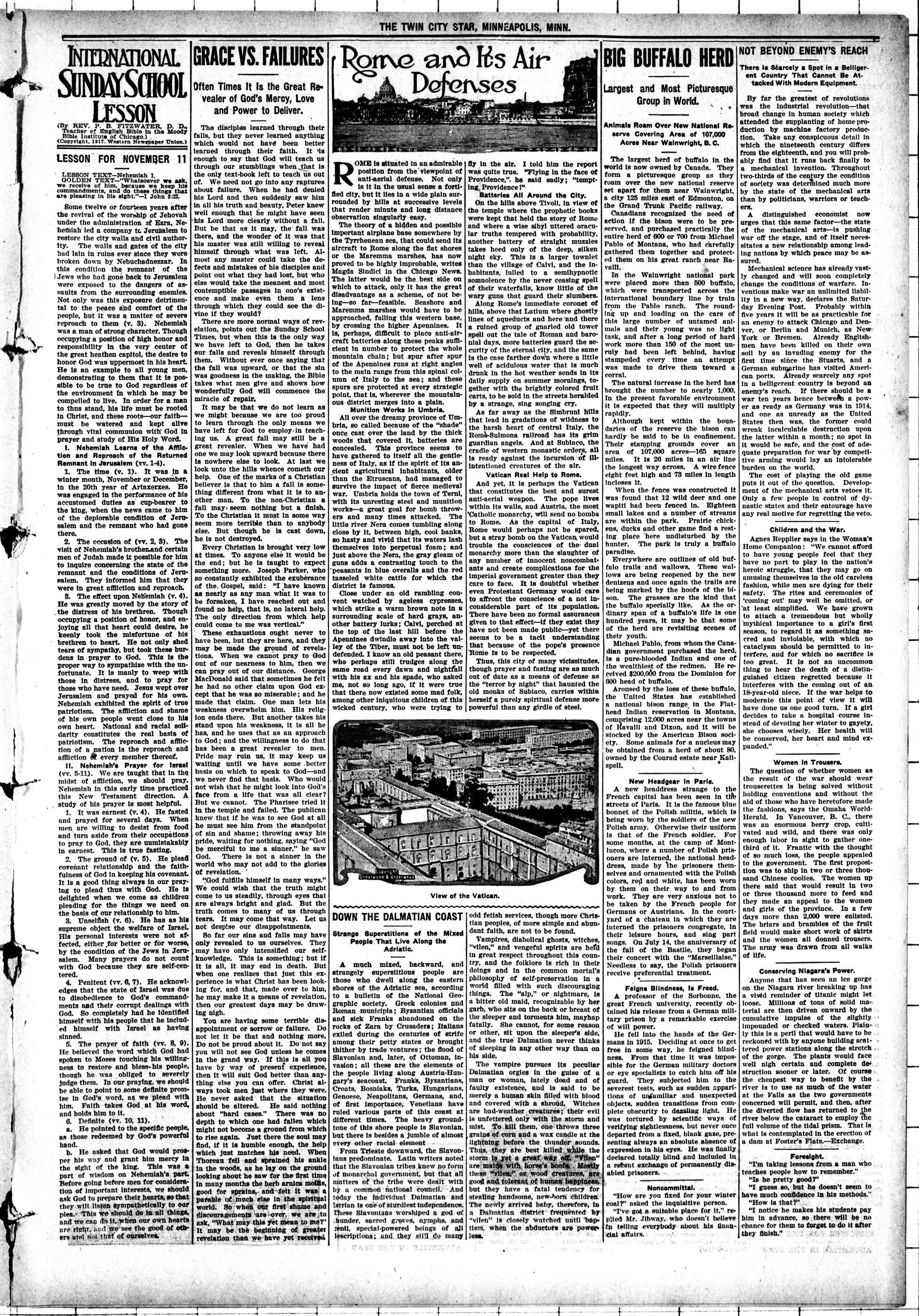
Rome and Its Air
Defenses
Is it in the usual sense a fortified city, but it lies in a wide plain surrounded by hills at successive levels that render minute and long distance observation singularly easy.
The theory of a hidden and possible important airplane base somewhere by the Tyrrhenene sea, that could send its aircraft to Rome along the flat shores or the Maremma marshes, has now proved to be highly improbable, writes Magda Sindlici in the Chicago News. The latter would be the best side on which to attack, only it has the great disadvantage as a scheme, of not being—so far—feasible. Seashore and Maremma marshes would have to be approached, falling this western base, by crossing the higher Apennines. It is, perhaps, difficult to place anti-aircraft batteries along these peaks sufficient in number to protect the whole mountain chain; but spur after spur of the Apennines runs at right angles to the main range from this spinal column of Italy to the sea; and these spurs are protected at every strategic point, that is, wherever the mountainous district merges into a plain.
Munition Works in Umbria. All over the dreamy province of Umbria, so called because of the "shade" once cast over the land by the thick woods that covered it, batteries are concealed. This province seems to have gathered to itself all the gentleness of Italy, as if the spirit of its ancient agricultural inhabitants, older than the Etruscans, had managed to survive the impact of fierce medieval war. Umbria holds the town of Ternil, with its unresting steel and muntion works—a great goal for bomb throwers and many times attacked. The little river Nera comes tumbling along close by it, between high, cool banks, so hasty and vivid that its waters lash themselves into perpetual foam; and just above the Nern, the gray gleam of guns adds a contrasting touch to the 'peasants in blue overalls and the red tasseled white cattle for which the district is famous.
Close under an old rambling convent watched by ageless cypresses, which strike a warm brown note in a surrounding scale of hard grays, another battery lurks; Calvi, perched at the top of the last hill before the Apennines dwindle away into the valley of the Tiber, must not be left undefended. I know an old peasant there, who perhaps still trudges along the same road every dawn and nightfall with his ax and his spade, who asked me, not so long ago, if it were true that there now existed some mad folk, among other iniquitous children of this wicked century, who were trying to
Copyright
Underwood & Underwood
View of the
View of the Vatican.
DOWN THE DALMATIAN COAST
Strange Superstitions of the Mixed People That Live Along the Adriatic.
A much mixed, backward, and strangely superstitious people are those who dwell along the eastern shores of the Adriatic sea, according to a bulletin of the National Geographic society. Greek colonies and Roman municipal; Byzantian officials and sick Franks abandoned on the rocks of Zara by Crusaders; Italians exiled during the centuries of strife among their pet states or brought thither by trade ventures; the flood of Slavonian and, later, of Ottoman, invasion; all these are the elements of the people living along Austria-Hungary's seacoast. Franks, Byzantians, Croats, Bosnials, Turks, Hungarians, Genoese, Neapolitans, Germans, and, of first importance, Venetians have ruled various parts of this coast at different times. The heavy groundstone of this shore people is Slavonian, but there is besides a jumble of almost every other racial element
From Trieste downward, the Slavonians predominate. Latin writers noted that the Slavonian tribes knew no form of monarchal government, but that all matters of the tribe were dealt with by a common national council. And today the individual Dalmatian and Istrian is one of sturdiest independence. These Slavontians worshiped a god of hound, sacred groves, nymphs, and genii, special-powered beings of all descriptions; and they still do many
fly in the air. I told him the report was quite true. "Flying in the face of Providence," he said sadly; "tempting Providence!"
Batteries All Around the City.
Batteries All Around the City.
On the hills above Tivoli, in view of the temple where the prophetic books were kept that held the story of Rome and where a wise sibyl uttered oracular truths tempered with probability, another battery of straight muzzles takes heed only of the deep, silken night sky. This is a larger townnet than the village of Calvi, and the inhabitants, lulled to a semihypnotic somnolence by the never ceasing spell of their waterfalls, know little of the wary guns that guard their slumbers.
Along Rome's immediate coronet of hills, above that Latium where ghostly lines of aqueducts and here and there a ruined group of gnarled old tower spell out the tale of Roman and baronial days, more batteries guard the security of the eternal city, and the same is the case farther down where a little well of acidulous water that is much drunk in the hot weather sends in its daily supply on summer mornings, together with the brightly colored fruit carts, to be sold in the streets heralded by a strange, sing songing cry.
As far away as the Simbruni hills that lead in gradations of wildness to the harsh heart of central Italy, the Rome-Sulmona railroad has its grim guardian angels. And at Subiaco, the cradle of western monastic orders, all is ready against the incursion of ill-intentioned creatures of the air.
Vatican Real Help to Rome.
And yet, it is perhaps the Vatican that constitutes the best and surest anti-aerial weapon. The pope lives within its walls, and Austria, the most Catholic monarchy, will send no bombs to Rome. As the capital of Italy, Rome would perhaps not be spared, but a stray bomb on the Vatican would trouble the consciences of the dual monarchy more than the slaughter of any number of innocent noncombatants and create complications for the imperial government greater than they care to face. It is doubtful whether even Protestant Germany would care to affront the conscience of a notconsiderable part of its population. There have been no formal assurances given to that effect—if they exist they have not been made public—yet there seems to be a tacit understanding that because of the pope's presence Rome is to be respected.
Thus, this city of many vlcisstudes, though prayer and fasting are as much out of date as a means of defense as the "terror by night" that haunted the old monks of Biplacio, carries within herself a purely spiritual defense more powerful than any girdle of steel.
e Vatican.
odd fetish services, though more Christian peoples, of more simple and abundant faith, are not to be found. Vampires, diabolical ghosts, witches, "vilen," and vengeful spirits are heft in great respect throughout this country, and the folklore is rich in their doings and in the common mortal's philosophy of self-preservation in a world filled with such discouraging things. The "alp," or nightmare, is a bitter old maid, recognizable by her garb, who sits on the back or breast of the sleeper and torments him, mayhap fatally. She cannot, for some reason or other, sit upon the sleeper's side, and the true Dalmation never thinks of sleeping in any other way than on his side.
The vampire pursues its peculiar Dalmatian orgies in the guise of a man or woman, lately dead and of faulty existence, and is said to be merely a human skin filled with blood and covered with a shroud. Witches are bad-weather creatures; their evil is unfettered only with the storm and mist. To kill them, one throws three grains of corn and a wax candle at the lightning before the thunder sounds. Thus, they are best killed while the storm is yet a great way off. "Vilian" are maids with horse's hoofs. Mostly these "vilen" or wood creatures, are good and tolerant of human happiness, but they have a fatal tendency for stealing handsome, new-born children. The newly arrived baby, therefore, in a Dalmatian district frequented by "vilen" is closely watched until baptism, when the abductors are powerless.
```markdown
```
Largest and Most Picturesque Group in World.
Animals Roam Over New National Reserve Covering Area of 107,000 Acres Near Wainwright, B.C.
The largest herd of buffalo in the world is now owned by Canada. They form a picturesque group as they roam over the new national reserve set apart for them near Wainwright, a city 125 miles east of Edmonton, on the Grand Trunk Pacific railway. Canadians recognized the need of action if the bison were to be preserved, and purchased practically the entire herd of 600 or 700 from Michael Pablo of Montana, who had carefully gathered them together and protected them on his great ranch near Ravalli.
In the Wainwright national park were placed more than 500 buffalo, which were transported across the international boundary line by train from the Pablo ranch. The rounding up and loading on the cars of this large number of untamed animals and their young was no light task, and after a long period of hard work more than 150 of the most unruly had been left behind, having stamped every time an attempt was made to drive them toward a corral.
The natural increase in the herd has brought the number to nearly 1,000. In the present favorable environment it is expected that they will multiply rapidly.
Although kept within the boundaries of the reserve the bison can hardly be said to be in confinement. Their stamping grounds cover an area of 107,000 acres—165 square miles. It is 26 miles in an air line the longest way across. A wire fence eight feet high and 73 miles in length incloses it. When the fence was constructed it was found that 12 wild deer and one wapiti had been fenced in. Eighteen small lakes and a number of streams are within the park. Prairie chickens, ducks and other game find a resting place here undisturbed by the hunter. The park is truly a buffalo paradise.
Everywhere are outlines of old buffalo trails and wallows. These wallows are being reopened by the new denizens and once again the trails are being marked by the hoofs of the bison. The grasses are the kind that the buffalo specially like. As the ordinary span of a buffalo's life is one hundred years, it may be that some of the herd are revisiting scenes of their youth.
Michael Pablo, from whom the Canadian government purchased the herd, is a pure-blooded Indian and one of the wealthiest of the redmen. He received $200,000 from the Dominion for 600 head of buffalo.
Aroused by the loss of these buffalo, the United States has established a national bison range in the Flathead Indian reservation in Montana, comprising 12,000 acres near the towns of Havailli and Dixon, and it will be stocked by the American Bison society. Some animals for a nucleus may be obtained from a herd of about 80, owned by the Conrad estate near Kallspell.
New Headgear In Paris.
A new headdress strange to the French capital has been seen in the streets of Paris. It is the famous blue bonnet of the Polish militia, which is being worn by the soldiers of the new Polish army. Otherwise their uniform is that of the French soldier. For some months, at the camp of Montlucon, where a number of Polish prisoners are interred, the national headress, made by the prisoners themselves and ornamented with the Polish colors, red and white, has been worn by them on their way to and from work. They are very anxious not to be taken by the French people for Germans or Austrians. In the courtyard of a chateau in which they are interred the prisoners congregate, in their leisure hours, and sing part songs. On July 14, the anniversary of the fall of the Bastile, they began their concert with the "Marseillalse." Needless to say, the Polish prisoners receive preferential treatment.
Felina Blindness. Is Freed.
A professor of the Sorbonne, the great French university, recently obtained his release from a German military prison by a remarkable exercise of will power.
He fell into the hands of the Germans in 1915. Deciding at once to get free in some way, he feigned blindness. From that time it was impossible for the German military doctors or eye specialists to catch him off his guard. They subjected him to the severest tests, such as sudden apparitions of un familiar and unexpected objects, sudden transitions from complete obscurity to dazzling light. He was tortured by scientific ways of verifying sightlessness, but never once departed from a fixed, blank gaze, presenting always an absolute absence of expression in his eyes. He was finally declared totally blind and included in a recent exchange of permanently disabled prisoners.
Noncommittal.
"How are you fixed for your winter coal?" asked the inquisitive person. "I've got a suitable place for it," replied Mr. Jibway, who doesn't believe in telling everybody about his financial affairs.
There Is Sarcely a Spot in a Belligerent Country That Cannot Be Attacked With Modern Equipment.
By far the greatest of revolutions was the industrial revolution—that broad change in human society which attended the supplanting of home production by machine factory production. Take any conspicuous detail in which the nineteenth century differs from the eighteenth, and you will probably find that it runs back finally to a mechanical invention. Throughout two-thirds of the century the condition of society was determined much more by the state of the mechanical arts than by politicians, warriors or teachers.
A distinguished economist now urges that this same factor—the state of the mechanical arts—is pushing war off the stage, and of itself necessitates a new relationship among leading nations by which peace may be assured.
Mechanical science has already vastly changed and will soon completely change the conditions of warfare. Inventions make war an unlimited liability in a new way, declares the Saturday Evening Post. Probably within five years it will be as practicable for an enemy to attack Chicago and Denver, or Berlin and Munich, as New York or Bremen. Already Englishmen have been killed on their own soil by an invading enemy for the first time since the Stuarts, and a German submarine has visited American ports. Already scarcely any spot in a belligerent country is beyond an enemy's reach. If there should be a war ten years hence between a power as ready as Germany was in 1914, and one as unready as the United States then was, the former could wreak incalculable destruction upon the latter within a month; no spot in it would be safe, and the cost of adequate preparation for war by competitive arming would lay an intolerable burden on the world.
The cost of playing the old game puts it out of the question. Development of the mechanical arts vetoes it. Only a few people in control of dynastic states and their entourage have any real motive for regretting the veto.
Children and the War.
Agnes Reppiller says in the Woman's Home Companion: "We cannot afford to have young people feel that they have no part to play in the nation's heroic struggle, that they may go on amusing themselves in the old careless fashion, while men are dying for their safety. The rites and ceremonies of 'coming out' may well be omitted, or at least simplified. We have grown to attach a tremendous but wholly mythical importance to a girl's first season, to regard it as something sacred and inviolable, with which no cataclysm should be permitted to interfere, and for which no sacrifice is too great. It is not an uncommon thing to hear the death of a distinguished citizen regretted because it interferes with the coming out of an 18-year-old niece. If the war helps to moderate this point of view it will have done us one good turn. If a girl decides to take a hospital course instead of devoting her winter to gayety, she chooses wisely. Her health will be conserved, her heart and mind expanded."
Women In Trousers.
The question of whether women as the result of the war should wear trouserettes is being solved without holding conventions and without the aid of those who have heretofore made the fashions, says the Omaha World-Herald. In Vancouver, B. C., there was an enormous berry crop, cultivated and wild, and there was only enough labor in sight to gather one third of it. Frantic with the thought of so much loss, the people appealed to the government. The first proposition was to ship in two or three thousand Chinese coolies. The women up there said that would result in two or three thousand more to feed and they made an appeal to the women and girls of the province. In a few days more than 2,000 were enlisted. The briars and brambles of the fruit field would make short work of skirts and the women all donned trousers. The army was drawn from all walks of life.
Conserving Niagara's Power.
Anyone that has seen an ice gorge on the Niagara river breaking up has a vild reminder of titanic might let loose. Millions of tons of solid material are then driven onward by the cumulative impulse of the slightly impounded or checked waters. Plainly this is a peril that would have to be reckoned with by anyone building scattered power stations along the stretch of the gorge. The plants would face well nigh certain and complete destruction sooner or later. Of course the cheapest way to benefit by the river is to use as much of the water at the Falls as the two governments concerned will permit, and then, after the diverted flow has returned to the river below the cataract to employ the full volume of the tidal prism. That is what is contemplated in the erection of a dam at Foster's Flats—Exchange.
Foresight
"I'm taking lessons from a man who teaches people how to remember."
"Is he pretty good?"
"I guess so, but he doesn't seem to have much confidence in his methods."
"How is that?"
"I notice he makes his students pay him in advance, so there will be no chance for them to forget to do it after they finish."
PUBLSHED EVERY FRIDAY BY
CHARLES SUMNER SMITH,
Minneapolis, Minnesota.
Entered in the Post Office at Minneapolis as second class matter.
MEMBER
NATIONAL NEGRO PRESS
ASSOCIATION
Subscription by Mail, Postpaid.
ONE YEAR ..... $2.00
SIX MONTHS ..... $125
THREE MONTHS ..... .65
Hamlet B. Rowe, Local Agent.
ADVERTISING RATES.
One Inch—1 Insertion—One Dollar.
Liberal discount given on 3, 6, 9,
Months, or 1 year contracts.
We do not run free ads, or over-run the time contracted for by our advertisers We respect their right to advertise at intervals, and rather have them do so, than to run continuously an "adv." and an increasing account. Write all Checks payable to
M:NNEAPOLIS . . . MINNESOTA
Call at 1317 6th Ave. N. on Wednesday to insure matter for publication.
The Star's Phone, Hyland 1205.
We fight to preserve the Constitution, to support the President in his perpetuation of its principles, to defend all of its loyal citizens and to secure for all men Liberty throughout every land. We will never surrender any right, accorded other American citizens. We demand "Equality before the Law." The Divine prophesies shall be fulfilled. God helps those who first help themselves.
HON. RALPH W. TYLER.
Hon. Ralph W. Tyler, ex-auditor of the Navy, is the logical man for Secretary of the National Negro Soldiers' Comfort Committee. He is the best newspaper man of our race, having long experience on white publications and is an expert on publicity. Mr. Tyler will have the confidence of a mass of friends in his work, and his selection by the committee is a very wise one.
MAKING MORE SOLDIERS.
The remark "I'm staying home to make more soldiers," is current among the vulgar, nevertheless, it should be the motto of all, who are not at the front. Every organization or individual is expected to do those things which build up the rising generation to the highest moral, mental and physical development—to preserve motherhood—to protect sisterhood—to provide for childhood and to promote brotherhood. Whether in peace or war these are essential for that good citizenship, and that alone can produce good soldiers. Those perverts who use this remark, in its vulgar terms, are the ones responsible for broken homes, deserted wives, dependent children and every other deplorable condition in our social life today. From such stuff slackers are made. Make soldiers for our race! not only for this war, but for the great battle of life.
There is not a Negro on the payroll of the entire military forces of the state.
The Star does not cast any personal reflections on the intent of the Union Hall banquet. We hope to show the results. Such an event was too large for such a small place. Negroes deserve the better places provided for such purposes. The Auditorium or State Capitol would serve the purpose better. The Negro soldier makes no apology for his record and is entitled to every consideration.
THE NEGRO IN THE WAR.
The course of the negro race has been highly creditable in this war. Upon barren soil fell the seeds of sedition and insurrection disseminated by German agents and pro-German newspapers in an attempt to incite the Negroes to uprising against the United States. So far as we have observed, Negro leaders have been conspicuously free from treasonable utterances. Drafted Negroes have gone to the front as cheerfully as any other set of men and, if history repeats itself, they will fight with signal bravery. German bullets will send as much torture and agony into black bodies as into white. Death will not discriminate against the Negro soldier. The patriotism of these people will not be forgotten and should ever be kept in mind and taken into account for full credit in the adjustment of racial problems.—Greenville, S. C., News.
CONG. THOS. D. SCHALL
Cong. Schall has promised to "do his bit" for the boys in the war, and every communication to him from our boys from his district in Minneapolis will be considered and answered. He sends through The Star his best wishes to them.
BUY RED CROSS SEALS.
ADVERTISE IN THE STAR
JOHN H. HARRIS
BOOKER T. WASHINGTON.
Founder of Tuskegee Institute.
Died November 14, 1915.
Let us honor his memory.
We have some among our advertisers and subscribers who are a credit to our race for their business-like methods. They pay promptly in advance and expect nothing unreasonable in return. Others want to know "Why we can't 'trust' them?" or send a bill, and then a collector, and finally censor a Negro editor because he can't run his paper "like the white man." Few persons realize that it pays to pay as you go. The Star is not an installment plan proposition. It is a real newspaper run under many difficulties mostly due to the foolish notions and ignorant whims of those whom it serves and protects and from whom it should get its support and their consideration.
There is a great demand for laborers now and Negroes are being employed where before they were "not wanted." As a rule, they are making good and their efficiency will overcome much of the general prejudice against them. The Negro has been denied the privilege of employment mostly because of the ignorance of many employers. Since the Negro laborer has better opportunities, he will be a better citizen. The so-called race-problem will soon be solved because there is no Negro problem; it is the white man's; and its only solution is an intelligent consideration for the Negro as a man and an acknowledgement of his right to earn his living on equal footing with other citizens.
FROM CAUSE TO EFFECT
The Negro is in the war at home and abroad. He must be true to himself to be true to his country. He cannot afford to surrender his manhood for position, or his birthright for finance; no more right here than he can afford to act as a spy or quit as a coward—Over there. Let us not be led astray by those friends who want us, because we give the most, but pay due tribute to those who treat us as men. And as a warning to St. Paul Negroes, let the white citizens accept the Negro in their own gatherings. Minneapolis sets the example. The boys here were given every consideration like the other races; and one of our black boys can do more among the white people by showing his loyalty and willingness to go, to advance us in their estimation as a race, than a thousand Negroes, by listening to the "bull" shot at us by a few white persons of prominence, who have done comparatively nothing for us, according to their positions and power; although they have been materially benefited by us.
PROGRESS AND THE NEGRO.
It takes years for great improvements to produce visible results. In the South a gregarious, pleasure-loving, improvident race has seemed to be but slightly affected by the economic and industrial changes of the times. The Negro has been the unskilled laborer, the poor tenant former, raising his bale or two of cotton and turning it over to the local buyer in liquidation of his debt for the year's living expenses. The teachings of institutions like Tuskegee, Calhoun and Hampton are producing a class trained in trades, efficiency and initiative, whose influence is a leaven slowly permeating the mass for industrial uplift and awakening in the Negro a sense of his economic value. The labor shortage has been an advantage to him. Seven thousand Negroes applied to the Federal Department of Labor last year in regard to opportunities for employment; testimony to the spread of industrial education—Detroit Free Press.
There is a fight among the Red Cross workers and the progress of the work is hindered by some who have done nothing but "organize" for social prominence and attempt to exclude others from actual service. The ladies should remember that this "washing of soiled linen" and a general fight among themselves will not aid this noble work.
Red Cross Cares for Refugees.
Rome, Nov. 9.—Members of the Red Cross included in the American colony of Rome, have opened a canteen and headquarters for refugees from northern Italy.
United States Civil-Service Examinations STENOGRAPHERS AND TYPEWRITERS WANTED. Men and Women.
The United States Government is in urgent need of thousands of typewriter operators and stenographers and typewriters. All who pass examinations for the departments and offices at Washington, D. C., are assured of certification for appointment. It is the manifest duty of citizens with this special knowledge to use it at this time where it will be of most value to the Government. Women especially are urged to undertake this office work. Those who have not the required training are encouraged to undergo instruction at once. Examinations for the Department Service, for both men and women, are held every Tuesday, in 450 of the principal cities of the United States, and applications may be filed with the Commission at Washington, D. C., at any time.
The entrance salary ranges from $1,000 to $1,200 a year. Advancement of capable employees to higher salaries is reasonably rapid. Applicants must have reached their eighteenth birthday on the date of the examination.
For full information in regard to the scope and character of the examination and for application blanks address the U. S. Civil Service Commission, Washington, D. C., or the Secretary of the U. S. Civil Service Board of Examiners at Boston, Mass.; New York; Philadelphia, Pa.; Atlanta, Ga.; Cincinnati, Ohio; Chicago, Ill.; St. Paul, Minn.; St. Louis, Mo.; New Orleans, La.; Seattle, Wash.; San Francisco, Cal.; Honolulu, Hawaii; or San Juan, Porto Rico.
JOHN A. McILHENNEY, President, U. S. Civil Service Commission, Washington, D. C.
JAMES L. CURTIS, U. S.
ENVOY TO LIBERIA, DIES
Former Resident of Minneapolis.
Chicago, Nov. 2.—Mrs. Elinor Curtis of Chicago has been informed by cablegram that her son, James L. Curtis, 47 years old, appointed minister to Liberia four years ago by President Wilson, had died October 24 in Freetown, Africa, following an operation, the nature of which was not disclosed. Mr. Curtis was a former resident of Minneapolis, where he practised law. He moved to New York city and was a partner to Hon. Frank Wheaton. He succeeded Hon. Fred L. Moore, who was appointed by Pres.
FRED. DOUGLASS McCRACKEN
Served at Washington, D. C., 18 Years As Private Secretary to Ex-Cong Fred B. Stevens
Ex-Cong. Fred. B. Stevens.
"Fred" McCracken received much applause when he delivered his message to the colored boys at the Union Hall banquet. He, could always be counted on for valuable service to his race and to prominent men in the Republican party. He is sought today for important information, but has not been given the recognition he deserves by the powers of his party. Mr. McCracken is doing fairly well in the real estate field in St. Paul and will make any sacrifice for his race. That is the reason he is not sitting at the Governor's pie counter, neither is he eating the crumbs from the Federal table. Fred is waiting for another election to favor our friends and fight our foes. May we live to see the results. He can proudly carry the honored name—Frederick Douglass—because he is a real race man.
NOT OUR REPRESENTATIVE.
Philip F. Hale does not in any way represent The Twin City Star. He is connected with The Advocate. We do not mislead those who inquire about both papers. Several complaints have reached us about "subscribing for the Star from Phil Hale." Those who desire The Advocate can secure it from Mr. Hale. He has no authority to solicit for us and those who wish The Star or The Advocate should get their choice, without any misrepresentation. The Star stands the tests.
MAYOR V. R. IRVIN COULD NOT BE PRESENT
D.
Mayor Irvin of St Paul was unable to appear at the Hill dinner for the drafted soldiers last week. He sent a letter of regrets which was read Mayor Irvin was called to Galesburg, Ill., on account of the death of his wife's mother. The Star is glad to correct the error of last week.
A. B.
U. S. SHIP ROCHESTER SUNK
15 Attacked By German Submarine November 2.
London, Nov. 9.-The American steamship Rochester was torpedoed and sank at dusk on Nov. 2. Four sailors are known to have lost their lives in the sinking of the Rochester. One boat with the second mate and 13 men is missing.
The captain and 22 men have been landed at Dunorana. One lifeboat with nine survivors reached Ross Port, in the county of Mayo.
Steamship Marconi Goes Down. Boston, Nov. 8.—A report that the steamship Marconi has been sunk en route from a French port to Portland, Me., was received here today. The Marconi, a new vessel of 7,402 tons, was on her way to load supplies for the allies. She is owned by the Liverpool, Brazil & River Platte Steam Navigation Co. and had been engaged in carrying beef from Montreal and St. John to France. Details of the reported sinking are lacking.
Soldier Suicides on Eve of Marriage. Pensacola, Fla., Nov. 9.—Herbert S. Foster, soldier from Fort Barrancas, committed suicide by taking strychnine at a hotel here. A marriage license he had obtained was found on his body. Miss Jessie L. Sherrer, who was to have been the bride, is prostrated. No cause is known for the act.
CLASSIFIED ADVERTISEMENTS
Furnished Rooms for Gentlemen.
Two good rooms, within walking distance, on car line, modern. 1915
4th Ave. So. Phone N. W. South
2451.
Furnished Room.—Conveniently located. Reasonable rent. Modern. Mrs.
Hall, 708 Girard Ave. No. Hy. 4956.
LOWER FLAT for rent; 4 rooms
and bath, all modern; desirable location, near car line. 2111 Fifth Ave. S.
Call Colfax 3306.
TWO NEATLY FURNISHED
ROOMS, one-half block from car line.
Mrs. E. A. Mitchell, 2020 5th Ave. So.
Phone South 117.
SIX-ROOM MODERN FLAT, downstairs, central location, near car line.
Apply J. S. Wright, 2737 11th Ave. So.
Rooms for Light Housekeeping.
Three rooms, second floor, good location. Call at 2531 Stevens ave.
FOR RENT—1706 East Nineteenth Street. Tollet, water and gas. Three and four rooms. $10.00 per month. McDew Realty Co., Sykes Block, Nic. 621.
ONE LARGE ROOM neatly furnished, modern conveniences, in residential section. Mrs. W. W. Williams, 2900 Eleventh avenue South. Drexel 4728.
BUY RED CROSS SEALS.
FOR RENT — Eight-room house; modern except heat; walking distance from town. Apply to A. Marshall, 715 E. 18th St. South 1848.
EVERY DAY is BARGAIN DAY at the ROOT & HAGEMAN STORE, 407 Nicollet Ave.
AGENTS WANTED—NOW!
Reliable and intelligent agents always wanted to solicit business for THE TWIN CITY STAR; also correspondents in principal cities. A chance to earn a good living. Write The Twin City Star, Minneapolis.
Madam Hart, the hairdresser and milliner, has moved to 305 Thirteenth avenue south, where she will be pleased to meet her patrons.
Peoples Christian Assembly.
ELDER G. W. MITCHELL, Pastor.
Assisted by Mrs. G. W. Mitchell.
Comel and Serve the Lord.
1204 Washington Ave. So.
Services Sunday—11 A. M.
Sunday School—1:30 P. M.
Praise Meeting—3 P. M.
Preaching—8 P. M.
ADVERTISE IN THE STAR
Office Phones—Main 2869; Auto 36774. Dining Room—Main 2831.
Twenty Elegant Steam-Heated and Electric Lighted Rooms.
A la Carte Meals at All Hours—Popular Prices.
246-250 FOURTH AVE. S., MINNEAPOLIS, MINN.
Private Dining and Reception Room for Ladies. Special Temperance Beverages. Men's Buffet and Grill; Billiards; Barber Shop in Connection.
J. A. Withers, Prop.
BELL'S BAY
CLARENCE W.
BATHS, BARBER SHOP
POOL AND BAR
CIGARS, RACE PARK
244 THIRD AVE. SOUTH
Phone No. tw
BELL'S BARBER SHOP
CLARENCE W. BELL, Proprietor.
BATHS, BARBER SHOP, POLITE BARBERS
POOL AND BILLIARD HALL
CIGARS, RACE PAPERS, SHOE SHINING
244 THIRD AVE. SOUTH ..MINNEAPOLIS, MINN.
Phone Northwestern, Main 2511.
might have been
South Side
212 Eleventh Ave
EXPERT BARBERS
CIGARS, POOL AND BILLIAR
RACE PAPERS
THOMPSON &
The Waiters' a
South Side Barber Shop
EXPERT BARBERS; UP TO. THE MINUTE.
CIGARS, POOL AND BILLIARD TABLES IN CONNECTION.
RACE PAPERS—SHOES SHINED;
THOMPSON & CARVER. Props.
GLOVER SHULL, PRES.
311 HENNEPIN AVE. MINNEAPOLIS
EDDIE BOYD, SECY' LEE WHEELER, MANAGER
F. PEOPLES
HOME BUILDING CO.
CONTRACTORS AND BUILDERS
F. PEOPLES
HOME BUILDING CO.
CONTRACTORS AND BUILDERS
818 METROPOLITAN LIFE BLDG.
OFFICE PHONE NIC. 1534
You don't need money; if you own your lot.
I BUILD HOMES ON MONTHLY PAYMENTS.
COTTAGES AND FOUR FAMILY FLATS
ITS JUST LIKE PAYING RENT.
PLANS FREE.
There are more than £13,000 men and women in this and other states who own Bell Telephone stock.
Bell Telephone stock is considered a conservative investment because it pays a reasonable return and is not "watered."
Office Phone, Hyland 2331
Residence—Hyland 4712.
611 Girard Ave. No.
Withers' Transfer
and Fuel Co.
1224 N. 6TH AVE., MINNEAPOLIS
WITHERS' SPECIAL SERVICE
HOUSEHOLD GOODS MOVED OR
STORED.
BAGGAGE TRANSFERED AND
FUEL DELIVERED TO ALL
PARTS OF THE CITY
ON SHORT NOTICE.
BARBER SHOP
W. BELL, Proprietor.
SHOP, POLITE BARBERS
O BILLIARD HALL
PAPERS, SHOE SHINING
H . MINNEAPOLIS, MINN.
Northwestern, Main 2511.
SMOKE THE BEST
5C CIGAR
Sight Draft
W. S CONRAD CO., Distributors
NO. 140. E. 6th ST., ST. PAUL.
NO. 1. WESTERN AVE., MINN.
Barber Shop
Ave. S., Minneapolis
ERS; UP TO. THE MINUTE.
HARD TABLES IN CONNECTION.
SHOES SHINED;
& CARVER, Props.
PLES
NG CO.
BUILDERS
Everybody Invited. Admission 25c. A Good Time Assured.
EVERYBODY COME!
Do not fail to attend the comedy entitled "Pro Tem", given under the auspices of the N. A. A. C. P. at Pillsbury House Auditorium, on
WEDNESDAY, NOVEMBER 14, 1917.
(4th St. and 16th Ave. So.)
Minneapolis, Minn.
Come and laugh and grow fat. Dancing. Admission 35c.
Curtain 8:15 p. m.
Tickets can be procured at McDew's or Bell's Barber Shop, or any member of the cast. Procure your tickets early and avoid the rush.
YOU CANNOT REALLY AFFORD TO MISS THIS.
R. AUGUSTINE SKINNER, Manager.
Come aird laugh and grow fat. Dancing. Admission 35c. Curtain 8:15 p. m. Tickets can be procured at McDew's or Bell's Barber Shop, or any member of the cast. Procure your tickets early and avoid the rush. YOU CANNOT REALLY AFFORD TO MISS THIS. R. AUGUSTINE SKINNER, Manager.
A DUNBAR PROGRAM
will be given at
THE ST. THOMAS MISSION
5th Ave. So. and 27th St.
Minneapolis.
THURSDAY, NOV. 15.
Admission 10c.
LOCAL NEWS
IMPORTANT NOTICE
Unless notes are written plainly and properly arranged they will not be inserted. Many people send in notes regardless of names, initials or composition. Arrangement by the publisher will be charged for. Free notices must be correctly written.
Mrs. Miles Jackson has moved to 2830 35th Ave. So.
Police Officer Charles Kelso is convalescent at his residence.
Mr. and Mrs. Harry Kimbrough have moved to 562 6th Ave. No.
The South Side Barber Shop is now located at 212 11th Ave. So.
Mr. J. H. Haygood has opened the People's Cafe at 11th Ave. and Washington So.
C. C. Pinkston has opened a print shop at 12 6th Ave. No. Give him your next order!
Mr. Albert A. Ford returned from a week's vacation in Chicago, much pleased with his trip.
Buy the Star this week. The publication is not up to its standard, but worth the price.
Queen Esther Temple, S. M. T., will give an entertainment on Nov. 12th at Beck's Hall.
The Young Girls' Beneficial Club will give a Dance for the Soldiers at Lane's Hall on November 16th.
Mr. Andrew Lawrence has painted two pictures which have received favorable comment from many artists.
REMEMBER: THE YOUNG GIRLS' BENEFICIAL CHAT ON FRIDAY NIGHT, NOV. 16TH, AT LANE'S HALL.
Mr. and Mrs. Jerry Lee, his mother and son Bernard, were guests of Mr. and Mrs. Chas. Harding of 6th avenue North on Tuesday.
Mrs. Mary Bryant of Osceola, Ia., is visiting her son, Roy, at the residence of Mr. and Mrs. John Washington, 1500 Penn Ave.
Do not waste your time making promises to our agents. Send your money by Express or Post Office Order or in cash or postage stamps.
Mr. R. Augustine Skinner was elected and installed as speaker of the Catholic Order of Foresters, St. Mary's Court 589, on Monday, Oct. 21, 1917.
Mrs. John Elliott, 3009 Garfield Ave. has the temporary agency of Madame Walker's Hair Preparations, assisting Mrs. Maggie Martin, who is out of the city.
THE TWIN CITY STAR will be sent to any out of town address. Send your subscription in postage stamps. Read your home paper while visiting in other cities. It's like a letter from home.
Mr. W. R. Donovan was called to Halifax, N. S., last week to attend the funeral of his mother, Mrs. Sarah Marguerite Donovan. She died while visiting his sister, Mrs. Macle Weeks. she was a native of Barbadoes, W. I.
The fellow who does not take the Star or ADVERTISE in it, because its "editor does not come around," is often stealing from himself and inviting a business failure. The editor is like the rest of the folks—won't come around because the guy who runs the place is a grouch
at. Dancing. Admission 35c.
3:15 p. m.
Lew's or Bell's Barber Shop, or any
or tickets early and avoid the rush.
AFFORD TO MISS THIS.
JUSTINE SKINNER, Manager.
BOYS ARRIVE IN CAMP.
Encouraging reports of the arrival of the Minnesota boys at Camp Dodge reached here last week. They were warmly received. There was a large crowd at the depot and many marched to the camp with them. Several have passed their examinations and are assigned to Co.'s A and B, 366th Inf. There is a report of their going to France about Jan. 1st, next.
GOPHER LODGE ANNIVERSARY.
(Gopher Lodge No. 105, I. B. P. O. E. of W., of St. Paul, observed their 11th anniversary on Nov. 7th at Union Hall. A number of guests were present. Addresses were made by E. R., Geo. W. Stewart; Thos. H. Lyles, Sld Harris and R. M. Johnson of Gopher Lodge, Past Grand F. L. K., Geo. W. Holbert; Dist. Deputy Fred G. Thomas and Chas. Sumner Smith of Ames Lodge of Minneapolis. The singing of L. C. Jackson was a special feature. Short remarks by Attorneys Hammond Turner and W. T. Francis, Dwight E. Reed and Fred D. McCracken were of special interest. A delicious lunch was served
Unintentionally Overlooked.
John Washington, Chas. Butler, Sillas G. West contributed to the Tobacco Fund. Their names were overlooked last week. Mr. Beamond gave the services of his auto for Dr. Sizer's use to make the collections.
Archbishop Ireland Improved.
Archbishop John Ireland, who has been ill for more than a month at his residence, 977 Portland avenue, St. Paul, showed so great improvement last night that he probably will be on his feet within a few days, attendants said.
An Important Meeting.
The regular meeting of the Minneapolis branch, N. A. A. C. P. will be held on Sunday, Nov. 11, 1917, at St. Peter A. M. E. church, at 8 p. m. Sen. S. A. Stockwell will deliver an address. Try and make a special effort to be present, as important business will be discussed.
R. Augustine Skinner
Secretary.
Otto Alphonso Hall and Hobart Green Fulbright have not reported to the local board of the fourth ward. They are liable to punishment and any information is wanted as to their whereabouts.
THE WAY TO MAKE MONEY.
If you wish to add to your income, you can do so by accepting an agency for The Twin City Star. Good commission to competent agents. Use your spare time in soliciting ads and subscriptions. Only honest and intelligent agents wanted. Call Hyland 1205.
Mr. Geo. W. Holbert will go to Des Moines to look out for the comfort of the Minnesota soldiers at Camp Dodge.
Geo. W. Lunsford, Bill Bailey, Fuller Thompson and Glover Shull went to Buffalo Lake, Minn., on a hunting trip this week.
THE STAR is the CHEAPEST and BEST NEGRO PAPER in the NORTHWEST. It needs 500 more Subscribers to keep it going. Help to get us A BIGGER CIRCULATION.
Owing to an increase in cost, we have raised our prices on all composition. Reading notices will be 10c per line under one inch and 50c per inch thereafter.
Mrs. Knox, 803 Bryant Avenue No., is on the sick list.
Mr. J. A. Withers, the expressman, is recovering from an operation performed last week.
Conspicuous By Their Absence.
Mr. R. B. Montgomery, editor of the Weekly Advocate, and Philip F. Hale were conspicuous by their absence from every important gathering for the "boys." If two papers are needed and they say so—The Star thinks they should cover this news and assist in the general program of publicity.
BUY RED CROSS SEALS.
---
THE TWIN CITY STAR, MINNEAPOLIS, MINN.
Washington county quota for the second Liberty Loan was oversubscribed more than $120,000.
The William Weis cement factory at Perham was totally destroyed by fire. The origin of the fire is unknown. The loss is placed at $3,000 with $2,000 insurance.
William Rosendahl, convicted of the murder of C. E. Lamberton at Redwood Falls, was sentenced to life imprisonment at the Stillwater penitentiary by Judge I. M. Olson.
Capt. C. A. Nye is well, working hard and "is going to stay with his work until the end of the war." according to a letter from the judge to County Attorney C. G. Dosland at Moorhead.
Charged with selling Iliquor without a license, John, Anton and William Holecek of Brushville were taken to Rothsay by Sherif Fitzgerald of Wilkinson county, pleaded guilty and were fined $50 and costs, each.
Pennington county's first annual potato show will be held at Thief River Falls in the Auditorium, Nov. 17. Prof. T. M. McCall of the Crookston School of Agriculture will judge the exhibits and talk on potatoes.
A framed tablet containing the names, the class and the branch of service the graduates of the Thief River Falls high school now serving their country is contemplated by the local alumni. The tablet will be presented to the high school.
The interior of the parish house at St. Agnes German Catholic church at St. Paul was wrecked by a bomb hurled through a window by an unknown person. The five occupants of the house escaped injury. Every detective in the city is working on the case.
Twenty-seven meetings throughout the Crookston section have been scheduled in the campaign to raise the quota of the Northwestern Minnesota division of the national war council's subscription to the $1,100,000 pledged by the state to the Y. M. C. A. work in Europe.
The new Ford car found abandoned in the road two miles this side of Fort Ripley was traced up and its owner found in Minneapolis by Sheriff Claus A. Theorin, who spent two weeks unraveling the matter and at length got the factory to locate the buyer through the engine number.
The students of the normal department of the Crookston high school have organized a Red Cross Sewing and Knitting society. The members will meet once a week when the time will be spent in sewing while knitting work will be done during the spare time of the members. All work will be sent to the American soldiers. Thomas W. Scott of St. Paul and Roy S. Cooper of Minneapolis were arrested at Lake Jefferson by Deputy Game Warden Peter Karpen on the charge of shooting ducks from a motor boat, and the motor boat, which belonged to John Hardegger, was confiscated and is being held until State Game Commissioner Carlos Avery makes a decision in the matter. The accused paid $10 fines.
The townships of Aitkin county have voted $61,003 for road and bridge maintenance and construction for the coming year.
Alvie Johnson, for many years a resident of Willow River and later of Sandstone, dropped dead of heart failure at his place of business at St. Paul.
The state department of education has assigned instructors for a teachers' institute for Aitkin county to be held at the Aitkin high school January 2, 3 and 4.
Farm work is in fairly good shape in Crow Wing county. About two thirds of the usual amount of plowing has been done. Of potatoes 35 per cent froze in the ground. Pastures are holding up unusually well. Hay on the average has been half a crop. The oats crop was very good and the straw is excellent.
The apportionment of forty Christmas packages allotted to the Pennington County Red Cross chapter will be willingly filled within a few days. At a special meeting of the directors it was thought best that St. Hilaire be asked to make six of the number, Goodridge four and the remaining 30 for Thief River Falls. The Northern Pacific freight depot at Little Falls is now operating on the eight-hour schedule. The freight warroorms are open from 8 a. m. to 5 p. m., but are closed from 12 to 1. The eight-hour schedule has been put in force in accordance with an agreement made between the clerks' union and the road a short time ago.
An interesting program is assured those attending the annual meeting at Thief River Falls of the Northwest Minnesota Educational association on Nov. 15 and 16. Several noted speakers from various parts of the country have been secured. Papers by local and other teachers will hold the attention of those at the meeting. A. J. Hayes of Crosby, who was appointed on a coal committee by the Public Safety commission, has tendered his resignation. He has, however, accepted the county chairmanship of the Y. M. C. A. campaign to raise $16,000, the amount counted on from Crow Wing county.
Judge of Probate J. T. Sanborn of Brainerd committed eleven children of the Delbert Leonard family of Fort Ripley, ranging in ages from 4 months to a boy of 16 years, to the Owatonna state school because the children were motherless and their father neglected them.
COMPLAINTS TO BE INVESTIGATED
STATE PUBLIC SAFETY COMMISSION TAKES ACTION ON TWIN CITY CARMEN'S CHARGES.
STATE HAS PLENTY OF CASH
Despite Increased Expenses Due to the War Amount on Hand Is Greater Than Same Time Last Year.
St. Paul.
Threats of another street railway strike in the Twin Cities were taken up by the State Public Safety commission at the capitol. After hearing complaints of the union trainmen and a written statement from President Horace Lowry of the Twin City Rapid Transit company, the commission discussed the case and appointed President Kerfoot of Hamline university, Robert C. Jamieson of Minneapolis and Norman Fetter of St. Paul to investigate the complaints and endeavor to secure an agreement.
The commission united in a telegram to President Wilson protesting against the action of the fuel administration in diverting coal from the Northwest. The application of Oscar Lagerlof, a Minneapolis retail meat dealer, to open a horse meat market in that city was refused. The city council of Minneapolis had refused permission and the Public Safety commission declined to override that action.
Complaint that certain private schools in Dodge county, particularly a German school at Dodge Center, give no instruction except in German and that the pupils are forbidden to attend a public school, brought an opinion from C. G. Schulz, state superintendent of education, that attendance at a private school cannot be recognized by the state unless instruction is provided in English in fundamental and elementary school subjects.
* * *
Plenty of Cash in Treasury.
Minnesota began November business with $7,306,372 in cash in the state treasury, compared with $7,165,523 a year ago, State Treasurer Henry Rines announced. Despite the war and increases in general expenses, the state revenue fund is $4,493,487, or $696,814 larger than a year ago. Some of the big larger credit items making up the big cash balance, as reported by George R. Olson of the treasury staff, are $773,780 in the road and bridge fund, $536,046 in the general university fund, $423,028 in the state prison revolving fund and $402,228 in the permanent school fund.
Congdon Estate Large.
Charles A. Congdon of Duluth, who was chairman of the Republican state central committee at the time of his death, November 21, 1916, in St. Paul, left Minnesota property valued at $6,010,633 besides large holdings in other statte, including a California residence worth more than $500,000.
The estimate of the Minnesota property in the estate is the basis of computation of inheritance taxes of $168-177 to be paid the state. The bulk of the Minnesota property is in mining stocks, but the family home and furnishings at Duluth are listed at more than $250,000 and there are other minor items. The estimate of the total estate was not available at the capitol.
Putnam on Commission.
Governor Burnquist has announced that Mr. Putnam has accepted the appointment.
Mr. Putnam is 33 years old and a son of W. H. Putnam, Red Wing banker and former member of the state legislature. He was graduated from the academic department of the University of Minnesota in 1906, took a law course at Ann Arbor, Mich., and began practicing at Red Wing.
Mr. Putnam's appointment is for the unexpired portion of Mr. Elmquist's term, which ends January 1, 1919, and the salary is $4,500 a year.
Twine Plant Well Supplied.
Far-sightedness of the State Board of Control was reflected in a report by Warden C. S. Reed of the state prison that the twine plant is well supplied with raw materials and will not be compelled to go into the market for new supplies for some time.
The statement was issued at the request of Henry Wolfer, former warden, now indicating the sisal situation at the direction of Herbert C. Hoover, federal food administrator. It showed among other things that the prison plant had turned out 65,323,185 pounds of twine during the last three years.
Can Reopen Draft Cases.
Can Reopen Draft Cases.
Adjustment General W. F. Rhinow has made a brief reply to charges that his office was attempting to influence decisions and otherwise interfere with the work of draft boards. "The adjutant general is given authority in the draft rules and regulations to request the reopening of any case," said General Rhinow. "Any suggestions made under this provision are not mandatory, however, and if the boards see fit to reject them, it makes no difference to me." Board members claim to be subject to Federal regulations.
IMPORTED AND DOMESTIC WOOLENS AT POPULAR PRICES Your Patronage Desired.
KEYSTONE BUFFET and
1313 Wash. Ave.
FOR LADIES & GENE
Music Every Day from 2 H
Kidd Mitchell, Prop.
LADIES SPECIALLY INVITED
Orex 1269
J. & H. Wet Wash
3753-55-57 Cedar
High Grade Specialist
Dry Wash and Family
OUR WORK IS OUR BEST
POPULAR PRICED SHOE REPAIR
SPECIAL SAMPLE SHOES
WE FIX 'EM WHILE YOU WAIT.
Men's Sewed Soles
Ladies' Sewed Soles
Men's Nailed Soles
Rubber Heels
Ladies' and Boy's Nailed Soles
SEVEN CORNERS' SHOE REPAIR
1424 Washington Ave. So., Minneapolis
HARRY LIE
Practical
MEN'S SUITS AND OVERCOAT
Dry Cleaning and Fancy Dyeing of LA
Phone N. W. Hyland 2875
STONE BUFFET and CLUB
1313 Wash. Ave. South
FOR LADIES & GENTLEMEN
Music Every Day from 2 P. M. to 11 P.
Mitchell, Prop.
MINNEAPOLIS
DIES SPECIALLY INVITED EVERY
Au
& H. Wet Wash Laun-
3753-55-57 Cedar Avenue
Grade Specialists in Wet
Wash and Family Launda-
WORK IS OUR BEST ADVERTISEMENT
ER PRICED SHOE REPAIRING.
SPECIAL SAMPLE SHOES
WE FIX 'EM WHILE YOU WAIT.
1d Soles ..... $1.00
2d Soles ..... .85
3d Soles ..... .85
4d Soles ..... .40
Boy's Nailed Soles ..... .65
ORNERS' SHOE REPAIR SHOP.
Washington Ave. So., Minneapolis.
JOSEP
HARRY LEVITT
Practical Tailor
Y'S SUITS AND OVERCOATS MADE TO O
cleaning and Fancy Dyeing of Ladies' and Gent's
W. Hyland 2875
1317 No. 6th Ave.
HATS CLEAN
AND RE-BLOC
Into Up-to-Date S
J. A. HUSS
16 North Seventh St.,
N. W. Main 3717 (Sec.
PANAMA HATS A S
First-Class Work Gu
E NORTH SIDE O
CHINESE AND AMERICAN COOK
th Avenue No.
Clean service. Chop Suey delivered by m
hat, cozy dining room for Ladies and Gentl
ular Dinner, from 3 to 8 P. M., 35c.
Sunday Dinner, from 12 M. to 8 P.
Ladies Souvenir Night.
by Thursday night every lady will receive
T" ANDERSON, Prop. Phone H
1313 Wash. Ave. South
FOR LADIES & GENTLEMEN
Music Every Day from 2 P. M. to 11 P. M.
J. & H. Wet Wash Laundry
3753-55-57 Cedar Avenue
High Grade Specialists in Wet Wash
Dry Wash and Family Laundering
OUR WORK IS OUR BEST ADVERTISEMENT
MEN'S SUITS AND OVERCOATS MADE TO ORDER. Dry Cleaning and Fancy Dyeing of Ladies' and Gent's Garments. Phone N. W. Hyland 2875 1317 No. 6th Ave., Minneapolis.
```markdown
```
HATS CLEANED
AND RE-BLOCKED
Into Up-to-Date Styles
J. A. HUSSEY
16 North Seventh St., Minneapolis
N. W. Main 3717 (Second Floor)
PANAMA HATS A SPECIALTY
First-Class Work Guaranteed
THE NORTH S
CHINESE AND AMERIC
723 Sixth Avenue No.
Quick, clean service. Chop Suey de
neat, cozy dining room for La-
regular Dinner, from 3 to 8 P. M.
Sunday Dinner, from
Ladies Souvenir
Every Thursday night every lace
souvenir.
"COUNT" ANDERSON, Prop.
THE NORTH SIDE CAFE
CHINESE AND AMERICAN COOKING
723 Sixth Avenue No. Minneapolis
Quick, clean service. Chop Suey delivered by messenger. A neat, cozy dining room for Ladies and Gentlemen.
Regular Dinner, from 3 to 8 P. M., 35c.
Sunday Dinner, from 12 M. to 8 P. M., 50c.
Ladies Souvenir Night.
Every Thursday every lady will receive a beautiful souvenir.
"COUNT" ANDERSON, Prop. Phone Hyland 5851
YOU HAVE TRIED THE REST.
NOW! WHY NOT TRY THE BEST?
THE PEOPLE
Open At All Hours
1100 Washington Ave. S
J. H. HAYGOOD,
They Are Here
THE YOUNG GIRLS' BEN
Will give a DANCE
THE PEOPLE'S CAFE
Open At All Hours.
1100 Washington Ave. So., Minneapolis
J. H. HAYGOOD, PROP.
They Are Here Again!
THE YOUNG GIRLS' BENEFICIAL CLU
Will give a DANCE for the
THE PEOPLE'S CAFE Open At All Hours. 1100 Washington Ave. So., Minneapolis. J. H. HAYGOOD, PROP.
They Are Here Again!
THE YOUNG GIRLS' BENEFICIAL CLUB
Will give a DANCE for the
BENEFIT OF THE COLORED SOLDIERS
Friday Evening, November 16, 1917.
Lane's Hall, 8th and Nicollet Ave., Minneapolis.
Clarence Johnson's Orchestra Admission, 35c
N. W. MAIN 2259
Orex 1269
Souvenirs for Ladies every Wednesday afternoon and Evening I and CLUB CAFE' L. Ave. South & GENTLEMEN am 2 P. M. to 11 P. M. MINNEAPOLIS, MINN. INVITED EVERY DAY.
Wash Laundry
Cedar Avenue
lists in Wet Wash
family Laundering
BEST ADVERTISEMENT
minneapolis. JOSEPH DAHL, Prop. LEVITON
Automatic 61809
[Picture of a man]
WAH MESSAGE OF WILSON DISTORTED
Berman People Not Permitted to Read Full Text of President's Address.
EFFECT ON PUBLIC FEARED
Copy issued by Committee on Public Information Shows Important Passages That Were Suppressed.
The German government did not dare to communicate to the German people the full text of President Wilson's war message of April 2, 1917. It feared the influence which the unabridged text of this message might have upon the opinion of the people. Therefore the official message of the president of the United States was presented to Germany in an abridged and distorted form.
The committee on public information of the United States government has prepared a copy of this message showing the passages which were suppressed in the report of the Wolff Telegraph bureau when the message of the president was published to the whole world. These passages are shown in bold-faced type in the following copy of the message. The Wolff Telegraph bureau is not only under censorship control of the German government, but has been consistently employed by the government for the promulgation of official opinions.
Gentlemen of the Congress:
I have called the congress into extraordinary session because there are serious, very serious, choices of policy to be made, and made immediately, which constituteally permissible that I should assume the responsibility of making.
On the 3d of February last I officially laid before you the extraordinary announcement of the Imperial German government that on and after the 1st day of February it was its purpose to put aside all restraints of law or of humanity and use its submarines to sink and fight to approach either the ports of Great Britain or the western coasts of Europe or any of the ports controlled by the enemies of Germany within the Mediterranean. That had seemed to be the object of the German submarine warfare earlier in the war, but since April of last year the Imperial government had somewhat restrained the commanders of its undersea craft, in conformity with the instructions to wipe out that passenger boats should not be sunk, and that due warning would be given to all other vessels which its submarines might seek to destroy, when no resistance was offered or escape attempted, and care taken that their crew were given at least a fair chance to save their lives in their open beats. The precautions taken were not always proved in distressing instance after instance in the progress of the cruel and unmanly business, but a certain degree of restraint was observed.
The new policy has swept every restriction aside. Vessels of every kind, whatever their flag, their character, their age, their gender, have been ruthless, ant to the bottom without warning and without thought of help or mercy for those on board, the vessels of friendly neutrals along with those of belligerents. Even hospital ships and ships carrying armored vehicles, are people of Belgium, though the latter were provided with safe conduct through the proscribed areas, by the German government itself and were distinguished by unmistakable marks of identity, have been sunk with the insignia, have lack of compassion or of principle.
I was for a little while unable to believe that such things would in fact be done by any government that had hitherto subscribed to the humane practices of civilised nations. International law had its origin in the attempt to set up some law which would be respected and observed upon the seas, where as nations dominate and where the free high dominion and the world. By painful stage after stage how that law been built up with menager enough results, indeed, after all was accomplished that could be accomplished, but always with a clear view, at least, of what the heart and conscience of mankind demanded. This minimum of right the German government has swept aside under the plea of retaliation and necessity and because it had no weapons which it could use at sea except those that it is imposed on menager than which it is embittered without throwing to the wind all scruples of humanity or of respect for the understandings that were supposed to underlie the intercourse of the world.
I am not now thinking of the loss of property involved immense and sorrows as that is, but only of the wanton and wholesale destruction of the lives of non-ombatants, men, women, and children, engaged in pursuits which have always, even in the past, been deemed innocent and legitimate. Property can be paid for; the lives of peaceful and innocent people cannot be. The present German submarine warfare against commerce is a warfare against mankind. It is a war against all national American ships, have been sank, American lives taken, in ways which it has stirred us very deeply to learn of, but the saxon man has people and tribes and have been sunk and overwhelmed by the writers, in the same way. There has been no discrimination. The challenge is to all mankind. Each nation must decide for itself how it will meet it. The choice we make for ourselves must be made with a moderation of counsel and a temperateness of judgment befitting our character and our own feelings. We must givened feelings away. Our motive will not be revenge or the victorious assertion of the physical might of the nation, but only the vindication of right, of human right, of which we are only a single champion.
When I addressed the congress on the 26th of February last I thought it would suffice to assuge our neutral rights with arms, our right to use the seas against unlawful interference, our right to keep our people safe against unlawful violence. But armed neutrality, it may, ambulance is in practicable. Because
submarines are in effect outlaws, when use as the German submarines have been used against merchant shipping. it is impossible to defend ships against attacks, as the law of nations has assures us that we must defend themselves against privateers or cruisers, visible craft giving chase on the open sea. It is common prudence in such circumstances, grim necessity indeed, to endevor to destroy them, so they have shown their own intention. The enemy will with upon sight, if dealt with at all.
The German government denies the right of neutrals to use arms at all within the areas of the sea which it has proscribed even in the defense of rights which no modern publicist has ever before questioned their right to defend. The intimation is conveyed that the armed guards which we have placed on our merchant ships will be subjected as beyond the pale of law and to be dealt with as pirates would be. The military is illiterate in a enough at best; in such circumstances and in the face of such pretensions it is worse than ineffectual; it is likely only to produce what it was meant to prevent; it is practically certain to draw us into war without either the rights or the effectiveness of the belligerents. There is one choice we cannot make, we are incapable of making: We will not choose the path of submission and suffer the most sacred rights of nation and our people to be ignored or violated. The wrongs against which we carry war are common wrongs; they ent to the very roots of human life.
With a profound sense of the solemn and even tragic character of the step I am taking and of the grave responsibilities which it involves, but in unhesitating obedience to what I deem my constitutional duty, I advise that the congress declare the recent course of the Imperial German government to be in fact nothing less than war against the government and people of the United States, and that it accept the status of belligerent which has thus been thrust upon it; and that it take immediate steps not only to put the country in a more thorough state of defense, but also to exert all its power and employ all its resources to bring the government of the German empire to terms and end the war. What this will involve is clear. It will involve the utmost practicable cooperation in counsel and action with the governments now at war with Germany and the incident to that tension to those governments of the most liberal financial credits, in order that our resources may so far as possible be added to theirs.
It will involve the organization and mobilization of all the material resources of the country to supply the materials of war and serve the incidental needs of the nation in the most abundant and yet the most economical and easiest manner. It will involve the immediate full equipment of the navy in all respects, but particularly in supplying it with the best means of dealing with the enemy's submarines.
It will involve the immediate addition to the armed forces of the United States, already provided for by law in case of war, of at least 500,000 men, built in navy solution, be opened upon the principle of universal liability to service, and also the authorization of subsequent additional increments of equal force so soon as they may be needed and can be handled in training.
It will involve also, of course, the granting of adequate credits to the government, sustained, I hope, so far as possible, to be sustained by the present generation, by well-conceived taxation.
I say sustained so far as may be equitable by taxation, because it seems to me that it would be most unwise to base the credits, which will now be necessary, entirely on money borrowed. I will surely urge you to protect our people, so far as we may, against the very serious hardships and evils which would be likely to arise out of the inflation which would be produced by vant loans. In carrying out the measures by which these things are to be accomplished we should keep constantly in mind the fact that we will be like as possible in our own preparation and in the equipment of our own military forces with the duty—for it will be a very practical duty—of supplying the nations already at war with Germany with the materials which they can obtain only from us or our allies. We should help them in every way to be effective there.
I shall take the liberty of suggesting, through the several executive departments of the government, for the consideration of your committees, measures for the accomplishment of the several objects I have mentioned. I hope that it will be your pleasure to deal with them as having been framed after very careful consideration of branch the government upon whom the responsibility of conducting the war and safeguarding the nation will most directly fall.
While we do these things, these deeply momentous things, let us be very clear, and make very clear to all the world, what our motives and our objects are. My own thought has not been driven from its habitual mind, nor from the events of last two months, and I do not believe that the thought of the nation has been altered or clouded by them. I have exactly the same things in mind now that I had in mind when I addressed the senate on the 22d of January last; the same that I had in mind when I addressed the 3d of February and on the 26th of February. Our object now, as then, is to vindicate the principles of peace and justice in the life of the world as against selfish and autocratic power, and to set up among the really free and self-governed peoples of the world such a conqueror of the world as will take forth to insure the observance of these principles.
Neutrality is no longer feasible or desirable where the peace of the world is involved and the freedom of its peoples, and the menace to that peace, and freedom lies in the existence of autonomic governments, backed by organized force which is controlled wholly by their will, not by the will of their people. We have seen the last of neutrality in such circumstances. We are at the beginning of an age in which its will be insisted that the common standards of conduct and of responsibility among nations doe shall be observed among nations and their governments that are observed among the individual citizens of civilized states.
We have no quarrel with the German people. We have no feeling toward them but one of sympathy and friendship. It was not upon their impulse that their government acted in entering the war. It was not in their preybook knowledge or approval. It was determined upon as wars used to be determined upon in the old unhappy days, when peoples were now where consulted by their rulers and wars were provoked and waged in the interest of dynasties or of little groups of ambitious men who were accustomed to and their fellow men as pawns and tools. We governed nations do not fill their neighbor stages with spies or set the course of intrigue to bring about some critical posture of affair which will give them an opportunity to strike and make conquest. Such designs can be
successfully worked out only under cover and where no one has the right to ask questions. Cunningly contrived plans of deception or aggression, carried, it may be from generation to generation, can be worked out and kept from the light only within the private beehive, be the fully guarded condidence of a narrow and privileged class. They are happily impossible where public opinion commands and insists upon full information concerning all the nation's affairs.
all who are in fact loyal to our bors and to the government of test. They are most of them and loyal Americans as if never known any other flegence. They will be promised with its building and the few who may be of a disdain and purpose. If there show loyalty, it will be deft w firm hand of stern repress it lifts its head at all, it only here and there and wi
A steadfast concert for peace can never be maintained except by a partnership of democratic nations. No autocratic government could be trusted to keep faith within it or observe its will. The people should honor, a partnership of opinion. Intrigue would entit its vitals away; the plottings of inner circles who could plan what they would, and reader account to no one, would be a corruption seated at its very heart. Only free people can hold their purpose and their honor steady to a common outset, and not to a conflict or to do any narrow interest of their own.
Does not every American feel that assurance has been added to our hope for the future peace of the world by the wonderful and heartening things that have been happening within the last few weeks in Russia? Russia was known to have been always in fact democratic at heart in all vital habits of her thought, in all the intimate relationships of her people that spoke their natural instinct, their habitual attitude toward life. The autocracy that crowned the summit of her political system was terrible as was the reality of its power, was not in fact Russian in origin, character, or purpose, and now it has been shaken off and the great generous Russian people have been added, in all their native majesty and might, to the forces that are fighting for justice and for peace. Here is a fit partner for a league of honor.
One of the things that have served to convince us that the Prussian autocracy was not and could never be our friend is that from the very outset of the present war it has filled our unsuspecting communities, and even our offices of government, with spies and set criminal intrigues everywhere afloat against our nation's enemies, we work and without, our industries, and our commerce. Indeed it is now evident that its spies were here even before the war began and it is unhappily not a matter of conjecture, but a fact proven in our courts of justice, that the intrigues which have more than once come perilously near to disturbing the peace and dislocating the industries of the country, have carried on at least with the personal directions of official agents of the Imperial government accredited to the government of the United States.
Even in checking these things and trying to extirpate them we have sought to put the most generous interpretation possible upon them, because we knew that their source lay not in any hostile feeling or purpose of the German people, but in doubt, in ignorant of them as we ourselves were), but only in the selfish designs of a government that did what it pleased and told its people nothing. But they have played their part in serving to convince us at last that that government entertains no real friendship for us and means to act against our pence and security and to stir up enemies against us at our very doors, the intercepted note to the German minister at Mexico City is eloquent evidence.
We are accepting this challenge of hostile purpose because we know that in such a government, following such methods, we can never have a friend, and that in the presence of a friend we will not to accomplish we know not what purpose, there can be no assured security for the democratic governments of the world. We are now about to accept the gage of battle with the natural foe to liberty, and shall, if necessary, spend the whole force against the gage of pretensions and its power. We are glad now that we see the facts with no veil of false pretence about them, to fight thus for the ultimate peace of the world and for the liberation of its peoples, the German peoples included; for the rights of nations, greent and small; for the lives of people; to choose their way of life and of obedience.
The world must be made safe for democracy. Its peace must be planted upon the tested foundations of political liberty. We have no selfish ends to serve. We desire no conquests, no dominion. We seek no indemnities for ourselves, no material compensation for the sacrifices she shall make. We shall be satisfied with the champions of the rights of mankind. We shall be satisfied when those rights have been made as secure as the faith and the freedom of nations can make them.
Just because we fight without rancor and without selfish object, seeking nothing for ourselves but what we shall wish to share with all free people, we shall. I feel confident, conduct our operations as belligerents, pass judgment with passion, with renunciation the principles of right and of fair play we profess to be fighting for.
I have said nothing of the governments allied with the Imperial government of Germany because they have not made war upon us or challenged us to defend our right and our honor. The Austro-Hungarian government has, indeed, avowed its unqualified indomement and acceptance of the reckless and lawless submarine warfare, adopted not without the assistance of the German government, and it has therefore not been possible for this government to receive Count Tarnowski, the ambassador recently accredited to this government by the Imperial and Royal government of Austria-Hungary but that government has not actually engaged in warfare against citizens of the United States on the seas, and I take the liberty, for the present at least, of postponing a discussion of relations with antiterrorists at Vienna. We enter this war only where we are clearly forced into it because there are no other means of defending our rights.
It will be all the easier for us to conduct ourselves as belligerents in a high spirit of right and fairness because we act without animus, not with empathy toward a people or with the desire to bring any injury or disadventure upon us, but by obeying our irresponsible government which has thrown aside all considerations of humanity and of right and is running amuck. We are, let me say again, the sincere friends of the German people, and shall desire nothing, so much as the early re-establishment of intimate relations of mutual advantage between us, however hard we may try, going to believe that this is spoken from our hearts. We have borne with their present government through all these bitter months because of that friendship, exercising a patience and forbearance which would otherwise have been impossible. We shall happily still have an opportunity to prove that friendship in our daily attitude and actions toward the enemy, in the birth and native sympathy who live among us and share our life, and we shall be proud to prove it toward
all who are in fact loyal to their accusers and to the government in the hour of test. They use most of them as true and loyal Americans as if they had never known any other fealty or allegiance. They will be prompt to stand with us in rebuking and restraining the few who may be of a different mind and purpose. If there should be disloyalty, it will be dealt with with a few of the accusers, who it lifts its head at all, it will lift it only here and there and without counterance except from a lawless and malignant few.
It is a distressing and oppressive duty, gentlemen of the congress, which I have performed in thus addressing you. There are, it may be, many months of fiery and sacrifice ahead of us. It is a fearful thing to lead this great, peaceful people into war, into the most terrible and disastrous of all wars, civility itself seeming to be in the balance. But the right is more precious than peace, and we shall fight for the things which we have always carried nearness our hearts—for democracy, for the right of those who submit to authority to have a voice in their own governments, for the rights and liberties of small nations, for a universal dominion by concern and concern plea to shall bring and safety to all nations and make the world itself at laft free.
To such a task we can dedicate our lives and our fortunes, everything that we are and everything that we have, with the pride of those who know that the day has come when America is written in blood, and might for the principles that gave her birth and happiness and the peace which she has treasured.
God helping her, she can do no other.
CALLS BOYS TO THE COLORS
President Wilson Asks All Between Ages of Sixteen and Twenty-One to Join Working Reserve.
Young men of the country between the ages of sixteen and twenty-one, not now employed, are called upon by President Wilson to serve the nation by joining the United States Boys' Working reserve. In a letter made public by Secretary Wilson of the labor department, the president says it is the patriotic duty of these young men to use their spare time in productive work and help support the nation in the present crisis. The president's letter follows:
"Permit me to express my great appreciation of the great work undertaken by the United States Boys' Working reserve of the employment service of the department of labor. To give to the young men between the ages of sixteen and twenty-one the privilege of spending their spare time in productive enterprises without interrupting their studies at school, while their older brothers are battling in the trenches and on the seas, must greatly increase the means of providing for the 'orces at the front and the maintenance of those whose services are needed here. It is a high privilege, no less than a patriotic duty, to help support the nation by devoted and intelligent work in this great crisis.
"Let me express the hope that the young men of the country not now permanently employed may eagerly enter the Boys Working reserve to fit themselves by training and study for good citizenship and productive service. In this way they can show themselves worthy of patriotic fathers who have fought for democracy in the past, sustain their patriotic brothers who are fighting for it today, and command the affectionate pride of the brave mothers who are silently bearing the burdens at home."
University Functions
What is the matter with our universities is that all the students are schoolboys, whereas it is of the very essence of university education that they should be men, writes George Bernard Shaw. The function of a university is not to teach things that can now be taught as well or better by university extension lecturers or by private tutors or modern correspondence classes with gramophones. We go to them to be socialized; to acquire the hall mark of communal training; to become citizens of the world instead of inmates of the enlarged rabbit hutches we call homes; to learn manners and become unchallengeable ladies and gentlemen. The social pressure which effects these changes should be that of persons who have faced the full responsibilities of adults as working members of the general community, not that of barbarous rabble of half emancipated schoolboys and unemancipated pedants.
Growing a Character
* Character is what you are. Reputation is what folks think you are. Sometimes they are so well balanced that you can't tell one from the other, says Grit. But more often the one is a libel on the other. Folks exalt virtues that do not exist and condemn follies that are purely subjective and personal. Much depends on who reports you. Friends are always charitable and interpret our lives to best advantage. Enemies can see no good in us and report as they see. So reputation may flatter or condemn. Not so with character. This is something beyond external observation. It is the life itself as lived amidst its motives and obstacles. Few people can know its real value, for even you do not always know just what you are capable of being until the emergency demands display your worth. What you are in the face of severe testing is character.
Just Missed It.
An old gentleman from the country, tremulous with fear after hearing bombs and gunfire, in an air raid, emerged from his hotel with his wife, relates the London Chronicle. In the street they inquired of an imperturbable police constable if it was "all over." The policeman, imagining they were eager sightseers, said, "Well, I'm afraid, sir, it is all over; but they may return in 'alf an 'our.' Rapid departure of the "sightseers."
THE NEW WAR TAX HELPS WHIP ENEMY
Folks Have to Pay Extra Now for Postage, Travel, Amusements, Eto. REMEMBER. KAISER TO BLAME
But for Prusia's Mad Ambition and Barbarous Methods, World Probably Would Be at Peace—Don't Forget Income Tax.
Washington—How does the war tax strike you? How do you enjoy putting up three cents instead of two on all letters sent out of town? How do you like paying the extra charge for movies, railroad tickets, telegrams, long-distance phone messages?
And, by the way, if you are single and earn more than $1,000 a year, you have to pay a two per cent tax on all in excess of the thousand bucks. And if you are married, you have to pay two per cent tax on your annual income in excess of $2,000.
Didn't you know that? Well, it's true, and the tax must be paid by June 1, 1918 for the whole year 1917. If you fail to pay, the government can exact a heavy penalty. But remember, folks, it is all done to help whip the kaiser. If the tax makes you grouchy, cuss the kaiser, don't cuss our government.
All of the new taxes fall upon the average man. They have nothing to do with the "conscription of wealth." They are a part of the program of taxation to make each "man, woman and child in the United States feel a direct personal part in the war. They apply to freight, passenger and express transportation, pipe lines, Pullman seats and berths, telegraph and telephone messages, insurance policies, admissions to theaters and "movies" and to club dues. The effect of most of them is felt, therefore, in a slight rise in the high cost of living. The taxes are expected to net the federal government the following revenues:
messages ..... 7,000,000
Insurance policies ..... 5,000,000
Club dues ..... 1,500,000
Admissions ..... 50,000,000
The war tax on facilities furnished by public utilities is now levied as follows:
Three per cent of the amount paid for transportation by rail or water or by any form of mechanical motor power in competition with carriers by rail or water, on freight consigned from one point in the United States to another.
One cent for each twenty cents or fraction charged by express companies for transportation from one point in the United States to another.
Eight per cent of the amount paid for the transportation of persons by rail or water or by any form of mechanical motor power on a regular established line in competition with common carriers, from one point in the United States to any point in the United States, Canada or Mexico where the ticket is issued in the United States. No tax is imposed on commutation or season tickets for trips less than 30 miles, or in cases where the fare does not exceed 35 cents.
Ten per cent of the amount paid for seats, berths or staterooms.
If a mileage book used for transportation or accommodation was purchased prior to November 1, 1917, or if cash fare is paid, the conductor or agent collecting the fare is required to collect the tax.
Five per cent on the amount paid for the transportation of oil by pipe line.
Five cents for each telegraph, telephone or radio dispatch originating in the United States where the charge is 15 cents or more.
The foregoing taxes are paid by the persons paying for the services or facilities rendered. A carrier making no charge for transporting a commodity because of its ownership thereof, or for any other reason, is required to pay a tax equivalent to the amount which would be imposed if it received payment, except in the case of commodities which are necessary for its use in the conduct of its business or the business of another line constituting a part of the same railroad system. Service rendered to the federal and state governments is exempt from taxation. Persons collecting these taxes are required to make monthly returns and monthly payments to the federal government. The new levies upon insurance take effect in the following manner:
On life insurance, eight cents on each $100 or fraction of the amount of the policy, except industrial insurance policies not in excess of $500 issued on the weekly payment plan, in which case the tax is 40 per cent of the first weekly premium. Policies of re-insurance are exempt. On marine, inland and fire insurance, one cent on each dollar or fraction of the premium charged under each policy including renewals, but not including policies of re-insurance. Casualty insurance, one cent on each dollar or fraction of the premium
Postage—Three cents an ounce or fraction thereof on letters for other than local delivery; two cents on all postal cards.
Admissions—Ten per cent tax on tickets to theaters, cabarets, and other amusement places.
Dues—Ten per cent tax on dues of clubs exceeding $12 a year.
Tobacco—Graduated taxes on cigars, tobacco, cigarettes, cigarette papers and snuff.
Express—Five per cent tax on amounts paid for express transportation.
Passengers—Eight per cent of the cost of railroad tickets, except local.
Berths—Ten per cent of the cost of berths, staterooms, and parlor car seats.
Oil—Five per cent tax on amounts paid for transportation of oil by pipe lines.
Messages—Five cents tax on each telegraph, telephone, or radio message costing 15 cents or more.
Insurance—Eight cents tax on each $100 or fractional part thereof of each life insurance policy; one per cent of the preinium on fire, marine, inland, and casualty insurance policies.
```markdown
```
charged under each policy (except indemnity and surety bonds, which are taxable under another title of the bill) including renewals, but not including re-insurance policies. Policies issued by any corporation exempt from the income are exempt from this tax. The person, partnership or association issuing such policies of insurance is required to make monthly returns and monthly payments to the government. For every ten cents or fraction thereof you spend on the movies you must turn over to the government one cent. Of course, the movie proprietors may save you the inconvenience of handling pennies by raising his admission price a nickel, as many other persons selling goods affected by the war tax have already done.
Here is the way admission tax and the club dues levies will fall upon the public:
One cent on each ten cents or fraction of the amount paid for admission to any place including admission by season ticket or subscription, to be paid by the person paying for such admission, except in the case of children under twelve, where the tax in every case is one cent. Persons admitted free pay the tax on the basis of the charge made to other persons of the same class, except employees, municipal officers on official business and children under twelve. Where the charge for admission to a cabaret or similar entertainment is wholly or in part included in the price paid for refreshment, service or merchandise, the amount paid is to be computed under regulations to be prescribed by the treasury department.
In the case of persons having the permanent use of boxes or seats, or a lease thereon, the tax is equivalent to 10 per cent of the amount for which a similar box or seat is sold for the performance or exhibition at which the box or seat is used or reserved by or for the lessee or holder.
These taxes are not to be imposed in the case of a place where the maximum charge for admission is five cents or for shows, rides or other amusements in outdoor general amusement parks where the admission is ten cents or in the case of shows, rides or other amusements (the maximum charge for admission to which is ten cents) within outdoor general amusement parks, or in the case of admissions to such parks. Where the proceeds inure exclusively to the benefit of religious, educational or charitable societies or organizations, and in the case of admissions to agricultural fairs, no tax shall be levied, provided none of the proceeds are distributed to stockholders or members of the association.
A tax of 10 per cent is imposed on the amount paid as dues or membership fees, including initiation fees, to any social, athletic or sporting club where such dues or fees are in excess of $12 per year, such tax to be paid by the person paying the dues or fees. Dues or fees paid to fraternal or beneficiary societies, orders or associations operated on the lodge system are exempt.
Those collecting admission dues or fees are required to collect the tax and make monthly returns and payments to the government.
Civilization.
Judge Shockney, of the Randolph county court, relates a story of a friend of his who for many years sailed on the high seas, and was at one time shipwrecked and drifted to a tropical island, says the Indianapolis News. After landing on the island his friend began to investigate, and made his way inland, in search of signs of habitation, proceeding cautiously, fearing he would meet cannibals. He wandered around until almost famished, when suddenly he discovered a fire in the distance. He hid himself until dark, when he crept near enough to hear voices. He listened for some time, but could not make out what was said. Suddenly the voices grew louder and an argument arose between the men around the fire. One exclaimed in a loud voice: "I played the jack." Another replied in angry tones, "You're a liar." Shockney's friend at once rushed up to them and cried out: "Thank God for civilization. You are Christians."
CORPORAL IS VITAL COG IN ARMY'S VAST MACHINE
Much Depends on Officer Who Holds Lowest Rank in Organization.
ACTS AS PARENT TO SQUAD
On the Efficiency of the Humble Corporal Rests Much of the Company's Reputation—Sets the Moral Tone Among the Soldiers.
Washington.—The corporal is known to most civilians merely as the lowest in rank of the non-commissioned officers of the army; his rank is marked by two stripes on the upper arm of his blouse. The familiar phrase "a corporal's guard" exemplifies this idea, as it suggests the smallest possible number of soldiers. Of him the Infantry Drill Regulations say briefly, "The corporal is the squad leader," and of the squad it says, "Soldiers are grouped into squads for purposes of instruction, discipline, control and order."
But the corporal is of more importance than this would indicate.
One of the regular army instructors at the last series of reserve officers' training camps was fond of telling his company that those of them who became captains would be fathers of their men, the captain being the highest officer with whom the enlisted man would in general come into personal contact. Many captains are like the Puritan father whose closest contact with his children was when he disciplined them. The leader who lives with the private and is most directly responsible for his well being in camp or in battle is his corporal.
In camp this responsibility is manifold. The squad, seven men and the corporal, form a family living together in one of the big pyramidal or square tents that have done much to make the soldier's life in the field comfortable. The corporal is often told that he has power to run that tentful of men absolutely; some officers tell him he's the king bee and others call him the czar, while all of them blame him if anything goes wrong. The first thing in the morning, at varying hours, but always before six, he must hear first call and have his seven men out for reville in fifteen minutes. He must see that every matchstick, cigarette butt and scrap of paper is picked up from the floor and surroundings of the tent, that every cot is stripped and in order, that every member called for special duty or detail reports on time, and that his squad is always on hand for all formations.
The corporal must see not only that the members of his squad are on hand for all formations, but that they are properly clothed, neat and shaven, with all buttons sewed on, shoes shined and rifles cleaned. On Saturdays he must be particularly scruppulous in seeing that his squad is spick and span in every respect of person and equipment. The latter must be fully displayed on every man's cot, with only one correct arrangement, one correct way to fold the blankets at the head of the cot and to place the shoes under the foot. And most important it is that the knife, fork and spoon shall be in the order that they are displayed on the mess kit.
Every inspecting officer has the correct picture of that display, from position of toothbrush to number of shelter half pins, so clearly in his mind that the corporal is lucky whose squad does not have two or three slips in its arrangement. Also the corporal must quickly learn the pet point of each
IS Y. M. C. A. WORKER
THE WORLD'S FIRST WORLD WAR
This photograph just received in this country shows Mrs. Theodore Roosevelt Jr. (right) wearing the smart looking uniform worn by the Y. M. C. A. workers in France. The picture made in one of the streets of Paris shows the daughter-in-law of Colonel Roosevelt in conversation with a worker in a Y. M. C. A. canteen.
inspecting officer. With one it may be the size of the cake of soap; with another the darn on the pair of socks or the minute particle of dirt that collects under the movable slide of the sight leaf of the rifle.
During the hours that are free from drills and duties the corporal must know where the men in his squad are. He is supposed to see that they bathe at least once a week and keep their clothes and persons neat. The last thing at night, as taps is blowing, he reports his squad as present if each one is on his cot, or names such unfortunates as may have misjudged the length of time required to return to camp or the amount of liquor they could consume safely.
Such are the routine matters the corporal has in charge. The question may arise as to how he enforces his authority in these matters. The rules are all so framed for a soldier's benefit that, however much he may have been without standards of order and neatness before enlisting, a corporal with force and tact can usually carry the man along with the rest with little necessity for discipline. The means of discipline are not lacking, however, and here the details above have a real value.
Disciplining His Men.
There are many of these pieces of work which do not call for a complete squad, and there are jobs done under a sergeant's oversight with a man from each squad. The corporal can always assign the man who was last out at drill call or whose rifle was denounced as unclean at inspection to these details, as well as those of cleaning up the tent each morning.
Most men learn after they have spent a few of their spare hours chopping wood or cleaning pans to obey the orders of the corporal. Some there are, of course, who have to be reported to the first sergeant for confinement to the company street, or whose repeated offenses lead to the guardhouse. The corporal who properly enforces his authority knows that the whole iron system of discipline of the army is behind him.
In the more purely military matters the corporal is equally important. We hear much of the recruit and the drill sergeant. If a company has efficient corporals, it is more often the latter who introduce the recruits to right dress and port; arms and explain the nice distinction between squads right and right turn.
Many a period of company drill begins with the captain's command: "Corporals, take your squads for fifteen minutes in the school of the soldier and school of the squad"; and it is there that individual attention can be given. Close order drill is of course in larger units, but even there the proper execution of a company movement frequently depends on the corporal, and woe be to the one who fails to distinguish between "On right into line" and "Right front into line," for he will find his squad moving at right angles to the rest of the company.
In open or deployed order, such as would always be used under battle conditions, the squad becomes the smallest fighting unit and the corporal becomes the leader whom the squad must obey, follow and stick to. Here he is usually under the supervision of a sergeant, but it is to him that the squad looks for orders, and the order which can properly be used only by a corporal and which is the simplest in the "Infantry Drill Regulations," "Follow me!" is the one which takes the squad away from the column in which it has been marching, arranges it in its proper position on the firing line, advances it by rushes and finally leads it to the bayonet charge.
Guard Duty.
It is the squad leader who is given the target designation and range by the platoon leader, and who is responsible for the volume and accuracy of the fire. The "Infantry Drill Regulations" say that "in battle officers and sergeants endeavor to preserve the integrity of squads; they designate new leaders to replace those disabled, organize new squads when necessary and see that every man is placed in a squad. Men are taught the necessity of remaining with the squad to which they belong, and in case it be broken up or they become separated therefrom to attach themselves to the nearest squad."
A distinct form of the military duty of a corporal is the guard duty. This may be in the nature of police duty, such as having charge of the men known as the military police, detailed to preserve order in towns near a camp. This work frequently requires a high degree of ability to size up a situation and act promptly.
More familiar in time of peace as well as time of war is what is known as interior guard duty used "in camp or garrison to preserve order, protect property and to enforce order, regulations." To the duties of the corporal of the guard in this work the "Infantry Drill Regulations" devote five pages, quite the largest amount of space given to him in this all-important book. It is summed up in one short paragraph, however: "It is the duty of the corporal of the guard to post and relieve sentinels and to instruct the members of his relief in their orders and duties."
For the purposes of explanation, assume a camp with fifteen posts, which must be patrolled each by a sentry. The guard would then consist of 45 privates, divided into three reliefs, each with a corporal. There would
THE TWIN CITY STAR, MINNEAPOLIS, MINN.
OVER $93,000,000,000
SPENT ON WORLD WAR
Washington.—The second Liberty loan of $3,000,000,000 will be applied to the $20,000,000,000 war bill of the United States to June 30, 1918. This vast total of American expenses, however, is only one-fifth of the cost of the war to the other belligerent governments.
The actual cost to date, based on figures to the first of this year and the daily rate of expenditure since then, is $93,814,785,000. This includes Uncle Sam's $2,000,000,000 Liberty loan.
Great Britain has been the biggest spender, with $22,939,375,000 to her credit. This does not include Canada's $645,700,000, nor the $763,800,000 spent by Great Britain's other colonies.
The other entente allies have spent: France, $15,114,000,000; Russia, $12,868,000,000; Italy, $5,911,000,000; Belgium, $763,-000,000; Serbia, $603,000,000, and Roumania, $796,000,000.
The central allies have spent much less according to the figures available. Germany's expenditures are estimated at $20,-333,000,000; Austria's, $8,003,-000,000; Turkey's, $1,059,500,-000, and Bulgaria's, $784,500,000.
be one or two sergeants, an officer of the guard and an officer of the day. The reliefs would be on post two hours and off four hours throughout the 24 hours of the day on duty. The sentry's orders are that "in cases not covered by instructions, he is to call the corporal of the guard." At night it is the corporal who is called to make the arrest in case the sentry catches anyone trying to cross his post; and he must be continually on the job, not only when his relief is on post but also during the preceding relief.
Powers of Leadership.
But it is guard duty in time of war that calls all a corporal's powers of leadership to the force. This is called exterior guard duty and consists of outposts during a halt and advance, flank or rear guards during an advance or retreat. It includes all that is commonly called patrolling. Bodies for this duty may be larger than a squad, and may be under the command of a sergeant or even a commissioned officer, if the duty is important enough; but here again the squad is the normal body to use and the squad leader the man put in charge if he is capable.
Every reader is familiar with the thrilling tales of patrolling from the tranches, and knows of its importance in the securing of details of information too minute for the airmen to pick up. The reconnoitering patrols have always been considered the eyes of an army, and even the airplanes cannot altogether take their place. Whether a corporal does any or much of this sort of work depends on the ability of the individual, and if he does well in this he soon ceases to be a corporal, for the qualities required in good advance guard or outpost work are those required in much higher grades than that of corporal.
Having discussed the military and what might be called the domestic responsibilities of the corporal, there remains a more difficult, because more intangible, responsibility. It is not mentioned in the "Infantry Drill Regulations," but it is much in the minds of the people. This is his responsibility for the moral tone of the American army. He can exert the greatest influence in this matter because he is the authority most closely in contact with the men.
Woman Fined for Feeding Dogs Bread.
Miss Carolina Stiff of Dover, England, was fined $25 for feeding bread to dogs. She had been buying 20 pounds of bread dally for herself and her 14 dogs. She admitted feeding the dogs bread four times a day.
PUBLIC RESPONSE
Western Newspaper Digest
This German sniper's mask is made of 2-inch Krupp steel. It is very heavy and is believed to be only used when resting on some object. It was captured in a recent battle by Canadiana
SONS OF FAMOUS WARRIORS ARE IN WORLD'S CONFLICT
SONS OF FAMOUS WARRIORS ARE IN WORLD'S CONFLICT
Many Noted American Names of Civil War Days Now on U. S. Army Roll at the Front.
By EDWARD B. CLARK.
Washington.—When American troops get into the actual fighting in France it is probable, if the censor shall allow names to be used, that the people of the United States will read of the doings of soldiers whose names will take readers back to the Civil war days.
In the American army today are a Grant, a Lee, a Sheridan, a Longstreet, a Miles, a Wheeler, a Macomb, a Henry, a Stanley, a Sumner, and a Christian who is a grandson of Gen. Stonewall Jackson.
When Theodore Roosevelt was president of the United States he appointed a Grant, a Lee and a Sheridan as his aides. The Grant was Ulysses S. Grant III, a grandson of the general; the Lee was Fitzhugh Lee, a son of the Confederate general of the same name and a grand nephew of Robert E. Lee; the Sheridan was Philip H. Sheridan, son of the famous Union cavalry leader. When he was in office as president, Colonel Roosevelt visited Georgia, which was his mother's birthplace. There he met the widow of Stonewall Jackson, and he told her that it was his intention to appoint her grandson, Thomas Jackson Christian, to the Military Academy. He did appoint the young man, and today the appointee is an officer in the American army.
Gen. Simon Bollivar Buckner, who died not long ago in Kentucky., has a son of the same name serving in the army. General Buckner and General Grant were students at West Point together in the forties, and they met again in battle in the Civil war. When Grant was dying General Buckner made a trip from the South to Mount McGregor to see his early comrade and inter antagonist. The meeting was a most affectionate one.
Young Fitzhugh Lee is an officer of cavalry. In the Roosevelt administration one of Lee's duties as an aide was to ride across country almost daily with the president. When the order was issued that army officers in order to prove their physical endurance should ride a hundred miles within the limit of three days, as a test, Roosevelt made the ride himself in one day, of course changing horses. He took with him on that ride young Lee. The two covered 103 miles, virtually straight away and returned.
Maj. Douglas MacArthur of the Engineer corps, who graduated number one in his West Point class about ten years ago, is a son of Lieutenant General MacArthur, who at the time of his retirement from the service was the ranking officer on the active list of the United States army. General MacArthur died not long ago.
It was young Major MacArthur who acted as censor in the war department for about three months. That work has been transferred to another, and now Major MacArthur is awaiting orders to go "Somewhere."
Sherman Miles, the son of Gen. Nelson A. Miles, is a major in the service at the present time. He was sent as an observer to the front in the Balkan wars of a few years ago, and had an interesting and instructive experience.
Adna R. Chaffee is a captain in the American army. He is the son of the general of the same name who led the American troops in their advance on Peking in 1900.
Lleut. Col. Guy V. Henry, just at present is commandant of cadets at
POLICE
"And does so. He's the only married man I ever met who encouraged his wife to be a high flyer."
Swearing Off.
"I guess I'm a little too keen with my repartee."
"Um."
"So I'm going to quit saying cutting things."
"That's right. Be a reparteetotaler."
Something Learned Every Day.
He—Poor Brown! He his lost all his money in a wild-cat mining company.
She—Mercy! I didn't know you had to mine for wild cats.
Works Both Ways.
"Do you consider it a good idea for a bank to send every depositor a statement once a month?" "Well, some might be glad to see it. Others might not like to be reminded so constantly of how little money they have."
Duty of the Individual
By DEAN DAVID KINLEY,
Vice President of the University of Illinois.
on some it has taken life. From others
it From others still it has taken the
it may take from you and me is yet
of sacrifice? Shall we be ready, when
call us, to say that all that we have
of duty and loyalty? In this hour
of world suffering, I would impress
ticularly the thought that their high-
y have to their country's call. The
of it great good comes, great deeds
force rests upon us all. In the provi-
nion from them much shall be required
even willingly it will be taken. If it
uses it loses also the spiritual nobility
ready to sacrifice for and serve his
right, those who have gone farthest in
set those whose privileges have been
of the idealism that is the need of
is specific. It rests on the individual
and society. It is an individual matter
heart to find whether he is living up
of his father and mother. Service,
duty of the soldier, the citizen and
The war calls for sacrifice. From some it has taken life. From others it has taken things dearer than life. From others still it has taken the small thing we call property. What it may take from you and me is yet to be seen. How great is our spirit of sacrifice? Shall we be ready, when our country and humanity and God call us, to say that all that we have we sacrifice and dedicate to our ideals of duty and loyalty? In this hour of our country's need, in this day of world suffering, I would impress upon university men and women particularly the thought that their highest duty is the sacrifice of what they have to their country's call. The spirit of sacrifice is ennobling. Out of it great good comes, great deeds arise and leadership is established.
The duty of sacrifice and service rests upon us all. In the providence of God to whom much is given from them much shall be required in this day of world trial. If not given willingly it will be taken. If it must be taken the individual who loses it loses also the spiritual nobility that marks the individual who is ready to sacrifice for and serve his fellow men. If the leaders in thought, those who have gone farthest in education, fail, how shall we expect those whose privileges have been fewer or less to rise to the height of the idealism that is the need of the hour? Duty is not general; it is specific. It rests on the individual and not on some fictitious group called society. It is an individual matter and each one must search his own heart to find whether he is living up to the ideals and spirit of the God of his father and mother. Service, sacrifice, is the prerogative and the duty of the soldier, the citizen and the Christian.
Now Famous War Tank Said To Have Had a Forerunner In the Nineteenth Century.
Jules Verne in "Twenty Thousand Leagues Under the Sea" gave an inkling of the present-day activities of the submarine boats. H. G. Wells predicted the work of air raiders, and now a historical delivery comes forward with the statement that the tank had a forerunner in the sixteenth century. John Napier, laird of Murchison, the mathematician who invented logarithms, devised a war engine something after the style of the tank.
Napier confided to Bacon's elder brother certain "secret inventions" for the purpose of confounding "enemies of God's truth." They included burning mirrors and a charlet of metal double musket proof, the motion of which was controlled by those within and from which shot was discharged through small holes, "the enemy being abased and uncertain what" defense to make against a moving mouth of metal."
This description sounds much like the early type of tank and the "conforming" of the enemy, as predicted by Napier, was to have been accomplished by the tanks of the British when they first appeared among the Germans. Napier's engine never went into action, for the Scottish inventor directed that his weird instrument of war be kept secret unless necessity compelled its use. Napier, who was born in 1550, died in 1617.
"To Take French Leave" Is Phrase of Uncertain Origin.
The origin of the phrase "to take French leave" has been the signal for many a philological contest, but the outcome of them, for the most part, has been to increase interest in the question. It has been plausibly suggested that the custom of disappearing unobtrusively from a crowded reception, instead of elbowing one's way through a throng of people, to reach the hostess, is a custom which was the natural outgrowth of courteous consideration for everyone involved, was borrowed by the English from the French.
Again, it has been suggested that the French, in the phrase "French leave," has no connection with the French people, except to the extent of what is implied in the etymology of the word "frank," meaning free, and that the expression may mean simply a permission not granted but assumed. But the question is further muddled by the fact that the French have a phrase "prendre conge a la maniere Anglaise," or "se retirer a l'Anglaise," with precisely the same significance, with the hit at the English. In Germany the phrase is identical with the English. From Hilpert's German dictionary it would appear that it is more than 100 years old, while the custom which it celebrates, withdrawing without final leave taking, was an established practice in Germany 300 years ago.
Phonetic Spelling.
A good story is told by Lady Login concerning a coachman named William Turley, whom her husband, Sir John Login, had in his service, and who ultimately became private coachman to Queen Alexandra.
He was (writes the authoress) a very honest, trustworthy man, but I often wondered whether, in the royal service, he made out his accounts in the original fashion he used to do with us. He had an unbounded talent for phonetic spelling. His first monthly stable bill puzzled my husband not a little. On the left-hand side of the paper appeared a column of figures, and on the right-hand side a row of capital "A's."
"What does this mean, Turley?" asked Sir John.
"That's a Sir John!"
"So I see. But what is 'A' for?" "Ay for the hosses, Sir John!" said honest William, with an inflection of reproachful surprise at his master's denseness.
West Point, but it is believed that he with all the others named soon will be ordered to go "Somewhere." Henry is a son of Gen. Guy V. Henry, the famous cavalry leader in the Civil war, and who later won additional fame as an Indian fighter in the West. It was General Henry who made the forced ride, with his troopers of the Ninth cavalry, of nearly 100 miles to the relief of a detachment of cavalry which was surrounded by Indians.
There are scores of other men now in the service whose fathers fought on one side or the other in the war between the states. Love for military life seems to be hereditary. The president of the United States has a right under the law to appoint each year to the United States Military academy at West Point 15 young men. The president, in order not to show favoritism, orders a competitive examination to be held for the 15 cadetships. As competitors he names the sons of army officers. Every year there are from 100 to 200 sons of the service ready to take the examination.
The rivalry is sharp, and it is known that virtually every young man who applies does such creditable work on his examination that if the trial were non-competitive each one of them would get a high enough mark to qualify him for admission to the academy. As it is, however, only 15 can enter, and the examiners see to it that the 15 who pass highest get the coveted positions.
The president also has the right to appoint each year a certain number of boys to the Naval academy at Annapolis. What is true of the land service is true also of the sea service, for the sons of officers who have sailed the seas for many years are ready and anxious to follow in the footsteps of the fathers who trod the quarter deck.
Senses of Elephant.
The elephant is accredited with having the keenest sense of hearing of any animal. His sense of scent is nearly as remarkable. Young and inexperienced elephants can detect the passing of a man over a trail hours afterward. The elephant is a true Oriental regarding domesticity. Bulls do not habitually go in company with the cows, old bulls especially holding themselves aloof and exclusive from the female of the species.
"I'm taking lessons from a man who teaches people how to remember."
"Is he pretty good?"
"I guess so, but he doesn't seem to have much confidence in his methods."
"How is that?"
"I notice he makes his students pay him in advance, so there will be no chance for them to forget to do it after they finish."
A man reading a newspaper.
The Son—Well, dad, a young fellow has to have his fling.
The Sire—Sure. But when you get flung out of six places in one night you're getting more than your share.
An Expensive Loan.
"I borrowed $2 from him once and I'm sorry I ever did."
"Why?"
"Ever since then he's felt free to touch me for ten or twenty at any time."
Father—Alfred, what did you learn at school this morning?
Alfred—The teacher asked me if I killed birds and I told her no, I couldn't hit them.
Melody Unappreciated.
"Your daughter knits constantly?" "Yes," replied Mr. Cumrx; "and I approve of it for two reasons. In the first place, it's patriotic. And in the second place, so long as she keeps knitting she can't play the piano."
2,000 Coats In This Fire Sale
For wearing purposes these coats were not damaged at all. You may detect a slight smoke smell thereon, but this will be easily removed with an hour's airing. There are coats here of every wanted material in scores of newest models.
We can save you $5.00 to $20.00 on any garment in the stock, because a liberal settlement by Insurance Companies makes big reductions possible.
Teleton Gains Stir America—Force of
5,000,000 May Be Raised.
100,000 May be Hauled.
Washington, Nov. 1.—Stupendous preparations to muster every ounce of manpower and economize resources for the defeat of Germany will be the answer of the United States to the Teutonic victories over the Russian and Italian armies, which mean a prolongation of the war.
Here is the program, some phases of which were discussed at the meeting of President Wilson and his cabinet:
Legislation by congress authorizing the expansion of the army to a maximum of 5,000,000 men.
Lowering of minimum draft age to 19 and raising the maximum draft age, possibly, to 35 years.
Examination of the second increment of 657,000 draft registrants, beginning in December, with a view to sending them to training camps by early spring.
Flotation of the third Liberty Loan, probably for $3,000,000,000, next February. A marked increase in war taxation, particularly on the profits of business. Legislation making it possible to restrict the manufacture of nonessentials and to concentrate the labor power of the nation on the production of ships and munitions.
NO FOOD HOARDING ALLOWED
Washington, Nov. 1.—Regulations designed to check hoarding of food are to be issued at once by the food administration in connection with its system of licensing dealers. No licensee, the food administration announces, will be permitted to keep on hand or have in possession or under "control by contract or other arrangement, at any time any food commodities in a quantity in excess of the reasonable requirements of his business for use or sale by him during the period of 60 days."
Veggs Get $5,000 In Cleanup.
Chicago, Oct. 31.—Veggreen blow safes in two jewelry stores in the Tower building on Michigan avenue here and occurred with a total cleanup of about $5,000 in cash and jewelry.
Food Drive Success Despite Enemy Plot. Against It. Washington, Nov. 2.—Pro-German propaganda spread through many Middle Western states against the signing of food pledges, has resulted in aiding instead of retarding the food administration's campaign, according to information sent to the administration headquarters. The reported propaganda, it was stated, was arousing the workers to renewed efforts and enabling them to convince many householders that the movement must have great merit to arouse an active fight against it by German agents and sympathizers.
Incomplete returns to the food administration showed that about 3,000,000 families had been enrolled at the close of the third day of food pledge week. The total largely represented the efforts of workers in centers of population in 34 states as no reports came from smaller towns or country districts.
AUSTRIANS DROP LEAFLETS
Deluge Italians With Paper-Filled Bombs Urging Peace.
London, Nov. 1.—Confidence that General Cadorna will hold his own is felt in Italian military quarters. The capture of Udine caused no surprise, as it is pointed out the Italians evacuated Udine some days ago.
The Austro-German drive, according to news dispatches received in London from Italy, is as much political as military. It is pointed out that for weeks the Austrians have been inundating the Italian lines with bombs filled with leaflets urging the Italians to retreat so that a separate peace could be concluded.
Perabing Dipes Congressmen.
Paris, Nov. 2.—Ten members of the American Congress have arrived in Paris on their way to pay a visit to the front. General Pershing invited them to dine with him and William Graves Sharp, the American ambassador, will give them a reception. Members of the party will proceed to the American training camp for a few days' stay and then will visit the French and British fronts.
THE TWIN CITY STAR, MINNEAPOLIS, MINN.
Quit Despite Government Efforts To Prevent Strike.
Houston, Texas, Nov. 2.—The strike of the oil workers in the Gulf Coast district of Texas, in spite of efforts of a government conciliatory and business interests to effect a compromise between workers and producers has gone into effect.
The union men throughout the oil fields, acting under instructions from headquarters, left their work at the time for changing shifts and the men who work on the morning shift did not report for duty.
It is claimed that between 7,500 and 8,000 are affected.
Union recognition, an eight-hour day and wage increases sum up the demands of the grievance committee for the workers. Sixteen production fields in Texas and Louisiana are affected. The producing companies late yesterday afternoon again called Federal Conciliator Barrett into conference.
SWITCHMEN TO ASK INCREASE
Want Wages Raised Fifty Per Cent, Is Statement.
Chicago, Nov. 1.—Demands for a 50 per cent wage increase will be submitted to the railroads of the United States by the members of the Switchmen's Union of North America, as a result of action taken by a special committee at a two days meeting which has ended here. The Adamson law enacted in 1916 to avert a threatened strike, reduced the daily hours of labor of the switchmen from 10 to 8 hours, but did not increase their earnings.
Six Chicago Firemen Under Suspicion.
Chicago, Oct. 31.—Six city firemen are under arrest charged with cracking safes, stealing automobiles and shopfitting. Their operations are said to have covered a period of six months. The police allege they recovered a quantity of stolen goods.
Russian Inheritance Tax Approved Petrogra, Nov. 2.—A supplementary inheritance tax has been approved by the ministry of finance. It is estimated it will produce about 50,000,000 rubles additional revenue annually.
Courageous Italian Detachment Sends Message By Pigeon.
Paris, Nov. 1.—A dispatch to the Havas agency from Rome says:
"The most devoted courage and hardihood is shown by detachments garrisoning isolated positions. One of these, belonging to troops operating between Plezzo and Tolmino, was besieged and completely cut off. It sent out a carrier pigeon with the laconic message: "We will never surrender. The detachment is provided with provisions for 12 days, so there is every likelihood of its fulfilling its promise. The position held is one of prime importance and it probably will play an important part in a counter-offensive."
LIEUTENANT IS FIRST
AMERICAN WOUNDED
With the American Army in
France, Oct. 31, (By Associated
Press).—The first American
wounded in the trenches has
arrived at a base hospital. He
is a lieutenant of the signal
corps. He was hit in the leg
by a shell splinter.
Ejected from White House; Burned.
Washington, Nov. 2.—Mrs. Minor
Hull Morris, whose forcible ejection
from the White House during President Roosevelt's first term created an uproar of national proportions, was burned to death in the rooming house where she lived. No one seems to know how it happened. She was discovered 'wrapped' in flames.
Denver, Nov. 2.—From this time until some undetermined date, the Denver mint will turn out nothing but pennies—600,000 of them a day—to relieve the need for great numbers of coppers caused by the war tax bill.
One Killed, 3 Hurt in Dupont Blast. Carney's Point, N. J., Nov. 2.—One man was killed and three injured here in an explosion at the Dupont powder works.
To Come Down At Once By Hoover's Orders.
Washington, Nov. 2.—An immediate drop in prices of canned vegetables is predicted by the food administrator as a result of putting into operation the license system for wholesale dealers. Canned goods, it was said, can be sold at less than the present market prices.
Dealers charging more than a reasonable profit are liable to forfeiture of their licenses to do business.
Retailers, too, will be controlled to an extent. Those charging more than the food administration considers just will find their supplies cut off in orders to wholesalers to cease furnishing them with goods.
The food administration yesterday warned dealers who have not applied for license blanks that they will be charged with violations of the food law if they continue to sell goods.
GERMANS LOSE 2 GENERALS
Leaders And 30,000 Men Die In Bain-
siza Plateau Fight.
Washington, Nov. 2.—Thirty thousand German soldiers, including two generals of division, were killed in the great battle on the Bainsizza plateau, according to cabled reports received here.
It is further stated that General Cadornia is pushing reserves rapidly towards the Italian front with every prospect of checking the enemy's advance. Assurances of British and French support, which will be immediately forthcoming, have been given by a war council held in Paris.
President Halts Coast Strike.
San Francisco, Nov. 1.—The coast wide strike of members of the Electrical Workers' union, has been halted by the intervention of President Wilson and the federal mediation committee, it is announced by federal of ficials. It was stated that orders countermanding the strike order or providing for its delay would go forth once.
N. W. Cedar 8190. Res. Dale 8935
HAMMOND TURNER
Attorney at Law
Suite 321, American Nat'l Bank
Fifth and Cedar Sts.
St. Paul.
WORKING-MEN'S SOCIAL CLUB FOR MEN ONLY 244 3RD AVE. S. MINNEAPOLIS OLIVER & JONES MANAGERS.
Phone Hy. 3605.
Dr. Ellis Burton
DENTIST
Graduate Northwestern Dental
School of Chicago.
713 Sixth Ave. No.,
Minneapolis, Minn.
If you suffer from headaches or your eyes tire or blur the reading—Let me examine them, expert advice and examination FREE. I duplicate any broken lenses made by me or anybody else.
OPTOMETRIST-OPTICIAN
45 S. 6th St., Minneapolis
CHOICE CITY AND SUBURBAN PROPERTY FOR SALE
ON SMALL MONTHLY PAYMENTS.
802 Sykes Block.
N. W. Nic. 621 Minneapolis
OSCAR GILBERT PRICE.
Real Estate, Insurance and Loans.
Choice Property for Sale or Rent.
2814 10th Ave. So.
N. W. South 5250 Minneapolis
J. M. MORRIS Real Estate Broker Loans Collections 506 BOSTON BLOCK MINNEAPOLIS, MINN. Peterson, The Druggist 1501 Washington Ave. So. TOILET ARTICLES, DRUGS PRESCRIPTIONS. He Solicits Your Patronage.
COME IN! and Try Our 30-cent Suppers. Meat, Potatoes, Hot Biscuits and Butter, Tea or Coffee.
From 5 P. M. to 7:30 P. M.
500 4th St. So., Minneapolis
W. S. Simmons, Prop.
T. S. Center. 4639.
WALFRID WESTMAN
Photographer
1425 Washington Ave. So. Minn.
AUTOS FOR HIRE
When you want a good Touring Car for Picnics, Fishing Parties, etc., also Moving or Expressing,—Call ANDERSON, Main 2267. Prices Reasonable—Advertisement.
THANN'S BUFFET MOVED
Occupies Phil Reid's Old Place.
Mr. Thann Travis has moved to 20 East Fourth street, St. Paul. He is located at the old place, which was kept many years by the deceased, Phil Reid. Mr. Travis will thoroughly renovate and equip his new location, which is larger and more desirable for his patrons. His genial disposition and business like management will insure to the public every accommodation.—Advertisement.