Twin City Star
Saturday, January 5, 1918
Minneapolis, Minnesota
Page text (machine-generated)
THE TWIN CITY STAR MINNESOTA HISTORICAL SOCIETY
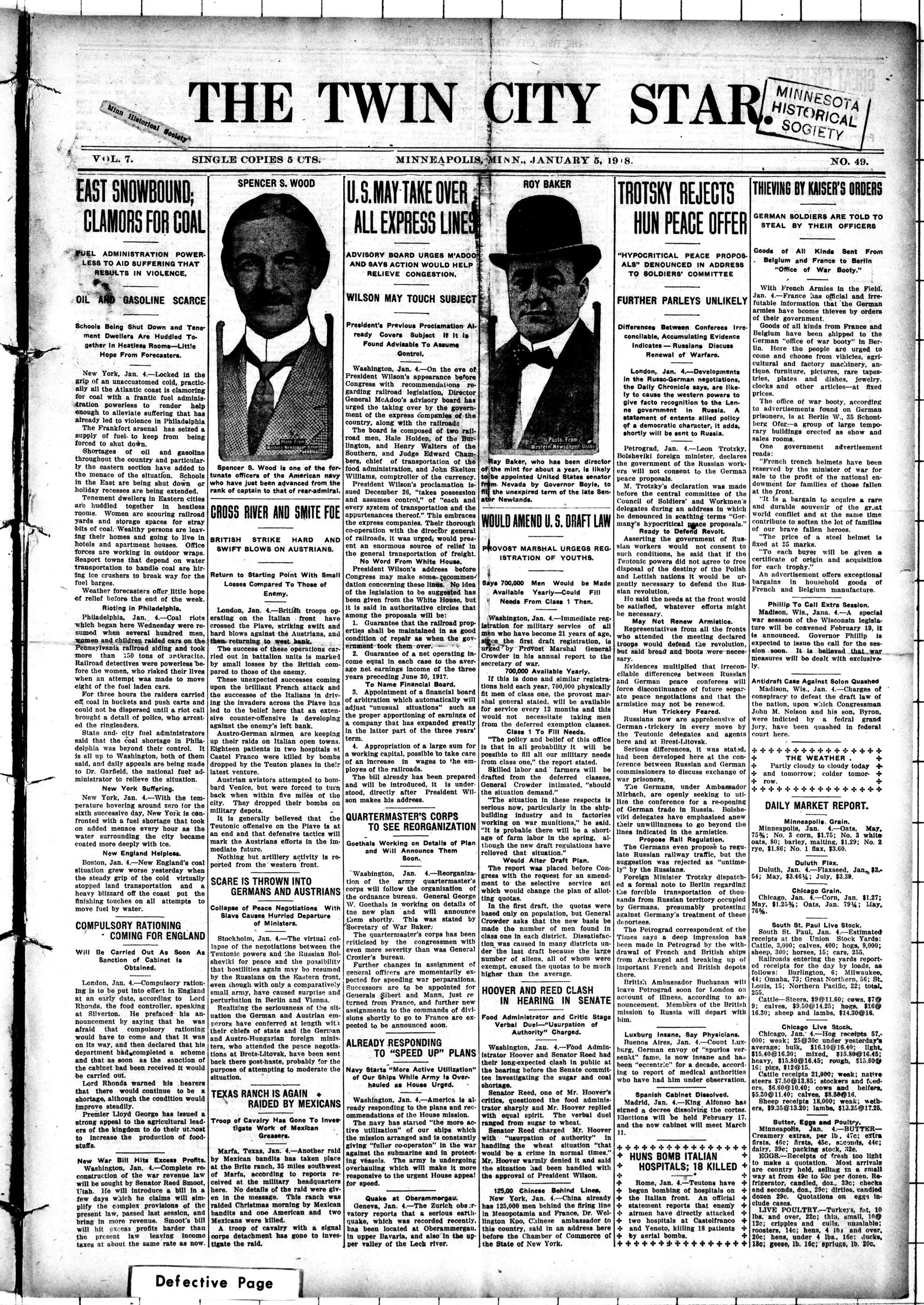
EAST SNOWBOUND; CLAMORS FOR GOAL
FUEL ADMINISTRATION POWER
LESS TO AID SUFFERING THAT
RESULTS IN VIOLENCE.
Schools Being Shut Down and Tenement Dwellers Are Huddled Together In Heatless Rooms—Little Hope From Forecasters.
New York, Jan. 4.—Locked in the grip of an unaccustomed cold, practically all the Atlantic coast is clamoring for coal with a frantic fuel administration powerless to render help enough to alleviate suffering that has already led to violence in Philadelphia. The Frankfort arsenal has seized a supply of fuel to keep from being forced to shut down.
Shortages of oil and gasoline throughout the country and particularly the eastern section have added to the menace of the situation. Schools in the East are being shut down or holiday recesses are being extended. Tenement dwellers in Eastern cities are huddled together in heatless rooms. Women are scouring railroad yards and storage spaces for stray bits of coal. Wealthy persons are leaving their homes and going to live in hotels and apartment houses. Office forces are working in outdoor wraps. Seaport towns that depend on water transportation to handle coal are hiring ice crushers to break way for the fuel barges.
Weather forecasters offer little hope of relief before the end of the week.
Rioting in Philadelphia.
Philadelphia, Jan. 4.—Coal riots which began here Wednesday were resumed when several hundred men, women and children raided cars on the Pennsylvania railroad siding and took more than 150 tons of antaracte. Railroad detectives were powerless before the women, who risked their lives when an attempt was made to move eight of the fuel laden cars.
For three hours the raiders carried off coal in buckets and push carts and could not be dispersed until a riot call brought a detail of police, who arrested the ringleaders.
State and city fuel administrators said that the coal shortage in Philadelphia was beyond their control. It is all up to Washington, both of them said, and daily appeals are being made to Dr. Garfield, the national fuel administrator to relieve the situation.
New York Suffering.
New York, Jan. 4.—With the temperature hovering around zero for the sixth successive day, New York is confronted with a fuel shortage that took on added menace every hour as the water surrounding the city became coated more deeply with ice.
New England Helpless.
Boston, Jan. 4.—New England's coal situation grew worse yesterday when the steady grip of the cold virtually stopped land transportation and a heavy blizzard off the coast put the finishing touches on all attempts to move fuel by water.
COMPULSORY RATIONING COMING FOR ENGLAND
Will Be Carried Out As Soon As Sanction of Cabinet Is Obtained.
London, Jan. 4.—Compulsory rationing is to be put into effect in England at an early date, according to Lord Rhonda, the food controller, speaking at Silverton. He prefaced his announcement by saying that he was afraid that compulsory rationing would have to come and that it was on its way, and then declared that his department had completed a scheme and that as soon as the sanction of the cabinet had been received it would be carried out.
Lord Rhonda warned his hearers that there would continue to be a shortage, although the condition would improve steadily.
Premier Lloyd George has issued a strong appeal to the agricultural leaders of the kingdom to do their utmost to increase the production of foodstuffs.
New War Bill Hits Excess Profits.
Washington, Jan. 4.—Complete reconstruction of the war revenue law will be sought by Senator Reed Smoot, Utah. He will introduce a bill in a few days which he claims will simplify the complex provisions of the present law, passed last session, and bring in more revenue. Smoot's bill will hit excess profits harder than the present law leaving income taxes at about the same rate as now.
Defective Page
New York Suffering.
SINGLE COPIES 5 CTS.
SPENCER S. WOOD
AL
VER-
AT
RCE
the
actic-
bring
minis-
help
has
phia
ed a
eing
line
ular
Photo From
Western News Press
Spencer S. Wood is one of the fortunate officers of the American navy who have just been advanced from the rank of captain to that of rear-admiral.
CROSS RIVER AND SMITE FOE
BRITISH STRIKE HARD AND
SWIFT BLOWS ON AUSTRIANS.
Return to Starting Point With Small Losses Compared To Those of Enemy.
London, Jan. 4.—British troops operating on the Italian front have crossed the Plave, striking swift and hard blows against the Austrians, and then returning to west bank.
The success of these operations carried out in battalion units is marked by small losses by the British compared to those of the enemy.
These unexpected successes coming upon the brilliant French attack and the successes of the Italians in driving the invaders across the Plave has led to the belief here that an extensive counter-offensive is developing against the enemy's left bank.
Austro-German airmen are keeping up their raids on Italian open towns. Eighteen patients in two hospitals at Castel Franco were killed by bombs dropped by the Teuton planes in their latest venture.
Austrian aviators attempted to bombard Venice, but were forced to turn back when within five miles of the city. They dropped their bombs on military depots.
It is generally believed that the Teutonic offensive on the Plae is at an end and that defensive tactics will mark the Austrians efforts in the immediate future. Nothing but artillery activity is reported from the western front.
SCARE IS THROWN INTO GERMANS AND AUSTRIANS
Collapse of Peace Negotiations With Slavs Causes Hurried Departure of Ministers.
Stockholm, Jan. 4.—The virtual collapse of the negotiations between the Teutonic powers and the Russian Bolshevik for peace and the possibility that hostilities again may be resumed by the Russians on the Eastern front, even though with only a comparatively small army, have caused surprise and perturbation in Berlin and Vienna.
Realizing the seriousness of the situation the German and Austrian emperors have conferred at length with their chiefs of state and the German and Austro-Hungarian foreign ministers, who attended the peace negotiations at Brets-Litovsk, have been sent back there post-haste, probably for the purpose of attempting to moderate the situation.
TEXAS RANCH IS AGAIN
RAIDED BY MEXICANS
Troop of Cavalry Has Gone To Investigate Work of Mexican Greasers.
Marfa, Texas, Jan. 4.—Another raid by Mexican bandits has taken place at the Brite ranch, 35 miles southwest of Marfa, according to reports received at the military headquarters here. No details of the raid were given in the message. This ranch was raided Christmas morning by Mexican bandits and one American and two Mexicans were killed.
A troop of cavalry with a signal corps detachment has gone to investigate the raid.
MINNEAPOLIS, MINN., JANUARY 5, 1918.
U.S.MAY TAKE OVER ALL EXPRESS LINES
U.S.MAY TAKE OVER ALL EXPRESS LINES
ADVISORY BOARD URGES M'ADOO AND SAYS ACTION WOULD HELP RELIEVE CONGESTION.
WILSON MAY TOUCH SUBJECT
President's Previous Proclamation Already Covers Subject If It is Found Advisable To Assume Control.
Washington, Jan. 4.—On the eve of President Wilson's appearance before Congress with recommendations regarding railroad legislation. Director General McAdoo's advisory board has urged the taking over by the government of the express companies of the country, along with the railroads.
The board is composed of two railroad men, Hale Holden, of the Burlington, and Henry Walters of the Southern, and Judge Edward Chambers, chief of transportation of the food administration, and John Skelton Williams, controller of the currency.
President Wilson's proclamation issued December 26, "takes possession and assumes control," of "each and every system of transportation and the appurtenances thereof." This embraces the express companies. Their thorough co-operation with the director general of railroads, it was urged, would present an enormous source of relief in the general transportation of freight.
No Word From White House.
President Wilson's address before Congress may make some recommendation concerning these lines. No idea of the legislation to be suggested has been given from the White House, but it is said in authoritative circles that among the proposals will be:
1. Guarantee that the railroad properties shall be maintained in as good condition of repair as when the government took them over.
2. Guarantee of a net operating income equal in each case to the average net earnings income of the three years preceding June 30, 1917.
To Name Financial Board.
3. Appointment of a financial board of arbitration which automatically will adjust "unusual situations" such as the proper apportioning of earnings of a company that has expanded greatly in the latter part of the three years' term.
4. Appropriation of a large sum for a working capital, possible to take care of an increase in wages to the employees of the railroads.
The bill already has been prepared and will be introduced, it is understood, directly after President Wilson makes his address.
QUARTERMASTER'S CORPS TO SEE REORGANIZATION
Goethals Working on Details of Plan and Will Announce Them Soon.
Washington, Jan. 4.—Reorganization of the army quartermaster's corps will follow the organization of the ordnance bureau. General George W. Goethals is working on details of the new plan and will announce them shortly. This was stated by Secretary of War Baker.
The quartermaster's corps has been criticised by the congressmen with even more severity than was General Crozier's bureau.
Further changes in assignment of general officers are momentarily expected for speeding war perparations. Successors are to be appointed for Generals Sibert and Mann, just returned from France, and further new assignments to the commands of divisions shortly to go to France are expected to be announced soon.
ALREADY RESPONDING TO "SPEED UP" PLANS
Navy Starts "More Active Utilization" of Our Ships While Army is Overhaul as House Urged.
Washington, Jan. 4.—America is already responding to the plans and recommendations of the House mission.
The navy has started "the more active utilization" of our ships which the mission arranged and is constantly giving "fuller co-operation" in the war against the submarine and in protecting vessels. The army is undergoing overhauling which will make it more responsive to the urgent House appeal for speed.
Quake at Oberammergau:
Geneva, Jan. 4.—The Zurich observatory reports that a serious earthquake, which was recorded recently, has been located at Oberammergau, in upper Bavaria, and also in the upper valley of the Lech river.
ROY BAKER
Photo From
Western Newspaper Union
Ray Baker, who has been director of the mint for about a year, is likely to be appointed United States senator from Nevada by Governor Boyle, to fill the unexpired term of the late Senator Newlands.
WOULD AMEND U. S. DRAFT LAW
PROVOST MARSHAL URGEGS REG
ISTRATION OF YOUTHS.
Says 700,000 Men Would be Made Available Yearly—Could Fill Needs From Class 1 Then.
Washington, Jan. 4.—Immediate registration for military service of all men who have become 21 years of age, since the first draft registration, is urged by Provost Marshal General Crowder in his annual report to the secretary of war.
700,000 Available Yearly.
If this is done and similar registrations held each year, 700,000 physically fit men of class one, the provost marshal general stated, will be available for service every 12 months and this would not necessitate taking men from the deferred exemption classes.
Class 1 To Fill Needs.
"The policy and belief of this office is that in all probability it will be possible to fill all our military needs from class one," the report stated.
Skilled labor and farmers will be drafted from the deferred classes, General Crowder intimated, "should the situation demand."
"The situation in these respects is serious now, particularly in the ship-building industry and in factories working on war munitions," he said.
"It is probable there will be a shortage of farm labor in the spring, although the new draft regulations have relieved that situation."
The report was placed before Congress with the request for an amendment to the selective service act which would change the plan of allotting quotas. In the first draft, the quotas were based only on population, but General Crowder asks that the new basis be made the number of men found in class one in each district. Dissatisfaction was caused in many districts under the last draft because the large number of aliens, all of whom were exempt, caused the quotas to be much higher than the average.
HOOVER AND REED CLASH IN HEARING IN SENATE
Food Administrator and Critic Stage Verbal Duel—"Usurpation of Authority" Charged.
Washington, Jan. 4.—Food Administrator Hoover and Senator Reed had their long-expected clash in public at the hearing before the Senate committee investigating the sugar and coal shortage.
Senator Reed, one of Mr. Hoover's critics, questioned the food administrator sharply and Mr. Hoover replied with equal spirit. The verbal duel ranged from sugar to wheat.
Senator Reed charged Mr. Hoover with "usurpation of authority" in handling the wheat situation "that would be a crime in normal times." Mr. Hoover warmly denied it and said the situation had been handled with the approval of President Wilson.
125.00 Chinese Behind Lines.
New York, Jan. 4.-China already has 125,000 men behind the firing line in Mesopotamia and France, Dr. Wellington Koo, Chinese ambassador to this country, said in an address here before the Chamber of Commerce of the State of New York.
TROTSKY REJECTS HUN PEACE OFFER
TROTSKY REJECTS HUN PEACE OFFER
"HYPOCRITICAL PEACE PROPOSALS" DENOUNCED IN ADDRESS TO SOLDIERS' COMMITTEE
FURTHER PARLEYS UNLIKELY
Differences Between Conferences Irreconcilable, Accumulating Evidence Indicates — Russians Discuss Renewal of Warfare.
London, Jan. 4.—Developments in the Russo-German negotiations, the Daily Chronicle says, are likely to cause the western powers to give facto recognition to the Lenne government in Russia. A statement of entente allied policy of a democratic character, it adds, shortly will be sent to Russia.
Petrograd, Jan. 4.—Leon Trotzky, Bolshevik foreign minister, declares the government of the Russian workers will not consent to the German peace proposals.
M. Trotzky's declaration was made before the central committee of the Council of Soldiers' and Workmen's delegates during an address in which he denounced in scathing terms "Germany's hypocritical peace proposals."
Ready to Defend Revolt.
Asserting the government of Russian workers would not consent to such conditions, he said that if the Teutonic powers did not agree to free disposal of the destiny of the Polish and Lettish nations it would be urgently necessary to defend the Russian revolution.
He said the needs at the front would be satisfied, whatever efforts might be necessary.
May Not Renew Armistice.
Representatives from all the fronts who attended the meeting declared troops would defend the revolution, but said bread and boots were necessary.
Evidences multiplied that irreconcilable differences between Russian and German peace conferees will force discontinuance of future separate peace negotiations and that the armistice may not be renewed.
Hun Trickery Feared.
Russians now are apprehensive of German trickery in every move by the Teutonic delegates and agents here and at Brest-Litovsk.
Serious differences, it was stated, had been developed here at the conference between Russian and German commissioners to discuss exchange of war prisoners.
The Germans, under Ambassador Mirbach, are openly seeking to utilize the conference for a re-opening of German trade in Russia. Bolshevik delegates have emphasized anew their unwillingness to go beyond the lines indicated in the armistice.
Propose Rail Regulation.
The Germans even propose to regulate Russian railway traffic, but the suggestion was rejected as "untimely" by the Russians.
Foreign Minister Trotky dispatched a formal note to Berlin regarding the forcible transportation of thousands from Russian territory occupied by Germans, presumably protesting against Germany's treatment of these deportees.
The Petrograd correspondent of the Times says a deep impression has been made in Petrograd by the withdrawal of French and British ships from Archangel and breaking up of important French and British depots there.
British Ambassador Buchanan will leave Petrograd soon for London on account of illness, according to announcement. Members of the British mission to Russia will depart with him.
Luxburg Insane, Say Physicians.
Buenos Aires, Jan. 4.—Count Luxburg, German envoy of "spurlos versenk't" fame, is now insane and has been "eccentric" for a decade, according to report of medical authorities who have had him under observation.
Spanish Cabinet Dissolved.
Madrid, Jan. 4.-King Alfonso has signed a decree dissolving the cortes. Elections will be held February 17. and the new cabinet will meet March 11.
HUNS BOMB ITALIAN
* HOSPITALS: 18 KILLED
Rome, Jan. 4.—Teutons have begun bombing of hospitals on the Italian front. An official statement reports that enemy airmen have directly attacked two hospitals at Castelfranco and Yeneto, killing 18 patients by aerial bombs.
NO. 49.
THIEVING BY KAISER'S ORDERS
GERMAN SOLDIERS ARE TOLD TO STEAL BY THEIR OFFICERS
Goods of All Kinds Sent From Belgium and France to Berlin "Office of War Booty."
With French Armies in the Field, Jan. 4.—France has official and unfruitable information that the German armies have become thieves by orders of their government.
Goods of all kinds from France and Belgium have been shipped to the German "office of war booty" in Berlin. Here the people are urged to come and choose from vehicles, agricultural and factory machinery, antique furniture, pictures, rare tapestries, plates and dishes, jewelry, clocks and other articles—at fixed prices.
The office of war booty, according to advertisements found on German prisoners, is at Berlin W., 35 Schontberg Ofer—a group of large temporary buildings erected as show and sales rooms.
One government advertisement reads:
"French trench helmets have been reserved by the minister of war for sale to the profit of the national endowment for families of those fallen at the front.
"It is a bargain to acquire a rare and durable souvenir of the great world conflict and at the same time contribute to soften the lot of families of our brave fallen heroes.
"The price of a steel helmet is fixed at 25 marks.
"To each buyer will be given a certificate of origin and acquisition for each trophy."
An advertisement offers exceptional bargains in household goods of French and Belgium manufacture.
Phillip To Call Extra Session
Madison, Wis., Jana. 4.—A special war sesson of the Wisconsin legislature will be convened February 19, it is announced. Governor Phillip is expected to issue the call for the session soon. It is believed that war measures will be dealt with exclusively.
Antidraft Case Against Solon Quashed
Madison, Wis., Jan. 4.—Charges of conspiracy to defeat the draft law of the nation, upon which Congressman John M. Nelson and his son, Byron, were indicted by a federal grand jury, have been quashed in federal court here.
THE WEATHER.
Partly cloudy to cloudy today and tomorrow; colder tomar row.
DAILY MARKET REPORT.
Minneapolis, Jan. 4—Oats, May,
75%; No. 3 corn, $1.75; No. 3 white
oats, 80; barley, malting, $1.29; No. 2
rye, $1.86; No. 1 flax, $3.60.
Duluth Flax.
Duluth, Jan. 4.—Flaxseed, Jan. $3.54;
May, $3.46¼; July, $3.39.
Chicago Grain.
Chicago, Jan. 4—Corn, Jan. $1.27;
May, $1.25%; Oats, Jan. 79¼; May,
76%.
South St. Paul Live Stock.
South St. Paul, Jan. 4.—Estimated receipts at the Union Stock Yards: Cattle, 3,000; calves, 400; hogs, 9,000; sheep, 300; horses, 15; cars, 255.
Railroads entering the yards reported receipts for the day by loads, as follows: Burlington, 6; Milwaukee, 44; Omaha, 73; Great Northern, 56; St. Louis, 15; Northern Pacific, 22; total, 255.
Cattle—Steers, $9@11.60; cows, $7@9; calves, $9.50@14.25; hogs, $16@16.30; sheep and lambs, $14.30@16.
Chicago Live Stock
Chicago, Jan. 4.—Hog receipts 57,
000; weak 25@30 under yesterday's
average; bulk, $16.10@16.40; light,
$15.40@16.30; mixed, $15.80@16.45;
heavy, $15.80@16.45; rough, $15.80@
16; pigs, $12@15.
Cattle receipts 21,000; weak; native
steers $7.50@18.85; stockers and feeders,
$6.60@10.40; cows and heifers,
$5.30@11.40; calves, $8.50@16.
Sheep receipts 18,000; weak; wethers,
$9.35@13.20; lambs, $13.25@17.25.
Butter, Eggs and Poultry.
Minneapolis, Jan. 4.—BUTTER—
Creamery extras, per lb, 47c; extra
firsts, 46c; firsts, 45c, seconds, 44c;
dairy, 39c; packing stock, 32c.
EGGS.—Receipts of fresh too light
to make a quotation. Most arrivals
are country held, selling in a small
way at from 49c to 50c per dozen. Refrigerator, candled, doz, 39c; checks
and seconds, doz, 29c; dirties, candied
dozen 29c. Quotations on eggs include cases.
LIVE POULTRY.—Turkeys, fat, 10
lbs. and over, 22c; thin, small, 10@
12c; cripples and culls, unavailable;
roosters, 14c; hens, 4 lbs and over,
20c; hens, under 4 lbs, 16c; ducks,
18c; geese, lb. 16c; springs, lb. 20c.
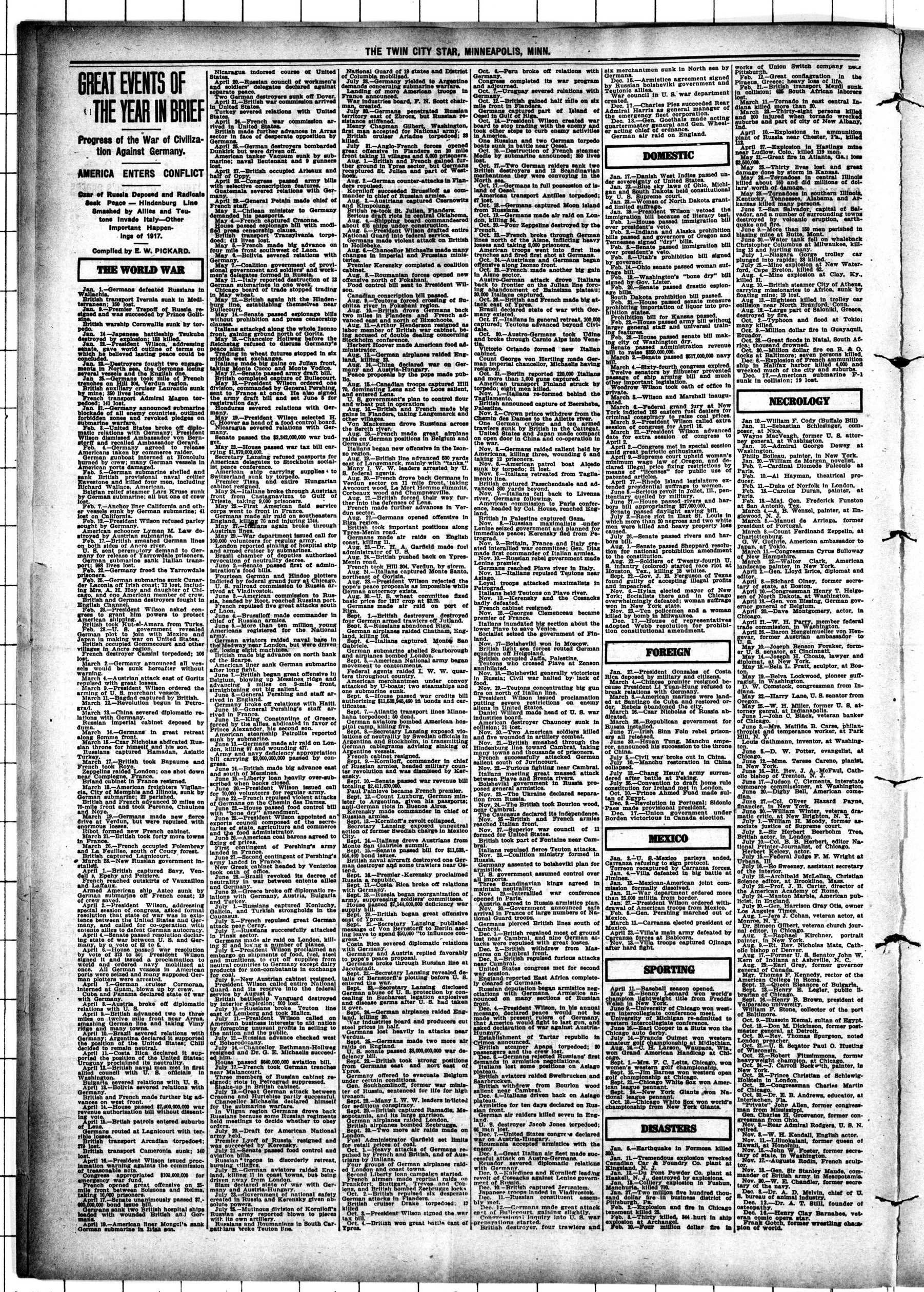
GREAT EVENTS OF THE YEAR IN BRIEF
Progress of the War of Civiliza-
tion Against Germany.
AMERICA ENTERS CONFLICT
Gear of Russia Deposed and Radicale
Seek Peace — Hindenburg Line
Smashed by Allies and Teu-
tons Invade Italy—Other
Important Happen-
ings of 1917.
Compiled by E. W. PICKARD.
THE WORLD WAR
Jan. 1.-Germans defeated Russians in
Mediterranean. Transport invasions sink in Medi-
British warship Cornwallis sunk by torpedo.
14—Japanese battleship Tukuba destroyed by explosion; 1933 killed.
Jan. 22—President Wilson, addressing senate, gave world outline of terms on which a believed lasting peace could be concluded.
Jan. 22. --Destroyers fought two engagements, one involving several vessels and the English one.
French transport Admiral Magon torpedo; 141 lost.
Jam. II.—Germany announced submarine
forbidden zones and revoked pledges on
forbidden zones and revoked pledges on
German gunboat at Honolulu
burned by crew; many German vessels in
the water.
Feb. 8. G- German submarine shellled and
killed by American forces, including
Rivesting and killed four men, including
Belgian relief steamer Lars Kruse sunk
the German submarine; all but one of crew
lost.
Feb. 7- Anchor liner California and other
German submarine; 41 lost on California.
Feb. 12—President Wilson refused parley sought by Germany.
U. B. sent peremptory demand to Germany for release of Yarrowdale prisoners. He sank Italian transport. 88 lives lost. Germany freed the Yarrowdale prisoners.
Feb. 28.—President Wilson asked congress to grant him powers to protect American interests. British took Kut-ei-Amara from Turks. Feb. 18.—U. S. government revealed plans to build a nuclear-powered Japan in making war on United States. British occupied Gommeccur and other villages in Ancre region. French destroyer Cassini torpedoed; 100 loss.
March 11—Bragad captured by British
March 12—Revolution begin in Petro-
town.
March 14.-Germans in great retreat along Somme front.
March 17.—British took Bapume and French took Roye. London; one shot down near Complegne, France. Briand cabinet in France reskinned. March 18.—British took Vigilance of Memphis from Memphis,unk by German submarine; 23 persisted.
British and French advanced 10 miles on
10-mile trail and took Peronne, Chaulnes
and Cahors.
March 19.-Germans made new fierce drive at Verdun, but were repulsed with fire. Hibot formed new French cabinet. March 21.-British took forty more towns in France. March 22.-French occupied Folembay and La Feuillee, south of Coucy forest. British captured Lagnicourt. March 23.-New Russian government in
Armed American ship Atec sunk by
German naval jungle off French coast;
of gray ships.
April 2—President Wilson, addressing
resolution that state of war was in existence
between the United States and Germany,
entirely aims to defeat German authority.
April 4—Senate passed resolution declaring state of war between U. S. and Germany. April 4—House passed war resolution by vote of 373 to 50; President Wilson by vote of 315 to 50. World and ordered naval mobilized at once. All German vessels in American waters were supposed German plotters were arrested. April 7—German cruiser Cormoran, interned at Guam, blown up by crew. April 8—Germany declared state of war with Germany. April 8—Austria broke off diplomatic relations. April 8—British advanced two to three miles on twelve mile front near Arrau, and taking Vimy rides and many towns.
April 13—Brazil severed relations with
the United States, the position of the United States. Chili
reached an agreement with Brazil.
April 11 - Costa Rica declared it sup-
pressed. States: Brazil, Hungary, proclaimed its neutrality.
April 14—British naval men met in first allied council with U. S. officials in Wellington.
Bulgaria severed relations with U. S.
April 14—Bolivia severed relations with U. S.
British and French made further big advances on west front.
April 14—House passed $7,000,000 war resolution authorization hill without dissenting vote.
April 15—British patrols entered suburb of Germans routed at Lagnicourt with terrible losses.
British transport Arcadian torpedoe4; 290 lost.
British transport Cameronia sunk; 140 lost.
April 16—President Wilson issued proclamation warning against the commission of reasonable acts.
President Wilson instituted $100,000,000 for emergency war fund.
French opened great offensive on 25,000 prisoners and Reims, taking 16,000 prisoners.
April 17—Sanitary unanimously passed $7,000,000 bond issue by 16,000 British hospital ships loaded with wounded British and German.
April 18—American liner Mongole sank German submarine in Jiao seas.
---
Nicaragua indorsed course or United States.
April 26—Russian council of workers' delegates declared against separate peace.
British made further advances in Arras
place of deserts of the
Germany.
April 27.-British occupied Arlesaux and half of Opay.
November passed army bills with selective conscription features.
Guatemala severed relations with Germany.
April 28.-General Petain made chief of French staff.
May 3.-Chilean minister to Germany may 4.-French captured Cronaone.
House passed espionage bill with modified press censorship clause.
May 12.-Tanzania torpedoed: 415 lives lost.
May 15.-French made big advance on Okinawa southwest of Lima.
May 6.-Bolivia relations with Germany.
May 7.-Coalition government of provisional leaders degrades formed in Russia.
May 14.-Senate passed emptionion bills
prohibition and press censorship
clauses.
Tallang made big gains on Shuraf, June
May 17. -Senate passed army draft bill.
British completed capture of Bulecourt,
President Owen Opponent on division,
concession, by Queen Elizabeth Parvish
sent to France at once. He also signed
the army draft bill and set June 5 for
registration day.
Honduras severed relations with Germany.
McKenna - President Wilson selecte
Cisco coverter
Nicaragua severed relations with Gorman
Senate passed the $3,342,000,000 war budget.
May 23—House passed war tax bill carrying $1,800,000. money refused passports for American delegates to Stockholm socialist peace conference.
May 24.-Italians broke through Austrian
banks and entered Gulf of Trieste
taking 9,600 prisoners.
May 25.-First American field service
troops landed in southern Germany.
Germans made air raid on southeastern
England, killing 75 and injuring 744.
Germans again broke through
Austrian lines.
revocation of neutrality decree.
receiving the first of administration's food bills.
Fourteen German and Hindoe plotters
U. S. railroad commission to Russia
U. S. railroad commission to Russia
June 3.--American commission to Russian forces has been appalled by the punishing five great attacks south of Leon. --Bruzoff made commander in chief of Russian armies. June 5.--More than ten million young Americans registered for the National Army.
June 7—British began great offensive in Belgium, blowing a ridge and ridge, straightening out $9-mile front, straightening out big salient. June 12—Perishing and staff arriving in England. Germany broke off relations with Hattit. June 13—German Perishing* staff arriving in France.
don, and
army that navy deficiency appropriation
bill carrying $600,000,000 passed by con-
gress
of Germania on the Chemien des Dames. of Germania on the Chemien des Dames. control with bona dry amendment. with bona dry amendment.
First contingent of Pershing's army landed in France. Second contingent of Pershing's army landed in France. New Greek cannon headed by Venizelos office. June 22.-Brazil revoked its decree of nequity and war between allies against Germany. June 23.-Greece broke off diplomatic relations with Germany, Austria, Bulgaria and Turkey.
July 1—Russians captured Konchuk, and Turks strongholds in the Chinchun
July 11
engage on shipments of food, fuel, steel and munitions, to cut off supplies from Iraq and Syria, to produce products for non-combatants in exchange for coal.
— New Austrian cabinet resigned.
President Wilson called entire National Guard and serve into the federal army. August 8.
July 11. H.-President Wilson called on American leaders to help byforgetting and the public in selling to them the products and the public.
July 12.-Russian advance checked west of Bohorodany.
Resigned and Dr. G. E. Michaels succeeded him.
House passed $640,000,000 aviation bill.
July 17.—French took German trenches near Malancourt.
Three members of Russian cabinet resigned; riots in Petrograd suppressed.
Shake-up in British cabinet.
July 19.—Great German attack between Croneine and Huriebise partly successful.
Chancellor Michaells declared himself for the submarine warfare.
In "Vilgen region Germans drove back Russians because some Russian regiments held meetings to decide whether to obey orders.
July 22—Draft for American National army.
Premier Lloyd of Russia resigned and was succeeded by Karenvsky.
July 22—Government passed food control and aviation bills.
Russians *stip* in disorderly retreat, bringing troops in in distress, July 22—German aviators raided England, killing 11 in coast town, but being defeated by Siam declared state of war with Germany and Austria-Hungary.
Siam created state of war with Germany and Austria-Hungary.
Russians in Karenusky given absolute powers.
Russians in division of Kornilovskiy Russian army reported blown to pieces with its own artillery.
Russians and Romanians in South Carpathians wrote Teton Ena.
THE TWIN CITY STAR, MINNEAPOLIS, MINN.
National Guard of 19 states and District Oct. 8-Peru broke off of Columbia mobilised.
Germany. Relieved to Argentina. Completed it.
demands concerning submarine warfare. Landing of more American troops in the Pacific, the war industries board, F. N. Scott chairman, manned warships. Armament penetrated Russian territory east of Zbrozc, but Russian resistance elicited of Zbrozc, Henry Gilbert, Washington, first man accepted for National army. Henry cruiser Arlane torpeded; 38 killed.
July 31.-Anglo-French forces opened
spendall hill to attack 11 villages and
500 prisoners. The ground in pyre sector, but
the ground in pyre sector, but the
recaptured St. Julien and part of West-
land.
British re-took St. Julian, Flanders. Serious blotts in central Paris and London commandeered about 65 ships under construction. Aug. 5. President Wilson drafted entire plan to harden into feeble defenses. Germans made violent attack on British in Hollebeke. Aug. 6. Chancellor Michaels made many changes in imperial and Prussian ministerial
Premier Kerensky completed a coalition cabinet.
Canadian conscription bill passed.
Teutons forced resisting of Sutch
wife, who was a member of the
Aug. 16—British drove Germans back
from the island of Borneo and east of Birochoe,
with the arrival of the British.
Herbert Hoover made American food administrator.
Aug. 12–German airplanes raided England. Aug. 14–China declared war on Germany and Austria-Hungary. Peace proposals by the pope made public. Aug. 15–Canadian troops captured Hillary Clinton and the Los sallent, and entered Lenox. U. S. government's plan to control flour mills was defeated. Aug. 16–British and French made big gains in Flanders, taking Langelamark and on to the Netherlands. Von Mackensen drove Russians across the Sereth river. Aug. 17–Germany made great airplanes raids on German positions in Belgium and Germany. Germany began new offensive in the Isson region.
Aug. 20.-French drove back Germans in Verdun sector on 11 mile front, taking Avocourt wood, Le Mort Homme summits, Corbeaux wood and Champneuville.
Germans made air raids on English coast, killing 11.
Aug. 28.—President Wilson rejected the pope's peace proposals as impossible while Gen. Augustine O'Brien, 20-U. S. wheat committee fixed basic price for 1317 crop at $2.50. Germans made air raid on port of Riga. Sept. 1. British destroyers destroyed for the first time 100 Russians. Sept. 3. Russians abandoned Riga. German airplanes raided Chatham, England. Sept. 4. Russians captured Monte San Gabriele. Sept. 5. American National army began movement to cantonments. Sept. 5. American National army began movement to cantonments. Sept. 5. I. W. W. quarters throughout country. American merchantman under convoy two steamships and one submarine sunk. Sept. 6. House passed war credit bills amounting to $11,538,449 in bonds and certificates.
Sept. 8—Secretary Lanning exposed violations or new threats to stockholm in transmitting German cablogramms advising sinking of AAA ships. French cabin resigned. Sept. 9—Korniloff, commander in chief of the revolution and was dismissed by keenaky. Sept. 10—Senate passed war revenue bill totaling $41,670,000.
Secretary Lansing exposed unnatural action of former Swedish charge in Mexico
British naval aircraft destroyed one German destroyer and some trawlers near Os-
Sept. 18 — Russia began reorganization of
the army. House passed $7,144,000 deficiency war
supply bill.
British began great offensive
attack on XPCS.
Costa Rica severed diplomatic relations with Germany. The United States and Austria replied favorably to pope's peace proposal. Germans broke through Russian line at Jupiter on Sept. 27—Secretary Lansing revealed details of the soffr's plotting before U. S. forces.
Sept. 8. Secretary Lansing disclosed German abuse of U. B. protection by concealing in Bucharest legislation explosives that germa erase U. B. had taken it over.
Sept. 24.-German airplanes raided England, killing 20.
Sept. 26—British took strong positions from Germans east and nort east of France. Germany offered to evacuate Belgium under certain conditions. Gen. Soukhomlinoff, former war minister, sentenced for life for high treason.
British airplanes bombed Zeebrugge.
In two more air raids made on London.
Four groups of German airplanes raided London and New York on September 2. Second Liberty lion campaign started. French airmen made reprisal raids on Britain and Germany. French and Colonels, and British bombed Zeebrugge locks. Oct. 2—British repulsed six desperate German attacks in Paris. German cruiser Drake torpedoed: 19 killed Oct. 3—President Wilson signed the war tax bill. Oct. 4—Britain won great battle cent of Ypres.
Oct. 12.-Two German raiders sank two British destroyers and 12 Scandinavian merchantmen they were convoying in the North sea.
Oct. 17.—Germans in full possession of island of Ossel.
Oct. 21—French brok through German
losses and taking 860 prisoners
losses and taking 860 prisoners
Oct. 25.-French made another big gain in Alsne sector.
Austro-German attack drives Italian
limbs against the Balkans' plateau.
Oct. 27.-Italians in general retreat, 100,000 captured; Teutons advanced beyond Civillian. Oct. 28.-Austro-Germans took Udine and broke through Carlo Alpi into Venezio. Vittorio Orlando formed new Italian cabinet. George von Hertling made German imperial chancellor, Michaelus having regained. Berlin reported 120,000 Italians and more than 1,000 guns captured. American transport Finland struck by torpedo; eight men killed. Italian men re-formed behind the Tagliamento.
British announced capture of Beersheba, Palestine.
Nov. 8. -Germans raided salient held by
Nakou. -Germans ridden three, wounding 6 and
taking 12 prisoners.
American commission to Paris conference, headed by Col. House, reached England. British in Palestine captured Gaza. Nov. 8.-Russian maximalists - under Lennie seized government and planned for peace; Kerensky fled from Petrograd. Nov. 9.-Britain, France and Italy created committee; Gen. Lennie made first command; Gen. Nassau November 10.-Russian rebel government made Lennie premier. Governments reached Plaive river in Italy. Nov. 11.-Italians repulsed Teutons near Assigio.
Loyal troops attacked maximalists in Petrograd.
Iialians held Teutons on Flame river
Northeast, enniesky and the Cossacks
badly defeated.
Nov. 17—Bolshevik won in Moscow. The Russians routed German squadron of Helgaskan. British occupied Jaffa, Palestine. Teutons who crossed Plateau at Zonsan and Sassafras. British occupied Hegelmann. Nov. 18—Bolshevik generally victorious in Russia; Civil war halted by lack of food. Nov. 19—Teutons concentrating big gun fire on north of Italian line. Proclamation putting severe restrictions on enemy allies in United States. American made head of U. S. war industry board. American destroyer Chauncey sunk in collision for the first American soldiers killed and five wounded in artillery combat. Nov. 21—British smashed through the Himalayas many towns and thousands of prisoners. French successfully attacked German cities. Nov. 22—Furious fighting near Cambal. Italians meeting great massed attack between Plateau and Brenta rivers. Nov. 23—British in Russia proposed general armistice. Nov. 23—The Ukraine declared separation from Russia. Nov. 24—British took Bourlon wood, near Cambal. The Caucasus declared its independence. Nov. 25—British took French armies reached Italian front.
Nov. 27.—Superior war council of 11 formed for United States. British took part of Fontaine near Cambridge. Italianans repulsed fierce Teuton attacks. Nov. 28.—C coalition ministry formed in Rhineland. Germany assented to bolahevki plan for armistice. Government assumed control over all imports.
Austria agreed to Russia armistice plan
in 1918. The plan was to allow a
arrival in France of large numbers of Nazi
submarines.
Germans pierced British lines south of Cambrai. - British resigned most of ground lost near Cambrai, and nine German attacks were repulsed with great losses. - French resumed from Masteniers on Cambrai front. Dec. 8. - British resurged furious attacks near Cambrai. - United States congress met for second war session. England reported East Africa completed by Germans. - Russian deputation began armistice negotiations with Germans. Armistice announced on many sections of Russian
Dec. 4. - President Wilson, in his annual
declaration, made with present rulers of
Germany, that America would fight to last gun,
and declaration of war against Austria-
Hungary.
Dec. 8.-Germany rejected Russians' first attempt to take control of the Italian lost some positions on Aslago plateau.
British aviators raided Sweibrucken and Saarbrücken.
Andrew from Bourdon wood saillent near Cambrai.
Dec. 8.-Italians driven back on Aslago plateau.
war on Austria-Hungary.
Austria accepted armies with the enemy.
Dec. 8.-Great Italian air fleet made successive victories against Germans.
Rearward seved diplomatic relations with Germany.
Dec. 9.-British forces and Korniloff leading revolt of Cossacks against Lennie government of Russia.
Dec. 10.-British captured Jerusalem.
Japanese troops landed in Vladivostok.
Dec. 11.-Russian constituent assembly met.
Dec. 12.-Germans made great attack east of Bullecourt, gaining slightly.
Conventional history into U.S. war promotions started.
British destroyer, four trawlers and
Telfont unites.
War council in U. S. war department
crested. 7—Charles Plex succeeded Ream
Admiral Harris as governor or corporation of
the U.S.
DOMESTIC
by U. B. Supreme court
North Dakota granted
limited suffrage
Jan. 29—President Wilson vetosed the immigration bill because of literacy test. The bill passed immigration bill over president's veto. Feb. 1. India and Alaska prohibition bills passed and governors of Oregon and Hawaii passed immigration bill over president's veto. Feb. 5—Senate passed immigration bill over president's veto. Mahathi's prohibition bill signed by governor. Feb. 14—Ohio senate passed woman suffrage bill. Feb. 19—Washington's "bone dry" bill signed by Gov. Lister. Feb. 20—Senate passed drastic esplosion bill. South Dakota prohibition bill passed. Feb. 21—House passed senate measure prohibiting importation of liquor into pro-immigration Prohibition bill for Kansas passed. Feb. 22—House passed army bill without license staff and universal training features.
March 4—Sixty-fourth congress expired. Twelve members of the board of ship armed bill and much other important legislation. Woodrow Wilson took oath of office in March 5—Wilson and Marshall inaugurated. March 6—Federal grand jury at New York indicted 163 eastern fuel dealers for criminal conspiracy to raise coal prices. March 7—Federal court added extra session of congress for April 18. March 21—President Wilson advanced date for extra session of congress to April 2. Congress met in special session amid great patriotic enthusiasm. President Obama held woman's minimum wage law of Oregon, and declared illegal price fixing restrictions by patented articles.
June 27—House passed rivers and harbors bill appropriating $27,000,000.
Senate passed daylight saving bill.
July 2—Race riot in East St. Louis in which more than 20 negroes and two white men were killed and heavy property loss caused.
July 26.-Senate passed rivers and harbors bill.
Aug. 1.-Senate passed Sheppard resolution to prohibit amendment to the constitution. Aug. 21.-Soldiers of Twenty-four U. at Houston, Tex., killing 15 whites.
Sept. 22—Gov. J. E. Ferguson of Texas
accepting illegal pronts
and impaired.
Nov. 6. -Hylan elected mayor of New York overwhelmingly defeated; woman suffrage won in New York state. Overwhelmingly defeated and a woman killed by bomb in Milwaukee. Dec. 17. -House of representatives defeated prohibition constitutional amendment
FOREIGN
March 4- Chinese premier resigned because President Li Yuan-Hung refused to break relations with Germany. The president landed at Santiago de Cuba and restored order. Rebels abandoned the city. March 13- Carz Nicholas of Russia ab-
June 20—Hsuan Tung, Manchu empire
has succeeded his succession to the throne
of China.
July 5.-Civil war broke out in China.
July 10.-Manchu restoration in China collapsed.
July 12.-Chang Hsun's army surrendered after battle at Peking.
July 26.-Convention to draft home rule constitution for Ireland met in London.
June 16.-Ahmed Fund made sultan of Egypt.
Dec. 8.-Revolution in Portugal; Sidonie Paas made provisional president.
July 18.-Borden victorious in Canada election.
MEXICO
Jan. 15.—Mexican-American joint commission forces ordered more than 25,000 militia from border.
Jan. 27.—President Wilson ordered withdrawn of American troops from Mexico.
Feb. 16.—Gen. Pershing matched out of Mexico.
March 11.—Carranza elected president of Mexico.
April 23.—Villa's main army defeated by Carranza forces at Babcica.
April 23.—American troops captured Ojlnaga after hard fight.
SPORTING
May 21—Bennany, Iceland open.
May 28—Walsh, Iceland open.
World's
Walsh in New York.
The
Walsh in New York.
June 8—University of Chicago won west
east division of the University of Michigan re-admitted to western intercollegiate conference.
University of Michigan in a Stuts won the
University auto derby.
July 14—Francis Gulmet won western amateur golf championship at Midlothian. He won C. H. Larson, Waupac, Wits. won Grand American Handicap at Chicago.
Sept. 1—Mrs. F. C. Lett, Chicago, won
Sept. 10—Mrs. F. C. Lett, Chicago, won
Sept. 15—Jim Barrens won western open
week.
Oct. 18.-Chicago White Sox won world's championship from New York Giants.
DISASTERS
Jan. 5.—Earthquake in Formosa killed 300.
Jan. 11.—Tremendous explosion wrecked Canadian Car & Foundry Co. plant at Kingland, N. J.
Jan. 12.—N. J. host Powder Co. plant at Haskell, N. J., destroyed by explosions.
Jan. 18.—Colliery explosion in Fushun, Manchuria, killed 70.
Jan. 21.—Two million five hundred thousand dollar fire in business district of Pittsburgh, Pa.
Jan. 26.—Explosion and fire in Chicago tenement killed 20.
Feb. 8.—Thirty killed, 844 hurt in ship explosion at Archangel.
Feb. 12.—Four million dollar fire in
works of Union Switch company near Pittsburgh.
Marcus 10 injured in eight persons who wrecked suburbs and part of city of New Albany,
April 10—Explosions in ammunition plant Russia near Chester, FZ, killed 11.
April 27.—Explosion in Hastings mine near Ludlow, Colo., killed 119 men. May 21.—Great fire in Atlanta, Ga.; 105 ± 100,000.
May 22.—Thirty lives lost and great damage done by storm in Kansas. May 24.—Major and central Illinois killers about 150 and did millions of dollars' worth of damage.
May 25.—Tornadoes in southern Illinois, Kentucky, Tennessee, Alabama and Arkansas called the massacre of the United States.
May 7.—San Salvador, capital of Salvador, and a number of surrounding towns destroyed by volcanic eruption, earthquake and fire.
June 1.—More than 150 men perished in blasing mine at Butte, Mont.
June 30.—Water tank fell on whaleback Christopher Columbus, Milwaukee, killing in a hightfall many.
July 1.—Niagara, Gorge, trolley car plunged into rapids; 28 killed.
July 25.—Mineral,粟, and New Water, and Coke Bretons killed 62.
Aug. 4.—Mine explosion at Clay, Ky., killed 31.
Aug. 10.—British steamer City of Athens, which was missionaries to Africa, sunk by floating mine; 19 lost.
Aug. 13.—Eighteen killed in trolley car colliion near North Branford, Conn.
Aug. 18.—Large part of Saloniki, Greece, destroyed by fire.
Oct. 1.—Typhoon and flood at Tokio; many killers.
August 11.—Million dollar fire in Guasaquill.
Oct. 23.-Great floods in Natal, South Africa; thousand drowned.
Oct. 30. "Million dollar fire on B. O. L.," said the firefighter. Dec. 6. "Explosions of French ammunition in the city." Wrecked much of the city and suburbs. Dec. 17. "American submarine F-1."
NECROLOGY
Jan 10. - William F. Cody (Buffalo Bill)
Jan 11. - Sebastian Schlesinger, composer, at Nice.
Wayne F. Macear, former U. S. attorney, at Washington.
Jan 18. - Admiral George Dewey at Washington.
Feb. 10. -Al Hayman, theatrical producer.
March 5—Manuel de Arriga, former president of Portugal.
March 6—Ferdinand Zeppelin, at Charlottenburg.
G. W. Guthire, American ambassador to March 11—Congressman Cyrus Sulloway of New Hampshire.
March 12—Walter Clark, American minister to New York.
March 12—Gen. Lloyd Jr. diplomat and editor.
March 18—Richard Olney, former secretary of state, at Boston.
April 10—Congressman Henry T. Helgeson of North Dakota, at Washington.
April 10—German government general of Belgium.
April 20—Dave Montgomery, actor, in Chicago.
April 21—W. H. Parry, member federal trade commission, in Washington.
April 26—Baron Hengelmüller von Hengevar, former Austrian ambassador to
diplomat, at New York.
May 13—Bela L. Pratt, sculptor, at Boston.
May 22-Harry Lane, U. S. senator from Oregon
June 3.-Mrs. Mattida B. Carse, philan-
tizer and temperance worker, at Park
Hill.
Louis Gathmann, inventor, at Washington.
June 16.-Rt. Rev. J. A. McFaul, Catholic bishop of Trenton, N. J.
June 17-Judson C. Clementa, interstate attorney
June 18-Albert Bell, American comedian
June 20-Digby Bell, American comedian
June 27-Col. Oliver Hazard Payne, financer, in New York.
June 28-William Winter, veteran drafter
June 29-William H. Moody, former associate justice of Supreme court
July 1-William H. Moody, former associate justice of Supreme court
July 10-Col. B. B. Herbert, editor Natalie of Chicago
Herbert Kelcoy, actor
July 15-Federal Judge F. M. Wright at U.S. District Court
July 18-Bo Swensen, assistant secretary
July 14, 2017 Harrison Gray Otsa, owner
Luke Jelley, assistant Aug. 1, 2017 J. Cohen, actor at man,
Aug. 1, 2017 J. Cohen, actor at man
W. Kern of Indiana at Asheville, N. C.
Aug. 23—Barl Earl, former governor
Mgr. Thomas F. Kennedy, rector of the
American College in Rome.
Mgr. Thomas F. Kennedy of Bulgaria.
Sept. 13—Henry E. Leger, public librarian of Chicago.
Brown, president of Valparaiso university.
William F. Stone, collector of the port of Oc.
Oct. 9—Hussin Kemal, suitor of Egypt.
Oct. 15—Don M. Dickinson, former postmaster general, at Detroit.
Thomas Spurgeon, noted London preacher.
Oct. 21—U. S. Segator Paul O. Husting
Oct. 22—Robert Fitzsimmon, former heavyweight champion, at Chicago.
Carroll Beck* with painter, is New York.
Oct. 26 Prince Christian of Schlewig-
Oct. 27 Congressman Charles Martin
gresman from Ohio
—Near Admiral Rodgers, U. S. N.
retired.
Nov. 11, W. H. Kendall, English actor.
Nov. 14, W. H. Kendall, former queen of
Hawaii, at Honolulu.
commander of British army in Mesopotamia,
Chandler, former secretary
of the navy.
Dec. 18.—Henry Clay Barnabee, veteran comic opera star.
Frank Gotch, former wrestling champion of world.
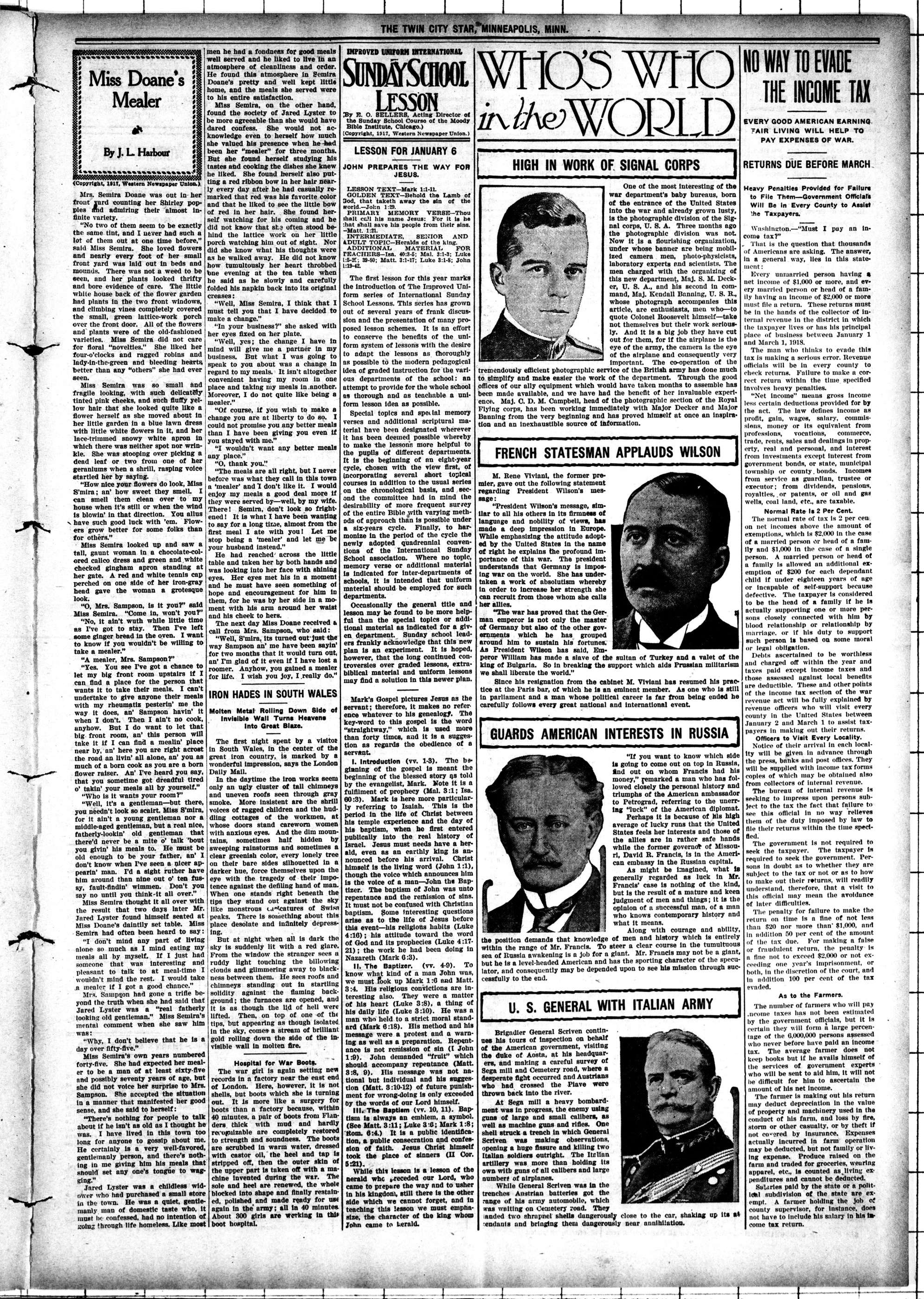
Miss Doane's Mealer
By J. L. Harbour
(Copyright, 1917, Western Newspaper Union.)
Mrs. Semira Doane was out in her front yard counting her Shirley popples and admiring their almost infinite variety.
"No two of them seem to be exactly the same tint, and I never had such a lot of them out at one time before," said Miss Semira. She loved flowers and nearly every foot of her small front yard was laid out in beds and mounds. There was not a weed to be seen, and her plants looked thrifty and bore evidence of care. The little white house back of the flower garden had plants in the two front windows, and climbing vines completely covered the small, green lattice-work porch over the front door. All of the flowers and plants were of the old-fashioned varieties. Miss Semira did not care for floral "novelties." She liked her four-o'clocks and ragged robins and lady-in-the-green and bleeding hearts better than any "others" she had ever seen.
Miss Semira was so small and fragile looking, with such delicately tinted pink cheeks, and such fluffy yellow hair that she looked quite like a flower herself as she moved about in her little garden in a blue lawn dress with little white flowers in it, and her lace-trimmed snowy white apron in which there was neither spot nor wrinkle. She was stooping over picking a dead leaf or two from one of her geraniums when a shrill, rasping voice startled her by saying.
"How nice your flowers do look, Miss Smira; an' how sweet they smell. I can smell them clean over to my house when it's still or when the wind is blowin' in that direction. You allus have such good luck with 'em. Flowers grow better for some folks than for others."
Miss Semira looked up and saw a tall, gaunt woman in a chocolate-colored calico dress and green and white checked gingham apron standing at her gate. A red and white tennis cap perched on one side of her iron-gray head gave the woman a grotesque look.
"O, Mrs. Sampson, is it you?" said Miss Semira. "Come in, won't you?" "No, it ain't wuth while little time as I've got to stay. Then I've left some ginger bread in the oven. I want to know if you wouldn't be willing to take a mealer."
"A meier, Mrs. Sampson?"
"Yes. You see I've got a chance to let my big front room upstairs if I can find a place for the person that wants it to take their meals. I can't undertake to give anyone their meals with my rheumatitz pesterlin' me the way it does, an' Sampson havin' it when I don't. Then I ain't no cook, anyhow. But I do want to let that big front room, an' this person will take it if I can find a mealin' place near by, an' here you are right across the road an livin' all alone, an' you as much of a born cook as you are a born flower raiser. An' I've heard you say, that you sometime got dreadful tired o' takin' your meals all by yourself."
Who is it when you meet "Well, it's a gentleman—but there, you needn't look so scary. Miss S'mira, for it ain't a young gentleman nor a middle-aged gentleman, but a real nice, fatherly-looking' old gentleman that there'd never be a mite o' talk 'bout you gvin' his meals to. He must be old enough to be your father, an' I don't know when I've seen a nicer appearin' man. I'd a sight ruth have him around than nine out o' ten fussy, fault-findin' wimmen. Don't you say no until you think-it all over." Miss Semira thought it all over with the result that two days later Mr. Jared Lyster found himself seated at Miss Doane's daintly set table. Miss Semira had often been heard to say:
"I don't mind any part of living alone so much as I mind eating my meals all by myself. If I just had someone that was interesting and pleasant to talk to at meal-time I wouldn't mind the rest. I would take a mealer if I got a good chance."
Mrs. Sampson had gone a trifle beyond the truth when she had said that Jared Lyster was a "real fatherly looking old gentleman." Miss Semira's mental comment when she saw him was:
"Why, I don't believe that he is a day over fifty-five."
Miss Semira's own years numbered forty-five. She had expected her mealer to be a man of at least sixty-five and possibly seventy years of age, but she did not voice her surprise to Mrs. Sampson. She accepted the situation in a manner that manifested her good sense, and she said to herself:
"There's nothing for people to talk about if he isn't as old as I thought he was. I have lived in this town too long for anyone to gossip about me. He certainly is a very well-favored, gentlemanly person, and there's nothing in me giving him his meals that should set any one's tongue to wagging."
Jared Lyster was a childless widower who had purchased a small store in the town. He was a quiet, gentlemanly man of domestic taste who, it must be confessed, had no intention of going through life homeless. Like most
men he had a fondness for good meals well served and he liked to live in an atmosphere of cleanliness and order. He found this atmosphere in Semira Doane's pretty and well kept little home, and the meals she served were to his entire satisfaction.
Miss Semira, on the other hand, found the society of Jared Lyster to be more agreeable than she would have dared confess. She would not acknowledge even to herself how much she valued his presence when he had been her "mealer" for three months. But she found herself studying his tastes and cooking the dishes she knew he liked. She found herself also putting a red ribbon bow in her hair nearly every day after he had casual remarked that red was his favorite color and that he liked to see the little bow of red in her hair. She found herself watching for his coming and he did not know that she often stood behind the lattice work on her little porch watching him out of sight. Nor did she know what his thoughts were as he walked away. He did not know how tumultously her heart throbbed one evening at the tea table when he said as he slowly and carefully folded his napkin back into its original creases:
"Well, Miss Semira, I think that I must tell you that I have decided to make a change."
"In your business?" she asked with her eyes fixed on her plate.
"Well, yes; the change I have in mind will give me a partner in my business. But what I was going to speak to you about was a change in regard to my meals. It isn't altogether convenient having my room in one place and taking my meals in another. Moreover, I do not quite like being a mealer."
"Of course, if you wish to make a change you are at liberty to do so. I could not promise you any better meals than I have been giving you even if you stayed with me."
"I wouldn't want any better meals any place."
"O. thank you."
"The meals are all right, but I never before was what they call in this town a 'mealer' and I don't like it. I would enjoy my meals a good deal more if they were served by—well, by my wife. There! Semira, don't look so frightened! It is what I have been wanting to say for a long time, almost from the first meal I ate with you! Let me stop being a 'mealer' and let me be your husband instead."
He had reached across the little table and taken her by both hands and was looking into her face with shining eyes. Her eyes met his in a moment and he must have seen something of hope and encouragement for him in them, for he was by her side in a moment with his arm around her waist and his cheek to hers.
The next day Miss Doane received a call from Mrs. Sampson, who said:
"Well, S'mira, its turned out! just the way Sampson an' me have been sayin' for two months that it would turn out, an' I'm glad of it even if I have lost a roomer. Anyhow, you gained a mealer for life. I wish you joy, I really do."
IRON HADES IN SOUTH WALES
Molten Metal Rolling Down Side of Invisible Wall Turns Heavens Into Great Blaze.
The first night spent by a visitor in South Wales, in the center of the great iron country, is marked by a wonderful impression, says the London Daily Mall.
In the daytime the iron works seem only an ugly cluster of tall chimneys and uneven roofs seen through gray smoke. More insistent are the shrill voices of ragged children and the huddling cottages of the workmen, at whose doors stand careworn women with anxious eyes. And the dim mountains, sometimes half hidden by sweeping rainstorms and sometimes a clear greenish color, every lonely tree on their bare sides silhouetted in a darker hue, force themselves upon the eye with the tragedy of their impotence against the defiling hand of man. When one stands right beneath the tips they stand out against the sky like monstrous catacultures of Swiss peaks. There is something about this place desolate and infinitely depressing.
But at night when all is dark the sky is suddenly lit with a red glare. From the window the stranger sees a ruddy light touching the billowing clouds and glimmering away to blackness between them. He sees roofs and chimneys standing out in startling solidity against the flaming background; the furnaces are opened, and it is as though the lid of hell were lifted. Then, on top of one of the tips, but appearing as though isolated in the sky, comes a stream of brilliant gold rolling down the side of the invisible wall in molten fire.
Hospital for War Boots.
The war girl is again setting new records in a factory near the east end of London. Here, however, it is not shells, but boots which she is turning out. It is more like a surgery for boots than a factory because, within 40 minutes, a pair of boots from Flanders thick with mud and hardly recognizable are completely restored to strength and soundness. The boots are scrubbed in warm water, dressed with castor oil, the heel and tap is stripped off, then the outer skin of the upper part is taken off with a machine invented during the war. The sole and heel are renewed, the whole blocked into shape and finally restrained, polished and made ready for use again in the army; all in 40 minutes. About 300 girls are working in this boot hospital.
THE TWIN CITY STAR, MINNEAPOLIS, MINN.
IMPROVED UNIFORM INTERNATIONAL SUNDAY SCHOOL LESSON
By E. O. SELLERS, Acting Director of the Sunday School Course of the Moody Bible Institute, Chicago. (Copyright, 1917, Western Newspaper Union.)
LESSON FOR JANUARY 6
JOHN PREPARES THE WAY FOR JESUS.
LESSON TEXT-Mark 1:1-11.
GOLDEN TEXT—Behold the Lamb of God, that taketh away the sin of the world,—John 1:29
PRIMARY MEMORY VERSE-Thou thou thee his name Jesus; For it is he that shall save his people from their sins.
-Matt. 1:21.
INTERMEDIATE, SENIOR AND
ADULT TOPIC-Heralds of the king.
ADDITIONAL MATERIAL FOR TEACHERS—Isn. 40:3-5; Mal. 3:1-3; Luke 1:5-2; 39-50; Matt. 3:1-17; Luke 3:1-8; John 1:19-42.
The first lesson for this year marks the introduction of The Improved Uniform series of International Sunday School Lessons. This series has grown out of several years of frank discussion and the presentation of many proposed lesson schemes. It is an effort to conserve the benefits of the uniform system of lessons with the desire to adapt the lessons as thoroughly as possible to the modern pedagogical idea of graded instruction for the various departments of the school: an attempt to provide for the whole school as thorough and as teachable a uniform lesson idea as possible.
Special topics and special memory verses and additional scriptural material have been designated wherever it has been deemed possible whereby to make the lessons more helpful to the pupils of different departments. It is the beginning of an eight-year cycle, chosen with the view first, of incorporating several short topical courses in addition to the usual series on the chronological basis, and second the committee had in mind the desirability of more frequent survey of the entire Bible with varying methods of approach than is possible under a six-years cycle. Finally, to harmonize in the period of the cycle the newly adopted quadrennial conventions of the International Sunday School association. Where no tople, memory verse or additional material is indicated for inter-departments of schools, it is intended that uniform material should be employed for such departments.
Occasionally the general title and lesson may be found to be more helpful than the special topics or additional material as indicated for a given department. Sunday school leaders frankly acknowledge that this new plan is an experiment. It is hoped, however, that the long continued controversies over graded lessons, extrabiblical material and uniform lessons may find a solution in this newer plan.
Mark's Gospel pictures Jesus as the servant; therefore, it makes no reference whatever to his genealogy. The key-word to this gospel is the word "straightway," which is used more than forty times, and it is a suggestion as regards the obedience of a servant.
1. Introduction (vv. 1-3). The beginning of the gospel is meant the beginning of the blessed story as told by the evangelist, Mark. Note it is a fulfilment of prophecy (Mal. 3:1; Isa. 60:3). Mark is here more particularly referring to Isaiah. This is the period in the life of Christ between his temple experience and the day of his baptism, when he first entered publically into the real history of Israel. Jesus must needs have a herald, even as an earthly king is announced before his arrival. Christ himself is the living word (John 1:1), though the voice which announces him is the voice of a man—John the Baptist. The baptism of John was unto repentance and the remission of sins. It must not be confused with Christian baptism. Some interesting questions arise as to the life of Jesus before this event—his religious habits (Luke 4:16); his attitude toward the word of God and its prophecy (Luke 4:17-21); the work he had been doing in Nazareth (Mark 6:3).
II. The Baptizer. (vv. 4-9). To know what kind of a man John was, we must look up Mark 1:6 and Matt. 3:4. His religious convictions are interesting also. They were a matter of his heart (Luke 3:8), a thing of his daily life (Luke 3:10). He was a man who held to a strict moral standard (Mark 6:18). His method and his message were a protest and a warning as well as a preparation. Repentance is not remission of sin (I John 1:9). John demanded "fruit" which should accompany repentance (Matt. 3:8, 9). His message was not national but individual and his suggestion (Matt. 3:10-12) of future punishment for wrong-doing is only exceeded by the words of our Lord himself.
III. The Baptism (vv. 10, 11). Baptism is always an emblem, a symbol. (See Matt. 3:11; Luke 3:6; Mark 1:8; Rom. 6:4.) It is a public identification, a public consecration and confession of faith. Jesus Christ himself took the place of sinners (II Cor. 5:21).
While this lesson is a lesson of the herald who preceded our Lord, who came to prepare the way and to usher in his kingdom, still there is the other side which we cannot forget, and in teaching this lesson we must emphasize, the character of the king whom John came to herald.
WHO'S WHO in the WORLD
HIGH IN WORK OF SIGNAL CORPS
tremendously efficient photographic service of the British army has done much to simplify and make easier the work of the department. Through the good offices of our ally equipment which would have taken months to assemble has been made available, and we have had the benefit of her invaluable experience. Maj. C. D. M. Campbell, head of the photographic section of the Royal Flying corps, has been working immediately with Major Decker and Major Banning from the very beginning and has proved himself at once an inspiration and an inexhaustible source of information.
FRENCH STATESMAN APPLAUDS WILSON
peror William has made a slave of the sultan of Turkey and a valet of the king of Bulgaria. So in breaking the support which aids Prussian militarism we shall liberate the world."
Since his resignation from the cabinet M. Viviani has resumed his practice at the Paris bar, of which he is an eminent member. As one who is still in parliament and a man whose political career is far from being ended he carefully follows every great national and international event.
GUARDS AMERICAN INTERESTS IN RUSSIA
GUARDS AMERICAN INTERESTS IN RUSSIA
Along with courage and ability the position demands that knowledge of men and history which is entirely within the range of Mr. Francis. To steer a clear course in the tumultuous sea of Russia awakening is a job for a giant. Mr. Francis may not be a giant, but he is a level-headed American and has the sporting character of the speculator, and consequently may be depended upon to see his mission through successfully to the end.
U. S. GENERAL WITH ITALIAN ARMY
U. S. GENERAL WITH ITALIAN ARMY
landed two shrapnel shells dangerously close to the car, shaking up its at- dendants and brinding them dangerously near annihilation.
JOHN B.
tremendously efficient photographic servi
to simplify and make easier the work
offices of our ally equipment which wou
been made available, and we have had
ence. Maj. C. D. M. Campbell, head of
Flying corps, has been working immed
Banning from the very beginning and lion
and an inexhaustible source of infi
FRENCH STATESMAN
M. Rene Vlviani, the former pre-
mier, gave out the following statement
regarding President Wilson's message:
"President Wilson's message, similar to all his others in its firmness of language and nobility of views, has made a deep impression in Europe. While emphasizing the attitude adopted by the United States in the name of right he explains the profound importance of this war. The president understands that Germany is imposing war on the world. She has undertaken a work of absolutism whereby in order to increase her strength she can recruit from those whom she calls her allies.
"The war has proved that the German emperor is not only the master of Germany but also of the other governments which he has grouped around him to sustain his fortunes. As President Wilson has said, Em-
peror William has made a slave of the king of Bulgaria. So in breaking the s we shall liberate the world." Since his resignation from the cab tice at the Paris bar, of which he is an in parliament and a man whose politi carefully follows every great national GUARDS AMERICAN IN
PETER H.
the position demands that knowledge within the range of Mr. Francis. To sea of Russia awakening is a job for a but he is a level-headed American and a later, and consequently may be dependcessfully to the end.
U. S. GENERAL WI
Brigadier General Scriven continues his tours of inspection on behalf of the American government, visiting the duke of Aosta, at his headquarers, and making a careful survey of Sega mill and Cemetery road, where a desperate fight occurred and Austrians who had crossed the Plave were thrown back into the river.
At Sega mill a heavy bombardment was in progress, the enemy using guns of large and small calibers, as well as machine guns and rifles. One shell struck a trench in which General Scriven was making observations, opening a huge fissure and killing two Italian soldiers outright. The Italian artillery was more than holding its own with guns of all calibers and large numbers of airplanes.
While General Scriven was in the trenches Austrian batteries got the range of his army automobile, which was waiting on Cemetery road. They
landed two shrapnel shells dangerous
pendants and bringing them dangerou
One of the most interesting of the war department's baby bureaus, born of the entrance of the United States into the war and already grown lusty, is the photographic division of the Signal corps, U. S. A. Three months ago the photographic division was not. Now it is a flourishing organization, under whose banner are being mobilized camera men, photo-physicists, laboratory experts and scientists. The men charged with the organizing of this new department, Maj. S. M. Decker, U. S. A., and his second in command, Maj. Kendall Banning, U. S. R., whose photograph accompanies this article, are enthusiasts, men who—to quote Colonel Roosevelt himself—take not themselves but their work seriously. And it is a big job they have cut out for them, for if the airplane is the eye of the army, the camera is the eye of the airplane and consequently very important. The co-operation of the
device of the British army has done much of the department. Through the good would have taken months to assemble has and the benefit of her invaluable experi- if the photographic section of the Royal diathetically with Major Decker and Major has proved himself at once an inspira- formation. N APPLAUDS WILSON
B.
the sultan of Turkey and a valet of the support which aids Prussian militarism
binnet M. Viviani has resumed his prac- eniment member. As one who is stillical career is far from being ended he and international event.
INTERESTS IN RUSSIA
"If you want to know which side is going to come out on top in Russia, and out on whom Francis had his money," remarked a man who has followed closely the personal history and triumphs of the American ambassador to Petrograd, referring to the uner- ring "luck" of the American diplomat.
Perhaps it is because of his high average of lucky runs that the United States feels her interests and those of the allies are in rather safe hands while the former governor of Missouri, David R. Francis, is in the American embassy in the Russian capital. As might be imagined, what is generally regarded as luck in Mr. Francis' case is nothing of the kind, but is the result of a mature and keen judgment of men and things; it is the opinion of a successful man, of a man who knows contemporary history and what it means.
Along with courage and ability, one of men and history which is entirely steer a clear course in the tumultuous giant. Mr. Francis may not be a giant, with the sporting character of the speculed upon to see his mission through suc-
WITH ITALIAN ARMY
M.
usly close to the car, shaking up its at usly near annihilation.
NO WAY TO EVADE THE INCOME TAX
EVERY GOOD AMERICAN EARNING FAIR LIVING WILL HELP TO PAY EXPENSES OF WAR.
RETURNS DUE BEFORE MARCH
Heavy Penalties Provided for Failure to File Them—Government Officials Will Be In Every County to Assist the Taxpayers.
Washington.—"Must I pay an income tax?"
That is the question that thousands of Americans are asking. The answer, in a general way, lies in this statement:
Every unmarried person having a net income of $1,000 or more, and every married person or head of a family having an income of $2,000 or more must file a return. These returns must be in the hands of the collector of internal revenue in the district in which the taxpayer lives or has his principal place of business between January 1 and March 1, 1918.
The man who thinks to evade this tax is making a serious error. Revenue officials will be in every county to check returns. Failure to make a correct return within the time specified involves heavy penalties.
"Net income" means gross income less certain deductions provided for by the act. The law defines income as profit, gain, wages, salary, commissions, money or its equivalent from professions, vocations, commerce, trade, rents, sales and dealings in property, real and personal, and interest from investments except interest from government bonds, or state, municipal township or county bonds. Incomes from service as guardian, trustee or executor; from dividends, pensions, royalties, or patents, or oil and gas well, coal land, etc., are taxable.
Normal Rate Is 2 Per Cent.
The normal rate of tax is 2 per cent on net incomes above the amount of exemptions, which is $2,000 in the case of a married person or head of a family and $1,000 in the case of a single person. A married person or head of a family is allowed an additional exemption of $200 for each dependant child if under eighteen years of age or incapable of self-support because defective. The taxpayer is considered to be the head of a family if he is actually supporting one or more persons closely connected with him by blood relationship or relationship by marriage, or if his duty to support such person is based on some moral or legal obligation.
Debts ascertained to be worthless and charged off within the year and taxes paid except income taxes and those assessed against local benefits are deductible. These and other points of the income tax section of the war revenue act will be fully explained by revenue officers who will visit every county in the United States between January 2 and March 1 to assist tax-payers in making out their returns.
Officers to Visit Every Locality.
Notice of their arrival in each locality will be given in advance through the press, banks and post offices. They will be supplied with income tax forms copies of which may be obtained also from collectors of internal revenue.
The bureau of internal revenue is seeking to impress upon persons subject to the tax the fact that failure to see this official in no way relieves them of the duty imposed by law to file their returns within the time specified. The government is not required to seek the taxpayer. The taxpayer is required to seek the government. Persons in doubt as to whether they are subject to the tax or not or as to how to make out their returns, will readily understand, therefore, that a visit to this official may mean the avoidance of later difficulties.
The penalty for failure to make the return on time is a fine of not less than $20 nor more than $1,000, and in addition 50 per cent of the amount of the tax due. For making a false or fraudulent return, the penalty is a fine not to exceed $2,000 or not exceeding one year's imprisonment, or both, in the discretion of the court, and in addition 100 per cent of the tax evaded.
As to the Farmers.
The number of farmers who will pay income taxes has not been estimated by the government officials, but it is certain they will form a large percentage of the 6,000,000 persons assessed who never before have paid an income tax. The average farmer does not keep books but if he avails himself of the services of government experts who will be sent to aid him, it will not be difficult for him to ascertain the amount of his net income. The farmer is making out his return may deduct depreciation in the value of property and machinery used in the conduct of his farm, and loss by fire, storm or other casualty, or by theft if not covered by insurance. Expenses actually incurred in farm operation may be deducted, but not family or living expense. Produce raised on the farm and traded for groceries, wearing apparel, etc., is counted as living expenditures and cannot be deducted.
Salaries paid by the state or a political subdivision of the state are exempt. A farmer holding the job of county supervisor, for instance, does not have to include his salary in his income tax return.
PUBLSHED EVERY FRIDAY BY
CHARLES SUMNER SMITH,
Minneapolis, Minnesota.
Entered in the Post Office at
Minneapolis as second class matter.
MEMBER
NATIONAL NEGRO PRESS
ASSOCIATION
Subscription by Mail, Postpaid.
ONE YEAR ..... $2.00
SIX MONTHS ..... $125
THREE MONTHS ..... .65
Hamlet B. Rowe, Local Agent.
ADVERTISING RATES.
One Inch—1 Insertion—One Dollar.
Liberal discount given on 3, 6, 9,
Months, or 1 year contracts.
We do not run free ads, or over-run the time contracted for by our advertisers We respect their right to advertise at intervals, and rather have them do so, than to run continuously an "adv." and an increasing account. Write all Checks payable to
MINNEAPOLIS MINNEAGA
Call at 1317 6th Ave. N. on Wednesday
to insure matter for publication
The Star's Phone, Hyland 1205.
OUR PROSPECTUS
The Star is the oldest Negro newspaper in Minneapolis. It was not published to put another Negro paper out of business, but because its present owner and editor, Chas. Sumner Smith, knew that it was a "long felt want" and thought it a good business proposition. The Star is doing as well as it has done since its advent, and its management has profited by past performances. We are here to deliver the goods in 1918 or go down with the old worn alibi, "because of the war." From the outlook, we are better off than ever; and with the encouragement given us by those who stand for the advancement of our race, we begin our new year under brilliant prospects. A Happy New Year to our readers.
Lack of Co-Operation Reduces Race's Representation.
Lack of unity among our people has caused us to lose one position in the City Hall and another is in doubt. Miss Sadie Marshall the efficient clerk in the office of the Recorder of Deeds. She resigned her position after a long illness. There was no one of our people put in her place. The mayor created a position for a policewoman of our race. Mrs. W. R Donovan was temporarily appointed and made a good record. The civil service examination was taken by ten colored women and Mrs. Lulu Maxwell won by about three per cent over Mrs. Donovan. Mayor Van Lear has not appointed Mrs. Maxwell and the position is vacant. He did not think that Mrs. Maxwell was better qualified for the position because of her better education, and said he would appoint Mrs. Donovan if Mrs. Maxwell withdrew from the head of the list. Under the rules the mayor may refuse to appoint anyone, as he created the position for the benefit of the colored people, while he can only appoint the person who stands at the head of the list. Mayor Van Lear has stated that he did not feel that the service to the city and the satisfaction given the police department by Mrs. Donovan should be disregarded because of the literary ability of any competitor. The mayor is fair and within his rights. These cases show our lack of co-operation. Miss Marshall should have been succeeded by a girl of our race, and now that election is near we are asked to "get together" for the same old quarrel. It appears that Mrs. Maxwell will not be appointed and it is a fact that Mrs. Donovan would be working today if Mrs. Maxwell would withdraw. This condition has prevailed since August, and it may be that the position will soon be abolished. The unfortunate part of the affair is that two factions are represented.
Now is the time for action. A sacrifice should be made. Shall we lose this position? The Star is for Mrs. Donovan because she rendered service and showed the necessity of our race being recognized to protect our young people and bring about the desired reforms among our people for the good of the community. There was no need of so much competition for her position, which was made because of her initiative, and if conditions were reversed the Star would support Mrs. Maxwell. This is a matter of vital concern to our people and should be settled for the good of all concerned.
FIGHTING FOR HIS PEOPLE.
Secy. Trotter of the Equal Rights League is always active in the interests of Negro citizens. He led a fight against the re-election of Mayor Curley of Boston, who endorsed "The Birth of a Nation," and assisted in electing Mayor Peters. Mr. Trotter assisted by the leading citizens, fought the extradition of Charles Johnson who was wanted in West Virginia. Editor Trotter is fearless and forward in every movement for the Negro's rights and progress.
SEN
UR SUBSCRIPTION
THE NEW YEAR
The colored American has every reason to take courage. The past year may have taken something away but it gave more than it took.
From the Twenty-fourth infantry we have lost three score of the best soldiers in the world, who, up to the bear-baiting of Houston, had an enviable record for discipline and soldierly courtesy.—But we have gained the unprecedented total of 700 colored commissioned officers in the United States army and have an equal status for service in the ranks.
We have heard the greatest Court of the land, by an obiter dictum, re-affirm its approval of ordinary "Jim-Crowism."—But the same court at the same time wiped out the very worst form of "Jim Crow" in the segregation ordinance, and removed from us the threat of an American Ghetto.
We had East St. Louis, a supremely savage effort to beat us back industrially.—But far from being beaten back, we have broken down the industrial wall that hemmed us in the Southeast, and have sent our hardy coherts to every industrial center of the greatest industrial nation.
We have Chester in Pennsylvania, and Memphis in Tennessee. O, yes, Memphis with the savage instincts that still infest its purleus.—But we also have Detroit in Michigan and we still have and have still better the Harlem in New 1901 City—THE Harlem!
We have to pay more for our butter and eggs—but we have more to pay with. What boots it to the colored man if eggs be a dime a dozen and his wages so low and his chances to work so slim that he cannot spare the ten cents? It were far better for him that eggs should: ll at fifty cents a dozen, if he can earn from three to five dollars a day.
We are still stalked by the shadow of government-departmental segregation.—But in substance we are represented in every department of government service, and have a high civil officer in the war department.
As a racial element in the world war we have earned the hate of Germany.—But we have deepened the love of France. And one of the acknowledged assets of America is our loyalty and magnanimity.
Like all the gentle folk of the world we stand horrified and agast at this World War and world murder.—But the colored American has gained, in both material and immaterial goods, and will gain proportionately more from this world conflict perhaps, than any other single element in the world.
"THY WILL BE DONE."
WM. PICKENS.
Morgan College, Baltimore, Md.
Jan. 1, 1918.
RELIEF FOR DEFENDENTS OF
THE HOUSTON VICTIMS
Washington, Dec. 24.—Colored people throughout the country are being given an opportunity to show how deep is their regret over the tragic hanging of 13 colored soldiers, and life imprisoning of 41 others at Fort Houston, and how deep is their sympathy for their bereaved and needy families, for the National Colored Comfort Committee is sending out one hundred thousand pledge cards with an urgent appeal to respond with contributions. R lie for these sorrowing and needy families is urgent. They need sympathy now in the form of financial help and need it quick. The National Colored Soldiers Comfort Committee has secured the resident address of the dependents of those 13 hung and 41 imprisoned for life, in order to reach them with relief.
The Negro soldier will face harder battles in America, than "somewhere over there." These have paid the penalty and it is said "they faced death bravely." America's mob violence was the agitator, and race prejudice was their executioner. The death of these men has done more to bring about a real democracy in America than the onslaughts of a thousand black heroes in Europe. The world is watching and the Negro awakening. Those men knew the penalty and suffered the consequences. If the hell hounds of the South or anywhere, choose to intimidate, or in any way molest the Negro soldiers and especially their women, then somebody must die. This is the beginning of the end. The Negro soldier can give but one life. The question is whether it shall be in defense of his own or his country.
The Star wants to see American Negro soldiers in the European war making a record for the race in America. This is their country, their cause is here. If America will not defend them here, many will not get over there, because they will die in a riot or by order of a courtmartial. Neither will be their choice, but their destiny, because there must be real democracy in America. Many Southern white men are willing to die to prevent it, and Negroes are enlisted and willing to die to establish it.
The hanging of several Negro soldiers and the imprisonment of many by authority of the War Department is certainly some "comfort for the enemy."
The Twin City Star stands to equal rights for all American citizens
THE TWIN CITY STAR, MINNEAPOLIS, MINN.
TEN OTHERS GIVEN LONG TERMS
AT FORT LEAVENWORTH DISCIPLINARY BARRACKS.
ALL SENTENCES AWAIT
PRESIDENT'S APPROVAL
Thirteen Others Hanged Recently—
Sixty Held For Further
Inquiry.
Fort Sam Houston, Texas, Jan. 2.—
Five negroes of the 24th United States
infantry were sentenced to be hanged
in the second Souton riot courtmartial,
findings of which were announced
late today.
Carrying out of the penalty will
await the pleasure of the president of
the United States.
The men given the death sentence
are:
All are of Company I, 24th infantry.
Ten Sent to Prison.
Ten Sent to Prison.
Corporals John Washington, Robert B. Jones and Earl Crowers each were sentenced to 10 years at the disciplinary barracks at Fort Leavenworth.
Privates Louis O'Neil, Ed McKenney, London Martin, Will Porter, John Smith, Eugene B. Taylor, Ernest Wilson were sentenced to seven years in the disciplinary barracks at Fort Leavenworth.
None of the 15 defendants were acquitted.
The five negroes sentenced to hang were found guilty of all charges made against them, including the murder of E. M. Bitner, who was shot on the night of the riot.
Corporals Washington, Jones and Clowers were found guilty of leaving their posts in a mutinous manner. The third charge upon which the other defendants were found guilty was leaving guard and marching on a highway in a riotous manner.
The offense with which the 15 were charged occurred at Houston, Texas, on the night of Aug. 23—the same riot for which 13 other members of the 24th infantry were hanged recently, 41 given life sentences, four short prison sentences and five acquitted.
Referred to President.
The killing of Jones occurred at a different place from the killing of 17 and wounding of 22 other persons. It was not a part of the general march upon the city of Houston.
Instructions were received last week that the findings in this case be referred to Washington before any death penalty was inicted. In time of war this is not required except under special instructions.
Announcement has been made that no more Houston riot charges will be tried here. Approximately 60 defendants still are held at Fort Bliss, El Paso, awaiting investigation.
United States Civil-Service Examinations STENOGRAPHERS AND TYPEWRITERS WANTED.
The United States Government is in urgent need of thousands of typewriter operators and stenographers and typewriters. All who pass examinations for the departments and offices at Washington, D. C., are assured of certification for appointment. It is the manifest duty of citizens with this special knowledge to use it at this time where it will be of most value to the Government. Women especially are urged to undertake this office work. Those who have not the required training are encouraged to undergo instruction at once. Examinations for the Department Service, for both men and women, are held every Tuesday, in 150 of the principal cities of the United States, and applications may be filed with the Commission at Washington, D. C., at any time.
The entrance salary ranges from $1,000 to $1,200 a year. Advancement of capable employees to higher salaries is reasonably rapid. Applicants must have reached their eighteenth birthday on the date of the examination.
For full information in regard to the scope and character of the examination and for application blanks address the U. S. Civil Service Commission, Washington, D. C., or the Secretary of the U. S. Civil Service Board of Examiners at Boston, Mass.; New York; Philadelphia, Pa.; Atlanta, Ga.; Cincinnati, Ohio; Chicago, Ill.; St. Paul, Minn.; St. Louis, Mq.; New Orleans, La.; Seattle, Wash.; San Francisco, Cal.; Honolulu, Hawaii; or San Juan, Porto Rico.
JOHN A. McILHENNEY, President, U. S. Civil Service Commission, Washington, D. C.
THE SUNDAY FORUM
Come out to The Sunday Forum at its first meeting to welcome the new administration. Success to the new president Dr. W. E. Ellis Burton and his co-workers.
Newly Elected Officers.
The officers elected for the ensuing term are: Dr. W. Ellis Burton, president; Mrs. Mary E. Pope, vice president; Miss Frances Mask, secretary; Mrs. S. G. Franklin, assistant secretary; Mrs. Clarence W. Bell, treasurer; Mrs. Liflu Maxwell, journalist; Miss Viola Jackson, organist; P. F. Hale, eritic; Wm. Jenkins and Rev T. B. Stovall, chaplains.
ROUND ABOUT
The 1917-18 Egyptian cotton crop is estimated at 6,250,000 cantars of 99 pounds.
Massachusetts is said to be the birthplace of the tanning and boot and shoe industries of the United States, which are now nearly 300 years old.
An aluminum alloy has been invented by an Australian that is said to be as hard as steel, to be noncorrosive and which can be brazed and soldered.
Claiming that it holds fish more securely than the usual type of hook, a Norwegian has patented a fish hook with the barb at one side of, instead of inside the point.
William Aiden Dimmock, aged twenty-two, of Limington Village, Mo., who has received his appointment as postmaster, is believed to be the youngest postmaster in the state.
A ten-hour bill for domestic servants is now before the California legislature, while a bill has been introduced in the Oregon legislature making an eight-hour day for working women.
A notice has been sent out by the Philadelphia and Reading Coal and iron company that their employees be furnished pea coal at $2.95 a ton. The general public in the anthracite region must pay $4.40.
For the first time in the history of the University of Colorado a woman has become president of the Combined Engineers, an organization composed of engineering students, Miss Elsie Saves having been awarded the honor.
Realizing the severity and extent of frost injury, Wisconsin farmers have gathered two or three times more seed corn than they will themselves require. Their surplus will probably be badly needed in other states before corn-planting time.
MUCH IN LITTLE
The king of Siam has a bodyguard of 400 trained and armed women doing service in his capital.
It is estimated that 20,000 women have been employed in the Wall street district of New York since the beginning of the war.
In order that their soldier boys may have a plentiful supply of cigarettes, thousands of women in France have given up smoking.
Recently 100,000 dozen eggs were landed in Wellington, New Zenland, from California, and sold readily in that market at 54 cents a dozen.
Guadeloupe coffee planters will harvest a crop much larger than that of 1916. The 1917 crop will probably exceed the normal production of 1,375,000 pounds.
Due to an increased demand for clear spruce for the manufacture of airplanes, prices have increased in northern British Columbia from $50 to $90 a thousand feet.
The mangrove of the South from Florida to the mouth of the Mississippi is a curious plant not closely related to any other genus, but somewhat approaching the myrtle family and is a plant of unusual interest.
WORTH KNOWING
The development of water power in Norway has made electricity cheaper than steam in that country.
Platinum deposits recently discovered in Spain are believed to be greater and richer than those of the Ural mountains, which furnish the greater part of the world's supply.
Lathe tools made of alloys of cobalt with chromium and other metals have been found to work satisfactorily at speeds greater than is possible with tools made of high-speed steel.
ABOUT PERSONS
Mr. and Mrs. T. M. Tobln of Swanton, Vt., for 36 years have had children attending school.
Mary Fitzsimmons of Winchester, Va., recently left her own ground for the first time in 40 years.
Governor McCall of Massachusetts has been advised by Food Director Lythgoe to require storage of larger quantities of food by dealers.
Fuel Commissioner Weaver forbids Washingtonians hoarding coal, saying: "Where once it might have been called thrift for a citizen to lay up ten or fifteen tons of coal in his bin, it is now downright selfishness, the very incarnation of selfishness."
BREEZY FACTS
The oath of a man and the tear of a woman are twins.
Borrowing is the ruin of agricultural nations and the life of manufacturing ones.
NOTES OF THE WORLD
It is easier to get married in Scotland than in England.
French women are making harness and saddles for the army.
Administering the draft law cost the United States $8,660,480.
The National Woman's army holds regular drills in New York city.
The value of otters is fully recognized by the Chinese, who train them to fish.
The Lutheran church in America has nearly 10,000 pastors, 16,000 churches, and 2,500,000 members.
A book agent entered a Kansas school and, after inducing the young woman teacher to dismiss the class, persuaded her to buy $27.50 worth of books.
Australia failed to put conscription into effect, but it has ordered a tax of 10 per cent to be placed on the taxable incomes of all unenlisted men who are eligible for service.
The most primitive mammals, the monotremes, are confined to Australia. There is the platypus, a strange beast which lays eggs like a turtle, has horny pads for teeth and a bill like the duck; its front feet are webbed and both back and front feet have claws.
A new trade and industrial development of interest in the Canton district has resulted from the growing demand for wolframite ore, and the recent discovery that this mineral is to be found in marketable quantities in Kwangtung province. The demand comes chiefly from America, and as soon as the ore was known to exist here American merchants immediately set about its exploitation.
Hardware dealers report calls for left-handed mails are getting scarce.
Would you say a man is "over head and cars in debt," when the derby he has on, is not paid for?
One good thing about the polar night is, there's a chance of finishing a chess game during the evening.
In the stone age, butterfly collectors went after a butterfly with a wagonload of bowlers drawn by a dinosaur.
The best description of a tank is, it's a wobbling thingamjig, full of whatchamacall-'ems and they blaze away like blazes.
Ninety-nine women in a hundred are naturally generous. Where one woman will keep a secret, ninety-nine will give it away.
WAR OBSERVATIONS
Military force is redoubtable. Mental forces alone are invincible.
War is one thing that gives to a nation a clear understanding of its good and bad qualities, its weakness and its strength.
War is an amazing proof of the power of mental forces. Under its influence fear of death and all personal interests vanish.
In her preparations Germany took everything into account but the influence of her mental forces, which have been strong enough to rouse the world against her.
A nation becomes powerful insofar as it possesses an ideal that is capable of exciting in all its people the same feelings and thoughts and consequently the same actions.
War, though appearing to be material is in reality a conflict of ideas. American's entry has made the present conflict a crusade against autocracy. -Gustave Le Bon in Les Annales (Paris).
WORDS OF WISE MEN
Truth is the conformity of expression to thought. The expression of truth is simplicity.
Thrift that does not take into partnership honesty of character develops into covetousness and avarice.
He who has thought, feeling, expression, imagination, action, character and continuity, all in the largest amount and highest degree, is the greatest poet.
A great advantage of riches is that they enable one to escape so much good advice. The rich are always advising the poor, but the poor seldom venture to return the compliment.
Let us beware lest the dethronement of custom to make place for right should displace along with it the principle of reverence, which bestows a despair which is invaluable in the formation of character.
N. W. Cedar 8190. Res. Dale 8935
HAMMOND TURNER
Attorney at Law
Suite 321, American Nat'l Bank
Fifth and Cedar Sts.
St. Paul.
WORKING-MEN'S
SOCIAL CLUB
FOR MEN ONLY
244 3RD AVE. S.
MINNEAPOLIS
OLIVER & JONES
MANAGERS.
Phone Hy. 3605.
Dr. Ellis Burton
DENTIST
Graduate Northwestern Dental
School of Chicago.
715 Sixth Ave. No.,
Minneapolis, Minn.
If you suffer from headaches or
your eyes tire or blur the reading.
—Let me examine them, expert
advice and examination FREE.
I duplicate any broken lenses
made by me or anybody else.
PAEGEL
OPTOMETRIST-OPTICIAN
45 S.6th St., Minneapolis
CHOICE CITY AND SUBURBAN PROPERTY FOR SALE
ON SMALL MONTHLY PAYMENTS.
802 Sykes Block.
N. W. Nic. 621 Minneapolis
N. W. Phone Nic. 1873
J. M. MORRIS
Real Estate Broker
Loans Collections
506 BOSTON BLOCK
MINNEAPOLIS, MINN.
T. S. Center 4639.
WALFRID WESTMAN
Photographer
1425 Washington Ave. So. Minna.
Peterson, The Druggist
1501 Washington Ave. So.
TOILET ARTICLES, DRUGS
PRESCRIPTIONS.
He Solicits You. Patronage.
THE SUNDAY FORUM MEETINGS
The regular meetings of the Minneapolis Sunday Forum are held bi-monthly as follows:
First Sunday Each Month.
St. Peter A. M. E. Church, 22d St.
between 9th and 10th Aves.
Third Sunday Each Month.
Bethesda Baptist Church 1122 8th
St. So.
The public always invited.
Exercises begin at 3:30 p. m.
OSCAR GILBERT PRICE
Real Estate
Insurance and Loans
Choice Property for Sale or Rent
401 W. Lake St.
Tel South 4521 Minneapolis
THANN'S BUFFET MOVED
Occupies Phil Reid's Old Place.
Mr. Thann Travis has moved to $0 East Fourth street, St. Paul. He is located at the old place, which was kept many years by the deceased, Phil Reid. Mr. Travis will thoroughly renovate and equip his new location, which is larger and more desirable for his patrons. His genial disposition and business like management will insure to the public every accommodation.—Advertisement.
RENEW YOUR SUBSCRIPTION.
The publisher of the Twin City Star urgently requests that subscribers send in their dues, or ask for a collector to call. The cost of publishing a newspaper is increasing, and it is important that subscriptions and ads be paid for NOW
---
IMPORTANT NOTICE
Unless notes are written plainly and properly arranged they will not be inserted. Many people send in notes regardless of names, initials or composition. Arrangement by the publisher will be charged for. Free notices must be correctly written.
SUNDAY FORUM MEETING
The Forum will hold the first regular meeting of its new year Sunday afternoon, Jan. 6, 3:30 at St. Peter's church. Particular interest is attached to this meeting because of the installation of its newly elected officers, who will be installed by the retiring president. Sergt. Z. A. Pope is expected to be present and bring back a message from the boys at Camp Dodge. Mrs. Lula Maxwell will read a paper entitled "Effort, the Measure of Success." Mrs. Maxwell is one of our best thinkers and her paper should prove exceptionally interesting. Mrs. Blanche Oliver will play a piano number, "Paplon," by Greig. Mrs. Oliver is an accomplished musician. The Forum extends a cordial invitation to the public to come out and help give the new officers a splendid start. —W. C. Jeffrey, President.
THE ELKS BALL
The public installation and ball given by Ames Lodge on Jan. 2 was the best ever given by them. The officers were installed with their new robes of office. Past Grand Leading Knight Geo. W. Holbert conducted the ceremonies, assisted by Grand Esquire, P. H. Southhall and Bro. Edw. L. Boyd, Chaplain. There were about 600 members present. Many were attired in evening dress, wearing the Ames Lodge fez. The general attendance was very good, the gowns of the ladies being one of the distinct features. Special comment was made because of the select deportment of the dancers. Bro. Alex Erwin managed the floor. He wore the uniform of the Ames Marching Club, a special military design, white trimmed with purple. The exercises were very impressive, and Bro. Solbert received many congratulations and the 'Lodge several new applicants. The oath to the flag and the singing of the Star Spangled Banner drew a hearty response from the audience. The Elks' beautiful new silk flag was used for the first time. Mrs. McCullough's orchestra furnished satisfactory service for the dancers and the evening was a round of pleasure. This is another success for Ames and a new era for Elkdom.
The following officers were installed:
Wm. Cratic, Exalted Ruler. Fuller Thompson, Esteemed Leading Knight.
St. Elmo Vinegar, Esteemed Loyal Knight.
Joseph Sizer, Esteemed Lecturing Knight.
Ross Hamilton, Tyler.
IMPERIAL POTENTATE
Jordan M. Morris, Imperial Potentate of the Nobles of the Mystic Shrine, paid his official visit last month to the following temples. Medinah, No. 39, St. Louis, Mo.; Moslem, No. 32, St. Joseph, Mo.; Allah, No. 6, Kansas City, Mo.; Oasis, No. 29, Topeka, Kan.; Hejaz No. 74, Lawrence, Kan.; Omar, No. 57, Independence, Kan., and Emith No. 30, Wichita, Kan. Mr. Morris was royally entertained and reports much progress among the Shriners.
NOT OUR REPRESENTATIVE
"Tommy" Jones, of national newspaper fame, is working for the Negro paper. He is not connected with the Star. Jones is a disgrace to the Negroes of this city and has served several terms in this state as a vagrant. He belongs to that destructive element which has hurt the Negro press. Jones has failed to produce his proposed publications and is now soliciting for the Weekly Advocate.
Owing to an increase in cost, we have raised our prices on all composition. Reading notices will be 10c per line under one inch and 50c per inch thereafter.
Secretaries of Lodges may send notices of their newly elected officers for free publication and office information.
Don't send in your ads and say "send me the bill" Send the bill with the ad or personal. If you haven't a dollar, wait until you get one.
Do not forget to send the money to the Star which you owe for subscriptions.
THE STAR is the CHEAPEST and BEST NEGRO PAPER in the NORTHWEST. It needs 500 more Subscribers to keep it going. Help to get us A BIGGER CIRCULATION.
AGENTS WANTED—NOW!
Reliable and intelligent agents always wanted to solicit business for THE TWIN CITY STAR; also correspondents in principal cities. A chance to earn a good living. Write The Twin City Star, Minneapolis.
THE TWIN CITY STAR will be sent to any out of town address. Send your subscription in postage stamps. Read your home paper while visiting in other cities. It's like a letter from home.
SUBS BE FOR THE STAR.
M.
JOHN M. ALLISON
Deputy Sheriff John M. Allison fell at his residence on Friday last week and sustained an injury to his knee. He was taken to Asbury hospital, where an operation was performed. He has been brought home where he is now improving. Mr. Allison has a host of friends who wish him a speedy recovery.
Mr. Milby Fisher, footman at The Radisson, died Wednesday night at the city hospital. He was an old retired railroad man and had resided a long while in this city. He leaves a widow to mourn his loss.
Mrs. I. S. Bogie has been seriously ill at her residence, 616 Tyler street N. E. She is much improved under the care of Dr. Redd. Mrs. Bogie is a social worker with the Traveling Aid and a valuable factor in the Sunday Forum. News of her recovery will be gladly received.
YOUNG PEOPLE'S SKATING PARTY
Miss Dorothy Gilbert entertained several of her young friends at a skating party on Saturday afternoon. The reception was held at the residence of her mother, Mrs. Howard Gilbert, 3123 18th Ave. So. Owing to the severe weather several did not attend. There were many present. Among whom were Margarita Jones, Huron Melker, Raynor J. Perkins, John Strong and Bill Brown of St. Paul, Dorothy and Elose Snyder, Alex and Lucy Mann, Donald Brown, Maud Hill, Charlie Boyd, Helen Bland, Viola Jackson, Carter Ellis, Delia Blackwell.
We wish to have all the names of "persons attending" whenever possible and invite the young people to send in a full account of their socials.
Miss Lillian Henderson, 1011 6th Ave. No., served a Christmas dinner to her relatives and friends. Those present were Mr. and Mrs. Jere Banham, Mr. and Mrs. Henry Turner, Mr. and Mrs. Thomas Henderson, Mr. James Branch, Mr. Avery Miller, Miss Francis Mask, Mr. James Austin of Sacramento, Cal., was an out of town visitor.
Mrs. Marie Caldwell of Seattle, Wash., is visiting with Mrs. Benj. Berry, 512 12th Ave. So., for the holiday season.
The Matinee Dance given by the Young Girls Beneficial Club was the social event of the holiday season. It was a select gathering of young people and well attended. The music was furnished by Clarence Johnson's orchestra. Dancing was enjoyed till 7 p. m. It was encouraging to notice the general advance of the rising generation. There were many from St. Paul present. The proceeds are for patriotic purposes.
The Strand Girls had a good cpwd at their dance on Dec. 28. Dancing was enjoyed a a delicious punch was served. Mesdames E. W. Martin, E. Posey and Josie Williams managed the affair. Owing to the severe cold weather and the failure of the boys at Camp Dodge to get furloughs to be present, the attendance was not as expected. The ladies deserve great credit for arranging the entertainment at their personal expense. The dance was a pleasure to all present and a source of refined amusement.
Mr. Eddie Boyd was confined to his home for several days with tonsillitis. He is much improved.
Mrs. Moses McClure is improving at the city hospital.
Mrs. J. W. McMoore, 918 Bassett Pl., is well again after a severe illness.
Mr. Robert Showell, of the Omaha Ry., has been taking a rest during the Holidays because of sickness.
The residence of Mr. Chas. W. Dwyer, 1015 South 5th St., was partly destroyed by fire last week.
Since the government has taken over the railroads, many employees are out of employment. Several railroads men returned from Canada this week.
Messrs. Clay Sheare and W. I. Grimes are employed as doormen at The Leamington, the fashionable apartment house. They have responsible positions and are special police officers. Both are progressive citizens and in their contact with our best white people, they make a splendid showing for the men of our race.
The Young Girls' Beneficial Club has paid for twenty copies of the Twin City Star to be sent weekly to the boys at Camp Dodge. This is a recognition of merit and we are thankful.
THE TWIN CITY STAR, MINNEAPOLIS, MINN.
DULUTH NEWS
By Mise Odessa McCullough,
510 Columbia Bldg., Duluth, Minn.
The members of the Parrots Club and a few other young people beginning at 12 o'clock Christmas eve went from house to house of the friends and sang Christmas carrols. At nearly all the homes the party of twenty were admitted and refreshments were served. After having carroled at the many homes breakfast was served at the home of Miss Anna Colby. The party then attended the 6 o'clock Christmas services. All proclaimed having had a glorious time.
The Quiltnox Club were hosts at an informal dance given at Rowley hall Christmas night.
Miss Eva Richey and brother Edward, were hostess and host at a delightfully arranged party given Friday night, December 28. About 18 girls and boys enjoyed the hospitality of these two at the home of Mr. and Mrs. Claude Richardson of Sixth avenue East. All departed in the "wee sma' hours" proclaiming the host and hostess most delightful entertainers.
The watch meeting held at the St. James A. M. E. church was attended by many. Remarks and a short sermon was preached by the pastor beginning at 10:30 o'clock. This was followed by testimonies, remarks and requests made by the audience. The passing moments between the old and new year were spent in prayer. Old hymns were sung and before departure was taken a hearty handshake was indulged in by all those who were present.
Miss Anna Colby was hostess at an informal dancing party given in honor of Mr. Wellington Glenn, who was in Duluth during the holidays for a short visit.
Messrs. Glenn and Lattimer were in Duluth on a five day pass from Fort Dodge. By their appearance camp life does no less than agree with them. No furloughs were granted the men leaving the camps and immediate return was compulsory.
Mr. Glenn addressed the Sunday school and evening services, giving what information the people deemed it necessary to know.
A party of young people accompanied him to the station to insure him something of a send off. May God speed with them both in their fights for those they may leave behind them.
When in Gary, New Duluth, pay the Elite a call. A clean, respectable place of enjoyment. McCullough and Porter owners.
Get the habit! Have the Twin City Star with the Duluth column of news sent to the boy-in camp. Mr. Earl Smith enjoys the paper each week because of the thoughtfulness of his father, Mr. Ben Smith, who subscribed for six-months to this paper.
YOUR PUBLICITY PAYS.
All persons interested in the progress of their lodges, churches, societies etc., should value the power of printer's ink. They should see that their secretaries SEND ALL NOTICES to the newspapers in proper time. They think the Editor should attend every affair, whether invited or not, and should know "What is going on?"—without being informed. Many exchanges clip from our columns, and often things done in Minneapolis get national publicity.
Do not waste your time making promises to our agents. Send your money by Express or Post Office Order or in cash or postage stamps.
The Twin City Star cannot continue without the payment of many subscribers, who are very delinquent. If you expect a publisher to give satisfactory service, you should financially support him.
Start the New Year by paying your delinquent subscription or a renewal.
Press reports show that America will face the problem of educating many of the Negroes drafted for war service. It may be a "problem" now, but it is a long neglected debt which she must pay with compound interest. Other "problems" will follow in rapid succession. America will learn the lesson of patriotic economy at the school of bitter and expensive experience. Nature's centrifugal forces are working, and she rigidly enforces the laws of compensation. The Negro is, and always has been, loyal to our Nation. The war has caused many heretofore indifferent Americans to become pro-Negro in this critical hour. The conservationists and economists have found that their neglect of the health, morals and rights of the Negro has been a willful waste—now a woeful want. Now that the handwriting on the wall is seen, the race will come into its own. The Negro will suffer side by side with the other Americans and by so doing will deliver the destinies of the race.
Peoples Christian Assembly.
ELDER G. W. MITCHELL, Pastor.
Assisted by Mrs. G. W. Mitchell.
Comel and Serve the Lord.
1204 Washington Ave. So.
Services Sunday—11 A. M.
Sunday School—1:30 P. M.
Praise Meeting—3 P. M.
Preaching—8 P. M.
Are you a delinquent subscriber?
If so, why not send your subscription?
SECY. SKINNER APPEALS FOR SUPPORT FOR N. A. A. C. P.
I would remind those persons who took out memberships in the Minneapolis Branch of the National Association for the Advancement of Colored People for the year ending December, 1917, to come prepared to renew their membership at the next regular meeting and bring an additional member and so make our branch one of the largest in the west.
Remember it is a duty you owe to yourself and every member of the race to become associated with the one Negro organization that selzes hold of the problems that confront us and reduces them to a happy solution. I desire that our membership at the end of the ensuing year be increased to 500 and I therefore appeal to every person, regardless of sex, whose love for his race, for equality and justice, transcend every other consideration and align himself and herself with this very worthy organization. Membership fee for one year, $1.00. If your duties prevent your being present at any of the meetings, mall the amount and a receipt will be promptly sent to you. Do not put it off, join the Minneapolis Branch of the National Association for the Advancement of Colored People.
THE OFFICIAL ORGAN.
The Twin City Star is the official organ for publishing all of the activities of the Minneapolis Branch of the National Association for the Advancement of Colored People. Individual notices of time and place of meetings will be discontinued and members are therefore asked to watch the Star. R. Augustine Skinner, Secretary, 2817 Chicago Ave., Minneapolis.
CLASSIFIED ADVERTISEMENTS
SEE McDEW! for real estate.
FOR RENT.—Nicely furnished room, with modern conveniences, on car line, in walking distance of business district. Mrs. Houston, 1907 4th Ave. South. Call South 6434.
ONE LARGE ROOM neatly furnished, modern conveniences, in residential section. Mrs. W. W. Williams, 2000 Eleventh avenue South. Drexel 4728.
APARTMENTS IN DUPLEX—Four rooms up and five rooms down. Modern except heat, 2621 Stevens avenue. Cheap rent for the winter. Walter Smith, 2812 Elliot avenue. Telephone South 3113.
MODERN FLAT, 5 rooms, stove or furnace heat, all conveniences. Mrs. Fately, 1917 5th Ave. So. Call South 4948.
LOWER FLAT for rent; 5 rooms and bath, all modern; desirable location, near car line. 2111 Fifth Ave. S. Call Colfax 3306.
$14.00 Per Month Rent.
FOR RENT—Furnished Room, all modern, steam heated. For one or two gentlemen. 715 6th Ave. No. or call Mrs. Willis, Hyland 5020.
A NORTH SIDE ENTERTAINMENT.
The North Side Cafe, 723 6th Ave.
No. offers to its patrons on Thursday
and Sunday evenings the services of
Miss Blanche Mason, a popular singer,
and Mr. Dan W. Raynor, who will play and sing For reservations
call Hyland 5851. Advertisement.
SIX-ROOM MODERN FLAT, downstairs, central location, near car line.
Apply J. S. Wright, 2737 11th Ave. So.
FOR RENT — Eight-room house;
modern except heat; walking distance
from town. Apply to A. Marshall, 715
E. 18th St. South 1848.
DANCING EVERY NIGHT
723 6th Ave. No.
Good Music
Good Order
COAL. WOOD AND CHARCOAL
You can get 100 lbs. of Hard or Soft Coal, Bundle Wood or Charcoal. Delivered. Call Withers. Your coal man. Hyland 2331. or Hyland 4712.
EVERY DAY is BARGAIN DAY
at the ROOT & HAGEMAN
STORE, 407 Nicollet Ave
THE WAY TO MAKE MONEY.
If you wish to add to your income
you can do so by accepting an agency
for The Twin City Star. Good commission to competent agents. Use your spare time in soliciting ads and subscriptions. Only honest and intelligent agents wanted. Call Hyland 1205.
Madam Hart, the hairdresser and milliner, has moved to 305 Thirteenth avenue south, where she will be pleased to meet her patrons.
The South Side Barber Shop is now located at 212 11th Ave. So.
ADVERTISE IN THE STAR
---
You don't need money; if you own your lot. I BUILD HOMES ON MONTHLY PAYMENTS. COTTAGES AND FOUR FAMILY FLATS ITS JUST LIKE PAYING RENT. PLANS FREE.
Open from 12 N. to 2 A. M.
NORTH S
HOME COOKED SPECIAL
REGULAR D
FINE CHOP SUEY
Ladies' Souvenir each Thursda
NORTH SIDE CAFE
HOME COOKED SPECIAL SUNDAY DINNER, 50c. REGULAR DINNER. 35c.
HARRY
Practica
MEN'S SUITS AND OVERG
Dry Cleaning and Fancy Dyeing
Phone N. W. Hyland 2875
Spirella
CORSETS
HARRY LEVITON
MEN'S SUITS AND OVERCOATS MADE TO ORDER. Dry Cleaning and Fancy Dyeing of Ladies' and Gent's Garments. Phone N. W. Hyland 2875 1317 No. 6th Ave., Minneapolis.
will give you lithe, uncorseted grace and constant comfort, yet mould your figure to the present fashion. They are fitted to your measure in your own home by a trained corsetiere—the Spirella way. A telephone call or post-card will bring an expert to your home to explain the Spirella service and boning in detail.
```markdown
```
Subscribe for The Star
Subscribe for The Star
FOOD RATIONS FOR ENGLAND
To Be Put Into Effect At An Early Date.
London, Jan. 4.—Compulsory rationing is to be put into effect in England at an early date, according to Lord Rhonda, the food controller, speaking at Silverton. He prefaced his announcement by saying that he was afraid that compulsory rationing would have to come and that it was on its way, and then declared that his department had completed a scheme and that as soon as the sanction of the cabinet had been received it would be carried out.
Lord Rhonda warned his hearers that there would continue to be a shortage, although the condition would improve steadily.
Premier Lloyd George has issued a strong appeal to the agricultural leaders of the kingdom to do their utmost to increase the production of foodstuffs.
SPANISH PALACE IN FLAMES
Magnificent Structure Near Madrid
Said To Be Burning.
Paris, Jan. 4.—A Havas dispatch from Madrid says that the Royal palace at La Granja, near Madrid, is on fire. Details of the fire are not known. The Royal Palace at La Granja was built in 1721-23. It consists of a main building, enclosing the court of the original Granja (Grandge) and of two double wings. The royal apartments on the first floor have been noted for their Eighteenth century magnificence.
Yaquis Massacre Two Americans.
Tucson, Ariz., Jan. 4.—H. J. Poe of Los Angeles, and Miguel Martinez of Nogales, Ariz., Americans, were among the 36 persons killed when Yaqui Indians attacked a Southern Pacific of Mexico train south of Empalme, Sonora, according to messages reaching to railroad's offices here.
L. Anderson, Prop.
N. W. Tel. Hyland 5851.
(MOT GOLD IN STORIES)
Spirella Corset Shop
CORA E. CARR
365 Aurora Ave.
St. Paul, Minn.
HUNS SEEK TO FORCE PEACE
Redouble Submarine Efforts—Temporary Success Seen.
London, Jan. 3.—Germany is making her greatest effort of the submarine war now, in the hope of furthering her peace projects.
The United Press is permitted to make this statement, in advance of the usual weekly official announcement, as to British ships sunk during the week past.
It is possible that Germany has organized her submarine warfare on an offensive scale hitherto unknown. The results of her concentrated drive are not yet available, but they may show indications of a temporary success.
Flag Now Flies Over German School, Muscatine, Iowa, Jan. 4.—Following a luncheon at the Hotel Muscatine, several hundred business men marched through the streets to the German Lutheran school and forced the Rev. John Haefner, head of the alleged pro-German institution, to raise a large American flag over the school and place one over his sonage. He was then compelled to uncover and salute the flag as the throng cheered. The high school, opposite, suspended, and hundreds of students joined the demonstration.
Paris, Jan. 4.—Three drastic measures for conservation of food and other supplies have been decided upon by the minister of provisions, Victor Boret. All shops of confectioners and pastry cooks are to be closed, restrictions will be placed on restaurants which charge high prices to prevent them from outbidding the more popular establishments in purchasing supplies, and the private use of, automobiles will be prohibited. These measures will be put into effect in the near future.
Many London Meat Shops Close.
London, Jan. 4.—Many butcher shops throughout London were without their usual supply of meat, and some were forced to close. Almost
The HUMBLE BEAN IS HELPING to WIN the WAR By Robert H.Moulton
HE humble bean is helping to win the war. So says Prof. L. C. Corbett, a bean expert in the department of agriculture. But the bean is no longer cheap. For plant-
HE humble bean is helping to win the war. So says Prof. L. C. Corbett, a bean expert in the department of agriculture. But the bean is no longer cheap. For planting, they cost the farmer this season from $10 to $12 a bushel. The food price at retail is considerably higher. Therefore, it becomes no man to refer irreverently to the bean, whether it be red, white, black or mottled, or whether it be baked, boiled or made into soup.
Professor Corbett, although a horticulturist by profession, knows more about beans than anyone else in the country. We may accept his statement, therefore, that the bean, which grows practically everywhere except at the North pole, is going to play a large part in helping to bring Germany to terms. He says it was the bean that put down the Civil war, and then whipped Spain in 1898. So why shouldn't it make as fine a record in the present conflict?
Previous to 1861, according to Professor Corbett, beans were not much used in this country on the table—barring, perhaps, the city of Boston. At that time our railroads were very crude and they found it almost impossible to keep the federal armies supplied with guns, ammunition and clothing, so in the matter of food bulk was eliminated as far as possible. Beans, being light in weight, and, moreover, very nourishing, made an ideal food under the conditions prevailing, so the Northern quartermasters began to buy them in large quantities and ship them to the soldiers at the front.
The soldiers waxed strong on beans; likewise their taste for them grew amazingly, so that when the war was over and they returned to their homes, they asked for beans. Thus a market was created, where no market existed before, and farmers began to grow them. The bean industry, therefore, may be said to have been created by the Civil war. While beans made no millionaires, they increased the prosperity of farmers in the North and in time became a valuable crop throughout the South.
For years beans have formed one of the principal articles of food for the soldiers in our regular army. During the Spanish war they ate great quantities of them, down on the Mexican border they did the same thing, and now in France the story is being repeated. It is not only our troops, however, that are being fed on beans, British and French soldiers are living on them, and the American product, at that. When autocracy has been conquered and democracy rules the world, credit should be given to the bean for the part it has played in bringing about such a condition.
Fifty years ago the acrieve in beans in this country was small, but it has been growing steadily. Last year 950,000 acres were planted to beans, the yield being 8,000,000 bushels. The 1915 crop did better, 928,000 acres yielding something like 10,000,000 bushels. Last year there were a good many foreign buyers in the market, and this fact, coupled with the smaller crop, caused the farm price of beans to jump from $2.50 a bushel in 1915 to $5.06 a bushel in 1916.
Farm value means the price that the grower receives. Very few, if any, consumers bought beans even for $0 a bushel. As the stock disappeared from the market the price mounted higher and higher. It might be supposed, then, that the acreage this year would break all previous records. But with seed selling as high as $12 a bushel, or 20 cents a pound, and mighty little at even such unheard-of prices, farmers preferred to take a chance on some other crop with which they were more familiar.
Beans are planted late in the spring after the ground gets warm. The crop is easily cultivated and readily shipped and stored. Under average conditions, a yield of ten to fifteen bushels per acre can be expected in most states. The greatest amount of labor is needed at harvest time. On account of the lack of special bean machinery, experience in handling the crop and the labor market, it is probably a desirable policy for many to grow small acreages rather than for a few to attempt large acreages.
The navy or pea bean is the leading commercial variety of dry beans. It is also called the soup bean. The demand for this variety is well established, a point which is much in the grower's favor. It is also probably the most prolific variety under most conditions. It is listed under various trade names.
Just Shucks.
A great deal has been said and written regarding the numerous by-products of the Indian corn plant. Something new in that line, however, has just come to light, says the Christian Science Monitor. A Western farmer reports that he is getting his corn shucked for nothing, while the man who is doing the work gratuitously is, nevertheless, making a good thing out of it. The latter, that is, is shucking to supply a concern that pays him well for perfect and clean shuckings
COOKED BROCCOLI
MARCH OF THE PAPER DOLLAR
The small-seeded type of navy called the pea bean is in greatest demand.
An increased acreage of beans will be an important contribution to the nation's food supply. But to make this increased acreage most prolific, we must standardize our varieties. Plant only the navy bean, preferably the small pea variety. This will assist the grower in finding a market for his surplus. Buy seed from reliable seed dealers if possible. Should this supply be exhausted, the beans sold at stores for cooking purposes can be drawn upon. First buy a small amount, or secure a sample for germination. Test between blotters, and if the test shows 85 per cent germination or better they will be safe.
A sandy loam is best for beans. In many places the soil may be too fertile, causing overluxurant growth of vines so that the plants bloom but sparingly and but little seed sets. Bottom lands are not adapted to bean growing for this reason, and also because of diseases, some of which are more prevalent under conditions where heavy dews and lack of air drainage are found, as on such lands. For this reason a location is to be preferred where there is good air drainage. Newly turned sod may be used for beans with good results. Such land is apt to be a little dry, which tends to check vine growth. Land which is somewhat impoverished is better than a rich soil.
The land should be prepared in the spring, because if this is deferred until planting time much of the moisture which should be conserved for the summer period will have been lost by evaporation or used by weeds. The seed bed should be prepared after plowing and followed at occasional intervals with the harrow. This will kill the young weeds and conserve the moisture. In this way much of the weed fighting can be done before the crop is planted. From 18 to 20 quarts of pea beans are required per acre. Larger varieties require more seed, ranging from the quantities named, to one bushel per acre, according to size.
The bean is distinctly a warm-season crop and should not be planted until the soil becomes thoroughly warmed. If planted too early the seed is likely to rot in a cold soil and will not germinate uniformly, making uneven ripening. The vine growth is more likely to be excessive than when planted later and checked by the hot, dry weather. Generally speaking, the first half of June is ample time for planting shell beans, and in several instances fair yields have been secured from plantings made as late as the first of July. The limitation on late planting is the ability of the crop to mature before frost and unsettled weather for harvesting.
Unlike most plants, the bean brings its seed leaves to the surface when germinating. If planted too deeply, this is made difficult. On the other hand, a crop planted shallow may suffer from moisture. From 1½ to 2 inches is a good average depth. For a small acreage a hand drill is satisfactory, the rows being commonly spaced 28 to 30 inches apart, with the plants
In the old days when we didn't have much money, but had muscular shoulders and wore stout jeans, we had no quarrel with the silver dollar, says the St. Paul Dispatch. When we possessed money it was a comfort to hear it jingle, to feel it weighing on our galluses. But since we have become prosperous we have put away our desire for the physical evidence of money. We want something that does not wear holes in our modern effete pockets. We want something which does not make us round-shouldered to carry about.
And so has spread the custom of the one-dollar bill. The cartwheel was first banished from the East. Now it is possible to trade almost anywhere in St. Paul and get your five-dollar bill changed with paper ones. In the smaller towns, the towns of the frontier and the West, the ponderous coin, supported by the muscular shoulders, the stout jeans and the galluses, is still tolerated.
But the demand for paper dollars is to be used as wrappers for hot tamales. The volunteer shucker, it is said, makes as much as $6 a day. Thus, "he doesn't amount to shucks." is another old saying destined for the scrap heap
Return of the Primitive.
A peculiar instance brought about by war conditions is the revival of a number of old-fashioned manufacturing methods abroad which have been dormant for centuries. This is especially true of the paper industry in
THE TWIN CITY STAR. MINNEAPOLIS. MINN.
W.
about 2 inches apart in the row. In field planting a corn planter with bean plates is the most desirable. A grain drill with a portion of the opening stopped may also be used. The crop is sometimes planted in hills, using five to seven seed to the hill. Experiments indicate that the drilled crops yield the heavier.
A final harrowing may be given just before the seed comes up. Level cultivation should be practiced after planting. The bean is a shallow-rooted plant, hence care should be exercised to avoid injury by cultivating deep near the plant. Following the appearance of the blossoms, and after the vines begin to run, cultivation should be done at less frequent intervals, except in case of severe drought. This has a tendency to check vine growth and to encourage seed production. Beans should not be cultivated when the foliage is wet because it has a tendency to encourage anthracnose. A one-horse cultivator or a two-row truck crop cultivator are excellent tools for this work. A surface corn cultivator can also be adjusted to this purpose.
The crop should be harvested as soon as the pods mature and before they begin to shell. On a field basis a cutting tool is required. A special bean harvester can be secured or a surface corn cultivator may be adapted for this work by removing the two inside blades and the rakes. Set the two outside blades to form a "V" with the inside point just touching so as to shave the plants off at the surface of the ground. Growers report the use of an ordinary plow with a long shear and the mold board removed for cutting the vines. On small patches the vines may be pulled by hand.
The pulled beans, while still damp, are forked into small piles or they may be bunched with a side-delivery rake. The piles should not be over 2½ feet in diameter, and 4 to 5 feet in height. If the shocks get wet, they should be opened and turned as one would hay. As soon as the shocks become fairly dry, the crop may be stacked under shelter or threshed. The threshing should not be done until the beans become bone dry.
The vines, which have gone through a sweat and are properly cured, have a tougher seed, and hence there is less damage from split beans in threshing. A grain separator may be used for threshing beans. Take out all but one row of concave teeth and alternate rows of the cylinder teeth. The beans should not pass back over the cylinder a second time. The machine should be operated at low speed, from 300 to 400 revolutions per minute. A limited acreage can be threshed with a flail or beat out with a stick. In this way, there is very little loss and at the present high prices hand cleaning can be done at a profit, as a winter job.
gradually carrying all before it. That is why the treasury department has decided to circulate a new issue of one-dollar and two-dollar greenbacks similar to those of Civil war days. And the day is coming when even the small boy will look with contempt upon the money that jingles but doesn't burn, the money that weighs on the shoulders and tests the fiber of the galluses.
As the Posies Live.
The month of roses, we call it. Why? Because the roses themselves marry in June, states a botanist. Every bursting bud is a drama of love and longing. Every brilliant color, every sweet perfume, is a plea for mating. This is not mere poetry or romance. It is cold scientific fact.
New Fireproof Varnish.
A quick-drying fireproof varnish that can be applied by machinery as well as by hand has been invented for textiles by a New York man.
France. The French press has been so hard put to it to procure newsprint that several paper mills, some of which date back to the sixteenth century, have been again put in operation. The mechanical pulp is simple made by grinding wood with a millstone, which is set in rotation by water power. The mixing and drying out process is carried on by hand. Up-to-date paper mills in France have had their operations curtailed owing to lack of raw materials and motive power.
TALK HURTING GAME
Pessimistic Utterances of Owners Doing Sport Harm.
If Calamity Howlers Keep on Crying They Will Make Public Believe Baseball 's Dead—No Use for Cork-Cored Slacker.
Baseball owners are doing the sport untold harm by spreading pessimistic reports of the game's future that have no foundation in fact. If the Calamity Janes of the major and minor leagues keep on crying they will make the public believe that baseball is dead and they will divert their interests to some other form of sport.
Of course, if professional baseball to any degree is going to interfere with America's war preparations or hinder war operations, it should be suppressed without delay. Throwing a lariat around the kalser's neck is a matter of bigger consequence than paying a cork-cored slacker a small fortune for "soldiering" on his manager, writes Jimmy Isaminger.
But through the exercise of some intelligence, it should be possible for America to get its mind off the horrors of warfare by attending its favorite sport, and at the same time not interfere with our participation in the great world conflict.
In England, which is nearer the battle scene than is the United States, the patronage at theaters has been extremely heavy, because there must be a time in the week when John Bull can forget barrage fire, gas attacks and U-boat atrocities. Soccer, which was abandoned at first, is playing to large crowds, for the reason that it was seen that dropping the sport altogether was a mistake.
The continuance of sport tends to preserve the morale of the nation, and no sport should be dropped unless for military or economic reasons.
These minor leaguers in Louisville who picture so many black clouds in the 1918 baseball horizon forget that one major league club cleared close to $250,000 this year.
There is no doubt that -1918 will not be the best year in the big leagues, but there will be no difficulty if the leaders adapt themselves to war conditions. Let them retrench.
Surely the players will stand for a reasonable cut in salary. It is said that theatrical managers have decided on a cut. Eliminate unnecessary expenses. Look into pay rolls. More than one club in baseball carries deadwood on its executive and business staff.
High salaried officials could be sent on a vacation. For the duration of the war, the club's roster could be cut to 18 players as a wartime basis. Clubs carry a flock of assistant managers, coaches and helpers who could be spared for a while.
Baseball hasn't been put to the lifeblood test yet. It has plenty of reserve force left.
OLLIE O'MARA IS RECALLED
Sensational Playing With Atlanta Team Causes Dodgers to Give Him Another Trial.
Shortstop Ollie O'Mara will return to the Robins in the spring. He was sent to the Pacific Coast league last March because he held up the Brooklyn club for more salary. Subsequently the Atlanta club of the Southern association and proceeded to "play the game of his life." Atlanta won the pennant largely because O'Mara strength-
L
Ollie O'Mara.
ened the team in batting, fielding and base running. The Brooklyn club kept a string tied to O'Mara's services all this time and recently called him back.
TAX COLLEGE ATHLETICS
College athletics and big league baseball will have to contribute their share to the American war chest under the new revenue act. Commissioner of Internal Revenue Daniel C. Roper ruled that athletic contests come under the classification of "amusements" and persons buying tickets thereto will be required to pay a tax of 5 cents on a half-dollar or 10 cents on a dollar.
Baseball Boom at Panama.
Baseball is booming again this winter in the Panama Canal Zone. The league consists of ten clubs.
RELAY RACES WITH GUNS BETWEEN THE DIFFERENT REGIMENTS AT THE PRESIDIO
The photograph shows a relay race with guns between the different regiments at the Presidio. This and other activities are under the auspices of the physical director of the Y. M. C. A. Contests are arranged for the men and they have relay races without guns and with guns.
JIM JEFFRIES AS A MAGNATE
Former Champion Heavyweight Interested in Manufacture of High Explosive Powder.
James J. Jeffries is on a fair way to become immensely wealthy. The former champ is the head of a Los Angeles powder concern and handles an explosive that is said to have maximum penetration and to be lacking in recoil. Its big feature and the one which appeals mostly, it is claimed, is that it can be manufactured on the battlefield
I
Jim Jeffries.
in an hour's time, thus preventing powder shortage among the troops in battle.
The powder eventually is expected to be used by the allied governments—in fact, it is said, they are negotiating now for the use of the explosive.
Those who have investigated state that the former heavyweight titleholder will soon be classed with the millionaires.
SWIMMING SEASON A BIG ONE
Indoor Sport Expected to Gain Rather Than to Lose as Result of European War.
The indoor swimming season of 1017-18, just opening, will gain rather than lose, as a result of the war. Although many expert swimmers are in the service, there are enough star water men left to put up lively competition. The ranks of the woman swimmers have not been affected by the war, and many new mermaids have made their debuts in the tanks. Colleges and high schools all have planned for a big swimming season and the open field swimmers are likewise preparing for keen competition. In the ranks of the American Aquatic union are enough youngsters and veterans to guarantee lively matches throughout the season. The general slump in other sports, swimmers believe, will bring aquatics to the fore.
New M. A. C. Clubhouse.
The Milwaukee A. C. new clubhouse, to be opened early next year, will include a swimming tank for men and another for women. Gymnastium, bowling alleys, basket-ball court, indoor baseball diamond and volley ball field will also be installed, together with the latest athletic equipment.
Adama Will Retire.
Charles B. "Babe" Adams, star of a world series a few years ago, will retire from baseball. He had a good year in the Western league, but is thinking of going into business.
HE CALLED IT FIGHTING
It is told of a certain young outfielder in the National league that he was testifying in a murder trial in his home town and was asked to describe to the jury a fight he had had with the defendant, who had a reputation as a "bad man" in the community.
"Well," began the ball player, "first I knocked him down, and then I kicked him in the face and then I kicked him in the stomach and then I—"
At this point the judge ventured a remark.
"You don't call that 'fighting', do you?" he asked.
"Sure," replied the witness, "what do you call it?"
SURE CURE FOR MANY ILLS
Bowling Is Recommended as Exercise Just Suited for Men of Sedentary Occupations.
The diseases due to faulty living habits, overeating and underexercise are on the increase. Affections of the heart, blood vessels and kidneys are responsible for the high death rate in the middle of life. A man should be at his best between the ages of forty-five and sixty-five, physically and mentally. Men must learn how to play. We ought to know more about sane recreation. The interest taken in golf and tennis is a good thing, but very few have the time for these short season outdoor games. Eighty per cent of the men employed in the city work during the day. Their only recreation is in the games or sports that can be played during the evening.
The 20 per cent who are financially able to participate in outdoor sports should assist in providing recreation for the majority who have assisted and are assisting in making their investments profitable.
Encourage clean, healthful indoor athletic sports. Every man that reads knows that exercise is necessary, but a very few become interested in gymnasium work. They will not saw wood or walk to work, but will everlastingly stick to a fascinating game if there is any benefit to be derived from it.
Heart disease, paralysis, Bright's disease and cancer are the enemies of middle life and old age. "How shall I live in order to avoid these chronic diseases?" The general answer is—Exercise.
Try bowling for what alls you.
EXCELLENT TWO-YEAR-OLDS
Exceptionally Good Performances
Marked Windup of Racing Season at Belmont Park.
A couple of exceptionally good performances by two-year-olds marked the windup of the harness racing season at Belmont park, Philadelphia. The Divorcee, a sister to this season's great three-year-old, Bertha Dillon, 2:03%, by Dillon Axworthy, 2:10%, out of Miss Bertha C., 2:10%, by Baronmore, 2::14%, took a record of 2:14, and The Cossack, by Dillon Axworthy, out of Czarevna (3), 2:07%, by Peter the Great, 2:07%, took one of 2:13. It is doubtful if any other two-year-olds ever trotted to as fast records as far north as Philadelphia in the month of November.
Long in Billiard Harness.
Jim Rawlings has been in charge of the Union league billiard room, Philadelphia, for 47 years. He is a crack player and has taught many of the members of the famous Republican club of the Quaker city the fine points of the green cloth game.
STORIES of AMERICAN CITIES
Why Akron Police Sergeant Is Somewhat Peeved
A KRON—Being naturally good natured and easy going, Police Sergeant F. B. McAllister seldom harbors a grudge against anyone. But there's a limit to all things. The sergeant was made the victim of a practical joke by someone and he is angered. McAllister was sitting down at police headquarters taking a little rest after a long rush of sending the police emergency after Thanksgiving eve celebrators, when suddenly the telephone jangled. As McAllister answered it, someone informed him there was a big murder in one of the downtown hotels.
"They're trying to cover it up," the voice continued. "You better get men down there to see what's going on." The informer spoke in such a truthful
The informa-
voice that the sergeant was convinced. Sending our
men to hurry to the hotel, McAllister slipped into his
in the hands of an assistant, hurried to join them.
policemen coming from all directions, breathless free
traveling.
"Surround the hotel here," McAllister hoarsely w
a murder there and they're trying to sneak the body of
a cordon was quickly drawn. From all sides the
in. Finally, with a rush, they entered the hotel, from
simultaneously. A scene of the usual quietness at
their eyes. The clerk was drowsily looking over the
was cleaning the floor and a man was sleeping in on
the policemen rushed up to the clerk.
voice that the sergeant was convinced. Sending out a general call for policemen to hurry to the hotel, McAllister slipped into his coat and, leaving the office in the hands of an assistant, hurried to join them. As he rushed there he saw policemen coming from all directions, breathless from the pace they had been traveling.
Sending out a general call for policemen into his coat and, leaving the office to join them. As he rushed there he saw breathless from the pace they had been over hoarsely whispered to them. "There's ask the body out without anyone seeing." On all sides the policemen quickly closed the hotel, from the rear and front doors quietness at two in the morning met poking over the register, a negro janitor sleeping in one of the lobby chairs. But bad. Polling in astonishment, "what body?" the story came out. A drunken man had so before who could hardly walk. Two he quickly revived and staggered away. Sergeant McAllister saying things under
Bath" in Cop's Presence
set nicked a watch off of Detective Sergeant police station on board of a street yesterday Vince was to church with his
"Surround the hotel here," McAllister hoarsely whispered to them. "There's a murder there and they're trying to sneak the body out without anyone seeing."
Surround the hotel here, McAllister horses whispered to them. There's a murder there and they're trying to sneak the body out without anyone seeing." A cordon was quickly drawn. From all sides the policemen quickly closed in. Finally, with a rush, they entered the hotel, from the rear and front doors simultaneously. A scene of the usual quietness at two in the morning met their eyes. The clerk was drowsily looking over the register, a negro janitor was cleaning the floor and a man was sleeping in one of the lobby chairs. But the policemen rushed up to the clerk.
"Where's the body?" they demanded.
"Body?" the clerk repeated, eyes blinking in astonishment, "what body?" Finally, after close questioning, the story came out. A drunken man had been taken from the hotel an hour or so before who could hardly walk. Two men carried him to the open air, where he quickly revived and staggered away. Sheepishly the policemen filed out, Sergeant McAllister saying things under his breath.
"Body" the clerk repeated, eyes blinking in an
Finally, after close questioning, the story came
been taken from the hotel an hour or so before when men carried him to the open air, where he quickly re
Sheepishly the policemen filed out, Sergeant McAh his breath.
Now Nobody Whispers "Bath" in
CHICAGO.—A while back a pickpocket nicked a vengeant Vincent Skiba of the South Chicago police car. That isn't nothing. Listen. Yesterday Vince missus and afterwards they went home, and Vince says:
Now Nobody Whispers "Bath" in Cop's Presence
CHICAGO.—A while back a pickpocket nicked a watch off of Detective Sergeant Vincent Skiba of the South Chicago police station on board of a street car. Thar isn't nothing. Listen. Yesterday Vince was to church with his missus and afterwards they went home and Vince says:
I WISH I HAD
TH CROOK
FER WAN
MINUTE
B-R-R-ZZ
stairs into the squad room and took his
laid them down somewhere. Then he
soap in his eyes and everything which
office, Desk Sergeant Berry heard the
need for his smoke wagon and looked up
he certainly should be ashamed of him
of everything, including hopes.
berry.
So he went over to the station and upstairs into the clothes off from him once more and laid them down in and washed himself and got soap in his goes with a bath.
Pretty soon, down in the front office, Desk blamedest yell in his life and he reached for his sr the stairway. There was Vince, and he certainly a self. He looked like he was just out of everything.
So he went over to the station and upstairs into the squad room and took his clothes off from him once more and laid them down somewhere. Then he went in and washed himself and got soap in his eyes and everything which goes with a bath.
Pretty soon, down in the front office, Desk Sergeant Berry heard the blamedest yell in his life and he reached for his smoke wagon and looked up the stairway. There was Vince, and he certainly should be ashamed of himself. He looked like he was just out of everything, including hopes.
"What's a biting of you?" says Berry.
"Somebody's pinched my clothes," says Vince.
So Berry he sent the patrol wagon to get some more clothes from Vince's house so as Vince wouldn't shame the whole police force, but when the wagon got there the missus was still in church and so Vince had to set like a dying gladiator on a radiator with a telephone directory between him and the radiator, else he would of been corrugated with a tin roof, until the missus fetched him some clothes. Pretty hard luck, he?
So Berry he sent the patrol wagon to get some house so as Vince wouldn't shame the whole police got there the missus was still in church and so Vi gladiator on a radiator with a telephone directory a tor, else he would of been corrugated with a tin roo him some clothes. Pretty hard luck, hey?
Sudden Check to Adventurer's
BROOKLYN.—It would seem to the normal citizen man who had found time to serve dik dik chop and springbok tall soup at a Beta Theta Pl spree ther had se
to get some more clothes from Vince's whole police force, but when the wagon ch and so Vince had to set like a dying directory between him and the radiain with a tin roof, until the missus fetchedey?
enturer's Stormy Career
normal citizen that any fairly youngish dik dik chops, hippopotamus tenderolon heta Pi spread in Manhattan, and fur-
Sudden Check to Adventurer's Stormy Career
Sudden Check to Adventurer's Stormy Career
BROOKLYN.—It would seem to the normal citizen that any fairly youngish man who had found time to serve dik dik chops, hippopotamus tenderloin and springbok tail soup at a Beta Theta Pi spread in Manhattan, and further had served as a Boer spy in the South African war, had been sentenced to a 21-year term by the British in consequence when caught, had escaped and gone straight into service in the Russian-Japanese war, later followed Roosevelt into South America to take movies of the colonel, had stayed behind until injured in a fight with Indians on the Bolivia frontier, had weathered a storm of brickbats aimed at him during the street railway strikes in Jamaica in 1912, had—
Well, it would seem to normal man that such a sold mixed up with a Brooklyn warehouse without ferr. Nevertheless, the charge laid against Captain Duqe he presented a false claim for $33,000 on a fire insu claim, the police say, was that a lot of movie films in which he was interested, were destroyed by a fire on December 6 a year ago. When the captain had told something about headquarters there were expressions of skepticism effect that no lone human could have crowded so mu paratively short existence. Nevertheless, a look be newspapers during the past dozen or more years sh a string of twelve consecutive months slide with the captain, which for the time being left normality.
Disloyalty Sharply Scored by Los
LOS ANGELES.—Denouncing the three pacifists- Robert Whitaker and Harold Storey—Judge T them to jail and added a $1,200 fine to each sentence
Well, it would seem to normal man that such a soldier of fortune could get all mixed up with a Brooklyn warehouse without fear of serious consequences. Nevertheless, the charge laid against Captain Duquesne by the police is that he presented a false claim for $33,000 on a fire insurance policy. The captain's claim, the police say, was that a lot of movie films of South American scenes, in which he was interested, were destroyed by a fire in the Brooklyn warehouse on December 6 a year ago.
at such a soldier of fortune could get all
without fear of serious consequences.
Captain Duquesne by the police is that
on a fire insurance policy. The captain's
of movie films of South American scenes,
joyed by a fire in the Brooklyn warehouse
thing about his riproaring life at police
of skepticism from the bluecoats to the
crowded so much hullabaloo into one com-
mess, a look back through the files of the
more years shows that only rarely could
slide past without an interruption from
left normality flat on its back.
I by Los Angeles Justice
three pacifists—Rev. Floyd Hardin, Rev.
ey—Judge Thomas P. White sentenced
each sentence. The men were convicted
When the captain had told something about his riproaring life at police headquarters there were expressions of skepticism from the bluecoats to the effect that no lone human could have crowded so much hullabaloo into one comparatively short existence. Nevertheless, a look back through the files of the newspapers during the past dozen or more years shows that only rarely could a string of twelve consecutive months slide past without an interruption from the captain, which for the time being left normality flat on its back.
Disloyalty Sharply Scored by Los Angeles Justice
LOS ANGELES.—Denouncing the three pacifists—Rev. Floyd Hardin, Rev. Robert Whitaker and Harold Storey—Judge Thomas P. White sentenced them to jail and added a $1,200 fine to each sentence. The men were convicted on three counts each. On the first two counts they were sentenced to six months in jail each, and on the third 90 days each, the sentences to run concurrently. Fifteen days was allowed them in which to appeal to the Supreme court for a new trial, and ball was fixed at $2,500 each. The courtroom was placed under guard of police officers while Judge White handed down his decision. Eighty G. A. R. veterans crowded the courtroom, while
life said: "You cast aspersions upon the usly expressing opposition to the draft have no hesitation in saying to you that would gratify the Germans, but Ameri- sought to impugn patriotism; you have to your country and to patriotism and will tolerate no disloyalty to the govern-
Addressing the defendants, Judge White said: "You cast aspersions upon the president of the United States, viciously expressing opposition to the draft law, and gave comfort to the enemy. I have no hesitation in saying to you that the doctrine you have been preaching would gratify the Germans, but American patriotism is on guard.
Addressing the defendants, Judge White said: "You president of the United States, viciously express law, and gave comfort to the enemy. I have no hesit the doctrine you have been preaching would gratify car patriotism is on guard.
"Under the guise of religion you've sought to in been weighed in the scales of loyalty to your coun found wanting.
"We, the people of Los Angeles, will tolerate n ment."
"Under the guise of religion you've sought to impugn patriotism; you have been weighed in the scales of loyalty to your country and to patriotism and found wanting.
"We, the people of Los Angeles, will tolerate no disloyalty to the government."
WHERE IS
TH'BODY?
"Where's the body?" they demanded.
"I guess I'll take a bath," he says and he took his clothes off of him and turned on the water. But he didn't take no bath because when he stuck his finger in the water it was too cold to take a bath in, the lucky stiff.
Then his missus said she had to go back to the church for the main services and Vince says: "All right, that's right in my kitchen. I go over to the station and take me a shower bath."
"What's a biting of you?" says Berry.
BOMBING
on three counts each. On the first two
counts they were sentenced to six
months in jail each, and on the third
90 days each, the sentences to run
concurrently. Fifteen days was allowed
them in which to appeal to the
Supreme court for a new trial, and ball
was fixed at $2,500 each. The court-
room was placed under guard of police
officers while Judge White hand-
down his decision. Eighty G. A. R. vet-
rans crowded the courtroom, while
the crowd overflowed to the sidewalks.
THE TWIN CITY STAR, MINNEAPOLIS, MINN.
A
L
If the smart style of the tunic dress had not made it a favorite, the advent of frocks like that shown above would soon place it among the season's best successes. Here is a frock of serge, trimmed with bands of narrow flat silk braid in the same color. There is nothing unusual in the fabric or the trimming, they are as familiar as they are tried and true in the realm of utility clothes, but nevertheless the dress is full of distinction. It is so original in design, so artistic and practical that it places itself at a glance as among the most excellent examples of today's styles.
The frock is made with a plaited tunic in one with a semifitted bodice to be worn over a plain, narrow skirt. In this instance the skirt is of serge like the tunic and bodice but it might be of satin or velvet. This combination of cloth overdress with satin skirt has pointed the way for remodeling suits into frocks, in many cases and all these expedients are worth considering—in the face of wartime prices.
The loose bodice in the dress pictured is set on to a tunic that is box plaited all around. It is finished at the bottom with a three-inch hem and above the hem three rows of braid are stitched. The braid is about three-
Muffler Collars a
It is no wonder that the muffler collars with hats to match have persisted through their second season. There is something so comfortable looking in these small collars of fur, that wrap the throat to the ears, and for once comfort and smart style are united. When the muffler collar and hat to match join forces the smart set in millinery is achieved. They are simply made for one another. With collars that reach high up over the chin and hats that come far down over the brow there is no chance for the winter's cold to reach anything but the eyes that laugh at it.
Many furs made up in many ways are used for these small neckpieces. A very practical set is shown in the picture and two views of it are given in order that its good points may be seen and appreciated. The collar is soft and shaped to rest on the chest and shoulders. It fastens at the back with hooks and eyes and widens at the front. It is roomy so that the chin and mouth may easily be covered by it when the head is bent downward.
The small hat with visor front is covered with narrow grosgrain ribbon put on in rows of scant ruffles. Along one edge of the ribbon there is a tiny silk cord wound with a silver thread. It gives the effect of a beaded edge on the ribbon with the appearance of the smallest steel beads set a very little dis
---
fourths of an inch wide and the distance between the rows just equals the width of the braid. The coat sleeves are plain and long, narrowing from elbow to wrist. They are finished with three rather large bone buttons set in a row on the outside seam. A wide shawl collar of the serge terminates in bands that cross at the bust and end under a wide, flat belt of the serge. This belt fastens at the left side with buttons like those on the sleeves, and buttonholes.
The underskirt is narrower than skirts have been for the past two seasons. It is just wide enough in fact to allow a comfortable stride. The tunic is wide but hangs close to t. figure and straight, the box plats being pressed as flat as possible.
Blue Liked for Evening.
Blue seems to be a favored color for evening this year; sometimes it is turquoise blue, sometimes a misty blue illac, sometimes a rich Chinese or tapestry blue. One stunning dinner gown is of hyacinth blue meteor with tunic drapery of silver gray georgette bordered with a deep hem of the blue satin. The train of georgette vells a panel of silver tissue embroidered in blue beads.
nd Hats to Match
tance apart. The visor is faced with the ribbon, which is in navy blue. At the front there is a flat bell-shaped flower made of the fur, with leaves and stem made of the ribbon and tiny silver cord. The fur used in this set is gray squirrel. Moleskin, kolinsky,ermine, mink and Hudson seal are liked for these sets.
The hat and neckpiece pictured are joined by a veil of gray silk mesh with one small figure embroidered on it. This narrow veil is sewed to the collar and to the hat at the base of the crown. Small sailor hats, with soft crowns, made of taupe velvet and trimmed with a narrow round band of moleskin ending in two balls of the fur are worn with a moleskin collar and a veil of taupe-colored silk mesh is the tie that binds hat and collar inseparably.
A fur-trimmed hat, made of velvet and metal lace appears at the bottom of the picture. It has a band of martin about the crown with a cluster of bright hued metallic flowers near the front. It is to be worn with a scarf or cape of martin fur.
Julie Bottomly
Brazil yearly produces about 80,000 metric tons of sugar.
RECORDS OF COWS
RECORDS OF COWS
Popularity of Testing Associations in United States.
NOW 459 IN THIS COUNTRY
Total Number of Animals July 1, 1917,
Placed at 23,372,200, of Which
91 Per Cent Numbered In
These Societies.
Prepared by the United States Department of Agriculture.
The popularity of co-operative cow-testing associations in the United States is shown by the fact that there are now 459 in this country, in which records of cows are systematically kept. Forty states now have associations. On July 1, 1917, there were 11,720 herds, with a total of 211,966 cows being tested regularly in these associations. The total number of milch cows in the United States at that time was 23,372,200, of which 0.91 per cent were numbered in these organizations.
Five Associations.
The first cow-testing association was organized in Newaygo county, Michigan, January, 1906, is still in existence, and now has 30 herds with a total of 804 cows. The following year three new associations were organized in that state. In 1908 three were organized in Maline, and one in New York. The next year five other states entered the list.
Wisconsin Leads.
Wisconsin now leads in the number of associations, 81 being in operation in that state. Other leading states are Vermont with 47, New York with 43, Iowa and Ohio with 30 each, Minnesota with 26 and Pennsylvania with 24. During the year ended June 30, 1917, 95 new organizations were established.
BIG LAYERS LATE MOLTERS
Fowls That Molt in October and November Are Largest Producers of Eggs in Winter.
Hens that molt as late as October and November are the high layers. Some will lay into December before taking on their new coat of feathers. Poor layers invariably are those that molt in summer and early autumn. At the end of the laying season their leg is a bright yellow and with little or no change in color of plumage or condition. Don't coop up a hen that looks shabby in color and condition in the winter, as your best layers will show signs of fading and a run-down appearance. Show them favors, as they are the ones that produce and have the breeding. If one will select a pen of late molters and give them a male bird of a good laying strain, the hatches from them will greatly improve the egg production.
GOOD FEED RACK FOR SHEEP
Concise Directions Given for Making Convenient Device—Trough Saves Leaves and Chaff.
A good feed rack for sheep may easily be constructed as follows: Use a pole for the bottom rail and a 2x6 inch scantling for the top rail. The cross bars (of any old piece of timber) are four feet long and one and one-half inches in diameter.
The bottom rail is held in place against the side of the barn by two strips of heavy sheet-iron which have been bent to fit around the pole. The top rail is secured by a piece of half-inch rope which passes over a
A
Convenient Sheep Rack.
pulley located in a hole in the wall above the rack, a weight being attached to the outside end of rope, serving to always keep the rack against the wall.
When the hay is put in, the rack is drawn down, and when filled is pushed back against the wall, holding the hay in place closely and kept in place by the weight.
The grain-trough placed beneath and in front of the rack serves as a receptacle for the chaff and leaves of the hay—the best and most nourishing part of the feed which would otherwise be pulled under foot and lost as food.
MUCH LOSS DUE TO RODENTS
Farmer Should Build Cribs and Granaries to Exclude Rats and Mice to Save Big Waste.
One of the big wastes on the farm is the loss due to mice and rats. This loss in the United States runs into millions of dollars every year, and each farmer should endeavor to reduce this waste by building cribs and granaries so that rodents will be excluded.
PRODUCTION OF POULTRY
The average size of the farm flock in the United States is 40 hens. If the average is increased to 100 hens next year there will be an increase of 6,500,000 pounds of much needed food—poultry and eggs. An equal number of pounds of beef and pork would thus be saved for army purposes. Many farms, of course, can have flocks of several hundred, and some farms will have to keep less. But the effort of the food administration is to increase the farm average to at least 100 hens.
It is an astonishing fact that there are 11/2 million eggless farms in the United States—an economic anomaly and an agricultural absurdity. Even if we had never been forced to go to war with Germany this condition would be one demanding every effort at correction—for each farm can, at least, produce sufficient poultry and eggs for home consumption, and thereby be a more profitable farm.
SPARROW OF GREAT BENEFIT
Bird Has Been Unjustly Maligned,
Says Kanaas Expert—Devours
Much Weed Seed.
The despised and lowly English sparrow is in reality as much of a benefit as a detriment to the farmer, in the opinion of Dr. Mary T. Harman, assistant professor of zoology in the Kansas state agricultural college.
"The English sparrow," said Doctor Harman, "has been greatly maligned, and in many cases unjustly, because of its habit of nesting in barns, under the caves of porches, and even in attics.
"The sparrow is doing much toward keeping down the dandelion pest. The birds are seed eaters and weed seeds are an important factor in their menu.
```markdown
```
English Sparrow.
One of the strongest arguments in favor of the birds, is that they consume large numbers of termites, cabbage worms, and alfalfa weevils. The food of the sparrows in the city is mostly waste material.
"In a few cases where the destruction of the sparrows is desirable, poisoned bait such as wheat and other small grains may be used. It must be remembered, however, that what will kill the sparrows will also kill more desirable birds. As a general rule the good that the sparrow accomplishes more than offsets the harm."
BUILDING UP A DAIRY HERD
Essential That Dairyman Be Breeder
Must Produce Milk, Cream or
Butter of Quality.
Experience has taught the farmer who is in the dairy business. It is very essential that he raise the cows on the farm that are to constitute the future dairy herd. He must be a breeder in the full sense of the word. He must be as particular and thoughtful as the man who is raising thoroughbred high-price stock. He should have a definite purpose and definite mental picture how best to accomplish that purpose. Form and beauty breeding must give way to a breeding for a fixed purpose—that is, production of milk, cream or butter of the best quality, and at the lowest cost of feed, labor and fixed charges that must be met. All side issues should be abandoned and his brain, capital and influence be given to building up his dairy's performance.
REMOVING TUSKS FROM BOAR
Anchor Animal to a Post With Rope Over Upper Jaw and Clip Teeth With Chisel.
A vigorous boar with big tusks is a dangerous beast. He can make a bad wound if he wants to. Anchor him to a post with a rope over the upper jaw just back of the tusks and clip them off with a cold chisel. One man may hold a crowbar against the tusk while the other uses the chisel on the opposite side and disarms the old fellow with one sharp blow. Special instruments for this purpose work all right, but it takes some power to work them on large tusks.
SELECTION OF BROOD SOWS
Leave Out Narrow-Chested, Pinch-Bellied Ones to Be Prepared for Convenient Market.
Pigs raised by a mature sow get a better start while young and give greater profits than the pigs from a young, immature sow. To increase the number of brood sows by selection from last fall's litters, one should choose the thrifty, broad-b chested sows and leave out the narrow-chested, pinch-bellied ones to be prepared for a market for a convenient season.
Hochsteiner
Brewed under sanitary condition Purest of ingredients The beer without a headache
The Leading Bottle Beer Brewery Both Phones 66 MINNEAPOLIS.
PEOPLE LEADER OF MIN
PLE
R OF MINO
LE TALKED ABOUT MINORITY IN HOUSE
PEOPLE TALKED ABOUT
LEADER OF MINORITY IN HOUSE
At this session of congress the country is to become better acquainted with Mr. Gillett of Massachusetts, Republican house leader in the absence of Mr. Mann. He is by no means a stranger. He has been a member of every house since, and including, the Fifty-third. He is a veteran therefore in point of service, and his present position testifies to how well he has served. An adviser all along, and a valued one, of other leaders, he has had a good schooling, and his own chance at leadership now has come. He could not have asked for a better time or a larger opportunity for the display of his powers. The house is going to be very much in evidence for months. In some things it must take the initiative, and in all things its part will be prominent.
Mr. Gillett is a Republican without limitations. He stands for the best traditions of the party, and in his long service as a legislator has helped shu party's lines.
G NATION'S AIR FLEET
IS BUILDING NATION'S AIR FLEET
BUILDING NATI
IS BUILDING NATION'S AIR FLEET
[Image of a man in a suit with a tie and a handcane].
to be a letter carrier. For four years a of Michigan he was in the federal civil s his start in the automobile game. GRATEFUL FOR A
For four years afte
the federal civil ser
obile game.
UL FOR AID
our years after he graduated from the University
eral civil service. It was not until 1900 that he got
name.
FOR AID GIVEN FRANCE
to be a letter carrier. For four years after he graduated from the University of Michigan he was in the federal civil service. It was not until 1900 that he got his start in the automobile game.
GRATEFUL FOR AID GIVEN FRANCE
Capt. Andre Tardieu, French high commissioner to the United States, in reviewing his work in America, after his return to France, made this statement:
"It remains for us to create, in conformity with the desire of the United States and in the common interest, real unity in the direction of military and economic affairs. That will be the work of the coming weeks."
Captain Tardieu said that, in order to gain time in the delivery of certain armament, the United States had placed orders in France amounting to more than $200,000,000.
The commissioner expressed himself as pleased with the special and easy terms on which all transactions with the United States were effected, referring particularly to the fact that the United States undertook the transportation of materials ordered for France with the understanding that
ing that
ved would be put over until after the war.
count on the United States," Captain Tardieu
been surpassed."
the financial settlement involved would be put over until after the war. "France knew she could count on the United States," Captain Tardieu added, "but all our hopes have been surpassed."
the financial settlement involved would "France knew she could count on added, "but all our hopes have been sur
the financial settlement involved would be "France knew she could count on the added, "but all our hopes have been surp
Gun Cotton.
Gun cotton may be made as follows: transverse cotton wool in a boiling dilute solution of potassium carbonate, wash with water, and then dry. Then steep for a few minutes in a cold mixture of one part of concentrated nitric acid and three of oil of vitriol, then squeeze, and again place in a fresh cold mixture and leave for 48 hours. Then squeeze and wash for a long time with running water, and finally steep in a solution of potassium carbonate. Gun cotton is insoluble in water, al
---
---
---
Good
Kochstein
PURITY BREWING CO.
PUBLIFT BREWING CO.
LAGER
MINNEAPOLIS, MINN
[Name]
An automobile engineer with a vision came out of the West and crystallized the thought of the United States along a new line—that of the dependence of a nation at war upon industry. Now this same engineer is giving the best illustration of the war of the application of his theory, for he is building the nation's air fleet, which he holds, will win the war for the allies next summer.
The man in question is Howard E. Coffin, chairman of the aircraft production board. His job is to get airplanes ready at the earliest possible moment. He has $640,000,000 given him by congress for the purpose. He is working fast, but there are many difficulties. He is one of those "it-can't be-done-but-here-it-is" men. His job is to build three times as many airplanes in six months as all the rest of the world can build in a year. He intends to do it. Howard E. Coffin used
A.
cohol, and ether. It takes fire at 800 degrees Fahrenheit burning away rapidly but without explosion. When ignited in a confined space or by percussion, it decomposes with violent detonation, the energy of which equals that of five times its weight of gunpowder.
Plain Evidence.
"The man yonder every one is looking at is a big gun."
"He looks it with that bullet head on him."
THE TWIN CITY STAR, MINNEAPOLIS, MINN.
News of the State Condensed for Busy Folks
The Northern Minnesota Editorial association will hold its annual meeting in Fergus Falls on Jan. 17 and 18.
A 10 per cent increase in wages, effective Jan. 1, was granted by the Northern Pacific railroad to 3,500 station clerks and employees.
A new automobile fire truck for the Moorhead fire department has been purchased, according to an announcement of Treasurer O. D. Hilde. John Swanson of the Hallock Roller Mills has made extensive improvements on his mill. Mr. Swanson has also secured the services of a miller of 30 years' experience.
Otto Kuntz, a bugler at Camp Pike, Ark., who is home on a furlough at Willmar, accidentally shot himself in the foot while hunting rabbits. It was necessary to amputate a toe on his foot.
The members of the Associated Charities of Crookston, will give a grand ball in that city some time next month, the proceeds of which is to be devoted to the relief of the poor in Crookston.
The president of the Southern Minnesota district of the Norwegian Lutheran Church of America, Rt. Rev. C. J. Eastvold of Northfield, installed Rev. J. O. Dreng of Zumbrota as pastor of the Norwegian Lutheran church at Stillwater.
E. S. Tolman of Pine River, well known as "Dinkey" Holman, was arrested by Sheriff Mack Kennedy and taken to the county jail at Walker, charged with seditious utterances against the government. At a hearing before Justice Morcel he was released under a bond of $500.
Mrs. Harriet Bates was admitted to the state hospital at Fergus Falls for treatment, her condition being brought about by grief over the death of her son, A. M. Bates, who enlisted in the Canadian forces more than a year ago. Recently news was received that he had been killed in action in France.
Minnesota began 1918 business with $6,474,703 cash in the state treasury where a year ago there was but $3,606,291. The increase in the yearend balance is due mainly to deferring payments of state school aid, pending decisions in litigation involving the fund. Treasurer Henry Rines asserted, nevertheless, that the state was never more prosperous on its own financial account.
The Rathskeller, one of Moorhead's leading saloons and which catered exclusively to the elite before the saloons were voted out on May 17, 1915, and where the "little German band" used to give open air concerts nightly from the veranda, is being remodeled into an apartment house. Announcement was made some time ago that the famous "House of Lords" just south of the Rathskeller, would be made into a garage.
Edmund F. Warner, confessed accomplice of Donald Dow alias Fred Anderson in the murder of George Sheffield, night operator of the Great Northern railroad at Moorhead, early in the morning of September 19, 1917, has been taken to the state penitentiary at Stillwater by Sheriff Dan W. McDonald. Following his confession and plea of guilty to robbery in the second degree, Warner was given an indeterminate sentence of three to 15 years.
Knife River thermometers registered from 40 to 45 deg. below zero a few days since, the coldest thus far this winter.
Burns suffered while playing the role of Santa Claus at her home on Christmas eve, resulted in the death of Mrs. Rachael Nielson, of Moorhead.
The explosion of gas in an empty gasoline tank being repaired at Park Rapids seriously injured James Kissock and blew out fifteen windows. Every phase of the newspaper business will be discussed at the annual business meeting of the Northern Minnesota Editorial association at Fergus Falls January 17, 18, and 19. Among the speakers will be officials of the National Editorial association, Minnesota Editorial association and Northern association and merchants. Immediate curtailment of luxurious passenger service equipment was among the first steps taken by some of the railroads operating in Minnesota, when the government came into control of the nation's rail systems. The Chicago, Milwaukee & St. Paul announced that it would eliminate both observation and buffet-smoking cars from its trains.
St. Cloud's new jail, now nearing completion, held its first prisoner for several hours a few days since. A workman employed on the building went into one of the cells, slammed the door and accidentally locked himself in. It was several hours before he was released. The new building is the first unit of a municipal group which is to be erected at a cost of $125,000.
At a Red Cross auction sale at Jeffers for Cottonwood county, nearly $800 was realized for the war relief organization. The sale was attended by a large crowd and comes in addition to a record number of memberships obtained in this section.
Brigadier General Charles B. Wheeler, who recently was made acting chief of the ordinance bureau of the United States army, is a Minnesota product. He was appointed to the military academy at West Point by Senator Knute Nelson, then a representative, in 1883 and was the senator's first apointee.
RAILROAD TAXES WILL CONTINUE
RAILROAD TAXES WILL CONTINUE
State Not To Lose Revenues Because of Control By Federal Government.
EFFICIENCY WEEK SET
Governor Issues Proclamation Naming Second Week in January to Bring About Co-Operation Between Employers and Employed.
Federal government direction of railroads will not prohibit Minnesota from collecting its gross earnings tax from the carriers, in the opinion of Attorney general Smith. The attorney general said it was a tremendously big problem to decide, but from a short investigation he is convinced that the taxation will continue, as usual.
"The government, according to my understanding, is only directing the railroads and is not owner of the system," Mr. Smith said. "It is guaranteeing the stockholders an income, and therefore I believe the railroads will be subject to the taxation, as usual."
The attorney general pointed out that a receivership in the federal court does not stop the gross earnings taxation, and he believes the same rule will apply with the federal government directing railroads.
The state receives approximately $5,000,000 a year from railroads on their gross earnings.
+ + +
Sets "Efficiency Week."
Realizing the great part that Minnesota can play in the successful prosecution of the war, Governor Burnquist proclaimed the second week in January as "efficiency week," during which time the state's resources and man-power will be mobilized for the coming year's campaign. The Governor's proclamation follows:
"I, J. A. A. Barnquist, Governor of Minnesota, do hereby proclaim the second week of January, 1918, Efficiency Week, urging every organization within our state, at some appropriate time during that week, consider plans for properly carrying on and systematizing their war work for the coming year; to intensify the production of our manufacturing and agricultural industries; to facilitate transportation and distribution, and to secure the full and systematic co-operation of all of our people in their various pursuits and activities.
"I request that on the Sabbath of said week the ministers of all denominations and in every pulpit call the attention of their congregations to the service that can be rendered in behalf of the great principles which this nation is defending.
"I further ask that employers of labor meet to consider and adopt methods of eliminating any cause for ill-feeling that may exist and to establish a spirit of greater harmony and co-operation on the part of their employees, and that wage earners discuss and devise ways and means of deferring general industrial disputes and thereby exercise that patriotism without which we cannot succeed.
"At the beginning of the new year let us all strive to be a united people, to permit no injury to the men of our army and navy through any failure on our part to do everything within our power to mastain the cause for which they and their associates in arms are fighting."
Quails Are Rare.
State Game and Fish Commissioner Carlos Avery, Deputy Game Warden John Huderle and Federal Bird Warden J. M. Eheim spent a day in Hutchinson recently tramping through the woods and over frozen fields and marshes taking a bird census. Eleven species and 159 individuals were counted. Birds were mostly noted far from dwellings, indicating that food is abundant. The census takers are of the opinion that owing to the deep snow and long periods of intense cold last winter that there are few quail left in the state and that it will be years before they are found in any considerable numbers.
```markdown
```
The Minnesota Railroad and Warehouse commission, which will continue to exercise its usual functions under Federal control of railroads, today pledged its hearty co-operation to Secretary of Treasurer McAdoo, as director general of railroads.
"The plan looks feasible because the railroads remain in the hands of their own officers, subject to final dictation by Mr. McAdoo as to government shipments," said Chairman Ira B. Mills.
State Down Timber to Be Sold. As a result of a resolution passed recently by the State Public Safety commission, dead and down timber and green hardwood, located on State lands, may be sold at a private sale by State Auditor Preus. The resolution was passed as a fuel saving measure. Application must be made to the timber department of the state auditor's office for the timber, stating the amount of fuel and wood desired and legal description of the land on which the wood is located. The amount to each buyer will be limited.
IMPORTED AND DOMESTIC WOOLENS AT POPULAR PRICES Your Patronage Desired.
1313 Wash. Ave. South
FOR LADIES & GENTLEMEN
Music Every Day from 2 P. M. to 11 P. M.
Kidd Mitchell, Prop.
LADIES SPECIALLY
Irex 1269
J. & H. Wet W
3753-55-57
High Grade Special
Dry Wash and Fa
OUR WORK IS OUR B
POPULAR PRICED SHOE
SPECIAL SAMPLE SH
WE FIX 'EM WHILE YOU
Men's Sewed Soles
Ladies' Sewed Soles
Men's Nailed Soles
Rubber Heels
Ladies' and Boy's Nailed Soles
SEVEN CORNERS' SHOE RE
1424 Washington Ave. So., N
MINNESOTA
Wholesale
Makers of Home
of All
Mercell, Prop.
MINNEAPOLIS
MEDIES SPECIALLY INVITED EVERY DAY
& H. Wet Wash Launcher
3753-55-57 Cedar Avenue
Grade Specialists in Wet Wash and Family Launderer
WORK IS OUR BEST ADVERTISEMENT
R PRICED SHOE REPAIRING.
SPECIAL SAMPLE SHOES
E FIX 'EM WHILE YOU WAIT.
1 Soles $1.00
1d Soles .85
Soles .85
s .40
Boy's Nailed Soles .65
DORNERS' SHOE REPAIR SHOP.
Washington Ave. So., Minneapolis. JOSEPH D.
MINNESOTA MEAT CO
Wholesale and Retail
Makers of Home Made Sausages
of All Kinds
Third St. 1409 Nicollet
725 HENNEPIN AVE.
BELL'S BARBER SHOP
CLARENCE W. BELL, Proprietor.
BATHS, BARBER SHOP, POLITE BARBER
POOL AND BILLIARD HALL
NIGARS, RACE PAPERS, SHOE SHINING
ARD AVE. SOUTH . MINNEAPOLIS,
Phone Northwestern, Main 2511.
Wet Wash Laundry
55-57 Cedar Avenue
Specialists in Wet Wash
and Family Laundering
IS OUR BEST ADVERTISEMENT
High Grade Specialists in Wet Wash Dry Wash and Family Laundering OUR WORK IS OUR BEST ADVERTISEMENT
POPULAR PRICED SHOE REPAIRING SPECIAL SAMPLE SHOES
Ave. So., Minneapolis. JOSEPH DAHL, Prop.
SOTA MEAT CO.
Wholesale and Retail
Of Home Made Sausages
of All Kinds
1409 Nicollet Avenue
725 HENNEPIN AVE.
S BARBER SHOP
ENCE W. BELL, Proprietor.
BARBER SHOP, POLITE BARBERS
AND BILLIARD HALL
ACE PAPERS, SHOE SHINING
SOUTH ... MINNEAPOLIS, MINN.
One Northwestern, Main 2511.
1424 Washington Ave. So., Minneapolis. JOSEPH DAHL, Prop.
725 HENN
BELL'S BAR
CLARENCE W.
BATHS, BARBER SHOP
POOL AND BAR
CIGARS, RACE PAP
244 THIRD AVE. SOUTH
Phone Northw
BELL'S BARBER SHOP
CLARENCE W. BELL, Proprietor.
BATHS, BARBER SHOP, POLITE BARBERS
POOL AND BILLIARD HALL
CIGARS, RACE PAPERS, SHOE SHINING
244 THIRD AVE. SOUTH .. MINNEAPOLIS, MINN.
Phone Northwestern, Main 2511.
HATS CLEANED
AND RE-BLOCKED
Into Up-to-Date Styles
J. A. HUSSEY
16 North Seventh St., Minneapolis
N. W. Main 3717 (Second Floor)
PANAMA HATS A SPECIALTY
First-Class Work Guaranteed
SMOKE THE BEST
5C CIGAR
Sight Draft
SUNIT DRAFT
Side Barber Shop
eenth Ave. S., Minneapolis
BARBERS; UP TO THE MINUTE.
BILLIARD TABLES IN CONNECTION.
PAPERS—SHOES SHINED.
PESON & CARVER, Props.
South Side
212 Eleventh Ave
EXPERT BARBERS
CIGARS, POOL AND BILLIAR
RACE PAPERS—
THOMPSON &
The Waiters'
North Side Barber Sh
212 Eleventh Ave. S., Minneapolis
EXPERT BARBERS; UP TO THE MINUTE
POOL AND BILLIARD TABLES IN CONNECT
RACE PAPERS—SHOES SHINED.
THOMPSON & CARVER, Props.
The Waiters' and Porters' Club
South Side Barber Shop
212 Eleventh Ave. S., Minneapolis
EXPERT BARBERS; UP TO THE MINUTE.
CIGARS, POOL AND BILLIARD TABLES IN CONNECTION.
RACE PAPERS—SHOES SHINED.
THOMPSON & CARVER, Props.
GLOVER SHULL, PRES.
311 HENNEPIN AVE. MINNEAPOLIS
EDDIE BOYD, SECY. LEE WHEELER, MANAGER
---
---
N. W. MAIN 2259
40 So. Third St.
Souvenirs for Ladies every Wednesday afternoon and Evening
W. S CONRAD CO., Distributors
NO. 140. E. 6th ST., ST. PAUL.
NO. 1. WESTERN AVE., MIKN.
Automatic 61809
M. B.