Twin City Star
Saturday, April 20, 1918
Minneapolis, Minnesota
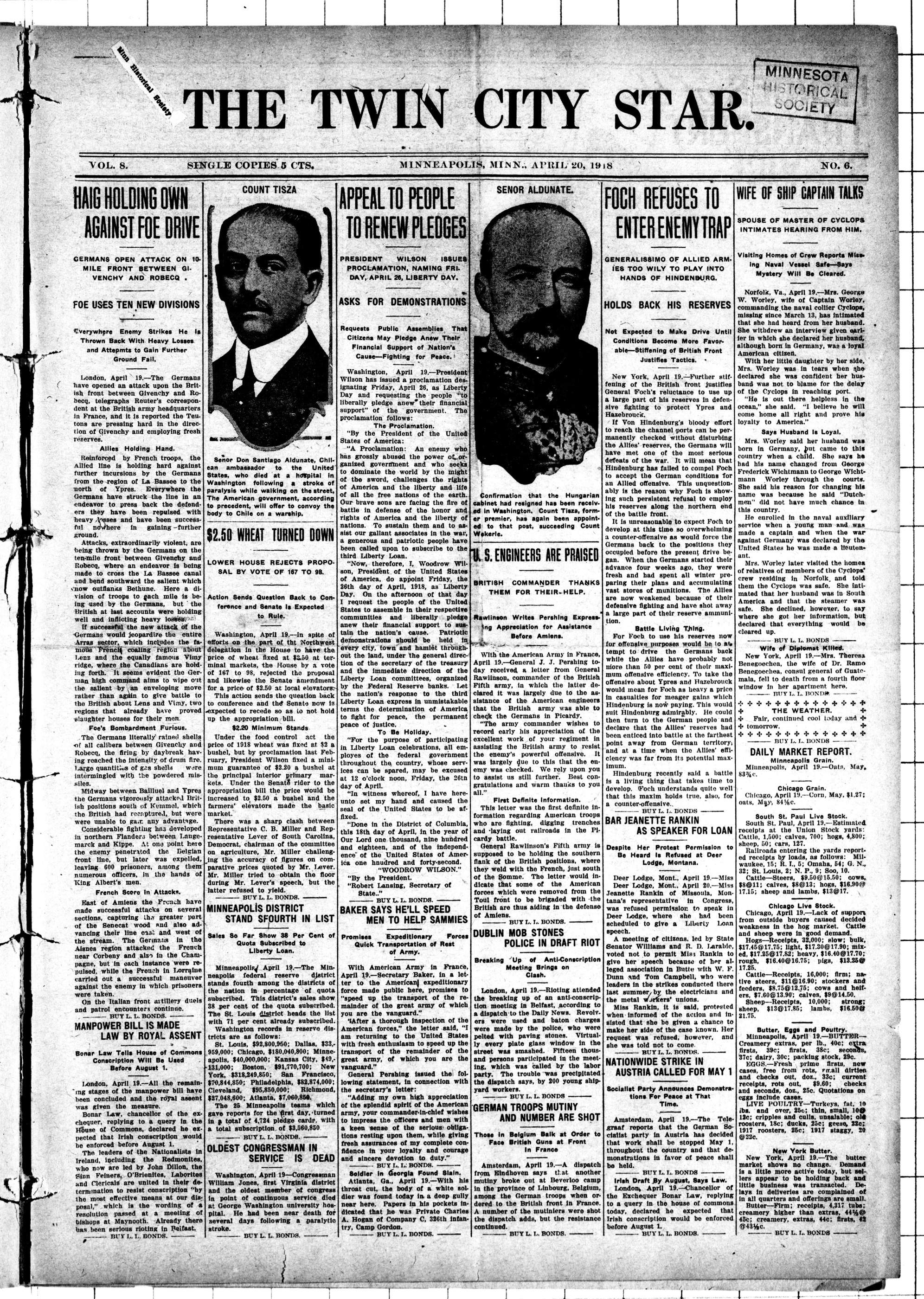
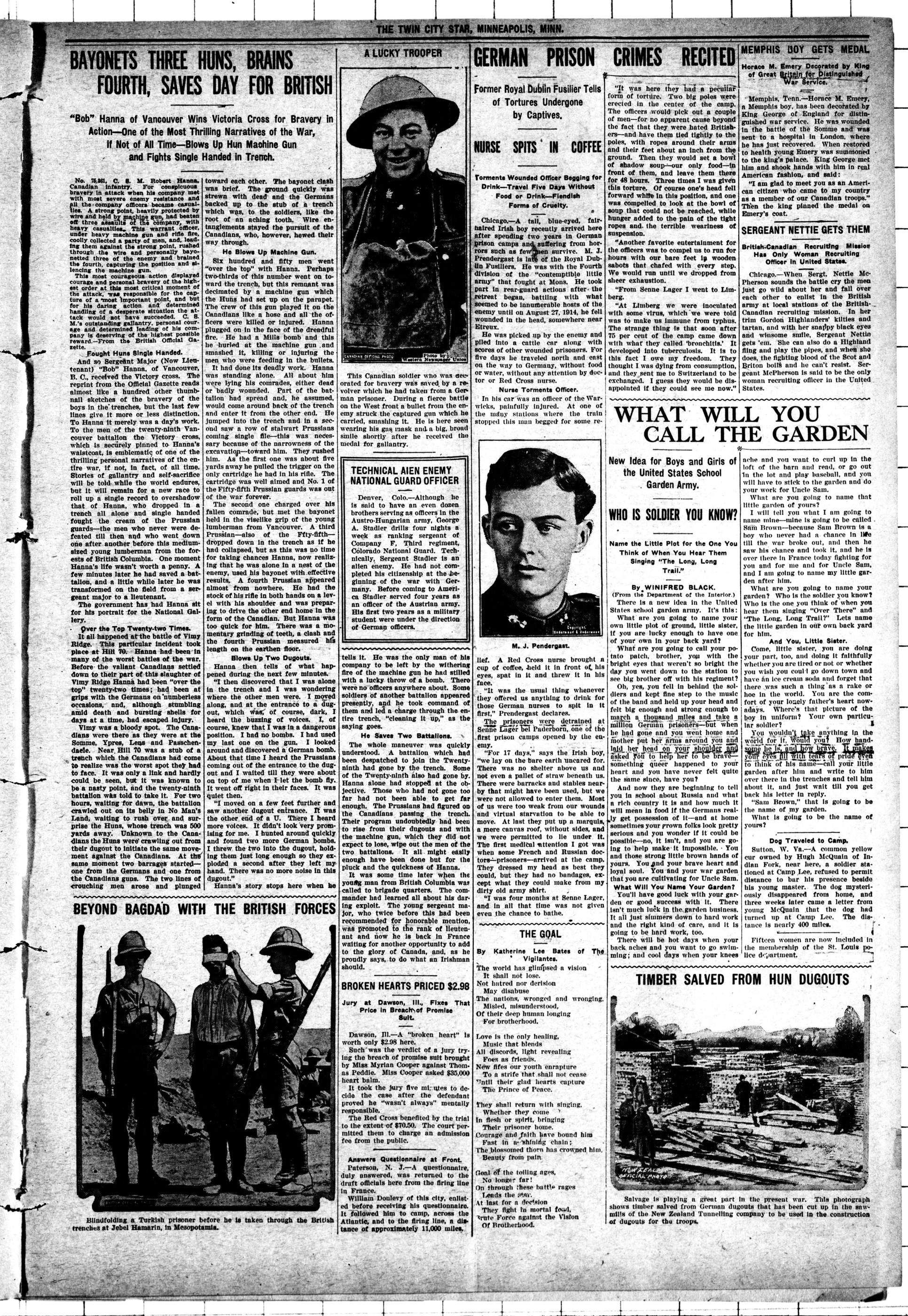
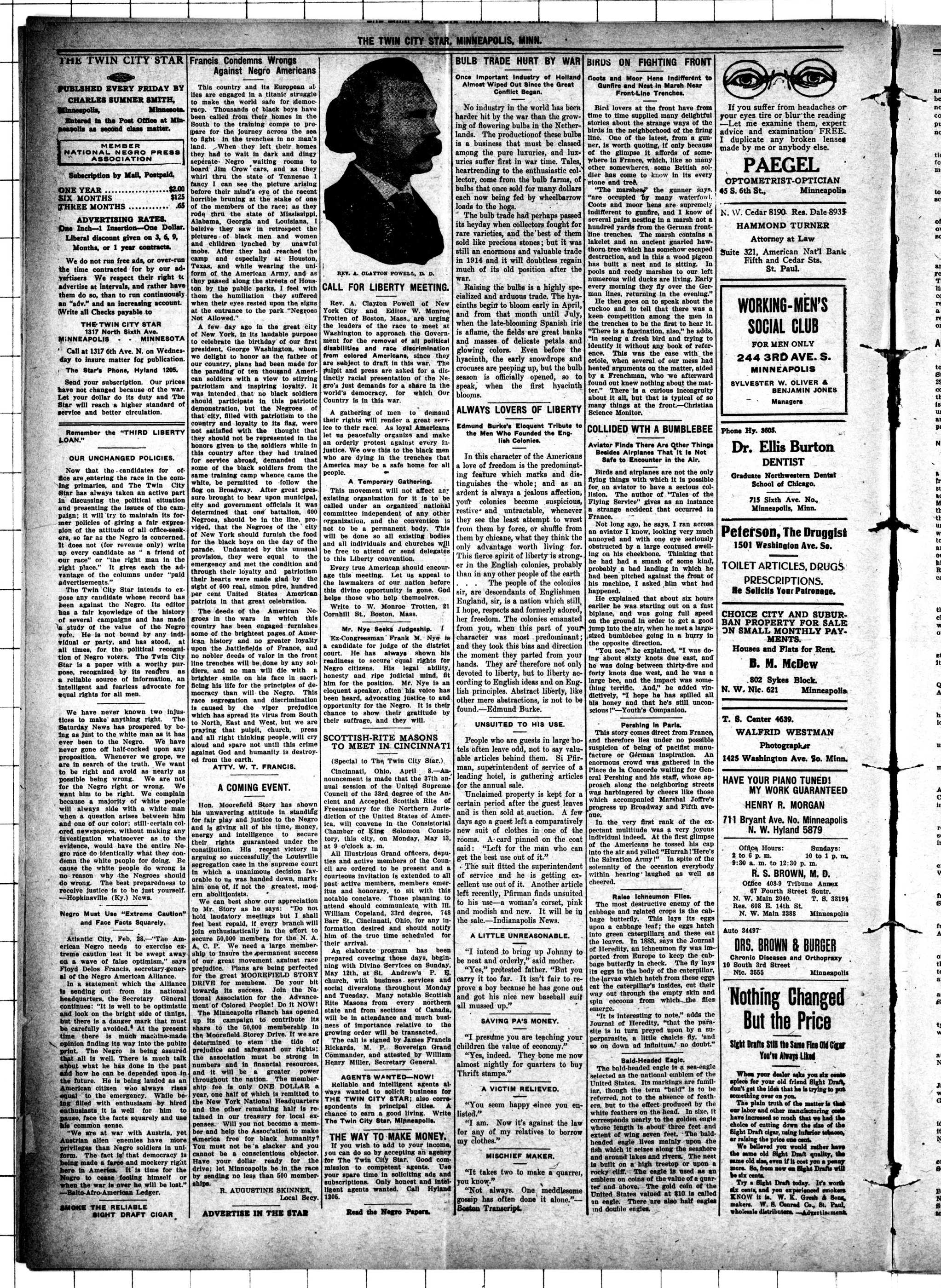
Page text (machine-generated)
HAIG HOLDING OWN AGAINST FOE DRIVE
GERMANS OPEN ATTACK ON 10
MILE FRONT BETWEEN GI-
VENCHY AND ROBECQ .
FOE USES TEN NEW DIVISIONS
Everywhere Enemy Strikes He Is Thrown Back With Heavy Losses and Attepnts to Gain Further Ground Fail.
London, April 19.—The Germans have opened an attack upon the British front between Givenchy and Robecq, telegraphs Reuter's correspondent at the British army headquarters in France, and it is reported the Teutons are pressing hard in the direction of Givenchy and employing fresh reserves.
Allies Holding Hand.
Reinforced by French troops, the Allied line is holding hard against further incursions by the Germans from the region of La Bassee to the north of Ypres. Everywhere the Germans have struck the line in an endeavor to press back the defenders they have been repulsed with heavy Losses and have been successful nowhere in gaining further ground.
Attacks, extraordinarily violent, are being thrown by the Germans on the ten-mile front between Givenchy and Robecq, where an endeavor is being made to cross the La Basse canal and bend southward the salient which now outfans Bethune. Here a division of troops to gach mile is being used by the Germans, but the British at last accounts were holding well and infiltrating heavy losses. If successful the new attack of the Germans would jeopardize the entire Arras sector, which includes the famous French coaling region about Lenz and the equally famous Vimy ridge, where the Canadians are holding forth. It seems evident the German high command aims to wipe out the salient by an enveloping move rather than again to give battle to the British about Lens and Vimy, two regions that already have proved slaughter houses for their men.
Foe's Bombardment Furious.
The Germans literally rained shells of all callibers between Glenchy and Robecq, the firing by daybreak having reached the intensity of drum fire. Large quantities of gas shells were intermingled with the powdered missiles. Midway between Bailluel and Ypres the Germans vigorously attacked British positions south of Kemmel, which the British had recaptured, but were unable to gain any advantage. Considerable fighting has developed in northern Flanders between Langemarck and Kippe. At one point here the enemy penetrated the Belgian front line, but later was expelled, leaving 600 prisoners, among them numerous officers, in the hands of King Albert's men.
French Score In Attacks.
East of Amiens the French have made successful attacks on several sections, capturing the greater part of the Senecat wood and also advancing their line east and west of the stream. The Germans in the Alsnes region attacked the French near Corbeny and also in the Champagne, but in each instance were repulsed, while the French in Lorraine carried out a successful maneuver against the enemy in which prisoners were taken.
On the Italian front artillery duels and patrol encounters continue.
Bonar Law Tells House of Commons Conscription Will Be Used Before August 1.
London, April 19.—All the remaining stages of the manpower bill have been concluded and the royal asseent was given the measure.
Bonar Law, chancellor of the exchequer, replying to a query in the House of Commons, declared he expected that Irish conscription would be enforced before August 1.
The leaders of the Nationalists in Ireland, including the Redmonites, who now are led by John Dillon, the Sinn Feiners, O'Brienes, Laborites and Clericals are united in their determination to resist conscription "by the most effective means at our disposal," which is the wording of a resolution passed at a meeting of bishops at Maynooth. Already there has been serious rioting in Reelfath.
THE TWIN CITY STAR.
]
Senor Don Santiago Aldunate, Chilean ambassador to the United States, who died at a hospital in Washington following a stroke of paralysis while walking on the street, The American government, according to precedent, will offer to convoy the body to Chile on a warship.
$2.50 WHEAT TURNED DOWN
LOWER HOUSE REJECTS PROPOSAL BY VOTE OF 167 TO 98.
Washington, April 19.—In spite of efforts on the part of the Northwest delegation in the House to have the price of wheat fixed at $2.50 at terminal markets, the House by a vote of 167 to 98, rejected the proposal and likewise the Senate amendment for a price of $2.50 at local elevators. This action sends the question back to conference and the Senate now is expected to recede so as to not hold up the appropriation bill.
$2.20 Minimum Stands
Under the food control act the price of 1918 wheat was fixed at $2 a bushel, but by proclamation last February, President Wilson fixed a minimum guarantee of $2.20 a bushel at the principal interior primary markets. Under the Senate rider to the appropriation bill the price would be increased to $2.50 a bushel and the farmers' elevators made the basic market.
There was a sharp clash between Representative C. B. Miller and Representative Lever of South Carolina, Democrat, chairman of the committee on agriculture, Mr. Miller challenging the accuracy of figures on comparative prices quoted by Mr. Lever. Mr. Miller tried to obtain the floor during Mr. Lever's speech, but the latter refused to yield.
MINNEAPOLIS DISTRICT
STAND SFOURTH IN LIST
Sales So Far Show 38 Per Cent of Quota Subscribed to Liberty Loan.
Minneapolis April 19.—The Minneapolis federal reserve district stands fourth among the districts of the nation in percentage of quota subscribed. This district's sales show 38 per cent of the quota subscribed. The St. Louis district heads the list with 71 per cent already subscribed.
Washington records in reserve districts are as follows:
St. Louis, $2,820,950; Dallas, $33,959,000; Chicago, $180,400; Minneapolis, $40,000,000; Kansas City, $49,131,000; Boston, $91,770,700; New York, $318,249,850; San Francisco, $70,844,850; Philadelphia, $82,874,000; Cleveland, $55,850,000; Richmond, $27,048,600; Atlanta, $7,060,850.
The 25 Minneapolis teams which gave reports for the first day, turned in a total of 4,724 pledge cards, with a total subscription of $3,560,850.
Washington, April 19—Congressman William Jones, first Virginia district and the oldest member of congress in point of continuous service died at George Washington university hospital. He had been near death for several days following a paralytic stroke.
MINNEAPOLIS, MINN., APRIL 20, 1918
APPEAL TO PEOPLE TO RENEW PLEDGES
APPEAL TO PEOPLE TO RENEW PLEDGES
PRESIDENT WILSON ISSUES
PROCLAMATION, NAMING FRI.
DAY, APRIL 26, LIBERTY DAY.
ASKS FOR DEMONSTRATIONS
Requests Public Assemblies That Citizens May Pledge Anew Their Financial Support of Nation's Cause—Fighting for Peace.
Washington, April 19.—President Wilson has issued a proclamation designating Friday, April 26, as Liberty Day and requesting the people "to liberally pledge anew their financial support" of the government. The proclamation follows:
The Proclamation.
"By the President of the United States of America:
"A Proclamation: An enemy who has grossly abused the power of organized government and who seeks to dominate the world by the might of the sword, challenges the rights of America and the liberty and life of all the free nations of the earth. Our brave sons are facing the fire of battle in defense of the honor and rights of America and the liberty of nations. To sustain them and to assist our gallant associates in the war, a generous and patriotic people have been called upon to subscribe to the third Liberty Loan.
"Now, therefore, I, Woodrow Wilson, President of the United States of America, do appoint Friday, the 26th day of April, 1918, as Liberty Day. On the afternoon of that day I request the people of the United States to assemble in their respective communities and liberally pledge anew their financial support to sustain the nation's cause. Patriotic demonstrations should be held in every city, town and hamlet throughout the land, under the general direction of the secretary of the treasury and the immediate direction of the Liberty Loan committees, organized by the Federal Reserve banks. Let the nation's response to the third Liberty Loan express in unmistakable terms the determination of America to fight for peace, the permanent peace of justice.
To Be Holiday.
"For the purpose of participating in Liberty Loan celebrations, all employees of the federal government throughout the country, whose services can be spared, may be excused at 12 o'clock noon, Friday, the 26th day of April.
"In witness whereof, I have hereunto set my hand and caused the seal of the United States to be affixed.
"Done in the District of Columbia, this 18th day of April, in the year of Our Lord one thousand, nine hundred and eighteen, and of the independence of the United States of America one hundred and forty-second.
"WOODROW WILSON."
"By the President.
"Robert Lansing, Secretary of State."
BUY L. L. BONDS.
BAKER SAYS HE'LL SPEED
MEN TO HELP SAMMIES
Promises Expeditionary Forces Quick Transportation of Rest of Army.
With American Army in France, April 19.—Secretary Baker, in a letter to the American expeditionary force made public here, promises to "speed up the transport of the remainder of the great army of which you are the vanguard."
"After a thorough inspection of the American forces," the letter said, "I am returning to the United States with fresh enthusiasm to speed up the transport of the remainder of the great army, of which you are the vanguard."
General Pershing issued the following statement, in connection with the secretary's letter:
"Adding my own high appreciation of the splendid spirit of the American army, your commander-in-chief wishes to impress the officers and men with a keen sense of the serious obligations resting upon them, giving fresh assurances of my complete confidence in your loyalty and courage and sincere devotion to duty."
Soldier in Georgia Found Slain.
Atlanta, Ga., April 19.—With his throat cut, the body of a white soldier was found today in a deep gully near here. Papers in his pockets indicated that he was Private Charles A. Hogan of Company C, 326th infantry, Camp Gordon.
SENOR ALDUNATE.
1914
Confirmation that the Hungarian cabinet had resigned has been received in Washington. Count Tiza, former premier, has again been appointed to that post, succeeding Count Wekerle.
U. S. ENGINEERS ARE PRAISED
BRITISH COMMANDER THANKS
THEM FOR THEIR-HELP.
Rawlinson Writes Pershing Expressing Appreciation for Assistance Before Amiens.
With the American Army in France, April 19.—General J. J. Pershing today received a letter from General Rawlinson, commander of the British Fifth army, in which the latter declared it was largely due to the assistance of the American engineers that the British army was able to check the Germans in Picardy.
"The army commander wishes to record early his appreciation of the excellent work of your regiment in assisting the British army to resist the enemy's powerful offensive. It was largely due to this that the enemy was checked. We rely upon you to assist us still further. Best congratulations and warm thanks to you all."
First Definite Information.
This letter was the first definite information regarding American troops who are fighting, digging trenches and laying out railroads in the Picardy battle.
General Rawlinson's Fifth army is supposed to be holding the southern flank of the British positions, where they weld with the French, just south of the Somme. The letter would indicate that some of the American forces which were removed from the Toul front to be brigaded with the British are thus aiding in the defense of Amiens.
Breaking Up of Anti-Conscription Meeting Brings on Clash.
London, April 19.—Rioting attended the breaking up of an anti-conscription meeting in Belfast, according to a dispatch to the Daily News. Revolvers were used and baton charges were made by the police, who were pelted with paving stones. Virtually every plate glass window in the street was smashed. Fifteen thousand persons participated in the meeting, which was called by the labor party. The trouble was precipitated the dispatch says, by 200 young shipyard workers.
Those in Belgium Balk at Order to Face British Guns at Front In France
Amsterdam, April 19.—A dispatch from Elndhoven says that another mutiny broke out at Beverloo camp in the province of Linbourg, Belgium, among the German troops when ordered to the British front in France. A number of the mutiniers were shot the dispatch adds, but the resistance continued.
FOCH REFUSES TO ENTER ENEMY TRAP
FOCH REFUSES TO ENTER ENEMY TRAP
GENERALISSIMO OF ALLIED ARM
IES TOO WILY TO PLAY INTO
HANDS OF HINDENBURG.
HOLDS BACK HIS RESERVES
Not Expected to Make Drive Until Conditions Become More Favorable—Stiffening of British Front Justifies Tactics.
New York, April 19.—Further stiffening of the British front justifies General Foch's reluctance to use up a large part of his reserves in defensive fighting to protect Ypres and Hazebrouck.
If Von Hindenburg's bloody effort to reach the channel ports can be permanently checked without disturbing the Allies' reserves, the Germans will have met one of the most serious defeats of the war. It will mean that Hindenburg has failed to compel Foch to accept the German conditions for an Allied offensive. This unquestionably is the reason why Foch is showing such persistent refusal to employ his reserves along the northern end of the battle front.
It is unreasonable to expect Foch to develop at this time so overwhelming a counter-offensive as would force the Germans back to the positions they occupied before the present drive began. When the Germans started their advance four weeks ago, they were fresh and had spent all winter preparing their plans and accumulating vast stores of munitions. The Allies are now weakened because of their defensive fighting and have shot away a large part of their reserve ammunition.
Battle Living Thing.
For Foch to use his reserves now for offensive purposes would be to attempt to drive the Germans back while the Allies have probably not more than 50 per cent of their maximum offensive efficiency. To take the offensive about Ypres and Hazebrouck would mean for Foch as heavy a price in casualties for meager gains which Hindenburg is now paying. This would suit Hindenburg admirably. He could then turn to the German people and declare that the Allies' reserves had been enticed into battle at the farthest point away from German territory, and at a time when the Allies' efficiency was far from its potential maximum.
Hindenburg recently said a battle is a living thing that takes time to develop. Foch understands quite well that this maxim holds true, also, for a counter-offensive.
Despite Her Protest Permission to Be Heard Is Refused at Deer Lodge, Montana.
Deer Lodge, Mont., April 19.—Miss Deer Lodge, Mont., April 20.—Miss Jeanette Rankin of Missoula, Montana's representative in Congress, was refused permission to speak in Deer Lodge, where she had been scheduled to give a Liberty Loan speech.
A meeting of citizens, led by State Senator Williams and R. D. Larable, voted not to permit Miss Rankin to give her speech because of her alleged association in Butte with W. F. Dunn and Tom Campbell, who were leaders in the strikes conducted there last summer by the electricians and the metal workers' unions.
Miss Rankin, it is said, protested when informed of the action and insisted that she be given a chance to make her side of the case known. Her request was refused, however, and she was told not to come.
NATIONWIDE STRIKE IN AUSTRIA CALLED FOR MAY 1
Socialist Party Announces Demonstra-
tions For Peace at That
Time.
Amsterdam, April 19.—The Telegraaf reports that the German Socialist party in Austria has decided that work shall be stopped May 1, throughout the country and that demonstrations in favor of peace shall be held.
BUY L. L. BONDS
Irish Draft By August, Says Law.
London, April 19.—Chancellor of the Exchequer Bonar Law, replying to a query in the house of commons today, declared he expected that Irish conscription would be enforced before August 1.
BUY L. L. BONDS.
NO.6.
WIFE OF SHIP CAPTAIN TALKS
SPOUSE OF MASTER OF CYCLOPS
INTIMATES HEARING FROM HIM
Visiting Homes of Crew Reports Missing Naval Vessel Safe—Says Mystery Will Be Cleared.
Norfolk, Va., April 19.—Mrs. George W. Worley, wife of Captain Worley, commanding the naval collier Cyclops, missing since March 13, has intimated that she had heard from her husband. She withdrew an interview given earlier in which she declared her husband, although born in Germany, was a loyal American citizen.
With her little daughter by her side, Mrs. Worley was in tears when she declared she was confident her husband was not to blame for the delay of the Cyclops in reaching port.
"He is out there helpless in the ocean," she said. "I believe he will come home all right and prove his loyalty to America."
Says Husband is Loyal.
Mrs. Worley said her husband was born in Germany, but came to this country when a child. She says he had his name changed from George Frederick Wichtmann to George Wichtmann. Worley through the courts. She said his reason for changing his name was because he said "Dutchmen" did not have much chance in this country.
He enrolled in the naval auxiliary service when a young man and was made a captain and when the war against Germany was declared by the United States he was made a lieutenant.
Mrs. Worley later visited the homes of relatives of members of the Cyclops' crew residing in Norfolk, and told them the Cyclops was safe. She intimated that her husband was in South America and that the steamer was safe. She declined, however, to say where she got her information, but declared that everything would be cleared up.
BUY L. L. BONDS
Wife of Diplomat Killed.
New York, April 19.—Mrs. Theresa Benegoechea, the wife of Dr. Ramo Benegoechea, consul general of Guatemala, fell to death from a fourth floor window in her apartment here.
BUY L. L. BONDS
THE WEATHER.
Fair, continued cool today and tomorrow.
BUY L. L. BONDS
Minneapolis, April 19.—Oats, May,
83% c.
Chicago Grain.
Chicago, April 19.—Corn, May, $1.27;
oats, May, 84% c.
South St. Paul Live Stock.
South St. Paul, April 19—Estimated receipts at the Union Stock yards: Cattle, 1,500; calves, 700; hogs, 4,800; sheep, 50; cars, 127.
Railroads entering the yards reported receipts by loads, as follows: Milwaukee, 15; R. I., 5; Omaha, 54; G. N., 32; St. Louis, 2; N. P., 9; Soo, 10.
Cattle—Steers, $9.50@15.50; cows, $8@11; calves, $8@13; hogs, $16.90@17.15; sheep and sheep, $13@17.
Chicago Live Stock.
Chicago, April 19.—Lack of support from outside buyers caused decided weakness in the hog market. Cattle and sheep were in good demand.
Hogs—Receipts, 32,000; slow, bulk, $17.45@17.75; light, $17.30@17.90; mixed, $17.25@17.82; heavy, $16.40@17.70; rough, $16.40@16.75; pigs, $13.25@17.25.
Cattle—Receipts, 16,000; firm; native steers, $11@16.90; stockers and feeders, $8.75@12.75; cows and heifers, $7.60@13.90; calves, $9@14.50.
Sheep—Receipts, 10,000; strong; sheep, $13@17.85; lambs, $16.50@21.75.
Butter, Eggs and Poultry.
Minneapolis, April 19.—BUTTER—Creamery extras, per lb., 40c; extra firsts, 39c; firsts, 38c; seconds, 37c; dairy, 30c; packing stock, 29c.
EGGS.—Fresh prime firsts, new cases, free from rots, n尔 dirtten and checks out, doz., 33c; current receipts, rots out, $9.60; checks and seconds, doz., 25c. Quotations on eggs include cases.
LIVE POULTRY—Turkeys, fat, 10 lbs. and over, 25c; thin, small, 10 12c; cripples and culls, unsalable; old roosters, 18c; ducks, 25c; gese, 22c; 1917 roosters, 25c; 1917 staggy, 20@22c.
New York Butter.
New York, April 19—The butter market shows no change. Demand is a little more active today, but sellers appear to be holding back and little business was transacted. Delays in deliveries are complained of in all quarters and offerings are small. Butter—Firm; receipts, 4,317 tubes; creamy higher than extras, 44%@ 45c; creamy, extras, 44c; firsts, 42@ 43%c.
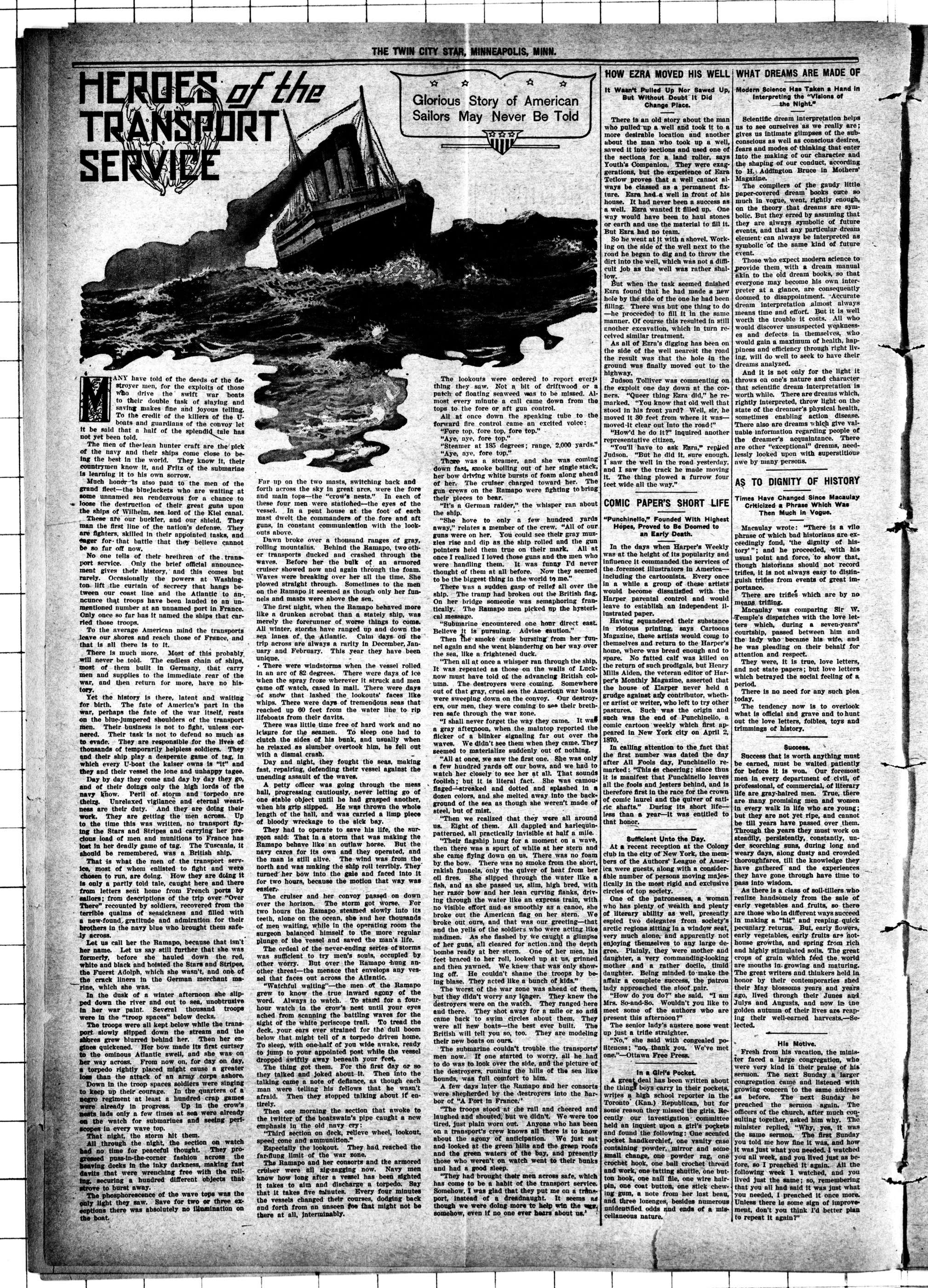
HEROES of the TRANSPORT SERVICE
ANY have told of the deeds of the destroyer men, for the exploits of those who drive the swift war boats to their double task of slaying and saving makes fine and joyous telling. To the credit of the killers of the U-boats and guardians of the convoy let id that a half of the splendid tale has been told.
M
The men of the lean hunter craft are the pick of the navy and their ships come close to being the best in the world. They know it, their countrymen know it, and Fritz of the submarine is learning it to his own sorrow.
Much honor is also paid to the men of the grand fleet—the bluejackets who are waiting at some unnamed sea rendezvous for a chance to loose the destruction of their great guns upon the ships of Wilhelm, sea lord of the Kiel canal. These are our buckler, and our shield. They man the first line of the nation's defense. They are fighters, skilled in their appointed tasks, and eager for that battle that they believe cannot be so far off now.
No one tells of their brethren of the transport service. Only the brief official announcement gives their history, and this comes but rarely. Occasionally the powers at Washington lift the curtain of secrecy that hangs between our coast line and the Atlantic to announce that troops have been landed to an unmentioned number at an unnamed port in France. Only once so far has it named the ships that carried those troops.
To the average American mind the transports leave our shores and reach those of France, and that is all there is to it.
There is much more. Most of this probably will never be told. The endless chain of ships, most of them built in Germany, that carry men and supplies to the immediate rear of the war, and then return for more, have no history.
Yet the history is there, latent and waiting for birth. The fate of America's part in the war, perhaps the fate of the war itself, rests on the blue-jumpered shoulders of the transport men. Their business is not to fight, unless cornered. Their task is not to defend so much as to evade. They are responsible for the lives of thousands of temporarily helpless soldiers. They and their ship play a desperate game of tag, in which every U-boat the kaiser owns is "it" and they and their vessel the lone and unhappy tagge.
Day by day they come and day by day they go, and of their doings only the high lords of the navy know. Peril of storm and torpedo are theing. Unrelaxed vigilance and eternal weariness are their duty. And they are doing their work. They are getting the men across. Up to the time this was written, no transport flying the Stars and Stripes and carrying her precious load of men and munitions to France has lost in her deadly game of tag. The Tuscania, it should be remembered, was a British ship.
That is what the men of the transport service, most of whom enlisted to fight and were chosen to run, are doing. How they are doing it is only a partly told tale, caught here and there from letters sent home from French ports by sailors; from descriptions of the trip over "Over There" recounted by soldiers, recovered from the terrible qualms of seasickness and filled with a new-found gratitude and admiration for their brothers in the navy blue who brought them safely across.
Let us call her the Ramapo, because that isn't her name. Let us say still further that she was formerly, before she hauled down the red, white and black and hoisted the Stars and Stripes, the Fuerst Adolph, which she wasn't, and one of the crack liners in the German merchant marine, which she was.
In the dusk of a winter afternoon she slipped down the river and out to sea, unobtrusive in her war paint. Several thousand troops were in the "troop spaces" below decks.
The troops were all kept below while the transport slowly slipped down the stream and the shores grew blurred behind her. Then her engines quickened. Her bow made its first curtsey to the ominous Atlantic swell, and she was on her way across. From now on, for day on day, a torpedo rightly placed might cause a greater loss than the attack of an army corps ashore. Down in the troop spaces soldiers were singing to keep up their courage. In the quarters of a segro regiment at least a hundred crap games were already in progress. Up in the crow's nest lads only a few times at sea were already on the watch for submarines and seeing periscopes in every wave top. That night, the storm hit them. All through the night, the section on watch had no time for peaceful thought. They progressed puss-in-the-corner fashion across the beaving decks in the inky darkness, making fast davits that were wrenching free with the rolling, securing a hundred different objects that strove to burst away.
The phosphorescence of the wave tops was the only light they saw. Save for two or three exceptions there was absolutely no illumination on the boat.
THE TWIN CITY STAR, MINNEAPOLIS, MINN.
f the
RT
THE FIGHT FOR THE GREAT BRITAIN
Fur up on the two masts, switching back and forth across the sky in great arcs, were the fore and main tops—the "crow's nests." In each of these four men were stationed—the eyes of the vessel. In a pent house at the foot of each mast dwelt the commanders of the fore and aft guns, in constant communication with the look-outs above.
Dawn broke over a thousand ranges of gray, rolling mountains. Behind the Ramapo, two other transports ducked and crashed through the waves. Before her the bulk of an armored cruiser showed now and again through the foam. Waves were breaking over her all the time. She plowed straight through. Sometimes to the men on the Ramapo it seemed as though only her funnels and masts were above the sea.
The first night, when the Ramapo behaved more like a drunken acrobat than a stately ship, was merely the forerunner of worse things to come. All winter, storms have ranged up and down the sea lanes of the Atlantic. Calm days on the trip across are always a rarity in December, January and February. This year they have been unique.
There were windstorms when the vessel rolled in an arc of 82 degrees. There were days of ice when the spray froze wherever it struck and men came off watch, cased in mall. There were days of snow that lashed the lookouts' faces like whips. There were days of tremendous seas that reached up 60 feet from the water line to rip lifeboats from their davits.
There was little time free of hard work and no leisure for the seamen. To sleep one had to clutch the sides of his bunk, and usually when he relaxed as slumber overtook him, he fell out with a dismal crash.
Day and night, they fought the seas, making fast, repalring, defending their vessel against the unending assault of the waves.
A petty officer was going through the mess hall, progressing cautiously, never letting go of one stable object until he had grasped another, when his grip slipped. He was thrown the whole length of the hall, and was carried a limp piece of bloody wreckage to the sick bay.
They had to operate to save his life, the surgeon said: That in a storm that was making the Ramapo behave like an outlaw horse. But the navy cares for its own and they operated, and the man is still alive. The wind was from the north and was making the ship roll terribly. They turned her bow into the gale and faced into it for two hours, because the motion that way was easier.
The cruiser and her convoy passed on down over the horizon. The storm got worse. For two hours the Ramapo steamed slowly into its teeth, alone on the ocean, she and her thousands of men waiting, while in the operating room the surgeon balanced himself to the more regular plunge of the vessel and saved the man's life.
The ordeal of the never-ending series of storms was sufficient to try men's souls, occupied by other worry. But over the Ramapo hung another threat—the menace that envelops any vessel that faces out across the Atlantic.
"Watchful waiting"—the men of the Ramapo grew to know the true inward agony of the word. Always to watch. To stand for a four-hour watch in the crow's nest until your eyes ached from scanning the battling waves for the sight of the white periscope trail. To tread the deck, your ears ever strained for the dull boom below that might tell of a torpedo driven home. To sleep, with one-half of you wide awake, ready to jump to your appointed post while the vessel dropped swiftly away beneath your feet. The thing got them. For the first day or so they talked and joked about it. Then into the talking came a note of defiance, as though each man were telling his fellows that he wasn't afraid. Then they stopped talking about if entirely.
Then one morning the section that awoke to the twitter of the boatswain's pipe caught a new emphasis in the old navy cry:
"Third section on deck, relieve wheel, lookout, speed cone and ammunition."
Especially the lookout. They had reached the forging limit of the war zone.
The Ramapo and her consorts and the armored cruiser were all zig-zagging now. Navy men know how long after a vessel has been sighted it takes to alm and discharge a torpedo. Say that it takes five minutes. Every four minutes the vessels changed their courses, dodging back and forth from an unseen foe that might not be there at all, intermably.
---
---
```markdown
```
Glorious Story of American Sailors May Never Be Told
The lookouts were ordered to report everything they saw. Not a bit of driftwood or a patch of floating seaweed was to be missed. Almost every minute a call came down from the tops to the fore or aft gun control.
All at once down the speaking tube to the forward fire control came an excited voice:
"Fore top, fore top, fore top."
"Aye, nye, fore top."
"Steamer at 185 degrees; range, 2,000 yards."
"Aye, nye, fore top."
There was a steamer, and she was coming down fast, smoke boiling out of her single stack, her bow driving white bursts of foam along ahead of her. The crusfer charged toward her. The gun crews on the Ramapo were fighting to bring their pieces to bear.
"It's a German raider," the whisper ran about the ship.
"She hove to only a few hundred yards away," relates a member of the crew. "All of our guns were on her. You could see their gray muzzles rise and dip as the ship rolled and the gun pointers held them true on their mark. All at once I realized I loved those guns and the men who were handling them. It was funny I'd never thought of them at all before. Now they seemed to be the biggest thing in the world to me."
There was a sudden gasp of relief all over the ship. The trump had broken out the British flag. On her bridge someone was semaphoring frantically. The Ramapo men picked up the hysterical message.
"Submarine encountered one hour direct east. Believe it is pursuing. Advise caution."
Then the smoke came bursting from her funnel again and she went blundering on her way over the sea, like a frightened duck.
"Then all at once a whisper ran through the ship, It was repeated as those on the walls of Lucknow must have told of the advancing British column. The destroyers were coming. Somewhere out of that gray, cruel sea the American war boats were sweeping down on the convoy. Our destroyers, our men, they were coming to see their brethren safe through the war zone.
"I shall never forget the way they came. It was a gray afternoon, when the mastopnt reported the flicker of a blinker signaling far out over the waves. We didn't see them when they came. They seemed to materialize suddenly out of nothing.
"All at once, we saw the first one. She was only a few hundred yards off our bows, and we had to watch her closely to see her at all. That sounds foolish; but it is literal fact. She was camouflaged—streaked and dotted and splashed in a dozen colors, and she melted away into the background of the sea as though she weren't made of steel, but of mist.
"Then we realized that they were all around us. Eight of them. All dappled and harlequin-patterned, all practically invisible at half a mile. "Their flagship hung for a moment on a wave, then there was a spurt of white at her stern and she came flying down on us. There was no foam by the bow. There was no smoke from the short, rakish funnels, only the quiver of heat from her oil fires. She slipped through the water like a fish, and as she passed us, slim, high bred, with her razor bow and her lean curving flanks, driving through the water like an express train, with no visible effort and as smoothly as a canoe, she broke out the American flag on her stern. We broke out ours, and that was our greeting—that and the yells of the soldiers who were acting like madmen. As she flashed by we caught a glimpse of her guns, all cleared for action and the depth bombs ready at her stern. One of her men, his feet braced to her roll, looked up at us, grinned and then yawned. We knew that was only showing off. He couldn't shame the troops by being blase. They acted like a bunch of kids."
The worst of the war zone was ahead of them, but they didn't worry any longer. They knew the destroyers were on the watch. They ranged here and there. They shot away for a mile or so and came back to swim circles about them. They were all new boats—the best ever built. The British will tell you so, too. They are modeling their new boats on ours.
The submarine couldn't trouble the transports' men now. If one started to worry, all he had to do was to look over the side, and the picture of the destroyers, running the hills of the sea like hounds, was full comfort to him.
A few days later the Ramapo and her consorts were shepherded by the destroyers into the harbor of "A Port in France."
"The troops stood at the rail and cheered and laughed and shouted, but we didn't. We were too tired, just plain worn out. Anyone who has been on a transport's crew knows all there is to know about the agony of anticipation. We just sat and looked at the green hills and the green roofts and the green waters of the bay, and presently those who weren't on watch went to their bunks and had a good sleep.
"They had brought their men across safe, which has come to be a habit of the transport service. Somehow, I was glad that they put me on a transport, instead of a dreadnaught. It seems as though we were doing more to help win the war, somehow, even if no one ever hears about us."
It Wan't Pulled Up Nor Sawed Up,
But Without Doubt It Did
Change Place.
There is an old story about the man
who pulled up a well and took it to a
more desirable location and another
about the man who took up a well,
sawed it into sections and used one of
the sections for a land roller, says
Youth's Companion. They were exaggerations, but the experience of Ezra
Tetlow proves that a well cannot always be classed as a permanent fixture. Ezra had a well in front of his house. It had never been a success as a well. Ezra wanted it filled up. One way would have been to haul stones or earth and use the material to fill it. But Ezra had no team.
So he went at it with a shovel. Working on the side of the well next to the road he began to dig and to throw the dirt into the well, which was not a difficult job as the well was rather shallow.
But when the task seemed finished Ezra found that he had made a new hole by the side of the one he had been filling. There was but one thing to do—he proceeded to fill it in the same manner. Of course this resulted in still another excavation, which in turn received similar treatment.
As all of Ezra's digging has been on the side of the well nearest the road the result was that the hole in the ground was finally moved out to the highway.
Judson Tolliver was commenting on the exploit one day down at the corners. "Queer thing Ezra did," he remarked. "You know that old well that stood in his front yard? Well, sir, he moved it 30 feet from where it was—moved-it clear out into the road!" "How'd he do it?" inquired another representative citizen. "You'll have to ask Ezra," replied Judson. "But he did it, sure enough. I saw the well in the road yesterday, and I saw the track he made moving it. The thing plowed a furrow four feet wide all the way."
COMIC PAPER'S SHORT LIFE
"Punchinello," Founded With Highest Hopes, Proved to Be Doomed to an Early Death.
In the days when Harper's Weekly was at the height of its popularity and influence it commanded the services of the foremost illustrators in America—including the cartoonists. Every once in a while a group of these artists would become dissatisfied with the Harper parental control and would leave to establish an independent illustrated paper.
Having squandered their substance in riotous printing, says Cartoons Magazine, these artists would come to themselves and return to the Harper's home, where was bread enough and to spare. No fatted calf was killed on the return of such prodigals, but Henry Mills Alden, the veteran editor of Harper's Monthly Magazine, asserted that the house of Harper never held a grudge against any contributor, whether artist or writer, who left to try other pastures. Such was the origin and such was the end of Punchinello, a comic cartoon weekly which first appeared in New York city on April 2, 1870.
In calling attention to the fact that the first number was dated the day after A Fools day, Punchinello remarked: "This as cheering; since thus it is manifest that Punchinello leaves all the fools and jesters behind, and is therefore first in the race for the crown of comic laurel and the quiver of satiric shafts." During its short life—less than a year—it was entitled to that honor.
Sufficient Unto the Day
At a recent reception at the Colony club in the city of New York, the members of the Authors' League of America were guests, along with a considerable number of persons moving majestically in the most rigid and exclusive circles of top society.
One of the patronesses, a woman who has plenty of wealth and plenty of literary ability as well, presently espied two delegates from society's arctic regions sitting in a window seat, very much alone, and apparently not enjoying themselves to any large degree. Plainly, they were mother and daughter, a very commanding-looking mother and a rather docile, timid daughter. Being minded to make the affair a complete success, the patron indy approached the aloof pair.
"How do you do?" she said. "I am Mrs. So-and-So. Wouldn't you like to meet some of the authors who are present this afternoon?"
The senior lady's austere nose went up just a trifle straighter. "No," she said with congealed politeness; "no, thank you. We've met one."—Ottawa Free Press.
In a Girl's Pocket.
A great deal has been written about the things boys carry in their pockets, writes a high school reporter in the Toronto (Knn.) Republican, but for some reason they missed the girls. Recently our investigation committee held an inquest upon a girl's pockets and found the following: One scented pocket handkerchief, one vanity case containing powder, mirror and some small change, one powder rag, one crochet hook, one ball crochet thread and work, one tatting shuttle, one button hook, one nail file, one wire hairpin, one coat button, one stick chewing gum, a note from her last beau, and three lozenges, besides numerous unidentified odds and ends of a miscellaneous nature.
Modern Science Has Taken a Hand in Interpreting the "Visions of the Night."
Scientific dream interpretation helps us to see ourselves as we really are; gives us intimate glimpses of the subconscious as well as conscious desires, fears and modes of thinking that enter into the making of our character and the shaping of our conduct, according to H. Addington Bruce in Mothers' Magazine.
The compilers of the gaudy little paper-covered dream books once so much in vogue, went, rightly enough, on the theory that dreams are symbolic. But they erred by assuming that they are always symbolic of future events, and that any particular dream element can always be interpreted as symbolic of the same kind of future event.
Those who expect modern science to provide them with a dream manual akin to the old dream books, so that everyone may become his own interpreter at a glance, are consequently doomed to disappointment. "Accurate dream interpretation almost always means time and effort. But it is well worth the trouble it costs. All who would discover unsuspected weaknesses and defects in themselves, who would gain a maximum of health, happiness and efficiency through right living, will do well to seek to have their dreams analyzed.
And it is not only for the light it throws on one's nature and character that scientific dream interpretation is worth while. There are dreams which, rightly interpreted, throw light on the state of the dreamer's physical health, sometimes enabling action disease. There also are dreams which give valuable information regarding people of the dreamer's acquaintance. There are other "exceptional" dreams, needlessly looked upon with superstitious awe by many persons.
AS TO DIGNITY OF HISTORY
Times Have Changed Since Macaulay
Criticized a Phrase Which Was
Then Much in Vogue.
Macaulay wrote: "There is a vile
phrase of which bad historians are
exceedingly fond, 'the dignity of
history'"; and he proceeded, with his
usual point and force, to show that,
though historians should not record
trifles, it is not always easy to distinguishe
trifles from events of great importance.
There are trifles which are by no
means trifling.
Macaulay was comparing Sir W.
Temple's dispatches with the love letters
which, during a seven-years'
courtship, passed between him and
the lady who became his wife, and
he was pleading on their behalf for
attention and respect.
They were, it is true, love letters, and not state papers; but love letters which betrayed the social feeling of a period. There is no need for any such plea today. The tendency now is to overlook what is official and grave and to hunt out the love letters, folibles, toys and trimmings of history.
Success that is worth anything must be earned, must be waited patiently for before it is won. Our foremost men in every department of civil, of professional, of commercial, of literary life are gray-haired men. True, there are many promising men and women in every walk in life who are young; but they are not yet ripe, and cannot be till years have passed over them. Through the years they must work on steadily, persistently, constantly, under scorching suns, during long and weary days, along dusty and crowded thoroughfares, till the knowledge they have gathered and the experiences they have gone through have time to pass into wisdom.
As there is a class of soil-tillers who realize handsomely from the sale of early vegetables and fruits, so there are those who in different ways succeed in making a "hit" and reaping quick peculiary returns. But, early flowers, early vegetables, early fruits are not-house growths, and spring from rich and highly stimulated soils. The great crops of grain which feed the world are months in growing and maturing. The great writers and thinkers held in honor by their contemporaries shed their May blossoms years and years ago, lived through their Junes and Julys and Augusts, and now in the golden autumn of their lives are reaping their well-earned harvests.—Selected.
His Motive.
Fresh from his vacation, the minister faced a large congregation, who were very kind in their praise of his sermon. The next Sunday a larger congregation came and listened with growing concern to the same address as before. The next Sunday he preached the sermon again. The officers of the church, after much consulting together, asked him why. The minister replied, "Why, yes, it was the same sermon. The first Sunday you told me how fine it was, and how it was just what you needed. I watched you all week, and you lived just as before, so I preached it again. All the following week I watched, and you lived just the same; so, remembering that you all had said it was just what you needed, I preached it once more. Unless there is some sign of improvement, don't you think I'd better plan to repeat it again?"
BAYONETS THREE HUNS, BRAINS FOURTH, SAVES DAY FOR BRITISH
"Bob" Hanna of Vancouver Wins Victoria Cross for Bravery in Action—One of the Most Thrilling Narratives of the War, If Not of All Time—Blows Up Hun Machine Gun and Fights Single Handed in Trench.
BEYOND BAGDAD WITH THE BRITISH FORCES
Blindfolding a Turkish prisoner before he is taken through the British
No. 7,8,31, C. S. M. Robert Hanna, Canadian infantry. For conspicuous bravery in attack when his company met with most severe enemy resistance and all the company officers became casualties, heavy point, heavily wire and held point, heavily wire and held point, had beaten off three assaults of the company, with heavy casualties. This warrant officer, under heavy machine gun and rifle fire, coolly collected a party of men, and, leading them against the strong point, rushed the wire and personnel, netted the wire and brained the fourth, capturing the position and silencing the machine gun.
This most courageous action displayed courage and personal bravery of the highest order at this most critical moment of the attack, was responsible for the capture of a most important point, and but for his daring action and determined handling of a desperate situation the attack would not have succeeded. M.'s outstanding gallantry and personal courage is deserving of the highest possible reward.—From the British Official Gazette.
Fought Huns Single Handed.
And so Sergeant Major (Now Lieutenant) "Bob" Hanna, of Vancouver, B.C., received the Victory cross. The reprint from the Official Gazette reads almost like a hundred other thumbnail sketches of the bravery of the boys in the trenches, but the last few lines give it more or less distinction. To Hanna it merely was a day's work. To the men of the twenty-ninth Vancouver battalion the Victory cross, which is securely plumed to Hanna's waistcoat, is emblematic of one of the thrilling personal narratives of the entire war, if not, in fact, of all time. Stories of gallantry and self-sacrifice will be told while the world endures, but it will remain for a new race to roll up a single record to overshadow that of Hanna, who dropped in a trench all alone and single handed fought the cream of the Prussian guards—the men who never were defeated till then and who went down one after another before this medium-sized young lumberman from the forests of British Columbia. One moment Hanna's life wasn't worth a penny. A few minutes later he had saved a battalion, and a little later he was transformed on the field from a sergeant major to a lieutenant.
The government has had Hanna sit for his portrait for the National Gallery.
Over the Top Twenty-two Times.
It all happened at the battle of Vimy Ridge. This particular incident took place at Hill 70. Hanna had been in many of the worst battles of the war.
Before the valiant Canadians settled down to their part of this slaughter of Vimy Ridge Hanna had been "over the top" twenty-two times; had been at grips with the Germans on numberless occasions, and, although stumbling amid death and bursting shells for days at a time, had escaped injury.
Vimy was a bloody spot. The Canadians were there as they were at the Somme, Ypres, Lens and Passchendaele. Near Hill 70 was a stub of a trench which the Canadians had come to realize was the worst spot they had to face. It was only a link and hardly could be seen, but it was known to be a nasty point, and the twenty-ninth battalion was told to take it. For two hours, waiting for dawn, the battalion crawled out on its belly in No Man's Land, waiting to rush over and surprise the Huns, whose trench was 500 yards away. Unknown to the Canadians the Huns were crawling out from their dugout to initiate the same movement against the Canadians. At the same moment two barrages started—one from the Germans and one from the Canadians guns. The two lines of crouching men arose and plunged
toward each other. The bayonet clash was brief. The ground quickly was strewn with dead and the Germans backed up to the stub of a trench which was, to the soldiers, like the root of an aching tooth. Wire entanglements stayed the pursuit of the Canadians, who, however, hewed their way through.
He Blowe Up Machine Gun.
Six hundred and fifty men went "over the top" with Hanna. Perhaps two-thirds of this number went on toward the trench, but this remnant was decimated by a machine gun which the Huns had set up on the parapet. The crew of this gun played it on the Canadians like a hose and all the officers were killed or injured. Hanna plugged on in the face of the dreadful fire. He had a Mills bomb and this he hurled at the machine gun and smashed it, killing or injuring the men who were feeding in the bullets.
It had done its deadly work. Hanna was standing alone. All about him were lying his comrudes, either dead or badly wounded. Part of the battalion had spread and, he assumed, would come around back of the trench and enter it from the other end. He jumped into the trench and in a second saw a row of stalwart Prussian coming single file—this was necessary because of the narrowness of the excavation—toward him. They rushed him. As the first one was about five yards away he pulled the trigger on the only cartridge he had in his rifle. The cartridge was well aimed and No.1 of the Fifty-fifth Prussian guards was out of the war forever.
The second one charged over his fallen comrade, but met the bayonet held in the viselike grip of the young lumberman from Vancouver. A third Prussian—also of the Ftty-fifth—dropped down in the trench as if he had collapsed, but as this was no time for taking chances Hanna, now realizing that he was alone in a nest of the enemy, used his bayonet with effective results. A fourth Prussian appeared almost from nowhere. He had the stock of his rifle in both hands on a level with his shoulder and was preparing to drive the other end home in the form of the Canadian. But Hanna was too quick for him. There was a momentary grinding of teeth, a clash and the fourth Prussian measured his length on the earthen floor.
Blows Up Two Dugouts.
Hanna then tells of what happened during the next few minutes.
"I then discovered that I was alone in the trench and I was wondering where the other men were. I moved along, and at the entrance to a dug-out, which was, of course, dark, I heard the buzzing of voices. I, of course, knew that I was in a dangerous position. I had no bombs. I had used my last one on the gun. I looked around and discovered a German bomb. About that time I heard the Prussians coming out of the entrance to the dug-out and I waited till they were about on top of me when I let the bomb fly. It went off right in their faces. It was quiet then.
"I moved on a few feet further and saw another dugout entrance. It was the other end of a U. There I heard more voices. It didn't look very promising for me. I hunted around quickly and found two more German bombs. I threw the two into the dugout, holding them just long enough so they exploded a second after they left my hand. There was no more noise in this dugout."
Hanna's story stops here when he
CANADIAN OFFICIAL PHOTO
Photo by
Western Newspaper Union
This Canadian soldier who was decorated for bravery was saved by a revolver which he had taken from a German prisoner. During a fierce battle on the West front a bullet from the enemy struck the captured gun which he carried, smashing it. He is here seen wearing his gas mask and a big, broad smile shortly after he received the medal for gallantry.
TECHNICAL AIEN ENEMY
NATIONAL GUARD OFFICER
Denver, Colo.—Although he is said to have an even dozen brothers serving as officers in the Austro-Hungarian army, George A. Stadler drills four nights a week as ranking sergeant of Company F, Third regiment, Colorado National Guard. Technically, Sergeant Stadler is an alten enemy. He had not completed his citizenship at the beginning of the war with Germany. Before coming to America Stadler served four years as an officer of the Austrian army. His first two years as a military student were under the direction of German officers.
tells it. He was the only man of his company to be left by the withering fire of the machine gun he had stilled with a lucky throw of a bomb. There were no officers anywhere about. Some soldiers of another battalion appeared presently, and he took command of them and led a charge through the entire trench, "cleaning it up," as the saying goes.
He Saves Two Battalions.
The whole maneuver was quickly understood. A battalion which had been despatched to join the Twenty-ninth had gone by the trench. Some of the Twenty-ninth also had gone by. Hanna alone had stopped at the objective. Those who had not gone too far had not been able to get far enough. The Prussians had figured on the Canadians passing the trench. Their program undoubtedly had been to rise from their dugouts and with the machine gun, which they did not expect to lose, wipe out the men of the two battalions. It all might easily enough have been done but for the pluck and the quickness of Hanna.
It was some time later when the young man from British Columbia was called to brigade quarters. The commander had learned all about his daring exploit. The young sergeant major, who twice before this had been recommended for honorable mention, was promoted to the rank of lieutenant and now he is back in France waiting for another opportunity to add to the glory of Canada, and, as he proudly says, to do what an Irishman should.
BROKEN HEARTS PRICED $2.98
Jury at Dawson, Ill., Fixes That Price in Breach of Promise Suit.
Dawson, Ill.—A "broken heart" is worth only $2.98 here.
Such was the verdict of a jury trying the breach of promise suit brought by Miss Mylian Cooper against Thomas Peddle. Miss Cooper asked $35,000 heart balm.
It took the jury five minutes to decide the case after the defendant proved he "wasn't always" mentally responsible.
The Red Cross benefited by the trial to the extent of $70.50. The court permitted them to charge an admission fee from the public.
Paterson, N. J.—A questionnaire, duly answered, was returned to the draft officials here from the firing line in France. William Donlevy of this city, enlisted before receiving his questionnaire. It followed him to camp, across the Atlantic, and to the firing line, a distance of approximately 11,000 miles.
Former Royal Dublin Fusilier Tells of Tortures Undergone by Captives.
NURSE SPITS IN COFFEE
Tormenta Wounded Officer Begging for Drink—Travel Five Days Without Food or Drink—Flendish Forms of Cruelty.
Chicago.—A tall, blue-eyed, fair-haired Irish boy recently arrived here after spending two years in German prison camps and suffering from horrors such as few men survive. M. J. Prendergast is late of the Royal Dublin Fusiliers. He was with the Fourth division of the "contemptible little army" that fought at Mons. He took part in rear-guard actions after the retreat began, battling with what seemed to be innumerable hosts of the enemy until on August 27, 1914, he fell wounded in the head, somewhere near Etreux.
He was picked up by the enemy and piled into a cattle car along with scores of other wounded prisoners. For five days he traveled north and east on the way to Germany, without food or water, without any attention by doctor or Red Cross nurse.
Nurse Torments Officer.
In his car was an officer of the Warwicks, painfully injured. At one of the many stations where the train stopped this man begged for some re-
Copyright
Underwood & Underwood
M. J. Pendergast.
lief. A Red Cross nurse brought a cup of coffee, held it in front of his eyes, spat in it and threw it in his face.
"It was the usual thing whenever they offered us anything to drink for those German nurses to spit in it first," Pendergast declares.
The prisoners were detrained at Senne Lager bel Paderborn, one of the first prison camps opened by the enemy.
"For 17 days," says the Irish boy, "we lay on the bare earth uncared for. There was no shelter above us and not even a pallet of straw beneath us. There were barracks and stables nearby that might have been used, but we were not allowed to enter them. Most of us were too weak from our wounds and virtual starvation to be able to move. At last they put up a marquis, a mere canvas roof, without sides, and we were permitted to lie under it. The first medical attention I got was when some French and Russian doctors—prisoners—arrived at the camp. They dressed my head as best they could, but they had no bandages, except what they could make from my dirty old army shirt.
"I was four months at Senne Lager, and in all that time was not given even the chance to bathe.
THE GOAL
By Katherine Lee Bates of The Vigilantes.
The world has glimpsed a vision
It shall not lose.
Not hatred nor derision
May disabuse
The nations, wronged and wronging,
Misled, misunderstood.
Of their deep human longing
For brotherhood.
Love is the only healing,
Music that blends
All discords, light revealing
Foes as friends.
New fives our youth enrapture
To a strife that shall not cease
Until their glad hearts capture
The Prince of Peace.
They shall return with singing,
Whether they come
In flesh or spirit, bringing
Their prisoner home.
Courage and faith have bound him
Fast in a shining chain;
The blossomed thorn has crowned him.
Beauty from pain.
Goal of the toiling ages,
No longer far!
On through these battle rages
Lends the star.
At last for a decision
They fight in mortal fear.
Brute Force against the Vision
Of Brotherhood.
WHAT WILL YOU CALL THE GARDEN
NEW REAL
SPECIAL PHOTO
Salvage is playing a great part in the present war. This photograph shows timber salved from German dugouts that has been cut up in the sawmills of the New Zealand Tunnelling company to be used in the construction of dugouts for the troops.
"It was here they had a peculiar form of torture. Two big poles were erected in the center of the camp. The officers would pick out a couple of men—for no apparent cause beyond the fact that they were hated Britishers—and have them tied tightly to the poles, with ropes around their arms and their feet about an inch from the ground. Then they would set a bowl of shadow soup—our only food—in front of them, and leave them there for 48 hours. Three times I was given this torture. Of course one's head fell forward white in this position, and one was compelled to look at the bowl of soup that could not be reached, while hunger added to the pain of the tight ropes and the terrible weariness of suspension.
"Another favorite entertainment for the officers was to compel us to run for hours with our bare feet in wooden sabots that chafed with every step. We would run until we dropped from sheer exhaustion.
"From Senne Lager I went to Limberg.
"At Limberg we were inoculated with some virus, which we were told to make us immune from typhus. The strange thing is that soon after 75 per cent of the camp came down with what they called 'bronchitis.' It developed into tuberculosis. It is to this fact I owe my freedom. They thought I was dying from consumption, and they sent me to Switzerland to be exchanged. I guess they would be disappointed if they could see me now."
New Idea for Boys and Girls of the United States School Garden Army.
WHO IS SOLDIER YOU KNOW?
Name the Little Plot for the One You Think of When You Hear Them Singing "The Long, Long Trail."
By WINIFRED BLACK.
(From the Department of the Interior.) There is a new idea in the United States school garden army. It's this:
There is a new idea in the United States school garden army. It's this: What are you going to name your own little plot of ground, little sister, if you are lucky enough to have one of your own in your back yard? What are you going to call your potato patch, brother, you with the bright eyes that weren't so bright the day you went down to the station to see big brother off with his regiment? Oh, yes, you fell in behind the soldiers and kept fine step to the music of the band and held up your head and felt big enough and strong enough to march a thousand miles and take a million German prisoners—but when he had gone and you went home and mother put her arms around you and laid her head on your shoulder and asked you to help her to be brave—something queer happened to your heart and you have never felt quite the same since, have you?
And now they are beginning to tell you in school about Russia and what a rich country it is and how much it will mean in food if the Germans really get possession of it—and at home sometimes your grown folks look pretty serious and you wonder if it could be possible—no, it isn't, and you are going to help make it impossible. You and those strong little brown hands of yours. You and your brave heart and loyal soul. You and your war garden that you are cultivating for Uncle Sam. What Will You Name Your Garden? You'll have good luck with your garden or good success with it. There isn't much luck in the garden business. It all just simmers down to hard work and the right kind of care, and it is going to be hard work, too.
There will be hot days when your back aches and you want to go swimming; and cool days when your knees
Horace M. Emery Decorated by King of Great Britain for Distinguished War Service.
Memphis, Tenn.—Horace M. Emery, a Memphis boy, has been decorated by King George of England for distinguished war service. He was wounded in the battle of the Somme and was sent to a hospital in London, where he has just recovered. When restored to health young Emery was summoned to the king's palace. King George met him and shook hands with him in real American fashion, and said:
"I am glad to meet you as an American citizen who came to my country as a member of our Canadian troops." Then the king pinned the medal on Emery's coat.
SERGEANT NETTIE GETS THEM
British-Canadian Recruiting Mission Has Only Woman Recruiting Officer in United States.
Chicago.—When Sergt. Nettle McPherson sounds the battle cry the men Just go wild about her and fall over each other to enlist in the British army at local stations of the British-Canadian recruiting mission. In her trim Gordon Highlanders' kilties and tartan, and with her snapy black eyes and winsome smile, Sergeant Nettin gets 'em. She can also do a Highland fling and play the pipes, and when she does, the fighting blood of the Scot and Briton bolls and he can't resist. Sergeant McPherson is said to be the only woman recruiting officer in the United States.
ache and you want to curl up in the loft of the barn and read, or go out in the lot and play baseball, and you will have to stick to the garden and do your work for Uncle Sam.
What are you going to name that little garden of yours?
I will tell you what I am going to name mine—mine is going to be called Sam Brown—because Sam Brown is a boy who never had a chance in life till the war broke out, and then he saw his chance and took it, and he is over there in France today fighting for you and for me and for Uncle Sam, and I am going to name my little garden after him.
What are you going to name your garden? Who is the soldier you know? Who is the one you think of when you hear them singing "Over There" and "The Long, Long Trail!" Lets name the little garden in our own back yard for him.
And You, Little Sister.
Come, little sister, you are doing your part, too, and doing it faithfully whether you are tired or not or whether you wish you could go down town and have an ice cream soda and forget that there was such a thing as a rake or hoe in the world. You are the comfort of your locally father's heart nowadays. Where's that picture of the boy in uniform? Your own particular soldier?
You wouldn't take anything in the world for it. Would you? How handsome he is, and how brave. It makes your eyes fill with tears of pride given to think of his name—call your little garden after him and write to him over there in the trenches and tell him about it, and just wait till you get back his letter in reply.
"Sam Brown," that is going to be the name of my garden.
What is going to be the name of yours?
Dog Traveled to Camp.
Sutton, W. Va.—A common yellow cur owned by Hugh McQuain of Indian Fork, near here, a soldier stationed at Camp Lee, refused to permit distance to bar his presence beside his young master. The dog mysteriously disappeared from home, and three weeks later came a letter from young McQuain that the dog had turned up at Camp Lee. The distance is nearly 400 miles.
Fifteen women are now included in the membership of the St. Louis police department.
PUBLISHED EVERY FRIDAY BY
CHARLES SUMNER SMITH,
Minneapolis, Minnesota.
Entered in the Post Office at Minneapolis as second class matter.
MEMBER
NATIONAL NEGRO PRESS
ASSOCIATION
ONE YEAR $2.00
SIX MONTHS $125
THREE MONTHS .65
ADVERTISING RATES.
One Inch—1 Insertion—One Dollar.
Liberal discount given on 3, 6, 9,
Months, or 1 year contracts.
We do not run free ads, or over-run
the time contracted for by our ad-
vettisers. We respect their right to
advertise at intervals, and rather have
them do so, than to run continuously
an "adv." and an increasing account.
(Write all Checks payable to
MINNEAPOLIS MINNESOTA
Call at 1317 6th Ave. N. on Wednesday to insure matter for publication.
The Star's Phone, Hyland 1205.
Send your subscription. Our prices have not changed because of the war.
Let your dollar do its duty and The Star will reach a higher standard of service and better circulation.
OUR UNCHANGED POLICIES.
Now that the candidates for office are entering the race in the coming primaries, and The Twin City Star has always taken an active part in discussing the political situation and presenting the issues of the campaign; it will try to maintain its former policies of giving a fair expression of the attitude of all office-seekers, so far as the Negro is concerned. It does not (for revenue only) write up every candidate as "a friend of our race" or "the right man in the right place." It gives each the advantage of the columns under "paid advertisements."
The Twin City Star intends to expose any candidate whose record has been against the Negro. Its editor has a fair knowledge of the history of several campaigns and has made a study of the value of the Negro vote. He is not bound by any individual or party, and has stood, at all times, for the political recognition of Negro voters. The Twin City Star is a paper with a worthy purpose, recognized by its readers as a reliable source of information, an intelligent and fearless advocate for equal rights for all men.
We have never known two injustices to make anything right. The Saturday News has prospered by being as just to the white man as it has ever been to the Negro. We have never gone off half-cocked upon any proposition. Whenever we grope, we are in search of the truth. We want to be right and avoid as nearly as possible being wrong. We are not for the Negro right or wrong. We want him to be right. We complain because a majority of white people will always side with a white man when a question arises between him and one of our color; still-certain colored newspapers, without making any investigation whatsoever as to the evidence, would have the entire Negro race do identically what they condemn the white people for doing. Be cause the white people do wrong is no reason why the Negroes should do wrong. The best preparedness to receive justice is to be just yourself. —Hopkinsville (Ky.) News.
Negro Must Use "Extreme Caution' and Face Facts Squarely.
Atlantic City, Feb. 28.—"Tae American Negro needs to exercise extreme caution lest it be swept away on a wave of false optimism," says Floyd Delos Francis, secretary-general of the Negro American Alliance.
In a statement which the Alliance is sending out from its national headquarters, the Secretary General continues: "It is well to be optimistic and look on the bright side of thirgs, but there is a danger mark that must be carefully avoided." At the present time there is much machine-made opinion finding its way into the public print. The Negro is being assured that all is well. There is much talk about what he has done in the past and how he can be depended upon in the future. He is being lauded as an American citizen who always rises equal to the emergency. While being filled with enthusiasm by hired enthusiasts it is well for him to pause, face the facts squarely and use his common sense.
"We are at war with Austria, yet Austrian alien enemies have more privileges than Negro soldiers in uniform. The fact is that democracy is being made a farce and mockery right here in America. It is time for the Negro to cease fooling himself or when the war is over he will be lost." —Balto-Afro-American Ledger.
SMOKE THE RELIABLE
SIGHT DRAFT CIGAR
This country and its European allies are engaged in a titanic struggle to make the world safe for democracr. Thousands of black boys have been called from their homes in the South to the training comps to prepare for the journey across the sea to fight in the trenches in no man's land. When they left their homes they had to wait in dark and dingy seperate. Negro waiting rooms to board Jim Crow cars, and as they whirl thru the state of Tennessee I fancy I can see the picture arising before their mind's eye of the recent horrible bruning at the stake of one of the members of the race; as they rode thru the state of Mississippi, Alabama, Georgia and Louisiana, I believe they saw in retrospect the pictures of black men and women and children lynched by unawful mobs. After they had reached the camp and especially at Houston, Texas, and while wearing the uniform of the American Army, and as they passed along the streets of Houston by the public parks, I feel with them the humiliation they suffered when their eyes rested upon the signs at the entrance to the park "Negroes Not Allowed."
A few day ago in the great city of New York, in its laudable purpose to celebrate the birthday of our first president, George Washington, whom we delight to honor as the father of our country, plans had been made for the parading of ten thousand American soldiers with a view to stirring patriotism and inspiring loyalty. It was intended that no black soldiers should participate in this patriotic demonstration, but the Negroes of that city, filled with patriotism to the country and loyalty to its flag, were not satisfied with the thought that they should not be represented in the honors given to the soldiers while in this country after they had trained for service abroad, demanded that some of the black soldiers from the same training camp whence came the white, be permitted to follow the flog on Broadway. After great pressure brought to bear upon municipal, city and government officials it was determined that one battalion, 600 Negroes, should be in the line, provided, that the Negroes of the city of New York should furnish the food for the black boys on the day of the parade. Undaunted by this unusual provision, they were equal to the emergency and met the condition and through their loyalty and patriotism their hearts were made glad by the sight of 600 real, simon pure, hundred per cent United States American patriots in that great celebration.
The deeds of the American Negroes in the wars in which this country has been engaged furnishes some of the brightest pages of American history and no greater loyalty upon the battlefields of France, and no nobler deeds of valor in the front line trenches will be done by any soldiers, and no man will die with a brighter smile on his face in sacrificing his life for the principles of democracy than will the Negro. This race segregation and discrimination is caused by the viper prejudice which has spread its virus from South to North, East and West, but we are praying that pulpit, church, press and all right thinking people will cry aloud and spare not until this crime against God and humanity is destroyed from the earth.
ATTY. W. T. FRANCIS.
A COMING EVENT.
Hon. Moorefield Story has shown his unwavering attitude in standing for fair play and justice to the Negro and is giving all of his time, money, energy and intelligence to secure their rights guaranteed under the constitution. His recent victory in arguing so successfully the Louisville segregation case in the supreme court in which a unanimous decision favorable to us was handed down, marks him one of, if not the greatest, modern abolitionists.
We can best show our appreciation to Mr. Story as he says: "Do not hold laudatory meetings but I shall feel best repaid, if every branch will join enthusiastically in the effort to secure 50,000 members for the N. A. A, C. P. We need a large membership to insure the permanent success of our great movement against race prejudice. Plans are being perfected for the great MOOREFIELD STORY DRIVE for members. Do your bit towards its success. Join the National Association for the Advancement of Colored People! Do it NOW!
The Minneapolis rBanch has opened up its campaign to contribute its share to the 50,000 membership in the Moorefield Storey Drive. If we are determined to stem the tide of prejudice and safeguard our rights; the association must be strong in numbers and in financial resources, and it will be a greater power throughout the nation. The membership fee is only ONE DOLLAR a year, one half of which is remitted to the New York National Headquarters and the other remaining half is retained in our treasury for local expenses. Will you not become a member and help the Association to make america free for black humanity? You must not be a slacker and you cannot be a conscientious objector. Have your dollar ready for the drive; let Minneapolis be in the race by sending no less than 500 member-shire.
R. AUGUSTINE SKINNER,
Local Secy.
ADVERTISE IN THE STAR
THE TWIN CITY STAR, MINNEAPOLIS, MINN.
M.
REV. A. CLAYTON POWELL, D. D.
CALL FOR LIBERTY MEETING.
Rev. A. Clayton Powell of New York City and Editor W. Monroe Trotten of Boston, Mass., are urging the leaders of the race to meet at Washington to approach the Government for the removal of all political disabilities and race discrimination from colored Americans, since they are subject to draft in this war. The pulpit and press are asked for a distinctly racial presentation of the Negro's just demands for a share in the world's democracy, for which Our Country is in this war.
A gathering of men to demand their rights will render a great service to their race. As loyal Americans let us peacefully organize and make an orderly protest against every injustice. We owe this to the black men who are dying in the trenches that America may be a safe home for all people.
A Temporary Gathering.
This movement will not affect any existing organization for it is to be called under an organized national committee independent of any other organization, and the convention is not to be a permanent body. This will be done so all existing bodies and all individuals and churches will be free to attend or send delegates to this Liberty convention.
Every true American should encourage this meeting. Let us appeal to the lawmakers of our nation before this divine opportunity is gone. God helps those who help themselves.
Write to W. Monroe Trotten, 21 Cornhill St., Boston, Mass.
Mr. Nye Seeks Judgeship.
Ex-Congressman Frank M. Nye is a candidate for judge of the district court. He has always shown his readiness to secure equal rights for Negro citizens. His legal ability, honesty and ripe judicial mind, fit him for the position. Mr. Nye is an eloquent speaker, often his voice has been heard, advocating justice to and opportunity for the Negro. It is their chance to show their gratitude by their suffrage, and they will.
SCOTTISH-RITE MASONS
TO MEET IN CINCINNATI
(Special to The Twin City Star.)
Cincinnati, Ohio, April 8.—Announcement is made that the 37th annual session of the United Supreme Council of the 33rd degree of the Ancient and Accepted Scottish Rite of Freemasonry for the Northern Jurisdiction of the United States of America, will convene in the Consistorial Chamber of King Solomon Consistory, this city, on Monday, May 13, at 9 o'clock a. m.
All Illustrious Grand officers, deputies and active members of the Council are ordered to be present and a courteous invitation is extended to all past active members, members emeritus and honorary, to sit with this notable conclave. Those planning to attend should communicate with III. William Copeland, 33rd degree, 748 Barr St., Cincinnati, Ohio, for any information desired and should notify him of the true time scheduled for their arrival.
An elaborate program has been prepared covering those days, beginning with Divine Services on Sunday, May 12th, at St. Andrew's P. E. church, with business services and social diversions throughout Monday and Tuesday. Many notable Scottish Rite Masons from every northern state and from sections of Canada, will be in attendance and much business of importance relative to the growing order will be transacted.
The call is signed by James Francis Rickards, M. P. Sovereign Grand Commander, and attested by William Henry Miller, Secretary General.
AGENTS WANTED—NOW!
Reliable and intelligent agents always wanted to solicit business for THE TWIN CITY STAR; also correspondents in principal cities. A chance to earn a good living. Write The Twin City Star, Minnesota.
THE WAY TO MAKE MONEY.
Read the Negro Paper.
Once Important Industry of Holland Almost Wiped Out Since the Great Conflict Began.
No industry in the world has been harder hit by the war than the growing of flowering bulbs in the Netherlands. The production of these bulbs is a business that must be classed among the pure luxuries, and luxuries suffer first in war time. Tales, heartrending to the enthusiastic collector, come from the bulb farms, of bulbs that once sold for many dollars each now being fed by wheelbarrow loads to the hogs.
The bulb trade had perhaps passed its heyday when collectors fought for rare varieties, and the 'best of them sold like precious stones; but it was still an enormous and valuable trade in 1914 and it will doubtless regain much of its old position after the war.
Raising the bulbs is a highly specialized and arduous trade. The hyacinth begin to bloom early in April, and from that month until July, when the late-blooming Spanish iris is aflame, the fields are great banks and masses of delicate petals and glowing colors. Even before the hyacinth, the early snowdrops and crocuses are peeping up, but the bulb season is officially opened, so to speak, when the first hyacinth blooms.
ALWAYS LOVERS OF LIBERTY
Edmund Burke's Eloquent Tribute to the Men Who Founded the English Colonies.
In this character of the Americans a love of freedom is the predominating feature which marks and distinguishes the whole; and as an ardent is always a jealous affection, your colonies become suspicious, restive and untractable, whenever they see the least attempt to wrest from them by force, or shuffle from them by chicane, what they think the only advantage worth living for. This fierce spirit of liberty is stronger in the English colonies, probably than in any other people of the earth . . . . The people of the colonies sir, are descendants of Englishmen England, sir, is a nation which still, I hope, respects and formerly adored, her freedom. The colonies emanated from you, when this part of your character was most predominant; and they took this bias and direction the moment they parted from your hands. They are therefore not only devoted to liberty, but to liberty according to English ideas and on English principles. Abstract liberty, like other mere abstractions, is not to be found.—Edmund Burke.
UNSUITED TO HIS USE.
People who are guests in large hotels often leave odd, not to say valuable articles behind them. Si Pierman, superintendent of service of a leading hotel, is gathering articles for the annual sale.
Unclaimed property is kept for a certain period after the guest leaves and is then sold at auction. A few days ago a guest left a comparatively new suit of clothes in one of the rooms. A card pinned on the coat said: "Left for the man who can get the best use out of it." The suit fitted the superintendent of service and he is getting excellent use out of it. Another article left recently, Firman finds unsuited to his use—a woman's corset, pink and modish and new. It will be in the sale.—Indianapolis News.
A LITTLE UNREASONABLE.
"I intend to bring up Johnny to be neat and orderly," said mother-
SAVING PA'S MONEY.
"I presume you are teaching your children the value of economy."
A VICTIM RELIEVED.
"You seem happy since you enlisted."
"I am. Now it's against the law for any of my relatives to borrow my clothes."
MISCHIEF MAKER
"It takes two to make a quarrel, you know."
"Not always. One meddlesome gossip has often done it alone."—Boston Transcript.
Goots and Moor Hens Indifferent to Gunfire and Nest in Marsh Near Front-Line Trenches.
Bird lovers at the front have from time to time supplied many delightful stories about the strange ways of the birds in the neighborhood of the firing line. One of the latest, from a gunner, is worth quoting, if only because of the glimpse it affords of somewhere in France, which, like so many other somewheres, some British soldier has come to know in its every stone and tree.
"The marshes" the gunner says, "are occupied by many waterfowl. Coots and moor hens are supremely indifferent to gunfire, and I know of several pairs nesting in a marsh not a hundred yards from the German frontline trenches. The marsh contains a lakelet and an ancient gnarled hawthorn tree which has somehow escaped destruction, and in this a wood pigeon has built a nest and is sitting. In pools and reedy marshes to our left numerous wild ducks are living. Early every morning they fly over the German lines, returning in the evening."
He then goes on to speak about the cuckoo and to tell that there was a keen competition among the men in the trenches to be the first to hear it. "There is a fascination, also," he adds, "in seeing a fresh bird and trying to identify it without any book of reference. This was the case with the oriole, when several of our mess had heated arguments on the matter, aled by a Frenchman, who we afterward found out knew nothing about the matter." There is a curious incongruity about it all, but that is typical of so many things at the front.—Christian Science Monitor.
COLLIDED WTH A BUMBLEBEE
Aviator Finde There Are Other Things Besides Airplanes That It Is Not Safe to Encounter in the Air.
Birds and airplanes are not the only flying things with which it is possible for an aviator to have a serious collision. The author of "Tales of the Flying Service" gives as an instance a strange accident that occurred in France.
Not long ago, he says, I ran across an aviator I know, looking very much annoyed and with one eye seriously obstructed by a large contused swelling on his cheekbone. Thinking that he had had a smash of some kind, probably a bad landing in which he had been pitched against the front of his machine, I asked him what had happened.
He explained that about six hours earlier he was starting out on a fast biplane, and was going full speed on the ground in order to get a good jump into the air, when he met a large-sized bumblebee going in a hurry in the opposite direction.
"You see," he explained, "I was doing about sixty knots due east, and he was doing between thirty-five and forty knots due west, and he was a large bee, and the impact was something terrific. And," he added vindictively, "I hope he has spilled all his honey and that his still unconscious!" "Youth's companion.
Pershing In Paris.
This story comes direct from France, and therefore lies under no possible suspicion of being of pacifist manufacture or Gérman inspiration. An enormous crowd was gathered in the Place de la Concorde waiting for General Pershing and his staff, whose approach along the neighboring streets was harbingered by cheers like those which accompanied Marshal Joffre's progress up Broadway and Fifth avenue.
In the very first rank of the expectant multitude was a very joyous individual indeed. At the first glimpse of the Americans he tossed his cap into the air and yelled "Hurrah! Here's the Salvation Army!" In spite of the solemnity of the occasion everybody within hearing laughed as well as cheered.
Raise Ichneumon Filies.
The most destructive enemy of the cabbage and related crops is the cabbage butterfly. This lays its eggs upon a cabbage leaf; the eggs hatch into green caterpillars and these eat the leaves. In 1883, says the Journal of Heredity, an ichneumon fly was imported from Europe to keep the cabbage butterfly in check. The fly lays its eggs in the body of the caterpillar, the larvae which hatch from these eggs eat the caterpillar's insides, cut their way out through the empty skin and spin cocoons from which the files emerge.
"It is interesting to note." adds the Journal of Heredity, "that the parasite is in turn preyed upon by a superparasite, a little chalcis fly, 'and so on down ad infinitum,' no doubt."
Bald-Headed Eagle.
The bald-headed eagle is a sea-eagle selected as the national emblem of the United States. Its markings are familiar, though the term "bald" is to be referred, not to the absence of feathers, but to the effect produced by the white feathers on the head. In size, it corresponds nearly to the golden eagle whose length is about three feet and extent of wing seven feet. The bald-headed eagle lives mainly upon the fish which it seizes along the seashore and around lakes and rivers. The nest is built on a high treetop or upon a rocky cliff. The eagle is used as an emblem on coins of the value of a quarter and above. The gold coin of the United States valued at $10 is called an eagle. There are also half eagles and double eagles.
If you suffer from headaches or your eyes tire or blur the reading—Let me examine them, expert advice and examination FREE. I duplicate any broken lenses made by me or anybody else.
PAEGEL
OPTOMETRIST-OPTICIAN
45 S. 6th St., Minneapolis
N. W. Cedar 8190. Res. Dale 893$
HAMMOND TURNER
Attorney at Law
Suite 321, American Nat'l Bank
Fifth and Cedar Sts.
St. Paul.
WORKING-MEN'S
SOCIAL CLUB
FOR MEN ONLY
244 3RD AVE. S.
MINNEAPOLIS
SYLVESTER W. OLIVER &
BENJAMIN JONES
Managers
Phone Hy. 3605.
Dr. Ellis Burton
DENTIST
Graduate Northwestern Dental
School of Chicago.
715 Sixth Ave. No.,
Minneapolis, Minn.
Peterson, The Druggist
1501 Washington Ave. So.
TOILET ARTICLES, DRUGS
PRESCRIPTIONS.
He Solicits Your Patronage.
CHOICE CITY AND SUBUR-
BAN PROPERTY FOR SALE
ON SMALL MONTHLY PAY-
MENTS.
Houses and Flats for Rent.
B. M. McDew
802 Sykes Block.
N. W. Nic. 621 Minneapolis
T. S. Center 4639.
WALFRID WESTMAN
Photographer
1425 Washington Ave. So. Minn.
HAVE YOUR PIANO TUNED!
MY WORK GUARANTEED
HENRY R. MORGAN
711 Bryant Ave. No. Minneapolis
N. W. Hyland 5879
Office Hours: Sundays:
2 to 6 p. m. 10 to 1 p. m.
9:30 a. m. to 12:30 p. m.
R. S. BROWN, M. D.
Office 408-9 Tribune Annex
67 Fourth Street Soutr.
N. W. Main 2040. T. S. 3819$
Res. 608 E. 14th St.
N. W. Main 2388 Minneapolis
DRS. BROWN & BURGER
Chronic Diseases and Orthopraxy
10 South 3rd Street
Nic. 3555 Minneapolis
Nothing Changed But the Price
Sight Drafts Still the Same Fine Old Cigar You've Always Liked
When your dealer asks you six cents apiece for your old friend Sight Draft, don't get the idea that he is trying to put something over on you.
The plain truth of the matter is that our labor and other manufacturing costs have increased so much that we had the choice of cutting down the size of the Sight Draft cigar, using inferior tobacco, or raising the price one cent.
We believed you would rather have the same old Sight Draft quality, the same old size, even if cost you a penny more. So, from now on Sight Draft will be six cents.
Try a Sight Draft today. It's worth six cents, and you experienced smokers KNOW it is. W. K. Grech & Song, makers. W. S. Conrad Co., St. Paul, wholesale distributors. — Advertisement.
---
IMPORTANT NOTICE
Unless notes are written plainly and properly arranged they will not be inserted. Many people send in notes regardless of names, initials or composition. Arrangement by the publisher will be charged for. Free notices must be correctly written.
Secretaries of Lodges may send notices of their newly elected officers for free publication and office information.
Do not forget to send the money to the Star which you owe for subscriptions.
Mr. J. M. Morris has moved his office from the Boston block to his own building at 1719 Fourth avenue south.
READ THIS CAREFULLY.
If you receive a newspaper by mail and do not wish to pay for it, just refuse it by informing your postman. Then it will be returned to the publisher and he will be notified to discontinue sending it. There is no reason why a person should pay for a paper forced on them, but every reason why it should be paid for when ordered and accepted.
ANNUAL WELCOME MEETING
The Annual Welcome and Get-together meeting of the Minneapolis Sunday Forum will be held on April 29th at St. Peter A. M. E. Church. A committee is working hard to make this one of the best ever given. It is the annual invitation by the Forum to strangers for better acquaintance and co-operation. A splendid program is being prepared.
NEGRO TAKEN FROM HOME AND BEATEN BY MOB.
John L. McHie was the victim of a gang of masked men who called him from his home and took him to the suburbs, where they beat him. He was accused of making disloyal remarks. McHie, when interviewed, said that the report in the Daily News that they threatened him with a rope is untrue. However, he admits that he was roughly handled. He was asked to come out of his house, and strong-armed into an auto, carried to the outskirts of the city, and left to find his way home. The men were masked. Race prejudice, McHie claims, caused the assault.
A CORRECTION.
The Star has been asked to correct the above statement. Mr. McHie claims that it was not "race prejudice" which caused the assault. It grew out of a real estate transaction.
Send us your subscription in stamps, check or postal order. Do it now!
Miss Lillian Thomas will be the Queen at the May Festival given by Ames Lodge of Elks.
Mr. S. G. Franklin, the news agent, has a Ford for his quick delivery service.
Mr. and Mrs. Clinton Borders have moved to 3635 40th Ave. So.
Mr. and Mrs. Cooper Lewis have moved to 3533 4th Ave. So.
Rev. Higgins, presiding elder of the
A. M. E. conference, visited the Twin
Cities. He held quarterly meetings
in the several churches.
Mr. W. H. Jenkins has secured a
responsible position with the Ericson
Artificial Limb Co. at 12 Washington Ave. No.
Mr. R. H. Johnson, who has been
employed for several months at the
West Hotel billiard room, has charge
Mrs. Sarah Johnson has moved
from 1318 E. 25th St. to 2430 5th Ave.
So.
Mrs. Mary Anderson has moved
from 2422 25th Ave. So. to 3349 21st
Ave. So.
Jordan M. Morris, Imperial Potentate of the Imperial Council, Nobles of the Mystic Shrine, will make an extended official visit to the Southern and Eastern Shrines.
as floor manager of the West Hotel Social club.
Negroes subscribed to Third Liberty Loan in large numbers to help win the war.
Mrs. Bertha Southall is very sick at her residence, 627 Girard Ave., North.
The Helping Hand club of St. James A. M. E. church met last week with Mrs. John A. Withers, 611 No. Girard Ave.
Mr. Geo. Trevan of Chicago is rapidly recovering his health, while visiting his brother, J. C. Trevan, 519 No. Humboldt.
Wanted—A live, honest, correspondent and agent. Apply to Twin City Star.
THE STAR is the CHEAPEST and BEST NEGRO PAPER in the NORTHWEST. It needs 500 more Subscribers to keep it going. Help to get us A BIGGER CIRCULATION.
Negro Citizens to Form Sixteenth Battalion.
The formation of two local companies has been authorized by Gov. Burnuquit, known as Co. C and Co. D of the 16th Battalion, Minnesota Home Guard. Attorney Gale P. Hilyer and Chas. Sumner Smith were authorized to form the respective companies, having been named as provisional captains. There is much enthusiasm among the Negroes over the opportunity to enter the military service of the state. Men of military record have offered their services and several musicians have decided to take active interest in organizing a band and fife and drum corps. The two local companies will begin work as a unit, and the St. Paul officers and men are invited to be present when the Minneapolis companies are mustered in. Over 130 members have enrolled.
A CALL FOR HOME
GUARD ORGANIZATION
All enrolled and prospective members of Companies C and D, 13th Battalion of Minnesota Home Guard are requested to meet in the Conciliation court room, city hall, lower floor, on Friday evening, April 26th, at 8 p. m., to be enlisted and mustered in under Mal. W. A. Curtis, chief of staff of Gov. Burnquist. Enter on Fifth street or Fourth Ave. entrances.
By order of
Prov. Capt. Gale C. Hilyer, Co. C.
Prov. Capt. Chas Summer Smith, Co. D.
HOME GUARDS FORMED.
A meeting Thursday night at the Old Capitol resulted in the organization and mustering in of two companies of Home Guards. These two companies will be known as "A" Company and "B" Company, Sixteenth Battalion, Minnesota Home Guards. Clarence W. Wigington, who took the initiative in this movement and perfected arrangements for the organization of the Home Guards through the Adjutant General's office, acting as temporary chairman, delivered a splendid address to the men and then the meeting was turned over to Major W. A. Curtis, Chief-of-Staff, who administered the oath of the men, conducted an election of officers, swore them in and then mustered the two companies into service. Major Curtis gave a magnificent address to the men and complimented them and the movement highly.
Officers elected and sworn in A
Company:
Clarence W. Wigington, captain.
Earl Weber, 1st lieutenant.
J. Homer Goins, 2d lieutenant.
B Company:
Jose H. Sherwood, captain.
Orrington C. Hall, 1st lieutenant.
T. W. Stepp, 2d lieutenant.
Sergeants and Corporals will be an-
nounced later. -† St. Paul Appeal.
"SEWING FOR THE MEATHEN."
A drama presented by young ladies of St. Paul at Bethesda Baptist church, April 23rd, Tuesday night, under the auspices of the Dorcas society and the Gleaners club of the church. A social after the drama. Refreshments served. Admission 15c. Everybody invited.
Booker Washington Troop 82, Boy Scouts, were on the firing line Tuesday evening, distributing the Liberty bells.. They covered one section of the city.
A service flag will be raised in Bethesda Baptist church on Sunday, April 28, with appropriate ceremonies.
A FREE ENTERTAINMENT.
A get-to-gather entertainment will be given on Tuesday evening, April 23rd, at St. James A. M. E. church. Everybody invited. Admission free.
THE MU-SO CHORAL CLUB.
The latest acquisition to the musical circles of Minneapolis is the MuSo Choral club. It was organized several months ago by a number of the music lovers of the city, and its purpose is the study and rendition of chorus and four part music, both for its own advancement and the advancement of the better class of music in the race. Its membership is limited to 30 active and 12 honorary members, and it now has a waiting list of 7 for active membership. Mrs. Beulah Van Hook is the president; Mrs. Cleo Walker, vice president; Mr. Paul Curry, secretary; Miss Ebsle Mason, treasurer and pianist, and W. C. Jeffrey, director.
HELP WIN THIS WAR.
THIRD
LIBERTY LOAN
Enlist your dollars--
Wear this. Button
THE TWIN CITY STAR, MINNEAPOLIS, MINN. ELKS MEMORIAL AND THAKSGIVING SERVICE AMFRICANS A
The Elks' memorial sermon was held last Sunday evening at St. Peter A. M. E. church, which was attended by about 100 Elks, about 15 being from Gopher Lodge Lodge 105 of St. Paul and the rest from Ames Lodge No. 106 of Minneapolis. Exalted Ruler W. D. Cratic of Ames presided. The addresses were by Brothers G. W. Stewart and Hammond Turner of Gopher and Geo. W. Holbert and P. H. Southall of Ames. Wm. R. Morris read Thanatopsis. The Ames Elks' Quartette, Clarence L. McCullough, Alex Ervin, Earl Stewart and Roy Austin; St. Peter's Quartette, James Burkes, Wilbert Nevels, O. C. Uptergrove and Jonathan Waters, sang appropriate numbers. L. C. Jackson of Gopher Lodge sang "The End of a Perfect Day."
The following deceased brothers: W. Hopkins Johnson and Chas. Cooper of Gopher Lodge, and John Preston Jackson of Ames, and Edward F. Mitchell of Great Lakes Lodge were paid fitting tributes of memory. Rev. T. B. Stovall preached the sermon. A collection of over $50 was raised. The services were very impressive. The Elks received many compliments on their large attendance and appearance. Most of them wore their fezzes and badges.
Crispus Attucks Home Meeting.
The regular meeting of members and friends of The Crispus Attucks Orphanage and Old Folks Home at St. Peter A. M. E. church Sunday afternoon, 2:30 P. M., April 24th. Good program, important business. The public invited. Mrs. Bessie Miller, president.
RED CROSS ORDERLIES
Mrs. Mary E. Pope and Mrs. John Washington have been commissioned as orderlies in the Red Cross service. They are in charge of collecting and distributing supplies and work, also to assist in packing shipments for foreign service. Mrs. Washington has pressed into service her new Bulck auto. Her patroltic assistance is very highly appreciated.
CLASSIFIED ADVERTISEMENTS
EVERY DAY is BARGAIN DAY
at the ROOT & HAGEMAN
STORE, 407 Nicollet Ave.
SEE McDEW! for real estate.
MALE HELP WANTED.
A reliable man to wash windows
and cut lawns. Steady work till
November. Good wages. Write to Louis
Cavette, 4553 Bryant Ave. So. Call
Colfax 947.
BUILDING LOT FOR SALE.
A fine building lot, 43 ft. front, 125 ft. to alley, sewer, curb, etc., all in and paid for. Lays high and is as level as a table. Situated on 11th Ave. So., in Minneapolis. Apply to J. S. Wright at Main Postoffice, Minneapolis.
COAL, WOOD AND CHARCOAL You can get 100 Ibs. of Hard or Soft Coal, Bundle Wood or Charcoal. Delivered. Call Withers. Your coal man. Hyland 2331, or Hyland 4712.
THE SUNDAY FORUM
The regular meetings of the Minneapolis Sunday Forum are held bi-monthly as follows:
First Sunday Each Month.
St. Peter A. M. E. Church, 22d St.
between 9th and 10th Aves.
Third Sunday Each Month.
Bethesda Baptist Church 1122 8th
St. So.
The public always Invited.
Exercises begin at 3:30 p. m.
We have some among our advertisers and subscribers who are a credit to our race for their business-like methods. They pay promptly in advance and expect nothing unreasonable in return. Others want to know "Why we can't 'trust' them?" or send a bill, and then a collector, and finally censor a Negro editor because he can't run his paper "like the white man." Few persons realize that it pays to pay as you go. The Star is not an installment plan proposition. It is a real newspaper run under many difficulties mostly due to the foolish notions and ignorant whims of those whom it serves and protects and from whom it should get its support and their consideration.
Do not waste your time making promises to our agents. Send your money by Express or Post Office Order or in cash or postage stamps.
YOUR PUBLICITY PAYS
All persons interested in the progress of their lodges, churches, societies etc., should value the power of printer's ink. They should see that their secretaries SEND ALL NOTICES to the newspapers in proper time. They think the Editor should attend every affair, whether invited or not, and should know "What is going on?"—without being informed. Many exchanges clip from our columns, and often things done in Minneapolis get national publicity.
SUBSCRIBE FOR THE STAR
Dollars Are Needed as Exemplification of Spirit.
TIME TO BUY LIBERTY BONDS
Citizens Must Lend Their Financial Assistance to Government to Forever Eliminate Effects of Germany's Influence.
By GEORGE E. BOWEN
of the Vintners
In the main, it cannot be said of America that she is without her Americans, or that the faith and service of the mass is un-American in spirit. Dollars do not always go with democracy, but when informed, inspired and enlisted they can be mighty useful to it.
There has been a mistaken idea in certain sections of America that dollars, according to the number of them, spelled "aristocracy."
They don't. That is aa imported idea. And that it is perishing in the land of its origin, witness the war and the consternation of the few aristocrats, both external and inbred.
There have been, possibly are, a few external aristocrats in America, who, in a moment of excessive vanity measured their social importance by the size of their material fortunes.
The war erased that absurd notion, almost with the first blare of the trumpet. Millionaire Privates in Ranks.
Millionaire Privates in Ranks.
There are millionaire privates in the ranks of the American army and navy who have renounced all the prestige of fortune for the privilege of comrade-ship.
In the crucial test humanity was first, last, and all the way between. Men are more than money. The outer veneer has been quickly shed. The man has emerged.
What he thought was his pride, in days of social and financial triumph, he finds was but a cheap and trivial plaything. Now, his real pride is a thing of purpose, power and dignity.
Before the war is over, dollars that hid in aristocratic seclusion or vaunted themselves in ostentatious power are going voluntarily and humbly to join the forces of democracy.
After the war they are going to develop a system of popular redistribution relieving the old congestion whose fevers broke out in many forms of luxury and extravagance incompatible with universal contentment.
The only aristocracy America wants or needs is of the heart and of the mind.
The shoulder touch of men on the march or in the trenches has welded this feeling into a living creed, a saving faith.
The escutcheon of American manhood may be either a splash of Belgian mud or a splotch of German blood.
Drawing True Men Together.
In place of the dollar crest will be the sign of the courage test.
There was a lot of sound democracy in the old ultimatum—"millions for defense, but not one cent for tribute."
Therein is the basic principle of resistance of Prussianism. That principle is drawing all true men together. It is putting service above self. It is asking America to take the gold of vanity and pour it into the cause of humanity.
The spirit of democracy is the only vital, uncompromising thing in a human world.
It laughs at dollars and dynamite and royal degenerates.
The America annointed of this spirit is at last to carry it forth to a perishing world.
And the despised American dollar shall, with the courage, generosity and chivalry of American manhood, be the instrument of salvation.
The day of contribution is at hand. Where is your dollar?
NO EXEMPTION
If you cannot launch a bullet at the flend across the sea,
If you've bought a lot before,
you'll want your chore
Buy a half a dozen more!
Buy a dozen more!
First Colonial General Hospital. It was on February 7, 1751, that the first general hospital was chartered in the colonies—the Pennsylvania state hospital in Philadelphia. Joshua Crosby was the first president of the institution, and Benjamin Franklin, who had been prominent in urging the establishment of an institution for the care of the sick, was the first clerk. It was in this hospital in 1709 that Thomas Bond gave the first clinical instruction in America.
The Difficulty.
"I understand young Loftus draws quite a small salary in his clerical work. He could make much more just now by going into a factory."
"Yes, but then he would have to draw wages."
Some Needed.
"That baby does nothing but scream all the time."
all the time.
"Well, dear, I'm as loyal as you are, but you must agree with me that this is one case where we must be pac- fets."
FIRST HOME GUARD BALL
Office Phones—Main 2869; Auto 36774. Dining Room—Main 2831
Twenty Elegant Steam-Heated and Electric Lighted Rooms.
A la Carte Meals at All Hours—Popular Prices.
246-250 FOURTH AVE. S., MINNEAPOLIS, MINN.
Private Dining and Reception Room for Ladies. Special Temperance Beverages. Men's Buffet and Grill; Billiards; Barber Shop in Connection.
Spirella CORSETS
(NOT SOLD IN STORES)
will give you lithe, uncorseted grace and constant comfort, yet mould your figure to the present fashion. They are fitted to your measure in your own home by a trained corsetiere—the Spirella way. A telephone call or post-card will bring an expert to your home to explain the Spirella service and boning in detail.
Spirella Corset Shop
CORA E. CARR
388 Aurora Ave.
St. Paul, Minn.
BUY
3RD LIBERTY BONDS
"SO THAT GOVERNMENT OF
THE PEOPLE BY THE PEOPLE,
AND FOR THE PEOPLE SHALL
NOT PERISH FROM THE EARTH"
Austrians Herald Drive On Yanks. Washington, April 19.—The Austrian press, duplicating the widespread prediction by German newspapers of the west front drive, is heralding a vast Italian offensive. American troops in Lorraine, adjoining Switzerland, may be attacked at the same time, it was hinted. Operations in the new theater will be so extensive, says the Vossische Zeit-
CAMPING CENTER
ITAN LIFE BLOG.
ONE NIC. 1534
y; if you own your lot.
MONTHLY PAYMENTS.
OUR FAMILY FLATS
PLANS FREE.
BUY
TY BONDS
VERNMENT OF
BY THE PEOPLE,
PEOPLE SHALL
FROM THE EARTH"
ung, according to official Rome cables here today, that Teuton armies will virtually encircle Switzerland.
BUY L. L. BONDS
Lenroot Resigns from House.
Washington, April 19.—Senator-elect Irvine L. Lenroot of Wisconsin formally has resigned as member of the House. He expects to take his seat in the Senate within a few days.
IN THE LIMELIGHT
SHERLEY FOR BUDGET SYSTEM
© 'HARRIS & EWING
as the representatives of the people, a people have, if necessary, to save the p "But, granting all that, there is as a reform in our system of appropriatiture by the executive officers of the go such reform because of the very mag principles of the budget system apply sums of today as they do to the small
as the representatives of the people, must spend to the last of all that the people have, if necessary, to save the people themselves.
"But, granting all that, there is as much need now as there ever was for a reform in our system of appropriating the money of the people for expenditure by the executive officers of the government. There is more need now for such reform because of the very magnitude of the war finances. And the principles of the budget system apply as well to the allotment of the huge sums of today as they do to the smaller sums of the normal period."
DIRECTOR OF PROPAGANDA
DIRECTOR OF PROPAGANDA
An American propaganda campaign of world-wide extent, having for its purpose the spreading among the neutrals of the truth about America's role in the war, the informing of the people of Germany of what the United States is fighting for, and lastly, and most important, bolstering up the morale of our allies by a thorough knowledge of what this nation is doing and plans to do to help them, has been undertaken by Arthur Woods, police commissioner of New York under the administration of Mayor John Purroy Mitchel. The propaganda is to counteract the sinister effects of German lies and machinations all over the world, and Mr. Woods will act in harmony with the committee on public information, of which George Creel is chairman.
In directing American propaganda outside the United States Mr. Woods will have the opportunity of infusing
the American spirit into places where it is needed. To the French and the Italian people will be told the true story of what America is doing and will do, and what are her purposes, and in this way his task will be to counteract the influences of the German propaganda. England, as a whole, has been felt to be somewhat more conversant with America's role than the other allies, a fact which may be attributed to the common language of the two people.
the American spirit into places where Italian people will be told the true sto do, and what are her purposes, and in the influences of the German propagan to be somewhat more conversant with fact which may be attributed to the co
RECTOR DEEP IN WAR WORK
RECTOR DEEP IN WAR WORK
P.
ning was born in England in 1866, but of ten, and is an American citizen. In St. Agnes' chapel of Trinity parish in ling year he was elected assistant re Morgan Dix in 1908 he succeeded to the
ning was born in England in 1866, but came to the United States when a boy of ten, and is an American citizen. In 1903 he came to New York as vicar of St. Agnes' chapel of Trinity parish in West Ninety-second street. The following year he was elected assistant rector, and upon the death of Rev. Dr. Morgan Dix in 1908 he succeeded to the rectorship of Trinity.
JACKLING HAS BIG JOB
When the government decided that $90,000,000 should be expended for the erection of explosives plants it felt it showed it should be shown where and how the money was spent. So it called for Daniel Cowan Jackling and he responded from the Pacific coast.
Raised in Missouri, Dan Jackling is the very essence of the "show-me" spirit, and when asked by the war department to take charge of the building of these plants he consented.
He was born in Appleton county, Missouri, in 1869, where he spent his early school days. He took up the study of metallurgical engineering at the Missouri School of Mines. In 1892 he took a post-graduate course and because of his thorough knowledge of the subject was made assistant professor of chemistry and metallurgy.
His first big accomplishment was in 1897, when he was appointed superintendent in charge of the construction
work of the immense metallurgical plu-
mines in Utah. For three years he he
these plants, but in 1000 he resigned
next three years he figured in various
operating capacities in the states of W
Mr. Jackling has held more vice
probably than any other one man in the
work of the immense metallurgical plants of the Consolidated Mercury Gold mines in Utah. For three years he was engaged in building and operating these plants, but in 1900 he resigned to take up general work. During the next three years he figured in various important consultation, construction and operating capacities in the states of Washington, Colorado and Utah. Mr. Jackling has held more vice presidencies and general managerships probably than any other one man in the mining industry.
Is there need now, as in the days of peace, for a reform budgetary system of national finance for the United States government? Representative Swagar Sherley of Kentucky says yes. He is the chairman of the house committee on appropriations, one of the big finance experts of congress, and he has been a budget advocate during the greater part of the 16 years he has been a member of the national legislature.
"I am not blind to the fact," he said the other day in the course of an interview, "that there must be and should be a wide distinction between the spending policy of the nation in time of peace and its policy in time of war. Under normal conditions we should consider every expenditure with reference to whether it is worth the burden it puts upon the people. In time of war there is only one side to that vital question. In time of war we,
must spend to the last of all that the people themselves.
much need now as there ever was for the money of the people for expend-ment. There is more need now for amplitude of the war finances. And the as well to the allotment of the huge sums of the normal period."
International Film Service
It is needed. To the French and the cry of what America is doing and will this way his task will be to counteract da. England, as a whole, has been felt America's role than the other allies, a common language of the two people.
Dr. William T. Manning, rector of Trinity parish in New York, said to be the largest and wealthiest parish in the world, who alligned himself with the forces opposed to the appearance in New York of Dr. Karl Muck, director of the Boston Symphony orchestra, has been an active figure in patriotic movements since the beginning of the war. He was one of the strongest supporters of the allied cause, it is said, between the outbreak of the war and America's entry into it, and was particularly prominent in the movement of protest against the Belgium deportations in the winter of 1916. He was an advocate of conscription long before that measure was adopted. Since last December he has been serving as voluntary chaplain at Camp Upton. His term expired the first week in March, but at the request of Upton officers he is to continue at his post in the cantonment. Doctor Man-
came to the United States when a boy of 1903 he came to New York as vicar of West Ninety-second street. The follow-vector, and upon the death of Rev. Dr. the rectorship of Trinity.
C. W.
grants of the Consolidated Mercury Gold was engaged in building and operating to take up general work. During the important consultation, construction and washington, Colorado and Utah. presidencies and general managerships in mining industry.
THE TWIN CITY STAR, MINNEAPOLIS, MINN.
In some eastern countries childreas hair is not cut until they are ten or twelve years of age, the girls then being considered marriageable. Up to that time it is colled on the top of the head and adorned with fresh flowers.
When the day for cutting comes, there is a grand ceremony, accompanied by much feasting.
One who was present at a royal hair-cutting tells us that the favorite of the harem was robed in long, flowing garments of silk and lace, confined at the waist by a golden girdle. Her long hair, coiled for the last time, was fastened with diamond pins, which gleamed and glittered among fresh white flowers and green leaves like pearly drops of morning dew.
There, in the presence of the ladies, her father and an officiating priest, surrounded by her maldens, some 200 in number, she knelt under a canopy of flowers and leaves while prayers were chanted.
Then, the beautiful tresses being unbound, her royal father, dipping his fingers in rosewater and drawing them caressingly over her head, clipped off about an eighth of an inch of hair and threw it into a golden basin, depositing at the same time, on a great salver placed ready to receive them, presents of jewels and gold.
The priest cut the next piece, her mother the next, and so on, each guest serving in turn until the little lady was shorn.
All gave costly gifts, intended for her marriage dower—princes, ministers of state and dignitaries of all sorts, who waited in the outer courts, sending in theers by attendants. The day ended in feasting and a display of fireworks—Rehoboth Sunday Herald.
HOW TO REMEMBER THINGS
Simple Ways by Which the Memory May Be Trained to Be Great Asset to Possess.
In an article about a man with a great memory, in the American Magazine, a writer says:
"Any test which trains your mind to really see things at a quick glance will help a lot," returned Horgan. 'One of the best tests I know is to stand in front of the show window of a store and glance quickly at all the articles in the window and then turn away and see how many you can remember. Practice will make anyone pretty adept at this.
"Look at the passengers opposite you in a street car. Then shut your eyes and try to visualize each one of them. Glance at the advertising placards over their heads. Close your eyes and see how many you can remember. All these things will help you in remembering a man's features from a quick glance; it would be impolite and usually impossible to stand and stare in a man's face for three or four minutes.
"Meet all the people you can. Watch them. Keep lists of their names. Sit down at night and check up the people you have met that day; see how clearly you can call up the image of each."
Laziest of Poets.
The laziest of British poets and possibly the laziest of men, was James Thomson, who won a place in English literature by his two works, "The Seasons" and "The Castle of Indolence." He is spoken of as an English poet because his work was done in England, but he was Scotch by extraction and by place of birth. He was born at Ednam, in Roxburghshire, Scotland, in the year 1700—nine years before the birth of Samuel Johnson. At the age of twenty-five he went to London to make his way in literature. He was tutor, writer for the press, dramatist and poet, but he is remembered today by reason of the two poems already mentioned. He died at the age of forty-eight. It is related of Thomson that he seldom got out of bed until noon and often not then. Most of "The Seasons" and nearly all of "The Castle of Indolence" were written in bed. Thomson excelled more in descriptions than in episode or reflection.
Frugal to the Last.
Not long ago a certain publication had an idea. Its editor made up a list of thirty men and women distinguished in art, religion, literature, commerce, politics and other lines, and to each he sent a letter or a telegram containing this question: "If you had but forty-eight hours more to live, how would you spend them?" his purpose being to embody the replies in a symposium in a subsequent issue of his periodical.
Among those who received copies of the inquiry was a New York writer. He thought the proposition over for a spell and then sent back this truthful answer by wire, collect:
"One at a time."—Saturday Evening Post.
Alice's Bluff
The other day my little niece, Alice, and her playmate, Helen, were playing in Helen's barn. Alice asked Helen if there were any Alice in the barn and Helen replied that she did not know. Then Alice called, "Here kitty, kitty." "But you haven't any kitten," said Helen. "No," replied Alice, "but if there are any mice they will run away if they hear me calling kitty."—Chicago Tribune
SILLY WORSHIP OF WEALTH
The tendency to gloat over the sight and sound of money may be less pervasive than it seems. It may be only a temporary predisposition, leaving us at heart clean, wise, and temperate. But there is a florid exuberance in the handling of this recurrent theme which nauseates us a little, like very rich food eaten in a close room, writes Agnes Reppler in the Atlantic. Why should we be told that—"the world gapes in wonder" as it contemplates "an Aladdin romance of steel and gold?" The world has other things to gape over in these sorrowful days. "Once a barefoot boy now riding in a $100,000 private car." There is a headline to catch the public eye, and make the public tongue hang watering from its mouth. That car, "early Pullman and the late German Lloyd," is to the American reader what the 2,000 black slaves with jars of jewels upon their heads were to Dick Swiveler—a vision of tasteful opulence. More intimate journalists tell us that a "Financial Potentate" eats baked potatoes for his luncheon, and gives his friends notebooks with a moral axiom on each page. We cannot really care what this unknown gentleman eats. We cannot, under any conceivable circumstance, covet a moral notebook. Yet such items of information would not be painstakingly acquired unless they afforded some mysterious gratification to their readers.
WHEN YALE COLLEGE MOVED
Village of Saybrook, Where It Was First Located, Bitterly Fought for Its Retention.
During our walk we came upon a bowler in the middle of a field inlaid with a bronze plate which told us that there was the original site of Yale college. Saybrook did not see the college to New Haven without a struggle, and one of its incidents is piquant to recall—the famous battle of the college books. In December, 1718, the trustees, already migrated to New Haven, desired to remove the college library, which had been left behind in Saybrook. But Saybrook refused to give it up, and so stubbornly that the governor and council had to come down from Hartford and set the sheriff and his assistants to work. These, however, found the house in which the books were kept barred and guarded by "resolute men," and even after the sheriff had broken in and placed a guard over the books the book-lovers of Saybrook did not yet give in. On the morrow it was found that the carts that were to transport the books had been disabled, and when others were procured and a start finally made, it was found that even the bridges along the road had been destroyed in advance of them. When before or since has a village shown such a furious passion for learning!—Richard Le Gallenne in Harper's Magazine.
Hindu Serpent Charmera
The power of the Hindu serpent charmer to detect the presence of the reptiles in a dwelling house and to "charm" them out of it, is far too common to be made a matter of skepticism. He is often required to do this in the full light of day, surrounded by spectators; and incredulous persons have searched him beforehand; yet his success has been complete. He assumes an air of mystery, strikes the walls with a short stick, whistles, makes a chuckling noise with his tongue, and splits upon the ground, and generally says: "I adjudge you by God, if ye be above, or if ye be below, that ye come forth. I adjure you by the most great name; if ye be obedient, come forth; and if ye be disobedient, die! die! die!" In all probability these charmers are acquainted with some mysterious physical means of discovering the presence of serpents without seeing them, and of attracting them from their hiding places.
Arithmetic Once Was Common.
Arithmetic School
At the time of the colonization of America in the first half of the seventeenth century arithmetic was not considered essential to a boy's education unless he was to enter commercial life or certain trades. The instruction in arithmetic was often given in another school, called a writing school, or a reckoning school. When arithmetic was taught in the grammar school it was very rudimentary. Not only was this true, but among the nobility and the aristocracy of the educated, arithmetic was looked upon as "common," "vile," "mechanic," because it was the accomplishment of clerks, artisans, tradesmen and others who bore no sign of heraldry. Consequently it was beneath the dignity of a boy unless he was "less capable of learning and fittest to be put to trades."
Cruel Blow.
"Your daughter has given me some encouragement, sir."
"Well?"
"But I'll be perfectly frank with you. My finances are in bad shape."
"Ahem!"
"I hope you are not disappointed, sir?"
"Indeed, I am, young man. I had planned to borrow $10 from you for 30 days."
---
Slap It On.
"Face powder should be applied with discrimination."
"Eb?"
"Some girls seem to think all you need is a lot of it."
SHOTS FROM THE MAGAZINE
How about two porkless days a week in congress?
Russia divorced her provisional government for failure to provide.
In these days of skulkers and slackers it is the appeal that proclaims the man.
What Willie needs right now is a little friendly advice from cousin Nickie.
The number of pacifists in the hospitals has increased 1,000 per cent in ten months.
The open season for peace talk closes every year when the snow melts in Belgium.
Here's hoping that knitting socks for soldiers will teach them how to darn 'em after the war.
Somehow, the opinion is gaining ground that the bolsheviki is not a government, but a debating society.
The bolsheviks are being advised not to follow the lead of political demagogues; but if they were as wise as that they would be qualified to come over and give us a few lessons.—Los Angeles Times.
---
THOUGHTLETS
Now we have the income tax and next winter's coal to save up for.
It is hard to have sympathy for a fool, and yet he always expects it.
Few people realize how well they are off until they have become worse off.
A woman's idea of the kind of a house she wants to buy is one that has all the comfort and luxury of a millionaire's home at a price within reach of a picker salary.
Once in a while we run across the man who doesn't think other people are grateful to him for what he has done for them because they haven't slopped over.
---
WORTH KNOWING
An automatic saw sharpener has been invented that files each tooth to the same length and angle.
The New York Historical society has a choice collection of walking canes once carried by notables.
Most of Japan's pearl divers are women, who begin to learn the trade at the age of thirteen or fourteen.
France is the best foreign patron of the United States patent office, with Great Britain following closely.
Corn, with a value of $4,058,672.000, is the king of the crops. Cotton, is second, with a value of $1,517,558.000.
Mixture of air and vapor from a benzol, petroleum or alcohol are used in a new blow pipe invented in Europe.
A scientist, after making investigation in Hawaii, has come to the conclusion that a volcano is hottest on the surface.
Most fruits contain from 75 to 95 per cent water, and a remainder of woody fiber or cellulose, fruit sugar and minerals.
SEVEN AGES OF MAN
The seven ages of man, if we may be permitted to tamper with Shakespeare's stuff, are as follows:
First—The age when he doesn't know anything and doesn't know it.
Second—When he doesn't know much more and yet doesn't know it.
Third—When he knows a little bit and doesn't know how little.
Fourth—When he knows he knows something and hopes to know more.
Fifth—When he knows a little and thinks he knows everything.
Sixth—When he begins to realize how little he knows.
Seventh—When he knows that he doesn't know anything worth knowing and doesn't care a continental whether he does or not.
POOR RICHARD, JR.
Flat feet exempteth thee not from the income tax.
In spite of the high cost of living, thou findeth no one who is anxious to stop.
Some things that are within reach of the public are the straps on the elevated.
Thou generally discovereth that the man with the weakest jaw exerciseth it the most.
SHEETS
Sheets are what a heavy rain is said to come down in.
Also they are what a drunken man is said to have three of in the wind.
Incidentally, they are used on beds, in numbers ranging from one to two per bed.
There are cotton bed sheets and linen bed sheets and hotel bed sheets.
In some states the hotel sheets are required to be nine feet long.
In some states they are not, but the patron of the hotel knows, even if his sheet is only five and a half feet in length, it will be long enough before there is another clean one on the bed.
A bed sheet folded and lying on the shelf of a linen closet or in a laundry bag is about as quiet and well behaved an article as one could wish to see.
One would never guess from its downcast eye and general decorous air that it had latent devilment in it.
But that same sheet, if you get into bed with it on top of you after a roast-pork or mince-pie supper, develops the most Douglasfairbanks disposition imaginable.
While you lie quietly beneath it, it will yank itself loose from its moorings at the foot of the bed and roll itself into a rope and leap violently from beneath the outer covers to lie writhing on top of the spread.
Just before you wake from a long and fruitless fight with it, it quilts down and swears it never moved throughout the entire night.
The activity of a sheet under such circumstances is greatly augmented if one is sleeping with a little boy who also ate mince ple.
Under such circumstances I have known the sheet to be hanging from the chandelier by 4 a. m.—Strickland Gillilian, in Farm Life.
SAYINGS OF WISE MEN
Every man is odd.—Shakespeare.
Sometimes virtue starves while vice is fed.—Pope.
Bad are those men who speak evil of the good.—H. T. Riley.
Nature made every fop to plague his brother, just as one beauty mortifies another.—Pope.
Who does the best his circumstance allows does well, acts nobly; angels could do no more.—Young.
Our grand business is not to see what lies dimly at a distance, but to do what lies clearly at hand.—Carlyle.
Every person is responsible for all the good within the scope of his abilities, and for no more, and none can tell whose sphere is the largest.—Gall Hamilton.
SERMONS IN SENTENCE
There will be sleeping enough in the grave.—Franklin.
Love beareth all things, believeth all things, hopeth all things, endureth all things.—I Cor. 13, 7.
Don't let us make imaginary evils when we know we have so many real ones to encounter.—Goldsmith.
He that will not reason is a bigot; he that cannot reason is a fool; and he that dares not reason is a slave.—W. Drummond.
If men can be induced to believe in the love of their fellow men, they are well on the road to believe in the love of God.—Marcus Dods.
SOLDIER BOY'S CHANCES
Has only one chance in 500 of losing a limb.
Has better medical care at the front than at home.
Is freer from disease in the army than in civil life.
Will live five years longer because of physical training.
This war is less wasteful of life than any other in history.
Has 29 chances of coming home to one chance of being killed.
Has 98 chances of recovering from wounds to two chances of dying.
In other wars from 10 to 15 men died from disease to one from bullets.
STATISTICAL NOTES
During November, the United States mints coined 77,000,000 pennies, 18,000,000 dimes and 11,000,000 nickels to meet the holiday trade demand.
Last year there were 180 strikes in Japan, involving 30,000 workers, compared with 80 strikes involving 9,000 workers in the year before.
FRENCH IMPOSTOR
DAZZLES GOTHAM
Almost Succeeds in Getting Huge Loan From New York Bankers.
BLOCKED BY LANSING
Former Telephone Worker at $15 a Week Bought Brilliant Uniforms and Had Merry Time Fooling Gullible New Yorkers.
New York—Chance alone caused the castle of the bogus "Marquis Edmond Rousselot dl Castillot" to topple over, after he had captivated the beauties of New York city with his brilliant uniforms, secured loans from wealthy men and contracted bills at the Waldorf-Astoria and other famous hostelries amounting to thousands of dollars. His success at issuing bogus letters, decorated with the coats of arms of imaginary estates in France and Spain, and intimate correspondence with the king of Spain, all his own handwriting, gained him admission; not only to the leading homes of Americans in the metropolis, but entrance to military clubs and organizations.
Went Step Too Far.
Emboldened by his success, which included masquerading in the uniforms of various French regiments, all made to his order by New York tailors, the "marquis," conceived the idea of conducting negotiations between New York bankers and Spanish authorities, by which Spain was to enter the war on the side of the allies, and was succeeding fairly well when the state department decided to take hand.
When the subject of the loan was broached to the bank by Rousselet, who had been introduced properly by W. E. D. Stokes of New York city, the bank communicated immediately with Secretary Lansing, who opposed the
A
Explained That the Loan Was to Be Made to King Alfonso.
loan to the Spanish government through an individual, and suggested that it be taken up through the regular government channels.
Rousselet objected to this method of procedure, explaining that the loan was to be made personally to King Alfonso, and it was because of this secret arrangement he could promise that Spain was to join the entente allies. The negotiations for the loan still were under way when the Frenchman was arrested on the charge of falsely representing himself as "Count Rousselet," a French diplomat here on a secret mission.
Cook by Trade.
Rousselot, a former telephone workman at $15 a week, accidentally met a wealthy New York woman and to her he confided the story that he was of noble birth, although his occupation in France was that of a cook. She advanced him stocks on which he realized $10,000, hired an expensive suite of rooms at a leading hotel, ordered brilliant uniforms, and in dust time secured entrance to select circles. A half dozen expensive automobiles were constantly at his command, as well as fancy riding horses. He succeeded in convincing even government officials that he was a French officer here on a great secret mission, and obtained passes to shipyards and war vessels.
He made ardent love to actresses and helplesses and when his rooms were searched, dozens of photographs, bearing endearing bits of sentiment, were found. Following his arrest the "marquis" said he merely wanted to see how far he could go and how badly he could fool the people of New York.
Grocer Was a Pickpocket.
Grocer was a Pickpocket.
London. Here's a story robbed of its peace-time prominence by the war.
In Middlesex court last week Henry Phillips, a grocer, was arrested on' a charge of picking pockets. It developed that he had been convicted 23 times previously and was an absence from the army. He was sent to prison for three years.
BOY IN JAIL FINDS HE HAS A MOTHER
Carried Away While a Baby, He Is Identified by His Brother.
New York.—The prospect of doing a bit in a penitentiary for carrying a gun isn't a particularly happy one, especially when a fellow has pleaded guilty, but sixteen-year-old George J. Burke was smiling all day in the Tombs, and he doesn't give a whoop if the court of special sessions sends him to jail for life, because he now knows he has a real, honest to goodness mother, and what's more, he's going to see her at once.
"That's the big idea," he told Warden Hanley in the Tombs. "I didn't know if I came to this earth in a flour
A
"I Think I'm Talking to My Brother."
bag, or how it was. I've been bumpin' from one institution to another in Massachusetts, and freightin' from one place to the other, and I always wondered why I never had a mother, and here I gotta get pinched by a uniformed bull to find out I really got one."
John R. Burke, a sailor on the U. S. S. Seattle, read of the youngster's arrest and told his mother, Mrs. Josephine Reld of Brooklyn, the name was the same as that of the seven-month-old child that was kidnapped from her, and so she sent the sailor boy post haste over to the Tombs.
"I think I'm talking to my brother," he said to the youthful prisoner, who came toward him from the barred gate.
"Is dat so? I ain't got no brother,
I ain't got anybody I know of," was the reply of George. But the sailor asked him if he had a scar on his side, and, brushing back his touseled black hair, another scar was revealed, and then there was no question about the identity of the prisoner.
"Say, have I got a mother?" was the first question the lad popped at him. And when told that not only had he a mother, but a good one, who has been waiting 16 long years to see him, the kid nearly wept for joy. He has a sister, too.
"Now I'm happy," he said.
LOVED WISELY, BUT TOO MANY
Seventeen-Year-Old Girl Marries Three Men, but Finds Third Is Real Thing.
Oakland, Cal.—Edna Metcalf, a seventeen-year-old girl, who loved wisely, but too many, is under the wing of her mother here, while attorneys are debating as to how she shall be disentangled from three marital complications.
Edna's love-making was entirely confined to the navy. Last August she wedded Ensign Edward Reese. Duty called him from her side, and soon she met and promptly married Jack Overstreet, a Mare Island marine. Finally, a naval radio operator, Lewis Linwisky, wooed and won her.
Although desperately fond of each of her naval husbands at the time of the marriage, she now declares that it took the third application for the love virus to take.
FIND NEW 'BOOZE TRANSPORT'
Woman Arrested in Kentucky Wears Peculiarly Contrived "Under-alle" With Many Pockets.
Newport, Ky.—Officers here discovered a new "booze transport" when they arrested a woman who had several aliases as she stepped off a train from Popular Bluffs, Mo. She wore a peculiarly contrived pair of "under-alls," which contained many pockets, and in each pocket was a pint of Missouri whisky. Lacking money to pay the imposed fine of $300, the woman is now in jail.
PLAYFUL KITTENS COST DEATH OF AGED WOMAN
Eau Claire, Wis.—Five playful kittens of which Mrs. Carrie Hagen, sixty-seven, widow, was intensely fond, cost her life. The kittens, while playing on the floor, ignited a box of matches, setting fire to Mrs. Hagen's dress.
THE TWIN CITY STAR, MINNEAPOLIS, MINN.
SOME FACTS ABOUT MERCURY "SOMETHING ELSE"
Astronomers Have Been Studying the Planet and Published the Conclusions Arrived At.
Much or Little May Be M Observes Writer in Y Companion.
The planet Mercury is the smallest of the major planets and the nearest to the sun, which it circles in a little less than three months. It reaches its greatest distance from the sun at periods about sixty days apart. During the year Mercury is morning star three times and evening star three times. Owing to its nearness to the sun, it is never visible for more than a period of about two hours after sunset or the same length of time before sunrise. The eccentricity of its orbit is greater than that of any other major planet; its greatest and its least distance from the sun differ by nearly 15,000,000 miles. According to A. W. McCurdy of the Royal Astronomical society of Canada, the most remarkable characteristic in the motion of Mercury is that when it is nearest to the sun it travels faster than it should if it moved only by the solar system. Astronomers have long sought an explanation of the accelerated motion. Some believe that there are other planets at present unknown between Mercury and the sun—bodies that although numerous are too small to be seen. The movements of Mercury indicate an influence that might be accounted for by the presence of another planet revolving within its orbit. If such a planet really exists, there should come a time when it will appear as a dark spot moving across the face of the sun. Another way to detect the presence of new planets in the vicinity of the sun is to take observations during a total eclipse. If there are no clouds at such a time, the stars become visible as the sun disappears. During the total eclipse of the sun in 1878 one observer saw an object that he thought might be the long-sought planet; but no other astronomer has been able to confirm the discovery and many now believe that the hidden source of the unusual movement of Mercury must be looked for elsewhere than in the orbit of the planet.—Youth's Companion.
AS PHILOSOPHER SAW LIFE
Walter Pater's Idea of Success Was Hardly That Held by the Modern Business Man.
The service of philosophy, of operative culture, toward the human spirit is to rouse, to startle it to a life of constant and eager observation, Every moment some form grows perfect in hand or face; some tone on the hills or the sea is chooser than the rest; some mood of passion or insight or intellectual excitement is irresistibly real and attractive to us—for that moment only. Not the fruit of experience but experience itself, is the end. A counted number of pulses only is given to us of a variegated, dramatic life. How may we see in them all that is to be seen in them by the finest senses? How shall we pass most swiftly from point to point and be present always at the focus where the greatest number of vital forces unite in their purest energy?
To burn always with this hard gem-like flame, to maintain this ecstasy, is success in life. . . . Great passions may give us this quickened sense of life ecstasy and sorrow of love, the various forms of enthusiastic activity, disinterested or otherwise, which come naturally to many of us. Only be sure it is passion—that it does yield you this fruit of a quickened, multiplied consciousness.—Walter Pater.
"Correspondence Germs."
People who have a habit of biting the tip of the penholder are quite likely to become infected from what physicians rather aptly call "correspondence germs." That the penholder, such as most of us frequently use in hotels, post offices, banks and other public writing rooms may be as deadly a carrier of disease germs as the roller towel and public drinking cups, is the belief of medical authorities today.
The next time you use one of these public penholders you will notice, if you examine it carefully, that the wooden handle is covered with little dents. These dents are the imprints of the teeth of persons who have used the pen before you; and as the mouth is the favorite port of entry of disease, each dent is usually full of microbes.
To expose yourself to sickness and death, therefore, all you need do is to bite on the penholder. Every time you do this, you take into your mouth the germs which scores of other persons have left by similar bites.
Old English Furniture.
That fine old furniture is yet found in Great Britain in many unexpected places is said to be largely due to the stirring up of the country that was given by the great exhibition at London of 1851. This was soon after the development of the railway system in England, and there flocked to London a large number of squires and their wives. A new world had opened to the country dimes. The new things had a wonderful fascination for them. On returning home they got rid of much of their old furniture and bought new. Much of the old furniture found its way to second-hand shops and was sold to poor folk, who could not afford to buy new. This accounts for the finding today of much good old furniture in small houses in provincial towns and among country people.
Much or Little May Be Made of It,
* Observes Writer in Youth's
Companion.
In reply to the question, "What
is a woman of leisure?" a speaker at
a woman's conference amused her
audience by giving some definitions
that she had gathered at a luncheon
a short time before, observes the
Youth's Companion. Here are some of
the answers she received:
"A woman of leisure is any woman
who hasn't five children."
"A woman who has time to play bridge daytimes."
"There is none; she is extinct, like the dodo."
"The woman who has time to be always telling you how busy she is."
"The woman who is on ten boards, and equally useless on all."
"The only one I know is bedridden."
"The busiest woman in town, who always finds time to do one thing more and do it graciously."
It may be that the woman of leisure has not even the scientific security that belongs to the dodo, which the dictionary assures us, is but "recently extinct." Research into the history of woman through the ages may, indeed, show that the woman of leisure never was; that she is only a myth—haunting, wistful, alluring.
To a daughter who asked what is leisure, a mother answered: "It is the spare time that womaa ins, my dear, in which she does something else."
That "something else" has to be dealt with in nearly every life. What is the one thing more that, by hook or by crook, each of us manages to crowd upon the margin of our programs? The latest play or novel or crochet stitch? The latest "ism" of philosophy or art or religion? The newest experiment in civics or education? Or is it, by chance, a little space for friendly old time-hospitality, for study undertaken for the sheer joy of learning, for neighborliness, for home times with your own family? Is it not possible, indeed, that these things are the real business of life, and the fads but the occasional "something else."
WHERE NATURE IS HIDEOUS
Delta of the Niger One of the Most Unhealthy Spots Known to Mankind.
The Niger is the third greatest river in Africa and the eleventh in rank in the world. How did it happen that for generations no one knew the place and the manner of its junction with the Atlantic? The problem was really a hard nut to crack, though with our present methods of American exploration and our knowledge of how to live in the deadly climate of the delta, the mystery would probably have been solved in a few months.
The Niger delta, one of the largest in the world, stretches 250 miles along the coast. Most of its streams are small; and, skirting the coast, one can hardly observe them, so completely are they hidden in the dense region of mangrove swamps. Explorers soon found that they might struggle for weeks up a stream only to prove it a blind alley; for a peculiarity of the Niger is that not a few independent rivers form between the delta branches and have no connection with the Niger itself. Most of the delta is a network, difficult to enter or to retreat from.
All nature is hideous there. The brown waters lazily coursing; the evil odors of the slime and ooze; the repulsive animal life from crocodiles to pythons, lurking in the shadow for their prey; and a choice collection of insect plagues including the anopheles mosquito with its poisonous sting. These terrible conditions, persisting for about forty miles inland, are then succeeded by solid earth, noble trees and sweet air; but the swamp region of the lower delta is one of the most forbidding parts of Africa.—Cyrus C. Adams, in the American Review of Reviews.
Halibut and Herring.
The halibut and herring fisheries are very closely related, for the reason that the herring is necessary to bait the hooks which catch the halibut, and accordingly when the herring are fished out or scare for any other reason, the halibut catch falls off. For this reason efforts are being made to bring about a repeal or at least a modification of the government laws which prevent the taking of herring in nets. The herring are taken in summer and must be kept on ice for use in the halibut season, which is in the winter. The latter cannot be artificially propagated, as salmon can, because halibut deposit their eggs on the ocean bottom. Hence man has not yet found a way to rob them and incubate the eggs. For this reason, if harvested too freely, the supply may some day run out for a time. On this account, steps are to be taken to protect the fish by a closed season. Legislation will probably provide an ocean sanctuary to be the breeding grounds, in the Pacific Northwest.
Wanted Her Share.
"It is no use trying to get away from the solemn fact that the woman of today is a most practical and resourceful creature," said the man who has known a few.
"What makes you think so?" a friend asked.
"The unsentimental attitude of a girl I know. I told her that she had inspired some of my best poems. She didn't say a word about the poems, but she wrote to my publishers for a percentage of the royalties."
Woman Could Stand a Lot From Mere Man, But—
"I feel exactly like an alarm clock all wound up and ready to strike," she announced.
"What in the world has happened?" said I.
"Nothing," said she, "except that a mere man has insinuated that I haven't sufficient intelligence to wind a watch."
"Who is the brute?" I demanded.
"Oh, a man downtown in a jewelry store. You know," she went on, "that Peggy has to have a watch or she'd never come in from play on time and she has to have one that doesn't object to being stepped on occasionally, or dropped on the sidewalk, or left in the bathtub. So I buy her a cheap and hardy variety that lasts about a year and when that is used up I get her another. It's more economical than paying to keep a higher bred article in repair.
"Well, I bought her a new one last week. The thing acted career from the start. Sometimes it would plunge furiously ahead as though it were bent on beating all the rest of the timepieces. Sometimes it would lag hours behind and sometimes it balked altogether. It performed more antics than you would think possible for a creature with only two hands. And all this time I was winding it faithfully.
"After several days of such acrobatics, I gave up winding it and interned the thing in a bureau drawer to await a time when I could take it back to the jeweler's.
"I took it back yesterday. I laid the watch and my troubles before that jeweler. He said if I'd leave it half an hour he'd look into the matter.
"Half an hour later, when I returned, a dozen other folks, more or less, had collected around the watch counter, all apparently waiting for their watches, too. I asked for mine. And in the presence of all those attentive ears and eyes he handed back that crazy little rattletrap, and remarked in a clear voice that 'it was run down and I couldn't expect any watch to go if I didn't wind it.'
"Now, I've been stuck on the road in an auto that refused to budge another inch. And I've sent to the service man who has rushed to my rescue for the purpose of telling me that there wasn't any gasoline in the tank. But that didn't irritate me. Anybody's liable to run short of gasoline.
"And once, a long time ago, when I lived in a house that had a cistern and a pump in it, I paid a plumber to come up and tell me that the cistern was empty. I did not mind that, either. I hadn't been down in the cistern—how should I know it was empty?
"But for any man to presume to inform me that a watch has to be wound—well, I suspect that when Kipling wrote that stuff about the female of the species being more deadly than the male, he had just seen some woman who had been told that her watch wouldn't run unless she wound it."
"However," said I in my best Peace Palace style, "to my certain knowledge there are a number of jewelry stores in this town where they listen to one's troubles with all the patience and attention of a family doctor. I suggest that you erase this painful episode from the tablets of your memory and buy your annual watch at one of these other places."
"It's a good suggestion," said she, "and so be it."—Detroit Free Press.
Sailed 400.000 Nautical Miles
Few men know their native countries as well as Earl Brassey, deed in England at the age of eighty-two, knew the globe. All the world had heard of the yacht Sunbeam; no important port had failed to welcome the bluff old sailor and his floating home. His record of 400,000 nautical miles in his yacht means that he lived much of his active life in defiance of the elements and in close companionship with things maritime, an environment only a true lover of the sea would seek. So it came about that, to the minds of millions, Earl Brassey appealed as the personification of healthy ocean adventure and seamanship, and now his death breaks a link with the old days when a stout, inoffensive ship could sail the seas without fear of pirates, mines or torpedoes, says the Montreal Star, and a courteous sailor could find a gentlemanly welcome the world over—except, perhaps, at Kiel.
Can't Afford 'Em Now.
"There goes a five-dollar hat," said a man on the back platform of a Pennsylvania street car recently, as his headpiece left him at Pennsylvania and Ohio streets, and went sailing over the post office. It cavorted around in the air, and finally came down, almost within his reach, as the car stopped at New York street, but suddenly took another swirl upward, and passed east over the Pennway building.
"It seemed a half-mile high," he says, "but I decided to follow it for a while on the run. It started downward again, and I legged it up Massachusetts avenue two squares from Ohio street, where some one had caught it and was looking around for a bareheaded man." The loser of the hat was a newspaper man, and explained his ownership of a five-dollar hat by saying he got it while at college, when his dad war paying expenses.—Indianapolis News.
Custom Most Prevalent Today in Ireland Well Known to the Egyptians, Greeks and Romans.
"The custom of 'waking' the dead, with the drinking, smoking and conversation of the large company of neighbors who assemble in the house of mourning, appears incongruous and repulsive to those who are unacquainted with its remote origin or the kindly and humane motives which underlie it," says Michael Macdonagh, in the English Review. "The wake is a very old institution. It existed among the Egyptians, the Greeks and the Romans; Shakespeare and Scott give instances of medieval revels in honor of the dead. The custom survives in a different form, but with somewhat identical motives, among the Irish, almost alone of the ancient peoples.
'Waking' means, for one thing, 'watching.' The English way of leaving the body shut in up a room, all alone, would be most repellant to the Irish nature. It would be regarded as desertion. The Irish keep close company with their dead until the very last moment of the burial.
"The body is clothed in a shroud made in imitation of the habits worn by certain orders of frilars and in the hands, crossed severally on the breast, is placed a crucifix. The walls near the bed are hung with clean white sheets on which are pinned bunches of flowers, laurel leaves and holy pictures. Lighted candles, seven in number, are on the table. They are symbolical of hopes and aspirations relating to the dead. That he or she has been cleansed of the seven deadly sins, possessed the seven gifts of wisdom, understanding, counsel, fortitude, knowledge, plenty and fear of the Lord, and the seven principal virtues.
"First entering the room where the body lies the visitors knee and say a prayer for the eternal salvation of the departed soul. Afterward in the kitchen, snuff, pipes and tobacco, whisky and stout are served to the company. The dead person is in his house for the last time, and, as host for the last time, dispenses hospitality.
"Memories of his kindliness and good nature are revived by the neighbors. "Tis he that had the bright smile and cheery word whenever you met him, and no matter what you might want of him, sure you had only to say the word to get it with a heart and a half."
He Got a Seat.
Speaking of street cars reminds one of the latest—the very latest—thing in wording heard on a local traction line.
This was sprung on an unsuspecting world the other night—morning, rather—about three o'clock.
The springer told about it to his office mates the next morning as follows:
"I'm so used to standing up in the street car that I don't know how to sit down any more, actually," he said. "I feel more rested standing up than sitting down. We always like what we grow accustomed to, of course—sort of force of habit; strong thing, you know, as all our well-known psychologists agree.
"The other afternoon I stood up for two miles, and finally a lady got out, and a motherly looking woman said to me, 'Here's a seat,' and I said, 'It's a pretty seat, all right.'
"But that night I started to tell you about—believe me, boys, if you want to get a seat on a Washington street car go home at three o'clock in the morning. It is pretty late, I'll admit, but the lateness of the hour has its compensation.
"I got on, and there wasn't anybody else on the car, but I got a seat, boys; I got a seat!"—Washington Star.
Meat Is Scarce.
Patrick J. Kennedy and Thomas Carr, farmers of Templeton, Ind., came to Indianapolis with three carlons of hogs and cattle, and after waiting all day at the stock yards were told that there was no demand for them, says the Indianapolis News. The price on hogs fell off from $17.69 to $17.10 while they were at the yards and finally they had to sell 12 of the choicest hogs from one car at $17. They were told that these hogs were too fat. The razorbacks, comparatively speaking, brought $17.10. The cattle could not be sold.
After this experience the two went to a stock yards restaurant nearby and ordered steak. It was Tuesday and, therefore, a meatless day.
"We can't buy beef or pork," said the waitress. "All we have for you is fish and oysters. Meat is very scarce, you know."
"Yes, we know," said Kennedy, as he gave in and bought a substitute.
Businessalike and Efficient.
It is considered worthy of notice in the papers that a woman has "held down" a job as agent at a railroad station somewhere in the West and that a woman was agent at a Maine station for a few weeks. People must have short memories not to recall that the agent of the important Grand Trunk station at Lewiston a dozen years ago was a woman, who held the job for some time. And the writer can testify that she was businesslike and efficient, for she once kept him waiting at the ticket window for ten minutes by the clock while she finished the job she was doing on the books.—Oxford (Me.) Democrat.
"I fear you are too pretty a nurse for this case."
"Why so?"
"The patient already has palpitation of the heart."—Louisville Courier Journal.
pr oe a
UOC EE a ee
TURLUUGHS ARE TO
~ HRP FARM WORK
WAR DEPARTMENT INTENDS TO
"| RET ENLISTED MEN GO HOME
> TO SOW AND HARVEST.
Bi Fei en,
‘HOW. TO MAKE APPLICATION
ee eee |
Many Drafted Men Have Been Ex
@used Under Vocation Provisions—
Trade Tests Used to Secure Skilled |
Workers for Army.
ee ee ee eee ee ee ee
Washington.—For the purpose of
nugmenting agricultural production it
is the~intention of the war depart
ment to grant furloughs to enlisted
men to enable them to engage In tarm-
ing during the present season, Com-
manding officers may grant such fur-
Youghs within. prescribed rules when-
ever {t appears they will contribute
to Increased farm produetion.
Furloughs may be given by com-
manding officers of posts, camps, ean-
tonments, divisions, and departments.
‘They will be for short periods, large-
ly for seeding and harvesting time.
‘They will not be granted to enlisted
men of or above the grade of first ser-
geant, nor in af organization that
has been ordered to move or 1s in
transit from points of mobilization dr
training to a port of embarkation, All
furloughs granted will be reealied and
the men ordered to their organizations
when they have received preparatory
orders for duty overseas.
Furloughs granted for farm work
will be without pay and allowances,
except that enough pay will be re-
tained in each case to meet allotments
im force on the duy of the order, war-
risk {Asurance, and pledges on: Lib-
erty ‘bonds.
For specially qualified experts in
agriculture furloughs may be granted
hy the secretary of war upon applicn-
tion by the secretary of agriculture,
providing such furloughs are volun-
tarily accepted by the persons for
whom application is made,
Individual applications for furloughs
submitted by relatives will be on a
form to be furnished by local draft
boards. ‘Two sections are to be made
‘out and presented to the local bourd,
whieh can complete the form.
If the furlough Is granted the appll-
eation will be filed by the command-
ing officer and « certificate furnished
the soldier, If not granted, the appll-
cation will be returned with reasons
for disapproval. mene
If the soldier initiuted the applica-
tion he will give the namie of the per-
son for whom he desires to work, from
whom ‘wil! be ascertained the need
for farm service,
Furloughs ‘may be granted en bloc
to men who are willing to accept them,
mpon requests of farmers, when time
consumed in traveling from the post
to the place of labor will not exceed
24 hours. In making these applica-
tiens farmers will use a form of the
provost marshal general's office, also
going to the local board.
Under provisions of the selective-
service law making specified vocations
® ground for exemption or discharge,
apart from the “necessary Industries”
dealt with by the district boards, 67,
716 men were excused from military
duty,
Of the men exempted, 1,005, were fed-
eral or state officers; ministers, 3,976;
divinity students, 3,144; In the military,
and naval service, 47,822.
County. and municipal officals num-
bering 889 were discharged; custom-
house clerks, 171; mall employees,
1,476; arsenal workmen, 2,358; fed-
eral employees designated by the pres-
ident, 1,777; pilots, 1,72; mariners,
2,008, ;
‘The allen property custodian has
been given power to sell, at private
nale without advertisement, enemy-
owned live stock, feed or food stuffs,
hides and other animal protlucts, agri-
cultural products, fertilizers, cheta-
feals, drugs, essential oils, lumber,
cotton, tobacco, furniture, books, glass
and china ware, wearing apparel, Jew-
elry,, precious Stones, pictures, orna-
ments, bric-a-brae, objects of art,
raw or finished textile materials,
trunks, boxes, partially or completely
manufactured metals, fabrics, rubber
find rubber products, and all kinds of
merchandise, In lots having a market
yalue of not more than $10,000, *
Such sales may be held at places
nd under conditions prescribed by the
alien property custodian.
Federal reserve banka are to redis-
count notes secured by farm tract-
org, according to the department of
agriculture. Instructions have been
Iusued to all federal reserve banks au-_
thorizing them to rediscount tractor
paper presented by any member bank,
provided it has maturity not exceeding
x months and the tractors are pur-
¢hased for agricultural purposes,
ae pes F
_sFn.Oklahoma, county counctis of dé
‘are securing pledges from auto-
‘owners to furnish transporta-
0 Peers for community coun-
_ pledge provides that- the
. of the county counell may
(Sirk if Ss soaededdlnd signer
who fails to furnish transportation at
mt ot 3 FR
“Tnvestigations by the department of
ire In 15 states show that of a
of 6.836.492 sheep, 34,083 were
the navy, special service regarding se-
lection of aviators, assistance to pro-
vost marshal general on the question-
naire, and assistance rendered the sur-
geon general for general Intelligence
tests for enlisted men and officers.
‘The warservice exchange of the
committee on classification of per-
sonnel answers inquiries of persons de-
siring to serve the army. It {o-
forms the department. of labor of
the needs which the-war department
has for men.
‘The committee on public Information
has made publie editorial comment in
the German press on the revelations
in the Reichstag main committee in
connection with investigations of the
Dalmler Motor Works. It was shown
that the Daimler company was earning
173 per cent, profit per annum, the
company’s sworn statement placing
the profits at 11 per cent, and while
the company was earning 400,000,000
marks monthly in excess of its peace-
time profits t had threatened to re-
duce, output unless higher prices were
paid. ‘The Berliner Tageblatt (Lib
eral), said:
“Energetic action of the authorities
and the Relchstag is demanded. Such
enterprises as the Daimler firm are
not compelled to submit books for in-
spection, while every little trader Sell-
Ing vegetables must show his profits.
We demand government confiscation
of Mlegal profits and, If necessary,
state control.”
Vorwnerts (Government Socialist),
sald:
“The Raimler revelations wilt hardly
occasion the same surprise In financial
circles as among the masses, The
Dalmler company’s purpose was not to
deceive the financial world, but the
authorities, so that its real profits
might be kept from the public's know!-
edge. The company reckoned upon
the commercial ignorance of the gov-
ernment and this experience shows
that such reliance ts usually Justified.”
os
Attention of fertilizer manufacture
ers and dealers has again been called
to the necessity of taking out federal
lcenses.
All fertilizer manufacturers, includ-
ing mixers, even though their out-
put may be small, are required to take
out licenses. Agents and dealers do-
ing “exclusively a retail business,
whose gross sales do not amount to
more than $100,000 a year, are not re-
quired to take out llcenses or to make
applications for blanks. However, any
retail dealer or agent whose gross
sales amount to more than $100,000
and who does not apply for a license,
is Mable under the provisions of the
et of congress providing for the gov-
ernmental control of the industry.
Application for license should be
made to the law department, Icetise
division, United States food adminis
tration, Washington, D. 0.
American soldiers and sallors in Ger-
man prison camps prior to April 12,
1918, will not be deprived of thelr
rights to warrisk insurance because
of inability to make personal applica-
tlon, provided such application is made
in their behalf.
¥ According to a statement by the see-
retary of the treasury, applications for
Insurance may be made in behalf of
such prisoners by persons within the
permitted class of beneficiaries un-
der the military and naval Insurance
law. This class Includes wife, child,
parent, brother, or sister. Application
should be niade to the bureau of war-
risk insurance, at-Washington, D. ©.
‘The health of troops in the United
States continues very good, according
to a recent report to the surgeon gen-
eral of the’army by the division of
field sanitation. Admission, nonef-
fective and death rates are somewhat
higher than last report, due chiefly to
prevalence of influenzé and bronchitis
with complicating pneumonia, In many
of our northern camps.
‘National Guard camps, as a group,
continue with remarkably low rates.
Very few new cases of measles and
meningitis have occurred:
National army camps continue fo
have high sick tates as compared with
camps of other groups, though the
rates ure lower than last report. Scat-
tering cases of measles are reported
from all. camps.
Field and garden seed are uncondt-
tionally exempted from all embargoes,
according to the department of agri
culture. Instructions are Issued to all
raltronds to do everything possible to
expedite the movement of seed.
‘Over 200,000 applications for insur-
ance by officers and enlisted. men of
the naval service had been filed by
March $1. ‘The average amount of In-
surance on each polley was about $7,-
900, miaking a total of more than $1.-
500,000,000, Payments on war-risk
‘allotments are now about $1,000,000. a
month, * | 5
Wednesday, April 8, was a peak day
‘in sales of war savings stamps, when
$4,120,982 was recorded at the trenk
ury for the day's receipts from stamp
‘ guies.
___ THE TWIN CITY STAR, MINNEAPOLIS. ‘MINN.
Chisholm.—all persons +
NEWS 9 STATE thle. meats Ot support oF D
are living 1) idlesness, 1
gamblers and foafers, will
TERSELY TOLD to leave the clty in @ gene
campaign to be started by
department next week.
oer eo. 8t. Cloud.—A chain lette
Recent Happenings In Minnesota | *t"e4 here for the sal
Given In Brief Items For |cencatamp ton voit
Busy. Readers. to buy four more and sen
st. Cloud—Herman Blaske of Sauk
Rapids was killed while working
‘smong wires of high voltage at Gil-
mun
Isanti—The Isanti county superin
tendent of schools hus just received
word that a school nurse has been
assigned to this county for one munti
Gt. Cloud.—8t. Cloud Court No. 404,
Catholic Order of Foresters, has de-
cited "fo subecrine: toe 318.008 wort
of bands under the third Liberty
Loan,
Washington.—Mrs. Volstead, wive of
Representative Andrew J. Volsteaa
of Minnesota, died at her home in this
city after an illness of abuut eight
‘months.
Fairmont—The movement in favor
of legislation authorizing confiscation
of property of convicted disioyalists
4s ‘spreading throtghout Sostaern
Minnesota,
Crosby.—Several cans of pike fry
will de alloted to Serpeant lake, uc-
cording to word received by Judge
Severance from the game and fish
commission.
| Stillwater—Mrs. Eltzabeth Roney,
Tor 64 years a resident of Stillwater,
1g dead. Mrs, Roney was tne widow
of James Roney, a pioneer lumberman
‘who. died in 1905,
- Isanti—Isanti county is to furnish
eighteen men for the second Minne-
sota draft quota of 3,513. These men
will leave during the five day period
deginning April 25.
Eveleth—G. H. Dormer, superin-
tendent of the Fayal district for many
years, has been transferred to the
Virginia district and will have charge
of the Alpena mine,
St. Paul—Five hundred prohibition
speeches are to be delivered in Min-
nesota within the next niuety days—
if the statements of the cold water
advocates ara fulfilled.
Fergus Falls—O. C. Lindrud, one of
the early settlers of Tordenskjold, is
dead at tho age of 68 years. Mr, Lind-
rud has been an invalid for a number
of years, He is survived by his wife
and a family of grown children.
East Grand Forks.—Prof. J. Kastep
of-White Beat, Minn,, will teach man-
ual training and athletics at the high
sehool next year. He is a graduate
of the Bradley institute and nas had
three years’ experience in thig work,
Luverne.—Mrs. Ingri, Riste, 108
years old, died at Hills, Rock county,
She was the oldest person living in
this section. Until four years go,
‘when she suffered an injury, she Was
‘pry and active and an expert knitter.
‘Thiet River Falls.—Speculation ‘15
Tife here as to whether the H. ©. L.
will go up or down, due to the fact
that dog licenses were doubted today
in cost. It fs believed the city will
de rid of 300 or 400 dogs within 30
days.
Eveleth—Rev. Victor Kuusisto,
former pastor of the Finnish Luth-
eran church of this city, hae accepted
a call to Crystal Falls, Mich, and
has taken up the duties of his new
charge. No one has been appointee
at the local church as yet.
‘St. Paul—Before adjournment here
the executive committee of the Pat-
rlotic Americans of German Origin
decided to begin a vigorous campaign
of education among the German speak-
ing people of Minnesota, so that they
will have a definite understanding
of the war polices of the United
6tates and what is expected of them
in the way of loyalty and support,
St. Paul—A new trial of the allena-
tion of affections case which brought
Frank A, Mullen of Morris, Minn, a
verdjet of $40,000 from James H. Dov
enny, a banker of that city, has been
ordered by Judge Jeiley, who heara
the case. He declared in his order
that the verdict of $40,000 was exces-
sive and appeared to have been
prompted by passion and prejudice.
Morgan.—This village with popula-
tion of 750 has given more than’ 50
men to army gervice and set 2 pace
for southwestern Minnesota for Rod
Cross donations at an auction which
netted $5,822. Leading Redwood
county on the sale of War Savings
stamps with a total of $16,750, it 2
now ready to go over the top for the
‘Third Liberty loan with a quota of
$21,000.
Moose Lake.—Steve Foster, a farm-
er living near Willow, River, ten
miles south of here, was arrested
soon after, it is charged, he shot and
Killed his wife and failed in an at-
tempt to kill himself. Foster, who
fs 55 years/old, ran his farm while
Mrs. Foster, who is said to have been
his coucin, conducted a small store in
Duluth. As the wife was leaving for
Duluth, after concluding a brief visit,
‘& Quarrel over a division of property
Ted to ‘Be ‘ansothie. oficial: wees.
told, three from a revolver end-
‘tng in her death.
‘Win-sa.—The office of the United
: In these days there is . © ;
NO REASON FOR“BLUE MONDAY”
* BECAUSE—
we wash clothes clean for less than home laundering
- costs and without the old-time wear and tear of the
gid-time taundry. — |
Phone Main 5080 for us to call.
: eae a:
A 2 ‘ Lfee
oe MINNEAPOLIS:DYE HOUSE a>
\y RS LAUNDERERS & DYERS. /
Cl eet ok en sae eke 1s 14a 7
= = rt i
[ALEXANDER GROSS-IRVING H. ROBITSHEK - ALLEN M. GROSS _ |}
Bamovers and laters, will 0e oruered
to leave the city in a general cleanup
campaign to be.started by the police
department next’ week.
Bt. Cloud.—A chain letter-has been
started tien. Soe tbe ale tore
stamps, The sender mails one 25-
cent stamp to a friend who ts supposed
to buy four more and send the ortg-
inal and the additional four to’ fiva
friends, who is requested to repeat tte
operation.
Montevideo—Liberty Loan propa-
ganda has been carried to all parts
of Chippewa county so effectively
that the war office committee has
ordered 21 “Liberty Loan Honor
Flage,” for the communities that go
over the top. The county's quota of
$430,000 has now been over-subscribed.
St. Paul.—Minnesota trust funds
the income from which goes to the
support of state schools and institu-
tions, and into the road and bridge
fund, now total $38,160,153, having
increased $1,871,583 during the last
fiscal year, according to a statement
issued by State Auditor J. A. v.
Preus.
Winona.—Winona bas opened {ts
campaign upon Idlers. The police,
co-operating with @ civilian recruiting
committeé, al are supplied witn
blanks to be gives to men who appear
‘ be out of employment. At var-
fous “hand-outs” the police will comb
‘out the men for military service and
‘urgq them. through the-blanks, to
‘Join the colors.
“St. Cloud.—Mrs. John Benson, wife
of the man who was arrested on a
charge of wife desertion and draft
evasion, has entergd a plea to the
local court asking that her husband
be allowed to stay at home instead
of being gent to Camp Dodge. She
‘claims she’ is dependent upon him for
support, The case is belng considered
by the local board.
Brainerd.—One of the practical
features of the program for the sum-
mer meeting of the Northern Min-
nesota Development association at
Walker on-June 7 and 8, will be a
demonstration in land clearing under
the direction of Prof. I, D. Chariton,
newly’ appointed chief of the division
of agricutural engineering at the Uni-
versity Farm, St, Paul.
St. Paul—A possible saving ot mora
than $850,000 a year to telephone sub-
seribers in Minnesota through the
unification of service by the North-
western and Tri-State companies is
shown by a preliminary survey made
by the State Railway and Warehousq
commission in advance of the hearing
April 29 on the application for ap-
proval of the consolidation project.
‘Spooner.—Curtis C. Shatfer ot
Northwest Angle, about the remotest
section of Minnesota, walked across
the feo on the Lake of the Woods, 42
miles to Warroad, and came on hero
by train, to apepar before the loca:
‘Doard for examination. Both his eyes
were closed and his face was badly
swollen from the exposure to the sun
and snow, but he said he “felt all
right” and is anxious to get after the
enemy.
St. Paul—The Cudahy Packing
company has lost its suit in tho Unl-
ted States supreme court to knock
out the gross earnings tax law in
Minnesota, ‘Tho law is constitutional
and in the, Cudahy case was fairly
executed, the court held. The case
involved a $2,100 tax on the earning
of the refrigerator cars of the com-
pany on Minnecota mileage from 1905
to 1912, according to the attorney
general's office.
St. Paul—Minnesota farmers sre
given’ until May 15 to marke: their
excess wheat. A . Wilson, fedorel
food administrator for Minnesota, do-
clared he was empowered to order
surplus wheat stocks sold at any
timo, Live and freshly killed hens
may ‘be dealt in by dealers after
April 19, the government having de
‘elded to lift the ban against the prac
tice at this time. Original orders
were to cover the period between
February 11 and April 30.
Houston.—German text books in
use in the schools here fed a municl-
pal bonfire following a meeting of the
Doard of education at which it was
Aecided to discontinug the teaching
of German in schools. After the
decision of the board villagers
marched to the postoffice buiding
Carrying the German books. A fre
was started and into it the books
‘were thrown while the citizens as
sembled about it and sang “Amer
ica,” and “The Star Spangled Ban-
ner.” .
St. Paul—Flour and wheat hoarding
‘has beon discovered in Renville coun
ty by Vivian. Vye, federal food tn
‘Yestigator, whe issued a report in
Minneapolis. In Olivia, Mr. Vye found
2,400 pounds of wheat flour stored in
homes in excess of the 30-day supply
‘ae ate peundn te & pereen “4a@ aise.
For 28 Years at 318 Hennepin Avenue.
: $
Tailor to Men
| IMPORTED AND DOMESTIC WOOLENS
, AT POPULAR PRICES y
-Your Patronage Desired.
ee
Orex 1269 ~ Automatic 61809
J. & H. Wet Wash Laundry
\ 3753-55-57 Cedar Avenue é
High Grade Specialists in Wet Wash
Dry Wash and Family Laundering
OUR WORK IS OUR BEST ADVERTISEMENT
———
eOoooooO—C—O—O SS
POPULAR PRICED SHOE REPAIRING, 4% oN
SPECIAL SAMPLE SHOES ye: ie Y i
WE FIX "EM WHILE YOU WAIT, i 3)
Men's Sewed Soles ee een meee Lene $1.00 fh i
Ladies’ Sewed SolCS .eecccccscscuceeenrencmnnineeseenees BS ‘ + i]
Men's Nailed Sole ecceceeeemieweeinetnninens 8S . vice
Rubber Heels v.ccmnteencninnnnensinintintnnnnnne “AD eer ibe
Ladies’ and Boy’s Nailed Soles .............._——.._ 65 YJ
SEVEN CORNERS’ SHOE REPAIR SHOP. gy
1424 Washington Ave. So, Minneapolis, josépis DAHL, Prop.
idence eine ec oe gs ns cee
BELL'S BARBER SHOP
CLARENGE W. BELL, Proprietor.
BATHS, BARBER SHOP, POLITE BARBERS
POOL AND BILLIARD HALL
SAGAS, RACE PAPERS, SHOE SHINING
244: THIRD AVE.SOUTH — ..MINNEAPOLIS, MINN.
‘Phone Notthwestern, hain 2511.
—————————————
i I J
The Waiters’ and Porters’ Club %
GLOVER SHULL, Pres.
‘ 311 HENNEPIN AVE. MINNEAPOLIS.
EDDIE BOYD, Secy’ LEE WHEELER, Manacen
HARRY LEVITON
Practical Tailor
‘ MEN’S SUITS AND OVERCOATS MADE TO ORDER,
Dry Cleaning and Fancy Dyeing of Ladies’ and Gent’s Garments...
Phone N. W. Hyland 2875 , 1317 No. 6th Ave. Minneapolis.
.
South Side Barber Shop
212 Eleventh Ave. S., Minneapolis
EXPERT BARBERS; UP TO THE MINUTE.
CIGARS, POOL AND BILLIARD TABLES IN CONNECTION.
RACE PAPERS—SHOES SHINED.
THOMPSON & CARVER, Props.
N, W, MAIN 2259 Souvenire for Ladies every
3 Wednesday sfternoon and Evening
KEYSTONE BUFFET. and CLUB. CAFE’
1313 Wash, Ave. South
FOR LADIES & GENTLEMEN \
Music Every Day from 2 P. M. to 11 P. M.
. MINNEAPOLIs, MINN.
=e Abies SPECIALLY -INVITED EVERY’ DAY.
Suhscribe for the Star