Twin City Star
Saturday, June 15, 1918
Minneapolis, Minnesota
Page text (machine-generated)
VOL. 8.
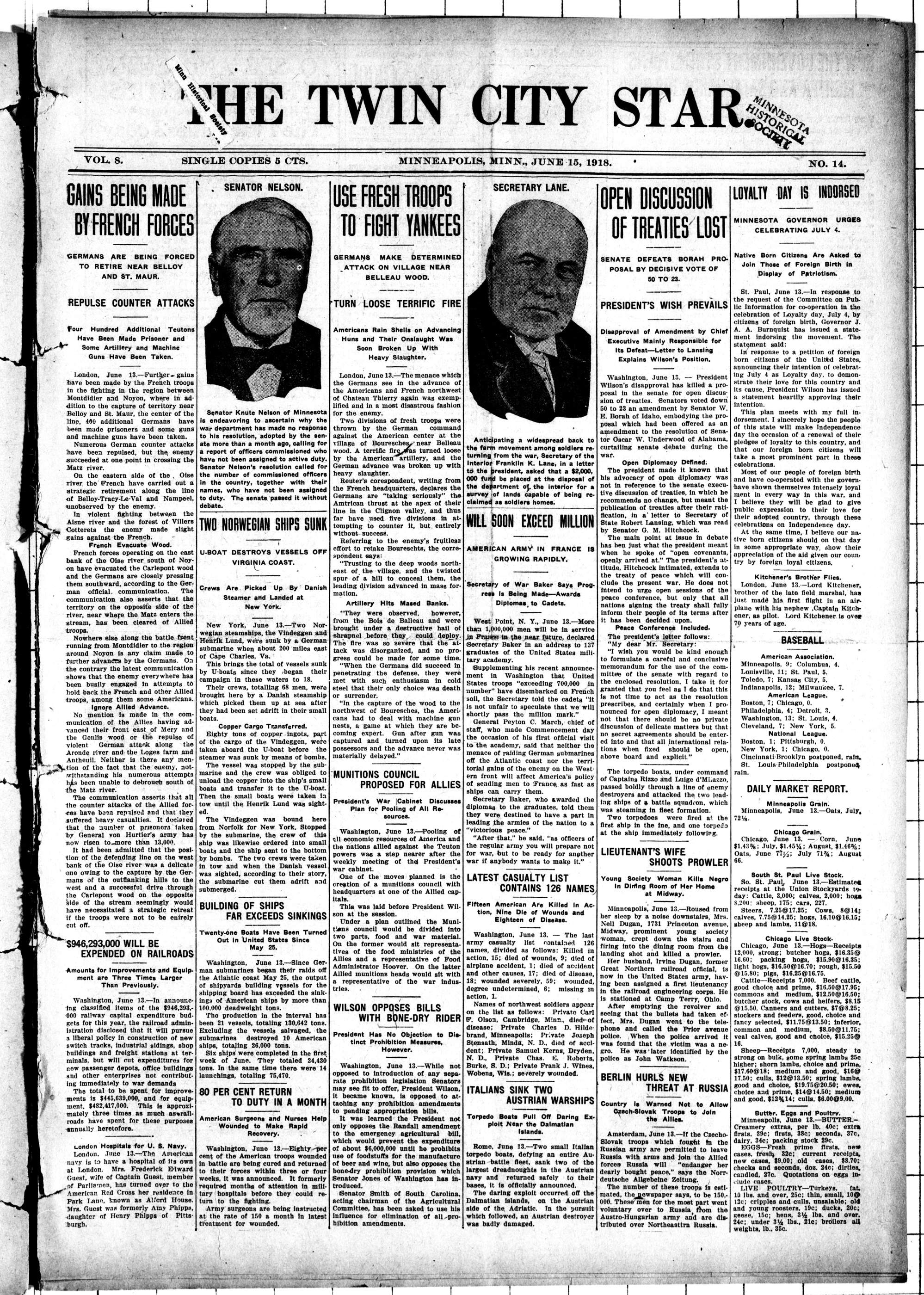
GAINS BEING MADE BY FRENCH FORCES
GERMANS ARE BEING FORCED TO RETIRE NEAR BELLOY AND ST. MAUR.
REPULSE COUNTER ATTACKS
Four Hundred Additional Teutons Have Been Made Prisoner and Some Artillery and Machine Guns Have Been Taken.
London, June 13.—Further gains have been made by the French troops in the fighting in the region between Montdidier and Noyon, where in addition to the capture of territory near Belloy and St. Maur, the center of the line, 400 additional Germans have been made prisoners and some guns and machine guns have been taken.
Numerous German counter attacks have been repulsed, but the enemy succeeded at one point in crossing the Matz river.
On the eastern side of the, Oise river the French have carried out a strategic retirement along the line of Belloy-Tracy-Le-Val and Nampeel, unobserved by the enemy.
In violent fighting between the Alsne river and the forest of Villers Cotterets the enemy made slight gains against the French.
French forces operating on the east bank of the Oise river south of Noyon have evacuated the Carlepont wood and the Germans are closely pressing them southward, according to the German official, communication. The communication also asserts that the territory on the opposite side of the river, near where the Matz enters the stream, has been cleared of Allied troops. Nowhere else along the battle front running from Montdidier to the region around Noyon is any claim made to further advances by the Germans. On the contrary the latest communication shows that the enemy everywhere has been busily engaged in attempts to hold back the French and other Allied troops, among them some Americans. Ignore Allied Advance. No mention is made in the communication of the Allies having advanced their front east of Mery and the Genlis wood or the repulse of violent German attack along the Aronde river and the Loges farm and Antheuil. Neither is there any mention of the fact that the enemy, notwithstanding his numerous attempts has been unable to debouch south of the Matz river.
The communication asserts that all the counter attacks of the Allied forces have been repulsed and that they suffered heavy casualties. It declared that the number of prisoners taken by General von Hurtier's army has now risen to more than 13,000. It had been admitted that the position of the defending line on the west bank of the Olsr river was a delicate one owing to the capture by the Germans of the outflanking hills to the west and a successful drive through the Carlepont wood on the opposite side of the stream seemingly would have necessitated a strategic retreat if the troops were not to be entirely cut off.
$946,293,000 WILL BE
EXPENDED ON RAILROADS
Amounts for Improvements and Equipment are Three Times Larger Than Previously.
Washington, June 13.—In announcing classified items of the $446,293,000 railway capital expenditure budgets for this year, the railroad administration disclosed that it will pursue a liberal policy in construction of new switch tracks, industrial sidings, shop buildings and freight stations at terminals, but will cut expenditures for new passenger depots, office buildings and other enterprises not contributing immediately to war demands.
The total to be spent for improvements is $445,639,000, and for equipment, $482,447,000. This is approximately three times as much as asphalt roads have spent for these purposes annually heretofore.
London Hospitals for U. S. Navy.
London, June 13.—The American navy is to have a hospital of its own at London. Mrs. Frederick Edward Guest, wife of Captain Guest, member of Parliament, has turned over to the American Red Cross her residence in Park Lane, known as Allard House. Mrs. Guest was formerly Amy Phipps, daughter of Henry Phipps of Pittsburgh.
THE TWIN CITY STAR
SINGLE COPIES 5 CTS.
SENATOR NELSON.
PETER H. BURKE
Senator Knute Nelson of Minnesota is endeavoring to ascertain why the war department has made no response to his resolution, adopted by the senate more than a month ago, calling for a report of officers commissioned who have not been assigned to active duty. Senator Nelson's resolution called for the number of commissioned officers in the country, together with their names, who have not been assigned to duty. The senate passed it without debate.
TWO NORWEGIAN SHIPS SUNK
U-BOAT DESTROYS VESSELS OFF VIRGINIA COAST.
Crews Are. Picked Up. By Danish Steamer and Landed at New York.
New York, June 13.—Two Norwegian steamships, the Vindeggen and Henrik Lund, were sunk by a German submarine when about 200 miles east of Cape Charles, Va.
This brings the total of vessels sunk by U-boats since they began their campaign in these waters to 18.
Their crews, totalling 68 men, were brought here by a Danish steamship which picked them up at sea after they had been set adrift in their small boats.
Copper Cargo Transferred.
Eighty tons of copper ingots, part of the cargo of the Vindeggen, were taken aboard the U-boat before the steamer was sunk by means of bombs. The vessel was stopped by the submarine and the crew was obliged to unload the copper into the ship's small boats and transfer it to the U-boat. Then the small boats were taken in tow until the Henrik Lund was sighted.
The Vindeggen was bound here from Norfolk for New York. Stopped by the submarine, the crew of this ship was likewise ordered into small boats and the ship sent to the bottom by bombs. The two crews were taken in tow and when the Danish vessel was sighted, according to their story, the submarine cut them adrift and submerged.
BUILDING OF SHIPS FAR EXCEEDS SINKINGS
Twenty-one Boats Have Been Turned Out in United States Since May 25.
Washington, June 13.—Since German submarines began their raids off the Atlantic coast May 25, the output of shipyards building vessels for the shipping board has exceeded the sinkings of American ships by more than 100,000 deadweight tons.
The production in the interval has been 21 vessels, totaling 130,642 tons. Excluding the vessels salvaged, the submarines destroyed 10 American ships, totaling 26,000 tons.
Six ships were completed in the first week of June. They totaled 24,430 tons. In the same time there were 14 launchings, totaling 75,470.
80 PER CENT RETURN
TO DUTY IN A MONTH
American Surgeons and Nurses Help Wounded to Make Rapid Recovery.
Washington, June 13.—Eighty per cent of the American troops wounded in battle are being cured and returned to their forces within three or four weeks, it was announced. It formerly required months of attention in military hospitals before they could return to the fighting.
Army surgeons are being instructed at the rate of 150 a month in latest treatment for wounded.
MINNEAPOLIS, MINN., JUNE 15, 1918.
USE FRESH TROOPS TO FIGHT YANKEES
USE FRESH TROOPS TO FIGHT YANKEES
GERMANS MAKE DETERMINED
ATTACK ON VILLAGE NEAR
BELLEAU WOOD.
TURN LOOSE TERRIFIC FIRE
Americans Rain Shells on Advancing Huns and Their Onslaught Was Soon Broken Up With Heavy Slaughter.
London, June 13.—The menace which the Germans see in the advance of the Americans and French northwest of Chateau Thierry again was exemplified and in a most disastrous fashion for the enemy.
Two divisions of fresh troops were thrown by the German command against the American center at the village of Bouresches, near Belleau wood. A terrific fire was turned loose by the American artillery, and the German advance was broken up with heavy slaughter.
Reuter's corespondent, writing from the French headquarters, declares the Germans are "taking seriously" the Amtrican thrust at the apex of their line in the Clignon valley, and thus far have used five divisions in attempting to counter it, but entirely without success.
Referring to the enemy's fruitless effort to retake Boureschts, the correspondent says:
"Trusting to the deep woods northeast of the village, and the twisted spur of a hill to conceal them, the leading division advanced in mass formation.
Artillery Hits Mased Banks.
"They were observed, however, from the Bols de Balleau and were brought under a destructive hall of shrapnel before they, could deploy. The fire was so severe that the attack was disorganized, and no progress could be made for some time.
"When the Germans did succeed in penetrating the defense, they were met with such enthusiasm in cold steel that their only choice was death or surrender.
"In the capture of the wood to the northwest of Bouriches, the Americans had to deal with machine gun nests, a game at which they are becoming expert. Gun after gun was captured and turned upon its late possessors and the advance never was materially delayed."
MUNITIONS COUNCIL
PROPOSED FOR ALLIES
President's War (Cabinet Discusses Plan for Pooling of All Resources.
Washington, June 13.—Pooling of all economic resources of America and the nations allied against the Teuton powers was a step nearer after the weekly meeting of the President's war cabinet.
One of the moves planned is the creation of a munitions council with headquarters at one of the Allied capitals.
This was laid before President Wilson at the session.
Under a plan outlined the Munitions council would be divided into two parts, food and war material. On the former would sit representatives of the food ministries of the Allies and a representative of Food Administrator Hoover. On the latter Allied munitions heads would sit with a representative of the war industries.
WILSON OPPOSES BILLS WITH BONE-DRY RIDER
President Has No Objection to Distinct Prohibition Measures, However.
Washington, June 13.—While not opposed to introduction of any separate prohibition legislation Senators may see fit to offer, President Wilson, it became known, is opposed to attaching any prohibition amendments to pending appropriation bills.
It was learned the President not only opposes the Randall amendment to the emergency agricultural bill, which would prevent the expenditure of about $6,000,000 until he prohibits use of foodstuffs for the manufacture of beer and wine, but also opposes the bone-dry prohibition provision which Senator Jones of Washington has introduced.
Senator Smith of South Carolina, acting chairman of the Agricultural Committee, has been asked to use his influence for elimination of all prohibition amendments.
SECRETARY LANE.
SECRETARY LANE
Anticipating a widespread back to the farm movement among soldiers returning from the war, Secretary of the Interior Franklin K. Lane, in a letter to the president, asked that a $2,000,000 fund be placed at the disposal of the department of the interior for a survey of lands capable of being reclaimed as soldiers homes.
WILL SOON EXCEED MILLION
AMERICAN ARMY IN FRANCE IS GROWING RAPIDLY.
Secretary of War Baker Says Progress is Being Made—Awards Diplomas, to Cadets.
West Point, N. Y., June 13.—More than 1,000,000 men will be in service in France in the near future, declared Secretary Baker in an address to 137 graduates of the United States military academy.
Supplementing his recent announcement in Washington that United States troops "exceeding 700,000 in number" have disembarked on French soil, the Secretary told the cadets "it is not unfair to speculate that we will shortly pass the million mark."
General Peyton C. March, chief of staff, who made Commencement day the occasion of his first official visit to the academy, said that neither the menace of raiding German submarines off the Atlantic coast nor the territorial gains of the enemy on the Western front will affect America's policy of sending men to France, as fast as ships can carry them.
Secretary Baker, who awarded the diplomas to the graduates, told them they were destined to have a part in leading the armies of the nation to a "victorious peace."
"After that," he said, "as officers of the regular army you will prepare not for war, but to be ready for another war if anybody wants to make it."
LATEST CASUALTY LIST
CONTAINS 126 NAMES
Fifteen American Are Killed in Action, Nine Die of Wounds and Eighteen of Disease.
Washington, June 13. — The last army casualty list contained 126 names, divided as follows: Killed in action, 15; died of wounds, 9; died of airplane accident, 1; died of accident and other causes, 17; died of disease, 18; wounded severely, 59; wounded, degree undetermined, 6; missing in action, 1.
Names of northwest soldiers appear on the list as follows: Private Carl F. Olson, Cambridge, Minn., died of disease; Private Charles D. Hildebrand, Minneapolis; Private Joseph Stensath, Minda, N. D., died of accident; Private Samuel Kerns, Dryden, N. D., Private Chas. E. Roberts, Burke, S. D.; Private Frank J. Wines, Wobens, Wis.; severely wounded.
ITALIANS SINK TWO
AUSTRIAN WARSHIPS
Torpedo Boats Pull Off Daring Exploit Near the Dalmatian Islands.
Rome. June 13.—Two small Italian torpedo boats, defying an entire Austrian-battle fleet, sank two of the largest dreadnoughts in the Austrian navy and returned safely to their bases, it is officially announced.
The daring exploit occurred off the Dalmatian islands, on the Austrian side of the Adriatic. In the pursuit which followed, an Austrian destroyer was badly damaged.
OPEN DISCUSSION OF TREATIES LOST
OPEN DISCUSSION OF TREATIES LOST
SENATE DEFEATS BORAH PRO
POSAL BY DECISIVE VOTE OF
50 TO 23.
PRESIDENT'S WISH PREVAILS
Disapproval of Amendment by Chief Executive Mainly Responsible for Its Defeat—Letter to Lansing Explains Wilson's Position.
Washington, June 13. — President Wilson's disapproval has killed a proposal in the senate for open discussion of treaties. Senators voted down 50 to 23 an amendment by Senator W. E. Borah of Idaho, embodying the proposal which had been offered as an amendment to the resolution of Senator Oscar W. Underwood of Alabama, curtailing senate debate during the war.
Open Diplomacy Defined:
The president made it known that his advocacy of open diplomacy was not in reference to the senate executive discussion of treaties, in which he recommends no change, but meant the publication of treaties after their ratification, in a letter to Secretary of State Robert Lansing, which was read by Senator G. M. Hitchcock. The main point at issue in debate has been just what the president meant when he spoke of "open covenants, openly arrived at." The president's attitude, Hitchcock intimated, extends to the treaty of peace which will conclude the present war. He does not intend to urge open sessions of the peace conference, but only that all nations signing the treaty shall fully inform their people of its terms after it has been decided upon.
"I wish you would be kind enough to formulate a careful and conclusive memorandum for the use of the committee of the senate with regard to the enclosed resolution. I take it for granted that you feel as I do that this is not time to act as the resolution prescribes, and certainly when I pronounced for open diplomacy, I meant not that there should be no private discussion of delicate matters but that no secret agreements should be entered into and that all international relations when fixed should be open, above board and explicit."
The torpedo boats, under command of Captains Rizzo and Luige d'Milazzo, passed boldly through a line of enemy destroyers and attacked the two leading ships of a battle squadron, which was steaming in fleet formation.
Two torpedoes were fired at the first ship in the inne, and one torpedo at the ship immediately following.
LIEUTENANT'S WIFE
SHOOTS PROWLER
Young Society Woman Kills Negro In Diring Room of Her Home at Midway.
Minneapolis, June 13.—Roused from her sleep by a noise downstairs, Mrs. Neil Dugan, 1731 Princeton avenue, Midway, prominent young society woman, crept down the stairs and firing into the dining room from the landing shot and killed a prowler.
Her husband, Irvine Dugan, former Great Northern railroad official, is now in the United States army, having been assigned a first lieutenancy in the railroad engineering corps. He is stationed at Camp Terry, Ohio.
After emptying the revolver and seeing that the bullets had taken effect, Mrs. Dugan went to the telephone and called the Prior avenue police. When the police arrived it was found that the victim was a negro. He was later identified by the police as John Watkson.
BERLIN HURLS NEW
THREAT AT RUSSIA
Country is Warned Not to Allow Czech-Slovak Troops to Join the Allies.
Amsterdam, June 13.—If the Czecho-Slovak troops which fought in the Russian army are permitted to leave Russia with arms and join the Allied forces Russia will "endanger her dearly bought peace," says the Norrdeutsche Allgebeine Zeitung.
The number of these troops is estimated, the newspaper says, to be 150,000. These men for the most part went voluntary over to Russia, from the Austro-Hungarian army and are distributed over Northeastrn Russia.
NO.14.
LOYALTY DAY IS INDORSED
MINNESOTA GOVERNOR URGES
CELEBRATING JULY 4.
Native Born Citizens Are Asked to Join Those of Foreign Birth in Display of Patriotism.
St. Paul, June 13.—In response to the request of the Committee on Public Information for co-operation in the celebration of Loyalty day, July 4, by citizens of foreign birth, Governor J. A. A. Burnquist has issued a statement indorsing the movement. The statement said:
In response to a petition of foreign born citizens of the United States, announcing their intention of celebrating July 4 as Loyalty day, to demonstrate their love for this country and its cause, President Wilson has issued a statement heartily approving their intention.
This plan meets with my full indorsement. I sincerely hope the people of this state will make Independence day the occasion of a renewal of their pledges of loyalty to this country, and that our foreign born citizens will take a most prominent part in these celebrations.
Most of our people of foreign birth and have co-operated with the governhave shown themselves intensely loyal ment in every way in this war, and I believe they will be glad to give public expression to their love for their adopted country, through these celebrations on Independence day.
At the same time, I believe our native born citizens should on that day in some appropriate way, show their appreciation of the aid given our country by foreign loyal citizens.
Kitchener's Brother Flies.
London, June 13.--Lord Kitchener, brother of the late field marshal, has just made his first flight in an airplane with his nephew, Captain Kitchener, as pilot. Lord Kitchener is over 70 years of age.
BASEBALL
American Association.
Minneapolis, 9; Columbus, 4.
Louisville, 11; St. Paul, 5.
Toledo, 7; Kansas City, 5.
Indianapolis, 12; Milwaukee, 7.
American League.
Boston, 7; Chicago, 0.
Philadelphia, 4; Detroit, 3.
Washington, 13; St. Louis, 4.
Cleveland, 7; New York, 5.
National League.
Boston, 1; Pittsburgh, 0.
New York, 1; Chicago, 0.
Cincinnati-Brooklyn postponed, rain.
St. Louis-Philadelphia postponed, rain.
DAILY MARKET REPORT.
Minneapolis Grain.
Minneapolis, June 13.—Oats, July.
72%.
Chicago Grain.
Chicago, June 13. — Corn, June
$1.43%; July, $1.45%; August, $1.46%;
Oats, June 77½; July 71½; August
66.
South St. Paul Live Stock.
So. St. Paul, June 13.—Estimated
receipts at the Union Stockyards
today: Cattle, 3,000; calves, 2,000; hogs
8,200; sheep, 175; cars, 227.
Steers, 7.25@17.25; Cows, 8@14;
calves, 7.75@14.25; hogs, 16.10@16.15;
sheep and sheep, 11@18.
Chicago Live Stock
Chicago, June 13.—Hogs—Receipts 12,000, strong; butcher hogs, $16.35@16.60; packing hogs, $15.90@16.35; light hogs, $16.50@16.70; rough, $15.50@15.80; pigs, $16.25@16.75.
Cattle—Receipts 7,000. Beef cattle, good choice and prime, $16.50@17.95; commones and medium, $12.50@16.50; butcher stock, cows and heifers, $8.15@15.50. Canners and cutters, $7@8.25; stockers and feeders, good, choice and fancy selected, $11.75@13.50; inferlor, common and medium, $8.50@11.75; veal calves, good and choice, $15.25@16.
Sheep—Receipts 7,000, steady to strong on bulk, some spring lambs 25c higher; shorn lambs, choice and prime, $17.60@18; medium and good, $16@17.50; culls, $12@13.50; spring lambs, good and choice, $19.75@20.50; ewes, choice and prime, $14@14.50; medium and good, $12%14; culls, $6.00@9.00.
Butter. Eggs and Poultry.
Minneapolis, June 13.—BUTTER. Creamy extras, per lb. 40c; extra firsts, 39c; firsts, 38c; seconds, 37c, dairy, 34c; packing stock 29c.
EGGS—Fresh prime firsts, new cases, fresh 32c; current receipts, new cases, $9.00; old cases, $8.70; checks and seconds, 20c; 24c; dirties, candled, 27c. Quotations on eggs include
LIVE POULTRY—Turkeys, fat
10 lbs. and over, 25c; thin, small, 10©
12c; cripples and culls, unsalable; old
and young roosters, 19c; ducks, 20c;
geese, 15c; lcens, 3½ lbs. 12c and over.
24c; under 3½ lbs., 21c; broilers all
weights. lb. 35c.
HOW THE GOVERNMENT STRENGTHENS FIGHTER AND SAFEGUARDS HIS HOME
Uncle Sam's War Risk Insurance Offers Protection at Cost—Government Assumes All Administrative Costs and Extra War Hazards—Business Exceeds by Several Hundred Per Cent Largest Insurance Company in World.
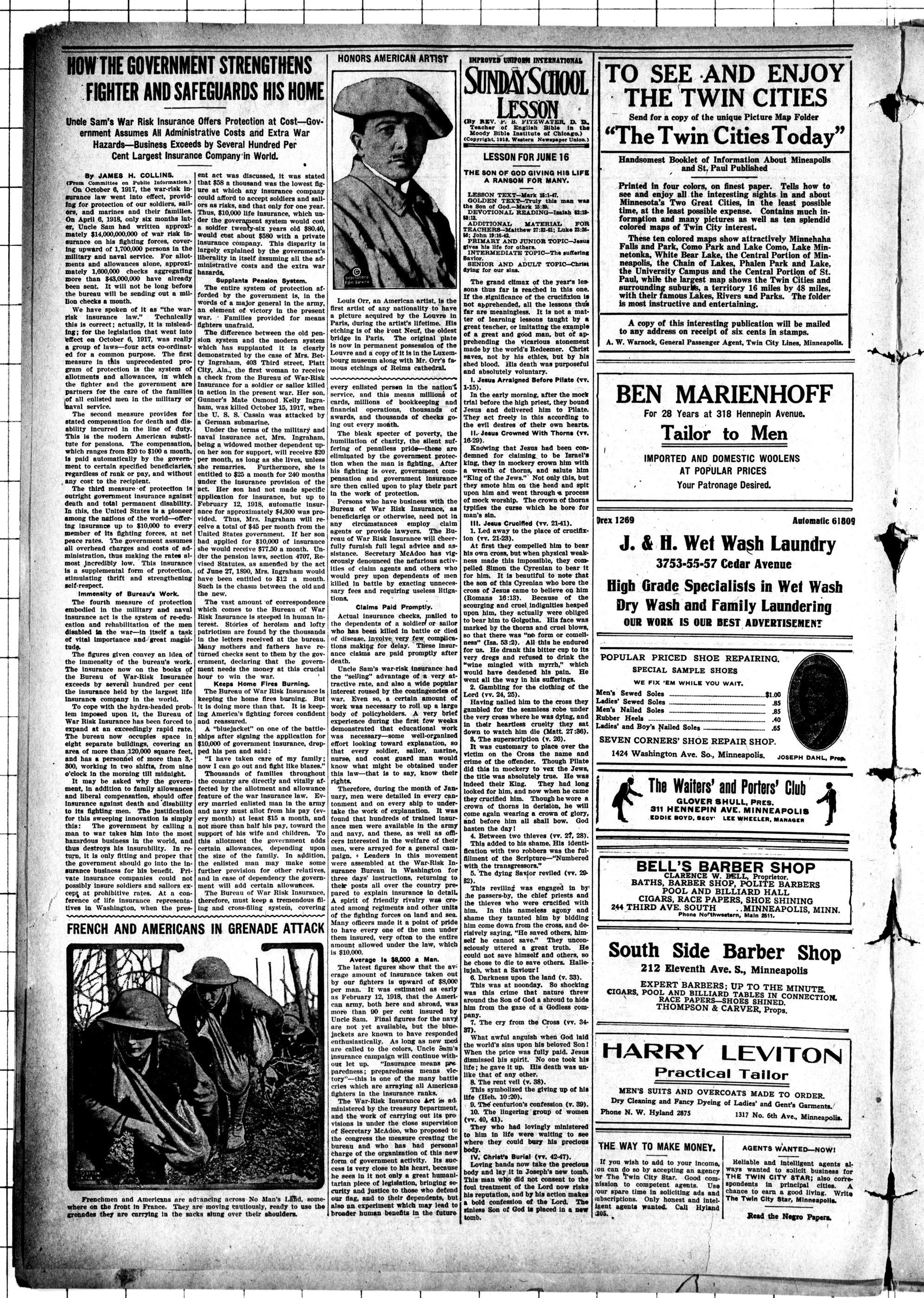
FRENCH AND AMERICANS IN GRENADE ATTACK
STROM
Frenchmen and Americans are advancing across No Man's Land, somewhere on the front in France. They are moving cautiously, ready to use the grenades they are carrying in the sacks slung over their shoulders.
By JAMES H. COLLINS.
(From Committee on Public Information.)
On October 6, 1917, the war-risk insurance law went into effect, providing for protection of our soldiers, sailors, and marines and their families.
On April 6, 1918, only six months later, Uncle Sam had written approximately $14,000,000 of war risk insurance on his fighting forces, covering upward of 1,700,000 persons in the military and naval service. For allotments and allowances alone, approximately 1,600,000 checks aggregating more than $43,000,000 have already been sent. It will not be long before the bureau will be sending out a million checks a month.
We have spoken of it as "the war-risk insurance law." Technically this is correct; actually, it is misleading; for the legislation that went into effect on October 6, 1917, was really a group of laws—four acts co-ordinated for a common purpose. The first measure in this unprecedented program of protection is the system of allotments and allowances, in which the fighter and the government are partners for the care of the families of all enlisted men in the military or naval service.
The second measure provides for stated compensation for death and disability incurred in the line of duty. This is the modern American substitute for pensions. The compensation, which ranges from $20 to $100 a month, is paid automatically by the government to certain specified beneficiaries, regardless of rank or pay, and without any cost to the recipient.
The third measure of protection is outright government insurance against death and total permanent disability. In this, the United States is a pioneer among the nations of the world—offering insurance up to $10,000 to every member of its fighting forces, at net peace rates. The government assumes all overhead charges and costs of administration, thus making the rates almost incredibly low. This insurance is a supplemental form of protection, stimulating thrift and strengthening self-respect.
Immensity of Bureau's Work.
The fourth measure of protection embodied in the military and naval insurance act is the system of re-education and rehabilitation of the men disabled in the war—in itself a task of vital importance and great magnitude.
The figures given convey an idea of the immensity of the bureau's work. The insurance now on the books of the Bureau of War-Risk Insurance exceeds by several hundred per cent the insurance held by the largest life insurance company in the world.
To cope with the hydra-headed problem imposed upon it, the Bureau of War-Risk Insurance has been forced to expand at an exceedingly rapid rate. The bureau now occupies space in eight separate buildings, covering an area of more than 120,000 square feet, and has a personnel of more than 3,800, working in two shifts, from nine o'clock in the morning till midnight.
It may be asked why the government, in addition to family allowances and liberal compensation, should offer insurance against death and disability to its fighting men. The justification for this sweeping innovation is simply this: The government by calling a man to war takes him into the most hazardous business in the world, and thus destroys his insurability. In return, it is only fitting and proper that the government should go into the insurance business for his benefit. Private insurance companies could not possibly insure soldiers and sailors except at prohibitive rates. At a conference of life insurance representatives in Washington, when the pres-
ent act was discussed, it was stated that $58 a thousand was the lowest figure at which any insurance company could afford to accept soldiers and sailors as risks, and that only for one year. Thus, $10,000 life insurance, which under the government system would cost a soldier twenty-six years old $80.40, would cost about $580 with a private insurance company. This disparity is largely explained by the government's liberality in itself assuming all the administrative costs and the extra war hazards.
Supplanta Pension System.
The entire system of protection afforded by the government is, in the words of a major general in the army, an element of victory in the present war. Families provided for means fighters unafraid.
The difference between the old pension system and the modern system which has supplanted it is clearly demonstrated by the case of Mrs. Betty Ingraham, 403 Third street, Platt City, Ala., the first woman to receive a check from the Bureau of War-Risk Insurance for a soldier or sailor killed in action in the present war. Her son, Gunner's Mate Osmond Kelly Ingraham, was killed October 15, 1917, when the U. S. S. Cassin was attacked by a German submarine.
Under the terms of the military and naval insurance act, Mrs. Ingraham, being a widowed mother dependent upon her son for support, will receive $20 per month, as long as she lives, unless she remarries. Furthermore, she is entitled to $25 a month for 240 months under the insurance provision of the act. Her son had not made specific application for insurance, but up to February 12, 1918, automatic insurance for approximately $4,300 was provided. Thus, Mrs. Ingraham will receive a total of $45 per month from the United States government. If her son had applied for $10,000 of insurance she would receive $77.50 a month. Under the pension laws, section 4707, Revised Statutes, as amended by the act of June 27, 1890, Mrs. Ingraham would have been entitled to $12 a month. Such is the chasm between the old and the new.
The vast amount of correspondence which comes to the Bureau of War Risk Insurance is steeped in human interest. Stories of herolism and lofty patriotism are found by the thousands in the letters received at the bureau. Many mothers and fathers have returned checks sent to them by the government, declaring that the government needs the money at this crucial hour to win the war.
Keeps Home Fires Burning.
The Bureau of War Risk Insurance is keeping the home fires burning. But it is doing more than that. It is keeping America's fighting forces confident and reassured.
A "bluejacket" on one of the battleships after signing the application for $10,000 of government insurance, dropped his pen and said:
"I have taken care of my family; now I can go out and fight like blazes." Thousands of families throughout the country are directly and vitally affected by the allotment and allowance feature of the war insurance law. Every married enlisted man in the army and navy must allot from his pay (every month) at least $15 a month, and not more than half his pay, toward the support of his wife and children. To this allotment the government adds certain allowances, depending upon the size of the family. In addition, the enlisted man may make some further provision for other relatives, and in case of dependency the government will add certain allowances. The Bureau of War Risk Insurance, therefore, must keep a tremendous filing and cross-filing system, covering
Internationales
Film Berlín
Louis Orr, an American artist, is the first artist of any nationality to have a picture acquired by the Louvre in Paris, during the artist's lifetime. His etching is of the Pont Neuf, the oldest bridge in Paris. The original plate is now in permanent possession of the Louvre and a copy of it is in the Luxembourg museum along with Mr. Orr's famous etchings of Reims cathedral.
every enlisted person in the nation's service, and this means millions of cards, millions of bookkeeping and financial operations, thousands of awards, and thousands of checks going out every month.
The bleak specter of poverty, the humiliation of charity, the silent suffering of penniless pride—these are eliminated by the government protection when the man is fighting. After his fighting is over, government compensation and government insurance are then called upon to play their part in the work of protection.
Persons who have business with the Bureau of War Risk Insurance, as beneficaries or otherwise, need not in any circumstances employ claim agents or provide lawyers. The Bureau of War Risk Insurance will cheerfully furnish full legal advice and assistance. Secretary McAdoo has vigorously denounced the nefarious activities of claim agents and others who would prey upon dependents of men killed in battle by exacting unnecessary fees and requiring useless litigations.
Claims Paid Promptly.
Actual insurance checks, mailed to the dependents of a soldier or sailor who has been killed in battle or died of disease, involve very few complications making for delay. These insurance claims are paid promptly after death.
Uncle Sam's war-risk insurance had the "selling" advantage of a very attractive rate, and also a wide popular interest roused by the contingencies of war. Even so, a certain amount of work was necessary to roll up a large body of policyholders. A very brief experience during the first few weeks demonstrated that educational work was necessary—some well-organized effort looking toward explanation, so that every soldier, sailor, marine, nurse, and coast guard man would know what might be obtained under this law—that is to say, know their rights.
Therefore, during the month of January, men were detailed in every cantonment and on every ship to undertake the work of explanation. It was found that hundreds of trained insurance men were available in the army and navy, and these, as well as officers interested in the welfare of their men, were arrayed for a general campaign. Leaders in this movement were assembled at the War-Risk Insurance Bureau in Washington for three days' instructions, returning to their posts all over the country prepared to explain insurance in detail. A spirit of friendly rivalry was created among regiments and other units of the fighting forces on land and sea. Many officers made it a point of pride to have every one of the men under them insured, very often to the entire amount allowed under the law, which is $10,000.
Average la $8,000 a Man.
The latest figures show that the average amount of insurance taken out by our fighters is upward of $8,000 per man. It was estimated as early as February 12, 1918, that the American army, both here and abroad, was more than 90 per cent insured by Uncle Sam. Final figures for the navy are not yet available, but the blue jackets are known to have responded enthusiastically. As long as new men are called to the colors, Uncle Sam's insurance campaign will continue without let up. "Insurance means preparedness; preparedness means victory"—this is one of the many battle cries which are arraying all American fighters in the insurance ranks.
The War-Risk Insurance Act is administered by the treasury department, and the work of carrying out its provisions is under the close supervision of Secretary McAdoo, who proposed to the congress the measure creating the bureau and who has had personal charge of the organization of this new form of government activity. Its success is very close to his heart, because he sees in it not only a great humanitarian piece of legislation, bringing security and justice to those who defend our flag, and to their dependents, but also an experiment which may lead to broader human benefits in the future
(By REV. P. B. FTZWATER. D. B.
Teacher of English Bible in the
Moody Bible Institute of Chicago.)
(Copyright, 1918, Western Newspaper Union.)
LESSON FOR JUNE 16
THE SON OF GOD GIVING HIS LIFE
A RANSOM FOR MANY.
LESSON TEXT—Mark 15:1-47.
GOLDEN TEXT—Truly this man was
the Son of God.—Mark 15:39.
DEVOTIONAL READING—Isaiah 62:19-
58:12.
ADDITIONAL MATERIAL FOR
TEACHERS—Matthew 27:32-61; Luke 23:26-
61; John 19:16-42.
PRIMARY AND JUNIOR TOPIC—Jesus
gives his life for others.
INTERMEDIATE TOPIC—The suffering
Baylor.
SENIOR AND ADULT TOPIC—Christ dying for our sins.
The grand climax of the year's lessons thus far is reached in this one. If the significance of the crucifixion is not apprehended, all the lessons thus far are meaningless. It is not a matter of learning lessons taught by a great teacher, or imitating the example of a great and good man, but of apprehending the vicarious atonement made by the world's Redeemer. Christ saves, not by his ethics, but by his shed blood. His death was purposeful and absolutely voluntary.
I. Jesus Arraigned Before Pilate (vv. 1-15).
In the early morning, after the mock trial before the high priest, they bound Jesus and delivered him to Pilate. They act freely in this according to the evil desires of their own hearts.
II. Jesus Crowned With Thorns (vv. 16-29).
Knowing that Jesus had been condemned for claiming to be Israel's king, they in mockery crown him with a wreath of thorns, and salute him "King of the Jews." Not only this, but they smote him on the head and spit upon him and went through a process of mock worship. The crown of thorns typifies the curse which he bore for man's sin.
III. Jesus Crucified (vv. 21-41).
1. Led away to the place of crucifixion (vv. 21-23).
At first they compelled him to bear his own cross, but when physical weakness made this impossible, they compelled Simon the Cyrenian to bear it for him. It is beautiful to note that the son of this Cyrenian who bore the cross of Jesus came to believe on him (Romans 16:13). Because of the scourging and cruel indignities heaped upon him, they actually were obliged to bear him to Golgotha. His face was marked by the thorns and cruel blows, so that there was "no form or comeliness" (Isa. 53:2). All this he endured for us. He drank this bitter cup to its very dregs and refused to drink the "wine mingled with myrrh," which would have deadened his pain. He went all the way in his sufferings. 2. Gambling for the clothing of the Lord (vv. 24, 25).
Having nailed him to the cross they
gambled for the seamless robe under
the very cross where he was dying, and
in their heartless cruelty they sat
down to watch him die (Matt. 27:30).
8. The superscription (v. 26).
It was customary to place over the
victim on the Cross the name and
crime of the offender. Though Pilate
did this in mockery to vex the Jews,
the title was absolutely true. He was
indeed their King. They had long
looked for him, and now when he came
they crucified him. Though he wore a
crown of thorns in derision, he will
come again wearing a crown of glory,
and before him all shall bow. God
hasten the day!
4. Between two thieves (vv. 27, 28).
This added to his shame. His identification with two robbers was the fulfillment of the Scripture—"Numbered with the transgressors."
5. The dying Savior reviled (vv. 29-82).
This reviling was engaged in by the passers-by, the chief priests and the thieves who were crucified with him. In this nameless agony and shame they taunted him by bidding him come down from the cross, and derisively saying, "He saved others, himself he cannot save." They unconsciously uttered a great truth. He could not save himself and others, so he chose to die to save others. Hallelujah, what a Saviour!
6. Darkness upon the land (v. 33).
This was at noonday. So shocking was this crime that nature threw around the Son of God a shroud to hide him from the gaze of a Godless company.
7. The cry from the Cross (vv. 34-37).
What awful anguish when God laid the world's sins upon his beloved Son! When the price was fully paid, Jesus dismissed his spirit. No one took his life; he gave it up. His death was unlike that of any other.
8. The rent vell (v. 38).
This symbolized the giving up of his life (Heb. 10:20).
9. The centurion's confession (v. 39).
10. The lingering group of women (vv. 40, 41).
They who had lovingly ministered to him in life were waiting to see where they could bury his precious body.
[V. Christ's Burial (vv. 42-47).]
Loving hands now take the precious body and lay it in Joseph's new tomb. This man who did not consent to the foul treatment of the Lord now risks his reputation, and by his action makes a bold confession of the Lord. The sinless Son of God is placed in a new tomb.
TO SEE AND ENJOY THE TWIN CITIES Send for a copy of the unique Picture Map Folder "The Twin Cities Today"
Handsomest Booklet of Information About Mineapolis and St. Paul Published
Printed in four colors, on finest paper. Tells how to see and enjoy all the interesting sights in and about Minnesota's Two Great Cities, in the least possible time, at the least possible expense. Contains much information and many pictures as well as ten splendid colored maps of Twin City interest.
These ten colored maps show attractively Minnehaha Falls and Park, Como Park and Lake Como, Lake Minnetonka, White Bear Lake, the Central Portion of Minneapolis, the Chain of Lakes, Phalen Park and Lake, the University Campus and the Central Portion of St. Paul, while the largest map shows the Twin Cities and surrounding suburbs, a territory 16 miles by 48 miles, with their famous Lakes, Rivers and Parks. The folder is most instructive and entertaining.
A copy of this interesting publication will be mailed to any address on receipt of six cents in stamps. A. W. Warnock, General Passenger Agent, Twin City Lines, Minneapolis.
IMPORTED AND DOMESTIC WOOLENS AT POPULAR PRICES Your Patronage Desired.
Orex 1269
J. & H. Wet
3753-55-57
High Grade Special
Dry Wash and F
OUR WORK IS OUR
POPULAR PRICED SHOE
SPECIAL SAMPLE SH
WE FIX 'EM WHILE YOU
Men's Sewed Soles
Ladies' Sewed Soles
Men's Nailed Soles
Rubber Heels
Ladies' and Boy's Nailed Soles
SEVEN CORNERS' SHOE R
1424 Washington Ave. So.,
The Waiters'
GLOVER S
311 HENNEPIN
EDDIE BOYD, SECY'
BELL'S BAR
CLARENCE W
BATHS, BARBER SH
POOL AND B
CIGARS, RACE PAPER
244 THIRD AVE. SOUTH
Phone Northw
South Side
212 Eleventh Ave
EXPERT BARBERS
CIGARS, POOL AND BILLIAR
RACE PAPERS—
THOMPSON &
HARRY
Practical
MEN'S SUITS AND OVER
Dry Cleaning and Fancy Dyeing
Phone N. W. Hyland 2875
Aurora & H. Wet Wash Launcher
3753-55-57 Cedar Avenue
Grade Specialists in Wet Wash and Family Laundry
WORK IS OUR BEST ADVERTISED
RER PRICED SHOE REPAIRING.
SPECIAL SAMPLE SHOES
WE FIX 'EM WHILE YOU WAIT.
Soles $1.00
Soles .85
Soles .85
Boy's Nailed Soles .65
DARNERS' SHOE REPAIR SHOP.
Washington Ave. So., Minneapolis. JOSEPH
The Waiters' and Porters' Club
GLOVER SHULL, PRES.
311 HENNEPIN AVE. MINNEAPOLIS.
EDDIE BOYD, SECY' LEE WHEELER, MANAGE
BELL'S BARBER SHOP
CLARENCE W. BELL, Proprietor.
BATHS, BARBER SHOP, POLITE BARBER
POOL AND BILLIARD HALL
CIGARS, RACE PAPERS, SHOE SHINED
ARD AVE. SOUTH ... MINNEAPOLIS.
Phone Northwestern, Main 2511.
North Side Barber Shop
212 Eleventh Ave. S., Minneapolis.
EXPERT BARBERS; UP TO THE MIN
POOL AND BILLIARD TABLES IN CONE
RACE PAPERS—SHOES SHINED.
THOMPSON & CARVER, Props.
RERR LEVITT
Practical Tailor
SUITS AND OVERCOATS MADE TO OVER
ning and Fancy Dyeing of Ladies' and Gent's G
Ty. Hyland 2875
1317 No. 6th Ave.,
J. & H. Wet Wash Laundry 3753-55-57 Cedar Avenue High Grade Specialists in Wet Wash Dry Wash and Family Laundering OUR WORK IS OUR BEST ADVERTISEMENT
BELL'S BARBER SHOP
CLARENCE W. BELL, Proprietor.
BATHS, BARBER SHOP, POLITE BARBERS
POOL AND BILLIARD HALL
CIGARS, RACE PAPERS, SHOE SHINING
244 THIRD AVE. SOUTH . MINNEAPOLIS, MINN.
Phone Northwestern, Main 2811.
EXPERT BARBERS; UP TO THE MINUTE.
CIGARS, POOL AND BILLIARD TABLES IN CONNECTION.
RACE PAPERS—SHOES SHINED.
THOMPSON & CARVER. Props.
MEN'S SUITS AND OVERCOATS MADE TO ORDER. Dry Cleaning and Fancy Dyeing of Ladies' and Gent's Garments. Phone N. W. Hyland 2875 1317 No. 6th Ave., Minneapolis
THE WAY TO MAKE MONEY.
If you wish to add to your income, you can do so by accepting an agency for The Twin City Star. Good commission to competent agents. Use your spare time in soliciting ads and subscriptions. Only honest and intelligent agents wanted. Call Hyland 205.
---
Wash Laundry
Cedar Avenue
realists in Wet Wash
family Laundering
TEST ADVERTISEMENT
Minneapolis. JOSEPH DAHL, Props.
Hand Porters' Club
HULL, PRES.
AVE. MINNEAPOLIS
LEE WHEELER, MANAGER
BARBER SHOP
BELL, Proprietor.
SHOP, POLITE BARBERS
BILLIARD HALL
BERS, SHOE SHINING
MINNEAPOLIS, MINN.
Etern, Main 2511.
Barber Shop
e. S., Minneapolis
; UP TO THE MINUTE.
AND TABLES IN CONNECTION.
SHOES SHINED.
CARVER, Props.
LEVITON
Tailor
COATS MADE TO ORDER.
of Ladies' and Gent's Garments.
1317 No. 6th Ave., Minneapolis.
AGENTS WANTED—NOW!
Reliable and intelligent agents always wanted to solicit business for THE TWIN CITY STAR; also correspondents in principal cities. A chance to earn a good living. Write The Twin City Star, Minneapolis.
Read the Negro Papera.
Automatic 61809
THE
UNION
OF
THE
MIDDLE
EAST
UNION
NEWS and GOSSIP of WASHINGTON
```markdown
```
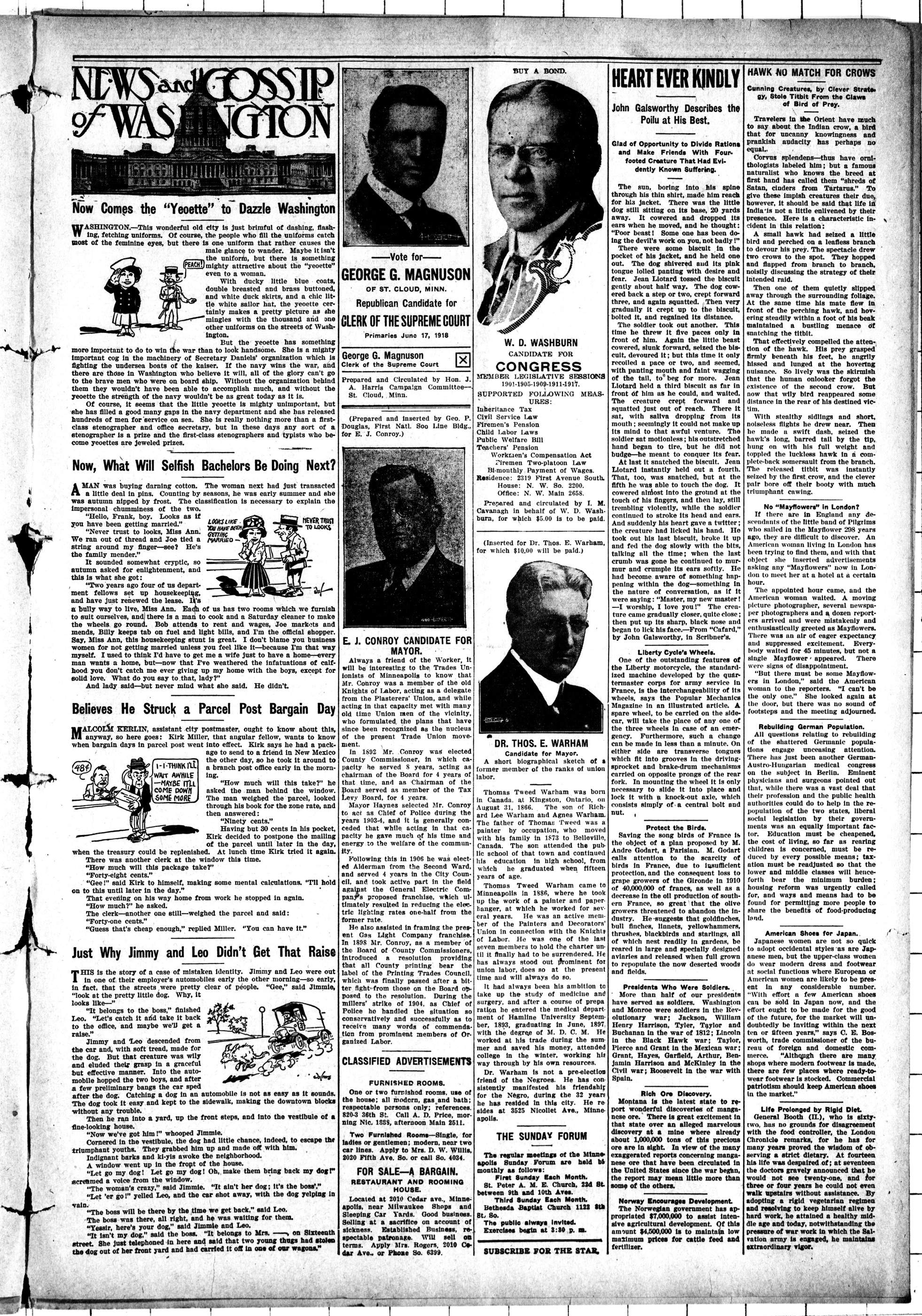
Now Comes the "Yeoette" to Dazzle Washington
WASHINGTON.—This wonderful old city is just brimful of dashing, flashing, fetching uniforms. Of course, the people who fill the uniforms catch most of the feminine eyes, but there is one uniform that rather causes the male glance to wander. Maybe it isn't the uniform, but there is something mighty attractive about the "yeoette" even to a woman.
With ducky little blue coats, double breasted and brass buttoned, and white duck skirts, and a chic little white sailor hat, the yeoette certainly makes a pretty picture as she mingles with the thousand and one other uniforms on the streets of Washington.
But the more important to do to win the war than to look in important cog in the machinery of Secretary Dan fighting the undersea boats of the kaiser. If the there are those in Washington who believe it will to the brave men who were on board ship. Without them they wouldn't have been able to accomplish yeoette the strength of the navy wouldn't be as great. Of course, it seems that the little yeoette is she has filled a good many gaps in the navy depart hundreds of men for service on sea. She is really class stenographer and office secretary, but in the stenographer is a prize and the first-class stenogra come yeoettes are jeweled prizes.
Now, What Will Selfish Bachelor
A MAN was buying darning cotton. The woman a little deal in pins. Counting by seasons, he was autumn nipped by frost. The classification is impersonal chumminess of the two.
more important to do to win the war than to look handsome. She is a mighty important cog in the machinery of Secretary Daniels' organization which is fighting the undersea boats of the kaiser. If the navy wins the war, and there are those in Washington who believe it will, all of the glory can't go to the brave men who were on board ship. Without the organization behind them they wouldn't have been able to accomplish much, and without the yeoette the strength of the navy wouldn't be as great today as it is.
war than to look handsome. She is a mighty of Secretary Daniels' organization which is the kaiser. If the navy wins the war, and who believe it will, all of the glory can't go board ship. Without the organization behind able to accomplish much, and without the wouldn't be as great today as it is. The little yeoette is mighty unimportant, but in the navy department and she has released sea. She is really nothing more than a first-secretary, but in these days any sort of a first-class stenographers and typists who be-ish Bachelors Be Doing Next? cotton. The woman next had just transacted by seasons, he was early summer and she the classification is necessary to explain the two.
Of course, it seems that the little yoette is mighty unimportant, but she has filled a good many gaps in the navy department and she has released hundreds of men for service on sea. She is really nothing more than a first-class stenographer and office secretary, but in these days any sort of a stenographer is a prize and the first-class stenographers and typists who become yoettes are jeweled prizes.
Now, What Will Selfish Bachelors Be Doing Next?
MAN was buying darning cotton. The woman next had just transacted a little deal in pins. Counting by seasons, he was early summer and she was autumn nipped by frost. The classification is necessary to explain the impersonal chummliness of the two.
"Hello, Frank, boy. Looks as if you have been getting married."
"Never trust to looks, Miss Ann. We ran out of thread and Joe tied a string around my finger—see? He's the family mender."
It sounded somewhat cryptic, so autumn asked for enlightenment, and this is what she got:
"Two years ago four of us department fellows set up housekeeping,
Each of us has two rooms which we furnish man to cook and a Saturday cleaner to makeends to rent and wages, Joe markets and light bills, and I'm the official shopper. g stunt is great. I don't blame you business unless you feel like it—because I'm that way to get me a wife just to have a home—every that I've weathered the infatuations of calf-living up my home with the boys, except for that, lady?" I mind what she said. He didn't.
a Parcel Post Bargain Day
a city postmaster, ought to know about this, Miller, that angular fellow, wants to know it went into effect. Kirk says he had a pack-
a bully way to live, Miss Ann. Each of us has two rooms which we furnish to suit ourselves, and there is a man to cook and a Saturday cleaner to make the wheels go round. Bob attends to rent and wages, Joe markets and mends, Billy keeps aks on fuel and light bills, and I'm the official shopper. Say, Miss Ann, this housekeeping stunt is great. I don't blame you business women for not getting married unless you feel like it—because I'm that way myself. I used to think I'd have to get me a wife just to have a home—every man wants a home, but—now that I've weathered the infatuations of calfhood you don't catch me ever giving up my home with the boys, except for solid love. What do you say to that, lady?"
a bully way to live, Miss Ann. Each of us has two to suit ourselves, and there is a man to cook and a the wheels go round. Bob attends to rent and mends, Billy keeps tab on fuel and light bills, an Say, Miss Ann, this housekeeping stunt is great. I women for not getting married unless you feel like myself. I used to think I'd have to get me a wife man wants a home, but—now that I've weathered hood you don't catch me ever giving up my home solid love. What do you say to that, lady?" And lady said—but never mind what she said
Believes He Struck a Parcel P
MALCOLM KERLIN, assistant city postmaster, anyway, so here goes: Kirk Miller, that angu when bargain days in parcel post went into effect. age to send
And lady said—but never mind what she said. He didn't.
Believes He Struck a Parcel Post Bargain Day
Believes He Struck a Parcel Post Bargain Day
MALCOLM KERLIN, assistant city postmaster, ought to know about this, anyway, so here goes: Kirk Miller, that angular fellow, wants to know when bargain days in parcel post went into effect. Kirk says he had a package to send to a friend in New Mexico the other day, so he took it around to a branch post office early in the morning.
"How much will this take?" he asked the man behind the window. The man weighed the parcel, looked through his book for the zone rate, and then answered:
"Ninety cents."
Having but 30 cents in his pocket, Kirk decided to postpone the mailing of the parcel until later in the day.
when the treasury could be replenished. At lunch
There was another clerk at the window this
"How much will this package take?"
"Forty-eight cents."
"Gee!" said Kirk to himself, making some me
on to this until later in the day."
That evening on his way home from work he
"How much?" he asked.
The clerk—another one still—welghed the par
"Forty-one cents."
"Guess that's cheap enough," replied Miller.
Just Why Jimmy and Leo Didn't
THIS is the story of a case of mistaken identity.
In one of their employer's automobiles early th
in fact, that the streets were pretty clear of pee
"look at the pretty little dog. Why, it
looks like—"
enished. At lunch time Kirk tried it again.
the window this time.
ge take?"
making some mental calculations. "Till hold
time from work he stopped in again.
—weighed the parcel and said:
"replied Miller. "You can have it."
I Leo Didn't Get That Raise
mistaken identity. Jimmy and Leo were out
automobiles early the other morning—so early,
pretty clear of people. "Gee," said Jimmie,
why, it
when the treasury could be replenished. At lunch time Kirk tried it again. There was another clerk at the window this time. "How much will this package take?" "Forty-eight cents." "Gee!" said Kirk to himself, making some mental calculations. "Till hold on to this until later in the day."
Just Why Jimmy and Leo Didn't Get That Raise
Just Why Jimmy and Leo Didn't Get That Raise
THIS is the story of a case of mistaken identity. Jimmy and Leo were out in one of their employer's automobiles early the other morning—so early, in fact, that the streets were pretty clear of people. "Gee," said Jimmle, "look at the pretty little dog. Why, it looks like."
published back
get a
from
side for
wily
peaceful
auto-
after
sped
on an automobile is not as easy as it sounds.
to the sidewalk, making the downtown blocks
to the front steps, and into the vestibule of a
sped Jimmle.
he dog had little chance, indeed, to escape the
hed him up and made off with him.
woke the neighborhood.
after the dog. Catching a dog in an automobile is
The dog took it easy and kept to the sidewalk, ma-
without any trouble.
Then he ran into a yard, up the front steps, a
fine-looking house.
after the dog. Catching a dog in an automobile is not as easy as it sounds. The dog took it easy and kept to the sidewalk, making the downtown blocks without any trouble. Then he ran into a yard, up the front steps, and into the vestibule of a fine-looking house.
"Now we've got him!" whooped Jimmie. Cornered in the vestibule, the dog had little chance, indeed, to escape the trumphant youths. They grabbed him up and made off with him. Indignant barks and ki-yis awoke the neighborhood. A window went up in the front of the house.
"Let go my dog! Let go my dog! Oh, make them bring back my dog!" screamed a voice from the window.
"Let go my dog! Let go my dog! Oh, make screamed a voice from the window.
"The woman's crazy," said Jimmie. "It ain't h
"Let 'er go!" yelled Leo, and the car shot awa
vain.
"The boss will be there by the time we get back
The boss was there, all right, and he was wai
"Yessir, here's your dog," said Jimmie and Le
"It isn't my dog," said the boss. "It belongs
street. She just telephoned in here and said that t
the dog out of her front yard and had carried it off
my dog! Oh, make them bring back my dog!"
now.
Jimmie. "It ain't her dog; it's the boss."
and the car shot away, with the dog yelping in
the time we get back," said Leo.
it, and he was waiting for them.
said Jimmie and Leo.
boss. "It belongs to Mrs. — on Sixteenth
here and said that two young thugs had stolen
had carried it off in one of our wagons."
"The woman's crazy," said Jimmie. "It ain't her dog; it's the boss!" "Let 'er go!" yelled Leo, and the car shot away, with the dog yelping in vain.
"It isn't my dog," said the boss. "It belongs to Mrs. — on Sixteenth street. She just telephoned in here and said that two young thugs had stolen the dog out of her front yard and had carried it off in one of our wagons."
PEACH!
"Hello, Frank, boy. Looks as if you have been getting married."
"Never trust to looks, Miss Ann. We ran out of thread and Joe tied a string around my finger—see? He's the family mender."
It sounded somewhat cryptic, so autumn asked for enlightenment, and this is what she got:
"Two years ago four of us department fellows set up housekeeping, and have just renewed the lease. It's
48¢
1-1-THINK ITLL
WAIT AWHILE
—MAYBE ITLL
COME DOWN
SOME MORE
"It belongs to the boss," finished Leo. "Let's catch it and take it back to the office, and maybe we'll get a raise." Jimmy and Leo descended from the car and, with soft tread, made for the dog. But that creature was wily and eluded their grasp in a graceful but effective manner. Into the automobile hopped the two boys, and after a few preliminary bangs the car speed
But the yeoette has something
"Ninety cents."
H. W. B.
Primaries June 17, 1918
George G. Magnuson
Clerk of the Supreme Court
Prepared and Circulated by Hon. J.
A. Harris Campaign Committee
St. Cloud, Minn.
(Prepared and Inserted by Geo. P Douglas, First Natl. Soo Line Bldg. for E. J. Conroy.)
480
E. J. CONROY CANDIDATE FOR MAYOR
Always a friend of the Worker, it will be interesting to the Trades Unionists of Minneapolis to know that Mr. Conroy was a member of the old Knights of Labor, acting as a delegate from the Plasterers' Union, and while acting in that capacity met with many old time Union men of the vicinity, who formulated the plans that have since been recognized as the nucleus of the present Trade Union movement. In 1892 Mr. Conroy was elected County Commissioner, in which capacity he served 8 years, acting as chairman of the Board for 4 years of that time, and as Chairman of the Board served as member of the Tax Levy Board, for 4 years.
Mayor Haynes selected Mr. Conroy to act as Chief of Police during the years 1903-4, and it is generally conceded that while acting in that capacity he gave much of his time and energy to the welfare of the community. Following this in 1906 he was elected Alderman from the Second Ward, and served 4 years in the City Council, and took active part in the field against the General Electric Company's proposed franchise, which ultimately resulted in reducing the electric lighting rates one-half from the former rate.
He also assisted in framing the present Gas Light Company franchise. In 1898 Mr. Conroy, as a member of the Board of County Commissioners, introduced a resolution providing that all County printing bear the label of the Printing Trades Council, which was finally passed after a bitter fight from those on the Board opposed to the resolution. During the millers' strike of 1904, as Chief of Police he handled the situation so conservatively and successfully as to receive many words of commendation from prominent members of Organized Labor.
CLASSIFIED ADVERTISEMENTS
FURNISHED ROOMS.
One or two furnished rooms, use of the house; all modern, gas and bath; respectable persons only; references. 820-3 36th St. Call A. D. Price, morning Nic. 1388, afternoon Main 2511.
Two Furnished Rooms—Single, for ladies or gentlemen; modern, near two car lines. Apply to Mrs. D. W. Willis, 2020 Fifth Ave. So, or call So. 4034.
FOR SALE—A BARGAIN.
RESTAURANT AND ROOMING HOUSE.
Located at 2010 Cedar ave., Minneapolis, near Milwaukee Shops and Sleeping Car Yards. Good business.
Selling at a sacrifice on account of sickness. Established Business, respectable patronage. Will sell on terms. Apply Mrs. Rogers, 2010 Cedar Ave., or Phone So. 6399.
BUY A BOND.
CONGRESS
MEMBER LEGISLATIVE SESSIONS
1901-1905-1909-1911-1917.
SUPPORTED FOLLOWING MEASURES:
Inheritance Tax
Civil Service Law
Firemen's Pension
Child Labor Laws
Public Welfare Bill
Teachers' Pension
Prepared and circulated by I. M
Cavanagh in behalf of W. D. Wash
burn, for which $5.00 is to be paid
(Inserted for Dr. Thos. E. Warham,
for which $10.00 will be paid.)
5
A short biographical sketch of a former member of the ranks of union labor.
Thomas Tweed Warham was born in Canada, at Kingston, Ontario, on August 31, 1866. The son of Richard Lee Warham and Agnes Warham. The father of Thomas Tweed was a painter by occupation, who moved with his family in 1873 to Belleville, Canada. The son attended the public school of that town and continued his education in high school, from which he graduated when fifteen years of age.
Thomas Tweed Warham came to Minneapolis in 1886, where he took up the work of a painter and paper-hanger, at which he worked for several years. He was an active member of the Painters and Decorators' Union in connection with the Knights of Labor. He was one of the last seven members to hold the charter until it finally had to be surrendered. He has always stood out prominent for union labor, does so at the present time and will always do so.
It had always been his ambition to take up the study of medicine and surgery, and after a course of preparation he entered the medical department of Hamline University September, 1893, graduating in June, 1897, with the degree of M. D. C. M. He worked at his trade during the summer and saved his money, attended college in the winter, working his way through by his own resources. Dr. Warham is not a pre-election friend of the Negroes. He has consistently manifested his friendship for the Negro, during the 32 years he has resided in this city. He resides at 3525 Nicollet Ave., Minneapolis.
THE SUNDAY FORUM
The regular meetings of the Minneapolis Sunday Forum are held bi monthly as follows:
First Sunday Each Month.
St. Peter A. M. E. Church, 22d St. between 9th and 10th Aves.
Third Sunday Each Month.
Bethesda Baptist Church 1122 8th St. So.
The public always invited.
Exercises begin at 3:30 p. m.
SUBSCRIBE FOR THE STAR
HEART EVER KINDLY
John Galsworthy Describes the Poilu at His Best.
Glad of Opportunity to Divide Rations and Make Friends With Four-footed Creature That Had Evidently Known Suffering.
The sun, boring into his spine through his thin shirt, made him reach for his jacket. There was the little dog still sitting on its base, 20 yards away. It cowered and dropped its ears when he moved, and he thought: "Poor beast! Some one has been doing the devil's work on you, not badly!" There were some biscuit in the pocket of his jacket, and he held one out. The dog shivered and its pink tongue lolled panting with desire and fear. Jean Liotard tossed the biscuit gently about half way. The dog covered back a step or two, crept forward three, and again squatted. Then very gradually it crept up to the biscuit, bolted it, and regained its distance.
The soldier took out another. This time he threw it five paces only in front of him. Again the little beast cowered, slunk forward, seized the biscuit, devoured it; but this time it only recoiled a pace or two, and seemed, with panting mouth and faint wagging of the tail, to beg for more. Jean Llotard held a third biscuit as far in front of him as he could, and waited. The creature crept forward and squatted just out of reach. There it sat, with saliva dropping from its mouth; seemingly it could not make up its mind to that awful venture. The soldier sat motionless; his outstretched hand began to tire, but he did not budge—he meant to conquer its fear.
At last it snatched the biscuit. Jean Lotiat instantly held out a fourth. That, too, was snatched, but at the fifth he was able to touch the dog. It cowered almost into the ground at the touch of his fingers, and then lay, still trembling violently, while the soldier continued to stroke its head and ears. And suddenly his heart gave a twitter; the creature had licked his hand. He took out his last biscuit, broke it up and fed the dog slowly with the bits, talking all the time; when the last crumb was gone he continued to murmur and crumple its ears softly. He had become aware of something happening within the dog—something in the nature of conversation, as if it were saying: "Master, my new master!" I worship, I love you!" The creature came gradually closer, quite close; then put up its sharp, black nose and began to lick his face.—From "Cafard," by John Galsworthy, in Scribner's.
Liberty Cycle's Wheels.
One of the outstanding features of the Liberty motorcycle, the standardized machine developed by the quartermaster corps for army service in France, is the interchangeability of its wheels, says the Popular Mechanics Magazine in an illustrated article. A spare wheel, to be carried on the sidecar, will take the place of any one of the three wheels in case of an emergency. Furthermore, such a change can be made in less than a minute. On either side are transverse tongues which fit into grooves in the driving-sprocket and brake-drum mechanisms carried on opposite prongs of the rear fork. In mounting the wheel it is only necessary to slide it into place and lock it with a knock-out axle, which consists simply of a central bolt and nut.
Protect the Birds.
Saving the song birds of France is the object of a plan proposed by M. Andre Godart, a Parisian. M. Godart calls attention to the scarcity of birds in France, due to insufficient protection, and the consequent loss to grape growers of the Gironde in 1910 of 40,000,000 of francs, as well as a decrease in the oil production of southern France, so great that the olive growers threatened to abandon the industry. He suggests that goldfinches, bull finches, linnets, yellowhammers, thrushes, blackbirds and starlings, all of which nest readily in gardens, be reared in large and specially designed aviaries and released when full grown to repopulate the now deserted woods and fields.
Presidents Who Were Soldiers
Presidents Who Were Soldiers.
More than half of our presidents have served as soldiers. Washington and Monroe were soldiers in the Revolutionary war; Jackson, William Henry Harrison, Tyler, Taylor and Buchanan in the war of 1812; Lincoln in the Black Hawk war; Taylor, Pierce and Grant in the Mexican war; Grant, Hayes, Garfield, Arthur, Benjamin Harrison and McKinley in the Civil war; Roosevelt in the war with Spain.
Rich Ore Discovery
Montana is the latest state to report wonderful discoveries of manganese ore. There is great excitement in that state over an alleged marvelous discovery at a mine where already about 1,000,000 tons of this precious ore are in sight. In view of the many exaggerated reports concerning manganese ore that have been circulated in the United States since the war began, the report may mean little more than some of the others.
Norway Encourages Development
The Norwegian government has appropriated $7,000,000 to assist intensive agricultural development. Of this amount $4,500,000 is to maintain low maximum prices for cattle feed and fertilizer.
HAWK NO MATCH FOR CROWS
Cunning Creatures, by Clever Strategy, Stole Tibit From the Claws of Bird of Prey.
Travelers in the Orient have much to say about the Indian crow, a bird that for uncanny knowingness and prankish audacity has perhaps no equal.
Corvus splendens—thus have ornithologists labeled him; but a famous naturalist who knows the breed at first hand has called them "shreds of Satan, cinders from Tartarus." To give these impish creatures their due, however, it should be said that life in India is not a little enlivened by their presence. Here is a characteristic incident in this relation:
A small hawk had seized a little bird and perched on a leafless branch to devour his prey. The spectacle drew two crows to the spot. They hopped and flapped from branch to branch, noisily discussing the strategy of their intended raid.
Then one of them quietly slipped away through the surrounding foliage. At the same time his mate flew in front of the perching hawk, and hovering steadily within a foot of his beak maintained a bustling menace of snatching the titbit.
That effectively compelled the attention of the hawk. His prey grasped firmly beneath his feet, he angrily hissed and lunged at the hovering nuisance. So lively was the skirmish that the human onlooker forgot the existence of the second crow. But now that wily bird reappeared some distance in the rear of his destined victim.
With stealthy sidlings and short, noiseless flights he drew near. Then he made a swift dash, seized the hawk's long, barred tall by the tip, hung on with his full weight and toppled the luckless hawk in a complete-back somersault from the branch. The released titbit was instantly seized by the first crow, and the clever pair bore off their booty with much triumphant cawing.
No "Mayflowers" in London?
If there are in England any descendants of the little band of Pilgrims who sailed in the Mayflower 298 years ago, they are difficult to discover. An American woman living in London has been trying to find them, and with that object she inserted advertisements asking any "Mayflowers" now in London to meet her at a hotel at a certain hour.
The appointed hour came, and the American woman waited. A moving picture photographer, several newspaper photographers and a dozen reporters arrived and were mistakenly and enthusiastically greeted as Mayflowers. There was an air of eager expectancy and suppressed excitement. Everybody waited for 45 minutes, but not a single Mayflower appeared. There were signs of disappointment.
"But there must be some Mayflowers in London," said the American woman to the reporters. "I can't be the only one." She looked again at the door, but there was no sound of footsteps and the meeting adjourned.
Rebuilding German Population.
All questions relating to rebuilding of the shattered Germanic populations engage unceasing attention. There has just been another German-Austro-Hungarian medical congress on the subject in Berlin. Eminent physicians and surgeons pointed out that, while there was a vast deal that their profession and the public health authorities could do to help in the repopulation of the two states, liberal social legislation by their governments was an equally important factor. Education must be cheapened, the cost of living, so far as rearing children is concerned, must be reduced by every possible means; taxation must be readjusted so that the lower and middle classes will henceforth bear the minimum burden; housing reform was urgently called for, and ways and means had to be found for permitting more people to share the benefits of food-producing land.
American Shoea for Japan.
American Shoes for Japan.
Japanese women are not so quick to adopt occidental styles as are Japanese men, but the upper-class women do wear modern dress and footwear at social functions where European or American women are likely to be present in any considerable number.
"With effort a few American shoes can be sold in Japan now, and the effort ought to be made for the good of the future, for the market will undoubtedly be inviting within the next ten or fifteen years," says C. E. Bosworth, trade commissioner of the bureau of foreign and domestic commerce.
"Although there are many shops where modern footwear is made, there are few places where ready-to-wear footwear is stocked. Commercial patriotism should keep American shoes in the market."
Life Prolonged by Blid Diet.
General Booth (IL.), who is sixty-two, has no grounds for disagreement with the food controller, the London Chronicle remarks, for he has for many years proved the wisdom of observing a strict dietary. At fourteen his life was despaired of; at seventeen the doctors gravely announced that he would not see twenty-one, and for three or four years he could not even walk upstairs without assistance. By adopting a rigid vegetarian regimen and resolving to keep himself alive by hard work, he attained a healthy middle age and today, notwithstanding the pressure of war work in which the Salvation army is engaged, he maintains extraordinary vigor.
PUBLSHED EVERY FRIDAY BY CHARLES SUMNER SMITH, Minneapolis, Minnesota. Entered in the Post Office at Minneapolis as second class matter. MEMBER NATIONAL NEGRO PRESS ASSOCIATION
Subscription by Mail, Postpaid.
ONE YEAR ..... $2.00
SIX MONTHS ..... $125
THREE MONTHS ..... .65
ADVERTISING RATES.
One Inch—1 Insertion—One Dollar.
Liberal discount given on 3, 6, 9,
Months, or 1 year contracts.
We do not run free ads, or over-run
the time contracted for by our advertisers. We respect their right to
advertise at intervals, and rather have
them do so, than to run continuously
an "adv." and an increasing account.
Write all Checks payable to
THE TWIN CITY STAR
1317 North Sixth Ave.
MINNEAPOLIS - - MINNESOTA
Call at 1317 6th Ave. N. on Wednesday to insure matter for publication.
The Star's Phone, Hyland 1205.
Send your subscription. Our prices have not changed because of the war.
Let your dollar do its duty and The Star will reach a higher standard of service and better circulation.
Hamlet B. Rows, Local Agent and Advertising Solicitor.
---
"THE REPUBLICAN PARTY IS THE SHIP; ALL ELSE IS THE SEA," said Frederick Douglass. Now is the most important time for Negroes to stand by the old party of Lincoln and Grant. These are Republican candidates for state offices. Cast your vote for
HON. J. A. A. BURNQUIST
For Governor
HON. KNUTE NELSON
For United States Senator
CLIFFORD L. HILTON
For Attorney General
HON. HENRY RINES
For State Treasurer
HON. J. A. O. PREUS
For State Auditor
A. D. STEPHENS
For Lieutenant-Governor
VOTE FOR THEM.
Gov. Burnquist needs every vote to
win. He deserves our support. Help
re-elect a Republican Governor.
A vote for Hon. Thomas Kneeland for Senator from the Fifth and Sixth wards is a protection against any injustice. He has served as a member of the Legislature and is a champion of equal rights for all men.
Those candidates, opposing present office holders, whose loyalty has been proven, by their records in and out of office, especially since we entered this war; are the most avowed pro-Germans and traitors. They are causing internal strife by trivial differences. Their opinions, merely mercenary and personal, are causing a sentiment, bordering on a revolution. Any effort to seriously divide the American people at this time is an act of treason. Such confusionists should be publicly denounced by a vote for the present incumbents or loyal opponents. The Star has said "Patriotism is the refuge of the professional politician."
OUR UNCHANGED POLICIES.
Now that the candidates for of-
fice are entering the race in the coming primaries, and The Twin City Star has always taken an active part in discussing the political situation and presenting the issues of the campaign; it will try to maintain its former policies of giving a fair expression of the attitude of all office-seekers, so far as the Negro is concerned. It does not (for revenue only) write up every candidate as " a friend of our race" or " the right man" in the right place." It gives each the advantage of the columns under "paid advertisements."
The Twin City Star intends to expose any candidate whose record has been against the Negro. Its editor has a fair knowledge of the history of several campaigns and has made a study of the value of the Negro vote. He is not bound by any individual or party, and has stood, at all times, for the political recognition of Negro voters. The Twin City Star is a paper with a worthy purpose, recognized by its readers as a reliable source of information, an intelligent and fearless advocate for equal rights for all men.
The Twin City Star stands for equal rights for all American citizens.
Keep Minnesota a Republican State.
SMOKE THE RELIABLE
SIGHT DRAFT CIGAR
---
4.
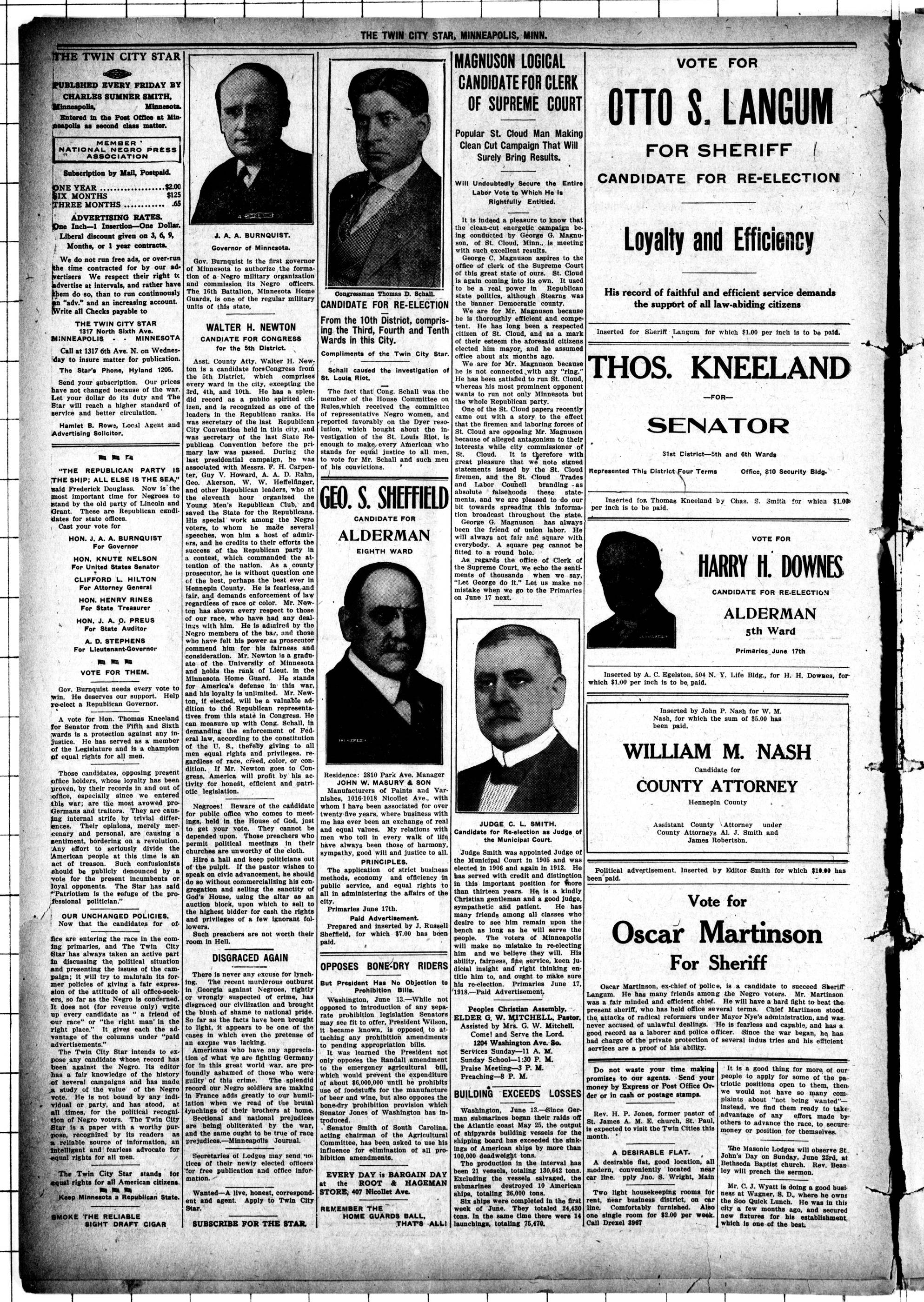
Gov. Burnquist is the first governor of Minnesota to authorize the formation of a Negro military organization and commission its Negro officers. The 16th Battalion, Minnesota Home Guards, is one of the regular military units of this state.
WALTER H. NEWTON
CANDIATE FOR CONGRESS
for the 5th District.
Asst. County Atty, Walter H. Newton is a candidate for Congress from the 5th District, which comprises every ward in the city, excepting the 3rd, 4th, and 10th. He has a splendid record as a public spirited citizen, and is recognized as one of the leaders in the Republican ranks. He was secretary of the last Republican City Convention held in this city, and was secretary of the last State Republican Convention before the primary law was passed. During the last presidential campaign, he was associated with Messrs. F. H. Carpenter, Guy V. Howard, A. A. D. Rahn, Geo. Akerson, W. W. Heffelfinger, and other Republican leaders, who at the eleventh hour organized the Young Men's Republican Club, and saved the State for the Republicans. His special work among the Negro voters, to whom he made several speeches, won him a host of admirers, and he credits to their efforts the success of the Republican party in a contest, which commanded the attention of the nation. As a county prosecutor, he is without question one of the best, perhaps the best ever in Hennepin County. He is fearless, and fair, and demands enforcement of law regardless of race or color. Mr. Newton has shown every respect to those of our race, who have had any dealings with him. He is admired by the Negro members of the bar, and those who have felt his power as prosecutor commend him for his fairness and consideration. Mr. Newton is a graduate of the University of Minnesota and holds the rank of Lieut. in the Minnesota Home Guard. He stands for America's defense in this war, and his loyalty is unlimited. Mr. Newton, if elected, will be a valuable addition to the Republican representatives from this state in Congress. He can measure up with Cong. Schall, in demanding the enforcement of Federal law, according to the constitution of the U. S., thereby giving to all men equal rights and privileges, regardless of race, creed, color, or condition. If Mr. Newton goes to Congress. America will profit by his activity for honest, efficient and patriotic legislation.
Negroes! Beware of the candidate for public office who comes to meetings, held in the House of God, just to get your vote. They cannot be depended upon. Those preachers who permit political meetings in their churches are unworthy of the cloth.
Hire a hall and keep politicians out of the pulpit. If the pastor wishes to speak on civic advancement, he should do so without commercializing his congregation and selling the sanctity of God's House, using the altar as an auction block, upon which to sell to the highest bidder for cash the rights and privileges of a few ignorant followers.
Such preachers are not worth their room in Hell.
DISGRACED AGAIN
There is never any excuse for lynching. The recent murderous outburst in Georgia against Negroes, rightly or wrongly suspected of crime, has disgraced our civilization and brought the blush of shame to national pride. So far as the facts have been brought to light, it appears to be one of the cases in which even the pretense of an excuse was lacking. Americans who have any appreciation of what we are fighting Germany for in this great world war, are profoundly ashamed of those who were guilty of this crime. The splendid record our Negro soldiers are making in France adds greatly to our humiliation when we read of the brutal lynchings of their brothers at home. Sectional and national prejudices are being obliterated by the war, and the same ought to be true of race prejudices.-Minneapolis Journal.
Secretaries of Lodges may send notices of their newly elected officers for free publication and office information.
Wanted—A live, honest, correspondent and agent. Apply to Twin City Star.
SUBSCRIBE FOR THE STAR.
THE TWIN CITY STAR, MINNEAPOLIS, MINN.
M.
From the 10th District, comprising the Third, Fourth and Tenth Wards in this City.
Compliments of the Twin City Star.
Schall caused the investigation of St. Louis Riot.
The fact that Cong. Schall was the member of the House Committee on Rules,which received the committee of representative Negro women, and reported favorably on the Dyer resolution, which bought about the investigation of the St. Louis Riot, is enough to make every American who stands for equal justice to all men, to vote for Mr. Schall and such men of his convictions.
GEO. S. SHEFFIELD
CANDIDATE FOR
ALDERMAN
EIGHTH WARD
Residence: 2810 Park Ave. Manager
JOHN W. MASURK & SON
JOHN W. MASURY & SON
Manufacturers of Paints and Varnishes, 1016-1018 Nicollet Ave., with whom I have been associated for over twenty-five years, where business with me has ever been an exchange of real and equal values. My relations with men who toll in every walk of life have always been those of harmony, sympathy, good will and justice to all.
PRINCIPLES.
The application of strict business methods, economy and efficiency in public service, and equal rights to all in administering the affairs of the city.
Primaries June 17th.
Paid Advertisement.
Prepared and inserted by J. Russell Sheffield, for which $7.00 has been paid.
OPPOSES BONE-DRY RIDERS
But President Has No Objection to Prohibition Bills.
Washington, June 13.—While not opposed to introduction of any separate prohibition legislation Senators may see fit to offer, President Wilson, it became known, is opposed to attaching any prohibition amendments to pending appropriation bills.
It was learned the President not only opposes the Randall amendment to the emergency agricultural bill, which would prevent the expenditure of about $6,000,000 until he prohibits use of foodstuffs for the manufacture of beer and wine, but also opposes the bone-dry prohibition provision which Senator Jones of Washington has introduced.
Senator Smith of South Carolina, acting chairman of the Agricultural Committee, has been asked to use his influence for elimination of all prohibition amendments.
EVERY DAY is BARGAIN DAY
at the ROOT & HAGEMAN
STORE, 407 Nicollet Ave.
REMEMBER THE
HOME GUARDS BALL,
THAT'S ALL
MAGNUSON LOGICAL CANDIDATE FOR CLERK OF SUPREME COURT
MAGNUSON LOGICAL CANDIDATE FOR CLERK OF SUPREME COURT
Popular St. Cloud Man Making Clean Cut Campaign That Will Surely Bring Results.
Will Undoubtedly Secure the Entire Labor Vote to Which He Is Rightfully Entitled.
It is indeed a pleasure to know that the clean-cut energetic campaign being conducted by George G. Magnuson, of St. Cloud, Minn., is meeting with such excellent results.
George C. Magnuson aspires to the office of clerk of the Supreme Court of this great state of ours. St. Cloud is again coming into its own. It used to be a real power in Republican state politics, although Stearns was the banner Democratic county.
We are for Mr. Magnuson because he is thoroughly efficient and competent. He has long been a respected citizen of St. Cloud, and as a mark of their esteem the aforesaid citizens elected him mayor, and he assumed office about six months ago.
We are for Mr. Magnuson because he is not connected, with any "ring." He has been satisfied to run St. Cloud, whereas his most prominent opponent wants to run not only Minnesota but the whole Republican party.
One of the St. Cloud papers recently came out with a story to the effect that the firemen and laboring forces of St. Cloud are opposing Mr. Magnuson because of alleged antagonism to their interests while city commissioner of St. Cloud. It is therefore with great pleasure that we note signed statements issued by the St. Cloud firemen, and the St. Cloud Trades and Labor Council branding as absolute falsehoods these statements, and we are pleased to do our bit towards spreading this information broadcast throughout the state.
George G. Magnuson has always been the friend of union labor. He will always act fair and square with everybody. A square peg cannot be fitted to a round hole.
As regards the office of Clerk of the Supreme Court, we echo the sentiments of thousands when we say, "Let George do it." Let us make no mistake when we go to the Primaries on June 17 next.
M.
JUDGE C. L. SMITH. Candidate for Re-election as Judge of the Municipal Court.
JUDGE C. L. SMITH. Candidate for Re-election as Judge of the Municipal Court.
Judge Smith was appointed Judge of the Municipal Court in 1905 and was elected in 1906 and again in 1912. He has served with credit and distinction in this important position for more than thirteen years. He is a kindly Christian gentleman and a good judge, sympathetic and patient. He has many friends among all classes who desire to see him remain upon the bench as long as he will serve the people. The voters of Minneapolis will make no mistake in re-electing him and we believe they will. His ability, fairness, fine service, keen judicial insight and right thinking entitle him to, and ought to make sure his re-election. Primaries June 17, 1918.-Paid Advertisement.
Peoples Christian Assembly.
ELDER G. W. MITCHELL, Pastor.
Assisted by Mrs. G. W. Mitchell.
Comel and Serve the Lord.
1204 Washington Ave. So.
Services Sunday—11 A. M.
Sunday School—1:30 P. M.
Praise Meeting—3 P. M.
Preaching—8 P. M.
BUILDING EXCEEDS LOSSES
Washington, June 13.-Since German submarines began their raids off the Atlantic coast May 25, the output of shipyards building vessels for the shipping board has exceeded the sinkings of American ships by more than 100,000 deadweight tons. The production in the interval has been 21 vessels, totaling 180,642 tons. Excluding the vessels salvaged, the submarines destroyed 10 American ships, totaling 26,000 tons. Six ships were completed in the first week of June. They totaled 24,430 tons. In the same time there were 14 launchings, totaling 75,470.
OTTO S. LANGUM
His record of faithful and efficient service demands the support of all law-abiding citizens
Inserted for Sheriff Langum for which $1.00 per inch is to be paid.
31st District—5th and 6th Wards
Represented This District Four Terms
Inserted for Thomas Kneeland per inch is to be paid.
District Four Terms Office, 810 S.
Thomas Kneeland by Chas. S. Smith paid.
VOTE FOR
HARRY H.
CANDIDATE FOR F
ALDERA
5th Wa
Inserted for Thomas Kneeland by Chas. S. Smith for which $1.00 per inch is to be paid.
VOTE FOR
HARRY H. DOWNES
CANDIDATE FOR RE-ELECTION
ALDERMAN
5th Ward
Primaries June 17th
Inserted by A. C. Egelston, 504 N which $1.00 per inch is to be paid.
C. Egelston, 504 N. Y. Life Bldg., for which is to be paid.
Inserted by A. C. Egelston, 504 N. Y. Life Bldg., for H. H. Downes, for which $1.00 per inch is to be paid.
Inserted by John P. Nash for W. M. Nash, for which the sum of $5.00 has been paid.
WILLIAM
Candidate
COUNTY A
Hennep
WILLIAM M. NA
Candidate for
COUNTY ATTORNEY
Hennepin County
Assistant County Attorney under
County Attorneys Al. J. Smith and
James Robertson.
Political advertisement. Inserted by been paid.
Vote
Oscar M.
For S
Oscar Martinson, ex-chief of police Langum. He has many friends among was a fair minded and efficient chief, present sheriff, who has held office se the attacks of radical reformers under never accused of unlawful dealings. good record as a laborer and police o had charge of the private protection o services are a proof of his ability.
sement. Inserted by Editor Smith for
Political advertisement. Inserted by Editor Smith for which $10.00 has been paid.
Vote for
car Martine
For Sheriff
in, ex-chief of police, is a candidate to
many friends among the Negro voters
and efficient chief. He will have a hail
he has held office several terms. Chief
local reformers under Mayor Nye's admin-
lawful dealings. He is fearless and o
babor and police officer. Since the w
private protection of several indus tries
of his ability.
Oscar Martinson For Sheriff
Oscar Martinson, ex-chief of police, is a candidate to succeed Sheriff Langum. He has many friends among the Negro voters. Mr. Martinson was a fair minded and efficient chief. He will have a hard fight to beat the present sheriff, who has held office several terms. Chief Martinson stood the attacks of radical reformers under Mayor Nye's administration, and was never accused of unlawful dealings. He is fearless and capable, and has a good record as a laborer and police officer. Since the war began, he has had charge of the private protection of several indus tries and his efficient services are a proof of his ability.
Do not waste your time making promises to our agents. Send your money by Express or Post Office Order or in cash or postage stamps.
Rev. H. P. Jones, former pastor of St. James A. M. E. church, St. Paul, is expected to visit the Twin Cities this month.
It is a good thing for more of our people to apply for some of the pro triotic positions open to them, the we would not have so many com plaints about "not being wanted" instead, we find them ready to take advantage of any effort made by others to advance the race, to secure money or position for themselves.
A desirable flat, good location, all modern, conveniently located near car line. pply Jno. S. Wright, Main
Two light housekeeping rooms for rent, near business district, on car line. Comfortably furnished. Also one single room for $2.00 per week. Call Drexel 3967
```markdown
```
Office, 810 Security Bldg.
by Chas. S. Smith for which $1.00
VOTE FOR
ARRY H. DOWNES
CANDIDATE FOR RE-ELECTION
ALDERMAN
5th Ward
Primaries June 17th
Y. Life Bldg., for H. H. Downes, for
M. NASH
ate for
ATTORNEY
in County
e for
Martinson
Sheriff
e, is a candidate to succeed Sheriff
ing the Negro voters. Mr. Martinson
He will have a hard fight to beat the
several terms. Chief Martinson stood
Mayor Nye's administration, and was
He is fearless and capable, and has a
officer. Since the war began, he has
several indus tries and his efficient
It is a good thing for more of our people to apply for some of the patriotic positions open to them, then we would not have so many complaints about "not being wanted"—instead, we find them ready to take advantage of any effort made by others to advance the race, to secure money or position for themselves.
The Masonic Lodges will observe St. John's Day on Sunday, June 23rd, at Bethseda Baptist church. Rev. Beasley will preach the sermon.
Mr. C. J. Wyatt is doing a good business at Wagner, S. D., where he owns the Soo Quick Lunch. He was in this city a few months ago, and secured new fixtures for his establishment, which is one of the best.
---
-FOR-
The Advocate gave considerable space to a roast against the Star, because Editor Smith does not support Atty, Harry L. Scott, a young Negro attorney, who is a candidate for the Legislature.
Had Mr. Scott managed his own affairs, and had not tried to gain notoriously by condemning the Editor of the Star for his action in the case of Editor Mntgomery (who spent 8 days in jail for collecting money under false pretenses) Mr. Scott would have one more vote in his favor. Because Scott is a Negro is not a sufficient reason that The Star should support him. Mr. Scott has attacked The Star in press and pulp. He cannot deny that Editor Smith has in a small way at least lost some time in trying to assist him in the hard struggle he is making.
He failed to get one case in court because of his famous habeas corpus farce in Montgomery's case. He was fighting Atty. Morris, and publicly praising himself. Atty. Morris expressed an opinion against Smith's action, but they had no quarrel. Scott was slaying everybody with his two edged sword, and was "foist on his own petard."
He is a wonderful speaker, many claim, but has never showed the material needed in a legislator.
He has neither patience nor experience and is a personified egotist, groomed by Phil Hale and Ed Hammond, two personal-interest politicians, who have as their only stock a much resurrected Republican Club, which is known only as a jack-pot proposition, where candidates may enter on payment of their catch-as-catch-can entrance fee.
Neither of them can give Scott a vote, and Montgomery swore to the Chief of Police in St. Paul that he was not a citizen of Minnesota. He may have been given his rights since he served in Waupun, Wis., for collecting money for a Catholic Church; therefore, there is doubt of his qualifications as a voter.
The same article, defending Scott, says that, "A few months ago, this same editor played the ground-hog act and did not come out until his friend Glover Shull came from California so that he could get some money to get his dirty sheet running again. He has lived off the Sunday Forum and the advancement of the Colored People's Society for the last six or seven years.
One thing we can say about Mr. Scott is, he takes care of his wife, and she does not have to go out to work, because he provides for her.
The last paragraph is rather personal, Editor Smith does not know anything about Mrs. Scott, who appears to be a lady of refinement. They have children and it is not the policy of the Star to attack women, not understanding the Advocate to the contrary. But it can defend Mrs. Catherine J. Smith, WIFE of its editor, who makes no apology for heg Caucasian blood, or generally speaking, being a white woman. Mrs. Smith has proven herself to be a woman of good training and even the Advocate cannot say a word against her character or reputation. Fortunately she has been able to work as a housewife, and not as a servant, which would not be a disgrace, and we are able to show to our many visiting friends that Mrs. Smith is an expert in domestic science, and has not forgotten all of her exercises learned at the Boston Conservatory of Music. And the best part is, that she is not afraid to declare her identification with a Negro, and he will not deny her nationality. There are many girls of our race who are as fair as any Caucasian, and Mrs. Smith could be passed among them.
It has been made to appear that Mrs. Scott is not a white lady. This is not very important, but it is a fact that she was known as being "white" until he entered this campaign. We cannot believe that he would deny the nationality of his wife for the sake of a little publicity, which is all he will get from this campaign.
Rev. A. Clayton Powell of New York, a fearless defender of his race; Prof. W. S. Scarborough, of Wilberforce University, Ohio, one of the most learned men of today, and head of the school of the great Negro Methodist; ex-Minister to Haiti, Summer Furniss, present member of the city council of Indianapolis, Ind., and scores of other Negroes of national reputation are married to Caucasian women. They do not advocate inter-marriage as a propaganda, but defend it as a legal and personal right.
So far as our needing money to get out the "dirty little sheet," we like the advertisement. It is a pleasure to say that Mr. Shull has never refused any financial assistance to Editor Smith, whose checks are honored at the Hennepin County Bank. There are several persons, white and colored, who are always willing to lend us money, and they are repaid in cash. Mr. Scott knows that Editor Smith was ill and he suspended publication for one month. During that time Mr. Scott, like the Greeks, bore gifts and did not get results.
The whole damned organization has busted up, during the past week. Scott has assumed the role of dictator for the distribution of finances for the club. Whenever any person pulls anything over Mr. Gibson, they are going some. Now, Scott will have to "get elected without the nigger votes."
Does he realize that people are asking why he did not speak at the Jewish Synagogue on Monday night?
Scott's picture in last week's issue was in every way descriptive. Just get one and give it the once over.
It is a calamity that the whole race suffers from such controversies as between the Negro newspaper and Scott and Smith. But, when a new Negro
comes here, God knows from where, and organizes our enemies, we must defend our action.
It were far better that Mr. Scott could say that he had the endorsement of the old residents of his race in his district, especially property owners, instead of representing a gang of public nuisances, who if challenged, could not show that they left their last abiding place in the day time.
We only lack one thing, that is the autobiography of Scott, whose obituary would not be complete without a reference to his nativity, that we may correctly carve on his marker—"Rest in Peace."
The editor of The Star can stand any criticism. The gang, Phil Hale and Montgomery, made a fight on Atty, W. H. H. Franklin, and he tried to put himself out of commission. But Smith is made of sterner stuff, and his wife can protect herself on every occasion.
We have never known two injustices to make anything right. The Saturday News has prospered by being as just to the white man as it has ever been to the Negro. We have never gone off half-cocked upon any proposition. Whenever we grope, we are in search of the truth. We want to be right and avoid as nearly as possible being wrong. We are not for the Negro right or wrong. We want him to be right. We complain because a majority of white people will always side with a white man when a question arises between him and one of our color; still certain colored newspapers, without making any investigation whatsoever as to the evidence, would have the entire Negro race do identically what they condemn the white people for doing. Be cause the white people do wrong is no reason why the Negroes should do wrong. The best preparedness to receive justice is to be just yourself. —Hopkinsville (Ky.) News.
COMMISSIONS NEGRO
MINNESOTA HOME GUARD
Commissions have been signed for the following Staff Officers:
JOSE H. SHERWOOD—Major.
ROBERT L. ROBINSON—First Lieutenant and Adjutant.
GEORGE L. HOAGE—First Lieutenant and Supply Officer.
ARTHUR J. TODD—First Lieutenant and Ordnance Officer.
DR. VALDO TURNER—Captain, Medical Corns.
DR. JAMES H. REDD—First Lieutenant Medical Corps.
Major Sherwood has appointed Ira S. Ashe Battalion Sergeant Major.
Company "B" elected officers following Captain Sherwood's promotion to Major.
OHN F. COQUIRE—Second Lieutenant.
COMPANY "D" DRILL.
The members of Company D, 16th Battalion, M. H. G., are ordered to report at headquarters in the city hall on Monday evening, beginning May 20th, and on each Monday thereafter until further notice, for company drill and instructions.
Charles Sumner Smith, Captain Commanding Co. D.
Capt. Gale C. Hilyer of Company C of the Home Guard announces that Friday of each week will be the regular drill night of his company.
Prof. Howard did not think that the Band was able to make a good showing. The fact is the men were led to believe that they need not parade unless they were uniformed, and they did not care to play in civilian dress. This was poor appreciation for the interest taken in the Band by the local officers.
Charlie Miller's 16th Battalion Drum Corps of 22 men will parade in Minneapolis on the evening of Flag Day to boost the 16th Battalion Band Ball.
Miss M. B. Anderson and Mrs. Cora E. Carr, of 365 Aurora Ave., St. Paul, have as their guests their sister, Mrs. Anastatia Robinson of Winnipeg, and niece, Miss Odette Johnson, of Minneapolis.
Mrs. Mary E. Talbot, of Buffalo, N. Y., is visiting her sister, Mrs. W. R. Hardy, of St. Paul.
The Negroes are organizing for a Y. M. C. A. Undertaker Lawrence made the call. A meeting was held last Sunday.
Mr. John Cheatham is very sick at his residence, 3020 20th Ave. So.
ELKS SPECIAL SERMON.
Rev. J. M. Henderson will preach a special sermon to the Negro Elks of the Twin Cities at St. James's A. M. E. Church in St. Paul on Sunday evening, June 16th. Everybody invited.
Mr. Arthur Jackson has begun extensive repairing at his place of business in the Metropolitan Building. He has installed large mirrors and a larger stand in order to accommodate increasing business.
Mr. and Mrs. Chas. Harden returned by rail last week from their auto trip to Camp Dodge, on account of bad roads from recent rains. They were accompanied by Mr. and Mrs. "Ike" J. Thompson. They visited Mason City and Des Moines, and report favorably on every condition among the Negro troops. Their auto trip was a record-breaker.
THE TWIN CITY STAR, MINNEAPOLIS, MINN.
MRS. TALBERT TO SPEAK. Hon. W. T. Fran
THE MASTER OF THE MUSIC
MRS. MARY B. TALBERT, PRESIDENT NATIONAL ASSOCIATION OF COLORED WOMEN'S CLUBS, BUFFALO, N. Y.
National President of the Women's Federated Clubs Visits Twin Cities.
Mrs. Talbert will speak at Bethesda Baptist Church, Minneapolis, on Sunday evening, June 16th. The public is invited.
SUNDAY SCHOOL CONVENTION.
Many Visiting Delegates
The St. Paul District Sunday School Convention of the Chicago Annual Conference was held at St. Peter's A. M. E. church, Minneapolis, June 6th and 7th, immediately after the closing of the District Conference, held June 4th and 5th.
The convention was opened with devotional services under Rev. James Higgins, the Presiding Elder, afterwards Mrs. Julia Hadley, of Evanston, Ill., the District Superintendent, conducted the meeting. After the regular business had been completed several interesting papers were read by delegates, Mrs. Coles of Duluth read a paper on "How Can the Goal of Moral Education Be Fully Reached?" A paper, "Loyalty to Christ and What It Means Today," was given by Mrs. Smith, of La Crosse. Dr. J. M. Henderson, of St. Paul, also gave a very interesting talk.
A resolution, introduced by the Twin City Sunday School Alliance was adopted to put before the Chicago Annual Conference, which meets in Evanston, Ill., next September, a plan for a Sunday School and Christian Endeavor Congress consisting of the four districts of the Chicago Conference, which will meet bi-annually.
An entertainment was given Thursday evening in behalf of delegates, at St. Peter's. The convention was a success in many ways, but it would have been much better if more of the home people, especially the younger ones, had turned out during the two days. Friday afternoon the delegates were treated to an automobile trip by the kind offer of Mrs. Dr. Brown, Mr. Frank Peoples, Mrs. B. S. Smith, and Mr. Lawrence.
ARTHUR JEWELL WILSON.
Mrs. Stella Smith, 1812 Charlotte Ave., Kansas City, is visiting her sister, Mrs. Albert W. Collier, 2111 5th Ave So., for a month.
Luther Crabtree, a member of Company D, fell while at work at the paper mill, and sustained painful injuries. He carried the colors in the last parade. An X-ray examination will be made this week.
THIS IS WHAT COUNTS.
If Mr. Joseph Dahl, the Shoeman, who has done business for years at Washington Ave. So., is elected alderman of the Sixth Ward, our race will have an advocate for a Negro teacher in the Jackson school and some firemen in the Fire Department. He believes that they should be there, and no one can say that Joe Dahl is not an advocate for equal opportunities to all. He is too well known for further introduction. He is the choice of the Negroes in the ward, who stand for progress and patriotism.
Three of our attorneys, Wm. R. Morris, Gale P. Hilyer and R. A. Skinner are supporting Mr. Bessesen for County Attorney, and the usual result will happen, nobody will get a job if he is elected.
WM. M. NASH IS RIGHT—He has been in the County Attorney's office and he is worthy of the Negro vote, because he has proven his fairness to and respect of Negroes.
Dahl and Bastis will get the Negro vote for aldermen in the 6th ward. Then they may fight it out in the fall election.
Negro Files For Legislature.
Harry L. Scott, a young Negro lawyer, has filed for the legislature, and has begun his campaign. Mr Scott lives at 620 Girard Ave. No. in the third ward.
Read the Negro Papers.
Hon. W. T. Francis
A. C. R.
Prominent Attorney Active for a Republican Victory.
WANTS RACE RECOGNITION
Realizing the need of every effort to keep Minnesota in the Republican ranks, Atty. William T. Francis, of St. Paul, is advising every one to vote for the Grand Old Party. He is a Republican leader, and has never left the party.
Now that the Non-Partisan League is seeking the Negro vote, and making the usual pre-election promises, Atty. Francis is turning a deaf ear to all inducements, and will support the true and tried Republicans for every office.
He is a strong supporter of Gov. Burnquist, and Atty. Gen. Hilton. He is an ex-member at large of the Republican State Committee, and urges the election of Atty. Hilton, who is filling the unexpired term of the late Lyndon A. Smith.
Mr. Francis hopes to see a Negro as one of the assistant state attorneys, and is going to make a demand for recognition of his race in the offices of the Republican candidates, who are to come out for our vote in the general election.
There is no reason why we should not be represented in every office in the departmental service of the state. Francis leads in a right direction, and he has a large following. The time has come for a recognition of the Negro voters, and a united effort will bring good results.
Should Atty. Gen. Hilton win in the primaries, he will be asked to reward the race that saved him in a time of need.
Paid Advertisement—Prepared and inserted by C. F. E. Peterson, for which $7.00 is to be paid.
6 KIDT
"HE'S A WINNER"
Vote for
J.E.MEYERS
For Mayor
"HE'S A WINNER"
Vote for
J.E.MEYERS
For Mayor
LOYALTY IS THE ISSUE.
Minneapolis must express its loyalty in no uncertain way. The question, then, is who is the best man to defeat the present Socialist mayor in the November election?
J. E. MEYERS is a winner. His long business career in Minneapolis, his public-spirited activities for the betterment of the city, his leadership in many committees, his frequent battles for a square deal for all, tend to make him the best qualified man for Mayor.
HE'S LOYAL—HE'S YOUR MAN FOR THE JOB.
WASTE-BASKET COPY.
We are daily receiving all sorts of "News" from Negro organization and institutions, prepared by some pre-paid press agent, with a request that, "The _____ would greatly appreciate the use of the enclosed in the current issue of your valued paper." When Negroes in general learn to pay for publicity, they will get better results from advertising and their copy will not be consigned to the waste-basket or kitchen stove.
READ THIS CAREFULLY
If you receive a newspaper by mail and do not wish to pay for it, just refuse it by informing your postman. Then it will be returned to the publisher and he will be notified to discontinue sending it. There is no reason why a person should pay for a paper forced on them, but every reason why it should be paid for when ordered and accepted.
PETER H.
CLERK OF THE SUPREME COURT AND REPUBLICAN CANDIDATE FOR RENOMINATION.
CLERK OF THE SUPREME COURT AND REPUBLICAN CANDIDATE FOR RENOMINATION.
Born on farm near Anoka.
Educated in country schools, Anoka
High School and University of Minnesota.
Married and resides at Anoka.
Attorney at Law.
Publisher Anoka Herald 10 years.
Served term of enlistment Minnesota National Guard.
First Lieutenant Spanish American War.
Member Navy League.
In charge of Minnesota Loyalty Campaign 1917.
Appointed to his office by unanimous vote of Surge Court.
Endorsed by the Bar of the State.
Nominated 1914 by vote of 111,000 to 50,000—the largest vote and the greatest majority of any candidate in the Primary.
In the General Election received 222,000 votes—40,000 more than any other candidate upon Republican ticket.
Has been chairman Anoka county Republican Committee, member National Republican Committee.
Successfully conducted two Presidential Campaigns in the State against the influence of all the big politicians.
Always has had the opposition of the politicians.
Stands on his record, and asks the support of the people in the present primary.
POLITICAL ADVERTISEMENT.
Paid Advertisement—Prepared and inserted by R. L. Smith in behalf of Clifford L. Hilton, Capitol, St. Paul, for which $10 is to be paid.
M.
Candidate for Republican Nomination
at Primary Election June 17, 1918.
Experience in Public Life.
Attorney General - since March 8, 1918
Deputy Attorney General - 1 year
Assistant Attorney General - 8 years
County Attorney, Ottertail
County - - - 10 years
City Attorney, Fergus Falls - 2 years
City Attorney, Fergus Falls - 2 years
U. S. Senator Nelson said of him,
"I think our state is fortunate in having such an able, reliable and energetic Attorney General."
If you want a lawyer of experience and ability, a man whose patriotism and loyalty has never been questioned, and a public officer of unimpeachable integrity for Attorney General, vote for Clifford L. Hilton.
SUBSCRIBERS WANTED — Make the Twin City Star a live and dependable weekly Negro newspaper by sending your subscription.
Send a dollar on your account, or get a new subscriber. The Star is THE PAPER.
Do not forget to send the money to the Star which you owe for subscriptions.
"ENLIST OR WORK" CAMPAIGN. The military authorities intend to push the enlist or work campaign among the Negroes. There are many idlers who have no lawful means of support. They will be drafted into the industrial army. Get work, gentlemen of leisure, even if as a side ine.
Boost for the Ball of the SIXTEENTH BATTALION-BAND.
Remember our friend Dahl, the Shoeman, for Alderman.
RE-ELECT
J. A. O. PREUS
STATE AUDITOR
STATE AUDITOR
Political Advertisement — Prepared
R. Augustus Skinner, for which $1.00
per inch is to be paid.
FLOYD B. OLSON
FOR
CONCILIATION JUDGE
THE PEOPLE'S CANDIDATE FOR THE PEOPLE'S COURT.
Mr. Floyd B. Olson is a native of Minneapolis. He is now engaged in the active practice of law as a partner of Frank D. Larabee, under the firm name of Larabee & Olson.
He is held in very high regard and has the respect of every one who has come in contact with him. He is a clean, square, fearless gentleman; one who believes in fair play regardless of your condition, race or station in life. We shall make no mistake what ever in voting solidly for this aspiring and very efficient young man.
PAID ADVERTISEMENT
Prepared and inserted by A. D. Stowe, for which $1.00 per inch is to be paid.
[Name]
A. D. STOWE CANDIDATE FOR
Comprising the Fifth and Sixth Wards
To the Voters of the Thirty-first District:
Friends and fellow citizens: When you go to the polls on June 17th, put your mark opposite the name of A. D. Stowe.
Primary Election June 17, 1918
CLASSIFIED ADVERTISEMENTS
FURNISHED ROOMS.
One or two furnished rooms, use of the house; all modern, gas and bath; respectable persons only; references. 820-3 36th St. Call A. D. Price, morning Nic. 1888, afternoon Main 2511.
Two Furnished Rooms—Single, for ladies or gentlemen; modern, near two car lines. Apply to Mrs. D. W. Willis, 2020 Fifth Ave. So, or call So. 4034.
FOR SALE—A BARGAIN.
RESTAURANT AND ROOMING
HOUSE.
Located at 2010 Cedar ave., Minneapolis, near Milwaukee Shops and Sleeping Car Yards. Good business. Selling at a sacrifice on account of sickness. Established Business, respectable patronage. Will sell on terms. Apply Mrs. Rogers, 2010 Cedar Ave., or Phone So. 6399.
FOR CONGRESS
THOS. D. SCHALL
8 STN SU Ra a ae a ac
lUinsung Heroes ofeacguas )
« ° ope Nie | a
) attie Lines AGE i eS ,
é Zp PFs , DT? ae ORR Uo
hide American Line CNX Sp ay
men, Fresh from Civil et OS t
Life, Maintain C (REE \ ON ai .
ications Und rommun- [>= Nees Ne
a Inder Fire + + SS. (oe 4) a y vga § in
einaguetin head aS Mat PR) ; aN ; 7. a
Ben reat mean of comme see AN PS Sa 3 ioe SAWN > : ed
wae ern pattie. eam ented zt er Ss PEN LS 4 t ae
{si einen oi OY. 46> 4 ee EN
¢ Ws ine aod By which se partect = e a ) ‘ w
r >) . the al aac | ssible are gi Me . Sf | EA ;
OS) Ress a Pee
GN ih Ea Cr Mae” |
cette att aa, NRE SASS By Vos
rillar to the people ear the commas, 83 MARK WEAR OED 7 he ro gh ie LEE =
alr tie ple at hon "om tw arena 77 208MM oe “SRA
bel pound aes), Rak ANS Le
E ee Van |
7 RR ea 1
_ peste es
eth eal Pe
a
Pree genio io @ yal |
week S| pa eee ||
el) eee.
wep See OR
Me AES.
ea
RERPURING GROKEN LINE SOLE WHERE It! FRANCE" CS
‘ture the imagination. But
the herole labors of men
who keep open the tele-
graph and telephone lines
which make co-operation
lof infantry and artillery
possible are almost un-
‘known outside the serv-
lice, save, for instance,
jwhen .one reads of a
{medal bestowed on a line
repairman for magnifi-
leent disregard of danger.
{For their losses and thelr
‘honors are alike great.
‘They go over the top
with the troops, smoking
‘their pipes, coolly string-
\ng lines behind the ad-
fwancing first line so that
‘he gun crews may be
‘kept informed of the ad-
jvance or told to concen-
trate their fire on a par-
ticularly obnoxious ma-
chine gun, says a writer
in the New York Sun
Tinedatian anathema
ee ee ee te
clamber out of dugouts into the slush and the
freezing wind of a winter night to feel thelr way
‘along a broken wire, sometimes over the shell-pit-
‘ted open ground behind the trenches until they
find the break, then sitting in ice water under fire
they repair it as carefully and skillfully as if they
were at work in the shop at home. It often takes
three or four men to repair one of these breaks;
the first men sent out may never come back.
Repaired at all costs the wire must be, and dan-
ger does not excuse a slipshod bit of work. For
the signal system of the army is what the nerv-
ous system Is to the human body.
‘Without it the modern army covering 100 miles
of front cannot see, feel or move. The army com-
mander wishing to move a portion of his line 60
miles away or to change the rapidity of his artil-
lery fire or to receive information of enemy move-
ments 1s as helpless without the slender threads of
copper as he would be if he wished to move his
right arm and found the nerves paralyzed.
“There are still people of intelliger“e who think
that the transmission of military thousiit Is summed
‘up in the use of the notebook, the orderly and his
horse,” writes Brig. Gen. George P. Scriven. “But
these are passing, and the trained soldier and the
educated volunteer understand the vital impor-
tance of information.
\ “Hence the necessity for a signal corps or its
‘equivalent, for without {ts ald modern armies can
no more be controlled than can great railway sys-
tems; the commander in the field remains blind
and deaf to the events occurring around him, tn-
capable of maintaining touch with conditions and
‘out of reach of his superiors or those under his au-
thority upon whom he depends for the execution of
his plans. ‘The brain lacks the power to control
because the nerves are lacking.
“Time 1s the main factor in war; to arrive first
mith the greatest number of men and with the
clearest understanding of the situation ts to suc-
ved. The last, and often the first, of these condi-
‘tons depends upon the lines of information of the
army.” K
And these lines in turn depend upon the obscure
but daring work of the repairman, the grimy,
mucky, hard-fisted mechanic who crawls on his
belly through shell fire calculated to appall the
stoutest heart and connects the break between the
commander and the point he wishes to reach.
Somehow the lines are kept open all the time or
are broken for only short intervals, und the con-
tant tending of them has made possible in France
system of wire communication that 1s a marvel
of efficiency. Indeed so perfect is it that London
and Paris are in direct connection with general
headquarters on the British front, which in turn ts
4m touch with every division and brigade staff on
ee line. A wire could be put straight through so
t Lloyd George if he wished could hear the
bursting of high explosives and shrapnel on the
‘Amiens front.
‘This tremendous use of the telephone and tele-
ph in warfare is partly the result of the im-
Pets, arsine from the American application of
jal communication on a large scale in the
‘Spanish war. The signal corps as.it now exists is
ja comparatively recent evolution.
Is the American army the dea first arose in
ese of @ young army surgeon, Albert James
“MMyer, The office of signal officer of the army was
‘created in June, 1860, the first of its kind, and
\ Myer was appointed. He was at once sent with
ee is against Navajo Indians in New Mex-
fi and his crude apparatus at once demon-
strated its worth.
| When the Civil war began he was ordered Hast
ise boats s seo for signalers, and in that was
the definite: beginning of the present signal corps.
» pele on horse or muleback then, the
4 ‘were imperfect and telegraphic com-
munication was a rare and precious thing. The
“took on tremendous Importance in the
‘war and followed the troops through Cuba
($04 Me Philippines, and ta China war the only
means of communication for a week between Pe-
king and the rest of the world.
But the tasks that confrontéd our signal) men
in these wars were play compared to the work
that is being done every day on the western front.
-Our signal men there have an area to cover about
the size of Pennsylvania and they have gone at It
with a vigor and efficlency that spell volumes for
the superiority of Americans in this particular line
of work,
The hardy linemen who- have strung lines and
repaired breaks on the Western plains or battled
with great floods and storms in the Rocky moun-
tains have taken to this new work with a zest
which is Inspiring. On the foundation of the
French system they are building a signal system
that will be a model of its kind. \
Up to within four miles of the front construc-
tion is not different from what it is here at home.
‘The wires are strung on poles and most of the
poles have been planted by the French. But when
one gets inside the shell-torn section that stretches
at leust four miles from the front wires have to
be protected by being buried from six to eight feet
deep, so that only a direct hit by a large shell will
disturb them.
Within half a mile of the front not even this
protection is sufficient, as the shells churn and re-
churn the ground. ‘Therefore all wires in this zone
are duplicated and are ‘strung along both sides of
the trenches. Sometimes a trench wall is covered
with wires.
In the battalion headquarters signal office, where
the hundreds of wires from the trenches and ob-
servation posts center and where the receivers
hum with the constant tremors of a world under
fire, plain Bill Smich lounges tn a corner rolling a
cigarette and occupled in his own particular
thoughts, It is a dugout, this headquarters, and
the air Is vile, but Bill got used to that long ago,
“The wire to A battery is down,” Smith's su-
pertor officer suys, turning to him, ~
“All right, sir,” 1s the answer, And Bill climbs
out of the dugout, repair kit over his arm and tin
hat on his head,
In the trench he finds the wire that 1s broken
and begins to follow it along. It is hot work in
the trench, shells are dropping thickly, but Smith
doesn't mind—much. He follows the wire down
communication trench and then after a long time
out into the open, where he has to craw! along
looking for the hole that will mark the place where
the line has been broken.
He gets nearly there when a shell lands near
him and Bill Smith, his face toward the break,
goes west. After a time, back in the dugout, an-
other repairman fs sent out and perhaps he is
luckier than Bill and finds the break.
‘Then he has to sit down in the shell crater, the
bags of bursting shells so close that sométimes
is half buried in dirt, calmly making the con-
neetion that will enable the observation officer up
front to get in touch with his battery again. If he
gets back to the dugout he will be sent out again
and yet again if the bombardment 1s heavy, and
often for days and nights at a time these men are
under fire, snatching a nap now and then in the
dugout between breaks. But they keep the lines
open.
In an attack the signal men go over the top with
the infantry, generally with the second wave, in
charge of the observing officer. They make for a
point where they can eétablish an observation
post, and as they pass on and through the enemy's
barrage they unroll thelr line and one of them car-
ries a fleld telephone, through which they somehow
manage in the din of battle to make themselves
heard.
‘That telephone ts lke a battle fiag, and many a
man goes down with it, only to have it picked up
and carried forward by another of these foncom-
batant troops. Their business 1s only to serve, not
to fight, and they do it with a cool daring which
{a not surpassed in any branch of the service,
‘They are in the forefront of every advance and
im the retreat are sometimes the last to leave the
eS
7 i‘ am
ao At
4
y
ae IEG. ag
els es a bea ae
Seether tee a Les as
“s aps: CS EO Te
Ae ee ee
COR Fg aE rs
| PREC Li tet tr Ss Cee ee
i Ag pers 1.
yom ever haa es
yy BESS gets a Roa eos
De) Barats OE RiGee Ese
Ly Pee a Ee
Vege. 5? ORO Be.
ASIERICAN LINEVIED STRINGING MUR ES
BEHIND LINES
front liné, where they stick to the end of thelr
wires under terrific shell fire until ordered to re-
Join their commands if they can gét through allve.
“An experience of this kind happened to me a
short time ago in a lonely chateau of the Ypres-
Menin road,” an English officer wrote home. “The
chateau was the center of a perfect hell of Ger
man shrapnel for nearly a week, until. {t became
almost untenable and was abandoned by the head
quarters staff.
“The general gave instructions that a telegrapte
ist was to remain behind to transmit mportant
messages from the brigades, and I was left in
charge of the instruments: in this shell-swept
chateau for a day and a night.
“On the second day the German’ broke through
our trenches and the wires were cut by the shell
fire. I was given orders ta evacuate the building
and smash up my instruments, These I saved by
burying In a shellproof trench, and then I had to
eseape between our own fire and that of the
enemy's across a field under a terrible tornado of
shrapnel. +
“On the early morning of the same day one of
our cable detachments was cut up and another
captured by the Germans, only to be retaken by
our sappers and drivers after a desperate and
glorious fight.”
‘The linemen also have regular patrols, stretches
of line which have to be constantly examined not
only for breaks but also to make sure that they
have not been tapped by enemy sples in ich a
way that every bit of information sent over them
finds its way to the Germans. In the Aisne once,
where the hill country offered good cover to sples,
the wires were constantly being tapped.
One day a lneman passing along the road no-
tleed a lot of cable lying at one side. He started
to coll {t up and found that a plece of wire had
been tied to the main line. When he traced it he
found that {t ran to a haystack. He went on,
tapped the line and sent in word to headquarters
and au armed escort found a spy hidden in the hay
with several days’ supply of food.
‘They are auto¢rats in their way, these wire re-
pairmen, and no dne {s permitted to interfere with
the swift execution of thelr work. Word coming
‘over the line that the wire to a battery was re
paired is often the sweetest sound in the world to
an observation officer up front, even it It comes tn
‘a rough brogue which French weather has not im.
proved.
‘So when anybody else breaks in on the line and
interferes with the repairman he gets rolled, es-
peclally if he has been sitting for several hours tn
‘a shell Hole with an {ey rain dripping down his
back. An English officer told of what happened
to a general who broke in once.
“A general came in the hut and told me ‘I rang
up the telephone just now and sald, “Give me the
— brigade, please,” but some one with a loud
voice replied deliberately and distinctly: “Get off
the blinking line.” I got off remarking that as
soon as convenient I should lke to speak. 1
apologized and ed that the line had been
Seta yas bees eit He went off with
a merry twinkle in his eye.”
‘As the number of men in the American aimy
abroad grows with the weeks, the number of line
men, those who make possible all that the artil
lery and infantry together accomplish, will stead-
fly increase until they are a small army in them-
selves. And probably it will not be long before an-
nouncement will be made that some plain Bi
Smith, wire repairman, has been given a medal for
bravery under fire, which attracted attention even
among the hundreds of brave aga which these
men perform every day.
MILITARY BALL
under the-auspices of
MINNESOTA HOME GUARD: -
COMPANIES C and D
: at the
New Viking Hall, Former Labor Temple
: 8th Ave.’ S. and 4th St, Mpls.
Flag Day Evening, June 14, 1918 3
Transfer From all Cars Admission 50c¢
Music by 16th Battalion Band
Taxis at 1.45
s 5 s
The Lady Minstrels’ Festival
—will be given by—
QUEEN ESTHER TEMPLE No. 2. S. M. T.
"at Pillsbury Settlement House
15th Ave So. and 4th St.
Friday Evening, June 14th, 1918
Door Open at 7:15 iSsi
Dancing after Program 30 Admission 25c
Curtain at 8:15 p. m.
e
Hennepin Lumber Co.
226 Plymouth Building. -
RETAIL LUMBER AND MILL WORK
We Finance Buildings.
Also all Kinds of Insurance through
ARTHUR P. SMITH CO.
Office Phones—Main Fo; Auto 36774. Dining Room—Main 2831.
Twenty Elegant Steam-Heated and Electric Lighted Rooms.
Ala fe Meals at All Hours—Popular Prices.
J. Ed. Stewart, Prop. Chas. Brody, Mgr.
246-250 FOURTH ‘VE. S., MINNEAPOLIS, MINN.
| anesPiate Diniz ception oom, fr Ladies. pedal Temper
Connection. - epee acti
N. W. Main 5040 Auto. 37032
Ladies’ Work Given Special Attention. Work Called for and De-
livered to Any Part of the City. One Day Service.
ames €. GOMBS BROS, Harow c.
TAILORS
, Our Motto: “PROMPTNESS”
French Dry Cleaning, Dyeing, Repairing and Pressing
High Grade Work a Specialty.
809 Fourth Ave. So. Minneapolis Minnesota.
—— es
qqitserted by Albert Bastis, for wth | HAROLD M. LEWIS
an Ot
we |
,
me
ee go
se At
a YY
ALBERT BASTIS
Socialist candidate for re-election to
the council from the 6th ward, is a
native son of the 6th ward. Mr. Bastis
is a member of the. Bookbinders’
‘Union. He has initiated and support-
ed a remarkably large number of la-
bor and progressive measures during
MMs term in the council.
He 4s friendly to the Negro voters
and was interested ‘in their employ-
ment as laborers in the street and
sewer departments.
Two light housekeeping rooms for
rent, near business district, on car
line. Comfortably furnished. Also
ona single room for $2.00 per week.
Cail Drexel 3967.
Wanted—Subscribets to Pay.
HAROLD M. LEWIS
ey
id bs sd
i
e :
f 2
a
HAROLD M. LEWIS
CANDIDATE for REPRESENTATIVE
31st Legislative District
Comprising 5th and 6th Wards
Loyalty Residence -
Candidate ++ 1916 Third Ave. &
Political Advertisement for which
$5.00 is to be paid.
A DESIRABLE FLAT.
A desirable flat, good location, all
modern, conveniently located neal
car line. pply Jno. 8. Wright, Main
postoffice. .
Call N. W. Orchid 19-W.
ADVERTISE IN THE STAR
A Matter of Money
By LINCOLN ROTHBLUM
(Copyright, 1918, by the McClure Newspaper Syndicate.)
Gloria was as delectable a bit of femininity as one could find at the fashionable resort of Norhabor. Barely five feet five in her French-heeled boots, she had a most alluring manner of looking into your eyes as if your every gesture were precious to her. Despite the adoration paid her, she remained lovable. But beyond these apparent facts, little was known of Gloria Stanley, who came every year to this resort and, to all appearances, plentifully supplied with money. Always dressed in good taste, with no little variety in her costumes, it is not to be wondered that she excited the admiration of the women as well as the men.
And now the summer colony was agog with excitement—for Gloria had met her "hero." And this is the way it happened:
Arising one morning earlier than the other guests, she slipped into her bathing suit and ran lightly across the stretch of sand, fairly quivering with suppressed excitement and pleasure of her anticipated plunge. Pausing a moment on tiptoe at the edge of the pier to drop her bathrobe and judge her dive, she stretched her arms obliquely downward and sailed through the air, cleaving the water like an arrow. In a moment her straight body could be seen skimming close to the surface.
C. A. F. R.
"I'm so Sorry."
then suddenly it stopped as if it had struck a barrier. And there arose above the water two heads, more shocked than hurt by the contact.
"I'm so sorry," Gloria sputtered, as she tread water. "I didn't see you before I dove off."
"Mighty careless of me to be in the way," laughed the young man, with a most engaging smile, as he swam close by in a very professional manner. "I hope you're not hurt."
"Not a bit," she responded, smiling back at him, and as a moment's afterthought, "let's race to shore."
Taking his compliance as granted, she commenced to augment the distance between them with broad, embracing strokes. He let her keep in the lead until but a few feet from shore, then swiftly caught up to her, so that they emerged in unison.
"You swim well," he said, breathing hard. "I didn't think I have to work so hard to catch up."
And, although Gloria couldn't account for it, she felt flattered by this stranger's praise. Out of the corner of her eye she saw a stalwart man—just a little different from any other she had ever met before.
"Let's rest," she suggested, stretching at full length on the sand, which had just begun to reflect the warmth of the sun now well up in the heavens.
He sat down beside her, hands clasped about his knees. It was as if they were children and she had said, "Let's play." He entered into the spirit.
"My name's John Turner, he ventured by way of conversation, "but most folks call me Jack. What's yours."
"My name is Gloria Stanley, but most folks call me Glory," she mimicked, her blue eyes twinkling merrily. "I'm staying at the hotel. When did you come?"
The young man hesitated.
"Oh, I'm not at the hotel," he answered hurriedly. "I'm camping on the other side of the lake. That hotel and my pocketbook don't hitch."
As if to avoid the personal trend his remark had given to their conversation, he continued: "But you must be hungry. Hadn't you better go for breakfast?"
Gloria arose and shook the wet sand from her suit. "Won't you come, too?" she asked abruptly, as if against her better judgment.
"No, no," he hastily responded, "my breakfast is waiting for me across the lake."
With serious formality they shook hands, and Gloria turned toward the hotel veranda, where already could be seen the ever watchful ladies missing
nothing of the scene enacted before them.
The next morning, as if by telepathic understanding, Gloria was at the water's edge at the same hour and in the same costume as the day before. Nor was she disappointed to find the young man already on hand. In the bottom of a canoe lay a neat bundle of wearing apparel.
"Thought I'd row across this morning so I could bring my clothes, and after we have our dip, I'd like to accept yesterday's invitation," and as the questioning look left her face, he added: "I'm camping by myself—and it's lonesome."
"Bully," she cried, striking her palms together man-fashion, "and then it'll be tennis after breakfast."
Quite naturally he took her hand as they waded into the water until the depth permitted swimming. That morning they raced beneath the water, springing above the waves like flying fish, diving in every conceivable position—and in all the young man executed, the girl gamely followed suit. Tired and breathless, they floated on their backs toward shore. And the porch dowagers shook their heads ominously as the laughter of the two figures chasing each other up and down the sand, came faintly to their ears.
But neither were prepared for the change clothes made. He had not quite expected to see this boyish girl transformed into the vision standing before him, just a trifle taller in the low-heeled tennis shoes; nor, it must be admitted, had Gloria anticipated the very good impression this white flanneled man seemed to be making upon the hotel guests who chanced to see him. And although such admiring glances, ill-concealed, did not displease her, she was wondering if the others noticed how carefully his finger ran down the price column of the bill of fare. But his seeming parsimony did not mar the ten wonderful days they swam, romped and played together—a very brief span of time indeed as the hourglass goes, but a sweet eternity of delight to the two who had found companionship in one another.
It was a sun, barely two hours awake, which looked down upon the sorrow of their parting.
"Glory," the young man finally spoke, "these days have been like a wonderful dream to me. I must wake up now."
"Do you want my address?" she tearfully and practically asked.
"No," he murmured, and turned away.
Gloria gasped. His answer was entirely unprecedented in the annals of lovemaking.
"Did you say 'no,' Jack?" she repeated, incredulously.
He turned around and held out his hand. "Trust me, little girl," he softly asked, "wait for me one year. Will you?"
Quite uncomprehendingly, Gloria shook his hand. Head bent, she turned toward the hotel. And though her heart told her that Jack belonged to no other, her reason bade her forget how very much he had come to mean to her.
Fall, winter and spring came and went, and with summer arrived Norharbor's perennial colonists. Gloria, with a charming array of new frocks, appeared as cheerful, winsome and pretty as ever, but exhibited a listless attitude toward her favorite recreation of-swimming.
On the third day of her stay, Gloria arose earlier than the other guests and made her way to the lake. As if to leave all her cares behind, she dove from the pier with a high spring and came up—in the arms of Jack Turner.
"Jack!" she exclaimed, trying to free herself from his tight embrace. Deftly he tucked her in the crook of his left arm, and striking out powerfully with his right, in a few moments stood her on the sand. Pleasure at his presence and indignation at his conduct fought for control. "Glory!" he commanded, and a wonderful happiness danced in his eyes. "Will you marry me?" Gloria gasped. "Then you're not already married?"
"Of course not. What put that idea into your head?"
"Well, why did you leave me that way last summer?"
"A man without money can't ask a girl who can afford the luxuries of this hotel, to marry him, can he?"
"No."
"So all winter I've had my shoulder to the wheel, and," he added, nervously, "if you're willing, I can give you the luxuries you are accustomed to."
"But, dear boy," she laughed delightedly, "I'm just a poor, foolish stenographer who spends her winter savings in two extravagant weeks!"
Big Collie Is Chauffeur.
Gear-shifting, of course, is outside the limits of possibility for him, but except for this operation a big colle, owned by a Poughkeepsie (N. Y.) automobile dealer, is able to drive a motorcar. Everybody along "auto row" in New York city was completely dumfounded not long ago when the dog acted as chauffeur for his master. While weaving in and out through Broadway's traffic, however, the owner had an auxiliary control at hand to help the animal out of tight places and avoid the danger of a mishap. But on ordinary occasions when congested streets do not have to be negotiated the collie drives along like a man, turning corners and avoiding other vehicles with surprising facility. On such rides his master sits beside him, or in the tonneau behind. On a track where the chance of accident is eliminated the dog drives along with nobody in the car to help him. No special device is fixed to the steering wheel to assist him.—Popular Mechanics Magazine.
Substitute for Dinner Garment
New York.—The world goes on reviving old things and calling them new. This is not only true of the stupendous spectacle of war in its most barbaric form, asserts a prominent fashion critic, but it is true of the minor accidents and happenings that flutter through "this imbrogio called life."
Observe fashions. The designers dip their hands deep into the boiling pot of ancient lands, history and peoples, and pull out of it demure or fantastic things, which they dress up a bit and give over to a most modern people, who accept them as new.
At present the designers are dipping more deeply than ever. They seem to be frantically pulling out odds and ends of flotsam and jetsam that must serve to whet the appetites of those who have money.
It seemed a fitting thing today to revive the simplicity of Civil war costumery, and therefore we see approaching us an era of printed muslins, garden hats, pastel colors and Colonial fichus. Along with these fashions comes that intimate and usually alluring garment called the tea gown. It is as much a part of the English social system as five o'clock tea, cricket and parliament. The French have always placed their reliance upon the garment which they call the "robe d'interieur." But the American had nothing to place beside these two.
When this remark was once made to a French designer she lifted her eyebrows in surprise and asked, "But is there not the Mother Hubbard?" There was, she was assured, but it was not the kind of garment of which she would approve.
But here in America today we are rapidly learning the artistic value and comfort of the British tea gowns, which someone once described as the only really soft thing in the British nation. That statement was made, however, before the English woman had learned to copy the arts and the graces of face and figure from the French, and when she still wore her stiff, unyielding, ugly clothes; her big boots; straight, mannish Scotch tweeds, and raglan coats.
The English tea gown has spread over the civilized world, alongside of the English five o'clock tea, which even the American soldiers behind the French battle front have learned to desire.
The British wear two sets of costume at that hour in the afternoon, and both of these are introduced this summer; the flowered muslin with the
M
Indoor robe with cape of silver lace. The gown is of soft gray silk, which is plaited and clings to the figure. It is tied at the waist with a coral silk cord, and the cape has a rolling collar. big shade hat, and the alluring tea gown with its fanciful coloring and its loose grace. Substitute It for Dinner Gown.
Substitute it for Dinner Gown.
One of the reasons that America is wearing this tea gown at and after the five o'clock hour is that the French have taught her the economy and pleasure of it.
Black, midnight blue, olive green, beige and munitions gray have ruled the outdoor costumery of the French people since August, 1914. They have worn white only at mountain and seashore resorts, and then it was restricted to sport clothes for the morning hours.
The French are quite willing to wear dark and demure clothes in the street, but they ease up the depression of their spirits by adopting colors in their
own homes. At the opera, the play, in public restaurants, one sees clothes in somber colors; but in the French homes—especially in the Paris houses, where women are involved in a social system—there is a brilliant display of the British tea gown. It solves the problem; it satisfies the need for color; it does not flaunt itself in the face of the public. It is worn intimately, cheerfully and artistically in one's own home.
About the beginning of January the Americans saw the attractiveness of this idea, and it was adopted in a wide area of houses where women dress well. In the smartest private homes tea gowns were substituted for dinner gowns, in the French fashion.
There has been little disposition on the part of the American woman to
THE FASHION OF THE TWENTIETH CENTURY
Sumptuous gown with long mantle. Purple and gold tissues are combined in this garment. The purple and gold oriental sash which drapes the hips ends in a gold embroidered panel in front, and the sleeves are of draped gold and purple tulle.
put a great deal of money into an exceedingly decollecte evening gown, although hundreds more have been purchased than the public realizes. But the average woman, whether she was placed in high or in middle society, felt that she would prefer to put her money into a house gown that gave her the chance to wear colors.
America's Contribution.
We are becoming quite self-assured in designing clothes these days, and have made such rapid progress that we do not rest entirely upon what others give us.
When the dressmakers found that women who spent different amounts of money and moved in different kinds of social life were asking for tea gowns, there immediately jumped up a kind of rivalry among the workers to see who could get out something startling and good.
The special contribution in which this rivalry has resulted is the rainbow tea gowns. We have already found out that we are in for a "rainbow" season. Whoever named the first fighting division that went to France had a happy inspiration—it gave the word to a hundred activities in this country. The name flickers from the stage, on posters, gowns and hats, and now it seems to have found an admirable setting in the new tea gown.
Elaborate Japanese Style.
France has sent to us a striking tea gown that is being copied. It is made as an elaborate Japanese kimono. The material is extra-broad black and white striped satin. There is a flicker of white lace and a bit of white satin, and the robe is complete.
All of the house robes that are to be substituted for dinner gowns this spring and summer do not owe their inspiration to the exotic East. There are other epochs and other fashions from which the designers draw.
The early nineteenth century has been found prolific in ideas. The tea gowns which are taken from that time are sometimes more suitable for the average woman than the more complicated draperies.
These are made of flowered chiffon, printed volle and silk net, and they are run beneath the bust, after the manner that obtained in the Directoire, with broad ribbons of old blue, pale pink and Chinese yellow. They are half low and round in the neck, and have short puffed sleeves.
(Copyright, 1918, by the McClure Newspaper Syndicate.)
Quaint Boudoir Cap.
A pretty little cap that reminds one faintly of the head covering worn by French sailors—in shape, not in coloring—is made of pale pink crepe de chine. A straight band four inches wide or so of the silk is edged with a frill of inch-wide lace and banded with rows of insertion to match. The crown is made of fine Brussels net over the pink silk and is divided into four segments by straps of narrow pink satin or velvet ribbon, the center of the crown, where they cross, being adorned by a fuzzy pink pompon.
How City Police Captain Dealt With Runaway Girl.
Brief Tour Sufficed to Make Her Acquainted With New York, and She Realized It Was Not All That She Had Pictured.
How Minnie, tired of the proscale life in her little home town, ran away to New York and how the New York police found her and returned her to her parents—is one of the incidents described by Zoe Beckley in an article in the People's Home Journal on "New York—the Port of Missing Girls and Boys." Minnie's parents had wired the New York police, and Capt. Grant Williams of the missing persons bureau, by methods the police keep secret, had located Minnie. The rest of the incident gives a picture of modern police methods rarely presented to the public.
At half-past seven that same morning, writes Miss Beckley, Minnie Nellell, lying awake and worried in a little room in an obscure New York hotel, was an astonished girl when she heard a sharp "rat-tat-tat" at her door and a voice saying, "It's all right, Minnie; I'm a friend with a message from home." Minnie sat up and blinked.
A short white later she was looking into the face of a stranger, mild of manner and kind of eye. He was the sort of man Minnie had heard give stereopticon lectures in her home church many a time—a man easy to talk to, because you instinctively trusted him and felt he would understand. Still—there was a certain keen, steady look in his brown eyes.
Minnie was angry. "Who are you, anyhow?" she flung defiantly. "What right have you to come here?"
"My name is Williams—Grant Williams. I'm from police headquarters."
Minnie's face flushed hotly. "You're going to try to send me home!" she cried. "Well, I won't go. You can arrest me if you like, but I won't go back. They've just sent for me out of meanness. Well, I can be mean, too! I've slaved all I'm going to. I've never seen anything or been anywhere or done anything in my life but work and slave and sit home. Now I've a chance to go with a musical show. I'm going to play the xylophone. I can earn good money. I won't go home! And what are you going to do about it?"
"Well," answered Williams, rubbing his chin, "I don't want to send you home against your will. But your mother's pretty sick. Suppose we have some breakfast first, and talk it over? I'll wait for you downstairs."
After coffee and ham and eggs at a nearby restaurant, Minnie's suilen anger relaxed a little. She found herself telling this man from headquarters about her home and her work as stenographer at ten dollars a week, and how tied down she was by reason of her mother's invalidism and her father's sternness. And how she longed "to see something."
"Good!" said Williams. "I'll show you New York."
The girl's eyes widened. The captain slipped away a moment and wired Jonas Barnell:
"Minnie found. Safe. Meet us at Grand Central at 4 p. m."
Then he started out with Minnie. They rode on a street car to Battery park; visited the aquarium; walked up the wondrous canyon of Broadway; saw Wall street and the stock exchange, and Trinity church dwarfed among the skyscrapers. They passed the Singer tower and the Woolworth building, the ancient post office and the beautiful city hall. Newspaper row and the Bowery, dim and grim, were pointed out—and Minnie forgot her appointment with the musical show manager.
With her unusual guide she took another street car that turned east on Delancey street, revealing a seething tenement district the like of which she had not pictured in her wildest dreams. She saw a single block where more people lived than in her whole town. She saw more poverty, more evidences of privation and sorrow than she believed existed in the world, let alone New York, the city of millionaires. They went uptown and took a dash through Fifth avenue, skimmed Forty-second street and glimpsed Broadway. Minnie's defiance had melted away. In its place was the weariness of the satisfied sightseer. She declined positively to have luncheon, saying that she preferred to have it on the train going home with her father.
Minnie was back home before midnight, her mother's glad tears upon her cheek, her shoulder warm from her dad's hard hug. She went to work Monday morning as usual. Her employer never even knew she had been away.
"At an expense of exactly one dollar—breakfast and carfares," grinned Captain Williams, telling me the story as we sat in his office at headquarters, "Minnie Barnell was cured of the obsession that made her wretched at home! It's amazing how easily the human mind unkinks itself as soon as it has the least normal outlet. Minnie wanted to see 'life.' New York represented 'life' to her."
Ash Treee for Airplanes
The appeal of the Aerial League of the British empire to landowners to offer their ash trees for aeronautical purposes has resulted in between three and four thousand trees being offered within the last few weeks, according to Fligat. The government requirements in the next 12 months are expected to exceed 200,000 trees.
WAD ATMOSPHERE OF HOME
Ambassador Quick to See Attraction
"Hostess House" Would Have for
Americans in London.
It was an amusing incident that first
made the need of the hostess house
apparent in London. In 1917 certain
American members of a Canadian unit
had business with the American
ambassador, but could come to him only
on Sunday. Mr. Page suggested that
they come to tea at his house. Six of
them arrived, and Mrs. Page poured
tea in the drawing-room. It was very
cheery and cordial, but somehow the
business hung over. They had to meet
another Sunday.
This time there were ten Americans—and the business was not completed. Mr. Page suggested a third Sunday, and 20 Americans came to transact business with him on that day.
During the following week he suggested that the Americans in the Canadian unit who still wished to talk to him should come to his house a fourth Sunday and wind up affairs with him, and on the fourth Sunday the Page drawing room was packed with soldiers.
The ambassador told his associates about it, and one of them chaffed an American who had gone there to tea. "Ambassadors are popular with you Yanks!" he said.
"Oh, the ambassador's all right!" conceded the American. "But we didn't attach much importance to the business. It was Mrs. Page. She served us tea around an honest-to-goodness log fire, with a tea wagon and fixings. It was great!" And there you are! Mindful of those Sundays, Mr. Page realized that with the advent of American forces in England a substitute home for them was an immediate necessity; so he was the moving spirit in the establishment by the Y. M. C. A. of the American Officers' inn at 5 Cavendish square, London.
Slogans That Have Counted.
One of the big factors in arousing the people of the United States to the great patriotic service they could perform through war gardening was through the slogans sounded from time to time, writes Charles Lathrop Pack, president of the National War Garden commission, in an article in the Garden Magazine.
"Every garden a munition plant," is the slogan on the design drawn by James Montgomery Flagg. "Can vegetables and fruit and can the kaiser, too," is the slogan of another striking poster.
"Grow food F. O. B. the kitchen door," is one of the forceful slogans coined and used by the commission.
"Hohenrakes versus Hohenzollers" is another of the phrases which has hit the reader between the eyes.
"Get into the garden trenches;"
"The hoe is the machine gun of the garden;" "Food must follow the flag" are slogans that have done their bit.
"Keep the home soil turning" is a clever paraphrase of the title of a famous song. Other successful phrases used by the commission are:
"Speed up and spade up;" "Tune up the spading fork."
Companions on Service Flag.
Companions on Service Flag.
A thirteen-star service flag has just been raised in Baltimore. It represents thirteen inseparable companions. One star is golden and honors the memory of Louis Cohen, a boatswain's mate on the United States steamer Manley, who made the supreme sacrifice when his ship and a British vessel collided somewhere in the Atlantic. The other twelve stars represent his mourning companions, who are now preparing to go "over there." Four are in the navy, one at Camp McClellan, Annston, Ala., and another at Camp Meade, Md. The flag hangs from the window of a store kept by H. Mankolditz, at 1430 Baltimore street, where the "crowd of thirteen" used to meet before being called to the colors. Cohen was a son of Louis Cohen, living at 13 Ridger place, New York. The Manley collision occurred March 19 last. A depth charge aboard the ship was exploded by the impact, killing one officer and three enlisted men and injuring a number of others.
Fresher Symbolism:
Symbolism has a more direct relation to our conduct than we are always ready to grant. The old conventions of burial and of grief overemphasized the importance of physical and individual loss, and so were in themselves an obscuration of the new light we are seeking upon the marble face of death. The growing practice of wearing white rather, than black for mourning, or of continuing the habitual colors of one's dress; the movement for placing upon the service flag a gold star in memory of a soldier killed, are attempts toward a fresher and truer symbolism expressing our growing protest against the depression and paralysis too often resultant upon the passage of a loved one from the known world to the unknown.—Winifred Kirkland, in Atlantic Monthly.
Magnesia Cure for Cancer.
The theory that cancer is not of microbial origin, but is due to the excessive elimination of certain substances normally contained in the blood, is supported by a report of the researches of Professor Dubard, just published by the French Academy of Medicine. Finding that the system of cancerous subjects was particularly poor in magnesia, Professor Dubard administered large doses of it to patients operated on for cancer, and reports encouraging results in a large number of cases.
REPORT OF THE UNION MEETINGS FOR MINNEAPOLIS, May 15-31 Inclusive.
Converts and Accessions for Minneapolis—77
Total receipts DISBURSEMENTS.
Balance $ 50.16
The balance, $50.16, divided equally among the three churches, St. Peter's
A. M. E., Bethesda Baptist, and St. James A. M. E., gives each church $16.72.
Respectfully submitted,
Prepared and circulated by O. E. Nordstrom, 300 Marquette Ave., for which $10.00 has been paid.
ERNEST LUNDEEN FOR CONGRESS
HE STANDS BY THE PEOPLE
"I will stand by the boys who are now in the field, as long as we remain in the war, to the limit of our resources."—(Memorial Day oration at National Soldiers' Home, Washington, D. C., 1918).
THE PROFESSIONAL ENTERTAINERS
THE PROFESSIONAL ENTERTAINERS
of the Twin Cities Will Give a DANCE AND ENTERTAINMENT MONDAY EVENING at UNION TEMPLE HALL June 17,1918 28 Washington Ave. So. MINNEAPOLIS.
MUSIC BY THE JAZZ BAND ORCHESTRA.
OFFERINGS.
FIFTEEN KILLED IN BATTLE
Last American Casualty List Contains
126 Names.
Washington, June 13. — The last
army casualty list contained 126
names, divided as follows: Killed in
action, 15; died of wounds, 9; died of
airplane accident, 1; died of accident
and other causes, 17; died of disease,
18; wounded severely, 59; wounded,
degree undetermined, 6; missing in
action, 1.
Names of northwest soldiers appear
on the list as follows: Private Carl
F. Olson, Cambridge, Minn., died of
disease; Private Charles D. Hilde-
---
$10.26
2.20
27.50
2.00
9.00
12.50
21.88
4.20
27.50
9.00
1.00
.60
6.00
REV. T. B. STOVALL
Secretary-Treasurer.
LUNDEEN
CONGRESS
BY THE PEOPLE
in service.
the Army and Navy.
of the press.
America first.
now in the field, as long as we remain
"—(Memorial Day oration at National
AL ENTERTAINERS
Cities Will Give a
ENTERTAINMENT
UNION TEMPLE HALL
28 Washington Ave. So.
APOLIS.
BURNS RECEIVED.
BAND ORCHESTRA.
brand, Minneapolis; Private Joseph Stensath, Minda, N. D., died of accident; Private Samuel Kerns, Dryden; N. D., Private Chas. E. Roberts, Burke, S. D.; Private Frank J. Wines, Wobens, Wis.; severely wounded.
London Hospitals for U. S. Navy.
London, June 13.—The American navy is to have a hospital of its own at London. Mrs. Frederick Edward Guest, wife of Captain Guest, member of Parilamen, has turned over to the American Red Cross her residence in Park Lane, known as Alford House. Mrs. Guest was formerly Amy Phipps, daughter of Henry Phipps of Pittsburgh.
---
THE TWIN CITY STAR, MINNEAPOLIS, MINN.
An
ment
show
FREE—We give Merchants' and Banks' Checks free with all purchases. 2% on every purchase, and earn 4% on w for them.
Clothing
NICOLLET AVENUE
our hostilities towards him, which is based on account of his color; grant him what the future must give—the right of an equal chance.
We are living in an age and an epoch which is characterized by a growing and insistent demand for justice and democracy. The United States is sending men, money and munitions to the battle fields of Europe as its demand for justice, freedom and equality of opportunity for all peoples, and it would be well for the Americans at this time to remember that here in our own country for the past fifty years since the abolition of slavery, is a race loyal, patriotic people who are not enjoying at the hands of this government here at home the principles of that democracy for which we are fighting to make the world safe, and in which fight God helping us, we will be victorious.
The regular meetings of the Minneapolis Sunday Forum are held bi-monthly as follows:
First Sunday Each Month.
St. Peter A. M. E. Church, 22d St.
between 9th and 10th Aves.
Third Sunday Each Month.
Bethesda Baptist Church 1122 8th St. So.
COAL IN SMALL QUANTITIES.
WITHER'S SMALL-ORDER
SERVICE.
Quick and Convenient.
Hyland 2331. Hyland 4712.
SEE McDFW! for real estate.
Extra Special
A fine assortment of Men's and Young Men's Serge and Worsted Suits. All the new, popular shades, mixtures and models. Actual values to $18. Saturday, very specially priced at $12.50 HATS
The newest shapes in Fine Quality Panamas, $2.98 up from .....
Straw Hats, $78c up from .....
Gordon Hats—We carry a complete line of the famous Gordon Hats, popu- $3.50 larly priced at .....
Men's Felt Hats—All the newest models in soft and stiff Hats for men and young men. Exceptionally fine values, $1.98 up from ....
THE BROADWAY
The following clipping is from one of the leading papers of Western Canada.
WHY THIS OUTCRY AGAINST THE NEGRO?
Editor, The Herald:—
The attention of the readers of The Calgary Daily Herald, both broad and narrow thinkers within the city of Calgary and province of Alberta, is called to analyze the true conditions of the labor question, which is causing so much animosity by the colored men replacing the white ones in the dining car capacity.
One could readily believe more antagonistic remarks could not have been anticipated had the heretofore white crews been replaced by Huns themselves.
We seem to forget we are striving to maintain democracy. We also fall to view the fact that intelligence is the shaping of every mar's destiny.
Can we, within our hearts, deny these men who have proved themselves as loyal as any race, with such a catastrophe facing us, the rights to such an insignificant position as has caused this dispute, when we ourselves have closed the doors to him of more intelligent positions which he is capable of holding?
As true democrats let us for a moment remove the veil of prejudice and view him from an angle of his true worth; they have more than proven their loyalty to the U. S. A., under conditions I will not mention. France found in them such loyalty and patriotism that her standing army of 200,000 consisted of them. Has France had cause to regret it? No. Let us recail at the outbreak of the war his anxiety to prove his loyalty and patriotism to Canada. Our hearts were so against him, he was plainly told, "This is the white man's war."
Since the adoption of the draft law, some of these very same men have been called to the colors. This same rejected man will, at present, and must in future prove himself capable of holding any position the white man holds if allowed the chance.
So let us as true democrats cease
Incomparable Values
In Suits and Furnishings for Men and Young Men at Minneapolis' Newest Popular Priced Store Saturday
Savings in Suits
ICKWIRE SUITS-One of the finest ready merica. Known every- ing qualities, styles and $25 to $45 model, specially priced at.
THE FAMOUS HIRSH-WICKWIRE SUITS—One of the finest ready-made brands of clothing in America. Known everywhere for their superior fitting qualities, styles and workmanship. Every new model, specially priced at.
Popular Priced MEN'S FURNISHINGS
SOCKS of excellent quality, 18c
per pair ...
SILK HOSE, very fine quality, assorted shades, per 85c
pair .....
FINE MADRAS SHIRTS, 75c only ..... MEN'S WASH TIES in silk fiber and fancy silk, 75c values, 48c at ..... SOFT COLLARS, 20c up from .....
nts' and Bankers' Savings
all purchases. Save a discount of
earn 4% on what you save. Ask
Linco
ing
VENUE
HONESTY QUALITY SERVICE
and T
FREE—We give Merchants' and Bankers' Savings Checks free with all purchases. Save a discount of 2% on every purchase, and earn 4% on what you save. Ask for them.
Lincoln Clothing Company
NICOLLET AVENUE
HONESTY QUALITY SERVICE
and THIRD STREET
---
An unusually attractive assortment of Suits in fine worsteds and cheviots, in single and double breasted models—in all the popular styles for young men and more conservative styles for older men. Values to $22. at ... $17.50
ME
SOCK
per
SILK
ed
pai
NIGHT ROBES
$1.75 values
$1.75 FIBER SHIRTS, excellent quality in popular stripes and colors only...
$1.19
$1.19
THE SUNDAY FORUM
The public always invited.
Exercises begin at 3:30 p. m.
SEE McDEW! for real estate.
Newest tweeds, cheviots and worsteds in all the popular models, including plain shades, stripes and fancy mixtures. Perfectly tailored of excellent fabrics that will look and wear well.
Actual values $22.50
to $30. at .....
REUNION SHIRTS, with two
collars, specially priced $1.69
5c
er and
8c
0c
Peterson, The Druggist 1501 Washington Ave. So.
TOILET ARTICLES, DRUGS
PRESCRIPTIONS.
He Sollicits Your Patronage.
T. S. Center 4639.
WALFRID WESTMAN
Photographer
1425 Washington Ave. So. Minn.
WORKING-MEN'S SOCIAL CLUB
FOR MEN ONLY
244 3RD AVE. S.
MINNEAPOLIS
SYLVESTER W. OLIVER &
BENJAMIN JONES
Managers
THE KEYSTONE BUFFET
(Formerly "Kid" Mitchell's)
Now under new management of
JIMMY SMITH
1313 Washington Ave So.
Main, 2259 Minneapolis
Wanted—A live, honest, correspondent and agent. Apply to Twin City Star.
SUBSCRIBE FOR THE STAR
THE NEW YORK TIMES
Bargain Basement
Men's Sport Shirts, 65c
fine quality at ...
Men's Blue Chambray Shirts,
specials at 69¢
and ...
Men's Balbriggan Underwear,
per garment,
at ...
Boys' Black Satin
Blouses ...
Boys' Slipovers
at ...
Boys' Blouses
at ...
Children's Seasonable Summer
Hats, in cloth
and straw ...
VERY LOW PRICES ON
TRAVELING BAGS AND
TRUNKS.
10 SAVING LEGENDS
10
Mississippi State University
Department of Agriculture
INFORMATION FOR SAVING. Mississippi State University
STATE INSTITUTION FOR SAVING. Hammondville, Miss.
507-755-2000
( JOHN DOL ) Sale $5.00
Company THIRD STREET
Nothing Changed But the Price
Sight Drafts Still the Same Fine Old Cigar You've Always Liked
When your dealer asks you six cents apiece for your old friend Sight Draft, don't get the idea that he is trying to put something over on you.
The plain truth of the matter is that our labor and other manufacturing costs have increased so much that we had the choice of cutting down the size of the Sight Draft cigar, using inferior tobacco, or raising the price one cent.
We believed you would rather have the same old Sight Draft quality, the same old size, even if it cost you a penny more. So, from now on Sight Drafts will be six cents.
Try a Sight Draft today. It's worth six cents, and you experienced smokers KNOW it is. W. K. Gresh & Sons, makers. W. S. Conrad Co., St. Paul, wholesale distributors. — Advertisement
CHOICE CITY AND SUBURBAN PROPERTY FOR SALE ON SMALL MONTHLY PAYMENTS.
B. M. McDew
802 Sykes Block.
N. W. Nic. 621 Minneapolis
Office Hours: Sundays:
2 to 6 p. m. 10 to 1 p. m.
9:30 a. m. to 12:30 p. m.
R. S. BROWN, M. D.
Office 408-9 Tribune Annex
67 Fourth Street Soutr.
N. W. Main 2040. T. S. 38194
Res. 608 E. 14th St.
N. W. Main 2388 Minneapolis