Twin City Star
Saturday, July 27, 1918
Minneapolis, Minnesota
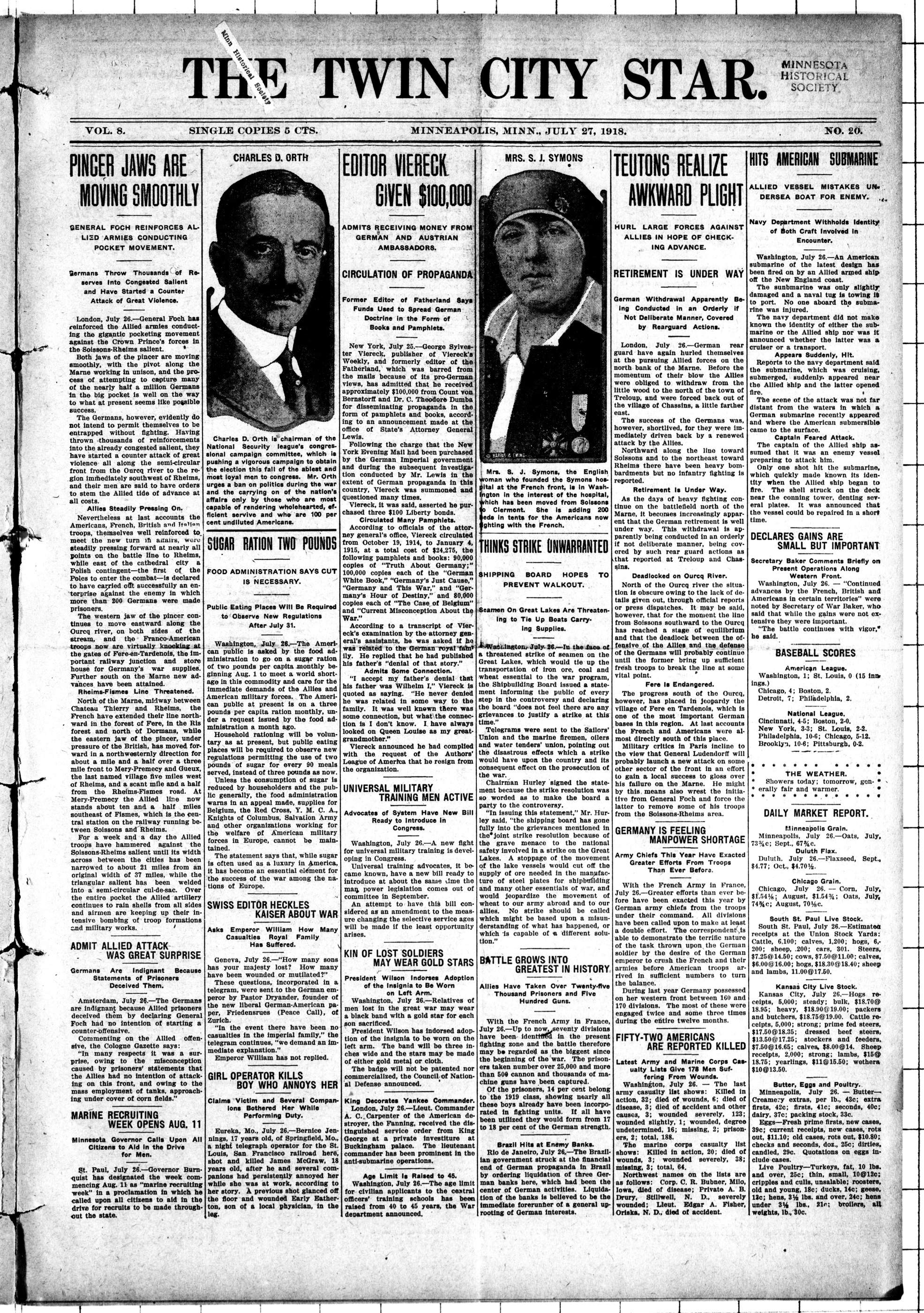
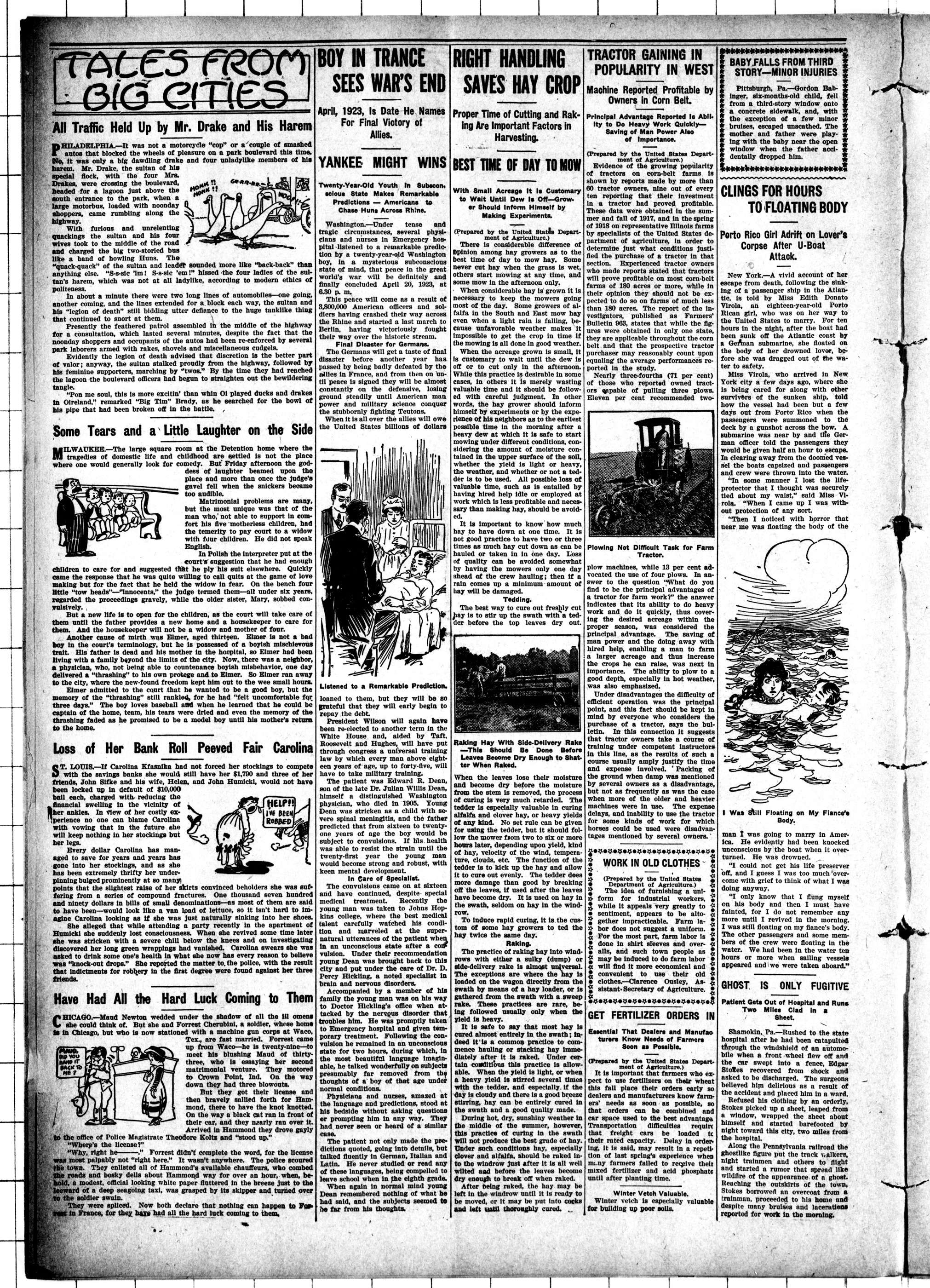
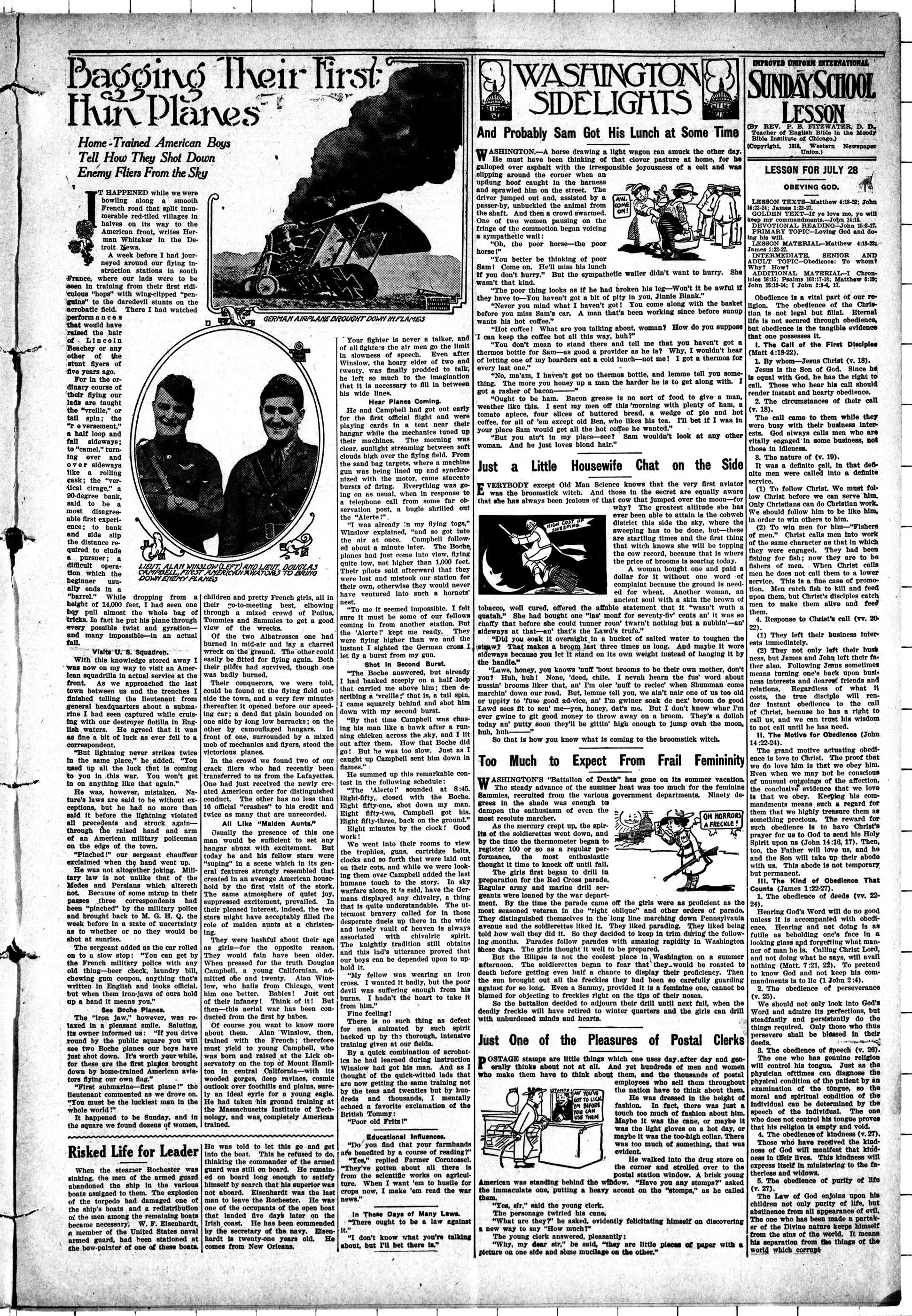
Page text (machine-generated)
PINGER JAWS ARE MOVING SMOOTHLY
GENERAL FOCH REINFORCES ALLIED ARMIES CONDUCTING POCKET MOVEMENT.
Germans Throw Thousands of Reserves Into Congested Sallent and Have Started a Counter Attack of Great Violence.
London, July 26.—General Foch has reinforced the Allied armies conducting the gigantic pocketing movement against the Crown Prince's forces in the Soissons-Rheims salient.
Both jaws of the pincer are moving smoothly, with the pivot along the Marne working in unison, and the process of attempting to capture many of the nearly half a million Germans in the big pocket is well on the way to what at present seems like possible success.
The Germans, however, evidently do not intend to permit themselves to be entrapped without fighting. Having thrown thousands of reinforcements into the already congested salient, they have started a counter attack of great violence all along the semi-circular front from the Ourcq river to the region immediately southwest of Rheims, and their men are said to have orders to stem the Allied tide of advance at all costs.
Allies Steadily Pressing On.
Nevertheless at last accounts the Americans, French, British and Italian troops, themselves well reinforced to meet the new turn in affairs, were steadily pressing forward at nearly all points on the battle line to Rhelms, while east of the cathedral city a Polish contingent—the first of the Poles to enter the combat—is declared to have carried out successfully an enterprise against the enemy in which more than 200 Germans were made prisoners.
The western jaw of the pincer continues to move eastward along the Ourec river, on both sides of the stream, and the Franco-American troops now are virtually knocking at the gates of Fere-en-Tardenois, the important railway junction and store house for Germany's war supplies. Further south on the Marne new advances have been attained.
Rheims-Fismes Line Threatened.
North of the Marne, midway between Chateau Thierry and Rheims, the French have extended their line northward in the forest of Fere, in the Ris forest and north of Dormans, while the eastern jaw of the pincer, under pressure of the British, has moved forward in a northwesternly direction for about a mile and a half over a three mile front to Mery-Premecy and Gueux, the last named village five miles west of Rheims, and a scant mile and a half from the Rheims-Fismes road. At Mery-Premecy the Allied line now stands about ten and a half miles southeast of Fismes, which is the central station on the railway running between Soissons and Rheims.
For a week and a day the Allied troops have hammered against the Soissons-Rheims salient until its width across between the cities has been narrowed to about 21 miles from an original width of 37 miles, while the triangular salient has been welded into a semi-circular cul-de-sac. Over the entire pocket the Allied artillery continues to rain shells from all sides and airmen are keeping up their intensive bombing of troop formations and military works.
ADMIT ALLIED ATTACK
WAS GREAT SURPRISE
Germans Are Indignant Because Statements of Prisoners Deceived Them.
Amsterdam, July 26.—The Germans are indignant because Allied prisoners deceived them by declaring General Foch had no intention of starting a counter-offensive.
Commenting on the Allied offensive, the Cologne Gazette says:
"In many respects it was a surprise, owing to the misconception caused by prisoners' statements that the Allies had no intention of attacking on this front, and owing to the mass employment of tanks, approaching under cover of corn fields."
Minnesota Governor Calls Upon All Citizens to Aid in the Drive for Men.
St. Paul, July 26.—Governor Burnquist has designated the week commencing Aug. 11 as "marine recruiting week" in a proclamation in which he called upon all citizens to aid in the drive for recruits to be made throughout the state.
THE TWIN CITY STAR.
SINGLE COPIES 5 CTS.
CHARLES D. SMITH
Charles D. Orth is chairman of the National Security league's congressional campaign committee, which is pushing a vigorous campaign to obtain the election this fall of the altest and most loyal men to congress. Mr. Orth urges a ban on politics during the war and the carrying on of the nation's affairs only by those who are most capable of rendering wholehearted, efficient servile and who are 100 per cent undiluted Americans.
SUGAR RATION TWO POUNDS
FOOD ADMINISTRATION SAYS CUT
IS NECESSARY.
Public Eating Places Will Be Required to Observe New Regulations After July 31.
Washington, July 26.—The American public is asked by the food administration to go on a sugar ration of two pounds per capita monthly beginning Aug. 1 to meet a world shortage in this commodity and care for the immediate demands of the Allies and American military forces. The American public at present is on a three pounds per capita ration monthly, under a request issued by the food administration a month ago.
Household rationing will be voluntary as at present, but public eating places will be required to observe new regulations permitting the use of two pounds of sugar for every 90 meals served, instead of three pounds as now.
Unless the consumption of sugar is reduced by householders and the public generally, the food administration warns in an appeal made, supplies for Belgium, the Red Cross, Y. M. C. A., Knights of Columbus, Salvation Army and other organizations working for the welfare of American military forces in Europe, cannot be maintained.
The statement says that, while sugar is often used as a luxury in America, it has become an essential element for the success of the war among the nations of Europe.
SWISS EDITOR HECKLES
KAISER ABOUT WAR
Asks Emperor William How Many Casualties Royal Family Has Suffered.
Geneva, July 26.—"How many sons has your majesty lost? How many have been wounded or mutilated?" These questions, incorporated in a telegram, were sent to the German emperor by Pastor Dryander, founder of the new liberal German-American paper, Friedensrues (Peace Call), of Zurich.
"In the event there have been no casualties in the imperial family," the telegram continues, "we demand an immediate explanation."
Emperor William has not replied.
GIRL OPERATOR KILLS BOY WHO ANNOYS HER
Claims Victim and Several Companions Bothered Her While Performing Duty.
Eureka, Mo., July 26.—Bernice Jennings, 17 years old, of Springfield, Mo., a night telegraph operator for the St. Louis, San Francisco railroad here, shot and killed James McGraw, 18 years old, after he and several companions had persistently annoyed her while she was at work, according to her story. A previous shot glanced off the floor and wounded Early Eatherton, son of a local physician, in the leg.
MINNEAPOLIS, MINN., JULY 27, 1918.
EDITOR VIERECK
GIVEN $100,000
ADMITS RECEIVING MONEY FROM
GERMAN AND AUSTRIAN
AMBASSADORS.
CIRCULATION OF PROPAGANDA
Former Editor of Fatherland Says Funds Used to Spread German Doctrine in the Form of Books and Pamphlets.
New York, July 25.—George Sylvester Viereck, publisher of Viereck's Weekly, and formerly editor of the Fatherland, which was barred from the mails because of its pro-German views, has admitted that he received approximately $100,000 from Count von Bernstorff and Dr. C. Theodore Dumba for disseminating propaganda in the form of pamphlets and books, according to an announcement made at the office of State's Attorney General Lewis.
Following the charge that the New York Evening Mall had been purchased by the German Imperial government and during the subsequent investigation conducted by Mr. Lewis in the extent of German propaganda in this country, Viereck was summoned and questioned many times.
Viereck, it was said, asserted he purchased three $100 Liberty bonds.
Circulated Many Pamphlets.
According to officials of the attorney general's office, Viereck circulated from October 19, 1914, to January 4, 1915, at a total cost of $24,275, the following pamphlets and books: 90,000 copies of "Truth About Germany;" 100,000 copies each of the "German White Book," "Germany's Just Cause," "Germany and This War," and "Germany's Hour of Destiny," and 80,000 copies each of "The Case of Belgium" and "Current Misconception About the War."
According to a transcript of Viereck's examination by the attorney general's assistants, he was asked if he was related to the German royal family. He replied that he had published his father's "denial of that story."
Admits Some Connection.
"I accept my father's denial that his father was Wilhelm I," Viereck is quoted as saying. "He never denied he was related in some way to the family. It was well known there was some connection, but what the connection is I don't know. I have always looked on Queen Louise as my great-grandmother."
Viereck announced he had complied with the request of the Authors' League of America that he resign from the organization.
UNIVERSAL MILITARY
TRAINING MEN ACTIVE
Advocates of System Have New Bill Ready to Introduce in Congress.
Washington, July 26.—A new fight for universal military training is developing in Congress.
Universal training advocates, it became known, have a new bill ready to introduce at about the same time the man power legislation comes out of committee in September.
An attempt to have this bill considered as an amendment to the measure changing the selective service ages will be made if the least opportunity arises.
KIN OF LOST SOLDIERS
MAY WEAR GOLD STARS
President Wilson Indores Adoption of the Insignia to Be Worn on Left Arm.
Washington, July 26.—Relatives of men lost in the great war may wear a black band with a gold star for each son sacrificed.
President Wilson has indorsed adoption of the insignia to be worn on the left arm. The band will be three inches wide and the stars may be made of either gold metal or cloth.
The badge will not be patented nor commercialized, the Council of National Defense announced.
King Decorates Yankee Commander. London, July 26.—Leut. Commander A. C. Carpenter of the American destroyer, the Fanning, received the distinguished service order from King George at a private investiture at Buckingham palace. The lieutenant commander has been prominent in the anti-submarine operations.
Age Limit Is Raised to 45.
Washington, July 26.—The age limit for civilian applicants to the cealral officers' training schools has been raised from 40 to 45 years, the War department announced.
BARBUS & EWING
Mrs. S. J. Symons, the English woman who founded the Symons hospital at the French front, is in Washington in the interest of the hospital, which has been moved from Soissons to Clermont. She is adding 200 beds in tents for the Americans now fighting with the French.
THINKS STRIKE UNWARRANTED
SHIPPING BOARD HOPES TO
PREVENT WALKOUT.
Seamen On Great Lakes Are Threatening to Tie Up Boats Carrying Supplies.
Washington, July 26.—In the face of a threatened strike of seamen on the Great Lakes, which would tie up the transportation of iron ore, coal and wheat essential to the war program, the Shipbuilding Board issued a statement informing the public of every step in the controversy and declaring the board "does not feel there are any grievances to justify a strike at this time."
Telegrams were sent to the Sailors' Union and the marine firemen, oilers and water tenders' union, pointing out the disastrous effects which a strike would have upon the country and its consequent effect on the prosecution of the war.
Chairman Hurley signed the statement because the strike resolution was so worded as to make the board a party to the controversy.
"In issuing this statement," Mr. Hurley said, "the shipping board has gone fully into the grievances mentioned in the joint strike resolution because of the grave menace to the national safety involved in a strike on the Great Lakes. A stoppage of the movement of the lake vessels would cut off the supply of ore needed in the manufacture of steel plates for shipbuilding and many other essentials of war, and would jeopardize the movement of wheat to our army abroad and to our allies. No strike should be called which might be based upon a misunderstanding of what has happened, or which is capable of a different solution."
BATTLE GROWS INTO
GREATEST IN HISTORY
Allies Have Taken Over Twenty-five Thousand Prisoners and Five Hundred Guns.
With the French Army in France, July 26.—Up to now, seventy divisions have been identified in the present fighting zone and the battle therefore may be regarded as the biggest since the beginning of the war. The prisoners taken number over 25,000 and more than 500 cannon and thousands of machine guns have been captured.
Of the prisoners, 14 per cent belong to the 1919 class, showing nearly all these boys already have been incorporated in fighting units. If all have been utilized they would form from 17 to 18 per cent of the German strength.
Brazil Hits at Enemy Banks.
Rio de Janeiro, July 26.—The Brazilian government struck at the financial end of German propaganda in Brazil by ordering liquidation of three German banks here, which had been the center of German activities. Liquidation of the banks is believed to be the immediate forerunner of a general uprooting of German interests.
TEUTONS REALIZE AWKWARD PLIGHT
TEUTONS REALIZE AWKWARD PLIGHT
HURL LARGE FORCES AGAINST ALLIES IN HOPE OF CHECKING ADVANCE.
RETIREMENT IS UNDER WAY
German Withdrawal Apparently Being Conducted in an Orderly if Not Deliberate Manner, Covered by Rearguard Actions.
London, July 26.—German rear guard have again hurled themselves at the pursuing Allied forces on the north bank of the Marne. Before the momentum of their blow the Allies were obliged to withdraw from the little wood to the north of the town of Treloup, and were forced back out of the village of Chassins, a little farther east.
The success of the Germans was, however, shortlived, for they were immediately driven back by a renewed attack by the Allies.
Northward along the line toward Solissons and to the northeast toward Rheims there have been heavy bombardments but no infantry fighting is reported.
Retirement Is Under Way.
As the days of heavy fighting continue on the battlefield north of the Marne, it becomes increasingly apparent that the German retirement is well under way. This withdrawal is apparently being conducted in an orderly if not deliberate manner, being covered by such rear guard actions as that reported at Treloup and Chassins.
Deadlocked on Ourcg River.
North of the Ourcq river the situation is obscure owing to the lack of details given out, through official reports or press dispatches. It may be said, however, that for the moment the line from Soissons southward to the Ourcq has reached a stage of equilibrium and that the deadlock between the offensive of the Allies and the defense of the Germans will probably continue until the former bring up sufficient fresh troops to break the line at some vital point.
Fere la Endangered.
The progress south of the Ourecq, however, has placed in jeopardy the village of Fere in Tardenois, which is one of the most important German bases in this region. At last accounts the French and Americans were almost directly south of this place. Military critics in Paris incline to the view that General Ludendorff will probably launch a new attack on some other sector of the front in an effort to gain a local success to gloss over his failure on the Marne. He might by this means also wrest the initiative from General Foch and force the latter to remove some of his troops from the Soissons-Rheims area.
GERMANY IS FEELING
MANPOWER SHORTAGE
Army Chiefs This Year Have Exacted Greater Efforts From Troops Than Ever Befors.
With the French Army in France, July 26.—Greater efforts than ever before have been exacted this year by German army chiefs from the troops under their command. All divisions have been called upon to make at least a double effort. The correspondent is able to demonstrate the terrific nature of the task thrown upon the German soldier by the desire of the German emperor to crush the French and their armies before American troops arrived in sufficient numbers to turn the balance.
During last year Germany possessed on her western front between 160 and 170 divisions. The most of these were engaged twice and some three times during the entire twelve months.
FIFTY-TWO AMERICANS ARE REPORTED KILLED
Latest Army and Marine Corps Casualty Lists Give 178 Men Suffering From Wounds.
Washington, July 26. — The last army casualty list shows: Killed in action, 32; died of wounds, 6; died of disease, 3; died of accident and other causes, 3; wounded severely, 123; wounded slightly, 1; wounded, degree undetermined, 16; missing, 2; prisoners, 2; total, 188.
The marine corps casualty list shows: Killed in action, 20; died of wounds, 3; wounded severely, 38; missing, 3; total, 64.
Northwest names on the lists are as follows: Corp. C. R. Bubner, Milo, Iowa, died of disease; Private A. B. Drury, Stillwell, N. D., severely wounded; Lleut. Edgar A. Fisher, Oriska, N. D., died of accident.
MINNESOTA HISTORICAL SOCIETY
NO. 20.
HITS AMERICAN SUBMARINE
ALLIED VESSEL MISTAKES UN-
DERSEA BOAT FOR ENEMY.
Navy Department Withholds Identity of Both Craft Involved In
Washington, July 26.—An American submarine of the latest design has been fired on by an Allied armed ship off the New England coast. The sunbmarine was only slightly damaged and a naval tug is towing it to port. No one aboard the submarine was injured. The navy department did not make known the identity of either the submarine or the Allied ship nor was it announced whether the latter was a cruiser or a transport.
Appears Suddenly, Hit.
Reports to the navy department said the submarine, which was cruising, submerged, suddenly appeared near the Allied ship and the latter opened fire.
The scene of the attack was not far distant from the waters in which a German submarine recently appeared and where the American submersible came to the surface.
Captain Feared Attack.
The captain of the Allied ship assumed that it was an enemy vessel preparing to attack him.
Only one shot hit the submarine, which quickly made known its identity when the Allied ship began to fire. The shell struck on the deck near the conning tower, denting several plates. It was announced that the vessel could be repaired in a short time.
DECLARES GAINS ARE
SMALL BUT IMPORTANT
Secretary Baker Comments Briefly on Present Operations Along Western Front.
Washington, July 26. — "Continued advances by the French, British and Americans in certain territories" were noted by Secretary of War Baker, who said that while the gains were not extensive they were important.
"The battle continues with vigor," he said.
BASEBALL SCORES
American League.
Washington, 1; St. Louis, 0 (15 inn-
ings.)
Chicago, 4; Boston, 2.
Detroit, 7; Philadelphia, 2.
National League.
Cincinnati, 4-5; Boston, 2-0.
New York, 3-3; St. Louis, 2-2.
Philadelphia, 10-6; Chicago, 5-12.
Brooklyn, 10-6; Pittsburgh, 0-2.
THE WEATHER.
* Showers today; tomorrow, gen-
erally fair and warmer.
DAILY MARKET REPORT.
Minneapolis, July 26.—Oats, July,
73%c; Sept., 67%c.
Duluth Flax.
Duluth, July 26—Flaxseed, Sept.,
$4.77; Oct., $4.70%.
Chicago Grain
Chicago, July 26. — Corn, July,
$1.54 \% ; August, $1.54 \% ; Oats, July,
74 \% ; August, 70 \% c.
South St. Paul Live Stock.
South St. Paul, July 26.—Estimated receipts at the Union Stock Yards:
Cattle, 6,100; calves, 1,200; hogs, 6,200; sheep, 200; cars, 301. Steers,
$7.25@14.50; cows, $7.50@11.00; calves,
$6.00@16.00; hogs, $18.30@18.40; sheep and lambs, $10.10@17.50.
Kansas City Live Stock.
Kansas City, July 26.-Hogs receipts, 5,000; steady; bulk, $18.70@18.95; heavy, $18.00@19.00; packers and butchers, $18.75@19.00. Cattle receipts, 5,000; strong; prime fed steers, $17.50@18.35; dressed beef steers, $17.50@17.25; stockers and feeders, $7.50@16.65; calves, $8.00@14. Sheep receipts, 2,000; strong; lambs, $15@18.75; yearlings, $11@15.50; wethers, $10@13.50.
Butter, Eggs and Poultry.
Minneapolis, July 26. — Butter— Creamy extras, per lb., 43c; extra firsts, 42c; firsts, 41c; seconds, 40c; dairy, 37c; packing stock, 33c.
Eggs—Fresh prime firsts, new cases, 39c; current receipts, new cases, rots out, $11.10; old cases, rots on, $10.80; checks and seconds, doz., 25c; dirties, candled, 29c. Quotations on eggs include cases.
Live Poultry—Turkeys, fat, 10 lbs. and over, 25c; thin, small, 10@12c; cripples and culls, unsalable; roosters, old and young, 18c; ducks, 14c; geese, 12c; hens, $3\frac{1}{2}$ lbs. and over, 24c; hens under $3\frac{1}{2}$ lbs., 21c; broilers, all weights, lb., 30c.
TALES FROM BIG CITIES
All Traffic Held Up by Mr. Drake and His Harem
PHILADELPHA.—It was not a motorcycle "cop" or a couple of smashed autos that blocked the wheels of pleasure on a park boulevard this time. No, it was only a big dawdling drake and four unladylike members of his. Mr. Drake, a cyclist of his.
"quack-quack" of the sultan and leader sounded more like "back-back" than anything else. "S-s-sic 'im! S-s-sic 'em!" hissed the four ladies of the sultan's harem, which was not at all ladylike, according to modern ethics of politeness.
In about a minute there were two long lines of automobiles—one going, another coming, and the lines extended for a block each way, the sultan and his "legion of death" still bidding utter defiance to the huge tanklike thing that continued to snort at them.
Presently the feathered patrol assembled in the middle of the highway for a consultation, which lasted several minutes, despite the fact that the noonday shoppers and occupants of the autos had been re-enforced by several park laborers armed with rakes, shovels and miscellaneous cudgels.
Evidently the legion of death advised that discretion is the better part of valor; anyway, the sultan stalked proudly from the highway, followed by his feminine supporters, marching by "twos." By the time they had reached the lagoon the boulevard officers had begun to straighten out the bewildering tangle.
"Pon me soul, this is more excitin' than whin Ol played ducks and drakes in Oireland," remarked "Big Tim" Brady, as he searched for the bowl of his pipe that had been broken off in the battle.
Some Tears and a Little Laughter on the Side
Some Tears and a Little Laughter on the Side
MILWAUKEE—The large square room at the Detention home where the tragedies of domestic life and childhood are settled is not the place where one would generally look for comedy. But Friday afternoon the god-
children to care for and suggested that he ply his suit elsewhere. Quickly came the response that he was quite willing to call quits at the game of love making but for the fact that he held the widow in fear. On the bench four little "tow heads"—"innocents," the judge termed them—all under six years, regarded the proceedings gravely, while the older sister, Mary, sobbed convulsively.
But a new life is to open for the children, as the court will take care of them until the father provides a new home and a housekeeper to care for them. And the housekeeper will not be a widow and mother of four.
Another cause of mirth was Elmer, aged thirteen. Elmer is not a bad boy in the court's terminology, but he is possessed of a boyish mischievous trait. His father is dead and his mother in the hospital, so Elmer had been living with a family beyond the limits of the city. Now, there was a neighbor, a physician, who, not being able to countenance boyish misbehavior, one day delivered a "thrashing" to his own protege and to Elmer. So Elmer ran away to the city, where the new-found freedom kept him out to the wee small hours.
Elmer admitted to the court that he wanted to be a good boy, but the memory of the "thrashing" still rankled, for he had "felt uncomfortable for three days." The boy loves baseball and when he learned that he could be captain of the home, team, his tears were dried and even the memory of the thrashing faded as he promised to be a model boy until his mother's return to the home.
Loss of Her Bank Roll Peeved Fair Carolina
ST. LOUIS—If Carolina Kfasnila had not forced her stockings to compete with the savings banks she would still have her $1,790 and three of her friends, John Sifke and his wife, Helen, and John Humicki, would not have been locked up in default of $10,000
points that the slightest raise of her skirts convinced beholders she was suffering from a series of compound fractures. One thousand seven hundred and ninety dollars in bills of small denominations—as most of them are said to have been—would look like a van load of lettuce, so it isn't hard to imagine Carolina looking as if she was just naturally sinking into her shoes. She alleged that while attending a party recently in the apartment of Humicki she suddenly lost consciousness. When she revived some time later she was stricken with a severe chill below the knees and on investigating discovered her long green wrappings had vanished. Carolina swears she was asked to drink some one's health in what she now has every reason to believe was "knock-out drops." She reported the matter to the police, with the result that indictments for robbery in the first degree were found against her three friends.
Have Had All the Hard Luck Coming to Them
CHICAGO.—Maud Newton wedded under the shadow of all the ill omens she could think of. But she and Forrest Cherubini, a soldier, whose home is in Chicago, but who is now stationed with a machine gun corps at Waco,
to the office of Police Magistrate Theodore Koltz and "stood up."
"Where's the license?"
"Why, right he——." Forrest didn't complete the word, for the license was most palpably not "right here." It wasn't anywhere. The police scoured the town. They enlisted all of Hammond's available chauffeurs, who combed the roads and bosky dells about Hammond way for over an hour, when, behold, a modest, official looking white paper fluttered in the breeze just to the leeward of a deep seagoing taxi, was grasped by its skipper and turned over to the soldier swain.
They were spliced. Now both declare that nothing can happen to Forest in France, for they have had all the hard luck coming to them.
harem. Mr. Drake, the sultan of his special flock, with the four Mrs. Drakes, were crossing the boulevard, headed for a lagoon just above the south entrance to the park, when a large motorbus, loaded with noonday shoppers, came rumbling along the highway.
With furious and unrelenting quackings the sultan and his four wives took to the middle of the road and charged the big two-storied bus like a band of howling Huns. The
"quack-quack" of the sultan and leader anything else. "S-sic 'im! S-sic 'ean'tan's harem, which was not at all la politeness.
In about a minute there were two another coming, and the lines extended his "legion of death" still bidding utter that continued to snort at them.
Presently the feathered patrol ass for a consultation, which lasted seven noonday shoppers and occupants of the park laborers armed with rakes, shovel.
Evidently the legion of death adv of valor; anyway, the sultan stalked his feminine supporters, marching by the lagoon the boulevard officers had b tangle.
"Pon me soul, this is more excitin' in Oireland," remarked "Big Tim" B his pipe that had been broken off in t
Some Tears and a Little
MILWAUKEE—The large square ro tragedies of domestic life and cl where one would generally look for co
A man is shouting at four children sitting on a bench.
children to care for and suggested the came the response that he was quite w making but for the fact that he held a little "tow heads"—"innocents," the jur regarded the proceedings gravely, wh vulsively.
But a new life is to open for the them until the father provides a new them. And the housekeeper will not be.
Another cause of mirth was Elmer boy in the court's terminology, but he trait. His father is dead and his mot living with a family beyond the limits of a physician, who, not being able to co delivered a "thrashing" to his own pro to the city, where the new-found freedom.
Elmer admitted to the court that memory of the "thrashing" still rankles days." The boy loves baseball captain of the home, team, his tears w thrashing faded as he promised to be to the home.
Loss of Her Bank Ro
ST. LOUIS.—If Carolina Kfasnika ha with the savings banks she would friends, John Sifke and his wife, Helen been locked up in default of $10,000.
been looked up in the sky, bull each, charged with reducing the financial swelling in the vicinity of her ankles. In view of her costly experience no one can blame Carolina with vowing that in the future she will keep nothing in her stockings but her legs. Every dollar Carolina has managed to save for years and years has gone into her stockings, and as she has been extremely thrifty her underpinning bulged prominently at so many
points that the slightest raise of her s-
fering from a series of compound frie-
and ninety dollars in bills of small de-
to have been—would look like a van
agine Carolina looking as if she was.
She alleged that while attending
Humicki she suddenly lost consciousness
she was stricken with a severe chill
discovered her long green wrappings h
asked to drink some one's health in wh
was "knock-out drops." She reported t
that indictments for robbery in the fir
friends.
Have Had All the Hard
CHICAGO.—Maud Newton wedded u
she could think of. But she and F
is in Chicago, but who is now statione
MAID,
DID YOU
HAND IT
BACK TO
ME?
to the office of Police Magistrate Theod
"Wherp's the license?"
"Why, right he——." Forrest di
was most palpably not "right here." In
the town. They enlisted all of Hamm
the roads and bosky dells about Ham
hold, a modest, official looking white p
iceward of a deep seagolng taxi, was p
to the soldier swain.
They were spliced. Now both de
rest in France, for they have had all t
MONK !!
MONK !!
GRRR-BRR
MONK !!
sounded more like "back-back" than him!" hissed the four ladies of the sulkilylike, according to modern ethics of long lines of automobiles—one going, and for a block each way, the sultan and defiance to the huge tanklike thing assembled in the middle of the highway.ural minutes, despite the fact that the autos had been re-enforced by several ils and miscellaneous cudgels.vised that discretion is the better part proudly from the highway, followed by "twos." By the time they had reached begun to straighten out the bewildering than whin Ol played ducks and drakes irrady, as he searched for the bowl of the battle.
Side Laughter on the Side
room at the Detention home where the childhood are settled is not the place comedy. But Friday afternoon the god-
dess of laughter beamed upon the place and more than once the judge's gavel fell when the snuckers became too audible. Matrimonial problems are many, but the most unique was that of the man who, not able to support in comfort his five motherless children, had the temerity to pay court to a widow with four children. He did not speak English. In Polish the interpreter put at the court's suggestion that he had enough
that he ply his suit elsewhere. Quickly willing to call quits at the game of love the widow in fear. On the bench four judge termed them—all under six years, little the older sister, Mary, sobbed con- children, as the court will take care of my home and a housekeeper to care for me a widow and mother of four. er, aged thirteen. Elmer is not a bad he is possessed of a boyish mischievous her in the hospital, so Elmer had been of the city. Now, there was a neighbor, untenance boyish misbehavior, one day stege and to Elmer. So Elmer ran away he kept him out to the wee small hours. he wanted him to be a good boy, but the bed, for he had "felt uncomfortable for and when he learned that he could be dried and even the memory of the a model boy until his mother's return
All Peeved Fair Carolina had not forced her stockings to compete still have her $1,790 and three of her en, and John Humicki, would not have
HELP!!
IVE BEEN
ROBBED
skirts convinced beholders she was suf-
actures. One thousand seven hundred
nominations—as most of them are said
load of lettuce, so it isn't hard to im-
just naturally sinking into her shoes.
a party recently in the apartment of
less. When she revived some time later
below the knees and on investigating
and vanished. Carolina swears she was
that she now has every reason to believe
the matter to, the police, with the result
st degree were found against her three
d Luck Coming to Them
under the shadow of all the ill omens
correst Cherubini, a soldier, whose home
bed with a machine gun corps at Waco,
Tex., are fast married. Forrest came up from Waco—he is twenty-nine—to meet his blushing Maud of thirty-three, who is essaying her second matrimonial venture. They motored to Crown Point, Ind. On the way down they had three blowouts. But they got their license and then bravely sallied forth for Hammond, there to have the knot knotted. On the way a black cat ran in front of their car, and they nearly ran over it. Arrived in Hammond they drove gayly
adore Koltz and "stood up."
didn't complete the word, for the license it wasn't anywhere. The police scoured Lond's available chauffeurs, who combed amid way for over an hour, when, be-paper fluttered in the breeze just to the grasped by its skipper and turned over
declare that nothing can happen to For the hard luck coming to them.
BOY IN TRANCE SEES WAR'S END
April, 1923, Is Date He Names For Final Victory of Allies.
YANKEE MIGHT WINS
Twenty-Year-Old Youth In Subconscious State Makes Remarkable Predictions — Americans to Chase Huns Across Rhine.
Washington.—Under tense and tragic circumstances, several physicians and nurses in Emergency hospital listened to a remarkable prediction by a twenty-year-old Washington boy, in a mysterious subconscious state of mind, that peace in the great world's war will be definitely and finally concluded April 20, 1923, at 6.30 p. m.
This peace will come as a result of 3,800,000 American officers and soldiers having crashed their way across the Rhine and started a last march to Berlin, having victoriously fought their way over the historic stream.
The Germans will get a taste of final disaster before another year has passed by being badly defeated by the allies in France, and from then on until peace is signed they will be almost constantly on the defensive, losing ground steadily until American man power and military science conquer the stubbornly fighting Teutons. When it is all over the allies will owe the United States billions of dollars
A man is sitting in a hospital room, holding a patient lying on a bed. A nurse is standing behind him, holding a clipboard and a pen. Two men are sitting on the floor, one of them is holding a clipboard and a pen.
Listened to a Remarkable Prediction.
loaned to them, but they will be so grateful that they will early begin to repay the debt.
President Wilson will again have been re-elected to another term in the White House and, aided by Taft, Roosevelt and Hughes, will have put through congress a universal training law by which every man above eighteen years of age, up to forty-five, will have to take military training.
The patient was Edward R. Dean, son of the late Dr. Julian Willis Dean, himself a distinguished Washington physician, who died in 1905. Young Dean was stricken as a child with severe spinal meningitis, and the father predicted that from sixteen to twenty-one years of age the boy would be subject to convulsions. If his health was able to resist the strain until the twenty-first year the young man would become strong and robust, with keen mental development.
In Care of Specialist.
The convulsions came on at sixteen and have continued, despite special medical treatment. Recently the young man was taken to Johns Hopkins college, where the best medical talent carefully watched his condition and marveled at the supernatural utterances of the patient when in an unconscious state after a convulsion. Under their recommendation young Dean was brought back to this city and put under the care of Dr. D. Percy Hickling, a noted specialist in brain and nervous disorders.
Accompanied by a member of his family the young man was on his way to Doctor Hickling's office when attacked by the nervous disorder that troubles him. He was promptly taken to Emergency hospital and given temporary treatment. Following the convulsion he remained in an unconscious state for two hours, during which, in the most beautiful language imaginable, he talked wonderfully on subjects presumably far removed from the thoughts of a boy of that age under normal conditions. Physicians and nurses, amazed at the language and predictions, stood at his bedside without asking questions or prompting him in any way. They had never seen or heard of a similar case.
The patient not only made the predictions quoted, going into details, but talked fluently in German, Italian and Latin. He never studied or read any of these languages, being compelled to leave school when in the eighth grade. When again in normal mind young Dean remembered nothing of what he had said, and the subjects seemed to be far from his thoughts.
Proper Time of Cutting and Raking Are Important Factors in Harvesting.
BEST TIME OF DAY TO MOW
With Small Acreage It is Customary to Wait Until Dew is Off—Grow-
(Prepared by the United States Department of Agriculture.)
There is considerable difference of opinion among hay growers as to the best time of day to mow hay. Some never cut hay when the grass is wet, others start mowing at any time, and some mow in the afternoon only.
When considerable hay is grown it is necessary to keep the mowers going most of the day. Some growers of alfalfa in the South and East mow hay even when a light rain is falling, because unfavorable weather makes it impossible to get the crop in time if the mowing is all done in good weather.
When the acreage grown is small, it is customary to wait until the dew is off or to cut only in the afternoon. While this practice is desirable in some cases, in others it is merely wasting valuable time and it should be followed with careful judgment. In other words, the hay grower should inform himself by experiments or by the experience of his neighbors as to the earliest possible time in the morning after a heavy dew at which it is safe to start mowing under different conditions, considering the amount of moisture contained in the upper surface of the soil, whether the yield is light or heavy, the weather, and whether or not a tedder is to be used. All possible loss of valuable time, such as is entailed by having hired help idle or employed at work which is less profitable and necessary than making hay, should be avoided.
It is important to know how much hay to have down at one time. It is not good practice to have two or three times as much hay cut down as can be hauled or taken in in one day. Loss of quality can be avoided somewhat by having the mowers only one day ahead of the crew hauling; then if a rain comes up a minimum amount of hay will be damaged.
Tedding.
The best way to cure out freshly cut hay is to stir up the swath with a tedder before the top leaves dry out.
Raking Hay With Side-Deilvery Rake
—This Should Be Done Before Leaves Become Dry Enough to Shatter When Raked.
When the leaves lose their moisture and become dry before the moisture from the stem is removed, the process of curing is very much retarded. The tedder is especially valuable in curing alfalfa and clover hay, or heavy yields of any kind. No set rule can be given for using the tedder, but it should follow the mower from two to six or more hours later, depending upon yield, kind of hay, velocity of the wind, temperature, clouds, etc. The function of the tedder is to kick up the hay and allow it to cure out evenly. The tedder does more damage than good by breaking off the leaves, if used after the leaves have become dry. It is used on hay in the swath, seldom on hay in the windrow.
To induce rapid curing, it is the custom of some hay growers to ted the hay twice the same day.
The practice of raking hay into windows with either a sulky (dump) or side-delivery rake is almost universal. The exceptions are where the hay is loaded on the wagon directly from the swath by means of a hay loader, or is gathered from the swath with a sweep rake. These practices are rare, being followed usually only when the yield is heavy.
It is safe to say that most hay is cured almost entirely in the swath; indeed it is a common practice to commence hauling or stacking hay immediately after it is raked. Under certain conditions this practice is allowable. When the yield is light, or when a heavy yield is stirred several times with the tedder, and especially if the day is cloudy and there is a good breeze stirring, hay can be entirely cured in the swath and a good quality made.
During hot, dry, sunshiny weather in the middle of the summer, however, this practice of curing in the swath will not produce the best grade of hay. Under such conditions hay, especially clover and alfalfa, should be raked into the windrow just after it is all well wilted and before the leaves become dry enough to break off when raked. After being raked, the hay may be left in the windrow until it is ready to be moved, or it may be put into cocks and left until thoroughly cured.
TRACTOR GAINING IN POPULARITY IN WEST
Machine Reported Profitable by Owners in Corn Belt.
Principal Advantage Reported Is Ability to Do Heavy Work Quickly—Saving of Man Power Also of Importance.
(Prepared by the United States Department of Agriculture.)
Evidence of the growing popularity of tractors on corn-belt farms is shown by reports made by more than 60 tractor owners, nine out of every ten reporting that their investment in a tractor had proved profitable. These data were obtained in the summer and fall of 1917, and in the spring of 1918 on representative Illinois farms by specialists of the United States department of agriculture, in order to determine just what conditions justified the purchase of a tractor in that section. Experienced tractor owners who made reports stated that tractors will prove profitable on most corn-belt farms of 180 acres or more, while in their opinion they should not be expected to do so on farms of much less than 180 acres. The report of the investigators, published as Farmers' Bulletin 963, states that while the figures were obtained in only one state, they are applicable throughout the corn belt and that the prospective tractor purchaser may reasonably count upon equaling the average performances reported in the study.
Nearly three-fourths (71 per cent) of those who reported owned tractors capable of pulling three plows. Eleven per cent recommended two-
Plowing Not Difficult Task for Farm Tractor.
plow machines, while 13 per cent advocated the use of four plows. In answer to the question "What do you find to be the principal advantages of a tractor for farm work?" the answer indicates that its ability to do heavy work and do it quickly, thus covering the desired acreage within the proper season, was considered the principal advantage. The saving of man power and the doing away with hired help, enabling a man to farm a larger acreage and thus increase the crops he can raise, was next in importance. The ability to plow to a good depth, especially in hot weather, was also emphasized.
Under disadvantages the difficulty of efficient operation was the principal point, and this fact should be kept in mind by everyone who considers the purchase of a tractor, says the bulletin. In this connection it suggests that tractor owners take a course of training under competent instructors in this line, as the results of such a course usually amply justify the time and expense involved. Packing of the ground when damp was mentioned by several owners as a disadvantage, but not as frequently as was the case when more of the older and heavier machines were in use. The expense delays, and inability to use the tractor for some kinds of work for which horses could be used were disadvantages mentioned by several owners.
WORK IN OLD CLOTHES
(Prepared by the United States Department of Agriculture.)
Department of Agriculture.)
The idea of furnishing a uniform for industrial workers, while it appeals very greatly to sentiment, appears to be altogether impracticable. Farm labor does not suggest a uniform. For the most part, farm labor is done in shirt sleeves and overalls, and such town people as may be induced to do farm labor will find it more economical and convenient to use their old clothes.—Clarence Ousley, Assistant Secretary of Agriculture.
GET FERTILIZER ORDERS IN
Essential That Dealers and Manufacturers Know Needs of Farmers Soon as Possible.
(Prepared by the United States Department of Agriculture.)
ment of Agriculture.)
It is important that farmers who expect to use fertilizers on their wheat this fall place their orders early so dealers and manufacturers know farmers' needs as soon as possible, so that orders can be combined and car space used to the best advantage. Transportation difficulties require that freight cars be loaded to their rated capacity. Delay in ordering, it is said, may result in a repetition of last spring's experience when many farmers failed to receive their mixed fertilizer and acid phosphate until after planting time.
Winter Vetch Valuable. Winter vetch is especially valuable for building up poor soils.
Pittsburgh, Pa.—Gordon Babinger, six-months-old child, fell from a third-story window onto a concrete sidewalk, and, with the exception of a few minor bruises, escaped unscathed. The mother and father were playing with the baby near the open window when the father accidentally dropped him.
CLINGS FOR HOURS TO FLOATING BODY
Porto Rico Girl Adrift on Lover's Corpse After U-Boat
Attack.
New York.—A vivid account of her escape from death, following the sinking of a passenger ship in the Atlantic, is told by Miss Edith Donato Virola, an eighteen-year-old Porto Rican girl, who was on her way to the United States to marry. For ten hours in the night, after the boat had been sunk off the Atlantic coast by a German submarine, she floated on the body of her drowned lover, before she was dragged out of the water to safety.
Miss Virola, who arrived in New York city a few days ago, where she is being cared for along with other survivors of the sunken ship, told how the vessel had been but a few days out from Porto Rico when the passengers were summoned to the deck by a gunshot across the bow. A submarine was near by and the German officer told the passengers they would be given half an hour to escape. In clearing away from the doomed vessel the boats capsized and passengers and crew were thrown into the water. "In some manner I lost the life-protector that I thought was securely tled about my waist," said Miss Virola. "When I came up I was without protection of any sort. "Then I noticed with horror that near me was floating the body of the
THE WATER IS RIVERING.
I Was Still Floating on My Fliance's Body.
man I was going to marry in America. He evidently had been knocked unconscious by the boat when it overturned. He was drowned.
"I could not get his life preserver off, and I guess I was too much overcome with grief to think of what I was doing anyway.
"I only know that I fung myself on his body and then I must have fainted, for I do not remember any more until I revived in the morning. I was still floating on my fliance's body. The other passengers and some members of the crew were floating in the water. We had been in the water ten hours or more when sailing vessels appeared and we were taken aboard."
GHOST. IS ONLY FUGITIVE
Patient Gets Out of Hospital and Runs Two Miles Clad in a Sheet.
Shamokin, Pa.—Rushed to the state hospital after he had been catapulted through the windshield of an automobile when a front wheel flew off and the car swept into a fence, Edgar Stokes recovered from shock and asked to be discharged. The surgeons believed him delirious as a result of the accident and placed him in a ward. Refused his clothing by an orderly, Stokes picked up a sheet, leaped from a window, wrapped the sheet about himself and started barefooted by night toward this city, two miles from the hospital.
Along the Pennsylvania railroad the ghostlike figure put the track walkers, night trainmen and others to flight and started a rumor that spread like wildfire of the appearance of a ghost. Reaching the outskirts of the town, Stokes borrowed an overcoat from a trainman, proceeded to his home and despite many bruises and lacerations reported for work in the morning.
Bagging Their First Thin Planes
Home-Trained American Boys Tell How They Shot Down Enemy Fliers From the Sky
MILITARY PHOTOGRAPHY
FILM
STUDIO
LEFT ALAN WINSON LOWE AND LEFT DOUGLAS
RIGHT ALAN WINSON LOWE AVIATORS TO BRUSH
DOWNEY LEAN FRAMES
T HAPPENED while we were bowling along a smooth French road that split innumerable red-tiled villages in halves on its way to the American front, writes Herman Whitaker in the Detroit News.
I
A week before I had journeyed around our flying instruction stations in south France, where our lads were to be seen in training from their first ridiculous "hops" with wing-clipped "penguins" to the daredevil stunts on the acrobatic field. There I had watched
performances that would have raised the hair of Lincoln Beachey or any other of the stunt flyers of five years ago.
For in the ordinary course of their flying our lads are taught the "vrellle," or tail spin; the "r e versement," a half loop and fall sideways; to "camel," turning over sideways like a rolling cask; the "vertical cage," a 90-degree bank, said to be a most disagreeable first experience; to bank and side slip the distance required to elude a pursuer; a difficult operation which the beginner usually ends in a
"barrel." While dropping from a height of 14,000 feet, I had seen one boy pull almost the whole bag of tricks. In fact he put his plane through every possible twist and gyration—and many impossible—in an actual fall. Visits U. S. Squadron.
With this knowledge stored away I was now on my way to visit an American squadrilla in actual service at the front. As we approached the last town between us and the trenches I finished telling the lieutenant from general headquarters about a submarine I had seen captured while cruising with our destroyer flotilla in English waters. He agreed that it was as fine a bit of luck as ever fell to a correspondent.
"But lightning never strikes twice in the same place," he added. "You used up all the luck that is coming to you in this war. You won't get in on anything like that again."
He was, however, mistaken. Nature's laws are said to be without exceptions, but he had no more than said it before the lightning violated all precedents and struck again—through the raised hand and arm of an American military policeman on the edge of the town.
"Pinched!" our sergeant chauffeur exclaimed when the hand went up. He was not altogether joking. Military law is not unlike that of the Medes and Persians which altereth not. Because of some mixup in their passes three correspondents had been "pinched" by the military police and brought back to M. G. H. Q. the week before in a state of uncertainty as to whether or no they would be shot at sunrise.
The sergeant added as the car rolled on to a slow stop: "You can get by the French military police with any old thing—beer check, laundry bill, chewing gum coupon, anything that's written in English and looks official. but when them iron-jaws of ours hold up a hand it means you."
See Boche Planes.
The "iron jaw," however, was relaxed in a pleasant smile. Saluting, its owner informed us: "If you drive round by the public square you will see two Boche planes our boys have just shot down. It's worth your while, for these are the first planes brought down by home-trained American aviators flying our own flag." "First submarine—first plane!" the lieutenant commented as we drove on. "You must be the luckiest man in the whole world!" It happened to be Sunday, and in the square we found dozens of women,
Risked Life for Leader
Risked Life for Leader
When the steamer Rochester was sinking, the men of the armed guard abandoned the ship in the various boats assigned to them. The explosion of the torpedo had damaged one of the ship's boats and a redistribution of the men among the remaining boats became necessary. W. F. Eisenhardt, a member of the United States naval armed guard, had been stationed at the bow-painter of one of these boats.
Their first
ines
Boys
on
GERMAN AIRPLANE BROUGHT DOWN IN FLAMES
GERMAN AIRPLANE BROUGHT DOWN IN FLAMES
SLOW (LEFT) AND LIEUT. DOUGLAS
AMERICAN WATCHERS TO BRUYD
JAMES
children and pretty French girls, all in their go-to-meeting best, elbowing through a mixed crowd of Pollus, Tommies and Sammies to get a good view of the wrecks.
Of the two Albatrosses one had burned in mid-air and lay a charred wreck on the ground. The other could easily be fitted for flying again. Both their pilots had survived, though one was badly burned.
Their conquerors, we were told, could be found at the flying field outside the town, and a very few minutes thereafter it opened before our speeding car; a dead flat plain bounded on one side by long low barracks; on the other by camouflaged hangars. In front of one, surrounded by a mixed mob of mechanics and flyers, stood the victorious planes.
In the crowd we found two of our crack filers who had recently been transferred to us from the Lafayette. One had just received the newly created American order for distinguished conduct. The other has no less than 10 official "crashes" to his credit and twice as many that are unrecorded.
All Like "Maiden Aunts."
Usually the presence of this one man would be sufficient to set any hangar abuzz with excitement. But today he in a his fellow stars were "suping" in a scene which in its general features strongly resembled that created in an average American household by the first visit of the stork. The same atmosphere of quiet joy. suppressed excitement, prevailed. In their pleased interest, indeed, the two stars might have acceptably filled the role of malden aunts at a christening.
They were bashtall about their age as girls—for the opposite reason. They would fain have been older. When pressed for the truth Douglas Campbell, a young Californian, admitted ohe and twenty. Alan Winslow, who halls from Chicago, went him one better. Bables! Just out of their infaney! Think of it! But then—this aerial war has been conducted from the first by babes.
Of course you want to know more about them. Alan Winslow, then, trained with the French; therefore must yield to young Campbell, who was born and raised at the Lick observatory on the top of Mount Hamilton in central California—with its wooded gorges, deep ravines, cosmic outlook over foothills and plains, surely an ideal eyrie for a young eagle. He had taken his ground training at the Massachusetts Institute of Technology, and was completely American trained.
He was told to let this go and get into the boat. This he refused to do, thinking the commander of the armed guard was still on board. He remained on board long enough to satisfy himself by search that his superior was not aboard. Eisenhardt was the last man to leave the Rochester. He was one of the occupants of the open boat that landed five days later on the Irish coast. He has been commended by the secretary of the navy. Eisenhardt is twenty-one years old. He comes from New Orleans.
Your fighter is never a talker, and of all fighters the air men go the limit in slowness of speech. Even after Winslow, the hoary elder of two and twenty, was finally prodded to talk, he left so much to the imagination that it is necessary to fill in between his wide lines.
Hear Planes Coming.
He and Campbell had got out early for the first official flight and were playing cards in a tent near their hangar while the mechanics tuned up their machines. The morning was clear, sunlight streaming between soft clouds high over the flying field. From the sand bag targets, where a machine gun was being lined up and synchronized with the motor, came staccato bursts of firing. Everything was going on as usual, when in response to a telephone call from some far observation post, a bugle shrilled out the "Alerte!"
"I was already in my flying toga," Winslow explained, "and so got into the air at once. Campbell followed about a minute later. The Boche planes had just come into view, flying quite low, not higher than 1,000 feet. Their pilots said afterward that they were lost and mistook our station for their own, otherwise they would never have ventured into such a hornets' nest.
"To me it seemed impossible. I felt sure it must be some of our fellows coming in from another station. But the 'Alerte!' kept me ready. They were flying higher than we and the instant I sighted the German cross I let fly a burst from my gun.
Shot in Second Burst.
"The Boche answered, but already I had banked steeply on a half loop that carried me above him; then describing a 'vrelle'; that is, a tail spin, I came squarely behind and shot him down with my second burst.
"By that time Campbell was chasing his man like a hawk after a running chicken across the sky, and I lilt out after them. How that Boche did go! But he was too slow. Just as I caught up Campbell sent him down in flames."
He summed up this remarkable contest in the following schedule:
"The 'Alerte!' sounded at 8:45. Eight-fifty-one, closed with the Boche. Eight fifty-one, shot down my man. Eight fifty-two, Campbell got his. Eight fifty-three, back on the ground." Eight minutes by the clock! Good work!
We went into their rooms to view the trophies, guns, cartridge belts, clocks and so forth that were laid out on their cots, and while we were looking them over Campbell added the last humane touch to the story. In sky warfare alone, it is said, have the Germans displayed any chivalry, a thing that is quite understandable. The uttermost bravery called for in those desperate duels up there in the wide and lonely vault of heaven is always associated with chivalric spirit. The knightly tradition still obtains and this lad's utterance proved that our boys can be depended upon to uphold it.
"My fellow was wearing an iron cross. I wanted it badly, but the poor devil was suffering enough from his burns. I hadn't the heart to take it from him."
Fine feeling!
There is no such thing as defeat for men animated by such spirit backed up by the thorough, intensive training given at our fields.
By a quick combination of acrobatics he had learned during instruction Winslow had got his man. And as I thought of the quick-witted lads that are now getting the same training not by the tens and twenties but by hundreds and thousands, I mentally echoed a favorite exclamation of the British Tommy:
"Poor old Fritz!"
Educational Influences.
"Do you find that your farmhands are benefited by a course of reading?"
"Yes," replied Farmer Corntossel.
"They've gotten about all there is from the scientific works on agriculture. When I want 'em to hustle for crops now, I make 'em read the war news."
In These Days of Many Laws.
"There ought to be a law against it."
"I don't know what you're talking about, but I'll bet there is."
WASHINGTON SIDELIGHTS
And Probably Sam Got His Lunch at Some Time
WASHINGTON.—A horse drawing a light wagon ran amuck the other day. He must have been thinking of that clover pasture at home, for he galloped over asphalt with the irresponsible joyousness of a colt and was
Sam! Come on. He miss his funn!
If you don't hurry." But the sympathetic waller didn't want to hurry. She wasn't that kind.
"The poor thing looks as if he had broken his leg—Won't it be awful if they have to—You haven't got a bit of pity in you, Jinnie Blank."
"Never you mind what I haven't got! You come along with the basket before you miss Sam's car. A man that's been working since before sunup wants his hot coffee."
"Hot coffee! What are you talking about, woman? How do you suppose I can keep the coffee hot all this way, huh?
"You don't mean to stand there and tell me that you haven't got a thermos bottle for Sam—as good a provider as he is? Why, I wouldn't hear of letting one of my boarders eat a cold lunch—not me! I got a thermos for every last one."
"No, ma'am, I haven't got no thermos bottle, and lemme tell you something. The more you honey up a man the harder he is to get along with. I got a rasher of bacon——"
"Ought to be ham. Bacon grease is no sort of food to give a man, weather like this. I sent my men off this 'morning with plenty of ham, a tomato aplece, four slices of buttered bread, a wedge of pie and hot coffee, for all of 'em except old Ben, who likes his tea. I'll bet if I was in your place Sam would get all the hot coffee he wanted."
"But you ain't in my place—see? Sam wouldn't look at any other woman. And he just loves blond hair."
Just a Little Housewife Chat on the Side
EVERYBODY except Old Man Science knows that the very first aviator was the broomstick witch. And those in the secret are equally aware that she has always been jealous of that cow that jumped over the moon—for
tobacco, well cured, offered the affable statement that it “wasn’t wuth a quatah.” She had bought one “las” monf for seventy-five cents an’ it was so chaffy that before she could tunner roun’t warn’t nothing but a nubbin—an’ sideways at that—an’ that’s the Lawd’s trufe.”
“Did you soak it overnight in a bucket of salted water to toughen the straw? That makes a broom last three times as long. And maybe it wore sideways because you let it stand on its own weight instead of hanging it by the handle.”
“Laws, honey, you knows 'nuff' bout brooms to be their own mother, don't you? Huh, huh! None, 'deed, chile. I nevah hearn the fus' word about nussin' brooms liker that, an' I'm oler 'nuff to reclec' when Shumman come marchin' down our road. But, lemme tell you, we ain't nair one of us too old or uppity to 'fuse good ad-vice, an' I'm gwiner soak de nex' broom de good Lawd sees fit to sen me—yes, honey, dat's me. But I don't know whar I'm ever gwine to git good money to throw away on a broom. They's a dolla today an' putty soon they'll be gittin' high enough to jump ovah the moon, huh, huh."
So that is how you know what is coming to the broomstick witch.
Too Much to Expect From Frail Femininity
Too Much to Expect From Frail Femininity
WASHINGTON'S "Battallon of Death" has gone on its summer vacation. The steady advance of the summer heat was too much for the feminine Sammies, recruited from the various government departments. Ninety degrees in the shade was enough to dampen the enthusiasm of even the most resolute marcher.
ment. By the time the parade came off the girls were as proficient as the most seasoned veteran in the "right oblique" and other orders of parade. They distinguished themselves in the long line marching down Pennsylvania avenue and the soldierettes liked it. They liked parading. They liked being told how well they did it. So they decided to keep in trim during the following months. Parades follow parades with amazing rapidity in Washington these days. The girls thought it well to be prepared.
But the Ellipse is not the coolest place in Washington on a summer afternoon. The soldierettes began to fear that they would be roasted to death before getting even half a chance to display their proficiency. Then the sun brought out all the freckles they had been so carefully guarding against for so long. Even a Sammy, provided it is a feminine one, cannot be blamed for objecting to freckles right on the tips of their noses.
So the battalion decided to adjourn their drill until next fall, when the deadly freckle will have retired to winter quarters and the girls can drill with unburdened minds and hearts.
Just One of the Pleasures of Postal Clerks
POSTAGE stamps are little things which one uses day.after day and generally thinks about not at all. And yet hundreds of men and women who make them have to think about them, and the thousands of postal
American was standing behind the window. "Have you any stomps?" asked the immaculate one, putting a heavy accent on the "stomps," as he called them.
"What are they?" he asked, evidently felicitating himself on discovering a new way to say "How much?"
The young clerk answered, pleasantly:
"Why, my dear sir," he said, "they are little pieces of paper with a picture on one side and some mucilage on the other."
Victoria
slipping around the corner when an upflung hoof caught in the harness and sprawled him on the street. The driver jumped out and, assisted by a passer-by, unbuckled the animal from the shaft. And a crowd swarmed. One of two women pausing on the fringe of the commotion began voicing a sympathetic wall:
"Oh, the poor horse—the poor horse!"
"You better be thinking of poor Sam! Come on. He'll miss his lunch
if you don't hurry." But the sympathy wasn't that kind.
"The poor thing looks as if he had they have to—You haven't got a bit of "Never you mind what I haven't before you miss Sam's car. A man that wants his hot coffee."
"Hot coffee! What are you talking I can keep the coffee hot all this way "You don't mean to stand there thermos bottle for Sam—as good a pro of letting one of my boarders eat a col every last one."
"No, ma'am, I haven't got no other thing. The more you honey up a man got a rasher of bacon——"
"Ought to be ham. Bacon greas weather like this. I sent my men of tomato apiece, four silices of butter coffee, for all of 'em except old Ben, your place Sam would get all the hot "But you ain't in my place—see woman. And he just loves blond hair
Just a Little Housewife
EVERYBODY except Old Man Scien was the broomstick witch. And that she has always been jealous of the
HIGH COST OF
SWEEPING
tobacco, well cured, offered the affair quatah." She had bought one "las' man chaffy that before she could tuner re sideways at that—an" that's the Lawn "Did you soak it overnight in a straw? That makes a broom last the sideways because you let it stand on it the handle."
"Laws, honey, you knows 'nuff 'bou you? Huh, huh! None 'deed, chile, nussin' brooms liker that, an' I am oler marchin' down our road. But, lemme or uppity to 'fuse good ad-vice, an' I Lawd sees fit to sen' me—yes, honey, ever gwine to git good money to thre today an' putty soon they'll be gittin' huh, huh—"
So that is how you know what is Too Much to Expect
WASHINGTON'S "Battallon of Dea The steady advance of the summ Sammels, recruited from the various grees in the shade was enough to dampen the enthusiasm of even the most resolute marcher.
As the mercury crept up, the spirits of the soldierettes went down, and by the time the thermometer began to register 100 or so as a regular performance, the most enthusiastic thought it time to knock off until fall. The girls first began to drill in preparation for the Red Cross parade. Regular army and marine drill sergeants were loaned by the war depart-
ment. By the time the parade came most seasoned veteran in the "right. They distinguished themselves in the avenue and the soldierettes liked it. told how well they did it. So they deed months. Parades follow parades these days. The girls thought it well. But the Ellipse is not the cooler afternoon. The soldierettes began to death before getting even half a chap the sun brought out all the freckles against for so long. Even a Sammy, blamed for objecting to freckles right. So the battalion decided to adjourn deadly freckle will have retired to w with unburdened minds and hearts.
Just One of the Plea
POSTAGE stamps are little things we erally thinks about not at all. who make them have to think about
ANY YOU'VE
GOT TO LICK
EM BEFORE
YOU CAN
USE THEM
"Yes, sir," said the young clerk.
The personage twirled his cane.
"What are they?" he asked, evide
a new way to say "How much?"
The young clerk answered, pleasa
"Why, my dear sir," he said, "t
picture on one side and some mucilage
AW. COME ON!
Aetic waller didn't want to hurry. She
will broken his leg—Won't it be awful if
empty in you, Jinnie Blank."
Not! You come along with the basket
that's been working since before sunup
g about, woman? How do you suppose
huh?"
and tell me that you haven't got a
provider as he is? Why, I wouldn't hear
d lunch—not me! I got a thermos for
mosos bottle, and lemme tell you some-
the harder he is to get along with. I
he is no sort of food to give a man,
if this morning with plenty of ham, a
ed bread, a wedge of pie and hot
who likes his tea. I'll bet if I was in
coffee he wanted."
? Sam wouldn't look at any other
."
Life Chat on the Side
Face knows that the very first aviator
chose in the secret are equally aware
at cow that jumped over the moon—for
why? The greatest altitude she has ever been able to attain is the cobweb district this side the sky, where the sweeping has to be done, but—these are startling times and the first thing that witch knows she will be topping the cow record, because that is where the price of brooms is soaring today. A woman bought one and paid a dollar for it without one word of complaint because the ground is needed for wheat. Another woman, an ancient soul with a skin the brown of
tble statement that it "wasn't wuth a conf for seventy-fly cents an' it was so son' twnaw't nothing but a nubblin'—an' its trufe."
bucket of salted water to toughen the three times as long. And maybe it wore its own weight instead of hanging it by
it brooms to be their own mother, don't
I nevah hearn the fus' word about
'nuff to reclec' when Shumman come tell you, we ain't nair one of us too old
im gwiner soak de nex' broom de good that's me. But I don't know what I'm now away on a broom. They's a dollah high enough to jump ovah the moon,
coming to the broomstick witch.
From Frail Femininity
with" has gone on its summer vacation, her heat was too much for the feminine government departments. Ninety de-
OH HORRORS
A FRECKLE!
off the girls were as proficient as the oblique" and other orders of parade, long line marching down Pennsylvania. They liked parading. They liked being added to keep in trim during the follow-with amazing rapidity in Washington to be prepared. First place in Washington on a summer fear that they would be roasted to face to display their proficiency. Then they had been so carefully guarding provided it is a feminine one, cannot be on the tips of their noses. On their drill until next fall, when the inter quarters and the girls can drill
asures of Postal Clerks
which one uses day.after day and gen- and yet hundreds of men and women them, and the thousands of postal employees who sell them throughout
the nation have to think about them.
He was dressed in the height of fashion. In fact, there was just a touch too much of fashion about him. Maybe it was the cane, or maybe it was the gloves on a hot day, or maybe it was the too-high collar. There was too much of something, that was evident.
He walked into the drug store on the corner and strolled over to the postal station window. A brisk young
Window. "Have you any stomps?" asked accent on the "stomps," as he called
ently felicitating himself on discovering
ntly:
they are little pieces of paper with a on the other."
(By REV. P. B. FITZWATER. D. B.
Teacher of English Bible in the Moody
Bible Institute of Chicago.)
(Copyright, 1918) Eastern Newspaper
Union
LESSON TEXT2-Matthew 4:18-22; John
14:22-24; James 1:22-27.
GOLDEN TEXT-If ye love me, ye will
keep mv_commandments-John 14:15.
keep my commandments.—John 14:14:
"And I will not leave you alone, but I will
PRIMARY TOPIC--Loving God and do-
ment."
DEVOTION READING-John 15:3-17.
PRIMARY TOPIC—Loving God and
doing his will.
LESSON MATERIAL Matthew 4:18-22
LESSON MATERIAL—Matthew 4:18-22;
James 1:22-27.
INTERMEDIATE, SENIOR AND
ADULT TOPIC—Obedience: To whom?
Why? How?
ADDITIONAL MATERIAL—I Chronicles 16:15; Psalms 103:17-18; Matthew 6:19;
John 15:12-14; I John 23:4-17.
Obedience is a vital part of our religion. The obedience of the Christian is not legal but filial. Eternal life is not secured through obedience, but obedience is the tangible evidence that one possesses it.
1. The Call of the First Disciples (Matt 4:18-22).
1. By whom—Jesus Christ (v. 18).
Jesus is the Son of God. Since he is equal with God, he has the right to call. Those who hear his call should render instant and hearty obedience.
2. The circumstances of their call (v. 18).
The call came to them while they were busy with their business interests. God always calls men who are vitally engaged in some business, not those in idleness.
8. The nature of (v. 19).
It was a definite call, in that definite men were called into a definite service.
(1) To follow Christ. We must follow Christ before we can serve him. Only Christians can do Christian work. We should follow him to be like him, in order to win others to him.
(2) To win men for him—"Fisherms of men." Christ calls men into work of the same character as that in which they were engaged. They had been fishing for fish; now they are to be fishers of men. When Christ calls men he does not call them to a lower service. This is a fine case of promotion. Men catch fish to kill and feed upon them, but Christ's disciples catch men to make them alive and feed them.
4. Response to Christ's call (vv. 20-22).
(1) They left their business interests immediately.
(2) They not only left their business, but James and John left their father also. Following Jesus sometimes means turning one's back upon business interests and dearest friends and relations. Regardless of what it costs, the true disciple will render instant obedience to the call of Christ, because he has a right to call us, and we can trust his wisdom to not call until he has need.
II. The Motive for Obedience (John 14:22-24).
The grand motive actuating obedience is love to Christ. The proof that we do love him is that we obey him. Even when we may not be conscious of unusual outgoings of the affection, the conclusive evidence that we love is that we obey. Keeping his commandments means such a regard for them that we highly treasure them as something precious. The reward for such obedience is to have Christ's prayer for us to God to send his Holy Spirit upon us (John 14:16, 17). Then, too, the Father will love us, and he and the Son will take up their abode with us. This abode is not temporary but permanent.
III. The Kind of Obedience That Counts (James 1:22-27).
1. The obedience of deeds (vv. 22-24).
Hearing God's Word will do no good unless it is accompanied with obedience. Hearing and not doing is as futile as beholding one's face in a looking glass and forgetting what manner of man he is. Calling Christ Lord, and not doing what he says, will avail nothing (Matt. 7:21, 22). To pretend to know God and not keep his commandments is to lie (1 John 2:4).
2. The obedience of perseverance (v. 25).
We should not only look into God's Word and admire its perfections, but steadfastly and persistently do the things required. Only those who thus persevere shall be blessed in their deeds.
3. The obedience of speech (v. 26).
The one who has genuine religion will control his tongue. Just as the physician oftimes can diagnose the physical condition of the patient by an examination of the tongue, so the moral and spiritual condition of the individual can be determined by the speech of the individual. The one who does not control his tongue proves that his religion is empty and void.
4. The obedience of kindness (v. 27).
Those who have received the kindness of God will manifest that kindness in their lives. This kindness will express itself in ministering to the fatherless and widows.
5. The obedience of purity of life (v. 27).
The Law of God enjoins upon his children not only purity of life, but abstinence from all appearance of evil. The one who has been made a partaker of the Divine nature keeps himself from the sins of the world. It means his separation from the things of the world which corrupt
MEMBER
NATIONAL NEGRO PRESS
ASSOCIATION
Subscription by Mail, Postpaid.
ONE YEAR .....$2.00
SIX MONTHS .....$125
THREE MONTHS ......65
ADVERTISING RATES.
One Inch—1 Insertion—One Dollar.
Liberal discount given on 3, 6, 9,
Months, or 1 year contracts.
We do not run free ads, or over-run
the time contracted for by our ad-
vertisers. We respect their right to
advertise at intervals, and rather have
them do so, than to run continuously
an "adv." and an increasing account.
Write all Checks payable to
THE TWIN CITY STAR
1317 North Sixth Ave.
MINNEAPOLIS - MINNESOTA
Call at 1317 6th Ave. N. on Wednesday to insure matter for publication.
The Star's Phone, Hyland 1205.
Send your subscription. Our prices have not changed because of the war.
Let your dollar do its duty and The Star will reach a higher standard of service and better circulation.
```markdown
```
"THE REPUBLICAN PARTY IS THE SHIP; ALL ELSE IS THE SEA," said Frederick Douglass. Now is the most important time for Negroes to stand by the old party of Lincoln and Grant.
Keep Minnesota a Republican State.
Maj. W. A. Curtis, chief of staff of the Adjutant General's office, has been called to Washington for duty. He leaves with the best wishes of the officers and men of the 16th Battalion, M. H. G., which was mustered in by him. He has been their friend and advisor and will be greatly missed. Their loss is the Nation's gain.
N. A. A. C. P.'s National President Volunteers Endorsement of Colored Inaugurating Movements for Rights of Citizenship.
(Special.)
Boston, Mass., July 20, 1918.—Great interest has been taken here in the attitude of Hon. Moorfield Storey as expressed by himself toward the National Colored Liberty Congress, which called 115 delegates to Washington from 30 states, and at the close of a whole week's session with five nightly mass meetings had a race petition presented to Congress and entered in the records of the House asking for the enforcement of democracy for Colored Americans. The interest was the greater because of Dr. Dubois' editorial in the Crisis against agitation in war time, and the attempt of Major Spingarn to prevent the Congress.
Without being consulted at all Mr. Storey sent the following letter to the Executive Secretary:
755 Exchange Building,
Boston, Mass., July 8, 1918.
Dear Mr. Trotter:
I congratulate you on the success of your.Liberty Congress. Persevere. "Who would be free himself must strike the blow." Sincerely yours, (Signed) M. STOREY.
THE COLOR THAT
"The colored troops fought bravely." It does not matter whether this historic report emerged from the Civil War or from one of the earlier struggles of the Republic. It has been historically true at all times. General Pershing reports from the field of France: "I cannot commend too highly the spirit shown among the colored combat troops who exhibit fine capacity for quick training and eagerness for the most dangerous work." In these words the American commanding officer bears glad testimony to the bravery and devoted spirit of the American Negroes who are doing their full share for the defense of their country and the triumph of civilization and democracy.
It always has been so. In every war in which the United States has engaged, the report has been to the same effect as the historic message quoted: "The colored troops fought bravely." In the Continental army, in the American revolution, in the naval triumphs of the War of 1812, in the struggle between North and South and finally in the brief contest with Spain, the American of African descent proved his valor and staying qualities. Now, in the greatest of wars and the greatest of duties, the Negro has conducted himself so as to win the approbation of our greatest soldier. The Kaiser will find that the American Negroes sent against his levied troops are of a color that will not run—St. Paul Pioneer Press.
Read the Negro Papers,
"The colored troops fought nobly."
That was more than half a century ago. They "fought nobly" on the plains, in the islands of the Pacific and the Atlantic, wherever they have been called on to fight. Properly led, they are magnificent fighting men; faithful, fearless, devoted, cheerful. And now in France they are living up to the reputation they have won on other, far distinct fields.
We have been told of the particularly valorous acts of two of them. Harry Johnson of Albany and Needham Roberts of Trenton, N. J. They have been enrolled among the heroes of the world and have been cited for the Crox de Guerre before the French army. They accomplished some incredible thing—fought with skill and calmness as their wounds accumulated, substituted one weapon for another as their assailants crowded about them, finally beat back a score and more of Germans before they sank unconscious at their posts as help came to them. For the arriving squads there was nothing to do except to carry them back to the lines for transport to the hospital; these two men had finished the job and Johnson's sole thought was of his duty: "Corporal London, turn out the guard!" were his first words when consciousness came back to him. They will get well of their wounds, but not as soon as they want to, and their only wish is to return to the trenches. Of them the French General, a soldier not unaccustomed to heroic and skilful military deeds, wrote to his superior;
"The American report is too modest. As a result of oral information furnished to me it appears that the blacks were extremely brave and this little combat does honor to the American."
If the good and the great who have preceded the hero of the present are privileged to read the citation for conspicuous bravery that mark their honorable successors, how must the shade of Robert Gould Shaw rejoice!—The New York Sun.
FINE VERBAL OUTPUT.
Congressman Pou, Democrat, North Carolina, said in debate: "As I stand here now I can see all over the South the vine-clad cabins of this kindly race. They have their faults, but disloyalty is not among those faults. In their homes you will find a burning love of country, a burning love for the flag. From these little homes throughout the South responding to their country's call the young Negro men are now answering, 'Here; we are ready.'"
Why then not enact a law that any man, white or black, who serves in the military or naval service of his country in this war, shall have the right to cast his vote in any election hereafter and to have it honestly counted? Why not a law against lynching, which is even more important to the loyal young and old "Negroes" of this country? Why not, by Presidential order, stop the numerous colorlines being drawn in the governmental departments at Washington, D.C., principally, and elsewhere in the country against Afro-Americans, who are eligible to appointment to clerical positions as a result of passing civil service examinations? Some one should inform Mr. Pou that fine words are good up to a certain point. Fine acts count.—Cleveland Gazette.
THOSE GEORGETTES.
Of the creation of fads there is no end, and for every one fad, there are a thousand fools.
The Georgette Crepe fad is on and as a result, thousands of women are naked. They put on thicker clothes to go to bed than they do to go into the streets.
The "indications" are that some of these wearers are "kinder" shy on underwear. They haven't the quality that goes with Georgette. In fact, Summer is a tell tale. We find that we have an army of "outside show" ladies who dare not faint. Through the alry, gauzy, sleazy "creations," we see coarse, soiled, dingy, underwear.
Then too, size and shape of arms should regulate the style and texture of the material for waist. Broom sticks and mill posts should not be covered with Georgette.
Have you seen the one inch shoulder strap girls? Surely she must wear that simply as an "expression" of patriotism. She likes shoulder straps and in these days when patriotism is expressed in every possible way, she dons the strap.
But isn't it strange that these sleezly dressed women and girls cannot keep their arms down. Perhaps they feel light enough to fly, but we wish they would keep their wings down until they are ready to use more "mum."—Miss Nannie E. Burroughs in "The Worker."
We are living in an age and an epoch which is characterized by a growing and insistent demand for justice and democracy. The United States is sending men, money and munitions to the battle fields of Europe as its demand for justice, freedom and equality of opportunity for all peoples, and it would be well for the Americans at this time to remember that here in our own country for the past fifty years sluce the abolition of slavery, is a race loyal, patriotic people who are not enjoying at the hands of this government here at home the principles of that democracy for which we are fighting to make the world safe, and in which fight God helping us, we will be victorious.
W. T. FRANCIS
SUBSCRIBE FOR THE STAR.
THE TWIN CITY STAR, MINNEAPOLIS, MINN.
Any man who speaks nothing but the truth is never garrulous.
If Ananfus were living today he would not be considered so much.
Usually the more money a man has the more selfish his children are.
Politics may not pay, but most candidates are compelled to put up.
A man wisely makes use of the present when he sells a duplicate wedding gift.
A woman may talk until things get serious and then give the man a chance.
Every man knows how mean his acquaintances are, but he is never absolutely sure about himself.—Chicago Daily News.
SAYS THE OWL
The sea of matrimony swamps many a courtship.
The teeth of time—those the dentist supplies on credit.
His satanic majesty acts as receiver for moral bankrupts.
It's unfair to judge some frames by the pictures they inclose.
Speaking of gloves, three of a kind aren't in it with two pairs.
The man who itches for fame has to do a lot of scratching to get there.
Some people have faith in odd numbers—and the favorite number is one.
No, Cordella, we can't all be hero worshipers; some of us have to be heroes.
Somé men have so much respect for the truth that they always keep at a distance from it.
WITH THE SAGES.
Direct not him, whose way himself will choose; 'tis breath thou lackest and that breath wilt thou lose.—Shakespeare.
Force, force, everywhere force! We ourselves a mysterious force in the center of that. There is not a leaf rotting on the highway but has force in it; how else could it rot?—Carlyle.
Ennul is the only other element necessary to be added in full strength to a deep, damming sense of guilt, to make a hell on earth within the soul itself. It extinguishes in its dark abyss every treasure and pleasure given from above.
A slender acquaintance with the world must convince every man that actions, not words, are the true criterion of the attachment of friends and that the most liberal professions of good-will are very far from being the surest marks of it.—George Washington.
Take life too seriously, and what is it worth? If the morning wake us to no new joys, if the evening bring us not the hope of new pleasures, is it worth while to dress and undress? Does the sun shine on me today that I may reflect on yesterday? That I may endeavor to foresee and to control what can neither be foreseen nor controlled—the destiny of tomorrow?—Goethe.
SOME POSTSCRIPTS
A ton of sapphires will be used this year in an American factory where the jeweled bearings of electric meters are made.
As a means of preventing thefts of automobiles some owners are now having their names engraved on the wind shield.
One of the newer electric batteries for medical purposes is no larger than a flashlight and can be carried in a pocket.
A recently patented foot rest for automobile drivers is intended to direct the feet to the right pedals when necessary.
The government of Uruguay will establish a plant for experiments in the production of fuel from native bituminous shale.
Italians have perfected a process for making an edible oil that also can be used in soap and as an illumimant from grape seeds.
Sights mounted on a sliding extension have been invented by an Englishman to give users of automatic pistols better aim.
An Englishman has invented a tool to probe cuts and small holes in automobile tires and remove articles which might cause punctures.
The American Federation of Labor has protested against the employment of women car conductors in New York city on the ground that there is no scarcity of labor.
Pittsburgh is to have portable schoolrooms.
Rawson, N. D., has no saloons, no jail, lawyers, doctors, red-light district, church, movie or pawnshops.
Every man, woman and child in the town of Prairie du Rocher, Ill., enrolled in the Christmas drive of the Red Cross.
A Brooklyn man who recently died left $300 to the pastor of a church who had done an act of kindness for him 54 years ago.
Sacramental wines are barred under the prohibition laws of Oklahoma, according to a decision handed down by a district court judge.
The proprietor of a hotel at Coney Island, who sold coal to the poor at cost during New York's recent coal shortage, has been convicted of obstructing the sidewalks in doing so.
Two Masonic lodges in Troy, N. Y., recently voted unanimously to accept an invitation of the Holy Name society, of St. Augustine's Roman Catholic church, to attend a service in honor of the members of the church who have enlisted.
The funeral took place at Hornchurch, Essex, England, recently of Thomas Medlake, an iron founder, who died at the age of eighty-eight. Mr. Medlake attributed his long life, health and energy to cold water, of which he drank a quart a day.
"THE WORLD DO MOVE"
An Italian scientist has developed a method of identification of individuals by means of the veins in their hands.
A duster made of cheesecloth, soaked in turpentine and then dried, will accumulate dust instead of scattering it.
A measuring instrument has been invented in England that can be used as dividers, inside callipers, surface or depth gauge, square, bevel protractor or straight edge.
As a new cotton-picking machine is driven over a field four men follow it and pick the bolls with nozzles connected to pneumatic apparatus with which it is equipped.
Europe's largest dam, a re-enforced concrete structure 330 feet high and 700 feet long, has been built by American engineers in Spain for power and irrigation purposes.
AS IT SEEMS TO US
True love says nothing and swaps kisses.
Lots of girls give themselves away for the asking.
It is easier for most people to be poor than honest.
The lazier a man the more he intends to do tomorrow.
The point of view depends upon which is your side of the fence.
Women would never kiss each other if the kisses had a tobacco flavor.
No, Elizabeth, a woman's tongue isn't necessarily a concealed weapon.
A woman's idea of a square deal is one in which she comes out ahead.
CYNICGRAMS
If it were not for the brave men in service the rest of us would be in servitude.
It takes more than water in the stocks to wash the taint out of tainted money.
The profiteer's wife is able to cut a figure because her husband boosts his every week or so.
The fellow who takes pride in being blunt about his speech always has the faculty for asking pointed questions.
The allied soldier wears his watch on his wrist. The Hun wears his on the Rhine. But there are other differences—to be settled.
WORTH KNOWING
The familiar transparent soap owes its transparency to alcohol.
The juice of the stalk and leaves of nettles is the source of green dye for woolen goods.
An elastic cushion has been patented that can be slipped over the back of a watch to protect it from jarring.
A standard cord is 128 cubic feet of wood, but if it be crooked wood it will contain only about eighty cubic feet.
Weeds between paving stones or in paths may be destroyed by a solution of brine made with coarse salt and boiling water.
FINANCIAL CAMPAIGN
FOR ATTUCKS ORPHAN-
AGE AND HOME
REV. THOMPSON, OF WILBER-
FORCE, O., WILL CONDUCT
SPECIAL SERVICES.
A Statement by the Board.
BOARD OF MANAGERS OF THE
CRISPUS ATTUCKS ORPHANAGE
AND OLD FOLKS' HOME MAKES
STATEMENT.
To the citizens of Minnesota:
Feeling that the public is interested
in this institution which cares for the
dependent Negroes of the Northwest,
we wish to make public the following
conditions:
There are at present twenty-one inmates in the Home. The Matron, with her assistants, is well qualified to properly care for them. The present location, 469 Collins St., is very desirable. A large building with thirty-five rooms, on a beautiful lot, was purchased for the consideration of five thousand dollars ($5,000.00). We have paid one thousand and six hundred dollars ($1,600.00), leaving a balance due on the purchase price of three thousand and four hundred dollars ($3,400.00). The building is very much in need of repairs.
An Appeal for Funds.
To pay off this indebtedness and properly repair the building, the Board of Managers are appealing to the public for the sum of eight thousand dollars ($8,000.00).
The Board is very fortunate in engaging the services of Rev. Eugene Thompson, of Wilberforce, Ohio, to run a financial campaign. Rev. Eugene Thompson comes highly recommended.
We feel that the success of this effort will place us in a position to accomplish much greater good. The business of the Home is looked after by a board of managers, as follows:
John Sellers, Minneapolis, president; Mattie R. Hicks, St. Paul, secretary; M. R. Knauft, of the Merchants National Bank, St. Paul, treasurer—Paid Advertisement.
Phil Hale, after writing a series of libelous articles in the Advocate against Editor Smith, has asked The Star for a retraction of certain statements recently published. The Editor of The Star will retract when wrong, but those articles about Hale are TRUE, and extremely moderate under the circumstances. Can't retract those statements.
HOME GUARD NOTICE
16TH BATTALION
Co.'s C and D of Minneapolis.
Company C—Regular drill nights every Monday and Friday. Assemble at 8 p. m. in Room 30, Courthouse.
CAPT. GALE C. HILYER.
Company D—Regular drill every Monday and Thursday evening at 8 p. m. Assemble at Headquarters in Room 30, Courthouse.
READ THIS CAREFULLY.
If you receive a newspaper by mail and do not wish to pay for it, just refuse it by informing your postman. Then it will be returned to the publisher and he will be notified to discontinue sending it. There is no reason why a person should pay for a paper forced on them, but every reason why it should be paid for when ordered and accepted.
Hennepin
226 Plymouth Building.
RETAIL LUMBER AND MILL WORK
We Finance Buildings.
Also all Kinds of Insurance through
ARTHUR P. SMITH CO.
Office Phones—Main 2869; Auto 36
Twenty Elegant Steam-Heated
A la Carte Meals at All
STEWART
J. Ed. Stewart, Prop.
246-250 FOURTH AVE.
Office Phones—Main 2869; Auto 36774. Dining Room—Main 2831.
Twenty Elegant Steam-Heated and Electric Lighted Rooms.
A la Carte Meals at All Hours—Popular Prices.
246-250 FOURTH AVE. S., MINNEAPOLIS, MINN. Private Dining and Reception Room for Ladies. Special Temperance Beverages. Men's Buffet and Grill; Billiards; Barber Shop in Connection.
Ladies' Work Given Special Attention. Work Called for and Delivered to Any Part of the City. One Day Service.
JAMES E. COMBS BROS. HAROLD C.
TAILORS Our Motto: "PROMPTNESS"
French Dry Cleaning, Dyeing, Repairing and Pressing
High Grade Work a Specialty.
809 Fourth Ave. So. Minneapolis Minnesota.
---
ST. ANTHONY LODGE NO. 2877.
Officers.
W. W. Williams, N. G.; David Murray, V. G.; J. J. Turner, P. N. G.; N. BoICE, N. F.; I. S. Bogie, P. N. F.; Wm. R. Morris, P. S.; A. L. Drew, E. S.; O. A. Lee, Chaplain; S. Davis, Warden; Jno. W. Harper, Jr., Guardian; N. C. Stone, W. T.; J. A. Withews, R. S. N. G.; Jno. W. Harper, Sr., L. S. N. G.; M. L. Brown, R. S. V. G.; Wm. Burgess, L. S. V. G.
HELP THE Y. M. C. A.
This Offer Expires August 1, 1918
This Offer Expires August 1, 1918.
One dollar will be given to the Colored Y. M. C. A. in this city for every paid annual subscription to the Twin City Star. (Editor.)
SUBSCRIBE NOW.
THE SUNDAY FORUM.
NEWLY ELECTED OFFICERS.
The newly elected officers are: Dr. W. E. Burton, president; Mrs. Lulu Maxwell, vice-president; Miss Tiny Whiteside, secretary; Miss Hattie Hill, assistant secretary; Mrs. Clarence W. Bell, treasurer; Miss Viola Jackson, organist; Miss Frances Duncan, journalist.
Dr. Burton, Mrs. Bell and Miss Jackson were re-elected. Dr. Elmer E. Cheeks, the dentist, made a brief address.
THE WAY TO MAKE MONEY.
If you wish to add to your income, you can do so by accepting an agency for The Twin City Star. Good commission to competent agents. Use your spare time in soliciting ads and subscriptions. Only honest and intelligent agents wanted. Call Hyland 1205.
Hunt
THE world is crying for food. Never since the Dark Ages has there been such an international food shortage.
It is the duty of every man, woman and child in America to work and plan constantly to increase the output of food.
The world simply must have more bread, meat, vegetables and fruits, or millions of men, women, and little children must die of starvation.
Food production will be stimulated greatly by a study of the large exhibits of farm products at the Minnesota State Fair. September 2 to 7.
Lumber Co.
774. Dining Room—Main 2831.
and Electric Lighted Rooms.
Hours—Popular Prices.
'S HOTEL
Chas. Brody, Mgr.
S., MINNEAPOLIS, MINN.
Room for Ladies. Special Temper-
d Grill; Billiards; Barber Shop in
Antention. Work Called for and De-
e City. One Day Service.
BROS. HAROLD C.
DILORS
"PROMPTNESS"
Repairing and Pressing
Work a Specialty.
Minneapolis Minnesota.
Auto. 37032
IMPORTANT NOTICE
Unless notes are written plainly and properly arranged they will not be inserted. Many people send in notes regardless of names, initials or composition. Arrangement by the publisher will be charged for. Free notices must be correctly written.
The Episcopal picnic was a bigger success than last year. About 1,000 persons went to Parker's Lake last Thursday and everybody enjoyed the outing.
EMANCIPATION CELEBRATION.
The public is invited to attend the Emancipation Celebration exercises at Glenwood Park on August 1st. A committee of citizens will make it pleasant. An appropriate program has been prepared. Noted speakers will deliver addresses, and a large gathering of citizens will spend the afternoon at this ideal resort. Everything free. Take Glenwood Park cars direct to the Park.
Mr. John W. Cheatham, the veteran fireman, continues quite ill at his residence, 3020 20th Ave. S.
LOAN OFFICE OPENED.
Mr. Joseph Young has opened a loan office in 818 Metropolitan Life Blldg. He has negotiated several substantial loans on residence property in this city. Owing to the increasing business he has secured an office with Atty. Wm. R. Morris, where he will make loans from $10.00 up, including chattel mortgages. Mr. Young has made a study of real estate values during his residence in this city, and is financially able to meet the demands of the trade.
Mr. Zach Hawkins, 516 16th Ave. So, is very ill from heart trouble at the City Hospital, where he has been for three weeks. Mr. Hawkins has resided in this city over 27 years, and has a host of friends who extend their sympathy.
Mrs. E. A. Mitchell, 1828 4th Ave. So, is confined to her home suffering from a severe accident, and is unable to walk.
St. Anthony Lodge of Odd Fellows will hold their annual quiting and Basket Picnic at Glenwood Park on August 1st.
Mrs. Emily Abbey is very sick.
The employment record of all persons in the "Enlist or Work" campaign is causing a scare among the idlers. It means that they may be called to the harvest fields in the Industrial Army. This is another condition caused by this war, which is a great benefit to many Negroes.
WILL SHOW NEGRO PICTURES
"Trooper of Troop K" and other interesting movies of Negro life, will be shown in this city at an early date. The famous Negro star, Noble M. Johnson will be featured.
"Trooper of Troop K" is a reproduction of the Battle of Carrizal, showing a detachment of the famous 24th Infantry in action. It is the movie masterpiece of the year and a military love drama, consisting of an entire Negro cast. Mr. Johnson is supported by Beulah Hall and Jimmie Smith.
FUNERAL OF MRS.
ADDIE MAXWELL
Mrs. Addie F. Maxwell died July 19, and was buried July 22 from Lyles Chapel. She was 40 years old and born in St. Paul. She was related to the Coombs and Giles families, and was the last of the Rayford family. She leaves a husband, Wm. Maxwell, and two children, Cornelius, aged 20; and a daughter Maynard, aged 19. Interment was at Oakland.
Mr. Thomas H. Lyles is rapidly improving.
Fred D McCracken Esq. and Capt. Gale P. Hilyer will speak to the drafted men at the Military Exhibition at Coliseum Hall on the night of August 1st.
Mr. Martin Brown was elected critic of the Sunday Forum at its last meeting. His name was unintentionally left off the list of elected officers.
Adft. Robert L. Robinson of the 16th Battalion is suffering from injuries received by stepping on a nail. He expects to be well in a few days.
Hon. Wm. T. Francis has been appointed as a member of the Republican State Committee. Mr. Francis is the only Negro member. This is the second time he has held this position.
NEGRO NURSES WANTED.
Major Jose H. Sherwood, 971 St. Anthony Ave., St. Paul, will be glad to receive the names of any graduate nurses among the colored women. He has been requested to forward such information to proper authorities for the organization of Colored Red Cross workers for overseas service.
Mrs. Mary White Ovington, noted author and one of the leading women of the country, is speaking in Western cities for the N. A. A. C. P.
SEND IN YOUR NEWS
COLORED NURSES TO BE USED IN ARMY CAMPS
Orders Issued by War Department Makes Opening for Hundreds at Six Base Hospitals in This Country—Many May Go Overseas.
Washington, D. C., July 22, 1918.—The War Department authorizes the following statement from Emmet J. Scott, special assistant to the Secretary of War:
"Orders were issued today by the War Department to the office of the Surgeon General, which will enable colored nurses who have been registered by the American Red Cross Society, to render service for their own race in the Army. Colored nurses will be assigned to the base hospitals now established at Camp Funston, Fort Riley, Kansas; Camp Grant, Rockford, Illinois; Camp Dodge, Des Moines, Iowa; Camp Taylor, Louisville, Ky.; Camp Sherman, Chillicothe, Ohio, and Camp Dix, Wrightstown, N. J. At these camps a total of about 38,000 colored troops are stationed. General Pershing has been asked by cable whether the services of colored nurses can be utilized to advantage among the American Expeditionary Forces."
DRAFTED MEN TO LEAVE
Minneapolis will send her quota of drafted Negroes to Camp Dodge between Aug. 1st and 6th. There are 126 from the city and 1 from Hopkins. Several send-offs have been arranged. A patriotic meeting was held Friday evening, July 26, at the Knox Hall by the following citizens' committee: J. B. Sizer, chairman; Ed Southall, Benj. Berry, Edw. L. Boyd, Glover Shull, Benj. Jones, Clarence W. Bell, B. S. Smith, Fred Thomas, James J. Roberts, J. H. Redd, Harry Scott, P. H. Southall, Wm. Cratie, E. A. Lockridge, Chas. and Hurry Curry.
ELKS HONOR
DRAFTED BROTHERS
Ames Lodge of Elks will send off their drafted members with appropriate ceremonies at a special meeting at their hall on July 30. All Elks invited. A program will be arranged by a committee; Chas. Sumner Smith, chairman. Refreshments served by Judge Johnston, master of social sessions. Nearly a score of members are among the draftees.
The Northwest has been recognized by the War Department in the appointment of Attorney W. T. Francis as one of the speakers to present the war aims of the government to the colored people of the United States.
ANOKA.
Miss Dorothy Waters of Wilberforce University, is spending her vacation with her mother in Anoka. She received her diploma for domestic science and household management.
Mr. Newt Martin of Creston, Iowa, spent two delightful weeks at D. H. and D. Villa with his sister and niece.
Mrs. Laura Samples Lee of Chicago spent a pleasant week visiting at Anoka.
Miss Dorothy Waters motored to St. Paul Tuesday and brought Mrs. Lottie Patterson home to Anoka.
Mr. Walter Willis of St. Paul entertained for Miss D. Waters last week.
Mr. and Mrs. Urlin Clarke entertained for Miss Dorothy Waters last week.
Mrs. D. Waters and daughter, with her brother, Mr. Martin of Iowa, motored in to Parkers' Lake to the Episcopal picnic.
Mr. Leland Early is home from Kansas City visiting his parents. James Harris of Minneapolis was in Anoka Sunday. Mr. Geo. Brown and son James with Mr. Newt Martin of Iowa, his guest, caught 110 large fish at Coon Lake last week.
CLASSIFIED ADVERTISEMENTS
SEE McDFW! for real estate.
N. W. Nicollet 1534
JOSEPH YOUNG
Loans on Real Estate
and Chattles
818 Metropolifan Life Bldg.
Minneapolis, Minn.
NICE FRONT ROOM For Rent—
Suitable for two; gentlemen prefer-
red. Snelling and 4th Ave. car lines
pass the door; good location; walking
distance. Call So. 117 before noon.
Mrs. E. A. Mitchell, 1828 4th Ave. So.
MODERN FLAT FOR RENT.
Modern Five Room Flat, 1st floor.
Good location; walking distance.
Apply J. S. Wright, Main Postoffice. Tel.
N. W. 19 W.
FOR RENT—Five rooms, 803 Basset Pl.; modern except heat; reasonable rent; 3 rooms first floor; 2 rooms second; very good basement. Call Leviton, 1317 No. 6th Ave. Hy. 2875.
LARGE FURNISHED ROOM—Reasonable rent; modern except heat; one block from car line. Mrs. W. W. Williams, 2900 Eleventh Ave. So. Tel. Drexel 4728.
EVERY DAY is BARGAIN DAY at the ROOT & HAGEMAN STORE, 407 Nicollet Ave.
SUBSCRIBERS WANTED — Make the Twin City Star a live and dependable, weekly Negro newspaper by sending your subscription.
THE TWIN CITY STAR, MINNEAPOLIS, MINN.
News of the State Condensed for Busy Folks
News of the State Condensed for Busy Folks
Duluth.—Father John U. Nicholas has been appointed by the Pope to be Dominican bishop of Duluth.
Breckenridge.—One hundred twenty children were weighed and measured during the recent Child Welfare campaign here.
Fergus Falls.—Scott Dfnsmore, 17 years old, high school student of Fergus Falls, was drowned in Round Lake while bathing.
St. Cloud.—The Guarantee Construction company of Minneapolis has started paving the St. Germain street bridge in this city.
St. Cloud.—Edward Stabolak, a youth living at Royalton, surprised the residents of that 'place when he tried out an airplane which he constructed. Stabolak's first trial flight was completed without incident or accident.
Bemidil.—In the resolutions passed by the Minnesota Chippewas at their annual council, held here, the Indians asked for a refund of $25,000,000 and the abolishment of the Indian bureau at Washington and equal privileges for Indians of intelligence.
Forth Worth.—Two officers belonging to Carruthers' field were killed instantly in a 1,000-foot fall in a tailspin near Benbrook field. The men are Llienanten Robert Yarnall Snyder, Elmira, N. Y., and Lieutenant Olaf John Tanner of Moorhead, Minn., son of Jacob Tanner.
Minneapolis. — The Minneapolis, Northfield & Southern Railroad company, which recently acquired the rights of bondholders of the defunct Dan Patch Electric line, will purchase the road when it is put up for sale by Howard Abbott, master in chancery, unless the new corporation is outbid.
Mankato.—At an enthusiastic meeting at the Elks' club here the cause of good roads in Minnesota received a substantial boost. The occasion was the presence of the members of the Civil Engineers' Society of St. Paul, who stopped here overnight while on a tour of inspection of Minnesota road projects. Virginia.—The Virginia, Eveleth, Chisholm, Mountain Iron and Hibbing fire departments will be unionized within a month, if the plans of organizers of the Minnesota Federation of Labor and some members of the departments are realized. While here firemen union organizers explained the workings of their unions to the range firemen.
Fairmont.—Thaddeus Allen, second son of County Attorney Albert R. Allen, has been severely gassed in France. With his body covered with blisters, "Thad" is now in a base hospital and may be confined there for some months. He was blind for a week or more. He is not yet 20 years old and is believed to have been the first Martin county boy to enlist and get into battle. Frazee.—A blaze which wiped out one complete business block and destroyed property to the value of $100,000 broke out in the early morning. The fire was discovered by Town Marshal C. Junglin. The alarm was given immediately but the fire was beyond control. The Detroit and Perham fire departments were called to help fight the blaze. The loss was about half covered by insurance.
Stillwater.—The body of "Fisherman John" Jeremy, who during the last 42 years probably helped to solve more tragic death problems than any other man in Minnesota, was taken to a morgue here after a tragic end. The aged half-breed Indian, who was famed throughout the Northwest as the recoverer of the bodies of drowned persons, shot and killed John Beinner of Stillwater. He then killed himself.
Minneapolis. — William F. Houk, state commissioner of labor for the past six and a half years, one of the best known men in organized labor circles in the Northwest, died suddenly at Menomonie, Wis., where he was spending a vacation. Mr. Houk was first appointed to head the state labor department in 1911 by Governor Eberhart. At the time of his appointment he was day foreman of the Minneapolis Tribune's composing room. He had served in that capacity for 12 years and had been an employee of the Tribune for 22 years.
Minneapolis.—Chester L. Caldwell, secretary of the Minnesota State Bar association, has completed the program for the annual meeting of the association at Faribault, August 13, 14 and 15. Earl Reading, lord high commissioner and ambassador to the United States on a special mission, heads the list of speakers, which includes Senators Nelson and Kellogg, Justice Oscar Hallam of the state supreme court, T. D. O'Brien of St. Paul, Charles E. Elliott, Minneapolis, former associate justice of the Minnesota supreme court and later chief justice in the Philippine Islands; Judge Willard L. Converse of the First judicial district, and Theodore Wold, governor of the Federal Reserve bank in Minneapolis.
Minneapolis.—Charles H. Hamblin, former managing editor and business manager of the Minneapolis Tribune, is dead at his home here. He had retired from active newspaper work about four years ago when he suffered a breakdown in health. He was 59 years old. Mr. Hamblin was born in London and came to America when 23 years old. Erskine.—A terrific windstorm is reported to have caused great damage to crops in the territory between Fossom and Erskine, beating down fields of small grains and raising havoc with farm buildings.
Orex 1269
J. & H. Wet
3753-55-57
High Grade Special
Dry Wash and Fo
OUR WORK IS OUR H
POPULAR PRICED SHOE
SPECIAL SAMPLE SH
WE FIX 'EM WHILE YOU
Men's Sewed Soles
Ladies' Sewed Soles
Men's Nailed Soles
Rubber Heels
Ladies' and Boy's Nailed Soles
SEVEN CORNERS' SHOE RE
1424 Washington Ave. So., N
POPULAR PRICED SHOE REPAIRING.
SPECIAL SAMPLE SHOES
WE FIX 'EM WHILE YOU WAIT.
Men's Sewed Soles ..... $1.00
Ladies' Sewed Soles ..... .85
Men's Nailed Soles ..... .85
Rubber Heels ..... .40
Ladies' and Boy's Nailed Soles ..... .65
BELL'S BAR
CLARENCE W
BATHS, BARBER SH
POOL AND B
CIGARS, RACE PAP
244 THIRD AVE. SOUTH
Phone Northw
South Side
212 Eleventh Ave
EXPERT BARBERS
CIGARS, POOL AND BILLIAR
RACE PAPERS—
THOMPSON &
HARRY
MEN'S SUITS AND OVER
Dry Cleaning and Fancy Dyeing
Phone N. W. Hyland 2875
MEN'S SUITS AND OVERCOATS MADE TO ORDER.
Dry Cleaning and Fancy Dyeing of Ladies' and Gent's Garments.
Phone N. W. Hyland 2875 1317 No. 6th Ave., Minneapolis.
THE WAY TO MAKE MONEY.
If you wish to add to your income, you can do so by accepting an agency or The Twin City Star. Good commission to competent agents. Use your spare time in soliciting ads and subscriptions. Only honest and intelligent agents wanted. Call Hyland 205.
Altkin.—Altkin is to have we chauqua again this year, Aug. 11 to 15.
Wabasha.—Word was received here that Private Neil Lynch of this place was found dead in bed at Camp Robinson, Wis.
Brainerd.—Miss Iva McGuire of Pillager was accidentally shot by an 11-year-old boy. The bullet caused an ugly scalp wound.
Albert Lea.—Farmers near Albert Lea and Austin, Minn., are cutting oats, and it is expected that the oats harvest will be early and the yields heavy.
Detroit.—Mrs. H. E. Nelson sustained a broken leg and Miss Alice Beck was severely bruised when their automobile was struck by a freight train near Audubon.
Virginia.—In a raid by police here on places selling liquor illegally, twenty-one arrests were made, including hotels, poolrooms, tailor shops, clubs and soft drink parlors.
St. Cloud.-The cost of school improvements here during the past two years was $319,539, according to a report made public by C. S. Bunnell, treasurer of the school board.
St. Cloud.-Leo Weisman, a youth who formerly resided at Rockville, near this city, has written to his parents stating that he was injured in action and is in a base hospital. He is recovering rapidly, he said.
Argyle.-Gilbert Merin, 18 years of age, and Philip Buckingham, 19 years of age, of Argyle, pleaded guilty to the charge of grand larceny in the first degree for robbing the till at the Great Northern depot at Argyle on two different occasions.
St. Cloud.—There will be almost the normal supply of hard coal again this year. It is stated that St. Cloud is promised 93 per cent of the supply of last year, and that with the extensive use of briquettes in many places there will be no great shortage felt.
Winona.—A Winona county war employment bureau has been established for the purpose of giving free service to employer and unemployed. It is conducted on a business basis, and unlike most employment agencies, there are no charges for services rendered. Hibbing.—With a continuous stretch of fine weather, state and other mines in the Hibbing district made an excellent shipping record in the past week. The Missabe Mountain State-owned property shipped 37,152 tons, and the total shipment of the district was 157,689 tons.
Moose Lake.—The village of Barnum, near here, has organized a Home Guard company. Capt. P. W. Swedberg of the Moose Lake Home Guard assisted in the organization. The new company has forty members and expects to become affiliated with the state guard shortly.
St. Paul.—Lieut.Com. Maxfield, U. S. N., a former resident of this city, has been commended by Secretary Daniels for his gallantry in assisting in the rescue of American aviators who had been caught under the folds of a French dirigible. Secretary Daniels has recommended him for a life saving medal.
Duluth—An extensive program of expansion which will extend through the next four months is planned by the officials of the McDougall-Duluth Shipbuilding company. The first activities in this new program will be started immediately, and foundation for a new administration building where all executives will have offices under one roof already is started. Hibbing—Laborers employed in digging ditches for gas mains at Alice, struck for higher wages. The men, 150 in all, are employed by the American Gas Construction company. They demand $4.60 a day. They are now being paid $4 a day. There were no disturbances, the men laying down their tools and stating their demands to the company. A settlement is expected.
St. Paul.-L. V. Conley, deputy state fire marshal, will soon stow away his palm beach and panama and forget the cooling electric fans of the state house while he "recreates" from 4 a. m. to 7 p. m. in a Minnesota wheat field. He intends to spend his month vacation harvesting. Any farmer who can offer enough work to satisfy Mr. Conley's ambition is invited to send in his name and address.
St. Paul.-St. Paul will contribute 113, Minneapolis 126 and Duluth 21 men under the call for all the negro men in Class 1 qualified for full military service. They will leave for Camp Dodge the five days beginning August 1, according to announcement made by Major John P. Snyder, chief draft aide to Adjutant General W. F. Rhinow. The list is subject to correction and more men will be added to the quotas if necessary.
St. Paul.—John C. Flanagan, auditor of the water department, says he has found the meanest man in America. "He sent in four Thrift stamps in payment of a water bill of $1," Flanagan said. "He will receive the stamps back with one of the most scorching letters he ever read. I never heard of such a shabby, unpatriotic act before. With our boys making a wonderful fight in France and entitled to every cent of support we can give them, he tried to dispose of the stamps. He has the soul of a peanut and unless he pays his water bill in cash at once his name will be given out."
Crookston—Raymond Hanson and Miss Pearl Bemmis, both of this city, miraculously escaped being killed when an automobile in which they were riding was struck by a passenger train on the railway crossing. The car was completely demolished and flung into the ditch along the right-of-way.
St. Paul—Gen. Hunter Liggett, who is commanding the American army in the big battle on the Rfver Marne, in which the Germans were badly beaten, was stationed at Fort Snelling fifteen years ago, and is well-known to many St. Paul people.
TO SEE AND ENJOY THE TWIN CITIES Send for a copy of the unique Picture Map Folder "The Twin Cities Today"
Handsomest Booklet of Information About Mineapolls and St. Paul Published
Printed in four colors, on finest paper. Tells how to see and enjoy all the interesting sights in and about Minnesota's Two Great Cities, in the least possible time, at the least possible expense. Contains much information and many pictures as well as ten splendid colored maps of Twin City interest.
These ten colored maps show attractively Minnehaha Falls and Park, Como Park and Lake Como, Lake Minnetonka, White Bear Lake, the Central Portion of Minneapolis, the Chain of Lakes, Phalen Park and Lake, the University Campus and the Central Portion of St. Paul, while the largest map shows the Twin Cities and surrounding suburbs, a territory 16 miles by 48 miles, with their famous Lakes, Rivers and Parks. The folder is most instructive and entertaining.
A copy of this interesting publication will be mailed to any address on receipt of six cents in stamps. A. W. Warnock, General Passenger Agent, Twin City Lines, Minneapolis.
IMPORTED AND DOMESTIC WOOLENS AT POPULAR PRICES Your Patronage Desired.
A & H. Wet Wash Launcher
3753-55-57 Cedar Avenue
Grade Specialists in Wet Wash and Family Launderer
WORK IS OUR BEST ADVERTISEMENT
R PRICED SHOE REPAIRING.
SPECIAL SAMPLE SHOES
WE FIX 'EM WHILE YOU WAIT.
1. Soles ..... $1.00
2. Soles ..... .85
3. Soles ..... .85
4. Boy's Nailed Soles ..... .65
ORNERS' SHOE REPAIR SHOP.
Washington Ave. So., Minneapolis.
JOSEPH D.
High Grade Specialists in Wet Wash Dry Wash and Family Laundering OUR WORK IS OUR BEST ADVERTISEMENT
The Waiters' and Porters' Club
GLOVER SHULL, PRES.
311 HENNEPIN AVE. MINNEAPOLIS
EDDIE BOYD, BECV. LEE WHEELER, MANAGER
BELL'S BARBER SHOP
CLARENCE W. BELL, Proprietor.
BOTHS, BARBER SHOP, POLITE BARBER,
POOL AND BILLIARD HALL
EIGARS, RACE PAPERS, SHOE SHINING
RD AVE. SOUTH ...MINNEAPOLIS,
Phone Northwestern, Main 2511.
North Side Barber S
212 Eleventh Ave. S., Minneapolis
EXPERT BARBERS; UP TO THE MINU
POOL AND BILLIARD TABLES IN CONNE
RACE PAPERS—SHOES SHINED.
THOMPSON & CARVER, Props.
RRY LEVITO
BELL'S BARBER SHOP
CLARENCE W. BELL, Proprietor.
BATHS, BARBER SHOP, POLITE BARBERS
POOL AND BILLIARD HALL
CIGARS, RACE PAPERS, SHOE SHINING
244 THIRD AVE. SOUTH ..MINNEAPOLIS, MINN.
Phone Northwestern, Main 2511.
South Side Barber Shop
212 Eleventh Ave. S., Minneapolis
EXPERT BARBERS; UP TO THE MINUTE.
CIGARS, POOL AND BILLIARD TABLES IN CONNECTION.
RACE PAPERS—SHOES SHINED.
THOMPSON & CARVER, Props.
Practical Tailor
SUITS AND OVERCOATS MADE TO ORD
ning and Fancy Dyeing of Ladies' and Gent's Gar
7. Hyland 2875 1317 No. 6th Ave., Mi
Wash Laundry
Cedar Avenue
Salists in Wet Wash
family Laundering
BEST ADVERTISEMENT
BARBER SHOP
BELL, Proprietor.
DIP, POLITE BARBERS
MILLIARD HALL
BERS, SHOE SHINING
...MINNEAPOLIS, MINN.
Etern, Main 2511.
Barber Shop
e. S., Minneapolis
; UP TO THE MINUTE.
D TABLES IN CONNECTION.
SHOES SHINED.
CARVER, Props.
LEVITON
COATS MADE TO ORDER. of Ladies' and Gent's Garments. 1317 No. 6th Ave., Minneapolis.
AGENTS WANTED—NOW!
Reliable and intelligent agents all
ways wanted to solicit business for
THE TWIN CITY STAR; also corre-
spondents in principal cities. A
chance to earn a good living. Write
The Twin City Star, Minneapolis.
Read the Negro Papers.
Automatic 61809
O
CZECHS IN ITALY MUST WIN OR DIE
C. HARRIS & FWING
Fighting Against Austria, Their Capture Means Nothing but Execution.
WON'T LEAVE THEIR DEAD
All Fallen Comrades Carried From the Field—These Valorous Warriors Select Their Own Officers and Eliminate Weak and Unfit.
(Special Correspondence of Italian American News Bureau.)
Italian Front.—The Slav soldiers in the Italian army elect their own superiors by the most rigid tests, and thus they are representative of the manhood of their nationalities. The Italian soldiery and people have taken kindly to them.
The first of the proofs of valor they gave are admirable, although limited to modest operations in exploring and raiding. Whether by themselves or with Italian troops, these Czech-Slovaks, arriving from beyond the ocean, have kept up the fire of patriotism and the ardor to fight, and have fought well.
The repatriates of the Czecho-Slovak army have been saluted already with brotherly love by the population in the zone of war, especially by the ancient inhabitants of the Veneto, who have the most recent and liveliest recollection of oppression and the convulsive struggle for redemption.
The women of Verona offered them a battle flag in the Bohemian colors, surmounted by a lion. The soldiers recognized the sanctity of the gift and swore an oath that they would die for that emblem of liberty. The expression was not rhetorical and the oath superfluous.
Are Killed if Captured.
The fate that awaits these new warriors for the ideals of a far-off and oppressed country is shown by the inflexible military rules of the Austrian empire. They are all subjects of the Emperor Carl and as such death is the only thing in store for them if captured.
Their word is for that reason sacred. Neither alive nor dead must they fall into the hands of the enemy. Even the dead must be snatched from the oppressor. Each one has sworn to carry off to the Italian lines the body of a compatriot killed in action.
Recently, during a reconnaissance, a Bohemian fell close to the enemy lines. Brewing a hot fire, the explorers hurried to carry him off, fearing that in a night sortie the Austrians might get the body.
These "soldiers of death" know that if an operation fails of success they must kill themselves. To the ignominious death inflicted by the enemy they prefer suicide. Whether through death by the enemy or through their own hands, they have consecrated their lives to the distant fatherland, from which they have come to fight in the greatest cradle of all liberty and all ideals—Italy.
Eliminate Weak and Unfit.
Rome, the ancient lighthouse of civility and of liberty, has substituted these new companions in arms for those of Russia. These warriors for the freedom of their country have found in the ranks of our own combatants fraternity and sturdy faith. This fraternity, more than common ideals for the redemption of their respective countries, is cemented by the knowledge and vision of the real difficulties and the resolution and firmness of purpose of the new combatants. From their own ranks on a spontaneous vote they have eliminated all about whose military vigor or enthusiasm there could be any doubt, so that the recruits represent the flower of the soldiery of the oppressed nationalities. Drawn from the same country, speaking the same tongue, in the daily intimacy of their new military life, they have subjected each other to voluntary but inflexible tests. The results are confided only to their officers.
"Titus does not please me. He would not make a good corporal. We do not want him," they say. Thus, out of the ancient military system of Austria springs elements of criticism which exclude the weak and unfit. The officers must heed these verdicts, which, like
WAR GARDENERS RESPOND TO CALL
all collective judgments, arise from a full consensus of the judges.
Elect Own Officers
The examination of the political opinion is not less exacting for being carried out by fellow soldiers. A Czech recruit who spoke his mother tongue well was challenged by his compatriots. "He speaks our language well, but his heart is not Czech," they said. It was learned that during protracted business transactions in Vienna he had lost the fierceness and the intrepidity of the Boheman character through daily contact with the Austrian authorities. This control has been fraught with excellent results. Those who have survived the tests of the assembled judges have furnished the best war material and proved themselves dependable in military and moral affairs.
The officers are also elected by the soldiers, who trust their leaders with blind faith, and give them the most rigid obedience and discipline. Such discipline the new soldiers of liberty are taught, by their remembrance of imperial oppression, to hold essential to the triumph of their cause.
Cheap teaspoons are being made from compressed cotton fiber.
Will "Keep the Food Coming" as General Pershing Has Asked.
BIG INCREASE THIS YEAR
Central West and Pacific Coast Especially Are Doing Well—National Commission Offers Prizes for Best Home-Grown Canned Vegetables.
Washington.—The war gardeners of the United States answered Pershing's call to "Keep the Food Coming." There are, according to figures being tabulated by the national war garden commission, 4,900,000 war gardens in the United States. These figures are incomplete and the estimates were made on reports received up to June 15. This number indicates an increase of 40 per cent over last year when there were 3,500,000 garden munition plants at work. Figuring in the increased cost this year over last, further estimates will be made by the commission both on the number of gardens and the estimated crop value.
"Taking these early figures into consideration," said Charles Lathrop Pack, president of the commission, in making public the preliminary survey, "together with the increased canning demonstration work being done by the United States department of agriculture in cities and towns, we feel safe in saying the forecast of 1,500,000,000 quarts in tin and glass of canned stuff, made by the department, will be reached."
Big Prizes Are Offered.
The report points to the early planting season this year, which was made possible by weather generally favorable throughout the country. To encourage saving the garden crop the national war garden commission, which planted a 400-acre demonstration war garden at Camp Dix, N. J., is offering $10,000 in prizes for the best canned vegetables grown in war gardens, with the slogan "Back up the cannon by use of the canner."
In nearly every section of the country there has been an appreciable and encouraging increase in the number of war gardens this year, the commission announced. This has ranged anywhere from 10 to 60 per cent. In the Eastern portions there was a failure to note a gain on the early returns.
"The greatest percentage of increase," the commission's statement adds, "was made in the Central Western states and Pacific coast, taking any one section of the country as a whole. There an awakening has taken
APRIL 1945
FIRST MIDDLE SCHOOL
It seems peculiarly appropriate that these German soldiers should look like the swine they imitate in their methods of warfare, though perhaps the porkery will object to the comparison. The type of gas mask used by the enemy gives them this repulsive swinish appearance that is topped off by the spiked German helmet.
place which revealed itself in an enthusiastic, widespread drive to help home food production. Of the total number of war gardens in the United States, the preliminary reports show that more than 2,000,000 of them—2,276,000, to be exact—were in the Central Western territory. There was a gain of fully 50 per cent over the war garden activity of last year.
Eastern States Lagging.
"The Eastern states, including New England, New York, Pennsylvania, New Jersey and Delaware, on the whole showed little increase over last year. In certain parts of all this territory there has been a better showing, and particularly has there been a greater activity among manufacturing concerns in providing land for their employees; but these gains have been counteracted to a certain extent by less activity in other places; so that the amount of food home-grown along the upper Atlantic coast this year will be slightly if any greater than last year. Better cultivation in hundreds of cases may make up for what is lacking in numbers. In New York the park department alone reports 2,000 war gardens 26 by 40. The total number of war gardens in this territory, as shown by the reports, is 848,000, of which 737,000 are in New York, Pennsylvania, New Jersey and Delaware.
"The South has made an excellent record, certain states in particular having made notable gains. Including Texas and Oklahoma, there are a total of 1,246,000 war gardens in the Southern states this year, one-fourth of the number in the entire United States. California, Washington and Oregon show a total of 463,000 war gardens. That the war gardeners intend to save a great part of the garden crop is shown in the 200 entries received up to July 1 for the canning contests that garden clubs are organizing all over the country."
REJECTED BY NAVY; DRAFTED
Man Is Accepted for Service in Army After Qualifying as Postman.
Corvallis, Ore.—Ernest Chase, rural mail carrier, enlisted in the navy. After his final physical examination he was discharged as being physically unfit. Then he got a job as rural carrier and invested $40 in a rig, horse and outfit. After working 29 days he was called in the military draft, passed by the local examining board, and ordered to camp.
He doesn't know now whether to sell his rig and give up his job, or whether to take a "lay off" and trust to being rejected by the army as he was by the navy.
MAN TOO HEAVY FOR NAVY
Recruiting Officer Says Uncle Sam Hasn't Sult Big Enough for Kansan.
Salina, Kan.—"I want to fight," declared V. C. Emick, twenty-one, of Miltonvale, at the local naval recruiting office. A recruiting officer gave him the "once over," put him through a series of paces and then said: "There is nothing doing here. There isn't a sailor suit in Uncle Sam's navy that would fit you."
Emick walked out of the office a disappointed man. He weighs 275 pounds and was recently registered under the new draft law.
Find Indian Skeletons
Martins Ferry, O.—While stripping coal at the Beech Flats Coal company mine at Rush Run, above this city, workmen unearthed the skeletons of three Indians. The skeletons are in a good state of preservation. The teeth are perfect and white as ivory.
The island of Tasmania lays claim to having the world's richest tin mine.
How to send money to a soldier in France in case of need, has puzzled many parents and relatives of members of the American expeditionary forces. There are several ways, but a certain and easy one is to use United States postal money orders. They can be cashed readily and easily by any payee. Here is the way to do it, according to an official statement by Postmaster W. B. Carille of Chicago:
"Money orders issued in the United States payable to members of the American expeditionary forces are made out on domestic forms precisely the same as if they were drawn on offices in this country and domestic fees only are charged therefor. Such orders are all drawn on 'U. S. Army Postal Service' without indicating the name of any post office abroad.
"The orders are, of course, delivered to the remitters to be mailed by them to the payee precisely the same as any other mail would be addressed. It is necessary, however, in any such case that the remitter furnish the full military description of the payee, that is, the company, regiment and branch of the service to which he is attached.
"There are many branches of the U. S. army postal service and a money order drawn thereon is payable at any of them. It should be explained, however, that the postal service in France has been militarized, which means that the distribution of the mail has been taken over by the military authorities. The post office department distributes and pouches the mail in the United States, but the war department carries it on its transports and distributes it to the soldiers abroad. The entire administration of the money order service still remains, however, under the post office department.
"The secretary of war has explained that owing to the fact that the military units were moving constantly from place to place, the changes being concealed from everybody except the particular commanding officer, it was necessary to let the mail follow the distribution of supplies. No doubt the soldiers at the front to whom a money order is delivered will turn the order over to the company mall orderly to have it collected and the amount thereof given to him. This office was informed some time ago that the payments were made in France in the money of that country."
Archer, National League's Star Catcher, Comes Back With His Old-Time Speed
Jimmy Archer, once the National league's star catcher when he played with the Chicago Cubs, is doing a remarkable comeback stunt in Pittsburgh. Archer was released by the Cubs last year because a bunch of crippled fingers prevented him from throwing to bases with his former speed and
Jimmy Archer. accuracy. The veteran was passed up by the other National league clubs and retired.
Manager Bezdek of the Pirates signed Archer to coach the pitchers this season. Archer soon proved that he could catch and throw as well as in former campaigns, with the result that Bezdek is playing him regularly, while the other Pitrate catchers—Schmidt, Wagner and Fischer—are sitting on the bench. If Archer doesn't break down there isn't a doubt that he will help the Pittsburgh pitchers and also will steady the whole team.
Dental Truck Is Provided for the United States Army.
The government has recently been presented with a dental truck which is remarkable for its completeness and the ingenuity of its design. It is illustrated in an article in Popular Mechanics Magazine. Attached to either side of the body and mounted on frames that fold up, jackknife fashion, are tents that can be opened quickly when the car is at rest. These are used as living quarters for the men in charge and for professional work. One is equipped with a portable dental chair and an oil heater.
The body of the car is equipped with a regulation dental chair, a gas-administering outfit, spacious cabinets for instruments, a washbasin, thirty-gallon water tank, rotary pump, etc. Acetylene gas is supplied from compression tanks for lights, a heater and a brazing torch. Storage batteries supply current for auxiliary lights, a dental lathe and an electric engine.
Around the World.
Ohio farmers have been plowing by moonlight and tractors. Spain is discussing a project to tunnel under Gibraltar strait. New York, New Jersey and Minnesota ban German in public schools. New York magistrate the other day sentenced an auto speeder to a spanking. Army chaplains are being trained in a school in Camp Zachary Taylor, Kentucky.
Name in the News.
Lialson—pronounced "lee-ay-zon"—the name given to the corps of interpreters for the British, French and Belgian armies. The duty of the "lialson" officer is to assist in billeting, conducting negotiations, translating messages of every description and questioning persons suspected of espionage. Springfield Union.
Tornadoes and Cyclones
Storms as Defined by the U. S.
Weather Bureau
Weather men define a tornado as a violent windstorm, with rain or hall, thunder and lightning, in which the air masses whirl with great velocity around a central core, while the whole storm travels across the country in a narrow path at high speed. The thunder and the whirling motion have given rise to two theories of the derivation of the word, as to whether it is derived from the Spanish "tornada," a thunderstorm, or from the Latin "tornare," to turn.
A cyclone, in the definition of the weather bureau, is not necessarily a windstorm of great velocity, but rather a widespread storm that moves with no great speed. Its width may cover several states. This cyclone, or area of low pressure—indicated as "low" on the weather map—gives conditions essential to tornadoes. Many cyclones never develop a tornado, but a tornado never develops without the cyclone, and almost invariably the tornadoes occur in the southeast quarter of the low area. About 120 cyclones pass across the United States each year, moving in a general way from west to east. They are of great benefit because they induce movement of surface air from the south and southeast, and the rainfall that makes the great interior valleys a rich agricultural region is dependent upon these southerly, moisture-bearing winds.
Practically all of the cyclones of the warm season give rise at some time or place to thunderstorms or half or violent winds. These winds may be violent enough to cause destruction, but unless they have the whirling column of air they are not tornadoes. In the East it is not always easy to distinguish the funnel-shaped cloud, but the lay of the debris after a storm will tell whether there has been a twisting motion. Tornadoes almost invariably move in an easterly direction and generally from southwest to northeast. The average length of the path of destruction is about 25 miles, and this path may not be continuous, if the funnel cloud is not in contact with the earth during its whole course. Sometimes it rises and goes for a considerable distance before descending again.
Living on Vegetables.
There is at least one family in England which can snap its fingers at Lord Rhondda and whose members are not to be found in food queues. The head of the family recently wrote to a London newspaper that himself, wife and family of four have lived for 14 weeks wholly on raw vegetable salads made of grated turnips, carrots, parsnips, beets, cabbages, etc., together with fruit salads, toast and porridge and says that they are all much healthier as a result. They use neither tea nor coffee, and grow their own vegetables, and so may be regarded as the most independent family in England.—New York World.
New Asparagus Strain.
A new strain of asparagus that is larger, more uniform and more productive than the old varieties and in addition is highly disease-resistant, has been developed through ten years of work by a plant breeder in the bureau of plant industry. Introduction of the new strain is expected eventually to stamp out the "rust," a destructive disease that swept over the country a few years ago.
Warm Bed Helps.
Sir William Gull, the distinguished English physician, announces that an electrically heated bed seems to diminish the number and percentage of fatal pneumonia victims.
Traumatic Shock, Harvard Medical Expert Finds Far Most Deadly in Trenches
Men rarely die of shell shock but they have been dying at the rate of 20,000 a year in the English and French armies alone as a result of a far more deadly form of shock-traumatic shock, says the Atlantic Monthly. In fact, the latter is usually fatal when skilled assistance is not at hand. Dr. William T. Porter of the, Harvard medical school has been sent into the front line trenches in France to study this strange enemy in action. Traumatic shock, he found, usually follows a serious fracture of a major bone like the hip bone or multiple wounds through the sub-cutaneous fat layer.
By experimenting with injecting olive oil into the veins of a cat Dr. Porter developed symptoms identical with those appearing in cases of traumatic shock, confirming his belief that fatty globules are released into the veins by certain wounds and these gradually clog up the hairlike capillaries of the brain until circulation ceases. Then began an interesting series of experiments in the front line trenches in which Dr. Porter tried the experiment of giving carbon dioxide to freshly wounded men to prevent shock. The pollus were delighted with his tests and crowded around eagerly to watch the operation.
All of these details, together with many keen and humorous reactions of a trained observer in the war zone, are set down in Dr. Porter's recently published little book, "Shock at the Front." In fact, one well known critic insists that the book, far from being a mere medical treatise, is rather "a glimpse of the war done in sharp stroke by a physician who has as pretty a technic with the pen as with the scalpel."
Keeping Books Aids Farmer in Ascertain What Part of Living Comes From Farm
(By the United States Department of Agriculture.)
How many people know just what it costs them to live? Such information is extremely valuable, especially if the makeup of the cost is known, both as to money cost and the other factors. To the farmer such data should prove valuable, indeed, especially in determining what part of his living comes from the farm.
If the accounts have been completely kept, the household expenses are easily assembled from the cash record, inventory and record of supplies used. Nothing in the realm of figures is more likely to astonish the average farm family than a summary of the household costs. The farm furnishes the family a house to live in, milk, butter, cream, eggs, pork, fowls, fuel, vegetables and fruit, and often a great many other things. Yet the farmer often does not think of all these unless they are set before him. If he breaks even on the year he is likely to think there is no profit in the business when, in fact, he may have been living much better than the average city business man of like education, attainments and capital.
All these things may have to be seen to be believed, but a well-kept set of records, by adequate handling, can be made to show them.
SMILES FOR ALL
"The youngsters think they're smart with their new dances."
"Well, Uncle Josh?"
"I'll admit they do give you a good excuse for hugging a girl, but at that they ain't got nothing on the old-fashioned kissing games."
"I fear I went too strong on that talk about it wasn't money we were suing for, but the principle of the thing." "Why so?"
THEATRE
"The jury saw it in that light, evidently. Gave us eight cents damages."
Heels Vs. Heads.
"I suppose she's head over heels in love?"
"I think it is a case of heels over head this time. She is engaged to a tango fiend."
WONDERFUL MAN
"Cholly, why
don't you let your
mustache grow?"
"Why don't I
let it? Good heavens,
death boy, boy,
do; but it won't."
"That's a fine stenographer you have."
"Yes," replied Mr. Cumrox. "Bus she's too deferential. I never pretended to be any great scholar, and sometimes she flatters me to the extent of trying to imitate my style of spelling."
Of Course!
Kidd—What caused Gaybird to fly the coop?
Kidden—Chickens
at i see 3 » a igs WB ice alias is Oc Meals 2 bia baka site dS oY liana atalo 9 Wale) Neher seam.
i i a Ai as 7 aia eal i Be lc MAA ae Mi ed —
Concerning Sleeping Garments
; oom,
S aN
— p | & ;
Qe e F es Q
SY fe Ne es OS
Ge WE! an) ©
Sh) | ee S E
"hike ss ae A
cor” Ct oo S
oe Ge ps Ree Sg
Te ae
C a co ee
Pm \ a io
fa, “Ree 4
“5 4 he |
x ah cr) J
Shoes That Have Proved Popular
eh a ay Ea)
y
wi Ajo ye
fa “ZA, fy
~ # av’
- « Lah
- So ie
N <<) fog
a Pll,
C an “ PP. ws
. Ce
Many women prefer pajamas to
nightdresses and others acknowledge
thelr advantages over the nightdress
but are loth to part company with the
dainty and frilly finishings that pa-
Jamas lack. For their benefit we have
been furnished, by those who make un-
ermuslins their special study, with a
variety of sleeping garments of a new
sort. These in¢lude separate trous-
¢r3 and coats or jackets and one-plece
garments in which trousers are fas-
tened onto a bodice. Besides these
there are full-trousered pajamas worn
under short kimono coats and for all
of them crepe chine has proved as
practical in every way as muslin. It {s
easily laundered and as filmy and
dainty as batiste.
‘The figure at the left, in the picture
‘above, is clad in plain pajamas made
of sateen. They are very like the
garments worn by men and are devel-
oped in séveral cotton fabrics, percale
and outing flannel among them, and in
crepe de chine. Occasionally a print-
flowered silk or men’s wear silk shirt-
ings are made in this model—the lat-
ter recommended to withstand wear.
‘The garment at the right is also
classed among pajamas. Just now,
flesh-colored batiste with narrow Val
Jace and insertions or fine swiss em-
broideries used for decorations, is the
favorite cotton fabric for these gar-
ments, but in the pieture the choice
seems to have fallen on striped dimity.
Here is a representative display of
summer shoes that have proved popu-
lar with women who give thoughtful
attention to ‘thelr footwear. Except
for shoes for sport wear they include
atyles for any sort of demand. «For
the street the choice between high and
low shoes depends upon the weather
and taste of the wearer and there 1s
safety in providing oneself with both
kinds. The high boot at the left of the
picture in black kid and the oxfords
at the top, also In black kid, may be
had with Cuban heels for those who
prefer them to French heels. But
French heels are not always high and
some women like them on street shoes.
At the right of the group is a pair of
white glace high boots being among the
styles that are favored above all oth-
ers for smart dressing. Like black
shoes they go well with almost any
dress, But they are to be classed
among expensive luxuries for they
must be made of fine quality of kid In
order to clean successfully—and they
are ares being cleaned.
In the'@nter of the group Is a pair
‘of dressy black colonial pumps with
steel buckles. These are dressy enough
for any sort of wear, but below them a
more brilliant pair of pumps In patent
leather hav buck'es in sparkling jet.
The full trousers have almost ths ef-
fect of a narrow skirt and are drawn
in about the ankles in fascinating lace-
edged frills. A beading, set in at the
waistline, carries a satin ribbon that
gathers up the necessary width about
the waist.
‘Trousers on pajamas of crepe de
chine are often banded with silk in a
contrasting color and made very full.
‘The simplest of slip-over upper gar-
ments s bordered with the same col-
or ais that used in the trousers. ‘These
new sleeping garments will please the
woman who likes distinctive lingerie.
Painted Sport Hats.
Painted ‘sport hats are affected by
the: younger girls at some of the sea-
side and country places, They are
painted with all sorts of designs, but
perhaps those showing daistes and
poppies and the other unsophisticated
flowers that have come in for much
approbation this summer on the part
of fashion, are the smartest. Very ef:
fective, too, are those, painted with
greeh and blue designs—peacock feath-
ers, for instance, wound around the
crown (in paint, of course), or pine
needles and cones. With some of these
hats there. are bags—inverted hats
they are, with silk tops and draw
strings, And with some there are
those little straw cases, one-half of
which slips Into the other, decorated
like the hats.
There is nothing more elegant thar
these and they are immensely well
liked for afternoon and evening wear.
‘Tiere {s nothing more durable or
satisfactory than white canvas. ghoes
for street wear, They are more easily
cleaned than other white shoes and
strong linen canvas will outwear
leather. For midsummer they are the
coolest of shoes and probably the most
economical in the long run.
New Fancies.
Some simple jersey dresses are seen
with collar and cuffs of knitted wool
in bright colors. Crisp and summer-
Itke and lovely are the new collar and
cuff sets. They are of fine organdie,
not only in white, but in delicate colgr-
ings as well. There {s the faskionable
yellow, Alice blue and rose plik. They
are in new shapes and have tiny ruf-
fled edges, As though the gamut of
cotor had been run in the separate
vests to be used with the’plain tailored
suft, we are now shown vests of black
satin, In the colored kind bright or
‘gandie is the newest.
Love My Dog,
Love Me
ens
By LOUISE OLIVER
ROBOTIC REINER ITO RTORIC OEE
Copyright, i918, by the McClure Newapa~
Der Syndicate.)
Laura swam about a bit in the water
of the lake, then climbed into her
canoe and pulled up shore a bit to her
favorite haven, where 8 Uttle gem of
water reaching around a breaétwork
of rocks, crossed a flat, sunny strip of
Beach;
In the canoe was a store of re-en-
forcements, carnal and mental—candy
and @ novel—also a towel to dry her
hair. Laura had lovely hair, of which
she was justly proud.
There was only one thing lacking to
complete her absolute contentment—
her dog. She colored wrathfully when
she thought of him, for she had very
substantial suspicions that only the
lake separated her trom her pet.
Suddenly there was a sneeze almost
directly over her head from the top of
a rock. Laura looked up quickly and
frowned, A man in swimming clothes
was sitting there quietly watching her.
“It's fist as well,” said Laura fart-
ly, “that nature takes a hand some
times to announce new arrivals.”
“Pardon me, fair mermaid, but you
are the newcomer. I was here first.”
‘There was nothing to say to this, and
she decided to leave without further
parley, when it occurred to her that as
phe.had been coming to this particular
ittle cove nearly every day for three
"Se
(a\ C
™m \-:
Vj poy
er a
WIRK iI) SZ.
SOW (RE
LP nt
aD
A
ae
lg 0 RES
Laura Looked Up Quickly.
months each summer for the last ten
years, it was not for her to let a
stranger rout her now.
“You're a soldier, aren't you?” she
asked.
“I hinve the honor.”
“You belong to that machine-gun
battalion across the lake, don't you?”
“Yes.”
“Perhaps then you can tell me what
became of my dog.”
Laura took a plece of chocolate and
then looked him steadily in the eye,
as impressively as a decidedly oblique
eight feet would permit. Authrity
should never have to look up. More-
over, when Laura looked up with her
chin tilted back, and the sunlight dane-
ing in little spurts of flame on her
hair, she looked more like a model of
hope than anything else. Whatever it
was, the young man quite refused to
be terrified, although he almost forgot
to answer, but for a different reason.
“Your dog! What kind of dog?”
“A Cairn. Not very big, white with
brown spots, short hair.”
“A Cairn,” he sald thoughtfully.
“Let me seo. It would be pretty hard
to tell. We have dogs and dogs’ and
then some, you see. All camps have,
It's a sort of Mecca—seems to draw
‘em ke a magnet.”
“I don't suppose there are many like
Laddle,” she remarked. “Dad gave him
to me for my birthday, and as I had
[my cholce of him or another row of
pearls for my pearl collar, you see
what I've lost. Besides he was a
splendid confhanton, such a good swim-
mer. Will you look when you go back
and see if there 1s a dog of his de-
scription tn’camp?”
“T certainly will. But how can I let
you know if I find him?”
“I come here every day,” she an-
‘swered. “If you could bring him
here.”
“[ might raanage It,” he sald slowly.
“But what if I miss you?”
Laura was thoughtful, She was
about to say, “Then come to the house,
won't you?” But she decided it would
be difficult to entertain an unknown
soldier should he prasent himself
here, Her mother would be’ sure to
fuss, too. That was one thing about
soldiers, they all looked allke, but dear
knows who they were!
“Oh, L thin’) we'll_manage to meet
here,” sbe sald. “I always come at
this time”
“All right. Tomorrow then,” he sald.
“1 mpst go back now, Good-by," and
diving Into the deep water on the
other side of the rock, he was gone,
"whe next doy as usual, Laura pad-
as
led {nto the cove. And there was her
soldier with a dog.
“Mercy! ‘That's not my dog,” she
erleds! “That looks more like an ant-
eater than a dog.”
“I hardly ttiought it was,” he an-
swered, crestfallen, “But it was the
only one I could catch. Perhaps I
have better luck tomorrow.”
As usual, Laura had brought along
some iagazinep and some candy. She
offered him some of the sweets with
an apology. “I don’t approve of candy
nowadays. But the boys insist on
sending it to me from town, Ive
finally made them stop, but I have an
accumulation of about fifty pounds,
Some day, if I can get permission, I'm
going over to your camp and distribute
the whole thing.”
“That will be splendid,” he cried
with enthusiasm. “Not the candy so
much as the visit, There's nothing
cheers the boys up so much as a—a,”
he was going to say pretty girl, “As
a nice looking young woman,” he fin-
ished. “But I must go tow. «You see,
I haven't much time te call my own.
TM try and bring your dog tomorrow.”
But the next day it was the same
thing, No Laddie! Instead a fox tar
ler, which barked incessantly.
“That's not my dog, either,” sald
Laure, “Of course, he answers the
description, but still a Cairn's a Cairn.
You ought to know one when you see
it”
“I must confess I don't,” he an-
swered, “but I'll try again if you'll let
me.”
‘Then the conversation turned to the
war and his prospects of going across,
‘Time flew fast.
For six days the soldier came with
dogs, a different one each day, and
never the right one.
“Mercy!” sald Laura despalringly.
“You can't go on all summer bringing
ddgs. I think Tl go to camp tomor
row myself. Dad got permission from
the major and I'll go in my car and
tuke the candy. I've some other things,
too. I hope I'll see you there.”
For Laura had decided by this time,
after a week of this young man, that it
was all right to-say she hoped much
that she'd see him, and she had deter-
mined. to ask her father to speak to
the major about him and have him
over to dinner gome night at Cairn
Craig.
Good as her word, Laura did go to
camp next day with a cargo of candy
and tobacco, and was immediately
taken to headquarters.
‘The orderly returned at once, say:
ing the major would see her.
Laura entered diffidently, wondering
‘What she should say to the potentate
in command. She had never talked to
so high an officer before.
But the man who rose from behind
the big desk was her own soldier of
the beach; at the same time a Cairn
that haa been sleeping under the desk
sprang forward with a yelp of delight.
“So you're Major Denning?” sald
Laura rather stiffly, “and you've got
Ladate, after all.”
“Yes,” he admitted, smiling quietly.
“I've had him all along.”
“I can understand your wanting to
keep him, but I don't see the idea of
bringing @ whole menagerie over to me
day after day.” .
“Suppose, my dear Indy, I had taken
Laddie over on my first trip; I could
have invented no excuse to see you s4
often. The past week has been Utopia
to me.”
“Why. couldn't you come to the house
to see me? You are father's friend.”
“I éidn't want you to discover my
{dentity until you had learned to like
me for myself. I had hoped you did, a
Uttle. But I'm afraid I've made a mis.
take, I should have returned your dog
the day he swam over here, and that
would have been the end of it all.”
Suddenly Laura came over and
touched his arm. “No, don't be sorry.
No one could possibly be cross at you
after—after what you've sald. And
T'm glad I didn't know you were an
officer—but just you.”
He took her hand in both of his,
“Laura, I've taken an awful fancy to
Laddie; you can't have the heart to
take him back without me now, can
your"
She sighed and looked away in mock
resignation. “It seems to be a case of
‘Love my dog, love me,’ doesn't it?
I suppose I'll have to take you both.”
‘Then he gathered her up close in
his arms and settled {t all with a kiss,
One of the Immortal Books,
One of the greatest epoch-making
One of the greatest epoch-making
books of the world was “Don Quixote.”
To that artificial age, reared in insipid
extravagances, “Don Quixote” was the
dawn of a new revelation. Saint-
Beuve, the great French critic, called
it “the book of humanity.” Even those
who miss the allegory and are insen-
sible to the satire cannot help but en-
Joy the story, so fresh 1g it with ple-
ives of national life and\eharacter of
Spain at the time, Cervantes himself
was amazed at the success of his book,
which immediately raised him to fame.
Since that time, nearly 800 years ago,
“Don Quixote” has been the delight
of mankind in a degree that no other
book has approached.
Beare and Sindbed the Galler.
In spite of evidence of modern in-
dustry, Basra (seaport of Mesopo-
tama) was the port from which Sind-
bad set out on his voyages of trade
and adventure, Sindbad was not a
niyth, but a real man with a sailor's
love for the sights of foreign lands. It
must have been a great event when he
sailed away with. his fleet of dhowa
and when he returned with treasures
of far-off China and the Eastern is-
lands.
‘The Basra of today Is a mean little
town in a clearing of palm traces two
miles from the river, and at its port,
Instead of the Inden dhows, are rusty
tramp steamers with tawdry wares of
the West.
‘
The Housewife and the War
eee
(Special Information Service, United States Department of Agriculture.)
NO CLOSED SEASON IN FLY HUNTING
pee
ree = Cite
aa ee ea
Yao dN 9
et h BA i :
KN y
| , ee ue
te wns a5 4 <a
lassie ‘i i wa i: we,
| al 4
Nie aad
The Picture Shows the House Fly, Enlarged; Eggs of the House Fly, Highly
Magnified; and an Efficient Conical Hoop Fly Trap That Can Be Made
ae toma:
DEAD FLIES ARE
ONLY GOOD FLIES
Swatting in Summer May Prevent
Abundant Reproduction Be-
fore Cold Weather.
IS VERITABLE ‘GERM-HUN”
Screening and Use of Papers, Poisons
and Traps Are Good Only as Tem-
porary Expetiiente—Use of
Formalin Is Favored.
Every fly that this year contamin-
ates and destroys food or spreads ill-
ness ts an enemy of America in even
greater degree than in the past. As
a fly hunter, alluding to the tendency
of the insect to spread disease, ex-
Pressed {t recently, the fly is a verit-
able “Germ-Hun.” Every fly de-
stroyed means a contribution, be it
ever so slight, to the,cause of Amer-
fea efficient.
‘The best time to swat the fly, of
course, {s early in the breeding season,
before the young ones have become
grandparents, Files killed in the
spring prevent hordes later on. But
it 1s a never-ending battle, and in
late July and early August vigilance
becomes more than ever necessary.
Work to kill files even at this time
may prevent abundant reproduction
before cold weather. In fact, there is
no closed season in hunting files. A
swat in any day of the year is a
meritorious swat, and even a fly buzz-
ing around window-pane in midwin-
ter should be regarded as legitimate
prey. .
Controlling the Fly.
Careful screening of windows and
doors during the summer months does
not decrease the number of files, but
at least it lessens the danger of con-
tamination of food. This applies not
only to homes, but with equal force
to stores, restaurants, bakeries, dal-
ries, and every other place where food
1s handled. Use of sticky fly papers
to destroy files that have gained ac-
cess to houses also 1s well-known, and
fly-polson preparations are common.
Many of the commercial fly poisons
contain arsenic, and thelr use in the
household ts attended by considerable
danger, especially to children. ‘This
danger, according. to specialists of the
United States department of agricul-
ture, Is lessened by the use of a wenk
solution of formalin, An effective fly
poison is made by adding three tea-
spoonfuls of the commercial formalin
to a pint of milk or water sweetened
with a lttle brown sugar.
Flytraps may be used to advantage.
‘Their use has been advocated not only
because of immediate results, but be-
cause of the chances that the files may
be caught before they lay thelr first
batch of eggs, thus reducing the num-
bers, of future generations, Many
types of fly traps are on the market,
and as a rule the larger ones are ef-
fective. The United States department
of agriculture on request will send
directions for making flytraps, not only
for household use, but for catching
files and destroying eggs around sta-
bles and other breeding places,
Can't Even Have “Near-Beer.”
Germany's brewers hoped this year
to produce a beer substitute that
should really resemble beer, but the
Prussian minister of finance has {s-
sued a decree that puts an end to the
dream of the foaming stein,
‘A new process has been patented
by which near-beer was to be made
from beetroot, hops, yeast and wa-
ter. Many brewerles had already in-
stalled machinery required under the
patent.
‘The minister of finance has decided
Fiz papers, polsons and traps ut
best are only temporary expedients.
The most logical method of abating
the fly nuisance is the elimination or
treatment of all breeding places. It
would appear, specialists say, from
what Is known of the life history and
hablts of the common house fly that
It Is perfectly feasible for cities and
towns to reduce the numbers of these
annoying and dangerous insects so
greutly as to render them of compara
tively slight account. Following are
some recommendations of entomolo+
gists who have studied the subject)
thoroughly :
Water-tight floors in stables, of con~
crete -or masonry, prevent exg devel=
opment.
Horse manure should be kept in fly
tight pits or bins, equipped wherever
possible with flytraps. Manure should!
be removed frequently, not less fre~
quently than twice a week during the
summer months,
In-rural and suburban districts staq
ble manure should be removed a
morning and hauled out at once an
spread rather thinly on the fields, not!
only to prevent development of fy
eggs, but to get the maximum fertllizy
Ing value.
‘Treatment of manure with chemteat
substances to kill the eggs and mag-
gots of the house fly has been found
effective in experiments by the de-
partment of agriculture, which has
publications for free distribution de«
scribing 1n detail this and other meth4
ods of destroying files, their eggs and|
maggots. : |
Not only horse stables but chicker
yards, piggerles and garbage yecegta
cles as well must be guarded. I
cities, with better methods of garbage
disposal and .with the lessening of the
number of horses and stables with the|
increase of street railways and aut
mobiles, the time may not be fé
away, according to department special
ists, when window screens may be di
carded. 7,
COSTLY FOODS ARE
NOT ALWAYS BEST
‘The nutritive value of an ar-
ticle of food and its price sel-
dom have any relation to each
other. An expensive cut of beef
4s not necessarily any more sus-
taining than a cheap one. It
usually tastes better or can be
cooked by easter methods. But
care In cooking and seasoning
will make inexpensive meats at-
tractive and much better than
costly ones poorly prepared.
With fruits and vegetables
the price is often determined
by the season. A vegetable out
of season {s much more expen-
sive than one In season, but it
is no more nutritive.
FEET EEE EEE Et
Barley Saves Wheat.
Not many years ago barley was
more extensively than wheat for bread|
making in many European countries,
Now it 1s coming into American favor
as a wheat substitute.
Barley flour is very satisfactory see
hot breads. Try this recipe, test
by government specialists, for barley)
drop biscuits:
2 cuptule barley 1 cupful of milk.
four, 4 tablespoontuts’
ig tsarpoontula of 8 enapgonfuia ke]
salt. ing powder,
Baked in a sheet this makes ‘a good
shorteake.
Rr
that'the sugar of the beetroot, upon
which the substitute depends for aleo-
hol, cannot be spared for beer. Beets,
he says, are badly needed for manufae-
ture of sugar, dilution of Jam and make
ing of coffee substitutes.
Jap Invents Novel Sprinkter.
A Japanese is tho inventor of ©
street sprinkler that distributes water
so as to form advertisements op
smooth pavements, .
Rashness brings luck to few. = _
Nothing Changed But the Price
Sight Drafts Still the Same Fine Old Gigar You've Always Liked
When your dealer naks you six cents apiece for your old friend Sight Draft, don't get the idea that he is trying to put something over on you.
The plain truth of the matter is that our labor and other manufacturing costs have increased so much that we had the choice of cutting down the size of the Sight Draft cigar, using inferior tobacco, or raising the price one cent.
We believed you would rather have the same old Sight Draft quality, the same old size, even if it cost you a penny more. So, from now on Sight Drafts will be six cents.
Try a Sight Draft today. It's worth six cents, and you experienced smokers KNOW it is. W. K. Greath & Song makers. W. S. Conrad Co., St. Paul, wholesale distributors. — Advertisement
CHOICE CITY AND SUBURBAN PROPERTY FOR SALE ON SMALL MONTHLY PAYMENTS.
802 Sykes Block.
N. W. Nic. 621 Minneapolis
Office Hours: Sundays:
9 to 6 p. m. 10 to 1 p. m.
9:30 a. m. to 12:30 p. m.
R. S. BROWN, M. D.
Office 408-9 Tribune Annex
67 Fourth Street Soutr.
N. W. Main 2040. T. S. 38194
Res. 608 E. 14th St.
N. W. Main 2388 Minneapolis
WORKING-MEN'S
SOCIAL CLUB
FOR MEN ONLY
244 3RD AVE. S.
MINNEAPOLIS
SYLVESTER W. OLIVER &
BENJAMIN JONES
Managers
Peterson, The Druggist
1501 Washington Ave. So.
TOILET ARTICLES, DRUGS
PRESCRIPTIONS.
File Solicits Your Patronage.
T. S. Center 4639.
WALFRID WESTMAN
Photographer
1425 Washington Ave. So. Minn.
THE KEYSTONE BUFFET
(Formerly "Kid" Mitchell's)
Now under new management of
JIMMY SMITH
1313 Washington Ave So.
Main 2259 Minneapolis
CLARENCE BELL MOVES
INTO NEW QUARTERS
Having secured a more desirable
building for my barber shop and pool
hall, I have moved to 250 Third Ave.
S. (same block), where everything
will be complete for the accommodation
and comfort of my patrons. Up-to-date
service and courteous treatment
extended to all. Public patronage
solicited.
CLARENCE W. BELL.
(Advertisement.)
COMMISSIONS NEGRO
COMMISSIONS NEGRO
MINNESOTA HOME GUARD
Commissions have been signed for
the following Staff Officers:
JOSE H. SHERWOOD—Major.
ROBERT L. ROBINSON—First Lieutenant and Adjutant.
GEORGE L. HOAGE—First Lieutenant and Supply Officer.
ARTHUR J. TODD—First Lieutenant and Ordnance Officer.
DR. VALDO TURNER—Captain, Medical Corps.
DR. JAMES H. REDD—First Lieutenant Medical Corps.
Major Sherwood has appointed Ira S. Ashe Battalion Sergeant Major.
Company "B" elected officers following Captain Sherwood's promotion to Major.
ORRINGTON C. HALL—Captain.
T. W. STEEP—First Lieutenant.
JOHN F. COQUIRE—Second Lieutenant.
Are you a delinquent subscriber?
If so, why not send your subscription?
SMOKE THE RELIABLE
SIGHT DRAFT CIGAR
THAT'S ALL!
---
Somewhat Peculiar Occupation of English Girl Is Said to Bring Her a Fair Income.
Probably no other hill in the world has had so strangely varied a history or played so important a-part in the affairs of men as that at Greenwich, in England. The granite line across the footpath on its summit is the meridian from which the longitude on every British map and chart is calculated. All England sets its time by the mean solar clock. There is a large galvano-magnetic clock fixed on the outside wall of the observatory and divided into 24 hurs. There are many who believe that this clock is kept going by the sun. They do not know that the fixed stars are the real time-keepers from which Britons check their daily progress.
To this galvano-magnetic clock in the wall comes every Monday a woman, Miss Belleville of Maindenhead, who makes $2,500 a year out of the queerest occupation in the world. She sells the time to London watchmakers. Many years ago the then astronomer royal suggested to her father that if he took the corrected time of a certified chronometer every week he could no doubt find numerous clients. So Mr. Belleville bought a watch made for the duke of Essex and then worked up a business with it. When he died his widow sold the time until she reached the age of eighty-one, and then she handed over the business to her daughter. When Miss Belleville visits Greenwich at the beginning of every week her chronometer is corrected and she is given an official certificate. From that her 50 customers correct their watches and clocks.
Yanks Always Happy.
A regiment of American soldiers, brigaded with an English regiment that had seen much service and acting under the immediate orders of an English brigadier general, recently marched for six hours under a broiling sun to a point where a German attack was expected, although it failed to materialize, and, while the English sat down and "looked glum" the Americans gathered in groups and sang, "Hall! Hall! the Gang's All Here!" The British officer commanding told the newspaper correspondent, says the Louisville Post, that he had never seen such troops. They never seemed to get tired and were always in a good humor and could see amusing things in situations which appealed to the soldiers of other nations as anything but funny.
"Hall! Hall! the Gang's All Here" may seem to some somewhat of a comedown from the stirring music of "The Campbell's Are Coming" but we imagine before the war is over it will be almost as popular an air with our allies of the French and English.
Boss' Lelasure Reported.
On several occasions, says Popular Science Monthly, when an executive's assistant desired to converse with his superior the former was busy on the telephone, so he' had to wait.
To open the door every few minutes for the purpose of looking in or to have the operator notify you when the receiver has been hung up is both annoying and time-consuming. A private concern has installed an inexpensive device which eliminates the embarrassment.
The executive's telephone has an extra connection which automatically lights a small blue light at the assistant's office when the former is using his phone. As soon as the executive hangs up the receiver the light goes out and the assistant knows that his superior is accessible.
This device, which is very inexpensive, consists of two pieces connected with wires which run through the cord to the assistant's office.
Wild Animal Shipments.
Yellowstone National park is growing in importance as a propagating and distributing center for certain kinds of wild animals. During February last 55 elk, 13 of which were bulls, were shipped to polls in four states —Idaho, Illinols, Texas and Minnesota. The Yellowstone contains more wild animals in a state of nature than any other preserve in the world. It is the policy of the department of the interior to part with superfluous elk, male buffalo, beaver and bear to federal, state, county and municipal authorities, for exhibition and propagation, where laws exist which will properly protect them.
Tea Dealers' Troubles.
Tea dealers claim that since the beginning of the war their profits have dwindled considerably. Since 1914 ocean freights have increased more than 600 per cent; and in addition to the increase in freight rates there is a high rate of war insurance quite apart from marine insurance. The cost of tea at the gardens in Ceylon and India has also increased, principally because. the British government takes a large part of the output. A Canadian tea dealer said lately that tea consumers in Canada were better served in quality for price than any other country in the world.
Bees Save Sugar.
"In this year of war, with a shortage of sugar, more farmers will find it profitable to keep bees, and the man who now keeps bees will find it profitable to give them better care," says Farm and Fireside, adding: "Tons of honey go to waste every year through lack of bees and through failure to care for bees in the most efficient way. But this year is no year for waste."
Emancipation Day Celebration GLENWOOD PARK
Military Stores on Mexican Border Are Salvaged.
Nothing That It Is Possible to Repair, or in Any Way Make Useful, is Ever Thrown Away as Worthless.
The most extensive dealer in junk on the Mexican border wears an olive drab uniform, two bars on his shoulders and a serious look, for business is always rushing with Capt. Fred Felix, Uncle Sam's junk man in the cavalry division here, writes the Fort Bliss (Tex.) correspondent of the New York Sun.
Addresses by the following speakers: Gov. J. A. A. Burnquist, Maj. Jos H. Sherwood, Hon. Wm. T. Francis, Hon. Wm. R. Morris, Judge Ell Torrence, Past Commander in Chief, G. A. R.
Readings from "Dunbar," by Adjt. Robt. L. Robinson. Selections by 16th Battalion Band.
As head of the salvage and reclamation department of the general quartermaster depot here, Captain Felix and his force of enlisted men are repairing and salvaging supplies which have been discarded by the United States army in the border district. Three warehouses, a part of the fort machine shops, and big yard downtown, are used for this work.
Committee: Sergt. John W. Harper, Sergt. Z. A. Pope, Sergt. Jere Banham, Lewis Mason, Mack Brady, of the G. A. R. Mesdames Ophelia Rice, Mary E. Pope, Emily Harper, Tennie White, Stewart. Ladies of G. A. R., Mesdames Noah C. Stone, Marguerite Washington, I. S. Bogie, Eva Robinson, Irene Jackson, Dr. R. S. Brown, Wm. M. Smith, Solomon Saunders, Will S. Simmons, Rev. T. B. Stovall, Rev. D. E. Beasley, Rev. V. S. Cooper, Rev. E. A. Mitchell, Fr. A. H. Lealtad, Rev. T. B. Smith, Prof. W. H. Howard, Capt. Gale C. Hilyer, Adjt. R. L. Robinson, Capt. Chas Sumner Smith.
Tents which have been torn by the winds are repaired by men who have been sailors or who have experience in repairing canvas. Canvas cot covers which have been torn are cut up into small pieces and made into clothing bags. These cot covers were formerly discarded. A tailor shop has been established where worn and torn uniforms are repaired, buttons sewn on, the uniforms steam cleaned and pressed and returned to the owners.
EVERYONE INVITED! EVERYTHING FREE!
HOME GUARD BALL and Military Exhibition
Army shoes which have been worn by many marches over the desert sands near the fort are half-soled by machinery, ripped places stitched, new laces inserted and the shoes sent back for further wear. Not a scrap of leather is permitted to be wasted by the reclamation and salvage department. Shoes too badly worn to be repaired, and cavalry boots, are ripped to pieces and the leather used for repalring other boots and shoes. The scraps are then sent to market for use in the manufacture of composition belting. Recently 15 meat grinders for preparing meat for cooking were condemned and sent to the reclamation department to be sold for junk. Instead, the parts were separated, reassembled and five good grinders obtained, while the remaining parts were stored for repalring other grinders. Broken parts were sold for junk.
Wagons, automobiles, tank wagons, soup kitchens and every other kind of field equipment is received by this department. Wagonnakers replace worn parts of transport and ammunition wagons with new ones. All automobile parts are classified and a crew of garage men repair the cars as they come to the shops. Even tracks for caterpillar trucks are kept for repairing those big trucks which haul supplies over the desert.
Moving Pictures of "Trooper of Troop K" under the management of Lt. J. Homer Goins
Broken spurs, ragged guldons and flags, eyelets from wqrout puttees, harness, saddles, the ropes and even "bull whips" used by the army mule drivers are salvaged in Uncle Sam's big junk shop here, and the government is saved thousands of dollars by repairing army property which otherwise would have to be replaced with new.
Featuring America's Premier Afro-American Screen Star,
NOBLE M. JOHNSON,
Ably Assisted by BEULAH HALL
in a Three-Reel Race Photo-Play — Lincoln Production.
Potash From Cement Dust
Extraction of potash from dust is claimed as a possibility. James D. Rhodes, a Pittsburgh manufacturer, calms to have made the discovery, and at his own expense has arranged to erect a large experimental plant adjoining the plant of a cement company at Castalla, O., for the purpose of experimenting for 120 days.
THE MASTER
The Castalla plant is in the hands of a receiver and it was necessary to get permission of the United States district court before Mr. Rhodes could enter into any agreement with the receiver. This was granted. Mr. Rhodes said he could extract large quantities of potash for fertilizer from the dust and waste of cement mills that will be of great benefit to the country in increasing the supply. It is understood that the United States government is watching the experiment with interest.
Dogs on the Battlefield.
Experiments made in the training of dogs as messengers with the armies in the field have, it is stated, given satisfactory results. The dogs which have proved most receptive under instruction are chiefly half-bred collies and retrievers. A rather poor breed of bob-tailed sheep dogs has also done well. All have been trained to perform their errands during heavy firing, both rifles and guns. They can be fired over as easily as the ordinary sporting dog, and, what is quite another thing, they will face fire at close range. Many have shown amazing skill in getting over, under and through all sorts of obstacles, including wire.
Noble M Johnson as 'The Trooper of Troop K'
A Re-production of THE BATTLE OF CARRIZAL See How Our Men Fought in Mexico! Hear the 16th Battalion Band! Watch the Exhibition Drill of Four Companies! A SPLENDID SUMMER NIGHT'S FESTIVAL
Destination—Berlin.
H. T. Bennett, a Seymour traveling man, was standing on a depot platform in a Kentucky town while a group of colored men were waiting to entrain, and overheard the following conversation between one of the conscripts and a colored girl who was bidding him goodby:
Dancing and Refreshments
"Well, Sam, are you goin' with this bunch? I suppose you are goin' to France right soon, ain't you?" the girl asked.
Subscribe for The Star
"Not exactly," replied the soldier candidate. "I suppose I'll go through France, but, you see, I'm on my way to Berlin," Indianapolis News.