Washington Bee
Saturday, December 22, 1906
Washington, D.C.
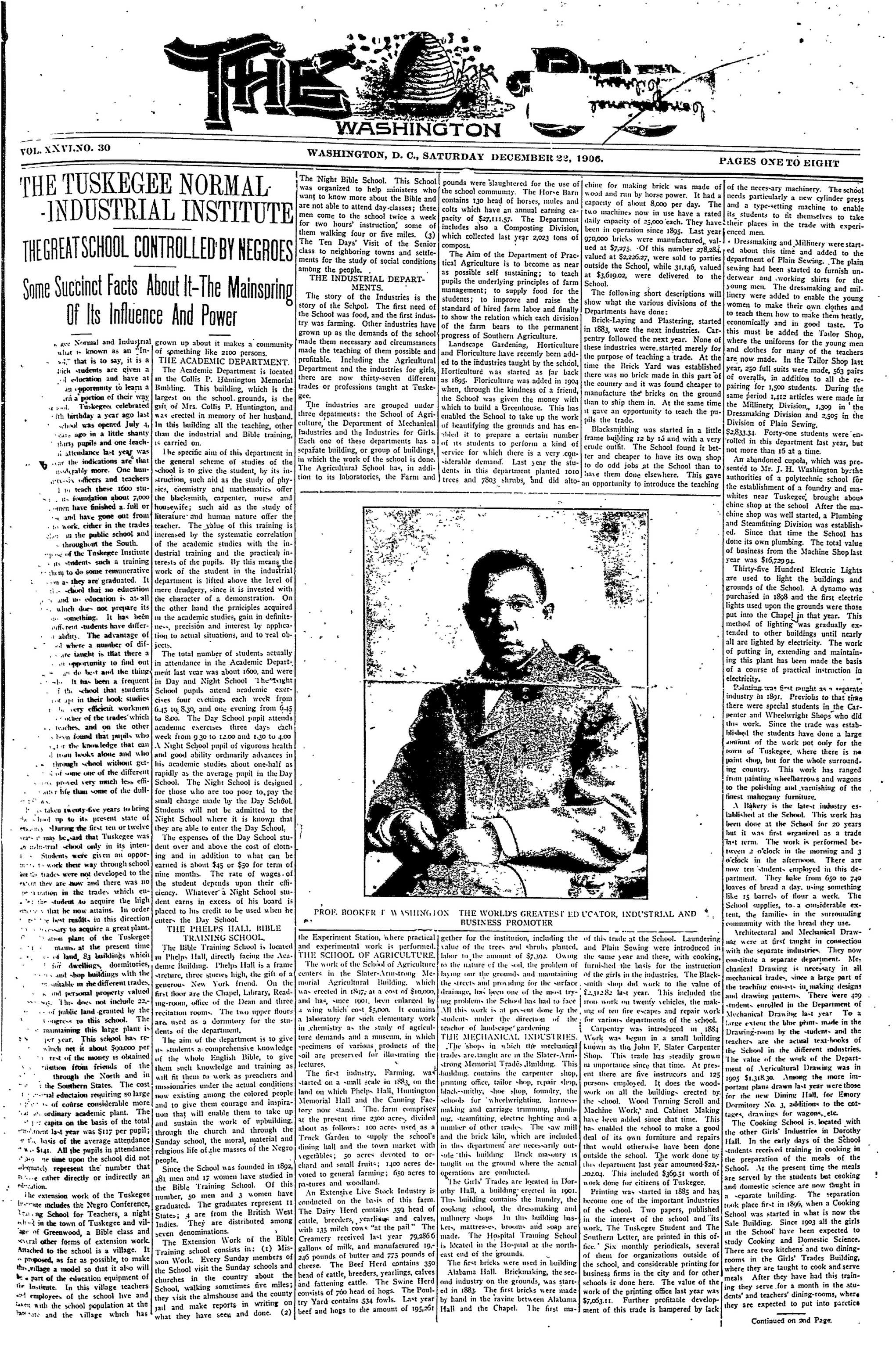
Page text (machine-generated)
THE TUSKEGEE NORMAL- INDUSTRIAL INSTITUTE THE GREAT SCHOOL CONTROLLED BY NEGROES Some Succinct Facts About It-The Mainspring Of Its Influence And Power
VOL. XXVI.NO. 30
THE TUSKEGEE
-INDUSTRIAL
THE GREAT SCHOOL CO
Some Succinct Facts A
Of Its Influence
gee Normal and Industrial what is known as an "In-
volved" that is to say, it is a high students are given a
poll education and have at an opportunity to learn a
portion of their way
school. Tuskegee celebrated
with birthday a year ago last
school was opened July 4.
years ago in a little shanty
thirty pupils and one teach-
attendance last year was
the indications are that
moderably more. One hun-
dren's officers and teachers
to teach these 1600 stu-
dents foundation about 7,000
men have finished a full or
and have gone out from
to work, either in the trades
in the public school and
throughout the South.
of the Tuskegee Institute
its students such a training
them to do some remunerative
as they are graduated. It
the school that no education
and no education is at all
which does not prepare its
something. It has been
different students have differ-
ability. The advantage of
where a number of dif-
are taught is that there a
opportunity to find out
to do best and the thing
it has been a frequent
the school that students
opt in their book studies
very efficient workmen
other of the trades which
teaches, and on the other
been found that pupils who
or the knowledge that can
from books alone and who
through school without get
some one of the different
proved very much less effi-
liter life than some of the dull-
It is taken twenty-five years to bring the school up to its present state of eminence. During the first ten or twelve years may be said that Tuskegee was an industrial school only in its intention. Students were given an opportunity to work their way through school but the trades were not developed to the extent they are now and there was no preparation in the trades which enabled the student to acquire the high that he now attains. In order to best results in this direction, the plant of the Tuskegee remains at the present time of land, 83 buildings which for dwellings, dormitories, and shop buildings with the suitable in the different trades, and personal property valued. This does not include 225 public land-granted by the congress to this school. The maintaining this large plant is per year. This school has re-which net it about $90,000 per rest of the money is obtained from friends of the through the North and in the Southern States. The cost of eductation requiring so large of course considerable more ordinary academic plant. The capita on the basis of the total investment last year was $117 per pupil; the basis of the average attendance $141. All the pupils in attendance are time upon the school did not adequately represent the number that either directly or indirectly an education.
The extension work of the Tuskegee Institute includes the Negro Conference, Training School for Teachers, a night school in the town of Tuskegee and village of Greenwood, a Bible class and several other forms of extension work. Attached to the school is a village. It is proposed, as far as possible, to make this village a model so that it also will be a part of the education equipment of the Institute. In this village teachers and employees of the school live and taken with the school population at the Institute and the village which has
grown up about it makes a community of something like 2100 persons.
THE ACADEMIC DEPARTMENT. The Academic Department is located in the Collis P. Huntington Memorial Building. This building, which is the largest on the school grounds, is the gift of Mrs. Collis P. Huntington, and was erected in memory of her husband. In this building all the teaching, other than the industrial and Bible training, is carried on.
The specific aim of this department in the general scheme of studies of the school is to give the student, by its instruction, such aid as the study of physics, chemistry and mathematics offer the blacksmith, carpenter, nurse and housewife; such aid as the study of literature and human nature offer the teacher. The value of this training is increased by the systematic correlation of the academic studies with the industrial training and the practical interests of the pupils. By this means the work of the student in the industrial department is lifted above the level of mere drudgery, since it is invested with the character of a demonstration. On the other hand the principles acquired in the academic studies, gain in definiteness, precision and interest by application to actual situations, and to real objects.
The total number of students actually in attendance in the Academic Department last year was about 1600, and were in Day and Night School The Night School pupils attend academic exercises four evenings each week from 6.45 to 8.30, and one evening from 6.45 to 8.00. The Day School pupil attends academic exercises three days each week from 9.30 to 12.00 and 1.30 to 4.00. A Night School pupil of vigorous health and good ability ordinarily advances in his academic studies about one-half as rapidly as the average pupil in the Day School. The Night School is designed for those who are too poor to pay the small charge made by the Day School. Students will not be admitted to the Night School where it is known that they are able to enter the Day School.
The expenses of the Day School student over and above the cost of clothing and in addition to what can be earned is about $45 or $50 for term of nine months. The rate of wages of the student depends upon their efficiency. Whatever a Night School student earns in excess of his board is placed to his credit to be used when he enters the Day School.
THE PHELPS HALL BIBLE TRAINING SCHOOL.
The Bible Training School is located in Phelps Hall, directly facing the Academic Building. Phelps Hall is a frame streture, three stories high, the gift of a generous New York friend. On the first floor are the Chapel, Library, Reading-room, office of the Dean and three recitation rooms. The two upper floors are used as a dormitory for the students of the department.
The aim of the department is to give its students a comprehensive knowledge of the whole English Bible, to give them such knowledge and training as will fit them to work as preachers and missionaries under the actual conditions now existing among the colored people and to give them courage and inspiration that will enable them to take up and sustain the work of upbuilding, through the church and through the Sunday school, the moral, material and religious life of the masses of the Negro people.
Since the School was founded in 1892, 481 men and 17 women have studied in the Bible Training School. Of this number, 50 men and 3 women have graduated. The graduates represent 11 States; 4 are from the British West Indies. They are distributed among seven denominations.
The Extension Work of the Bible Training school consists in: (1) Mission Work. Every Sunday members of the School visit the Sunday schools and churches in the country about the School, walking sometimes five miles; they visit the almshouse and the county jail and make reports in writing on what they have seen and done. (2)
THE MILITARY OFFICER
The Night Bible School. This School was organized to help ministers who want to know more about the Bible and are not able to attend day-classes; these men come to the school twice a week for two hours' instruction, some of them walking four or five miles. (3) The Ten Days' Visit of the Senior class to neighboring towns and settlements for the study of social conditions among the people.
THE INDUSTRIAL DEPARTMENTS.
The story of the Industries is the story of the School. The first need of the School was food, and the first industry was farming. Other industries have grown up as the demands of the school made them necessary and circumstances made the teaching of them possible and profitable. Including the Agricultural Department and the industries for girls, there are now thirty-seven different trades or professions taught at Tuskegee. The industries are grouped under three departments: the School of Agriculture, the Department of Mechanical Industries and the Industries for Girls. Each one of these departments has a separate building, or group of buildings, in which the work of the school is done. The Agricultural School has, in addition to its laboratories, the Farm and
PROF. BOOKER I WASHINGTON
the Experiment Station, where practical and experimental work is performed. THE SCHOOL OF AGRICULTURE. The work of the School of Agriculture centers in the Slater-Armstrong Memorial Agricultural Building, which was erected in 1807; at a cost of $10,000, and has, since 1901, been enlarged by a wing which cost $5,000. It contains a laboratory for such elementary work in chemistry as the study of agriculture demands and a museum, in which specimens of various products of the soil are preserved for illustrating the lectures. The first industry, Farming, was started on a small scale in 1883, on the land on which Phelps Hall, Huntington Memorial Hall and the Canning Factory now stand. The farm comprises at the present time 2300 acres, divided about as follows: 100 acres used as a Truck Garden to supply the school's dining hall and the town market with vegetables; 50 acres devoted to orchard and small fruits; 1400 acres devoted to general farming; 650 acres to pastures and woodland.
An Extensive Live Stock Industry is conducted on the basis of this farm. The Dairy Herd contains 350 head of cattle, breeders, yearlings, and calves, with 135 milch cows "at the pail" The Creamery received last year 79,2866 gallons of milk, and manufactured 19,246 pounds of butter and 775 pounds of cheese. The Beef Herd contains 350 head of cattle, breeders, yearlings, calves and fattening cattle. The Swine Herd consists of 700 head of hogs. The Poultry Yard contains 534 fowls. Last year beef and hogs to the amount of 195,261
pounds were slaughtered for the use of the school community. The Horse Barn contains 130 head of horses, mules and colts which have an annual earning capacity of $27,111.57. The Department includes also a Composting Division, which collected last year 2,023 tons of compost. The Aim of the Department of Practical Agriculture is to become as near as possible self sustaining; to teach pupils the underlying principles of farm management; to supply food for the students; to improve and raise the standard of hired farm labor and finally to show the relation which each division of the farm bears to the permanent progress of Southern Agriculture.
Landscape Gardening, Horticulture and Floriculture have recently been added to the industries taught by the school. Horticulture was started as far back as 1895. Floriculture was added in 1904 when, through the kindness of a friend, the School was given the money with which to build a Greenhouse. This has enabled the School to take up the work of beautifying the grounds and has enabled it to prepare a certain number of its students to perform a kind of service for which there is a very considerable demand. Last year the students in this department planted 1010 trees and 7803 shrubs, and did alto-
ON THE WORLD'S GREATEST ED
BUSINESS PROMOTER
gether for the institution, including the value of the trees and shrubs planted, labor to the amount of $7,392. Owing to the nature of the soil, the problem of laying our grounds and maintaining the streets and providing for the surface drainage, has been one of the most trying problems the School has had to face. All this work is at present done by the students under the direction of the teacher of landscape gardening
THE MECHANICAL INDUSTRIES.
The shops in which the mechanical trades are taught are in the Slater-Armstrong Memorial Trades Building. This building contains the carpenter shop, printing office, tailor shop, repair shop, black-smith, shoe shop, foundry, the schools for wheelwrighting, harness-making and carriage trumming, plumbing, steamfitting, electric lighting and a number of other trades. The saw mill and the brick kiln, which are included in this department are necessarily outside this building. Brick masonry is taught on the ground where the actual operations are conducted.
The Girls' Trades are located in Dorothy Hall, a building erected in 1901. This building contains the laundry, the cooking school, the dressmaking and millinery shops. In this building haskets, mattresses, brooms and soap are made. The Hospital Training School is located in the Hospital at the northeast end of the grounds.
The first bricks were used in building Alabama Hall. Brickmaking, the second industry on the grounds, was started in 1883. The first bricks were made by hand in the ravine between Alabama Hall and the Chapel. The first ma-
chine for making brick was made of wood and run by horse power. It had a capacity of about 8,000 per day. The two machines now in use have a rated daily capacity of 25,000 each. They have been in operation since 1895. Last year 970,000 bricks were manufactured, valued at $7,275. Of this number 278,281, valued at $2,226,27, were sold to parties outside the School, while 311,146, valued at $3,619,02, were delivered to the School.
The following short descriptions will show what the various divisions of the Departments have done:
Brick-Laying and Plastering, started in 1883, were the next industries. Carpentry followed the next year. None of these industries were started merely for the purpose of teaching a trade. At the time the Brick Yard was established there was no brick made in this part of the country and it was found cheaper to manufacture the bricks on the ground than to ship them in. At the same time it gave an opportunity to teach the pupils the trade.
Blacksmithing was started in a little frame building 12 by 15 and with a very crude outfit. The School found it better and cheaper to have its own shop to do odd jobs at the School than to have them done elsewhere. This gave an opportunity to introduce the teaching
UCATOR, INDUSTRIAL AND
of this trade at the School. Laundering and Plain Sewing were introduced in the same year and these, with cooking, furnished the basis for the instruction of the girls in the industries. The Blacksmith shop did work to the value of $2,31282 last year. This included the prom work on twenty vehicles, the making of ten fire escapes and repair work for various departments of the school.
Carpentry was introduced in 1884. Work was begun in a small building known as the John F. Slater Carpenter Shop. This trade has steadily grown in importance since that time. At present there are five instructors and 125 persons employed. It does the wood-work on all the buildings erected by the school. Wood Turning Scroll and Machine Work; and Cabinet Making have been added since that time. This has enabled the school to make a good deal of its own furniture and repairs that would otherwise have been done outside the school. The work done by this department last year amounted $22,202.04. This included $369.51 worth of work done for citizens of Tuskegee.
Printing was started in 1885 and has become one of the important industries of the school. Two papers, published in the interest of the school and its work. The Tuskegee Student and The Southern Letter, are printed in this office. Six monthly periodicals, several of them for organizations outside of the school, and considerable printing for business firms in the city and for other schools is done here. The value of the work of the printing office last year was $7,063.11. Further profitable development of this trade is hampered by lack
PAGES ONE TO EIGHT
of the necessary machinery. The school needs particularly a new cylinder press and a type-setting machine to enable its students to fit themselves to take their places in the trade with experienced men. Dressmaking and Millinery were started about this time and added to the department of Plain Sewing. The plain sewing had been started to furnish underwear and working shirts for the young men. The dressmaking and millinery were added to enable the young women to make their own clothes and to teach them how to make them neatly, economically and in good taste. To this must be added the Tailor Shop, where the uniforms for the young men and clothes for many of the teachers are now made. In the Tailor Shop last year, 250 full suits were made, 563 pairs of overalls, in addition to all the repairing for 1,500 students. During the same period 1,412 articles were made in the Millinery, Division, 1,309 in the Dressmaking Division and 2,505 in the Division of Plain Sewing.
$2,833.34. Forty-one students were enrolled in this department last year, but not more than 16 at a time.
An abandoned cupola, which was presented to Mr. J. H. Washington by the authorities of a polytechnic school for the establishment of a foundry and mawhites near Tuskegee, brought aboutchine shop at the school After the machine shop was well started, a Plumbing and Steamfitting Division was established. Since that time the School has done its own plumbing. The total value of business from the Machine Shop last year was $16,729.94.
Thirty-five Hundred Electric Lights are used to light the buildings and grounds of the School. A dynamo was purchased in 1898 and the first electric lights used upon the grounds were those put into the Chapel in that year. This method of lighting was gradually extended to other buildings until nearly all are lighted by electricity. The work of putting in, extending and maintaining this plant has been made the basis of a course of practical instruction in electricity.
Painting was first taught as a separate industry in 1891. Previous to that time there were special students in the Carpenter and Wheelwright Shops who did this work. Since the trade was established the students have done a large amount of the work not only for the town of Tuskegee, where there is no paint shop, but for the whole surrounding country. This work has ranged from painting wheelbarrows and wagons to the polishing and varnishing of the finest umhogany furniture.
A bakery is the latest industry established at the School. This work has been done at the School for 20 years but it was first organized as a trade last term. The work is performed between 2 o'clock in the morning and 3 o'clock in the afternoon. There are now ten students employed in this department. They lake from 650 to 740 loaves of bread a day, using something like 15 barrels of flour a week. The School supplies, to a considerable extent, the families in the surrounding community with the bread they use.
Architectural and Mechanical Drawing were at first taught in connection with the separate industries. They now constitute a separate department. Mechanical Drawing is necessary in all mechanical trades, since a large part of the teaching consists in making designs and drawing patterns. There were 429 students enrolled in the Department of Mechanical Drawing last year. To a large extent the blue prints made in the Drawing-room by the student and the teachers are the actual text-books of the School in the different industries. The value of the work of the Department of Agricultural Drawing was in 1905 $1,318.30. Among the more important plans drawn last year were those for the new Dining Hall, for Emory Dormitory No. 3, additions to the cottages, drawings for wagons, etc.
The Cooking School is located with the other Girls' Industries in Dorothy Hall. In the early days of the School students received training in cooking in the preparation of the meals of the School. At the present time the meals are served by the students but cooking and domestic science are now taught in a separate building. The separation took place first in 1860, when a Cooking School was started in what is now the Sale Building. Since 1903 all the girls in the School have been expected to study Cooking and Domestic Science. There are two kitchens and two dining-rooms in the Girls' Trades Building, where they are taught to cook and serve meals. After they have had this training they serve for a month in the students' and teachers' dining-rooms, where they are expected to put into practice
Continued on and Page.
THE COLLIE P. HUNTINGTON MEMORIAL ACADEMIC LUILDING
THE HISTORY OF THE MUSEUM
50
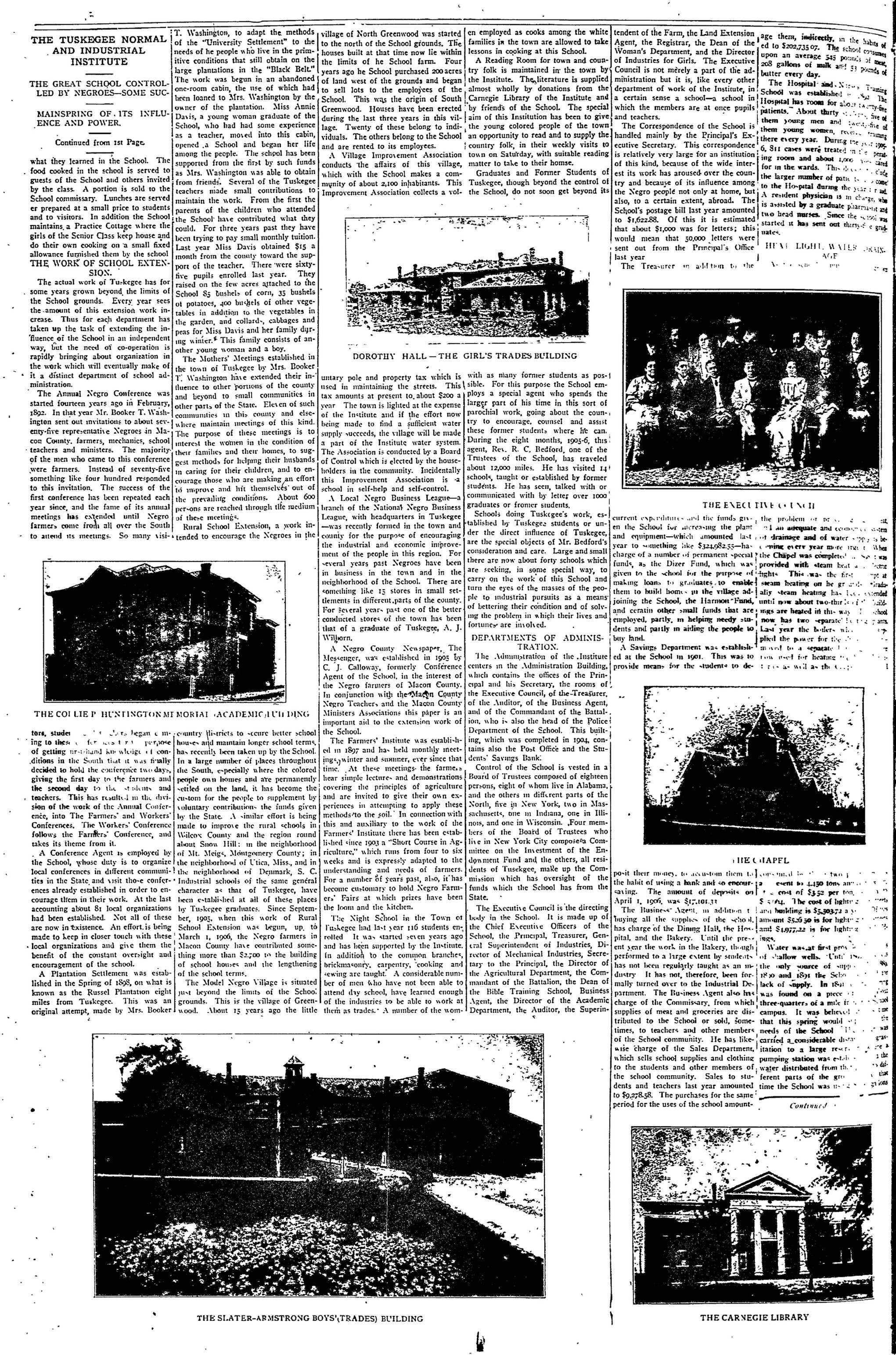
THE TUSKEGEE NORMAL AND INDUSTRIAL INSTITUTE
THE TUSKEGEE NORMAL AND INDUSTRIAL INSTITUTE
THE GREAT SCHOOL CONTROLLED BY NEGROES—SOME SUC
MAINSPRING OF. ITS INFLUENCE AND POWER.
Continued from 1st Page
what they learned in the School. The food cooked in the school is served to guests of the School and others invited by the class. A portion is sold to the School commissary. Lunches are served er prepared at a small price to students and to visitors. In addition the School maintains a Practice Cottage where the girls of the Senior Class keep house and do their own cooking on a small fixed allowance furnished them by the school THE WORK OF SCHOOL EXTENSION
The actual work of Tuskegee has for some years grown beyond the limits of the School grounds. Every year sees the amount of this extension work increase. Thus for each department has taken up the task of extending the influence of the School in an independent way, but the need of co-operation is rapidly bringing about organization in the work which will eventually make of it a distinct department of school administration.
The Annual Negro Conference was started fourteen years ago in February, 1892. In that year Mr. Booker T. Washington sent out invitations to about seventy-five representative Negroes in Macon County, farmers, mechanics, school teachers and ministers. The majority of the men who came to this conference were farmers. Instead of seventy-five something like four hundred responded to this invitation. The success of the first conference has been repeated each year since, and the fame of its annual meetings has extended until Negro farmers come from all over the South to attend the meetings. So many saints
to attend its meetings. So many visit-
THE COILIE P HUNTINGTON MI
tors, student began coming to these conferences for purpose of getting first-hand knowledge of conditions in the South that it was finally decided to hold the conference two days, giving the first day to the farmers and the second day to the students and teachers. This has resulted in the division of the work of the Annual Conference, into The Farmers' and Workers' Conferences. The Workers' Conference follows the Farmers' Conference, and takes its theme from it.
A Conference Agent is employed by the School, whose duty is to organize local conferences in different communities in the State and visit those conferences already established in order to encourage them in their work. At the last accounting about 81 local organizations had been established. Not all of these are now in existence. An effort is being made to keep in closer touch with these local organizations and give them the benefit of the constant oversight and encouragement of the school. A Plantation Settlement was established in the Spring of 1898, on what is known as the Russel Plantation eight miles from Tuskegee. This was an original attempt, made by Mrs. Booker
---
THE SLATER-ARMSTRONG BOYS'(TRADES) BUILDING
T. Washington, to adapt the methods of the "University Settlement" to the needs of he people who live in the primitive conditions that still obtain on the large plantations in the "Black Belt." The work was begun in an abandoned one-room cabin, the use of which had been loaned to Mrs. Washington by the owner of the plantation. Miss Annie Davis, a young woman graduate of the School, who had had some experience as a teacher, moved into this cabin, opened a School and began her life among the people. The school has been supported from the first by such funds as Mrs. Washington was able to obtain from friends. Several of the Tuskegee teachers made small contributions to maintain the work. From the first the parents of the children who attended the School have contributed what they could. For three years past they have been trying to pay small monthly tuition. Last year Miss Davis obtained $15 a month from the county toward the support of the teacher. There were sixty-five pupils enrolled last year. They raised on the few acres attached to the School 85 bushels of corn, 35 bushels of potatoes, 400 bushels of other vegetables in addition to the vegetables in the garden, and collards, cabbages and peas for Miss Davis and her family during winter. This family consists of another young woman and a boy.
The Mothers' Meetings established in the town of Tuskegee by Mrs. Booker T. Washington have extended their influence to other portions of the county and beyond to small communities in other parts of the State. Eleven of such communities in this county and elsewhere maintain meetings of this kind. The purpose of these meetings is to interest the women in the condition of their families and their homes, to suggest methods for helping their husbands in caring for their children, and to encourage those who are making an effort to improve and hit themselves out of the prevailing conditions. About 600 persons are reached through the medium of these meetings.
Rural School Extension, a work intended to encourage the Negroes in the
T MORIAL ACADEMIC BUILDING
country districts to secure better school houses and maintain longer school terms, has recently been taken up by the School. In a large number of places throughout the South, especially where the colored people own homes and are permanently settled on the land, it has become the custom for the people to supplement by voluntary contributions the funds given by the State. A similar effort is being made to improve the rural schools in Wilcox County and the region round about Snow Hill: in the neighborhood of Mt. Meigs, Montgomery County; in the neighborhood of Utica, Miss., and in the neighborhood of Denmark, S. C. Industrial schools of the same general character as that of Tuskegee, have been established at all of these places by Tuskegee graduates. Since September, 1905, when this work of Rural School Extension was begun, up. to March 1, 1906, the Negro farmers in Macon County have contributed something more than $2,700 to the building of school houses and the lengthening of the school terms.
The Model Negro Village is situated just beyond the limits of the School grounds. This is the village of Greenwood. About 15 years ago the little
1
DOROTHY HALL — THE GIRL'S TRADES BUILDING
village of North Greenwood was started to the north of the School grounds. The houses built at that time now lie within the limits of he School farm. Four years ago he School purchased 200 acres of land west of the grounds and began to sell lots to the employees of the School. This was the origin of South Greenwood. Houses have been erected during the last three years in this village. Twenty of these belong to individuals. The others belong to the School and are rented to its employees. A Village Improvement Association conducts the affairs of this village, which with the School makes a community of about 2,100 inhabitants. This Improvement Association collects a vol-
DOROTHY HALL—THE
untary pole and property tax which is used in maintaining the streets. This tax amounts at present to about $200 a year. The town is lighted at the expense of the Institute and if the effort now being made to find a sufficient water supply succeeds, the village will be made a part of the Institute water system. The Association is conducted by a Board of Control which is elected by the householders in the community. Incidentally this Improvement Association is a school in self-help and self-control.
A Local Negro Business League—a branch of the National Negro Business League, with headquarters in Tuskegee—was recently formed in the town and county for the purpose of encouraging the industrial and economic improvement of the people in this region. For several years past Negroes have been in business in the town and in the neighborhood of the School. There are something like 15 stores in small settlements in different parts of the county. For several years past one of the better conducted stores of the town has been that of a graduate of Tuskegee, A. J. Willborn.
A Negro County Newspaper, The Messenger, was established in 1905 by C. J. Calloway, formerly Conference Agent of the School, in the interest of the Negro farmers of Macon County. In conjunction with the Macon County Negro Teachers and the Macon County Ministers Associations this paper is an important aid to the extension work of the School.
The Farmers' Institute was established in 1897 and has held monthly meetings, winter and summer, ever since that time. At these meetings the farmers hear simple lectures and demonstrations covering the principles of agriculture and are invited to give their own experiences in attempting to apply these methods to the soil. In connection with this and auxiliary to the work of the Farmers' Institute there has been established since 1903 a "Short Course in Agriculture," which runs from four to six weeks and is expressly adapted to the understanding and needs of farmers. For a number of years past, also, it has become customary to hold Negro Farmers' Fairs at which prizes have been the loom and the kitchen.
The Night School in the Town of Tuskegee had last year 116 students enrolled. It was started seven years ago and has been supported by the Institute. In addition to the common branches, brickmasonry, carpentry, cooking and sewing are taught. A considerable number of men who have not been able to attend day school, have learned enough of the industries to be able to work at them as trades. A number of the wom-
```markdown
```
en employed as cooks among the white families in the town are allowed to take lessons in cooking at this School. A Reading Room for town and country folk is maintained in the town by the Institute. The literature is supplied almost wholly by donations from the Carnegie Library of the Institute and by friends of the School. The special aim of this Institution has been to give the young colored people of the town an opportunity to read and to supply the country folk, in their weekly visits to town on Saturday, with suitable reading matter to take to their homse. Graduates and Former Students of Tuskegee, though beyond the control of the School, do not soon get beyond its
GIRL'S TRADES BUILDING
with as many former students as possible. For this purpose the School employs a special agent who spends the larger part of his time in this sort of parochial work, going about the country to encourage, counsel and assist these former students where he can. During the eight months, 1905-6, this agent, Rev. R. C. Bedford, one of the Trustees of the School, has traveled about 12,000 miles. He has visited 14 schools, taught or established by former students. He has seen, talked with or communicated with by letter over 1000 graduates or fromer students.
Schools doing Tuskegee's work, established by Tuskegee students or under the direct influence of Tuskegee, are the special objects of Mr. Bedford's consideration and care. Large and small there are now about forty schools which are seeking, in some special way, to carry on the work of this School and turn the eyes of the masses of the people to industrial pursuits as a means of bettering their condition and of solving the problem in which their lives and fortunes are involved.
DEPARTMENTS OF ADMINISTRATION
The Administration of the Institute centers in the Administration Building, which contains the offices of the Principal and his Secretary, the rooms of the Executive Council, of the-Treasurer, of the Auditor, of the Business Agent, and of the Commandant of the Battalion, who is also the head of the Police Department of the School. This building, which was completed in 1904, contains also the Post Office and the Students' Savings Bank.
Control of the School is vested in a Board of Trustees composed of eighteen persons, eight of whom live in Alabama, and the others in different parts of the North, five in New York, two in Massachusetts, one in Indiana, one in Illinois, and one in Wisconsin. Four members of the Board of Trustees who live in New York City compose a Committee on the Investment of the Endowment Fund and the others, all residents of Tusekgee, make up the Commission which has oversight of the funds which the School has from the State.
The Executive Council is the directing body in the School. It is made up of the Chief Executive Officers of the School, the Principal, Treasurer, General Superintendent of Industries, Director of Mechanical Industries, Secretary to the Principal, the Director of the Agricultural Department, the Commandant of the Battalion, the Dean of the Bible Training School, Business Agent, the Director of the Academic Department, the Auditor, the Superin-
```markdown
```
tendent of the Farm, the Land Extension Agent, the Registrar, the Dean of the Woman's Department, and the Director of Industries for Girls. The Executive Council is not merely a part of the administration but it is, like every other department of work of the Institute, in a certain sense a school—a school in which the members are at once pupils and teachers.
The Correspondence of the School is handled mainly by the Principal's Executive Secretary. This correspondence is relatively very large for an institution of this kind, because of the wide interest its work has aroused over the country and because of its influence among the Negro people not only at home, but also, to a certain extent, abroad. The School's postage bill last year amounted to $1,622.88. Of this it is estimated that about $1,000 was for letters; this would mean that 50,000 letters were sent out from the Principal's Office last year.
The Treasurer in addition to the
THE FOOTBALL CLUB
THE FILM "THE MEN" BY JOHN HARRISON.
THE EXECUTIVE COUNCH
current expenditures and the funds given the School for increasing the plant and equipment—which amounted last year to something like $324,982.55—has charge of a number of permanent special funds, as the Dizer Fund, which was given to the school for the purpose of making loans to graduates, to enable them to build homes in the village adjoining the School, the Harmont Fund, and ceratin other small funds that are employed, partly, in helping needy students and partly in aiding the people to buy land. A Savings Department was established at the School in 1901. This was to provide means for the students to de
THE C
```markdown
```
posit their money, to accustom them to the habit of using a bank and so encour-saving. The amount of deposits on April 1, 1906, was $17,101.33
The Business Agent, in addition to buying all the supplies of the school, has charge of the Dining Hall, the Hospital, and the Bakery. Until the present year the work in the Bakery, though performed to a large extent by students has not been regularly taught as an industry. It has not, therefore, been formally turned over to the Industrial Department. The Business Agent also has charge of the Commissary, from which supplies of meat and groceries are distributed to the School or sold, sometimes, to teachers and other members of the School community. He has likewise charge of the Sales Department, which sells school supplies and clothing to the students and other members of the school community. Sales to students and teachers last year amounted to $9,278.58. The purchases for the same period for the uses of the school amount-
THE HISTORY OF THE MUSEUM
THE MUSEUM
THE CARNEGIE LIBRARY
age them, indirectly, in the habits of ed to $202,735.07. The school consumes upon an average 545 pounds of meat, 208 gallons of milk and 53 pounds of butter every day.
The Hospital and Nurses Training School was established in 1922. The Hospital has room for about twenty-five patients. About thirty-five of them young men and twenty-five of them young women receive training there every year. During the year 1995, 6,811 cases were treated in the operating room and about 1,000 patients were for in the wards. This includes the larger number of patients who come to the Hospital during the year and A resident physician is in charge, who is assisted by a graduate pharmacist and two head nurses. Since the school was started it has sent out thirty-five graduates.
HEAV LIGHT WALLS AGE
1. 2. 3. 4. 5. 6. 7. 8. 9. 10. 11. 12. 13. 14. 15. 16. 17. 18. 19. 20. 21. 22. 23. 24. 25. 26. 27. 28. 29. 30. 31. 32. 33. 34. 35. 36. 37. 38. 39. 40. 41. 42. 43. 44. 45. 46. 47. 48. 49. 50. 51. 52. 53. 54. 55. 56. 57. 58. 59. 60. 61. 62. 63. 64. 65. 66. 67. 68. 69. 70. 71. 72. 73. 74. 75. 76. 77. 78. 79. 80. 81. 82. 83. 84. 85. 86. 87. 88. 89. 90. 91. 92. 93. 94. 95. 96. 97. 98. 99. 100.
1930
the problem or pro-
blem and an adequate and economical
system of drainage and of water supply is be-
coming every year more urgent. When
the Chapel was completed, it was
provided with steam heat at
fights. This was the first at
steam heating on he grids. Gradually steam heating has been extended until now about two-thirds of buildings are heated in this way. School now has two separate heating plants.
Last year the boilers who
plied the power for the
moved to a separate
tow used for heating the
tires as well as the
IAPEL
consumed in the two p
a cemnt is 4,450 tons, an
cost of $3.52 per ton.
$5,024. The cost of light
and building is $5,503.72 a
amount $5,2630 is for light
and $4,977.22 is for light
ings.
THE CHAPEL
Water was at first pro-
of shallow wells. Until 1850
the only source of supp-
lance 1850 and 1851 the School
lack of supply. In 1851
was found on a piece
three-quarters of a mile from
campus. It was believed
that this spring would
needs of the School
carried a considerable dis-
tribution to a large reser-
pumping station was estab-
water distributed from the
ferent parts of the gro-
time the School was usi-
Continued
day. Later a second pump was erected to supply water Now the School consumes This is supplied in part in part by the pumping in part by the water system The school is now sink well in the hope of separate supply of water in extension of the water needed in the direction dormitories, in order in case of fire.
Light Plant was used
the Chapel when it was
1908. The power shop was sup-
Machine Shop. When
after a larger generator was
found necessary to pro-
engine of its own. By
Academic Building was
1904, it was found that the
able to light the build-
mitories when most of
were turned off. A
was set up in August,
new furni-hed to 3,500
and ten are lamps,
the buildings and
the new Dining Hall
Dormitory are com-
3000 additional lights will
seems also desirable at
the near future to use
to supply power to the
of machinery in the
seems that this will be
local than steam for tins
use System of the School
very imperfect condition,
has been necessary to rely
on drainage of the land,
to such elementary pro-
dual conditions compelled.
to make use of the excel-
lence system to carry off
refuse of the School to a
down the ravine, into
flows, where it can be
used as fertilizer. In
this it is planned to so
present course of the stream
the waste land can be
converted into a truck
DISCIPLINE
of the School, the de-
dents and the inspection
the guarding of the
charge of the Comman-
pitation and the Dean of
Department
Discipline of some sort has since the foundation of the first day the students for they marched. After Washington arrived at the hall in addition to his other of the military training of the School. He held until the present Com- mor J. B. Ramsey, came to take in hand the dis- School. The boys in the huddled into two battalions, companies of ninety men up from the Night School other of five companies of which made up from the Day The officers are chosen Senior Class and represent from all points of view, Initiative, intelligence other than negative quali- ficiencies of good offi-
ptection take place every
The day students are
squads, one of which
living in the town; The
for day. The day stu-
kids every student
a week. Between 8.00
inspection. On Sunday
high inspection of all the
part of the work of
this assistants consists
students to take care
and in drilling and train-
tle dexencies of life.
41. CHAPEL.
Cupel was begun in 1895 in 1898. Up to that time it and the most imposing grounds. It was regarded at the time as a great cause it was constructed with student labor, the iron drawn on the grounds. The building is intended to be The choir back of ranged to seat about 150 unless the building has been inadequate for the voters who come to the entrance and other cel- year its capacity has about 3,000 by the lo- in the transcepts. In the religious life of the
Men's Christian Associating the largest of the vol- organizations among students. It meets Sun- on Carnegie Library As the Association has an 400, and an average at- 250 The Christian En- tion, which meets at the evening, has an aver- 300. The younger stu- duced into a club called
The Careful Builders, which meets Saturday evenings and Sunday afternoons, and is conducted under the direction of one of the administrative officers of the School.
The Chapel Sunday School is composed of the entire student body, with the exception of the Phelps Hall Bible School students, who are excused on Sundays to do missionary work in the surrounding country. There are forty-one classes. They are taught b members of the faculty, post-graduates and members of the Senior and A Middle Classes, as it is expected that graduates will be called upon to do considerable work in the Sunday schools after they leave, no matter where they go.
The Young Women's Christian Association is the only religious organization composed exclusively of girls, upon the grounds. This society meets every Sunday in Douglass Hall. It does a large part of its work through the medium of committees in association with the members of the Woman's Club. Every Sunday one of the teachers takes a student with her to visit the Plantation Settlement and assist there in the Sunday school work. Another teacher takes with her two Senior or Y. W. C. A. girls to visit the county jail in the town. Every Saturday they give the jail a thorough cleaning. Often they take the prisoners old clothes, and sometimes fruits and flowers.
Music is an essential part in the training of Tuskegee students. All the students are given regular training in voice culture at some period of their studies. The choir, which consists of 150 voices, is made up of students selected at the beginning of each year. The School maintains a band, an orchestra and a glee club. A special effort is made to preserve the old Negro hymns and plantation melodies.
THE LIBRARY.
The Carnegie Library building was completed in 1902. It was erected at a cost of about $20,000. It contains in addition to the library proper an assembly room, which is used as a lecture room for Senior and graduate students; a seminary room, where students who are preparing essays may work; and an historical room, where relics connected with the history of the School are kept. This room contains at present an interesting collection of West African saries, trade by John W. W. Robinson, a graduate of Tuskegee, who has been for six years employed by the German government in teaching the natives of Fogoland American methods of cotton culture.
The Library contains at present abut 12,000 volumes. The first library of the School, which was started in Porter Hall in 1883, was made up, almost wholly, of books which were sent down from the North in barrels, together with old clothes for the needy students. Porter Hall was the first building erected on the school grounds. Until two years ago it was still used by the academic classes. The library had one room in this building until 1899, when it was removed to the building which had been occupied up to that time by Mr. Washington as a residence. A special effort is now being made to furnish this library with books and pamphlets on Africa and the Negro, with the hope of making Tuskegee eventually a centre for information concerning the Negro and Negro history.
The African Exhibit at present in the historical room is an addition to a previous gift of African curios presented to the School some years ago by Mr. Robinson and now installed in the museum of the Agricultural Building. It includes specimens of the fabrics manufactured by the Hausa people of the Soudan and by natives of Togo and Dahomey, articles of leather and of iron manufactured by the natives together with other articles which illustrate their religious and social customs.
The Tuskegee Woman's Club was founded eleven years ago by Mrs. Booker T. Washington. By encouraging the formation of smaller clubs within its own organization, each to act independently in the performance of some specific service to the women of the community, it has extended its work to nearly every interest of women in the School and in the community. The Woman's Club largely supports the work of the Plantation Settlement on the Russel plantation. For three years it has maintained an "Out-of Door" Sunday school at "Thompson's Quarters." Other organizations which the Woman's Club has fostered among the students are the Edna Cheney Circle, founded in honor of Mrs. Cheney, who died at Jamaica Plain, Mass., November 18, 1901; The Vesta Club, composed Margaret Murray Washington Club, The Humane Band and the Young Woman's Temperance Union.
The Twentieth Century Club is made up of the men of the faculty. Its purpose is to promote among the different departments of the school a better understanding of its work as a whole in order to secure a more hearty co-operation of the different departments and create a public spirit in the school community in favor of the work it is seeking to do. Debating Clubs are popular among the young men. The Willing Workers aim to keep their members informed on current topics. The Liberty Debating
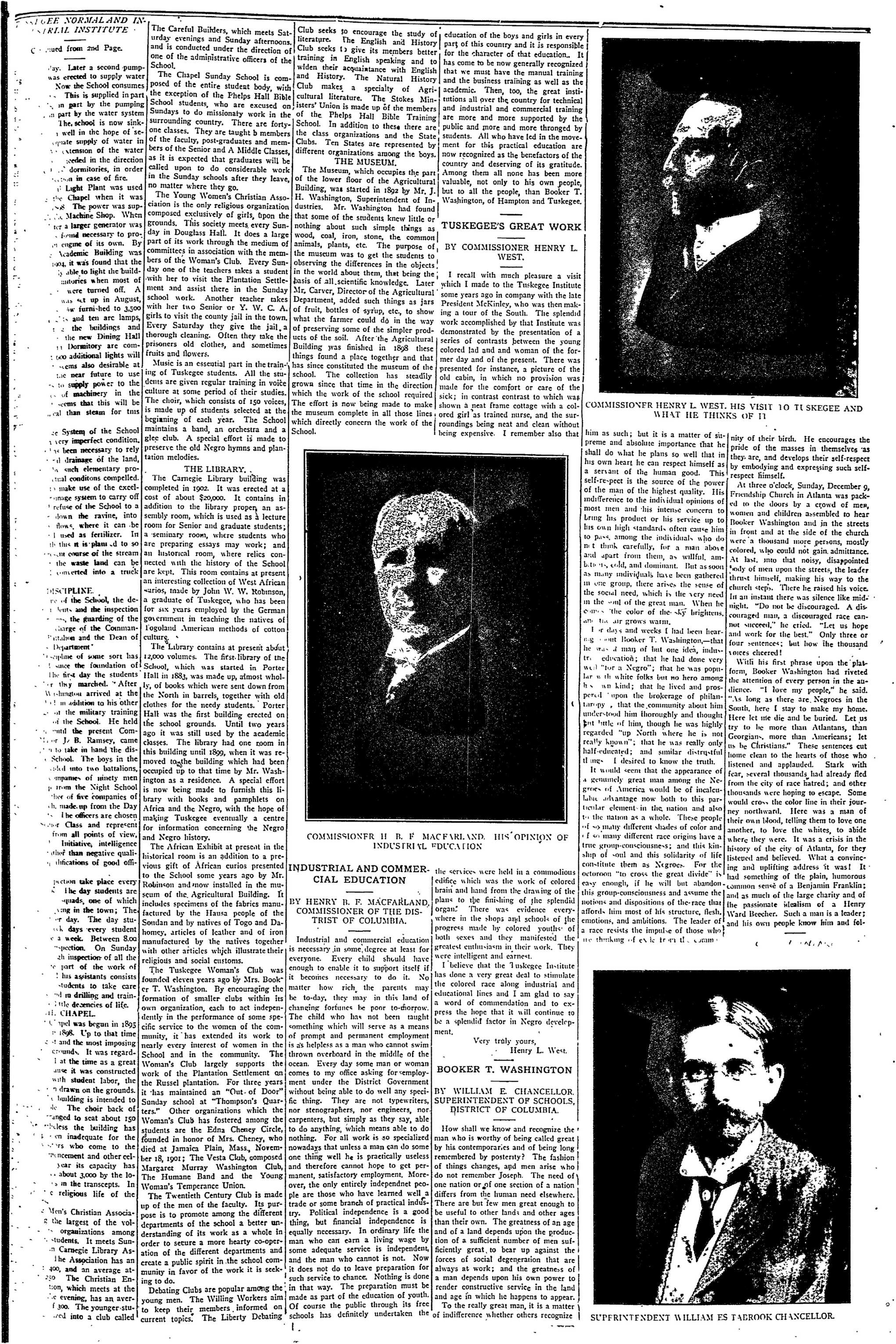
[Image of a man with a serious expression, wearing a suit and tie.]
COMMISSIONER H B. F MACFARLAND. HIS OPINION OF INDUSTRIAL EDUCATION
Club seeks to encourage the study of literature. The English and History Club seeks to give its members better training in English speaking and to widen their acquaintance with English and History. The Natural History Club makes a specialty of Agricultural literature. The Stokes Ministers' Union is made up of the members of the Phelps Hall Bible Training School. In addition to these there are the class organizations and the State Clubs. Ten States are represented by different organizations among the boys.
The Museum, which occupies the part of the lower floor of the Agricultural Building, was started in 1892 by Mr. J. H. Washington, Superintendent of Industries. Mr. Washington had found that some of the students knew little or nothing about such simple things as wood, coal, iron, stone, the common animals, plants, etc. The purpose of the museum was to get the students to observing the differences in the objects in the world about them, that being the basis of all scientific knowledge. Later Mr. Carver, Director of the Agricultural Department, added such things as jars of fruit, bottles of syrup, etc., to show what the farmer could do in the way of preserving some of the simpler products of the soil. After the Agricultural Building was finished in 1898 these things found a place together and that has since constituted the museum of the school. The collection has steadily grown since that time in the direction which the work of the school required The effort is now being made to make the museum complete in all those lines which directly concern the work of the School.
COMMISSIONER H. B. F. MAC
INDUSTRIAL FI
INDUSTRIAL AND COMMER CIAL EDUCATION
BY HENRY B. F. MACFARLAND COMMISSIONER OF THE DISTRIST OF COLUMBIA.
Industrial and commercial education is necessary in some degree at least for everyone. Every child should have enough to enable it to support itself if it becomes necessary to do it. No matter how rich the parents may be to-day, they may in this land of changing fortunes be poor to borrow. The child who has not been taught something which will serve as a means of prompt and permanent employment is as helpless as a man who cannot swim thrown overboard in the middle of the ocean. Every day some man or woman comes to my office asking for employment under the District Government without being able to do well any specific thing. They are not typewriters, nor stenographers, nor engineers, nor carpenters, but simply as they say, able to do anything, which means able to do nothing. For all work is so specialized nowadays that unless a man can do some one thing well he is practically useless and therefore cannot hope to get permanent, satisfactory employment. Moreover, the only entirely independent people are those who have learned well a trade or some branch of practical industry. Political independence is a good thing, but financial independence is equally necessary. In ordinary life the man who can earn a living wage by some adequate service is independent, and the man who cannot is not. Now it does not do to leave preparation for such service to chance. Nothing is done in that way. The preparation must be made as part of the education of youth. Of course the public through its free schools has definitely undertaken the
education of the boys and girls in every part of this country and it is responsible for the character of that education.. It has come to be now generally recognized that we must have the manual training and the business training as well as the academic. Then, too, the great institutions all over the country for technical and industrial and commercial training are more and more supported by the public and more and more thronged by students. All who have led in the movement for this practical education are now recognized as the benefactors of the country and deserving of its gratitude. Among them all none has been more valuable, not only to his own people, but to all the people, than Booker T. Washington, of Hampton and Tuskegee.
TUSKEGEE'S GREAT WORK
BY COMMISSIONER HENRY L.
WEST.
I recall with much pleasure a visit which I made to the Tuskegee Institute some years ago in company with the late President McKinley, who was then making a tour of the South. The splendid work accomplished by that Institute was demonstrated by the presentation of a series of contrasts between the young colored lad and and woman of the former day and of the present. There was presented for instance, a picture of the old cabin, in which no provision was made for the comfort or care of the sick; in contrast contrast to which was shown a neat frame cottage with a colored girl as trained nurse, and the surroundings being neat and clean without being expensive. I remember also that
ACFARLAND. HIS OPINION OF EDUCATION
the services were held in a commodious edifice which was the work of colored brain and hand from the drawing of the plans to the finishing of the splendid organ. There was evidence everywhere in the shops and schools of the progress made by colored youths of both sexes and they manifested the greatest enthusiasm in their work. They were intelligent and earnest. I believe that the Tuskegee Institute has done a very great deal to stimulate the colored race along industrial and educational lines and I am glad to say a word of commendation and to express the hope that it will continue to be a splendid factor in Negro development.
Very truly yours,
Henry L. West.
BOOKER T. WASHINGTON
BY WILLIAM E. CHANCELLOR.
SUPERINTENDENT OF SCHOOLS,
DISTRICT OF COLUMBIA.
How shall we know and recognize the man who is worthy of being called great by his contemporaries and of being long remembered by posterity? The fashion of things changes, and men arise who do not remember Joseph. The need of one nation or of one section of a nation differs from the human need elsewhere. There are but few men great enough to be useful to other lands and other ages than their own. The greatness of an age and of a land depends upon the production of a sufficient number of men sufficiently great, to bear up against the forces of social degeneration that are always at work; and the greatness of a man depends upon his own power to render constructive service in the land and age in which he happens to appear. To the really great man, it is a matter of indifference whether others recognize
[Name]
COMMISSIONER HENRY L. WEST. HIS VISIT 10 TU SKEGEE AND WHAT HE THINKS OF IT
[Name]
SUPERINTENDENT WILLIAM ES TAPROOK CHANCELLOR.
him as such; but it is a matter of supreme and absolute importance that he shall do what he plans so well that in his own heart he can respect himself as a servant of the human good. This self-repect is the source of the power of the man of the highest quality. His indifference to the individual opinions of most men and his intense concern to bring his product or his service up to his own high standards often cause him to pass, among the individuals who do not think carefully, for a man above and apart from them, as willful, ambitious, cold, and dominant. But as soon as many individuals have been gathered in one group, there arises the sense of the social need, which is the very need in the soul of the great man. When he comes the color of the sky brightens, and the air grows warm.
I for days and weeks I had been hearing about Booker T. Washington,—that he was a man of but one idea, industrial education; that he had done very well "tor a Negro"; that he was popular with white folks but no hero among his own kind; that he lived and prospered upon the brokerage of philanthropy, that the community about him understood him thoroughly and thought but little of him, though he was highly regarded "up North where he is not really known"; that he was really only half-educated; and similar distrustful things. I desired to know the truth.
It would seem that the appearance of a genuinely great man among the Negroes of America would be of incalculable advantage now both to this particular elements in the nation and also to the nation as a whole. These people of so many different shades of color and of so many different race origins have a true group-consciousness; and this kinship of soul and this solidarity of life constitute them as Negroes. For the octoaron "to cross the great divide" is easy enough, if he will but abandon this group-consciousness and assume the notions and dispositions of the race that affords him most of his structure, flesh, emotions, and ambitions. The leader of a race resists the impulse of those who are thinking of exile from the city.
nity of their birth. He encourages the pride of the masses in themselves as they are, and develops their self-respect by embodying and expressing such self-respect himself.
At three o'clock, Sunday, December 9, Friendship Church in Atlanta was packed to the doors by a crowd of men, women and children assembled to hear Booker Washington and in the streets in front and at the side of the church were a thousand more persons, mostly colored, who could not gain admittance. At last, into that noisy, disappointed body of men upon the streets, the leader thrust himself, making his way to the church steps. There he raised his voice. In an instant there was silence like midnight. "Do not be discouraged. A discouraged man, a discouraged race cannot succeed," he cried. "Let us hope and work for the best." Only three or four sentences; but how the thousand voices cheered!
With his first phrase upon the platform, Booker Washington had riveted the attention of every person in the audience. "I love my people," he said. "As long as there are. Negroes in the South, here I stay to make my home. Here let me die and be buried. Let us try to be more than Atlantans, than Georgians, more than Americans; let us be Christians." These sentences cut home clean to the hearts of those who listened and applauded. Stark with fear, several thousands had already fled from the city of race hatred; and other thousands were hoping to escape. Some would cross the color line in their journey northward. Here was a man of their own blood, telling them to love one another, to love the whites, to abide where they were. It was a crisis in the history of the city of Atlanta, for they listened and believed. What a convincing and uplifting address it was! It had something of the plain, humorous common sense of a Benjamin Franklin; and as much of the large charity and of the passionate idealism of a Henry Ward Beecher. Such a man is a leader; and his own people know him and fol-
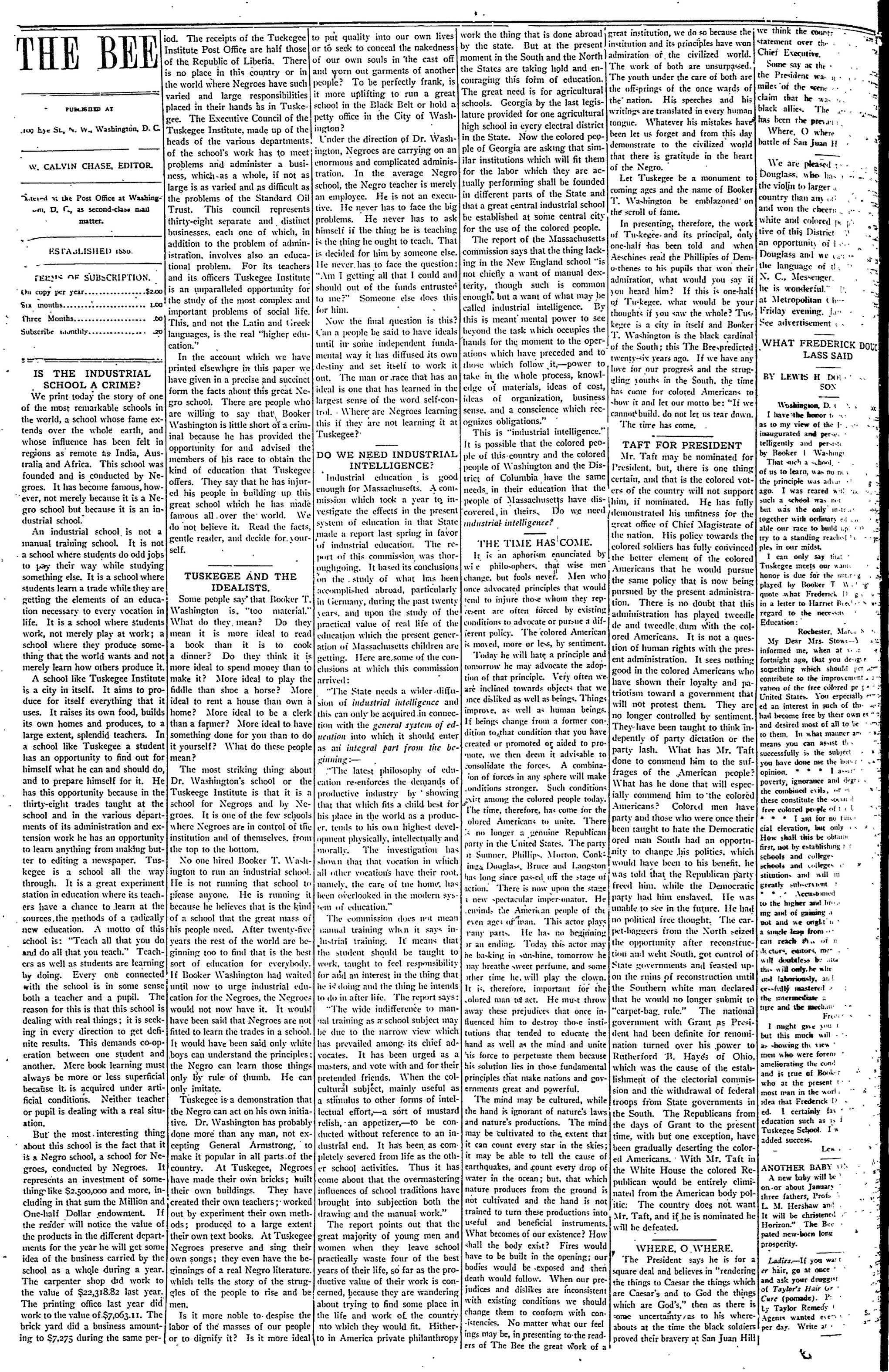
THE BEE
PUBLISHED AT
100 Eve St., N. W., Washington, D. C.
W. CALVIN CHASE, EDITOR.
Intered at the Post Office at Washington, D. C., as second-class mail matter.
ESTABLISHED 1880.
TERMS OF SUBSCRIPTION.
On copy per year.....$2.00
Six months.....1.00
Three Months......00
Subscribe monthly.....20
IS THE INDUSTRIAL
SCHOOL A CRIME?
We print today the story of one of the most remarkable schools in the world, a school whose fame extends over the whole earth, and whose influence has been felt in regions as remote as India, Australia and Africa. This school was founded and is conducted by Negroes. It has become famous, however, not merely because it is a Negro school but because it is an industrial school.
An industrial school is not a manual training school. It is not a school where students do odd jobs to pay their way while studying something else. It is a school where students learn a trade while they are getting the elements of an education necessary to every vocation in life. It is a school where students work, not merely play at work; a school where they produce something that the world wants and not merely learn how others produce it.
A school like Tuskegee Institute is a city in itself. It aims to produce for itself everything that it uses. It raises its own food, builds its own homes and produces, to a large extent, splendid teachers. In a school like Tuskegee a student has an opportunity to find out for himself what he can and should do, and to prepare himself for it. He has this opportunity because in the thirty-eight trades taught at the school and in the various departments of its administration and extension work he has an opportunity to learn anything from making butter to editing a newspaper. Tuskegee is a school all the way through. It is a great experiment station in education where its teachers have a chance to learn at the sources, the methods of a radically new education. A motto of this school is: "Teach all that you do and do all that you teach." Teachers as well as students are learning by doing. Every one connected with the school is in some sense both a teacher and a pupil. The reason for this is that this school is dealing with real things; it is seeking in every direction to get definite results. This demands co-operation between one student and another. Mere book learning must always be more or less superficial because it is acquired under artificial conditions. Neither teacher or pupil is dealing with a real situation.
But the most interesting thing about this school is the fact that it is a Negro school, a school for Negroes, conducted by Negroes. It represents an investment of something like $2,500,000 and more, including in that sum the Million and One-half Dollar endowment. If the reader will notice the value of the products in the different departments for the year he will get some idea of the business carried by the school as a whole during a year. The carpenter shop did work to the value of $22,318.82 last year. The printing office last year did work to the value of $7,063.11. The brick yard did a business amounting to $7,275 during the same per-
iod. The receipts of the Tuskegee Institute Post Office are half those of the Republic of Liberia. There is no place in this country or in the world where Negroes have such varied and large responsibilities placed in their hands as in Tuskegee. The Executive Council of the Tuskegee Institute, made up of the heads of the various departments of the school's work has to meet problems and administer a business, which as a whole, if not as large is as varied and as difficult as the problems of the Standard Oil Trust. This council represents thirty-eight separate and distinct businesses, each one of which, in addition to the problem of administration, involves also an educational problem. For its teachers and its officers Tuskegee Institute is an unparalleled opportunity for the study of the most complex and important problems of social life. This, and not the Latin and Greek languages, is the real "higher education."
In the account which we have printed elsewhere in this paper we have given in a precise and succinct form the facts about this great Negro school. There are people who are willing to say that Booker Washington is little short of a criminal because he has provided the opportunity for and advised the members of his race to obtain the kind of education that Tuskegee offers. They say that he has injured his people in building up this great school which he has made famous all over the world. We do not believe it. Read the facts, gentle reader, and decide for yourself.
TUSKEGEE AND THE IDEALISTS.
Some people say that Booker T. Washington is, "too material." What do they mean? Do they mean it is more ideal to read a book than it is to cook a dinner? Do they think it is more ideal to spend money than to make it? More ideal to play the fiddle than shoe a horse? More ideal to rent a house than own a home? More ideal to be a clerk than a farmer? More ideal to have something done for you than to do it yourself? What do these people mean?
The most striking thing about Dr. Washington's school or the Tuskegee Institute is that it is a school for Negroes and by Negroes. It is one of the few schools where Negroes are in control of the institution and of themselves, from the top to the bottom.
No one hired Booker T. Washington to run an industrial school. He is not running that school to please anyone. He is running it because he believes that is the kind of a school that the great mass of his people need. After twenty-five years the rest of the world are beginning too to find that is the best sort of education for everybody. If Booker Washington had waited until now to urge industrial education for the Negroes, the Negroes would not now have it. It would have been said that Negroes are not fitted to learn the trades in a school. It would have been said only white boys can understand the principles; the Negro can learn those things only by rule of thumb. He can only imitate.
Tuskegee is a demonstration that the Negro can act on his own initiative. Dr. Washington has probably done more than any man, not excepting General Armstrong, to make it popular in all parts of the country. At Tuskegee, Negroes have made their own bricks; built their own buildings. They have created their own teachers; worked out by experiment their own methods; produced to a large extent their own text books. At Tuskegee Negroes preserve and sing their own songs; they even have the beginnings of a real Negro literature, which tells the story of the struggles of the people to rise and be men.
Is it more noble to despise the labor of the masses of our people or to dignify it? Is it more ideal
Under the direction of Dr. Washington, Negroes are carrying on an enormous and complicated administration. In the average Negro school, the Negro teacher is merely an employee. He is not an executive. He never has to face the big problems. He never has to ask himself if the thing he is teaching is the thing he ought to teach. That is decided for him by someone else. He never has to face the question: "Am I getting all that I could and should out of the funds entrusted to me?" Someone else does this for him.
Now the final question is this? Can a people be said to have ideals until in some independent fundamental way it has diffused its own destiny and set itself to work it out. The man or race that has an ideal is one that has learned in the largest sense of the word self-control. Where are Negroes learning this if they are not learning it at Tuskegee?
DO WE NEED INDUSTRIAL INTELLIGENCE?
Industrial education is good enough for Massachusetts. A commission which took a year to investigate the effects in the present system of education in that State made a report last spring in favor of industrial education. The report of this commission was thoroughgoing. It based its conclusions on the study of what has been accomplished abroad, particularly in Germany, during the past twenty years, and upon the study of the practical value of real life of the education which the present generation of Massachusetts children are getting. Here are, some of the conclusions at which this commission arrived:
"The State needs a wider diffusion of industrial intelligence and this can only be acquired in connection with the general system of education into which it should enter as an integral part from the beginning:—
"The latest philosophy of education re-enforces the demands of productive industry by showing that that which fits a child best for his place in the world as a producer, tends to his own highest development physically, intellectually and morally. The investigation has shown that that vocation in which all other vocation's have their root, namely, the care of the home, has been overlooked in the modern system of education."
The commission does not mean manual training when it says industrial training. It means that the student should be taught to work, taught to feel responsibility for and interest in the thing that he is doing and the thing he intends to do in after life. The report says:
"The wide indifference to manual training as a school subject may be due to the narrow view which has prevailed among its chief advocates. It has been urged as a masters, and vote with and for their pretended friends. When the ecocultural subject, mainly useful as a stimulus to other forms of intellectual effort,—a sort of mustard relish, an appetizer,—to be conducted without reference to an industrial end. It has been as completely severed from life as the other school activities. Thus it has come about that the overmastering influences of school traditions have brought into subjection both the drawing and the manual work."
The report points out that the great majority of young men and women when they leave school practically waste four of the best years of their life, so far as the productive value of their work is concerned, because they are wandering about trying to find some place in the life and work of the country into which they would fit. Hitherto in America private philanthropy
work the thing that is done abroad by the state. But at the present moment in the South and the North the States are taking hold and encouraging this form of education. The great need is for agricultural schools. Georgia by the last legislature provided for one agricultural high school in every electral district in the State. Now the colored people of Georgia are asking that similar institutions which will fit them for the labor which they are actually performing shall be founded in different parts of the State and that a great central industrial school be established at some central city for the use of the colored people.
The report of the Massachusetts commission says that the thing lacking in the New England school "is not chiefly a want of manual dexterity, though such is common enough, but a want of what may be called industrial intelligence. By this is meant mental power to see beyond the task which occupies the hands for the moment to the operations which have preceded and to those which follow it,—power to take in the whole process, knowledge of materials, ideas of cost, ideas of organization, business sense, and a conscience which recognizes obligations."
This is "industrial intelligence." It is possible that the colored people of this country and the colored people of Washington and the District of Columbia have the same needs, in their education that the people of Massachusetts have discovered in theirs. Do we need industrial intelligence?
It is an aphorism enunciated by wise philosophers, that wise men change, but fools never. Men who once advocated principles that would tend to injure those whom they represent are often forced by existing conditions to advocate or pursue a different policy. The colored American is moved, more or less, by sentiment. Today he will hate a principle and tomorrow he may advocate the adoption of that principle. Very often we are inclined towards objects that we once disliked as well as beings. Things improve, as well as human beings. If beings change from a former condition to that condition that you have created or promoted or aided to promote, we then deem it advisable to consolidate the forces. A combination of forces in any sphere will make conditions stronger. Such conditions exist among the colored people today. The time, therefore, has come for the colored Americans to unite. There is no longer a genuine Republican party in the United States. The party at Summer, Phillips, Morton, Conkings, Douglas, Bruce and Langston has long since passed off the stage of action. There is now upon the stage a new spectacular imperator. He invades the American people of the even ages of man. This actor plays many parts. He has no beginning or an ending. Today this actor may be basking in sunshine, tomorrow he may breathe sweet perfume, and some other time he will play the clown. It is, therefore, important for the colored man to act. He must throw away these prejudices that once influenced him to destroy those institutions that tended to educate the hand as well as the mind and unite his force to perpetuate them because his solution lies in those fundamental principles that make nations and governments great and powerful.
The mind may be cultured, while the hand is ignorant of nature's laws and nature's productions. The mind may be cultivated to the extent that it can count every star in the skies; it may be able to tell the cause of earthquakes, and count every drop of water in the ocean; but, that which nature produces from the ground is not cultivated and the hand is not trained to turn these productions into useful and beneficial instruments. What becomes of our existence? How shall the body exist? Fires would have to be built in the opening; our bodies would be exposed and then death would follow. When our prejudices and dislikes are inconsistent with existing conditions we should change them to conform with consistencies. No matter what our feelings may be, in presenting to the readers of The Bee the great work of a
In presenting, therefore, the work of Tuskegee and its principal, only one-half has been told and when Aeschines read the Phillipies of Demo-thenes to his pupils that won their admiration, what would you say if you heard him? If this is one-half of Tuskegee, what would be your thoughts if you saw the whole? Tuskegee is a city in itself and Booker T. Washington is the black cardinal of the South; this The Bee-predicted twenty-six years ago. If we have any love for our progress and the struggling youths in the South, the time has come for colored Americans to show it and let our motto be: "If we cannot build, do not let us tear down. The time has come
Mr. Taft may be nominated for President, but, there is one thing certain, and that is the colored voters of the country will not support him, if nominated. He has fully demonstrated his unfitness for the great office of Chief Magistrate of the nation. His policy towards the colored soldiers has fully convinced the better element of the colored Americans that he would pursue the same policy that is now being pursued by the present administration. There is no doubt that this administration has played tweedle de and tweedle dum with the colored Americans. It is not a question of human rights with the present administration. It sees nothing good in the colored Americans who have shown their loyalty and patriotism toward a government that will not protest them. They are no longer controlled by sentiment. They have been taught to think independently of party dictation or the party lash. What has Mr. Taft done to commend him to the suffrages of the American people? What has he done that will especially commend him to the colored Americans? Colored men have party and those who were once their been taught to hate the Democratic ored man South had an opportunity to change his politics, which would have been to his benefit, he was told that the Republican party freed him, while the Democratic party had him enslaved. He was unable to see in the future. He had no political free thought. The carpet-baggers from the North seized the opportunity after reconstruction and went South, got control of State governments and feasted upon the ruins of reconstruction until the Southern white man declared that he would no longer submit to "carpet-bag rule." The national government with Grant as President had been definite for renomination turned over his power to Rutherford B. Hayes of Ohio, which was the cause of the establishment of the electoral commission and the withdrawal of federal troops from State governments in the South. The Republicans from the days of Grant to the present time, with but one exception, have been gradually deserting the colored Americans. With Mr. Taft in the White House the colored Republican would be entirely eliminated from the American body politic. The country does not want Mr. Taft, and if he is nominated he will be defeated.
WHERE, O WHERE. The President says he is for a square deal and believes in "rendering the things to Caesar the things which are Caesar's and to God the things which are God's," then as there is some uncertainty as to his whereabouts at the time the black soldiers proved their bravery at San Juan Hill
The Week in Society
10 SUBSCRIBERS.
for The Bee are notified that no collector will be sent to them for subscriptions and they will either call and pay or send a check or postal money order. The management will not allow subscribers with collectors.
B. L. C. Subscription Department
Washington Bee, 1009 Eye street
Receives accompanied the man husband, Mr. James died here last week, to his Edenton, Va. Mrs. Reeves time with relatives and
Wister-elect W. L. Houston
now for Chicago, Ill., to de-
press at a demonstration to
the order in that city on
night.
House of Mr. Daniel L. Brooks.
Works in the office of the Re-
dock, D. C., to Miss Ernesc-
lor, whose residence is 1713
N. W., took place Wednes-
ning at 8 o'clock from the resi-
the bride, after which there
unmet reception from 8 to. 10
P.M. The presents were many,
and useful.
b and groom left immediately
contra for a fortnight's honeymoon
great parts of New York.
g colored lady was insulted on
toot car a few days ago by a
Mr. Fielding Dodson, of the
Office was present at the time
reported the affair to General Har-
sh promptly dismissed the motor-
Fdutor, tutor of the Armstrong
Training School, died last week
worn buried Tuesday.
K Hall of West Washington died
week
Mr. H Grimshaw has been re-elect-
Mist Worshipful Grand Master of
the crossing year.
A. Wormley still lies dan at his residence in Brook- D R Venning is spending his Philadelphia. ning choir of St Luke's P. E. of fifteen female voices. for the amusing exhibition Jolie's was works at True
Jurk has been appointed to
in the U. S. Supreme
to attending the wedding
dinner in this city, Mr. John
of Seattle, Washington,
other cities of interest
Lester, who has been the
sister, Mrs. H. Ward, of
returned to her home in
of Mr. B. F. Morrison
not to Alabama very pleas
Jack M. Ryan and daughter,
trouble, were entertained royally
W. Cabanis visited Atlantic
Jersey City last week.
Abele of Philadelphia was
town lately on a visit.
Lorne Barrier Williams has re-
Chicago.
Amie Dprette spent some time
on her return to Washing-
Mrs. W. M. Watson have
this city from Asbury Park,
Taylor was a guest at the
during her stay at New-
Layton of Philadelphia made
Washington last week.
K. Anderson of Richmond, ment in St. Luke work, is re-improving from her recent
anche Benson entertained Mrs. and son of Philadelphia, dursty here.
rristine, the daughter of Mr. George W. Wheeler, 1713 street, N. W., was married to I. Brooks last Wednesday the residence of her parents. after January 1, 1907, 514
Mr. Fred Miller, who graduated from the Preparatory Department of Howard last May and is now attending Oberlin, will spend the Christmas holidays at the university, the guest of former classmates.
Miss Florence Marsh of Orange, N. J., will spend the Xmas holidays with her friend, Miss Marion T. Scott of 903 9th street, N. E.
Miss Marie W. Forrest of Woodridge, D. C., will spend the holidays in Concord, N. C.
Mrs. A. B. Robinson of Charlotte, N. C., will be the guest of Mrs. M. C. Maxfield of 1229 1st street, N. W., during the holidays.
Mrs. Stella A. Fendall of Philadelphia, will spend the holidays in Washington as the guest of her parents, Mr. and Mrs. McKinney, 63 P street, N. W. Miss Orrie B. Boyd, who has been teaching in Kittrell College since her graduation from Howard, will spend her Christmas holidays at home, and will be pleased to have her friends call to see her at the residence of her parents, 1324 Montello avenue, N. E. Bishop Chas. C. McCabe, of the M. E. Church, died last Wednesday morning in the New York hospital. He was stricken with apoplexy on the 11th inst.
MUSIC
Its Origin—How Porduced—Its Effect on Man and Beast—What It Is and
The first record we have of music, is found in Genesis, fourth chapter, 21st verse, where Jubal is mentioned as the "father of all who handle the harp and organ." Then again in First Chron., 25th chapter, 1st verse.
Finding music thus recorded, it necessarily takes position in the front rank of art and science.
An inconceivable number and design of instruments have been and are still made for the production of music. All kinds of manufactured instruments belong to one of the three classes. The harp and violin belong to the string; the cornet and the organ to the wind; the timbrel and drum to the percussion class.
The voice stands alone and yet it is easily classed with the wind instru
THE MASTER
MRS. ARABELL VIRGINIA CHASE
ments.
Not, one of the instruments for
producing music is more delicate and
complicated in structure, susceptible to bad
management, nor greater durability,when
properly used, than the voice. Handled
with the greatest care, no other instrument except the voice can be guaranteed to last a life's time, be that life long or short.
There is a decided difference between music and noise, it matters not by what instrument it is made.
The effect of music upon man or beast differs, for its powers are beyond description.
The singing of two hundred men and women in the vast congregation of people, who returned from Babylon, Ezra second chapter, 65th verse, was soothing and made the burdens of the people lighter. When the sweet lullaby of a mother fails to lull the infant to rest something is very wrong with the infant and medical treatment may be necessary. In the thickest of a battle when the strength of the fighters is all but gone the sound of the bugler's horn arouses the dying man to superhuman actions. Musical sounds arrest the attention
That the color of one's complexion despite all the talk about the white man's prejudice against his colored brother, is not always a bar to politeness toward the negro on the part of some white people at least was made plain to me on a Broadway car the other night. Among the passengers to board the car at Eighty-eighth street and Broadway was a young negro, neatly dressed, and wearing dark-colored glasses and having the appearance of one recovering from an illness. As the car stopped he approached hesitatingly, in the manner of one with defective eyesight. Seeing his evident plight, a well-dressed man immediately helped him aboard the car. There he had to stand, however, as all the seats were taken. The car had only gone a few yards when a fashionably attired woman, a well-dressed man, and a little boy simultaneously offered the young negro their seats. He accepted that of the man, evidently grateful for the courtesy shown him. It was merely an exhibition of politeness, but it was rather an unusual sight on a trolley car, where generally such a thing as courtesy is conspicuous by its absence.
SLAVERY OF WOMEN IN AFRICA.
(From "Customs of the Mandan," by
Julia F. Winter, in the December
Southern Workman.)
Every woman is the property of some man, from the time when her mother first wraps her in a skin sack, till the day when she is folded in a reed mat and carried outside the kraal for buriat. First she belongs to her father, the mother having in no case any right to her offspring. At any age she may be sold to another man as his wife, and becomes his property till his death, but even that event does not release her. for she is then passed on to the oldest son or nearest male heir, as a part of his inheritance. Sometimes, indeed, an old man anticipates his death and himself makes a present of his young wife to his oldest son. Many a woman of my acquaintance, therefore, has been the wife, successively, of a father and his son and his children by both. The lobola was originally paid in cattle, but since the rinderpest decimated the flocks, it has been payable in money, and is reckoned at one hundred dollars for an ordinary girl and one hundred and twenty dollars for a chief's daughter. Even unborn daughters are contracted for; for instance a man wishing to buy a wife, but having no means to pay, makes a bargain with the father of a girl, promising to give by way of compensation all the daughters born to him, and, in case he has no girls, he must give a son. Little girls are constantly being sold to old grandfathers with a plurality of wives. Indeed, it would seem as if such suitors were preferred by the fathers, probably because they have more means to pay, and have often the additional advantage of being able to pay with one of their own daughters. I know of a case where a girl was sent to an old man with a broken back, while another girl escaped to the missionaries to avoid being sold to a leaper. If a girl is not friendly to the match, she is persuaded by heating, and if that fails she may be bound and carried off by force.
Mrs. M. A. Parker, the popular D. M. N. G., informs the Executive Committee on arrangements of the banquet to be tendered Grand Master Houston January 21, 1907, that the members of her cabinet and a number of other representative ladies from various Households will be present.
The suit of Prof. R. J. Daniels against Eliza J. Daniels for a divorce on statutory grounds was finally disposed of in the circuit court of Alexandria Co, Va., on the 17th instant, and the complainant was allowed an absolute divorce. Prof. Daniels is widely and favorably known in this city and his friends are glad that he successfully prosecuted his suit for an absolute divorce.
of the lower animals and they are affected very much in the same manner that men are.
Since music is invisible it is necessary to represent it, and this is done by characters called notes. These vary in appearance and value. To properly use the characters, one becomes an artist, for the home of music is in the catalogue of Arts, and the executor of music becomes an artist.
By a systematic arrangement of the characters, a succession of sounds are formed.
Too much stress cannot be placed on rhythm for the intended effect is spoiled if attention to time is neglected. Indeed, one of the most sublime attractions to Mr. Coleridge Taylor when conducting one of his own compositions, is his own accuracy in rhythm.
The basis of melody is the scale and this represents sounds. A continuous monotone without an accompaniment varying in pitch would become object the sound becomes musical and produces a melody. Just as the voice is the natural instrument, all other instruments are artificial, so the diatonic differs from the chromatic.
The Germans, and they are authority, consider the minor scale more smooth and gentle than the major.
If the tones are pure the force may not injure them; and still some attention must be given to the dynamic department of music.
A musical selection may have its sweetness marred by a misapplication of dynamics. The performer must feel the inspiration of the music in order to give the proper expression.
All the foregoing thoughts give rise to the question. What is music? Music is the resultant of uniform regular vibrations of sonorous bodies. The sounds are alike in duration, intensity and recur at equal intervals of time.
If the number of vibrations be increased in a given time the sound is sharpened. If the number be diminished in a given time the music becomes flattened. Music then is the harmonious blending of sounds, having the property of pitch so arranged as to please the ear. Two general divisions include all music. That made by the vibrations of the vocal cords, caused by the passage of a current of air is the music of nature and is known as vocal music. Dame nature has bestowed on woman the finest quality of vocal cords and at the expiration of seventy years after the overthrow of Tyre the sweetness of the voice of woman is mentioned.
Under the head of artificial is all the music not vocal. Great skill is required in rendering, acceptibly, vocal or instrumental music, and thrice happy is he whose soul responds to the enchanting influence of the sweet strains of music.
SENTENCE WITHOUT TRIAL.
From the Cleveland, Ohio News.
From the Cleveland, Ohio, Was President Roosevelt arbitrary and hasty in ordering the dishonorable dismissal of three companies of the Twenty-fifth Infantry? The sentiment of military men seems to be that the President exceeded a reasonable interpretation of his privilege as commander-in-chief of the army. Then sentiment is recognized and apparently sustained by Secretary Taft, head of the War Department, who had such faith in the President's readiness to do justice, that he assumed the responsibility of calling a halt in the proceedings. The same interpretation if common justice must find lodgment in the public mind outside of military circles.
Concisely, what was the President's titled under charges to the privilege of action? The infliction of penalty without over a form of trial. The silent criminal who may slip into a uniform as a protection against the evils of his acts is ena hearing in court-martial before being subjected to the extreme penalty visited upon the murderer, the coward, or the laggard who has slept upon picked post. It is not claimed that all the brave men in these three companies were guilty of crime. Some of them had stood shoulder to shoulder under the old flag in the presence of danger, and it was men of their color who made it possible for the President to write "San Juan" upon his battle flag.
There are men in those companies as brave as Caesar, as faithful as Horatius, as true as steel. But their offense? They They were ordered into a state which had fought for four years to lower the flag under which they marched and public sentiment rebelled at their presence. A riot resulted. Some of the soldiers were to blame; no one doubts it. Possibly the blame may have lain entirely with some of these colored troops.
But because all the machinery of the official department of the army failed to develop guilt that might be placed against individual members, charge, arraignment, trial, appeal and sentence, were all incorporated in an impulsive and hasty order for the dishonorable dismissal of the three companies. Taft sounded an honorable retreat for the President; it is to be regretted that the executive did not follow the War Secretary.
COLOR AND COURTESY.
New York Correspondence Pittsburgh
Dispatch.
THE INTERNATIONAL LABORERS' UNION
Mrs. Arabella V. Chase is the commissioned deputy for the entire District of Columbia and surroundjng cities. After hearing from our deputy of the good derived from and done by the International Laborers' Union you cannot resist becoming a member. Protection and better conditions for the laboring people. No discrimination as to complexion or sex. See our Deputy, 1212 Florida avenue, N. W.
Grand Master-elect W. L. Houston will leave tomorrow for Chicago, Ill, where he has been specially to deliver an address before the members of the order. While there a banquet will be tendered him.
Mrs. Mary Hill White has been elected by the members of Silver Queen H. of R. No. 740 to represent that body in the Odd Fellows Hall Association, vice Samuel H. Hunter. Mrs. White is unusually intelligent and is the sister of M. V. P. Charles S. Hill, the efficient P. S. of J. McC., Crummell Lodge No. 1437.
PROF. DANIELS GRANTED DIVORCE.
FOR SALE
100
We offer this valuable residence on 21st street, N W., near Pa. ave., containing 10 rooms and bath, hot water heat, complete in every detail. Suitable for a physian. AT LOW PRICE OF $7,700 MARTIN BPOS, 1925 27 PA. AVE., N W
A GRAND VIEW
Friday Eve'g
AT POPULAR PRICE
METROPOLITAN
M Street, between
A VIOLIN RECITAL IN
LIFE
JOSEPH H.
ASSISTED BY HIS W
THERE WILL BE O
AMONG WHICH W
SELECTIONS AND
ADMISSION 2
THE AMPHION GLEE CLU
DOUGLASS. THEY ARE E
THEIR FINE VOICES.
Christmas
THE QUALITY
HOUSE.
Christian
THE LEADING HOUSE
BEST SELECTED STOCK
WINES, DISTILLATES, E
FOR PURITY AND EXCIS
ES. NO OTHER HOUSE CAM
AVANTAGES FOR BUYING
HOLIDAY
AT 909 SEVENTH STREET
NO BRAND
OPEN EVENING
CREDIT FOR A
Don't Bankrupt
Buying
It is a foolish extravagance
there are so many practical things
related by the recipient, and which
and pleasure.
We invite you to select from
artistic homefurnishings and arra
enience. This enables you to be
adgment in selecting. Our price
we charge no interest.
Peter
AND VIOLIN RECORDS
by Eve'g January 4
POPULAR PRICES WILL BE GIVEN
METROPOLITAN A. M. E. CHURCH,
M Street, between 15th and 16th,
VIOLIN RECITAL BY OUR EMINENT VIOLINIST,
JOSEPH H. DOUGLASS,
STATED BY HIS WIFE ON THE PIANO
WILL BE OTHER ATTRACTIONS
ING WHICH WILL BE HISTRIONAL
ELECTIONS AND VOCAL MUSIC.
ADMISSION 25 and 35 CENTS.
ON GLEE CLUB WILL ASSIST MIRRORS
THEY ARE EX-CEPTIONALY NO
VOICES.
A GRAND VIOLIN RECITAL Friday Eve'g January 4,1907
JOSEPH H. DOUGLASS. ASSISTED BY HIS WIFE ON THE PIANO. THERE WILL BE OTHER ATTRACTIONS, AMONG WHICH WILL BE HISTRIONIC SELECTIONS AND VOCAL MUSIC. ADMISSION 25 and 35 CENTS. THE AMPHION GLEE CLUB WILL ASSIST MR. JOSEPH H. DOUGLASS. THEY ARE EX-CEPTIONALY NOTED FOR THEIR FINE VOICES.
Christmas Beverages
RISTIAN XANDER
BUILDING HOUSE IN TOWN. THE LAST
SELECTED STOCKSOUTH OF NEW
STILLATES, Erc. ABSOLUTE GU
Y AND EXCEL LENCE. MODER
ER HOUSE CAN COMPETE. GREAT
FOR BUYING
HOLIDAY BEVERAGES
SEVENTH STREET. PHONE, MA
BRANCH HOUSE
OPEN EVENINGS UNTIL CHRISTMAS
CREDIT FOR ALL WASHINGTON.
Bankrupt Yourself
Buying Christmas
Fish extravagance to make gifts of fleeting
any practical things that would be thorou
cipient, and which would give many yeas
you to select from our gigantic stocks.
Finishings and arrange the payments to s
enables you to buy with freedom and e
ecting. Our prices are all marked in pla
terest.
Peter Grogan
Christian Xander's
Christian Xander's
THE LEADING HOUSE IN TOWN. THE LARGEST AND BEST SELECTED STOCKSOUTH OF NEW YORK. 307 WINES, DISTILLATES, Erc. ABSOLUTE. GUARANTEE FOR PURITY AND EXCEL LENCE. MODERATE PRICES. NO OTHER HOUSE CAN COMPETE. GREATEST ADVANTAGES FOR BUYING
OPEN EVENINGS UNTIL CHRISTMAS CREDIT FOR ALL WASHINGTON. Don't Bankrupt Yourself Buying Christmas Gifts
It is a foolish extravagance to make gifts of fleeting value when there are so many practical things that would be thoroughly appreciated by the recipient, and which would give many years of service and pleasure.
We invite you to select from our gigantic stocks of new and artistic homefurnishings and arrange the payments to suit your convenience. This enables you to buy with freedom and exercise your judgment in selecting. Our prices are all marked in plain figures and we charge no interest.
817-819-821-823 Seventh Street,
LIN RECITAL
January 4,1907
WILL BE GIVEN AT
M. E. CHURCH,
15th and 16th,
OUR EMINENT VIO-
T,
OUGLASS,
BE ON THE PIANO.
HER ATTRACTIONS,
WILL BE HISTRIONIC
VOCAL MUSIC.
and 35 CENTS.
WILL ASSIST MR. JOSEPH H.
CEPTIONALLY NOTED FOR
Beverages
BUY YOUR WINES AND DISTILLATES OF A WINE MERCHANT, WHO INTIMATELY KNOWS THEIR NATURE.
Xander's
TOWN. THE LARGEST AND
SOUTH OF NEW YORK. 307
ABSOLUTE GUARANTEE
ELENCE. MODERATE PRIC-
COMPETE. GREATEST AD-
BEVERAGES
PHONE, MAIN 274.
H HOUSES
UNTIL CHRISTMAS.
WASHINGTON.
Yourself
Christmas Gifts
make gifts of fleeting value when
that would be thoroughly appre-
ould give many years of service
our gigantic stocks of new and
the payments' to suit your con-
with freedom and exercise your
are all marked in plain figures and
Grogan
Between H and I Streets.
PROF. BOOKER T. WASHINGTON
Continued from 1.1 Page.
lew him.
But oratory is not the final test of a great man. Can he do things? Can he make his dream come true? Can he bring success where there was chaos? Can he turn poverty into prosperity, ignorance into intelligence, slovenliness into efficiency, worthlessness into morality? Can he confront a community and war?
Booker Washington has done exactly these things. As everyone knows, he has persuaded the Northern rich white man to take an interest in the Southern poor colored man. This is in itself no small achievement. He has persuaded the colored man to try to benefit by the kind of instruction that the Northern has been willing to provide. This is a greater achievement. He has organized the instruction thus provided and the pupils time won into a school that does accomplish in reality much more than has upon the surface; and this is the greatest achievement of Booker Washington. To get two million dollars in buildings, lands and endowment for the colored people of the Black Belt; to bring together at one time in one place in a region that is still voting county by county whether or not to adopt the public school system, nearly two thousand generally unschooled young men and women; and so to combine trade instruction, daily manual labor and academic studies as to constitute a true education: in short, to solve the problem of how to make the Southern colored man useful to himself so that he can rise out of his poverty, out of his persisting servitude to landlords and to money lords, and out of his ignorance—this is the work that has brought to Booker Washington the love and the esteem of all white and black who know him and that will cause him to be remembered many, many a year after most of his contemporaries have been forgotten.
Incidentally, Bocker Washington has written several books radiant with power: "Up from Slivery" has been translated into ten foreign languages; it is an inspiring book to any man. It is an example of the best kind of autobiography, a truthful self-relation; that it has sold over a hundred thousand copies in America speaks as well for the good taste of our reading public as it does for the literary skill of the man of action who wrote it.
I believe in Booker Washington. The more I know of him the better I like him. I believe in the kind of education that he has created for the kind of pupils whom he must necessarily gather about him. I count him as a potent factor in the peace of the Southland. I regard him as one of the most important Americans in this decade of the sunrise of the twentieth century. From every point of view Booker Washington is a tower of strength in this age and land.
Of course one man, even though he be a genius, cannot compass all the wisdom necessary for the uplift and guidance of over ten million people. Fortunately, there is room for more than one leader now in this vast movement for the welfare of the freedmen and of the sons and daughters of the freedmen. Fortunately, the wonderful "New South" is developing men of light and of leading among the white people, men who, like ex-Governor Northern of Georgia are able to live above the color line. I heard this grand old man say to a vast audience, "At my age, my life belongs to God, and I would use it for the settlement of the race war. Let us have peace." His mild words fell like a benediction after the earnest plea of Washington for "absolute justice." And I heard Reverend Doctor White in a fashionable white church argue most frequently for the spirit of law and order to prevail among his own parishioners.
These are the times that are trying the souls of men. No one speech, no one book, no one school, no one city, no one State will solve the whole race problem. It is worth while to live in the South in these stirring times. History is making fast there; and among those who are making it in respect to the future of the South; and in particular of the colored man there, none outranks, in the extent and in the quality of his service, Booker Washington, orator, author, educator, and statesman Whoever South or North lends him a hand in this cause, renders a patriotic service to this country.
- Mate Owner of the.....
... Following Brands:
Private Stock,
Old Reserve,
Hermit
25 TENTH SHEET. N. W.
Telephone—114-1-
Our Christmas Stock Contains Just The Things You Want
```markdown
```
A gift to be entirely satisfactory should be both pretty and useful, and something of lasting value best expresses you good wishes.
We have made special and careful preparations to meet your Christmas requirements and invite you to examine our stock, believing that you will find it the most attractive collection of suitable things exhibited anywhere.
We only handle qualities that are above suspicion and we are showing all the newest things in home furnishings and decorations.
Among the many things our big store contains you will find:
Morris Chairs, Easy Chairs, Leather Chairs, and Fancy Rockers.
MANY PRETTY
Writing Desks, Bookcases, Combination Cases, Library. Tables, Magazine Racks, Desk Chairs, and Couches.
Burrets, China and Crystal Cabinets, Cellarettes, and all sorts of Den Furnishings. Dinner Sets, Chop Plates, Chocolate Sets, Vases, Mantel Clocks, Hall Clocks, Umbrella Jars, Purlor Lamps, Pictures, Jardinieres, and Cut Glos. Rugs of all sizes are for every purpose, Couch Coters, Portieres, Lace Curtains. An early selection is advisable so as to get the best choice. We will gladly lay aside anything for future delivery.
People's Pharmacy
SEVENTH AND EYE STREETS, NORTHWEST
DRUGS AT CUT PRICES.
Lowest Prices In All Washington
On High-Grade Drugs.
We can fill any prescription, no
matter on whose blank it is written.
Special Prices to Nurses, Physi-
cians and Medical Students.
Our Underselling Prices:
50c Nadinola Beauty Cream...39c
25c Ox Marrow Pomade
(makes curly hair straight)...19c
25c Barnard's Complexion
Cream .....14c
50c Pure Bay Rum, full pint.....25c
25c Packer's Tar Soap.....15c
50c Liebig's Beef, Iron and
Wine, a grand tonic.....25c
25c Sozodont, Rubifoam on San-
itol .....17c
100 2-grain Quinine Pills, the
best .....18c
25c Lyon's Tooth Powder.....14c
50c Norwegian Cod Liver Oil,
full pint.....25c
25c Mennen's Talcum.....11c
25c Laxative Quinine Tablets..15c
25c Dr. Graham's Borated Tal-
cum, pound can.....15c
25c Seidlitz Powders, dozen in
a box.....25c
People's I
SEVENTH AND EYE ST
PURE DRUGS
FULL DRESS AND TUXEDO
SUITS.
$1.00-For Hire-$1.00.
Julius Cohen,
1104 7th street, N. W.
Advice from Addis, Albeba Capital of Abyssina states that King Menelik, 'ineral descendant of King Solomon (our Ancient Grand Master) is seriously it.'
```markdown
```
Prices in the Diamond market are advancing, but prices have not been advanced in some times. We still have a large collection of superb Diamonds which we bought a considerable time ago at lower prices than prevail today.
We shall not advance prices on these stones. We are merchants and not speculators and our fair percentage of profit is all we ask. So, as long as these Diamonds last, it will be possible to buy them here under the regular market for fine stones. Ladies' Diamond Rings, $5.00 to $150.00.
in the District.
-European and American
Bar stocked with fine wines. I am sure Branl
and pure old Rye Whiskey.
MADE MAK
THE HADINOLA GIRL
15c Pure Epsom Salt, pound... 5c
15c Pure Powdered Alum, lb... 5c
25c Cuticura Soap, the genuine. 17c
$1.00 Wine of Cod Liver Oil,
best medicine for weak, lungs. 60c
39c Bulb Syringes, warranted... 23c
$1.00 Fountain Syringes, pure
Para Rubber..... 69c
50c Hand-Finished Combs... 39c
25c Massage Brushes, make
skins like velvet..... 10c
$1.00 Rubber Gloves, guaran-
teed .....57c
50c Atomizers for Nose and
Throat .....39c
S1.50 Truss, fitted free.....79c
Free De'very. 'Phone Main 4119
POPULAR PRICES
WE KNOW OUR OWN FLOWERS.
F. H. KRAMER.
Florist and Decorator.
J. C. Powell, the florist, with F. H. Kramer. Central Market, and 916 F street. N. W. will be pleased to see all his friends during the holidays Plenty of Roses, Carnations, Violets. Floral Designs and Decorations. Don't fail to call Store phone, Main 3787 Market phone, Main 2197. Greenhouse phone, East 193 Private office phone, Main 3987.
J.
F-737
DIAMONDS
Put Your Money in Diamonds. No Better Investment To-Day.
Ladies' Diamond Broaches, $5.50 to $1,000.
Diamond Earrings. $15.00 to $500.00.
Diamond Scarf Pins. $7.00 up.
Diamond Cuff Buttons, $7.00 up.
Diamond Studs. $10.00 up.
We have Ladies' Handsome Diamond Rings set in Tiffany Mounting which we are selling at $30.00. This will make an appropriate present for Christmas. Every stone a ball of fire.
CLOCKS AND BRONZES Clocks of all makes—American, French and German. We have a Clock as cheap as $200—must be seen to be appreciated. All Clocks kept in order for two years.
IF
TO BOAR
ADVENTURE
Go to
HOLME'S Hotel
333 V. Ave.. S. W. F. The Best Afro-American Accommodation
Best Line Cigars Goo on
5 & 10c and
Lodging 50. 75 & $1.00 Comfortably
heated by steam.
Give us a Call
JAMES OFFOWAY H·LMES Pro
Washington, D, C
E. VOIGT MANUFACTURINGJEWELER 725 7th Street, N rthwest
BETWEEN G & H.
Our stock of Jewelry and Brig-a-Brac is so piece has been carefully selected and we feel satisfied you will bear us out that we have as fine a selection anywhere. Why not give us a call tomorrow.
Everybody has some friend whom they wish may be mother or father, sister or brother. It may be a sweetheart—and no better time than Christmas—so suggestive. Nothing makes one feel happier than heart of another.
Any article that you may select will be laid as when wanted. Experienced clerks. Polite attention.
Engraving Free of Charge.
WATCHES.
We mention here but a few of our specials.
Gentlemen's 20-year-Gold Filled American Stem Winders and Setters, $10.
Ladies 20-year Gold Filled Stem Winders and Setters, $10.
Gentlemen's 14-carat Solid Gold American Stem Winders and Setters, as cheap as $35.
Children's Solid Silver Watches with Pin Attachment, $3.50; regular price, $4.50.
Ladies Solid Gold Watches, Open Face, $8.00.
Boys' Solid Silver Watches, $5 up.
RINGS, LOCKETS, ETC.
Gents' Solid Gold Signet Rings,
$3.50 up.
Ladies' Solid Gold Signet Rings.
$2.00 up.
Child's Solid Gold Signet Rings.
$1.00 up.
Ladies' Solid Gold Medallion
Lockets, $4.00 up.
Ladies Solid Gold Crosses, $4.00
up.
Gents' Solid Gold Lockets, $4.00
up.
Ladies' Solid Gold Bracelets,
$5.00 up.
Ladies' .14-Carat Gold Filled
Lockets, $2.00 up.
We engrave the monograms on
them in the highest style of the art.
SILVERWARE
Silver Tea Sets, $10.00 up.
Silver Cake Baskets, $4.00 up.
Silver Cups for Children, $1.25 up.
Silver Baking Dish, 7.00.
Silver Butter Dishes, $3.50 up.
Silver Pickle Castors, $3.00 up.
The above silver is the Genuine Rogers, which speaks for itself.
CATHOLIC GOODS
We have the largest line of Catholic Goods in the city.
Genuine Pearl Rosaries, 35 cents up. Genuine Pearl Rosaries, strung
Wm. C
1225 and 1227-78
SOLE DISTRIBUT
James F
Wm. Cannon,
1225 and 1227 7th Street. N W
SOLE DISTRIBUTER OF OLD PURI NM A. SHEY
James F. Oyster,
The Leading Place in the City for BUTTER, CHEESE AND EGGS. Oyster's Butter is the sweetest in the market. H purest and Eggs the freshest. Square Stands, Center Market, 5th and K street Riggs Market.
OFFICE
Wholesale Dealer and Salesman, 900 and 902. Penns N. W.
Oyster's Butter is the sweetest in the market. His Cheese purest and Eggs the freshest.
Square Stands, Center Market, 5th and K streets. N. W. and Riggs Market.
OFFICE
Wholesale Dealer and Salesman, 900 and 902. Pennsylvania Avenue, N. W.
No one shall keep any kind of fowls in any square of the District of Columbia that has been 75 per cent improved without consent of the Health Officer, neglect to obtain the same $10 fine.
The Cathedral of the P. E. Church of the D. C. will be located at St. Alban's, on the Tennallytown road. It will be 500 feet long and of Gothic style.
Members of the Metropolitan police must reside in the D. C. according to the opinion of Corporation Council. Thomas of the District.
The farmer in the long run is the main man in this country. The amounts produced by him during the last year was $6,794,000,000, while the R. R. received $2,320,000,000, and the man $1,200,000,000.
Phc e Notih 523
Bric-a-Brac is so
and we feel satisfied
e as fine a selection
d tomorrow.
wition they wish
brother. It may be a
time than Christmas
one feel happier than
lect will be laid as
ss. Polite attention.
on Fine Silver.
Crucifix, 75 cents
Emerald, Sapphire.
by, Jade, Turquoise.
tal, and Coral Rosaries
14-Carat Gold-Eilled Coin $4.00
and $5.00. Will make a present
Christmas present.
Solid Gold R
Stones, $25.00.
Rosaries for special viz.: Immaculate Conception St Ann's, St. Philomena, St. Arlington Seven Dulces, Infant of Praise St. Joseph, etc. with prayers in English or German.
High quality at low prices as Key of Heaven. Manual of Prairies. St. Vincent's Manual. Vale Mecum. Sacred Heart. Finding of Christ by Kempis. Lives. Old and New Testaments etc. We have them in cases suitable for the labor or Christmas presents
RELIGIOUS MEDALS
Religious Medals in Gold and Silver; Immaculate Conception. St. Benedict. St. Anthony. St. Joseph. Infant of Prague. St. Vincent le Paul. St. Alcysius. etc.
Eight-Day Sanctuary. $1.10 per gallon. Cracinixes, hanging and staining. Candle Sticks in Gold Silver and Brass. Sacred Hearts, S. 11, 75 cents and $1.25.
annon,
th Street. N.W
TER OF OLD PUR: N.M. A. SKEY
Oyster,
in the market. His Cheese the
t, 5th and K streets. N. W. and
FICE
, 900 and 902. Pennsylvania. Avenue.
W.
Members of the Metropolitan police
must reside in the D. C. according to the
opinion of Corporation Council. Thomas
of the District.
The farmer in the long run is the main man in this country. The amounts produced by him during the last year was $6,794,000,000, while the R. R. man received $2,320,000,000, and the R. R. man $1,200,000,000.
1637
NINE LOAN OFFICE. silver watches, diamonds, guns, mechanical tools. and gent's wearing apparel. and silver bought. pledges for sale. Pennsylvania Ave. N. W.
MONEY.
in terms lower than the be deceived; come to date. Business strictly No one knows of your bus. We lend on fur world, its bad and its above the power of sons of his animal hair salary. If you have where and need more us. Nothing deducted get full amount. Ex- sickness without ex-
OLITAN LOAN AND
RUST CO.
E St. N. W.
SAMUEL G. STEWART
Seventh Street
Northwest
Land M
Liquors etc.
SOUTH WASHINGTON
DRUG STORE.
STREET, S. W.
MAS IS NOT
WITHOUT A
RICHARDSON'S
STORE, WHERE THE
AS THOUGHT RA-
ROM EVERY SEC-
THE STORE, FOR
THE ARE GOODS
TOILET ARTI-
A THOUSAND
NCS TO CHOOSE
RICHARDSON'S,
STREET. S. W.
ABSOLUTE-
ST. LUKE HALL.
I.0. of St. Luke. Richmond, Virginia.
THE BANK OF THE UNITED STATES OF AMERICA
Independent Order of St. Luke
HEADQUARTERS AT
R. V. is a growing Fra-
nancial Society, with several
corporated Departments, op-
ening
A Fraternal Society paying
Dues and an Endowment at
A Tenile Department pay
Dues and an Endowment
A Royalia Department.
A Savings Bank.
Department Store.
Weekly Paper—The St.
7 A1 Printing Office.
The Jokes are now operating and are rapidly spread direction.
Good, hustling Deputies.
or the right persons,
file. When you write testimonial as to character
For information, address
MAGGIE L. WALKER.
Sec'y, I. O. St. Luke,
L. Hall, Richmond, Va.
McCALL PATTERNS
10
15
MORE HIGHER
McCALL MAGAZINE
50
YEAR
MILLIPON A CALL PATTERN
There are more McCall Patterns sold in the United
States than of any other make of patterns. This is on
account of their style, accuracy and simplicity.
McCallie Magazine (The Queen of Fashion) has subscribers than any other Lady Magazine. One year's worth of copies to 50 countries, latest number, 5 ceptus. Every subscriber gets a McCall Print Free. Subscribe today.
Lady Agent Wanted. Handmade premiums or liberal cash commission. Pattern Catalogue (of 60 designs) and Premium Catalogue (showing 60 premiums) bent free. Address THE McCALL CO. New York
THE BEE AND McCALL'S GREAT FASHION MAGAZINE for one year for $2.00. COUPON.
Editor Bee:—
Find enclosed two dollars. Send to my address below The Bee and McCall's Fashion Magazine for one year.
No.....
Street.....
Town or City....
BUY THE
NEW HOME
LIGHT RUNNING
SEWING MACHINE
Before You Purchase Any Other Write
THE NEW HOME SEWING MACHINE COMPANY
ORANGE, MASS.
Many Sewing Machines are made to sell vaguely
of quality, but the "New Home" is made
wear. Our guaranty never runs out.
We make Sewing Machines to suit all conditions of the trade. The "New Home" stands at the head of all High-grade family sewing machines sold by authorized dealers only.
FOR SALE BY
FUNERAL DIRECTOR
HIRING, LIVERY AND SALE STABLE
Carriages hired for funerals, parties, balls, receptions, etc.
Horses and carriages kept in first class style. Satisfaction guaranteed Business at 1132 Third street, N. W Main Office Branch at 222 11 re street, Alexandria, Va.
Telephone for Office Main 1727
Telephone Call for Stable, Man 1482-5.
OUR STABLES IN
FREEMAN'S ALLEY.
Where I can accommodate 50 hot-
Call and inspect our new and modern
1132 Third street, N. W.
J. H. DARNEY Prop
ate caskets and investigate our meth
NEW YORK
CLIPPER
IS THE GREATEST
THEATRICAL SHOW PAPER
IN THE WORLD.
$4.00 Per Year. Single Copy, 10 Cts
ISSUED WEEKLY
SAMPLE COPY FREE
FRANK QUEEN PUB CO (Ltd)
ALBERT J. BOWE
PUBLISHERS
MANAGER W 25TH ST NW 101
Mme. Davis,
STAR
BORN CLAIRVOYANT
AND
CARD READER.
TELLS ABOUT BUSINESS.
Removes Spells and Evil Influences.
Reunites the Separated, and
Gives Luck to All.
1228 25th St. N.W., Washington, D. C.
N. B.—No letters answered unless
accompanied by stamp.
N. B.—Mention The Bee.
ROOMS FOR RENT.
Large, comfortable furnished hooms fo reither ladies or gentlemen, 1207 K street northeast.
Furnished rooms for rent at 1117% 5th street, N. W.
Front Parlor suitable for a doctor and a back bedroom, 1410 First street, N. W.
A HIGH DEGREE
of satisfaction is a rare thing in most $3.04 shoes. Shoes at this price usually lack style or comfort or both.
The style of more expensive shoes and good solid value are found in our.
SIGNET SHOE
because of the
stowed on the
ness in it anyw
A Goodyear-w
ral of the sea
the most popu
Looks first
every time.
It's worth you
the Signet ow
to buy
Always welco
Wm.M
491Pe
HOLTMAN'S OLD ST
House &
because of the exceptional attentive
owled on the making. The only o
ress in it anywhere is the price.
A Coodyear-welted shoe, made on
all of the season's handsomest lace
the most popular leathers.
Books first rate and wears tha
very time.
It's worth your while to come in and
the Signet over, even if you're not
to buy
always welcome.
m.Morelan
91Penna Ave
MAN'S OLD STAND. SIGN OF THE BIG
se & Herrman
because of the exceptional attention bestowed on the making. The only cheapness in it anywhere is the price. A Goodyear-welted shoe, made on several of the season's handsomest lasts, in the most popular leathers. Looks first rate and wears that way every time. It's worth your while to come in and look the Signet over, even if you're not ready to buy Always welcome.
Wm.Moreland, 491Penna Ave
HOLTMAN'S OLD STAND. SIGN OF THE BIG BOOT
House & Herrman
Cor. 7th EYE STS. N. W.
LAMP Shade, with holder, special ...
embossed Ruby. Lamp and Globe, center d
table tank ...
sh shade, tubing, and goose neck ...
Sets in three styles of decoration ...
ear, $3.85.
large pieces—flow blue decorations ...
ear, $4.98.
floral decorations, with gold lines ...
ear, $6.45.
Sets—3 styles of decorations, only ...
Sets—gold lines. ...
Set—blue or green decorations ...
Set—floral border ...
Set or English ware—blue decorations ...
Set of Carlsbad China—floral border ...
Set of very beauthina—3 patterns ...
Set of French Ciful Haviland China ...
AND WASHINGTON CANDY KID
street, N. W.
delicious ice cream delivered free. O
25 cents; one pint, 15 cents.
Our Candie's Made Daily.
Son Bons, Taffy and drops of all kinds to
IOIA Ice and Coal
STS., N. W., NEAR K ST. MAR
AND COAL UNDER COVER.
CLEAN, AND WE SELL CHEAP.
ON COAL FOR CHURCHES.
NAME AND ADDRESS, AND AW
IMPTLY FILL-ED. LEAVE YOUR
AND TELL US THE KIND OF CO
COAL AND ICE COMPANY.
SOME SPECIALS FROM OURCHINAWARE DEPARTMENT
Folding Japanese Lamp Shade, with holder, special $ .75
Very handsome embossed Ruby. Lamp and Globe, center draft
burner. Removable tank $ 3.65
Gas Portable, with shade, tubing, and goose neck $ 2.98
Handsome Toilet Sets in three styles of decoration $ 2.25
Including slop jar, $ 3.85.
Rich Toilet Sets—large pieces—flow blue decorations $ 3.15
Including slop jar, $ 4.98.
Fine Toilet Sets—floral decorations, with gold lines ..... $ 3.95
Including slop jar, $6.45.
NEW YORK AND WASHINGTON CANDY KITCHEN 1614 14th street. N. W.
All kinds of delicious ice cream delivered free. One gallon $1.00; one quart, 25 cents; one pint, 15 cents. Our Candie's Made Daily. Chocolates, Bon Bons, Taffy and drops of all kinds ten cents pound
Columbia Ice and Coal Co.
FILE YOUR NAME AND ADDRESS, AND AVE WILL DO THE REST.
ORDERS PROMPTLY FILL-ED. LEAVE YOUR NAME AND ADDRESS AND TELL US THE KIND OF COAL YOU WANT.
COLUMBIA COAL AND ICE COMPANY.
60 YEARS' EXPERIENCE
PATENTS
TRADE MARKS DESIGNS
HOTEL MACEO
ESTABLISHED JAN. 27, 1897.
TELEPHONE:
803 COLUMBUS
HOTEL MACEO,
COPYRIGHTS ©
Anyone sending a sketch and description may quickly ascertain our opinion free whether a invention is patentable, potential, communications already confidential, HANDBOOK on Patents, sent free, Oldest agency for securing patents. Patents taken through Muna & Co. receive special notice, without charge, in the Scientific American. A handsomely illustrated weekly. Largest circulation of any scientific journal. Tertra, $3 a year; four months, $1. Bold by all news dealers. MUNN & Co. 361 F St., Washington, D.C.
ed the 40th anniversary of the establishment at the Academy of Music, Philadelphia last week.
There were nearly 7,000 desertions from the U. S. Army in the last year, and the President can afford to cut out three companies. The Govt. must have soldiers to burn.
Mobs at Princeton, Ky., burnt out the property of business men and terrorized the people yet the South claims that the negro is, the bad man.
Drs. Greenbell and Hunt, now in Egypt, have secured new light on the Bible in Egyptian Record. The information comprises all classes of literature. The most important find is 45 lines, touching upon the visit of Jesus with His Disciples to the Temple at Jeru-
exceptional attention be-
making. The only cheap-
where is the price.
velted shoe, made on seve-
son's handsomest lasts, in
ular leathers.
rate and wears that way
or while to come in and look
er, even if you're not ready
me.
Moreland,
Enna Ave
AND. SIGN OF THE BIG BOOT
Herrman
CHINAWARE DEPARTMENT
With holder, special ... $ .75
Lamp and Globe, center draft
... $ 3.65
and goose neck ... $ 2.98
Styles of decoration ... $ 2.25
Low blue decorations ... $ 3.15
tons, with gold lines ... $ 3.95
of decorations, only ... $ 7.65
... $10.00
seen decorations ... $13.50
er ... $15.00
aware—blue decorations ... $18.00
and China—floral border ... $20.00
authina—3 patterns ... $23.75
Critical Haviland China ... $26.00
WINGTON CANDY KITCHEN,
team delivered free. One gallon,
point, 15 cents.
Life Made Daily.
dy and drops of all kinds ten cents.
e and Coal Co.
NEAR K ST. MARKET.
UNDER COVER.
WE SELL CHEAP.
FOR CHURCHES.
ADDRESS, AND AVE WILL.
ED. LEAVE YOUR NAME.
US THE KIND OF COAL YOU
ICE COMPAN.
HOTEL MACEO ESTABLISHED JAN.27,1897.
TELEPHONE:
803 COLUMBUS
HOTEL MACEO,
FIRST CLASS ACCOMMODATIONS ONLY.
FIRST CLASS RESTAURANT FOR LADIES AND GENTLEMEN IT HAS BEEN HEADQUARTERS OF THE CLERGY AND BUSINESS MEN FOR THREE AND ONE-HALF YEARS SALADS, OYSTERS AND CHOPS A SPECIALTY.
REGULAR DINNER 6 TO 8 P.M., 35C.; SUNDAYS, 1 TO 8 P.M., 45C. OPEN FROM 7.30 A.M. to 12 P.M.
BENJ. F. THOMAS, PROP.
salem and then meeting with a Pharisee.
The house of Susan B. Anthony, at Adams, Mass, 150 years old, was burned down last week.
protective Benefit Association
DISTRICT OF COLUM Capital Stock Fully Paid
We insure any person from 5 to 60 years of age in good health without regard to sex.
We insure any person from 5 to without regard to sex.
We pay sick and accident benefit per week, and a death benefit fund w
to keep a certian RESERVE FUND OF THE INSURED, thus putting a Association other than LEGITIMA LIABLE. You can deal with us wi do whatever promised if you do your
WANTED A
Twenty Good Agents
PROTECTIVE BENER
GOOD PAY ST
Call early and secure territory.
OFFICE: 609 F STREET
from 1 to 3 o'clock P. M.
person from 5 to 60 years of age sex.
and accident benefits varying from death benefit fund varying from $
RESERVE FUND on hand for the need, thus putting it out of our possession LEGITIMATE, SAFE, SAFE, deal with us with the firm assisted if you do your part.
WANTED AT ONCE
Twenty Good Agents to represent ACTIVE BENEFIT ASSOCIATE — STEADY EMPLOYEE
secure territory.
PRICE: 609 F STREET, N. W. (Fisck P. M.
We pay sick and accident benefits varying from 75 cents to $10.00 per week, and a death benefit fund varying from $7.50 to $125.00. we are required to keep a certian RESERVE FUND on hand for the PROTECTION OF THE INSURED, thus putting it out of our power to render the Association other than LEGITIMATE, SAFE, SOUND AND RELIABLE. You can deal with us with the firm assurance that we will do whatever promised if you do your part.
OFFICE: 600 F STREET, N. W. (First room front) from 1 to 3 o'clock P. M. DIRECTORS AND OFFICERS FOR
DIRECTORS AND OFFICERS FOR
Dr. W. Bruce Evans, presider
O. T. Taylor, 1st vice-president.
Aaron J. Gaskins, and vice-president.
L. Melendez King, secretary.
Dr. L. A. Bovd, treasurer.
Dr. Harry J. Williams, musical direc
Dr. M O Dumas, medical director.
W.Sidney Arch
idneyPit Architec
W.SidneyPittman Architect
RENDERING IN MONOTONE, WATER COLOR AND PEN & INK
EXPERT BUILDERS EXAMINES
Plans gotten out at short notice, written or verbal description, country. In the past forty-two more repaired and built over Eight Hullars worth of work in Washington, ing of nearly every description and WE MAKE A SPECIALTY OF BUILDS, SCHOOL BUILDING. We also make a specialty of built and industrial plants for schools, one contemplating having plans go repaired, we would be glad to have Main Office 317 Sixth St., N. W., Washington, D. C.
Branch, Miller's Hotel, Richmond Branch, Taner's Hotel, Norfolk, V.
SICK AND ACCIANCE UP TO $25.00
WHOLE LIFE IN VERY LIBERAL
PAYABLE ONE HOUR
AMERICAN HOME LIFE
FIFTH and G Streets N. W.
CONSTRUCTION A SP M. Office 494 Louis Lankfo
STEEL CONSTRUCTION A SPECIALTY. Phone: Main 6059-M. Office 494 Louisiana Ave., N.W.
J. A. Lankford,
EXPERT BUILDERS EXAMINERS AND ESTIMATORS.
Plans gotten out at short notice from rough sketches, pencil drawings, written or verbal description, and mailed to any section of the country. In the past forty-two months we have designed, overhauled, repaired and built over Eight Hundred Thousand ($800,000) Dollars worth of work in Washington, D. C., and vicinity, the work being of nearly every description and character.
WE MAKE A SPECIALTY OF DESIGNING FOR CHURCHES, SCHOOL BUILDINGS AND HALLS. We also make a specialty of building up vacant lots, installing steam and industrial plants for schools, colleges and business places. Anyone contemplating having plans gotten out, buildings overhauled or repaired, we would be glad to have them call on or write us. Main Office 317 Sixth St.. N. W., Residence, 1210 V Street, N. W., Washington, D. C. Telephone 4620.
AM NICAN NAME LIFE MUSICAL BUILD
SICK AND ACCIDENT INSURANCE UP TO $25.00 PER WEEK WHOLE LIFE INSURANCE ON VERY LIBERAL TERMS PAYABLE ONE HOUR AFTER DEATH AMERICAN HOME LIFE INSURANCE CO., FIFTH and G Streets N. W. Washington, D. C.
WM. T. S
ASSOCIATE
ROGERS and
Embalmers and F
'AS. A. ROGERS
1224 U STREET, N. W.,
to 60 years of age ... in good health,
its varying from 75 cents to $10.00
varying from $7.50 to $125.00.
we are required
on hand for the PROTECTION
it out of our power to render the
ATE, SAFE, SOUND AND RE-
with the firm assurance that we will
part.
AT ONCE!
its to represent the
FIT ASSOCIATION.
TEADY EMPLOYMENT—
ET, N. W. (First room front)
THE FIRST YEAR.
PATENT DRAWINGS DRAFTING,DETAILING,TRACING BLUE PRINTING
INKford,
INERS AND ESTIMATORS.
from rough sketches, pencil drawings, and mailed to any section of the months we have designed, overhauled, hundred Thousand ($800,000) Dollars, D. C., and vicinity, the work be-
OF DESIGNING FOR CHURCH-
DINGS AND HALLS.
building up vacant lots, installing steam engines, colleges and business places. Any-gotten out, buildings overhauled or are them call on or write us.
Residence, 1210 V Street, N. W.,
Telephone 4629.
111, Va.
Va.
PRESENT INSURANCE
100 PER WEEK
INSURANCE ON
REAL TERMS
AFTER DEATH
THE INSURANCE CO.,
Washington, D. C.
SMITH
ED WITH
I CLIFFORD
Funeral Directors
---
OF THE
W. H. CLIFFORD
PHONE CONNECTION.
MY CREDIT IS GOOD
AT GROGAN'S
(SP IS YOURS)
MY CREDIT IS GOOD
AT GROGAN'S
(CP IS YOUR
Christmas Goods
R. G. Swaine are Ser
WHOLE SALE COURTS
932 47 AVE. ALEXANDRIA
224. p. 169 W. W.
WE DO BUSINESS AT ONE PRICE
Misfit Cloth-
ing Parlor,
Jine Garments (Slightly Worn) Made
by Our Leading Tailors.
JUSTH'S OLD STAND.
Established 1865. 619 D St. N. W
FORD'S
HAIR POMADE
Formerly known as
"OZOMIZED OX MARROW"
MINKY CURLY HAIR that it can be put on with a style desired consistent with its length.
Ford's Hair Pomade was formerly known as "OZONIZED OX MARROW" and is the only safe preparation known to us that makes minky or curly hair straight as it does normal hair. It is born, minky or curly hair soft, pliable and easy to comb. These results may be obtained from one treatment; 2 to 4 bottles are usually sufficient for a year. The OZONIZED OX MARROW is made from Ford's Hair Pomade ("OZONIZED OX MARROW") and receives lishing, invigorates the scalp, stops the hair from falling out or breaking off, makes it grow and, by nourishing the roots, gives it new life and vigor. Being elegantly performed and harmless, it is a to let the hair return from the hundreds of thousands have sold. FORD'S Hair Pomade remains sweet and effective. no matter how long you keep it. Be sure to get Ford's, as it uses the hair STRAIGHT SORTS and that Ford's, Hair Simulations. In remember that Ford's, Hair Pomade is put up only in 50 cft. size, and is made only in Chicago and by us. The genuine has the signature, Charles Ford Preset, on each package. Refuse all others. Full directions with every bottle. Price only 30 cft. for one bottle. Hair Simulations or dealer can not supply you he can procure it from his jobber or wholesale dealer or send us 30 cft. for one bottle postpaid, or $1.50 for three bottles or $2.50 for six bottles, express pay. We pay postage and express mailing send postal or express money order, and mention this paper. Write your name and address plainly to
The Ozenized Ox Marrow Co.
(None genuine without my signature)
Charles Ford Print
78 Wahash Ave., Chicago, HI.
Agents wanted everywhere.
READ THE BEE
PETER GROGAN,
J. D. O'Connor
Union Star and Union Goods
Yellow Keystone Pure Rye
Wake.
0000 NORK. BETHEL.
070 12 streets N.W.
SHEETS
10TH&F N.W.
HEADQUARTERS
FOR
Fine CANDIES
HIGHER WAGES FOR NEGRO LABORERS
Powerful Labor Organization Will Protect Colored Workingmen and Women..
Every colored citizen who has the interest of the race at heart, will reprise to learn that a great Labor Union is using its strength and influence to secure higher wages for the negro laboring men and women. This is the first labor organization in this country to take up the battle in behalf of our race.
This Union proposes to see that the colored people are given their proper place in the work of this country and accorded equal opportunities to work with other workmen and receive Union wages and hours. They will extend full protection to their negro members, and insist upon justice being done them.
The negro has an equal standing in this union with his white brother, and is eligible to hold any office in the organization.
When a member dies, $100.00 is paid to his beneficiary, this being one of the beneficial features of this Union.
If a leading negro of each locality will become a Deputy, and help extend this Union by forming new Lodges, he will uplift our people and do grand work for the race. He may continue his regular employment, forming the Lodge during idle moments, and receive good pay for his efforts.
Those of our readers who desire to take up this work should write THE INTERNATIONAL LABORERS' UNION, DAYTON, OHIO, and request sample Journal, Constitution and By-Laws and instructions about becoming a Deputy Organizer for this progressive Union.
Be sure to mention this paper and enclose 10 cents to pay the postage. Also give reference as to character and honesty.
In all probability the next heavyweight contest will be between Jack Johnson, colored, and Tommy Burns, French Canadian.
Don't Empty Your Pocketbook in Buying Christmas Gifts.
CHRISTMAS, INSTEAD OF BEING A JOYFUL OCCA-SION. IS DREADED BY MANY A MAN BECAUSE THE TAX ON HIS POCKET-BOOK IS TOO SEVERE FOR HIS INCOME. THIS UNFOR-TUNATE STATE OF ARFIRS CAN BE AVOIDED BY THE EXERCISE OF A LIT-TLE JUDGMENT AND WITH THE ASSISTANCE OF OUR LIBERAL OFFER OF CRED-IT, WHICH ENABLES YOU TO SPREAD THE CHRIST-MAS EXPENSES OVER MONTHS INSTEAD OF HAV-ING THEM COME ALL IN ALUMP. WE CORDIALLY IN-VITE YOU TO COME HERE AND PICK OUT ALL THE GIFT THINGS YOU WANT FROM OUR STOCK, ONCREDIT. AND ARRANGE THE PAYMENTS IN SUCHSMALL WEEKLY ORMONTHLY AMOUNTS THAT YOU WILL NEVER MISS THE MONEY. THERE IS NO STRING ATTACHED TOTHIS OFFER—NO INTEREST TO PAY—NO EXTRA EXPENSE WHATEVER — JUST THE PLAINLY MARKED PRICES. WHICH ARE ASLOW AS ANY YOU CAN FIND ANYWHERE IN THE CITY. OUR STOCK CONTAINS THOUSANDS OF THINGS PARTICULARLY SUITABLLE FOR GIFTS BE-CAUSE THEY ARE OF LAST-ING WORTH AS WELL AS ARTISTIC BEAUTY. AND IF YOU GIVE ANYTHING ATALL YOU NATURALLYWANT TO GIVE SOME-THING THAT WILL BE APRECIATED. YOU ARE NOT LIMITED, IN YOUR SELECTION HERE TO ANY PAR-TICULAR AMOUNT — YOU CAN BUY TO SUIT YOURTASTES AND YOUR JUDGMENT.
---
OGAN,
817-315-8
BETWEEN
t Acceptable
ROG.
Most A
Is Jewelry—but it is well to have it always. Together two and today we are better holiday sticks NOW—the tention which will help you
The Most Acceptable of All Gifts
Is Jewelry - but it is well - a first step in having a reputation for fair honest values. However two years we have served the role of washing and today we are better able to meet your demand than ever before. Holiday stocks NOW - they are complete and we are giving you the necessary which will help you in making a wise decision.
Two Cuff Button
Specials.
Gold Gold Cuff Belt
set with da
and an exotic
Christmas gift
Only $2.25
Boys' and Girls'
Rings engraved
$4.00 Value.
Our Price
This Sterling Silver Chatelaine Catch and Pin Only $3.00.
Two Cuff Butter Specials.
Solid Gold Cuff for get with a Wooden An exotic Christmas gift.
ing Silver Toilet
Sterling Silver Toilet Sets.
1.
Sterling Silver Toilet Sets $16.00
A actually worth £3-piece set in Sterling Silver with heavy carvings. Very newest patterns. Engraved Free Satin-lined $16.00
Solid Gold Scarf Pins; Only ...
You have over terms to choose including many pins.
Selingen
The M street High School was in- Agusta Savoya corporated last week. Objects, moral, Rev Wm. intellectual and social improvement. tist clergyman principal officers, Geo. Williams, R. November 28th y. W. Hurt, C. Williams, A. Hall, Mrs. Evalin
E. Brown, M. P.
WHY NOT GIVE
RECEPTION CHAIRS,
PARLOR CABINETS.
PARLOR TABLES.
MUSIC CABINETS.
TABORETTES, PEDESTALS.
PARLOR ROCKERS,
MANTEL CLOCKS,
PORTIERES.
COUCH COVERS,
LACE CURTAINS.
CHINA CABINETS.
LEATHER CHAIRS,
COUCHES, SETTEES.
FRAMED PICTURES.
DENNER SETS
The Mo
All Engraving Done Free.
Give the Lady a Watch.
1824
Laurie Hight Sol
Gold Water, Roma
or Polished Case, s
wit pure white da
mont Jupiter Eig
or Waltman
movement
$15.75
$30.00
12 1 2 3 4 5 6 7 8 9
Scriene
Wae
gring
gring
gring
TABLE
Sterling Silver
We know that the earring is a gift to the recipient. It embraces the earlobe and is designed to be worn with confidence. We would like to thank you for your support.
A S + 1 ng S 1 v + r Se = 10 m/s
r + a + d 1 r = 0 + n sat = 1 re
a + a + a + a + a + a + a + a
r + a + S + 1 v r + 1 v + E n = $10.50
Open Evenings Until Christmas.
JAY GOULD'S WONDER STORE
Tree toys and millions of small toys,
scrap pictures, "snow" cotillon favors,
fancy paper, etc.
J. JAY GOULD.
421 9th street.
WE ALLOW THE FOLLOWING DISCOUNTS OFF OUR PLAINLY, MARKED PRICES:
10% FOR CASH OR IF PAID IN 30 DAYS.
75% IF PAID IN 60 DAYS.
5% IF PAID IN 90 DAYS.
CARPETS MADE, LAID, AND LINED FREE.
GEORGE S.
Gold Screw Ring
very handsomely
carved. only
$1.50 Baby Signer Rings $1.00
$4.00 Value.
Our Price.
$2.50.
$6.00 Value.
Our Price.
$4.25.
$6.50 Value.
Our Price.
$4.25.
$55.00 Value.
Our Price.
$48.00.
Ladies' Spiritual
Rings make
patterns and all
birthstone-
only a leader
at $2.50
Beautiful Gentle-
man's style Ring.
and medal carv-
ed T-sils an un-
sual value $4.25
Lady's Spiritual
Ring set with
Hung-
bian oval te-
cal setting
$4.25
$48.00
Christmas Brooches.
33
You have over 3 patterns to choose from. Including many novelty pins.
Every Man Wants a Watch.
Gentlemen
Hike out of Gold-dust
War with Eiger
Watiam movement
ancient 2 year
thin mobile
Special $10.00
(999) Gentlemen's
Gold Hunting
and Watson, Kijewel,
Eiger, Waltem
movement, newest
special price $32.50
Gold Stiff
Buttons, plains and
fancy designs,
let the thing for
Christmas
Only $1.50
The giving of a toilet get for Christmas is one of the best suggestions we can make—it is a gift of elegance as well as useful
WHY NOT GIVE
BRASS BEDS.
TOILET TABLES.
CHEVAL MIRRORS.
BACHELORS CHIFFONTERS
SHAVING STANDS.
SLIPPER CHAIRS.
HANDSOME RUGS.
WRITING DESKS.
MORRIS CHAIRS:
TURKISH ROCKERS.
BOOKCASES.
LIBRARY TABLES.
BRINCESS DRESSERS.
DESK CHAIRS.
BLANKETS. COMFORTERS:
---
817-815-521 823 SEVENTH STREET
BETWEEN H & I STREETS
f All Gifts
Goods Laid
Aside
wing of Signet Rings.
0 $5.00 $6.50
.50 Baby Singer Rings $1 00
rings and boots
$6.50 Value. Our Price. Our Price. $48.00.
Solid Gold Neck Chains $1.75 only
F St., Cor 9th.
"Look for the Big Clock"
F St., Cor 9th. "Look for the Big Clock"
---
The badge of
Signei Ring
Roman finish. well
neal pattern. our
leader
$6.00 Value.
Our Price.
$4.25.
Beautiful Gentleman's Gifty Ring.
and is made carved.
This is an unusual value.
$4.25.
Diamond
Bronze make-
post post-
gifts All our
broaches, set
with gen-
dmonies spec-
for
```markdown
```
BASKET
The art of
artificial
handicraft
handicraft
handicraft
Roman times
other
signs
Jg1
```markdown
```
$6.50 Value.
Our Price.
$4.25.
```markdown
```
HW PLAN
Sold the
Locke to
monograms
The kind that
open for 2 pl
trees Exact
size of 2ft Special price
the Solid Go
Locke Engraving free
An attractive
fish Special price $0.00
Her son who is living is 80. She ate time cooked for George W. The President has violated revived statutes of the Federal Government, section 1784( in receiving presents from Panama.
George B Cortelyou, Chair
man of the National Republican Com-
munity
tially must have been
the correspondence between
Storer and the President.
great shock to the country.
respondence gave us a great in-
tention? Had things continued
If Rome would have owned
inspiration wouldn't he? Don't
me as being inimical to the
Church I am of the opinion
Govered Americans will be com-
pulsed that institution be-
tion.
the National Repub-
ttee, what do you think of
condition of the country?
backdown for the Presi-
implified spelling and the
don't you think so? It
you think of the open
don't hear anything of
faced the Negroes as he
deny the correspond-
but Bellamy called
wont taste, didn't he?
the best and the most noble
of the President would
reign the Presidency
conceived in the
of the people not expressed by
Of course you know that
in an unrestful condi-
way, I saw Senator Tillian
Pennsylvania railroad sta-
tion evening at the window
for asking information
about the trains goo-
After he left my friend Mr.
A lieutenant of New York, son of
Col. Giles B. Jackson,
literally approached the Senator and
Sir Carlman extended his hand.
I said to Mr. Tillman that
wrote in the South and was the
Col. Giles B. Jackson, but was
north and engaged in the real
things. Oh, said Mr. Tillman,
people in the north are fooling
these are not your friends. How
I hope you will succeed.
Lieutenant said, "Senator, I do
know that you hate my people as
"Oh," said Mr. Tillman, "I
cannot trust you people."
Bryan say some hard things," re-
cited Mr Jackson. After reaching
cower of 10th street and Pennsyl-
lvania, the Senator took his hand
him good night.
It didn't this would interest you, Mr.
Richie because Old Ben is as pecu-
ious chief. Strange things hape-
natures. Why. Old Ben may
give some day and turn to be
his best friend.
that Col. Devoux, Collector of Savannah, Ga., is to be the this another move on the keyboard to satisfy the New hope the door of hope invested long enough to enable price holders to remain under Fairlanks or Mr. Foraker in the absent of the United States. I am only no hope for Mr. Roos, I am confident that no man will stamp of the administration nominated. If nominated, will be elected. The colored Mr. Cortelyou, are determined. They do not intend to treat slaves of men and parish consideration. Just think there is a population of almost three and people in the District Virginia and he has but little represeive, and that little comes from aocratic commissioner who was apped to look after Democrats. In
water department of the local gov't. it has no representative at all, such conditions going to continue out? But, just think of it, the col- people pay taxes on over fifteen col- people' worth of property, real per- and not a representative of he hold. There was a time in the colored citizen had representa- as United States marshals' and bain the Police Court. All he holds are ministers, messengers and labor- While I don't object to Democrats to Catholic Church controlling apt- tions, I think colored Republicans colored Catholics are entitled to consideration, don't you? Why I now, as National Chairman and of a great department, do someth- Why don't you get a move on You made no clerical appoint- colored men while Secretary of Department of Commerce and La- only colored man that held a five hundred dollar place in the Office Department was removed
Now do you intend to keep record when you take charge of
the Treasury Department?
You have changed so since you have been in the Cabinet. You were a different man under the late President McKinley. We all admire your gentlemanly and polished bearing, which are so inconsistent with your politics. Let me hear of you doing something for the colored citizen before the next Presidential election, because I think that it would help the party. There are lots of things that you can do if you will. Do something and before I write you again let the country see some patriotic act of yours in behalf of an oppressed people. Until then believe me to be.
HON. WILLIAM TECUMSEH VERNON, A.M., LLD. REGISTER OF THE UNITED STATES TREASURY.
On June 12th of the present year, the Honorable W. T. Vernon took oath of office as Register of the United States Treasury. Two other colored men have preceded him along the tortuous path of politics which has led to the Register's chair. They are the Hon. B. K. Bruce and the Hon. I. W. Lyons.
For many years Colored men North of the Mason and Dixon line received very scant recognition for their political services to the Republican party. Beginning with the first McKinley administration, however, there was a perceptible turning of the tide. The menace of "Free Silver" and Bryanism was driven back through the support of 450,000 Colored voters of the North and West, and the leaders of the Party showed their gratitude by appointing Colored men to consulates and other important posts never before held by men of the race.
One very significant evidence of this change of selection of Colored men from the North for representative official position is that of the Hon. W. F Vernon, of Quindaro, Kansas. In this instance a Colored man west of the Mississippi. River has been appointed Register of the Treasury to succeed two other Colored men from the South whence have come most of our prominent politicians. It must therefore be interesting to know something of the man whose star has recently risen in the nation
He was born in Lebanon, Mo., thirty-five eyars ago. As a youthful farm hand he earned the money with which to purchase his school books and to assist in the support of his family.
After acquiring what instruction the modest local school offered, he went to Lincoln University, at Jefferson City, Mo, earning the money after school hours, between times and during vacation season to sustain himself there. After being graduated therefrom he taught school at his home town, and later at Bonne Terre, Mo., for several years, going thence to Quindaro, Kansas, to assume charge of six pupils and one building at the Institution which is now celebrated throughout the West as Western University—the most important educational plant for Colored youth west of the Mississippi.
Mainly through the herculean efforts of this man, the Institution at Quindaro has grown to such physical proportions as to embrace building improvements valued at over $75,000, nearly three hundred acres of farm land, on which scientific agriculture is taught. There are approximately three hundred students, and a faculty of fourteen instructors. Further improvements have just been ordered under a large appropriation which Mr. Vernon secured from the Legislature.
Academic, musical manual training and industrial departments are embraced by the comprehensive curriculum, and the Institute during a decade—the decade of this man's labors there has been a beacon light for the Colored youth of the trans-Mississippi section. The development of Western University has called this man to the rostrum time and again, where his gifted speech has been turning a constantly swelling stream of gold Quinaroward. On one occasion in an address on Abraham Lincoln he closed with the following preoration—
"Rest! Rest! Rest! Thy fame is secure. Trusted with posterity, it is surpassed by none since man became a living soul. 'Tis safe with those who love free Government, with the widow and orphan or him who bore the shock of battle, the bondman rejoicing in his freedom. Minstrel and bard will sing of thee, dreamers will place thee with mythology's deities, nations will rise and stand with head uncovered at the mention of thy name, and when thy granite monuments as all man's works have per-
WASHINGTON,D.C., SATURDAY DECEMBER 22, 1906
ished and all sarcophaga and mansoleum have crumbled away, fresh and innutable as the God-ordained deeds of the prophets thy deeds shall endure until propheth shall cease to be."
*His reputation as an orator quickly carried him into political prominence in Kansas, and on January 30, 1905, he delivered a speech before the Kansas Day Club, of which he was the single Colored guest, entitled, "A Plea for a Suspension of Judgment," which probably made him the Register of the Treasury
Said he among other things on that notable occasion: "Today the wisest and best argue and rightfully so, that he who denies education to any class of citizens, in such measure inveighs against public safety, gives us a dangerous element, places a millstone around the neck of all, and isopardizes the welfare of our common country. Race prejudice as some argue may be natural, but God's justice is of loftier rank than man's prejudice. To give work to those of us who are worthy; to allow us to rise in business trades and professions; to protect us before the law, in jury box and courts, to allow us comforts in public places if we
[Pictorial portrait of a man in formal attire, likely a gentleman or a businessman, with a serious expression. The background is plain and light-colored, emphasizing the subject. The image is cropped to focus on the face and upper body.]
[Portrait of a man in a suit with a bow tie].
REGISTER WILLIAM TECUMSEH VERNON
are clean, decent and honorable is justice." "Place1 for a spell by His Almighty hand within the tenement of possibly less favored clay—the deathless soul which speaks through lips ofttimes derided shall not lament its presence there. The cause of my people is my cause, their struggles my struggles."
"Remembering the sacrifice of benefactors whose memory is embalmed in history's urn, we mark the vast step from savagery of ancestor to the product of the school today, from the chattering jargon and fetish adoration on native heath four centuries ago, we, rung by rung have come to poets, painters, scholars of aesthetic tastes and a reverence for the Christian's God."
And again: "We delved in earth, we tunnelled the mountains, we diked and stayed the wave dashed sea carrying all of nature's power. We felled the trees in forests primeval, we changed the course of winding river. We leveled hills and tilled the fields. We gathered stores in barn and bin. We wrought in mine and drew the load—the burden bearers we were. If aborigine or wild beast attack were threatened, we watched at day or night and still if wanted at toil, men had but to look at spreading fields at dawn or fading twilight, and we were there. We broke no faith. We betraved no trust."
"And to those of our critics today who could forget justice I would say, forge not that each upward struggling soul, go stumbling though it may, goes clinging to the skirts of the invisible God, and for your own sakes, I adjure you not to cast obstacles before His face in the way of a weaker though upward struggling race."
His speech was well received and he concluded in the midst of an ovation.
The Topeka Capitol, the leading daily
Continued to 10th page of part. 2nd.
Labor Union Elects Five
1 NERO GRAND LODGE OFFICERS
There is at least one place where the people of the colored race are not dismubished, and where they can vote upon an equality with all others and be certain of having the ballots counted.
The election of Grand Lodge Officers has totally taken place in the International Laborers' Union of Dayton, Ohio. Five of those elected are negroes, men who are working heart and soul to help advance the interests of the colored people and secure universal recognition of their skill and ability.
The five men and the high positions they were elected to, are as follows:
First General Vice-President—H. L. Faylor, Cleveland, Ohio.
Third General Vice-President—W: C. Thompson, Indianapolis, Ind.
Fifth General Vice-President—L. B. Allen, Lithonia, Ga.
Seventh General Vice-President—J. S. Sandlin, Dallas, Texas.
Ninth General Vice-President—Frank Pelpress, Pittsburgh, Pa.
In lition to these five leading offi-
[Image of a man in a suit with a bow tie].
ers, this Labor Union has several negro State Deputies and nearly 100 negro District|Deputies. The Organization is working to form all laboring people under one banner, without regard to color, sex or creed, and all members have equal rights after joining this body. The election for officers is held by the "referendum ballot." The name of all nominees are printed upon ballot, and these are sent out to all badges, and the vote is held open for 15 days, and each member may cast one ballot for each office to be filled. The ballots are then sent on to the Grand Lodge and Canvassing Committee counts the results. This is the fairest method of electing officers that is known.
Any of our readers who are interested in assisting this grand movement can get full information by writing to the International Laborers' Union, Dayton, Ohio, and referring to this publication.
Dr S. L. Corrothers delivered a sermon last Sunday evening relative to negro and the administration taking for his subject God has no respecter of person. In his discourse he spoke of the action of the President relative to the discharge of the colored soldiers of the 25th Infantry and he thought that the President would some day soon revoke his order and the men be retained, setting forth in his sermon the qualities the President possessed. After leaving the President's position relative to the negro Dr. Corrothers stated where the negro stood with Secretary Root, Senator Tillman and Governor Vardaman. He took each of the named gentlemen in their order and when he reached Senator Tillman he said he would rather vote for Senator Tillman than either of the other because if Senator Tillman would turn from his ways and opinions which he he has today he would be just as strong and noble in the fight for rights of the negro as he is against him now.
CHURCHES
Bishop Charn delivered the morning sermon Sunday, December 9.
DE OLE TIME KRISMUS EVE
Dad's gone to town wid de ole brown jug.
Mam's done got out de haf pin mug.
De pots am de kittles am all shinin' bright.
Case ole Kris Krinkle am er comin heah de night.
Fodder's in de stable, corn is in de crib,
Meat's all in de smoke house, livin' on spar rib.
De wood pile's biggerin ebber an de log fire's burnin' brighter
Case ole Kris Krinkle am er comin heah de night.
Mam she's makin white bread wid de penah sno' flake.
Good-bye waller corn pone, good bye ole ash cake.
Be up in de mo'nin fu hit's good da light
Case ole Kris Krinkle am er comin here de night.
Mam says, "Hang yo' stockin and den go tu bed.
Sleep; don't wan no foolin, sleep! jees like you're dead."
Goin tu bed right crely, no, tu'll be all right,
Case ole Kris, Krukle am er comin healu de night.
—J. Conway Jackson.
J.
EMMETT J. SCOTT
Secretary to Booker 1 Washington
EMANCIPATION OF THE NEGRO
Louisville, Ky., Dec. 17, 1906.
Special to The Bee.
For the first time in a number of years, the Afro-Americans of this city will celebrate the Emancipation Proclamation. The anniversary will take place at the 5th Street Baptist Church, January 1, at 8 P. M.
The Hon. W. T. Vernon, Registrar of the United States Treasury, will speak. The occasion will be under the auspices of the Afro-American Council, and the Cave Dwellers' Association. Rev. L. G. Jordan will act as chairman. This will be the first time that the new Registrar of the Treasury has been to this city. A reception will be tendered him at the Woman's Industrial Club.
The citizens of Louisville regard it as great honor to have this distinguished character to address them Everything is being done by the local committee to make this event the greatest in the history of Louisville. Prominent business and professional men from Lexington, Georgetown, Frankfort and other parts of the State are expected to come to hear Mr. Vernon.
MOTION OVERBUILLED
In the circuit court for Alexandira county yesterday, Judge Charles E. Nicol presiding, Joseph Thomas, alias John Wright, colored, was brought into court at the instance of his counsel, Mr. James E. Clements, who endeavored to have Wright tried under indictments pending against him for the murder of Jackson Boney, colored, and also for assaulting Annie Green, colored. The motion was vigorously opposed by Commonwealth Attorney Mackey and was overruled by the court. Wright was to have been hanged Friday last for criminal assault, but his counsel secured a writ of error and stay of execution pending an application for a new trial before the court of appeals of Virginia.
The Bee would like to know why Crandall Mackey does not try John Wright for the alleged murder of Jackson Boney and assault upon Annie Green. It is quite evident that he cannot convict Wright upon either of the above and it is not believed that he committed assault upon any one. Attorney Clements is making a brave fight for this unfortunate man and the people should do something to help him.
Ben Fillman modestly admits that he is better qualified o discuss the race question that any other man in America. Tf colored people of Chicago offered t give the hospital under whose auspice he spoke $5,000 to call the lecture off.
PAGES NINE TO TWELVE
PARAGRAPHIC NEWS
"Industrial Education and the City Negro," was the subject of an address by Prof. R. C. Bruce before the Baltimore Education Association.
Mr. C. Brown, D. D. S., of this city, expects to locate in Richmond Va. and have offices in the United States Bank building.
We extend to the Philadelphia Tribune congratulations, having on the 28th of last month witnessed its twenty-third anniversary.
The Bee and Record of this city seemed to have had the twelfth day of the month impressed upon them in their last issues.
The many friends of Mr. J. Edward Mosely, member of the Amphion Glee Club, who moved to Baltimore some time ago and is now leader of the Trinity Baptist Church choir, Baltimore, are highly pleased with his skill and ability.
Many exchanges are in error in calling the late Flora Batson "Black Patti." Flora Batson was known as the "Queen of Song," a justly merited title.
The Indianapolis Freeman of December 15th states on the first page that Flora Batson was born in Washington. D. C., and on its sixth that her birthplace was Australia. Which is correct?
The Indianapolis World has tried to solve "A Great Social Problem," why women are afraid of mice.
Mr. Beni. T. Thomas, the proprietor of the Hotel Maceo, New York City, has one of the most convenient, up-to-date hotels in New York.
The Fankner News and Book Store Company reflects credit on the people of Chicago.
The Natchez Weekly Herald, published in Natchez, Miss., was placed on our exchange list this week.
Rev. Geo. W. Lee has been invited to deliver an address at the laying of the corner stone of the St. John Orphan Home in Texas, January 1, 1907.
The block operator, G. D. Mattox, at Rangoon Station, was held responsible for the wreck Thanksgiving Day, when President Spencer and six other persons lost their lives. The man has been discharged.
Prof. J. Lawrence Laughlin said in a speech that the wiggling, swaying walk of American women is ungraceful and undignified.
Mr. Motthuy, a rich cattle owner and miner at Paris, had his pockets picked of $5,000 on the stock exchange.
It is said that a little piece of Dresden china eleven inches in height, representing a lady wearing a crinoline and carrying a pug dog, has been sold at auction in London for over $5,000
After today the old long bridge will become a thing of the past. Preparations for demonishing it are being planned.
It has now become unlawful for any person to burn rubbish or any kind of fire on their own premises, or adjacent street or alley.
Henry N. Carey, publisher of the Morning Telegraph of New York city, and W P Materson, who is associated with him, were fined $5,000 each at Herkimer last Tuesday for contempt of court in criticising the conduct of the murder trial of Gillette.
Pref. Booker T. Washington is expected to attend the South Carolina Negro Conference which is to convene in Columbus, S. C., January 23, 1907. The Christmas Edition of the National Domestic contains many articles of interest.
A WHITE MAN IN DISGUISE. Monday evening a telephone message was received at the U street police station that a colored man dressed in a long coat, slouch hat and quite tall was seen at the back window upon the back shed in the vicinity of 18th and U streets, N. W. Officer Wearing, who received the message from the station, was on the lookout for the party described. While standing at the corner of 14th and U streets, N. W., he saw a man answering the description of the person wanted. This man entered the saloon at the corner of 14th and U streets, N. W., and when he came out Officer Wearing placed him under arrest. When he was carried to the station to the surprise of the officer the prisoner was a white man who had his face corked black. He was brought to the Police Court Tuesday morning and without any questions being asked him was discharged by Judge Kimball. This is only one of the man cases of this kind for which colored men are held responsible. Officer Clindenst said after the case was dismissed that he was certain that he had the right man.
Read The Bee.
J. A. LANKFORD, M.S., ARCHITECT AND BUILDER.
A. Mom Who Is Doing Something for Himself and Race.
Mr. J. A. Lankford, the noted Negro architect and builder, the man who was the pioneer Negro in the country in opening up the first, first-class, up-to-date, scientific and practical architectural and building office, is no doubt a young man who is not only a credit to the District of Columbia, but the country at large. He has designed, constructed and built more buildings than any living Negro. In the past few months he has designed, overhauled and built according to the District Inspector's report more buildings than all the Negro architects and builders put together in the District of Columbia. His main office is No. 317 6th street, N. W., Washington, D. C., his branch offices are Miller's Hotel, Richmond, Va., and Tanner's Hotel, Norfolk, Va. He is the only Negro who has passed the Board and received his license as a scientific architect in the State of Virginia. Some of the buildings he has designed outside of the District of Columbia during the past year are D Webster Davis' residence, Richmond, Va.; a fifteen thousand dollar residence and three apartment houses for Dr. W. L. Taylor, the president of the Grand United Order of True Reformers. In the past two months he has laid out the scheme, made the designs and drawings for the Jonesburg Land Improvement Company, for Industrial School, church and over two hundred cottages of a variety of designs and styles to be situated in Jonesburg at Fort Lee, five miles south of Richmond.
Dr. Jones of Richmond is the president and promoter of the corporation which has purchased about six hundred and forty acres of land. The object of the corporation is to build an Industrial School and Model City, composed of laymen and professional men, who desire to have summer homes and resting places of modern designs. It will be a city unlike any in this country. Dr. F. L. Jones conceived the idea while traveling in West Germany and Switzerland. He is a man of wealth and broad experience, having graduated from the Medical Department of Michigan University and has practiced medicine in Richmond for nearly thirty years. He has been honored by the men of his profession and the University, having been President of the Negro Medical Association of America.
Mr. Lankford has just finished the plans for the large parsonage of the St. John's A. M. E. Church and Queen St. Baptist Church in Norfolk, Va. This church is a structure, which will cost about thirty-five thousand dollars, of Roman design in and out trimmed with finish marble and granted. He is getting out now in his designing room plans for the largest Negro Building which has ever been designed in this country, to be built in Baltimore, Md. It is an office, lodge and business building, fifty feet wide, four stories high, one hundred and fifty feet long and basement with all modern improvements, with elevator, elevator, which will seat four thousand people. The building fronts one two main streets, extending through the blues from Lexington street to Vine. The main front on Lexington street is of purely Roman design, with granted base and trimmed with polish marble. The main entrance consists of two large circular doorway, supported by three large Roman columns. The basement and first floor will be for manufacture and business purposes, the second floor for a large auditorium for theatrical purposes. The third and fourth floors consist of lodge rooms for the ord and for the accommodations. Other secret organizations. The designs and arrangements are both substantial and beautiful.
In the District of Columbia, in the past few months, Messrs. J. A. Lankford & Bro. have designed, built and are building a following furniture for Mrs. M. Bower, Washington popular interior, at a tiny nine room brick residence six room brick residence on 25th and M. Street. Four-story apartment house for Undertaker. Establishment and three-story stable for Undertaker D. L. Steward: overhailed and rearranged Metropolitan Baptist Church; designed Trinity Baptist Church, Birdsville A. M. E. Z Church, two-story brick residence for James Green; large dwelling house for S. H. Lucas, Amos ostina; D. C. six-room dwelling for Elijah Collenen, three-story room apartment house for Dr. John on, thirty thousand dollar office, lodge and business building for Labor's League, and many other designs in the District of Columbia and through the States. Any one calling at his office will see that his work is not at all local, for they will find plans being drawn there from every section of the country. He has associated with him his brother, Mr. A. E. Lankford, who is very conservative.
A handsome Christmas present for practical training. Mr. J. A. Lankford is a man of great natural and acquired ability, also business man along his special line. He is the designer and supervisor of construction of one hundred thousand dollar True Reformer Building, the largest and most costly structure
owned and managed by Negroes. He was asked to compete for the plans for the Negro Jamestown Exposition Building in which the leading architects of the country competed.
He is not only an architect and builder, but a broad hearted, liberal gentleman, having acquired several pieces of property in the District of Columbia; organized and is president of the Washington Business League, treasurer of the Columbia Benefit Association, commissioner general of the Jamestown Exposition for the District of Columbia, board of directors of the Y. M. C. A. prominently connected with the St. Lukes and True Reformers. He employs several of the Normal and Manual Training School graduates as clerks, stenographers and draughtsmen; he employs Negro lawyers, doctors and printers; takes and advertises in the leading Negro papers of the country. works all Negro workmen and mechanics; he has stimulated and revolutionized the negro artisan throughout the United States.
He is a young man about thirty-two years of age, being born and educated in the state of Missouri, worked his way through college without any assistance and has always maintained that independent spirit in business and social affairs. He has been honored by three of the best colleges in the country, the last degree being conferred Master of Arts by the Wilberforce University. He is a young man of pluck, push and ability and should receive encouragement in his work, both locally and nationally, and it is opportune to note that he is also a product of the Tu-keree Normal and Indu-trial Institute
THE BATTLE OF SHILOH ENDED.
In Equity Court No. 1 Justice Claugh presiding, Wednesday morning, Attorney Thomas L. Jones stated to the court that the battle of Shilohm had come to a successful termination and out of which a new Trinity Church had been formed and he would ask that all bills, petitions, and rules to show cause, etc., be dismissed against Shiloh Church. Attorney Stewart, representing the Shiloh Church, stated that he wanted to read he report of the ministers. Mr. Jones objected and the court stated there was nothing to be heard but the motion of Mr. Jones, which he thought was a happy solution of the church's troubles. Shiloh Church, remarked the Court, was large enough to have two churches. Two orders were agreed up on by counsel and signed by the court, which ends the great religious battle of Shiloh. It was remarked by those interested in Shiloh, now the Jones will be turned out. Although Mr. A. C. Porter of Jacksonville, Fla., wrote: The Bee last week that Rev. Waldron would decline the case, it is claimed that he will now accept. Rev. Waldron was formerly pastor of Berean Church, and because he married Miss Matthews, on Episcopalian, his congregation became displeased. Rather than be dictated to Rev. Waldron resigned and went to Florida, where he has been ever since Mr. Waldron has been anxious for some time to return to Washington and many efforts have been made by his friends to get him back. Whether he will come after Mr. Porter stated that he didn't want the church is left to be seen.
BOOKER T.
Alabama is, you see, the home of old Tuskegee.
Founded there to teach the race industrie.
Tis a business institute
And it stands as a tribute
our working brains of Book-
To the wonderworking brains of Booker T.
You will say industry helps to set the Negro free.
He to help a lending hand to Booker T.
You will have to turn about.
Form some plan to help him out.
Should they ever try to down our Booker T.
This is my advice to thee—stand on thy integrity.
Hold up men with all your strength like Booker T.
Five need ten thousand like Bocker
T.
Oh my people, don't you see that your
sons will have to be
( it we had a hundred men like Booker
ANOTHER HORRIBLE MURDER.
From the Chattanooga Herald.
Will Hurd, a de-perate charcater,
while resisting arrest, shot and killed
Officer Musgrove, who was an efficient officer and was simply doing his duty when shot by Hurd. Dave Drennon also was shot while attempting to lend assistance to Officer Mus-
J.
MR JAMES A. LANKFORD. WELL-KNOWN ARCHITECT AND BUILDER
grove. About 11:45 Patrolmen Bob Peace and George Krug captured Hurd at the house of John Sharp, in what is known as "Race Row." It was very commendable in the officers and we'll worth mention, that with all the trying circumstances surrounding the case, and with all the excitement, they restrained themselves and gave the prisoner the protection due under such conditions.
The Herald expresses for the better class of colored people their deepest regret of the untimely death of Officer Musgrove and believe that the murderer should be brought to a speedy trial and given the full punishment for the crime. The above item reached us just before going to press and we have not time and space to give anything further but will in our next issue.
BEE ITEMS ON THE WING
Rev Jos. H. Weber, the cyclone evangelist of Ohio, says that women with bad tempers have a personal devil. (We know that the Rev. is right.)
Mrs. Mary C. Parsons of Portland, Ore., mother-in-law of Labor Commissioner O.P. Hoff, is 77 years old and is cutting new teeth.
Green Wonck of Jackson, Miss. has been indicted for holding several colored people in slavery for eight years. A great many colored people claim that Abe Lincoln freed the black man. Jeff Davis was the man. By God hardening his heart, the necessity of the war con-
MR. JAMES A. LANKFORD. BUILD
pelled the emancipation act. Yet slavery continues to exist in the South. We were very much amused at a colored paper published here in Washington that claims that the President was right in mustering out the colored soldiers. It rather strikes us that a newspaper man can glean how public sentiment is from the various newspapers that touch upon the same. A desperate fight occurred at Cheyenne, Wyoming, between armlerymen from Fort Russell and a detachment of infantrymen on leave. A good many were hurt. This happened last week. The most famous o fall comets will again be visible in 1910.
The Elks of Philadelphia laid the corner stone of the Win Penn Theater last week.
The recent moving pictures of the Gans-Nelson fight were doctored. Anyhow they do not injure Gans.
Uncel Sam is behind the oyster dredgers. From all accounts they are a brutal set and should receive the law.
Rev. J. J. Pay-sour of Charlotte, N. C. shot Mr. Ezell Burke, a farmer who had warned him to keep off of his land.
A new factory will be established at 467 C street, N. W. about December 1 for the manufacture of knee pants.
The Colored Y. M. C. A. held a mass meeting at the True Reformers' Hall last Sunday. Prof. Sutton E. Griggs of Nashville, Tenn., was one of the principal speakers. Mr. S. Coleridge Taylor of London, England, was invited to be present Prof John T. Layton had charge of the musical program
Bishop C. S. Smith of Detroit, Michigan, in his address to the congregation of the Bethel African M. E. Church in West 25th street, New York City, spoke on some very good things for the race's interest. He paid particular attention to Mr. Roosevelt. He also thinks it a good plan to have the dissatisfied element of the race migrate to Africa, the west coast. In looking the matter over this is one of the principal causes of the dissatisfaction today.
Between the theory of Prof. B. T. Washington, the constant talk of the negro migrating, Ben Tillman and Vardaman of Mississippi, and the rever. thos
divon (whom the good Bishop characterized as a degenerated son of perdition who has stolen the livery of heaven to serve the devil—are found the main cause of all the dissatisfaction in this country. It is an undeniable fact that the negro was brought to this country in 1620 against his will. He has suffered all manner of wounds at the hands of his white brother, who now having got up on the hands that he got from the red thieves and money from the labor of the black brother (forced) now desires to run hint out of the country. For every white man and woman who is against the negro of the U. S. there are six who are for him. The only trouble with the negro of today is his lack of unity. He rights in the church. In Masonry, which is next door to the church, he is dreadful, and in everything else. If he would
It is worth the little of colored man
to wear the pin of a K. of P. in the
State of Kansas. Cowies tried to
lynch John E. Lewis of Wichita three
times for the above offers recently.
Tommy Murphy of Harlem has step-
pied into Trey McGreever's place in the
match with Young Corbett which will
occur in Philadelphia soon.
The Library of Congress contains
1439241 bk. 508 pages and charts,
21427 pts. 147350 pieces of
music. The Library contains 116.
Read The Bee.
WELL-KNOWN ARCHITECT AND
DER
A
A man kneeling in front of a cross, holding a book.
3
PHOTO ALBUM
BOOK WHICH CONTAINS ONLY PICTURES OF THE HUNTED.
Likenesses of Men with Record for Misdedehs Kept in Unique Collection at Detective Headquarters in Chicago.
Chicago. — The strangest photograph album in Chicago is what is known as "Billy" Lothart's "Big Book." None of Lothart's friends has his picture in this mysterious book. When a person is represented there it is pretty certain that he has killed some one, has run away with money escaped from the penitentiary or has been lost or stolen. The odd thing about this book is that a picture goes in whether the original does or does not care. Besides all this, it's pretty hard for a man to stay in Chicago without getting into jail if his picture is in the book.
Big, thick canvas covers and mysterious looking printing on the back make 'Billy' Lloyd's album an object of pious interest at the central detective offices in the city hall. Between these covers is a great lot of pictures ever seen in our book, exerting possibility in an amateur snapshot feeds' collection. But these are pictures every one of which tells a story, a sweetheart slain, a trusted employee's defalcation, the murder of an enemy, the theft of thousands of dollars. These are some of the little tales retold by the sketches that fill the heavy pages and there are thousands of pictures and sketches, too, with more coming in every day.
This collection contains the pho
sical of Paul O. Stensland, with d
escriptions and rewards printed in
area different languages. That picture is now considered obsolete. Anyhow, there are others with rewards which aggregate large sums.
Robert L. Div. who escaped from the Jefferson county fall at Birmingham. Also is worth $1,500 to the man who finds him. William "Bossie" Francis, the allezed murderer of Miss Mary Hender-on, near Columbus. Mo. has a reward of $3,750 offered for his capture. The state of Missouri agrees to pay $300, the county court $500, the city of Columbus $700, and even his dead body will bring $500. For evidence that any white or black person killed him in the deed $500 more will be paid. If it can be proved that he was barbored, fed, supplied with money or helped to travel, the informer will get $150. Besides all this a special reward of $1,900 will go to anyone who proves that persons have libeously connected the name of W. C Hyatt with the murder.
Michael Liebel disappeared from his home in Erie, Pa., according to this cosmopolitan book, and the one who finds him alive will get the ugly little sum of $5.000. The story of a New York elevated railway wreck is told by one circular which bears the picture of Paul Kelly, a motorman who is alleged to have disregarded the signals. His possession, says the circular, is worth $500 to the city's police. The picture of an intelligent, bright looking young man. William Robert Vice, serves as the guide post for a search instituted by the Union Pacific railroad. Gambling is said to have caused the already wealthy. Vice to embezzle thousands of dollars from his employers and hide from place to place after the posting of a $1,000 reward for his capture
The person of the murderer of Sol Bardenheler, who was found dead at Blooming Grove. Wis., is good for a $600 reward the minute he is captured. Tom Jones escape from the Colorado state penitentiary, will cost that state $200 if he is caught. So it goes on through the list of new fugitives and old ones whose activities have made them wanted by the police. From Maine to California, men with a record of misdeeds behind them are represented in this Chicago photograph album and their faces are eagerly scanned day after day until the word comes that they are in fall or dead.
RED TIE SPOILS ELOPEMENT.
Man's Return to Get Lurid Piece of Neckwear Discloses Plans.
Waterbury, Conn. — When Miss Julia Tonpense crocheted the most lurid red necktie that ever graced the neck of a Waterbury Adonis and worked in a number of pretty sentimental inscriptions upon its fiery floss she little thought that the same necktie would shatter her hopes of an elopement.
Albert Vernice, the young woman's flancee, has neither a red tie nor a wife to-day and is awaiting some one to appear in the courthouse to go on his bond for $300. He is charged with abduction.
Miss Tonpense's father, fearing an elopement when she wanted to go to New York, insisted on accompanying her to the station. The young couple had everything arranged, so when Vernice saw the father with the girl he hid in a freight car until the New York train was just starting. Then he made a running jump and landed on the rear platform.
When the young couple arrived in New York, the bride-to-be discovered that Vernice had forgotten his red necktie. He was sent back post haste to get it, as Miss Tonpense refused to be married with him wearing any other neckwear. When Vernice got back to Wetland, he Tonpense was at the station and had him arrested.
Washington
formal will
prepare
have the ed
general
hire
handle in the
reelism az de
Senator F.
which he will
west Michigan
under the mea-
Senator F.
bob a year be
land of 1100
land is reclaim-
er be
the year
in this cree-
from the
lie lands
The sa-
volved in
stood the
area of se
States in
about 1200
over half a
man or
area of land
The land
from the a
from the a
and New Jersey
of the total in
the Hoboken area
There is some
England, but
account of the
acre of the
tains nearly the
lands, Minnesota
that. There are
in the Sacramento
alone.
The estimate
glades swamp
acres, and the
swamp land in
sourl, Louisiana
bama and oth-
SEAWEED IN JAPAN
$2,000,000 Yearly Derived From
Plans to Increase the Crop
Washington —
nothing in
realizes $2,000
seaweed product
report of 41 J
of the British
than $2,000 in
along the Ja arcs
with our food
produce
The trawl is scanned. The salt of the sea water front of every farm varieties are seen in fish Some of the sea grass are buried and remain acacia the red bowls. Other species of in the manufacture and of starch. We given over to seaweed drying and packing for shipment to plants in the large country along the ers use the coarse fertilizing their
During the last eneese government subject of the seaw the purpose of gement. Experiment on in many places with a view to of the deep water ament offers a rea method of producing plants.
French Savant Advocates New rangement of Working Hour
Paris.—Prof Hail, emy of Medicine
The true secret valuable brain w night in two The ventor, the financiator, should be able 10 o'clock, to w two in the morning work from two to the tranquility of the mean the revealing new possibilities a undreamed of under system.
"From five to six sleep again. Taking work the brain will with the mental frigil, there will be ting into practice what was planned hours before
"The habit may be but mechanical men first will induce the Lotl has long had working and decla thoughts, his clearest lon, his choicest phon when he works fresh all the world still in him.
Professor Halloran
poleon and Carour
ing the merits of the
vocates.
Family Has Divorce Me
Omaha, Neb.—George T
was 'divorced in May
brother's wife, who
June. George's sister
the same day.
rages and five divorces
family in five years
Continued from 1st page of part 2nd. of the State, employed the following have made in speaking of this speech:
Ipoka has rarely if ever heard an oration of such power. Vernon's phrases runs the gamut of good English. Behind a vocabulary which is as poetic as the dream of a lover and which swings full voiced and melodious from minor key with the ease and prose of a swiftly moving current, he is cerity of thought and that in something which for want of a time we call personal magnet. No Kansas Day speaker in received such a tremendous end of his speech, and held the attention of his closely."
speech established him firmly solid men of Kansas and Nauctteeman Mulvane, Senator Long: the entire Congressigation, and Senators and men from other Western States and campaigned composed the support which made him the President of the Treasury.
In the closing days of September last
week Washington, for the West to
actively participate in the campaign in
Kansas and fill speaking engagements
elsewhere. Just on the verge of leaving
he is approached by a representative
of the press, who asked him where he
was going. The following characteris-
sion response gives evidence of his poetic
entertainment and the unhesitating capa-
city of expressing ideas in the choic-
ese language, said he:
I'm going back to Kansas, the State of Osteatomie Brown, Ingalls and Freeman's early light; where rolling prairies and limpid streams outstretched under such skies know carol of bird songs of cattle, and fatling herds that make the farmer glad; where bountiful harvests fill bin and barn and allows with happiness is the denizen of the Sunflower State.
There men are strong, manly and brave and their loved ones tender and true; their childhood knows no color and rights not allied with caste. There whose houses dot every hill and dale, and yet set forth those whose lives are a benediction to their fellow where education, thrift, religion, morals and worth are taught to lisprage and preached in death stories or parted sires.
There greatness and goodness give true worth and nowhere else land—for Kansas is God's country.
campaign in Kansas was of such
appreciated character, that Mr. Ver-
ment all over the State, and his
much to save the State
Hoch and the Republican
spoke from the same plat-
Senator Long during the
campaign and the Lea-
tures, edited by D. R. An-
a relative of Susan B.
R. Anthony, famous in
annals, had this to say of a
spach which he delivered in Leaven-
worth the evening of October 26th:
William F. Vernon, the Negro educ-
tor, Register of the Treasury, and
outside a crowd which packed Turner Hall in perfect sway during more
than an hour last night when he de-
sired a more than brilliant and stir-
ing address exhorting the Colored voters whom he faced to stand and fall
with the Republican party. The speaker
received a most enthusiastic wel-
come from his auditors. He had his
hearspellbound from a few moments
after his wonderful voice began to
pour out its strange, stirring music,
and he closed, weary himself, but leav-
ing hearers elated and ready to go
Professor Vernon came with the reputation of an orator of unusual power, but none who had not heard him ever dreamed him such an one as he proved to be. He compare favorably with the abuser orators of any race or nation heard here in many years."
It is Sunday but thirty-five years of age of powerful physique and a tireless student and worker. Much may yet be expected from him. When the time came for him to sever his relations with the Institution at Quindaro, so deeply was his splendid work done there appreciated by the Trustee Board that it gave him indefinite leave of absence, so that he might resume his labors at Quindaro, whenever he may desire to do so. The acorn which he found there, under his skillful husbandry, has grown into a giant of the forest and it is still growing and Vernon is still growing.
TRINITY BAPTIST CHURCH
THE NLW CHURCH—REV. J. ANDERSON TAYLOR GREETED BY A LARGE CONGREGATION.
About two hundred and fifty persons, formerly members of Shiloh Baptist Church, and followers of Rev. J. Anderson Taylor, met Saturday evening at 6:00 a.m. street, N. W., to consider the propriety of organizing a church. It was apparent that every one present had received to sever his or her connection with Shiloh Baptist Church and never again participate in its
meetings or its religious worship. Thereupon, the following resolution was offered and adopted:
Whereas, we, the former members of Shiloh Baptist Church feel that we cannot worship God with that harmony and Christian spirit so essential to honest devotion and service to Almighty God in the church in which we have spent so many and the best years of our lives on account of the strife, discord, and destruction of the Christian principles of brotherhood among the members and feeling that our usefulness there is at an end and feeling confident that we can accomplish more for the good, of the cause of Christ and for the uplift of fallen humanity by establishing a separate institution where peace and harmony and brotherly love exist among us, therefore, be it
Resolved, That we do hereby organize ourselves into a religious body which is and hereafter shall be known and called "The Trinity Baptist Church of Washington, D. C." 2. It is resolved further, That the principles and laws governing the Baptist churches of the United States as prescribed by the Baltist Church Directory shall be our rule and government.
After the adoption of this resolution Rev. J. Anderson Taylor was elected pastor of the church and a committee was appointed to notify him of his election and request him to preach at eleven o'clock services at the True Reformers' Hall, 12th and U streets, N. W., Sunday, December 16, 1906. There was a large congregation present at the morning services and a large collection was raised. At the evening services Rev. Taylor again occupied the pulpit and preached to a crowded house.
The officers elected as deacons and trustees for the above named church are as follows:
For Trustees—Rufus Delaney, John Diggs, John Lanier, Willis Jones, James S. Braxton, Jesse Foster.
For Deacons—Israel Cook, Jefferson Miner, Arthur Lewis, Benjamin Green, Charles' S. Curtis, Mrs. Jennie Shelton, Church Clerk.
It was decided that the place of worship hereafter will be at the True Reformers' Hall.
Lawyer Jones speaking of the matter said, "The followers of Rev. Taylor have taken the matter in their own hands and think that the course which they have taken is best. They declare that they cannot bear the thought of worshiping at their former church under the administration of the deacons and trustees of Shiloh Church, who are responsible for this trouble."
The first services of the Trinity Baptist Church were held Sunday morning in True Reformers' Hall, which will be the temporary home of the new church, Rev. J. Anderson Taylor preached his first sermon to about three hundred people, two hundred and fifty of whom were formerly active members of Shiloh. At the evening services the crowd was larger. The new choir was conducted by Rev. Taylor's son. The singing was splendid and all present seemed to appreciate the fact that they had been relieved of a burden.
Thursday evening a mass meeting was held in True Reformers' Hall on which occasion addresses were made by Rev. J. A. Taylor, Attorneys Thomas L. Jones, W. Calvin Chase and others. Refreshments were served by Caterer Rose. The new Trinity Baptist Church was organized under the most favorable auspices and the outlook is that it will be one of the largest Baptist Churches in the city. A special committee on church erection has been appointed and it is expected that within a year the new congregation will have a church second to none in the city. The first Sunday school for children will be organized Sunday morning. In connection with the church there will be fifty clubs or more organized for the purpose of increasing the membership and giving financial aid to the church. There is no preacher connected with the Baptist denomination better known than Rev. Taylor. He is a thorough race man and the best part of his life has been given to his people. A distinguished white Baptist divine has agreed to give to the new church a handsome contribution to enable it to purchase sufficient ground for a new church. When this is received the members have agreed to tax themselves a sufficient amount to erect a new church edifice. This new membership seems to be determined to push matters to a successful consummation and build a church worthy of the Baptist denomination.
ATTORNEY LAUDROS MELENDEZ KING.
In this issue The Bee presents a cut of Laudros Melendez King. Mr. King was born in the State of Virginia, May 31, 1870. He attended the public schools of his State, and afterwards further pursued his literary course at the Virginia Normal and Collegiate Institute and the Virginia Seminary. He thereafter selected law as his chosen profession and pursued his law studies in the law departments of the University of Ann Arbor, Mich., and Howard University, Washington, D. C., graduating from the Post Course, Class 1899, with the degree of LL.M. He rented offices at 609 F street, N.
W, where he has been engaged in business ever since. After the failure of the Capital Savings Bank, Mr. King leased the entire building for a period of five years and moved his office in the same rooms formally occupied by the said bank, where his offices now are, and he sub-lets the other part of the building. His lease has several years longer still to run. The name of the building has been changed to the National Benefit Association Building.
JOHN H. HARRIS
L. MELENDEZ KING, ESQ. MEMBER OF THE BAR.
Mr. King has figured in a number of important cases before the District courts both criminal and civil. He, however, in recent years, has devoted his attention almost exclusively to the civil practice, drawing legal papers of all kinds such as wills, deeds, etc. He is generally considered as a very careful and painstaking attorney and has established a reputation as being one of the leading
THE NEW YORK TIMES
M.
REV. J. ANDERSON TAYLOR.
civil lawyers at the District Bar. When he was first admitted to the bar, his financial circumstances were such as to force him to borrow $25 upon which to begin his practice. But through honest dealings, strict application to business and practicing habits of economy, he has succeeded in accumulating a substantial foothold in the financial world and is now regarded as a man of some means for one with his length of service in business.
He is a real estate owner in the District of Columbia and stands well among his people financially. Mr. King attributes his success not so much to any superior intelligence but to his inheritance of mother wit from his foreparents. He came of some of the best Virginia stock, big in mind and body. Mr. King has also been instrumental in establishing a few business enterprises since he has been engaged in the practice of law; one being an Association which now-gives employment to ten or twelve young men and women of his race.
He is a man of few words, but generally what he says can be absolutely relied upon. He has a reputation of never failing to stand by his friends nor to revenge his enemies.
The Bee is unable to state just what his annual income from his profession is, but it is estimated at between $2,500 and $3,000.
He has been a member of the Trustee Board of the Bercan Baptist Church for some years; which is one of the leading churches in the city.
His name was prominently mentioned for appointment to a judicial position in the District of Columbia, but he has hitherto declined to allow his name to be used as a candidate on the theory that he believes that the office should seek the man and not the man the of-
Bee predicts that the time is not far hence when he will reach the topmost round in the race of life. WHY MR. WRIGHT WAS REMOVED.
Crandall Mackey, when he addressed the jury in the John Wright's alleged criminal assault case, among other things said that Ex-Commissioner John B. Wright was removed because he did his duty and on account of Negro roughs. It will be remembered that Mr. Wright appeared before a sub-committee of Congress that had a hearing on District matters relative to an increase of the police, consisting of "Messrs. W. W. Grout, H. H. Bingham, J. T. McCleary, John M. Allen, and M. E. Benton, of the Committee on Appropriations, House of Representatives, in charge of the District of Columbia Appropriations Bill for 1901, on the days following, namely, Feb. 19 and 20, 1900.
Mr. John B. Wright, Mr. John W. Ross, Capt, Lansing H. Beach, Commissioners of the District of Columbia, appeared before the sub-committee.
Mr. Benton. There may be a good many policemen, but is not the criminal class as successfully taken care of in Washington as in any other city of its size in the country?
Mator Sylvester. I believe so; but when I answer that statement I want to write your attention to what I stated to you the hours these men have.
Br. Benton. I recollect what you said on that subject. You effect it, but you have to work your men more than you want to.
Mr. Wright. Perhaps I had better answer that, because it might be a little embarrassing to Major Sylvester. "I think it is remarkably to the credit of the police department with the small amount of men and the large amount of criminal classes—" Mr. Benton (a member of the Committee). I did not know that there was
*
a very great amount. I know there is not a great deal of crime, comparatively. The Chairman of the Committee. They are not the worse criminals.
Mr. Wright. I say it with all kindness, but I state it as a fact, that the the 90,000 colored people here are equal to the criminal conditions in any city. They regard life as of no value whatever.
Mr. Chairman. But they are not safe crackers?
Mr. Wright. They are worse.
Mr. Wright. And to handle these 90,000 colored people with the Irish and Italians and other classes that are here and in considerable numbers, speaks well, I think, for the police department, and I will defy any city in this country to show better handled prostitutes than is shown here:
Mr. Wright is understood to be a candidate for reappointments in May next. Let all Irish, Dagoes and Negroes rally to his support, and if they do, they will be all that he tells Congress they are."
This attack of Mr. Wright on the races was presented to the late President McKinley by Mr. W. Calvin Chase and a committee of colored citizens who requested the President not to reappoint Mr. Wright. President McKinley asked the committee if the immediate removal of Mr. Wright was asked. To which the chairman stated no, but the people did not wish his reappointment. At the expiration of his term of office Hon. H. B. F. Macfarland was appointed, who has held the office ever since. Mackey will see that the Irish and Italians were assailed as well as the ninety thousand colored citizens.
Declares Sphinx Has Given Him Message He Won't Reveal.
Binghamton, N. Y.-Baffling the wise men of the ages for untold centuries the Sphinx' stone face has at last given up its mysterious message to Rev. Dr. J. W. Phillips, a noted archaeologist and pastor of one of the largest churches of the state, if the announcement made by him to-day proves correct.
By special invitation he will give his answer to "The Riddle of the Sphinx" at the spring meeting of American Archaeological society of New York.
Dr. Phillips spent a year in excavating among the Egyptian ruins and brought to America many inscriptions which he has since translated at his leisure.
This study has led to what he believes to be the successful solution of the world's greatest riddle. Dr. Phillips said to-day that he is not yet ready, to make public the details of his discovery.
He said, however, that in substance his answer to the riddle proves that the ancient Egyptians were monotheists and not pantheists and that the Sphinx is a stone embodiment of their religious beliefs.
In answer to correspondence from him he has received appreciative letters from the American Archaeological society and from Dr. Budges, curator of the department of Egyptology in the British museum and secretary of the British society, congratulating him upon what the writers say they believe is a solution of the riddle of ages.
Country Second in Value of Output but Leads in Silver.
Washington.—Gold is produced in 21 states in the union, silver in 23 states, and the United States leads the world in silver production and comes second in the output of gold, according to the statement, covering the year 1905, issued by the bureau of the mint and the geological survey, which are cooperating in determining the output of gold and silver in the United States. The total value for the world for 1905 was: Gold, $376,289,200; silver, 157,339,962 fine ounces. According to the report, gold and silver both are produced in eight of the southern states, as follows: Alabama, Georgia, Maryland, North Carolina, South Carolina, Tennessee, Texas and Virginia.
The total number of ounces of gold produced was 4,265,742, and the commercial value of the silver produced was $34,221,976.
The most important changes in gold production are shown by Alaska, which advances from $9,100,500 in 1904 to $14,925,600 in 1905. Colorado shows an increase from $24,385,800 in 1904 to $25,701,100 in 1905, due to freedom from labor troubles. Nevada shows a gain from $4,307,800 in 1904 to $5,359,100 in 1905 and a gain in silver from 2,695,100 to 5,863,500 fine ounces. The total output of silver is about 1,500,000 ounces under that of the previous year, the three heaviest producers, Colorado, Montana and Utah, all showing a decline.
PLAYS WITH TITLE TO FORTUNE.
Boy Shoos Chickens With Lease of Real Estate Worth Millions.
Millwaukee.—Millions lost because an ancient lease, considered worthless, was used as a plaything by children, is the story told by Henry Forncrook, who was supposed to hold the paper upon which the Forncrook heirs all over the country depended to prove their claim to 160 acres of land in the heart of New York city, worth to-day at least $15,000,000.
Henry Forncrook is now 84 years of age, and a member of the National Soldiers' home. He recalls that as a boy he rolled the lease into a club and drove chickens with it, and also used it as a spelling book. One day he took it to a cave, where he and other boys had a rendezvous, and that is the last he remembers of the document upon which hinge to-day the fortunes of people all over the United States.
No one paid any attention to the loss of the document at that time, as it was considered worthless for the reason alone that the land was considered worthless. The title was clear enough.
PHONOGRAPH DEFIES. A CITY.
Trenton's Solicitor and Police Baffled by Harassing Music.
Trenton, N. J. — City Solicitor Charles E. Bird and Capt. John J. Cleary held a conference the other day in an effort to find some way to silence the big phonograph which has been making life miserable for residents and business men in the vicinity of State and Broad streets, the center of the city. Complaint as to the nerve-destroying power of the machine has been made by the clerical force of the city board of assessors in city hall, just opposite. They allege that it is impossible to figure correctly when such melodies as "Keep on the Sunny Side" and "Moon Dear" are being poured into their ears.
Counsellor William J. Backes has offices adjoining and he complains that his reading of Blackstone is impossible while the racket is going on. The city authorities are hopeful that they can make the "anti-noise" ordinance fit the case and some action will likely be taken by the common council.
PRIDE OF THE NAVY
NORFOLK HAS GLORIOUS PLACE IN NATION'S HISTORY.
Vessels From There Lowered Colors of England's Flies—Scene of Fierce Sea Battle During War of Rebellion.
Washington.—One of the most important supplementary attractions that visitors to the Jamestown Tercentennial exposition will have an opportunity to see is the Norfolk navy yard, which many people may be surprised to know is not located in Norfolk at all but just across the Elizabeth river in Portsmouth. The naval training station attached to the navy yard is, however, located in Hierkley, on the left side of the Elizabeth, which is now part of Norfolk.
The naval glory of the United States is inseparably connected with the Norfolk navy yard. From this yard have gone forth the great naval captains who have alone been able to lower the colors of England's navy. It was here that the Merrimac, or Virginiola, was sunk in the general destruction of government property when the federal authorities evacuated Norfolk in 1861. She was later repaired and armored to fight a battle with the Monitor which changed the character of naval architecture throughout the world.
The first dry dock ever used by a ship of the line was constructed here and that ship, the Delaware was placed in it on June 17, 1833, the fifty-fifth anniversary of the battle of Bunker hill. The dock was built of stone and was at that time considered a magnificent specimen of that class of work.
The occasion of its opening was made a general holiday in Norfolk, Portsmouth and vicinity and crowds flocked to Portsmouth from many miles around. Speeches were made by citizens of Delaware, the federal authorities and navy yard officials.
The Delaware was one of the first ships of the line ever built for the United States government. She was a 74 gun ship and was the second of that name, the first having been a 24 gun vessel. She was begun in 1818 under the superintendence of Captain Arthur Sinclair, who had been detailed from the navy department for that purpose. She was launched in October, 1820, amid general rejoicing. After the completion of her hull she was housed over, not being required for immediate service. After this she was fitted out and made several cruises. At the outbreak of the civil war she was again in the Norfolk navy yard along with several other vessels. When the federal officers decided to evacuate Norfolk and the government property, was destroyed the Delaware was sunk along with the Pennsylvania, Merrimac and several others.
Of great interest to visitors to the Norfolk navy yard is the trophy park. Even those who have been around battle ships and naval shops all their lives find interest in the grim relics of American victories arranged there. The chief and largest objects of interest are, of course, the cannon, torpedo tube and torpedoes captured from the Spanish during the Spanish American war. Under the heavy trees of great age which shadow the trophy park stands with all its equipment a 14-centimeter rifle taken from the wreck of Admiral Cervera's flagship, the Quendo, after the battle of July 3, 1898, at Santiago. A level twisted out of shape and a rod broken there shows all too plainly the damage done by American fire.
Grouped about the flagstaff in the center of the yard are specimens of the armor of the ram Texas and the Albemarle. At one side of the park are the torpedo tubes taken from the Spanish cruiser Reina Mercedes during the Spanish-American war. There are relics of famous American ships and trophies from British, French, Spanish, Chinese, Mexican, South American and Turkish ordnance shops. Perhaps the most curious trophy of all is the ancient Turkish cannon ball more than a foot in diameter which came from Constantinople. These trophies of past achievements are the strongest incentive to future deeds in these belonging to the naval branch and an equally strong incentive to loftier patriotism in those who do not.
Church Members Promise to Refrain from Runaway Marriages.
Pittsburg, Pa.—"We, the undersigned members of the Young Woman's circle of the First English Lutheran church, do solemnly promise that we will not be parties to any elopements, such as has already become too common in our society. If we should choose such a method of assuming matrimonial bonds, we hereby relinquish all rights to the linen shower which it has been customary to give our newly wedded members."
The above agreement has been signed by 52 out of the 70 members of the Young Woman's Mission circle and will be forwarded to the remaining 18 members for their signatures. The reason is that last summer no less than 12 church members eloped, and, as it has been a custom of the society to give each newly wedded bride from its number a linen shower, the treasury was seriously embarrassed.
Doubtless the action of the Secretary of War in undertaking to suspend the operation of an Executive order, issued in his own name, though without his personal privity, is unprecedented in American history. So, for that matter, is the order which it assumes to suspend. The power of summarily dismissing an army or navy officer, a soldier or a sailor has often been exercised. It has rarely been exercised, however, when the case was not so clear that the victim could not decently or plausibly protest. The dismissal "without honor" of a whole battalion of the United States Army for an offense which only a small minority of that battalion could have committed, or was charged with committing, gave a shock to the general sense of justice. It seemed to be forbidden by the implanted sense of fair play and a "square deal." It seemed almost to be forbidden by the express prohibition of the Fifth Amendment to the Constitution, that "no person shall be deprived of life, liberty, or property without due process of law." It was It was upon this ground that the Times, the morning after the President's edict of dismissal was issued, expressed the belief that Mr. Taft could not have been consulted about the order which was issued in his name.
There are three several aspects in which the President's order, thus brought into question by the Secretary of War, can be viewed.
1. As a question of law. Was "due process of law" observed in the dismissal of this battalion, and, if not, was there a dispensation in this case from that observance? The question whether the original amendments to the Constitution, known among lawyers as the Bill of Rights, and avowedly intended as a restriction upon the Federal authority, apply to the army and, navy is a question which has been twice brought before the Supreme Court. In the first case, the Milliken case, so memorable on other grounds, it was not directly in issue. The minority of the court, however, headed by Chief Justice Chase, laid down as an obiter dictum that none of the original amendments applied or was intended to apply to the military forces. In the second case, that of Capt. Oberlin M. Carter, the question came up directly. While the case, on other points, was decided adversely to the appellant, the court reserved its decision on this point. But in the context of the unanimous opinion sufficient appears to warrant the conclusion that the court would hold such of the original amendments applicable to the army and navy as were not in conflict with the Constitutional power granted to Congress to provide for the government of the land and naval forces of the United States. It may therefore safely be concluded that the Constitutional safeguard of "due process of law," while it does not protect against summary dismissal from the military service, does protect against the arbitrary action of the Executive in assuming to inflict upon a discharged soldier, thus become a civilian, the punishment, without, trial, of a disqualification for employment in the civil service, even during the term of the President who issues the order, and even more "forever," or after the term of that President has expired. It seems, therefore, that the President has clearly exceeded his powers.
2. As a question of administration. It is greatly to be regretted that the President did not in this case allow the military procedure to take its usual course. That procedure might perfectly well have been initiated by himself. It would have been the convening of a court of inquiry in order judicially to ascertain the facts. Before such a tribunal every member of the accused battalion could have been summoned, and could have shielded himself from testifying only by claiming his Constitutional right to refuse to give testimony that might incriminate him. Had no other purpose been served by this orderly procedure, it would have permitted every innocent suspect to give an account of himself and to show that he had no connection with the disorder under investigation. The President would thus have been saved from the infliction of disgrace upon the many innocent as well as upon the few guilty. He has preferred to take final action in conformity with the ex parte report of his Inspector General, who had at his command none of the means recognized by military any more than by civil law as essential to the judicial ascertainment of truth.
3. As a question of policy. The President's order in this case was so unprecedented, so radical and so sweeping, that it was a foregone conclusion that men whose attention had been arrested by it should at once begin to look about for explanations. It is not good that American citizens should be driven to make search for the motives of their President in his official acts. It is very bad. But in this case it was necessary and inevitable. When a politician, such as we may without disrespect say that the President is, does an act which, on the face of it, is unjust and in the man-
"This whole thing is thin ice, and, as ner of it irregular, the beholders are simply compelled to make a search for motives. It is not their fault if they conclude that the order dismissing without honor a whole battalion of colored
15. JANES E. SHEPPARD OF DURHAM, N. WHO WILL GO TO ROME AND
troops would not have been issued, the circumstances in all other respects being the same, against a battalion of white troops. It is the case itself which suggests that the President has concluded that the colored vote is now negligible compared with the Southern white vote. It is evidently in vain to tell men of the African race that the President's action is simply one of the products of his well-known impulsiveness, and that he would have done the same thing that he did do had the offending battalion been composed of whites. They will not believe it. They will continue to believe that the President's "cruel and unusual" treatment of this black battalion is the President's roundabout and belated apology to the Southern whites for his entertainment in the White House of a distinguished man of color. That was the sentiment that actuated a meeting of colored preachers in New York this week. One of them said, very nobly, that it is not social recognition that they asked of the white man, but equity and justice, and that the President had done them wrong in granting that and denying this. Even if this deep-rooted sentiment does the President an injustice, he cannot complain. He is himself responsible. The defiant message which he has sent to the Republican Committee of this country by no means takes the tone which it behooves him in such a case to take. It remains to be seen what action he will take in view of the loyal and friendly action of his own Secretary of War, which is in effect an urgent and mandatory invitation to him to reconsider. It is clear that, in his haste to punish a comparatively few offenders by punishing the whole body of which they form a minor part, he has exceeded his Constitutional powers, outraged the opinion of the army at large, and shocked the popular sense of justice. It is not an attitude of obstinacy and defiance which becomes any man in such a conjuncture.
THE NEW YORK TIMES
MR. JAMES A. JACKSON OF NEW YORK, SON OF COL. GILES B. JACKSON, OF VIRGINIA.
---
Dr. Von Lecog, who is traveling in Central Asia, has discovered important collections, archaeological discoveries; also, ten different languages, one in a wholly uncommon tongue.
The white caps of Lafayette, La., brutally murdered Antone Domingue, a peaceful colored man, after robbing him of his horse and buggy last week. They also held up a number of colored people and robbed them.
Members of the Citizens N. W. Suburban Association are very much put out with Dr. Chancellor for visiting the colored schools at this time of the year. They claim that he should stay home and conscientiously discharge his duties.
Howard Broadus vs. Georgiana Broadus and Alphonzo Waters.
No. 26,682, Equity Doc. 59.
The object of this suit is to obtain an absolute divorce from the defendant, Georgiana Broadus, because of her adultery with the defendant, Alphonzo Waters.
On motion of the complainant, it is this 7th day of December, 1906, ordered that the defendant, Alphonzo Waters, cause his appearance to be entered herein on or before the fortieth day, exclusive of Sundays and legal holidays, occurring after the day of the first publication of this order; otherwise the cause will be proceeded with as in case of default. Provided, a copy of this order be published once a week for three successive weeks in the Washington Law Reporter, and The Bee, before said day. Harry M. Clabaugh
DR. JANES E. SHEPPARD.
Dr. James E. Sheppard, of Durham, N. C., is one of the best known young men in the United States. He is working among his people throughout the United States and doing all in his power to build them up morally. He leaves the United States in February for a portion of Europe as a delegate to the International Sunday School Convention that will meet in Rome, Italy. He will visit Asia and Africa and the Holy Lands. As an orator Dr. Sheppard is one of the most gifted in the South, who will in a short time have no equals. Dr. Sheppard will go to Paris and will remain there one week. The Sunday School Convention that will convene in Rome will be attended by the most representative Christians in the world. Bishop Clinton of Charlotte, N. C., Rev. E. W. and Mrs. Ella V. Chase Williams of Abbeville, S. C., are also delegates to this international convention. Dr. Sheppard will make a tour of Africa and do all he can for his people there. The Bee will from time to time publish an account of his travels, which will no doubt be interesting. This distinguished Sunday school worker is popular wherever he goes and there is no doubt that he will be as popular abroad as he is in America.
MR. JAMES A. JACKSON
Mr. James A. Jackson, son of Col Giles B Jackson, has been appointed Commissioner of New York for the Jamestown Exposition. Mr. Jackson is one of the brightest young men in the State of New York. He is engaged in the real estate business, in which he is a success. He is an enterprising young man and very successful in business This young man has a host of friends who wish him well in his new field of labor. Mr. Jackson was formerly a citizen of Richmond, Va., in fact Richmond, Va., is his birth place. He is the youngest and most wide awake real estate in the city of New York. His clients are among the Jews, who liberally patronize him.
FOR FAIRBANKS.
Dr. James E. Sheppard of Durham, N. C., speaks favorably of Vice-President Fairbanks for the Presidency. Dr. Sheppard says that his square stand on all economic questions and his fair dealing to the Negro will draw the people him. Dr. Sheppard has always been an admirer of the Vice-President.
一
Frederick Douglas was very fond of the violin and he was something of a performer himself. His grandson, Joseph H. Douglas, inherits his taste in an eminent degree and by steady and studious application has become recognized by the press of the country as one of the leading artists on that instrument. He will appear at Metropolitan Church on January 4, 1907, assisted by his wife on the piano. See advertisement in another column.
The Shelburne Club, a new organization that proposes to open a modern club house for young colored men of the city, gave a reception at the Auditorium Hall, which filled the hall to its capacity with friends of the club. The hall was elaborately decorated with flags of all nations, as well as flags and bunting of the club's colors, which are "white and blue." The Monumental Orchestra furnished music for the occasion. The club has a membership of five hundred.
WASHINGTON Candy Kitchen
The Board of Governors are Ralph Campbell, Richard N. Carter, Harry A. Goodrich, M. Chaucey Johnson, Jabez Lee, Gonzelous F. Mason, Wm. H. Mason, J. Wm. Monroe, Chas. W. Matthews, Chas. S. Reed, R. Oliver Rogers, A. W. Toppen and Ulysses Jasper
---
Dr. Lapponi, physician to the Pope, is dead. The Pope is greatly stricken because of the death of his friend and physician. Alfred Pope, oldest colored resident of West Washington, died last Thursday. He was a member of the Masonic Fraternity, Virginia avenue and 5th, S. E. (Widow's Son, No 7.)
Many a noble ship, rich,
the proudest spoils of human
and enterprise, and freighted with
which is dearer still—human
passed away with the morning
glittering on its snowy cane
away, never to arrive at its
passed away forever from the
knowledge of men as complete
it had never been in existence
What has become of these
argosies? Whither have they
```markdown
```
When the seas give up their the old ocean lays bare its secrets the human skeletons, the virgin gid the priceless gems, the costly jewels and the wrecks of those vanished be found strewn amid the passes and deep defiles of merged mountain ranges where backbones of lost continents topmost peaks, projecting near face of the seas, these lost can been dashed to destruction danger's compass and the navigator can have not been able to protect from the wreck and ruin of merged ridges, but the good
POLUMIDIA CLE
lumbia, richly laden with cargo of "Columbia Club" and best whiskey in the wort and navigated by William J. from the famous Baseball Hall at 1528 Seventh street, N.W. Stars and Stripes glittering gaff and defiance to all competering from its steel-clad tire weathered every gale and really from every voyage, because ovan knows the highways of enterprise are strewn with the of pretension and misrepresents that quality alone, and quality and strenuously adhered to chart and surest recommend those who wish to indulge inrous, stimulating, health-giving of a truly honest American the "Columbia Club."
```markdown
```
Governor Higgins of New
flattered the President by im-
He has dismissed six com-
New York National Guard
Our friend, Booker T. W
students, have built a rai-
the past year have made 2000
There are 1500 students
56; 36 States and 12 foreign
represented; 800 acres of gr
cultivation; value of property
with an endowment of $1,500
Doctor says that we are of
ideas of the black race. Also
Clarence Logan, colored. 11 Days in Dixie, was found to of obtaining money under tenses at Alexandria, Va., in day. They are behind Senator Texas for receiving money Watson-Pierce and Standard panies for securing the rea the Comapany in the Stm mids receiving $15,000. The hanging fire with the Attorney