Washington Bee
Saturday, November 2, 1907
Washington, D.C.
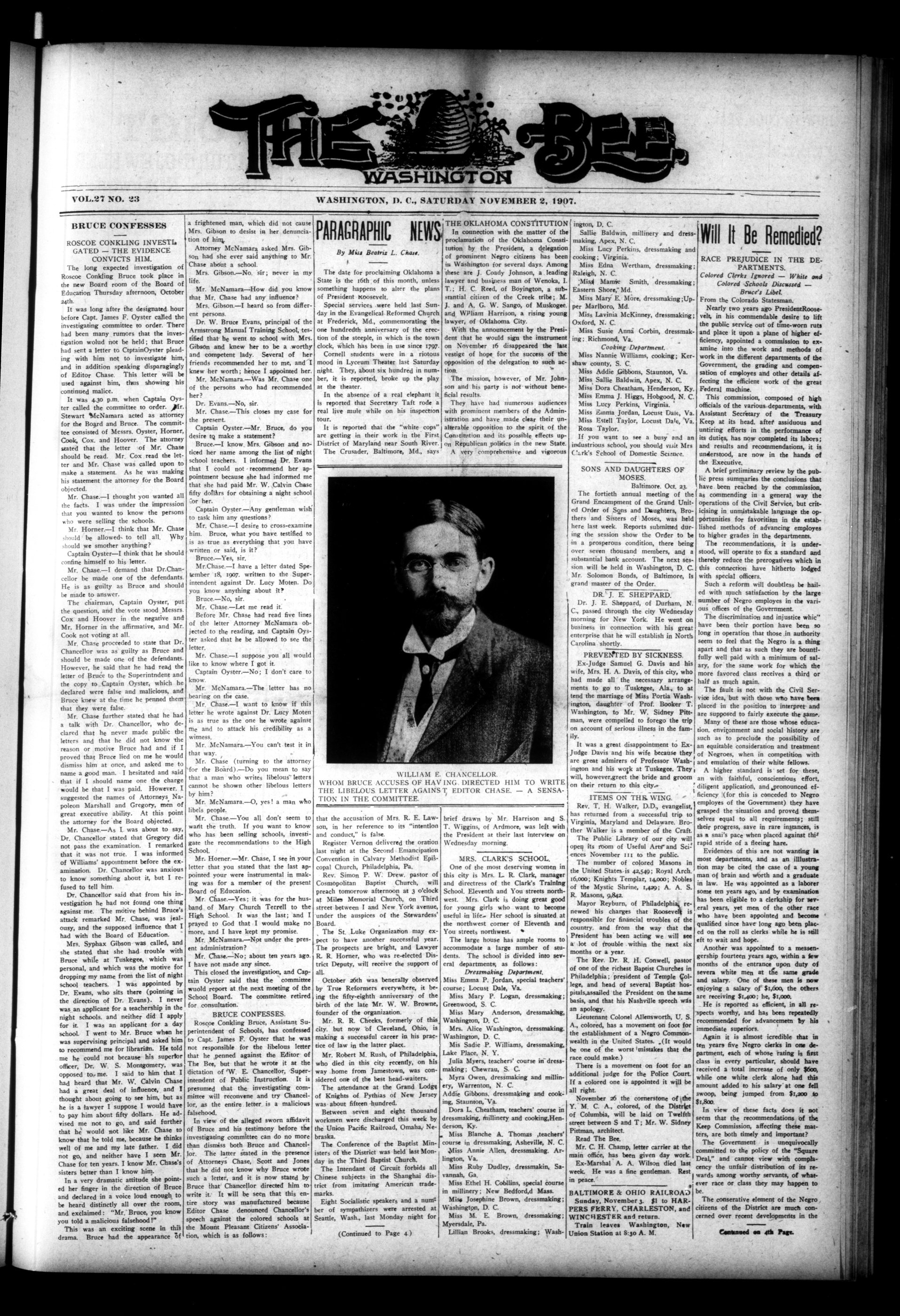
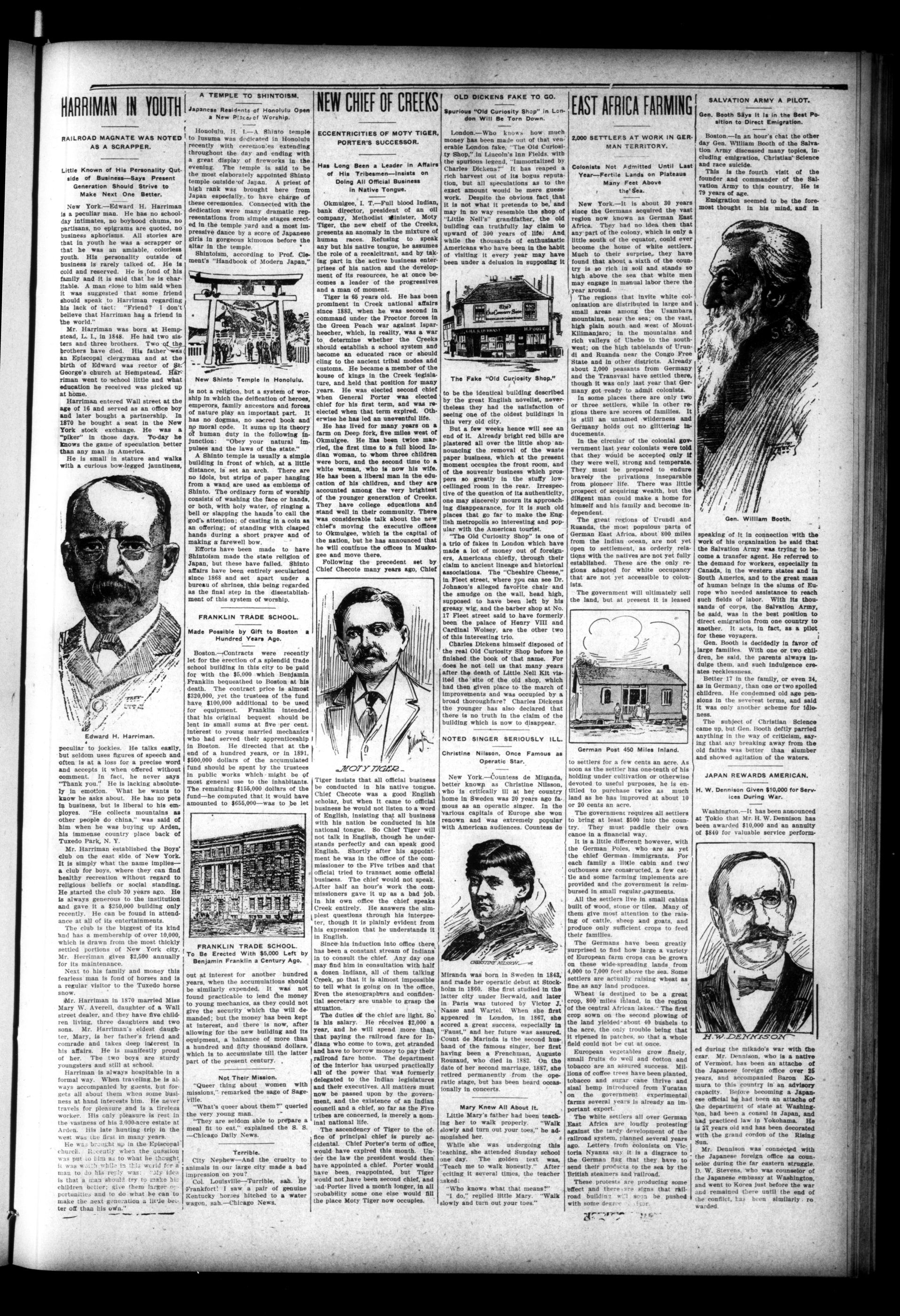
Page text (machine-generated)
VOL.27 NO.23
BRUCE CONFESSES
ROSCOE CONKLING INVESTIGATED — THE EVIDENCE CONVICTS HIM.
The long expected investigation of Roscoe Conkling Bruce took place in the new Board room of the Board of Education Thursday afternoon, October 24th.
It was long after the designated hour before Capt. James F. Oyster called the investigating committee to order. There had been many rumors that the investigation woul not be held; that Bruce had sent a letter to CtptainOyster pleading with him not to investigate him, and in addition speaking disparagingly of Editor Chase. This letter will be used against him, thus showing his continued malice.
It was 4:30 p.m. when Captain Oyster called the committee to order. Mr. Stewart McNamara acted as attorney for the Board and Bruce. The committee consisted of Messrs. Oyster, Horner, Cook, Cox, and Hoover. The attorney stated that the letter of Mr. Chase should be read. Mr. Cox read the letter and Mr. Chase was called upon to make a statement. As he was making his statement the attorney for the Board objected.
Mr. Chase.—I thought you wanted all the facts. I was under the impression that you wanted to know the persons who were selling the schools.
Mr. Horner.—I think that Mr. Chase should be allowed to tell all. Why should we smother anything?
Captain Oyster—I think that he should confine himself to his letter.
Mr. Chase.—I demand that Dr. Chancellor be made one of the defendants. He is as guilty as Bruce and should be made to answer.
The chairman, Captain Oyster, put the question, and the vote stood Messrs. Cox and Hoover in the negative and Mr. Horner in the affirmative, and Mr. Cook not voting at all.
The Chancellor proceeded to state that Dr. Chancellor was as guilty as Bruce and should be made one of the defendants. However, he said that he had read the letter of Bruce to the Superintendent and the copy to Captain Oyster, which he declared were false and malicious, and Bruce knew at the time he penned them that they were false.
Mr. Chase further stated that he had a talk with Dr. Chancellor, who declared that he never made public the letters and that he did not know the reason or motive Bruce had and if I proved that Bruce lied on me he would dismiss him at once, and asked me to name a good man. I hesitated and said that if I should name one the charge would be that I was paid. However, I suggested the names of Attorneys Napoleon Marshall and Gregory, men of great executive ability. At this point the attorney for the Board objected.
Mr. Chase—As I was about to say, Dr. Chancellor stated that Gregory did not pass the examination. I remarked that it was not true. I was informed of Williams' appointment before the examination. Dr. Chancellor was anxious to know something about it, but I refused to tell him.
Dr. Chancellor said that from his investigation he had not found one thing against me. The motive behind Bruce's attack remarked Mr. Chase, was jealousy, and the supposed influence that I had with the Board of Education.
Mrs. Syphax Gibson was called, and she stated that she had trouble with Bruce while at Tuskegee, which was personal, and which was the motive for dropping my name from the list of night school teachers. I was appointed by Dr. Evans, who sits there (pointing in the direction of Dr. Evans). I never was an applicant for a teachership in the night schools, and neither did I apply for it. I was an applicant for a day school. I went to Mr. Bruce when he was supervising principal and asked him to recommend me for librarian. He told me he could not because his superior officer, Dr. W. S. Montgomery, was opposed to me. I said to him that I had heard that Mr. W. Calvin Chase had a great deal of influence, and I thought about going to see him, but as he is a lawyer I suppose I would have to pay him about fifty dollars. He advised me not to go, and said further that he would not like Mr. Chase to know that he told me, because he thinks well of me and my late father. I did not go, and neither have I seen Mr. Chase for ten years. I know Mr. Chase's sisters better than I know him.
In a very dramatic attitude she pointed her finger in the direction of Bruce and declared in a voice loud enough to be heard distinctly all over the room, and exclaimed: "Mr. Bruce, you know you told a malicious falsehood!" This was an exciting scene in this drama. Bruce had the appearance of
THE BEE WASHINGTON
a frightened man, which did not cause Mrs. Gibson to desist in her denunciation of him.
Attorney McNamara asked Mrs. Gibson had she ever said anything to Mr. Chase about a school.
Mrs. Gibson.—No. sir; never in my life.
Mr. McNamara—How did you know that Mr. Chase had any influence?
Mrs. Gibson.—I heard so from different persons.
Dr. W. Bruce Evans, principal of the Armstrong Manual Training School, testified that he went to school with Mrs. Gibson and knew her to be a worthy and competent lady. Several of her friends recommended her to me, and I knew her worth; hence I appointed her.
Mr. McNamara.—Was Mr. Chase one of the persons who had recommended her?
Dr. Evans.—No, sir.
Mr. Chase.—This closes my case for the present.
Captain Oyster.—Mr. Bruce, do you desire to make a statement?
Bruce.—I know Mrs. Gibson and noticed her name among the list of night school teachers. I informed Dr. Evans that I could not recommend her appointment because she had informed me that she had paid Mr. W. Calvin Chase fifty dollars for obtaining a night school for her.
Captain Oyster.—Any gentleman wish to ask him any questions?
Mr. Chase.—I desire to cross-examine him. Bruce, what you have testified to is as true as everything that you have written or said, is it?
Bruce.—Yes, sir.
Mr. Chase.—I have a letter dated September 18, 1907, written to the Superintendent against Dr. Lucy Moten. Do you know anything about it?
Bruce—No, sir.
Mr. Chase.—Let me read it.
Before Mr. Chase had read five lines of the letter Attorney McNamara objected to the reading, and Captain Oyster asked that he be allowed to see the letter.
Mr. Chase.—I suppose you all would like to know where I got it.
Captain Oyster.—No; I don't care to know.
Mr. McNamara.—The letter has no bearing on the case.
Mr. Chase.—I want to know if this letter he wrote against Dr. Lucy Moten is as true as the one he wrote against me and to attack his credibility as a witness.
Mr. McNamara.—You can't test it in that way.
Mr. Chase (turning to the attorney for the Board)—Do you mean to say that a man who writes libelous letters cannot be shown other libelous letters by him?
Mr. McNamara.—O, yes! a man who libels people.
Mr. Chase.—You all don't seem to want the truth. If you want to know who has been selling schools, investigate the recommendations to the High School.
Mr. Horner.—Mr. Chase, I see in your letter that you stated that the last appointed your were instrumental in making was for a member of the present Board of Education.
Mr. Chase.—Yes; it was for the husband of Mary Church Terrell to the High School. It was the last; and I prayed to God that I would make no more, and I have kept my promise.
Mr. McNamara.—Not under the present administration?
Mr. Chase.—No; about ten years ago, I have not made any since. This closed the investigation, and Captain Oyster said that the committee would report at the next meeting of the School Board. The committee retired for consultation.
BRUCE CONFESSES.
Roscoe Conkling Bruce, Assistant Superintendent of Schools, has confessed to Capt. James F. Oyster that he was not responsible for the libelous letter that he penned against the Editor of The Bee, but that he wrote it at the dictation of W. E. Chancellor, Superintendent of Public Instruction. It is presumed that the investigating committee will reconvene and try Chancellor, as the entire letter is a malicious falsehood.
In view of the alleged sworn affidavit of Bruce and his testimony before the investigating committee can do no more than dismiss both Bruce and Chancellor. The latter stated in the presence of Attorney's Chase, Scott and Jones that he did not know why Bruce wrote such a letter, and it is now stated by Bruce that Chancellor directed him to write it. It will be seen that this entire story was manufactured because Editor Chase denounced Chancellor's speech against the colored schools at the Mount Pleasant Citizens' Association, which is as follows:
WASHINGTON, D. C., SATURDAY NOVEMBER 2. 1907.
PARAGRAPHIC NEWS
By Miss Beatris L. Chase.
The date for proclaiming Oklahoma a State is the 16th of this month, unless something happens to alter the plans of President Koosevelt.
Special services were held last Sunday in the Evangelical Reformed Church at Frederick, Md., commemorating the one hundredth anniversary of the erection of the steeple, in which is the town clock, which has been in use since 1797. Cornell students were in a riotous mood in Lyceum Theater last Saturday night. They, about six hundred in number, it is reported, broke up the play at the theater.
In the absence of a real elephant it is reported that Secretary Taft rode a real live mule while on his inspection tour.
It is reported that the "white cops" are getting in their work in the First District of Maryland near South River. The Crusader, Baltimore, Md., says
100
J. H.
that the accusation of Mrs. R. E. Lawson, in her reference to its "intention and conduct," is false.
Register Vernon delivered the oration last night at the Second Emancipation Convention in Calvary Methodist Episcopal Church, Philadelphia, Pa.
Rev. Simon P. W. Drew. pastor of Cosmopolitan Baptist Church, will preach tomorrow afternoon at 3 o'clock at Miles Memorial Church, on third street between I and New York avenue, under the auspices of the Stewardess' Board.
The St. Luke Organization may expect to have another successful year. The prospects are bright, and Lawyer R. R. Horner, who was re-elected District Deputy, will receive the support of all.
October 20th was benerally observed by True Reformers everywhere, it being the fifty-eighth anniversary of the birth of the late Mr. W. W. Browne, founder of the organization.
Mr. R. R. Cheeks, formerly of this city, but now of Cleveland, Ohio, is making a successful career in his practice of law in the latter place.
brief drawn by Mr. Harrison and S. T. Wiggins, of Ardmore, was left with the President at their last interview on Wednesday morning.
MRS. CLARK'S SCHOOL
One of the most deserving women in this city is Mrs. L. R. Clark, manager and directress of the Clark's Training School. Eleventh and You streets northwest. Mrs. Clark is doing great good for young girls who want to become useful in life. Her school is situated at the northwest corner of Eleventh and You streets northwest.
The large house has ample rooms to accommodate a large number of students. The school is divided into several departments, as follows:
Dressmaking Department,
Miss Emma P. Jordan, special teachers' course; Locust Dale, Va.
Miss Mary P. Logan, dressmaking; Greenwood, S. C.
Miss Mary Anderson, dressmaking, Washington, D. C.
Mrs. Alice Washington, dressmaking, Washington, D. C.
Miss Sadie P. Williams, dressmaking.
Mr. Robert M. Rush, of Philadelphia, who died in this city recently, on his way home from Jamestown, was considered one of the best head-waiters.
The attendance at the Grand Lodge of Knights of Pythias of New Jersey was about fifteen-hundred.
Between seven and eight thousand workmen were discharged this week by the Union Pacific Railroad, Omaha, Nebraska.
The Conference of the Baptist Ministers of the District was held last Monday in the Third Baptist Church.
The Intendant of Circuit forbids all Chinese subjects in the Shanghai district from imitating American trademarks.
Eight Socialistic speakers and a number of sympathizers were arrested at Seattle, Wash., last Monday night for
(Continued to Page 4.)
(Continued to Page 4.)
THE OKLAHOMA CONSTITUTION
In connection with the matter of the proclamation of the Oklahoma Constitution by the President, a delegation of prominent Negro citizens has been in Washington for several days. Among these are J. Coady Johnson, a leading lawyer and business man of Wenoka, L. T.; H. C. Reed, of Boyington, a substantial citizen of the Creek tribe; M. J. and A. G. W. Sango, of Muskogee, and William Harrison, a rising young lawyer, of Oklahoma City.
With the announcement by the President that he would sign the instrument on November 16 disappeared the last vestige of hope for the success of the opposition of the delegation to such action.
The mission, however, of Mr. Johnson and his party is not without beneficial results.
They have had numerous audiences with prominent members of the Administration and have made clear their unalterable opposition to the spirit of the Constitution and its possible effects upon Republican politics in the new State.
A very comprehensive and vigorous
```markdown
```
brief drawn by Mr. Harrison and S. T. Wiggins, of Ardmore, was left with the President at their last interview on Wednesday morning.
MRS. CLARK'S SCHOOL
One of the most deserving women in this city is Mrs. L. R. Clark, manager and directress of the Clark's Training School. Eleventh and You streets northwest. Mrs. Clark is doing great good for young girls who want to become useful in life. Her school is situated at the northwest corner of Eleventh and You streets northwest.
The large house has ample rooms to accommodate a large number of students. The school is divided into several departments, as follows:
Dressmaking Department.
Miss Emma P. Jordan, special teachers' course; Locust Dale, Va.
Miss Mary P. Logan, dressmaking; Greenwood, S. C.
Miss Mary Anderson, dressmaking, Washington, D. C.
Mrs. Alice Washington, dressmaking, Washington, D. C.
Mis Sadie P. Williams, dressmaking, Lake Place, N. Y.
Julia Myers, teachers' course in dressmaking; Chewrau, S. C.
Myra Owen, dressmaking and millinery, Warrenton, N. C.
Addie Gibbons, dressmaking and cooking, Staunton, Va.
Dora L. Cheatham, teachers' course in dressmaking, millinery and cooking, Henderson, Ky.
Miss Blanche A. Thomas, teachers' course in dressmaking, Asheville, N. C.
Miss Annie Allen, dressmaking. Arlington, Va.
Miss Ruby Dudley, dressmakin, Savannah, Ga.
Miss Ethel H. Cobblins, special course in millinery; New Bedford,d Mass.
Miss Josephine Brown, dressmaking; Washington, D. C.
Miss M. E. Brown, dressmaking; Myersdale, Pa.
Lillian Brooks, dressmaking; Wash-
ington, D. C.
Sallie Baldwin, millinery and dress-
making, Apex, N. C.
Miss Lucy Perkins, dressmaking and
cooking; Virginia.
Miss Edna Wertham, dressmaking;
Raleigh, N. C.
Miss Mamie Smith, dressmaking;
Eastern Shore, Md.
Miss Mary E. More, dressmaking;Upp-
per Marlboro, Md.
Miss Lavinia McKinney, dressmaking;
Oxford, N. C.
Miss Susie Anna Corbin, dressmaking;
Richmond, Va.
Cooking Department.
Miss Nannie Williams, cooking; Kershaw county, S. C.
Miss Addie Gibbons, Staunton, Va.
Miss Sallie Baldwin, Apex, N. C.
Miss Dora Cheatham, Henderson, Ky.
Miss Emma J. Higgs, Hobgood, N. C.
Miss Lucy Perkins, Virginia.
Miss Emma Jordan, Locust Dale, Va.
Miss Estell Taylor, Locust Dale, Va.
Rosa Taylor.
If you want to see a busy and an
industrious school, you should visit Mrs
Clark's School of Domestic Science.
SONS AND DAUGHTERS OF MOSES.
Baltimore. Oct. 23.
The fortieth annual meeting of the Grand Encampment of the Grand United Order of Sons and Daughters, Brothers and Sisters of Moses, was held here last week. Reports submitted during the session show the Order to be in a prosperous condition, there being over seven thousand members, and a substantial bank account. The next session will be held in Washington, D. C. Mr. Solomon Bonds, of Baltimore, is grand master of the Order.
DR L E SHEPPARD
Dr. J. E. Sheppard, of Durham, N.C., passed through the city Wednesday morning for New York. He went on business in connection with his great enterprise that he will establish in North Carolina shortly.
PREVENTED BY SICKNESS.
Ex-Judge Samuel G. Davis and his wife, Mrs. H. A. Davis, of this city, who had made all the necessary arrangements to go to Tuskegee, Ala., to attend the marriage of Miss Portia Washington, daughter of Prof. Booker T. Washington, to Mr. W. Sidney Pittman, were compelled to forego the trip on account of serious illness in the family.
It was a great disappointment to Ex-Judge Davis and his wife because they are great admirers of Professor Washington and his work at Tuskegee. They will, however, greet the bride and groom on their return to this city.
ITEMS ON THE WING.
Rev. T. H. Walker, D.D., evangelist, has returned from a successful trip to Virginia, Maryland and Delaware. Brother Walker is a member of the Craft.
The Public Library of our city will open its room of Useful Arts and Sciences November III to the public.
The number of colored Masons in the United States is 42,549; Royal Arch. 16,000; Knights Templar, 14,000; Nobles of the Mystic Shrine, 1,429; A. A. S. R. Masons, 9,842.
Mayor Reyburn, of Philadelphia, renewed his charges that Roosevelt is responsible for financial troubles of the country, and from the way that the President has been acting we will see a lot of trouble within the next six months or a year.
The Rev. Dr. R. H. Conwell, pastor of one of the richest Baptist Churches in Philadelphia; president of Temple College, and head of several Baptist hospitals,assailed the President on the same basis, and that his Nashville speech was an apology.
Lieutenant Colonel Allensworth, U. S. A., colored, has a movement on foot for the establishment of a Negro Commonwealth in the United States. (It would be one of the worst mistakes that the race could make.)
There is a movement on foot for an additional judge for the Police Court. If a colored one is appointed it will be all right.
November 26 the cornerstone of the Y. M. C. A., colored, of the District of Columbia, will be laid on Twelfth street between S and T; Mr. W. Sidney Pittman, architect.
Mr. C. H. Champ, letter carrier at the main office, has been given day work.
Ex-Marshal A. A. Wilson died last week. He was a fine gentleman. Rest in peace.
BALTIMORE & OHIO RAILROAD
Sunday, November 3. $1 to HARPERS FERRY, CHARLESTON, and WINCHESTER and return.
Train leaves Washington, New Union Station at 8:30 A. M.
Will It Be Remedied?
RACE PREJUDICE IN THE DEPARTMENTS.
Colored Clerks Ignored — White and Colored Schools Discussed — Bruce's Libel.
From the Colorado Statesman.
Nearly two years ago PresidentRoosevelt, in his commendable desire to lift the public service out of time-worn ruts and place it upon a plane of higher efficiency, appointed a commission to examine into the work and methods of work in the different departments of the Government, the grading and compensation of employees and other details affecting the efficient work of the great Federal machine.
This commission, composed of high officials of the various departments, with Assistant Secretary of the Treasury Keep at its head, after assiduous and untiring efforts in the performance of its duties, has now completed its labors; and results and recommendations, it is understood, are now in the hands of the Executive.
A brief preliminary review by the public press summaries the conclusions that have been reached by the commission, as commending in a general way the operations of the Civil Service, but criticising in unmistakable language the opportunities for favoritism in the established methods of advancing employees to higher grades in the departments.
The recommendations, it is understood, will operate to fix a standard and thereby reduce the prerogatives which in this connection have hitherto lodged with special officers.
Such a reform will doubtless be hailed with much satisfaction by the large number of Negro employees in the various offices of the Government.
The discrimination and injustice whic" have been their portion have been so long in operation that those in authority seem to feel that the Negro is a thing apart and that as such they are bountifully well paid with a minimum of salary, for the same work for which the more favored class receives a third or half as much again.
The fault is not with the Civil Service idea, but with those who have been placed in the position to interpret and are supposed to fairly execute the same.
Many of these are those whose education, environment and social history are such as to preclude the possibility of an equitable consideration and treatment of Negroes, when in competition with and emulation of their white fellows.
A higher standard is set for these, an with faithful, conscientious effort, diligent application, and pronounced efficiency (for this is conceded to Negro employees of the Government) they have grasped the situation and proved themselves equal to all requirements; still their progress, save in rare instances, is as a snail's pace when placed against this rapid stride of a fleeing hare.
Evidences of this are not wanting in most departments, and as an illustration may be cited the case of a young man of brain and worth and a graduate in law. He was appointed as a laborer some ten years ago, and by examination has been eligible to a clerkship for several years, yet men of the other race who have been appointed and become qualified since have long ago been placed on the roll as clerks while he is still eft to wait and hope.
Another was appointed to a messengership fourteen years ago, within a few months of the entrance upon duty of severa white men at the same grade and salary. One of these men is now enjoying a salary of $1,600, the others are receiving $1,400; he $1,000.
He is reported as efficient, in all respects worthy, and has been repeatedly recommended for advancement by his immediate superiors.
Again it is almost incredible that in ten years five Negro clerks in one department, each of whose rating is first class in every particular, should have received a total increase of only $600, while one white clerk alone had this amount added to his salary at one fell swoop, being jumped from $1,200 to $1,800.
In view of these facts does it not seem that the recommendations of the Keep Commission, affecting these matters, are both timely and important?
The Government is unequivocally committed to the policy of the "Square Deal," and cannot view with complacency the unfair distribution of its rewards among worthy servants, of whatever race or class they may happen to be.
The conservative element of the Negro citizens of the District are much concerned over recent developments in the
HOW TO COOK VEAL
SEVERAL DAINTY DISHES PREPARED FOR TWO PEOPLE.
Copyright, 1901. The Delineator. New York. Braised Cutlets a la Creole—Melt a tablespoonful of lard in a frying-pan. Chop four small onions fine and let them fry for a moment in the hot lard. Then season four chops, or cutlets, with salt and pepper, dredge them with flour, and place them on top of the frying onions. When they have simmered for a few minutes, turn them; and, at the expiration of another two or three minutes, add two tablespoonfuls of vinegar, a little chopped parsley, a threaded clove of garlic, a bay-leaf and some thyme. Turn the veal from time to time, until it has browned on both sides; then add a coffee-cupful of hot water, cover the pan, and let the water come to a boil quickly. At this point, remove it to the back of the stove, where it can do no more than simmer, and leave it for two hours. Remove the garlic and bay-leaf, garnish with freshly chopped parsley, and serve.
Perfection Stew—Much as many people object to the stew, or to any dish that savors of it, the cook who is willing to take some palms in preparing the viands for her table can serve a veal stew in such a manner that the fact that it is a "stew" will never be suspected. To do this she must first make a rich white sauce by using a heaping tablespoonful of flour and a goodly proportioned piece of butter to a cupful of good milk, or cream. When this sauce has commenced to boil, she must take some thin slices of cold veal and lay them in it, adding half a dozen mushrooms, chopped, and a little minced parsley. Simmer until the meat has become heated through, when it is ready for the table.
Veal in Chafing Dish—The appearance of a chafing dish at supper, or even at luncheon, often adds materially to the delights of the repast, so if you have a chafing dish that can be called into service, try it some day when you want to dispose of some left-overs from the roast of veal. To do this, melt some butter in the pan, and fry some chopped onions in it until they have browned nicely; then add a cupful of veal gravy, or white stock, and lay the slices of veal in it. Season with salt, pepper, and mushroom catsup, and, at the end of two or three minutes, add a well-beaten egg, and serve immediately.
English Veal Cake—When so much of the roast has been used that it is no longer possible to get slices, there are still several methods by which it can be prepared most appetizingly. Purchase a few slices of boiled ham and two eggs, and you can serve one of the famous English veal cakes. Here is the recipe: Take about a pound of cold roast veal; remove all fat, etc., and chop it into small pieces. Grease a plain mold and put into it alternate layers of chopped veal, hard-boiled eggs, and boiled ham in slices, with chopped parsley and salt and pepper between each layer, until the mold is nearly full. Next, take some good stock and flavor it with tarragon, mace and pepper to taste. Pour this over, the other ingredients until the mold is filled almost to the brim. Bake it for half an hour, but do not serve it until it has become so cold that it can be sliced neatly. Served with a garnish of crisp watercress, these slices of veal-cake make a most acceptable hot-weather luncheon dish
Russian Croquettes—Another minced-veal dish that will appeal attractively to lovers of nice eating is known as "Russian croquettes." To make them, mince a pound of cold veal, and season it with pepper, salt, a little nutmeg and half a teaspoonful of grated lemon peel, and molten with a sauce made as follows: Heat a coffee-cupful of milk to the boiling point; then add a slice of onion, a stalk of celery, chopped, a bay-leaf, half a dozen peppercorns, and parsley, thyme and mace. Do not let the mixture actually boil, but keep it simmering steadily for fully 15 minutes. Then strain, season to taste with salt and pepper, and thicken with a blend of flour and butter. While this sauce is being prepared, roll some puff paste very thin, and, when the sauce and meat have been combined, shape a tablespoonful of the mixture into the shape of a croquette, and roll it up in a strip of the puff paste, pressing the ends together closely. Have some deep fat ready and fry the croquettes brown. Drain carefully, and serve with mustard, cress, or sorrel and bits of lemon. They must not be put on a cold platter nor kept standing, because, to be really delectable, croquettes should be served very hot.
Quaintest' of Wraps.
The qualintest of wraps to be introduced this season is the shawl of chiffon, thin silk or crepe de chine edged with tiny flouces headed with baby velvet ribbon and draped with the same ribbon. They are drawn down the middle of the back with the ribbon.
For Embroidery Edges
Many garments are spoiled by having the embroidered edge split and fraed by a careless laundress. The garment can be made to last twice as long and many dollars saved by stitching around the scallops twice, this makes a strong, firm edge and does not detract from its appearance. Mrs. L. G. P.
COLONIAL SOCIALS A FAD.
It Can.Be Made a Success in Every Community.
There is one form of sociable which is warranted to be a success, since every one is interested in it from the start; this is the "colonial social." The committee should canvass thoroughly, letting no house escape, for in every one something is tucked away which speaks of earlier days. The committee on decorations may hang the walls of the parlors with crossed swords, old muskets and flags, and portraits of Washington and other colonial heroes. Around the rooms may be tables and chalers of old mahogany, spinning wheels, and irons, and curious kettles. Arranged around the wall may be long, narrow tables draped with cheese cloth in blue and yellow, bearing old silver, brass candlesticks, snuffers, decanters, slippers, embroidery, fans and jewelry, with samplers, warming pans, old mirrors and family portraits above. Each article should be labeled with the owner's name, the date of the manufacture, or use of the article, and any historical event in connection with it.
It is a good plan to have everything brought to the parlors early in the day and returned at the close of the sociable to prevent possible loss. It is one of the interesting things about the sociable to see the quality of relics even the smallest town has hidden away.
For entertainment some one may sing some of the revolutionary ballads, or tell a curious event in family history, or read from old records. Or there may be recitations of such things as "Paul Revere's Ride" of "Dorothy Q." or some description of life in colonial days. Of course the whole affairs is more delightful if the hostess at least can come in quaint old silk or cotton gowns, with tall combs and huge fans, and powdered hair.
As to refreshments, there should certainly be poundcake and mulled cider, and perhaps doughnuts, or little spicy cookies. A great deal of fun can be had if old recipe books are hunted up and some of the things tried which are suggested there. This soakable suggests one on much the same lines, where a real New England supper is served at six, all sitting down at long tables to eat the same dishes which were served long ago. Afterwards the same entertainment may be provided as at the colonial soakable, with or without the pretty old dresses.
DRINKING AT MEALS.
Water Should Be Taken Only After Eating, Says an Authority.
Most physicians today will tell you never to take any liquid, and least of all water, during meals. There are, however, two sides to the question.
Those with a tendency to gout or other diseases arising from excess of uric acid should avoid liquids until two hours, at least after eating.
For those without such a tendency there is no harm in drinking a moderate amount at the end of the meal.
There is, therefore, sound reason back of the custom of keeping the coffee for the last course. Even when this prandial drinking is permissible, one should avoid excess. A little cold water in the mouth is often just as refreshing as if gallons of the liquid had been consumed.
The great American fault—or one of them—is the consumption of enormous quantities of ice water, which is really a deadly beverage and not fit for civilized man to drink—I emphasize "civilized," for no savage would do anything to stupid as to chill and paralyze the muscles of his stomach in the belief that he is cooling his skin.
The rules, then, are: A little water if you are healthy and your stomach is normal, not too cold, and taken at the end of the meal. And thus will you avoid the countless ills to which most drinkers during meals are heir.
Umbrella Cover as Hair Protector. A woman who was the proud possessor of a braid of hair which reached well below her knees, every hair even and the whole one satiny length of golden brown, gave this secret of the beauty of her crowning glory. It certainly is an original scheme, to say the least.
She took the cover of her silk umbrella (a use for them at last), and each night after the dust of the day had been removed by a vigorous brushing, this cover was drawn snugly over the braid and securely tied. Thus the ends were kept unbroken and the hair untangled, no matter how restless she was. By the way, in severe illness, when the hair must go for days often, unbrushed, if it is possible to braid it in two plaits and saturate thoroughly with alcohol before even attempting to comb the least bit, the work will be accomplished in half the time.
Culinary Concepts
When interrupted while frying in deep fat drop a dry crust of bread into the fat to prevent its burning.
When frying croquettes be sure to plunge the basket in hot fat before the croquettes are placed in it. This will prevent them adhering to the wire when lifted out.
When roasting meat, to make the gravy nice and brown take a table-spoonful of sugar and melt it in a pan till it smokes, then add boiling water stir well and mix with the gravy.
Cracker and bread crumbs-used in covering the tops, of scallops, etc., should be well greased in melted butter. This makes a better covering than the dry crumbs dotted with butter and uses less of the latter ingredient.
AIDS TO BEAUTY
PRACTICAL LITTLE HINTS FOR THE WOMAN WHO CARES.
Blackreads.
Keep Skin Clear — Perspiration opens the pores wisily, and hence is a prime buster. Damp air and fog are kind to the complexion and are held to be largely responsible for the fresh pliability of the young English girls' complexion. The fog seems to lie close against the cheeks, soft and luscious, like kisses from velvety lips. You will find that every one, be it man, woman, or child, who drinks quantitles of water will have a clear and soft skin, as pink and white as a baby's. Water, if drunk in great quantitles, will cause perspiration, which clears out the pores and makes them healthy. It also bleaches the skin. It prevents the skin from becoming hard, dry and close, and is thus indirectly a preventive of wrinkles.
The stout woman need not fear to drink water because she thinks it will increase her weight, for it will not unless, of course, she drinks it with her meals. It is a mystery why women do not drink more water, for every doctor will advise his woman patients to drink lots of water. It is such a simple remedy and is so much easier to take than medicines. Still, it is almost impossible to make many women believe that they will derive benefit from anything but medicine.
To Remove Blackheads—Blackheads are the result of the skin falling to throw off all its impurities. The perfectly cleansed face has no blackheads. Many who are afflicted with blackheads deny this, as every one likes to think they are clean, but few of us know how to cleanse our faces properly and thoroughly. Not enough can be said about the nightly scrub with the flesh brush and soap and about the morning wash. Wash the face every night, even if you are so sleepy and tired that nothing matters, so long as you get to bed. If the habit is formed, the task will soon become a mechanical one and will be part of the duty of undressing. There is no hope for the girl who is too indolent to do this. She must accept her lot and the blackheads with it.
Different skins need different treatments, but one knows no end of women who gayly go to the nearest drug store and buy a cold cream, simply because some of her friends have recommended it. Probably her friend has a dry skin, while she has an oily one, but that does not make any difference; it's a good cream, so she uses it.
Eat Oil for Dry Skin—Women who suffer from a dry skin will be wonderfully benefited if they will take a tablespoonful of olive oil after each meal. Beazoin, which is far too astingent for many complexions, is excellent for a dry skin. Bran bags will have a wonderful effect upon the too dry skin. To make some fine meal for bran bags at home, mix four pounds of fine oatmeal and two quarts of clean bran together and also one and a half pounds of powdered orris root, one and a half pounds of almond meal, and one-half pound of white castile soap ground up. Three ounces of sachet powder of any kind to suit one's taste may also be added.
These are simple luxuries and they make the skin exquisitely soft and fresh. They are used exactly like soap and make a soft and fluffy lather. The bags must be stuffed so lightly that they may be rubbed over the face just like a wash cloth. Each bag may be used three times. After each using it should be thoroughly dried in the sun. It is best to make a large quantity of the meal and put it away in closed jars, only filling five or six bags at a time. The bags should be made of soft cheese cloth.
The almond meal is made as follows: Powdered orris root, four ounces; wheat flour, four ounces; castile soap, finely powdered, one ounce; pure borax, one ounce, oil of bitter almonds, ten drops; oil of bergamont, two drams; tincture of musk, one dram. Put into a bottle or jar having a perforated top and shake well so as to mix the ingredients. When ready for use first wet the hands and then shake a quantity of the meal through the shaker top of the jar. Rub the hands together and also over the face, and a delicious lather will form.
Don't Have Rough Hands—Wash your hands in sugar water; dry them with corn meal, night and morning.
. A Remodeling Hint.
When buying new goods for an old dress, considerable care must be exercised to select something that will make the old goods look better instead of worse.
It is better to have the new material of a different texture. For instance, new velvet will look better with old silk: black, that has been worn some time will look better if made over with some other color.
If it is desirable to have the dress all black, buy the same color black and change the texture. Black chiffon makes a worn cloth lifeless, while other materials will give it a fresh look.
The bodice linings are often perfectly good while outside is worn out, needing, perhaps just a cleaning about neck and waist, and some new bones and casings.
They can easily be, utilized with little work for the foundations of the more or less fancy waists for house or evening wear.
F-797
DIAMONDS
Put Your Money in Diamonds. No Better Investment To-Day. Prices in the Diamond market are advancing, but our prices have not been advanced in some time. We still have a large collection of superb Diamonds which we bought a considerable time ago at lower prices than prevail today.
We shall not advance prices on these stones. We are merchants and not speculators and our fair percentage of profit is all we ask. So, as long as these Diamonds last, it will be possible to buy them here under the regular market for fine stones.
Ladies' Diamond Rings, $5.00 to $150.00.
Ladies' Diamond Breaches, $5.50 to $1,000.
Diamond Earrings, $15.00 to $500.00.
Diamond Scarf Plus, $7.00 up.
Diamond Cuff Buttons, $7.00 up.
Diamond Studs, $10.00 up.
We have Ladies' Handsome Diamond Rings set in Tiffany Mounting which we are selling at $30.00.
This will make an appropriate present for Christmas. Every stone a ball of fire.
CLOCKS AND BRONZES
. Clocks of all makes—American, French and German. We have a Clock as cheap as $5.00—must be seen to be appreciated. All Clocks kept in order for two years.
E.VOIGT MANUFACTURINGJEWELER 725 7th Street, Northwest
Our stock of Jewelry and Bric-a-Brac is now complete. Each piece has been carefully selected and we feel satisfied that a visit from you will bear us out that we have as fine a selection as can be found anywhere. Why not give us a call tomorrow.
Everybody has some friend whom they wish to make happy. It may be mother or father, sister or brother. It may be a wife, or it may be a sweetheart—and no better time, than Christmas is so appropriate—so suggestive. Nothing makes one feel happier than to gladden the heart of another.
Any article that you may select will be laid aside and delivered when wanted. Experienced clerks. Polite attention.
Engraving Free of Charge.
We mention here but a few of our specials.
Gentlemen's 20-year-Gold Filled American Stem Winders and Setters, $10.
Ladies 20-year Gold Filled Stem Winders and Setters, $10.
Gentlemen's 14-carat Solid Gold American Stem Winders and Setters, as cheap as $35.
Children's Solid Silver Watches with Pin Attachment, $3.50; regular price, $4.50.
Ladies Solid GoldWatches, Open Face, $8.00.
Boys' Solid Silver Watches, $5.00
up.
RINGS, LOCKETS, ETC.
Gents' Solid Gold Signet Rings,
$3.50 up.
Ladies' Solid Gold Signet Rings,
$2.00 up.
Child's Solid Gold Signet Rings,
$1.00 up.
Ladies' Solid Gold Medallion
Lockets, $4.00 up.
Ladies Solid Gold Crosses, $4.00
up.
Gents' Solid Gold Lockets, $4.00 up.
Ladies' Solid Gold Bracelets,
$5.00 up.
Ladies' 14-Carat Gold Filled Lockets, $2.00 up.
We engrave the monograms on them in the highest style of the art.
SILVERWARE
Silver Tea Sets, $10.00 up.
Silver Cake Baskets, $4.00 up.
Silver Cups for Children, $1.25 up.
Silver Baking Dish, 7.00.
Silver Butter Dishes, $3.50 up.
Silver Pickle Casters, $3.00 up.
The above silver is the Genuine
Regers, which speaks for itself.
CATHOLIC GOODS
We have the largest line of Catho-
lic Goods in the city.
Genuine Pearl Rosaries, 35 cents
up.
Genuine Pearl Rosaries, strung
rh 52 Wm. C
Wm. Cannon,
PAYABLE ONE HOME AND DEATH AMERICAN HOME LIFE INSURANCE CO. FTH and G Streets N. W. Washington, D. C.
KEYSTON
D-779
on Fine Silver, with Solid Silver Crucifix, 75 cents up.
Emerald, Sapphire, Garnet, Ruby, Jade, Turquoise, Topaz, Crystal, and Coral Rosaries, strung on 14-Carat Gold-Filled Chain, $4.00 and $5.00. Will make a handsome Christmas present.
Solid Gold Rosaries, Genuine Stones, $25.00.
Rosaries for special devotions, viz.: Immaculate Conception, St Ann's, St. Philomena, St. Anthony, Seven Dolors, Infant of Prague, St. Joseph, etc., with prayers either English or German.
High quality at low prices, such as Key of Heaven, Manual of Prayers, St. Vincent's Manual, Vade Mecum, Sacred Heart, Following of Christ (by Kempis), Bibles, Old and New Testaments, etc. We have them in cases suitable for bridal or Christmas presents.
RELIGIOUS MEDALS
Religious Medals in Gold and Silver; Immaculate Conception, St. Benedict, St. Anthony, S' Joseph, Infant of Prague, St. Vincent de Paul, St. Aloysius, etc.
Eight-Day Sanctuary Oil, $1.10 per gallon.
Crucifixes, hanging and standing.
Candle Sticks in Gold Silver, and
Brass.
Sacred Hearts, Sclid Gold, 75
cents and $1.25.
HARRIMAN IN YOUTH
RAILROAD MAGNATE WAS NOTED AS A SCRAPPER.
Little Known of His Personality Outside of Business—Says Present Generation Should Strive to Make Next One Better.
New York.—Edward H. Harriman is a peculiar man. He has no school-day intimates, no boyhood chums, no partisans, no epigrams are quoted, no business aphorisms. All stories are that in youth he was a scraper or that he was an amblable, colorless youth. His personality outside of business is rarely talked of. He is cold and reserved. He is fond of his family and it is said that he is charitable. A man close to him said when it was suggested that some friend should speak to Harriman regarding his lack of tact: "Friend? I don't believe that Harriman has a friend in the world."
Mr. Harriman was born at Hempstead, L. I., in 1848. He had two sisters and three brothers. Two of the brothers have died. His father was an Episcopal clergyman and at the birth of Edward was rector of St. George's church at Hempstead. Harriman went to school little and what education he received was picked up at home.
Harriman entered Wall street at the age of 16 and served as an office boy and later bought a partnership. In 1870 he bought a seat in the New York stock exchange. He was a "piker" in those days. To-day he knows the game of speculation better than any man in America. He is small in stature and walks with a curious bow-legged jawtiness.
TREVEN
peculiar to jockies. He talks easily, but seldom uses figures of speech and often is at a loss for a precise word and accepts it when offered without comment. In fact, he never says "Thank you." He is lacking absolutely in emotion. What he wants to know he asks about. He has no pets in business, but is liberal to his employees. "He collects mountains as other people do china," was sald of him when he was buying up Arden, his immense country place back of Tuxedo Park, N. Y.
Mr. Harriman established the Boys' club on the east side of New York. It is simply what the name implies—a club for boys, where they can find healthy recreation without regard to religious beliefs or social standing. He started the club 30 years ago. He is always generous to the institution and gave it a $250,000 building only recently. He can be found in attendance at all of its entertainments.
The club is the biggest of its kind and has a membership of over 10,000, which is drawn from the most thickly settled portions of New York city. Mr. Harriman gives $2,500 annually for its maintenance.
Next to his family and money this fearless man is fond of horses and is a regular visitor to the Tuxedo horse snow.
Mr. Harriman in 1870 married Miss Mary W. Averell, daughter of a Wall street dealer, and they have five children living, three daughters and two sons. Mr. Harriman's eldest daughter, Mary, is her father's friend and comrade and takes deep interest in his affairs. He is manifestly proud of her. The two boys are sturdy youngsters and still at school.
Harriman is always hospitable in a formal way. When travelling he is always accompanied by guests, but forgets all about them when some business at hand interests him. He never travels for pleasure and is a tireless worker. His only pleasure is rest in the vastness of his 3,000-acre estate at Arden. His late hunting trip in the west was the first in many years.
He was, he taught up in the Episcopal church. It really when the question was put to him was to what he thought it was with what will in his world for a man to do his reply was: "Only idea is that a man should try to make his children better; give them larger opportunities and to do what he can to make the next generation a little better off than his own."
Japanese Residents of Honolulu Open a New Place of Worship.
Honolulu, HI I—A Shinto temple to Iusuma was dedicated in Honolulu recently with ceremonies extending throughout the day and ending with a great display of fireworks in the evening. The temple is said to be the most elaborately appointed Shinto temple outside of Japan. A priest of high rank was brought here from Japan especially to have charge of these ceremonies. Connected with the dedication were many dramatic representations from simple stages erected in the temple yard and a most impressive dance by a score of Japanese girls in gorgeous kimonos before the altar in the temple
Shintolism, according to Prof. Clement's "Handbook of Modern Japan."
New Shinto Temple In Honolulu.
is not a religion, but a system of worship in which the delification of heroes, emperors, family ancestors and forces of nature play an important part. It has no dogmas, no sacred book and no moral code. It sums up its theory of human duty in the following injunction: "Obey your natural impulses and the laws of the state."
A Shinto temple is usually a simple building in front of which, at a little distance, is set an arch. There are no idols, but strips of paper hanging from a wand are used as emblems of Shinto. The ordinary form of worship consists of washing the face or hands, or both, with holy water, of ringing a bell or slapping the hands to call the god's attention; of casting in a coin as an offering; of standing with clasped hands during a short prayer and of making a farewell bow.
Efforts have been made to have Shintolism made the state religion of Japan, but these have failed. Shinto affairs have been entirely secularized since 1685 and set apart under a bureau of shrines, this being regarded as the final step in the disestablishment of this system of worship.
FRANKLIN TRADE SCHOOL.
Made Possible by Gift to Boston a Hundred Years Ago.
Boston.—Contracts were recently let for the erection of a splendid trade school building in this city to be paid for with the $5,000 which Benjamin Franklin bequeathed to Boston at his death. The contract price is almost $320,000, yet the trustees of the fund have $100,000 additional to be used for equipment. Franklin intended that his original bequest should be lent in small sums at five per cent. interest to young married mechanics who had served their apprenticeship in Boston. He directed that at the end of a hundred years, or in 1891, $500,000 dollars of the accumulated fund should be spent by the trustees in public works which might be of most general use to the inhabitants. The remaining $155,000 dollars of the fund—he computed that it would have amounted to $655,000—was to be let
FRANKLIN TRADE SCHOOL.
To Be Erected With $5,000 Left by
Benjamin Franklin a Century Ago.
out at interest for another hundred years, when the accumulations should be similarly expended. It was not found practicable to lend the money to young mechanics, as they could not give the security which the will demanded; but the money has been kept at interest, and there is now, after allowing for the new building and its equipment, a balance of more than a hundred and fifty thousand dollars, which is to accumulate till the latter part of the present century.
Not Their Mission.
"Queer thing about women with missions," remarked the sage of Sageville.
"What's queer about them?" queried the very young man.
"They are seldom able to prepare a meal fit to eat," explained the S. S.—Chicago Daily News.
Terrible.
Qity Nephew—And the cruelty to animals in our large city made a bad impression on you?
Col. Louisville—Turrible, sah. By Frankfort! I saw a pair of genuine Kentucky horses hitched to a water wagen, sah.—Chicago News.
NEW CHIEF OF CREEKS
ECCENTRICITIES OF MOTY TIGER PORTER'S SUCCESSOR.
Has Long Been a Leader in Affairs of His Tribesmen—Insists on Doing All Official Business in Native Tongue.
Okmulgee, I. T.—Full blood Indian, bank director, president of an oil company, Methodist minister, Moty Tiger, the new chief of the Creeks, presents an anomaly in the mixture of human races. Refusing to speak any but his native tongue, he assumes the role of a recalcitrant, and by taking part in the active business enterprises of his nation and the development of its resources, he at once becomes a leader of the progressives and a man of moment. Tiger is 65 years old. He has been prominent in Creek national affairs since 1883, when he was second in command under the Proctor forces in the Green Peach war against Isparheecher, which, in reality, was a war to determine whether the Creeks should establish a school system and become an educated race or should cling to the ancient tribal modes and customs. He became a member of the house of kings in the Creek legislature, and held that position for many years. He was elected second chief when General Porter was elected chief for his first term, and was reelected when that term expired. Otherwise he has led an uneventful life.
He has lived for many years on a farm on Deep fork, five miles west of Okmulgee. He has been twice married, the first time to a full blood Indian woman, to whom three children were born, and the second time to a white woman, who is now his wife. He has been a liberal man in the education of his children, and they are accounted among the very brightest of the younger generation of Creeks. They have college educations and stand well in their community. There was considerable talk about the new chief's moving the executive offices to Okmulgee, which is the capital of the nation, but he has announced that he will continue the offices in Muskogee and move there. Following the precedent set by Chief Checote many years ago, Chief
William K.
Tiger insists that all official business be conducted in his native tongue. Chief Checote was a good English scholar, but when it came to official business he would not listen to a word of English, insisting that all business with his nation be conducted in his national tongue. So Chief Tiger will not talk in English, though he understands perfectly and can speak good English. Shortly after his appointment he was in the office of the commissioner to the Five tribes and that official tried to transact some official business. The chief would not speak. After half an hour's work the commissioners gave it up as a bad job. In his own office the chief speaks Greek entirely. He answers, the simplest questions through his interpreter, though it is plainly evident from his expression that he understands it in English.
Since his induction into office there has been a constant stream of Indians in to consult the chief. Any day one may find him in consultation with half a dozen Indians, all of them talking Creek, so that it is almost impossible to tell what is going on in the office. Even the stenographers and confidential secretary are unable to grasp the situation.
The duties of the chief are light. So is his salary. He receives $2,000 a year, and he will spend more than that paying the railroad fare for Indians who come to town, get stranded and have to borrow money to pay their railroad fare home. The department of the Interior has usurped practically all of the power that was formerly delegated to the Indian legislatures and their executives. All matters must now be passed upon by the government, and the existence of an Indian council and a chief, so far as the Five tribes are concerned, is merely a nominal national life.
The ascendency of Tiger to the office of principal chief is purely accidental. Chief Porter's term of office would have expired this month. Under the law the president would then have appointed a chief. Porter would have been reappointed, but Tiger would not have been second chief, and and Porter lived a month longer, in all probability some one else would fill the place Moty Tiger now occupies.
OLD DICKENS FAKE TO GO.
Spurious "Old Curiosity Shop" in London Will Be Torn Down.
London.—Who knows how much money has been made out of that venerable London fake, "The Old Curiosity Shop," In Lincoln's Inn Fields, with the spurious legend, "Immortalized by Charles Dickens." It has reaped a rich harvest out of its bogus reputation, but all speculations as to the exact amount would be mere guesswork. Despite the obvious fact that it is not what it pretends to be, and may in no way resemble the shop of "Little Nell's" grandfather, the old building can truthfully lay claim to upward of 300 years of life. And while the thousands of enthusiastic Americans who have been in the habit of visiting it every year may have been under a delusion in supposing it
The Fake "Old Curiosity Shop."
to be the identical building described by the great English novelist, nevertheless they had the satisfaction of seeing one of the oldest buildings in this very old city.
But a few weeks hence will see an end of it. Already bright red bills are plastered all over the little shop announcing the removal of the waste paper business, which at the present moment occupies the front room, and of the souvenir business which prospers so greatly in the stuffy low-celling room in the rear. Irrespective of the question of its authenticity, one may sincerely mourn its approaching disappearance, for it is such old places that go far to make the English metropolis so interesting and popular with the American tourist.
"The Old Curiosity Shop" is one of a trio of fakes in London which have made a lot of money out of foreigners, Americans chiefly, through their claim to ancient lineage and historical associations. The "Cheshire Cheese," in Fleet street, where you can see Dr. Johnson's alleged favorite chair and the smudge on the wall, head high, supposed to have been left by his greasy wig, and the barber shop at No. 17 Fleet street said to have formerly been the palace of Henry VIII and Cardinal Wolsey, are the other two of this interesting trio.
Charles Dickens himself disposed of the real Old Curlosity Shop before he finished the book of that name. For does he not tell us that many years after the death of Little Nell Kit visited the site of the old shop, which had then given place to the march of improvements and was occupied by a broad thoroughfare? Charles Dickens the younger has also declared that there is no truth in the claim of the building which is now to disappear.
Christine Nilsson, Once Famous as Operatic Star.
New York.—Countess de Miranda, better known as Christine Nilsson, who is critically ill at her country home in Sweden was 20 years ago famous as an operatic singer. In the various capitals of Europe she won renown and was extremely popular with American audiences. Countess de
Miranda was born in Sweden in 1843, and made her operatic debut at Stockholm in 1860. She first studied in the latter city under Berwald, and later in Paris was tutored by Victor J. Nasse and Wartel. When she first appeared in London, in 1867, she scored a great success, especially in "Faust," and her future was assured. Count de Marinda is the second husband of the famous singer, her first having been a Frenchman, Auguste Rouzaud, who died in 1882. On the date of her second marriage, 1887, she retired permanently from the operatic stage, but has been heard occasionally in concerts.
Mary Knew All About It.
Little Mary's father had been teaching her to walk properly. "Walk slowly and turn out your toes," he admonished her.
White she was undergoing this teaching, she attended Sunday school one day. The golden text was, "Teach me to walk honestly." After exiting it several times, the teacher asked:
"Who knows what that means?"
"I do," replied little Mary. "Walk slowly and turn out your toes."
EAST AFRICA FARMING
2,000 SETTLERS AT WORK IN GERMAN TERRITORY.
Colonists Not Admitted Until Last Year—Fertile Lands on Plateaus Many Feet Above the Sea.
New York. It is about 30 years since the Germans acquired the vast region now known as German East Africa. They had no idea then that any part of the colony, which is only a little south of the equator, could ever become the home of white settlers. Much to their surprise, they have found that about a sixth of the country is so rich in soil and stands so high above the sea that white men may engage in manual labor there the year around.
The regions that invite white colonization are distributed in large and small areas among the Usambara mountains, near the sea; on the vast, high plain south and west of Mount Killimanjaro; in the mountains and rich valleys of Uhehe to the south-west; on the high tablelands of Urundi and Ruanda near the Congo Free State and in other districts. Already about 2,000 peasants from Germany and the Transvaal have settled there, though it was only last year that Germany got ready to admit colonists.
In some places there are only two or three settlers, while in other regions there are scores of families. It is still an untamed wilderness and Germany holds out no glittering inducements.
In the circular of the colonial government last year colonists were told that they would be accepted only if they were well, strong and temperate. They must be prepared to endure bravely the privations inseparable from pioneer life. There was little prospect of acquiring wealth, but the diligent man could make a home for himself and his family and become independent.
The great regions of Urundl and Ruanda, the most populous parts of German East Africa, about 800 miles from the Indian ocean, are not yet open to settlement, as orderly relations with the natives are not yet fully established. These are the only regions adapted for white occupancy that are not yet accessible to colonists.
The government will ultimately sell the land, but at present it is leased
German Post 450 Miles Inland.
to settlers for a few cents an acre. As soon as the settler has one-tenth of his holding under cultivation or otherwise devoted to useful purposes, he is entitled to purchase twice as much land as he has improved at about 10 or 20 cents an acre.
The government requires all settlers to bring at least $500 into the country. They must paddle their own canoe in a financial way.
It is a little different; however, with the German Poles, who are as yet the chief German immigrants. For each family a little cabin and two outhouses are constructed, a few cattle and some farming implements are provided and the government is reimbursed in small regular payments.
All the settlers live in small cabins built of wood, stone or tiles. Many of them give most attention to the raising of cattle, sheep and goats, and produce only sufficient crops to feed their families.
The Germans have been greatly surprised to find how large a variety of European farm crops can be grown on these wide-spreading lands, from 4,000 to 7,000 feet above the sea. Some settlers are actually raising wheat as fine as any land produces.
Wheat is destined to be a great crop, 800 miles inland, in the region of the central African lakes. The first crop sown on the second plowing of the land yielded about 10 bushels to the acre, the only trouble being that it ripened in patches, so that a whole field could not be cut at once.
European vegetables grow finely, small fruits do well and cotton and tobacco are an assured success. Millions of coffee trees have been planted, tobacco and sugar cane thrive and sisal hemp introduced from Yucatan on the government experimental farms several years is already an important export.
The white settlers all over German East Africa are loudly protesting against the tardy development of the railroad system, planned several years ago. Letters from colonists on Victoria Nyanza say it is a disgrace to the German flag that they have to send their products to the sea by the British steamers and railroad.
These protests are producing some effect and there are signs that railroad buildings will soon be pushed with some dear
SALVATION ARMY A PILOT.
Genj Booth Says It Is in the Best Position to Direct Emigration.
Boston.—In an hour's chat the other day Genj. William Booth of the Salvation Army discussed many topics, including emigration, Christian Science and race suicide.
This is the fourth visit of the founder and commander of the Salvation Army to this country. He is 79 years of age.
Emigration seemed to be the foremost thought in his mind and in
Gen. William Booth.
speaking of it in connection with the work of his organization he said that the Salvation Army was trying to become a transfer agent. He referred to the demand for workers, especially in Canada, in the western states and in South America, and to the great mass of human beings in the slums of Europe who needed assistance to reach such fields of labor. With its thousands of corps, the Salvation Army, he said, was in the best position to direct emigration from one country to another. It acts, in fact, as a pilot for these voyagers.
Gen. Booth is decidedly in favor of large families. With one or two children, he said, the parents always indulge them, and such indulgence creates recklessness.
Better 17 in the family, or even 24, as in Germany, than one or two spolled children. He condemned old age pensions in the severest terms, and said it was only another scheme for idleness.
The subject of Christian Science came up, but Gen. Booth deftly parled anything in the way of criticism, saying that any breaking away from the old faiths was better than slumber and showed agitation of the waters.
JAPAN REWARDS AMERICAN.
H. W. Dennison Given $10,000 for Services During War.
Washington — It has been announced at Tokio that Mr. H. W. Dennison has been awarded $10,000 and an annuity of $840 for valuable service perform-
ed during the mikado's war with the czar Mr Dennison, who is a native of Vermont, has been an attache of the Japanese foreign office over 25 years, and accompanied Baron. Komura to this country in an advisory capacity. Before becoming a Japanese official he had been an attache of the department of state at Washington, had been a consul in Japan, and had practiced law in Yokohama. He is 37 years old and has been decorated with the grand cordon of the Rising Sun. Mr. Dennison was connected with the Japanese foreign office as counsel during the far eastern struggle. D. W. Stevens, who was counselor of the Japanese embassy at Washington, and went to Korea just before the war and remained there until the end of the conflict. He has been similarly rewarded.
THE BEE
TERMS OF SUBSCRIPTION.
One copy per year in advance.....$2.00
Six months .....1.00
Three months .....50
Subscription monthly .....20
THE BRUCE INVESTIGATION.
Those who were present at the investigation last Thursday, October 24th, and saw the attitude of Roscoe Conkling Bruce, when he was being tried for that libelous letter he penned to the Superintendent of Schools, saw a dejected and pitiful spectacle. Not once, when he was confroonted by the accused, did he raise his eyes from the floor and look his accused in the face.
The testimony of Mrs. Mary Syphax Gibson was dramatic, and when she pointed her finger in his face and cried out, "You know you told a malicious falsehood," it almost brought tears from the eyes of the spectators.
She said that she was a widow; that she had a baby child to support; that she had trouble with Bruce at Tuskegee, which was the motive of his attack upon her, and that she had never uttered such a thing in her life. She emphasized the fact that she had never in her life applied for a night school, and this was corroborated by Dr. W. Bruce Evans, supervising principal of night schools, who testified that the lady never applied for a night school; but he (Dr. Evans) appointed her upon the recommendation of her friends, and that he knew her and knew her worth as a teacher when he appointed her; that Mr. Chase was not one of the presons who recommended her.
Who is safe in our schools if this man is permitted to remain at the head of our colored schools? Bruce showed his malice after the lady had made a sworn affidavit by declaring that Negro lawyers were selling places in the schools, and the stand taken by the Superintendent in stopping the sale of places was correct. The interview
WILL IT BE REMEDIED
The Week in Society
West, whom The Bee suck, was entirely recovering resumed his practice in profession welcomes him. Bank of 1228 You street, is lands and relatives in Phila- Miss Burk will remain in winter. Target The Bee can be purveyor section of the city. Ladies, remember the holidays meeting. Consult Madame Dorn clairvoyant and card Read-tells you things you wish to pays to consult her. Marion T. Scott expects to en- friends from the North very
W. Sudney Pittman left the city
for Tuskegee, Ala., where he
arrived to Miss Portia Washing-
tier evening, in the presence
of congruished company.
Reorder H. P. Cheatham arrived
in the city Wednesday night over the
Southern Air Line, en route for New York
R. P. W. Drew, D.D., pastor of the Christian Temple Baptist Ch.
President of Dr. J. H. Welch in the
city of New York Club last Sunday
at nine o'clock p.m. His text, "The
Club Succeed Seven Times After
Death was eloquently treated, and his
servant was a masterpiece. The club
was nineteen dollars; good for a rainy
weather. An appreciative audience
Sunday afternoon at three o'clock
Metropolitan A. M. E. Church,
Wellington A.Adams sang a bea-
tor that electrified the entire au-
tor they ventured to applause
effort, so well pleased were they.
Peninsulis and congregation present
were highly pleased with the soo. Pro-
sper Adams is the recent organist and
master of the Cosmopolitan Tent-
h Baptist Church, Rev. Simon P. W.
pastor, and teaches voice culture
instrumental music.
Mr. W. O. Lee, of Charleston, W.
is resuming her course in the med-
iment of Howard University.
The city from his Western trip.
Mr. J. Cook, of this city, was mar-
ried to Mr. Charles Neil, the 16th of
month, at the residence of Mr. and
Mr. Thomas Cook, Brooklyn, N. Y.
The newly married couple will reside
in this city.
Mr. Charles Lattimore and wife have
arrived from Saratoga.
W. W. A. Pethel has returned to
Philadelphia after a pleasant visit here
friends.
The "Soiree" for the benefit of the Bermond Baptist Church, last week at the True Reformers' Hall, under the auspices of the Misses Lucas, Watson, Wright, Mrs. David Warner and other well known ladies, was a decided success every way. The music was furnished by the Lyric Orchestra. The Vanity Fair during last week held at the suburban residence of Mrs. Anna McLee, in Mt. Pleasant, by the Women's Guild of St. Luke's Protestant Episcopal Church, was very enjoyable and successful.
The Guild has raised over five hundred dollars for parish work during the past year. A large number of friends last week called upon Edward Washin at Brookland, with "birthday" presents.
Dr Harry Van Buren, a graduate of the medical department of Howard, also a graduate of Biddle University, is practising in Columbia, S. C.
Miss Erma S. Fleming, of 1734 12th street northeast, has been on the sick list for the last two weeks.
Mr. George Miner, who has been in operation, is himself again.
Don't fail to attend the musicale at Metropolitan Church, November 8th, given by Professor Braxton.
Mr S K. Chambers. of 1434 Twelfth Street northwest, who The Bee produced conyalescent some time ago, had a fearful relapse and had to be taken to West Abbey, the hospital part of the St Elizabeth's Asylum, for three weeks. Dr Swyme and Hunt, specialists, were the attending physicians. He has now entirely recovered, and is home again. Dr. Harry Brown is doing well in the practice of medicine in Baltimore, Maryland.
Miss Bessie Pinkney, of 81 O street northwest, and aunt, Miss Elizabeth Pinkney, will spend a few days in Baltimore with relatives. The Charity Soiree, given by the Chrysanthemum Club, was a financial success. It was the best arranged, the best music, and the most aristocratic audience that has ever been in the True Reformers' Hall. Much credit is due to the president of the Club, Miss Edith Wright.
CITY PERSONALS.
Mr. William H. A. Wormley, of Brookland, lies very ill at his residence. He was compelled to resign his position as bailiff of the Supreme Court of the District on account of continued ill-health. Mr. William Carl Boliver, of Philadelphia, visited this city last Sunday. He was the guest of Mrs. Datcher, in Sixteenth' street northwest. Col. Milton M. Holland, chief of division in the office of the auditor for the Postoffice Department, is dangerously ill at his country residence in Montgomery county, Md. Dr. Forman Shadd is slowly improving under the skillful treatment of Drs. Reyburn, Graham and Williston.
Prof. J. Hilliary Taylor will speak before the Dunbar Literary next Sunday evening at 5:30 at the Colored Young Women's Christian Association, corner Four-and-a-half street and Maryland avenue southwest. His subject will be "The History of the Piano." Other features will be a solo and recitations by able artists. Alyl are welcome.
DR. TAYLOR IN BALTIMORE
Rev. J. Anderson Taylor, pastor of the Trinity Baptist Church, preached in Baltimore, Md., Sunday at the Mt. Airy Baptist Church His subject was "The Appointment and Work of a Deacon." So much pleased were they that he was invited to return next Sunday.
MR. GEORGE A. CARTER ILL.
Mr. George A. Carter, one of the best known and most influential Odd Fellows in the United States, is sick at his home, 1346 Wallach Place north-west. Mr. Carter is being tenderly cared for by his faithful wife, Mrs. Bessie L. Carter.
SOUTHWEST NOTES
Notwithstanding the inclement weather, the lecture room of Zion Baptist Church, F street between Third and Four-and-a-half streets southwest, there were several hundred present at the concert given by Madame Gertrude Brown Cason, one of Washington's most gifted singers, who has recently returned from a musical tour in New England and Canada. Madame Cason was ably assisted by local talent, the program being as follows:
Overture Miss Rosa A. Bell.
Chorus, St. Paul A. M. E. Church choir, Prof. Ford Moxley-director.
Selection, Amphion Quartette, Prof. J.
Henry Lewis, director.
Address. Mrs. Julia M. Layton.
Address, Mrs. Julia M. Layton.
Soprano solo, "Fleur de Alpes," Madame Gertrude Brown Cason.
Recitation, Madame Henrietta Vinton Davis.
Select reading, Mrs. Mary Love.
Selection, Amphion Quartette.
Select reading, Madame Henrietta Vinton Davis.
Solo, selected, Madame Gertrude B. Cason.
Violin solo, with piano accompaniment; Prof. William Coleman and Master Ed Coleman.
Piano solo. Master John. Layton.
Solo, Mrs. Jennie Harris.
Instrumental solo, Miss Rosa A. Bell. Solo, singing and laughing gestures, Mr. George Brown; Mr. Fred Green, pianist. Ushers, Mrs. N. Jackson, Mrs. L Stevenson, Miss M. Nickets, Mrs. Elsie Dortch, Miss A. Valentine, Miss H. Fox Mis L Minor, Miss L Nickens, Mrs. D. Brown, Miss L Johnson, Mrs. L V. Smith, Miss A. Scott. The audience expressed much regret at the inability of Dr. W. J. Howard, pastor, to be present at the opening of the exercises. The singing of the St. Paul Church choir was fairly good, but
the defects in the singing were more than compensated for by the splendid bearing and appearance or the dozen or more pretty girls of which the choir is composed. Madame Henrietta Vinton Davis was heartily received by the audience. She appeared in resplendent theatrical costume, with diamond neckalce and bracelet, and maintained her well established reputation as an elocutionist and dramatic reader.
Prolonged applause followed the appearance of the musical star, Madame Gertrude Brown Cason, each time she appeared on the rostrum. She has a wonderful range and volume, and she is destined to become a "prima donna" and musical "star" of the first magnitude.
The address of Mrs. Julia H. Layton was full of sound and wholesome advice, and was heartily approved by the audience.
The celebrated Amphion Glee Club was faultlessly represented by the Amphion Quartette—Prof. J. Henry Lewis, and Messrs. Beale, Champ and Washington. They were vociferously encored and appeared before the "lights" five times. Their work was perfect.
The audience also showed its appreciation of the work of Mrs. Jennie Harris, Miss Rosa A. Bell and Mr. George Brown, the "laughing singer."
TRINITY RALLY.
The Trinity Baptist Church, S street between Fourteenth and Fifteenth sts. Rev, J. Anderson Taylor, D.D., pastor; will commence their Grand Rally Sunday, November 3, and continue through to December 1.
The purpose of this rally is to raise one thousand dollars to pay on the church property. A number of the leading ministers of the city have promised to assist them in their effort, among them being: Rev. M. W. W. D. Norman, pastor of the Metropolitan Baptist Church; Rev. George W. Lee, pastor of the Vermont Avenue Baptist Church; Rev. I. D. Toliver, pastor of Liberty Baptist Church; Rev. James H. Lee, pastor of Third Baptist Church; Rev. S. L. Corrothers, pastor of Galbraith A. M. E. Zion. Church; Rev. W. P. Gibbons, pastor of Mt. Carmel Baptist Church, and Rev. W. B. Johnson, pastor of Second Baptist Church.
In connection with the preaching every night the ladies of the church are going to hold a grand fair, for two weeks. commencingg Monday, November 3, ending November 15th. The ladies will spare no pains to make it pleasant for all. The opening address will be made by Hon. John C.Dancy, Recorder of Deeds. Various attractions will be furnished each night, with good music. We invite our sister churches and charitable public to help us in our great effort for good.
Mr. J. Hilliary Taylor is bursy rehearsing a chorus of forty voices to produce his choral ballad entitled "A Christmas Ballad," or "Holly Berry and Mistletoe Lyrics." The words are by Mr. William Stanley Braithwaite, and the music is by Mr. Taylor. It is set to music for baritone solo, soprano and alto duet, and full chorus with an interesting piano accompaniment.
A WEEK OF JUBILEE AT GAL BRAITH.
The first week in November, beginning with Sunday, the 3rd, will be a jubilee for Galbraith A. M. E. Zion Church. It is intended that this week of rejoicing will climax a series of strenuous efforts by the church, under the leadership of Dr. S. L. Corrothers, to raise the sum of $2,000, about $700 of which have already been secured.
The chief feature of the services on Sunday, November 33, will be the insertion of the cornerstone at 2 p.m., by the Knights of Jerusalem, as the one now in the building is too small and worn to distinctly mark the date and denomination of the church. Other fraternal organizations are invited to be present and assist.
Monday evening November 4, will be Citizens and Educational Night. Some of the most popular orators of the city will speak. Among them will be the Hon. W. T. Vernon, Register of the Treasury; Hon. H. B. MacFarland, Commissoioner of the District of Columbia; Hon. B. H. Warner, of Columbia National Bank, and Dr. Thirkield, of Howard University. The music in general will be furnished by the choir of Galbraith Church. A solo will be rendered by Prof. John T. Layton, and the Amphion Glee Club has been invited to render two numbers. No one should lose the opportunity to listen to this group of individuals, each of whom is a master in his particular line.
Tuesday evening, November 5, there will be a class reunion of all the Methodist churches of the city, in which brief addresses will be delivered by representative men and women, followed by general testimonies.
On Wednesday evening, November 6, all the fraternal organizations in the District of Columbia will take part in the services. General Purdy, of the Knights of Jerusalem; Grand Master of the United Order of Odd Fellows, William H. Houston; Chief Griffin, of the
True Reformers; of the Masons, William H. Grimshaw, M. W. G. M. of the District of Columbia; Crispus Attucks, J. Aldridge Lewis, chief of organization.
One among the chief features of the evening will be a speech delivered by the Hon. Harry H. Clark, well known politician and attorney at the District Bar. Clark is a bold and fearless advocate of a remedy by injunction for discrimination, by jim crow car laws, between white and colored interstate passengers. He has made an elaborate study of Judge Pritchard's rulings in the recent rate cases, and of the Constitution of the United States, and will expound that part of this memorable document which supports his views. He is the author of a pamphlet covering a wide range of facts and figures pertaining to the political status of the Negro, and is a walking bureau of information as to the conditions of the Negro in general. The general public should not fail to hear what might prove to be the very remedy which has been so long sought for by the colored people in vain.
Thursday evening, November 7, will be denominational night. There will be one or two selections rendered by every choir of the A. M. E. Zion connection in Washington, also one or two by the choirs of several Baptist churches, with brief remarks interspersed.
Friday evening, November 8, there will be a ministerial concert, Dr. Francis Grimke, of the Presbyterian Church, presiding. The participants will no doubt agrecably surprise the listening audience by their musical accomplishments. There will be solos, duets, quartets and music upon stringed instruments. Rev. George W. Lee will sing a solo of his own composition. The program is as follows: Solo, Rev. Lewis Sheaf; selection, Ministerial Orchestra, Drs. A. C. Garner, L. M. Beckett, B. F. Seaton and Mooreland; brief remarks, Dr. Welch, of the A. M. E. Church; solo, Rev. George W. Lee; duet, Drs. W. H. Davenport and P. H. Williams; address, Dr. J. Anderson Taylor; solo, Dr. M. W. Clair; quartet, Drs. S. N. Brown, A. C. Garner, J. W. Smith and D. E. Wiseman; address, Dr. L. B. Moore; address, Dr. M. W. D. Norman; solo, Dr. B. T. Perkins; recitation, Dr. Walter H. Brooks.
This rally will probably eclipse any in the history of Galbraith A. M. E. Zion Church. The church, through her worthy pastor, Dr. S. L. Corrothers, cordially invites the public to attend. Come and help a man who stands for the highest development of his race, and never slights an opportunity to defend it when wrongfully assailed.
THE F. E. GREEN CO.
818 19th St N. W. Washington, D. C.
Dyeing, Cleaning and Pressing.
J. Henry Foster, Manager.
Gentlemen's Neckties Cleaned and Pressed, 5c.
Prosessed, 35c.
MEMBERS.
Prosessed and Repaired
Each week SUIT
delivered the same day.
for goods left over
T FOR LADIES.
and Pressed, Plain, 50c.
and Pressed, Plaited, 75c.
and Pressed, Silk, 75c.,
and Pressed, 50c., 75c.
and Pressed, 50c.
and and Pressed, 75c.,
Prosessed, Plain, 75c.
Prosessed, Plaited, $1.50
and and Pressed, $1.00,
The I. L. U. Grand Lodge
May 1, 1902, and since
ealiliated over 40,142 L.
has also accepted over 64
bers-At-Large, who are at
L. Grand Lodge roster.
This Order holds a le
Charter from Ohio, while
power to aid and prot
eour and guarantees how
all of the people because of stat
Lodge does everything w
to advance the condition
laboring to do so;
to be true, honest and
abiding citizens; to do t
and and, to secure bet
hey, and to shorten the
exail our time to obtain
laboring work to be done, v
support themselves and far
good citizens of foll i an
each month the right to
and work at it for equal
workmen, no matter wh
they may be.
There is no color, race
nation under the banner
The next has an model
ed and Pressed, 75c., other members, and is all to any office in the Grand dinate Lodges.
d and Pressed, $1.00, Members of the L. L. U. to suffer from want, for the THE I. L. U. GRA
$1.50. Portieres Dyed
00, $1.50.
ng and Repair Depart-
service. Suits steam Will be given by Mr. W
ton, at Metropolitan A.
M street between 15th, a
northwest, Friday, Nov
The following talent wi
Miss M. P. Burrill, the
cutionist; Mr. J. H.
world's greatest colored
grandson of the Hon. F
lass (Boston Globe): P
Short Coats Dyed and Pressed, 75c,
$1.00
Long Coats Dyed and Pressed, $1.00,
$1.50.
Blankets, $1.00, $1.50. Portieres Dyed
or Cleaned, $1.00, $1.50.
Our Dressmaking and Repair Department
is at your service. Suits steam
cleaned, $1.00.
WANTED!
One hundred voices for rendition of "Hallefujah Chorus—Thirty spranos, 25 altos, 20 tenors, 25 bassos. Meeting, Thursday, 8 p.m., each week, at Cadets' Armory Hall, O street 'between Sixtr and Seventh streets. Prof. W. A. Adams, of Boston, musical director. Rev. S. P. W. Drew, pastor.
BETHEL LITERARY
A large audience greeted Rev. Waldron at the Bethel Literary last Tuesday night, and Miss Madre in her opening address was eloquent and convincing. Rev. Waldron discussed socialism and the Negro. He thought that the best thing for the Negro was the Socialist-Labor party.
The Bee begs leave to introduceto the citizens of Washington Mr. Leon De Voux, the world's greatest photographer, who has traveled very extensively, and has given satisfaction in the profession of which he is the master. Colored Americans have largely depended upon white photographers to do their work and accept it if it does not satisfy them. There is not a white photographer of any note in the city that will permit the photo of a colored American to be placed upon exhibition.
Mr. De Voux is an expert in his profession. He makes his pictures the exact likeness of his patrons. He has leased for a term of yeas one of the most convenient and commodious places near the Fourteenth. Street Bank, 1359-61 You streets, near the corner of Fourteenth street northwest. Mr. De Voux will have upon exhibition some of his own work as an evidence of his artistic workmanship. His photos are as natural as the person himself. He means to give his patrons entire satisfaction, and if he fails, your money is refunded.
There is no artist in the United States who has made the reputation that he has. Mr. De Voux wants the world to know that his studio will be opened to the public on or about Wednesday, October 9th, and the citizens of Washington should avail themselves of the opportunity of the great offers that he is making. The public should inspect his studio and select the style or character of pictures desired.
MONEY REFUNDED
If you are not satisfied with your funded. This proposition alone on public that Mr. De Voux is a sur like a natural image. So artistic in pher in this country who has travel his travels acquired great knowledge been pronounced superior to any not cost you anything to call and you anything if your photos don't s Artists are known by their work they can do. This city has been in for years. Colored Americans may they will be seen and admired. M any kind of work in this line of b There is no flattery about his natural shape and at the same time His studio opened October 7th first-class work, Mr. De Voux is city have been looking for these His studio will have its opening thirty days, to enable the public is the artist that the people of this year. Mr. De Voux has succeeded in Hoag, the finest developing and colored race, as assistant and man ton and Maxwell of St. Louis, Mo Artists of other nationalities do The Bee presents a man who is try, no matter to which nationality Call and inspect his work. His west.
BETTER PROTE NEGRO LABO
If you are not satisfied with your pictures, your money will be refunded. This proposition alone ought to be sufficient to assure the public that Mr. De Voux is a superior artist. He makes you look like a natural image. So artistic is his work. There is no photographer in this country who has traveled as Mr. De Voux. He has in his travels acquired great knowledge in photo-making. His work has been pronounced superior to any artist in his line of business. It will not cost you anything to call and inspect his studio. It will not cost you anything if your photos don't suit you.
Artists are known by their work. They are appreciated for what they can do. This city has been in need of a first-class photographer for years. Colored Americans may have their pictures placed where they will be seen and admired. Mr. De Voux claims to be able to do any kind of work in this line of business.
There is no matter about his work. He portrays the person in his natural shape and at the same time makes the image to be admired.
His studio opened October 7th, and if the public wishes to inspect first-class work, Mr. De Voux is the artist that the people of this city have been looking for theseyears.
His studio will have its opening October 7th, and be continued for thirty days, to enable the public to be convinced that Mr. De Voux is the artist that the people of this city have been looking for these years.
Mr. De Voux has succeeded in securing the services of Mr. William Hoag, the finest developing and printing artist identified with the colored race, as assistant and manager. He was formerly with Sexton and Maxwell of St. Louis, Mo.
Artists of other nationalities do not cater for colored citizens' trade.
The Bee presents a man who is superior to any artist in the country, no matter to which nationality he belongs.
Call and inspect his work. His studio is 1359-61 You street northwest.
BETTER PROTECTION FOR NEGRO LABORING PEOPLE
Every negro man and woman who reads this piece, should acquaint themselves with the principles of the L. L. Grand Lodge
man who reads themselves with U. Grand Lodge of Dayton, Ohio, and join it at once.
There is no other Lodge in the world like it. Its principles are to protect and uplift all laboring people, men and women, colored and white alike—no color discrimination is allowed under its pro-tecting laws.
The I. L. U. Grand Lodge was established May 1, 1902, and since then has started over 449 Subordinate I. L. U. lodgees and initiated over 41,142 I. L. U. members; it has also accepted over 649 I. L. U. Members-At-Large, who are attached to the I. L. U. Grand Lodge roster.
This Order holds a legal International Charter to order all power to obey and protect all Laboring People, gives it legal standing in the courts and guarantees honest dealings with all people because of state supervision.
The Grand Lodge and ench Subordinate Lodge does everything within their power to advance the conditions of the negro laboring men and women; they teach them the duties of honesty and faith to work, abiding citizenz and to work better and quicker; to secure better pay for what they do and to shorten their hours of toll so all our people can obtain a share of the laboring work to be done, with enough pay to support themselves and families as becomes good citizens of toll; and to secure for each member of the right to learn a trade and work; it for equal pay with other workmen, no matter what race or color they may be.
There is no color, race or sex discrimination under the banner of the L. L. U. The negro has an equal standing with all other members, and is eligible for election to any office in the Grand Lodge or Subordinate Lodges. Members of the L. L. U. are not allowed to suffer from want, for they are voluntarily THE I. L. U. GRAND LODGE
ORGAN RECITAL
Will be given by Mr. William G. Braxton, at Metropolitan A. M. E. Church, M street between 15th, and 16th streets northwest, Friday, November 8th, 1907. The following talent will also appear: Miss M. P. Burrill, the well-known executionist; Mr. J. H. Douglass, the world's greatest colored violinist, and grandson of the Hon. Frederick Douglass (Boston Globe); Prof. J. T. Layton, the renowned basso. Proceeds for the benefit of the church rally.
Doors open at 7 p.m. Exercises at 8 p.m.
Tickets of admission, 25 cents.
Tickets of admission, 25 cents.
Reserved seats, 35 cents.
Telephone, Main 6613.
Mrs. Wayne, of 315 East Capitol St,
mother of Ill. L. H. Wayne, thirty-third
degree, still keeps to bed by sickness
W. G. CRITCHLOW,
Grand President and Founder
of the L. L. U. Grand Lodge
ORGAN RECITAL
our pictures, your money will be re-ought to be sufficient to assure the superior artist. He makes you look is his work. There is no photogra- led as Mr. De Voux. He has in edge in photo-making. His work has artist in his line of business. It will dissect his studio. It will not cost suit you.
They are appreciated for what in need of a first-class photographer may have their pictures placed where Mr. De Voux claims to be able to do business. work. He portrays the person in his one makes the image to be admired. and if the public wishes to inspect the artist that the people of this eyears.
October 7th, and be continued for to be convinced that Mr. De Voux city have been looking for these securing the services of Mr. William printing artist identified with the mager. He was formerly with Sexo.
not cater for colored citizens' trade. is superior to any artist in the coun- y he belongs. is studio is 1359-61 You street north-
TECTION FOR ORING PEOPLE
assisted when in distress. For instance, when a member dies it is customary for the Grand Lodge to give $100.00 to help out on the expense. After January 1st, 1908, it is proposed that the Grand Lodge give $25.00 to each male member when his wife dies, also to same to each female member when husband is unmarried. A member's child between 3 and 10 years of age dies and $10.00 when one over 10 years old passes away. In addition to this nearly every I. L. U. Subordinate Lodge maintains a slick and accident fund, out of which they give each member from $3.00 to $5.00 per week when sick or disabled. The I. L. U. Grand Lodge does not bonast about what it does in voluntarily assisting the Grand Lodge. I. U. members unite in saying that they are projected better under the I. L. U. Grand Lodge than in many other Orders who promise big things and do little.
The I. L. U. Grand Lodge owns and publishes THE I. L. U. HOME JOURNAL, a 16 page monthly publication of great interest to our people. An I. L. U. Membership Book will be recognized and accepted by the I. L. U. Bordorate Lodge in world. Each I. L. U. member has the privilege of buying I. L. U. Grand Lodge Stock from $1.00 up to $100,000, which pays 8 per cent interest (or more); hence all profits made from the Publishing and Home Office business go right back in cash dividends to the members who own stock. Any honorable negro man or woman who lends to the I. L. U. Bordorate Lodge is now established, can join the I. L. U. Grand Lodge and thus enjoy all these benefits.
We want a leading negro man and woman to become our Representative in each and every locality throughout the country. It is not necessary that you be a laboring person to become our Representative, but we want honest negroes who wish to help advance their Race. This work can be easily done during your spare time, and you will get big money from us by a little hustling after hours in helping to introduce and extend the I. L. I. Grand Lodge. If you meet with success in your home location will stand in line for a steady traveling position with a good mary and all expenses paid.
This space is too small to tell you one-half of the benefits of the I. L. U., so you must write and we will tell you the rest by mail.
Write us at once and learn all about this Order. Send 10 cents to pay postage on printed matter and free Constitution which we shall send you. Address
107. I. L. U. Bldg., Dayton, O.
COLORED AMUSEMENT CORPORATION.
Shares Now Selling at 70 Cents. The Amusement and Recreation Corporation (Inc.) organized to do a general amusement business among the colored people. This corporation has acquired a large acreage of land in Brentwood, Maryland, and will build an amusement park by next summer. Remember, shares are now seventy cents; par value one dollar. Will advance soon to par. Jesse J. James, President and General Manager.
Want a position as waiter in a hotel or boarding house, to enable me to attend school at Howard University. Address Box 1, Pendleton, S. C., by November 1, 1907.
THE BEETLE. AND THE BIRDS.
find; And two little birdies came out with the dawn ing. On peared; So the birdies they waited the blosoms among. For the
Copyright, MDC0001, by New York
Gillette SafetyRazor
Set consists of 12 double-edged blades (24 keen cutting edges) with triple silver-plated holder in velvet lined case. Each blade good for an average of more than 20 satisfying shaves. Handle and blade guaranteed to be perfect in material and workmanship. Sold by leading Drug, Cutlery and Hardware dealers. Inquire about SPECIAL FREE TRIAL OFFER.
is the ideal garment for over-developed figures requiring special restraint. It has an apron over the abdomen and hips, so boned as to give the wearer absolute freedom of movement.
REDUSO STYLE 750 for tall, well-developed figures. Made of a durable coulil in white or drab. Hose supporters front and sides. Sizes 22 to 36.
PRICE, $3.00
REDUSO STYLE 760 for short, well-developed figures. Made of white and drab coulil. Hose supporters front and sides. Sizes 24 to 36 PRICE, $3.00
W.B. NUFORM and W.B. ERECT FORM CORSETS are built hyglenically—they do not press or strain anywhere. Their lines are your lines, their shape that of your own figure. They make a bad figure good and a good figure better.
Erect Form 744 (Stout) of Imported Couil $2.00
Nuform 403 (Slender) of Court or Batiste 1.00
Nuform 447 (Stout) of White Couil 3.00
Erect Form 720 (Average) of Court or Batiste 1.00
Nuform 738 (Average) of Imported White Couil or Batiste 2.00
Nuform 406 (Medium) of Court or Batiste 1.50
CASSEROLE COOKING
A DELICIOUS FLAVOR IMPORTED TO ALL KINDS OF FOOD.
The Idea Recently Imported to This Country from France—Has Suc-
There is nothing that imparts to food a more savory and delicious flavor than to cook it en casserole. Not that there is any peculiar spiciness hidden in the rough sides of this foreign cooking utensil. The casserole possesses no magical powers, but it has a very delightful way all its own of retaining and blending the natural flavors of anything cooked in it, while it brings out others that are entirely lost in the ordinary method of preparing meats and vegetables. The casserole marks a new era in the history of cuisine. It has changed the routine of the family domestic and it has educated the taste of the members around the dinner tables, as well as of the habitues of good restaurants, for the casserole is the favorite dish of the lovers of excellent food. It is the pet dish of the gourmet. En casserole is the way to prepare a bird, a specially fine bit of meat or vegetables to tempt the most jaded appetite and to pease the palate of the epicure. With a steaming and savory casserole before one the worries of the moment are forgotten. Ambrosia and nectar even seem insipid when compared with the relish held within the bulging sides of a common clay casserole.
Cooking en casserole is an idea adopted from the world's best chefs, those of France. It is simple to do and it is economical, while the dish itself is so cheap that Americans hesitate to have it served in its natural form at the dinner table and seek to hide its roughness with costly ornamentation. The ideal French casserole is a shallow yellow earthenware dish provided with a stubby handle which is a part of the earthenware dish itself. The outside of the common casserole is quite rough, and it has a porous appearance which may have something to do with the way the casserole cooks whatever is put into it. The inside is glazed and usually has a reddish brown color. An ordinary casserole costs about 40 cents and larger ones come to a dollar or more, and the ordinary kind is quite the best to use for cooking.
Until recently casseroles were rather difficult to buy in this country. Few of the department stores and shops devoted to cooking paraphernalia carried them, and those who were wedded to casserole cooking had to hunt these earthenware dishes in little out-of-the-way places in the French quarter of the city. There is a casserole headquarters in a quaint French shop just south of Washington square heavy
business of just the same kind. The bee-tle was crawling horns of this fellow they feared. Now by waiting, these horns sat.
a tempo. riten. mf
long on his feet, The birdies were watching him too; Said the bee-tle. Break-fast that day, For the bee-tle no longer would wait, But he opened.
break-fast I'll eat?" Said the birdies, "We think we'll eat you." Flew far away—To be eaten at some future date.
The Beetle and the Buds.
which has long been the Mecca of the casserole devotees. There you can get casseroles in every size, ranging from the tiny individual one that is scarcely three inches in diameter, and yet is an exact copy of the larger ones, even to the handle, to casseroles measuring about 18 inches across and with a capacity that would satisfy a fair sized camping party. Some of these casseroles are deeper than others, though all are comparatively shallow and have sides that round up slightly over the top. They come with and without covers, but whether you provide yourself with an earthenware cover to match before beginning your apprenticeship to the casserole, it is well to understand that part of the secret of cooking en casserole is in having the dish covered while it is in the oven.
The casserole has succeeded the chafing dish to a great extent and instead of the old time alcohol and double pan nickel affairs, without which no bachelor apartment or college room was considered completely equipped, casseroles mounted something like chafing dishes are being sold. The casserole part is the same as those that are offered in the little French shop, but it is set on handsome copper, brass or nickel supports. It is provided with a large alcohol lamp, a spoon, a fork and a metal or earthenware cover. Anything that can be cooked in a chafing dish can be cooked as well. If not better, in a casserole, while there are many dishes that lend themselves to the casserole only.
To Wash Fine Muslim.
Dissolve some borax in tepid water—one tablespoonful to each gallon of water—and in this put the muslins. Leave them for half an hour; lift them into a tub containing a strong lather of white curd soap and boiling water, and rub them gently. When quite clean, rinse, fold in a large white cloth or a sheet or tablecloth and pass twice through the wringer. If white, rinse, in blue water, if cream, a bag of bran stirred into the water will, give the desired tint. When almost dry, iron with a warm, not very hot iron.
The Clothes Tree.
An article of furniture too seldom used is the clothes "tree." resembling the posts of our grandmother's fourpost bedstead. It stands on three feet and has half a dozen prongs or hooks. As it takes up so little floor space and holds so many garments it is an invaluable article. In a small hall or vestibule it takes the place of the hatrack and in a larger hall it complement the table on which men's hats are laid. For the necessary airing of one's clothes over night it is preferable to chairs, as it can so easily be set out of the sleeping room. In the bathroom it is especially convenient.
ED. PINAUD'S HAIR TONIC (EAU DE QUININE)
LILLIAN RUSSELL,
the beautiful actress, says:
"Without question, an indispensable adjunct to a lady's toilet table. Exceedingly memorable in preserving the hair and causing it to retain its lustre."
You can make your hair beautiful and improve your personal appearance by using ED. PINAUD'S HAIR TONIC every day. It curts dandruff and stops falling hair, because it goes to the root of the trouble. FREE! A sample bottle of ED. PINAUD'S HAIR TONIC (3 applications) for 10 cents to pay postage and packing.
ED. PINAUD'S LILAC VEGETAL
An exquisite perfume for the handkerchief, sunscreen and bath. Used by women of fashion in Paris and New York.
Send 10 cents (to pay postage and packing) for a free sample bottle containing enough Lilac Vegetal Extract for 10 applications.
Write to-day to ED. PINAUD'S American Office,
ED. PINAUD BUILDING, NEW YORK CITY.
FASHION'S FOIBLES.
Among the novelties in hat trimmings are arum lilies in white velvet, with skeleton leaves of white net velined with silk.
Vulture and carsoar plumes, with sweeping Amazone or pleureause in ostrich falling below the shoulder, promise to be much worn.
Dainty little handkerchiefs to match the tailored costumes worn are now being carried by the French women. There are new arrangements of checks and stripes, and the delicate shades make the handkerchiefs quite expensive. Where there is a colored border the initial is on a solid ground of white.
A charming evening frock of creamy chiffon had large woven satin dots and a deep border of great pink and yellow roses in pale shades. This was worn over a shell pink supple taffeta slip, which was velled by the same shade of chiffon.
The dyed laces will be greatly used.
A gown of silk for an afternoon costume is always in good style for the elderly woman. Faille louisine, molre and the soft taffetas are among the best to choose from.
The embroidery laces are interesting worked in colors to match the ground and combination of several colors.
The Oriental and Persian effects are sought.
The soutache lace resembles soutache braiding applied to net ground, yet in many ways it is much more attractive.
Filet laces are shown in widely diversified effects. There is filet in colors, with gold and aluminum grounds, and filet antique, and so on indefinitely.
These materials may be secured at a reasonable price, and are all rainproof. There is a new process em-
which has proved most useful The rage for Shantu and shows no sign of abhorring fabrics are being used wonderful shades of the hagen blue, marble green They are equally fashionable natural colors.
HER HEELS.
A Trustworthy indication to a G Character.
"If you want to know a girl is slovenly or not to heels," said the wise woman young man who was cop matrimony. "Her gown mity, her hat becoming trim and neat and her giting, but if her heels are look out for her. Her her respects denotes that spasmodically; that she effort to keep things under only when she is cause she has some tion. But by nature she man who marries a girl ally run-over heels willing to the breakfast and the honeymoon is over kimono and with her pers. She never will keeper.
"On the other hand who maybe did not have appearance, whose he a little flying, but who firmly on the ground I discover they were class. Maybe they are enough of outward they kept their buttons repaired, spots sponges rooms in immaculate or
MICHAEL MICHAEL
50
YEAR
MAGICAL
FASHION
Fabric Patterns sold in the United
market make of pajamas. This is in
with accuracy and simplicity.
Please The Queen of Fashion has
invited her Lady Margaret Ow
to number 100 new designs and
northern gets a Macell Pun-
chery.
Wanted. Hardcover presupposes
P. A. R. Catalogue (of two de-
cals in Catalogue libraring and presupposes
THE McCALL CO. New York.
AND McCALL'S GREAT
HION MAGAZINE
one year for $2.00.
COUPOX.
used two dollars. Send to
below The Bee and McCall's
presupposes for one year.
BUY THE
HOME
WITH RUNNING
ING MACHINE
Purchase Any Other Write
MACHINE COMPANY
ORANGE, MASS.
If Vacations are made to sell regardless
of "New Home" made
largely never runs out.
If Machines to suit all conditions
The "New Home" stands at the
high-grade family sewing machines
authorised dealers only.
FOR SALE BY
ERAL DIRECTOR
ERAL DIRECTOR
LIVERY AND SALE STABLE
is hired for funerals, par-
receptions, etc.
and carriages kept in first-
satisfaction guaranteed
at 1132 Third street, N. W.
Ete Branch at 222 Alfre-
donia, Va.
for Office, Main 1727
Call for Stable, Main
ABLES IN
REEMAN'S ALLEY.
can accommodate 50 horse-
project our new and modern.
Third street, N. W.
L. H DABNEY, P.
and investicate our meth-
EW YORK
IN THE GREATEST
MEDICAL & SHOW PAPER
IN THE WORLD
TELL. Single Copy 10 Cm.
SUCCEED WEEKLY
AMPLE COPY FREE
BANK QUEEN PUB CO LTD
PUBLISHERS
ne. Davis,
STAR
A L N T
AND
CARD READER
S A P O T B U S I N E S.
Pers and Evil Influences.
Separated, and
Lock to All.
Washington, D. C.
Pers answered unless
stamp.
Here on The Bee.
FOR RENT.
suitable furnished booms
trade or gentlemen, 1907 K
booms for rent at 1117%
W
suitable for a doctor
bedroom, 1419 First street,
New Garments are Made in Three or Four Ways. Skirts are made in one of three or four different ways. But just for the moment, the favorite is the plaited straight skirt. But it all depends upon the material after all and the fancy plaited skirt with the plaits set in below the hips is a model that is much worn. Where materials will permit the ruffled skirt is popular, and the skirt, consisting of two deep ruffles, each one-half the depth of the spirit, is selected as the model in soft silks and poplins.
The seven gored empire skirt is one of the best models. This is a plain walking skirt. It is fitted around the hips, but spreads widely below. It is made without ornamentation of any kind, but is finished with two or three plain bands around the foot. These bands are of velvet, sewed upon the upper edge only, so as to set out well and make a pretty finish for the skirt. The five gored skirt is also one of the popular designs, but it needs to be trimmed, and the wide, handsome border of heavy lace around the bottom is a favorite way of trimming this style of skirt. Still another popular method is that of applying a ruffle about a foot wide, with a heading of lace, or with a piping of silk, or some flat velvet bands.
The kilted skirt is much in evidence, and there are skirts that are made with the plaits turning back sharply from the front. They are wide and so arranged as to leave a very broad front panel, which is ornamented in some manner. This wide front panel may be trimmed with lace or with a branded design.
The use of lace upon winter skirts may seem a questionable stretch of appropriateness, yet when one sees the beautiful winter gowns that are trimmed with lacy materials one is forced to change one's mind as to the use of lace on winter gowns. Many of the handsomest winter costumes are trimmed with filmy materials. Lace dyed, tan lace, brown lace and laces in black and white are all much worn.
The mixed fabrics are so pretty that they need little or no decoration, and many of the dressmakers absolutely refuse to trim them in anyway, declaring that it spoils a woman's lines to break up the pattern with trimming.
Making Plumes New
Ostrich feathers which have been in use for some time often require reshaping as well as recurring. The quill of the feather should be held in the steam of a fast-bolling kettle until it is perfectly pliable. It may then be straightened out flat on a board and planned down until dry, or curled round a linen collar if a rounded effect is required.
One clever woman has even dyed her plumes.
They were a delicate blue until the summer sun turned them white. Desiring them blue again she simply mixed with gasoline enough blue from an oil paint tube to give the desired shade. Into this they were dipped. After that they were shaken gently and hung on the clothesline by the tip ends. When dry they were well shaken. The ends may be curled, if one prefers, by simply drawing the fronds between the finger and a dull knife.
French Belts.
Parisians are wearing very elaborate leather belts, the leather being much tooled and glided after the fashion of old blindings, having solid gold buckles. With an ingenious cye for effect many women are wearing them back to front, the deep buckle coming in front, while the narrower one, with its holes for adjusting, goes at the back. This plan gives a pretty sloping line to the waist. The striped leather belt is very fashionable for the moment. The belts are of white suede and the stripes, about half an inch wide, run across. These have nothing at the back, and are fastened in front with a wide square or Byzantine buckle of bronze or gold.
Ribbon Trimmings.
For trimming children's afternoon dresses ribbons will be used a great deal. A last year's dress can be made to look like new if ribbon is skillfully used. Velvet, satin, gros-grain, and taffeta ribbons are the ones used. The trimming can be put on in almost any way one wishes.
Another trimming is plaid material. A dress of plain cloth is trimmed with blas bands of plaid or check material of some contrasting shade.
Braids are particularly fashionable for trimming both adults and children's dresses, and they are seen in many beautiful varieties.
Hat Trimming Hint
The merely flower-adorned hat is becoming hackneyed, but the idea is still being carried out by the milliners, as it has met with so much favor. The simple field blossoms and grasses look quite exquisite in conjunction with new felt hats, of rich butter color. White hats are still seen with the trimming of pure white roosters' feathers. Velvet ribbon is making its appearance as a hat trimming, and it is very successful when mingled with illusion net. Brims are lined with colored or black silk, or else a little bias covers the edge.
Overcasting of Sleeves.
To overcast the sleeve seams and baste them at the same time was the invention of one woman who was pressed for time. By overcasting the sleeves the basting was avoided and there were no basting threads to pull out. Sleeves put in in this manner are easier to stitch on the machine.
FLOWER HOLDERS
MADE FOR EITHER THE WALL OR THE TABLE.
They Take the Place of the Old Fashioned Flower Baskets and Are Graceful and Charming.
The most graceful and charming flower holders have now been placed upon the markets to take the place of the fascinating baskets which have been so popular that the searchers after novelty are eager for something new which may distinguish the floral decoration of their rooms and tables from that to be seen in the houses of their acquaintances.
Porcelain cornucoplas suspended in a network of dried grass, rafa or cord are the newest sort of wall pockets. The shape of these hanging vases is not exactly that of a reconucopla either, because they slope more gradually toward the bottom and are more rounded than a cornucopla. Perhaps the shape is more nearly that of one of those common seashore shells, round and large at the top and sloping gracefully toward the bottom.
The ware used for these hanging vases is a bright glaze and they are almost all in rather crude colors, vlid orange, equally vlid green, dark but brilliant red and bright blue. The network of brown or tan and a grass in which they are hung soften the colors of the vases. A loop of the rafa or cord is used for suspending them from a wall hook, gas arm or some similar suitable projection. These hanging vases are suspended over the table where there is a chandelier, and they are most decoratively used in this way. They are also hung from the doorways and in the windows, especially when there is a window of some size.
A delicately beautiful vase for the table, in which for informal occasions flowers may be effectively arranged, is a slender silver upright, from which branch out the most graceful and beautiful morning glory cups, two on one side and three on the other. The cups, in the shape of morning glories, are of white glass with delicate opalescent tints, which fittingly represent the pale yet radiant tints of pink and blue which flush the petals of a white morning glory. The silver upright, which is mounted on an unobtrusive silver vase, is made to represent a slender shrub stem, and around this is a silver morning glory vine, which twines itself with all the grace of nature.
The bells, or cups, are of course to be filled with flowers, and the silver upright may be joined with a delicate green vine to make a most charming centerpiece.
Sweet peas, morning glories, lilies of the valley, with asparagus vine, tiny moss roses and smilax, garden pinks ragged ribbons, the delicate hot-house narcissus and innumerable other swell and graceful flowers, whose stems are not stiff, are charming in these vases.
For table vases also there are lotus bowls, which are useful for another sort of blossom. These bowls are dull green in color, and are made of a heavy dull finish, with grayish suggestions in all the tones of green. They are decorated with slightly raised lotus blossoms, leaves and stems, all in the color of the bowl and formed into a conventional pattern.
The bowls are quite large and very low; being almost entirely open at the top. A wire stand having convolutions of wires to hold the separate flowers is placed in the center of the bowl. Such a vase is suitable for an arrangement of roses, chrysanthemums, Queen Marguerites or carnations.
There are also rather eccentric new vases, suitable for a child's room, but hardly attractive for an ordinary apartment. These are in the shape of frogs, fish and kittens, in whose open mouths the flowers are placed. These vases are all in very vivid colors, and are rather grotesque than attractive, although they are no doubt very much liked by children. They would be very suitable prize gifts for a children's party, and either boys or girls would probably be delighted with them.
Our Handkerchief's Utility.
From a lady's fancy hemstitched handkerchief one can make two turn over collars, one pair cuffs, and have the center left for another fancy handkerchief. Cut a strip across opposite sides for the turn overs, and the two pieces of border which are left can be made into cuffs by hemstitching the ends to correspond with the rest of the hem. Finish these with Persian lamb bands. You will also have a perfect square left in the center, which, after putting in a narrow hem and finishing with lace, makes a pretty handkerchief.
Mrs. F. W. Reinold.
Individual Perfumes.
The woman who uses a scent at all should aim to have it individual as well as inclusive. Always choose the same perfume or sachet powder. The best effect is gained by keeping sachets of orris root among one's clothes. If the real Florentine orris is bought it keeps its strength indefinitely. If, however, a perfume is preferred, buy the very best you can afford, and then be downright stingy in the use of it. Remember, a mere sussion of violets or heliotrope is mysteriously fascinating; to reck of them is decidedly vulgar.
FULL DRESS AND TUXEDO SUITS.
$1.00-For Hire-$1.00.
Julius Cohen,
1104 7th street, N. W.
100
Independent Order of St. Luke
Independent Order of St. Luke
WITH HEADQUARTERS AT
Richmond, Va., is a growing Fraternal Society, with several Incorporated Departments, operating:—
1 A Fraternal Society paying Sick Dues and an Endowment at death.
2 A Juvenile Department paying Sick Dues and an Endowment at death.
3 A Regalia Department
4 A Savings Bank.
5 A Large Department Store.
6 A Weekly Paper—The St.
Lake Herald.
7 A Job Printing Office.
The St. Lukes are now operating in 15 states, and are rapidly spreading in every direction.
We want good, hustling Deputies. Good terms for the right persons. Male or female. When you write close testimonial as to character and ability.
For further information, address
MAGGIE L. WALKER,
Grand Sec'y, I. O. St. Luke,
St. Luke Hall, Richmond, Va.
Tomato Pillau.
Alternate layers of boiled rice and raw tomatoes in the baking dish. Sprinkle over each layer of tomatoes a little minced green pepper and tender young onion; also some previously stewed veal, chicken, or ham. Salt to taste. When the dish is full place a layer of green corn from the cob, and a little rolled cracker to give firmness, with bits of butter on top. Add a cup of veal broth, which must penetrate all of it, and bake half or three-quarters of an hour, according to degree of heat in the oven.
A. Chocolate Affair.
Chocolate now is served at afternoon functions where tea once was considered the only proper beverage. At a charming afternoon affair given by a girl who had become tired of the beaten track of the usual "teas" the refreshments served were composed almost entirely of the chocolate variety. There were cups of hot chocolate with whipped cream, thin bread and butter sandwiches, with olives for a relish; this of course was followed by a chocolate ice, fancy chocolate cakes and chocolate bonbons.
To Remove Medicine Stains.
Stains made by medicine and liniment are often obstinate to remove in the hands of an amateur. Iodine marks may be removed by washing the spots with strong ammonia until it fades, after which wash with tepid water and strong soap. Ammonia is equally good for removing cod liver oil stains. Fuller's earth made into a paste and thickly applied to the spots will also remove them.
Fairy Pudding.
One pint boiling water, stir into this three tablespoons of cornstarch, mixed smooth with a little cold water, the juice of a lemon, piece of butter the size of a walnut and one beaten egg. It will thicken up nicely in three or four minutes. Then turn into mold. To be eaten with sugar and cream or rich milk.
Mexican Alole.
Two tablespoonfuls of blanched almonds, three tablespoonfuls of rice. Irind the almonds fine first, then the ice, then mix; add a cup of sweet milk and cook in a double boiler until the mixture thickens. Add salt or sugar to taste and serve.
Columbia Ice and Coal Co.
Columbia Ice and Coal Co.
ORDERS PROMPTLY FILL-ED. LEAVE YOUR NA AND ADDRESS AND TELL US THE KIND OF COAL YOU WANT. COLUMBIA COAL AND ICE COMPANY.
W.SidneyPittman Architect
The Stock-Holders of the Leland Giants Base-Ball Association, has concluded to dissolve that Association in order to give room for the former, with it's increased Capital for the purpose of buying a Permanent Home For The Leland Giants Base-Ball Club and Establishing For All The People, The Only First Class, Up-To-Date Amusement Park, With It's Theater (Light Operal, Figure Eight, Shoot The Chutes, Minature Ry, Electric Theater, Dance Pavilion, Roller Skating, Hurley Burley, Double Swing, Boating, Auto Riding, and all the latest fun making devices and laugh producing concessions, together with a First Class Summer Hotel, large enough to accommodate 1000 quests, at it's present location, 79th and Wentworth Ave., twenty, (20) minutes aside on the Electric Cars to the Loop District in Chicago.
The Public is Base-Ball mad, and amusement Crazy. Stocks have doubled in value in a single season. Millions can be made by those Who Take Stock In This New Enterprise.
Are You In Favor Of The Race Owning And Operating This Impense And Well Paying Plant, Where More Than 1,000 Persons Will Be Employed, between May and October of each year, where you can come without fear and Enjoy The Life and Freedom of a Citizen unmolested or annoyed? The Answer can only be effectively given by subscribing for Stock in this Corporation. it has been made purposely low so that all Loyal Members of the Race can have a Share and Interest in this Twentieth Century Enterprise, Think of it, Shares Only Ten (10.00) Dollars Each. You Squander More than this amount Any Holiday around Amusement Parks and Public Places, where you are not wanted and never welcome. Come! buy and build one of your by filling out the attached Coupon and mail with Ten Dollars to the Leland Giants Base-Ball and Amusement Association. Do it to-day so that we may commence to build.
Ir Beauregard F. Moseley; Treas:
which I am sending as Part for infu-
shares of the Capital Stock of the
Association.
I agree to pay $ _____
G _____ has been
certificate.
I B
All payments on Stock Ac-
counts must be made to the order
and Beauregard F Moseley,
Treasurer, 6258 Halsted Street,
Chicago, Illinois. All Stock-
holders are entitled to prefer-
ance employees and should
inform the Treasurer with their
final remittance of their inten-
tions to apply for employment.
For further information ad-
ress Leland Giants Base-Ball
and Amusement Assn. 6258
halsted St. Chicago
Name _____
Address _____
City _____
State _____
Enclosed please fill
Funding as Part (or infill) as subscription fee for
Capital Stock of the Leland Giants Base Ball and
to pay $.....per month until the
has been paid, at which time I am to n
Name _____
Address _____
City _____
State _____
James F. Oyster
which I am sending as Part for infull as subscription fee for shares of the Capital Stock of the Leland Giants Base Ball and Amusement Association.
I agree to pay $.....per month until the full amount
$.....has been paid, at which time I am to recieve my stock
certificate.
The Leading Place in the City for BUTTER, CHEE SE AND EGGS.
Oyster's Butter is the sweet
purest and Eggs the freshest.
Square Stands, Center Mar-
riggs Market.
Wholesale Dealer and Salesm
A·HIGH
Butter is the sweetest in the market. His
Eggs the freshest.
Stands, Center Market, 5th and K' streets,
et.
OFF ICE
Seller and Salesman, 900 and 902 Pennsyl
N. W
HIGH·DEGR
Oyster's Butter is the sweetest in the market. His Cheese is the purest and Eggs the freshest.
Square Stands, Center Market, 5th and K streets, N. W., and Riggs Market.
OFF ICE
Wholesale Dealer and Salesman, 900 and 902 Pennsylvania Avenue,
N. W.
OF SATISFACTION IS A RARE THING IN MOST $3.00 SHOES. SHOES AT THIS PRICE USUALLY LACK STYLE OR COMFORT OR BOTH. THE STYLE OF MORE EXPENSIVE SHOES AND GOOD SOLID VALUE ARE FOUND IN OUR
because of
stowed on t
ness in it an
A Goodyear
ral of the s
the most po
SIGNET SHOE because of the exceptional attested on the making. The onliness in it anywhere is the price. A Coodyear-welted shoe, made ral of the season's handsomest the most popular leathers
because of the exceptional attention bestowed on the making. The only cheapness in it anywhere is the price. A Coodyear-welted shoe, made on several of the season's handsomest lasts, in the most popular leathers. Looks first rate and wears that way every time. It's worth vour while to come in and look the Signet over, even if you're not ready to buy Always welcome.
Wm.Moreland, 491Penna Ave HOLTMAN'S OLD STAND. BIGY OF THE BIG BOOT
Our Plainly Marked Prices Show That we Court Comparison of Values
PETER GROGAN, 817-19-21-23 Seventh Street. Bet. H'and I Sts.
FOUNTAIN PEYTON, ATTORNEY. SUPREME COURT OF THE DISTRICT OF COLUMBIA, Holding a Probate Court. No. 14586. Administration
This is to give notice, that the subscriber, of the District of Columbia, has obtained from the Probate Court of the District of Columbia Letters Testamentary on the estate of Elizabeth Keckly, late of the District of Columbia, deceased. All persons having claims against the deceased are hereby warned to exhibit the same, with vouchers thereof, legally authenticated, to the subscriber, on or before the 16th day of September, A. D. 1908; otherwise they may by law be excluded from all benefit of said estate.
Given under my hand this 24th day of September, 1907. Rebecca J. Cole. Home of Nat Asso. Eighth street phone
Home of Nat. Asso., Eighth street above Berry Place Northwest, Washington, D.C. Attest, James Tanner, Register of Wills for the District of Columbia, Clerk of the Probate Court.
Fountain Peyton, Attorney.
W. C. MARTIN, ATTORNEY. SUPREME COURT OF THE DIS-
Administraition Docket. No.14690 Estate of Louise C. Robain, Deceased. Application having been made herein tate by William Reynolds, it is ordered this third day of October, A.D. 1907, that W. George Robain and all others concerned., appear in said Court on Monday, the 11th day of November, A. D. 1907, at 10 o'clock a.m., to show cause why such application should not be granted. Let notice hereof be published in the "Washington Law Reporter" and the "Washington Bee" onct in each of three successive weeks before the return day herein mentioned — the first publication to be not less than thirty days before said return day.
Ashley M. Gould,
Justice.
Attest:
James Tanner, Register of Wills for
the District of Columbia, Clerk of the
Probate Court. (Seal).
The Salvation Army has a new band.
They gave a fine parade last week.
FAR FROM WISHING-TO HIDE OUR PRICES, we should like everyone in the city to become thoroughly familiar with them, so that they might compare them with those asked on similar grades of goods at other stores. We mark them all in plain figures to make comparison as easy as possible. It facilitates buying, too; for you can wait on yourselves if you wish, and it is plain evidence that we treat all alike and do not take advantage of anyone's ignorance of values.
THE BETTER YOU BECOME ACQUAINTED with this store and its methods, the more clearly you will realize that it is our constant endeavor to do as well by our customers as we possibly can. We use every effort to have each article thoroughly satisfactory. If, after all, actual use discloses flaw or shortcoming, be as fair to us as we try to be with you — come and tell us, and we will make it right.
OUR LINES OF FURNITURE are very extensive, and as complete as careful planning can make them. We have searched the entire country for new patterns and novel ideas, and have spent much time and thought in gathering the best examples of representatives styles. Each piece has had to stand close examination of its quality and construction, for we do not sell anything that we cannot honestly guarantee.
CARPETS MADE AND LAID FREE We fully realize the importance of both the appearance and quality of Floor Coverings; so we have been exceedingly particular in choosing our stock. You can buy here with the full assurance that you are getting the best values that can be had anywhere, and we make no charge for sewing, laying, or lining carpets or for waste in matching figures.
MAKE YOUR OWN TERMS. We invite everyone who makes a purchase from us to arrange the payments to suit his or her income. We are always ready to extend the accommodation of credit, and there are no disagreeable features about opening an account here. All bills are payable at the store—no collector being sent to your house, except at your own request.
DR.MILES' ANTI-PAIN PILLS FOR Headache
FOR NEURALGIA. SCIATICA. RHEUMATISM. BACKACHE. PAIN IN CHEST. DISTRESS IN STOMACH. SLEEPLESSNESS
ON TABLES OF THE LITTLE TABLETS AND THE PAIN IS GONE
If you have Headache Try One
They Relieve Pain Quickly, leaving no bad After-effects
25 Doses
25 Cents
Never Sold in Bulk
TAKE ONE of the Little Tablets AND THE PAIN IS GONE
REPUBLICAN MEETING.
The first Republican meeting of the United Republican clubs of the District of Columbia will be held at Grand Army Hall, under the auspices of the W. Calvin Chase Republican Club, on next Thursday evening, November 7th. Specia provisions have been made for ladies who may attend. The back upper gallery has been set apart for them. Music will be furnished by the Monumental Orchestra, Prof. Charles Hamilton, leader. Attorney Thomas L. Jones, of the local bar, will preside, and those who have been invited to speak are: Rev. J. Anderson Taylor, Rev. W. Bishop Johnson, Attorneys A. W. Scott, Albert Sellers, M. W. J. Abrahams. Attorney J. B. McLaughlin, Major S. J. Block, Attorney M. T. Clinkscales, Rev. W. J. Waldron, Hon. W. T. Vernon, Hon. Ralph Taylor, Rev. S. L. Corrothers, Rev. Simon P. W. Drew.
Those who have been invited to seats upon the stage are: Hon. Oscar J.Ricke- itts, ex-public printer; Dr. W. S. Richardson, Dr. Charles H. Marshall, Attorney Chapin Brown.Hon. Sidney Bieber, Mr. James T. Turner, Dr. Robert Rayburnf.
This will be one of the largest Republican meetings that has ever been held in the District.
The sentiment of the meeting will be to support the nominee of the party, whoever he may be, and to advocate loyalty to the great principles of the Republican party.
Read The Bee.
HOUSE & HERRMANN RUGS CARPETS
The newest weaves from the foremost looms of the country. Many designs shown are to be found nowhere else in Washington at the prices we quote, and whatever may be desired in the way of carpets, the carpet department can save you money.
HOUSE AND HERMAN. Cor. 7th and I Sts., N. W.
James H
UNDERTAKER AND P
ALL WORK FIRST CLASS.
mes H. Winsl
ERTAKER AND PRACTICAL EMBALM
K FIRST CLASS. TERMS MOST REA
James H. Winslow
James H. Winslow
UNDERTAKER AND PRACTICAL EMBALMER.
TWELFTH AND R STREETS, N. W.
and size. One of the most representative showings of made-up carpets, room size, in the city. The stock of velvet and tapestry brussels rugs is especially rich in unusual values.
Winslow ACTICAL EMBALMER. TERMS MOST REASONABLE.
The most famous of all Spanish Clarets Grown in the vineyards on ex-Empress Eugenie's estate. Lovely taste, exquisite bouquet. (Grand Prix Paris Exposition, 1900.) $6 doz. qts. $6.50 24 pts. 60c. qt. Sole Distributer. CHRISTIAN XANDER'S Quality House 909 7th St. 'Phone 34 274.
Established 1866'.
Gold and silver watches, diamonds,
jewelry, guns, mechanical tools,
pairs.
Old gold and silver bouquet.
Unredeemed pledges for 200.
361 Pennsylvania Avenue, N. W.
PEOPLE'S DRUG STORE
GREAT DOUBLE VALUE DRUG 25c. Sanitol Tooth Powder, paste or liquid, 19 cents.
25c. Sozodont Powder, paste or liquid, 17 cents.
25c. Rubifoam, for the teeth, 19 cents.
25c. Lyon's Tooth Powder, 14 cents.
15c. Aromatic Tooth Powder, 10 cents.
10c. Chalk and Orris Root, 5 cents.
50c. Pure Glycerine, a fine product, full pound, 25 cents.
35c. Blaud's Iron Pills, 5-grain, 100 in a bottle 17 cents.
25c. Graham's Borated Talcum, the best powder made, pound can, 15 cents.
25c. Double Distilled Witch Hazel, full pint, 15 cents.
25c. Laxative Quinine Tablets, just the thing for that cold of yours, 15 cents.
25c. Phosphate of Soda—the liver tonic pound, 12 cents.
25c. Sedlitz Powders, 1 dozen in box, keep perfectly, 15 cents.
25c. Dead Stuck, for bugs, 17 cents.
Pitcher's Castoria; elsewhere, 25c.; special, 15 cents.
Quinine Pills, best grade, 2-grain, 100 in bottle; elsewhere, 25c.; special, 18 cents.
Beef, Lron and Wine, elsewhere 50c.; special, full pint, 25 cents.
15c. Chloride Lime, disinfectant, pound, 9 cents.
Porous Plasters—Belladonna, Belladonna and Capsicum; elsewhere 10c. special,4 for 25 cents.
$1.25 Zinc Douche Pans, 69 cents.
$2 Enameled Douche Pans, $1.19.
25c. Euthymol Tooli Paste, 17 cents.
10c Rose or Violet Cream, 8 cents.
10c. Camphor Ice, 8 cents.
25c. Rhinitis Tablets, 100 in bottle, 15 cents.
25c. Cherrifoam, makes teeth pearl, 19 cents.
Little Liver Pills, 7c., 4 for 25 cents.
25c. Espey's Cream, 15 cents.
25c. Sugar of Milk, full pound, 15 cents.
10c. Almond Cold Cream, 7c.; full pound, 49 cents.
Effervescent, Phosphate of Soda; elsewhere, 25c.; special, 1-4 pound, 15 cents.
75c. German Imported Combs, a great value, 49 cents. Sr. German male Dressin. Cock
5-grain, 100 for 25 cents.
50c. Olympian Massage Cream, 29 cents.
50c. Malvina Cream, 34 cents.
50c. Viola Cream, 34 cents.
Williams' Shaving Soap, cake, 5 cents.
15c. Rat Bisket, 12 cents.
25c. Dentacura Tooth Paste, 17 cents.
$1 Shoulder Braces, 69 cents.
$2 White Maple Crutches, pair, 98 cents.
50c. Solution of Formaldehyde, full pint (Parke, Davis & Co.), 39 cents.
Denatured Alcohol, 95 per cent; pint, 10 cents.
15c. Toilet Paper, full pound roll, 8 cents.
..You can get it for less at our Store than elsewhere. PEOPLE'S DRUG STORE, 84 7th St, N. W., just above King's Palace.
Nicely furnished room with or without board. No. 1742 Fourteenth street northwest.
A. H. Underdown,
1742 14th St. N. W.
FOR RENT.
Two or three desirable rooms (front to back), furnished or unfurnished; married or single. Apply
529 You Street N. W.
W. T. Gibson.
A large, sunny front room. with use of house; furnished or unfurnished; modern improvements; lady or gentleman. Apply 69 N street northwest.
HOLLY MOUNT PURE RYE WHISKEY. Sold Only JOHN F. MEENEHAN 14th St. and Rhode Island Avenue N. W. WASHINGTON D.C Phone N. 3166.
HIGHER WAGES TO NEGRO WORKMEN
Secured by This New Union Order Grows By Leaps and Bounds-Started Five Years Ago with Nothing But a "Principle"—Now Has Over 400 Subordinate Lodges and 36,000 Members.
Over 30,000 homes of our people have been filled with joy, because of the Protection of a great and powerful Order, which is using its strength and influence to secure better conditions for our people. This is the first and only great Union Order in this country. Looking an International Union from the Courts, which gives Protection and Benefits to our race
There is no color, race or sex discrimination in this Order. The negro has an equal standing with the white members, and can be elected to hold any office. Every effort is made to advance the condition of the members by securing equal opportunities to work with other workmen, to learn the train and to have steady work at high wages and Union hours.
The Grand Lodge donates $100.00 for the burial of each deceased member. A fine monthly Journal is published. A Membership Book of the Order is recognized by all Lodges everywhere. Distressed members are assisted. Each member and Subordinate Lodge has the privilege of buying stock in the Order, on low monthly payments, said stock paying 8 per cent interest, guaranteed. A Leading Negro Deputy is wanted in each locality. AT ONCE, to form Lodges, sell Buttons, take Journal subscriptions, sell Stock and act as DISTRICT DEPUTY ORGANIZER. The work can be done in spare hours but many are devoting their whole time and attention to it. Big money is made by good hustlers.
Write at once. State name of this paper, and enclose 10 cents for information and postage. Address THE I. L. U. GRAND LODGE, 34 to 40 Canby Building, Dayton, Ohio
FORD'S
HAIR POMADE
Formerly known as "OZOMIZED OX MARROW"
```markdown
```
So STRAIGHTEN KINKY or CURLY HAIL that it can be put up in any style desired consistent with its length.
Ford's Hair Pomade was formerly known as "OZONIZED OXMARROW" and is the only safe preparation known to us that makes kinky or curly hair straight as shown above. Its use makes the most stubborn, harsh, kinky or curly hair soft, and may be obtained from one treatment. It so bottles are equally sufficient for a year. The use of Ford's Hair Pomade removes and prevents dandruff, relieves itching, integrates the scalp, stops the hair from falling out or breaking off, makes it grow and, by nourishing the roots, gives it new life and will harmlessly, it is a roller necessary for ladies gentlemen and children. Ford's Hair Pomade has been made and sold continuously since about 1854, and label, "OZONIZED OXMARROW," was registered in the Called States Patent Office, in 1854. Be sure to purchase Ford's Hair Pomade makes the hair STRONG SOFT and PLUSH. Remember that Ford's Hair Pomade is put up only in 50 ct. size, and is made only in Chicago and by us. The genuine has the signature, Charles Ford. Presst. on each package. Bufuse all others. Full directions with every bottle. Price only 50 ct. Sold by drugstores and dealers. If your drugstores can not supply you, be sure to purchase one of these dealers or send us 50 ct. for one bottle postpaid, at $1.40 for three bottles or $2.50 for six bottles, express paid. We pay postage and express charges to all points in U. S. A. When ordering send postal or express money order and mention name of this paper. Write your name and address plainly to
The Ozenized Ox Marrow Co.
(None genuine without my signature)
Charles Ford Paul
153 E. KINZIE ST., CHICAGO, IL.
Agents wanted everywhere.
COLE & SWAN,
WATCHMAKERS AND JEW-
ELERS.
Choicest jewelry of ever, kind. To suit the most fastidious mind; With taste and skill combined, The best and finest you will find.
ColoredSkin Made Lighter
At last, science has discovered it. Every application makes the skin a shade lighter and softer Price 50 cents per jar. Send 10 cents for sample Francois de Salle. P. O. Box 1837, New York City. W. S. RICHARDSON. DRUGGIST.
316 4½ Street, S. W.
A stitch in time saves nine.
At this drug store are all the freshest drugs, choice perfumes and toilets. Before going to the Jamestown Exposition get your toilet articles at this store and save money. Soda Fountain open the year round.
RICHARDSON'S,
PURE DRUGS,
316 4½ Street, S. W.