Washington Bee
Saturday, February 1, 1908
Washington, D.C.
Page text (machine-generated)
V0L.27 NO.36
TEACHERS COERCED
WHO IS RTSPONSIBLE? TEACHERS TOLD THEY MUST SIGN.
Petitions were circulated some time ago by the supervising principals of the colored schools. Teachers were told that it was the wish and desire of the colored superintendent of schools that they sign the petitions presented to them by the colored supervisors.
Many of the teachers refused to sign the petition in its present shape. It is said that many threats were made if the teachers did not sign, and notwithstand ing such threats there were many of the teachers that stood upon their constitutional rights.
The Senate Committee that will soon investigate the schools will no doubt summon those teachers who refused to sign the petition and ask them why and by whose authority the petition was Presented.
This information may be obtained from the colored supervising principals who circulated the petition. One teacher especially was reprimanded by a colored official because she had declined to sign.
It is not believed that the Board of Education has anything to do with tese petitions, and it is not presumed that any authority was given the colored school officials by Mr. Stuart to circulate this petition among the colored teachers.
DR. WASHINGTON AT HOWARD.
Dr. Booker T Washington delivered an unusually eloquent and comprehensive address on Tuesday of last week to the faculty and student-body of Howard University on the practical aspect of education and life.
The spacious auditorium eof Andrew Rankin Memrial Chapel was packed to its utmost capacity, rivaling the immense throng which greeted President Roosevelt, Andrew Carnegie, Ambassador Bryce and Secretary Garfield on the occasion of the inauguration of President Thirkield in November On the platform were Justice Job Barnard, president of the Board of Trustees of the University; Dr. E. M. Gallaudet, of Gallaudet College; Rev. J. G. Butler, of Luther Place Memorial Church; Rev. Dr. F. J. Grimke, Professor Chickering, Prof. J. H. N. Waring of Baltimore, and many others of like prominence.
Dr. Washington was never in better voice and seemed keenly alive to the spirit of optimism and cheer that pervaded the entire proceedings. He was accorded an ovation upon entering the hall and it is safe to say that few addresses if any were ever received with more enthusiastic interest. Once again he may be said to have made "the speech of his life." He spoke along his usual lines of self-helpfulness, impressing the value of industry and the dignity of labor, and the liberal applause indicated that he had won a host of new friends and admirers. He said, among other pertinent things
"A Negro should have faith in himself. Go out into the world, students of Howard, and make a place for yourselves. Don't rely on getting a position from a white man. Be, independent. Go into a business that will make you independent, even if you have to borrow the money to do it. If you have chosen a profession which you wish to follow the rest of your lives, go to the South. There is greater opportunity there for the man with a profession than in any section of the country. Go into a community where you are needed, where the white man has not been before you. Don't stay in Washington, where every calling is overcrowded. There is one physician to every 258 persons in this city. In the South ou have an abundance of opportunities to be useful, not only to yourselves, but to every member of your race."
President Thirkield Endorsed.
Before entering upon the main thread of his magnificent address, Dr. Washington was introduced in felicitous style by President Thirkield, and gave the new administration and work of the institution the following hearty and sincere endorsement
"I am glad to be here," said Dr. Washington. "I wish to take this occasion to express my regret at not being able to be present when your president was inaugurated some weeks ago.
"I am glad to be officially connected with this university; a great university; one that has back of it a unique history; one that has back of it a record of continued usefulness."
"I feel very much at home with you. I believe in your president largely for the reason that I have known him in the South for many years, have work-
ed with him, have watched his career, and especially have I noted his deep and unfailing interest in all that concerns the welfare of our race. While in the South, at the head of one of our largest and most important institutions, his course was characterized by wisdom, prudence and courage, and I am glad to note that the same qualities which made his work so successful in the South are being manifested at the head of this great university, which we must all strive to make the pride of our race. I believe in his policies. I believe in the work of this university, and I am grateful to you, my fellow-members of the Trustee Board, for permitting me to have some little part in this great work which you are undertaking. Wherever and whenever my voice or my acts can in any slight degree contribute toward the further upholding and further strengthening of this institution, you have but to call upon me and my voice and my body, will be at your service." (Applause, long and enthusiastic.)
Busy Day.
Dr. Washington put in a busy day while in the city. Besides delivering the address above mentioned, he attended an important meeting of the Board of Trustees of the University, of which he is a member. The Board took up a number of matters of great moment, prominent among them a consideration of the conditions relative to the acceptance of Andrew Carnegie's generous gift of $50,000 for a new library building. Arrangements of a satisfactory nature were agreed upon, and the actual work of erecting the structure will be commenced as soon as the designs can be prepared and passed on. Dr. Thirkield, president of the institution, reported that the work was in an unusually favorable condition. The present enrollment is 1,020, the largest in the history of the school, and that the faculty, the students and the people within the sphere of Howard's beneficent influence were never in heartier accord. The curriculum has been materially improved and the standard of the personnel of the students have been raised by judicious elimination, and that all departments are reaping gratifying results. The alumni is taking hold vigorously of the plan for raising $25,000 for the new Science Hall, to cost $100,000 as authorized by the Board of Trustees. The accommodations are sadly overtaxed, and a new hall is absolutely needed. The College of Arts and Sciences has increased from 62 in 1906 to beyond the 100 mark. Dr. Kelly Miller has been made Dean and is carrying on the work with his well-known vigor and ability.
Dr. Thirkield expressed himself as being especially pleased with the tangible evidences of prosperity and increased popular interest in the school, growing out of the presence of Dr. Washington on the Board of Trustees, looking upon such an acquisition as an earnest of the broadening scope of the university, and the formal recognition of the natural kinship of the spiritual and material elements that go to make the wellrounded man of affairs.
MUST PAY UP.
Hereafter Newspaper Subscriptions All Must be Paid in Advance to Go Through the Mails.
Under a recent ruling of the United States Postoffice Department, all subscriptions to newspapers must be paid in advance. If they are not paid in advance it will require a one-cent stamp on each newspaper to send it through the mail. The following is the section of the postal law:
Section 436-3—A reasonable time will be allowed publishers to secure renewals of subscriptions, but unless subscriptions are expressly renewed after the term for which they are paid, within the following periods:
Dailies, within three months; they shall not be counted in the legitimate list of subscribers, and copies mailed on account thereof shall not be accepted for mailing at the second class postage rate of one cent a pound, but may be mailed at the transient second class postage rate of one cent for each four ounces or fraction thereof, prepaid by stamps affixed.
Thi. means that after the first of April newspaper subscriptions will have to be prepaid. Subscribers will save annoyance by getting on the safe side of the calendar.
PROFESSOR GRAY.
The Bee has just received a beautiful New Year, card from Prof. J. H Gray, of Philadelphia, author and poet. On the inside leaf of the card is a beautiful poem, entitled "The Year That Is Gone." The Bee extends its congratulations to its friend, Professor Gray.
READ THE BEE
WAR WITH JAPAN
WAR WITH JAPAN
IN THE EVENT OF WAR WITH JAPAN WILL COLORED AMERICANS BE ENLISTED?
There is every indication that the United States and Japan will have a bloody conflict. Just how soon this conflict will occur is a conjecture. In the event that aJapan and the United States go to war, The Bee would like to know if colored Americans who are discriminated against will be enlisted? Will the Government believe that colored men who have shown their superior fighting qualities be enlisted?.
In no war between the United States and other nations has the colored American been found wanting. Perhaps an attempt will be made to enlist the colored man and mjke breastworks of him to protect the white soldiers from the attacks of shots. aJapan is preparing for war and the United States might as well prepare to meet the exigencies of this coming war. It will be
A
A
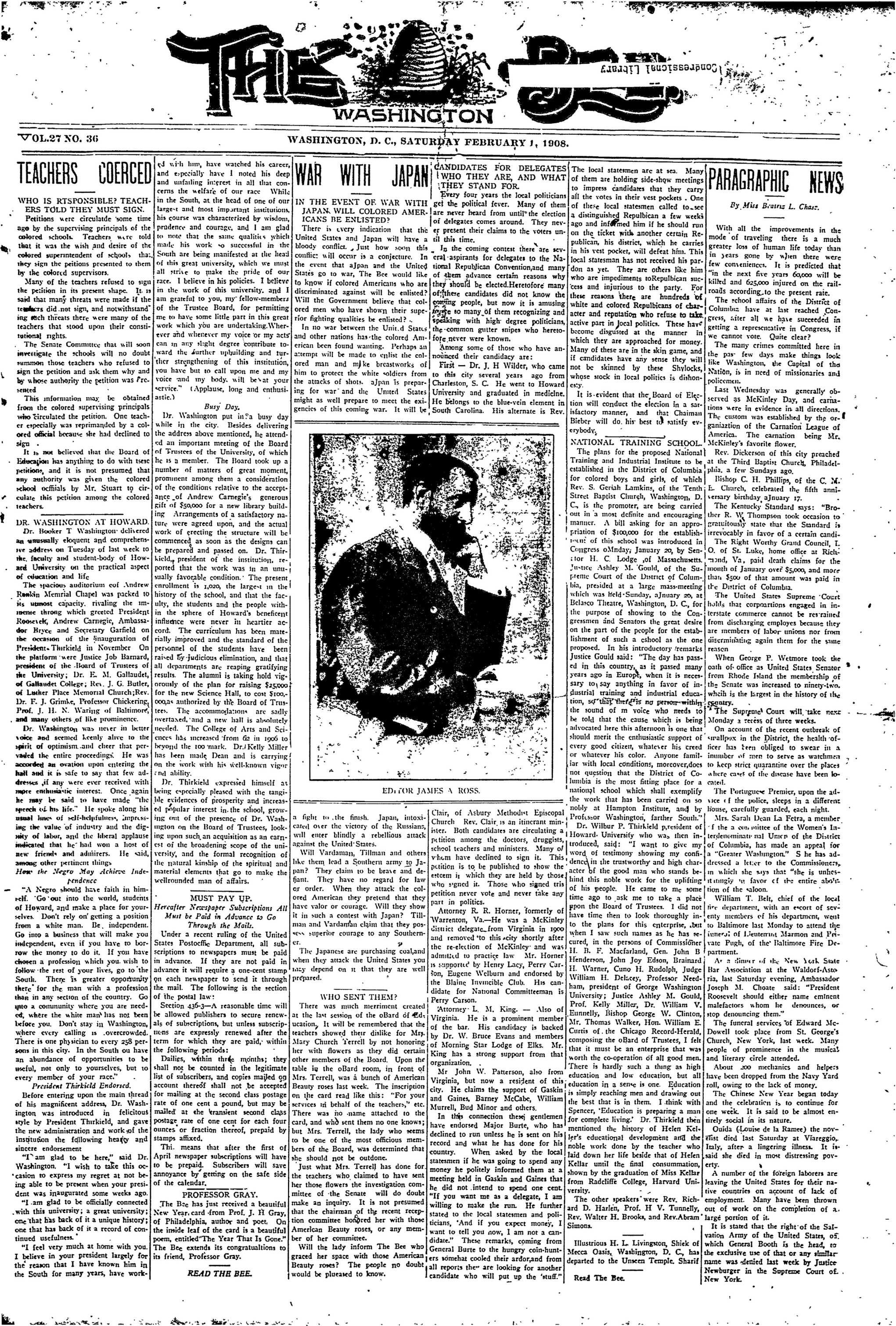
ED. FOR JAMES A ROSS.
a fight to the finish. Japan, intoxicated over the victory of the Russians, will enter blindly a rebellious attack against the United States. Will Vardaman, Tillman and others like them lead a Southern army to Japan? They claim to be brave and defiant. They have no regard for law or order. When they attack the colored American they pretend that they have valor or courage. Will they show it in such a contest with Japan? Tillman and Vardaman claim that they possess superior courage to any Southerner. The Japanese are purchasing coal and when they attack the United States you may depend on it that they are well prepared.
There was much merriment created at the last session of the oBard of education. It will be remembered that the teachers showed their dislike for Mrs. Mary Church Terrell by not honoring her with flowers as they did certain other members of the Board. Upon the table in the oBard room, in front of Mrs. Terrell, was a bunch of American Beauty roses last week. The inscription on the card read like this: "For your services in behalf of the teachers," etc. There was no name attached to the card, and who sent them no one knows; but Mrs. Terrell, the lady who seems to be one of the most officious members of the Board, was determined that she should not be outdone.
Just what Mrs. Terrell has done for the teachers who claimed to have sent her those flowers the investigation committee of the Senate will do doubt make an inquiry. It is not presumed that the chairman of the recent reception committee honored her with those American Beauty roses, or any member of her committee.
Will the lady inform The Bee who graced her space with those American Beauty roses? The people no doubt would be plueased to know.
WHO SENT THEM?
CANDIDATES FOR DELEGATES WHO THEY ARE, AND WHAT THEY STAND FOR.
Every four years the local politicians get the political fever. Many of them are never heard from until the election of delegates comes around. They never present their claims to the voters until this time.
In the coming contest there are several aspirants for delegates to the National Republican Convention, and many of them advance certain reasons why they should be elected.Heretofore many of these candidates did not know the coming people, but now it is amusing more so many of them recognizing and speaking with high degree politicians, the common gutter snipes who heretofore never were known.
Among some of those who have announced their candidacy are:
First — Dr. J. H Wilder, who came to this city several years ago from Charleston, S. C. He went to Howard University and graduated in medicine. He belongs to the blue-vein element in South Carolina. His alternate is Rey.
THE NEW YORK TIMES
Clair, of Asbury Methodist Episcopal Church Rev. Clair, is an itinerant minister. Both candidates are circulating a petition among the doctors, druggists, school teachers and ministers. Many of whom have declined to sign it. This petition is to be published to show the esteem it which they are held by those who signed it. Those who signed this petition never vote and never take any part in politics.
Attorney R. R. Horner, formerly of Warrenton, Va.-He was a McKinley district delegate from Virginia in 1900 and removed to this city shortly after the re-election of McKinley and was admitted to practice law Mr. Horner is supported by Henry Lacy, Perry Carson, Eugene Welburn and endorsed by the Blaine Invincible Club. His candidate for National Committeeman is Perry Carson.
Attorney L. M. King. — Also of Virginia. He is a prominent member of the bar. His candidacy is backed by Dr. W. Bruce Evans and members of Morning Star Lodge of Elks. Mr. King has a strong support from that organization.
Mr John W. Patterson, also from Virginia, but now a resident of this city. He claims the support of Gaskin and Gaines, Barney McCabe, William Murrell, Bud Minor and others.
In this connection these gentlemen have endorsed Major Burte, who has declined to run unless he is sent on his record and what he has done for his country. When asked by the local statesmen if he was going to spend any money he politely informed them at a meeting held in Gaskin and Gaines that he did not intend to spend one cent. "If you want me as a delegate, I am willing to make the run. He further stated to the local statesmen and politicians, 'And if you expect money, I want to tell you now, I am not a candidate.' These remarks, coming from General Burte to the hungry coin-hunters somehat cooled their ardor, and from all reports they are looking for another candidate who will put up the 'stuff."
The local statesmen are at sea. Many of them are holding side-show meetings to impress candidates that they carry all the votes in their vest pockets. One of these local statesmen called to see a distinguished Republiican a few weeks ago and informed him if he should run on the ticket with another certain Republiican, his district, which he carries in his vest pocket, will defeat him. This local statesman has not received his pardon as yet. Ther are others like him who are impediments to Republiican success and injurious to the party. For these reasons there are hundreds of white and colored Republiicans of character and reputation who refuse to take active part in local politics. These have become disgusted at the manner in which they are approached for money. Many of these are in the skin game, and if candidates have any sense they will not be skinned by these Shvlocks, whose stock in local politics is dishonesty.
It is evident that the Board of Election will conduct the election in a satisfactory manner, and that Chaiman Bieber will do his best to satisfy everybody.
NATIONAL TRAINING SCHOOL.
The plans for the proposed National Training and Industrial Institute to be established in the District of Columbia for colored boys and girls, of which Rev. S. Geriah Lamkins, of the Tenth Street Baptist Church, Washington, D.C. is the promoter, are being carried out in a most definite and encouraging manner. A bill asking for an appropriation of $100,000 for the establishment of this school was introduced in Congress oMnday; January 20, by Senator H. C. Lodge, of Massachusetts. Justice Ashley M. Gould, of the Supreme Court of the District of Columbia, presided at a large mass-meeting which was held-Sunday, a January 20, at Belasco Theatre, Washington, D.C., for the purpose of showing to the Congressmen and Senators the great desire on the part of the people for the establishment of such a school as the one proposed. In his introductory remarks Justice Gould said: "The day has passed in this country, as it passed many years ago in Europe, when it is necessary to say anything in favor of industrial training and industrial education, so that there is no person within the sound of m voice who needs to be told that the cause which is being advocated here this afternoon is one that should merit the enthusiastic support of every good citizen, whatever his creed or whatever his color. Anyone familiar with local conditions, moreover, does not question that the District of Columbia is the most fitting place for a national school which shall
the work that has been carried on so nobly at Hampton Institute, and by Professor Washington, farther South." Dr. Wilbur P. Thirkield president of Howard University who was then introduced, said: "I want to give my word of testimony showing my confidence in the trustworthy and high character of the good man who stands behind this noble work for the uplifting of his people. He came to me some time ago to ask me to take a place upon the Board of Trustees. I did not have time then to look thoroughly into the plans for this enterprise, but when I saw such names as he has secured, in the persons of Commissioner H. B. F. Macfarland, Gen. John B Henderson, John Joy Edson, Brainard H. Warner, Cuno H. Rudolph, Judge William H. Delacey, Professor Needham, president of George Washington University; Justice Ashley M. Gould, Prof. Kelly Miller, Dr. William V. Eunnelly, Bishop George W. Clinton, Mr. Thomas Walker, Hon. William E. Curtis of the Chicago Record-Herald, composing the obard of Trustees, I felt that it must be an enterprise that was worth the co-operation of all good men. There is hardly such a thing as high education and low education, but all education in a sense is one. Education is simply reaching men and drawing out the best that is in them. I think with Spencer, 'Education is preparing a man for complete living.' Dr. Thirkield then mentioned the history of Helen Keller's educational development and the noble work done by the teacher who laid down her life beside that of Helen Kellar until the final consummation, shown by the graduation of Miss Kellar from Radcliffe College, Harvard University.
The other speakers were Rev. Richard D. Harlen, Prof. H V. Tunnelly, Rev. Walter H. Brooks, and Rev.Abram Simons.
Illustrious H. L. Livingston, Shiek of Mecca Oasis, Washington, D. C., has departed to the Unseen Temple. Sharif
Read The Bee.
PARAGRAPHIC NEWS
PARAGRAPHIC NEWS
With all the improvements in the mode of traveling there is a much greater loss of human life today than in years gone by when there were few conveniences. It is predicted that "in the next five years 60,000 will be killed and 625,000 injured on the railroads according to the present rate. The school affairs of the District of Columbia have at last reached Congress, after all we have succeeded in getting a representative in Congress, if we cannot vote. Quite clear? The many crimes committed here in the past few days make things look like Washington, the Capital of the Nation, is in need of missionaries and policemen. Last Wednesday was generally observed as McKinley Day, and carnations were in evidence in all directions. The custom was established by the organization of the Carnation League of America. The carnation being Mr. McKinley's favorite flower.
Rev. Dickerson of this city preached at the Third Baptist Church, Philadelphia, a few Sundays ago.
Bishop C. H. Phillips, of the C. M. E. Church, celebrated the fifth anniversary birthday, January 17.
The Kentucky Standard says: "Brother R. W. Thompson took occasion to gratitiously state that the Standard is irrevocably in favor of a certain candidate.
The Right Worthy Grand Council, L. O. of St. Luke, home office at Richmond, Va., paid death claims for the month of January over $5,000, and more than $500 of that amount was paid in the District of Columbia.
The United States Supreme Court holds that corporations engaged in interstate commerce cannot be restrained from discharging employees because they are members of labor unions nor from discriminating again them for the same reason.
When George P. Wetmore took the oath of office as United States Senator from Rhode Island the membership of the Senate was increased to ninety-two, which is the largest in the history of the country.
The Supreme Court will take next Monday a recess of three weeks.
On account of the recent outbreak of smallpox in the District, the health officer has been obliged to swear in a number of men to serve as watchmen to keep strict quarantine over the places where cases of the disease have been located.
The Portuguese Premier, upon the advice of the police, sleeps in a different house, carefully guarded, each night.
Mrs. Sarah Dean La Fetra, a member of the a committee of the Women's Interdenominational Union of the District of Columbia, has made an appeal for a "Greater Washington." S he has addressed a letter to the Commissioners, in which she says that "she is unhesitably in favor of the entire abolition of the saloon.
William T. Belt, chief of the local fire department, with an escort of seventy members of his department, went to Baltimore last Monday to attend the innerval of Lieutenant Marmon and Private Pugh, of the Baltimore Fire Department.
As a dinner of the New York State Bar Association at the Waldorf-Astoria, last Saturday evening, Ambassador Joseph M. Choate said: "President Roosevelt should either name eminent malefactors whom he denounces, or stop denouncing them."
The funeral services of Edward McDowell took place from St. George's Church, New York, last week. Many people of prominence in the musical and literary circle attended.
About 200 mechanics and helpers have been dropped from the Navy Yard roll, owing to the lack of money.
The Chinese New Year began today and the celebration is to continue for one week. It is said to be almost entirely social in its nature.
Ouida (Louise de la Ramee) the novelist died last Saturday at Viareggio, Italy, after a lingering illness. It is said she died in most distressing poverty.
A number of the foreign laborers are leaving the United States for their native countries on account of lack of employment. Many have been thrown out of work on the completion of a large portion of it. It is stated that the right of the Salvation Army of the United States, of which General Booth is the head, to the exclusive use of that or any similar name was denied last week by Justice Newburger in the Supreme Court of New York.
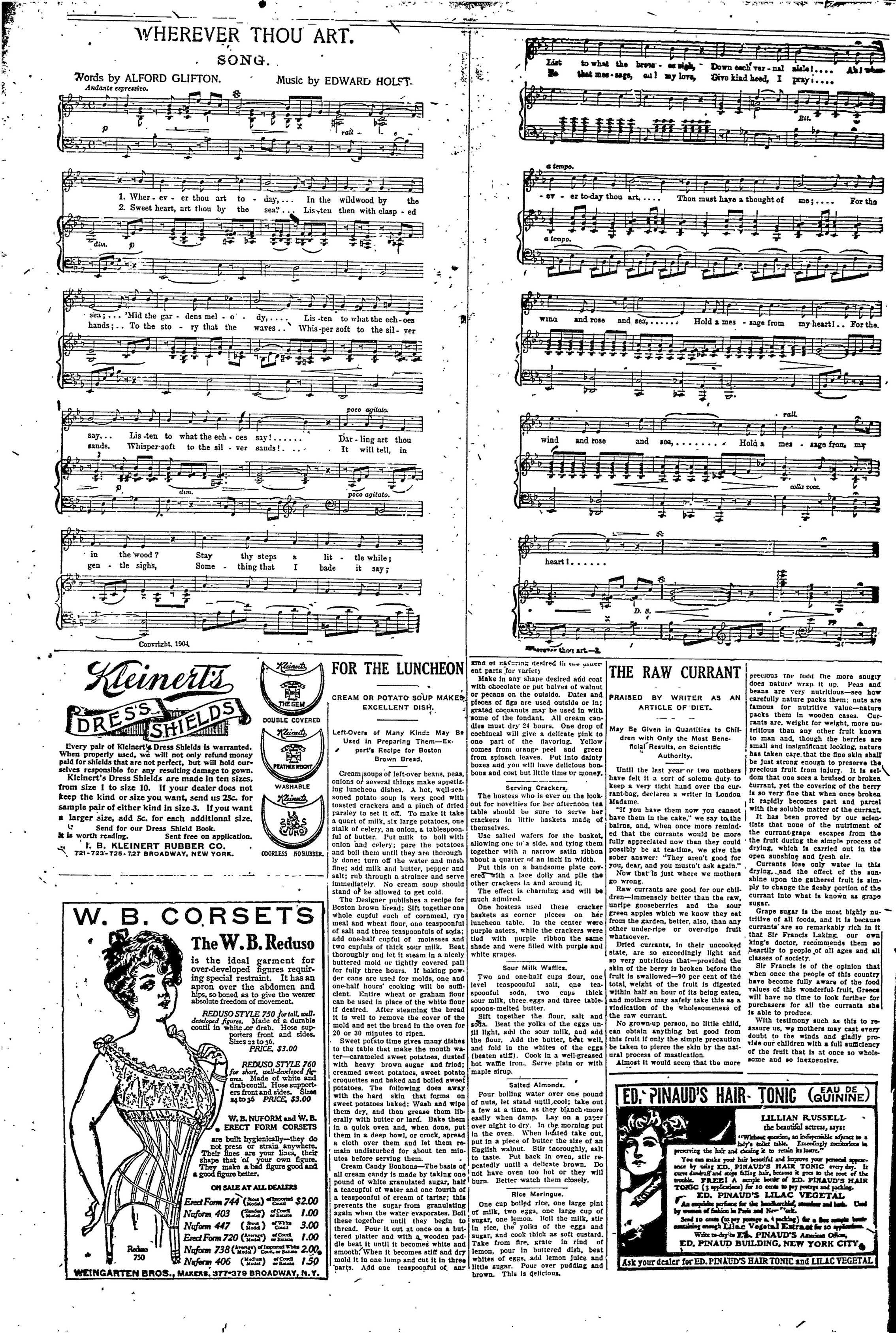
Words by ALFORD GLIFTON.
Andante espressivo.
1. Wherever thou art today, ... In the wildwood by the
2. Sweet heart, art thou by the sea? ... Listen then with clasped
sea; ... Mid the gardens melody, ... Listen to what the ech-oes
hands; ... To the story that the waves ... Whisper soft to the silver
say, ... Listen to what the ech-oes say! ... Dar-ling art thou
sands. Whisper soft to the silver sands! ... It will tell, in
in the wood? Stay thy steps a little while;
gentle sighs, Some thing that I bade it say;
Convright. 1904
Kleinert's DRESS SHIELDS
Kleinets
THE GEM
DOUBLE COVERED
Kleinets
FEATHER WDGHT
WASHABLE
Kleinets
2 S
LUNO
DOUBLE COVERED
Every pair of Kleinert's Dress Shields is warranted. When properly used, we will not only refund money paid for shields that are not perfect, but will hold ourselves responsible for any resulting damage to gown.
Kleinert's Dress Shields are made in ten sizes, from size 1 to size 10. If your dealer does not keep the kind or size you want, send us 25c. for sample pair of either kind in size 3. If you want a larger size, add 5c. for each additional size.
Send for our Dress Shield Book.
It is worth reading. Sent free on application.
I. B. KLEINERT RUBBER CO.
721-723-728-727 BROADWAY, NEW YORK.
W. B. CORSETS
The W.B. Reduso
is the ideal garment for over-developed figures requiring special restraint. It has an apron over the abdomen and hips, so boned as to give the wearer absolute freedom of movement.
REDUSO STYLE 750 for tall, well-developed figures. Made of a durable contil in white or drab. Hose supporters front and sides. Sizes 22 to 36.
PRICE, $3.00
REDUSO STYLE 760 for short, well-developed figures. Made of white and drab contil. Hose supporters front and sides. Sizes 24 to 36 PRICE, $3.00
W. B. NUFORM and W. B. ERECT FORM CORSETS
are built hygienically—they do not press or strain anywhere. Their lines are your lines, their shape that of your own figure. They make a bad figure good and a good figure better.
ON SALE AT ALL DEALERS
Erect Form 744 (Short Model) of Imported Contil $2.00
Nuform 403 (Slender Model) of Contil or Batista 1.00
Nuform 447 (Short Model) of White Contil 3.00
Erect Form 720 (Average Model) of Contil or Batista 1.00
Nuform 738 (Average Model) of Imported White Contil or Batista 2.00
Nuform 406 (Medium Model) of Contil or Batista 1.50
WEINGARTEN BROS., MAKERS, 377-379 BROADWAY, N.Y.
FOR THE LUNCHEON
CREAM OR POTATO SOUP MAKES EXCELLENT DISH.
Left-Overs of Many Kinds May Be Used in Preparing Them—Expert's Recipe for Boston Brown Bread.
Cream soups of left-over beans, peas, onions or several things make appetizing luncheon dishes. A hot, well-seasoned potato soup is very good with toasted crackers and a pinch of dried parsley to set it off. To make it take a quart of milk, six large potatoes, one stalk of celery, an onion, a tablespoonful of butter. Put milk to boil with onion and celery; pare the potatoes and boil them until they are thoroughly done; turn off the water and mash fine; add milk and butter, pepper and salt; rub through a strainer and serve immediately. No cream soup should stand of be allowed to get cold.
The Designer publishes a recipe for Boston brown bread: Slift together one whole cupful each of cornmeal, rye meal and wheat flour, one teaspoonful of salt and three teaspoonfuls of soda; add one-half cupful of molasses and two cupfuls of thick sour milk. Beat thoroughly and let it steam in a nicely buttered mold or tightly covered pail for fully three hours. If baking powder cans are used for molds, one and one-half hours' cooking will be sufficient. Entire wheat or graham flour can be used in place of the white flour if desired. After steaming the bread it is well to remove the cover of the mold and set the bread in the oven for 20 or 30 minutes to ripen.
Sweet potato time gives many dishes to the table that make the mouth water—carameled sweet potatoes, dusted with heavy brown sugar and fried; creamed sweet potatoes, sweet potato croquettes and baked and boiled sweet potatoes. The following does away with the hard skin that forms on sweet potatoes baked; Wash and wipe them dry, and then grease them liberally with butter or lard. Bake them in a quick oven and, when done, put them in a deep bowl, or crock, spread a cloth over them and let them remain undisturbed for about ten minutes before serving them.
Cream Candy Bonbons—The basis of all cream candy is made by taking one pound of white granulated sugar, half a teacupful of water and one fourth of a teaspoonful of cream of tartar; this prevents the sugar from granulating again when the water evaporates. Boll these together until they begin to thread. Pour it out at once on a buttered platter and with a wooden paddle beat it until it becomes white and smooth. When it becomes stiff and dry mold it in one lump and cut it in three parts. Add one teaspoonful of an
List to what the breast is high, Down each vernal sigh! ... All when
be that message, call my love, Give kind heed, I pray! ...
a tempo.
ever to-day thou art ... Thou must have a thought of me; ... For the
a tempo.
wine and rose and sea, ... Hold a message from my heart! ... For the.
rall.
wind and rose and sea, ... Hold a message from my
colla rose.
heart! ...
kind or macerating desired in the puer-
ent parts for variety
Make in any shape desired and coat
with chocolate or put halves of walnut
or pecans on the outside. Dates and
pieces of figs are used outside or in;
grated cocoanuts may be used in with
some of the fondant. All cream candies
must dry 24 hours. One drop of
cochineal will give a delicate pink to
one part of the flavoring. Yellow
comes from orange peel and green
from spinach leaves. Put into dainty
boxes and you will have delicious bon-
bons and cost but little time or money.
Serving Crackers.
The hostess who is ever on the lookout for novelties for her afternoon tea table should be sure to serve her crackers in little baskets made of themselves.
Use salted wafers for the basket, allowing one to a side, and tying them together with a narrow satin ribbon about a quarter of an inch in width.
Put this on a handsome plate covered with a lace dolly and pile the other crackers in and around it.
The effect is charming and will be much admired.
One hostess used these cracker baskets as corner pieces on her luncheon table. In the center were purple asters, while the crackers were tled with purple ribbon the same shade and were filled with purple and white grapes.
Sour Milk Waffles.
Two and one-half cups flour, one level teaspoonful salt, one teaspoonful soda, two cups thick sour milk, three eggs and three tablespoons-melted butter. Sift together the flour, salt and soda. Beat the yolks of the eggs until light, add the sour milk, and add the flour. Add the butter, beat well, and fold in the whites of the eggs (beaten stiff). Cook in a well-greased hot waffle iron. Serve plain or with maple syrup.
Salted Almonds.
Pour boiling water over one pound of nuts, let stand until cool; take out a few at a time, as they blanch more easily when damp. Lay on a paper over night to dry. In the morning put in the oven. When located take out, put in a piece of butter the size of an English walnut. Stir thoroughly, salt to taste. Put back in oven, stir repeatedly until a delicate brown. Do not have oven too hot or they will burn. Better watch them closely.
Rice Meringue.
One cup boiled rice, one large pint of milk, two eggs, one large cup of sugar, one lemon. Illl the milk, stir in rice, the yolks of the eggs and sugar, and cook thick as soft custard. Take from fire, grate in rind of lemon, pour in buttered dish, beat whites of eggs, add lemon juice and little sugar. Pour over pudding and brown. This is delicious.
ED. PINAUD'S HAIR- TONIC (EAU DE QUININE)
LILLIAN RUSSELL
the beautiful actress, says:
"Without question, an indispensable adjunct to a lady's toilet table. Exceedingly meritorious in preserving the hair and causing it to retain its lustre."
You can make your hair beautiful and improve your personal appearance by using ED. PINAUD'S HAIR TONIC every day. It curts dandruff and stops filling hair, because it goes to the root of the trouble. FREE! A sample bottle of ED. PINAUD'S HAIR TONIC (3 applications) for 10 cents to pay postage and packing.
ED. PINAUD'S LILAC VEGETAL
An explosive perfume for the handkerchief, umbrella and bath. Used by women of fashion in Paris and New York.
Send 10 cents (to pay postage a 1 packing) for a free sample bottle containing enough Lilac Vegetal Extract for 10 applications.
Write to day in ED. PINAUD'S American Office.
ED. PINAUD BUILDING, NEW YORK CITY
Ask your dealer for ED. PINAUD'S HAIR TONIC and LILAC VEGETAL
THE RAW CURRANT
PRAISED BY WRITER AS AN ARTICLE OF DIET.
May Be Given in Quantities to Children with Only the Most Beneficial Results, on Scientific Authority.
Until the last year or two mothers have felt it a sort of solemn duty to keep a very tight hand over the currant-bag, declares a writer in London Madame.
"If you have them now you cannot have them in the cake," we say to the bairns, and, when once more reminded that the currants would be more fully appreciated now than they could possibly be at tea-time, we give the sober answer: "They aren't good for you, dear, and you mustn't ask again."
Now that is just where we mothers go wrong.
Raw currants are good for our children—immensely better than the raw, unripe gooseberries and the sour green apples which we know they eat from the garden, better, also, than any other under-ripe or over-ripe fruit whatsoever.
Dried currants, in their uncooked state, are so exceedingly light and so very nutritious that—provided the skin of the berry is broken before the fruit is swallowed—90 per cent of the total, weight of the fruit is digested within half an hour of its being eaten, and mothers may safely take this as a vindication of the wholesomeness of the raw currant.
No grown-up person, no little child, can obtain anything but good from this fruit if only the simple precaution be taken to pierce the skin by the natural process of mastication. Almost it would seem that the more
precious the food the more snugly does nature wrap it up. Peas and beans are very nutritious—see how carefully nature packs them; nuts are famous for nutritive value—nature packs them in wooden cases. Currants are, weight for weight, more nutritious than any other fruit known to man and, though the berries are small and insignificant looking, nature has taken care, that the fine skin shall be just strong enough to preserve the precious fruit from injury. It is seldom that one sees a bruised or broken currant, yet the covering of the berry is so very fine that when once broken it rapidly becomes part and parcel with the soluble matter of the currant. It has been proved by our scientists that none of the nutritment of the currant-grape escapes from the fruit during the simple process of drying, which is carried out in the open sunshine and fresh air.
Currants lose only water in this drying, and the effect of the sunshine upon the gathered fruit is simply to change the fleshy portion of the currant into what is known as grape sugar.
Grape sugar is the most highly nutritive of all foods, and it is because currants are so remarkably rich in it that Sir Francis Laking, our own king's doctor, recommends them so heartily to people of all ages and all classes of society.
Sir Francis is of the opinion that when once the people of this country have become fully aware of the food values of this wonderful fruit, Greeces will have no time to look further for purchasers for all the currants she is able to produce.
With testimony such as this to reassure us, wg mothers may cast every doubt to the winds and gladly provide our children with a full sufficiency of the fruit that is at once so wholesome and so inexpensive.
MAGALL PATTERN
10
15
MAGALL MAGAZINE
50
YEAR
MAGALL PATTERN
There are now Magall Magazines sold in the Duke of Boston than any paper made in 50 patterns. This is no account of their style, quantity and thickness.
Magall Magazines The Company of Practical Jewelry subsistency than any other Magazine. One must be subsistency than any other Magazine. One must be subsistency than any other Magazine. Every subsistency gets a Magall Pattern Few. Ensemble today.
THE BEE AND McCALL'S GREAT FASHION MAGAZINE
for one year for $2.00.
COUPO...
Editor Bee:—
Find enclosed two dollars. Send to my address below The Bee and McCall's Fashion Magazine for one year.
No.....
Street.....
Town or City....
BUY THE
NEW HOME
SEwing MACHINE
Before You Purchase Any Other Write
THE NEW HOME SEWING MACHINE COMPANY
ORANGE, MASS.
Many Sewing Machines are made to sell regard-
ness of quality, but the "New Home" is made
wear. Our guaranty never runs out.
We make Sewing Machines to suit all conditions of the trade. The "New Home" stands at the head of all High-grade family sewing machines sold by authorized dealers only.
FULL DRESS AND TUXEDO SUITS.
$1.00-For Hire-$1.00.
Julius Cohen,
1104 7th street, N. W.
WE DO BUSINESS AT ONE PRICE
Misfit Cloth-
ing Parlor;
Fine Germents (Slightly Worn) Made by Our Leading Tailors. JUSTH'S OLD STAND. Established 1865. 619 D St. N. W. NEW YORK CLIPPER
IS THE GREATEST
THEATRICAL SHOW PAPER
IN THE WORLD.
24.00 Per Year. Single Copy, 10 Cm.
HOUSED WEEKLY.
BAMPLE COPY FREE
FRANK QUEEN PUB. CO. (Ltd.)
PUBLISHERS
MARSHAL W. 50TH ST. NOVEMBER
Mme. Davis,
A
BORN CLAIRVOYANT AND
CARD READER.
TELLS ABOUT BUSINESS.
Removes Spells and Evil Influencer.
Reunites the Separated, and
Gives Luck to All.
1248 25th St. N.W., Washington, D. C.
N. B.—No letters answered unless
accompanied by stamp.
N. B.—Mention The Bee.
ROOMS FOR RENT.
Large, comfortable furnished booms fo neither ladies or gentlemen, 1207 K street northeast.
Furnished rooms for rent at 1117% 5th street, N. W.
Front Parlor suitable for a doctor and a back bedroom, 1410 First street, N. W.
Annual Annoucement
J.
Our stock of Jewelry and Bric-a-brac is now complete. Each individual piece has been carefully selected and we feel satisfied thata visit from you will bear us out that we have as fine a selection ascan be found anywhere. Why not give us a call tomorrow? Any article that you may select will be laid aside and deliveredwhen wanted. Experienced clerks. Polite attention.
F-757
Prices in the Diamond market are advancing, but OUR PRICES HAVE'NT BEEN ADVANCED in some time. We still have a large collection of superb Diamonds which we bought a considerable time ago at lower prices than prevail today. We shall not advance prices on these stones. We are merchants and not speculators, and our fair percentage of profit is all we ask. So, as long as these Diamonds last, it will be possible to buy them here under the regular market for
REMEDY FOR TORN MATTING.
Darn with Colors of RaMa to Match Straw.
Often in moving a heavy piece of furniture the matting on the floor will have an ugly hole torn in it. The torn place is usually where it is the most noticeable and cannot be covered with a rug. There is an excellent way to remedy this defect by darning the place with raffia of colors to match the matting straw. It is much better than threads and the work can be neatly done. It may be necessary to run heavy cords across the work through which the raffia is to be woven. The threads are sewed in place with a large darning needle. Torn places on the edge of matting can be remedied in the same manner. It is best to sew matting together with a loose stitch, using very heavy linen thread for the purpose, but where this cannot be done then use the regular matting tacks or ordinary tacks, placing first one side, then the opposite side to prevent the baggy appearance which so often occurs. Never use a claw hammer to lift tacks from matting, since it invariably breaks the straw. Get an old blunt chisel, place it beneath the matting and tack-head, pound gently with the hammer and pry the tack up. This will draw the tack out straight and leave the matting unbroken. If matting is used in a room during the winter, cover the floor with paper covering and pad lightly with newspapers. The cold air cannot penetrate a floor covering of that kind.
VARIETY OF THE CAKE MAKER
Meant to Satisfy Longing for "Some- thing Different."-
Instead of cooking all the sugar or ginger cookies the same size try cutting some out with small cans, baking the same as larger cookies.
Make a boiled frosting of one cup of sugar and a little water, boiled until it will thread, and then poured slowly over the beaten whites of two eggs. Beat until cold. Flavor and spread on small cookies; dip into cocoanut and press two cookies together. This makes a neat little cake, and may be made with colored or chocolate frosting and cocoanut omitted, just as one pleases.
The small round centers of dough left when cutting out doughnuts are nice fried and dipped in the frosting and cocoanut.
If sponge or angel food cake is tough, place in a stone crock or jar, cover carefully, and set in the cellar or cool place for a day or two, at the end of which time the cake will be molat and tender.
The ordinary paper cracker boxes, three by 12 inches in size, are nice to bake loaf cakes in, requiring little fire, and the paraffin paper with which they are lined prevents the cake from sticking.
E.VOIGT MANUFACTURINGJEWELER 725 7th Street, Northwest
Everybody has some friend whom they wish to make happy. It may be mother or father, sister or brother. It may be a wife, or it may be a sweetheart — and no better time than Christmas is so appropriate — so suggestive. Nothing makes one feel happier than to gladden the heart of another.
WATCHES
We mention here but a few of our
specials.
Gnetlemen's 20-year Gold Filled Am
ican Stem Winders and Setters, $10.
Ladies' 20-year Gold Filled Stem
Winders and Setters, $10.
Gentlemen's 14-karat Solid Gold
American Stem Winders and Setters, as
cheap as $35.
Children's Solid Silver Watches with
Pin Attachment, $3.50; regular price,
$4.50.
Ladies' Solid Gold Watches, Open
Face, $8.00.
Boys' Solid Silver Watches, $5.00 up.
DIAMONDS.
Put Your Money in Diamonds. No Better Investment Today.
NOW THE FLOWER SANDWICH.
Dainty Morsels Which Are Served at
Debutante Lunchcona and Teas.
The latest wrinkle of the dainty
housekeeper is to serve "flower sand-
wiches" to her guests at an afternoon
tea.
Of course, these deliapacles are exclu-
sively feminine, and no woman is so
foolish as to try to satisfy the mascu-
line appetite with such morsels.
If milady's tea or luncheon table
happens to be decorated with chrysanthem
sandwiches, or if sweet peas, violets,
roses, carnations, prevail in the deco-
rations, she will have her sandwiches
to match.
The fragrance is extracted from the flowers and imparted to the sandwiches by cutting the butter to be used in thin blocks, wrapping it in cheese cloth, smothering it with flowers and letting it stand for several hours in a tightly closed jar. The bread is cut in paper like slices, spread with the perfumed butter and sprinkled with petals of flowers.
The sandwitches are rolled and tied with ribbon to match the flowers. After they have been put back in the jar with the flowers they are served in a veritable bed of blooms, and if they are not the most substantial things in the food line they are at least novel and dalnty, and at present are quite the thing at debutante lunch-ons and teas.
Select a dozep or so of the smoothest and largest splints from the new broom and lay them away to use in testing cake when it is baking.
When cutting bread and butter specially thin, occasionally dip the knife in hot water, and never draw the knife over the same place.
When frying fish of any sort a little salt should be sprinkled on the base of the pan when it is hot and the fat is boiling. The fish can then be easily turned without being broken.
When cooking chops and steaks in a frying-pan or on a gridiron, never thrust a fork into them in order to turn them. If you do the juice will run out and the steak or chop will be hard or dry.
The dripping from roast meat, the skimmings from soups, and rendered down fat from meat trimmings, same the same purpose, when clarified thoroughly as lard or butter. Use beef drippings for basting beef and game, keep mutton dripping for frying cutlets, fish, etc.
Too rapid bolling makes most vegetables tough. As a rule vegetables should be cooked uncovered.
Rice and macaroni require fast boiling.
Too much salt in gravy or soup may be counteracted by putting in a pinch of brown sugar.
When finely chopped nuts are needed for salads or sandwiches, run the nuts through the meat chopper.
BETWEEN G'&H
fine stones.
Ladies' Diamond Rings, $5.00 to $150.
Ladies' Diamond Brooches, $5.50 to $1,000.
Diamond Earrings, $15.00 to $500.00.
Diamond Scarf Pins, $7.00 up.
Diamond Cuff Buttons, $7.00 up.
Diamond Studs, $10.00 up.
We have Ladies' Handsome Diamond Rings set in Tiffany Mounting, which we are selling at $30.00. This will make an appropriate present for Christmas.
Every stone a ball of fire.
HINTS FOR THE COOK.
KEYSTONE
D-779
---
Fruit Bread.
The night before you wish to bake, set a cake of yeast with a cupful of potato water. Mix with a little flour like a thin batter, let it stand all night in a warm place; in the morning sift your flour in your pan, then put a quart of warm milk in your flour, then add your yeast and two cups of sugar, one teaspoon salt, one cup of butter, one pound of currants, one pound seedless raisins, one pound of walnuts, one spoon of lemon or vanilla extract, three eggs. Mix it and work in just like you do bread. Then set it in a warm place to rise; when light; shape in small flat loaves, put in pans to rise again, when nice and light butter the top and sprinkle with sugar and cinnamon, or leave plain; then bake until a light brown in a not too hot oven. This you can keep for a whole week and it won't dry out.
Pumpkin Pie.
Three pounds of pumpkin, six ounces of butter, six eggs, three tablespoonfuls of wine, two of brandy, the rind and juice of one lemon, as much cinnamon as can be put on a dime.
Cut the pumpkin in slices, pare it, take out the seeds and soft parts, cut it into small pieces and stew in a small quantity of water until tender. Then press in a colander until dry.
Turn it out in a pan, put in the butter and salt and mash fine.
When cool whisk the eggs until light and stir in, add sugar to taste, also the brandy, wine and cinnamon.
This is sufficient for three or four pies.
Line the plates with paste and bake in a quick oven.
Candied Oranges.
Candied orange is a great delicacy and the housewife will find these are nice to serve with the last course of dinner.
Peel and quarter the oranges, make a sipup in the proportion of one pound of sugar to one pint of water. Let it boil until it will harden in water; then take it from the fire and dip the quarters of oranges into the sipup; let them drain on a fine sieve placed over a platter, so that the sipup will not be wasted. Let them drain until cool, when the sugar will crystallize.
Spanish Salad.
Four large cucumbers.
One bunch celery.
Three large onions.
Four large tomatoes.
Two heads lettuce.
Two green peppers.
Chop each separately until flas, then mix together and season with one tablespoonful of vinegar, juice of one lemon, salt and pepper.
Boll a cupful of rice, line a buttered pan with the rice while hot. When sold all center with chopped cooked meat of any kind, season wall, add gravy. Set in pan of water and hake one-half or three-quarters of an hour. Turn out on a dish and serve with tomato sauce.
W.SidneyPittman Architect
RENDERING IN PATENT DRAWINGS
MONOTONE, WATER COLOR DRAFTING, DETAILING, TRAC
AND PEN & INK BLUE PRINTING
STEEL CONSTRUCTION A SPECIALTY.
Phone: Main 6059-M Office 494 Louisiana Ave., N.W.
Leland Giants Base-Ball and Amusement Assn.
Now Organizing—Capital Stock
$100,000
The Stock-Holders of the Leland Giants Base-Ball Association, has concluded to dissolve that Association in order to give room for the former, with it's increased Capital for the purpose of buying a Permanent Home For The Leland Giants Base-Ball Club and Establishing For All The People, The Only First Class, Up-To-Date Amusement Park, With It's Theater (Light Opera), Figure Eight, Shoot The Chutes, Minature Ry, Electric Theater, Dance Pavillion, Roller Skating, Hurley Burley, Double Swing, Boating, Auto Riding, and all the latest fun making devices and laugh producing concessions, together with a First Class Summer Hotel, large enough to accommodate 1000 guests, at it's present location, 79th and Wentworth Ave., twenty (20) minutes ride on the Electric Cars to the Loop District in Chicago.
The Public is Base-Ball mad, and amusement Crazy. Stocks have doubled in value in a single season. Millions can be made by those Who Take Stock In This New Enterprise.
Are You In Favor Of The Race Owning And Operating This Imense And Well Paying Plant. Where More Than 1,000 Persons Will Be Employed, between May and October of each year, where you can come without fear and Enjoy The Life and Freedom of a Citizen unmolested or annoyed? The Answer can only be effectively given by subscribing for Stock in this Corporation. it has been made purposely low so that all Loyal Members of the Race can have a. Share and Interest in this Twentieth Century Enterprise. Think of it, Shares Only Ten (10,00) Dollars Each. You Squander More than this amount Any Holiday around Amusement Parks and Public Places, where you are not wanted and never welcome. Come! buy and build one of your own by filling out the attached Coupon and mail with Ten Dollars to the Leland Giants Base-Ball and Amusement Association. Do it to-day so that we may commence to build.
which I am sending as Part (or infull) as subscription shares of the Capital Stock of the Leland Giants Association.
I agree to pay $... per $... has been paid, at which certificate.
N B.
All payments on Stock Accounts must be made to the order of Beauregard F. Mossley, Treasurer, 6258 Halsted Street, Chicago, Illinois. All Stockholders are entitled to preferance as employees and should inform the Treasurer with their final remittance of their intentions to apply for employment.
For further information address Leland Giants Base-Ball and Amusement Assn. 6258 Halsted St. Chicago, Ill.
Name
Address
City
State
J H DAE
FUNERAL DIRECTOR
Hiring, Levery and Sale
Carriages hired for funerals, parties, ball
Horses and carriages kept in first-class anteed. Business at 1132 Third street now at 222 More street, Alexandria, Va.
James H. Winslow
UNDERTAKER AND PRACTICAL EMBALMER. ALL WORK IN CLASS. TERMS MOST REASONABLE.
J H DABNEY
Carriage fired for funerals, parties, balls, receptions, etc. Horses and carriages kept in first-class style. Satisfaction guaranteed. Business at 1132 Third street northwest. Main office branch at 222 More street. Alexandria, Va. Telephone for Office. Main 1727. Telephone call for Stable. Main 1428-5.
OUR STABLES IN FREEM
Where I can accommodate 50 Horses.
Call and inspect our new and modern st
J H DARNEY Pron.. 1632
A·HIGH·DE
ES IN FREEMAN'S ALLEY.
e 50 Horses.
w and modern stable.
V. Prom.. 1632 Third Street N. W.
H·DEGRE
OF SATISFACTION IS A RARE THING IN MOST $3.00 SHOES. SHOES AT THIS PRICE USUALLY LACK STYLE OR COMFORT OR BOTH.
THE STYLE
PENSIVE SH
SOLID VALU
IN OUR
SIGNET SH
because of the excep
stowed on the making
ness in it anywhere la
because of the exceptional attention be- stowed on the making. The only cheap- ness in it anywhere is the price. A Goodyear-welted shoe, made on sere- ral of the season's handsomest lasts, in the most popular leathers. Looks first rate and wears that way every time. It's worth your while to come in and look the Signet over, even if you're not ready to buy. Always welcome.
Mr Beauregard F. Moseley; Treas:~
THE BEE
PUBLISHER
1109 Eye St., N. W., Washington, D. C.
W. CALVIN CHASE, EDITOR.
Entered at the Post Office at Washington, D. C., as second-class trail matter.
ESTABLISHED 1880.
TERMS OF SUBSCRIPTION.
One copy per year in advance.....$2.00
Six months .....1.00
Three months ......50
Subscription monthly ......20
CRIME
CKIME.
Is crime on the increase? What has Emancipation done for the young Negro? Does he increase in crime? To, these three questions The Bee will address itself.
Crime is on the increase among the young Negroes, and to remedy the evil, what must be done? The law must be forcibly enforced and the punishment must be of the character that will be effective. Within the last few days there have been a number of offenses committed which have been shocking to the community. These offenses are the best argument for additional officers asked for by the Chief of Police. Emancipation of certain Negroes has been a cuse to the race. These offenses are attributable to the young Negro who has no regard for books or good morals. The schoolhouse seems to be an impediment to his progress. Drastic measures should be taken to compel all idlers to work, no matter who they may be. The vragrant laws should be more strictly enforced, and all loafers around and in bar rooms should be arrested immediately, convisted, and sent to the Workhouse. All idle and disorderly persons should not be allowed under any circumstances to be upon the public streets.
The intelligent and best behaved colored citizens must be held responsible for crimes committed by the inferior classes. It seems to The Bee that crime is on the increase among the younger element in the Negro race. Something must be done, or else the race will be damned and held responsible for these young Negro criminals.
The Bee does not mean to be understood that the young Negro is responsible for every crime committed in this city. He commits some of the most brutal at times that shock society. Here is where the hypocritical Negro pulpit now should do its duty. Instead of its making itself a "jim crow" annex to these so-called white temperance organizations it should condemn these atrocious crimes among its people. Instead of appealing every Sunday to the people for money to send the Negro minister abroad to frolic he should be reforming bad neighborhoods. There is too much sham among these so-called temperance advocates. The whiskey drinkers are as often found in the pulpit as they are found in any other place. Sham reformers are found in the pulpit and there is where you will find crime also.
DOES THIS MEAN REBELLION?
"The South has not changed." asserted Representative Heifn in an address, and amid a storm of applause, at the celebration in the honor of the one hundred and first birthday anniversary of Gen. Robert E. Lee, given by Camp 171, United Confederate Veterans, at Mount eVron Pace Methodist Episcopal Church, South. The South may believe in the doctrine of State rights, it may believe that the faithful colored Americans who have served the Confederacy should be
destroyed also. But is this fair? The great question that seems to worry the Southern white man is the social question. If he would divorce this question from his mind The Bee is of the opinion that the poor white man in the South would rest at ease. It is the poor white man who seems to be worried. The South is paralyzed by a prejudice that has found root in the ignorant classes of whites.
Representative J. T. Heflin of Alabama is mistaken in his premises and conclusions. The Bee does not believe that ex-Auditor Petty entertains the same ideas that Mr. Heflin does. The Bee doesn't believe that Mr. Petty has any race prejudice, because he has on more than one occasion spoken in the highest terms of the colored Americans. He has commended the colored clerks in his office, namely Mr. Warner and the son of the late John M. Langston. His name may be mentioned among those who were responsible for the invitation sent to Mr. Heflin, but because she was one of the committee to invite him The Bee will not presume that he subscribes to his doctrine.
The South cannot blindly follow the teachings of this Alabama Representative. If we believe what Mr. Heflin has stated we must believe that the South believes in slavery. But listen: "There is no newSouth, it is the same old South." This is what Mr. Heflin said, and this is what he means. If it is the same old South, then he believes in rebellion. If it is not a new South, he believes in slavery and rebellion. Certainly, Mr. Petty doesn't believe in what Mr. Heflin has asserted. No man who occupies a position under our Government will say that he believes in the oldSouth which means rebellion and secession.
The South must surrender and return to Caesar the things that are Caesar's, and to God the things that are God's.
WHERE ARE THEY? Some few months ago the Northern colored man stood upon the housetops shouting for Senator J. B. Foraker. The fight that he was making for human liberty was then being applauded and those who stood for the policies of the President were damned. Today those who were shouting have silently closed their months and the Senator from Ohio seems to be standing alone battling for the independence of the colored Americans.
Will the colored Americans permit their best friend in the Senate to retire in darkness and remain a reculse? If there ever was any gratitude in the colored Americans they should show it now! This is the lime and the hour. Where does the colored American stand? The colored South seems to stand where it always stood. There are a few in the North who don't believe in the policies of the President, but, like many others, it is hard to ascertain where they stand. Many are holding out their hands in the hope of having placed there a bait that will tend to change their already fixed opinion.
The question now is, What position will colored Americans take in the coming contest? Will they alhere to their first opinion at the time the President disbanded the colored companies, or have they changed by virtue of the blandishments of official power? Colored Americans should not put themselves in a position that will forever cause the white man to desert them. The question is, Where are they?
THE DOLIVER BILL. The action of the sub committee of the Senate on last Tuesday to recommend the passage of the Doliver bill without giving a hearing to the people, and the attack of Admiral Baird, formerly a president of the Board of Education, should be immediately considered by the colored citizens of Washington. The Bee warns the Republican Senate that the colored people in this city will resent any and all discrimination against them in sections
Our schools were properly conducted and managed prior to the appointment of those who were recently removed from the control of our schools. The colored citizens should act at once. If there is to be a Commissioner of Education the colored citizens demand that an assistant be recommended also for the colored schools. The time is no more that the colored Americans shall continue under a white master. So far as the Board of Education is concerned it has done its duty with but one exception, and that is it failed to remove Roscoe Bruce after he had been found guilty. Mr. Stuart should remove him.
The Doliver bill is objectionable to the entire school population. Placing the schools in the hands of one man is as bad as if hotworse than imperialism. Why not permit the District Commissioners to appoint our school officers? They would appoint men acceptable to the people and for the best interest of the schools. Down with the Doliver bill! It is a dangerous weapon, more dangerous than are other impediments that have been in the schools.
The Civic Club which has been sleeping for more than a year has been summoned from its long slumber. Several efforts have been made to get a meeting, but they failed, school question would be the subject for consideration at the meeting held last Friday evening. A dozen or fifteen members mana committee to tell Congress that the present school law needed only slight change, and that the appointment of the Board of Education should be taken from the judges and placed with the Commissioners of the District.
Another committee was appointed to investigate and report on the liquor traffic in the District. The Civic Cub made a mess of the school question two years ago, and everyone whom it supported lost out. Prof. John Love, its secretary, and Mrs. Cooper, principal of the M Street High School, were the victims of its support.
The lesson of the past seems to be that it is unlucky to have the endorsement of the Civic Club. The president of the club is a candidate for delegate to the Republican National Convention, and if the Civic Club is as big a hoodoo to him as it has been to others, he may see his finish now.
URAISE FOR TUSKEGEE — GOV- ERNOR JOINS IN.
From the New York Tribune.
As assemblage which filled every seat in Carnegie Hall, and overflowed into the standing room area in orchestra circle and gallery alike last night plauged vigorously at every utterance from the speakers on the platform that the black man in this country must have his chance to prove his worth. And every one of the speakers, who came from various parts of the country to help to forward the good work that Booker T. Washington is doing for the members of his race at Tuskegee Institute, in Alabama, said it. Foremost among them was Governor Chas T. Hughes, who came down from Alany for the special purpose of saying a good word for the industrial training school at Tuskegee. He got a great ovation from the audience, which rose to its feet as he strode to his place on the platform after the students from the Hampton Institute had sung to an encore one of the characteristic Neggo folksongs.
Seth Low, president of the Armstrong Association, the special purpose of which is to assist the work for the Negro at Tuskegee, had to stop in introducing the Governor when he said he was so busy in discharging his official duties that he had no time to devote to his own political present or future. The audience rose again and cheered when the Governor started to speak,
and as if set off by an electric spark came the demonstration which "followed the Executive's (declaration (that "there is no such thing as the color line in good work."
Governor's Plea for Negro.
The audience was on its feet before the Governor himself arose, applauding and cheering for several minutes. When the demonstration was over the Governor said:
We are here tonight to emphasize our interest in the work that is being done for the benefit of our fellow citizens of the black race. From a proper point of view it is a work for our own benefit as well. It is essential to the interests of the people as a whole.
We can never afford to lose sight of the fundamental objects alike of enlightened self-interest, of philanthropy and of aptriotism. These are, first to give opportunity and stimulus so that each man may make the most of himself, further to stimulate that wholesome interest in the welfare of our fellows which will make usefulness and service the standards of our activities, and without, which talent and trained skill are prostituted to signible and corrupt purposes; and, still further, to see that our laws and our administration of laws shall secure equality of civil rights, shall protect the gains of honest effort, and shall make the field of our labors a fair one, in which talent and industry shall have a chance on their merits, free from all preventable oppression.
These aims are not sectional, nor do they concern exclusively any race or any portion of our population. They are the aims of a free people, and they must be constantly emphasized with regard to all, white and black, whatever their occupation or antecedents. He is a bold man who would attempt to forecast the destiny of any people. A few centuries ago the ancestors of most of us were living a savage life in the forests of Northern Europe. We have been fortunate in opportunities for free and independent effort, and have attained a high degree of civilization, which at a time put long remote if we consider the period of recorded human history, would have been beyond the bounds of prophecy. We have reason for pride in what has been accomplished. But we take little account of the past if we do not constantly strive to widen the area of opportunity and to do all in our power to promote the development, raise the standards and to increase the efficiency of those who have been denied our own advantages.
No Color Long in Good Work.
The black man is entitled to his chance. He is entitled to the advantages of training and education. He is entitled, under the stimulus of free institutions, to an opportunity to prove by his works what is in him to make his contribution, according to his talent and aptitude, to the sum of our productive laborers and of our national life; and he is entitled to the rewards which his character and industry may deserve. There is no color line in good work, whether of hand or brain. Good work, trained skill and sterling integrity are the same, irrespective of race, color or previous condition of servitude. The effort should be likewise irrespective of race to increase the efficiency, to produce the skill and to develop the character. For this purpose there is guaranteed the equality of civil rights, and nothing should be left undone to make provision for education and for training of mind and character. It has well been said that whatever problem the progress of the Negro may present, it is not comparable with that which will be presented by stagnation or retrogression. In this land the door of opportunity must be wide open to our citizens. We want neither slaves nor serfs, nor any body of citizens premanently below the standards which must be maintained for the preservation of the republic. We cannot maintain our democratic ideals as to one set of our people and ignore them as to others.
One of the most characteristic features of recent progress is that preparation for active life becomes more definite and less haphazard. On every hand new opportunities are being provided to fict men for some useful work. These are made necessary by the conditions of modern life and the necessity of special preparation with regard to a constantly increasing number of tasks. The best stimulus to industry is the ability to do something well; and the greatest temptation to shiftlessness is the lack of any apparent opportunity for usefulness.
The widening of the sphere of educational work is shown not simply in provision for technical training, but notably in connection with agriculture. There is a widespread demand for elementary and practical instruction in farming and kindred subjects, a demand which is likely in time to affect profoundly our system of public instruction. As a leading educator said to me yesterday: "It is probable that in the future our boys will be prepared not simply for the office, but will be taught how to live in the country."
TAFT DELEGATES NEEDED. Secretary's Nomination on the First Ballot Now Not So Certain. From the New York rPess.
Having conceded that Hughes is to have New York delegates, and to have them from start to finish, the Taft men today were inclined to admit that President Roosevelt shot beyond the mark two weeks ago when he announced that the War Secretary would be nominated on the first ballot. Mr. Roosevelt may have been in earnest, but if so he was deceived by his friends in many of the Northern States. The claim that two-thirds of the New England delegates will be Taft is no longer made. There is one Congress district in Connecticut that may reasonably be counted for him, and a minority of the Massachusetts delegates.
Information that disturbs the White House is that all the delegates at large from Connecticut will be against Taft. News from Maine and New Hampshire is equally depressing. The President now more than ever is turning his attention to the Far Western States, where his policies have been so popular He is convinced that Taft has nothing to hope for in New eJrsey, Pennsylvania or Delaware, and that West Virginia will follow the lead of Senator Elkins, who is a candidate for Vice President. Cannon and a fIRbanks have disposed of Illinois and Indiana, so that Taft cannot hope to be the second choice at any time. The real disturbing factor for the President in the West is Senator La Follette. He has shown unexpected strength in Minnesota, Michigan, and Iowa, and threatens to break into Nebraska and aKnasas, despite the manipulations of the Federal officeholders. The unlooked-for split in Missouri and Tennessee and the refusal of Cortelyou to straighten matters in certain Southern States combine to make the President recognize that after all it is to be hard sledding for his candidate.
That Taft cannot win on the first ballot is apparently admitted today in the White House, for orders have bone out to select delegates for the Ohio man who will stand like the old guard did for Grant. That means that the Administration forces hope to nominate when the general breakup comes in the convention. There is talk of having at least 150 delegates who will go to Taft as second choice and Secretary Locb, in discussing these, said such delegates would appear in the New York and Wisconsin delegations, as well as in Illinois and Indiana.
Neither Fairbanks nor Cannon will indorse this in respect of his State. Both are extremely bitter toward Mr. Roosevelt. They hold that while no open contest is being made against them in their States, Federal agents are at work in attempts to select delegates who will jump to Taft at the first opportunity. Both Cannon and a Fairbanks have nailed this job, and while they have no personal animosity toward Taft they are determined to see that the White House tactics do not succeed. The influence of Speaker Cannon extends beyond his own State, and he will use every ounce of it to prevent the nomination of the War Secretary.
As La Follette's admirers in the Northwest have to fight Federal agents for every delegate they get, the men who will vote for him in the convention will not live any love for the Ohio candidate. La Follette has been shabbily treated by the President, and his influence will not be exerted to bring about a triumph for the White House. Politicians here regard all this as promising for Governor Hughes.
He appears to them as the oe man who certainly can carry New oYrk, New Jersey, and Connecticut. Republican members of Congress are hearing every case that Bryan is stronger than ever in the Northwest and on the Pacific Coast, and they admit that they must have a man who can insure the vote of the East. Any breaking up, therefore, of the Cannon, Fairbanks, Knox, and La Holleite forces would be largely in favor of Governor Hughes.
There is much criticism of the administration in the Pacific States and Taft it is conceded would suffer. From the drift of conversation here it would appear that Hughes is the second choice of many leaders in the strong Republican States, a fact recognized by the President in the efforts recently begun to get second-choice men for his Ohio candidate.
ALL EMOTIONS ARE DISEASES.
New York Society Women Deeply Impressed by Psychopathic Talk.
Anger was dissected and pronounced a disease recently by Mrs. Vaner Cheney, who says psychology can cure that emotion resultant of hot temper just as well as colds and grip and other diseases that have been wont to lay their victims low. Indeed, in her falk, which was given at an 'at home' of Mrs. Roswell D. Hitchcock, of 44 West Forty-fifth street, most of her hearers could but feel that all evil emotions will soon cease to be exciting themes for novelists and playwrights to enlarge, upon in their plots, and the household will be more of a dove cote.
"It is such a blow to romance to feel that anger, hate jealousy, and, of course their opposites, love, friendship, and so on, are nothing less than maladies of the nervous centers of the brain," said one woman who listened to the little lecture.
Mrs. Cheney was introduced by Mrs. Hitchcock. She was dressed in a black velvet gown and wore a light-blue beplumed hat. Her audience fixed eyes on that hat, and, doubtless, gave a thought to the distracting subject of spring clothes before Mrs. Cheney began; to speak.
"This is the century, the year, the day, and the hour of psychology," said the speaker, and, after a word or two about the wave of introspection which is sweeping over us and which we find in the drama and text-books, and goodness knows where, she went on to say that by concentration one can send the mind spinning through space to any distance, for the mind annihilates space and finds itself as easily in China as in the next room.
"The trained mind finds at any distance what it seeks," she added impressively. "Health is a matter of thinking; a matter of brain cells. I don't mean if you think a headache you have a headache, or you can make one go away by thinking that you haven't," she explained, as she hoticed a few uplifted eyebrows and exchange of smiles. "I mean that by a careful choosing of our thoughts we find them established as character, as disposition, and physical health. We will be able to compound disposition and character, as we make a chemical compound."
Mrs. Cheney then enlived her discourse by a personal experience. She told of a woman, known well for her ungracious disposition, who suffered extremely from rheumatism, which story was sufficiently encouraging to make any victims of this affliction dance a jig for joy. The woman in question was lobbling about when Mrs. Cheney met her and asked a favor, at which the sparks flew. This interested Mrs. Cheney, who asked if she might not drop in again to see her friend and have a little chat. The woman assented, and dropped off into a nap. Mrs. Cheney said that she worked at her subconscious mind and suggested it the patient's mind that sweetness was a most desirable quality, and also the advantage of cultivating a serene state of mind. After that the woman with the rheumatism and ill temper proved an angel. And, furthermore she never had a touch of the ailment again
"How did you get at her subconscious mind without hypnotism?" asked a physician in the audience. Mrs Cheney said she would explain that but didn't. She then told them of curing a man of alcoholism, and mentioned that several of the diseases which have yielded to correction by this system are insomnia, mental depression, hysteria, neurasthenia, drug habit, self-consciousness, want of self-confidence. irritability, worry, anger, fear nervous dyspepsia, hypochondria, melancholia, and the general functional diseases.
WRATH.
Judge Norwood warms up in his wrath and seems to charge the white people with the sin of having so cultured and educated a Negro that he had become his equal intellectually. He sent The Bee's reply to his savage attack and defaming utterances against colored Americans to the Savannah (Ga.) News for publication Judge Norwood attacked the colored race with all the eloquence and venom he possessed, and because Editor Chase, of The Bee, chided him with an eloquence equal or superior at his, he becomes furious, claims that God had set a limit on the Negro's intellect, and he cndmns and damms the efforts of his own race to educate the Negro beyond what he calls the limit. No better evidence than this is needed to show that the objection to higher education for the Negro which comes from that racehating and immurciful class of white men, is on account of their fear that it will make the Negroes their equal intellectually. Nothing is plainer than the fact shown that it is not because they believe the Negro is incapable of higher education. Judge Norwood shows that he is sore all over, and solely because of Editor Chase's ability to answer him.
He boasts of having tried and convicted 12,000 Negroes during his term of office, forgetting that he himself will have to appear before the Great Judge and answer for his partiality and prejudice against the Negro, which disqualified him to sit as a judge over these alleged criminals.
The above is more apparent when we apply the unperishable truths uttered by the eminent divine, Dr Martin D Hardin, of Charlotte, N C, who said: "Who does not know that in multitudes of cases in our courts the Negro against a white man stands just one chance in ten to get just."
From the Cumberland Alleganianap Governor Warfield is acting rashly Forgetful of the expressed wish of Job concerning his enemy, he is about to write a book. It is painful to find a gentleman so bland and suave as the ex-Governor falling into such reckless ways.
The Week in Society
Mr. Henry Nipson and his bride arrived in this city immediately after they were married, to spend their honey-moon. The bride was Miss Ella Lee Lord, and the marriage took place at the home of the bride's mother in New York city.
Mrs. E. Reed, after a pleasant visit to friends here, has returned to her home in Baltimore.
Mr. W. E. Cole had as his guest, several days just past, his mother, Mrs. E. J. Cole, of Baltimore.
Miss Rebecca Cole has returned to the city.
Mr. J. Mitchell, who has returned to the city from a recent visit to relatives and friends at Vicksburg, Miss., was the recipient of many social honors while there.
Misses Nettie Wade and Effie Green, of the Monumental City, were oim Washington last week.
The Niagara Movement will hold a public meeting at the Nineteenth Street Baptist Church, Friday evening, February 14, in commemoration of the birthday of Frederick Douglass. Addresses will be delivered by George W. Crawford, Esq., of New Haven, Conn.; Bishop Alexander Waters, Mrs. Carrie W. Clifford and Representative Francis W. Cushman.
Mr. Christopher C Sewell, formerly of this city, but who has been living in Boise, Idaho, for eighteen years, brother of Mr. George Sewell, is in the city on a visit, the guest of his brother George. There is a movement on foot to organize a Butlers' Association. Several meetings have been held, and there will be a final meeting in February for permanent organization.
Vesper services were held Sunday, January 26, at Mrs. Clark's Seminary School, being conducted by Mrs. Clarke. Opening hymn "Blest be the tie that binds;" prayer, Rev. Queen; song. "Throw out the life-line;" song, "Rescue the perishing;" remarks by Mrs. W. T. Vernon; song, "Holy, holy, holy;" remarks, Dr. Henry; solo, Miss McClain; remarks, Rev. Queen; collection, $1.40; closing hymn, "God be with you;" Epworth League benediction.
These meetings will be held every Sunday evening from 6 to 7 All welcome.
Mrs. Julia Jackson and her daughter arrived in the city last week from New York, where she is permanently residing. Mrs. Jackson is married again and her name remains as it did formerly. She is looking well, and seems to be in the best of health. For the present she is the guest of her mother, at 327 Massachusetts avenue northwest.
Mr. and Mrs. Oscar Savins of Philadelphia Pa, left for their home Monday afternoon after a pleasant sojourn in this city. Mrs. Savins, who is the daughter of Mr. and Mrs. James Tillis, of 223 K street southwest, spent about five weeks visiting her parents, and also her friend, Miss Sarah Jackson, of 200 L street southwest. Mr. Savins came over on a flying trip Sunday, January 26, to accompany his wife on her return.
Mr. and Mrs. Savins are both very accomplished and are fine entertainers, and have many friends in this city
Editor Mannings, of the Indianapolis World, has returned to the city from Fredericksburg, Va, where he had been visiting his sister.
Mr. E. E Cooper, who has been quite ill, is fast improving, greatly to the gratification of his friends. He resides at 1926 Sixth street northwest.
Assistant United States District Attorney James A. Cobb left the city on Thursday for New York city, to attend the dinner to Mr. Charles W. Anderson.
Justice of the Peace Robert H. Terrell has been confined to his home with the grip.
Miss Mamie V. Williams, stepdaughter of the late Dr. C. C. Ctewart, and daughter of his wife, was married to Mr. Norvall Charles Cooper, Thursday evening, January 16th, at the residence of the bride's mother, 2018 E street northwest.
MissWilliams is a prepossessing young lady and quite popular among a large circle of young people. Mr. Cooper is well known in the West End and a young man of exemplary habits. For the present the bride and groom are
living with their mother, Mrs. Stewart. There were only a few intimate and personal friends of the family present at the marriage. Notwithstanding the severe storm last Thursday night a good-size audience assembled in the Cosmopolitan Temple Baptist Church to listen to addresses by Editors W. Calvin Chase of The Bee and A. E. Manning of the Indianapolis World. Attorney W. L. Pollard, who was severely injured by a fall down a flight of stairs in New York city, has recovered and is enjoying his usual health, with as much optimism on tap as circumstances will permit.
A class of candidates for confirmation at St. Luke's Protestant Episcopal Ch. will be confirmed by Bishop Henry Y. Satterlee on February 2.3at 7.30 p.m. Rev. J. Albert Johnson, now stationed in Philadelphia, for five years pastor of the Metropolitan A. M. E. Church in this city, and prominently mentioned in connection with the African bishopric of his denomination, preached in his former pulpit at the morning and evening services, and shook hands with a host of old friends.
Dr. Albert Ridgeley, one of the young practitioners of the city, is making rapid strides to the front rank of his profession. He has been appointed a medical examiner for the public schools, making the fourth colored physician to be so designated.
Mrs. Samuel T. Henry, of Ward Place, has returned from a visit to relatives at Delaware City, Del.
Many signatures, representing the leading citizens of both races, are being affixed to a letter, suggesting a testimonial in honor of Prof. John T. Layton. It is presumed he will accept and that the time set for the occasion will be early in March.
Auditor R. W. Tyler, Justice Robert H. Terrell, Mr. W. H. Clifford, Recorder J. C. Dancy, Assistant Districtt Attorney J. A. Cobb and Mr. J. W. Gray, the restaurateur, are among those who accepted invitations to attend the national dinner in honor of Mr. Chas. W. Anderson in New York on the 30th. The January meeting of the Education Club was addressed by Dr. L. R. Klemm on "Sex in Teacherships," and the discussion was led by Prof. L. B. Moore and Mr. U. A. Craig. Prof. Kelly Miller presided, and after a general discussion, in which some interesting speeches were made, a collation was served.
A basket ball league, bearing the title of the Interscholastic Athletic Association, has been organized, with the following teams: M Street High School, Armstrong aMnual Training School, Howard Medical School, Howard College and Howard Academy, Y. M. C. A., Crescent, LeDroit.Park, and Oberlin Athletic Clubs. The season opened Saturday night, with two games, uJice R. H. Terrell being chosen to "toss the sphere" inaugurating the grand carnival which is to last until April 25, two agmes to be played each Saturday night.
The "Mu-So-Lit" held its annual election of officers last Friday evening. Mr. James A. Cobb was elected president; Mr. Arthur S. Gray, vice president; Mr. J. E. Hayne, financial secretary; Prof. M. Grant Lucas, corresponding secretary, and Dr. C. Sumner Wormley, treasurer. The organization is now three years old and its membership is restricted to sixty. Its meetings are held monthly at the Conservatory of Music, 902 T street northwest. Mrs. J. Edgar Smith, agent for Dr. Booker T. Washington's newest book, 'The Negro in Business,' announces a splendid sale of that very useful and informing work.
Miss Grace E. Campbell, of the Normal School, has gone to Chicago to take a special course in normal training, having secured a six months' leave of absence for that purpose.
Mrs. W. Sidney Pittman, of Fairmount Heights, is recovering from quite a serious illness.
Mr. John H. Trammell, of 2230 12th street, celebrated his birthday anniversary Monday evening in approved fashion. An elegant luncheon was served by his wife, Mrs. Martha Trammell, with covers laid for twenty.
Mrs. Engene Brooks, of 2216 Twelfth street, is at home again, after an enjoy-
able holiday visit to Rochester, N. Y. Invitations are out announcing the marriage of Miss Mabel Best to Mr. Charles Harrod, Wednesday evening, February 5, at 142 West 13rd street, New York city. Mrs. Mae Jones Richardson, of this city, is now in Richmond, Va., and will remain there until March. She is meeting with much success as a soloist. Rev. E. B. Gordonpastor of the Walker Memorial Church, has returned to the city from Boston, Mass., where he preached the anniversary sermon at his brother's church.
RECORDER DANCY, IN SOUTH CAROLINA.
Recorder of Deeds John C. Dancy was the principal orator of the Race Conference held recently at Columbia, S. C., under the direction of Rev. Richard Carroll. About fifteen hundred farmers, ministers, teachers, industrial workers and business men from all parts of the State were in attendance, and resolutions were adopted suggesting means by which the agricultural production might be enlarged, longer terms for schools be procured, better wages granted to skilled mechanics, as well as how there may be propagated a higher social and religious life in the rural districts of South Carolina and the South in general. At the request of the body, Mr. Dancy presided; and the appreciative delegates were not slow to give evidence of their pride in having so distinguished a member of their race to supervise their deliberations. Several attempts were made to inject politics into the proceedings, but Chairman Dancy held the convention rigidly to the printed program and peremptorily ruled out everything of a political nature. The Columbia Daily News printed a full report of the series of meetings, and says the people of the town, white and colored, were "carried away" with the sanity and solid substance contained in Mr. Dancy's felicitous address. At the last conference Dr. Booker T. Washington was the speaker. The next conference will be held in November in connection with the first annual Afro-American State Fair of South Carolina.
ZION BISHOPS COMING.
ZION BISHOPS COMING.
The semi-annual session of the Bishops' Council of the A. M. E. Zion Church will open next Wednesday at Union Wesley Church, of which Rev W. H. Davenport is pastor. According to the program arranged, Rev W. H. Davenport will call the Council to order and introduce Resident Bishop J. W. Smith, who will preside during the preliminary exercises. Recorder of Deeds J. C. Dancy will deliver the address of welcome on behalf on the citizens of the District of Columbia, and Bishop Alexander Walter, of New eJrsey, will respond. Rev S. L. Corrothers will welcome the body on behalf of the local churches, with response by Bishop J. W. Alstork, of Alabama; Prof. Kelly Miller, of Howard University, will extend the welcome of the educational institutions, and Prof. S. G. Atkins, of North Carolina, will respond. Additional words of welcome will be offered on behalf of the press, the bar, and the ladies, and the exact date of the grand reception to be tendered the visitors at Galbraith Church will be announced. The choirs of the Zion Churches will alternate in furnishing music for the session, which closes Sunday, February 9. The major portion of the delegates will remain in the city for the purpose of attending the Joint Council of Bishops of the A. M. E. and C. M. E. and the A. M. E. Zion connections, which opens for a lengthy session at Metropolitan A. M. E Church, February 12.
BAPTIST SUNDAY SCHOOL
UNION
A public meeting of the Baptist Sunday School Union was held at the St. Luke Baptist Church, Brightwood, D.C., of which Rev. Snelton Miller, D.D, is pastor, Sunday, the 218h, at 3 p.m. The meeting was called to order by the president, Perri W. Frisby; singing by the Junior Choir of St. Luke's Sunday School, followed by an address of welcome by the superintendent, Mr. W. P. Sidney. The response on behalf of the Union was made by Rev. C. N. Pryr, after which Prof. A. A. Lott delivered an instructive address on "Denominational Unity," and Sunday School work in general. Dr. Edgar R. Beckley, M.D., had charge of the musical program, which was excellent. Ex-Justice E. M. Hewlett delivered a timely and fitting address on "Temperance." Professor Davis with his choir and delegates from the N. E. Baptist Church, rendered additional musical solos. Letters of endorsement and commendation were received from many prominent Sunday School workers. The meeting then adjourned to meet in February, at which time all the superintendents and delegates from the several' States will either be present, or their papers will be read. The Sunday School department will soon be established, and steps will be taken to lease or buy a suitable building in whie ht establish the work.
Sister A. V. Thomas still continues to lead the sisters in the Mystic Tie.
Never stir a cake after final beating. Beating motion should always be last used.
It is said that if a little borax is put in the water it will remove fruit stains from the hands.
The rollers of a clothes wringer may be easily and effectively cleaned by rubbing them with a cloth which has been dipped in coal oil.
In order to be sure that the cocoanut for pies and candy is perfectly fresh it is well to buy the whole fruit and shred it in the meat chopper.
It is said that if an onion is cut into small pieces and placed about a room it will absorb many disagreeable odors, including fresh paint and turpentine.
A few economical housewives have tried grinding their tea leaves like coffee, and they declare that the result is excellent, only about half the usual quantity being used. Of course, the tea strainer must be as fine as can be bought.
Dainty Dresser Scarf.
When handkerchiefs are cheap buy four embroidered ones with the plain hemsitched edge and sew them all neatly together with a strip of torchon lace insertion about an inch and a half or two inches in width between each handkerchief and on the edge of the one at each end. When this has been neatly done sew lace, which should match the insertion used, on both sides and ends a little full. Now make a plain cover to go under this of some delicate color, a pale yellow or plink being especially pretty, and you will have a dresser cover of which you may justly be proud. If a commode cover be desired to match this, use three handkerchiefs. Instead of four to make it shorter and proceed the same as before.
Pineapple Honey Is Delicious.
Pineapple Honey Is Delicious. If you have been accustomed to throwing away the core and parings from your pineapples, says the Delineator, stop doing this and make the following excellent substitute for honey: Take the cores and parings from the fruit; cover with cold water, and let them stand over night. In the morning bring the mixture to a boll, and cook for several minutes; then strain through a cheesecloth, return to the fire and boll about ten minutes longer. Add an equal quantity of sugar, and boll about three minutes. The result should be a clear, amber-colored slurp. It will prove delicious when served with hot cakes.
Cabbage Dumplings.
Parboil the leaves of a head of cabbage. Beat or stir two pounds of ground meat, rolled toast or crackers, one raw egg, half a cup of milk and butter the size of a walnut, seasoning with salt and pepper. Place a tablespoonful of the mixture in each cabbage leaf, roll up tightly, tie with a string and brown nicely in a buttered pan. Place in a kettle and let simmer slowly one and one-half hours, and when done place dumplings on a platter, removing the strings. Add a little flour to remaining liquid and serve as gravy.
Coffee Creams.
Heat one pint of milk. Beat up the yolks of three eggs and one white, and add to the hot, not boiling, milk. When it has cooled add two ounces' of granulated sugar and enough coffee essence to color and flavor it. Put into a bowl one-half gill of boiling water, three quarters ounce of gelatine. Stir it over the fire until dissolved, then strain it into the custard, which should be warm.
The finger marks so frequently left on painted doors by children or careless malds may be removed by rubbing with a perfectly clean cloth dipped in a little paraffine. The place should be afterward carefully rinsed in cold water and given a final polish with a clean, soft cloth. There is no real remedy for finger marks on light wall paper, but sometimes simply rubbing with a clean cloth will heil.
Shaw's Regiment, U. V. U., installed heir officers at Hall, 137 Seventh street northwest, last Wednesday, as follows: Comrade Daniel Keys, colonel; William H. Johnson, litutenant-colonel; Solomon Brooks, major; Philip Tubman, officer of the day; John Bell, color bearer; Hugh Denny, surgeon; H. C. Saunders, quartermaster. The officers were installed by Past General Bogia, after which the Garrison was opened and Lituetnant Tommy spake on the Negro soldier and gave a recitation of "Forty Years' Freedom," by Uncle Rest, followed by remarks by Past General R. D. Goodman, William H. Johnson and others. The outlook is that the U. V. U. has started the new year with a new era.
In the matter appertaining to the reduction of Comrade Goodman at the Government Printing Office, which appeared last week, in place of the word Christopher it should read colorphobia (typographical error.) Rev. T. A. Walker, pastor of the Divinity Baptist Church, held interesting services last Sunday. Brother Walker is a member of the Craft, and a rising young divine. Mrs. W. H Lee, widow of Sir William H. Lee, has returned home to the Queen of Sheba Chapter, O. T. Star (Virginia avenue and Fifth street.)
Former Register Judson W. Lyons is here, after a lengthy tour of Georgia, where he conferred with leading politicians of every section of the State. He says presidential preferences in the State of Georgia are not, as yet, sufficiently crystallized to justify an ex-
HER-TRU-LINE
The proper care of the hair is a duty every man and woman owes to themselves and friends as well. Nature makes an effort to preserve the hair, but by not giving the hair and scalp the proper attention man works against the effort of Nature by his carelessness and negligence.
You should help Nature in the direction in which she makes an effort to work, and the greatest help possible is by using "Her-Tru-Line."
The beauty of a fine suit of hair is very valuable to both man and woman.
"Her-Tru-Line" is the result of years of intelligent study and experiment and is a scientific preparation.
The attractiveness of a luxurious growth of beautiful hair is invaluable to man and woman alike.
"Her-Tru-Line" stimulates the growth of the hair, it takes out the curl and leaves the scalp in a clean and healthy condition.
"Her-Tru-Line" leaves the hair soft and glossy and easily dressed.
"Her-Tru-Line" curts dandruff, ringworm and scalp tetter.
"Her-Tru-Line" is delightful as a dressing for the hair, being perfectly harmless. Only the purest materials are used in its manufacture.
"Her-Tru-Line" leaves a nice, comfortable feeling in the scalp. It is a true luxury and a valuable addition to toilet accessories.
One jar of "Her-Tru-Line" will convince anyone that it will do all we claim for it.
"Her-Tru-Line" is Manufactured Only by the SOUTHERN MEDICINE COMPANY.
Frank F. Woog, Eastern Agent, 1114 G Street Northwest,
Washington, D. C.
This photograph of LulaSwanson and testimonial of Lovie Mayes show what HER-TRU-LINE will do for the hair in a short time.
```markdown
```
pression as to who will receive its votes at Chicago. All of the leading candidates have a following, and his only wish is that the most valuable man be nominated. He is prepared to accept the will of the party and will give cordial support to the nominee whoever he may be.
IT MAY BE "EDITOR" GAINES IN MAY
As the scores of A. M. E. ministers and laymen make their way through Washington much favorable sentiment is manifested looking to the election of Dr. A. L. Gaines, of Bethel Church, Baltimore, as editor of the Christian Recorder, the official organ of the A. M. E. Church. Dr. Gaines has held some of the most prominent charges in Georgia, Norfolk and Portsmouth, Va., has been a presiding elder and is now finishing a five year term of monumental achievement as pastor of Bethel Church at Baltimore. In every capacity where brains and business acumen were required, Dr. Gaines' painstaking efforts have been crowned with success, and his promotion in-May at Norfolk is in keeping with then atural order of things—the reward for service well performed and an opportunity to use him in a sull larger way for the benefit of the Church. He is experienced in editorial work and has a thorough knowledge of the printing trade, two qualifications that every man should have who aspires to this responsible office. If the General Conference elects Dr. Gaines there is no doubt that he will prove a worthy successor to such geniuses as Editors B. T. Tanner and B. L. Lee (now bishops) and Dr. Johnson.
The local statesmen have been wondering how the candidates for delegates stand on presidential candidate. Attorney Horner non-committal. He would rather make deals.
Others will make their appearance later on.
ECONOMIC CONDITION OF THE JEWS IN RUSSIA.
A recent bulletin of the Bureau of Labor (No. 72) presents an interesting contribution to the study of immigration and its relation to social and industrial questions in an article on the "Economic condition of the Jews in Russia," by I. M. Rubinow. The article is based on investigations of the Jewish Coloniazation Society and Russian official statistics.
The subject derives its importance in this country chiefly from the fact that the Russian Jews constitute approximately one-tenth of the total number of immigrants now coming into the United
Soutiern Medicine Co.
Atlanta, Ga.
Gentlemen:
I wish to say that my hair was only
about three inches long and so kinky,
stiff and harsh I could not manage it at
all. But since I took two jars of your
HER-TRU-LINE I have as pretty suit
of hair as any lady in Atlanta. I wish
everyone with curly or kinky hair knew
of this wonderful HER-TRU-LINE.
Yours respectfully
Miss Lovie Mayes,
Marietta Street,
Atlanta, Ga
States and because they contibute so largely, bu the conditions under which they so often live and work, to the problems which are involved in the greatly congested conditions in some of our large cities.
According to the latest Russian official statistics (those of 1897) the five and a half million Jews in Russia constituted about four percent of the total population. Largely because of the legal restrictions upon the right of domicile, ninety-four percent of them live with the so-called Pale (a territory representing less than twenty percent of the area of European Russia) where they constitute 11.6 percent of the total population. Even within the limited area of the Pale the Jews are largely concentrated in urban communities (also because of legal restrictions), nearly 80 percent of the entire Jewish population of the Pale living in cities and towns, where they constitute 37.7 percent of the population.
In the most congested provinces of the Pale,from which the Jewish immigrants to the United States largely come, the proportion of Jews is much greater, constituting 57.9 percent of the population in the cities of Northwestern Russia. The occupation of the Jew in Russia is much more largely manufacturing and less largely commercial than is commonly supposed. According to Russian official statistics 37.9 percent of all the Jews gainfully employed were engaged in manufacturing and mechanical pursuits as against commerce, 63.3 percent of them being employed in the former, against a combined 27 percent in commerce and transportation, while the percentages for the entire population of New York city were 37.6 in manufacturing and 32 in commerce.
In view of the widespread impression that the Jew is unfit for agricultural life it is interesting to note that the Russian official report, show 40,000 employed in agricultural pursuits, or 150,000 all told when their dependents are included. The fact that the numbers are no larger is due to the restrictions against the Jew entering into agriculture which have been in force for very many years.
While in Russia as in this country, industrial pursuits calim the greatest number of adult Jews, yet there exists this important difference: that in Russia the independent artisans and their journeymen and apprentices are much more numerous than factory employees, even though the tendency in Russia, as everywhere, is away from the small artisan's shop to the factory. An enumeration of these artisans by a private organization, and therefore obviously incomplete, showed their number as more than half a million, of whom women and children numbered more than 155,000, or 31 percent. Of the total number of artisans a little more than one-half were master workmen, about 30 percent journeymen, and 20 percent apprentices.
PRESIDENT'S WIDOW
MR8. JONES WAS "FIRST LADY"
OF TEXAS REPUBLIC.
Austin, Tex.-Mrs. Anson Jones, who died the other day, was one of the most historic women of Texas. She was the widow of Dr. Anson Jones, who was president of the Republic of Texas during the period just previous to the annexation of the commonwealth to the United States. Mrs. Jones, as "first lady of the land," presided at many social functions which were given at the capital of the young republic. In those early days foreign ambassadors were located in Austin, and, despite the activity of the Indians, who kept them in constant dread of being killed, these representatives of foreign governments managed to have a very pleasant time.
The marriage of Dr. and Mrs. Jones took place in Austin in May, 1840. The wedding trousseau was brought all the way from Houston to Austin, a distance of 186 miles, by oxcart.
Judge James Smith, who married Dr. and Mrs. Jones, was killed by Indians while out riding near Austin a short time after he had performed the ceremony.
Mrs. Jones related many interesting incidents that occurred in the Texas capital during the time that her husband was president of the republic. She said that the foreign ambassadors, seldom traveled even a short distance into the country out of Austin without being provided with a guard to prevent attack by Indians. On one occasion the French ambassador, M. De Saligny, wanted to take a pleasure ride a short way beyond the outskirts
M.
of town. He applied to President Jones for an armed guard to accompany him. The guard was not avail able just at the time, and President Jones informed the ambassador that he was unable to comply with his request. The Frenchman became maddened and excited when his request met with refusal, Mrs. Jones said. He exclaimed as he left the president's presence in a huff: "I hope a d—Indian will kill me, Then see what France will do." The ambassador went on his ride alone and returned safely.
Dr. Jones, the last president of the Texas republic, was a native of Massachusetts. He came to Texas in 1833, before the new republic was born, and located at Brazoria. He soon became prominent in the political affairs of the country after independence from Mexico was gained. He was a member of the Texas congress in 1838, and that same year he was appointed minister to the United States from Texas. He represented this republic at Washington for two years and returned to his home to fill the office of senator, to which he had been elected.
The seat of government was moved from Austin to Washington, Tex., in 1842, while Dr. Jones was president. He named the executive mansion at Washington Barrington, in honor of Great Barrington, Mass., the place of his nativity.
Dr. Jones died in 1858. His widow lived for some time in Galveston, and in 1879 she moved to Hodaton, where she has since resided.
The early life of this remarkable woman, before her marriage to Dr. Jones, was full of adventure and excitement. She was born in Lawrence county, Arkansas, and was the oldest child of John C. and Sarah Smith. Her father died in 1827. In 1833 she accompanied her mother on an overland trip from Arkansas to Texas, and when they reached Brazoria county they joined Austin's colony. When word reached them that Gen. Santa Anna and his Mexican army were advancing upon the colony they made a hurried flight with other settlers to the eastern part of Texas. When they learned that Gen. Sam Houston's forces were victorious at the battle of San Jacinto the mother and daughter returned to their home which had been made desolate by the invading forces.
MAY RETURN TO USE OF OXEN.
Lumbermen in Northern Wisconsin Believe Them More Serviceable.
Milwaukee.—The determination of the lumbermen to return to the employment of oxen in the woods of northern Wisconsin and Minnesota will recall the days of the pioneer of 40 and 50 years ago, when horses in the woods were a curiosity or luxury. Horses succeeded oxen for the reason that they make quicker time in hauling over long roads, and for the reason that feed became more plentiful as the country became settled by homesteaders. It was when feed was impossible to obtain that cattle were employed, for they were generally able to forage with the deer through summer and winter months. Those were
A
Ox Team in Northern Wisconsin.
the days of the dense pine forests when feed was plentiful and the climatic changes were not so sudden as a present, but the present day has its advantages, though the winters are more severe. Feed for the oxen may be had at any railroad station or of almost any farmer or homesteader. Oxen require less feed than horses, and here is the first stroke of economy, though not a large one. They are sure of foot and will haul as large a load as horses. In skidding logs they are said to be much preferable to horses, and, unlike horses, they may be slaughtered and served to the lumberjacks when they have served their purpose. In some of the northern counties oxen are being employed by the new settlers for the cultivation of the farm. They move along slowly, it is true, but they accomplish the work of clearing the land and bringing it to a state of cultivation. The only drawback to this new movement is the lack of trainers and drivers. The oxen men of the last generation have or are passing away, and it will be difficult to get men who will condescend to desert the horse for the ox.
HOLDS ONLY OFFICE OF KIND.
Charles A. Taylor, Examiner and Inspector of Accounts of Oklahoma.
Guthrie, Okla.—Charles A. Taylor, state examiner and inspector of accounts, has the distinction of being the only state officer of the kind in the entire United States. His is an elective office, too, and he was chosen along with the other state incumbents on September 17 last. Only Kentucky has any office in any way similar to that held by Mr. Taylor, and even that is an appointive, instead of an elective position.
As this is the only office of the kind in the United States it is necessary
CHAS. A. TAYLOR
for the Oklahoma legislature to make the only provisions in the United States for the government of this office.
Mr. Taylor is a native of Lynn, Mass., where he served as city engineer for several years prior to coming west to Hutchinson, Kan., where he was employed as civil engineer and surveyor. Later he moved to Pratt, Kan., and served as register of deeds and deputy clerk of the district court, later as vice president of the People's bank of Pratt. During the palmy Populistic days in Kansas, while Gov. Lewelling was the state's executive, Mr. Taylor was assistant state commissioner of insurance, and later deputy state auditor. He came to Oklahoma when the "Cherokee Strip" was opened, and after being elected on the first state ticket of Oklahoma he began matters aright by becoming a benedict, being married two days prior, to statehood to Miss Frances M. Skidmore of Pond Creek, which is also Mr. Taylor's home in Oklahoma.
NEW BUREAU CHIEF
CAPT. J. E. PILLSBURY BUCCESSOR TO BROWNSON.
Knows All About Bureau of Navigation—Did Effective Work as Commander of Dynamite Cruiser Vesuvius in Spanish War.
Washington.—The vacancy in the important office of chief of the bureau of navigation, navy department, which was vacated by the resignation of Rear Admiral Willard H. Brownson, has been filled by the appointment to that office of Capt. John Elliott Pillsbury, at present on duty in this city as a member of the general board of the navy, and also as a member of the army and navy joint board. Capt. Pillsbury notified the president that although he did not seek the office he appreciated the honor implied in his selection and would perform its duties to the beat of his ability.
The selection of Capt. Pillsbury to be chief of the bureau of navigation is at best only a temporary measure of relief for the friction between the line and staff which is now distressing the navy. Capt. Pillsbury is, perhaps, more acceptable than any other line officer (and the vacancy in this case must be filled from the line under the terms of the law) with the officers of the staff, through he is by no means lacking in popularity with his brethren of the line. Yet he can exercise his good offices as a pacifier for a comparatively short time only, unless the president should decide to again have recourse to the doubtful expedient of commissioning a retired officer as chief of a bureau. For Capt. Pillsbury was born in Lowell, Mass., December 15, 1846, and will consequently have to retire on account of age December 15 next.
Combining in his record long sea service with much work in the naval bureaus, especially that of navigation.
H. W. D.
the new head of the bureau is peculiarly fitted to dispassionately judge upon their merits the various isues between line and staff that are constantly arising in the department.
Capt. Pillsbury occupies an exceptional position in the navy for a man of his rank in being practically out of line for promotion to the grade of rear admiral, though in his capacity of chief of the bureau of navigation he will temporarily enjoy that title
The beginning of the Spanish war found Pillsbury a lieutenant commander, and because of his tendency toward high explosives he was placed in command of the dynamite cruiser Vesuvius, then regarded as extra hazardous service. That little boat was then an unknown quantity in naval warfare. She was sent down to join Sampson's fleet in front of Santiago, and it is believed by military experts contributed largely to bringing about the surrender of that stronghold by the moral-effect produced by her creeping under the fortifications in the shadows of night and hurling huge projectiles charged with gun cotton over the hills and into the harbor lines, to the great terror of the besieged Spanards.
Since the war Capt. Pillsbury has had service at the Boston navy yard, on the general board at Washington, and on the army and navy joint board. He knows the duffles of the chief of the bureau of navigation thoroughly having served as assistant to Rear Admiral Converse when he was head of that bureau, from November, 1903, to July, 1904. His last duty before coming to Washington was as chief of staff to Rear Admiral Evans, in command of the Atlantic fleet, in organizing which into its splendid states of efficiency he was a potent factor.
It is known that Capt. Pillsbury did not seek his new duty, but he has the reputation in the navy of refusing to apply for any special duty and always assuming any assignment without protest. It was that charge teristic that led him to undertake the command of the little fleet headed by the cruiser Prairie, which was as signed to the duty of endeavoring to successfully run the blockade on the New England-coast during recent naval maneuvers. It was a foregone conclusion that the defending fleet would discover the approach of the pseudo hostile fleet in season to defeat the projected movement, yet Pillsbury accepted the unpopular task of commanding the blockade runners
THE COMING ELECTION.
How the District Will Be Divided.
The District of Columbia will be divided into twenty-two districts, as follows:
First District-All that part of the county of Washington, outside the limits of the cities of Washington and Georgetown, lying east of Lincoln avenue and Bunker Hill road.
Second District-All that part of the county of Washington, outside the cities of Washington and Georgetown, lying west of Lincoln avenue and Bunker Hill road.
Third District-All that part of the city of Georgetown lying west of High street.
Fourth District—All the part of the city of Georgetown lying east of High street.
Fifth District—All that part of the city of Washington lying west of twenty-first street west.
Sixth District—All that part of the city of Washington lying south of K street north, between Fifteenth street west and Twenty-first street west.
Seventh District—All that part of the city of Washington lying between K street north and N street north, and Fi<sub>r</sub> teenth street west and Twenty-first street west, and north of N, between Fourteenth street west and Twenty-first street west.
Eighth District—All that part of the city of Washington lying north of N street north, between Seventh street west and Fourteenth street west.
Ninth District—All that part of the city of Washington lying between G street north and N street north, and between Eleventh street west and Fifteenth street west.
Tenth District—All that part of the city of Washington lying between G street north and the canal, and between Eleventh and Fifteenth streets west.
Eleventh District—All that part of the city of Washington south of canal and east of Eighth street west.
Twelfth District—All that part of the city of Washington lying between Seventh street west and Eleventh street west and between G street north and the canal.
Thirteenth District—All that part of the city of Washington lying between Seventh street west and Eleventh street west, and between G street north and N street north.
Fourteenth District—All that part of K street northm, between North Capitol street and Seventh street west.
Fifteenth District—All that part of the city of Washington lying between D street north and K street north, and between North Capitol street and Seventh street west.
Sixteenth District — All that part of the city of Washington lying between North and South Capitol streets and Seventh street west, and between D street north and the canal.
Seventeenth District—All that part of the city of Washington lying between G street south and the canal, and between South Capitol and Eighth streets west.
Eighteenth District—All that part of the city of Washington lying south of G street and Eighth street west.
Nineteenth District—All that part of the city of Washington lying north of E street north, between North Capitol street and Fifteenth street east.
Twentieth District—All that part of the city of Washington south of E street north, between North and South Capitol streets and Fourth street east.
Twenty-first District—All that part of the city of Washington lying east of Fourth street east, and between E street north and E street south.
Twenty-second District—All that part of the city of Washington lying south of E street south and east of Fourth street east.
Pantry Lore.
Cover the shelves with white oilcloth; they are so much more easily kept clean.
Keep dry supplies in glass preserve jars, labeled.
Have sewing implements at hand for dressing fowls—strong cotton, celluloid thimble, tape, twine, needle and scissors.
Keep a roll of cheesecloth for bags and strainers.
Cotton cloth for pudding and dumplings bags will be needed; also bands for binding the beef roast.
A big apron, a basin of warm water and towels are essentials.
Sugar, flour, soap and starch can be bought in large quantities at a saving, for they will not spoil.
Perishable things, like cornmeal, oatmeal, codfish, raisins, olive oil, and poffed and canned goods had best be purchased in small lots.
Curried Vegetables.
Four level tablespoonfuls butter,
one-half onion alced, four level tablespoonfuls flour, one level tablespoonful
curry powder, one-half level teaspoonful salt, two cupful hot milk, one cupful cooked peas (fresh or canned), one cupful potato (diced), one cupful turnip (diced).
Cook the onion in the butter for five
minutes, but do not brown; add the
flour, curry powder and salt and stir
until blended. Add gradually the milk
and stir until thick and smooth. Strain
this over the vegetables and heat in
a double boiler.
Wm. Cannon,
1235 andf 1237th Street, N. W.
OLE DISTRIBUTER OF OLD PUR SIM WHISKE
ICK AND ACCIDENT INSURANCE UP TO $25.00 PER WEEK HOLE LIFE INSURANCE
HOUSE & HERRMANN RUGS CARPETS
The newest weaves from the foremost looms of the country. Many designs shown are to be found nowhere else in Washington at the prices we quote, and what ever may be desired in the way of carpets, the carpet department can save you money.
If the country. town are to be sentative showing pets, room size, quote, and what stock of velvet sels rugs is especiual values. department can
foremost looms of the country. Many designs shown are to be representative showings of made-up carpets, room size, in the city. The ever may be desired in the way of stock of velvet and tapestry bruscarpets, the carpet department can save you money.
HOUSE AND HERMAN
Cor. 7th and I Sts. N. W.
M. HENNE
216 9th STREET,
WINES, LIQUORS & CIGA
Patrick CAN
HENNES
9th STREET, N
WINES, LIQUORS & CIGA S.
ck CAN
M. HENNESSY, 216 9th STREET, N. W.
936 PENNSYLVANIA AVE. N W
IF YOU WANT A PLACE
To Board
ADVERTISE
Go to HOLMES' HOTEL,
No. 333 Virginia Ave., S.W.
Best Afro-American Accommodation in the District.
EUROPEAN AND AMERICAN PLAN.
Good Rooms and Lodging, 50.
75c. and $1.00. Comfortably
Heated by Steam. Give
us a Call
James Otoway Holmes, Prop.
Washington, D. C.
Main Phone 231c.
WOMEN'S GUIDE
Good Rooms and Lodging, 50..
75c. and $1.00. Comfortably
Heated by Steam. Give
us a Call
James Otoway Holmes, Prop.
Washington, D. C.
Main Phone 231c.
WOMEN'S GUIDE.
A NEW PAMPHLET BY MRS.
MARY J. BOLTON — ITS
CONTENTS.
Birth and early life of the au-
thoress.
A word to the young girls and
mothers.
The man who is little protection to his family.
Color line among Negroes.
A word to the better class preacher.
Why married people don't stay together.
A talk to the mother of good character.
Price, 15 cents.
Address, 51s You street northwest.
---
INESSY,
STEET, N. W.
S & CK A S.
CANNON
60 YEARS' EXPERIENCE
PATENTS
TRADE MARKS DENVER
COPYRIGHTS & C.
Any person selling a patent and description may equally acquire one opinion free whether an invention is probably patentable. Communities merely condemn it. Manufacturers must obtain patenting patent. Patents taken through Mum & Co. receive special notice, without charge, in the
Scientific American.
A handsomely illustrated weekly. Latest publication of the scientific journal. Toronto, June and yearly, four months. $4.99 all. Printed at MUM & Co. 261 Broadway, New York
Broadway, 46 F. St. Washington, D.C.
---
IDEAL DINING-ROOM
MADE THING OF BEAUTY BY ARTISTIC DECORATION.
Wall Panel Design in Bunches of Grapes—White Woodwork and Cream Tint for Ceiling.
An attractive dining room recently seen in an apartment had the wall panels covered with paper, the design of which was beautiful bunches of grapes, says the New York Evening Post. The ceiling was of a cream tint, and the woodwork white. The floor was, of course, hard wood, with a rug in two tones of brown. At the windows hung simple yellow silk curtains, coming just to the sill.
Brown wall paper is also much used for dining rooms. It can be had in various shades from the lightest to the darkest. This paper is particularly good for rooms having a southern or eastern exposure. If this color is decided upon, a light shade should be used for the space above the chair rail, while that below should be a darker brown. The woodwork should, of course, harmonize. A brown background will display pictures and most furniture to advantage, especially weathered or Flemish oak. If mahogany is the wood, a buff wall paper makes a better contrast.
When choosing new furniture for the dining room be careful to select chairs with not too curved legs. They may be very handsome, but if your room is small you will find it difficult to seat your guests close together; at a dinner or luncheon, as is sometimes necessary. The bow in the legs of the chair takes up a too generous amount of room. High-backed ones are unnecessary and inconvenient when it comes to serving, and are also cumbersome. One is not expected to lean back when at the table, so that for all practical purposes the low-backed chair is best for the dining room.
It has been found that bead fringe on a droplight is not as good as silk, as the former streaks the faces of the guests sitting around the dining table.
Another artistic dining room in a country house was finished with a chair rail and plate shelf, the walls being papered in shades of old blue, the deeper tone being used below the chair rail, while the lighter shade was above. The woodwork was a dull oak, with a heavily beamed colling. A handsome mantel was built of stone, the fireplace being large enough to burn huge logs. Andirons and other fixtures were of wrought iron. The furniture was of dull oak to match the woodwork, and at the left of the sideboard was built in a useful and attractive china closet with a chest of drawers below. The cupboard above had leaded glass doors in colonial design. The walls were devoid of all ornamentation, save for the plate shelf, which held a quaint collection of brass and old china. Simple window curtains were of yellow silk, coming just to the sill. A yellow and blue English rug on the floor completed the furnishings.
A violet luncheon was recently given by a bride to her six. bridesmaids. The table, laid for seven, was unusually attractive and beautiful. A large cut-glass bowl, filled with violets, served for a centerpiece. Violets tied with bows of ribbon of a lighter shade, formed into a chain by connecting the ends of the ribbon together, made a border just inside the covers on the table. When the chain was disconnected the bunches were given as favors. The table was lighted with candies having violet shades. The ice cream was served in heart-shaped violet colored boxes, and place cards were decorated with the same flower.
Fruit Rolls.
Two cups of entire wheat flour, four level teaspoons baking powder, one-half level teaspoon salt, two level tablespoons shortening, three-fourths cup milk and water mixed, melted butter, two level teaspoons sugar, one-fourth level teaspoon clinnamon, three-fourths cup raisins (seeded and cut into small pieces).
Sift together the flour, baking powder and salt. Work in the shortening with fingers, then mix to a dough with the liquid. Toss on to a floured board and roll out one-fourth inch thick. Brush over with, melfed butter, sprinkle with the sugar and cinnamon mixed, then with the raisins. Roll up like a jelly roll and cut in pieces one inch thick. Place these on the flat surface an inch apart, on a buttered baking sheet and bake in a hot oven for 10 or 12 minutes.
Apple Pudding
Scald one cup of milk and pour it over a pint of dry crumbs. Stand until very soft, then beat into them the beaten yolks of four eggs, two cupfuls of peeled and chopped apples, a teaspoonful of mixed cinnamon and mace, the grated rind of a half-lemon, and all the juice, a quarter-pound of seeded and chopped ralsins, a cup of sugar and a teaspoonful of brandy. Beat all well together, folding in at the last the stiffened whites of the eggs. Bake in a buttered dish, covered for a half hour, then uncover and brown. Eat hot with a hard sauce.
To Make a Gla Box.
A pretty glass picture box can be easily made of old window glass by cutting six squares or any shape wanted. Bind up edges with 1½ inch ribbon, silk or velvet, fasten at corners. It is ready to put together simply by fastening the corners together, leaving corners loose so as to form a lid.
4
BERLIN WOOL WORK AGAIN.
Fashion's Wheel Has Brought Old-
Timer Into Favor.
So many of our "new things" turn out to be old things slightly disguised and brought into fashion by a turn of the wheel. Here's "Berlin work" as the latest arrival. This is work in wools on canvas in either "cross" or "tent" stitch. The cross-stitch is the easier and, on the whole, the better adapted to elaborate patterns. It was in cross-stitch that the dames of olden days embroidered the elaborate tapestries that adorned the walls of hall and castle, some of which are highly esteemed as art treasures.
If a girl is very enterprising and wishes to give a very handsome present to some friend, she could not do better than work a chairback and seat cover. The back of the chair might be worked in the coat of arms of the recipient. Cross-stitch lends itself particularly well to such conventional designs. The seat of the chair might be the crest only. Care must be taken to do the work in the very best grade of wools, as the others are liable to fade. Sofa pillows worked in cross-stitch are always acceptable, and many charming patterns (most of them old ones revived) are shown this season. Hand fire screens are very pretty, but they should be worked in silk on very fine canvas. A very little practice will enable any girl to pick out even the most complicated pattern with ease, but for the lazy, patterns are bought already stamped on the material.-Detroit Free Press.
PRETTY AND CHEAP SCREEN.
Beautiful Ornament for Any Room in the House.
Something beautiful in a window screen will cost you only the price of some very thin blue lawn, providing you already have a frame, and many homes have screen frames which have once done duty and only await something new in a covering. It takes a double thickness of lawn for the screen, because the designs are pasted lightly between the covers and when the light shines through the screen there is a beautiful shadow effect. One neat design is a stork standing amid cattails and pond lilies, another is bunches of grapes and leaves, and the odd little figures of dancing Dutch children or pretty geisha girls make good shadowgraphs. A handsome covering can be made with white lawn, the pictures being in colors which reflect through the material. It is best to cut the patterns from paper and paste very lightly to one piece of the material after it has been tacked in place. Always iron the pieces to the material to prevent wrinkles. Or the patterns can be cut from dress goods and attached in the same manner. A large screen will be attractive if covered with cheap unbleached muslin and the figures cut from heavy paper, which show in bold relief on the white background. Shades for lamps can be made in the same manner, either with floral effect or any of the conventional patterns commonly used.
Spice Fingers.
Cream thoroughly three tablespoonfuls of butter with a scant cupful of brown sugar, adding a teaspoonful of powdered cinnamon, a half teaspoonful each of nutmeg and allspice, a quarter of a teaspoonful each of ginger and salt. Stir one teaspoonful of sifted baking soda into one cupful of rich sour cream, and as it foams add it to the spice mixture alternately with enough graham and white flour (half and half) to make a soft dough. Turn on a floured board and knead into it three tablespoonfuls of seeded raisins, three of currants, and one each of chopped citron and candied orange peel. Roll out very thin, cut in strips with a jagging iron, then sprinkle with powdered sugar and bake in a moderate oven until brown and crisp.—The Circle.
Buttermilk Biscuit.
Two cups flour, one-half level teaspoon salt, one-half level teaspoon soda, two level teaspoons cream of tartar, three level tablespoons shortening, buttermilk.
Sift together the flour, salt, soda and cream of tartar. Work in the shortening with the fingers, then add buttermilk to make a soft dough. Toss onto a floured board; roll one-half inch thick, cut with biscuit cutter, and place in a buttered pan one-half inch apart. Prick the tops with a fork and bake in a hot oven for ten minutes.
To Cut Hot Brown Bread.
Draw a clean, strong, white thread sharply and firmly across the loaf, pushing it down equally on either side. The result will be clean, smooth slices, free of the stickiness that comes from cutting with a knife.
Brown Bread Sandwiches.
Cut brown bread into thin slices and butter. Mix grated cheese and finely chopped English walnut meats and season with salt. Spread on half of the slices and cover with the remaining slices.
Worried Batter.
One thing is very necessary to remember: Do not let the batter get chilled or worried in any way; keep it the same even temperature, and you will have nice crumpets.—Baker and Confectioner.
Bellief for Choking
A raw egg swallowed immediately will generally carry a fish bone or other substance down which cannot be removed from the throat by the utmost exertion.
Some Ways of Removing These Blemishes on Clothing.
The effect of spots and stains on the clothing is to give a general air of untidiness to the appearance.
It is expensive to send the garment to the cleaners for every spot, and home applications are often ineffective, partly because the right agent has not been employed and partly because the work is not rightly done.
One of the most important things in removing stains and spots is to remember that there must be a fresh piece of cloth underneath to absorb the soiled cleansing fluid as it soaks through. Cheesecloth is excellent for this purpose; fold several thicknesses and place beneath the stain. Blotting paper also is good.
The spot should be spread out on a flat surface, and the absorbent material should be large enough so it can be moved several times. Old white channel is useful in making the application, using it in wetting and rubbing, and taking a dry piece to soak up the fluid when the spot is out.
One often has jet passementerie that has grown cool and dusty. Clean with alcohol slightly diluted with water and pat it dry with a clean cloth. To use magnesia, molsten the stain, then the magnesia, rub as carefully as possible, and let dry with magnesia on it. The powder can then be easily shaken off.
In using turpentine to remove paint, surround the spot with cornstarch to prevent a "ring."
CLEAN FEATHERS IN BAG.
Description of One of the Best Methods to Employ.
It is said one of the best methods for cleaning feathers in a bed is to make a large cheesecloth bag and into it put all of the feathers. The cheesecloth bag and tick' should be sewed together at one corner, so that the feathers can be worked from the tick to the bag. When the bag is full, saw up the opening and place the bag over the clothes line and beat gently with a rattan carpet beater. This frees the feathers from all dust. It is possible for the sun to reach the feathers, and they will get very light and fuzzy, increasing wonderfully in bulk. When the tick is washed, the feathers are returned in the same manner, the tick closed, then the cheesecloth covering is washed and slipped over the tick to protect it. Pillows may be cleaned in the same manner. Of course this is not a good season for cleaning feather beds, yet fresh air will do as much as the sun to renovate the feathers.
HOUSEHOLD. HINTS.
A box of lime placed in a damp cupboard will dry it out and act as a disinfectant. Mix starch with soapy water, for it will give the linen a beautiful gloss. This plan also prevents the iron from sticking. Black lead will give a brilliant polish with but little trouble if a pinch of soda and a little sugar be added to it before moistening it with cold tea. An enamelled kettle which has been allowed to boil dry should be filled immediately with boiling water. Cold water poured in in such a case would cause the enamel to chip. Stove blacking, moltened with benzine, will give a fine, lasting polish. Be sure that there is no fire in the stove or light in the room while the polish is being applied.
Shelves for very precious china may have pads of felt to prevent chipping the dishes. When fragile plates must be piled one on another a small, plain dolly placed between them will save breaking.
Rings in a Blanket
Have you ever tried pigs in a blanket for a cold night and with thin sandwiches made of brown or graham bread and butter? Allow five or six oysters for each person. Roll each oyster in a tiny blanket of bacon, cut thin as a wafer, and fasten this on with a toothpick run straight through. Now lay your "pigs" in the plazer of your chafing dish and turn them over and over until the bacon is crisp. Serve on hot plates and watch them melt among "oh's" and "ah's" of satisfaction. Cold slaw or green tomato pickle or plicallill should be served with these.
Washable Knot
When making knots on materials that must be laundered it is well to use the washable knot. This does not pull like the French one that is the only one known to most embroiderers. Stick the needle up through the material, wind the thread around it three or four times, hold it very taut and put the needle down again as in the French knot. Then take another stitch in exactly the same place and over the loops. This holds the knot very firm and prevents twisting when washed.
Make Broom Bags.
To keep hardwood floors in perfect order, make canton flannel bags for the broom, then put a little bit of any good furniture polish on the duster and rub it over the canton flannel bag, and then wipe up the floors. The object of putting the furniture polish on the duster first is to have a suspicion of it only on the bag.
To Restore Colors
When the color is taken from dresses by lemon, pliant or tomato juice sponge the spot with aqua ammonia, then wash in warm soapsuds. The color will be restored entirely.
GLACED FRUIT AND NUTS.
Recipes for Making These Delicious Confections at Home.
These are very nice when made at home. Select a bright, clear day for the work and do it in a room where there is no moisture. Prepare oranges 'or the glace some little time beforehand so that the peeled quarters or eighths may become quite dry. Tangerines are excellent for this purpose, being naturally dry; Cut Malaga or Tokay grapes from the bunches, leaving the stems as long as possible. Cut citron in pretty forms, and if you use branded cherries, dry them. Preserved watermelon rind dried out in the oven is also nice. Shell as many peanuts, Brazil nuts, hazelnuts and walnuts as needed. Almonds and chestnuts must be blanched as well as shelled, then thoroughly dried. The large French or Spanish chestnuts should be shelled, thrown in boiling water a few moments, then skinned, and after that be simmered a little in boiling water until tender, but not too soft. Drain and dry. When cool insert a small wooden toothpick in each nut.
To make the glace, put a pound of granulated sugar and a scant cup of cold water in a saucepan and let it stand half an hour until the sugar is dissolved. Then set over the fire where it can be trusted to boll without stirring or jarring the kettle. To insure safety it is well to place an asbestos mat under the pan. When the bubbles on the surface of the sirup begin to look tough, test by dropping a teaspoonful in a cup of cold water. If it falls to the bottom with a brittle, clicking sound, add two tablespoonfuls of vinegar and lift at once from the fire. Set the pan in a large basin of hot water and dip orange carpels held by the tips, cherries, grapes and other fruits in one by one, then place on oiled paper to harden. Do not use much motion in dipping the fruit lest the sirup granulate.
A candy dipper that may be purchased at any department or candy store facilitates the dipping. Cherries and grapes or any fruit with stems are easy to dip, but the nuts are harder. If the sirup becomes too cold before the fruit has been dipped, it can be reheated. As fast as each pan is filled with the glacied fruit set in an open window or other cold place to harden. If the glace is not complete with the first dipping, repeat the operation again, adding a little more water to the sirup and reheating until it stands the test. Figs, dates and prunes are all nice for a glace—Kansas City Star.
Morning Glories.
Morning glories can be easily grown in the house during the winter, says Harper's Bazar. Planted in pots, they will bloom in about six weeks. Put three or four seeds in each pot, and place near a window. If planted late in the winter, put tumbers over them until they get started. Let them run on a basket reed or piece of feathery bone, and when it is nearly covered bend it over and stick the other end in the pot, and there will be a circle of blossoms. The vines can be trained on cords and so delicately outline a frieze which would be charming in a breakfast room. Nasturtiums may be used in the same way, and cobara is also a good runner for the house.
Bread Griddle Cakes.
Two cups of bread crumbs, one cup flour, thick sour milk, one-half level teaspoon salt, one level tablespoon sugar, one egg well beaten, two tablespoons melted butter, soda.
Soak the bread crumbs in cold water for one hour, then drain. Add the flour and enough sour milk to make a good batter. Let stand over night. When ready to add the salt, sugar, egg and butter, and one-half level teaspoon of soda for each cup of sour milk. Dissolve the soda in a bit of cold water before adding. Mix thoroughly and cook on a hot well greased griddle.
Cold Meat Salad
Take either cold pork or lamb roast, cut into small pieces, place in dish on lee a short while, then to one heaping cup of the chopped meat add one cup of boiled Irish potatoes, which also have been cut into small pieces, then add a small piece of finely chopped onion, also celery if desired. Over all pour a salad dressing made of one egg beaten light, one teaspoonful of mustard, two teaspoonfuls of sugar, half teaspoon each of salt and pepper, small piece of butter. Stir together well, then add one teacup of vinegar. Place on fire and cook until stiff, stirring constantly.
Preserved Apple.
Select six pounds of perfectly sound apples. Pare, quarter and core. Boll the skins in water to cover. Add to the apples three pounds of granulated sugar, and let them stand until the sugar is dissolved, then strain over them the boiling water from the skins. Let stand until cold, then set over the fire, add the grated rind and juice of two lemons and cook slowly until the apples are clear and transparent. Put the jars and covers into cold water to cover and heat to the boiling point. Keep boiling hot until ready to fill.
Baby Clothes Hanger-
Coat hangers of various sorts have long been familiar. A novelty in this line is the baby clothes hanger, which is made in precisely the same fashion as a hanger for the clothes of adults, but of only half the size, a coat hanger in miniature. Baby clothes hangers made of twisted wire are when untrimmed sold at a very low price; trimmed with silk or with ribbons they cost more, but they are all very cute.
TO REMOVE INK STAINS.
Preparation Will Dissolve and Entirely Remove the Blemish.
In two quarts of water, previously boiled and cooled, dissolve four ounces of citric acid. Add six to eight ounces of a strong strained solution of borax, after which the whole may be put in a bottle. Then to two quarts of water previously boiled and cooled add three-quarters of a pound of chloride of lime. Shake and let stand from four to six days, after which strain and add from six to eight ounces of borax in a strong solution, and place in a separate bottle.
To remove ink from paper, cloth or other absorbent substances, the composition in bottle No. 1 is applied as to saturate thoroughly the ink-covered spot; a blotter placed underneath will absorb al. waste moisture. Rinse out, then apply liquid No. 1.
By the combined use of the two fluids thus described writing inks or other fluids will be immediately dissolved and removed. If ink spot is on paper the paper can then be rewritten on.
LITTLE LABOR SAVERS.
Keep a high stool in the kitchen.
Use a wooden-handled spoon for stirring.
See that knives are kept sharp.
A potato slicer will be found a most useful device.
A stiff brush will be useful for cleaning greasy pans.
Keep a little scrubbing brush for scouring potatoes.
A whisk broom is invaluable for cleaning out corners.
Keep a house painter's brush for dusting tufted furniture. Cheesecloth dusters are best, and a feather duster is indispensable. Keep a large lump of washing soda on grating over the sink.
Fill dishes and pans with water as soon as empty.
Wash dish towels daily. When greasy throw them into hot water, strong with borax or household ammonia. They should be boiled at least once a week.
Ovatera Roasted
Allow four or five oysters for each person. Drain them from the liquor and look them over carefully to free them from bits of shell. Place them in buttered scallop shells, having as many shells as individuals to be served. Sprinkle with salt and pepper, bits of butter, and one drop of tabasco sauce to each shell. Place the shells in a dripping pan and cook in hot oven until the oysters are plump and the edges curled. Garnish with toast points and a little sprig of parsley.
The oysters should be prepared but not cooked until the guests are seated at the table, as they cook very quickly and should be served immediately.
Soft Hermits.
One-half cupful butter, one cupful sugar, three cupful raisins seeded and chopped, two eggs well beaten, one-half cupful milk, one cupful flour, one-half level teaspoonful each of chinamon and clove, one-fourth level teaspoonful each of mace and nutmeg, three level teaspoonfuls baking powder, flour to make a soft dough.
Cream the butter, add the sugar, then the raisins and egg. Heat well, add the milk and the flour, spices, and baking powder sifted together. Add enough more flour to make a soft dough; roll out, cut and bake in a quick oven.
Pea Pudding.
An old-fashioned pea pudding may be revived now and then in a hungry family. Wash and dry a pint of split peas by the fire, te them loosely in a cloth, put them in a kettle of warm water and let them boil a couple of hours or until perfectly tender. Take them up, turn them out of the cloth and mash them thoroughly, with salt and white pepper to season and a generous lump of butter; add the beaten yolk of an egg, stir until quite smooth; then tie up in the cloth again and boil an hour longer. This is really excellent with corn beef.
Indoor Amusement.
A quiet, rainy day game for children old enough to read is to cut out all the animals and birds you can find; then write the names of each on small slips of paper, let the children have one corner of the room for a playground, and let them place all the animals on the floor; then find the name of each one. It will not only amuse them for hours, but they will soon learn to know all the different kinds of animals and birds. Give them crayon and let them color them.
Creamed Finnan Haddle
Soak the fish eight or ten hours in cold water, to freshen. Butter a sheet baking pan, lay in the fish, sprinkle with pepper, put on generous bits of butter and nearly cover with milk. Take in fairly quick over 45 minutes to an hour. Take out fish on platter, thicken gravy with one tablespoon each flour and butter blended together, pour over fish and garnish with pastry and slices of lemon. If there is more gravy than 14 liked on platter serve in gravy boat.
Cotton Balls
Roll one cup of codfish with four good-sized potatoes. When done mash potatoes and fish together, add good-sized piece of butter and little pepper and one egg, boaten Roll in a little tour to form balls and place in fryer. Fry brown on one side, turn and brown on the other side. These are very good. Serve hot on hot platter.
SITE OF OLD FORT BULL
Monument Now Marks It Near City of Rome, N. Y.
Home, N. Y.—Out of compliment to Fort Stanwix chapter, Daughters of the American Revolution of this city, Mrs. W. J. P. Kingsley, who lives here, has just erected a monument on the site of old Fort Bull. It consists of a fire-ton bowder set upon two large granite slabs and a concrete foundation four feet deep. The outlines of this fort of the French and Indian war are still plainly visible, and the monument stands in the center of the site. The site is on the 1,000-acre farm owned by George Dunham. There is no legal protection for what remains of the old fort, and it
FOLK BULL
MONUMENT OF THE
MARTIAL ARTS
MARTIAL ARTS
MARTIAL ARTS
Monument Which Marks Site of Fort
Bull.
has been suggested that the state or Onedda county should purchase the site for the purpose of its preservation.
Fort Bull was named after the officer who commanded it. It stood on Wood creek about two miles northwest of Fort Stanwix, had a garrison of 60 men and was equipped with a considerable quantity of munitions of war and profils. The fort somewhat resembled a star in shape and was constructed of heavy pickets 15 to 18 feet above the ground, with a second row inside the height of a man. It contained no cannon, but there were a number of grenades which Col. Johnson had sent when he heard of the intended approach of the hostile forces.
It was the intention of the French to seize the guards of the fort and enter without firing a shot, but the approach of the enemy was observed by the English, and the guards rushed into the fort and closed the gates. The English commander was summoned to surrender with the promise of quarter. He replied with a round of musketry and a shower of grenades. The French obtained possession of the portholes and fired through them at such of the English as they could see. The gate was cut down within the hour and the French rushed in and put to the sword every one they could lay their hands upon. One woman and a few soldiers escaped. The French were about to throw the store of gunpowder into the river when one of the magazines caught fire and exploded. Two of the invaders were killed. The remaining supplies, including 15 bateaus, were then destroyed.
Besides Fort Stanwix and Fort Bull there were several other forts in the neighborhood, but all traces of the others have been obliterated. Fort Bull was never repaired after its capture
NEW MAYOR OF BOSTON.
Postmaster G. A. Hibbard a Man of Scholarly Tastes.
Boston.—George A. Hibbard. Republican, who was elected mayor of this city the other day, has been postmaster of that city since 1899. Mr. Hibbard was born in Boston in 1863, grad-
J.
ated from Harvard university in 1830, was admitted to the bar in 1885 and entered politics in 1898 as a member of the citizens' committee, through whose efforts Thomas N. Hart was elected mayor. In 1894 he was chairman of the Republican city committee and in 1895 was an unsuccessful candidate for the Republican nomination for state treasurer. For several years he has been a frequent contributor to the magazines and is a man of scholarly tastes.
Disappearing Paper.
A disappearing paper has now been devised for lovers' correspondence. It is steeped in sulphuric acid, and after a certain time it crumbles into dust
A HUNDRED THOUSAND CHRISTIAN SOLDIERS WANTED AT GREAT UNION REVIVAL MEETINGS.
Commencing Sunday, aJnuary 26th, at the great Cosmopolitan emple Baptist Church, N street between Ninth and Tenth, these meetings will be conducted by the world's greatest colored evangelist, Rev. Simon P. W. Drew, D.D. He will be assisted by several ministers, missionaries, praying bands, and jubilee singers.
Dr. Drrew will preach the following sermons:
COMMUNICATOR TEMPLE DAVID LARRY
MASSACHUSETTS PUBLIC LIBRARY
COSMOPOLITAN BAPTIST CHURCH.
ject, "Come into the rk."
Sunday, February 2, at 10:30 a.m.
subject, "Behold the Lamb of God."
At 12:30 p.m, baptizing; at 7:30 p.m.
subject, "The Death of Christ." Hand of fellowship extended to new members and celebration of the Lord's. Supper.
Monday, February 3, at 7:30 p.m., subject, "The End of the World."
Wednesday, February 5, at 7:30 p.m., subject, "The Love of God."
Thursday, February 6, at 7:30 p.m., subject, "His Name Shall Be Called Wonderful."
Friday, February 7, at 7:30 p.m., subject, "Seven Golden Candlesticks."
Sunday, February 9, at 10.30 a.m. subject, "The Brotherhood of Man" at 12.30, baptizing: at 7.30 p.m., subject, "Bed Too Short and Covering Too Narrow"
Other sermons will be announced later.
THE OLD-SCHOOL POLITICIAN. Below is an exact likeness of Mr. Randall Bowie, one of the old-school politicians, but who is today just as active and farseeing, as the most astute politician of today.
Mr. Bowie is known by every man of prominence in this city. He is one among the few colored Republicans who made it possible for colored men and women to walk the public streets soon after the war when the Highlanders were camped upon Vermont Hill, today known as Fourteenth and K streets. In those days respectable young colored ladies could not walk the streets for fear
M. H.
of being insulted by these white soldiers. Colored boys as well as men had to appeal for protection. Mr. Randall Bowie in those days was never found wanting. He and a few others like him were protectors to the colored people. He was prominent in politics soon after the Reconstruction period. He was a king politician under the Sheppard and Bowen regimes, and a true defender of his people.
Secretary Taft, of the War Department, received an invitation to the national dinner of Mr. Charles Anderson of New York. When the Secretary received it he laughed all over and remarked that he was surprised. The per thing that should have been done was to have sent a committee and ascertained whether he would accept.Fur-
JAMES L. NEILL, ATTORNEY. In the Supreme Court of the District of Columbia.
Raquel Cruz Carter vs. Heyward S. Carter. No. 27531.
The object of this suit is to obtain absolute divorce on ground of adultery.
On motion of the complainant, it is this 3rd day of January, A. D. 1908, ordered that the defendant cause his appearance to be entered herein on or before the fortieth day.exclusive of Sundays and legal holidays, occurring after the day of the first publication of this order; otherwise the cause will be proceeded with as in case of default; provided a copy of this order be published in the Law Reporter and the Washington Bee once a week for three successive weeks.
Harry M. Clabaugh,
Chief Justice.
True Copy. Test:
Johmn R. Young. Clerk.
By J. A. C. Palmer, Asst. Clerk.
thermore, Cabinet officers are not in the habit of attending dinners of subordinates
MISS NALLE APPOINTED.
Miss Mary' Nalle has been elected matron of the Orphans' Home, to succeed Dr Cole, who recently resigned.
HOW CANDIDATES STAND.
Dr. J R Wilder and Rev. Clair are for Secretary Taft.
Attorney R. R. Horner and General Burte, who is it said will run, with either Mr. Horner or Attorney J. W. Patterson, are non-committal.
Attorney L. M. King has not selected his running mate as yet. Attorney King date for President," and wonders where has not declared himself as yet, but is quite likely that he will also be an Administration candidate.
Voters, or those who intend to vote, have demanded that candidates declare themselves. Many of them claim that the sentiment in town is anti-Administration; hence only a few have declared themselves as yet.
"WHY DONT YOU TRY FOR ONE?"
Dr. George R. Parkin, of London, England, who is in charge of the arrangements for examining applicants for the Cecil Rhodes Scholarships at Oxford, is in the city. The election of students is to be completed by April 15. There are at present 160 Rhodes scholarships at Oxford, but it will be several years before the limit is reached and the field is open to the world, regardless of color or nationality. It will be remembered that one colored young man, Alan LeRoy Locke, of Pennsylvania, captured one of the prizes last year, and Dr. Parkin reports that he is "making good" at England's historic seat of learning. While here he had a most interesting chat with Dr. Booker T. Washington and learned many facts concerning the progress of the Negro which pleased him greatly.
ITEMS ON THE WING.
At a meeting of the Colored Baptist Ministers of Richmond, Manchester, recently held, infant baptism was denounced. The Rev. Dr. Evans Payne started the ball rolling in his address The brethren approved.
Dorsey Foulitz appears to be deserted. Kemp, Myers and the rest have returned; but no Dorsey. Dorsey, where art thou?
The Odd Fellows Veterans Association of the District of Columbia have installed the following officers: L. A. Dodson, chief veteran; S. W. Watson, first vice chief; William Walker, second vice chief; L. P. Webb, third vice chief; J. B. Asking, financial secretary; C. H. T. Over, recording secretary; Ed Guary, treasurer; . H. Mahoney, chaplain; Frank Pendleton, sergeant-at-arms; Geo. W. Parker, chairman Lookout Committee. The officers were installed by Major-General J W oJnes. Carrie Nation is going to retire. Her hatchet and George Washington's were the most celebrated in the country.
A meeting of the representative colored citizens of Richmond Va., was held to take action to bring to the attention of the Legislature the importance of making appropriation to found an institution for the education of the colored deaf, dumb and blind children of the State. Dr. R. E. oJnes presided. George St. Julian Stephens acted as the secretary. Jennie Caldwell, of Salts, Bell county, Ky., coolred, age 106 years, who does the cooking for her family, is now enjoying her third set of teeth. Her long life she lays to good whiskey.
There is a great howl about Major Sylvester not putting on more police. The Major has been asking for more men ever since he has been in the office. The great trouble is labck of police and no work all over the city. The great cry is "tight times." The matter between the two opposing factions of Masons, viz, the Virginia Avenue and the Nineteenth Street, has been put off until some time next month. (They had better cease firing and follow the advice of The Bee.)
JAMES F. OYSTER
The Leading Place in the City for BUTTER, CHEESE AND EGGS.
Oyster's Butter is the sweetest in the purest and Eggs the freshest.
Square Stands, Center Market, 5th and Riggs Market.
OFFICE
Wholesale Dealer and Salesman, 000 and
N. W.
Butter is the sweetest in the market. His Eggs the freshest.
Stands, Center Market, 5th and K streets, market.
OFFICE
Dealer and Salesman, 920 and 902 Pennsylvania
N. W.
in the market. His Cheese is the
t, 5th and K streets, N. W., and
FICE
, 900 and 902 Pennsylvania Avenue
.W.
Oyster's Butter is the sweetest in the market. His Cheese is the purest and Eggs the freshest. Square Stands, Center Market, 5th and K streets, N. W., and Riggs Market.
Wholesale Dealer and Salesman, 900 and 902 Pennsylvania Avenue N.W.
M. B.
XMAS-GOODS AT PRICES TO SUIT AT W. S. RICHARDSON'S, 310 41-2 ST BRUSHES, TOOTH BRUSHES, FACLES, INCLUDING ALL KINDS OF FUMERY SOAPS. RICHARDSON'S ESPECIAL LOGNE IS AN EXQUISITE BLEND ORS, THE FRAGRANCE OF ORANG DOMINATING. DELICATE, LASTING TO BE FOUND FOR THE MONEY. OTHER USEFUL THINGS THAT W AND USEFUL XMAS PRESENTS.
FOODS AT PRICES TO SUIT ALL C. RICHARDSON'S, 310 41-2 ST. N. W. C. S. TOOTH BRUSHES, FANCY TOPS INCLUDING ALL KINDS OF THE LASTY SOAPS. WARD SON'S ESPECIALLY PREPARES AN EXQUISITE BLENDING OF D. FRAGRANCE OF ORANGE BLOSSING. DELICATE, LASTING. NON- FUND FOR THE MONEY. THOUSUFUL THINGS THAT WILL MAKE FUL XMAS PRESENTS.
CO SUIT ALL CUSTOMERS. 641-2 ST. N. W. COMBS AND HIES, FANCY TOILET ARTIKINDS OF THE LATEST PERCIAILLY PREPARED COBLENDING OF DAINTY ODOR ORANGE BLOSSOMS PRELASTING. NONE BETTER MONEY. THOUSANDS OF THAT WILL MAKE PRETTY ENTS.
XMAS-GOODS AT PRICES TO SUIT ALL CUSTOMERS. AT W. S. RICHARDSON'S, 310 41-2 ST. N. W. COMBS AND BRUSHES, TOOTH BRUSHES, FANCY TOILET ARTICLES, INCLUDING ALL KINDS OF THE LATEST PERFUMERY SOAPS. RICHARDSON'S ESPECIALLY PREPARED COLOGNE IS AN EXQUISITE BLENDING OF DAINTY ODORS, THE FRAGRANCE OF ORANGE BLOSSOMS PREDOMINATING. DELICATE, LASTING. NONE BETTER TO BE FOUND FOR THE MONEY. THOUSANDS OF OTHER USEFUL THINGS THAT WILL MAKE PRETTY AND USEFUL XMAS PRESENTS.
DON'T NEGLECT YOUR HEALTH ABSOLUTELY PURE-FOR COLDS, ATISM, AND A GENERAL HEALTH BE FOUND HERE. SATISFACTION, REFUNDED.
316.41-2 S., N. W.
Columbia Ice and
mbia Ice and Coa
Columbia Ice and Coal Co.
FIFTH AND L STS., N. W.,
Thus ice is made from distilled water, drawn from artesian wells. It is from the same water veins that furnish the famous Columbia Springs.
J. H.
Also retail dealers in Wood and Coal. Corner Fifth and L streets, Northwest, Washington, D. C. Phone Main 273
Joseph T. Peake, Pres. & Mgr. Secy.-Treas. Why not make a gift to your home by placing your order with the Columbia Ice Company for your coal and wood? and your ice for the winter' and summer? Absolute satisfaction guaranteed Phone. 5th & L. Sts. N.W. city of Washington that calls on
Absolut
A present for every Butler in the Phone.
me, between December 31st and city of V
Columbia Ice Co.,
Absolute satisfaction for every Butler in the Phone. 5th & December 31st and city of Washington Columbia Ice Co.,
A present for every Butler in the Phone. 5th & I. Sts. N.W. me, between December 31st and city of Washington that calls on Columbia Ice Co.,
CREDIT FOR ALL WASHINGTON
age of
ences
is to reduce stock. We have an im-
styles and woods, and we have tak-
is one of those bargain chances that
mary Clearance Sale.
edit terms to suit you, as usual.
Grogan
Take Advantage of The Special Prices
We are making on Bedroom Suites to reduce mense assortment of them, in all styles and en a big slice off all prices. This is one of the are only met with during our January Clear Yes; we will gladly arrange credit terms. Peter Gro
ing on Bedroom Suites to reduce stock. W
ment of them, in all styles and woods, and
off all prices. This is one of those bargain
with during our January Clearance Sale.
will gladly arrange credit terms to suit you,
Peter Groga
We are making on Bedroom Suites to reduce stock. We have an immense assortment of them, in all styles and woods, and we have taken a big slice off all prices. This is one of those bargain chances that are only met with during our January Clearance Sale. Yes; we will gladly arrange credit terms to suit you, as usual.
Peter Grogan
817-819-821-823 Seventh Street.
TheLife and Works of PAUL LA
Containing his complete poetical works,
With biographies of famous poet by Lida
troduction by Walter Dean Howe lls, edited
Properly illustrated by J. T. Nichols Bro., Ill
Drop postal to The Bee Office, and a repre
and Works of PAUL LAWRENCE
ing his complete poetical works, his best sho-
phies of famous poet by Lida Keck Wigg
by Walter Dean Howells, editor of Harp-
illustrated by J. T. Nichols Bro., Illinois. Price,
to The Bee Office, and a representative wi
PAUL LAWRENCE DUNBAR
local works, his best short stories, etc.
t by Lida Keck Wiggins, and an in-
slee ls, editor of Harper's Magazine
Is Bro., Illinois. Price, $1.75.
and a representative will call on you.
The Life and Works of PAUL LAWRENCEDUNBAR
Containing his complete poetical works, his best short stories, etc. With biographies of famous poet by Lida Keck Wiggins, and an introduction by Walter Dean Howells, editor of Harper's Magazine. Properly illustrated by J. T. Nichols Bro., Illinois. Price, $1.75.
Drop postal to The Bee Office, and a representative will call on you.
CABINET ARE TO MALARIA, RHEUMFRESH DRUGS OR YOUR MONEY
NEAR K ST. MARKET.
Between H and I Streets.
POERDM CITY'S
HERRIES
19 standards of Pedro Domecq's Sherries—the most delicate kinds extant, in their originality as sent from the Bordegas of that great ancient Xerez house to the sole di tributer.
CHRISTIAN XANDER'S
Quality House 909 7th St. Phone
3121
COLE & SWAN,
WATCHMAKERS AND JEW-
ELERS,
Choiceest jewelry of every kind, To suit the most fastidious minl. With taste and skill combined, The best and finest you will find.
J. A. WHITE STANDS
Nos. 216 and 218 Ninth street northwest. Families supplied with Oysters, Clams, Crab Meat, Hard and Soft Crabs Everything guaranteed to be fresh and delivered
Gold and silver watches, diamonds,
jewelry, guns, mechanical tools.
parei.
Old gold and silver bought.
Unredeemed plaques for sale.
got Pennsylvania Avenue, N. H.
DR.MILES' ANTI-PAIN PILLS FOR Headache
FOR NEURALGIA. SQATICA. RHEUMATISM BACKACHE. PAIN IN CHEST DISTRESS IN STOMACH. SLEEPLESSNESS
Take ONE of the Little Tablets AND THE PAIN IS GONE
If you have Headache Try One
They Relieve Pain Quickly, leaving no bad After-effects
25 Doses
25 Cents
Never Sold in Bulk
HOUSE AND HERMANN. Satisfaction
Herein lies the keynote of an establishment's success. Satisfaction on the part of a patron the belief that fair dealing in the future the knowledge that a mistake will be cheerfully,gladly righted without delay the confidence that one fees when paying a price which is just what a piece of furniture is worth, and no more. You can know all this here—and more. HOUSE & HERRMANN, Seventh and Eye Sts., N. W.
Ill. Henry Cox is sick at his residence, 202 Massachusetts avenue northwest.
The recent cold spell caused much suffering among the poor of this city.
Recent hold-ups claimed to have been done by colored men (provided they were not blacked up) will do the race a lot of harm if the same is not stopped.
A good many people in this city have a good thing and don't know it. We have reference to work.
Sir William Gaskins, P. E. C. of Simons Commandery. has been sick, but is improving.
The salt deposits of Chile are said to be the greatest in the world.
THE F. E. GREEN CO.
8:18 19th St N. W. Washington, D. C.
Dyeing. Cleaning and Pressing.
CHARLES H. JAVINS & SONS FISH,
POULTRY AND OYSTER DEALERS,
930 C Street Northwest,
and
Center Market,
Washington, D. C.
Phone, Main 4480.
FOR RENT.
Nicely furnished room with or without board. No. 1742 Fourteenth street northwest.
A. H. Underdown,
1742 14th St. N. W.
POLLY MOUNT PURE RYE WHISKEY.
Sold Only
JOHN F. MEENEHAN,
14th st. and Rhode Island Avenue,
N. W.,
WASHINGTON. D. C.
Phone N. 3166.
J. D. O'CONNOR, Union Bar, and Union Goods. Yellow Keystone Pure Rye Whiskey. J. D. O'CONNOR'S BUFFET, Cor. Seventh and P Sts. N.W.
Phone N 4117
SAMUEL G. STEWART
1141 Seventh Street Northwest,
Between L and M Streets.
Wies, Liquors, Etc.
Washington, D. C.
G To C. E. Bunch
DEALER IN FINE FAMILY GROCERIES FRESH MEATS AND PROVISIONS. COR. FOUR AND HALF AND MD. AVE. S. W.
Louis J. Kessel,
Importer of and Wholesale Dealer in
WINES
AND
whiskies
The Owner of the.....
... Following Brands:
Private Stock,
Old Reserve,
Hermit
Oxford,
Tremont
5 TENTH SREET, N. W.
Telephone—Main—160
---